2 Timothy 2:2
2 Timothy 2:3
2 Timothy 2:4
2 Timothy 2:5
2 Timothy 2:6
2 Timothy 2:7
2 Timothy 2:8
2 Timothy 2:9
2 Timothy 2:10
2 Timothy 2:11
2 Timothy 2:12
2 Timothy 2:13
2 Timothy 2:14
2 Timothy 2:15
2 Timothy 2:16
2 Timothy 2:17
2 Timothy 2:18
2 Timothy 2:19
2 Timothy 2:20
2 Timothy 2:21
2 Timothy 2:22
2 Timothy 2:23
2 Timothy 2:24
2 Timothy 2:25
2 Timothy 2:26
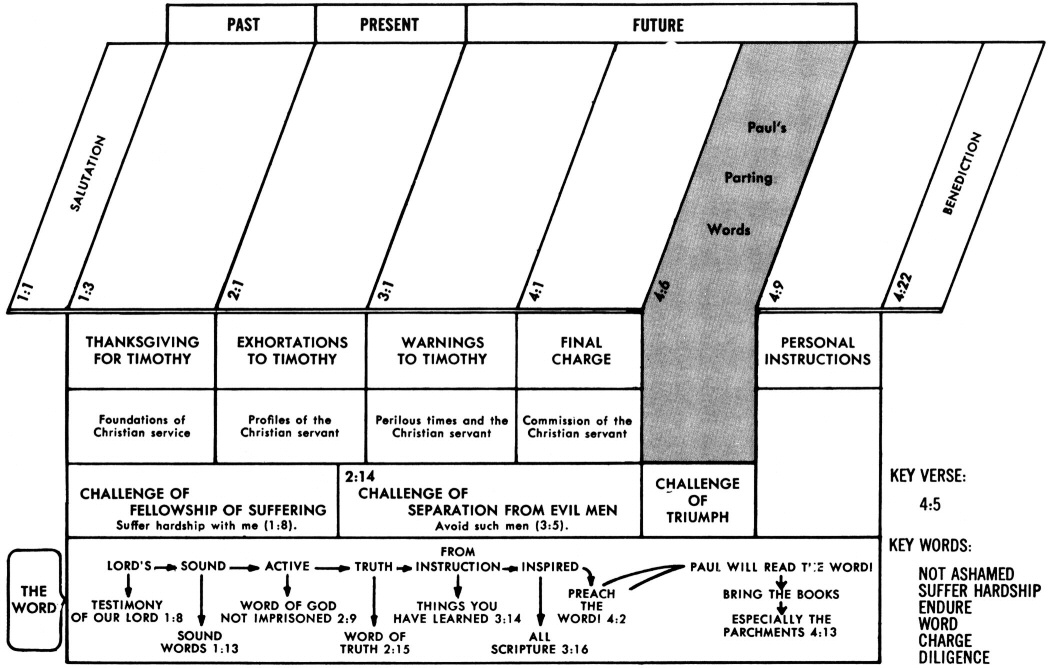
ENDURANCE AND SEPARATION IN THE MINISTRY
Click chart to enlarge
Charts from Jensen's Survey of the NT - used by permission
Second Timothy - Swindoll
| 2 TIMOTHY | |||
| 2 Timothy 1:1-18 | 2 Timothy 2:1-26 | 2 Timothy 3:1-17 | 2 Timothy 4:1-22 |
| Retain the Standard |
Rightly Divide the Word |
Difficult Times Will Come |
Preach the Word |
| PAST | PRESENT | FUTURE | |
| Foundation of Christian Service |
Pictures of Christian Servant |
Dangerous Times for Christian Servant |
Commission of Christian Servant |
| Unashamed as a Witness: Guard the Gospel |
Unashamed as a Workman: Suffer for the Gospel |
Adequate as a Workman: Continue in the Gospel |
Awarded as a Workman: Preach the Gospel |
| Power of the Gospel |
Perseverance of the Gospel Message | Protection of the Gospel |
Proclamation of the Gospel |
| Reminder | Requirements | Resistance | Requests |
| Encouragement in Ministry |
Examples in Ministry |
Exhortations in Ministry |
Exhortations to Fulfill Ministry |
| Commendation & Charge |
Commission to Fulfill |
Conflict to Face |
Course to Finish |
|
Compiled from Jensen's Survey of the NT and Wilkinson's Talk Thru the Bible |
|||
2 Timothy 2:3 Suffer hardship (2SAAM) with me, as a good soldier of Christ Jesus. (NASB: Lockman)
Greek: sugkakopatheson ( 2SAAM ) os kalos stratiotes Christou Iesou.
Amplified: Take [with me] your share of the hardships and suffering [which you are called to endure] as a good (first-class) soldier of Christ Jesus. (Amplified Bible - Lockman)
Barclay: Accept your share in suffering like a fine soldier of Christ Jesus. (Westminster Press)
KJV: Thou therefore endure hardness, as a good soldier of Jesus Christ.
NLT: Endure suffering along with me, as a good soldier of Christ Jesus. (NLT - Tyndale House)
Phillips: Put up with your share of hardship as a loyal soldier in Christ's army. (Phillips: Touchstone)
Wuest: Take your part with others in enduring hardships as a good soldier of Christ Jesus.
Young's Literal: thou, therefore, suffer evil as a good soldier of Jesus Christ;
SUFFER HARDSHIP WITH ME: sugkakopatheson (2SAAM):
- 2 Timothy 2:10; 1:8; 3:11; 4:5; 1Cor 13:7; 2Cor 1:6; Heb 6:15; 10:32; 11:27; 12:2;3 James 1:12
- 2 Timothy 2 Resources - Multiple Sermons and Commentaries
- 2 Timothy 2:3-7 Embracing Hardship for Gospel - Steven Cole
- 2 Timothy 2:1-4 Advice to a Young Disciple - Study Guide - 4 studies in dropdown - John MacArthur
- 2 Timothy 2:3-7: Elements of a Strong Spiritual Life 2 - John MacArthur
Other translations = Take your share of suffering (NET), take your share of hardship (Vine), Endure hardship with us (NIV), Share in the troubles that we have (ICB), Bear your share of hardship along with me (NAB), Be ready to do without the comforts of life (BBE).
Suffer hardship with me (4777) (sugkakopatheo from the combination of sun= together, with [speaks of intimate relation] + kakós = evil [of a soldier = cowardly] + patheo = suffer) means to suffer what is bad, to suffer ill treatment, to endure persecution, to suffer misfortune, to be in sorry case, - and to do all of these together with another. This compound verb is found only in here and in 2 Timothy 1:8. where Paul commands Timothy to "join with (him) in suffering for the gospel according to the power (dunamis) of God." (Click for discussion of 2Ti 1:8)
The basic meaning of kakopatheo in use from Homer onwards is that of experiencing something which originates from outside of an individual and which affects that individual, either for good or ill.
NIDNTT writes that the related root word "pascho originally meant nothing more than “to be affected by”, but how one was affected had to be expressed by additional words, e.g. kakos paschein, to be in a bad situation (Homer, Od. 16, 275); eu paschein, to be in a good situation (Sophocles, OC 1489). However, since such additions tended to be negative, the vb. itself came to have a negative meaning, unless there were clear indications to the contrary. Thus the idea of being affected is replaced by that of suffering... In most cases it is a matter of being delivered up to an adverse fate or to malevolent gods and men (Diogenes Laertius, 5, 61; Diodorus Siculus, 13, 98, 2), and only rarely refers to enduring a punishment." (Brown, Colin, Editor. New International Dictionary of NT Theology. 1986. Zondervan)
Larry Richards writes that this word group (pascho, patheo, etc) "in Greek culture expressed the view that humanity is afflicted with experiences that are beyond our control and yet cause us physical and mental anguish. (Richards, L O: Expository Dictionary of Bible Words: Regency)
Paul is saying "Timothy be willing to take your share of rough treatment with me."
Suffer is not a suggestion but a command - the aorist tense and imperative mood together convey a sense of urgency, and even ring out like a sharp military command. The idea of the aorist imperative is "Do this now! Do it effectively!"
Wuest comments that the aorist imperative "is a sharp command given with military snap and curtness...How we in the ministry of the Word (Ed note: and in some sense every believer falls into this category) need that injunction today. What “softies” we sometimes are, afraid to come out clearly in our proclamation of the truth and our stand as to false doctrine, fearing the ostracism of our fellows, the ecclesiastical displeasure of our superiors, or the cutting off of our immediate financial income. I would rather walk a lonely road with Jesus than be without His fellowship in the crowd, wouldn’t you? I would rather live in a cottage and eat simple food, and have Him as Head of my house and the Unseen Guest at every meal, than to live in royal style in a mansion without Him. (Wuest, K. S. Wuest's Word Studies from the Greek New Testament: Eerdmans)
As an aside just try to obey this command in your own strength!!! You can't. God didn't mean for you to obey it in your power. His indwelling Spirit energizes us and gives us not only the desire to obey but the power to obey. (See Php 2:13NLT-note) See a more detailed discussion of this topic and listing of all the commands of the NT - All the Commands.
The pronoun me is not in the original Greek but is inferred from the preposition with in the verb sugkakopatheo. By the use of this compound verb (especially sun = with) Paul assures his young protégée Timothy that he will not suffer alone (cf note 1 Peter 5:9). Paul is not asking anything of Timothy that he was not willing to experience himself.
In some of his last written words, Paul uses the root kakopatheo commanding Timothy to endure hardship (see note 2Timothy 4:5)
This idea of suffering for one's faith is foreign to most believers in Western Christianity and it's easy to forget that the Christian life entails continual warring against the forces of evil. Paul wanted young Timothy to have no illusions but to understand that being faithful to the truth, unwilling to twist it or compromise it for personal gain, and constantly preaching it even against threat of persecution would inevitably lead to suffering. This truth is well known to those who have come to faith in countries where conversion is punishable by imprisonment, beating and even death.
All of this truth should come as no surprise for Jesus warned His disciples of the certain warfare declaring that "If the world (kosmos [word study]= represents the self-centered, godless value system of fallen mankind which loves sin and error and hates truth and holiness) hates you, you know that it has hated Me before it hated you. If you were of the world, the world would love its own; but because you are not of the world, but I chose you out of the world, therefore the world hates you. Remember the word that I said to you, 'A slave is not greater than his master.' If they persecuted Me, they will also persecute you; if they kept My word, they will keep yours also. But all these things they will do to you for My name's sake, because they do not know the One who sent Me. (John 15:18-21)
Every true believer is in a sense in "active service" and must expect some measure of ill-treatment, even as every soldier does.
John MacArthur - It is difficult for Christians in most of the Western world to understand what serious spiritual warfare and suffering for Christ mean. The secular environment in our society is becoming more and more hostile to Christianity and to religion in general. But we are not faced with loss of job, imprisonment, and execution because of our faith. With few exceptions, being a Christian will not keep a student out of college or a worker from getting a good job. But the more faithful a Christian becomes and the more the Lord blesses his work, the more Satan will put roadblocks, hardships, and rejection in the way, the more evident the spiritual warfare will become, and the more frequent and obvious the hardship will become." Chrysostom wrote that "It behooves thee not to complain if thou endure hardness; but to complain if thou dost not endure hardness. (MacArthur, J. 2 Timothy. Chicago: Moody Press)
Felix Neff - A Christian without affliction is only like a soldier on parade.
Too often Christianity is presented to non-believers as the cure to all anxieties, difficulties, and trials and this so-called "gospel" can result in false disciples and/or false expectations. The essence of Paul's invitation still rings true "Take up your armor and join me in a lifelong struggle against the world, the flesh, and the devil."
A fruitful Christian life, inevitably, is accompanied by intense spiritual warfare and opposition. Paul wanted to encourage young Timothy to stand strong, as he himself had done for so long. Did Timothy obey? Paul answers this himself writing later that
you followed (closely, side by side) my teaching, conduct, purpose, faith, patience, love, perseverance, persecutions, and sufferings... (2Ti 3:10, 11-note)
The writer of Hebrews has an interesting entry near the close of the letter recording "Take notice (present imperative) that our brother Timothy has been released, with whom, if he comes soon, I shall see you. (Heb 13:23-note)!
Timothy surely would have been familiar with the attributes of Roman soldiers and Plummer notes Timothy would have understood that Paul's charge was no small matter but that it involved "self-sacrifice, endurance, discipline, vigilance, obedience, ready co-operation with others, sympathy, enthusiasm, loyalty.'
Larry Richards writes that to suffer hardship as a good soldier means that "An easy life, distractions from our goal, these are all to be rejected. We’re to pick up our packs, and march through life as men and women on a mission." (Richards, L. The 365 Day Devotional Commentary. Wheaton, Ill.: Victor Books. 1990 )
Just as the Roman legionnaires suffered hardship in the service of the Emperor for temporal hardship for temporal gain, even more should be the willingness and desire of the Christian soldier in the service of the King of kings to suffer temporal hardship for eternal gain!
A willingness to accept an assignment to suffer is the sure mark of a good soldier of Christ Jesus.
In a parallel passage on the call of disciples to suffer hardship Luke records that after Paul and Barnabas
had preached the gospel to that city and had made many disciples, they returned to Lystra and to Iconium and to Antioch, strengthening the souls of the disciples, encouraging them to continue in the faith, and saying, "Through many tribulations (thlipsis) we must enter the kingdom of God." (Acts 14:21, 22)
Spurgeon - Paul does not appear to have pictured true believers as sluggards sound asleep upon the downiest beds. His description of a Christian in the text is that of a soldier, and that means something very different either from a religious fop whose best delight is music and millinery, or a theological critic who makes a man an offender for a word, or a spiritual glutton who cares for nothing but a lifelong enjoyment of the fat things full of marrow, or an ecclesiastical slumberer who longs only for peace for himself. He represents him as a soldier—and that, I say, is quite another thing. For what is a soldier? A soldier is a practical man, a man who has work to do, and hard, stern work. He may sometimes when he is at his ease wear the fineries of war, but when he comes to real warfare he cares little enough for them. Truly to serve God, really to exhibit Christian graces, fully to achieve a life work for Christ, actually to win souls—this is to bear fruit worthy of a Christian. A soldier is a man of deeds and not of words. He has to contend and fight. In wartime his life knows little of luxurious ease. In the dead of night, perhaps, the trumpet sounds to boot and saddle, just at the time when he is most weary, and he must go to the attack just when he would best prefer to take his rest in sleep. The Christian is a soldier in an enemy’s country, always needing to stand on his watchtower, constantly to be contending, though not with flesh and blood, with far worse foes—namely, with spiritual wickedness in high places. Paul does not exhort Timothy to be a common or ordinary soldier, but to be a “good soldier of Jesus Christ.” All soldiers, and all true soldiers, may not be good soldiers. There are men who are just soldiers and nothing more; they only need sufficient temptation and they readily become cowardly, idle, useless and worthless. But he is the good soldier who is bravest of the brave, courageous at all times, who is zealous, does his duty with heart and earnestness. He is the good soldier of Jesus Christ who, through grace, aims to make himself as able to serve his Lord as shall be possible, who tries to grow in grace and to be perfected in every good word and work, that he may be in his Master’s battles fit for the roughest and sternest service and ready to bear the very brunt of the fray. David had many soldiers, and good soldiers too, but you remember it was said of many, “He did not come up to the three” (2 Sam 23:19). Now Paul, if I read him rightly, would have Timothy try to be of the first three, to be a good soldier.
FISHING IN A TUB - Endure hardness, as a good soldier of Jesus Christ - The other day I read about a man who decided that his weekly fishing excursion was costing him too much money and causing him too much work. Therefore he purchased a large washtub, filled it with water, placed it under a shade tree in his backyard, pulled up a comfortable lawn chair and started his fishing. It seemed like a great idea. He thought of the money he was saving, and of the fact that he was no longer weary from hooking and unhooking his boat and loading and unloading his motor. He was also avoiding the bother of toting a gasoline can, tackle box, and supply of bait. Often he caught as many fish out of the tub as he did when he worked so hard on the lake or stream! (Exactly nothing!) However, this business of fishing in a tub gradually lost its appeal. He never felt the tingle of excitement that comes when the bobber disappears and a sudden tug is felt on the line. He also missed the fact that he no longer could tell stories to his friends about the large fish he caught, or the larger one that got away. Finally, he decided that although fishing in a tub is cheaper and easier, it is not nearly as rewarding as going to a lake or stream.
Christians who are primarily concerned with relaxation and ease will soon find that life without discipleship and zealous service is not very rewarding. It's like fishing in a tub! Paul knew this, so he exhorted Timothy to endure hardness like a good soldier, to strive to excel like a determined athlete, and to toil patiently like a faithful farmer. This is the kind of Christian life that pays dividends and produces inner joy and satisfaction. Only thus can one know the thrill of being a true "fisher of men" and of bringing a needy soul to Jesus Christ! (Our Daily Bread, Copyright RBC Ministries, Grand Rapids, MI. Reprinted by permission. All rights reserved)
Fishers would you be of men?
Cut loose every shoreline then;
Listen to the Master speak:
"Launch out! Launch out into the deep!"— J. Oatman, Jr.
If you are not "FISHING,"
you are not properly FOLLOWING the Lord!
Help Wanted! - Perhaps the most effective advertisement ever written appeared in a London newspaper early in the 20th century: "Men wanted for hazardous journey. Small wages, bitter cold, long months of complete darkness, constant danger. Safe return doubtful." Those were the words written by Sir Ernest Shackleton, the famous South Pole explorer.
Commenting on the overwhelming response he received, Shackleton said, "It seemed as though all the men in Great Britain were determined to accompany us."
Shackleton's words remind me of Jesus' words in Matthew 16:24, "If anyone desires to come after Me, let him deny himself, and take up his cross, and follow Me." The Lord was calling people to go with Him on a hazardous journey—the way of the cross. He issued that call after telling His disciples that He was going to Jerusalem to suffer and be killed.
Through the centuries, thousands have responded to Jesus' words by forsaking all to follow Him. But unlike Shackleton's expedition that came to an end, the Lord's work goes on and volunteers are still needed. He continues to call for those who will serve Him regardless of the cost.
Have you answered His call?— Richard De Haan (Our Daily Bread, Copyright RBC Ministries, Grand Rapids, MI. Reprinted by permission. All rights reserved)
Never came the call more clear,
Midst the storms of hate and fear,
Jesus' love to show in this world of woe;
For His grace is ever near. —Loes
A faith that costs nothing
and demands nothing is worth nothing.
AS A GOOD SOLDIER OF CHRIST JESUS: os kalos stratiotes Christou Iesou :
- Click for description of "Good Soldier" in Josephus, Gibbon's Decline and Fall of the Roman Empire, et al
- Torrey's Topic "Saints Compared To" ~ Metaphors for saints
- 2Cor 10:3, 4, 5 Eph 6:11-18; 1Ti 1:18 1Cor 9:7; Php 2:25
- 2 Timothy 2 Resources - Multiple Sermons and Commentaries
- 2 Timothy 2:3-7 Embracing Hardship for Gospel - Steven Cole
- 2 Timothy 2:1-4 Advice to a Young Disciple - Study Guide - 4 studies in dropdown - John MacArthur
- 2 Timothy 2:3-7: Elements of a Strong Spiritual Life 2 - John MacArthur
The Metaphors of St Paul by John Saul Howson (1868)
- Chapter 1 - Roman Soldiers
- Chapter 2 - Classical Architecture
- Chapter 3 - Ancient Agriculture
- Chapter 4 - Greek Games
See in depth study (sermons, notes, illustrations, hymns, etc) on A Good Soldier
Other Translations = as a loyal soldier (TEV), as a good (first-class) soldier (AMP), as one of the army of Christ Jesus (BBE)
Paul informs us in Ephesians that all believers are involved in a spiritual battle "against the schemes (methodeia [word study] > English "method" = orderly logical effective arrangement usually in steps - our mortal enemy is very organized and methodical - Look out!) of the devil". Paul goes on to remind us that our "struggle is not against flesh and blood, but against the rulers, against the powers, against the world forces of this darkness, against the spiritual forces of wickedness in the heavenly places." The need of the hour for every "good soldier" of the Lord is to "take up the full armor of God, that you may be able to resist in the evil day, and having done everything, to stand firm." (Ep 6:11; 12; 13-see notes Ep 6:11; 12; 13)
All believers must recognize that the Christian life is not a playground; but a battlefield where battles are being won and lost in real spiritual battles. Ultimately Christ Jesus has was victorious over the powers of darkness at Calvary, but in the meantime He has left us here and called us to be "good soldiers".
Thanks be to God, Who gives us the victory through our Lord Jesus Christ. (1Cor 15:57)
Good (2570) (kalos [word study]) does not refer to that which is superficial or cosmetic but to what is genuinely and inherently good, organically healthy, fit, useful, serviceable. Another Greek word, agathos is used generally for what is good and useful, especially moral goodness in relation to God who is perfect.
Although kalos can be used as a synonym with agathos, kalos tends to stress more the aesthetic aspect, and stands for beautiful, fine, free from defects. When applied to acts, kalos means noble, praiseworthy. In secular Greek writings a suitable kalos was used to refer to a suitable harbour (Homer); a healthy body (Plato); pure, genuine gold (Theognis) and an unblemished sacrifice (Xenophon). Kalos came to mean that which was aesthetically beautiful. Finally the meaning of kalos broadened to include the sense of morally good.
NIDNTT adds that "in the course of the history of Greek thought, the concept kalos achieved an inclusive meaning, linked with taxis (order) and symmetria (symmetry). In this context kalos came to mean “the total state of soundness, health, wholeness and order, whether in external appearance or internal disposition. For the Greek., then, the term applies particularly to the world of the divine” (W. Grundmann, kalos TDNT III 537). (Brown, Colin, Editor. New International Dictionary of NT Theology. 1986. Zondervan)
Paul is urging Timothy to be a fit, useful soldier (4757) "of Christ Jesus", this latter phrase indicating that Timothy was not his own but belonged to Christ Jesus and was His to engage in spiritual warfare for Him. Roman troops were a model of discipline, and because of that discipline, they were unbeatable. In a greater, grander degree we as Christian soldiers who are obedient to our Commander and empowered by His grace are even more than conquerors through Christ.
Soldier (4757)(stratiotes from stratia = an army, cp strateuomai = to make war) in the majority of NT uses refers to a man (or men) engaged in military service; one whose occupation is military; a man enlisted for service in an army; a private, or one in the ranks. Stratiotes is used metaphorically in 2Ti 2:3. Surprisingly stratiotes is not used in the Septuagint (it is in the Apocrypha - 2 Macc 5:12; 14:39; 3 Macc 3:12; 4 Macc 3:7, 12; 17:23)
New International Bible Dictionary - In the earlier times, every man above the age of twenty was a soldier (Num 1:3); and each tribe formed a regiment, with its own banner and its own leader (2:2; 10:14). Up until the time of David, the army consisted entirely of infantry (1 Sam 4:10; 15:4), the use of horses having been restrained by divine command (Deut 17:16).
Vine - Soldier (4757 — Noun Masculine — stratiotes — strat-ee-o'-tace ) "a soldier," is used (a) in the natural sense, e.g., Matthew 8:9; 27:27; 28:12; Mark 15:16; Luke 7:8; 23:36; six times in John; thirteen times in Acts; not again in the NT; (b) metaphorically of one who endures hardship in the cause of Christ, 2 Timothy 2:3 (Soldier - Vine's Expository Dictionary of NT Words )
Stratiotes - 26x in 24v - Matthew 8:9 "For I also am a man under authority, with soldiers under me; and I say to this one, 'Go!' and he goes, and to another, 'Come!' and he comes, and to my slave, 'Do this!' and he does it."
Matthew 27:27 Then the soldiers of the governor took Jesus into the Praetorium and gathered the whole Roman cohort around Him.
Matthew 28:12 And when they had assembled with the elders and consulted together, they gave a large sum of money to the soldiers,
Mark 15:16 The soldiers took Him away into the palace (that is, the Praetorium), and they called together the whole Roman cohort.
Luke 7:8 "For I also am a man placed under authority, with soldiers under me; and I say to this one, 'Go!' and he goes, and to another, 'Come!' and he comes, and to my slave, 'Do this!' and he does it."
Luke 23:36 The soldiers also mocked Him, coming up to Him, offering Him sour wine,
John 19:2 And the soldiers twisted together a crown of thorns and put it on His head, and put a purple robe on Him;
23 Then the soldiers, when they had crucified Jesus, took His outer garments and made four parts, a part to every soldier and also the tunic; now the tunic was seamless, woven in one piece.
24 So they said to one another, "Let us not tear it, but cast lots for it, to decide whose it shall be"; this was to fulfill the Scripture: "THEY DIVIDED MY OUTER GARMENTS AMONG THEM, AND FOR MY CLOTHING THEY CAST LOTS."
32 So the soldiers came, and broke the legs of the first man and of the other who was crucified with Him;
34 But one of the soldiers pierced His side with a spear, and immediately blood and water came out.
Acts 10:7 When the angel who was speaking to him had left, he summoned two of his servants and a devout soldier of those who were his personal attendants,
Acts 12:4 When he had seized him, he put him in prison, delivering him to four squads of soldiers to guard him, intending after the Passover to bring him out before the people.
6 On the very night when Herod was about to bring him forward, Peter was sleeping between two soldiers, bound with two chains, and guards in front of the door were watching over the prison.
18 Now when day came, there was no small disturbance among the soldiers as to what could have become of Peter.
Acts 21:32 At once he took along some soldiers and centurions and ran down to them; and when they saw the commander and the soldiers, they stopped beating Paul.
35 When he got to the stairs, he was carried by the soldiers because of the violence of the mob;
Acts 23:23 And he called to him two of the centurions and said, "Get two hundred soldiers ready by the third hour of the night to proceed to Caesarea, with seventy horsemen and two hundred spearmen."
31 So the soldiers, in accordance with their orders, took Paul and brought him by night to Antipatris.
Acts 27:31 Paul said to the centurion and to the soldiers, "Unless these men remain in the ship, you yourselves cannot be saved."
32 Then the soldiers cut away the ropes of the ship's boat and let it fall away.
42 The soldiers' plan was to kill the prisoners, so that none of them would swim away and escape;
Acts 28:16 When we entered Rome, Paul was allowed to stay by himself, with the soldier who was guarding him.
2 Timothy 2:3 Suffer hardship with me, as a good soldier of Christ Jesus.
As a good soldier named Joshua learned, Christ (Messiah) Jesus is the Commander of the army of the LORD (Josh 5:14 NKJV) and in recognition of His Commander's authority, "Joshua fell on his face to the earth and worshiped and said to Him "What does my Lord say to His servant?
Joshua's response should be the attitude of all who would be known by the glorious title "good soldier" -- "What do You command Your servant, my Lord?" (NRSV)
Christ Jesus is our Commanding Officer, and we owe total obedience to Him!
Paul knew the characteristics of good Roman soldiers. When Claudius Lysias (see Acts 23:1-35) ordered Paul to go to Caesarea for a government trial, two hundred soldiers, two hundred spearmen, and seventy horsemen from the Roman army formed his personal escort! He was also chained to a Roman soldier night and day for two whole years. Paul was also chained to a soldier even as he wrote these words and so he understood how good soldiers behaved, and how they obeyed the commanding officer. And thus Paul calls on Timothy and all "recruits" of Christ to endeavor to be good soldiers.
MacArthur adds that "a spiritual Christian does not simply do minimum duty for his Lord, Christ Jesus, but serves Him with everything he is and has." (MacArthur, J. 2 Timothy. Chicago: Moody Press)
Timothy would be familiar with "soldier language" because in the first epistle Paul had used the military term command (paraggello [word study] from para = side + anagello = declare) 12 times (1Co 7:10; 11:17; 1Th 4:11; 2Th 3:4, 6, 10, 12; 1Ti 1:3; 4:11; 5:7; 6:13, 17).
Paraggello in the ancient world meant to transmit a message or order from one to another and when it was a military command it demanded that the subordinate obey the order without hesitation. The idea inherent in paraggello is found in our word "subpoena" where the refusal to obey makes the recipient liable to punishment.
Paraggello was also used of a doctor’s prescription or instruction to the patient, the failure to obey having potentially serious effects.
Every example of paraggello conveys the idea of binding the recipient or hearer to make the proper response or else!
As the spiritual leader in the church, Timothy was expected to give the soldiers under him God’s “marching orders” and so Paul commanded Timothy to...
Prescribe (paraggello; KJV, NIV = command and present imperative = is a command to keep on "prescribing" or "commanding") and teach these things" (1Timothy 4:11-note)
I charge (paraggello) you in the presence of God, Who gives life to all things, and of Christ Jesus, Who testified the good confession before Pontius Pilate, that you keep the commandment without stain or reproach until the appearing of our Lord Jesus Christ. (1Ti 6:13 14)
As Warren Wiersbe quipped "If the men and women in the armed forces treated their orders with the same carelessness the average Christian treats God’s Word—they would probably all be court martialed!"
C. L. Feltoe - SOLDIERS. Throughout the Roman Empire, and especially in a praetorian province like Syria, of which the various divisions of Palestine practically formed part, soldiers were a common sight, and took a prominent share in the administration of affairs. The references to them, however, in the Gospels, except, as is natural, in connexion with our Lord's trial and crucifixion, are not numerous.
1. In Luke 3:14 we read of soldiers who came to John the Baptist and asked him what they were to do. The word here is στρατευόμενοι (not στρατιται ) and implies that they were on active service at the time. They can hardly have been Roman legionaries, but may have been members of Herod Antipas' army engaged in some local expedition, of which we know nothing, or even, as Ewald supposes, only a kind of police or gendarmes employed in custom-house duties. The Baptist's answer to their inquiry shows what the temptations of such folk were in those days. They must be careful, he says, henceforth not to do violence or extort money by false accusations, and to be content with their pay.
2. In Matthew 8:9 and Luke 7:8 the centurion (no doubt a proselyte, though a Roman officer; cf. Acts 10:1 ) who desired to have his servant healed, speaks of the soldiers who were under his command, and, in contrast to (1) above, his remarks bring out forcibly the idea of discipline and organization, which was to be found in a Roman legion.
3. The armies ( στρατόπεδα) that would encircle Jerusalem in the fatal siege of Titus (a.d. 70) are referred to in Luke 21:20 (cf. Luke 19:43 ).
4. In the parable of the Marriage of the Kingâs Son ( Matthew 22:1 ff.) we read of the armies (στρατεύματα) which the king sent to avenge the murder of his servants.
5. After the trial before Pilate, when our Lord had been scourged and condemned to be crucified, Pilate's soldiers on duty took Him into their own quarters, and, gathering the whole band together, proceeded to treat Him with the grossest insults and mockery ( Matthew 27:27 , Mark 15:16 , John 19:2). And during the long hours of crucifixion He had to endure similar maltreatment from the soldiers who were in charge (Luke 23:36; cf. Matthew 27:48 , John 19:29 ). It is recorded also (John 19:23-24 ) how they parted His garments among them (see Coat and Quaternion); and further that, when the end had come, finding He was already dead, they refrained from breaking His legs, as Pilate had ordered, before taking Him down; but one of them with a spear pierced his side, and forthwith there came out blood and water (John 19:32; John 19:34 ).
6. Lastly, soldiers were keeping guard at the sepulchre when the Resurrection took place ( Matthew 27:65 f., Matthew 28:11-13; see Watch). (Soldiers - Hastings' Dictionary of the New Testament)
See resources for more on what characterized a good "soldier"...
- Three Kinds of Soldiers - Ten Principles of Warfare
- The Roman Soldier (Gibbon's Decline & Fall of the Roman Empire)
- The Roman Soldier - Description from Josephus
- A Few Soldier Stories & Sermons
- Roman Soldiers - by J S Howson
- Soldier - Bridgeway Bible Dictionary
- Soldier - Holman Bible Dictionary
- Soldier - Hastings' Dictionary of the Bible
What else characterizes a "good" Roman soldier ?
Roman soldiers were bound to service through a long term, took a solemn oath, were never to desert their standard (the golden eagle), were to submit their will to the commands of the leaders, were to sacrifice their life for the safety of the Emperor, received excellent pay, were constantly involved in military exercises regardless of age or weather conditions, exercised with weights double those used in actual warfare, cultivated the science of tactics, were able to advance 20 miles in 6 hours even with their baggage until they met the enemy. Soldiers were not allowed to marry during their term of service and were to be strictly devoted to their service for over twenty years but only about half survived to retire.
Spurgeon - A truly good soldier of Jesus Christ knows nothing about difficulties except as things to be surmounted. If his Master bids him perform exploits too hard for him, he draws upon the resources of omnipotence, and achieves impossibilities. Wellington sent word to his troops one night, “Ciudad Rodrigo must be taken tonight.” And what do you think was the commentary of the British soldiers appointed for the attack? “Then,” they all said, “we will do it.” So when our great Captain sends, as He does to us, the word of command, “Go into all the world and preach the gospel to all creation” (Mark 16:15), if we were all good soldiers of the cross, we should say at once, “We will do it.”
Alexander Maclaren has written that "In Paul's time there were no standing armies, but men were summoned from their ordinary avocations and sent into the field. When the hasty call came forth, the plough was left in the furrow, and the web in the loom; the bridegroom hurried from his bride, and the mourner from the bier. All home industries were paralyzed while the manhood of the nation were in the field."
C Campbell Morgan has an interesting note for those of us who have never suffered through a global war: "This word of Paul took on new meaning for many of us during the years of the Great War (WWI). Indeed, today it seems to some of us as though we had never seen it at all before. Of course, we had seen it, and we had given it a certain conventional interpretation. Our thinking, however, of what was included in the phrase "the affairs of this life," was very superficial in many cases. We thought of certain liberties and comforts, which the soldier is denied; and, of course, that thinking was correct so far as it went. We needed the stern and awe-inspiring experiences of those dread years to enable us to apprehend the full content of the phrase. Now we know that nothing is left out. The soldier on active service breaks with everything except the War. We saw them go in millions, leaving father, mother, brother, sister, wife, and lover; we saw them march away from promising careers, loved occupations, high ambitions, and the finest things of responsibility. Nothing was permitted to entangle them, to hinder them, or in any way to interfere with the one thing. This new understanding has brought a new revelation of the claims which our Lord's campaign makes upon us. He only asks His people to do what the sons of the commonwealth did, grudgingly. Does not the consideration bring a sense of shame with it? How often those who should constitute the sacramental host of God have played at war! May God forgive us, and give us another chance! And if in His grace He will, may we be worthy of it!" (Morgan, G C: Life Applications from Every Chapter of the Bible. page 326, 1926). (Bolding added)
William Barclay commenting on why Paul may have used the metaphor of a soldier writes The picture of man as a soldier and life as a campaign is one which the Romans and the Greeks knew well. "To live," said Seneca, "is to be a soldier" (Seneca: Epistles 96: 5). "The life of every man," said Epictetus, "is a kind of campaign, and a campaign which is long and varied" (Epictetus: Discourses, 3, 24, 34). Paul took this picture and applied it to all Christians, but specially to the leaders and outstanding servants of the Church. He urges Timothy to fight a fine campaign (1 Timothy 1:18). He calls Archippus, in whose house a Church met, our fellow soldier (Philemon 1:2 ). He calls Epaphroditus, the messenger of the Philippian Church, "my fellow soldier", (Philippians 2:25). Clearly Paul saw in the life of the soldier a picture of the life of the Christian. What then were the qualities of the soldier which Paul would have repeated in the Christian life?
(i) The soldier's service must be a concentrated service. Once a man has enlisted on a campaign he can no longer involve himself in the ordinary daily business of life and living; he must concentrate on his service as a soldier. The Roman code of Theodosius said: "We forbid men engaged on military service to engage in civilian occupations." A soldier is a soldier and nothing else; the Christian must concentrate on his Christianity. That does not mean that he must engage on no worldly task or business. He must still live in this world, and he must still make a living; but it does mean that he must use whatever task he is engaged upon to demonstrate his Christianity.
(ii) The soldier is conditioned to obedience. The early training of a soldier is designed to make him unquestioningly obey the word of command. There may come a time when such instinctive obedience will save his life and the lives of others. There is a sense in which it is no part of the soldier's duty "to know the reason why." Involved as he is in the midst of the battle, he cannot see the over-all picture. The decisions he must leave to the commander who sees the whole field. The first Christian duty is obedience to the voice of God, and acceptance even of that which he cannot understand.
(iii) The soldier is conditioned to sacrifice. A. J. Gossip tells how, as a chaplain in the 1914-18 war, he was going up the line for the first time. War and blood, and wounds and death were new to him. On his way he saw by the roadside, left behind after the battle, the body of a young kilted Highlander. Oddly, perhaps, there flashed into his mind the words of Christ: "This is my body broken for you." The Christian must ever be ready to sacrifice himself, his wishes and his fortune, for God and for his fellow-men.
(iv) The soldier is conditioned to loyalty. When the Roman soldier joined the army he took the sacramentum, the oath of loyalty to his emperor. Someone records a conversation between Marshal Foch and an officer in the 1914-18 war. "You must not retire," said Foch, "you must hold on at all costs." "Then," said the officer aghast, "that means we must all die." And Foch answered: "Precisely!" The soldier's supreme virtue is that he is faithful unto death. The Christian too must be loyal to Jesus Christ, through all the chances and the changes of life, down even to the gates of death. (Barclay, W: The Daily Study Bible)
Rienecker - "The Roman soldier -- always ready to faithfully obey his commander without grumbling or complaining; constantly in training whatever hardships must be endured; never leaving his post even if it meant death; working with his company as a unit, carrying out his specific task...received praise from his commander and was rewarded for his service. (Rogers, C L - originally by Fritz Rienecker: New Linguistic and Exegetical Key to the Greek New Testament. Zondervan. 1998)
The respected Jewish historian Josephus noted that "each soldier every day throws all his energy into his drill, as though he were in action. Hence that perfect ease with which they sustain the shock of battle: no confusion breaks their customary formation, no panic paralyzes, no fatigue exhausts them. All their camp duties are performed with the same discipline, the same regard for security: the procuring of wood, food-supplies, and water, as required—each party has its allotted task; nothing is done without a word of command. The same precision is maintained on the battlefield; nothing is done unadvisedly or left to chance. This perfect discipline makes the army an ornament of peace-time and in war welds the whole into a single body; so compact are their ranks, so alert their movements, so quick their ears for orders, their eyes for signals, their hands to act upon them. None are slower than they in succumbing to suffering. (Josephus: Wars of the Jews: 3. 72-107 )
A good measure of all worldly activities is...
Does it (whatever "it" represents) entangle me?
Have you become entangled in "Civilian" Affairs?
Matthew Henry writes that "The soldiers of Jesus Christ must approve themselves good soldiers, faithful to their captain, resolute in his cause, and must not give over fighting till they are made more than conquerors, through him that loved them, Ro 8:37 (note). Those who would approve themselves good soldiers of Jesus Christ must endure hardness; that is, we must expect it and count upon it in this world, must endure and accustom ourselves to it, and bear it patiently when it comes, and not be moved by it from our integrity." (2 Timothy 2 - Matthew Henry's Complete Commentary on the Bible)
Dwight L. Moody did not want his song leader Ira Sankey to use “Onward Christian Soldiers” in their evangelistic meetings. It was all right for Sankey to have the crowd sing “Hold the Fort, for I Am Coming” but not “Onward Christian Soldiers.” Why? Well, Mr. Moody thought that the church as he knew it did not look or act like an army of Christian soldiers, and maybe he was right.
A. A. Harmer tells the story "During the Crimean War a young chaplain, newly arrived in camp, inquired of a Christian sergeant the best method for carrying on his work, among the men. The sergeant led him to the top of a hill and pointed out the field of action. "Now, sir," said he, "look around you. See those batteries on the right, and the men at their guns. Hear the roar of the cannon. Look where you will, all are in earnest here. Every man feels that this is a life and death struggle. If we do not conquer the Russians the Russians will conquer us. We are all in earnest here, sir; we are not playing at soldiers. If you would do good, you must be in earnest; an earnest man always wins his way." Such was the advice of Queen Victoria’s servant to the servant of King Jesus." (A. A. Harmer. Biblical Illustrator)
Ramsey has the following notation on soldiers writing that "The Roman soldier, marching under the colors of his regiment, was marching under the standard of idolatry, for the standards (signa) were all divine, and worship was paid to them by the soldiers as a duty of the service, and all contained one or more idolatrous symbols or representations; moreover he was frequently required, standing in his place in the ranks, to take part in idolatrous acts of worship. The soldier could not retire and take to some other way of life, for he was bound to the service through a long term of years. Here, again, the rule and practice of the Church seems to have been that in ordinary circumstances the converted soldier should remain passive, and as far as possible silent, during the ceremony at which he was compulsorily present, but should not actively protest."
The Jewish historian Josephus gives us a clue as to why Roman soldiers were so dominant in war writing that "their military exercises differ not at all from the real use of their arms, but every soldier is every day exercised (the Greek verb = gymnazo), and that with great diligence, as if it were in time of war which is the reason why they bear the fatigue of battles so easily." (Josephus, F. The Works of Josephus. Wars 3.73)
An Example of a Good Soldier - William Wilberforce's Source of Strength - When wanting to faint after years of fighting against slave trade William Wilberforce leaned upon the Lord for his strength. On his forty-first birthday, as he rededicated himself to his calling, he prayed, “Oh Lord, purify my soul from all its stains. Warm my heart with the love of Thee, animate my sluggish nature and fix my inconstancy, and volatility, that I may not be weary in well doing.” (Neh 8:10, Isa 40:31, Gal 6:9, Eph 3:16, Col 1:11, 2 Tim 2:1 ) (Amazing Grace in the Life of William Wilberforce - Desiring God) (Peculiar Doctrines, Public Morals, and the Political Welfare - Desiring God)
Here is the introduction to chapter 8 in Warren Wiersbe's highly recommended book BE WHAT YOU ARE --
A Soldier in God’s Army - Dwight L. Moody did not want his song leader Ira Sankey to use “Onward Christian Soldiers” in their evangelistic meetings. It was all right for Sankey to have the crowd sing “Hold the Fort, for I Am Coming” but not “Onward Christian Soldiers.” Why? Well, Mr. Moody thought that the church as he knew it did not look or act like an army of Christian soldiers, and maybe he was right.
However, the Apostle Paul often used military imagery in his letters; and, thanks to the ever-present Roman legions, those images were very meaningful to the recipients of his epistles. No doubt today there are believers in totalitarian nations who understand some of these references better than do the believers living in free countries.
Mr. Moody had a Quaker background, and Quakers are traditionally nonmilitant. But even Moody would have to admit that there is definitely a military side to what the Bible teaches about God and the Christian life. “The Lord is a man of war!” sang Moses and his people after they had crossed the Red Sea (Exod. 15:3). “The Lord strong and mighty,” sang David, “the Lord mighty in battle”(Ps 24:8). Even our Savior is pictured as a conqueror riding a white horse (Ps. 45:3–7; Rev. 19:11–21).
Of course, we must remember that the Christian’s warfare is in the realm of the spiritual (Eph. 6:10–12), and we should use only spiritual armor and spiritual weapons in our battles (Eph. 6:13–18; 2 Cor. 10:3–5). Peter tried to use a sword to defend the Lord, and Jesus severely rebuked him (John 18:10–11). At Pentecost, Peter used the “sword of the Spirit” and turned three thousand enemies into brothers. That’s the way to do battle.
Using Paul’s admonitions to Timothy as the basis for our study, let us examine a number of topics and see what it means today to be a “Christian soldier.”
For the remainder of Wiersbe's description of a Christian soldier see the following sections (I give just the first paragraph of each - click the links for the full discussion - BORROW THE BOOK IF THESE DO NOT WORK)...
1. The Soldier’s Enlistment - Whether we like it or not, we were “drafted” when we trusted Jesus Christ as our Savior and were born again into the family of God. Every child of God is a soldier in God’s army, either a good one or a bad one. In fact, the very first mention of the church in the New Testament (Matt. 16:18) includes the military image of conflict: “And the gates of hell shall not prevail against it.” It is the picture of an army storming the gates and conquering the city.
2. The Soldier’s Enablement - We have no strength of our own, so we must “be strong in the grace that is in ChristJesus” (2 Tim. 2:1). This does not mean that we neglect basic training and maneuvers, because every believer wants to be at his best for his Lord. The expression, “Exercise thyself rather unto godliness” (1 Tim. 4:7) suggests that the soldier has to do his part if he is to keep in shape. The point is that we don’t depend on our own strength, experience, or expertise. We depend on God’s grace.
3. The Soldier’s Enlightenment - The training manual for the Christian soldier is the Word of God. “And the things that thou hast heard of me among many witnesses, the same commit thou to faithful men, who shall be able to teach others also” (2 Tim. 2:2).
4. The Soldier’s Entanglement - “No one serving as a soldier gets involved in civilian affairs—he wants to please his commanding officer” (2 Tim. 2:4, NIV). I read about a Civil War soldier who had been a watchmaker in civilian life and set himself up in business in his camp, repairing watches and earning extra money. One day the bugle blew and his company was ordered to be ready to move within the hour.
5. The Soldier’s Encouragement - The Christian life is not easy. There are many battles and our enemy is extremely powerful and subtle. Sometimes the dedicated Christian soldier feels like he or she is standing alone. What kind of encouragement do we have from the Lord? The greatest encouragement is that Jesus Christ has already won the fight and we need only follow him by faith. We are not fighting for victory but from victory. “But thanks be to God, who always leads us in triumphal procession in Christ and through us spreads everywhere the fragrance of the knowledge of him” (2 Cor. 2:14, NIV). “I can’t do it!” the watchmaker lamented. “I have too much work to do and I’ll lose my customers!” Before we criticize him, let’s examine our own lives and find out what kind of situation we would be in if the trumpet were to blow and God’s soldiers were called up.
6. The Soldier’s Equipment - The key text here is Ephesians 6:10–18 where “the whole armor of God” is described. The purpose of this armor is to enable the soldier to “stand” before the battle (v. 11), “withstand” during the battle (v. 13), and “stand” after the victory (v. 14). The first is defensive and the second is offensive, and both are important.
"Paul does not exhort Timothy to be a common, or ordinary soldier, but to be a "good soldier of Jesus Christ"; for all soldiers, and all true soldiers, may not be good soldiers..."
(1) "Must be loyal to his King... " A soldier of Jesus Christ owns the divine Redeemer as his King, and confesses his sole and undivided sovereignty in the spiritual kingdom.
(2) "Obedient to his captain’s commands...." Are we doing all the Master’s will?...The soldier who did not take the trouble to read the orders of his superior, might justly be suspected of mutinous intentions. Disobedience rankles in any heart where there is carelessness about knowing the Lord’s will. Be courageous enough always to look Scripture in the face. It is after all nothing more than your bare duty.
(3) "To conquer will be his ruling passion..." The passion for victory with the soldier often makes him forget everything else. Before the battle of Waterloo, Picton had had two of his ribs smashed in at Quatre Bras, but he concealed this serious injury, and, though suffering intensest agony, he rode at the head of his troop, and led one of the greatest charges which decided the fortunes of the day. He never left his post, but rode on till a ball crushed in his skull and penetrated to the brains. Then in the hot fight the hero fell." ...To be a good soldier of Jesus Christ, there must be a passion for victory, an insatiable greed for setting up the throne of Jesus in the souls of men.
(4) "A good soldier is very brave at a charge." When the time comes and the orders are given for the good soldier to advance to the attack, he does not wish himself away; though a perfect hail of hurtling shot whistles all around, and the ranks of the army are thinned, he is glad to be there, for he feels the stern joy that flushes the face in the light of battle, and he only wants to be within arm’s length of the foe and to come to close quarters with him. So is it with the genuine Christian when his heart is right with God. If he be bidden to advance, let the danger be what it may, he feels he is honored by having such a service allotted to him. But are we all such? I fear not. How many of us are silent about Jesus Christ in private conversation, how little do we show forth our light before men. If we were good soldiers, such as we ought to be, we should select every favorable opportunity in private as well as in public intercourse with our fellow men, and prudently but yet zealously press the claims of Jesus Christ and his gospel upon them. Oh, do you this, beloved, and good will come of it....My beloved, may you and I be ready for anything, and bold to bear witness for Christ before a scoffing world. In the pulpits where we preach, in the workshops where we labor, in the markets where we trade, in every company amidst which we are called to move; wherever we may be, may we be brave enough to own our Lord and to uphold his cause.
(5) "A good soldier is like a rock under attack." So British soldiers have been; they have stood in solid squares against the enemies’ cavalry until their foes have dashed upon them madly, gnashed their teeth, fired in their faces, thrown their guns at them, and yet might just as well have ridden against granite rocks; for our soldiers did not know how to yield, and would not retreat; as fast as one fell another filled up the gap, and there stood the square of iron defying the rush of the foe. We want this kind of fixed, resolved, persevering Godliness in our churches, and we shall have it if we are good soldiers of Jesus Christ. Alas! too many are exhausted by the zeal at first exhibited; for a time they can reach the highest point, but to continue on, and on, and on, this is too difficult a task for them. How many young people will join the church, and for awhile seem very zealous and then grow cold! Alas! it is not always the young, there be some among yourselves who were once most diligent in your various forms of service; what doth hinder you that you are not diligent in your Master’s business now? Has Christ given you leave to retire into inglorious ease? Does he exempt you from service? Take heed lest you are also exempt from reward. No, we must through life still maintain our integrity, still resist temptation, still tread the separated path, and, withal, still seek the souls of men with undying ardor, with indefatigable earnestness, still wrestling with God for men and with men for God. Oh, for more of this stern determination to stand, and having done all to stand!
(6) "He derives his strength from on high." This has been true even of some common soldiers, for religious men when they have sought strength from God have been all the braver in the day of conflict....Often has my soul said to her Captain, “My Lord, I will do that work if thou wilt give me a grip of thy conquering right hand.” Oh, what power it puts into a man when he gets a grip of Christ, and Christ gets a grip of him! Fellowship with Christ is the fountain of the church’s strength. Her power did never lie in her wealth, nor in the eloquence of her preachers, nor in aught that comes of man; the strength of the church is divine, and if she fails to draw strength from the everlasting hills, she becomes weak as water. Good soldiers of Jesus Christ, watch unto prayer, “praying in the Holy Ghost,” for so shall you be strong in the Lord, and in the power of his might." (Click Spurgeon's full sermon)
2 Timothy 2:4 No soldier (continuously) in active service (PMPMSN) entangles (3SPPI) himself in the affairs (civilian affairs) of everyday life, so that he may please (3SAAS) the one who enlisted (AAPMSD) him as a soldier. (NASB: Lockman)
Greek: oudeis strateuomenos (PMPMSN) empleketai (3SPPI) tais tou biou pragmateiais, hina to stratologesanti (AAPMSD) arese; (3SAAS)
Amplified: No soldier when in service gets entangled in the enterprises of [civilian] life; his aim is to satisfy and please the one who enlisted him. (Amplified Bible - Lockman)
Barclay: No soldier who is on active service entangles himself in ordinary civilian business; he lays aside such things, so that by good service he may please the commander who has enrolled him in his army. (Westminster Press)
KJV: No man that warreth entangleth himself with the affairs of this life; that he may please him who hath chosen him to be a soldier.
NLT: And as Christ's soldier, do not let yourself become tied up in the affairs of this life, for then you cannot satisfy the one who has enlisted you in his army. (NLT - Tyndale House)
Phillips: Remember: That no soldier on active service gets himself entangled in business, or he will not please his commanding officer (Phillips: Touchstone)
Wuest: No one when engaged in military service allows himself to become involved in civilian pursuits, in order that he may please the one who enlisted him as a soldier.
Young's Literal: no one serving as a soldier did entangle himself with the affairs of life, that him who did enlist him he may please
NO SOLDIER IN ACTIVE SERVICE ENTANGLES HIMSELF IN THE AFFAIRS OF EVERYDAY LIFE: oudeis strateuomenos (PMPMSN) empleketai (3SPPI) tais tou biou pragmateiais:
- See Torrey's Topic "Self Denial"
- Dt 20:5, 6, 7; Lk 9:59, 60, 61, 62, 4:10; Lk 8:14; 1Co 9:25-note, 1Co 9:26-note 1Ti 6:9;10, 11, 12 2Pe 2:20-note
- 2 Timothy 2 Resources - Multiple Sermons and Commentaries
- 2 Timothy 2:3-7 Embracing Hardship for Gospel - Steven Cole
- 2 Timothy 2:1-4 Advice to a Young Disciple - Study Guide - 4 studies in dropdown - John MacArthur
- 2 Timothy 2:3-7: Elements of a Strong Spiritual Life 2 - John MacArthur
See related studies:
as Christ's soldier, do not let yourself become tied up in the affairs of this life (NLT),
No one when engaged in military service allows himself to become involved in civilian pursuits, (Wuest),
Whoever serves in the military doesn’t get mixed up in non-military activities (GWT),
Every one who serves as a soldier keeps himself from becoming entangled in the world’s business (Weymouth),
he does not waste his time doing the things that most people do (ICB)
No (3762) (oudeis) means no one, nothing, none at all and particularly places emphasis on not even one!.
Some believers think they can be a Christian but not have to fight as a soldier but they are deceiving themselves, for all believers are on "the front line" whether they realize it or not. Those Christians who do not realize the intent or intensity of the real spiritual war are essentially "asleep at the post" a dangerous position to be in!
See Wayne Barber on Spiritual Warfare, Torrey's Topic "Warfare of the Saints" for a good Scriptural review of this important doctrine "in order that no advantage be taken of us by Satan...we are not ignorant of his schemes [2 Cor 2:11]
See list of articles on site related to Spiritual Warfare
Spurgeon - So Timothy, as a Christian minister, is to act as the Roman soldier did. It was a law in Rome that no soldier was to plead in court for another as a lawyer, or to act in business for another as a bailiff, or to have anything to do, while a soldier, with either husbandry or merchandise. And so should it be with the men of God who have to preach the Word—and every Christian, indeed! Though he meddles with common things, he is to take care that he is not entangled by them, not to be caught, as it were, as game is entangled in a net. There is a way, you know, of making the actions of common life subservient to the purposes of divine grace. This is the Christian’s business; let him take care that he is not entangled with the cares of this life.
Soldier in active service (4754) (strateuo or strateuomai from strategos = army, stratos = an encamped army) means literally to perform military service, serve as a soldier in the army, go to fight, carry on a military campaign, make a military expedition, lead soldiers to war or to battle.
Most of the NT uses are figurative, two speaking of believers "waging war" (not according to the flesh, 2Cor 10:3-note; fighting the good fight, 1 Ti 1:18) and two speaking of moral enemies that continually wage war against us (pleasure in James 4:1, fleshly lusts in 1Pe 2:11-note)
Wuest adds that strateuomai means to "to make a military expedition, to do military duty, be on active service, to be engaged in warfare."
Strateuomai is in the present tense indicating that this active service is to be a lifestyle, not an occasional endeavor.
Strateuomai is used 3 times in the Septuagint (LXX) (Judges 19:8, 2Sa 15:28, Isa 29:7). Here is a representative use "Isaiah 29:7 And the multitude of all the nations who wage war (Lxx = related derivative verb epistrateuo) against Ariel, Even all who wage war (Hebrew = tsaba = wage war; Lxx = strateuomai) against her and her stronghold, and who distress her, Shall be like a dream, a vision of the night.:
There are 7 uses in the NT...
Luke 3:14 And some soldiers were questioning him, saying, "And what about us, what shall we do?" And he said to them, "Do not take money from anyone by force, or accuse anyone falsely, and be content with your wages."
1 Corinthians 9:7 Who at any time serves as a soldier at his own expense? Who plants a vineyard, and does not eat the fruit of it? Or who tends a flock and does not use the milk of the flock?
2 Corinthians 10:3 For though we walk in the flesh, we do not war according to the flesh,
1 Timothy 1:18 This command I entrust to you, Timothy, my son, in accordance with the prophecies previously made concerning you, that by them you may fight the good fight,
2 Timothy 2:4 No soldier in active service entangles himself in the affairs of everyday life, so that he may please the one who enlisted him as a soldier.
James 4:1 What is the source of quarrels and conflicts among you? Is not the source your pleasures that wage war in your members?
1 Peter 2:11 (note) Beloved, I urge you as aliens and strangers to abstain from fleshly lusts, which wage war (present tense) against the soul. (Comment: Take careful note of the tense - fleshly lusts will be ambushing us and trying to trip us up until we see Jesus face to face.)
The point is that a good soldier in active service does not have a 9 to 5 job but is on duty (and needs to be alert) around the clock, "7x24". All that the soldier is belongs to the military in which he serves. A soldier on active duty is always a soldier. He can't call a "time-out" in the middle of battle. As we have seen in recent wars in the Middle East, Afghanistan, Iraq, etc, even when the soldier is on leave, he is still subject to recall without notice. Whenever he is ordered into dangerous duty, he is expected to put his life on the line without question or hesitation. This picture emphasizes the total commitment necessary in order to be a good soldier.
Expositors - Military service involves self-sacrifice, endurance, discipline, vigilance, obedience, ready co-operation with others, sympathy, enthusiasm, loyalty. (2 Timothy 2 Expositor's Bible Commentary)
William Kelly - No doubt (for a Roman soldier) furlough might allow of relaxation, and completed service, (a time) of perfect liberty; but to Christ’s servant here below is NO furlough and NO discharge from his duty.
As Solomon writes "there is no discharge in the time of war." (Eccl 8:8)
How would your "military service" be evaluated?
Are you AWOL?
Are we acting like children playing "toy soldiers"?
Active service calls for rigorous self discipline (1Ti 4:7; 4:8; 4:9; 10-notes 1Ti 4:7; 4:8; 4:9; 4:10;cf Ec 9:10) and unquestioning obedience (see Jn 14:15, 1Sa 15:22, 23). A good soldier must have a steady intake of the "solid food" of truth who by practice train his or her senses (He 5:14-note) to distinguish between the "good and evil", between "good" and the "best", constantly striving to choose the Commander's priority.
Either perpetual warfare
or
Perpetual preparation
Plummer observes that "Military service implies vigilant, unwearying and organized opposition to a vigilant, unwearying, and organized foe.... Military service is either perpetual warfare or perpetual preparation for it. And just such is the Christian life: it is either a conflict, or a preparation for one. The soldier, so long as he remains in the service, can never say, “I may lay aside my arms and my drill: all enemies are conquered; there will never be another war.” And the Christian, so long as he remains in this world, can never think that he may cease to watch and to pray, because the victory is won, and he will never be tempted any more. It is for this reason that he cannot allow himself to be “entangled in the affairs of this life." (Plummer, Alfred: 2 Timothy) (Bolding added)
C. Garret - "You cannot be a saint on Sundays and a sinner in the week; you cannot be a saint at church and a sinner in the shop; you can not be a saint in Liverpool and a sinner in London. You cannot serve God and Mammon. You are a soldier everywhere or nowhere, and woe to you if you dishonour your King."
Albert Barnes - He "wars a good warfare" who is engaged in a righteous cause; who is faithful to his commander and to his post; who is unslumbering in observing the motions of the enemy, and fearless in courage in meeting them; who never forsakes his standard, and who continues thus faithful till the period of his enlistment has expired, or till death." (Barnes' Notes on the New Testament)
F B Meyer - "It is good to begin, but it is better to keep on steadily to the end. It is much when the young soldier, well equipped for battle, steps out into the early dawn, with the light shining upon his weapons, but it is more important far, if, in the late afternoon, he is found standing in the long thin line, resisting the perpetual onset of the foe. We are told of Daniel, that he "continued" (Da 1:21-note). This, perhaps, is the greatest tribute to him, that through decades he did not swerve from his loyalty to God, or devotion to the high interests which were committed to his charge. The men that are steadfast in their loyalty to truth, in their prosecution of duty, in their holding the post assigned to them by the providence of God, are those which leave the deepest impression on their contemporaries. It is not the flash of the meteor which the world really wants, but the constant radiance of the fixed star. What though the storm beats in your face, and every effort is made to dislodge you, though it seems as if you were forgotten in that lone post of duty, still stand fast: the whole situation may depend upon your tenacity of purpose, the campaign may be decided by your holding your ground without flinching. If the Master has put you as a light on the cellar stair, never desert that post because it is lonely and distasteful, and because the opportunity of service comes rarely. To be found doing your duty at the unexpected moment, when His footfall is heard along the corridor, will be a reward for years of patient waiting." (Meyer, F B: Our Daily Walk) (Bolding added)
ARE YOU INVOLVED IN THE WORLD
OR ENTANGLED BY IT?
Entangles (1707) (empleko from en = in + pléko = tie, braid, twist - pléko is used of the Roman soldiers "weaving a crown of thorns" to mock Jesus in Mt 27:29) literally means to weave in, and so to intertwine. In general empleko means to interconnect closely and so to wrap or twist together and thus entwine, intertwine, braid, entangle and finally to be caught in.
Empleko described a person entangled in his garments or a person who is caught in some type of vine. Empleko described a runner whose garments had entangled his legs, hindering his ability to run in such a way as to win (Cp Heb 12:1-note, 1Cor 9:24-27-note). Empleko was used to describe sheep whose wool was caught in thorns.
Figuratively empleko means to become involved in an activity to the point of interference with other activities or objectives. Become enchanted with. In the present context empleko signifies, especially, entanglement in something hindering and obstructing. Rick Renner adds that "By using this word, Paul tells us that, as committed Christians, we don’t have the privilege of getting too involved or intertwined with matters that are relatively unimportant in light of eternity."
Empleko is in the present tense (continually) and may be either middle or passive voice. The middle voice signifies one entangles himself, the idea being that the subject initiates the action (in this case getting entangled) and participates in the "fruit" thereof (not easily separated)! Empleko in the passive voice means subject is acted upon by outside force, in this case the everyday affairs of the world, which serve to entangle him. In either case, John gives us a divine "antidote" - "Do not love the world or the things in the world!" (1Jn 2:15-note) He did not say we could not have or enjoy some of the things of the world, but the danger is when we begin to love them, especially to love them more than we love Jesus, for then we will surely be entangled by them (whatever they are - hobbies, sports, jobs, etc). Do not be deceived beloved. This is an inviolable spiritual principle! "Jesus did not pray that His Father would take Christians out of the world, but that He would take the world out of Christians (cp Jn 17:17)." (Blanchard)
Related Resource:
Empleko is used only once in the (non-apocryphal) LXX in Proverbs 28:18 = The NAS reads "He who walks blamelessly will be delivered, But he who is crooked will fall all at once. (Pr 28:18) The English translation of the Septuagint reads "where "He that walks justly is assisted: but he that walks in crooked ways shall be entangled therein."
The related noun emploke (1708) is used in 1Peter 3:3-note to describe hair which was braided, plaited (in ornamentation) or intertwined.
Twist together (weave) is the root verb pleko (4120) meaning to plait, to braid, to intertwine, to weave together, twist together, e.g., "ivy intertwined with acanthus," "plaited fish baskets," "rope", metaphorically in secular Greek = "complication." Pleko is used 3 times in the NT, first by Matthew who writes "And after twisting together (weaving - pleko) a crown of thorns, they put it on His head, and a reed in His right hand; and they knelt down before Him and mocked Him, saying, “Hail, King of the Jews!” (Matt 27:29, Mk 19:2, Jn 19:2) As a side note, the soldiers placing the crown of thorns on his head were unwittingly symbolizing God's curse on humanity (Ge 3:18)! It is also interesting that this same verb (pleko) is used in the Septuagint in Isaiah 28:5 of another "crown," but this crown is not the object on His head, but is a description of the King (Jesus) Himself (Lxx = "the woven crown of glory") in that great future day when He returns to set up His millennial kingdom and rule as King of kings and Lord of lords. Amen (Rev 19:16, cp Rev 17:14)! See derivative empleko (1707) = entangle.
Webster defines entangle - To twist or interweave in such a manner as not to be easily separated! To make confused or disordered; as, thread, yarn or ropes may be entangled; to, entangle the hair. To involve in any thing complicated, and from which it is difficult to extricate one’s self; as, to entangle the feet in a net, or in briars. To be entangled implies one is distracted (diverted from his main goal, having his attention drawn to a different object!)
Service as a Christian soldier calls for wholehearted devotion.
It is notable that empleko is similar in sound to our English word “implicate” which means to bring into intimate or incriminating connection
The only other use of empleko is by Peter who warns of the danger of “becoming entangled” or “being entrapped” in the defilements or corruption of the fallen world system which is opposed to God. -"For if, after they have escaped the defilements of the world by the knowledge of the Lord and Savior Jesus Christ, they are again entangled in them and are overcome, the last state has become worse for them than the first." (2Peter 2:20-note)
Vincent - The same metaphor occurs in Aeschylus (“Prometheus”): “For not on a sudden or in ignorance will ye be entangled (empleko) by your folly in an impervious net of Ate (destruction).”
Empleko refers to the act of getting so involved in something that one becomes restricted and controlled, no longer free to do what one should do.
Liddell and Scott write that empleko was used in secular writing meaning "to entwine one's hand in another's clothes, so as to hold him."
Peter Lange - Amongst the ancients, the unnatural combination of one line of activity with another was forbidden by positive laws. Ambros. De Offic., libr. 1, says: “He who fights for the Imperator, is prohibited by human laws from litigation, the pursuit of forensic affairs, the sale of merchandise.” The sole calling of the soldier is that, through the faithful performance of his duties, he please the commander, the commander-in-chief.
BDAG's lexicon has a picturesque definition of empleko stating that it means "to be involuntarily interlaced to the point of immobility" and was used "literally of sheep whose wool is caught in thorns" and of the "hares (rabbits) who are caught in thorns; Aesop's Fables." (2) to become involved in an activity to the point of interference with other activity or objective = be involved in. (Arndt, W., Danker, F. W., & Bauer, W. A Greek-English Lexicon of the New Testament and Other Early Christian Literature)
Thomas Brooks - The stars which have least circuit are nearest the pole; and men whose earths are least entangled with the world are always nearest to God and to the assurance of His favor.
ARE YOU INVOLVED OR ENTANGLED? - "This is not to say that we are not to be INVOLVED in the affairs of every day living; but rather that we are not to the ENTANGLED in them. The word for entangle (empleko) was used often of a sheep whose wool was caught in the thorns. This helps illustrate the main difference between INVOLVEMENT AND ENTANGLEMENT. One is entangled when he is not free to get loose! When the affairs of this life hem us in so tightly that we can't get loose to fulfill Christ's desires, then we have become entangled in the thorns of non-eternal pursuits. (Ed comment: When the affairs of this life hem us in so tightly that we can't get loose to fulfill our Captain's commands, then we have become entangled in the "thorns" of non-eternal pursuits. The world's pleasures can easily entwine us especially in hedonistic America!) How easy this can happen in the materialism and hedonism of modern America! Almost before we realize it, our souls are seduced away from the path of discipleship until we find ourselves tangled up in the allurements and pleasures of modern society. We must continually resurrect in our minds the things which will still be standing long after the breath of God has swept all other non-eternal entities into oblivion! This seems like a heavy responsibility; yet it also carries with it a heavier reward: "that he may please Him Who enlisted him as a soldier." What enjoyment or pleasure from this world could even hope to compare itself with the indescribably thrill and satisfaction of hearing the words, "Well done, you good and faithful servant. . . " coming forth from the lips of the One Who breathed eternity into existence. To hear those precious words and to see the Master's smile is certainly worth any sacrifice we may be called upon to make as a soldier of the cross." (Dwight Edwards)
Warren Wiersbe - Identification with the world and its needs is one thing; imitation of the world and its foolishness is quite another.
Spurgeon - So Timothy, as a Christian minister, is to act as the Roman soldier did. It was a law in Rome that no soldier was to plead in court for another as a lawyer, or to act in business for another as a bailiff, or to have anything to do, while a soldier, with either husbandry or merchandise. And so should it be with the men of God who strove to break the Word, and every Christian indeed, though he meddleth with common things, is to take care that he be not entangled by them, not to be caught, as it were, as game is entangled in a net. There is a way, you know, of making the actions of common life subservient to the purposes of divine grace. This is the Christian’s business; let him take care that ‘he be not entangled with the cares of this life.
John Calvin - The mind of a Christian ought not to be filled with thoughts of earthly things, or find satisfaction in them, for we ought to be living as if we might have to leave this world at any moment.
Thomas Guthrie - If you find yourself loving any pleasure better than your prayers, any book better than the Bible, any house better than the house of God, any table better than the Lord’s table, any person better than Christ, any indulgence better than the hope of heaven—take alarm!
Vance Havner - If you stand on the Word you do not stand in with the world....Many Christians are still in the wilderness, longing for garlic instead of grace, melons instead of manna!....The path of the Word and the path of the world do not run parallel.....We cannot have a heavenly fellowship if we allow a hindering fellowship.....We must deal with the carnalities if we desire the spiritualities.
Philip Schaff notes that Paul's warning is "not against engaging in, secular callings, but against so ‘entangling’ ourselves in them that they hinder the free growth of our higher life." (2 Timothy 2 - Schaff's Popular Commentary on the New Testament)
Everett - The word “entangle” implies that a person can get into bondage to the cares of this world without really intending to do so. Some habits have a way of getting a grip on a person’s life so that he is not able to get loose and be free to serve the Lord any longer. There are a lot of things that we can do in life, but most of this entertainment and business has no eternal value. The sign of a mature Christian is seen in their interests. They have set their affects on things above, and not on the things of this earth. We should find God’s plan for our lives and focus on that plan. The cares of this world, called here the affairs of life, are like a snare or a trap. Jesus used a similar analogy in the Parable of the Sower (Mk 4:18–19). “And these are they which are sown among thorns; such as hear the word, And the cares of this world, and the deceitfulness of riches, and the lusts of other things entering in, choke the word, and it becometh unfruitful.” (Study Notes on the Holy Scriptures)
Chuck Smith on do not be entangled - And that's our problem so often. As Jesus said, "(In the last days) Be on guard, so that your hearts will not be weighted down with dissipation and drunkenness and the worries of life, and that day will not come on you suddenly like a trap." (Luke 21:34). Catch you unaware. Jesus is talking about how thorns grew up with wheat. Identifying the thorns, He said the desire for riches, the cares of this life and the desires of other things choke out the fruitfulness of the Gospel within their life. So the cares of this life can choke out the fruitfulness. No man who is in war, no man who has signed up for the army is to get involved in the little mundane things of life. Hey, I"m in a battle and I can"t get bogged down with the cares of this life."
Laansma - The things for Timothy that would amount to being “tied up in the affairs of civilian life” can scarcely be limited to inherently immoral things. Rather Paul likely had in mind anything—even something otherwise morally acceptable—that distracted from Timothy’s particular responsibility to the Good News (cf. Mt 8:18–22; Acts 6:1–7; 1Cor 7:26–34), especially things that go with “getting on in the world.” A misapplication of this principle has certainly contributed to the mocking accusation that some servants of the gospel are “so heavenly minded that they are no earthly good.” Paul cannot be blamed for this. He was by no means forgetting his own emphasis on public good works (2Ti 2:21; 3:17; cf. Titus 2:14). We may not use the gospel as an excuse for disinterest in very earthly justice, mercy, and faithfulness (Matt 23:23) or for indolence (2Th 3:6–15). But it is also true that the mocking accusation of being “too heavenly minded” can represent a misevaluation of the world (see Jn 6:26–27). It is appropriate to be oriented to heaven and the age to come, but this does not make sense to a mindset that values the world too highly, a mindset that believers themselves can at times have. The servants of the gospel represent a Kingdom that must finally be described as “heavenly” (4:18), and the sacredness and urgency of the call to discipleship in its proclamation requires total allegiance (Matt 4:18–22; 6:19–34; 19:16–30; 28:16–20; 1Cor 7:29–34). What that looks like for each individual varies (John 21:22). (Cornerstone Biblical Commentary, Volume 17: 1 Timothy, 2 Timothy, Titus, and Hebrews)
Huther - The literal interpretation, according to which the apostle or preacher should take no concern whatever in civil affairs, is contradicted by Paul’s own example; according to the precept here given, he is to avoid them only when they are a hindrance to the duties of his office. (Critical and Exegetical Handbook to the Epistles of St. Paul to Timothy and Titus, 1881, T&T Clark)
THE CHOICE:
PERIPHERALS OR PRIORITIES
A man entangled with this world is ill-prepared for the next one.
Black - Like a soldier, a Christian leader must resist the distractions that would make peripherals seem like priorities. The cost of leadership is full devotion to duty and full attention to the task at hand. This holy detachment does not make the Christian culturally, politically, or economically irrelevant. The idea is not to look away from the issues of the day but to look beyond them to Christ, who is eternally relevant. (1 & 2 Timothy, Titus, Philemon: a commentary for bible students, Wesleyan Publishing House)
Guthrie explains that empleko "envisages a soldier's weapons entrammelled (hampered or obstructed by entangling) in his cloak. The main point is therefore the renunciation of everything which hinders the real purpose of the soldier of Christ. There is nothing intrinsically wrong, in other words, about civilian affairs until they entangle. Then they must be resolutely cast aside. (Guthrie, Donald . 2 Timothy).
Empleko was also used of weaving or braiding the hair. This latter picture reminds us of Samson, a strong soldier, who lost his power because he got entangled with Delilah at first lying to her saying that "If you weave the seven locks of my hair with the web and fasten it with a pin, then I shall become weak and be like any other man." (Judges 16:13-note)
Lot was a lot like Samson, for he LOOKED at Sodom (Ge 13:10), then pitched his tent "TOWARD Sodom" (NIV "near Sodom" Ge 13:12), and finally was "LIVING IN Sodom" (Ge 14:12). Little by little, Sodom began to move INTO Lot and entangle him to the point that he did not please the Lord, eventually costing him dearly. (Ge 19:15ff). Don't we all have a "lot" of Lot in us?
Empleko pictures a soldier's sword becoming so entangled in his cloak that he is unable to defend himself in battle! The position of the soldier demands detachment from all that would hinder his wholehearted obedience to the call of His commander. James would call a soldier who entangles himself "a double-minded man, unstable in all his ways." (James 1:8-note) Like a single-minded soldier, we should respond to the orders of our commanding officer, the Lord Jesus, with unquestioning and immediate obedience.
Deuteronomy 20:5, 6, 7, 8 warns a man not to go to war if there are unsettled affairs in his life. The battle is serious and a soldier cannot be distracted by entanglements of business or family affairs.
Plummer observes that the Christian soldier "has a duty to perform “in the affairs of this life,” but in doing it he is not to be entangled in them. They are means, not ends; and must be made to help him on, not suffered to keep him back. If they become entanglements instead of opportunities, he will soon lose that state of constant preparation and alertness, which is the indispensable condition of success." (Plummer, Alfred: 2 Timothy). (Bolding added)
Kent Hughes - Single-mindedness, the ability to focus, to shut everything out when necessary, is the key to success in virtually every area of life....But here the focus is not a basketball rim, a flag fluttering on a distant green, or a musical score—it is Christ himself and how to please him. The single-minded disciple is in the world, but he does not get “entangled” (literal translation) in the world. He avoids anything that will hinder single-minded dedication to his Master. Paul put it this way to the Philippians: “But one thing I do: Forgetting what is behind and straining toward what is ahead, I press on toward the goal to win the prize for which God has called me heavenward in Christ Jesus” (3:13, 14). Paul was fervent! Single-minded devotion to a thing (a sport, a philosophy, or a cause) can turn you into a machine. But when it is given to Christ who is perfect God and perfect man, whose commands are consonant with perfect love and wisdom and our highest good, then we become what we ought to be and can stand tall even in suffering.
We must purposely focus on him and willingly join with his followers in suffering hardship like good soldiers of Jesus Christ. Charles Spurgeon expressed the point with such power: "Up, I pray you now. By him whose eyes are like a flame of fire, and yet were wet with tears, by him on whose head are many crowns, and who yet wore the crown of thorns, by him who is King of kings and Lord of lords, and yet bowed his head to death for you, resolve that to life’s latest breath you will spend and be spent for his praise. The Lord grant that there may be many such in this church—good soldiers of Jesus Christ. (1 & 2 Timothy and Titus: to guard the deposit).
Paul's description of the Christian soldier who is not entangled so that he might please his Lord could be summed up with terms like...
Single minded
Whole hearted
Undivided heart
A man of one mind
Singleness of purpose
Bernard in his Pastoral Epistles writes that "Singleness of purpose and detachment from extraneous cares are essential conditions of successful service."
ILLUSTRATION OF SINGLE MINDED FOCUS - "What does it take," someone asked a circus tightrope walker, "to do what you do?" "Three things," he answered. "Raw courage. You commit yourself to begin walking, and then you can't change your mind. Balance. You can't lean too far this way or that. Most of all, concentration. You fix your eyes on that wire, and until it's all over you never shift your attention." He paused. "Never," he said firmly. What consumes you? Where are you going? Have you pinpointed your aim? Does you life have a specific target? It's the look that saves, but it's the gaze that sanctifies.
ILLUSTRATION - Uriah was a great example of NOT ENTANGLING himself in the everyday affairs of the world! – when David had taken his wife Bathsheba and she conceived, to hide it he brought Uriah back from the battle so he’d come home to be with his wife. Instead, Uriah slept at the door of the kings house. The second night David got him drunk, but still Uriah didn’t go home to his wife. Finally David sent him into the heat of battle and had Joab retreat back. Uriah died as a loyal soldier!
ILLUSTRATION - Shortly after joining the Navy, the new recruit asked his officer for a pass so he could attend a wedding. The officer gave him the pass, but informed the young man he would have to be back by 7 p.m. Sunday. “You don’t understand, sir,” said the recruit. “I’m in the wedding.” “No, you don’t understand,” the officer shot back. “You’re in the Navy!”
The Roman code of Theodosius said "We forbid men engaged on military service to engage in civilian occupations."
John Bunyan (Pilgrim's Progress) would undoubtedly refer to a soldier who entangled himself in the everyday affairs of the world as "Mr. Facing-both-ways."
Matthew Henry has an interesting way to describe not entangling oneself "A soldier, when he has enlisted, leaves his calling, and all the business of it, that he may attend his captain’s orders. If we have given up ourselves to be Christ’s soldiers, we must sit loose to this world; and though there is no remedy, but we must employ ourselves in the affairs of this life while we are here (we have something to do here), we must not entangle ourselves with those affairs, so as by them to be diverted and drawn aside from our duty to God and the great concerns of our Christianity. Those who will war the good warfare must sit loose to this world. That we may please him who hath chosen us to be soldiers. Observe, 1. The great care of a soldier should be to please his general; so the great care of a Christian should be to please Christ, to approve ourselves to him. The way to please him who hath chosen us to be soldiers is not to entangle ourselves with the affairs of this life, but to be free from such entanglements as would hinder us in our holy warfare. (Matthew Henry's Commentary on the Whole Bible) (Bolding added)
Guy King writes that the good soldier "must not allow himself to get entangled with civilian interests, when all his energies are supposed to be devoted to the war. He must, for the time, forswear anything, and everything, that would prejudice his soldiering. A like sacrifice must be seen in the soldier of the Cross. He may find that he will have to give up certain things, certain interests, certain habits, certain amusements, even certain friends - not because any of these are wrong in themselves, but because they are a snare, an entanglement, to him; they get in the way of his success as a soldier. He will not criticise his fellow Christians if they find no harm in such matters - it is not his business to criticize; though, when asked, he is free to give his opinion, and to explain the reason for his own avoidance. Anything that interferes with our being the best that we can be for Him is to be sacrificed - however harmless it may be to others, and however attractive it may be to ourselves; even though it be so darling a possession as a hand, or a foot, or an eye, Matthew 18:8-9. Let it be made clear that there are many things in "this life" that, for the Christian soldier, are plain duty, family things, social affairs, business matters, that must be attended to - and done all the better for the very reason that he is a Christian - but the point lies in that word "entangleth": that is where the emphasis rests. When anything, however otherwise legitimate, becomes an entanglement, it must be severely, and sacrificially, dealt with. (2 Timothy 2:1-7 Some Things Every Christian)
ISBE says that entangled illustrates " the process of mental, moral and spiritual confusion and enslavement."
Paul is not prescribing us to separate from the world like a hermit in the desert, but that as His Lord said, we are to be in the world but not of the world. How else could we fight the good fight of faith and proclaim the Gospel if we were not salt and light in a lost world! Paul's charge is for us to give wholehearted devotion to our Commander in Chief, to be single minded in our duty, not distracted and double minded.
The Christian must live in the world, but he must not let the world live in him. A boat in water is by design, but water in the boat is disaster!
Solomon picks up on Paul's warning and exhorts all "soldiers" on active duty to "Watch over (command) (Greek word phulake pictures setting a sentry at the "eye gate" of your heart) your heart with all diligence, for from it flow the springs of life." (NLT translates it "Above all else, guard your heart, for it affects everything you do") (Proverbs 4:23-note)
Paul would add that Christian soldiers "have been approved by God to be entrusted with the gospel" and thus should "speak, not as pleasing men but God, who examines our hearts." (1Thes 2:4-note)
Lea - Paul’s appeal shows the importance of developing an ability to distinguish between doing good things and doing the best things. Servants of Christ are not merely to be well-rounded dabblers in all types of trivial pursuits. They are tough-minded devotees of Christ who constantly choose the right priorities from a list of potential selections. Paul prohibited the loss of single-mindedness and the longing for an easy life. (Lea, T. D., & Griffin, H. P. Vol. 34: 1, 2 Timothy, Titus. The New American Commentary Page 203. Nashville: Broadman & Holman Publishers) (Bolding added)
A great example of a man who did not entangle himself was the Christian song writer and singer, Keith Green. After he died, his wife wrote and entitled his biography "No Compromise," which is certainly a major aspect of avoiding entanglement.
Life Application Bible makes the point that ""Christian workers, whether pastors or laymen, must watch their outside involvements carefully. Business ventures, serving on committees or boards, volunteer assignments, and/or home projects can eat up valuable time and energy"... (and goes on to add the caution that) "Some have taken Paul’s advice to mean that Christians should do nonstop Christian work. While the image of the soldier presents helpful insights about endurance, even soldiers need rest. Wise commanders know their soldiers need breaks from the action. Even when there have been no wounds, the soldier needs relief from the stress of the battle. We must maintain a healthy balance in our lives between spiritual activity and spiritual rest. Pastors, teachers, and other ministers cannot function without times of refreshment. Do you give yourself permission to take time away from work? (Barton, B, et al: The NIV Life Application Commentary Series: Tyndale)
Where would an army be if every soldier had part-time work that took him away from his military duties! Our main task is to please our Commander and Lord—not others and not ourselves.
It was disobedient double-mindedness of one (bad) soldier (Achan) that led to Israel’s defeat at Ai after their great victory at Jericho (Joshua 7:1-26). Joshua had given a clear command to the soldiers to dedicate to God all the spoil from Jericho, but Achan who failed to guard the "eye gate" of his heart, "saw among the spoil a beautiful mantle from Shinar and two hundred shekels of silver and a bar of gold fifty shekels in weight, then" he "coveted them and took them” (Josh 7:21)
Peter Lange emphasizes that Paul, a tent maker, was not saying a Christian should never do secular work writing that "Paul also, while working with his hands, has eaten his own bread (Acts 20:34; 1Cor 4:12; 9:6); and certainly he will not have given this counsel to Timothy unconditionally. But, assuredly, special tact and wisdom are necessary so to manage the inevitable cares and occupations which daily life brings with it, that the cause of the kingdom of God shall be thereby in no way be injured, but rather can gain advantage from their results; as was the case actually with Paul himself, who found occasion, in his own activity, to set forth his example to the community for imitation (see 2Th. 3:6-9)."
Thomas Adams (discussing entangle in 2Pe 2:20) - “They are entangled,” as birds are caught in an evil net; where the more they struggle to get out, the faster they stick.
Melanchthon: “So he wishes the minister of the gospel to serve in his own vocation unreservedly, and not to engage in outside affairs, in political management. Let not the minister of the gospel have one foot in the temple and the other in the curia (any of the ten subdivisions of the Latin, Sabine, or Etruscan tribes; a meeting place of such a subdivision; the senate house of Rome).”
Achan (and his entire family) were stoned and then burned with fire. Israel also reaped a bitter defeat in their first attempt to conquer Ai including the loss of 36 Israelites. Why such tragedy? All because of one unfaithful selfish soldier unwilling to remain unentangled.
The Roman soldier was to avoid all preoccupation with the daily affairs of the marketplace in order to be free to obey without hesitation or hindrance the commander's order. Engaged in a continual spiritual war, the Christian soldier likewise must ever concentrate on his Lord's work and must not devote his time and interests to a business on the side which hinders his faithful performance of his primary responsibility. Paul is not saying that a Christian soldier should have no contact at all with his former friends and surroundings, but that he is not to become caught up and enmeshed in them. Furthermore, Paul does not mean that the Christian worker must never engage in any secular work, for Paul himself was engaged in "tent making" for a living, but it was only a means toward furthering his passion of preaching Christ crucified. What Paul is saying is that the "good soldier" must not allow ordinary affairs of life to become the main object of existence. Instead, the active service for Christ must always occupy the prominent place, while the things of this life are kept in the background.
The active soldier must be on guard against becoming so involved in such pursuits that he no longer feels free to give himself fully to the call of Christian service. Stated another way, a believer's life is not to be wrapped up in the passing pleasures and non-essentials of this life. Because we live on the battlefront continually, all things are to be subservient to winning the battle, remembering that "the battle is the Lord's". (1Sa 17:47)
Christians like soldiers in the field must avoid anything that hampers their effectiveness in battle. Christian soldiers should be so consumed with their duties that they are oblivious to the passing pleasures and enticements of the world like God's servant Moses (He 11:24, 25, 26-note, He 11:27-note).
John reminds us that "the world is passing away, and also its lusts, but the one who does the will of God abides forever." (1Jn 2:17)
Paul advised the Corinthian saints "Those in frequent contact with the things of the world should make good use of them without becoming attached to them, for this world and all it contains will pass away." (New Living Translation paraphrase) (1Cor 7:31)
MacArthur - "Paul is not speaking about things that necessarily are wrong in themselves. It is not that a soldier should have no contact at all with his former friends and surroundings, but that he is not to become caught up and enmeshed in them. Those things are irrelevant to his soldiering and are always subject to being relinquished. In the same way, a good soldier of Christ Jesus refuses to allow earthly matters to interfere with the fulfillment of his duty to his Lord. Many Christians, pastors, special ministries, and doctrinally sound churches have been undermined by concerns and activities that are innocent in themselves but have been allowed to crowd out the primary purpose of serving Jesus Christ in the advancing of His kingdom against the forces of darkness. (MacArthur, J. 2 Timothy. Chicago: Moody Press)
A. Plummer, D. D. - Paul does not suggest that Christians should keep aloof from the affairs of this life, which would be a flat contradiction of what he teaches elsewhere (1 Thessalonians 4:11, 12). He has a duty to perform "in the affairs of this life," but in doing it he is not to be entangled in them. They are means, not ends; and must be made to help him on, not suffered to keep him back. If they become entanglements instead of opportunities, he will soon lose that state of constant preparation and alertness which is the indispensable condition of success. (Not Entangled with the World)
ILLUSTRATION - Paul's point is illustrated by the story of the Civil War soldier who had been a watchmaker in civilian life and set himself up in business in his camp, repairing watches and earning extra money. One day the bugle blew and his company was ordered to be ready to move within the hour. “I can’t do it!” the watchmaker lamented. “I have too much work to do and I’ll lose my customers!”
YOU'RE ENTANGLED WHEN...
YOUR POSSESSIONS POSSESS YOU!
APPLICATION - There is nothing wrong with owning nice things. In fact, God wants to bless us with nice things. But we are not to allow material possessions to become so ingrained in our hearts that they become the central focus of our lives. Our souls, emotions, and desires are not to become so ensnared, entangled, and caught up in the things of the world that we become meshed together with them. How do you know if you’ve become materialistic? How do you know if natural possessions mean too much to you? Well, could you give them up if the Lord asked you to? Or have they become so woven into the very fabric of your life that you are now entangled in them? Only you and the Holy Spirit know the answers to these questions. Do everything in your power to keep the temporal things of this world in the right perspective. Keep them in your hands but out of your heart. Ask the Holy Spirit to show you areas of your life that need to be “untangled” and brought back into balance. Then after He speaks to you, it’s up to you to STAY untangled from those natural affairs of life! (Staying Untangled From the World - Sparkling Gems from the Greek)
Luke 9 gives 3 examples of entanglement in the lives of individuals which impeded their active service in the Lord's army. The first person confidently declared to Jesus ""I will follow You wherever You go."
but Jesus who knew all men's hearts replied
"The foxes have holes, and the birds of the air have nests, but the Son of Man has nowhere to lay His head" indicating that this individual was more concerned with comfort than truly following the Lord.
To another person Jesus said "Follow Me" to which the individual answered with the excuse "Permit me first to go and bury my father."
To which Jesus in turn replied "Allow the dead to bury their own dead; but as for you, go and proclaim everywhere the kingdom of God."
Finally, the third said "I will follow You, Lord; but first permit me to say good-bye to those at home."
But again Jesus made it clear He was not recruiting part-time, half-hearted soldiers answering that "No one, after putting his hand to the plow and looking back, is fit for the kingdom of God." (see Lk 9:57, 58, 59, 60, 61, 62) (See similar idea in Mark 10:28-30; Lk 10:41, 42; 1Cor 7:29–31; Heb 12:1).
Similarly, Jesus taught that “the worry of the world, and the deceitfulness of riches” (Mt 13:22) are some of those affairs of everyday life that can keep an unbeliever from receiving Christ and by extrapolation certainly can keep believers from loyal, single minded service to their Commander-in-chief. Just as the dutiful soldier places his life willingly on the line in service of his country, so the faithful Christian will willingly “deny himself, and take up his cross, and follow” his Captain (Mt 16:24).
A solider has to give up many things; some of them are bad things (pride, independence, self-will), and some of them are good things (his home, his family) - but if he is not willing to suffer hardship, he is not a "good solider of Christ Jesus". The issue doesn’t have to be between “good” or “bad.” Whatever gets in the way of serving our Commanding Officer, and in the way of being a good solider, must be removed. Using a the figure of an individual in a race, the writer of Hebrews gives a similar exhortation that we "lay aside every encumbrance (superfluous bodily weight athletes shed during training), and the sin which so easily entangles us, and...run with endurance the race (agon = fight, conflict) that is set before us." (He 12:1-note)
One race. One war. One life.
Will you fight the good fight?
Will you be willing to lay aside the good in order to experience God's best?
Here is a good barometer by which you can assess every activity --
Does it entangle you?
We are called to be IN in the world but not to be ENTANGLED by it. In His great prayer in John 17, Jesus prayed His disciples "are in the world...(but) "They are not of the world, even as I am not of the world." (Jn 17:11, 16)
One can do many things during wartime, but a faithful soldier does not have the right to do anything that will entangle him and make him less effective as a soldier. A good soldier must put priority on his calling and be completely dedicated to his task and his Commander. When a soldier makes a decision, the big question is not “Is it safe, popular or right" but "Is it what my Commander-in-chief wants me to do?” We should follow the lead of our Captain, Who in the heat of His most agonizing battle left us "an example...to follow in His steps" (1Pe 2:21-note) declaring "Not My will, but Thine be done". (Lk 22:42)
McGee - Imagine a soldier in the midst of battle going to his sergeant or his lieutenant and saying, “Sir, I’m sorry to have to leave, but I have to go over into the city to see about some business; and then I have a date with a local girl, and I just won’t be able to be here for the battle tonight!” A great many Christians are trying to fight like that today!...There are those who interpret this verse to mean that a Christian is not to get married. Well, he is not talking about celibacy, but he is talking about being so entangled in worldliness that he is not able to live the Christian life. (McGee, J V: Thru the Bible Commentary: Thomas Nelson) (Bolding added)
This idea of "separation", of being in the world but not of the world, is not an easy task. Every believer faces the same danger as the frog in the kettle where the water temperature is being slowly, imperceptibly increased.
Barcley - The point is not that the Christian minister is to withdraw completely from everyday life. Rather, he is to keep his focus on the goal—the service of Christ in the furthering of his kingdom. He is to be single-minded in this task. The love of this world, especially its comforts and pleasures, has hindered many ministers from taking up the cross daily to follow Christ. (A Study Commentary on 1 and 2 Timothy, EP Study Commentary)
Soldiers must "examine everything carefully; hold fast to that which is good, abstain from every form of evil" (1Th 5:21,22-note) "trying to learn (dokimazo [word study] = proving a thing as worthy or not as in Ro 12:2-note) what is pleasing to the Lord" (Ep 5:10-note) in order to remain ready for action. We are to be constantly testing the thoughts and trends of the world around us against the revealed will of God (in the word of God) or we too like the frog in the kettle will become gradually, imperceptibly entrapped in the web of this evil world system and will become ineffective soldiers of Christ.
A. Barnes - Nowhere else is it so true that the will of one becomes lost in that of another as in the case of the soldier. In an army it is contemplated that there shall be but one mind, one heart, one purpose — that of the commander; and that the whole army shall be as obedient to that as the members of the human body are to the one will that controls all. The application of this is obvious. (One Mind Rules the Army)
A. Barnes - Roman Soldiers were not allowed to marry or to engage in any husbandry or trade; and they were forbidden to act as tutors to any person, or curators to any man's estate, or proctor in the cause of other men. The general principle was, that they were excluded from those relations, agencies, and engagements, which it was thought would divert their minds from that which was to be the sole object of pursuit. (Roman Soldiers)
Peter using military language warned the saints "as aliens and strangers to abstain (present tense = continually) from fleshly lusts (strong desires that emanate/originate from the fallen flesh , still present in all beleivers until glory - It can never be improved, only defeated by walking in obedience to the Spirit - see Ro 8:13-note) which wage war (present tense = strategizes continually - this is why Jesus warned/commanded us to continually watch and pray Mt 26:41 - we are continually in "harm's way" and the moment you forget this fact, you are in even greater peril, dear soldier of Christ. Furthermore, if you think you've conquered your flesh, you are deceived! Only the power of the Cross conquers the flesh. So daily [yea, even moment by moment] we must take up the mighty cross [Lk 9:23, Mk 8:34, Mt 10:38, 39] and deny ourselves! No furloughs in active spiritual combat [the war is incessant, our enemies -- the world, the flesh and the devil -- are relentless] dear brother or sister! ) against the soul. (1Pe 2:11-note)
If we yield to our sinful appetites, then we will start living like the unsaved world around us, and will become ineffective soldiers. And don't forget the truth of Proverbs 5:22-note! A good "soldier's prayer" would be to pray "that your love may abound still more and more in real knowledge and all discernment, so that you may approve the things that are excellent, in order to be sincere and blameless until the day of Christ; having been filled with the fruit of righteousness which comes through Jesus Christ, to the glory and praise of God." (Php 1:9, 10, 11-see notes Php 1:9; 10; 11)
David Guzik - A solider has to give up many things. Some of them are bad things (pride, independence, self-will), and some of them are good things (his home, his family). Nevertheless, if a soldier is not willing to give up these things, he is not a soldier at all. The things that might entangle a soldier might be good or bad for a civilian. The soldier can’t ask if something is good or bad for those who are not soldiers; he must give up anything that gets in the way of being a good soldier or serving his commanding officer. A faithful soldier does not have the right to do anything that will entangle them and make them less effective as a soldier.
John Calvin - It is as if he is saying, “The rule of military discipline is that as soon as a soldier has enrolled under a commander he leaves his home and all his affairs and concentrates only on the war. In the same way, we also can only be devoted to Christ if we are free from all the world’s entanglements.”....When we apply this to the present subject we see that it means that everyone who wants to fight under Christ’s command must let go of all the diversions of the world and devote all his energies to the fight. We must, in short, remember the old proverb, “Do what lies to hand.” This means that when we undertake our sacred duties we should be so completely absorbed in them that nothing can distract us.
W. M. Statham - In the fourth verse Paul speaks of the "affairs of this life," in which Timothy, like the rest of us, was in danger of "being entangled;" and unquestionably, apart from evil, the innocent side of the present life is most attractive to us, in all its forms of pleasure seeking and outward prosperity and honour.
John Trapp - The Council of Chalcedon strictly forbiddeth ministers to meddle in worldly matters: Clericus in oppido, piscis in arido. (Canon 31.)
Noyes - The Christian soldier is to be unentangled.—In the world—he must not be of it. He should aim at freedom from a worldly spirit. With regard to to-morrow he must have no anxious thought. His comrades should be one with him in the service of the Lord. His commercial or professional pursuits should be subordinate to the duties of his higher calling. He must not live in pleasure-seeking, or ever consider himself ‘off duty’—free to indulge in that which the service forbids. (The Church Pulpit Commentary: Philippians–Hebrews)
John Gill - Christ's people, his soldiers, and especially his ministers, should not he involved and implicated in worldly affairs and cares; for no man can serve two masters, God and mammon (Mt 6:24-note); but should wholly give up themselves to the work and service to which they are called; and be ready to part with all worldly enjoyments, and cheerfully suffer the loss of all things, when called to it, for the sake of Christ and his Gospel.
Spurgeon - Milton excuses Oliver Cromwell's want of bookish application in his youth thus: "It did not become that hand to wax soft in literary ease which was to be inured to the use of arms and hardened with asperity; that right arm to be softly wrapped up amongst the birds of Athens, by which thunderbolts were soon afterwards to be hurled among the eagles which emulate the sun." Carnal ease and worldly wisdom are not becoming in the soldier of Jesus Christ. He has to wrestle against principalities and powers, and has need of sterner qualities than those which sparkle in the eyes of fashion or adorn the neck of elegance. (Carnal Ease not Becoming a Soldier)
Thomas Manton - It is a hard matter to enjoy the world without being entangled with the cares and pleasures of it.
Thomas Browne - The created world is but a small parenthesis in eternity.
Matthew Henry - This world is our passage and not our portion.
C. S. Lewis - There is no neutral ground in the universe: every square inch, every split second, is claimed by God and counterclaimed by Satan.
J C Ryle - The money, the pleasures, the daily business of the world are so many traps to catch souls.
Adam Clarke - It is well remarked by Grotius, on this passage, that the legionary soldiers among the Romans were not permitted to engage in husbandry, merchandise, mechanical employments, or any thing that might be inconsistent with their calling.
William Kelly - To entangle oneself in the businesses of life means really to give up separation from the world by taking one’s part in outward affairs as a bona-fide partner in it. The servant of Christ is bound whatever he does to do it unto the Lord and therefore in conformity with His word. In everything he serves the Lord Christ; nor is this bondage of the law but liberty in the Spirit, though he be the Lord’s bondman.
Knofel Staton gives us insight on everyday (civilian - pagan) affairs - During the early centuries of Christianity, the Latin word for being a civilian was pagani. A pagani was not involved in the military in any way. It was that Latin word that was carried over into Christian talk to refer to someone who had not joined God’s army. That non-Christian was referred to as a pagan. Our word pagan comes from that “civilian-military” terminology; the civilian in this metaphor is the non-Christian. So when Paul talked about Timothy’s being a soldier who did not get involved in civilian affairs, he was referring to a Christian’s not getting involved in pagan affairs. He is to make the break. Learn to say no. Learn to flee. Learn to run. Live the holy life to which God has called us (2 Timothy 1:9). (Timothy–Philemon: Unlocking the Scriptures for You, Standard Bible Studies)
Gene Cunningham - You cannot be a soldier and a civilian at the same time. You have to be one or the other. You cannot live the Christian way of life and be involved in cosmic activity at the same time. You have to choose one or the other. Paul is saying this: At any point of time you are either in fellowship or out of fellowship; you are either in the battle or out of the battle; you are either with the cause of Christ or an enemy of the cause of Christ. No soldier has time for the occupations of the civilian. Why? The military dictates every moment of the soldier’s life. The soldier must be here at a certain time; he must be there at a certain time. He is told when to go, when to stay, what to do, and how to do it. He is expected to do what he is told, and he does. That is—or should be—the Christian life for the individual believer under the leadership of the Holy Spirit. No soldier involved in a campaign entangles himself in the activities or the occupations of a civilian. Why? “So that he may please the one who enlisted him.” “That he may please” is a contingency. The subjunctive mood indicates that this is based on personal response. You make your own free-will decision to please God, to commit yourself to the service He has enlisted you for. The word, enlist is stratologeo; it actually means‚ to call into service. In the ancient world, if a man wanted to be a commander, he went out and signed up however many people he could. If he signed up 50, if he signed up 100—those were his troops. He was the commander and he led the men he recruited into battle. The man who wanted to be a commander had to be the kind of man people could trust or else no one would volunteer to follow him. Jesus Christ is signing up troops for His army, and He challenges you to follow Him. One of the highest motivations you could have in life is to please the One who enlisted you, to have the Lord Jesus Christ tell you that you did well in combat, you succeeded, you were victorious. (Christian Warrior)
Alexander Maclaren qualifies do not be entangled and then offers practical advice about how to know you are entangled and what to do about it - Now it is to be noticed that the parallel of the soldier on service and the Christian in his warfare fails in this one respect: that the soldier had to abandon entirely all other occupation, even the most needful and praiseworthy, because he could not both do them and fight; but the abandonment of the affairs of this life is not necessary for us, because occupation with them is not incompatible with our Christian warfare. Nay, so far from that, these ‘affairs’ furnish the very fields on which a large part of that warfare to be waged. If these are abandoned, what is left to fight about? What is our Christian warfare but the constant struggle with evil in ourselves and temptation in the world; the constant effort to bring all the activities of our spirits and hands under the power of Christ’s law, and to yield our whole selves, in heart, mind, will, and deed, to Him? How then can that warfare be waged, and that ennobling self-surrender achieved, but by the heroic, patient effort to deal with all the affairs of this life in a Christ-like temper, and to Christ-pleasing ends? The Christian who abandons any of these is much liker the frightened deserter who runs from his post, and may expect a stern rebuke, if nothing worse, than the faithful soldier, whose face will one day brighten beneath the smile of his chief. We must put stress on that word ‘entangled,’ if we would rightly understand this saying. It is not occupation with the things of life, but entanglement in them, that is fatal to the possibility of pleasing the King. The metaphor is plain enough, and vivid enough. As some poor struggling fish in the meshes of a net vainly beats its silver scales off, and gasps out its life, and swims no more in the free deep; or as some panting forest creature is checked in its joyous bounding, and, tangled in the half-seen snares, only tightens the cords by its wild plunging; or as some strong swimmer is caught in the long, brown seaweed which clings to his limbs till it drags him under and drowns; so men are snared and caught and strangled by these multitudinous cords and filaments of earthly things. The fate of Jonah befall, many a professing Christian, who, if he know what had really come to him, might cry with him, ‘The weeds are wrapped about my head.’
We are not bound to abandon the affairs of this life, but we are called upon to prevent their interfering with our warfare. If we are caught in the thicket whilst we are pressing on to the fight, out with the billhooks and hew it down. It may be full of pretty peeps, where there are shade and singing-birds; but if it stands in our way, it has to be grubbed up. ‘If thy right eye cause thee to stumble, pluck it out. It is better for thee.’
And that interference can easily be detected, if we honestly wish to do so. Does a certain thing - some legitimate, or even praiseworthy occupation, or possession, the exercise of some taste or accomplishment, some recreation, some companionship-clog my feet when I ought to march; clip my wings when I ought to soar; dim my eyes when I ought to gaze on God? Then no matter what others may do about it, my plain duty is to give it up. It is entangling me. It is interfering with my warfare, and I must cut the cords. I can only do so by entire abstinence. Perhaps I may get stronger some day, and be able to use it as not abusing it; but I cannot venture on that at present. So go it must. I judge nobody else, but whoever may be able to retain that thing, whatever it be, without slackening hold on Christ, I cannot.
So, brethren, if you find that legitimate occupation and affairs are absorbing your interests, and interfering with your clear vision of God, and making you less inclined and less apt to high thoughts and noble purposes, to lowly service and to Christ-like life, your safety lies in at once shaking off the venomous beast that has fastened on you into the fire. Unless the occupation be a plain duty, a post where the Captain has set you as sentry, and which it would be fiat disobedience to forsake, leave it at any cost, if you would kept your Christian integrity.
The affairs of this life must not entangle us; that is the one indispensable condition to pleasing Him. That they may not, they must always be rigidly subordinated, and used as helps to our higher life. Sometimes, when they cannot be so used, they must be abandoned altogether. Each must settle that for himself. Only let us make it our one great purpose in life that, whether present or absent, we may be well-pleasing to Him; and that single, lofty motive will breathe unity into our life, and giving us clear, sure insight into good and evil, will instruct us, by the instinct of hearts and wills tuned to harmony to His, to shun the evil and cleave strenuously to the good. So living, ever looking to His face to catch His smile as our highest reward, it will not be hard to give up anything that hinders the light of His countenance shining upon us. So surrendering, we may hope to be His obedient, and therefore in highest reality, His victorious soldiers. So fighting, we may possess in our hearts the assurance that His wonderful mercy accepts even our poor service as well-pleasing in His sight, and may lay ourselves How, in peace on the field where we seem to ourselves to have berne ourselves so badly and been so often beaten, with the wondrous hope to keep us company in the grave, that when the triumph comes, and our King goes up as conqueror, we, even we, shall follow, and receive from His lips the praise, and from His face the smile, which make the highest heaven of reward for all Christ’s soldiers. (2 Timothy 2 Maclaren Expositions Of Holy Scripture)
Hiebert - As a soldier under arms his duty is not to “entangle himself in the affairs of everyday life.” The Roman soldier avoided all preoccupation with the daily affairs of the marketplace in order to be free to obey without hindrance the orders of his commander. Engaged in a spiritual battle, the Christian soldier likewise must concentrate on his work; he must not devote his time and interests to a business on the side which hinders his faithful performance of his primary responsibility. Paul’s language does not mean that the Christian worker must never engage in any secular work or tentmaking (Acts 18:3). Rather, he must be on guard against becoming so involved in such pursuits that he no longer feels free to give himself fully to the call of Christian service. As a loyal soldier of Christ he may “feel compelled to lay aside certain things, certain habits, certain amusements, certain pursuits, certain methods in business, and even certain friends-not because any of these may necessarily be wrong in themselves as such, but because they are a snare and entanglement” to him.
In another note Hiebert wrote the good soldier of Christ Jesus "must keep habitually free from getting himself tied up in these pursuits so that he is not at liberty to devote himself to his primary duty. That does not mean that the Christian minister must never engage in “secular work” for a living, but rather “he is to avoid absorption in it, or complications in connection with it, such as may divert him in spirit from his higher, divine calling” (Harvey). Paul engaged in “tentmaking” for a living, but it was only a means toward his master passion of preaching the Gospel. Nor did the early Christian church understand this passage as forbidding a trade to the minister. (Second Timothy- Everyman’s Bible Commentary)
Steven Cole gives a real life illustration of entanglement - The key here is the word, “entangle.” It’s easy for all of us, including those of us supported by ministry, to get entangled with things that are not wrong in themselves. They’re wrong because they distract us from seeking first the kingdom of God. There is nothing wrong with a limited use of sports or computers or recreation or hobbies, if we use them to refresh us for the battle. But it’s easy for these legitimate things to suck you into the quicksand and before you know it, you’re not seeking first God’s kingdom. In his book, Your Money Matters ([Bethany Fellowship, 1977], pp. 22-23) Malcolm MacGregor tells of a man who had gone into business for himself, who came to him for counsel. A tremendous opportunity had come along. Once he got this business established, he was going to have a lot of time available to minister at the church and help others. He had excitedly told his family that he had found an opportunity to be his own boss and have the freedom he wanted. They must understand that for a short period of time, he was going to have to pour a lot of work and time into getting the business started, but after that he would have a lot of extra time. He would be able to help out at church, perhaps coach Little League, and they would do things together as a family. So, the first thing he did was to resign his position on the church council, because the council met on Saturday and that was the one day he had to be at work. But as soon as he got the business started, he would be back. Business was going well, but he was not going to the midweek service any more, because that was the night he had to catch up on paper work. Then he quit teaching Sunday School, because he didn’t have time to prepare his lesson. Next, he stopped coming Sunday evenings. Then a crisis set in and he was not in church on Sunday morning for six, eight, ten weeks. Now, sitting across the desk from MacGregor, his business was destroyed and he was facing bankruptcy. He asked, “Why would God put me into this business just to see it fail?” Before we sit in judgment on that man, let’s admit that it’s very easy to drift into that kind of situation. But if anything-even your family-comes before seeking first the kingdom of God and His righteousness, it is wrongful entanglement. (2 Timothy 2:3-7 Embracing Hardship for Gospel)
J Hammond - In evil times (2Ti 3:1) it fares best with them that care most careful about duty, and least about safety.
J. J. Wray - Ofttimes a commander is so beloved and idolised by his soldiers, that they know no higher wish than to please him for his own sake. A French soldier lay sorely wounded on the field of battle. When the surgeons were probing the wound in the breast to find the bullet, the soldier said: "A little deeper, gentlemen, and you will find the emperor." So heart-deep was his devotion to his captain. But there never, never was a captain who so held the heart and charmed the love of His soldiers as Immanuel does. For Him they fight, for Him they live, for Him they suffer, and for Him they die! if only they may "please Him who hath called them to be a soldier." This Commander loves to mention his beloved "braves" in His dispatches, and these are kept as a book of remembrance. (Heart Devotion to Christ)
British Weekly - The Countess of Aberdeen, speaking at Millseat, said, "If you have noticed Mr. Gladstone as I have done, he considers it a sacred duty never to think any part of his time his own while he is in office. He considers he has no right to have anything to do with his own private affairs. He has told me himself that he never reads a book which he does not think will help in some way to prepare his mind for the work which he has to do for the country. He never takes any relaxation, any recreation, but what he thinks is just necessary to prepare him in doing the work of his country. It is a life of hard and coutinuous work, and yet we all look upon that as the most honourable place in the country, that of being absolutely the servants of the country."
G. Huntingdon - What are the things with which we are in danger of entangling ourselves? 1. Doubtless we are in the greatest danger from our sins and especially from our besetting sin, i.e., that peculiar sin to which each one is liable either from some natural bias, or from acquired habit arising out of the evil within. We are in danger of entangling ourselves with our sins — (1) From their deceitfulness. (2) From the power and force of habit. (3) Because we cannot be the slaves of sin and be the servants of God. 2. But the Christian's dangers arise not only from his sins, but also from the ordinary affairs of daily life. These are more especially meant in the text. And what snare can be greater? Actual sin we may generally know to be sin. But in the affairs of this life, our daily occupations and our lawful enjoyments, it is often hard to find where the entanglement begins. If as moralists say and as experience proves, the difference between things lawful and unlawful is frequently one of degree, it must require both an enlightened conscience and much self-examination to ascertain the middle path of safety. Then keep as your safeguard the motive the text supplies: "to please Him who hath chosen you to be a soldier." It is possible, we may think we do God service by acts which a more enlightened judgment would convince us do not; we cannot mistake a sincere desire to please Him. The old Crusader who, his heart aroused by the preaching of a Bernard or a Peter, laid his hand on his breast and swore to scare away the infidel from the holy sepulchre by his good broadsword, needed more light to learn that "our weapons are not carnal"; and yet who can doubt his desire to please his Saviour? Let us, then, see to it that we have this motive — Am I desirous to please Him who hath chosen me to be a soldier? (The Christian Warfare)
Affairs (4230) (pragmateia from from pragma = matter, business) refers to transactions, negotiations, business affairs.
Paul's point is that it's hard to obey our Captain's orders when there are so many distracting influences. Paul is emphasizing single-mindedness and focused purpose (cf "one thing I do" see Php 3:13-note), abstaining from anything contrary to the will of the Lord.
It is interesting to note that the related word (pragmateuomai) is translated occupy (KJV) in Luke 19:13 Jesus told His disciples to "Occupy (do business in the aorist imperative = Do this now! Don't delay! Conveys sense of urgency) until I come back."
Our word, pragmatic, is derived from these Greek words. As Christian believers, it is pragmatic for us to be active in our daily responsibilities while waiting for Christ, but it is also spiritually pragmatic not to be so involved with these activities as to hinder our service to our Commander. In fact, even our daily occupations should be carried out in His name and in ways that please Him (1Co 10:31, Col 3:23-note).
Plummer - Paul does not suggest that Christians should keep aloof from the affairs of this life, which would be a flat contradiction of what he teaches elsewhere (1Th 4:11,12-note). He has a duty to perform "in the affairs of this life," but in doing it he is not to be entangled in them. They are means, not ends; and must be made to help him on, not suffered to keep him back. If they become entanglements instead of opportunities, he will soon lose that state of constant preparation and alertness which is the indispensable condition of success. (Plummer, A: 2 Timothy)
Albert Barnes - Roman soldiers were not allowed to marry, or to engage in any husbandry or trade; and they were forbidden to act as tutors to any person, or curators to any man’s estate, or proctors in the cause of other men. The general principle was, that they were excluded from those relations, agencies, and engagements, which it was thought would divert their minds from that which was to be the sole object of pursuit.
JIM ELLIOT'S
"LIFE VERSE"
2Timothy 2:4 was Jim Elliot's "Life Verse" as related by his widow Elizabeth Elliot. Before she became Jim's wife, she was Elizabeth Howard a student at Wheaton College. Elizabeth had scrutinized the boys on campus and decided that there was really only one who interested her and his name was Jim Elliot. He displayed a maturity and godliness she found most attractive. When the school yearbooks were handed out, Elizabeth asked Jim to sign hers, hoping that if there was any interest in her, he might indicate so in signing her yearbook. When he returned it, she rushed to her room, found his signature and read beneath it 2Timothy 2:4. He later wrote
He is no fool who gives up what he cannot keep
to gain what he cannot lose.
He was willing to suffer hardship as a good soldier even it meant dying for his Commander which is exactly what he did. His actions backed up the words he lived by in 2 Timothy 2:4. Jim Elliot was a good soldier like Paul who said "I do not consider my life of any account as dear to myself, in order that I may finish my course, and the ministry which I received from the Lord Jesus, to testify solemnly of the gospel of the grace of God. (Acts 20:24)
ILLUSTRATION OF "DISENTANGLING" = Learning to Discard "Necessities" - In Jules Verne's novel The Mysterious Island, he tells of five men who escape a Civil War prison camp by hijacking a hot air balloon. As they rise into the air, they realize the wind is carrying them over the ocean. Watching their homeland disappear on the horizon, they wonder how much longer the balloon can stay aloft. As the hours pass and the surface of the ocean draws closer, the men decide they must cast overboard some of the weight, for they had no way to heat the air in the balloon. Shoes, overcoats, and weapons are reluctantly discarded, and the uncomfortable aviators feel their balloon rise. But only temporarily. Soon they find themselves dangerously close to the waves again, so they toss their food. Better to be high and hungry than drown on a full belly! Unfortunately, this, too, is only a temporary solution, and the craft again threatens to lower the men into the sea. One man has an idea: they can tie the ropes that hold the passenger car and sit on those ropes. Then they can cut away the basket beneath them. As they sever the very thing they had been standing on, it drops into the ocean, and the balloon rises. Not a minute too soon, they spot land. Eager to stand on terra firma again, the five jump into the water and swim to the island. They live, spared because they were able to discern the difference between what really was needed and what was not. The "necessities" they once thought they couldn't live without were the very weights that almost cost them their lives. The writer to the Hebrews says, "Let us throw off everything that hinders and the sin that so easily entangles" (Hebrews 12:1 NIV).—Ed Haynes, Edwardsville, Illinois. Leadership, Vol. 11, no. 4.
SO THAT HE MAY PLEASE THE ONE WHO ENLISTED HIM AS A SOLDIER: hina to stratologesanti (AAPMSD) arese (3SAAS):
- 1Co 7:22,23; 2Cor 5:9-note; 1Th 2:4-note Gal 1:10
- 2 Timothy 2 Resources - Multiple Sermons and Commentaries
- 2 Timothy 2:3-7 Embracing Hardship for Gospel - Steven Cole
- 2 Timothy 2:1-4 Advice to a Young Disciple - Study Guide - 4 studies in dropdown - John MacArthur
- 2 Timothy 2:3-7: Elements of a Strong Spiritual Life 2 - John MacArthur
his aim is to satisfy and please the one who enlisted him (Amp)
Spurgeon - A soldier is a serving man. He does not follow his own pleasure; he is under law and rule. Each hour of the day has its prescribed duty, and he must be obedient to the word of another and not to his own will and whim. Such is the Christian. We serve the Lord Jesus Christ. Though no longer the slaves of man so as to dread his frown, we are servants of Christ who has loosed our bonds.
The one who enlisted him (4758) (stratologeo from stratos = warfare + lego = in this instance lego means "to choose") primarily means to gather or select as a warrior or choose to be a soldier and is used here in the verb participle form to describe the soldier's commander.
As discussed above, a Christian's commander is Jesus Christ Whom, the One we are endeavor to please. Paul's constant "ambition, whether at home or absent (was) to be pleasing to" his Lord. (2Cor 5:9-note)
The paramount concern of every saint should be to please their Lord in every area of their life. And remember that you can't always be a "people pleaser" and "God pleaser" at the same time. It is impossible to serve two commanders, just as it is impossible to serve two masters (Mt 6:24-note). As the "good soldier" gives himself fully to his calling, allowing no outside pursuits to interfere with his duties as Christ's soldier, he may appear radical to those less committed but he will "please" his Commander. To obey is better than sacrifice. The faithful Christian’s fondest hope is to be rewarded for loyal, obedient service and to hear his Master say, "Well done, good and faithful slave (Note reasons he heard well done - "good", "faithful" or trustworthy - Are you? Am I? We all have some responsibility to be good stewards - e.g., we all have been allotted precious moments of time to redeem and use wisely for His glory! Don't waste your life - see video by John Piper = Don't Waste Your Life); you were faithful with a few things, I will put you in charge of many things, enter into the joy of your master (Mt 25:21)
Please (700) (aresko [word study] from airo = through the idea of raising up, elevating or exciting emotion - not everyone agrees ) originally meant to make peace, to reconcile someone, to be well disposed to someone. It came to mean to be satisfied with, to take pleasure in and then to take a pleasant attitude toward someone. In short it means to cause someone to be pleased with someone or something or to be pleasing to or acceptable to. Aresko can sometimes mean to strive to please to accommodate one’s self to the opinions desires and interests of others.
To please means to give or be the source of satisfaction, pleasure or contentment to another. It means satisfying or behaving properly toward one with whom one is related and so to agreeable and to please them.
Paul a good soldier of Christ Jesus explains to the Galatians what it means to please one's commander writing "am I now seeking the favor of men, or of God? Or am I striving to please men? If I were still trying to please men, I would not be a bond-servant of Christ." (Gal 1:10)
Indeed a good soldier is in a sense a "bond-servant" of his Commander-in-chief. Paul writes to the Romans that "those who are in the flesh (non-believers) cannot please God" (Ro 8:6-note). So clearly to please the Commander one must be a believer and secondly like a bondservant, he must be willing give up his will and surrender to His will as Albert Barnes elaborates on below.
Barnes adds that a good soldier's "great object is to approve himself to (his Commander). It is not to pursue his own plans, or to have his own will, or to accumulate property or fame for himself. His will is absorbed in the will of his commander, and his purpose is accomplished if he meet with his approbation. Nowhere else is it so true that the will of one becomes lost in that of another, as in the case of the soldier. In an army it is contemplated that there shall be but one mind, one heart, one purpose - that of the commander; and that the whole army shall be as obedient to that as the members of the human body are to the one will that controls all. The application of this is obvious. The grand purpose of the minister of the gospel is to please Christ. He is to pursue no separate plans, and to have no separate will, of his own; and it is contemplated that the whole “Corps” of Christian ministers and members of the churches shall be as entirely subordinate to the will of Christ, as an army is to the orders of its chief. (Albert Barnes' Notes on the Bible)
William Barclay asks - What then were the qualities of the soldier which Paul would have repeated in the Christian life?
(i) The soldier's service must be a concentrated service. Once a man has enlisted on a campaign he can no longer involve himself in the ordinary daily business of life and living; he must concentrate on his service as a soldier. The Roman code of Theodosius said: "We forbid men engaged on military service to engage in civilian occupations." A soldier is a soldier and nothing else; the Christian must concentrate on his Christianity. That does not mean that he must engage on no worldly task or business. He must still live in this world, and he must still make a living; but it does mean that he must use whatever task he is engaged upon to demonstrate his Christianity.
(ii) The soldier is conditioned to obedience. The early training of a soldier is designed to make him unquestioningly obey the word of command. There may come a time when such instinctive obedience will save his life and the lives of others. There is a sense in which it is no part of the soldier's duty "to know the reason why." Involved as he is in the midst of the battle, he cannot see the over-all picture. The decisions he must leave to the commander who sees the whole field. The first Christian duty is obedience to the voice of God, and acceptance even of that which he cannot understand.
(iii) The soldier is conditioned to sacrifice. A. J. Gossip tells how, as a chaplain in the 1914-18 war, he was going up the line for the first time. War and blood, and wounds and death were new to him. On his way he saw by the roadside, left behind after the battle, the body of a young kilted Highlander. Oddly, perhaps, there flashed into his mind the words of Christ: "This is my body broken for you." The Christian must ever be ready to sacrifice himself, his wishes and his fortune, for God and for his fellow-men.
(iv) The soldier is conditioned to loyalty. When the Roman soldier joined the army he took the sacramentum (See discussion of sacramentum), the oath of loyalty to his emperor. Someone records a conversation between Marshal Foch and an officer in the 1914-18 war. "You must not retire," said Foch, "you must hold on at all costs." "Then," said the officer aghast, "that means we must all die." And Foch answered: "Precisely!" The soldier's supreme virtue is that he is faithful unto death. (Ed: Cp Paul in his last letter - 2Ti 4:6-8) The Christian too must be loyal to Jesus Christ, through all the chances and the changes of life, down even to the gates of death. (Barclay, W: The Daily Study Bible)
Guy King writes...
One bitterly cold winter's morning, long before the War, the business men, warmly and snugly wrapped up, arrived at their city terminus, to be met with the ticket-collectors' chorus, "All seasons, please!"
So they had to unwrap and unbutton, to search in every pocket for the ticket that, of course, they had forgotten that morning and had left at home. Tempers ran out, and strong words, likewise. As one man came to the barrier he said to the collector,
"I'm afraid you're not very popular this morning", to which the official replied, with a grin, "Well, I don't care so long as I'm popular up there" - pointing to the office of the General Manager of the Line. Splendid if he could manage to retain his popularity with the passengers, but the principal thing, the essential thing, was to be well-thought of by the Company.
Would you deem me irreverent if, pointing my finger heavenwards, I say that the thing that counts is to be "popular up there"? - "that he may please Him who hath chosen him to be a soldier". To receive His smile - what honour, what ineffable happiness, what all embracing satisfaction, And we haven't to wait till the end to receive it, for, as Hebrews 11:5 says of Enoch, "before his translation he had this testimony, that he pleased GOD."
Having come with me thus far, do you wonder that both Timothy and we need strength to carry out what has been laid before us? It will have to be a strength beyond our own. Very affectionately Paul reminds Timothy of that strength before ever he shows him why he will so badly need it. In the opening verse: "My son" - it is "my child," really; so affectionately does this father think of his son in the faith - "be strong [strengthen yourself] in the grace that is in Christ Jesus".
You will only adequately strengthen yourself when you learn day by day to draw upon His grace which alone is sufficient to strengthen you for a life so strategic, so strenuous, so sacrificial - and withal, so satisfying,
That will be, as we shall see later on, the very last word that the Apostle will write to him: "Grace be with you. Amen." (2 Timothy 2:1-7 Some Things Every Christian)
ILLUSTRATION - Audie Murphy (Wikipedia) was an unlikely hero. Weighing in at only 112 pounds and with the face of a child, Audie was 18 years old when he went overseas during World War II. Nothing about him suggested a hero in the making. Yet when called upon by his commanding officers to do the duty of a soldier, Murphy held nothing back. By war’s end, the quiet boy from Texas had fought with extraordinary bravery and saved the lives of countless fellow soldiers. He returned home to an adoring public, was awarded the Congressional Medal of Honor, and received at least 36 other medals—more than anyone else in U.S. history, all because nothing meant more to him as a soldier than the will of his commanding officer.
The great puritan preacher Richard Baxter wrote
It is a most lamentable thing to see how most people spend their time and their energy for trifles, while God is cast aside. He who is all seems to them as nothing, and that which is nothing seems to them as good as all. It is lamentable indeed, knowing that God has set mankind in such a race where heaven or hell is their certain end, that they should sit down and loiter, or run after the childish toys of the world, forgetting the prize they should run for. Were it but possible for one of us to see this business as the all-seeing God does, and see what most men and women in the world are interested in and what they are doing every day, it would be the saddest sight imaginable. Oh, how we should marvel at their madness and lament their self-delusion! If God had never told them what they were sent into the world to do, or what was before them in another world, then there would have been some excuse. But it is His sealed word, and they profess to believe it.
Gracegems - GOOD SOLDIERS OF CHRIST
"A good soldier of Jesus Christ." 2 Timothy 2:3
This is quite additional to the preceding titles. A servant, a disciple, a friend, may become a soldier. But it is a new relationship. It requires peculiar qualities. It imposes peculiar duties. To be a soldier, implies exposure, contest, difficulty. To be a good soldier, implies also courage, fidelity, and success. Let me consider some of the attributes of a good soldier of Jesus Christ. He is one of the great army of the living God. He is engaged in a most important warfare. He has set up his standard toward Zion. He must press on through all opposers, to his glorious end. He will be made a conqueror through the Lord Jesus Christ, who gives him the victory. Am I such a soldier of Christ?
1. A good soldier has made a final CHOICE of the service in which he is engaged.
He has enlisted for a warfare. It is his own choice. He is not ashamed of his uniform, of his duty, of his officers, or of his cause. He glories in the stand which he has taken. He participates in every triumph. He rejoices over all its success. Thus have I enlisted for Christ. He is the great Captain of my salvation. He has a warfare on the earth, which he is carrying on to final victory. I have united with him in it. I bear his name. I am enrolled among his followers. I would not be ashamed of his cause, or of my service and duty for him. My enlistment is for actual duty. It is cheerfully made by the action of my own heart, under the guidance of his Spirit. It is recorded in his own book of remembrance. I am engaged to build up his kingdom, to gather his chosen, to bring in the vessels dedicated to his service, to maintain his authority, and to exalt the glory of his name. This is my final, faithful choice. Let me never shrink from it, or turn back in weariness from the duties which it imposes.
2. A good soldier must have true COURAGE.
Ah, how important is this for me! I have many enemies to meet. My enemies are the enemies of Christ. I must continually contend if I would conquer at last. These enemies are temptations around, that would lead me away, or drive me back from my Savior. Evil propensities and habits of thought within, that would entangle and harass me. Evil men who surround me, and oppress me with their hostility to my Lord. The more faithful I am, the more my enemies will multiply, and the more earnestly they will oppose. If I am indolent and careless in my life, they will not trouble me. If they can make me a traitor, or induce me to desert my Master's cause, they will have accomplished their end. But if I strive to do my Master's will, and to follow him truly and fully, then my enemies seem more hostile, and more bitter, and more multiplied. When I would do good, evil is present with me. But what then? Why, I ought to be the more bold and the more decided as a soldier. I must fight on. There is no other path. I see my great Leader before me, and I must follow after him. Soon the contest will be over, and then the victory will be mine. I am resolved rather to displease and to forsake all others, than to forsake or deny my glorious Lord.
3. A good soldier must ENDURE HARDNESS.
It is a hard life. The soldier has much to bear--sometimes very much. He must endure suffering without murmuring. His power of endurance is often the very means of his victory. The warfare in which I am engaged, may require me to bear much. It may be long and very trying. But my mind must be fixed and strengthened to bear even to the end. My great Leader, the Captain of my salvation, goes before me. He has endured the cross and despised the shame. Let me follow him to the end. I would make no terms with him for my obedience. I would go with him through all. Patiently abide his will. Resist even unto blood, striving against sin. And allow nothing to separate me from the service or love of my glorious Master and Lord. Other soldiers have freely laid down their lives upon the field. I desire to be willing to do so, if my Lord requires and appoints. Come what will come, by his strength, I am resolved to abide by him.
4. A good soldier has a confident HOPE OF TRIUMPH.
He never desponds. He fights not as uncertainly. He is saved and strengthened by hope. In all human contests there is great uncertainty. But in our warfare there is none. Our Captain has already triumphed. We follow him to the fruits of his own victory. We are sure of success by his power. This hope is an anchor to the soul. The warfare may now be very dark and discouraging. Circumstances and probabilities may be all against me. But God gives me the victory. The crown is certain. The kingdom is sure. And he appoints the darkest as well as the brightest periods of the battle. We cannot be overcome, if we stand our ground. Oh let me never flee, nor be discouraged. I would be found faithful, earnest, engaged, devoted. I have one voice to hear, and one Master to follow. I may lose all beside. It is of little consequence. Whatever can live with Christ, I shall get again in that great day. Oh let me never lose my interest in Christ himself.
5. I am a soldier of Christ.
And thus I have enlisted myself for life. And with courage, endurance, and hope, I will press forward. I may not have to fight long. But I will fight faithfully. Let me rest upon his power. Let me give myself up to his care. Let me prize him even as chief among ten thousand. In his favor is life, and his loving-kindness is better than life. He will be my strength and my salvation.
We're soldiers fighting for our God,
Let trembling cowards fly–
We'll stand unshaken, firm, and fixed,
With Christ to live and die.
Let devils rage, and hell assail,
We'll fight our passage through;
Let foes unite, and friends desert,
We'll seize the crown in view.
The Good Soldier's Purpose James Smith, 1864
"Endure hardship with us like a good soldier of Christ Jesus!" 2 Timothy 2:3
"You have known my purpose." 2 Timothy 3:10
Saul of Tarsus was a rebel in arms against the King of kings. He hated his person, despised his government, and denied his claims. He mustered and headed a troop, with a determination if possible to dethrone him. He arrested, imprisoned, and obtained the death warrant of every faithful subject that came within his reach. He was exceedingly mad against all the adherents to the cause of the Prince of peace. He said, "I will not have him to reign over me!" Not only so — but he made up his mind that he should reign over no one else, if he could prevent it. He persecuted all his followers in Judea, and obtained a commission to carry the war against them into Damascus. He mustered his forces, headed his troop, and set out for Damascus, breathing out threatenings and slaughter against them. His purpose now was to slay utterly both old and young, and to blot out the name and cause of Jesus from under Heaven!
But as he was on his journey, just as he was drawing near to Damascus, a bright light from Heaven suddenly shone upon him, and the Lord Jesus appeared unto him. The manifestation of Christ instantly changed his mind and altered his purpose, and he at once enlisted in the army of Immanuel. He arose from the ground, to which he had fallen, went into Damascus, and was blind for three days. At the end of that time he was restored to sight, and immediately put on the regimentals of the once hated Nazarene.
He soon learned his exercise, and appeared very prominent in the ranks of God's elect. From the day he enlisted, his purpose was formed, through his whole life it was carried out; and therefore to every one who knew him intimately, he could say "You have fully known my purpose." The fixed, settled, solemn purpose of Paul, embraced four principal points:
First, to secure his own salvation. His heart was set upon this. He was determined to "win Christ." To make his "calling and election sure." He therefore gave himself to prayer. He lived by faith in the Son of God. He crucified the flesh with its affections and lusts. He put off the old man with his deeds, and put on the new man. He labored that whether present in the body, or absent from it — he might be accepted of the Lord. He kept his body under control, and brought into subjection; lest after having preached to others, he himself should be castaway. He did not rest satisfied with a single evidence, or an uncertain hope — but he aimed at certainty and obtained it. Hear how confidently bespeaks, "I am crucified with Christ, nevertheless I live; yet not I, but Christ lives in me; and the life which I now live in the flesh live by the faith of the Son of God who loved me, and gave himself for me." Galatians 2:20. Again, "To me to live is Christ, and to die is gain." Philippians 1:21.
Every one of us also should make it our first, our grand object — to secure our own salvation. To obtain the knowledge of salvation by the forgiveness of our sins. To have Christ formed in our hearts "the hope of glory." To know, "that we have passed from death unto life," by our sincere love to the brethren. To commit our souls to Jesus, to be washed in his blood, to be clothed in his righteousness, to be sanctified by his Spirit, and to be preserved by his providence and power — so that we may say with Paul, "I know whom I have believed, and am persuaded that he is able to keep that which I have committed unto him against that day." And thus live "in hope of eternal life, which God who cannot lie, promised before the world began."
Paul's purpose was, Secondly, To bring as many sinners to the Savior as he possibly could. No sooner was Paul enlisted and sworn in — than he became a recruiting sergeant. He endeavored to enlist every person that he could In order to this, he was constantly speaking of Jesus to all with whom he came in contact. In public he preached Jesus, and in private he talked of Jesus. He was always telling those about him, of the glories of his person, the nature of his sacrifice, the perfection of his work, the kindness of his heart, the happiness that was found in his service, the equity of the war which he had proclaimed, and the glorious crowns which he had promised.
He assured every rebel of pardon, the very moment he laid down his arms, and embraced the terms of reconciliation. He often appealed to: his own bad character and detestable conduct, the reception he met with, the pardon he received, and the honor that was conferred upon him — to prevent the vilest from doubting, and to encourage all that believe. He traveled thousands of miles, suffered the most agonizing pains, endured the greatest hardships, and accommodated himself to all classes of people, and to all possible circumstances, to enlist sinners into the army of the Savior. Hear his own words, "Though I am free from all men — yet have I made myself servant unto all, that I might gain the more. And unto the Jews I became as a Jew, that I might gain the Jews; to those who are under the law, as under the law, that I might gain them that are under the law; to those who are without the law, as without law, .(being not without law to God — but under the law to Christ,) that I might gain them that are without law. To the weak became I as weak, that I might gain the weak. I am made all things to all men, that I might by all means save some." 1 Corinthians 9:19-22.
Christian soldier, here is your example, You should try to bring all your comrades to Christ. Never yield to discouragement — but putting your trust in the Lord, praying for the power of the Holy Spirit to accompany your feeble efforts — try, try, try. God works by feeble means. He honors the well-meant endeavor. Speak of Jesus to all who will hear you — for you know not who God may dispose to listen to you, until you try. Speak to all of Christ, many people will listen to a soldier speaking of Jesus, who would not listen to a regular minister. Let Paul's purpose be yours, to enlist as many for Christ as you can. You may assure them of a welcome reception, large bounty, good pay, excellent quarters, kind officers, and high honors when the campaign is ended.
Paul's purpose was, Thirdly, To honor Christ as highly as possible. He never wearied of speaking of him. He never thought that he could speak too highly of Christ. Indeed he considered no subject worthy of a thought, in comparison with Christ. Christ was the center toward which he constantly tended, the circle within which he moved. He preferred the weakness of Christ, to the strength of men; the shame of Christ, to the honor of men; and even suffering for Christ, to living at ease with sinners. Christ was enthroned in Paul's affections, and he endeavored to obtain a throne for him in every human breast.
If he preached — he preached Christ.
If he wrote — he wrote of Christ.
If he gave an example for imitation — it was Christ.
If he furnished a powerful motive — it was fetched from Christ.
Christ was his Alpha and Omega, his first and last, his all in all.
He believed him to be God, and he taught others to believe it. He knew him to be the only Savior, and he preached him as such. He rejoiced in his humiliation, and he triumphed in his exaltation. The cross inspired him with hope — but to see his Savior on the throne, filled him with joy unspeakable and full of glory! He lost everything for Christ, and gloried in the fact that he had anything to lose tor him. Christ filled his thoughts, his ministry, and his anticipations. He looked back at what Jesus was originally, at what he became for us, and then at what he is now, and exclaimed, "Who, being in very nature God, did not consider equality with God something to be grasped, but made himself nothing, taking the very nature of a servant, being made in human likeness. And being found in appearance as a man, he humbled himself and became obedient to death — even death on a cross! Therefore God exalted him to the highest place and gave him the name that is above every name, that at the name of Jesus every knee should bow, in Heaven and on earth and under the earth, and every tongue confess that Jesus Christ is Lord, to the glory of God the Father!" Philippians 2:6-11.
Glorious Savior! Let us endeavor to imitate the good soldier Paul, and show forth the honors of his name, making his praise glorious. Let us exalt him as highly as we can, and endeavor to bring others to exalt him too. Let us labor in his cause, walk by his precepts, suffer for his name, and copy his bright, his blessed example — for he is worthy, for whom we shall do this.
Paul's purpose included, Fourthly, To glorify God both by doing and suffering. He looked upon himself as purchased property. As bought out of the most degrading and debasing slavery, on purpose that he might glorify God. And he looked upon all the soldiers of the cross in the same light, therefore writing to the regiment which was quartered at Corinth, he said, "You are not your own, for you are bought with a price; therefore glorify God in your body, and in your spirit, which are God's." 1 Corinthians 6:19, 20.
And lest they should not understand that he meant that this principle should be carried out in all the common, and everyday affairs of life, he says again in the same letter, "Whether therefore you eat, or drink, or whatever you do — do all to the glory of God." 1 Corinthians 10:31.
And writing to the battalion which was quartered at Philippi, among whom some refractory spirits were found, and were trying to do mischief; and referring to his own practice and hope, he says, "According to my earnest expectation and my hope, that in nothing I shall be ashamed — but that with all boldness, as always, so now also Christ shall be magnified in my body, whether it be by life, or by death." Philippians 1:20.
Brother soldier, let this be our object too. In every plan we form, in every engagement we undertake, in everything we do — let us aim at the glory of our good and gracious God. Every morning let us ask, "How can I glorify my God today?" In every undertaking let us examine, how we may glorify God in fulfilling it. God is glorified by us, when we trust in his promises — when we walk by his precepts — when we worship at his throne — when we praise him for his mercies — when we spread his truth — when we assist his cause — when we try to benefit his people — when we enlist souls into his army, and when we put on the whole suit of armor he has provided; and with bold and courageous front, resist and repel his foes!
Let us then endeavor so to plan, to purpose, and to act, that every clear-sighted observer, may see inscribed on every plan, purpose, or performance of ours, "To the praise and glory of God." If we glorify God on earth — he will glorify us in Heaven. If we honor Christ where we now are — we shall walk with Christ in white robes where he is; and along with all that have gotten the victory over Satan, the world, the beast, and his image — we shall stand on the sea of glass, and sing "the song of Moses, the servant of God, and the song of the Lamb, siying, Great and marvelous are your works, Lord God Almighty; just and true are your ways, O King of saints!" Rev. 15:2, 3.
The Good Soldier's Object! James Smith, 1864
"Endure hardship with us like a good soldier of Christ Jesus!" 2 Timothy 2:3
"No one engaged in warfare entangles himself with the affairs of this life, that he may please him who enlisted him as a soldier." 2 Timothy 2:4
It is an unspeakable honor to be a soldier of Christ — to be enlisted under his banner, to be sworn into his army, to wear his regimentals, to put on his armor, and learn the use of his spiritual weapons, to distinguish his foes from his friends, protecting and honoring the one, and opposing and conquering the other. Every soldier of Christ is chosen to this honor. God, the Father, chooses all the soldiers who are to constitute the army of his Son. His choice of them is a secret, it is the effect of his love, it is a mark of favor. They know nothing about it, until the recruiting sergeant is sent where they are — their minds are then inclined to a soldier's life, they are disposed to enlist into the service, they carry out the thought which rules in their heart; and when fully equipped as one of Immanuel's soldiers, and engaged as every good soldier ought to be, opposing their sovereign's foes; then, from the conduct of others, from the change in their own tastes and habits, from the volume of inspiration, and from the Holy Spirit's witness in their hearts — they discover that their present honorable position, and the glorious prospects which are before them, flow from the free favor, eternal love, and sovereign choice of the King of kings, and Lord of lords.
Perceiving this, and realizing the greatness of the honor conferred upon them, they are filled with gratitude, rejoice in their distinction, prefer a soldier's life with its difficulties and dangers to all others, and make it their one object "to please him who enlisted them as his soldiers." Happy men, who are soldiers of the cross! Honored men, who are chosen into the army of the Son of God! Let the business of your life be to please him — who has so wondrously distinguished you. Imitate the example of the good old warriors, who have fought the good fight, conquered every foe, and are now enjoying their Captain's presence, smile, and blessing,
A good soldier will endeavor to ascertain what will please his Captain; and this is easily done, as it is clearly, plainly, and repeatedly stated in his own blessed book. He will always endeavor to do what he ascertains will please him, acting as under his eye, aiming to commend himself to his loving heart in all things. He will make this the one grand business of his life — his chief thought, his warmest desire will be to please his honored Lord.
But what will please our General?
Bright armor. Every part free from dust, spot, and impurity. Never does a soldier look so well, as when he has his complete suit of armor on, every piece exactly fitting him, and the whole burnished bright, glittering in the rays of the morning sun. And so the Christian never looks so well, or pleases his Lord so much, as when:
- his loins are girt about with pure truth;
- having on the polished breastplate of righteousness, in which the commanding officer may see his own face;
- his feet shod with the bright and shining preparation of the gospel of peace;
- having on the glittering helmet of salvation, the assured hope of complete deliverance from every foe and fear;
- having the shield of faith hanging on the arm, ready to catch, quench, and render harmless the fiery darts of the enemy;
- and having the keen, bright, and powerful sword of the Spirit in his hand, against which no foe can stand, and which no opposing power can break.
When the good soldier is thus equipped, with courageous heart, presenting a bold front to the enemies of his King — he pleases him who has called him to be a soldier.
Regard to orders.
The good soldier pays a close and strict attention to orders, and therefore knows when to march, when to halt, when to charge, when to fire, and when to rest. His will is lost in the will of his Commander; and his strict attention to orders, refusing to do what is not commanded, or to omit anything which is commanded, pleases him who has chosen him to be a soldier.
Determined courage.
Fear does not befit the soldier of the Cross. Cowardice is his disgrace. He is required to face any foe, and every foe against which his Captain is pleased to lead him. And when trusting to promised strength, following his victorious Leader, he goes without inquiry or hesitation against the foes of his King and fatherland, determined to conquer — or to die; he pleases him who has called him to be a soldier.
True loyalty.
The soldier must be whole-hearted to his Prince. He must prefer his Prince's honor — to his own ease; his country's safety — to his own life. "No surrender!" must be his motto; and strong attachment to the royal cause, his ruling passion. He must be determined to defend his Sovereign's prerogatives at any risk, and rather part with every drop of his blood — than see his Monarch robbed of his rights. When the good soldier shows his loyalty by being willing to do, or suffer anything, rather than compromise the honor of his King — he pleases him who has chosen him to be his soldier.
Attention to recruits.
Every good soldier is commissioned to make recruits. The King's army needs to be replenished. The number of his soldiers is never too large. He glories in the increase of his troops. We are entrusted with his money to enlist, and are warranted to promise a considerable bounty. We may hold out the highest honors, and point to the brightest prospects, to win our fellows to his cause. And when he sees us striving to make recruits, or having made them, teachingthem to adjust their armor, clean their regimentals, learn their exercises, use their weapons, and prepare to face the foe with true daring — we please him who has chosen us to be his soldiers.
The subjugation of rebels.
There are many rebels in his empire — some within us, and some without us; and these are to be opposed and subdued. They must yield or die, become his friends, or perish. There is no quarters for a rebel as such — but if he will submit, yield himself up, and become reconciled to his Prince, and join the Lord's army — there is pardon, acceptance, and the prospect of honor. If we are found crucifying and making an example of the rebels within us, and if we win over to obedience and loyalty the rebels without us — then we please him who has chosen us to be his soldiers.
Now this is the good soldier's object. He constantly aims to do this, to do it cheerfully, to do it regularly, to do it in a soldier-like manner. He makes this his one business, and only takes other things by the way. May he but please his Lord — he cares not who is displeased with him. May he but win the approbation of his Sovereign — he is not much affected by any reproach that may be heaped upon him. He has given himself up to be a soldier, to be ruled by military law, to be used for the public good, to be sent where his Commander pleases, and to serve faithfully, courageously, and cheerfully until the end of life, or the end of the war.
Beloved reader, are you a soldier of the Cross? Have you enlisted into the army of the Prince of Peace? Have you been taken into the stripping room — has every rag of your own clothing been taken from you, and have you been clothed in regimental dress? Have you put on the whole armor of God? Have you sworn to fight for your Prince and your country, giving no quarters to his foes? Have you looked at yourself thus accoutred and pledged, in the looking-glass of his word, and almost felt proud of your distinction and honor? Is it your daily object to please him who has called you to be a soldier? If so, I hail you as a fellow-soldier! I rejoice in your happiness, and honor.
Keep your clothing clean, and you armor bright. Be always ready for marching orders. Never envy any creature in God's dominions. Yours is an honorable distinction — you were chosen to it, you may well rejoice in it. You belong to "the sacramental host of God's elect." Your regiment is commanded by the King's Son! Your post may be one of danger — but the more danger now, the more honor by and bye. Every scar you receive in the conflict here — will be to your credit when the war is ended. No scars are dishonorable unless scars in the back; none are so honorable as those on the face. Face the foe! Keep to the field. Strive for the mastery. Use your sword. Hold fast your shield. Persevere in the conflict until the sound of the trumpet informs you that the warfare is ended, and then — with all your brave companions in arms — then,
March up the heavenly street,
And ground your arms at Jesus' feet!
The Good Soldier's Pursuit! James Smith, 1864
"Endure hardship with us like a good soldier of Christ Jesus!" 2 Timothy 2:3
"I have pursued my enemies and destroyed them!" 2 Samuel 20:38
The writer of these words was a captain in the army of the Lord Almighty. He refers to danger, difficulty, and deliverance. He had been in danger from his foes, these were difficult to conquer — but he was delivered from them. He . . .
- reviews the past with gratitude;
- records his conquests with humility,
- and prepares for future service.
The war was not ended, the enemies were not all subdued, the field was not to be abandoned. Just so, should every faithful soldier of the Lord Jesus do. We must not put off our armor — until we put on our shroud! We must never enter into a truce with any of our foes. We were enlisted to fight. Our armor was provided for the day of battle, and that day lasts through the whole of the present life. The enemies of our King are our enemies, and (blessed be God), our enemies are the enemies of our King. Let us therefore pursue, let us overtake them, and let us never sheath our sword until we have overcome them. To arms! to arms! The enemy is in the field, and the trumpet sounds to victory!
First. The enemies of the soldier of the Cross, are only the enemies of his King and country.
There is SIN — this is the enemy of Jesus, it prostrated him in the garden, it pierced him through and through upon the cross. It is the enemy of his person, his people, and his crown.
Sin is in the world — and we must resist it there unto blood. We must give it no quarters, make no allowance for it, never palliate it or treat it with tenderness.
Sin is within us, and we must watch it, oppose it, and seek its extermination and destruction. No peace with sin, is the motto of every loyal soldier of the King of kings, and Lord of lords.
There is SATAN; he is the enemy of Jesus too, we must resist him steadfast in the faith. We must give him no place — but strike at him with the sword of the Spirit, and so use the shield of faith, as to quench all his fiery darts. He cares not for argument, he fears not our vows or promises — but he trembles before the Word of God and prayer. He hates — but is obliged to fly before the name of the great Captain of our salvation.
There is the WORLD; it has apostatized from God, it is in rebellion against God, and does all it can to dishonor God. We must therefore come out of it, and be separate from it. We may pity its poor deluded votaries — but we must hate its practices, maxims and motives. There must be no friendship between us and it, for "if any man is a friend of tne world — he is the enemy of God."
There is DEATH; this is sin's first-born. It is the King of terrors, and the enemy of humankind. It once seized our Captain, and for a short time brought him under its power. But he overcame it and triumphed. He overcame it, not merely for himself — but for us. And we by faith in his name, by union to his person, and by close and holy fellowship with him, must overcome it too.
Soldier of the cross! here are your enemies; they are linked together, they are well drilled and determined, they appear invincible! But up and at them, meet them in the name of Jesus, resist them steadfast in the faith — and it shall be said of you, as of that glorious battalion in the days of old, "They overcame by the blood of the Lamb, and the word of their testimony, for they loved not their lives unto death."
Secondly. The good soldier hates these enemies of his King.
He hates them for his King's sake, and he hates them for his own sake. His hatred is just, holy, deep, and abiding. He must hate them, hate them every moment, hate them under every shape and form — or he cannot be loyal to his Prince. His hatred grows with his years, and Scriptural meditation deepens and strengthens it. If he views them rightly, he views them as the enemies of his gracious God, the enemies of his loving Savior, the enemies of his Christian brethren, the enemies of his fellow-creatures, and his own enemies too. Such views must deepen his hatred to them, and lead him to say with an old warrior on the battlefield, "Do not I hate those who hate you? I hate them with perfect hatred." At the word of command from his victorious general, he pursues them through every highway and byway, over every mountain and down into every valley, across every plain and into every thicket, in the crowded city and the unpeopled desert. He pursues them as for his life. He thirsts for their life, and sighs for their entire annihilation.
His is a bloodless warfare — but it is nevertheless arduous. It is a warfare that calls for sleepless vigilance, untiring zeal, undaunted courage, and unwearied perseverance.
There is no discharge in this war. The armor must never be taken off. The soldier must never quit the field, until his Captain calls him to receive his crown.
He seeks the utter destruction of all that is hostile to the divine government, derogatory to his Savior's honor, injurious to his own character, or calculated to injure his fellow-men. He fights to introduce peace on earth, and to bring glory to God in the highest: and until God has the highest possible glory, and man perfect and uninterrupted peace — he never wishes to quit the field.
Noble enterprise this! Glorious calling this! Let every soldier count it his highest honor, nor envy even an angel — for he is in the path to glory, honor, and immortal life. He will gain laurels that will never fade, a diadem that will ever sparkle on his brow, and a title which will dignify him forever in a better world. Jesus, Captain, make me a valiant, skillful, victorious soldier in your army — and I ask no higher honor!
Thirdly. The faithful soldier will certainly overcome every foe.
If his heart is honest, if he is but faithful — victory is absolutely certain. He may be overcome in a skirmish, as many a brave soldier has — but he shall overcome at last. He may occasionally yield to fear and doubt the outcome of the contest — but he will prove to be more than a conqueror through Jesus who has loved him. By faith in Christ, by strength received from Christ, and after the example of Christ — he will . . .
- conquer sin,
- trample upon Satan,
- overcome the world,
- and triumph over death!
He will stand at the grave's mouth, with eternity full in view, and with a loud voice and fearless heart, exclaim "O death! where is your sting? O grave! where is your victory? The sting of death is sin; and the strength of sin is the law: but thanks be unto God that gives us the victory through our Lord Jesus Christ!" The enemy that shall be destroyed last is death — but it shall be destroyed; and the faithful soldier rise to enjoy a deathless state of existence, beneath unclouded skies, where sorrow and sighing shall forever flee away. O glorious termination of a righteous war! O blessed reward of faithfulness to our illustrious general!
Brother soldier, do you look upon SIN as the greatest enemy of God and man? Are you manfully resisting it in yourself, in your comrades, and in the world in general? It does not matter whatever else you conquer — if you do not conquer sin. Overcome this, and every other foe will soon fall before you. Get your sins pardoned through the blood of Jesus, and strive to subdue your sins through the Spirit of Christ. Oppose everything that opposes Jesus. Fight against everything that would dishonor his name, rob him of his glory, or grieve his loving heart.
Make no compromise with the WORLD, it is radically evil. It must be conquered by us — or it will conquer us. "This is the victory that overcomes the world, even our faith." Confidence in Christ's word, dependence on his sacrifice, trust in his veracity, and reliance on his faithfulness, will bring us off victorious over all the powers of earth and Hell.
SATAN cares nothing for the crucifix — but he will flee before the cross. Does he tempt you to despond because your sins are great and many? Tell him that the blood of Jesus Christ cleanses from all sin. Does he fill you with fears of judgment, and try to lead you to despair? Tell him that there is now no condemnation to those who are in Christ Jesus; and that those that come to him, he will never cast out.
Look at DEATH through Jesus, and it will lose all its terrors; it will appear stripped of all its formidable power; and it will be seen to be only a sleeping in Jesus, a resting until the mystery of redemption shall be finished.
But no unconverted sinner, can be Christ's soldier — and only the soldiers of Jesus gain the victory. Dear reader, are you converted to God? Have you been washed in his blood? Are you clothed in his righteousness? Does his Spirit dwell in you preparing you for glory? Are you relying on his sacrifice alone for your acceptance with God? And do you strive to please him in all that you do? If so, happy are you, "Rejoice, and be exceeding glad," you will soon be found in the ranks of God's elect in the New Jerusalem, and enjoy the smile of the Prince of peace forever. Yet a little while, and duty below will be done, and an eternal discharge will be given, and with it, not a mere pension — but a crown of glory, a weight of glory, a priceless inheritance — an inheritance that is kept in Heaven for you, pure and undefiled, beyond the reach of change and decay!
INTENTIONS - A strong desire to please God is the highest incentive for doing His will and shows a true understanding of godly fear. We may have other worthy motives, such as the inner satisfaction of doing what's right or the anticipation of heavenly rewards. But we bring the greatest glory to God when we obey and serve Him because we long to do what brings Him delight.
Craig, a first-grader, beamed with satisfaction as he handed me a spelling test on which his teacher had written a large "100—Good work!" Craig said,
I showed this to Dad and Mother because I knew it would please them.
I could just see him riding home on the bus, hardly able to wait for the moment when his parents would express their excitement with how well he had done. His desire to make Dad and Mom happy obviously was a strong motivating factor in his life.
When Paul used the simile of a soldier serving with single-minded devotion to please his commanding officer (2Timothy 2:3, 4), he wanted Timothy to know the supreme reason for serving God, even when the going gets tough. Wholehearted devotion, marked by hard work and careful attention to God's rules, brings the greatest glory to the Lord when it comes from a yielded, loving heart. Our Savior, Who in His humanity shrank from the prospect of being made the sin-offering for mankind, nevertheless prayed, Not My will, but Yours, be done (Luke 22:42)
Our motive, like His, should be the desire to please the Father. —H V Lugt (Our Daily Bread, Copyright RBC Ministries, Grand Rapids, MI. Reprinted by permission. All rights reserved)
Man weighs the deeds;
God weighs the intentions.
What Comes Naturally? - The story is told about an elderly man who retired after many years in the British Army. One day a man who knew about his long and distinguished military career decided to play a prank on him. As the old soldier walked down the street with his arms full of packages, the jokester sneaked up behind him and shouted, "Attention!" Without hesitation, the military man dropped his arms to his side, and every package went tumbling to the sidewalk. Without a conscious thought, the veteran was doing what comes naturally for a soldier. Similarly, as believers in Christ, we should respond in a manner that corresponds with our new life. Our behavior is to be more and more in line with the example of Jesus' life. We still must deal with sinful desires, so we need to discipline ourselves to be the kind of person God wants us to be. Like a soldier or athlete in training (2Timothy 2:3, 4, 5), we need to practice repeatedly until doing what's right comes naturally.
Through faith in Christ we are children of the heavenly Father. By the power of the indwelling Spirit, therefore, let us develop the habit of submitting to God's Word. Then, in every situation of life we will increasingly find that obeying Him is "doing what comes naturally." —R W De Haan (Our Daily Bread, Copyright RBC Ministries, Grand Rapids, MI. Reprinted by permission. All rights reserved)
Lord, may our lips and lives express
The blessed gospel we profess;
So let our works and virtues shine
And speak of Him who is divine. —Anon.
When we walk with Christ, we become more like Him.
Supreme Motive - April 15, 2006 READ: 2 Timothy 2:1-13
"walk worthy of the Lord, fully pleasing Him, being fruitful in every good work." —see note Colossians 1:10
A first-grader beamed with satisfaction as he handed me a spelling test on which his teacher had written a large "100%—Good work!" The boy said, "I showed this to Mom and Dad because I knew it would please them." I could just see him riding home on the bus, hardly able to wait for the moment when his parents would express their excitement with how well he had done. His desire to make Mom and Dad happy was obviously a very important motivating factor in his life.
In 2Timothy 2:3, Paul used the image of a soldier who serves with single-minded devotion to please his commanding officer. He wanted Timothy to know the supreme reason for serving God, even when the going gets tough. Wholehearted devotion, marked by hard work and careful attention to God’s rules, brings the greatest glory to the Lord when it comes from a yielded and loving heart.
In His humanity, our Savior desired that the prospect of a cruel death and of becoming the sin-offering for mankind would pass from Him. Nevertheless He prayed, "Not My will, but Yours, be done" (Luke 22:42). Jesus’ supreme motive was a desire to please His Father. That should be our incentive too. —Herbert Vander Lugt (Our Daily Bread, Copyright RBC Ministries, Grand Rapids, MI. Reprinted by permission. All rights reserved)
In all I think and say and do,
I long, O God, to honor You;
But may my highest motive be
To love the Christ who died for me. —D. De Haan
Others see what we do, but God sees why we do it.
Is Faith An Escape? - November 25, 1996 - READ: Hebrews 11:32-40
Endure hardship as a good soldier of Jesus Christ. --2Timothy 2:3
Travel to the moon is no longer a fantasy. Human beings have walked on its surface. But years ago when the Hayden Planetarium in New York advertised (merely in jest) that it would take reservations for that lunar trip of 240,000 miles, 18,000 people applied within a few days.
A psychologist who studied their letters concluded that most of them were eager to escape from their responsibilities and problems. One woman wrote, "It would be heaven to get away from this busy earth . . . and just go somewhere that's nice and peaceful, good, safe, and secure."
Many who don't believe in Christ think of Christians as emotionally weak people who are looking for an escape from real life now and pie-in-the-sky later. But biblical faith is not an opiate that induces drug-like passivity. In Hebrews 11:32-38 we read about men and women who chose to endure torture rather than renounce their spiritual convictions. And today, bold missionaries throughout the world illustrate that following Christ is difficult.
As modern-day believers, we may not experience great persecution for our faith, but we do face hardships and trials. Our faith in Christ is not an escape; it gives us the strength to endure. —Vernon C Grounds (Our Daily Bread, Copyright RBC Ministries, Grand Rapids, MI. Reprinted by permission. All rights reserved)
Against the foe in vales below
Let all our strength be hurled;
Faith is the victory, we know,
That overcomes the world. --Yates
Great faith is often built during great trials.