2 Timothy 2:2
2 Timothy 2:3
2 Timothy 2:4
2 Timothy 2:5
2 Timothy 2:6
2 Timothy 2:7
2 Timothy 2:8
2 Timothy 2:9
2 Timothy 2:10
2 Timothy 2:11
2 Timothy 2:12
2 Timothy 2:13
2 Timothy 2:14
2 Timothy 2:15
2 Timothy 2:16
2 Timothy 2:17
2 Timothy 2:18
2 Timothy 2:19
2 Timothy 2:20
2 Timothy 2:21
2 Timothy 2:22
2 Timothy 2:23
2 Timothy 2:24
2 Timothy 2:25
2 Timothy 2:26
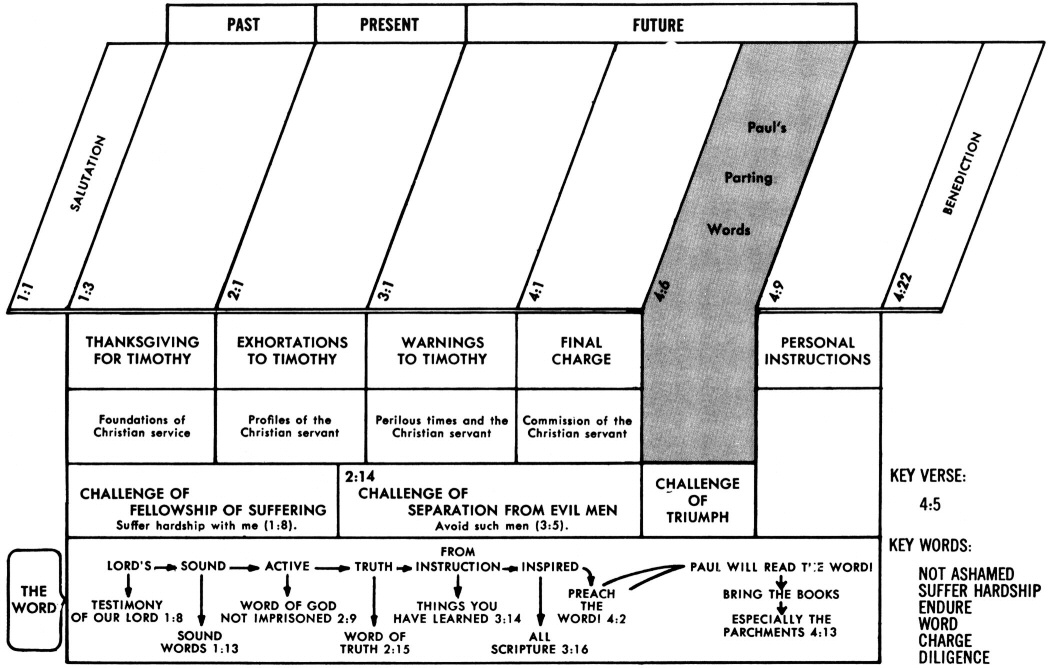
ENDURANCE AND SEPARATION IN THE MINISTRY
Click chart to enlarge
Charts from Jensen's Survey of the NT - used by permission
Second Timothy - Swindoll
| 2 TIMOTHY | |||
| 2 Timothy 1:1-18 | 2 Timothy 2:1-26 | 2 Timothy 3:1-17 | 2 Timothy 4:1-22 |
| Retain the Standard |
Rightly Divide the Word |
Difficult Times Will Come |
Preach the Word |
| PAST | PRESENT | FUTURE | |
| Foundation of Christian Service |
Pictures of Christian Servant |
Dangerous Times for Christian Servant |
Commission of Christian Servant |
| Unashamed as a Witness: Guard the Gospel |
Unashamed as a Workman: Suffer for the Gospel |
Adequate as a Workman: Continue in the Gospel |
Awarded as a Workman: Preach the Gospel |
| Power of the Gospel |
Perseverance of the Gospel Message | Protection of the Gospel |
Proclamation of the Gospel |
| Reminder | Requirements | Resistance | Requests |
| Encouragement in Ministry |
Examples in Ministry |
Exhortations in Ministry |
Exhortations to Fulfill Ministry |
| Commendation & Charge |
Commission to Fulfill |
Conflict to Face |
Course to Finish |
|
Compiled from Jensen's Survey of the NT and Wilkinson's Talk Thru the Bible |
|||
2 Timothy 2:6 The hard-working (PAPMSA) farmer ought (3SPAI) to be the first to receive his share (PAN) of the crops. (NASB: Lockman)
Greek: ton kopionta (PAPMSA) georgon dei (3SPAI) proton ton karpon metalambanein. (PAN)
Amplified: [It is] the hard-working farmer [who labors to produce] who must be the first partaker of the fruits. (Amplified Bible - Lockman)
KJV: The husbandman that laboureth must be first partaker of the fruits.
NJB: and again, it is the farmer who works hard that has the first claim on any crop that is harvested
NET: The farmer who works hard ought to have the first share of the crops.
NLT: Hardworking farmers are the first to enjoy the fruit of their labor. (NLT - Tyndale House)
Phillips: Only the man who works on the land has the right to the first share of its produce. (Phillips: Touchstone)
Wuest: It is a necessity in the nature of the case that the tiller of the soil who labors with wearisome effort be the first to be partaking of the fruits.
Young's Literal: the labouring husbandman it behoveth first of the fruits to partake;
THE HARDWORKING FARMER: ton kopionta (PAPMSA) georgon (3SPAI):
- Is 28:24, 25;28:26, Mt 9:37, 38; 20:1; 21:33, 34, 35, 36, 37, 38, 39, 40, 41; Lk 10:2; Jn 4:35;36,37, 38 1Co 3:6, 7, 9; 9:7, 8, 9, 10, 11
- 2 Timothy Resources - Multiple Sermons and Commentaries
- 2 Timothy Resources - Multiple Sermons and Commentaries
- 2 Timothy 2:3-7 Embracing Hardship for Gospel - Steven Cole
- 2 Timothy 2:3-7: Elements of a Strong Spiritual Life 2 - John MacArthur
HARD WORK NOW
FRUITFUL REAPING LATER!
A Simple Axiom - One of the most important instructions for a fruitful life (now but especially eternity) is to work hard.
the tiller of the soil who labors with wearisome effort (Wuest)
The harvestman who labors in the field (WNT)
Related Resources:
John MacArthur outline The Patterns of a Man of God (2Ti 2:1-26)
A. Paul (2Ti 2:1, 2) (Ed: A grace enabled man - cp 1Co 15:10, 2Co 12:9, 10)
B. A Soldier (2Ti 2:3, 4)
C. An Athlete (2Ti 2:5)
D. A Farmer (2Ti 2:6, 7)
E. Jesus (2Ti 2:8-13)
F. A Worker (2Ti 2:14-19)
G. A Vessel (2Ti 2:20-23)
H. A Servant (2Ti 2:24-26)
Ryrie sees 2Timothy 2 as illustrative of various aspects of the believer...
Soldier (2Ti 2:3, 4). He suffers hardship and is totally focused on pleasing his commander.
Athlete (2Ti 2:5). He follows the rules (the Word of God).
Farmer (2Ti 2:6). He receives a reward.
Slave (2Ti 2:24, 25, 26). He patiently seeks to bring remedial correction to wayward people.
All these fall into the category of sanctification.
(From Ryrie's Practical Guide to Communicating Bible Doctrine)
Paul uses multiple pictures (terms of comparison) in this chapter to illustrate various facets of the Christian life and each one is worthy of mediation (cp making it your habit to consider = 2Ti 2:7-note):
- Son/Child (2Ti 2:1-note)
- Teacher (2Ti 2:2-note)
- Soldier (2Ti 2:3,4 - note 2:3; 2:4)
- Athlete (2Ti 2:5 -note)
- Farmer (2Ti 2:6 - note)
- Prisoner (2Ti 2:9 -note, 2Ti 2:10-note)
- Workman (2Ti 2:15 -note)
- Vessel (2Ti 2:21-note)
- Bondservant (2Ti 2:24-note)
The hardworking farmer - This is clearly a metaphor (see discussion of terms of comparison). It behooves the serious student of the Word to query times of comparison with the 5W/H'S. Why is Paul using this word picture? What is he seeking to convey?, etc. Notice that in the next passage Paul commands consideration of these 3 metaphors and promises that if we do seriously ponder them, the Lord (the Holy Spirit) will give us understanding. Hardworking (kopiao) is in the present tense picturing continual wearying, tiring activity. This is the "Christian farmer's" way of life. Momentary light affliction is producing for such "farmers" an eternal weight of glory far beyond all comparison (cp 2Co 4:17+).
Spurgeon - This is a law. No man has any right to be a preacher at all until he has first tasted of the fruits of the field. Until we have first tasted that the Lord is gracious, we cannot effectively or properly minister the things of God. Before Ezekiel delivered to the people the prophecies that were written in the scroll, the voice came to him, “Son of man … eat this scroll” (Ezek 3:1). Not only did he take it into his mouth, where it was like honey for sweetness, but it descended even into his bowels and mingled with his innermost self. We must ourselves feel the weight of the burden of the Lord that we proclaim to others, or we shall not be ministers of the apostolic sort. Rather, we shall be descendants of the hypocritical Pharisees who “tie up heavy burdens and put them on people’s shoulders, but they themselves are not willing to move them with their finger” (Matt 23:4). The apostle Paul could with peculiar propriety call the gospel his own. On the road to Damascus he had singularly experienced its mighty power. Afterward, in frequent trials, in many difficulties, in varied experiences, in furious temptations, he had made each truth of Scripture his own by having tasted its sweetness, handled its strength, proved its comfort, and tried its power.
Hardworking (2872) (kopiao from kopos = labor, fatigue) This root word kopos (word study) is used in secular Greek of “a beating,” “weariness” (as though one had been beaten) and “exertion,” was the proper word for physical tiredness induced by work, exertion or heat. Kopiao means to to exhibit great effort and exertion, to the point of sweat and exhaustion. To physically become worn out, weary or faint. To engage in hard work with the implication of difficulty and trouble. Figuratively kopiao means to become emotionally fatigued and/or discouraged and thus to lose heart and/or give up. Kopiao speaks of intense, hard, wearisome toil even to the point of utter exhaustion if necessary. The work described by kopiao was left one so weary it was as if the person had taken a beating. Kopiao describes not so much the actual exertion as the weariness which follows the straining of all one's powers to the utmost. Kopiao was sometimes used to refer to athletic training. It is not surprising that kopiao was also a verb commonly used in descriptions of the down-trodden masses of the Roman world.
Kopiao emphasizes the intensity of labor required of Christian farmers who would be about the business of making disciples. Simply put...it's hard work!
Lightfoot says that kopiao "is used especially of the labor undergone by the athlete in his training.
MacArthur adds that kopiao "does not stress the amount of work, but rather the effort. A man’s reward from God is proportional to the excellence of his ministry and the effort he puts into it. Excellence combined with diligence mark a man worthy of the highest honor. (MacArthur, John: 1Timothy Moody Press)
Kopiao is used 24 times in the NT in the NASB and is translated: diligently labor, 1; grown weary, 1; hard-working, 1; labor, 3; labored, 4; labors, 1; toil, 4; wearied, 1; weary, 1; work hard, 1; worked, 2; worked hard, 1; worked hard worked hard, 1; workers, 1; working hard, 1.
Matthew 6:28+ "And why are you anxious about clothing? Observe how the lilies of the field grow; they do not toil nor do they spin,
Matthew 11:28+- Come (aorist imperative - Command that conveys sense of urgency - Do it now! Don't delay! Not naturally possible for no man seeks God but must be energized by the Holy Spirit to obey) to Me, all who are weary (kopiao) and heavy-laden, and I will give you rest.
Luke 5:5+ And Simon answered and said, "Master, we worked hard all night and caught nothing, but at Your bidding I will let down the nets."
Luke 12:27+ "Consider the lilies, how they grow; they neither toil nor spin; but I tell you, even Solomon in all his glory did not clothe himself like one of these.
John 4:6 and Jacob's well was there. Jesus therefore, being wearied from His journey, was sitting thus by the well. It was about the sixth hour.
John 4:38 "I sent you to reap that for which you have not labored; others have labored, and you have entered into their labor (kopos)."
Acts 20:35+ "In everything I showed you that by working hard in this manner you must help the weak and remember the words of the Lord Jesus, that He Himself said, 'It is more blessed to give than to receive.'"
Romans 16:6+ Greet Mary, who has worked hard for you.
Romans 16:12+ Greet Tryphaena and Tryphosa, workers in the Lord. Greet Persis the beloved, who has worked hard in the Lord.
1 Corinthians 4:12 and we toil, working with our own hands; when we are reviled, we bless; when we are persecuted, we endure;
1 Corinthians 15:10+ But by the grace of God I am what I am, and His grace toward me did not prove vain; but I labored even more than all of them, yet not I, but the grace of God with me.
1 Corinthians 16:16 that you also be in subjection to such men and to everyone who helps in the work and labors.
Galatians 4:11+ I fear for you, that perhaps I have labored over you in vain.
Ephesians 4:28+ Let him who steals steal no longer; but rather let him labor, performing with his own hands what is good, in order that he may have something to share with him who has need.
Philippians 2:16+ holding fast the word of life, so that in the day of Christ I may have cause to glory because I did not run in vain nor toil in vain.
Colossians 1:29+ And for this purpose also I labor, striving according to His power, which mightily works within me.
1 Thess 5:12+ But we request of you, brethren, that you appreciate those who diligently labor among you, and have charge over you in the Lord and give you instruction,
1 Timothy 4:10+ For it is for this we labor and strive, because we have fixed our hope on the living God, who is the Savior of all men, especially of believers.
1 Timothy 5:17 Let the elders who rule well be considered worthy of double honor, especially those who work hard at preaching and teaching.
2 Timothy 2:6+ The hard-working farmer ought to be the first to receive his share of the crops.
Revelation 2:3+ and you have perseverance and have endured for My name's sake, and have not grown weary.
Kopiao is used 34 times in the Septuagint (LXX) Dt 25:18; Jos 24:13; Jdg 5:26; 1Sa 6:12; 14:31; 17:39; 2Sa 17:2; 23:7, 10; Job 2:9; 20:18; 39:16; Ps. 6:6; 69:3; 127:1; Pr 4:12; Is 5:27; 16:12; 30:4; 31:3; 33:24; 40:28, 30, 31; 43:22; 45:14; 46:1; 47:13, 15; 49:4; 57:10; 63:13; 65:23; Jer 2:24; 17:16; 51:58; La 5:5).
Kopiao is used in the Lxx chiefly for yaga (03021) which means to work or become weary with work, and indicates putting forth great effort and exertion to accomplish something
Jesus addressing the church at Ephesus says...
And hast borne, and hast patience, and for my name's sake hast laboured (kopiao), and hast not fainted. (Re 2:3KJV-note)
THOUGHT: Are you growing weary in your Christian life? Look to Jesus and His exhortation which is timeless and filled with edifying wisdom. Dear child of the King, press on in His power, for He has already won the victory, and though your battle may now seem intense, it is only for a short time compared to eternity!) (See commentary on Isaiah 40:31 = How to "Fly Like An Eagle")
Paul explained to the Corinthians the "secret" of his ability to work hard writing...
But (despite the fact that he was the least of all apostles) by the grace of God I am what I am, and His grace toward me did not prove vain; but I labored (kopiao) even more than all of them, yet (Note: this is the key to life on the highest plain, a life that bears much fruit, fruit that endures for eternity) not I, but the grace of God with me (1Cor 15:10+)
THOUGHT: Here is the "secret" of the Christian life in a nutshell! Not you striving (referring to your "natural" strength) to live the Christian life, but learning to die to self (cp Mk 8:34, 35) that He might live His life (in His supernatural strength) through you. To a large extent, this is a mysterious coalition or cooperation and one which is difficult to explain but it is the (only) way of victorious living in Christ, abiding in the Vine living (Jn 15:5), a walking by the Spirit type life (Gal 5:16-note)
Paul's deep desire to "present every man complete in Christ" caused him to "labor (kopiao), striving according to His power, which mightily" worked within him (Col 1:28, 29-see notes Col 1:28; 29). This use by Paul gives us insight what is entailed by the picture of a hardworking farmer. These passages in Colossians describe the balance one should seek in their Christian life and ministry.
J B Phillips paraphrases Colossians 1:29-note this way "This is what I am working at all the time, with all the strength that God gives me.
J Vernon McGee commenting on Colossians adds "Oh, this should be the desire of everyone today who is working for Christ—that He would work in us mightily to do two things: to get out the gospel that men might be saved and then to build them up in the faith. These are the two things the church should be doing today. (SEE Thru the Bible Vol. 48: The Epistles (Philippians/Colossians))
Paul writing to the Thessalonians says "we request of you, brethren, that you appreciate those who diligently labor (kopiao) among you, and have charge over you in the Lord and give you instruction. (see note 1Thessalonians 5:12)
The faithful pastor works hard among his people and ministers to them as a shepherd cares for his sheep. In a parallel instruction Paul says to "Let the elders who rule well be considered worthy of double honor, especially those who work hard at preaching and teaching. (1Ti 5:17)
There has to be a commitment to diligence and hard work when you search the Scriptures in preparation for preaching and teaching. The preacher and teacher must be the very opposite of the “sluggard” in Proverbs "The sluggard does not plow after the autumn, So he begs during the harvest and has nothing. (Pr 20:4) "I passed by the field of the sluggard, and by the vineyard of the man lacking sense. And behold, it was completely overgrown with thistles. Its surface was covered with nettles, and its stone wall was broken down. (Pr 24:30, 31)
If the farmer works hard, he should be the first to take his share of the crops a principle found even in the Old Testament "(Moses asks) And who is the man that has planted a vineyard and has not begun to use its fruit? Let him depart and return to his house, lest he die in the battle and another man begin to use its fruit. (Dt. 20:6)
Proverbs instructs us that "He who tends the fig tree will eat its fruit; And he who cares for his master will be honored. (Pr 27:18).
Constable - A farmer must continue to sow seed and water it if he or she wants to harvest its fruit. Likewise the farmer for Christ must plant and nourish the gospel seed if he or she eventually expects to reap the fruit of God’s Word in the lives of people. All three illustrations imply dogged persistence and hold out the prospect of reward for the faithful. (Expository Notes)
Hendriksen commenting on the metaphor of God's workman as a farmer emphasizes that "Not only will his own faith be strengthened, his hope quickened, his love deepened, and the flame of his gift enlivened, so that he will be blessed “in his doing” (Jas 1:25 [note] - But one who looks intently at the perfect law, the law of liberty, and abides by it, not having become a forgetful hearer but an effectual doer, this man shall be blessed in what he does.), but in addition he will see in the lives of others the beginnings of those glorious fruits that are mentioned in Gal 5:22, 23 (see notes Ga 5:22; 23). (SEE A Commentary on I & II Timothy and Titus - Page 249)
And so we see Paul write to the saints at Rome...
And I do not want you to be unaware, brethren, that often I have planned to come to you (and have been prevented thus far) in order that I might obtain some fruit (karpos) among you also, even as among the rest of the Gentiles. (Ro 1:13-note)
In his letter to the beloved saints at Philippi Paul writes...
But if I am to live on in the flesh, this will mean fruitful (karpos) labor (ergon - ergs a unit to measure work or energy expended) for me; and I do not know which to choose. But I am hard-pressed from both directions, having the desire to depart and be with Christ, for that is very much better; yet to remain on in the flesh is more necessary for your sake. (Php 1:22, 23, 24-notes) (See notes on similar idea in 1Th 2:19, 20-note)
The angel explained to Daniel this same principle of rewards to faithful farmers declaring that...
those who have insight will shine brightly like the brightness of the expanse of heaven, and those who lead the many to righteousness, like the stars forever and ever. (Da 12:3)
TOUGH TALK
vs
HARD WORK
“When all is said and done,
there is more said than done.”
It ought not to be that way! Luther worked so hard that many days, according to his biographers, he fell into bed. Moody’s bedtime prayer on one occasion, as he rolled his bulk into bed, was, “Lord, I’m tired! Amen.” John Wesley rode sixty to seventy miles many days of his life and preached an average of three sermons a day, whether he was riding or not. Alexander Maclaren would get to his office when the workmen went to work so he could hear their boots outside, and would put on workmen’s boots to remind him why he was in his study. G. Campbell Morgan (The Westminster Pulpit vol. IV: The Preaching of G. Campbell) kept a newspaper clipping for twenty years, entitled “Sheer Hard Work,” and said:
What is true of the minister is true of every man who bears the name of Christ. We have not begun to touch the great business of salvation when we have sung, “Rescue the perishing, care for the dying.” We have not entered into the business of evangelizing the city or the world until we have put our own lives into the business, our own immediate physical endeavor, inspired by spiritual devotion.
Paul’s ministerial drive is a model for us all. We will never have an authentic, apostolic ministry unless we are willing to work to the point of exhaustion (Hughes, R. K. Colossians and Philemon: The Supremacy of Christ: Crossway Books).
In his first letter to Timothy Paul explained that he was willing to labor (kopiao) and strive to discipline himself for godliness because he knew that "godliness is profitable for all things" holding "promise for the present life and also for the life to come" (1Ti 4:7, 8, 9, 10, 11-see notes 1Ti 4:7; 4:8; 4:9; 10; 11) Later in that same epistle Paul associated (as in this verse on the hardworking farmer) the idea of hard work and reward, writing: "Let the elders who rule well be considered worthy of double honor, especially those who work hard (kopiao) at preaching and teaching." (1Ti 5:1)
James reminds us that a farmer needed patience telling his readers "Be patient (makrothumeo = Aorist Imperative - enabled by the Spirit - submit to Him and He will enable you to bear this fruit), therefore, brethren, until the coming of the Lord. Behold, the farmer waits for the precious produce of the soil, being patient (makrothumeo) about it, until it gets the early and late rains. (Jas 5:7).
As someone has said "The harvest is not the end of the meeting but at the end of the age!" Amen
Those who labor for the Lord are blessed and rewarded here and hereafter. (cp the now and then aspect taught by Paul in 1Ti 4:8)
Farmer (1092) (georgos from ge = the earth + ergo = to work) describes one who tills or works the soil or the ground. A husbandman (one that plows and cultivates land).
Related Resources:
- Biblical Discussion of Agriculture
- Farm Sermons by C H Spurgeon - Index to 19 messages (of all in one Pdf)
Georgos - 19x in 17 verses -
Matthew 21:33 "Listen to another parable. There was a landowner who PLANTED A VINEYARD AND PUT A WALL AROUND IT AND DUG A WINE PRESS IN IT, AND BUILT A TOWER, and rented it out to vine-growers and went on a journey. 34 "When the harvest time approached, he sent his slaves to the vine-growers to receive his produce. 35 "The vine-growers took his slaves and beat one, and killed another, and stoned a third....38 "But when the vine-growers saw the son, they said among themselves, 'This is the heir; come, let us kill him and seize his inheritance.'...40 "Therefore when the owner of the vineyard comes, what will he do to those vine-growers?" 41 They said to Him, "He will bring those wretches to a wretched end, and will rent out the vineyard to other vine-growers who will pay him the proceeds at the proper seasons."
Mark 12:1 And He began to speak to them in parables: "A man PLANTED A VINEYARD AND PUT A WALL AROUND IT, AND DUG A VAT UNDER THE WINE PRESS AND BUILT A TOWER, and rented it out to vine-growers and went on a journey. 2 "At the harvest time he sent a slave to the vine-growers, in order to receive some of the produce of the vineyard from the vine-growers....7 "But those vine-growers said to one another, 'This is the heir; come, let us kill him, and the inheritance will be ours!'...9 "What will the owner of the vineyard do? He will come and destroy the vine-growers, and will give the vineyard to others.
Luke 20:9 And He began to tell the people this parable: "A man planted a vineyard and rented it out to vine-growers, and went on a journey for a long time. 10 "At the harvest time he sent a slave to the vine-growers, so that they would give him some of the produce of the vineyard; but the vine-growers beat him and sent him away empty-handed....14 "But when the vine-growers saw him, they reasoned with one another, saying, 'This is the heir; let us kill him so that the inheritance will be ours.'...16 "He will come and destroy these vine-growers and will give the vineyard to others." When they heard it, they said, "May it never be!"
John 15:1 "I am the true vine, and My Father is the vinedresser.
2 Timothy 2:6 The hard-working farmer ought to be the first to receive his share of the crops.
James 5:7 Therefore be patient, brethren, until the coming of the Lord. The farmer waits for the precious produce of the soil, being patient about it, until it gets the early and late rains.
Georgos - 8 times in the Septuagint - Ge 9:20; 49:15; Je 14:4; 31:24; 51:23; 52:16; Joel 1:11; Amos 5:16.
Wiersbe...The church is a garden, and the seed is the Word of God. Various servants plant, water, and harvest the seed in due season. Timothy was not to be discouraged if the harvest failed to come immediately. It takes time, patience, and hard work to develop a fruitful garden. Like the faithful farmer, the pastor should share in the blessings God sends. “In due season we shall reap, if we faint not” (Gal. 6:9). (BORROW Wiersbe, W. W. Wiersbe's Expository Outlines on the New Testament PAGE 244)
Oswald Chambers comments that...The worker has to have discernment like that of a farmer, that is, he must know how to watch, how to wait, and how to work with wonder. The farmer does not wait with folded arms but with intense activity, he keeps at it industriously until the harvest. (Approved Unto God)
Bernard writes that...The main thought is that labour, discipline, striving are the portion of him who would succeed in any enterprise, be he soldier or athlete or farmer.
Stephen Olford...Preparation should be a daily discipline in the life of a preacher. Indeed, it would be safe to say that one of the greatest failings of the minister is indiscipline....Observe how the apostle illustrates the need for preparation as he describes the disciplined endurance of a soldier, the disciplined exercise of a runner, and the disciplined endeavors of a farmer. Then he climaxes the passage with those words, “Study to show thyself approved unto God, a workman that needeth not to be ashamed, rightly dividing the word of truth” (2Ti 2:15). It is quite evident from this statement that Paul has in mind, first, the preparation of the messenger, and second, the preparation of the message. (Olford, S. F. Vol. 2: Institutes of Biblical preaching : Volume two. Institutes of Biblical Preaching. Memphis: Olford Ministries International)
The hardworking farmer is not a glamorous metaphor like the athlete or soldier for the farmer begins his demanding work early and often goes late, limited finally by the dimming light of day. His work is often tedious, boring and unexciting. Not many farmers every become celebrities unlike soldiers and athletes. He is often called to endure cold, heat, rain, and drought. He plows whether the soil is hard or not. He waits not for a convenient time because the seasons do not wait for him (2Ti 4:2-note). When is time to plant, he must plant. When weeds appear, he must extract them. When the fruit ripens, he must harvest. What drives the farmer to labor under such grueling, unpredictable conditions? Is it not because he is looking forward to the bountiful harvest (2Pe 1:11-note). But while he tarries, the bulk of his labor is tedious, humdrum, and unexciting.
Unlike the teacher, the soldier, or the athlete, a farmer often works alone with no students to stimulate, no fellow soldiers to fight alongside and no crowd in the stands to cheer him on. The lives of many believers are like the farmer's life. To be sure, there may be seasons of harvest excitement, but for the most part the daily routine is often mundane and seemingly unrewarding. But like the hardworking farmer, faithful believers are promised God’s blessing and reward not only in this life but in that to come. Now they may be underpaid, unjustly treated, or unappreciated but they have not seen the bountiful harvest reward Christ will present to the faithful hardworking farmer.
Hughes sums up the farmer's life, each of these characteristics having spiritual application...1) early and long hours because he could not afford to lose time; 2) constant toil (plowing, sowing, tending, weeding, reaping, storing); 3) regular disappointments—frosts, pests, and disease; 4) much patience—everything happened at less than slow motion; and 5) boredom. (See 1–2 Timothy and Titus (ESV Edition): To Guard the Deposit - Page 212)
THE HARDWORKING FARMER - The patience called for in the spiritual farmer waiting to see his eternal harvest reminds me of the true story of Henry C. Morrison a little known "hardworking farmer" in God's missionary fields, toiling some forty years in the difficult fields of Africa. As the story is told, he became sick and had to return home to America, and as providence would have it, the boat he returned on was also carrying a well known guest. As the great ocean liner docked in New York Harbor there was a great crowd gathered to greet President Teddy Roosevelt who received a grand welcome-home-party after his widely publicized African Safari. Resentment seized the hardworking farmer, Henry Morrison, and he turned to God saying "I have come back home after all this time and service to the church and there is no one, not even one person here to welcome me home." Then a small voice came to Morrison reminding him "You're not home yet." Our ultimate harvest is yet future and our future reward is out of this world!
Robert Sheffield gives the following illustration of hard work...
Paul used the illustration of a farmer. The farmer is a hard worker. If you don’t apply this to commitment and discipline, you won’t get anywhere. How often do we experience hard labor and wearisome toil in our Christian lives?
Some years ago in Canada I joined a labor union to get some temporary work. On my first day of working the foreman assigned me and two other laborers the job of taking out of storage some large sheets of plywood at a warehouse. The foreman dropped us off at the warehouse and said he would be back for us at noon.
As soon as he left, the two other men sat down, lit up their cigarettes, and relaxed. As a Christian who believed in an honest day’s work for an honest day’s pay, I went ahead and worked by myself. This so upset the other two that they refused to be assigned with me the following day.
Many people don’t want to work hard. This is true in the Christian world too. Few are committed to the labor it takes to do the things God wants done. This is what Paul encouraged Timothy to do. (Discipleship Journal: Issue 6. Colorado Springs: The Navigators/NavPress)
OUGHT TO BE THE FIRST TO RECEIVE HIS SHARE OF THE CROPS: dei (3SPAI) proton ton karpon metalambanein (PAN):
- 1 Cor 9:23; Heb 10:36
- 2 Timothy Resources - Multiple Sermons and Commentaries
- 2 Timothy 2:3-7 Embracing Hardship for Gospel - Steven Cole
- 2 Timothy 2:3-7: Elements of a Strong Spiritual Life 2 - John MacArthur
has the first claim on any crop that is harvested (NJB)
that has the first claim on any crop that is harvested (NJB)
to be the first to take of the fruit (BBE)
who must be the first partaker of the fruits (Amp)
Ought (1163) (dei) means is needful or necessary. It describes a necessity growing out of a given situation, in this case the fact that the spiritual farmer works hard at his tasks. Paul is saying that the Christian farmer needs to be the first to partake of the crops (karpos = fruit).
Ought to be the first to receive - Must be the first to partake is a better translation. The present tense signifies that this is to be a continual necessity. There is a similar allusion in first Corinthians where Paul asks...
Who at any time serves as a soldier at his own expense? Who plants a vineyard and does not eat the fruit of it? Or who tends a flock and does not use the milk of the flock? (1 Co 9:7) (As here in 2Timothy 2, Paul associates military service and farming).
Receive his share (3335) (metalambano from meta = with, denoting association + lambáno = receive) means to receive as one's share in or as one's part of. The idea is to share or participate in something, in this case something which is "imperishable and undefiled and will not fade away, reserved in heaven for you" (1Pe 1:4-note). When the work becomes wearying, recall this truth to mind even as did God's "farmer" Jeremiah...
14 I have become a laughingstock to all my people, their mocking song all the day.
15 He has filled me with bitterness. He has made me drunk with wormwood.
16 And He has broken my teeth with gravel. He has made me cower in the dust.
17 And my soul has been rejected from peace; I have forgotten happiness.
18 So I say, "My strength has perished, and so has my hope from the LORD."
19 Remember my affliction and my wandering, the wormwood and bitterness. (A prayer)
20 Surely my soul remembers and is bowed down within me. (A choice to recall)
21 This I recall to my mind, therefore I have hope. ("This" = the famous truths that follow)
22 The LORD'S lovingkindnesses indeed never cease, For His compassions never fail.
23 They are new every morning; Great is Thy faithfulness.
24 "The LORD is my portion," says my soul, "Therefore I have hope in Him."
25 The LORD is good to those who wait for Him, to the person who seeks Him.
26 It is good that he waits silently for the salvation of the LORD. (Waiting - Implies trust in His promises, His faithfulness and is manifest in patience endurance in whatever task or circumstance He has called us to for our good and His glory!)
Metalambano - 6x in the NT - Acts 2:46; 24:25; 27:33; 2Ti 2:6; Heb. 6:7; 12:10
THOUGHT - Dear set apart one (hagios = holy one, saint) of God, you have been graciously granted (a "grace gift") an allotment, for you are God's workmanship (His "masterpiece" = poiema) created in Christ Jesus for good works which He prepared before you knew Him as Lord, so that now you should live your life accomplishing those good works in His power and for His glory (Eph 2:10-note, Mt 5:16-note). So even as Joshua (representing Israel) had an allotment granted to Israel by God (Josh 1:2), he still had to step out in faith and obedience to lay hold of his share, for God explained to him that...
Every place on which the sole of your foot treads (man's responsibility), I have given it to you (God's sovereignty), just as I spoke to Moses...6 "Be strong and courageous (man's responsibility), for you shall give this people possession of the land which I swore to their fathers to give them (Ge 12:6,7; 13:14,15; 15:18, 19, 20,21) (God's sovereignty) (Joshua 1:3, 4, 5, 6)
Comment: Throughout Scripture one can observe this God ordained, albeit mysterious juxtaposition of man's responsibility and God's sovereignty.
Crops (2590) (karpos) is used in its literal sense to refer to fruit, produce or offspring, which describes that which is produced by the inherent energy of a living organism. Karpos is what something naturally produces. Figuratively, karpos is used of the consequence of physical, mental, or spiritual action. In the NT the figurative (metaphorical) uses predominate and this is particularly true in the Gospels, where human actions and words are viewed as fruit growing out of a person's essential being or character. Karpos refers to that which originates or comes from something producing an effect or result (benefit, advantage, profit, utility).
Karpos - 67x in 57v - NAS renders karpos as -- benefit(2), crop(5), crops(2), descendants*(1), fruit(43), fruitful(1),fruits(4), grain(1), harvest(1), proceeds(1), produce(4), profit(1).
Matt. 3:8, 10; 7:16ff; 12:33; 13:8, 26; 21:19, 34, 41, 43; Mk. 4:7f, 29; 11:14; 12:2; Lk. 1:42; 3:8f; 6:43f; 8:8; 12:17; 13:6f, 9; 20:10; Jn. 4:36; 12:24; 15:2, 4f, 8, 16; Acts 2:30; Rom. 1:13; 6:21f; 15:28; 1 Co. 9:7; Gal. 5:22; Eph. 5:9; Phil. 1:11, 22; 4:17; 2 Tim. 2:6; 4:13; Heb. 12:11; 13:15; Jas. 3:17f; 5:7, 18; Rev. 22:2.
Related Resource:
If you are a preacher or teacher you understand completely what Paul is saying here in 2Timothy for you always get more out of the sermon or lesson preparation than do the hearers because you have (hopefully) been diligent to put much more into it. I once heard Dr John MacArthur say that before he accepted the job as pastor at Grace Church, he stipulated that they must ensure he had an uninterrupted 30 hours each week to prepare his message. His logic was how could he feed the sheep, if he himself had not been fed during the week. The elders acquiesced and the fruit of Dr MacArthur's ministry is well known around the world. I would add that such diligent preparers of preaching and teaching also get great joy out of seeing their planted seeds bear fruit in the lives of the Lord's disciples.
Paul uses karpos as an expression for desirable, righteous qualities in one’s life, the “fruit of the Spirit” (Gal 5:22-note; Gal 5:23-note).
Hebrews pictures God's discipline in the believer's life, producing the peaceful fruit of righteousness. (He 12:11-note)
Ironside writes that "The farmer has his work to do: his plowing, sowing, harrowing, and reaping before he can enjoy his fruit. We are here to labor; and oh, what a day it will be when at last we come before our Lord at the judgment-seat of Christ and become partakers of the fruit! How much it will mean to any of us who have had the privilege of winning souls for Christ, to stand at that judgment-seat with those whom we have brought to Him, and say, "Behold I and the children whom Thou hast given me!" How sweet His "Well done" will sound to these ears of ours in that day of reward!
Scripture catalogs 3 general kinds of spiritual fruit...
1) Spiritual attitudes that characterize a Spirit-led believer - Galatians 5:22,23
2) Righteous actions - Ro 6:22-note, Php 4:16, 17-note; He 12:11, 13:5-note
3) New converts - Ro 16:5-note
Life is the seedtime
of eternity!
Larry Richards summarizes the Biblical concept of spiritual fruit writing that "Fruitfulness is a consistent concept in the OT and the NT. The fruit God seeks in human beings is expressed in righteous and loving acts that bring peace and harmony to the individual and to society. But that fruit is foreign to sinful human nature (the flesh). Energized by sinful passions , fallen humanity acts in ways that harm and bring dissension. God's solution is found in a personal relationship with Jesus and in the supernatural working of God's Spirit within the believer. As we live in intimate, obedient relationship with Jesus (Jn 15:5, 16, 1Jn 2:6), God's Spirit energizes us (Ezek 36:27, Php 2:13NLT-note) as we produce the peaceable fruits of a righteousness (He 12:11-note, Is 32:17, Ro 14:17-note, Jas 3:17, 18, Ps 119:165-note) that can come only from the Lord. (Richards, L O: Expository Dictionary of Bible Words: Regency)
Litfin comments that "A diligent soldier gains the approval of his commanding officer; a diligent athlete wins the victory; a diligent farmer wins the first . . . share of the crops. The three illustrations have in common the point that success is achieved through discipline (cf. 2Ti 1:7-note), hard work, and single-mindedness. (SEE The Bible Knowledge Commentary Acts and Epistles) (Bolding added)
The People's Bible offers this question "How does a pastor receive the firstfruits of his work? These are not financial or earthly benefits, although the Lord promises those also. The fruits of the pastor’s labors are spiritual, for his work is to sow the seed of God’s Word. His members will receive spiritual fruits from his faithful preaching. However, as the pastor studies the Word and prepares a sermon or Bible study, he will reap a rich harvest of fruit for himself in spiritual growth, in a strengthened faith, and in comfort and joy through Christ. The sermon a pastor prepares for his people he first preaches to himself. (Schuetze, A. W.. 1 Timothy, 2 Timothy, Titus. The People's Bible. Milwaukee, Wis.: Northwestern Pub. House)
William MacDonald - According to all principles of righteousness, the one who labors to bring forth the crops has a prior right to participate in them. This would serve as an encouragement to Timothy, should he ever become discouraged in his labor for the Lord. Such toil will not go unrewarded (Gal 6:9, 1Co 15:58, 2Th 3:13, Jas 5:7, 8). Although many will participate in the harvest in a coming day, yet Timothy’s labor of love would not go unnoticed. Indeed, he would be the first to partake of the fruit of his own labor. (BORROW Believer's Bible Commentary PAGE 2144)
William Kelly - There is a third maxim which has been singularly misunderstood by truly spiritual minds. Yet the structure of the sentence is not really obscure. The difficulty is due rather to a certain prejudice as to the sense or its application. The figure is taken from agriculture, not from military service nor from the well-known games. The stress is on the “labouring husbandman”. The love of Christ must constrain and brotherly love must continue, in order that the servant of Christ persevere unintermittingly in his labours. Hence we find in the former Epistle (1Ti 5:17) that, while the elders that rule well were to be counted worthy of double honour, those are distinguished “especially” that labour in the word and in teaching. So here, where the general service of Christ is in question, the labouring husbandman ought first to partake of the fruits. Impossible that God could deign to be a debtor to any. “Each shall receive his own reward according to his own labour,” whether the planter or the waterer or any other (1Co 3:8). For God is not unrighteous in any case to forget our work and the love shown to His name. But the labour of love has especial value in His sight. This may be in very young saints (1Th 1:3-note), no less than the work of faith and the patience of hope. It is most blessed where the servant of Christ is sustained in such labour. “The labouring husbandman ought first (whatever others may, and before all) to partake of the fruits”. It is rather a truism that he must labour before partaking of the fruits, or “labouring first must be partaker of the fruits” as the margin of the Authorized Version says. But this is not the sense of the phrase in any grammatical construction of it possible, nor, if it were, could it afford so grave or so cheering a call to the labourer. Thus in the three maxims of 2Ti 2:4, 5, 6 we have first the object or starting-point; then the ways or means guarded, as well as the end; and lastly encouragement along the road for him who labours in love, as faith does. (2 Timothy Commentary)
W. E Vine has an excellent summary of karpos explaining that...
Karpos frequently in the New Testament in its natural sense of that which is produced by the inherent energy of a living organism, Matthew 13:8, and also, in a derived sense, of the result, in the spiritual and moral sphere, of the energy of the Holy Spirit operating in those who through faith are brought into living union with Christ, John 15:4, 5.
Fruit is thus the outward expression of power working inwardly, and so in itself beyond observation, the character of the fruit giving evidence of the character of the power that produces it, Mt 7:16 (note). As lust manifests itself in works, the restless and disorderly activities of the flesh, or principle of evil, in man, so the Spirit manifests His presence in His “peaceable,” He 12:11 (note), and orderly fruit.
In this connection fruit presents an advance upon “works.” “Works” gives prominence to the notion of activity; fruit directs attention to the power that works within.
Fruit is also used by the apostle Paul of the converts resulting from his ministry, Php 1:22 (note); and of the manifestation of the character of Christ in the lives of believers in consequence of his ministry of the Word among them, Ro 1:13 (note); and of the care of the believers for the poor, for this is the fruit, or outward expression, of love, attesting its reality, Ro 15:28 (note); and of the care of laborers in the gospel, for this is the fruit, or outward expression, of thankfulness to God for spiritual blessings enjoyed, attesting its reality, Php 4:17 (note).
The singular form, fruit, is used here perhaps to suggest the unity and harmony of the character of the Lord Jesus which is to be reproduced in the believer by the power of the Holy Spirit, in contrast with the discordant and often mutually antagonistic “works of the flesh.” In Christ actually, and in the Christian potentially, the fruit of the Spirit is harmonious, the various elements being mutually consistent, and each encouraging and enhancing the rest in happy coordination and cooperation in that “new man, which after God hath been created in righteousness and holiness of truth,” Eph 4:24 (note).
The verb “fruit-bearing,” karpophoreo, is found in the New Testament in both the natural, Mark 4:28, and the spiritual sense, Matthew 13:23; Mark 4:20; Luke 8:15. The two states of men, the regenerate and the unregenerate, are contrasted in Ro 7:4, 5 (note); in the former “the passions of sins,” i.e., sinful impulses, see at v. 24, below, bore fruit unto death, that is these activities arose out of a state of alienation from God; in the latter the power of the indwelling Spirit, who unites the soul with the risen Lord, bears fruit unto God; so also Col 1:10 (note). Col 1:6 (note) corresponds with Php 1:22 (note), mentioned above. (Vine, W. Collected writings of W. E. Vine. Nashville: Thomas Nelson )
D. Edmond Hiebert commenting on the image of a farmer notes that "By the very nature of his occupation the farmer toils to produce food for others. But if he does not himself profit from the harvest produced, he will soon cease farming. The Christian worker toils to produce food for others through his study and teaching of the Word. But to remain spiritually effective, he must first nourish his own spiritual life with the food he produces. In 1Ti 4:16 Paul urges Timothy, “Pay close attention to yourself and to your teaching.” The order is significant: “yourself and your teaching.” So the Christian worker has the duty and privilege of being the first to partake of the fruit produced. He must be willing to engage in hard and difficult toil in fulfilling his duty. But he also has the rewarding privilege of first nurturing his own spiritual life from the results of his labors. Faithful toil in the Lord’s service has its rewards for the worker both here and hereafter. The faithful Christian worker experiences blessings from his work now vastly more rewarding than anything the world has to offer. (Bibliotheca Sacra, 1996, page 227, Dallas, Texas. Dallas Theological Seminary) (Bolding added)
Hiebert writes that
The word georgos, translated “farmer,” means “a tiller of the soil,” (In the Authorized Version the word is rendered “husbandman.”) Farming is an essential occupation but it has no spectacular appeal or exciting glamour. Paul makes the hard work of the farmer central in his picture. The participle kopionata (“hardworking”) denotes toiling to the point of weariness and exhaustion. Some innocent souls may harbor the illusion that the farmer simply sits under his vine or fig tree and lets the ripe fruit fall into his lap. But anyone having any acquaintance with farming knows that if there is to be fruit there must first be hard, exhausting toil.
This image gives emphasis to the fact that Christian service is hard work. Stott makes this remark: “This notion that Christian service is hard work is so unpopular in some happy-go-lucky Christian circles today that I feel the need to underline it.” Clearly Paul expected the willingness to work hard to be a normal characteristic of the Christian leader. Human hearts are the soil where the Christian leader sows the seed of the Word of God and where the fruits of his labors are produced. While never easy work, it is for the sake of the harvest that the Lord’s husbandman gladly engages in the demanding toil.
But the intended point in Paul’s figure of the farmer is the fact that the toil of the Christian worker has its present rewards. Because of his persistent toil, the farmer “ought to be the first to receive his share of the crops.”
Ought (dei) indicates that his partaking of the fruit is a moral necessity. By the very nature of his occupation the farmer toils to produce food for others. But if he does not himself profit from the harvest produced, he will soon cease farming. The Christian worker toils to produce food for others through his study and teaching of the Word. But to remain spiritually effective, he must first nourish his own spiritual life with the food he produces.
In 1Timothy 4:16 Paul urges Timothy, “Pay close attention to yourself and to your teaching.” The order is significant: “yourself…your teaching.” So the Christian worker has the duty and privilege of being the first to partake of the fruit produced. He must be willing to engage in hard and difficult toil in fulfilling his duty.
But he also has the rewarding privilege of first nurturing his own spiritual life from the results of his labors. Faithful toil in the Lord’s service has its rewards for the worker both here and hereafter. The faithful Christian worker experiences blessings from his work now vastly more rewarding than anything the world has to offer.
Paul’s fourth figure, that of the hardworking farmer, sets forth two qualities needed by the Christian leader. He must be willing to engage in difficult and exhausting toil in fulfillment of his assignment. But he must also be sure to nurture his own spiritual life from the results of his toil. (SEE Vital Ministry Issues: Examining Concerns and Conflicts - Page 51) (Bolding added)
In NT times, farm laborers often were paid with a portion of the crops they helped to plant, cultivate, and harvest. The hardworking farmer received not only a greater share but also the first share of the crops. The preacher and the teacher always get more out of the sermon or lesson than do the hearers because they put much more into it. The corollary is that if the teacher is to have spiritual food for the hearers, he must first be fed from the Word or he can't really feed others.
Farming is hard work, and it can have many disappointments, but the rewards are worth it. Human hearts are the soil where the Christian "farmer" sows the seed of the Word of God and where the fruits of his labors are produced (cp Lk 8:11, 12, 13, 14, 15, Mt 13:19, 20, 21, 22, 23, Mk 4:16, 17, 18, 19, 20, see also 1Pe 1:23-note). Spiritual "farmers" get great joy out of seeing planted seeds bear fruit in the lives of others.
Farmers work in faith because they are ultimately dependent upon God to provide the rain and sunshine which are necessary for crops to grow. Even then the farmer must wait from seedtime to harvest to see if the harvest will be good.
In context one aspect of the spiritual crop would be an abundant harvest of "faithful men who are able to teach others also." (2Ti 2:2-note)
Toiling through the changing seasons
In the sunshine and the rain,
Zealous sowing with compassion
Yields a wealth of golden grain.
—Anon.
As Warren Wiersbe has well said "Witnessing is like farming—it is a cooperative effort. One plows, one sows, one waters, but God is the One who bring forth the harvest. (BORROW Be What You Are - page 19 - highly recommended! See the Table of Contents - 12 pictures of the Christian life described by one of the most gifted writers of our day.)
Paul speaks of the reward that will accrue in the "spiritual bank account" of those who plant spiritual seed writing...
I planted, Apollos watered, but God was causing the growth. So then neither the one who plants nor the one who waters is anything, but God who causes the growth. Now he who plants and he who waters are one; but each will receive his own reward according to his own labor. For we are God's fellow workers; you are God's field, God's building (Paul mixes metaphors here). (1 Cor 3:6, 7, 8, 9+).
Jesus taught a similar "farming" principle of cooperation declaring...
My food is to do the will of Him who sent Me, and to accomplish His work (He goes on now to explain the Father's "work" - His disciples do not understand that which is from above, the hidden spiritual food, real "soul food", for they are earthbound, mired by the limitations of fleshly existence - Jesus' "food" is to obey and fulfill His Father's will). Do you not say, 'There are yet four months, and then comes the harvest'? Behold, I say to you, lift up your eyes, and look on the fields, that they are white for harvest. "Already he who reaps is receiving wages, and is gathering fruit (karpos = same word as "crops" here in Timothy) for life eternal; that he who sows and he who reaps may rejoice together. "For in this case the saying is true, 'One sows, and another reaps.' "I sent you to reap that for which you have not labored (kopiao); others have labored (kopiao), and you have entered into their labor (kopos). (John 4:34, 35, 36, 37, 38+)
Guy King writes that...
In spite of the present cost, it is all so infinitely worth-while. If, from down here, we look on, or if, from up there, we look back, we shall confess how gloriously desirable the life has turned out to be. "I reckon that the sufferings of this present time are not worthy to be compared with the glory which shall be revealed . . .", says Ro 8:18 (note). "He had respect unto the recompence of the reward," says He 11:26 (note). "Who for the joy that was set before Him endured the cross, despising the shame", says He 12:2 (note). Well, what has our present passage to say about these abundantly satisfying delights?
Take that phrase "Partaker of the fruits". That means, doesn't it, that we shall ourselves receive some enjoyment and enrichment from our labours. Done for Him, and done for others, yet we ourselves shall have gains for our pains. One is forcibly reminded of that beautiful provision in Dt 25:4: "Thou shalt not muzzle the ox when he treadeth out the corn."
That is a hard job that the poor beast has got, very tiring and very boring; but why take his muzzle off? So that even while he treads the corn, he may eat of the corn. Working for others, he is a gainer himself. While he feeds others, he himself is fed. A beautiful provision of GOD for His dumb creatures' welfare; and, after a spiritual manner, a beautiful rule of His service. Is our Christian work strenuous and sacrificial? Well, our own soul will be satisfied in it. That is the grateful testimony of every earnest Christian worker right down the years. (TO MY SON An Expositional Study of II Timothy)
SUCCESSFUL or FAITHFUL? - Speaking in Edinburgh, missionary John Williams held his audience spellbound with thrilling accounts of God's work among the tribes-people of the New Hebrides Islands. A soft-spoken missionary followed Williams with a brief report of his work. In a low and trembling voice he said,
My friends, I have no remarkable success to relate like Mr. Williams. I've labored for Christ in a far-off land for many years and have seen only small results. But I have this comfort: when the Master comes to reckon with His servants, He will not say, `Well done, thou good and successful servant,' but `well done, thou good and faithful servant.' I have tried to be faithful!.
Work done well for Christ
will receive a "well done" from Christ.
THE CALL TO PERSEVERANCE LIKE A FARMER - Do you ever feel like just quitting and giving up? Do you get so tired that you feel you cannot go another step? The Christian believer is not immune to these feelings, but the challenge is to persevere through them. For example...
The folklore surrounding Poland's famous concert pianist and prime minister, Ignace Paderewski, includes this story:
A mother, wishing to encourage her young son's progress at the piano, bought tickets for a Paderewski performance. When the night arrived, they found their seats near the front of the concert hall and eyed the majestic Steinway waiting on stage.
Soon the mother found a friend to talk to, and the boy slipped away. When eight o'clock arrived, the spotlights came on, the audience quieted, and only then did they notice the boy up on the bench, innocently picking out "Twinkle, Twinkle, Little Star."
His mother gasped, but before she could retrieve her son, the master appeared on the stage and quickly moved to the keyboard.
"Don't quit—keep playing," he whispered to the boy. Leaning over, Paderewski reached down with his left hand and began filling in a bass part. Soon his right arm reached around the other side, encircling the child, to add a running obbligato. Together, the old master and the young novice held the crowd mesmerized. [Craig B. Larson, Editor. Illustrations for Preaching & Teaching, p.221].
Serving the Lord is hard work. Using your own strength will exhaust you and you will be tempted to quit. But using God's strength as you work hard will produce beautiful music.(From Practical Illustrations: Volume 7)
FAITHFULNESS & FRUITFULNESS - A deacon rebuked an elderly preacher one Sunday morning before the service.
"Pastor," said the man, "something must be wrong with your preaching and your work. There's been only one person added to the church in a whole year, and he's just a boy."
The minister listened, his eyes moistening and his thin hand trembling.
"I feel it all," he replied, "but God knows I've tried to do my duty."
On that day the minister's heart was heavy as he stood before his flock. As he finished the message, he felt a strong inclination to resign. After everyone else had left, that one new boy came to him and asked,
"Do you think if I worked hard for an education, I could become a preacher—perhaps a missionary?"
Again tears welled up in the minister's eyes.
"Ah, this heals the ache I feel," he said.
"Robert, I see the Divine hand now. May God bless you, my boy. Yes, I think you will become a preacher."
Many years later an aged missionary returned to London from Africa. People spoke his name with reverence. Nobles invited him to their homes. He had added many souls to the church of Jesus Christ, reaching even some of Africa's most savage chiefs. His name was Robert Moffat, the same Robert who years before had spoken to the pastor on that Sunday morning in the old Scottish church.
Our service for Christ may sometimes seem fruitless. We wonder if anything significant is happening. But if we are faithful, God will give the increase. —D J De Haan (Reprinted by permission from Our Daily Bread Ministries. Please do not repost the full devotional without their permission.) (Bolding added)
Faithfulness is God's requirement.
Fruitfulness is His reward.
O dearly beloved hardworking farmer whoever and wherever you are, do
not lose heart in doing good, for in due time (you) shall reap if (you) do not grow weary (Gal 6:9-note).
Instead
consider (aorist imperative - a command that can even convey a sense of urgency. Do this now! Don't delay!) Him Who has endured such hostility by sinners against Himself, so that you may not grow weary and lose heart. (He 12:3-note)
Being fully confident that
momentary, light affliction is producing for (you) an eternal weight of glory far beyond all comparison (2Cor 4:17-note)
Finally, Paul adds this great exhortation to which all believers do well to pay heed...
Therefore (m of conclusion - forces you to observe and query the context), my beloved brethren, be (present imperative - calls for this as a lifestyle - what God commands, He enables!) steadfast, immovable, always abounding in the work of the Lord (Who's work? - see Eph 2:10-note, compare Jn 15:5), knowing that your toil (kopos) is not in vain in the Lord. (1Co 15:58-note)
A believer visiting a mission field said to one of the dedicated workers, "My, you certainly are buried out here!"
To which the missionary quietly replied,
We were not buried—we were planted! We buried ourselves (died with Christ, daily denial of self, Mk 8:34, 35, 36, 37) long before we ever arrived on this field!
William Barclay summarizes these three metaphors writing that...
One thing remains in all three pictures. The soldier is upheld by the thought of final victory. The athlete is upheld by the vision of the crown. The husbandman is upheld by the hope of the harvest. Each submits to the discipline and the toil for the sake of the glory which shall be. It is so with the Christian. The Christian struggle is not without a goal; it is always going somewhere. The Christian can be certain that after the effort of the Christian life, there comes the joy of heaven; and the greater the struggle, the greater the joy. (SEE 2 Timothy 2 - Barclay's Daily Study Bible)
Vine adds this summation...
The three illustrations are taken from everyday life and each is indicative of patient, self-sacrificing and enduring toil. Again, there are three respective incentives. The first is that of pleasing the Lord. The second is the obtaining of the reward in the day to come. The third is that of partaking of the fruits of labor. (Vine, W. Collected writings of W. E. Vine. Nashville: Thomas Nelson)
Steven Cole writes that...
To be a fruitful Christian, willingly embrace the hardship of the farmer: Hard, unexciting work with no immediate payback (2Ti 2:6).Note three things:
A. Much Christian work is unexciting.
Compared to the lives of the soldier and the athlete, the life of a farmer is rather boring. The soldier lives on the edge of life and death on the battlefield. The athlete has the thrill of the cheering crowd as he runs toward the goal. But the farmer works long and hard, plowing and planting, and goes home tired. About the most exciting thing he can see is, “The corn grew two inches last week!” Whoopee! Why does he do it? He is looking for the harvest.
Spiritually, there are a few who have “exciting” ministries. They’re invited to speak all over the world. They have thousands flocking to hear them or buying their books. Then there are the rest of us, out in the fields waiting for the corn to grow. Every week, I try to sow the seed of God’s Word into hearts, but people don’t usually change over night. Sometimes bad storms or pests
destroy the plants before they bear fruit. But you keep sowing, trusting God to bring the increase of the harvest.
B. Christian work is tiring.
The Greek word that Paul uses for “hardworking” means to toil or strive so as to become weary and tired. He uses it to describe pastors who “work hard in preaching and teaching” (1Ti 5:17). He commends those in Rome who “worked hard” in the Lord (Ro 16:6, 12). He often mentions his own labor or toil in the Lord’s work (1Cor. 15:10; 2Cor. 6:4; Gal. 4:11; Phil. 2:16; Col.1:29-2:1; 1Ti 4:10). Much Christian work is mentally and emotionally draining. Even Jesus was so tired that He could fall asleep in a small boat in a fierce storm! Expect to be tired as part of the hardship of serving the Lord.
C. The reward comes at the end of the age, not at the end of the meeting.
The harvest is at the end of the age. Often we will not know what God accomplished through our labors or our prayers or our gifts until we stand before Him. Then we will meet people who are in heaven because we sowed the seed through our words or our gifts or our good deeds. We will enjoy a harvest of eternal joy! (Lesson 10: Embracing Hardship for the Gospel 2 Tim. 2:3-7)
As soldiers we are to single mindedly focus on pleasing our Lord alone.
As athletes we must play by the rules God has ordained.
As farmers we must be willing to work hard in the present, confident that we shall have future gain.
In light of brevity of our life and the length of eternity and the certainty of the rewards or loss of rewards at the the judgment seat of Christ ponder these words by the great missionary to Burma, Adoniram Judson (biography)
A life once spent is irrevocable. It will remain to be contemplated through eternity...the same may be said of each day. When it is once past, it is gone forever. All the marks which we put upon it, it will exhibit forever...each day will not only be a witness of our conduct, but will affect our everlasting destiny....How shall we then wish to see each day marked with usefulness...! It is too late to mend the days that are past. The future is in our power. Let us, then, each morning, resolve to send the day into eternity in such a garb as we shall wish it to wear forever. And at night let us reflect that one more day is irrevocably gone, indelibly marked.
This is Coram Deo living before the face of God, Carpe Diem seizing the day, because Tempus Fugit, time flies, and so our daily prayer should be
So teach us to number our days, that we may present to Thee a heart of wisdom (Ps 90:12-note) doing all things as "for the Lord" (Col 3:23-note) that they may see our good works and glorify our Father Who is in heaven. (Mt 5:16-note)
No Looking Back - When I was a boy on the farm, my dad would tell me, "You can't plow a straight row if you look back." You can test this for yourself by looking back as you walk through snow or along a sandy beach. Your tracks won't be straight.
A good farmer doesn't look back once he has put his hand to the plow. Jesus used this analogy to teach us that if we are to be His disciples we must make a complete break with all loyalties that hinder our relationship with Him.
Total allegiance to God is a principle that is rooted in the Old Testament. The Israelites, after being freed from slavery and fed by supernatural means, looked back longingly to the days when they enjoyed fish, cucumbers, melons, leeks, onions, and garlic in Egypt (Nu 11:5-6). God was greatly displeased, and He judged His people. Their looking back indicated a lack of commitment to Him.
Today, people who cling to old sins and the worldly pleasures they enjoyed before becoming Christians cannot be loyal disciples of Jesus Christ. When we repent and believe in Him, we become citizens of a new kingdom. We are to break with the sins of the past.
Discipleship means no looking back (Lk 17:32+)! — Herbert Vander Lugt
(Reprinted by permission from Our Daily Bread Ministries. Please do not repost the full devotional without their permission.)
I had always heard that if a farmer keeps his eyes on a distant object while he's plowing, he'll make a straight furrow. So I tested the principle when I mowed my lawn. Sure enough, my first cut was a straight swath of new-mown turf.
If you can plow a straight furrow or mow in a straight line by keeping your eyes fixed on a distant object, surely the principle should also be true of life--especially if the object on which you fix your gaze is the same yesterday, today, and forever.
Planting Time - Somewhere in the world right now a farmer is dropping seeds into the ground. Soon those seeds will begin to change the place where they were planted. The carefully prepared soil that appears barren today will become a field ready for harvest.
In the same way, New Year’s resolutions can be seeds to alter the landscape of life for others and ourselves. This prayer of Saint Francis of Assisi is a powerful model of this longing to bring positive change in a hurting world:
Lord, make me an instrument of Your peace. Where there is hatred, let me sow love; where there is injury, pardon; where there is doubt, faith; where there is despair, hope; where there is darkness, light; and where there is sadness, joy.
A farmer who sows wheat is never surprised when wheat grows from the ground where it was planted. That’s the universal law of sowing and reaping. Paul used it to illustrate a corresponding spiritual principle: “Do not be deceived, God is not mocked; for whatever a man sows, that he will also reap” (Gal. 6:7). Our sinful nature says, “Satisfy yourself,” while the Spirit urges us to please God (Ga 6:8).
Today is planting time. God has promised: “In due season we shall reap if we do not lose heart” (Gal 6:9). — David C. McCasland
(Reprinted by permission from Our Daily Bread Ministries. Please do not repost the full devotional without their permission.)
Let’s sow good deeds though life be grim
And leave the harvest time with Him;
Let’s give and serve as to the Lord
And look to Him for our reward.
—JarvisSow today what you want to reap tomorrow.
Galatians 6:7-note
Galatians 6:8-note
Notes From
Pulpit Commentary...
The reward of the laboring husbandman.
(1) This does not mean that the husbandman would be the first to partake of the fruits, but that he must first labour before he obtained the reward. There is evidently an emphasis on the fact that a laborious husbandman was the most fully entitled to reward.
(2) The minister of Christ must plough and sow before he can reap; he must use all laborious diligence in his calling, not discouraged because he does not at once see the fruits of his labour, for the seed may not sprout up quickly, but ever looking upward for the dews of Heaven's grace to descend upon the wide field of his ministry. (Homily by T. Croskery)
The husbandman (From Homily by R. Finlayson). The husbandman has to extract bread from the unwilling ground; and he may have to do this under unfavorable conditions of weather. He has need, then, for hard and persistent labour, especially in the season of spring. In the sweat of his face he has to prepare the soil and put in the seed. It is only the husbandman that thus exerts himself that comes to the front in the time of fruit. He is eating of the new corn, when the husbandman who has not exerted himself is far behind.
In the same way the minister has to extract good products from unwilling hearts, and not always under favorable conditions from without. Hard work is needed to prepare the soil and to put in the seed. If he engages in hard work, he has the prospect of the farmer, viz. the fruit of his own labour. He will have joy in those for whom he has laboured — partly in this world, chiefly in the next world. It is the minister who does not grudge hard service that comes to the front in the enjoyment of fruit, while he who gives grudging service lags behind in the reward.
Appended call to attention. “Consider (present imperative = command calling for continuous attention - only possible in a "Christian farmer" who is filled with the enabling grace and power of the Holy Spirit!) what I say; for the Lord shall give thee understanding in all things.”
What Paul said was easily understood; but it needed to be thoroughly weighed so as to become spiritual strengthening to Timothy. It plainly meant that he was to set himself to hard work, and that he need not expect easy outward conditions of working; when the mind is made up to it, the hardest work is often felt to be light. This was a lesson which he wished Timothy to learn, with the Lord's promised and all-sufficient assistance.
Notes From
Biblical Illustrator...
The Laboring Husbandman - The order of the Greek shows that the emphatic word is "labours." It is the labouring husbandman who must be the first to partake of the fruits. It is the man who works hard and with a will, and not the one who works listlessly or looks despondently on, who, according to all moral fitness and the nature of things, ought to have the first share in the fruits. This interpretation does justice to the Greek as it stands, without resorting to any manipulation of the apostle's language. Moreover, it brings the saying into perfect harmony with the context. It is quite evident that the three metaphors are parallel to one another, and are intended to teach the same lesson. In each of them we have two things placed side by side—a prize, and the method to be observed in obtaining it. Do you, ass Christian soldier on service, wish for the approbation of Him who has enrolled you. Then you must avoid the entanglements which would interfere with your service. Do you, as a Christian athlete, wish for the crown of victory? Then you must not evade the rules of the contest. Do you, as a Christian husbandman, wish to be among the first to enjoy the harvest? Then you must be foremost in toil. (A. Plummer, D. D.)
The Minister a Husbandman
1. He must prepare good seed—i.e., sound doctrine. For in this sense we may truly say: what a man soweth, he shall reap; such as thy seed is, such will be thy harvest.
2. Understand the nature of the soil, the spiritual estate of thy people, and let the seed be in degree and measure suitable. Seed that is hot and dry must be sown in a cold and moist ground; if cold and moist, in a land that is hot and dry, else no multiplication. He that preaches mercy to the wicked is like him who soweth wheat on dry sandy mountains; judgment to the righteous, rye in wet and watery valleys—neither of both will, can prosper.
3. Get skill in the manner of sowing.
4. When the seed is sown, weeds will grow up with it. These must be plucked up, kept under, else the corn will not prosper.
5. In any case, go not thou beyond thy bounds, but sow in that soil where God commands thee. That great seedsman, Paul, had ill success among the Jews, being chiefly sent to teach the Gentiles.
6. Cast not off thy calling; wax not weary in this husbandry; and to encourage thee, consider the excellency of thy function. The husbandman waiteth long; be thou also patient, for a time of gathering will come—shall come. (J. Barlow, D. D.)
What the Christian Teacher Can Learn From the Husbandman
1 No fruit without labour.
2. No labour without reward. (Van Oosterzee.)
The Minister a Husbandman
1. He must cultivate the people, and sow the good seed.
2. He must not be discouraged if he does not reap fruit at once.
3. As the fruits of the ground sustain the husbandman, so should the people sustain the minister. (W. Burkitt, M. A.)
Reward of Work - A few years since, Motley shot up to the first position as an historian. Many wondered; but it was no wonder. He had wrought patiently for years in the libraries of the Old and New Worlds, unseen of men. The success of the great artist Dore was years of study in the hospitals, and practice in the studio behind it. This path to success is open to all. (New Cyclopaedia of Illustrations.)
No Work, No Reward - Gilbert Wakefield tells us that he wrote his own memoirs, a large octavo, in six or eight days. It cost him nothing, and, what is very natural, is worth nothing, You might yawn scores of such books into existence; but who would be the wiser or better? We all like gold, but dread the digging. The cat loves the fish, but will not wade to catch them. (J. Todd, D. D.)
The Pleasure of Sloth Inconsistent with the Reward of Toil - They are utterly out that think to have the pleasure of sloth and the guerdon of goodness. (J. Trapp.)
Work and Joy - Work is heaven's condition of prosperity and enjoyment in everything. A workless world would be a joyless world. (Homilist.)
Partaking of the Fruit - A young man came to a man of ninety years of age, and said to him, "How have you made out to live so long and be so well?" The old man took the youngster to an orchard, and; pointing to some large trees full of apples, said, "I planted these trees when I was a boy, and do you wonder that now I am permitted to gather the fruit of them?" We gather in old age what we plant in our youth. Sow to the wind, end we reap the whirlwind. Plant in early life the right kind of a Christian character, and you will eat luscious fruit in old age, and gather these harvest apples in eternity.
The Present Rewards of Service - Of the husbandman it is said that he first shall eat of the fruit of his labour. Here we have an intimation of the rewards of Christian life that come before the final distribution. The soldier must wait until the war is over; the contestant shall not be crowned until the games are over; but the husbandman has continuous incomings of the fruits of his labours all the time. He first partakes of the fruit of his labour. The loaf on his table, the milk in his dairy, the fruit of his storehouse—these are kept plenished and plentiful all the time. Then comes harvest and autumn, with their laden garners and their orchard spoil. So it is with the rewards of the Christian. Let him be as a soldier brave, as contestant striving, as a husbandman diligent and thrifty, and he shall have the reward of his labours even now—in grace and favour, in strength and peace, in hope and heavenly mindedness, and in the joy of doing good. Plenty to go on with, and a harvest to follow—the fruits immortal, that await the plucking from the bending branches of the trees of life! (J. J. Wray.)