2 Timothy 4:2
2 Timothy 4:3
2 Timothy 4:4
2 Timothy 4:5
2 Timothy 4:6
2 Timothy 4:7
2 Timothy 4:8
2 Timothy 4:9
2 Timothy 4:10
2 Timothy 4:11
2 Timothy 4:12
2 Timothy 4:13
2 Timothy 4:14
2 Timothy 4:15
2 Timothy 4:16
2 Timothy 4:17
2 Timothy 4:18
2 Timothy 4:19
2 Timothy 4:20
2 Timothy 4:21
2 Timothy 4:22
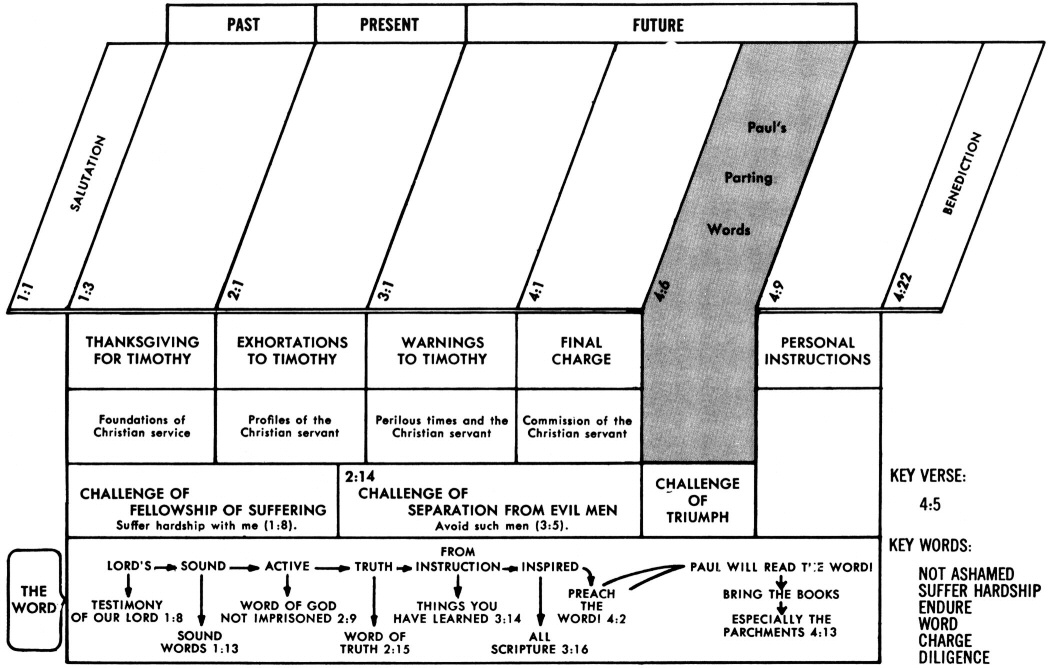
ENDURANCE AND SEPARATION IN THE MINISTRY
Click chart to enlarge
Charts from Jensen's Survey of the NT - used by permission
Second Timothy - Swindoll
| 2 TIMOTHY | |||
| 2 Timothy 1:1-18 | 2 Timothy 2:1-26 | 2 Timothy 3:1-17 | 2 Timothy 4:1-22 |
| Retain the Standard |
Rightly Divide the Word |
Difficult Times Will Come |
Preach the Word |
| PAST | PRESENT | FUTURE | |
| Foundation of Christian Service |
Pictures of Christian Servant |
Dangerous Times for Christian Servant |
Commission of Christian Servant |
| Unashamed as a Witness: Guard the Gospel |
Unashamed as a Workman: Suffer for the Gospel |
Adequate as a Workman: Continue in the Gospel |
Awarded as a Workman: Preach the Gospel |
| Power of the Gospel |
Perseverance of the Gospel Message | Protection of the Gospel |
Proclamation of the Gospel |
| Reminder | Requirements | Resistance | Requests |
| Encouragement in Ministry |
Examples in Ministry |
Exhortations in Ministry |
Exhortations to Fulfill Ministry |
| Commendation & Charge |
Commission to Fulfill |
Conflict to Face |
Course to Finish |
|
Compiled from Jensen's Survey of the NT and Wilkinson's Talk Thru the Bible |
|||
2 Timothy 4:19 Greet (2SAAM) Prisca and Aquila, and the household of Onesiphorus Greek: Aspasai (2SAAM) Priskan kai Akulan kai ton Onesiphorou oikon.
BBE: Give my love to Prisca and Aquila and those of the house of Onesiphorus.
GWT: Give my greetings to Prisca and Aquila and the family of Onesiphorus.
KJV: Salute Prisca and Aquila, and the household of Onesiphorus.
Phillips: Give my love to Prisca and Aquila and Onesiphorus and his family.
Wuest: Greet Prisca and Aquila and the household of Onesiphorus.
Young's Literal: Salute Prisca and Aquilas, and Onesiphorus' household;
GREET PRISCA AND AQUILA AND THE HOUSEHOLD OF ONESIPHORUS: Aspasai (2SAAM) Priskan kai Akulan kai ton Onesiphorou oikon:
- Prisca - Acts 18:2,18,26; Romans 16:3,4; 1Cor 16:19
- 2Ti 1:16
- 2 Timothy 4 Resources - Multiple Sermons and Commentaries
Greet Prisca and Aquila, and the household of Onesiphorus - Greet is aorist imperative a command to carry this out effectively. Be sure to greet them!
Greet (782) (aspazomai from a + spao = draw out as a sword, pull, breathe) means to enfold in arms, to welcome, to embrace. To salute one (not in a military sense), greet, bid, wish well to. In classical literature aspazomai can also be used of physical expressions of welcome, such as “embrace” and “kiss.” It is spoken of those who meet (Mt. 10:12; Mk 9:15; Lk 1:40; 10:4; Acts 21:19; Lxx = Ex. 18:7) or separate (Acts 20:1; 21:6). This is one final expression of Paul's paternal love. A salutation on meeting; an expression of good wishes at the opening (or in Hellenistic times times also the close) of a letter. Aspazomai is constantly used in the papyri for conveying the greetings at the end of a letter (Ro 16:3, 5–16, 21–23; 1Cor. 16:19, 20; 2Cor. 13:12; Phil. 4:21, 22; Col. 4:10, 12, 14, 15; 1Th. 5:26; 2Ti 4:19, 21; Titus 3:15; Philemon 1:23; Heb. 13:24; 1Pet. 5:13; 2 John 1:13; 3 John 1:14). In Heb 11:13 spoken of promises to be embraced, to be happy about, based on the fact that they would prove to be particularly welcome. In Acts 20:1 the idea is to that Paul took "his leave" of the brethren and departed for Macedonia. In other words here aspazomai means to say goodbye, to bid goodbye to or to take leave of. In the next chapter aspazomai is used of "greeting the brethren" after which Paul stayed with them. In Acts 25:13 King Agrippa and Bernice "paid their respects" (aspazomai) to Festus. In Romans 16 Paul uses aspazomai 16 times, 13 in the form of commands (aorist imperative), in Ro 16:16 calling them to "Greet one another with a holy kiss."
Wuest - The Israelites, on meeting and at parting, generally used the formula, “Peace unto thee.” It is interesting to note our Lord’s command to the outgoing disciples, “Salute no man by the way” (Luke 10:4). Thayer says in this connection (Jesus' charge in Lk 10:4), “As a salutation was made, not merely by a slight gesture and a few words, but generally by embracing and kissing, a journey is retarded by saluting frequently.” (Interesting to note that ancients took significant time to greet one another, a far cry from our frequent "Hello, how are you?" even in a church setting! Perhaps we should seek to emulate the ancients in our manner of greeting!)
Wuest comments on aspazomai in Heb 11:13 (All these died in faith, without receiving the promises, but having seen them and HAVING WELCOMED [aspazomai - KJV renders "embraced"; ESV = "greeted" them from a distance, and having confessed that they were strangers and exiles on the earth.) - The word “embraced” (KJV) is the translation of aspazomai which means “to greet or salute.” Vincent says that the word “embraced” is a sort of inferential rendering of the original sense of this word. He offers the translation, “having seen them from afar and greeted them:” and adds this comment, “as seamen wave their greeting to a country seen far off on the horizon, on which they cannot land.”
Friberg (Summary) strictly means to embrace; hence greet, salute, express good wishes; literally, of those entering a house greet, salute (Luke 1.40); of meeting someone along the road greet (Luke 10.4); of departing take leave of, say good-bye to (Acts 20.1); in letters (often imperatively) greet someone, remember (the writer) to someone (Ro 16.3); of short official visits pay one's respects to (Acts 25.13); figuratively, of treating someone affectionately be fond of, be friendly to (Mt 5.47); of things be happy about, welcome, anticipate (Heb 11.13) (Analytical Greek Lexicon)
BDAG (Summary) (1) to engage in hospitable recognition of another (w. varying degrees of intimacy) = greet, welcome a. through word or gesture or both; b. of short friendly visits, ‘look in on’ Acts 18:22; 21:7 (2) to express happiness about the arrival of something = welcome, greet, figurative ext. of 1 in ref. to something intangible .
Vine - (Strong's #782 — Verb — aspazomai — as-pad'-zom-ahee ) signifies "to greet, welcome," or "salute." In the AV it is chiefly rendered by either of the verbs "to greet" or "to salute." "There is little doubt that the revisers have done wisely in giving 'salute' ... in the passages where AV has 'greet.' For the cursory reader is sure to imagine a difference of Greek and of meaning when he finds, e.g., in Philippians 4:21 , "Salute evey saint in Christ Jesus. The brethren which are with me greet you,' or in 3 John 1:14 , "Our friends salute thee. Greet the friends by name'" (Hastings, Bible Dic.). In Acts 25:13 the meaning virtually is "to pay his respects to." In two passages the renderings vary otherwise; in Acts 20:1, of bidding farewell, AV, "embraced them," RV, "took leave of them," or, as Ramsay translates it, "bade them farewell;" in Hebrews 11:13 , of welcoming promises, AV, "embraced," RV, "greeted." The verb is used as a technical term for conveying "greetings" at the close of a letter, often by an amanuensis, e.g., Romans 16:22 , the only instance of the use of the first person in this respect in the NT; see also 1 Corinthians 16:19,20; 2 Corinthians 13:13; Philippians 4:22; Colossians 4:10-15; 1 Thessalonians 5:26; 2 Timothy 4:21; Titus 3:15; Philemon 1:23; Hebrews 13:24; 1 Peter 5:13,14; 2 John 1:13 . This special use is largely illustrated in the papyri, one example of this showing how keenly the absence of the greeting was felt. The papyri also illustrate the use of the addition "by name," when several persons are included in the greeting, as in 3 John 1:14 (Moulton and Milligan, Vocab). Literally aspazomai. signifies "to draw to oneself;" hence, "to greet, salute, welcome," the ordinary meaning, e.g., in Romans 16 , where it is used 21 times. It also signifies "to bid farewell," e.g., Acts 20:1 , RV, "took leave of" (AV, "embraced"). A "salutation or farewell" was generally made by embracing and kissing (see Luke 10:4 , which indicates the posibility of delay on the journey by frequent salutation). In Hebrews 11:13 it is said of those who greeted the promises from afar, RV, "greeted," for AV, "embraced." Cp. aspasmos, "a salutation." (Vine's Expository Dictionary of NT Words)
Zodhiates - OT references with the meaning of greeting: Jdg. 19:20; Ruth 2:4; 1 Sam. 25:6; 2 Sam. 20:9; Dan. 10:19). Equivalent to the NT “Peace be unto you” of those who meet (Luke 24:36; John 20:19; also coll. Matt. 10:12; Luke 10:5). Also spoken of those who separate (Judg. 18:6; 2 Sam. 15:9); equivalent to the NT “Go in peace” (Mark 5:34).
Aspazomai - 59x in 47v - Mt 5:47; 10:12; Mark 9:15; 15:18; Luke 1:40; 10:4; Acts 18:22; 20:1; 21:7, 19; 25:13; Rom 16:3, 5ff, 21ff; 1 Cor 16:19f; 2 Cor 13:12; Phil 4:21f; Col 4:10, 12, 14f; 1 Thess 5:26; 2 Tim 4:19, 21; Titus 3:15; Philemon 1:23; Heb 11:13; 13:24; 1 Pet 5:13f; 2 John 1:13; 3 John 1:15.
NAS Usage = acclaim(1), give...your greeting(1), greet(41), greeted(3), greeting(1), greets(5), paid their respects to(1), sends...greetings(4), taken...leave(1), welcomed(1).
Aspazomai - Only twice in the non-apocryphal Septuagint - Ex 18:7, Esther 5:2.
Related Resources:
- Holman Bible Dictionary Greeting
- Hastings' Dictionary of the Bible Greeting
- Hastings' Dictionary of the NT Greetings
- International Standard Bible Encyclopedia Greeting
- McClintock and Strong's Bible Encyclopedia Greeting
Prisca - In the NT "Priscilla" and "Prisca" are the same person. The author of Acts uses the full name Priscilla, while Paul uses the diminutive form Prisca.
Acts 18:2 And he found a Jew named Aquila, a native of Pontus, having recently come from Italy with his wife Priscilla, because Claudius had commanded all the Jews to leave Rome. He came to them,
Acts 18:18 Paul, having remained many days longer, took leave of the brethren and put out to sea for Syria, and with him were Priscilla and Aquila. In Cenchrea he had his hair cut, for he was keeping a vow.
Acts 18:26 and he began to speak out boldly in the synagogue. But when Priscilla and Aquila heard him, they took him aside and explained to him the way of God more accurately.
Romans 16:3 Greet Prisca and Aquila, my fellow workers in Christ Jesus,
1 Corinthians 16:19 The churches of Asia greet you. Aquila and Prisca greet you heartily in the Lord, with the church that is in their house.
2 Timothy 4:19 Greet Prisca and Aquila, and the household of Onesiphorus.
Aquila - Acts 18:2, 18, 26; Ro 16:3; 1Cor 16:19; 2Ti 4:19. Husband of Prisca/Priscilla. A Jew of Pontus, a tent-maker, convert to Christ, companion and ally of Paul in propagating the Christian religion.
Acts 18:2 And he found a Jew named Aquila, a native of Pontus, having recently come from Italy with his wife Priscilla, because Claudius had commanded all the Jews to leave Rome. He came to them,
Acts 18:18 Paul, having remained many days longer, took leave of the brethren and put out to sea for Syria, and with him were Priscilla and Aquila. In Cenchrea he had his hair cut, for he was keeping a vow.
Acts 18:26 and he began to speak out boldly in the synagogue. But when Priscilla and Aquila heard him, they took him aside and explained to him the way of God more accurately.
Romans 16:3 Greet Prisca and Aquila, my fellow workers in Christ Jesus,
1 Corinthians 16:19 The churches of Asia greet you. Aquila and Prisca greet you heartily in the Lord, with the church that is in their house.
2 Timothy 4:19 Greet Prisca and Aquila, and the household of Onesiphorus.
Wayne Detzler - GREETING - MEANING - In the Greek New Testament the word translated "greeting" is aspazomai, a very broad but meaningful term. It embraces all forms of greeting from a verbal welcome to a kiss. In fact, it is variously translated in the New Testament by "embrace," "greet," "salute" (in the King James Version), and "take leave of." The original Greek use of this word was also general. Building on the basic meaning of "embrace," other forms of greeting were added as time went on. Usually they referred to some external gesture, such as offering one's hand, kissing, or expressing acclaim in some other form. The usual greeting in Greek was chaire, which literally meant "rejoice." In practice it also meant "welcome," "good day," "hail," "hello," and "I am glad to see you." It is a lot like our English word, "Hi." Later on the Greeks turned from personal greetings to letters of greeting, forerunners of our greeting cards.
BIBLE USAGE - The word aspazomai speaks generally of the social grace of greeting. In fact, Jesus said it was the least of common courtesies, and He taught that Christians should even greet those who were not particular friends (Matt. 5:47). A slightly different turn to the word is seen in the narrative of Mark's Gospel. He mentioned that a crowd greeted Jesus eagerly, when He returned from His transfiguration (Mark 9:15). This is closer to the idea of acclaim. A fascinating appearance of our word is in the birth narrative of Luke. When the Angel Gabriel came to the Virgin Mary, his angelic greeting troubled her (Luke 1:29). Furthermore, when Mary went to greet Elizabeth, the baby John leaped inside her womb (1:41). This says much about the joy of that special greeting. As the Apostle Paul made his way to Jerusalem, he met with many Christians at Troas, Ephesus, Caesarea, and Ptolemais. The word for "greeting" is used to describe the "farewell" which Christians at Ephesus gave him (Acts 20:7). Again in Acts the word for greeting is used to describe a visit, when Paul stopped briefly at Ptolemais or Acre (21:7).
The most frequent use of our word is found in the New Testament epistles. Greetings are extended to special friends such as Priscilla and Aquila (Rom. 16:3, 5, 22). Churches also greet one another by reference in the apostle's letters (1 Cor. 16:19). The "holy kiss" was also used as a form of greeting (2 Cor. 13:12). General greetings were issued to "every saint" (Phil. 4:21). In the Book of Colossians Paul listed several from whom he sent greetings (Col. 4:10-14). Again in his final epistle, Paul passed on greetings (2 Tim. 4:19, 21). The same kind of greeting is given in Titus 3:15 and Philemon 23. A general greeting to all the leaders and all the saints is included at the conclusion of the Book of Hebrews (Heb. 13:24). Peter urged Christians to greet one another with the "kiss of love," which is a fairly unusual formulation (1 Peter 5:14). In his rather cryptic epistles, John also passed on greetings to the church (2 John 13; 3 John 14). Though not using the exact word, John warned the Christians not to greet or welcome false prophets (2 John 10). Jesus set down an interesting criterion concerning greetings. When He first sent out the disciples, He told them to bring a special greeting to each house which they entered (Matt. 10:12). The Christian greeting was one of peace. The Lord had said, "Peace be with you" (John 20:21). If this greeting was not appreciated or 192 received, the disciples were instructed to leave immediately (Luke 10:5-6). On the lowest level, greeting is a simple social custom. The ancient Greeks were much like the Romans and Jews. All greeted socially. However, under the exposition of Christ's teaching, greeting became an evangelistic test. Disciples were instructed to share their Gospel only with those who were receptive toward them.
ILLUSTRATIONS - Greetings remind most modem people of greeting cards. For nearly every possible event there is a suitable card. Apart from the normal birthdays, anniversaries, and wedding greetings, there are also many other memorable occasions. Depending on the neighborhood, there may be special cards for Jewish holidays, Christmas cards, or even Muslim greetings. Recently the Soviet Union set an unusual precedent in the greeting card business. A line of Soviet Christmas cards appeared on the market in Europe. This was doubly amazing. Not only were the cards printed in English, but they came from an officially atheistic country. Apparently, profits can also be the mother of invention. Another interesting line of greeting cards is found in England. The British driving test is very difficult and it takes many people two or three times to pass it. Thus the friends of recently licensed drivers shower the successful candidate with specially printed cards.
In his poignant poem, "When We Two Parted," Lord Byron (1788-1824) theorized concerning a future reunion, and said this about the greeting:
If I should meet thee After long years,
How should I greet thee? With silence and tears.For several years our family lived in Germany, where the standard greeting was a handshake. In fact it was impolite not to shake hands. In time the extending of a hand came to be second nature. When one could not offer the right hand, one said: "The left hand is from the heart." When Germans write to one another, the greeting is also extremely important. At the end of a letter one says: "Gruss an Deine Mutter" (Greet your mother). At other times one passes on greetings from another person: "Meine Mutter laesst gruessen" (My mother sends her greetings). It is a matter of form, but this form conveys real friendship. In Christian circles certain German churches set aside a portion of the service for the passing of greetings. The leader asks: "Are there any greetings from other churches?" Then people from near and far stand to give greetings in the names of their home churches. It is a lovely habit which binds together Christians from various parts of the country. Not only is this practice cultivated in church services, but it is also used in large conferences. Often I have sat through hours of "greetings" from personages great and small. Though it may be overdone, the German idea of conveying greetings does give a sense of personal regard and friendship. (New Testament Words in Today's Language.)
Household (3624) (oikos) refers to a place of habitation thus a house, a building or a dwelling (Lk 1:40, 4:28), one's home, where one lives at a particular time (Lk 1:23), the Temple (Lev 19:46, see "house of God" below), a city (Lk 13:35 - but some would equate this with the Temple rather than the city of Jerusalem), property (Acts 7:10), and by implication a family (more or less related), a household (Lk 10:5). A king's home is a palace (Mt 11:8).
The house of God refers to the Temple (Mt. 12:4; Mk. 2:26; Lk. 6:4; 11:51; Heb. 10:21). With the phrase "My house" in Mt 21:13 (Lk 19:46, "My Father's house" - Jn 2:16, 17) Jesus is referring to the Temple (quoting Isa 56:7).
"Your house" in Mt 23:38 (Lk 13:35) refers to the Temple in Jerusalem which was destroyed by the Romans in 70 A.D.
The house of Israel refers to the nation/people of Israel (Mt. 10:6; 15:24; Acts 2:36; 7:42; Heb. 8:8, 10, cp house of Jacob - Lk 1:33)
Figuratively, oikos can refer to Christians as the spiritual house or temple of God (1 Pet. 2:5). Of those in whom evil spirits dwell (Mt. 12:44; Lk 11:24).
Figuratively, of the "house of David" (Lk 1:27KJV, Lk 2:4) means the lineage or descendants of David.
God's family (Heb 3:6 "Christ was faithful as a Son over His house–whose house we are, if we hold fast our confidence and the boast of our hope firm until the end.")
Metonymically, oikos is translated household or family and refers to the social unit that was living together and which usually consisted of family, servants and some extended family, residing in the same physical building (oikos) (Luke 10:5; Acts 10:2; 11:14; 16:15; 1 Cor. 1:16; 2 Tim. 1:16; Titus 1:11).
The household of God, refers to the Christian Church and/or Christians (1 Ti 3:15; Heb. 3:6; 10:21; 1 Pe 4:17)
Metonymically, oikos could refer to a family, lineage, posterity, descended from one head or ancestor (Luke 1:27, 69; 2:4; Lxx - Ex. 6:14; 1 Kgs. 12:16, 19). A whole people or nation as descended from one ancestor such as the house or people of Israel (Matt. 10:6; 15:24); the house of Jacob (Luke 1:33); the house of Judah (Heb. 8:8; Lxx - Ex. 19:3; Lev. 10:6; Jdg 1:23; 1 Ki 12:23; Jer. 31:31).
Vine on oikos - (a) “a house, a dwelling,” e.g., Mt. 9:6, 7; 11:8; it is used of the Tabernacle, as the House of God, Matt. 12:4, and the Temple similarly, e.g., Matt. 21:13; Luke 11:51, KJV, “temple,” RV, “sanctuary”; John 2:16, 17; called by the Lord “your house” in Matt. 23:38 and Luke 13:35 (some take this as the city of Jerusalem); metaphorically of Israel as God’s house, Heb. 3:2, 5, where “his house” is not Moses’, but God’s; of believers, similarly, Heb 3:6, where Christ is spoken of as “over God’s House” (the word “own” is rightly omitted in the RV); Heb. 10:21; 1 Pet. 2:5; 4:17; of the body, Matt. 12:44; Luke 11:24;
(b) by metonymy, of the members of a household or family, e.g., Luke 10:5; Acts 7:10; 11:14; 1 Tim. 3:4, 5, 12; 2 Tim. 1:16; 4:19, RV (KJV, “household”); Titus 1:11 (plural); of a local church, 1 Tim. 3:15; of the descendants of Jacob (Israel) and David, e.g., Matt. 10:6; Luke 1:27, 33; Acts 2:36; 7:42.
Gilbrant on uses in the Septuagint - In the Septuagint both oikos and oikia are used often to translate the Hebrew word bayith. Conceptually bayith and oikos are quite similar in Hebrew and Greek thought; bayith can simply refer to a building, or it can refer to other things associated with the domicile such as property or persons. Both Hebrew and Greek use “house” as a word for the family unit (e.g., 2 Samuel 16:5 [ LXX 2 Kings 16:5]). The temple or tabernacle of the Lord is called a house even as heathen temples are (e.g., Judges 18:31; 1 Kings 6:1 [LXX 3 Kings 6:1]; 1 Samuel 5:2 [ LXX 1 Kings 5:2]). The temple of God is often referred to as “the house” (e.g., 1 Kings 6 [LXX 3 Kings 6]). Furthermore, house can be used to describe an entire nation (e.g., 2 Samuel 6:5 [ LXX 2 Samuel 6:5]).In the Dead Sea Scrolls the Qumran community described itself as the temple of God (1QS 5:6; 8:5,9; 9:6; GD 3:19). (See Gartner, The Temple and the Community in Qumran and the New Testament.) This has significant New Testament parallels. (Complete Biblical Library Greek-English Dictionary,) (Note that there are over 1700 uses of oikos in the Septuagint - here are just the uses in Genesis - Genesis 7:1; 9:21; 27; 12:1; 15; 17; 17:23; 27; 18:19; 19:2; 10; 20:13; 18; 24:7; 27; 38; 40; 67; 27:15; 28:2; 17; 19; 21; 29:13; 30:30; 31:14; 30; 33; 35; 37; 34:19; 26; 30; 35:2; 36:6; 38:11; 39:2; 4; 8; 16; 41:10; 40; 42:33; 43:17; 26; 44:8; 45:2; 8; 16; 46:27; 31; 47:12; 14; 24; 50:7)
Oikos - 114x in 106v - Usage: descendants(1), families(1), family(1), home(18), homes(2), house(79), household(14), households(1), itself(1), palaces(1), place(1).
Matthew 9:6 "But so that you may know that the Son of Man has authority on earth to forgive sins "-- then He said to the paralytic, "Get up, pick up your bed and go home."
7 And he got up and went home.
Matthew 10:6 but rather go to the lost sheep of the house of Israel.
Matthew 11:8 "But what did you go out to see? A man dressed in soft clothing? Those who wear soft clothing are in kings' palaces!
Matthew 12:4 how he entered the house of God, and they ate the consecrated bread, which was not lawful for him to eat nor for those with him, but for the priests alone?
44 "Then it says, 'I will return to my house from which I came'; and when it comes, it finds it unoccupied, swept, and put in order.
Matthew 15:24 But He answered and said, "I was sent only to the lost sheep of the house of Israel."
Matthew 21:13 And He said to them, "It is written, 'MY HOUSE SHALL BE CALLED A HOUSE OF PRAYER'; but you are making it a ROBBERS' DEN."
Matthew 23:38 "Behold, your house is being left to you desolate!
Mark 2:1 When He had come back to Capernaum several days afterward, it was heard that He was at home.
11 "I say to you, get up, pick up your pallet and go home."
26 how he entered the house of God in the time of Abiathar the high priest, and ate the consecrated bread, which is not lawful for anyone to eat except the priests, and he also gave it to those who were with him?"
Mark 3:20 And He came home, and the crowd gathered again, to such an extent that they could not even eat a meal.
Mark 5:19 And He did not let him, but He said to him, "Go home to your people and report to them what great things the Lord has done for you, and how He had mercy on you."
38 They came to the house of the synagogue official; and He saw a commotion, and people loudly weeping and wailing.
Mark 7:17 When he had left the crowd and entered the house, His disciples questioned Him about the parable.
30 And going back to her home, she found the child lying on the bed, the demon having left.
Mark 8:3 "If I send them away hungry to their homes, they will faint on the way; and some of them have come from a great distance."
26 And He sent him to his home, saying, "Do not even enter the village."
Mark 9:28 When He came into the house, His disciples began questioning Him privately, "Why could we not drive it out?"
Mark 11:17 And He began to teach and say to them, "Is it not written, 'MY HOUSE SHALL BE CALLED A HOUSE OF PRAYER FOR ALL THE NATIONS '? But you have made it a ROBBERS' DEN."
Luke 1:23 When the days of his priestly service were ended, he went back home.
27 to a virgin engaged to a man whose name was Joseph, of the descendants of David; and the virgin's name was Mary.
33 and He will reign over the house of Jacob forever, and His kingdom will have no end."
40 and entered the house of Zacharias and greeted Elizabeth.
56 And Mary stayed with her about three months, and then returned to her home.
69 And has raised up a horn of salvation for us In the house of David His servant--
Luke 2:4 Joseph also went up from Galilee, from the city of Nazareth, to Judea, to the city of David which is called Bethlehem, because he was of the house and family of David,
Luke 5:24 "But, so that you may know that the Son of Man has authority on earth to forgive sins,"-- He said to the paralytic-- "I say to you, get up, and pick up your stretcher and go home."
25 Immediately he got up before them, and picked up what he had been lying on, and went home glorifying God.
Luke 6:4 how he entered the house of God, and took and ate the consecrated bread which is not lawful for any to eat except the priests alone, and gave it to his companions?"
Luke 7:10 When those who had been sent returned to the house, they found the slave in good health.
36 Now one of the Pharisees was requesting Him to dine with him, and He entered the Pharisee's house and reclined at the table.
Luke 8:39 "Return to your house and describe what great things God has done for you." So he went away, proclaiming throughout the whole city what great things Jesus had done for him.
41 And there came a man named Jairus, and he was an official of the synagogue; and he fell at Jesus' feet, and began to implore Him to come to his house;
Luke 9:61 Another also said, "I will follow You, Lord; but first permit me to say good-bye to those at home."
Luke 10:5 "Whatever house you enter, first say, 'Peace be to this house.'
Luke 11:17 But He knew their thoughts and said to them, "Any kingdom divided against itself is laid waste; and a house divided against itself falls.
24 "When the unclean spirit goes out of a man, it passes through waterless places seeking rest, and not finding any, it says, 'I will return to my house from which I came.'
51 from the blood of Abel to the blood of Zechariah, who was killed between the altar and the house of God; yes, I tell you, it shall be charged against this generation.'
Luke 12:39 "But be sure of this, that if the head of the house had known at what hour the thief was coming, he would not have allowed his house to be broken into.
52 for from now on five members in one household will be divided, three against two and two against three.
Luke 13:35 "Behold, your house is left to you desolate; and I say to you, you will not see Me until the time comes when you say, 'BLESSED IS HE WHO COMES IN THE NAME OF THE LORD!'"
Luke 14:1 It happened that when He went into the house of one of the leaders of the Pharisees on the Sabbath to eat bread, they were watching Him closely.
23 "And the master said to the slave, 'Go out into the highways and along the hedges, and compel them to come in, so that my house may be filled.
Luke 15:6 "And when he comes home, he calls together his friends and his neighbors, saying to them, 'Rejoice with me, for I have found my sheep which was lost!'
Luke 16:4 'I know what I shall do, so that when I am removed from the management people will welcome me into their homes.'
27 "And he said, 'Then I beg you, father, that you send him to my father's house--
Luke 18:14 "I tell you, this man went to his house justified rather than the other; for everyone who exalts himself will be humbled, but he who humbles himself will be exalted."
Luke 19:5 When Jesus came to the place, He looked up and said to him, "Zaccheus, hurry and come down, for today I must stay at your house."
9 And Jesus said to him, "Today salvation has come to this house, because he, too, is a son of Abraham.
46 saying to them, "It is written, 'AND MY HOUSE SHALL BE A HOUSE OF PRAYER,' but you have made it a ROBBERS' DEN."
John 2:16 and to those who were selling the doves He said, "Take these things away; stop making My Father's house a place of business."
17 His disciples remembered that it was written, "ZEAL FOR YOUR HOUSE WILL CONSUME ME."
John 7:53 Everyone went to his home.
John 11:20 Martha therefore, when she heard that Jesus was coming, went to meet Him, but Mary stayed at the house.
Acts 2:2 And suddenly there came from heaven a noise like a violent rushing wind, and it filled the whole house where they were sitting.
36 "Therefore let all the house of Israel know for certain that God has made Him both Lord and Christ-- this Jesus whom you crucified."
46 Day by day continuing with one mind in the temple, and breaking bread from house to house, they were taking their meals together with gladness and sincerity of heart,
Acts 5:42 And every day, in the temple and from house to house, they kept right on teaching and preaching Jesus as the Christ.
Acts 7:10 and rescued him from all his afflictions, and granted him favor and wisdom in the sight of Pharaoh, king of Egypt, and he made him governor over Egypt and all his household.
20 "It was at this time that Moses was born; and he was lovely in the sight of God, and he was nurtured three months in his father's home.
42 "But God turned away and delivered them up to serve the host of heaven; as it is written in the book of the prophets, 'IT WAS NOT TO ME THAT YOU OFFERED VICTIMS AND SACRIFICES FORTY YEARS IN THE WILDERNESS, WAS IT, O HOUSE OF ISRAEL?
46 "David found favor in God's sight, and asked that he might find a dwelling place for the God of Jacob.
47 "But it was Solomon who built a house for Him.
49 'HEAVEN IS MY THRONE, AND EARTH IS THE FOOTSTOOL OF MY FEET; WHAT KIND OF HOUSE WILL YOU BUILD FOR ME?' says the Lord, 'OR WHAT PLACE IS THERE FOR MY REPOSE?
Acts 8:3 But Saul began ravaging the church, entering house after house, and dragging off men and women, he would put them in prison.
Acts 10:2 a devout man and one who feared God with all his household, and gave many alms to the Jewish people and prayed to God continually.
22 They said, "Cornelius, a centurion, a righteous and God-fearing man well spoken of by the entire nation of the Jews, was divinely directed by a holy angel to send for you to come to his house and hear a message from you."
30 Cornelius said, "Four days ago to this hour, I was praying in my house during the ninth hour; and behold, a man stood before me in shining garments,
Acts 11:12 "The Spirit told me to go with them without misgivings. These six brethren also went with me and we entered the man's house.
13 "And he reported to us how he had seen the angel standing in his house, and saying, 'Send to Joppa and have Simon, who is also called Peter, brought here;
14 and he will speak words to you by which you will be saved, you and all your household.'
Acts 16:15 And when she and her household had been baptized, she urged us, saying, "If you have judged me to be faithful to the Lord, come into my house and stay." And she prevailed upon us.
31 They said, "Believe in the Lord Jesus, and you will be saved, you and your household."
34 And he brought them into his house and set food before them, and rejoiced greatly, having believed in God with his whole household.
Acts 18:8 Crispus, the leader of the synagogue, believed in the Lord with all his household, and many of the Corinthians when they heard were believing and being baptized.
Acts 19:16 And the man, in whom was the evil spirit, leaped on them and subdued all of them and overpowered them, so that they fled out of that house naked and wounded.
Acts 20:20 how I did not shrink from declaring to you anything that was profitable, and teaching you publicly and from house to house,
Acts 21:8 On the next day we left and came to Caesarea, and entering the house of Philip the evangelist, who was one of the seven, we stayed with him.
Romans 16:5 also greet the church that is in their house. Greet Epaenetus, my beloved, who is the first convert to Christ from Asia.
1 Corinthians 1:16 Now I did baptize also the household of Stephanas; beyond that, I do not know whether I baptized any other.
1 Corinthians 11:34 If anyone is hungry, let him eat at home, so that you will not come together for judgment. The remaining matters I will arrange when I come.
1 Corinthians 14:35 If they desire to learn anything, let them ask their own husbands at home; for it is improper for a woman to speak in church.
1 Corinthians 16:19 The churches of Asia greet you. Aquila and Prisca greet you heartily in the Lord, with the church that is in their house.
Colossians 4:15 Greet the brethren who are in Laodicea and also Nympha and the church that is in her house.
1 Timothy 3:4 He must be one who manages his own household well, keeping his children under control with all dignity
5 (but if a man does not know how to manage his own household, how will he take care of the church of God?),
12 Deacons must be husbands of only one wife, and good managers of their children and their own households.
15 but in case I am delayed, I write so that you will know how one ought to conduct himself in the household of God, which is the church of the living God, the pillar and support of the truth.
1 Timothy 5:4 but if any widow has children or grandchildren, they must first learn to practice piety in regard to their own family and to make some return to their parents; for this is acceptable in the sight of God.
2 Timothy 1:16 The Lord grant mercy to the house of Onesiphorus, for he often refreshed me and was not ashamed of my chains;
2 Timothy 4:19 Greet Prisca and Aquila, and the household of Onesiphorus.
Titus 1:11 who must be silenced because they are upsetting whole families, teaching things they should not teach for the sake of sordid gain.
Philemon 1:2 and to Apphia our sister, and to Archippus our fellow soldier, and to the church in your house:
Hebrews 3:2 He was faithful to Him who appointed Him, as Moses also was in all His house.
3 For He has been counted worthy of more glory than Moses, by just so much as the builder of the house has more honor than the house.
4 For every house is built by someone, but the builder of all things is God.
5 Now Moses was faithful in all His house as a servant, for a testimony of those things which were to be spoken later;
6 but Christ was faithful as a Son over His house-- whose house we are, if we hold fast our confidence and the boast of our hope firm until the end.
Hebrews 8:8 For finding fault with them, He says, "BEHOLD, DAYS ARE COMING, SAYS THE LORD, WHEN I WILL EFFECT A NEW COVENANT WITH THE HOUSE OF ISRAEL AND WITH THE HOUSE OF JUDAH;
10 "FOR THIS IS THE COVENANT THAT I WILL MAKE WITH THE HOUSE OF ISRAEL AFTER THOSE DAYS, SAYS THE LORD: I WILL PUT MY LAWS INTO THEIR MINDS, AND I WILL WRITE THEM ON THEIR HEARTS. AND I WILL BE THEIR GOD, AND THEY SHALL BE MY PEOPLE.
Hebrews 10:21 and since we have a great priest over the house of God,
Hebrews 11:7 By faith Noah, being warned by God about things not yet seen, in reverence prepared an ark for the salvation of his household, by which he condemned the world, and became an heir of the righteousness which is according to faith.
1 Peter 2:5 you also, as living stones, are being built up as a spiritual house for a holy priesthood, to offer up spiritual sacrifices acceptable to God through Jesus Christ.
1 Peter 4:17 For it is time for judgment to begin with the household of God; and if it begins with us first, what will be the outcome for those who do not obey the gospel of God?
Onesiphorus - Profit-bringer. Bringing advantage. "One of the punning names so common among slaves. Cp. Chresimus, Chrestus, Onesimus, Symphorus, all of which signify useful or helpful." (Vincent)
2 Timothy 1:16 The Lord grant mercy to the house of Onesiphorus, for he often refreshed me and was not ashamed of my chains;
2 Timothy 4:20 Erastus remained ( 3SAAI ) at Corinth, but Trophimus I left ( 1SAAI ) sick ( PAPMSA ) at Miletus . Greek: Erastos emeinen (3SAAI) en Korintho, Trophimon de apelipon (1SAAI) en Mileto asthenounta. (PAPMSA)
BBE: Erastus was stopping at Corinth; but Trophimus, when I last saw him was at Miletus, ill.'
GWT: Erastus stayed in the city of Corinth and I left Trophimus in the city of Miletus because he was sick.
KJV: Erastus abode at Corinth: but Trophimus have I left at Miletum sick.
Phillips: Erastus is still staying on at Corinth, and Trophimus I had to leave sick at Miletus.
Wuest: Erastus remained in Corinth, but Trophimus, being ill, I left behind in Miletus.
Young's Literal: Erastus did remain in Corinth, and Trophimus I left in Miletus infirm;
ERASTUS REMAINED AT CORINTH BUT TROPHIMUS I LEFT SICK AT MILETUS: Erastos emeinen (3SAAI) en KorinthoTrophimon de apelipon (1SAAI) en Mileto asthenounta (PAPMSA):
- Erastus - Acts 19:22; Romans 16:23
- Trophimus - Acts 20:4; 21:29
- Miletum - Acts 20:15,17, Philippians 2:26,27
- 2 Timothy 4 Resources - Multiple Sermons and Commentaries
See Erastus
Acts 19:22 And having sent into Macedonia two of those who ministered to him, Timothy and Erastus, he himself stayed in Asia for a while.
Romans 16:23 Gaius, host to me and to the whole church, greets you. Erastus, the city treasurer greets you, and Quartus, the brother.
2 Timothy 4:20 Erastus remained at Corinth, but Trophimus I left sick at Miletus.
Remained (3306) (meno) means to remain in the same place over a period of time and so to abide. This is a major verb in the NT (118x in 102v) and is used 3x in 2Timothy (2Ti 2:13, 2Ti 3:14, 2Ti 4:20).
See Trophimus
Acts 20:4 And he was accompanied by Sopater of Berea, the son of Pyrrhus, and by Aristarchus and Secundus of the Thessalonians, and Gaius of Derbe, and Timothy, and Tychicus and Trophimus of Asia.
Acts 21:29 For they had previously seen Trophimus the Ephesian in the city with him, and they supposed that Paul had brought him into the temple.
2 Timothy 4:20 Erastus remained at Corinth, but Trophimus I left sick at Miletus.
Sick (770)(astheneo [word study] from asthenes [see study] = without strength, powerless from a = without + sthenos = strength, bodily vigor) means to be feeble (in any sense), to be diseased, impotent, sick, to lack strength, to be infirm, to be weak.
Astheneo - 33 times in the NAS - Mt 10:8; 25:36, 39; Mark 6:56; Lk 4:40; Jn 4:46; 5:3, 7; 6:2; 11:1, 2, 6; Acts 9:37; 19:12; 20:35; Ro 4:19; 8:3; 14:1,2; 1Cor 8:11, 12; 2Co 11:21, 29; 12:10; 13:3, 4, 9; Php 2:26, 27; 2Ti 4:20; James 5:14. NAS = am weak, 1; becoming weak, 1; fell sick, 1; sick, 18; weak, 12.
See Miletus
Acts 20:15 Sailing from there, we arrived the following day opposite Chios; and the next day we crossed over to Samos; and the day following we came to Miletus.
Acts 20:17 From Miletus he sent to Ephesus and called to him the elders of the church.
2 Timothy 4:20 Erastus remained at Corinth, but Trophimus I left sick at Miletus.
This happening cannot be fitted into Acts and thus indicates two imprisonments in Rome for Paul. Trophimus was an Ephesian (Acts 20:4; 21:29).
Whereas God often heals the sick, through physicians or without them, it is not the case that in all situations there is instant healing. Epaphroditus was seriously ill for some time (cf. Php 2:25, 26, 27; 2Co12:7, 8, 9, 10; Jas 5:14). If it were God's will that all should be healed, surely Paul would have been able to heal Trophimus.
2 Timothy 4:21 Make every effort (2SAAM) to come (AAN) before winter. Eubulus greets (3SPMI) you, also Pudens and Linus and Claudia and all the brethren.
Greek: Spoudason (2SAAM) pro cheimonos elthein. (AAN) Aspazetai (3SPMI) se Euboulos kai Poudes kai Linos kai Klaudia kai oi adelphoi pantes.
GWT: Hurry to visit me before winter comes. Eubulus, Pudens, Linus, Claudia and all the brothers and sisters send you greetings.
BBE: Do your best to come before the winter. Eubulus sends you his love, and Pudens and Linus and Claudia, and all the brothers.
KJV: Do thy diligence to come before winter. Eubulus greeteth thee, and Pudens, and Linus, and Claudia, and all the brethren.
Phillips: Do your best to get here before the winter. Eubulus, Pudens, Linus, Claudia and all here send their greetings to you.
Wuest: Do your best to come before winter. There greet you Eubulus and Pudens and Linus and Claudia and all the brethren.
Young's Literal: be diligent to come before winter. Salute thee doth Eubulus, and Pudens, and Linus, and Claudia, and all the brethren.
MAKE EVERY EFFORT TO COME BEFORE WINTER: Spoudason (2SAAM) pro cheimonos elthein (AAN):
- 2 Timothy 4 Resources - Multiple Sermons and Commentaries
Make every every (4704) (spoudazo [word study] from spoude = earnestness, diligence) conveys the idea hastening to do something with the implication of associated energy or with intense effort and motivation. It means marked by careful unremitting attention or persistent application. The idea is give maximum effort, do your best, spare no effort, hurry on, be eager! Hasten to do a thing, exert yourself, endeavor to do it. It means not only to be willing to do with eagerness, but to follow through and make diligent effort. In other words spoudazo does not stop with affecting one's state of mind, but also affects one's activity. Spoudazo conveys the idea of exertion. It means to be conscientious, zealous and earnest in discharging a duty or obligation. The verb speaks of intensity of purpose followed by intensity of effort toward the realization of that purpose.
To be diligent is to exert steady, earnest, and energetic effort and suggests earnest application to some specific object or pursuit. The idea is careful and persevering in carrying out tasks or duties. It means to be assiduous (marked by careful unremitting attention or persistent application).
Spoudazo basically means to make haste, and from that come the meanings of zeal and diligence. One commentator describes it as a holy zeal that demands full dedication.
Wuest says that spoudazo means
to make haste, do one’s best, take care, desire. The idea of making haste, being eager, giving diligence, and putting forth effort are in the word. The word speaks of intense effort and determination. (Wuest, K. S. Wuest's Word Studies from the Greek New Testament: Eerdmans)
Before winter - Before the winter-season which spans the Feast of Tabernacles to Feast of Passover (roughly, October to April). Why? Clearly weather impeded or even completely prohibited travel, especially by sea (as is apparent from a study of Acts 27:1ff). Another reason of course is that the time of Paul's departure (demise) was drawing near (2Ti 4:6-note). Paul would also need his cloak (2Ti 4:13-note)
Practical Application: Winter is a season. Seasons pass. And when they pass, the opportunities (Click for an in depth word study on kairos, the Greek Word which means "opportunity") that were present during that season will also pass. God gives us all opportunities but He won't force us to respond. We have to choose to respond to opportunities. In this last section of Paul's final known communication he makes the plea (a second time) to "make every effort" but not qualifies it with “Come before winter”. This plea should be a reminder to all of us that opportunities do not wait forever. Practically speaking, in the ancient world, once the winter season began, Timothy would no longer be able to travel easily to Rome and see his beloved friend for the last time.
Dr. Clarence Macartney in his famous sermon “Come Before Winter” asks...
Why “before winter”? Because when winter set in the season for navigation closed in the Mediterranean and it was dangerous for ships to venture out to sea. How dangerous it was, the story of Paul’s last shipwreck tells us. If Timothy waits until winter, he will have to wait until spring; and Paul has a premonition that he will not last out the winter, for he says, “The time of my departure is at hand.” We like to think that Timothy did not wait a single day after that letter from Paul reached him at Ephesus, but started at once to Troas, where he picked up the books and the old cloak in the house of Carpus, then sailed past Samothrace to Neapolis, and thence traveled by the Egnatian Way across the plains of Philippi and through Macedonia to the Adriatic, where he took ship to Brundisium, and then went up the Appian Way to Rome, where he found Paul in his prison, read to him from the Old Testament, wrote his last letters, walked with him to the place of execution near the Pyramid of Cestius, and saw him receive the crown of glory.
Before winter or never!
There are some things which will never be done unless they are done “before winter.” The winter will come and the winter will pass, and the flowers of the springtime will deck the breast of the earth, and the graves of some of our opportunities, perhaps the grave of our dearest friend. There are golden gates wide open on this autumn day, but next October they will be forever shut. There are tides of opportunity running now at the flood. Next October they will be at the ebb. There are voices speaking today which a year from today will be silent. Before winter or never! (Click for full sermon)
To reiterate...
“Before winter or never!...
There are some things which will never be done unless they are done ‘before winter.’”
Beloved, are there opportunities you are neglecting today that may soon vanish forever? Are there people you should contact and decisions you should make? Today is yours; tomorrow may be too late.
Beloved "Timothy" or "Timothea", "Come before winter!" whatever that plea might mean to you in your present life circumstance...don't delay! Dr. Arnot Walker did not delay...
Dr. Arnot Walker, when a student in the Jefferson Medical College, heard Dr. Clarence E. Macartney preach a sermon on the text, “Do thy diligence to come before winter” (2Ti 4:21). The text continued to linger in his thoughts as he sat in his room. He decided, “I had better write a letter now to my mother. Perhaps the winter of death is near for her.” He wrote to her and expressed gratitude for her exemplary Christian life. Two days later while he sat in class a telegram was given to him. It read, “Come at once. Your mother is critically ill!” Hurriedly he went to the country home. His mother was still living. A smile of recognition and satisfaction was on her face. Under her pillow lay a treasured possession—the loving letter her son had written her after the Sunday service. It had cheered and comforted her as she entered “the valley of the shadow of death!” (Bolding Added) (Tan, P. L. Encyclopedia of 7700 illustrations: Garland TX: Bible Communications)
EUBULUS GREETS YOU, ALSO PUDENS AND LINUS AND CLAUDIA AND ALL THE BRETHREN: se Euboulos kai Poudes kai Linos kai Klaudia kai oi adelphoi pantes:
- Romans 16:21, 22, 23; 1Corinthians 16:20; 2Corinthians 13:13; Philippians 4:22; 2John 1:13; 3John 1:14
- 2 Timothy 4 Resources - Multiple Sermons and Commentaries
At least the four persons named here had not deserted Paul (v16). Nothing more is known of them.
2 Timothy 4:22 The Lord be with your spirit. Grace be with you. Greek: O kurios meta tou pneumatos sou. e charis meth' humon
BBE: The Lord be with your spirit. Grace be with you.
GWT: The Lord be with you. His good will be with all of you.
KJV: The Lord Jesus Christ be with thy spirit. Grace be with you. Amen.
Phillips: The Lord be with your spirit. Grace be with you.
Wuest: The Lord be with your spirit. The grace be with you
Young's Literal: The Lord Jesus Christ is with thy spirit; the grace is with you! Amen.
THE LORD BE WITH YOUR SPIRIT. GRACE BE WITH YOU: O kurios meta tou pneumatos sou e charis meth' humon:
- Matthew 28:20; Romans 16:20; 2Corinthians 13:14; Galatians 6:18; Philemon 1:25
- Romans 1:7; 1Corinthians 16:23; Ephesians 6:24; Colossians 4:18; 1Timothy 6:21; 1Peter 5:14; Revelation 22:21
- 2 Timothy 4 Resources - Multiple Sermons and Commentaries
A MESSAGE WITH BOOKENDS
OF THE GRACE OF GOD
To Timothy, my beloved son: Grace, mercy and peace from God the Father and Christ Jesus our Lord. (2 Ti 1:2+)
The Lord be with your spirit - In essence a prayer of blessing to Timothy. It is notable that in Galatians 6:18 and Philemon 1:25, Paul gives a similar blessing that "The grace of our Lord Jesus Christ be with your spirit" but in closing words to Timothy ("your" is singular not plural, so Paul is specifically addressing Timothy) the blessing bestowed is not of the grace of the Lord, but of the presence of the Lord (of grace)! Then in the following blessing, Paul shifts to the plural form of you (as he uses in the benediction of 1Ti 6:21 and Titus 3:15 where both uses of "you" are plural), which expands the benediction to the believers in general (which would include you and me).
Grace be with you - As noted above, this blessing is bestowed on all believers.
How fitting that Paul began and ended this last letter with the encouraging benediction of "grace". What Timothy began in the invigorating atmosphere of grace (2Ti 1:2 "Timothy, my beloved son: Grace, mercy and peace from God the Father and Christ Jesus our Lord"), and was continued in the strengthening power of that same grace, could only be accomplished with that same supply of amazing grace. And the same "formula" for success, applies to any good work any saint would seek to accomplish in the name of the Lord and for His glory.
Grace (5485) (charis from from chairo = to rejoice. English = charity. Beggars need "charity" even as sinners need grace, for we are all spiritual paupers outside of Christ, but "God gives where he finds empty hands"-Augustine [cp Mt 5:3-note])
Grace (charis) is a word which defies a simple definition but at its core conveys the sense of favor while the specific nuances of charis depend on the context in which it is used. Someone has written that the word grace is probably the greatest word in the Scriptures, even greater even than “love,” because grace is love in action, and therefore includes it. It is hardly too much to say that God has in no word uttered Himself and all that was in His heart more distinctly than in this word grace (charis)!
See studies on related words -
The English word grace is from the Latin gratia meaning favor, charm or thanks. Gratia in turn is derived from gratus meaning free, ready, quick, willing, prompt. Webster defines grace as the...
unmerited love and favor of God which is the spring and source of all benefits men receive from Him, including especially His assistance given man for his regeneration or sanctification. (Grace is) a virtue from God influencing man, renewing his heart and restraining him from sin. (Compare this more "modern Webster" with Noah Webster's original definition of grace)
Grace in simple terms is God's unmerited favor and supernatural enablement and empowerment for salvation and for daily sanctification. Grace is everything for nothing to those who don't deserve anything. Grace is what every man needs, what none can earn and what God Alone can and does freely give (see Ro 8:32-note where "freely give" is charizomai [word study] from charis = a grace gift!). Grace addresses man's sin, while mercy addresses man's misery. The gift of grace makes men fit for salvation, miraculously making separated strangers into God's beloved sons (1Th 1:4-note, 1Jn 3:1-note, 1Jn 3:2-note, 1Jn 3:3-note).
J H Jowett summarizes grace as God's "holy love on the move" (Another source attributes this quote to H G C Moule). This reminds me of the phrase that God is like the "hound of heaven" chasing after sinners, sinners who before Christ saved them by grace through faith, chased after sin but now because of the transforming power of sanctifying grace, they no longer chase after sin but sin "chases" after them! And so we see the continual need for God's grace!
Eadie in his commentary on Ephesians writes that grace (charis) is...
that goodwill on God's part which not only provides and applies salvation, but blesses, cheers, and assists believers. As a wish expressed for the Ephesian church, it does not denote mercy in its general aspect, but that many-sided favour that comes in the form of hope to saints in despondency, of joy to them in sorrow, of patience to them in suffering, of victory to them under assault, and of final triumph to them in the hour of death. And so the (writer of Hebrews) calls it grace in order to well-timed assistance. (He 4:16-note) (A Commentary on the Greek text - Page 6)