2 Timothy 4:2
2 Timothy 4:3
2 Timothy 4:4
2 Timothy 4:5
2 Timothy 4:6
2 Timothy 4:7
2 Timothy 4:8
2 Timothy 4:9
2 Timothy 4:10
2 Timothy 4:11
2 Timothy 4:12
2 Timothy 4:13
2 Timothy 4:14
2 Timothy 4:15
2 Timothy 4:16
2 Timothy 4:17
2 Timothy 4:18
2 Timothy 4:19
2 Timothy 4:20
2 Timothy 4:21
2 Timothy 4:22
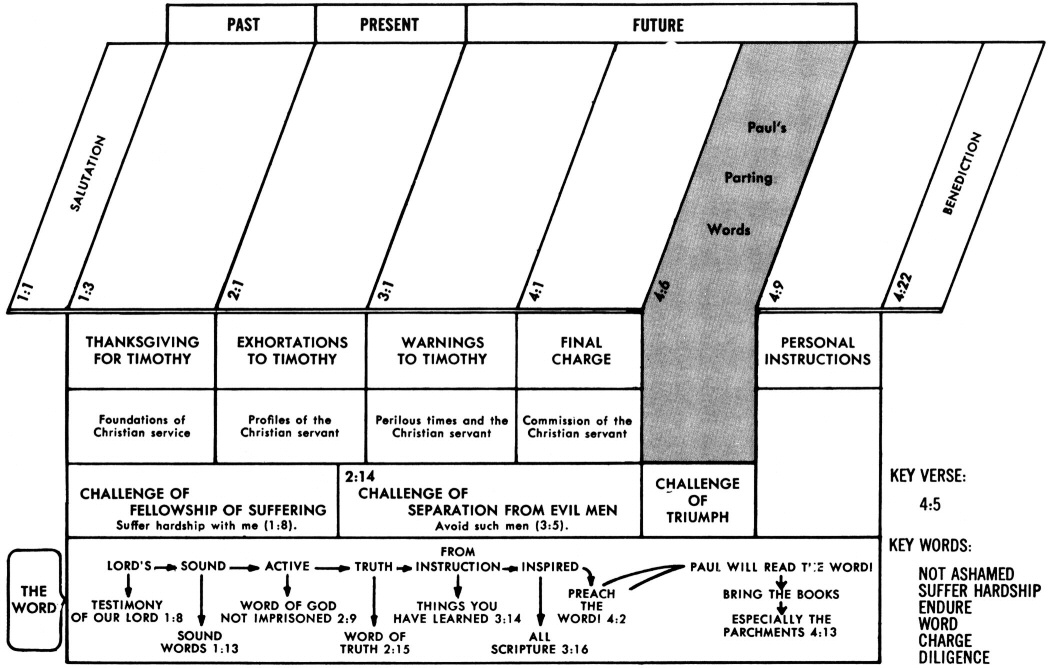
ENDURANCE AND SEPARATION IN THE MINISTRY
Click chart to enlarge
Charts from Jensen's Survey of the NT - used by permission
Second Timothy - Swindoll
| 2 TIMOTHY | |||
| 2 Timothy 1:1-18 | 2 Timothy 2:1-26 | 2 Timothy 3:1-17 | 2 Timothy 4:1-22 |
| Retain the Standard |
Rightly Divide the Word |
Difficult Times Will Come |
Preach the Word |
| PAST | PRESENT | FUTURE | |
| Foundation of Christian Service |
Pictures of Christian Servant |
Dangerous Times for Christian Servant |
Commission of Christian Servant |
| Unashamed as a Witness: Guard the Gospel |
Unashamed as a Workman: Suffer for the Gospel |
Adequate as a Workman: Continue in the Gospel |
Awarded as a Workman: Preach the Gospel |
| Power of the Gospel |
Perseverance of the Gospel Message | Protection of the Gospel |
Proclamation of the Gospel |
| Reminder | Requirements | Resistance | Requests |
| Encouragement in Ministry |
Examples in Ministry |
Exhortations in Ministry |
Exhortations to Fulfill Ministry |
| Commendation & Charge |
Commission to Fulfill |
Conflict to Face |
Course to Finish |
|
Compiled from Jensen's Survey of the NT and Wilkinson's Talk Thru the Bible |
|||
2 Timothy 4:5 But you, be sober in all things, endure hardship, do the work of an evangelist, fulfill your ministry. (NASB: Lockman)
Greek: su de nephe (2SPAM) en pasin, kakopatheson, (2SAAM) ergon poieson (2SAAM) euaggelistou, ten diakonian sou plerophoreson. (2SAAM)
BGT Σὺ δὲ νῆφε ἐν πᾶσιν, κακοπάθησον, ἔργον ποίησον εὐαγγελιστοῦ, τὴν διακονίαν σου πληροφόρησον.
My Amplified Paraphrase: But as for you, stay spiritually alert, clear-minded, and self-controlled in every situation. Don’t be shaken, distracted, or dulled by the pressures around you. Be ready to face hardship—expect it, endure it, and remain steadfast through it. Keep proclaiming the gospel—do the work of one who announces the good news of Christ to the lost, wherever God opens a door. And don’t quit—carry out the ministry God has entrusted to you fully, faithfully, and to the very finish.
Barclay: As for you, be steady in all things; accept the suffering which will come upon you; do the work of an evangelist; leave no act of your service unfulfilled. (Westminster Press)
BBE: But be self-controlled in all things, do without comfort, go on preaching the good news, completing the work which has been given you to do.
GWT: But you must keep a clear head in everything. Endure suffering. Do the work of a missionary. Devote yourself completely to your work. (GWT)
ICB: But you should control yourself at all times. When troubles come, accept them. Do the work of telling the Good News. Do all the duties of a servant of God. (ICB: Nelson)
KJV: But watch thou in all things, endure afflictions, do the work of an evangelist, make full proof of thy ministry.
NKJ But you be watchful in all things, endure afflictions, do the work of an evangelist, fulfill your ministry.
NET You, however, be self-controlled in all things, endure hardship, do an evangelist's work, fulfill your ministry.
CSB But as for you, be serious about everything, endure hardship, do the work of an evangelist, fulfill your ministry.
ESV As for you, always be sober-minded, endure suffering, do the work of an evangelist, fulfill your ministry.
NIV But you, keep your head in all situations, endure hardship, do the work of an evangelist, discharge all the duties of your ministry.
Moffatt: Whatever happens, be self-possessed, flinch from no suffering, do your work as an evangelist, and discharge all your duties as a minister.
NLT: But you should keep a clear mind in every situation. Don't be afraid of suffering for the Lord. Work at bringing others to Christ. Complete the ministry God has given you. (NLT - Tyndale House)
Phillips: Go on steadily preaching the Gospel and carry out to the full the commission that God gave you. (Phillips: Touchstone)
WNT: But as for you, you must exercise habitual self-control, and not live a self-indulgent life, but do the duty of an evangelist and fully discharge the obligations of your office.
Wuest: But as for you, you be constantly in a sober mood, calm, collected, wakeful, alert in all things. Endure hardships. Let your work [as a pastor] be evangelistic in character. Your work of ministering fully perform in every detail
Young's Literal: And thou -- watch in all things; suffer evil; do the work of one proclaiming good news; of thy ministration make full assurance,
BUT YOU BE SOBER IN ALL THINGS : Su de nephe (2SPAM) en pasin :
- Isa 62:6; Jer 6:17; Ezek 3:17; 33:2;33:7 Mk 13:34;37 Lk 12:37; Acts 20:30;31 1Thes 5:6, 5:8; Heb 13:17; 1Pet 1:13, 4:7, 5:8, Rev 3:2
- 2 Timothy 4 Resources - Multiple Sermons and Commentaries
- 2 Timothy 4:1-5 My Major Task And Yours - Steven Cole
- 2 Timothy 4:1-5 Preaching & Hearing God's Word - Steven Cole
- 2 Timothy 4:5 Marks of the Faithful Preacher 4 - John MacArthur
- 2 Timothy 4:6-8 The Epitaph of a Faithful Preacher - John MacArthur
- 2 Timothy 4:6: The Triumphant Epitaph of Paul 1 - John MacArthur
you must keep a clear head in everything (GWT)
be self-controlled (BBE)
you be constantly in a sober mood calm, collected, wakeful, alert in all things. (Wuest)
you must exercise habitual self-control, and not live a self-indulgent life (WNT)
keep your head in all situations (NIV)
but amid it all, keep your head (Berkley)
but you must keep control of yourself in all circumstances (TEV)
be calm and cool and steady (Amp)
be watchful in all things (NKJV)
you should keep a clear mind in every situation (NLT)
you should control yourself at all times (ICB)
be steady in all things (Barclay).
Related Passages:
Matthew 26:41 “Keep watching (present imperative see our need to depend on the Holy Spirit to obey) and praying (present imperative see our need to depend on the Holy Spirit to obey) that you may not enter into temptation; the spirit is willing, but the flesh is weak.”
1 Peter 5:8 Be of sober spirit (nepho - aorist imperative see our need to depend on the Holy Spirit to obey), be on the alert (aorist imperative see our need to depend on the Holy Spirit to obey) . Your adversary, the devil, prowls around like a roaring lion, seeking someone to devour.
1 Thessalonians 5:6 (so then let us not sleep as others do, but let us be alert and sober (nepho)
1 Peter 4:7 The end of all things is near; therefore, be of sound judgment and sober spirit (nepho - aorist imperative see our need to depend on the Holy Spirit to obey)for the purpose of prayer.
Luke 21:36 “But keep on the alert (present imperative see our need to depend on the Holy Spirit to obey) at all times, praying that you may have strength to escape all these things that are about to take place, and to stand before the Son of Man.”
2 Timothy 2:3 Suffer hardship (aorist imperative see our need to depend on the Holy Spirit to obey) with me, as a good soldier of Christ Jesus.
James 5:11 We count those blessed who endured. You have heard of the endurance of Job and have seen the outcome of the Lord’s dealings, that the Lord is full of compassion and is merciful.
Hebrews 10:36 For you have need of endurance, so that when you have done the will of God, you may receive what was promised.
Acts 14:22 strengthening the souls of the disciples, encouraging them to continue in the faith, and saying, “Through many tribulations we must enter the kingdom of God.”
Matthew 28:19-20“Go therefore and make disciples (aorist imperative see our need to depend on the Holy Spirit to obey) of all the nations, baptizing them in the name of the Father and the Son and the Holy Spirit, 20 teaching them to observe all that I commanded you; and lo, I am with you always, even to the end of the age.”
Acts 1:8 but you will receive power when the Holy Spirit has come upon you; and you shall be My witnesses both in Jerusalem, and in all Judea and Samaria, and even to the remotest part of the earth.”
Romans 10:14 How then will they call on Him in whom they have not believed? How will they believe in Him whom they have not heard? And how will they hear without a preacher?
Proverbs 11:30 The fruit of the righteous is a tree of life, And he who is wise wins souls.
Colossians 4:17 Say to Archippus, “Take heed (present imperative see our need to depend on the Holy Spirit to obey) to the ministry which you have received in the Lord, that you may fulfill it.”
Acts 20:24 “But I do not consider my life of any account as dear to myself, so that I may finish my course and the ministry which I received from the Lord Jesus, to testify solemnly of the gospel of the grace of God.
Philippians 1:6 For I am confident of this very thing, that He who began a good work in you will perfect it until the day of Christ Jesus.
2 Timothy 4:7 I have fought (perfect tense) the good fight, I have finished (perfect tense) the course, I have kept (perfect tense) the faith;
KEEP ON
KEEPING ON!
As Paul approached the end of his life and ministry (2Ti 4:6), he handed Timothy a sober and urgent charge. The world around Timothy was shifting, false teachers were multiplying, and pressures were mounting. In that tense moment, Paul didn’t call Timothy to comfort or retreat, but to clarity, courage, and perseverance. With eternity in view and the gospel at stake, he urged this young pastor to stay alert, endure hardship, keep evangelizing, and finish the work God had given him. Verse 5 stands as a timeless call for every believer (whether preacher, teacher or lay person) to remain steadfast and faithful when the road grows difficult, as it assuredly will for "difficult times will come." (2Ti 3:1).
But you makes the following charge emphatically personal as Paul sets Timothy in contrast to the apostates just mentioned. Once again (2Ti 2:1, 3:10, 14-see notes 2Ti 2:1; 3:10; 3:14) Paul followed the mention of those who were oppositional or wayward with a strong contrasting but you for his young disciple. Don't fall into their seductive snare of unsound teaching!
Be sober (3525) (nepho) means literally to abstain from wine and as used metaphorically here means to be free from every form of mental and spiritual ‘drunkenness’, from excess, passion, rashness, confusion, etc. and so to be well-balanced and self-controlled so as to keep a keep a cool, calm, and collected mind.
Nepho - 6x in 6v - 1Th 5:6, 8; 2 Tim 4:5; 1 Pet 1:13; 4:7; 5:8 (and not used in the Septuagint)
The present imperative commands Timothy to make this his standing so that he is continually on alert, yet calm and circumspect regardless of the season. This alert wakefulness and calm assurance would protect him from being surprised and confused when those who professed Christ turned away from the word of Christ and unto myths of men.
🙏 THOUGHT - See discussion of the Need for the Holy Spirit to obey NT commands or "How to Keep All 1642 Commandments in the New Testament!"
Compare this command to a similar command by Jesus to His disciples to "keep (continually) watching and praying" (Mt 26:41, cf 1Cor 10:12, 16:13, 1Pe 5:8-).
The idea is that Timothy is to be in control of his thought processes and thus not be in danger of irrational thinking ("God has not given us a spirit of timidity but of...discipline [Other translations - "sound mind, self-discipline, self-control, sobriety, sound judgment, self-restraint, wise discretion"]" - 2Ti 1:7). In contrast to this verb, the 3 verbs which follow are aorist imperatives (commands) which call for carrying out each action with a sense of urgency. Obviously, these 3 commands are the very areas in which Timothy is to exercise sobriety, calm and self-control at all times.
Rienecker adds that Timothy is "to be in a vigilant, wakeful, considerate frame of mind, taking heed of what is happening and pursuing a course with calm and steady aim. (Borrow The New Linguistic and Exegetical Key to the Greek New Testament)
Vine has an interesting note on be sober (nepho) stating that "whilst literally signifying freedom from the influence of intoxicants, is used in the New Testament only in a metaphorical sense, and conveys the thought of freedom from credulity as well as from excitability. It does not actually signify watchfulness, but rather indicates stability, a contrast to the excitement of drunkenness. The exhortation here is set in contrast to the fickleness of those who aspire to novelty (2Ti 4:3,4-see notes 2Ti 4:3; 4:4)
Kent Hughes shares the story of how Pastor Alistair Begg has taken verse 5 as an anchor verse in his ministry. He shares,
Late one afternoon Alistair Begg was meeting with a number of pastors, including myself. He wistfully quoted this very verse, then said, “I increasingly find that verse to be the anchor point for all of my days. I wake up on a Monday, and say, ‘well, what will I do now?’ Then I say, ‘Well, I think I’ll try to keep my head, endure hardship, do the work of an evangelist, and discharge all the duties of my ministry.’ And when I am lifted up by a little encouragement, which sometimes comes, I say to myself, ‘Well, what shall I do?’ The answer is keep your head, endure hardship, and so on.”
He paused, then went on, “And when the waves beat on me and I feel just like running away to the hills somewhere, what should I do? ‘Well, Alistair, just keep your head, endure hardship, do the work of an evangelist, and discharge all the duties of your ministry.’ ”
Then he concluded, “So, that’s a word in season for us to take away and think of.” (See 1–2 Timothy and Titus: To Guard the Deposit - Page 271)
ENDURE HARDSHIP: kakopatheson (2SAAM) :
- 2Ti 1:8; 2:3, 2:10; 3:10, 3:11, 3:12
- 2 Timothy 4 Resources - Multiple Sermons and Commentaries
- 2 Timothy 4:1-5 My Major Task And Yours - Steven Cole
- 2 Timothy 4:1-5 Preaching & Hearing God's Word - Steven Cole
- 2 Timothy 4:5 Marks of the Faithful Preacher 4 - John MacArthur
- 2 Timothy 4:6-8 The Epitaph of a Faithful Preacher - John MacArthur
- 2 Timothy 4:6: The Triumphant Epitaph of Paul 1 - John MacArthur
accept and suffer unflinchingly every hardship (Amp)
When troubles come, accept them (ICB)
flinch from no suffering (Moffatt)
accept the suffering which will come upon you (Barclay)
Endure hardship (2553)(kakopatheo cp sugkakopatheo) meant to suffer physical pain, hardship, troubles, problems, difficulties, evils or distress. In secular Greek kakopatheo was frequently used to describe the hardships inherent in military service.
Gilbrant - In classical Greek kakopatheō commonly means “to suffer misfortune” or “to be in distress.” Used in connection with sōma, “body,” this verb can be used to speak of sickness. Another meaning, though not as common, is “to bear hardship patiently,” frequently in connection with military service. In non-biblical Greek of the New Testament era, Josephus employs kakopatheō to mean “to run into trouble” and also “to be able to endure trouble,” again frequently in military contexts (e.g., Antiquities 10.11.1). Its only occurrence in the Septuagint is found in Jonah 4:10. In that verse God reproved Jonah for having more pity for a withered gourd, which he did not “labor” over or make grow, than for an entire city of undiscerning people (Nineveh). Military connotations are clearly in Paul’s mind when he exhorts Timothy to “endure hardship with us like a good soldier of Christ Jesus” (2 Ti 2:3) (ED: A GOOD METAPHOR FOR WE ARE IN AN INVISIBLE BUT VERY REAL WAR FOR THE SOULS OF MEN!) (Complete Biblical Library Greek-English Dictionary)
Wuest notes that endure hardship "is aorist imperative which speaks of a sharp command given with military snap and curtness. Timothy needed just that....How we in the ministry of the Word need that injunction today. What ‘softies’ we sometimes are, afraid to come out clearly in our proclamation of the truth and our stand as to false doctrine, fearing the ostracism of our fellows, the ecclesiastical displeasure of our superiors, or the cutting off of our immediate financial income. I would rather walk a lonely road with Jesus than be without His fellowship in the crowd, wouldn’t you? I would rather live in a cottage and eat simple food, and have Him as Head of my house and the Unseen Guest at every meal, than to live in royal style in a mansion without Him."
Kakopatheo - 3x in the NT - endure hardship(1), suffer hardship(1), suffering(1).
2 Timothy 2:9 for which I suffer hardship even to imprisonment as a criminal; but the word of God is not imprisoned.
James 5:13 Is anyone among you suffering? Then he must pray. Is anyone cheerful? He is to sing praises.
Timothy is certain to experience reproach and persecution (2Ti 3:12- , cf Mt 10:22, Php 1:29) but such experiences are not to becloud his sobriety and calm demeanor (2Ti 1:7).
There is no such thing as a faithful ministry that is not costly. A painless ministry is a shallow and fruitless ministry.
MacArthur notes "Many preachers want a ministry free of difficulties. However, I believe faithfulness to God's Word and the endurance of trials are the marks of an effective ministry. A preacher has the choice of either enduring or compromising a difficult situation.
Paul had made clear the cost of ministry and had called on Timothy to "join with (him) in suffering for the gospel according to the power of God" (2Ti 1:8), to "suffer hardship with (him), as a good soldier of Christ Jesus" (2Ti 2:3), to remember that although he (Paul) was suffering "hardship even to imprisonment as a criminal...the word of God is not imprisoned" (2Ti 2:9), and to realize that "all who desire to live godly in Christ Jesus will be persecuted." (2Ti 3:12).
How did Timothy fare in obeying this difficult command?
The writer of Hebrews (probably written shortly after 2 Timothy) says "Take notice that our brother Timothy has been released..." (He 13:23) where the word "released" is apoluo which elsewhere refers to releasing a prisoner (e.g., see apoluo in Mt 27:15) all of which suggests that Timothy indeed fully followed Paul in his "teaching, conduct, purpose (preaching Christ)...persecutions, sufferings..." (2Ti 3:10,11)
Like Timothy, we too need to be "strong in the grace that is in Christ Jesus" (2:1) so that we are prepared and willing to endure whatever rejection, hostility or persecution that comes from following Christ until the end of our course.
Related Resource:
DO THE WORK OF AN EVANGELIST: ergon poieson (2SAAM) euaggelistou:
- Acts 21:8; Ep 4:11;1Ti 4:12 15
- 2 Timothy 4 Resources - Multiple Sermons and Commentaries
- 2 Timothy 4:1-5 My Major Task And Yours - Steven Cole
- 2 Timothy 4:1-5 Preaching & Hearing God's Word - Steven Cole
- 2 Timothy 4:5 Marks of the Faithful Preacher 4 - John MacArthur
- 2 Timothy 4:6-8 The Epitaph of a Faithful Preacher - John MacArthur
- 2 Timothy 4:6: The Triumphant Epitaph of Paul 1 - John MacArthur
Do the work of telling the Good News (ICB)
ANNOUNCE THE
GOOD NEWS
Do (poieo) the work (ergon) of an evangelist (euaggelistes) - Paul is giving another military-like command (aorist imperative) which is apropos for we are ALL continually in a spiritual war! Satan takes no furloughs! Too many believers are AWOL! Paul commands his "young lieutenant" (so to speak) to be a herald of good news, a messenger who proclaims Christ, a man who brings the gospel to those who have not believed (but also preaches the Gospel to those who have believed for the Gospel is not just about justification but includes teaching on progressive sanctification). Do the work of a "gospelizer", literally of the "good message teller"! Perform this task with urgency and resolve (aorist imperative), obeying this sharp command with military snap and curtness. Note that the work is not social reform, moral improvement, religious activity, or motivational messaging (all of which sadly characterize an appreciable percentage of so-called Christian "work" in American churches in 2025). It is the work of proclaiming the life, death, resurrection, and saving grace of Jesus Christ to sinners in need of salvation (cf. 1 Cor 15:1–4). The centerpiece of the work is proclamation of Christ crucified and resurrected from the dead (1Co 1:23, 1Co 2:2). Evangelism is not an add-on to our ministry, but is central to fulfilling God’s calling. A ministry that neglects the Gospel is an unfinished ministry! We all need the attitude of Paul who declared "we also have as our ambition, whether at home or absent, to be pleasing to Him. For we must all appear before the judgment seat of Christ, so that each one may be recompensed for his deeds in the body, according to what he has done, whether good or bad." (2Co 5:9-10)
Note Paul does not use say "play" but "work" which implies arduous labor, intelligent intentionality, holy sweat, and Spirit empowered perseverance. Evangelism requires our time, courage, compassion, endurance, and prayer. The work of evangelism is not passive but is a Spirit enabled labor prompted by love (1 Th 1:3). Notice that Paul does not command Timothy to "save" people. Only the Spirit of God can bring about new birth (Jn 3:3-7). And thus the command is not to "save" but to sow, to proclaim the message, and to bear witness of Christ. Faithfulness is the measure of a man's ministry—the reward is spiritual fruit which is God’s gift to His workers.
The work of evangelism assumes obstacles and resistance, including rejection, opposition, hardship, and even martyrdom! This is why the command is surrounded by calls to sobriety and endurance (2Ti 4:5). Doing the work means continuing even when the results seem small and the response is cold.
As Hiebert writes "the manifold tasks, the harassing difficulties, the manifestation of antagonism must not distract him from his primary task of being...a bringer of God's good news." He goes on to explain and I agree that "The term (euaggelistes) used without an article (equivalent to the English "the") does not here designate a distinct office but rather characterizes him as one whose chief activity is the bringing of the good news of the Gospel of Christ. His ministry is to be evangelistic in nature. (cf 1Co 1:17)
How does one go about this work of proclaiming the gospel?
(1) Keep the message clear, simple and to the point, the most succinct "definition" of the gospel being in (1Cor 15:1, 2, 3, 4, 5,6, 7, 8-see notes 1Co 15:1, 15:2; 15:3; 15:4; 15:5; 15:6 ; 15:7; 15:8).
(2) Rely not on manipulative techniques, but on the power of God as did Paul in (Ro 1:16)
Dr Martyn Lloyd-Jones wrote "You should not put direct pressure on the will. The will should always be approached primarily through the mind, the intellect, and then through the affections...As the mind grasps [God's Word], understands it, the affections are kindled and moved, and so in turn the will is persuaded and obedience is the outcome...Obedience is not the result of direct pressure on the will, it is the result of an enlightened mind and a softened heart (BORROW Preaching and Preachers ).
We are to have the attitude of Paul who "determined to know nothing among (the Corinthians) except Jesus Christ, and Him crucified." (1Cor 2:2)
"Give the ungodly
no rest in their sins".
--Spurgeon
Edwards adds that "The fact that Paul says, do the work indicates that this will not be an easy or natural task, for evangelism never is. But it is impossible to follow Christ without becoming a "fisher of men." (Mt 4:19). If we are not fishing for men, seeking to draw them out of the bitterly cold waters of Satan's domain, then we must question whether we really are following Christ. One may admire Christ, believe in Christ, even give to Christ without seeking lost souls, but one cannot follow Christ without becoming intimately involved in the great quest of doing the work of an evangelist. (Call to Completion)
Do (poieo) means to accomplish and the aorist imperative (see our need to depend on the Holy Spirit to obey) is issued as a command to be carried out without delay.
Work (2041) (ergon) means a deed or action in contrast to inactivity. It speaks of toil or effort in which one exerts strength or faculties to do or perform something. Works are the result of and never the means of salvation.
Evangelist (2099)(euaggelistes from eu = good, well + aggéllo = proclaim, tell) a bringer of good tidings or one who proclaims the good news (the Gospel) and is used only three times in Scripture (also Acts 21:8, Ep 4:11) and once in a non-Christian inscription meaning "a proclaimer of an oracle". This does not mean that the minister is to become a traveling or professional evangelist. It means that his work is to be evangelistic — he is to seek to win souls in all that he does (cf 1Pe 3:15).
The related verb euaggelizo/euangelizo meaning to proclaim good news is used 61 times and the noun euaggelion, meaning good news or gospel is found in 52v (see below). Clearly preaching the gospel to the lost is a significant message in the NT.
Euaggelizo/euangelizo Matt. 11:5; Lk. 1:19; Lk. 2:10; Lk. 3:18; Lk. 4:18; Lk. 4:43; Lk. 7:22; Lk. 8:1; Lk. 9:6; Lk. 16:16; Lk. 20:1; Acts 5:42; Acts 8:4; Acts 8:12; Acts 8:25; Acts 8:35; Acts 8:40; Acts 10:36; Acts 11:20; Acts 13:32; Acts 14:7; Acts 14:15; Acts 14:21; Acts 15:35; Acts 16:10; Acts 17:18; Rom. 1:15; Rom. 10:15; Rom. 15:20; 1 Co. 1:17; 1 Co. 9:16; 1 Co. 9:18; 1 Co. 15:1; 1 Co. 15:2; 2 Co. 10:16; 2 Co. 11:7; Gal. 1:8; Gal. 1:9; Gal. 1:11; Gal. 1:16; Gal. 1:23; Gal. 4:13; Eph. 2:17; Eph. 3:8; 1 Thess. 3:6; Heb. 4:2; Heb. 4:6; 1 Pet. 1:12; 1 Pet. 1:25; 1 Pet. 4:6; Rev. 10:7; Rev. 14:6
- Stay awake spiritually—your assignment matters.
- A sleepy soul can’t fight a spiritual battle.
- Hardship isn’t a signal to quit, but to trust.
- Endurance is the proof of true ministry.
- Evangelism isn’t a gift to admire—it’s a task to obey.
- The gospel moves forward through faithful mouths and willing hearts.
- Don’t wait for comfort—souls can’t wait.
- Ministry isn’t finished until you finish it.
- Results belong to God; obedience belongs to you.
- When the road gets hard, the mission hasn’t changed.
- Courage keeps going when feelings say stop.
- Faithfulness is greater than fame.
- The evangelist’s task is simple: speak Christ to the lost.
- You can’t fulfill your ministry if you flee from hardship.
- Start with alertness, continue with endurance, finish with faithfulness.
- A calling unfinished is a race unrun.
- Don’t just begin well—end well.
- God measures ministry by faithfulness, not applause.
- The next lost soul is your mission field.
- Stay clear-minded, stay courageous, stay committed.
History records a remarkable account of the destruction of an ancient town. The watchmen on the walls would call out whenever they thought they saw a foe approaching. Sensing that the people had begun to resent them for giving these false alarms, they decided to remain quiet. Regrettably, not long afterward the enemy actually did come. The city that could have been saved was assaulted and devastated, and nothing was left but smoking ruins. Later someone erected a small memorial inscribed with the following epitaph: "Here stood a town that was destroyed by silence."
The church today for the most part has become The Submarine Church in which 1 day we just shut the hatch on the outside world and submerged into its own sea. And only on occasion does it run up the periscope to even see where it is going.
FULFILL YOUR MINISTRY: en diakonian sou plerophoreson (2SAAM):
- 2Ti 4:4, 2:5, 2:6, Acts 12:25 Jn 4:34, 17:4 Ro 15:19;1Cor 1:17 Col 1:25; 4:17
- 2 Timothy 4 Resources - Multiple Sermons and Commentaries
- 2 Timothy 4:1-5 My Major Task And Yours - Steven Cole
- 2 Timothy 4:1-5 Preaching & Hearing God's Word - Steven Cole
- 2 Timothy 4:5 Marks of the Faithful Preacher 4 - John MacArthur
- 2 Timothy 4:6-8 The Epitaph of a Faithful Preacher - John MacArthur
- 2 Timothy 4:6: The Triumphant Epitaph of Paul 1 - John MacArthur
make full proof of thy ministry (KJV)
fill your ministry to the brim (Williams)
completing the work which has been given you to do (BBE)
Do all the duties of a servant of God (ICB)
discharge to the full your duties as a minister (Berkley)
carry out to the full the commission that God gave you (Phillips)
leave no act of your service unfulfilled (Barclay)
"fill up the full measure of thy ministry." (Darby)
discharge all your duties as a minister (Moffatt)
fulfill the service asked of you (NJB)
My Amplified Paraphrase - Bring to completion the calling God has entrusted to you—carry out every part of your assignment fully, faithfully, and to the very end. Don’t leave the work half-done or set it aside when it becomes difficult, but persevere until you have accomplished everything the Lord has given you to do, finishing your course with steadfast obedience and wholehearted devotion.
FINISH WHAT GOD STARTED:
STAY THE COURSE!
Fulfill (plerophoreo) your ministry (diakonia) - Note "your" signifies it is Timothy's personal possession, his gift from God (cf Eph 2:10), which he is to steward well (cf Col 1:25, Col 4:17). Paul knew that starting well is easy—finishing well is costly. Many begin with passion, but pressure, hardship, distraction, or disappointment cause them to drift, stall, or walk away. Against that backdrop, he turns to Timothy with a sobering reminder: ministry is not a sprint of excitement but a marathon of endurance. God has entrusted Timothy with a specific calling, a sacred stewardship, and a responsibility no one else can complete for him. The charge is not merely to serve for a season, but to carry the work all the way to the finish line. “Fulfill your ministry” is the summons to stay faithful when it’s hard, to persist when results seem small, and to complete every task God assigns—until the final breath. This final charge summarizes the entirety of 2 Timothy.
Fulfill (4135) (plerophoreo from pleres = full + phoréo = fill) is literally to fill full and here is a command for Timothy to accomplish his ministry fully and wholeheartedly. Timothy was to carry out his ministry to its end, completing all its demands and requirements. Again the the aorist imperative is a command calling for Timothy to obey this order with immediacy and effectiveness.
Paul had written a similar exhortation to Archippus to "Take heed to the ministry which you have received in the Lord, that you may fulfill (see word study pleroo) it." (Col 4:17) Here we learn that ministry is a gift from God, and we are stewards who one day will give an account of our work (1Pe 4:10, 11). It is also interesting that plerophoreo was used in secular Greek describing "a man to whom money had been entrusted who in turn satisfies the investor by the return he makes."
Plerophoreo - 6x in 6v - Lk 1:1; Ro 4:21; 14:5; Col 4:12; 2Ti 4:5, 17. NAS = accomplished(1), fulfill(1), fully accomplished(1), fully assured(2), fully convinced(1).
Earlier Paul had commanded Timothy to "Guard, through the Holy Spirit who dwells in us, the treasure (Gk = paratheke = deposit, something committed to one's charge) which has been entrusted to you" (2Ti 1:14). Now Paul is commanding Timothy to fully satisfy the One Who had entrusted so much to him when He returns (Mt 25:14-30). He will hear "well done" (Mt 25:21) only if he "discharges his ministry to the full" and the same can be said of every believer for all have received this "treasure".
Ministry (1248) (diakonia > English = "deacon") means the rendering or assistance or help by performing certain duties, often of a humble or menial nature serve, including such mundane activities as waiting on tables or caring for household needs—activities without apparent dignity. Diakonia is translated 19x as "ministry" and 7x as "service", and specifically referring to a personal ministry done in the service of another, such "service" often being of a humble or menial nature.
Diakonia - 34x in 32v - ministries(1), ministry(19), mission(m)(1), preparations(m)(1), relief(m)(1), serve(1),service(7), serving(2), support(m)(1). Luke 10:40; Acts 1:17, 25; 6:1, 4; 11:29; 12:25; 20:24; 21:19; Rom 11:13; 12:7; 15:31; 1 Cor 12:5; 16:15; 2 Cor 3:7ff; 4:1; 5:18; 6:3; 8:4; 9:1, 12f; 11:8; Eph 4:12; Col 4:17; 1 Tim 1:12; 2 Tim 4:5, 11; Heb 1:14; Rev 2:19.
Diakonia speaks of Christian work in general, every mode of Christian service and does not have the "specialized" meaning which the English word "ministry" conveys. This is not referring to a group of professional, seminary trained individuals. In the first letter Paul wrote
I thank Christ Jesus our Lord, who has strengthened me, because He considered me faithful, putting me into service (diakonia). (1Ti 1:12)
This verse clearly teaches that ministry (or "service") is not just something we do for God but is something we have received from God, Who does His work through us. Our attitude in this service is to be wholehearted as was Paul's who wrote that
I labor (to point of exhaustion), striving (agonizing) according to His power, which mightily works within me (Col 1:29).
You may be saying "but I'm not a "minister". Then read these next few verses to see how the NT describes the purpose of believers.
Paul teaches "We are His workmanship, created in Christ Jesus for good works , which God prepared beforehand, that we should walk in them" (Eph 2:10) and thus we are each saved for the purpose of good works.
Peter reminds of our calling as "A CHOSEN RACE, A royal PRIESTHOOD, A HOLY NATION, A PEOPLE FOR God's OWN POSSESSION, that you may proclaim the excellencies of Him who has called you out of darkness into His marvelous light" (1Pe 2:9)
And thus clearly each of us has a ministry to proclaim Christ.
Finally, Paul reminds us that "we are ambassadors for Christ, as though God were entreating through us; we beg you on behalf of Christ, be reconciled to God". (2Co 5:20) and thus every believer has been given the privilege of "the ministry of reconciliation" (2Cor 5:18).
Spurgeon wrote, "The propagation of the gospel is left, not to a few, but to all the disciples of the Lord Jesus Christ: according to the measure of grace entrusted to him by the Holy Spirit, each man is bound to minister in his day and generation, both to the church and among unbelievers...[All Christians are] to exert themselves to the utmost to extend the knowledge of the Lord Jesus Christ (BORROW Lectures to My Students, p22).
William James once wrote, "The greatest use of life is to spend it for something that will outlast it."
I don't know if James was a Christian but nevertheless describes a goal every disciple should pursue, the laying up for themselves of
treasures in heaven, where neither moth nor rust destroys, and where thieves do not break in or steal (Mt 6:20)
It is only as we spend our lives in "fully discharging" our divinely-appointed ministry that we realize the greatest use of this fleeting life. Like Christ, we should strive with every fiber of our being to be able to say at the end of our life,
I glorified Thee on the earth, having accomplished (teleioo) the work (ergon - same word used for our "work") which Thou hast given Me to do. (Jn 17:4, cf "Jesus *said to them, “My food is to do the will of Him who sent Me and to accomplish [teleioo] His work [ergon]." Jn 4:34)
Or like Paul we should be willing to say
I do not consider my life of any account as dear to myself, in order that I may finish my course, and the ministry which I received from the Lord Jesus, to testify solemnly of the gospel of the grace of God. (Acts 20:24, cf Ac 20:28)
Clearly not every minister completes his ministry... to the brim... does everything Christ wants Him to do... undertakes every ministry that God desires for him... fills every ministry he undertakes to the brim. And so the urgent charge to each believer:
Fulfill your ministry!
“Finish Well”
Be sober in the battle,
Stay watchful in the fight;
The enemy loves darkness,
So walk in Spirit’s light.
When hardship presses heavy
And tears begin to fall,
Stand firm in Christ your Captain—
His grace is strength for all.
Speak Christ to every sinner,
Let gospel seeds be sown;
The love that won your rescue
Can rescue them as well.
And when your race is nearing
Its final breath and day,
May “faithful to the finish”
Be all your life would say.
So stay awake, endure, proclaim,
And run the course God’s given—
For those who fight and finish well
Will hear His "Well done" in heaven.
(Listen to Run Like Heaven - based on Heb 12)
WHY THIS CHARGE IS SO NEEDED TODAY - In the US, statistics say over 1700 pastors leave the ministry every month because of burn-out, discouragement, moral failure, and other causes. (Resource)
Gordon McLaughlin is a native New Zealander. That gives him the right to speak of his own nation. He has written a book about his homeland entitled The Passionless People. He calls modern New Zealand "a sterile society." Could that be said of some congregations? Are we a passionless people, or are we caught up in that grand passion that motivated Jesus Christ and all the saints that followed him?
In 1990 newspapers reported that city workers in Newport Beach, California, were sifting through two and one-half tons of trash, looking for $42,500 mistakenly discarded at the Great American Bank and hauled away by garbage trucks. That's a significant loss of money, but it is only money. The loss of human lives and souls is infinitely more significant. Evangelism deserves our very best efforts.
When missionary Ray Dibble and his wife left Nigeria at the beginning of World War II, they had just finished translating the New Testament into the Igala language. There were only six typewritten copies of the New Testament and a handful of Christians when they left. Returning after the war the Dibbles found fifty congregations. Tribesmen had made at least one hundred copies of the New Testament by hand. Some pages were torn, so some tribesmen had committed whole gospels to memory that they might not be lost. The believers were persecuted by nonbelievers and called "The Word of God People." They never gave up, and they deserved the title!
A classic phrase, "General Longstreet's forces are not yet committed to battle," was spoken at the battle of Gettysburg during the American Civil War. Too often a similar statement can be made regarding the church!
It's almost impossible to see a rainbow and not point it out to someone else. It's the kind of thing that just must be shared. You see one and you want to tell someone about it. If you are by yourself and see one, it's frustrating. The gospel is such a beautiful expression of God's love that it just must be shared.
Christchurch, New Zealand, boasts a very fine museum. Over the doorway are these words: "Lo, these are parts of His ways, but how little is heard of Him." All things are parts of His ways and it is manifestly true that "little is heard of Him."
There are four ways in which substances react to light. Some are transparent. The light passes through them. Some are translucent. They scatter the light. Some are opaque. They bar the light. Some are like mirrors. They reflect the light. We want to be mirrors, reflecting the light.
Livingstone's Encourager
I think about David Livingstone when he climbed into the pulpit of a little church in Scotland. He'd honed his sermon. He'd prepared it so very well. He wanted to be a great preacher. He wanted to go give his life on the mission field. And when he got up to preach that night, he flapped his wings, but he couldn't get off the runway. He tried, but finally he forgot his sermon altogether; so he apologized to the people and left in great shame.
But Robert Moffat, the famous missionary, was there. And Moffat came up to him after the service and said, "You can be a great and wonderful servant of God. Why don't you go to medical school?" Today you can't mention Africa without thinking about David Livingstone. But what would have happened to David Livingstone without Robert Moffat? —William Hinson, "A Breath of Fresh Air," Preaching Today, Tape No. 114.
The Greatest Threat to the Church
Dr. James Stewart, professor of New Testament at the University of Edinburgh, described what he thought is the greatest threat to the church. He said, "It is not communism, atheism, or materialism; the greatest threat is Christians trying to sneak into heaven incognito without ever sharing their faith."
I Don't Like the Way I do It
One day a lady criticized D.L. Moody for his methods of evangelism in attempting to win people to the Lord.
Moody's reply was, "I agree with you. I don't like the way I do it either. Tell me, how do you do it?"
The lady replied, "I don't do it."
Moody retorted, "Then I like my way of doing it better than your way of not doing it."

The Ultimate "Bridge"
The Bridge Builder - A crew worked to repair a damaged bridge after a storm. The winds were bitter, the workload heavy, and the progress slow. One worker said, “We don’t fix this because it’s easy—we fix it because people need a way across.” “Endure hardship.” Ministry isn’t about comfort; it’s about helping souls reach Christ—no matter the cost.
The Unfinished Symphony - A composer died before completing his final symphony. Another musician later said, “The saddest sound is not a wrong note—but an unfinished work.” “Fulfill your ministry.” God gave you a calling—don’t leave your assignment half-done. Finish what He started in you.
The Runner Who Didn’t Quit - A marathon runner injured his leg halfway through the race. Limping and exhausted, he crossed the finish line long after the crowds went home. Asked why he kept going, he said, “My country didn’t send me 5,000 miles to start the race—but to finish it.” Ministry isn’t about speed but endurance. God didn’t call you merely to begin—but to finish.
Making Waves, Winning Souls - Robert Morgan
Charles Bowles’s father was African; his mother was the daughter of a Revolutionary War hero. He was converted as a youth and called to the Freewill Baptist ministry. On July 24, 1816 he preached his first sermon, and his ministry soon resulted in both converts and controversy. He was a black preacher in the far north, making waves and winning souls. In Huntington, Vermont, a mob secretly plotted to attack him at his next worship service. They intended to tie him to a wooden horse and plunge him in the lake to sink or swim as he would. Bowles, however, heard of the plot.
The time arrived for the meeting; and while the enemy was preparing the weapons of their warfare, he is fitting himself. Behold him in yonder grove, bowed low before the throne of the Redeemer. What a noble sight to behold that despised servant of God, bowed alone in the grove, seeking only a preparation of heart! What a contrast with that band preparing by whiskey and oaths.
The service began, and the mob, seated before him, awaited its signal. Bowles read Matthew 23:33—You are nothing but snakes … ! How can you escape going to hell? He preached with such fervor that no one dared move. He finished by saying, “I am informed there are persons here who have agreed to put me on a wooden horse, carry me to the pond, and throw me in; and now, dear creatures, I make no resistance.” But he had one request—that on the way to the lake the assembly sing hymns. “Glory be to God! Yes, we will have music. Glory to God!”
This was said with his powerful voice with such confidence in God that it went like an electric shock through the congregation, and produced an effect upon the mob that could scarcely have been equaled had a bolt from heaven fallen; so completely were they overcome, that they fell prostrate upon the floor.
Shortly afterward, the troublemakers did meet Bowles at the lake—where he plunged them into its chilly waters, baptizing them as followers of his Lord Jesus.
You must stay calm and be willing to suffer. You must work hard to tell the good news and to do your job well. 2 Timothy 4:5
Rick Renner - More End-Time Ministry Advice
But watch thou in all things, endure afflictions, do the work of an evangelist, make full proof of thy ministry.—2 Timothy 4:5
Today I want to give you some end-time ministry advice—advice that is very pertinent for the present times. You might want to go back and review what we discussed in the September 26 Sparkling Gem, because it is foundational to what I will share with you today. As we saw, the Holy Spirit prophesied in Second Timothy 4:3, 4 that doctrine would change in the last days.
The Holy Spirit inspired these writings in Second Timothy 4 to prepare us for what lies ahead, much of which is already happening right now. He told us that when it comes to our stance on the infallible, incorruptible Word of God, we should be dedicated to correct interpretation and to teaching and preaching that is done with the power of the Holy Spirit.
This is very important instruction for us in a day when people are abandoning the sound teaching of doctrine. Regardless of what others do, we must decide that we will remain clear channels for the truth, even if it means we must put up with accusations that we are too traditional and stuck in the past. This is God’s command to us.
Then Paul wrote in verse 5, “… Make full proof of thy ministry.” The Greek word for “full proof” is plerophoreo, which simply means fulfill. Paul was urging Timothy to complete his ministry and bring it to its fullness. Although Paul was addressing Timothy directly, he was also talking very specifically to us—to those who would be alive at the end of the age. I believe this refers to our generation, and it certainly explains why we see so much nonsense going on in the world around us concerning the way people think and believe. This kind of deluded thinking and believing has even crept into the Church.
The pure preaching of doctrine is often replaced today with motivational speaking—nice, uplifting messages. In fact, the majority of people in modern congregations are ignorant of the most elementary aspects of New Testament doctrine. And very often, those who occupy the pulpits—although they may be masterful communicators and rate highly among motivational speakers—are equally uneducated in basic Bible principles. Many of those who do know the Bible don’t preach it as strongly as they once did because it’s not as popular as other types of messages. The result of this compromise is a drift from the Holy Scriptures. And this drift continues, seemingly unabated, while the doctrinal vacuum in the Church is being filled with motivational messages and “new-and-improved” church-growth programs. Yet when everything is said and done, only the Bible has the power to permanently transform a life.
Friend, the Bible has not changed. It’s still sharper than any two-edged sword (see Hebrews 4:12), and it’s still the answer for everyone, whether it’s in written form or on your computer or smart phone! The Bible is still the Word of God that has His very breath infused within it. And if you’ll take it into your heart and release it, it will put you on your feet again. It will heal your body, deliver your mind, and bring peace and order to your children and your household!
So much of what “creeps” into your home today is just a treadmill of information designed to keep you in a continual state of learning, never able to come to the knowledge of the truth (see 2 Timothy 3:6, 7). So if I could leave you with some valuable end-time advice today, it would be to continue in the truth you know—found in God’s holy, infallible, incorruptible Word.
You can rest assured that the Word of God is, has been, and always will be unchanging, and it will produce fruit in you if you will abide in it. God’s Word will perfectly equip you to stand strong, unfaltering, and unwavering in the days that lie ahead. Your part is simply to abide in His truth and continue in that which you have learned from Him.
H C G Moule - THE FAREWELL APPEAL - 2 Timothy 4:5, 6
But watch thou in all things, endure afflictions, do the work of an evangelist, make full proof of thy ministry. For I am now ready to be offered. A.V.
But thou, be sober in all things, endure hardship, do an evangelist’s work, fully discharge thy ministry. For I am already being poured out upon the altar as a drink-offering.
Here again we have an argument for Timothy’s devotion and diligence drawn not from sunshine but from shadow. St. Paul has just charged him to preach the Word because dark days were coming in the Church. Now he tells him to rise up afresh to suffer and to labour because he, Paul, was just about to be ‘taken from the head’ of his dear Timothy. He was ‘being poured upon the altar’ of martyr death; he was ‘being libated’; his life-blood was so soon to be shed that it might be said to be already flowing, like the wine of libation dropped upon the sacrifice.
This vivid image is an echo from the thoughts of long years before. In that happier first captivity, in the ‘hired house,’ he had written just so to the Philippians (Phil. 4:17); ‘Yea, even if I am being poured out as a drink-offering upon the sacrifice and the service of your faith, I joy, and I rejoice with you.’
But the metaphor here after all meant for Timothy no poetic picture but just this tremendous fact, that: St. Paul was soon to die, and he to be left orphaned, of that wonderful companionship. In earlier chapters we have noticed once and again how often this dying Letter utters or implies that thought; how we feel it to be wet here and there with the tears of a mortal farewell, tears shed by the writer as his heart feels the tears of the receiver. And be sure that this profound sympathy is not absent here; St. Paul knows here as elsewhere the anguish which his death will mean for his son. But here the tender thought passes upward at once into the heroic, or let us rather say, for it is more Christian to say so, into the believing, into the devoted. St. Paul is now in act to be ‘poured out’; therefore let Timothy arise, as if he had never done it before, to ‘be sober,’ and to accept suffering with all his heart, and to labour in the Gospel to the end.
It is the holy logic, conclusive to the believing heart, which JEHOVAH Himself used so very long before with Joshua (Josh. 1:2); ‘Moses my servant is dead; now therefore arise, go over this Jordan.’ The Master was about to ‘bury his workman,’ but He would be present as ever to ‘carry on His work.’ And He had need of Timothy that He might do it. And to do it, let us be sure, would be for Timothy not only the clearest duty but the most effectual and benignant balm.
Now, what is the command to him which this argument from death and loss is intended to enforce? Look at it word by word; and if my reader is a commissioned minister of Christ, let him look at it with a special scrutiny. First, ‘be sober in all things’:—the Greek points directly to that ‘sobriety’ which is the opposite to the fumes and bewilderment of the drunkard. Not the so-called sobriety which often means a timid refusal to give the will and energies wholly over to God, the pointde-zêle of the worldling, but rather the sobriety which means a soul fully awake, deliberately conscious of eternal realities, ‘looking at the things which are not seen’ (2 Cor. 4:18), ‘seeing Him which is invisible’ (Heb. 11:27), and accordingly alive to the life which his bond-servant must live, ‘yielded unto God.’ Then, secondly, ‘endure hardship’; do not be the carpet-knight who never really sacrifices and suffers. For such a Lord, and for the dear souls for which He died, be willing to lead a life which daily dies to self-indulgence and to that self-protection which, whether for spirit or for body, shuns exhaustion, or pain, or sorrow, as ‘strange things happening to you.’ Then, further, ‘do an evangelist’s work’; remember that you are called not to be the mere theorist of a system however true, or the mere guardian and celebrator of ordinances however sacred, but the evangelist, the message-bearer of the blessed Christ to living (and dying) human hearts; the man who for himself ‘knows whom he has believed,’ and so has an immediate and absolute certainty that HE is the Evangelium, the Good Tidings, for all who want Him and who find Him, and longs to bring them and Him together, loving Him and them. Lastly, ‘fully discharge thy ministry’; let it so fill thy life that thy life may all serve to fill it fully out, that ‘all thy studies may be drawn that; way,’ and that all men may see that thou, O man! of God, O man of Christ, hast only one ruling passion, only one master aim, even to ‘glorify Him on the earth and to finish the work which He gave thee to do’ (Joh. 17:4).
A W Tozer - The True Minister: Man of God Speaking to Men Evenings with Tozer: Daily Devotional Readings - Page 23
But watch thou in all things, endure afflictions, do the work of an evangelist, make full proof of thy ministry. 2 Timothy 4:5
The Christian minister, as someone has pointed out, is a descendant not of the Greek orator but of the Hebrew prophet!
The differences between the orator and the prophet are many and radical, the chief being that the orator speaks for himself while the prophet speaks for God.
The orator originates his message and is responsible to himself for its content. The prophet originates nothing but delivers the message he has received from God who alone is responsible for it, the prophet being responsible to God for its delivery only. The prophet must hear the message clearly and deliver it faithfully, and that is indeed a grave responsibility; but it is to God alone, not to men!
It is a dubious compliment to a preacher to say that he is original. The very effort to be original has become a snare to many a young man fresh out of seminary, who rejects the pure wheat of the Word and tries to nourish his congregation on chaff of his own manufacture. It may even be golden chaff, but chaff nevertheless that can never feed the soul.
The true preacher is a man of God speaking to men; he is a man of heaven giving God’s witness on earth. Because he is a man of God he can decode the message he receives from heaven and deliver it in the language of earth!
David Jeremiah - BRINGING IN THE SHEAVES Your Daily Journey with God: 365 Daily Devotions - Page 215
Do the work of an evangelist. 2 TIMOTHY 4:5
Fritz Kreisler (1875–1962) was a renowned violinist from Austria. He was paid handsomely for performing concerts and writing compositions, but he gave away almost everything he earned. While on one of his concert tours, he came across an exquisite violin he wished to buy, but he wasn’t able to afford it. He returned to the seller later, after saving the money needed to purchase the violin. When he arrived, however, he was told that the instrument had been sold to a collector. Kreisler tracked down the new owner and offered to buy the violin, but the collector refused, saying the instrument had become his prized possession. Kreisler was about to leave when he had an idea. “Could I play the instrument once more before it is consigned to silence?” he asked. The seller agreed, and the room was filled with such beautiful music that the collector was deeply moved. “I have no right to keep that to myself,” he exclaimed. “It’s yours, Mr. Kreisler. Take it into the world, and let people hear it.”
We have a message to share. Our heavenly Father created us as exquisite instruments, and the beautiful music we are to make is the Good News of salvation through faith in Jesus Christ. We were made to be played. (Listen to Touch of the Master's Hand)
The church has many tasks but only one mission.
ARTHUR PRESTON
A W Tozer - The Economic Squeeze Tozer for the Christian Leader: A 365-Day Devotional - Page 11
But watch thou in all things, endure afflictions, do the work of an evangelist, make full proof of thy ministry.—2 Timothy 4:5
A number of factors contribute to bad spiritual leadership.…
The economic squeeze. The Protestant ministry is notoriously underpaid and the pastor’s family is often large. Put these two facts together and you have a situation ready-made to bring trouble and temptation to the man of God. The ability of the congregation to turn off the flow of money to the church when the man in the pulpit gets on their toes is well known. The average pastor lives from year to year barely making ends meet. To give vigorous moral leadership to the church is often to invite economic strangulation, so such leadership is withheld. But the evil thing is that leadership withheld is in fact a kind of inverted leadership. The man who will not lead his flock up the mountainside leads it down without knowing it.
David Jeremiah - NOW I UNDERSTAND Discovering God: 365 Daily Devotions - Page 76
Be watchful in all things, endure afflictions . . . fulfill your ministry. 2 TIMOTHY 4:5
Clayton Christensen is a professor at Harvard Business School and is well known for articulating his theory of disruptive technology —an unexpected product or service that disrupts an existing market and helps create a new category of customers. Examples of disruptive technologies include desktop publishing, CD-ROMs, DVDs, personal computers, steamships, telephones, and automobiles. Disruptive technologies are usually resisted at first and then accepted because of their benefits and efficiencies.
God allows disruptive moments in our lives that we almost always question or resist because they are painful, unanticipated, misunderstood, and often not optional. Yet in hindsight, they are always embraced for the good or blessing that results. In the Old Testament, Job is the classic example of a life being disrupted, while Paul’s thorn in the flesh (2 Corinthians 12:7-10) is an obvious New Testament example.
If God has allowed a disruptive moment in your life, walk through it by faith rather than by sight (2 Corinthians 5:7).
We all face a series of great opportunities brilliantly
disguised as impossible situations.
CHUCK SWINDOLL
The Firefighter’s Helmet - A retired firefighter kept a charred helmet on his mantel. When asked why, he said, “It reminds me that saving lives was worth every scar.” Hardship in ministry isn’t failure—it’s proof that souls are worth fighting for.
The Farmer’s Field - A farmer planted seeds during a dry season. Neighbors mocked him, saying rain would never come. The farmer replied, “When the rain does fall, I want to be ready.” Keep sowing the gospel. God brings the harvest in His time. Faithfulness now prepares for fruit later.
The Soldier’s Orders - A soldier was once asked how he stayed focused in battle. He answered, “My job isn’t to know the whole plan—only to obey the order in my hand.” You don’t need to see the full picture to fulfill your ministry. Just obey the next command God gives.
The Burning Candle - A candle burns itself up to give light to others. It doesn’t complain—it completes its purpose. Ministry is costly, but when we spend ourselves for Christ, we shine brightest.
2 Timothy 4:5 calls us to stay alert, endure hardship, share Christ, and finish the work God has entrusted to us—no matter the cost.
In Our Daily Bread we read a devotional entitled "Not Satisfied"...
Sometimes we are not satisfied with the responsibilities God has given us, thinking we are fitted for a larger ministry. Looking enviously at the size or scope of a fellow believer’s calling, we think less of our own work and begin to neglect it. In his book Be Faithful,
Warren W. Wiersbe illustrated how one Christian leader handled that problem. “A young preacher once complained to C. H. Spurgeon, the famous Baptist preacher, that he did not have as big a church as he deserved.
‘How many do you preach to?’ Spurgeon asked.
‘Oh, about a hundred,’ the man replied.
Solemnly, Spurgeon said, ‘That will be enough to give account for on the day of judgment.’”
The truth of Spurgeon’s Statement is borne out in Paul’s reminder to “make full proof of thy ministry,” which means, “fulfill your ministry.”
The apostle was telling his young friend in the faith to do all that God has called him to do.
But this did not mean that Timothy was required to do the same things Paul was called to do.
Nor did it mean that he would accomplish as much as the apostle would.
Rather, it meant that whether Timothy’s task was large or small, in the limelight or behind the scenes, he was to fulfill his ministry in a diligent and commendable manner.
The same is true of us. Whether we are teaching three unruly boys in a Sunday school class, directing a girls club of hundreds, or preaching to thousands, we’re to do the job faithfully. That’s what God expects. And as we do, we will be fulfilling our ministry. -D. C. Egner (Our Daily Bread, Copyright RBC Ministries, Grand Rapids, MI. Reprinted by permission. All rights reserved)
We are to do what we can,
where we are, with what we have.
Compare Ec 9:10
Or as someone has said...
"Once you are there, be all there!"
2 Timothy 4:6 For I am already being poured out (1SPPI) as a drink offering, and the time of my departure has come (3SRAI) . (NASB: Lockman)
Greek: Ego gar ede spendomai, (1SPPI) kai o kairos tes analuseos mou ephesteken. (3SRAI)
BBE: For I am even now being offered, and my end is near.
GWT: My life is coming to an end, and it is now time for me to be poured out as a sacrifice to God. (GWT)
KJV: For I am now ready to be offered, and the time of my departure is at hand.
Moffatt: The last drops of my own sacrifice are falling; my time to go has come.
Phillips: As for me, I feel that the last drops of my life are being poured out for God. (Phillips: Touchstone)
Wuest: as for myself, my life’s blood is already being poured out as a libation, and the strategic time of my departure is already present.
Young's Literal: for I am already being poured out, and the time of my release hath arrived;
FOR I AM ALREADY BEING POURED OUT AS A DRINK OFFERING: Ego gar ede spendomai (1SPPI):
- 2 Timothy 4 Resources - Multiple Sermons and Commentaries
- 2 Timothy 4:1-5 My Major Task And Yours - Steven Cole
- 2 Timothy 4:1-5 Preaching & Hearing God's Word - Steven Cole
- 2 Timothy 4:5 Marks of the Faithful Preacher 4 - John MacArthur
- 2 Timothy 4:6-8 The Epitaph of a Faithful Preacher - John MacArthur
- 2 Timothy 4:6: The Triumphant Epitaph of Paul 1 - John MacArthur
Related Passages:
Philippians 2:17 But even if I am being poured out as a drink offering upon the sacrifice and service of your faith, I rejoice and share my joy with you all.
Other translations - I am now ready to be offered (KJV), The last drops of my own sacrifice are falling (Moffatt), time for me to be poured out as a sacrifice to God (GWT), I feel that the last drops of my life are being poured out for God (Phillips)
Paul has just charged Timothy to stay faithful, endure hardship, and finish his ministry. Now he reveals why the charge is so urgent: Paul’s own race is nearly over. Standing in the shadow of death, imprisoned and awaiting execution, he speaks not with fear but with peace, surrender, and worship. He sees his life not being taken from him, but being poured out as an offering to God. In this tender and solemn moment, Paul hands the baton to the next generation. Verse 6 is the voice of a man who knows his time is short, his work is complete, and his departure is near—calling Timothy, and us, to carry on the mission with the same unwavering devotion.
For (gar) - This term of explanation answers the question "Why" Timothy needed to be sober and fulfill his ministry. Paul has accomplished the work God had assigned him and was on his last lap and must soon pass the the baton on to Timothy. This would also motivate Timothy to remain faithful for as Edwards notes
The master discipler, Paul, never asks more of his disciple than his own experience warrants. The servant of God must infect his disciples with the unquestionable reality of his own faithfulness before his words will have any significant penetrating power. (2 Timothy- Call to Completion)
Note that the "I" is emphatic (in contrast to the emphatic "you" of 4:5): The courage and comfort of dying saints and ministers, and especially dying martyrs, are a great confirmation of the truth of Christianity, and a great encouragement to living saints and ministers in their work. Faith in the furnace (our actions & reactions to affliction, etc) sounds forth louder than our words (1Th 1:6, 7, 8, 9-see notes 1Th 1:6; 1:7; 1:8; 1:9).
Poured out as a drink offering (4689) (spendo) means to pour out or to make a libation.
Libation refers to the practice of pouring out wine or some other liquid as a drink offering. After placing a sacrificial animal on the altar, the priests would take wine (or sometimes water or honey) and pour it either on the burning sacrifice or on the ground in front of the altar. That act symbolized the rising of the sacrifice into the nostrils of the deity to whom it was being offered.
Wuest adds that spendo was "used in the pagan Greek religions, of the drink-offering poured out upon the sacrifice itself, the latter being the major part of the offering to the gods, and the former, the minor part. Paul uses this drink-offering or libation to speak of the violent death he will some day die as a martyr. It will be his blood poured out."
Among the Greeks and Romans this practice was an essential part of solemn sacrifices. The offerer poured wine either in front of or on top of the burning animal and the wine would be vaporized producing steam which symbolically ascended as an offering to the deity for whom the sacrifice was made (cf. 2Ki 16:13; Jer 7:18 Hos 9:4).
Figuratively, which is the manner of use in this verse, spendo means to pour out oneself, as one’s blood and to offer up one’s strength and life to God. Note however that Paul did not pour himself out but was poured out (passive voice). The tense is present which pictures a continuous process, one which culminates in his physical death.
Spendo - 19x in the Septuagint = LXX - Gen 35:14; Ex 25:29; 30:9; 37:16; Num 4:7; 28:7; 2 Sam 23:16; 1 Chr 11:18; Jer 7:18; 19:13; 32:29; 44:17, 19, 25; Ezek 20:28; Dan 2:46; Hos 9:4. Compared to only 2 uses in the NT, 2Ti 4:6 & Php 2:17.
Moulton and Milligan have a statement that the putting to death of a prophet (of the false deity Apollo), who remained true to his "god", was described as "spendo".
We have a similar use in the English language, when we say that a man sacrifices himself for his friends, family or country.
In Genesis we see
Jacob set up a pillar in the place where He had spoken with him, a pillar of stone, and he poured out a libation on it; he also poured oil on it. (Ge 35:14)
In Exodus the drink offering of wine was poured on the burning bronze altar along with a lamb each morning and evening. (Ex 29:40)
In Numbers 3 times wine is specified for "the libation" (Nu 15:1-10) and was meant to give a pleasing aroma for God. What a picture of what our lives daily are to be unto our God!
In Isaiah's prophecy we see Messiah's penultimate "libation", God declaring
I will allot Him (Messiah) a portion with the great, and He will divide the booty with the strong, because He poured out Himself to death, and was numbered with the transgressors. Yet He Himself bore the sin of many, and interceded for the transgressors. (Is 53:12)
In sum, this practice of pouring out liquid on the sacrifice is a picture of the total sacrifice of one's life to the will of God. Just as Paul exhorted each believer to present himself or herself to the Lord as “a living and holy sacrifice, acceptable to God” (Ro 12:1), he continuously offered himself to the Lord. Paul says that his life is continuously being offered to God which would soon culminate in one last act — the act of death. What a view of death! Seeing death as an offering and sacrifice being presented to God.
Using this same verb, spendo, for pouring out a libation, Paul reminded the saints at Philippi that
I am being poured out as a drink offering (spendo) upon the sacrifice and service of your faith. (Php 2:17).
John MacArthur makes the point that here in Philippians, Paul was not speaking so much of his eventual martyrdom for spendo is in
the present tense (which) clearly indicates that he was speaking of his current experience as a prisoner in Rome. He saw his life, not his death, as his ultimate act of sacrifice to the Lord. He was a living sacrifice, not a dead one." (Bolding added) (See Philippians Commentary - Page 192)
Paul regarded his own life as a sacrifice in the interests of the spiritual advancement of the Philippian believers.
Marvin Vincent, commenting on (Php 2:17), adds that
"the figure is that of a sacrifice, in which the Philippians are the priests, offering their faith to God, and Paul’s life is the libation poured out at this offering." (Vincent, M. R. Word studies in the New Testament. Vol. 3, Page 1-440).
Wiersbe has an interesting comment that
In effect Paul was saying, “Caesar is not going to kill me. I am going to give my life as a sacrifice to Jesus Christ. I have been a living sacrifice, serving Him since the day I was saved. Now I will complete that sacrifice by laying down my life for Him. (Bible Exposition Commentary)
As the contemporary martyr, Jim Elliot, once wrote "He is no fool who gives what he cannot keep to gain what he cannot lose."
Vine comments
Paul’s whole life since his conversion had been devoted as a sacrifice to the service of God, and now, conscious of the acceptance of his sacrifice, he views his death in this way. This provides a high incentive to all who would be true to Christ to spend their lives in absolute devotion to Him.
Hiebert says Paul's
whole life has been presented to God as a living sacrifice; now his death, comparable to the pouring out of the wine as the last act of the sacrificial ceremony, will complete the sacrifice.
Oswald Chambers asks "Are you ready to be offered?"...
I am now ready to be offered.” It is a transaction of will, not of sentiment. Tell God you are ready to be offered; then let the consequences be what they may, there is no strand of complaint now, no matter what God chooses. God puts you through the crisis in private, no one person can help another. Externally the life may be the same; the difference is in will. Go through the crisis in will, then when it comes externally there will be no thought of the cost. If you do not transact in will with God along this line, you will end in awakening sympathy for yourself. “Bind the sacrifice with cords, even unto the horns of the altar.” The altar means fire—burning and purification and insulation for one purpose only, the destruction of every affinity that God has not started and of every attachment that is not an attachment in God. You do not destroy it, God does; you bind the sacrifice to the horns of the altar; and see that you do not give way to self-pity when the fire begins. After this way of fire, there is nothing that oppresses or depresses. When the crisis arises, you realize that things cannot touch you as they used to do. What is your way of fire? Tell God you are ready to be offered, and God will prove Himself to be all you ever dreamed He would be.
Today in the Word (Moody Bible Institute) describes sacrifice
“Capacocha” was the name for the human sacrifice ritual practiced by the ancient Incas of Peru. Such sacrifices were often offered after a significant event such as an earthquake or the death of an emperor. Once a physically perfect sacrifice was chosen, typically the child of a chief, a procession traveled from the child’s home village to Cuzco, the capital city. Then, in one form of sacrifice, the child was placed in a tomb, walled in alive, and given only a drugged potion to drink. In other cases, the priests sedated then strangled the child. The sacrifices, who were often deified later, were buried at the tops of mountains so as to be closer to the Inca sun god.
Without God’s truth, the practice of sacrifice goes horribly wrong. When Paul calls himself a “drink offering” or urges us to be “living sacrifices” (tomorrow’s reading), he does not have in mind a horrifying scene like those practiced by the Incas, but the beauty of spiritual consecration and service to God.
Service is another “sacrifice” we are instructed to offer. After all, Jesus led the way: “I have set you an example that you should do as I have done for you” (Jn 13:15; cf. Mk 10:45).
A drink offering never stood alone in the Old Testament, but was always offered with a greater sacrifice (see, for example, Nu 15:6, 7; 28:6, 7). Thus, in today’s reading, Paul places his individual service in the context of the larger body of believers (Php 2:17), and presumably in the context of Christ’s ultimate sacrifice as well (v16). To transform the Gentiles into an acceptable sacrifice was the consuming purpose of Paul’s life (Ro 15:16; 2Co 11:2)! Service and witness are inseparable in Paul’s writings.
AND THE TIME OF MY DEPARTURE HAS COME: kai o kairos tes analuseos mou ephesteken (3SRAI):
- Ge 48:21; 50:24; Nu 27:12, 13, 14, 15, 16, 17; Dt 31:14; Josh 23:14; Php 1:23; 2Pe 1:14 15
- 2 Timothy 4 Resources - Multiple Sermons and Commentaries
- 2 Timothy 4:1-5 My Major Task And Yours - Steven Cole
- 2 Timothy 4:1-5 Preaching & Hearing God's Word - Steven Cole
- 2 Timothy 4:5 Marks of the Faithful Preacher 4 - John MacArthur
- 2 Timothy 4:6-8 The Epitaph of a Faithful Preacher - John MacArthur
- 2 Timothy 4:6: The Triumphant Epitaph of Paul 1 - John MacArthur
Other translations - the time of my release (Young's Literal); the strategic time of my departure is already present (Wuest)
Time (2540) (kairos) refers to a fixed and definite time, the time when things are brought to crisis. This is the final time period of Paul's life. Paul is in a race and he is saying this is the last lap. Like the sands in an hourglass Paul's "last sands" were dropping, and he was soon to traverse the way of all flesh. The time has come for me to "hoist anchor", to "pull up my tent stakes", to loosen the bonds that tie me to earth, to be unyoked from the toil of ministry.
Departure (359) (analusis from ana = again + luo = to loose) means to unloose, undo again, break up and then to depart and was a common metaphor for death and was used in military circles of loosening the tent ropes with the subsequent departure of the army which reminds one of a similar metaphor using tent" to picture our earthly body in (2Cor 5:1).
Paul used the verb form analuo in a similar way writing "I am hard-pressed from both directions, having the desire to depart (analuo) and be with Christ." (Php 1:23) clearly referring to death as his entrance into the presence of his Lord.
Barclay as an informative comment on "Departure" (analusis) writing that
(a) It is the word for unyoking an animal from the shafts of the cart or the plough. Death to Paul was rest from toil. He would be glad to lay the burden down.… (cf note Revelation 14:13)
(b) It is the word for loosening bonds or fetters. Death for Paul was a liberation and a release. He was to exchange the confines of a Roman prison for the glorious liberty of the courts of heaven.
(c) It is the word for loosening the ropes of a tent. For Paul it was time to strike camp again. Many a journey he had made across the roads of Asia Minor and of Europe. Now he was setting out on his last and his greatest journey: he was taking the road that led to God.
(d) It is the word for loosening the mooring ropes of a ship. Many a time Paul had sailed the Mediterranean, and had felt the ship leave the harbor for the deep waters. Now he is to launch out into the greatest deep of all; he is setting sail to cross the waters of death to arrive in the haven of eternity.
Barnes has a similar comment on analusis: It is applied to the act of unloosing or casting off the fastenings of a ship, preparatory to a departure. The proper idea in the use of the word would be, that he had been bound to the present world, like a ship to its moorings, and that death would be a release. He would now spread his sails on the broad ocean of eternity. The true idea of death is that of loosening the bands that confine us to the present world; of setting us free, and permitting the soul to go forth, as with expanded sails, on its eternal voyage. With such a view of death, why should a Christian fear to die?
Has come is in the perfect tense indicating that his it is at hand, standing by, simply awaiting its time. The clouds of death had come were hovering over Paul and he was well aware. The servant of the Lord is immortal until his work is done. A clear example of this truth is found in the "two witnesses" of whom John wrote:
when they have finished their testimony, the beast that comes up out of the abyss will make war with them, and overcome them and kill them. (Re 11:7)
Matthew Henry notes "what pleasure he [Paul] speaks of dying. He calls it his departure: though it is probable that he foresaw he must die a violent bloody death, yet he calls it his departure, or his release. Death to a good man is his release from the imprisonment of this world and his departure to the enjoyments of another world; he does not cease to be, but is only removed from one world to another". "Precious in the sight of the LORD Is the death of His godly ones" (Ps 116:15 - Spurgeon's note)
The final words of most dying men are stripped of hypocrisy and reflect accurately their true beliefs and feelings. Contrast Paul's glorious last words with those of Gandhi not long before he died:
My days are numbered. I am not likely to live very long—perhaps a year or a little more. For the first time in fifty years I find myself in a slough of despond. All about me is darkness. I am praying for light.
Tragically Gandhi's foolish heart was darkened. (Ro 1:21). As an aside regarding Gandhi, he wrote in his autobiography that in his student days he was truly interested in the Bible. Deeply touched by reading the Gospels, he seriously considered becoming a convert, since Christianity seemed to offer the real solution to the caste system that was dividing the people of India. One Sunday he went to a nearby church. He decided to see the minister and ask for instruction in the way of salvation and enlightenment on other doctrines. But when he entered the sanctuary, the ushers refused to give him a seat and suggested that he go worship with his own people! Woe to those ushers! Gandhi left and never came back. He reasoned that...
If Christians have caste differences also, I might as well remain a Hindu.
On his deathbed, Napoleon said, "I die before my time; and my body will be given back to earth, to become the food of worms. Such is the fate which so soon awaits the great Napoleon." (By some accounts Napoleon had a genuine conversion to Christianity, but we will have to await heaven to know for sure!)
Nineteenth century French statesman Talleyrand wrote on a piece of paper on a nightstand near his bed "Behold, 83 years passed away! What cares! What agitation! What anxieties! What ill will! What sad complications! And all without other results, except great fatigue of mind and body, and a profound sentiment of discouragement with regard to the future, and of disquiet with regard to the past!"
How different the words of these unsaved men. Talleyrand a woeful lament, to which Solomon would add "The wicked is thrust down by his wrongdoing, but (don't miss the dramatic contrast) the righteous has a refuge when he dies. (Pr 14:32)
And so Paul declares not defeat but victory, for death is not his dread but his departure into delights indescribable.
George Whitefield, the revivalist of the 1700's had these words from his deathbed "I go to my everlasting rest. My sun has risen, shone, and is setting nay, it is about to rise and shine forever. I have not lived in vain. And though I could live to preach Christ one thousand years, I die to be with Him, which is far better.
The great American missionary to Burma, Adoniram Judson, penned these words shortly before his death: I am not tired of my work, neither am I tired of the world; yet when Christ calls me home, I shall go with the gladness of a boy bounding away from school. Perhaps I feel something like the young bride when she contemplates resigning the pleasant associations of her childhood for a yet dearer home - though only a little like her, for there is no doubt resting on my future.
Paul was ready to go home. How about you...as you grow older do you find you think more of going home? Here's a devotional from Our Daily Bread that speaks this issue...
Because I have traveled widely in my ministry, I've had to spend a lot of time away from home. Although some hotels promise to make me "feel at home," few of them achieve it. In fact, some make me wish fervently that I was at home!
During his final days on earth, the apostle Paul had a deep longing for his heavenly home. His thoughts turned toward the warm welcome he would receive from the Lord, "the righteous Judge" (2 Timothy 4:8). Although he was facing death, thoughts of heaven kept his spirit hopeful.
This reminds me of an old man and his grandson who were sitting on a dock late one afternoon. The two chatted about everything, it seemed—why water is wet, why seasons change, why girls hate worms, what life is like. Finally the boy looked up and asked, "Grandpa, does anybody ever see God?" "Son," said the old man as he looked across the still waters of the lake, "it's getting so now I hardly see anything else."
Aging should be like that. Praying should come more easily. Communion with the Father in heaven should be as natural as breathing. Thoughts of seeing Jesus and going home should increasingly occupy our minds. That's how we'll know we're ready to go home. —H W Robinson (Our Daily Bread, Copyright RBC Ministries, Grand Rapids, MI. Reprinted by permission. All rights reserved)
When, by the gift of His infinite grace,
I am accorded in heaven a place,
Just to be there and to look on His face
Will through the ages be glory for me. —Gabriel
As life's shadows lengthen,
thoughts of God should deepen.
Our Eternal Home
I am now ready to be offered, and the time of my departure is at hand. 7. I have fought a good fight, I have finished my course, I have kept the faith: 8. Henceforth there is laid up for me a crown of righteousness. — 2 Timothy
4:6-8.
PAUL’S long day’s work is nearly done. He is a prisoner in Rome, all but forsaken by his friends, in hourly expectation of another summons before Nero. To appear before him was, he says, like putting his head into ‘the mouth of the lion.’ His horizon was darkened by sad anticipations of decaying faith and growing corruptions in the Church. What a road he had travelled since that day when, on the way to Damascus, he saw the living Christ, and heard the words of His mouth!
It had been but a failure of a life, if judged by ordinary standards. He had suffered the loss of all things, had thrown away position and prospects, had exposed himself to sorrows and toils, had been all his days a poor man and solitary, had been hunted, despised, laughed at by Jew and Gentile, worried and badgered even by so-called brethren, loved the less, the more he loved. And now the end is near. A prison-and the-headsman’s sword are the world’s wages to its best teacher. When Nero is on the throne, the only possible place for Paul is a dungeon opening on to the scaffold. Better to be the martyr than the Caesar!
These familiar words of our text bring before us a very sweet and wonderful picture of the prisoner, so near his end. How beautifully they show his calm waiting for the last hour and the bright forms which lightened for him the darkness of his cell! Many since have gone to their rest with their hearts stayed On the same thoughts, though their lips could not speak them to our listening ears. Let us be thankful for them, and pray that for ourselves, when we come to that hour, the same quiet heroism and the same sober hope mounting to calm certainty may be ours.
These words refer to the past, the present, the future. ‘I have fought — the time of my departure is come — henceforth there is laid up.’
I. So we notice, first, the quiet courage which looks death full in the face without a tremor.
The language implies that Paul knows his death hour is all but here. As the Revised Version more accurately gives it, ‘I am already
being offered’ — the process is begun, his sufferings at the moment are, as it were, the initial steps of his sacrifice — ‘and the time of my departure is come.’ The tone in which he tells Timothy this is very noticeable. There is no sign of excitement, no tremor of emotion, no affectation of stoicism in the simple sentences. He is not playing up to a part, nor pretending to be anything which he is not. If ever language sounded perfectly simple and genuine, this does.
And the occasion of the .whole section is as remarkable as the tone. He is led to speak about himself at all, only in order to enforce his exhortation to Timothy to put his shoulder to the wheel, and do his work for Christ with all his might. All he wishes to say is simply, do your work with all your might, for I am going off the field. But having begun on that line of thought, he is carried on to say more than was needed for his immediate purpose, and thus inartificially to let us see what was filling his mind.
And the subject into which he subsides after these lofty thoughts is as remarkable as either tone or occasion. Minute directions about such small matters as books and parchments, and perhaps a warm cloak for winter, and homely details about the movements of the little group of his friends immediately follow. All this shows with what a perfectly unforced courage Paul fronted his fate, and looked death in the eyes. The anticipation did not dull his interest in God’s work in the world, as witness the warnings and exhortations of the context. It did not withdraw his sympathies from his companions. It did not hinder him from pursuing his studies and pursuits, nor from providing for small matters of daily convenience. If ever a man was free from any taint of fanaticism or morbid enthusiasm, it was this man waiting so calmly in his prison for his death.
There is great beauty and force in the expressions which he uses for death here. He will not soil his lips with its ugly name, but calls it an offering and a departure. There is a widespread unwillingness to say the word ‘ Death.’ It falls on men’s hearts like clods on a coffin. So all people and languages have adopted euphemisms for it, fair names which wrap silk round its dart and somewhat hide its face. But there are two opposite reasons for their use — terror and confidence. Some men dare not speak of death because they dread it so much, and try to put some kind of shield between themselves and the very thought of it, by calling it something less dreadful to them than itself. Some men, on the other hand, are familiar with the thought, and though it is solemn, it is not altogether repellent to them.
Gazing on death with the thoughts and feelings which Jesus Christ has given them concerning it, they see it in new aspects, which take away much of its blackness. And so they do not feel inclined to use the ugly old name, but had rather call it by some which reflect the gentler aspect that it now wears to them. So ‘sleep,’ and ‘rest’ and the like are the names which have almost driven the other out of the New Testament — witness of the fact that in inmost reality Jesus Christ ‘has abolished death,’ however the physical portion of it may still remain master of our bodies.
But looking for a moment at the specific metaphors used here, we have first, that of an offering, or more particularly of a drink offering, or libation, ‘I am already being poured out.’ No doubt the special reason for the selection of this figure here is Paul’s anticipation of a violent death. The shedding of his blood was to be an offering poured out like some costly wine upon the altar, but the power of the figure reaches far beyond that special application of it. We may all make our deaths a sacrifice, an offering to God, for we may yield up our will to God’s will, and so turn that last struggle into an act of worship and self surrender. When we recognise His hand, when we submit our wills to His purposes, when ‘we live unto the Lord,’ if we live, and ‘die unto Him,’ if we die, then Death will lose all its terror and most of its pain, and will become for us what it was to Paul, a true offering up of self in thankful worship. Nay, we may even say, that so we shall in a certain subordinate sense be ‘made conformable unto His death’ who committed His spirit into His Father’s hands, and laid down His life, of His own will. The essential character and far-reaching effects of this sacrifice we cannot imitate, but we can so yield up our wills to God and leave life so willingly and trustfully as that death shall make our sacrifice complete.
Another more familiar and equally striking figure is next used, when Paul speaks of the time of his ‘departure.’ The thought is found in most tongues. Death is a going away, or, as Peter calls it (with a glance, possibly, at the special meaning of the word in the Old Testament, as well as at its use in the solemn statement of the theme of converse on the Mountain of Transfiguration), an Exodus. But the well-worn image receives new depth and sharpness of outline in Christianity. To those who have learned the meaning of Christ’s resurrection, and feed their souls on the hopes which it warrants, Death is merely a change of place or state, an accident affecting locality, and little more. We have had plenty of changes before. Life has been one long series of departures. This is different from the others mainly in that it is the last, and that to go away from this visible and fleeting show, where we wander aliens among things which have no true kindred with us, is to go home, where there will be no more pulling up the tent-pegs, and toiling across the deserts in monotonous change. How strong is the conviction, spoken in this name for death, that the essential life lasts on quite unaltered through it all! How slight the else formidable thing is made! We may change climates, and for the stormy bleakness of life may have the long still days of heaven, but we do not change ourselves. We lose nothing worth keeping when we leave behind the body, as a dress not fitted for home, where we are going. We but travel one more stage, though it be the last, and part of it be in pitchy darkness. Some pass over it as in a fiery chariot, like Paul and many a martyr. Some have to toil through it with slow steps and bleeding feet and fainting heart; but all may have a Brother with them, and, holding His hand, may find that the journey is not so hard as they feared, and the home from which they shall remove no more, better than they hoped when they hoped the most.
II. We have here, too, the peaceful look backwards.
There is something very noteworthy in the threefold aspect under which his past life presents itself to the Apostle who is so soon to leave it. He thinks of it as a contest, as a race, as a stewardship. The first image suggests the tension of a long struggle with opposing wrestlers who have tried to throw him, but in vain. The world, both of men and things, has had to be grappled with and mastered. His own sinful nature and especially his animal nature has had to be kept under by sheer force, and every moment has been resistance to subtle omnipresent forces that have sought to thwart his aspirations and hamper his performances. His successes have had to be fought for, and everything that he has done has been done after a struggle. So is it with all noble life; so will it be to the end.
He thinks of life as a race. That speaks of continuous advance in one direction, and more emphatically still, of effort that sets the lungs panting and strains every muscle to the utmost. He thinks of it as a stewardship. He has kept the faith (whether by that word we are to understand the body of truth believed or the act of believing) as a sacred deposit committed to him, of which he has been a good steward, and which he is now ready to return to his Lord. There is much in these letters to Timothy about keeping treasures entrusted to one’s care. Timothy is bid to ‘keep that good thing which is committed to thee,’ as Paul here declares that he has done. Nor is such guarding of a precious deposit confined to us stewards on earth, but the Apostle is sure that his loving Lord, to whom he has entrusted himself, will with like tenderness and carefulness ‘keep that which he has committed unto Him against that day.’ The confidence in that faithful Keeper made it possible for Paul to be faithful to his trust, and as a steward who was bound by all ties to his Lord, to guard His possessions and administer His affairs. Life was full of voices urging him to give up the faith. Bribes and threats, and his own sense-bound nature, and the constant whispers of the world had tempted him all along the road to fling it away as a worthless thing, but he had kept it safe; and now, nearing the end and the account, he can put his hand on the secret place near his heart where it lies, and feel that it is there, ready to be restored to his Lord, with the thankful confession, ‘Thy pound hath gained ten pounds.’
So life looks to this man in his retrospect as mainly a field for struggle, effort, and fidelity. This world is not to be for us an enchanted garden of delights, any more than it should appear a dreary desert of disappointment and woe. But it should be to us mainly a palaestra, or gymnasium and exercising ground. You cannot expect many flowers or much grass in the place where men wrestle and run. We need not much mind though it be bare, if we can only stand firm on the hard earth, nor lament that there are so few delights to stay our eyes from the goal. We are here for serious work; let us not be too eager for pleasures that may hinder our efforts and weaken our vigour, but be content to lap up a hasty draught from the brooks by the way, and then on again to the fight.
Such a view of life makes it radiant and fair while it lasts, and makes the heart calm when the hour comes to leave it all behind. So thinking of the past, there may be a sense of not unwelcome lightening from a load of responsibility when we have got all the stress and strain of the conflict behind us, and have at any rate not been altogether beaten. We may feel like a captain who has brought his ship safe across the Atlantic, through foul weather and past many an iceberg, and gives a great sigh of relief as he hands over the charge to the pilot, who will take her across the harbour bar and bring her to her anchorage in the landlocked bay where no tempests rave any more forever.
Prosaic theologians have sometimes wondered at the estimate which Paul here makes of his past services and faithfulness, but the wonder is surely unnecessary. It is very striking to notice the difference between his judgment of himself while he was still in the thick of the conflict, and now when he is nearing the end. Then one main hope which animated all his toils and nerved him for the sacrifice of life itself was ‘that I might finish my course with joy.’ Now in the quiet of his dungeon, that hope is fulfilled, and triumphant thoughts, like shining angels, keep him company in his solitude. Then he struggled, and wrestled, touched by the haunting fear lest after that he has preached to others he himself should be rejected. Now the dread has passed, and a meek hope stands by his side.
What is this change of feeling but an instance of what, thank God, we so often see, that at the end the heart, which has been bowed with fears and self-depreciation, is filled with peace? They who tremble most during the conflict are most likely to look back with solid satisfaction, while they who never knew a fear all along the course will often have them surging in upon their souls too late, and will see the past in a new lurid light, when they are powerless to change it. Blessed is the man who thus feareth always. At the end he will have hope. The past struggles are joyful in memory, as the mountain ranges, which were all black reek and white snow while we toiled up their inhospitable steeps, lie purple in the mellowing distance, and burn like fire as the sunset strikes their peaks. Many a wild winter’s day has a fair, cloudless close, and lingering opal hues diffused through all the quiet sky. ‘At eventide it shall be light.’ Though we go all Our lives mourning and timid, there may yet be granted us ere the end some vision of the true significance of these lives, and some humble hope that they have not been wholly in vain.
Such an estimate has nothing in common with self-complacency. It coexists with a profound consciousness of many a sin, many a defeat, and much unfaithfulness. It belongs only to a man who, conscious of these, is ‘looking for the mercy of the Lord Jesus Christ unto eternal life,’ and is the direct result, not the antagonist, of lowly self-abasement, and contrite faith in Him by whom alone our stained selves and poor broken services can ever be acceptable. Let us learn too that the only life that bears being looked back upon is a life of Christian devotion and effort. It shows fairer when seen in the strange cross lights that come when we stand on the boundary of two worlds, with the white radiance of eternity beginning to master the vulgar oil lamps of earth, than when seen by these alone. All others have their shabbiness and their selfishness disclosed then. I remember ones seeing a mob of revelers streaming out from a masked ball in a London theatre in the early morning sunlight; draggled and heavy- eyed, the rouge showing on the cheeks, and the shabby tawdriness of the foolish costumes pitilessly revealed by the pure light. So will many a life look when the day dawns, and the wild riot ends in its unwelcome beams. The one question for us all, then, will be, Have I lived for Christ, and by Him? Let it be the one question for us now, and let it be answered, Yes. Then we shall have at the last a calm confidence, equally far removed from presumption and from dread, which will let us look back on life with peace, though it be full of failures and sins, and forward with humble hope of the reward which we shall receive from His mercy.
III. The climax of all is the triumphant look forward. ‘Henceforth there is laid up for me a crown of righteousness.’ In harmony with the images of the conflict and the race, the crown here is not the emblem of sovereignty, but of victory, as indeed is almost without exception the case in the New Testament. The idea of the royal dignity of Christians in the future is set forth rather under the emblem of association with Christ on His throne, while the wreath on their brows is the coronal of laurel, ‘meed of mighty conquerors,’ or the twine of leaves given to him who, panting, touched the goal. The reward, then, which is meant by the emblem, whatever be its essence, comes through effort and conflict. ‘A man is not crowned, except he strive.’
That crown, according to other words of Scripture, consists of ‘life,’ or ‘glory’ — that is to say, the issue and outcome of believing service and faithful stewardship here is the possession of the true life, which stands in union with God, in measure so great, and in quality so wondrous that it lies on the pure locks of the victors like a flashing diadem, all ablaze with light in a hundred jewels. The completion and exaltation of our nature and characters by the elapse of ‘life’ so sovereign and transcendent that it is ‘glory’ is the consequence of all Christian effort here in the lower levels, where the natural life is always weakness and sometimes shame, and the spiritual life is at the best but a hidden glory and a struggling spark. There is no profit in seeking to gaze into that light of glory so as to discern the shapes of those who walk in it, or the elements of its lambent flames. Enough that in its gracious beauty transfigured souls move as in their native atmosphere. Enough that even our dim vision can see that they have for their companion ‘One like unto the Son of Man.’ It is Christ’s own life which they share; it is Christ’s own glory which irradiates them.
That crown is ‘a crown of righteousness’ in another sense from that in which it is ‘a crown of life.’ The latter expression indicates the material, if we may say so, of which it is woven, but the former rather points to the character to which it belongs or is given. Righteousness alone can receive that reward. It is not the struggle or the conflict which wins it, but the character evolved in the struggle, not the works of strenuous service, but the moral nature expressed in these. There is such a congruity between righteousness and the crown of life, that it can be laid on none other head but that of a righteous man, and if it could, all its amaranthine flowers would shrivel and fall when they touched an impure brow. It is, then, the crown of righteousness, as belonging by its very nature to such characters alone.
But whatever is the essential congruity between the character and the crown, we have to remember too that, according to this Apostle’s constant teaching, the righteousness which clothes us in fair raiment, and has a natural right to the wreath of victory, is a gift, as truly as the crown itself, and is given to us all on condition of our simple trust in Jesus Christ, If we are to be ‘found of Him in peace, without spot and blameless,’ we must be ‘found in Him, not having our own righteousness, but that which is ours through faith in Christ.’ Toil and conflict and anxious desire to be true to our responsibilities will do much for a man, but they will not bring him that righteousness which brings down on the head the crown of life. We must trust to Christ to give us the righteousness in which we are justified, and to give us the righteousness by the working out of which in our life and character we are fitted for that great reward. He crowns our works and selves with exuberant and unmerited honours, but what he crowns is His Own gift to us, and His great love must bestow both the righteousness and
‘the crown.’
The crown is given at a time called — by Paul ‘at that day,’ which is not the near day of his martyrdom, but that of His Lord’s appearing. He does not speak of the fulness of the reward as being ready for him at death, but as being ‘henceforth laid up for him in heaven.’ So he looks forward beyond the grave. The immediate future after death was to his view a period of blessedness indeed, but not yet full. The state of the dead in Christ was a state of consciousness, a state of rest, a state of felicity, hut also a state of expectation- To the full height of their present capacity they who sleep in Jesus are blessed, being still in His embrace, and their spirits pillowed on His heart, nor so sleeping that, like drowsy infants, they know not where they lie so safe, but only sleeping in so much as they rest from weariness, and have closed their eyes to the ceaseless turmoil of this fleeting world, and are lapped about for ever with the sweet, unbroken consciousness that they are ‘present with the Lord.’ What perfect repose, perfect fruition of all desires, perfect union with the perfect End and Object of all their being, perfect exemption from all sorrow, tumult, and sin can bring of blessedness, that they possess in over measure unfailingly. And, in addition, they still know the joy of hope, and have carried that jewel with them into another world, for they wait for ‘the redemption of the body,’ in the reception of which, ‘at that day,’ their life will be filled up to a yet fuller measure, and gleam with a more lustrous ‘glory.’ Now they rest and wait. Then shall they be crowned.
Nor must self-absorbed thoughts be allowed to bound our anticipations of that future. It is no solitary blessedness to which Paul looked forward Alone in his dungeon, alone before his judge when ‘no man stood by’ him, soon to be alone in his martyrdom, he leaps up in spirit at the thought of the mighty crowd among whom he will stand in that day, on every head a crown, in every heart the same love to the Lord whose life is in them all and makes them all one. So we may cherish the hope of a social heaven. Man’s course begins in a garden, but it ends in a city. The final condition will be the perfection of human society. There all who love Christ will be drawn together, and old ties, broken for a little while here, be reknit in yet holier form, never to be sundered more.
Ah, friends, the all-important question for each of us is how may we have such a hope, like a great sunset light shining into the western windows of our souls? There is but one answer — Trust Christ. That is enough. Nothing else is. Is your life built on Jesus Christ? Are you trusting your salvation to Him? Are you giving Him your love and service? Does your life bear looking at to-day? Will it bear looking at in death? Will it bear His looking at in Judgment?
If you can humbly say,
To me to live is Christ,
then is it well Living by Him we may fight and conquer, may win and obtain. Living by Him, we may be ready quietly to lie down when the time comes, and may have all the future filled with the blaze of a great hope that glows brighter as the darkness thickens. That peaceful hope will not leave us till consciousness fails, and then, when it has ceased to guide us, Christ Himself will lead us, scarcely knowing where we are, through the waters, and when we open our half- bewildered eyes in brief wonder, the first thing we see will be his welcoming smile, and His voice will say, as a tender surgeon might to a little Child waking after an operation, ‘It is all over.’ We lift our hands wondering and find wreaths on our poor brows. We lift our eyes, and lo! all about us a crowned crowd of conquerors,
‘And with the morn those angel faces smile
Which we have loved long since, and lost awhile,’