2Samuel 9:1 THEN DAVID SAID, "IS THERE YET ANYONE LEFT OF THE HOUSE OF SAUL, THAT I MAY SHOW HIM KINDNESS FOR JONATHAN'S SAKE?":
- 2Sa 1:26 1Sa 18:1, 2, 3, 4 20:14, 15, 16, 17,42 23:16, 17, 18 1Ki 2:7 Pr 27:10 Mt 10:42 25:40 Mk 9:41 Jn 19:26,27 Philemon 1:9, 10, 11, 12 1Pe 3:8
David Demonstrates the Lovingkindness
of Jehovah to Mephibosheth
While the word "covenant" does not appear in 2Samuel 9, this story is nevertheless one of the most beautiful illustrations of the solemn and binding nature of covenant in all of Scripture.
William Blaikie makes an excellent observation regarding King David "It is proof that the bloody wars in which he had been engaged had not destroyed the tenderness of his heart, that the very chapter which follows the account of his battles opens with a yearning affection -- a longing for an outlet to feelings of kindness… This period of David's life was its golden era, and it is difficult to understand how the man that was so remarkable at this time for his regard for God and his interest in his neighbour should so soon afterwards have been betrayed into a course of conduct that showed him most grievously forgetful of both. (Ed: Your truly is continually reminded of 1Cor 10:12, which should be a "watch word" for ever saint.) (The Second Book of Samuel)
G Campbell Morgan commenting on 2Samuel 9:1 writes that…
There is an exquisite tenderness about the story of this chapter. David's love for Jonathan was still fresh. One can easily imagine how, in the days of his growing prosperity, the king would often think of the old strenuous times, and of his friend's loyalty to him under circumstances so full of stress and peril. For David, the house of Saul, which had caused him so much suffering, was redeemed by his love for (and covenant with) Jonathan; and therefore he instituted inquiry as to whether there were any left of that house, to whom he might show kindness (hesed - a covenant term) for the sake of his friend.
HISTORICAL CONTEXT: The prophet Samuel had anointed David ("beloved") to replace King Saul because of his rebellious heart which led to his willful disobedience (1Sa 15:16, 17, 18, 19, 20, 21, 22, 23, 24, 25, 26, 27, 28, 29, 35, 16:1, 5, 6, 7, 12, 13, 14). God subsequently protected David from Saul's numerous attempts to assassinate the divinely anointed heir to the throne (1Sa 18:8, 9, 10, 11, 12, 13, 15, 17, 20, 21, 25, 26, 27, 28, 29, 19:1, 2, 9, 10, 11, 12, 18, 19, 20). At the time of the writing of 2Samuel 9, David is reigning as King over united Israel. Saul and Jonathan had died some 15-20 years earlier (1Sa 31:2, 3, 4, 5, 6). However, before he died, Jonathan (see ISBE #2) had cut covenant (berit/berith/beriyth) with David in 1Sa 18:1,2,3, 4 (See Covenant-The Exchange of Robes) and David was loyal to his covenant partner Jonathan (see David's affirmation 1Sa 20:8 where kindly = hesed which is intimately associated with covenant). Jonathan affirmed his loyalty to David (1Sa 20:13) and cut a covenant with David asking…
14 And if I am still alive, will you not show me the lovingkindness (hesed) of the LORD (Note: He does not say "the lovingkindness of David" but of Jehovah, the source of all true lovingkindness - and yet clearly Jehovah uses vessels of honor to bestow His lovingkindness upon others), that I may not die? (Implication? Jonathan seems to be aware that David will surely succeed Saul as King, cp 1Sa 23:17, 18) 15 And you shall not cut off your lovingkindness (hesed) from my house forever, not even when the LORD cuts off every one of the enemies of David from the face of the earth. 16 So Jonathan made a covenant (Note: Only the verb karath meaning "cut" is in the Hebrew text, but clearly Jonathan is referring to the cutting of covenant) with the house of David (Note: This seems to be a second covenant, one which now includes the descendants of Jonathan), saying, "May the LORD require it at the hands of David's enemies (See comment below)." 17 And Jonathan made David vow again because of his love for him, because he loved him as he loved his own life. (1Sa 20:14, 15, 16, 17) (cp similar thought in 1Sa 20:42)
Comment: 1Sa 20:16ESV is misleading as it is not compatible with the context, which would favor translations such as the Holman Christian Standard's "May the LORD hold David's enemies accountable" implying that the enemies should be held accountable to take revenge on David if he should break the solemn binding agreement with Jonathan. (1Sa 20:16GW paraphrases it this way "At that time, if Jonathan's name is cut off from David's family, then may the LORD punish David's house.")
Ralph Davis rightly observes how many observers might consider the covenant in 1Sa 20:15,16 as a foolish move on David's part because…
According to the wisdom of the age such promises would be regarded as the height or depth of folly. When a new regime or dynasty came to power, the name of the game was purge. You needn’t go wandering into the ancient Near East to confirm this. You can stay within the pages of biblical history and watch Baasha (1Ki 15:27, 28, 29, 30) or Zimri (1Ki 16:8, 9, 10, 11, 12, 13) or Jehu (2Ki 10:1, 2, 3, 4, 5, 6, 7, 8, 9, 10, 11) to find out what happens to the remnants of a previous regime. The new king always needed to solidify his position. It was conventional political policy: solidification by liquidation. Everybody knew it; everybody believed it; everybody practiced it. (Ralph Davis, D. Focus on the Bible: 1 Samuel)
We also see that although Saul did not cut covenant with David as did Jonathan, he nevertheless wisely sought David's favor…
So now swear to me by the LORD that you will not cut off my descendants after me and that you will not destroy my name from my father's household." David swore to Saul. And Saul went to his home, but David and his men went up to the stronghold. (1Sa 24:21, 22)
Finally, to fully appreciate the beauty of the story in 2Samuel 9, the reader must keep in mind the fact that Jonathan (scroll down to ISBE #2) had one son who survived the war in which Jonathan had lost his life…
Now Jonathan, Saul's son, had a son crippled in his feet. He was five years old when the report of Saul and Jonathan came from Jezreel, and his nurse took him up and fled. And it happened that in her hurry to flee, he fell and became lame. And his name was Mephibosheth. (2Sa 4:4)
Comment: This event occurred some 15-20 years prior to the scene in 2Samuel 9. This estimate is deduced from the fact that that in 2Sa 9:13, we are made aware of the fact that Mephibosheth had a son named Mica. If he was 5 at the time of the events in 2Samuel 4:4, surely 15-20 years had passed during which time he had married and produced a son.
Phil Newton has two illustrations about how changing circumstances make it expedient to forget and forgo our former vows, something David could have easily done regarding his covenant with Jonathan considering that (1) Jonathan was dead, (2) no one else knew about it as far as I can discern (except of course God) and (3) that covenant had been cut almost 2 decades earlier.
Illustration: Former President George Bush was defeated for reelection in 1992, according to many pundits, because of one line: "Read my lips: no new taxes!" Then, caught in political maneuvering, he raised taxes. Promises made then laid aside were costly.
Illustration: Franklin Delano Roosevelt's speech in Pittsburgh in 1932 advocated restraint in government spending. Four years later he wanted to speak in favor of government spending. The solution according to his advisors: deny you made a speech in Pittsburgh in 1932.
David could have done the same - I Samuel 20's covenant with Jonathan. Now, 15 years later, all enemies vanquished and the lone rival to his throne was Mephibosheth. But David honored covenant love: "life under covenant gives you a firm place to stand and ought to evoke a sense of security, privilege, and wonder from you" (Ralph Davis).
THE POWER
OF COVENANT
Ralph Davis gives the following illustration of the power of covenant - The works of B. B. Warfield, the esteemed biblical theologian of old Princeton Seminary, are still known and read in the evangelical church today. What is not so well–known is the tale of his marriage. Warfield was pursuing studies in Leipzig, Germany, in 1876–77. This time also doubled as honeymoon with his wife Annie. They were on a walking tour in the Harz Mountains when they were caught in a terrific thunderstorm. The experience was such a shock to Annie that she never fully recovered, becoming more or less an invalid for life. Warfield only left her for his seminary duties, but never for more than two hours at a time. His world was almost entirely limited to Princeton and to the care of his wife. For thirty–nine years. One of his students noted that when he saw the Warfields out walking together ‘the gentleness of his manner was striking proof of the loving care with which he surrounded her.’ For thirty–nine years. That is the power covenant exercises.
Is there anyone left of the house of Saul that I may show him kindness (hesed) - Several observations can be made…
First, note that David initiates the search for a possible relative of Jonathan and not vice versa.
Second, keep in mind as discussed above that David's query occurs some 15-20 years after the death of Saul and Jonathan. He could have easily reasoned, it's been almost two decades since I cut covenant with Jonathan, so I am free of any obligation. Besides no one else even knows about the covenant we cut.
Third, note that David does not seek descendants of Jonathan to assassinate (as occurred with most regime changes in that day) but to show lovingkindness (hesed). Ralph Davis defines hesed as "love that is willing to commit itself to another by making its promise a matter of solemn record". In a sense David is seeking one who by all other reasoning might be considered as his potential enemy (e.g., Mephibosheth would have been the heir apparent to Jonathan's kingdom), and he is doing so in order to demonstrate kindness, not vengeance.
As an aside, it is surprising to read a number of commentaries that question David's motives for his actions in this chapter, saying that he wants to "keep an eye" on Mephibosheth. It seems they are almost oblivious to the obvious repetition of the word lovingkindness which is clearly David's motivation reflecting his commitment to covenant with his beloved friend Jonathan.
Fourth, notice that David is motivated to do this for the sake of Jonathan. This clearly demonstrates the loyal, faithful love (hesed) that David had for Jonathan and which was a central component of the covenant they cut (1Sa 20:8 "kindly" = hesed). David, a man after God's own heart (Acts 13:22), was a man of his word, and understood the solemn and binding nature of covenant. And even though he was in a sense bound by the covenant to show lovingkindness (hesed) (1Sa 20:14, 15) to Jonathan's descendants, there is no hint that David is doing so as a "legalistic" obligation but as an act of his covenant love (See Love that Motivates Cutting Covenant) for his departed friend (covenant term) Jonathan. Such is the nature of covenant for it is undergirded and energized by love not law.
THOUGHT - Are you having difficulty in your marital covenant? Perhaps its a covenant you made 20 years ago, but for a variety of reasons you are now even considering leaving your spouse. Beloved, may God find us faithful to the end. May we not be covenant breakers, but emulate David, a covenant keeper, remembering that…
The promise made in the past
directs fidelity in the present
--Ralph Davis
So despite the passage of time, David's loyalty to covenant was steadfast and so much so that it controlled his thoughts and actions in 2Samuel 9. Little wonder David is called a man after God's own heart (Acts 13:22)!
Lovingkindness (02617) (See hesed/chesed/heced)
What a picture of the steadfast lovingkindness of Jehovah (Play Don Moen's "Your Steadfast Love")…
O give thanks to the LORD, for He is good;
For His lovingkindness is everlasting.
(1Chr 16:34)
SHADOWS OF
MESSIAH
In this great chapter the reader would be remiss to pass over the text too quickly and fail to see the shadows of the "Greater David", the Lord Jesus Christ.
First, like David, the Lord Jesus Christ came to seek and save the lost (Luke 19:10, 15:3, 4, 5, 6, 7, 8, 9, 10, 32, Ezek 34:16, 1Ti 1:15, Isa 65:1), yea, even those who did not seek Him (Ro 3:11-note) and who were His inveterate (firmly established) enemies, hostile and alienated toward Him (Col 1:21, 22-note, Ro 5:10-note, Ro 8:7-note). He follows us in our empty wanderings, comes near to our spiritual helplessness (Ro 5:6-note) and poverty (Mt 5:3-note), and calls us by His Word, His providence, and His Spirit (Jn 3:8, 10:16). Do you remember the time when the King first called for you by name and brought you into His presence?
Pulpit Commentary: There can be no question that, in the regal and better qualities of his life, David illustrates the more perfect King who comes to reign in righteousness (Isa 32:1, Jer 23:5, Ro 5:21-note) and save the poor and needy. This strong yearning compassion (Lam 3:22, 3:32, Ps 30:5-note) was conspicuous in our Lord in the days of His flesh (He 5:7-note), when He was seeking a lost race. In this He is unapproachable. It appears in His deeply pathetic tone whenever referring to sin and sorrow (Jn 8:24), in His patient unwearying toil, in His pleadings with the weary and heavy laden (Mt 11:28, 29, 30), in His looking with compassion on the people as sheep without a shepherd (Mt 9:36), in His tears over Jerusalem (Lk 19:41), and in the sweet and gentle submission with which He drank the cup in Gethsemane (Lk 22:42), and poured out his life on the Cross (Lk 23:46). Overflowing love! (Play Amazing Love) And He is the same now (Heb 13:8-note). His life, sufferings, and death were the revelation of a permanent character, and therefore of an ever-yearning compassion for the fallen. (Hallelujah! Amen!)
Second, even as David would not forget his covenant promise to Jonathan, neither will the Greater David forget His New Covenant promise to us for He has inscribed us "on the palms of" His hands (Isa 49:16-see note), scars of covenant that will endure throughout eternity (cp Zech 12:10 and Rev 1:7-note both of which allude to Messiah's Second Coming. See Rev 5:6-note where the phrase "Lamb as if slain" alludes to our Lord's eternal covenant marks) (See also Ps 22:16, Jn 20:19, 20, 25, 26, 27, 28, 29, Read Lk 24:30, 31-What did they see that identified Him as their Redeemer?, )
Third, even as David was motivated to not to kill (compare 1Ti 2:3,4, 2Pe 3:9-note) but to show the lovingkindness of Jehovah, so too Jehovah was motivated by His kindness to pour out His Spirit through the Greater David, Jesus Christ, on those who did not deserve it, Paul explaining that…
For we also once were foolish ourselves, disobedient, deceived, enslaved to various lusts and pleasures, spending our life in malice and envy, hateful, hating one another. 4 But when the kindness of God our Savior and His love for mankind appeared, 5 He saved us, not on the basis of deeds which we have done in righteousness, but according to His mercy, by the washing of regeneration and renewing by the Holy Spirit, 6 whom He poured out upon us richly through Jesus Christ our Savior, 7 that being justified by His grace we might be made heirs according to the hope of eternal life. (Titus 3:3-note, Titus 3:4-note, Titus 3:5-note Titus 3:6,7-note)
Henri Rossier makes an interesting statement that "There was no reason that his (David's) interest should be drawn toward the house of Saul; this house had ever made war against David and, as far as its present condition was concerned, only its misery could attract the king's attention. But it is precisely misery that attracts grace." (2 Samuel)
Fourth, even as David was motivated by his covenant love for Jonathan, so too Jehovah…
made us accepted in the Beloved (Jesus Christ), in Whom we have redemption through His blood, the forgiveness of sins, according to the riches of His grace (Eph 1:6KJV-note, Eph 1:7KJV-note)
What else can poor sinners saved by grace and made rich in Christ (2Co 8:9, 9:8) say but…
What is man,
that thou art mindful of him?
(Psalm 8:1a)
Gingrich comments on the typology of 2Samuel noting that "The whole chapter is a picture of the undeserved kindness shown by Christ to the believer. We as sinners were members of a rejected family, living in a far-away country, in weakness poverty, and fear (Ed: And "shame"). God brought us to Himself, showed us favor for Christ’s sake, and caused us to repossess the inheritance once possessed by our grandfather Adam (Ed: Ge 1:26, 28 was forfeited because of Ge 3:1, 8, 16, 17, and Adam's "legacy" was passed on to every person ever born - Ro 5:12) and to sit at His (God’s) table, feasting as one of His sons, Mt 22:1-10. (Gingrich, R. E. The Book of 2nd Samuel. Memphis, TN.: Riverside Printing) (See Typology - Study of Biblical types)
For Jonathan's sake - Because of their having cut covenant, because of the friendship of covenant, because their hearts had been knit together in love (1Sa 18:1, 3, 20:17).
E Mellor writes that "There are thousands of young men and women who are daily receiving kindness for their fathers’ and mothers’ sakes. And this is, in fact, one of the incidental blessings connected with having parents who, though now dead, were, when living, persons of worthy and estimable life. Their children inherit the advantages which the love of others for their memory can bestow, and many an applicant for some office of trust and emolument would be turned away from the door were it not that his face bears the lineaments of a departed and cherished friend, or his tones call back to memory the voice which will speak no more. (See examples of this principle in Scripture Ge 30:27; 19:29; 1Ki 11:12, Ge 39:2, Pr 13:22, Ge 18:26, Is 65:8, Ex 32:13, 14 = an appeal to covenant with those men, Ro 11:28)
2Samuel 9:2 NOW THERE WAS A SERVANT OF THE HOUSE OF SAUL WHOSE NAME WAS ZIBA AND THEY CALLED HIM TO DAVID; AND THE KING SAID TO HIM "ARE YOU ZIBA?" AND HE SAID, "I AM YOUR SERVANT.":
- servant: Ge 15:2,3 24:2 39:6
- Ziba: 2Sa 16:1, 2, 3, 4 19:17,27-29
Servant of the house of Saul… Ziba - One's character will eventually be shown for what it truly is in times of testing. In 2Samuel 9 Ziba appears in a good light, but subsequent events would show him for what he really was, a self-seeking conniving scoundrel. And so in this chapter David commands Ziba and his entire household to serve Mephibosheth (2Sa 9:9,10, 11), he subsequently proves himself to be a dishonest and disloyal servant to Mephibosheth. Keep the context in mind, noting first that David is on the run from his son Absalom (2Sa 15:10, 13, 14). Ziba rides out of Jerusalem to meet the fleeing David and proceeds to lie about Mephibosheth in order to deceive David. Sadly, David (showing himself to be human) made a rash decree that Ziba would receive Mephibosheth's properties (2Sa 16:1, 2, 3, 4-See discussion of this episode). However after the uprising is quelled and David returned to Jerusalem we read the following dramatic encounter with the "supposed traitor" Mephibosheth (where 2Sa 19:30 shows his heart)…
Then Mephibosheth the son of Saul came down to meet the king; and he had neither cared for his feet, nor trimmed his mustache, nor washed his clothes, from the day the king departed until the day he came home in peace. 25 And it was when he came from Jerusalem to meet the king, that the king said to him, "Why did you not go with me, Mephibosheth?" 26 So he answered, "O my lord, the king, my servant deceived me; for your servant said, 'I will saddle a donkey for myself that I may ride on it and go with the king,' because your servant is lame. 27 "Moreover, he has slandered your servant to my lord the king; but my lord the king is like the angel of God, therefore do what is good in your sight. 28 "For all my father's household was nothing but dead men before my lord the king; yet you set your servant among those who ate at your own table. What right do I have yet that I should complain anymore to the king?" 29 So the king said to him, "Why do you still speak of your affairs? I have decided, 'You and Ziba shall divide the land.'" 30 And Mephibosheth said to the king, "Let him even take it all, since my lord the king has come safely to his own house." (2Sa 19:24, 25, 26, 27, 28, 29, 30-See discussion of this episode).
Matthew Henry notes that "Jews have a saying, "He that multiplies servants multiplies thieves’’, but in Ziba's case one self-seeking seductive servant was sufficient.
The King said to him - It is interesting that when David addresses Ziba the text refers to him as "the King" (2Sa 9:2, 3, 4, 9) but when he addresses Mephibosheth he is referred to as "David" (2Sa 9:6, 7)
2Samuel 9:3 THE KING SAID, "IS THERE NOT YET ANYONE OF THE HOUSE OF SAUL TO WHOM I MAY SHOW THE KINDNESS OF GOD?" AND ZIBA SAID TO THE KING, "THERE IS STILL A SON OF JONATHAN WHO IS CRIPPLED IN BOTH FEET.":
- Kindness - Dt 4:37 10:15 1Sa 20:14, 15, 16, 17 Mt 5:44,45 Lk 6:36 Titus 3:3,4
- son: 2Sa 4:4 19:26
Kindness of God - David had asked Jonathan to show "the lovingkindness (hesed) of the LORD" (1Sa 20:14) and now desires to show the same to any in Jonathan's house. The Almighty God used David as a "vessel of honor" (2Ti 2:21-note, cp Acts 9:15) to convey His lovingkindness.
Is this not the privilege the Everlasting God (Ge 21:33) has granted to us beloved, Paul writing for example…
And so, as those who have been chosen (eklektos) of God, holy (hagios) and beloved (agapao), put on (enduo - in the aorist imperative = do this now!) a heart (splagchnon) of compassion (oiktirmos), kindness (chrestotes), humility (tapeinophrosune), gentleness (prautes) and patience (makrothumia) (Col 3:12-note)
And be (present imperative = command to make this your supernatural lifestyle - only possible as we yield our will to His sweet will and enabling grace through His Spirit - see fruit below) kind (chrestotes) to one another (Study the "one anothers"), tender-hearted (eusplagchnos), forgiving (charizomai from grace - charis = when we "forgive" we in a sense bestow God's grace to others] in the present tense = make this your Spirit filled and enabled supernatural lifestyle!) each other, just as God in Christ also has forgiven you. (Ep 4:32-note)
Explaining how this is even possible Paul writes that…
the fruit of the Spirit is love, joy, peace, patience, kindness, goodness, faithfulness, (Gal 5:22-note)
Luke adds Jesus' exhortation…
But love (present imperative = command to make this your supernatural lifestyle) your enemies, and do good (present imperative), and lend (present imperative), expecting nothing in return; and your reward will be great, and you will be sons of the Most High; for He Himself is kind to ungrateful and evil men. (Luke 6:35)
Comment: God's children are never more like their Father (Ep 5:1-note) then when they demonstrate His lovingkindness to those who do not deserve it (which of course is all of us)!
God’s children are to bear the indelible stamp
of His moral character.
A son of Jonathan who is crippled in both feet - It is interesting that Ziba does not specify Mephibosheth's name but instead chooses to focus on his physical deformity. And David when confronted with the boy's disability, does not respond "Isn't there someone else who is not lame?" In so doing David once again shows why he is a man after God's own heart "for man looks at the outward appearance, but the LORD looks at the heart." (1Sa 16:7)
THOUGHT - How often we too are like Ziba and look primarily at the physical appearance of others while we fail to see what is really of eternal value to God! Almighty God please give us Your eyes that me might be enabled to see others the way you see them for the sake of Thy Son. Amen.
R A Torrey writes that the lovingkindness of God…
is the highest degree of kindness, as the hail of God is very great hail; the mountains of God exceeding high mountains; besides which, this kindness was according to the covenant of God made between him and Jonathan.
2Samuel 9:4 SO THE KING SAID TO HIM, "WHERE IS HE?" AND ZIBA SAID TO THE KING, "BEHOLD, HE IS IN THE HOUSE OF MACHIR THE SON OF AMMIEL IN LO-DEBAR.":
Where is he - David is seeking the fearful son of Jonathan. Grace is unmerited favor and clearly other than covenant Jonathan's son had no reason to expect kindness. One wonders what he would have done had he known about and understood the solemn covenant vows his father Jonathan had made with David some 15-20 years earlier. It begs the question dear saint in the New Covenant with God's Son, do you really know and understand the privileged position you have entered into because of this Covenant cut almost 2000 years ago? Are you still fearful? (Afraid that God is an angry Judge who is watching your ever move ready at any moment to punish you or even kill you?) Are you filled with shame for past sins which have been covered by the blood of the New Covenant (cp Mephibosheth's name)? Are you living in spiritual poverty (cp Lo-Debar) because you don't know about or really understand the infinite riches which are yours as an heir of God and co-heir of Christ?
Machir the son of Ammiel - Machir means "selling, sold". Ammiel means "the people of God." We encounter Machir again in 2Sa 17:27, 28, 29 which says that he (among others) brought supplies to David the fugitive King, suggesting that Machir was relatively well off. He certainly seems to a man filled with great compassion, having harbored and supported Mephibosheth for some 15-20 years prior to David's calling him to court. And for all Machir knew, King David may have held him guilty for harboring a relative of the rival monarchy, which could have meant the death sentence not only for Mephibosheth but himself, had David been so disposed (and as was frequently the case when a new regime came into power).
Lo-Debar - No pasture. A good word picture of Mephibosheth's condition. Even as David made a way out of the "wilderness wandering" for crippled Mephibosheth, our Greater David will make a way (play this song) for you dear reader. You may have been a believer for some time but because of circumstances (and people) you feel now like you are in a place of "no pasture", filled with fears and anxieties, perhaps trapped in the shame (bosheth = shame) of past (forgiven) sins, haunted by thoughts that have virtually "crippled" your walk of faith. Our Greater David desires not just eternal life for you but abundant life today (Jn 10:10b). May David's bestowal of the lovingkindness of God on an undeserving cripple named Mephibosheth stir the embers of your flickering hope (See Believer's Blessed Hope) into full flame for the sake of His Name. Amen. Meditate on Mephibosheth's dire condition which was changed by grace to Davidic communion, and allow the Spirit of your Greater David to renew your mind with this truth about how God deals with the downcast. The psalmist would have you ask and answer these questions dear child of God…
Why are you in despair, O my soul?
And why have you become disturbed within me?
Hope in God, for I shall again praise Him
For the help of His presence.
(Psalm 42:5-Spurgeon's Note)
2Samuel 9:5 THEN KING DAVID SENT AND BROUGHT HIM FROM THE HOUSE OF MACHIR THE SON OF AMMIEL, FROM LO-DEBAR:

Click to Enlarge
Sent and brought him - KJV says David "fetched" Mephibosheth. David did not just send for him and tell him to pick up his crutches and make your way to Jerusalem. David made a way for him and provided the means for him to come. That's the lovingkindness of God through David on behalf of the covenant cut with his father Jonathan. It's a picture of the lovingkindness of God to those who have been crippled by the fall to come to His Throne Room through the New Covenant of His Son.
David is a beautiful picture of our Greater David, the Lord Jesus Christ, Who calls "Mephibosheths" crippled by the fall (Ro 5:12-note) to Come just as you are (Play this beautiful song).
Have you come? Will you come? Hear the King's grace filled invitation…
And the Spirit and the bride say, "Come."
And let the one who hears say, "Come."
And let the one who is thirsty Come;
Let the one who wishes take the water of life without cost.
(Rev 22:17-note)
|
THE CHRONICLES OF |
|
| Crippled by a fall | 2Sa 4:4 |
| Called to the court | 2Sa 9:1-13 |
| Castigated by a conniver | 2Sa 16:1-4-note |
| Cleared by his confession | 2Sa 19:24-30-note |
| Covered by Covenant | 2Sa 21:1-14, 7-note |
From Lo-Debar ("No Pasture") - Julie Martin poetically describes the picture of crippled Mephibosheth in a place called "no pasture" to all people outside of Christ…
Grace in a "Barren Place"
I was that Mephibosheth
Crippled by my twisted pride and
hiding from You in a barren place
where You could not find me
where You would not give me what I deserved.
But somehow You found me and
I don’t understand why but You
give me what I do not deserve.
You not only spared my desolate life but
You made it bountiful
And here at Your table
I will thank You, my King.
—Julie Martin
Gingrich comments on the kindness shown to Mephibosheth (2Sa 9:5, 6, 7)
(1) The essence of this kindness—David caused Mephibosheth to prosper both materially and socially.
(2) The nature of this kindness—It was “the kindness of God,” 2Sa 9:3, the kind of kindness that God shows to men unmerited and gracious kindness.
(3) The cause of this kindness—David showed Mephibosheth this kindness for Jonathan’s sake, 2Sa 9:1, 7: 1Sa 20:14, 17. (Gingrich, R. E. The Book of 2nd Samuel. Memphis, TN.: Riverside Printing)
2Samuel 9:6 MEPHIBOSHETH, THE SON OF JONATHAN THE SON OF SAUL, CAME TO DAVID AND FELL ON HIS FACE AND PROSTRATED HIMSELF. AND DAVID SAID, MEPHIBOSHETH." AND HE SAID, "HERE IS YOUR SERVANT!":
- Ge 18:2 33:3 1Sa 20:41 25:23
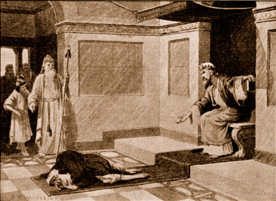
Click to Enlarge
Fell on his face and prostrated (see popup) (bowing down throwing kisses toward the one in authority) himself - Fear. Dread. Reverence. Humility. Mephibosheth must have had a range of reactions to seeing face to face the one his grandfather had relentless sought to exterminate.
Lying prostrate was an act of respect to authority figures especially kings (cp 1Sa 24:8; 25:23; Esther 8:3). In addition lying prostrate was also a frequent expression of fear. For example, Balaam fell down afraid when he saw the Angel of the LORD (Nu 22:31). The beloved apostle John in exile on the Isle of Patmos fell down before his glorified Lord and heard words similar to those David spoke to Mephibosheth…
And when I saw Him, I fell at His feet as a dead man. And He laid His right hand upon me, saying, "Do not be afraid; I am the first and the last (Rev 1:17-note)
And David said "Mephibosheth" - Notice that Ziba had not specified this name but had referred to him as "the son of Jonathan who is crippled in both feet." While the Bible does not allow us to hear the tone or inflection of David's voice, the context would certainly support the presumption that the King spoke with a gentle, soft tone, not a harsh, condemning tone. Don't miss this magnificent display of grace. It is what David did not say that is dramatic - He did not "the cripple". He did not say "my former enemy's grandson". He did not even say "Jonathan's son". Instead David calls him by his name, "Mephibosheth". Can you imagine what went through Mephibosheth's mind at that moment? "He knows my name. The King knows my name!" And the "Greater David" King Jesus also knows your name and calls you personally and intimately by name. He calls you by name to join Him at the table for communion and fellowship. How wonderful that David called this frightened, shame-filled "dead dog" by name, and sought to lift him out of his fear, his shame and his poverty and place him on a higher plane (play hymn below).
THOUGHT - Is this not a manifestation of the lovingkindness of God through David as he stoops in his royal robe to reach out and lift up this crippled man by calling his name? Is this not what the Greater David, the Lord Jesus Christ, has done for all who have entered into communion and fellowship with the King of kings by grace through faith? Hallelujah! Amen!
by Charles H Gabriel
In lovingkindness Jesus came
My soul in mercy to reclaim,
And from the depths of sin and shame
Through grace He lifted me.
Refrain
From sinking sand He lifted me,
With tender hand He lifted me,
From shades of night to plains of light,
O praise His Name, He lifted me!
He called me long before I heard,
Before my sinful heart was stirred,
But when I took Him at His word,
Forgiv’n, He lifted me.
Refrain
His brow was pierced with many a thorn,
His hands by cruel nails were torn,
When from my guilt and grief, forlorn,
In love He lifted me.
Refrain
Now on a higher plane I dwell,
And with my soul I know ’tis well;
Yet how or why I cannot tell
He should have lifted me.
Refrain
Matthew Henry suggests that David "remembered (Mephibosheth's) name, for it is probable that he was born about the time of the intimacy between him and Jonathan."
Mephibosheth - The root of this name includes the Hebrew word "bosheth" which means shame or shameful thing and in turn is from a root meaning to fall into disgrace through failure of self. This name certainly is apropos for the state of Jonathan's surviving son. However the first portion of Mephibosheth's name means something like to scatter or to exterminate and so the full meaning of Mephibosheth is exterminate, scatter or destroy shame, in fact something that did transpire because of the gracious bestowal of the lovingkindness of God by King David! The reader should be aware that there is a second individual in Scripture who is named Mephibosheth (2Sa 21:8). This latter Mephibosheth is a son of Saul who is later executed by the Gibeonites to avenge Saul's bloodguiltiness for attempting to exterminate the Gibeonites during his reign (See 2Sa 21:1, 2, 3, 4, 5, 6, 7, 8, 9-See discussion of how this bloody revenge relates to the seriousness of the covenant Joshua cut with the Gibeonites some 300-400 years earlier!)
In the book of First Chronicles we also learn that Mephibosheth was also named Merib-baal…
And the son of Jonathan was Merib-baal, and Merib-baal became the father of Micah. (1Chr 8:34, 9:40)
Comment: Meri-baal means from the "mouth of Baal", "contender with Baal" or the "mouth of the Lord" (baal means "lord" or "master"). While we cannot be absolutely certain it seems that Merib-Baal was changed to Mephibosheth to keep from having to pronounce the name "Baal", which was also the name of the horrible Canaanite deity and was a source of great shame to Israel. Thus the second part of Mephibosheth's name was changed from "baal" to "bosheth" or "shame".
Here is your servant (Hebrew = ebed; Lxx = doulos) - Mephibosheth refers to himself as "servant" five times (2Sa 9:6, 9:8, 19:26, 27, 28). What does this say about Mephibosheth? His reply suggests a humble attitude, an interpretation which is supported by the following passages. Like the apostle Paul (Ro 1:1-note) Mephibosheth seems to have understood the call and commitment that this great word "servant" pictures.
One source makes the unfounded statement that Mephibosheth is "a very bitter, resentful young man. He has been handicapped from childhood. He has probably not had very much social contact with people. (Don Anderson)" There is simply no evidence in the text to support such a speculative statement. He may have been bitter, but the text gives no clue that such was his attitude. Furthermore 2Sa 9:12 indicates he had enough social contact to have a child (and presumably a wife although none is specifically mentioned). One needs to be very diligent to rightly divide the Word of Truth, neither adding to nor taking away from what the text states.
2Samuel 9:7 DAVID SAID TO HIM, 'DO NOT FEAR, FOR I WILL SURELY SHOW KINDNESS TO YOU FOR THE SAKE OF YOUR FATHER JONATHAN , AND WILL RESTORE TO YOU ALL THE LAND OF YOUR GRANDFATHER SAUL; AND YOU SHALL EAT AT MY TABLE REGULARLY:
- Do not fear: Ge 43:18,23 50:18, 19, 20, 21 1Sa 12:19,20,24 Isa 35:3,4 Mk 5:33,34 Lk 1:12,13,29,30
Do not fear- The Septuagint (LXX) translates the Hebrew with the Greek "me phobou " (from phobos) using the present imperative with a negative which calls for one to cease something they are already doing, in this case cease fearing retribution and revenge from King David. Indeed, Mephibosheth was surely filled with dread at this first sight of his grandfather's archenemy (as least from Saul's perspective) and knew that his first words would call for the end his life. Yes, Mephibosheth's life would soon "end", but not as he had expected, not with his head on a platter before the king (Mt 14:6, 7, 8, 11) but with a privileged position at the royal table with the King! From fear of gallows to fullness with gastronomic delights! Amazing grace. Incomparable lovingkindness. And so King David quickly seeks to quiet Mephibosheth's fear and anxiety. (Related topic: Fear, How to Handle It) And on what basis does David take such incredible action? It flows out of covenant, and the loyal, steadfast covenant love that David had for Mephibosheth's father Jonathan. As someone has well said "What goes around, comes around." and this is especially true if it is based on covenants that have been cut that include the households of the covenanting parties (1Sa 20:14, 15, 16, 17).
Indeed, many years earlier Jonathan had spoken similar words of comfort to David…
Thus he (Jonathan) said to him, “Do not be afraid (present imperative + negative = calls stop being afraid), because the hand of Saul my father will not find you, and you will be king over Israel and I will be next to you; and Saul my father knows that also.” (1 Sa 23:17)
God often speaks these same comforting words to those who are His (Ge 15:1, Lk 12:32, Rev 1:17) and in fact this was one of the most frequent commands of Jesus (Mt 10:26, 28,31, 14:27, 17:7, 28:10 Mk 5:36, 6:50, Lk 5:10, 8:50, 12:4, 7, 32, Jn 6:20)
Matthew Henry - Great men should not take a pleasure in the timorous approaches of their inferiors (for the great God does not), but should encourage them… (David) gives him, by grant from the crown, all the land of Saul his father, that is, his paternal estate, which was forfeited by Ishbosheth’s rebellion and added to his own revenue. This was a real favour, and more than giving him a kind word. True friendship will be generous.
For - David explains why he does not need to fear. And the answer of course is that it because of covenant, the same reason New Covenant believers need not fear. In Romans 5 Paul explains…
Therefore having been justified by faith, we have peace with God through our Lord Jesus Christ, through Whom (base on our covenant relationship with Christ) also we have obtained our introduction (access) by faith into this grace in which we stand; and we exult in hope (absolute certainty of future good) of the glory of God. (Ro 5:1, 2)
Comment: The word "introduction" is a technical term referring to royal protocol. It refers to what people needed in the ancient world in order to come into the presence of a royal ruler. You couldn't just waltz into a king's presence. To do this would invite death. You had to have an introduction--a signal from the king that he desired to see you. The French word entree pictures the freedom of entry or access believers now have into the presence of the King. Our Lord clothes sinners who have entered covenant with Him with His righteousness and brings him into the full unmerited favor of God the Father. This is entree and this is why we do not have to fear. But for how long you ask? Aren't there rules we must keep or works we must do to guarantee our entree into the Royal Courtroom? The New Covenant is forever even as brought out by the verb “Have obtained” which in the perfect tense means we have obtained this entree in the past (a past completed action - at the moment we entered the New Covenant) when we were justified by faith and the effects of that initial entree continue into the present and throughout eternity. All of this is independent of human merit. This is a humbling thought which should cause us like Mephibosheth to fall on our face and bow low in worship at "so great a salvation". We enjoy access into an indescribable position of favor with God. We are accepted in the Beloved; therefore we are near and dear to God. The Father extends the golden scepter to us and welcomes us as sons, not strangers. We cry out "Abba, Daddy". The question then is not do we believe that you deserve this for we don't. The better question is "Do you believe this truth about your relationship now with the Almighty?" Don't try to deserve it. Don't try to intellectualize it. Ask God to open the eyes of your heart that you may know what is the hope of His calling, what are the riches of the glory of His inheritance in the saints, and what is the surpassing greatness of His power toward us who believe. And then practically demonstrate your genuine love for your Father in your obedience.
I will surely (Hebrew = kiy) show kindness to you - Don't miss the Spirit inspired addition of the Hebrew adverb "surely" (kiy) -- Not just "show kindness" but "surely" show kindness, words calculated to dissolve all the doubts and fears that surely must have shackled Mephibosheth. Many of the translations unfortunately do not render this little Hebrew particle "kiy" (03588) and thus miss the added emphasis intended by David. Kiy means indeed, surely, truly and is a marker of emphasis which strengthens the statement which follows (eg, Ge 18:20 = "indeed"; 1Sa 14:44, 1Sa 21:5). When used in this sense, "kiy" is almost equivalent to a positive assurance.
For the sake of your father Jonathan - "For" introduces David's explanation (Be alert for "for" when are reading God's Word always pausing to ask [and attempt to answer] "What's it there for?"- See terms of conclusion). This is a clear reference to Jonathan's covenant with David (1Sa 20:14, 15, 16) which he would not break. How interesting that David now carries out what he had formerly ask of Mephibosheth's father Jonathan when he declared…
Therefore deal kindly ("Show kindness, loyalty, steadfast, faithful love" - David appeals to the covenant term hesed) with your servant, for you have brought your servant into a covenant of the LORD (While it was a covenant between men, note how David considers it … a covenant of Jehovah) with you (Jonathan). But if there is iniquity in me, put me to death yourself (Emphasizing how solemn and binding David considers his covenant with Jonathan - David in essence says may he forfeit his life if he breaks the covenant! Talk about a man of his word, a man after God's own heart! May his tribe increase!); for why then should you bring me to your father?" (1Samuel 20:8)
Restore to you all the land of your grandfather Saul - Given that Saul was King, this is no small gift David bestows on Mephibosheth. David could have given Mephibosheth a few acres in proximity to the Holy City and that would have been grace (unmerited favor). But this is not the generous heart of David, who goes far beyond the letter of the law, even as the Greater David has done to those who believe in Him…
For of His (Jesus') fullness we have all received, and grace upon grace. For the Law was given through Moses; grace and truth were realized through Jesus Christ. (Jn 1:16-17).
Comment: How often we forget this truth which speaks of waves of God's amazing grace that continually break over our heads, washing us clean, strengthening us for the good fight, the worthy walk. Grace piled upon grace. Overflowing. Abundant. Never ending. Amazing!
You shall eat at my table regularly - (HCSB - "you will always eat meals at my table", ESV "you shall eat at my table always") What an incredible declaration from the King to one whose very name means something like "shameful thing." An invitation to dine with the King. And not just once, not just occasionally, but regularly (implying the rest of his life, which would also have been during the glorious "golden years" which Israel experienced under the godly leadership of David). Like so many of David's words and actions, does this not remind us of our Lord Jesus about Whom it was recorded that…
both the Pharisees and the scribes began to grumble, saying, "This man receives sinners and eats with them." (Lk 15:2)
Ryken comments
It was a mark of great favor to “eat at the king’s table,” an honor bestowed by King David on Mephibosheth (2Sa 9:7, 13) and the sons of Barzillai (1Kings 2:7). To dine at the king’s table is an honor; it is to enjoy the favor, protection, prosperity and power of the king (2Sa 9:7–13; 19:28; 1 Kings 2:7). Refusing the king’s invitation insults him (1Sa 20:29; Esther 1:12). To be disinvited from sitting at the king’s table and reduced to “eating the crumbs” from underneath it instead is a picture of humiliation and defeat (Jdg 1:7; used figuratively in Ezek 39:20 and Mt 15:21-28). (Ryken, L., Wilhoit, J., Longman, T., Duriez, C., Penney, D., & Reid, D. G. Dictionary of biblical imagery Downers Grove, IL: InterVarsity Press)
Isaiah records a similar gracious invitation to those who are undeserving…
Ho! Every one who thirsts, come to the waters; and you who have no money come, buy and eat. Come, buy wine and milk without money and without cost. 2 "Why do you spend money for what is not bread, And your wages for what does not satisfy? Listen carefully to Me, and eat what is good, And delight yourself in abundance. (Isa 55:1, 2)
Criswell comments: In Isaiah 55 the Lord issues a general call to all who would call themselves by His name, to abandon the Babylons of this world and to find their satisfaction and their security in Him alone, and in that city of joy and peace that He will build. This passage is a call to revival for all who have wandered far from the Lord or from that grace which is the basis for our relationship with Him. It is also a call to salvation for any who have not known Him, promising a free but abundant and eternal life that is better than money can buy. The call is issued to the thirsty and the penniless -- all who will recognize their need for spiritual blessing and their inability to meet the need themselves. "Waters" and "wine and milk" are symbols of abundant spiritual blessings.
F B Meyer…
FOUR times in this chapter we are told of the lame man eating bread at the royal table.
But what are these facts recorded and repeated for,
save to accentuate the infinite blessings
which come to us through the Divine love!
Mephibosheth had done nothing to merit the royal favour. Not a word is said of his being well favoured and attractive. So far from that, he was lame on both his feet, and probably a sickly invalid. In his own judgment he was worthless as a dead dog. His state was impoverished; no deed of prowess could win David's notice; he was almost entirely at the mercy of his servant, Ziba. In these respects there are many analogies to our own condition in the sight of God. We are lame indeed; and, so far as we are concerned, it is quite impossible that we should ever win the Divine regard, or sit at his table among his sons.
But between David and Jonathan a covenant had been struck, which had provided for the children of the ill fated Jonathan (1Sa 20:14-16). It was because of this sacred obligation that Mephibosheth fared as he did.
Look away, child of God,
to the covenant struck between
God and thy Representative, the Son of His love.
It is idle of thee to seek to propitiate the Divine favour, or earn a seat at his table; but if thou art willing to identify thyself with thy Lord, and to shelter thyself in Him by the living union of faith (Ed: In essence a description of believers in covenant with Christ the Covenant Head); if thou canst base thy plea on the Blood of the everlasting covenant (He 13:20-note) then the provisions of that covenant between Father and Son shall be extended to thee: and because of God's love to Jesus thou shalt sit at the Divine table (Rev 19:7, 8, 9), and be regarded as one of the heirs of the great King. (F. B. Meyer. Our Daily Homily)
IVP Background commentary notes that
Mephibosheth had good cause to be afraid of David. There is wide precedent in Mesopotamian texts for the elimination of all rival claimants to the throne when a king comes to power (compare Baasha’s murder of Jeroboam’s family in 1Kings 15:29). Such purges also occurred years later as a form of revenge for political opposition or rebellion attempted against previous rulers. For example, Ashurbanipal mutilated, executed and fed the bodies of his grandfather’s rivals to dogs as part of his first official acts as king of Assyria. David, however, treats Mephibosheth, the only surviving male member of the royal family, as the rightful heir to Saul’s estates. His generosity is coupled with the command to eat at David’s table. In this way Mephibosheth is treated with honor, though some have noted it also keeps him under observation should he be inclined to subversion. (Matthews, V. H., Chavalas, M. W., & Walton, J. H.. The IVP Bible background commentary: Old Testament. Downers Grove, IL: InterVarsity Press)
2Samuel 9:8 AGAIN HE PROSTRATED HIMSELF AND SAID, "WHAT IS YOUR SERVANT, THAT YOU SHOULD REGARD A DEAD DOG LIKE ME?" :
- dead dog: 2Sa 3:8 16:9 1Sa 24:14,15 26:20 Mt 15:26,27
Again he prostrated himself - Reflecting his humility and amazement at such unexpected kindness.
THOUGHT - Have you ever fallen prostrate before the Lord in utter amazement at the grace and mercy He has poured out in your life? In an "exercise crazy" society, this is good exercise for the soul!
Matthew Henry adds that…
Mephibosheth accepts this kindness with great humility and self-abasement. He was not one of those that take every favour as a debt, and think every thing too little that their friends do for them; but, on the contrary, speaks as one amazed at the grants David made him… How he vilifies himself (lowers himself in importance)! Though the son of a prince, and the grandson of a king, yet his family being under guilt and wrath, and himself poor and lame, he calls himself a dead dog before David. Note, It is good to have the heart humble under humbling providences. If, when divine Providence brings our condition down, divine grace brings our spirits down with it, we shall be easy. And those who thus humble themselves shall be exalted (Jas 4:6-note, 1Pe 5:5-note, Isa 57:15, 66:2) How does he magnify David’s kindness! It would have been easy to lessen it if he had been so disposed. Had David restored him his father’s estate? It was but giving him his own. Did he take him to his table? This was policy, that he might have an eye upon him. But Mephibosheth considered all that David said and did as very kind, and himself as less than the least of all his favors. See 1 Sa. 18:18.
Your servant (Lxx = doulos) - Mephibosheth refers to himself as "servant" also in 2Sa 9:6.
Dead Dog - Dead dogs were contemptible to the Jews. While some might accuse him of "low self esteem", Mephibosheth's humble attitude is a model for all of us to consider. As Paul grows in grace he goes from seeing himself as the "least of all the apostles" to the "foremost" of sinners (Note the increasing sense of self abasement by Paul over time - 1Cor 15:9 = 55AD Ep 3:8 = 61AD 1Ti 1:15 = 63-66AD!) (See also Dog in the Bible)
Ryken notes that…
Although the phrase “a dog’s life” epitomizes a life of ease devoid of anxiety in contemporary Western society, a “dog’s life” in a biblical context shocks the reader with visions of squalor, dismal poverty and the life of a pariah at the bottom of the social scale. Dogs are repeatedly depicted in terms of their disgusting and inadequate diet. Typically they devour what is left over after humans are finished eating, and that is usually described as mere crumbs (Mt 15:26, 27; Mk 7:27, 28). One certainly does not give them quality fare (Mt 7:6). Consequently dogs are never satisfied and are constantly on the lookout for nourishment. Since what they manage to scavenge is inadequate, they may consume what is repulsive (Pr 26:11; 2Pe 2:22) or what is not fit for human consumption (Ex 22:31). Of all the domesticated animals there is a particular revulsion for the dog, who alone is willing to eat humans corpses, a fact that is reprehensible to every human and exploited uniquely by the book of Kings as a curse that comes upon wicked dynasts (1Ki 14:11; 16:4; 21:23, 24; 2Ki 9:10, 36)… To identify oneself as a dog is therefore to draw attention to one’s miserable condition as an inconsequential creature. A dead dog is a cheap life: “Why should this dead dog curse my lord the king?” (2Sa 16:9). David’s comparison of Saul’s pursuit to hunting “after a dead dog” (1Sa 24:14) craftily combines two meanings. David is not worth hunting, and doing so is an act of cowardice. (Ryken, L., Wilhoit, J., Longman, T., Duriez, C., Penney, D., & Reid, D. G. Dictionary of biblical imagery Downers Grove, IL: InterVarsity Press)
Kay Arthur writes that
Mephibosheth prostrates himself and says, "What is your servant, that you should regard a dead dog like me?" (2Sa 9:8)
A "dead dog" was a Hebrew expression for an embarrassing piece of garbage. That's how Mephibosheth saw himself. Compassion and lovingkindness were flowing from the throne, but Mephibosheth couldn't take it in. Why? Because, beloved, like so many of us, he did not have the facts straight. Mephibosheth knew only what he had been told by people who perpetuated Saul's point of view. Mephibosheth had lived in utter ignorance of the covenant his father, Jonathan, had cut for him - a covenant made for just such an occasion as this.
And what about you, precious one? Are you crippled because you've been living in fear of God, ignorant of the covenant cut for you? Have you been dwelling in the barrenness and the poverty of Lo-Debar rather than in the riches of the inheritance that belongs to those of covenant? Have you feared that, if you ever came and bowed before God and gave Him your life, He would do something terrible to you, He would exact some horrible price-giving you cancer, or killing your loved ones, leaving you single, and alone, or sending you off to some hostile foreign land? Have you believed you can only be safe by fighting for the throne, shaping your own destiny, taking care of yourself rather than trusting the God you have heard about?
May I ask you this: How well do you know the One who sits upon the throne? Are you fully aware that He administers justice for all His people? Or are you the hopeless victim of rumors about God? Do you feel that God would never find you acceptable and fit to enter His city because you are lame? Do you sometimes feel that He (and everyone else) must view you as worthless? Quit trembling, beloved. You have heard lies. Such reasoning knows nothing of the covenant cut for you from eternity. There is hope for you. There is a future because of covenant.
And yet here was Mephibosheth his own choosing an enemy of David's, a man lame in both feet, crippled because of fleeing from David, worthless and embarrassing in his own eyes yet bidden by the king to come and dine! Why? It wasn't because of Mephibosheth. It was because of Jonathan…
"Do not fear, for I will surely show kindness (hesed a covenant word) to you for the sake of your father Jonathan (for the sake of covenant)." (2Sa 9:7)
You can feast at Jesus' table anytime. He who fed the multitudes, turned the water into wine, to the hungry calls even now, "Come and dine!" (Rev 3:20-note) Oh, beloved, are you taking hold of all that is yours in your covenant with Him? (Our Covenant God by Kay Arthur)
Spurgeon offers these devotional thoughts on 2Sa 9:8…
If Mephibosheth was thus humbled by David's kindness, what shall we be in the presence of our gracious Lord?
The more grace we have, the less we shall think of ourselves;
for grace, like light, reveals our impurity.
Eminent saints have scarcely known to what to compare themselves, their sense of unworthiness has been so clear and keen. "I am," says holy Rutherford, "a dry and withered branch, a piece of dead carcass, dry bones, and not able to step over a straw." In another place he writes, "Except as to open outbreakings of sin—I am no different than Judas and Cain."
The basest objects in nature appear to the humbled Christian—to be better than himself, because they have never contracted sin. A dog may be greedy, fierce, or filthy—but it has no conscience to violate, no Holy Spirit to resist. A dog may be a worthless animal, and yet by a little kindness it is soon won to love its master, and is faithful unto death; but we forget the goodness of the Lord, and follow not at His call.
Dead Dog…
Clay, Animated Dust, Mere Walking Dirt
Sinners… Monsters Indeed!
The term "dead dog" is the most expressive of all terms of contempt—but it is none too strong to express the self-abhorrence of instructed believers. They do not affect mock modesty; they mean what they say; they have weighed themselves in the balances of the sanctuary, and found out the vanity of their hearts. At best, we are but clay, animated dust, mere walking dirt! But viewed as sinners—we are monsters indeed!
Let it be published in heaven as a wonder, that the Lord Jesus should set His heart's love upon such as we are. Dust and ashes though we are, we must and will "magnify the exceeding greatness of His grace." (Ep 2:7KJV) Could not His heart find rest in heaven? Must He needs come to these tents of Kedar for a spouse, and choose an unlovely bride? O heavens and earth, break forth into a song, and give all glory to our sweet Lord Jesus!
F B Meyer…
David's kindness to Mephibosheth is a beautiful incident in his history, and strikingly illustrates the grace of our Lord Jesus.
It was unexpected and unsought. -- The young prince was spending a retired life with one of the great families of the trans-Jordanic region. The thought of becoming an inmate of David's palace never occurred to him; and his great nervousness needed David's most careful reassurances. "What is thy servant, that thou shouldest look upon such a dead dog as I am?" "Behold, what manner of love the Father hath bestowed upon us, that we should be called the sons of God" "Depart from me, for I am a sinful man, O Lord"
2Sa 9:3-13 It was unlikely. -- He was lame. This sad infirmity dated from his birth (2Sa 4:4). We, too, are lame in our powers of spiritual obedience. We cannot do anything to merit the Divine regard.
It was not without good reason. -- Probably Mephibosheth knew nothing of the covenant into which David and Jonathan had entered so long before (1Sa 20:14, 15, 16). But to David it was sacred; and even the unlovable son was dear to him for his father's sake. For a similar reason does God look on us. We are loved in Him in whom we have been chosen. God will ever be mindful of His covenant with His well-beloved Son.
It admitted him into the royal circle. -- Though consciously unworthy, he received again Saul's family estate (2Sa 9:7), was admitted to the royal table, and treated as one of the king's sons (2Sa 9:11); he had, in Ziba and his household, a retinue worthy of a prince (2Sa 9:10). All was due to the unmerited favor of the king; and is a type of all those spiritual blessings with which the God and Father of our Lord Jesus Christ has blessed us in heavenly places in Him (Ep 1:3). (F. B. Meyer. CHOICE NOTES ON JOSHUA THROUGH 2 KINGS)
2Samuel 9:9 THEN THE KING CALLED SAUL'S SERVANT ZIBA AND SAID TO HIM, 'ALL THAT BELONGED TO SAUL AND TO ALL HIS HOUSE I HAVE GIVEN TO YOUR MASTER'S GRANDSON.:
- 2Sa 16:4 19:29 1Sa 9:1 Isa 32:
Paul Westervelt - You and I are Mephibosheths, too. The similarities between his life and ours are just too compelling. Before the Father drew us near by His own initiative, we spent our lives running from Him in brokenness and shame. We feared that entering His presence would bring judgment upon our heads. When finally we lay trembling at His feet, He touched us gently and said, "Don’t be afraid." He lifted us up and said, "I’m going to give back to you everything you ever lost because of sin. I’m going to give you an inheritance, blessing, and riches in the heavenly places. But more that that, I want you forever in My presence, and I’m going to call you My child." And when we protested, "But why would You care about a worthless loser like me?" He said, "Because I know your brother Jesus. And for His sake, I’ll do it all on your account." (Discipleship Journal, Issue 116 March/April 2000)
2Samuel 9:10 "YOU AND YOUR SONS AND YOUR SERVANTS SHALL CULTIVATE THE LAND FOR HIM, AND OU SHALL BRING IN THE PRODUCE SO THAT YOUR MASTER'S GRANDSON MAY HAVE FOOD; NEVERTHELESS MEPHIBOSHETH YOUR MASTER'S GRANDSON SHALL EAT AT MY TABLE REGULARLY." NOW ZIBA HAD FIFTEEN SONS AND TWENTY SERVANTS.:
- 2Sa 9:7,11, 12, 13 19:28 2Ki 25:29 Lk 14:15
Eat at my table regularly - I love Chuck Swindoll's illustration of God's grace taken from the life of Mephibosheth writing that…
the bible is a photo album filled with pictures of God’s grace. One striking image is found in the pages of 2 Samuel. The setting is the palace of King David. Gold and bronze fixtures gleam from the walls. Lofty, wooden ceilings crown each spacious room. In the banquet room, David and his children gather for an evening meal. Absalom, tanned and handsome, is there, as is David’s beautiful daughter Tamar. The call to dinner is given, and the king scans the room to see if all are present. One figure, though, is absent. Clump, scraaape, clump, scraaape. The sound coming down the hall echoes into the chamber. Clump, scraaape, clump, scraaape. Finally, the person appears at the door and slowly shuffles to his seat. It is the lame Mephibosheth seated in grace at David’s table. And the tablecloth covers his feet. Now the feast can begin. (Swindoll, C. R.: The Tale of the Tardy Oxcart and 1501 Other Stories. Nashville: Word Publishers)
J Vernon McGee draws some wonderful lessons from this chapter…
1. A child of God recognizes that he is also a cripple in God’s sight. We are told in Ro 3:15,16: “Their feet are swift to shed blood: Destruction and misery are in their ways.” That is the report from God’s clinic on the human race. Our feet lead us astray. “All we like sheep have gone astray; we have turned every one to his own way; and the Lord hath laid on him the iniquity of us all” (Isa. 53:6). Then the writer of the Book of Proverbs says, “There is a way that seems right unto a man, but the end thereof are the ways of death” (Pr 16:25). Our feet get us into trouble. The way that the soul and the feet are so closely connected in Scripture is quite interesting. I do not mean to make a bad pun; I am not talking about the sole of the foot.
Remembering that David for the rest of his life had a crippled boy who ate at his table, listen to the words of Ps 56:13, “For thou hast delivered my soul from death: wilt not thou deliver my feet from failing, that I may walk before God in the light of the living?” Ps 73:2 says, “But as for me, my feet were almost gone; my steps had well nigh slipped” David knew what it was to have lame feet! In Psalm 116:8 he says, “For thou hast delivered my soul from death, mine eyes from tears, and my feet from falling.” My friend, all of us are actually cripples before God.
Modern philosophy and humanism present another picture of man. I once heard a liberal say that Christ came to reveal the splendors of the human soul! God says, “The heart is deceitful above all things, and desperately wicked: who can know it?” (Jer. 17:9). Out of the heart proceed evil thoughts, and it is a mess of bad things. You cannot expect any good from human nature. Paul could say, “For I know that in me (that is, in my flesh,) dwelleth no good thing: for to will is present with me; but how to perform that which is good I find not” (Ro. 7:18). Paul had no confidence in the flesh. The Law is condemnation. Jn 14:6 says, “Jesus saith unto him, I am the way, the truth, and the life: no man cometh unto the Father, but by me.” When we come that way, He will receive us.
2. David extended kindness to Mephibosheth for the sake of Jonathan. This is another facet of this amazing incident. You see, David did not know the boy. He did what he did for the sake of Jonathan whom he loved. When David looked upon this boy, he did not see a cripple; he saw Jonathan. He had made a covenant with Jonathan. The kindness, mercy, and grace extended to a helpless person were for the sake of another.
We have seen how much Jonathan meant to David. When the news of his death reached him, he said: “How are the mighty fallen in the midst of the battle! O Jonathan, thou wast slain in thine high places. I am distressed for thee, my brother Jonathan: very pleasant hast thou been unto me: thy love to me was wonderful, passing the love of women” (2 Sam. 1:25,26). Now God has saved you and me because of Another—the Lord Jesus Christ. When we accept Jesus Christ as Savior, Ephesians 1:6 tells us that we are “accepted in the beloved.” When God sees you and me in Christ, He accepts us and saves us.
3. David said nothing about the lame feet of Mephibosheth. There is no record that David ever mentioned it or made an allusion to it. He never said to him, “It is too bad that you are crippled.” He treated him like a prince. He sat at the king’s table, and his feet were covered with a linen cloth. My friend, God forgets our sin because it is blotted out by the blood of the Lord Jesus Christ. That is the only way God can forgive our sins. The writer of Hebrews put it this way: “And their sins and iniquities will I remember no more” (Heb. 10:17).
4. Mephibosheth said nothing about his lame feet. What do you think David and Mephibosheth talked about when they sat at the table? They talked about another person. Do you know who it was? It was Jonathan. David loved Jonathan. Mephibosheth loved Jonathan—he was his father. Jonathan was the subject of conversation. What should you and I talk about? Some Christians take a keen delight in talking about the old days when they lived in sin. It is too bad that when we get together we don’t talk about Another. The Lord Jesus Christ should be the main subject of our conversation.
5. Others said nothing about Mephibosheth’s lame feet. There was a large company that ate at the king’s table. One day they saw David bringing this crippled boy to the table. The gossips did not say, “Did you hear how it happened?” Instead they listened to the king. They heard David praise Mephibosheth, They had no time to indulge in cheap talk. Their hearts went out in love to this boy. You see, love “beareth all things, believeth all things, hopeth all things, endureth all things.” Love “never fails” (1 Cor. 13:7–8).
As far as I can tell, David was never able to make this boy walk. If you see that you cannot walk well-pleasing to God, turn to the Lord Jesus Christ. Christ said to the man with palsy, whose friends had let him down through the roof, “… Son, be of good cheer; thy sins be forgiven thee…. Arise, and walk” (Matt. 9:2–5). The apostle Paul urges: “I therefore, the prisoner of the Lord, beseech you that ye walk worthy of the vocation wherewith ye are called, With all lowliness and meekness, with longsuffering, forbearing one another in love” (Eph. 4:1–2). If you are failing in your walk, turn to Christ for help.
Christ is sending out an invitation today into the highways and byways and out into the streets of your town. He is saying, “Come to my table of salvation just as you are, crippled, and I will feed you.” He says, “Come unto me, all ye that labour and are heavy laden, and I will give you rest” (Matt. 11:28). He also says, “… If any man thirst, let him come unto me, and drink” (John 7:37). What a wonderful picture of God’s love is presented in this chapter! (Listen to Dr McGee's exposition - 2Samuel 9 Intro 2Sa 9:1-9 2Sa 9:10-13)
2Samuel 9:11 THEN ZIBA SAID TO THE KING, "ACCORDING TO ALL THAT MY LORD THE KING COMMANDS HIS SERVANT SO YOUR SERVANT WILL DO." SO MEPHIBOSHETH ATE AT DAVID'S TABLE AS ONE OF THE KING'S OWN SONS.:
- Ziba: 2Sa 19:17
- According: 2Sa 16:1, 2, 3, 4 19:26
As one of the king's sons - While not necessarily indicative of adoption, it certainly presents a picture similar to adoption a term filled with the ideas of love, grace, compassion, and intimate relationship.
John MacArthur commenting on Mephibosheth writes that…
Perhaps the most touching adoption mentioned in the Old Testament was that of Mephibosheth, the crippled son of Jonathan and the sole remaining descendent of Saul. When King David learned about Mephibosheth, he gave him all the land that had belonged to his grandfather Saul and honored this son of his dearest friend, Jonathan, by having him dine regularly at the king’s table in the palace at Jerusalem (see 2Sa 9:1-13). Pharaoh’s daughter adopted Moses out of pity and sympathy. And although Mordecai dearly loved Esther, his adoption of her was also prompted by family duty. But David’s adoption of Mephibosheth was motivated purely by gracious love. In many ways, David’s adoption of Mephibosheth pictures God’s adoption of believers. David took the initiative in seeking out Mephibosheth and bringing him to the palace. And although Mephibosheth was the son of David’s closest friend, he was also the grandson and sole heir of Saul, who had sought repeatedly to kill David. Being crippled in both feet, Mephibosheth was helpless to render David any significant service; he could only accept his sovereign’s bounty. The very name Mephibosheth means “a shameful thing,” and he had lived for a number of years in Lo-Debar, which means “the barren land” (lit., “no pasture”). David brought this outcast to dine at his table as his own son and graciously granted him a magnificent inheritance to which he was no longer legally entitled.
That is a beautiful picture of the spiritual adoption whereby God graciously and lovingly seeks out unworthy men and women on His own initiative and makes them His children, solely on the basis of their trust in His true Son, Jesus Christ. Because of their adoption, believers will share the full inheritance of the Son. To all Christians God declares, “ ‘I will welcome you, and I will be a father to you, and you shall be sons and daughters to Me,’ says the Lord Almighty” (2Co 6:17,18). Paul gives us the unspeakably marvelous assurance that God has “predestined us to adoption as sons through Jesus Christ to Himself, according to the kind intention of His will” (MacArthur, J: Romans 1-8. Chicago: Moody Press) (Bolding added)
Pulpit Commentary - David would be content with nothing less than that Mephibosheth should be a free and constant guest at his table. He was to be raised from social degradation and obscurity to a position of greatest distinction. No mere pension, no formal expression of personal interest, no delegation to others of attention to be paid to him, would suit the largeness of the king’s heart. His idea of “the kindness of God” (2Sa 9:3) far transcended the best human conceptions of generosity, and this unwonted elevation to honour was but the index of it. What a marvellous change in the condition of this poor, feeble outcast! How contrary to all the usages of monarchs, to the offspring of the fallen, was this overflow of “the kindness of God”! Than this there is not in the Bible a more apt illustration of the exceeding grace of the Lord Jesus Christ, who condescends to our low estate, seeks us out, bows us down in wondering submission by his matchless gentleness, and then raises us to the honour of being members of his household, of free access to his Person and closest fellowship with himself and those most dear to him. “Neither do I condemn thee” (Jn 8:11; cf. Ro 8:1). He gives “power to become the sons of God” (Jn 1:12, 16; 1John 3:1, 2). The “far-off” are made “nigh” (Ep 2:13), and are called “friends” (Jn 15:15), blessed with constant fellowship (1Jn 1:3), and even made heirs of “the glory” given to Himself (Jn 17:22, 23, 24). It is in the Antitype alone that we find the full and true expression of “the kindness of God” (2Sa 9:3). “Eye hath not seen, nor ear heard, neither have entered into the heart of man, the things which God hath prepared for them that love him” (1Cor. 2:9). (The Pulpit Commentary Homily)
Spurgeon - Love the brethren of Him who loved you. If there is a Mephibosheth anywhere who is lame or halt—help him for Jonathan's sake. If there is a poor tried believer, weep with him, and bear his cross—for the sake of Him who wept for you and carried your sins.
2Samuel 9:12 MEPHIBOSHETH HAD A YOUNG SON WHOSE NAME WAS MICA. AND ALL WHO LIVED IN THE HOUSE OF ZIBA WERE SERVANTS TO MEPHIBOSHETH.:
- son: 1Ch 8:8,34-40 9:40-44
- servants: Micah 7:5,6
Mica - In Hebrew the name is a rhetorical question "Who is like Jehovah?" or "Who is like Yahweh?"
Paul Westervelt writes - Imagine the gratitude that must have flooded Mephibosheth’s soul at the birth of his son. Perhaps he thought, I never dreamed I’d even live to see this day. Not only have I survived, but I’ve been richly blessed. I’m a wealthy man. I have an inheritance, and the king calls me his son! Now I have a family, and God has given me a son. Whenever I look into the shining face of that boy, I will never cease to ask myself, Who is like Yahweh? The answer, of course, is nobody! And just as David did with Mephibosheth, so our King graciously invites us to take our places at His table as His adopted sons and daughters.
2Samuel 9:13 SO MEPHIBOSHETH LIVED IN JERUSALEM, FOR HE ATE AT THE KING'S TABLE REGULARLY. NOW HE WAS LAME IN BOTH FEET:
- he did eat: 2Sa 9:7,10,11
- lame: 2Sa 4:4, 9:3
Mephibosheth lived in Jerusalem - From fear in "no pasture" (Lo-Debar) to security in God's holy city of peace all on the basis of the "kindness of God" that flowed through a man after God's own heart!
He ate at the King's table regularly - From poverty in "no pasture" to provision in the presence of the King with a permanent place at the King’s table
Jesus has a table spread
Where the saints of God are fed,
He invites His chosen people, “Come and dine”;
With His manna He doth feed
And supplies our every need:
O ’tis sweet to sup with Jesus all the time!
Refrain
“Come and dine,” the Master calleth, “Come and dine”;
You may feast at Jesus’ table all the time;
He Who fed the multitude, turned the water into wine,
To the hungry calleth now, “Come and dine.”
Soon the Lamb will take His bride
To be ever at His side,
All the host of Heaven will assembled be;
O ’twill be a glorious sight,
All the saints in spotless white;
And with Jesus they will feast eternally.
Refrain
Now he was lame in both feet - But I thought we knew that. So clearly the inspired text means to make a point. One point would be to never forget the low state of Mephibosheth, which serves to even further magnify the lovingkindness of Jehovah. And by way of application, God does not want us to forget the point of His lovingkindnesses abundantly bestowed in spite of our lameness. Notice what Jesus' first coming brought about (Mt 11:2, 3, 4, 5, 6) and which serves as a foreshadowing of what He will do for the lame in the His Millennial (Messianic) Kingdom (Isa 35:5, 6; Jer 31:7, 8, 9; Mic 4:6, 7).
Paul Westervelt paints the scene for us…
I can only imagine what it must have been like to have dinner at the king’s house from that day forward. The grand table is decorated with royal linens and piled high with the finest foods. Servants stand along the walls. Military officials and handsome sons enter one by one. Suddenly they rise, for the king is coming. As he approaches the head of the table, they all sit down together. One of the younger boys grabs for the bread, but the king commands, "Wait!" His eyes scan the table, and he says, "I don’t think we’re all here yet." The room grows quiet, and then they hear a peculiar noise echoing down the hallway: the sound of clumsy crutches clopping along the stone floors. A moment later, all heads turn. Standing in the doorway is Mephibosheth, the king’s adopted son. Perhaps that night a visiting dignitary from a far country watches the scene with great interest. He leans to a palace guard and whispers, "What’s all the commotion over the crippled kid?" The guard responds, "That ‘crippled kid’ was born an enemy of the king, but David has chosen to make the boy his son." "But," the visitor protests, "I don’t understand." The guard smiles. "Not many people do. Isn’t he a great king?" (Discipleship Journal, Issue 116 March/April 2000)
Paul describes what has happened to those were born like "dead dogs", dead in their sins and transgressions, without hope in the world…
But God, being rich in mercy, because of His great love with which He loved us, 5 even when we were dead in our transgressions, made us alive together with Christ (by grace you have been saved), 6 and raised us up with Him, and seated us with Him in the heavenly places in Christ Jesus, 7 so that in the ages to come He might show the surpassing riches of His grace in kindness toward us in Christ Jesus. (Eph 2:4-7).
Comment: Beloved, can you not see the parallel? Crippled by a fall, unable to walk in a pleasing way, no hope in the world, and God intervenes and raises us up from our fallen state, seats us with Him in Christ and for all ages to come shows us the kindness in our Covenant Head Christ Jesus. Amazing mercy. Amazing love. Amazing grace indeed. Hallelujah! Amen.
Spurgeon…
Mephibosheth was no great ornament to a royal table, yet he had a continual place at David’s board, because the king could see in his face the features of the beloved Jonathan. Like Mephibosheth, we may cry unto the King of Glory,
“What is thy servant, that thou shouldst
look upon such a dead dog as I am?”
but still the Lord indulges us with most familiar intercourse with Himself, because He sees in our countenances the remembrance of His dearly-beloved Jesus.
The Lord’s people are dear for another’s sake. Such is the love which the Father bears to His only begotten, that for His sake He raises His lowly brethren from poverty and banishment, to courtly companionship, noble rank, and royal provision. Their deformity shall not rob them of their privileges. Lameness is no bar to sonship; the cripple is as much the heir as if he could run like Asahel
Our right does not limp,
though our might may.
A king’s table is a noble hiding-place for lame legs, and at the gospel feast we learn to glory in infirmities, because the power of Christ rests upon us. Yet grievous disability may mar the persons of the best-loved saints. Here is one feasted by David, and yet so lame in both his feet that he could not go up with the king when he fled from the city, and was therefore maligned and injured by his servant Ziba (compare the falsehood of Ziba in 2Sa 16:1, 2, 3, 4 with the truth of Mephibosheth in 2Sa 19:24, 25, 26, 27, 28). Saints whose faith is weak, and whose knowledge is slender, are great losers; they are exposed to many enemies, and cannot follow the king whithersoever he goes. This disease frequently arises from falls. Bad nursing in their spiritual infancy often causes converts to fall into a despondency from which they never recover, and sin in other cases brings broken bones.
Lord, help the lame to leap like an hart,
and satisfy all thy people with the bread of thy table!
GREATLY VALUED - "Mephibosheth… shall eat at my table like one of the king's sons." -2 Samuel 9:11
A British factory worker and his wife were excited when, after many years of marriage, they discovered they were going to have their first child. According to author Jill Briscoe, who told this true story, the man eagerly relayed the good news to his fellow workers. He told them God had answered his prayers. But they made fun of him for asking God for a child.
When the baby was born, he was diagnosed as having Down’s syndrome. As the father made his way to work for the first time after the birth, he wondered how to face his co-workers. “God, please give me wisdom,” he prayed. Just as he feared, some said mockingly, “So, God gave you this child!” The new father stood for a long time, silently asking God for help. At last he said, “I’m glad the Lord gave this child to me and not to you.”
As this man accepted his disabled son as God’s gift to him, so David was pleased to show kindness to Saul’s son who was “lame in his feet” (2Samuel 9:3). Some may have rejected Mephibosheth because he was lame, but David’s action showed that he valued him greatly.
In God's eyes, every person is important. He sent His only Son to die for us. May we remember with gratitude how much He values each human life. -J D Branon (Our Daily Bread, Copyright RBC Ministries, Grand Rapids, MI. Reprinted by permission. All rights reserved)
Lord, may we see in those we meet
The imprint of Your image fair,
And may their special dignity
Grow stronger from our love and care.
-DJD
Everyone is valuable to God.
SHOWING THE KINDNESS OF GOD - DURING a time when I was feeling down, a good friend sent me a card thanking me for being honest with him even though it hurt. Another person sent me a note of appreciation, saying, "Thanks for coloring my world beautiful." Those small kindnesses encouraged me greatly.
Then there was the time I left my date book in the seat pocket of an airplane. An anonymous person on the staff of Northwest Airlines took the time to put it in an envelope and mail it back to me. I really appreciated that little act of kindness.
On another occasion, a friend compiled a whole notebook of information on a subject I was studying. That person's help saved me hours of time and gave me valuable resources for the class I was taking. I was so grateful.
When David wanted to honor someone in Saul's household for Jonathan's sake, he said, "Is there not still someone of the house of Saul, to whom I may show the kindness of God?" (2 Samuel 9:3). His kindness reflected the kindness that is part of God's character.
Who do you know that needs an act of kindness? Go ahead and do it! It is, after all, the way God continually treats us.—D C Egner (Our Daily Bread, Copyright RBC Ministries, Grand Rapids, MI. Reprinted by permission. All rights reserved)
SPECIAL PEOPLE- "Be of one mind, having compassion for one another; love as brothers, be tenderhearted." - 1 Peter 3:8
Hubert H. Humphrey, former senator, vice-president, college professor, and family man, spoke proudly and lovingly of his family in a television interview. Then his eyes moistened as he recalled the birth of a very special granddaughter with Down's syndrome. "It happened several years ago," he said, "and do you know, that little girl has brought more love into our family circle than had existed before."
A few years later Humphrey died, and after the graveside service the family found it difficult to leave the cemetery. But it was this grandchild who lifted their spirits. "Grandpa is in heaven, not in this casket," she said. What a blessing that little girl with a disability has been to the Humphrey family!
As king, David could have eliminated Saul's household for Saul's attempts to kill him. But he desired instead to show favor to any living member of Saul's family for Jonathan's sake. When told about Mephibosheth, who was "lame in his feet" (2 Samuel 9:3), David showed him special kindness. I believe his physical condition, as well as his place in Saul's household, brought out the best in David.
People with disabilities fulfill a unique place in God's plan. Let's learn from David's example.- H. V. Lugt (Our Daily Bread, Copyright RBC Ministries, Grand Rapids, MI. Reprinted by permission. All rights reserved)
They will not realize right away
The leading role they're asked to play,
But with this child sent from above
Comes stronger faith and richer love.
- Massimilla
People with a disability
have a unique ability to teach us how to love.
A C Gaebelein - Annotated Bible - David and Mephibosheth 2 Samuel 9
1. Mephibosheth brought to David (9:1-6)
2. Grace and mercy shown to him (9:7-13)
The story of Mephibosheth is the first thing mentioned after the government of David had been fully established. Typically it reveals the gospel in a beautiful way, and dispensationally the kindness of God which will be manifested in the coming kingdom. Mephibosheth is a type of the sinner and the condition which he is in. He was helpless, being lame of both feet. How he became lame is found in chapter 4:4. He fell and became lame, a helpless cripple. It reminds us of the fall of man and the helpless condition into which sin has put man. Therefore he could not come to David. He had to be carried into the king's presence. The sinner cannot come of himself to the Saviour; He has to seek him out.
And David wanted to show him "the kindness of God" for Jonathan's sake. "Thus the kindness and love of God our Saviour toward man hath appeared" (Titus 3:4). God for Christ's sake shows His great kindness to sinful man. Mephibosheth means "shame out of the mouth"; when he hears from David's lips what kindness was prepared for him he confessed with his mouth his own shame and nothingness. "What is thy servant that thou shouldst look upon such a dead dog as I am?" And what words of grace came from David's lips! Surely the kindness of God is here fully made known. He is lifted from his low place of shame to take a place at the King's table "as one of the King's sons." It is the kindness of God as made known in the gospel of His Son our Lord Jesus Christ. He takes us out of our shame and makes us one of His sons. "So Mephibosheth dwelt in Jerusalem ; for he did eat continually at the king's table; and was lame on both feet." When the kingdom has come the King will show such grace and kindness to the poor and needy (Isaiah 11:1-5; Ps. 72:1-4).
L M Grant - 2 Samuel 9…
When David's kingdom was established, he was not infatuated with his self-importance, as many men would be. Some would be inclined to get rid of every possible challenger of his position, particularly those of the house of Saul, who had reigned before him.
In contrast to this, David desired to show kindness to someone of the house of Saul who remained living (2Sa 9:1). He proposed this "for Jonathan's sake," whose attachment to David was not to be forgotten. This history is a beautiful picture of the gospel of the grace of God, and reminds us of God's showing kindness to sinners "for Jesus' sake." A servant of Saul's house is found, named Ziba (2Sa 9:2), whom David asks if there is one left of Saul's family to whom he may show the kindness of God.
Ziba knew of one son of Jonathan, lame on both his feet (2Sa 9:3). We have read of him before in 2Sa 4:4, which tells us that he was crippled through a fall. This is spiritually true of all mankind. Because of Adam's fall, all his children have inherited his crippled, sinful condition. The man, Mephibosheth, was living at Lo Debar (meaning "no pasture") (2Sa 9:4), in other words, a place of desolation with typically no food for the soul. We have all been at one time in this place, needing the grace of God.
The meaning of Mephibosheth's name is "shame out of the mouth." When the gospel of grace is preached, it is this "shame out of the mouth" that people usually strongly resist. They justify themselves rather than confessing the shame of their sinful condition. Their unseemly pride becomes the great hindrance to their being sinful condition. Their unseemly pride becomes the great hindrance to their being saved. When Mephibosheth was brought before David he did not act with the bold defiance of human pride, but fell before him prostrate (2Sa 9:6). This is the only becoming attitude for anyone to assume before the face of the Lord Jesus Christ, the Son of God. David addressed the cripple man by name, and he answered, "Here is your servant." No doubt he was afraid, when summoned into the king's presence, that he might even be put to death. Similarly, when we who know we are sinners are called to face our Creator, we are fearful of the eternal consequences. Just as Mephibosheth did not know the heart of David at first, so a guilty sinner does not at first realize how great is the love of God in Christ Jesus.
David immediately sets him at ease, telling him not to fear, and adding, "I will surely show you kindness for Jonathan your father's sake, and will restore to you all the land of Saul your grandfather; and you shall eat bread at my table continually" (2Sa 9:7). What a lesson for us is this, that God is not only merciful in forgiving our sins, but in over abounding grace He enriches every believer with far more than he could ever imagine he would receive! He "has blessed us with every spiritual blessing in the heavenly places in Christ" (Eph.1:3-note)
When David announces to Mephibosheth the many kindnesses he would show him, the response of Mephibosheth is just what is to be expected from everyone who comes to the Lord Jesus for salvation. Do we fully echo the words of Mephibosheth, "What is your servant, that you should look upon such a dead dog as 1?" A dog is unclean: being dead it is corrupt. Both things are true of us in our natural sinful condition.
The man who was virtually destitute is given abundant riches. David instructs Ziba, Saul's servant, to care for the land that Mephibosheth is given as an inheritance (2Sa 9:9). Ziba in fact had 20 servants of his own, so that all would be well cared for, with the fruit of the land rendered to Mephibosheth in its due time. But not only were his needs to be met: he was to have the privilege of eating continually at David's table. The Lord Jesus does not only supply what is necessary for us: He desires our company in fellowship with Him. He is not only kind to us: He loves us. Mephibosheth ate at the kings table "like one of the king's sons" (2Sa 9:11).
2Sa 9:12 informs us that Mephibosheth had a young son named Micha, and that all who lived in the house of Ziba were servants to Mephibosheth. Then 2Sa 9:13 reminds us again that Mephibosheth ate at the king's table continually, indicating that this is something that should engage our special attention. Again also it is mentioned that he was lame in both feet. Though the grace of God blesses us with innumerable blessings, this does not mean that all our health problems will disappear, as Paul was reminded when he prayed for relief from his "thorn in the flesh" (2Cor.12:7-9-notes on verse 9) when the Lord answered him, "My grace is sufficient for you, for My strength is made perfect in weakness." The lame feet also illustrates the fact that the flesh remains in us while we live on earth. However, some one has well observed that when Mephibosheth ate at David's table, his feet would be hidden from view under the table. So long as we are honestly enjoying communion with the Lord Jesus, the flesh will not show itself.