HAGGAI BUILD THE HOUSE
AND I WILL BE GLORIFIED
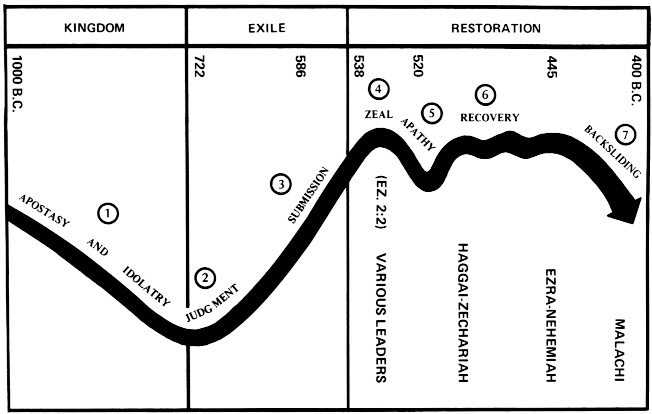
THE SPIRITUAL STATE OF ISRAEL DURING
OLD TESTAMENT TIMES
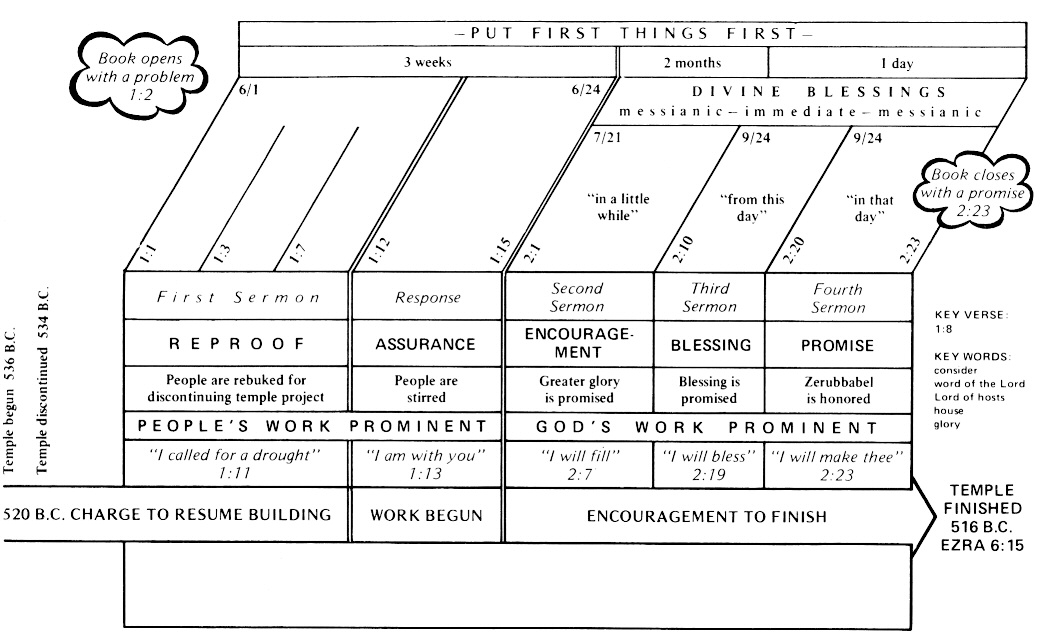
Charts from recommended resource Jensen's Survey of the OT - used by permission
Haggai Chart from Charles Swindoll
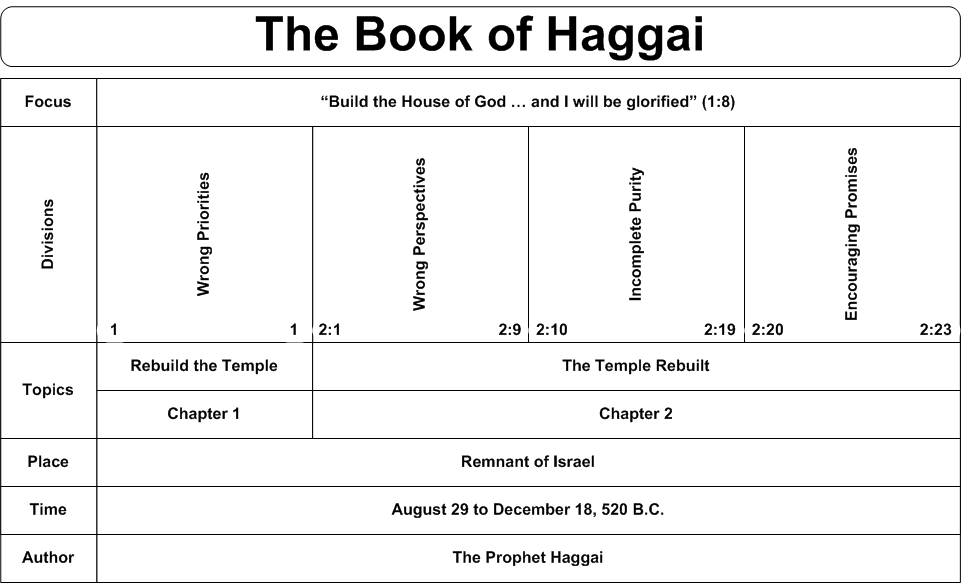
Another Haggai Chart
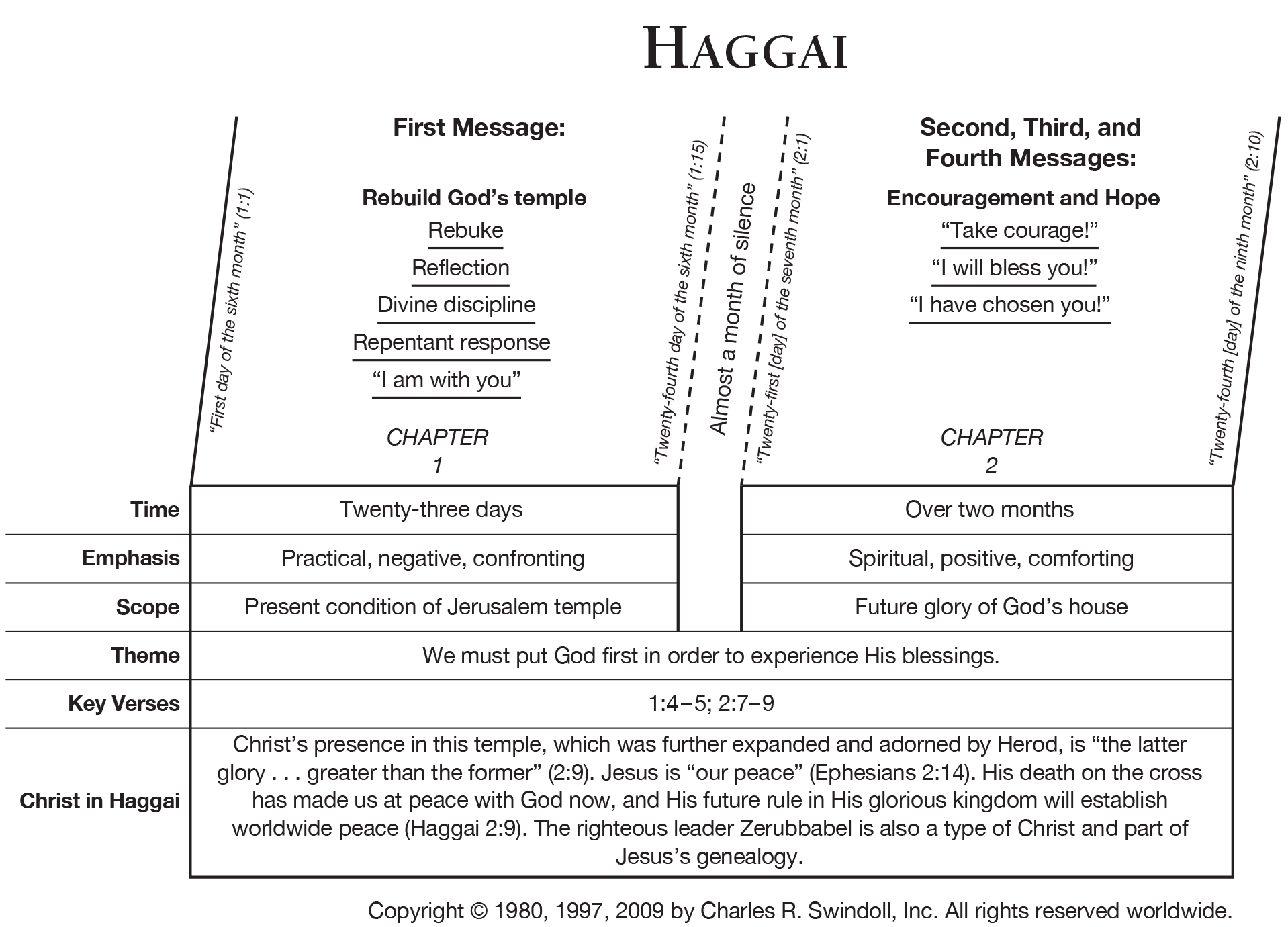
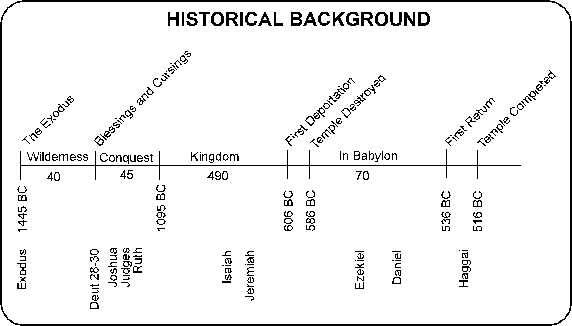
Source - Hampton Keathley IV - Haggai
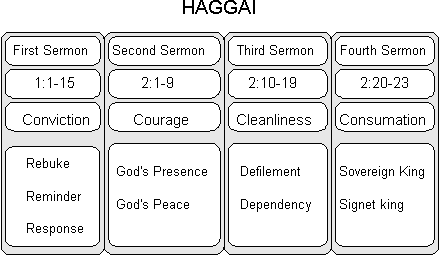
Source - Hampton Keathley IV - Haggai
Click All Charts to Enlarge

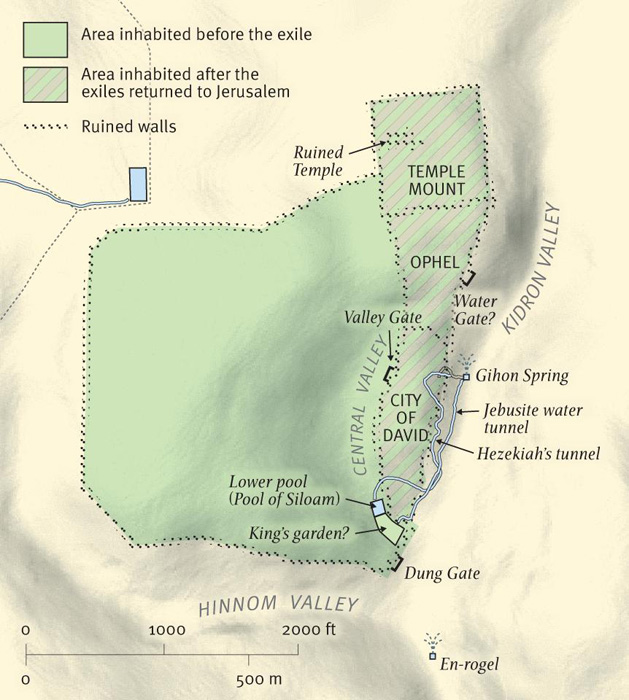
Jerusalem At Time of Haggai
Source: ESV Global Study Bible
THOUGHT - What will you say to Haggai when you meet him if you have not read his book?
MacArthur Study Bible - Intro, Date, Setting, Themes, Interpretative Challenges, Outline
Swindoll Overview - Includes "Listen to Chuck Swindoll’s overview in his audio message" - 27 minutes
KJV Bible Commentary - Intro, Outline and Verse by Verse Commentary
The King James Study Bible Second Edition - short introduction
NKJV Study Bible: New King James Version Study Bible (loads slow) - Introduction, Historical Setting, Purpose, Timeline, Christ in the Scriptures
| HAGGAI "Put First Things First" |
||||||
| 3 WEEKS | 2 MONTHS | 1 DAY | ||||
| Hag 1:1-2 | Hag 1:3-6 | Hag 1:7-11 | Hag 1:12-15 | Hag 2:1-9 | Hag 2:10-19 | Hag 2:20-23 |
|
Consider Your Ways… |
Glory of the Latter Temple shall be greater |
From this day forward I will bless you | I will shake heaven and earth |
|||
|
Completion of |
Glory of |
Present Blessing of Obedience |
Future Blessing thru Promise | |||
| Prophet's First Sermon Hag 1:1-11 |
People's Response Hag 1:12-15 |
Prophet's Second Sermon Hag 2:1-9 |
Prophet's Third Sermon Hag 2:10-19 |
Prophet's Fourth Sermon Hag 2:20-23 |
||
|
REPROOF |
ASSURANCE |
ENCOURAGEMENT |
BLESSING |
PROMISE |
||
|
People are rebuked |
People are stirred |
Greater glory is promised |
Blessing is promised |
Zerubbabel is honored |
||
| TEMPLE OF GOD Present condition of Jerusalem Temple |
BLESSINGS OF GOD Future glory of God's House |
|||||
| PEOPLE'S WORK PROMINENT | GOD'S WORK PROMINENT | |||||
| EMPHASIS: Practical, negative, confronting |
EMPHASIS: Spiritual, positive, comforting |
|||||
| "I called for a drought on the land" Hag 1:11 |
"I am with you" Hag 1:13 |
"I will fill this house with glory" Hag 2:7 |
"I will bless you" Hag 2:19 |
"I will make you a signet" Hag 2:23 |
||
|
Background: |
||||||
|
520BC Charge to |
Work Begun |
Encouragement to Finish - |
||||
| Haggai Opens With A Problem Hag 1:2 |
Haggai Closes With |
|||||
|
Key Words:
|
||||||
| Key Verse: Hag 1:4-5, Hag 2:7-9 | ||||||
|
Christ in Haggai: Christ's presence in the Temple (Jn 1:1, 14, Lk 2:32b), which was further expanded and adorned by Herod, is " ‘The latter GLORY of this house will be greater than the former,’ says the LORD of hosts, ‘and in this place I shall give PEACE,’ declares the LORD of hosts." (Hag 2:9) Jesus is our PEACE (Eph 2:14-note) and His future rule in the Millennium will establish worldwide peace (Hag 2:9). "On that day,’ declares the LORD of hosts, ‘I will take you, Zerubbabel, son of Shealtiel, My servant,’ declares the LORD, ‘and I will make you like a signet ring (02368), for I have chosen you,’” declares the LORD of hosts." (Hag 2:23) Righteous Zerubbabel is a foreshadowing of Christ, as well as in the genealogy of the Messiah (Mt 1:12,13, Lk 3:27). |
||||||
| Interesting Facts about Haggai | ||||||
DICTIONARY ARTICLES
- Baker’s Evangelical Dictionary of Biblical Theology: Haggai, Theology Of
- American Tract Society: Haggai
- Bridgeway Bible Dictionary: Haggai
- Easton’s Bible Dictionary: Haggai, Book Of; Haggai
- Fausset Bible Dictionary: Haggai, the Book Of; Haggai
- Holman Bible Dictionary: Haggai
- Hastings’ Dictionary of the Bible: Haggai
- Kitto’s Popular Cyclopedia of Biblical Literature: Haggai
- Morrish Bible Dictionary: Haggai
- International Standard Bible Encyclopedia: Haggai
- McClintock and Strong: Haggai, Prophecy Of; Haggai
- The Nuttall Encyclopedia: Haggai
- The Jewish Encyclopedia: Haggai, Book Of; Haggai
- Hitchcock’s Bible names: Haggai means feast; solemnity
Haggai, Zechariah, and Malachi are the three prophets to the restored remnant that returned from Babylon. They all make frequent use of the title ''The Lord of Hosts.''
Haggai and Zechariah were probably among the first exiles who returned with Zerubbabel. From his words in 2:3, it is thought that possibly Haggai himself had seen the glory of Solomon's Temple, in which case he would be an old man at this time [cp. Ezra 3:12], while Zechariah was quite young (Zech 2:4).
The burden of Haggai's message was, ''I am with you, saith the Lord of Hosts'' (Hag 1:13).
To the prophet Haggai is given the privilege-- along with Zechariah-- of stirring the people, by his few concise words, to the work of rebuilding the Temple. His message may be summed up in the words, ''Seek ye first the Kingdom of God and His righteousness, and all these things shall be added unto you'' [Mt 6:33-note].
He uttered [five] short prophecies during the last four months of the second year of Darius. [Each of these prophecies begins with this phrase: ''came the word of the Lord''.]
In the first [and second] [Hag 1:1-2, 3-11], he endeavored to shame the people out of their apathy in beautifying their own houses, while the house of the Lord lay waste; and he tells them that all the drought on crops and cattle had its source in this neglect [cp. Deut 28:1ff]. This prophecy produced the desired effect, and Zerubbabel, the governor of Jerusalem, and Joshua the High Priest, and the residue of the people rose up and began the work of rebuilding the Temple, which had been interrupted by their surrounding enemies, chiefly the Samaritans [cp. Ezra. 3:1-Ezra 6:1ff].
A month later, discouragement seems to have beset the workers, at the contrast between the glory of the former house [ie., the Temple built by Solomon] and the poverty of this latter [house]. Haggai exhorted them to be strong and build, for the Lord was with them, His Spirit would remain among them, and, moreover, a time was coming when the Lord of Hosts would shake the heavens and the earth, and the Desire of all nations [would] come, and His glory [would] fill the Temple, so that the glory of this latter house should be greater than that of the former, and in this place would the Lord of Hosts give peace [Hag 2:1-9].
''Herod's Temple, to which our Lord came, was not a new Temple, but a renovation of this second Temple, with splendid additions and improvements. In Haggai's words, 'The silver is Mine and the gold is Mine, saith the Lord of Hosts,' we probably have a prophecy of its magnificence when adorned, at the cost of many millions, by Herod, so as to make it a glorious house, just before He whose house it was came to it, as it were in preparation for His august presence. Yet, the true glory was the presence of the ''Great King'' in His deep disguise as a peasant of Galilee'' (Rev. James Neil).
The fourth [and fifth] prophecies were addressed to Zerubbabel, and through him to Christ [Hag 2:10-19, 20-23]. Zerubbabel was a prince of the house of David, he had led back the people from captivity, he had built the Temple. In all this, he was a type of Christ, who is the Servant of the Lord, chosen of Him, set as a signet (or seal) upon the hand of the Father, the ''express image of His Person.'' This word in Hebrews 1:3-note means the impression made as by a seal upon wax.
Haggai's message is full of stirring words to us today. If, as a Church, we thought more of the Lord's work of saving souls than of our own comfort, there would be no lack of means to carry it forward.
''Consider your ways,'' said Haggai; if we so adjust our ways as to make them fall into line with God's will for us, we have the certainty of His promise, ''I am with you, saith the Lord of Hosts.'' And if His Spirit remaineth among us, we need fear neither opposition from without, nor discouragement from within. [cp. Mat 28:18-20]
Explanation - The following list includes not only commentaries but other Christian works by well known evangelical writers. Most of the resources below are newer works (written after 1970) which previously were available only for purchase in book form or in a Bible computer program. The resources are made freely available by archive.org but have several caveats - (1) they do not allow copy and paste, (2) they can only be checked out for one hour (but can be checked out immediately when your hour expires giving you time to read or take notes on a lengthy section) and (3) they require creating an account which allows you to check out the books free of charge. To set up an account click archive.org and then click the picture of the person in right upper corner and enter email and a password. That's all you have to do. Then you can read these more modern resources free of charge! I have read or used many of these resources but not all of them so ultimately you will need to be a Berean (Acts 17:11+) as you use them. I have also selected works that are conservative and Biblically sound. If you find one that you think does not meet those criteria please send an email at https://www.preceptaustin.org/
COMMENTARIES
NOTE - THESE ARE IN NO PARTICULAR ORDER
Bible Knowledge Commentary - Old Testament - 1608 pages. Dallas Theological Seminary Faculty-
James Rosscup - Lindsey, F. Duane. “Haggai,” in Bible Knowledge Commentary - A former Dallas Seminary faculty member did this very able, brief work covering most of the vital bases to aid an expositor. He is helpful on historical background, flow of the context, meanings of verses, etc. The section on the future millennial temple in Hag 2:6–9 and the reference to Zerubbabel in Hag 2:20 are well done.
The Minor Prophets - borrow this well done commentary by Charles Feinberg (see also The Major Messages of the Minor Prophets)
Cyril Barber - A forthright study denouncing formalism and heartlessness in worship.
The Minor Prophets : an expositional commentary by Boice, James Montgomery, 292 pages
Haggai and Malachi By: Wolf, Herbert
Cyril Barber - Part of the growing corpus of popular commentaries backed by sound evangelical scholarship. Wolf's handling of the writings of these two prophets reveals the timeliness and practical relevance of their message. Recommended. 2
The prophets of Israel by Wood, Leon James
James Rosscup - This quite readable work by a premillennialist covers the overall range of Old Testament prophets, various key subjects under “Prophetism” such as what “to prophesy” means, the prophets’ function, early prophets, Samuel, monarchy prophets, and writing prophets both major and minor. Wood has solid sections on Elijah and Elisha (their spiritual features, episodes, miracles). The Elisha part surveys each miracle. Some sections, as on Hosea, even discuss in some detail leading problems such as whether Gomer was tainted before marriage or became unfaithful later. But sections on the books do not delve into nearly the detail Chisholm gives. Wood does sum up the message well, has an outline on each book, and organizes much on background, character qualities and work of each prophet. He deals with each prophet in relation to the reign he fitted into. Chisholm and Freeman deal more with various problems. Cf. Hobart Freeman, Introd. to the Old Testament Prophets, available now only in some theological libraries.
Haggai and Zechariah 1-8 : a commentary By: Petersen, David L., author
Cyril Barber - Based on the author's long-standing interest in the post-exilic period of Israel's history. Deals relevantly with the events leading up to the building of the second Temple and ably relates the ministry of Haggai and Zechariah to the life and work of the Jews during this period.
James Rosscup - A liberal work detailed in verse by verse comment, form structure, word meanings, and the like. He uses his own translation and sometimes quotations from the RSV. At times he defends verses as fitting meaningfully, not agreeing with scholars who judge them as secondary and superfluous (as Haggai 1:13, p. 57; some aspects in 2:3–9, pp. 65–66). Some verses though dealt with in detail do not seem to be explained well, as when he does not make clear when the shaking in 2:6 will occur. The glory of the future temple appears to be put in the near historical future and a future millennial temple is not even mentioned as a possibility in 2:7–9. On 2:23 he has much discussion but little light, no messianic import, and vagueness. Patience is often needed in searching for some crystallization of his interpretation in the midst of ponderous wording, for he is not soon to the point and can be nebulous about when things will be fulfilled. An example is the fuzziness about the removal of evil to Babylon in Zechariah 5:5–11.
Four minor prophets: Obadiah, Jonah, Habakkuk, and Haggai; their message for today By: Gaebelein, Frank E. (Frank Ely), 1899-1983
The communicator's commentary. Hosea, Joel, Amos, Obadiah, Jonah By: Ogilvie, Lloyd John
Enjoying the Minor Prophets - a devotional commentary - By: MacDonald, William - same author of Believer's Bible Commentary (see note)
Hearing God's voice above the noise - The Twelve Minor Prophets By: Briscoe, D. Stuart
Living prophecies; the Minor prophets paraphrased with Daniel and the Revelation (The Living Bible paraphrase) By: Taylor, Kenneth Nathaniel
Interpreting the Minor Prophets By: Chisholm, Robert B - conservative, premillennial.
The minor prophets By: Lewis, Jack Pearl, 1919- Does not go into much depth.
Be heroic : demonstrating bravery by your walk : OT commentary, minor prophets By: Wiersbe, Warren W - Always worth checking! - Ezra, Haggai, Zechariah
Bible Exposition Commentary - Old Testament - Warren Wiersbe - always worth checking
Be amazed By: Wiersbe, Warren W - Some but not all the minor prophets - Hosea, Joel, Jonah, Nahum, Habakkuk, Malachi
Be concerned By: Wiersbe, Warren W - Some but not all the minor prophets - Amos, Obadiah, Micah, Zephaniah
Twelve voices for truth confronting a falling world with hope : a study of the minor prophets By: Hayford, Jack W
Every prophecy of the Bible By: Walvoord, John F
Haggai, Zechariah and Malachi : an introduction and commentary - Tyndale OT Commentary Series - Volume: 28 By: Hill, Andrew E
The message of Ezra and Haggai : building for God - Bible Speaks Today Series - By: Fyall, Robert S
The Book Of Twelve Prophets Commonly Called The Minor By: George Adam Smith
James Rosscup - Though old this is well-written and often cited, with many good statements on spiritual truths. Users will find much that is worthwhile, and sometimes may disagree, as when he sees the Jonah account as allegorical.
The minor prophets By: Theo. Laetsch, D.D.
James Rosscup - This is a very good amillennial commentary on the minor prophets as a whole. Laetsch deals with the text verse-by-verse, grapples with difficult phrases and explains them, uses the Hebrew extensively, and presents illuminating word studies. The lucid presentation helps make it a very interesting commentary to read. In crucial prophetical sections, his strong amillennialism appears. His weakness here is offset by his helpfulness in exegesis generally plus his good background material.
Micah-Malachi Volume: 32 in Word Biblical Commentary - By: Smith, Ralph L.
Cyril Barber - Adheres to the format established for this series. Handles textual problems adroitly. Discusses the theological implications of these writings, and provides a variety of insights into the text. A necessary volume.
James Rosscup This quite readable work by a premillennialist covers the overall range of Old Testament prophets, various key subjects under “Prophetism” such as what “to prophesy” means, the prophets’ function, early prophets, Samuel, monarchy prophets, and writing prophets both major and minor. Wood has solid sections on Elijah and Elisha (their spiritual features, episodes, miracles). The Elisha part surveys each miracle. Some sections, as on Hosea, even discuss in some detail leading problems such as whether Gomer was tainted before marriage or became unfaithful later. But sections on the books do not delve into nearly the detail Chisholm gives. Wood does sum up the message well, has an outline on each book, and organizes much on background, character qualities and work of each prophet. He deals with each prophet in relation to the reign he fitted into. Chisholm and Freeman deal more with various problems. Cf. Hobart Freeman, Introd. to the Old Testament Prophets, available now only in some theological libraries.
Evangelical Commentary on the Bible - Judges by Andrew Boling (20 pages); editor Walter Elwell (1989) 1239 pages
Haggai, Zechariah, Malachi : an introduction and commentary By: Baldwin, Joyce G
Cyril Barber - Brief, scholarly verse-by-verse comments with additional notes interspersed throughout the text
James Rosscup - The work furnishes a detailed exegesis and rather thorough use of other writers, giving evidence of wide study.
Wiersbe Commentary - Old Testament - His commentaries are always worth checking.
Wiersbe's Expository Outlines on the Old Testament by Wiersbe, Warren W
"Even the most difficult Scriptures come alive as Warren Wiersbe leads you book-by-book through the Old Testament and helps you to see the "big picture" of God's revelation. In this unique volume, you will find: • Introductions and/or outlines for every Old Testament book • Practical expositions of strategic chapters • Special studies on key topics, relating the Old Testament to the New Testament • Easy-to-understand expositions that are practical, preachable, and teachable If you have used Dr. Wiersbe's popular BE series, you know how simple and practical his Bible studies are, with outlines that almost teach themselves. If not, you can now discover a wonderful new resource. This work is a unique commentary on every book of the Old Testament. It contains new material not to be found in the BE series.
With the Word - Devotional Commentary - Warren Wiersbe
Thru the Bible with J. Vernon McGee - Proverbs - Malachi
Believer's Bible Commentary - OT and NT - MacDonald, William (1995) 2480 pages. Conservative. Literal. Often has very insightful comments. John MacArthur, says "Concise yet comprehensive - the most complete single-volume commentary I have seen." Warren Wiersbe adds "For the student who is serious about seeing Christ in the Word." One hour limit.
James Rosscup - This work, originally issued in 1983, is conservative and premillennial, written to help teachers, preachers and people in every walk of life with different views, explanation and application.
Unger's Commentary on the Old Testament (Volume 2 - Isaiah - Malachi) by Unger, Merrill Frederick, 1909- (1981) 972 pages. See his commentary on Haggai below.
Understanding the Old Testament by Scripture Union - All 12 minor prophets. 100 pages.
J.Sidlow Baxter: Explore The Book - pdf Vol. 4 Ezekiel to Malachi
Thru the Bible with J. Vernon McGee - Proverbs - Malachi
The twelve minor prophets By: Robinson, George L.
James Rosscup - This is a reprint of the 1926 edition (New York: Harper and Brothers). He devotes a chapter to each prophet, “Hosea the Prophet of Love,” etc. The studies are terse summaries. On Hosea he lists and comments on steps in Israel’s downfall and has five points on the message to men today. He packs a lot of information in and organizes it well. His word portrait of Jonah is choice (pp. 74–75), and he has interesting accounts of great fish swallowing men. Though brief, the book has frequent material a preacher can use.
The Book Of Twelve Prophets Commonly Called The Minor By: George Adam Smith
James Rosscup - Though old this is well-written and often cited, with many good statements on spiritual truths. Users will find much that is worthwhile, and sometimes may disagree, as when he sees the Jonah account as allegorical.
The minor prophets By: Theo. Laetsch, D.D.
James Rosscup - This is a very good amillennial commentary on the minor prophets as a whole. Laetsch deals with the text verse-by-verse, grapples with difficult phrases and explains them, uses the Hebrew extensively, and presents illuminating word studies. The lucid presentation helps make it a very interesting commentary to read. In crucial prophetical sections, his strong amillennialism appears. His weakness here is offset by his helpfulness in exegesis generally plus his good background material.
STUDY BIBLES, ETC
Note: The first 3 resources have no time restriction and allow copy and paste function:
(1) KJV Bible Commentary - Hindson, Edward E; Kroll, Woodrow Michael. Over 3000 pages of the entire OT/NT. Well done conservative commentary that interprets Scripture from a literal perspective. Pre-millennial. User reviews - it generally gets 4/5 stars from users. - 372 ratings
Very well done conservative commentary that interprets Scripture from a literal perspective user reviews
The King James Version Bible Commentary is a complete verse-by-verse commentary. It is comprehensive in scope, reliable in scholarship, and easy to use. Its authors are leading evangelical theologians who provide practical truths and biblical principles. Any Bible student will gain new insights through this one-volume commentary based on the timeless King James Version of the Bible.
(2) The King James Study Bible Second Edition 2240 pages (2013) (Thomas Nelson) General Editor - Edward Hindson with multiple contributing editors. . 3,194 ratings. Pre-millennial. See introduction on How to Use this Study Bible.
(3) NKJV Study Bible: New King James Version Study Bible (formerly "The Nelson Study Bible - NKJV") by Earl D Radmacher; Ronald Barclay Allen; Wayne H House. 2345 pages. (1997, 2007). Very helpful notes. Conservative. Pre-millennial. 917 ratings
HCSB Study Bible : Holman Christian Standard Bible - General Editor Jeremy Royal Howard (2010) 2360 pages. Conservative. Good notes. Include Holmans excellent maps. One hour limit
Life Application Study Bible: Old Testament and New Testament: New Living Translation. Has some very helpful notes especially with application of texts. 4,445 ratings. See also Life application New Testament commentary - Bruce Barton
The MacArthur Study Bible - John MacArthur. Brief but well done notes for conservative, literal perspective. 1,275 ratings
ESV Study Bible - Excellent resource but not always literal in eschatology and the nation of Israel 6,004 ratings
Zondervan NIV Study Bible - (2011) 2570 pages - Use this one if available as it has more notes than edition below.
The David Jeremiah Study Bible - (2013) 2208 pages. 2,272 ratings Logos.com - "Drawing on more than 40 years of study, Dr. David Jeremiah has compiled a legacy resource that will make an eternal impact on generations to come. 8,000 study notes. Hundreds of enriching word studies"50+ Essentials of the Christian Faith" articles."
Wycliffe Bible Commentary - Charles Pfeiffer - 1560 pages (1962). 214 ratings Less detailed than the KJV Bible Commentary. Conservative. Notes are generally verse by verse but brief.
Rosscup - Conservative and premillennial scholars here have been experts in their fields. The work contains brief introductions and attempts to give a verse-by-verse exposition, though it does skip over some verses. The treatments vary with the authors, but as a whole it is a fine one-volume commentary for pastors and students to use or give to a layman. Outstanding sections include, for example: Whitcomb on Ezra-Nehemiah-Esther; Culver on Daniel; Ladd on Acts; Harrison on Galatians; Johnson on I Corinthians; and Ryrie on the Johannine Epistles.
Ryrie Study Bible Expanded Edition (1994) 2232 pages
The Defender's Study Bible : King James Version by Morris, Henry M. Excellent notes by well known creationist. 45 ratings
NLT Study Bible (Illustration Version)
Disciple's Study Bible: New international version 54 ratings Not that helpful for verse by verse study. Focuses on application of Christian doctrines. 10,000 annotations; doctrinal summaries, "Life Helps" section relate doctrine to everyday discipleship.
The Living Insights Study Bible : New International Version - Charles Swindoll. Notes are good but somewhat sparse and not verse by verse.
The Apologetics Study Bible Understand Why You Believe by Norman Geisler - Apologetics Study Bible on Haggai
NIV Archaeological Study Bible (2005) 2360 pages 950 ratings (See also Archaeology and the Bible - OT and NT)
New Bible Commentary - (1994) See user reviews
Compact Bible commentary by Radmacher, Earl D; Allen, Ronald Barclay; House, H Wayne, et al - 954 pages. 424 ratings Multiple contributors to the comments which are often verse by verse. The comments are brief but meaty and can really help your study through a given book. A sleeper in my opinion.
The Experiencing God Study Bible: the Bible for knowing and doing the will of God - Blackaby, Henry (1996) 1968 pages - CHECK THIS ONE! Each chapter begins with several questions under the title "PREPARE TO MEET GOD." Then you will interesting symbols before many of the passages. The chapter ends with a "DID YOU NOTICE?" question. This might make a "dry chapter" jump off the page! Read some of the 48 ratings
Unger's bible handbook : a best-selling guide to understanding the bible by Unger, Merrill F
Encyclopedia of Bible difficulties by Archer, Gleason L - or here with no restrictions
Halley's Bible Handbook Henry H. Halley - (2000) 2720 pages (much larger than original edition in 1965 and no time limit on use). (Halley's Bible handbook : an abbreviated Bible commentary - one hour limit 1965 872 pages)
Rosscup - A much-used older evangelical handbook bringing together a brief commentary on Bible books, some key archaeological findings, historical background, maps, quotes, etc. It is helpful to a lay Bible teacher, Sunday School leader, or pastor looking for quick, pertinent information on a Bible book. This is the 72nd printing somewhat revised. Halley packed in much information. Unger’s is better overall, but that is not to say that Halley’s will not provide much help on basic information.
The Shaw Pocket Bible Handbook - Editor - Walter Elwell (1984) 408 pages.
"This hardback is small in size but packed full of content: Brief summaries of every book of the bible, cultural, archaeological and historical info, word definitions, pictures, maps and charts." Worth checking!
HEBREW WORD STUDY
Theological Wordbook of the Old Testament by Harris, R. Laird - (5/5 Stars) One of the best OT lexicons for laymen. no time limit on use and does allow copy and paste. Can be downloaded as PDF.
Vine's Expository Dictionary of Old Testament and New Testament Words - online pdf
Nelson's Expository Dictionary of the Old Testament by Unger, Merrill. Indexed by English word and then any related Hebrew nouns or verbs. Definitions are solid and geared to the lay person.
Expository Dictionary of Bible Words by Richards, Larry, It is does not go into great depth on the Greek or Hebrew words but does have some excellent insights.
- Seek First The Kingdom of God - 53 pages
Excerpt from Paul Apple's quote from Hanko (Apple has many quotes) - We know nothing about Haggai himself, except that he prophesied in years after the return from Babylon, as a contemporary of the prophet Zechariah, when Zerubbabel was governor of Judahand Darius king of the Persians. He is not mentioned elsewhere in Scripture and neither his prophecy nor the book of Ezra give us any information about him. There is not even any clear evidence that his name has any significance. In fact, as far as we know, he delivered only four prophecies, each of which is marked in the book of Haggai by a date. Those four prophecies were given over a period of just under four months (15 weeks). Whether Haggai’s career as a prophet lasted longer, and whether there were other prophecies besides these four we do not know. . .The first prophecy is a call to be busy with the work of building the temple accompanied by a warning against further neglect of the work. In that warning God points out the sins of his people and shows them how he was punishing them for those sins. Though they did not recognize the fact, many of the troubles they were suffering in Judah were God’s chastisement. Attached to that first prophecy is an historical notice of the people’s obedience to God’s Word through Haggai and a word of encouragement to them in their work of rebuilding the temple. Haggai does not tell that part of the story, but the Jews obtained a decree from the king allowing them to build and providing them with the necessities for building and for the worship of God in the temple, to the consternation of their enemies (Ezra 5:3-6:13).
The second prophecy, found in Haggai 2:1-9, is the most important of them all. In it God addresses the discouragement of the people, who could see, now that the work was progressing, that the temple they were building was not much in comparison with Solomon’s temple. God not only encourages them with the promise that he would live in the temple as in old times, but also points them forward to the coming of Christ, to the building of the true temple, and to its glory, which would be far greater than the glory of Solomon’s temple. This second prophecy concerns the future history of the temple and carries us all the way to the end of the world, when all things would be shaken to pieces and destroyed and only the true temple remain.
The third prophecy is a reminder to the people, through an example taken from the law of Moses, that because the work was God’s work, they must be holy and work with holy hands. That warning is reinforced in Haggai 2:13-19, with a reminder of God’s former judgments and a promise of future blessing.
The fourth of these prophecies speaks again of the coming of Christ as the one in whom all the promises of God concerning the temple would be fulfilled. Christ is spoken of in the figure of Zerrubbabel, the governor of Judah, and under that figure God not only promises his people complete deliverance from their enemies, but also speaks of His great and eternal love for them as the motive for all his dealings with them.
See critique
Be a Berean - Not Always Literal especially in prophetic passages
Excerpts from each sermon to give you a sense of how Pastor Cole preaches the text in hopes that you will be stimulated to read each of these four messages to supplement your personal study of the practical little book of Haggai.
- Haggai 1:1-15 Putting First Things First (Seeking God) -
ExcerptEvery day you exchange a day of your life for something. It’s as if at the start of life each of us were issued a certain number of coins. They’re hidden inside a large machine so that we don’t know how many we were issued or how many we have left. Each day, the machine issues us a new coin. It may be the last coin we get, or we may get many more. All we know is that the average person in America gets between 70 and 80 years’ worth, but some get far less; a few may get more.
You take each day’s coin and exchange it for something: a day at work or school, shopping, church, leisure, or whatever. Once spent, you can never get the coins back to spend them differently. The art of living wisely is largely a matter of spending your coins on the things that really matter in light of eternity and not frivolously wasting them. Living wisely is difficult because often the choice is not between the bad and the good, but between the good and the best.
The Book of Haggai, second shortest in the Old Testament, has a potent message. It tells us to put first things first in our lives. It was written to people, like us, who would have told you that God must be first. They believed that; we believe that. But, they had drifted into a way of life where their intellectual belief in the supremacy of God was not reflected in the way they were living. They gave lip service to the priority of God, but in fact they lived with other priorities. God sent this prophet to help His people get their priorities in line with what they knew they should be.....
1. We all are prone to put our prosperity above God’s house.
A. Those who put their prosperity above God’s house are often committed believers.
B. Those who put their prosperity above God’s house have “reasons” (excuses) for their lifestyles.
C. Those who put their prosperity above God’s house are blind to God’s chastening hand.
D. Those who put their prosperity above God’s house never get what they’re after.2. We must deliberately and continually put God’s house above our prosperity.
A. To put God’s house above material prosperity requires deliberate and continual effort.
B. To put God’s house above material prosperity requires constant self-evaluation in the fear of God.
(1) How are you spending your time? These people had plenty of time for themselves, but they didn’t have time for God. Rearrange your schedule!
(2) How are you spending your money, which is really God’s money? These folks claimed that they had to get their own houses built first, and then they could build God’s house. That was backwards. God says that we are to give Him the first fruits, off the top. We are to give Him the best. We are managers of all that He has given us, to invest it profitably for His kingdom.
3) What are your goals? What is it that you’re aiming at in life? If you live to an old age, what do you want to look back on as far as accomplishments?
(4) What do you think about the most? What secretly occupies your thought life? Do you dream of getting rich, of achieving fame, of some hobby or leisure pursuit, or do you think about the Lord and how He wants you to spend your life?
(5) Who are your heroes or models? Whom do you most admire? Whom would you like to be like? Why? (6) Who are your friends? Whom do you like to spend time with? Why do you like to be with them?
(7) How do you spend your leisure time? When you have time off, how do you spend it? Do you watch TV? Do you live for sports? Do you hang out with friends? How does your leisure time reflect and affect your devotion to Jesus Christ?....I’ve shared before the story of the time management expert who was speaking to a group of business students. He pulled out a large, wide-mouth jar and filled it with fist-sized rocks. When he couldn’t put any more in, he asked, “Is this jar full?”
The class responded, “Yes.” He said, “Really?” Then he pulled out a bucket of gravel and poured it in, shaking it down through the cracks. Then he asked, “Is the jar full?”
The students were onto him, so they said, “No.” “Good,” he replied. He dumped in a bucket of sand. Once more he asked, “Is the jar full?” “No,” they shouted. Again he said, “Good.” He poured in a pitcher of water until the jar was full to the brim.
Then he asked, “What is the point of the illustration?” One student ventured, “No matter how full your schedule, if you try hard, you can always fit more in.”
“No,” the speaker replied, “that is not the point. The point is, if you don’t put the big rocks in first, you’ll never get them in at all.” (First Things First, by Stephen Covey, Roger & Rebecca Merrill [Simon & Schuster], pp. 88-89.)
Editorial comment - What should our “big rocks” be? Jesus and His Word! Put them first in your life! If we put the pebbles, or sand, etc, in first, we won't find time for Jesus the King of kings and His Word which endures forever!
- Haggai 2:1-9 God's Encouragement for Discouraged Servants
Excerpt from introduction -The famous inventor, Thomas Edison, tried again and again to find the right filament for the incandescent electric light bulb. One day he had completed his 10,000th experiment only to discover another way that would not work. When he arrived home that night, he shared this bit of news with his wife. “Aren’t you pretty discouraged, Tom?” she asked. “Discouraged?” responded Edison. “Certainly not! I now know 10,000 ways that won’t work!”
Perseverance seems to be an outdated concept in our day of instant everything. If it doesn’t come easy, why pursue it? If it’s hard or requires endurance, maybe it isn’t your thing.
It’s easy to start a new diet. It’s tough to stick to it when you crave that cinnamon roll. It’s easy to start a new exercise program. It’s tough to persevere when your aching muscles scream, “No more!” It’s easy to get married. It’s tough to hang in there and work through problems over a lifetime. It’s easy to begin a new ministry in the local church. It’s tough to keep on when problems arise or when the results don’t match your initial expectations.
That describes the people in Haggai’s day, just shy of a month after they had obeyed his first message and resumed work on rebuilding the temple. The foundation had been laid about 15 years before, but the project had been set on the shelf. But now, in response to Haggai’s word from the Lord, the leaders and people had begun to rebuild on the twenty-fourth day of the sixth month of the second year of Darius (Sept. 21, 520 B.C.; 1:15). The seventh month in Israel began with the Feast of Trumpets on the first day, followed by the Day of Atonement on the tenth day. Then the Feast of Tabernacles went from the 15th to the 21st. On the last day of that feast (Oct. 17th), Haggai delivered his second message to the people (2:1-9). It is a message of God’s encouragement to discouraged workers. We learn that …
God encourages His discouraged servants to persevere in His work.
These verses teach us three things about persevering by turning our discouragement in serving the Lord into encouragement:
1. God understands and cares about the discouragement we face in serving Him (Hag 2:1-3).....
2. God’s word to us when we discouraged in serving Him is to persevere (Hag 2:4a).....
3. God assures us when we are discouraged in serving Him by His presence, His promise, and His prophecy (Hag 2:4b-9).....One of the most remarkable examples of a Christian persevering in the Lord’s work is that of William Wilberforce of England (1759-1833). He was converted in 1785. Two years later he gave notice in the House of Commons, where he served, that he would bring a motion for the abolition of the slave trade. This was a hugely lucrative business that brought much income into the British economy. The British plantations in the West Indies depended on slave labor for their profit. Owning slaves was a strong cultural institution. So it was an enormous task to undertake. Numerous times Wilberforce’s life was threatened. There was political pressure to back down because of the international political ramifications. For example, if Britain outlawed slavery, the West Indian colonies threatened to declare independence from Britain and associate with the United States, which still allowed slavery. But in spite of all of these obstacles, Wilberforce persevered. Finally, on March 25, 1807, after 20 years of setbacks, Wilberforce prevailed when the House voted to outlaw the slave trade. But the battle wasn’t over. Wilberforce battled on for the next 26 years, until his death, to abolish not only the slave trade, but also slavery itself. The decisive vote on that issue came on July 26, 1833, just three days before Wilberforce died. After 46 years of battle, slavery itself was outlawed in the British Empire. But Wilberforce wasn’t just a one-issue man. He was also involved heavily in a number of missionary endeavors and in many social causes. He worked to alleviate harsh child labor conditions, for agricultural reform, prison reform, and the prevention of cruelty to animals. And he continually sought to win his colleagues to personal faith in Jesus Christ. (The above facts are taken from John Piper, The Roots of Endurance [Crossway Books], pp. 129-134). Not many of us can rack up such a record! But we can persevere in whatever the Lord has given us to do for His kingdom. Just as the result of the people’s building the temple in Haggai’s day would bring more glory to God, so our obedience in building His spiritual temple, the church, will glorify Him. If you are discouraged in your service for the Lord, He wants to encourage you to persevere for His glory.
- Haggai 2:10-19 Seek First His Righteousness (Holiness)
Excerpt from introduction - When asked what he needed for his birthday, a six-year-old said firmly, “I don’t want to need, I want to want.” Perceptive kid! What do you want in life? That question requires careful thought! The story of King Midas, who was granted his ultimate wish that everything he touched would turn to gold, shows us how easy it is to want the wrong things. Midas quickly discovered that you can’t eat gold and you can’t relate to gold people! He made the wrong choice! What I want more than anything—I covet it—is God’s blessing. When you’ve got God’s blessing, you’ve got it all. You may be rich or poor, healthy or ill, living in a mansion or hiding out in a cave. But if you know that God is blessing your life, you’ve got something that the world can’t give or take away. You are truly satisfied! On the other hand, if you lack God’s blessing, you may get what you think will satisfy, but you will have leanness in your soul (Ps. 106:15, KJV). The prophet Haggai’s third message (Hag 2:10-19) to the remnant that had returned from the Babylonian captivity tells us how we can experience God’s true blessing...... The third message is:God will grant true blessing when we put His house first from righteous lives.....
Conclusion - hree times God repeats the same phrase that He repeated three times in the first section (Hab 1:5, 7): “Consider” (Hab 2:15, 18). It is literally, “set your heart,” or “fix your attention on this.” What God wants us to consider is, if we seek first His kingdom from righteous hearts, He will bless us. So we need to take frequent inventory of our lives, beginning on the heart level.
- Do I spend frequent time alone before God, in the Word and in prayer (Matt. 4:1-11)?
- Do I immediately confess any known sin and turn from it in genuine repentance, without blaming or excuses (1 John 1:9)?
- Do I build into my life protection and accountability in order not to make any provision for the sins that so easily entangle me (Rom. 13:14; Heb. 12:1-2; James 5:16)?
- Do I memorize and meditate on Scriptures that will keep me from temptation and sin (Ps. 119:9, 11)?
- Am I completely truthful in my closest relationships, or do I put on a mask of hypocrisy through deception (Eph. 4:25)?
- Is my love for Jesus Christ fervent and vital because I think often on what He did for me on the cross (Gal. 2:20; Rev. 2:4)?
- Do I truly want God’s blessing on my life, on my family, and on the ministry that He has entrusted to me?
“Search me, O God, and know my heart; try me and know my anxious thoughts; and see if there be any hurtful way in me, and lead me in the everlasting way” (Ps. 139:23, 24).
- Haggai 2:20-2 God Will Prevail (God's Sovereignty)
Excerpt from introduction - A correction notice in a local Oregon newspaper read, “The title of a First Christian Church program in last week’s paper was written as ‘Our God Resigns.’ The actual title is ‘Our God Reigns’” (Reader’s Digest, [9/93], p. 53). What a difference one letter makes! But maybe that typo is more true in our experience than we care to admit! Many Christians live as if their God resigned, not as if He truly reigns as the Sovereign of the universe. As I mentioned recently, 70 percent of pastors constantly fight depression and over 80 percent of pastors and their wives feel discouraged in their work. If we aren’t careful, we can easily develop that perspective, because as you look around, it seems as if the enemy is winning. In spite of all of the Christian influence and Christian resources available in this country, evil has escalated to unimaginable proportions in the past 35 years. Most Americans used to agree with Christian moral standards, even if they didn’t keep them. But now even many professing Christians do not live by those standards, let alone those in the world. People flaunt their sin as if it’s a badge of honor. Several Christian denominations tolerate homosexual sin not only among their members, but even among the clergy! Very few churches take a stand for absolute truth, whether in morals or in doctrine. The gospel has been changed from how a person can be saved from God’s judgment to how we can use God for personal fulfillment! When you consider the cause of world missions, it also can be discouraging. The worldwide threat of militant Islam is daunting. Often new converts in Islamic countries are killed, which is no small problem in founding new churches! There are still thousands of people groups with no gospel witness. Quite often, even in this country, let alone in developing nations, professing Christians mingle cultural folk religion with their Christian faith. If we focus too much on these problems, it’s easy to wonder if our God resigned! Zerubbabel found himself in that sort of discouraging situation..... To Zerubbabel and to all of God’s servants who may be discouraged, God has this word: Because the Sovereign Lord will prevail in His eternal plan, His servants should be encouraged to trust Him and to do His will.
Interesting simple translation and comments
Note: This resource is listed because it has numerous commentary notes that relate to the OT Prophetic Books
- Israelology: Part 1 of 6 Introduction: Definition of Terms
- Israelology: Part 2 of 6 Israel Present (Note: Article begins on Page 2)
- Israelology: Part 3 of 6 Israel Present (Continued)
- Israelology: Part 4 of 6 - Israel Future (Part One)
- Israelology: Part 5 of 6 - Israel Future (Part Two)
- Israelology: Part 6 of 6 Other Relevant Topics - Illustrations of Israel (including marriage)
The First Address
The Second Address
The Third Address
The Fourth Address
The Fifth Address
- Book of Haggai - Bible Survey
- Haggai 1:2 Why were the Israelites not rebuilding the temple?
- Haggai 1:4 Is it wrong to live in nice houses?
- Haggai 1:6, 9 Does God use frustrations in life to awaken and/or punish us ()?
- Haggai 2:7 Who is the desired of all nations?
- Haggai 2:23 What does it mean that Zerubbabel was the LORD’s signet ring?
- What was Zerubbabel’s temple/the second temple?
- What are the Major Prophets and Minor Prophets?
Best "devotional flavor" commentary on the Minor Prophets - see Notes on the Minor Prophets
- Haggai 1-2: Let Us Begin with God!
- Haggai 1:7 Thinking God's Thoughts
- Haggai 2:1-9 Be Strong and Build
- Haggai 2:10-19 A Time to Bless
James Rosscup writes "This 1858 work supplies much help on matters of the text, word meaning, resolving some problems, etc. Some have found it one of the most contributive sources in getting at what a text means." (Commentaries for Biblical Expositors: An Annotated Bibliography of Selected Works)
Be cautious (Acts 17:11-note): Does not always interpret the Scripture literally and sometimes replaces Israel with the Church (note) (Click example of his interpretative approach which is often allegorical) (Or another example)
Be a Berean - Not Always Literal
- Haggai 1 Critical Notes - Scroll down for following topics
- Haggai 1:1, 2 The Call to Duty
- Haggai 1:2-4 The Guilty Excuses for Delay in Duty
- Haggai 1:4 A Missionary Sermon
- Haggai 1:5 Human Thoughtlessness
- Haggai 1:6-8 Due Consideration of our Ways Should Teach Us the Will & Urge Us to the Work of God
- Haggai 1:8 Homily
- Haggai 1:5-11 Duty Vindicated by Divine Government
- Haggai 1:9-11 The Double Curse
- Haggai 1:12-15 The Performance of Neglected Duty
- Haggai 1 Illustrations to Chapter 1
- Haggai 2 Critical Notes - Scroll down for following topics
- Haggai 2:1, 2 Methods in Divine Teaching
- Haggai 2:3 Causes of Despondency in the Work of God
- Haggai 2:4, 5 Remedies For Despondency in the Work of God
- Haggai 2:6-8 The Establishment of God's Kingdom
- Haggai 2:7 The Desire of All Nations
- Haggai 2:8 God's Claims and Man's Stewardship
- Haggai 2:9 The Glory of the Latter House
- Haggai 2:10-14 Duty Neglected Contaminates Character and Conduct
- Haggai 2:15-19 God's Relation to Men Determined by Their Conduct
- Haggai 2:20-23 The Preservation of God's People Amid the Overthrow of Empires
- Haggai 2 Illustrations to Chapter 2
Note: JFB is one of the more literal, conservative older commentaries (prior to 1900). Sample excerpt of eschatological (prophetic, apocalyptic) passage Zechariah 14:2 - "gather all nations, etc. — The prophecy seems literal (compare Joel 3:2). If Antichrist be the leader of the nations, it seems inconsistent with the statement that he will at this time be sitting in the temple as God at Jerusalem (2Thessalonians 2:4); thus Antichrist outside would be made to besiege Antichrist within the city. But difficulties do not set aside revelations: the event will clear up seeming difficulties (Ed: Interesting statement!). Compare the complicated movements, Daniel 11:1-45-note." Comment on Zech 14:11 - "no more utter destruction — (Jer 31:40). Literally, “no more curse” (Rev 22:3-note; compare Malachi 4:6-note), for there will be no more sin. Temporal blessings and spiritual prosperity shall go together in the millennium: long life (Isaiah 65:20-22), peace (Isaiah 2:4-note), honor (Isaiah 60:14-16), righteous government (Isaiah 54:14; Isaiah 60:18). (Zechariah 14 - Commentary Critical and Explanatory on the Whole Bible)
UNABRIDGED VERSION
- Haggai 1:1-14 Consider Your Ways
- Haggai 2:1-9 The Desire of All Nations
- Haggai 2:10-19 The Contagiousness of Sin
- Haggai 2:20-28 Zerubbabel, the Signet
See caveat regarding this commentary
Rosscup - This is the best older, overall treatment of a critical nature on the Old Testament Hebrew text verse by verse and is a good standard work to buy. The student can buy parts or the whole of this series. Sometimes it is evangelical, at other times liberal ideas enter… In prophecy it is amillennial. (Commentaries for Biblical Expositors: An Annotated Bibliography of Selected Works).
- Haggai Introduction
- Haggai 1 - Admonition to Build the Temple and Its Result
- Haggai 2 - The Glory of the New Temple and the Blessings of the New Era
- Haggai - Introduction
- Haggai - Introduction -cont
- Haggai - Theme
- Haggai 1:1-2 Commentary
- Haggai 1:3-4 Commentary
- Haggai 1:5-7 Commentary
- Haggai 1:8 Commentary
- Haggai 1:8 Commentary
- Haggai 1:9-11 Commentary
- Haggai 1:12 Commentary
- Haggai 1:13-15 Commentary
- Haggai 2:1-3 Commentary
- Haggai 2:4 Commentary
- Haggai 2:5-7 Commentary
- Haggai 2:7-8 Commentary
- Haggai 2:9 Commentary
- Haggai 2:10-13 Commentary
- Haggai 2:14-19 Commentary
- Haggai 2:20-23 Commentary
ANOTHER SOURCE
- Haggai Master Rhetorician -- M.J. Boda
- The Shaking Of The Nations An Eschatological View -- John A. Kessler
- Literary Connectors And A Haggai-Zechariah-Malachi Corpus -- Ronald W. Pierce
- A Thematic Development Of The Haggai-Zechariah-Malachi Corpus --Ronald W Pierce
- Impulse And Design In The Book Of Haggai -- By Duane L. Christensen
- The Theological Basis for the Prohibition of Images in the Old Testament - Edward M Curtis
- Composition, Rhetoric and Theology in Haggai 1:1-11 (Note: Jewish perspective) - Elie Assis
- -The Building of the Second Temple- by J. Stafford Wright
- Lesson 1 from Workbook - Ezra and Haggai - Rebuilding the Temple
- Excellent Timeline/Chart of Rulers & Prophets of Ezra, Nehemiah and Esther and Haggai- page 33
- Chart of Feasts of Israel with NT fulfillment - Excellent Chart Page 36-37 of Pdf
- See inductive Bible study; See also observation
Rosscup on Kaiser: A careful evangelical gives contemporary outlines usable to pastors. He has occasional illustrations and serious explanation of the text. He is premillennial, as on Zechariah 14, and packs in much expositional help, relating it strategically to life. (Commentaries for Biblical Expositors: An Annotated Bibliography of Selected Works)
James Montgomery Boice - conservative, literal, futuristic - excellent for preaching Rosscup comments: The large, two-column pages contain much good material on the relevance of the words for then and for now, dealing with such topics as love, repentance, and sincerity (Hosea 6). A prolonged contemplation of these pages and an application of their principles will produce substantial Christian growth. The author could improve the work by being more definite sometimes in specifying in what framework God will bless Israel in the future (e.g., Hosea 14). Vagueness such as in Joel 2:1-11, where he says the invader is neither locusts nor a human army, is a drawback. Wordiness and wandering in his discussions is another shortcoming, as in using Joel 2:28 to take off into a long discussion of clericalism. He finds fulfillment of Joel 2:28 at Pentecost, yet it would help to point out some aspects that were (Rosscup)
Exploring the Minor Prophets John Phillips - Rosscup on John Phillips - A respected popular expositor on a number of biblical books here has two introductory chapters, then a chapter of about 20–30 pp. on each prophet (50 on Zech.). Several charts aid readers, and a detailed outline runs before each exposition. The exposition is in general surveys of sections, at times taking a view on a main problem. In Hosea 1:2, he feels that God had Hosea marry an immoral woman but Phillips offers no help on the moral issue. Phillips is premillennial, seeing Israel’s future kingdom blessings as in the millennium after Christ’s Second Coming (Hosea 3:5; Joel 3:14ff; Amos 9:15; Zeph. 3:9ff; Zech 2:10–13; 14:1–21). In Mal. 2:15 he has “one” refer to God making husband and wife into one, and in 4:5 he thinks the Elijah will be fulfilled in one of the two witnesses in Rev. 11. The work helps on broad coverage, and is quite readable for preachers, church teachers, students and lay people wanting a general devotional sweep. (Ibid)
The Books of Haggai and Malachi - New International Commentary on the Old Testament - Pieter A. Verhoef - Rosscup writes that "This is by the Professor of Old Testament, Emeritus, University of Stellenbosch, South Africa. It is conservative and offers much on current literature, introductory matters, and verse by verse content, adeptly explaining the text and flow of thought. He takes issue with W. Rudolph who says in his commentary on Haggai that the book has no relevance at all for the Christian faith (Verhoef, p. vii), and strives to show the significance of both Haggai and Malachi to today. He has interacted with much scholarship within the text and in footnotes. He believes that someone close to Haggai in his day wrote the book with authentic material from Haggai. He upholds the unity of the book, and traces the movement through the verses carefully in relation to its background. He may or may not be premillennial, seeing the fulfillment of prophetical aspects about the temple beyond the Second Advent. He deals at length with many of the problems, giving different views and factors to weigh, as on God’s love and hate (Malachi 1:2–3), “one” in 2:15, the messenger concepts of 3:1, and “Elijah” in 4:4–6." (Commentaries for Biblical Expositors: An Annotated Bibliography of Selected Works)
- Haggai Top 5 Commentaries - Ligonier - beware these are largely non-literal/futuristic and amillennial
- Old Testament Commentaries for Bible Expositors 1987-92 -James Rosscup - below are entries related to Haggai:
Thomas McComiskey, Raymond Dillard, and Jeffrey Niehaus. Hosea, Joel, Amos. An Exegetical and Expository Commentary; Grand Rapids: Baker, 1992. 509 pp. This volume is part of a new series on the Minor Prophets with McComiskey as its editor. It is evangelical and shows expertise in exegesis, background, and sensitivity to hermeneutics, plus evidencing a good grasp of recent scholarship. Its bibliography is splendid. The format of the work puts a textual section first, followed by an expository part.
Pieter A. Verhoef. The Books of Haggai and Malachi. NICOT; Grand Rapids: Eerdmans, 1987. 364 pp. This volume by a professor of OT, Emeritus, University of Stellenbosch, South Africa, is conservative in its coverage of much current literature, introductory matters, and verse-by-verse content. Explanations of the text and the tracing of the flow of thought are competent. Verhoef takes issue with W. Rudolph who says that Haggai has no relevance for those of the Christian faith (vii), and strives to show the significance of both Haggai and Malachi for today. He has interacted with much scholarship within the text and in his footnotes. He believes that someone close to Haggai wrote the book with authentic material from Haggai. He upholds the unity of the book and traces the movement through the verses carefully in relation to its background. He seems to be premillennial in understanding the fulfillment of prophetic aspects about the temple beyond the second OT Commentaries for Bible Expositors 91 advent. He deals at length with many of the problems by giving different views and factors to weigh`e.g., on God's love and hate (Mal 1:2-3), "one" (2:15), and "Elijah" (4:4-6).
Hans W. Wolff. Haggai, A Commentary. Minneapolis: Augsburg, 1988. 128 pp. This work by an expert in exegesis, history, and critical study is a translation from the German Biblischer Kommentar series. Wolff sees three layers of composition from Haggai to the final writer. The chronicler, he feels, added interpolations at 2:5, 9, 14, 17-19, 21-22. The helpfulness of the large amount of information and expertise on exegesis is reduced by what some will consider arbitrary opinions about composition and rearrangement.
- Haggai 1:1-4 Leadership Responsibility: Spiritual leaders in the church are to both model and teach the will of God. Video
- Haggai 1:5-11 Eternal Rewards: To store up treasures in heaven, we must make it a priority to build God's eternal kingdom with our material possessions. Video
- Haggai 1:12-2:5; The Human and Divine: To carry out our biblical tasks, we are to draw on God's supernatural strength but at the same time use our God-given abilities. Video
- Haggai 2:6-23 Building God's Church: When spiritual leaders become discouraged, they should envision the day when God's spiritual temple is completed and transformed into the image of the Lord Jesus Christ. Video
JOE GUGLIELMO
- Haggai -Intro, Date, Setting, Themes, Interpretative Challenges, Outline
- In a Separate Article the Question is answered: When were the Bible books written?
- Excerpt: Interpretive Challenges - The most prominent interpretive ambiguity within the prophecy is the phrase “the Desire of All Nations” (Hag 2:7). Although many translations exist, there are essentially only two interpretations. Pointing to “The silver is Mine, and the gold is Mine” (Hag 2:8), as well as to Is. 60:5 and Zech 14:14, some contend that it refers to Jerusalem, to which the wealth of other nations will be brought during the Millennium (cf. Is. 60:11; 61:6). It seems preferable, however, to see a reference here to the Messiah, a Deliverer for whom all the nations ultimately long. Not only is this interpretation supported by the ancient rabbis and the early church, the mention of “glory” in the latter part of the verse suggests a personal reference to the Messiah (cf. Is. 40:5; 60:1; Luke 2:32).
MAPS COVERING ISRAEL PRE- AND POST-EXILE
These are excellent full color, modern maps with events marked on many of the maps
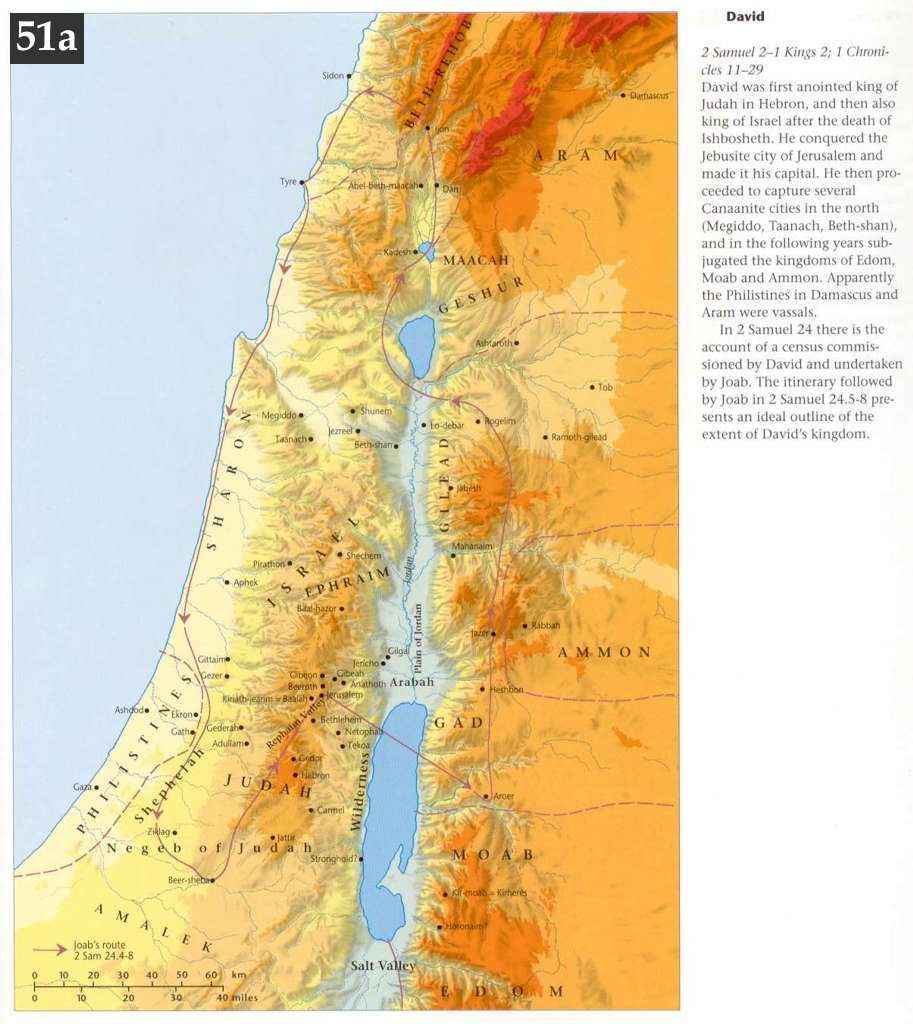
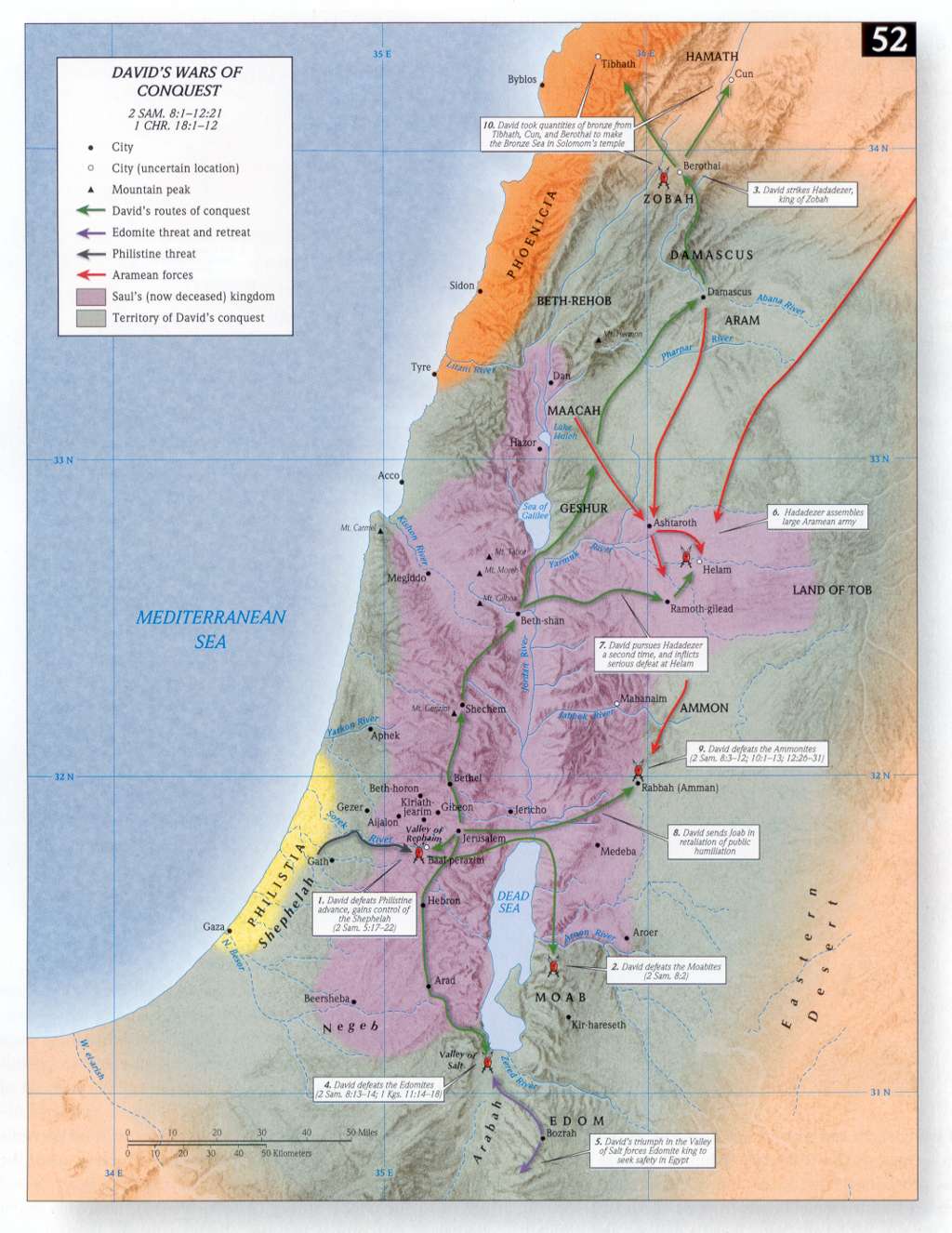
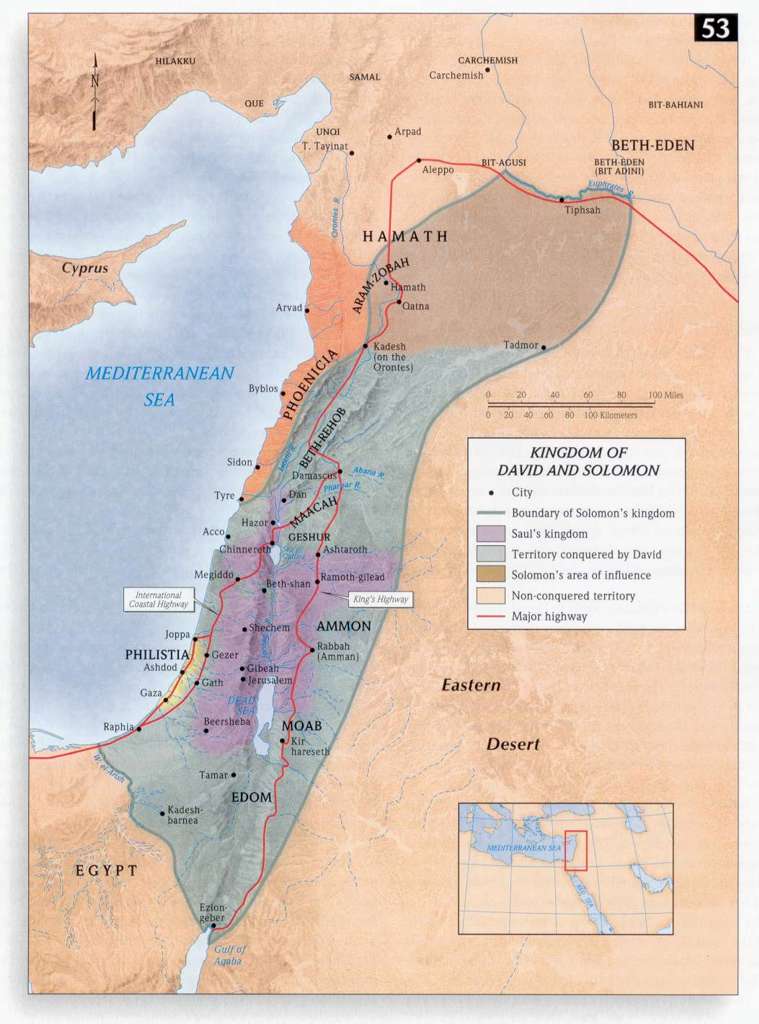
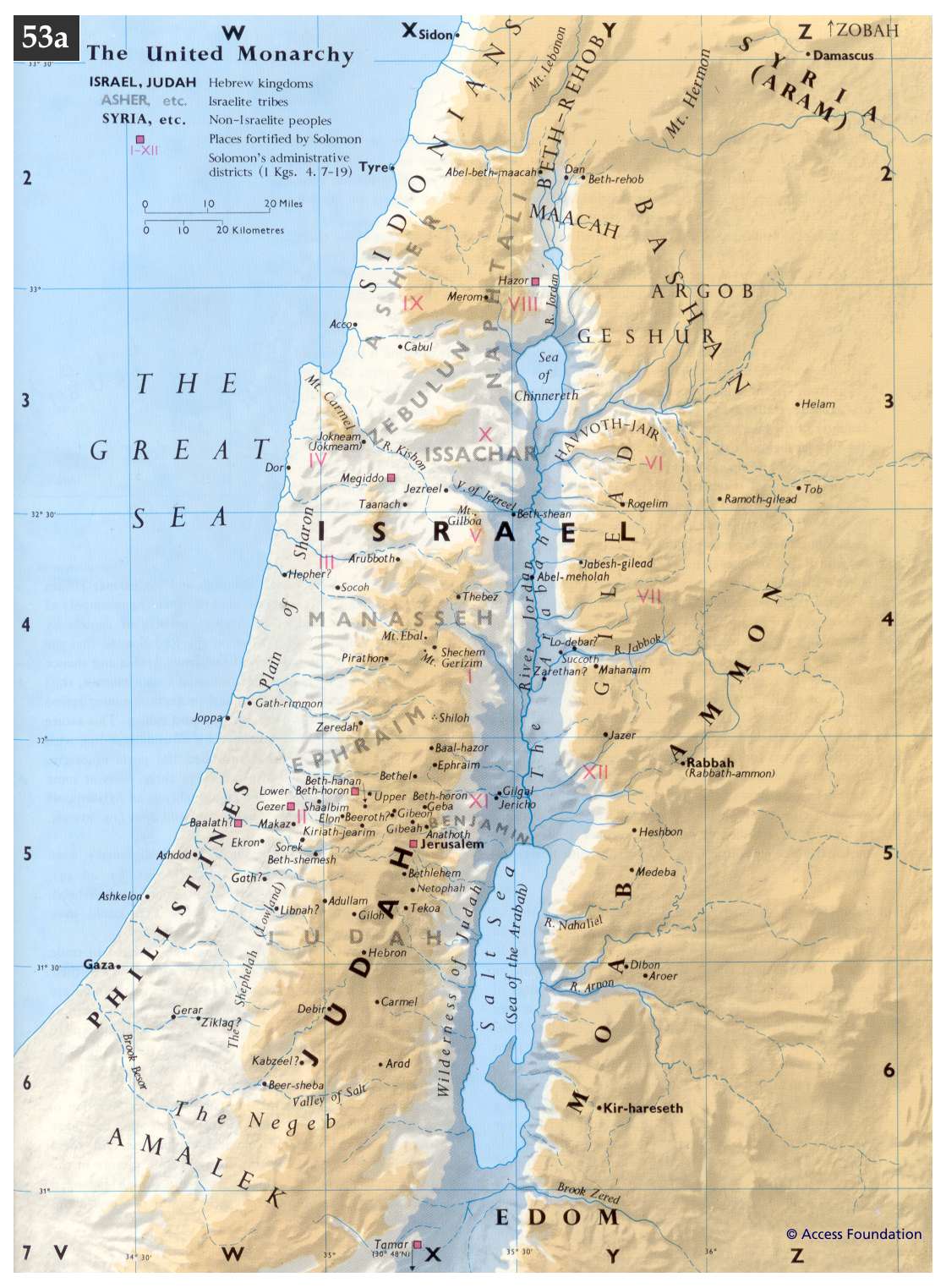
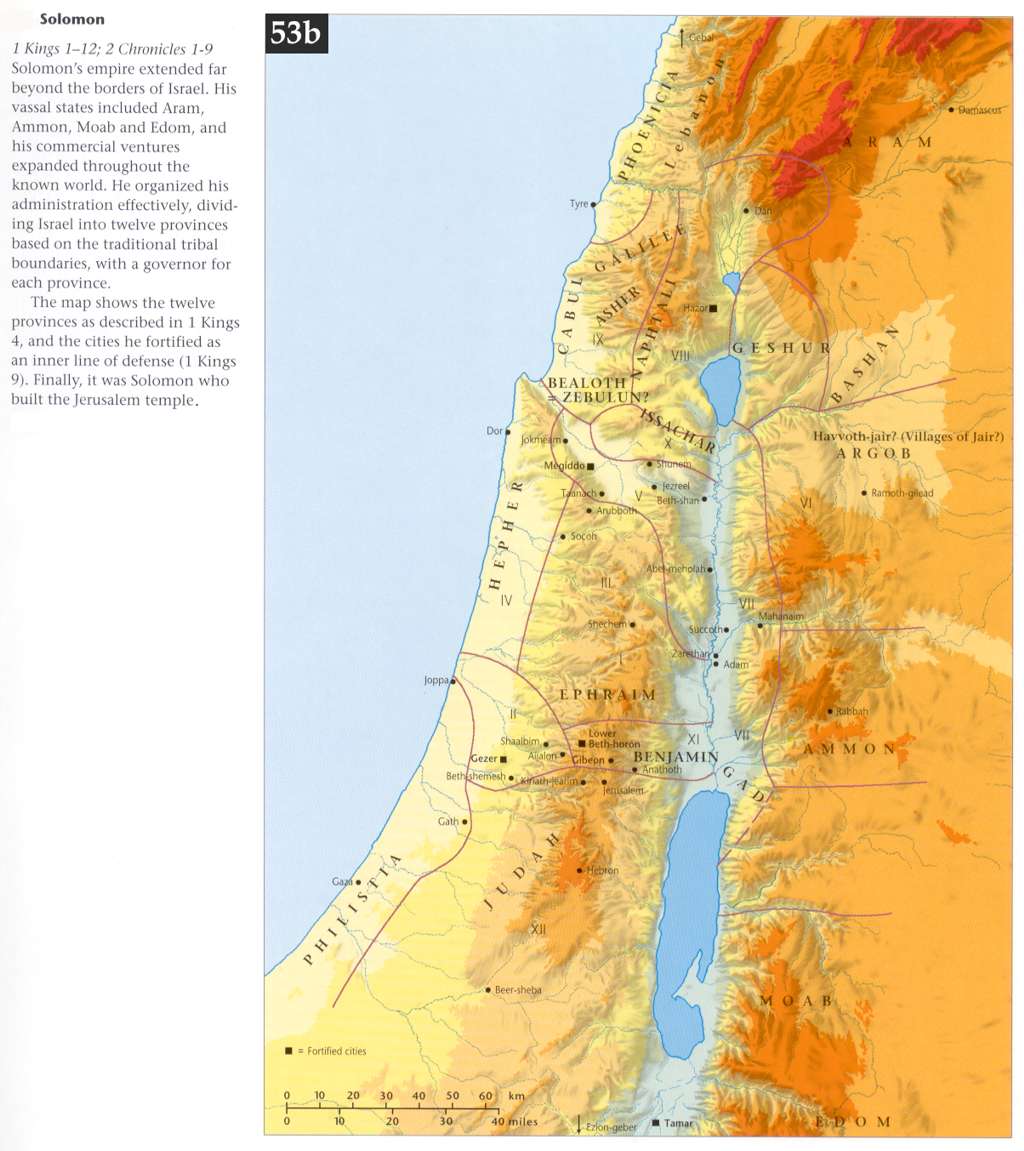
The Kingdom of David and Solomon
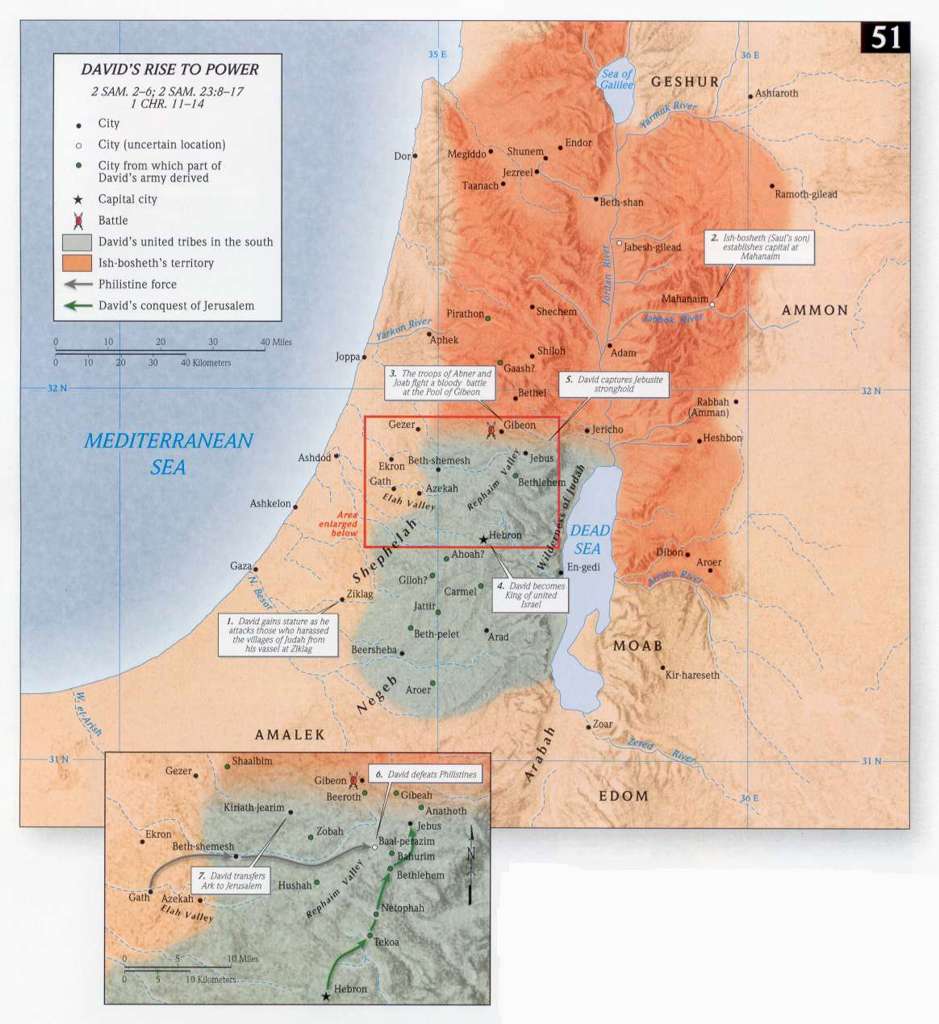
- David's Rise to Power
- David in Conquest of Canaan
- David's Wars of Conquest
- Kingdom of David and Solomon
- The United Monarchy under Solomon (1)
- The United Monarchy under Solomon (2)
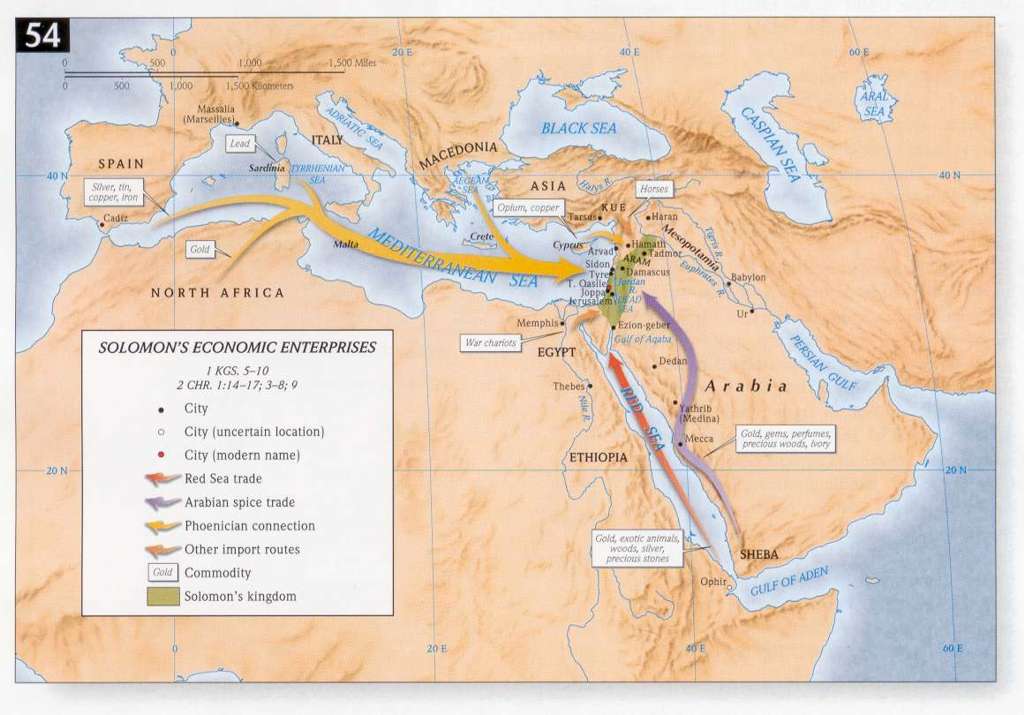
- Solomon's Economic Enterprises
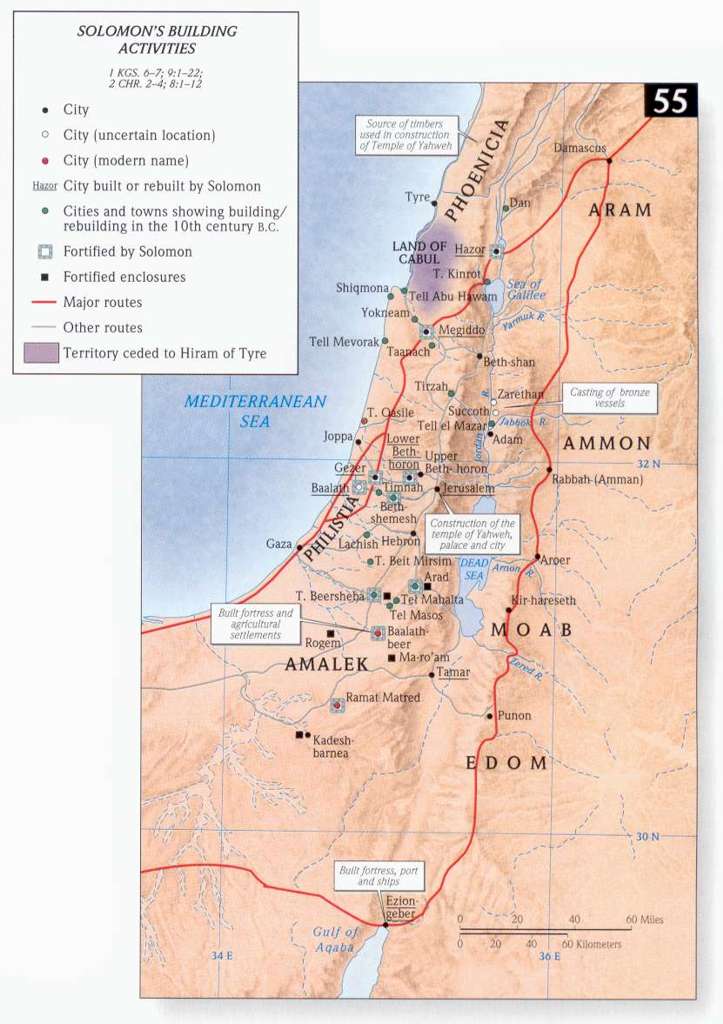
- Solomon's Building Activities
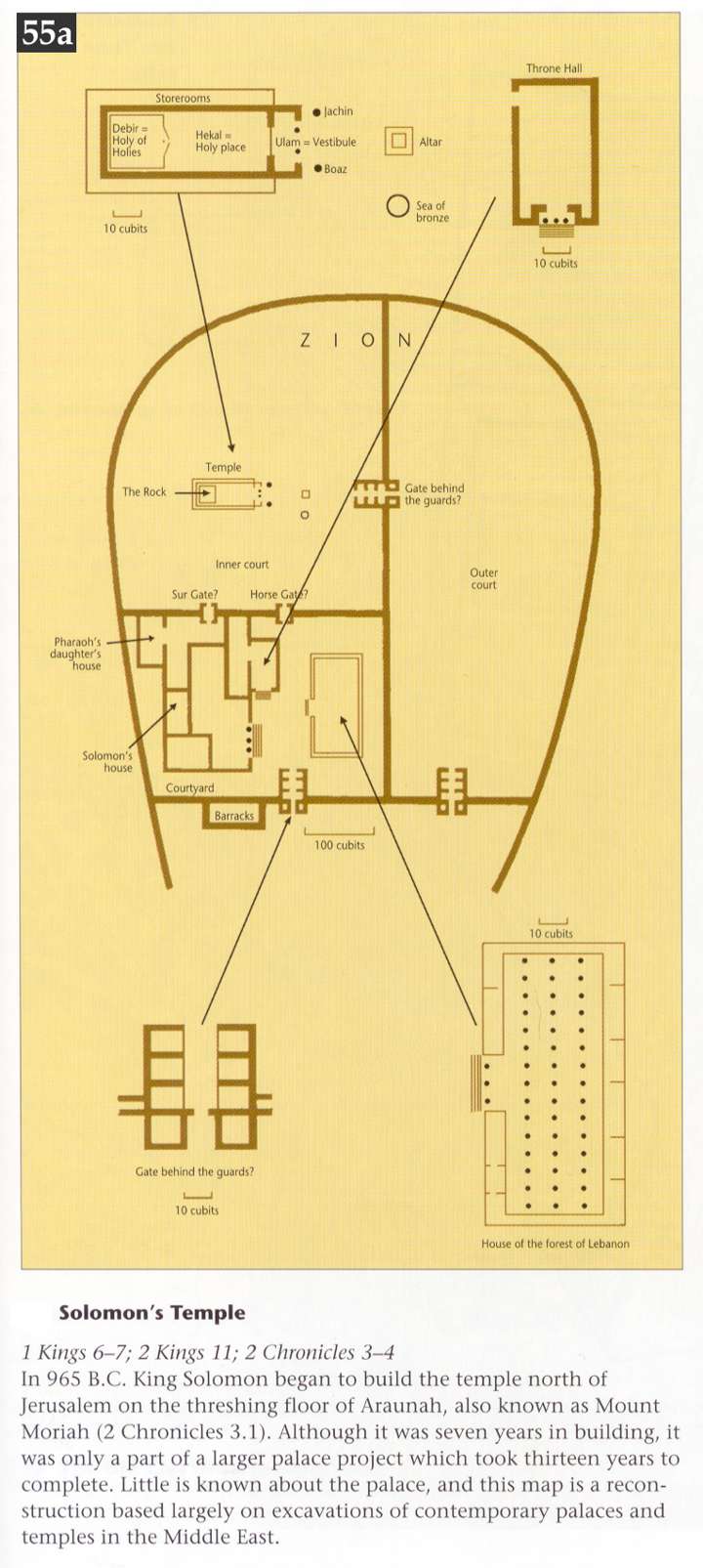
- Solomon's Temple
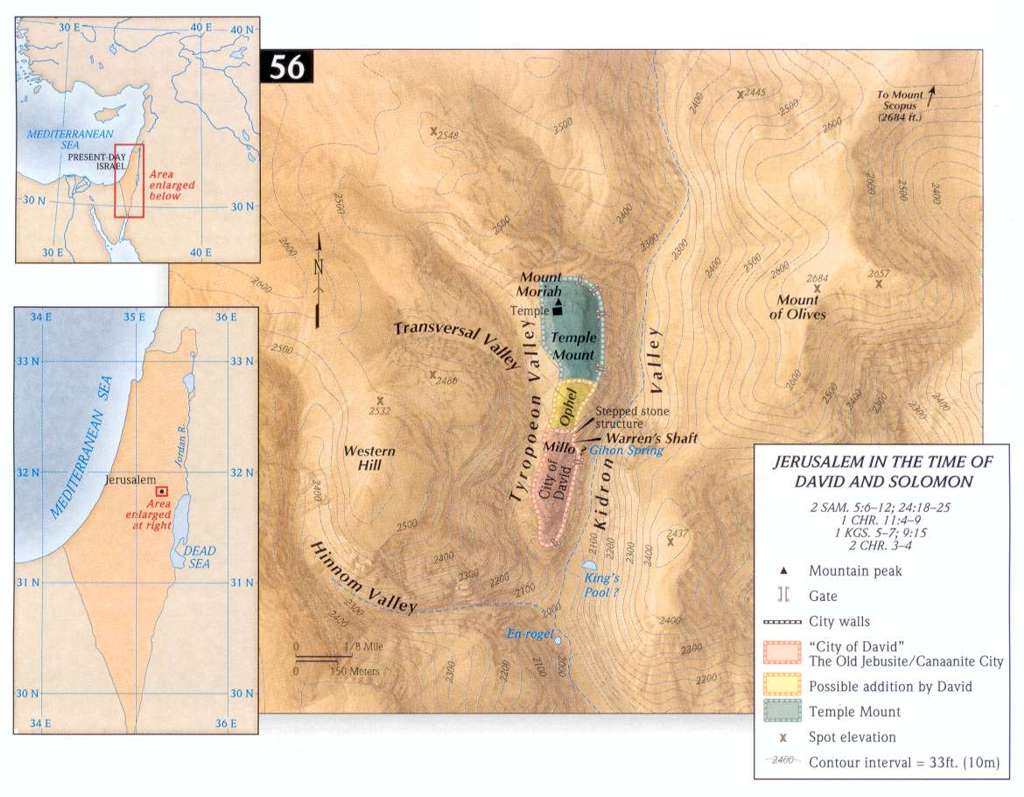
- Jerusalem in the Time of David and Solomon
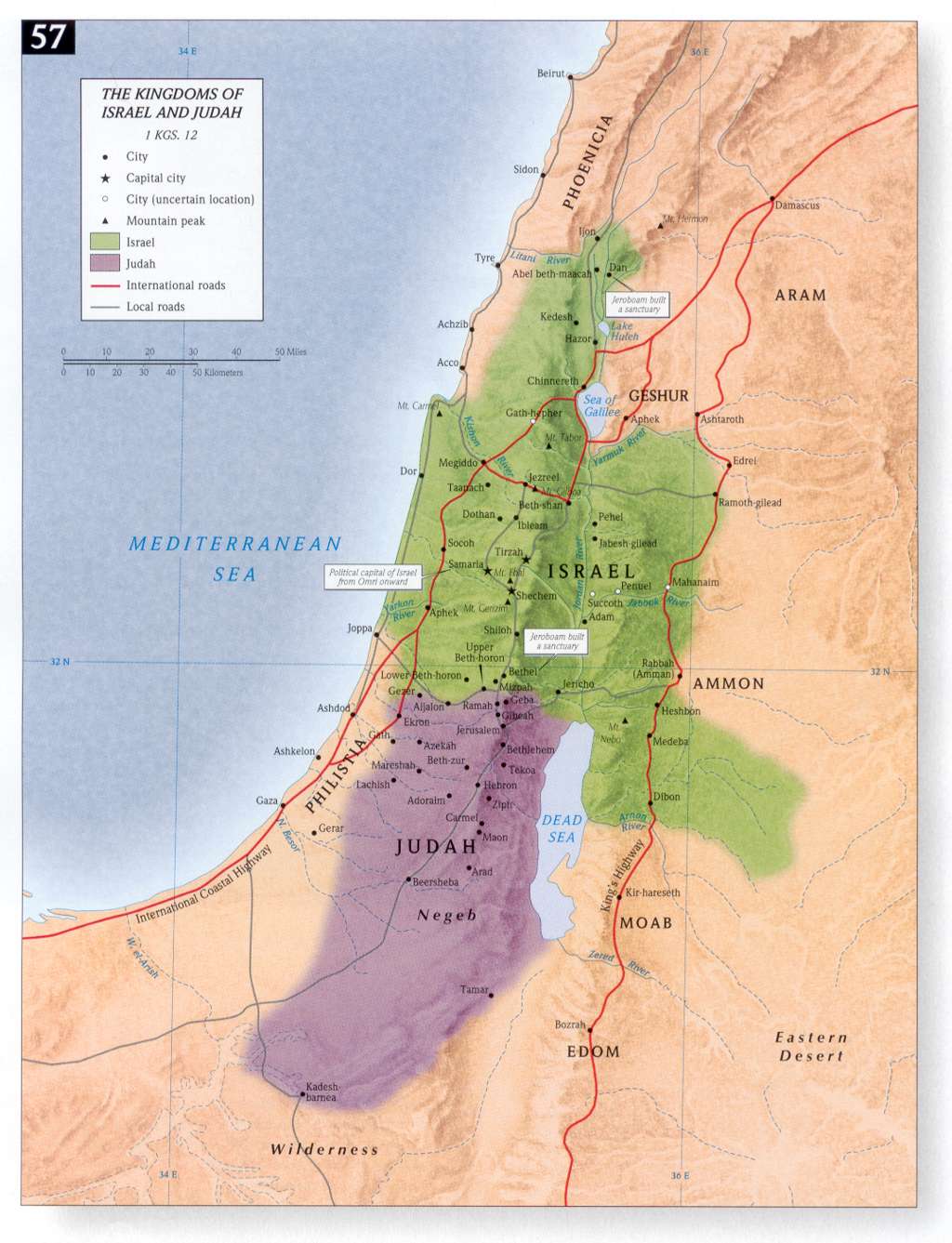
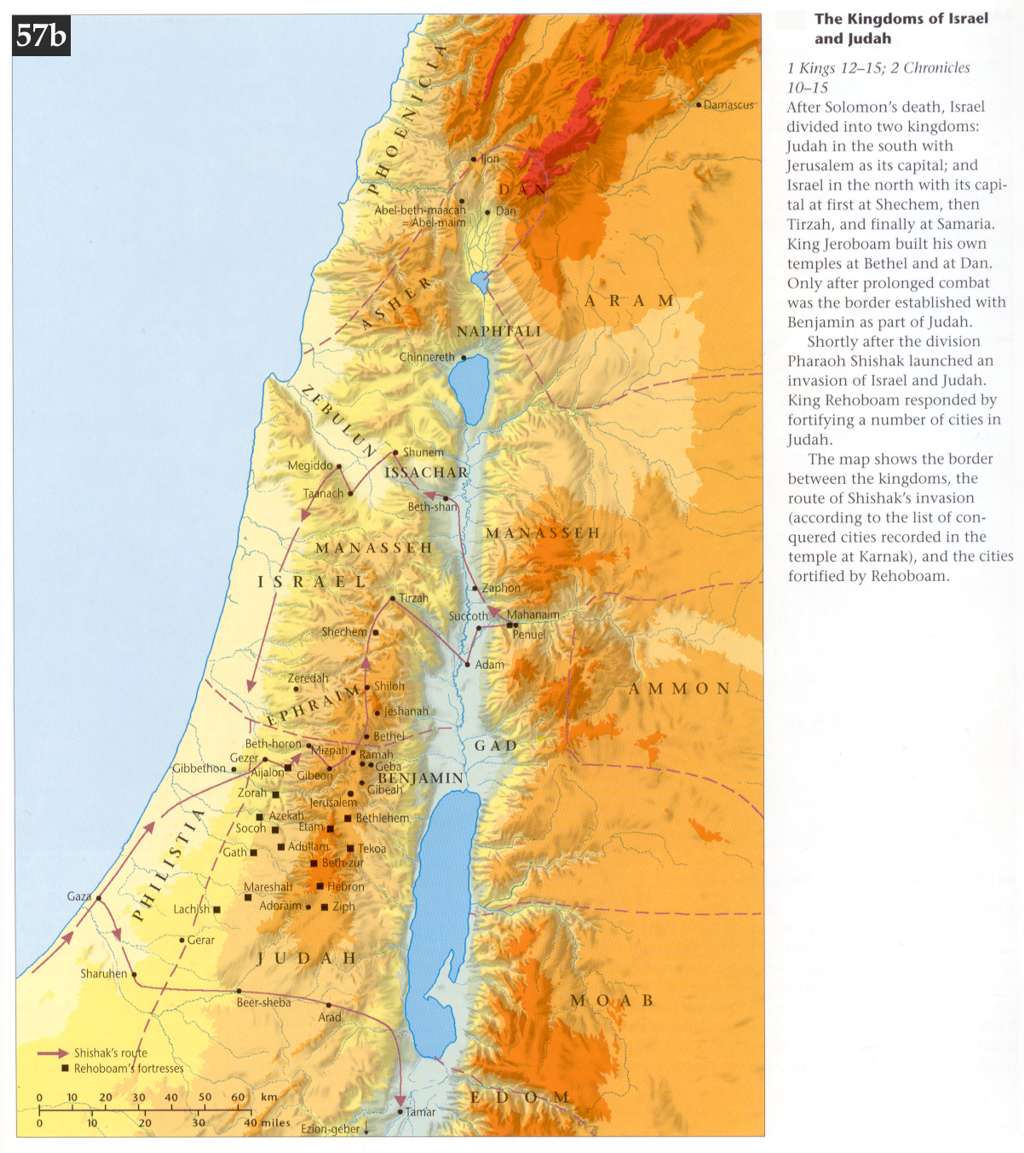
The Kingdoms of Israel and Judah
- The Kingdoms of Israel and Judah (1)
- The Kingdoms of Israel and Judah (2)
- The Kingdoms of Israel and Judah (3)
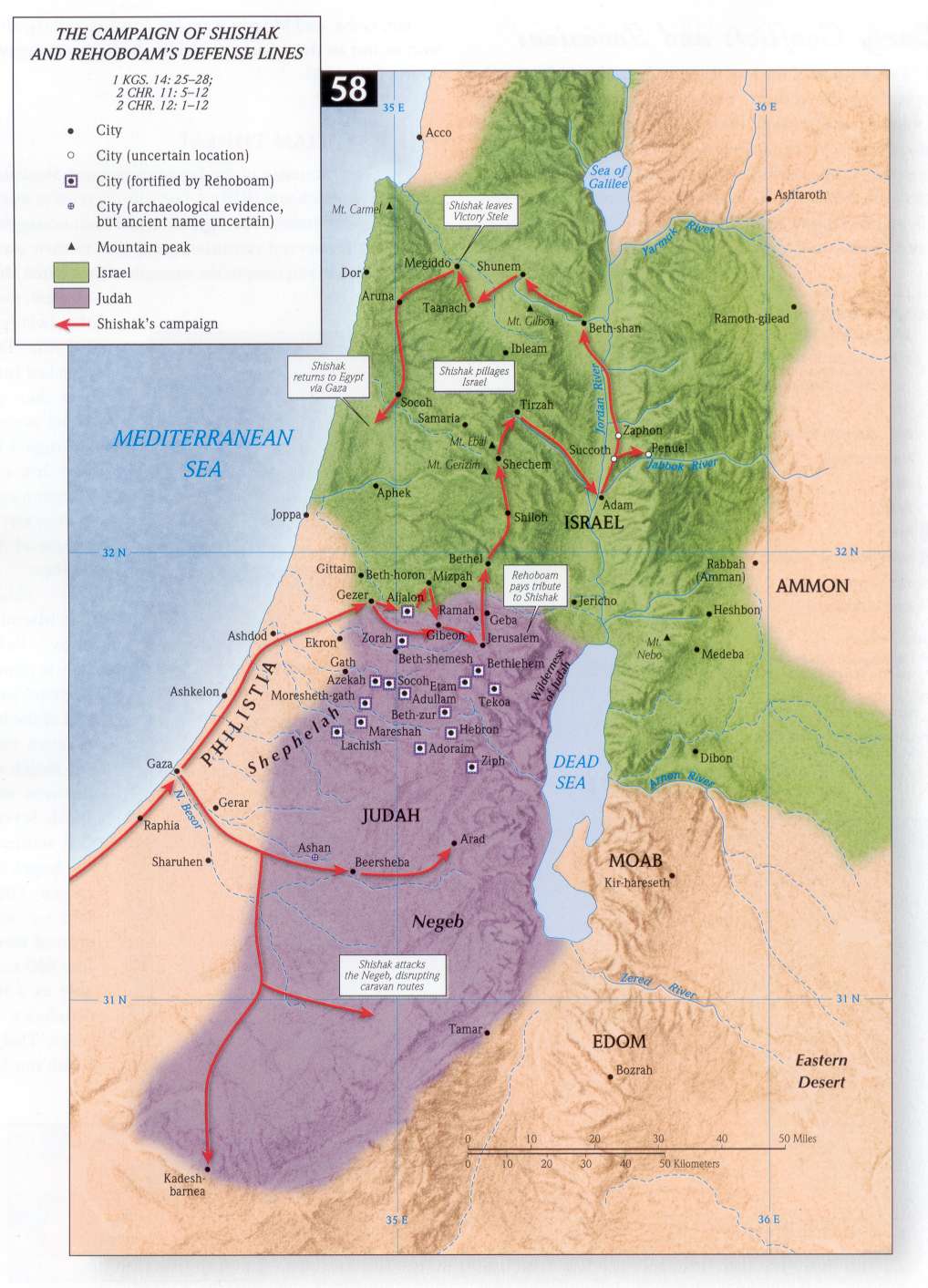
- The Campaign of Shishak
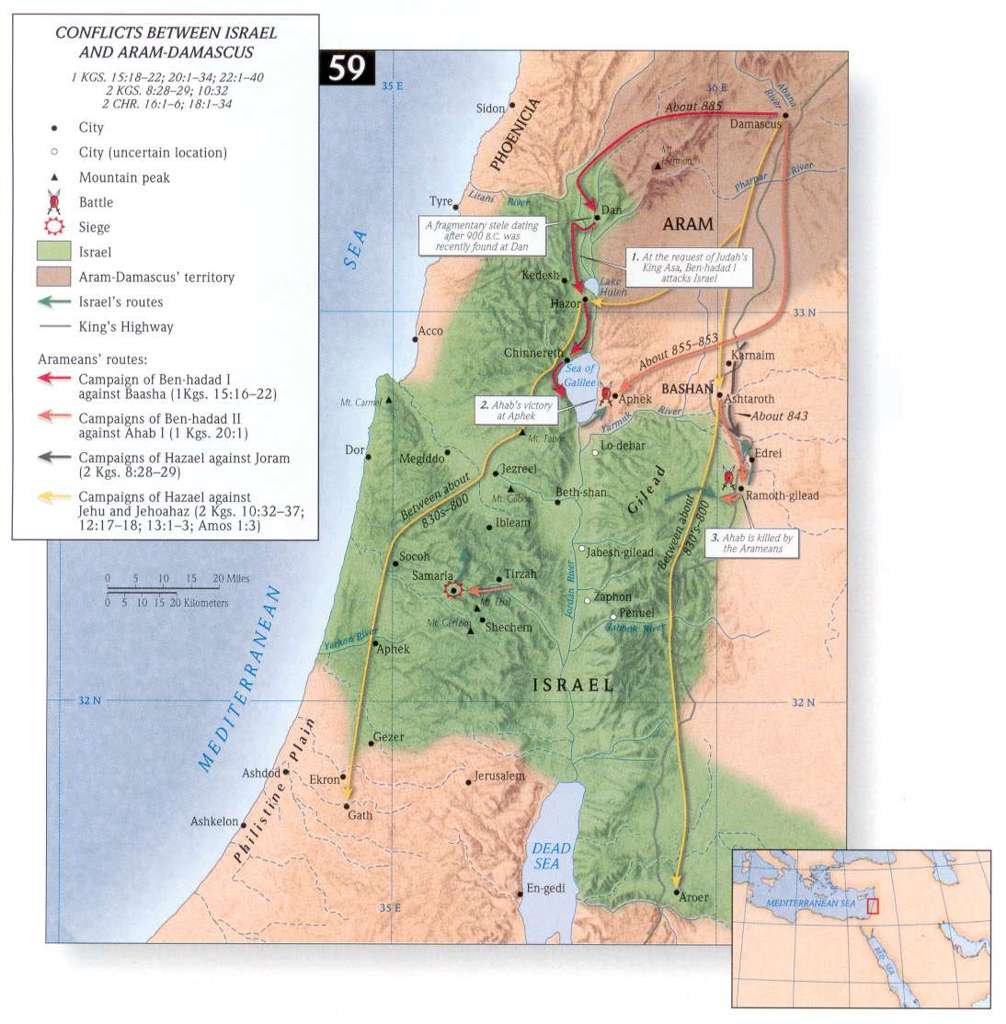
- Conflicts between Israel and Aram-Damascus
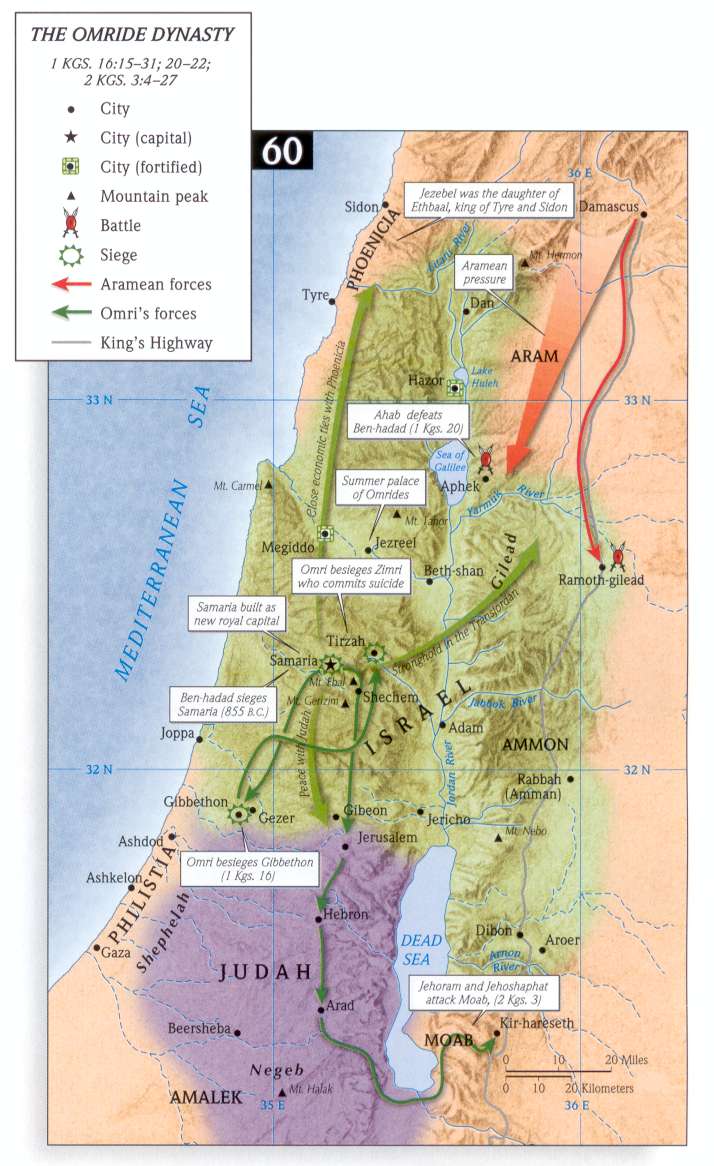
- The Omride Dynasty
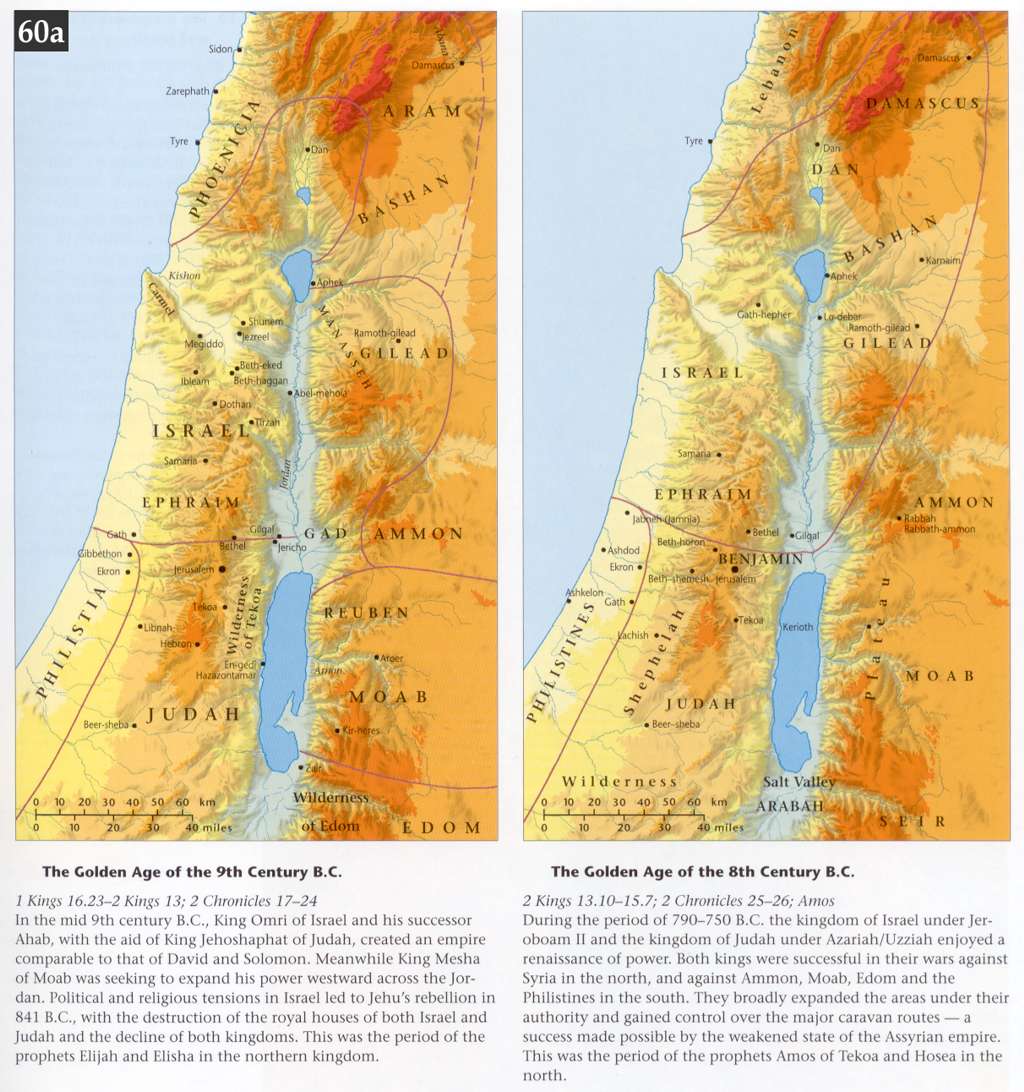
- The Golden Ages of the 9th & 8th centuries BCE
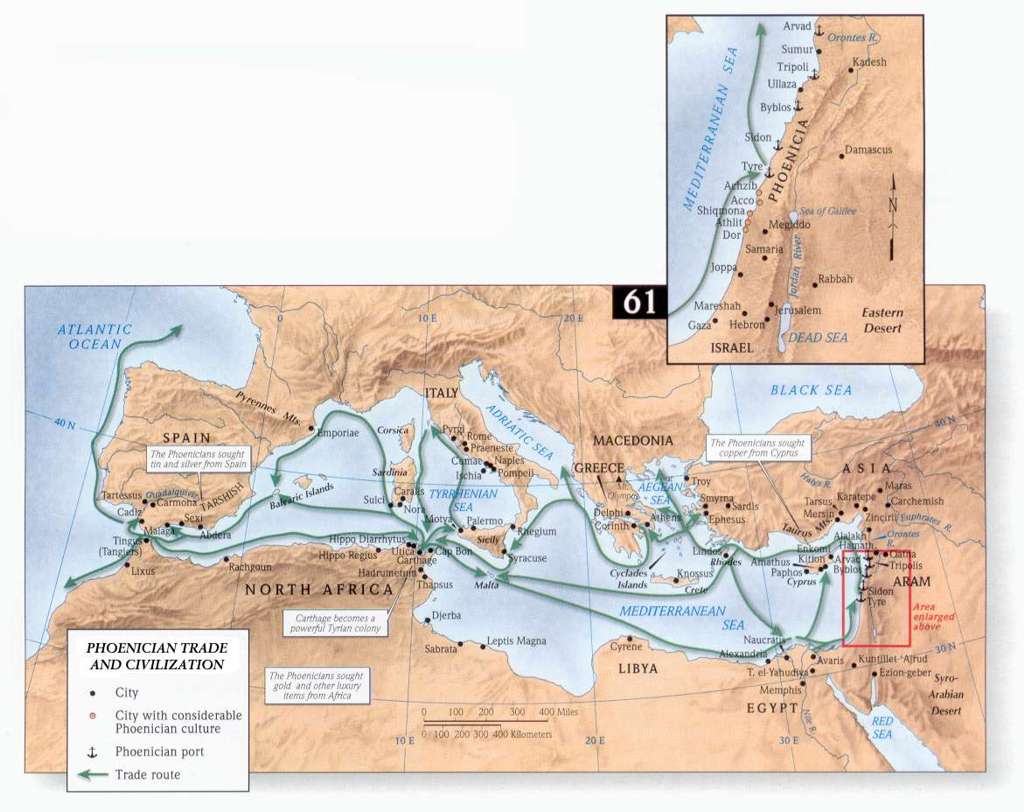
- Phoenician Trade and Civilization
- Trade Routes throughout the Middle East
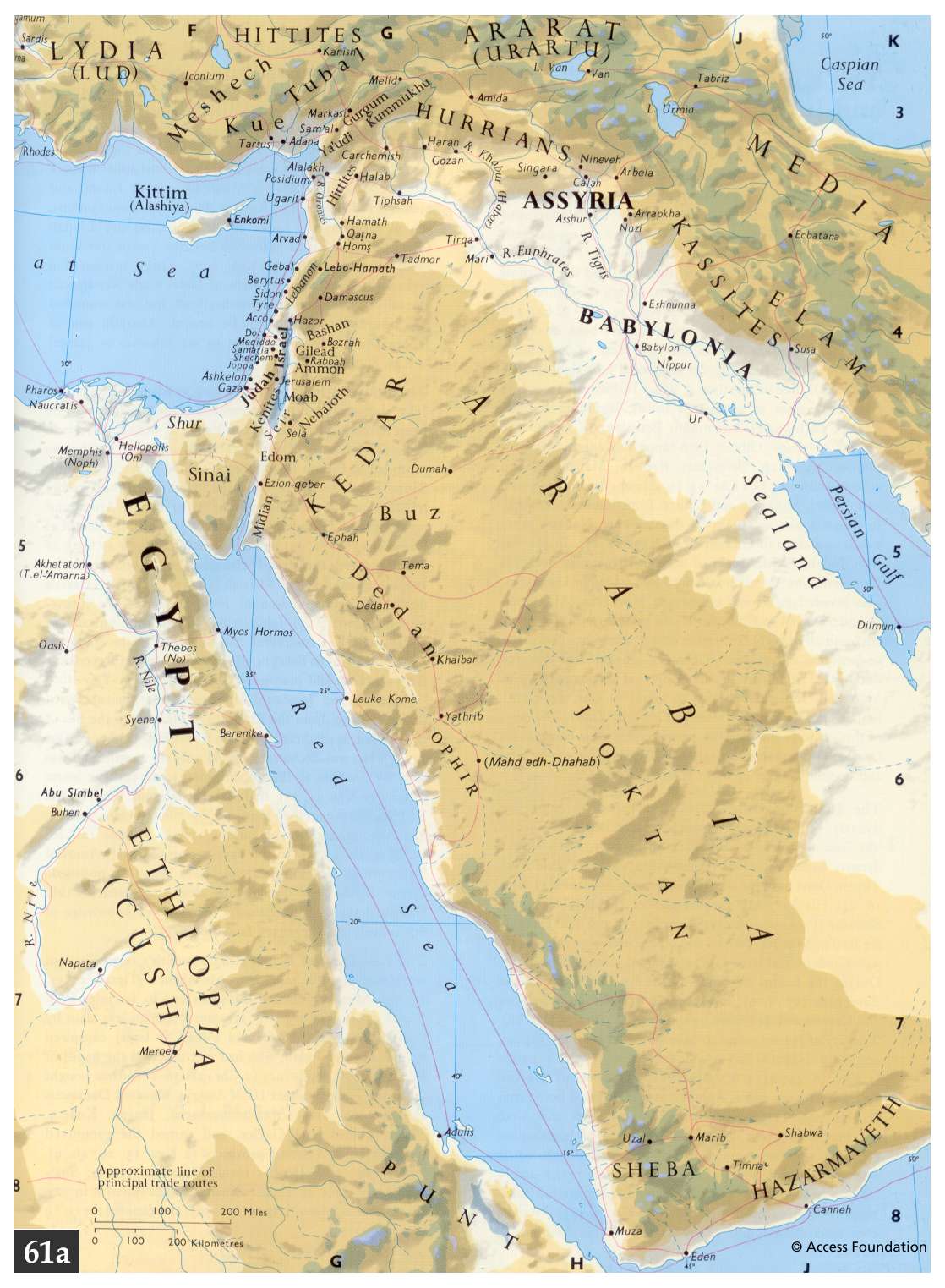
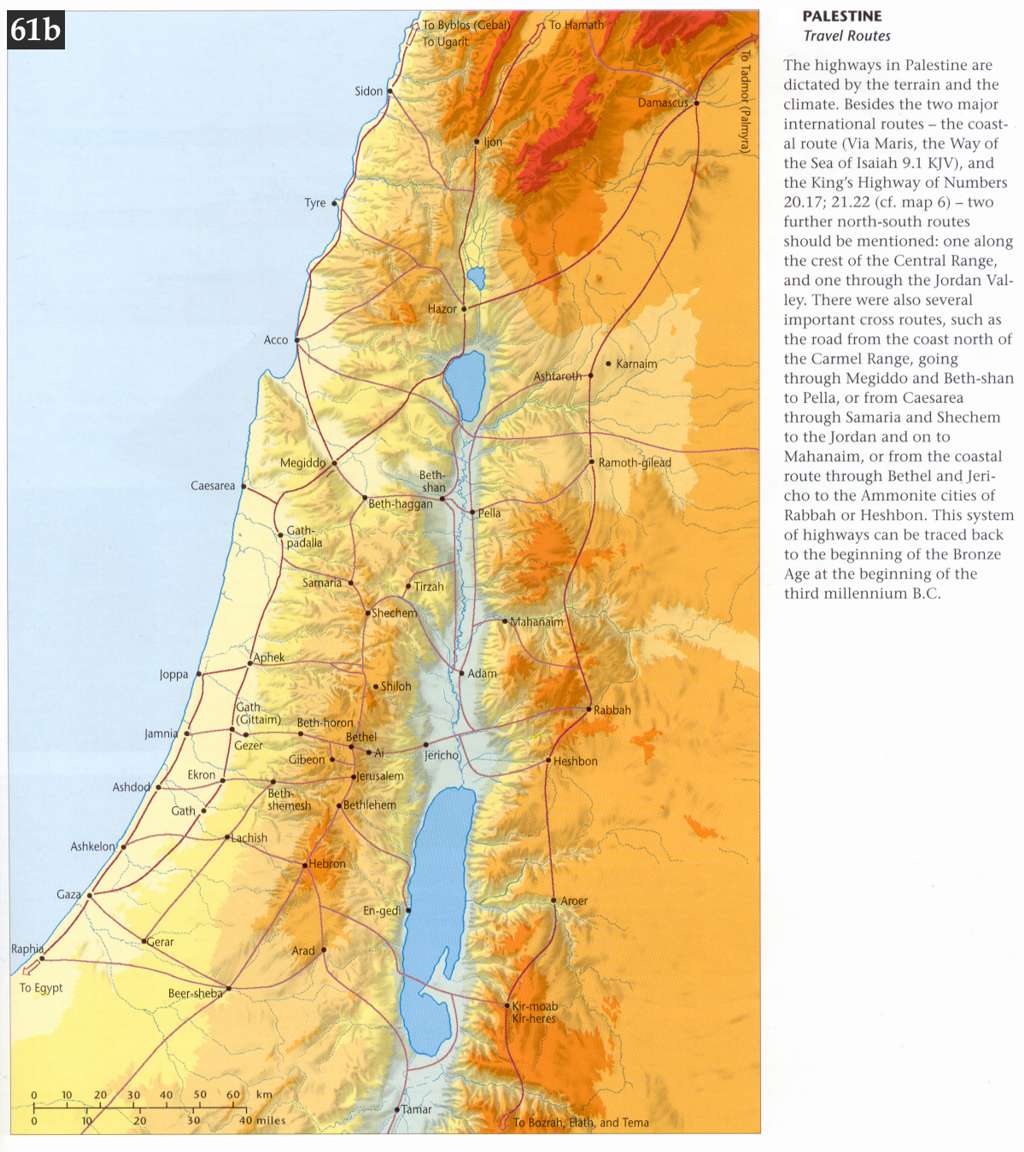
- Travel Routes throughout Palestine
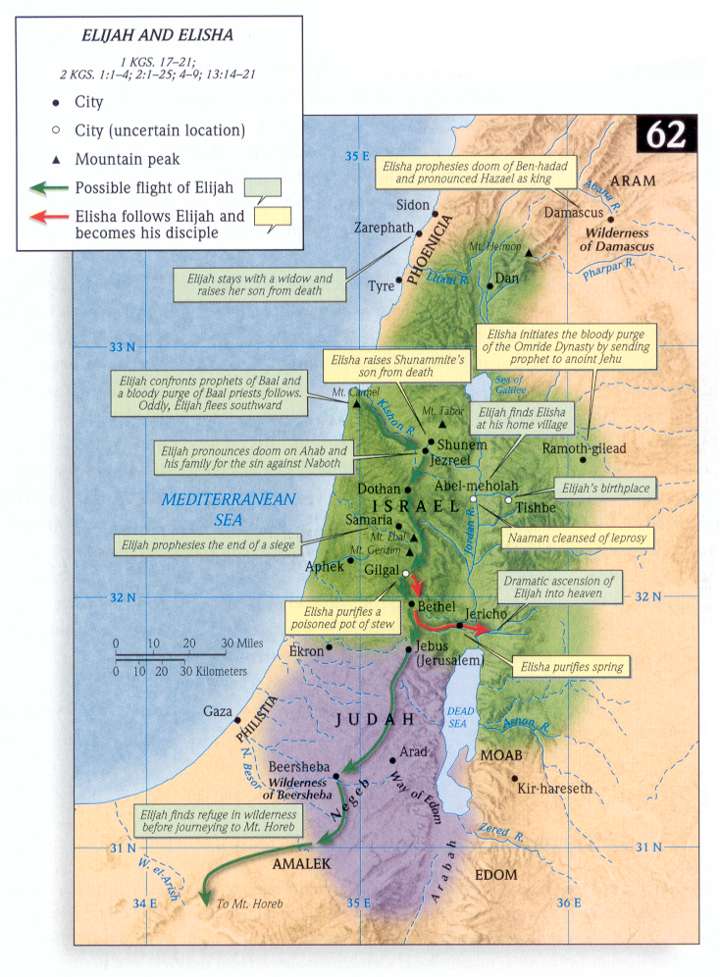
- Elijah and Elisha
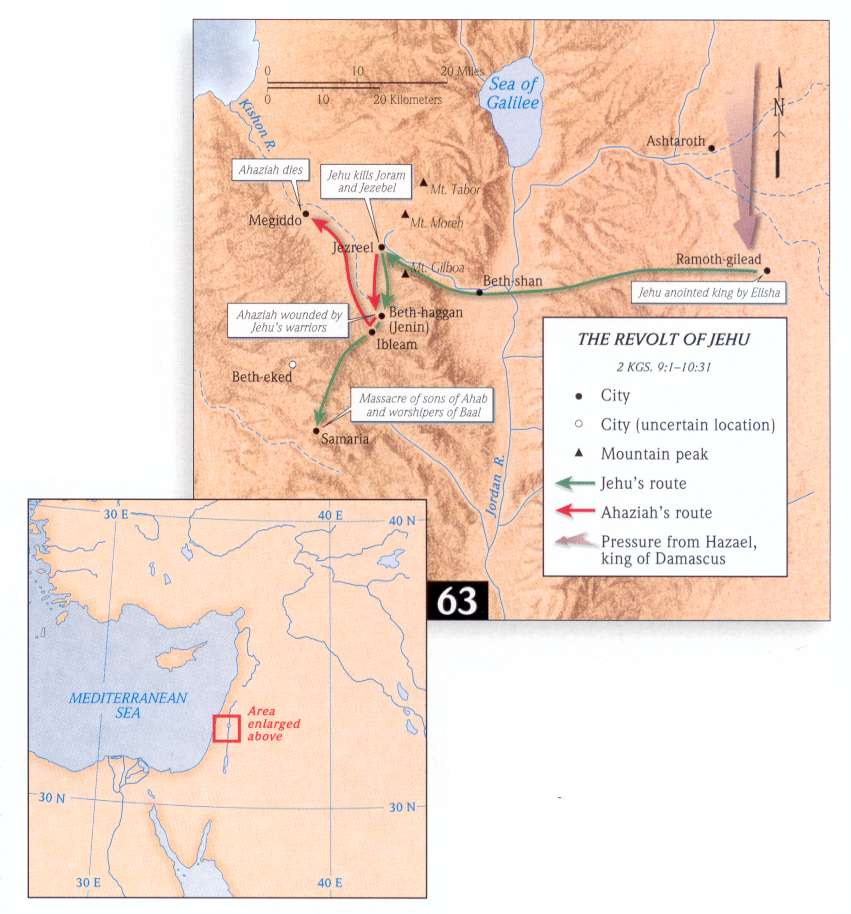
- The Revolt of Jehu
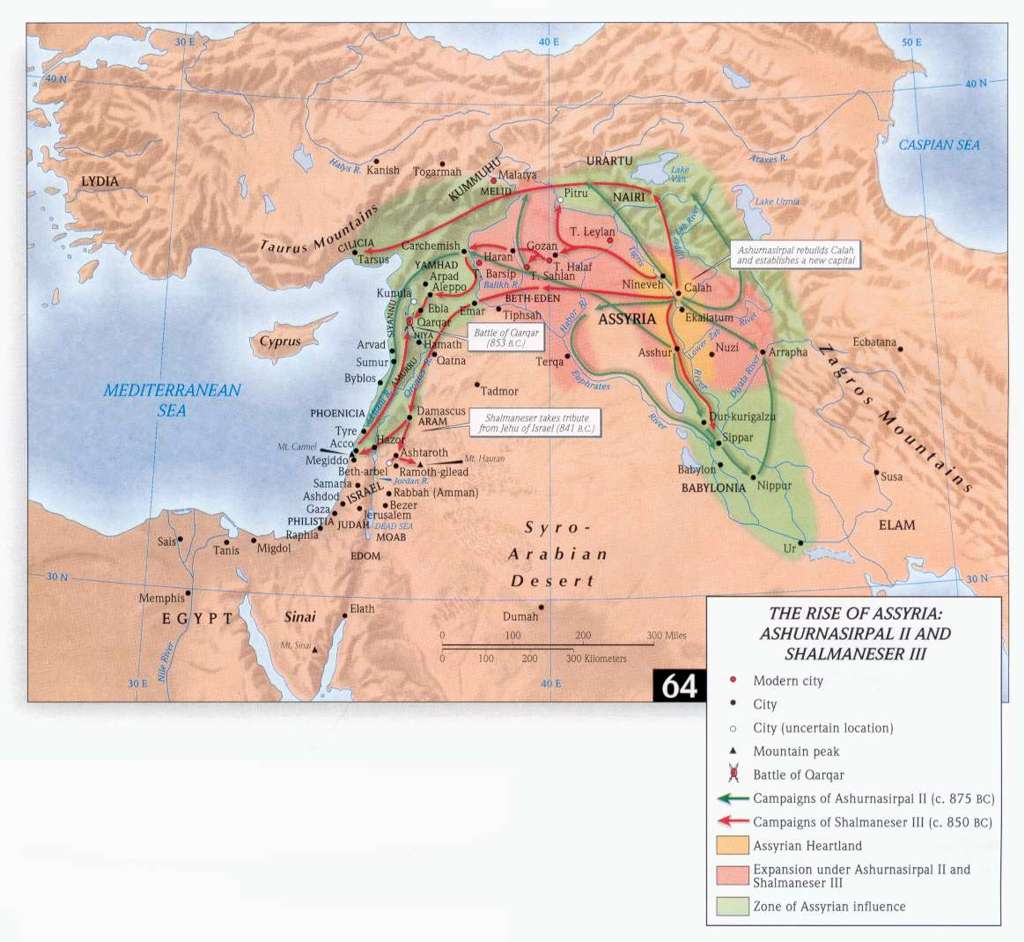
- The Rise of Assyria
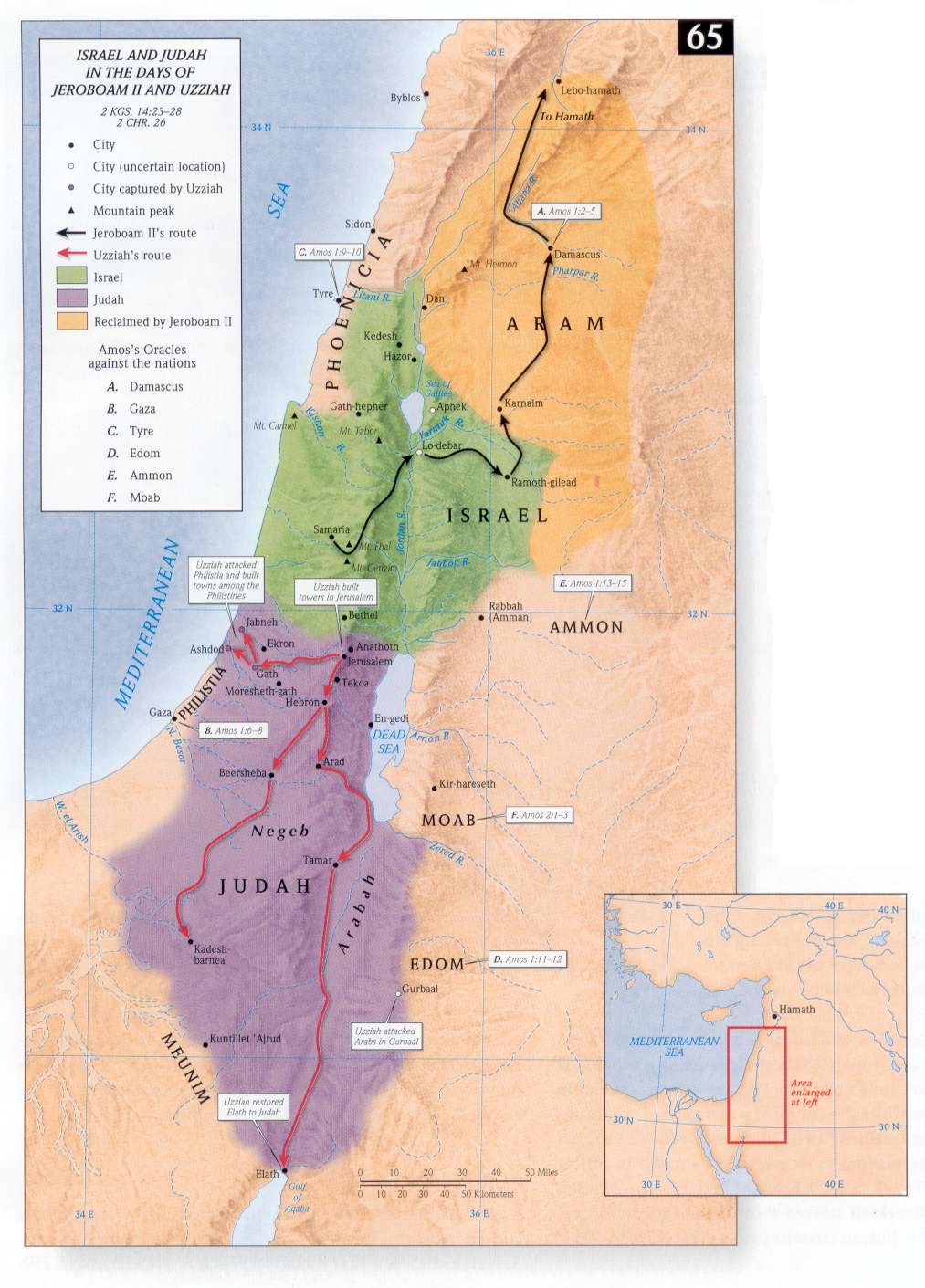
- Israel & Judah in the days of Jeroboam II and Uzziah
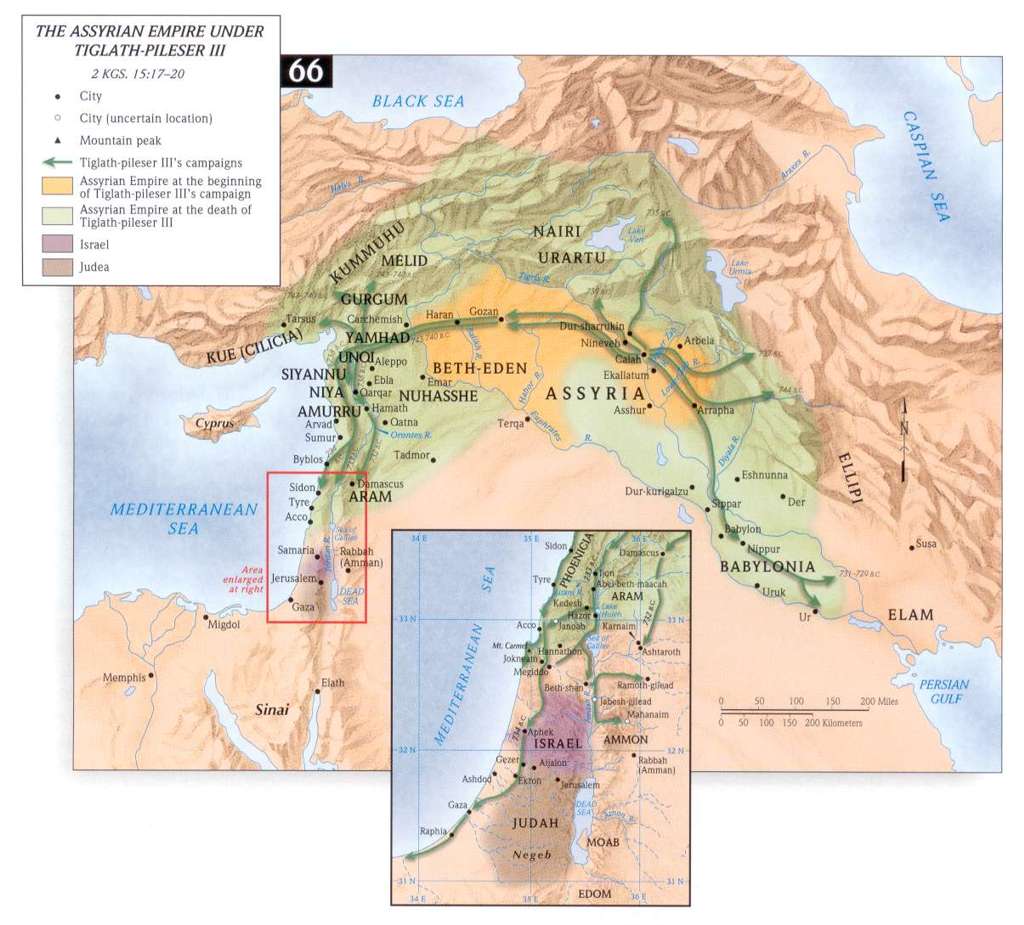
- The Assyrian Empire under Tiglath-Pileser III
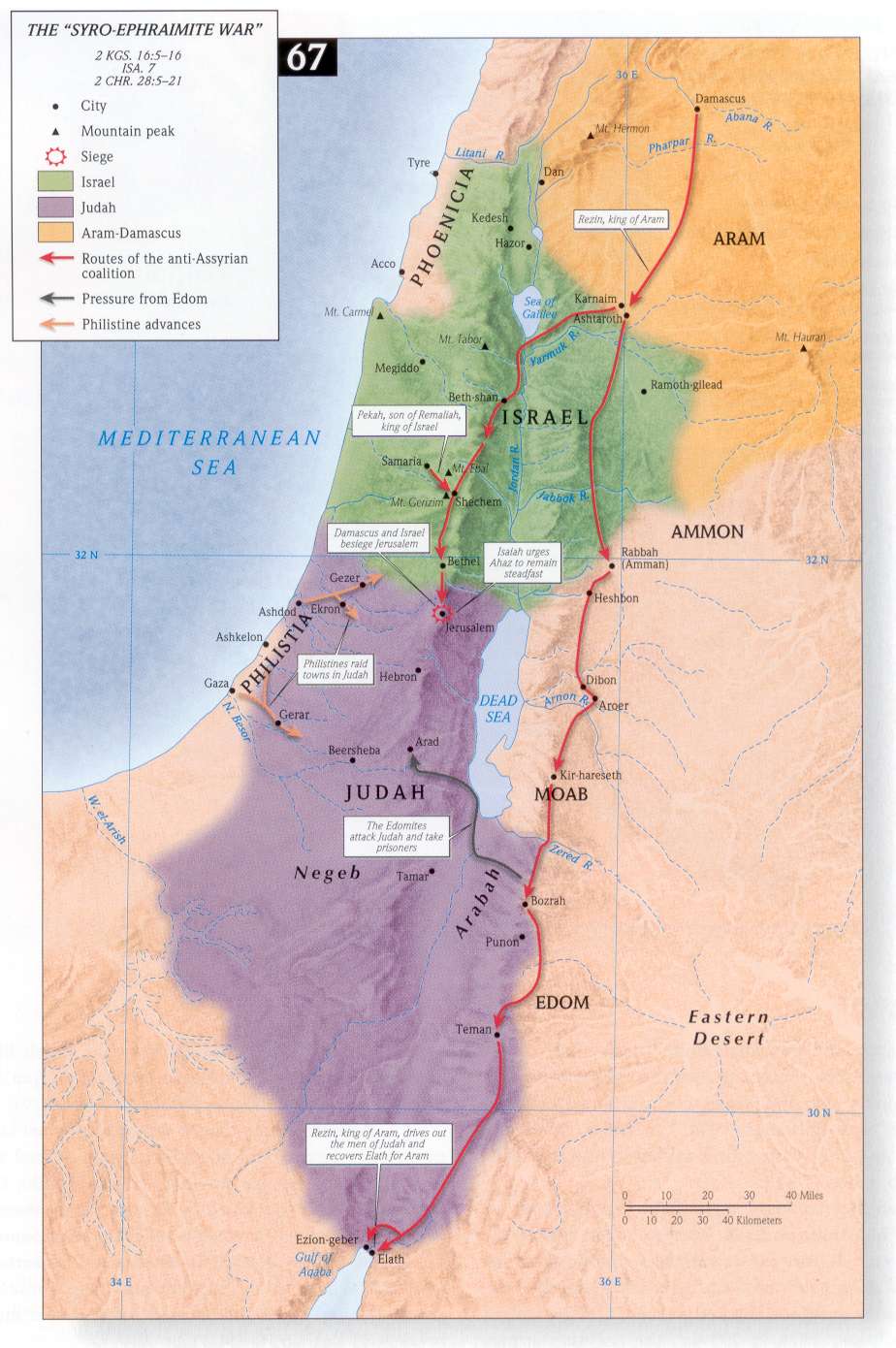
- The Syro-Ephraimite War
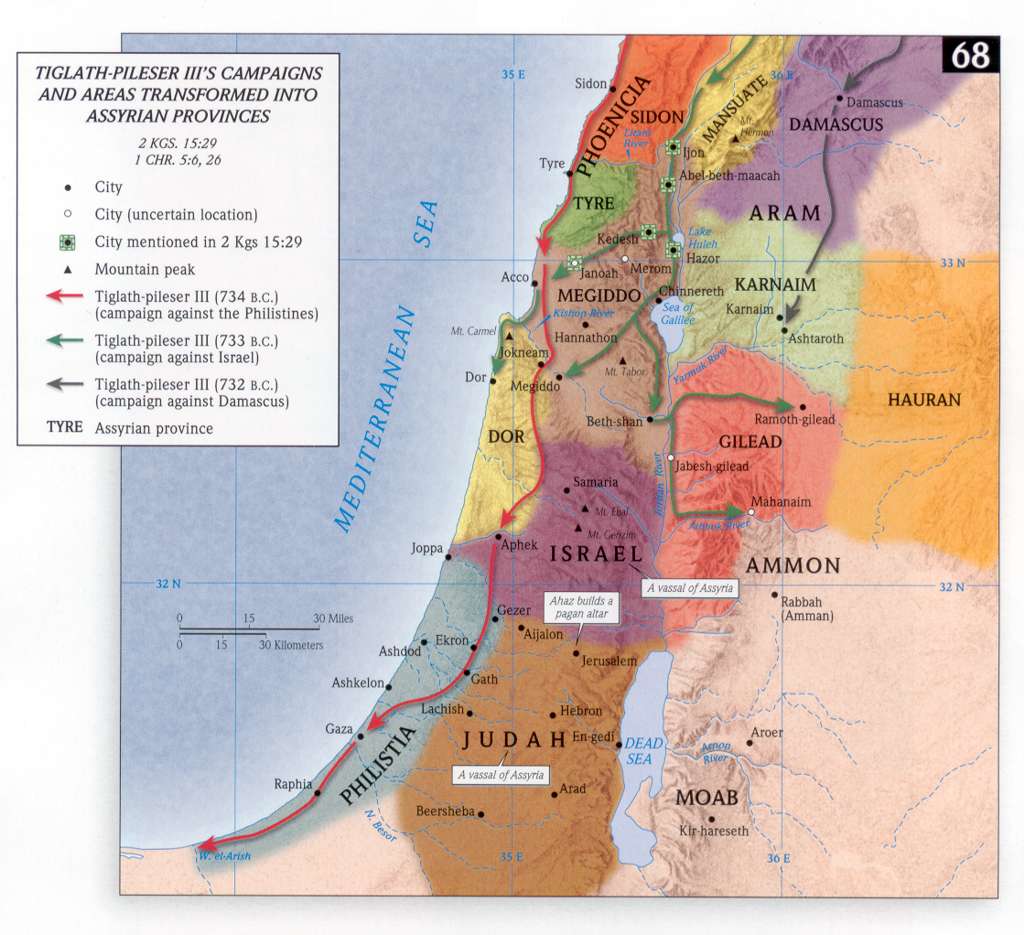
- Tiglath-Pileser III's Campaigns
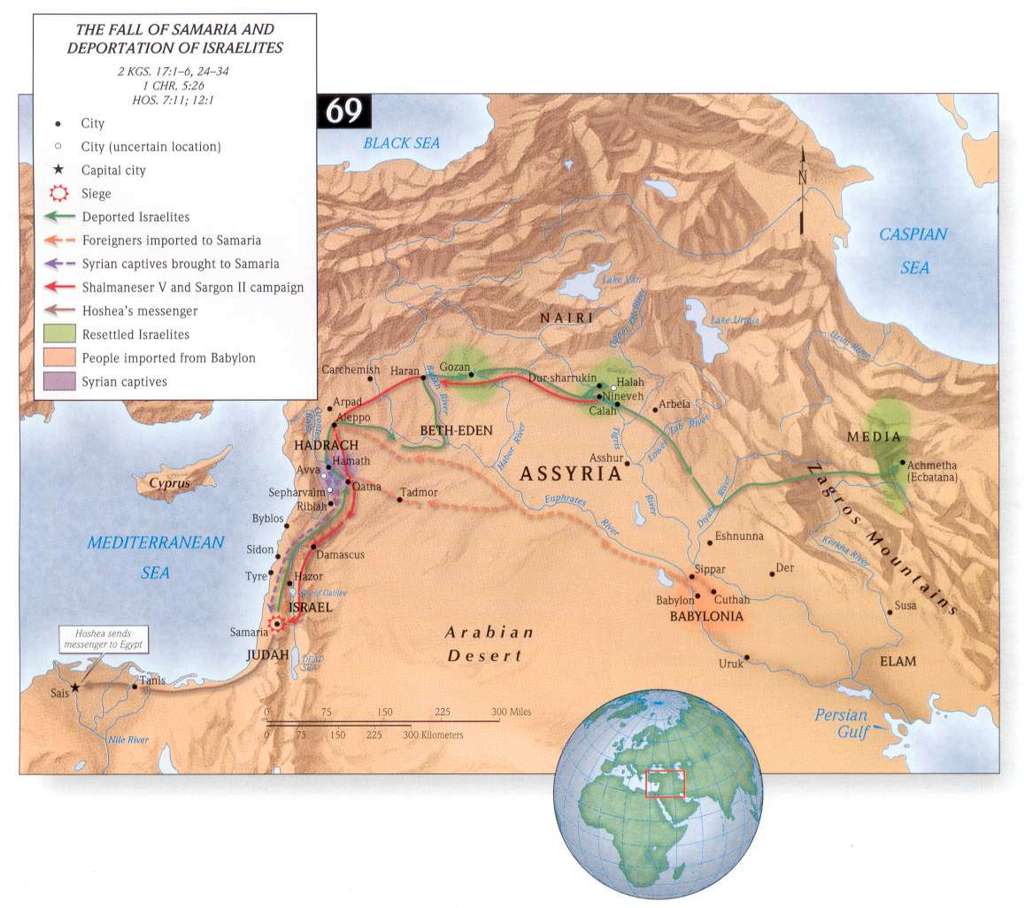
- Fall of Samaria and Deportation of Israelites
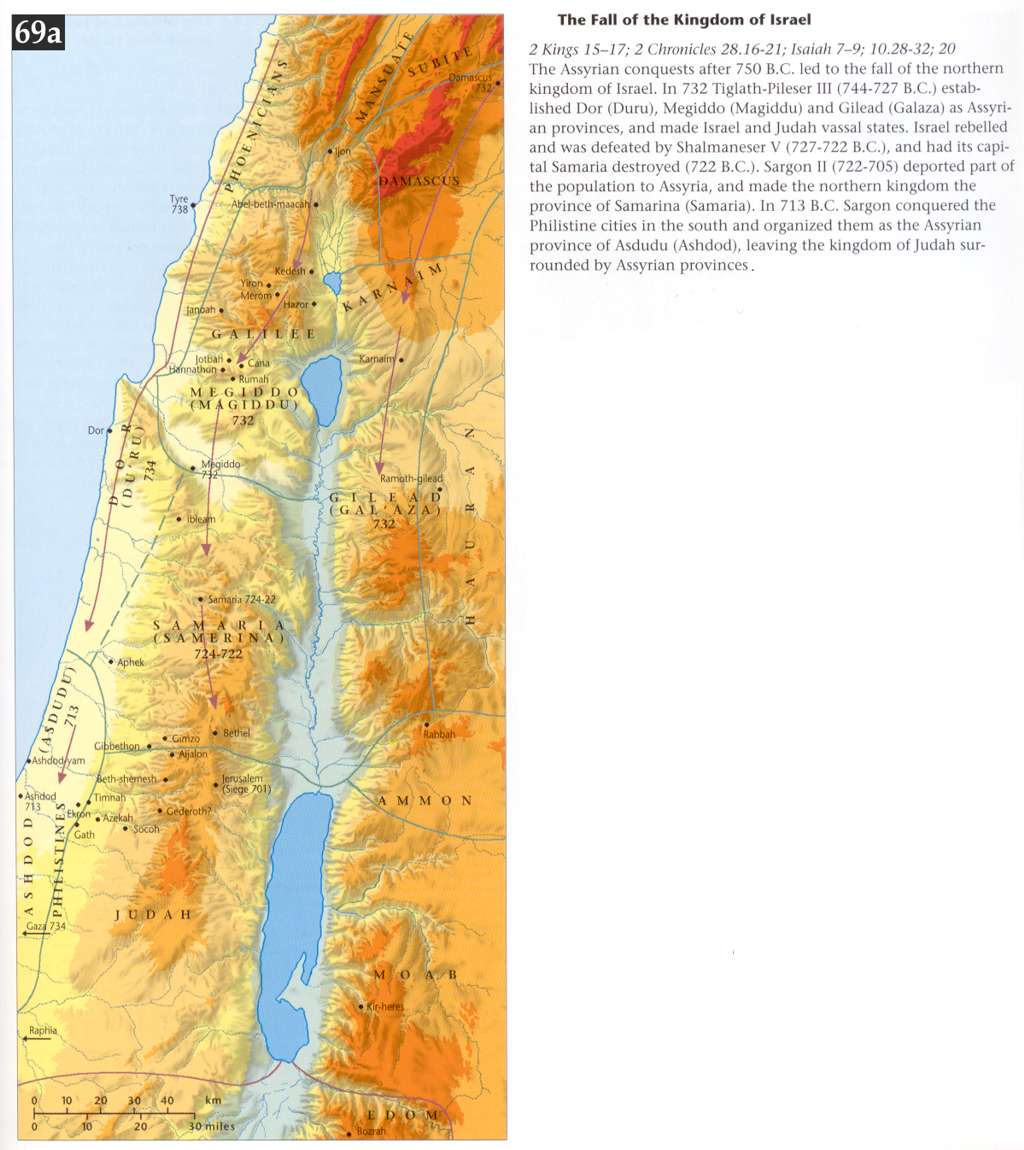
- The Fall of the Kingdom of Israel
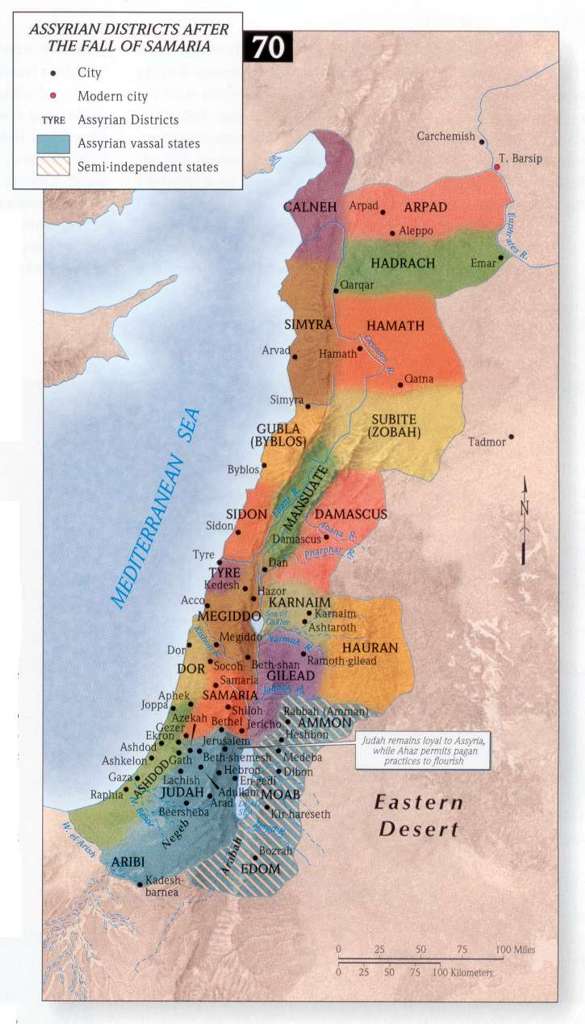
- Assyrian Districts after the Fall of Samaria
- Prophets of the 8th Century BCE

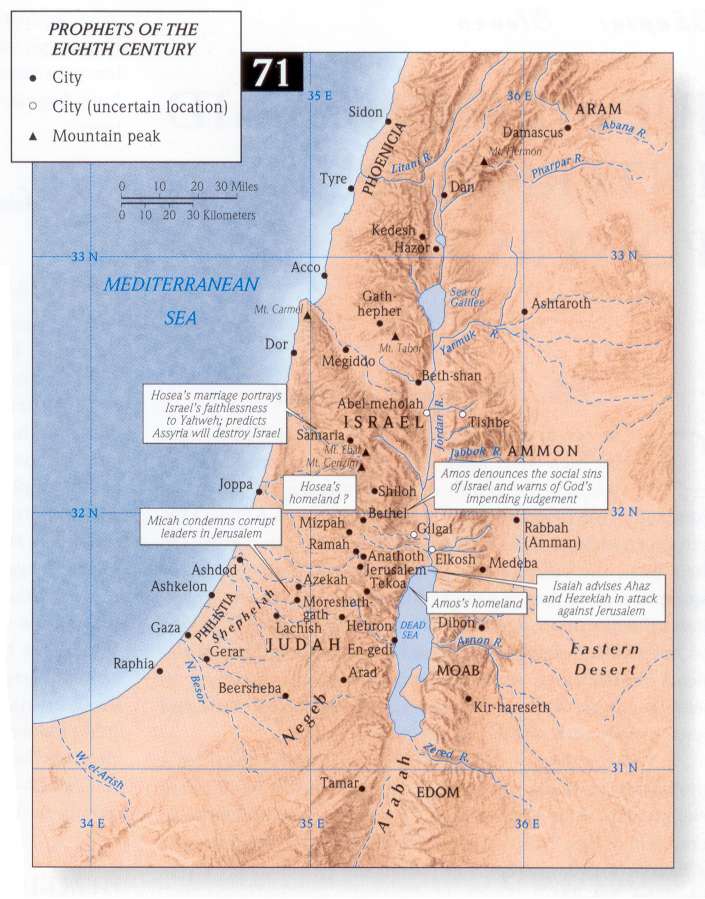
Judah Alone amid International Powers
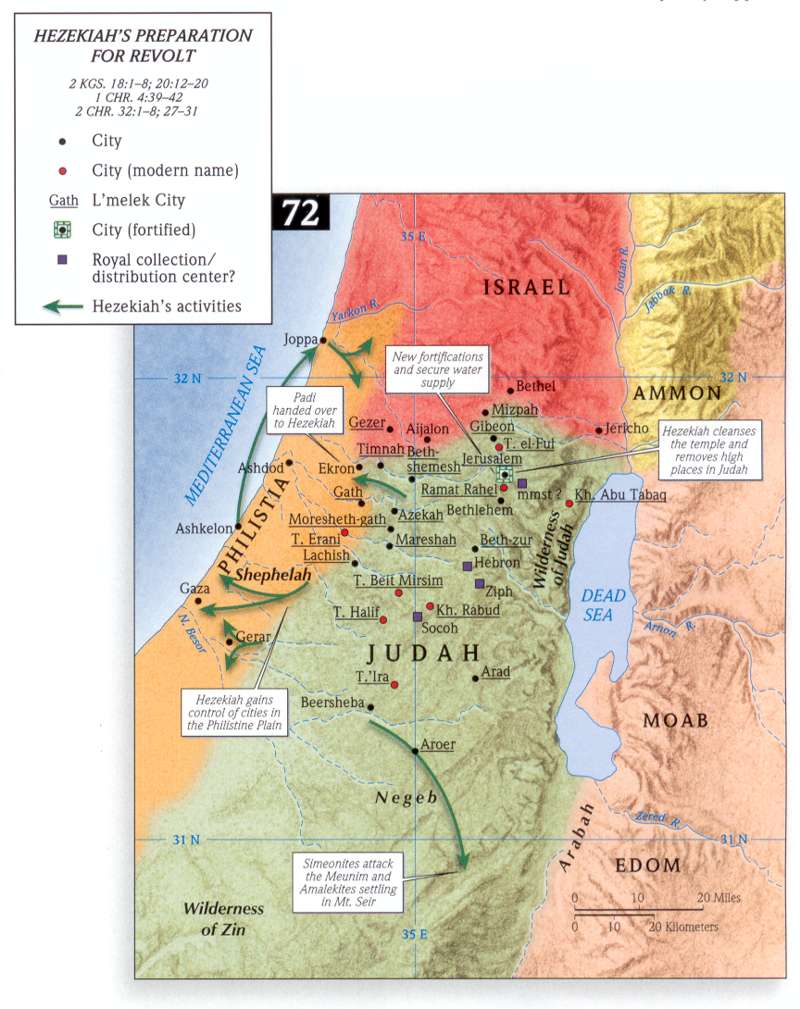
- Hezekiah's Preparation for Revolt
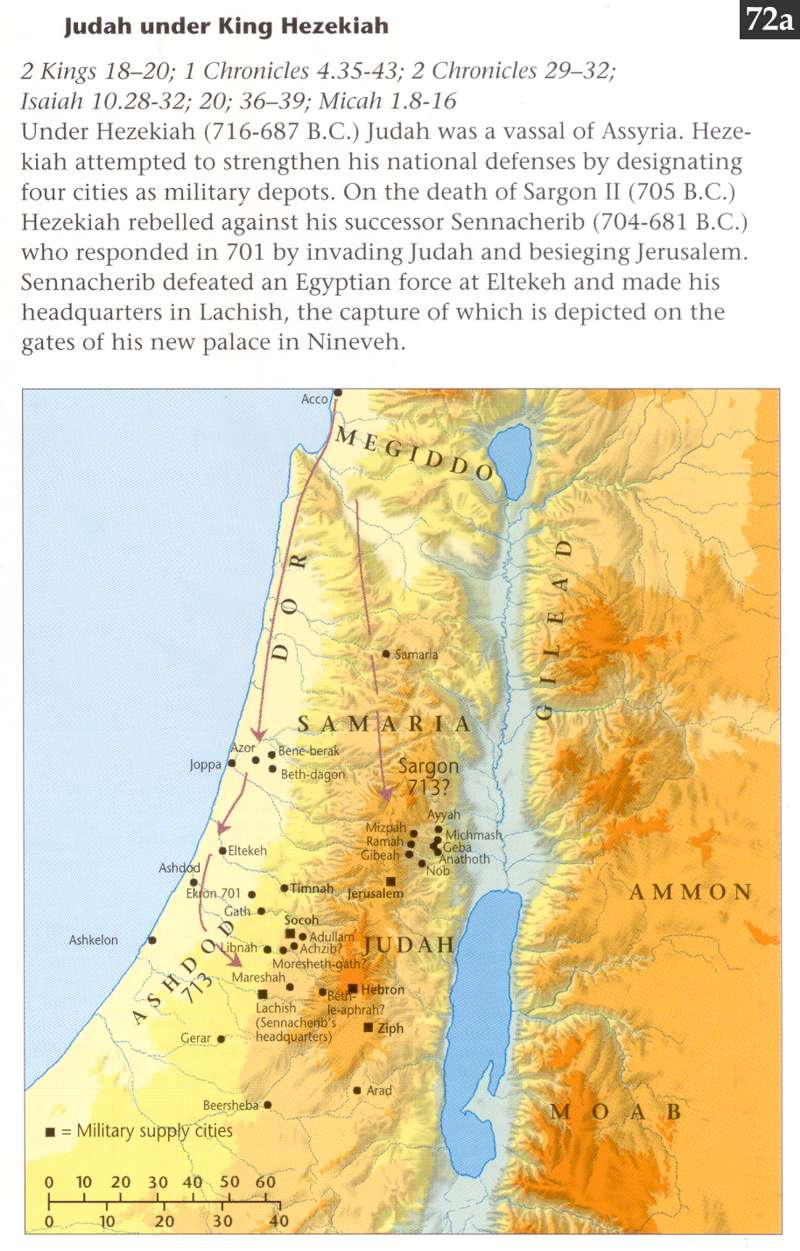
- Judah under King Hezekiah
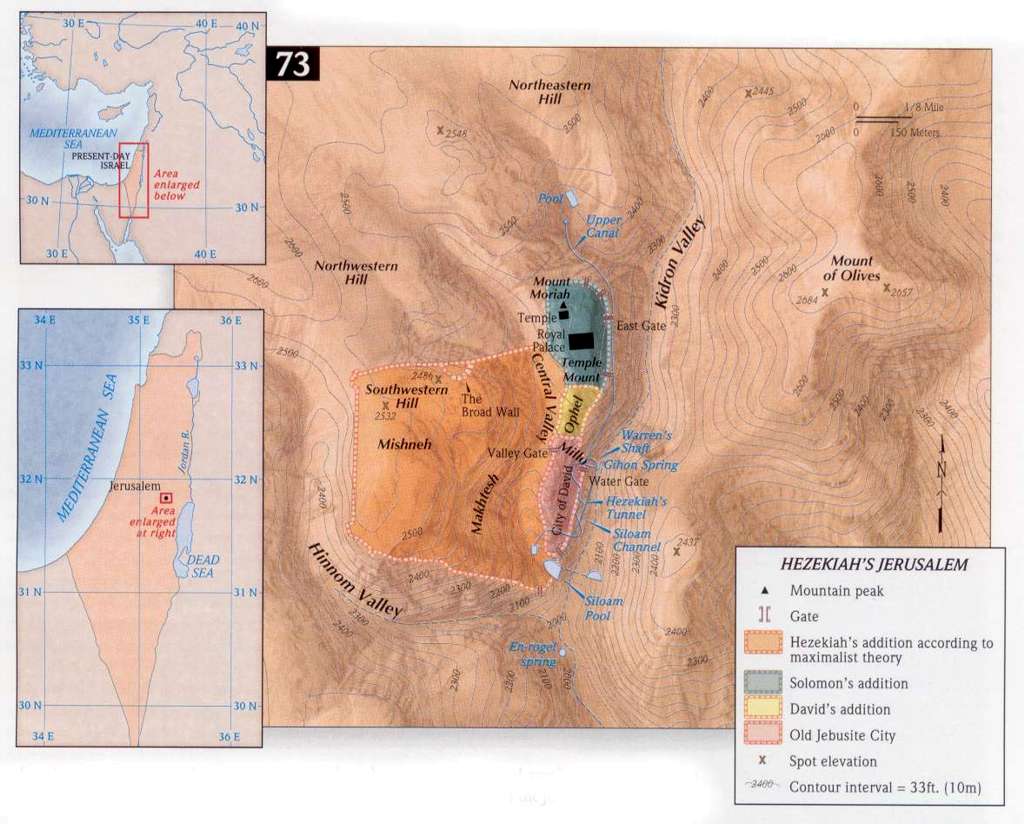
- Hezekiah's Jerusalem
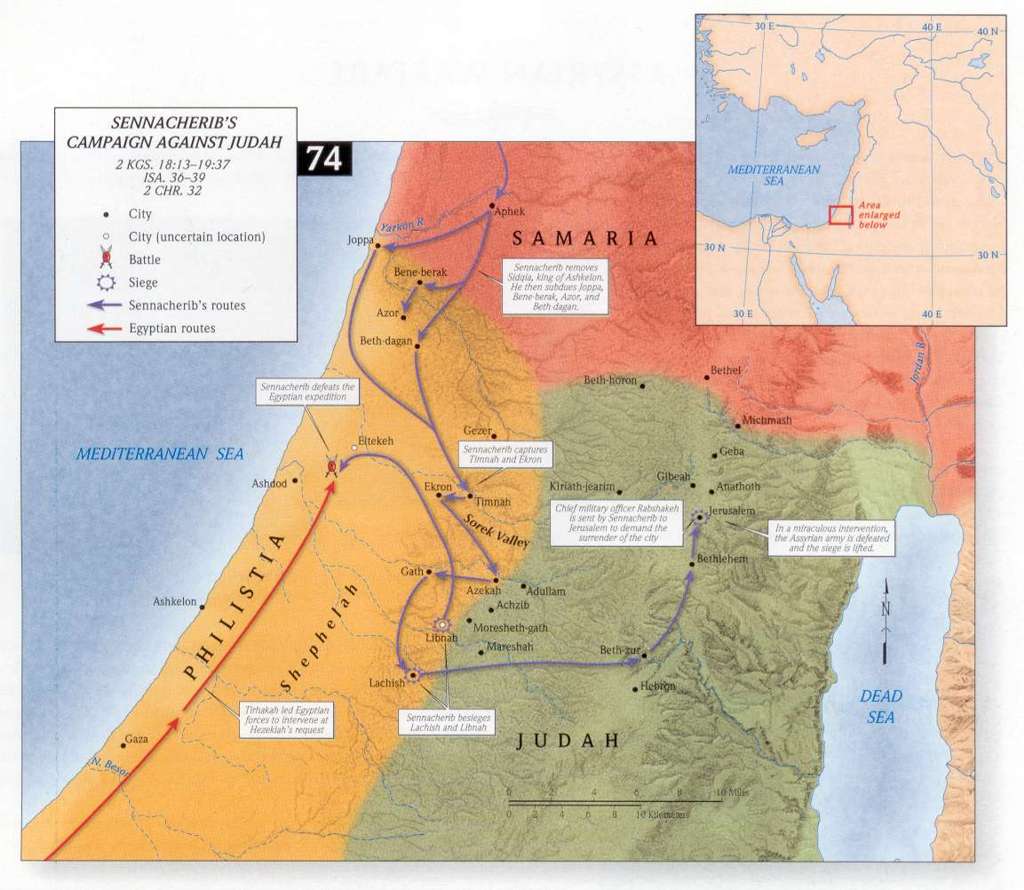
- Sennacherib's Campaign against Judah
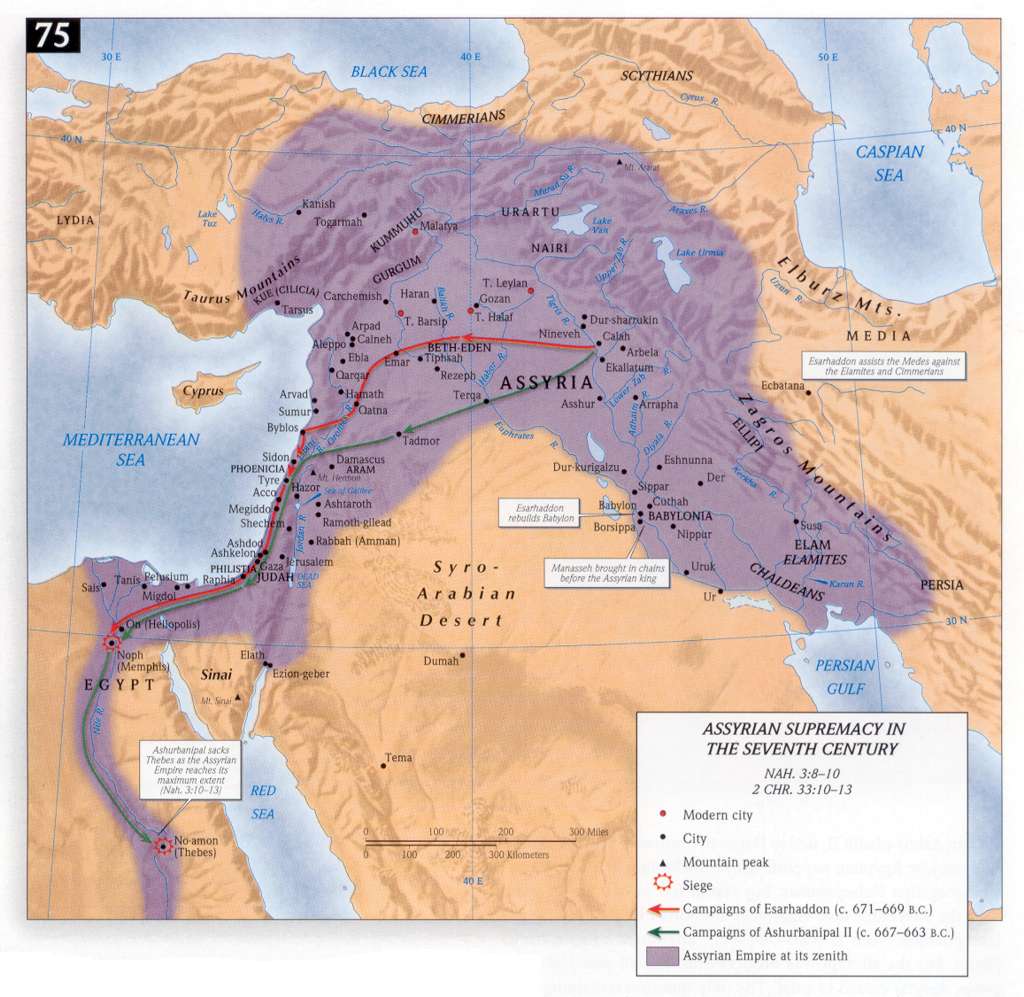
- Assyria in the 7th century BCE
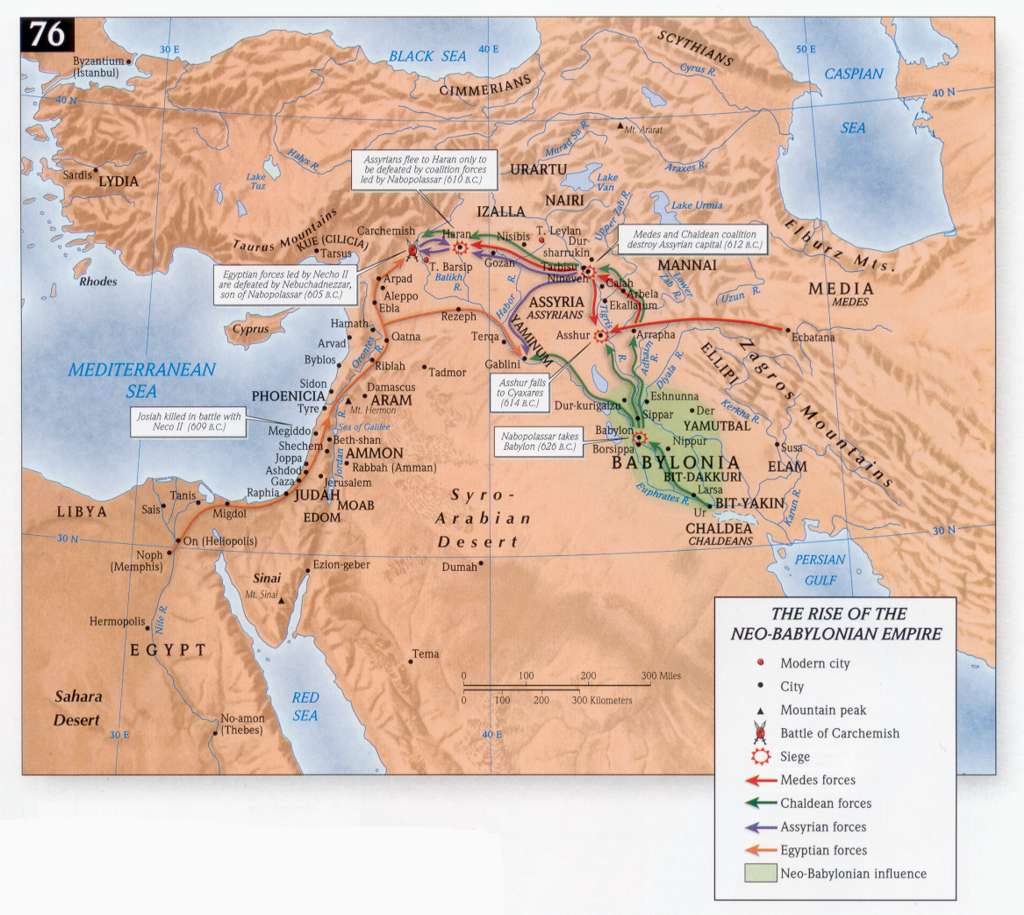
- The Rise of the Neo-Babylonian Empire
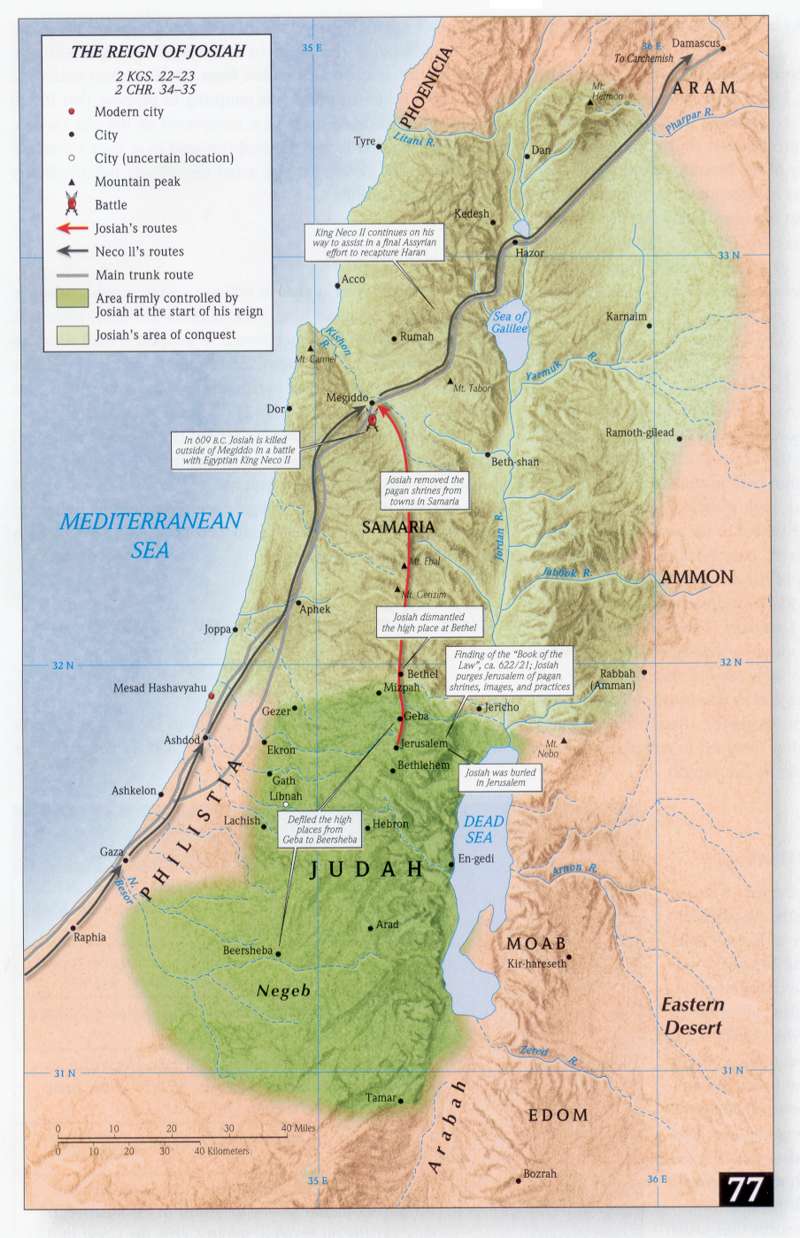
- The Reign of Josiah
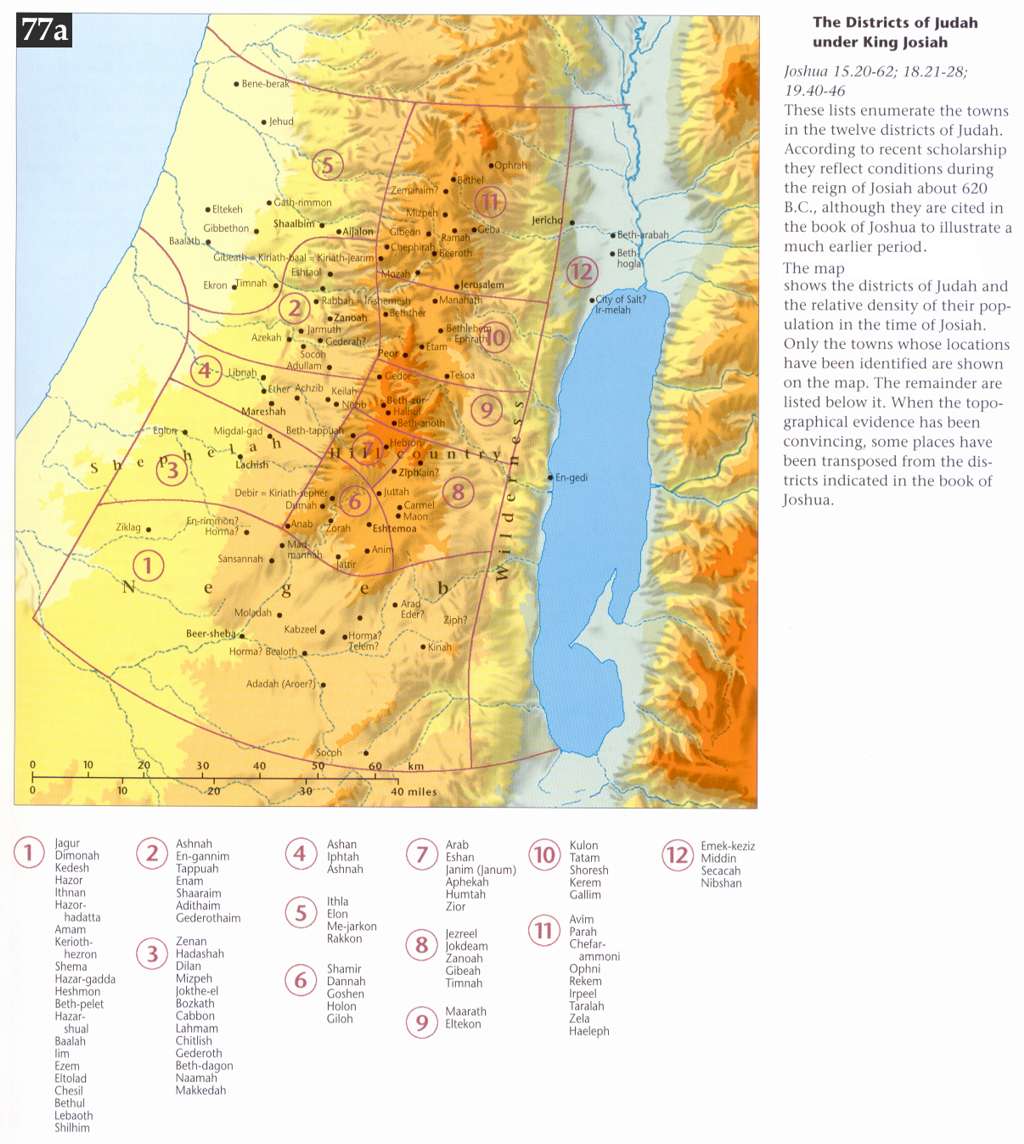
- The Districts of Judah under King Josiah
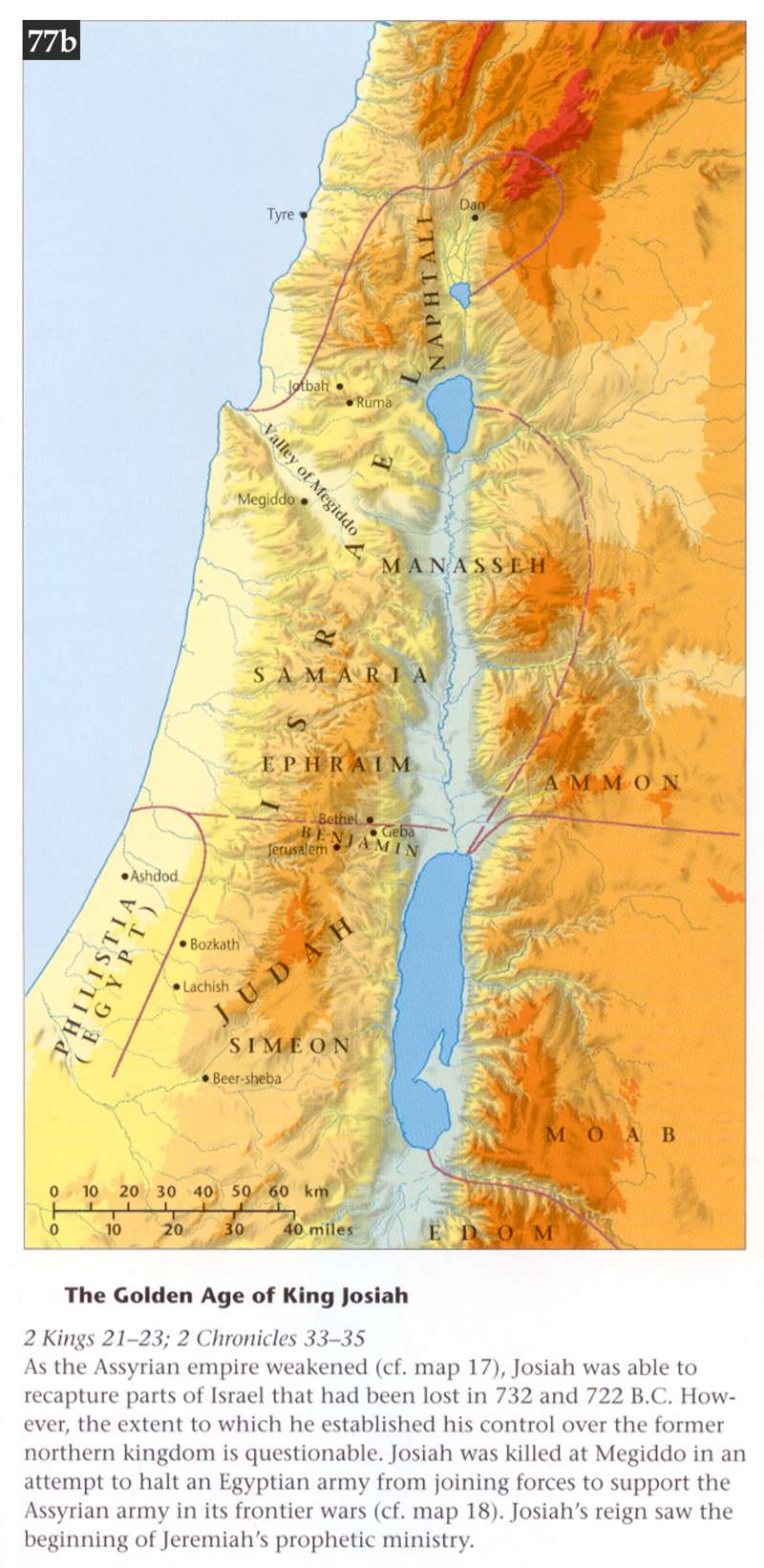
- The Golden Age of King Josiah
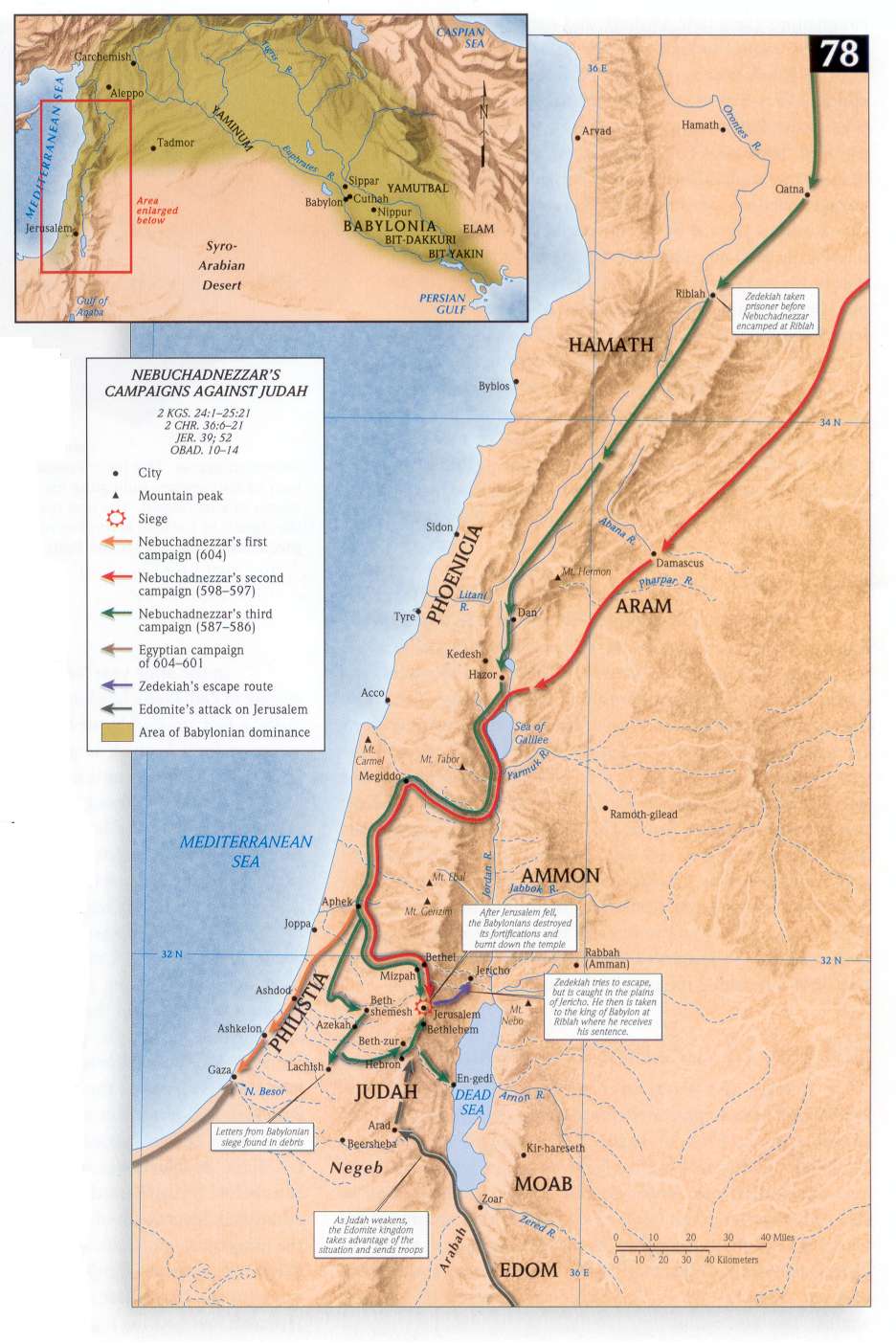
- Nebuchadnezzar's Campaigns against Judah
The Babylonian Exile up to the early Rome
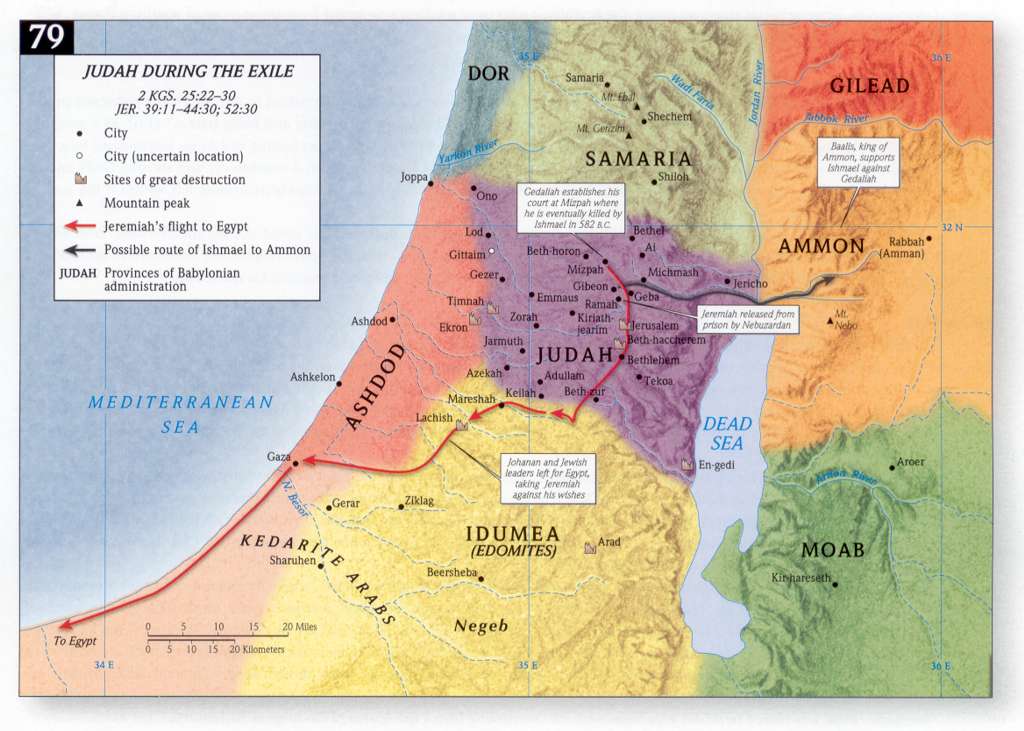
- Judah during the Exile
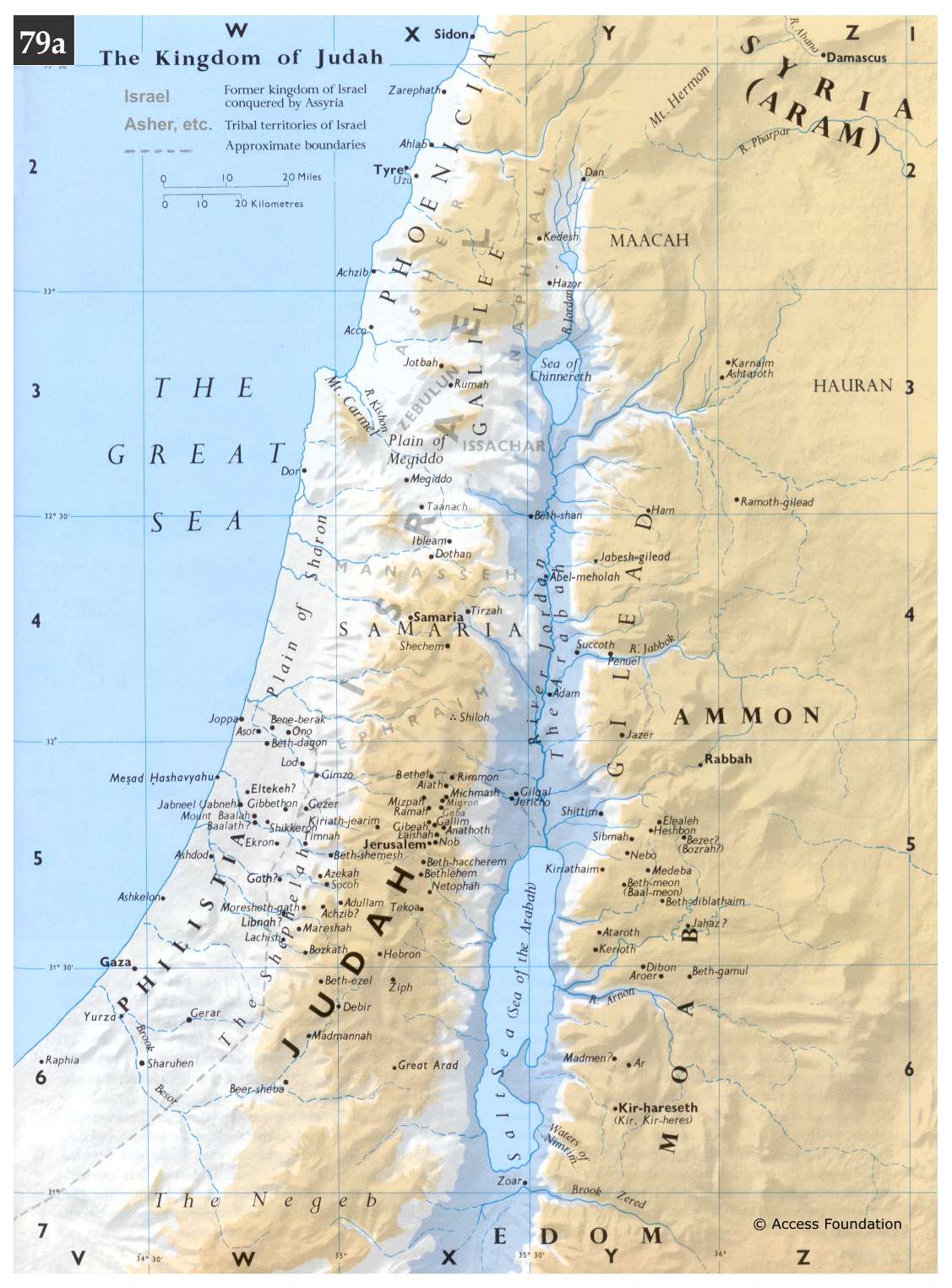
- The Kingdom of Judah
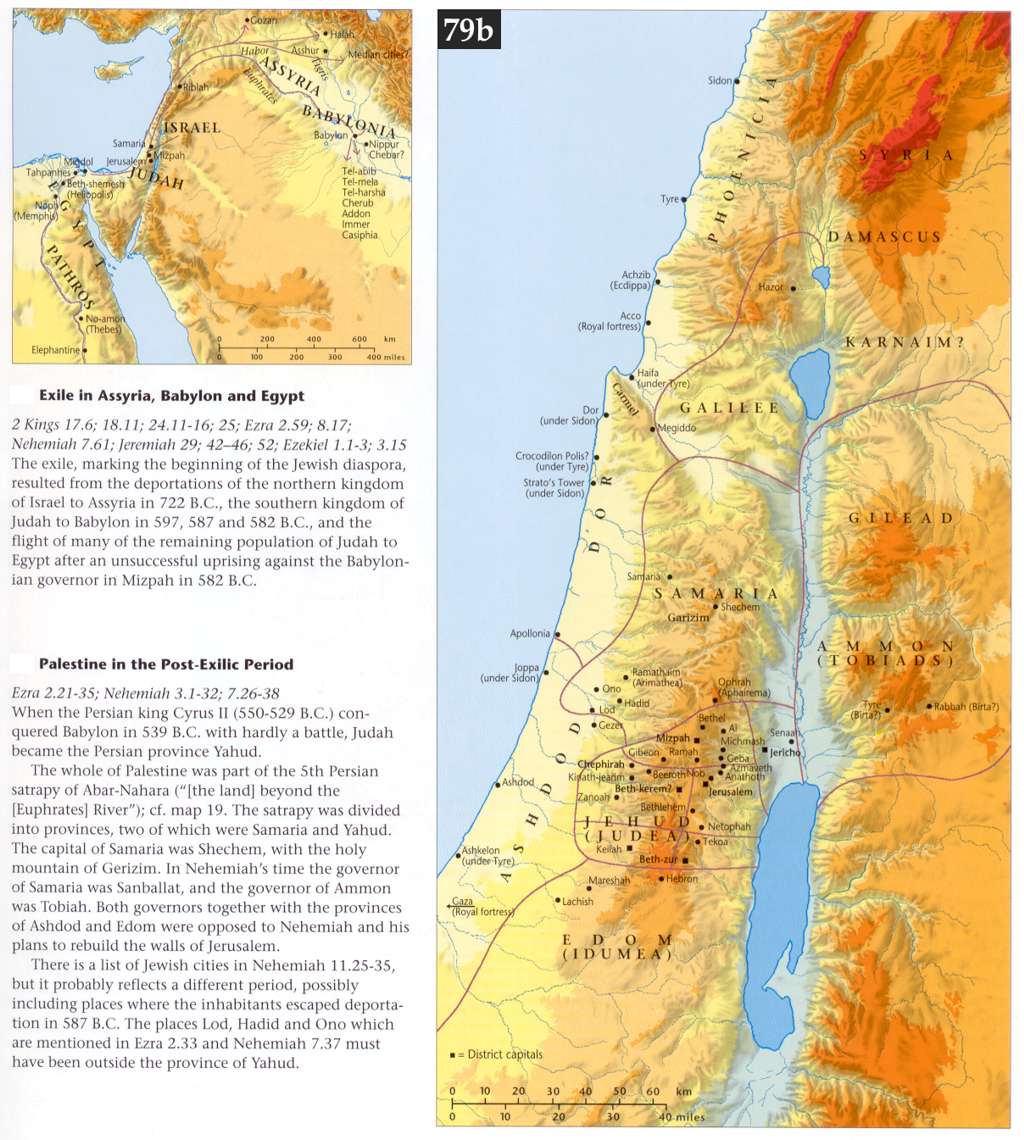
- Exile; Palestine in the Post-Exilic Period
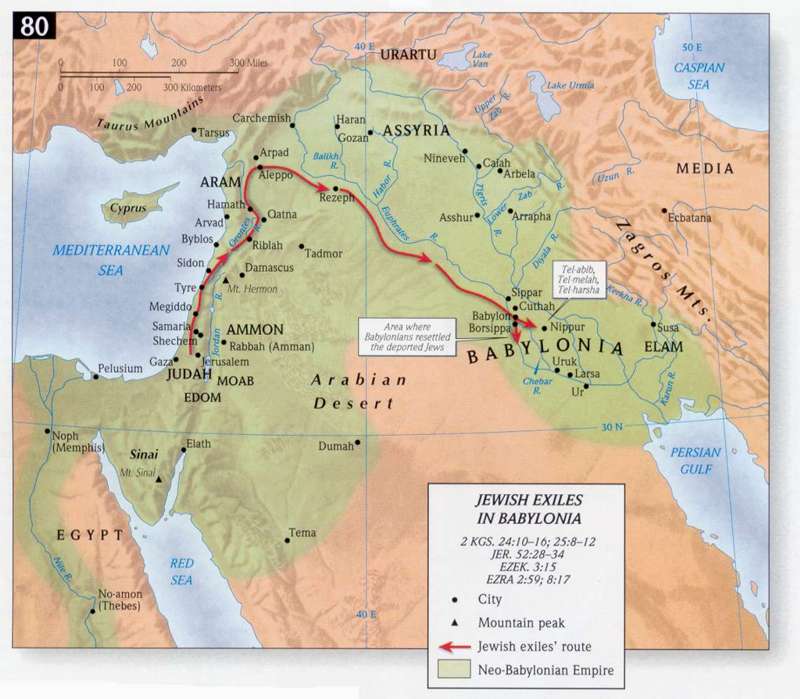
- Jewish Exiles in Babylon
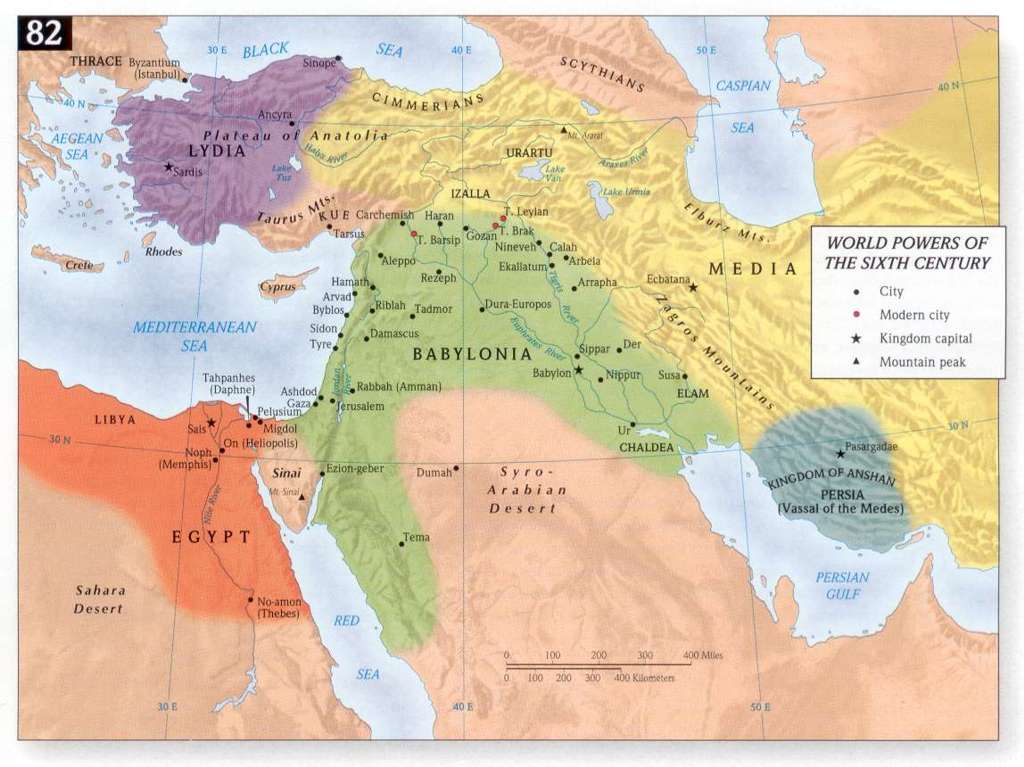
- World Powers of the 6th century BCE
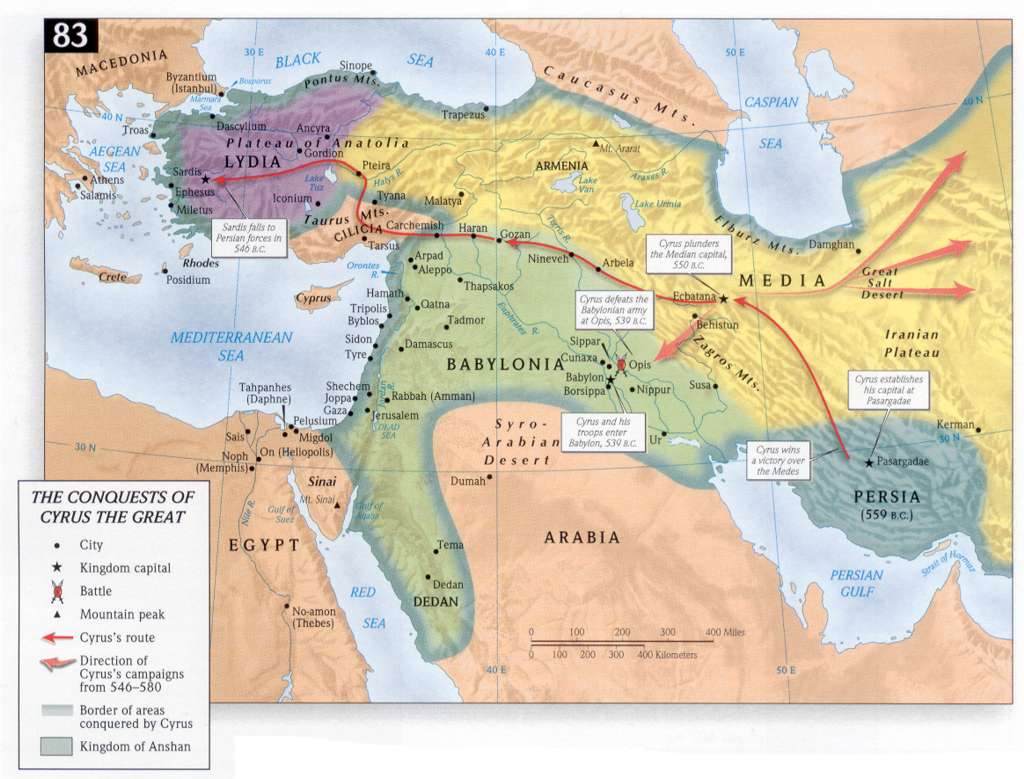
- The Conquests of Cyrus the Great
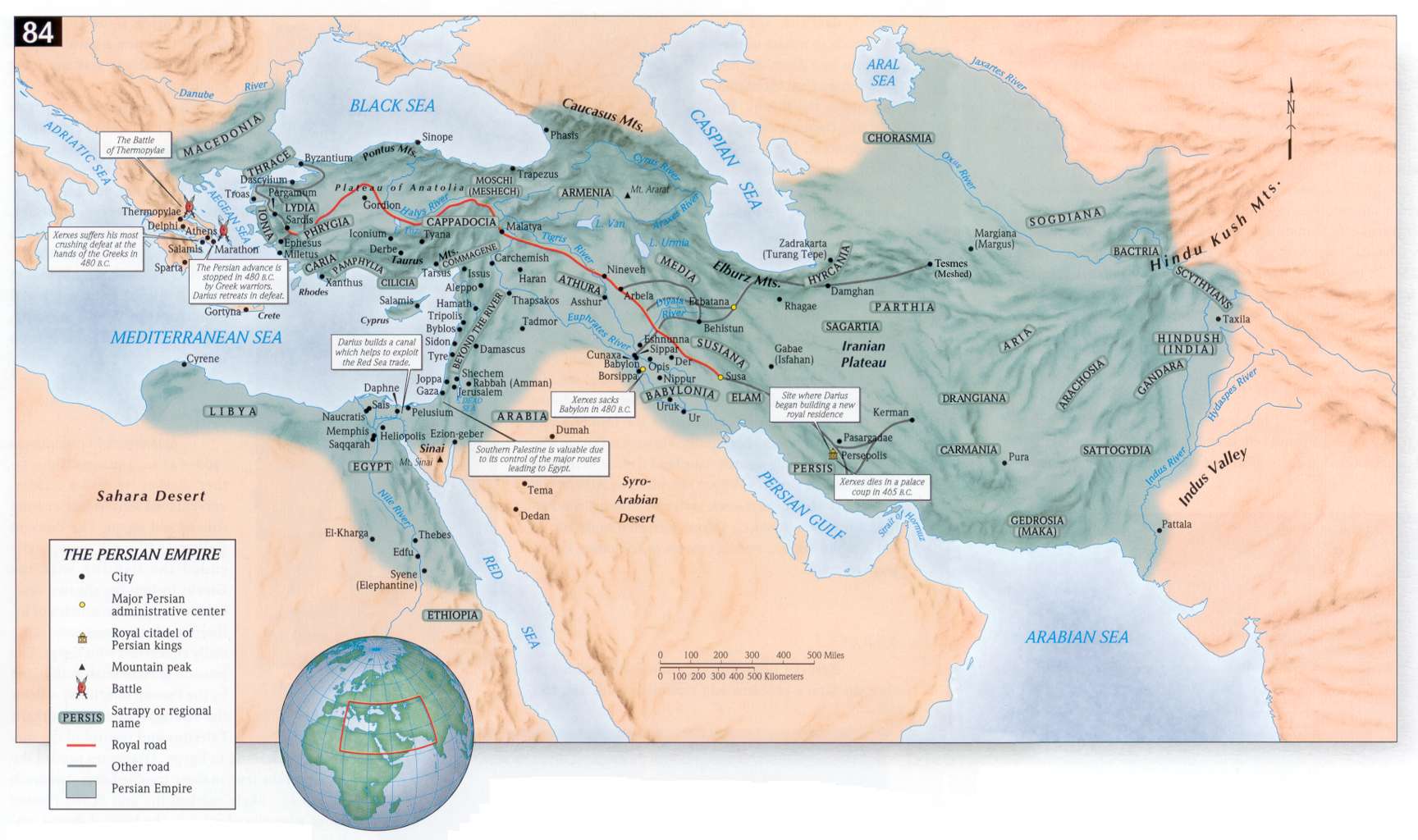
- The Persian Empire
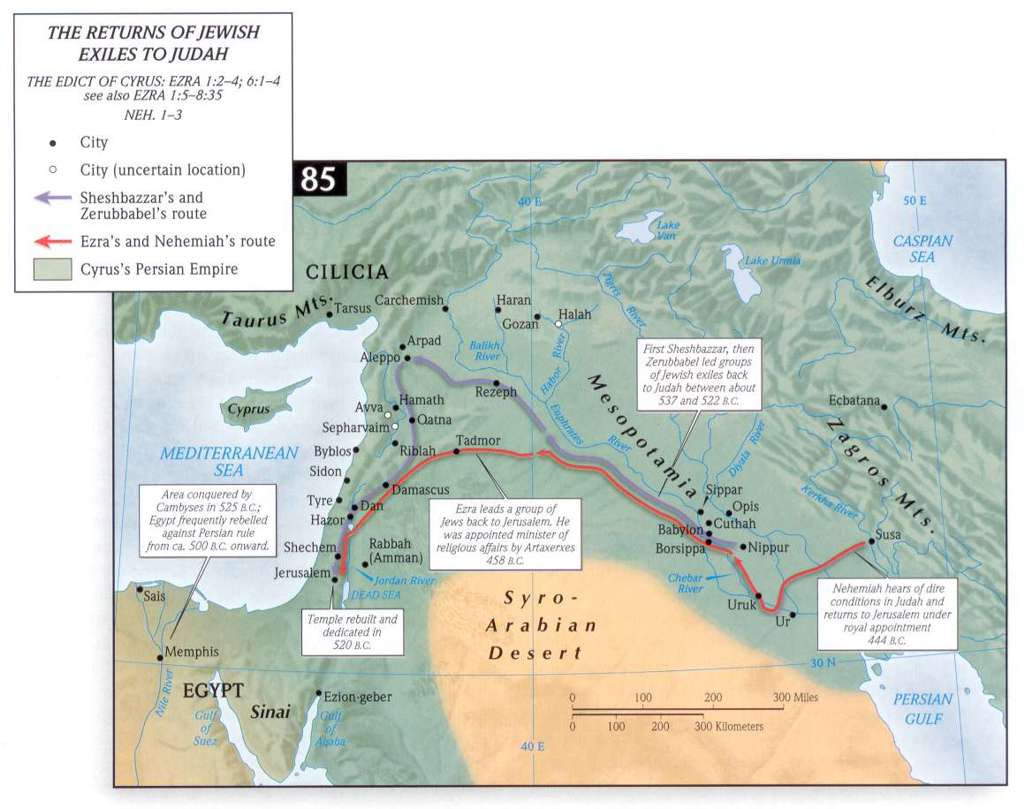
- The Return of the Jewish Exiles to Judah
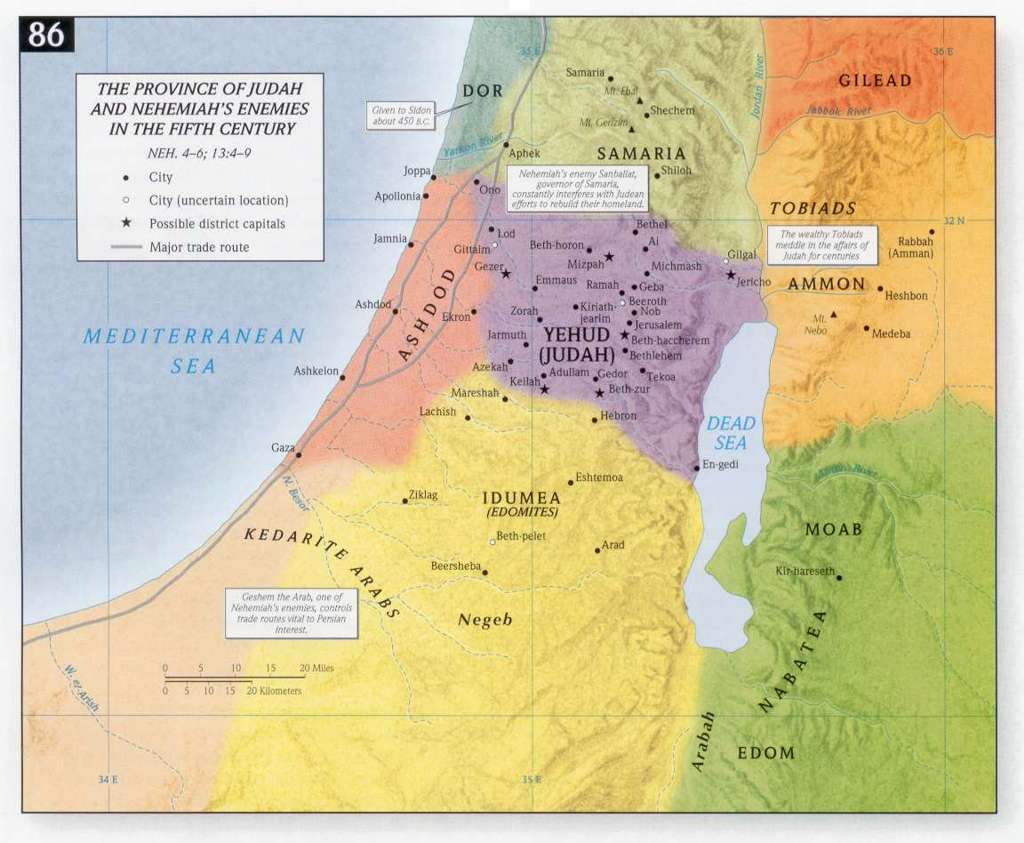
- Judah in the 5th century BCE
- Palestine after the Exile
- Alexander the Great's Empire
- The Division of Alexander's Empire ca. 275 BCE
- Palestine under the Ptolemies
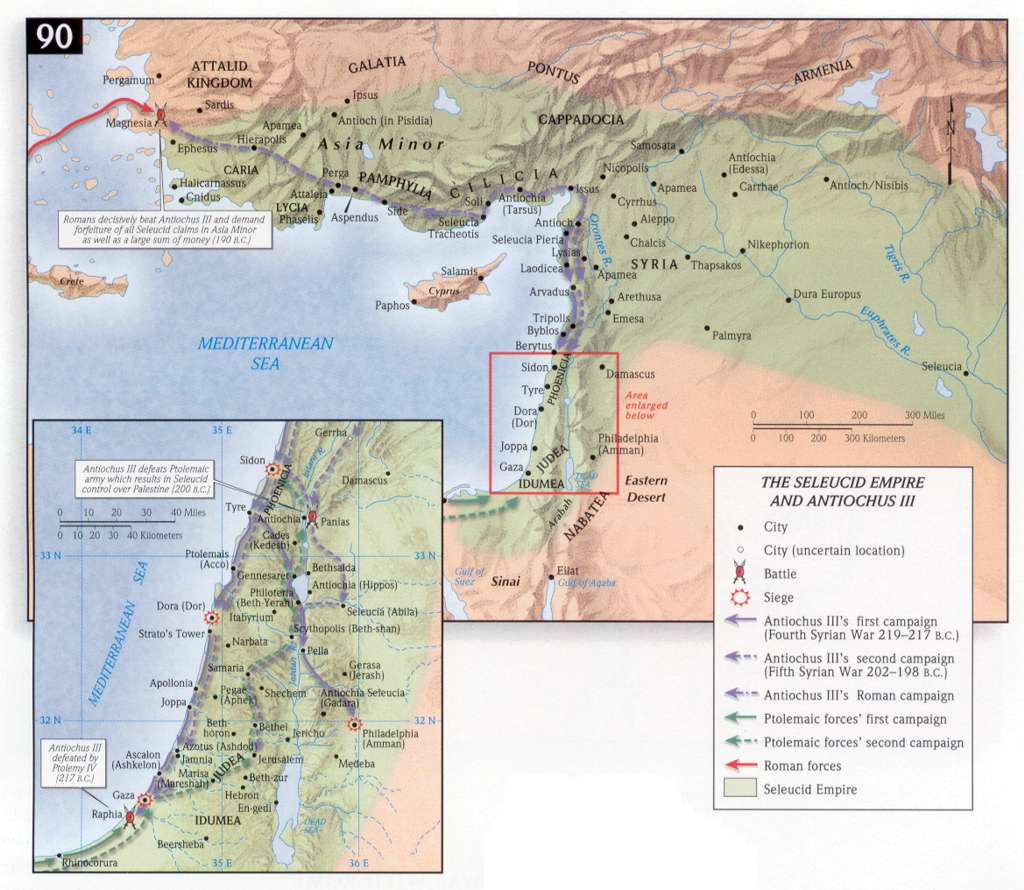
- The Seleucid Empire and Antiochus III
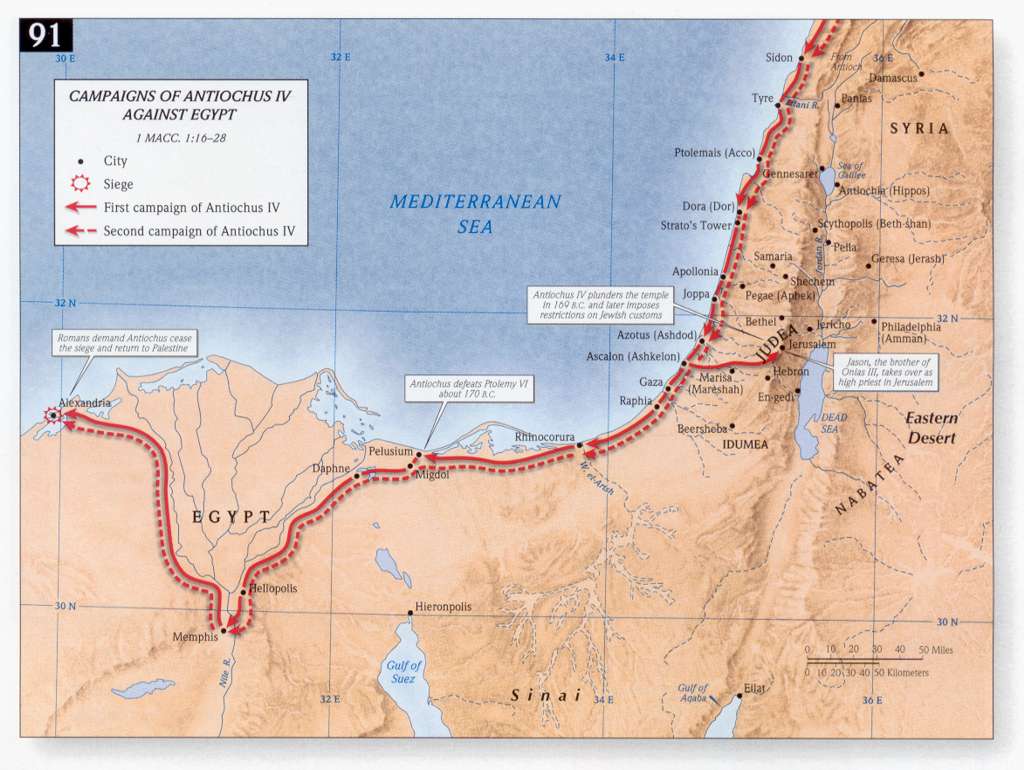
- Campaigns of Antiochus IV against Egypt
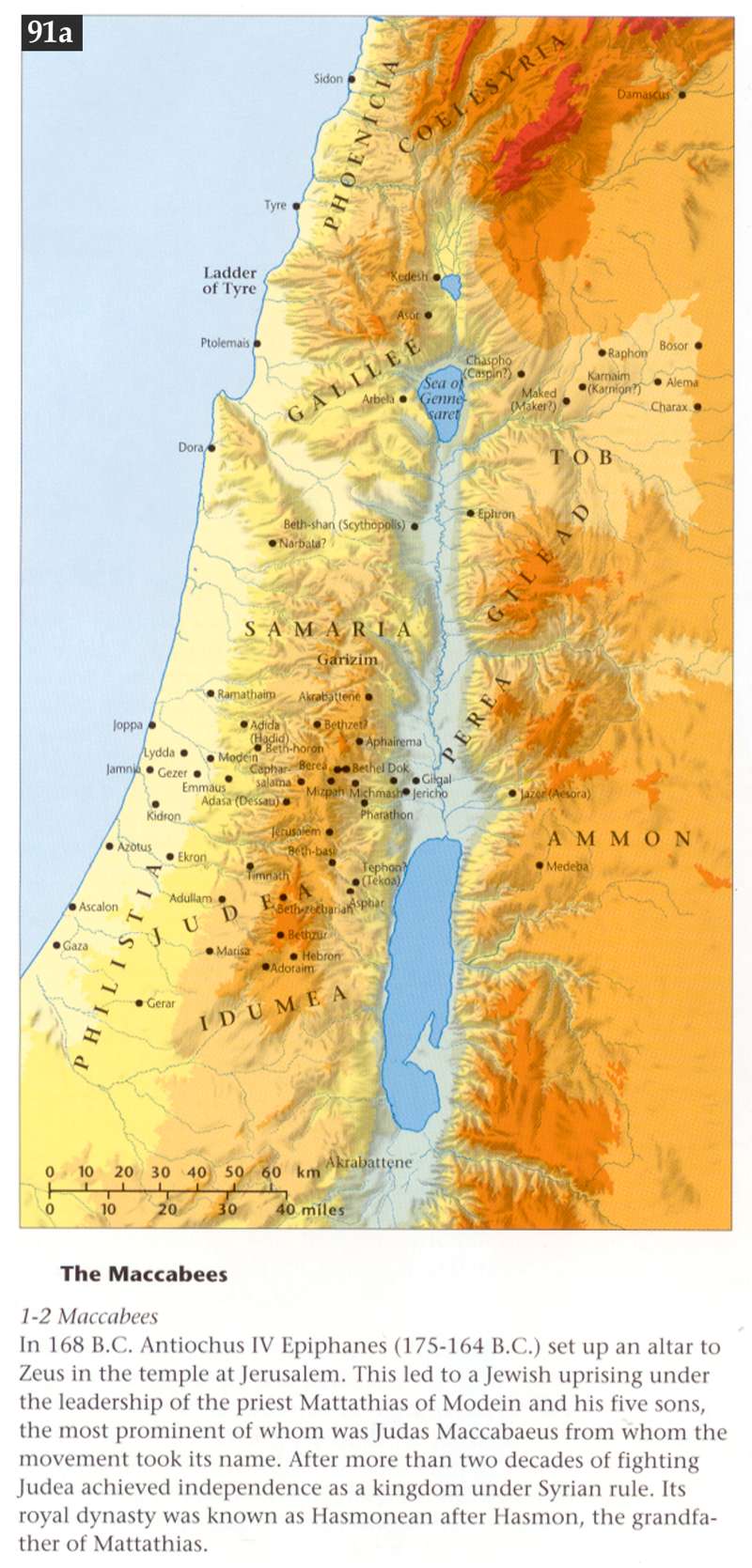
- The Maccabees in 168 BCE
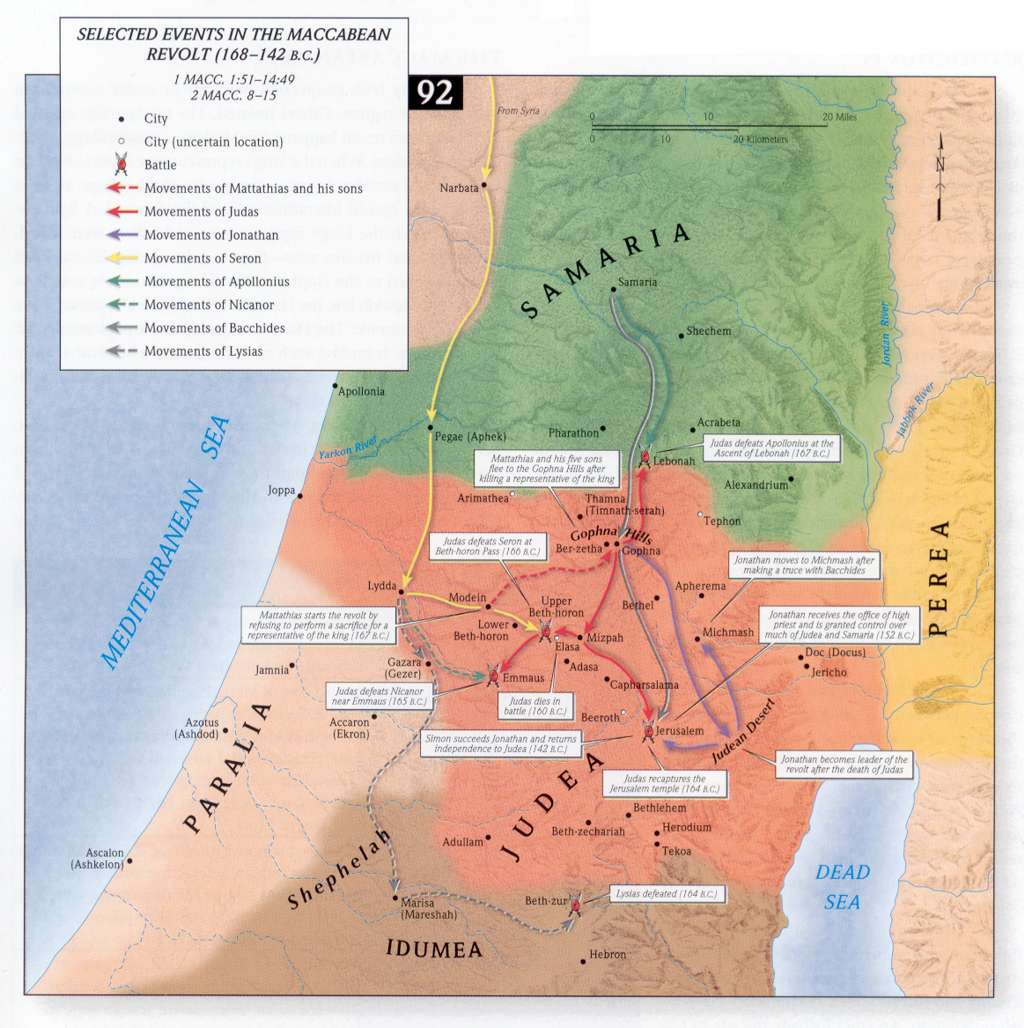
- Selected Events in the Maccabean Revolt
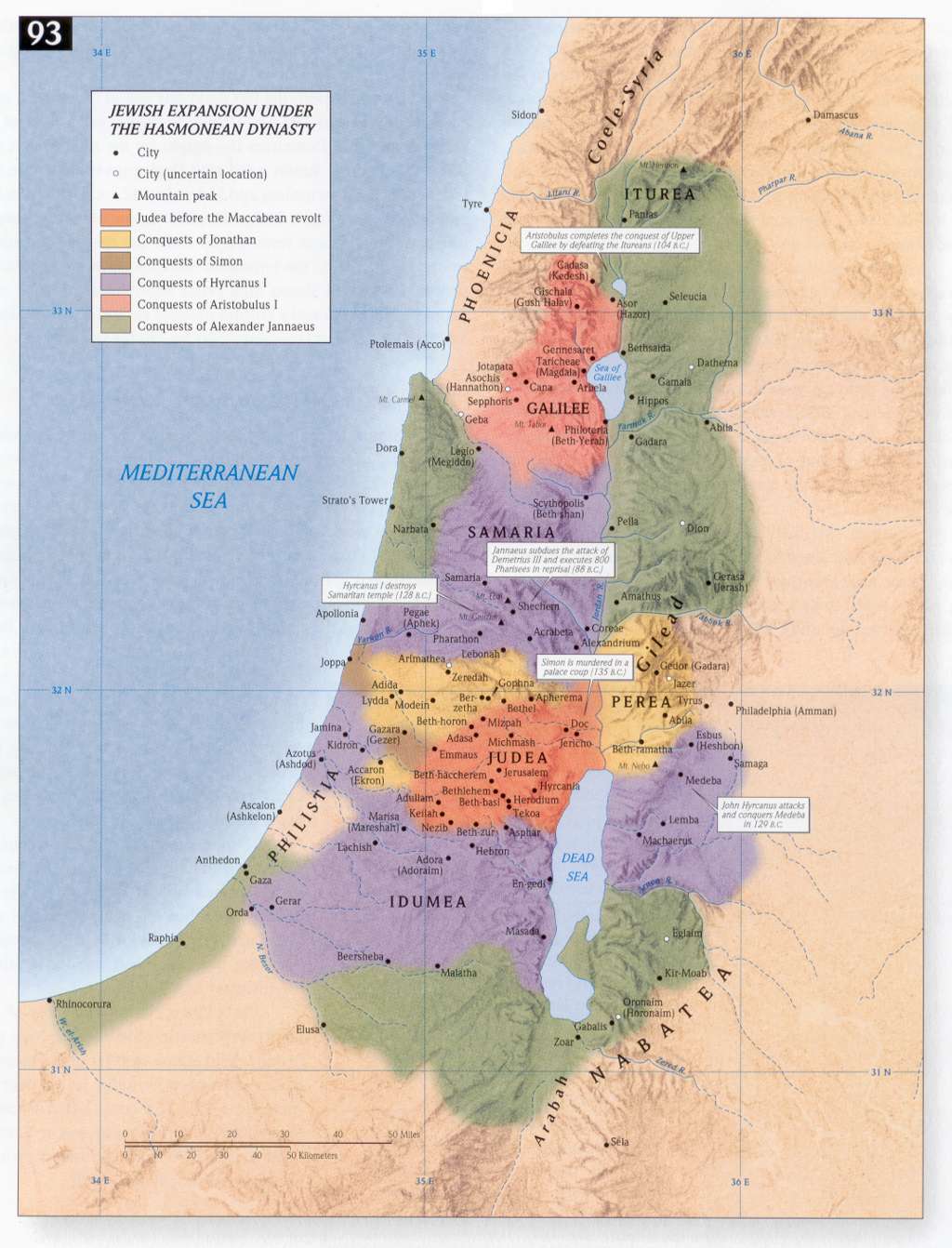
- Jewish Expansion under the Hasmonean Dynasty
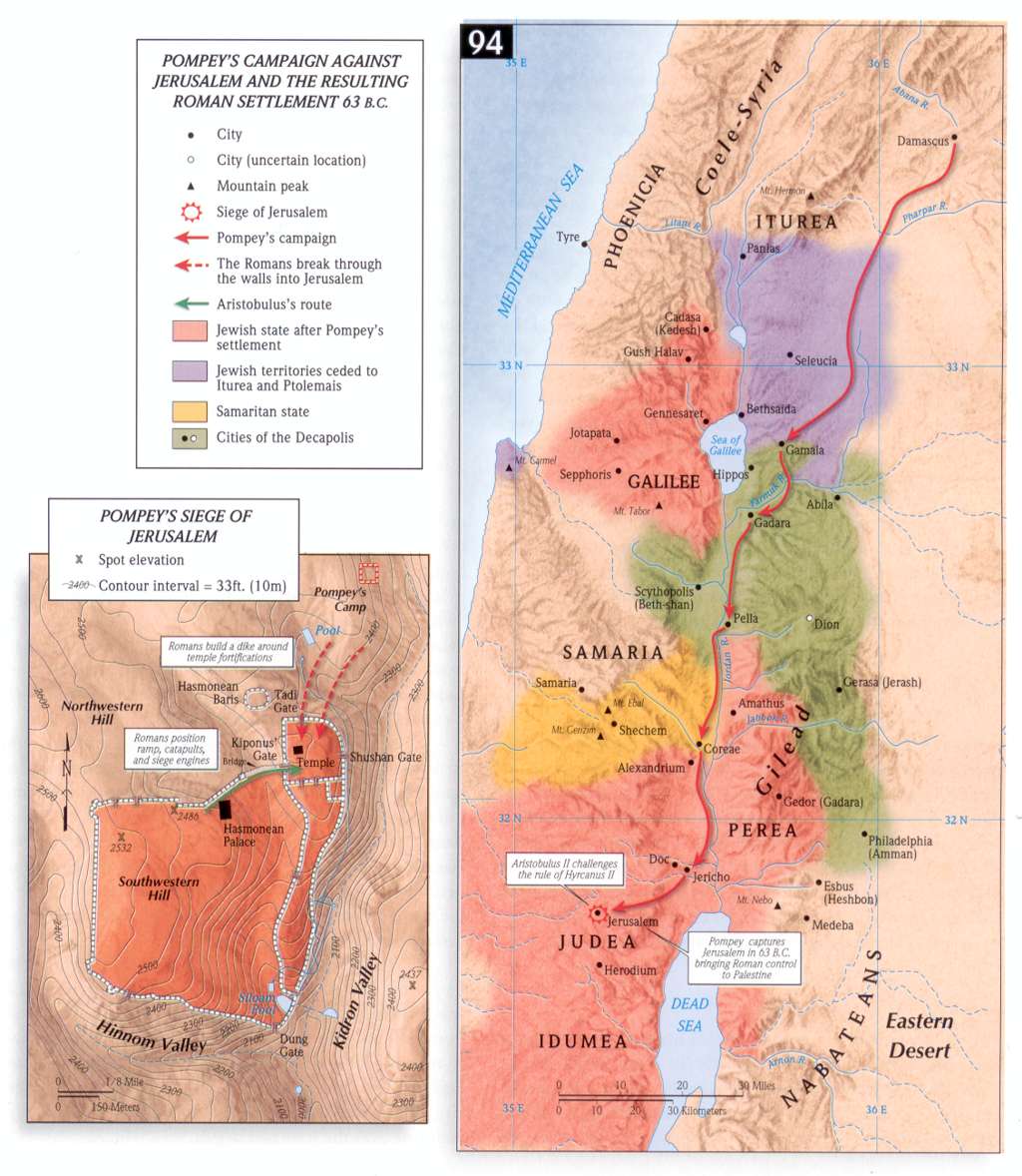
- Pompey's Campaign against Jerusalem
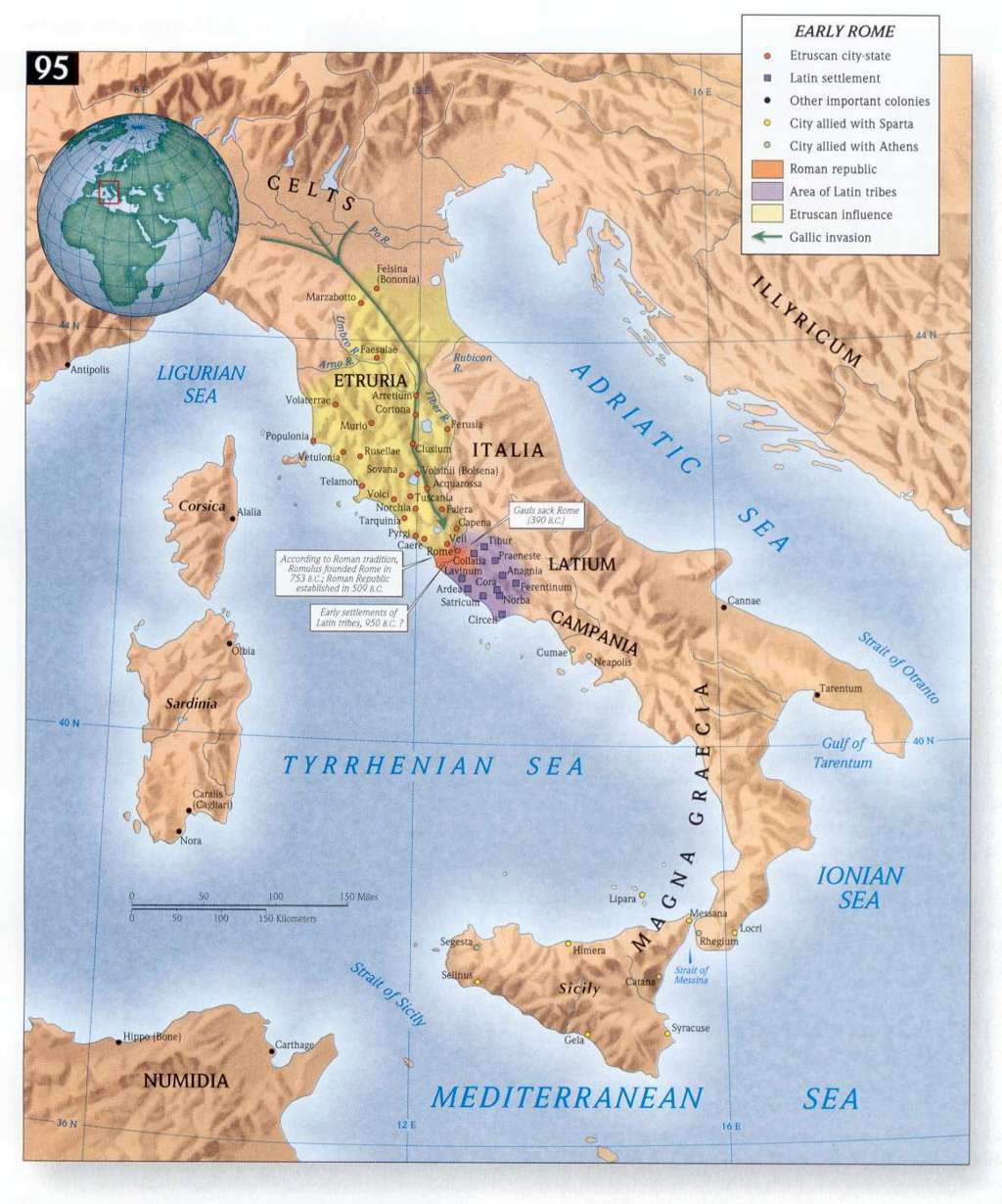
- Early Rome
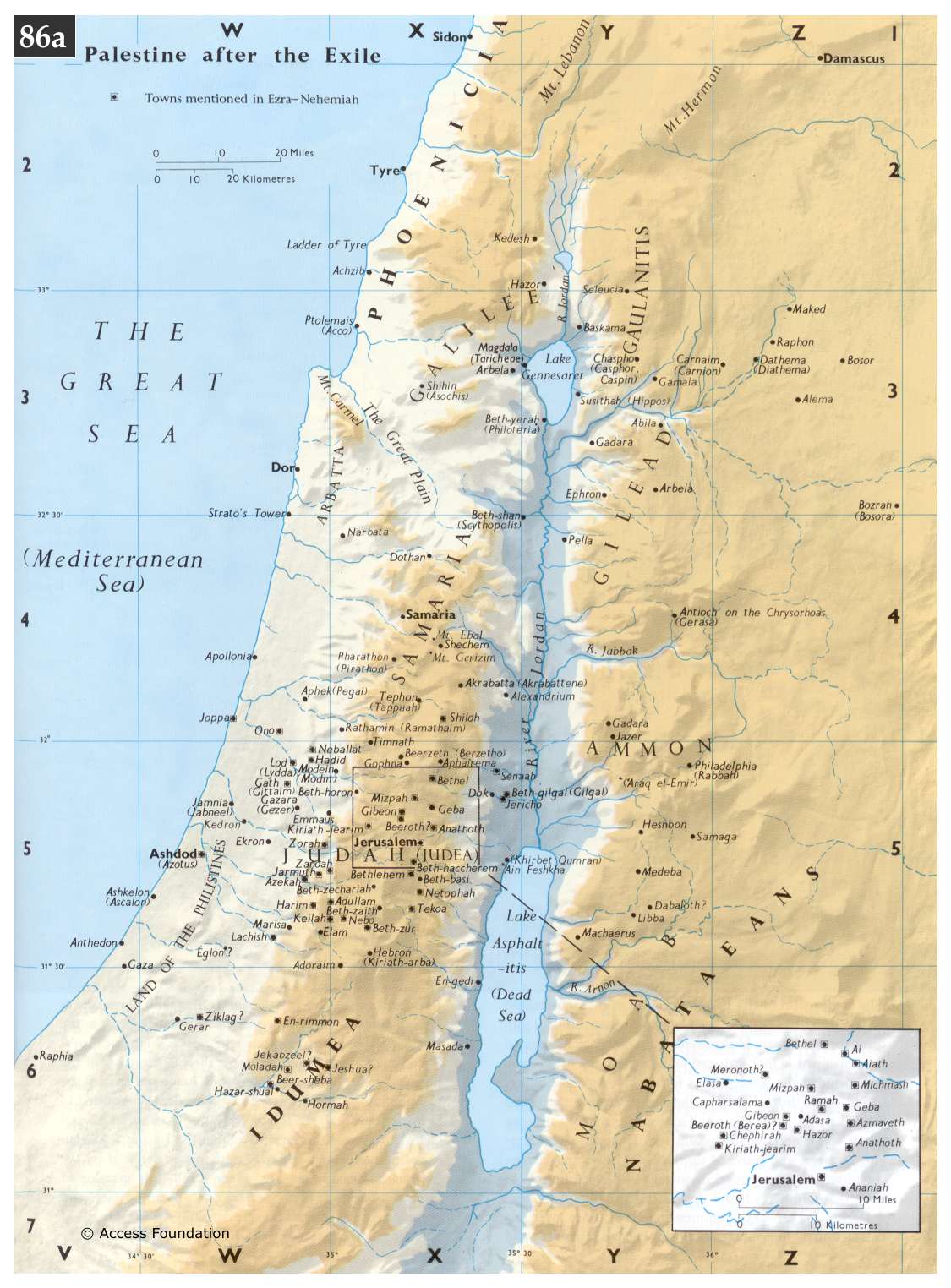
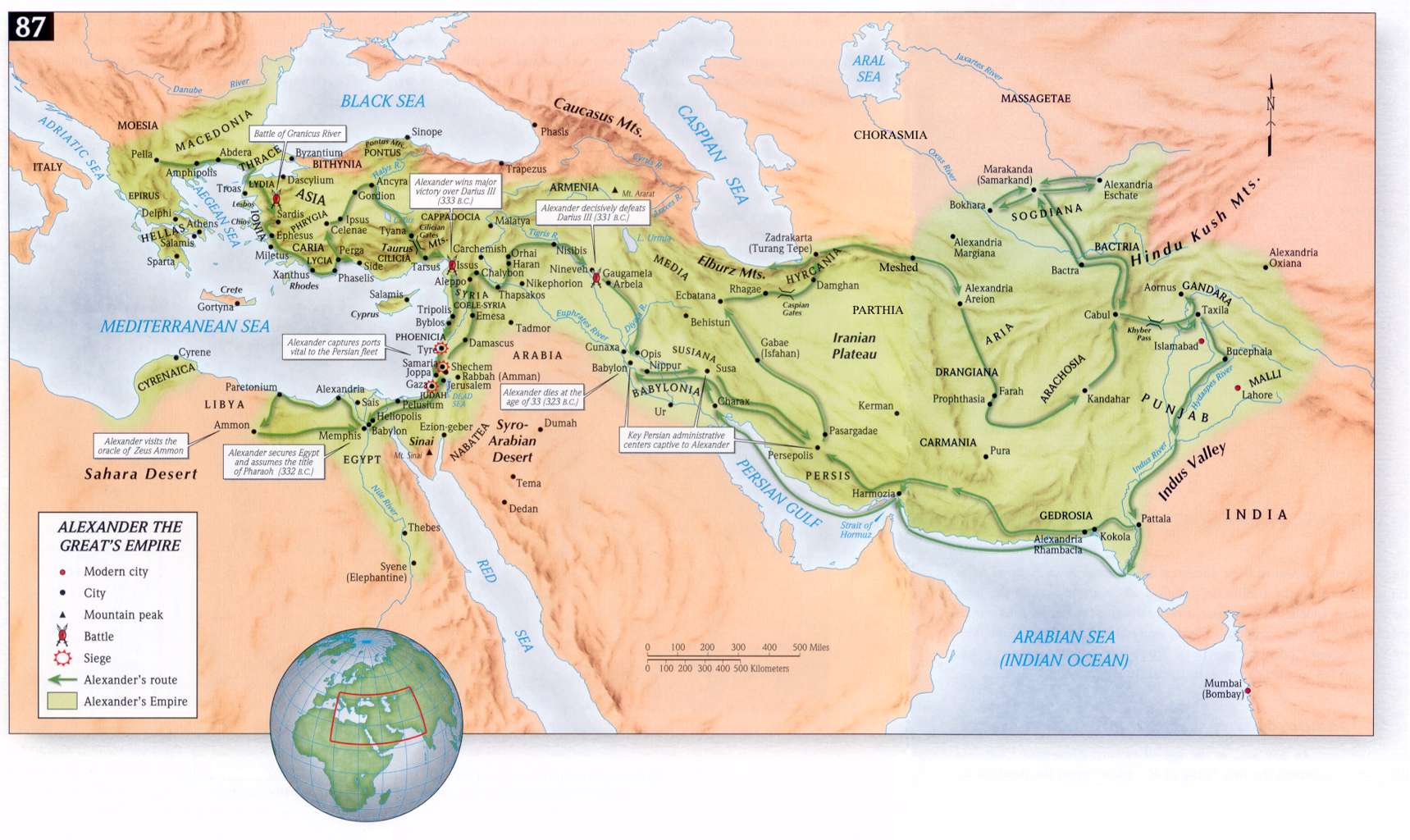
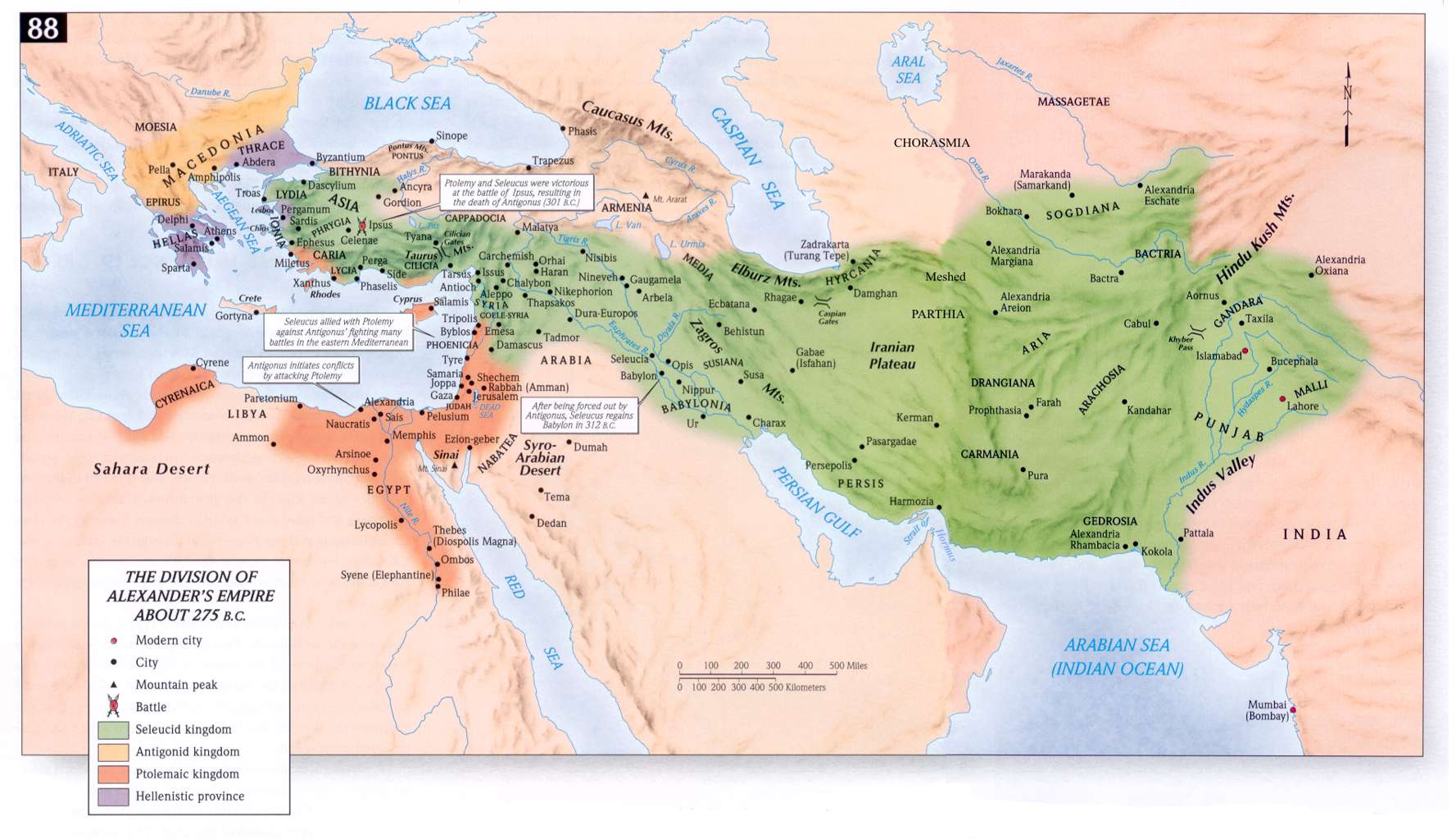
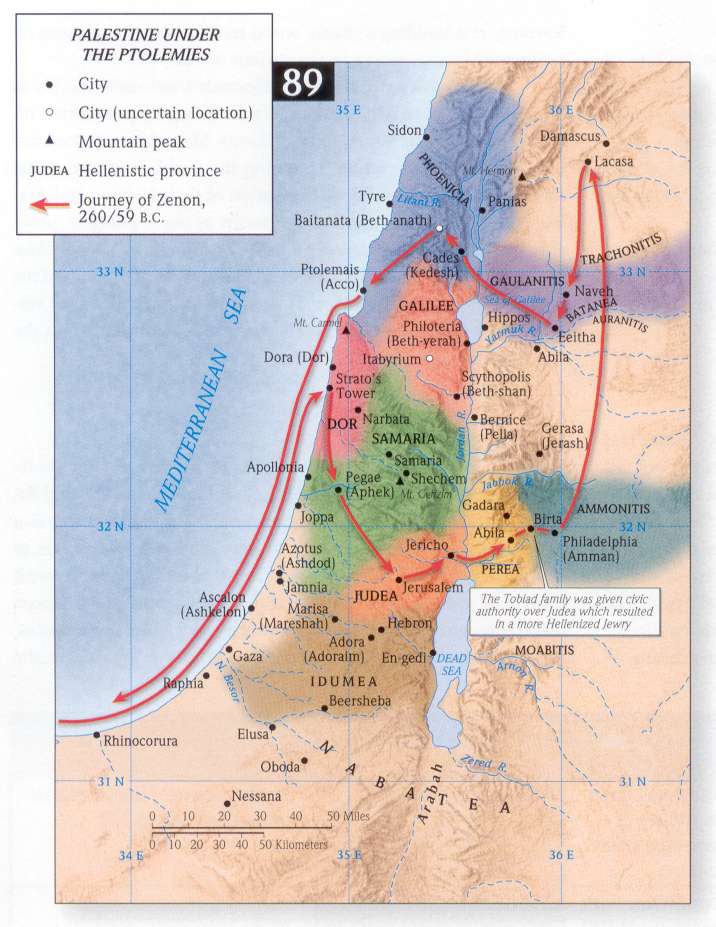
MAPS FROM ESV
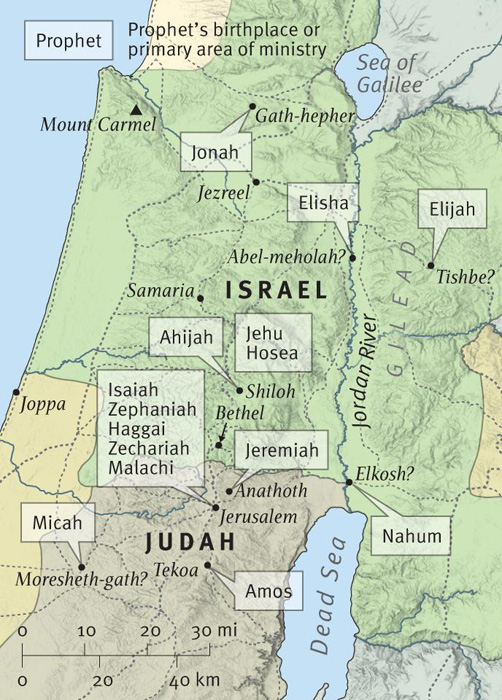
Prophets of Israel and Judah
c. 875–430 B.C.
- Extent of Solomon’s Kingdom
- Israel and Judah in 2 Kings
- Solomon’s Administrative Districts
- The Kingdom Divides
- Syria Captures Gilead
- Resurgence during Azariah, Jeroboam II
- Prophets of Israel and Judah
- Resurgence of Assyrian Influence
- Fall of Samaria, Deportation of Israelites
- Exile to Babylon
- Extent of David’s Kingdom
- Solomon’s International Ventures
- Syria and Israel Attack Judah
- Judah after the Fall of Israel
- Persian Empire at the Time of Ezra
- Persian Empire at the Time of Nehemiah
- Judea under Persian Rule
- Persian Empire at the Time of Esther
- Near East at the Time of Isaiah
- Israel and Judah at the Time of Jeremiah
- Babylonian Empire
- Babylon Attacks Judah
- Jeremiah Prophesies against Egypt
- Near East at the Time of Ezekiel
- Ezekiel’s Vision of Israel’s New Boundaries
- Introduction to Daniel: Babylonian Empire
- Empires of Daniel’s Visions: Persians
- Empires of Daniel’s Visions: Greeks
- Empires of Daniel’s Visions: Ptolemies and Seleucids (Early)
- Empires of Daniel’s Visions: Ptolemies and Seleucids (Late)
- Maccabean Kingdom
- Haggai - Living Messages
- Haggai 1:4 - Life Application
- Haggai 2:9 - Life Application
- Outline Studies - Haggai
- Excerpt: Hag 2:1-9: The design of the second address is to correct a tendency to discouragement and depreciation which had begun to appear. It is to the same officers and through them to the people. They were peculiarly disposed to discouragement. When the foundations were laid old persons who had seen the first temple wept at the contrast. After the first burst of enthusiasm in the work of rebuilding, there came, as almost always comes in human enterprises, the reaction, the time of flagging interest and waning energy. Haggai set himself to reanimate their drooping spirits and rekindle their fainting ardor. In the latter part of this address, Hag 2:6, 7, the prophet grounds his appeal on the great fact that God will ere long shake heaven, earth, sea, and all nations—a passage quoted in Heb 12:26, 27; and adds, “and the desire of all nations shall come,” or “the things desired of all nations shall come.” It is a difficult phrase, but in view of what is said of it Heb 12:25-29, it must in some way be connected with the kingdom of God and the Messiah. Hab 2:10-19. Instruction, reproof, appeal and promise. Hab 2:20-23. This last address was delivered on the same day as the preceding. It was spoken to Zerubbabel alone and was designed to stimulate that officer to zealous efforts in the good work undertaken. The prophet again refers to the supernatural shaking of earth and sky and kingdoms, but amid it all the prince shall be as a signet, firm and immovable, because chosen of the Lord. This can be no other than the day of the Lord, the day of the Prince Messiah.
- Keys to Haggai
- Excerpt: THEME: Haggai returned with the first expedition led by Zerubbabel, along with Ezra the scribe (Ezra 3:8; Haggai 1:1). Work began on the restoration of the temple, only to run into opposition from former inhabitants of the land. GOD inspired the prophet, who urged the work forward. SPECIAL CHARACTERISTICS: Four messages of Haggai were spoken within a period of only four months. It is possible that Haggai may have personally seen the glory of the temple of Solomon (Hag 2:3). This would have made him a very old man at the time of his prophetic ministry. The messages are exceedingly condensed and perhaps were a summary of that which was given orally. Each time Haggai's name is mentioned, he is called "the prophet" thus emphasizing his important ministry. OUTSTANDING TEACHINGS: Opposition to the work caused the people to leave it and turn to more profitable pursuits. They rationalized that the time had not come for rebuilding. Adorning their homes, propagating their flocks and working their fields occupied their interests. Haggai's impassioned plea roused them again to action. Haggai's first message was in substance that of Matthew 6:33-note. In the second he stressed that the glory of the new temple would be greater than the first. He told them that certain plagues had come on them due to their neglect of the important task, and the last message was specially to Zerubbabel promising him that GOD would destroy the enemy and that His people would endure and prosper. KEY TO UNDERSTANDING: GOD will not be frustrated nor change in His purposes; He uses men to fulfill His plans.
- Through the Bible - Haggai
- Excerpt: I. First message: the neglect of the second temple's completion (Hag 1:1-15) 1. The excuse for the neglect (Hag 1:1, 2). "The time is not come that the Lord's house should be built." The people were probably waiting for some special revelation from GOD before they would perform what they knew to be their duty. 2. The cause of the neglect - the people's selfishness (Hag 1:3, 4). They did not wait for any special command to build and embellish their own homes. 3. The punishment for the neglect - drought and barrenness (Hag 1:5-11). 4. The repentance for the neglect (Hag 1:12-15). The people set to work on the temple. II. The second message: the glory of the second temple (Hag 2:1-9) 1. The people's discouragement (Hag 2:1-3). Remembering the magnificence of Solomon's temple, the people were evidently discouraged by the thought that the present temple would not equal it in beauty and glory. They knew that it would lack the Shekinah glory that filled the first temple. 2. The Divine encouragement (Hag 2:4-9). The glory of the second temple will be greater than that of the first, declares the Lord, for Messiah Himself, the Lord of glory, will enter it. This was fulfilled at Christ's first coming when He entered the temple (Jn 2:13-25; compare Malachi 3:1). There may be a more complete fulfillment at His second coming. Third message: sacrifice. without obedience (to rebuild the temple) will not sanctify (Hag 2:10-19) 1. A parable (Hag 2:10-14). The lesson contained in these scriptures is as follows: holiness is not contagious, but evil is. The sacrifices offered on the altar were not sufficient to sanctify a land which the disobedience of the people had polluted. Therefore the land was barren. "The faint aroma of sanctity coming from the altar was too feeble to pervade the secular atmosphere of their lives. Haggai argues that Israel's sacrifices for sixteen years had been unclean in God's sight, and had brought them no blessing, because the temple was in ruins." 2. A warning (Hag 2:15-18). The blight upon the land was caused by disobedience. 3. A promise (Hag 2:19). Now that the people have set themselves to the work in earnest, the Lord will bless them. IV. Fourth message: the safety and perpetuity of the house of Israel (Hag 2:20-23) 1. The coming world commotions (Hag 2:20-22). Comparing Haggai 2:6,7 and Hebrews 12:26-28, we see here a reference to the final world upheaval preceding Christ's second coming. 2. The assurance of safety (Hag 2:23). The national disturbances in Zerubbabel's time had perhaps made him fear for the safety of his nation. As a representative of the house of David and an ancestor of the Messiah, he receives a promise of protection and safety for himself and his people. All the nations of the world shall be shaken, but the Jewish nation under Messiah, of whom Zerubbabel is a type, shall be established.
- The Book of Haggai (pdf)
- The Prophet Haggai
- Excerpt: The prophet Haggai recorded his four messages to the Jewish people of Jerusalem in 520 BC, eighteen years after their return from exile in Babylon (538 BC). Haggai 2:3 seems to indicate that the prophet had seen Jerusalem before the destruction of the temple and the exile in 586 BC, meaning he was more than seventy years old by the time he delivered his prophecies. From these facts, the picture of Haggai begins to come into focus. He was an older man looking back on the glories of his nation, a prophet imbued with a passionate desire to see his people rise up from the ashes of exile and reclaim their rightful place as God’s light to the nations. Haggai’s prophecy came at a time when the people of Judah were extremely vulnerable. They had been humbled by their exile to Babylon, hopeful in their return to their Promised Land, and then so discouraged by opposition in their rebuilding of the temple that they had quit (Ezra 4:24). Now, sixteen years later, with Haggai blaming their lack of food, clothing, and shelter on their failure to rebuild the temple, the Jews were receptive to his message of rebuilding the Lord’s house. (See also Haggai Overview Chart)

- Caveat Emptor: Dr. Utley is amillennial and unfortunately replaces Israel with the church (Scroll down for his interpretation of Galatian 6:16! He writes "Significantly Paul calls the Church "the Israel of God."). Such a non-literal approach makes it difficult to interpret OT eschatological passages.
- Introduction to Haggai
- Haggai 1 Commentary
- Haggai 2 Commentary
- The Old Testament Presents… Reflections of Christ - Haggai
- The Old Testament Presents… Reflections of Christ - Table of Contents - all 33 OT books
- Haggai 1:1-15 Consider Your Ways
- Haggai 2:1-9 Consider Your LORD
- Haggai 2:10-19 Consider Your Actions
- Haggai 2:20-23 Consider Your Faith
- Be a Berean - Not always a literal interpretation. Caveat Emptor!
- Haggai - Commentary for English Readers
- Haggai 1 Commentary for English Readers
- Haggai 2 Commentary for English Readers
- Sermon- Putting First Things First - Haggai
- Excerpt: E. M. Gray spent his life searching for the one trait all successful people share. His essay entitled "The Common Denominator of Success" revealed successful people's common characteristic was not hard work, good luck, or astute human relations, although these traits were important. The one factor that seemed to transcend all the rest was the habit of putting first things first. He observed, "The successful person has the habit of doing the things failures don't like to do. They don't like doing them either, necessarily. But their disliking is subordinated to the strength of their purpose."
- Haggai: Commentary - Summary of Principles from Haggai - see link for exposition of each one
1. The work of the Lord should never be procrastinated (Haggai 1:3)
2. Misplaced priorities hinder the work of God (Haggai 1:4,9)
3. The goal of God’s work is His glory and pleasure. (Haggai 1:8)
4. God sometimes uses natural disasters for spiritual discipline (Haggai 1:6,10,11)
5. Obedience and reverence are prerequisites for spiritual blessing (Haggai 1:12-14)
6. It is never too late to start obeying God (Haggai 1:12-15)
7. Courage comes from knowing that God is present (Haggai 2:1-4)
8. The remedy for a discouraged heart is to see the divine perspective (Haggai 2:6-7)
9. Everything belongs to and is under the control of the Lord (Haggai 2:7-8)
10. Holiness is not transferable (Haggai 2:11-12)
11. Sin contaminates everything one does (Haggai 2:13-14)
12. Disobedience brings discipline, while obedience guarantees blessing (Haggai 2:15-19)
13. God is sovereign over the nations and kingdoms of this world. (Haggai 2:20-22)
14. The covenants of the Lord are guaranteed to be fulfilled (Haggai 2:23)
- Haggai 1 The Twin Secrets Of Haggai And Zechariah's Success
- Haggai 1 Build God's House
- Haggai 2:1-9 The Best Is Yet To Be
- Haggai 2:10-19 Bringing God's Blessing Down
- Haggai 2:20-23 His Day Will Come
- Haggai, Zechariah, Malachi - Commentary
- Haggai 1 Commentary
- Haggai 2 Commentary
James Rosscup: This work came out in 1856. It is competent in exegetical detail of a reformed nature, explaining much in the books, but disappointing to premillennialists in passages on the future kingdom. (Commentaries for Biblical Expositors: An Annotated Bibliography of Selected Works)
Cyril Barber - A Reformed commentary first published as The Prophets of the Restoration (1856). Designed for lay reading. Amillennial.
Haggai - Be discerning: Utley is Amillennial and replaces Israel with the Church. Why listed? Because he has interesting grammatical (word and phrase studies) and historical comments.
- Haggai Introduction
- Haggai 1 Commentary
- Haggai 2 Commentary
- (See Related Resources: Millennium; Israel of God
- Haggai 1:2-14 The Time to Build Has Come - Excerpt (original unfortunately no longer available on web).
Conclusion: Where have your priorities been lately? Have you put your own interests ahead of everything else? Have you been putting off a commitment to serve God, or to support His work? Have you put off giving your heart to Christ? Have you put off church membership? Have you suffered losses and a lack of satisfaction as a result? Forget the excuses. Consider your ways! It’s time to obey the Lord. It’s time to trust in the Lord. It’s time to put God first in your life. Again, Jesus said in Mt. 6:33, “But seek first the kingdom of God and His righteousness, and all these things shall be added to you.” Put God first. Trust in Him, and He will meet your needs, and satisfy your soul.
- Haggai 1-1-15 Obedience - Excerpt
It is said that history repeats itself. That I am not sure about, but I do know that people, and the way that they respond to certain situations, are much the same. Psalm 92:12-15. In this psalm we find David singing about the blessings of the righteous who are "planted in the house of the Lord." I like David's phraseology. Planted indicates permanence, they have put down roots. They withstand the winds of adversity and the storms of life quite well. But most important ... they flourish and bring forth fruit. When an apple tree is uprooted, it will stop bearing fruit. The same is true of God's people; if they are not well-grounded and planted in the house of the Lord there will be no fruitful life. That is sad. Unfortunately some, like an uprooted tree, are unable to stand the test of trials and often they are uprooted in the midst of a storm. As I said before, people, in all ages, are much alike in the way they respond to situations. In the first chapter of Haggai we find some problems that are very similar to us today.
- Haggai 1:5. Consider your ways. Before proceeding to any work, we should weigh it. Letters are charged in the post office according to weight. I have written and sealed a letter containing several sheets. I desire that it should pass; I think it will; but I know well that it will not be allowed to pass because I desire that it should or think that it will. I know well it will be tested by imperial weights and measures. Before I plunge it beyond my reach, I place it on a balance before me, not constructed to please my desire, but honestly adjusted to the legal standard. I weigh it there, and check it myself by the very rules which government will apply. So should we weigh our purposes in the balance, before we launch them forth in action..
- Haggai 1-2 How Does it Look to You Now?
- Haggai 1:2-10 I Need Help With My Tithing
- Haggai 1:6 - The Victorious Christian Life - For some odd reason, his parents assigned him the unlikely name of Handley Carr Glyn Moule. His friends, however, called him “Bishop,” for he came to be one of England’s most respected churchmen. His conversion to Christ occurred at age 25, during the Christmas season of 1866. Writing to his father, he said: This very Christmas vacation, after much mental wretchedness, I was able to find and to accept pardon and peace through the satisfaction of the Redeemer, as I had never done before. Yet some years later when he entered the ministry, he felt spiritually unfit. Writing again to his father, he said: I sadly feel the need of tenfold grace before I can hope to be either a very happy Christian or—as a minister of Jesus Christ—a very useful one. He pressed on in ministry, but the feeling of powerlessness increased. His mother wrote to him of being filled with the Spirit, and he replied: Oh, to be made to feel a little more my hold on the Lord Jesus Christ. In 1882, D. L. Moody and Ira Sankey came to Cambridge and their flaming power and victorious message stirred his heart. A year later, some Keswick speakers came along preaching of rest and victory in Christ. Handley attended the meeting, held in a great barn. A Christian businessman, William Sloan, spoke from Haggai 1:6: “You eat, but do not have enough.” Sloan said that when “Self” rules our hearts instead of Christ, our souls are lean. Only the life fully committed to Christ is Spirit-filled and victorious. That evening Moule yielded himself without reservation to be the Lord’s bondservant, and he trusted Christ to fill him with power for joyful living and effective service. A peace filled him like the ocean, and from that day until his death in 1920, Handley Carr Glyn Moule demonstrated Christ to all who met him. (From This Verse)
- “Ye looked for much, and, lo, it came to little; and when ye brought it home, I did blow upon it. Why? saith the Lord of hosts. Because of mine house that is waste, and ye run every man unto his own house.” —Haggai 1:9 - Churlish souls stint their contributions to the ministry and missionary operations, and call such saving good economy; little do they dream that they are thus impoverishing themselves. Their excuse is that they must care for their own families, and they forget that to neglect the house of God is the sure way to bring ruin upon their own houses. Our God has a method in providence by which he can succeed our endeavours beyond our expectation, or can defeat our plans to our confusion and dismay; by a turn of his hand he can steer our vessel in a profitable channel, or run it aground in poverty and bankruptcy. It is the teaching of Scripture that the Lord enriches the liberal and leaves the miserly to find out that withholding tendeth to poverty. In a very wide sphere of observation, I have noticed that the most generous Christians of my acquaintance have been always the most happy, and almost invariably the most prosperous. I have seen the liberal giver rise to wealth of which he never dreamed; and I have as often seen the mean, ungenerous churl descend to poverty by the very parsimony by which he thought to rise. Men trust good stewards with larger and larger sums, and so it frequently is with the Lord; he gives by cartloads to those who give by bushels. Where wealth is not bestowed the Lord makes the little much by the contentment which the sanctified heart feels in a portion of which the tithe has been dedicated to the Lord. Selfishness looks first at home, but godliness seeks first the kingdom of God and his righteousness, yet in the long run selfishness is loss, and godliness is great gain. It needs faith to act towards our God with an open hand, but surely he deserves it of us; and all that we can do is a very poor acknowledgment of our amazing indebtedness to his goodness.
- Haggai 1:6 Our Daily Homily - Haggai 1:6 He that earneth wages earneth wages to put it into a bag with holes.
In these words, spoken on their return from captivity, God remonstrates with his people for neglecting the rebuilding of his house, and indicates this as the reason for the failure of their crops, and the profitlessness of their labors. They seemed to put their hard-earned wages into a bag with holes. How true a description of many in the present day! They work hard, but derive little comfort from their toils. Their homes are bare; their children unkempt; their circumstances meager. They are always in anxiety. Gambling, drinking, loose and evil company—are indeed bags with holes. But there are other analogies. We sometimes find our days slipping away without accomplishing anything worth mentioning. We have nothing to show for them—nothing accomplished, nothing done. Or we expend time and thought on plans that are apparently well and carefully devised, but they prove abortive and disappointing. All this is like a laborer putting his wages into a bag with holes, and when he reaches home he has nothing to show for his labor. There is a reason for this loss and failure. What applied to the Jews on their return from captivity, applies still. We have not placed God first. We have run every man to his own house, while His house has lain waste. We have worked from the wrong base of operations. We have not made first things first. If we do not trust in the Lord with all our heart, but lean to our own understanding; if in all our ways we do not acknowledge Him; if our eyes are not single to his interests, we need not be surprised when He calls for a drought upon the land. Let us consider our ways, and amend them. - Haggai 2:8-9 Our Daily Homily - The latter glory of this house shall be greater than the former. (R.V.)
The new Temple was deficient in the splendid adornment which Solomon had lavished on the first. Neither gold, nor silver, nor precious stones garnished its bare walls. But Haggai says that this lack was not due to any failure in the resources of Israel’s God. The silver and the gold were his; and if He had chosen He could have poured them without stint into the lap of his people. But He purposely withheld them, that their attention might not be distracted from the spiritual glory which was to make the second Temple more famous than the lavished gold of Parvaim. The latter glory of this house, or the glory of this latter house, shall be greater, saith the Lord of Hosts; and then, as though to indicate that the glory was to be moral and spiritual, the Divine voice adds, “And in this place will I give peace.” Dear child of God, it has pleased thy Heavenly Father to withhold from thee both gold and silver. Thou hast just enough to live on, but that is all. With the apostle thou sayest, “Silver and gold have I none.” God could have done otherwise for thee; for the silver and gold are his. But He purposely abstained lest thy head should be lifted up; lest thy attention should be so absorbed by these things as to neglect the sure riches; lest the radiance of thy faith, which is more precious than gold tried in the fire, or the beauty of thy meek and quiet spirit, should be obscured by the tawdry sheen of earth’s metals. But peace, and righteousness, and meek humility, are of everlasting work. Cultivate these; let thy life be a Temple whose glory is the indwelling of God; expect that the Desire of all nations should make thee his home, and shine through thee to others.
- Haggai 1:12–14 On the one hand, the people respond to the preaching of Haggai and obey Yahweh (1:12); and on the other, Yahweh himself stirs up the spirit of leaders and people alike. The expression ‘stir up the spirit of’ suggests that the spirit of a man is aroused in such a way that he becomes willing to perform some task (cf. Isa. 42:1; Jer. 50:9; Ezr. 1:1, 5; 1 Chr. 5:26; 2 Chr. 21:16). ‘Though the impact of Haggai’s sermon was such that a unanimous decision was taken to resume work on the Temple, he took none of the credit. It was the Lord’s doing.… Behind the willing response of both leaders and people was the silent working of the Lord, creating a willing attitude by His Spirit.’ Thus, whereas on the one hand the obedience of the people is the condition for Yahweh’s blessing, nevertheless the people can scarcely boast of their obedience because it is Yahweh who has stirred up the spirit of the people. This fact, that Yahweh is working among them, serves to encourage the people (cf. Hag 2:4ff.). (Divine Sovereignty and Human Responsibility)
- And the desire of all nations shall come.—Haggai 2:7. And who could this be but Jesus? Who but he alone could be the object of desire, or able to gratify the desire of all nations? Sit down, my soul, this evening, and consider the subject to the full; and if the result be, as it surely must be, under divine teaching, that none but Jesus can answer to this character, and he most fully and completely comes up to it in every possible point of view, thou wilt find another sweet testimony to the truth as it is in Jesus, that he who alone is thy desire hath ever been, and still is, to all that need and seek salvation, the desire of all nations. And, first, consider how universal the want of Jesus must be. “All the world is become guilty (the scripture saith) before God.” (Romans 3:19.) Hence, in every nation, kindred, tongue, or clime, every poor, awakened and convinced sinner stands in need of a Saviour; and, however diversified by language, customs, or manners, sin is felt exceeding sinful, and the desire of deliverance from its guilt and its consequences, however variously expressed, is the burden and cry of every prayer. Now, suppose that to souls of this description Jesus and his glorious salvation was revealed, would not the desire of every heart be towards him? Surely every eye would be directed to Jesus, and every tongue call aloud upon his name. Hence it is that Jesus, and he alone, is the desire of all nations. And as all poor sinners, whether conscious of it or not, stand in need of salvation, so, secondly, it must be observed, that it is Jesus, and he alone, who can give salvation; for, as the apostle speaks, “there is salvation in no other, neither is there any other name under heaven, given among men, whereby we must be saved.” (Acts 4:12.) And how extensive and all-sufficient is Jesus, to answer the desire of all nations! As one sun in the heavens becomes a fulness of light, and warmth, and healing to a whole earth; one ocean to supply all the rivers and lakes, and the inhabitants of the world; so one Lord Jesus Christ is both the sun of righteousness, and the everlasting river of life, which maketh glad the city of God. Every want, and every desire that can be necessary for time and eternity, all temporal, spiritual, and eternal blessings, are in Jesus. He that is the desire of all nations, is in himself sufficient to satisfy the desires of every living soul. Pause one moment, my soul, over this view of thy Jesus, and say, is He, that is the desire of all nations, thy one, thine only one desire, to which every other is subordinate, and in which every other is swallowed up and lost? See what answer thou canst give to the heart-searching question. And when, through grace, thou hast derived renewed conviction from this view of the subject, that none but Jesus can fully answer the desires of an awakened soul, close the month, as thou hopest to close life, with the blessed hope, that he who is thy one desire now will be thine everlasting portion to all eternity. Amen and Amen.
- From this day will I bless thee - Haggai 2:9 - MY soul! what day is the memorable day to thee from whence commenced thy blessing? No doubt from everlasting the Lord hath blessed his people in Jesus. But the commencement of thy personal enjoyment of those blessings, was at the time the Lord graciously laid the foundation of his spiritual temple in thee; the blessed, the gracious, the auspicious, the happy day, when the Lord made thee willing in the day of his power! Oh! blessed day, never, never to be forgotten! A day of light; when the light of Jesus first broke in upon me. A day of life; when the Lord Jesus quickened my poor soul, which before was lying dead in trespasses and sins. A day of love; when his love first was made known to my soul, who so loved me as to give his dear and ever-blessed Son for me: and His love was sweetly manifested, who so loved me as to give himself for me. A day of the beginning of victory over death, hell, and the grave. A day of liberty; when the Lord Jesus opened my prison doors and brought me out. A day of wonder, love, and praise; when mine eyes first saw the King in his beauty, and my whole soul was overpowered in the contemplation of the grace, the glory, the beauty, the loveliness, the suitableness, the all-sufficiency, of his glorious Person and his glorious work. A day! oh what dear name shall I term it to be? A day of grace, a jubilee, a salvation day; the day of my espousals to Jesus, and of the gladness of my Redeemer’s heart. And, my soul, did thy God, did thy Jesus, say, that from that day he would bless thee? And hath he not done it? Oh! yes, yes; beyond all conception of blessing. He hath blessed thee in thy basket and thy store. All the blessings, even in temporal mercies, which were all forfeited in Adam, are now sweetly restored, and blessed, and sanctified, in Jesus: nay, even thy very crosses have the curse taken out of them by thy Jesus; and thy very tears have the spiced wine of the pomegranate. And, as to spiritual blessings, God thy Father hath blessed thee with all in his dear Son. Thy Father hath made over himself, in Jesus, with all his love and favour. And Jesus is thine with all his fulness, sweetness, all-sufficiency. And God the Spirit, with all his gracious influences and comforts. And the present enjoyment of these unspeakable mercies becomes the sure earnest of blessings which are eternal. Jesus himself hath declared, that it is the Father’s own gracious will that he should give eternal life to as many as the Father hath given him; and therefore eternal life must be the sure portion of all his redeemed. He that believeth in the Son, hath indeed everlasting life; and Jesus will raise him up at the last day. Pause, my soul! and view the vast heritage to which thou art begotten from the day of thy new birth in Jesus. Oh! most gracious Father! let me never lose sight of those sweet words, nor the feeling sense of my interest in them, in which thou hast said, “From this day will I bless thee.”
STUART BRISCOE
Shaking Off Discouragement - Haggai 2:4: “Yet now be strong, Zerubbabel,” says the LORD; “and be strong, Joshua, son of Jehozadak, the high priest; and be strong, all you people of the land,” says the LORD, “and work; for I am with you,” says the LORD of hosts.
Background: Haggai appeared on the scene in Jerusalem in 520 B.C. That was a critical time in the history of Jerusalem, because approximately 70 years earlier the city had been devastated, the temple had been destroyed, and the inhabitants had been in exile. Eventually through an edict of Cyrus, the Persian king, a Jewish remnant was allowed to return to Israel, intent on re-establishing the worship of Jehovah. They started off very well, but then ran into discouraging opposition; and for 18 years the work on restoring the temple and restoring the worship in the temple had ceased. That’s when Haggai arrived. He reminded the people that whilst the temple of the Lord was being neglected, they had spent a lot of time on their own houses. He explained in chapter 1 that the hard times they were experiencing were directly related to the spiritually impoverished lives they were living. The people were very responsive, and they got to work, assured that the Lord was with them as they went about the work on His house. That is the essence of Haggai, chapter 1. Now, as we move into chapter 2, we find this dated very specifically (Hag 2:1)—October 17, 520 B.C. This is less than a month after they had set to work with a will, but their enthusiasm had drained away again, their energies had dissipated, and once again they were becoming discouraged. People do need an awful lot of encouragement. If we’re not being continually renewed and refreshed and reminded, it’s easy to slip into a low-grade attitude and to slide into a kind of spiritual depression. That’s why it is so important that we constantly hear the Word of the Lord.
1. The Debilitating Dynamic of Discouragement. What happens to people when discouragement sets in? They become debilitated, their energy goes, and they begin to settle for considerably less than they should be settling for. Their reasons for discouragement:
A. Repetitive problems with the authorities (Ezra 5:1–7).
B. Remembrance of former glory (Hag. 2:3).
C. Recognition that their expectations may not be met. The prophet Ezekiel had been talking about the future temple (Ezek. 40–48), and perhaps they realized that the temple they were going to be able to build was unlike anything Ezekiel had envisioned. Zechariah 4:10 reminded these people not to despise the day of small things. God usually begins things small and grows them.
D. Realization that the problems are not going to be solved overnight. It had been a time of famine. Even if God sent rains today, it would take awhile to see the results on the dinner table.2. The Empowering Effect of Encouragement (Haggai 2:4–5). Notice the six encouragements found in these two verses:
A. “Be strong.” Notice that three times Haggai told them to “Be strong” (Hag 2:4).
B. “And work.” Haggai said, in effect, “There is something to do, and the thing to do is to get on doing it.” R. A. Torrey used to say, “The best way to begin is to begin.”
C. “For I am with you, says the LORD of hosts.” This is an oracle from God to be received and acted upon as unassailable truth.
D. “According to the word that I covenanted with you when you came out of Egypt … ” This harkened back to Exodus 19:4–6, and reminded the workers that they were a special people with whom God has made a special covenant.
E. “My Spirit remains among you.” The same Holy Spirit who had assisted Israel’s forefathers was with them now. The same Holy Spirit who inflamed Luther, Wesley, Whitefield remains with us here today.
F. “Do not fear.”3.The Positive Power of Promise (Haggai 2:6–9). Notice the repetition of the phrase, “I will … ” God gave the people some fantastic promises about the role of that temple in the future, and about the coming of their Messiah. God kept His promises to them, and He will keep His many promises to you. (Nelson's Annual Preacher's Sourcebook - 2004)
The Message of Instruction By Dr. Stuart Briscoe:
Haggai 2:10–19, especially verse 19: … As yet the vine, the fig tree, the pomegranate, and the olive tree have not yielded fruit. But from this day I will bless you.
Introduction: The Book of Haggai is composed of messages the prophet Haggai preached to a remnant of the Jews who returned to Jerusalem after the exile to Babylon. They returned to rebuild the temple, but they became discouraged and gave up the project. For eighteen years, nothing was done. Then in 520 B.C., a man called Haggai showed up and challenged the people. He said, “You’re saying you don’t have time to build the Lord’s house. How come you find time to work on your own houses?” So poignant was his challenge that the people responded positively and set to work rebuilding the temple of the Lord. Haggai 2:10 contains the prophet’s subsequent message of instruction. The questions he asked in the text sound very complicated, but let me put them in modern English. The two questions Haggai posed were these. Number one: Is holiness contagious? This question can also be put this way: Can you catch holiness just by being in touch with something holy? The answer is no. Number two: Is uncleanness contagious? The answer is yes. Haggai’s point was that the people had accepted the challenge to rebuild their holy temple, and accordingly, because they were involved in a “holy” work, they assumed that it made them holy. Haggai challenged them on this because that is not necessarily the case. However, conversely, if we engage in the work of the Lord and our lives are defiled, is it possible the defilement is contagious? In other words, can we defile the work of the Lord if our own lives are unclean? The answer is yes. Why is this important? Why was holiness such a big deal to the children of Israel? Is holiness a subject we should be concerned about? The answer is emphatically, “Yes!” Leviticus 19:2 says, “You shall be holy, for I the Lord your God am holy.” Holiness is the overarching characteristic of God, and it is to be the overarching characteristic of the covenant people of God.
1. God Is Holy.
A. He is exalted in His transcendence. To ascend means to go up. To descend means to go down. To transcend means to go across. Holiness means that God goes across or overarches. This is His overarching attribute. When we ask someone what is the greatest characteristic of God, we get answers like His love, His grace, His mercy, His forgiveness. The actual fact is that his holiness defines His other attributes. His love is a holy love. His grace is a holy grace. His mercy is a holy mercy. He is holy.
B. He is awesome in power.
C. He is glorious in appearance.
D. He is pure in character. One aspect of His other-ness or separate-ness is that, while we are fallen and sinful, He is pure and sinless.2. We are to be Holy. - As far as the children of Israel were concerned, they were to be holy because that was the overarching characteristic of their God. By the way they behaved, by the way they conducted themselves, by the way they lived distinctively among the other nations, they were to demonstrate something of the beauty and power and purity of God Himself. But Haggai wanted the people to realize that holiness isn’t just a matter of being engaged in activities such as rebuilding the temple. It came from their own relationship with God. He wanted them to realize that it was perfectly possible for them to go through all their externals and rituals but be totally devoid of any holiness. We must make sure that we’re not just involved in the work and worship of the Lord without being deeply committed in obedience to the Lord to whom our work and worship is rendered.
Conclusion: In 2 Corinthians 7:1, we read: “Therefore, having these promises, beloved, let us cleanse ourselves from all filthiness of the flesh and spirit, perfecting holiness in the fear of God.” That pretty well summarizes what we’ve been talking about. Haggai tells us to never underestimate the holiness of God, nor devalue the sinfulness of humanity, nor neglect the wonders of grace, nor take your own spirituality carelessly. We’re to be holy for He is holy. (Nelson's Annual Preacher's Sourcebook - 2006)
JAMES HASTINGS - HAGGAI
Then spake Haggai the Lord’s messenger in the Lord’s message unto the people, saying, I am with you, saith the Lord.—Hag. 1:13.
Yet now be strong, O Zerubbabel, saith the Lord; and be strong, O Joshua, son of Jehozadak, the high priest; and be strong, all ye people of the land, saith the Lord, and work: for I am with you, saith the Lord of hosts.—Hag. 2:4.THE novelist S. R. Crockett says somewhere regarding one of his characters that he belonged to the great society of encouragers. That select and goodly fellowship has had its members in all ages. It was the appointed task of each of the prophets of Israel to inspire his hearers and his readers with his own ardent hope and dauntless courage. And each of them did this in the same way—by bringing the doubting and the fearing back to faith in a living, a gracious, and a present God. “God is with us”—Immanuel—was the watchword of the greatest pre-Exilic prophet. “Fear not, for I am with thee” was the trumpet note of the greatest prophet of the Exile (Is. 43:5). And God’s messengers in the difficult and depressing days which immediately followed the Return, when the fallen nation was struggling to its feet again and bracing itself for a fresh start, still emphasized the sublime words of encouragement, “I am with you, saith the Lord.”
1. Haggai lived in a time when cheering and emboldening words were almost the one thing needful. The Second Isaiah had depicted Jehovah manifesting His glory to Israel, gathering them from all quarters, making a road for them through the desert, leading them like a shepherd to their home, renewing His covenant with them, pouring His Spirit upon them, beginning for them a time of eternal favour and blessing, and making them a light to the Gentiles, the bearers of His salvation to the ends of the earth. But somehow the reality seemed to come far short of this glowing prophetic hope.
Deutero-Isaiah’s prophecy of the freeing of the people under Cyrus had been fulfilled after the conquest of Babylon. The edict of Cyrus granted permission to the exiles to return, and about 50,000, under the leadership of Zerubbabel and Joshua the priest, availed themselves of it. But the condition of things in the home so eagerly longed for did not answer the high-flown expectations of the returned exiles. The foreign domination still continued, and all energy was paralysed by poverty and failure of crops, as well as by the hostility of the Jewish-heathen mixed population, which had gradually spread over the land during the Exile. Even if the cultus was resumed, immediately after the Return, by the re-erection of the altar of burnt-offering (Ezra 3:2 ff.), it was not till the year 520 that, thanks to the energetic stimulation of Haggai and Zechariah, the work of building the Temple was taken in hand in earnest, and finished in 516.2. There are, indeed, eminent scholars who maintain that Cyrus failed to fulfil any of the expectations which were cherished regarding him.
¶ It has been commonly supposed that the hope of the “Deutero-Isaiah” was realized almost literally. It must however be confessed, that, whereas there is but little confirmation of this supposition, there are many weighty reasons that may be urged against it. The actual statement that Cyrus authorized the Jews to return seems to belong to the work of the Chronicler, and not to be taken from an older source. Nor is there any confirmation of it apart from the Bible. The cylinder-inscription of Cyrus apparently refers to Assyria and Babylonia rather than to all the captive population of the whole Babylonian Empire. On the other hand the whole evidence of the Books of Haggai and Zechariah is strongly opposed to the supposition of any such return. Neither of these prophets gives the slightest hint that there has been an extraordinary change in the fortunes of Israel only some seventeen years previously; Zechariah indeed explicitly says that Jehovah has been wroth with the cities of Judah for seventy years; both prophets use language which is only explicable if they regard Persia as still the oppressor; and both look forward to the shaking of the nations by which alone the real welfare of Israel can be secured.
3. In any case the nature of Haggai’s mission was clear. He was called to continue the task of strengthening the weak hands and confirming the feeble knees, of saying to those who were of a fearful heart, “Be strong, fear not.” He was sent to communicate to Israel his own indomitable faith and unquenchable hope.
¶ One of Charles Reade’s characters, the inimitable Frenchman Denys in The Cloister and the Hearth, used to face every difficulty and danger with the cheerful words on his lips, “Courage, camerade, le diable est mort.” The prophets of Israel did not say that; in truth, not one of them ever mentions the devil at all. But each of them did say, “Courage, for the Lord liveth, and He is with you.” “Best of all,” as John Wesley used to say, “God is with us.” One of Jesus’ favourite words is θαρσεῖ or θαρσεῖτε, which is translated “Be of good cheer,” and the best single English equivalent of His Divine word is just “Courage!” “In the world,” He said, “ye shall have tribulation, but courage, I have overcome the world.” He is the President of the great society of encouragers.
I THE NEW TEMPLE
1. Haggai knew the people had no right to encourage themselves in the Lord their God, as young David did (1 Sam. 30:6), unless they were at the same time doing something for His glory. Those who expect great things from Him must attempt great things for Him. The most courageous and sanguine men in the world are the fellow-workers of God, who come to His help against the mighty, espousing His cause, fighting His battles, maintaining His honour. And like every other true prophet, Haggai addresses himself to the urgent need of the present hour. His eyes are not in the ends of the earth or in the far-off unknown future. He sees his own and his nation’s immediate duty as clear as noonday. He has learned the great lesson, to act in the living present, “heart within and God o’erhead.” He knows, of course, that when God’s Kingdom comes it will be in His own time and way. But he also knows that He uses the energies of men and makes them an integral part of His own mighty plan.
God’s all, man’s nought:
But also, God, whose pleasure brought
Man into being, stands away
As it were a handbreadth off, to give
Room for the newly-made to live,
And look at Him from a place apart,
And use his gifts of brain and heart,
Given, indeed, but to keep for ever.2. Haggai sees that God had given the people of his day gifts of brain and heart for the plain task of building in the Holy City a new temple for His worship. He rebukes their lack of public spirit and devotional feeling. While they build for themselves cieled houses, while every man runs to his own house, they can look without shame and without pain upon God’s house still lying waste. And he assures them that it is for their disregard of the urgent necessity of the hour that the heaven is withholding its dew and the earth its fruit.
¶ For ourselves Haggai’s appeal to the barren seasons and poverty of the people as proof of God’s anger with their selfishness must raise questions. But we have already seen, not only that natural calamities were by the ancient world interpreted as the penal instruments of the Deity, but that all through history they have had a wonderful influence on the spirits of men, forcing them to search their own hearts and to believe that Providence is conducted for other ends than those of our physical prosperity. Haggai, therefore, takes no sordid view of Providence when he interprets the seasons, from which his countrymen had suffered, as God’s anger upon their selfishness and delay in building His House.
3. It is sometimes levied as a reproach against Haggai that he makes no direct reference to moral duties, and it is doubtless true that his treatment of his theme, practical and effective as it was for the purpose in hand, moves on a far lower level than the aspirations of the prophet who wrote the closing chapters of Isaiah. To the latter the material Temple is no more than a detail in the picture of a work of restoration eminently ideal and spiritual, and he expressly warns his hearers against attaching intrinsic importance to it. To Haggai the Temple appears so essential that he teaches that, while it lay waste, the people and all their works and offerings were unclean. In this he betrays his affinity with Ezekiel, who taught that it is by the possession of the sanctuary that Israel is sanctified.
The time is still far distant when a Greater than any of the prophets taught that a material fabric is not necessary for the service of God, who as a Spirit is worshipped in spirit and in truth. The greatest of the prophets—Amos, Isaiah, Jeremiah—might well have understood such a reasonable service—a worship of God without altar and sacrifice—and directed their efforts to making it a reality in Israel. But Haggai’s inspiration moved him in a different direction, and impartial historians contend that he took the only right, because the only possible, course, due regard being had to the circumstances of his time.¶ In point of fact the practical issue of the prophetic reformation sketched in Deuteronomy had been to make the Temple the national centre still more than formerly. The hagiocracy towards which Ezekiel had already opened the way was simply inevitable.
II THE FORWARD VIEW
1. The books of history and memory should not only record the events of the past, but also guide and inspire their readers to face the problems of the future. Unless this or that story is told in the proper spirit and interpreted by a heroic faith, it may have a depressing and paralysing effect. Dante has said that “there is no greater sorrow than to be mindful of the happy time in misery” (Inferno, v. 121 f.), and Chaucer:
For, of fortunes sharp adversitee,
The worst kinde of infortune is this,
A man to han ben in prosperitee
And it remembren, when it passed is.Haggai makes it evident that he was surrounded by garrulous old men who lived in the past, and whose reminiscences were damping the ardour and relaxing the moral fibre of the man of the new time. “Who is left among you,” he asks, “that saw this house in its former glory? How do you see it now? Is it not in your eyes as nothing?” From these questions we may perhaps infer with Ewald that Haggai was one of those who had seen the Temple “in its former glory,” and that his prophetic work began in extreme old age. This supposition agrees well with the shortness of the period covered by his book, and with the fact that Zechariah, who began to prophesy in the same autumn, afterwards appears as the leading prophet in Jerusalem.
2. If that was so, Haggai was a sanguine as well as an eloquent old man. His memory carried him back to the time when, as a child, he had seen the splendid Temple of Solomon in all its glory. But he chants no pathetic dirge about “a sorrow’s crown of sorrow.” On the contrary, he has the rapture of the forward view. He knows that the best is yet to be. The things that are behind merely suggest to him the greater things that are before. Let the dead past bury its dead. Let the mind cease from brooding, and give itself to hoping and aspiring. How the old man rings the changes upon his one essential theme, which he knows to be God’s message: “Yet now be strong, O Zerubbabel, saith the Lord; and be strong, O Joshua, son of Jehozadak, the high priest; and be strong, all ye people of the land, saith the Lord, and work: for I am with you, saith the Lord of hosts.”
3. Thus the optimist of Jerusalem confronted the pessimists of his time. His was not the shallow, light-hearted optimism which forgets or ignores the deep miseries of the world. It was the optimism which is “very sure of God,” seeing His hand in the past and the present, trusting Him for the future, and “greeting the unseen with a cheer.” He was not a laudator temporis acti, but a herald of the dawn. A desponding or despairing servant of God is a contradiction in terms. A Christian must logically be optimistic about the future—a teleological view of the universe implies optimism on the whole.
¶ It is the element of duty in it that saves optimism from being one of the worst of things and makes it one of the best. There is a cheap and impertinent optimism, which consists in not looking at the facts of life, but nursing a pleasant mood without reference to them. From this Stevenson was singularly free. He prayed to be delivered from all cheap pleasures, and refused to cheat himself into any blindfold light-heartedness. He found some good things actually there, and concentrated on them—a very different matter from the brainless optimism of the blindfolded. His action when no good could be seen, was founded upon a faith that in the depths
This world’s no blot for us,
Nor blank; it means intensely and means good,—a faith which he found experience abundantly to confirm. It is one thing to live in a fool’s paradise of our own imagining; it is a very different thing to trust life and to find it reveal its trustworthiness in return for the venture of faith. Whether optimism shall be mere vanity, or whether it shall be the discovery of God, depends almost wholly upon how much it is cherished on the one hand as a form of selfishness, or on the other as a matter of duty. He believed in life because he found that only in that belief could a man be true to himself and serviceable to others. And life justified his faith, for to the strenuous and the unselfish it is always true that “experience worketh hope, and hope maketh not ashamed.”
III THE MESSIANIC AGE
1. When the prophets observed the quickening of the currents of providence in any direction, whether of judgment or of salvation, the presentiment filled their minds that it was the beginning of the Day of the Lord. They had a finer sensibility than others to detect the currents of things. Their hearts were full of certain issues, and they were constantly looking for them, although the exact time of their coming was hid from them. And as one in the darkness thinks he hears the approach of an evil which he dreads, these prophets, when the sound of Jehovah’s goings was more distinctly heard than usual, deemed that what they heard was the warning of His coming to shake terribly the earth. This was not a mere subjective feeling. For His final appearance was closely connected with these manifestations in great providences, as the outermost ring in the pool is but the widening of the innermost. To say that this frame of things shall never reach a goal is to put God out of it as effectually as to say that it never began. But it shall not end in a manner which cannot be guessed at. It shall end on the lines on which it is at present moving. And the ear that is wakened by Jehovah, and sharpened by His touch, may detect in the sounds of any signal providence the final issue of things, as surely as one can hear the full tempest in the first drops that fall sharp and measured upon the leaves in the sultry stillness of the air.
2. The monuments of Babylon have thrown much light upon the prophecies of Haggai, making it clear what were the events which seemed to him like the shaking of a nation. In 521 B.C. a pretender Nidintu Bel, who had assumed the name of Nebuchadnezzar, laid claim to the throne of Babylon, and about the same time revolts broke out in Persia, Susiana, Media. The appointment of Zerubbabel may therefore have been a sop to the Jews in Babylonia and in Palestine to prevent the disaffection spreading to them. If, however, this was the intention of Darius, it was at best only partially successful. The Palestinian section of the Jews, at any rate, looked for nothing less than full political freedom.
It is possible that Haggai anticipated from these revolts the downfall of the Persian Empire. Zechariah, writing some six months later, is less sanguine, though he too looks for the overthrow of the government.3. These were the events which suggested to the two sanguine prophets in Jerusalem, and to all who shared their ideals, the immediate coming of the Kingdom of God. To the Jews it seemed that Persia was tottering, and that the Messianic era was nigh. It was therefore natural that Haggai and Zechariah should urge the speedy building of the Temple, in order that the great King might be fittingly received. After the shaking of the heavens, and the earth, and the sea, and the dry land, after the shaking of all nations, the desirable things of all nations shall come, and the Lord of Hosts shall fill with His glory the house which the Jews had begun to rear unto Him.
The meaning of the words “the desirable things” is clearly indicated in the verse which follows. “The silver is mine, and the gold is mine, saith the Lord of hosts.” The Kingdom of God having been established and the Temple having become the religious centre of the earth, the Gentiles will send their choicest treasures for the adornment of the house which is destined to be a house of prayer for all nations. This tribute of the nations is the outward expression of their recognition of Jehovah, and accordingly the passage may rightly be regarded as having a Messianic reference, though it cannot be understood as a prophecy of the Messiah Himself. Construction and sense are both illustrated by Is. 60:5, to which this passage may very possibly be an allusion: “The abundance of the sea shall be turned unto thee, the wealth of the nations shall come unto thee.”¶ The beautiful translation in the A.V., “the Desire of all nations shall come,” was due to the Vulgate—veniet desideratus cunctis gentibus—and suggested the great and true idea that the nations are “feeling after him if haply they may find him.” This is not grammatically permissible, but the new and accurate rendering contains an equally magnificent promise. The prophets sometimes expressed deeper things than they knew, and the “desirable things” which all nations are to bring into the Kingdom of God are not to be limited to their material offerings, but include whatsoever things are true, and honourable, and just, and pure, and lovely, and of good report. The British nation has expressed its faith in God the Father by inscribing on the portal of its Royal Exchange the words, “The earth is the Lord’s and the fulness thereof”; and the time will come when every nation of the earth will say to God the Son not only “Take my silver and my gold,” but—
Take my love; my Lord, I pour
At Thy feet its treasure-store.Take myself, and I will be
Ever, only, all for Thee.¶ Have we, indeed, desired the Desire of all nations? and will the Master whom we meant to seek, and the Messenger in whom we thought we delighted, confirm, when He comes to His temple,—or not find in its midst,—the tables heavy with gold for bread, and the seats that are bought with the price of the dove? Or is our own land also to be left by its angered Spirit;—left among those, where sunshine vainly sweet, and passionate folly of storm, waste themselves in the silent places of knowledge that has passed away, and of tongues that have ceased? This only we may discern assuredly: this, every true light of science, every mercifully granted power, every wisely-restricted thought, teach us more clearly day by day, that in the heavens above, and the earth beneath, there is one continual and omnipotent presence of help, and of peace, for all men who know that they Live, and remember that they Die.
C H SPURGEON Haggai 2:17 - Morning and Evening
- How destructive is the hail to the standing crops, beating out the precious grain upon the ground! How grateful ought we to be when the corn is spared so terrible a ruin! Let us offer unto the Lord thanksgiving. Even more to be dreaded are those mysterious destroyers—smut, bunt, rust, and mildew. These turn the ear into a mass of soot, or render it putrid, or dry up the grain, and all in a manner so beyond all human control that the farmer is compelled to cry, “This is the finger of God.” Innumerable minute fungi cause the mischief, and were it not for the goodness of God, the rider on the black horse would soon scatter famine over the land. Infinite mercy spares the food of men, but in view of the active agents which are ready to destroy the harvest, right wisely are we taught to pray, “Give us this day our daily bread.” The curse is abroad; we have constant need of the blessing. When blight and mildew come they are chastisements from heaven, and men must learn to hear the rod, and him that hath appointed it. Spiritually, mildew is no uncommon evil. When our work is most promising this blight appears. We hoped for many conversions, and lo! a general apathy, an abounding worldliness, or a cruel hardness of heart! There may be no open sin in those for whom we are labouring, but there is a deficiency of sincerity and decision sadly disappointing our desires. We learn from this our dependence upon the Lord, and the need of prayer that no blight may fall upon our work. Spiritual pride or sloth will soon bring upon us the dreadful evil, and only the Lord of the harvest can remove it. Mildew may even attack our own hearts, and shrivel our prayers and religious exercises. May it please the great Husbandman to avert so serious a calamity. Shine, blessed Sun of Righteousness, and drive the blights away.
C H SPURGEON - Haggai 2:19 Faith's Checkbook From Obedience to Blessing “From this day will I bless you.”—Haggai 2:19
- FUTURE things are hidden from us. Yet here is a glass in which we may see the unborn years. The Lord says, “From this day will I bless you.” It is worthwhile to note the day which is referred to in this promise. There had been failure of crops, blasting, and mildew, and all because of the people’s sin. Now, the Lord saw these chastened ones commencing to obey His word and build His temple, and therefore He says, “From the day that the foundation of the Lord’s temple was laid, consider. From this day will I bless you.” If we have lived in any sin, and the Spirit leads us to purge ourselves of it, we may reckon upon the blessing of the Lord. His smile, His Spirit, His grace, His fuller revelation of His truth will all prove to us an enlarged blessing. We may fall into greater opposition from man because of our faithfulness, but we shall rise to closer dealings with the Lord our God and a clearer sight of our acceptance in Him. Lord, I am resolved to be more true to thee and more exact in my following of thy doctrine and thy precept; and I pray thee, therefore, by Christ Jesus, to increase the blessedness of my daily life henceforth and forever.
Excellent-Recommended
James Rosscup: Here is an evangelical commentary well-done in 493 pp. Introductions gather much that is most pertinent for expositors. In Hag 2:7, “precious things” are Gentiles’ tributes (Isa 60:5; 61:6) in the future kingdom. Merrill sees Zech 14 as related to Christ’s Second Advent and the coming of the Messianic Kingdom, in premillennial fashion. Fairly full exegetical detail meets readers verse by verse, yet Merrill’s comments are readable for others than scholars, except the technical notes in special sections will be more for the latter. Problem passages usually draw careful remarks, as in seeing Zech 12:10 as referring to the Lord, and in a future day. (Commentaries for Biblical Expositors: An Annotated Bibliography of Selected Works)
Cyril Barber - While the comments on each verse are brief, they are adequate. Throughout there is a pleasing balance between exegesis and exposition. Pastors will find this volume a great resource for their sermons, and they are sure to appreciate the devotional hints that are scattered throughout. Recommended.
- Preface to Haggai Zechariah Malachi
- 1. Haggai
- 2. Zechariah
- 3. Zechariah Part 1 - The Night Visions (1:1—6:15)
- 4. Zechariah Part 2 - Oracles Concerning Hypocritical Fasting (7:1—8:23)
- 5. Zechariah - Part 3 Oracle Concerning YHWH’s Sovereignty (9:1-11:17)
- 6. Zechariah - Part 4 Oracle Concerning Israel (12:1-14:21)
- 7. Malachi >70 page exegetical commentary with extensive bibliography (>200 resources referenced!)
Conservative notes from Dr Morris who approaches the text seeking it's literal meaning in the context. Millennial. Click the words or phrases after the Scripture for the Study Notes and note that they are from the KJV translation.
Haggai 1 Commentary
- Haggai 1:1 Darius the king by Haggai Zerubbabel
- Haggai 1:2 time is not come
- Haggai 1:4 cieled house
- Haggai 1:5 Consider your ways
- Haggai 1:6 bring in little
- Haggai 1:13 The LORD’s messenger
Haggai 2 Commentary
- Haggai 2:3 left among you in comparison of it
- Haggai 2:6 shake the heavens
- Haggai 2:7 shake all nations desire of all nations this house with glory
- Haggai 2:8 the gold is mine
- Haggai 2:9 this latter house
- Haggai 2:12 shall it be holy
- Haggai 2:13 shall it be unclean
- Haggai 2:16 pressfat
- Haggai 2:17 blasting
- Haggai 2:20 came unto Haggai
- Haggai 2:23 a signet
NETBible notes are in the right panel. You can also select the tab for "Constable's Notes." As you scroll the Bible text in the left panel, the notes are synchronized and will scroll to the same passage. Also has a nice parallel Bible feature (see Tab = "Parallel"). Select a different Bible translation (see Tab = "Bible"). Open Greek/Hebrew tab. Mouse over shows corresponding English word and has short definition at bottom of right panel.
Click following links for all the devotionals on one page.
- Haggai 1:2 In His Time (play this old Maranatha classic chorus "In His Time")
- Haggai 1:4 Paneled Houses
- Haggai 1:6 Emptiness without God
- Haggai 1:7 Careful Thought
- Haggai 1:7 Consider Your Ways!
- Haggai 2:4 Courage To Continue
- Haggai 2:4 Strengthened for Work
- Haggai 2:8 It's God's
- Haggai 2:17 Why Am I Not Blessed?
- Haggai 2:19 Holiness
- Haggai 2:21 Earthquake Power
- Haggai 2:23 Signet Ring
- Haggai Introduction
- Haggai 1 Commentary (scroll down for homilies)
- Haggai 2 Commentary (scroll down for homilies)
James Rosscup writes "This work originally appeared in 1860. The present publication is set up in two columns to the page with the text of the Authorized Version reproduced at the top. Scripture references, Hebrew words, and other citations are relegated to the bottom of the page. The work is detailed and analytical in nature. Introduction, background and explanation of the Hebrew are quite helpful. Pusey holds to the grammatical-historical type of interpretation until he gets into sections dealing with the future of Israel, and here Israel becomes the church in the amillennial vein." (Commentaries for Biblical Expositors: An Annotated Bibliography of Selected Works)
- Standing on Solid Ground—Haggai 1:1–7; 2:6–9, 16–17
- The Greatness of Our God—Haggai 1:3–6, 9; 2:6–7, 21
- How Big Is God?—Haggai 1:3–11; 2:6–9
NOTE: If you are not familiar with the great saint Charles Simeon see Dr John Piper's discussion of Simeon's life - you will want to read Simeon's sermons after meeting him! - click Brothers We Must Not Mind a Little Suffering (Mp3 even better)
- Haggai 1:2-5, 12 Consideration of Our Ways Enforced
- Haggai 2:7 Christ the Desire of All Nations
- Haggai 2:11-14 Integrity of the Soul Enjoined
- Haggai 2:19 God Recompenses Our Works
- Preface
- The Book of the Twelve
- The Prophet in Early Israel
- The Eighth Century in Israel
- Influence of Assyria Upon Prophecy
- The Seventh Century in Israel
- The Early Years of Josiah (639-625): Jeremiah and Zephaniah
- The Rest of the Century (625-586): The Fall of Nineveh; Nahum and Habakkuk
James Rosscup writes "Though old this is well-written and often cited, with many good statements on spiritual truths. Users will find much that is worthwhile, and sometimes may disagree, as when he sees the Jonah account as allegorical (Ed: See Tony Garland's article on the Rise of Allegorical Interpretation)." (Commentaries for Biblical Expositors: An Annotated Bibliography of Selected Works or Logos Format)
- Israel Under the Persians (539-331BC)
- From the Return from Babylon to the Building of the Temple (536-516BC)
- Introduction
- Haggai 1, 2 Haggai and the Building of the Temple
- Haggai 1 The Call to Build
- Haggai 2:1-9 Courage, Zerubbabel: Courage, Jehoshua and All the People
- Haggai 2:10-19 The Power of the Unclean
- Haggai 2:20-23 The Reinvestment of Israel's Hope (scroll down)
Handfuls on Purpose by James Smith, 1943 HAGGAI
CONSIDER YOUR WAYS. Haggai 1:3-10
Thus says the Lord of hosts, "Consider your ways" (v. 5). This call comes to His thoughtless, dilatory, procrastinating people Let us hear it as coming to ourselves. Is there not a tendency with us to be slack, and backward in facing facts. Consider your ways—
I. In Relation to God's Cause.
1. They said, "The time is not come to build the Lord's house" (v. 2). How ready we are at times to postpone the things we should do for the cause of Christ. We feel we should consecrate ourselves to God, but "the time is not come," or that we should make an offering to some missionary enterprise but "the time is not come." The time to help on God's work is an ever present opportunity. "Consider your ways."
2. "They dwelt in their own ceiled houses, while His house lay waste" (v. 4). They were content that their own personal interests were prosperous, while the house of the Lord was in ruins. Just as there are many professing Christians today satisfied with material things, while the cause of Christ languishes for lack of faith and personal effort. "Is it nothing to you, all you that pass by?" "Seek you first the Kingdom of God." "Consider your ways"—
II. In View of the Results of your Labors.
1. "You have sown much, and bring in little" (v. 6). We who are ministers of His Word have much need to lay this reminder to heart. There is something sadly wrong where there is much sowing and little reaping. Is it the sower or the seed that is to be blamed? Or is the cause of failure the blighting breath of God's disapproval? For it is "God who gives the increase." Those who sow much of the seed of the Word of God, and bring in little, have need to "consider their ways," for such results are not in harmony with God's purpose.
2. You "Eat and have not enough" (v. 6). This is the spiritual condition of multitudes. They have a keen appetite for the things of this life—wealth, position, honor, and the praise of men. They are constantly eating, but never satisfied. They cannot say, like Esau, "I have enough." Hungry souls, but will not take the true "Bread of Life" that they may have the life which is forever (John 6:51).
3. You "Clothe you, but there is none warm" (v. 6). They wrap themselves up in the flimsy garments of their own righteousness, and complain of the cold. There is nothing like the "Righteousness of God, which is unto all and upon all them that believe," for keeping the heart warm in the cold season of adverse circumstances. Put you on the Lord Jesus Christ, and His righteousness, and the glow of His Presence will keep you warm.
4. You put your "wages in a bag with holes" (v. 6). The wages you have earned by the efforts of your pride and self-seeking become of no practical value to your soul. "The wages of sin is death." Death is a bag with tremendous holes in it. Every ungodly thing will fall through it. "Consider your ways"—
III. In View of the Work to be Done.
1. The Work. "Build the house, and I will take pleasure in it, and I will be glorified, says the Lord" (v. 8). The house of the Lord was the Temple at Jerusalem which stood for worship and testimony. The Church of God, which is the "Body of Christ," stands for worship and witnessing. It is a spiritual temple, built with spiritual stones. That building is now going on, and we are called to be fellow-workmen together with Him (2 Corinthians 6:1, margin). Our work then is to build this holy temple of the Lord in which He will take pleasure and be glorified. If we have been in any way indifferent to this Divine purpose, let us "consider our ways."
2. The Material. "Go up to the mountain and bring wood" (v. 8). The temple at Jerusalem could not be built with high and noble thoughts or eloquent speakers, they must have timber. "Go, bring wood." The great spiritual temple of which Christ is the Foundation, cannot be built with mere formal prayers, or powerless sermons, or social activities. A spiritual building needs spiritual stones, souls quickened by the Holy Spirit of God, "built upon the foundation of the apostles, fitly framed together, growing unto a holy temple of the Lord" (Ephesians 2:19-22). But where are these living stones to come from? "Go up to the mountains" and bring them. They had to go up, probably to Mount Lebanon, for the wood. We must go up to Mount Calvary if we would secure what is needful for the building of this holy temple of the Lord. To win souls for Christ we need personal cleansing, personal consecration, and a personal enduement of the sacrificial spirit of Jesus. "He who wins souls is wise." In considering your ways, take time to consider God's ways.
THE DESIRE OF ALL NATIONS. Haggai 2:6-9
All agree that the reference here is to the Coming of the Messiah. But the birth of Christ was not heralded by a universal "shaking," but rather, we are told that there was universal peace at the first Christmas. So the reference must be to His Second Appearing. Note, then—
I. The Condition of the Nations at His Second Coming. "I will shake the Heavens, the earth, the sea, and the dry land. And I will shake all nations" (vv. 6, 7). Convulsions in nature, and nations being shaken to pieces by internal strife. Our daily newspapers are giving us abundant evidence of this shaking process in operation. "I will overturn, overturn, overturn, until He come whose right it is" (Ezekiel 21:27). We are not warranted to look for a converted world before He comes, but for these signs (see Luke 21:25-28). And when these things begin to come to pass, then look up, for your redemption draws near. "Distress of nations," and "Men's hearts failing them for fear" are the warning signals of His near approach.
II. The Desire of All Nations shall Come. But do all nations, as nations, desire the coming of the Lord? There is no evidence of this. This word "desire" is of peculiar significance. According to Dr. Young, the word in the Hebrew only occurs in one other place in the Bible (1 Samuel 9:20), where the sense seems to be, "They desired the things which a wise and mighty ruler would bring." "The desirable things of all nations shall come: and I will fill this house with glory" (v. 7, R.V.). The nations, as such, do not desire the Coming of the Lord Jesus Christ, but mutely long for the things which Christ alone can bring.
1. As a Mediator. One to stand between the wrongs of men and the rights of God. His Presence would do more for peace than a "League of all Nations." He will be the God-appointed and final Arbiter in all the controversies of earth.
2. As a Deliverer. "There shall come out of Zion the Deliverer" (Romans 11:26). All national enemies have their stronghold in the hearts of men. All that is in the world at enmity with God lies in the human heart. A Deliverer is needed. When we think of the age-long blindness of the Jewish nation, of the problem of racial hatred, of a rapidly growing heathendom, of the growing army of "seducing spirits," and the comparative impotence of the Church to win the world for Christ. But when He Comes, "All nations shall bow down before Him."
3. As a Physician. He alone can heal all our diseases: all the running sores in our social, industrial, commercial, and national life. His Presence will be a balm for every wound. No one shall say, "I am sick."
4. As a King. When He came as Redeemer it was in lowliness and weakness; but when He comes as King it will be in kingly fashion—with "great power and glory." Then shall He judge the poor and save the needy. Then shall His Presence be like rain upon the mown grass, and as showers that water the earth. Then in His days shall there be abundance of peace. Then shall the heathen that dwell in the wilderness bow before Him. Then shall His enemies lick the dust. Then shall all kings fall down before Him, and all nations serve Him. Then shall He redeem from deceit and violence. Then shall be given unto Him the gold of Sheba, and daily shall He be praised. Then shall His Name be continued, and all nations shall call Him blessed. Then shall the whole earth be filled with His glory. Amen and Amen (Psalm 72). "Even so, come, Lord Jesus."
- Spurgeon's Expositional Notes on Haggai - Brief but pithy
- Spurgeon's Book Power for You: Chapter 6: The Abiding of the Spirit
- Haggai 2:4-5 The Abiding of the Spirit the Glory of the Church
- Haggai 2:7 The Desire of All Nations
- Haggai 2:13: Defiled and Defiling
- Haggai 2:13-14 Spurgeon's Sermon Notes
- Haggai 2:19 Thrice Happy Day!
Main page of Theology of Word - See "Bible Commentary" at top of page for list of all 66 books - recommended site
The Need for Social Capital (Haggai 1:1-2:19)
One of the challenges we face in work is the temptation to put self and family ahead of society. The prophet Haggai paints a vivid picture of this challenge. He confronts people working hard to rebuild their own houses while neglecting to put resources into the rebuilding of the temple, the centre of the Jewish society. “Is it a time for you yourselves to live in your panelled houses, while this house lies in ruins?” (Haggai 1:4). He says that this failure to invest in social capital is actually diminishing their individual productivity.
You have sown much, and harvested little; you eat, but you never have enough; you drink, but you never have your fill; you clothe yourselves, but no one is warm; and you that earn wages earn wages to put them into a bag with holes. (Hag. 1:6)
As the Lord stirs up the spirit of the people and their leaders, they do begin to invest in rebuilding the temple and the fabric of society (Hag. 1:14-15).
Investing in social capital reminds us that there is no such thing as a “self-made man.” Although individual effort may create great wealth, each of us relies on resources and social infrastructure that originate ultimately in God. “I will fill this house with splendor, says the Lord of hosts. The silver is mine, and the gold is mine, says the Lord of hosts” (Hag. 2:7–8). Prosperity is not a matter only—or even primarily—of personal effort, but of a community grounded in God’s covenant. “In this place I will give prosperity, says the Lord of hosts.” (Hag. 2:9).
How foolish if we think we must provide for ourselves before we can afford to take time for God and the society of his people. The truth is that we cannot provide for ourselves except by the grace of God’s generosity and the mutual work of his community. This is the same concept behind the tithe. It is not a sacrifice of 10% of the harvest, but a blessing of 100% of the amazing yield of God’s creation.
In our own day, this reminds us of the importance of putting resources into the intangible aspects of life. Housing, food, automobiles, and other physical necessities are important. But God provides richly enough that we can also afford art, music, education, nature, recreation and the myriad things that feed the soul. Those who work in the arts or humanities or leisure industries, or put money towards the creation of parks and playgrounds and theatres are making every bit as much of a contribution to the world of which God dreams as the businessman or carpenter.
This also suggests that investing in churches and church life is crucial to empowering Christians’ work. Worship itself is intricately tied to doing good work, as we have seen, and perhaps we should engage in worship as formation for good work, rather than merely as private devotion or leisure. Moreover, the Christian community can be a powerful force for economic, civic and social well-being if it can learn to bring the spiritual and ethical power of God’s word to bear on matters of work in the economic, social, governmental, academic, medical, scientific and other matters of work.
Work, Worship, and the Environment (Haggai 1:1-2:19; Zechariah 7:8-14)
Haggai connects the economic and social well-being of the people with the state of the environment. By means of a play on words more obvious in Hebrew than in the English translation, Haggai links the desolation of the temple (“in ruins,” Hebrew hareb, Hag. 1:9) with the desolation of land and its harvests (“drought,” Hebrew horeb) and the consequent ruination of the general wellness of “human beings and animals, and all their labours” (Hag. 1:11). The linchpin of this link is the health of the temple, which becomes a kind of cipher for the religious faithfulness or unfaithfulness of the people. So there is a three-way link among worship, socio-economic health, environment and worship. When there is disease in the physical environment on which we depend, there is disease in human society, and one of the marks of an unhealthy society is its contribution to the disease of the environment.
There is also a link between the way a community worships and cares for the land, and the economic and political condition of those who occupy the land. The prophets call us to re-learn the lesson that a respect for the creator of the earth we occupy is a starting point for peace between the earth and its inhabitants. For Haggai, the drought of the land and the ruin of the temple are inseparable. True and whole-hearted worship ushers in peace and blessing from the land. “Since the day that the foundation of the Lord’s temple was laid, consider: Is there any seed left in the barn? Do the vine, the fig tree, the pomegranate, and the olive tree still yield nothing? From this day on I will bless you” (Hag. 2:18–19). Zechariah, too, draws a link between human sin and desolation of the land. Those in power “oppress the widow, the orphan, the alien or the poor” (Zechariah 7:10). “They made their hearts adamant in order not to hear the law and the words that the Lord of hosts had sent” (Zech. 7:12). As a result, the environment became degraded, and thus “a pleasant land was made desolate.” (Zech. 7:14). Joel had observed the beginnings of this degradation long before the exile, in fact. “The vine withers, the fig tree droops. Pomegranate, palm, and apple—all the trees of the field are dried up; surely, joy withers away among the people” (Joel 1:12).
Given the importance of work and work practices to the wellbeing of the environment, if Christians were to do their work according to the vision of the Twelve Prophets, we could have a profoundly beneficial impact on the planet and all those who inhabit it.[1] It is the urgent environmental responsibility of the faithful to learn in concrete ways how to ground their work, in the worship of God.
Haggai’s long oracle on purity (Hag. 2:10-19) also suggests a link between purity and the health of the land. God complains that because of the people’s impurity, “with every work of their hands…what they offer there is unclean” (Hag. 2:14). This is part of the more general link between worship and the health of the environment. One possible application is that a pure environment means an environment being treated in sustainable ways by those to whom God has given responsibility for its wellbeing, namely humanity. Thus purity entails a fundamental respect for the integrity of the whole created order, the health of its ecospheres, the viability and wellbeing of its species, the renewability of its productivity. And so we return to the theme of Christians and responsible work practices.
Accordingly, if desolation is part of God’s punishment for the sin of the people reported in the Book of the Twelve, then productive ground is part of their restoration. Indeed, in quite different circumstances, Zechariah has a very similar vision to that of Amos during the time of Israelite prosperity: people experiencing wellbeing in the form of sitting under the fig trees that they planted. “On that day, says the Lord of hosts, you shall invite each other to come under your vine and fig tree” (Zech. 3:10). Peace with God includes care for the earth that God has made. Productive land, of course, has to be worked in order to yield its fruit. And so the world of work is intimately connected with the realisation of abundant life.
Outline & References
Haggai 1
- Message: Rebuild the Temple - Haggai 1:1-15
- A Problem: Misplaced Priorities - Haggai 1:1-4
- A Poverty: Economic and Spiritual - Haggai 1:5-11
- The Necessary Response: Repentance - Haggai 1:12-15
Haggai 2
- Message: Encouragement - Haggai 2:1-9
- Encouragement: God's Presence - Haggai 2:1-5
- Encouragement: God's Promise of Blessing - Haggai 2:6-9
- Message: God's Blessing for a Defiled People - Haggai 2:10-19
- People's Defilement: Its Cause - Haggai 2:10-14
- God's Reaction: Curses and Blessings - Haggai 2:15-19
- Message: A New Leader - Haggai 2:20-23
- Conquering of the Nations - Haggai 2:20-22
- Enthronement of David's Son - Haggai 2:23
Click for list of sermons which include the audio. The links below are to the pdf transcripts.
- Haggai 1:1
- Haggai 1:1-11
- Haggai 1:1-15
- Haggai 1:1-15
- Haggai 1:12-15
- Haggai 2:1-5
- Haggai 2:5
- Haggai 2:6-9
- Haggai 2:10-14
- Haggai 2:15-19
- Haggai 2:20-23
| Hope Where It Hurts | Haggai 2:20-23 | Taylor, Paul |
| The Demand of Disappointment | Haggai 2:10-19 | Taylor, Paul |
| Don't Believe in Yesterday | Haggai 2:1-9 | Taylor, Paul |
| Remodel Your Reality | Haggai 1:1-15 | Taylor, Paul |
| A Fearless Forecast | Haggai 2:1-23 | Zeisler, Steve |
| Help For The Dry And Hungry Heart | Haggai 1:1-15 | Zeisler, Steve |
| First Things First | Haggai | Roper, Dave |
| Haggai: Some Words to Discouraged Carpenters | Haggai | Stedman, Ray |