Judges 11:2
Judges 11:3
Judges 11:4
Judges 11:5
Judges 11:6
Judges 11:7
Judges 11:8
Judges 11:9
Judges 11:10
Judges 11:11
Judges 11:12
Judges 11:13
Judges 11:14
Judges 11:15
Judges 11:16
Judges 11:17
Judges 11:18
Judges 11:19
Judges 11:20
Judges 11:21
Judges 11:22
Judges 11:23
Judges 11:24
Judges 11:25
Judges 11:26
Judges 11:27
Judges 11:28
Judges 11:29
Judges 11:30
Judges 11:31
Judges 11:32
Judges 11:33
Judges 11:34
Judges 11:35
Judges 11:36
Judges 11:37
Judges 11:38
Judges 11:39
Judges 11:40
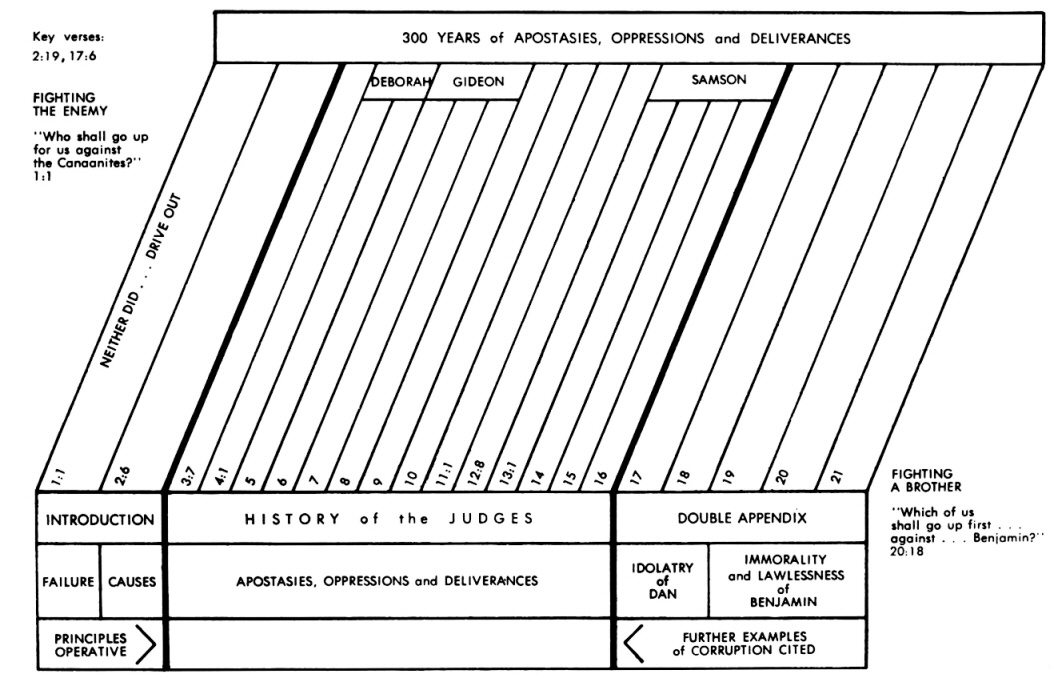
Chart from recommended resource Jensen's Survey of the OT - used by permission
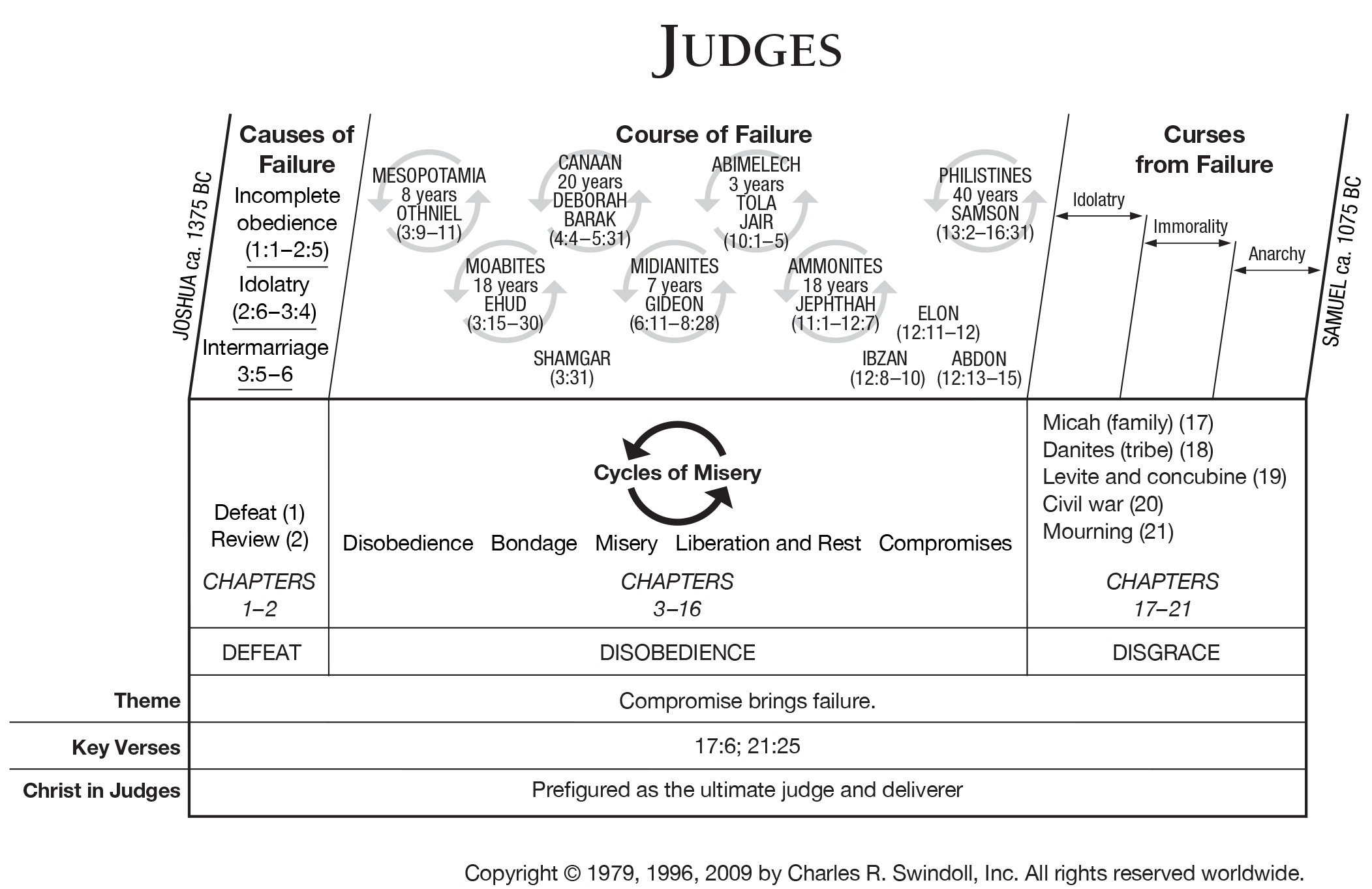
Chart on Judges - Charles Swindoll
|
RECYCLING SIN |
|||||
| Jdg 1:1-3:6 | Jdg 3:7-16:31 | Jdg 17:1-21:25 | |||
| Introduction | History of the Judges | Appendix | |||
| Causes of the Cycles THE REASON |
Curse of the Cycles THE RECORD |
Conditions in the Cycles THE RESULTS |
|||
| Failure to Complete Conquest Jdg 1:1-36 God's Judgment for Failure Jdg 2:1-3:6 |
Curse of the Cycles |
Conditions in the Cycles |
|||
| Living with Canaanites |
War with the Canaanites |
Living Like the Canaanites |
|||
| Religious Laxity |
Political Uncertainty |
Moral Anarchy |
|||
| About 350 Years of Israel's History - Almost 25%! From Compromise to Confusion! |
|||||

Another Timeline of Israel's History
Click to Enlarge
from Jensen's Survey of the OT
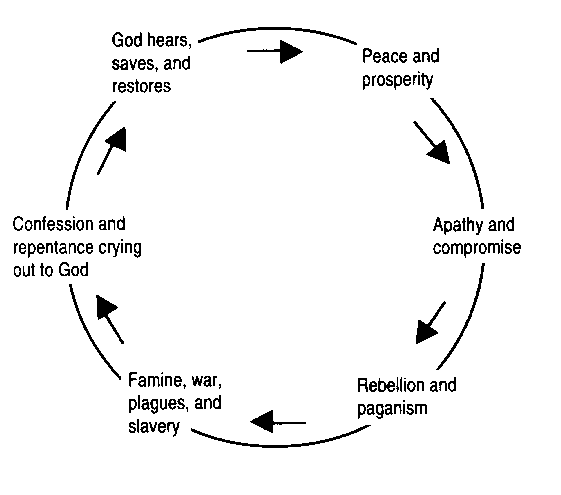
Click to Enlarge
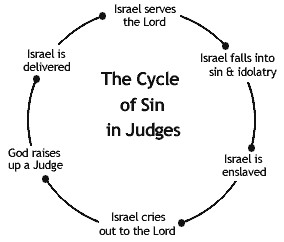
Other ways to describe Israel's cycle…
- Rest > Rebellion > Retribution > Repentance (?) > Restoration
- Sin > Suffering/Servitude > Supplication > Salvation
- Apathy > Apostasy > Affliction > Answered Prayer
- Disobedience > Desperation > Deliverance
- Disobedience > Bondage >Misery > Liberation and Rest > Compromises
Hannah's Bible Outline
Parenthesis: the tyranny of Abimelech (Jdg 8:33-Jdg 9:57)
- Israel's idolatry (Jdg 8:33-35)
- Shechem's submission to Abimelech (Jdg 9:1-57)
- Abimelech's treachery to become king (Jdg 9:1-6)
- Jothan's speech (Jdg 9:7-21)
- The parable (Jdg 9:7-15)
- The application (Jdg 9:16-21)
- Shechem's treachery toward Abimelech (Jdg 9:22-25)
- Gaal's aborted rebellion (Jdg 9:26-41)
- Abimelech's capture of Shechem (Jdg 9:42-49)
- Abimelech's death at Thebez (Jdg 9:50-57)
3. Tola (Jdg 10:1–2)
4. Jair (Jdg 10:3–5)
5. Jephthah (Jdg 10:6–12:7)
1. Israel’s sin (Jdg 10:6)
2. Israel’s servitude (Jdg 10:7–9)
3. Israel’s supplication (Jdg 10:10–16)
4. Israel’s deliverance (Jdg 10:17–12:7)
1. The preparations for battle (Jdg 10:17–11:28)
1. The armies gathered (Jdg 10:17–18)
2. The leader secured (Jdg 11:1–11)
1. His background (Jdg 11:1–3)
2. His covenant (Jdg 11:4–11)
3. The messages to Ammon (Jdg 11:12–28)
2. The vow and victory in battle (Jdg 11:29–40)
1. The vow made (Jdg 11:29–31)
2. The victory secured (Jdg 11:32–33)
3. The vow observed (Jdg 11:34–40)
3. The strife with Ephraim (Jdg 12:1–6)
1. Ephraim’s jealousy (Jdg 12:1–3)
2. Ephraim’s defeat (Jdg 12:4–6)
4. The death of Jephthah (Jdg 12:7)
6. Ibzan (12:8–10)
7. Elon (12:11–12)
8. Abdon (12:13–15)
FOLLOWING NOTES ARE COMPLETELY REVISED SPRING, 2022
Judges 11:1 Now Jephthah the Gileadite was a valiant warrior, but he was the son of a harlot. And Gilead was the father of Jephthah.
- Jephthah (KJV): Heb 11:32, called Jephthae
- a mighty (KJV): Jdg 6:12 2Ki 5:1
- an harlot (KJV): Heb. a woman
- Judges 11 Resources
- See excellent map of Jephthah and the Ammonites
- Map of all the Judges of Israel
- Map related to the Period of the Judges
- THE THREAT OF WAR (Judges 10:17–18)
- PARENTHESIS (Judges 11:1-3 - see comment below)
- THE SEARCH FOR A LEADER (Judges 11:4–11)
- THE ART OF DIPLOMACY (Judges 11:12–28)
- THE BATTLE OF AROER (Judges 11:29–33)
- THE FULFILLMENT OF A VOW (Judges 11:34–40)
Outline - Arthur Cundall
- Renewed Ammonite Pressure Judges 10:17-18
- The Rejection of Jephthah Judges 11:1-3
- The Recall of Jephthah. Judges 11:4–11
- Charge and Countercharge. Judges 11:12–28
- Jephthah’s Vow. Judges 11:29–31
- Defeat of the Ammonites Judges 11:32, 33
- The Fulfilment of Jephthah’s Vow Judges 11:34–40
Israel's deliverance (Judges 10:17-12:7) - Hannah's Bible Outline
- The preparations for battle (Judges 10:17-11:28)
- The armies gathered (Judges 10:17-18)
- The leader secured (Judges 11:1-11)
- His background (Judges 11:1-3)
- His covenant (Judges 11:4-11)
- The messages to Ammon (Judges 11:12-28)
- The vow and victory in battle (Judges 11:29-40)
- The vow made (Judges 11:29-31)
- The victory secured (Judges 11:32-33)
- The vow observed (Judges 11:34-40)
- The strife with Ephraim (Judges 12:1-6)
- Ephraim's jealousy (Judges 12:1-3)
- Ephraim's defeat (Judges 12:4-6)
- The death of Jephthah (Judges 12:7)
John Butler - JEPHTHAH, THE NINTH judge of Israel had a checkered career. It ended better than it started, however. His worth to Israel is his deliverance of Israel from the oppression of Ammonites, but he will always be a controversial character because of his vow that affected his daughter. Judges 11 can be divided into seven major parts as follows:
- The Valor of Jephthah (Judges 11:1)
- The Vilification of Jephthah (Judges 11:1–3)
- The Visitors of Jephthah (Judges 11:4–11)
- The Villain for Jephthah (Judges 11:12–29)
- The Vow of Jephthah (Judges 11:30, 31, 35)
- The Victory of Jephthah (Judges 11:32, 33
- The Vexation of Jephthah (Judges 11:34–40)
Paul Apple (Judges 10:6-12:15) Cycle # 5 – Deliverance from Philistines and Ammonites Jephthah (Judge #8)
God can use a man who is rejected by the world but appropriates His grace
1. Judges 10:6-11:28 Rise of Jephthah – From Despised Reject to Desired Recruit --
Don’t Underestimate the Love of God in Remaining Faithful to His People Despite Their Repeated Apostasies . . . And Don’t Underestimate the Grace of God in Transforming Human Outcasts Into Conquering Heroes
2. Judges 11:29-40 Jephthah’s Tragic Vow – Don’t Bargain With God –
Commitments Made to the Lord Must Be Kept Regardless of the Cost
3. Judges 12:1-7 Jephthah’s Legacy -- Internal Conflict Tears Apart the People of God –
Inflated Egos and a Harsh Spirit Erupt in Tragic Conflict for the People of God
Remember what was prophesied of the Lord Jesus Christ: “the stone which the builders rejected has become the chief cornerstone.” (1 Peter 2:7-8; Ps. 118:22 – “This is the Lord’s doing; it is marvelous in our eyes.” Acts 4:11-12) All of the judges point to the ultimate Deliverer in some form or fashion. Today we are going to be amazed at the love of God for His people and the grace of God to make leaders out of cast off rubble. Whatever our past may have been, by the providence of God it can be used to shape us and mold us for great usefulness to the Lord in the future.
Cyril Barber - Judges 11:1–3 is a parenthetical section between Jdg 10:17–18 and Jdg 11:4. Even though Jephthah had been reared in his father’s house (an act implying adoption and the conferring of legitimacy), when his father died Jephthah’s brothers disinherited him. Believing that “might makes right,” they banded together and threw him out. (BARBER USES SOME "POETIC LIBERTY" IN THE FOLLOWING DESCRIPTION, BUT IT IS LIKELY WHAT TRANSPIRED) Jephthah yearned for someone to say a kind word to him, but instead of compassion he saw stony glares on the faces of the townspeople; and in place of an outstretched hand and a smile, he saw backs being turned and doors being closed. Alone, and with the taunts and jeers of the people ringing in his ears, Jephthah was forced to leave his village. No one offered him counsel or gave him food for his journey. He was an outcast. (Judges: A Narrative of God's Power: An Expositional Commentary)
Now - Now often functions like a time phrase to introduce a new subject. In this case it serves to give some critical background on the hero of chapter 11. So we are left in Jdg 10:18 with the question of WHO WOULD LEAD GILEAD IN BATTLE against the Ammonites (which is why this was probably not a good chapter break)? But before the writer addresses the need for a leader he gives us a parenthetic panoramic view of Jephthah who began as an illegitimate child of a prostitute, was rejected by the natural heirs of his father Gilead (Jdg 11:2), and began to rise in notoriety in the land of Tob (Jdg 11:3) as the leader of a gain of raiders. Some think he was functioning somewhat like an oriental "Robin Hood".
Jephthah the Gileadite was a valiant warrior, (a mighty man of valor): (See Jephthah) This is the same epithet the Angel of the Lord used to address Gideon in Jdg 6:12+, but in this context uses this name to speak of his proven track record as a valiant warrior. In a military situation, a valiant man is a strong, adept warrior, such as Gideon. So while Israel was responding with repentance (Jdg 10:15-16), God was preparing Jephthah to be the leader who would deliver the Israelites from the 18 years of Ammonite oppression.
Valiant warrior in the Septuagint is "dunatos en ischui" which means "strong (powerful, mighty) in strength (power, might)" which is a "powerful" description of his character and aptitude! Samuel uses Jephthah as an illustration of how God raised up a leader to deliver Israel from trouble (1Sa 12:11). Jephthah is also in Hebrews "Hall of Faith" in Hebrews 11:32. Jephthah is a fascinating judge for even though some of his theology was questionable, he used the personal name of God more than any other judge in the entire book! It would seem to be no exaggeration that this man knew Jehovah, the covenant keeping God in a very real and personal way. He had been rejected by those closest to him, and now God had become his closest friend and this is what made him the man of God that he was.
NLT Study Bible - In Jephthah, inspired leadership took a new turn. He had humble origins, attracted followers, was eloquent in debate, and had Spirit-filled military prowess, but all of these were overshadowed by the fatal flaws of his untimely vow (Jdg 11:30-31, 34-35) and his petulant civil war with Ephraim (Jdg 12:1-6). Even his victory was short lived (six years, Jdg 12:7). The period of decline was underway, which increased the demand for kingship.
Stone has an interesting comment that "The name Jephthah is probably the short form for Jephthah-El, "God opens [the womb]," not a surprising name for a firstborn son, but an extremely ironic name for a man repudiated by his people and deprived of any descendants. The short form of the name does not imply uncertainty about the deity whom Jephthah served any more than it would with Caleb, Ehud, Deborah, Barak, Jael, or Gideon.(See Joshua, Judges, Ruth)
Stone on valiant warrior - Not one of the 40 other occurrences of the phrase in the OT refers to an unworthy person. To suggest that the narrator's characterization "hardly commends him spiritually for the role of savior of Israel" (Block 1988:50) misses the sociological import of this term and assumes a dichotomy between the "spiritual" and practical worlds that the OT does not share. Sometimes status as gibbor khayil is contrasted with some unfortunate circumstance, such as Naaman's leprosy, but the term itself unreservedly connotes dignity and honor. (Joshua, Judges, Ruth )
But he was the son of a harlot: In a word (the word my mother is a "harlot") this man was a social outcast and thus he lost his family rights (Jdg 11:2). He was a social outcast before men but not before God, Who had a providential plan. THOUGHT - As an aside we are all "outcasts" before we come to faith in Jesus and God has a beautiful pre-prepared plan for each of our lives (if you feel useless in His Kingdom work, memorize so you can mediated on Eph 2:10+!) Jephthah's lineage is even more clouded than Abimelech's (mother was a concubine), the Lord saw fit to use Jephthah in a remarkable way spite of the fact that he was an illegitimate child! God is still in the business of redeeming the broken lives of broken people born into broken family situations, praise God!
There is also a possibility that Jephthah's mother may well have been a Canaanite because she is called in the KJV "a strange woman" or "a woman of another race." This may be another reason his brethren drove him from the family.
G Campbell Morgan - The one thing which we emphasize is that God did not count the wrong for which he was not responsible, a disqualification. He raised him up; He gave him His Spirit; He employed him to deliver His people in the hour of their need.”
Gary Inrig writes that "The Lord does not produce Christians the way General Motors produces cars, rolling them off an assembly line, differing only in a few options. We search Scripture in vain for the stereotype into which we must fit before He can uses us. Yet many Christians suffer from a severe inferiority complex because they do not "fit the mold". Sometimes the fault is their's; often the complex comes from listening to other Christians. Thank God as Jephthah shows there is no such mold, the man nobody wanted. Driven out, he was alone in the world. Alone except for God. I do not have to be a prisoner of my past no matter how desperate that past was. God delights by using the unusable and in making what may appear ugly to men beautiful in His eyes." (Borrow Hearts of Iron, Feet of Clay)
James Jordan: Bastards could not be full citizens of Israel until the tenth generation (Dt. 23:2). . . Judah was the royal tribe in Israel; yet most of Judah were bastards (Gen. 38). Thus, they had to wait ten generations before they could take up full citizenship in Israel, and thus it was ten generations before any Judahite could become king. The genealogy in Ruth 4:18-22 shows that David was ten generations away from his bastard ancestor. This fact shows one of the reasons why Israel was not to have a king during the period of the Judges. Only someone from Judah could be king, and virtually all of Judah was temporarily excluded. This fact shows the folly of what Jephthah tried to accomplish . . .
And Gilead was the father of Jephthah.: Gilead is here a person’s name, in contrast to Jdg 10:17 and elsewhere (cf. Jos17:1, 3) where it refers to a place. Gilead in contrast to Gideon was apparently not a polygamist (as best we can discern from the text and context) but he was an adulterer, doing what was right in his own eyes! (Jdg 21:25).
Keith Krell - Jephthah’s name means “he opens,” and he is quite good at opening his mouth and speaking. Unfortunately, his mouth ends up getting him in a lot of trouble. Jeff is the Peter of the Old Testament. Yet, initially he is the victim, not the victimizer. When Jeff’s dad dies and the inheritance is to be divided, his brothers drive him away because he is the son of a harlot. Little do Jeff’s brothers realize they are rejecting the man that would deliver them and all of Israel. Jephthah is in good company though. Joseph was rejected by his brothers and later became their savior. It also took King David seven years to gain the full support of the twelve tribes of Israel. Even Jesus was rejected by His people (Jn 1:11), but will be received by them when He comes again (Zech 12:10+). Indeed, God has a huge sense of humor and He shows it here. Jephthah turns out to be the most gifted guy in the family. What a great reminder that God chooses the weak and foolish people of this world to shame the wise and strong (1Cor 1:27+). (Failure in the Family)
George Bush - Now Jephthah—was a mighty man of valor. More properly perhaps, ‘had become.’ The original היה hâyâh, is not merely a verb of existence, but denotes the transition of its subject, from one state to another . When its meaning is simply ‘is,’ or ‘was,’ it is almost invariably omitted in the original. Here, however, it is inserted, and probably hints at the process by which Jephthah had gradually become distinguished. (ED: THIS A GOOD THOUGHT AND PICTURES HIS CHARACTER DEVELOPING IN THE MIDST OF HIS ADVERSE CIRCUMSTANCES)
The son of an harlot. Heb. אשה זונה ishâh zonâh, Literally = a woman, a harlot. Not begotten in lawful wedlock. The Jewish commentators, for the most part, give a softening exposition of the term here employed, as if it imported merely a concubine, or a gentile, i. e. a foreign or strange woman, not one of the Israelitish race, as she is termed in Jdg 11:2. But without doing violence to its ordinary and most legitimate sense, we know not how to depart from the rendering of the text. At the same time, it is to be observed, that our limited knowledge of the actual state of manners and society in those ancient periods, prevents us from affirming, that the word conveys precisely the idea of public addictedness to degrading vice, which its modern acceptation imports. It may have indicated a character somewhat less vile and iniquitous, but the ambiguity of the term is not sufficient to cover all disgrace in Jephthah’s origin. His extraction, however, whatever it was, was the fault and disgrace of his parents rather than of himself, and a man should not be reproached with the unhappiness of his birth, when his own conduct bespeaks him deserving a more honorable relation.
Gilead begat Jephthah. One of the descendants of the Gilead mentioned Nu 32:1; Josh. 17:1, 3, and bearing his name. To what tribe he belonged is not certain, but probably that of Manasseh beyond the Jordan. 1 Chron. 7:14. (Judges 11 Commentary)
A R Fausset - Now Jephthah the Gileadite was a mighty man of valour, and he (was) the son of [a woman] an harlot [or concubine. In 1 Chron. 7:14, Manasseh’s concubine, who bare Machir father of Gilead, is described as an ‘Aramitess’ or Syrian. Jephthah, at his father’s death, fled to the land of Tob, an Aramean settlement (2 Sam. 10:6, margin); probably to the land of his mother’s kindred. Therefore she was probably a Syrian. The vicinity of the Gileadite half tribe of Manasseh to Syria led to marriages with Syrians, and to apostasy to “the gods of Syria” (ch. 10:6)]; and Gilead [not the original founder of the clan, but a descendant who bore the name of his famous ancestor] begat Jephthah. (Judges 11 Commentary)
Related Resource:
Valiant (strength) (02428) chayil strength, wealth, army. This word has the basic idea of strength and influence. C P Weber - In the sense of "strength," "power," or "might" in general, ḥayil is used about twenty times: of God (Psalm 59:11), from God (Ps 18:32), physical strength of a man (Eccles. 10:10), or even of plant life (Joel 2:22). As wealth is often related to power, ḥayil is thus used to mean "wealth" about thirty times being translated "wealth," "riches," "substance," or "goods." It may be the wealth of a nation (Tyre, Ezekiel 28:4-5) an individual (e.g. Job 31:25), the wicked (Job 15:29), or from God (Dt. 8:18, etc.). Approximately eighty-five times ḥayil is used as an attribute of people. It follows ʾîsh "man" ("valiant man," 1 Kings 1:42), sometimes bēn, son" ("valiant man," 2 Sa 17:10), and most often follows gibbôr "mighty (man)" ("mighty man of valor"). The individual designated seems to be the elite warrior similar to the hero of the Homeric epic, and it may be that the gibbôr hayil was a member of a social class. Although in most contexts his military prowess was involved, he was wealthy enough to bear special taxes (2 Kings 15:20, translated because of context, "mighty men of wealth"). The use in 1 Kings 1:52 indicates that the ben ḥayil (translated "worthy man") was also to be honorable or reputable. Adonijah's life was in danger because of his treachery, not because of lack of strength or wealth. ḥayil also designates men of ability to care for Joseph's sheep (Genesis 47:6, translated "men of activity"), or to judge the people (Exodus 18:21, 25, translated able men").
Uses of chayil in Judges - Jdg. 3:29; Jdg. 6:12; Jdg. 11:1; Jdg. 18:2; Jdg. 20:44; Jdg. 20:46; Jdg. 21:10;
Warrior (01368) gibbor cp related verb gabar = be strong, accomplish, excel, prevail) is from a root which is commonly associated with warfare and has to do with the strength and vitality of the successful warrior. And thus this adjective means powerful, strong,
Gibbor in Judges - Jdg 5:13 = "warriors", Jdg 5:23 = "warriors", Jdg 6:12 = "O valiant warrior" (Gideon), Jdg 12:1
Harlot (actually two words in Hebrew - ishshah = woman + zanah) (02181)(zanah is a verb meaning to fornicate, to prostitute and refers to marital infidelity or unfaithfulness. It was word used elsewhere in the OT to describe prostitution (Lev 21:7, Pr 7:10). Many of the uses of zanah are figurative describing Israel 's (Jehovah's "wife") commission of "spiritual prostitution" by having "intercourse" so to speak with other gods (cp 1 Co 6:16). Indeed, idolatry is looked upon as prostitution (Isa 50:1-3; 54:6, 7, 8; Jer 2:1-3; 3:1ff; Hos 2:1ff; Jas 4:4+; Rev 2:4+). In addition zanah describes Israel’s improper relationships with other nations (Isa. 23:17; Ezek. 23:30; Nah. 3:4). "The thought seems to be of having relations with these nations for the sake of political and monetary benefit, although in the case of Nineveh the added element of alluring, deceitful tactics leading on to oppressive dominance is implied. A third figurative meaning is found in Isa 1:21, where the Israelites’ departure from God’s approved moral standards is called harlotry." (link to TWOT online) CLICK HERE TO SEE THE REMAINDER OF THIS LENGTHY DEFINITION BELOW
Cyril Barber on Jephthah - It is doubtful if we can experience any hurt more painful than the ache of rejection. The great Scottish preacher Dr. Alexander Whyte knew what this was like. He had been born out of wedlock, which carried a lifelong stigma in his day. The unfortunate circumstances of his birth excluded him from the company of his peers. He had to contend with the mockery of boys his age, the scorn of the girls, and the whispers of the townspeople whenever they saw him in the street. He knew from painful personal experience the agony of being made to bear the punishment of a sin not his own. John Whyte, Alexander’s father, had offered to marry Janet Thompson, Alexander’s mother, but she refused. When Alexander was born, his mother gave him his father’s surname. She reared him in poverty, but with deep spiritual piety. In time he became apprenticed to a shoemaker. Through hard work he was finally able to study at the universities of Aberdeen and Edinburgh. Dr. Whyte never forgot his illegitimacy. His preaching was marked by a keen sensitivity to the evils of his day, as well as a profound identification with those who suffered. In the course of his ministry, he preached on most of the people of the Bible, and his character studies now fill two large volumes. His insights into the life and character of Jephthah paint a vivid word-portrait:
Jephthah the Gileadite was the most ill-used man in all the Old Testament, and he continues to be the most completely misunderstood, misrepresented, and ill-used man down to this day. Jephthah’s ill-usage began when he was born, and it has continued down to the last Old Testament commentary and last Bible dictionary that treats of Jephthah’s name. The iron had entered Jephthah’s soul while yet he lay in his mother’s womb; and both his father and his brothers and the elders of Israel helped forward Jephthah’s affliction, till the Lord rose up for Jephthah and said, “It is enough.” (Judges: A Narrative of God's Power: An Expositional Commentary)
F B Meyer - TURNING TO A REJECTED LEADER Judges 10:17-18; Judges 11:1-11
The life of Jephthah is a great consolation to those whose birth has been irregular. The sin of his parents was not allowed permanently to injure his career. He is also distinctly mentioned in Hebrews 11:1-40 as one of the heroes of faith. See Ezekiel 18:14-17.
Driven from his home, Jephthah took to the life of a bandit-chieftain, probably in much the same fashion as David in after-years when he protected, for payment, the cattle of the Hebrew grazers from Ammonite forays. See 1 Samuel 25:15. Jephthah’s wife apparently had died; but his sweet and noble daughter grew up amid that wild horde, and they were all in all to each other. As David influenced a similar band, so did this father and child lift the tone and morale of their followers, until the story of it filled the land and brought the, elders, who years before had sided with Jephthah’s brethren, to entreat him to lead the fight for freedom. What a beautiful suggestion of our Lord! He came to His own and they crucified Him. He comes to us and we at first refuse Him. But His love never faileth. Being reviled, He blesses; being persecuted, He endures; being defamed, He entreats, 1 Corinthians 4:12.
Phil Newton - Judges 11:1-11 Confusing Times
There is no clean, neat, I-dotting, t-crossing story in this portion of Judges. We're met with confusing, troubling issues. Perhaps this is something of the medicine that we need to cure the vanity of American cultural Christianity. Let me amplify what I mean. It seems that much of the evangelical world lives in a make-believe Christian world. Everyone lives happily ever after, regardless of the setting. To unruffled our neat, packaged ideas of God, the gospel, and the Christian faith will not do. Many will avoid reading or listening to anything that will disrupt their comfortable lives. They say they believe that God is sovereign but refuse to consider what this sovereignty means. They claim to believe in the gospel but know little of the meaning and implications of the gospel, and then recoil when the gospel is applied.
We like to think that Bible stories present lovely pictures of happy, satisfied people. But instead, we have the most realistic pictures presented to us. We see man in his sinfulness, weakness, and folly, whose only hope can be found in the God of sovereign grace.
Jephthah is just such a story. He had an ignoble beginning, the offspring of infidelity. He was rejected by his brothers (or half-brothers) because of his mother being a harlot. He leaves home and "worthless fellows" join him to form a brigand. Once he is finally accepted, he opens his mouth and makes a most foolish vow, resulting in the death of his daughter, contrary to the laws of God. Though he was given a great victory over his enemies he finds no satisfaction in it because of his own personal tragedy. To top it off, he is unable to reconcile a neighboring tribe and so instigates a slaughter of his kin in Israel. In spite of this, Jephthah finds his way into the "Hall of Faith" in Hebrews 11 (32).
In spite of the failures, tragedies, and great errors, God was pleased to use Jephthah to accomplish His purpose in Israel. We see again that He is a God of grace who bestows upon unworthy creatures His kindness. And we see that in spite of God's gracious favor, men can still act in the most reprehensible ways. God is not reduced to a cookie-cutter pattern of action, nor is man who is used by God squeezed into the same mold.
I. An unlikely instrument with God
It is somewhat easy to pre-judge an individual and what he can accomplish. Certain positions and pedigrees appeal to the flesh as being greater and more useful for service to God. But God is pleased to do what we do not naturally expect! Cf. I Corinthians 1:26-29
Rejected by men, Judges 11:1-2
How else can we explain Jephthah? E.g. Erasmus was the illegitimate son of a priest and a physician's daughter; William Carey had neither education, notoriety nor family connections in England; Spurgeon was raised for several years by his grandparents because his parents were too impoverished to care for him. What the world despises makes no difference to the sovereign Lord.
That no man would boast, Judges 11:3-11
Though rejected, Jephthah was being prepared for leadership and as a deliverer for the ones who rejected him. We must recognize this much about him:
- He made the most of his dire situation
- He showed no bitterness of rancorous spirit when invited to return
- He was willing to lay down his life to serve even those who had rejected him
- He understood that the source of victory would be the Lord (Judges 11:9)
- He willingly spoke of the Lord among his relatives (Judges 11:10-11)
Application: Too often we despair of our own usefulness before the Lord because of fame, money, position, power. We put so much value in the impressive things of the world. Consequently, we end up trusting things and missing the blessing of the Lord. In this sense Jephthah is a stunning rebuke to all who complain or make excuses for lack of service or who fail to look to the Lord in sheer, unadulterated dependence. (Sermon)
Alan Carr - Judges 11:1-3 AN APPALLING REJECTION
A. Judges 11:1 Jephthah’s Character –
The first revelation we have concerning Jephthah is that he is “a mighty man of valor”. The phrase “mighty man” means that Jephthah was marked by “great bravery”. The word “valor” refers to “strength, ability and efficiency”. This identified Jephthah as a very courageous and powerful man. He was the kind of man who did what needed to be done in every situation he faced in life. He was the kind of man who refused to back down. He was the kind of man you would like to have at your back in a battle. He was the kind of man others would look to for leadership. He was a strong, able and efficient man.
B. Judges 11:1 Jephthah’s Challenge –
The next truth we learn about this man is the fact that “he was the son of a harlot”. His father’s named was “Gilead”. Evidently, Gilead was a man who frequented prostitutes. One became pregnant and bore him a son named Jephthah. This was a major strike against Jephthah as it marked him as an illegitimate son of Gilead.
(Note: Like everyone in this room, Jephthah had marks in the plus column and marks in the minus column. He had areas of his life that were extraordinary while other areas were problematic. We are all in the same boat. Most of us do not trumpet our abilities, yet we go to great lengths to conceal our problems. This just reminds us that we are human, and as long as we live in this world, we are going to remain less than perfect. No matter how far up the ladder of holiness we climb, we will still be sinners, and we will still desperately need a Savior.)
Judges 11:2 And Gilead's wife bore him sons; and when his wife's sons grew up, they drove Jephthah out and said to him, "You shall not have an inheritance in our father's house, for you are the son of another woman."
- they drove Jephthah out: Ge 12:10 Dt 23:2 Ga 4:30
- you are the son of another woman: Pr 2:16 5:3,20 6:24-26
- Judges 11 Resources
JEPHTHAH THE
OUTCAST
And Gilead's wife bore him sons; and when his wife's sons grew up, they drove Jephthah out and said to him, "You shall not have an inheritance in our father's house, for you are the son of another woman - Gilead’s wife refers to his lawful wife, not to Jephthah’s mother and yet to Gilead's credit he did acknowledge him, but the same acceptance was not found with his brothers. Note the reason given to explain why Jephthah has no inheritance is explained ("for" - term of explanation) by his birth from another woman or strange woman as in the KJV. What is sad is that Jephthah was not to blame for the untoward circumstances of his birth and yet he is held responsible. Bush says the Hebrew (אשה אחרת ishâh a’hereth) is literally "of another woman" i.e., other than his lawful wife, and probably a foreigner." (cf Ex. 1:8; Dt. 29:26; Jer. 22:26)
Bush - You shall not have an inheritance in our father's house. That he was not entitled to share in the inheritance was a matter of course, for even the children of the lawful secondary wife or concubine were not admitted to this privilege, Ge 21:10, and Ge 25:6, much less the issue of such an illicit connection as that in question. But Jephthah’s brethren were probably actuated by some secret motive of jealousy or envy, which they would fain conceal by the plea of illegitimacy and outlawry here advanced; for it does not appear that his expulsion from his father’s house was necessary simply on this account. At any rate, he evidently regarded it as a gross outrage upon his rights, Jdg 11:7, and one which the elders and magistrates of the city connived at and abetted. The pretense of legal right is often a mere cover to the foulest wrongs and injuries (ED: GREAT POINT WHICH IS MANIFEST AT ALL LEVELS OF OUR MODERN JUDICIAL SYSTEM!). (Judges 11 Commentary)
They drove Jephthah out (garas; Lxx - ekbállō) and said to him: Garas is used in Ge 21:10 where Sarah gave the same reason declaring "to Abraham, “Drive out this maid, and her son, for the son (ISHMAEL) of this maid shall not be an heir with my son Isaac.” In both cases the sins of the father's had significant consequences to their sons. Fathers… listen up. Take heed and be instructed by these OT examples given that we might not crave evil things as they craved! (1Cor 10:6+).
HCSB - Driven from his home, Jephthah lived the life of a bandit in the land of Tob, where he was joined by lawless men. This is the same phrase used to describe Abimelech's mercenaries in Judges 9:4+. Jephthah was a man without a home, a family, or a future.
Rich Cathers - God uses outcasts - It seems that God has this habit of using people that have been rejected by others. Joseph was rejected by his brothers. David was rejected by his boss, Saul. Jeremiah and many of the other prophets were often rejected because of their message. Jesus was rejected by His people, the Jews. Paul wrote, (1 Cor 1:26-27 KJV) For ye see your calling, brethren, how that not many wise men after the flesh, not many mighty, not many noble, are called: {27} But God hath chosen the foolish things of the world to confound the wise; and God hath chosen the weak things of the world to confound the things which are mighty (Sermon Notes)
IVP Background Commentary - It should be noted that it was not any family shame or humiliation that resulted in Jephthah’s being driven out. With the existence of temple prostitutes and polygamy it would be fairly common for children of different mothers to be in the same household. Here the text makes it clear that it was the inheritance that motivated the expulsion. Whether Jephthah, as the firstborn, had rights to a double portion, or whether they were dividing equally (see comment on primogeniture at 9:2), elimination of one party would increase the shares of the others. (See context The IVP Bible Background Commentary)
A R Fausset - And Gilead’s wife bare him sons: and his wife’s sons grew up, and they thrust out Jephthah, and said unto him, Thou shalt not inherit in our father’s house [just as Ishmael the son of the concubine, and the sons of Keturah, were sent away by Abraham, not to inherit with Isaac the son of the wife (Ge 21:10, 25:5, 6). Though not entitled to share his father’s inheritance, he was entitled to sustenance: therefore Jephthah upbraids them (Jdg 11:7)]; for thou (art) the son of a strange woman. (Judges 11 Commentary)
Drove out (01644)(garas) is a verb that means to cast out, drive out. Garash depicts God driving Adam and Eve from Eden (Ge 3:24), God driving Cain from His presence (Ge 4:14), Jonah expelled from God's sight (Jonah 2:4), Pharaoh driving out the Israelites (Ex 6:1; 12:39), Pharaoh driving Moses and Aaron from his presence (Ex. 10:11), repeatedly used of God driving out Israel's enemies (Ex 23:28-31, 33:2, 34:11, Dt 33:27, Jos. 24:12, Ps. 78:55, Ps. 80:8 contrast result because of Israel's disobedience - Jdg 2:3-note, Hos. 9:15) . It is used in the general sense of banishing outcasts from society (Job 30:5). In its figurative usage, it indicates divorcing one’s wife (Lev. 21:7). It describes the sea or a river as driven and tossed (Isa. 57:20; Amos 8:8). The word is also used of a divorced woman in Lev. 21:7, a woman that is “put away from her husband.”
Garas in Judges - Jdg. 2:3; Jdg. 6:9; Jdg. 9:41; Jdg. 11:2; Jdg. 11:7;
Gary Inrig introduces Jephthah - Rejected by Men, Accepted by God
The name of G. Campbell Morgan isn’t well known today, but for many years he was renowned throughout the English-speaking world as the “prince of Bible expositors.” His ministry took him around the world, but his impact was especially felt in Great Britain in the first half of the twentieth century.
To help ease the financial pressures in his family, Morgan found it necessary to work as a school teacher. But his heart was in the ministry of God’s Word, and he took every opportunity that came his way. Finally, he decided to seek credentialing for the Methodist ministry. Because of his lack of formal training, part of the process was a “trial sermon,” to be preached before examiners. Morgan found himself among 150 candidates applying that year, and, on the appointed day, his examination took place in a church in Birmingham, England. He was met by a rather austere examiner who, on meeting him, said rather sharply, “Now I am ready for you!” Already intimidated, the young man walked into a thousand-seat auditorium to find only seventy-five people present. In that context, what little self-confidence he had utterly vanished, and he did very poorly. Two weeks later, when he received word of the results, Morgan was among the 105 who were rejected.
Despondent, he sent a one-word telegraph to his father: “Rejected.” He then poured out his soul in his diary: “Very dark everything seems. Still, he knoweth best.” But very quickly a reply came back: “Rejected on earth. Accepted in heaven. Dad.” That word of encouragement was enough to keep him going. He became an itinerant evangelist, was later ordained as a Congregationalist, and was one of the most sought-after speakers of his day as well as a writer whose books many still read.20
Rejection is a bitter pill to swallow, and it can scar us for life. But the things that often cause people to reject us do not necessarily disqualify us before God. All too often we live with a sense that unless we possess certain very specific skills or personality traits or qualifications, we fall short. Or perhaps we measure ourselves by our family background, our social standing, or a blemish-free past. The result can be discouraging. We convince ourselves that, at best, we will be allowed to watch and cheer as the real spiritual first-string accomplishes God’s truly significant work. Without the proper credentials, we are not the kind of people the Lord can or will use.
As we have already seen, that is not the pattern we find in God’s Word. God is not a God of stereotypes, and, if we need any confirmation of that, we have it in abundance in the study of another judge, a unique man named Jephthah. He was a man in whom we find great conflicts and contrasts. There are some ugly blotches in his life, but there are also some glorious victories.
To understand Jephthah, it is essential for us to understand the times in which he lived and served God. That background is given in Judges 10:6–18....
Jephthah’s emergence is unlike that of any other judge. Earlier judges have been raised up by God, often in rather dramatic fashion. But there is no such intervention that puts Jephthah on stage, as it were. Instead we are shown the deliberations and maneuverings of people. That is not to suggest that God is not at work behind the “seen.” He clearly is, but Jephthah’s emergence is described as “ground-level.”
When the Ammonites once again moved in force into Israelite territory east of the Jordan (the region of Gilead, part of modern-day Jordan), they aroused a counter-response by the eastern Israelite tribes, who mustered against them at Mizpah. It is hard to imagine that they became aware of the problem only at that point, but it quickly became evident that they lacked one vital ingredient—a leader of enough skill and charisma that he could lead the Israelite forces against the enemy. This was no small problem—survival depended upon it! The question “Who will lead us?” was a cry of desperation, not one of curiosity. It was a situation that should have driven them to their knees in heartfelt prayer to the Lord that He would either reveal or raise up such a deliverer, as He had in the past.
There is no such prayer. Instead there is a declaration that combines appeal and bribery: “Whoever will launch the attack against the Ammonites will be the head of all those living in Gilead.” To accept any person who would simply claim leadership or automatically to make a military leader a nation’s political head without knowing in advance whom that person might be would not be considered a wise strategy. But desperate times call forth desperate measures, and the Israelites were desperate. Not, mind you, desperate enough to humble themselves before their God!
It is at this point that we are introduced to Jephthah by way of a flashback. He is one of the most unusual men in the Old Testament: a man with a tragic past, a checkered career, and a strong personality, a man possessed with more than his share of faults. Nothing about Jephthah came in pale colors. His gifts and weaknesses were painted in bold colors, and his inner conflicts ran deep. Yet he was a man God used to accomplish something of His purpose for His people.
The Lord does not produce Christians the way General Motors produces cars, a few basic models rolling off an assembly line with a variety of available options. He is infinitely creative. We search Scripture in vain for an established pattern into which we must fit before He would deign to use us. As I write this, I am on my way home from a pastor’s meeting, intrigued once again by how very different the various men were— differences in personality, appearance, age, ethnicity, background, and skill set—yet we do very similar things. God can use each one of us. Yet many Christians suffer from a severe inferiority complex because they do not “fit the mold,” whatever they conceive it to be.
Sometimes the fault is ours because we put restrictions on God; sometimes it is others’, who are quite sure they have the Lord figured out. Thank God, there is no such mold. Some time ago a friend wrote a letter describing what he was witnessing as a missionary in Ethiopia. Among other things, he wrote:
The key to the exciting growth of the church in Ethiopia is the Holy Spirit. His human agents in all of this are the Ethiopian evangelists. Nine of them share the work here . . . Each man is supported by his home church which provides him with about $20 a month. All of them have families, and, as you can well imagine, find it very difficult to make ends meet on such meager allowances.
As for the men themselves, there is little, humanly speaking, to commend them as missionaries. Without exception, they would be rejected by North American mission societies. Their average education is grade four. Some of them have no formal Bible training.
Take Indreas, for example. With his wife—a former barmaid—and four children—one of whom is a hunch back—he preaches and teaches at a remote point two full days journey from Bonga. Last time I went to his church, I attended the baptism of 88 believers!
Or take Arshe, a young man of about 25. He has six fingers on his hand. He is well educated by local standards, having completed grade six as well as some Bible training. His wife has T.B. His church, too, is growing, with 24 baptized one month, while many more believed.
Jephthah was an Old Testament man like that—a leader of the society of the unacceptable. Yet God, in His sovereign wisdom, chose to use and work through Him. The passage before us depicts him in five distinct stages of his development. (Borrow Hearts of Iron, Feet of Clay)
Alan Carr - Judges 11:1-3 AN APPALLING REJECTION
Judges 11:2 Jephthah’s Conflict –
Jephthah’s father also had children with his wife. When these legitimate children reached maturity, they all turned on Jephthah and forced him out of the family home. Apparently, their father is dead and they refused to share their inheritance with Jephthah. Most likely they were motivated by greed. With Jephthah out of the way, there was more money to go around. Besides, Jephthah’s presence in the family was a constant reminder of their father’s infidelity.
They had probably hated Jephthah all their lives. They may have even envied him since he was a strong, able and efficient man. He was probably everything they were not and they turned on him. They hated him because he represented everything they could never be.
(Note: Jephthah paid a price for the sins of his father. His father was a philanderer who brought an illegitimate child into the world. That child lived with the stigma of his father’s sins his whole life. His life was scarred by the actions of his father and his half-brothers, but he did not stoop to the same level of evil he saw in them. Jephthah broke the cycle of sin in his family and became a better man than the others in his family.
We need to stop here and learn a valuable lesson. Exodus 34:7 says, “Keeping mercy for thousands, forgiving iniquity and transgression and sin, and that will by no means clear the guilty; visiting the iniquity of the fathers upon the children, and upon the children's children, unto the third and to the fourth generation.” This does not mean that God will punish you for what your parents did. It does mean that what your parents did will often bear fruit in your life.
Children often develop attitudes that are similar to their parents. They develop ways of living that are like their parents. They have prejudices, likes and dislikes that were built into them by their parents.
The fact is, a lot of what we do is generational. We may not like it, but we carry the influence of our family with us all the days we live. If your mother was hateful, there is a good chance that you might have the tendency too. If your father was a drunk, you could be prone to problems in that area. If you grew up hearing criticism and negativity, you have a good chance of becoming a negative of person too. If you grew up in an abusive home, you might have that kind of mindset as well.
However, someone has to break the cycle! Just because your parents did certain things to you or around you it does not mean that those things have to be a part of your life today. You have the opportunity to change. There is power, grace and help in the Person of the Holy Spirit and in the Word of God. As we yield to God and allow Him to work in our lives, we can rest assured that He will work to change us into His image. That is His goal, Rom. 8:28-29; Eph. 1:4; 4:13-15.
I don’t know if that speaks to any of your hearts today, but let’s break the cycle of sin in our families and set our children free. There is help, hope and power in the Word and will of God.)
(Note: Others have suffered this kind of familial rejection. David experienced it. When Samuel came to Jesse’s house to anoint one of his sons as king of Israel, they did not even think enough of David to call him to appear before the prophet. Jesus Christ experienced it. His half-brothers mocked His claims to be the Messiah. They doubts His identity and none of them believed on Him until after His death and resurrection, John 7:2-5. At one point all His family and friends thought He was crazy, Mark 3:21.
Your earthly family may turn against you, but if you are saved, you are a member of a new family. Your Heavenly Father will never turn you away! Your true brothers and sisters will never fail to love you, forgive you and stand by you. That is the nature of our new family! Like the song writer said. “I’m so glad that I’m a part of the family of God!”) (Judges 11 - The Reject Who Became a Ruler)
Judges 11:3 So Jephthah fled from his brothers and lived in the land of Tob; and worthless fellows gathered themselves about Jephthah, and they went out with him.
- Jephthah fled from his brothers: Heb. from the face of
- worthless fellows gathered themselves about Jephthah: Jdg 9:4 1Sa 22:2 27:2 30:22-24 Job 30:1-10 Ac 17:5
- Judges 11 Resources
Related Passages:
1 Samuel 22:1-2 So David departed from there and escaped to the cave of Adullam; and when his brothers and all his father’s household heard of it, they went down there to him. 2 Everyone who was in distress, and everyone who was in debt, and everyone who was discontented gathered to him; and he became captain over them. Now there were about four hundred men with him.
JEPHTHAH FLEES TO "LAND OF GOOD"
AND GATHERS A "GANG"
So Jephthah fled from his brothers and lived in the land of Tob (see map for probable location); and worthless (req) fellows gathered themselves about Jephthah, and they went out with him - Tob (see map Tob = "land of good") - The fact that he fled (Lxx has apodidrasko = run away, escape, especially by stealth) suggests that they did not just casually tell him to go but were more aggressive. Tob is probably in region of modern day Syria and is to the north and east of Gilead (on east side of Jordan River). There is a slight word play for Tob is from a root meaning to be pleasing which the antithesis of what he was in the eyes of his brothers! Worthless is a Hebrew word which means to make empty, in context describing men who idle and looking for something to do (cf unemployed). The fact that they gathered about him show that he was honing his skills as a leader. It is also notable that the Septuagint translates gathered with sullego which means to gather by plucking or picking suggesting he handpicked the men and here is in the imperfect tense picturing this as a process. Clearly his reputation was growing in Tob and attracted these men. Thus even in this exiled state we see his leadership qualities rise to the top. Jephthah did not let circumstances restrict or limit who he was, and in fact his circumstances actually allowed him to develop into the leader he would later be. God clearly was at work in the providential circumstances of making sure he was kicked out of his family. They went out with him is a key phrase raising the question went out where? I think the NRSV translation is "spot on" as it says "went raiding with him." (Jdg 11:3NRSV) Several other translations also favor this idea - AMP = "went on raids with him." TLB = "living off the land as bandits." MLB = "joined him in banditry." NJB = "used to go raiding with him." NAB = "went out with him on raids." NKJV = "went out raiding with him." Bush adds that went out with him "is a phrase frequently applied to warlike and plundering inroads upon an enemy’s territory." This paraphrase would makes sense in the overall context, for if indeed he was the leader of a band of raiders (some say he like an ancient "robin hood"), it would have allowed him to hone his skills as a valiant warrior (Jdg 11:1) and would also give him a reputation as a man of war. And the fact that the land of Tob was likely not that far from Gilead, soon led to his reputation spreading eastward to his Israelite relatives.
Arthur Cundall - Eventually he was thrust out by his stepbrothers, an event which determined his whole future, for he became a brigand-chief over a group of outcasts and social misfits. There is some correspondence with the factors that shaped the career of David who, driven into the wilderness by Saul’s jealousy, gathered to himself those who were in distress or debt, or who were discontented (1 Sam. 22:2), and welded them into a formidable force. At a later stage, still pursued by Saul and unsure of the loyalty of his own countrymen, David went over to the Philistines as a mercenary captain, learning the arts of warfare which were to serve him in good stead in the course of his long reign. So Jephthah the despised, through dire misfortune, was prepared for the task of saving the very people who had thrust him out. Tob has been tentatively identified with the modern el-Taiyibeh, about 15 miles east-north-east of Ramoth-gilead, in the desolate area which lay just outside the eastern boundary of Israel and the northern frontier of Ammon. (Borrow Judges & Ruth: Tyndale Old Testament Commentary)
George Bush - Were gathered vain men to Jephthah, and went out with him. Heb. ריקים אנשים rëkim anâshim, empty men; that is, idle, worthless, profligate men, a lawless rabble. The original רקים is a term of great reproach, being the same with ‘Raca,’ in the New Testament. The meaning evidently is, that Jephthah, being without any inheritance or family connexions to afford him a subsistence, and being expelled from his native place, became an adventurer, and his character having brought around him a number of brave but idle men, perhaps similarly circumstanced, he made predatory incursions into the neighboring countries. This is what is meant by ‘going out with him,’ a phrase frequently applied to warlike and plundering inroads upon an enemy’s territory. Probably they went out particularly into the land of the Ammonites, to retaliate the incursions which the latter made into Israel; and Jephthah’s success or skill in these free-booting expeditions acquired him so much reputation, that the people would naturally be led to look to him when they wanted a military leader. The mode of life here indicated, is precisely that which was followed by David, when his reputation brought around him men of similar character to these followers of Jephthah. This kind of military robbery is far from being considered dishonorable in the East. On the contrary, the fame thus acquired is thought as fair as any that can be obtained through any class of military operations. An Arab or Tartar desires no higher or brighter distinction than that of a successful military robber; and to make that fame unsullied, it is only necessary that his expedition should not be against his own nation or tribe.
(Judges 11 Commentary)
NIV Study Bible on the land of Tob. The Hebrew name sounds exactly like "the good land," a common way of referring to the promised land in Deuteronomy. The narrator appears to call attention to the irony of this outcast from Israel finding a refuge in "a land of good (things)." The men of Tob were later allied with the Ammonites against David (2Sa 10:6-8). adventurers. (See context NIV Study Bible, Fully Revised Edition)
Gary Inrig on Jephthah: He became a kind of Hebrew Robin Hood, a leader of a military band who functioned as an unofficial police force. He skillfully brought together this refugee band, and, for a price, they protected the Hebrews and attacked the enemy. This provides another interesting parallel to the life of David because he did exactly the same thing in the period while he was hiding from King Saul....Alone except for God. The grace of God was at work in this man’s life, rescuing him from an apparently hopeless future. God does not submit to human prejudices, and He is not limited by the social, parental, and environmental factors that men consider determinative. A Christian knows that God is the great Determiner, and in that knowledge there is freedom. I am not a prisoner of my past, no matter how desperate that past was. God delights in using the unusable and in making the ugly beautiful.
Guzik - “He and his band probably operated more in the manner of David and his group years later, protecting cities and settlements from marauders.” (Wood) David did this in the period described in 1 Samuel 25:4-8, receiving pay from those whom they helped. It is also possible that they only plundered the villages of enemy peoples, such as the Ammonites.
A R Fausset - Then Jephthah fled from [the face of] his brethren, and dwelt in the land of Tob [north-east of Peræa, bordering on Syria and Ammon (2 Sam. 10:6, 8). Ptolemy mentions a Thauba south-west of Zobah. There is still a Tell Dobbe ruin south of the Lejah]: and there were gathered vain [ch. 9:4, unprincipled (1 Sam. 22:2)] men to Jephthah, and went out with him [on marauding Bedouin-like expeditions. Probably he carried off booty from the Ammonites chiefly—a just reprisal for their inroads on Israel (ch. 10:8, 9)]. (Judges 11 Commentary)
Preacher's Commentary has some applications writing that "Jephthah’s story is a powerful reminder to us Christians today, with our highly developed personality inventories and assessment packages, not to write anybody off from having a place to fulfill in the work of God’s kingdom. Our danger is that we become too controlled by the perceptions of the secular world around us, so that we apply its criteria unchanged to the operations of God’s work. Without in any way condoning the mediocre or losing sight of our quest for excellence in the work of God, we must nevertheless ensure that we make room for a biblical balance… One further application is also worthy of our consideration. We need to encourage those in our churches, who feel they are nobodies, not to allow disadvantages in their backgrounds or setbacks in life to discourage or disqualify them from serving the Lord. Let us affirm that God has something for each of His dearly loved children to do, something that is precious to Him and unique to us as individuals… So many Christians waste their time and energy grieving over something they never had, and that is very counterproductive… To be always looking back over one’s shoulder wishing that father had been more demonstrative, mother less demanding, and that the family circumstances had been different, is to be both ungrateful for God’s providence and unrealistic about life in a fallen world. Some of us have had a raw deal out of life, but we need to recognize that God’s providence means that He weaves the strands together to make each of us the unique individual we all are, and that is for His glory. There are no mistakes, no accidents with God; no pages to be torn up. It all counts. The story of Jephthah provides us with a key example to encourage our “no hopers” not to write themselves out of the script, but to make themselves freshly available to their totally ingenious Lord. (See context The Preacher's Commentary)
Worthless (idle) (07386) req is an adjective that means empty or vain (frivolous, trivial, trifling) and indicates something that has nothing in it. . Req is used to describe an empty pit (Ge 37:24), empty pitchers (Jdg 7:16), vain (worthless) men (Jdg 9:4, 11:3, 2Chr 13:7 = speaking of their character), empty vessels (2Ki 4:3), worthless things (Pr 12:11, Pr 28:19), empty vessel (as a term of comparison - Jer 51:34)
Req - 14v - emptied(1), empty(6), foolish ones(1), idle(1), satisfied(1), worthless(4). Gen. 37:24; Deut. 32:47; Jdg. 7:16; Jdg. 9:4; Jdg. 11:3; 2 Sam. 6:20; 2 Ki. 4:3; 2 Chr. 13:7; Neh. 5:13; Prov. 12:11; Prov. 28:19; Isa. 29:8; Jer. 51:34; Ezek. 24:11
TOB [SMITH] (from a root word that means to be pleasing, be well done, be good), The land of, a place in which Jephthah took refuge when expelled from home by his half-brother, (Judges 11:3) and where he remained, at the head of a band of freebooters, till he was brought back by the sheikhs of Gilead. ver. 5. The narrative implies that the land of Tob was not far distant from Gilead; at the same time, from the nature of the case it must have lain out toward the eastern deserts. It is undoubtedly mentioned again in (2Sa 10:6,8) as Ishtob, i.e. man of Tob , meaning, according to a common Hebrew idiom, the men of Tob. After a long interval it appears again, in the Maccabaean history, 1 Macc. 5:13, in the names Tobie and Tubieni. 2 Macc. 12:17. No identification of the ancient, district with any modern one has yet been attempted.
Gary Inrig - Alone, that is, except for God. The grace of God was at work in this man’s life, rescuing him from an apparently hopeless future. God does not submit to human prejudices, and He is not limited by the social, parental, and environmental factors that people consider determinative. Over the years I have observed how He gets some of His most effective servants from the most unlikely places. A Christian knows that God is the great Determiner, and in that knowledge there is freedom. I am not a prisoner of my past, no matter how difficult or dysfunctional. God delights in using the “unusable” and in making the “ugly” beautiful.
There is another person in the Old Testament whose background parallels Jephthah in intriguing ways. He was not an illegitimate son, but he does seem almost to have been an unwanted one. I am speaking of David. We are not told a great deal about his parents, but piecing together what we are told makes it clear that he too was from a highly difficult and dysfunctional family. By the time David was born, his father was an old man who had had several families by different wives. David’s brothers had sons the age of David himself, and his sisters were much older than he was. From all indications, his family did not have much time for David. In fact, when Samuel told Jesse to call all his sons, they did not even bother calling David. His place, they were convinced, was out looking after the sheep. Apparently, he had a lonely, unhappy childhood.
But David learned a great truth, which he declares in Psalm 27:10, “For my father and my mother have forsaken me, but the Lord will take me up” (nasb). I thank God for my parents; they certainly did not forsake me. Their love and encouragement were my constants. But all are not so fortunate. So I thank God that, no matter what our family background, God is able to use us for His glory. We are not prisoners of our past, whatever the source of our pain.
This period must have been enormously defining for Jephthah. It was there in the wilderness that he became his own man.
1. Jephthah learned military warfare and strategy God later used for His glory. God does not ignore a person’s strengths or skills, whether innate or acquired. In that period of Jephthah’s life God was overseeing his development, long before Jephthah could have any idea of his destiny. The years in the wilderness were not a waste but an investment.
God never wastes anything in one of His children’s lives. The gifts and talents that you have can be used in some way for His glory and service. I am always grateful for an illustration of this in the life of a man who greatly influenced me as a young seminary student, Dr. S. Lewis Johnson. When Dr. Johnson was a university student, he was an ardent golfer, and he found that if he wanted to play on the school golf team, the only course that would fit his schedule was one in classical Greek. He had no interest in Greek, and he was not, at the time, a Christian, but he loved golf, so he took Greek. He came to love Greek so much that the next year he dropped his golf to pursue Greek! Dr. Johnson graduated and went into business. Classical Greek was not very helpful in selling insurance, so it must have seemed like a waste. Then God, in His sovereign love, reached into His life, and Dr. Johnson was brought to a saving faith in Christ. As he grew in the Lord, he felt called to prepare himself to minister God’s Word. That in turn led to a rich and God-blessed ministry of teaching the Greek New Testament at Dallas Theological Seminary. The schedule conflict that seemed so accidental and meaningless years before was part of God’s eternal purpose for His life!
Sometimes Christians fall into the trap of viewing their pre-conversion experience as a vast wasteland from which nothing can be redeemed. That is never so. The same Lord who was sovereign in your salvation was sovereign before your salvation; nothing brought to Him is wasted. In His hands, even broken fragments have purpose and meaning.
2. Jephthah learned leadership. There was no better training camp than the one Jephthah found himself in as he took a group of “worthless men,” as they are called, and turned them into an effective force. Those renegades taught Jephthah everything he wanted to know about leadership and more. The practical skills he learned in those years became the reservoir on which he could draw when his role expanded. It was in the desert that he discovered and developed his strong natural leadership gifts. And it was also in the desert that he began to develop a reputation. His accomplishments were impressive enough that people back in Gilead began to hear about this significant leader, who was a force to be reckoned with.
3. Jephthah learned to know something of God. I do not want to overstate the case here, because Jephthah was a man full of contradictions. He remained terribly ignorant of God, a fact that is somewhat understandable in light of his family background and the total neglect of God’s Word in his time. But for all of that, Jephthah used the personal name of God more than any other person in the book of Judges. He spoke not just generically of God, but of Yahweh, the covenant-keeping God of Israel, and despite his spiritual immaturity, he was committed to Him. His zeal for God was real, but his knowledge of Him was pathetic.
A group of broadcasters was holding a conference with some Soviet Christians, and one of the men asked a Russian, “Brother, how did you manage to survive thirty-two years of Soviet labor camp?” The writer says that he expected some tale of terror or an outburst of anger. Instead, the man quietly and gently answered, “Brothers, even a desert looks like a flower garden when you are in communion with the Lord.”
Perhaps Jephthah knew something of that kind of experience. He did not have a father or mother to accept him, but he did have the Lord. He knew what it was to be taken up by the Lord when even those closest to him had rejected him, and because that rejection drew him closer to the Lord, it made Jephthah the man he was for God. (Borrow Hearts of Iron, Feet of Clay)
Alan Carr - Judges 11:1-3 AN APPALLING REJECTION
Judges 11:3 Jephthah’s Companions –
When Jephthah left the family home, he went to a place called “Tob”. Tob was located east of the Jordan River in the country of Syria.
We are told “vain men” gathered themselves to Jephthah. The phrase “vain men” refers to those who are “unemployed, bankrupt and empty.” These were idle men looking for something to fill their time. We do not know why flocked to Jephthah, but it may that in him, they saw a leader. Maybe they saw someone who could help them find a purpose in life.
Whatever their reason for coming to Jephthah, the Bible tells us that they “went out with him.” This does not mean that they dated. Jephthah was not that kind of man! What it means is that Jephthah became the ragtag leader of this band of misfits and outcasts. It is speculated that they acted like David and his men did during the time they were running from King Saul. They probably served as an informal police force that protected the Hebrews from the attacks of their enemies. It seems that Jephthah was able to mold these misfits into an effective fighting force. Jephthah was showing himself to be a leader of men.
(Note: There are a couple of lessons from Jephthah’s actions that I want to mention.
1. Jephthah took a negative and turned it into a positive. He could have taken his rejection by his brothers as an indication that his life was over and that he would never amount to anything. Instead, he rose above the challenges of his life and made something of himself.
Sometimes it looks like life is against us, but if you believe in divine sovereignty; you know that ever the worst of circumstances are part of His plan to make us more like Him, Psa. 37:23. Whether you see it or not, whether you believe it or not, all the days of your life have been structured by God to make you into the person He wants you to be!
2. God delights in using the unusable. He specializes in taking those who seem to be the least of the least and making them vessels of honor for His glory, 1 Cor. 1:26-31!
3. Birds of a feather tend to flock together. People like Jephthah came to Jephthah. The principle is this: people tend to gravitate toward those who reflect what is in their own hearts. Look at the people you talk to. They are often people just like you. We usually seek out others who are just like us. Look at the people you spend your time with. They reveal the sort of person you are!
If someone is discontented, they will gravitate toward other discontents. If someone is given over to a specific sin, they will gravitate toward others who do the same thing. Conversely, is someone has a true heart for the things of god; they will gravitate toward others who are seeking God too. Today would be a good time to consider the kind of people you spend time with!
4. Rejection is hurtful, but beneficial. God uses the animosity and attacks of others to build our character and refine our lives!)
(Judges 11:1-11 - The Reject Who Became Ruler)
Jephthah fled from his brethren.—Judges 11.3.
To those who are willing to see it, the story of Jephthah affords a solemn warning as to the wrong of treating a child born out of wedlock with contempt. It is constantly done, even by excellent people and it is wholly unjust. Here we see God raising up such a man to be a judge of his people, and to deliver them in time of grave difficulty. Jephthah was the son of a harlot, and had been thrust out from his inheritance by the legitimate sons of his father. The iron had entered into his soul, and he had gathered to himself a band of men, and had become a kind of 'outlawed freebooter. He was a man of courage and heroic daring, and it is impossible to read the story of the approach of the men of Gilead to him in the time of distress without recognizing the excellencies of his character. He can hardly be measured: by the standards of Israel, for he had lived outside the national ideal. Yet it is evident that he was a man of clear religious convictions. All of which should be remembered when the question of his vow is discussed. The picture of this man, defrauded by his brethren of his rightful inheritance, fleeing from them with the sense of wrong burning its way into his soul, is very natural and very sad. The one thing which we emphasize is that God did not count the wrong for which he was not responsible, a disqualification. He raised him up; He gave him His Spirit; He employed him to deliver His people in the hour of their need. Let us ever refrain from the sin of being unjust to men by holding them disqualified for service or friendship by sins for which they are not to blame. (Morgan, G. C. Life Applications from Every Chapter of the Bible)
Judges 11:4 And it came about after a while that the sons of Ammon fought against Israel.
IT CAME ABOUT
And it came about after a while that the sons of Ammon fought against Israel. This verse now carries us back to where the writer left off at (Jdg 10:17,18), with the sons of Gilead in dire straits and in need for a militarily leader like Jephthah. Notice again the phrase and it came about after a while, a time phrase that once again emphasizes that God is behind the scenes and controls the scenes He is behind! Do you believe that is true? The doctrine of the sovereignty of God disturbs some people, but when properly understood it is like laying your head down on a soft pillow!
George Bush - The children of Ammon made war against Israel. Or, perhaps more properly, ‘had made war,’ and were now encamped in Gilead. We are here carried back in point of time to the period mentioned Jdg 10:17, the historian having returned from his digression concerning the parentage and early life of Jephthah. The words ‘in process of time,’ Heb. ‘after days,’ probably refer to the period immediately antecedent to the expulsion of Jephthah. Many days after he had been thrust out in disgrace, he was brought back again with honor. (Judges 11 Commentary)
A R Fausset - And it came to pass in process of time [Heb., “after days,” as in ch. 14:8, 15:1; Josh. 23:1, i.e., a considerable time after Jephthah’s expulsion in youth], that the children of Ammon made war against Israel [here the account of the war is resumed from Judges 10:17, preparatory to describing the victory under Jephthah]. (Judges 11 Commentary)
Keith Krell - As the two nations gather for battle, Israel realizes that they need a general who will lead them into war (Jdg 11:4). Israel asks Jephthah to be their leader (Jdg 11:5–6). Jephthah responds by saying, “Why now? You dogged me out, and now that you’re in need, you come crawling back on bended knee?” (Jdg 11:7) Jeff and Israel agree that if he destroys the Ammonites he will become their “head and chief”—their main man (Jdg 11:8–11). In this dialogue, Jephthah shows a lack of faith and manipulates the elders with shrewd diplomacy. He uses his powers of persuasion to assure himself of leadership. Interestingly, there is no mention that Jephthah is called to be a judge. Yet, the writer of Judges tells us that the Lord raised up Othniel (Jdg 3:9) and Ehud (Jdg 3:15) and through a prophetess summoned Barak (Jdg 4:6) and through an angel called Gideon (Jdg 6:14) and Samson (Jdg 13:5). But there is no such word regarding Jeff! (Failure in the Family)
Alan Carr - II. Judges 11:4-8 AN ASTONISHING REQUEST
Jephthah is living his life in exile. He is something of a Robin Hood kind of figure. He is protecting the Israelites and making the best out of his situation when his own people came looking for him. They come to him with an astonishing request. Let’s take a moment examine that request.
A. Judges 11:4-5 The Cause Of The Request –
The nation is under attack. The Ammonites are trying to take over the land. The children of Ammon were the descendants of Abraham’s nephew Lot through and incestuous relationship with one of his own daughters. The Ammonites were cousins to the Jews, but they were also there perpetual enemies. So, Israel is under attack and they do not have a strong leader to guide them to victory over their enemies. (Judges 11:1-11 - The Reject Who Became Ruler)
Judges 11:5 And it happened when the sons of Ammon fought against Israel that the elders of Gilead went to get Jephthah from the land of Tob;
- Ammon fought against Israel Jdg 10:9,17-18
- to fetch (KJV): 1Sa 10:27 11:6,7,12 Ps 118:22,23 Ac 7:35-39 1Co 1:27-29
- Judges 11 Resources
Related Passage:
Judges 10:17-18 - (BACKGROUND FOR THE PRESENT PASSAGE) Then the sons of Ammon were summoned and they camped in Gilead. And the sons of Israel gathered together and camped in Mizpah. 18 The people, the leaders of Gilead, said to one another, “Who is the man who will begin to fight against the sons of Ammon? He shall become head over all the inhabitants of Gilead.”
A HAPPENING JUST
HAPPENED TO HAPPEN
And it happened - I love this phrase in the Bible as it always recalls to mind that things do not "just happen," but that a sovereign, omnipotent, omniscient God is ever "moving the chess pieces" around on "His board of life." See one of those "divine happenings" in Ruth 2:3+ resulting in Ruth the Moabitess meeting Boaz who later became her husband and from whose lineage would one day come the Messiah.
THOUGHT - Believe me, God is in control of the "happenings" that are happening in your (and my) life. That's easy for me to say when the fog has lifted or the clouds moved on, but it is not so easy for me to practice when I am in the midst of the Refiner's Fire! The "fire" is allowed so that our eyes of faith (or "muscles of faith") might more clearly discern the Master's hand like a symphony conductor, using the "discordant notes" in our life to bring forth "beautiful music"-- a divine symphony out of our human cacophony!
When the sons of Ammon fought against Israel (See map) that the elders of Gilead went to get Jephthah from the land of Tob. In Jdg 10:17 the Ammonites were camped, but how they begin the battle. And apparently somebody had heard about Jephthah who had become a valiant warrior. Jephthah was not seeking this job. God had prepared him in the land of Tob and he was willing when he was called. My job in the Christian life is to be faithful where God has placed me, learn the lessons He is teaching me and be available. How many times have we heard, it is not ability God desires, but my availability! It is God's job to open the doors of opportunity and to empower those who walk through the doors. An available heart will always find much labor for the LORD.
ILLUSTRATION - We see a similar thing in the life of one of the greatest figures in WWII, Winston Churchill, who had been ostracized from politics prior to the war because of his warnings against Hitler. He was later sought out by the British to be prime minister after the military disaster at Dunkirk. But later England "went to get" Churchill whose leadership was used (in the providence of God) to defend their island from almost certain Nazi invasion and defeat. The entire course of the war was influenced by the leadership of one man, just as would be the subsequent course of Israel after Jephthah led them to victory over the fierce Ammonites.
Something had happened to this man, rejected by those closest to him, trekking off into the land of Tob, where he like others before him (Moses, Elijah, David, Paul) found that the wilderness experience and times of affliction reduce a man to the place where he can only look to God for His direction and deliverance. Jephthah was a man molded in the furnace of rejection (by men but not by God).
George Bush - Went to fetch Jephthah. Heb. לקחת lakahath, to take; that is, to persuade to go. See Note on Josh. 24:3, and on Gen. 2:15. This was undoubtedly with the approbation, if not with the express direction of Jehovah. (Judges 11 Commentary)
THOUGHT - Warren Wiersbe has an encouraging application writing that "No person should be blamed for the circumstances surrounding his or her birth. Why permit the things you cannot control to burden your life? Learn to accept them, and the Lord will work out His purposes in His own time (Ps. 139:13–16). Opposition will one day give way to opportunity. (See context With the Word: The Chapter-by-Chapter Bible Handbook or Borrow With the Word)
Judges 11:6 and they said to Jephthah, "Come and be our chief that we may fight against the sons of Ammon."
Related Passage:
Joshua 10:24 When they brought these kings out to Joshua, Joshua called for all the men of Israel, and said to the chiefs (qatsin) of the men of war who had gone with him, “Come near, put your feet on the necks of these kings.” So they came near and put their feet on their necks.
JEPHTHAH CALLED TO
COMMAND MILITARY
ESV Study note is interesting - God did not “raise up” Jephthah, as he had raised up previous judges (Jdg 3:9, 15; 4:6; 6:14). Now, for the first time, a leader was commissioned by the people, without seeking God’s approval—another sign of their increasing apostasy. (See context ESV Study Bible or borrow the ESV study Bible)
And they said to Jephthah, "Come and be our chief (qatsin) that we may fight against the sons of Ammon. They refers to the elders, those who had either looked the other way when he was cast out of town or possibly now including some of the very brothers who had cast him out. In either even here is a man not wanted earlier, but now actually needed! Talk about personal vindication! In contrast with the judgeship of Gideon, who was initially called by the Lord, Jephthah was initially called by men. But of course while that is true, clearly God was at work preparing him to the point that he became known as a valiant warrior.
At one point they asked him to leave; now they come to him asking him to lead!
What a change of mind! What a change of direction.
-- Alan Carr
George Bush - Come, and be our captain. The (PROVIDENTIAL) manner in which God overrules the ill-meant actions of men to the furtherance of His designs is here very observable. If Jephthah had not been, as he was, the object of his brethren’s unkindness, he would had lost the opportunity to exercise and improve his martial (MILITARY) genius, and would have failed to distinguish himself in the eyes of his countrymen. So it often happens that the providence which is by all appearance, our greatest misfortune, is necessary to fit us for the work for which God designs us (cf Ro 8:28)! (Judges 11 Commentary)
THOUGHT - ONE LESSON IS DON'T WASTE YOUR [ADVERSE] CIRCUMSTANCES THINKING THINGS LIKE "NOW GOD COULD NEVER USE ME, ETC". OUR SOVEREIGN GOD CAN USE ANY CIRCUMSTANCES AFFECTING HIS PEOPLE IN FRUITFUL WORK FOR HIS KINGDOM.)
A R Fausset - And they said unto Jephthah, Come and be our captain [Qatzin, in war here, as in Josh 10:24. Elsewhere ‘ruler’ or ‘prince’ in general: akin to the Arabic Kady (Isa 1:10, 3:6, 7; Mic. 3:1, 9)], that we may fight with the children of Ammon. (Judges 11 Commentary)
Chief (07101)(qatsin) means a chief, ruler, commander, captain from a root meaning one who decides. Military sense = Josh 10:24; Jdg 11:6, 11; cf. Jdg. 11:9; Da 11:18. Non-military sense in Isa 3:6-7.
Gilbrant - A masculine noun coming from qātsāh, qātsîn occurs twelve times in the OT. In Arabic, the cognate means "to decide," referring to a judge. Qātsîn appears as a military term describing a "commander" of an army responsible for recruiting and leading the force. Joshua had his commanders place their feet on the necks of five captured kings before executing them (Josh. 10:24). Daniel predicted the appearance of a commander who would put a stop to the campaign carried out by the king of the north (Da. 11:18). The word often moves beyond military leadership to include a place as head of a people in a more general sense. Jephthah is mentioned as chief of the Israelite forces as well as becoming their political leader (Judg. 11:6, 11). And Isaiah predicted that the rulers of Jerusalem would all flee and be captured (Isa. 22:3).
Micah delivered a scourging rebuke of the civil leaders of Jerusalem, condemning them for rendering perverted court decisions, victimizing God's people and breaking the requirements of his covenant (Mic. 3:1, 9). When Isaiah called on the chiefs of Sodom to listen to his rebuke, he was undoubtedly delivering a message to the same Jewish leaders. The image of Sodom would be a fitting reminder of their wickedness and of the threat of total destruction that was hanging overhead (Isa. 1:10). In fact, one of the consequences of judgment would be that no one would be willing to accept the task of standing at the head of a broken people (Isa. 3:6f).
Proverbs employs qātsîn twice, pointing out that a leader can be persuaded by a gentle approach, even though he wields great power (Prov. 25:15), and pointing to the diligence of ants who carry out their tasks even though they have no chieftain (Pr. 6:7). (Complete Biblical Library)
Qatsin - 12 verses - chief(3), chiefs(1), commander(1), ruler(3), rulers(4). Jos. 10:24; Jdg. 11:6; Jdg. 11:11; Prov. 6:7; Prov. 25:15; Isa. 1:10; Isa. 3:6; Isa. 3:7; Isa. 22:3; Dan. 11:18; Mic. 3:1; Mic. 3:9
Alan Carr - Judges 11:4-8 AN ASTONISHING REQUEST - Judges 11:6 The Character Of The Request –
The elders of his people come to him with the request that Jephthah come back and become their “captain” (qatsin) . This word means “commander, chief, or ruler”. At one point they asked him to leave; now they come to him asking him to lead! What a change of mind! What a change of direction.
"When we serve Him faithfully today, He will look after our tomorrow’s!"
THOUGHT: This is just a reminder that the call to service or leadership might come without notice. We are to be ready and prepared to answer His call when it comes. Our duty is to faithfully serve the Lord where we are. We should ever do His will where He has placed us. We must strive to learn all the lessons He wants to teach us. It is God’s responsibility to open the doors of ministry and opportunity. It is our responsibility to grow where we are planted, and to trust the Lord to use us when, where and how He sees fit. If we will make our hearts available to Him (ED: HERE IS THE KEY BELOVED - AVAILABILITY, NOT ABILITY!!!), He will give us plenty of opportunities for service in His kingdom’s work. When we serve Him faithfully today, He will look after our tomorrow’s! (Judges 11:1-11 - The Reject Who Became Ruler)
Judges 11:7 Then Jephthah said to the elders of Gilead, "Did you not hate me and drive me from my father's house? So why have you come to me now when you are in trouble?"
- Did you not hate me and drive me: Ge 26:27 37:27 45:4,5 Pr 17:17 Isa 60:14 Ac 7:9-14 Rev 3:9
- Judges 11 Resources
JEPHTHAH IS
WARY
Then - Marks progression in the narrative. Apparently elders of Gilead made a trip to Tob meet with Jephthah who reminded the leaders of his previous ostracism (v7). His complaint about being appealed to as a last resort is almost identical to the words of the Lord in [Jdg 10:14].
Jephthah said to the elders of Gilead, "Did you not hate me and drive me from (garas; Lxx - ekbállō) my father's house? So why have you come to me now when you are in trouble? Note that Jephthah says they hated him and drove in. So either the elders colluded with his brothers in the past or now some years later, some of his brothers were elders! Either way "what goes around, comes around!" Jephthah was wary and hesitant to jump on their offer. Why should he trust those who had treated him so badly in the past? This led to some hard-nosed negotiating in which Jephthah was offered, and accepted, the twin role of tribal leader and military commander (Jdg 11:8). The bargain thus struck was formally ratified in a ceremony held at Mizpah, the place at which the initial gathering had been (cf. Jdg 11:11 and Jdg 10:17). So the episode ended where it began, but with Jephthah now installed as leader. Hate in context refers not so much to the emotion per se, but to the action produced by the emotion. Their disdain for Jephthah prompted them to expel him from the family
Arthur Cundall - His answer to their request implies that they were as blameworthy as his own brethren in his expulsion from the family, but in spite of the sting in his words, there is not the vindictiveness that is revealed in Jdg 12:1-6. Jephthah probably realized that the conventions of society left them no alternative but to acquiesce in the harsh action of his brethren. Illegitimacy remains a stigma upon the innocent, who are compelled to suffer for the sin of their parents. The elders of Gilead had swallowed their pride in approaching him and he was opportunist enough not to let his pride stand in the way, not only of advancement, but of acceptance into normal society. His reluctance was soon overcome after he had established the fact that he would be accepted as their leader after, and not only during, the Ammonite war. (Borrow Judges & Ruth: Tyndale Old Testament Commentary)
John Trapp on why have you come to me now when you are in trouble - “May not God justly say as much to most of us? We seldom seek to him till needs must.”
George Bush - Did ye not hate me and expel me, &c. Though the act of his expulsion was primarily that of Jephthah’s brethren, yet these elders had either actively aided in it, or by forbearing to prevent or punish the injury, had virtually made themselves partakers in the guilt of it; and with this he plainly charges them. ‘Magistrates that have power to protect those that are injured, if they do not do them right, really do them wrong.’ Henry.
Why are ye come unto me now when ye are in distress? Not that Jephthah was unwilling to save his country, but he thought fit to give them a hint of their former unkindness, that they might repent of it, and in future be more sensible of their obligations. Thus Joseph humbled his brethren before he made himself known to them. The same language too may be applied by Christ to impenitent sinners, who after doing what in them lies to expel the Saviour from his inheritance in their own hearts, in the church, and in the world, still fly to him and supplicate him for succor in the day of their distress. (Judges 11 Commentary)
A R Fausset - And Jephthah said unto the elders of Gilead, Did not ye hate me, and expel me out of my father’s house? [the elders of Gilead who came to Jephthah probably included some of his brethren who had expelled him. His fellow tribesmen and the elders had at least supported his brothers in the expulsion, and privation of sustenance, which was an unjust action (note, ver. 2). Still, it was not just to charge them all with the wrong act of his brethren]. And why are ye come unto me now when ye are in distress? (Judges 11 Commentary)
Alan Carr - Judges 11:4-8 AN ASTONISHING REQUEST
Judges 11:7-8 The Commitment Of The Request –
In verse 7, Jephthah recounts their past attitude towards him. He reminds him that they were the ones who asked him to leave; now they want him to come back and be their ruler. In verse 8, they reissue their promise that Jephthah will be their “head” if he will only come back with them and deliver them from their enemies. The word “head” means “the top, the summit, the chief”. They want Jephthah to come back and take over! They want him to come back and be their boss. They are offering him control over their lives.
There treatment of Jephthah in these verses is sad. They had no use for him when things were going well, but when the bottom fell out, they ran to him for the help they needed.
By the way, this is how many people treat the Lord. They refuse to be faithful. They refuse to serve Him. They refuse to honor His word, His will or His house. They treat Him like He is an unwanted intruder in their lives. They treat Him like He is the spare tire on the car of their life. He is to stay in the trunk and keep quiet, but He better be ready when they have a flat and pull him out!
What a shame! How much better it is to walk in the will of the Lord day by day. Then, when the bad days to come, you have the confidence that you have walked with Him, and now He will walk with you. If you leave Him out of your life, He may just let you deal with your problem on your own when it comes! If He did, who could blame him? (Judges 11:1-11 - The Reject Who Became Ruler)
Judges 11:8 And the elders of Gilead said to Jephthah, "For this reason we have now returned to you, that you may go with us and fight with the sons of Ammon and become head over all the inhabitants of Gilead."
- And the elders of Gilead: Ex 8:8,28 9:28 10:17 1Ki 13:6 Lk 17:3,4
- we have now returned to you: Jdg 10:18
- Judges 11 Resources
THE ELDERS OF GILEAD
"SWEETEN THE POT!"
And the elders of Gilead said to Jephthah, "For this reason we have now returned to you, that you may go with us and fight with the sons of Ammon and become head over all the inhabitants of Gilead - Can you imagine what his evil brothers must have been thinking at hearing this news! Head suggests that some type of political leadership is apparently in view, for in their initial offer to Jephthah to be their military commander they do not use the word "head," but "chief" (qatsin)(Jdg 11:6). They "sweeten the pot" to attract his interest.
NET Note on become head over - Then you will become the leader. The leaders of Gilead now use the word רֹאשׁ (ro’sh, “head, leader”), the same term that appeared in their original, general offer (see 10:18). In their initial offer to Jephthah they had simply invited him to be their קָצִין (qatsin, “commander”; v. 6). When he resists they must offer him a more attractive reward—rulership over the region. See R. G. Boling, Judges (AB), 198.
ESV Study note on go with us and fight - Cf. the language later used by the Israelites to ask Samuel for a king: “that our king may... go out before us and fight” (1 Sam. 8:20). In both cases, even though God acquiesced, the request was inappropriate. God, not any judge or any king, was to be Israel’s prime warrior. (See context ESV Study Bible or borrow the ESV study Bible)
George Bush - Therefore we turn again unto thee. This cannot be meant of a local turning or returning to Jephthah, for the words were obviously spoken at the first interview, from which they had not yet retired. The phrase doubtless has reference to a change of mind, a turning again in the state of their feelings towards him. It is as if they had said, ‘We are convinced that we have done thee wrong, and that thou hast just ground of complaint; but we renounce the feelings we have formerly cherished, and we now come to acknowledge our fault and to make thee full reparation. As a proof of our sincerity we proffer thee this honor, which shall counterbalance the dishonor we have put upon thee.’ The incident may serve to remind us, (1) That the least we can do when we have injured a fellow-being, is to confess frankly our wrong, and ask his pardon. (2) That we should beware of despising or trampling upon any man, so as to make him our enemy, for we know not how much need we may have of his friendship and services before we die. (3) That men of worth who are undervalued, disparaged, and ill-treated, should bear it with meekness and cheerfulness, leaving it to God to vindicate their good name in his own way. Their judgment shall finally come forth as the noon-day. (Judges 11 Commentary)
A R Fausset - And the elders of Gilead said unto Jephthah, Therefore [because thou wast formerly wronged, and we wish to make thee amends. Wisely they do not reason with a passionate and resentful man like Jephthah] we turn again to thee now, that thou mayest go with us, and fight against the children of Ammon, and be our head over all the inhabitants of Gilead [though as a Mamzer or illegitimate son (Deut. 23:2), he was ordinarily disqualified from entering the congregation of the Lord, yet under special circumstances God gives an extraordinary call. God imposes positive precepts as ordinarily binding on us, but not as a necessity binding Himself. The elders were divinely guided to choose as leader him whoever should begin to fight against the Ammonites (ch. 10:18). Jephthah fulfilled this requirement, in having probably already made inroads on Ammon. The law as to the exclusion of bastards, being made for Israel’s good, must give place to God’s choice of Jephthah, now that Israel’s good required him as the leader (compare Matt. 12:7)]. (Judges 11 Commentary)
Judges 11:9 So Jephthah said to the elders of Gilead, "If you take me back to fight against the sons of Ammon and the LORD gives them up to me, will I become your head?"
- If you take me back to fight Nu 32:20-29
- Judges 11 Resources
Related Passages:
Joshua 10:12 (THE LORD GIVES THE VICTORY) Then Joshua spoke to the LORD in the day when the LORD delivered up the Amorites before the sons of Israel, and he said in the sight of Israel, “O sun, stand still at Gibeon, And O moon in the valley of Aijalon.”
Deuteronomy 2:31 “The LORD said to me, ‘See, I have begun to deliver Sihon and his land over to you. Begin to occupy, that you may possess his land.’
JEPHTHAH NEGOTIATES
A FAVORABLE ARRANGEMENT
So Jephthah said to the elders of Gilead, "If you take me back to fight against the sons of Ammon and the LORD gives them up to me, will I become your head? - His reply although acknowledging God's power in the battle still appears to be motivated somewhat by self-interest. Nevertheless, one cannot help but appreciate the way Jephthah emphasized the LORD in all his negotiations with the leaders of Israel. He is clearly acknowledging that it is the the LORD Who gives the victory, not Jephthah. and the agreement between him and the elders must be ratified before the Lord at Mizpah. Although there may have been an element of self-interest in Jephthah's request, the writer of Hebrews makes it clear that Jephthah was indeed a man of faith, not simply an opportunist, placing him in the famous Hebrews 11 "Hall of Faith" writing "And what more shall I say? For time will fail me if I tell of Gideon, Barak, Samson, Jephthah, of David and Samuel and the prophets," (Heb 11:32).
Pulpit Commentary points out that "There is no interrogative in the Hebrew. The words may be taken as the laying down of the condition by Jephthah, to which in the following verse the elders express their assent."
Guzik makes a good point - Jephthah was only will to assume leadership in the crisis if he could also remain a leader after the crisis. He didn’t want to be rejected again as a worthless man.
George Bush - Shall I be your head? Not only your leader in this war, but permanent judge and chief magistrate. Having to deal with persons whom he had reason to distrust, he determines to bind them to their compact by the most unequivocal assurances. ‘Jephthah’s wisdom had not been answerable to his valor, if he had not made his match beforehand. He bargains therefore for his sovereignty ere he wins it.’ Bp. Hall. In all our agreements it is well to be explicit and solemn, that afterwards there may be no room for subterfuge or evasion. As the service before him was one in which he would naturally endanger his life, he deems it right that he should be duly rewarded, especially as he seems to have thought it was only in this way that he could effectually secure himself against the treacherous designs of his brethren, whose ill will and injuries he had once experienced. That there might also have been some tincture of ambition insinuating itself into his motives, is perhaps not improbable. The spirit of pious dependence, however, on the divine blessing, argues strongly in favor of his general spirit. He does not speak with confidence of his success, but qualifies it with a peradventure—‘if the Lord deliver them before me,’—as if intending to remind his countrymen, to look up to God, as he himself did, as the giver of victory. (Judges 11 Commentary)
A R Fausset - And Jephthah said unto the elders of Gilead, If ye bring me home again to fight against the children of Ammon, and the LORD [JEHOVAH] deliver them before me [as in Josh. 10:12; Deut. 2:31], shall I be your head? [or as Keil explains (without a question which the impression in ver. 10, “according to thy words,” less suits; for it presupposes an affirmative statement on the part of Jephthah) “I will be your head;” the ‘I’ being emphatic as distinguished from ‘ye’].(Judges 11 Commentary)
Gary Inrig - Unable to find the leader they had been looking for who would lead the charge against Ammon, the tribal leaders make a personal visit to recruit a man they would have considered the last candidate for the job a few years earlier. There must have been a huge sense of vindication when Jephthah heard the leaders of the people who had rejected him urging him to be the commander of the Israelite forces. But Jephthah was not too flattered to miss the fact that they had downgraded the job from “head” to “commander!” And he was still too angry and bitter about the way they had treated him to simply jump at the opportunity. He held all the cards, and if the leaders thought they could get him cheap, with a few flattering words, they were deeply mistaken. There was an opportunistic streak in Jephthah, and he was fully prepared to take advantage of the situation for his purposes. After all, they had come to him; he wasn’t applying for their job opening! By the time the interview ends, the elders have offered him the position of “head,” both political and military leader, and promised him their full support. And the entire Gilead community gathered at Mizpah to witness this arrangement become law. But although we are told that Jephthah entered into this role “before the Lord at Mizpah,” there is little indication that this was anything more than religious ceremonialism. The Lord had been left out of everything that had so far transpired.
There is something to be learned, however, from Jephthah’s emergence. This was not a position for which he had applied or worked or to which he aspired. But, in God’s own time, a door opened, and Jephthah was elevated to the position God had purposed for him. My responsibility as a Christ-follower is to be fully involved and invested in the place where I find myself, doing the will of God where He has put me and learning the lessons He is teaching me. It is God’s job to open doors of opportunity. An available heart will always find lots to do for the Lord.
As a young man, Charles Spurgeon was pondering his future, especially in relation to his education. A very valuable opportunity to gain admission to a coveted university position was lost because of someone’s foolish mistake. Spurgeon was deeply discouraged, but as he was pondering what had happened, replaying the events and the lost opportunities through his mind, he sensed the Holy Spirit bring to his mind the words of Scripture: “Seekest thou great things for thyself? Seek them not!” “At that moment,” he said, “I realized I would never go to Cambridge, and I would never amount to anything more than preaching to a congregation of two hundred people.” He committed himself to doing God’s will, whatever the cost. Six months later, through a totally unexpected chain of events and as a young man only nineteen years old, he was pastoring and preaching to 2,500 people a Sunday in London. That happened because he was willing to allow God to open the doors in his life and to be faithful where he was then. Live enthusiastically for Him in the present, and He will concern Himself with your future. (Borrow Hearts of Iron, Feet of Clay)
Alan Carr - III.Judges 11:9-11 AN AMAZING RESPONSE
(Ill. I do not know what I would do if I were Jephthah and that bunch of yahoos came to me. I probably would not respond like he did. His is an amazing response. Let’s take a moment to examine it.)
A. Judges 11:9-11a Jephthah’s Acceptance –
After confirming that their offer is valid, Jephthah consents to go with them and to lead them to victory. His treatment of them is vastly different from their treatment of him! Even though they had abused him and treated him like dirt, Jephthah is not bitter. He was able to get over the things they did to him. He was able to see past their mean-spirited actions and he caught a glimpse of the hand of God at work in his life.
One that will become clear as you read about Jephthah is that he was a man who honored the Lord in his life. He might have been an exile from Israel, but he was never and exile from God. Unlike his relatives, he proved his commitment to the Lord by his treatment of others!
Whether we will accept it or not, how we treat others is a direct reflection of the place God holds in our hearts. If we can spitefully mistreat and attack those who are made in God’s image and bought by the blood of His Son, it does not say much for our opinion of Him. When we love Him as we should, we will love others as we should, Matt. 22:37-39; 1 John 3:14-16; 4:20.
B. Judges 11:11b Jephthah’s Advancement –
The people honored their word and they elevated the reject and made him their ruler. He became their “head” and he became their “captain”.
C. Judges 11:11c Jephthah’s Acknowledgement –
We are told that “Jephthah uttered all his words before the Lord in Mizpeh.” The word “Mizpeh” means “watchtower”. In Gen. 31:33-55 the place is called “Mizpah”. It was there that Jacob and Laban made an agreement that they would not attack the other. They called upon the Lord to witness their covenant. By the way, there’s was not a friendly parting! They parted as enemies. (Ill. The “Mizpah Coins” are supposed to express friendship. In reality, they represent perpetual enemies!)
That is what Jephthah is doing here. He is calling on the Lord to look upon the promises made to him by his people. He is calling on the Lord to watch over him as he goes out to battle. He is acknowledging the Lord and looking to Him for the help he will need to win the victory. In verse 9, Jephthah knows that any victory they might enjoy will only come from the Lord.
It would do us well to remember that any victories we might enjoy in this life will be our only if the Lord delights in us. Victory does not come from us, our efforts or our abilities. Victory comes from the Lord and from a relationship that is centered in Him and in Him alone! (Ill. 1 Cor. 15:57) It pays to acknowledge God in everything we do. It pays to call on Him, look to Him and trust Him for the victories we seek in life. Jephthah became a victor, but only because he was first a servant of God who looked to the Lord for the victory!
Conclusion: The reject became the ruler! Most of us will not become rulers in our lifetime, but there are some lessons we can take away from this message on Jephthah.
1. We all have strengths and weaknesses, but the Lord can use us and make something special out of our lives.
2. There may be a cycle of sin in our background, but it can be broken today!
3. God can use you in spite of your past, your family or your failures. (Ill. A twenty dollar bill has the same value whether it is new, worn or torn. Its value never changes!)
4. Your treatment of others reveals how you really feel about God.
5. You can and should serve God faithfully today and trust Him with all your tomorrows.
If He has touched you through the story of Jephthah, you should obey His voice and do exactly what He is calling you to do!
(Judges 11:1-11 - The Reject Who Became Ruler)
Judges 11:10 And the elders of Gilead said to Jephthah, "The LORD is witness between us; surely we will do as you have said."
- The Lord: Ge 21:23 31:50 1Sa 12:5 Jer 29:23 42:5 Ro 1:9 2Co 11:31
- witness: be the hearer, Ge 16:5 31:53 Dt 1:16 1Sa 24:12
- surely we will do: Ex 20:7 Zec 5:4 Mal 3:5
- Judges 11 Resources
YAHWEH IS CALLED
TO WITNESS THE AGREEMENT
And the elders of Gilead said to Jephthah, "The LORD is witness between us; surely we will do as you have said. - Jehovah is Witness between us is a very suggestive of the picture of two parties making a covenant, Jehovah observing and listening to terms of both parties and holding both accountable for fulfilling their obligations and promises of the covenant. The elders in effect are making a vow to keep their agreement, which is intriguing in light of the later foolish vow by Jephthah!
NET Note on the LORD is witness between us - The statement by the leaders of Gilead takes the form of a legally binding oath, which obligates them to the terms of the agreement.
George Bush on The LORD is witness between us - Heb. שמע בנותינו shomaa benothënu, be the hearer between us. They confirm their promise by the solemnity of an oath, appealing to God’s omniscience as the judge of their present sincerity, and to his justice as an avenger, if they should afterwards prove false to their engagements. ‘Whatever we speak, it concerns us to remember that God is a hearer, and to speak accordingly.’ Henry. (Judges 11 Commentary)
A R Fausset - And the elders of Gilead said unto Jephthah, The LORD [JEHOVAH] be witness [Heb., hearing, i.e., Judge (Gen. 31:48, 49)] between us, if we do not so according to thy words [Jephthah betrays a more self-seeking spirit than Gideon (Jdg 8:22, 23). But it was the elders’ own proposal that he should be head, and he took office at the risk of losing his life in the fulfilment of its responsibilities in the war. Therefore God, who is quick to discern the good side of His servants’ actions, commends Jephthah as an example of ‘faith’ (Heb. 11:32, 33)]. (Judges 11 Commentary)
Judges 11:11 Then Jephthah went with the elders of Gilead, and the people made him head and chief over them; and Jephthah spoke all his words before the LORD at Mizpah.
- head: Jdg 11:8
- Jephthah spoke all his words : 1Sa 23:9-12 1Ki 3:7-9 2Co 3:5 Jas 1:5,17
- before the LORD at Mizpah: Jdg 10:17 20:1 1Sa 10:17 11:15
- Judges 11 Resources
SOLEMN WORDS
SPOKEN AT MIZPAH
As alluded to above most writers think this passage is describing a sort of ratification ceremony of the agreement between the elders of Gilead and Jephthah and that would seem to be a reasonable interpretation from the context.
Then - Marks progression in the narrative.
Jephthah went with the elders of Gilead and the people made him head and chief over them - Note that the elders and people of Gilead make him their political leader (head - rosh) and military leader (chief - qatsin).
Bush writes that his willingness to go with them shows "a generous forgetfulness of all their previous wrongs and indignities. No injuries should make us implacable. We must forgive as we hope to be forgiven (Mt 6:12+)."
And Jephthah spoke all his words before the LORD at Mizpah - This Mizpah was east of Jordan (see map) in the mountains of Gilead (Ge 31:49); and hence called Mizpah of Gilead (Jdg 11:29), to distinguish it from another Mizpah, west of Jordan in the tribe of Judah (Jos 15:38) As alluded to above Spoke all his words seem to solemnize the agreement between Jephthah and the elders of Gilead that they would make him their ruler. This suggest that Jephthah was living his life in a conscious presence of the Lord. (Compare 1Sa 11:15 1Ki 12:1)
THOUGHT - While the text does not say they cut a formal covenant, the fact that there is an offer by the elders and a reception by Jephthah certainly raises that possibility. In that regard it is interesting that the name Mizpah mean watchtower or "the look out." The first use of this name Mizpah is in the memorialization of the covenant between Jacob and Laban. Laban called the place Mizpah to memorialize, ratify and witness to the covenant he and Jacob had cut (Genesis 31:49). In the present context the agreement is in the presence of Yahweh at a place known as "watchtower." The implication is that Yahweh would be watching over the agreement to assure it was kept. The NJB has "Jephthah repeated all his conditions at Mizpah in Yahweh's presence." The NLT has "At Mizpah, in the presence of the LORD, Jephthah repeated what he had said to the elders." TLB paraphrases it "The contract was ratified before
the Lord in Mizpah at a general assembly of all the people."
Guzik - The idea of Mizpah (“watch”) is “If you do wrong according to this promise, God will see it and may He punish.”
NET Note on spoke all his words - This probably refers to the “words” recorded in Jdg 11:9. Jephthah repeats the terms of the agreement at the LORD’s sanctuary, perhaps to ratify the contract or to emphasize the Gileadites’ obligation to keep their part of the bargain. Another option is to translate, “Jephthah conducted business before the LORD in Mizpah.” In this case, the statement is a general reference to the way Jephthah ruled. He recognized the LORD’s authority and made his decisions before the LORD.
Bush says all his words were "all the words pertaining to the solemn compact which had now been entered into. The words seem to be inserted to explain how it was that the people, as affirmed in the preceding clause, made him head and captain over them. The arrangement had first been concluded upon at Gilead between Jephthah and the elders. But this was not sufficient. He would have it solemnly repeated and ratified after entering the camp at Mizpeh, between himself and the whole assembled congregation. In order to give it the utmost validity, and preclude all future misunderstanding, the people must confirm the act by their own choice, and this is said to have been done ‘before the Lord,’ to indicate the religious and solemn manner in which the transaction was conducted, as if under his immediate inspection and sanction. See on Josh. 4:13." (Judges 11 Commentary)
Warren Wiersbe points out that "There is every evidence that Jephthah was a sincere worshiper of the Lord. He negotiated with the elders in the hearing of the Lord and he knew the Scriptures. He was a man of faith and courage (Heb. 11:32) who depended on God’s power for victory (Jdg 11:29)." (See context With the Word: The Chapter-by-Chapter Bible Handbook)
ESV Study note is a bit more critical of Jephthah than Wiersbe noting that "Jephthah represented a strange mixture of faith and foolishness. While he acknowledged God (cf. Jdg 11:21, 23, 27, 30-31; 12:3), overall his foolishness seemed to outstrip his faith (see Jdg 11:31). (See context ESV Study Bible or borrow the ESV study Bible)
A R Fausset - Then Jephthah went with the elders of Gilead, and the people made him head and captain over them: and Jephthah uttered all his words [repeated the conditions and obligations under which he accepted the headship] before the LORD [JEHOVAH (compare Hezekiah, 2Ki 19:14)] in Mizpah [i.e., as in Jehovah’s presence, the Witness of oaths and Punisher of their violation. Not that the ark or altar was there, as the Speaker’s Commentary (Jdg 20:18) supposes, suggesting that whilst Shiloh was the chief residence of the ark (Jer. 7:12), yet the tabernacle, being movable, was as occasion required moved to where the judge and congregation were (1Sa 1:3, 4:3, 7:16). But there is no mention of the ark here in the context. The high priest with the ephod may have been summoned to Mizpeh or Ramoth Gilead, as being a Levitical city (Josh. 21:34, 38), but there is no clear proof that the words “before the LORD” express more than that he solemnly confirmed his engagement as before the omnipresent God of Israel. Jehovah was present especially when his people assembled (Dt. 23:14)] (Judges 11 Commentary)
Related Resource:
Judges 11:12 Now Jephthah sent messengers to the king of the sons of Ammon, saying, "What is between you and me, that you have come to me to fight against my land?"
- What is between: 2Ki 14:8-12
- Judges 11 Resources
Related Passages:
Numbers 21:21 Then Israel sent messengers to Sihon, king of the Amorites, saying,
Deuteronomy 2:26 “So I sent messengers from the wilderness of Kedemoth to Sihon king of Heshbon with words of peace, saying,
Deuteronomy 20:10-11 “When you approach a city to fight against it, you shall offer it terms of peace. 11 “If it agrees to make peace with you and opens to you, then all the people who are found in it shall become your forced labor and shall serve you.
Proverbs 25:8-9 (Do not go out hastily to argue your case; Otherwise, what will you do in the end, When your neighbor humiliates you? 9 Argue your case with your neighbor, And do not reveal the secret of another,
Judges 11:12-28 Jephthah's Diplomatic Discussion - 4 arguments he pursue in an attempt to arrive at a peaceful end
- (Judges 11:12-13) Ammonite Issue – The Land Rightfully Belongs to Us
- (Judges 11:14-20) Historical Justification – You Have the Facts All Wrong
- (Judges 11:21-24) Theological Justification – The Lord Gave Us This Land
- (Judges 11:25-26) Statue of Limitations Justification – 300 Years of Possession
- (Judges 11:27-28) Closing Summary – the Lord Determines Right and Wrong
WHY ARE YOU
IN MY LAND?
Cundall observes that "Wrangling over frontiers and claims to prior possession of areas have been commonplace in relationships between countries since time immemorial, and almost invariably there has been no settlement short of war."
Now Jephthah sent messengers to the king of the sons of Ammon, saying, "What is between you and me, that you have come to me to fight against my land?"- Although he is a valiant warrior, Jephthah speaking in the name of Israel (as head) first seeks a peaceful solution. The fact that he Sent messengers shows that Jephthah acted in accordance with the law of Moses; and hence the justice of his cause would appear more forcibly to the people. So before declaring war, Jephthah tried peaceful negotiations with the Ammonites, but as the story unfolds the negotiations failed. Nevertheless, this section does tell us that Jephthah knew the Scriptures and the history of his people, and he was not a hothead who was itching for a fight. He in essence accuses Ammon of violating his territory.
Guzik - Jephthah asked a simple question: why are you in the land of Israel? Perhaps the whole dispute could be solved by negotiations and diplomacy instead of warfare.
George Bush - Jephthah sent messengers, &c. A measure in the highest degree honorable to the equity, prudence, and piety of Jephthah, who herein conformed to the rule of conduct prescribed by Moses, Deut. 20:10–18, which was, not to make war with nations out of Canaan, till messengers had been sent with proposals of peace. Though a mighty man of valor, yet he delighted not in war for its own sake, and was desirous, if possible, to prevent the effusion of blood by a peaceable accommodation. How vastly different this from the spirit of most military chieftains! They are glad to seize upon any, even the slightest pretexts for an appeal to arms. But here, though the newly elected captain of Israel might, perhaps, have been justified in repelling force by force without any preliminary negotiations, yet if he can, by showing them the injustice of their conduct, persuade the invaders to retire, he will not compel them by the sword. If the children of Ammon could convince him that Israel had done them wrong, he was ready to restore the rights of the Ammonites; if not, it was plain by their invasion that they did Israel wrong, and he should by no means submit to it. This, though in an Israelite, was acting under the influence of that religion which teaches us to follow peace with all men, and never to seek redress by forcible means till every fair proposal is rejected. (Judges 11 Commentary)
Rich Cathers - Try peace first - Jephthah’s first move is to offer to make peace with the Ammonites. This is the proper thing to do –
Dt 20:10NLT "As you approach a town to attack it, first offer its people terms for peace.
Paul writes, Ro 12:18KJV If it be possible, as much as lieth in you, live peaceably with all men.
A R Fausset - And Jephthah sent messengers unto the king of the children of Ammon, saying, What hast thou to do with me [Heb., “What (is there) to me and thee?” (Josh. 22:24; 2 Sam. 16:10; Matt. 8:29). He would settle (Deut. 20:10) the issue by appeal to right before resorting to force], that thou art come against me [Jephthah regards himself as representing Israel], to fight in my land? (Judges 11 Commentary)
Keith Krell - Scene 3: Jephthah proclaims Israel’s right to the land (Judges 11:12–28). In an attempt to avoid war, Jephthah preaches an eloquent and persuasive sermon to the King of Ammon. This sermon can be succinctly summarized: God gave Israel the land that they now occupy (Judges 11:23–24). Israel has lived on the land for centuries (Judges 11:25–26). If the Ammonites declare war on Israel, they will be fighting against the Lord, which will result in disaster and defeat (Judges 11:27). Jephthah tries to reason with the King of Ammon, but in the end he disregards the message (Judges 11:28). Literally, the king “did not listen to the words.” This is typical of many people who sit under God’s Word. Although King Ammon is an unbeliever, he is still accountable for his response to God’s Word. A biblical mind is a terrible thing to waste. The person who hears God’s Word is accountable for his or her response. To coin Jesus’ words: “To whom much is given, much is required” (Luke 12:48). (Failure in the Family)
Notes from Paul Apple's Commentary on Judges
Block: Scholars have recognized that the text divides into five dialogic episodes, each of which involves a confrontation and a resolution: Episode 1 Yahweh versus Israel (Jdg 10:6-16) Episode 2 Jephthah versus Gilead (Jdg 10:17-11:11) Episode 3 Jephthah versus Ammon (Jdg 11:12-28) Episode 4 Jephthah versus His Daughter (Jdg 11:29-40) Episode 5 Jephthah versus Ephraim (Jdg 12:1-6) In each episode the power of the spoken word is a key motif. At the same time the narrator plays with the verb abar, which occurs sixteen times but with a range of meanings.
Gil Rugh: Jephthah’s Vow and Victory
No details about the judgeship of these minor judges even though they ruled for a long time; selective account given to us by God; relentless pressure on people of God to conform to pagan people around them; there was an attraction to the world and to the worship of these other gods; we find the world appealing in so many ways and are tempted away from faithfulness and devotion to the Lord; Ammonites afflicting all the sons of Israel living in the land of the Amorites; 18 years is a long time to be enslaved; severe oppression; “You want help, why not go to the gods you keep turning to;” why do we need pressure and affliction to turn our hearts to the Lord for help? Everybody is remorseful about all the trouble they have when they are being punished for sins; does not mean they are truly repentant; “Do whatever seems good to you but make sure that means delivering us.” Stage set for battle; God has sovereignly moved to intervene; need some background on Jephthah the Gileadite = the man who will be the deliverer; God can use your past difficulties to prepare you for future service; you go from being nobody to top dog, in charge of all of Gilead; Jephthah starts with diplomacy rather than warfare;
4 arguments against their position:
1) (Judges 11:14-22) land belonged to the Amorites, not the Ammonites – making a claim to land that never belonged to them; your claim is fallacious
2) (Judges 11:23-24) military victory attributed to the corresponding god; our God gave us this land; why would we give it to you?
3) (Judges 11:25) King of Moab never challenged right of Israel to this land; he opposed them because he hated them but he recognized their right to the land
4) (Judges 11:26) We have been here 300 years; you have waited too long to make your claim; bottom line is we are not giving it to you
Careful answers – Jephthah could think as well as fight;
Ultimately makes his appeal to the Lord;
Stubborn refusal of king of Ammon to listen to what makes good sense logically; God is about to judge him and free Israel from servitude
Spirit of the Lord comes upon special leaders in OT to accomplish specific objectives; not necessarily to motivate them to holy living
Motyer: One of the main themes of the story of Jephthah will be that the rot which set in long ago has reached the core, and things central to the relationship between God and his people have now been affected. The national life lacks direction; Israel is a rudderless ship; the old standards have been forsworn, the old landmarks obliterated; the foundations are being eroded.
David Silversides: The Beginning of the Delivery of Jephthah
The Lord still did not leave Israel to disintegrate into anarchy; preserving a people to His name even after Abimelech;
1. Regret and Repentance (Judges 10)
a. Conformity to the world and its consequences – these pagans gave them a hard time in the providence of God; conformity never pays the dividends that we expect; can’t really feel comfortable among those who don’t love our God;
b. Confession and regret – look at all the people in Scripture like Pharaoh who admitted they had sinned for various reasons but did not really repent; in evangelism merely getting people to say they have sinned is not necessarily repentance; can be an expression of selfishness because the consequences of those sins are beginning to be felt; can be simply a desire for self preservation
c. (Judges 11-14) Reminder of all that the Lord had done in delivering His people; His kindness and compassion and mercy; designed to stir up genuine repentance d. (Judges 11:15ff) Word took effect in genuine repentance (at least in some of the people) a change of practice; not just mere words; “His soul was shortened” – desired not to prolong Israel’s misery
e. Ammonites increase the pressure
2. (Judges 11:1-3) The Difference that Grace Makes
He had a hard beginning in life; immorality brings bitter fruit and internal strife; legitimate sons did not want to share inheritance with Jephthah; dealt harshly with him; various other social misfits gathered around him; gained reputation as valiant man and courageous and effective fighter and leader of men; God’s grace to the deprived and underprivileged; cf. to start for Abimelech – not the ideal family situation; but not as rough of an upbringing; what a difference between the two men; Abimelech was appallingly wicked; murdered his half brothers; Jephthah ended up helping his brothers; never underestimate the sovereign grace of God
3. (Judges 11:4-11) Things Which are Despised Has God Chosen
a. (Judges 11::4-5) Need for a Leader – there was one obvious choice
b. Jephthah reminds them of their history of mistreating him
c. Whole matter must be solidly agreed to in presence of the Lord
d. Pride brought low; humbling occasion to ask him to be their leader
Lessons: - the Lord does not choose as we do; beware of dismissing or despising for wrong reasons; don’t make our own assumptions as to whom the Lord can use - the Lord puts down the pride of men and the assumptions of men - the Lord’s message and methodology and chosen leaders are not of the world’s choosing
Phil Newton - A concern for truth - Judges 11:12-28
Again, we find Jephthah taking the high road, this time in dialogue with the Ammonites.
The question, Judges 11:12-13
His question points out that the Ammonites were picking a fight, taking advantage of Israel's weakness. The king's response was not true, as Jephthah will show. Nevertheless, it was his pretense for intimidation and fighting. Most are not concerned about what is true and right; they just want their way. We must come to terms with this as we address situations. As Ralph Davis comments, "The Ammonite was in no mood to be confused by the facts" (145). I hope you do not call this cynical. Instead, it is an unfortunate reality that shows up in business, politics, national and international issues, and even in churches. It serves to remind us of the fallenness of men that can only be transformed by the light of divine truth - the gospel taking root in the life.
Stating the truth, Judges 11:14-28
Jephthah demonstrates justice in his position by staying with the truth. The Ammorites were kin to Israel, descendants of Lot's son Ben-Ammi from the incestuous relationship with his youngest daughter. The Moabites descended from Lot through the incestuous relationship with his older daughter. So both groups were distant cousins of Israel, and for this reason, they gave care during the Exodus not to transgress their lands.
But the Amorites were not kinfolk. They were part of the native dwellers of ancient Palestine often used to describe at least a portion of the Canaanites. When Sihon, King of the Amorites, attacked Israel unprovoked, the Lord gave them into Israel's hands including their lands (Numbers 21:21ff). Jephthah's point, though Ammon bordered this territory at the wilderness, was that Ammon never held this land as possession. They were claiming something that did not belong to them. On top of this, Israel had lived there for 300 years without Ammon even making the slightest attempt to take possession.
In the midst of his reasoned argument he gives testimony to the Lord (Judges 11:21), and then drives home the distinction between them in v. 24. Not even Moab tried to possess their land - Judges 11:25.
Finally, he leaves it in the Lord's hands to judge what is right - Judges 11:27. (Sermon)
F B Meyer - A WARNING FROM HISTORY Judges 11:12-28
Jephthah acted with great prudence. Before rushing into war, he endeavored to argue the matter at issue in peaceful and courteous terms. In answer to the contention that Ammon was only trying to regain its own territories, he insisted that, when Israel came on the scene, they wrested the land, not from Ammon, but from the Amorites. Besides, the occupation of 300 years, which had never before been challenged, surely disproved the claim of the Ammonite king.
When a nation has right and justice on its side and is fighting against aggression, especially when the choice between two ideals is in the scale, there is every reason why it should appeal to the Lord, the Judge, to vindicate its cause. It was a question whether the worship of Jehovah or of Chemosh should dominate the country; on that issue there could be no vacillation nor hesitancy. It is interesting to notice how accurately Jephthah had studied the sacred annals of his people and how reverently he alludes to God. There is more religion in the hearts of men like Jephthah than certain Pharisees and priests give them credit for!
Judges 11:12 F B Meyer Our Daily Homily
And Jephthah sent messengers unto the king of the children of Ammon.
Jephthah’s procedure was admirable in his quiet expostulation, before resorting to force in the defence of home and country against the aggression of Amalek. It was quite clear that Ammon had no right to the lands of which Israel, at God’s command, had dispossessed the Amorites. “Thou doest me wrong to war against me.” But before repelling the invasion, Jephthah did his best to show the unreasonableness of Ammon’s pretext.
Thus our Lord expostulated with the servant that smote Him. “If I have spoken evil, bear witness of the evil; but if well, why smitest thou Me?”
It is in this way that we are to act still. “If thy brother sin against thee, go, show him his fault between thee and him alone: if he hear thee, thou hast gained thy brother.”
In the Masters judgment, the wrong-doer injured himself much more than any one else; and therefore earnest words of expostulation were desirable to stay him from his own destruction.
How admirable it would be if we would act in such a spirit of meek conciliation! Then our cause might fairly be submitted to the Judge of all (Judges 11:27); and we should be strong in after-times to stand for the sacred rights of others.
There is no need to bribe God’s help, as Jephthah did, by his rash promise. He will give gladly and freely out of his own heart of love the help and deliverance we need, if only our cause is rightly ordered before Him. “Who delivered, … and doth deliver; … He will yet deliver” (2 Corinthians 1:10). When we are right with our fellow-men, we can confidently count on God’s almighty helpfulness.
Judges 11:13 And the king of the sons of Ammon said to the messengers of Jephthah, "Because Israel took away my land when they came up from Egypt, from the Arnon as far as the Jabbok and the Jordan; therefore, return them peaceably now."
- Because Israel took away my land: Nu 21:24-26 Pr 19:5,9
- Jabbok: Ge 32:22 Dt 2:37, 3:16
- Judges 11 Resources
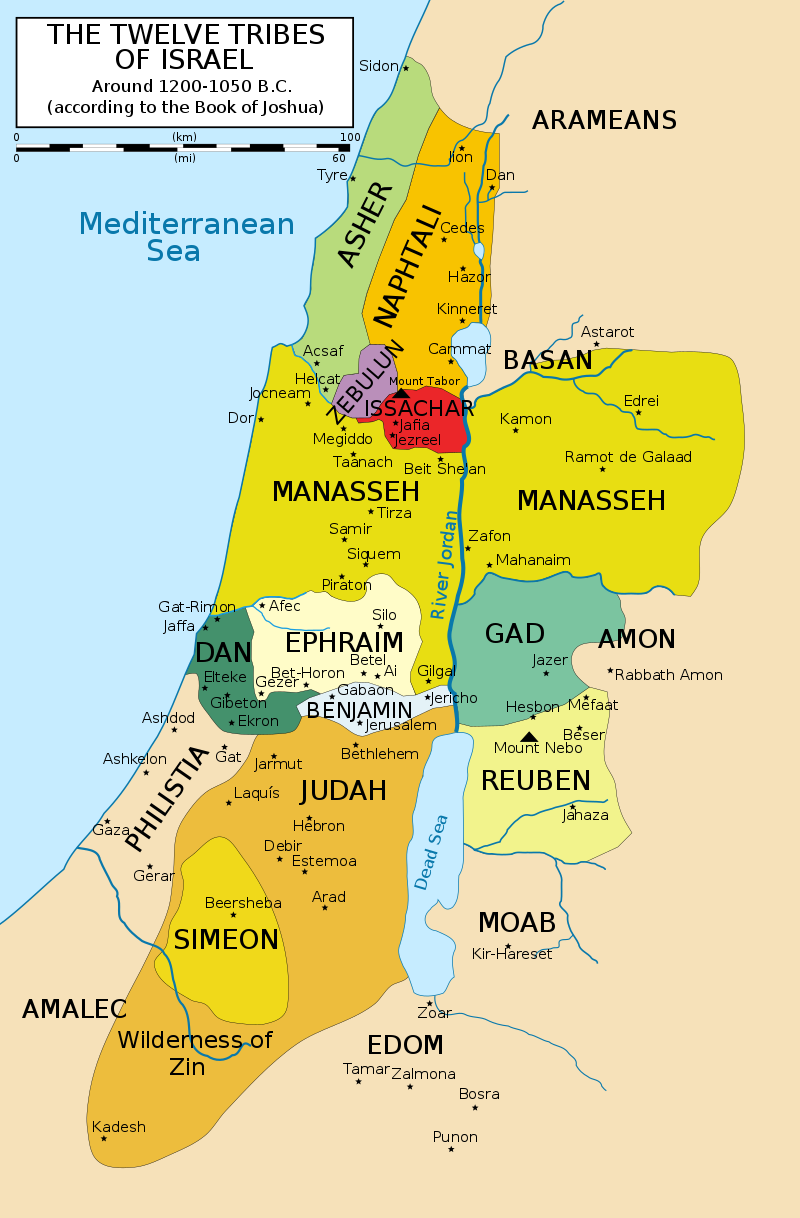
Arnon River on South separates Reuben from Moab
Jabbok River on North separates Gad from Manasseh
KING OF AMMON'S
COUNTER
And the king of the sons of Ammon said to the messengers of Jephthah, "Because Israel took away my land when they came up from Egypt, from the Arnon as far as the Jabbok and the Jordan; therefore, return them peaceably now - The territory the king of the Ammonites claims belongs to his people is the land of Reuben (bordered on South by the Arnon River) and Gad (bordered on the north by the Jabbok River) (See the map above for orientation). The King of Ammon is saying this land originally was their land, Israel took it from them unjustly and thus they had the right to act to recoup what was theirs.
Yahweh states the territory He Himself had given to Israel declaring "To the Reubenites and to the Gadites I gave from Gilead even as far as the valley of Arnon, the middle of the valley as a border and as far as the river Jabbok, the border of the sons of Ammon." (Dt 3:16+)
Pulpit Commentary - It appears from Joshua 13:25 that part of the land of the tribe of Gad, that, namely, "on the western side of the upper Jabbok," had once belonged to the Ammonites, but had been conquered by the Amorites, from whom Israel took it, together with that which had formerly belonged to the Moabites.
George Bush - Because Israel took away, &c. One who seeks a pretext for a quarrel will never be at a loss to find one; yet it speaks much in favor of the general peaceableness and inoffensiveness of Israel towards their neighbors, that their enemies, when intent upon hostilities against them, are obliged to look three hundred years back for a specious occasion. If the Ammonites had been conscious of a valid claim, their demand should have been published before invading Israel. But we have no intimation of this, and the claim now preferred was evidently trumped up to serve the present occasion, as affording a colorable pretence of justice in the invasion; showing that they who are destitute of conscience and honesty, are often very unwilling to appear so. Jephthah, however, in what follows, stripped their conduct of its specious disguise, and showed conclusively how false and arrogant were their pretensions. (Judges 11 Commentary)
Daniel Block - The response of the king of the sons Ammon to Jephthah’s first approach is curt and to the point. By invading the land of Gilead he has reclaimed land the Israelites had taken away from him. The king’s historical sense is both remarkable and skewed. On the one hand, he was aware of Israel’s origins in Egypt and their earlier migration to the land of Canaan. On the other hand, he accused them of injustice against him, inasmuch as they had robbed him of the territory between the Arnon and Jabbok tributaries of the Jordan (modern Wadi Mugîb and Wadi Ez-Zarqa respectively). But this is patently false. The Ammonites had never occupied this land. Even so, the new territorial claims are understandable because the Ammonite heartland consisted of an amorphous region without distinct geographic boundaries between the desert to the east and the hills of Gilead in the west. The present claims arise not only from a desire for more land but also out of a need for fixed and definable borders, such as these rivers would provide. But the Ammonite’s claim is based more on wishful thinking (ED: GREED!) than on historical reality. According to the biblical record the Arnon served as the border between Moab and the Amorites (not the Ammonites), and the Israelites had gained title to the land between this river and the Jabbok by defeating the Amorite king Sihon, who ruled in Heshbon. But the Ammonite king’s reply to Jephthah is a typical political speech, claiming land that his people have never owned but basing his claim on history. (Borrow Judges, Ruth. Vol. 6: New American Commentary)
A R Fausset - (Judges 11:13) And the king of the children of Ammon answered unto the messengers of Jephthah, Because Israel took away my land, when they came up out of Egypt, from Arnon [on the south, flowing into the Dead Sea] even unto Jabbok [on the north, flowing into Jordan], and unto Jordan [on the west: the eastern boundary was the wilderness (ver. 22)]; now therefore restore those (lands) [viz., that of Moab, and that of Ammon (ver. 15)] again peaceably. (Judges 11 Commentary)
Judges 11:14 But Jephthah sent messengers again to the king of the sons of Ammon,
- again to: Ps 120:7 Ro 12:18 Heb 12:14 1Pe 3:11
- Judges 11 Resources
JEPHTHAH BEGINS HIS COUNTER
WITH A HISTORICAL ACCOUNT
But Jephthah sent messengers again to the king of the sons of Ammon - He is still seeking the diplomatic route. While he is a valiant warrior, clearly war is not his default position. Here Jephthah proves himself to be a diligent diplomat giving a detailed discussion of historical facts which defend Israel's right to the land in question (the territory now occupied by Gad and Reuben).
Block - Jephthah responded to the king of Ammon’s rebuff with a second delegation of envoys, sent with a specific message dictated by the Gileadite leader (Jdg 11:14–27). This speech is remarkable not only for its length but also the formality and sophistication of Jephthah’s argumentation (Borrow Judges, Ruth. Vol. 6: New American Commentary)
Gary Inrig - The fourth stage of Jephthah’s career puts him in a very different role. We do not need to pursue all the details either of the argument or of the history Jephthah recounts. But we need to notice that the illegitimate outcast and desert gang leader is now negotiating face to face with an enemy king. A few days have brought him a very long distance! He is not a tentative leader. He had been given a responsibility, and he seized it with both hands.
Jephthah was a fighting man, and we might expect him to strike first and to ask questions later. But that was not the route he chose to go. Before he drew up battle lines, Jephthah sent messengers to Ammon, asking the obvious question, “What is the problem? Why are you invading us and fighting against our land?” He accused Ammon of unwarranted aggression, an unjustified invasion. Ammon countered with a claim that Israel had stolen Ammon’s land hundreds of years earlier in the time of Joshua and that he was simply seeking justice, a rightful land claim.
Jephthah turned out to be as forceful and strong-minded a negotiator with the king of Ammon as he had been with the tribal leaders of Gilead. He displayed a strong grasp of the historical realities (although he may have stumbled on a detail or two), and he was convinced that the story of Israel was a story of what God had done. His response was direct and to the point: He told the king, “Check your history. We captured the land from Sihon, the king of the Amorites, not the Ammonites” (vv. 15–22). Next, check your theology. The Lord God of Israel gave us this land, and we cannot surrender His gift. Live in the land your god Chemosh has given you” (vv. 23-25). We should note that at this point Jephthah makes two mistakes. The first is that Chemosh was the god of the Moabites, not of the Ammonites, who worshiped Milcom. Giving him the benefit of the doubt, he may have been considering the king as the leader of an alliance. More seriously, he seemed to reduce Yahweh, God alone, into just another god, by his argument that Chemosh had indeed given them their land while Israel’s God had given His people theirs. This was a huge mistake and shows how much paganism had corrupted his thinking. “Finally, check your logic. For three hundred years we have held the land, and you have done nothing to recapture it. It is too late for native land claims now” (vv. 26-27). The significant thing is that Jephthah’s answer was grounded in the truths of history. He did not argue probability or dispute possibility. He stood firmly on fact. That is where a Christian always stands. The early Christians did not set their world aflame by expressing opinions or exchanging experiences but by insisting upon the truth of who Jesus is and what He did. Our calling is the same. We do not go into the world merely telling people of our experience but proclaiming Jesus Christ, telling people who He is, what He has done, and what He requires of us. (Borrow Hearts of Iron, Feet of Clay)
Judges 11:15 and they said to him, "Thus says Jephthah, 'Israel did not take away the land of Moab, nor the land of the sons of Ammon.
- Israel did not take away the land of Moab: Nu 21:13-15,27-30 Dt 2:9,19 2Ch 20:10 Ac 24:12,13
- Judges 11 Resources
ISRAEL WAS NOT
A LAND THIEF!
And they said to him, "Thus says Jephthah, 'Israel did not take away the land of Moab, nor the land of the sons of Ammon. They of course refers to the emissaries sent by Jephthah to speak his words. Through these messengers Jephthah states the facts correctly concerning the Ammonites' false claim to the disputed land. When Israel first captured the land it belonged to the Amorites NOT the Ammonites. So Israel coming from Egypt to the Promised Land did not steal Ammon's land. The following passages explain why this is the case. He is simply proving that Israel captured this land from the Amorites without violating the territorial rights of either Moab or Ammon.
The Arnon River (separating Reuben from Moab in map above) is mentioned repeatedly because in Jdg 11:13 the King of Ammon specifically claims that the land bordered on the south by the Arnon River and on the north by the Jabbok River belonged to Ammon when historically this was actually the possession of the the Kingdom of Sihon, the ruler of the Amorites. His refusal to let Israel pass through (Jdg 11:19,20) resulted in God giving Sihon's land to Israel (Jdg 11:21). In short, the King of Ammon had absolutely no claim to this land which Israel had occupied for 300 years (Jdg 11:26).
George Bush - Israel took not away, &c. In order to evince beyond dispute, the falsehood and futility of the enemy’s claims upon these lands, Jephthah goes into a recapitulation of the leading circumstances of Israel’s coming into possession of them. He admits that they had indeed taken the territories in question, but they took them not from the Ammonites or Moabites, whom they were expressly forbidden to molest on their march, but finding them in possession of Sihon, king of the Amorites, they took them from him in just and honorable warfare, in consequence of an unprovoked attack upon them. It might, indeed, be true, that prior to Israel’s arrival in the country, the Amoriteshad taken these lands from the Moabites or Ammonites, Num. 21:26; Josh. 13:25, but this was no concern of theirs, nor were they bound to recognize the previous title of any people whatever. This was his first plea in support of his claims, which extends to v. 22. (Judges 11 Commentary)
A R Fausset - And said unto him, Thus saith Jephthah, Israel took not away the land of Moab, nor the land of the children of Ammon [the king of Amnion’s claim had an appearance of justice: for one portion of the land occupied by Israel had belonged to Moab and Ammon formerly. But Israel had not wrested it from them, for God had forbidden Israel to attack Ammon, Moab, and Edom (Deut. 2:5, 9, 19; 2 Chron. 20:10). Part of it had been wrested from Moab by Sihon king of the Amorites (Nu 21:26). Part also was wrested by him from Ammon, as is implied by the statement in Josh. 13:25, 26, that Gad received in addition to Gilead “half the land of the children of Ammon unto Aroer that is before Rabbah,” i.e., the land to the east of Gilead, on the western side of the Upper Jabbok, Nahr Amman (Deut. 2:37, 3:16). Israel, in taking Sihon’s territory, took the portions already absorbed by Sihon from Ammon and Moab, but did not take in addition any of the land possessed by the latter in the time of Moses]. (Judges 11 Commentary)
Judges 11:16 'For when they came up from Egypt, and Israel went through the wilderness to the Red Sea and came to Kadesh,
- Israel went through the wilderness: Nu 14:25 Dt 1:40 Jos 5:6
- came to Kadesh Ge 14:7 Nu 13:26 Nu 20:1 Dt 1:46
- Judges 11 Resources
Numbers 20:14-17+ From Kadesh Moses then sent messengers to the king of Edom: “Thus your brother Israel has said, ‘You know all the hardship that has befallen us; 15 that our fathers went down to Egypt, and we stayed in Egypt a long time, and the Egyptians treated us and our fathers badly. 16 ‘But when we cried out to the LORD, He heard our voice and sent an angel and brought us out from Egypt; now behold, we are at Kadesh, a town on the edge of your territory. 17 ‘Please let us pass through your land. We will not pass through field or through vineyard; we will not even drink water from a well. We will go along the king’s highway, not turning to the right or left, until we pass through your territory.’”
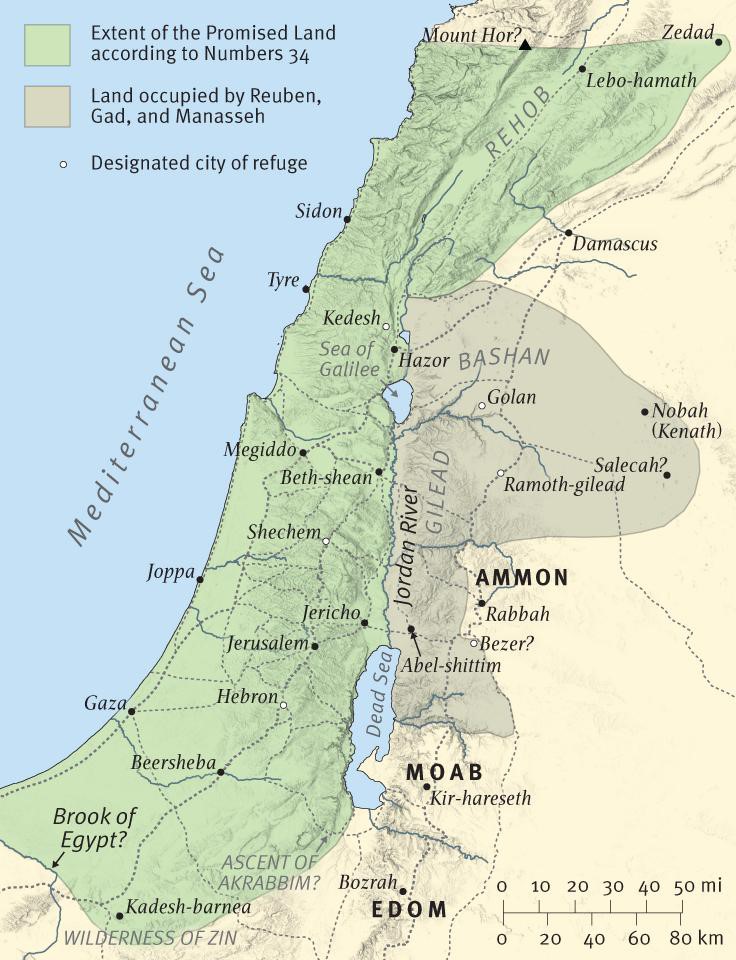
Boundaries of the Promised Land (Source)
For - Term of explanation. He explains why he can state that Israel did not steal Ammonite land. Jephthah's explanation demonstrates that he was familiar with Israel's history which would support the premise that he was familiar with the Pentateuch penned by Moses. Where he secured a copy is not stated in this section.
When they (Israel) came up from Egypt, and Israel went through the wilderness to the Red Sea and came to Kadesh - Jephthah begins his explanation by referring to Israel's stay at Kadesh (see map above at ~7 o'clock)(see on modern map), when they requested permission to travel through Edom (see passages above) and Moab (Jdg 11:17).
A R Fausset - But when Israel came up from Egypt, and [rather “then Israel”] walked through the wilderness [the same Hebrew (halak, walked,’ &c.) expression as in Deut. 1:19, 2:14; Josh. 5:6. “The wilderness of wanderings,” or El-Tih, is meant (Deut. 1:19)] unto the Red Sea (the Yam Suf, Israel’s last station before reaching Kedesh, was Ezion Gaber, on the gulf of Akaba, the eastern tongue of the Red Sea (Nu 33:36, 37; 1 Kings 9:26], and came to Kadesh [Kadesh-Barnea. Fürst explains Barnea, “son of wandering,” i.e., Bedouin. The Speaker’s Commentary explains it “country of convulsion” (compare Ps. 29:8); called also Meribah Kadesh. Rithmah (from retem, “a broom,” the chief shrub of the desert), was near, and therefore is the name given instead of Kadesh, in Nu 33:18: here was Israel’s encampment in their first march towards Canaan in the summer of the second year after the exodus. From this encampment (Nu 12:16, 13:20, 25), they sent the spies, waiting forty days for them. Moses and the tabernacle still “abode in Kadesh many days,” whilst the people vainly tried to reverse God’s sentence (Nu 14:8; Deut. 1:34–46). Then Israel compassed Mount Seir, i.e., wandered in the desert of Paran till all that generation died (2:1). The wilderness of Zin is the northern part of the Paran desert, and is also called “the wilderness of (i.e., adjoining) Kadesh” (Nu 10:12, 13:21, 33:30; Ps. 29:8). Thirty-eight years subsequently they reached the same locality, and encamped at Kadesh (Nu 20:1, 22, 33:36, 37), in the fortieth year after leaving Egypt, when just about to enter Canaan. Only a few incidents are recorded of the thirty-eight years of wandering, which comprise the seventeen stages (Nu 33:19–36), between the first time and the second. At Kadesh, the Wady el Ghuweir affords access north-westwards through mountainous Edom: at Hor, their next stage after Edom, they were “in the edge of the land of Edom” (Nu 33:37); and Moses describes Kadesh as a city “in the uttermost of Edom’s border” (Nu 20:16). Here, accordingly, Moses sent to ask a passage “by the king’s highway.” Kadesh, i.e., ‘holy,’ may be the name given from the long stay there of the sanctuary and priests. En-Mishpat, “fountain of judgment,” another of its names (Gen. 14:7), corresponds, inasmuch as judgment and sanctity go together, and emanate from the one and the same Jehovah]. (Judges 11 Commentary)
Related Resource:
Judges 11:17 then Israel sent messengers to the king of Edom, saying, "Please let us pass through your land," but the king of Edom would not listen. And they also sent to the king of Moab, but he would not consent. So Israel remained at Kadesh.
- sent messengers: Nu 20:14-21 Dt 2:4-8,29
- to the king of Edom: Dt 2:9
- So Israel remained at Kadesh: Nu 20:1,16
- Judges 11 Resources
JEPHTHAH PRESENTS
THE EVIDENCE
Then - Marks progression in the narrative.
Israel sent messengers to the king of Edom, saying, "Please let us pass through your land," but the king of Edom would not listen. And they also sent to the king of Moab, but he would not consent. So Israel remained at Kadesh (see map for Kadesh, Edom and Moab) - This continues Jephthah's explanation of how Israel came to possess the land of Sihon the Amorite. The Pentateuch itself does not record Israel's specific petition to Moab. He is building his case like a good defense attorney!
George Bush - Then Israel sent messengers, &c. So far were they from offering the least violence to the children of Esau or of Lot, that when refused a passage through their countries, though able, if they had chosen it, to have opened their way by force, they rather underwent the fatigue of a long march to compass their territories, than to set a foot upon them, much less to seize them for their own use.
In like manner they sent unto the king of Moab. Of this deputation, however, the history no where else gives us any account. (Judges 11 Commentary)
A R Fausset - Then Israel sent messengers unto the king of Edom, saying, Let me, I pray thee, pass through thy land: but the king of Edom would not hearken (thereto). And in like manner they sent unto the king of Moab: but he would not (consent): and Israel abode in Kadesh [“many days” (Nu 20:1; Deut. 1:46). In Deut. 1:19, 2:14, the interval between the encampment at Kadesh-Barnea and Israel’s crossing the brook Zered, before entering Canaan, is said to be thirty-eight years. So also in Nu 13:26, Kadesh is mentioned as the place where the spies returned to at the beginning of the thirty-eight years’ wandering. Elsewhere (Nu 33:36), Kadesh is mentioned as the place at which Israel arrived at the end of the thirty-eight years. Therefore Kadesh must have been the point from which they started, and to which they returned, the thirty-eight years intervening. The seventeen stages named in Nu 33:19–36, are the headquarters of the scattered people. The camp with the tabernacle, the priests, and the chiefs, was the nucleus and rallying-point, whilst the congregation was dispersed in various directions during the thirty-eight years. The embassy to the king of Moab is not mentioned in the Pentateuch, as it did not directly affect Israel’s further advance. Otherwise Jephthah shows an accurate knowledge of, and almost exact agreement with, Moses’ inspired history in Numbers and Deuteronomy, and confirms thereby the early date of the Pentateuch, as opposed to modern objections]. (Judges 11 Commentary)
Related Resources:
- What is the significance of Edom in the Bible? | GotQuestions.org
- Who were the Edomites? | GotQuestions.org
- What is the significance of Moab in the Bible? | GotQuestions.org
- Who was Ruth in the Bible? | GotQuestions.org
- When did Moab and Ammon eventually worship the Lord (Zephaniah 2:11)? | GotQuestions.org
Judges 11:18 'Then they went through the wilderness and around the land of Edom and the land of Moab, and came to the east side of the land of Moab, and they camped beyond the Arnon; but they did not enter the territory of Moab, for the Arnon was the border of Moab.
- went : Nu 20:22 Nu 21:10-13 Nu 33:37-44 Dt 2:1-8
- around: Nu 21:4-9
- came: Nu 21:11
- camped beyond the Arnon: Nu 21:13 22:36
- Judges 11 Resources
Deuteronomy 2:1-5+ (FIRST PROHIBITION TO NOT TOUCH EDOM) “Then we turned and set out for the wilderness by the way to the Red Sea, as the LORD spoke to me, and circled Mount Seir for many days. 2 “And the LORD spoke to me, saying, 3 ‘You have circled this mountain long enough. Now turn north, 4 and command the people, saying, “You will pass through the territory of your brothers the sons of Esau who live in Seir; and they will be afraid of you. So be very careful; 5 do not provoke them, for I will not give you any of their land, even as little as a footstep because I have given Mount Seir to Esau as a possession.
Deuteronomy 2:9+ (PROHIBITION TO NOT TOUCH MOAB) “Then the LORD said to me, ‘Do not harass Moab, nor provoke them to war, for I will not give you any of their land as a possession, because I have given Ar to the sons of Lot as a possession.’
Deuteronomy 2:19+ (PROHIBITION TO NOT TOUCH AMMON) ‘When you come opposite the sons of Ammon, do not harass them nor provoke them, for I will not give you any of the land of the sons of Ammon as a possession, because I have given it to the sons of Lot as a possession.’
JEPHTHAH DESCRIBES
DETOUR AFTER DENIAL OF PASSAGE
Then - Marks progression in the narrative.
They went through the wilderness and around the land of Edom and the land of Moab, and came to the east side of the land of Moab, and they camped beyond the Arnon; but they did not enter the territory of Moab, for the Arnon was the border of Moab - See map for Edom and Moab to see how Israel had to go around on the south and east sides. Neither Edom nor Moab allowed Israel to pass through their land, so the people detoured south of Edom and then east of Moab, stopping at the eastern end of the Arnon River. The Lord specifically commanded Israel not to fight against Edom, Moab, and Ammon because these peoples were all related to Israel and God had given them their own territory (see passages above).
A R Fausset - Then they went [Heb., ‘walked’] along through the wilderness [to Mount Hor], and compassed the land of Edom [(Nu 21:4, 10, 11). From Mount Hor they went down the Arabah to the Red Sea: and so on to Obath and Ije-Abarim in the wilderness before Moab. So they went round Edom and Moab, and came on the east of Moab’s boundary], and the land of Moab, and came by the east side of the land of Moab, and pitched on the other side of Arnon [i.e., on the upper course of the Arnon where it flows through the desert], but came not within the border of Moab; for Arnon (was) the [eastern] border of Moab [(Nu 21:13; Dt. 2:1–9, 14, 19, 24). The branch of the Arnon (Seil es Saideh), flowing northwest through the wilderness into the Dead Sea; now Wady el Mojeb, flowing through a rugged ravine]. (Judges 11 Commentary)
Judges 11:19 'And Israel sent messengers to Sihon king of the Amorites, the king of Heshbon, and Israel said to him, "Please let us pass through your land to our place."
- Nu 21:21-35 Dt 2:26-34 3:1-17 Jos 13:8-12
- Judges 11 Resources
Related Passages:
Numbers 21:21-22+ Then Israel sent messengers to Sihon, king of the Amorites, saying, 22 “Let me pass through your land. We will not turn off into field or vineyard; we will not drink water from wells. We will go by the king’s highway until we have passed through your border.”
ISRAEL'S ATTEMPT AT
DIPLOMACY TO A DESPOT
And Israel sent messengers to Sihon king of the Amorites, the king of Heshbon, and Israel said to him, "Please let us pass through your land to our place." No prohibition (like that regarding Edom, Moab or Ammon) applied to Sihon and the Amorites. In short his land was what we would call "fair game."
A R Fausset - And Israel sent messengers unto Sihon king of the Amorites, the king of Heshbon; and Israel said unto him, Let us pass, we pray thee, through thy land into my place [from Judges 11:19-22, Jephthah follows almost word for word Nu 20:17, 21:21–27; Deut. 2:26–30, where the words, “over Jordan—the land which the Lord our God giveth us,” answer to “my place” here]. (Judges 11 Commentary)
Related Resource:
Judges 11:20 'But Sihon did not trust Israel to pass through his territory; so Sihon gathered all his people and camped in Jahaz, and fought with Israel.
- Nu 21:23 Dt 2:32, Ne 9:22 Ps 135:10-12 136:17-21, Nu 21:24,25 Dt 2:33,34, Jos 13:15-32
- Judges 11 Resources
Related Passages:
Numbers 21:23+ But Sihon would not permit Israel to pass through his border. So Sihon gathered all his people and went out against Israel in the wilderness, and came to Jahaz and fought against Israel.
Deuteronomy 2:32 “Then Sihon with all his people came out to meet us in battle at Jahaz.
DIPLOMACY WITH
DESPOT FAILS
But Sihon did not trust Israel to pass through his territory; so Sihon gathered all his people and camped in Jahaz, and fought with Israel. When the Amorite king also refused the Israelites passage, there was a battle at Jahaz (means "trodden down!") (map - note Jahaz north of Arnon River).
George Bush - Trusted not Israel to pass through his coast. That is, through his dominions; as also, v. 22. The word signifies not only the borders of a country, but the territory included in them. Those who are themselves conscious of a disposition to oppress the weak, and take undue advantages of the simple, will generally give others credit for being actuated by the same spirit, and consequently withhold their confidence in circumstances where they are sensible they could not be confided in themselves. (Judges 11 Commentary)
A R Fausset - But Sihon trusted not Israel [i.e., the promises of Israel, detailed in Nu 21:22; Deut. 2:27, 28; but omitted for brevity by Jephthah, yet hinted at in his word ‘trusted,’ which presupposes promises] to pass through his coast; but [not confining himself to refusing Israel’s request for leave to pass through his land] Sihon gathered all his people together, and pitched in Jahaz [in the plain, now called the Belka, on the extreme south of Sihon’s land, but north of the Arnon. The battle was probably fought on the hill-slope called still Shihan: here is a network of cyclopean walls, from which, Josephus says, the Amorites were dislodged by Israel’s slings and arrows, and fled two miles to the edge of the Arnon gorge], and fought against Israel.(Judges 11 Commentary)
JAHAZ [ISBE] - ja'-haz (yahats, Isa 16:4; Jer 48:34, yahatsah, or yahtsah, Nu 21:23; Dt 2:32; Josh 13:18; 21:36, the King James Version "Jahazah"; Jdg 11:20; Jer 48:21; 1Chr 6:78, "Jahzah"): This is the place where in a great battle Israel overwhelmed Sihon king of the Amorites, and then took possession of all his territory (Nu 21:23, etc.). It is named along with Beth-baal-meon and Kedemoth (Josh 13:18), with Kedemoth (Josh 21:37) pointing to a position in the Southeast of the Amorite territory. It was given to Reuben by Moses, and was one of the cities in the portion of that tribe assigned to the Merarite Levites. Mesha (MS, ll. 18 if) says that the king of Israel dwelt in Jahaz when at war with him. Mesha drove him out, and the city passed into the hands of Moab. It is referred to as a city of Moab in Isa 15:4; Jer 48:21,34. Cheyne thinks that either Jahaz or Kedemoth must be represented today by the important ruins of Umm er-Recac, about 2 1/2 hours North of Dibon toward the desert (EB, under the word). No certain identification is possible. W. Ewing
Judges 11:21 'And the LORD, the God of Israel, gave Sihon and all his people into the hand of Israel, and they defeated them; so Israel possessed all the land of the Amorites, the inhabitants of that country.
THE LORD DEFEATED AND
DISPOSSESSED SIHON!
And the LORD, the God of Israel, gave Sihon and all his people into the hand of Israel, and they defeated them; so Israel possessed (yarash) all the land of the Amorites, the inhabitants of that country - As we repeatedly see in the Scripture, note the juxtaposition of God's sovereignty (LORD...gave) and man's responsibility (Israel...defeated). This principle permeates the Bible from Genesis to Revelation. It is never "Let go, let God," but always "Let God, let's go!" It is the "Paradoxical Principle of 100% Dependent and 100% Responsible" (100/100).
So the LORD, the God of Israel gave the Israelites a decisive victory and they took possession of the precise parcel of land then claimed by the king of Ammon which was the land extending "from the Arnon (on the south - see map) as far as the Jabbok (flows east from Jordan 40 miles north of Dead Sea see map on north) and the Jordan" (Jdg 11:13+).
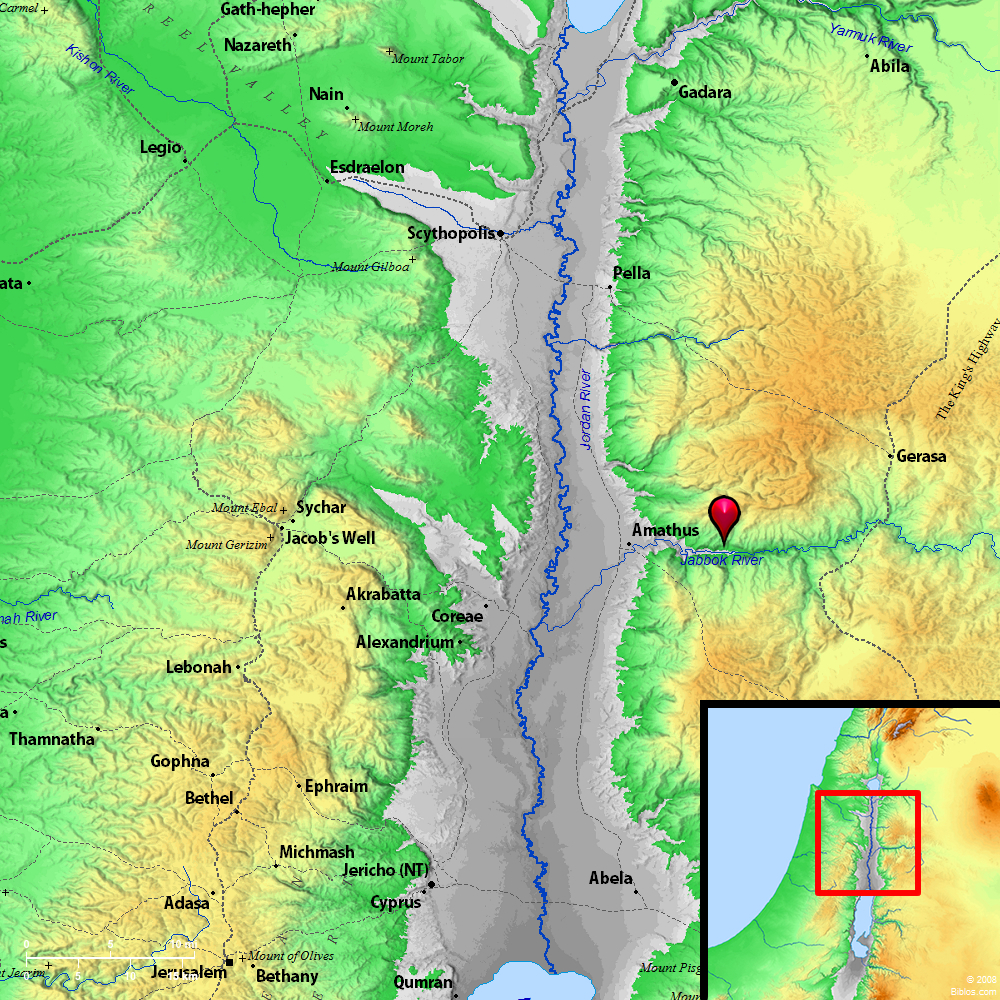
Arnon River [EBD] swift, the southern boundary of the territory of Israel beyond Jordan, separating it from the land of Moab (Deut. 3:8, 16). This river (referred to twenty-four times in the Bible) rises in the mountains of Gilead, and after a circuitous course of about 80 miles through a deep ravine it falls into the Dead Sea nearly opposite Engedi. The stream is almost dry in summer. It is now called el-Mujeb. The territory of the Amorites extended from the Arnon to the Jabbok.
The LORD....gave - Israel defeated Sihon because God gave them into the hand (power) of Israel. As Solomon wrote "The horse is prepared for the day of battle, but victory belongs to the LORD. (Pr 21:31) This is a proverb, but is also a persistent principle in Scripture as discussed above. God gives the victory over the enemy. And so we see what was true in the OT and is still true in the NT. John writes...
For whatever is born of God overcomes the world; and this is the victory that has overcome the world–our faith. Who is the one who overcomes the world, but he who believes that Jesus is the Son of God? (1 John 5:4-5+)
Comment - Note the pattern, believer overcome because God has overcome!
TECHNICAL NOTE - The Septuagint translates gave with the verb paradidomi which conveys the basic meaning of to give over from one's hand to someone or something, especially to give over to the power of another. This same verb is found in Judges in both a positive (gave enemy into hand of Israel - Judges 1:4, 3:10, 3:28, 4:7, 14, 7:2, 7:9, 14, 15, 8:3, 11:32) and a negative context (when Israel did evil God gave them into the hands of their enemy - Judges 2:14, 13:1, 16:24).
A R Fausset - And the LORD [JEHOVAH] God of Israel [so ver. 23; Deut. 2:30, 33, “JEHOVAH thy God—our God.” In contrast to what Chemosh gave his worshippers (ver. 24)] delivered Sihon and all his people into the hand of Israel, and they smote them: so Israel possessed all the land of the Amorites, the inhabitants of that country.(Judges 11 Commentary)
Possessed (03423) yarash to take possession of, inherit, dispossess, to drive out. The verb yārash is an especially important word in contexts dealing with Israel's conquest of and possession of the land of Canaan. Possession of the land was directly connected to a person's relationship with the Lord; breaking the covenantal relationship led to dispossession. But even in exile, Israelites awaited the day when they would repossess the land (Jer. 30:3). The first meaning, "to take possession of," is most commonly used in connection with possessing land, specifically, the Promised Land. Yahweh first announced "possession" of the land in the context of the Abrahamic covenant (Gen. 15:7f). Although similar usage continues in Leviticus (Lev 20:24) and Numbers (Nu 13:30; 14:24; 21:24f), yārash in the sense of covenant land possession is a key theme in Deuteronomy. "Go in and possess the land," the Lord commanded (Deut. 1:8, 21, 39; 11:31; 17:14). The phrase, "where you are going to possess it," with reference to the land, recurs in Deuteronomy and Joshua (Deut. 4:5, 14, 26; Josh. 1:11, 15; 12:1; 13:1; 21:43; 23:5). Emphasis on the idea of "possessing" the land continues in Judges (Jdg 11:21-24; 18:9).
Yarash in Judges - Jdg. 1:19; Jdg. 1:20; Jdg. 1:21; Jdg. 1:27; Jdg. 1:28; Jdg. 1:29; Jdg. 1:30; Jdg. 1:31; Jdg. 1:32; Jdg. 1:33; Jdg. 2:6; Jdg. 2:21; Jdg. 2:23; Jdg. 3:13; Jdg. 11:21; Jdg. 11:22; Jdg. 11:23; Jdg. 11:24; Jdg. 14:15; Jdg. 18:7; Jdg. 18:9
Judges 11:22 'So they possessed all the territory of the Amorites, from the Arnon as far as the Jabbok, and from the wilderness as far as the Jordan.
Related Passages:
Deuteronomy 2:35-36+ We took only the animals as our booty and the spoil of the cities which we had captured. 36 “From Aroer which is on the edge of the valley of Arnon and from the city which is in the valley, even to Gilead, there was no city that was too high for us; the LORD our God delivered all over to us.
ISRAEL DISPOSSESSED THE AMORITES
NOT THE AMMONITES!
So they possessed (yarash) all the territory of the Amorites, from the Arnon as far as the Jabbok, and from the wilderness as far as the Jordan - Jephthah's accurate historical account directly contradicts the King of Ammon's claim. The very land the latter claimed was stolen is the land Israel secured after God gave them victory over the Amorites. The land that Israel received from the Amorites was from the Arnon on the south (see map) to the Jabbok on the nother (see map).
A R Fausset - Jabbok "flows into Jordan midway between the sea of Galilee and the Dead Sea, forty-five miles north of the Arnon. Jabbok formed the Amorite border between Rabbah and Gerasa: Israel did not pass this boundary into Ammon eastward: but westward Israel took the Ammonite land already absorbed by Sihon. (Judges 11 Commentary)
Judges 11:23 'Since now the LORD, the God of Israel, drove out the Amorites from before His people Israel, are you then to possess it?
Related Passage:
Deuteronomy 2:24+ ‘Arise, set out, and pass through the valley of Arnon. Look! I have given Sihon the Amorite, king of Heshbon, and his land into your hand; begin to take possession and contend with him in battle.
THIS LAND IS OUR
LAND NOT YOUR LAND
Since now the LORD, the God of Israel, drove out (yarash - dispossessed) the Amorites from before His people Israel, are you then to possess (yarash) it - This is essentially a rhetorical reply and almost like a rebuke! Jephthah reiterates it was Yahweh Who orchestrated the dispossession of the Amorites! Thus he shows that the Israelites did not take the land of the Moabites or Ammonites, but that of the Amorites, which they had conquered from Sihon their king; and although the Amorites had taken the lands in question from the Ammonites, yet the title by which Israel held these lands was good, because they took them, not from the Ammonites, but from the Amorites.
Bush - Another branch of Jephthah’s argument in proof of Israel’s right to the land. God gave them the country by giving them the victory over him who possessed it. The great Proprietor of the earth, the King of nations, bestowed it upon them by an express and particular conveyance, such as vested in them a title that none could gainsay, Deut. 2:24, ‘I have given into thy hand Sihon and his land.’
Shouldest thou possess it? Heb. תירשנו tirâshennu, shouldest thou inherit him; i. e. the Amorite; the nation, according to Heb. idiom, being taken for the country which it occupied. He appeals to them whether they could suppose that God had given them the land in such an extraordinary manner, merely in order that they should restore it again to the Ammonites or Moabites. (Judges 11 Commentary)
Judges 11:24 'Do you not possess what Chemosh your god gives you to possess? So whatever the LORD our God has driven out before us, we will possess it.
- Chemosh: Nu 21:29 1Ki 11:7 Jer 48:7,46
- So whatever the LORD our God has driven out before us: Dt 9:4,5 18:12 Jos 3:10 Ps 44:2 78:55 Mic 4:5
- Judges 11 Resources
JEPHTHAH'S
ARGUMENTUM AD HOMINEM
TSK on do you not possess - This is simply an Argumentum ad hominem in which Jephthah argues on this principles recognized by the king of Ammon. As if he had said, "You suppose that the land which you possess was given you by your god Chemosh; and therefore you will not relinquish what you believe you hold by a "divine right". Now we know that Jehovah, our God, has given us the land of the Israelites; and therefore we will not give it up."
Do you not possess (yarash) what Chemosh your god gives you to possess (yarash)? So whatever the LORD our God has driven out (yarash - dispossesed) before us, we will possess (yarash) it. Chemosh was the god of Moab, and Milcom (Molech, Moloch) the idolatrous god of Ammon, though Molech may be a title for Chemosh, who was worshiped by both peoples (since they had much in common).
NET Note explains that "Jephthah speaks of Chemosh as if he is on a par with the LORD God of Israel. This does not necessarily mean that Jephthah is polytheistic or that he recognizes the LORD as only a local deity. He may simply be assuming the Ammonite king’s perspective for the sake of argument. Other texts, as well as the extra-biblical Mesha inscription, associate Chemosh with Moab, while Milcom is identified as the god of the Ammonites. Why then does Jephthah refer to Chemosh as the Ammonite god? Ammon had likely conquered Moab and the Ammonite king probably regarded himself as heir of all territory formerly held by Moab. Originally Moab had owned the disputed territory (cf. Nu 21:26–29), meaning that Chemosh was regarded as the god of the region (see R. G. Boling, Judges [AB], 203–4). Jephthah argues that Chemosh had long ago (ED: "300 YEARS") relinquished claim to the area (by allowing Sihon to conquer it), while the LORD had long ago established jurisdiction over it (by taking it from Sihon and giving it to Israel). Both sides should abide by the decisions of the gods which had stood firm for three hundred years.
Another source writes that the reference to Chemosh as actually giving them their land is rhetorical, intended to appeal to the king of Ammon. It implied, however, that Yahweh was stronger than "Chemosh," since Israel and not Ammon possessed the disputed territory.
Guzik has another thought - This was an inherent challenge: “If your god is mighty enough to give you the land, then let him do it. Let us see who is stronger – Yahweh or Chemosh.” Jephthah did not see this battle as primarily between two armies, but between the God of Israel and the false god of Ammon. Jephthah showed true wisdom in seeing this as a spiritual battle first.
THOUGHT - ISN'T THIS TRUE OF ALL OUR "BATTLES" BELOVED? ARE THEY NOT ALL IN ONE SENSE OR ANOTHER SPIRITUAL BATTLES? I THINK THEY ARE! GOD IS EVER HONING US AND TRANSFORMING US INTO THE IMAGE OF HIS SON, AND HE USES THE MANIFOLD, VARIEGATED BATTLES EACH OF US FACES IN OUR LIFE. DOES THIS HELP PUT A DIFFERENT PERSPECTIVE ON THE AFFLICTIONS, ADVERSITIES, TRIALS, STRUGGLES, SUFFERINGS, ETC THAT YOU HAVE GONE THROUGH IN THE PAST, ARE GOING THROUGH IN THE PRESENT OR WILL GO THROUGH IN THE FUTURE! LORD, GIVES US 2 Cor 4:17-18+ PERSPECTIVE AND EYESIGHT!
For momentary, light affliction is producing for us an eternal weight of glory far beyond all comparison (PAUL USES WORDS HERE INDICATING HE CANNOT EVEN FULLY DESCRIBE THE GLORY WE SHALL EXPERIENCE! PONDER THAT THOUGHT AS YOU FIGHT THE GOOD FIGHT OF FAITH THROUGH MANY TRIBULATIONS - Acts 14:22b+), while we look not at the things which are seen, but at the things which are not seen; for the things which are seen are temporal, but the things which are not seen are eternal.
IVP Background Commentary - Chemosh is best known as the national god of the Moabites, and in the ninth-century Moabite stone (Mesha Inscription) he is said to bring victory in battle, as Yahweh is depicted as doing for Israel. The Ammonite national deity is generally Milcom (1Ki 11:5, 33NIV, Molech). Although Chemosh was adopted as the national deity of the Moabites, the occurrence of the variant form, Kamish, in a deity list from Ebla, where he had a temple, suggests he was on the register of Semitic gods in third-millennium Syria, long before the Moabites. One Assyrian deity list associates Chemosh (Kammush) with Nergal, the god of the netherworld. There is not yet any firm identification of what natural phenomenon Chemosh was related to, nor is there any uncontested depiction of him on archaeological finds. (See context in The IVP Bible Background Commentary: Old Testament)
George Bush - Wilt thou not possess that which Chemosh thy god giveth thee? Without really attributing any divinity to the Ammonitish idol, Jephthah here argues with them on their own admitted principles. ‘It is a maxim with you, as among all nations, that the lands which they conceive to be given by their gods, they have an absolute right to, and should not relinquish to any claimant whatever. You suppose that the land which you possess was given by your god Chemosh, and therefore you will not relinquish what you believe you hold by a divine right. In like manner we are fully assured that Jehovah our God, who is Lord of heaven and earth, has given the Israelites the land of the Amorites; and therefore we will not give it up.’ The ground of Jephthah’s remonstrance was evidently sound and impregnable. (Judges 11 Commentary)
A R Fausset - Ammon’s god was Molech; but being akin to Moab, the Ammonites also worshipped Chemosh. Depicted on coins with sword, lance, and two torches at his side. A black star was his symbol; and Dibon was his chief seat of worship On the black stone of Dibon, recently discovered, the Moabite king, Mesha, ascribes all his successes, in war against Israel, to Chemosh, or Ashtar-(Astarte)-Chemosh, to whom he offered, in sacrifice, all the warriors taken at Ataroth] giveth thee to possess? [Is it not the fact, that what Chemosh thy god (according to thy false creed) giveth thee to possess (Jer. 10:5), that thou possessest?] So whomsoever the LORD [JEHOVAH] our God shall drive out from before us, them will we possess [Ammon and Moab gained their territory by forcibly dispossessing the ancient inhabitants (Deut. 2:10–21). Instead of attributing their success to Jehovah, they attributed it to Chemosh. What Chemosh, on their own showing, gave them, that they have. They have no reason, therefore, to complain if Israel retains, by right of conquest and of prescription, what Jehovah gave them by dispossessing the Amorites]. (Judges 11 Commentary)
Related Resource:
Judges 11:25 'And now are you any better than Balak the son of Zippor, king of Moab? Did he ever strive with Israel, or did he ever fight against them?
- Balak: Nu 22:2-21 Dt 23:3,4 Jos 24:9,10 Mic 6:5
- Judges 11 Resources
FOLLOW ANOTHER
LEADER!
And now are you any better than Balak the son of Zippor, king of Moab? Did he ever strive with Israel, or did he ever fight against them Balak did "strive" with Israel thru Balaam. "Jephthah argues that the Ammonite king should follow the example of Balak, who, once thwarted in his attempt to bring a curse on Israel, refused to attack Israel and returned home (Num 22–24)." (NET Note)
Balak was the king of Moab who hired Balaam to curse the Israelites. After the curses turned out to be repeated blessings (Nu 24:10), Balak made no attempt to regain the area held by Sihon and then Israel (v25). He clearly recognized the legitimacy of Israel's claim to the land.
George Bush - Art thou any better than Balak? That is, probably not morally better, but hast thou any better title? Yet Balak, who was then king of Moab, from whom the greatest part of these lands had been taken by the Amorites, who had most interest in the matter, and was best able to enforce his claim, if he had thought fit—Balak did not once object to our settlement then, nor offer to molest us in the enjoyment of our possessions. If he then acquiesced in this disposition of the lands, if the title of Israel had not been disputed upon their first entrance upon them, what grounds had the Ammonites to do it now? They had possessed the country quietly for three hundred years, and even though their title had been less clear at first, yet seeing no claim had been made during that long period of time, they had obtained a right by prescription, which the law of nations would clearly have acknowledged. A title so long unquestioned was to be presumed to be unquestionable. The following therefore is the sum of Jephthah’s argument relative to the matter in dispute. (1) The Ammonites had lost their lands in their contests with the Amorites. (2) The Israelites conquered these lands from the Amorites, who had waged an unprincipled war against them. (3) God, the Maker, Proprietor, and Disposer of heaven and earth, had given these lands by special grant to the Israelites. (4) In consequence of this, they had had possession of them for upwards of three hundred years. (5) These lands were never reclaimed by the Ammonites, though they had repeated opportunities to do it, whilst the Israelites dwelt in Heshbon, in Aroer, and the coasts of Arnon; but they did not reclaim them, because they knew the Israelites held them legally. Consequently every subsequent claim was effectually barred, and the present pretensions of Ammon were unsupported and unjustifiable. (Judges 11 Commentary)
A R Fausset - And now (art) thou anything better than Balak the son of Zippor king of Moab? did he ever strive against Israel, or did he ever fight against them? [No. He bribed Balaam to curse Israel; but this he did in order to save from Israel the territory yet remaining to him, not to wrest from Israel the Moabite land, originally conquered by Sihon, then appropriated, with the rest of the Amorite land, by Israel (Nu 21:26). If then Balak, king of Moab, did not claim back from the Israelites the Moabite land, which they had taken from the Amorites, what claim to it can the king of Ammon have now, especially after Israel’s possession of it for 300 years? Ammon was with Moab in hiring Balaam (Deut. 23:4). Moab was the more civilised and agricultural; Ammon the more fierce, Bedouin-like, and marauding half of Lot’s descendants (contrast Isa. 15, 16; Jer. 48, with 1 Sam. 11:2; Amos 1:13; 2 Sam. 10:1–5, 12:31). Moab and Ammon were excluded from the Lord’s congregation, i.e., from full Israelite citizenship, not from spiritual privileges if proselytes, for ten generations, because they joined in hiring Balaam: whereas Edom, who had not hired him, was only excluded to the third generation (Deut. 23:2, 4–6; Neh. 13:2)]. (Judges 11 Commentary)
Related Resources:
Judges 11:26 'While Israel lived in Heshbon and its villages, and in Aroer and its villages, and in all the cities that are on the banks of the Arnon, three hundred years, why did you not recover them within that time?
- Heshbon: Nu 21:25-30 Dt 2:24 3:2, 3:6 Jos 12:2,5 13:10
- Aroer: Dt 2:36
- three hundred: Jdg 3:11,30 5:31 8:28 9:22 10:2,3, 10:8 Jos 11:18 23:1
- Judges 11 Resources
ISRAEL IN THE LAND
FOR 300 YEARS
Jephthah made these points in his negotiations with the Ammonite king: CHECK YOUR HISTORY (1) Israel had taken their land east of the Jordan not from Ammon, but from the Amorites (Jdg 11:15-23; cf. Nu 21:24; Dt 2:19, 37) CHECK YOUR THEOLOGY (2) Israel had not chosen her possessions; they had been given by her God (Jdg 11:24) CHECK YOUR LOGIC (3) if Ammon had some prior claim to Gilead, why had they waited 300 years to press it (Jdg 11 26)? It was a little too late for native land claims now!
While Israel lived in Heshbon (see map) and its villages, and in Aroer (see map) and its villages, and in all the cities that are on the banks of the Arnon, three hundred years, why did you not recover them within that time? Jephthah's final argument is based on the length of time Israel had possessed the disputed territory. During the next "three hundred years," neither Moab nor Ammon succeeded in retaking the land. Did not such a long occupancy prove Israel's right to that area? Indeed it did!
The chronology of the period of the Judges is difficult to decipher, but this statement of Jephthah's, inserted more or less incidentally in his polemic against the king of Ammon, provides an important constraint on such estimates. The children of Israel conquered Heshbon, Aroer and Arnon, and "dwelt in the cities of the Amorites" shortly before they crossed the Jordan into Canaan.
Numbers 21:24-26+ Then Israel struck him with the edge of the sword, and took possession of his land from the Arnon to the Jabbok, as far as the sons of Ammon; for the border of the sons of Ammon was Jazer. 25 Israel took all these cities and Israel lived in all the cities of the Amorites, in Heshbon (see map), and in all her villages. 26 For Heshbon was the city of Sihon, king of the Amorites, who had fought against the former king of Moab and had taken all his land out of his hand, as far as the Arnon.
Constable - Jephthah's reference to 300 years is an important benchmark in biblical chronology. It had been approximately 300 years since the Israelites had defeated Sihon and captured Heshbon (in 1406 B.C.). Shortly after Jephthah spoke these words he defeated the Ammonites (Jdg 11:33; about 1106 B.C.) and ended the 18 year Ammonite oppression (Jdg 10:8). The Philistine oppression of Israel began at the same time as the Ammonite oppression (Jdg 10:7; in 1124 B.C.). The Philistines harassed Israel for 40 years (Jdg 13:1; ca. 1124-1084 B.C.). The dates of the Philistine oppression are important because they provide a framework for the ministries of Eli and Samuel as well as Samson. This time reference along with the one in 1 Kings 6:1 indicates that the Exodus took place about 1446 B.C. rather than about 1280 B.C. (Judges 11)
A R Fausset - While Israel dwelt [quoted from Nu 21:25, 31] in Heshbon and her [dependent] towns, and in Aroer [facing Rabbah of Ammon; ‘built,’ i.e., restored and enlarged by Gad (Nu 32:34; Josh. 13:25): distinct from the Aroer of Reuben (Josh. 13:9, 10), which was one of “the cities that belong to Arnon”] and her towns, and in all the cities that (be) along by the coasts [sides: i.e., along the course] of Arnon, three hundred years? why therefore did ye not recover (them) within that time? [If Ammon had any right to them, the claim ought to have been made in Moses’ time, 300 years ago: it is too late now, otherwise no length of time could give a prescriptive title (see, on the 300 years, remarks on Judges 2-3 “Chronology of Judges”)]. (Judges 11 Commentary)
Judges 11:27 'I therefore have not sinned against you, but you are doing me wrong by making war against me; may the LORD, the Judge, judge today between the sons of Israel and the sons of Ammon.'"
- the Judge: Ge 18:25 1Sa 2:10 Job 9:15 23:7 Ps 7:11 50:6 75:7 82:8 Ps 94:2 98:9 Ec 11:9 12:14 Joh 5:22,23 Ro 14:10-12 2Co 5:10 2Ti 4:8 Heb 12:23
- judge (shaphat): Ge 16:5 31:53 1Sa 24:12,15 Ps 7:8,9 2Co 11:11
- Judges 11 Resources
- See excellent map of Jephthah and the Ammonites
JEPHTHAH'S CONCLUSION AND
APPEAL THE JUDGE OF ALL MEN
I therefore have not sinned against you, but you are doing me wrong by making war against me; may the LORD, the Judge, judge (shaphat) today between the sons of Israel and the sons of Ammon - Jephthah as a clear conscience. He has given the adversary an opportunity to arrive at a peaceful settlement. Here he sees conflict as inevitable (unlike Neville Chamberlain after his last visit with the liar Hitler). And so in a sense he calls on Yahweh Who he recognizes as Judge of all mankind, to be the judge in this regional war. He does not ask for Yahweh to give them victory, but he is so clear on his theology that he knows the "verdict" will fall in favor of Israel not Ammon! That's a real-time faith that trusts in a faithful God. May his tribe increase!
George Bush - The Lord, the Judge, be judge this day. Not by pronouncing sentence verbally, like human judges, but by awarding the victory to the side which he sees to be in the right. In this way he leaves the controversy to be decided. When we have justice and truth on our side, we may confidently appeal to the God of truth for a decision in our favor. (Judges 11 Commentary)
A R Fausset - Therefore I [Israel represented by Jephthah] have not sinned against thee, but thou doest me wrong to war against me: the LORD [JEHOVAH] the Judge be judge this day between the children of Israel and the children of Ammon [Gen. 16:5, 31:53]. (Judges 11 Commentary)
Judge (08199) shaphat is a verb that means to judge or govern. While it frequently translated judge, this is somewhat misleading as shaphat is not typical of the modern concept of judge (as in a court of law), but is much more inclusive -- to function as ruler or governor - individuals (Jdg. 16:31; 1 Sa 7:16), king (1 Ki. 3:9); even God Himself (Ps. 50:6; 75:7) because He is the source of authority and will eventually conduct all judgments (Ps. 96:13). In a judicial sense shaphat could refer to the arbitration of civil, domestic, and religious disputes (Dt. 25:1), fulfilled by the congregation (Nu 35:24), by individual judges (Ex 18:16; Dt. 1:16), by the king (1 Sa 8:5, 6, 20) or by God Himself (Ge 16:5; 1 Sa 24:12, 15). The Septuagint (LXX) uses the Greek krites = Judges or krino meaning to judge.
Uses of shaphat in Judges - Jdg. 2:16; Jdg. 2:17; Jdg. 2:18; Jdg. 2:19; Jdg. 3:10; Jdg. 4:4; Jdg. 10:2; Jdg. 10:3; Jdg. 11:27; Jdg. 12:7; Jdg. 12:8; Jdg. 12:9; Jdg. 12:11; Jdg. 12:13; Jdg. 12:14; Jdg. 15:20; Jdg. 16:31
Judges 11:28 But the king of the sons of Ammon disregarded the message which Jephthah sent him.
- 2Ki 14:11 Pr 16:18
- Judges 11 Resources
JEPHTHAH'S BIBLICAL
ARGUMENT REFUSED
But - This term of contrast would mark 180 degree turn -- the 18 years of Ammonite oppression would be brought to an abrupt end.
The king of the sons of Ammon disregarded the message which Jephthah sent him - As with many despots over the centuries, this king was stubbornly, and resolutely set on satisfying his desire for more land. His desire would dictate his demise!
Barry Webb - "His (Jephthah's) negotiations with the elders, his diplomacy with the Ammonites, and his vow, have all amply displayed Jephthah's facility with words. Jephthah, we know, is good at opening his mouth. (How ironical that his name means literally 'he opens'!). What has precipitated the crisis with his daughter is that he has opened his mouth to Yahweh, that is, he has tried to conduct his relationship with God in the same way that he has conducted his relationships with men. He has debased religion (a vow, an offering) into politics."
Judges 11:29 Now the Spirit of the LORD came upon Jephthah, so that he passed through Gilead and Manasseh; then he passed through Mizpah of Gilead, and from Mizpah of Gilead he went on to the sons of Ammon.
- the Spirit: Jdg 3:10 6:34 13:25 Nu 11:25 1Sa 10:10 16:13-15 1Ch 12:18
- over Mizpah: Jdg 10:17
- Judges 11 Resources
Judges 11:29-33 THE COMMITMENT MADE WITH PROSPECT OF GREAT VICTORY
(Judges 11::29) Boldness of Jephthah – prompted by the Spirit of God
(Judges 11:30-31) Bargaining of Jephthah – prompted by faith mixed with presumption
(Judges 11:32-33) Blessing Upon Jephthah – prompted by the grace of God
Ramoth-Gilead = Mizpah-Gilead (Source)
Now the Spirit of the LORD came upon Jephthah - When God calls a man to serve Him, He always enables him for the task (cp Paul 1Ti 1:12-14).
Study the Spirit of the LORD came - 7 verses - Jdg 3:10; Jdg 6:34; Jdg 11:29; Jdg 14:6; Jdg 14:19; Jdg. 15:14; 1Sa 16:13, 2Chr. 20:14. Cf related phrase Spirit of God came - 7 verses - Nu 24:2; 1Sa 10:10; 1Sa 11:6; 1Sa 19:20; 1Sa 19:23; 2Chr. 15:1; 2Chr. 24:20
So that - Expresses purpose. In this case the purpose of the Spirit's empowerment.
He passed through Gilead and Manasseh; then he passed through Mizpah of Gilead, and from Mizpah of Gilead he went on to the sons of Ammon - Jephthah is not under the control and guidance of the Spirit. God gave His Spirit to Jephthah, providing direction and empowerment. God's Spirit does not replace our personality and thus does not necessarily prevent a person from acting rashly and wrongly for later we see Jephthah's later vow is almost like a "bribe" -- "if" you do such and such, I will repay with my vow. If he had truly believed in God's ability at this point the test would have said "when" not "if".
IVP Background Commentary - the Spirit of the Lord in Judges. When the Spirit of the Lord is attached to any activity in Judges, it is usually to the calling up of an army. In a tribal society with no centralized government, it was difficult to get other tribes to stand with one or two that might be facing problems. The measure of a leader in such situations was his ability to compel others to follow even though he had no office of command over them. In Israel this was a mark of the power of Yahweh, for it was he alone who had the authority to call out the armies of the tribes. Yahweh was the only central authority. It was therefore a clear indication of the Lord’s authority at work in someone when they exercised authority that was only Yahweh’s by calling out the armies (see Judg 11:29; 1 Sam 11:6–8). This was one of the distinguishing features of the Judges of Israel. (See context [scroll down] in The IVP Bible Background Commentary: Old Testament)
George Bush - The Spirit of the Lord came upon him. Endowing him in an extraordinary manner for the work before him, and thus giving him convincing testimony that his cause was good. He ‘passed through’ for the purpose of collecting recruits and increasing his forces to the utmost. (Judges 11 Commentary)
A R Fausset - Then the Spirit of the LORD [JEHOVAH] came upon Jephthah [with supernatural influence upon his human spirit (Judges 3:10). Thus the victory was to be, not by might, nor by power of man, but by Jehovah’s Spirit (Zech. 4:6). The Gileadites already had chosen him: God now, by imparting His Spirit, shows His appointment of Jephthah as judge to all Israel. The Spirit consecrated to the office of Judge, and also qualified for it. Type of the inauguration of Messiah, the grand antitype (Isa. 61:1; Luke 4:18, 21; Matt. 3:16], and he passed over [through] Gilead [the part of it between the Arnon and the Jabbok; the land of Reuben and Gad] and Manasseh [i.e., the land of the half tribe of Manasseh, comprising northern Gilead and Bashan], and passed over [the Jabbok, ON TO] Mizpeh of Gilead [he raised new forces in Gilead and Bashan, and then with them marched to Mizpeh to join the army he had left at his camp there (Judges 10:17)], and [with his combined forces] from Mizpeh of Gilead he passed over (unto) [to attack] the children of Ammon. (Judges 11 Commentary)
Related Resources:
- The Holy Spirit-Walking Like Jesus Walked!
- Discussion of the Need for the Holy Spirit to obey NT commands (or "How to Keep All 1642 Commandments in the NT!")
- Filled with His Spirit/Richly Indwelt with His Word - Chart Comparing
Gary Inrig - It is not until this point that it becomes clear that this very horizontal process of the emergence of Jephthah also has a vertical dimension. The Ammonite king was not prepared to listen to truth, so the time had come to stop talking and to start fighting. At that moment, Jephthah received the mysterious empowering of the Spirit of God, and he carried out the battle in that power. For all of his experience in war, it was not Jephthah’s skill that brought victory, it was God. “Then the Spirit of the Lord came upon Jephthah . . . and the Lord gave them into his hands” (v. 32). Jephthah was led and controlled by the Spirit.
But that leading was not a quiet inactivity. Jephthah did not sit down and passively observe while God accomplished His will. He traveled through the region to gather troops; he organized them; he developed strategy; he led the attack. To be led by the Spirit is always to be led into activity and into the battle for God. The result was a major victory.
Whatever our strengths and weaknesses, the secret of our usefulness is our availability to our God.
Gideon was a weak man who was transformed by God into a fearless warrior. Jephthah was a valiant warrior. Because of his tragic family life, he had become strong to survive. The story of his life is of God’s taking a strong man, and, by His Spirit, turning him into a usable man. Whatever our strengths and weaknesses, the secret of our usefulness is our availability to our God.
God’s grace had taken Jephthah from the scrap heap of Israel and transformed him into the liberator of his people. We would have seen nothing that God could use in Jephthah, an illegitimate outcast with a graduate degree in violence and survival. But the Lord took him and transformed him into His agent. Jephthah had been rejected by people but accepted in heaven. The Lord delights to do that. No one is so “worthless” that God cannot use him or her for His glory. Your past may not be as sordid as Jephthah’s nor your gifts so unusual, but the God who used Him will use you as you trust Him. (Borrow Hearts of Iron, Feet of Clay)
Keith Krell - Scene 4: Jephthah makes a rash vow (Judges 11:29–40). The battle between Israel and Ammon is set to begin. Therefore, the author informs us that the “Spirit of the LORD” comes upon Jephthah as he makes his way to the battle line (Judges 11:29). (Note: Barry Davis, “How could Jephthah make such a foolish vow if the Spirit of the Lord had come upon him? Under normal circumstances, even though the Holy Spirit may have guided an individual, that individual still had the freedom either to follow the Holy Spirit’s leading or to reject it. Jephthah here, apparently, chose to act on his own. Thus, in his own exuberance (albeit misplaced), he made an unwise vow (Pr 20:25; Ec 5:2-4). Furthermore, the guidance of Jephthah by the Holy Spirit may have related solely to Jephthah’s activities as a judge (e.g., leading God’s people into battle—Jdg 11:29, 32-33) and not to his private life (Jdg 11:30-31).)
In Judges 11:30–31, we read that “Jephthah made a vow to the LORD and said, ‘If You will indeed give the sons of Ammon into my hand, then it shall be that whatever comes out of the doors of my house to meet me when I return in peace from the sons of Ammon, it shall be the LORD’S, and I will offer it up as a burnt offering.” (Note: Kaiser says that Jephthah could have had only people in mind when he made the vow. “What then did Jephthah vow? Some have tried to soften the vow by translating what was vowed as whatever comes out. However, if the Hebrew text intended this neuter idea (which would have allowed for anything including Jephthah’s animals), it should have used a different gender here (neuter in the Hebrew would have been signalled [sic] by the feminine form of the word). Since the masculine form is used, and the verb is to come out, it must refer (as it does in every other context) only to persons and not to animals or anything else.” See Walter C. Kaiser Jr., “Jephthah Did with Her as He Had Vowed,” in Hard Sayings of the Old Testament (Downers Grove, IL: InterVarsity, 1988), 103; italics his). Howard is more specific regarding the feminine gender required for animals. “That is because things with no specified gender—abstracts or neuters—are expressed in Hebrew by the feminine… ‘Whatever’ is an inclusive form that would fall into this category.” David M. Howard Jr., An Introduction to the Old Testament Historical Books (Chicago: Moody, 1993), 116.)
Jephthah seeks to manipulate the Lord Himself with his rash vow. This vow is totally unnecessary, but Jeff needs God to come through big so that he has the allegiance of his people. (Note: In contrast to Caleb, who brought blessing on his daughter Jdg 1:12–15, Jephthah’s foolishness brought a curse on his daughter.) So he opens his big mouth and makes what turns out to be an awful mistake. In Judges 11:32–33, God gives Jeff the victory. It is clear that God would have done this with or without the vow, but Jeff didn’t believe that simple faith was sufficient. Yet, the Bible declares that simple faith is all that is required for salvation and the Christian life. The issue is not the amount of faith a person has; what is critical is the object of a person’s faith. If a believer has Jesus Christ as the object of his or her faith, even the faith of a mustard seed is more than enough.
In Judges 11:34–40, we come upon one of the most tragic sections of Scripture. As you read these verses, make sure you read them aloud, with emotion. Feel Jeff’s agony and the horrible loss of his unnamed daughter. “When Jephthah came to his house at Mizpah, behold, his daughter was coming out to meet him with tambourines and with dancing. Now she was his one and only child; besides her he had no son or daughter. When he saw her, he tore his clothes and said, ‘Alas, my daughter! You have brought me very low, and you are among those who trouble me; for I have given my word to the LORD, and I cannot take it back.’ So she said to him, ‘My father, you have given your word to the LORD; do to me as you have said, since the LORD has avenged you of your enemies, the sons of Ammon.’ She said to her father, ‘Let this thing be done for me; let me alone two months, that I may go to the mountains and weep because of my virginity, I and my companions.’ Then he said, ‘Go.’ So he sent her away for two months; and she left with her companions, and wept on the mountains because of her virginity. At the end of two months she returned to her father, who did to her according to the vow which he had made;19 and she had no relations with a man. Thus it became a custom in Israel, that the daughters of Israel went yearly to commemorate the daughter of Jephthah the Gileadite four days in the year.”
Now, I must acknowledge that this is one of the most disputed accounts in the Old Testament. There are two primary views on how this passage should be understood: (1) Jeff offered his daughter as a human sacrifice or (2) Jeff offered his daughter as a living sacrifice (see Rom 12:1). Godly men and women disagree on which of these views is correct.20 In fact, some scholars believe that this issue won’t be settled until Jesus returns. Nevertheless, this past week my twelve-year-old son, Joshua, settled this debate for me. (I say this facetiously.) After we read this account out loud together, I said, “Joshua, what do you think happened to Jeff’s daughter?” Joshua said, “Dad, that’s easy. Judges 11:39a reads that Jeff ‘did to her according to the vow which he had made.’ Jeff killed his daughter and offered her as a human sacrifice!” From the mouth of babes! Since Joshua wasn’t familiar with the theological debate, he just accepted what appears to be the plain meaning of the text.
One of the reasons I believe that Bible students struggle with this account is that they cannot grasp how a supposedly godly man could offer his daughter as a burnt offering. Many people claim Heb 11:32 and point out that Jephthah is included in the “Hall of Faith.” This is true, but Jephthah is included alongside Gideon and Samson. Like Jephthah, these two men are not exactly stalwarts of the faith. I would argue that all three of these men failed to finish well. Thus, it is important to understand that the author of Hebrews takes snapshots of Old Testament examples of faith. He is not suggesting that these individuals are to be imitated in every area of their lives.
Many careful Bible students also observe the emphasis upon the virginity of Jephthah’s daughter (Judges 11:37, 38, 39). It is argued that if Jephthah offered his daughter as a human sacrifice, virginity would not be emphasized. This appears to be a rather convincing argument. However, the author of Judges emphasizes the theme of family throughout the book. In the case of Jephthah, he seems to be emphasizing that this father forfeited a lasting legacy. Consequently, God had to raise up other judges to carry on the generations. This is one of the primary points of the secondary judges in 12:8–15. Ibzan had thirty sons and daughters (Judges 12:8–10) and Abdon had forty sons and thirty grandsons (Judges 12:14–15). The principle is: There is no lasting success apart from godly generations.
Going back to the Jephthah account in Judges, I think it is clear that Jephthah was influenced by the culture around him. If you recall, Israel has been worshiping seven different gods (Jdg 10:6). Some of the nations that worshiped these gods offered human sacrifices (Ammon = Milcom/Molech: Lev 18:21; 20:2–5). Apparently, Jephthah was guilty of going with the spiritual flow in Israel. He may have assumed that he was obligated to fulfill his vow (see Nu 30:1–2). Yet, would God take seriously a vow that violated both human rights and divine law? The sixth of the Ten Commandments forbids murder. God does not want a vow that violates His Law and is abhorrent to Him.23 Furthermore, Lev 27:1–8 provided a way out. As a successful soldier who had just returned from looting the enemy, Jephthah could easily have paid the redemption price to redeem his daughter. Jephthah knew his Old Testament, but he chose not to obey. A biblical mind is a terrible thing to waste.
Like Jephthah, perhaps God has given you success in your job and ministry. Praise God! But I have a few questions:
- Are you listening to the Lord in every area of your life?
- Are you applying your knowledge of God’s Word in all the circumstances of your life? Specifically, have you focused on your family and your subsequent generations? The danger that you and I face is a failure to apply God’s Word in the difficult circumstances of our lives. Generally, it’s not that we don’t know what to do. We know the Word… we just fail to apply it. Today, will you be a doer of the Word and not merely a hearer (Jas 1:22)?
- Will you spend time alone in God’s Word on a daily basis?
- Will you make a commitment today that you will spend five to ten minutes a day five days a week reading God’s Word and praying with your children? This simple discipline will not only change your own life, but it will impact your children and their children. There are no easy answers, quick fixes, or guarantees in parenting, but parents who read God’s Word to their children and pray with them typically experience amazing results. Will you focus on your family and raise up a godly line of believers who will transfer truth of next generation? (Failure in the Family)
Phil Newton - Triumph to tragedy, Judges 11:29-40
While Jephthah has shined up to this point, he does something so unnecessary, so rash, so foolish, that it robs him of any satisfaction in triumph.
A fateful vow, Judges 11:29-33
Was it not enough that the Spirit of the Lord came upon him so that his ability to rally troops gave clear evidence of God's hand? The issue he faced was trusting the Lord. Arthur Cundall (TDOT, 146), "he showed his lack of appreciation of the character and requirements of the Lord, and also a lack of confidence in the divine enablement by seeking to secure the favor of God by his rash vow." Here he sought to bargain with God as though the Lord needed whatever he offered in sacrifice. He treated the Lord in virtually a superstitious way. A vow of service or obedience is one thing but he added to it a dimension that reeked of the superstitions of Canaan. Perhaps the years of Israel's waywardness was taking a toll in Jephthah's well-meaning vow. Vows are not wrong. But they are to be taken seriously, Ecclesiastes 5:4-5. Some attempt to tone this down by saying he thought an animal would emerge first from his house:
God had prescribed acceptable sacrifices - sheep, goats, bulls, birds
Jephthah likely had many servants and thought that one of them was expendable for his vow
Cundall states that the language of v. 31 "must refer to an intended human sacrifice" (146)
We cannot attribute more piety to Jephthah than the text reveals. He knew much about Yahweh, "But that does not mean Jephthah observed the law he knew" (Davis 148). Plus his companionship with "worthless fellows" "hardly enhanced social graces or nourished personal ethics," as Davis states (148).
Yet he made a vow - which he intended to keep
A dance of death, Judges 11:34-40
Jephthah's daughter came through the door in true Israelite fashion to acknowledge the victor. But the joy of victory was short-lived for Jephthah. There are some strange happenings here but useful lessons.
Be careful what you vow. God is not manipulated by grandiose vows. He is the sovereign Lord who calls for our obedience and trust.
Human sacrifice is never acceptable to God. It is condemned throughout the Old Testament (e.g. Leviticus 18:21, 20:2-5; Deuteronomy 12:31, 18:10; Exodus 20:13). The sanctity of human life should have overridden his foolish vow (Wilcock, BST, 120). But he chose the path of death for one who should not have died.
Yet we must acknowledge on the other hand a sense of honor and integrity when it came to a vow. Both Jephthah and his daughter put this above their own comfort. In a day that treats vows tritely - from marriage to business to public office - it would do us well to have this same spirit shown in this tragic setting. It is ironic that in an act that the Lord forbids, we still learn a lesson of the deepest honor.
It is also commendable that his daughter holds this sense of honoring a vow with a most charitable spirit (Judges 11:36). Michael Wilcock expresses it well: "What he did (the sacrifice of his daughter) is a thing all Scripture condemns; why he did it (in order to keep his word) is a thing all Scripture commends" (120).
SO THAT: this "term of conclusion" and the subsequent action he takes would support the fact that Jephthah in fact knew that the SPIRIT had come upon him.
As in the case of Gideon (Judges 6:34), the Spirit of the Lord empowered Jephthah in preparation for battle. Strengthened by this divine designation, he traveled north through Transjordan, gathering troops from the tribes of Gad and Manasseh. These two tribes actually split Gilead between them (Josh 13:25, 31), with Gad receiving the larger share.
F B Meyer - A SHADOWED VICTORY Judges 11:29-40
All the nations around were accustomed to offer those dearest to them in sacrifice to their cruel national deities. This was pre-eminently the case with the neighboring country of Moab, which the prophet Micah rebuked, Micah 6:6-8. But in all that wild border-country, there was then no prophetic voice to arrest Jephthah, who probably felt that Chemosh should not claim from the king of Ammon more than he would surrender to Jehovah. Out of this arose, not the rash but the deliberate though mistaken vow of Judges 11:31. Before you judge him, ask whether you would be willing for your dearest to become a missionary in a heathen land. Have you ever yielded your all to the Man of Calvary? Do you love Him better than the best? You would not carry out your vow as probably Jephthah did, but are you as absolute in your dedication?
The reply of Jephthah's daughter is one of the noblest on record. Compare it with Luke 1:38. Her heart was full of filial love and patriotic passion, as she stood there, timbrel in hand; but the love of God overmastered all else and made her willing to yield all. See 2 Corinthians 5:14.
Alan Carr - Judges 11:29-40 BE CAREFUL LITTLE MOUTH WHAT YOU SAY
Introduction: Jephthah was the son of a man named Gilead and an unnamed prostitute, v. 1. His birth caused him problems with his half-brothers. After their father died, they refused to share the family inheritance with Jephthah and they forced him out of the family home, v. 2-3. Jephthah became the leader of a band of mercenaries who protected the people of Israel from their enemies.
Sometime later, the Ammonites attacked the Israelites, v. 4. This promoted the leaders of Jephthah’s tribe to reach out to him, v. 5-6. Apparently, they were familiar with his prowess as a military leader. They ask Jephthah to come back and lead them to victory. If he will do that, they promise to make him the head of their tribe, v. 7-10. Jephthah answers their call and returns with them to address the Ammonite problem.
In Jdg 11:12-28 Jephthah tries a series of diplomatic measures to cool tensions with the Ammonites and avoid all out war. In correspondence with the king of Ammon, Jephthah learns that they are attacking Israel because they want back some of the land that Israel took when it entered Canaan, v. 13. Displaying an amazing grasp of Hebrew history, Jephthah answers the Ammonites with several convincing arguments that prove they are wrong in attacking the people of Israel.
· Jdg 11:14-22 – The Israelites did not take the land from the Ammonites. They took it from the Ammorites who originally took it from the Moabites. The Ammonites had no stake in the land at all.
· Jdg 11:23-24 – The Lord had given the land to Israel. God was given all the glory and credit for giving them the land. Jephthah tells them to take what their god has given them and be satisfied.
· Jdg 11:25-26 – Israel had lived in the land for hundreds of years. The Ammonites had not tried to claim the land during the three hundred years Israel had possessed, why were they attempting to claim it now?
· Jdg 11:27 – The Ammonites are reminded that by attacking Israel, they are in fact attacking God! He will judge who is right and He will give the victory to whom He chooses!
The Ammonites fail to listen to that arguments put forth by Jephthah because they are ignorant of the Word of God; they do not care about the will of God; and they have no regard for the Person of God or the people of God. They press their attack against Israel.
When Jephthah attempted to negotiate with the Ammonites, he was not compromising. He stands firmly upon the Word of God and declares the facts of the situation. What he is doing is trying to prevent them from being annihilated in war. He knows that God will give Israel the victory and he is trying to save lives.
Jephthah teaches us the truth that the best response is always a peaceful response. When you are attack, do not attack back. Instead, approach those who attack you with offers of peace. If they receive your overtures and reconcile, you have gained a friend. If they persist in their attacks, the Lord will take care of them in His Own way, and in His Own time, Rom. 12:17-21; Matt. 5:38-48.
This brings us to our text verses. In these verses Jephthah has another valuable lesson to teach us. In these verses we witness a man who makes a rash vow that he lives to regret. Jephthah teaches us that we need to take heed to every word that comes out of our mouths, and nowhere is that more than when it comes to the words we speak to the Lord.
Little children are sometimes taught a song that has a line that goes:
Oh, be careful little mouth,
what you say,
For the Father up above,
Is looking down in love,
So be careful little
mouth what you say.
In these verses, we are going to learn the truth at what we say matters, especially when we say it to the Lord. This passage will teach us that He expects us to keep the vows we make to Him. So, let’s consider the truths that present themselves to us in these verses as I try to preach on the thought Be Careful Little Mouth What You Say.
I. Judges 11:29-31 JEPHTHAH’S VOW
(Jephthah’s attempts at peace are rebuffed by the Ammonites. The stage is set for war. As Jephthah leads the armies of Gilead to battle, he makes a “vow” to the Lord. A “vow” is not something the Lord requires. To not make a vow is not a sin, but to make a vow and not keep it is a serious thing before the Lord. A “vow’ is “a binding promise that involves a gift or sacrifice.” Vows in the Bible are never made to men, but always to God. I will talk more about what the Bible teaches about making vows to the Lord in a moment. Let’s consider Jephthah’s vow.)
Judges 11:29-30a The Context of His Vow – Jephthah made his vow to the Lord and he and his men were headed out to do battle with the Ammonites. Apparently, Jephthah wants to be certain of victory, so he tried to make a contract with the Lord. It’s one of those “if you will do this for me, then I will do something for you.”
Have you ever done that? Have you ever tried to bargain with the Lord? I think we all have at times, but I think we all fail to recognize the serious nature of the vows we make to the Lord. Again, I will say more about it in a few minutes, but God expects you to fulfill every vow you make to Him!
B. Judges 11:30b-31 The Content of His Vow –
In this vow, Jephthah promises to offer up to God “whatsoever” comes out of his house first when he returns home in victory. Just a simple glance at this vow tells us how rash and foolish this vow rally is. This is a truth that Jephthah will learn the hard way when he returns home.
That’s the problem with most of the promises we make to the Lord. We don’t take the time to think them through before we make them. Then, when things do not go exactly like we want them to, we will go back on our vows to Him. That is a dangerous state of affairs!
C. The Character Of His Vow –
Jephthah’s vow was totally unnecessary! In verse 29 we are told that “the Spirit of God was upon Jephthah”. God was going to give Jephthah and his army the victory just because he made the Lord a bunch of promises. Victory was assured anyway just because the Lord wanted to give it!
When Jephthah made the vow, even though it was unnecessary, it was also binding. The Lord gave Israel some very specific instructions for the use of vows, Deut. 23:21-25; Lev. 27; Num. 30; Num. 30:2. While vows were absolutely voluntary, once a vow had been made to the Lord; God expected that vow to be paid in full, Eccl. 5:1-6.
So, when you make a vow to the Lord, He will hold you to the keeping of that vow. It is far better not to promise the Lord something than to make a promise to Him and to fail to carry out that promise. Have you made any vows that you have failed to pay?
Judges 11:30 And Jephthah made a vow to the LORD and said, "If Thou wilt indeed give the sons of Ammon into my hand,
- Ge 28:20 Nu 30:2-16 1Sa 1:11 Ec 5:1,2,4,5
- Judges 11 Resources
A VOW THAT SHOULD HAVE
NEVER BEEN MADE
And Jephthah made a vow to the LORD and said, "If Thou wilt indeed give the sons of Ammon into my hand Jephthah was not totally confident of success, so he vowed to give the Lord an offering in exchange for victory. To vowed a vow was a common practice before battle among ancient peoples. Promising a sacrifice in exchange for divine deliverance was not wrong in and of itself. Hannah promised to dedicate her child to the Lord's service in exchange for relief from Peninnah's insults (1Sa 1:11). However, Jephthah's vow was unnecessary under the circumstances. Jephthah did not need to bargain with the Lord prior to this battle, for his cause was just (as he had just eloquently presented in Jdg 11:12-28) and he was energized by the divine Spirit (Jdg 11:29).
Human sacrifice was strictly forbidden by the Mosaic law (Lev 18:21; Dt 12:31) so Jephthah (who seems to know the Pentateuch as evidenced by his accurate review of Israel's history) should have known that God's favor could not be gained in this terrible way. Yet Israel's neighbors ironically, including the Ammonites, sacrificed their children and this custom might have influenced Jephthah. There is a (after Jephthah's time of course) notable example of the slaughter of the crown prince at the hands of the king of Moab (2Ki 3:27). In his desperation the king was willing to pay the ultimate price for victory.
If he had truly believed in God's ability at this point the test would have said "when" not "if". Like Barak and Gideon before him (Jdg 4:8; 6:17, 36-37), his use of the conditional word "if" prior to the battle testifies to his uncertainty about its outcome.
This is a most controversial passage so it is wise to avoid taking any dogmatic stand and being argumentative. The point is that Jephthah made a vow which he himself (for whatever reason) later regretted. His reaction alone therefore tells us that this indeed was a rash vow. See [Pr 20:25, Ec 5:1-3,v4,v5] re "rash vows".
Jephthah might sincerely (although wrongly— Lv 18:21; Dt 12:31) suppose ‘that Jehovah would need to be propitiated by some offering as costly as those which bled on the altars of Chemosh and Moloch’. It is interesting that MOLECH (Moloch or Milcom) was the detestable god of the Ammonites, the worship of whom was characterized by the gruesome sacrifice of children (cf. Lv 20:2-5; 1Ki 11:5, 7, 33; 2Ki 23:10, 13; Jer 32:35; 49:1-3; Zep 1:5).
George Bush - Jephthah vowed a vow
Vows were very common under the Mosaic dispensation. They were even encouraged by God himself, in order that his people might have opportunities of manifesting the love that was in their hearts by offerings that were not enjoined, and services that were not commanded. In cases of difficulty or distress, where it appeared of more than ordinary importance to secure the divine favor and protection, the patriarchs of old had resorted to vows, and bound themselves, in case he should vouchsafe to them the desired blessing, to render unto him according to the benefits he should confer upon them. Thus Jacob, when he had just left his father and family in order to seek in a foreign land a refuge from his brother’s vengeance, vowed, that if the Lord would be with him and restore him to his home in peace, he would take God entirely for his God, and devote to him a tenth of all that he should possess, Gen. 28:20–22. In the time of Moses the whole people resorted to the same measure, in order to obtain success against the Canaanites, Num. 21:2. This, it must be confessed, has a legal appearance, and looks like offering to make a bargain with God; but vows may certainly be made in perfect consistency with the liberal spirit of the Gospel; for it is intimated that under the Gospel, yea even in the so termed millennial age, such a practice should obtain, Is. 19:21, and we know that Paul both made a vow himself, Acts 18:18, and united with others in services to which, by a voluntary engagement, they had bound themselves. It is, however, to be remarked, that a vow, to be acceptable to God, must have respect to things in themselves lawful. It cannot cancel a former obligation, or superinduce one that is repugnant to it. All our obligations to obedience proceed from God. He has a supreme right to give laws to his creatures; but if men, by entering into vows, could free themselves from the obligation of his laws, they might then, whenever they pleased, by their own act defeat his authority. Whatever therefore is in itself forbidden by God, and for that reason unlawful, cannot, by being made the matter of a vow, become justifiable. So that he who has vowed to do what cannot be done without sin, is so far from being obliged to perform his vow, that he is, notwithstanding his vow, obliged not to perform it; the original wrong of making such a vow being greatly aggravated by keeping it. Now in applying these remarks to the case of Jephthah, nothing is clearer than that human sacrifices were ever an abomination to the Lord, and that he had again and again interdicted them, with the strongest expressions of abhorrence and reprobation. Deut. 12:31. Indeed it was one of the grand reasons assigned for driving out the Canaanites, that they were in the habit of offering their sons and daughters to Moloch in the fire, i. e. of making burnt offerings of them, as is reasonably to be inferred. It cannot be doubted, therefore, that if Jephthah really vowed such an offering to the Lord, it was utterly unlawful for him to perform it. His duty would have been to humble himself before God, and deeply repent of having entertained for a moment such a criminal purpose. But the intrinsic character of such a vow, supposing Jephthah made it, is one thing, and its moral quality as issuing from a mind, in such a state as his then was, is another. The vow itself may have been unlawful, and yet in making it he may not have been aware of its real nature. Though his motives may have been devout, and in a measure acceptable to heaven, yet he may have uttered it in great darkness and ignorance. Let the circumstances of his case be considered. Let it be borne in mind that he was born in a loose and degenerate period of the Israelitish nation, and that he was bred up beyond Jordan, far from the tabernacle, and in the near neighborhood of heathen tribes, with whose idolatrous practices he would naturally become familiar. Under these circumstances, in a foreign land, and associated with a band of outlaws and freebooters who lived by rapine and violence is it to be wondered at that he should, previous to his appointment as a leader of Israel, have sunk into a state of semi-paganism from which he had by no means recovered, even at the time of his signal victory over the Ammonites? And in this benighted state, is it not easily conceivable that he might have thought to propitiate Jehovah by such a kind of offering as was sometimes presented by heathen worshippers, especially if we suppose he was further influenced by some confused recollections of Abraham’s intended sacrifice of Isaac by divine command? Would it be unnatural for a man thus imperfectly instructed, on the eve of an important battle, in an excited state of mind, and under the promptings of a blind zeal, to bind himself, on condition of his success, to evince his gratitude by what he conceived a heroical and almost superhuman act of devotion? To us there is nothing violent or forced in the supposition; nothing inconsistent with the general tenor of the narrative; and in forming a correct estimate of his conduct on the occasion, it is exceedingly important, if possible, to ascertain the real state of mind by which it was prompted; for it is only in this, that we can find an adequate clew to the right interpretation of his vow. Before entering, however, upon the more particular explication of this, it may be well to advert for a moment to the different kinds of vows in use among the Jews, and determine, if possible, to what class of them this of Jephthah properly belonged.
Of these the most important was the ’herem (חרם), which was accompanied by an execration, and answered to the anathema of the Septuagint and the Greek Testament. The person or thing thus vowed unto the Lord, was said to be ‘devoted’ to him, and could not be redeemed, Lev. 27:28. When it respected persons, or animals of any kind, it implied that they were devoted to destruction; but when it respected things, it implied that they were either to be utterly consumed by fire, or to be irrevocably dedicated to the Lord for religious purposes. In its application to persons it seems to have been uttered by public authority and to have been restricted to heathen, aliens, and enemies of God, as the Amalekites, Canaanites, &c., Judg. 1:17; Num. 21:1–3, nor do we any where read that a father or a master of a family was ever authorised thus to anathematize, execrate, or devote to destruction one of his own household. The utter destruction of Jericho with all that it contained, excepting Rahab, affords a striking example of the ’herem. Its grand feature was, that in no case could its objects, whether persons or things, be properly redeemed from the use, condition, or destiny to which they had been devoted. In this respect it differed from a second and milder kind of vow, usually termed neder (נדר), by which one engaged to perform some particular act of piety, as for instance, to bring an offering to God, or otherwise to dedicate any thing to him. The objects of this kind of vow were various, as clean or unclean beasts, lands, the tithes of lands, houses, and the person of the vower himself; of all which we have a detailed account, Lev. 27. These various objects, with the single exception of clean beasts, might be redeemed at the rate, and on the conditions specified in that chapter. Now it is supposed by many critics that the vow of Jephthah is to be classed under this head. The sacred writer in speaking of it says, וידר נדר vayiddar nëder, and he vowed a neder, not a ’herem, and consequently, they say, it was such a vow as he might have redeemed by paying the prescribed ransom of thirty shekels, which was the fixed estimation for a female, Lev. 27:4. But to this it is replied by Rosenmüller, that the terms nâdar, to vow, and neder, a vow, are generic, comprehending both the redeemable and irredeemable class of vows. In proof of this he cites Num. 21:2, where immediately after the words, ‘And Israel vowed a vow (וידר נדר) unto the Lord,’ &c., it is added, ‘then I will utterly destroy החרמתי ha’haramti, their cities,’ from which it plainly appears that the ’herem may be comprised under the neder, though every neder was not a ’herem. As therefore the words alone do not enable us to determine satisfactorily the nature of the vow, it must be gathered from the circumstances. For ourselves, after an attentive consideration of all the incidents connected with the transaction, we are brought to the conclusion, that as far as Jephthah in making the vow had any statute of the divine law in his mind, it was rather that of the ’herem, than of the simple neder; that his predominant idea was that of the irrevocable devotement to death of the object contemplated in his vow. But after all, it may well be doubted, whether Jephthah had his eye upon any particular precept or provision of the Mosaic code. For the reason before mentioned, we imagine his acquaintance with the law was extremely limited; that the distinction between the different classes of vows was a matter of which he had little or no conception; and that he was prompted at the moment far more by a superstitious impulse, than by a zeal according to knowledge. He knew in the gross that vows were recognised in the religious institutes of his people; that there was such a thing as a person’s being devoted without redemption to God; and that such a vow, when taken, was sacredly binding; and this we conceive was about the sum of his knowledge on the subject. Possessing then this very partial degree of light, and actuated by an intense solicitude as to the result of the engagement, he seems to have rushed precipitately into the assumption of a vow, which proved a fearful snare to his soul. That he became, however, subsequently more enlightened as to the import of the vow, and discovered a mode of dispensation from the literal execution of it, we shall endeavor to show in the sequel. But we are treating, at present, solely of his intention at the time, which, if we mistake not, was just that which the reader would naturally apprehend from the simple letter of the text. This we trust will be still more clearly illustrated in the Notes that follow. (Judges 11 Commentary)
Matthew Henry comments that…
"Several important lessons are to be learned from Jephthah's vow.
1. There may be remainders of distrust and doubting, even in the hearts of true and great believers.
2. Our vows to God should not be as a purchase of the favour we desire, but to express gratitude to Him.
3. We need to be very well-advised in making vows, lest we entangle ourselves.
4. What we have solemnly vowed to God, we must perform, if it be possible and lawful, though it be difficult and grievous to us.
5. It well becomes children, obediently and cheerfully to submit to their parents in the Lord.
It is hard to say what Jephthah did in performance of his vow; but it is thought that he did not offer his daughter as a burnt-offering. Such a sacrifice would have been an abomination to the Lord; it is supposed she was obliged to remain unmarried, and apart from her family. Concerning this and some other such passages in the sacred history, about which learned men are divided and in doubt, we need not perplex ourselves; what is necessary to our salvation, thanks be to God, is plain enough. If the reader recollects the promise of Christ concerning the teaching of the Holy Spirit, and places himself under this heavenly Teacher, the Holy Ghost will guide to all truth in every passage, so far as it is needful to be understood. "
A R Fausset - And Jephthah vowed a vow unto the LORD [JEHOVAH], and said, If Thou shalt without fail deliver [Heb., “If giving thou shalt give”] the children of Ammon into mine hands, (Judges 11 Commentary)
Judges 11:31 then it shall be that whatever comes out of the doors of my house to meet me when I return in peace from the sons of Ammon, it shall be the LORD'S, and I will offer it up as a burnt offering."
- it shall be the LORD'S: Lev 27:2,3,28,29 1Sa 1:11,28 2:18 14:24,44 Ps 66:13,14
- and I will offer it up as a burnt offering. Lev 27:11,12 Dt 23:18 Ps 66:13 Isa 66:3
- Judges 11 Resources
- See excellent map of Jephthah and the Ammonites
THE FOOLISH
VOW
then it shall be that whatever comes out of the doors of my house to meet me when I return in peace from the sons of Ammon, it shall be the LORD'S, and I will offer it up as a burnt offering." More than one expositor has pointed out that the little word “and” in the phrase “and I will offer it up” can be translated “or.” (In the Hebrew, it’s the letter waw which usually means “and.”) If we take this approach, then the vow was twofold: Whatever met him when he returned home would be dedicated to the Lord (if a person) or sacrificed to the Lord (if an animal).
it shall be the LORD'S, and I will offer it up as a burnt offering: This phrase may be translated: "shall surely be the LORD's (if a human being comes first), or I will offer it up for a burnt offering (if an animal appears first)." Sometimes the idea is presented that Jephthah gave her to the tabernacle where she spent the remainder of her life working as a priest’s servant, never marrying, for she would be devoted to the sacred duties of religion as a holy virgin (cf. Ex 38:8; 1Sa 2:22). However, there is no specific OT example for the concept of the celibate female temple servant, though there were women performing various religious functions. Historically, this interpretation apparently rose from the allegorical explanation posited by the Rabbis Kimchi in the 11th and 12th cen. This interpretation was subsequently adopted by many Christian expositors but has little biblical basis.
Warren Wiersbe - "Since he was met by his daughter, Jephthah gave her to the Lord to serve Him at the tabernacle (Ex38:8; 1Sa2:22). She remained a virgin, which meant that she would not know the joys of motherhood and perpetuate her father’s inheritance in Israel. This would be reason enough for her and her friends to spend two months grieving, for every daughter wanted a family and every father wanted grandchildren to maintain the family inheritance. Nowhere in the text are we told that Jephthah actually killed his daughter, nor do we find anybody bewailing the girl’s death. The emphasis in Jud11:37-40 is the fact that she remained a virgin. It’s difficult to believe that “the daughters of Israel” would establish a custom to celebrate (not “lament” as in KJV) the awful sacrifice of a human being, but we can well understand that they would commemorate the devotion and obedience of Jephthah’s daughter in helping her father fulfill his vow. She deserves to stand with Isaac as a faithful child, who was willing to obey both father and God, no matter what the cost." (See context The Bible Exposition Commentary)
Burnt offering (05930)('olah) In all of the over 250 occurrences of the term used here, it refers to an actual sacrifice literally burnt on an altar. It is never used figuratively or symbolically. For a discussion of the burnt offering see comment on Leviticus 1:3–4. It is the word used in Genesis 22:2 and in 2 Kings 3:27, where human sacrifice is in view.
George Bush -
Whatsoever cometh forth. Or, Heb. אשר יצא asher yëtzë, whosoever cometh forth. The rendering given to these words will no doubt be governed in a great measure by the translator’s views of the real nature of the vow uttered on this occasion; as whether it had reference primarily to a human being or a brute animal. To us the former appears decidedly the most probable. Admitting that the Heb. היוצא hayotzë, which cometh forth, may apply equally to men or animals, yet the phrase, ‘cometh forth to meet,’ seems to imply an intelligent act, a coming forth with a design, which could scarcely be predicated of any but a human being. Sheep, bullocks, and other animals fit to be offered in sacrifice, are usually enclosed in pastures and stalls, and could not be expected to come out to meet him. How unlikely, then, was it that any of the animals allowed for sacrifice should come forth from ‘the doors of his house;’ to say nothing of the probability that a dog or some unclean animal might meet him, which could neither lawfully be consecrated to the Lord, nor offered as a burnt sacrifice.
Shall surely be the Lord’s, and I will offer it up for a burnt offering. As much depends, in forming a judgment of the real character of Jephthah’s vow, upon the correct explication of the terms in which it was made, it will be proper here to advert to the leading opinions of commentators on this point. These may be ascertained from the four following proposed modes of rendering, each of which has had its zealous advocates, whose collective treatises on the subject would amount to several volumes.(1) The first is that given above; ‘Whosoever cometh out of the doors of my house to meet me, when I return from the children of Ammon, shall be the Lord’s, and I will offer him up for a burnt offering.’
(2) The second is that adopted in the text of our common English Bibles;—‘Whatsoever cometh out of the doors of my house, &c., shall be the Lord’s, and I will offer it up for a burnt offering.’
(3) The third is that given in the margin of the English Bible;—‘Whatsoever cometh out of the doors of my house, &c., shall be the Lord’s, or I will offer it up for a burnt offering.’
(4) The fourth was proposed about sixty years since by Dr. Randolph, and is this;—‘Whosoever cometh out of the doors of my house, &c., shall be the Lord’s, and I will offer (to) Him (viz. the Lord) a burnt offering.’Of these, the first is that adopted by the Septuagint and Vulgate versions, and is undoubtedly the sense which the words of the original, if viewed in themselves, apart from any moral considerations, do most naturally present. That this rendering supposes Jephthah to have had a human sacrifice in his thoughts when he made the vow, is undeniably true, and without doing violence to the letter we know not how to avoid this conclusion. We are aware that it is objected to this, that Jephthah was at this time undoubtedly a pious man, for it is said in the immediate connexion, that he was under the influence of the Spirit of God, and it cannot be supposed that such a man, under such an influence, could deliberately vow to God that he would commit murder—that he would vow to put to death the first person who should come forth to congratulate him, whether it might be man, woman, or child, yea, even if it should be his own, his only daughter. But to say nothing of the impropriety of applying the invidious term murder to Jephthah’s intention, we do not think much stress can be laid upon the fact of his being said to be at this time under the influence of the Spirit of God, for it does not appear that this phrase, as used by the Old Testament writers, indicates by any means such a kind of influence as is intended in the New Testament by one’s being led, prompted governed by the Holy Spirit. In the latter case it denotes mainly a moral, spiritual, sanctifying influence; in the former, it simply implies the divine bestowment of remarkable gifts, whether physical or intellectual, for the performance of a particular work, or the discharge of a particular office. The endowments indicated by it were seated rather in the head and the body, than in the heart, so that taken by itself it affords us no clew to the moral character or actions of the subject of it. A similar train of remark is applicable also to another objection urged on the ground of Jephthah’s being enrolled by Paul, in the eleventh of Hebrews, among the eminent men who had obtained a good report through faith. This is supposed to afford conclusive proof that he was a good man, and therefore that he could not have been guilty of a conduct so contrary to the divine law. But it is extremely doubtful whether the faith celebrated in that chapter, was in every instance a justifying and saving faith, in relation to the individuals mentioned. The apostle’s object seems to be merely to illustrate the power of a firm belief in the divine testimony, which may doubtless exist separate from a renewed heart. We learn elsewhere, from the same authority, that a man might have the faith of miracles so as to remove mountains, and yet not be a good man. We do not affirm that Jephthah was not a good man, yet we derive no absolute assurance from the simple fact of his putting a strong faith in the divine promises, that he was an eminent saint, and incapable of making such a vow as we have supposed above. The objections, therefore, drawn from these sources against the interpretation now recited do not seem to carry with them any great weight. Jepththah may still have meant to vow that he would offer up a human sacrifice. But that such a sacrifice was actually made does not, we conceive, necessarily follow from this admission. Of this, however, more in the sequel.
The second rendering, which is that of the translators of the English Bible, is liable perhaps to no serious grammatical objection, though, we think, less punctiliously faithful to the original than the former, for the reasons stated in the previous note. It is, however, the view given by Josephus, who makes Jephthah promise to ‘offer in sacrifice what living creature soever should first meet him,’ and he affirms that the vow, in that sense, was executed by him; ‘he sacrificed his daughter as a burnt offering, offering such an oblation as was neither conformable to the law, nor acceptable to God.’ The same sense is given by the Targum of Jonathan, and is perhaps the sense which has on its side the balance of authorities, both Jewish and Christian. But the question whether Jephthah actually sacrificed his daughter, is still to be decided on grounds independent of the balance of authority as to the literal purport of the vow.
The celebrated Rabbi, David Kimchi, who flourished in the twelfth century, seems to have been the first who proposed the third translation, or that given in the margin of the English Bible. According to this interpretation, the Heb. copulative ו and, is to be translated or, and the sense of the vow will then be, ‘Whatsoever cometh out of the doors of my house, I will, if it be a thing fit for a burnt offering, make it one; or, if not, will consecrate it to his service.’ This would suppose him, in making the vow, to have had a mental reserve, which would allow him to act as the exigency of the case might require. It gives him an alternative which by the other mode of rendering is effectually precluded. This construction, however, is certainly liable to a very important grammatical objection. Though it is unquestionable that the particle ו is sometimes used as a disjunctive, and properly rendered ‘or,’ as Ex. 12:5, ‘hand or foot;’ 21:15, ‘father or mother;’ 2 Sam. 2:19, ‘right hand or left,’ yet it may be doubted whether it is ever used to disjoin things so completely as this translation supposes. Gussetius (Comm. Ling. Ebr.) contends that to give ו a disjunctive force, it is essential that the terms between which it stands should not be related as genus and species, or the one member comprehending the other, as otherwise it would be as absurd as to say, ‘Thou shalt not injure a man or his head,’ the one term evidently including the other. So in the present instance, the clause ‘It shall be the Lord’s,’ is obviously, he affirms, the general, while ‘It shall be offered up for a burnt offering,’ is merely the included particular, indicating the special manner in which it shall be the Lord’s. This we cannot but regard as the interpretation required on strict philological principles, and if the passage were rendered, ‘It shall, be the Lord’s, even I will offer it up for a burnt offering,’ it would come, we believe, still nearer to the genuine force of the original. We assent, therefore, to the remark of Noble, (Plen. Inspir.) that ‘this rendering is extremely forced and harsh, and one which critics have acquiesced in only to get rid of what they esteemed a greater difficulty. It also makes the second clause of the vow entirely unnecessary; for if Jephthah meant to say, that whatsoever came out of his house should be consecrated to the Lord, in such a manner as was suitable to its nature, this is fully conveyed in the first clause; and the addition of the second, separated by or, instead of helping to determine his meaning, is of no use but to perplex it.’ For these reasons we are compelled to reject the third hypothesis, as wholly unsustained by a just philological support.The fourth and last, is Dr. Randolph’s rendering, ‘Whosoever cometh out, &c., shall be the Lord’s, and I will offer (to) Him a burnt offering.’ According to this translation, Jephthah’s vow will consist of two parts. The first, that whatsoever person or object should come forth of his doors to meet him should surely be the Lord’s; i. e. should be dedicated, consecrated for ever to his service. The second, that he would, beside this, offer to Jehovah a burnt offering. According to the rendering in our common version, the very same object or person who should ‘surely be the Lord’s,’ was to be offered up for a burnt offering. According to that now proposed, they were to be different objects. This explanation appeared to Bp. Lowth so signally happy and conclusive, that he speaks of it as having ‘perfectly cleared up a difficulty, which for two thousand years had puzzled all the translators and expositors, had given occasion to dissertations without number, and caused endless disputes among the learned.’ such a commendation, from such a source, undoubtedly entitles the proposed explanation to great respect, but it has still failed to satisfy the mass of commentators, and as we think for very good reasons. The sense hereby given to the original is not warranted by common usage. The Hebrew, it will be observed, is והעליתיהו עולח vehaalithihu olâh, where the suffixed pronoun הו hu, is joined to the verb to express the thing offered, and not another example can be found, in which verbs of offering or sacrificing are accompanied with a suffix pronoun denoting the Being to whom the offering is made. On the contrary, instances of a precisely parallel usage to the present are of no uncommon occurrence. Thus 1 Sam. 7:9, ‘Then Samuel took a sucking lamb, and offered it (for) a burnt offering (ויעלהו עולה veyaalëhu olâh,) wholly to the Lord.’ See also 2 Kings 3:27, where we meet with a case exceedingly similar to this of Jephthah. What Jephthah, according to the most direct import of his words, is supposed to have promised to do, the king of Moab, when sore pressed by the kings of Israel, Judah, and Edom, is affirmed actually to have done; and in precisely the same words, joined in the same construction; ‘Then took he his eldest son, that should have reigned in his stead, and offered him (for) a burnt offering, (ויעלהו עולה) upon the wall.’ These words differ from Jephthah’s only in the mood, tense, and person of the verb, and in the common variety in spelling of the noun, the same suffix הו and apparently in the same relation being used in each.
On the whole we are constrained to dissent from this, as well as the preceding interpretation, and to acknowledge, that after all the labors of the learned, nothing satisfactory has yet been produced to fix a sense upon the passage, which should exclude the idea that a human sacrifice was either intended by the vow, or might be its unintended result. It is still undeniable that the old common translation, sanctioned by the venerable Septuagint version, is that which naturally flows from the words, if taken in their legitimate construction. Certain too it is, that if Jephthah had spoken English, and had said, ‘Whosoever cometh out of the doors of my house, &c., shall be the Lord’s, and I will offer him up for a burnt offering;’ and these words had been translated from English into Hebrew, they could not otherwise have been exactly rendered than by the very words which now stand in the Hebrew Bible. At the same time, as we shall presently endeavor to show, though we do not doubt that this language expresses fairly what was in Jephthah’s mind at the time of making the vow, yet whether he actually executed the vow in this sense of it admits of very serious question. See farther on v. 39. (Judges 11 Commentary)
A R Fausset - Then it shall be, that whatsoever cometh forth [Heb., “that which (or whoever) coming forth shall have come forth”] of the doors of my house to meet me [he must mean a man or woman: for a beast would not “come forth of the doors of his house to meet him.” It would have been a paltry vow to promise to sacrifice the first beast that should meet him] when I return in peace from the children of Ammon, shall surely be the Lord’s, and [the Hebrew can mean ‘or’: an alternative: or else. But it is better to translate ‘and,’ the second clause which follows defining more precisely the first] I will offer it up for a burnt-offering [Jephthah shrank from defining the person to be offered; this he leaves to God to order by His providence, no doubt hoping that his daughter (if indeed, in his ardent zeal for Israel against the oppressor, she entered his thoughts at the time) would not be demanded]. (Judges 11 Commentary)
Judges 11:32 So Jephthah crossed over to the sons of Ammon to fight against them; and the LORD gave them into his hand.
- the LORD gave them into his hand: Jdg 1:4 2:18 3:10
- Judges 11 Resources
- See excellent map of Jephthah and the Ammonites
So Jephthah crossed over to the sons of Ammon to fight against them; and the LORD gave them into his hand.
Jephthah was led and controlled by the Holy Spirit (Jdg 11:29). This leading was not a quiet inactivity. Jephthah did not sit down and passively observe while God accomplished His will (i.e., not like the false teaching "Let go and let God! - not Biblical!). He traveled through the region to gather troops, organizing them, developing strategy and leading the attack. To be led by the Spirit is always to be led into activity and into the battle for God. He worked out what God worked in (see this basic principle in Php 2:12-note, Php 2:13-note). Gideon was a weak man that God transformed into a fearless warrior. Jephthah however was a valiant warrior and because of his tragic family history he had had to become strong to survive. The story of his life is of "God taking a strong man and by His Spirit turning him into a usable man. Whatever our strengths and weaknesses, the secret of our usefulness is our availability to our God.
Note that there was not just one battle involved here but an entire military campaign which proved victorious over twenty cities. Why? Because the LORD gave them into his hand. They still had to engage in the warfare but the victory was from the Lord (as it always is!)
You can mark it down = God's sovereignty does not release us from personal responsibility!
George Bush - Jephthah passed over unto. That is, passed through or over the intermediate regions lying between him and the enemy. (Judges 11 Commentary)
Gave them - Jehovah repeatedly gave Israel into the hands of their enemies. See notes Judges 2:14; Judges 6:1; Judges 11:32; Judges 13:1)
A R Fausset - So Jephthah passed over unto the children of Ammon [resumed from ver. 29, where he broke off to narrate his vow before the campaign] to fight against them; and the LORD [JEHOVAH] delivered them into his hands. (Judges 11 Commentary)
Alan Carr - Judges 11:32-33 JEPHTHAH’S VICTORY
(When the children of Israel faced the Ammonites on the field of battle, Israel carried the day. They defeated their enemy and won a great victory. A couple of thoughts regarding that victory are in order here.)
A. Judges 11:32 It Was A Divine Victory –
The battle was waged and the victory was won. The children of Ammon were defeated because the Lord “delivered” them up to the Israelites. It was a divine victory and God was given all the glory.
B. Judges 11:33 It Was A Decisive Victory –
The language of this verse tells us how complete this victory was. We are told that Jephthah “smote” the Ammonites. This word means “to strike, smite, hit, beat, slay, kill”. We are told that Jephthah “smote” them with “a great slaughter”. This phrase refers to “a great blow, wound, beating, or conquest.” It has the idea of being “overcome with a plague”. The children of Israel swept down on the Ammonites and cut them down like a plague. It was an astounding and complete victory.
(Note: Just as reminder let me say that our God can still give His people great and decisive victories in this life. He is still defeating enemies and overcoming all foes so that we can experience his power and deliverance in our lives. Regardless of what you might be facing today, the Lord can give you victory over it for His glory!
I would encourage you to remember that any victories we might enjoy in this life are divine in origin. They come to us through God because of our relationship with His Son the Lord Jesus Christ, 1 Cor. 15:57.
When there is victory over some sin, over some enemy, over some difficult period of life, we should always be quick to praise the Lord and thank Him for the victory. If victory came our way, it came to us through Him, and He deserves all the glory for it! We should never take any credit for any of the victories in our lives. (Ill. Rom. 8:37; 2 Cor. 2:14) (Sermon)
Judges 11:33 And he struck them with a very great slaughter from Aroer to the entrance of Minnith, twenty cities, and as far as Abel-keramim. So the sons of Ammon were subdued before the sons of Israel.
- Aroer: Dt 2:36
- Minnith: Situated, according to Eusebius, four miles from Heshbon, towards Philadelphia or Rabbath. Eze 27:17
- Judges 11 Resources
- See excellent map of Jephthah and the Ammonites
And he struck them with a very great slaughter from Aroer to the entrance of Minnith, twenty cities, and as far as Abel-keramim. So the sons of Ammon were subdued before the sons of Israel. The Lord gave Israel a stunning victory over Ammon, and Israel was able to capture twenty cities. These included Aroer, at Reuben's southern border just north of the Arnon, and Abel Keramim, tentatively located about five miles north of Heshbon. Thus the bulk of the region between the Arnon and the Jabbok once again belonged to Israel.
George Bush - Thus the children of Ammon were subdued, &c. Heb. יכרעו yikkâreu, were greatly humbled, or, if we may be allowed to fabricate a term for the purpose, ‘were Canaanized,’ i. e. made to share the fate of the Canaanites; which to a Hebrew ear would be precisely the import of the original. How far his success on this occasion is to be construed as an answer to his prayers, and a token of the divine acceptance of his vow, it is not possible to determine. By some it is considered a strong argument in favor of the milder view which is taken of the vow. ‘Would God,’ it is asked, ‘have sanctioned in this manner a gross act of deliberate murder? Would not this have been the very way to deceive his people, and to make them think he was pleased with such offerings as the heathen presented unto Moloch? And when, in future ages, he punished his people for offering human sacrifices, might they not justly have pleaded, that he, in this instance, had both approved and rewarded them?’ To this we answer, that the public interest of the whole Jewish people was more regarded in the bestowment of the victory, than the private hopes or wishes of Jephthah. Unworthy or faulty instruments were often employed by the Most High in effecting his kind purposes for Israel, and we see no reason to doubt that the result would have been the same with the same means, even had no vow whatever been uttered. Moreover, it is a high presumption in weak mortals to read in the events of providence a proof, that God makes himself a party to compacts of their own voluntary proposing, let them be ever so well intended. His counsels are a great deep, and it is at our peril that we put such unauthorized constructions upon his dispensations. ‘No man knoweth either love or hatred by all that is before them.’ (Judges 11 Commentary)
A R Fausset - And he smote them from Aroer [an Israelite town (ver. 26) which the Ammonites had seized: so that Israel was fighting in self-defence, to expel the enemy from the land given by Jehovah to His people], even till thou come to Minnith [at the fourth milestone on the way from Heshbon to Rabbah of Ammon, according to Eusebius. Famous for wheat (Ezek. 27:17)], (even) twenty cities, and unto the plain of the vineyards [rather Abel Keramim: Abela, seven miles from Rabbath Ammon or Philadelphia, according to Eusebius and Jerome. Thus Jephthah’s pursuit of the foe was first southwards to the neighbourhood of Heshbon, then northwards to the border of Bashan], with a very great slaughter. Thus the children of Ammon were subdued before the children of Israel. (Judges 11 Commentary)
Judges 11:34 When Jephthah came to his house at Mizpah, behold, his daughter was coming out to meet him with tambourines and with dancing. Now she was his one and only child; besides her he had neither son nor daughter.
- When Jephthah came to his house at Mizpah: Jdg 11:11 10:17
- his daughter: Jdg 5:1-31 Ex 15:20 1Sa 18:6,7 Ps 68:25 148:11,12 150:4 Jer 31:4,13
- neither: Zec 12:10 Lk 7:12 8:42 9:38
- Judges 11 Resources
ONE OF THE SADDEST
EPILOGUES IN ALL LITERATURE
When Jephthah came to his house at Mizpah, behold, his daughter was coming out to meet him with tambourines and with dancing. Now she was his one and only child; besides her he had neither son nor daughter - Jephthah's words flash before him, words he wished could have retracted (or redacted) - "whatever comes out of the doors of my house to meet me when I return in peace from the sons of Ammon, it shall be the LORD'S, and I will offer it up as a burnt offering." (Jdg 11:31)
IVP Background Commentary - The practice of maidens going out to greet returning victors with song and dance is attested in the celebration for Saul and David (1 Sam 18:6–7) and partly by Miriam’s song in Exodus 15:20–21. The “tambourine” his daughter played has been identified in archaeological reliefs as the tambour, a small drum (leather stretched over a hoop) that would not have the tinny rattle sound of modern tambourines. (See context The IVP Bible Background Commentary: Old Testament)
George Bush - With timbrels and with dances. From this, and from 1 Sam. 18:6, where David’s triumphal return from the defeat of Goliath and the Philistines is mentioned, it appears to have been an ancient custom for women to go forth to meet returning conquerors with musical instruments, songs, and dances. Jephthah’s daughter, on this occasion, undoubtedly came forth, not alone, but at the head of a band or choir of maidens, who joined with her in these joyful congratulations.
She was his only child. This circumstance is mentioned to point out an additional cause of the poignancy of his distress. It is well known how intensely anxious the Hebrews were for posterity, and as Jephthah could only hope for descendants through his daughter, the sorrow he expressed is quite natural, even under the milder interpretation of his vow.
Besides her he had neither son nor daughter. Or, Heb. ‘there was not to himself either son or daughter;’ implying, as some of the Jewish commentators think, that though he had no other children of his own, yet his wife, the widow of a former husband, had. Others take the original ממנו mimmenu, with our translators, as used for ממנה mimmenâh, besides her, a view of the phrase which Rosenmüller seems to approve. (Judges 11 Commentary)
A R Fausset - And Jephthah came to Mizpeh [of Gilead, his home (ch. 11:11)] unto his house, and, behold, his daughter came out to meet him with timbrels and with dances [as Miriam and all the women after her with timbrels and dances celebrated Moses’ victory at the Red Sea (Exod. 15:20; so 1 Sam. 18:6, 7)]; and she (was his) only child: beside her [Heb., masculine used for feminine, as the idea of child in general was in the writer’s mind] he had neither son nor daughter.(Judges 11 Commentary)
The New Unger's Bible Dictionary - Volumes have been written on what is generally termed “Jephthah’s rash vow”; the question is whether, in doing to his daughter according to his vow, he actually offered her as a sacrifice. That he really did so is a horrible conclusion but one that it seems impossible to avoid. The following may be taken as a summary of the arguments on both sides.
In favor of actual sacrifice, the following arguments are urged:
(1) The express terms of the narrative, “I will offer it up as a burnt offering,” and he “did to her according to the vow.”
(2) The fact that Jephthah was half heathen and that the circumstances took place where the heathen dwelt in great numbers and where human sacrifices were not unknown.
(3) That Jephthah’s excessive grief on seeing his daughter come forth to meet him can only be accounted for on the supposition that he considered her devoted to death.
(4) That the mourning for Jephthah’s daughter for four days in the year can be reconciled only with the supposition that she was an actual sacrifice.
(5) That there is nothing in the history to show that his conduct was sanctioned by God.
In opposition it is urged:
(1) By translating the Heb. prefix (which is rendered and in our version) to or, all difficulty will be removed. His words would then read, “shall be the Lord’s, or I will offer it up as a burnt offering”; and not infrequently the sense requires that the Heb. should be thus rendered (Lv 27:28) where there is a similar meaning of the conjunctive waw.
(2) He cannot be understood as declaring an intention to offer a burnt offering whatever might come forth to meet him, since he might have been met by what no law or custom permitted to be so offered.
(3) The sacrifice of children to Molech is expressly forbidden and declared an abomination to the Lord (Lv 20:2,v3); and it would be a yet higher insult to offer them to the Lord.
(4) There is no precedent for such an offering.
(5) No father by his own authority could put even an offending child to death, much less one that was innocent (Dt 21:18-21; 1Sa 14:24-45).
(6) It is said he did to her “according to the vow which he had made,” and “she had no relations with a man,” which conveys the idea that she was devoted to a life of celibacy; and that what the daughters of Israel bewailed was not her death, but her celibacy, for she “wept on the mountains because of her virginity” (Jdg 11:38-40). There appears to have been a class of women devoted exclusively to the Temple service who were Nazirites (Ex 38:8); to this company of females reference is made in 1Sa 2:22 (see Lu 2:37). To such a company of devoted women Jephthah’s daughter might be set apart. One of the strongest points on this side of the argument is that the Heb. word lethanoth, rendered “wept,” rather meant “to celebrate.” Therefore, these daughters of Israel went yearly, not to lament, but with songs of praise to celebrate the daughter of Jephthah. The prominence given to the daughter’s virginity, as an argument against Jephthah’s sacrifice, we think is hardly warranted. It is probably mentioned to give greater force to the sacrifice, as it would leave him without descendants, which in the East was considered a special misfortune (G. H. A. von Ewald, Hist. of Israel; K. & D., Com.; Robertson, Early Religion of Israel; McClintock and Strong, Cyclopedia; Smith, Bib. Dict.; and others).
Related Resources:
- Numerous hits in a Google search on Jephthah's vow
- Jephthah and His Daughter - Whyte's Bible Characters
- Did Jephthah sacrifice his daughter to the Lord? | GotQuestions.org
Alan Carr - Judges 11:34-40 JEPHTHAH’S VIGILANCE
(The battle is over and the victory is secured. Jephthah returns home as a conquering hero. I am sure the vow he made to the Lord was fresh in his mind. He fully intended to carry out his vow. Among other things, Jephthah was a man of his word and he would not fail to do all that he promised to the Lord. Let’s watch this man as he fulfills his promises to God.)
A. Judges 11:34-35a Jephthah’s Pain –
When he arrives home, the first person who comes out to meet him is his daughter. She is his only child. She comes out to greet her father with songs of celebration because of the victory the Lord had given to His people. She is excited that her father has returned home safe, and that he is a hero. How appropriate that this young lady should be filled with pride and come out to greet her father.
When Jephthah sees her, his heart is broken. He has promised to give up “whatsoever cometh forth of the doors” of his house “to meet” him when he returned home, Judges 11:31. He sees his only child coming to meet him, his precious daughter, and it breaks his heart because he knows what he has to do to her, and he fully intends to do it.
He tears his clothes in a sign of mourning and cries “Alas! My daughter…” the word “alas” is an expression of pain. It is the same as crying “Oh!” in the midst of a tragedy. Then he tells her that she has “brought” him “very low”. This phrase means “to bring one to his knees.” The thought of what he must do to his own daughter fills Jephthah with grief. The life is forced out of him. The thrill of his victory vanishes completely away and he is left with the searing pain of loss, and the overwhelming agony of loss. (Ill. Imagine what you would feel like if it were you and your only child!)
B.Judges 11:35b Jephthah’s Problem –
When Jephthah sees his daughter, he tells that he has made a vow concerning her. Jephthah knows that vow made to the Lord must be fulfilled. Apparently, Jephthah is a man of his word.
Jephthah’s actions should speak to us today. We should also be a people of our word. When we tell someone we will do something, we should do it. When we tell someone we will be somewhere at a given time, we should be there. We should always do what we say we are going to do regardless of the personal cost or inconvenience.
There was a time in our nation when a person’s word was their bond. Business deals were made, livestock was traded, and cops were sold all on a good word and a handshake. There was a time when people said what they meant, meant what they said and did what they promised. Those days are passed!
No, you have to have a contract signed by both parties. That contract has to be notarized and filed with the courts. A person’s word is no longer taken at face value and people cover themselves so that they can sue when someone reneges on a deal.
That should never be true of a child of God! When we give our word, we ought to be a people of our word. We ought to say what we mean, mean what we say and stand by our promises. This is especially true when the Person to Whom we have made our vow is the Lord.
We are to be a people marked by truth! Eph 4:25 says, “Wherefore putting away lying, speak every man truth with his neighbour: for we are members one of another.” Col 3:9 says, “Lie not one to another, seeing that ye have put off the old man with his deeds.”
C. Judges 11:36-40 Jephthah’s Performance –
Jephthah’s daughter encourages her father to do all that he has promised the Lord he would do. She only asks for some time to mourn her virginity. This girl was willing to make a huge sacrifice to help her father honor his vow to the Lord. She willingly gave up the joy of becoming a wife and mother. She sacrificed the dream of every Israelite girl that was the dream of giving birth to the Messiah. She sacrificed her dreams to help her father fulfill his vow to God.
She goes away with her friends for two months and they “bewailed her virginity”. That is, they mourned with her that she would never be a wife or a mother. When she returned home, her father fulfilled his vow to the Lord and did with her the thing he promised to do. After that, v. 39 tells us that “she knew no man”. And her friends came every year for “four days” to “lament the daughter of Jephthah”, v. 40.
Now, here is the question: did Jephthah really offer his daughter up as a burnt offering to the Lord? Or, is there some other explanation for these events? This has been a hotly debated issue among theologians for thousands of years. Many good men believe that Jephthah offered his daughter up as a burnt offering to the Lord. Of course, other equally great men teach that he fulfilled his vow by dedicating his daughter to serve in the Tabernacle for the rest of her life.
Personally, I do not believe that Jephthah offered his daughter as a burnt offering. I lean toward the second interpretation. I believe that he dedicated her to serve the Lord at the Tabernacle. I believe that she remained there all her days. I believe that she remained a virgin all her life and gave herself to the will of the Lord.
Here are the reasons why I believe this is the correct interpretation.
· The language Jephthah uses in verse 31 is ambiguous. He says “Then it shall be, that whatsoever cometh forth of the doors of my house to meet me, when I return in peace from the children of Ammon, shall surely be the LORD'S, and I will offer it up for a burnt offering.” The word “whatsoever” suggests that he did not know who or what he would see first. So, it was a rash vow.
Then, when he says, “…shall surely be the LORD'S, and I will offer it up for a burnt offering.” The word “and” can also be translated as “or”. This means that if it is a person he meets, he will dedicate that person to the Lord. If it is an animal that he sees first, he will offer that animal as a burnt offering.
· God would never have approved of, or accepted, a burnt offering. Jephthah would have known about Abraham and Isaac, Gen. 22, and how the Lord intervened and prevented Abraham from actually offering up Isaac as a burnt offering. He would have known the various teachings in the Law that prevented human sacrifice, Lev. 18:21; Lev. 20:1-5; Deut. 12:30-31; Deut. 18:9-12. God would not have honored a human sacrifice, and it would be doubtful that a man guilty of such a despicable crime would be listed among the “Heroes of the Faith” in Heb. 11:32.
· While the days of the judges were a lawless time, I cannot conceive of how the men of Israel would allow Jephthah sacrifice his own daughter. When Saul made a rash vow and threatened to kill Jonathon his son, his own soldiers intervened and stopped him from killing Jonathan, 1 Sam. 14:24-46.
· Where would he have offered the sacrifice? God only accepted sacrifices offered at the Tabernacle, Lev. 17:1-9. God only accepted sacrifices offered up by Levitical priests, Deut. 16:2, 6, 11, 16. No priest would have participated in such a wicked sacrifice. Even if he had taken his daughter to Shiloh to sacrifice her, any priest there would have told him that he could spare his daughter by redeeming her for a sum of money, Lev. 27:1-8.
· I think it stands to reason that Jephthah gave his daughter to the Lord to serve in the Tabernacle with the other women who served there, Ex. 38:8; 1 Sam. 2:22. She remained a virgin for the rest of her life, v. 39. Every year, her friends came and spent four days with her helping her mourn for her unmarried, childless condition, v. 40. The word “lament” has the idea of “recounting, of telling again; of celebrating”. It is doubtful that they would gather to celebrate a sinful act, which it would have been had she been offered as a burnt offering by Jephthah. If she was going to die, why would she spend two months prolonging that the agony of knowing that her death was coming?
· Jephthah’s daughter joins Isaac as a picture of the submissive, obedient child. She sacrificed family and motherhood to honor her father. By the way, Jephthah’s daughter proves that it is harder to live for the Lord than to die for Him, Rom. 12:1.
· Jephthah sacrificed too. Jephthah saw his line come to an end. There would be no grandchildren because he gave his daughter to serve the Lord all her days.
· Of course, there is the possibility that I could be wrong. He might have offered his daughter as a burnt offering! Here is Martin Luther’s blunt statement, “One would like to think that he did not sacrifice her, but the text clearly says that he did.”[i]
Conclusion:
The fact is, we will never settle the issue of what actually happened to Jephthah’s daughter until we arrive home in glory. So then, what can we take away from this passage? There are a few lessons here that we need to take to heart today.
· We must be a people characterized by the truth. Let it never be said that any child of God every failed to keep his or her word.
· Vows made to God are sacred. They must be kept. Be careful what you promise God. He will expect you to fulfill every promise to the letter, Deut. 23:21-23; Num. 30:2; Psalm 34:13; Eccl. 5:4-6. Be aware that you will pay every vow you make to God! Be very careful not to make rash promises to God. You will be called on to fulfill those vows.
· It is always evil to fulfill an evil vow. While God expects us to do what we say, He does not expect us to violate His Law in the process. It is a sinful thing to make a vow that involves evil, and it would be even more evil to actually carry it out. If Jephthah had promised to sacrifice his daughter, God would not have accepted that vow, and he would have never expected him to fulfill it.
· Never try to strike a bargain with God. Your plan will not change His plan. Regardless of what you offer Him it will not change His mind about what He plans to do. Our God is sovereign and He will not be coerced into anything that is not part of His perfect plan! We are to walk by faith and trust the Lord to do with us as He pleases. Don’t bargain, simply obey!
If the Lord has spoken to you about your honesty and about the vows you have made to Him, you ought to come before Him and deal with that today. Remember that vow to love Him, serve Him and obey Him forever? How’s that going for you? Remember that vow to honor Him with your life and income? How’s that coming along? Listen to Him and do what He is telling you to do today. (Judges 11:29-40 BE CAREFUL LITTLE MOUTH WHAT YOU SAY)
Paul Apple's Outline Commentary notes on Judges 11:34-40
I. (Judges 11:34-40) THE COMMITMENT MAINTAINED DESPITE THE GREAT COST
A. (Judges 11:34-35) Commitments Can Be Costly
Brensinger: In the traditional role of jubilant women welcoming home their heroes, this unsuspecting child dances in total celebration (Exod. 15:20-21; Judg. 5:28-30; 1 Sam. 18:6-7).
“tore his clothes” – Lev. 10:6 – sign of intense mourning at time of death
B. (Judges 11:36) Commitments Call For Submission
C. (Judges 11:37-40) Commitments Worth Commemorating
Block: No memorials were erected for Jephthah, but the memory of his daughter was immortalized in a festival celebrated in her honor. Nothing specific is known of this festival, except that it was observed four days each year by the women of Israel. It is doubtful this observance ever became a national event. The absence of any external attestation probably may be attributed to the fact that the events described to this point have all concerned only the Transjordanian tribes, whom their Cisjordanian countrymen tended to marginalize from the beginning.
CONCLUSION:
1 Thess. 5:24 “Faithful is He who calls you, and He will also bring it to pass.”
Look at all the passages that speak to the faithfulness of God Not saying “Don’t make any commitments to the Lord”
But be careful in what you pledge and follow through and keep your commitments; don’t make commitments as part of some bargaining interaction with a God who graciously gives good gifts to His children. “O Jesus I have promised to serve Thee to the end”
DEVOTIONAL QUESTIONS:
1) What are some other Scripture passages that urge us to count the cost?
2) When have we tried to bargain with the Lord? What was our motivation? What lessons did we learn?
3) When have we kept our word and suffered some hard consequences as a result?
4) Why was Jephthah included in the Faith Hall of Fame in Hebrews 11?
QUOTES FOR REFLECTION:
Keil & Delitzcsh: the two clauses “he shall be the Lord’s” and “I will offer him up for a burnt offering,” cannot be taken disjunctively in such a sense as this, it shall either be dedicated to the Lord, or, if it should be a sacrificial animal, I will offer it up as a burnt-offering, but the second clause simply contains a more precise definition of the first, -- Jephthah must at the very outset have contemplated the possibility of a human sacrifice.
Motyer: If you have made a promise, you keep it. He should never have made that promise. He should have realized that keeping it might mean the breaking of other basic rules. But amid the welter of contradictory voices he had heard the voice of God saying, “You keep your word,” and he heeded the vice. It was a mark of paganism to shut one’s ears to inconvenient messages, as he knew: “the king of the Ammonites did not heed the message of Jephthah” (Jdg 11:28). But Jephthah was a man of faith, and he did heed at any rate the message of God concerning faithfulness, whatever confusions may have accompanied it. What he did (the sacrifice of his daughter) is a thing all Scripture condemns; why he did it (in order to keep his word) is a thing all Scripture commends.
Dennis Bratcher: We are supposed to recoil from the monstrosity of Jephthah’s actions. The later community of Israel who included this story in the biblical traditions knew how wrong child sacrifice was, so there would be no mistaking this for a model of right behavior. It would be another example of what happens when God’s people become confused in their thinking about who is really God and how God works in the world. This becomes another lesson for Israel that God will not be manipulated by magical incantations or bargains that we strike with him on our own terms. That is precisely what Jephthah tried to do in making his vow to sacrifice the first thing that met him on his return home, if only God would help him win a battle. God did not need that bargain to aid Jephthah. Jephthah was yet another tragic figure in Judges who had not yet learned enough about God to know that God does not respond to magic or bargains, which lay at the heart of Ba’al worship. Jephthah’s battle against the Ammonites was not won because of his vow, but because of God’s presence (11:32). His lack of faith in God, and understanding of who God is, cost him his daughter. http://www.crivoice.org/jephthah.html
Tim McQuade: When people face a challenge they are tempted to bargain with God. The greater the challenge the more tempting it is to try to make a deal with God. Jephthah tried it, we mustn't. There are problems with trying to make a deal with God. The first problem is that God doesn't care for it. Rather than an attempted bribe, God would much rather see faith. A second reason is that you can't, or won't keep the promise you made. If you promised to go to church every Sunday, for example, you cannot keep it. You will, eventually, miss a Sunday. Things will work initially, but over time you'll forget the deal you made. . . Trust God. Don't try to manipulate Him. Don't bargain because you cannot keep it. Don't bargain because God is unimpressed. Don't bargain because God wants your faith. http://www.christianity.com/SermonHelps/11599536/
Woodrow Kroll: I think the daughter may be the real story here. You're right--she is courageous, she is obedient, she is loyal to her father (to his ill-conceived vow). And I think that what she teaches us is that there is honor in courage and obedience and loyalty, and that's a lesson that many people apparently have forgotten today. http://www.backtothebible.org/index.php/Back-to-the-Bible-Radio-Program/Jephthah-s-TragicMistake-2010.html (Paul Apple - Judges Commentary)
Judges 11:35 And it came about when he saw her, that he tore his clothes and said, "Alas, my daughter! You have brought me very low, and you are among those who trouble me; for I have given my word to the LORD, and I cannot take it back."
- he tore his clothes: Ge 37:29,30,34,35 42:36-38 2Sa 13:30,31 18:33 Job 1:20
- for I have given my word to the LORD: Lev 27:28,29 Nu 30:2-5 Ps 15:4 Ec 5:2-6
- I cannot take it back: Jdg 21:1-7 1Sa 14:44,45 Mt 14:7-9 Ac 23:14
- Judges 11 Resources
NATIONAL VICTORY
PERSONAL DEFEAT
And it came about when he saw her, that he tore his clothes and said, "Alas, my daughter! You have brought me very low, and you are among those who trouble me; for I have given my word to the LORD, and I cannot take it back." The joy of victory was suddenly turned to sorrow when Jephthah saw his daughter and remembered his vow.
IVP Background Commentary - Since a vow is a religious act, drawing the deity into compact with the worshiper, it may not be broken under penalty of God’s displeasure (see Ex 20:7 and the injunction not to “misuse” God’s name). Though a vow could not be broken, the law allowed for the mitigation of vows, especially those involving persons (see comment on Lev 27:2–8). This loophole was apparently unknown to Jephthah. (See context The IVP Bible Background Commentary: Old Testament)
Wiersbe feels that "Jephthah knew that God’s law prohibited human sacrifices, and certainly the Lord would not have given victory on the basis of such an offer. Jephthah’s daughter was dedicated to serve the Lord at the tabernacle and therefore remained unmarried. As a result, Jephthah had no descendants to carry on his great name. If she had been sacrificed, it is not likely that the maidens would have been allowed to commemorate the event annually, for that would have been imitating the heathen around them. (See context With the Word: The Chapter-by-Chapter Bible Handbook)
George Bush - Alas, my daughter, thou hast brought me very low. Heb. חכרע חכרעתני hakraa hikrateni, bowing thou hast made me to bow; generally spoken of bowing down upon the knees for purposes of religious reverence, or from feebleness and exhaustion, especially when overcome in battle. Here the idea seems to be, that from being highly elated by the recent victory, he had now, in meeting his daughter under the present circumstances, been suddenly and wofully depressed and struck down, as it were, to the earth. His exultation was changed to humiliation and grief. His daughter had done to him what the Ammonites could not. The evident bitterness of emotion which he betrayed, on meeting his daughter, clearly shows that he then looked upon himself as bound by the tenor of his vow to make her life a sacrifice. Although the idea of consigning her to a state of perpetual celibacy and seclusion, of being bereft of her society, and seeing the extinction of his name in Israel certain, could not but greatly affect the heart of a father, yet the anguish which he now expressed appears too intense and excruciating to be caused by any thing but the conviction that she must die—die a martyred victim to his precipitate vow.
Thou art one of them that trouble me. Heb. ‘thou hast become among my troublers.’ This language might, in reality, have been more properly addressed by the daughter to her father, but his meaning obviously is, that she had innocently and involuntarily become a source of unspeakable distress to him. ‘He answers the measures of her feet with the knockings of his breast. Her joy alone hath changed the day, and lost the comfort of that victory which she enjoyed to see won. It falls out often, that those times and occasions which promise most contentment, prove most doleful in the issue; the heart of this virgin was never lifted up so high as now, neither did any day of her life seem happy but this; and this only proves the day of her solemn and perpetual mourning. It is good, in a fair morning, to think of the storm that may arise are night, and to enjoy both good and evil fearfully.’—Bp. Hall.
I have opened my mouth unto the Lord. I have solemnly vowed to him; implying that the vow was not only conceived in the mind, but uttered with the lips. Vows, unless they were verbally enounced, seem not to have been regarded as binding, Num. 30:3, 7, 9, 13; Deut. 23:22, 23. Although the narrative does not represent him as informing her specifically of the burden of the vow, yet from what follows it is plain that she soon became aware of it, either from the extreme distress which he now manifested, or from his subsequent explicit disclosures. The sacred writers frequently omit the mention of minor circumstances, contenting themselves with the statement of leading facts, and leaving it to the judgment of the reader to supply the omitted links of the chain.
I cannot go back. I cannot recall the vow myself, now that it is solemnly uttered, nor can any power on earth release me from its obligation. (Judges 11 Commentary)
A R Fausset - And it came to pass, when he saw her, that he rent his clothes, and said, Alas! my daughter! thou hast brought me very low [after having been raised so high by the victory: compare the Antitype weeping in the very hour of triumph (Luke 19:38–41)], and thou art one of them that trouble me: for I have opened my mouth [in a vow] unto the LORD [JEHOVAH], and I cannot go back [Ps. 66:13, 14; Nu 30:2; Deut. 23:21–23]. (Judges 11 Commentary)
Judges 11:36 So she said to him, "My father, you have given your word to the LORD; do to me as you have said, since the LORD has avenged you of your enemies, the sons of Ammon."
- since the LORD has avenged you of your enemies: Jdg 16:28-30 2Sa 18:19,31 19:30 Ac 20:24 21:13 Ro 16:4 Php 2:30
- Judges 11 Resources
JEPHTHAH'S
LOYAL DAUGHTER
So she said to him, "My father, you have given your word to the LORD; do to me as you have said, since the LORD has avenged you of your enemies, the sons of Ammon. - The daughter's fidelity sealed her fate.
George Bush - My father, if thou hast opened thy mouth, &c. A striking pattern of filial piety and obedience, and of heroic zeal for what she conceived the honor of God and of Israel. So rejoiced was she at the victory, as redounding to the good of her country, that she is willing to be herself offered up as a thank-offering for it, and thinks her life well bestowed when laid down for such a purpose. True indeed it is, that if her father’s conduct was wrong in making the vow, hers, when viewed intrinsically in itself, could not be right in concurring in it; the same moral character would attach to both; but it were vain to expect that her knowledge in such a matter would go beyond that of her father. How can it be supposed that a youthful maiden should have had clear views of the import of the divine law on such a subject, when her father’s mind was enveloped in darkness? Her generous self-devotion, therefore, is still entitled to our highest commendation. Her involuntary ignorance excuses her infirmity, and if she believed when she uttered these words, that she was to be put to death, neither Greece nor Rome, with all their heroes and heroines, can furnish an instance of sublimer self-sacrifice than this of the humble maid of Israel. Had it occurred among these boasting people, instead of the plain unvarnished tale of the sacred historian, we should have had it pressed on our admiration with all the pomp of eloquence. Indeed it cannot be doubted, had but Jephthah and his daughter been heathens, that the very persons, who now find in the transaction nothing but a pretence for vilifying the Scriptures, would then have extolled the whole as exhibiting the finest example of the most noble constancy, the most disinterested virtue. (Judges 11 Commentary)
A R Fausset - And she said unto him, My father, (if) thou hast opened thy mouth unto the LORD [JEHOVAH], do to me according to that which hath proceeded out of thy mouth [compare Isaac’s submission to his father (Gen. 22:7, 9); filial obedience, piety, and patriotism appear in her reply]; forasmuch as the LORD [JEHOVAH] hath taken vengeance for thee of thine enemies, (even) of the children of Ammon. (Judges 11 Commentary)
Judges 11:37 And she said to her father, "Let this thing be done for me; let me alone two months, that I may go to the mountains and weep because of my virginity, I and my companions."
- weep because of my virginity: 1Sa 1:6 Lk 1:25
- Judges 11 Resources
THE DAUGHTER'S
WILLINGNESS
And she said to her father, "Let this thing be done for me; let me alone two months, that I may go to the mountains and weep because of my virginity, I and my companions." - Is she saying go ahead and sacrifice me? We will not know definitively until we get to heaven.
George Bush - Let me alone for two months. The word in the original is that used for slacking, relaxing, loosing one’s hold upon any thing; see Note on Josh. 1:4. The whole narrative affords nothing more obscure and remarkable than this request. On what custom was it founded? Is there an intimation of any thing similar in any other part of the Scriptures, or in any thing relative to oriental manners and usages? We know of nothing, and must sit down resigned in our ignorance. Yet we think the inference fair, that children, both sons and daughters, were occasionally dedicated by Jewish parents to the perpetual service of God at the tabernacle or temple, as we know was the case with Samuel, though he, in after life, seems to have obtained a dispensation from the vow of his mother. Where this was the case with youthful females, it is probable the custom obtained of their retiring for a season in groups from domestic scenes to sequestered places, in token of regret at being thereby excluded the privilege of a place among the ancestors of the future generations of Israel, and perhaps of the Messiah. Not that we can suppose that companies of unprotected maidens would forsake for days and weeks the habitations of men, and spend their time in roving about over hill and dale in the open air, for they would surely stand in need of food and shelter, and how on this supposition were they to procure them? but they probably withdrew to some retired places of abode, remote from populous villages, where, under the care of pious matrons, they passed the allotted time in the observance of such rites and ceremonies, as were appointed for the purpose; occasionally, perhaps, walking abroad in solemn and mournful processions. It is at least difficult to conceive, in a civilized and religious state of society, and especially in Eastern countries, of any other mode, in which a company of youthful damsels could, without a very ill appearance, spend a season of retirement from their usual place of residence. Let the question be put to any reflecting mind, in what other light can a transaction of this nature, be viewed? Did the Jewish maidens, under these circumstances, sojourn unattended for weeks and months, wandering up and down on the mountains? Is it conceivable that they should have adopted a measure so utterly abhorrent to female decorum and so completely at war with the very first rudiments of oriental prejudice? If then, upon abandoning their own homes, they must have resorted to some kind of habitations, what were they? what, but a species of abode designed for the purpose? For ourselves, the narrated facts of the Scripture allow us to come to no other conclusion. If then such a custom existed at the time to which our narrative refers, it is very supposable, that Jephthah’s daughter on an occasion like the present, with her impending fate full before her, should have been desirous to avail herself of a usage, originally indeed designed for another purpose, but not inappropriate to this, and so have requested a respite of a few weeks from the doom that awaited her. What more fitting employment during that dread interval, than to mingle her regrets with those whose lot her own in one respect so much resembled, though they were exempted from the destiny to which she had meekly submitted? (Judges 11 Commentary)
A R Fausset - And she said unto her father, Let this thing be done for me: let me alone two months, that I may go up and down [Heb., “go and go down”: i.e., go down from the Mizpeh height of her home to the valley and then go up] upon the mountains, and bewail my virginity, I and my fellows [to become a wife and mother was the great desire of Israelite women. To be unwedded and childless was deemed a great calamity and reproach (compare Isa. 4:1; 1 Sam. 1:6; Luke 1:25; Gen. 30:23). The seed of the woman, according to the protevangelical promise (Gen. 3:15), was to crush the serpent’s head: hence arose the yearning desire of maternity]. (Judges 11 Commentary)
Judges 11:38 Then he said, "Go." So he sent her away for two months; and she left with her companions, and wept on the mountains because of her virginity.
JEPHTHAH'S TWO
AGONIZING MONTHS
Then he said, "Go." So he sent her away for two months; and she left with her companions, and wept on the mountains because of her virginity. - One can only imagine what went through Jephthah's heart and mind and soul in these 2 months.
Judges 11:39 And it came about at the end of two months that she returned to her father, who did to her according to the vow which he had made; and she had no relations with a man. Thus it became a custom in Israel,
- who did to her Jdg 11:31 Lev 27:28,29 Dt 12:31 Isa 66:3
- vow: 1Sa 1:11,22,24,28 2:18
- Judges 11 Resources
JEPHTHAH KEEPS
HIS VOW
And it came about at the end of two months that she returned to her father, who did to her according to the vow which he had made; and she had no relations with a man. Thus it became a custom in Israel, In view of the divine commands in the Mosaic law against human sacrifice (Lv 18:21; 20:2 -5; Dt 12:31; 18:10), a question has been raised about Jephthah's action. However as discussed above, there is debate as to what he actually did. Those who think that he slew his daughter see no divine approval of the act, but rather attribute it to his rash vow. Others do not believe that Jephthah sacrificed his daughter, but that he set her apart to perpetual virginity. The latter view emphasizes the unusual expression in [Jdg 11:31]: "will be the LORD's," and the stress upon virginity instead of death in [Jdg 11:37,39].
Gary Inrig points out the real tragedy was Jephthah's ignorance of the Word of God - even at this point, Jephthah’s ignorance was pernicious. He could not take back his vow. He was committed before God. But there were other options. First, he could have ignored the vow and taken the consequences on himself, making himself the victim of his own folly. Or, more appropriately, he could have carried it out biblically. You see, God had clearly spelled out a solution to Jephthah’s problem in Leviticus 27. It explains that when a person is committed to the Lord, that person’s life can be redeemed by the payment of a certain amount of money. If only Jephthah had known God’s Word, if only someone had taught him God’s Word, his daughter need never have died! He could have paid the ransom price and spared her. One Jewish commentary on Judges tells us that the reason they held the annual mourning for Jephthah’s daughter was “in order that none should make his son or daughter a burnt offering, as Jephthah did, and did not consult Phineas the priest. Had he done so, he would have redeemed her with money.” Do you see how devastating ignorance of the Word of God is? Jephthah’s daughter died because he did not know the Word of God. Our ignorance may not have such tragic consequences, but there will be tragic consequences. Ignorance of God is the greatest ignorance of all. (Borrow Hearts of Iron, Feet of Clay)
Treasury of Scripture note - That Jephthah did not sacrifice his daughter, but consecrated her to the service of God in the tabernacle, in a state of celibacy, will we imagine be evident from the following consideration:--1. Human sacrifices were ever an abomination to Jehovah, of which Jephthah could not be ignorant; and consequently he would neither have made such a vow, nor carried it into execution. 2. We are expressly told (ver. 29) that Jephthah was under the influence of the Spirit of God, which would effectually prevent him from embruing his hands in the blood of his own child. 3. He had it in his power to redeem his daughter, (Lev 27:4;) and surely his only child must have been of more value than thirty shekles. 4. Besides, who was to perform the horrid rite? Not Jephthah himself, who was no priest, and in whom it would have been most unnatural and inhuman; and the priests would certainly have dissuaded him from it. 5. The sacred historian informs us, that she bewailed her virginity, that she knew no man, and that the Israelitish women went yearly to comfort or lament with her.
George Bush - Did with her according to his vow. Heb. ויעש לה את נדרו vayaas lâh eth nidro, did to her his vow. The original, if we mistake not, affords some more latitude of construction, in respect to the mode of executing the vow, than is allowed by our present rendering. According to the latter, we are required to believe that he adhered to the very letter of the vow, and actually offered her as a burnt offering, which we have endeavored to show is the unforced legitimate sense of the vow itself. According to the former, which is more general and indefinite, we are not, we conceive, absolutely shut up to the adoption of this sense. The phrase, ‘he did to her his vow,’ strikes us as not specifying the precise manner in which the vow was performed, but as leaving us at liberty, provided the exigency of the case requires it, to understand the writer as saying, that he did to her what was equivalent to his original vow, what was accepted in lieu of it, instead of the identical thing which the vow contemplated. The verisimilitude of this rendering will be just in proportion to the probability, derived from other sources, that he did not actually put his daughter to death; that in the interval of the two months’ respite which she besought, he had come to a different view of the demands of duty in the case, the amount of which was, a clear conviction that the literal fulfilment of the vow was not obligatory upon him. In support of this hypothesis, which we think to be the true one, we offer the following considerations.
(1) It is not expressly stated that she was offered up for a burnt offering. Instead of saying, as would naturally, on that supposition; have been expected in a transaction of such moment, ‘He did with her according to his vow, and offered her up for a burnt offering to the Lord,’ the writer simply affirms, ‘He did to her his vow, and she knew no man;’ as if this were intended to be explanatory of the manner in which the doing of the vow was accomplished, viz. by devoting her to a life of celibacy. Why else is this latter circumstance mentioned, but to show wherein the accomplishment of the vow consisted? If she were really put to death, is it not strange that the fact of her death is not once spoken of? But if she were only doomed to a state of perpetual virginity, the reason of the expression is at once obvious. It may indeed be objected that no other instance of devoting a person to virginity occurs, nor have we evidence that parents possessed any such right. This we admit; but neither, on the other hand, does the Scripture afford evidence, that parents possessed the right of devoting their children to death, nor exhibit, among the chosen people, an example of the fact of such a devotement. The intrinsic probability, therefore, is as strong on the one side as the other. Nor is the objection more valid, that supposing her only devoted to God, there was no reason why she should remain unmarried; since Samson and Samuel, both of whom were devoted to God from the womb, were both married. But the case is extremely different between a man and a woman. The former was at liberty to serve God, in any way that he judged agreeable to his will; but the latter, if she had married, would have been under the control of her husband, who might in a variety of ways have interfered with the discharge of the duties which the vow implied. It was therefore necessary that she should remain unmarried, and that she should also be secluded in a great measure from society itself; that being the way in which the object of entire consecration could be most effectually attained. Moreover, such a sentence would come the nearest of any other to the letter of his vow. She would henceforth become dead to the world, and in her perpetual celibacy the line of his posterity become extinct for ever. It would therefore almost amount to a positive immolation of her.
(2) It does not appear by whose hands such a sacrifice could have been offered. Not by the high priest, or any regular member of the priesthood, for with all the deplorable laxness, ignorance, and degeneracy that prevailed, it is incredible that any officiating priest should have tolerated for a moment, in the face of such explicit prohibitions as Moses had given, the oblation of a human sacrifice. And not by Jephthah himself, for this would have been a transgression of the Levitical law, which enjoined that every offering should be made by the hand of the priest, and at the place where the tabernacle and altar stood. This is rendered still more certain by an important circumstance mentioned in the beginning of the next chapter. It will be remembered that the tabernacle was at this time at Shiloh, in the tribe of Ephraim. Now immediately after the conclusion of the war with the Ammonites, we find Jephthah engaged in a bitter war with the Ephraimites. This makes it in the highest degree improbable that he should, in the very heat of the quarrel, have gone into the heart of that tribe to offer such a sacrifice, even had it been lawful. If then, there is the utmost reason to believe that such an offering was not made by the high priest or any inferior priest—that it was not made by Jephthah himself—and that it was not made at Shiloh, the appointed place of sacrifice, what reason is there to suppose it was made at all?
(3) From all the circumstances, the probability, we think, is very strong that Jephthah availed himself of the provisions of the law, in respect to devoted persons and things; in other words, that during the two months’ interval, he had become better instructed in regard to the subject of vows in general under the Mosaic statutes, and ascertained that a dispensation, in his case, was practicable. We have already remarked that vows were encouraged under the law, and that besides the ’herem or anathema, persons or things might be devoted to God. But where this was the case, the law permitted that a valuation should be made of the devoted person or thing, and that the money should be regarded as a ransom for it, or an offering be presented in its stead. If a human being were devoted, the estimation was to vary according to the sex or age of the person, Lev. 27:2–13, but for an adult female, it was thirty shekels of silver. Now supposing that Jephthah, at the time of making the vow, had no distinct recollection or knowledge of this law; supposing even that the vow, as it emanated from his lips, partook more of the character of the ’herem than the neder; yet is it conceivable, that when the execution of it was postponed for two months, and the affair had become notorious throughout the nation, and was the subject of general discussion and great lamentation, there was no person in all Israel who once thought of this law? Would not the agonized father, besides devoting to it his own intensest study, consult the priests on the subject? And would not the priests acquaint him with the provisions of the law in reference to a case of casuistry like the present? And what would naturally be the result? Could he fail to come to the conclusion, that such a sacrifice as he first intended was not only unlawful, but in the face of the numerous pointed prohibitions against it would amount to nothing short of downright murder? Would he not learn, that as an offering (עילה, the term he had employed in his vow) was in its own nature incompatible with a ’herem (חרם), and that the law having made no provision for the latter being substituted for the former, he was even, according to the very terms of his vow, rightly understood, not only released, but prohibited from performing it? Under these circumstances, would he, could he persevere in his original intention? Is it not more probable, that after deep deliberation in concert with the authorised expounders of the law, he yielded to the conviction, that although his solemn pledge did not originally contemplate any such alternative, yet it might be embraced in the provisions now alluded to—that it might come under the class of redeemable vows? He would be more encouraged to avail himself of this dispensation, on the ground of the darkness of his mind at the time of coming under the engagement. It was not an act of wilful disregard of the divine statutes relative to this point, but one rather of misapprehension and infirmity, though from its rash and reckless character by no means innocent. He was still, we may suppose, ready to humble himself before God in view of his precipitancy, and while he paid the ransom price that delivered his daughter from death, piously resolved, by way of punishing himself for his rashness, to fulfil his vow in her civil excision from among the living. He accordingly, we conceive, consigned her henceforth to a state of perpetual seclusion and celibacy—of living consecration to God—and in this manner ‘did unto her his vow,’ though in a mode of execution, which did not, in the first instance, enter into his thoughts.
Thus, on the whole, after weighing all the circumstances and arguments bearing upon the case, we are led to decide upon the much disputed point, whether Jephthah really sacrificed his daughter. To our mind the evidence for the negative clearly preponderates. At the same time, we do not, as will be seen, deduce it from the terms of the vow, or any fancied contingency of purpose in Jephthah’s mind at the time of making it. We believe that it was made under the prevailing impression that a human sacrifice would be the result; but that, although his conduct was contrary to the Scriptural precept forbidding men ‘after vows to make inquiry,’ he became subsequently more enlightened, and by a careful study of the law, aided by its proper ministers, he ascertained the possibility of being released from the dilemma in which he had so thoughtlessly ensnared himself. Perhaps the most valid objection to the view given above, is that which would assume the form of the question, Why, if such were the fact, is the narrative so constructed as to give rise almost inevitably to the impression, that the literal immolation of Jephthah’s daughter actually took place? Without allowing that an inability to answer this question satisfactorily ought to be considered as essentially weakening the force of the arguments adduced above, we may suggest in reply, that the Spirit of inspiration may have framed the record as it now stands, marked by a somewhat ambiguous asspect, in order to guard against a light estimate of the obligation of vows. We do not affirm this to have been the design, but it is certainly conceivable that if it had been expressly stated that the vow in its literal sense had not been performed, it might have gone to relax somewhat of the apprehended sacredness of all such votive engagements, and led men to think that God himself might easily dispense with them. Whereas, as it is now worded, and would be perhaps most naturally understood, it would inspire far other sentiments, and lead men at once to be very cautious in making, and very punctilious in performing their vows. (Judges 11 Commentary)
Bush - And it was a custom in Israel. Heb. ותהי חק בישראל vattehi ’hok be-yisraël. The phraseology of the original is peculiar, the verb being of the fem., the noun of the masc. gender. The literal rendering we take to be, ‘and she became an ordinance in Israel;’ i. e. her case became a precedent; it gave rise to an established custom in Israel. But what particular custom is alluded to, whether that of dedicating maidens to God, as Gusset supposes, or that of going at stated times to commemorate the fate of Jephthah’s daughter, as others contend, is not clear. The latter appears, on the whole, most probable. (Judges 11 Commentary)
Judges 11:40 that the daughters of Israel went yearly to commemorate the daughter of Jephthah the Gileadite four days in the year.
- to commemorate the daughter of Jephthah Jdg 5:11
- four days in the year: 1Ki 9:25
- Judges 11 Resources
ANNUAL COMMEMORATION
OF JEPHTHAH'S DAUGHTER
that the daughters of Israel went yearly to commemorate the daughter of Jephthah the Gileadite four days in the year. One of the few Jewish commentaries on Judges says that the reason they held the annual mourning for Jephthah's daughter was "in order that none should make his son or daughter a burnt offering as Jephthah did and did not consult Phineas the priest. Had he done so, he would have redeemed her with money."
George Bush - Went yearly to lament the daughter of Jephthah. Heb. מימים ימימח miyâmim yâmimâh, from days to days; but a day in Scriptural idiom is often used for a year; for which reason the marginal reading is properly ‘from year to year.’ The original for ‘to lament,’ (לתנות lethannoth), is a term of very questionable import. It is rendered differently according to the different opinions of expositors, as to the nature of the vow, and the mode of its fulfilment. Those who think that she was sacrificed, are satisfied with the present version; those who dissent from this, contend earnestly for the marginal rendering, ‘to talk with,’—meaning that the daughters of Israel went yearly to condole with and to comfort her. It must be admitted, that the evidence for this latter sense of the word is by no means slight, if we refer to the only other instance in which it occurs, Judg. 5:11, where, though translated ‘to rehearse’—‘there shall they rehearse the righteous acts of the Lord,’—yet the idea of colloquy, of mutual address, is clearly involved. This is confirmed by Kimchi, the Jewish commentator, who thus paraphrases the words before us, ‘That indeed, with their friendly discourse they might comfort her concerning her virginity and her solitary state of life.’ The ancient versions, however, with one accord, give the sense of lamenting, bewailing, a circumstance undoubtedly to us of no small weight, though not absolutely decisive in estimating the true import of the term. The probability is, that the word means in its most general sense, ‘to praise, to celebrate, to commemorate,’ and would therefore denote that the daughters of Israel kept a few days’ anniversary to commemorate this transaction, whatever were its result. For aught that appears from the language itself, she might have been living at the time. Indeed take the passage as it reads; ‘The daughters of Israel went to lament the daughter of Jephthah;’ and the question is, what in her, or respecting her, did they lament? It is not said they lamented her death; and to affirm that they did, is to beg the question. ‘They might have lamented only what they and Jephthah’s daughter had lamented before, viz. her virginity. On the whole, though some difficulties attend every interpretation hitherto advanced of Jephthah’s vow and its consequences, yet the foregoing has perhaps the fewest and the least, and receives most countenance both from philological and moral considerations.
We may close our observations on this remarkable portion of holy writ by suggesting, (1) That we be cautious in making vows. ‘Be not rash with thy mouth, and let not thine heart be hasty to utter any thing before God; for God is in heaven, and thou upon earth; therefore let thy words be few.’ It may sometimes be useful to bind ourselves by solemn vows, to evince our gratitude and confirm our regard for the divine glory. But such vows should be deliberately and discreetly made, and should extend to those things only that are clearly lawful in themselves, and serviceable to the interests of religion. Strict inquiry should be made into the nature and extent of the proposed engagements, before we enter into them. Thus Solomon declares, ‘It is a snare to a man to devour that which is holy, and after vows to make inquiry.’ If we have rashly pledged ourselves to do what the law of God prohibits, we must recede from our vow, and humble ourselves before our Maker for our precipitance. The forty conspirators, who swore that they would neither eat nor drink till they had killed Paul, and Herod, who swore that he would give his daughter whatsoever she should ask of him, had no right to bind themselves to such an extent, and would have sinned less in violating than in keeping their engagements. Let their case be a warning to us. (2) That we be conscientious in performing them. Where our vows are lawful and practicable they should be religiously kept. Better is it not to vow, than to vow and not perform. So Solomon exhorts; ‘When thou vowest a vow unto God, defer not to pay it, for he hath no pleasure in fools. Pay that which thou hast vowed.’ Even though the rigid observance of our vows should subject us to great sacrifices, expense, and trouble, yet the obligation should be considered sacred, and the attempt to set them aside by the plea of inadvertence or of difficulty in the performance will only serve to bring upon us the heavy displeasure of God. If Jephthah, after having precipitately bound himself by a solemn engagement, felt constrained to adhere to its spirit, though released from the letter, and would not go back, notwithstanding the sacrifice was so great, so neither should we decline the performance of the most difficult of our vows. Let us remind ourselves of the sacredness uniformly attached in the Scriptures to obligations of this sort, and say with David, ‘I will go into thy house with burnt offerings; I will pay thee my vows which my lips have uttered, and my mouth hath spoken, when I was in trouble.’ And who is there that has not the responsibility of vows of some kind resting upon him? Who has not, in a time of sickness, or danger, or trouble, or alarm, determined with himself, that if he should be delivered, he would devote himself to the Lord and to the pursuit of heavenly things? Let all such look back and call to mind the vows that are upon them, and be admonished that Jephthah will rise up in judgment against the violation of them. Especially let us remember that in making a profession of religion, we have vowed to be the Lord’s in a perpetual covenant of love, trust, and obedience. We have opened our mouths to him, and now we cannot go back without the shipwreck of truth, honor, conscience, and probably of salvation. Again therefore we say, let us be faithful to covenant engagements. (3) Others’ sorrows should be our own, and by partaking we should seek to alleviate them. So was it with the companions of Jephthah’s daughter, and so should it be with the sons and daughters of the true Israel, in all ages and climes. (Judges 11 Commentary)
Judges 11:1-3 Jephthah had a very base origin. -- But men ought not to be reproached with their parentage, if their own character is sweet and noble. Let us so live as to cast a halo of light on our origin, however lowly. Is not this also an illustration of God's constant action (1 Cor. 1:27)?
Judges 11:4-11 The terms of agreement. -- How often it has happened that in our extremity we, like the elders of Gilead, have turned to Him whom we refused. But there is only one condition on which the Lord will fight for us against our over-mastering foes. He must be our Head; we must put Him on the throne.
Judges 11:12-28 The meeting. -- This was consistent with Deut. 20:10-11. The land had not belonged to the Ammonites, but to the Amorites, from whom Israel had taken it at God's command; Ammon, therefore, had no claim to it whatever.
It is important that we should vindicate the cause we espouse, that those who oppose us may know that they are in conflict not with us alone, but with the eternal principles of God's righteousness. It is a great thing to be able to say, "I have not sinned against thee, but thou doest me wrong" (Judges 11:27). Even if we do not wrong people by act, let us guard against speaking treacherously or unkindly.
Judges 11:29-40 His vow. -- There was no need of such a vow to obtain God's favor. Our vows should not be made to win God's help, but as an expression of our gratitude and love. We do not need to bribe Him to do aught for us. Not the burnt-offering as an inducement for God to deliver, but God's deliverance an inducement to the burnt-offering. Whether or not Jephthah did really offer his child is not material to our present consideration, for it must have been as great an agony to shut her away from the cherished hope of an Oriental woman, as to see her consumed on a funeral pyre. (F. B. Meyer. CHOICE NOTES ON JOSHUA THROUGH 2 KINGS)
VOWS were common under the Mosaic dispensation: they were even encouraged by God himself, in order that his people might have opportunities of manifesting the love that was in their hearts by offerings that were not enjoined, and services that were not commanded. In cases of difficulty, where it appeared of more than ordinary importance to secure the divine favour and protection, the patriarchs had resorted to vows, and bound themselves, in case he should vouchsafe to them the desired blessing, to render unto him according to the benefits he should confer upon them. Thus Jacob, when he had just left his father and family in order to seek in a foreign land a refuge from his brother’s vengeance, vowed, that, if the Lord would be with him and restore him to his home in peace, he would take God entirely for his God, and devote to him a tenth of all that he should possess. (Ge 28:20, 21, 22.) In the time of Moses, the whole people of Israel resorted to the same measure, in order to obtain success against the Canaanites. (Nu. 21:2) This, it must be confessed, has a legal appearance, and looks like offering to make a bargain with God: but vows may certainly be made in perfect consistency with the liberal spirit of the Gospel: for it is intimated, that under the Gospel, yea even in the millennial age, such a practice should obtain; (Is 19:21) and we know that Paul both made a vow himself (Acts 18:18), and united with others in services to which by a voluntary engagement they had bound themselves. (Acts 21:23, 24)
The vow of Jephthah has engaged the attention of learned men in all ages: but they are by no means agreed as to the import of it. We propose,
I. To explain his vow—
It must be confessed, that the Jewish writers in general, together with their great historian Josephus, were of opinion, that Jephthah offered his daughter to the Lord as a burnt-offering. Of the same opinion also were the generality of writers in the early ages of the Christian Church. Multitudes also of the most approved authors amongst the moderns take the same side of the question. But we are constrained to differ from them; and the more attentively we have weighed their arguments, the more fully are we persuaded that Jephthah did not offer up his daughter as a burnt-offering, but only devoted her to the service, the exclusive service, of the Lord.
In confirmation of this opinion, we would call your attention to the particular circumstances of the vow:
1. The making of it—
[In opposition to the idea of his offering her up for a burnt-offering, we say, that No pious man would have made such a vow. Jephthah was undoubtedly a pious man, as his whole history declares: for at his first acceding to the proposals of his countrymen to stand forth for their deliverance, he laid the matter before the Lord (Jdg 11:11): and his vow was expressive of his affiance alone in God for success: besides which, he is celebrated by St. Paul (Ed: I don't agree that Paul was the author of Hebrews) as one of those eminent men who obtained a good report through their faith (Heb. 11:32). Moreover, he was at this time under the influence of the Spirit of God (Jdg 11:29). Now can we suppose that such a man, under such influence, should deliberately vow to God that he would commit murder? that he would murder the first person who should come forth to congratulate him, whether it might be man, woman, or child, yea even if it should be his own, his only daughter? or, if a dog or other unclean animal should come forth, he would offer it up for a burnt-offering? Could he conceive that this would be pleasing to the Deity, and that such a vow as this would be likely to procure success? Had not the law said, “Thou shalt not kill?” (Ex 20:13) and had not God expressly forbidden his people to imitate the heathen in offering human sacrifices? (Dt. 12:31) Had not the law prescribed, that if a man should unintentionally kill his slave, he should be punished? and could he imagine that the law permitted him intentionally and deliberately to kill his own daughter? It may be said, that the Spirit ordered him to offer up this sacrifice, just as God commanded Abraham to offer up his son Isaac: but I ask, Where if any such thing expressed in this history? and why, if the Sprit of God had ordered a human sacrifice to be made, and he under the influence of the Spirit had vowed to offer one, whence came the rending of his garment, and all his vehement lamentation, upon finding that his daughter was the appointed victim? If he had been called to Abraham’s trial, we may well suppose that God would have given to him the faith of Abraham; or at least, that, if he had so greatly failed in this duty, he would not have been so highly commended as an example of faith. But, we say again, that there is not the smallest intimation that the Spirit of God did give any such order to him: nor can we conceive that if, for the trial of his faith, God had given it, he would have ever suffered it to be carried into execution; but would rather have interposed to prevent it, as he did in the case of Isaac.
But, as no pious man would have made such a vow, so, if Jephthah had made it, the law itself had provided a ransom for her. We have before said, that vows were encouraged under the law; and persons, as well as things, might be devoted to God. But if either persons, or things, were devoted to him, the law permitted that a valuation should be made of the devoted thing or person, and that the money should be regarded as a ransom for it, or an offering be presented in its stead. If a human being were devoted, the estimation should vary according to the sex and age of the person: but if it were a beast, then the offerer should give in addition one fifth more than the estimated value as the price of its redemption. (Lev 27:2-13) When the enemies of God and their cities or possessions were, as accursed things, devoted to destruction, they were not to be redeemed at all: they were accursed of God himself, as the Amalekites and Canaanites were, and were therefore not to be spared (Lev. 27:29): and Saul, in sparing Agag, whom God had devoted to destruction, sinned as much as if he had murdered one whom God had ordered to be spared. (1Sa 15:3, 9, 22, 23, 32, 33) Now, if we call to mind how eminently conversant Jephthah was with the history of Israel, so as to be able to refute all the claims of the king of Ammon (Jdg 11:12-27), we can feel no doubt but that he was well acquainted with the law that prescribed the mode in which devoted things were to be redeemed: indeed his vow was evidently founded on the knowledge of that law: for if a dog had met him first, he would never have dared to offer that in sacrifice to God: consequently he would never have made his vow so indefinitely, if he had not known that the law admitted of an exchange, in case the devoted thing should be improper to be offered.
But supposing that he was ignorant of this law, were the high-priest and all the priests in the kingdom ignorant of it? and, when the execution of the vow was postponed for two months, and great lamentation was made all that time throughout the kingdom on account of the vow, was there no person in all Israel who once thought of this law? If but one person had thought of it, would he not have been very glad to mention it? and would not the mention of it have been most acceptable to Jephthah, when it would have put an immediate end to all his mourning and lamentation? Would he not have been glad enough to pay thirty shekels, about 3l. 8s. 6d., the sum prescribed by the law, to save the life of his daughter? But it may be said, that this was a period of gross darkness; and that idolatry with all its horrid rites prevailed to a great extent. (Jdg 10:6) To this I answer, that though idolatry had recently prevailed, this was a time of singular reformation; for the people had put away the strange gods from among them, and served the Lord:” (Jdg 10:16) and in such a state of mind, considering what obligations they felt to Jephthah, even if they had not thought of this law, they would have interposed to rescue his innocent daughter from destruction; just as the people, at a later period of their history, rescued Jonathan from the hands of Saul, when the sentence, to which his father’s oath had doomed him, was just ready to be executed. (1Sa 14:45)
These arguments, we grant, would have no weight against an express declaration of Holy Writ: but it is no-where said, that such a vow as doomed her to death was ever made. On the contrary we affirm, that the terms used by Jephthah do not imply any such thing. The word that is translated And, is not unfrequently used in a disjunctive sense, and should be translated Or. In many places it must of necessity be translated Or, and actually is so translated in our Bible (See Ex. 21:16, 17; Lev 6:3, 5; 2Sa 2:19): and in the margin of our Bibles it is so translated in the very passage before us. Thus translated, the words of Jephthah involve no difficulty: he says, Whatsoever cometh forth of the doors of my house to meet me, shall surely be the Lord’s, or I will offer it up for a burnt-offering;” (Jdg 11:31) that is, it shall be consecrated to the Lord; or, if it be fit to be offered in sacrifice to the Lord, (as a lamb or kid would be,) it shall be offered to him as a burnt-offering. It is really strange, that, when so easy and obvious a translation occurs, any one should prefer one so replete with difficulties, as that which has been usually received.
Thus in relation to the making of the vow, we have shewn, that no good man would make such a vow as this is supposed to be; that, if made, the law admitted of an exchange; and that the terms used on the occasion do not imply that she should be put to death.]
2. The execution of it—
[Observe the language used by all parties on this occasion, and it will manifestly lead to a very different conclusion from that which has been usually adopted.
Observe the language of his daughter’s acquiescence. There is a delicacy in it which throws considerable light on the subject. In noticing the effect of the vow upon herself, she studiously avoids the mention of it. This, if we understand the vow as subjecting her to a state of perpetual virginity, is what might have been expected from her; but, if she was to be offered in sacrifice to God, there is no reason whatever why so solemn an event should not have been expressed in plainer terms. In requesting a respite of the sentence, which involved in it a seclusion from the world, somewhat like that which has been practised by Nuns in later ages, she does express what in the first instance she had only glanced at; “Let me alone two months, that I may go up and down upon the mountains and bewail my virginity, I and my fellows.” Here she mentions that which constituted the substance of the vow. Had she been consigned to death, she would rather have bewailed her premature death, and not merely her virginity. If it be thought, that her piety kept her from bemoaning her death, and that she bemoaned her virginity merely as a circumstance that seemed to render her death opprobrious; I answer, that the same piety that reconciled her to death, would certainly have reconciled her to the opprobrium of dying in a virgin state; exactly as Isaac was willing to forego his prospects in relation to the promised Seed, when he yielded up himself to be slain in sacrifice to God.
If it be said, that, on a supposition she was doomed only to a state of perpetual virginity, there was no occasion for her having two months given her to bewail her fate, since she would have had her whole life wherein to bewail it; I answer, that, in the apprehension of Jewish women, it was a great calamity to be childless, since they had not the honour of increasing the number of the Lord’s people, or a hope that the Messiah might spring from them: and this was a peculiarly heavy calamity to her, because she was the only child of Jephthah (Jdg 11:34); and her doom cut her off from all prospect of raising up a seed who should inherit his honours, and follow his example. Therefore it was proper that there should be a public kind of mourning observed, not only in honour of her who thus freely sacrificed all her prospects in life, but in honour of Jephthah also, who in this instance exercised most eminent self-denial, and might be considered as almost dead.
Next observe the language in which is recorded his performance of his vow: “Her father did with her according to his vow which he had vowed: and she knew no man.” Why is this latter circumstance mentioned, but to shew wherein the accomplishment of the vow consisted? Is it not strange that this should be mentioned so often, and her death be never once noticed, if indeed she was put to death? But, if she was only doomed to a state of perpetual virginity, the reason of the expression is clear enough.
In addition to all this, observe the language in which the commemoration of the event is mentioned: “It was a custom in Israel, that the daughters of Israel went yearly to lament the daughter of Jephthah the Gileadite four days in a year.” If she was dead, there was scarcely any adequate reason for the daughters of Israel to go four times a year to one particular place to lament her; for they might as well have lamented her at home: but if she was alive, and secluded from company all the rest of the year, there was reason enough why they should visit her then. But the word which we translate to lament, is in the margin of the Bible translated to talk with: and this assigns the true reason of those stated convocations: her female friends went to condole with her on the occasion, and to do her honour. Even the manner in which she is mentioned in this passage seems to bespeak her a living person; they went to talk with “the daughter of Jephthah the Gileadite.” Had she been offered in sacrifice to God, there would probably have been something more descriptive of her character; but, if she was still living, this is the only description of her that we should expect to find.]
But there is yet a third source from whence we may derive arguments in confirmation of this point. We have noticed the vow in reference both to the making, and the execution of it: let us now proceed to notice,
3. The honour God put upon it—
[In consequence of this vow, “God delivered the Ammonites into the hands” of Jephthah. (Jdg 11:32, 33) But would God have sanctioned in this manner a gross act of deliberate murder? Would not this have been the very way to deceive his people, and to make them think that he was pleased with such offerings as the heathen presented unto Moloch? And when in future ages he punished his people for offering human sacrifices, might they not justly have pleaded, that he in this instance had both approved and rewarded them?
Again: St. Paul, in his catalogue of eminent believers, particularly mentions Jephthah, and with an express reference to this event. Jephthah had shewn his faith by looking to God for victory, and by going forth against the Ammonites in an assured dependence upon him, as the protector of Israel, and the rewarder of all that trust in him: and this act of his is a subject of high commendation with God himself. Now I ask, Would this act have been so commended, if it had been ushered in with such an impious vow, and been followed by such a deliberate murder? But if the vow imported only that whatsoever met him first at his return should be consecrated to God, and if, in consequence of that vow, he did with such steady self-denial proceed to the performance of it, then is God’s approbation easily accounted for, even whilst we condemn the indefiniteness and rashness with which the vow was made.
It may be objected to this, that no other instance of devoting a person to virginity occurs. It is true: but neither does any other instance of devoting a person to death. The instance of Abraham and Isaac is not at all in point: for there the determination to offer Isaac was not the result of a rash vow, but of a divine command: and God had a right to dispose of Isaac’s life in any way he pleased; but Jephthah had no right whatever over his daughter’s life. The right usurped by wicked Saul over his son Jonathan (which however was properly and successfully resisted) will scarcely be brought in justification and support of such a claim.
It may further be objected, that parents had no right to devote a daughter to perpetual virginity. This also may be true; but much less had they any right to devote her unto death. (See Ex 21:16, 17; Lev 6:3, 5; 2Sa 2:19)
The most specious objection however against our interpretation is, that, supposing he only devoted her to God, there was no reason why she should remain unmarried; since Samson and Samuel, both of whom were devoted to God from the womb, were both married. But the case is extremely different between a man and a woman: they were at liberty to serve God in any way that they judged to be agreeable to his will; but she, if she had married, would have been under the control of her husband, who might in a variety of ways have interfered with such a discharge of her duties as the vow implied: and therefore it was necessary that she should remain unmarried, and that she should also be secluded in a great measure from society itself; that being the way in which a woman might serve the Lord, as men served him by waiting on him continually in the tabernacle.
As to the objection, that if he had only devoted her in the sense that we maintain, he would not have so deplored her fate, it has no weight; for as she was his only child, all the distress occasioned to her came with double force on him, who was thereby doomed, and by his own folly too, to have his name and posterity cut off from Israel.]
Such, we are persuaded, was the vow that Jephthah made: we proceed,
II. To suggest some instruction from it—
Both the father and the daughter afford us very instructive lessons. We may learn,
1. To avoid the rashness of Jephthah—
[We cannot be wrong in condemning this, since Jephthah himself lamented it. It may be thought that we are in no danger of imitating it: but what do we in rash oaths? do we not tread in the very steps of Jephthah? There is scarcely an office to which we can be introduced, whether civil or religious, that is not entered upon by first taking an oath to fulfil the duties of it. Yet if there be a post of honour or profit to be obtained, how little do men in general think of the oaths by which they are to gain access to it! Would to God that this matter were considered by the legislature; and that penalties were substituted in the place of oaths! Verily “by reason of oaths the land mourneth,” and the consciences of thousands are greatly burthened. I cannot but consider the frequency of oaths, the ease with which they are administered, and the indifference with which they are taken, as among the most crying sins of the nation.
There is another way also in which we follow the steps of Jephthah, namely, by undertaking so lightly the office of sponsors for the children of our friends. The providing of sponsors to supply the place of parents who shall be removed, or disqualified for the instruction of their children in the fear of God, is excellent: but the engaging solemnly before God to perform their office is no light matter. Let any one read the baptismal service, and see what it is that he undertakes; and then let him see what little attention is paid to these vows in general, or, perhaps, what little attention he himself has paid to them. It will be well if we lay this to heart in future. Peradventure we have, like Jephthah, inconsiderately opened our mouths to the Lord: let us then at least, like Jephthah, proceed to the performance of our vows. The duty we have undertaken may be difficult and self-denying; but if he, after having unintentionally devoted his only daughter to the Lord, would not go back, notwithstanding the sacrifice was so exceeding great, so neither should we hesitate to perform the most difficult of our vows.
But there is yet another way in which we follow the steps of Jephthah. Who has not in a time of sickness, or danger, or trouble, or alarm, determined with himself, that, if he should be delivered, he would devote himself more unto the Lord, and to the pursuit of heavenly things? Look back, all ye who have been restored from sickness, ye who have been delivered from the pangs of childbirth, ye who have seen your friends or relatives cut off by death, ye who have been in a storm at sea, or been alarmed by thunder and lightning; look back, and call to mind the vows that are upon you; and see how Jephthah will rise up in judgment against you for your violation of them.
How this subject applies to Ministers, I need not say: but if I were addressing them, methinks the subject would apply with ten-fold force to them, seeing that their vows were all taken with foresight and solemnity, and involve duties more important than pertain to any other situation under heaven.
But, whatever be their office or character, two things I would say to all: first, Be cautious in making vows; and next, Be conscientious in performing them. Inquire into the nature and extent of any engagements before you enter into them: for, as Solomon says, “It is a snare to a man to devour that which is holy, and after vows to make inquiry.” (Pr. 20:25) If we have rashly engaged ourselves to do what the law of God positively prohibits, we must recede from our vow, and humble ourselves before God for our temerity. The forty conspirators who swore that they would neither eat nor drink till they had killed Paul, and Herod who swore that he would give his daughter whatsoever she should ask of him, had no right to bind themselves to such an extent, and would have sinned less in violating, than they did in keeping, their engagements. But where our vows are practicable, they must be kept, even though the observance of them be attended with great cost and trouble: (Dt. 23:21, 22, 23) and the attempting to set them aside by the plea of inadvertence or of difficulties attending the observance of them, will only deceive our own souls, and bring upon us the heavy displeasure of our God. (Eccl 5:4, 5, 6) We remember the judgments which God inflicted upon the whole Jewish nation in the time of David, for Saul’s impiety in violating an engagement which had been hastily contracted by Joshua four hundred years before in favour of the Gibeonites: (Josh 9:19 with 2Sa 21:1) and much more will God visit upon us in the eternal world the violation of engagements entered into by ourselves. “Vow then unto the Lord,” (Ps. 76:11-note) if ye see it good, “but pay it;” and say with David, “I will go into thy house with burnt-offerings; I will pay thee my vows, which my lips have uttered, and my mouth hath spoken, when I was in trouble.” (Ps 66:13, 14-note)]
2. To imitate the piety of his daughter—
[Very eminent was her deportment on this occasion. Great was her love of her country, great her love towards her father, great her reverence for an oath, and great her zeal for God. O that there were such a spirit in all the daughters of our land! Assuredly the conduct of this pious female may lead them to consider how much they are bound to consult the judgment of their parents in relation to marriage: for though we do not think that a parent’s authority extends to a prohibition of marriage, which is an ordinance instituted by God himself, yet we have no doubt but that it is the duty of children to pay a deference to the judgment of their parents, and never, unless in extreme cases, to form a connexion contrary to their commands.
Need I say however, that when engagements are formed, they are not to be broken? The whole world unites in condemning so base, so iniquitous a conduct, as that of repudiating a person betrothed. But it has been thought by some, that if one who has in his unconverted state formed an engagement, becomes converted, he may then break his engagement, because he is “not to be unequally yoked with an unbeliever.” (2Cor 6:14) But does religion justify the violation of our vows? God forbid! The very thought is a libel upon God himself. None but the person with whom the engagement is made, can liberate us from our vows. If indeed a woman to whom one was engaged, were to disgrace herself by some gross misconduct, it might be a reason for refusing to continue the engagement with her, because she has ceased to be the person with whom the engagement was formed. So, if an engagement were formed with a person on account of his supposed piety, and he were to cast off all regard for piety, his change of character would warrant a termination of the contract that had been made with him; because the very grounds of the engagement are subverted. But where, for the gratifying of our own inclination, excuses are sought out for receding from an engagement, God himself will be the avenger of the injured party.
There is one point in particular which the conduct of this pious virgin may well impress on the minds of all who belong to the Established Church; I mean, the observance of those vows which were made for us in baptism — — — Of those vows our parents will never have reason to repent; nor can we ever regret that they were made for us. No mournings, no lamentations will ever be excited by our performance of them. The ungodly world indeed may regret that we have renounced its ways and vanities; and Satan may regret that we have cast off his yoke; but all the saints and angels will rejoice; yea, “there is joy among the angels in the presence of God over one sinner that repenteth.” Even God himself will “be glad and make merry with us,” and will “rejoice over us to do us good.” True it is, that such a consecration of ourselves to God is difficult and self-denying; but it is our truest wisdom, and our highest joy. To all of you then I say, “Dedicate yourselves to God by a perpetual covenant not to be forgotten;” (Jer 50:5) yea, “I beseech you by the mercies of God that ye yield yourselves to God a living sacrifice, holy and acceptable to God, which is your reasonable service.” (Ro 12:1-note)] (Simeon, C. 1832-63. Horae Homileticae)