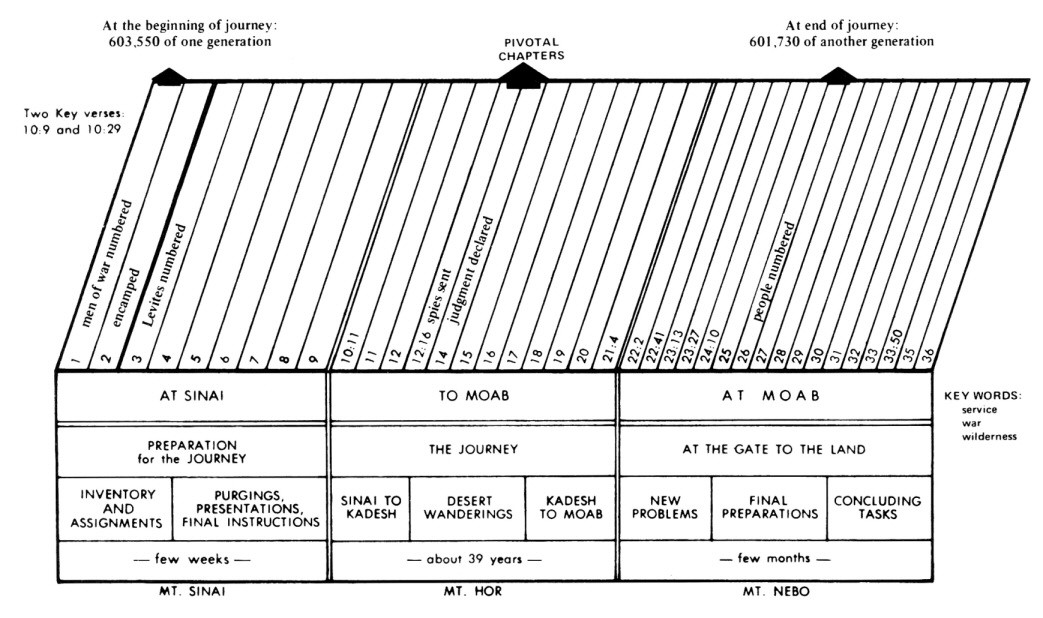
Numbers: Journey to God's Rest-Land by Irving Jensen- used by permission
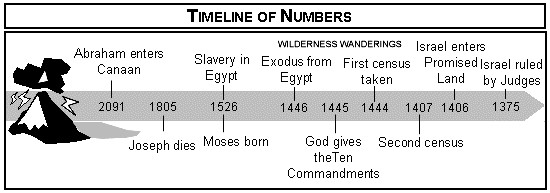
Source: Ryrie Study Bible
| THE BOOK OF NUMBERS "Wilderness Wandering" |
||||||||
| WALKING Numbers 1-12 |
WANDERING Numbers 13-25 |
WAITING Numbers 26-36 |
||||||
| Counting & Camping Nu 1-4 |
Cleansing & Congregation Nu 5-8 |
Carping & Complaining Nu 9-12 |
12 Spies & Death in Desert Nu 13-16 |
Aaron & Levites in Wilderness Nu 17-18 |
Serpent of Brass & Story of Balaam Nu 21-25 |
Second Census 7 Laws of Israel Nu 26-30 |
Last Days of Moses as Leader Nu 31-33 |
Sections, Sanctuaries & Settlements Nu 34-36 |
| Law & Order |
Rebellion & Disorder |
New Laws for the New Order |
||||||
| Old Generation |
Tragic Transition |
New Generation |
||||||
| Preparation for the Journey: Moving Out |
Participation in the Journey: Moving On |
Prize at end of the Journey: Moving In |
||||||
| At Sinai Mt Sinai |
To Moab Mt Hor |
At Moab Mt Nebo |
||||||
| En Route to Kadesh (Mt Sinai) |
En Route to Nowhere (Wilderness) |
En Route to Canaan (Plains of Moab) |
||||||
| A Few Weeks to 2 Months |
38 years, 3 months, 10 days |
A Few Months |
||||||
| Christ in Numbers = Our "Lifted-up One" (Nu 21:9, cp Jn 3:14-15) |
||||||||
| Author: Moses | ||||||||
- Service (41x/37v),
- sin/sins (49x),
- Passover (11x/10v),
- covenant (5x),
- holy (38x/35v),
- atonement (17x/15v),
- offering(s) (296x/167v),
- "the LORD spoke to" (47x),
- war (31x/30v),
- wilderness (48x/44v),
- tent/tabernacle (93v),
- cloud (20x/16v),
- curse(s) (23x/19v)
Also in the KJV the phrases "thou shalt" occurs 208x/154v and "thou shalt not" occurs 80x/76v
OUTLINE OF NUMBERS- See Detailed Outline of Numbers
Christ in the Book of Numbers: Portrayed as our "Lifted-Up One" (Nu 21:9, cp Jn 3:14-15)
- See Christ in the Old Testament by A M Hodgkin
- See The Old Testament Presents... Reflections of Christ by Paul R Van Gorder
- Irving Jensen's summary below on how to study Numbers
- Spiritual Warfare in the Book of Numbers-Chuck Huckaby
- Introduction to the Book of Numbers – John MacArthur
- Overview of Numbers - Charles Swindoll - see chart on right side
- Numbers – Analysis – James Van Dine
- Numbers – Living Messages-G Campbell Morgan
- Numbers 1-19 Synthetic Bible Studies - including spiritual lessons
- Numbers 20-36 Synthetic Bible Studies – James Gray
- Numbers The Incomplete Christian Life – Ray Stedman – very practical
- Theology of Numbers – Baker’s Evangelical Dictionary of Biblical Theology
- Parallels Between Exodus and Numbers - chart
- Map - Journey of the Spies
- Journey from Kadesh-Barnea to the Plains of Moab
- The Conquest of the East - Numbers 21 - Map correlating with verses in Numbers 21

RECOMMENDED WORK-AROUND
WHEN A LINK SAYS “PAGE NOT FOUND” (404 ERROR)
If you encounter "bad" links especially links from early versions of my website, and they return a “Page Not Found” (404) message, in many cases, the following simple workaround can successfully restore access to the intended page:
- Go to: https://web.archive.org/
- Copy and paste the URL that produced the dead link.
Example: Devotional
URL: https://getmorestrength.org/daily/jesus-at-the-crossroad/
Paste this URL into the search box on archive.org. - Press Enter on your keyboard.
- A Timeline will appear, with vertical black bars showing the years the page was archived (this example shows multiple lines)
- Click one of the years—I usually recommend choosing one of the earlier years.
- After selecting a year (e.g., select 2018) a 12-month calendar appears. Dates highlighted in blue indicate an archived version.
- Hover over the blue date (JUL 18) and you will see a timestamp (08:25:49)
- Click that link.
- The archived page—in this case "Jesus at the Crossroad"—should now load. (loading is sometimes slow)
This process may seem a bit intimidating at first, but after doing it a few times it becomes quite simple. If the first year you choose does not reveal the page, just try another year on the timeline. Over the past decade, this method has helped me recover about 90% of those “missing” pages.
If you come across a bad link, would you kindly let me know? Please send the broken link AND the page where you found it using the contact form. Thank you for helping keep the site useful for everyone.
Numbers 1:2
Numbers 1:3
Numbers 1:4
Numbers 1:5
Numbers 1:6
Numbers 1:7
Numbers 1:8
Numbers 1:9
Numbers 1:10
Numbers 1:11
Numbers 1:12
Numbers 1:13
Numbers 1:14
Numbers 1:15
Numbers 1:16
Numbers 1:17
Numbers 1:18
Numbers 1:19
Numbers 1:20
Numbers 1:21
Numbers 1:22
Numbers 1:23
Numbers 1:24
Numbers 1:25
Numbers 1:26
Numbers 1:27
Numbers 1:28
Numbers 1:29
Numbers 1:30
Numbers 1:31
Numbers 1:32
Numbers 1:33
Numbers 1:34
Numbers 1:35
Numbers 1:36
Numbers 1:37
Numbers 1:38
Numbers 1:39
Numbers 1:40
Numbers 1:41
Numbers 1:42
Numbers 1:43
Numbers 1:44
Numbers 1:45
Numbers 1:46
Numbers 1:47
Numbers 1:48
Numbers 1:49
Numbers 1:50
Numbers 1:51
Numbers 1:52
Numbers 1:53
Numbers 1:54
Numbers 2:2
Numbers 2:3
Numbers 2:4
Numbers 2:5
Numbers 2:6
Numbers 2:7
Numbers 2:8
Numbers 2:9
Numbers 2:10
Numbers 2:11
Numbers 2:12
Numbers 2:13
Numbers 2:14
Numbers 2:15
Numbers 2:16
Numbers 2:17
Numbers 2:18
Numbers 2:19
Numbers 2:20
Numbers 2:21
Numbers 2:22
Numbers 2:23
Numbers 2:24
Numbers 2:25
Numbers 2:26
Numbers 2:27
Numbers 2:28
Numbers 2:29
Numbers 2:30
Numbers 2:31
Numbers 2:32
Numbers 2:33
Numbers 2:34
Numbers 3:2
Numbers 3:3
Numbers 3:4
Numbers 3:5
Numbers 3:6
Numbers 3:7
Numbers 3:8
Numbers 3:9
Numbers 3:10
Numbers 3:11
Numbers 3:12
Numbers 3:13
Numbers 3:14
Numbers 3:15
Numbers 3:16
Numbers 3:17
Numbers 3:18
Numbers 3:19
Numbers 3:20
Numbers 3:21
Numbers 3:22
Numbers 3:23
Numbers 3:24
Numbers 3:25
Numbers 3:26
Numbers 3:27
Numbers 3:28
Numbers 3:29
Numbers 3:30
Numbers 3:31
Numbers 3:32
Numbers 3:33
Numbers 3:34
Numbers 3:35
Numbers 3:36
Numbers 3:37
Numbers 3:38
Numbers 3:39
Numbers 3:40
Numbers 3:41
Numbers 3:42
Numbers 3:43
Numbers 3:44
Numbers 3:45
Numbers 3:46
Numbers 3:47
Numbers 3:48
Numbers 3:49
Numbers 3:50
Numbers 3:51
Numbers 4:2
Numbers 4:3
Numbers 4:4
Numbers 4:5
Numbers 4:6
Numbers 4:7
Numbers 4:8
Numbers 4:9
Numbers 4:10
Numbers 4:11
Numbers 4:12
Numbers 4:13
Numbers 4:14
Numbers 4:15
Numbers 4:16
Numbers 4:17
Numbers 4:18
Numbers 4:19
Numbers 4:20
Numbers 4:21
Numbers 4:22
Numbers 4:23
Numbers 4:24
Numbers 4:25
Numbers 4:26
Numbers 4:27
Numbers 4:28
Numbers 4:29
Numbers 4:30
Numbers 4:31
Numbers 4:32
Numbers 4:33
Numbers 4:34
Numbers 4:35
Numbers 4:36
Numbers 4:37
Numbers 4:38
Numbers 4:39
Numbers 4:40
Numbers 4:41
Numbers 4:42
Numbers 4:43
Numbers 4:44
Numbers 4:45
Numbers 4:46
Numbers 4:47
Numbers 4:48
Numbers 4:49
Numbers 4:50
Numbers 4:51
Numbers 4:52
Numbers 4:53
Numbers 4:54
Numbers 4:55
Numbers 4:56
Numbers 4:57
Numbers 4:58
Numbers 4:59
Numbers 4:60
Numbers 4:61
Numbers 4:62
Numbers 4:63
Numbers 4:64
Numbers 4:65
Numbers 4:66
Numbers 4:67
Numbers 4:68
Numbers 5:2
Numbers 5:3
Numbers 5:4
Numbers 5:5
Numbers 5:6
Numbers 5:7
Numbers 5:8
Numbers 5:9
Numbers 5:10
Numbers 5:11
Numbers 5:12
Numbers 5:13
Numbers 5:14
Numbers 5:15
Numbers 5:16
Numbers 5:17
Numbers 5:18
Numbers 5:19
Numbers 5:20
Numbers 5:21
Numbers 5:22
Numbers 5:23
Numbers 5:24
Numbers 5:25
Numbers 5:26
Numbers 5:27
Numbers 5:28
Numbers 5:29
Numbers 5:30
Numbers 5:31
Numbers 6:2
Numbers 6:3
Numbers 6:4
Numbers 6:5
Numbers 6:6
Numbers 6:7
Numbers 6:8
Numbers 6:9
Numbers 6:10
Numbers 6:11
Numbers 6:12
Numbers 6:13
Numbers 6:14
Numbers 6:15
Numbers 6:16
Numbers 6:17
Numbers 6:18
Numbers 6:19
Numbers 6:20
Numbers 6:21
Numbers 6:22
Numbers 6:23
Numbers 6:24
Numbers 6:25
Numbers 6:26
Numbers 6:27
Numbers 7:2
Numbers 7:3
Numbers 7:4
Numbers 7:5
Numbers 7:6
Numbers 7:7
Numbers 7:8
Numbers 7:9
Numbers 7:10
Numbers 7:11
Numbers 7:12
Numbers 7:13
Numbers 7:14
Numbers 7:15
Numbers 7:16
Numbers 7:17
Numbers 7:18
Numbers 7:19
Numbers 7:20
Numbers 7:21
Numbers 7:22
Numbers 7:23
Numbers 7:24
Numbers 7:25
Numbers 7:26
Numbers 7:27
Numbers 7:28
Numbers 7:29
Numbers 7:30
Numbers 7:31
Numbers 7:32
Numbers 7:33
Numbers 7:34
Numbers 7:35
Numbers 7:36
Numbers 7:37
Numbers 7:38
Numbers 7:39
Numbers 7:40
Numbers 7:41
Numbers 7:42
Numbers 7:43
Numbers 7:44
Numbers 7:45
Numbers 7:46
Numbers 7:47
Numbers 7:48
Numbers 7:49
Numbers 7:50
Numbers 7:51
Numbers 7:52
Numbers 7:53
Numbers 7:54
Numbers 7:55
Numbers 7:56
Numbers 7:57
Numbers 7:58
Numbers 7:59
Numbers 7:60
Numbers 7:61
Numbers 7:62
Numbers 7:63
Numbers 7:64
Numbers 7:65
Numbers 7:66
Numbers 7:67
Numbers 7:68
Numbers 7:69
Numbers 7:70
Numbers 7:71
Numbers 7:72
Numbers 7:73
Numbers 7:74
Numbers 7:75
Numbers 7:76
Numbers 7:77
Numbers 7:78
Numbers 7:79
Numbers 7:80
Numbers 7:81
Numbers 7:82
Numbers 7:83
Numbers 7:84
Numbers 7:85
Numbers 7:86
Numbers 7:87
Numbers 7:88
Numbers 7:89
Numbers 8:2
Numbers 8:3
Numbers 8:4
Numbers 8:5
Numbers 8:6
Numbers 8:7
Numbers 8:8
Numbers 8:9
Numbers 8:10
Numbers 8:11
Numbers 8:12
Numbers 8:13
Numbers 8:14
Numbers 8:15
Numbers 8:16
Numbers 8:17
Numbers 8:18
Numbers 8:19
Numbers 8:20
Numbers 8:21
Numbers 8:22
Numbers 8:23
Numbers 8:24
Numbers 8:25
Numbers 8:26
Numbers 9:2
Numbers 9:3
Numbers 9:4
Numbers 9:5
Numbers 9:6
Numbers 9:7
Numbers 9:8
Numbers 9:9
Numbers 9:10
Numbers 9:11
Numbers 9:12
Numbers 9:13
Numbers 9:14
Numbers 9:15
Numbers 9:16
Numbers 9:17
Numbers 9:18
Numbers 9:19
Numbers 9:20
Numbers 9:21
Numbers 9:22
Numbers 9:23
Numbers 10:2
Numbers 10:3
Numbers 10:4
Numbers 10:5
Numbers 10:6
Numbers 10:7
Numbers 10:8
Numbers 10:9
Numbers 10:10
Numbers 10:11
Numbers 10:12
Numbers 10:13
Numbers 10:14
Numbers 10:15
Numbers 10:16
Numbers 10:17
Numbers 10:18
Numbers 10:19
Numbers 10:20
Numbers 10:21
Numbers 10:22
Numbers 10:23
Numbers 10:24
Numbers 10:25
Numbers 10:26
Numbers 10:27
Numbers 10:28
Numbers 10:29
Numbers 10:30
Numbers 10:31
Numbers 10:32
Numbers 10:33
Numbers 10:34
Numbers 10:35
Numbers 10:36
Numbers 11:2
Numbers 11:3
Numbers 11:4
Numbers 11:5
Numbers 11:6
Numbers 11:7
Numbers 11:8
Numbers 11:9
Numbers 11:10
Numbers 11:11
Numbers 11:12
Numbers 11:13
Numbers 11:14
Numbers 11:15
Numbers 11:16
Numbers 11:17
Numbers 11:18
Numbers 11:19
Numbers 11:20
Numbers 11:21
Numbers 11:22
Numbers 11:23
Numbers 11:24
Numbers 11:25
Numbers 11:26
Numbers 11:27
Numbers 11:28
Numbers 11:29
Numbers 11:30
Numbers 11:31
Numbers 11:32
Numbers 11:33
Numbers 11:34
Numbers 11:35
Numbers 12:2
Numbers 12:3
Numbers 12:4
Numbers 12:5
Numbers 12:6
Numbers 12:7
Numbers 12:8
Numbers 12:9
Numbers 12:10
Numbers 12:11
Numbers 12:12
Numbers 12:13
Numbers 12:14
Numbers 12:15
Numbers 12:16
Numbers 13:2
Numbers 13:3
Numbers 13:4
Numbers 13:5
Numbers 13:6
Numbers 13:7
Numbers 13:8
Numbers 13:9
Numbers 13:10
Numbers 13:11
Numbers 13:12
Numbers 13:13
Numbers 13:14
Numbers 13:15
Numbers 13:16
Numbers 13:17
Numbers 13:18
Numbers 13:19
Numbers 13:20
Numbers 13:21
Numbers 13:22
Numbers 13:23
Numbers 13:24
Numbers 13:25
Numbers 13:26
Numbers 13:27
Numbers 13:28
Numbers 13:29
Numbers 13:30
Numbers 13:31
Numbers 13:32
Numbers 13:33
Numbers 14:2
Numbers 14:3
Numbers 14:4
Numbers 14:5
Numbers 14:6
Numbers 14:7
Numbers 14:8
Numbers 14:9
Numbers 14:10
Numbers 14:11
Numbers 14:12
Numbers 14:13
Numbers 14:14
Numbers 14:15
Numbers 14:16
Numbers 14:17
Numbers 14:18
Numbers 14:19
Numbers 14:20
Numbers 14:21
Numbers 14:22
Numbers 14:23
Numbers 14:24
Numbers 14:25
Numbers 14:26
Numbers 14:27
Numbers 14:28
Numbers 14:29
Numbers 14:30
Numbers 14:31
Numbers 14:32
Numbers 14:33
Numbers 14:34
Numbers 14:35
Numbers 14:36
Numbers 14:37
Numbers 14:38
Numbers 14:39
Numbers 14:40
Numbers 14:41
Numbers 14:42
Numbers 14:43
Numbers 14:44
Numbers 14:45
Numbers 15:2
Numbers 15:3
Numbers 15:4
Numbers 15:5
Numbers 15:6
Numbers 15:7
Numbers 15:8
Numbers 15:9
Numbers 15:10
Numbers 15:11
Numbers 15:12
Numbers 15:13
Numbers 15:14
Numbers 15:15
Numbers 15:16
Numbers 15:17
Numbers 15:18
Numbers 15:19
Numbers 15:20
Numbers 15:21
Numbers 15:22
Numbers 15:23
Numbers 15:24
Numbers 15:25
Numbers 15:26
Numbers 15:27
Numbers 15:28
Numbers 15:29
Numbers 15:30
Numbers 15:31
Numbers 15:32
Numbers 15:33
Numbers 15:34
Numbers 15:35
Numbers 15:36
Numbers 15:37
Numbers 15:38
Numbers 15:39
Numbers 15:40
Numbers 15:41
Numbers 16:2
Numbers 16:3
Numbers 16:4
Numbers 16:5
Numbers 16:6
Numbers 16:7
Numbers 16:8
Numbers 16:9
Numbers 16:10
Numbers 16:11
Numbers 16:12
Numbers 16:13
Numbers 16:14
Numbers 16:15
Numbers 16:16
Numbers 16:17
Numbers 16:18
Numbers 16:19
Numbers 16:20
Numbers 16:21
Numbers 16:22
Numbers 16:23
Numbers 16:24
Numbers 16:25
Numbers 16:26
Numbers 16:27
Numbers 16:28
Numbers 16:29
Numbers 16:30
Numbers 16:31
Numbers 16:32
Numbers 16:33
Numbers 16:34
Numbers 16:35
Numbers 16:36
Numbers 16:37
Numbers 16:38
Numbers 16:39
Numbers 16:40
Numbers 16:41
Numbers 16:42
Numbers 16:43
Numbers 16:44
Numbers 16:45
Numbers 16:46
Numbers 16:47
Numbers 16:48
Numbers 16:49
Numbers 16:50
Numbers 17:2
Numbers 17:3
Numbers 17:4
Numbers 17:5
Numbers 17:6
Numbers 17:7
Numbers 17:8
Numbers 17:9
Numbers 17:10
Numbers 17:11
Numbers 17:12
Numbers 17:13
Numbers 18:2
Numbers 18:3
Numbers 18:4
Numbers 18:5
Numbers 18:6
Numbers 18:7
Numbers 18:8
Numbers 18:9
Numbers 18:10
Numbers 18:11
Numbers 18:12
Numbers 18:13
Numbers 18:14
Numbers 18:15
Numbers 18:16
Numbers 18:17
Numbers 18:18
Numbers 18:19
Numbers 18:20
Numbers 18:21
Numbers 18:22
Numbers 18:23
Numbers 18:24
Numbers 18:25
Numbers 18:26
Numbers 18:27
Numbers 18:28
Numbers 18:29
Numbers 18:30
Numbers 18:31
Numbers 18:32
Numbers 19:2
Numbers 19:3
Numbers 19:4
Numbers 19:5
Numbers 19:6
Numbers 19:7
Numbers 19:8
Numbers 19:9
Numbers 19:10
Numbers 19:11
Numbers 19:12
Numbers 19:13
Numbers 19:14
Numbers 19:15
Numbers 19:16
Numbers 19:17
Numbers 19:18
Numbers 19:19
Numbers 19:20
Numbers 19:21
Numbers 19:22
Numbers 20:2
Numbers 20:3
Numbers 20:4
Numbers 20:5
Numbers 20:6
Numbers 20:7
Numbers 20:8
Numbers 20:9
Numbers 20:10
Numbers 20:11
Numbers 20:12
Numbers 20:13
Numbers 20:14
Numbers 20:15
Numbers 20:16
Numbers 20:17
Numbers 20:18
Numbers 20:19
Numbers 20:20
Numbers 20:21
Numbers 20:22
Numbers 20:23
Numbers 20:24
Numbers 20:25
Numbers 20:26
Numbers 20:27
Numbers 20:28
Numbers 20:29
Numbers 21:2
Numbers 21:3
Numbers 21:4
Numbers 21:5
Numbers 21:6
Numbers 21:7
Numbers 21:8
Numbers 21:9
Numbers 21:10
Numbers 21:11
Numbers 21:12
Numbers 21:13
Numbers 21:14
Numbers 21:15
Numbers 21:16
Numbers 21:17
Numbers 21:18
Numbers 21:19
Numbers 21:20
Numbers 21:21
Numbers 21:22
Numbers 21:23
Numbers 21:24
Numbers 21:25
Numbers 21:26
Numbers 21:27
Numbers 21:28
Numbers 21:29
Numbers 21:30
Numbers 21:31
Numbers 21:32
Numbers 21:33
Numbers 21:34
Numbers 21:35
Numbers 22:2
Numbers 22:3
Numbers 22:4
Numbers 22:5
Numbers 22:6
Numbers 22:7
Numbers 22:8
Numbers 22:9
Numbers 22:10
Numbers 22:11
Numbers 22:12
Numbers 22:13
Numbers 22:14
Numbers 22:15
Numbers 22:16
Numbers 22:17
Numbers 22:18
Numbers 22:19
Numbers 22:20
Numbers 22:21
Numbers 22:22
Numbers 22:23
Numbers 22:24
Numbers 22:25
Numbers 22:26
Numbers 22:27
Numbers 22:28
Numbers 22:29
Numbers 22:30
Numbers 22:31
Numbers 22:32
Numbers 22:33
Numbers 22:34
Numbers 22:35
Numbers 22:36
Numbers 22:37
Numbers 22:38
Numbers 22:39
Numbers 22:40
Numbers 22:41
Numbers 23:2
Numbers 23:3
Numbers 23:4
Numbers 23:5
Numbers 23:6
Numbers 23:7
Numbers 23:8
Numbers 23:9
Numbers 23:10
Numbers 23:11
Numbers 23:12
Numbers 23:13
Numbers 23:14
Numbers 23:15
Numbers 23:16
Numbers 23:17
Numbers 23:18
Numbers 23:19
Numbers 23:20
Numbers 23:21
Numbers 23:22
Numbers 23:23
Numbers 23:24
Numbers 23:25
Numbers 23:26
Numbers 23:27
Numbers 23:28
Numbers 23:29
Numbers 23:30
Numbers 24:2
Numbers 24:3
Numbers 24:4
Numbers 24:5
Numbers 24:6
Numbers 24:7
Numbers 24:8
Numbers 24:9
Numbers 24:10
Numbers 24:11
Numbers 24:12
Numbers 24:13
Numbers 24:14
Numbers 24:15
Numbers 24:16
Numbers 24:17
Numbers 24:18
Numbers 24:19
Numbers 24:20
Numbers 24:21
Numbers 24:22
Numbers 24:23
Numbers 24:24
Numbers 24:25
Numbers 25:2
Numbers 25:3
Numbers 25:4
Numbers 25:5
Numbers 25:6
Numbers 25:7
Numbers 25:8
Numbers 25:9
Numbers 25:10
Numbers 25:11
Numbers 25:12
Numbers 25:13
Numbers 25:14
Numbers 25:15
Numbers 25:16
Numbers 25:17
Numbers 25:18
Numbers 26:2
Numbers 26:3
Numbers 26:4
Numbers 26:5
Numbers 26:6
Numbers 26:7
Numbers 26:8
Numbers 26:9
Numbers 26:10
Numbers 26:11
Numbers 26:12
Numbers 26:13
Numbers 26:14
Numbers 26:15
Numbers 26:16
Numbers 26:17
Numbers 26:18
Numbers 26:19
Numbers 26:20
Numbers 26:21
Numbers 26:22
Numbers 26:23
Numbers 26:24
Numbers 26:25
Numbers 26:26
Numbers 26:27
Numbers 26:28
Numbers 26:29
Numbers 26:30
Numbers 26:31
Numbers 26:32
Numbers 26:33
Numbers 26:34
Numbers 26:35
Numbers 26:36
Numbers 26:37
Numbers 26:38
Numbers 26:39
Numbers 26:40
Numbers 26:41
Numbers 26:42
Numbers 26:43
Numbers 26:44
Numbers 26:45
Numbers 26:46
Numbers 26:47
Numbers 26:48
Numbers 26:49
Numbers 26:50
Numbers 26:51
Numbers 26:52
Numbers 26:53
Numbers 26:54
Numbers 26:55
Numbers 26:56
Numbers 26:57
Numbers 26:58
Numbers 26:59
Numbers 26:60
Numbers 26:61
Numbers 26:62
Numbers 26:63
Numbers 26:64
Numbers 26:65
Numbers 27:2
Numbers 27:3
Numbers 27:4
Numbers 27:5
Numbers 27:6
Numbers 27:7
Numbers 27:8
Numbers 27:9
Numbers 27:10
Numbers 27:11
Numbers 27:12
Numbers 27:13
Numbers 27:14
Numbers 27:15
Numbers 27:16
Numbers 27:17
Numbers 27:18
Numbers 27:19
Numbers 27:20
Numbers 27:21
Numbers 27:22
Numbers 27:23
Numbers 28:2
Numbers 28:3
Numbers 28:4
Numbers 28:5
Numbers 28:6
Numbers 28:7
Numbers 28:8
Numbers 28:9
Numbers 28:10
Numbers 28:11
Numbers 28:12
Numbers 28:13
Numbers 28:14
Numbers 28:15
Numbers 28:16
Numbers 28:17
Numbers 28:18
Numbers 28:19
Numbers 28:20
Numbers 28:21
Numbers 28:22
Numbers 28:23
Numbers 28:24
Numbers 28:25
Numbers 28:26
Numbers 28:27
Numbers 28:28
Numbers 28:29
Numbers 28:30
Numbers 28:31
Numbers 29:2
Numbers 29:3
Numbers 29:4
Numbers 29:5
Numbers 29:6
Numbers 29:7
Numbers 29:8
Numbers 29:9
Numbers 29:10
Numbers 29:11
Numbers 29:12
Numbers 29:13
Numbers 29:14
Numbers 29:15
Numbers 29:16
Numbers 29:17
Numbers 29:18
Numbers 29:19
Numbers 29:20
Numbers 29:21
Numbers 29:22
Numbers 29:23
Numbers 29:24
Numbers 29:25
Numbers 29:26
Numbers 29:27
Numbers 29:28
Numbers 29:29
Numbers 29:30
Numbers 29:31
Numbers 29:32
Numbers 29:33
Numbers 29:34
Numbers 29:35
Numbers 29:36
Numbers 29:37
Numbers 29:38
Numbers 29:39
Numbers 29:40
Numbers 30:2
Numbers 30:3
Numbers 30:4
Numbers 30:5
Numbers 30:6
Numbers 30:7
Numbers 30:8
Numbers 30:9
Numbers 30:10
Numbers 30:11
Numbers 30:12
Numbers 30:13
Numbers 30:14
Numbers 30:15
Numbers 30:16
Numbers 31:2
Numbers 31:3
Numbers 31:4
Numbers 31:5
Numbers 31:6
Numbers 31:7
Numbers 31:8
Numbers 31:9
Numbers 31:10
Numbers 31:11
Numbers 31:12
Numbers 31:13
Numbers 31:14
Numbers 31:15
Numbers 31:16
Numbers 31:17
Numbers 31:18
Numbers 31:19
Numbers 31:20
Numbers 31:21
Numbers 31:22
Numbers 31:23
Numbers 31:24
Numbers 31:25
Numbers 31:26
Numbers 31:27
Numbers 31:28
Numbers 31:29
Numbers 31:30
Numbers 31:31
Numbers 31:32
Numbers 31:33
Numbers 31:34
Numbers 31:35
Numbers 31:36
Numbers 31:37
Numbers 31:38
Numbers 31:39
Numbers 31:40
Numbers 31:41
Numbers 31:42
Numbers 31:43
Numbers 31:44
Numbers 31:45
Numbers 31:46
Numbers 31:47
Numbers 31:48
Numbers 31:49
Numbers 31:50
Numbers 31:51
Numbers 31:52
Numbers 31:53
Numbers 31:54
Numbers 32:2
Numbers 32:3
Numbers 32:4
Numbers 32:5
Numbers 32:6
Numbers 32:7
Numbers 32:8
Numbers 32:9
Numbers 32:10
Numbers 32:11
Numbers 32:12
Numbers 32:13
Numbers 32:14
Numbers 32:15
Numbers 32:16
Numbers 32:17
Numbers 32:18
Numbers 32:19
Numbers 32:20
Numbers 32:21
Numbers 32:22
Numbers 32:23
Numbers 32:24
Numbers 32:25
Numbers 32:26
Numbers 32:27
Numbers 32:28
Numbers 32:29
Numbers 32:30
Numbers 32:31
Numbers 32:32
Numbers 32:33
Numbers 32:34
Numbers 32:35
Numbers 32:36
Numbers 32:37
Numbers 32:38
Numbers 32:39
Numbers 32:40
Numbers 32:41
Numbers 32:42
Numbers 33:2
Numbers 33:3
Numbers 33:4
Numbers 33:5
Numbers 33:6
Numbers 33:7
Numbers 33:8
Numbers 33:9
Numbers 33:10
Numbers 33:11
Numbers 33:12
Numbers 33:13
Numbers 33:14
Numbers 33:15
Numbers 33:16
Numbers 33:17
Numbers 33:18
Numbers 33:19
Numbers 33:20
Numbers 33:21
Numbers 33:22
Numbers 33:23
Numbers 33:24
Numbers 33:25
Numbers 33:26
Numbers 33:27
Numbers 33:28
Numbers 33:29
Numbers 33:30
Numbers 33:31
Numbers 33:32
Numbers 33:33
Numbers 33:34
Numbers 33:35
Numbers 33:36
Numbers 33:37
Numbers 33:38
Numbers 33:39
Numbers 33:40
Numbers 33:41
Numbers 33:42
Numbers 33:43
Numbers 33:44
Numbers 33:45
Numbers 33:46
Numbers 33:47
Numbers 33:48
Numbers 33:49
Numbers 33:50
Numbers 33:51
Numbers 33:52
Numbers 33:53
Numbers 33:54
Numbers 33:55
Numbers 33:56
Numbers 34:2
Numbers 34:3
Numbers 34:4
Numbers 34:5
Numbers 34:6
Numbers 34:7
Numbers 34:8
Numbers 34:9
Numbers 34:10
Numbers 34:11
Numbers 34:12
Numbers 34:13
Numbers 34:14
Numbers 34:15
Numbers 34:16
Numbers 34:17
Numbers 34:18
Numbers 34:19
Numbers 34:20
Numbers 34:21
Numbers 34:22
Numbers 34:23
Numbers 34:24
Numbers 34:25
Numbers 34:26
Numbers 34:27
Numbers 34:28
Numbers 34:29
Numbers 35:2
Numbers 35:3
Numbers 35:4
Numbers 35:5
Numbers 35:6
Numbers 35:7
Numbers 35:8
Numbers 35:9
Numbers 35:10
Numbers 35:11
Numbers 35:12
Numbers 35:13
Numbers 35:14
Numbers 35:15
Numbers 35:16
Numbers 35:17
Numbers 35:18
Numbers 35:19
Numbers 35:20
Numbers 35:21
Numbers 35:22
Numbers 35:23
Numbers 35:24
Numbers 35:25
Numbers 35:26
Numbers 35:27
Numbers 35:28
Numbers 35:29
Numbers 35:30
Numbers 35:31
Numbers 35:32
Numbers 35:33
Numbers 35:34
Numbers 36:2
Numbers 36:3
Numbers 36:4
Numbers 36:5
Numbers 36:6
Numbers 36:7
Numbers 36:8
Numbers 36:9
Numbers 36:10
Numbers 36:11
Numbers 36:12
Numbers 36:13
Explanation - Most of the resources below are newer commentaries (written after 1970) and other Bible resources which previously were available only for purchase in book form or in a Bible computer program. The resources are made freely available by archive.org but have several caveats - (1) they do not allow copy and paste, (2) they can only be checked out for one hour (but can be checked out immediately when your hour expires giving you time to read or take notes on a lengthy section) and (3) they require creating an account which allows you to check out the books free of charge. To set up an account click archive.org and then click the picture of the person in right upper corner and enter email and a password. That's all you have to do. Then you can read these more modern resources free of charge! I have read or used many of these resources but not all of them so ultimately you will need to be a Berean (Acts 17:11) as you use them. I have also selected works that are conservative and Biblically sound. If you find one that you think does not meet those criteria please send an email at https://www.preceptaustin.org/
Numbers : an introduction and commentary by Wenham, Gordon J
Cyril Barber - Tyndale Old Testament Commentaries. Seldom read by Christians, the book of Numbers has been ignored by the majority of the contemporary "lamp-toting children of Diogenes:' Now, however, Wenham's excellent treatment not only illumines the text, but also suggests applications to everyday life.
Wiersbe's expository outlines on the Old Testament by Wiersbe, Warren W 113 ratings
"Even the most difficult Scriptures come alive as Warren Wiersbe leads you book-by-book through the Old Testament and helps you to see the "big picture" of God's revelation. In this unique volume, you will find: • Introductions and/or outlines for every Old Testament book • Practical expositions of strategic chapters • Special studies on key topics, relating the Old Testament to the New Testament • Easy-to-understand expositions that are practical, preachable, and teachable If you have used Dr. Wiersbe's popular BE series, you know how simple and practical his Bible studies are, with outlines that almost teach themselves. If not, you can now discover a wonderful new resource. This work is a unique commentary on every book of the Old Testament. It contains new material not to be found in the BE series.
The communicator's commentary. Numbers by Philip, James Numbers - The Preacher's Commentary by Philip, James (the new title for the Communicator's commentary)
Numbers : based on the Revised Standard Version by Davies, Eryl W
Cyril Barber - New Century Bible Commentary. Grand Rapids: Wm. B. Eerdmans Publishing Co., 1995. Based on the text of the RSV. Comprehensive in scope. Shows the strategic importance of this canonical book in its relation to the Torah and the rest of the Bible. Examines the role of the priest, and lays bare the importance of holiness as one approaches the Lord.
KJV Bible Commentary - Hindson, Edward E; Kroll, Woodrow Michael. Over 3000 pages of the entire OT/NT - no restriction on length of time one can use it. However it does not allow copy and paste. 5 Stars - 372 ratings
Very well done conservative commentary that interprets Scripture from a literal perspective (pre-millennial) user reviews
The King James Version Bible Commentary is a complete verse-by-verse commentary. It is comprehensive in scope, reliable in scholarship, and easy to use. Its authors are leading evangelical theologians who provide practical truths and biblical principles. Any Bible student will gain new insights through this one-volume commentary based on the timeless King James Version of the Bible.
Numbers by McGee, J. Vernon
The MacArthur study Bible : John MacArthur Brief but well done notes 1,275 ratings
ESV study Bible - Good notes but not always literal in eschatology and the nation of Israel 6,004 ratings
New Bible Commentary - (1994) See user reviews Leviticus by Christopher J. H. Wright, M.A., Ph.D., Principal, All Nations Christian College, Ware, UK.
The David Jeremiah study bible - (2013) 2208 pages. 2,272 ratings Logos.com -
"Drawing on more than 40 years of study, Dr. David Jeremiah has compiled a legacy resource that will make an eternal impact on generations to come. 8,000 study notes. Hundreds of enriching word studies"50+ Essentials of the Christian Faith" articles."
Moses : a man of selfless dedication : profiles in character by Swindoll, Charles
Cyril Barber - Swindoll is a master in the use of drama, and those who have sat under his ministry readily appreciate his acumen. His writings, however, do not reflect this and leave a great figure such as Moses forever (it seems) in the shadows. On the positive side, this is a useful summary of the great liberator’s contribution to the lives of his people
Moses: moments of glory ... feet of clay by Getz, Gene A - How to appropriate God's power today.
The Defender's Study Bible : King James Version by Morris, Henry M. Excellent notes for well known creationist. 45 ratings
The Henry Morris KJV Study Bible is an invaluable apologetic Bible study tool for the defense of the Christian faith, including biblical creationism, that highlights the foundational truths of Genesis found in all the other 65 books of the KJV Bible. The comprehensive apologetic study bible notes provide answers to questions related to doctrinal issues, as well as scientific matters, such as geology, earth history, astronomy, biology, and other sciences.
With the Word - Devotional Commentary - Warren Wiersbe -27 ratings 428 ratings Comments on each chapter. Wiersbe is always worth checking!
"A fresh approach which not only offers trustworthy exposition, but also provides a book-by-book, chapter-by-chapter tour through the glory of the Bible. This highly readable personal "conversation" with Scripture guides you through each book, helping you reap the rich, life-changing applications on every page. You will be encouraged to develop your own personal Bible reading program and learn the power of meditation on its truth."
The Experiencing God study Bible : the Bible for knowing and doing the will of God - Blackaby, Henry (1996) 1968 pages - CHECK THIS ONE! Each chapter begins with several questions under the title "PREPARE TO MEET GOD." Then you will interesting symbols before many of the passages. The chapter ends with a "DID YOU NOTICE?" question. This might make a "dry chapter" jump off the page! Read some of the 48 ratings
NKJV Study Bible: New King James Version Study Bible by Radmacher, Earl D; Allen, Ronald Barclay; House, H. Wayne; 917 ratings Very helpful notes. Conservative.
Wycliffe Bible Commentary - Charles Pfeiffer - 1560 pages (1962). Less detailed than the KJV Bible Commentary.
Life application study Bible : New Living Translation. Has some very helpful notes. 4,445 ratings
New Bible Commentary - (1994) See user reviews
NIV archaeological study Bible (2005) 2360 pages 950 ratings
"Readers who desire a more intimate knowledge of the historical context of the Bible will appreciate the NIV Archaeological Study Bible. Full of informative articles and full-color photographs of places and objects from biblical times, this Bible examines the archaeological record surrounding God’s Word and brings the biblical world to life. Readers’ personal studies will be enriched as they become more informed about the empires, places, and peoples of the ancient world. Features include: • Four-color interior throughout • Bottom-of-page study notes exploring passages that speak on archaeological and cultural facts • Articles (520) covering five main categories: Archaeological Sites, Cultural and Historical Notes, Ancient Peoples and Lands, the Reliability of the Bible, and Ancient Texts and Artifacts • Approximately 500 4-color photographs interspersed throughout • Detailed book introductions that provide basic, at-a-glance information • Detailed charts on pertinent topics • In-text color maps that assist the reader in placing the action "
The NIV study Bible by Barker, Kenneth L; Burdick, Donald W (1995) 2250 pages. Note this is the first edition. This resource has been fully revised in 2020.
Evangelical Commentary on the Bible - editor Walter Elwell (1989) 1239 pages. User reviews.
The Ryrie study Bible - Charles Ryrie (1978) 2142 pages. Conservative. 216 ratings
The Pentateuch; a concise commentary on Genesis, Exodus, Leviticus, Numbers, and Deuteronomy by Erdman, Charles
Nelson's expository dictionary of the Old Testament by Unger, Merrill
Ashley, Timothy R. The Book of Numbers. New International Commentary on the Old Testament. Grand Rapids: Wm. B. Eerdmans Publishing Co., 1993. “A rigorous, thorough, up-to-date evangelical commentary on Numbers! The author courageously tackles that book’s thorny technical problems [while at the same time] effectively bringing out its important theological message.”--Robert L. Hubbard.
Brown, Raymond. The Message of Numbers: Journey to the Promised Land. Downers Grove, IL: InterVarsity, 2002. Brown helps readers explore the main themes of Numbers. His application of the truth is challenging and comes from his heart to ours.
Budd, Philip J. Word Biblical Commentary: Numbers. Waco, Tex.: Word Books, 1984. †Contains an excellent introduction, and the bibliographies at the beginning of each section are most helpful. The translation requires careful attention for its values to become apparent. There are also times when liberties have been taken in handling the MT As with other books in this series, a heavy reliance is placed on Redaktionsgeschichte, and there are also places where definite theological weaknesses occur. This book is of value to the discerning reader.
*Bush, George. Notes, Critical and Practical, on the Book of Numbers. Minneapolis: Klock & Klock Christian Publishers, 1981. Meets a definite need for a thorough work in this sorely neglected area of God's revelation. Can be read with profit by laypeople as well as pastors. Recommended.
Davies, Eryl W. Numbers. New Century Bible Commentary. Grand Rapids: Wm. B. Eerdmans Publishing Co., 1995. Based on the text of the RSV. Comprehensive in scope. Shows the strategic importance of this canonical book in its relation to the Torah and the rest of the Bible. Examines the role of the priest, and lays bare the importance of holiness as one approaches the Lord.
Erdman, Charles Rosenbury. The Book of Numbers: An Exposition. Grand Rapids: Baker Book House, 1982. An overview of the history of Israel in the wilderness with principles of application drawn from their experiences.
Harrison, Roland Kenneth. Numbers. Wycliffe Exegetical Commentary. Chicago: Moody Press, 1990. One of the most promising series of commentaries to be launched by an evangelical publishing house. Harrison's work exhibits his remarkable skill in handling the MT. He deals with interpretative problems in a most helpful manner, and his exposition is clear. This book will be referred to by Bible students for many years to come. Recommended.
Maarsingh, B. Numbers, a Practical Commentary. Text and Interpretation. Translated by J. Vriend. Grand Rapids: Wm. B. Eerdmans Publishing Co., 1987. Condenses a vast amount of information into a concise, readable commentary. Careful attention is paid to details. Readers will find the author's approach helpful.
Sakenfeld, Katherine Doob. Journeying with God: A Commentary on the Book of Numbers. Grand Rapids: Wm. B. Eerdmans Publishing Co., 1995. Although little studied by most Christians, the book of Numbers offers a rich storehouse of material for reflection on the relationship between God and the religious community. This new commentary highlights this theme, and in the process attempts to interpret the many unique stories (e.g., Baalim) that the reader encounters. Sakenfeld gives prominence to the role of women in Israel, as well as the way in which these women are presented by the Biblical writer and how mention of them is to be interpreted/understood by contemporary Christians.
Sturdy, John. Cambridge Bible Commentary. New York: Cambridge University Press, 1976. Based on the text of the NEB, this study follows the documentary hypothesis and places the final composition in the reign of David or Solomon. The brief notes supply background information, but are insufficient to meet the needs of the expository preacher.
*Wenham, Gordon J. Numbers: An Introduction and Commentary. Tyndale Old Testament Commentaries. Downers Grove, Ill.: InterVarsity Press, 1981. Seldom read by Christians, the book of Numbers has been ignored by the majority of the contemporary "lamp-toting children of Diogenes:' Now, however, Wenham's excellent treatment not only illumines the text, but also suggests applications to everyday life. (ED: One of the better commentaries for laymen - the other is Ronald Allen's section on Numbers in the Bible Knowledge Commentary).
Allen, Ronald B. “Numbers” (Expositor’s Bible Commentary) Volume 2, ed. Frank Gaebelein and R. P. Polcyn. Grand Rapids: Zondervan, 1990.
A then Professor of Old Testament at Western Conservative Baptist Seminary, Portland, OR (he later has taught at Dallas Theological Seminary) has provided this excellent conservative introduction, also a verse by verse commentary, usually handling problems adeptly. Many will find this theory on the numbers being too high as hard to accept realistically with a high view of Scripture.
Ashley, Timothy R. The Book of Numbers (NICOT). Grand Rapids: Eerdmans, 1993.
This favors a preexilic date for final composition with Moses a key in the first writing for some of the material (7). A 24-pp. bibliography precedes the commentary. Ashley favors a late exodus date (47). He gives six problems in the census counts being so many (60–61), plus scholars’ views and evaluations of views (61–65), finally suggesting that the numbers were about a third of what Numbers says (65–66). Then he concludes that the ancient system of counting is unknown to people today, but he does not take the numbers as literal. Much of the time is spent commenting on elements of different documents he recognizes and whether they are feasible or not. Still he devotes much explanation to many of the verses. Apparently he favors priestly details being in Moses’ day, not devised only centuries later (88). Sometimes discussions end with no leaning, for example in the suspected adulteress’s thigh falling and belly swelling (133). All in all one receives much help on what verses mean or may mean, but a tangle of differences between taking some details as reliable and others as not.
Budd, Philip J. Numbers (Word Biblical Commentary). Waco: Word Books, 1984. 409 pp.
Budd accepts a J, E, D, P scheme of literary sources, regarding Genesis-Joshua as put together by priestly writers in the sixth to fifth centuries B. C., writing to enhance their own concerns and meet problems of their day. Budd takes very little in the various incidents to be trustworthy history (xxvi–xxxi, etc.); it rather is tradition on which scholars can pronounce. If one wants to read on past the fairly current critical judgment on Numbers, gain profit from extensive bibliography, and stick with sometimes ponderous discussions of scholars’ opinions, he can learn much here. But Budd holds that much is relevant only to a time centuries later than the wilderness wanderings. For example, Korah’s rebellion (Numbers 16), in Budd’s imagination, addresses a power struggle in post-exilic days between Zadokite and Levite priests. Much of the commentary furnishes examples of the commentator’s theories artificially forced upon Numbers, this being more pervasive than an illumination of the book in a wilderness setting in which conservatives believe it more naturally fits. The discerning student who is rightly oriented to the wilderness setting of the book can profit much from understanding fine word study, exegesis etc. to relate to that and not later times where Budd places things.
Cole, R. Dennis. Numbers (New American Commentary). Nashville: Broadman & Holman, 2000.
This is a good commentary on most parts, but Cole follows Ron Allen in seeing large numbers in census lists as hyperbole. Many cannot take seriously or honouring to God his claim that badly exaggerated numbering “was not for misrepresentation but for powerful demonstration of Yahweh’s continuous blessing and a statement of confidence” in His multiplication (82). Does God need untruth, and do such purposes justify untruth (cf. 78–82)? On many verses, Cole gets to the point more helpfully than some, and where relevant shows awareness of various possibilities.
Gray, George G. A Critical and Exegetical Commentary on Numbers (ICC). Edinburgh: T. & T. Clark, 1912.
This is a detailed commentary relevant to the serious student who desires help on problem passages as well as general help throughout the book. See earlier comments on the I.C.C. (This usually liberal work was begun in 1885 under the editorial supervision of C. A. Briggs, S. R. Driver and Alfred Plummer. The intention was to provide for English readers a Bible commentary equal in scholarship to the critical German productions of that day. The emphasis is critical and philological.)
Harrison, R. K. Numbers (Wycliffe Exegetical Commentary). Chicago: Moody, 1990. 452 pp.
Harrison’s introduction is well-done in surveying main areas of scholarly debate. Though he sees different literary sources compiled into our present book, among these Balaam’s oracles (Numbers 22–24) from a non-Israelite source but valid, he does hold to the historicity of accounts as coming from eye-witnesses during the wilderness trek. Moses, he feels, exercised supervision over these and contributed some material himself (pp. 22–23). The commentary often shows a well read scholar who is skilled in bringing in material that throws light on texts exegetically, historically, culturally, etc. Harrison is not ready, as Gispen and some others, to assume that the numbers of Israelites are correct, but wants more information before making a judgment (45–47). By and large he is very accepting of the passages as they stand, and free of tendencies to explain them away.
Huey, F. B., Jr. Numbers (Bible Study Commentary). Grand Rapids: Zondervan, 1981. 115 pp.
The work on Exodus in this series is also a fairly good survey. Here, the Professor of Old Testament, Southwestern Baptist Theological Seminary, Fort Worth, has a detailed outline which he follows well. He gives a summation of seven views on the numbers being allegedly too high (pp. 9–11). One wishes Huey stated the theme of Numbers distinctly at the outset. Sometimes he lacks clarity. He calls Moses’ striking the rock in Exodus 17 “the parallel experience” with his striking a rock in Numbers 20 (p. 72). These were at different times and places, not strictly parallel. In the same discussion he gives as different scholars’ views six different aspects of Moses’ sin, which are not views and which can all be true together. Still, this is for the most part a good brief look at Numbers.
Jensen, Irving L. Numbers, Journey to God’s Rest-land. Chicago: Moody, 1964. Paperback.
This is a brief but good evangelical survey exposition.
Keil, C. F. and Franz Delitzsch. The Pentateuch
As in their other works in this Old Testament set, the authors are careful in the exegesis of the Hebrew text. This is the best older, overall treatment of a critical nature on the Old Testament Hebrew text verse by verse and is a good standard work to buy. The student can buy parts or the whole of this series. Sometimes it is evangelical, at other times liberal ideas enter.
Kidner, Derek. Cf. on Leviticus.
This is a preparation for laypeople’s daily segments of Bible reading. An outline of each book runs throughout, and comments on each chapter are about a half page or more. Brevity prevails, and he has done a fine job in this to get to the gist of things for those who desire a quick look and survey.
Levine, Baruch. Numbers (Anchor Bible). 2 vols. NY: Doubleday, 1993.
A very detailed work (526 and 614 pp.) uses Levine’s translation, then his commentary is based on documentary hypothesis sources, positing editing and elaboration in the seventh century B. C. (48–84). Priestly material, he feels, shows later development than other data in Numbers, and he does not regard some Numbers material as authentically related to Moses’ day. The 29 topics he treats before getting to the commentary (Vol. 1) deal with theories of matters above, priests as poets, such peoples as the Edomites, laws of purity, etc. This reviewer found no comment where he expected it on the large census figures (chs. 1, 26) except a brief idea that the numbers arose from a “sexigesimal system” using multiples of 60 to get 600,000, and Levine sees the numbers as unrealistic (139). At times his detailed sections cite ancient extra-biblical help to explain a text, such as Jewish writings on the wife accused of infidelity in ch. 5, where Levine sees a mixture of prayer, magic and ordeal (200–212, espec. 212).
Maarsingh, B. Numbers. Grand Rapids: Eerdmans, 1987. 221 pp.
This is lucid, brief, vigorous in tackling and explaining words, phrases and many issues with a learned grasp of text, exegesis, ancient customs, etc. Yet the author remains practical and has a freshness to spark application and growth. Lay readers and even advanced students can profit from the survey.
MacRae, A. A. “Numbers,” The New Bible Commentary. Edited by F. Davidson, A. M. Stibbs and E. F. Kevan. Grand Rapids: Eerdmans, 1953.
This is a more concise discussion of Numbers by a well-known conservative scholar of recent times who was president of Faith Theological Seminary and a member of the editorial committee for the revised Scofield Reference Bible of 1967.
Milgrom, Jacob. Numbers (JPS Torah Commentary). NY: JPS, 1990. 520 pp.
As on Leviticus, Milgrom delves into rich detail; there are 331 pages of commentary, and 77 excursuses (pp. 335–513) usually one to three pages long. Topics of the latter are such as “The Census and its Totals,” “Adultery …,” “Repentance in the Torah and the Prophets,” and “The Copper Snake,” etc. Each chapter of commentary is followed by copious, helpful notes, some lengthy and reflecting wide reading in relevant literature. Notes on excursuses also have notes at the end of the section. Frankly, notes would be more handy if placed on pages in the commentary or right with an excursus. Milgrom draws much from medieval exegetes and gives sketches on 17 of these (pp. xlii–xlv). The section on theological and anthropological matters has good summary comments about God, intercession, etc. While the commentary is concise it is often contributive on crucial points. At times Milgrom champions a high view of the unity and integrity of passages. Not all will agree when he sees the Dathan and Abiram story in Numbers 16 as from a separate story not originally a part of the Korah episode (Excursus 39).
Noordtzij, A. Numbers (Bible Student Commentary). Grand Rapids: Zondervan, 1983. 304 pp.
This translation from the Dutch is at most points a very able treatment of the text, word study, background, and relation to other Scripture. Sometimes it is too thin on a verse, at other times exegetical detail is rewarding. The writer brings enormous reading and awareness to his comments on issues, and often has special details on episodes (20:2–12; 21:4–9, etc.). Pastors and students as well as serious lay readers will appreciate much of it. The publishers warn readers that Noordtzij, while in most places sound, has strange ideas at times. For example, he writes of God’s law keeping an Israelite “from inhaling through his mouth and nose further demonic influences” (p. viii), He also lacks a bibliography, footnotes, and an overall doctrinal orientation in his introduction. He loses the flow of the book in details. He claims that instructions for camp format and order of march in Numbers 2 could not possibly have been given originally in the present form. For the number of men and names of leaders are out of place in such initial instructions (p. 12). Many will wonder how this naturally follows. Yet he often defends traditional views against critical theories.
Noth, Martin. Numbers, A Commentary. (Old Testament Library). Philadelphia: Westminster, 1968. 258 pp.
Cf. his works on Exodus and Leviticus; much the same applies here. He holds to late composition from various traditions, seeing confusion and lack of order, varied styles and methods which rule out a single authorship. To him it is self-evident that Numbers has repeated factually contradictory ideas in passages, and he sees no need for exhaustive proof (p. 4). His assumptions on which source a given part was from frequently intrude on explanations of passages. If, however, one patiently stays with the book, he can sift out much that is of help and leave much that is unconvincing, arbitrary conjecture. Conservatives may feel, for example, that it is far more reasonable to see the bronze serpent idea as continued by Israelites to the time of 2 Kings 18:4 than to say, with Noth, that “the later existence of the ‘bronze serpent’ … was certainly the reason for the telling of the plague … in the wilderness …” (p. 157). On the beneficial side, Noth often presents several views and a good discussion of how a problem can possibly be resolved, for example the high numbers of Chapter 1 (21–23). The work will offer help at times to the advanced student who has discernment and skill in weighing matters.
Philip, James. “Numbers” (The Communicators Commentary). Waco: Word Books, 1987. 364 pp.
Philip has long been a bright light for the evangelical faith in Scotland, pastoring the Holyrood Abbey Church in Edinburgh. Using good sources and explaining the text conservatively, he also shows practical applications to people today.
Plaut, W. Gunther. Numbers (The Torah, A Modern Commentary). New York: Union of American Hebrew Congregations, 1979. 366 pp.
He also did the commentary on Genesis in this series. There he says many things against the veracity of Genesis, for example Genesis gives Israel’s history “not, perhaps, as it was but as it ought to have been” (xviii). Abram’s experience of God promising him Canaan “will not pass as historic ‘fact,’ (yet) its reality was accepted by generations … and, for them, validated their possession of the land” (xix). Many verses of Genesis are not really explained, or are given liberal comments, or are just skipped, as most of the verses in Genesis 3 are. The finest value of the commentary for those taking a high view of scriptural integrity is its frequent examples of how a liberal mind thinks on verses, and also the rabbinic comment brought in helpfully at times.
In Numbers again he is brief and skips verses (as 1:4, 16–46; 1:5–15 receive seven lines) or is too brief to take up issues in any adequate way. Special notes, usually one to a section, do go into some problems or define issues, as “The Census Figures” (pp.18–19). Plaut is not certain but favors viewing the word elef, “thousand,” as a tribal contingent; so, he theorizes Reuben’s 46,500 to be 46 elefs, = a total of 500 men (p. 18, cf. 272). Each section ends with “Gleanings,” citations from rabbinic sources or modern scholars, explanations of points, etc. Sometimes really key points, such as the cruciality that one look if he would live in Numbers 21, are passed over. At many points this is fairly good Jewish commentary, but very spotty and not anything near the helpfulness of Milgrom’s impressive work.
Wenham, Gordon J. Numbers (TOTC). Downers Grove: Inter Varsity Press, 1981.
For its brevity, a superb commentary in lifting out the legitimate meaning of the text and applying it to the contemporary reader in a crisp, thoughtful and reverent manner. Good, solid treatments of the significance of the rituals and dietary laws, fair (but not always satisfying) treatment of most problems. Indispensable for preaching or teaching, an excellent aid for understanding.—Dan Phillips
INTRODUCTORY COMMENTS
Ray Stedman - Now we come to the book of Numbers. In Numbers we have dramatically set forth what is perhaps the hardest lesson a Christian has to learn -- to trust God instead of his own reason. This is where we struggle, isn't it? We think that what we want to do and the way we want to do it is the right way. The hardest struggle we have, even as these Israelites had, is to learn to believe that God knows what he is talking about and that what he tells us is the truth, and is for our good, and to operate on that basis despite what friends and others around are telling us concerning the right way. Proverbs puts it so graphically, "There is a way which seems right to a man, and its end is the way to death." (Pr 14:12) The book of Numbers is a picture of that experience in the believer. You will recognize, of course, that it is the experience of Romans 7 where the unhappy, defeated Christian, who is his own worst enemy, is being disciplined by God because God as a father loves him. He is experiencing in the midst of this discipline the fatherly love and care of God and protection from his enemy. That is what the book of Numbers portrays. It is a picture of people who have come out of Egypt but who have not yet reached Canaan. They had the faith to follow God out of the bondage and slavery of sin but have not yet come into the fullness of liberty and rest in the Holy Spirit -- Canaan being a picture of the Spirit-filled life. (Overview of Numbers- The Incomplete Christian Life - Recommended)
Henrietta Mears - The children of Israel were saved to serve. So is every child of God today. Beware of unbelief! The apostle Paul says to us, "You were running a good race. Who cut in on you and kept you from obeying the truth?" (Galatians 5:7). Unbelief hinders blessing. God tells why we cannot enter into His blessings (Hebrews 3:19). This book might be called the Wilderness Wandering from Sinai to the border of Canaan, the land of promise, covering about forty years. Numbers is also called the Book of the March and the Roll Call (Numbers 33:1-2). It might, too, be called the Book of Murmurings because from beginning to end it is filled with the spirit of rebellion against God. Read what God says about this in Psalm 95:10. Numbers is indeed the book of the wilderness, recording the pitiable failure of Israel at Kadesh-barnea, and the consequent wanderings and experiences of the people in the wilderness. It records the pilgrimage, warfare, service and failure of the second generation of the nation after the Exodus from Egypt. This, however, is not all the message of Numbers. The first ten chapters give us the divine legislation; Numbers 11-20 tells the story of the nation's failure; but the closing chapters of the book record Israel's return to Jehovah's favor and final victory, even in the wilderness.
While the annals of many powerful nations of that same time are lost to the world, these of a comparative handful of people are preserved. The reason for this is that the Messiah who would redeem the world was to come from this people. This is the reason God was so patient with them. He wanted to preserve them for Himself. In 1 Cor. 10, we learn that the things that happened to them were "examples" unto us. In other words, their whole history was an "object lesson" to us, illustrating God's dealing with us today.
The key thought is discipline. Numbers is the fourth book of Moses. Someone has said that the order of the books is as follows:
In Genesis, we see humanity ruined.
In Exodus, humanity redeemed.
In Leviticus, humanity worshiping.
In Numbers, humanity serving.
This is the order the Law lays down. Only someone who is saved can serve and worship God. Remember, we are saved to serve. We are not saved by good works, but we are "created in Christ Jesus to do good works, which God prepared in advance for us to do" (Eph 2:10). The law can bring us up to the land of promise, but only our divine Joshua (Christ) can bring us in. Paul says that the law is the "schoolmaster" (KJV) to bring us to Christ (Galatians 3:24). The law cannot save us, for we are saved "not by works, so that no one can boast" (Eph 2:9).
Leviticus deals with the believer's worship.
Numbers deals with the believer's walk.
In Leviticus we see the believer's privileges.
In Numbers the wilderness is the drill field.....
It was God's plan that the children of Israel should go straight into the land He had promised them, the land of Canaan, but the people would not. God said that all those at Kadesh over twenty years old, except Joshua and Caleb, would have to die. A new generation arose during the forty years of wandering, but at the end the nation was about as strong in numbers as the day they left Egypt. (Read Numbers 26.) (What the Bible is All About)
Paul Van Gorder - A key phrase of the book, ''all who were able to go forth to war,'' appears 14 times in chapter one. In typology, the theme of Numbers is service and walk. (Van Gorder on the Red Heifer in Numbers 19:1-22) God prescribed for Israel both a basis and method of cleansing. The sacrifice was to be a red heifer that was without blemish or spot and that had never borne a yoke. This speaks of the spotless character of Christ, who never came under the yoke of the curse for sin. That heifer was slain outside the camp. So also our Lord, though holy, was treated as unclean. By this He became the substitute for the unclean. The entire sacrifice had to be consumed. Christ offered Himself-- every part-- unto God. Cedar and hyssop and scarlet were cast into the midst of the burning sacrifice. The ashes from the sacrifice were gathered up and laid in a clean place-- set apart for those that were defiled. Likewise, our Lord went through the agony and sacrifice of Calvary, and His body was laid in a clean, new tomb. But He did not remain there. He arose from the grave, and ''He ever liveth to make intercession for us'' (Heb 7:25).The Israelites were told, ''He who toucheth the dead body of any man shall be unclean seven days'' (Nu 19:11). Just a touch was enough to make a person unclean. Death is the work of sin, and the entire race has come under sin's penalty. ''There is none righteous, no, not one'' (Ro 3:10). The believer in Jesus, after he has received by faith the sacrifice of Christ, comes in contact with the defilement of the flesh and of the world. Just a touch of sin is enough to break fellowship with God and render a person unclean. For such an unclean person in Israel, the priest sprinkled the ashes of the burnt heifer in running water and put them into a container. Then a clean person would dip hyssop in the water and sprinkle it upon the tent, the utensils, and the person that had become unclean. This speaks of cleansing from the defilement of sin. The slaying of the sacrifice and the keeping of the ashes were not enough. For the sacrifice to be effective, it had to be appropriated through the ceremony of the running water.
How vividly this speaks of the water of the Word! The Lord Jesus said, ''Now ye are clean through the word which I have spoken unto you'' (John 15:3). Just as it was running water for Israel, so it is by the moving of the Spirit of God through the Word that we are convicted of our sin and also cleansed from it. Paul said that Christ gave Himself for the church ''that He might sanctify and cleanse it with the washing of water by the word'' (Eph 5:26). The apostle John wrote, ''But if we walk in the light, as He is in the light, we have fellowship one with another, and the blood of Jesus Christ, His Son, cleanseth us from all sin. If we say that we have no sin, we deceive ourselves, and the truth is not in us. If we confess our sins, He is faithful and just to forgive us our sins, and to cleanse us from all unrighteousness'' (1John 1:7-9). (OT Reflections of Christ - Numbers)
| THE PENTATEUCH SUMMARIZED |
||||||
| BOOK | KEY IDEA |
THE NATION |
THE PEOPLE |
GOD'S CHARACTER |
GOD'S ROLE |
GOD'S COMMAND |
| Genesis | Beginnings Ruin |
Chosen | Prepared | Powerful Sovereign |
Creator | "Let there be!" |
| Exodus | Redemption | Delivered | Redeemed | Merciful | Deliverer | "Let My people go!" |
| Leviticus | Worship | Set Apart | Taught | Holy | Sanctifier | "Be Holy!" |
| Numbers | Wandering | Directed | Tested | Just | Sustainer | "Go in!" |
| Deuteronomy | Renewed Covenant |
Made Ready |
Retaught | Loving Lord |
Rewarded | "Obey!" |
|
Source: Talk Thru the Bible |
||||||
Do you wonder if you are following the Lord's leading to the place where He wants you to be? The Israelites cried out to God, and He heard them, raising up Moses to deliver them out of slavery in the land of Egypt and lead them towards the Promised Land. Because of their sin, however, they suffered the consequences and wandered in the wilderness for nearly forty years. What can you learn from the children of Israel so that you won't make the same mistakes?
- Click for discussion of the value of Inductive Study
- 7 weeks, 7 lessons (Download Lesson 1 - 54 page Pdf)
Lecture notes available
- Numbers 1-11 Kay Notes: Worshiping God the Proper Way
- Numbers 11-14 (Kay Notes): Heroes Following God Fully
- Numbers 15-17 (Kay Notes):How Does One Become Holy?
- Numbers 18-20 (Kay Notes):God's Picture of Grace to Come
- Numbers 21-25 (Kay Notes): Blessing of Being God's People
- Numbers 26-31 (Kay Notes): What's Missing from our Journey with God?
- Numbers 32-36 (Kay Notes): Lessons from the Past for the Future
Related Resources from Numbers - Study Helps
- Numbers 1
- Numbers 2
- Numbers 3
- Numbers 5
- Numbers 6
- Numbers 7
- Numbers 8
- Numbers 9
- Numbers 10
- Numbers 11
- Numbers 12
- Numbers 13
- Numbers 14
- Numbers 15
- Numbers 16
- Numbers 17
- Numbers 18
- Numbers 20
- Numbers 22
- Numbers 23
- Numbers 25
- Numbers 26
- Numbers 27
- Numbers 28
- Numbers 29
- Numbers 32
- Numbers 33
- Numbers 34
- Numbers 35
- Numbers 36
Older work but very readable and informative.
- Numbers 1
- Numbers 2
- Numbers 3
- Numbers 4
- Numbers 5
- Numbers 6
- Numbers 7
- Numbers 8
- Numbers 9
- Numbers 10
- Numbers 11
- Numbers 12
- Numbers 13
- Numbers 14
- Numbers 15
- Numbers 16
- Numbers 17
- Numbers 18
- Numbers 19
- Numbers 20
- Numbers 21
- Numbers 22
- Numbers 23
- Numbers 24
- Numbers 25
- Numbers 26
- Numbers 27
- Numbers 28
- Numbers 29
- Numbers 30
- Numbers 31
- Numbers 32
- Numbers 33
- Numbers 34
- Numbers 35
- Numbers 36
- Numbers 13:1-14:45 Twelve Spies
- Numbers Images - 50 images from Blue Letter Bible
- Clipart Images - 1
- Numbers 1
- Numbers 2
- Numbers 3
- Numbers 4
- Numbers 5
- Numbers 6
- Numbers 7
- Numbers 8
- Numbers 9
- Numbers 10
- Numbers 11
- Numbers 12
- Numbers 13
- Numbers 14
- Numbers 15
- Numbers 16
- Numbers 17
- Numbers 18
- Numbers 19
- Numbers 20
- Numbers 21
- Numbers 22
- Numbers 23
- Numbers 24
- Numbers 25
- Numbers 26
- Numbers 27
- Numbers 28
- Numbers 30
- Numbers 31
- Numbers 32
- Numbers 33
- Numbers 34
- Numbers 35
- Numbers 36
- Numbers 1-4
- Numbers 5-6
- Numbers 7-8
- Numbers 9
- Numbers 10-11
- Numbers 12-13
- Numbers 14
- Numbers 15
- Numbers 16-17
- Numbers 17-18
- Numbers 18:20-32
- Numbers 19-20
- Numbers 20-21
- Numbers 22-24
- Numbers 25
- Numbers 26-27
- Numbers 28
- Numbers 29
- Numbers 30-31:18
- Numbers 31:19-32:42
- Numbers 32:6-33:56
- Numbers 34
- Numbers 35
See caveat regarding his interpretative approach
- Numbers 1
- Numbers 2
- Numbers 3
- Numbers 4
- Numbers 5
- Numbers 6
- Numbers 7
- Numbers 8
- Numbers 9
- Numbers 10
- Numbers 11
- Numbers 12
- Numbers 13
- Numbers 14
- Numbers 15
- Numbers 16
- Numbers 17
- Numbers 18
- Numbers 19
- Numbers 20
- Numbers 21
- Numbers 22
- Numbers 23
- Numbers 24
- Numbers 25
- Numbers 26
- Numbers 27
- Numbers 28
- Numbers 29
- Numbers 30
- Numbers 31
- Numbers 32
- Numbers 33
- Numbers 34
- Numbers 35
- Numbers 36
These are part of Pastor Cole's 2018 sermon series on the Life of Moses - highly recommended
- Numbers 11:1-34 When Leaders Get Depressed
- Numbers 12:1-15 Challenging Spiritual Leaders
- Numbers 13:1-14:11 Persevering Faith or Temporary Faith?
- Numbers 14:11-45 The Tragic Consequences of Unbelief
- Numbers 16:1-50 Serving God Wrongly or Rightly?
- Numbers 20:1-13 Stumbling at the Finish
- Numbers 21:1-9 The Snake that Saves
- Numbers 9:1-14 A Memorial of Redemption
- Numbers 10-12 the Nobility of Moses
- Numbers 13 The Promised Land
- Numbers 13:26-33 I Feel Inferior, What Shall I Do?
- Numbers 14 The Bitter, Bitter Disappointment
- Numbers 16 Faithful Under Reproach
- Numbers 17 Aaron's Rod That Budded
- Numbers 19:1-22 Red Heifer: God's Sevenfold Provision for Cleansing
- Numbers 20:1-12 How It Went Ill With Him
- Numbers 21:22 Going Along the King's Highway
- Numbers 21:4-9 The Nation of Israel (The Scarlet Thread Through The Bible)
- Numbers 21:5-9 The Brazen Serpent
- Numbers 27:13-23 We Begin our 45th Year
- Numbers Intro
- Numbers 1
- Numbers 2
- Numbers 3
- Numbers 4
- Numbers 5
- Numbers 6
- Numbers 7
- Numbers 8
- Numbers 9
- Numbers 10
- Numbers 11
- Numbers 12
- Numbers 13
- Numbers 14
- Numbers 15
- Numbers 16
- Numbers 17
- Numbers 18
- Numbers 19
- Numbers 20
- Numbers 21
- Numbers 22
- Numbers 23
- Numbers 24
- Numbers 25
- Numbers 26
- Numbers 27
- Numbers 28
- Numbers 29
- Numbers 30
- Numbers 31
- Numbers 32
- Numbers 33
- Numbers 34
- Numbers 35
- Numbers 36
Note: The commentary below does not include the well done introductory comments by Dr Constable which can be retrieved by clicking here for his Pdf of Numbers.
- Numbers 1
- Numbers 2
- Numbers 3
- Numbers 4
- Numbers 5
- Numbers 6
- Numbers 7
- Numbers 8
- Numbers 9
- Numbers 10
- Numbers 11
- Numbers 12
- Numbers 13
- Numbers 14
- Numbers 15
- Numbers 16
- Numbers 17
- Numbers 18
- Numbers 19
- Numbers 20
- Numbers 21
- Numbers 22
- Numbers 23
- Numbers 24
- Numbers 25
- Numbers 26
- Numbers 27
- Numbers 28
- Numbers 30
- Numbers 31
- Numbers 32
- Numbers 33
- Numbers 34
- Numbers 35
- Numbers 36
- Numbers 1:1-4 Introduction and Outline
- Numbers 1:1-46 Numbered
- Numbers 2 Arranged
- Numbers 3:1-51 Priests, Duties, Firstborn
- Numbers 4:1-49 Priests, Duties, Firstborn (2)
- Numbers 5:1-10 Defiled
- Numbers 5:11-31 The Adultery Test
- Numbers 6:1-21 The Nazarites
- Numbers 6:22-27 The Total Blessing
- Numbers 6:22-27 Good Words - William E. Dempsey
- Numbers 6:22-27 The Great Blessing of God's Name Mark Ross
- Numbers 7:1-89 Offerings of the Leaders
- Numbers 8:1-26 Lamps, Levites, and Retirement
- Numbers 9:1-14 Passover
- Numbers 9:15 -10:10 Cloud and Trumpets
- Numbers 10:11-36 Leaving Sinai
- Numbers 11:1-15 Grumbling
- Numbers 11:16-30 Elders and Quail
- Numbers 11:31-35 The Plague
- Numbers 12:1-16 Murmuring in the House
- Numbers 13:1-33 Spies in the Land
- Numbers 14:1-45 Rebellion and Rebuke
- Numbers 15:1-41 The Laws of the Land
- Numbers 16:1-50 Korah's Rebellion
- Numbers 17:1-13 Aaron's Rod Blossoming
- Numbers 18:1-32 Levites’ Duties and Priestly Portion
- Numbers 19:1-22 The Red Heifer
- Numbers 20:1-29 Just Another Day in the Wilderness
- Numbers 20:1-13 More Than a Rock - Billy Dempsey
- Numbers 21:1-9 Snakebit
- Numbers 21:10-35 The Wars of the Lord
- Numbers 22:1-21 Conspiracy to Curse
- Numbers 22:22-40 Balaam's Ass
- Numbers 22:41-23:26 Balaam's Prophecy
- Numbers 23:27 - 24:25 Balaam's Prophecy (2)
- Numbers 25:1-18 Zeal of Phinehas
- Numbers 26:1-65 The New Generation
- Numbers 27:1-14 With God in the Wilderness (37): Inheritance Laws
- Numbers 27:12-23 Succession Plan
- Numbers 28:1-31 The Laws of Offerings
- Numbers 29:1-40 The Offerings of the Seventh Month
- Numbers 33:1-49 With God in the Wilderness (44): From Egypt to Jordan
- Numbers 34:1-29 With God in the Wilderness(47) Divvying Up Canaan
- Numbers 36:1-13 No Inheritance Transferred
- Numbers 10-11-14-45 Israel's Failure at Kadesh Barnea
- Numbers 22:1-35 Balaam, Part I
- Numbers 22:36–24:25 Balaam, Part II
- Numbers 25:1-18 Balaam, Part III
- Introduction
- Numbers 1
- Numbers 2
- Numbers 3
- Numbers 4
- Numbers 5
- Numbers 6
- Numbers 7
- Numbers 8
- Numbers 9
- Numbers 10
- Numbers 11
- Numbers 12
- Numbers 13
- Numbers 14
- Numbers 15
- Numbers 16
- Numbers 17
- Numbers 18
- Numbers 19
- Numbers 20
- Numbers 21
- Numbers 22
- Numbers 23
- Numbers 24
- Numbers 25
- Numbers 26
- Numbers 27
- Numbers 28
- Numbers 29
- Numbers 30
- Numbers 31
- Numbers 32
- Numbers 33
- Numbers 34
- Numbers 35
- Numbers 36
- Numbers 1-4; 10:1-11 - Analysis Of The Book Of Numbers - The Numbering Of Israel - And That Of The Levites - Arrangement Of The Camp, And Its Symbolical Import - The March
- Numbers 7-9 The Offerings Of The Princes - The Setting Apart Of The Levites - Second Observance Of The Passover
- Numbers 10:29-11 Departure From Sinai - March Into The Wilderness Of Paran - At Taberah And Kibroth-Hattaavah
- Numbers 12-14 -Murmuring Of Miriam And Aaron - The Spies Sent To Canaan - Their "Evil Report" - Rebellion Of The People, And Judgment Pronounced Upon Them - The Defeat Of Israel - "Unto Hormah"
- Numbers 33:19-37; 16, 17; Deuteronomy 1:46-11:15 - The Thirty-Eight Years In The Wilderness - The Sabbath-Breaker - The Gainsaying Of Korah And Of His Associates - Murmuring Of The People; The Plague, & How It Was Stayed - Aaron's Rod Budding, Blossoming, And Bearing Fruit
- Numbers 20; 21:1-3 - The Second Gathering Of Israel In Kadesh - The Sin Of Moses And Aaron - Embassy To Edom - Death Of Aaron -Retreat Of Israel From The Borders Of Edom -Attack By The Canaanitish King Of Arad
- Numbers 21:3-35; 33:35-49; Deuteronomy 2, 3 - Journey Of Children Of Israel In "Compassing" Land Of Edom - The "Fiery Serpents" And The "Brazen Serpent" - Israel Enters The Land Of The Amorites - Victories Over Sihon And & Og, - The Kings Of The Amorites And Of Bashan - Israel Camps In "Lowlands Of Moab" Close By The Jordan
- Numbers 22 - Israel About To Take Possession Of The Land Of Promise - Decisive Contest Showing The Real Character Of Heathenism - Character And History Of Balaam
- Numbers 22:36-31:1-20 - The "Prophecies" Of Balaam - The End Of Balaam - Parallel Between Balaam And Judas
- Numbers 26-36 - The Second Census Of Israel - The "Daughters Of Zelophehad" - Appointment Of Moses' Successor - Sacrificial Ordinances - The War Against Midian - Allocation Of Territory East Of The Jordan - Levitical And Cities Of Refuge
- Numbers 27:15-23 Death And Burial Of Moses. Deut 3:23-29; Deut 34
- Introduction
- Numbers 1
- Numbers 2
- Numbers 3
- Numbers 4
- Numbers 5
- Numbers 6
- Numbers 7
- Numbers 8
- Numbers 9
- Numbers 10
- Numbers 11
- Numbers 12
- Numbers 13
- Numbers 14
- Numbers 15
- Numbers 16
- Numbers 17
- Numbers 18
- Numbers 19
- Numbers 20
- Numbers 21
- Numbers 22
- Numbers 23
- Numbers 24
- Numbers 25
- Numbers 26
- Numbers 27
- Numbers 28
- Numbers 29
- Numbers 30
- Numbers 31
- Numbers 32
- Numbers 33
- Numbers 34
- Numbers 35
- Numbers 36
Book One:
The End of the First Generation
in the Wilderness (Numbers 1:1–25:18)
I. Faithfulness of Israel at Sinai (Numbers 1:1–10:10)
1. Sinai Cycle A: Census and Consecration of the Tribes of Israel (Numbers 1:1–6:27)
(1) Historical Setting: Prologue (Numbers 1:1)
(2) Military Conscription of the Twelve Tribes of Israel (Numbers 1:2–46)
Census Instructions (Numbers 1:2–4)
Census Assistants Enlisted (Numbers 1:5–16)
Census Directed by Moses (Numbers 1:17–19)
Census Results by Tribal Households (Numbers 1:20–43)
Census Summary and Total (Numbers 1:44–46)
Responsibilities of Uncounted Levites (Numbers 1:47–53)
Census Conclusion: Faithful Obedience (Numbers 1:54)
(3) Holy Arrangement of the Israelite Camps (Numbers 2:1–34)
Introduction (Numbers 2:1–2)
East Side, South Side West Side, North Side Encampments (Numbers 2:3–31)
Conclusion: Faithful Obedience (Numbers 2:32–34)
(4) Responsibilities and Census of the Levite Clans (Numbers 3:1–4:49)
Introduction: Genealogy of Aaron and Moses (Numbers 3:1–4)
Levite Consecration to Service (Numbers 3:5–10)
Levite Replacement of the Firstborn (Numbers 3:11–13)
Genealogical Delineation of Levite Clans (Numbers 3:14–20)
Census and Responsibilities of the Levite Clans (Numbers 3:21–39)
Dedication of the Levites in Firstborn Redemption (Numbers 3:40–51)
Further Responsibilities and Census of Levites for Service (Numbers 4:1–49)
Kohathite Service Detailed (Numbers 4:1–20)
Gershonite Service Detailed (Numbers 4:21–28)
Merarite Service Detailed (Numbers 4:29–33)
Summary Census of Levites (Numbers 4:34–49)
(5) Purification Laws for the Faithful Community (Numbers 5:1–31)
Cultic Isolation of Various Disease Carriers (Numbers 5:1–4)
Restitution for Wrongs Done (Numbers 5:5–10)
The Case of a Suspected Adulterous Wife (Numbers 5:11–31)
(6) The Sacred Nazirite Vow (Numbers 6:1–21)
Introduction (Numbers 6:1–2)
Prohibitions (Numbers 6:3–8)
Purification from Corpse Defilement (Numbers 6:9–12)
Completion Rituals of the Nazirite Vow (Numbers 6:13–20)
Summary (Numbers 6:21)
(7) The Priestly Blessing (Numbers 6:22–27)
2. Sinai Cycle B: Tabernacle and Celebration (Numbers 7:1–10:10)
(1) Offerings of the Leaders of the Israelite Tribes (Numbers 7:1–89)
Historical Setting and Introduction (Numbers 7:1–11)
Tribal Gifts Delineated (Numbers 7:12–83)
Summary of Offerings Presented (Numbers 7:84–88)
Yahweh Speaks with Moses in the Tabernacle (Numbers 7:89)
(2) Menorah Lamp Arrangement (Numbers 8:1–4)
(3) Installation of the Levites (Numbers 8:5–26)
Ritual Cleansing (Numbers 8:5–7)
Presentation of Levites with Sacrifices (Numbers 8:8–11)
Offering of Sacrifices (Numbers 8:12–14)
Levite Substitutionary Role (Numbers 8:15–19)
Summary of the Levite Dedication (Numbers 8:20–22)
Postlude: The Levite Retirement (Numbers 8:23–26)
(4) The Second Passover: With New Delineations (Numbers 9:1–14)
(5) Pattern of the Journey: The Lord and the Cloud (Numbers 9:15–23)
(6) The Silver Trumpets (Numbers 10:1–10)
Gathering and Disembarking the Camps (Numbers 10:1–7)
Rallying for Battle and Rejoicing in Festival Offerings (Numbers 10:8–10)
II. The Rebellious Generation in the Wilderness (Numbers 10:11–25:18)
1. Rebellion Cycle A: From Sinai to Zin—Decline and Fall of the First Generation (Numbers 10:11–15:41)
(1) Historical Reference: From Mount Sinai to the Paran Desert (Numbers 10:11–13)
(2) The Departure from Sinai (Numbers 10:14–36)
The Israelite Tribes Depart in Orderly Array (Numbers 10:14–28)
Hobab: Departure or Guidance in the Wilderness? (Numbers 10:29–32)
First Stage of the Journey (Numbers 10:33–36)
(3) First Rebellion: General Murmuring (Numbers 11:1–3)
(4) Second Rebellion: Complaint about Food (Numbers 11:4–35)
The Rabble’s Complaint (Numbers 11:4–6)
Yahweh’s Provision of Manna (Numbers 11:7–9)
Moses’ Complaint about the People (Numbers 11:10–15)
Yahweh Responds: Assemble Seventy Elders (Numbers 11:16–17)
Preparation for Provision of Meat: Purification and Confession (Numbers 11:18–20)
Moses Expresses Disbelief to Yahweh (Numbers 11:21–22)
Yahweh Responds to Moses’ Disbelief (Numbers 11:23)
Preparation for Blessing: Elders Assembled (Numbers 11:24)
Yahweh Sends Spirit upon the Seventy Elders (Numbers 11:25–27)
Moses Responds to Joshua’s Complaint (Numbers 11:28–30)
Yahweh’s Fresh Provision of Meat (Numbers 11:31–32)
Plague upon the People: With Meat in their Mouths (Numbers 11:33–34)
Second Stage of the Journey: Kibroth Hattaavah to Hazeroth (Numbers 11:35)
(5) Third Rebellion: Challenge to Moses’ Authority (Numbers 12:1–16)
Miriam and Aaron’s Challenge of Moses (Numbers 12:1–3)
God Speaks to Moses, Aaron, and Miriam (Numbers 12:4–8)
The Judgment against Miriam (Numbers 12:9–13)
God’s Reply to Moses, Miriam, and Aaron (Numbers 12:14–15)
Third Stage of the Journey (Numbers 12:16)
(6) Fourth Rebellion: Rejection of the Promised Land (Numbers 13:1–14:45)
Instructions from Yahweh to Explore the Promised Land (Numbers 13:1–3)
Tribal Scouts Enlisted (Numbers 13:4–16)
Moses Instructs the Tribal Scouts (Numbers 13:17–20)
Scouts Explore the Land (Numbers 13:21–25)
Report of the Scouts (Numbers 13:26–33)
Congregational Response to the Report (Numbers 14:1–4)
Leadership Response to the People (Numbers 14:5–10)
God Intervenes: Glory of Lord Appears (Numbers 14:10b–12)
Moses Intercedes with Yahweh for the People (Numbers 14:13–19)
Yahweh Responds to Moses’ Prayer (Numbers 14:20–23)
Caleb My Servant Will Live (Numbers 14:24–25)
Yahweh Speech: The Unfaithful Community Will Die in the Wilderness (Numbers 14:26–35)
Judgment against the Leaders: The Ten versus Joshua and Caleb (Numbers 14:36–38)
Conclusion: Moses Reports Judgment—Israel Mourns (Numbers 14:39–45)
(7) Offerings from the Land of Promise: Covenant Hope (Numbers 15:1–41)
Offerings from the Land (Numbers 15:1–16)
Offerings of the Firstfruits (Numbers 15:17–21)
Offerings for Inadvertent versus Intentional Sins (Numbers 15:22–36)
Covenant Epilogue: Garment Tassels and Growing Faith (Numbers 15:37–41)
2. Rebellion Cycle B: Korah and Company Challenge Moses (Numbers 16:1–19:22)
(1) Rebellion of Korah and the Reubenites (Numbers 16:1–50)
Korah Instigates Rebellion versus Moses and Aaron (Numbers 16:1–3)
Moses’ Initial Response: Yahweh Will Demonstrate (Numbers 16:4–7)
Moses’ Confrontation with Rebellious Leaders (Numbers 16:8–15)
Moses’ Further Instructions to Korah (Numbers 16:16–19)
Yahweh’s Judgment and Moses’ Appeal (Numbers 16:20–22)
Yahweh’s Response: Judgment Is Imminent (Numbers 16:23–30)
Yahweh’s Judgment (Numbers 16:31–35)
Yahweh’s Instruction to the Priests (Numbers 16:36–40[Hb. 17:1–5])
People’s Response: Grumbling (Numbers 16:41–43[Hb. 17:6–8])
Yahweh Dispenses Judgment (Numbers 16:44–50[Hb. 17:9–15])
(2) Aaron’s Budding of Staff: Primacy of the Aaronic Priesthood Reconfirmed (Numbers 17:1–13 [Hb. 17:16–28])
Requirements: Instructions and Commands (Numbers 17:1–5 [Hb. 17:16–20])
Ready Compliance of the People and Moses (Numbers 17:6–7 [Hb. 17:21–22])
Results of the Test (Numbers 17:8–9[Hb. 17:23–24])
Renewed Instructions (Numbers 17:10–11[Hb. 17:25–26])
Rhetorical Response of the Israelites (Numbers 17:12–13 [Hb. 17:27–28])
(3) The Priests and the Levites: Additional Responsibilities and Provisions (Numbers 18:1–23)
Priests and Levites as Guardians of the Sanctuary (Numbers 18:1–7)
Provisions of Tribute for the Priests (Numbers 18:8–19)
Provisions for the Levites (Numbers 18:20–24)
Tithes and Offerings of the Levites (Numbers 18:25–32)
(4) Red Heifer Ashes and the Waters of Purification (Numbers 19:1–22)
Introduction: Divine Instruction and First Statute (Numbers 19:1–2a)
Preparation of the Ashes of the Red Heifer (Numbers 19:2b–10)
General Rule for Applying Red Heifer Ashes (Numbers 19:11–13)
Second Statute: Applying the Waters of Purification for Death Impurity (Numbers 19:14–22)
3. Rebellion Cycle C: From Zin to Moab: The Rebellion and Replacement of Moses (Numbers 20:1–25:19)
(1) From Kadesh of Zin to Mount Hor: The End of an Era (Numbers 20:1–29)
Historical Setting: Kadesh of Zin and the Death of Miriam (Numbers 20:1)
Moses’ Rebellion at Meribah- Kadesh (Numbers 20:2–13)
Edom Denies Passage to the Israelites (Numbers 20:14–21)
The Death and Burial of Aaron (Numbers 20:22–29)
(2) Victory over the Canaanites of Arad Hormah (Numbers 21:1–3)
(3) Rebellion and Judgment (Numbers 21:4–9)
(4) Journey through Moab (Numbers 21:10–20)
(5) Victory over the Amorites of Transjordan (Numbers 21:21–35)
Victory over Sihon of Heshbon (Numbers 21:21–31)
Victory over Og of Bashan (Numbers 21:32–35)
(6) The Book of Balaam (Numbers 22:1–24:25)
Literary Analysis of Numbers 22–25
Introduction to the Balaam Oracles (Numbers 22:1–24:25)
Geographical Setting: Arabah of Moab along the Jordan across from Jericho (Numbers 22:1)
Cycle I: First Messengers Sent to Balaam (Numbers 22:2–14)
Balak Sees—Moses Fears the Numerous Israelites (Numbers 22:2–4)
First Messengers Sent (Numbers 22:5a)
The Message: Curse the Mighty Israel (Numbers 22:5b–6)
Elders of Moab and Elders of Midian Journey to Pethor to Meet Balaam (Numbers 22:7)
Balaam’s Response (Numbers 22:8)
God’s Encounter with Balaam (Numbers 22:9–12)
Balaam’s Response of Refusal (Numbers 22:13)
Messengers Return Home to Moab (Numbers 22:14)
Cycle II: Second Set of Messengers Sent to Balaam (Numbers 22:15–21)
Messengers Again Sent to Balaam (Numbers 22:15–17)
Balaam’s Response to Balak’s New Messengers (Numbers 22:18–19)
God’s Second Encounter with Balaam (Numbers 22:20)
Balaam Departs with Messengers (Numbers 22:21)
Cycle III: God’s Messenger Sent to Balaam (Numbers 22:22–38)
Introduction: God’s Anger with Balaam (Numbers 22:22a)
The Angel of Yahweh Appears (Numbers 22:22b)
The Donkey Responds (Numbers 22:23)
The Angel of Yahweh Appears Again (Numbers 22:24)
Donkey Responds Again (Numbers 22:25)
The Angel of Yahweh Appears the Third Time (Numbers 22:26)
Donkey Responds the Third Time (Numbers 22:27)
God’s Third Encounter with Balaam (Numbers 22:28–35)
Balak Goes out to Meet Balaam (Numbers 22:36–38)
Preparation for the First Oracular Event (Numbers 22:39–40)
Balaam’s First Oracle (Numbers 22:41–23:10)
Balak Leads Balaam to Bamoth Baal (Numbers 22:41)
Balaam Instructs Balak to Prepare Sacrifices (Numbers 23:1)
Balak Obeys Balaam (Numbers 23:2)
Balaam to Balak: Stand Beside Your Burnt Offering (Numbers 23:3)
God Manifested Himself to Balaam (Numbers 23:4–5)
Balaam Returns to Balak (Numbers 23:6)
Balaam Obeys Yahweh: Speaks the First Oracle (Numbers 23:7–10)
Balak’s Response to Balaam and the Rejoinder (Numbers 23:11–12)
Balaam’s Second Oracle (Numbers 23:13–26)
Balak Sacrifices Animals on Seven Altars (Numbers 23:14b)
Balaam to Balak: Stand Beside Your Burnt Offering (Numbers 23:15)
God Manifested Himself to Balaam (Numbers 23:16)
Balaam Returns to Balak (Numbers 23:17)
Balaam Obeys Yahweh: Speaks the Second Oracle (Numbers 23:18–24)
Balak’s Second Response to Balaam and the Rejoinder (Numbers 23:25–26)
Balaam’s Third Oracle (Numbers 23:27–24:14)
Balak Leads Balaam to Bamoth Baal (Numbers 23:27–28)
Balaam Instructs Balak to Prepare Sacrifices (Numbers 23:29)
Balak Obeys Balaam (Numbers 23:30)
God Manifested Himself to Balaam (Numbers 24:1–2)
Balak’s Angry Response (Numbers 24:10–11)
Balaam’s Retort (Numbers 24:12–14)
Balaam’s Fourth Oracle (Numbers 24:15–19)
Balaam’s Final Three Oracles (Numbers 24:20–24)
Balaam’s Fifth Oracle: Against the Amalekites (Numbers 24:20)
Balaam’s Sixth Oracle: Against the Kenites (Numbers 24:21–22)
Balaam’s Seventh Oracle: Against Assyria (Numbers 24:23–24)
Balaam Departs Homeward (Numbers 24:25)
(7) The Final Rebellion: Idolatry at Baal Peor (Numbers 25:1–19)
Setting of Immorality (Numbers 25:1–3)
Moses Receives Instruction from Yahweh (Numbers 25:4)
Moses Instructs the Leaders of Israel (Numbers 25:5)
Phinehas Follows Moses’ Instruction (Numbers 25:6–8a)
Wrath of Yahweh Allayed (Numbers 25:8b)
The Results of Israel’s Immorality (Numbers 25:9)
Moses Receives Further Instruction from the Lord (Numbers 25:10–18)
Conclusion: The End of the Former Generation and Setting for the New (Numbers 25:19)
Book Two:
The New Generation
and the Prospects of
the Promised Land (Numbers 26:1–36:13)
III. Preparation of the New Generation of Israel (Numbers 26:1–30:16)
1. The Second Census in the Plains of Moab (Numbers 26:1–65)
(1) Census Instructions (Numbers 26:1–4)
(2) Reuben’s descendants (Numbers 26:5–11)
(3) Simeon’s Descendants (Numbers 26:12–14)
(4) Gad’s Descendants (Numbers 26:15–18)
(5) Judah’s Descendants (Numbers 26:19–22)
(6) Issachar’s Descendants (Numbers 26:23–25)
(7) Zebulun’s Descendants (Numbers 26:26–27)
(8) Sons of Joseph: Manasseh’s Descendants (Numbers 26:28–34)
(9) Sons of Joseph: Ephraim’s Descendants (Numbers 26:35–37)
(10) Benjamin’s Descendants (Numbers 26:38–41)
(11) Dan’s Descendants (Numbers 26:42–43)
(12) Asher’s Descendants (Numbers 26:44–47)
(13) Naphtali’s Descendants (Numbers 26:48–50)
(14) Total Population of the Second Generation (Numbers 26:51)
(15) Instructions for Division of the Land (Numbers 26:52–56)
(16) Levi’s Descendants (Numbers 26:57–62)
(17) Conclusion of the Second Census (Numbers 26:63–65)
2. Land Inheritance Laws: The Case of Zelophehad’s Daughters (Numbers 27:1–11)
(1) The Case of Zelophehad’s Daughters (Numbers 27:1–5)
(2) Case Decision and Derived Principles (Numbers 27:6–11)
3. Joshua Heir to Moses (Numbers 27:12–23)
(1) Moses’ Sin Recapitulated (Numbers 27:12–14)
(2) Moses’ Entreaty for a New Leader (Numbers 27:15–17)
(3) Moses’ Instruction from the Lord (Numbers 27:18–21)
(4) Moses Commissions Joshua (Numbers 27:22–23)
4. The Appointed Times and Offerings (Numbers 28:1–29:40)
(1) Introduction (Numbers 28:1–2)
(2) Daily Offerings (Numbers 28:3–8)
(3) Weekly (Sabbath) Offerings (Numbers 28:9–10)
(4) Monthly (Rosh Chodesh) Offerings (Numbers 28:11–15)
(5) Passover (Pesach) and Unleavened Bread Offerings (Numbers 28:16–25)
(6) Feast of Weeks (Shavuoth / Pentecost) Offerings (Numbers 28:26–31)
(7) Feast of the Blowing Trumpets Offerings (Numbers 29:1–6)
(8) Day of Atonement (Yom Kippur) Offerings (Numbers 29:7–11)
(9) Feast of Booths (Sukkoth) Offerings (Numbers 29:16–38)
(10) Summary (Numbers 29:39–40)
5. Women’s Vows (Numbers 30:1–16)
(1) Introduction: General Principle for Vows (Numbers 30:1–2)
(2) Vows of Unmarried Women (Numbers 30:3–5)
(3) Vows of Newly Married Women (Numbers 30:6–8)
(4) Vows of Widowed or Divorced Women (Numbers 30:9)
(5) Vows of Married Women (Numbers 30:10–15)
(6) Summary (Numbers 30:16)
IV. Advent Cycle B: Preparation for War and Entry into the Promised Land (Numbers 31:1–36:13)
Introduction to the Second Advent Cycle
1. The Midianite Campaign (Numbers 31:1–54)
Critical Issues in Numbers 31
(1) Israelite Armies Battle the Midianites (Numbers 31:1–12)
(2) Preserving the Sanctity of the Camp (Numbers 31:13–24)
(3) Division of the War Booty among the Israelites (Numbers 31:25–54)
2. Settlement of the Transjordan Tribes (Numbers 32:1–42)
(1) Reubenite and Gadite Request (Numbers 32:1–5)
(2) Moses’ Response (Numbers 32:6–15)
(3) Promise of Support (Numbers 32:16–19)
(4) Moses’ Response to the Promise (Numbers 32:20–24)
(5) Gad and Reuben Ratify the Agreement (Numbers 32:25–27)
(6) Moses Informs Eleazar and Joshua of the Decision (Numbers 32:28–30)
(7) Gad and Reubenite Reiterate the Promise (Numbers 32:31–32)
(8) Moses Grants Transjordan Tribal Territory (Numbers 32:33–42)
3. The Israelite Victory March: From Ramses to the Plains of Moab (Numbers 33:1–49)
4. Instructions for the Conquest of the Land (Numbers 33:50–56)
5. Preparation for Allocation of the Promised Land (Numbers 34:1–29)
(1) Boundaries of the Promised Land Delineated (Numbers 34:1–15)
(2) Leaders Appointed to Divide the Promised Land (Numbers 34:16–29)
6. Levitical Cities and the Cities of Refuge (Numbers 35:1–34)
(1) The Levitical Cities (Numbers 35:1–8)
(2) Cities of Refuge (Numbers 35:9–34)
7. Inheritance Laws: Zelophehad Clarifications (Laws and Land) (Numbers 36:1–12)
Legal Precedent: Historical Background of the Request by Zelophehad’s Daughters (Numbers 36:1–2)
The Case Presented by the Gileadite Clans (Numbers 36:3–4)
Moses Presents the Case Adjudication at Yahweh’s Command (Numbers 36:5–12)
8. Conclusion to the Case and the Book of Numbers (Numbers 36:13)
- Numbers 1
- Numbers 2
- Numbers 3
- Numbers 4
- Numbers 5
- Numbers 6
- Numbers 7
- Numbers 8
- Numbers 9
- Numbers 10
- Numbers 11
- Numbers 12
- Numbers 13
- Numbers 14
- Numbers 15
- Numbers 16
- Numbers 17
- Numbers 18
- Numbers 19
- Numbers 20
- Numbers 21
- Numbers 22
- Numbers 23
- Numbers 24
- Numbers 25
- Numbers 26
- Numbers 27
- Numbers 28
- Numbers 30
- Numbers 31
- Numbers 32
- Numbers 33
- Numbers 34
- Numbers 35
- Numbers 36
- Israelology: Part 1 of 6 Introduction: Definition of Terms
- Israelology: Part 2 of 6 Israel Present (Note: Article begins on Page 2)
- Israelology: Part 3 of 6 Israel Present (Continued)
- Israelology: Part 4 of 6 - Israel Future (Part One)
- Israelology: Part 5 of 6 - Israel Future (Part Two)
- Israelology: Part 6 of 6 Other Relevant Topics - Illustrations of Israel (including marriage)
- Introduction
- Numbers 1
- Numbers 2
- Numbers 3
- Numbers 4
- Numbers 5
- Numbers 6
- Numbers 7
- Numbers 8
- Numbers 9
- Numbers 10
- Numbers 11
- Numbers 12
- Numbers 13
- Numbers 14
- Numbers 15
- Numbers 16
- Numbers 17
- Numbers 18
- Numbers 19
- Numbers 20
- Numbers 21
- Numbers 22
- Numbers 23
- Numbers 25
- Numbers 26
- Numbers 27
- Numbers 28
- Numbers 30
- Numbers 31
- Numbers 32
- Numbers 33
- Numbers 35
- Numbers 36
These are short video summaries about 10 minutes or so with applications
- Numbers; Principle #1; Numbers 1:1-2; p. 168 Hearing God's Word: Since God still speaks today through the authors of Scripture, we should devote ourselves to studying the Word of God in order to discern His will for our lives. Video
- Numbers; Principle #2; Numbers 1:3-19; p. 174 The Book of Life: As believers, when we are tempted to doubt God's love and concern, we should remember that our names are forever written in the book of life. Video
- Numbers; Principle #3; Numbers 1:20-2:2; p. 170 Well-Ordered Lives: Since we are made in God's image, we should live our lives in an orderly fashion. Video
- Numbers; Principle #4; Numbers 3:1-13; p. 171 Spiritual Leadership: To carry out God's work in the world, we should appoint qualified spiritual leaders. Video
- Numbers; Principle #5; Numbers 5:5-6; p. 174 Sinful Actions: When we sin against another person, we should understand immediately that we are actually sinning against God. Video
- Numbers; Principle #6; Numbers 5:7-10; p. 174 Making Restitution: When we have wronged someone, we should do all we can to make restitution. Video
- Numbers; Principle #7; Numbers 5:11-31; p. 175 Handling Jealousy Appropriately: When we experience jealousy in our lives and encounter these feelings in others, we should deal with these emotions in appropriate ways. Video
- Numbers; Principle #8; Numbers 6:22-27; p. 177 Blessing One Another: As followers of Jesus Christ, we are to bless one another in the name of the Father, the Son, and the Holy Spirit. Video
- Numbers; Principle #9; Numbers 7:1-88; p. 179 Modeling Generosity: Spiritual leaders should take the lead in being generous with their material possessions. Video
- Numbers; Principle #10; Numbers 8:5-26; p. 180 The Blood of Christ: As new covenant believers who are cleansed by the blood of Christ, we are to serve one another. Video
- Numbers; Principle #11; Numbers 10:1-10; p. 182 Our Trumpet Call: When God's trumpet call summons us to meet Jesus Christ, we should be spiritually ready to meet our Savior. Video
- Numbers; Principle #12; Numbers 10:29-32; p. 183 Sharing Our Blessings: We must not forget to bless those who have blessed us on our spiritual journey. Video
- Numbers; Principle #13; Numbers 11:1-3; p. 183 Selfish Complaining: As recipients of God's blessings, we must be on guard against the sin of ungratefulness. Video
- Numbers; Principle #14; Numbers 11:4-9; p. 184 Sinful Influences: We must not allow worldly and sinful people to impact our attitudes and actions in unspiritual ways. Video
- Numbers; Principle #15; Numbers 11:10-15; p. 184 Honesty with God: When we become discouraged and even disgusted because of fickle people, we should share our negative feelings openly and honestly with God. Video
- Numbers; Principle #16; Numbers 12:1-3; p. 186 The Power of Jealousy: We must not allow jealousy to cause us to sin against God and our fellow human beings. Video
- Numbers; Principle #17; Numbers 12:4-16; p. 186 Our Greatest Defender: When we are falsely accused, we should first and foremost allow God to defend us. Video
- Numbers; Principle #18; Numbers 13:1-20; p. 187 Inappropriate Influences: Spiritual leaders should not allow selfish opinions to cause them to make unwise decisions. Video
- Numbers; Principle #19; Numbers 13:21-33; p. 188 Majority Opinions: We must not assume that majority opinions always reflect God's will. Video
- Numbers; Principle #20; Numbers 14:1-10; p. 188 Majority Resentment: If we support a minority opinion that is clearly in God's will, we should expect intense resentment if the majority are living our of God's will. Video
- Numbers; Principle #21; Numbers 14:11-19; p. 189 Depth of Character: We should consider difficult challenges as opportunities to be humble, to be unselfish, and to defend God's character. Video
- Numbers; Principle #22; Numbers 14:20-45; p. 190 Inappropriate Human Effort: When we disobey the Lord, we should never attempt to correct our mistakes in our own strength. Video
- Numbers; Principle #23; Numbers 15:22-36; p. 191 Flagrant Defiance: When we deliberately and consistently disobey God, we should evaluate the authenticity of our salvation experience. Video
- Numbers; Principle #24; Numbers 16:1-35; p. 193 Inexcusable Disloyalty: We must never become a part of a conspiracy against godly spiritual leaders. Video
- Numbers; Principle #25; Numbers 16:41-50; p. 194 Misplacing Blame: We must avoid our human tendency to turn criminals into victims. Video
- Numbers; Principle #26; Numbers 18:8-21; p. 195 Motivation in Ministry: Those who receive material gifts in order to devote their time and effort to ministry should serve God with pure motives. Video
- Numbers; Principle #27; Numbers 18:22-32; p. 196 Ministerial Giving: Those who devote full time to ministry are also to support God's work proportionately, just as the church support them proportionately. Video
- Numbers; Principle #28; Numbers 20:1-13; p. 197 Spiritual Maturity: Regardless of our age and spiritual maturity, we must guard against making foolish decisions that can hurt our witness for Jesus Christ. Video
- Numbers; Principle #29; Numbers 20:22-29; p. 198 God's Faithfulness: Regardless of our failures, we can be assured that God will not forget us. Video
- Numbers; Principle #30; Numbers 21:4-9; p. 198 Looking to Jesus: To receive the gift of eternal life, each of us must put our faith in the Lord Jesus Christ who made atonement for our sins on the cross. Video
- Numbers; Principle #31; Numbers 22:1-24:25; p. 202 Our Sovereign God: We are to trust God in all circumstances, believing that He can use anyone and anything to accomplish His purpose in this world. Video
- Numbers; Principle #32; Numbers 25:1-5; p. 203 Idolatry and Immorality: We must be on guard against Satans universal strategy to lead people into sexual immorality and idolatrous activities. Video
- Numbers; Principle #33; Numbers 25:6-18; p. 204 Church Discipline: As members of Christs body, the church, we are to separate ourselves from those who continue to engage in immoral behavior. Video
- Numbers; Principle #34; Numbers 26:1-65; p. 206 New Beginnings: No matter what our failures as a community of believers, we should determine to move forward once weve dealt with our sin issues. Video
- Numbers; Principle #35; Numbers 27:1-11; p. 207 Equality in Christ: In terms of our eternal inheritance, we must never believe or teach that God shows favoritism. Video
- Numbers; Principle #36; Numbers 27:12-23; p. 208 Leadership Succession: At some point in time, every primary leader should initiate a plan for someone to be a successor. Video
- Numbers; Principle #37; Numbers 28:1-29:40; p. 210 Living Sacrifices: To make a new beginning with God, we should present our bodies as living sacrifices that are holy and pleasing to the Lord. Video
- Numbers; Principle #38; Numbers 30:1-16; p. 211 Faith Promises: When we make commitments before God and mankind, we should do so with total honesty. Video
- Numbers; Principle #39; Numbers 32:1-42; p. 213 The Wages of Sin: When we deliberately and consistently sin against the Lord, we will ultimately suffer the consequences. Video
- Numbers; Principle #40; Numbers 33:1-56; p. 215 Obeying God Fully: To be a witness in our world today, we must be transformed into the image of the Lord Jesus Christ. Video
- Numbers 1
- Numbers 2
- Numbers 3
- Numbers 4
- Numbers 5
- Numbers 6
- Numbers 7
- Numbers 8
- Numbers 9
- Numbers 10
- Numbers 11
- Numbers 12
- Numbers 13
- Numbers 14
- Numbers 15
- Numbers 16
- Numbers 17
- Numbers 18
- Numbers 19
- Numbers 20
- Numbers 21
- Numbers 22
- Numbers 23
- Numbers 24
- Numbers 25
- Numbers 26
- Numbers 27
- Numbers 28
- Numbers 29
- Numbers 30
- Numbers 31
- Numbers 32
- Numbers 33
- Numbers 34
- Numbers 35
- Numbers 36
- Book of Numbers - Bible Survey
- Who was Aaron in the Bible?
- Who was Moses in the Bible?
- Why did God order a census in the book of Numbers?
- Are the numbers in the Bible accurate? In Numbers 1:45–46, how could Israel have an army this size?
- What is the difference between the ceremonial law, the moral law, and the judicial law in the Old Testament?
- Is Numbers 5:11-31 referring to God causing an abortion?
- What is the Aaronic Blessing?
- Why did God restrict the age that a priest could serve (Numbers 8:24–26)?
- What is the story of Joshua and Caleb in the Bible?
- Why did Moses send twelve spies into the Promised Land?
- What is a drink offering?
- What is a sin offering?
- Who was Moses’ wife? Did Moses have more than one wife?
- Who were Eldad and Medad?
- What was the significance of the rebellion of Korah?
- What was the significance of Aaron’s rod?
- Who was Korah in the Bible?
- Who were the sons of Korah in the Old Testament?
- Why was Israel cursed with forty years of wilderness wandering?
- Why should we care about how the Israelites camped and traveled?
- Why were non-Israelites allowed to participate in the sacrificial system?
- Why is a bronze serpent used to save the Israelites in Numbers 21:8-9?
- Who were the daughters of Zelophehad?
- Why was Moses not allowed to enter the Promised Land?
- What is the Nazirite/Nazarite vow?
- What is the significance of a red heifer in the Bible? Is a red heifer a sign of the end times?
- Who was Balaam in the Bible?
- Who was Balak in the Bible?
- Did Balaam’s donkey really talk to him?
- How can Jesus be God, when Numbers 23:19 says that God is not a man or a son of man?
- Who was Og king of Bashan?
- What is an avenger of blood in the Bible?
- What were the Urim and Thummim?
- Why did God command the Israelites to completely destroy the Midianites in Numbers 31:17?
- What does Numbers 32:23 mean when it says, “be sure your sin will find you out”?
- Who were the Kohathites, Gershonites, and Merarites?
- Why did Reuben, Gad, and the half-tribe of Manasseh want to live on the east of the Jordan?
Conservative, Evangelical, Millennial Perspective
- Numbers 1
- Numbers 2
- Numbers 3
- Numbers 4
- Numbers 5
- Numbers 6
- Numbers 7
- Numbers 8
- Numbers 9
- Numbers 10
- Numbers 11
- Numbers 12
- Numbers 13
- Numbers 14
- Numbers 15
- Numbers 16
- Numbers 17
- Numbers 18
- Numbers 19
- Numbers 20
- Numbers 21
- Numbers 22
- Numbers 23
- Numbers 24
- Numbers 25
- Numbers 26
- Numbers 27
- Numbers 28
- Numbers 29
- Numbers 30
- Numbers 31
- Numbers 32
- Numbers 33
- Numbers 34
- Numbers 35
- Numbers 36
- Numbers 1
- Numbers 2
- Numbers 3
- Numbers 4
- Numbers 5
- Numbers 6
- Numbers 7
- Numbers 8
- Numbers 9
- Numbers 10
- Numbers 11
- Numbers 12
- Numbers 13
- Numbers 14
- Numbers 15
- Numbers 16
- Numbers 17
- Numbers 18
- Numbers 19
- Numbers 20
- Numbers 21
- Numbers 22
- Numbers 23
- Numbers 24
- Numbers 25
- Numbers 26
- Numbers 27
- Numbers 28
- Numbers 30
- Numbers 31
- Numbers 32
- Numbers 33
- Numbers 34
- Numbers 35
- Numbers 36
- Numbers Intro
- Numbers 1
- Numbers 2
- Numbers 3
- Numbers 4
- Numbers 5
- Numbers 6
- Numbers 7
- Numbers 8
- Numbers 9
- Numbers 10
- Numbers 11
- Numbers 12
- Numbers 13
- Numbers 14
- Numbers 15
- Numbers 16
- Numbers 17
- Numbers 18
- Numbers 19
- Numbers 20
- Numbers 21
- Numbers 22
- Numbers 23
- Numbers 24
- Numbers 25
- Numbers 26
- Numbers 27
- Numbers 28
- Numbers 29
- Numbers 30
- Numbers 31
- Numbers 32
- Numbers 33
- Numbers 34
- Numbers 35
- Numbers 36
Irving Jensen writes "An excellent commentary, with much helpful background material."
- Numbers 1
- Numbers 2
- Numbers 3
- Numbers 4
- Numbers 5
- Numbers 6
- Numbers 7
- Numbers 8
- Numbers 9
- Numbers 10
- Numbers 11
- Numbers 12
- Numbers 13
- Numbers 14
- Numbers 15
- Numbers 16
- Numbers 17
- Numbers 18
- Numbers 19
- Numbers 20
- Numbers 21
- Numbers 22
- Numbers 23
- Numbers 24
- Numbers 25
- Numbers 26
- Numbers 27
- Numbers 28
- Numbers 30
- Numbers 31
- Numbers 32
- Numbers 33
- Numbers 34
- Numbers 35
- Numbers 36
- Numbers 9:15-23 and Ex 13:17-22 The Pillar of Cloud and Fire
- Numbers 13:1-33 Israel at Kadesh-Barnea, part I
- Numbers 14:1- 10 Israel at Kadesh-Barnea, part II
- Numbers 14:11-45 Israel at Kadesh-Barnea, part III
- Numbers 16:1-50 The Gainsaying of Korah
- Numbers 17: 1-13 Aaron’s Rod That Budded
- Numbers 20-22:1 Meribah, Aaron’s Death and the Brazen Serpent
- Numbers 20:1-40 The Dunce and the Donkey
- Numbers 22:41-23:14 Balaam’s Prophecies, part I: The Distinctiveness of Israel
- Numbers 23:13-16 Israel’s Immutable Blessing
- Numbers 23:27-24:13 Israel Blessed and the Touchstone
- Numbers 24:14-25 Skywatch ’85: Halley’s Comet, or Jacob’s Eternal Star
- Numbers 24:14-25 Jacob's Awesome Star
- Numbers 25:1-18; 31:3,16 Balaam’s Last End
- Numbers Intro
- Numbers 1
- Numbers 2
- Numbers 3
- Numbers 4
- Numbers 5
- Numbers 6
- Numbers 7
- Numbers 8
- Numbers 9
- Numbers 10
- Numbers 11
- Numbers 12
- Numbers 13
- Numbers 14
- Numbers 15
- Numbers 16
- Numbers 17
- Numbers 18
- Numbers 19
- Numbers 20
- Numbers 21
- Numbers 22
- Numbers 23
- Numbers 24
- Numbers 25
- Numbers 26
- Numbers 27
- Numbers 28
- Numbers 29
- Numbers 30
- Numbers 31
- Numbers 32
- Numbers 33
- Numbers 34
- Numbers 35
- Numbers 36
- Numbers 1:2-3 The Numbered People
- Numbers 2:2 The Camp
- Numbers 2:he Nazarite
- Numbers 6:21 The Threefold Blessing
- Numbers 10:2 The Silver Trumpets
- Numbers 10:29 The Invitation
- Numbers 10:35-36 The Rising and the Resting Prayer
- Numbers 13:23 Grapes of Eshcol
- Numbers 17:8 The Budded Rod
- Numbers 19:2 The Red Heifer
- Numbers 21:8-9 The Brazen Serpent
- Numbers 24:17 Jacob's Star and Israel's Scepter
- Numbers 25:10-13 Phinehas
- Numbers 35:6 The Refuge
Irving Jensen - An excellent commentary, comprehensive, interestingly written. For the advanced student.
Mackintosh, a Plymouth Brethren, was a gifted teacher and writer. D L Moody said that "it was C. H. Mackintosh who had the greatest influence" upon his learning of the Word of God. One of his most respected works was Notes on the Pentateuch. Further biographical Note
Irving Jensen writes "Written in a devotional style, with emphasis on spiritual application."
- 1 2 3-4 5 6 7 8 9 10 11 12 13 14 15 16 17-18 19 20 21 22-24 25 26 27 28-29 30 31 32 33-34 35 (Note: 36 has been referred to in the meditation on 17)
- Numbers 4:23 The Warfare of Christian Service
- Numbers 9:16 The Guiding Pillar
- Numbers 10:29: Hobab
- Numbers 10:35-36 The Hallowing of Work and of Rest
- Numbers 11:14 Moses Despondent
- Numbers 13:17-33 Afraid of Giants
- Numbers 14:1-10 Weighed and Found Wanting
- Numbers 14:19 Moses the Intercessor
- Numbers 18:7 Service A Gift
- Numbers 20:1-13 The Waters of Meribah
- Numbers 21:4-9 The Poison and the Antidote
- Numbers 22:6 Balaam
- Numbers 23:10, 31:8 An Unfulfilled Desire
Mp3 Audio Click to listen or Right click and select "Save Target as"
- Numbers 1
- Numbers 2
- Numbers 3
- Numbers 4
- Numbers 5
- Numbers 6
- Numbers 7
- Numbers 8
- Numbers 9
- Numbers 10
- Numbers 11
- Numbers 12
- Numbers 13
- Numbers 14
- Numbers 15
- Numbers 16
- Numbers 17
- Numbers 18
- Numbers 19
- Numbers 20
- Numbers 21
- Numbers 22
- Numbers 23
- Numbers 24
- Numbers 25
- Numbers 26
- Numbers 27
- Numbers 28
- Numbers 30
- Numbers 31
- Numbers 32
- Numbers 33
- Numbers 34
- Numbers 35
- Numbers 36
- Numbers 1:18
- Numbers 2:2-34
- Numbers 3:45
- Numbers 4:19
- Numbers 5:3
- Numbers 6:12
- Numbers 7:89
- Numbers 8:11, 13, 15, 21
- Numbers 9:19
- Numbers 10:32
- Numbers 11:29
- Numbers 12:7-8
- Numbers 13:33
- Numbers 14:13
- Numbers 15:38
- Numbers 16:5
- Numbers 17:5
- Numbers 18:20
- Numbers 19:17
- Numbers 20:8, 11
- Numbers 21:17
- Numbers 22:22
- Numbers 23:20
- Numbers 24:2
- Numbers 25:3
- Numbers 26:65
- Numbers 27:21
- Numbers 28:2
- Numbers 29:1, 7, 12, 35
- Numbers 30:5, 8, 12
- Numbers 31:23
- Numbers 32:23
- Numbers 33:9
- Numbers 34:13
- Numbers 35:25, 28, 32
- Numbers 36:2
An annual $50 or monthly $5 subscription (click here) is required to view the entire article but will give you access to literally thousands of conservative articles. Click the following links to search by topic, author, or bible reference.
Examples of Articles in Theological Journals...
- The Character And Prophecies Of Balaam. Numbers 22-24 - R D C Robbins
- The Angel of The Lord In The Old Testament—Part I - John Baze
- The Angel of The Lord In The Old Testament—Part II - John Baze
- The Nazarite Vow - Numbers 6 - James McLeish
- Short Study Why Did Moses Strike Out?...Numbers 20:1-13 - John A Beck
- The Book Called “Numbers" - Allan MacRae
- The Release of Homicides from the Cities of Refuge A Critical Monograph on Nu 35:25-Warren Driver
- Does God “Change His Mind”? - Nu 23;19 - Robert B Chisholm
- Identifying the Angel of the Lord in the Book of Judges - Rene Lopez
- Ronald B. Allen, The Theology of the Balaam Oracles: A Pagan Diviners and the Word of God. Th.D. dissertation, Dallas Theological Seminary, 1973
- J. A. Beck, "Geography and the Narrative Shape of Numbers 13,"Bibliotheca Sacra 157 (July-Sept. 2000) 271-80
- Martin Emmrich, "The Case Against Moses Reopened," Journal of the Evangelical Theological Society 46.1 (2003): 53-62
- David M. Fouts, "A Defense of the Hyperbolic Interpretation of Large Numbers in the Old Testament," Journal of the Evangelical Theological Society 40.3 (1997): 377-387
- M. M. Kalish, Bible Studies: The Prophecies of Balaam (Numbers XXII- XXIV). London: Longmans, Green & C. 1877
- Keith Mattingly, "The significance of Joshua's reception of the laying on of hands in Numbers 27:12-23," Andrews University Seminary Studies39.2 (Autumn 2001): 191-208
- Preston. L. Mayes, "Cities of Refuge," Calvary Baptist Theological Journal 14.1 (Spring 1998) 1-25
- Georges Chawkat Moucarry, "The Alien According to the Torah," Themelios 14.1 (October / November 1988): 17-20,"
- John Rea, "New Light on the Wilderness Journey and the Conquest," Grace Journal 2.2 (Spring, 1961) 5-13
- John H. Sailhammer, ."The Mosaic Law and the Theology of the Pentateuch," Westminster Theological Journal 53 (1991) 241-61
- George Adam Smith, "The Experience of Balaam as Symbolic of the Origins of Prophecy," The Expositor, 8th series, V (1913) 1-11
- John Wilkinson, "The Quail Epidemic of Numbers 11.31-34," The Evangelical Quarterly 71.3 (Jul.-Sept. 1999): 195-208
- Is there any Evidence to Prove the Existence of the Prophet, Balaam? (Bryant G. Wood)
- American Tract Society Balaam
- Bridgeway Bible Dictionary Balaam
- Chabad Knowledge Base Balaam
- Easton's Bible Dictionary Balaam
- Fausset Bible Dictionary Balaam
- Holman Bible Dictionary Balaam
- Hitchcock Bible Names Balaam
- Hastings' Dictionary of the Bible Balaam
- Hastings' Dictionary of the NT Balaam
- Morrish Bible Dictionary Balaam
- Hawker's Poor Man's Dictionary Balaam
- People's Dictionary of the Bible Balaam
- Whyte's Bible Characters Balaam
- Wilson's Bible Types Balaam
- Webster Dictionary Balaam
- Watson's Theological Dictionary Balaam
- 1911 Encyclopedia Britannica Balaam
- International Standard Bible Encyclopedia Balaam
- Kitto Biblical Cyclopedia Balaam
- McClintock and Strong's Bible Encyclopedia Ass of Balaam.
- The Jewish Encyclopedia Balaam
- Strong's #1109 - בִּלְעָם - Balaam, Balaam's, Bileam - Hebrew Lexicon
- Strong's #903 - Βαλαμ - Balaam - Greek - Thayer's Expanded
- Numbers 1-36 - “PAST AND TO COME SEEM BEST, THINGS PRESENT, WORST.” - THE MESSAGE OF NUMBERS - 65 minute Mp3
- Also Click Here and select Old Testament and Numbers for multiple sermons on Book of Numbers
- The Book of Numbers
- Book of Numbers - Bible Survey
- Baker's Evangelical Dictionary of Biblical Theology Theology of Numbers
- American Tract Society Numbers, the Book of
- Bridgeway Bible Dictionary Numbers, book of
- Easton's Bible Dictionary Numbers, Book of
- Fausset Bible Dictionary Numbers, the Book of
- Holman Bible Dictionary Numbers, Book of
- Hastings' Dictionary of the Bible Numbers, Book of
- Morrish Bible Dictionary Numbers, Book of
- International Standard Bible Encyclopedia Numbers, Book of
- McClintock and Strong's Bible Encyclopedia Numbers, Book Of,
- The Nuttall Encyclopedia Numbers, Book of
- The Jewish Encyclopedia Numbers, Book of
- Numbers Overview
- Numbers 6:22-27 The Lord Bless Thee
- Numbers 13:16 Jehovah Is Salvation
- Numbers 14:24 Follow The Lord Fully
- Numbers 14:24 Follow The Lord Fully
- Numbers 14:24 Follow the Lord Fully
- Numbers 19:1-22 The Red Heifer
- Numbers 23:16-21 What hath the Lord spoken
- Numbers 23:16-24 What hath God Wrought
- Numbers 23:21 God Sees No Sin In His People
- Bible Manners and Customs - Numbers - 5 pages
- Numbers 1-19 Synthetic Bible Studies - with long list of spiritual lessons
- Numbers 20-36 Synthetic Bible Studies
- Numbers 10:29-31 Come With Us
- Numbers 21:8 Look and Live
- Numbers 23:10 The Death to Die
- Numbers 32:23 Sin the Detective
- Holman Christian Standard Bible Study Bible - Nice notes but you must create a free account to utilize.
- An Argument of the Books of Exodus and Numbers
- An Introduction to Numbers
- Selected Bibliography of Numbers - Bible.org
- Maps related to Book of Numbers
- See also Google Images
- Bible Maps - Excellent Maps - Recommended
- Bible Maps - More Excellent Maps
- Overview of Numbers- 17 pages
- Numbers - Outline Studies - 5 page overview
Defender's Study Bible Notes - Excellent, conservative, literal study Bible notes from a leading creationist commentator, Dr Henry Morris. Click Chapter number below and see right margin for links to available notes.
- Numbers - Old Testament Studies- Being the Lessons Given at Various Union Bible - Scroll up to the 20 page study on Numbers
- Old Testament Studies- Review of the Pentateuch
- Keys to Numbers - 2 page overview
- Numbers - Through the Bible - 5 page overview
Except sample - Have you ever had a wilderness experience? It was a time when everything seemed to dry up - a time when God took you and put you on the shelf. It happened to me with drastic suddenness on my 30th birthday. I had been serving within a small church when suddenly, through no fault of my own, the situation changed and I found myself removed from the teaching ministry. For the next two and a half years, my wife and I were without a church home. During that time, I did very little teaching. Now, I want you to know that there is nothing harder for a Bible teacher to do than to keep quiet. But God wanted to teach me something during that period. I couldn't hear Him at first, but He was shouting to me in that silence. God speaks to us in the wilderness. I have learned a lot about God in Bible College and in seminary. I have learned a lot about Him in the church and in Bible Studies. But I learned the most about Him in the wilderness. Are you in the wilderness right now? There are some lessons that you can learn in the wilderness.
- Numbers – Analysis- 26 page overview with outline & bibliography
- The Conquest of the East - Numbers 21 - Map correlating with verses
- Numbers 3 Sons of Levi Diagram
- Numbers 4 Diagram of Tabernacle Duties of the Levites
- Numbers 7 The Leaders Offerings - Diagram
- Numbers 24 Old Testament Witness that Jesus is the Christ
- Numbers 28-29 Calendar of Feasts - Diagram
- Numbers 28-29 Offerings - Diagram
- Numbers 28-29 Offerings - Table of Grain, Oil, Wine Offerings
- Numbers Commentary 1 2 3 4 5 6 7 8 9 10 11 12 13 14 15 16 17 18 19 20 21 22 23 24 25 26 27 28 29 30 31 32 33 34 35 36
- Numbers Commentary 1 2 3 4 5 6 7 8 9 10 11 12 13 14 15 16 17 18 19 20 21 22 23 24 25 26 27 28 29 30 31 32 33 34 35 36
- Numbers Commentary 1 2 3 4 5 6 7 8 9 10 11 12 13 14 15 16 17 18 19 20 21 22 23 24 25 26 27 28 29 30 31 32 33 34 35 36
- Numbers Commentary 1 2 3 4 5 6 7 8 9 10 11 12 13 14 15 16 17 18 19 20 21 22 23 24 25 26 27 28 29 30 31 32 33 34 35 36
- Numbers Commentary 1 2 3 4 5 6 7 8 9 10 11 12 13 14 15 16 17 18 19 20 21 22 23 24 25 26 27 28 29 30 31 32 33 34 35 36
- Numbers Commentary 1 2 3 4 5 6 7 8 9 10 11 12 13 14 15 16 17 18 19 20 21 22 23 24 25 26 27 28 29 30 31 32 33 34 35 36
- Numbers Commentary 1 2 3 4 5 6 7 8 9 10 11 12 13 14 15 16 17 18 19 20 21 22 23 24 25 26 27 28 29 30 31 32 33 34 35 36
- Numbers Commentary 1 2 3 4 5 6 7 8 9 10 11 12 13 14 15 16 17 18 19 20 21 22 23 24 25 26 27 28 29 30 31 32 33 34 35 36
- Numbers Commentary 1 2 3 4 5 6 7 8 9 10 11 12 13 14 15 16 17 18 19 20 21 22 23 24 25 26 27 28 29 30 31 32 33 34 35 36
- Numbers Commentary 1 2 3 4 5 6 7 8 9 10 11 12 13 14 15 16 17 18 19 20 21 22 23 24 25 26 27 28 29 30 31 32 33 34 35 36
- Numbers Commentary 1 2 3 4 5 6 7 8 9 10 11 12 13 14 15 16 17 18 19 20 21 22 23 24 25 26 27 28 29 30 31 32 33 34 35 36
- Numbers Commentary 1 2 3 4 5 6 7 8 9 10 11 12 13 14 15 16 17 18 19 20 21 22 23 24 25 26 27 28 29 30 31 32 33 34 35 36
- Numbers Commentary
Providing concise exposition on Numbers and Deuteronomy, Henry Blunt moves verse-by-verse through each chapter. Providing both historical and cultural background, Blunt offers practical commentary and application
- Numbers 1-10: The Israelites at the Start of their Journey
- Numbers 11-20: The Israelites Travel through the Desert
- Numbers 21-36: The Israelites Prepare to Enter the Promised Land
- Numbers Commentary Notes
- Click for a 75 page Pdf with the NET Bible and NET Notes on the entire book - an excellent technical commentary
- Numbers 6:22-27 An Old Ending for a New Beginning
- Numbers 6:1-19:22 Who Shall Stand in His Holy Place?
- Numbers 7-9 Everything You Need for a Trip
- Numbers 10:2 The Silver Trumpets
- Numbers 10:29 The Invitation
- Numbers 10:35-36 The Rising and the Resting of Prayer
- Numbers 12:3 Meekness: Strength Under Control
- Numbers 12:1-16 Jealousy Uses Spiritual Cloak
- Numbers 13:1-3, 25,33 Walking by Sight, Not by Faith
- Numbers 13: 1 On the Edge of Greatness
- Numbers 13-14 Looking Up for Vision
- Numbers 13:17-33 At The Border
- Ex. 32 & Num. 13, 16, 21 The Story of Israel and the Law – From Sinai to the Wilderness Wanderings --audio only
- Numbers 14 and 21 Kadesh and Hormah “If God is With Us…?”- audio only
- Numbers 14:1- 10 Israel at Kadesh-Barnea, part II
- Numbers 14:11-45 Israel at Kadesh-Barnea, part III
- Numbers 19 The Red Heifer - click and search pdf for 28 occurrences of red heifer such as the one below
- Alternative site
- The Red Heifer 1. The purification from the defilement of death by the ashes of the red heifer (Num 19). In the worship of the Old Testament, where everything was symbolical, that is, where spiritual realities were conveyed through outwards signs, every physical defilement would point to, and carry with it, as it were, a spiritual counterpart. But especially was this the case with reference to birth and death, which were so closely connected with sin and the second death, with redemption and the second birth. Hence, all connected with the origin of life and with death, implied defilement, and required Levitical purification. But here there was considerable difference. Passing over the minor defilements attaching to what is connected with the origin of life, the woman who had given birth to a child was Levitically unclean for forty or for eighty days, according as she had become the mother of a son or a daughter (Lev 12). After that she was to offer for her purification a lamb for a burnt-, and a turtle-dove, or young pigeon, for a sin-offering; in case of poverty, altogether only two turtle-doves or two young pigeons. We remember that the mother of Jesus availed herself of that provision for the poor, when at the same time she presented in the Temple the Royal Babe, her firstborn son (Luke 2:22).
- Numbers 20-22:1 Meribah, Aaron's Death and the Brazen Serpent
- Numbers 20:1-40 The Dunce and the Donkey (Balaam)
- Numbers 21:4 Dangers of Discouragement
- Numbers 21:4 Key Words Of The Christian Life: Discouraged
- Numbers 21:4-9 The Brazen Serpent
Painting of an allegory of salvation - cp John 3:14-15 and Nu 21:7-9, but see how they turned this into an idol!!! See 2 Ki 18:4 = The bronze serpent was preserved for 730 years until Hezekiah (715–686BC) broke it in pieces because the people were worshipping it instead of the One to Whom it was supposed to point them!!! In contempt he gave it the name ‘Nehushtan’ (a play on the word nahas/nachash, = ‘serpent’), meaning a ‘trifling thing’, because it had become an object of worship. Before we are "too hard" on Israel we need to remember that Israel's rebellion in the OT is a picture of our old flesh nature, and thus this incredible story begs the question "Have I turned something good and glorious into an idol? Am I willing to pray Psalm 139:23, 24?" (Bruce Hurt, MD)

DAVID LEGGE
- Numbers 21:4-9, John 3:14-16: The Bronze Serpent
- Numbers: Book of Wanderings - Wandering in the wilderness of sin
- Deuteronomy 4:30 Commentary
- Numbers 21:21-35 Taking War to the Hilt -- audio only
- Numbers 22-31 An Odd Little War- The Lesson of “Danger Within" - audio
- Numbers 22 – Joshua God’s Nation of Law- Saved By Grace
- Numbers 22:41-23:14 Balaam's Prophecies, part I: The Distinctiveness of Israel
- Numbers 23:13-16 Balaam's Prophecies, part II: Israel's Immutable Covenantal Blessing
- Numbers 23:27-24:13 Balaam's Prophecies, part III: Israel Blessed and the Touchstone of the Gentiles
- Numbers 30:2 As Good As Your Word
- Numbers 32:6-7 Discouraging by Default
- Numbers 32:11-12 Total Commitment
RELATED RESOURCES ON NUMBERS 35
- Jesus Christ is our Blood Avenger
- Avenger (01350) see goel/ga'al.
- Table depicting Jesus as our Kinsman-Redeemer
- What is an avenger of blood in the Bible?
- International Standard Bible Encyclopedia Refuge, Cities of
- Holman Bible Dictionary Cities of Refuge
- Kitto Biblical Cyclopedia Cities of Refuge
- McClintock and Strong's Bible Encyclopedia City of Refuge
- The Jewish Encyclopedia Cities of Refuge
- Click for Pdf of 75 Pdf that contains all the Bible text and notes on entire book - an excellent technical commentary
- Numbers 1
- Numbers 2
- Numbers 3
- Numbers 4
- Numbers 5
- Numbers 6
- Numbers 7
- Numbers 8
- Numbers 9
- Numbers 10
- Numbers 11
- Numbers 12
- Numbers 13
- Numbers 14
- Numbers 15
- Numbers 16
- Numbers 17
- Numbers 18
- Numbers 19
- Numbers 20
- Numbers 21
- Numbers 22
- Numbers 23
- Numbers 24
- Numbers 25
- Numbers 26
- Numbers 27
- Numbers 28
- Numbers 29
- Numbers 30
- Numbers 31
- Numbers 32
- Numbers 33
- Numbers 34
- Numbers 35
- Numbers 36
See More Our Daily Bread Devotionals
- Numbers 6:22-27 Benediction Blessing
- Numbers 6:22-27 Smile! - Our Daily Bread
- Numbers 8:23-26 Don't Just Retire!
- Numbers 9:15-23 Following The Master - Our Daily Bread
- Numbers 9:15-23 To Work Or to Wait?
- Numbers 11:1-9 Tired Of Manna?
- Numbers 11:1-10 Are You A Complainer?
- Numbers 11:4-17 Help for a Heavy Load
- Numbers 11:6 Boring?
- Numbers 12:1 Jealousy or zeal?
- Numbers 12:1 The Friction of Jealousy
- Numbers 13:17-33 Only a Scarecrow
- Numbers 13:25-14:9 Trouble Ahead
- Numbers 13:25–14:19 House-Hunting Ants - Our Daily Bread
- Numbers 14:18 Caricature God
- Numbers 14:26-35 So Near And Yet So Far
- Numbers 14:1-11 Thorns Or Roses?
- Numbers 14:1-4, 11-23 Rearview Mirror
- Numbers 15:37-41 The Color Of Blue
- Numbers 15:37-41 Look at the Tassels
- Numbers 15:38 Holy Blue (Very convicting!)
- Numbers 16 Passing Judgment
- Numbers 20:1-13 Danger: Explosives
- Numbers 20:1-13 Are You Listening?
- Numbers 20:12,24 A Bitter Attitude
- Numbers 22:21-35. God, Donkeys, And Us
- Numbers 22:10-34 Unstoppable
- Numbers 22:21-31 The Unseen World
- Numbers 22:31 Unstoppable
- Numbers 23:13-23 When God Intervenes
- Numbers 24:17 Wishing On Stars
- Numbers 27:12-23 Change Of Leaders
- Numbers 27:15-23 Going Out & Coming In
- Numbers 32:23 Be Sure Your Sin Will Find You Out
- Numbers 32:23 What's the Trouble?
- Numbers 32:23 Collision Course
- The Danger of Presumption Numbers 15:30-31 Franklin L. Kirksey
- Discouraging Pathways Numbers 21:4 Alan Stewart
- The Greatest Work In The World Numbers 21:4-9 J. Mike Minnix
- The Cross in the Wilderness Numbers 21:4-9 Johnny L. Sanders
- Lessons From A Dog Numbers 22 Alan Stewart
- Jochebed - The Momma of Moses Numbers 26:59 Ron Hale
- The Ark of Jochebed
- Arrows in the Quiver of Amram Numbers 26:59 Franklin L. Kirksey
- Numbers 1
- Numbers 2
- Numbers 3
- Numbers 4
- Numbers 5
- Numbers 6
- Numbers 7
- Numbers 8
- Numbers 9
- Numbers 10
- Numbers 11
- Numbers 12
- Numbers 13
- Numbers 14
- Numbers 15
- Numbers 16
- Numbers 17
- Numbers 18
- Numbers 19
- Numbers 20
- Numbers 21
- Numbers 22
- Numbers 23
- Numbers 24
- Numbers 25
- Numbers 26
- Numbers 27
- Numbers 28
- Numbers 30
- Numbers 31
- Numbers 32
- Numbers 33
- Numbers 34
- Numbers 35
- Numbers 36
Preached in 2008-2009
- Introduction to Numbers
- Numbers 1:1-54
- Numbers 2:1-34
- Numbers 3:1-4:49
- Numbers 5:1-10
- Numbers 5:11-31
- Numbers 6:1-21
- Numbers 6:22-27
- Numbers 7:1-89
- Numbers 8:1-26
- Numbers 9:1-14
- Numbers 9:15-10:36
- Numbers 11:1-35
- Numbers 12:1-16
- Numbers 13:1-33
- Numbers 14:1-45
- Numbers 15:1-41
- Numbers 16:1-50
- Numbers 17:1-13
- Numbers 18:1-32
- Numbers 19:1-22
- Numbers 20:1-13
- Numbers 20:14-21
- Numbers 20:22-29
- Numbers 21:1-3
- Numbers 21:4-9
- Numbers 21:10-35
- Numbers 22:1-41
- Numbers 23:1-24:25
- Numbers 25:1-17
- Numbers 26:1-65
- Numbers 27:1-11
- Numbers 27:12-23
- Numbers 28:1-29:40
- Numbers 30:1-16
- Numbers 31:1-54
- Numbers 32:1-42
- Numbers 33:1-56
- Numbers 34:1-35:34
- Numbers 36:1-13
- Numbers 1:1–10:10
- Numbers 1:1–46
- Numbers 1:1
- Numbers 1:5–16
- Numbers 1:20–43
- Numbers 1:45–46
- Numbers 1:47–54
- Numbers 2
- Numbers 2:14
- Numbers 3:1
- Numbers 3:3
- Numbers 3:4
- Numbers 3:11–13
- Numbers 3:14–37
- Numbers 3:38
- Numbers 3:39–49
- Numbers 4:1–33
- Numbers 5:1–4
- Numbers 5:5–10
- Numbers 5:11–31
- Numbers 6:1–21
- Numbers 6:24–26
- Numbers 6:25
- Numbers 7:1–88
- Numbers 7:1–9
- Numbers 7:89
- Numbers 8:5–22
- Numbers 8:18
- Numbers 8:24
- Numbers 9:6–13
- Numbers 9:14
- Numbers 9:15–10:6
- Numbers 10:11–22:1
- Numbers 10:11
- Numbers 10:14–28
- Numbers 10:29
- Numbers 10:35–36
- Numbers 11:4
- Numbers 11:7
- Numbers 11:25
- Numbers 11:31
- Numbers 12:1
- Numbers 12:2
- Numbers 12:3
- Numbers 12:5
- Numbers 12:6–8
- Numbers 12:7
- Numbers 12:8
- Numbers 12:10
- Numbers 12:16
- Numbers 13:1
- Numbers 13:3
- Numbers 13:16
- Numbers 13:22
- Numbers 13:33
- Numbers 14
- Numbers 14:39–45
- Numbers 14:45
- Numbers 15
- Numbers 15:1
- Numbers 15:22–29
- Numbers 15:30
- Numbers 15:37–41
- Numbers 16:1–3
- Numbers 16:4–11
- Numbers 16:12–14
- Numbers 16:22
- Numbers 16:28–30
- Numbers 16:32
- Numbers 16:36–40
- Numbers 16:45–48
- Numbers 17:1–11
- Numbers 17:4
- Numbers 17:13
- Numbers 18:1–24
- Numbers 18:1
- Numbers 18:19
- Numbers 18:25–32
- Numbers 19
- Numbers 19:9
- Numbers 19:20
- Numbers 20:1–13
- Numbers 20:1
- Numbers 20:2
- Numbers 20:2–5
- Numbers 20:9–11
- Numbers 20:12
- Numbers 20:13
- Numbers 20:14–20
- Numbers 20:14
- Numbers 20:22–29
- Numbers 20:29
- Numbers 21:1–3
- Numbers 21:4–9
- Numbers 21:14
- Numbers 21:21–35
- Numbers 21:33
- Numbers 22:1
- Numbers 22:2–24:25
- Numbers 22:4
- Numbers 22:5
- Numbers 22:22
- Numbers 22:28
- Numbers 22:29
- Numbers 22:40
- Numbers 23:1
- Numbers 23:18–24
- Numbers 23:27–30
- Numbers 24:1–9
- Numbers 24:4
- Numbers 24:7
- Numbers 24:10–11
- Numbers 24:15–19
- Numbers 24:20–25
- Numbers 24:20
- Numbers 24:21
- Numbers 24:22
- Numbers 24:24
- Numbers 25:1–3
- Numbers 25:1
- Numbers 25:3
- Numbers 25:4
- Numbers 25:11
- Numbers 26–36
- Numbers 26:1–51
- Numbers 26:5–11
- Numbers 26:12–14
- Numbers 26:19
- Numbers 26:33
- Numbers 26:52–56
- Numbers 27:1–11
- Numbers 27:12–14
- Numbers 27:18
- Numbers 27:20
- Numbers 28–29
- Numbers 30
- Numbers 31
- Numbers 31:6
- Numbers 31:8
- Numbers 31:13–18
- Numbers 31:16
- Numbers 31:25–47
- Numbers 32
- Numbers 32:33
- Numbers 33:3–4
- Numbers 33:4
- Numbers 33:5–48
- Numbers 33:31
- Numbers 33:36
- Numbers 33:44
- Numbers 33:52
- Numbers 33:53
- Numbers 34:1–15
- Numbers 34:16–29
- Numbers 35:1–8
- Numbers 35:9–33
- Numbers 35:12
- Numbers 35:25
- Numbers 35:30
- Numbers 35:31–32
- Numbers 35:33–34
- Numbers 36:1–11
- Numbers 1:1 A God Of Order
- Numbers 1:2 Survey Chapters 1 & 2
- Numbers 3:1 Our identity; Our Destiny
- Numbers 3:14 Survey Chapter 3
- Numbers 6:22 The Lord Bless Thee!
- Numbers 6:1 The Nazarite Vow
- Numbers 4:1 Survey Chapters 4 & 5
- Numbers 7:1 Survey Chapters 7 & 8
- Numbers 10:1 The Silver Trumpets
- Numbers 9:1 Survey Chapters 9 & 10
- Numbers 10:29 Come With Us
- Numbers 11:1 Survey Chapter 11
- Numbers 11:10 The Fullness Of The Spirit
- Numbers 12:1 Dealing With Discord
- Numbers 13:1 Survey Chapter 13 & 14
- Numbers 13:30 Caleb, The Man For The Tmes
- Numbers 15:1 Survey Chapter 15
- Numbers 16:42 Aaron & Jesus - The Men In The Middle
- Numbers 16:18 Survey Chapters 16-19
- Numbers 19:1 The Red Heifer
- Numbers 20:1 Smitting The Rock
- Numbers 22:1 Lessons From The Life Of Balaam
- Numbers 20:1 Survey Chapter 20-25
- Numbers 27:1 The 5 daring Daughters Of Zelophehad
- Numbers 27:29 Survey Chapter 26-29
- Numbers 27:12 Leaving A Legacy
- Numbers 32:1 Move On In The Spirit
- Numbers 30:1 Survey Chapters 30-33
- Numbers 35:9 A Refuge For Sinners
- Numbers 34:36 Survey Chapters 34-36
- Numbers 35:30 The Blood Speaks
- Numbers 1:1-54 (pdf)
- Numbers 2:1-34 (pdf)
- Numbers 3:1-51 (pdf)
- Numbers 4:1-49 (pdf)
- Numbers 5:1-31 (pdf)
- Numbers 6:1-21 (pdf)
- Numbers 6:22-27 (pdf)
- Numbers 7:1-89 (pdf)
- Numbers 8:1-22 (pdf)
- Numbers 9:1-14 (pdf)
- Numbers 9:15-23 (pdf)
- Numbers 10:11-28 (pdf)
- Numbers 10:1-10 (pdf)
- Numbers 10:29-36 (pdf)
- Numbers 11:1-3 (pdf)
- Numbers 11:5-15 (pdf)
- Numbers 11:16-35 (pdf)
- Numbers 12:1-16 (pdf)
- Numbers 13-14 (pdf)
- Numbers 13:1-33 (pdf)
- Numbers 14:1-10 (pdf)
- Numbers 14:10-20 (pdf)
- Numbers 14:24 (pdf)
- Numbers 14:20-45 (pdf)
- Numbers 15:1-21 (pdf)
- Numbers 15:22-41 (pdf)
- Numbers 16:1-35 (pdf)
- Numbers 16:36-17:13 (pdf)
- Numbers 18:1-32 (pdf)
- Numbers 20:1-3 (pdf)
- Numbers 21:4-9 (pdf)
- Numbers 20:14-21:3 (pdf)
- Numbers 23-24 (pdf)
Caveat Emptor - These are of variable quality.
- Numbers 1 Sermons - audios
- Numbers 1 Sermons - Pdf's
- Numbers 2 Sermons - audios
- Numbers 2 Sermons - Pdf's
- Numbers 3 Sermons - audios
- Numbers 3 Sermons - Pdf's
- Numbers 4 Sermons - audios
- Numbers 4 Sermons - Pdf's
- Numbers 5 Sermons - audios
- Numbers 5 Sermons - Pdf's
- Numbers 6 Sermons - audios
- Numbers 6 Sermons - Pdf's
- Numbers 7 Sermons - audios
- Numbers 7 Sermons - Pdf's
- Numbers 8 Sermons - audios
- Numbers 8 Sermons - Pdf's
- Numbers 9 Sermons - audios
- Numbers 9 Sermons - Pdf's
- Numbers 10 Sermons - audios
- Numbers 10 Sermons - Pdf's
- Numbers 11 Sermons - audios
- Numbers 11 Sermons - Pdf's
- Numbers 12 Sermons - audios
- Numbers 12 Sermons - Pdf's
- Numbers 13 Sermons - audios
- Numbers 13 Sermons - Pdf's
- Numbers 14 Sermons - audios
- Numbers 14 Sermons - Pdf's
- Numbers 15 Sermons - audios
- Numbers 15 Sermons - Pdf's
- Numbers 16 Sermons - audios
- Numbers 16 Sermons - Pdf's
- Numbers 17 Sermons - audios
- Numbers 17 Sermons - Pdf's
- Numbers 18 Sermons - audios
- Numbers 18 Sermons - Pdf's
- Numbers 19 Sermons - audios
- Numbers 19 Sermons - Pdf's
- Numbers 20 Sermons - audios
- Numbers 20 Sermons - Pdf's
- Numbers 21 Sermons - audios
- Numbers 21 Sermons - Pdf's
- Numbers 22 Sermons - audios
- Numbers 22 Sermons - Pdf's
- Numbers 23 Sermons - audios
- Numbers 23 Sermons - Pdf's
- Numbers 24 Sermons - audios
- Numbers 24 Sermons - Pdf's
- Numbers 25 Sermons - audios
- Numbers 25 Sermons - Pdf's
- Numbers 26 Sermons - audios
- Numbers 26 Sermons - Pdf's
- Numbers 27 Sermons - audios
- Numbers 27 Sermons - Pdf's
- Numbers 28 Sermons - audios
- Numbers 28 Sermons - Pdf's
- Numbers 29 Sermons - audios
- Numbers 29 Sermons - Pdf's
- Numbers 30 Sermons - audios
- Numbers 30 Sermons - Pdf's
- Numbers 31 Sermons - audios
- Numbers 31 Sermons - Pdf's
- Numbers 32 Sermons - audios
- Numbers 32 Sermons - Pdf's
- Numbers 33 Sermons - audios
- Numbers 33 Sermons - Pdf's
- Numbers 34 Sermons - audios
- Numbers 34 Sermons - Pdf's
- Numbers 35 Sermons - audios
- Numbers 35 Sermons - Pdf's
- Numbers 36 Sermons - audios
- Numbers 36 Sermons - Pdf's
200 pages of sermons
- Numbers 5:29 The Jealousy Offering
- Numbers 5:21 The Law of Nazarites
- Numbers 6:23-27 God Will Bless His Own Ordinances
- Numbers 9:21-23 The Journeys of the Israelites
- Numbers 10:29 Moses' Initiation at Hobab
- Numbers 10:35-36 Moses' Prayer at the Removal and Resting of the Ark
- Numbers 11:10-13 Inordinate Desire Punished
- Numbers 11:23 God's Word Sure
- Numbers 11:27-29 Joshua's Envy Reproved
- Numbers 12:8-9 Aaron and Miriam Reproved
- Numbers 14:4-5 Apostasy Deprecated
- Numbers 14:6-9 The People Murmuring at the Report of the Spies
- Numbers 14:20-21 God's Answer to the Intercession of Moses
- Numbers 14:24 Following the Lord Fully
- Numbers 14:44 Presumption of the Rebellious Israelites
- Numbers 15:30-31 The Danger of Presumptuous Sin
- Numbers 15:32-36 The Sabbath Breaker Stoned
- Numbers 15:37-41 The Use and Intent of Fringes on the Garments
- Numbers 16:38 Korah's Rebellion
- Numbers 16:48 Aaron's Intercession
- Numbers 17:10 Aaron's Rod that Budded
- Numbers 19:17-20 The Law of Purification
- Numbers 20:12 Moses and Aaron Sentenced to Die in the Wilderness
- Numbers 20:27-28 Death of Aaron
- Numbers 21:4 The Israelites Discouraged by the Way
- Numbers 21:8-9 The Brazen Serpent
- Numbers 27:18-19 Balaam's Character
- Numbers 22:31 Balaam Obstructed by the Angel
- Numbers 23:7-10 Balaam's First Attempt to Curse Israel
- Numbers 23:18-23 Balaam's Second Attempt to Curse Israel
- Numbers 23:19 God Will Fulfill His Word
- Numbers 24:5-8 Balaam's Third Attempt to Curse Israel
- Numbers 24:15-17 Christ the Star Spoken of by Balaam
- Numbers 25:10-13 Phinehas Rewarded for His Zeal
- Numbers 26:63-65 Perishing of the Israelites in the Wilderness
- Numbers 27:15-21 Appointment of Joshua to Succeed Moses
- Numbers 28:3-10 The Morning and Evening Sacrifice
- Numbers 31:48-50 Destruction of the Midianites
- Numbers 32:6-7 Moses Reproves the Reubenites
- Numbers 32:23 The Certainty that Sin Will Find Us Out!
- Numbers 35:21-28 The Cities of Refuge
ALTERNATIVE SOURCE:
- Numbers 6:2 The Vow of the Nazarite
- Numbers 6:22-26 The LORD Bless You
- Numbers 6:23-27 The LORD Bless You
- Numbers 6:23-27 Priestly Benediction
- Numbers 6:24 The LORD Bless You
- Numbers 11:4 The Mixed Multitude
- Numbers 11:4 The Mixed Multitude - 2
- Numbers 11:4 The Mixed Multitude - 3
- Numbers 11:4 The Mixed Multitude - 4
- Numbers 13-14 The Tragedy of Kadesh Barnea
- Numbers 13:26 Life Divided into Three Planes
- Numbers 13:26 The Tragedy of Kadesh Barnea 3
- Numbers 13:26-14:34 Legitimate and Illegitimate Wilderness Experience
- Numbers 14 Unbelief
- Numbers 14:22-23 Unbelief the Thief
- Numbers 15:1,2 God's Amazing Grace
- Numbers 21:5 The Brass Serpent (See how it became a "snare" to Israel - 2Ki 18:4)
- Numbers 21:5-9 The History of the Brazen Serpent
- Numbers 21:5-9 The Serpent of Brass
- Numbers 22-20,35 Going Beyond the Word
- Numbers 23:10 The Death of the Righteous
- Numbers 23:10 - The Death of the Righteous (Read the warning in part III.)
- Numbers 26:9 Famous for Infamy
- Numbers 26:29 The Twelve Tribes
- Numbers 27:12-14 God's Representative (very practical!)
- Numbers 32:5 Less Than Best (The Danger of Falling Short)
- Numbers 32:23 Your Sin Will Find You Out (in your face, conscience, life, death)
- Numbers 32:23 Be Sure Your Sin Will Find You Out
- Numbers 32:23 Discovered! (Three common errors about sin)
- Numbers 32:23 You Can Be Sure
- Numbers 33:50-56 A Clean Sweep
- Numbers 35:11-12 The Place of Refuge (in many ways a type of Christ)
Chuck Smith Audio Chapter by Chapter
- C2000 Series on Numbers 1-10
- C2000 Series on Numbers 11-20
- C2000 Series on Numbers 21-28
- C2000 Series on Numbers 29-36
Chuck Smith Commentary (same material as C2000 Series above)
- Numbers 1
- Numbers 2
- Numbers 3
- Numbers 4
- Numbers 5
- Numbers 6
- Numbers 7
- Numbers 8
- Numbers 9
- Numbers 10
- Numbers 11
- Numbers 12
- Numbers 13
- Numbers 14
- Numbers 15
- Numbers 16
- Numbers 17
- Numbers 18
- Numbers 19
- Numbers 20
- Numbers 21
- Numbers 22
- Numbers 23
- Numbers 24
- Numbers 25
- Numbers 26
- Numbers 27
- Numbers 28
- Numbers 29
- Numbers 30
- Numbers 31
- Numbers 32
- Numbers 33
- Numbers 34
- Numbers 35
- Numbers 36
Click here for notes on the following passages:
- THE LEVITES AS A PECULIAR PEOPLE. Numbers 1:47-54.
- THE STANDARDS OF ISRAEL. Numbers 2.
- THREE CLASSES OF WORKERS. Numbers 4.
- NAZARITESHIP. A CONSECRATED LIFE. Numbers 6:1-12.
- THE PRIESTLY BLESSING. Numbers 6:22-27.
- THE CALL OF THE LEVITES. Numbers 8:1-14.
- THIRTY DAYS OF GRACE. Numbers 9:6-14.
- THE HOLY CLOUD. Numbers 9:15-23.
- THE SILVER TRUMPETS. THE GOSPEL OF GOD. Numbers 10:1-10.
- A PILGRIM'S INVITATION. Numbers 10:29-32.
- THE ARK OF THE COVENANT. Numbers 10:33-36.
- THE GRAVES OF LUST. Numbers 11.
- SPIRIT-POSSESSED MEN. Numbers 11:24-30.
- JEALOUSY AMONG THE LORD'S SERVANTS. Numbers 12.
- THE FOLLY OF UNBELIEF. Numbers 13 and 14.
- THE TRIUMPHS OF FAITH. Numbers 13 and 14.
- THE SIN OF PRESUMPTION. Numbers 14:39-45.
- THE DESTRUCTION OF KORAH AND HIS COMPANY. Numbers 16.
- THE ROD THAT BUDDED. Numbers 17.
- AARON AS A REPRESENTATIVE OF CHRIST. Numbers 18.
- THE RED HEIFER. Numbers 19.
- THE SIN OF MOSES, AND ITS FRUITS. Numbers 20:1-13.
- THE DEATH OF AARON, PREFIGURING THE DEATH OF CHRIST. Numbers 20:23-29.
- THE BRAZEN SERPENT. Numbers 21:1-9.
- BALAAM'S PARABLE. THE PRIVILEGES OF GOD'S PEOPLE. Numbers 23:18-24.
- SEEING BUT NOT POSSESSING. Numbers 27:12-17.
- CHARACTERISTICS OF A HEAVEN-SENT LEADER. Numbers 27:18-23.
- A CALL FOR UNITED EFFORT. Numbers 32:1-33.
- HOW TO INHERIT GOD'S LAND OF PROMISE. Numbers 33:50-56
- THE CITIES OF REFUGE. Numbers 35
- Numbers 4:24-26 Lowly Service
- Numbers 4:49 The Numbered People
- Numbers 6:22-27 The Blessing of the High Priest
- Numbers 6:23-27, 2 Cor 13:14 Two Choice Benedictions
- Numbers 9:11, 12 Feeding on a Whole Christ
- Numbers 10:29 A Generous Proposal
- Numbers 10:35 The March
- Numbers 11:1 Against Murmuring - Sermon Notes
- Numbers 11:23 The Glorious Right Hand of the Lord
- Numbers 13:32, 14:6-7 The Spies
- Numbers 14:11 Mistrust of God Deplored and Denounced
- Numbers 14:24 Caleb - The Man for the Times
- Numbers 16:47-48 The High Priest Standing Between the Dead and the Living
- Numbers 19:2, 3 The Red Heifer
- Numbers 21:8 Man's Ruin and God's Remedy
- Numbers 21:9 Lifting Up the Brazen Serpent
- Numbers 21:16-18 A Song At the Well Head
- Numbers 23:10 The End of the Righteous Desired
- Numbers 23:21 The Best War Cry
- Numbers 24:17 The Star Our of Jacob
- Numbers 26:63-65 The Census of Israel
- Numbers 27:5 Women's Rights -- A Parable
- Numbers 32:23 The Great Sin of Doing Nothing
- Numbers 35:11 The Sinner's Refuge
Morning and Evening; Faith's Checkbook
Conservative
- Numbers Introduction
- Numbers 1
- Numbers 2
- Numbers 3
- Numbers 4
- Numbers 5
- Numbers 6
- Numbers 7
- Numbers 8
- Numbers 9
- Numbers 10
- Numbers 11
- Numbers 12
- Numbers 13
- Numbers 14
- Numbers 15
- Numbers 16
- Numbers 17
- Numbers 18
- Numbers 19
- Numbers 20
- Numbers 21:1-20
- Numbers 21:21-35
- Numbers 22
- Numbers 23
- Numbers 24
- Numbers 25
- Numbers 26
- Numbers 27
- Numbers 28
- Numbers 29
- Numbers 30
- Numbers 31
- Numbers 32
- Numbers 33
- Numbers 34
- Numbers 35
- Numbers 36
- Numbers 1
- Numbers 2
- Numbers 3
- Numbers 4
- Numbers 5
- Numbers 6
- Numbers 7
- Numbers 8
- Numbers 9
- Numbers 10
- Numbers 11
- Numbers 12
- Numbers 13
- Numbers 14
- Numbers 15
- Numbers 16
- Numbers 17
- Numbers 18
- Numbers 19
- Numbers 20
- Numbers 21
- Numbers 22
- Numbers 23
- Numbers 24
- Numbers 25
- Numbers 26
- Numbers 27
- Numbers 28
- Numbers 30
- Numbers 31
- Numbers 32
- Numbers 33
- Numbers 34
- Numbers 35
- Numbers 36
- Numbers 1:1-19
- Numbers 1:44-54
- Numbers 3:1-13
- Numbers 3:38-51
- Numbers 5:1-4
- Numbers 6:1-21
- Numbers 6:22-27
- Numbers 7:1-17
- Numbers 7:89-8:26
- Numbers 9:1-14
- Numbers 9:15-23
- Numbers 10:1-36
- Numbers 11:1-35
- Numbers 11:1-17
- Numbers 12:1-16
- Numbers 13:1-33
- Numbers 13:1-3, 17-33
- Numbers 13:1-14:38
- Numbers 14:1-10
- Numbers 14:1-45
- Numbers 14:1-10
- Numbers 14:11-16, 26-38
- Numbers 14:39-45
- Numbers 15:1-41
- Numbers 16:1-50
- Numbers 18:1-32
- Numbers 18:20-24
- Numbers 19:20
- Numbers 20:1-19
- Numbers 20:1-13
- Numbers 20:4-9
- Numbers 20:14-21
- Numbers 21:21-35
- Numbers 23:1-26
- Numbers 23:19
- Numbers 23:23
- Numbers 24:15-19
- Numbers 26:51-27:23
- Numbers 26:52-56
- Numbers 27:1-11, 36:1-13
- Numbers 30:2
- Numbers 32:1-42
- Numbers 32:23
- Numbers 33:50-56
- Numbers 35:1-8
- Numbers 35:9-34
- Numbers 35:9-34a
- Numbers 35:29-34
“They shall go hindmost with their standards.” — Numbers 2:31 (from Morning and Evening)
The camp of Dan brought up the rear when the armies of Israel were on the march. The Danites occupied the hindmost place, but what mattered the position, since they were as truly part of the host as were the foremost tribes; they followed the same fiery cloudy pillar, they ate of the same manna, drank of the same spiritual rock, and journeyed to the same inheritance. Come, my heart, cheer up, though last and least; it is thy privilege to be in the army, and to fare as they fare who lead the van. Some one must be hindmost in honour and esteem, some one must do menial work for Jesus, and why should not I? In a poor village, among an ignorant peasantry; or in a back street, among degraded sinners, I will work on, and “go hindmost with my standard.”
The Danites occupied a very useful place. Stragglers have to be picked up upon the march, and lost property has to be gathered from the field. Fiery spirits may dash forward over untrodden paths to learn fresh truth, and win more souls to Jesus; but some of a more conservative spirit may be well engaged in reminding the church of her ancient faith, and restoring her fainting sons. Every position has its duties, and the slowly moving children of God will find their peculiar state one in which they may be eminently a blessing to the whole host.
The rear guard is a place of danger. There are foes behind us as well as before us. Attacks may come from any quarter. We read that Amalek fell upon Israel, and slew some of the hindmost of them. The experienced Christian will find much work for his weapons in aiding those poor doubting, desponding, wavering, souls, who are hindmost in faith, knowledge, and joy. These must not be left unaided, and therefore be it the business of well-taught saints to bear their standards among the hindmost. My soul, do thou tenderly watch to help the hindmost this day.
“All the days of his separation shall he eat nothing that is made of the vine tree, from the kernels even to the husk.” — Numbers 6:4 (from Morning and Evening)
Nazarites had taken, among other vows, one which debarred them from the use of wine. In order that they might not violate the obligation, they were forbidden to drink the vinegar of wine or strong liquors, and to make the rule still more clear, they were not to touch the unfermented juice of grapes, nor even to eat the fruit either fresh or dried. In order, altogether, to secure the integrity of the vow, they were not even allowed anything that had to do with the vine; they were, in fact, to avoid the appearance of evil. Surely this is a lesson to the Lord’s separated ones, teaching them to come away from sin in every form, to avoid not merely its grosser shapes, but even its spirit and similitude. Strict walking is much despised in these days, but rest assured, dear reader, it is both the safest and the happiest. He who yields a point or two to the world is in fearful peril; he who eats the grapes of Sodom will soon drink the wine of Gomorrah. A little crevice in the sea-bank in Holland lets in the sea, and the gap speedily swells till a province is drowned. Worldly conformity, in any degree, is a snare to the soul, and makes it more and more liable to presumptuous sins. Moreover, as the Nazarite who drank grape juice could not be quite sure whether it might not have endured a degree of fermentation, and consequently could not be clear in heart that his vow was intact, so the yielding, temporizing Christian cannot wear a conscience void of offence, but must feel that the inward monitor is in doubt of him. Things doubtful we need not doubt about; they are wrong to us. Things tempting we must not dally with, but flee from them with speed. Better be sneered at as a Puritan than be despised as a hypocrite. Careful walking may involve much self-denial, but it has pleasures of its own which are more than a sufficient recompense.
He Blesses and Keeps (Faith's Checkbook)
“The Lord bless thee, and keep thee.” Numbers 6:24
THIS first clause of the high-priest’s benediction is substantially a promise. That blessing which our great High Priest pronounces upon us is sure to come, for He speaks the mind of God.
What a joy to abide under the divine blessing! This puts a gracious flavor into all things. If we are blessed, then all our possessions and enjoyments are blessed; yea, our losses and crosses, and even our disappointments are blessed. God’s blessing is deep, emphatic, effectual. A man’s blessing may begin and end in words, but the blessing of the Lord makes rich and sanctifies. The best wish we can have for our dearest friend is not “May prosperity attend thee,” but “The Lord bless thee.”
It is equally a delightful thing to be kept of God: kept by Him, kept near Him, kept in Him. They are kept indeed whom God keeps: they are preserved from evil; they are reserved unto boundless happiness. God’s keeping goes with His blessing to establish it and cause it to endure.
The author of this little book desires that the rich blessing and sure keeping here pronounced may come upon every reader who may at this moment be looking at these lines. Please breathe the text to God as a prayer for His servants.
“Wherefore hast thou afflicted thy servant?” — Numbers 11:11 (from Morning and Evening)
Our heavenly Father sends us frequent troubles to try our faith. If our faith be worth anything, it will stand the test. Gilt is afraid of fire, but gold is not: the paste gem dreads to be touched by the diamond, but the true jewel fears no test. It is a poor faith which can only trust God when friends are true, the body full of health, and the business profitable; but that is true faith which holds by the Lord’s faithfulness when friends are gone, when the body is sick, when spirits are depressed, and the light of our Father’s countenance is hidden. A faith which can say, in the direst trouble, “Though he slay me, yet will I trust in him,” is heaven-born faith. The Lord afflicts his servants to glorify himself, for he is greatly glorified in the graces of his people, which are his own handiwork. When “tribulation worketh patience; and patience, experience; and experience, hope,” the Lord is honoured by these growing virtues. We should never know the music of the harp if the strings were left untouched; nor enjoy the juice of the grape if it were not trodden in the winepress; nor discover the sweet perfume of cinnamon if it were not pressed and beaten; nor feel the warmth of fire if the coals were not utterly consumed. The wisdom and power of the great Workman are discovered by the trials through which his vessels of mercy are permitted to pass. Present afflictions tend also to heighten future joy. There must be shades in the picture to bring out the beauty of the lights. Could we be so supremely blessed in heaven, if we had not known the curse of sin and the sorrow of earth? Will not peace be sweeter after conflict, and rest more welcome after toil? Will not the recollection of past sufferings enhance the bliss of the glorified? There are many other comfortable answers to the question with which we opened our brief meditation, let us muse upon it all day long.
“Thou shalt see now whether my word shall come to pass unto thee or not.” — Numbers 11:23 (from Morning and Evening)
God had made a positive promise to Moses that for the space of a whole month he would feed the vast host in the wilderness with flesh. Moses, being overtaken by a fit of unbelief, looks to the outward means, and is at a loss to know how the promise can be fulfilled. He looked to the creature instead of the Creator. But doth the Creator expect the creature to fulfil his promise for him? No; he who makes the promise ever fulfils it by his own unaided omnipotence. If he speaks, it is done—done by himself. His promises do not depend for their fulfilment upon the co-operation of the puny strength of man. We can at once perceive the mistake which Moses made. And yet how commonly we do the same! God has promised to supply our needs, and we look to the creature to do what God has promised to do; and then, because we perceive the creature to be weak and feeble, we indulge in unbelief. Why look we to that quarter at all? Will you look to the north pole to gather fruits ripened in the sun? Verily, you would act no more foolishly if ye did this than when you look to the weak for strength, and to the creature to do the Creator’s work. Let us, then, put the question on the right footing. The ground of faith is not the sufficiency of the visible means for the performance of the promise, but the all-sufficiency of the invisible God, who will most surely do as he hath said. If after clearly seeing that the onus lies with the Lord and not with the creature, we dare to indulge in mistrust, the question of God comes home mightily to us: “Has the Lord’s hand waxed short?” May it happen, too, in his mercy, that with the question there may flash upon our souls that blessed declaration, “Thou shalt see now whether my word shall come to pass unto thee or not.”
“He had married an Ethiopian woman.” — Numbers 12:1 (from Morning and Evening)
Strange choice of Moses, but how much more strange the choice of him who is a prophet like unto Moses, and greater than he! Our Lord, who is fair as the lily, has entered into marriage union with one who confesses herself to be black, because the sun has looked upon her. It is the wonder of angels that the love of Jesus should be set upon poor, lost, guilty men. Each believer must, when filled with a sense of Jesus’ love, be also overwhelmed with astonishment that such love should be lavished on an object so utterly unworthy of it. Knowing as we do our secret guiltiness, unfaithfulness, and black-heartedness, we are dissolved in grateful admiration of the matchless freeness and sovereignty of grace. Jesus must have found the cause of his love in his own heart, he could not have found it in us, for it is not there. Even since our conversion we have been black, though grace has made us comely. Holy Rutherford said of himself what we must each subscribe to—“His relation to me is, that I am sick, and he is the Physician of whom I stand in need. Alas! how often I play fast and loose with Christ! He bindeth, I loose; he buildeth, I cast down; I quarrel with Christ, and he agreeth with me twenty times a day!” Most tender and faithful Husband of our souls, pursue thy gracious work of conforming us to thine image, till thou shalt present even us poor Ethiopians unto thyself, without spot, or wrinkle, or any such thing. Moses met with opposition because of his marriage, and both himself and his spouse were the subjects of an evil eye. Can we wonder if this vain world opposes Jesus and his spouse, and especially when great sinners are converted? for this is ever the Pharisee’s ground of objection, “This man receiveth sinners.” Still is the old cause of quarrel revived, “Because he had married an Ethiopian woman.”
“And all the children of Israel murmured.” — Numbers 14:2 (from Morning and Evening)
There are murmurers amongst Christians now, as there were in the camp of Israel of old. There are those who, when the rod falls, cry out against the afflictive dispensation. They ask, “Why am I thus afflicted? What have I done to be chastened in this manner?” A word with thee, O murmurer! Why shouldst thou murmur against the dispensations of thy heavenly Father? Can he treat thee more hardly than thou deservest? Consider what a rebel thou wast once, but he has pardoned thee! Surely, if he in his wisdom sees fit now to chasten thee, thou shouldst not complain. After all, art thou smitten as hardly as thy sins deserve? Consider the corruption which is in thy breast, and then wilt thou wonder that there needs so much of the rod to fetch it out? Weigh thyself, and discern how much dross is mingled with thy gold; and dost thou think the fire too hot to purge away so much dross as thou hast? Does not that proud rebellious spirit of thine prove that thy heart is not thoroughly sanctified? Are not those murmuring words contrary to the holy submissive nature of God’s children? Is not the correction needed? But if thou wilt murmur against the chastening, take heed, for it will go hard with murmurers. God always chastises his children twice, if they do not bear the first stroke patiently. But know one thing—“He doth not afflict willingly, nor grieve the children of men.” All his corrections are sent in love, to purify thee, and to draw thee nearer to himself. Surely it must help thee to bear the chastening with resignation if thou art able to recognize thy Father’s hand. For “whom the Lord loveth he chasteneth, and scourgeth every son whom he receiveth. If ye endure chastening, God dealeth with you as with sons.” “Murmur not as some of them also murmured and were destroyed of the destroyer.”
Numbers 14:11
“How long will it be ere they believe me?” — Numbers 14:11 (from Morning and Evening)
Strive with all diligence to keep out that monster unbelief. It so dishonours Christ, that he will withdraw his visible presence if we insult him by indulging it. It is true it is a weed, the seeds of which we can never entirely extract from the soil, but we must aim at its root with zeal and perseverance. Among hateful things it is the most to be abhorred. Its injurious nature is so venomous that he that exerciseth it and he upon whom it is exercised are both hurt thereby. In thy case, O believer! it is most wicked, for the mercies of thy Lord in the past, increase thy guilt in doubting him now. When thou dost distrust the Lord Jesus, he may well cry out, “Behold I am pressed under you, as a cart is pressed that is full of sheaves.” This is crowning his head with thorns of the sharpest kind. It is very cruel for a well-beloved wife to mistrust a kind and faithful husband. The sin is needless, foolish, and unwarranted. Jesus has never given the slightest ground for suspicion, and it is hard to be doubted by those to whom our conduct is uniformly affectionate and true. Jesus is the Son of the Highest, and has unbounded wealth; it is shameful to doubt Omnipotence and distrust all-sufficiency. The cattle on a thousand hills will suffice for our most hungry feeding, and the granaries of heaven are not likely to be emptied by our eating. If Christ were only a cistern, we might soon exhaust his fulness, but who can drain a fountain? Myriads of spirits have drawn their supplies from him, and not one of them has murmured at the scantiness of his resources. Away, then, with this lying traitor unbelief, for his only errand is to cut the bonds of communion and make us mourn an absent Saviour. Bunyan tells us that unbelief has “as many lives as a cat:” if so, let us kill one life now, and continue the work till the whole nine are gone. Down with thee, thou traitor, my heart abhors thee.
Numbers 15:25
Sins of Ignorance (Faith's Checkbook)
“And it shall be forgiven them; for it is ignorance.”—Numbers 15:25
BECAUSE of our ignorance, we are not fully aware of our sins of ignorance. Yet we may be sure they are many in the form both of commission and omission. We may be doing in all sincerity, as a service to God, that which He has never commanded and can never accept.
The Lord knows these sins of ignorance, every one. This may well alarm us, since in justice He will require these trespasses at our hand; but on the other hand, faith spies comfort in this fact, for the Lord will see to it that stains unseen by us shall yet be washed away. He sees the sin that He may cease to see it by casting it behind His back.
Our great comfort is that Jesus, the true priest, has made atonement for all the congregation of the children of Israel. That atonement secures the pardon of unknown sins. His precious blood cleanses us from all sin. Whether our eyes have seen it and wept over it or not, God has seen it, Christ has atoned for it, the Spirit bears witness to the pardon of it, and so we have a three-fold peace.
O my Father, I praise thy divine knowledge, which not only perceives my iniquities, but provides an atonement which delivers me from the guilt of them, even before I know that I am guilty
Numbers 21:8
Look and Live (Faith's Checkbook)
“And the Lord said unto Moses, Make thee a fiery serpent, and set it upon a pole: and it shall come to pass, that everyone that is bitten, when he lookethupon it, shall live.”—Numbers 21:8
THIS is a glorious gospel type. Jesus, numbered with the transgressors, hangs before us on the cross. A look to Him will heal us of the serpent-bite of sin, will heal us at once: “When he looketh upon it, he shall live.” Let the reader who is mourning his sinfulness note the words, “Everyone that looketh upon it shall live.” Every looker will find this true. I have found it so. I looked to Jesus and lived at once. I know I did. Reader, if you look to Jesus you will live too. True, you are swelling with the venom and you see no hope. True, also there is no hope but this one. But this is no doubtful cure, “Everyone that is bitten, when he looketh upon it, shall live.”
The brazen serpent was not lifted up as a curiosity to be gazed upon by the healthy; but its special purpose was for those who were “bitten.” Jesus died as a real Savior for real sinners. Whether the bite has made you a drunkard, or a thief, or an unchaste or a profane person, a look at the Great Savior will heal you of these diseases and make you live in holiness and communion with God. Look and live.
“Then Israel sang this song, Spring up, O well; sing ye unto it.” — Numbers 21:17 (from Morning and Evening)
Famous was the well of Beer in the wilderness, because it was the subject of a promise: “That is the well whereof the Lord spake unto Moses, Gather the people together, and I will give them water.” The people needed water, and it was promised by their gracious God. We need fresh supplies of heavenly grace, and in the covenant the Lord has pledged himself to give all we require. The well next became the cause of a song. Before the water gushed forth, cheerful faith prompted the people to sing; and as they saw the crystal fount bubbling up, the music grew yet more joyous. In like manner, we who believe the promise of God should rejoice in the prospect of divine revivals in our souls, and as we experience them our holy joy should overflow. Are we thirsting? Let us not murmur, but sing. Spiritual thirst is bitter to bear, but we need not bear it—the promise indicates a well; let us be of good heart, and look for it. Moreover, the well was the centre of prayer. “Spring up, O well.” What God has engaged to give, we must enquire after, or we manifest that we have neither desire nor faith. This evening let us ask that the Scripture we have read, and our devotional exercises, may not be an empty formality, but a channel of grace to our souls. O that God the Holy Spirit would work in us with all his mighty power, filling us with all the fulness of God. Lastly, the well was the object of effort. “The nobles of the people digged it with their staves.” The Lord would have us active in obtaining grace. Our staves are ill adapted for digging in the sand, but we must use them to the utmost of our ability. Prayer must not be neglected; the assembling of ourselves together must not be forsaken; ordinances must not be slighted. The Lord will give us his peace most plenteously, but not in a way of idleness. Let us, then, bestir ourselves to seek him in whom are all our fresh springs.
Numbers 23:9
Among the Redeemed (Faith's Checkbook)
“Lo, the people shall dwell alone, and shall notbe reckoned among the nations.”—Numbers 23:9
WHO would wish to dwell among the nations and to be numbered with them? Why, even the professing church is such that to follow the Lord fully within its bounds is very difficult. There is such a mingling and mixing that one often sighs for “a lodge in some vast wilderness.”
Certain it is that the Lord would have His people follow a separated path as to the world and come out decidedly and distinctly from it. We are set apart by the divine decree, purchase, and calling, and our inward experience has made us greatly to differ from men of the world. Therefore, our place is not in their Vanity Fair, nor in their City of Destruction, but in the narrow way where all true pilgrims must follow their Lord.
This may not only reconcile us to the world’s cold shoulder and sneers, but even cause us to accept them with pleasure as being a part of our covenant portion. Our names are not in the same book; we are not of the same seed; we are not bound for the same place; neither are we trusting to the same guide. Therefore, it is well that we are not of their number. Only let us be found in the number of the redeemed, and we are content to be odd and solitary to the end of the chapter.
Numbers 23:23
God Routs Fear (Faith's Checkbook)
“Surely there is no enchantment against Jacob, neither is there any divination against Israel.”—Numbers 23:23
HOW this should cut up root and branch all silly, superstitious fears! Even if there were any truth in witchcraft and omens, they could not affect the people of the Lord. Those whom God blesses, devils cannot curse.
Ungodly men, like Balaam, may cunningly plot the overthrow of the Lord’s Israel; but with all their secrecy and policy they are doomed to fail. Their powder is damp, the edge of their sword is blunted. They gather together; but as the Lord is not with them, they gather together in vain. We may sit still, and let them weave their nets, for we shall not be taken in them. Though they call in the aid of Beelzebub and employ all his serpentine craft, it will avail them nothing: the spells will not work; the divination will deceive them. What a blessing this is! How it quiets the heart! God’s Jacobs wrestle with God, but none shall wrestle with them and prevail. God’s Israels have power with God and prevail, but none shall have power to prevail against them. We need not fear the fiend himself, nor any of those secret enemies whose words are full of deceit and whose plans are deep and unfathomable. They cannot hurt those who trust in the living God. We defy the devil and all his legions.
“Shall your brethren go to war, and shall ye sit here?” — Numbers 32:6 (from Morning and Evening)
Kindred has its obligations. The Reubenites and Gadites would have been unbrotherly if they had claimed the land which had been conquered, and had left the rest of the people to fight for their portions alone. We have received much by means of the efforts and sufferings of the saints in years gone by, and if we do not make some return to the church of Christ by giving her our best energies, we are unworthy to be enrolled in her ranks. Others are combating the errors of the age manfully, or excavating perishing ones from amid the ruins of the fall, and if we fold our hands in idleness we had need be warned, lest the curse of Meroz fall upon us. The Master of the vineyard saith, “Why stand ye here all the day idle?” What is the idler’s excuse? Personal service of Jesus becomes all the more the duty of all because it is cheerfully and abundantly rendered by some. The toils of devoted missionaries and fervent ministers shame us if we sit still in indolence. Shrinking from trial is the temptation of those who are at ease in Zion: they would fain escape the cross and yet wear the crown; to them the question for this evening’s meditation is very applicable. If the most precious are tried in the fire, are we to escape the crucible? If the diamond must be vexed upon the wheel, are we to be made perfect without suffering? Who hath commanded the wind to cease from blowing because our bark is on the deep? Why and wherefore should we be treated better than our Lord? The firstborn felt the rod, and why not the younger brethren? It is a cowardly pride which would choose a downy pillow and a silken couch for a soldier of the cross. Wiser far is he who, being first resigned to the divine will, groweth by the energy of grace to be pleased with it, and so learns to gather lilies at the cross foot, and, like Samson, to find honey in the lion.
- Excerpt from Jensen's SURVEY OF OLD TESTAMENT
Numbers is the story of God leading His people, Israel, through wildernesses on their way to Canaan, the rest land He promised. The journey moves from Mount Sinai to the plains of Moab, opposite Jericho. First it is a brief journey in the dark unknown, demanding the utmost in trust and patience. Then it is a long, aimless wandering in judgment for unbelief, consuming all but a few of the original travelers. Finally, it is a new and swift journey by the next generation with a few of the old leaders, reviving the hopes of the nation to appropriate the original promise of a land of rest and blessing.
As the book of Numbers closes, the people can expect to hear the trumpet as the signal to cross over the Jordan into the land. They have to drive out the enemy, but success is assured, for their God has said, “I will give it [the land] to you” (10:29).
The five books of Moses (Pentateuch), as noted earlier, constitute a whole. Numbers, as the fourth part of that whole, makes its indispensable contribution. This may be seen in the following comparisons:
I. PREPARATION FOR STUDY
1. Acquaint yourself with the geography of the Numbers narrative. See Map F, studied earlier. It is very helpful to visualize location as you study action in any historical account. As indicated earlier, the story of Numbers moves from Mount Sinai to the plains of Moab, opposite Jericho.
2. Review the accounts of Exodus and Leviticus, which are the antecedents of the book of Numbers.
3. Be prepared to read about many supernatural works of God in behalf of the Israelites. These are a continuation of His mighty deeds recorded in Exodus. Do you know why God performed so many miracles in Old Testament times?
4. Be thinking of what the extent of the average Jew’s acquaintance was with God at the beginning of the journey of Numbers.
II. BACKGROUND
A. TITLE
This fourth book of Moses has had various titles (e.g., “Book of Journeyings,” “Book of Murmurings”). According to the Hebrew custom of deriving its title from the first word of the Hebrew text, it has been called Wayyedabber, meaning simply, “And he said.” When the Septuagint translators affixed a title to the book, they chose the Greek word Arithmoi, meaning “Numbers,” the word being suggested by the two numberings, or censuses, of the people as recorded in the book (Num 1 and 26). The Latin Vulgate named it Liber Numeri (“Book of Numbers”), which was carried over into the English versions. It must be true that not a few readers and students of the Bible have passed by the fourth book of Moses because of the “dry” connotation of this title. But it is both an exciting and inspiring story, and all who spend time studying it receive much benefit.
B. AUTHOR
External and internal evidences point conclusively to Mosaic authorship of all five books of the Pentateuch, which includes Numbers. Moses certainly was a logical choice of God to write Numbers, since he was the chief eyewitness of its events.
C. DATE
Moses wrote Numbers when he was at Moab with his people, toward the end of his life at the close of the fifteenth century B.C.
III. SURVEY
1. Begin your survey study by scanning the thirty-six chapters of Numbers. Record on paper chapter titles similar to the ones shown on Chart 24.
2. Note on Chart 24 where the two main censuses are recorded in the book. The second census involves a different generation from the first. To understand the reason for a second count, read the pivotal chapters cited on the chart. (A pivot is a turning point in a book’s structure. In the case of a historical account, the change that follows a pivot may be for the better or for the worse.)
3. According to the chart, how many major divisions comprise the book of Numbers? Study the various outlines showing this. Refer to your Bible text to support these outlines. For example, read Nu 10:11–13 and Nu 22:1, observing the geographical movements.
4. According to the chart, how much time is covered by each of the three divisions? (It should be noted here that, while the middle section covers a span of about thirty-nine years, there is scarcely any record of the events of these many years of wanderings. Most of the section deals with events immediately before and after the actual wanderings. This is a good example of the Holy Spirit’s selectivity as to what He inspired the biblical authors to include and exclude.)
5. Read through Numbers again, referring to your chapter titles and the extended eight-point outline shown on the chart. This will give you a good overview of the book.
IV. PROMINENT SUBJECTS
A. THE CENSUSES (chaps. 1 and 26)
Both censuses of this book were counts of the fighting forces of Israel, not of the total population. On the basis of those censuses, the total population has been estimated to be around two million. The people occupied a very large area as they traveled, and were miraculously fed and sustained along the way.
B. FINAL INSTRUCTIONS BEFORE THE JOURNEY (Nu 5:1–10:10)
The first four chapters of Numbers record the directions which Jehovah gave Moses regarding preparations for the journey as related especially to the community of the camp as a whole. In Nu 1 the instruction was, “Count the warriors of the camp”; in Nu 2, “Arrange the tribes in the camp”; and in Nu 3 and 4, “Take care of the tabernacle of the camp.” Beginning at chapter 5, the directions are aimed at individuals within the camp. Read these chapters with the following outline in mind:
1. Put out the unclean (Nu 5:1–4).
2. Judge the guilty (Nu 5:5–31).
3. Separate yourselves (Nazirite vow) (Nu 6:1–27).
4. Offer gifts (Nu 7:1–88).
5. Cleanse the Levites (Nu 7:89–8:26).
6. Keep the Passover (Nu 9:1–14).
7. Follow your leaders (Nu 9:15–10:10).
C. THE SPIES’ REPORTS AND THE PEOPLE’S UNBELIEF (Nu 12:16–13:33)
Read the passage. As the Israelites approached the land of Canaan from the south (Map F), Moses sent spies ahead to see what the Israelite armies would be facing. God chose to use this situation as a terminal test of faith. He knew what the report would be—overwhelmingly fearful from a human standpoint. What God wanted to do was to face the people with the ultimate in the test of their faith: Would they move on in faith into the jaws of apparent annihilation?
Caleb’s recommendation was to go in and possess the land, impregnable as it seemed. The other spies’ conclusion was that a conquest of the land was impossible. In unbelief, all the people went along with the pessimistic report and rebelled against the Lord and His promises of deliverance. They cried out, “Let us appoint a leader and return to Egypt” (Nu 14:4).
Judgment by God was inevitable: death and disinheritance (Nu 14:11–12). Everyone who murmured against Jehovah would die in the wilderness in the course of forty years. Only Caleb and Joshua, along with the children of the murmuring Israelites, would enter Canaan at the end of the forty years.
D. DESERT WANDERINGS (Nu 15:1–19:22)
The next thirty-seven years or more were transitional years in the history of the nation of Israel. (When the commencement and closing days of the wilderness experiences are included, the total time period was forty years.) Read Nu 15:1–19:22.
The history of Numbers records very few events of these transitional years, for in a real sense they were years of void; one generation of Israel’s sacred history was quickly dying off, and its rising youth as yet had no history at all. But though the period lacked in events, it did not lack in its significance as a transitional period.
Geographically. The people neither advanced nor retreated geographically; rather, they wandered aimlessly about the wilderness and desert areas, between Kadesh and the Red Sea (Nu 14:25), consuming the years of God’s calendar of judgment. Some of the names of the camping places are listed in Nu 33:19–36. When the judgment years came to a close, the nation returned to Kadesh (Nu 20:1), ready then to advance toward Canaan.
Population. The thirty-seven years produced the major population change. The 600,000 warriors met their appointed death over the space of the years, some by violent causes (16:49), and were buried in the wilderness—daily reminders of God’s great judgment. Children and youth under twenty years of age grew up, were married, and reared children; and by the end of the wandering years, a new generation of the seed of Abraham had appeared.
Spiritually. In a spiritual sense, new seeds of hope were sown, the original covenant and promise reaffirmed, and preparation for entering God’s land renewed. For this spiritual ministry among the people, God still had His servants, Moses, Aaron, Aaron’s sons, the Levites, Joshua, and Caleb. The next chapters of Numbers put into focus the major spiritual issues of these transitional years.
E. AT THE GATE TO THE LAND (Nu 22:2–36:13)
The Israelites had now arrived at the gate to the promised land. Geographically, that gate is located in Nu 22:1 as by “the plains of Moab beyond the Jordan opposite Jericho.” For the Israelites, God would keep the gate closed until the day of entrance arrived. The delay was for the accomplishment of God’s sovereign business at this crucial junction in the history of the Israelites. In the midst of new problems, the people would experience God’s hand of vindication and judgment (Nu 22:2–25:18). For preparation for life in the new land, a new census must be taken, a new leader identified to succeed Moses, and the Law of God finalized (Nu 26–30). (Actually, Deuteronomy contains the bulk of legislation given to the people at this time).
Good strategy called for completing the disposition of the Transjordan (land on the east side of the Jordan where the Israelites were now settled) before crossing into Canaan proper (Nu 31–32). Finally, specifications were given as to the geographical distribution of the lands of Canaan, with an identification of cities of refuge, and a recognition of the stability of inheritances within the respective tribes (Nu 34–36).
An important item of business at this time, as noted above, was the designation of a new leader to succeed Moses. After telling Moses to take one last view of the promised land before his death (Nu 27:12–14), the Lord instructed him to commission Joshua, son of Nun, as his successor (Nu 27:18–21).
And Moses, aged 120, a mature man of God and faithful leader of His people through agonizing years of tribulation, still in prime physical condition (Deut 34:7), who would have loved to be there when his brethren finally crossed the Jordan into the land of rest, unflinchingly obeyed his Master to the very end, and “did just as the Lord commanded him” (Nu 27:22, italics added). Before his death, recorded in Deuteronomy, Moses was to manifest this obedient attitude in a few more tasks as God’s servant.
V. KEY WORDS AND VERSES
Note the key words cited on Chart 24. Refer to an exhaustive concordance, and read all the phrases where these words appear.
Two key verses suggested for Numbers are 10:9 and 10:29. Look for other key verses in the course of your study.
VI. APPLICATIONS
1. Numbers reveals much about God’s character. Look for passages in which these attributes appear: unchanging faithfulness, omnipotence, holiness, justice, mercy, and sovereignty. Why is it important for you to keep learning about who God is?
2. Why did God perform such extreme miracles in the days of Numbers? Are such miracles generally observed today? Why or why not?
3. Numbers is like a mirror for man to look in. Especially in the middle section of the book, from Nu 10 through 21, man’s heart is exposed with its many sinful tendencies. The prominent sin of Numbers, in the general category of unbelief and disobedience, is that of murmuring against God. The Israelites no sooner began the journey from Sinai to Canaan than they began to murmur. “Now the people became like those who complain of adversity in the hearing of the LORD” (Nu 11:1). This they did despite the fact that everything was to their advantage: (1) deliverance from Egypt’s bondage; (2) no present problems on the start of the journey; (3) promise of sufficient help from God for the successful arrival in Canaan (cf. Nu 10:29). About what things are Christians tempted to murmur today?
4. The years of desert wanderings were literally years of waste and void, giving awesome testimony of the fact of divine judgment for sin. Is God still the Judge of all mankind? If so, what should the Christian’s attitude be to this Judge?
5. Hebrews 3 and 4 apply Numbers to the Christian life, concerning victorious living. The main thrust of the Hebrews passage is shown below.
a) God offered the occupation of Canaan to His people, Israel.
b) They failed to enter the land because of unbelief (Heb 3:19).
c) Today God offers rest to the Christian if he will fulfill the conditions of belief and obedience. (“There remains therefore a Sabbath rest for the people of God,” Heb 4:9.)
The “rest” spoken of in Hebrews does not refer to heaven, since the epistle teaches it is possible for a Christian to come short of it. (“Let us fear lest, while a promise remains of entering His rest, any one of you should seem to have come short of it,” Heb 4:1.) Therefore, this rest is a state of Christian living today, of victory and blessing, where Jesus has preeminence in the heart (hence, the fruits of His rest), and where the Holy Spirit continually fills the soul. Even as the Israelite needed to watch his life and keep right with God on his journey to Canaan if he would enter the land, so the Christian must “be diligent to enter that rest” (Heb 4:11). Spend time meditating on God’s offer of spiritual rest to Christians who fulfill His conditions.
Numbers 10:1-13 Theodore Epp Back to the Bible
Moving Ahead!
The 11 months at Sinai had brought about many changes in the life of Israel. The people had arrived at Sinai a fugitive and unorganized people; they left a well-organized nation, molded into a commonwealth of 12 tribes. All was beautifully ordered.
Moses had spent the first 40 years of his life being trained in the courts of Pharaoh as a possible successor to Pharaoh. As such, Moses was trained in organization, and the writings of Josephus assert that he was the general of the Egyptian army."
He learned all that would be necessary to lead the greatest nation on earth at that time.
Moses used all the knowledge he had accumulated in leading the Israelites. It was not, however, the unaided genius of Moses that God used. God leads through minds competent to receive and transmit His teaching.
In Moses' case, his mental abilities were used to transmit to the Israelites an order of organization that was second to none. What Moses had learned in the world was translated into use for the glory of God.
The Israelites left Sinai as a mighty nation in battle array. They had been furnished with a code of laws, including sanitary regulations, which have been a model for civilized peoples of the world.
They had also been provided with a system of sacrifices that continued for centuries. These sacrifices prophetically pointed to the priesthood of the Lord Jesus Christ for believers.
"Be strong, all ye people of the land, saith the Lord, and work: for I am with you, saith the Lord of hosts" (Hag. 2:4).
Numbers 11:1-15 Theodore Epp Back to the Bible
Complaining Is Contagious
The mixed multitude (Num. 11:4) was probably a group of Gentiles who left Egypt with the Israelites. Although the complaining was started by the mixed multitude, the Israelites were also guilty of complaining.
This indicates how infectious a complaining attitude can be. Because every person has a sin nature, it does not take long even for believers to become disheartened and to develop an attitude of complaining against the goodness of God.
After salvation, Christians too often remember what they enjoyed in the world and occasionally long for the pleasures of sin. When this happens, the believer is guilty of leaving his first love.
Christians who have not grown spiritually as they should, through the reading of God's Word and applying it to daily life, find it easy to murmur as the Israelites did.
Only a small minority may begin the complaining, but the Christian who is not mature is also susceptible. Just as the bark of one dog can start a whole group of dogs barking, one complaining believer can affect an entire group.
Many pastors have had their hearts broken, and church work has been greatly hampered by a few disgruntled people who influence the entire church.
Every church group seems to have a few people who find it easy to complain about anything. Unless the other believers are mature, they will soon follow the pattern of the murmuring, weak believer.
"Do not complain, brethren, against one another, that you yourselves may not be judged; behold, the Judge is standing right at the door" (James 5:9, NASB).
Numbers 12:1-16 Theodore Epp Back to the Bible
Jealousy Uses Spiritual Cloak
Miriam and Aaron were Moses' older sister and brother. But even they took issue with Moses' leadership, although at first their complaints concerned his wife.
Numbers 12 does not specifically say what Miriam and Aaron found objectionable about Moses' wife, but jealousy must have been the main problem.
This jealousy took its usual hypocritical turn. Miriam and Aaron did not talk to Moses about his wife; instead, they complained about his authority.
How easy it is to disguise jealousy beneath a cloak of zeal for the law of God or to think of oneself as pure while rebuking somebody else's faults. Real jealousy originates from power hunger, and it usually breaks out in faultfinding, just as it did in this case.
We need to spend time in the Word and be alone with God until we are more concerned about His honor than our own. We do not have to worry about competition from other believers; our concern is only to glorify the Lord in all that we do.
When a Christian is more concerned about God's honor than about his own, God will take care of his worries about competition from fellow believers.
Granted, it is much easier to say this than to really live it, but we must come to grips with this problem if we are going to have victory in our Christian lives. We must be aware of the indwelling Christ and rely on Him to give us victory in these areas.
"For where jealousy and selfish ambition exist, there is disorder and every evil thing" (James 3:16, NASB).
Numbers 12:3 Theodore Epp Back to the Bible
Meekness: Strength Under Control
Numbers 12:3; Galatians 5:22,23; Colossians 3:12
In reviewing Isaac's life, we should also take special note of his spirit of meekness. All through his life his temperament was of a passive nature rather than of an active or aggressive nature.
In childhood he was subjected to the insults of Ishmael, but there is no record that he became angry about them. As a young man he was taken to Mount Moriah to be offered as a sacrifice, and in meekness he surrendered and made himself available.
He did not even choose his own wife, as she was chosen for him through his father's arrangements and the leading of the Holy Spirit.
Isaac also accepted the rebuke of Abimelech in meekness. There were no reprisals. He and his men yielded whenever they were wrongly driven away from the wells they had redug.
Isaac's meek spirit brought forth praise from even his enemies. They testified concerning his great power and might and their realization that the Lord was with him.
The world thinks little of meekness, yet it is the fruit of the Holy Spirit (Gal. 5:23). The Apostle Paul urged all Christians: "Let your moderation be known unto all men. The Lord is at hand" (Phil. 4:5).
Meekness involves the self-sacrifice of our own desires and interests. Because Isaac gladly gave up his own personal desires, it pleased God to refer to Himself as "the God of Isaac."
"For thus saith the Lord God,... In quietness and in confidence shall be your strength" (Isa. 30:15).
They… cut down … a branch with one cluster of grapes, and they bare it between two upon a staff. - Numbers 13:23
God has sent over into our earthly wilderness-life many samples of the good things of the heavenly life - foretastes of the full glories there awaiting us.
The joy, peace, love, and grace we get here are very sweet, but they are just little specimens of fruits that grow everywhere in the Better-Land. The old rabbis say that when the famine began in Egypt and the storehouses were opened, Joseph threw the chaff of the grain upon the Nile, that it might float down on the river and show those who lived below that there was abundance of provision laid up for them farther up the river.
So the blessings of divine grace, which we enjoy in this world, are little more than the husks of the heavenly good things, sent down on the river of divine grace as foretastes or intimations of what is in store for us in heaven. The joy the Christian has here is deep and rich, but heaven's joy is infinitely deeper and richer.
Numbers 13:1-3, 25-33 Theodore Epp Back to the Bible
Walking by Sight, Not by Faith
In addition to being characterized by unbelief, the Israelites were also characterized by self-will.
Concerning the Israelites, the psalmist said, "They quickly forgot His works; they did not wait for His counsel, but craved intensely in the wilderness, and tempted God in the desert. So He gave them their request, but sent a wasting disease among them" (Ps. 106:13-15, NASB).
The King James Version translates this last verse: "He gave them their request; but sent leanness into their soul" (v. 15). This reveals that God sometimes permits what is not in His direct will. It also reveals that the individual loses out spiritually.
What a paradox! The Israelites were to walk by faith, but they wanted to send spies into the land (see Deut. 1:19-23). What does faith want with spies? Apparently they were more concerned about walking by sight than by faith.
Many believers today find it extremely difficult to take God at His word. Instead of walking by faith, they want proofs about the future beyond what God has said and the power He has demonstrated.
They are just like the Israelites who wanted to send spies into the land so they would know what it was like and how strong it was. Then they would choose whether or not to go in.
Every believer should remember 2 Corinthians 5:7: "(For we walk by faith, not by sight.)"
"As ye have therefore received Christ Jesus the Lord, so walk ye in him" (Col. 2:6).
Numbers 14:26-38 Theodore Epp Back to the Bible
God's Judgment Falls
Even Joshua and Caleb, who dared to believe God, had to return to the wilderness with the others. Joshua and Caleb had to suffer along with them for 38 more years. This is an example of the way decisions affect other people.
But the faith of Joshua and Caleb was characterized by great patience. Because they believed God, they were able to endure even the experiences of the desert without losing hope.
After God pronounced that none would enter the land except Joshua and Caleb and the younger generation, the Bible records God's judgment on the ten spies. They were judged by physical death right there and then.
"The men, which Moses sent to search the land, who returned, and made all the congregation to murmur against him, by bringing up a slander upon the land, even those men that did bring up the evil report upon the land, died by the plague before the Lord" (Num. 14:36,37).
Surely this judgment caused the others to realize that the Lord was not to be trifled with. This surely underscored in their minds that God expects to be taken at His word and not mocked by unbelief.
"It is a fearful thing to fall into the hands of the living God" (Heb. 10:31).
Numbers 18:20 Our Daily Walk F B Meyer
THE PSALM OF INHERITANCE
"I am thy portion and thine inheritance among the children of Israel."-- Numbers 18:20.
"The Lord is my portion, saith my soul; therefore will I hope in Him."-- Lam 3:24.
IT IS a wonderful thing when we can look upon God as being our portion, when we can lay our hand upon all His nature and say there is nothing in God which will not in some way contribute to my strength and joy. It makes one think of the early days of the settlement of emigrants in the Far West of Canada or Australia. The settler and his family would slowly travel forward, with their implements and seeds, till they reached the plot of ground allocated to them by the Government. At first the family would encamp on the edge of it, then they would prospect it, and go to and fro over its acres with a sense that it all belonged to them, though it needed to be brought under cultivation. In the first year, within the fence hastily constructed, the farmer and his sons would begin to cultivate some small portion of their newly-acquired territory. This would yield the first crops; next year they would press the fences farther out, until at the end of a term of years the whole would have been brought under cultivation.
So it is with the mighty Nature of God. when first we are converted and led to know Him for ourselves, we can claim to apprehend but a small portion of the length and depth and breadth and height of His Love; but as the years go slowly on, amid the circumstances of trouble and temptation and the loss of earthly things, we are led to make more and more of God, until the immensity of our inheritance, which can never be fully explored or utilized, breaks upon our understanding. No wonder that the Psalmist breaks forth into thanksgiving in Ps 16:6-7, and Psalm 91.
The devout soul rejoices in God as his great Inheritance. When He is always present to our mind, when we are constantly making use of Him, when we find ourselves naturally turning to Him through the hours of the day, then such quiet peace and rest settle down upon us that we cannot be moved by any anxiety of the present or future. Death itself will make no difference, except that the body which has obscured our vision will be left behind, and the emancipated soul will be able more fully to expatiate in its inheritance, which is incorruptible, undefiled, and unfading (1Pe 1:4-5).
PRAYER: We thank Thee, O Lord, that all things are ours in Christ, working for us, co-operating with us, and bearing us onward to that glorious destiny for which Thou art preparing us. AMEN.
Numbers 20:1-13a, 22-29 Theodore Epp Back to the Bible
Christ Our Rock
The rock mentioned in Exodus 17 foreshadowed Christ on the cross because there He was smitten. However, the rock of Numbers 20 foreshadowed the ascended Christ, who now intercedes as a High Priest for believers.
The significant difference in the rocks of Exodus 17 and Numbers 20 is also indicated in that a different word for "rock" is used in these two passages.
Although both rocks speak of Christ, God was endeavoring to communicate two different things to us concerning the Person of Christ.
In Exodus 17 the rock was smitten, just as Christ was "smitten of God" (Isa. 53:4) and was "bruised for our iniquities" (v. 5).
The rock of Numbers 20 foreshadowed Christ in the heavens, as referred to in Hebrews 9:24: "For Christ is not entered into the holy places made with hands, which are the figures of the true; but into heaven itself, now to appear in the presence of God for us."
In the incident of Numbers 20 the rock foreshadowed the exalted Christ, and that is why it needed only to be spoken to.
It is so important that this distinction between the smitten Christ and the exalted Christ as He is foreshadowed in the two rocks be maintained.
Since the Lord Jesus Christ has been judged on the cross by having all of the sins of the world placed on Him, those of us who have received Him as Saviour need now to speak to Him for our needs.
"And did all drink the same spiritual drink: for they drank of that spiritual Rock that followed them: and that Rock was Christ" (1 Cor. 10:4).
Numbers 30:2 Woodrow Kroll Back to the Bible
As Good As Your Word by Tony Beckett and Woodrow Kroll
Numbers 29-31, Mark 9:1-29
Key Verse: Numbers 30:2
Although today a Christian is not under responsibility to fulfill the ceremonial law, the New Testament emphasis on the moral law is strong. We may not make vows as is referenced in Numbers 30:2, but we are to be truthful people. Moses commanded the Israelites that a man "must not break his word but must do everything he said."
In the course of a year, a person makes many more "vows" than is probably realized. For example, each credit card slip we sign is a vow. Don't sign unless you intend to pay. A tax form will ask if the answers given were truthful. Don't sign unless they were. A code of conduct may be included in the regulations for a student or an employer. Don't sign unless you plan to live by it.
Then there are the other slips-not of paper, but of tongue. "I'll get back to you about that." "The check is in the mail." "We will get together for a meal while you are in town."
Jesus said, "Simply let your 'Yes' be 'Yes,' and your 'No,' 'No'; anything beyond this comes from the evil one" (see note Matthew 5:37).
How good is your word? And are you as good as your word?
Think before you speak today. Ask yourself, "Will I do what I am about to say?" Keep your word.
Numbers 32:6-7 Woodrow Kroll Back to the Bible
Discouraging by Default by Tony Beckett and Woodrow Kroll
Numbers 32-34, Mark 9:30-50
Key Verses: Numbers 32:6-7
"Looking out for number one" is an old saying, but its sentiment is as popular as ever. We have been taught that we can have it our way and that we deserve a break today.
Too often a Christian can be subtly sucked into thinking about self with little regard for others. The follower of Christ, however, must remember that every believer is part of the Body and must consider how individual actions affect others.
This is not a new problem. The Reubenites, Gadites and half the tribe of Manasseh liked the look of the land east of the Jordan. It was suitable for livestock. Their request to stay there seemed reasonable.
But Moses saw the effect it would have on Israel: "Shall your countrymen go to war while you sit here? Why do you discourage the [nation]?" (Numbers 31:6-7).
To their credit, when reminded of similar past situations and when made aware of how their action would affect others, these tribes did not choose to be discouragers. Yes, their families and livestock remained, but the men went to war with the rest of Israel.
Too often people in the church think of themselves and not how their choices might discourage others. Determine to encourage others by your actions as well as your words.
You can be an encourager or a discourager. Putting your interests first can discourage others. Choose to be an encourager. (Copyright Back to the Bible. Used by permission. All rights reserved)
And the Lord spoke to Moses, saying: “Speak to Aaron and his sons, saying, ‘This is the way you shall bless the children of Israel. Say to them: “The Lord bless you and keep you; The Lord make His face shine upon you, and be gracious to you. The Lord lift up His countenance upon you, and give you peace.”’ “So they shall put My name on the children of Israel, and I will bless them.”—Numbers 6:22-27
This week I’ve been in correspondence with Dr. Judith M. Hadley of Villanova University in Pennsylvania regarding a sensational archaeological discovery she made in Jerusalem back in 1979. At the beginning of the Twentieth Century, we did not have any truly ancient original-language copies of the Old Testament, the Hebrew Scriptures. The oldest extant copy of the Old Testament dated from about a thousand years after Christ. The critics, therefore, questioned the accuracy of the transmission of the text of the Old Testament. They said, “We cannot trust the Hebrew Scriptures. It must be riddled with discrepancies and errors due to hundreds of years of unattested transmission. As it was copied, mistakes were made; and as it was recopied and recopied, those mistakes multiplied.
Then in 1949, the Dead Sea Scrolls were discovered, pushing back the date of our oldest extant Hebrew Scriptures by a thousand years, to just before the time of Christ. When we compared these Dead Sea Scrolls to our older copies, the critics were silenced. The transmission of the Old Testament text turned out to be exceedingly accurate.
But in 1979, an even older copy of a biblical text, just a fragment, was discovered by Dr. Hadley. She was excavating a burial cave in Jerusalem’s Hinnom Valley, and she saw a tiny round piece of silver on the ground. She told me it looked something like the metal top to a pencil that keeps the eraser on. Another excavator said that it resembled a cigarette butt. A second, similar artifact was found nearby.
Two tiny silver scrolls—amulets—were found that had apparently been worn as a piece of jewelry. They were so ancient and fragile that it took several years for Israeli scientists to figure out how to clean, open, and unroll them. But when they did, they found what we now know to be the oldest known fragment of Scripture in existence—our oldest extant copy of Scripture, dating to the days of the Davidic dynasty hundreds of years or so before Christ. It actually dates from the Old Testament era itself.
Inscribed on those scrolls, which you can now see displayed in the Israeli Museum in Jerusalem, are the words we have read for our text today, the Aaronic benediction or the priestly blessing of Numbers 6.
This is one of the most significant passages in the Old Testament, yet I’ve never preached a sermon on it, I’ve never heard a sermon on it, and I’ve never read a sermon on it. But as I have studied it in preparation for today’s message, I’ve been blessed and amazed at how wonderfully this little paragraph of Scripture meets our needs. I can understand why some ancient Jewish girl wanted it engraved on silver to wear around her neck day and night. Let’s read it again, and then I want to make some observations about this portion of Scripture that we sometimes call the Aaronic or Priestly
Blessing or Benediction:
And the Lord spoke to Moses, saying: “Speak to Aaron and his sons, saying, ‘This is the way you shall bless the children of Israel. Say to them: “The Lord bless you and keep you; The Lord make His face shine upon you, and be gracious to you. The Lord lift up His countenance upon you, and give you peace.”’ “So they shall put My name on the children of Israel, and I will bless them.”
First, a little background. The book of Numbers is a sort of manual telling the nation of Israel how to function after leaving Mount Sinai. Among other things, various instructions were given to the Levites and priests. They were told how to go about their religious duties, how to minister before the Lord, and, in this passage, how to bless the people.
We call this ancient blessing the Priestly Blessing, because it was to be pronounced by the priests upon Israel. Sometimes we call it the Aaronic Blessing or Benediction, because it was given to Aaron, the chief priest. Today I’d like to show you four aspects of this Aaronic Benediction.
Blessing in Triplicate
First, it a blessing given in triplicate. It is a tripartite blessing. It has three stanzas:
· The Lord bless you and keep you.
· The Lord make His face shine upon you, and be gracious to you.
· The Lord lift up His countenance upon you, and give you peace.
Notice the three-fold use of God’s name: The Lord… the Lord… the Lord…. What is the significance of the three-fold nature of this blessing? First, the three-fold nature represented to the fullness of God’s blessing. He wasn’t just blessing them, He was blessing and blessing and blessing again. It reminds us of the three-fold nature of the angelic song in Isaiah 6: Holy, Holy, Holy is the Lord God Almighty. The triple use of the word intensifies the reality to an infinite degree. As the writer of Ecclesiastes put it: “A three-fold cord is not quickly broken.”
But I think there’s an even greater significance to this triune formula. As one old commentator put it, “There lurks here the suggestion of the Trinity.” I don’t believe the Children of Israel, at this point in biblical revelation, yet understood the doctrine of the Trinity as we do today, but the book of Numbers wasn’t just written for them. These passages were written for us, too—for God’s people of all ages. Looking at it now, through the lens of subsequent revelation, we can appreciate it more. And from our perspective it seems natural to understand that the three-fold blessing of Numbers 6 implies that the blessings are being bestowed by God the Father, God the Son, and God the Holy Spirit. The Lord… The Lord… The Lord….
Some of the old Bible scholars whose books I consulted as I prepared this message made an interesting suggestion. They felt that the three stanzas in Numbers 6 should be read with the Trinity in mind, like this:
· The Lord God the Father bless you and keep you.
· The Lord God the Son—Jesus Christ—make His face shine upon you and be gracious to you.
· The Lord God the Holy Spirit lift up His countenance upon you and give you peace.
I think they may well be correct. God the Father is the source of all blessing. It is the face of God the Son that we see, and He sheds His light on us. It is God the Holy Spirit who brings all these blessings in our lives and bestows peace in our hearts. The Bible calls Him the “Comforter.”
Another thing that reinforces this interpretation is this—there are two great benedictions or blessings in the Bible—one in the Old Testament and one in the New Testament. The New Testament counterpart to Numbers 6 is found in 2 Corinthians 13:14, and it is distinctively Trinitarian: The grace of the Lord Jesus Christ, and the love of God, and the communion of the Holy Spirit be with you all. Amen.
All of God—Father, Son, and Holy Spirit—all there is of God loves you and wants to bless you and keep you and fill you with the sunshine of His presence. What a glorious thought.
Blessings from Christ
Now, here’s a second observation. While the blessings may be from the Triune God, the Bless-er Himself is the Lord Jesus, of whom Aaron was a “type.” Look again at Numbers 6: And the Lord spoke to Moses, saying: “Speak to Aaron and his sons, saying, “This is the way you shall bless the children of Israel. Say to them….”
This blessing could not be uttered by just anyone. It was a priestly blessing. It was the Aaronic blessing, given to Aaron as the High Priest of Israel representing Almighty God. Now we know from Hebrews 5 that Aaron was a type of Christ. He was a forerunner or foreshadowing of Christ, our Great High Priest.
Do you know what was our Lord’s very last act of ministry on this earth before returning to heaven? Luke’s Gospel ends with these words:
And He led them out as far as Bethany, and He lifted up His hands and blessed them. Now it came to pass, while He blessed them, that He was parted from them and carried up into heaven.
Acts 3:26 says: To you first, God, having raised up His Servant Jesus, sent Him to bless you.
It is the Lord Jesus Christ who pronounces upon the lives of His children the richest gifts of the Trinity. He is constantly holding His nail-scarred hands over your head, over your life, over your family, saying, “The Lord bless you and keep you. The Lord make His face to shine upon you and be gracious to you. The Lord lift up His countenance upon You and give you peace.”
If we could just realize that, if we could just visualize that, if we could just believe that, what a difference it would make every day. I believe that’s why we can say, “Surely goodness and mercy follows me all the days of my life.” That’s why we can say, “This is the day the Lord has made. I will rejoice and be glad in it.” That’s why we can say, “Through the Lord’s mercies we are not consumed, because His compassions fail not. They are new every morning; Great is Your faithfulness.”
Blessings with Authority
Here’s a third thing we can say about the Aaronic benediction. It conveys blessings with authority. This benediction wasn’t just an expression of good will. We often say, “God bless you,” as an expression of good will. Whenever we use the simple English term, “Goodbye,” it is a contraction of the phrase, “God be with you,” or “God bless you.” When the President gives a speech, he often ends with the words, “God bless the United States of America.” When I sign a book, I usually write, “God bless you.”
But when Aaron stood before the encamped millions of Israel, lifted his hands, and pronounced the blessing in Numbers 6, it was more than just an expression of good will. It was also more than a simple prayer.
It was Aaron, God’s ambassador, standing in the place of Almighty God, endued with the authority of Almighty God, using the Divine Name, using the appointed words of God Himself, to pronounce God’s blessings on the congregation, as it is when the Lord Jesus blesses us.
Blessings According to our Needs
Now, finally, I want to share the fourth and the primary thing about this blessing. It was a blessing that corresponds to our needs. There are three sections, but each section has two parts, so there are six components to this blessings. And all six correspond to where we are, to the needs we have.
A. The Lord Bless You
The first phrase says, “The Lord bless you….” The word “bless” is a Hebrew word that you’re already familiar with if you’re keeping up with news from the Middle East. It is the word, “Barak.” The former Prime Minister of Israel is a man named Ehud Barak. This is a very common Old Testament word, occurring (with its derivatives) about 415 times in the Hebrew Scriptures. It implied life, health, and prosperity. In fact, these blessings are spelled out in Deuteronomy 28:
“Now it shall come to pass, if you diligently obey the voice of the Lord your God, to observe carefully all His commandments which I command you today, that the Lord your God will set you high above all nations of the earth. 2 And all these blessings shall come upon you and overtake you, because you obey the voice of the Lord your God. “Blessed shall you be in the city, and blessed shall you be in the country. “Blessed shall be the fruit of your body, the produce of your ground and the increase of your herds, the increase of your cattle and the offspring of your flocks. “Blessed shall be your basket and your kneading bowl. “Blessed shall you be when you come in, and blessed shall you be when you go out. “The Lord will cause your enemies who rise against you to be defeated before your face; they shall come out against you one way and flee before you seven ways. “The Lord will command the blessing on you in your storehouses and in all to which you et your hand, and He will bless you in the land which the Lord your God is giving you. “The Lord will establish you as a holy people to Himself, just as He has sworn to you, if you keep the commandments of the Lord your God and walk in His ways. Then all peoples of the earth shall see that you are called by the name of the Lord….”
The book of Ephesians is the New Testament counterpart to that, especially Ephesians 1-3 which is a sort of inventory of our blessings in Christ. The tone for the book of Ephesians is set at the very beginning of the book where we read: Blessed be the God and Father of our Lord Jesus Christ, who has blessed us with every spiritual blessing in the heavenly places in Christ, just as He chose us in Him before the foundation of the world, that we should be holy and without blame before Him in love.
B. The Lord Keep You
The second pronouncement is, “The Lord keep you.” The Hebrew word for keep (shamar /shaw·*mar) *conveyed the idea of protection. This is the word the Hebrews used for a shepherd’s keeping watch over a flock of sheep. Strong’s Enhanced Dictionary of Old Testament words suggests that, in its root form, this word meant “to hedge about.” The Theological Wordbook of the Old Testament, a great resource, defines this term as meaning, “to exercise great care over.” Just think of it—the Lord exercises great care over us. It reminds us of 1 Peter 5: “Casting all your care on Him, for He cares for you.” The Lord exercises personal care over us. He keeps us.
C. The Lord Make His Face Shine Upon You
The third pronouncement says, “The Lord make His face shine upon you.” Here the idea is that of sunshine. Some animals are nocturnal. They live in the shadows and in the caves and they come alive in the night. But how wonderful to be creatures of the day, to dwell in the sunshine, to let the sun shine upon us.
Here the pronouncement is that the Lord’s presence will be to our souls what sunshine is to our bodies, and it conveys the idea of restoration. When I was a child, I won a little object at Vacation Bible School. It was a cross or a Bible or something like that—I don’t remember exactly—but it was luminescent. In other words, it would glow in the dark. But I found that it glowed much better if I held it up to the light bulb for a few minutes before bedtime. Somehow it was of a material that just soaked up the light, and afterward it glowed through the night. That’s the idea here. We’re made to soak up the light, the joy, the truth, the radiance, the enthusiasm of Almighty God. We need to be close to Him. We need to be in His Word. We need to worship Him, and love Him, and spend much time in prayer. And in the darkness of this present age we’ll glow, and others can see the cross of Jesus Christ because it will glow through our lives in the dark. So the High Priest said, “The Lord make His light bulb to shine brightly into your luminescent soul. The Lord make His face to shine upon you.”
D. The Lord Be Gracious To You
The fourth pronouncement was, “The Lord be gracious to you.” The word “gracious” here meant “ kind and beneficent.” We get our wonderful word “Grace” from this word. I looked this up in Webster’s Dictionary, and it said: “Marked by kindness and courtesy. merciful and compassionate.” Among the ideas contained in this word “gracious” is the idea of forgiveness. There is a pardoning implication to this word.
A lady called me this week to tell me how wonderfully she had been delivered from shame in her life. God had not only forgiven her sins, He had removed her sense of guilt and shame. That’s what He does through the shed blood of Jesus.
E. The Lord Lift Up His Countenance Upon You
The fifth pronouncement is, “The Lord lift up His countenance upon you.” This is similar to the third petition, but it is worded more strongly and it implies a more personal and individual attention from the Lord.
In the Old Testament, the relationship that two people had with one another was often expressed in terms of their countenances, or facial expressions. For example, when Cain became angry with his brother Abel and with the Lord Himself, it says that his countenance fell. When Laban became frustrated with his nephew Jacob, it says that his countenance was not favorable toward him.
Matthew Henry said that the idea of the phrase lift up His countenance is that of sensing God’s smile. When a person was given an audience in an ancient Middle Eastern court, the monarch might not even look in that person’s direction. The monarch might look at the claimant, but with an expression of wrath. How pleasant it was, however, when the monarch looked with pleasure on the one who had come before his throne. How wondrous when that smiling monarch is the King of kings and Lord of lords, and when He grants His peace!”
The real idea here involves fellowshipping with God, living in His presence, enjoying the pleasure of His company.
A. The Lord Give You Peace
The word is the familiar Shalom. Recently I read the autobiography of a great lady, a missionary to China named Bertha Smith. She said that as she was preparing to sail for China in the early 1930s, she prayed for three months that God would choose the steamer on which she would sail and that he would keep her from seasickness. She ended up on a Danish ship, and there she had the opportunity of witnessing to a number of passengers.
One day they sailed through a terrific gale. Bertha stood in a sheltered place in the middle of the back deck, holding the railing with both hands, and marveled at what they were passing through. About noon, a tremendous wave struck the ship. Dishes on the dining room table went smashing to the floor. Men turned white with fear and women screamed as they were hurled across the room. No sooner was one such shock over than another followed. All day long the grim-faced captain remained on the bridge at the helm, and the first officer went from passenger to passenger administering tranquilizers. There was a distinct possibility, if one of those mountainous waves should strike the ship full force, it would be destroyed.
Bertha found a woman to whom she had been witnessing and who was overwhelmed with terror, and she used it as an opportunity of sharing her faith. “I was able to tell her of my own assurance that Jesus had come aboard that ship in Los Angeles, for He was living in my heart. The ship on which He traveled could not go down, unless He willed it.”
Bertha later wrote these words that have come to mean a great deal to me, because they describe how we should respond to the storms of life that we ourselves face from time to time:
“Words cannot describe the feeling in my heart! It was more than assurance and rest of mind. It was joy unspeakable bubbling up and filling my soul! God the all-terrible, God the Creator and Controller of all the forces of nature, was in tenderest love surrounding me, His child. In fact, from His Word I knew that I was with Christ, so hidden in God that I was just as safe from the power of the angry billows as if I had been in heaven itself! All that I could do was to rejoice in it and praise Him.”
That, it seems to me, is shalom. “Thou wilt keep him in perfect peace—in shalom, shalom—whose mind is stayed on Thee, because He trustest in Thee.”
Blessings Equated To the Name of God
So these are the six petitions. Now, there is one other aspect of this Aaronic benediction to consider in closing. These blessing are equated to the Name of God being placed upon our lives. Look at the concluding verse 27: So they shall put My name on the children of Israel, and I will bless them.
The blessings of Jesus Christ on our lives indicate that He has put His name on us, that we are called by His name, that we are part of His family. Have you become a part of His family? Do you need His blessings? Are you ready to turn from sin and Satan, and to give your life wholeheartedly to Him? When you do, the Lord Jesus Christ Himself lifts His pierced hand over you and says:
The Lord bless you and keep you;
The Lord make His face shine upon you, and be gracious to you.
The Lord lift up His countenance upon you, and give you peace.