Colossians 1:2
Colossians 1:3
Colossians 1:4
Colossians 1:5
Colossians 1:6
Colossians 1:7
Colossians 1:8
Colossians 1:9
Colossians 1:10
Colossians 1:11
Colossians 1:12
Colossians 1:13
Colossians 1:14
Colossians 1:15
Colossians 1:16
Colossians 1:17
Colossians 1:18
Colossians 1:19
Colossians 1:20
Colossians 1:21
Colossians 1:22
Colossians 1:23
Colossians 1:24
Colossians 1:25
Colossians 1:26
Colossians 1:27
Colossians 1:28
Colossians 1:29
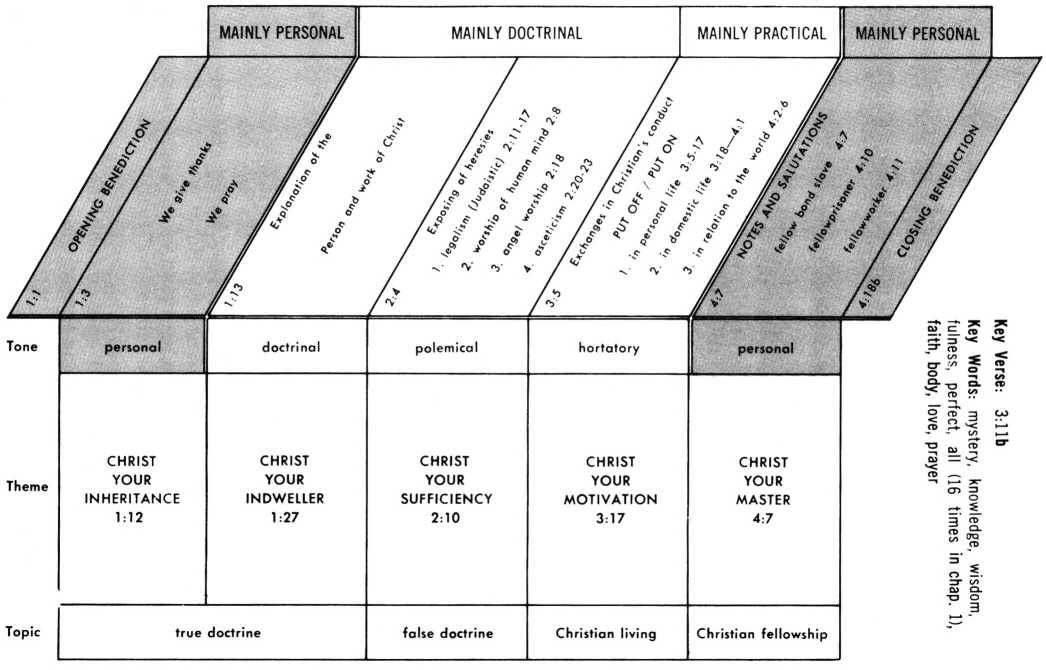
CHRIST IS ALL IN ALL
Click chart to enlarge
Charts from Jensen's Survey of the NT - used by permission
Colossians Overview - Click Chart on right side
| Christ Preeminent in All Things Supreme Lord - Sufficient Savior |
|||
| Colossians 1 | Colossians 2 | Colossians 3 | Colossians 4 |
| Supremacy of Christ |
Submission to Christ |
||
| Doctrinal and Corrective |
Practical and Reassuring |
||
| What Christ Did For Us |
What Christ Does Through Us |
||
| Christ Our Lord |
Christ Our Life |
Christ our Love |
|
| Christ the Head of the Body |
Christ the Lord of the Universe |
Christ the Head of the Home |
|
| Instruction | Warnings | Exhortations | Reminders |
| Reconciliation | Creation | Submission | Conversation |
| His Person and Word |
His Peace and Presence |
||
Colossians 1:11 strengthened (PPPMPN) with all power according to His glorious might, for the attaining of all steadfastness and patience; joyously (NASB: Lockman)
Greek: en pase dunamei dunamoumenoi (PPPMPN) kata to kratos tes doxes autou eis pasan hupomonen kai makrothumian, meta charas
Amplified: [We pray] that you may be invigorated and strengthened with all power according to the might of His glory, [to exercise] every kind of endurance and patience (perseverance and forbearance) with joy, (Amplified Bible - Lockman)
Barclay - May you continue to be strengthened with all strength according to his glorious power, so that you may possess all fortitude and patience with joy. (Daily Study Bible)
BBE: Full of strength in the measure of the great power of his glory, so that you may undergo all troubles with joy;
Lightfoot: thus you will be strengthened in all strength, according to that power which enters in and spreads from his glorious manifestation of himself, and nerved to all endurance under affliction and all long-suffering under provocation, not only without complaining, but even with joy:
MLB (Berkley): We pray that you may be invigorated with complete power in accordance with His glorious strength, for the cheerful exercise of unlimited patience and perseverance
Moffatt: May his glorious might nerve you with full power to endure and to be patient cheerfully, whatever comes,
NJB: fortified, in accordance with his glorious strength, with all power always to persevere and endure, (NJB)
NLT: We also pray that you will be strengthened with his glorious power so that you will have all the patience and endurance you need. May you be filled with joy, (NLT - Tyndale House)
Phillips: As you live this new life, we pray that you will be strengthened from God's boundless resources, so that you will find yourselves able to pass through any experience and endure it with courage. (Phillips: Touchstone)
Weymouth: Since His power is so glorious, may you be strengthened with strength of every kind, and be prepared for cheerfully enduring all things with patience and long-suffering;
Wuest: by every enabling power being constantly strengthened in proportion to the manifested power of His glory, resulting in every patience and forbearance, with joy
Young's Literal: in all might being made mighty according to the power of His glory, to all endurance and long-suffering with joy.
STRENGTHENED WITH ALL POWER: en pase dunamei dunamoumenoi (PPPMPN):
- Isa 45:24 Acts 1:8 Ro15:13 2Co 4:7, 2Co 12:9 Eph 3:16, Eph 6:10 Php 4:13
- Colossians 1 Resources - multiple sermons and commentaries
Full of strength in the measure of the great power of his glory, (BBE),
that you may be invigorated and strengthened with all power according to the might of His glory (Amp),
May you be made strong with all the strength which comes from his glorious power, so that you may be able to endure everything with patience. (TEV)
being empowered with all power (ALT)
Hannah's Bible Outlines.
Introduction (Col 1:1-14)
- Salutation (Col 1:1-2)
- The author (Col 1:1)
- The recipients and blessing (1:2)
- Thanksgiving (Col 1:3-8)
- The reason (Col 1:3-5)
- The source (Col 1:6-8)
- Supplication (Col 1:9-14)
- For proper knowledge (Col 1:9)
- For proper conduct (Col 1:10-14)
- Fruitfulness and knowledge (Col 1:10)
- Strength (Col 1:11)
- Giving thanks (Col 1:12-14)
- Inheritance (Col 1:12)
- Deliverance and transference (Col 1:13-14)
Wiersbe Outlines "A Prisoner's Prayer" -
- Colossians 1:9 - He Prayed for Spiritual Intelligence
- Colossians 1:10-11 - He Prayed for Practical Obedience
- Colossians 1:11-12 - He Prayed for Moral Excellence
John MacArthur - Paul Prays for the Colossians
The Petition - Col 1:9
The Results - Col 1:10-11
- A Worthy Walk - Col 1:10a
- A Fruitful Life - (Col 1:10b)
- Growth (Col 1:10c)
- Strength (Col 1:11a)
- Endurance (Col 1:11b)
- Inheritance (Col 1:12)
- Deliverance (Col 1:13a)
- Transferance (Col 1:13-14)
POSB Outline- The Great Requests of Prayer, 1:9-11
- Request 1: to know God's will—to be filled with the knowledge of God's will (Col 1:9).
- Request 2: to walk worthy of Christ (Col 1:10).
- Request 3: to possess the power of God (Col 1:11).
ESV Study Bible note on strengthened with all power - Spiritual power was a key issue in the Greco-Roman world. People sought power through connection with various gods and pagan rituals in order to protect them from evil spirits and to help them acquire wealth or influence. Paul wants the Colossians to know that he prays regularly that God would impart His power to them, not for selfish aims but so that they can live for God in a worthy manner. for all endurance and patience with joy. The purpose (as indicated by the word “for”) of this God-given power is to provide the divine strength needed for the believer to attain Christian virtues, to persevere in the faith, to resist temptation and deceitful teachers, and so to know the joy of the Lord. (ESV Online Study Bible Crossway)
Guy King - "All might" comes next in our contemplation of this complete Christian. Whenever we come across a description of what a believer's character and conduct are to be like, we are inclined to be halted by such high demands. A worthy walk, and a worth-while work - yes, indeed; but how? Let us ever bear this in mind as a principle of the spiritual life, that "If God command thee so, then thou shalt be able to", Exodus 18:23. in other words, if I know that I ought, I know that I can. "All might" is available to me, so that "I can do all things [He requires] through Christ which strengtheneth me", Philippians 4:13. So does our passage answer our trembling "How?" Note that it is a continuous power - "strengtheneth" is a present participle, being strengthened - it goes on, ever at our disposal. Moreover, it is a sufficient power - "according to His glorious power": we might render the phrase, "up to the limit of His power". I fancy that, however great our need, it will never exceed that limit. In another place, our apostle changes the metaphor to say, "My God shall supply all your need according to His riches in glory by Christ Jesus", Philippians 4:19 - His blank check to be drawn on the inexhaustible account in the Bank of Heaven. Surely we need never live spiritually bankrupt lives when such limitless resources are ours for the taking. We should be living as princes, not as paupers. What relief, then, and what rejoicing, comes with the realization that for all Divine calls upon us we have "all might" to draw on. (Colossians 1:3-11 His Courteous Address)
Strengthened (1412) (dunamoo - see word study on related word endunamoo; words of the stem dunamai all have the basic sense of ability or capability) means to be enabled and speaks of an inherent power which gives one the ability to do something. To strengthen. To make strong. To enable.
The present tense indicates that believers are to be continuously strengthened, the passive voice indicating that the strengthening comes from without, from an outside Source (God = His Spirit, His grace) (Colossians 3:4). That power is available to the believer who is filled with the knowledge of God’s Word. God is not like a booster rocket giving believers an initial boost of power and then leaving them to fly on their own. Spiritual growth and maturity can come only as we yield to God’s word and permit Him to do His work in and through us.
Dunamoo - only 2x in NT - here and Hebrews 11:34
Hebrews 11:34 quenched the power of fire, escaped the edge of the sword, from weakness were made strong (passive voice =strengthening from outside source, ie, God the Holy Spirit), became mighty in war, put foreign armies to flight.
Comment: Note the principle - when we are weak (in our self, our strength, our puny efforts) then we are strong (in His endless source of strength), specifically in the arena of spiritual matters. This principle is timeless and was the source of Paul's strength that enabled His Spirit filled ministry - see 2 Cor 12:9, 2 Cor 12:10)
Dunamoo in the Septuagint- 4x in 4v -
- Ps 52:7 (IN A NEGATIVE SENSE = "was strong in his evil desire");
- Ps 68:28 (SPEAKING OF ISRAEL = "Your God has commanded your strength" OR "has decreed that you will be powerful" = NET);
- Eccl 10:10 ("If the axe is dull and he does not sharpen its edge, then he must exert more strength"); NET Note - The point is that it is a waste of a great deal of strength and energy. If a person is not smart, he will have to use a lot of energy and waste his efficiency.
- Da 9:27 (Theoredet's version of Daniel 9:27)
Although dunamoo is used only twice in the NT, the similar verb endunamoo is used in several instructive circumstances. For example, Paul writes to the Ephesians saints their continual moment by moment need to be strong (endunamoo - here a command to let yourself continually be strengthened) in the Lord and in the strength of His might. (Eph 6:10).
From jail Paul writes to his beloved saints in the Philippian church
I can do all things through Him who strengthens (endunamoo - present tense = continuous action) me. (Phi 4:13, see how he "learned the secret" Php 4:11, 12)
Paul seeking to encourage Timothy for the difficult task before him wrote "I thank Christ Jesus our Lord, Who has strengthened me, because He considered me faithful, putting me into service." (1Ti 1:12)
Strengthened with all power - In Greek Paul "piles up" the related words that convey the sense of inherent strength - dunamis and dunamoo and then even adds the all (pas) which in Greek means all without exception.
Alexander Maclaren - As he desired for the Colossians all wisdom, unto all pleasing, and fruitfulness in every good work, so he prays for all power to strengthen them. Every kind of strength (all power) which God can give and man can receive, is to be sought after by us, that we may be "girded with strength," cast like a brazen wall all round our human weakness. And that Divine power is to flow into us, having this for its measure and limit-"the might of His glory." His "glory" is the lustrous light of His self-revelation; and the far-flashing energy revealed in that self-manifestation is the immeasurable measure of the strength that may be ours. True, a finite nature can never contain the infinite, but man’s finite nature is capable of indefinite expansion. Its elastic walls stretch to contain the increasing gift. The more we desire the more we receive, and the more we receive the more we are able to receive. The amount which filled our hearts today should not fill them tomorrow. Our capacity is at each moment the working limit of the measure of the strength given us. But it is always shifting, and may be continually increasing. The only real limit is "the might of His glory," the limitless omnipotence of the self-revealing God. To that we may indefinitely approach, and till we have exhausted God we have not reached the furthest point to which we should aspire. (Colossians 1 Expositor's Bible Commentary)
Power (1411)(dunamis from dunamai = to be able, to have power) power especially achieving power. It refers to intrinsic power or inherent ability, the power or ability to carry out some function, the potential for functioning in some way (power, might, strength, ability, capability), the power residing in a thing by virtue of its nature.
Dunamis - 116 verses in NT (This makes a fascinating study!) -Matt. 6:13; Matt 7:22; Matt 11:20f, 23; Matt 13:54, 58; Matt 14:2; Matt 22:29; Matt 24:29f; Matt 25:15; Matt 26:64; Mk. 5:30; Mk 6:2, 5, 14; Mk 9:1, 39; Mk 12:24; Mk 13:25f; Mk 14:62; Lk. 1:17, 35; Lk 4:14, 36; Lk 5:17; Lk 6:19; Lk 8:46; Lk 9:1; Lk 10:13, 19; Lk 19:37; Lk 21:26f; Lk 22:69; Lk 24:49; Acts 1:8; Acts 2:22; Acts 3:12; Acts 4:7, 33; Acts 6:8; Acts 8:10, 13; Acts 10:38; Acts 19:11; Rom. 1:4, 16, 20; Rom 8:38; Rom 9:17; Rom 15:13, 19; 1 Co. 1:18, 24; 1 Co 2:4f; 1 Co 4:19f; 1 Co 5:4; 1 Co 6:14; 1 Co 12:10, 28f; 1 Co 14:11; 1 Co 15:24, 43, 56; 2 Co. 1:8; 2 Co 4:7; 2 Co 6:7; 2 Co 8:3; 2 Co 12:9, 12; 2 Co 13:4; Gal. 3:5; Eph. 1:19, 21; Eph 3:7, 16, 20; Phil. 3:10; Col. 1:11, 29; 1 Thess. 1:5; 2 Thess. 1:7, 11; 2 Thess 2:9; 2 Tim. 1:7f; 2 Tim 3:5; Heb. 1:3; Heb 2:4; Heb 6:5; Heb 7:16; Heb 11:11, 34; 1 Pet. 1:5; 1 Pet 3:22; 2 Pet. 1:3, 16; 2 Pet 2:11; Rev. 1:16; Rev 3:8; Rev 4:11; Rev 5:12; Rev 7:12; Rev 11:17; Rev 12:10; Rev 13:2; Rev 15:8; Rev 17:13; Rev 18:3; Rev 19:1.
All power describes an all sufficient source for all the trials of life, all the time! What a mighty God we worship and serve!
As I obey, walking in the revealed knowledge (filled with the knowledge) of His will with all spiritual wisdom and understanding (cf filled with the Spirit), I am continually being strengthened by His Spirit to bear up under whatever problem people or problem circumstances God allows into my life. In some languages one would translate this section as being “strong in your spirits” or “strong in your hearts,” for this is internal, moral (supernatural) strength and not physical strength.
Wiersbe makes the important point that "the emphasis in Paul's prayer is on Christian character: patience, long-suffering, joyfulness, and thanksgiving. The inner victories of the soul are just as great, if not greater, than the public victories recorded in the annals of history. For David to control his temper when he was being maligned by Shimei was a greater victory than his slaying of Goliath (2Sa 16:5, 6, 7, 8, 9, 10, 11, 12, 13). He who is slow to anger is better than the mighty, and he who rules his spirit, than he who captures a city (Pr 16:32).
Matthew Henry comments that Paul prays that the saints may be "fortified against the temptations of Satan and furnished for all their duty. It is a great comfort to us that he who undertakes to give strength to his people is a God of power and of glorious power. Where there is spiritual life there is still need of spiritual strength, strength for all the actions of the spiritual life. To be strengthened is to be furnished by the grace of God for every good work, and fortified by that grace against every evil one: it is to be enabled to do our duty, and still to hold fast our integrity. The blessed Spirit is the author of this strength; for we are strengthened with might by his Spirit in the inward man, Eph 3:16. The word of God is the means of it, by which he conveys it; and it must be fetched in by prayer. It was in answer to earnest prayer that the apostle obtained sufficient grace."
Oft in Sorrow, Oft in Woe
Henry White
Oft in sorrow, oft in woe,
Onward, Christian, onward go:
Fight the fight, maintain the strife
Strengthened with the Bread of life.Let not sorrow dim your eye,
Soon shall every tear be dry;
Let not fears your course impede,
Great your strength, if great your need.
Preacher's Outline and Sermon Bible on Power -
Power: the third great request is for the power of God. God's power is an absolute essential for the believer. This is easily seen by asking two questions.
⇒ What good is it if the believer knows God's will, but he does not have the power to do God's will?
⇒ How can the believer walk worthy of Christ if he does not have the power to walk worthy?
Many in the world believe that man has the strength within himself to become spiritually strong; that it is a matter of the will and discipline; that man can apply himself and conquer the circumstances of life. And, to some degree, this is true. But man's flesh fails in three critical areas.
⇒ The flesh cannot become perfect, neither can it do anything about perfection. Therefore, no matter what the flesh becomes or does, it is still unacceptable to God. Why? Because God is perfect, and being perfect, God can accept only perfection.
⇒ The flesh cannot conquer death. No matter what the flesh does, it all ends up as dead matter. One thing is certain: death has no part with God.
⇒ The flesh cannot do what this verse says: it cannot be patient and longsuffering against all the traumatic trials and temptations of life and be joyful at the same time.
It is for these three reasons that we need the power of God. Man's power can overcome some of the problems of life, but his power cannot overcome all the problems, especially the three mentioned.
⇒ Only God's power can make us acceptable (perfect) before Him.
⇒ Only God's power can conquer death, that is, raise us up to live eternally.
⇒ Only God's power can infuse enough strength in us to make us endure any and all trials with a spirit of joyfulness.
Imagine some of the trials we have to face: disease, accident, poverty, loss, death. There is no way for the flesh to work up a joyful spirit through some of the traumas of life. But God has the power, the power...
• to give us understanding and peace
• to strengthen and settle us
• to give us hope and security
Where does such power come from? From God. And we secure His power through prayer. This is the point of this great request of Paul. Now, note the results of God's power.
ACCORDING TO HIS GLORIOUS MIGHT: kata to kratos tes doxes autou:
- Colossians 1 Resources - multiple sermons and commentaries
Literally - according to the power of His glory
Maclaren explains that according to (kata) means that "The equipment with power is proportioned not simply to the recipient’s need, but to the Divine supply. This equipment with Divine power is not, as we might have expected, said to be given with a view to deeds of great spiritual heroism, but for the practice of passive virtues, since this often puts the greater strain on the Christian’s strength." (Colossians 1 - The Expositor's Greek Testament)
Adam Clarke adds that it is "According to that sufficiency of strength which may be expected from him who has all power both in the heavens and in the earth."
Wuest - The Greek has it, “according to the manifested power of His glory.” Lightfoot says: “The glory here, as frequently, stands for the majesty or the power or the goodness of God, as manifested to men. The doxa (glory), the bright light over the mercy-seat (Ro 9:4) was a symbol of such manifestations. God’s revelation of Himself to us, however this revelation may be made, is the one source of all our highest strength.” (Wuest's word studies from the Greek New Testament )
Might (2904)(kratos means strength or might, especially manifested power, the power to rule or control or dominion (power to rule, supreme authority, sovereignty, the right to govern or rule or determine). Krátos denotes the presence and significance of force or strength rather than its exercise. It is the ability to exhibit or express resident strength. See note by Wayne Barber on kratos.
Kratos-12 times in the NT -The NAS translates krátos as: dominion, 6; might, 1; mightily, 1; mighty deeds, 1; power, 1; strength, 2.
Lk. 1:51; Acts 19:20; Eph. 1:19; Eph 6:10; Col. 1:11; 1 Tim. 6:16; Heb. 2:14; 1 Pet. 4:11; 1 Pet 5:11; Jude 1:25; Rev. 1:6; Rev 5:13.
Regarding the derivation of krátos, Vine writes that this word means "force, strength, might, more especially manifested power, is derived from a root kra—, to perfect, to complete: “creator” is probably connected. It also signifies dominion, and is so rendered frequently in doxologies." (Vine, W E. Vine's Expository dictionary of Old and New Testament words. Vol. 2, Page 1-333. Old Tappan NJ: Revell)
Most of the NT uses (10/12) are in references to God Almighty, and make the point that ultimate dominion belongs to God Alone.
Kratos = perfect strength or strength in action and in the NT it is applied to God 11/12x. Here God's might is accompanied by glory. Kratos refers to strength regarded as abundantly effective in relation to an end to be gained or dominion to be exercised and to overcome what stands in the way. It refers to the inherent strength which displays itself in the rule over others Kratos denotes presence and significance of force or strength rather than its exercise. Kratos is “power in the sense of dominion” and thus stresses sovereign power or supreme authority.
His glorious might indicates that this strengthening is not by any human means, but by the power of God. There is a manifestation of power in the spirit with which Christians are enabled to bear up under trials, which shows that it is not of human origin and it is the power which God gives in the day of trial. Here God's might is accompanied by glory (Shekinah).
MARCH ON, O SOUL, WITH STRENGTH
March on, O soul, with strength,
As strong the battle rolls!
’Gainst lies and lusts and wrongs,
Let courage rule our souls;
In keenest strife, Lord, may we stand,
Upheld and strengthened by Thy hand.
FOR THE ATTAINING OF ALL STEADFASTNESS: eis pasan hupomonen:
- Colossians 1 Resources - multiple sermons and commentaries
PATIENCE WITH
DIFFICULT CIRCUMSTANCES
For - term of explanation. Power precedes patience. Supernatural strength sparks steadfastness.
For the attaining - This phrase is a translation of the Greek preposition eis meaning unto or showing motion toward something.
Note that one can become somewhat confused when trying to understand the distinctions between "steadfastness" and "patience" because the same English word is used in many translations for different Greek words (hupomone and makrothumia [word study]). Thus one cannot simply look up all the uses of "patience" but will need to utilize a Greek study tool to help determine which Greek word is being translated.
All (pas) means all with no exceptions! Note how Paul repeatedly uses this powerful little adjective in Colossians -
Col 1:4, 6, 9, 10 (2x), Col 1:11 (2x) Col 1:15, 16 (2x), Col 1:17 (2x), Col 1:23, Col 1:28 (4x); Col 2:2, 3, 9, 10, 13, 19, 22; Col 3:8, 11 (2x), Col 3:14, 16, 17 (2x), Col 3:20, 22; Col 4:7, 9, 12
Ray Stedman: When you are faced with irritating circumstances, or difficult people, it takes power to remain patient and longsuffering. Our natural tendency is to get upset, to scream in impatience, or to become resentful and angry. It takes (supernatural, Holy Spirit energized) power to resist these when you feel them rising within you. Every believer has that power, and the sign is that they lead quiet, cheerful lives, that hang in to the end. That is what is meant by endurance (steadfastness). The word is best translated "stick-to-it-iveness." People who have this quality don't quit. They hang in there with their relationships, despite the pressures of their work or their circumstances. Endurance (hupomone) is a word that relates primarily to circumstances. The second word, translated here "patience," is really "longsuffering," (makrothumia) a willingness to wait and not pay back in kind. It has to do with willingness to forgive and refusing to take revenge.
Guy King - "All steadfastness," - That means Christian stickability: the power to keep on keeping on. We shall have temptations to give up: - the allurements of the world; - the weakness of our resolve; - the frequency of our failures; these, and other things, may tend to undermine our resistance. So Paul prays that these Colossian believers may have the grace of perseverance. It was an outstanding quality in an Old Testament saint, "Daniel purposed … and Daniel continued", Daniel 1:8+, Da 1:21+. It was an outstanding quality in the first New Testament saints, who "continued steadfastly", Acts 2:42. Be it ours also to display a like tenacity - and that, not in a temper of grim and glum resignation, but "with joyfulness". What a grand note to finish on! (Colossians 1:3-11 His Courteous Address)
Wiersbe: Re Patience – “Too many Christians have a tendency to quit when circumstances become difficult. The saintly Dr. V. Raymond Edman, late president of Wheaton College (Illinois), used to remind the students, ‘It is always too soon to quit.’ I have often thought of that statement when I find myself in the midst of trying circumstances. It is not talent or training that guarantees victory: it is perseverance. ‘By perseverance the snail reached the ark,’ said Charles Spurgeon.”
Steadfastness (NASB also translates it as endurance, patient enduring and most often as perseverance) is the Greek word hupomone (hupo = under + meno = abide) which has to do more with one's response to difficult circumstances than with difficult people. Hupomone is is “endurance when circumstances are difficult” and is manifest by "remaining under" difficulties without succumbing.
Barclay says hupomone "does not mean patience in the sense of simply bowing the head and letting the tide of events flow over one. It means not only the ability to bear things, but the ability, in bearing them, to turn them into glory. It is a conquering patience." (Colossians 1 - Daily Study Bible)
The reason we need God’s power
is because patience is so difficult.
ILLUSTRATION - The antiquated train on a branch line was creeping slowly through the countryside when suddenly it came to a dead stop. The only passenger in the car, a salesman riding the line for the first time, asked the conductor why they had stopped. The conductor said, “Nothing to worry about, sir. There’s a cow on the tracks.” In about ten minutes the train got under way again, but after chugging along for a mile or two, it again ground to a halt. “Just a temporary delay,” the conductor said. “We’ll be on our way shortly.” The exasperated salesman asked, “What is it now? Did we catch up to the cow again?” (James S. Hewett, Illustrations Unlimited) - That’s NOT hupomone. We can only be patient with God’s strength.
Steadfastness (5281)(hupomone [word study] from hupo = under + meno = stay, remain, abide) is literally abiding under and thus steadfastness in face of trials, temptations and persecutions. The root idea of hupomone is that of remaining under some discipline, subjecting one’s self to something which demands the acquiescence of the will to something against which one naturally would rebel. It portrays a picture of steadfastly and unflinchingly bearing up under a heavy load and describes that quality of character which does not allow one to surrender to circumstances or succumb under trial. The picture is that of steadfastness, constancy and endurance. It has in it a forward look, the ability to focus on what is beyond the current pressures. For example, Jesus "Who for the joy set before Him endured [verb form hupomeno] the Cross despising the shame" (Heb 12:2+).
And so hupomone does not describe a grim resignation or a passive "grin & bear" attitude but a triumphant facing of difficult circumstances knowing that even out of evil God guarantees good. It is courageous gallantry which accepts suffering and hardship and turns them into grace and glory.
Barclay - (Hupomone) does not mean patience in the sense of simply bowing the head and letting the tide of events flow over one. It means not only the ability to bear things, but the ability, in bearing them, to turn them into glory. It is a conquering patience. Hupomone is the ability to deal triumphantly with anything that life can do to us. (Colossians 1 - Daily Study Bible)
Hupomone - 32x in NT - NAS renders it as endurance(7), enduring(1), patient(1), perseverance(21), steadfastness(3).
Lk. 8:15; Lk 21:19; Rom. 2:7; Rom 5:3f; Rom 8:25; Rom 15:4f; 2 Co. 1:6; 2 Co 6:4; 2 Co 12:12; Col. 1:11; 1 Thess. 1:3; 2 Thess. 1:4; 2 Thess 3:5; 1 Tim. 6:11; 2 Tim. 3:10; Tit. 2:2; Heb. 10:36; Heb 12:1; Jas. 1:3f; Jas 5:11; 2 Pet. 1:6; Rev. 1:9; Rev 2:2f, 19; Rev 3:10; Rev 13:10; Rev 14:12.
Steadfastness (perseverance) is an important characteristic of the maturing Christian growing best in the field of affliction, as James writes --"the testing of your faith produces endurance (hupomone)" (Jas 1:3, 4) is also associated with self-control in (2Pe 1:6. If we do not learn to be patient, we are not likely to learn anything else. As believers, can even "exult in our tribulations, knowing that tribulation brings about perseverance (hupomone) and perseverance, proven character; and proven character, hope” (Ro 5:3, 4). So despite the trial, the man who perseveres does not lose heart. If you fall, don't give up, get up.
Trench - “Makrothumia will be found to express patience in respect of persons, hupomonē, in respect of things. The man makrothumei, who having to do with injurious persons, does not suffer himself easily to be provoked by them, or to blaze up in anger (2Ti 4:2). The man hupomonē, who under a great siege of trials, bears up, and does not lose heart or courage (Ro 5:3; 2Cor. 1:6).” (Long suffering - Trench's Synonyms of the New Testament)
The difference between perseverance and obstinacy is that one often comes from a strong will and the other from a strong won't. - Henry Ward Beecher
By perseverance the snail reached the ark. -C. H. Spurgeon
Perseverance is the hallmark of a genuine interest in Christ. - Geoffrey B. Wilson
James reminds his readers of Job "Behold, we count those blessed who endured. (verb form hupomeno) You have heard of the endurance (hupomone) of Job and have seen the outcome of the Lord's dealings, that the Lord is full of compassion and is merciful. (Jas 5:11)
As the former president of Wheaton College, Dr. Edman, would often remind the students “It is always too soon to quit.” Ponder that statement and the blessing of bearing up under when you find yourself in the midst of trying circumstances.
Matthew Henry - When we bear our troubles well, though ever so many, and the circumstances of them ever so aggravating, then we bear them with all patience (steadfastness)… All patience includes all the kinds of it; not only bearing patience, but waiting patience.
The UBS Handbook notes that "In some languages, patience is best expressed as a negation of some negative quality, for example, “enduring without complaining” or “enduring and not being resentful.” (The United Bible Societies' New Testament Handbook Series )
Do not think that steadfastness is complacency but in contrast is endurance in action. It is not the Christian sitting in a rocking chair, waiting for God to do something. It is the soldier on the battlefield, keeping on when the going is tough. It is the runner on the race track, refusing to stop because he wants to win the race. Too many Christians have a tendency to back away or even to quit when circumstances become difficult. Spurgeon said ''By perseverance the snail reached the ark.'' It is not talent or training that guarantees victory: it is perseverance.
Maclaren- Patience here is not merely passive endurance. It includes the idea of perseverance in the right course, as well as that of uncomplaining bearing of evil. It is the "steering right onward," without bating one jot of heart or hope; the temper of the traveler who struggles forward, though the wind in his face dashes the sleet in his eyes, and he has to wade through deep snow… And whether we think of our afflictions in the one or the other light, God’s strength will steal into our hearts, if we will, not merely to help us to bear them with perseverance and with meekness as unruffled as Christ’s, but to crown both graces-as the clouds are sometimes rimmed with flashing gold-with a great light of joy. That is the highest attainment of all. "Sorrowful, yet always rejoicing." Flowers beneath the snow, songs in the night, fire burning beneath the water, "peace subsisting at the heart of endless agitation," cool airs in the very crater of Vesuvius-all these paradoxes may be surpassed in our hearts if they are strengthened with all might by an indwelling Christ. (Colossians 1 Expositor's Bible Commentary)
AND PATIENCE: kai makrothumian:
- Colossians 1 Resources - multiple sermons and commentaries
PATIENCE WITH
DIFFICULT PEOPLE
Remember that we spiritual power (from the Holy Spirit) to exhibit patience with people.
As Lightfoot says "The one (steadfastness) is opposed to cowardice or despondency, the other (patience) to wrath or revenge."
Kent: “This strengthening, however, is not for the purpose of enabling believers to work great miracles or perform stupendous feats before a skeptical world. It is rather for the production of spiritual fruit, particularly under trying circumstances. The display of patience (endurance under trial) and longsuffering (non-retaliation), coupled with joy, is not always easy to demonstrate. But when the believer is confronted with adversity, whether from harsh circumstances or hostile persons, and can respond as Paul here describes, it is good evidence that he has learned something of the will of God, and has drawn upon the resources of the Holy Spirit.”
Patience (long-suffering) (3115) (makrothumia from makros = long + thumos = temper, a tumultuous welling up of the whole spirit; a mighty emotion which seizes and moves the whole inner man) is literally long-temper (as opposed to "short tempered), a long holding out of the mind before it gives room to action or passion. It describes a state of emotional calm or quietness in the face of provocation, misfortune or unfavorable circumstances. Makrothumia manifests a long endurance that does not retaliate. Patience is a virtue that carries a lot of wait!
Moule describes patience - The temper indicated is the opposite to that haste of spirit which gives the man no time, under pressure of pain or (particularly) of wrong, to remember what is due to others.
Barclay - (Makrothumia's) basic meaning is patience with people. It is the quality of mind and heart which enables a man so to bear with people that their unpleasantness and maliciousness and cruelty will never drive him to bitterness, that their unteachableness will never drive him to despair, that their folly will never drive him to irritation, and that their unloveliness will never alter his love. Makrothumia is the spirit which never loses patience with, belief in, and hope for men....So the Christian prayer is: "Make me, O Lord, victorious over every circumstance; make me patient with every person; and withal give me the joy which no circumstance and no man will ever take from me." (Colossians 1 - Daily Study Bible)
Makrothumia is characterized by an emotional calm in face of provocation or misfortune. It is not passive but on the contrary is active, concentrated strength. It is a long holding out of the mind before it gives room to passion and so refers to the self-restraint which does not hastily revenge a wrong and expresses itself in patience without complaint or irritation in the face of injustice or unpleasant circumstances. As Trench summarizes, makrothumia expresses patience in respect to persons, hupomone in respect to things or circumstances. While both graces are used to describe men, only makrothumia is used of God. Men may tempt and provoke Him, and He may and does display an infinite makrothumia in regard of them (e g, Ro 2:4)
ILLUSTRATION - Debra K. Johnson (Dublin Ohio, Christian Reader, May/June 1996, p. 58.) writes, "My seven-year-old daughter wanted to take violin lessons, so I took her to a music store to rent an instrument. Hoping she would understand the importance of practicing, I explained that violin lessons were expensive so she would have to work hard. “There may be times when you feel like giving up,” I said, “but I want you to hang in there and keep on trying.” She nodded and then in her most serious voice said, “It will be just like marriage, right Mommy?” Sometimes the most difficult people to be patient with are those closest to us. That doesn’t mean that you should sit here and be thinking, “Yeah, I hope he’s listening to this …” It means you need to be patient with him.
Hope is the foundation of patience. - John Calvin
Patience is the ballast of the soul that will keep it from rolling and tumbling in the greatest storms. - Ezekiel Hopkins
Teach us, O Lord, the discipline of patience, for to wait is often harder than to work. - Peter Marshall
Patience (makrothumia) or long-suffering is a fruit of the Spirit (Ga 5:22) and is an important trait for us to exhibit and practice and so the writer of Hebrews exhorts believers to not to be "sluggish but (be) imitators of those who through faith and patience inherit the promises (and he gives the example of God promising to bless and multiply Abraham)" (He 6:12, 13, 14)
Paul later exhorts the Colossians to "put on a heart of compassion, kindness, humility, gentleness and patience (makrothumia)." (Col 3:12) First he prays for patience, then he exhorts them to
Makrothumia - 14x in the NT - The NAS always translates makrothumia as patience.
Rom. 2:4; Rom 9:22; 2 Co. 6:6; Gal. 5:22; Eph. 4:2; Col. 1:11; Col 3:12; 1 Tim. 1:16; 2 Tim. 3:10; 2 Tim 4:2; Heb. 6:12; Jas. 5:10; 1 Pet. 3:20; 2 Pet. 3:15.
Paul commanded young Timothy to "preach the word; be ready in season and out of season; reprove, rebuke, exhort, with great patience (makrothumia) and instruction." (2Ti 4:2), a situation that would definitely call for having a "long temper" with difficult people. The short-tempered person speaks and acts impulsively and lacks self-control. When a person is longsuffering, he can put up with provoking people or circumstances without retaliating. It is good to be able to get angry, for this is a sign of holy character. But it is wrong to get angry quickly at the wrong things and for the wrong reasons.
It is amazing how people can patiently endure trying circumstances, only to lose their tempers with a friend or loved one. Moses was patient during the contest with Pharaoh in Egypt. But he lost his temper with his own people and, as a result, forfeited his right to enter the Promised Land (Nu 20).
Like a city that is broken into and without walls is a man who has no control over his spirit (Pr 25:28)
JOYOUSLY: Meta charas:
- Colossians 1 Resources - multiple sermons and commentaries
Maclaren - (Joyously is literally "with joy" which) forms a very necessary addition, for the peculiar danger of the exercise of those qualities (steadfastness and patience) is that it tends to produce a certain gloominess or sourness of disposition. The remedy is that the Christian should be so filled with joy that he is able to meet all his trials with a buoyant sense of mastery. (Colossians 1 - The Expositor's Greek Testament)
In a number of languages, joy is expressed figuratively as “with a happy heart” or “with dancing in one’s heart” or “with a heart that sings.
Moule - Observe the holy paradox of the thought here. The fulness of Divine power in the saints is to result primarily not in “doing some great thing” but in enduring and forbearing, with heavenly joy of heart. The paradox points to one deep characteristic of the Gospel, which prepares the Christian for service by the way of a true abnegation of himself as his own strength and his own aim. (Colossians 1 Cambridge Bible for Schools and Colleges)
Barclay - So Paul prays for hupomone, the fortitude which no situation can defeat, and makrothumia, the patience which no person can defeat. He prays that the Christian may be such that no circumstances will defeat his strength and no human being defeat his love. The Christian's fortitude in events and patience with people must be indestructible. Added to all this there is joy. The Christian way is not a grim struggle with events and with people; it is a radiant and sunny-hearted attitude to life. The Christian joy is joy in any circumstances. As C. F. D. Moule puts it: "If joy is not rooted in the soil of suffering, it is shallow." It is easy to be joyful when things go well, but the Christian radiance is something which not all the shadows of life can quench. So the Christian prayer is: "Make me, O Lord, victorious over every circumstance; make me patient with every person; and withal give me the joy which no circumstance and no man will ever take from me." (Colossians 1 - Daily Study Bible)
Joyously (5479) (chara from the root char- = extend favor, lean towards, be favorably disposed) means an awareness of grace (for believers God's grace of course). Someone has said joy is "grace recognized." Joy is grace dependent and circumstance independent unlike earthly happiness which depends on favorable circumstances ("happenings"). Joy expresses the experience of the feeling of inner blessedness or gladness of heart at knowing God's favor.
Chara - 57x in NT - The NAS renders chara as greatly(1), joy(54), joyful(1), joyfully(1), joyously(1), rejoicing(1). Matt. 2:10; Matt 13:20, 44; Matt 25:21, 23; Matt 28:8; Mk. 4:16; Lk. 1:14; Lk 2:10; Lk 8:13; Lk 10:17; Lk 15:7, 10; Lk 24:41, 52; Jn 3:29; Jn 15:11; Jn 16:20, 21, 22, 24; Jn 17:13; Acts 8:8; Acts 12:14; Acts 13:52; Acts 15:3; Ro 14:17; Ro 15:13, 32; 2Co 1:24; 2Co 2:3; 2Co 7:4, 13; 2Co 8:2; Ga 5:22; Phil 1:4, 25; Phil 2:2, 29; Phil 4:1; Col 1:11; 1Th 1:6; 1Th 2:19f; 1Th 3:9; 2Ti 1:4; Philemon 1:7; He 10:34; He 12:2, 11; He 13:17; Jas 1:2; Jas 4:9; 1Pe 1:8; 1Jn. 1:4; 2Jn. 1:12; 3Jn. 1:4.
As Matthew Henry reminds us "to have joy as well as patience in the troubles of life… we could never do by any strength of our own, but as we are strengthened by the grace of God.
God’s power is evidenced in our lives not only in our patience and long-suffering, but also in our joyfulness. When circumstances are difficult, we should exhibit joyful patience; and when people are hard to live with, we should reveal joyful long-suffering. There is a kind of patience that “endures but does not enjoy.” Paul prayed that the Colossian Christians might experience joyful patience and long-suffering.
We often use the words joy and happiness interchangeably, but as alluded to above a distinction should be made. Happiness often depends on what happens! If circumstances are good and people are nice to us then, we are happy. On the other hand, joy is a fruit borne in a believer's heart by the Holy Spirit and thus it's manifestation is independent of both circumstances and people. Joy is not something we work up with self effort but come only from Spirit dependence. It is fascinating that the most joy filled epistle Paul wrote was Philippians was written from a jail cell and with the thought of imminent martyrdom looming over his head!
MacArthur sums up the prayer to this point - It was Paul’s constant prayer for the Colossians that they be filled with the knowledge of God’s will. He knew that only when believers are controlled by that knowledge can they walk worthy of the Lord and please Him. Paul knew further that such knowledge was required for a fruitful life, spiritual growth, strength, and joyful endurance of trials. (Colossians and Philemon MacArthur New Testament Commentary)
Rich Cathers - Joyful patience - The purpose of being strengthened is so that they might endure both hard times and difficult people, and all the enduring to be done with joy. It’s not a complaining kind of “I have to put up with all these wretched people!” attitude, but a joyful patience with people. A key to having joy in patience is looking to the future. Is there a reason for the wait?
ILLUSTRATION
There once was an oyster whose story I tell,
Who found that sand had got under his shell,
Just one little grain, but it gave him much pain,
For oysters have feelings although they’re so plain.Now, did he berate the working of Fate,
Which had led him to such a deplorable state?
Did he curse out the government, call for an election?
No; as he lay on the shelf he said to himself
“If I cannot remove it, I’ll try to improve it.”So the years rolled by as the years always do,
And he came to his ultimate destiny—stew.
And this small grain of sand which had bothered him so,
Was a beautiful pearl, all richly aglow.Now this tale has a moral—for isn’t it grand
What an oyster can do with a morsel of sand;
What couldn’t we do if we’d only begin
With all of the things that get under our skin.
--James S. Hewett, Illustrations Unlimited
Towards the end of his life, Solomon wrote, (Eccl 7:8KJV) Better is the end of a thing than the beginning thereof: and the patient in spirit is better than the proud in spirit." God knows what He’s doing. Let Him finish what He’s doing. There’s a pearl in it somewhere! (Sermon)
Colossians 1:12 giving thanks (PAPMPN) to the Father , Who has qualified (AAPMSD) us to share in the inheritance of the saints in light. (NASB: Lockman)
Greek: eucharistountes (PAPMPN) to patri to hikanosanti (AAPMSD) humas eis ten merida tou klerou ton hagion en to photi;
Amplified: Giving thanks to the Father, Who has qualified and made us fit to share the portion which is the inheritance of the saints (God’s holy people) in the Light. (Amplified Bible - Lockman)
Lightfoot: thus finally (for this is the crown of all), so rejoicing you will pour out your thanksgiving to the universal Father, who prepared and fitted us all—you and us alike—to take possession of the portion which his goodness has allotted to us among the saints in the kingdom of his light.
MLB (Berkley): with thanksgivings to the Father, who has qualified you for your share in the inheritance of the saints in the light.
Moffatt: thanking the Father who has qualified us to share the lot of the saints in the Light,
NJB: giving thanks with joy to the Father who has made you able to share the lot of God's holy people and with them to inherit the light. (NJB)
NLT: always thanking the Father, who has enabled you to share the inheritance that belongs to God's holy people, who live in the light. (NLT - Tyndale House)
Phillips: You will even be able to thank God in the midst of pain and distress because you are privileged to share the lot of those who are living in the light.
Wuest: constantly giving thanks to the Father who qualified you for the portion of the share of the inheritance of the saints in the sphere of the light
Young's Literal: Giving thanks to the Father who did make us meet for the participation of the inheritance of the saints in the light,
GIVING THANKS TO THE FATHER: eucharistountes (PAPMPN) to patri:
- 2Cor 9:15 Ps 30:4; Ps 97:12; Ps 50:14, Ps 107:21, 22, Ps 92:1, Col 3:15,17 Ro 1:21; Ro 7:25; Ro 14:6; Eph 5:4,20 1Th 5:18 Php 4:6 Heb 13:15 2Sa 22:50; Ps 28:7 1Chr 16:4; Neh. 12:24 Da 6:10 Ezra 3:10, 11
- Colossians 1 Resources - multiple sermons and commentaries
THE CROWN OF CHRISTIAN CHARACTER
A THANKFUL HEART
Paul's letter epitomizes and models for us the Spirit filled (controlled) man for this epistle to the Colossian saints is filled with thanks, thankfulness and thanksgiving (Col 1:3, 12, Col 3:15-17, Col 4:2). Paul himself gave thanks for the Colossian church (Col. 1:3), and then prayed that they themselves might grow in their giving of thanks to God (Col. 1:12). He commanded believers as those who chosen of God, holy and beloved, to continually be thankful (Col 3:15) and to "let the word of Christ richly dwell within… singing with thankfulness in your hearts to God." (Col 3:16) In case he missed anything Paul exhorted the Colossians that in "whatever you do in word or deed, do all in the name of the Lord Jesus, giving thanks through Him to God the Father." (Col 3:17) Finally Paul emphasized the importance of thankfulness in prayer instructing them "Devote yourselves to prayer, keeping alert in it with an attitude of thanksgiving" (Col. 4:2).
Maclaren on giving thanks to the Father - The crown of all, the last of the elements of the Christian character, is thankfulness-"giving thanks unto the Father." This is the summit of all; and is to be diffused through all. All our progressive fruitfulness and insight, as well as our perseverance and unruffled meekness in suffering, should have a breath of thankfulness breathed through them. We shall see the grand enumeration of the reasons for thankfulness in the next verses. Here we pause for the present, with this final constituent of the life which Paul desired for the Colossian Christians. Thankfulness should mingle with all our thoughts and feelings, like the fragrance of some perfume penetrating through the common scentless air. It should embrace all events. It should be an operating motive in all actions. We should be clear sighted and believing enough to be thankful for pain and disappointment and loss. That gratitude will add the crowning consecration to service and knowledge and endurance. It will touch our spirits to the finest of all issues, for it will lead to glad self-surrender, and make of our whole life a sacrifice of praise. "I beseech you, brethren, by the mercies of God, that ye present your bodies a living sacrifice." Our lives will then exhale in fragrance and shoot up in flashing tongues of ruddy light and beauty, when kindled into a flame of gratitude by the glow of Christ’s great love. Let us lay our poor selves on that altar, as sacrifices of thanksgiving; for with such sacrifices God is well pleased. (Colossians 1 Expositor's Bible Commentary)
Spurgeon's introduction to his sermon on Col 1:12-13 is worth noting - THIS passage is a mine of riches. I can anticipate the difficulty in preaching and the regret in concluding we shall experience this evening because we are not able to dig out all the gold which lies in this precious vein. We lack the power to grasp and the time to expatiate upon that volume of truths which is here condensed into a few short sentences. (Ed: Dear pastor, please don't preach through this great section too speedily. Feed your sheep! Literal sheep may be herbivores, but spiritual sheep are ever in need of meat or solid food! cp Heb 5:14-).
GOD'S GIVING
DESERVES
OUR THANKSGIVING
Giving thanks (2168) (eucharisteo from eucháristos = thankful, grateful, well-pleasing - Indicates the obligation of being thankful to someone for a favor done <> in turn from eú = good, well + charízomai = grant out of kindness in turn from charis = grace) is a verb describing one's awareness that God's grace works well (for our eternal gain and His glory), leading us to the give thanks. Literally "thankful for good grace." To show oneself as grateful (most often to God in the NT). When we acknowledge that the Lord always brings what is favorable to His eternal purpose, our response is thankfulness ("grace gladness").
Giving thanks is closely associated with faith - See Eph 1:15-16; Col 1:3-4; 1Th 1:2-3; 2Th 1:3, 2Th 2:13; Philemon 1:4-5.
Grateful is related to Old English "grace-ful," and thus means to be thankful for grace. Webster (1828) defines grateful as "Having a due sense of benefits; kindly disposed towards one from whom a favor (Ed: synonym of grace) has been received; willing to acknowledge and repay benefits; as a grateful heart." Dearly beloved, how is your heart today as you read these words? Do you have a grateful heart?
In thanking God, we fasten upon His favors to us; in praising and adoring God, we fasten upon His perfections in Himself. - Matthew Henry
Eucharisteo - 37v in NT -
Mt. 15:36; Mt 26:27; Mk. 8:6; Mk 14:23; Lk. 17:16; Lk 18:11; Lk 22:17, 19; Jn. 6:11, 23; Jn 11:41; Acts 27:35; Acts 28:15; Ro 1:8, 21; Ro 14:6; Ro 16:4; 1Co. 1:4, 14; 1Co 10:30; 1Co 11:24; 1Co 14:17-18; 2Co. 1:11; Eph 1:16; Eph 5:20; Phil 1:3; Col. 1:3, 12; Col 3:17; 1Th 1:2; 1Th 2:13; 1Th 5:18; 2Th 1:3; 2Th 2:13; Philemon 1:4; Rev. 11:17
Moulton and Milligan note that eucharisteo originally meant “do a good turn to” or “oblige,” and in late Greek passed readily into the meaning “be grateful,” “give thanks”. Giving thanks is the quality of being grateful, with the implication of also having appropriate (Spirit filled and enabled) attitude.
Giving thanks is a common meaning in diplomatic documents in which the recipient of a favor reciprocates with assurance of goodwill. It is also used to express appreciation for benefits or blessings. Giving thanks was an important component of Greco-Roman reciprocity as demonstrated by a copy of a letter written by the Emperor Claudius to a Gymnastic Club expressing his gratification at games performed in his honor. The word eucharista was also common on ancient inscriptions.
Thanksgiving expresses what ought never to be absent from any of our devotions. We should always be ready to express our grateful acknowledgement of past mercies as distinguished form the earnest seeking of future mercies. Compare Paul's charge in Php 4:6, 7 (see notes Php 4:6; 4:7)
As the Lord loves a cheerful giver, so likewise a cheerful thanksgiver. - John Boys
How worthy it is to remember former benefits when we come to beg for new. - Stephen Charnock
Those blessings are sweetest that are won with prayers and worn with thanks. - Thomas Goodwin
As one saint has well phrased it "Thanksgiving is the vibration of the soul's heart-strings under the soft touch of God's benevolence."
TDNT writes that "We first find eucharistos in the senses “pleasant” and “graceful.” Eucharisteo means “to show a favor,” but this imposes a duty of gratitude and the meaning “to be thankful” or “to give thanks” develops. We also find the sense “to pray.” The Greek world held thanksgiving in high esteem. With the ordinary use we find a public use (gratitude to rulers) and a religious use (thanksgiving to the gods for blessings). Thanks are also a constituent part of letters. (Kittel, G., Friedrich, G., & Bromiley, G. W. Theological Dictionary of the New Testament. Eerdmans)
Giving thanks is in the present tense = continually, as a lifestyle, habitually, at all times, in all situations! Such a steadfast attitude of gratitude is only possible when the believer is filled with (controlled by) and empowered by the Holy Spirit. Only then can we continually be "giving thanks" to our Father (Eph 5:18, Ep 5:19, 20). Only those who are surrendered to the Spirit's control (click for discussion of "filled") can really be thankful in times of suffering, disappointment, or bereavement. This exhortation thus proves our continual need for the Spirit of God, because in our own strength we could never live a life of gratitude to God! It has to be supernaturally produced, by the Spirit Who indwells us. Keep in mind that Paul was a prisoner when he wrote these words, and yet he was thankful to God (Col 1:3).
Thankfulness is a flower which will never bloom well excepting upon a root of deep humility. - J. C. Ryle
Warren Wiersbe gives some excellent practical advice writing that "When a Christian finds himself in a difficult situation, he should immediately give thanks to the Father, in the name of Jesus Christ, by the power of the Spirit, to keep his heart from complaining and fretting. The devil moves in when a Christian starts to complain, but thanksgiving in the Spirit defeats the devil and glorifies the Lord."
When we become ungrateful, we begin to complain and look at people and circumstances with a critical spirit. That's never happened to you has it? As someone has well said "Don't complain about thorns among the roses! Be grateful for roses among the thorns!" Paul said it even better exhorting us to “In everything give thanks; for this is God's will for you in Christ Jesus” (1Th 5:18+). Note that Paul is not exhorting us to give thanks for everything but in everything. For example, Job could give thanks even after losing all his possessions and even his children (Job 1:20, 21, 22). Empowered by the Spirit we can all and should all seek to manifest an attitude similar to that of Habakkuk who (after working through "issues" with God's sovereignty in Hab 1-2) was able to declare "Though the fig tree should not blossom, and there be no fruit on the vines, though the yield of the olive should fail, and the fields produce no food, though the flock should be cut off from the fold, and there be no cattle in the stalls, yet I will exult in the LORD, I will rejoice in the God of my salvation. (Hab 3:17, 18+) (And all God's people said "Amen!") This kind of thankfulness is God's will for us in Christ Jesus.
It ought to be as habitual to us to thank as to ask. - C. H. Spurgeon
As noted the Greek word for "giving thanks" is eucharisteo which is from to the root charizomai which in turn is derived from charis or grace. The point is that those who have experienced the grace of God now have the (grace enabled) desire and the power of God to be grateful for what God allows into their life. Thank and think also come from the same root word. If we would think more about all we have to be thankful for, we would all be a lot more likely to thank more. In context as we think about the fact that the Father has "qualified us" for entry into His presence eternally, that truth should motivate us to an attitude of continual gratitude.
The thankful saint is one who is conscious of benefits they have received. The Merriam Webster Thesaurus has the following antonyms for "thankful" -- unappreciative, ungrateful, self-centered; careless, thoughtless; unappreciative, ungrateful. The tragic story is told about a young a ministerial student, Edward Spencer, who personally saved 17 persons on September 8, 1860, when a passenger boat floundered on the lake. The exertion permanently damaged Spencer's health and he was unable to continue his pursuit of the ministry. At his death some years later, it was noted that not one of the 17 persons he had saved ever came to thank him. We all think "How horrible!" but how many times have we all forgotten to "in everything give thanks" to our heavenly Father for so great a salvation! Unfortunately we all have a tendency to be eager to ask but slow to appreciate our heavenly Father's continual bestowal of undeserved benevolence.
God is never more properly thanked for his goodness than by our godliness. - John Blanchard
MacArthur comments that "Father emphasizes the personal, relational aspect of our union with God. Before our salvation, God was our Judge. We stood condemned before Him for violating His holy, just laws. But when, through the grace of God, we placed our faith in Christ, God ceased being our sentencing Judge and became our gracious Father."
TODAY IN THE WORD - Over 147 years ago, on October 3, 1863, Abraham Lincoln stated: “The year that is drawing towards its close, has been filled with the blessings of fruitful fields and healthful skies. To these bounties, which are so constantly enjoyed that we are prone to forget the source from which they come, others have been added … They are the gracious gifts of the Most High God … It has seemed to me fit and proper that they should be solemnly, reverently and gratefully acknowledged as with one heart and voice by the whole American People. I do therefore invite my fellow citizens in every part of the United States … to set apart and observe the last Thursday of November next, as a day of Thanksgiving and Praise to our beneficent Father who dwelleth in the Heavens.” Although Lincoln made Thanksgiving an official holiday, the practice of setting aside a day of thanks was a longstanding tradition in the United States. Moreover, Lincoln's writings, as well as those of other American leaders long before him, frequently reflect a deep sense of gratitude to God, both for His providence in national matters and in their own lives and families. It's evident that thanksgiving extended beyond a national holiday to lives that were characterized by gratitude to God. Thanksgiving as a lifestyle has been a recurring theme in our study this month. This is particularly evident in Colossians. In Colossians 1:9-14, Paul indicates that he is praying that the Colossians would be filled with God's knowledge, so that they might live lives worthy of the Lord. Then he lists four characteristics of such a life: believers are to be fruitful, maturing, empowered, and thankful. The order of this list suggests that the more we progress in our walk of faith the more thankful we become. This is repeated in Colossians 2, where Paul links spiritual growth with overflowing thankfulness. TODAY ALONG THE WAY - Bible scholar David Pao writes, “Thanksgiving becomes an essential part of the day to day living of believers. To live a life worthy of the Lord is to live with the constant awareness of God's grace.” As you give thanks today for family, friends, and a special meal, pray that you will grow in gratitude throughout the upcoming year. Both of today's passages also link thankfulness with growing in the essentials of our faith. If you aren't already attending a Bible study, commit to making that a priority as well.
Moule gives an elegant introduction to Colossians 1:12-14 - WE have advanced thus far in this Epistle without having reached its main subject. We now, however, are on its verge. The next verses to those now to be considered lead us into the very heart of Paul’s teaching, by which he would oppose the errors rife in the Colossian Church. The great passages describing the person and work of Jesus Christ are at hand, and here we have the immediate transition to them. The skill with which the transition is made is remarkable. How gradually and surely the sentences, like some hovering winged things, circle more and more closely round the central light, till in the last words they touch it "the Son of His love"! (Col 1:13 "His beloved Son") It is like some long procession heralding a king. They that go before cry Hosanna, and point to him who comes last and chief. The affectionate greetings which begin the letter, pass into prayer; the prayer into thanksgiving. The thanksgiving, as in these words, lingers over and recounts our blessings, as a rich man counts his treasures, or a lover dwells on his joys. The enumeration of the blessings leads, as by a golden thread, to the thought and name of Christ, the fountain of them all, and then, with a burst and a rush, the flood of the truths about Christ which he had to give them sweeps through Paul’s mind and heart, carrying everything before it. The name of Christ always opens the floodgates in Paul’s heart.
We have here then the deepest grounds for Christian thanksgiving, which are likewise the preparations for a true estimate of the worth of the Christ Who gives them. These grounds of thanksgiving are but various aspects of the one great blessing of "Salvation." The diamond (of salvation) flashes greens and purples, and yellows and reds, according to the angle at which its facets catch the eye.
It is also to be observed that all these blessings are the present possession of Christians. The language of the first three clauses in the verses before us points distinctly to a definite past act (Ed: Paul uses the aorist tense) by which the Father, at some definite point of time, made us meet, delivered and translated us, while the present tense in the last clause shows that "our redemption" is not only begun by some definite act in the past, but is continuously and progressively possessed in the present.
We notice, too, the remarkable correspondence of language with that which Paul heard when he lay prone on the ground, blinded by the flashing light, and amazed by the pleading remonstrance from heaven which rung in his ears. "I send thee to the Gentiles that they may turn from darkness to light, and from the power of Satan unto God, that they may receive remission of sins, and an inheritance among them which are sanctified." (Acts 26:18) All the principal phrases are there, and are freely recombined by Paul, as if unconsciously his memory was haunted still by the sound of the transforming words heard so long ago. (Colossians 1 Expositor's Bible Commentary)
ILLUSTRATION: LIVING ABOVE THE SNAKE LINE - There is, in nature, an invisible, yet very real and definite, line above which you will never find a snake. Early settlers in America referred to this line as “the snake line”. Often, when they were purchasing a property, they would ask the seller whether or not the property was above “the snake line”. They knew the land on the mountain was more rocky, harder to clear, and not as fertile as the land in the valley. But, they also knew the land in valley was infested with rattlesnakes, adders, and copperheads. Many settlers chose to raise their families on the higher ground, above “the snake line”, rather than risk snake bites for themselves or their families. Just as the Lord has drawn an invisible line in the mountains which the snakes can’t pass, there is a spiritual “snake line” as well.
• There is a level of living that is higher than that of the world.
• There is a level of life available to God’s children that allows them to live lives that are holy, pleasing to the Lord, and free from many of the problems that cause “the way of the transgressor” to be “hard.” (Proverbs 13:15)
This passage speaks about that spiritual “snake line.” Here, we are told how we get above “the snake line”, and how we can stay there. I want to share three factswith you about Living Above The Snake Line. I want to show you that We Have Been Elevated Above The Snake Line; We Have Been Enlightened About The Snake Line; and that We Have Been Empowered Against The Snake LIne. (Alan Carr - Living Above the Snake Line - FANTASTIC SERMON!).
ILLUSTRATION: Once, a little girl was playing in the yard when she stopped to examine the flowers in her mother’s flower garden. She said, “Mom, I know why flowers grow”. “Why?”, asked the mother. “Because”, explained the little girl, “they want to get out of the dirt”. That desire to “get out of the dirt” dwells in the heart of every child of God. We want to live better because we know Him! This desire, while real, does highlight a serious problem for those who have been saved. The problem is, we still sin and we sin frequently. For this to happen, we must descend below “the snake line”, reentering the country inhabited by the serpents of sin. Here’s the really sad part, for us to move below “the snake line” does not require us to move an inch geographically. We don’t have to make a physical move to go from the highest heights in Jesus to the lowest lows in sin. We can go from the top of the highest spiritual mountain to the bottom of the lowest spiritual valley in an instant, and we can do it all in our hearts. (Ed: This illustration begs a question - If you don't want to "get out of the dirt" maybe you aren't a genuine flower!)
ILLUSTRATION: I heard about a young preacher who rode his bicycle everywhere he went. One day he was walking down the street and met another older preacher who asked him, “Why are you walking? Where’s your bike”? The young preacher responded, “I don’t know. It just came up missing. I suppose someone stole it, and I think it might have been a member of my church. What should I do”? The wise old preacher said, “Go to church on Sunday, and preach on the Ten Commandments. When you get to the one that says, “Thou shalt not steal”, hammer on that a while, and the guilty person will be convicted and return your bike”. A few days later, the two preachers met again. The younger preacher was riding his bike this time. The older preacher asked him if he had followed his advice. The younger preacher responded, “Yes I did. I preached though the Ten Commandments and I was planning to preach for a while, like you said, on the one that says ‘Thou shalt not steal’. But, when I got to the one that says, “Thou shalt not commit adultery’, I remembered where I left my bike”.
WHO HAS QUALIFIED US:to hikanosanti (AAPMSD) humas:
- Ro 8:29, 30 2Co3:5, 6, 2Co 5:5 Titus 2:14
- Colossians 1 Resources - multiple sermons and commentaries
KJV translates it "made us meet" (see hymn #3 below - click on the hymn for all 3 convicting stanzas)
made us fit (Darby)
the Father Who prepared and fitted us all (Lightfoot),
Who has qualified and made us fit (Amplified),
made you competent (Bible Knowledge Commentary)
We should continually give thanks to the Father Himself because He qualified believers making them competent to partake of the inheritance of the saints by placing them in Christ, in Whom they enjoy a standing which makes them the objects of God’s grace, today and forevermore! That calls for thanksgiving.
Qualified (2427) (hikanoo = for more insights see word study of - hikanos = sufficient, enough) means to make fit, to make adequate, to make sufficient (as fulfilling a specific requirement) or to render competent or worthy. To render fit. Make capable. To reach the place of sufficiency and hence be made qualified, able, competent.
In 2Cor 3:6 the idea is to equip one with adequate power to perform the duties as servants of the New Covenant.
The aorist tense signifies effective action at a point in time, past completed action ~ the act of making them fit or qualified = that moment when God saved us. By the past completed act (aorist tense) of Jesus crucifixion and our co-crucifixion with Him (Ro 6:6, Gal 2:20), believers are worthy because "worthy is the Lamb Who was slain" (Re 5:12) and they are now in Christ (See in Christ and in Christ Jesus and in Christ). When an individual by faith receives what was prepared from the foundation of the world, they are made sufficient in Christ and thus qualified to enter the Holy of Holies by the blood of the Lamb, qualified to receive full possession of their inheritance which will be realized in the future.
Hikanoo is in the passive voice which emphasizes that we received the effect of the qualifying from God -- He made us fit for future glory in the Beloved, His Son. There is simply no other way to share in the inheritance unless God qualifies us. In contrast the Gnostics taught you could get enough knowledge to get to heaven and so were like every other false religious system which when distilled to the essence all teach salvation by works. Paul is clearly stating that no man can qualify himself no matter how much "gnosis" he acquires! God is the only "Qualifier". The sense is, he has conferred on us grace sufficient to make it proper that we should partake of the blessings of his kingdom. This truth should make us humble and thankful, for there is simply nothing we could have done to make ourselves meet, fit, adequate, qualified or worthy to enter into the kingdom of God.
The only other NT use of hikanoo is by Paul in explaining why and how he was competent for the ministry he was carrying out in Corinth used 3 forms of hikanoo (noun, verb and adjective) writing that
Not that we are adequate (adjective = hikanos) in ourselves to consider anything as coming from ourselves, but our adequacy (noun = hikanotes) is from God Who also made us adequate (verb = hikanoo) as servants of a new covenant, not of the letter, but of the Spirit; for the letter kills, but the Spirit gives life. (2Cor 3:5, 6).
Hikanoo - 15x in the non-apocryphal Septuagint (LXX) - Ge 32:10; Num 16:7; Deut 1:6; Deut 2:3; Deut 3:26; 1Kgs 12:28; 1Kgs 19:4; 1Kgs 20:11; 1Chr 21:15; Esther 4:17; Song 7:9; Ezek 44:6; Ezek 45:9; Mal 3:10. LEH - to be sufficient Gen 32:11; to be satisfied Mal 3,10; to be contented with] Esther 4:17; let it suffice you to Dt 1:6; suiting my lips and teeth, delicious Song 7:10.
O I am my Beloved’s and my Beloved’s mine!
He brings a poor vile sinner into His “house of wine.”
I stand upon His merit—I know no other stand,
Not even where glory dwelleth in Immanuel’s land.
-- Anne R. Cousin (Play hymn)
><>
Man’s work faileth, Christ’s availeth;
He is all our righteousness;
He, our Savior, has forever
Set us free from dire distress.
Through His merit we inherit
Light and peace and happiness
-- V. Fortunatus (Play hymn)
><>
Oh, to be nothing, nothing,
Only to lie at His feet,
A broken and emptied vessel,
For the Master’s use made meet.
Emptied that He might fill me
As forth to His service I go;
Broken, that so unhindered,
His life through me might show.
-- Georgiana Taylor. (Play hymn)
><>
Come, Lord, when grace hath made me meet
Thy blessed face to see;
For if Thy work on earth be sweet
What will Thy glory be!
-- Richard Baxter (Play hymn)
William MacDonald eloquently sums up the gist of qualified writing "When God saves someone, He instantly bestows on that person fitness for heaven. That fitness is Christ. Nothing can improve on that. Not even a long life of obedience and service here on earth makes a person more fit for heaven than he was the day he was saved. Our title to glory is found in His blood. (Believer's Bible Commentary)
In a passage with a parallel thought Paul writes "Now He Who prepared us for this very purpose (what purpose? from previous verse = "what is mortal may be swallowed up by life" = glorified immortal bodies) is God, Who gave to us the Spirit as a pledge. (2Cor 5:5)
TO SHARE IN THE INHERITANCE: eis ten merida tou klerou:
- 1Pe 1:3, 4, 5
- "for the portion of the lot" (Literal)
- Colossians 1 Resources - multiple sermons and commentaries
Wuest - The lot of the saints, namely, that which is determined upon the saints is future blessedness, not only in the future life, but also here on earth. “The path of the just is as the shining light, that shineth more and more unto the perfect day” (Prov. 4:18). (Ibid)
Share (3310) (meris) refers to (1) a portion of a whole that has been divided ("district" in Acts 16:12). (2) a share or an assigned portion (Lk 10:42, 2Co 6:15, Acts 8:21, Col 1:12).
The Greek reads more literally " for the portion of the lot" --that is we each receive our own individual assigned allotment or portion of the total inheritance.
In the OT, God’s people had an earthly inheritance, the land of Canaan, and each tribe received its portion of the lot. Christians have a spiritual inheritance in Christ (See hymn below "Be Thou My Vision"). Crossing the Jordan to Canaan is unfortunately often portrayed as a picture of heaven but this is not an accurate portrayal for there will be no battles or defeats in heaven. More accurately, Canaan can be considered a picture of our present inheritance in kingdom of God's beloved Son, Jesus Christ.
Meris - 5v in NT - Lk. 10:42; Acts 8:21; Acts 16:12; 2Co. 6:15; Col. 1:12. NAS - common(1), district(1), part(2), share(1).
Luke 10:42 but [only] a few things are necessary, really [only] one, for Mary has chosen the good part, which shall not be taken away from her.”
Acts 8:21 “You have no part or portion in this matter, for your heart is not right before God.
Acts 16:12 and from there to Philippi, which is a leading city of the district of Macedonia, a [Roman] colony; and we were staying in this city for some days.
2Cor 6:15 Or what harmony has Christ with Belial, or what has a believer in common with an unbeliever?
Meris - 113x in the Septuagint (LXX) -
Gen 14:24; Gen 31:14; Gen 33:19; Gen 43:34; Ex 29:26; Lev 6:17; Lev 7:33; Lev 8:29; Num 18:20; Num 31:36; Deut 9:26; Deut 10:9; Deut 12:12; Deut 14:27, 29; Deut 18:1, 8; Deut 32:9; Josh 14:4; Josh 15:13; Josh 18:5ff, 9; Josh 19:9, 47; Josh 21:42; Josh 22:25, 27; Josh 24:32; Jdg 5:15; Ruth 2:3; Ruth 3:7; Ruth 4:3; 1 Sam 1:4f; 1 Sam 9:23; 1 Sam 30:24; 2 Sam 2:16; 2 Sam 14:30f; 2 Sam 20:1; 2 Sam 23:11f; 1 Kgs 12:16, 24; 2 Kgs 3:19, 25; 2 Kgs 9:10, 21, 25f, 36f; 1 Chr 11:13f; 2 Chr 10:16; 2 Chr 31:3f, 19; 2 Chr 35:5; Neh 2:20; Neh 8:10, 12; Neh 11:36; Neh 12:44, 47; Neh 13:10; Esther 2:9; Esther 4:17; Esther 9:19, 22; Job 17:5; Job 20:29; Job 24:18; Job 27:13; Job 30:19; Ps 11:6; Ps 16:5; Ps 50:18; Ps 63:10; Ps 73:26; Ps 119:57; Ps 142:5; Prov 15:16; Prov 20:9; Eccl 2:10, 21; Eccl 3:22; Eccl 5:18; Eccl 9:6, 9; Eccl 11:2; Isa 17:14; Isa 57:6; Jer 10:16; Jer 12:10; Jer 13:25; Jer 51:19; Lam 4:16; Ezek 45:7; Ezek 48:8, 21; Dan 4:15, 23; Amos 4:7; Amos 7:4; Mic 2:4; Nah 3:8; Hab 1:16; Zech 2:12
Several of the uses of meris in the Psalms are most encouraging as they translate the portion allotted to believers. Meditate on your share or portion as a believer in Yeshua!
Ps 16:5 The LORD is the portion of my inheritance and my cup; Thou dost support my lot.
Ps 73:26 My flesh and my heart may fail, But God is the strength of my heart and my portion forever.
Ps 119:57 Heth. The LORD is my portion; I have promised to keep Thy words.
Ps 142:5 I cried out to Thee, O LORD; I said, “Thou art my refuge, My portion in the land of the living.
Now contrast the portion allotted to the wicked (forever and ever)!
Ps 11:6 Upon the wicked He will rain snares; Fire and brimstone and burning wind will be the portion of their cup.
This contrast should be a cause for great giving of thanks to the Father!
Barclay - Paul turns to grateful thanksgiving for the benefits which the Christian has received in Christ. There are two key ideas here. (i) God has given to the Colossians a share in the inheritance… (ii) The second key idea lies in the phrase which says, as the Revised Standard Version has it, that God has transferred us to the kingdom of his beloved Son, or, as we have translated it, that God has brought us over into the kingdom of his beloved son. (Colossians 1 - Daily Study Bible)
Inheritance (lot) (2819)(kleros from kláo = to break or from klero = to cast a lot) properly means a lot which was cast to distribute or apportion. Kleros was a specially marked small object, pebble or a piece of wood used in casting lots (Acts 1:17, 26). The object was thrown down in order to aid the making decisions a practice based on pagan views of chance (Greeks and Romans), or in the case of believers using the lot and interpreting the result as guided by God (see Acts 1:26 in choosing Judas' replacement). In a verse that parallels Colossian 1:12-14 we read that Jesus sent Paul to the Gentiles instructing him "to open their eyes so that they may turn from darkness to light and from the dominion of Satan to God, in order that they may receive forgiveness of sins and an inheritance (Kleros) among those who have been sanctified by faith in Me." (Acts 26:18)
Kleros - 11 times in the NAS - and is translated: allotted to your charge, 1; inheritance, 2; lot, 1; lots, 5; portion, 1; share, 1.
Mt. 27:35; Mk. 15:24; Lk. 23:34; Jn. 19:24; Acts 1:17, 26; Acts 8:21; Acts 26:18; Col. 1:12; 1 Pet. 5:3
Legal inheritance refers to actual property or goods received after a family member's death. While Jewish inheritance customs were linked to family blood lines, Greek and Roman laws also provided for the disposition of family possessions through the adoption of an heir. The Scriptures transform the concept of inheritance to include the acquisition of spiritual blessings and promises from God.
The Old Testament.
The Old Testament is rich in its usage of the inheritance metaphor. The terms for inheritance occur over two hundred times, most frequently in Numbers, Deuteronomy, Joshua, and Psalms. While Jewish inheritance laws were specific and complete (Nu 27:8, 9, 10, 11), almost all references to inheritance in the Old Testament are theological, not legal.
In the theological sense, to inherit means to "receive an irrevocable gift" with an emphasis on the special relationship between the benefactor and the recipients. Unlike legal inheritance, the benefactor, God, does not die, yet He provides material and spiritual blessings for His people (Ed note: This is not a Biblically accurate statement. Actually God in the Flesh does die on an old rugged cross in order to make it possible for saints to become beneficiaries of all "spiritual blessings in the heavenly places in Christ.")
The focus of the inheritance concept in the Old Testament is God's promise to Abraham. The land of Canaan was bequeathed to him and his descendants as an eternal possession (Gen 12:7). Each family in Israel was apportioned its own inheritance as an inalienable possession (Josh 13-31) and given the task to occupy the land (Judges 1:3). As the biblical history of Israel unfolds, the promised inheritance specifies a righteous remnant who will inherit the world as an everlasting possession (Psalm 2:8; Isa 54:3; Da 7:14). (Ed note: Click for discussion of "Remnant" on this website)
From the promise of Canaan as Israel's inheritance came other aspects of the concept. The nation is described as God's inheritance (1Kings 8:51, 53; Psalm 78:71; Isa 19:25; Zech 2:12) whom the Lord will never forsake (Psalm 94:14). The Lord is conversely described as the inheritance of the nation (Psalm 16:5). The privileged position of Israel as God's chosen people placed them at the center of God's plans for blessing.
Between the Testaments.
In the intertestamental period the actual appropriation of this promise seemed remote due to the domination of Persian, Greek, and Roman powers. The reality of the inheritance of the land was deferred to the future and intertestamental literature emphasized the inheritance of eternal life and the world to come. The focus of the promised inheritance was less on national prominence in the present and more on personal participation in the future life with God. This idea was broadened in the rabbinic literature where having an inheritance or share in the world to come was a primary aspiration of the Jews. A notable dichotomy existed between those who would inherit the future world (the redeemed) and those who would not (the condemned). By the time of the New Testament, it was common for a person to ask a rabbi, "What must I do to inherit eternal life?" (Matt 19:16).
The New Testament.
The legal-historical milieu of the first century provided an array of inheritance traditions. Jewish, Greco-Hellenistic, and Roman inheritance laws differed greatly in the meaning and implementation of their traditions. However, as in the Old Testament, almost all occurrences of the terms for inheritance in the New Testament are theological (Luke 12:13; is the lone exception ).
Who Are the Heirs?
Three major characters dominate the inheritance usage in the New Testament: Abraham, Christ, and the believer. The New Testament continues the focus on Abraham as a central figure of the inheritance metaphor. The initial promise to Abraham of the land of Canaan (Heb 11:8) is broadened to include "the world" (Ro 4:13). While the fact of Abraham's inheritance is significant, the New Testament concentrates on the means by which he received the inheritance: God's promise and Abraham's faith, not by works of the law (Ro 4:14; Gal 3:18).
The second major character is Jesus Christ. His prominent position as the Son of God uniquely qualifies him as God's heir. He is presented as the heir of all things (Heb 1:2note, He 1:4) and the promises of God's kingdom are focused in him (Matt 21:38).
Finally, for the believer in Christ, heirship is a natural result of justification: "He saved us, … so that, having been justified by his grace, we might become heirs having the hope of eternal life" (Titus 3:5, 6, 7). Since all believers are children of God they are necessarily heirs of God (Rom 8:17; Gal 4:7). It follows naturally that Christians are also heirs along with Abraham and Christ (Gal 3:29). They receive their inheritance by faith as did Abraham (Ro 4:13, 14) and share in the inheritance with Christ as sons (Ro 8:17).
What Is the Inheritance?
Throughout the New Testament, a striking promise for believers is simply "the inheritance" (Acts 20:32; Acts 26:18; Eph 1:14note, Ep 1:18; Col 3:24). Generally, the promise refers to the possession of salvation (Heb 1:14). The believer's inheritance is described more specifically as eternal and joyful existence with God. Believers are promised "an inheritance that can never perish, spoil or fade—kept in heaven for you" (1Peter 1:4). Inheriting the "world to come" is a guarantee for all those who belong to God's family.
The apostle Paul employs the inheritance metaphor more than any other New Testament writer. For him, the object of the inheritance is the kingdom of God. He never states exactly what constitutes the believer's inheritance of the kingdom, but asserts emphatically that unbelievers will not inherit the kingdom (1Cor 6:9, 10; Gal 5:21; Eph 5:5).
The Bible is clear that inheriting eternal life is synonymous with entering the kingdom. At the judgment, the righteous will inherit the kingdom (Matt 25:34) but the wicked will be eternally tormented (Matt 25:46). The finality of the separation of those outside of the family of God is clearly seen in their lack of a share in God's inheritance.
The concept of the believer's inheritance highlights the dignity of the family relationship of the believer in Christ. No higher position or greater wealth can an individual acquire than to become an heir of God through faith in Christ. (Baker's Evangelical Dictionary of Biblical Theology)
Related Resources on Inheritance:
- Inheritance - Nave's Topical Bible
- Inheritance - The Topical Concordance
- Inheritance - Bridgeway Bible Dictionary
- Inheritance - Holman Bible Dictionary
- Inheritance - Hastings' Dictionary of the Bible
- Inheritance - Hastings' Dictionary of the New Testament
- Heir Heritage Inheritance - Hastings' Dictionary of the New Testament
- Inheritance - International Standard Bible Encyclopedia
- Inheritance - Kitto's Popular Cyclopedia of Biblical Literature
- Inheritance - Cyclopedia of Biblical, Theological and Ecclesiastical Literature
- Inheritance - The 1901 Jewish Encyclopedia
Based solely on scripture it is difficult to state in specific terms all that our inheritance entails, the following verses outlining some of the general quantitative and qualitative aspects of a believer's inheritance. One thing is for certain as the writer of Hebrews encouraged the saints who had experienced loss of their earthly possessions -- we have "a better possession and an abiding one" (Heb 10:34) Paul already reminding the Colossian of this "the hope laid up for you in heaven". (Col 1:5)
As the hymn (below) "Be Thou My Vision" says "Riches I heed not, nor man’s empty praise, Thou mine Inheritance, now and always."
Jeremiah echoes this focus in the midst of tragic loss and destruction of the material wealth of Jerusalem affirming that
Jehovah is my portion," says my soul, "Therefore I have hope in Him. (Lam 3:23)
Peter says…
Therefore, gird your minds for action, keep sober in spirit, fix your hope completely on the grace to be brought to you at the revelation of Jesus Christ. (1Pet 1:13)
Jesus said in Mt 19:29, "Everyone who has left houses or brothers or sisters or father or mother or children or farms for My name’s sake, shall receive many times as much, and shall inherit eternal life.
Eternal life is not only an endless existence in "eternity future" but describes a quality of life which is available now -- Christ’s life lived out in the believer in "eternity present" (Gal 2:20). In this sense believers can begin to share in their "spiritual inheritance" even now.
Paul in his parting warning to the Ephesian elders to guard the flock said "And now I commend you to God and to the word of His grace, which is able to build you up and to give you the inheritance among all those who are sanctified. (Acts 20:32)
Col 1:13-14 indicate that we have to some degree already received our spiritual inheritance - a new kingdom and forgiveness of sins!
Paul encourages the Roman saints with the truth that not only were they now children of God but they were "heirs also, heirs of God and fellow heirs with Christ, if indeed we suffer with Him in order that we may also be glorified with Him. (Ro 8:17)
Paul instructed the Ephesian church that in Christ "we have obtained an inheritance, having been predestined according to His purpose who works all things after the counsel of His will. (Eph 1:11)
Then Paul prays for the Ephesian church to understand what it is that they have already "inherited" asking "that the eyes of your heart may be enlightened, so that you may know what is the hope of His calling, what are the riches of the glory of His inheritance in the saints. (Eph 1:18)
But clearly the major "component" of our spiritual inheritance is yet future. Thus Peter writing to saints being severely tested encourages them in their temporal trials with the assurance that they will
obtain an inheritance which is imperishable and undefiled and will not fade away, reserved in heaven for you, who are protected by the power of God through faith for a salvation ready to be revealed in the last time." (1Pet 1:4, 5)
Paul amplifies the certainty of our future inheritance writing that believers have been given the Holy Spirit as "as a pledge (a deposit) of our inheritance" (Eph 1:14) (NLT phrases it "The Spirit is God's guarantee that he will give us everything he promised and that he has purchased us to be his own people.")
The writer of Hebrews uses God's promises to exhort his readers to continue on in the faith and to persevere and "not be sluggish, but imitators of those who through faith and patience inherit the promises. (Heb 6:12)
At the end of the great tribulation and at the inception of the 1000 year reign of Christ Jesus the King will judge the "sheep and the goats (respectively saved and unsaved Gentiles and) will say to those on His right (saved Gentile "sheep") 'Come, you who are blessed of My Father, inherit the kingdom prepared for you from the foundation of the world." (Mt 25:34)
The saved Gentiles will enter into His millennial kingdom. This eschatological truth parallels Jesus' "beatitude" promising that "the gentle… shall inherit the earth." (Mt 5:5)
Finally, we would be remiss to not remember why we obtain the inheritance, the writer of Hebrews stating that Jesus "is the Mediator of a new covenant, in order that since a death has taken place for the redemption of the transgressions that were committed under the first covenant, those who have been called may receive the promise of the eternal inheritance." (Heb 9:15)
BE THOU MY VISION
Click to play vocal by Eden's Bridge
Be Thou my Vision, O Lord of my heart;
Naught be all else to me, save that Thou art
Thou my best Thought, by day or by night,
Waking or sleeping, Thy presence my light.
Be Thou my Wisdom, and Thou my true Word;
I ever with Thee and Thou with me, Lord;
Thou my great Father, I Thy true son;
Thou in me dwelling, and I with Thee one.
Be Thou my battle Shield, Sword for the fight;
Be Thou my Dignity, Thou my Delight;
Thou my soul’s Shelter, Thou my high Tower:
Raise Thou me heavenward, O Power of my power.
Riches I heed not, nor man’s empty praise,
Thou mine Inheritance, now and always:
Thou and Thou only, first in my heart,
High King of heaven, my Treasure Thou art.
Moule expounds on the truth that glorious bounty is bestowed on beggars who are now in Christ - (The glorious truth is that) men who are not yet perfectly pure (Ed: All I have to do is look in the mirror to concur!) are already fit (qualified) to be partakers of the inheritance. The tense of the verb (qualified) in the original points back to a definite act by which the Colossians were made meet, namely, their conversion; and the plain emphatic teaching of the New Testament is that incipient and feeble faith in Christ works a change so great, that through it we are fitted for the inheritance by the impartation of new nature, which, though it be but as a grain of mustard seed, shapes from henceforth the very inmost centre of our personal being. In due time that spark will convert into its own fiery brightness the whole mass, however green and smokily it begins to burn. Not the absence of sin, but the presence of faith working by love, and longing for the light, makes fitness. No doubt flesh and blood cannot inherit the Kingdom of God, and we must put off the vesture of the body which has wrapped us during the wild weather here, before we can be fully fit to enter the banqueting hall; nor do we know how much evil which has not its seat in the soul may drop away therewith-but the spirit is fit for heaven as soon as a man turns to God in Christ (Hallelujah!). Suppose a company of rebels, and one of them, melted by some reason or other, is brought back to loyalty. He is fit by that inward change, although he has not done a single act of loyalty, for the society of loyal subjects and unfit for that of traitors. Suppose a prodigal son away in the far off land. Some remembrance comes over him of what home used to be like, and of the bountiful housekeeping that is still there; and though it may begin with nothing more exalted than an empty stomach, if it ends in "I will arise and go to my Father," at that instant a gulf opens between him and the riotous living of "the citizens of that country," and he is no longer fitted for their company. He is meet for the fellowship of his father’s house, though he has a weary journey before he gets there, and needs to have his rags changed, and his filth washed off him, ere he can sit down at the feast. So whoever turns to the love of God in Christ, and yields in the inmost part of his being to the power of His grace, is already "light in the Lord." The true home and affinities of his real self are in the kingdom of the light, and he is ready for his part in the inheritance, either here or yonder. There is no breach of the great law, that character makes fitness for heaven-might we not say that character makes heaven?-for the very roots of character lie in disposition and desire, rather than in action. Nor is there in this principle anything inconsistent with the need for continual growth in congruity of nature with that land of light. The light within, if it be truly there, will, however slowly, spread, as surely as the grey of twilight brightens to the blaze of noonday. The heart will be more and more filled with it, and the darkness driven back more and more to brood in remote corners, and at last will vanish utterly. True fitness will become more and more fit. We shall grow more and more capable of God. The measure of our capacity is the measure of our possession, and the measure in which we have become light is the measure of our capacity for the light. The land was parted among the tribes of Israel according to their strength; some had a wider, some a narrower strip of territory. So, as there are differences in Christian character here, there will be differences in Christian participation in the inheritance hereafter. "Star differeth from star." Some will blaze in brighter radiance and glow with more fervent heat because they move in orbits closer to the sun. But, thank God, we are "fit for the inheritance," if we have ever so humbly and poorly trusted ourselves to Jesus Christ and received His renewing life into our spirits. Character alone fits for heaven. But character may be in germ or in fruit. "If any man be in Christ, he is a new creature." Do we trust ourselves to Him? Are we trying, with His help, to live as children of the light? Then we need not droop or despair by reason of evil that may still haunt our lives. Let us give it no quarter, for it diminishes our fitness for the full possession of God; but let it not cause our tongue to falter in "giving thanks to the Father who made us meet to be partakers of the inheritance of the saints in light." (Colossians 1 Expositor's Bible Commentary)
INHERITANCE OF THE SAINTS BY MARY WILDER TILESTON (In Joy and Strength)
Giving thanks unto the Father, which hath made us meet to be partakers of the inheritance of the saints in light. --COLOSSIANS 1:12
NOT their own, ah! not from earth was flowing
That high strain to which their souls were tuned;
Year by year we saw them inly growing
Liker Him with whom their hearts communed.
Then to Him they passed; but still unbroken,
Age to age, lasts on that goodly line,
Whose pure lives are, more than all words spoken,
Earth's best witness to the life divine.
--JOHN CAMPBELL SHAIRP
ONLY to remember that such have been, that we walked for a season with them, is a chastening, a purifying, yea, and however much we may miss and mourn them, a gladdening thought. --RICHARD CHENEVIX TRENCH
The beatitude of the Saints is the matured result of the long course of patient strivings, which may have passed wholly unobserved because of their minuteness. One step has followed another in the mysterious progress of daily, hourly acts, each seeming to pass away, as footprints on the sand are obliterated by the advancing tide; but the end is the Vision of God, and the recompense is the perfection of a nature made one with the Mind of God. --T. T. CARTER
OF THE SAINTS IN LIGHT: ton hagion en to photi:
- Ps 36:9 Pr 4:18 Isa 60:19 ,20 Rev 21:23; Rev 22:5
- Colossians 1 Resources - multiple sermons and commentaries
Related Passages:
1 John 1:7 but if we walk in the Light as He Himself is in the Light, we have fellowship with one another, and the blood of Jesus His Son cleanses us from all sin.
Psalm 36:9 For with You is the fountain of life; In Your light we see light.
Proverbs 4:18 But the path of the righteous is like the light of dawn, That shines brighter and brighter until the full day.
Philippians 2:14-15 Do (present imperative see our need to depend on the Holy Spirit to obey) all things without grumbling or disputing; 15 so that (term of purpose/result) you will prove yourselves to be blameless and innocent, children of God above reproach in the midst of a crooked and perverse generation, among whom you appear as lights in the world,
Matthew 5:16 “Let your light shine (aorist imperative see our need to depend on the Holy Spirit to obey) before men in such a way that they may see your good works, and glorify your Father who is in heaven.
WALK IN THE LIGHT SO
YOU CAN SHINE YOUR LIGHT
Vincent says: “The inheritance which is in light. This need not be limited to future glory. The children of God walk in light on earth. See 1Jn 1:7, 1Jn 2:10.”
Saints (see Col 1:2)(hagios) are those who have been separated by the sanctifying work of the Spirit (1Pe 1:2) from the world and set apart to God.
Note the NIV adds "kingdom" but the Greek word is not present in this verse. The context of the following verse would appear to allow that as a "dynamic paraphrase" (NIV) of this verse. Review of numerous commentaries suggests that the phrase "saints in light" does not have a clear consensus although saints residing even now in the kingdom of light does fit the context.
Paul gives us a clue to the meaning (saints in light) in the parallel letter to the Ephesians in which he exhorts the saints to "not be partakers with (the sons of disobedience)" going on to remind these saints that they "were formerly darkness, but now (they) are light in the Lord" and therefore should now "walk as children of light" adding that "the fruit of the light consists in all goodness and righteousness and truth trying to learn what is pleasing to the Lord. And do not participate in the unfruitful deeds of darkness, but instead even expose them for it is disgraceful even to speak of the things which are done by them in secret. But all things become visible when they are exposed by the light, for everything that becomes visible is light." (Eph 5:6, 7, 8, 9)
Looking at this verse from a future perspective, the inheritance is in the light because He who is the Light dwells there and fills heaven with His marvelous light. Vincent has a helpful note commenting that "in light" does not need to "be limited to future glory. The children of God walk in light on earth." (see John 3:21; John 11:9; John 12:36; 1Th 5:5; 1Jn 1:7; 1Jn 2:10)
🙏 THOUGHT - Beloved, we are sons (and daughters) of light (1Th 5:5) who have been delivered from darkness into His marvelous light (1Pe 2:9, cp Acts 26:18) and been given the privileged responsibility to be God's lights of the world (Mt 5:14, Phil 2:15), and therefore we are to continually walk in that light, living in truth, purity, and fellowship with Him (1Jn 1:7).
ILLUSTRATIONS OF BIBLE TRUTH by Harry A. Ironside - SALVATION ALTOGETHER OF GOD
Giving thanks unto the Father, which hath made us meet to be partakers of the inheritance of the saints in light (Col 1:12)
There is a story told of an old man who owned a little narrow lot with a poor miserable cabin on it. Lots in his neighborhood had been selling for fabulous prices and he felt that some day his place would make his fortune. By and by a millionaire came along and seeing the possibilities of that block, said, "I want the whole thing."
He sent his agent to buy the whole block; when he came to the old man, he said, "What is the price of your place?" As the old man had waited long for this opportunity, he priced it at what he thought was a tremendously big figure. "Very well," said the agent, "I will take it."
"When do you want it?" the old man asked.
"In about two weeks I will be around with the deed and you can be ready to sign it. Here is a thousand dollars to bind the sale," replied the agent.
The old man was simply delighted and thought, "Well, if somebody has bought this place who is able to pay all that money, I ought to fix it up a bit." And so he bought some paint and went to work painting the old cabin. He bought some glass to replace the broken panes, and for two weeks he worked on the cabin. When this millionaire purchaser and his agent brought the papers for him to sign, he was so nervous about it he could hardly hold the pen. He was surprised that the purchaser did not say anything about the shack and so he said, "You see how beautifully I have painted it up and have put in some new windows. It is going to make a nice place. I hope you will be very comfortable in it.
"Oh," said the millionaire, "but I didn't buy this place for what is on it, but for what I am going to put on it."
That is how GOD justifies the ungodly. It is not because of what He finds in men, but He saves them for what He is going to put in them, for what He is going to do for them. When they put their trust in Him, they get everlasting life, they are justified, and all their sins are forgiven. Then GOD proceeds to make them fit for His own blessed presence, and when we get home to heaven, we will give Him all the glory.
QUESTION - What is our inheritance in Christ? | GotQuestions.org
ANSWER - The Bible is full of references to the inheritance believers have in Christ. Ephesians 1:11 says, "In [Christ] we have obtained an inheritance, having been predestined according to the purpose of him who works all things according to the counsel of his will" (ESV). Other passages that mention a believer’s inheritance include Colossians 3:24 and Hebrews 9:15. Our inheritance is, in a word, heaven. It is the sum total of all God has promised us in salvation. Words related to inheritance in Scripture are portion and heritage.
1 Peter 1:4 describes this inheritance further, saying that we have been born again "into an inheritance that can never perish, spoil or fade. This inheritance is kept in heaven for you." According to the apostle Peter, our inheritance is distinguished by four important qualities:
Our inheritance in Christ is imperishable. What we have in Christ is not subject to corruption or decay. In contrast, everything on earth is in the process of decaying, rusting, or falling apart. The law of entropy affects our houses, our cars, and even our own bodies. Our treasure in heaven, though, is unaffected by entropy (Matthew 6:19–20). Those who have been born again are born "not of perishable seed, but of imperishable, through the living and enduring word of God" (1 Peter 1:23).
Our inheritance in Christ is unspoiled. What we have in Christ is free from anything that would deform, debase, or degrade. Nothing on earth is perfect. Even the most beautiful things of this world are flawed; if we look closely enough, we can always find an imperfection. But Christ is truly perfect. He is "holy, blameless, pure, set apart from sinners, exalted above the heavens" (Hebrews 7:26), and our inheritance in Him is also holy, blameless, exalted, and pure. No earthly corruption or weakness can touch what God has bestowed. Revelation 21:27 says that "nothing impure will ever enter [the New Jerusalem], nor will anyone who does what is shameful or deceitful."
Our inheritance in Christ is unfading. What we have in Christ is an enduring possession. As creatures of this world, it is hard for us to imagine colors that never fade, excitement that never flags, or value that never depreciates; but our inheritance is not of this world. Its glorious intensity will never diminish. God says, "I am making everything new!" (Revelation 21:5).
Our inheritance in Christ is reserved. What we have in Christ is being "kept" in heaven for us. Your crown of glory has your name on it. Although we enjoy many blessings as children of God here on earth, our true inheritance—our true home—is reserved for us in heaven. Like Abraham, we are "looking forward to the city with foundations, whose architect and builder is God" (Hebrews 11:10). The Holy Spirit guarantees that we will receive eternal life in the world to come (2 Corinthians 1:22). In fact, "when you believed, you were marked in him with a seal, the promised Holy Spirit, who is a deposit guaranteeing our inheritance" (Ephesians 1:13–14).
Jesus prayed for His followers, "Holy Father, protect them by the power of your name" (John 17:11). We are secure, being guarded by the Almighty Himself, and surely our inheritance is equally secure. No one can steal it from us. John 10:28–29: "I give them eternal life, and they shall never perish; no one will snatch them out of my hand. My Father, who has given them to me, is greater than all; no one can snatch them out of my Father’s hand." See also Matthew 6:20.
As God’s children, "adopted" into His family, we have been assured an inheritance from our Heavenly Father. "Now if we are children, then we are heirs—heirs of God and co-heirs with Christ, if indeed we share in his sufferings in order that we may also share in his glory" (Romans 8:17). This heavenly heritage is God’s purpose and will for us (Ephesians 1:11). We receive the promise of our inheritance by hearing the word of truth and believing in Christ (Ephesians 1:13).
One day, we will take possession of our portion, our heritage, our full inheritance. John Calvin writes of our inheritance,
"We do not have the full enjoyment of it at present. . . . We walk . . . in hope, and we do not see the thing as if it were present, but we see it by faith. . . . Although, then, the world gives itself liberty to trample us under foot, as they say; although our Lord keeps us tried with many temptations; although he humbles us in such a way that it may seem we are as sheep appointed to the slaughter, so that we are continually at death’s door, yet we are not destitute of a good remedy. And why Seeing that the Holy Spirit reigns in our hearts, we have something for which to give praise even in the midst of all our temptations. . . . [Therefore,] we should rejoice, mourn, grieve, give thanks, be content, wait" (from Calvin’s Ephesian sermons, delivered in Geneva, 1558—59).
When we understand and value the glory that awaits us, we are better able to endure whatever comes our way in this life. We can give God praise even during trials because we have His guarantee that we will receive all He has promised:
"For our light and momentary troubles are achieving for us an eternal glory that far outweighs them all" (2 Corinthians 4:17).
Revelation 21:4 gives us a brief but beautiful description of our inheritance:
"‘He will wipe every tear from their eyes. There will be no more death’ or mourning or crying or pain, for the old order of things has passed away."
God and man will dwell together. Everything will be made new. The bejeweled city, New Jerusalem, will be our residence. The river of life will issue from God’s throne. The healing tree of life with twelve kinds of fruit will grow there, too. There will be no night there, because the eternal light of the Lamb will fill the new heaven and new earth and shine upon all the heirs of God.
David writes, "Lord, you alone are my portion and my cup; / you make my lot secure. / The boundary lines have fallen for me in pleasant places; / surely I have a delightful inheritance" (Psalm 16:5–6). And that is why "we fix our eyes not on what is seen, but on what is unseen, since what is seen is temporary, but what is unseen is eternal" (2 Corinthians 4:18).
Colossians 1:13 For He rescued (3SAMI) us from the domain of darkness and transferred (3SAAI) us to the kingdom of His beloved Son, (NASB: Lockman)
Greek: hos errhusato (3SAMI) hemas ek tes exousias tou skotous kai metestesen (3SAAI) eis ten basileian tou huiou tes agapes autou
Amplified: [The Father] has delivered and drawn us to Himself out of the control and the dominion of darkness and has transferred us into the kingdom of the Son of His love, (Amplified Bible - Lockman)
Analyzed Literal: who rescued us out of the dominion of the darkness and transferred [us] into the kingdom of the Son of His love,
Lightfoot: Yes, by a strong arm he rescued us from the lawless tyranny of darkness, removed us from the land of our bondage, and settled us as free citizens in our new and glorious home, where his Son, the offspring and the representative of his love, is King;
MLB (Berkley): He has rescued us from the domain of darkness, and has transferred us into the kingdom of His Beloved Son,
Moffatt: rescuing us from the power of the Darkness and transferring us to the realm of his beloved Son!
NJB: Because that is what he has done. It is he who has rescued us from the ruling force of darkness and transferred us to the kingdom of the Son that he loves (NJB)
NLT: For he has rescued us from the one who rules in the kingdom of darkness, and he has brought us into the Kingdom of his dear Son. (NLT - Tyndale House)
Phillips: For we must never forget that he rescued us from the power of darkness, and re-established us in the kingdom of his beloved Son, that is, in the kingdom of light. (Phillips: Touchstone)
Weymouth: It is God who has delivered us out of the dominion of darkness, and has transferred us into the Kingdom of His dearly-loved Son,
Wuest: who delivered us out of the tyrannical rule of the darkness and transferred us into the kingdom of the Son of His love, in whom we are having our liberation, procured by the payment of ransom
Young's Literal: who did rescue us out of the authority of the darkness, and did translate us into the reign of the Son of His love,
FOR HE RESCUED US: os errhusato (3SAMI) hemas:
- Lk 1:74 Ro 7:24, Ro 11:26 Acts 26:18; 2Co 1:10 1Th 1:10 2Pe 2:7-9
- Colossians 1 Resources - multiple sermons and commentaries
Related Passages:
Luke 1:74 To grant us that we, being rescued from the hand of our enemies, Might serve Him without fear,
Romans 7:24 Wretched man that I am! Who will set me free from the body of this death?
Acts 26:18 to open their eyes so that they may turn from darkness to light and from the dominion of Satan to God, that they may receive forgiveness of sins and an inheritance among those who have been sanctified by faith in Me.’
2 Corinthians 1:10 Who delivered us from so great a peril of death, and will deliver us, He on whom we have set our hope. And He will yet deliver us,
1 Thessalonians 1:10 and to wait for His Son from heaven, whom He raised from the dead, that is Jesus, who rescues us from the wrath to come.

OPERATION
RESCUE
For - (See terms of explanation) This word is not present in the Greek but is added by several of the translations (NAS, NIV, NLT, NAB) to explain how we got into the light, how we became saints in light, for as Ephesians said we were all dead in our trespasses and sins (Eph 2:1) and were formerly darkness (Eph 5:8 - not just IN darkness which is true [unsaved we were IN spiritual darkness] but literally in some way we were the very essence of darkness! Woe! What a Deliverer! What a glorious Gospel which had the power to abolish death and bring life and immortality to light - 2Ti 1:10). We were spiritually blind (2Cor 4:4) but God shined His Gospel light (2Cor 4:6) into our hearts and delivered us into the light! The "FOR" also explains why we have a reason to give thanks (Col 1:12a).
Maclaren- Paul now explains how God has qualified them for their share in the heavenly inheritance.
Rescued (4506)(rhuomai from rhúo = to draw, drag along the ground) means to draw or snatch to oneself and invariably refers to a snatching from danger, evil or an enemy. This basic idea is that of bringing someone out of severe and acute danger, and so to save, rescue, deliver, preserve. Rhuomai emphasizes greatness of peril from which deliverance is given by a mighty act of power. In the NT rhuomai is always associated with God as the Deliverer and with a person as the object of His deliverance.
In context rhuomai means God drew or snatched us to Himself out of danger and away from the clutches of our mortal evil enemy, Satan and his minions, who rule in the "domain of darkness". Rhuomai emphasizes the greatness of peril from which deliverance is given by a mighty act of power.
Rescued is in the aorist tense (past completed act) and the middle voice which conveys the great truth that God initiated the "rescue operation" and participated in the carrying out of the operation! One could paraphrase this verse as "God Himself rescued us" (or the Amplified Version's "[The Father] has delivered and drawn us to Himself"). This deliverance points to the moment of salvation for every believer - He "rescued" us from sin and death when He died in our place, and that "credit" was placed on our account the moment we first believed this Good News. The truth to depraved men and women is that we did (and could) not rescue ourselves from the jaws of eternal destruction! God did only what He could do and for that we should have the deepest gratitude.
Rhuomai - 15v in NT - Mt. 6:13; Mt 27:43; Lk. 1:74; Ro 7:24; Ro 11:26; Ro 15:31; 2Co 1:10; Col. 1:13; 1Th 1:10; 2Th 3:2; 2Ti 3:11; 2Ti 4:17f; 2Pe 2:7, 9
Rhuomai was used to describe a soldier going to a wounded comrade on the battlefield and snatching him to safety. The "great danger" we were rescued from is that the wages of sin made us liable to eternal death and placed us in the kingdom of Satan and subject to his rule and authority and in bondage to our old (sin) nature inherited from Adam.
NIDNTT notes that rhuomai is found in "found in classic Greek. from Homer onwards and also in inscriptions and papyri. It is used of deliverance and keeping by both the gods and men. (1) Ajax prayed to “Father Zeus” to save (rhuomai) the Achaians from the dark night (Homer, Il. 17, 645). “Only Zeus and the other gods saved (rhuomai) thee”, cried Achilles to Aeneas (Il. 20, 194). Such deliverance extends not only to individuals in battle, but to various dangers, afflictions and also the protection of property (Il. 15, 257, 290; Hdt. 1, 87 ek tou kakou, “from evil”; 5, 49; 9, 76; 4, 187; 6, 7; 7, 217; other instances in W. Kasch, rhyomai, TDNT VI 1000). (2) On the human level the verb. is applied to the action of princes in delivering cities and countries (Homer, Il. 9, 396), women and children (Il. 17, 224), the outcast (Soph., OC 285). Moreover, rhuomai can be used of inanimate objects. Thus, walls (Il. 18, 515), helmets (Il. 10, 259), and armour (Il. 23, 819) are said to protect. On the other hand, Odysseus cannot save his comrades who have destroyed themselves by sin (Od. 1,6f.), and there are cases where not even the gods can save (Il., 15, 141; Od. 12, 107; Aesch., Sept. 91; cf. W. Kasch, ibid.). (Click here for 4 page discussion on Brown, Colin, Editor. New International Dictionary of NT Theology. 1986. Zondervan)
The Greek verb ῥύομαι (rhyomai) is a vivid, forceful term that means to rescue, to deliver, to draw out from danger, or to snatch away from a threatening power, often with the nuance of urgent intervention by a superior power on behalf of one who cannot save himself. It is not a mild word for help; it portrays decisive, personal, and often dramatic deliverance, whether from physical danger, spiritual bondage, persecution, or final judgment.
CORE MEANING AND WORD PICTURE
At its root, rhyomai conveys the idea of drawing someone to oneself out of peril, like pulling a person out of deep water, rescuing from a predator, or snatching from imminent destruction. The emphasis falls not on the method but on the act of powerful rescue. Thus it differs slightly from other salvation terms like sōzō (to save in a broad sense) or lytroō (to redeem by payment), by highlighting the act of deliverance from danger itself.
This explains why it is frequently used in contexts of life-threatening peril, hostile opposition, or divine judgment.
1. RHYOMAI IN GOD’S PROPHETIC DELIVERANCE (ISRAEL)
In its theological height, rhyomai describes the coming Messianic Deliverer. In Romans 11:26, Paul writes, “The Deliverer will come from Zion, He will remove ungodliness from Jacob,” drawing from Isaiah 59:20 and related passages (Psalm 14:7; Isaiah 27:9; Jeremiah 31:34). Here rhyomai points to eschatological rescue, where Christ removes sin, restores Israel, and fulfills covenant promises.
This use shows that deliverance is not merely from circumstances but from ungodliness itself, linking rhyomai to forgiveness, covenant renewal, and final salvation. Zion, once the historical city of David, becomes the eschatological source of divine rescue, comparable to the “heavenly Jerusalem” (Galatians 4:26).
2. RHYOMAI AS PAST, PRESENT, AND FUTURE DELIVERANCE
A key feature of rhyomai is its multi-temporal scope. In 2 Corinthians 1:10, Paul writes, “He delivered us… and will deliver us… He on whom we have set our hope. And He will yet deliver us.” This threefold expression shows:
Past deliverance: God has already rescued
Present reliance: God continues to rescue
Future confidence: God will certainly rescue
Thus rhyomai spans the believer’s entire experience, from conversion through trials to final salvation.
3. RHYOMAI IN PERSECUTION AND SUFFERING
Paul repeatedly uses rhyomai to describe deliverance from hostile forces and deadly danger. For example:
“Rescue us from wicked and evil men” (2 Thessalonians 3:2)
“From them all the Lord rescued me” (2 Timothy 3:11)
In 2 Timothy 4:17–18, Paul declares, “I was rescued from the lion’s mouth. The Lord will rescue me from every evil deed, and will bring me safely to His heavenly kingdom.” Here the word carries both immediate rescue (from death or execution) and ultimate salvation (entrance into the kingdom).
The imagery may echo Daniel 6:20 and Psalm 22:21, reinforcing that rhyomai often conveys dramatic, God-intervening deliverance when human help fails.
4. RHYOMAI AND SPIRITUAL TRANSFER (SALVATION)
The most theologically concentrated use appears in Colossians 1:13, “He rescued us from the domain of darkness and transferred us to the kingdom of His beloved Son.” Here rhyomai describes salvation as a decisive rescue from a tyrannical realm, not merely forgiveness but liberation from Satan’s authority (Acts 26:18).
This rescue is:
- Complete: a full transfer of realms
- Divine: entirely God’s work
- Transformational: resulting in a new life under Christ’s rule
It is closely tied to redemption and forgiveness (Colossians 1:14), showing that rhyomai focuses on the rescue aspect of redemption.
5. RHYOMAI IN MORAL AND SPIRITUAL CONFLICT
In Romans 7:24, Paul cries, “Who will deliver me from this body of death?” This reveals that rhyomai also expresses the believer’s longing for deliverance from indwelling sin and mortality. The answer comes immediately: “Thanks be to God through Jesus Christ our Lord!” (Romans 7:25), pointing to Christ as the Deliverer.
Yet the full deliverance awaits completion, as Romans 8:23 explains: believers “groan… waiting for… the redemption of our body.” Thus rhyomai includes both present spiritual rescue and future bodily redemption.
6. RHYOMAI AND DIVINE PRESERVATION IN JUDGMENT
In 2 Peter 2:9, “the Lord knows how to rescue the godly from trial,” the word is illustrated by Old Testament examples:
Noah preserved through the flood
Lot rescued from Sodom
In each case, the righteous are snatched out of judgment, while the wicked are left to destruction. This dual emphasis makes rhyomai both:
An encouragement (God rescues His own)
A warning (judgment remains for the ungodly)
7. RHYOMAI IN PRAYER AND ESCHATOLOGY
Jesus teaches believers to pray, “deliver us from evil” (Matthew 6:13), using rhyomai. This petition recognizes:
The present threat of evil or the evil one
The need for continual divine rescue
The hope of final deliverance from this evil age
Similarly, 1 Thessalonians 1:10 speaks of Jesus “who rescues us from the wrath to come,” showing rhyomai in its ultimate sense: deliverance from final judgment.
SYNTHESIS
ῥύομαι (rhyomai) describes God’s powerful, personal act of rescuing His people from danger, bondage, opposition, sin, and judgment, by drawing them out of one realm into safety under His protection, both now and ultimately. It encompasses past rescue, present preservation, and future salvation, reaching its fullest expression in Christ, the Deliverer from Zion, who removes ungodliness, rescues from the dominion of darkness, sustains through every trial, and finally delivers His people into His heavenly kingdom (Romans 11:26; Colossians 1:13; 2 Timothy 4:18; 1 Thessalonians 1:10).
Jonathan Edwards in his famous sermon Sinners in the Hands of an Angry God says that as those in the domain of darkness, we were "always exposed to destruction as one that stands or walks in slippery places is always exposed to fall… always exposed to sudden unexpected destruction… every moment liable to fall… at once without warning" Edwards goes on to write that we were all once in danger of spending eternity apart from God -- "God will not hold them up in these slippery places any longer, but will let them go; and then at that very instant, they shall fall into destruction; as he that stands on such slippery declining ground, on the edge of a pit, he cannot stand alone, when he is let go he immediately falls and is lost… The wrath of God is like great waters that are dammed for the present; they increase more and more, and rise higher and higher, till an outlet is given; and the longer the stream is stopped, the more rapid and mighty is its course, when once it is let loose. (Ref)
The sword of God’s judgment was hanging over our heads from the moment of our birth into Adam's helpless race (Ro 5:12) until God graciously snatched us from the jaws of death and placed us safely in the "ark", in Christ (see 1Cor 15:22)! We were "judged already" and on "death row" according to (Jn 3:18) with the "wrath of God" abiding on us (Jn 3:36) until we were saved by grace through faith in the fully atoning work of Jesus Christ (Eph 2:8-9).
To Thee my spirit I commend;
Redemption is with Thee,
O Thou Jehovah, God of truth,
Who hast delivered me. (play hymn)
Zacharias, upon the birth of his son, John the Baptist, was filled with the Holy Spirit and prophesied of the Messiah declaring "Blessed be the Lord God of Israel, for He has visited (episkeptomai [word study]) us and accomplished redemption (lutrosis [word study]) for His people (in the Messiah)… to grant us that we, being delivered (rhuomai) from the hand of our enemies, might serve (latreuo [word study]) Him without fear, in holiness and righteousness before Him all our days. (Luke 1:68, 74, 75)
Although deliverance grants us freedom our enemies, as this Scripture indicates, the freedom is to now live a holy, righteous lifestyle, not to live any way our old nature chooses!
Paul was encouraged by the Thessalonian believers who had "turned to God from idols to serve a living and true God and to wait for His Son from heaven, Whom He raised from the dead, that is Jesus, Who delivers us from the wrath to come (literally "the wrath, the coming"). (1Th 1:9, 10).
In this verse in Colossians Paul is referring to our deliverance in our salvation experience, but God's mighty deliverances do not end with our initial salvation. And so Paul encouraged Timothy with this truth, explaining that although he (Paul) had experienced "persecutions, and sufferings" yet "out of them all the Lord delivered (rhuomai) me! (2Ti 3:11)
Paul went on to explain that in his first defense no one supported him but all deserted him, and yet "the Lord stood with me, and strengthened me, in order that through me the proclamation might be fully accomplished, and that all the Gentiles might hear and I was delivered (rhuomai - aorist tense and indicative mood = a definite time and a definite historical event!) out of the lion's mouth. The Lord will deliver (rhuomai) me from every evil deed, and will bring me safely to His heavenly kingdom; to Him be the glory forever and ever. Amen." (2Ti 4:17, 18).
The fact that God's deliverances are not restricted to our initial salvation, is in one sense the basis for Jesus' instruction to pray for daily deliverance asking God specifically to "not lead us into temptation, but deliver (rhuomai) us from evil. (Mt 6:13)
Peter adds that if God "rescued (rhuomai) righteous Lot, oppressed by the sensual conduct of unprincipled men (for by what he saw and heard that righteous man, while living among them, felt his righteous soul tormented day after day with their lawless deeds), then the Lord knows how to rescue (rhuomai) the godly from temptation (notice that temptation can be perceived at times as torment - cp Lot), and to keep (guard) the unrighteous under punishment for the day of judgment." (2Peter 2:7-9)
If you are godly, you are not immune to temptations, even very strong ones! Have you prayed Mt 6:13 today asking God for deliverance from evil? Note that God does not always deliver us immediately or in the same way. Sometimes He delivers us from our trials, and at other times He delivers us in our trials (cp 1Cor 10:13-).
Christ comes to His temple; we, His Word receiving,
Are made happy in believing.
Lo! from sin delivered, He hath turned our sadness,
Our deep gloom to light and gladness!
Let us raise hymns of praise, for our bonds are severed;
Christ comes to His temple!
Today in the Word - Captain Scott O’Grady knows better than most what rescue (Ed: cp "delivered") means. In June 1995 his plane was shot down over Bosnia. The Air Force pilot survived on insects, plants, and rain water and was only able to use his radio transmitter late at night. On the sixth night of his ordeal, his faint radio signal was picked up by another U.S. pilot. A daring rescue mission eventually brought the helpless pilot to safety. As amazing as this rescue was, every believer has experienced one even more miraculous, as today’s passage reveals. As part of his prayer for the Colossians, Paul first prays for knowledge of God’s will. This isn’t knowledge for the sake of knowledge, but knowledge that causes growth in one’s relationship with the Lord so as to live a life worthy of the Lord, pleasing to Him in all respects (Col. 1:10). As Bible scholar David Garland says, “God gives us knowledge to lead us to deeper faith, greater virtue, and more devout service.”
FROM THE DOMAIN OF DARKNESS: ek (out from) tes (the specific) exousias tou skotous:
- Lk 22:53,Col 2:15 Acts 26:18, Jn 12:31 2Co 4:4 Ep 4:18; Ep 5:8; Ep 6:12 1Pe 2:9 1Jn 2:8, 1Jn 2:11, 1Jn 3:8
- Colossians 1 Resources - multiple sermons and commentaries
out of the control and the dominion of darkness (Amp),
out of the power of darkness (ASV),
has made us free from the power of evil (BBE),
from the authority of darkness (Darby)

For he has rescued us from the one who rules in the kingdom of darkness (NLT)
From - Ek more literally means "out of". It's as if God looked down, saw we were drowning in sin, threw us a life preserver to grab hold of and lifted us up out of the dark, miry clay of lost mankind in bondage to sin and Satan.
Lightfoot comments that "We were slaves in the land of darkness. God rescued us from this thralldom. He transplanted us from there and settled us as free colonists and citizens in the kingdom of his Son, in the realms of light.
Domain (1849) (exousia is derived éxesti = it is permitted, it is lawful meaning liberty of action). It refers to authority, conferred or delegated power, "authorization" to operate decisively in a designated jurisdiction. Exousía in short refers to delegated authority and combines the idea of the "right and the might", these attributes having been granted to someone.
Exousia in reference to the saints is the authority God gives us which authorizes us to act, thus bringing about the outcome He designated. 1. God confers His sovereign authority (exousia) to believers as they submit to His prerogatives, to use His power, at His direction. Exousia or "delegated authority" from the Lord grants believers authority to act but Gal 2:20 explicitly teaches we have no rights (prerogatives) of our own – to do any independent decision-making. We should never "make up our own minds" about what the Lord should do, or how He should be served! The Lord authorizes believers to act out His will as revealed through His written Word. Exousia is transferred or delegated power authorizing someone with delegated power. Exousia specifically applies to believers as they are authorized by God's word to do His will or His bidding. This is discerned through the Lord imparting faith (His inworked persuasions; cf. Ro 14:23)
Wayne Barber adds that "Jesus now has authority (exousia) in me over the darkness. Don't let anyone tell you that you and I have authority (the right and the might) over the darkness apart from Jesus living in us. It is He who has the authority, not us. That authority is that which He exercises as we walk worthy of Him, and then He puts down the darkness which is around us. This is a repeated picture in the New Testament --- if I walk in the light, if I seek Him, then automatically I'm going to see power over the darkness, because it's Him in me exercising that heritage through me."
Vine explains that exousia evolved "from the meaning of "leave or permission" or "liberty of doing as one pleases" and passed to that of "the ability or strength with which one is endued," then to that of the "power of authority," the right to exercise power or "the power of rule or government," the power of one whose will and commands must be obeyed by others. (Vine's Complete Expository Dictionary of Old and New Testament Words)
Vincent adds that "Authority or right is the dominant meaning in the New Testament. (Word studies in the New Testament. Vol. 1, Page 3-171)
Exousía means the power to do something and was a technical term used in the law courts, of a legal right.
Exousia - 93v in NT - Matt. 7:29; Matt 8:9; Matt 9:6, 8; Matt 10:1; Matt 21:23f, 27; Matt 28:18; Mk. 1:22, 27; Mk 2:10; Mk 3:15; Mk 6:7; Mk 11:28f, 33; Mk 13:34; Lk. 4:6, 32, 36; Lk 5:24; Lk 7:8; Lk 9:1; Lk 10:19; Lk 12:5, 11; Lk 19:17; Lk 20:2, 8, 20; Lk 22:53; Lk 23:7; Jn. 1:12; Jn 5:27; Jn 10:18; Jn 17:2; Jn 19:10f; Acts 1:7; Acts 5:4; Acts 8:19; Acts 9:14; Acts 26:10, 12, 18; Rom. 9:21; Rom 13:1ff; 1 Co. 7:37; 1 Co 8:9; 1 Co 9:4ff, 12, 18; 1 Co 11:10; 1 Co 15:24; 2 Co. 10:8; 2 Co 13:10; Eph. 1:21; Eph 2:2; Eph 3:10; Eph 6:12; Col. 1:13, 16; Col 2:10, 15; 2 Thess. 3:9; Tit. 3:1; Heb. 13:10; 1 Pet. 3:22; Jude 1:25; Rev. 2:26; Rev 6:8; Rev 9:3, 10, 19; Rev 11:6; Rev 12:10; Rev 13:2, 4f, 7, 12; Rev 14:18; Rev 16:9; Rev 17:12f; Rev 18:1; Rev 20:6; Rev 22:14
In English the word "domain" means complete and absolute ownership of a land. John tells us who the "owner" is at the present time writing that "We know that we are of God, and the whole world lies in [the power of (NIV = "under the control of)] the evil one." (1Jn 5:19)
Paul calls Satan "the god of this world" who "has blinded the minds of the unbelieving, that they might not see the light of the gospel of the glory of Christ, who is the image of God. (2Cor 4:4)
Darkness (4655) (skotos [word study] from skia = shadow thrown by an object. Skia it can assume the meaning of skotos and indicate the sphere of darkness) is literally that sphere in which light is absent. In the phrase "the outer darkness", the reference is the place of punishment or exclusion from God Who is light!
Skotos -30x in NT -- Skotos is translated "darkness" in each of these verses. Click (or here) for more in depth discussion of the Biblical concept of "Darkness". Matt. 4:16; Matt 6:23; Matt 8:12; Matt 22:13; Matt 25:30; Matt 27:45; Mk. 15:33; Lk. 1:79; Lk 11:35; Lk 22:53; Lk 23:44; Jn. 3:19; Acts 2:20; Acts 13:11; Acts 26:18; Rom. 2:19; Rom 13:12; 1 Co. 4:5; 2 Co. 4:6; 2 Co 6:14; Eph. 5:8, 11; Eph 6:12; Col. 1:13; 1 Thess. 5:4, 5; 1 Pet. 2:9; 2 Pet. 2:17; 1 Jn. 1:6; Jude 1:13.
NIDNTT explains that "In classic Gk. darkness applies primarily to the state characterized by the absence of light (phos) without any special metaphysical overtones. The thought is chiefly of the effect of darkness upon man. In the dark man gropes around uncertainly (Plato, Phaedo, 99b), since his ability to see is severely limited. Thus the man who can see may become blind in the darkness, and no longer know which way to turn. Hence darkness appears as the “sphere of objective peril and of subjective anxiety” (H. Conzelmann, TDNT VII 424). Since all anxiety ultimately derives from the fear of death, the ominous character of darkness culminates in the darkness of death which no man can escape (cf. Homer, Il., 4, 461). Darkness is therefore Hades, the world of the dead, which already reaches out into our world in the mythical figures of the Eumenides, the children of Skotos and Gaia (Soph., Oedipus Coloneus, 40). Freed from their proper, temporal sense, the words of this group can be used in a metaphorical sense to describe human ways of life and behaviour. Thus they can describe a man’s seclusion or obscurity. They can also indicate the secrecy, furtiveness or deceitfulness of his activity, the abstruseness of his speech, lack of enlightenment, insight and knowledge. “The word does not attain to high conceptual rank in philosophy. Mention of darkness serves to set off light; it has no philosophical content of its own” (TDNT VII 425 f.). (Brown, Colin, Editor. New International Dictionary of NT Theology. 1986. Zondervan - See this page for a few instructions on how to most efficiently utilize this incredible online resource. )
Skotos is sometimes used of natural or intellectual darkness but is most frequently used metaphorically, of moral and spiritual darkness, the present condition of the world, which reflects the character of the evil spiritual powers that dominate it. Jesus Himself uses skotos in this way declaring "While I was with you daily in the temple, you did not lay hands on Me; but this hour and the power (exousia - right & might) of darkness are yours." (Lk 22:53)
For believers, this power of the evil one has been broken, the writer of Hebrews informing us that "Since then the children share in flesh and blood, (Jesus) Himself likewise also partook of the same (His incarnation), that through death He might render powerless him who had the power of death, that is, the devil and might deliver (release, set free, liberate believers) those who through fear of death were subject to slavery (in as state of servitude) all their lives." (Heb 2:14, 15)
Now that we are no longer in the "domain of darkness" "our struggle ("hand-to-hand" combat describing wrestlers) is not against flesh and blood, but against the rulers, against the powers, against the world forces of this darkness, against the spiritual forces of wickedness in the heavenly places." (Eph 6:12, 13, 14f)
Peter reminds us of our new privileged position and what should be our ready reasonable response writing that we are now "A CHOSEN RACE, a royal PRIESTHOOD, a HOLY NATION, a PEOPLE FOR God's OWN POSSESSION, that you may proclaim the excellencies of Him who has called you out of darkness into His marvelous light. (1Peter 2:9)
The Greek word exousia Vines says evolved "from the meaning of "leave or permission," or liberty of doing as one pleases, it passed to that of "the ability or strength with which one is endued," then to that of the "power of authority," the right to exercise power… or "the power of rule or government," the power of one whose will and commands must be obeyed by others. In short exousia is "the right and the might" to do as one pleases. Satan (and our old Sin nature inherited from Adam - see below) has both the right (to rule) and the might (the ability or power to do so) to subject us to his control and his evil schemes.
Paul teaches in this verse that God has delivered believers from the right and the might of the darkness. The "domain of darkness" now has no right to "fasten" itself on a believer. As a way of life the evil one cannot grasp a believer in a way that exerts a modifying influence on his or her life. Why not? Because God has delivered all believers by this once for all ("delivered" is in the aorist tense = completed action, once for all accomplished in the past). Believers can choose to slip back into the darkness for a season, but if this is habitual or manifest by one's lifestyle, then there is no proof that such an individual has ever been genuinely delivered from the domain of darkness. Do not be deceived. God rescued us out from (ek) the power (exousia) of the kingdom of darkness in which we were held captive as slaves (cf 2Ti 2:26). How do you know whose "domain" you are under? John writes that "the one who practices (present tense = continually, as a habit or lifestyle) sin is of the devil; for the devil has sinned from the beginning. The Son of God appeared for this purpose, that He might destroy the works of the devil. No one who is born of God practices (present tense = continually, as a habit or lifestyle) sin, because His seed abides in him; and he cannot sin (present tense = continually, as a habit or lifestyle), because he is born of God." (1John 2:8, 9)
TENANT OF THE TUNNEL COLOSSIANS 1:13
For 16 years, John Kovacs was a "tenant of the tunnel." Along with a few others, John lived underground in an abandoned railroad tunnel in New York City. When Amtrak bought the tunnel and prepared to reopen it, John was forced to look for a place to live above ground.
According to The New York Times, Mr. Kovacs became the first person chosen for a new program designed to "transform the homeless into homesteaders." After spending a third of his life in a railroad tunnel, he left his underground existence to become an organic farmer in upstate New York. He was quoted as saying, "The air will be better up there. I'm not going to miss anything. I'm not coming back."
If we could see ourselves as our Lord does, we would realize that every child of God has had a similar experience. We too have been chosen to leave a dark, filthy existence for the dignity of a new life and work. If only we could see our former life as clearly as John Kovacs saw his, we too would know that there is nothing worthwhile in the dark, and no reason to go back.
Lord, help us to remember how needy we were when You found us. Forgive us for sometimes wanting to go back to the tunnel. —Mart De Haan (Reprinted by permission from Our Daily Bread Ministries. Please do not repost the full devotional without their permission.)
I wandered in the shades of night
Till Jesus came to me
And with the sunlight of His love
Bid all my darkness flee.
—Van De Venter
Children of the light will not be comfortable in the dark.
COLOSSIANS 1:9-14 THE POWER OF LIGHT
“You shine as lights in the world.” – Philippians 2:15
Some of us may not especially enjoy poetry. But often a few lines of verse will grip our imagination, as do the following by Francis Thompson: “The innocent moon that nothing does but shine, moves all the laboring surges of the world.” The moon is nearly 240,000 miles from Earth and is only 1/400th the size of the sun. With no light or heat of its own, it reflects the radiance of that greater heavenly body. It appears to be relatively insignificant. Yet, the moon quietly and almost imperceptibly moves the oceans of the world by its gravitational pull. Most of us may not seem all that influential or well-known. We don't have the giftedness, the wealth, or the position to make much of an impact on our society. Our names don't appear in the newspaper, nor are they mentioned on television. We may think that all we can do is practice our faith in the humdrum routines of everyday life. But perhaps, unnoticed by us, we are having an influence on the people around us by our Christlike attitudes and actions. Let's not be concerned, then, about our seeming lack of influence. Instead, do what Jesus commanded: “Let your light so shine before men, that they may see your good works and glorify your Father in heaven” (Matthew 5:16). – V C Grounds (Reprinted by permission from Our Daily Bread Ministries. Please do not repost the full devotional without their permission.)
Jesus bids us shine with a clear, pure light
Like a little candle burning in the night;
In this world of darkness we must shine—
You in your small corner, and I in mine.
—Warner
Even the smallest light can make a difference in the darkest night.
AND TRANSFERRED US: kai metesthsen (3SAAI):
- Jn 5:24; Ro 6:17, 18, 19, 20, 21, 22; 1Co 6:9, 10, 11; Eph 2:1, 2, 3, 4, 5, 6, 7, 8, 9, 10 Titus 3:3, 4, 5, 6; 1Jn 3:14
- Colossians 1 Resources - multiple sermons and commentaries
Life Application Study Bible - The Colossians feared the unseen forces of darkness, but Paul says that true believers have been transferred from darkness to light, from slavery to freedom, from guilt to forgiveness, and from the power of Satan to the power of God. We have been rescued from a rebel kingdom to serve the rightful King. Our conduct should reflect our new allegiance.
Brian Bell - So we’re transferred from what, to what?
(1) TRANSFERRED FROM DARKNESS TO LIGHT! (Col 1:13) Delivered us from the power of darkness - (contrast from light in previous verse)
- Without God you’re groping around in the dark!
- Lk.1:78,79 Through the tender mercy of our God, With which the Dayspring from on high has visited us; To give light to those who sit in darkness and the shadow of death, To guide our feet into the way of peace.”
- Jn 3:19 And this is the condemnation, that the light has come into the world, and men loved darkness rather than light, because their deeds were evil.
(2) TRANSFERRED FROM ENEMY'S KINGDOM TO KINGDOM OF THE SON! (13)
(3) TRANSFERRED FROM INCARCERATION TO REDEMPTION! (Col 1:14a)
(4) TRANSFERRED FROM CONDEMNATION TO FORGIVENESS! (Col 1:14b) (Sermon)
Transferred (3179) (methistemi from meta = denoting change of place or condition + histemi =place, stand) literally means to remove or transfer from one place to another.
Thayer says methistemi from "Homer down properly (means) to transpose, transfer, remote from one place to another: properly, of change of situation or place."
Friberg - literally remove from one place to another, transfer (1Cor 13.2); as causing a change in someone's official position remove, dismiss, discharge (Acts 13.22); passive be dismissed, lose one's job (Lk 16.4); figuratively, as causing someone to change sides mentally or spiritually bring to a different view; in a bad sense turn away, mislead (Acts 19.26)
In Acts 13:22 methistemi refers to causing someone to change their official position and thus conveys the sense of to dismiss or discharge (cp similar meaning in Lk 16:4).
In Acts 19:26 the meaning of methistemi is to bring or cause a person to turn aside or "change sides" either mentally and/or spiritually.
Methistemi was used to signify deportation of men or a removal to form a colony of which the history of Oriental Kings gave many examples-- for example, the Assyrians "transferred" Israel out of the promised land (see 2Ki 17:23) and replaced them with substitutes. This Greek word may have had special meaning to the Colossians for history records that Antiochus the Great "transferred" at least 2,000 Jews from Babylonia to Colossae.
Barclay - The word which Paul uses for to transfer or to bring over is the Greek verb methistemi. This is a word with a special use. In the ancient world, when one empire won a victory over another, it was the custom to take the population of the defeated country and transfer it lock, stock and barrel to the conqueror's land. Thus the people of the northern kingdom were taken away to Assyria, and the people of the southern kingdom were taken away to Babylon. So Paul says that God has transferred the Christian to his own kingdom. That was not only a transference but a rescue; and it meant four great things.
(a) It meant a transference from darkness to light. Without God men grope and stumble as if walking in the dark. They know not what to do; they know not where they are going. Life is lived in the shadows of doubt and in the darkness of ignorance. When Bilney the martyr read that Jesus Christ came into the world to save sinners, he said that it was like the dawn breaking on a dark night. In Jesus Christ, God has given us a light by which to live and by which to die.
(b) It meant a transference from slavery to freedom. It was redemption, and that was the word used for the emancipation of a slave and for the buying back of something which was in the power of someone else. Without God men are slaves to their fears, to their sins and slaves to their own helplessness. In Jesus Christ there is liberation.
(c) It meant a transference from condemnation to forgiveness. Man in his sin deserves nothing but the condemnation of God; but through the work of Jesus Christ he discovers God's love and forgiveness. He knows now that he is no longer a condemned criminal at God's judgment seat, but a lost son for whom the way home is always open.
(d) It meant a transference from the power of Satan to the power of God. Through Jesus Christ man is liberated from the grip of Satan and is able to become a citizen of the Kingdom of God. Just as an earthly conqueror transferred the citizens of the land he had conquered to a new land, so God in his triumphant love transfers men from the realm of sin and darkness into the realm of holiness and light. (Colossians 1 - Daily Study Bible)
The verb methistemi is in the aorist tense which points to an immediate transference from one spiritual region or kingdom to another. This great transfer occurred the moment we believed in Jesus!
In a parallel passage Jesus describes the "transfer" in terms of a "passage" declaring "Truly, truly, I say to you, he who hears My word, and believes Him who sent Me, has eternal life, and does not come into judgment, but has passed out of death into life." (Jn 5:24) John adds in his first epistle that "We know that we have passed out of death into life, because we love the brethren. He who does not love abides in death." (1Jn 3:14)
Paul describes the "transfer" in terms of a change of masters (see also next paragraph) writing "thanks be to God that though you were slaves of sin, you became obedient from the heart to that form of teaching to which you were committed and having been freed from sin, you became slaves of righteousness. (Ro 6:17, 18, 19, 20, Ro 6:21, 22)
Paul describes some of the details by which this "transfer" was effected writing that "such were some of you ("unrighteous") but you were washed, but you were sanctified, but you were justified in the name of the Lord Jesus Christ, and in the Spirit of our God." (1Co 6:9, 10, 11)
Paul goes on to describe the ideal behavior of those who have been "transferred" writing "Therefore, COME OUT FROM THEIR MIDST AND BE SEPARATE," says the Lord. "AND DO NOT TOUCH WHAT IS UNCLEAN and I will welcome you. And I will be a father to you, And you shall be sons and daughters to Me," says the Lord Almighty. Therefore, having these promises, beloved, let us cleanse ourselves from all defilement of flesh and spirit, perfecting holiness in the fear of God."(1Co 6:17, 18, 2Cor 7:1)
Paul says that having been transferred, we should now "walk in a manner worthy of the God Who calls you into His own kingdom and glory." (1Th 2:12)
Here are the 5 NT uses of methistemi…
Luke 16:4 'I know what I shall do, so that when I am removed from the stewardship, they will receive me into their homes.'
Acts 13:22 "And after He had removed him, He raised up David to be their king, concerning whom He also testified and said, 'I have found David the son of Jesse, a man after My heart, who will do all My will.'
Acts 19:26 "And you see and hear that not only in Ephesus, but in almost all of Asia, this Paul has persuaded and turned away a considerable number of people, saying that gods made with hands are no gods at all.
1Corinthians 13:2 And if I have the gift of prophecy, and know all mysteries and all knowledge; and if I have all faith, so as to remove mountains, but do not have love, I am nothing.
Colossians 1:13 For He delivered us from the domain of darkness, and transferred us to the kingdom of His beloved Son
Methistemi - 19x in Septuagint (LXX) -
Dt. 17:17; Dt 30:17; Jos. 14:8; Jdg. 9:29; 1 Sam. 6:12; 1 Ki. 15:13; 1 Ki 18:29; 2Ki. 3:2; 2Ki 12:3; 2Ki 17:23; 2Ki 23:33; 2Chr. 15:16; Isa. 54:10; Isa 59:15; Dan. 2:21; Dan 7:12, 26; Dan 11:31; Amos 5:23.
In 1Ki 15:13 we read that King Asa "also removed (Lxx = Methistemi) Maacah his mother from [being] queen mother, because she had made a horrid image as an Asherah; and Asa cut down her horrid image and burned [it] at the brook Kidron." In essence she was deposed as a ruler.
In 2Ki 17:23 "the LORD removed (transferred, Lxx = Methistemi) Israel from His sight, as He spoke through all His servants the prophets. So Israel was carried away into exile from their own land to Assyria until this day.
Note that in the present context methistemi speaks of a total removal from the rule of Satan. The verb is in the aorist tense which indicates a past completed action at a point in time and thus the moment we were saved, at that point in time, God transferred us from the kingdom of darkness into the kingdom of light. We were set free from the power of the darkness and placed under God's authority. Believers no longer are in or subject to the "domain of darkness" and therefore are not obligated to live in submission to the power of Satan nor to the power of the old SIN nature which seeks like Satan to reign over us. Paul personifies "Sin" (our old flesh nature or our inherent propensity to commit sin which we inherited from Adam Ro 5:12) as a cruel "Monarch" explaining to the Roman saints that they were now (see Romans 5 & Romans 6) in Christ (and in His "domain") and were now "dead" to the rule of "King Sin" and thus Paul like a "spiritual general" in wartime, commanded them -- "Do not let SIN reign (like a king) (present imperative with a negative) in your mortal body that you should obey ITS lusts, and do not go on presenting the members of your body to ("King") SIN as instruments of unrighteousness; but present (aorist imperative) yourselves to God (you are now in His domain) as those alive from the dead, and your members as instruments of righteousness to God. For ("King") SIN shall not be master over you, for you are not under law, but under grace. (Ro 6:12-14)
Moule writes that "The second ground of thankfulness is, the change of king and country. God "delivered us out of the power of darkness, and translated us into the kingdom of the Son of His love." These two clauses embrace the negative and positive sides of the same act which is referred to in the former ground of thankfulness, only stated now in reference to our allegiance and citizenship in the present rather than in the future. In the "deliverance" there may be a reference to God’s bringing Israel out of Egypt, suggested by the previous mention of the inheritance, while the "translation" into the other kingdom may be an illustration drawn from the well known practice of ancient warfare, the deportation of large bodies of natives from conquered kingdoms to some other part of the conqueror’s realm. We notice then the two kingdoms and their kings. "The power of darkness," is an expression found in Luke’s Gospel, {Luke 22:18} and it may be used here as a reminiscence of our Lord’s solemn words. "Power" here seems to imply the conception of harsh, arbitrary dominion, in contrast with the gracious rule of the other kingdom. It is a realm of cruel and grinding sway. Its prince is personified in an image that Aeschylus or Dante might have spoken. Darkness sits sovereign there, a vast and gloomy, form on an ebon throne, wielding a heavy sceptre over wide regions wrapped in night. The plain meaning of that tremendous metaphor is just this-that the men who are not Christians live in a state of subjection to darkness of ignorance, darkness of misery, darkness of sin. If I am not a Christian man, that black three-headed hound of hell sits baying on my door step.
What a wonderful contrast the other kingdom and its King present! "The kingdom of"-not "the light," as we are prepared to hear, in order to complete the antithesis, but-"the Son of His love," who is the light. The Son who is the object of His love, on whom it all and ever rests, as on none besides. He has a kingdom in existence now, and not merely hoped for, and to be set up at some future time. Wherever men lovingly obey Christ, there is His kingdom. The subjects make the kingdom, and we may today belong to it, and be free from. all other dominion because we bow to His. There then sit the two kings, like the two in the old story, "either of them on his throne, clothed in his robes, at the entering in of the gate of the city." Darkness and Light, the ebon throne and the white throne, surrounded each by their ministers; there Sorrow and Gloom, here Gladness and Hope; there Ignorance with blind eyes and idle aimless hands, here Knowledge with the sunlight on her face, and Diligence for her handmaid; here Sin, the pillar of the gloomy realm, there Righteousness, in robes so as no fuller on earth could white them. Under which king, my brother?
We notice the transference of subjects. The sculptures on Assyrian monuments explain this metaphor for us. A great conqueror has come, and speaks to us as Sennacherib did to the Jews, {2 Kings 18:31-32} "Come out to me and I will take you away to a land of corn and wine, that ye may live and not die." If we listen to His voice, He will lead away a long string of willing captives and plant them, not as pining exiles, but as happy naturalised citizens, in the kingdom which the Father has appointed for "the Son of His love."
That transference is effected on the instant of our recognising the love of God in Jesus Christ, and yielding up the heart to Him. We too often speak as if the entrance ministered at last to "a believing soul into the kingdom of our Lord and Saviour," were its first entrance therein, and forget that we enter it as soon as we yield to the drawings of Christ’s love and take service under the king. The change then is greater than at death. When we die, we shall change provinces, and go from an outlying colony to the mother city and seat of empire, but we shall not change kingdoms. We shall be under the same government, only then we shall be nearer the King and more loyal to Him. That change of king is the real fitness for heaven. We know little of what profound changes death may make, but clearly a physical change cannot effect a spiritual revolution. They who are not Christ’s subjects will not become so by dying. If here we are trying to serve a King who has delivered us from the tyranny of darkness, we may be very sure that He will not lose His subjects in the darkness of the grave. Let us choose our king. If we take Christ for our heart’s Lord, every thought of Him here, every piece of partial obedience and stained service, as well as every sorrow and every joy, our fading possessions and our undying treasures, the feeble new life that wars against our sins, and even the very sins themselves as contradictory of our deepest self, unite to seal to us the assurance, "Thine eyes shall see the King in His beauty. They shall behold the land that is very far off." (Colossians 1 Expositor's Bible Commentary)
Location, Location, Location
Buying and selling real estate in the US is tricky business these days. Housing prices have dropped significantly, and if you’re trying to unload commercial property it’s even more difficult. So, in the game of real estate, it remains important to keep this old adage in mind: “The three most important things to know about buying and selling property are location, location, location!”
The same is true of living for Jesus. Knowing our location spiritually is critical if we are to succeed in navigating through the greatly devalued territory of our world. Paul reminds us that we have a new location in Christ, having been delivered “from the power of darkness and conveyed … into the kingdom of the Son” (Col. 1:13). Knowing that we have been relocated by His amazing grace into the kingdom of Jesus makes a difference. Jesus now reigns as King in our hearts and minds, and we are His grateful subjects. His will is our will and His ways become patterns for all of life and behavior. And when we are forced to make a choice, our allegiance is to Him.
So, when the temptations and the seductions of the darkness from which you have been removed threaten His reign in your heart, remember your new postal code: Colossians 1:13!— by Joe Stowell
Where Jesus reigns there is no fear,
No restless doubt, no hopeless tear,
No raging sea nor tempest dread,
But quietness and calm instead. —Anon.
The subjects of the kingdom should display the manners of the court.
TO THE KINGDOM: eis ten basileian:
- 1Th 2:12 2Pe 1:11 Ps 2:6,7 Isa 9:6,7 Da 7:13,14 Zec 9:9; Mt 25:34; Ro 14:17; 1Cor 15:23, 24, 25
- Colossians 1 Resources - multiple sermons and commentaries
Kingdom (932) (basileia from basileus = a sovereign, king, monarch) denotes sovereignty, royal power, dominion and refers therefore to the territory or people over whom a king rules. Therefore in context the kingdom of His beloved Son defines the sphere in which the Son rules (In hearts giving Him obedience).
In Scripture, the Kingdom has a spiritual aspect, a present physical aspect, and a future eternal aspect (beginning with the millennium, cf Mt 25:31,34 - see Dr Walvoord's article The Future Work of Christ — Part IV: The Millennial Kingdom and the Eternal State).
In Romans, Paul reminds us that the Kingdom of God is not in observance of ordinances, external and material, but in the deeper matters of the heart, which are spiritual and essential "for the kingdom of God is not eating and drinking, but righteousness and peace and joy in the Holy Spirit." (Ro 14:17)
See related discussion - the Kingdom of Heaven
Vine - Since this earth is the scene of rebellion against Him, it is the sphere in which at any time His rule is acknowledged. He calls upon men everywhere to submit voluntarily to it. It is now “in mystery” (Mk 4:11); that is, it does not come within the range of natural observation. Entrance into it is by the new birth, Mt 18:3; John 3:5. That a person is in it is shown, not in external forms and ritual, but in matters which are spiritual and essential, namely, “righteousness, and peace, and joy in the Holy Spirit” (Ro 14:17). (Vine, W. Collected writings of W. E. Vine)
To reiterate the Kingdom of His beloved Son in context refers to more than the future millennial kingdom, when Jesus will reign on earth for 1000 years. Similarly, the kingdom does not refer solely to the general rule of God over creation. The kingdom is a present spiritual reality and in a real sense the kingdom is the special relationship men in this age have with God through Jesus Christ. Although Christ does not yet rule on earth, He is no less our King. In response to Pilate’s question, “Are You the King of the Jews?” Jesus replied, “It is as you say” (Mt 27:11). He reigns in eternity, He rules now over His church, and one day will return to rule on earth as King of kings in the Millennium (Click here and scroll down for a prophetic time line).
As suggested by (Ro 14:17) quoted above, there is a tremendous responsibility that accompanies being part of Christ’s kingdom. As subjects of that kingdom, we must properly represent the King and so Paul admonished the Thessalonians to “walk in a manner worthy of the God who calls you into His own kingdom and glory” (1Th 2:12). Even the persecution of the Thessalonian believers was a plain indication of God’s righteous judgment so they might be considered worthy of the kingdom of God, for which indeed they were suffering (2Th 1:5). (cp Heb 12:28).
MacDonald offers a nice summary of kingdom writing that "The kingdom of Christ is seen in Scripture in several different aspects. When He came to the earth the first time, He offered a literal kingdom to the nation of Israel. The Jews wanted deliverance from the Roman oppressor, but they did not want to repent of their sins. Christ could only reign over a people who were in proper spiritual relationship to Him. When that was made clear to them, they rejected their King and crucified Him. Since then, the Lord Jesus has gone back to heaven and we now have the kingdom in mystery form (Mt 13). This means that the kingdom does not appear in visible form. The King is absent. But all who accept the Lord Jesus Christ during this present age acknowledge Him as their rightful Ruler, and thus they are subjects of His kingdom. In a coming day, the Lord Jesus will come back to earth, set up His kingdom with Jerusalem as capital, and reign for one thousand years. At the end of that time, Christ will put down all enemies under His feet and then deliver up the kingdom to God the Father (1Cor 15:23, 24, 25). That will inaugurate the eternal kingdom, which will continue throughout eternity. (MacDonald, W & Farstad, A. Believer's Bible Commentary: Thomas Nelson )
MEMBERS OF THE KINGDOM BY MARY WILDER TILESTON (In Joy and Strength)
Who hath delivered us from the power of darkness, and hath translated us into the kingdom of His dear Son. COLOSSIANS 1:13
IT is right that we should have an aim of our own, determined by our individuality and our surroundings; but this may readily degenerate into exclusive narrowness, unless it has for a background the great thought that there is a Kingdom of God within us, around us, and above us, in which we, with all our powers and aims, are called to be conscious workers. Toward the forwarding of this silent, ever-advancing Kingdom, our little work, whatever it be, if good and true, may contribute something. And this thought lends to any calling, however lowly, a consecration which is wanting even to the loftiest self-chosen ideals. But even if our aim should be frustrated and our work come to naught, yet the failure of our most cherished plans may be more than compensated. In the thought that we are members of this Kingdom, already begun, here and now, yet reaching forward through all time, we shall have a reserve of consolation better than any which success without this could give. JOHN CAMPBELL SHAIRP
A NEW BEGINNING BY THEODORE EPP (In Strength for the Journey)
Exodus 12:1-14
That the time of the Exodus was also the time of the birth of Israel as a nation is evident from what God told Moses and Aaron in the land of Egypt. This was actually a fulfillment of what God had told Jacob: "Fear not to go down into Egypt; for I will there make of thee a great nation" (Gen. 46:3). The month referred to in Exodus 12:2,3 is the month of April, known to the nation of Israel as "Abib." From that point on, Israel was to keep the Feast of the Passover during this month.
Deuteronomy 16:1 refers to this: "Observe the month of Abib, and keep the passover unto the LORD thy God: for in the month of Abib the LORD thy God brought thee forth out of Egypt by night."
The Feast of the Passover was a remembrance of the beginning of the nation of Israel. As such, the Passover reminded the Israelites of everything that was foundational to the nation itself.
Just as the Israelites needed to be reminded of their beginning as a nation, those of us who know Jesus Christ as Saviour need to be reminded of the deliverance we have experienced.
Colossians 1:12-14 refers to this deliverance:
"Giving thanks unto the Father,. . .Who hath delivered us from the power of darkness, and hath translated us into the kingdom of his dear Son: In whom we have redemption through his blood, even the forgiveness of sins."
"This one thing I do, forgetting those things which are behind, and reaching forth unto those things which are before" (Phil. 3:13).
OF HIS BELOVED SON: tou huiou tes agaphes autou:
- Isa 42:1; Mt 3:17; Mt 17:5; Jn3:35; Jn 17:24; Ep1:6)
- Colossians 1 Resources - multiple sermons and commentaries
His beloved Son - The Greek literally reads, “the Son of His love” the object of the Father's love. At the baptism and transfiguration of Jesus Christ, the Father declared that Jesus was His “beloved Son” (Mt 3:17; Mt 17:5). This fact reminds us of the price the Father paid when He gave His Son for us. It also reminds us that His kingdom is a kingdom of love as well as a kingdom of light. The Father gives the kingdom to the Son He loves, then to everyone who loves the Son (Lk 12:32).
Beloved (27) (agapetos from agapao = to love, agape = unconditional love borne by Spirit) means beloved, dear, very much loved. Agapetos is love called out of one’s heart by preciousness of the object loved. God the Father repeatedly uses agapetos to describe His Son and in fact the first 9 uses in the NT (see below) refer to God the Father speaking about His beloved Son. This gives you some idea of the preciousness of the word "beloved"! This truth makes it even more incredible that Paul described the saints at Thessalonica (and by application all believers of all ages) as
brethren beloved (agapao) by God, His choice (1Th 1:4).
Agapetos - 61 uses in NT -
Mt. 3:17; Mt 12:18; Mt 17:5; Mk. 1:11; Mk 9:7; Mk 12:6; Lk. 3:22; Lk 20:13; Acts 15:25; Ro 1:7; Ro 11:28; Ro 12:19; Ro 16:5, 8, 9, 12; 1 Co. 4:14, 17; 1 Co 10:14; 1 Co 15:58; 2Co. 7:1; 2Co 12:19; Eph 5:1; Eph 6:21; Phil. 2:12; Phil 4:1; Col. 1:7; Col 4:7, 9, 14; 1Th 2:8; 1Ti 6:2; 2Ti 1:2; Philemon 1:1, 16; Heb 6:9; Jas 1:16, 19; Jas 2:5; 1Pe 2:11; 1Pe 4:12; 2Pe 1:17; 2Pe 3:1, 8, 14, 15, 17; 1Jn. 2:7; 1Jn 3:2, 21; 1Jn 4:1, 7, 11; 3Jn. 1:1, 2, 5, 11; Jude 1:3, 17, 20
H. C. G. Moule says this phrase signifies the Son who is “the blessed Object of the Father’s love… the supremely Beloved One”
The false teachers in Colossae, like the false teachers of our own day, would not necessarily directly deny the importance of Jesus Christ. They would simply but subtly, surreptitiously dethrone Him, giving Him "prominence" but not "preeminence". In their philosophy, Jesus Christ was but one of many “emanations” that proceeded from God and through which men could reach God. It was this claim that Paul refuted in (Col 1:13-20) which probably contains more concentrated doctrine about Jesus Christ than any other paragraph in the New Testament. Oh, how this sound doctrine is direly needed in our day!
LET THE LIGHT OF THE GOSPEL SHINE - The LIGHT of the GOSPEL of the glory of Christ, Who is the image of God (2Cor 4:4) brings eternal life and immortality to LIGHT in the revelation of our Savior Christ Jesus (2Ti 1:10), our LIGHT and our Salvation (Ps 27:1), the One Who declared “I am the LIGHT of the world" and Who promised that "He who follows Me shall not walk in the darkness, but shall have the LIGHT of life.” (John 8:12) For God, Who said, “LIGHT shall shine out of darkness,” is the One who has shone in our hearts to give us the LIGHT of the knowledge of the glory of God in the face of Christ. (2Cor 4:6) Indeed, the GOSPEL is the POWER (Greek = dunamis = inherent miracle producing power) of God for salvation to all who believe (Ro 1:16), ABLE to make us saints in the LIGHT by delivering us from the domain of darkness, and transferring us to the kingdom of His beloved Son (Col 1:12-13), ABLE to open the eyes of unbelieving, stony hearts so that they might be turned from darkness to LIGHT and from the dominion of Satan to God, receiving forgiveness of sins and an inheritance (Acts 26:18) which is imperishable and undefiled and will not fade away, reserved in heaven for us (1Pe 1:4). Now because of the truth that the night is almost gone, and the day is at hand, let us therefore lay aside the deeds of darkness and put on the armor of LIGHT , putting on the Lord Jesus Christ, making no provision for the flesh to gratify its desires (Ro 13:12, 14), striving according to the Spirit's power (dunamis) which mightily works within us (Col 1:29b, Phil 2:13) enabling us to walk in the LIGHT as He Himself is in the LIGHT so that we might experience fellowship with one another (1Jn 1:7). Beloved, now we are sons and daughters of LIGHT (1Thes 5:5), those who have been called out of darkness into God's marvelous LIGHT (1Pe 2:9) and have been given the privilege and responsibility to proclaim His excellencies (1Peter 2:9), to be the LIGHT of the world like a city set on a hilltop that cannot be hidden (Mt 5:14), children of God above reproach in the midst of a crooked and perverse generation, among whom we now appear as LIGHTS to the world (Phil 2:15).
Father, lift up the LIGHT of Your countenance upon us, O LORD, make Your face shine upon us and by the Spirit of Christ Who indwells us, strengthen us in our inner being with Your grace and power and boldness and love so that we might be enabled to let our LIGHT, the LIGHT of the Gospel of the glory of Christ in us, shine before men in such a way that they may see our good works which You prepared beforehand, that we should walk in them, and glorify You our Father Who art in heaven." Amen (Ps 4:6, Nu 6:25, Ro 8:9, 1Cor 6:19, Mt 5:16, 2Cor 4:4, Col 1:27b, Eph 2:10b, Mt 6:9).