Colossians 1:2
Colossians 1:3
Colossians 1:4
Colossians 1:5
Colossians 1:6
Colossians 1:7
Colossians 1:8
Colossians 1:9
Colossians 1:10
Colossians 1:11
Colossians 1:12
Colossians 1:13
Colossians 1:14
Colossians 1:15
Colossians 1:16
Colossians 1:17
Colossians 1:18
Colossians 1:19
Colossians 1:20
Colossians 1:21
Colossians 1:22
Colossians 1:23
Colossians 1:24
Colossians 1:25
Colossians 1:26
Colossians 1:27
Colossians 1:28
Colossians 1:29
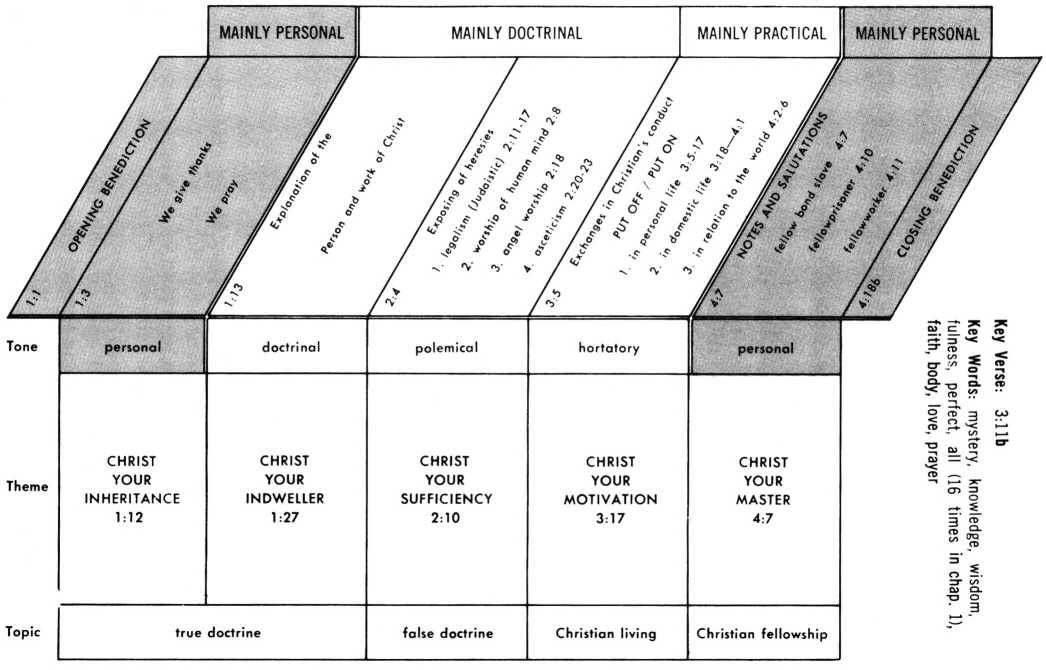
CHRIST IS ALL IN ALL
Click chart to enlarge
Charts from Jensen's Survey of the NT - used by permission
Colossians Overview - Click Chart on right side
| Christ Preeminent in All Things Supreme Lord - Sufficient Savior |
|||
| Colossians 1 | Colossians 2 | Colossians 3 | Colossians 4 |
| Supremacy of Christ |
Submission to Christ |
||
| Doctrinal and Corrective |
Practical and Reassuring |
||
| What Christ Did For Us |
What Christ Does Through Us |
||
| Christ Our Lord |
Christ Our Life |
Christ our Love |
|
| Christ the Head of the Body |
Christ the Lord of the Universe |
Christ the Head of the Home |
|
| Instruction | Warnings | Exhortations | Reminders |
| Reconciliation | Creation | Submission | Conversation |
| His Person and Word |
His Peace and Presence |
||
Colossians 1:28 We proclaim (1PPAI) Him admonishing (PAPMPN) every man & teaching (PAPMPN) every man with all wisdom, so that that we may present (1PPAS) every man complete in Christ. (NASB: Lockman)
Greek: hon hemeis kataggellomen (1PPAI) nouthetountes (PAPMPN) panta anthropon kai didaskontes (PAPMPN) panta anthropon en pase sophia, hina parastesomen (1PAAS) panta anthropon teleion en Christo;
Amplified: Him we preach and proclaim, warning and admonishing everyone and instructing everyone in all wisdom (comprehensive insight into the ways and purposes of God), that we may present every person mature (full-grown, fully initiated, complete, and perfect) in Christ (the Anointed One).(Amplified Bible - Lockman)
Lightfoot: ‘This Christ we, the Apostles and Evangelists, proclaim without distinction and without reserve. We know no restriction either of persons or of topics. We admonish every man and instruct every man. We initiate every man in all the mysteries of wisdom. It is our single aim to present every man fully and perfectly taught in Christ.
Moffatt: This is the Christ we proclaim; we train everyone and teach everyone the full scope of this knowledge, in order to set everyone before God mature in Christ
NLT: So everywhere we go, we tell everyone about Christ. We warn them and teach them with all the wisdom God has given us, for we want to present them to God, perfect in their relationship to Christ. (NLT - Tyndale House)
Phillips: So, naturally, we proclaim Christ! We warn everyone we meet, and we teach everyone we can, all that we know about him, so that, if possible, we may bring every man up to his full maturity in Christ. (Phillips: Touchstone)
Wuest: Whom we are constantly announcing, admonishing every man and instructing every man in every wisdom in that we may present every man fully mature in Christ Jesus.
AND WE PROCLAIM HIM: hon emeis kataggellomen (1PPAI):
- Acts 8:5, 13:5, 15:36, 16:17, 17:3, 17:13, 17:23, Ro 1:8, 1Cor 2:1, 11:26, Php 1:18
- Colossians 1 Resources - Multiple Sermons and Commentaries
"Him we preach and proclaim." (Amplified)
"This Christ we, the Apostles and Evangelists, proclaim without distinction and without reserve. We know no restriction either of persons or of topics" (Lightfoot)
"So, naturally, we proclaim Christ!" (Phillips)
The Greek reads literally "Him we proclaim" laying appropriate emphasis on Christ. Paul does not proclaim politics, philosophy, a system of theology, a Weltanschauung or a theory of knowledge. He didn't preach himself, his opinions, even lots of entertaining stories or illustrations. He preached Jesus. He proclaimed a Person because Christianity is Christ. We too are called to testify of our risen Lord (cf. Acts 1:8, “my witnesses”).
Writing to the Corinthians Paul reminded them of the main message of the God-Man declaring "we preach Christ crucified, to Jews a stumbling block, and to Gentiles foolishness but to those who are the called, both Jews and Greeks, Christ the power of God and the wisdom of God." (1Cor 1:23, 24)
J Vernon McGee - "The gospel is not what we preach, but it is whom we preach. No man has ever preached the gospel who hasn’t preached Christ. Jesus Christ is the gospel. He is eternal life. John wrote that he was going to show us eternal life, that he had seen eternal life (see 1Jn 1:1–2). Whom had John seen? He’d seen Christ. And, my friend, today you either have Him or you don’t have Him. The gospel is Christ—what He has done for us in His death and resurrection and what He is going to do in the future."
Eadie eloquently writes that "This Christ, so glorious in person and perfect in work—the incarnate God—the bleeding peacemaker— the imperial governor of the universe—it is He, none else, and none besides Him, whom we preach. Not simply His doctrine, but Himself; and He was preached, not by Paul alone, but by all his colleagues. This Christ is the one and undivided object of proclamation; and if He be the hope of glory, no wonder that they rejoice to proclaim Him wide and far, and on every possible occasion. The apostolic preaching was precise and definite. It contained no reveries about the heavenly hierarchy. It was overlaid by no tasteless and tawdry declamation about invisible and worthless mysteries. It dealt not in ascetic distinctions of meats and drinks. There was about it none of those abstruse transcendentalisms in which the Colossian heresiarchs seem to have indulged. It did not gratify the morbid and curious, by prying into celestial arcana. It did not nourish a carnal pride under the delusion of a “voluntary humility.” Nor did it dethrone a Saviour-God, and substitute the worshipping of angels for the faith, love, and homage due to Him. The one theme was Christ—“Him first, Him last, Him midst.” Christ, as the one deliverer, conferring pardon by His blood, purity by His Spirit, and perfection by His pledge and presence, securing defense by His power, comfort by His sympathy, and the hope of glory by His residence in the believing heart; this Christ, as the only source of such multifarious and connected gifts, we preach, and we preach with special tenderness and anxiety. (A Commentary on the Greek Text of the Epistle of Paul to the Colossians)
We is emphatic which stands in contrast to the false teachers who by implication proclaimed someone beside Christ. "We" from the context of this letter would appear to include Timothy (Col 1:1) and Epaphras (Col 4:12-note).
Spurgeon on proclaim Him - That is, Christ; it is not so much what we preach as whom we preach. We preach the Person of Christ: “Whom we preach,”
Proclaim (2605) (kataggello [word study] from katá = intensifies the meaning + aggelos = messenger) means to promulgate or publicly declare and in this case to declare plainly and openly the Christ, the focus of all ministry. Promulgate, make known by open declaration, utter openly, make public, declare with honor, give official notice of. The present tense = continual action. Paul knew that just as with initial salvation, so too with subsequent maturation (sanctification) - the key to both is knowing Christ, not knowing a system of theology, not memorizing 100's of passages of Scripture, not doing more Bible studies...but knowing Christ and so he continually proclaimed Christ. Christianity is not a religion but a relationship. It's not a theology so much as it is a Person, the Person of Christ. Maturity in Christ necessitates being like Him in character. Believers are to continually grow into the likeness of Christ. Not smarter sinners but more like the Savior!
Dave Guzik says Paul "didn’t preach himself, or his opinions, or even lots and lots of entertaining stories. He preached Jesus."
Moule - The Greek word (kataggello) recurs with Christ as its living Object, Acts 17:3; Php 1:16; Php 1:18. (Colossians 1 Cambridge Bible for Schools and Colleges)
Kataggello was a general term focusing on the extent to which the proclamation extended and was not restricted to formal preaching. Paul continually declared clearly, forcefully and authoritatively Christ. The proclamation of the gospel is not the statement of a set of doctrines of the faith, but the proclamation of a Person. One may dissociate Buddha from his teaching, Confucius and others from theirs, but Christ was His teaching. And so even after being flogged and ordered not to speak further in the name of Jesus, Peter and the other apostles "every day, in the temple and from house to house...kept right on teaching and preaching Jesus as the Christ." (Acts 5:42)
Kataggello - 18x in 18v - Acts 3:24; 4:2; 13:5, 38; 15:36; 16:17, 21; 17:3, 13, 23; 26:23; Rom 1:8; 1 Cor 2:1; 9:14; 11:26; Phil 1:17f; Col 1:28. NAS = announced(1), proclaim(7), proclaimed(5), proclaiming(5).
The NT uses of kataggello are especially concentrated in Acts (Click for the11/18 NT uses), which surely suggests something about what the activity that the modern church (specifically the individual members of the body of Christ) should be about
Luke also records that "Philip went down to the city of Samaria and began proclaiming Christ to them....(and later) Philip opened his mouth, and beginning from this Scripture he preached Jesus to (the Ethiopian eunuch)." (Acts 8:5, 35)
Paul practiced what he preached for after he regained his sight and took sustenance, he "immediately began to proclaim Jesus in the synagogues, saying, "He is the Son of God." (Acts 9:20)
Paul did not fearlessly went into the synagogue of the Jews in Thessalonica "and for three Sabbaths reasoned with them from the Scriptures explaining and giving evidence that the Christ had to suffer and rise again from the dead, and saying, "This Jesus whom I am proclaiming to you is the Christ." (Acts 17:1, 2, 3) adding later that "we preach Christ crucified, to Jews a stumbling block, and to Gentiles foolishness." (1Cor 1:23)
Paul was a purpose driven man declaring to the Philippians that although some "proclaim (kataggello) Christ out of selfish ambition, rather than from pure motives, thinking to cause me distress in my imprisonment. What then? Only that in every way, whether in pretense or in truth, Christ is proclaimed (kataggello); and in this I rejoice, yes, and I will rejoice." (Php 1:!7, 18-see notes Php 1:17; Php 1:18)
False teachers exalted themselves and their great “spiritual” attainments. They preached a Philosophy (Col 2:8-note) but Paul preached a Person. The false teachers had lists of rules and regulations (Col 2:16-note; Col 2:20-note; Col 2:21-note), but Paul presented Christ. What a contrast between the ministry of darkness and the ministry of light! One enslaves, the other liberates. True freedom is in Christ alone.
ADMONISHING: nouthetountes (PAPMPN):
- Acts 20:31, Col 3:16, 1Th 5:14, 2Th 3:15
- Colossians 1 Resources
"warning and admonishing everyone and instructing everyone" (Amplified),
"We admonish every man and instruct every man " (Lightfoot)
"We warn everyone we meet" (Phillips)
Admonishing (3560) (warning, cautioning, gently reproving, exhorting) (noutheteo from nous = mind + títhemi = place) (see also Nouthesia) literally means to place in the mind and so to warn or give notice to beforehand especially of danger or evil, by reasoning with them. The idea is to lay it on the mind or heart of the person, with the stress being on influencing not only the intellect, but also the will, emotions and disposition. The idea is to counsel about avoidance or cessation of an improper course of conduct. Noutheteo especially appeals to the mind, supplying doctrinal and spiritual substance (content), "providing needed reasoning to turn (alter) a person's direction towards God's reasoning." Noutheteō includes helping someone make the journey of thinking through an issue – from premise to necessary conclusions (convictions) which rest on a solid, scriptural foundation. Noutheteō then makes skillful use of logic, redirecting someone's reasoning (thought-process) to find the Lord's approval. This "exerts positive pressure" on someone's logic (reasoning), i.e. urging them to choose (turn to) God's best. Noutheteō ("to warn through teaching") focuses on changing wrong beliefs – especially by challenging the wrong premise(s) involved. Indeed, one wrong premise drives many wrong conclusions.noutheteō) Noutheteō supplies necessary instruction (evidence, proof) that effectively warns, admonishes, or reprimands (Souter) – leading people to righteous behavior.] Noutheteō appeals to the mind (logic) to "believe differently" by effective warning (admonishing, correcting, exhorting). The Bible explicitly urges us to confront sin! This requires nouthetéō ("admonish, warn, correct"), done on the basis of God's Word (the perfect standard). Our mind matters! God changes us by transforming our thinking (Ro 12:1-3). True sanctification means learning to incorporate the legitimate "extreme-ends" of an issue – a necessary discipline to finding genuine balance (true moderation). In sum, Noutheteō involves appealing to a person's reason to make meaningful change. This root (nouthe-) does not strictly mean "chastise," though this can be involved – i.e. with needed admonishing, correcting, exhortation, etc The English word admonish means to express warning or disapproval especially in a gentle, earnest, or solicitous manner; reproving firmly but not harshly; or advising to do or not do something. Noutheteo describes "putting sense into someone’s head", alerting them of the serious consequences of their actions and does not mean being judgmental or critical in a superior manner but instead imparting a caring kind of warning against danger. Noutheteo = 8 times in 8v in the NT- Acts 20:31; Ro 15:14; 1Cor 4:14; Col 1:28; 3:16; 1Th 5:12, 14; 2Th 3:15).
Noutheteo is in the present tense which indicates Paul was continually admonishing, warning, cautioning, etc
English dictionaries state that to admonish is to indicate duties or obligations to; to express warning or disapproval to especially in a gentle, earnest, or solicitous manner; to give friendly earnest advice or encouragement to; to reprove firmly but not harshly; to advise to do or against doing something; warn; caution.
Noutheteo describes "putting sense into someone’s head", alerting them of the serious consequences of their actions and does not mean being judgmental or critical in a superior manner but instead imparting a caring kind of warning against danger.
Guzik adds "Some translate warning “counseling.” The ancient Greek verb nouthetountes means, “to impart understanding,” “to lay on the mind or the heart.” The stress is on influencing not only the intellect, but also the will and disposition. It describes a basic means of education. The work of warning - or helping to impart understanding - was a passion for Paul in ministry (Acts 20:31-note). It is also the job of church leaders (1Thes 5:12-note) and of the church body in general (Col 3:16-note), providing that they are able to admonish others (Ro 15:14-note)."
The TDNT says that noutheteo (and noun Nouthesia) - "The verb (noutheteo) means “to impart understanding,” “to set right,” “to lay on the heart” “to impart understanding (a mind for something)". The stress is on influencing not merely the intellect but the will and disposition. The word thus acquires such senses as “to admonish,” “to warn,” “to remind,” and “to correct.” It describes a basic means of education. (didasko = Provide instruction in a formal or informal setting = teach) often linked with noutheteo/nouthesia, e.g... Socrates takes aside someone who has unintentionally given a false account of something in order to instruct and warn him. In the case of didasko the primary effect is on the intellect, and someone qualified exercises the influence. , Noutheteo however, describes an effect on the will and disposition, and it presupposes an opposition which has to be overcome. It seeks to correct the mind, to put right what is wrong, to improve the spiritual attitude.1 “The basic idea is that of the well-meaning earnestness with which one seeks to influence the mind and disposition by appropriate instruction, exhortation, warning and correction.”...Hence the dominant meanings “to admonish, warn, soothe, remind, correct...Aiming both to ward off and to impel, noutheteo takes place through the word... (noutheteo) is an elementary means of education which the father uses...It does not mean “to punish,” but through the word... to cause the appeal to the moral consciousness to gain a hold over men and bring them to repentance and shame, so that punishment is superfluous. In keeping with pedagogic experience, however, the word can have the secondary sense of actively affecting the mind, i.e., “to discipline”...Philo and Clement of Alexandria speak about God or Christ warning, censuring, and encouraging us in this way. The idea is not that of punishment but of a moral appeal that leads to amendment. In this sense it takes on the meaning “to discipline.” Philosophy, however, does not use it technically for its own work. The LXX makes little use of it; it means “to reprimand” in 1 Sam. 3:13, “to admonish” in Job 4:3, and “to correct” in Job 30:1; 36:12. The noun, which means “admonition” or “correction,” is common in Philo, for whom it represents divine warnings as distinct from divine punishments. The group occurs in the NT only in Paul. In Eph 6:4 the noun represents a means of Christian upbringing, i.e., the admonition or instruction which will correct but not provoke. In 1Cor 10:11 God’s OT judgments have pedagogic significance; they are written for our instruction. (Noutheteo) denotes a pastoral function. The man who by admonition and correction seeks to turn others from what is wrong and to lay the good on their hearts is (Paul), the preacher of the Gospel, the one who bears responsibility for the faith and life of the primitive churches...Paul warns and teaches (Col. 1:28) with a view to bringing believers to maturity in Christ. Admonition is a central part of the cure of souls (Acts 20:31). Criticisms are fatherly words of correction (1Cor. 4:14, 15)...Similarly a congregation admonishes or corrects whether by its pastors (1Th. 5:12) or by the reciprocal brotherly ministry of the members exercising pastoral oversight with a sense of congregational obligation (1Th. 5:14). This may be a correcting of the refractory (2Th. 3:15), but in (Titus 3:10) it represents an attempt to make the heretic aware of the falsity of his position, a pastoral attempt to reclaim rather than a disciplinary measure, though there is place for this if the corrective word is of no avail. The pastoral use remains a common one in the apostolic fathers." (Modified from the "big Kittel" - Kittel, et al: Theological Dictionary of the New Testament. Vol. 4, Page 1020. Grand Rapids, MI: Eerdmans)
Noutheteo has the connotation of confronting with the intent of changing one’s attitudes and actions.
The ISBE says that in Scripture admonish conveys the idea "of warning or guidance given to persons through a reminder of certain principles by which they should be living. If such counsel is heeded it will bring prosperity, since the instruction is directed to a positive end for the edification of the hearer. Admonition is not condemnation, and when it adduces the biblical principles for Christian living it forms a valuable element in spiritual discipline." (Bromiley, G. W. The International Standard Bible Encyclopedia, Revised. Wm. B. Eerdmans)
Noutheteo - 8 times in 8v in the NT- Acts 20:31; Ro 15:14; 1Cor 4:14; Col 1:28; 3:16; 1Th 5:12, 14; 2Th 3:15). NAS = admonish, 5; admonishing, 2; give...instruction, 1. In KJV it is translated - admonish, 4; warn, 4.
Noutheteo is used 9 times in the Greek translation of the Hebrew OT, the Septuagint (LXX), 8 of those uses being in the book of Job - 1Sa 3:13; Job 4:3; 23:15; 30:1; 34:16; 36:12; 37:14; 38:18; 40:4; (for discussion of use in 1Sa 3:13 see below) . It was said of Job "Behold you have admonished many, And you have strengthened weak hands." (Job 4:3)
Richards makes an important distinction writing that "admonishing is a ministry calling for much warmth and closeness. There is no hint of a distant judgmentalism or of criticism launched from some height of supposed superiority. Paul's admonitions were stimulated by a deep love for young believers. His love was so deep that his admonitions were often accompanied by tears. Paul does not see admonition as an exclusive prerogative of leaders. The members of the body of Christ at Rome were "competent to instruct [admonish] one another" (Ro 15:14-note), and all believers are called to exercise this ministry with one another (Col 3:16-note). When we love our brothers and sisters and have a genuine concern for their well-being, we can hardly hesitate to encourage them to live godly lives and thus bring glory to the Lord." Expository Dictionary of Bible Words: Regency)
Vine writes that noutheteo "is used, (a) of instruction, (b) of warning. It is thus distinguished from paideuo, “to correct by discipline, to train by act,” Heb 12:6; cf. Ep 6:4-note. “The difference between ‘admonish’ and ‘teach’ seems to be that, whereas the former has mainly in view the things that are wrong and call for warning, the latter has to do chiefly with the impartation of positive truth, cf. Col 3:16-note; they were to let the Word of Christ dwell richly in them, so that they might be able (1) to teach and ‘admonish’ one another, and (2) to abound in the praises of God. “Admonition differs from remonstrance, in that the former is warning based on instruction; the latter may be little more than expostulation. For example, though Eli remonstrated with his sons, 1Sa 2:24, he failed to admonish them, 1Sa 3:13, LXX. Pastors and teachers in the churches are thus themselves admonished, i.e., instructed and warned, by the Scriptures, 1Cor 10:11, so to minister the Word of God to the saints, that, naming the Name of the Lord, they shall depart from unrighteousness, 2Ti 2:19-note.” (Admonition, Admonish - Vine's Expository Dictionary of NT Words)
Trench adds that the idea of noutheteo "is the training by word—by the word of encouragement, when this is sufficient, but also by that of remonstrance (an earnest presentation of reasons for opposition or grievance), of reproof, of blame, where these may be required; as set over against the training by act and by discipline, which is paideia." (Synonyms of the New Testament)
Trench goes on to say that admonishing is a most needful element of Christina education. He says that noutheteo when the need calls for it can be earnest and even severe and is much more than a feeble remonstrance like the priest Eli gave to his worthless sons (1Sa 2:12).
Scripture records that "Eli was very old and he heard all that his sons were doing to all Israel, and how they lay with the women who served at the doorway of the tent of meeting. And he said to them, "Why do you do such things, the evil things that I hear from all these people? No, my sons; for the report is not good which I hear the LORD'S people circulating. If one man sins against another, God will mediate for him; but if a man sins against the LORD, who can intercede for him?" But they would not listen to the voice of their father, for the LORD desired to put them to death." (1Sa 2:22, 23, 24, 25)
The results of Eli's failure to admonish are recorded in 1Sa 3:13 - "For I have told him that I am about to judge his house forever for the iniquity which he knew, because his sons brought a curse on themselves and he did not rebuke (Greek Septuagint translates this Hebrew word with noutheteo) them."
Beet comments that noutheteo "includes all kinds of friendly discipline and training, as of a father, brother, or companion; especially reproof with a view to improvement."
Cremer says that the fundamental idea of noutheteo is "the well-intentioned seriousness with which one would influence the mind and disposition of another by advice, admonition, warning, putting right, according to circumstances”
Warning and admonishing is as critical for the leaders in the church as it was for Eli. Note that warning and teaching belong inseparably together, as the constant counterpart of knowledge and action.
Paul in his parting words to the Ephesian elders reminded them that "from among your own selves men will arise, speaking perverse things, to draw away the disciples after them" and therefore they had to "be on the alert, remembering that night and day for a period of three years (note what Paul did for 3 years! Is this an active aspect of ministry in the modern day church?) I did not cease to admonish (noutheteo) each one with tears." (Acts 20:30, 31-note)
Note that in this passage Paul gives us a model to imitate when we admonish. In verse 31 Paul clearly demonstrates a spirit of humility ("with tears") Paul was not unsympathetic, mean-spirited, or callous with them, and neither should we be when we are called to admonish one another.
Paul exhorted the Colossian saints to "Let the word of Christ richly dwell within you, with all wisdom teaching and admonishing one another..." (Colossians 3:16-note)
When Christ's word is richly dwelling in God’s people they are wise and discerning and "enabled" to admonish one another.
Paul wrote to the Roman saints letting them know that he was "convinced that you yourselves are full of goodness, filled with all knowledge, and able also to admonish one another." (Ro 15:14-note)
In his note on the Romans 15:14 passage John MacArthur writes that noutheteo "is a comprehensive term for counseling. In this context, it refers to coming alongside other Christians for spiritual and moral counseling. Paul is not referring to a special gift of counseling, but of the duty and responsibility that every believer has for encouraging and strengthening other believers. Tragically, many Christians today have been convinced that competent counseling can only be accomplished by a person who is trained in the principles of secular psychology—despite the fact that the various schools of psychology are, for the most part, at extreme odds with God’s Word and frequently with each other. Although they may profess that “all Scripture is inspired by God and profitable for teaching, for reproof, for correction, for training in righteousness” (2Ti 3:16-note), many evangelicals—both those who give and those who receive counseling—do not rely on the full sufficiency of God’s Word.... When God’s Word rules our hearts (cf Col 3:16-note), His Holy Spirit makes us “rich in the true wisdom” and prepares us to admonish one another, to “teach and help one another along the right road.” The place for Christians to counsel and be counseled is in the church. That is not, of course, to say that it must be done in a church building, but that it be Christian counseling Christian. That principle applies to general admonitions among fellow believers, as Paul mentions in this text, as well as to counseling regarding more serious and prolonged problems confronted by a biblically oriented and spiritually gifted Christian minister." (MacArthur, J: Romans 9-16. Chicago: Moody Press ) (bolding added, reference link added)
Paul considered himself a spiritual father to the local churches, and it was his duty to warn his children -- "I do not write these things to shame you, but to admonish you as my beloved children" (1Corinthians 4:14)
Children who are not warned can get in a lot of trouble! Using the noun form (nouthesia) Paul instructs fathers, writing ""And, fathers, do not provoke your children to anger; but bring them up in the discipline and instruction (nouthesia) of the Lord." (Ep 6:4-note) (Fathers, are you warning your children? It is critical for their well being in a amoral society which has run amuck and scoffs at the life giving Biblical principles like this one in Ephesians!)
In admonishment there is a moral emphasis, in teaching a doctrinal emphasis.
The Wycliffe Bible commentary says that "The ‘doctor of souls’ has a warning and teaching ministry, not self-centered but patient-centered."
Below are the final three occurrences of noutheteo in the NT:
"But we request of you, brethren, that you appreciate those who diligently labor among you, and have charge over you in the Lord and give you instruction (not merely to academic data imparted impersonally but instruction for purpose of correcting and changing people = teaching with an element of warning, designed to direct the sheep to holy living)...14 And we urge you, brethren, admonish the unruly, encourage the fainthearted, help the weak, be patient with all men." (1Th 5:12-note,1Th 5:14-note)
"And yet do not regard him as an enemy, but admonish him as a brother." (2Thessalonians 3:15)
F B Meyer - WATCHING FOR SOULS (Col. 1:27, 28, cp Acts 20:31)
THE MINISTRY of warning should be a recognized part of the work of the Church and of each individual member. The foghorn warns the ship from the deadly rocks; the red light warns the train of imminent danger; in the days of the plague people were warned from infected areas: how much more should we, who know the wrath of God which abides on those who refuse Christ, raise our voice in warning. We should do it deliberately, earnestly, patiently, and in reliance upon the Spirit of God to make our words, however much they may be resented, the means of arresting the wicked from the error of his ways, and those who are taking their first steps in forbidden paths from pursuing them (Ezek. 33:7, 8, 9).
How wonderful it is that God does not commission angels to carry His warnings and appeals; instead of this, the work that angels might love to do is entrusted to men. It is at our peril that we neglect our opportunities in this direction. If the signalman is placed at a point where many lines of rail cross or diverge, and he sleeps at his post, or neglects his duty, he may be tried for manslaughter; and if we know of people in the immediate circle of our influence who are in danger of ruining their physical, moral, and spiritual well-being, we are bound to raise a warning voice. If we saw, upon the upper reaches of a river, a boat full of people hastening towards the rapids unheeding the danger, surely we might be guilty of being an accessory in their destruction, if we failed to do something to warn them of their peril.
Accompanying our words of warning, there should be the clear reiteration of the Love of God. He does not desire the death of a sinner, but rather that he should turn from his wickedness and live. It is not enough to try and prevent men from taking the wrong path, we must urge and allure them to take the pleasant ways of righteousness and peace. All are included in the love of God. Even sin cannot turn away His love, which is like that described in the parable of the Prodigal Son, or 1Cor 13:4, 5, 6, 7-note
PRAYER - O God, we have left undone many things that we ought to have done. Hands have been reached out for help which we have not given; hearts have turned to us for sympathy which we have not blessed. Forgive us, we pray Thee, and at whatever cost may we follow Christ in His redemptive purpose. AMEN. (Our Daily Walk)
EVERY MAN: panta anthropon:
- Colossians 1 Resources - Multiple Sermons and Commentaries
EVERY MAN...
EVERY MAN...
EVERY MAN...
Thrice repeated, in order to emphasize the universality of the Gospel and surely a thrust at the exclusiveness of those (Gnostics) who advocated a system of truth designed from the intellectual few. Christianity, however, knows no hopeless classes. Paul states and repeats emphatically "EVERY MAN," and declares that thus wisdom is used for the benefit of all. The goal of the Christian ministry is not simply salvation, although that is extremely important, but ultimately the presentation of the believer before the Father as mature in Christ. A conception of evangelism which does not envisage this is not in the Pauline tradition. The same may be said for the teaching ministry. All in all this is “a very daunting task”, impossible apart from divine enablement which Paul brings out in the next verse.
Regarding "every man" Eadie adds that "The apostle warned every man—any one, every one,—urged him as a sinner to bethink himself, to consider his danger, as the victim of a broken law—and apprehending the certainty of safety alone in Christ, to look at the adaptation of the gospel and the glory of its evidence, and to submit to its paramount claims. And he taught “every man”—gave him full instruction—left him in no dubiety, but presented him with a correct and glowing sketch of redemption by the cross. And this is done in all wisdom" (Colossians 1 - Eadie's Commentary on Colossians)
AND TEACHING EVERY MAN WITH ALL WISDOM: kai didaskontes (PAPMPN) panta anthroponen pase sophia:
- Literally "in all wisdom"
- Colossians 1 Resources - Multiple Sermons and Commentaries
WIN
WARN
TEACH
It is not enough to warn people; we must also teach them the positive truths of the Word of God. How far would we get in our travels if the highway signs told us where the roads were not going? Not very far! It is good to win a man to Christ, and then to warn him about the dangers ahead; but it is also important to teach that convert the basic truths of the Christian life.
Peake - Meyer points out that admonishing and teaching correspond to the two main elements of the evangelic preaching, repent and believe. (Colossians 1 Expositor's Greek Testament)
Teaching (1321) (didasko [word study]) (holding discourse with others in order to instruct them, delivering didactic discourses, imparting instruction, explaining doctrine, explaining or expounding something to another, communicating to another the knowledge of that of which he was before ignorant, exhibiting or instructing by precept, example, or experience so as to impress the listener's mind) (present tense = continually teaching as a habit of one's life) (didasko = our word didactic = designed or intended to teach) means to provide instruction in a formal or informal setting.
The first use of didasko describes Jesus "going through all Galilee teaching (didasko) in their synagogues and proclaiming the gospel of the kingdom..." (Mt 4:23)
And in His famous Sermon on the Mount "He opened His mouth and began to teach them saying "Blessed..." (Mt 5:2-3-note).
Paul like a relay runner wrote to the next runner (presenting a pattern for discipleship, cp 2Ti 3:10-note), Timothy, "the things which you have heard from me in the presence of many witnesses, these entrust to faithful men, who will be able to teach (didasko) others also. (2Ti 2:2-note)
Teaching is the orderly presentation of Christian truth for converts so that they may grow in respect to salvation (cf 1Pe 2:2-note)
Teaching is the responsibility of every believer (Col 3:16-note), is part of the Great Commission (Mt 28:20 - notice Jesus did not say "Go and make converts!" but "disciples" Mt 28:18, 19) and is especially the responsibility of church leaders for Paul instructs that “An overseer must be...able to teach” (1Ti 3:2, cp 2Ti 2:2-note, 2Ti 2:24-note, cp Acts 20:28, 29, 30, 31, 32). Heresy flourishes when sound doctrine flounders!
Didasko is teaching in such a way as to shape and influence the understanding and the will of the one taught.
The difference between “admonishing” and “teaching” is that the former has especially in view things that are wrong and call for warning, the latter has to do especially with the impartation of positive truth. Paul made it his business to instruct men, as well as to exhort them. Admonishment, exhortation and warning are of little use where there is no sound instruction and a careful inculcation of the Truth.
J Vernon McGee - "I believe there are two commands here for ministers today—these are two things we should be doing. We are to preach the gospel in order to win sinners to Christ and to save them from the wrath that is to come, and we are to teach every man in all wisdom. In other words, we are to seek to build up men and women so that they may grow in grace and be faithful members of the body of Christ; they are to be encouraged to serve Christ in the local assembly. I am told that my teaching of the Bible helps the local churches, and that is the reason I have the support of so many pastors across this country. If I am not doing that, then I would have to say I am not fulfilling my ministry. (McGee, J V: Thru the Bible Commentary: Thomas Nelson) (Comment: Is it any wonder that years after Dr McGee's death, his ministry remains vital and active on the radio and in print!)
Paul not only preached Christ, but he also “taught Christ,” for in Christ are “all the treasures of wisdom and knowledge” (Col 2:3-note). It was not necessary to introduce a new teaching, for all that a believer needs to know (and needs period) is found in Christ (cf 2Pe 1:3, 4-note).
Amplified Version - "instructing everyone in all wisdom (comprehensive insight into the ways and purposes of God)."
Wisdom (sophia [word study]) is the right use of knowledge and in Scripture is the ability to apply the knowledge of God's will to real life situations. The false teachers promised to give people a “hidden wisdom” that would make them members of the “spiritual elite.” But all true spiritual wisdom is found only in Christ. So Paul's purpose was not to fill his disciples with knowledge but to assure that they possessed the wisdom necessary for making decisions so that they might walk in a manner worthy of the Lord, pleasing Him in all respects.
Nelson's Illustrated Bible Dictionary notes that "The biblical concept of wisdom...is quite different from the classical view of wisdom, which sought through philosophy and human rational thought to determine the mysteries of existence and the universe. The first principle of biblical wisdom is that people should humble themselves before God in reverence and worship, obedient to His commands." (Youngblood, R. F., Bruce, F. F., Harrison, R. K. Nelson's New Illustrated Bible Dictionary)
MacArthur comments that "Admonishing and teaching must be done with all wisdom. This is the larger context....wisdom refers to practical discernment—understanding the biblical principles for holy conduct. The consistent pattern of Paul’s ministry was to link teaching and admonishment and bring them together in the context of the general doctrinal truths of the Word. Doctrinal teaching was invariably followed by practical admonitions. That must also be the pattern for all ministries." (MacArthur, J. Colossians)
Webster defines "wisdom" as "the right use or exercise of knowledge; the choice of laudable ends, and of the best means to accomplish them. This is wisdom in act, effect, or practice. If wisdom is to be considered as a faculty of the mind, it is the faculty of discerning or judging what is most just, proper and useful, and if it is to be considered as an acquirement, it is the knowledge and use of what is best, most just, most proper, most conducive to prosperity or happiness. Wisdom in the first sense, or practical wisdom, is nearly synonymous with discretion. It differs somewhat from prudence, in this respect; prudence is the exercise of sound judgment in avoiding evils; wisdom is the exercise of sound judgment either in avoiding evils or attempting good. Prudence then is a species, of which wisdom is the genus."
Vincent adds comments that the phrase "In every form of wisdom" is "opposed to the idea of esoteric (= inner; that which is profounder and more abstruse, and which is reserved only for the cultivated few who can receive it) and exoteric (outer: that which is more rudimentary and simple, and adapted to the popular comprehension) wisdom represented by the false teachers; higher knowledge for the few philosophic minds, and blind faith for the masses. In Christian teaching the highest wisdom is freely open to all." (Colossians 1 - Vincent's Word Studies)
Lightfoot comments on sophia writing that "The Gnostic spoke of a blind faith for the many, of a higher gnosis for the few. St Paul declares that the fullest wisdom is offered to all alike. The character of the teaching is as free from restriction, as are the qualifications of the recipients."
Eadie comments that "with all wisdom" means "To preach the gospel so as to guide the wandering sinner to Christ—to drive him from all refuges of lies, and urge him to embrace a free and full salvation—to enlighten, comfort, strengthen, and refresh the children of God, is seen to be a task demanding consummate wisdom, when we consider the endless varieties of character and temperament, the innumerable sophistries of the human heart, and the ever- changing condition and events of our brief existence. Yet, while Christ crucified is the theme of every address, such uniformity of doctrine does not imply sameness of argument or tedious monotony of imagery and illustration. There may be, and there will be, in this wisdom, circumstantial variety in the midst of essential oneness—for the truth, though old, is ever new. (Colossians 1 - Eadie's Commentary on Colossians)
S Lewis Johnson adds in regard to "all wisdom", "Paul’s Old Testament was not like the Bible of so many Christians today—dog-eared in the Psalms and clean in Romans. The whole counsel of God was the subject of his ministry. The aim of the apostle is the aim of God, as the purpose clause, introduced by the hina (AV, “that”), indicates. (Bibliotheca Sacra, page 235, 1962).
THAT WE MAY PRESENT EVERY MAN COMPLETE IN CHRIST: hina parastesomen (1PAAS) panta anthropon teleion en Christo:
- Col 4:12, Eph 4:12, 13
- Colossians 1 Resources - Multiple Sermons and Commentaries
that we may present every person mature (full-grown, fully initiated, complete, and perfect) in Christ (the Anointed One). (Amplified)
so that, if possible, we may bring every man up to his full maturity in Christ." (Phillips)
in order to bring each one into God’s presence as a mature individual in union with Christ (GNB)
that we may present every man fully mature in Christ Jesus. (Wuest)
That (hina) (See discussion of the importance of observing the Scripture for this strategic "term of purpose" - note that "hina" occurs 663 times in the NT giving you many opportunities to practice interrogating this term of purpose!) - In order that. Webster says purpose is the reason for which something is done. Here Paul delineates his purpose of proclaiming, admonishing, teaching, etc. The purpose of Paul's ministry was to bring people to maturity in Christ, not dependence upon himself (or upon their "self"!). A supernatural walk calls for supernatural power.
Morgan - Therefore, the aim of this epistle, and, indeed, of all apostolic work is admonishing and teaching every man toward the realization of perfection in Christ, because that issues in the perfecting of the whole Church.”
So Paul says in essence his purpose is spiritual maturity. The sphere of this maturity is "in Christ." As Sinclair Ferguson says...
In a word, maturity equals Christlikeness. No other standard may be allowed to substitute. All other standards will be lesser, man-made alternatives that disguise the all-demanding standard God sets before us in the Scriptures.
Zeal, knowledge, orthodoxy, and success would be easier standards by far. What would be particularly attractive about them, of course, is that we could measure ourselves and others against them with some degree of satisfaction in our own performance. We might even, in this case, be obviously more mature than others!
But God's standard is none of these things. The only thing that counts, according to Paul, is being like Jesus. Are you growing more and more like Him? Then you are maturing as a Christian. But then and only then...
Nothing has impressed me more in recent years than this: if I were only more intimately and sensitively familiar with God's Word; if I had read and studied it more, weighed its meaning and applied its truth to my own life more—how much more useful my service in the kingdom of God would have been! In witnessing my words would have been more faithful, in counseling I would have been better able to reach into people's deepest and most hidden needs with the help of the Spirit; in personal holiness I would have been more conformed to the image of my Savior. I would have seen more of the answer to His prayer for me: "Sanctify them by the truth; your word is truth" (Jn. 17:17)....
spiritual maturity was the great purpose of the apostles' ministries. It lay at the nerve center of apostolic, New Testament Christianity. What about us? Is bringing others to maturity our great goal? Do we long to present them mature in Christ? Do we labor for that, struggling with all the energy of God that works powerfully in us (Col. 1:28, 29)? That will be true only if maturity is one of the goals of our own Christian lives. That is where we need to start. And, if we have not started, or, having started have fallen by the way, there is no time like the present for us to pay attention to the exhortation of God's Word: "Let us—go on to maturity" (Heb. 6:1). (Discipleship Journal. Issue 24. Nov/Dec, 1984)
Guzik - The goal of Paul’s ministry was to bring people to maturity in Christ, not dependence upon himself.
John Eadie - “In order that we may present every man perfect in Christ.” A glorious aim—hina—the noblest that can stimulate enthusiasm, or sustain perseverance in suffering or toil. The Iesou of the Textus Receptus (KJV has "perfect in Christ Jesus") is not supported by full authority. The phrase “perfect in Christ” does not simply mean perfect in knowledge, because of this previous teaching, as Chrysostom and Calvin supposed; for the effect of such knowledge is moral in its nature, and sanctifying in its effect (Ed: I.e., it affects or at least should effect our Christian conduct.). Jn 17:3 (Ed: where "know" = ginosko = knowing Him by experiencing "life" with Him and from Him!). Such perfection is in Christ in fellowship with Him (see discussion of phrase in Christ), is derived from Him, and consists in likeness to Him (Ro 8:29-note). The verb (paristemi) occurs in Col 1:22-note, and in a clause of similar import. The time of presentation is described under Eph. 5:27-note. The object of his preaching was to save every man. He was contented with nothing less than this, and nothing else than this was his absorbing motive. Not that every man was perfected whom he had endeavored to instruct, but such was his avowed object (Ed: And it should be ours).... Clement of Alexandria takes panta in the sense of holon—the man entire—soul, body, and spirit. And the gaining of that object cost the apostle no small pains and labor. (Colossians 1 - Eadie's Commentary on Colossians)
A SOAPBOX
APPEAL
In this section we see the emphasis which Paul placed on follow-up work. He felt a real sense of responsibility toward those whom he had pointed to the Savior and was not satisfied to see souls saved and then to move on. He wanted to see saints grow from babes into maturity in Christ (cp Heb 5:12-note, Heb 5:13, 14-note, 1Pe 2:2-note) Does this describe your church? Let's face it discipleship is difficult work and requires time and energy (I know as I have done it! cp Paul's "I labor, striving" Col 1:29) But frankly to not disciple is to disobey the "Great Commission" and replace it with the "Great Omission!" (Read Mt 28:18-20 and note the only command is to make disciples!) Where are the Paul's (the older men in your church) who are discipling the Timothy's (the younger men, newly married, struggling with a growing family and job, etc)? I approached a large popular church in my city which is led by what I refer to as the "young reformers," young (30's), sincere, serious, Bibliocentric, Gospel focused men. I pointed out to these young leaders that they had in their church probably 20-50 older mature men (especially older than 60), many of whom were men of the book, leaders in their own right and with time on their hands. I suggested they organize and challenge these men to first of all receive some basic training on Bibliocentric disciple making (grounding them in serious Bible study, not just accountability groups, especially using inductive Bible study). They listened politely, nodding their heads, but in the end took absolutely no action. In retrospect, it seems the young Timothy's thought they had solved the discipleship puzzle and were not really in need of the older "Paul's!" Sad, very sad and very unbiblical. If you are a young pastor and have older men who have truly walked with Jesus for 20 or 30 years (and I'm not talking about just filling a pew seat year after year, but filling their heart and mind with the pure milk of the Word!), then I strongly suggest you pray through Paul's words in Colossians 1:28-29 and see if the Spirit might not prompt you to approach these men and ask their help to consider discipling a younger man. Notice I did not say "mentor" (be a trusted guide) but "disciple" (make learners!) Personally, I think we need to keep the Biblical vocabulary and the modern fad of mentoring is not a word even used in Scripture. We need to make learners, filled with the Word, filled with Spirit, "in order that we may present every man complete in Christ!"
THOUGHT - Does your church have a purposed, Biblically based follow up (genuine discipleship) program for every new convert, taking them from the elementary teaching about the Christ and helping them press on to maturity and become complete in Christ? (Php 3:14-note) This was Paul's passionate burden for those he had led to His Savior...do you share his passion?
Present (3936) (paristemi [word study] from para = near, beside + histemi = place, set) literally means to place or set beside or near and hence to place at someone's disposal. To present with the idea of yielding that which is presented to the disposal of the one it is presented to. Paristemi means to present oneself for service or to put at the service of (sometimes translated "help" Ro 16:2-note). To bring before, to yield to another, to place a person at the disposal of another, to set, place or introduce into the presence or before the face of a superior
Paristemi was used as a technical term (especially in the Greek Septuagint) for a priest’s placing an offering on the altar. Thus it as if Paul pictures himself as a priest offering up "sacrifices" to God, although here not dead sacrifices, but living saints. Further he does not want to offer up "blemished sacrifices" but he wants them to be "perfect" sacrifices, mature, full-grown, adult Christians. Speaking in in terms of the return of Jesus, Paul conveys a parallel thought in (1Thes 2:19, 20-note) writing "who is our hope or joy or crown of exultation? Is it not even you, in the presence of our Lord Jesus at His coming? For you are our glory and joy."
Paristemi was also a legal term meaning “to bring” someone before the magistrate or judge.
Paul used the same verb earlier instructing the saints that Jesus "has now reconciled you in His fleshly body through death, in order to present you before Him holy and blameless and beyond reproach" (Col 1:22-note) In other words, here Paul uses paristemi to express the purpose of the reconciliation accomplished by Christ. The presentation Paul seems to be alluding to in Col 1:28 is that final day when "every man" who is a believer will stand before the judgment seat of Christ (bema) "that each one may be recompensed for his deeds in the body, according to what he has done, whether good or bad." (2Cor 5:10-note, Ro 14:10-12-note, cp Rev 22:12-note , Isa. 40:10-11; 62:11; Lk 14:12-14; 1Cor 3:13-15; Col. 3:22-25-note; 1Jn. 2:28),
SPIRITUAL
MATURITY
IN CHRIST
Complete (5046) (teleios [word study] from telos = an end, a purpose, an aim, a goal) means complete, mature, fully developed, full grown, brought to its end, finished, wanting nothing necessary to completeness, in good working order.
Teleios signifies consummate soundness, includes the idea of being whole. Interestingly the Gnostics used teleios of the one fully initiated into their mysteries and that may have been why Paul used teleios in this epistle. Teleios means perfect, fully mature, full grown not babies, adult, "of full age", consummate regarding human integrity and virtue, complete in mental and moral character, wanting nothing necessary for completeness, absolute moral completeness in every man, having attained the full limits of stature, strength and power within one's reach and thus having reached the goal or desired end.
Teleios suggests attainment of the proper end of one's existence. In the present context, teleios refers to attaining of spiritual maturity, "full grown" and like Christ. Teleios was employed by the mystery religions and the Gnostics to describe those who had become possessors of the secrets or knowledge boasted of by the particular religion. Trench adds that the "image of full completed growth, as contrasted with infancy and childhood, underlies the ethical use of teleios by Paul."
A T Robertson on teleios in Col 1:28 - Spiritual adults in Christ, no longer babes in Christ (Heb. 5:14), mature and ripened Christians (4:22), the full-grown man in Christ (Eph. 4:13). (Colossians 1 - Robertson's Word Pictures of the New Testament)
Paul uses this same word "complete" (teleios) to describe Epaphras - "Epaphras, who is one of your number, a bondslave of Jesus Christ, sends you his greetings, always laboring earnestly for you in his prayers, that you may (passive - may be made to, probably "divine passive" - something the Spirit accomplishes - cp Jude 1:24-note) stand perfect (now, in this short life and then, at the bema) and fully assured in all the will of God." (Col 4:12-note)
THOUGHT - Paul's Pattern for "Perfection" (Christlikeness not sinlessness) = Proclaim Him, Pray for them, Present them.
Vincent - There may be in this word (teleios) a hint of its use in the ancient mysteries to designate the fully instructed as distinguished from the novices. Peter uses the technical word eye-witnesses which designated one admitted to the highest grade in the Eleusinian mysteries, of those who beheld Christ's glory in His transfiguration, 2Peter 1:16-note. From this point of view Bishop Lightfoot appropriately says: “The language of the heathen mysteries is transferred by Paul to the Christian dispensation, that he may the more effectively contrast the things signified. The true Gospel also has its mysteries, its hierophants, its initiation; but these are open to all alike. In Christ every believer is teleios fully initiated, for he has been admitted as eye-witness of its most profound, most awful secrets.” (See Lightfoot's comments on teleios) (Colossians 1 - Vincent's Word Studies)
For example in the next chapter Paul writes that "we do speak wisdom among those who are mature (teleios), a wisdom, however, not of this age, nor of the rulers of this age, who are passing away. (1Cor 2:6)
Paul writes to the Philippian saints declaring "Let us therefore, as many as are perfect (teleios = spiritual maturity which is not a state of sinless perfection but one of completeness, as the maturity of an adult compared with that of an infant. Paul is describing those who as Christians are "mature," as contrasted with "babes in Christ"), have this attitude; and if in anything you have a different attitude, God will reveal that also to you. (Php 3:15-note)
Elsewhere Paul prayed for complete sanctification of believers, praying for the Thessalonians "may the God of peace Himself sanctify (separate you from profane things, make you pure and wholly consecrated to God, set apart for His holy uses) you entirely (through and through so that nothing shall escape the sanctifying power); and may your spirit and soul and body be preserved complete (with no deficiency in any part), without blame at the coming of our Lord Jesus Christ." (1Th 5:23-note)
James also instructs us that God matures His children by the use of various trials which are for "the testing of your faith (which) produces endurance. And let endurance (and steadfastness and patience) have its perfect (teleios) result (have full play and do a thorough work), that you may be perfect (teleios) (having reached maturity, lacking nothing to complete your character, possessing consummate integrity and virtue) and complete (complete in all respects, whole in every part, fully developed without blemish or defect), lacking in nothing." (James1:2-12 - see notes James 1:2; 1:3; 1:4; 1:5; 1:6; 1:7; 1:8; 1:9; 1:10; 1:11; 1:12;)
Dearly beloved, persevere in the process of perfection and you will receive the crown of life. (Jas 1:12)
A T Robertson says that - Paul uses the term (teleios) in two senses as applied to Christians--absolute perfection as here, which Paul denies having yet attained (Php 3:12-note), and relative perfection in the sense of adults no longer babes (cf. Heb 5:14-note), which Paul claims for himself and others (Php 3:15-note). There are those who claim instantaneous and absolute perfection here and now (cp 1Jn 1:8), but they got no support and no comfort from Paul. . . . One of the chief discouragements of every preacher is the lack of growth and dullness of understanding on the part of those who should be able to grasp great spiritual truths, who have to be given milk instead of solid food and sometimes skimmed milk at that. (cp Heb 5:12-note, Heb 5:13, 14-note, 1Pe 2:2-note)
Kenneth Wuest has this note on the word "perfect" writing that
the adjective (teleios) is used in the papyri, of heirs being of age, of women who have attained maturity, of full-grown cocks, of acacia trees in good condition, of a complete lamp stand, of something in good working order or condition... one perfect Theban mill.” In the case of the chickens it means “soundness, freedom from sickness and physical defect.” In the case of the mill, it describes it as being in good working order and condition, that is, in such condition that the desired results would be obtained when it is operated. In the case of the lamp stand, it speaks of the fact that all necessary parts are included. To summarize; the meaning of the word includes the ideas of “full-growth, maturity, workability, soundness, and completeness.” In the pagan Greek mystery religions, the word referred to those devotees who were fully instructed as opposed to those who were novices.
The verb (teleioō) refers to the act of bringing the person or thing to any one of the aforementioned conditions. When applied to a Christian, the word refers to one that is spiritually mature, complete, well-rounded in his Christian character.... In passing, it might be well to note that the phrase “babes in Christ” as Paul uses it in the Greek (see 1Co 3:1, 2, 3, 4, 5, 6, 7, 8, 9, 10), does not mean “young converts,” but “Christians who have not attained to a mature Christian experience.” It is a sad thing to see one who has been a Christian for many years and who is still a babe in Christ, immature.
In Eph 4:13, 14-notes, we have the same contrast between a perfect (teleios) man and children (nepios). But teleios has an added shade of meaning here (in Eph 4:14). Not only does it refer to spiritual maturity by its contrast to nepios which speaks of spiritual immaturity, but it speaks also of completeness. This latter shade of meaning comes from the words in the context, “the measure of the stature of the fulness of Christ.” The word “completeness” speaks of a well-rounded Christian character, where the Christian graces are kept in proper balance. For instance, a Christian who has much zeal but little wisdom to guide that zeal into its proper channels and restrain it when necessary, is not a well balanced Christian, and not spiritually mature. (Wuest, K. S. Wuest's Word Studies from the Greek New Testament: Eerdmans )
Paul was interested in believers not remaining spiritual babies (cf. 1Cor 3:1, 2ff) but in becoming spiritually mature. The writer of Hebrews declares that "solid food is for the mature (teleios), who because of practice have their senses trained to discern good and evil" (Heb 5:14-note) In His sermon on the mount Jesus instructed those who would seek to be His disciples that "you are to be perfect (teleios), as your heavenly Father is perfect (teleios). " (Mt 5:48-note)
The purpose for proclaiming Christ is that every man might first be saved and then that they might reach the goal or the purpose for which they were created. In one sense (positionally) in Christ (in Christ) every believer is teleios or "fully initiated". In the "mystery religions" the initiate, after a long period of training and instruction, was allowed to be present at a performance similar to a passion play. By means of the performance the initiate was to have an experience of identification with his god. The instruction given previously enabled the initiate to understand the play. To outsiders the ritual would have been a mystery.
Lightfoot adds that teleios "is probably a metaphor borrowed from the ancient mysteries, where it seems to have been applied to the fully instructed, as opposed to the novices"
Pulpit Commentary - The philosophic Judaists affected this term considerably. Philo frequently distinguishes between the “perfect” or “fully initiated” (teleioi) who are admitted to the sight of God, and the “advancing” (Gal 1:14), who are candidates for admission to the Divine mysteries and he makes Jacob a type of the latter, Israel of the former.
Gordon MacDonald - A disciple-grower must also never forget that the goal of discipling is to present every man mature in Christ (Col. 1:28). Disciple-growers are not out to change people; they are out to grow them. The gardener does not try by the force of his will to make peas into roses. He merely cultivates the ground in which peas are planted, freeing them to become what God meant them to be. (Discipleship Journal. Issue 30. 1985)
Phillips Brooks - The more earnestly you are at work for Jesus, the more you need times when what you are doing for Him passes totally out of your mind, and the only thing worth thinking of seems to be what He is doing for you. That is the real meaning of the days of discouragement and self-contempt which come to all of us.
Experiencing God Day by Day...
Discipleship is personally transferring the full dimensions of your relationship with Christ to the person you are walking with. It is not the imparting of spiritual disciplines as much as it is acquainting another with a Person you love. Paul said that he would teach and urge with all his strength that every person God placed in his life would come to a complete experience of the person of Christ (Col. 1:29). He was not satisfied with people becoming partially like Christ. He would not rest until those around him were perfect, or complete, in Christ. That is, that the fruits of the Spirit were being fully expressed through each life and the character of Christ was reflected in each person (Gal. 5:22-note).
We can mistake Christian activity with becoming like Christ. Christian activity and Christlikeness are not the same things. We must not assume that because our friend attends church and reads her Bible, she is growing as a Christian.
Christian activities are an important expression of your relationship with Christ. They can lead you to a relationship, but the danger is assuming that your religious activity is the relationship. If you are only encouraging those around you to attend Christian activities, then you have not “discipled” them the way Paul did. You do your fellow Christians an injustice by teaching them that Christian activity is equal to Christian maturity. Do not rest until those around you have become “perfect” in Christ. If God has put new Christians under your care, you have an obligation to “stay with them” until they have reached Christian maturity.
S Lewis Johnson adds that "The goal of the Christian ministry is not simply salvation, although that is extremely important, but ultimately the presentation of the believer before the Father as one mature and blameless in Christ. A conception of evangelism which does not envisage this is not in the Pauline tradition. The same may be said for the teaching ministry. All in all, if I may be permitted the expression, this is for the Christian pulpit “a very daunting task.” In fact, it is another of the impossibles of the New Testament, that is, impossible apart from divine enablement. (Amen!) (Studies in the Epistle to the Colossians Part V- The Minister of the Mystery -- By- S. Lewis Johnson, Jr.).
Make us all in Thee complete,
Make us all for glory meet,
Meet to appear before Thy sight,
Partners with the saints in light.
---Charles Wesley
(click to play hymn)
Doctrinal teaching was invariably followed by practical admonitions. Such should be the pattern for all ministry that seeks to emulate the New Testament pattern.
R W Wall rightly points out that "Public gauges of success, whether large numbers of converts or eloquent speech or architecturally elegant sanctuaries, are not effective measures of a ministry’s importance. God calculates success by whether a congregation entrusted to the care of a minister is spiritually fed (Ed: cp Jesus' own charge - Jn 21:15, 16, 17 - Are you feeding the sheep or simply entertaining the sheep?) and fit to the end. Paul’s gospel not only provides knowledge of God’s redemptive mystery but also equips the converted so as to present everyone perfect in Christ. (Colossians 1 - IVP NT Commentary) (Bolding added)
Jeff Jernigan - "The process of maturing in Christ is not a program measured by performance, but rather an ongoing journey measured by progress...God isn't interested in how many devotionals we have had, how many Bible studies we have completed, how much time we have spent in prayer, or how often we have witnessed if those disciplines are performed from a sense of duty void of love. He is far more concerned with the progress of our relationship with a living Savior. “But let him who boasts boast of this, that he understands and knows Me” (Jer 9:24). Growing in love, joy, peace, patience, kindness, goodness, faithfulness, gentleness, and self-control (Gal. 5:22-note, Gal 5:23-note) is the true measure of maturity in Christ." (Jeff Jernigan: Discipleship Journal: Issue 60. 1999).
Bible Knowledge Commentary comments that "Paul preached the “fullness” of the gospel so that believers could have the fullness of life Jesus promised (John 10:10). (Walvoord, J. F., Zuck, R. B., et al: The Bible Knowledge Commentary. 1985. Victor )
Paul was no was no hit-and-run evangelist. During his ministry at Ephesus, “night and day for a period of three years [he] did not cease to admonish each one with tears” (Acts 20:31). In the final analysis, the work of a well-taught, mature, spiritually strong local congregation has a far greater impact than massive evangelistic crusades (Ed: Dear faithful, at times dejected or despairing pastor - read that sentence again and then contemplate eternity and 2Co 5:10). Paul's consuming passion, even at the risk of his life, was to see believers brought to spiritual maturity.
Christian perfection is not sinlessness (cp 1Jn 1:8), but maturity, growing up unto Christ in all things (Eph 4:15-note). The whole theme of Colossians is “Christ is all you need.” We are made full in Him (Col 2:10-note), and that is all that is needed! How tragic when Christians substitute man-made rules, disciplines, and rituals for the fullness we have in Christ! When we are born again, we are positionally complete in Christ.
In an article on disciple making in Discipleship Journal (issue 30, 1999) the author writes that
A disciple-grower must also never forget that the goal of discipling is to present every man mature in Christ (Col. 1:28). Disciple-growers are not out to change people; they are out to grow them (Ed: Trusting the Spirit to grow them in grace as we feed them the Word, Jn 17:17, 2Pe 3:18-note). The gardener does not try by the force of his will to make peas into roses. He merely cultivates the ground in which peas are planted, freeing them to become what God meant them to be."
Dr Anthony Evans writes "The job of the pastor is to quarterback the team, not to play every position. Yet, he is ultimately responsible to “present every man mature in Christ” (Col. 1:28). So many pastors are overloaded with counseling, administration, and a million other details, that it’s no wonder their sermons are weak and the church’s influence in the lives of its members is minimal.
These last 2 verses summarize why Paul existed = Paul does not preach a religion but a relationship; not a dogma but a Person, Jesus Christ. Anything you know about Paul, you know about the Lord Jesus Christ. The story in Acts 19 of the 7 sons of Sceva, who were trying to practice demonic exorcism were recognized by the evil spirit in Acts 19:15 "I recognize Jesus, and I know about Paul, but who are you?" The demon knew who Paul was because Paul knew who Jesus was, and Jesus was the center of Paul's life. What would the demon say about your and my life beloved?
We have all seen the television commercial for the Armed Forces that says "Be all that you can be." It implies that if you join the Army, the Navy, the Air Force or the Marines, then you can be all that you can be. But do you really believe that? Not really, but the message certainly has strong appeal because everybody wants to be all that he can be. Paul however is saying that his passion was to achieve this goal in all he encountered...that every man be all they can be! What is your passion? Is it to see men and women grow in the grace and knowledge of our Lord and Savior Jesus Christ (2Pe 3:18-note), conformed more and more to His image (Ro 8:29-note), being transformed from glory to glory (2Co 3:18)? If that's your passion, you can be certain that you will not lack God's power (see next verse) for that is the Father's passion also.
A Squash Or an Oak?
The following excerpt comes from an Editorial in the Brethren Missionary and is entitled "A Squash Or an Oak?" - A new student once asked a College president if he didn't have a shorter course to offer. The man of learning replied: "That depends upon what you want to make of yourself. When God makes an oak, He takes a century. When he makes a squash, three months will do." One reason why the Churches of our country have so many "squashes" and so few "oaks" in their pulpits and in the mission fields, lies right here. In this pell-mell, hurry-up-and-get-there age in which we are living, few young men and women have the grit to resist the spirit of the age. Few have the determination and perseverance necessary to send them to the top. In their impatience, they make "squashes" out of themselves-and, O, how the Church needs oaks! (Note that this editorial was written in January, 1935! Things haven't changed much have they?). How is your "garden" or "grove" growing, beloved?
><>><>><>
Perfect
in Christ Jesus
C H Spurgeon - Do you not feel in your own soul that perfection is not in you? (Ed: "Amen" or "Oh my"!) Does not every day teach you that? Every tear which trickles from your eye, weeps "imperfection"; every harsh word which proceeds from your lip, mutters "imperfection." You have too frequently had a view of your own heart to dream for a moment of any perfection in yourself. But amidst this sad consciousness of imperfection, here is comfort for you-you are "perfect in Christ Jesus." In God's sight, you are "complete in him;" even now you are "accepted in the Beloved." But there is a second perfection, yet to be realized, which is sure to all the seed. Is it not delightful to look forward to the time when every stain of sin shall be removed from the believer, and he shall be presented faultless before the throne, without spot, or wrinkle, or any such thing? The Church of Christ then will be so pure, that not even the eye of Omniscience will see a spot or blemish in her; so holy and so glorious, that Hart did not go beyond the truth when he said-
"With my Saviour's garments on,
Holy as the Holy One."
Then shall we know, and taste, and feel the happiness of this vast but short sentence, "Complete in Christ." Not till then shall we fully comprehend the heights and depths of the salvation of Jesus. Doth not thy heart leap for joy at the thought of it? Black as thou art, thou shalt be white one day; filthy as thou art, thou shalt be clean. Oh, it is a marvelous salvation this! Christ takes a worm and transforms it into an angel; Christ takes a black and deformed thing and makes it clean and matchless in his glory, peerless in his beauty, and fit to be the companion of seraphs. O my soul, stand and admire this blessed truth of perfection in Christ.
DAISY CHAINS - I was an adult when I made my first daisy chain. Seated in a meadow with a friend, we crafted delicate necklaces by joining daisies together. It was so absorbing that we momentarily forgot about life's pressing needs. Afterward, however, those needs were still there, urgent as ever.
That experience reminded me of a story I read about a woman who dreamed that she saw a meadow next to a precipice that dropped hundreds of feet to the rocks below. Scores of blind people were walking toward the edge. She tried to warn them, but there were too many. Then she noticed others in the meadow who could see. But instead of warning the crowd, they sat on the grass making daisy chains.
There's certainly nothing wrong with harmless pursuits and times of leisure. But are we so absorbed with our own interests that we forget the countless people who are stumbling blindly into hell?
Paul understood the urgency of such a situation. His constant focus was Christ. "Him we preach," he wrote, "warning every man and teaching every man in all wisdom, that we may present every man perfect in Christ Jesus" (Col. 1:28).
What are you absorbed with? Making daisy chains? Or making disciples? — Joanie Yoder (Our Daily Bread, Copyright RBC Ministries, Grand Rapids, MI. Reprinted by permission. All rights reserved)
So send I you to hearts made hard by hatred,
To eyes made blind because they will not see,
To spend--though it be blood--to spend and spare not--
So send I you to taste of Calvary. --Clarkson
© 1966 Singspiration, Inc.
Wanted: Messengers to deliver the good news.