Colossians 1:2
Colossians 1:3
Colossians 1:4
Colossians 1:5
Colossians 1:6
Colossians 1:7
Colossians 1:8
Colossians 1:9
Colossians 1:10
Colossians 1:11
Colossians 1:12
Colossians 1:13
Colossians 1:14
Colossians 1:15
Colossians 1:16
Colossians 1:17
Colossians 1:18
Colossians 1:19
Colossians 1:20
Colossians 1:21
Colossians 1:22
Colossians 1:23
Colossians 1:24
Colossians 1:25
Colossians 1:26
Colossians 1:27
Colossians 1:28
Colossians 1:29
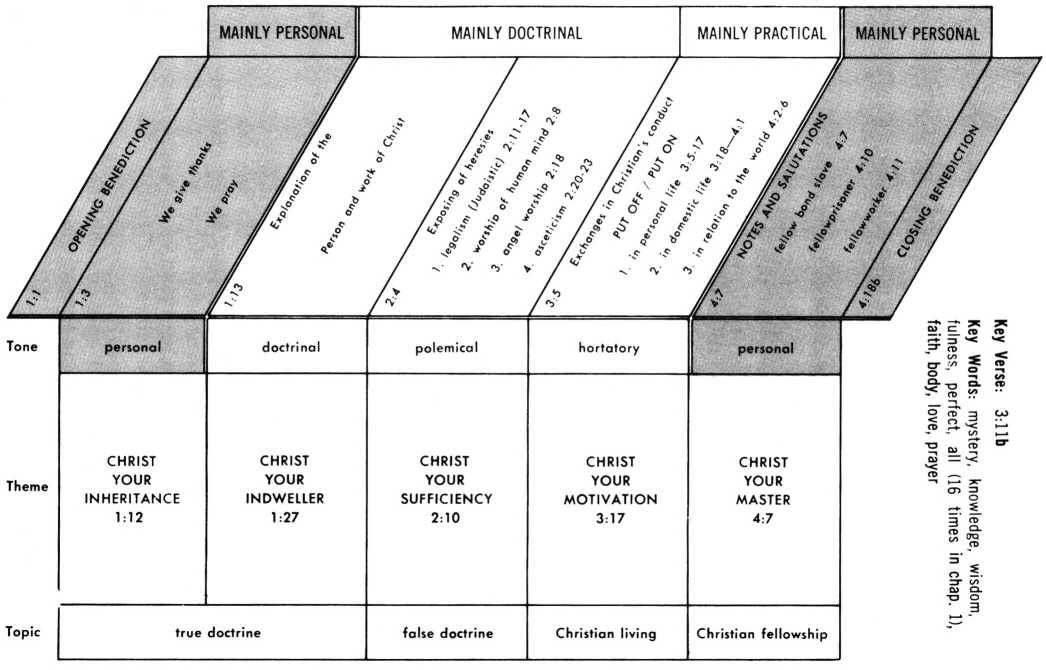
CHRIST IS ALL IN ALL
Click chart to enlarge
Charts from Jensen's Survey of the NT - used by permission
Colossians Overview - Click Chart on right side
| Christ Preeminent in All Things Supreme Lord - Sufficient Savior |
|||
| Colossians 1 | Colossians 2 | Colossians 3 | Colossians 4 |
| Supremacy of Christ |
Submission to Christ |
||
| Doctrinal and Corrective |
Practical and Reassuring |
||
| What Christ Did For Us |
What Christ Does Through Us |
||
| Christ Our Lord |
Christ Our Life |
Christ our Love |
|
| Christ the Head of the Body |
Christ the Lord of the Universe |
Christ the Head of the Home |
|
| Instruction | Warnings | Exhortations | Reminders |
| Reconciliation | Creation | Submission | Conversation |
| His Person and Word |
His Peace and Presence |
||
Colossians 1:6 which has come to you, just as in all the world also it is constantly bearing fruit and increasing even as it has been doing in you also since the day you heard of it and understood the grace of God in truth; (NASB: Lockman)
Greek: tou parontos (PAPNSG) eis humas, kathos kai en panti to kosmo estin (3SPAI) karpophoroumenon (PAPNSN) kai auxanomenon (PPPNSG), kathos kai en humin, aph es hemeras ekousate (2PAAI) kai epegnote (2PAAI) ten charin tou theou en aletheia;
Lightfoot: —the one universal unchangeable Gospel which was made known to you, even as it was carried throughout the world, approving itself by its fruits wherever it is planted. For, as elsewhere, so also in you, these fruits were manifested from the first day when you received your lessons in, and apprehended the power of, the genuine Gospel, which is not a law of ordinances but a dispensation of grace, not a device of men but a truth of God.
Phillips: that hope which first became yours when the truth was brought to you. It is, of course, part of the Gospel itself, which has reached you as it spreads all over the world. Wherever that Gospel goes, it produces Christian character, and develops it, as it had done in your own case from the time you first heard and realised the amazing fact of God's grace. (Phillips: Touchstone)
Wuest: which is present with you even as also it is in all the world constantly bearing fruit and increasing, just as it is also among you from the day when you heard it and came to know experientially the grace of God in the sphere of truth
WHICH (gospel) HAS COME TO YOU JUST AS IN ALL THE WORLD ALSO: tou parontos (PAPNSG) eis humas kathos kai en panti to kosmo:
- Col 1:23
- Colossians 1 Resources - Multiple Sermons and Commentaries
Hart - This word of the truth has been defined as the Gospel, but Paul now proceeds to indicate more precisely what he means by this term. It is that Gospel which they have already received, not the local perversion of it that has recently been urged on their notice, but that which is spreading in the whole world, its truth authenticated by its ever-widening area and deepening influence on its adherents, and which manifests the same inherent energy among the Colossians themselves, in the form in which they learnt it from their teacher Epaphras. (Colossians 1 - The Expositor's Greek Testament)
Wuest makes the point that in this passage "Paul further defines the gospel so as to identify it and differentiate it from the false message of the Gnostics." (Word Studies from the Greek New Testament)
Which has come (3918) (pareimi) which means to arrive and be present. In context Paul is referring to the gospel message (Col 1:5).
Vine - the Gospel had not only come to them, it was an abiding force among them.
Jamieson - “Which is present among you,” that is, which has come to, and remains with, you. He speaks of the word as a living person present among them." (Jamieson)
Vincent - Literally, which is present unto you. Has come and is present. Compare Luke 11:7, “are with me into bed.”
Wuest adds that the idea of pareimi "is, “which is being alongside you.” Lightfoot translates, “which reached you.” The idea is that the Gospel has snuggled close up to the Colossian saints and they have taken it into their hearts." (Wuest's Word Studies from the Greek New Testament: Eerdmans)
Barclay commenting on in all the world (cp Col 1:23, “all creation under heaven.”) observes that "The Gospel is universal. It is for all the world (see Mt. 24:14; 28:19, 20; Mk 16:15; Ro 1:8, 14, 16; 1Th 1:8) It is not confined to any one race or nation, nor to any one class or condition. Very few things in this world are open to all men. A man's mental caliber decides the studies he can undertake. A man's social class decides the circle amidst which he will move. A man's material wealth determines the possessions he can amass. A man's particular gifts decide the things he can do. But the message of the gospel is open without exception to all men." (Colossians - Barclay's Daily Study Bible)
Vincent - In all the world. Hyperbolical. Compare Ro 1:8; 1Th 1:8; Acts 17:6. Possibly with a suggestion of the universal character of the Gospel as contrasted with the local and special character of false Gospels.
A T Robertson - “A legitimate hyperbole, for the gospel was spreading all over the Roman Empire.”
Adam Clarke - “The doctrine of the Gospel is represented as a traveler, whose object it is to visit the whole habitable earth . . . So rapid is this traveler in his course, that he had already gone nearly through the whole of the countries under the Roman dominion, and will travel on until he has proclaimed his message to every people, and kindred, and nation, and tongue.”
J. B. Lightfoot - “More lurks under these words than appears on the surface. The true Gospel, the Apostle seems to say, proclaims its truth by its universality ("all the world"). The false gospels are the outgrowths of local circumstances, of special idiosyncrasies; the true Gospel is the same everywhere. The false gospels address themselves to limited circles; the true Gospel proclaims itself boldly throughout the world. Heresies are at best ethnic; truth is essentially catholic (relating to the universal church).” (Colossians 1 Commentary)
Vine - while this (in all the world) is a hyperbolical usage and is not intended to be taken literally, the apostle here probably purposed to imply that the Gospel is a universal message, designed for all men and suitable to be preached among all nations, whereas the teachings of the false gospels were limited in origin and in the regions of their propaganda. (Collected writings of W. E. Vine)
Keathley - the gospel is universal. It is for all men. This is seen in the words, “which has come to you, just as in all the world.” Paul was not saying that it had been preached in every town and village all over the world, though it had already made amazing advances in the ancient world. This statement does, however, point to its universal design by God and, in keeping with the Great Commission of Matthew 28:19-20, it is surely prophetic of the penetrating course and power of the gospel around the world. With its universal appeal, the gospel…is not confined to any one race or nation, nor to any one class or condition. Very few things in this world are open to all men. A man’s mental caliber decides the studies he can undertake. A man’s social class decides the circle amidst which he will move. A man’s material wealth determines the possessions he can amass. A man’s particular gifts decide the things he can do. But the message of the gospel is open without exception to all men. (Paul’s Gratitude for the Colossians)
World (2889) (kosmos [word study]) related to the verb kosmeo = to order or adorn, to put in order [Mt 25:7 = "trimmed"], to adorn literally [1Ti 2:9], to adorn figuratively [Titus 2:9]) means essentially something that is well-arranged, that which has order or something arranged harmoniously. Kosmos refers to an ordered system or a system where order prevails. Kosmos/kosmeo give us our English words cosmos (the ordered universe), cosmopolitan (literally a citizen of the world!) and cosmetics (those things we put on in order to bring order out of "chaos"!) English terms. A matter of "cosmic" significance, is something which is important for the whole world. When one speaks of a "cosmopolitan" city, it means a city which has citizens from many parts of the world.
The phrase "in all the world" is not be taken in an absolute sense for it does not mean that every man and woman in the world had heard the gospel.
Robertson writes that "all the world" is best understood as "a legitimate hyperbole (extravagant exaggeration), for the gospel was spreading all over the Roman Empire."
Paul used a similar hyperbole informing the Roman saints that their "faith is being proclaimed throughout the whole world" (Ro 1:8)
Similarly, he wrote to the saints at Thessalonica that "the word of the Lord (which in context is equivalent to the gospel) has sounded forth from you, not only in Macedonia and Achaia, but also in every place your faith toward God has gone forth, so that we have no need to say anything." (1Th 1:8) (Compare to Acts 17:6)
Finally, in this same chapter Paul used a parallel phrase describing "the hope of the gospel that you have heard, which was proclaimed in all creation under heaven..." (Col 1:23)
Other Scriptures clearly speak of the worldwide "leaven like" pervasive ability of the gospel: "And this gospel of the kingdom shall be preached in the whole world for a witness to all the nations, and then the end shall come. (Mt 24:14) "Again therefore Jesus spoke to them, saying, “I am the light of the world; he who follows Me shall not walk in the darkness, but shall have the light of life.” (Jn 8:12)
Vine - "in all the world" as "a hyperbolical usage...not intended to be taken literally. The apostle here probably purposed to imply that the gospel is a universal message, designed for all men and suitable to be preached among all nations, whereas the teachings of the false gospels were limited in origin and in the regions of their propaganda." (Collected writings of W. E. Vine)
Guy King - Down through the years (THE GOSPEL) has proved itself indigenous in all lands, It has settled itself down as native to all races, it is at home in every clime and age, it has flourished in its conquests of human hearts throughout the wide world. By the way, it was when some Greeks desired to see Him (Jn 12:20) that the Saviour used words that express the very heart of the Gospel, "I, if I be lifted up from the earth will draw all men unto Me", (Jn 12:32) - that is, not "all" without exception, for that has manifestly not been so but "all" without distinction - Greeks as well as Jews. The appeal and efficacy of His atoning death is without frontiers, and will prove to have embraced "a great multitude, which no man could number, of all nations, and kindreds, and peoples, and tongues which stood before the throne and before the Lamb", Revelation 7:9. Oh, then, to fall in line with this mighty purpose of GOD, and to be truly missionary-hearted Christians, like this Paul himself. (Colossians 1:3-11 His Courteous Address)
Global Effect of the Gospel of the Galilean Peasant - Nearly 2,000 years ago an obscure Galilean peasant gained some local notoriety as a wandering preacher and healer. He was executed by the Romans Yet today there is not a single nation in the world where this obscure peasant was not worshipped and acclaimed as a king, a king whose kingdom shall never end. Where in this world can one go and not discover somewhere a group of people who confess Jesus as Lord and King? In countries rich and poor, large and small, free or suppressed, the church is present and growing. In the highlands of the interior of the East Malaysian state of Sarawak on the heavily-forested island of Borneo, there is a small village called Barrio. It is only accessible by small planes capable of landing on
the tiny mountain-ringed runway, or by a long journey by canoes up jungle rivers and trekking on foot. And yet, every person in that village confesses the Lordship of Jesus Christ. In southern Congo, where political turmoil and corrupt government has many people on the brink of starvation, there are small groups of Christians who gather in rural mud-brick churches. Sometimes there is no roof, yet they are there each Sunday, to sing the praises of a king whose name is Jesus. Through the long years of repression in the Soviet Union and its satellites, we now discover the church was not only alive but growing. It is now stronger than it ever was in those lands. Many people in those lands refused to confess Mao Tse-Tung or Stalin or Brezhnev as king, preferring to confess Jesus as king instead, sometimes at great personal cost. (Rev. Brett Blair's Illustrations)
Illustration of the power of the Gospel in all the world - My wife and I were in Northern Ireland this summer, meeting with young Christians in the most troubled part of that troubled country. At a conference one evening there was an interview with a man who had been a member of the IRA, the Irish Republican Army, the terrorist group that has caused so much bloodshed in Northern Ireland. He had been a wild and rough man, raised in a Catholic area, and who would have nothing to do with Protestants. He joined the IRA and became, in fact, what was called "an enforcer." He was responsible to see that orders for terrorist acts---murders, bombings, or whatever---were carried out even if he had to break the legs of the person who refused to carry them out. He had been in prison several times and during one of those prison experiences somebody gave him a New Testament. Reading it, he heard for the first time of the grace of God and the availability of Jesus Christ to forgive his sins. He received the Lord, and was wonderfully changed. We heard him that night, interviewed by a Protestant pastor whose cousin had been killed some months before by the IRA. The men ended the interview by embracing one another before one thousand people in riot-torn, strife-filled Northern Ireland. What a change the gospel makes! That kind of thing had been happening also in Colossae. It was happening all over the world, wherever the apostle went, and it still happens today. (Colossians 1 - Ray C. Stedman's Expository Studies of the Bible)
IT IS CONSTANTLY BEARING FRUIT: estin (3SPAI) karpophoroumenon (PAPNSN):
- Colossians 1 Resources - Multiple Sermons and Commentaries
THE GOSPEL:
BEARING FRUIT
INCREASING
It - The Gospel. Paul explains that the Gospel is alive! It has an inherent power to bring about salvation! This should take the pressure off of us! Our job is be faithful to proclaim the true Gospel (with you "life" and your "lips"). Paul alludes to the inherent power of the Gospel in Romans explaining that because of its power, he is not ashamed writing that the Gospel "is the power (see dunamis) of God for salvation to everyone who believes, to the Jew first and also to the Greek." (Ro 1:16)
The fact that the Gospel is bearing fruit and increasing further differentiates it from the false teaching that had come into the church.
Is - This verb (estin) is the present tense which signifies that the Gospel is continually bearing fruit.
Hart notes that bearing fruit "expresses the inward energy of the Gospel (dynamic middle) in its adherents, the latter (increasing) its extension in the world by gathering in new converts." (Colossians 1 - The Expositor's Greek Testament)
Barclay - The Gospel is productive. It bears fruit and increases. It is the plain fact of history and experience that the Gospel has power to change individual men and the society in which men live. It can change the sinner into a good man and can slowly take the selfishness and the cruelty out of society so that all men may have the chance God would wish them to have. (Colossians - Barclay's Daily Study Bible)
Harrison on “bearing fruit and increasing” - The Gospel invites comparison (Ed: with the false gospel that apparently was being propagated) from the standpoint of its effectiveness...The truth makes a difference; it transforms lives. By these two observations the apostle adroitly prepares the way for his frontal assault on the Colossian heresy. He is suggesting that true Christianity carries credentials which false teaching cannot equal. (Ibid)
Garland - The truth of the gospel is also effective, “bearing fruit and growing” (Col 1:6). Schweizer comments that “just as a tree without fruit and growth would no longer be a tree, so a gospel that bore no fruit would cease to be a gospel.” The gospel, however, continues to produce harvest after harvest. “Bearing fruit” has been interpreted since Chrysostom as referring to “a crop of good deeds,” but Paul has in mind converts (see Ro 1:13; Phil 1:22). Most, however, would not have called the advance of the gospel in the Greco-Roman world a triumphant success. The church was not taking the world by storm. The Jewish historian Josephus, penning his history of the Jewish war and of the Jews at the end of the first century, hardly gave mention to Christians. The Roman historian Tacitus mentioned Christians only as Nero’s scapegoats for the fire of Rome. By contrast, Paul could see what they could not. A seed as small as the mustard had been sown, and it would produce magnificently because of God who gives the growth (1Cor. 3:7). The gospel was bursting forth in small groups of Christians not only in such vital centers of the empire as Rome, Corinth, and Ephesus, but also in declining towns such as Colossae, in the hearts of slave owners such as Philemon, and in runaway slaves such as Onesimus. The gospel is growing the way Kudzu takes over in some parts of the American South. Originally imported as a groundcover, kudzu overruns everything. The difference is that the gospel is not some alien import or a noxious infestation but something deeply rooted in human need and in God’s purposes for the whole creation. (The NIV Application Commentary: Colossians and Philemon)
Vincent - Bearing fruit (present tense) would emphasize the continuous fruitfulness of the Gospel. The middle voice of the verb, of which this is the sole instance, marks the fruitfulness of the Gospel by its own inherent power.
Moule - bearing fruit —the Greek verb is (here only in Greek literature, apparently) in the middle voice, and this indicates specially the innate, congenital, fruit-bearing power of the Gospel. It is “essentially a reproductive organism, a plant whose seed is in itself” (Lightfoot). Hence the Christian is, if we may put it so, nothing if not a fruit-bearer (Matthew 7:17-20; Luke 13:6; John 15:2-8; John 15:16; Romans 6:22; Galatians 5:22; Php 1:11; James 3:17). (Colossians 1 Cambridge Bible for Schools and Colleges)
Lightfoot - “The fruit, which the Gospel bears without fail in all soils and under every climate, is its credential, its verification, as against the pretensions of spurious counterfeits.”
Bearing fruit (2592) (karpophoreo [word study] from karpos = fruit, produce + phero = bear, bring) literally means to bring forth fruit, to be fertile, productive. It is used figuratively to refer to bringing forth deeds or works (fruit), which depending on the context can be good fruit or bad fruit. In the present context the fruit is the souls saved by the proclamation of the Gospel (cp Ro 1:13, Php 1:22). Not only does the Gospel bear fruit, but Spirit filled believers bear fruit (Col 1:10).
Karpophoreo - 8x in 8v - Mt 13:23; Mk 4:20, 28; Lk 8:15; Ro 7:4-5; Col 1:6, 10. NAS = bear fruit(4), bearing fruit(2), bears fruit(1), produces crops(1).
In John 15 those who abide in the Vine Christ Jesus, will bring forth "much fruit" ("good works"). In this verse Paul says that they will continually (present tense) bear fruit in (every good work) every kind of activity undertaken for the name of Christ and in the operating power of the indwelling Holy Spirit, upon Whom the believer is entirely dependent.
Vine - the word karpophoreō, to bear fruit, is used (a) in the natural sense (Mark 4:28), (b) metaphorically, of conduct, or what takes effect in conduct, as in verse 10 and in Matthew 13:23; Mark 4:20; Luke 8:15; Romans 7:4, 5; in the last passage, of the contrast between bringing forth fruit to God and the evil effect of activities resulting from alienation from God. Here the verb is in the middle voice, whereas in verse 10 it is in the active voice. The middle is intensive, denoting the inherent energy; the active is extensive, suggesting the external diffusion. The middle has a special stress attached to it. Karpos, fruit is, primarily, that which is produced by the inherent energy of a living organism, e.g., Matthew 7:17; Luke 1:42; Acts 2:30; James 5:17, 18. In a derived sense it is used of the spiritual results of the energy of the Holy Spirit (Gal. 5:22) and of the gospel (as here). It is the outward expression of power working inwardly. (Collected writings of W. E. Vine)
Jesus used karpophoreo several times...
"And the one on whom seed was sown on the good soil, this is the man who hears the word and understands it; who indeed bears fruit (present tense) and brings forth, some a hundredfold, some sixty, and some thirty." (Mt 13:23)
The soil produces crops (present tense) by itself; first the blade, then the head, then the mature grain in the head. (Mark 4:28)
Comment: This is the only literal use of this verb in the NT
And the seed in the good soil, these are the ones who have heard the word in an honest and good heart, and hold it fast (refers to ongoing obedience), and bear fruit (present tense) with perseverance. (Luke 8:15)
Comment: These hearer of the word (seed) not only received the word but allowed it to mold their lives. They were teachable and obedient, and developed true Christ-like character and produced fruit that glorified their Father in heaven. They bore genuine spiritual fruit which evidenced that they possessed genuine spiritual life. As J Vernon McGee says these fruit bearers "are the hearers who are genuinely converted by the Word of God."- Thru the Bible Commentary)
The present tense underlines the continuous effect of the gospel is to bear fruit.
Karpophoreo is used in the natural sense (Mk 4:28) but here is used figuratively to describe the conduct that results from implantation and germination of the "seed" of the gospel. Stated another way, fruit bearing is the outward expression of the power of the gospel (and the Spirit) working inwardly. The Gospel is not merely a stagnant system of ethics but is a living, moving, and growing reality which bears fruit and spreads.
The Gospel is variously described as the "gospel of grace", "the word of truth", "the word of life", "the Word of the Cross" (1Cor 1:18) and is the power of God unto salvation (see note Romans 1:16) (Click to see various descriptions of the gospel as "the gospel of ____").
As the gospel goes all over the world, it breaks down all barriers: religious, cultural, and racial. The glorious gospel brings people to faith in Christ and bears fruit for God's glory.
An excellent illustration of the inherent fruit bearing ability of the gospel is found in the Thessalonian believers where the "Gospel did not come...in word only (not just mere words of men), but also in (inherent) power (dunamis) and in the Holy Spirit and with full conviction (complete conviction of the veracity of the gospel message)" (1Th 1:5)
The resulting fruit was the Thessalonian believers who "became imitators of (Paul, Silas & Timothy) and of the Lord, having received the word in much tribulation with the joy of the Holy Spirit".
But the pervasive effect of the gospel did not stop there. These believers in turn "became an example to all the believers in Macedonia and in Achaia". And how did they become an example? They in turn became "light bearers" of the good news "for the word of the Lord (the gospel)...sounded forth from (them), not only in Macedonia and Achaia, but also in every place (their) faith toward God (went) forth, so that (Paul, et al had) no need to say anything." (1Th 1:6, 7, 8-see notes 1Th 1:6; 1:7; 1:8).
In other words, the testimony to the life changing power of the Gospel was so evident in the lives and message of the Thessalonian believers ("fruit") that they in turn became fruit bearers as they proclaimed the divine message of the gospel. What's the message for us today? Don't be fearful to speak the truth in love beloved. You have the Spirit of Christ Who will prepare hearts of those who hear (cf Acts 16:14) and you have been entrusted with the treasure of the gospel "seed" to sow, a "seed" whose efficacy and power is independent of your eloquence or your formal theological training. This is good news indeed. Now go and bear fruit, fruit that will remain (Jn 15:16).
Let your life be a living epistle testifying to the transforming power of the Gospel. You are now to be a
"letter...known and read by all men (2Co 3:2) ...a letter of Christ...written not with ink, but with the Spirit of the living God, not on tablets of stone, but on tablets of human hearts." (2Cor 3:3)
Wiersbe adds this note on the "word of truth the gospel" - "When it is planted in the heart, it can produce fruit...Near King’s Cross station in London, England, there is a cemetery containing a unique grave, that of the agnostic Lady Ann Grimston. She is buried in a marble tomb, marked by a marble slab. Before she died, she said sarcastically to a friend, “I shall live again as surely as a tree will grow from my body.” An unbeliever, Lady Ann Grimston did not believe that there was life after death. However, a tree did grow from her grave! A tiny seed took root, and as it grew, it cracked the marble and even tore the metal railing out of the ground! There is life and power in a seed, and there is life and power in the Word of God. When God’s Word is planted and cultivated, it produces fruit. Faith, hope, and love are among the firstfruits in the spiritual harvest. These spiritual graces are among the evidences that a person has truly been born again." (Wiersbe, W: Bible Exposition Commentary. 1989. Victor)
While Paul's allusion to fruit probably points primarily to converts, it certainly does not exclude the fruit of good deeds (cp Heb 13:20-21) - True Christianity makes a difference. In no area has this been more true than in Christianity's championing of the weak, the poor, the sick, and the defenseless. Authors Dave Shiflett and Vincent Carroll remind us how revolutionary the Christian doctrine of mercy has been. They quote historian John McManners, who noted that the classical world into which Christianity was born, "regarded mercy and pity as pathological emotions --defects of character to be avoided by all rational men." But Christians had a different view. They knew that God's grace and mercy were unearned and so they were unable to withhold mercy from others. They also knew that their Savior had instructed them to see his face in the face of the poor and desperate. Jesus' words still ring through history: "As you have done these things to the least of my brethren, you have done them unto me." (Matthew 25:40) (Quoted by David Holwick)
AND INCREASING EVEN AS IT HAS BEEN DOING IN YOU ALSO SINCE THE DAY YOU HEARD OF IT AND UNDERSTOOD THE GRACE OF GOD IN TRUTH: kai auxanomenon (PPPNSN) kathos kai en humin, aph es hemeras ekousate (2PAAI) kai epegnote (2PAAI) ten charin tou theou en aletheia:
- Mk 4:8 Acts 6:7 Acts 12:24 Acts 19:20 1Pe 2:2
- Colossians 1 Resources - Multiple Sermons and Commentaries
THE DYNAMIC
GOSPEL
Acts 6:7 And the word of God (THE GOSPEL) kept on spreading; and the number of the disciples continued to increase greatly in Jerusalem, and a great many of the priests were becoming obedient to the faith.
Acts 12:24 But the word of the Lord (THE GOSPEL) continued to grow and to be multiplied.
Acts 19:20 So the word of the Lord (THE GOSPEL) was growing mightily and prevailing.
Guy King - All that we have seen thus far has emphasized for us that the Gospel is a living force. Stories could be multiplied of instances wherein the sound, or sight, of a Gospel word, without any human explanation, has brought about the complete conversion of an erstwhile godless and careless soul. One recalls the case of a man doing some repair work high up in the old Crystal Palace building. All of a sudden, he heard distinctly words, coming seemingly from nowhere, which changed his whole life with GOD's salvation - the words, "Behold the Lamb of God, Who takes away the sin of the world" (John 1:29). The story is that C H Spurgeon was engaged to preach at a great rally to be held at the Crystal Palace, and the previous day he went to the place to try out his voice in the great auditorium, and to test himself he just declared that Gospel verse (Jn 1:29), with the result we have mentioned. Many such incidents could be recounted, to demonstrate the vital "power unto salvation" of this Divine Good News presented to the individual. The prophetic statement of Old Testament deliverance is also a principle of New Testament salvation, "Ye shall be gathered one by one", Isaiah 27:12. (Ed: I have heard the story of Spurgeon, but the version I heard was that there were two men high in the rafters, and sadly only one was smitten with the words of John 1:29). (Colossians 1:3-11 His Courteous Address)
Wuest - The participles “bearing fruit” and “increasing” are in the middle voice. Lightfoot comments; “The middle denotes the inherent energy. The Gospel is essentially a reproductive organism, a plant whose ‘seed is in itself’.… The Gospel is not like those plants which exhaust themselves bearing fruit and wither away. The external growth keeps pace with the reproductive energy. While ‘bearing fruit’ describes the inner working, ‘increasing’ gives the outward extension of the Gospel.”
Wiersbe - The Word of God is the only seed that can be planted anywhere in the world and bear fruit. (Ed: And I would add that it is the only seed that is commanded to be planted EVERYWHERE in the world, be it the driest desert, the most remote valley or the densest jungle! - Mark 16:15)
Increasing (growing) (837) (auxano [word study]) (present tense = continually increasing, pervading, diffusing throughout) means to grow or cause to grow or increase. To grow greater in size. For someone or something to grow it must be acted upon by an outside power (passive voice [some see this as middle voice] indicates subject receives action from outside source) or have the element of life within him or it and indeed the Gospel has the inherent "power (dunamis) of God for salvation to everyone who believes, to the Jew first and also to the Greek. (Ro 1:16). (Word Studies from the Greek New Testament)
Vine - increasing describes the outward activity and extent of the gospel rather than the inward power. Natural plants exhaust themselves in bearing fruit. Not so with the gospel; it is ever spreading and developing. (Collected writings of W. E. Vine)
It is important to remember that the GOSPEL is not a stagnant system of ethics but is living, dynamic and growing truth. The living GOSPEL is the power that transforms lives (Ro 1:16). Those lives in turn testify to the vital, dynamic power of the Gospel by growing in maturity (cp auxano in Eph 4:15), by growing in respect to salvation (cp auxano in 1Pe 2:2), by growing in grace and the knowledge of our Lord and Savior Jesus Christ (growth in Christ-likeness - auxano in 2Pe 3:18). As the Gospel penetrates and permeates hearts, the fruit it produces is testified to by transformed lives. So as the GOSPEL produces fruit (good deeds) in individual lives, its influence spreads, making more converts (fruit). We see this dynamic effect of the GOSPEL powerfully illustrated in the saints at Thessalonica who "received the word (THE GOSPEL) in much tribulation with the joy of the Holy Spirit so that you became an example to all the believers in Macedonia and in Achaia. For the word of the Lord (THE GOSPEL) has sounded forth from you, not only in Macedonia and Achaia, but also in every place your faith toward God has gone forth, so that we have no need to say anything. For they themselves report about us what kind of a reception we had with you (FRUIT OF THE GOSPEL IN GOOD DEEDS), and how you turned to God from idols to serve a living and true God (FRUIT OF THE GOSPEL IN CONVERSION) (1Th 1:3-9)
Auxano - 23x in 23v (Note Paul's two other uses of auxano in Col 1:10, 2:19) - Matt 6:28; 13:32; Mark 4:8; Luke 1:80; 2:40; 12:27; 13:19; John 3:30; Acts 6:7; 7:17; 12:24; 19:20; 1 Cor 3:6f; 2 Cor 9:10; 10:15; Eph 2:21; 4:15; Col 1:6, 10; 2:19; 1 Pet 2:2; 2 Pet 3:18. NAS = causes the growth(1), causing the growth(1), full grown(1), grew(1), grow(8), growing(2), grows(2), increase(2), increased(2), increasing(2), spreading(1).
Jesus used auxano in Mt 13:32 to describe the kingdom of God as like a mustard seed although "smaller than all other seeds; but when it is full grown (auxano) it is larger than the garden plants, and becomes a tree."
In (Mark 4:8) Jesus in describing the Word of God taught that the seed (the Word) that "fell into the good soil...grew up and increased (auxano) and yielded a crop and produced thirty, sixty, and a hundredfold." Thus Jesus taught that when the Gospel enters a divinely prepared heart, fruit would be evident. As someone has well said "No fruit. No Root!" This is not "works salvation" for salvation is by faith alone but Jesus and Paul both taught that genuine faith that truly saves is not alone!
Lightfoot adds that the Gospel "increasing" is "not like those plants which exhaust themselves in bearing fruit. The external growth keeps pace with the reproductive energy.
Increasing shows the supernatural character of the Gospel. In nature, a plant does not usually bear fruit and grow at the same time. In fact plants often have to be pruned in order to bear fruit, for if the plant is allowed to grow wild, the result is that all the life of the plant goes into leaves and branches rather than into fruit. The gospel gives life and grows at the same time bearing fruit in the salvation of souls and in the building up of the saints, as it spreads from city to city and from nation to nation.
The Growing Gospel - China and voluminous persecution files. Li Shi-xiong was born in 1953 and grew up in a labor camp in Red China. His father had been a counter-revolutionary. Li was beat up every day. His mother was forced to apologize to the bullies. A deep bitterness and a violent temper gripped him by the time he was released from the camp after 20 years. He had almost no formal education and no money. In 1989 Li was a committed anti-Communist and supported the demonstrations in Tiananmen square. The police knocked on his door and told him he could expect to be arrested any time. The government forced Li into bankruptcy while he made the arrangements to move to America. Once he got to America he made it his mission to help others get out. He began to notice that many of these Chinese were Christians and had terrible stories of persecution. Li was reminded of an old farmer at the labor camp who had been jailed with his father. The old farmer had told him about God and had loved him better than his parents had. Li knew of Christians in China but had not really known how much they had suffered. He started to collect their stories and supporting evidence. This year the archive was turned over to the United States government. It contains 22,000 testimonies of persecution against Christians and the stack is 10 feet high. Many of the testimonies contain photos of their wounds from torture. While he worked with these Christians, they shared their faith with him. A Christian aunt from Taiwan wrote to him about Christ and how she was praying every day for him. Eventually the atheist counter-revolutionary asked Jesus to be his personal Savior. ("New China, Same Old Tricks," by Tony Carnes, Christianity Today)
The Gospel (euaggelion) is not like earthly investments which require long term outlook to yield a good return. The "investment" of the gospel in the Colossian saints bore fruit (note phrase "even as it has been doing in you") when it was heard and received (cp Jn 1:11, 12, 13) in their honest and good heart that held it fast and in turn bore fruit with perseverance. (Lk 8:15)
Even as it has been doing in you - Doing what? Increasing. Growing. Moule adds that Paul "returns, careless of literary symmetry, to the thought closest to his heart, the fruitful and growing life of faith at Colossae which is now his bright example and illustration of the blessing experienced “in all the world.”"(Colossians 1 Cambridge Bible for Schools and Colleges)
Robertson - The growing and the fruit-bearing go on simultaneously as always with Christians (inward growth and outward expression).
Moule (since the day) - From the very first hour of intelligent faith the Divine secret of fruit and growth had worked; as it was, and is, always meant to do. (Colossians 1 Cambridge Bible for Schools and Colleges)
Since the day you...understood the grace of God in truth - How did we understand it? How could we possibly have understood it? When we were in Adam (1Co 15:22, cp Ro 5:12), subject to the right and might of our spiritual father the Devil (1Jn 5:19, 1Jn 3:10 where "practice" = present tense = speaks of one's lifestyle!), the "eyes" of our heart (our "control center") were blinded to this spiritual truth, truth which only the sovereign God could supernaturally make visible as described by Paul...
And even if our Gospel is veiled, it is veiled to those who are perishing, 4 in whose case the god of this world (Satan, cp Lk 4:5, 6) has blinded the minds of the unbelieving, that they might not see the light of the Gospel of the glory of Christ (the gospel intrinsically brings supernatural spiritual light - this truth is in itself "good news" - that is, the gospel's effectiveness does not depend on our eloquence or erudition! So what's your excuse? Just do it! Share it with someone you love - "Give the gift that keeps on giving!" Give it even if you stutter and stammer. It won't return void! [cp Is 55:7, 8, 9, 10, 11, 12]. You can count on that! [Nu 23:19] Remember, you are not responsible for how they respond to the light!), who is the image of God. 5 For we do not preach ourselves but Christ Jesus as Lord, and ourselves as your bond-servants for Jesus' sake. 6 For God, who said, "Light shall shine out of darkness," is the One who has shone in our hearts to give (It is a precious gift) the light of the knowledge of the glory of God in the face of Christ. (Dear reader has He shone into your heart or are you still spiritually blind and unbelieving?). (2Co 4:3, 4, 5, 6, cp 1Co 2:12, 13, 14, 15, 16)
What is the grace of God in truth? Is this not a beautiful description of God's glorious good news - the Gospel! Hallelujah for grace and truth (cp Jn 1:16, 17)! It was "in truth" in contrast to the false doctrines that were coming into the Colossian church. As Barclay says "The Gospel is truth. All previous religions could be entitled "guesses about God." The Christian gospel gives a man not guesses but certainties about God." (Colossians)
Hart has an interesting thought that "The grace of God is probably mentioned in opposition to the false teachers doctrine of ordinances and rigorous asceticism." (Ibid)
Moule on understood - The structure of the word (epiginosko) suggests developed knowledge; the NT usage tends to connect it with spiritual knowledge. The Colossians had not only heard and, in a natural sense, understood the Gospel; they had seen into it with the intuition of grace (cp. 1 Corinthians 2:12; 1 Corinthians 2:14). (Colossians 1 Cambridge Bible for Schools and Colleges)
Understood (1921) (epiginosko [word study] from epí = upon, gives force of “fully” or in addition to what one already has+ ginosko = to know) means to recognize something for what it really is and in the present context indicates that the Colossians had personally come to know the grace of the gospel fully and experientially (they had experienced the power of the gospel in their lives). The noun form of epiginosko is epignosis and is used four times in this short epistle (Col 1:9, 10, Col 2:2, Col 3:10) - Paul seems to be emphasizing true gnosis which refutes the so-called "higher" gnosis of those who were enlightened, and may have been saying one needed this "higher knowledge" in order to be "saved", somewhat like the false teachings of the New Age movement in our day (See previous discussion of gnosticism).
Jamieson - became fully experimentally (experientially - see Spurgeon's note below) acquainted with. (Ibid)
Spurgeon - If there is a way of knowing the grace of God which is of no value, it is when it is not known in truth, that is to say, when it is only head-knowledge, not heart-knowledge. But, oh, when in truth the grace of God sinks into the soul, and changes the whole nature, then it is an experience for which we may well give thanks to God....We do not know the grace of God in truth unless it brings forth fruit in us. We may know it with the head very correctly, but yet we do not truly know it unless it is knowledge in the heart, knowledge in the inner man. We do not really know it unless it affects our lives, and brings forth faith love, hope; — faith, which lifts us above the world; love, which preserves us from selfishness; and hope, which keeps us up under all trials. (Spurgeon on Colossians)
Epiginosko - 20x in 20v - Ro 1:28; 3:20; 10:2; Eph 1:17; 4:13; Phil 1:9; Col 1:9f; 2:2; 3:10; 1Ti 2:4; 2Ti 2:25; 3:7; Titus 1:1; Philemon 1:6; Heb 10:26; 2 Pet 1:2f, 8; 2:20
THE GOSPEL:
THE GRACE OF GOD
Grace of God expresses the source of the Gospel. (Vine) Compare Paul's words to the Ephesian elders - "But I do not consider my life of any account as dear to myself, in order that I may finish my course, and the ministry which I received from the Lord Jesus, to testify solemnly of the Gospel of the grace of God." (Acts 20:24-note)
The Gospel is also called “the word of His grace,” that is, of the “grace of the Lord Jesus” (Acts 14:3).
Barclay - The gospel tells of grace. It is not so much the message of what God demands as of what he offers. It tells not so much of his demand from men as of his gift to men. (Colossians 1 - Barclay's Daily Study Bible)
Paul Apple - The Core of the Gospel is the Grace of God. Watch out for: legalism, ritualism, mysticism, intellectualism (Colossians)
Guy King - By all the repeated emphasis of Divine revelation, it is only Paul's "Gospel of the grace of God" that can accomplish the saving work. Like Jacob's ladder it is brought within reach of man, "set up on the earth" and "it reached" to Heaven (Ge 28:12). And when our Lord JESUS came to earth to be our Ladder to the Skies (Jn 1:51) thank GOD "it reached". All other ladders however attractive in themselves, fall short. The fact is that He is not "a" way to Heaven, but "the" Way, as He Himself told us, John 14:6 - the only way, the true way, the living way. (What the Gospel is NOT) - the Gospel of Do your best. - the Gospel of accumulated merit, - the Gospel of personal worth, - the Gospel of ritual observance - away with them, and all like them. They flatter to deceive, and can never avail to save a soul. (Colossians 1:3-11 His Courteous Address)
Harrison - All other religions proceed on the assumption that man must commend himself to God, or, as in the case of the Galatian error, that a mixture of human effort with divine grace is required. By a simple mention of God’s grace this early in the letter, coupled with the reminder that his readers have come to know the meaning of that grace as a reality in their lives, Paul is already laying the axe to the root of legalism that he will tear out later and cast aside before the eyes of the Colossians (Col 2:16–23). (Ibid)
Grace (5485) (charis [word study]) is a word with a number of meanings in the NT, the specific nuance being dependent on the context.
- a quality that adds delight or pleasure or a winning quality or attractiveness that invites a favorable reaction = graciousness, attractiveness, charm, winsomeness (Luke 4:22, Col 4:6)
- a beneficent disposition toward someone, and specifically in the NT defines God's attitude toward human beings = kindness, grace, favor, helpfulness, gracious care/help, goodwill (John 1:16, Eph 2:8)
- practical application of goodwill = (a sign of) favor, gracious deed/gift, benefaction (Acts 24:27, 25:9, 2 Cor 8:4, Eph 4:29)
- exceptional effects produced by God's favor = ability, power to transform, enabling power (Ro 12:6, 1 Cor 15:10)
- response to generosity or beneficence = verbal thank offering, thanks, gratitude (1 Cor 15:57)
Charles Swindoll - “Every time the thought of grace appears, there is the idea of its being undeserved. In no way is the recipient getting what he or she deserves. Favor is being extended simply out of the goodness of the heart of the giver.” (Grace Awakening)
What is the "grace of God in truth"? It is nothing less than the heart of the gospel message. "Of God" expresses its source (as in Acts 20:24) and elsewhere is attributed to Christ (Gal 1:6).
We do not deserve nor can we earn salvation but it is "by grace through faith you have been saved and that not of yourselves, it is the gift of God." (Eph 2:8)
The truth of the gospel is that salvation is through G.R.A.C.E. which has been summarized in the acrostic or acronym G.od's R.iches A.t C.hrist's E.xpense
Paul wrote to Titus that "the grace of God has appeared (in the Person of Jesus Christ and His gospel), bringing salvation to all men, instructing us to deny ungodliness and worldly desires and to live sensibly, righteously and godly in the present age." (see notes Titus 2:11; Titus 2:12)
Wiersbe - John Selden (1584–1654) was a leading historian and legal authority in England. He had a library of 8,000 volumes and was recognized for his learning. When he was dying, he said to Archbishop Ussher: “I have surveyed most of the learning that is among the sons of men, and my study is filled with books and manuscripts on various subjects. But at present, I cannot recollect any passage out of all my books and papers whereon I can rest my soul, save this from the sacred Scriptures: ‘The grace of God that bringeth salvation hath appeared to all men’ (Titus 2:11).” (The Bible exposition commentary)
Salvation is "to the praise of the glory of His grace, which He freely bestowed on us in the Beloved."
Grace of God - This exact phrase occurs 21x in 20v (NAS) - Luke 2:40; Acts 11:23; 13:43; 14:26; 20:24; Rom 5:15; 1 Cor 1:4; 3:10; 15:10; 2 Cor 1:12; 6:1; 8:1; 9:14; Gal 2:21; Col 1:6; Titus 2:11; Heb 2:9; 12:15; 1 Pet 4:10; 5:12
Vine on in truth - The phrase “in truth” signifies in its genuineness and reality, in freedom from adulteration such as characterized the false gospels. (Ibid)
Truth (225) (aletheia from alethes = true in turn from a + lêthô = that which is hidden or lanthanô = conceal, this combination meaning out in the open, containing nothing that is hidden) describes the body of reality (facts, events, etc) or the content which is true, or which is in accordance to what actually occurred. Truth is the unveiled reality lying at the basis of and agreeing with an appearance; the manifested, the veritable essence of matter. Truth is the correspondence between a reality and a declaration which professes to set it forth. Words are true when they correspond with objective reality. Persons and things are true when they correspond with their profession. Hence a truth is a declaration which has corresponding reality, or a reality which is correctly set forth. Since God is Himself the great reality, that which correctly sets forth His nature is pre-eminently the Truth. Obviously whatever God says is "the truth", and in fact "the Truth" is actually embodied in the Person of Christ Jesus!
We must faithfully hold the truth of God’s word, but it is also necessary for the truth to hold us. We must apply it to our daily lives and test everything by comparing it to the plumb line of God's Word of truth.
Since Satan is a liar, we must oppose him with God’s truth. In Paul's day the people wore belts or girdles to bind up their flowing garments and hold everything together. It is God’s truth that must hold everything together in our lives. As Christians, we must love truth and live truth. It is therefore not surprising to see John write to his spiritual children "I have no greater joy than this, to hear of my children walking in the truth. (3 John 1:4)
In truth - It was not a false gospel but genuine and real, free from adulteration such as characterized the false gospels. Some were preaching a “different gospel—which is really no gospel at all” (Gal 1:6, 7) because it is a gospel of faith plus works but the true gospel is one of grace alone.
The expression, “the grace of God in truth,” means “the grace of God in its genuine simplicity, without adulteration” (Lightfoot).
The grace of God is a beautiful description summarizing the glad tidings than the wonderful truth of God’s grace has been bestowed on guilty men who deserve God’s wrath! It doesn't get much better than that!
Keathley - The words, “understood the grace of God in truth,” declares the fact that the gospel in all aspects (justification and sanctification) is a message of grace. Indeed, grace is nothing less than a synonym for the gospel. Any message that fails to proclaim the grace element of the gospel of the New Testament is no gospel at all (Paul’s Gratitude for the Colossians)
Commenting on "heard" Robertson adds that the tense of "heard" is "definite aorist indicative. They heard the gospel from Epaphras and at once recognized and accepted (understood) (ingressive second aorist active of epiginosko, to know fully or in addition). They fully apprehended the grace of God and should be immune to the shallow vagaries of the Gnostics."
JESUS PAID IT ALL
Click Title & Praise God for His Gospel of Grace
Words by Elvina Hall Music by John Grape
Refrain:
Jesus paid it all,
All to Him I owe;
Sin had left a crimson stain,
He washed it white as snow.
For nothing good have I
Whereby Thy GRACE to claim,
I’ll wash my garments white
In the blood of Calv’ry’s Lamb.
Lord, now indeed I find
Thy power and Thine alone,
Can change the leper’s spots
And melt the heart of stone.
When from my dying bed
My ransomed soul shall rise,
Jesus died to my soul to save
Shall rend the vaulted skies
Colossians 1:7 just as you learned it from Epaphras, our beloved fellow bond-servant, who is a faithful servant of Christ on our behalf, (NASB: Lockman)
Greek: kathos emathete (2PAAI) apo Epaphra tou agapetou sundoulou hemon, os estin (3SPAI) pistos huper humon diakonos tou Christou,
Lightfoot: Such was the word preached to you by Epaphras, our beloved fellow servant in our Master’s household, who in our absence and on our behalf has ministered to you the Gospel of Christ
Phillips: You learned these things, we understand, from Epaphras who is in the same service as we are. He is a most well-loved minister of Christ, and has your well-being very much at heart. (Phillips: Touchstone)
Wuest: even as you learned from Epaphras, the beloved, our fellow bondslave, who is faithful on your behalf as a servant of Christ
JUST AS YOU LEARNED IT FROM EPAPHRAS: kathos emathete (2PAAI) apo Epaphra:
- Col 4:12; Philemon 1:23; Ro 10:14
- Colossians 1 Resources - Multiple Sermons and Commentaries
EPAPHRAS A DEDICATED
DISCIPLE MAKER
Just as - Means "in the manner in which"
Salvation is by God's grace but He uses human instruments (cp Acts 9:14), vessels of honor (2Ti 2:20) like Epaphras to proclaim His Gospel of grace. This principle is clearly taught in Romans where Paul writes that "Whoever will call upon the name of the Lord will be saved” but then follows with the question "How then shall they call upon Him in whom they have not believed? And how shall they believe in Him whom they have not heard? And how shall they hear without a preacher? And how shall they preach unless they are sent? Just as it is written, “How beautiful are the feet of those who bring glad tidings of good things!” (Ro 10:13, 14, 15-see notes Ro 10:13; 14; 15)
Keathley has an interesting comment - In the Tribulation (Ed: More accurately the Great Tribulation - the last 3.5 years preceding the Lord's triumphant return. See also Daniel's Seventieth Week) as detailed in the Book of Revelation, God will at times use other methods to communicate the gospel (cf. Rev. 8:13-note; Rev 14:6-note), but even then, God has chosen the human channel as His primary method for communicating the gospel. (Paul’s Gratitude for the Colossians)
Epaphras had "shod (his) FEET WITH THE PREPARATION OF THE GOSPEL OF PEACE (Ep 6:15)
Little wonder that Paul was willing to apply the precious title to Epaphras of "faithful" (see below). Would God describe your "spiritual feet" as "faithful" or "untrustworthy" feet?
- American Tract Society Epaphras
- Easton's Bible Dictionary Epaphras
- Fausset Bible Dictionary Epaphras
- Holman Bible Dictionary Epaphras
- Hitchcock Bible Names Epaphras
- Hastings' Dictionary of the Bible Epaphras
- Hastings' Dictionary of the NT Epaphras
- Morrish Bible Dictionary Epaphras
- Hawker's Poor Man's Dictionary Epaphras
- International Standard Bible Encyclopedia Epaphras
- Kitto Biblical Cyclopedia Epaphras
- McClintock and Strong's Bible Encyclopedia Epaphras
Barclay - The Gospel is humanly transmitted. It was Epaphras who brought it to the Colossians. There must be a human channel through which the Gospel can come to men. And this is where we come in. The possession of the good news of the Gospel involves the obligation to share it. (Ed: Read Paul's testimony in Ro 1:14-15-note) That which is divinely given must be humanly passed on. Jesus Christ needs us to be the hands and feet and lips which will bring His Gospel to those who have never heard it. (Colossians 1 - William Barclay's Daily Study Bible)
Spurgeon - Epaphras told them of Paul’s prayers for them; and when he came back from Colosse, he told Paul of their great love in the Spirit....I like to read of these godly men speaking well of one another. Nowadays, it is thought to be a distinguishing mark of faithfulness to be able to pick holes in the coats of our fellow-Christians. Now, we cannot help perceiving their defects, and sometimes it is our duty to speak of them, and to speak of them faithfully, but let us also observe all the virtues that are to be found in them otherwise we may despise the work of the Holy Spirit, and rob him of his glory. How kindly Paul speaks of Epaphras, and how kindly Epaphras speaks of the church at Colossae! (Spurgeon on Colossians)
Learned (3129) (manthano related to the noun mathetes = disciple, literally a learner!) means to acquire information as the result of instruction, whether in an informal or formal context and thereby to increase one’s knowledge or be instructed. Manthano is not the term Paul normally used for communication or reception of the gospel. Keathley writes that " The use of this verb “…probably indicates that Epaphras had given them systematic instruction in the gospel rather than some flimsy outline and that these Colossians had committed themselves as disciples to that teaching (cf. Col 2:6, 7).” (Ibid)
Manthano - 25x in 24v - Matt 9:13; 11:29; 24:32; Mark 13:28; John 6:45; 7:15; Acts 23:27; Rom 16:17; 1 Cor 4:6; 14:31, 35; Gal 3:2; Eph 4:20; Phil 4:9, 11; Col 1:7; 1 Tim 2:11; 5:4, 13; 2 Tim 3:7, 14; Titus 3:14; Heb 5:8; Rev 14:3. NAS = educated(1), find(1), learn(12), learned(9), learning(1), receive instruction(1).
Epaphras did not simply lead the Colossians to Christ and then abandon them. He taught them the Word and sought to establish their faith. In short he "discipled" them (see note in next paragraph). Every church needs an "Epaphras" to disciple the new converts, lest they "be carried away by varied and strange teachings" (He 13:9).
Note also that "Epaphras...a bond slave of Jesus Christ" was "always laboring earnestly for (the Colossian disciples) in his prayers, that (they) may stand perfect and fully assured in all the will of God." (Col 4:12) Are you praying for your disciples? Do you have any disciples? Are you disobeying Jesus' great command to make disciples ? (Mt 28:19)
The verb manthano is the root word for mathetes, a learner, a pupil, one who follows the teaching of someone else, which is the essence of a disciple, a description of one who puts himself under the teaching of someone else and learns from him. Note that the context is critical to determine whether the specific Scriptural reference is to a "saved disciple" or an "unsaved disciple". The Colossians were clearly "saved" but the context of Jn 6:66 indicates that these were "unsaved disciples" (study John 6 for yourself if you are not convinced).
Keathley writes that "Epaphras was a disciple maker, one who was committed to building men in Christ and in the Word. Naturally, disciple making begins with evangelism, but for a ministry to be confirmed by the Bible, it needs to be committed to building men and women in the Word of God so they mature in Christ (cf. Col. 1:28-note). (Ibid)
The Life Application Bible has this poignant comment on most of the "disciples" Jn 6:66 - "Several followers decided to not follow (Jesus) anymore. Within sight of the kingdom of heaven, privileged with a taste of the Bread of Life, and watching the living water flow, they nevertheless walked away. In a short sentence, John captured one of the saddest moments in the ministry of Jesus."
Parenthetically, it is interesting to note that in the book of Acts, the most common word for believers is "disciples" (Study all 26 uses of "disciple" in Acts = Acts 6:1, 2, 7; 9:1, 10, 19, 25, 26, 36, 38; 11:26, 29; 13:52; 14:20, 21, 22, 28; 15:10; 16:1; 18:23, 27; 19:1, 9, 30; 20:1, 30; 21:4, 16)
It is also interesting to study how Jesus Himself defines a "disciple" - see Mk 8:34, 35, 36, Luke 14:26, 27, 33
Keathley - Paul had just spoken of the fruitfulness of the gospel and here we have an example of the process involved in its fruitfulness. First, it touches the lives of men and brings them to God through Christ. Then, through fellowship with the Savior and the enabling work of the Spirit, the gospel changes those men or women by transforming them into willing servants who use their gifts and abilities for the Savior. (Paul’s Gratitude for the Colossians)
OUR BELOVED FELLOW BOND-SERVANT: tou agaphetou sundoulou hemon:
- Colossians 1 Resources - Multiple Sermons and Commentaries
Beloved (27) (agapetos - see verb - agapao) refers to a quality of love called out of one’s heart by preciousness of the object loved. What a description from the great apostle. The point is that there is no bitterness or jealousy in the Apostle Paul. It did not bother him to see another preacher receiving commendation. In fact, he was the first to express his appreciation for other servants of the Lord.
John Eadie - Timothy, Paul, and Epaphras not only served a common master, but were engaged in the same service; and therefore this community of labor begat a special attachment. The heart of the apostle was knit in cordial affection to all his fellow-laborers. He had none of that ignoble rivalry which just “hints a fault and hesitates dislike.” He felt no envy at their success, but was so identified with their work, that whatever gladdened them gladdened him; he shared in their triumphs and was saddened at their reverses.
Fellow bondservant (co-slave)(4889) (sundoulos from sun/syn = with, expressing association, fellowship, inclusion + doulos = bondservant) describes a "willing fellow slave," a servant who is intimately associated with another servant (or servants) by virtue of the fact that they belong to (serve) the same master. Sundoulos is used of both men and of angels (Rev. 19:10; 22:9).
Strong's Definition (abbreviated from Thayer) is good - 1. a fellow servant, one who serves the same master with another a. the associate of a servant (or slave) b. one who with others serves (ministers to) a king c. a colleague of one who is Christ’s servant in publishing the gospel d. one who with others acknowledges the same Lord, Jesus, and obeys his commands e. one who with others is subject to the same divine authority in the Messianic economy 1. of angels as the fellow servants of Christians
The main word doulos indicates that they had wholly surrendered their will to the master's will and were devoted to their master, even to the disregard of their own interests and/or desires. Of the 10 uses in the NT, two speak not of literal slaves but of "spiritual" slaves so to speak (Col 1:7, 4:7). Someone has well described them as "sold-out believers" belonging to each other because each belongs to Christ. Since they mutually belong to one body, the body of Christ (1Cor 6:15, 12:13, 27, cp Jn 14:20), in a sense all believers are "fellow bondservants." We all serve the Lord together as willing "love slaves," being joined to one another in Christ through His indwelling Spirit, serving the Master with Spirit produced unity (cp Eph 4:2-3). Fellow bondservants are described on earth and in heaven (Rev 6:11, Rev 19:10) and presumably all believers will in a sense be fellow bondservants in heaven throughout eternity!
Keathley - The inclusion of this prefix (sun/syn = with, expressing association, fellowship, inclusion) stresses the truth mentioned in Phil. 1:27; all believers in Christ are to be working together for the faith of the gospel, which lays stress on the community aspect of our lives together as believers in Christ. It reminds us that we need each other, that we are a team, and that the cause of Jesus Christ is sorely hampered when we do not act accordingly—when we do not use our gifts and talents to work together and strive to maintain the unity of the Spirit in the bond of peace. “Slave” stresses his relationship and attitude to Christ. The second part of the word is doulos and means not merely a servant, but a bondslave. A bondslave was one owned by another and so completely that he was dependant upon his master for everything in life—for his daily supply of needs, where he lived and how, for his vocation or area of service, and for the supplies needed to do his work. It shows his submission and who controlled his life. His life was not his own, he had been bought with a price. He was the Lord’s possession who guided his life and supplied his needs. But he was not just a “fellow slave,” but “our dear fellow slave.” “Dear” is agapetos, a verbal adjective that means “beloved.” This description not only demonstrated Paul and Timothy’s love for this man, but also pointed to him as their approved and trusted representative, a fact expressed even more in the next description. (Paul’s Gratitude for the Colossians Col 1:3-8)
Paul had a strong sense of "togetherness" with his fellow laborers in the Kingdom of God. In using this description, he is saying that he and Epaphras were not their own but had been bought with the price of the blood of Christ (cf 1Cor 6:20, Acts 20:28, Gal 3:13, Heb 9:12, 1Pe 1:18, Re 5:9, Titus 2:14, 1Pe 2:9). They were now the property of the Lord Jesus Christ and were His slaves exclusively and eternally. They knew that no man can serve two masters (Mt 6:24). Paul and Epaphras had been slaves of Sin (see note on "the Sin") by their birth into Adam's likeness (Ro 5:12), but now they were slaves of Christ (Ro 6:18, 22) by virtue of their new birth. Now, as His bondslaves, they had no will of their own, no business of their own, no time of their own and were acting for their Master, Christ; dependent upon Him and obedient to Him.
Paul was saying "We are slaved to the Lord Jesus Christ. We are absolutely sold out to His will. We are willing to do whatever He tells us to do. We are willing to say whatever He tells us to say (Mt 10:20). We are willing to go wherever He leads us. We are men who has made a choice. We are going to serve Him for all eternity."
Sundoulos - 10x in 10v - NAS Usage: fellow bond-servant(2), fellow servant(2), fellow servants(1), fellow slave(2), fellow slaves(3).
Matthew 18:28 "But that slave went out and found one of his fellow slaves who owed him a hundred denarii; and he seized him and began to choke him, saying, 'Pay back what you owe.'
29 "So his fellow slave fell to the ground and began to plead with him, saying, 'Have patience with me and I will repay you.'
31 "So when his fellow slaves saw what had happened, they were deeply grieved and came and reported to their lord all that had happened.
33 'Should you not also have had mercy on your fellow slave, in the same way that I had mercy on you?'
Matthew 24:49 and begins to beat his fellow slaves and eat and drink with drunkards;
Colossians 1:7 just as you learned it from Epaphras, our beloved fellow bond-servant, who is a faithful servant of Christ on our behalf,
Colossians 4:7 As to all my affairs, Tychicus, our beloved brother and faithful servant and fellow bond-servant in the Lord, will bring you information.
Revelation 6:11 And there was given to each of them a white robe; and they were told that they should rest for a little while longer, until the number of their fellow servants and their brethren who were to be killed even as they had been, would be completed also.
Revelation 19:10 Then I fell at his feet to worship him. But he said to me, "Do not do that; I am a fellow servant of yours and your brethren who hold the testimony of Jesus; worship God. For the testimony of Jesus is the spirit of prophecy."
Comment - Like the people of God, the elect angels are His servants and do His will (Ps. 103:20; Dan. 7:10; Luke 1:19; Heb. 1:14). Angels can be considered to be John’s brothers in the sense that they share in the mission of carrying out God’s will. They can also be considered his brothers because, like believers, they are “sons of God.” Angels are called “sons of God” (Gen. 6:2, 4; Job 1:6; 2:1; 38:7) because, like Jesus (Luke 1:35) and Adam (Luke 3:38), they were created by a direct act of God. This can be said for all those who are spiritually born of God (Luke 20:36; John 1:12; Rom. 8:14, 19; Gal. 3:26). It is in this dual sense of doing God’s will and having their genesis in God that the angel could say he was of John’s brethren, the saints.
Revelation 22:9 But he said to me, "Do not do that. I am a fellow servant of yours and of your brethren the prophets and of those who heed the words of this book. Worship God."
Sundoulos - 7x in the Septuagint - Ezra 4:7, 9, 17, 23; 5:3, 6; 6:6, 13
The will of the doulos is consumed in the will of the master. In sum a bondservant is one who is absolutely surrendered and totally devoted to his master. What a picture of Paul and Epaphras' relation to their Lord! What an example for all believers of every age to emulate!
In the Greek culture doulos usually referred to the involuntary, permanent service of a slave, but the use in the epistles of Paul and Peter elevates the meaning of doulos to the Hebrew sense which describes a servant who willingly commits himself to serve a master he loves and respects (cp Ex 21:5, 6 Dt 15:12, 13, 14, 15, 16). By Roman times, slavery was so extensive that in the early Christian period one out of every two people was a slave! From at least 3000BC captives in war were the primary source of slaves.
Matthew Henry - "The highest honor of the greatest apostle, and most eminent ministers, is to be the servants of Jesus Christ; not the masters of the churches, but the servants of Christ."
Kenneth Wuest explains that a doulos as "the most abject, servile term used by the Greeks to denote a slave. The word designated one who was born as a slave, one who was bound to his master in chords so strong that only death could break them, one who served his master to the disregard of his own interests, one whose will was swallowed up in the will of his master. Paul was born a slave of sin at his physical birth, and a bondslave of his Lord through regeneration. (Note: There was another word, andrapodon which was person taken prisoner in war and sold into slavery) The chords that bound him to his old master Satan, were rent asunder in his identification with Christ in the latter’s death (Ro 6). The chords that bind him to his new Master will never be broken since the new Master will never die again, and is Paul’s new life (Php 1:21, Col 3:3,4). He has changed masters because he has a new nature (2Cor 5:17, 2Pe 1:3,4), the divine, and the evil nature which compelled him to serve the Devil has had its power over him broken (Col 1:13, He 2:14, 15). Paul’s will, at one time swallowed up in the will of Satan, now is swallowed up in the sweet will of God. The reader will observe how wonderfully God has watched over the development of the Greek language so that at the time it was needed as the medium through which He would give His New Testament revelation to the human race, its words were fit receptacles and efficient instruments for the conveyance of His message to man. Paul calls himself a bondslave of Christ Jesus... The apostle is proud of the fact that he is a slave belonging to his Lord. There were certain individuals in the Roman empire designated “Slaves of the Emperor.” This was a position of honor. One finds a reflection of this in Paul’s act of designating himself as a slave of the King of kings. He puts this ahead of his apostleship." (Wuest's Word Studies from the Greek New Testament) (Bolding added)
Prayer worth calling prayer: that God will call true and treat as prayer, takes far more time, by the clock, than one man in a thousand thinks. After all Holy Ghost has done to make independent of times, places, kinds instruments assistances,--as long we remain this unspiritual undevotional world, shall not succeed, be called success, without other assistances prayer. Take good care you are spiritual overmuch matter lest your salvation too softly, cheaply. If find life always so short, easy, spiritual, cost strain sweat you, may depend upon it, yet begun pray. sure sit there, I stand here, it is just time many us making shipwreck our own souls, souls others. (><>><>><>CHUMS Prayer worth calling prayer: that God will call true and treat as prayer, takes far more time, by the clock, than one man in a thousand thinks. After all Holy Ghost has done to make independent of times, places, kinds instruments assistances,--as long we remain this unspiritual undevotional world, shall not succeed, be called success, without other assistances prayer. Take good care you are spiritual overmuch matter lest your salvation too softly, cheaply. If find life always so short, easy, spiritual, cost strain sweat you, may depend upon it, yet begun pray. sure sit there, I stand here, it is just time many us making shipwreck our own souls, souls others. ( - In 19th-century England, debtors’ prison housed those unfortunate souls who couldn’t pay their bills. New prisoners were escorted to the “chummage,” a prison dormitory. Since the people were not there for violent crimes, a spirit of trust and camaraderie soon developed. They played games together and had plenty to eat. Some were even allowed private rooms. In time, the prisoners began to refer to each other as “chums.” Later, the word caught on outside the prison walls and took on the meaning of “a cordial friend.” Deep bonds of friendship also take place in Christian ministry. Those who worked alongside Paul were not strangers to persecution and imprisonment. But a common mission created a deep sense of connectedness. In his letter to the believers in Colossae, Paul called Epaphras a “fellow servant” (SUNDOULOS) (Col 1:7). The term can be paraphrased as “together slave” or “one who serves the same master with another.” When believers live under the lordship of Christ, they can see their lives intertwined in service. By serving as slaves to Christ, a spiritual camaraderie results that transcends being “chums.” And that special relationship will continue on into eternity! - by Dennis Fisher
Working together with others,
Serving the Lord day or night,
Telling the story of Jesus
Promises endless delight.
—Hess
Christians stand strong
when they stand together[
WHO IS A FAITHFUL SERVANT OF CHRIST ON OUR BEHALF: os estin (3SPAI) pistos huper humon diakonos tou Christou:
- Colossians 1 Resources - Multiple Sermons and Commentaries
WELL DONE GOOD
AND FAITHFUL SERVANT
Faithful (4103) (pistos [word study] from peitaho [word study] = to persuade) is something or someone who is worthy of faith or keeps promises and is applied to God, humans, His Word, etc. Epaphras was trustworthy, dependable, reliable. Does that describe you as a follower of Christ?
Vincent gives a nice summary of the meaning of pistos, faithful, writing that it is used "(1), of one who shows Himself faithful in the discharge of a duty or the administration of a trust (Mt 24:45). Hence, trustworthy (2Ti 2:2). Of things that can be relied upon (2Ti 2:11). (2), Confiding; trusting; a believer (Gal 3:9; Acts16:1; 2Cor 6:15; 1Ti 5:16)" (Word Studies in the New Testament)
Webster says that "Faithful" means firm in adherence to whatever one owes allegiance and implies unswerving adherence to a person or thing or to the oath or promise by which a tie was contracted.
Keathley - The faithful person is a person who is also full of faith. That which makes a person faithful is his or her trust and faith in the Lord and His sovereignty, love, provision, and support. A man or woman of faith is faithful because he or she is resting in God’s sovereignty and knows their work is never fruitless (1 Cor. 15:58-note).
Faithfulness is a key characteristic of those God uses for His Kingdom work. When was the last time you commended or heard someone commended specifically for their faithfulness? If truth be told, faithfulness in ministry undergirds everything else we do for Christ. And as David Jeremiah says "Faithfulness translates into persistence in ministry." (Sanctuary)
S ervant (minister, deacon, attendant, helper) (1249)( diakonos probably from the verb diakō = to pursue and is the root of our English word "deacon" -- related word diakonia) a term used in the New Testament to express service in general. Epaphras was a man Paul could trust to discharge his duties without compromise. What about you? How would your service to the body of Christ be described?
Moule - The word (diakonos) essentially implies activity and subordination. In Php 1:1; 1 Timothy 3:8-12; the word denotes holders of a subordinate and active office in the organized Christian ministry (Colossians 1 Cambridge Bible for Schools and Colleges)
Keathley - “Minister” is diakonos, “servant, attendant, helper.” It is used technically of the office of “deacon” and generally of some form of service for the sake of others. Other New Testament synonyms like doulos, “bondservant,” therapon, “a servant” who acts voluntarily, and huperetes (See definition A-3 = literally an "under rower"), “servant, attendant,” by etymology suggesting subordination, all imply a relationship to a person while diakonos represents the servant in relation to his particular work. As seen previously, his work was that of training and building the Colossians in Christ (cf. Col 2:6-7), but in that work, he was first “a servant of Christ.” This means that he served under the authority of Christ and for His glory. ()
Diakonos - 27v - Translated deacons(3), minister(7), servant(10), servants(9).
Mt 20:26; 22:13; 23:11; Mk 9:35; 10:43; Jn 2:5, 9; 12:26; Ro 13:4; 15:8; 16:1; 1Cor 3:5; 2Cor 3:6; 6:4; 11:15, 23; Gal 2:17; Eph 3:7; 6:21; Phil 1:1; Col 1:7, 23, 25; 4:7; 1Ti 3:8, 12; 4:6.
Guzik reminds us - The word minister does not mean “superior”; it means “one who serves.”
Faithful servant is used only one other time in Scripture also in Colossians where Paul describes Tychicus as "our beloved brother and faithful servant" (Col 4:7) (Compare use of diakonos in John 12:26; Eph. 6:21)
THOUGHT: What's the opposite of a faithful servant? How would Paul this describe you if he were writing a letter to your home church?
On...behalf of (huper) means in place of or as a substitute for. Epaphras was Paul’s representative at Colossae, backed by his authority and that of the Lord Jesus. While Paul was imprisoned, unable to go to the Colossians, Epaphras ministered to the Colossians on Paul’s behalf. This pattern reminds one of Paul's exhortation to Timothy
The things which you have heard from me in the presence of many witnesses, entrust these to faithful men who will be able to teach others also. (2Ti 2:2)
Paul puts his apostolic stamp of approval on this saint’s life, ministry, and gospel. The implication to the readers: Surely you will not forsake the word of truth spoken by Epaphras’ for the doctrine of the local heretics, will you? Epaphras’ authority gave them good reason to not accept teachings that had come to them later and which were contradictory to Epaphras’ teaching.
Warren Wiersbe gives a warning - We who disciple other believers must be careful not to get in the way. We are not to make disciples for ourselves, but for Jesus Christ. We must relate people to Him so that they love and obey Him. Epaphras faithfully taught his people and related them to Jesus Christ, but the false teachers came in and tried to “draw away disciples.” (For Paul’s warning about this problem, see Acts 20:28-30.) Human nature has the tendency to want to follow men instead of God—to want “something new” instead of the basic foundational truths of the Gospel.
Colossians 1:8 and he also informed us of your love in the Spirit (NASB: Lockman)
Greek: o kai delosas (AAPMSN) hemin ten humon agapen en pneumati.
Lightfoot: and who now brings back to us the welcome tidings of the love which you show in the Spirit
NLT: He is the one who told us about the great love for others that the Holy Spirit has given you.
Wuest: who also declared to us your love in the sphere of the Spirit.
Young's Literal: 8 who also did declare to us your love in the Spirit.
AND HE ALSO INFORMED US: o kai delosas (AAPMSN) hemin:
- Colossians 1 Resources - Multiple Sermons and Commentaries
Informed (1213) (deloo [word study] from delos = manifest) means to make plain by words and thus to declare. It means to make some matter known that was unknown or not communicated previously. It means to show clearly, to signify, to make manifest, visible, clear, or plain and to make known. When spoken of things past it means to tell, relate or impart information (as in 1Cor 1:11; Col 1:18). Although deloo is used most often in reference to declarations through articulate language, it is also used often (as in the present verse) of any kind of indirect communication.
The aorist tense indicates that at some point in time in the past Epaphras had given Paul a report, possibly on a visit to Paul in prison.
When spoken of things future or hidden, deloo means to reveal, show or bring to light.
Deloo is used 28 times in the Septuagint (LXX) (Ex. 6:3; 33:12; Deut. 33:10; Jos. 4:7; 1 Sam. 3:21; 1Ki. 8:36; 2Chr. 6:27; Est. 2:22; Ps. 25:14; 51:6; 147:20; Isa. 42:9; Jer. 16:21; Da 2:5, 6, 9, 11, 16, 23, 24, 25, 28, 29, 30, 47; 4:18; 7:16). Here are some uses in the Septuagint (LXX)
Exodus 6:3 and I appeared to Abraham, Isaac, and Jacob, as God Almighty, but by My name, LORD, I did not make Myself known (deloo) to them.
Exodus 33:12 Then Moses said to the LORD, "See, Thou dost say to me, 'Bring up this people!' But Thou Thyself hast not let me know (deloo) whom Thou wilt send with me. Moreover, Thou hast said, 'I have known you by name, and you have also found favor in My sight.'
Esther 2:22 But the plot became known (deloo) to Mordecai, and he told Queen Esther, and Esther informed the king in Mordecai's name.
Psalm 25:14 The secret of the LORD is for those who fear Him, And He will make them know (deloo) His covenant.
Psalm 51:6 Behold, Thou dost desire truth in the innermost being, And in the hidden part Thou wilt make me know (deloo) wisdom.
Psalm 147:20 He has not dealt thus with any nation and as for His ordinances, they have not known (deloo) them. Praise the LORD!
Isaiah 42:9 "Behold, the former things have come to pass, Now I declare new things; Before they spring forth I proclaim (Lxx = deloo = make them known) them to you."
Daniel 2:25 Then Arioch hurriedly brought Daniel into the king's presence and spoke to him as follows: "I have found a man among the exiles from Judah who can make the interpretation known (deloo) to the king!"
Deloo is used 7 times in the NT...
1 Corinthians 1:11 For I have been informed concerning you, my brethren, by Chloe's people, that there are quarrels among you.
1 Corinthians 3:13 each man's work will become evident; for the day will show it, because it is to be revealed with fire; and the fire itself will test the quality of each man's work.
Colossians 1:8 (note) and he also informed us of your love in the Spirit.
Hebrews 9:8 (note) The Holy Spirit is signifying this, that the way into the holy place has not yet been disclosed, while the outer tabernacle is still standing,
Hebrews 12:27 (note) And this expression, "Yet once more," denotes the removing of those things which can be shaken, as of created things, in order that those things which cannot be shaken may remain.
1 Peter 1:11 (note) seeking to know what person or time the Spirit of Christ within them was indicating as He predicted the sufferings of Christ and the glories to follow.
2 Peter 1:14 (note) knowing that the laying aside of my earthly dwelling is imminent, as also our Lord Jesus Christ has made clear (of something divinely communicated) to me.
OF YOUR LOVE IN THE SPIRIT: ten humon agaphen en pneumati:
- Ro 5:5, 15:30 2Ti 1:7 1Pe 1:22
- Colossians 1 Resources - Multiple Sermons and Commentaries
SUPERNATURAL LOVE REQUIRES
A SUPERNATURAL SOURCE
Love in the Spirit - How else could we manifest a "God" like agape love, except by the supernatural enablement of His Spirit? Such love "grows" as the believer dwells in and surrenders to and is controlled by the Holy Spirit. The idea of the preposition "in" means in the sphere of or in a sense in the "atmosphere" of (the Spirit). Think of a fish. In what atmosphere are they most "alive"? The water of course. As long as they are "in" the sphere or "atmosphere" of the water, they function as God intended. By analogy, the same goes for believers who as they learn to dwell more and more in the "atmosphere" of the Spirit, bring forth the fruit of the Spirit which includes love.
Note the association of agape love with the Holy Spirit in Romans...
Ro 5:5-note and hope does not disappoint, because the love of God has been poured out within our hearts through the Holy Spirit who was given to us.
Ro 15:30-note Now I urge you, brethren, by our Lord Jesus Christ and by the love of the Spirit, to strive together with me in your prayers to God for me,
Love (26) (agape) is that supernatural love which God is and which God the Holy Spirit produces in the heart of the surrendered saint (Gal 5:22). This was not a merely human affection, but it was that genuine love for the Lord and for His people which is created by the indwelling Spirit of God. This is the only reference to the Holy Spirit in this Epistle.
This is Paul's only reference to the Spirit in Colossians.
In the Spirit (Phrase occurs 20x in NAS - Mt 22:43; Luke 1:17; 2:27; Acts 19:21; Ro 8:9; 1Cor 6:11; 14:16; Eph 2:22; 3:5; 4:23; 6:18; Phil 3:3; Col 1:8; 1Ti 3:16; 1 Pet 3:18; 4:6; Rev 1:10; 4:2; 17:3; 21:10) - Some do not feel this should be capitalized as it is not directly a reference to the Holy Spirit. I disagree because in the context Paul describes that supernatural love that could only be the fruit of the Spirit (Gal 5:22). It is not possible for one not filled with and controlled by the Spirit. It is a love which is empowered by and grounded in the Holy Spirit.
See also related phrase - By the Spirit - 20x in 19v in NAS - Isa 4:4; Ezek 11:24; 37:1; Matt 4:1; 12:28; Luke 4:1, 33; Acts 11:28; Rom 2:29; 8:13f; 1 Cor 2:13; 12:3; Gal 3:3; 5:16, 18, 25; 2 Thess 2:13; 1 John 3:24
Assuming as most commentaries do that Spirit refers to the Holy Spirit, the idea of "in the Spirit" is in the sphere of the Spirit. In the "atmosphere" if you will, of the Spirit. As a fish functions best in the sphere of water, so too believers function best when in the environment or sphere of the Spirit. The idea is that we submit to the Spirit's leading so that every thought, word, and deed is done with power of the Holy Spirit through the Holy Word. Thus every thought we think, every word we speak, and and every act or deed we perform, we do so in an attitude of entire dependence upon the Holy Spirit’s empowering energy. Is this somewhat "mystical"? Sure, but is totally Biblical! And it is the only way to energize supernatural love! In short, to "love in the Spirit" is to do so as directed and empowered by the Spirit Who indwells every believer.
was "that agape love which is produced in the heart of the yielded saint by the Holy Spirit (Gal 5:22, Ro 5:5), a love which impels one to sacrifice one’s self for the object or person loved." (Wuest)[/FONT>
Keathley on the practical implication of their love in the Spirit - This would again highlight the effectiveness of the teaching and ministry of Epaphras for it was through him that they had learned about the Spirit-controlled walk (see also Gal. 5:23-note). Too often, Christian teachers fail to communicate the truths of the Christ- centered, Spirit-controlled life and as a result, they end up in a mode where they try to force, browbeat, and manipulate people into Christian behavior. (Paul’s Gratitude for the Colossians Col 1:3-8)