Colossians 1:2
Colossians 1:3
Colossians 1:4
Colossians 1:5
Colossians 1:6
Colossians 1:7
Colossians 1:8
Colossians 1:9
Colossians 1:10
Colossians 1:11
Colossians 1:12
Colossians 1:13
Colossians 1:14
Colossians 1:15
Colossians 1:16
Colossians 1:17
Colossians 1:18
Colossians 1:19
Colossians 1:20
Colossians 1:21
Colossians 1:22
Colossians 1:23
Colossians 1:24
Colossians 1:25
Colossians 1:26
Colossians 1:27
Colossians 1:28
Colossians 1:29
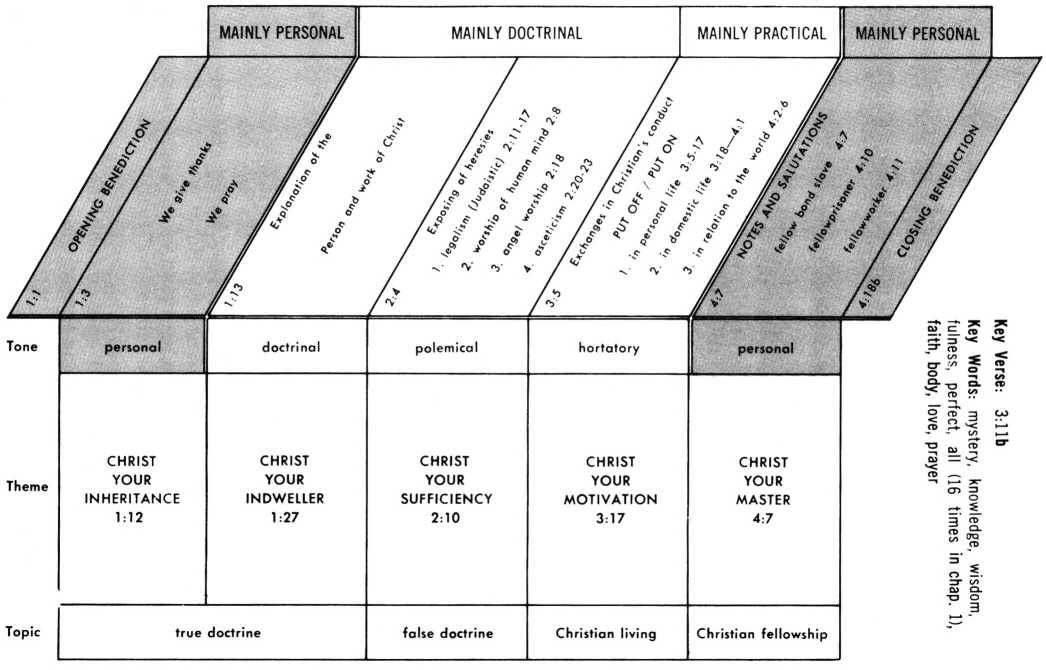
CHRIST IS ALL IN ALL
Click chart to enlarge
Charts from Jensen's Survey of the NT - used by permission
Colossians Overview - Click Chart on right side
| Christ Preeminent in All Things Supreme Lord - Sufficient Savior |
|||
| Colossians 1 | Colossians 2 | Colossians 3 | Colossians 4 |
| Supremacy of Christ |
Submission to Christ |
||
| Doctrinal and Corrective |
Practical and Reassuring |
||
| What Christ Did For Us |
What Christ Does Through Us |
||
| Christ Our Lord |
Christ Our Life |
Christ our Love |
|
| Christ the Head of the Body |
Christ the Lord of the Universe |
Christ the Head of the Home |
|
| Instruction | Warnings | Exhortations | Reminders |
| Reconciliation | Creation | Submission | Conversation |
| His Person and Word |
His Peace and Presence |
||
Colossians 1:9 For this reason also, since the day we heard (1PAAI) of it, we have not ceased (1PPMI) to pray (PMPMPN) for you and to ask (PMPMPN) that you may be filled (2PAPS) with the knowledge of His will in all spiritual wisdom and understanding (NASB: Lockman)
Greek: Dia touto kai hemeis, aph en hemeras ekousamen, (1PAAI) ou pauometha (1PPMI) huper humon proseuchomenoi (PMPMPN) kai aitoumenoi (PMPMPN) hina plerothete (2PAPS) ten epignosin tou thelematos autou en pase sophia kai sunesei pneumatike,
Amplified: |For this reason we also, from the day we heard of it, have not ceased to pray and make [special] request for you, [asking] that you may be filled with the full (deep and clear) knowledge of His will in all spiritual wisdom [in comprehensive insight into the ways and purposes of God] and in understanding and discernment of spiritual things— (Amplified Bible - Lockman)
Barclay - That, in fact, is why, from the day we heard about it, we do not cease to pray for you, asking that you may be filled with an ever-growing knowledge of his will, in all spiritual wisdom and understanding
NLT: So we have continued praying for you ever since we first heard about you. We ask God to give you a complete understanding of what he wants to do in your lives, and we ask him to make you wise with spiritual wisdom. (NLT - Tyndale House)
Phillips: so you will understand that since we heard about you we have never missed you in our prayers. We are asking God that you may see things, as it were, from his point of view by being given spiritual insight and understanding. (Phillips: Touchstone)
Wuest: Because of this, we also, from the day we heard, do not cease on behalf of you of Bring our petitions and presenting our definite requests, that you might be filled with the advanced and perfect knowledge of His will in the sphere of every kind of wisdom and intelligence which is spiritual (Eerdmans)
Young's Literal: Because of this, we also, from the day in which we heard, do not cease praying for you, and asking that ye may be filled with the full knowledge of His will in all wisdom and spiritual understanding,
FOR THIS REASON ALSO SINCE THE DAY WE HEARD OF IT: Dia touto kai hemeis kai hemeis, aph es hemeras ekousamen (1PAAI):
- Colossians 1 Resources - multiple sermons and commentaries
Hannah's Bible Outlines.
Introduction (Col 1:1-14)
- Salutation (Col 1:1-2)
- The author (Col 1:1)
- The recipients and blessing (1:2)
- Thanksgiving (Col 1:3-8)
- The reason (Col 1:3-5)
- The source (Col 1:6-8)
- Supplication (Col 1:9-14)
- For proper knowledge (Col 1:9)
- For proper conduct (Col 1:10-14)
- Fruitfulness and knowledge (Col 1:10)
- Strength (Col 1:11)
- Giving thanks (Col 1:12-14)
- Inheritance (Col 1:12)
- Deliverance and transference (Col 1:13-14)
Wiersbe Outlines "A Prisoner's Prayer" -
- Colossians 1:9 - He Prayed for Spiritual Intelligence
- Colossians 1:10-11 - He Prayed for Practical Obedience
- Colossians 1:11-12 - He Prayed for Moral Excellence
John MacArthur - Paul Prays for the Colossians
The Petition - Col 1:9
The Results - Col 1:10-11
- A Worthy Walk - Col 1:10a
- A Fruitful Life - (Col 1:10b)
- Growth (Col 1:10c)
- Strength (Col 1:11a)
- Endurance (Col 1:11b)
- Inheritance (Col 1:12)
- Deliverance (Col 1:13a)
- Transferance (Col 1:13-14)
POSB Outline- The Great Requests of Prayer, 1:9-11
- Request 1: to know God's will—to be filled with the knowledge of God's will (Col 1:9).
- Request 2: to walk worthy of Christ (Col 1:10).
- Request 3: to possess the power of God (Col 1:11).
Colossians 1:9-14 is one long sentence in the Greek and it is one of the most power-packed prayers in all of Scripture. Even as I write I will pause to pray this prayer for you as you read this note. Would you pause to pray for me? Thank you either way. Remember what John inspired by the Spirit promised "And this is the confidence (boldness) which we have before Him, that, if we ask anything according to His will (best determined by His Word), He hears us. And if we know that He hears us [in] whatever we ask, we know that we have the requests which we have asked from Him." (1Jn 5:14-15) Do you believe that promise? God will surely answer Colossians 1:9-14 in your life and mine. Pray it frequently (not vain repetition, but as a spiritual pauper knocking on the King's door) for yourself, your pastor, your leaders, your disciples, your spouse, etc. I can attest to the power and productivity of such a practice, because years ago a woman committed to pray this for me daily, but then fell asleep in Jesus. I can still remember the impact of her prayers and the void it left in my spiritual life when she passed on.
Morgan: his four main prayer passages are all found in prison epistles -- if he could not preach, he could increase his prayers!
This great prayer is all the more impressive since Paul had never visited this church. Do you pray for saints you have never seen? Paul did!
In his letter to the saints at Ephesus, Paul offers a similar prayer "I pray that the eyes of your heart may be enlightened, so that you may know what is the hope of His calling, what are the riches of the glory of His inheritance in the saints and what is the surpassing greatness of His power toward us who believe." (Eph 1:18-19a)
C. F. D. Moule writes, “Prayer makes 2 great requests: It asks for the discernment of God’s will and then for the power to perform that will.”
For this reason (dia touto) - Always uses this term of explanation as an opportunity to pause and ponder the text, asking at least "What reason?"
For this reason (dia touto) Young's translates this literally as "because of this". What is "this"? The context refers to the favorable report Paul had received from Epaphras in the previous verse. Since the day Paul heard that report, he had been praying for the Colossians. It may seem unnecessary to pray for those who are "doing well". From my experience as a Sunday School leader, it is interesting how much of the prayer time focuses on those who are struggling, facing difficulties or fallen into sin or physical distress (and those prayer are certainly to be encouraged). Paul, however, knew that the knowledge that someone is growing in grace and Christ-likeness should never lead one to stop praying for them. Rather, it should encourage prayer that they would excel even more! The enemy reserves his strongest opposition for those who have the most potential for expanding God’s kingdom. Undoubtedly, another reason to pray for the Colossians, is that they were still relatively new believers in the midst of insidious Gnostic heresies beginning to creep into and corrupt the body.
Albert Barnes - The progress which they had already made, and the love which they had shown, constituted an encouragement for prayer, and a reason why higher blessings still should be sought. We always feel stimulated and encouraged to pray for those who are doing well.
John Eadie explains for this reason - On this account, because ye know the grace of God in truth-because such are your condition and prospects-because of the faith which sustains you, the love which glows within you, the blessed hope laid up for you, and the verdant fertility which characterizes you, and sets its seal on the genuineness of your Christianity. Since the day not only refers to Colossians 1:8, but carries us back to Colossians 1:4. The receipt of the intelligence produced immediate result, and led to prayer. The report did not lie in dormancy, or slowly wake up the reciprocal love of Paul and Timothy. The effect was instant-and it was not spent with a single impulse. From the day we heard it down to the period of our writing this letter—“we cease not.” (Colossians 1 Commentary on Colossians)
In the introductory section of Spurgeon's sermon (Colossians 1:9-10 Spiritual Knowledge: It's Practical Results) the prince of preachers observes that…
Paul felt encouraged by what he saw in the Colossian believers to pray to God to enrich them yet farther. It should be our desire that our best brethren should be better, and that those who are most like Jesus should be still more completely conformed to his image. We cannot more wisely show our love to our friends than by first acknowledging the grace, which is in them, and then by praying that God may give them more. Paul, as with an eagle eye, surveyed the church at Colosse, which he loved so well, and he noted that it was somewhat lacking in knowledge. The Colossian brotherhood differed considerably from the church at Corinth, which abounded in talent, and was enriched with all knowledge. The Colossians had fewer gifted brethren among them who could act as teachers, and, though this was no fault of theirs, it impoverished them in the matter of knowledge, and as Paul would not have them come behind in any desirable attainment, he therefore prayed for them that they might be filled with knowledge in all wisdom and spiritual understanding.
If you read this epistle through, you will observe that Paul frequently alludes to knowledge and wisdom. To the point in which he judged the church to be deficient he turned his prayerful attention. He would not have them ignorant. He knew that spiritual ignorance is the constant source of error, instability, and sorrow; and therefore he desired that they might be soundly taught in the things of God. Not that they were destitute of saving knowledge already, for he says in the sixth verse that they “knew the grace of God in truth,” and that they had brought forth fruits meet for salvation; but saving knowledge, though it be the most essential attainment, is not the only knowledge which a Christian should seek after. He longs to be useful as well as to be safe. Being himself delivered out of darkness he strives to bring others into the marvelous light of grace.
Paul would have his brethren thoroughly furnished for sacred service, knowing the will of the Lord themselves, and able to teach others. He desired for them that they might possess comforting knowledge, strengthening knowledge, edifying knowledge, sanctifying knowledge, directing knowledge; so that they might be ready for all the trials, duties, and labors of life…
My first subject is The Great Value Of Intercessory Prayer; for as soon as Paul felt his heart burning with love to the saints at Colosse, and had heard of the work of the Spirit among them, he began to show his love by lifting up his heart in prayer for them. He did that for them which he knew would bless them.
Notice, that intercessory prayer is a very important part of the work of Christians for one another.
We are not sent into the world to live unto ourselves, but we are members of one body, and each member is expected to contribute to the health and the comfort of the whole. It is true we cannot all preach, but we can all pray; we cannot all distribute alms from our substance, but we can all offer prayer from our hearts. In temporal things we may not be able to enrich the church for lack of substance; but if we fail to bless the church by our prayers it will be for lack of grace.
Whatever you fail in, dearly beloved---and I pray that you may in nothing come behind---yet do not fail in prayer for all the saints, that every blessing may abound towards them.
Intercessory prayer is to be esteemed as an invaluable proof of love, and as the creator of more love. The man who will truly pray for me will certainly forgive me readily if I offend him; he will relieve me if I am in necessity; and he will be prepared to assist me if I am engaged in a service too hard for me. Give us your earnest prayers, and we know that we live in your hearts. How sweet it is to be permitted thus to manifest our love to one another! When our hand is palsied we can still pray; when our eye grows dim we can see to pray; when by sickness we are altogether laid aside we can still pray; and when we meet with cases in which we are unable to help, and yet are moved with sympathy for a brother, our sympathy can always find one open channel, for we can pray, and by prayer call in the aid of one whose help is effectual. Therefore, by your love to your Lord, and to all those who are in him, I beseech you abound in intercessory prayer, as the apostle did.
Intercessory prayer, again, is most valuable, because it is an infallible means of obtaining the blessings, which we desire for our friends. It is not in vain that we ask, for it is written, “Everyone that asketh receiveth.” It is not in vain that we intercede for others, for the Lord delights to answer such petitions. The unselfish devotion which pleads as eagerly for others as for itself is so pleasing to the Lord that he puts great honor upon it. If we desire any blessing for our friends our best course is to pray: even if we would have them to be filled with knowledge in all wisdom our safest course is to pray that it may be so. Of course, we must not forget to instruct them and to aid them in their own studies as far as lieth in our power, for every honest prayer supposes the use of all proper means; but the instruction which we offer will be of no service unless we first bring down the blessing of God upon it, that thereby our friends may be made willing to learn, and may receive the truth not as the word of man, but as from the Lord himself. None but spiritual teaching will nourish spiritual life. The Holy Ghost must teach divine truth to the heart, or it will never be truly known. Whatsoever thou wisely desirest for thy friend go about to get it for him, but hasten first to the throne of grace. If thou wouldst have thy friend converted, if thou wouldst have him strengthened, if thou wouldst have him taught of God, if thou wouldst have him quickened to a nobler life, and elevated to a higher consecration, do him this great service-take his case before the Lord in prayer; and in so doing thou hast gone the wisest way to work to enrich him.
IMMEDIATE PRAYER
Note, brethren, for I am keeping to my text closely, that such intercessory prayer will be all the more valuable if it is our immediate resort.
The apostle says,
“Since the day we heard it, we do not cease to pray for you.”
He began to pray at once. Whenever you perceive the work of the Spirit in any heart, pray at once, that the holy change may proceed with power. Whenever you discover any lack in a brother begin on the day you hear of it to pray that his lack may be supplied. There should be no delaying of prayer.
“He gives twice who gives quickly” is a human proverb, but I believe that when we pray speedily we shall often find that God in answering quickly gives us a double blessing.
Usually he shall win worldly riches who is the most diligent in the pursuit of them, and assuredly he shall be richest towards God who is most diligent in supplication. Linger not a minute, speed thee to the mercy-seat. Now is the accepted time; the Lord waits to be gracious to thee. The Lord indicates to thee what thy prayer shall be by the news, which thou hast just heard of thy friend; therefore, bring his case at once before the throne of grace. Divine providence has brought the needful subject for prayer under thy notice; therefore, this day begin to pray about it.
INCESSANT PRAYER
Our prayers will be all the more valuable if they are incessant as well as immediate. “We cease not,” said Paul, “to pray for you since the day we heard it.” “Oh,” says one, “was Paul always praying for the Colossians from the day he heard of their welfare? It may have been months and years; did he never cease to pray?” I answer, he was always praying for them in the sense which he explains: he adds, “and to desire.” Now, desire is the essence of prayer; in fact, desire is the kernel of prayer, and the vocal expressions, which we call by the name of prayer are often but its shell; inward desire is the life, the heart, the reality of prayer. Though you cannot always be speaking in prayer, you can always be desiring in prayer. The miser is always desiring riches, though he is not always talking about his gold and silver; and the man who loves his fellow-men, and desires their profit, is really always praying for their benefit, though he is not always lifting up his voice in supplication. “Since the day we heard it,” saith Paul, “we do not cease to pray for you.” The act of prayer is blessed, the habit of prayer is more blessed, but the spirit of prayer is the most blessed of all; and it is this that we can continue for months and years. The act of prayer must, from force of circumstances, be sometimes stayed; but the habit of prayer should be fixed and unvarying; and the spirit of prayer, which is fervent desire, should be perpetual and abiding. We can hardly realize the value to the church and to the world of that intercessory prayer which ceases not day nor night, but without fail ascends before the Lord from the whole company of the faithful, as the incense ascended from the altar.
INTENSE PRAYER
Dear friends, our intercessory prayer will be all the more precious if it is an intense expression unto God. I suppose that by the use of the word “desire” here, the apostle not only explains how he continued to pray, but in what manner he prayed-with “desire.” Remember how our Lord puts it- “with desire have I desired to eat this passover with you before I suffer.” I wish we could always say “with desire have I desired in prayer. I did not repeat a merely complimentary benediction upon my friends, but I pleaded for them as for my life; I importuned with God; I offered an effectual inwrought prayer, which rose from the depths of my heart to the heights of heaven, and obtained an audience with God.” Fervency is a great essential for victorious prayer. God grant us to be importunate, for then we shall be invincible.
INTIMATE UNION PRAYER
One more observation, and I have done with this. Intercessory prayer is increased in value when it is not from one person alone, but is offered in intimate union with other saints. Paul says, “We also,” not “I only,” but “He also, since the day we heard it, cease not.” If two of you agree as touching anything concerning the kingdom, you have the blessing secured to you by a special promise of God. Remember how Abraham prayed for the cities of the plain, but succeeded not until Lot also added his supplication for Zoar. Then the little city was spared. I compare Abraham’s intercession to a ton weight of prayer, and poor Lot’s I can hardly reckon to have been more than half an ounce, but still that half-ounce turned the scale.
So here is Paul, and with him is youthful Timothy, who, compared with Paul, is inconsiderable; yet. Paul’s prayer is all the more effectual because Timothy’s prayer is joined with it. Our Lord sent out his servants by two and two, and it is well when they come back to him in prayer two and two.
I commend to you, brethren and sisters, the habit of frequent prayer together. When a Christian friend drops in, his visit, will perhaps end in mere talk unless you secure its spiritual profit by at least a few minutes spent in united prayer.
I frequently during the day, when a friend comes in upon the Master’s business, say, “Let us pray before you go,” and I always find the request is welcomed. Such prayers do not occupy much time, and if they did, it might be well spent; but such united supplications oil the wheels of life’s heavy wain, and cause it to move with less of that creaking which we too often hear.
“I alone” is certainly a good word in prayer; but “we also” is a better one. Let us link hands and intercede for our brethren and the whole church of God.
Thus have I expatiated upon the excellencies which increase the value of intercessory prayer. Use much this heavenly art. It is effectual for ten thousand ends. It turneth every way to bless the church. Brethren, pray for us, pray for all saints, pray for all sinners, and by so doing you will be the benefactors of your age. (See the full text)
WE HAVE NOT CEASED TO PRAY FOR YOU: ou pauometha (1PPMI) huper humon proseuchomenoi (PMPMPN):
- Col 4:12 Eph 6:18, 1Sa 12:23 Acts 12:5 Php 1:4 1Th 1:3 5:17 2Th 1:11 2Ti 1:3, 4 Philemon 1:4
- Colossians 1 Resources - multiple sermons and commentaries
See Resources Related to Prayer…
- Gems on Prayer by C H Spurgeon
- Prayer Resources: Multiple links: Topical Bible Studies, books, music
- Missionary: Global Prayer Digest ; Operation World
- Praying for Your Missionaries: Guide to specific daily prayers
- Prayer for Deeper Understanding: Wayne Barber
- Prayer for Fullness: Wayne Barber's exposition Ephesians 3:14-21
- Notes on the "Disciple's Prayer" Matthew 6:9ff
- Notes on praying for hope, joy, peace Romans 15:13
- Notes on praying for enlightenment, etc Ephesians 1:18, 19, 20
- Notes on praying for inner strength Ephesians 3:14, 15, 16, 17, 18
- Notes on praying when anxious Philippians 4:6, Philippians 4:7
- Notes on prayer for loving discernment Philippians 1:9, 10, 11, 12
- Notes on praying without ceasing 1Thessalonians 5:17
Grant Richison writes "Paul begins with a prayer for the Colossians that touches all the bases of their need. This is one of the greatest prayers of the Bible." (Ed: I wholeheartedly agree. If you ever are moved to pray for me as I work on this website, please consider Colossians 1:9-12. Thank you. Bruce Hurt). Paul first begins with intercession for the Colossians and then moves to thanks for what God has already done for them. It is ironic that Christians ask God to do for them things which he has already done. We ask God to forgive us for our sins when he has already forgiven us in Christ (v. 14). We ask God to allow us to enter his kingdom, when he has already done that as well (v.13). It is more proper to thank God for these things than to ask him for them....This is incessant prayer but it does not mean that Paul prayed for them perpetually. It simply means that he prayed for them on a regular basis. We should pray for people regularly (Acts 20:31; Eph. 1:16; I Thes. 1:2; 5:17). Many people do not cease because they do not start. We need to seize every opportunity to pray. Prayer is the place where we fight spiritual battles. Do you have a spirit of prayer? Do you seize every opportunity to pray for people you may influence? Are we dead earnest about prayer? We believe in prayer but we do not pray very much. We subscribe to the idea of prayer but when we announce a prayer meeting a minimal number of people come. We believe in prayer if an emergency lands into our lives. Otherwise, we show little interest in prayer. We are eloquent in prayer if it involves our family or our person. If it involves someone else we are quite casual about prayer. (Col 1:9 Notes)
We (plural) have not ceased to pray - Not that they literally were praying every moment but that this was their habitual practice (prayer to Paul was a "lifestyle") to lift up these requests for the saints at Colossae (this is the idea of interceding for one another). Paul gave the saints at Thessalonica the command to Pray (present imperative = command to do this continually) without ceasing (1Th 5:17, cp Mt 7:7), something all believers are commanded to carry out and should be motivated to gladly obey. Why pray (other than that it is a command and God never commands what He does not enable - the Spirit in us energizes our prayer)? Scripture records that out of approximately 667 recorded prayers in the Bible, there are about 454 recorded answers. God always answers of course but the fact that such a high percentage of answers are recorded should encourage us to pray without ceasing! Spurgeon had another great reason to pray without ceasing observing that "As you are tempted without ceasing, so pray without ceasing (Heb 2:18 where tempting is in the present tense indicating we are continually being tempted)."
Paul has been making constant and earnest prayer for the saints at Colossae, similar to 1Th 1:2; 1Th 2:13; Ro 1:9; and Eph. 1:15.
We all probably need to be a bit more like the apostle James of whom Eusebius wrote that his "knees grew hard like a camel’s because of his constant worship of God, kneeling and asking forgiveness for the people."
Edward Payson - Prayer is the first thing, the second thing, the third thing necessary to minister. Pray, therefore, my dear brother, pray, pray, pray.”
Spurgeon in his book Power in Prayer notes that "It may be a revealing exercise for some of you to find out how often in Scripture you are told to pray. You will be surprised to find how many times such words as these are given: “Call upon Me in the day of trouble, and I will deliver thee” (Psalm 50:15). “Ye people, pour out your heart before Him” (Psalm 62:8). “Seek ye the LORD while He may be found; call ye upon Him while He is near” (Isaiah 55:6). “Ask, and it shall be given you; seek, and ye shall find; knock, and it shall be opened unto you” (Mt 7:7). “Watch ye and pray, lest ye enter into temptation” (Mark 14:38). “Pray without ceasing” (1Th 5:12). “Come boldly unto the throne of grace” (He 4:16). “Draw nigh to God and He will draw nigh to you” (James 4:8). “Continue in prayer” (Col 4:2). I need not multiply what I could not possibly exhaust."
There Is an Eye that Never Sleeps
by James Cowden WallaceThere is an eye that never sleeps
Beneath the wing of night;
There is an ear that never shuts,
When sink the beams of light
There is an arm that never tires,
When human strength gives way.
There is a love that never fails,
When earthly loves decay.
But there’s a pow’r which man can wield,
When mortal aid is vain,
That eye, that arm, that love to reach
That list’ning ear to gain.
That pow’r is prayer, which soars on high,
Through Jesus, to the throne;
And moves the hand that moves the sky,
A blessing to bring down.
Unceasing prayer refers more to prayer as an attitude and not just to prayer as an activity. As such this type of prayer serves as a good reflection of our "spiritual health" and of our level of communion ("high, medium, low") with our Father.
Thomas Kelley - There is a way of ordering our mental life on more than one level at once. On one level we can be thinking, discussing, seeing, calculating, meeting all the demands of external affairs. But deep within, behind the scenes, at a profounder level, we may also be in prayer and adoration, song and worship, and a gentle receptiveness to divine breathings. (Thomas Kelly, Testament of Devotion New York: Harper, 1941)
In his famous book Pilgrim’s Progress John Bunyan described prayer this way "About the midst of this valley I perceived the mouth of hell to be, and it stood also hard by the wayside. Now thought Christian, what shall I do? And ever and anon the flame and smoke would come out in such abundance, with sparks and hideous noises (things that cared not for Christian’s sword, as did Apollyon before), that he was forced to put up his sword, and betake himself to another weapon, called “All-Prayer.”
In the classic The Practice of the Presence of God, Brother Lawrence explained "all-prayer" this way "The time of business does not differ with me from the time of prayer; and in the noise and clatter of my kitchen, while several persons are at the same time calling for different things, I possess God in as great tranquility as if I were on my knees." (Would it be we would all be is such constant, clear communion with the throne of grace!)
J N Darby has an interesting note writing that "If we had sufficient confidence in the interest which God takes in His children, we should have greater boldness in asking God, according to the intentions of His grace. We do not live enough by this grace, and that is why our prayers are so constantly stamped with the sense of want. We are often the Abraham of Genesis 15, who asks for himself, saying to God: "What wilt thou give me?" But Paul shews himself here the Abraham of Genesis 18, sitting before God, worshipping Him, and making requests for others.
The ancient preacher Chrysostom (his name means “golden-mouthed”) described the power of unceasing prayer this way "The potency of prayer has subdued the strength of fire, it has bridled the rage of lions, hushed anarchy to rest, extinguished wars, appeased the elements, expelled demons, burst the chains of death, expanded the fates of heaven, assuaged diseases, dispelled frauds, rescued cities from destruction, stayed the sun in its course, and arrested the progress of the thunderbolt. There is (in it) an all-sufficient panoply, a treasure undiminished, a mine which is never exhausted, a sky unobscured by clouds, a heaven unruffled by the storm. It is the root, the fountain, the mother of a thousand blessings! (Ed: Beloved do I really believe this? Better yet do I really believe what Jesus promises to those who ask, seek and knock? My (and your) answer to this question will not be evidenced by a simple "yes" or "no" but by the "calluses (or lack of) on our knees" so to speak!)
Unceasing prayer is not restricted to a set time, place or position of one's body. The believer is not in a right place with God's Spirit if he cannot pray anytime, anywhere. The Christian's life of righteousness and his approach to relationships and responsibilities should be such that he maintains a constant attitude of being in God's presence (cp Brother Lawrence's "Practice of the Presence of God"). Such a person will pray often and about many things, including requests, praise, and thanksgiving.
John Bunyan - In prayer, it is better to have heart without words, than words without heart. Prayer will make a man cease from sin.
William Heslop in his book Sermon Seeds from the Psalms alluded to this attitude of unceasing prayer in his comments on Psalm 5 writing that "As a rule, the early morning hours are best for devotion, prayer, and the exercise of faith. "In the morning will I direct my prayer… and will look up." (Ps 5:3-Spurgeon's note) Like a steady and determined archer, David directs his prayer. He takes careful aim, steadies himself, prays intelligently and perseveringly, and then looks up as though he were expecting and anticipating an answer. Praying by spasms and without a fixed aim is like throwing a line and sinker into the water without a worm or minnow. Here is one of the golden keys which unlock the storehouses of God, "and will look up." The poet prays expectantly, anticipatively, and believingly. He "directs" his prayer and then looks up for the answer. The Old Testament seers and sages oft times prayed with the palms of their hands held up and out towards the sky as though they expected GOD to put something in them." (ED: Do you pray confidently and expectantly?)
by William Poole
Have you prayed all night, till the break of day,
And the morning light drove the dark away?
Did you linger there, till the morning dew,
In prevailing prayer, did you pray it through?
Refrain
Did you pray till the answer came,
Did you plead in the Savior’s Name?
Have you prayed all night till the morning light,
Did you pray till the answer came?
Did you pray it through, till the answer came?
There’s a promise true for your faith to claim,
At the place of prayer, Jesus waits for you,
Did you meet Him there, did you pray it through?
Refrain
As the Master prayed in the garden lone,
Let your prayer be made to the Father’s throne,
If you seek His will, He will answer you,
Are you trusting still, have you prayed it through?
Refrain
Ceased (3973) (pauo) means to cease (middle voice = oneself) from an activity in which one is engaged. Pauo in the active sense means to cause something or someone to cease from some activity or state. To make stop. To stop, restrain, refrain, quit, desist. To come to an end.
Pauo is used 15 times in the NAS translated: cease, 4; ceased, 4; finished, 2; incessantly, 1; keep, 1; kept right, 1; stopped, 2.
Luke 5:4 When He had finished speaking, He said to Simon, "Put out into the deep water and let down your nets for a catch."
Luke 8:24 They came to Jesus and woke Him up, saying, "Master, Master, we are perishing!" And He got up and rebuked the wind and the surging waves, and they stopped, and it became calm.
Luke 11:1 It happened that while Jesus was praying in a certain place, after He had finished, one of His disciples said to Him, "Lord, teach us to pray just as John also taught his disciples."
Acts 5:42 And every day, in the temple and from house to house, they kept right on teaching and preaching Jesus as the Christ.
Acts 6:13 They put forward false witnesses who said, "This man incessantly speaks against this holy place and the Law;
Acts 13:10 and said, "You who are full of all deceit and fraud, you son of the devil, you enemy of all righteousness, will you not cease to make crooked the straight ways of the Lord?
Acts 20:1 After the uproar had ceased, Paul sent for the disciples, and when he had exhorted them and taken his leave of them, he left to go to Macedonia.
Acts 20:31 "Therefore be on the alert, remembering that night and day for a period of three years I did not cease to admonish each one with tears.
Acts 21:32 At once he took along some soldiers and centurions and ran down to them; and when they saw the commander and the soldiers, they stopped beating Paul.
1 Corinthians 13:8 Love never fails; but if there are gifts of prophecy, they will be done away; if there are tongues, they will cease; if there is knowledge, it will be done away.
Ephesians 1:16 do not cease giving thanks for you, while making mention of you in my prayers;
Colossians 1:9 For this reason also, since the day we heard of it, we have not ceased to pray for you and to ask that you may be filled with the knowledge of His will in all spiritual wisdom and understanding,
Hebrews 10:2 Otherwise, would they not have ceased to be offered, because the worshipers, having once been cleansed, would no longer have had consciousness of sins?
1 Peter 3:10 For, "THE ONE WHO DESIRES LIFE, TO LOVE AND SEE GOOD DAYS, MUST KEEP HIS TONGUE FROM EVIL AND HIS LIPS FROM SPEAKING DECEIT.
1 Peter 4:1 Therefore, since Christ has suffered in the flesh, arm yourselves also with the same purpose, because he who has suffered in the flesh has ceased from sin,
Pauo - 78 times in the non-apocryphal Septuagint (LXX)
Ge 11:8; 18:33; 24:14, 19, 22; 27:30; Ex 9:28-29, 33-34; 31:17; 32:12; Nu 16:31; 17:10; 25:8; Dt 20:9; 32:26; Josh 7:26; 8:24; Jdg 15:17; 2 Sam 15:24; 1Chr 21:22; Est 5:1; Job 6:7, 26; 14:13; 18:2; 29:9; 31:40; 37:19; 38:1; Ps 34:13; 37:8; Pr 18:18; 30:1; Isa 1:16, 24; 10:25; 16:10; 24:8, 11, 13; 26:10; 32:10; 33:8; 38:20; 57:10; 58:12; Jer 25:37; 26:3, 8, 13, 19; 31:15, 36; 43:1; 44:10; 48:2; 51:63
The middle voice indicates that Paul and Timothy initiate the action of prayer and participate in the result (praying). Middle voice has a reflexive sense (relating to, or constituting an action -- as in “he perjured himself” -- directed back on the subject) and can be translated "we ourselves have not ceased".
Cease is in the present tense indicating that this is a habit of life for Paul and Timothy. Said another way, prayer was their lifestyle. Is prayer your lifestyle?
"Not" is the Greek ou which indicates absolute negation. In other words, Paul and Timothy were always in communion with the Lord, "always keeping the receiver off the hook” and thus never in the position of having to say when praying “Lord, we come into Thy presence,” because they never left His presence! They set a worthy goal for all of us to “pray without ceasing” (1Th 5:17) because we are always subject to temptations and attacks from the world, the flesh and the devil. A surprise attack has defeated more than one believer who forgot to “pray without ceasing.” Have you prayed today? Better yet, have you left the receiver off the hook?
Praying without ceasing does does not mean we are always saying an audible prayer for Jesus made it clear we are not to think we "will be heard for (our many) words" (Mt 6:7). We are not to be walking around muttering prayers under our breath. Rather, praying without ceasing is when prayer becomes as natural to us as our regular breathing. Unless we are sick or smothering, we rarely think about our breathing; we just do it. Likewise with prayer—it should be the natural habit of our lives, the “atmosphere” in which we constantly live. Prayer without ceasing suggests the attitude and desire of one's heart as well as the words of one's lips. A saint who has his heart fixed on the things above, is ready to pray even when he is not conscious of it, because he is living with an attitude of "God consciousness".
When Paul looked around his world, everything he saw prompted him to prayer in some way. When he thought of or heard about one of his beloved churches, it moved him toward communion with God. Nehemiah is an example of a man who continually left the receiver off the hook. After King Artaxerxes demanded the reason for his sadness, Nehemiah told him of the destruction of Jerusalem. Asked by the king for his request, he prayed a quick, brief prayer before replying (Neh 2:4). In the midst of a stressful situation, Nehemiah was conscious of God’s "attentive ear" and faithfulness to hear the cries of His children.
Paul’s prayers for the church –
Ro 1:8-10 (Saints he had never seen); Ro 15:5-6; , Ro 16:20, 24, 25-27, 1 Cor 1:3, 1:4-9; 1 Cor 16:23-24; 2 Cor 1:2, 2 Cor 1:11; 2 Cor 13:7,9; 2 Cor 13:14; Gal 1:3-5; Gal 6:16; Gal 6:18; Eph 1:2; Eph 1:15-23; Eph 3:14-21; Eph 6:23-24; Php 1:2-11; Php 4:23; Col 1:2; Col 1:3-14; 1 Th 1:1, 3-10; 1 Th 2:13; 1 Th 3:9-13; 1 Th 5:23-24; 1 Th 5:28; 2 Th 1:3-12; 2 Th 2:13; 2 Th 3:5, 2 Th 3:16; 1 Ti 1:2, 1 Ti 6:21; 2 Ti 1:2, 3-5; 2 Ti 1:16, 18; 2 Ti 4:22; Titus 1:4, Titus 3:15; Philemon 1:3; 4-7; Philemon 1:25
Paul’s request for prayers –
Ro 15:30-33; Eph 6:18-20; Php 1:19; Col 4:2-4; Col 4:18; 1 Th 5:25; 2 Th 3:1, Philemon 1:22
Other Prayers by Paul -
Prayer Inspired by the Spirit (Ro 8:15, 23, 26, 27), Ro 10:1; Ro 11:33-36; Ro 12:12, Ro 16:20; 1 Cor 1:14, 2 Cor 12:8; 2 Cor 1:23; 1 Cor 7:5, 1 Cor 15:57; 2 Cor 1:3; 2 Cor 2:14; 2 Cor 4:15; 2 Cor 8:16; 2 Cor 9:11-15; Gal 1:6-9; Gal 1:24; Gal 4:6; Eph 1:3-14; Eph 5:20; Php 4:6-7; Php 4:20; Col 3:15-17; Col 4:12-13; 1 Th 5:17-18; 1 Ti 1:12; 1 Ti 6:15-16; 2 Ti 4:16, 18;
AND TO ASK: kai aitoumenoi (PMPMPN):
- Colossians 1 Resources - multiple sermons and commentaries
CONTINUALLY
MAKE REQUESTS
Jesus encouraged continual prayer - "Now He was telling them a parable to show that at all times they ought to pray and not to lose heart" (Luke 18:1 see Lk 18:2-7).
Paul exhorted us to "Pray (present imperative - command to do this continually, as our lifestyle - the only way is by continually being filled with and enabled by the Holy Spirit!) without ceasing." (1 Th 5:17)
Thou art coming to a King—
Large petitions with thee bring;
For His grace and power are such
None can ever ask too much. —Newton
Ask (154) (aiteo) (present tense = we keep on asking - note the verb is plural suggesting Paul has some "prayer partners") is a specific word for prayer which asks for something to be given and gives prominence to the thing asked for rather than the person.
Aiteo conveys the sense of asking with urgency, even to the point of demanding and refers to the seeking by the inferior from the superior (Acts 12:20), by a beggar from the giver (Acts 3:2), by the child from the parent (Mt 7:9) or by a man from God (Mt 7:7; cf Jas 1:5 1Jn 3:22).
Vine - "to ask," is to be distinguished from No. 2. Aiteo more frequently suggests the attitude of a suppliant, the petition of one who is lesser in position than he to whom the petition is made; e.g., in the case of men in asking something from God, Matthew 7:7; a child from a parent, Matthew 7:9,10; a subject from a king, Acts 12:20; priests and people from Pilate, Luke 23:23 (RV, "asking" for AV, "requiring"); a beggar from a passer by, Acts 3:2 . With reference to petitioning God, this verb is found in Paul's epistles in Ephesians 3:20; Colossians 1:9; in James four times, James 1:5,6; 4:2,3; in 1John, five times, 1 John 3:22; 5:14,15 (twice) ,16. (Ask - Vine's Expository Dictionary of NT Words - Bible Dictionary)
Lenski - Blass says that this voice is used in business transactions when one asks and gives (B.-D. 316, 2); but the middle voice denotes an asking to which one is entitled. This may occur in a business deal, but it may also take place in far more refined relations when he of whom we ask in some way entitles us to do so. Note, for instance, that Herod had entitled Salome to ask for as much as the half of his kingdom. The reflexive idea “ask for oneself” is only the starting point of this use of the middle: ask as one who is entitled to ask. The entitling referred to here is the fact that God commands us to ask; the middle voice implies that only on this supposition do we ask. (Lenski, R. C. H. (1937). The interpretation of St. Paul's Epistles to the Colossians, to the Thessalonians, to Timothy, to Titus and to Philemon (33). Columbus, O.: Lutheran Book Concern)
J R Miller - Some people pray for their friends, but ask only for things of lower or less important - that they may have good health, that they may get on well in worldly affairs, that they may prosper socially. These are proper enough blessings to ask for our friends, but they are not the first things. Paul, in praying for his friends, asks for them the highest and greatest things. He requests that they may be filled with the knowledge of God's will in all spiritual wisdom and understanding; that they may walk worthy of the Lord unto all pleasing; that they may bear fruit in every good work; that they may increase in the knowledge of God; and that they may be strengthened with all power unto all patience and long-suffering with joy. Could we do better than to pray Paul's prayer for our friends? These are blessings, which we know they need, and which God is willing to give them. We need never fear that in asking for such things we are seeking for blessings that will perish in the using.
Brian Bell - In prayer we’re not trying to make God listen, but making ourselves to listen to Him! In prayer we are not trying persuade God to do something, but to find out what He wants us to do! Often we pray to God, “Thy will be changed” instead of “Thy will be done.” So, the 1st object of prayer is to listen not to speak! Life’s greatest problem is not to know what to do, but doing it (putting it into action). We need Power & it comes by Prayer! If God only told us what to do, this would be frustrating! But He not only tells us His will, He also empowers us to do it. W. Through Prayer then, we obtain Knowing God’s will & we receive the power to be able to accomplish it! (Sermon)
ILLUSTRATION: What do you wish for? Peanuts cartoon.One day Lucy and Linus had a chicken wishbone and were going to pull it to make a wish. Lucy was explaining to Linus that if he got the bigger half of it, his wish would come true. Linus said to her, "Do I have to say the wish out loud?" Lucy said, "Of course, if you don't say it out loud it won't come true." So Lucy goes ahead and makes her wish first. She says, "I wish for four new sweaters, a new bike, a new pair of skates, a new dress and one hundred dollars." It came time for Linus to make his wishes, and he says, "I wish for a long life for all of my friends, I wish for world peace, I wish for great advancements in medical research." Lucy takes the wishbone and throws it away saying, "Linus, that's the trouble with you. You're always spoiling everything!" Paul's wish for the Colossians is expressed in these verses. It is his prayer for them.
Magazine Christianity: Colossians 1:9-14
[We] do not cease to pray for you, and to ask that you may be filled with the knowledge of His will. —Colossians 1:9
Are we “Time-magazine Christians”? Pastor Stan Henderson used this phrase to describe how some believers divide their lives into departments, with the religious section given a half-page somewhere near the back. Little if any attempt is made to relate matters of faith to the everyday issues of life.
Some think that the spiritual part of their lives can be taken care of by church attendance or doing some good. Then they are free to run their own businesses, choose their entertainment, or relate to people in whatever way pleases them. But Christianity can’t be confined to just one area of our lives.
When Paul prayed for the believers in Colosse, he asked God to fill them with “the knowledge of His will” (1:9). He asked that they would know His will in every aspect of their experience—what they thought and what they did—so that they would live a life worthy of the Lord and please Him in every way (v.10).
Our relationship with Christ must affect all areas of life. There is no way we can live a life that is pleasing to God if we keep our faith limited to the religious section. Walking with Christ is a total-life experience.
Invite Jesus into all of your life. Then you won’t be a Time-magazine Christian.
For Further Thought
Is there a part of your life that you're keeping under your own control—finances, recreation, work, home, goals, habits, relationships? Yield it to Christ's control.
Give Christ the key to every room in your life.
By David C. Egner (Our Daily Bread, Copyright RBC Ministries, Grand Rapids, MI. Reprinted by permission. All rights reserved)
Praying Like Paul - It's dark. It's cold. You've been thrown into prison, and you don't know when you'll get out or when you'll eat your next meal. You bow your head to pray. What will you pray for? Safety? Deliverance? A decent meal?
If you are the apostle Paul, you pray for something far different. You talk to God about a group of people you have never seen.
Colossians 1 gives us a brief record of Paul's prison prayer for the people at the church in Colossae. His words help us see how important intercessory prayer should be--even when we have our own troubles.
In Paul's case, he prayed for what he thought this young church needed. He asked God to give them several things, including spiritual understanding (v.9), fruitful lives (v.10), and strength, patience, and joy (Col 1:11).
Paul gave thanks and prayed for his fellow believers "always" (Col 1:3). Not just when he felt good. Not just when he was warm and well-fed. Always.
How often is our prayer-life interrupted by circumstances that we turn into excuses? Our friends, our family members--even people we don't know--need our intercession. No matter what our difficulty, let's pray for others. — Dave Branon
We give to others what they need;
We show no greater care
Than when we give them to the Lord,
Surrounding them with prayer. --DJD
The best way to influence people for God is to intercede with God for people.
THAT YOU MAY BE FILLED (controlled by) WITH THE KNOWLEDGE (deep, experiential) OF HIS WILL: ten epignosin hina plerothete (2PAPS) ten epignosin tou thelematos autou:
- 1Co 1:5 Eph 1:15, 16, 17, 18, 19, 20, 3:14, 15, 16, 17, 18, 19 Php 1:9, 10, 11 Col 2:2, 3:10 2 Pe 1:2, 3
- Colossians 1 Resources - multiple sermons and commentaries
FILLED WITH
DIVINE KNOWLEDGE
That (hina - see discussion of term of purpose) which introduces the purpose of their prayer. Whenever you encounter a "that" or "so that" (which is in the context of expression of purpose) take a moment to pause and ponder the passage, asking simple questions like "What is the purpose?," etc.
Wiersbe: “The word filled is a key word in Colossians. It was also a key word in the teachings of the false teachers who had invaded the Colossian church. Paul used it many times. (See Col. 1:19, 25; 2:2, 9-10; 4:12, 17 [Complete = ‘filled full’]). The word carries the idea of being fully equipped. It was used to describe a ship that was ready for a voyage. The believer has in Christ (and His indwelling Spirit, our "on board" supernatural "turbine") all that he needs for the voyage of life. ‘And you are complete in Him’ (Col. 2:10). ‘And of His fullness have all we received’ (John 1:16).”
Richison on filled - The word “filled” suggests filling to the top or brim. Paul prays that they will be satisfied with nothing less than the limit of the knowledge of God’s will. He wants them to obtain an entire insight into the will of God. “Filled” means to be controlled to the tiniest detail. We need to know the will of God not only in major decisions of life but in the little decisions as well. It is to pervade our purpose, plans and thoughts. Most of us are satisfied with being half-filled with everything except food. We do not stop eating until we are full. We are not that way when it comes to spiritual food. We are satisfied with a starvation diet in spiritual things. We snack on spiritual junk food and run off to the spiritual race only to run with very little spiritual energy. It is God’s will that we be filled with spiritual food. Most of us are not even half full. God wants us to be chock-block full of the knowledge of the will of God. God wants us to be experts in the will of God. If God answers this prayer we will know all the implications of his will for our lives. (Notes)
Eadie - The Colossians had gnosis, but the apostle wished them to be filled with additional and supplemental knowledge, not new knowledge, or a different form or section of Christian science, but a fuller development of the partial theological information which they already possessed. Had he gently wished them somewhat more of knowledge, he might have used gnosis, but as he prayed that they might be filled with more of that insight which they already enjoyed, such an accumulation was naturally expressed by epignosis. That augmentation of knowledge had for its theme the Divine will… The prayer was not one for plenary inspiration-nor that God would by some dazzling self-discovery imbue them with a knowledge of His will, but that He would give them this higher spiritual science in the way of giving them all spiritual wisdom and understanding. (Colossians 1)
Filled (4137) (pleroo) means to be filled (passive voice = saints acted on by outside force = "Divine Passive") to the brim (a net, Mt 13:48, a building, Jn 12:3, Acts 2:2, a city, Acts 5:28, needs Phil 4:19), to make complete in every particular, to cause to abound, to furnish or supply liberally, to flood, to diffuse throughout, to pervade, to take possession of and so to ultimately to control.
Pleroo is used 87 times in the NAS (SEE ALL USES OF PLEROO IN NT @ END OF THIS NOTE) - NAS is translated: accomplish(1), accomplished(1), amply supplied(1), approaching(1), complete(1), completed(3), completing(1), elapsed(1), fill(3), filled(16), fills(1), finished(1), fulfill(20), fulfilled(20), fully carry(1), fully come(1), fully preached(1), increasing(1), made complete(2), made full(5), make… full(1), make… complete(1), passed(2), supply(1).
Mt 1:22; 2:15, 17, 23; 3:15; 4:14; 5:17; 8:17; 12:17; 13:35, 48; 21:4; 23:32; 26:54, 56; 27:9; Mark 1:15; 14:49; Luke 1:20; 2:40; 3:5; 4:21; 7:1; 9:31; 21:24; 22:16; 24:44; John 3:29; 7:8; 12:3, 38; 13:18; 15:11, 25; 16:6, 24; 17:12f; 18:9, 32; 19:24, 36; Acts 1:16; 2:2, 28; 3:18; 5:3, 28; 7:23, 30; 9:23; 12:25; 13:25, 27, 52; 14:26; 19:21; 24:27; Ro 1:29; 8:4; 13:8; 15:13f, 19; 2 Cor 7:4; 10:6; Gal 5:14; Eph 1:23; 3:19; 4:10; 5:18; Phil 1:11; 2:2; 4:18f; Col 1:9, 25; 2:10; 4:17; 2Th 1:11; 2Ti 1:4; Jas 2:23; 1Jn 1:4; 2Jn 1:12; Rev 3:2; 6:11.
Pleroo is used 77 times in the Septuagint (LXX)
Gen 1:22, 28; 9:1, 7; 25:24; 29:21; 50:3; Exod 32:29; Lev 8:33; 12:4; 25:29f; Num 6:5, 13; 7:88; Josh 3:15; Jdg 17:5, 12; 2 Sam 7:12; 1 Ki 1:14; 2:27; 7:14; 8:15, 24; 13:33; 2 Ki 4:4; 1 Chr 12:15; 17:11; 29:5; 2 Chr 6:4, 15; 13:9; 24:10; 29:31; 36:21f; Job 20:22f; Ps 16:11; 20:4f; 65:9; 71:8; 72:19; 74:20; 81:10; 83:16; 104:24; 110:6; 127:5; 129:7; Eccl 1:8; 6:7; 9:3; 11:3; Song 5:14; Isa 8:8; 13:3; 40:4; 65:11; Jer 13:12f; 23:24; 25:12, 34; 29:10; 33:5; 34:14; 44:25; 51:11, 14; Lam 4:18; Ezek 7:19; Dan 2:35; 4:11, 34; 5:26; 8:23; Zeph 1:9
Pleroo also means to fulfill, to complete, to carry out to the full (eg Lk 9:31 at the transfiguration, Moses and Elijah were "speaking of [Jesus'] departure which He was about to accomplish [pleroo] at Jerusalem")
Pleroo indicates more than just pouring water in a glass up the brim and has at least three shades of meaning that are helpful in illustrating the meaning.
(1) Pleroo was often used of the wind billowing the sails of a ship and providing impetus to move the ship across the water. To be filled with the Spirit then to is to be moved along in our Christian life by God Himself, by the same dynamic by which the writers of Scripture were “moved by the Holy Spirit” (2Pe 1:21). In the spiritual realm, this concept depicts the Holy Spirit providing the thrust to move the believer down the pathway of obedience. A Spirit-filled Christian is not motivated by his own desires or will to progress. Instead, he allows the Holy Spirit to carry him in the proper directions. Another helpful example of this first meaning is a small stick floating in a stream. Sometime in our lives most of us have tossed a stick into a creek and then run downstream to see the twig come floating by, propelled only by the force of the water. To be filled with the Spirit means to be carried along by the gracious pressure of the Holy Spirit. From a negative aspect, the men in (Ro 1:29) are being moved by their depraved minds to do unspeakable evil.
(2) Pleroo also conveys the idea of permeation as of salt’s permeating meat in order to flavor and preserve it. God wants the Holy Spirit to permeate and flavor our lives so that when we’re around others they will know for certain that we possess the pervasive savor of the Spirit.
(3) Pleroo conveys the sense of domination or total control. It is used by the Gospel writers in various passages to indicate that people were dominated by a certain emotion. In Luke 5:26, after Jesus rebuked the Pharisees and healed the paralytic, the people were astonished and “filled with fear.” In Luke 6:11, when Jesus restored a man’s hand on the Sabbath, the scribes and Pharisees “were filled with rage.” When our Lord told the disciples that He would soon be leaving them, He told of their reaction: “sorrow has filled your heart” (John 16:6). The person who is filled with sorrow is no longer under his own control but is totally under the control of that emotion. In the same way, someone who is filled with fear, anger or even Satan (Acts 5:3) is no longer under his own control but under the total control of that which dominates him. Each of these uses reveals an emotion so overwhelming within the people that it dominated their thoughts and excluded every other emotion.
The word pleroo can also convey the idea of being fully equipped and was used to describe a ship that was "fully equipped" and ready for a voyage at sea. The believer has in Christ all that he needs for the "voyage of life" for we "are complete (pleroo - perfect tense = having been filled full, with the present result that you are in a state of fulness) in Him” (Col 2:10). “And of His fullness have all we received” (John 1:16).
The more common meaning of "filled" in the NT is to be controlled by that which fills one's heart and mind. For example, in (Ep 5:18) Paul commands (imperative mood) all believers (the verb is plural) at Ephesus "do not get drunk with wine, for that is dissipation, but be filled (pleroo) with the Spirit". The verb is present tense calling for all saints to be continually filled, which describes what should be "the normal Christian life" to be enjoyed and experienced constantly and not to be reserved for a few special "spiritual" experiences.
Pleroo is in the passive voice (subject receives the action - in this context the "divine passive") which points out the fact that as believers we do not fill ourselves but permit the Spirit of God to fill us (and control us). In other words God discloses a knowledge of Himself. One cannot simply learn to know God. God is not like secular truths which may be learned. Divine truth must be revealed!
Melick - Christians must place themselves in that spiritual environment with the hope and expectation that God will reveal his will regarding specific matters. Paul’s point was not the difficulty of knowing God; it was the attitude required by the seeker of knowledge. In Christ God always makes himself known. (Melick, R. R. V32: Philippians, Colossians, Philemon; The New American Commentary. Nashville: Broadman & Holman Publishers)
The verb “fill” has less to do with contents, as though we are empty vessels that need a required amount of spiritual fuel to keep going. The person who is filled with sorrow (Jn 16:6) is no longer under his own control but is under the control of that emotion. In the same way, someone who is filled with fear (Luke 5:26), anger (Luke 6:11), jealously (Acts 5:17) or even Satan (Acts 5:3) is no longer under his own control but under the control of that which "fills" him. To be filled in this sense is to be totally dominated and controlled, and it is the most important meaning of pleroo for believers to understand.
Luke records that “all in the synagogue were filled with rage” (Luke 4:28) indicating that they were controlled by rage. What was the result? "They rose up and cast Him (Jesus) out of the city, and led Him to the brow of the hill on which their city had been built, in order to throw Him down the cliff." (Luke 4:29) The rage had so controlled Jesus' audience they were driven to the point of seeking to murder Jesus! Have you ever been furious? You know that you when anger controls you, you are capable of doing some things you would otherwise never consider.
In Acts 4:8 Peter "filled with the Holy Spirit" boldly proclaimed Jesus to the "rulers and elders of the people" even reminding them that they had crucified Jesus! This bold action shows the effects of one filled with the Spirit versus being filled with the flesh (see Peter's contrasting behavior on the night Jesus was betrayed in Mt 26:69ff)
In Acts 6:5 Stephen, a "man full of faith and of the Holy Spirit" was so controlled that he proclaimed to the hostile Jewish audience one of the most powerful sermons ever recorded in (Acts 7), with the result that it cost him his earthly life. In sum, the fullness of the Spirit refers to His control over the yielded or surrendered believer.
When Paul and Barnabas arrived at Pisidian Antioch, Paul began proclaiming Jesus as Savior to the point that people were even begging for more of Paul's expository preaching. “When the Jews saw the crowds, they were filled with jealousy, and began contradicting the things spoken by Paul, and were blaspheming.” (Acts 13:45)
In sum, to be “filled with the Spirit” means to be constantly controlled by the Spirit in our mind, emotions, and will. To be filled with the Spirit is not to have Him somehow progressively added to our life until we are full of Him. It is to be under His total dominion and control. This is in direct contrast to the uncontrolled drunkenness and dissipation in the worship of Dionysius that was alluded to in the first half of (Ep 5:18).
Remember that what ''fills'' you will control you… it will control both your actions and your reactions. Are you letting the Word of Christ richly dwell within you (Col 3:16) so that you might be controlled by the will of God in the Word of God as taught by the Spirit of God? How can you tell that you are "filled with the Spirit"? In Ephesians 5 Paul gives at least three "markers" of a person controlled by the Spirit because such an individual is (1) joyful (Eph 5:19), (2) thankful (Eph 5:20), and (3) submissive (Eph 5:21-33). Are you joyful, thankful and submissive? Then you are being controlled by God's Holy Spirit. Note that this filling is a repeated experience, for we constantly need to be filled with spiritual power if we are to walk in a manner worthy of the Lord.
William Barclay - It is a very precious thing to hear the prayers of a saint for his friends; and that is what we hear in this passage. It may well be said that this passage teaches us more about the essence of prayer's request than almost any other in the New Testament. From it we learn, as C. F. D. Moule has said, that prayer makes two great requests. It asks for the discernment of God's will and then for the power to perform that will.
(i) Prayer begins by asking that we may be filled with an ever-growing knowledge of the will of God. Its great object is to know the will of God. We are trying not so much to make God listen to us as to make ourselves listen to him; we are trying not to persuade God to do what we want, but to find out what he wants us to do. It so often happens that in prayer we are really saying, "Thy will be changed," when we ought to be saying, "Thy will be done." The first object of prayer is not so much to speak to God as to listen to him.
(ii) This knowledge of God must be translated into our human situation. We pray for spiritual wisdom and understanding. Spiritual wisdom is sophia, which we could describe as knowledge of first principles. Understanding is sunesis, which is what the Greeks sometimes described as critical knowledge, meaning the ability to apply first principles to any given situation which may arise in life. So when Paul prays that his friends may have wisdom and understanding, he is praying that they may understand the great truths of Christianity and may be able to apply them to the tasks and decisions which meet them in everyday living. A man may quite easily be a master of theology and a failure in living; able to write and talk about the eternal truths and yet helpless to apply them to the things which meet him every day. The Christian must know what Christianity means, not in a vacuum but in the business of living.
(iii) This knowledge of God's will, and this wisdom and understanding, must issue in right conduct. Paul prays that his friends may conduct themselves in such a way as to please God. There is nothing in this world so practical as prayer. It is not escape from reality. Prayer and action go hand in hand. We pray not in order to escape life but in order to be better able to meet it.
(iv) To do this we need power. Therefore, Paul prays that his friends may be strengthened with the power of God. The great problem in life is not to know what to do but to do it. For the most part, we are well aware in any given situation what we ought to do; our problem is to put that knowledge into action. What we need is power; and that we receive in prayer. If God merely told us what his will was, that might well be a frustrating situation; but he not only tells us his will, he also enables us to perform it.
Knowledge we ask not, knowledge thou hast lent,
But Lord--the will, there lies our deepest need.
Grant us to build above the high intent--
The deed--the deed.
Through prayer we reach the greatest gift in all the world--knowledge plus power. (Colossians 1 - William Barclay's Daily Study Bible)
Adam Clarke - Nothing could satisfy the apostle, either for himself or his hearers, but the fullness of the blessing of the Gospel of peace. The Colossians had knowledge, but they must have more; it is their privilege to be filled with it. As the bright shining of the sun in the firmament of heaven fills the whole world with light and heat, so the light of the Sun of righteousness is to illuminate their whole souls, and fill them with Divine splendor, so that they might know the will of God, in all wisdom and spiritual understanding; in a word, that they might have such a knowledge of Divine things as the Spirit of truth can teach to the soul of man.
Spurgeon commenting on the idea of be filled says that "this is grand scholarship, to have the mind, and heart, and the whole of our manhood filled with knowledge. Paul would not have a believer ignorant upon any point: he would have him filled with knowledge, for when a measure is full of wheat there is no room for chaff. True knowledge excludes error. The men that go after false doctrine are usually those who know little of the word of God; being untaught they are unstable, ready to be blown about with every wind of doctrine (Ep 4:14). It you leave empty spots in your minds unstored with holy teaching, they will be an invitation to the devil to enter in and dwell there. Fill up the soul, and so shut out the enemy. Paul desired the Colossian saints to be filled-filled up to the brim with the knowledge of God’s will. Brethren, we would have you know all that you can know of God’s truth. Rome flourishes by man’s ignorance, but the New Jerusalem rejoices in light. No knowledge of the revealed will of God can ever do you any harm if it be sanctified. Do not be afraid of what they call “high doctrines,” or the “deep things of God.” They tell us that those things are secrets, and therefore we ought not to pry into them. If they are secrets, there is no fear that anybody can pry into them; but the truths revealed in the word are no longer secrets, seeing that they are revealed to us by the Spirit of God, and as far as they are revealed it should be our desire to understand them, so as to be filled with the knowledge of them.
Spurgeon comments on this intimate, experiential type of knowledge exhorting us to "Let us try to know divine truth more and more intimately. You know a man, for you pass him in the streets with a nod; you know another man far better, for you lodge in the same house with him; you know him best of all when you have shared his trouble, partaken in his joy, and have, in fact, had fellowship with him by blending your two lives in one common stream of friendship. When you learn a spiritual truth endeavor to know it out and out; to know its foundation and up building; to know it by the application of the Spirit to your own soul so that you are filled with it. You may have knowledge in the brain, but it may not run into your spirit, so as to penetrate, and permeate, and saturate your spirit, till you are filled therewith. Oh, to get the gospel into one’s entire nature, and to be like the water pots of Cana, filled up to the brim! Lord, fill thy poor children with the knowledge of thy will!"
PRAYER FOR
A CHRISTIAN
MIND
Paul is praying in essence for these saints to have a Christian mind in the midst of a secular world who has a mindset radically and definitively in opposition to God and His will. Harry Blamires puts it this way in his book The Christian Mind explaining that "The Christian mind has succumbed to the secular drift (cp Col 2:8) with a degree of weakness and nervelessness unmatched in Christian history… as a thinking being, the modern Christian has succumbed to secularization. He accepts religion - its morality, its worship, its spiritual culture; but he rejects the religious view of life, the view which sets all earthly issues within the context of the eternal… the view which sees all things here below in terms of God's supremacy and earth's transitoriness, in terms of Heaven and Hell. The Christian mind (is) a mind trained, informed, equipped to handle data of secular controversy within a framework of reference which is constructed of Christian presuppositions. The Christian mind is the prerequisite of Christian action. (The Christian Mind- How Should a Christian Think. Vine Books. 1997).
Eadie - The Colossians had gnosis, but the apostle wished them to be filled with additional and supplemental knowledge, not new knowledge, or a different form or section of Christian science, but a fuller development of the partial theological information which they already possessed.
Richison elaborates on the will of God: John 7:17, “If anyone wants to do His will, he shall know concerning the doctrine, whether it is from God or whether I speak on My own authority.” We must be willing to do his will, sight unseen. We must be willing to do his will before we even know what it is. We say, “Well, I will consider whether the will of God fits my personality, then I will do it.” No, God wants us to be willing to do his will no matter the cost. God will leave us in the dark about his will if we are not willing to do it. God is willing to reveal his will to us if we are willing to ascertain it. We dare not say to God, “I would like a free, 30 day trial, of your will. If I like it, I will do it.” We will never know the will of God in that case. We cannot dictate to God the terms on which we will condescend to do his will. God does not have to make a deal with us. He does not need us; we need him. We do not bankrupt the will of God when we do not do it; we bankrupt ourselves. We cannot blackmail God. Eph 5:17, “Therefore do not be unwise, but understand what the will of the Lord is.” It is not enough to know the will of God, we need to understand it. We do not need a Ph.D from our local university to understand it either. Rom 12:1,2, “I beseech you therefore, brethren, by the mercies of God, that you present your bodies a living sacrifice, holy, acceptable to God, which is your reasonable service. 2 And do not be conformed to this world, but be transformed by the renewing of your mind, that you may prove what is that good and acceptable and perfect will of God.” We cannot prove the will of God until we “present” or yield our bodies to God for his use. We cannot prove the will of God until we are free from the gravitational tug of the world. God makes his will known through the Holy Spirit’s teaching ministry in the Word of God. (Note)
Knowledge (1922) (epignosis from gnosis = knowledge gained by experience + epi = here used to intensify the meaning) full, perfect, precise knowledge thus signifying a more complete, more thorough, larger knowledge than that found in gnosis. Epignosis as used by Paul stresses a true knowledge of God and His will. It was also, generally, the appropriate term for personal rather than intellectual knowledge. Epignosis thus implies a more intimate and personal relationship than gnosis. The learner exhibits a more thorough participation in the acquiring of knowledge.
Epignosis - 20x in 20v - NAS = acknowledge*(1), knowledge(14), real knowledge(1), true knowledge(4).
Rom 1:28; 3:20; 10:2; Eph 1:17; 4:13; Phil 1:9; Col 1:9f; 2:2; 3:10; 1 Tim 2:4; 2 Tim 2:25; 3:7; Titus 1:1; Philemon 1:6; Heb 10:26; 2 Pet 1:2f, 8; 2:20.
In the New Testament epignosis is always used of the knowledge of things ethical or divine, and is never ascribed to God.
In the NT epignosis often refers to knowledge which very powerfully influences the form of one's spiritual life (in contrast to gnosis which Vincent says "may be concerned with the intellect without affecting the character").
Epignosis is not merely an intellectual understanding of the truth, but a heart submission and appropriation of the same.
Epignosis is thus a knowledge laying claim to personal involvement. The definite article signifies "the" very specific knowledge & in the case of God's will found primarily in the Word of God. In contrast to the so-called "superior" knowledge claimed by the Gnostics & hidden from all but the initiated, Paul wants the Colossians to be totally controlled by GOD'S knowledge. The knowledge Paul wants the Colossians to have is a deep and thorough knowledge of God's word, will and ways. Ideally then epignosis controls & directs one's behavior. Ignorance contrary to popular thought is not bliss. Most of Paul's letter give this pattern of ''knowledge'' or doctrine, then duty.
Lucas - Bruce quotes Bultmann’s definition of epignosis is ‘almost a technical term for the decisive knowledge of God which is involved in conversion to the Christian faith’. It is just because, in Christ, the Christians already have access to the privilege of this ‘full knowledge’ of God, that Paul can pray for them that they may be filled with it. If conversion to Christ had not brought with it this decisive understanding, then it would be reasonable to teach the need for some further initiation, and thus to occupy the same sort of ground as the new teachers. Paul does not ask for the Christians a new knowledge, however, but rather the proper use of what is already theirs in Christ, so that they can the better discern the will of God for their lives. (Lucas, R. C. Fullness & Freedom : The Message of Colossians & Philemon. Downers Grove, Ill.: InterVarsity Press)
H A Ironside - (Paul) told his readers that he prayed that they "might be filled with the knowledge of [God's] will." Those who were troubling the Colossian saints boasted of their superior knowledge. These Gnostics had evolved a complex system of mystical and wholly imaginative teaching regarding the soul's approach to God through an interminable number of intermediaries; they coupled this teaching with ascetic regulations and legal 31observances. In their eyes the gospel as preached by Paul was simplicity indeed; they looked on it as a child's conception of the philosophy of the universe; they viewed the gospel as puerile for men of mature minds. But he who knew this gospel in all its grandeur, as few other men have ever known it, spoke here of being "filled with the knowledge of [God's] will" (italics added); and he used a superlative instead of a word that the Gnostics were very fond of. They boasted of gnosis, which means "knowledge," but he said epignosis, which literally means "super knowledge." It is in the divine revelation alone that this is found. (Colossians 1 - Ironside's Notes on Selected Books - Commentaries)
Wuest adds that epignosis "is a knowledge which grasps and penetrates into an object. It was a favorite word of the Gnostics who used it to designate the superior knowledge which they claimed al their exclusive possession. Paul prays that all the saints might become possessors of this knowledge, indicating that it was open for all to appropriate, not a secret mystery into which only a favored few could be initiated. If the Gnostics had their superior knowledge, so did the Christian Church. The former was speculative and false, the latter, positive and true. Paul prays that they not only might have it but that they might be filled with it." (Wuest's Word Studies from the Greek New Testament)
F B Hole makes an important distinction regarding this experiential knowledge writing that "our knowledge is to be in spiritual understanding; that is, understanding acquired by the Spirit of God and not by a merely intellectual process. It is possible to acquire Biblical information in much the same way as one obtains historical or geographical information, and in such a case one may be able to analyze and expound the Scriptures and yet be quite a stranger to their experimental bearing and their power. Also our knowledge is to be in all wisdom. The wise man is he who is able with good judgment to apply his knowledge to the circumstances that he has to face. So what the Apostle desired for the Colossians, and for us, is that we might gain full knowledge of God's will by the teaching of the Holy Spirit, for in that way we shall ourselves be governed by what we know and also be able to apply our knowledge to practical details in the midst of the tangled circumstances that surround us. (Colossians Commentary)
R Kent Hughes gives us some interesting background for this great Pauline prayer "It is significant that Paul prayed for the Colossians' knowledge, because they were under siege by people who were telling them they needed a better knowledge, a gnosis. The Gnostics were teaching that Christ was a good place to begin, but that there was so much more they could know and experience if only they would incorporate the Gnostic system of passwords, rites, and initiations. Their superior, know-it-all air was intimidating, and some of the Colossians were made to feel they were lacking. What is more, the system, by promising a special understanding, appealed to the people's natural, elitist instinct. And some had fallen… The Gnostics' characteristic word for knowledge was gnosis. But Paul used the word epignosis as a reference to full knowledge for the Colossians. (Preaching the Word – Colossians: The Supremacy of Christ.)
GOD'S GOOD, ACCEPTABLE,
AND PERFECT WILL
See more discussion and resources: God's Will
Ironside - I do not think he was referring merely to God's will for the individual believer's life from day to day, although that would indeed be involved in the broader concept, just as a drop of water is included in the ocean. I think the apostle was referring to the Father's wondrous plan that has been known from eternity, is now being carried out in time, and will have its consummation in the ages to come. Knowledge of this eternal purpose of God is super knowledge indeed! The cleverest human intellect could never fathom it, apart from divine revelation. This revelation we have in our Bibles. Running throughout the Scriptures from Genesis to the Apocalypse, it furnishes a theme for devout contemplation, demands enthusiastic study and careful examination by the most erudite minds and brilliant intellects, and calls for the deepest investigation of the most spiritual believers. At the same time, unlearned and ignorant Christians will find constant enjoyment in this revelation if they allow themselves to be guided by the Spirit in searching the Scriptures for knowledge of God's will. (Colossians 1 - Ironside's Notes on Selected Books - Commentaries)
Spurgeon explains that in "the matter of this knowledge is; “filled with the knowledge of his will.” What is that? It means the revealed will of God. Paul would have the Colossians know what the Lord has revealed, as far as human mind could grasp it, whether it were doctrine, precept, experience, or prophecy. How well it is to know the perceptive will of God. Our prayer should daily be, “Lord, what wilt thou have me to do?” Lord, teach me what is sin, and what is righteousness, that I may discern things which are excellent. Whereas there are questions in the church of God itself upon what the will of the Lord is, Lord help me not to care to know what is the will of this learned doctor, or what is the will of a certain assembly, but what is the Lord’s will." “To the law and to the testimony,” this is our touchstone. Our desire is to be filled with the knowledge of the Lord’s will so as to do it without fail. Especially would we know the will of God, as it constitutes the gospel; for Jesus says, "This is the will of him that sent me, that every one which seeth the Son, and believeth on him, may have everlasting life." Oh, to know His will in that respect most clearly, so as to go and tell it out on all sides, that men may know the way of life, and may be led into it by our word! Once more we read in 1Thes 4:3 (see note): "This is the will of God, even your sanctification." Oh, to be filled with the knowledge of the Lord’s will till you know what sanctification means, and exhibit it in your daily life! It is yours to teach men what God means by holiness. Your mission is not fulfilled, and the will of God is not accomplished unless you are sanctified. This it is with which we need to be filled. Know anything, know everything that is worth knowing. “That the soul be without knowledge is not good.” Never attempt to run side by side with the agnostic whose glory it is that he knows nothing; but let it be your delight to know all that can be learned out of the Book of the Lord, by the teaching of the Holy Ghost. Concentrate your faculties upon the will of God. Here dive into the deeps and climb up to the heights, and be afraid of nothing; ask the Holy Spirit to saturate you with truth, as Gideon’s fleece was wet with the dew of heaven, as the golden pot was filled with manna, or as Jordan is filled in the time of harvest, when it overflowed all its banks. (Colossians 1:9-10 Spiritual Knowledge: It's Practical Results)
Will (2307) (thelema) refers to a desire which comes from one’s heart or emotions. Thelema is what one wishes or has determined shall be done or that which is desired or wished for. Here thelema refers to God’s gracious disposition. We understand the will of God through the Word of God (Col 3:16). The Spirit teaches us as we submit to Him. See more resources on the Will of God.
Thelema properly means a desire (wish) and typically refers to God's "preferred-will, or His "best-offers" (so to speak - his offering is always the BEST!) to people, which can either be accepted or rejected.
Thelema - 62x in 58v - NAS = desire(1), desires(1), will(57).
Mt 6:10; 7:21; 12:50; 18:14; 21:31; 26:42; Mark 3:35; Luke 12:47; 22:42; 23:25; John 1:13; 4:34; 5:30; 6:38ff; 7:17; 9:31; Acts 13:22; 21:14; 22:14; Rom 1:10; 2:18; 12:2; 15:32; 1Cor 1:1; 7:37; 16:12; 2Cor 1:1; 8:5; Gal 1:4; Eph 1:1, 5, 9, 11; 2:3; 5:17; 6:6; Col 1:1, 9; 4:12; 1Th 4:3; 5:18; 2 Tim 1:1; 2:26; Heb 10:7, 9f, 36; 13:21; 1 Pet 2:15; 3:17; 4:2, 19; 2Pet 1:21; 1 John 2:17; 5:14; Rev 4:11.
The "knowledge of His will" could be considered as the science of God's will and perhaps one could call this science "thelemology" (since the Greek word for will is thelema). God has indeed given us guidelines for knowing His will. The principles of "thelemology" could be grouped in two categories: God's general will for all His people, and God's specific will for each individual believer. His general will includes knowledge and acceptance concerning creation (Rev 4:11, the last occurrence of will in the Bible, there translated "pleasure"), redemption (Heb 10:7, 8, 9, 10), salvation (2Ti 1:9), regeneration (Jn 1:13; Eph 1:5), security (Jn 6:39;17:24), sanctification (1Th 4:3; 1Th 5:18; 1Pe 2:15), and our eternal presence with Christ (Jn 17:24; Eph 1:9, 10, 11). The knowledge of His particular will is conditioned on willingness to follow it (Jn 7:17; Ro 12:1, Ro 12:2), obedience when known (Jas 1:22; Mt 7:21), prayer for guidance (1Jn 5:14, 15), obedience to the relevant Scriptures (Ps 119:105), recognition of relevant circumstances (1Cor 12:4,11; Ro 8:26, 27, Ro 8:28), and inner confidence (Php 4:6, Phil 4:7; Ps 32:8; Pr 3:5,6).
Lenski - For the Colossians, who are faced with errorists, Paul asks the knowledge they need in order to see through these errorists; and again the wording fits the special need: that you may be filled with full knowledge (epignosis), with no gaps in this knowledge that may lay you open to deception. They are to know fully “his (God’s) will” so that no one may substitute something for what God has really willed… We note the combination epignosis-sophia-sunesis, the first dominating, the other two presenting its form. When it is connected with “wisdom” real knowledge of God’s will knows how to use and to apply this knowledge in life’s situations, for instance, when error confronts one. When it is connected with “understanding” (bringing this and that together) such knowledge will analyze and combine, will take one point after another of the error and will set against each point the part of truth regarding God’s will which refutes and exposes that error. (Ibid)
Constable - The "will" (thelematos) of God is what God has revealed in His Word to be correct regarding both belief (faith) and behavior (works, morality; cf. 4:12; Acts 22:14; Rom. 12:2). In the broadest sense, the will of God is the whole purpose of God revealed in Christ.[21] (Colossians 1 Expository Notes)
Sinclair Ferguson - The will of God means death to our own will, and resurrection only when we have died to all our own plans… It should be the aim of every Christian to have his will directed by the will of God revealed in Scripture (and)… Only in obedience can we discover the great joy of the will of God… Wisdom and the will of God are intimately related… Nothing is more vital for practical knowledge of the purposes of God than wisdom.
Resources Related to the Will of God: Click for list below
Rich Cathers - God wants you to know His will
God has a purpose for your life. He has desires and wishes for your life. But these are things in which it appears you have the ability to choose not to accept.
What is God’s will for my life? Here’s three general areas:
1. God’s will is for you to be saved.
(1 Tim 2:3-4) This is good and acceptable in the sight of God our Savior, {4} who desires all men to be saved and to come to the knowledge of the truth.
(2 Pet 3:9) The Lord is not slow about His promise, as some count slowness, but is patient toward you, not wishing for any to perish but for all to come to repentance.
Life is kind of like an “independent study” course where you work all semester on your own. But there will be a time when the semester ends, and you will receive a grade from the professor, based on how you did. The problem is that each of us is failing the course. Each of us has sinned and fallen short of a passing grade. But instead of just getting an “F”, the consequence of failing the course of life is to be punished for our sins. And that’s something that none of us would want to do. But Jesus became a man, lived a perfect life, and became an acceptable sacrifice to die in our place. He died on a cross to pay for my sins. And because He has paid for my sins, I have the ability to actually be forgiven by God. The catch? Only that I receive the gift God offers me. Will I be willing to admit that I’m failing and need His help? Does God want me to be saved? Yes He does. He wants me to be saved so much that He sent His Son to die in my place.
2. God’s will is that you live in a way that pleases Him.
(1 Th 4:1-4NIV) Finally, brothers, we instructed you how to live in order to please God, as in fact you are living. Now we ask you and urge you in the Lord Jesus to do this more and more. {2} For you know what instructions we gave you by the authority of the Lord Jesus. {3} It is God's will that you should be sanctified: that you should avoid sexual immorality; {4} that each of you should learn to control his own body in a way that is holy and honorable,
One of the ways that we can live that pleases Him is when we do not give in to temptations towards sex outside of marriage. God wants us to control our body in a way that pleases Him. Some people are afraid of God’s will. They think that if they yield to God, that He will take all the fun out of life and will make us do horrible things. Not so.
(Ro 12:1-2) I urge you therefore, brethren, by the mercies of God, to present your bodies a living and holy sacrifice, acceptable to God, which is your spiritual service of worship. {2} And do not be conformed to this world, but be transformed by the renewing of your mind, that you may prove what the will of God is, that which is good and acceptable and perfect.
As we give our selves to Him and allow Him to keep changing us to be more and more like Him, we will prove to ourselves and to the world that God’s will is wonderful.
3. God’s will is for you to be filled with the Holy Spirit.
(Eph 5:17-18NIV) Therefore do not be foolish, but understand what the Lord's will is. Do not get drunk on wine, which leads to debauchery. Instead, be filled with the Spirit.
The longer you are a Christian, the more you realize that God wants us to be more like Jesus, the more you’ll come to the conclusion that it’s completely IMPOSSIBLE!!!! The only way that you and I can become more and more like Jesus is by getting help from an outside source, the Holy Spirit. The filling of the Holy Spirit is what happens as we yield to Him, as we let Him have control of our entire life. God wants you to have the power to live the kind of life that He has for you. My job is only to say “yes” to Him.
IN ALL SPIRITUAL WISDOM: en pase sophia kai sunesei pneumatike:
- Col 3:16, 4:5, Ps 119:99, Eph 1:8, Jas 1:5
- Colossians 1 Resources - multiple sermons and commentaries
"in comprehensive insight into the ways and purposes of God" (Amplified)
In all spiritual wisdom - Note how every word is important in this section…
In - In the "atmosphere" of, bathed in, invigorated with.
All - Not just a part but all… all that God's Spirit will illuminate to me… all that my spiritual estate will bear. " This wisdom and spiritual understanding are not limited or shriveled, but may be enjoyed to their utmost bounds." (Eadie) Give it all Lord.
All is a key word in Colossians - Col. 1:4; Col. 1:6; Col. 1:9; Col. 1:10; Col. 1:11; Col. 1:15; Col. 1:16; Col. 1:17; Col. 1:19; Col. 1:20; Col. 1:23; Col. 1:28; Col. 2:1; Col. 2:2; Col. 2:3; Col. 2:9; Col. 2:10; Col. 2:13; Col. 2:22; Col. 3:8; Col. 3:11; Col. 3:14; Col. 3:16; Col. 3:17; Col. 3:20; Col. 3:22; Col. 4:7; Col. 4:12
Spiritual - Oh, for spiritual (Spirit given) wisdom rather than human wisdom which is earthly, natural and demonic. Give us experientially the mind of Christ O God.
Eadie on spiritual (pneumatikos) - As we have shown at length under Ephesians 1:3 , the prevailing meaning of pneumatikos in the New Testament, is “of, or belonging to the Holy Spirit.”
Albert Barnes feels spiritual wisdom means "In understanding those things that pertain to the "Spirit;" that is, those things taught by the Holy Spirit, and those which he produces in the work of salvation. 1Corinthians 2:12, 1Corinthians 2:13. C. 1John 2:20, 5:20."
Richison on spiritual wisdom - The Holy Spirit uses the word “wisdom” six times in Colossians (Col. 1:9, 28; 2:3, 23; 3:16; 4:5). Wisdom is the application of truth to experience. It is the ability to apply truth to life that comes only from God (James 1:5; 3:15). Wisdom is insight into the true nature of things. It is the faculty of judging and acting aright. “Full knowledge” is not the end; it is the means. The end is the wisdom to apply truth to experience. False teachers submitted only the “appearance” of wisdom” (Col 2:23). Their “wisdom” trapped the Colossians in legalism. So the “wisdom” for which Paul prays for them is prudence–the ability to look at actions in terms of their results....There is emphasis on “spiritual” in the original language. This is knowledge from the Holy Spirit, not from the Gnostic Judaizers. (Note)
Wisdom is the ability to see something from God’s viewpoint. Wisdom is “God’s character in the many practical affairs of life.”
Ortlund - Wisdom is skill, expertise, competence that understands how life really works, how to achieve successful and even beautiful results.
Spiritual wisdom is godly wisdom (contrasted with worldly wisdom - study and make a list of the contrasts in Jas 3:13-18 and 1Cor 1:19 through 1Cor 2:13) and involves living life in the light of the revelation of God’s Will in His Word and applying this knowledge to specific situations. Biblical wisdom is definable as skill for living.
Spurgeon writes…
we must now notice the manner as well as the matter of this knowledge: “in all wisdom and spiritual understanding.”
Wisdom is better than knowledge, for wisdom is knowledge rightly used.
Knowledge may find room for folly, but wisdom casts it out.
Knowledge may be the horse, but wisdom is the driver.
When a man hath knowledge it is like the corn which is laid in the barn; but wisdom is the fine flour prepared for food.
We want Christian people not only to know, but to use what they know.
Happy is he who knows what to do at the right time! Many people are very knowing half an hour after it is too late; but to be filled with wisdom is to be able at once to apply knowledge rightly in difficult cases.
Wisdom enables you to bring your knowledge practically to bear upon life, to separate between the precious and the vile, to deal with your fellow Christians in their different conditions, and to deal with sinners and those that are without.
You need wisdom so to conduct your affairs that nothing therein shall scandalize the weak, or bring dishonor upon the name of Christ; for mere knowledge will not suffice for this.
Knowledge is the blade, wisdom is the fall corn in the car.
Knowledge is the cloth, but wisdom is the garment.
Knowledge is the timber, but wisdom hath builded her house.
May all our knowledge be sanctified by grace and attended with the guidance of the Spirit that we may become wise to know what the will of the Lord is.
“All wisdom,” saith the apostle-many-handed wisdom, wisdom of all sorts, wisdom that will serve you in the shop, wisdom that will be useful in the counting-house, wisdom that will aid the church of God, and wisdom that will guide you if you are cast among the vilest of mankind. May you “be filled with knowledge in all wisdom.”
But that wisdom which operates without must be attended by a spiritual understanding which is powerful within. I hardly know how to explain this: it is an inward knowledge of truth, the knowledge of the inward parts of things. It is a spiritual discernment, taste, experience, and reception of truth, whereby the soul feeds upon it, and takes it into herself.
We know many men who know much but understand nothing. They accept implicitly what they are taught, but they have never considered it, weighed it, estimated it, found out the roots of it, or seen the heart of it. Oh, to have in the church men full of spiritual understanding! These can say that they have tasted and handled the good word of life, and have proved and tested the truth as it is in Jesus.
You know how it was with the sacrifices of old: a man who was poor brought turtle-doves or pigeons, and of these we read of each bird, “The priest shall cleave it with the wings thereof, but shall not divide it asunder:” but a man who was rich in Israel brought a bullock or a sheep, and this offering was not only cleft down the middle, but further divided, and the fat and the “inwards” are mentioned in detail. The poorer sacrifice represents the offering of the uninstructed; they have never rightly divided the word of God, and know not its fullness of meaning; but the man who is rich in grace is comparable to him who brought his bullock; for he can enter into detail and see the secret meanings of the Word. There is a deep, which lieth under, and he that is taught of the Lord shall find it.
“The secret of the Lord is with them that fear him; and he will show them his covenant;” (Ps 25:14) and blessed are they that are taught of the Lord so as to read the mystery of His grace!
Here, then, is a grand petition for us. To go back to our first head, let our intercessory prayers go up for all our brethren. Lord, teach them Thy word. Let them know Thy book from cover to cover, and let the truths therein revealed enter into them until they are filled to the brim: then grant thou them the skill to use in daily life the knowledge which thy Spirit has imparted, and may they more and more in their inmost souls be guided into all truth, that they may comprehend with all saints what are the heights, and depths, and know the love of Christ which passeth knowledge.
Creating an environment of clear direction from God by Ron Hutchcraft: Ultimately, this "God's will fill-up" is an answer to prayer. But there are some things you can do to create the environment of clear, unmistakable direction from God. First, want it badly. Are you interested in God's viewpoint just to see if you want to do what He says? Or are you desperate to get God's leading on what you should do, and you'll do it no matter what? Remember, "Commit your way to the Lord; trust also in Him and He will bring it to pass." (Psalm 37:5) Secondly, approach it neutrally. Don't pray to be filled with God's will if you're all full of your will. Give God a blank piece of paper, not a contract you'd like Him to sign. One other step that prepares you for a "God's will fill up" - act responsively. When you get God's leading, do it - before you change your mind. Obedience isn't just agreeing with what God wants - it's doing it. And until God fills you with the knowledge of His will on this matter, don't move. When He does fill your heart, don't wait. Don't forget that the unfolding of God's will is usually just the next step, not the whole plan.That is why we have to depend on him day by day. (Source)
Spiritual (4152)(pneumatikos from pneuma = wind, spirit <> in turn from pneo = to blow) is an adjective which means pertaining to the wind and then relating to the realm of the spirit referring to the inner, invisible sphere of a human being. As Barclay says "the man who is pneumatikos is the man who is sensitive to the Spirit and whose life is guided by the Spirit."
Pneumatikos refers to Jesus (1Cor 15:47), but primarily is used of impersonal things - law (Ro 7:14), gift (Ro 1:11), blessing (Eph 1:3), songs (Eph 5:19, Col 3:16), food (1Cor 10:13), understanding (Col 1:9 - as given by the Spirit). Believers are a spiritual (pneumatikos) house and offer spiritual sacrifices (1Pe 2:5).
Vincent - Spiritual (pneumatikos) is emphatic, as contrasted with the vain philosophy of false teachers.
Pneumatikos can refer to a Christian pattern of life which is controlled or directed by the Spirit.
Pneumatikos can refer to what belongs to, or is actuated by, the Divine Spirit; (a) persons: 1 Cor 2:13, 2:15, 3:1, 14:37; Gal 6:1; 1 Pet 2:5; (b) things: Ro 1:11, 7:14, 1Cor 2:13, 10:3,4, 12:1, 14:1; Eph 1:3, 5:19; Col 1:9, 3:16; 1 Pet 2:5; Ro 15:27; 1Cor 9:11"
MacArthur (commenting on Eph 1:3) says pneumatikos "is always used in relation to the work of the Holy Spirit. Therefore it does not here (Eph 1:3) refer to immaterial blessings as opposed to material ones but to the divine origin of the blessings… Spiritual refers to the source, not the extent, of blessing."
W E Vine -
Pneumatikos "always connotes the ideas of invisibility and of power. It does not occur in the Sept. nor in the Gospels; it is in fact an after-Pentecost word. In the NT it is used as follows:
(a) the angelic hosts, lower than God but higher in the scale of being than man in his natural state, are 'spiritual hosts,' Ephesians 6:12 ;
(b) things that have their origin with God, and which, therefore, are in harmony with His character, as His law is, are 'spiritual,' Romans 7:14 ;
(c) 'spiritual' is prefixed to the material type in order to indicate that what the type sets forth, not the type itself, is intended, 1 Corinthians 10:3,4 ;
(d) the purposes of God revealed in the gospel by the Holy Spirit, 1 Corinthians 2:13 , and the words in which that revelation is expressed, are 'spiritual,' 1 Corinthians 2:13 , matching, or combining, spiritual things with spiritual words [or, alternatively, 'interpreting spiritual things to spiritual men,' see (e) below]; 'spiritual songs' are songs of which the burden is the things revealed by the Spirit, Ephesians 5:19; Colossians 3:16; 'spiritual wisdom and understanding' is wisdom in, and understanding of, those things, Colossians 1:9 ;
(e) men in Christ who walk so as to please God are 'spiritual,' Galatians 6:1; 1Corinthians 2:13 [but see (d) above],1Cor 15; 3:1; 14:37;
(f) the whole company of those who believe in Christ is a 'spiritual house,' 1Peter 2:5 ;
(g) the blessings that accrue to regenerate men at this present time are called 'spiritualities,' Romans 15:27; 1Corinthians 9:11; 'spiritual blessings,' Ephesians 1:3; 'spiritual gifts,' Romans 1:11 ;
(h) the activities Godward of regenerate men are 'spiritual sacrifices,' 1Peter 2:5; their appointed activities in the churches are also called 'spiritual gifts,' lit., 'spiritualities,' 1Corinthians 12:1; 14:1 ;
(i) the resurrection body of the dead in Christ is 'spiritual,' i.e., such as is suited to the heavenly environment, 1Corinthians 15:44 ;
(j) all that is produced and maintained among men by the operations of the Spirit of God is 'spiritual,' 1 Corinthians 15:46 …
"The spiritual man is one who walks by the Spirit both in the sense of Galatians 5:16 and in that of Galatians 5:25 , and who himself manifests the fruit of the Spirit in his own ways…
"According to the Scriptures, the 'spiritual' state of soul is normal for the believer, but to this state all believers do not attain, nor when it is attained is it always maintained. Thus the Apostle, in 1Corinthians 3:1-3 , suggests a contrast between this spiritual state and that of the babe in Christ, i.e., of the man who because of immaturity and inexperience has not yet reached spirituality, and that of the man who by permitting jealousy, and the strife to which jealousy always leads, has lost it. The spiritual state is reached by diligence in the Word of God and in prayer; it is maintained by obedience and self-judgment. Such as are led by the Spirit are spiritual, but, of course, spirituality is not a fixed or absolute condition, it admits of growth; indeed growth in 'the grace and knowledge of our Lord and Savior Jesus Christ,' 2Peter 3:18 , is evidence of true spirituality." [From Notes on Galatians, by Hogg and Vine, pp. 308-319.] (Vine's Expository Dictionary of NT Words)
Friberg - spiritual, pertaining to the spirit, opposite sarkikos (fleshly, carnal) and sarkinos (worldly, earthly); (1) as distinguishing the nonmaterial from the material part of man; (2) predominately as distinguishing what belongs to the supernatural world from what belongs to the natural world (1Co 15.44, 46)… the spiritual person, the Spirit-filled person, i.e. a person possessing and governed by the Spirit of God (1Co 2.15); neuter plural ta pneumatika, spiritual things or matters (1Co 9.11); spiritual gifts or enablements (1Co 14.1); (3) as an adjective expressing the qualifying characteristic of impersonal things under the divine order spiritual (Ro 7.14); (4) as an adjective denoting relationship to satanic forces; neuter plural ta pneumatika. tes ponerias as a substantive spiritual forces of evil, supernatural evil powers (Ep 6.12) (Analytical Lexicon)
Thayer - In secular writings from Aristotle, down it means pertaining to the wind or breath; windy, exposed to the wind; blowing
Zodhiates - (I) Pertaining to the nature of spirits. “A spiritual body” (1Cor 15:44) means a body dominated by the Spirit, in contrast to a natural or soulish body (soma psuchikón [soma {4983}, body; psuchikón, pertaining to soul]) which obeys one’s natural instincts or soul. In Eph. 6:12, tá pneumatiká tes ponērías, iniquity) means the evil spirits. (II) Pertaining to or proceeding from the Holy Spirit. (A) Of persons who are spiritual, enlightened by the Holy Spirit, enjoying the influences, graces, gifts of the Holy Spirit (1 Cor. 2:13, 15; 3:1; 14:37; Gal. 6:1). (B) Of things spiritual, communicated or imparted by the Holy Spirit: Ro 15:27; 1Cor 2:13, meaning those things pertaining to the Spirit (as in 1Cor 2:14); 1Cor. 9:11; 12:1; 14:1, the things pertaining to the Spirit; Ep 1:3; 5:19; Col. 1:9; 3:16, “spiritual songs,” meaning those composed in the Spirit on spiritual and instructive subjects. In Ro 7:14 “the law is spiritual” means it is according to the mind and will of the Spirit. In Ro 1:11 chárisma pneumatikón (chárisma, gift), “a spiritual gift,” means a gift relating to the mind or spirit of Christians as enlightened and quickened by the Holy Spirit (cf. Ro 1:12). Also spoken of things in a higher and spiritual sense, not literal or corporeal, including also a reference to the Holy Spirit (1Co 10:3, 4, they ate spiritual food and drank spiritual drink; 1Pet 2:5 “a spiritual house”). (The Complete Word Study New Testament)
Pneumatikos - 26x in 21v - NASB Usage: spiritual(23), spiritual men(1), spiritual things(2). Not found in the Septuagint.
Romans 1:11 For I long to see you so that I may impart some spiritual gift to you, that you may be established;
Romans 7:14 For we know that the Law is spiritual, but I am of flesh, sold into bondage to sin.
Romans 15:27 Yes, they were pleased to do so, and they are indebted to them. For if the Gentiles have shared in their spiritual things, they are indebted to minister to them also in material things.
1 Corinthians 2:13 which things we also speak, not in words taught by human wisdom, but in those taught by the Spirit, combining spiritual thoughts with spiritual words.
1 Corinthians 2:15 But he who is spiritual appraises all things, yet he himself is appraised by no one.
Barclay - Paul speaks about interpreting spiritual things to spiritual people. He distinguishes two kinds of men. (a) There are those who are pneumatikoi. Pneuma is the word for Spirit; and the man who is pneumatikos is the man who is sensitive to the Spirit and whose life is guided by the Spirit. (b) There is the man who is psuchikos. Psuche in Greek is often translated soul; but that is not its real meaning. It is the principle of physical life. Everything which is alive has psuche; a dog, a cat, any animal has psuche, but it has not got pneuma. Psuche is that physical life which a man shares with every living thing; but pneuma is that which makes a man different from the rest of creation and kin to God. So in 1Corinthians 2:14 Paul speaks of the man who is psuchikos. He is the man who lives as if there was nothing beyond physical life and there were no needs other than material needs, whose values are all physical and material. A man like that cannot understand spiritual things. A man who thinks that nothing is more important than the satisfaction of the sex urge cannot understand the meaning of chastity; a man who ranks the amassing of material things as the supreme end of life cannot understand generosity; and a man who has never a thought beyond this world cannot understand the things of God. To him they look mere foolishness. No man need be like this; but if he stifles "the immortal longings" that are in his soul he may make himself like this so that the Spirit of God will speak and he will not hear. (1 Corinthians 2)
1 Corinthians 3:1 And I, brethren, could not speak to you as to spiritual men, but as to men of flesh, as to infants in Christ.
Barclay - Paul has just been talking about the difference between the man who is spiritual (pneumatikos), and who therefore can understand spiritual truths, and the man who is psuchikos, whose interests and aims do not go beyond physical life and who is therefore unable to grasp spiritual truth. He now accuses the Corinthians of being still at the physical stage. But he uses two new words to describe them. In 1Corinthians 3:1 he calls them sarkinoi. This word comes from sarx which means flesh and is so common in Paul. Now all Greek adjectives ending in -inos mean made of something or other. So Paul begins by saying that the Corinthians are made of flesh. That was not in itself a rebuke; a man just because he is a man is made of flesh, but he must not stay that way. The trouble was that the Corinthians were not only sarkinoi they were sarkikoi (sarkikos), which means not only made of flesh but dominated by the flesh. To Paul the flesh is much more than merely a physical thing. It means human nature apart from God, that part of man both mental and physical which provides a bridgehead for sin. So the fault that Paul finds with the Corinthians is not that they are made of flesh--all men are--but that they have allowed this lower side of their nature to dominate all their outlook and all their actions. (1 Corinthians 3)
1 Corinthians 9:11 If we sowed spiritual things in you, is it too much if we reap material things from you?
1 Corinthians 10:3 and all ate the same spiritual food; 4 and all drank the same spiritual drink, for they were drinking from a spiritual rock which followed them; and the rock was Christ.
1 Corinthians 12:1 Now concerning spiritual gifts, brethren, I do not want you to be unaware.
1 Corinthians 14:1 Pursue love, yet desire earnestly spiritual gifts, but especially that you may prophesy.
37 If anyone thinks he is a prophet or spiritual, let him recognize that the things which I write to you are the Lord's commandment.
1 Corinthians 15:44 it is sown a natural body, it is raised a spiritual body. If there is a natural body, there is also a spiritual body… 46 However, the spiritual is not first, but the natural; then the spiritual.
Comment - Pneumatikos refers to a body directed by the Spirit as opposed to one under the dominion of the flesh. And so it is not ruled by the flesh which perishes but the Spirit which endures. Here spiritual (pneumatikos) body refers to one that is immortal and imperishable.
Galatians 6:1 Brethren, even if anyone is caught in any trespass, you who are spiritual, restore such a one in a spirit of gentleness; each one looking to yourself, so that you too will not be tempted.
Ephesians 1:3 Blessed be the God and Father of our Lord Jesus Christ, who has blessed us with every spiritual blessing in the heavenly places in Christ,
John Eadie Comments: Pneumatikos is, indeed, in a generic sense opposed to sarkikos (pertaining to what is human or characteristic of human nature = human, natural) in 1Corinthians 9:11, and in Ro15:27; while in 1Corinthians 15:44-46 pneumatikos is employed in contrast with psuchikos (natural, sensual.)-the latter term descriptive of an animal body, and the former of a body elevated above animal functions and organization, with which believers shall be clothed at the last day. Similar usage obtains in Eph 6:12; 1Peter 2:5; 1Corinthians 10:3; 1Corinthians 4:3. But in all other passages where, as in Eph 1:3, the word is used to qualify Christian men, or Christian blessings, its ruling reference is plainly to the Holy Spirit. Thus-spiritual gifts, Ro 1:11; a special endowment of the Spirit, 1Corinthians 12:1; 1Corinthians 14:1, etc.; spiritual men, that is, men enjoying in an eminent degree the Spirit, 1Corinthians 2:15; 1 Corinthians 14:37; and also in Galatians 6:1; Ro 7:14; Ephesians 5:19; Colossians 3:16; and in 1 Corinthians 2:13, “spiritual” means produced by or belonging to the Holy Spirit. Therefore the prevailing usage of (pneumatikos in) the New Testament warrants us in saying, that these blessings (in Eph 1:3) are termed spiritual from their connection with the Holy Spirit. (Commentary on Ephesians)
Ephesians 5:19 speaking to one another in psalms and hymns and spiritual songs, singing and making melody with your heart to the Lord;
Ephesians 6:12 For our struggle is not against flesh and blood, but against the rulers, against the powers, against the world forces of this darkness, against the spiritual forces of wickedness in the heavenly places.
Colossians 1:9 For this reason also, since the day we heard of it, we have not ceased to pray for you and to ask that you may be filled with the knowledge of His will in all spiritual wisdom and understanding,
Colossians 3:16 Let the word of Christ richly dwell within you, with all wisdom teaching and admonishing one another with psalms and hymns and spiritual songs, singing with thankfulness in your hearts to God.
1 Peter 2:5 you also, as living stones, are being built up as a spiritual house for a holy priesthood, to offer up spiritual sacrifices acceptable to God through Jesus Christ.
SPIRITUAL
WISDOM
Wisdom is the insight into the true nature of things. Knowledge is the mental possession of powers of perceiving objects, wisdom is the power of right reasoning concerning them and forming right decisions accordingly.
Wisdom is the ability to judge correctly and to follow the best course of action, based on knowledge and understanding.
Wisdom is the art of being successful, of forming the correct plan to gain the desired results. Its seat is the heart, the centre of moral and intellectual decision
Wisdom emphasizes understanding of ultimate things—such as life and death, God and man, righteousness and sin, heaven and hell, eternity and time.
Wisdom is mental excellence in its highest and fullest sense (Vincent).
Spiritual wisdom is godly wisdom (contrasting with worldly wisdom - study and make a list of the contrasts in Jas 3:13, 14, 15, 16, 17, 18 and 1Cor 1-2) which involves living life in the light of the revelation of God’s Will in His Word and applying this knowledge to specific situations. Biblical wisdom is definable as skill for living. God's plan to redeem us destroyed the wisdom of the worldly wise men (1Cor 1:19). In fact, human wisdom never could comprehend God's plan for salvation (1Cor 1:21). Paul was not bound by the limits of human wisdom because the Holy Spirit conveyed spiritual wisdom through him (1Cor 2:13). Human wisdom is totally inadequate to accept God's salvation (1Cor 3:18,19).
Spiritual wisdom is given only by the Holy Spirit. In the Old Testament, Solomon exemplified this wisdom (Matt 12:42). When Jesus came, His wisdom also outshone the wisdom of the wisest among men (Matt 13:54). This wisdom was seen in the Lord Jesus, even when He was a small Boy (Luke 2:40,52). When leaders became necessary in the Jerusalem church, the apostles set about to select men who possessed this spiritual wisdom (Acts 6:3).
Wisdom is the insight into the true nature of things. Knowledge is the mental possession of powers of perceiving objects, wisdom is the power of right reasoning concerning them and forming right decisions accordingly.
Wisdom is the ability to judge correctly and to follow the best course of action, based on knowledge and understanding.
Wisdom is the art of being successful, of forming the correct plan to gain the desired results. Its seat is the heart, the centre of moral and intellectual decision
Spurgeon - Wisdom is the right use of knowledge. To know is not to be wise. Many men know a great deal, and are all the greater fools for it. There is no fool so great a fool as a knowing fool. But to know how to use knowledge is to have wisdom.
Vance Havner - If you lack knowledge, go to school. If you lack wisdom, get on your knees! Knowledge is not wisdom. Wisdom is the proper use of knowledge.
James Draper - Wisdom is the skill to live in a way that is pleasing to God. It is not simply information in our heads. It is information that we put to use—where we live, where we work, and where we play. The fear of the Lord is the beginning of knowledge, of wisdom. That is the starting point. Fools despise wisdom and instruction. We must choose either to live in the power of God, under the discipline of his Word, or to live foolishly. The world offers no hope, no solution, no encouragement. God says, "I want you to have wisdom, the skill to experience life as it ought to be experienced." The choice is up to us.
Solomon was the author of much of the "Wisdom Literature," but from Solomon's life example it should be painfully clear that "spiritual wisdom" is no guarantee that one will walk worthy, for God's wisdom needs to be affect our heart decisions in order to be practical. How are you doing in this area? Are you like "wise" King Solomon, filled with "spiritual wisdom" and yet choosing to walk in a manner counter to God's clearly revealed will? Bible study won't do you much good unless it transforms your thinking and your walk. True spiritual wisdom must affect our daily life. Wisdom and practical intelligence must go together.
Wisdom (4678) (sophia, compare saphes = clear) is the ability to judge correctly and to follow the best course of action, based on knowledge and understanding.
Sophia is used 6x in Colossians - Col 1:9, 28; 2:3, 23; 3:16; 4:5 (clearly it is a key word)
Sophia - 51x in 49v - NAS = cleverness, 1; learning, 1; wisdom, 49.
Mt 11:19; 12:42; 13:54; Mk 6:2; Lk 2:40, 52; 7:35; 11:31, 49; 21:15; Acts 6:3, 10; 7:10, 22; Ro 11:33; 1Cor 1:17, 19ff, 24, 30; 2:1, 4ff, 13; 3:19; 12:8; 2Cor 1:12; Eph 1:8, 17; 3:10; Col 1:9, 28; 2:3, 23; 3:16; 4:5; Jas 1:5; 3:13, 15, 17; 2 Pet 3:15; Rev 5:12; 7:12; 13:18; 17:9
Faith (pistis) and wisdom (sophia) occur together in Acts 6:3-5, 8-10; 1Cor 2:4-7; Eph 1:15-17, 3:10-12; Col 2:3-5, 3:16,17; James 1:3-5. Wisdom ("God's clarity" or "God-revealed clarity") conveys the Lord's solution for problem-solving. In other words, sophia manifests God's persuasion about solving problems or challenges by applying His solutions. Like faith, wisdom is always given by the Lord and reveals how to please Him in a particular situation. In short, this is real clarity! Ultimately all true spiritual wisdom resides in Christ, the Personification of perfect wisdom (1Cor 1:30).
See Bishop Trench's article on synonyms - Trench's Synonyms of the New Testament sophia, phronesis (5428), gnosis, epignosis
Trench - In Scripture sophia is ascribed only to God or to good men, though it is used in an ironic sense by adding "of this world" (1Cor 1:20), "of this age" (1Cor 2:6), or similar words (2Cor 1:12). None of the children of this world are called sophoi without this tacit or expressed irony (Lk 10:21). They are never more than those "professing to be wise" (Ro 1:22). If sophia includes striving after the best ends as well as using the best means mental excellence in its highest and fullest sense then wisdom cannot be separated from goodness. ( Trench's Synonyms of the New Testament)
Sophia - 138x in the Septuagint -
Ex 31:3; 35:26, 31, 33, 35; 36:1f; Deut 4:6; 2 Sam 14:20; 20:22; 1Kgs 2:6, 35; 3:1; 4:29; 5:12; 1Chr 22:12; 28:21; 2Chr 1:10ff; 9:3, 5ff, 22f; Ezra 7:25; Job 4:21; 11:6; 12:2, 12f; 13:5; 15:8; 26:3; 28:12, 18, 20, 28; 32:7, 13; 33:33; 38:36f; 39:17; Ps 37:30; 49:3; 51:6; 90:12; 104:24; 107:27; 111:10; Pr 1:2, 7, 20, 29; 2:2f, 6, 10; 3:5, 13, 19; 4:11; 5:1; 6:8; 7:4; 8:1, 11f; 9:1, 10; 10:13, 23, 31; 11:2; 14:6, 8, 33; 15:33; 16:16; 17:16, 28; 18:2; 20:29; 21:30; 22:4; 24:3, 7, 14; 28:26; 29:3, 15; 30:3; 31:5; Eccl 1:13, 16ff; 2:3, 9, 12f, 21, 26; 7:10ff, 19, 23, 25; 8:1, 16; 9:10, 13, 15f, 18; 10:1, 10; Isa 10:13; 11:2; 29:14; 33:6; Jer 8:9; 9:23; 10:12; 49:7; 51:15; Dan 1:4, 17, 20; 2:20f, 23, 30; 5:14
Thayer makes an excellent point that wisdom is "used of the knowledge of very diverse matters, so that the shade of meaning in which the word is taken must be discovered from the context in every particular case."
Sophia emphasizes understanding of ultimate things—such as life and death, God and man, righteousness and sin, heaven and hell, eternity and time.
Sophia is mental excellence in its highest and fullest sense (Vincent, M. R. Word studies in the New Testament. Vol. 3, Page 1-129).
Sophia is used frequently in the New Testament to describe the ability to discern and conform to God’s will.
Charles Simeon - True wisdom is the gift of God—Even earthly wisdom must in reality be traced to God as its author. The persons who formed the tabernacle and all its vessels derived all their skill from God: and even those who move in a sphere which may be supposed to be suited to the meanest capacity, and spend their lives in the common pursuits of agriculture, can no farther approve themselves skilful in their work, than they are instructed by God Himself (Is 28:23, 24, 25, 26, 27, 28, 29). But spiritual wisdom is still farther out of the reach of unassisted reason, because it is conversant about things “which no human eye has seen, or ear heard, or heart conceived, and which can only be revealed by the Spirit of God.” (1Co 2:9, 10, 11, 12) It is emphatically “a wisdom which is from above,” (Jas 3:17) and which can “come only from the Father of lights, with whom is no variableness, neither shadow of turning.” (Jas 1:17 with Mt 16:17) The Spirit of God, whose office it is to impart it unto men, is called “the Spirit of wisdom and understanding, the Spirit of counsel and of might, the Spirit of knowledge and of the fear of the Lord;”(Is 11:2) and to him are we directed “to open the eyes of our understanding,” (Ep 1:18) and to “guide us into all truth:” since it is only by the unction derived from him, that we can possibly attain a spiritual discernment. (James 1 - Charles Simeon - The Way to Obtain True Wisdom)
Salmond - “Sophia is the collective moral intelligence, ‘insight into the true nature of things’ (Lightfoot) and in the Pauline Epistles it is this intelligence in especial as knowledge of the divine plan of salvation long hidden and now revealed; while phronēsis is the practical use of wisdom, the product of wisdom, ‘the right use and application of the phrēn (the mind)’ (Trench), the faculty of discerning the proper disposition or action. The riches, the abounding riches, of the grace expended on us stood revealed in the bestowal of these gifts of spiritual discernment with reference to the deep things of the divine counsel and the divine revelation “ (Expositor's Bible Commentary - Salmond)
William Barclay - see his discussion of wisdom (Topic "The Wrong Kind of Wisdom" and "True Wisdom" - James 3 - William Barclay's Daily Study Bible). Other comments on wisdom by Barclay…
Col 2:3 Wisdom is sophia (Greek #4678) and knowledge is gnosis (Greek #1108). These two words do not simply repeat each other; there is a difference between them. Gnosis (Greek #1108) is the power, almost intuitive and instinctive, to grasp the truth when we see it and hear it. But sophia (Greek #4678) is the power to confirm and to commend the truth with wise and intelligent argument, once it has been intuitively grasped. Gnosis (Greek #1108) is that by which a man grasps the truth; sophia (Greek #4678) is that by which a man is enabled to give a reason for the hope that is in him.
1Cor 12 (God's Differing Gifts) The Greek word we have translated wisdom is sophia (Greek #4678). It is defined by Clement of Alexandria as "the knowledge of things human and divine and of their causes." Aristotle described it as "striving after the best ends and using the best means." This is the highest kind of wisdom; it comes not so much from thought as from communion with God. It is the wisdom which knows God. Knowledge--the Greek word is gnosis (Greek #1108)--is a much more practical thing. It is the knowledge which knows what to do in any given situation. It is the practical application to human life and affairs of sophia (Greek #4678). The two things are necessary--the wisdom which knows by communion with God the deep things of God, and the knowledge which, in the daily life of the world and the Church, can put that wisdom into practice.
Ephesians 1 - There is wisdom and sound sense. The two words in Greek are sophia (Greek #4678) and phronesis (Greek #5428), and Christ brought both of them to us. This is very interesting. The Greeks wrote much about these two words; if a man had both, he was perfectly equipped for life. Aristotle defined sophia (Greek #4678) as knowledge of the most precious things. Cicero defined it as knowledge of things both human and divine. Sophia (Greek #4678) was a thing of the searching intellect. Sophia (Greek #4678) was the answer to the eternal problems of life and death, and God and man, and time and eternity. Aristotle defined phronesis (Greek #5428) as the knowledge of human affairs and of the things in which planning is necessary. Plutarch defined it as practical knowledge of the things which concern us. Cicero defined it as knowledge of the things which are to be sought and the things which are to be avoided. Plato defined it as the disposition of mind which enables us to judge what things are to be done and what things are not to be done. In other words, phronesis (Greek #5428) is the sound sense which enables men to meet and to solve the practical problems of everyday life and living. It is Paul's claim that Jesus brought us sophia (Greek #4678), the intellectual knowledge which satisfies the mind, and phronesis (Greek #5428), the practical knowledge which enables us to handle the day to day problems of practical life and living. There is a certain completeness in the Christian character. There is a type of person who is at home in the study, who moves familiarly amidst the theological and philosophical problems, and who is yet helpless and impractical in the ordinary everyday affairs of life. There is another kind of person who claims that he is a practical man, so engaged with the business of living that he has no time to concern himself with the ultimate things. In the light of the gifts of God through Christ, both of these characters are imperfect. Christ brings to us the solution of the problems both of eternity and time.
Marvin Vincent on Sophos and Sophia
Sophia is mental excellence in its highest and fullest sense.
1Cor 1:19 Wisdom - prudence (σοφίαν - σύνεσιν ) The two words are often found together, as Exodus 31:3; Deuteronomy 4:6; Colossians 1:9. Compare σοφοὶ καὶ συνετοί wiseand prudent, Matthew 11:25. For the distinction, see, as to σοφία wisdomon Romans 11:33; as to σύνεσις prudenceon Mark 12:33; Luke 2:47. Wisdom is the more general; mental excellence in its highest and fullest sense. Prudence is the special application of wisdom; its critical adjustment to particular cases.
Eph 3:10 Manifold wisdom (πολυποίκιλος σοφία) A very striking phrase. The adjective occurs only here, and means variegated. It is applied to pictures, flowers, garments. Ποίκιλον (poikilon) is used in the Septuagint of Joseph's coat, Genesis 37:3. Through the Church God's wisdom in its infinite variety is to be displayed - the many-tinted wisdom of God - in different modes of power, different characters, methods of training, providences, forms of organization, etc.
James 3:13 - In the New Testament sophos is used -
1. In the original classical sense, skilled in handicraft (1Corinthians 3:10).
2. Accomplished in letters, learned (Romans 1:14, Romans 1:22; 1Corinthians 1:19, 1 Corinthians 1:26; 1 Corinthians 3:18). So of the Jewish theologians and doctors (Matthew 11:25), and of Christian teachers (Matthew 23:34).
3. In a practical sense, of the practice of the law of piety and honesty; so Ephesians 5:15, where it is joined with walking circumspectly, and 1 Corinthians 6:5, where it is represented as the quality adapted to adjust differences in the church.
4. In the higher, philosophical sense, of devising the best counsels and employing the best means to carry them out. So of God, Romans 16:27; 1 Timothy 1:17; Judges 1:25; 1 Corinthians 1:25. In this passage (James 3:13) the word appears to be used in the sense of 3: practical wisdom in pious living. "Knowledge is proud that she has learned so much, Wisdom is humble that she knows no more.”
Ro 11:33 - Wisdom - knowledge (σοφίας - γνώσεως) Used together only here, 1Corinthians 12:8; Colossians 2:3. There is much difference of opinion as to the precise distinction. It is agreed on all hands that wisdom is the nobler attribute, being bound up with moral character as knowledge is not. Hence wisdom is ascribed in scripture only to God or to good men, unless it is used ironically. See 1Corinthians 1:20; 1Corinthians 2:6; Luke 10:21. Cicero calls wisdom “the chief of all virtues.” The earlier distinction, as Augustine, is unsatisfactory: that wisdom is concerned with eternal things, and knowledge with things of sense; for gnosis knowledge is described as having for its object God (2Corinthians 10:5); the glory of God in the face of Christ (2Corinthians 4:6); Christ Jesus (Philemon 3:8). As applied to human acquaintance with divine things, gnosis knowledge is the lower, sophia wisdom the higher stage. Knowledge may issue in self-conceit. It is wisdom that builds up the man (1Corinthians 8:1). As attributes of God, the distinction appears to be between general and special: the wisdom of God ruling everything in the best way for the best end; the knowledge of God, His wisdom as it contemplates the relations of things, and adopts means and methods. The wisdom forms the plan; the knowledge knows the ways of carrying it out.
Bullock - In the Old Testament wisdom at one level describes skilled arts and artisans, like weavers (Exodus 35:25-26 ), architects (Exodus 35:30-36:1 ), and goldsmiths (Jeremiah 10:9 ). At a second level, wisdom was keen insight into life and ways of dealing with its problems. Solomon was associated with wisdom in this sense (1 Kings 3:1-15 ; see also 1 Kings 4:32-34 ), although the term used was "understanding, " which occurs often as a synonym of wisdom. At a fourth level, the terms "wisdom" and "wise" apply to men and women who represent a way of thinking and conduct that is orderly, socially sensitive, and morally upright. Thus, the major thrust of wisdom in the Old Testament was a code of moral conduct. This is especially represented by the Book of Proverbs, which gives instruction on personal behavior from the discipline of children (Pr 22:6) to the golden-rule treatment of one's neighbor (Pr 24:29). The goal of wisdom was to build an orderly and functional society that reflected the moral requirements of God as set forth in the law of Moses. (Wisdom - Baker's Evangelical Dictionary of Biblical Theology)
Harry Hunt - Real Wisdom Is the Fear of God Three basic definitions of wisdom summarize the status of the field of study very well. Note that the first two of these definitions are quite secular in nature while the third is religious. First, wisdom is considered by many to be simply the art of learning how to succeed in life. Apparently, ancient persons learned very early that there was an orderliness to the world in which they lived. They also learned that success and happiness came from living in accordance with that orderliness (Proverbs 22:17-24:22). Second, wisdom is considered by some to be a philosophical study of the essence of life. Certainly, much of the Books of Job and Ecclesiastes seem to deal with just such existential issues of life (see particularly Job 30:29-31). Third, though the other definitions might include this, it seems that the real essence of wisdom is spiritual, for life is more than just living by a set of rules and being rewarded in some physical manner. Undoubtedly, in this sense wisdom comes from God (Proverbs 2:6). Thus, though it will involve observation and instruction, it really begins with God and one's faith in Him as Lord and Savior (Proverbs 1:7; Job 28:28).(Wisdom and Wise Men - Holman Bible Dictionary)
Charles Buck - (Wisdom) Denotes a high and refined notion of things, immediately presented to the mind, as it were, by intuition, without the assistance of reasoning. In a moral sense, it signifies the same as prudence, or that knowledge by which we connect the best means with the best ends. Some, however, distinguish wisdom from prudence thus: wisdom leads us to speak and act what is most proper; prudence prevents our speaking or acting improperly. A wise man employs the most proper means for success; a prudent man the safest means for not being brought into danger. Spiritual wisdom consists in the knowledge and fear of God. It is beautifully described by James, "as pure, peaceable, gentle, easy to be entreated, full of mercy and good fruits, without partiality, and without hypocrisy." James 3:17 (Wisdom - Charles Buck Theological Dictionary)
In the time of Homer, wisdom was an attribute but in some Greek writings sophia was not infrequently used to describe shrewdness and cunning. To the Greeks sophia was never an action, as saying wise words or doing wise deeds. In fact, in ancient Greece wisdom had a practical aspect, for a "wise" carpenter was one who knew his trade well. In Greek culture the College of Seven Sages was distinguished by both wisdom and political discernment. According to Socrates, wisdom was knowing how little one really knew. Aristotle equated wisdom with "philosophy." The Stoics described wisdom as the application of knowledge. In the Septuagint (LXX), the Greek translation of the Old Testament, is used 135 times, and in the first use Jehovah tells Moses that…
And I have filled him (Bezalel in preparation for the task of fashioning and constructing the tabernacle) with the Spirit of God in wisdom, in understanding, in knowledge, and in all kinds of craftsmanship" (Exodus 31:3)
Comment: Notice how God's work is to be done with God's wisdom and not worldly wisdom
In Deuteronomy Moses instructed Israel that they should "keep and do them (statutes and judgments which Jehovah had commanded Moses Israel to carry out in the land they were entering to possess it), for that is your wisdom (LXX = sophia) and your understanding in the sight of the peoples who will hear all these statutes and say, 'Surely this great nation is a wise (sophos) and understanding people. (Deut 4:6)
Wisdom is sometimes personified, as in the Proverbs as special knowledge, mainly knowledge concerning Jehovah ("Wisdom shouts in the street. She lifts her voice in the square" Pr 1:20). When Solomon prayed for wisdom to rule, "Now God gave Solomon wisdom and very great discernment and breadth of mind, like the sand that is on the seashore." (1Kings 4:29) And so "so King Solomon became greater than all the kings of the earth in riches and wisdom. And all the kings of the earth sought the presence of Solomon, to hear his wisdom, which God had put in his heart." (2Chronicles 9:22, 23) which is what led the Queen of Sheba to come and see and then declare "How blessed are your men, how blessed are these your servants who stand before you continually and hear your wisdom." (2Chronicles 9:7)
In what is considered to be the oldest book in the Bible we read Job's thoughts on divine wisdom:
But where can wisdom (LXX = sophia) be found? And where is the place of understanding?… "Coral and crystal are not to be mentioned; and the acquisition of wisdom (LXX = sophia) is above that of pearls." So what was the source of this valuable resource? "And to man He said, 'Behold, the fear of the Lord, that is wisdom (LXX = sophia) and to depart from evil is understanding.' (Job 28:12, 18, 28)
Below are a few examples of verses from Psalms (7 uses of sophia) and Proverbs (43 uses of sophia, compared with 25 uses in Ecclesiastes) which use sophia in the LXX:
Psalm 37:30 The mouth of the righteous utters wisdom, And his tongue speaks justice. (Spurgeon's Note)
Psalm 51:6 - Behold, Thou dost desire truth in the innermost being, and in the hidden part Thou wilt make me know wisdom. (Note)
Psalm 90:12 (Moses prays) So teach us to number our days, That we may present to Thee a heart of wisdom. (Spurgeon's note)
Proverbs 1:7 The fear of the LORD is the beginning of knowledge; Fools despise wisdom and instruction.
Proverbs 2:2 Make your ear attentive to wisdom, Incline your heart to understanding;
Proverbs 2:6 For the LORD gives wisdom; From His mouth come knowledge and understanding.
Proverbs 2:10 For wisdom will enter your heart, And knowledge will be pleasant to your soul;
Proverbs 3:13 How blessed is the man who finds wisdom, And the man who gains understanding.
Proverbs 3:19 The LORD by wisdom founded the earth; By understanding He established the heavens
Proverbs 8:11 "For wisdom is better than jewels; And all desirable things can not compare with her.
Proverbs 11:2 When pride comes, then comes dishonor, But with the humble is wisdom.
Proverbs 16:16 How much better it is to get wisdom than gold! And to get understanding is to be chosen above silver.
Proverbs 29:3 A man who loves wisdom makes his father glad, But he who keeps company with harlots wastes his wealth.
Proverbs 29:15 The rod and reproof give wisdom, But a child who gets his own way brings shame to his mother.
Vine - While sophia is the insight into the true nature of things, phronesis is the ability to discern modes of action with a view to their results; while sophia is theoretical, phronesis is practical” (Lightfoot).
Paul sums up spiritual wisdom and knowledge with the truth that in Christ "are hidden all the treasures of wisdom and knowledge." (Col 2:3, cf 1Cor 1:24, 30)
It is not enough to have knowledge -- one has to have wisdom to be able to use that knowledge correctly. Knowledge enables us to take things apart, but wisdom enables us to put things together and relate God’s truth to daily life.
Wuest comments that wisdom or sophia “was a great word with the Greeks. With them the word included the ideas of cleverness and skill in handicraft and art, skill in matter of common life, sound judgment, intelligence, practical wisdom, learning, speculative wisdom, natural philosophy and mathematics” (Liddell and Scott). Trench says that sophia is recognized in the NT and in Christian writers as expressing the highest and noblest in wisdom. He says; “We may affirm with confidence that sophia is never in Scripture ascribed to other than God or good men, except in an ironical sense… For, indeed, if sophia includes the striving after the best ends as well as the using of the best means, is mental excellence in its highest and fullest sense,… there can be no wisdom disjointed from goodness.” Thayer says that when sophia is used of God, it refers to supreme intelligence such as belongs to God… Expositors says; “Sophia is the collective moral intelligence, ‘insight into the true nature of things’ (Lightfoot) and in the Pauline Epistles it is this intelligence in especial as knowledge of the divine plan of salvation long hidden and now revealed." (Wuest's Word Studies from the Greek New Testament)
Wisdom is the right use of knowledge:
All true spiritual wisdom is found only in Christ
Nelson's New Illustrated Bible Dictionary adds that "The biblical concept of wisdom, therefore, is quite different from the classical view of wisdom, which sought through philosophy and human rational thought to determine the mysteries of existence and the universe. The first principle of biblical wisdom is that people should humble themselves before God in reverence and worship, obedient to His commands. This idea is found especially in the Wisdom Literature: the books of Job, Proverbs, and Ecclesiastes. In the Old Testament, the best example of a “wise man” is King Solomon (1Ki 10:4,6, 7, 8). And yet the same book that heaps such lavish, warm, and glowing praise upon Solomon for his reputed wisdom (1Ki 4:29, 30, 31, 32, 33, 34) also points out how Solomon’s heart turned away from the Lord (1Ki 11:1–13)." (Youngblood, R. F., Bruce, F. F., Harrison, R. K., & Thomas Nelson Publishers. Nelson's New Illustrated Bible Dictionary)
So clearly "spiritual wisdom" is no guarantee that one will walk worthy, but needs to be affect our heart decisions in order to be practical. How are you doing in this area? Or, are you like "wise" King Solomon, filled with "spiritual wisdom" and yet choosing to walk in a manner counter to God's clearly revealed will? Bible study won't do you much good unless it transforms your thinking and your walk. True spiritual wisdom must affect your daily life. Wisdom and practical intelligence must go together.
James writes that when we find ourselves in trials and are uncertain how to behave "if any of you lacks wisdom, let him ask of God, who gives to all men generously and without reproach, and it will be given to him" (Jas 1:5). God gives wisdom to those who ask Him, provided they are sincerely willing to obey Him (Jas 1:6). It is amazing that the same spiritual wisdom which motivated Christ during His earthly ministry is available to Christians now.
Paul and Timothy are praying for "wisdom" for the Colossian saints, but it is not just any wisdom but that which is “spiritual.” The wisdom in which the false teachers boasted had to do with "matters which have, to be sure, the appearance of wisdom in self-made religion and self-abasement and severe treatment of the body, but are of no value against fleshly indulgence" (Col 2:23, cf Col 2:8 Col 2:18- note)
In other words their wisdom was for "show" and clearly had no redeeming value in regard to denying self and living a genuinely holy life.
True "spiritual wisdom" is in contrast to "fleshly wisdom" or wisdom pertaining to what is human or characteristic of human nature as Paul mentioned in (2Cor 1:12)
Wiersbe - Spiritual intelligence is the beginning of a successful, fruitful Christian life. God puts no premium on ignorance. I once heard a preacher say, "I didn't never go to school. I'm just a igerant Christian, and I'm glad I is!" A man does not have to go to school to gain spiritual intelligence; but neither should he magnify his "igerance." Great men of God like Charles Spurgeon, G. Campbell Morgan, and H. A. Ironside never had the privilege of formal Bible training. But they were devoted students of the Word, learning its deeper truths through hours of study, meditation, and prayer. The first step toward fullness of life is spiritual intelligence—growing in the will of God by knowing the Word of God.
Martyn Lloyd-Jones (1899-1981) defined divine wisdom as ""that attribute by which God arranges His purposes and His plans, and arranges the means which bring forth the results that He purposes."
A.W. Tozer said that "Wisdom … is the ability to devise perfect ends and to achieve those ends by the most perfect means."
Billy Graham said that "Knowledge is horizontal. Wisdom is vertical—it comes down from above."
C H Spurgeon said that "Wisdom is the right use of knowledge. To know is not to be wise. Many men know a great deal, and are all the greater fools for it. There is no fool so great a fool as a knowing fool. But to know how to use knowledge is to have wisdom."
James describes the most debased form of wisdom as that which is "earthly, natural, demonic" and is associated ungodly behavior such as "jealousy and selfish ambition… , disorder and every evil thing. But the wisdom from above is first pure, then peaceable, gentle, reasonable, full of mercy and good fruits, unwavering, without hypocrisy." (Jas 3:15-17).
Billy Graham commented that "Knowledge is horizontal. Wisdom is vertical—it comes down from above."
Wisdom which is spiritual is spoken of again in this epistle in Colossians where Paul says "we proclaim Him, admonishing every man and teaching every man with all wisdom, that we may present every man complete in Christ." (Col 1:28).
Contrast the outcome of teaching with spiritual wisdom with that associated with the other types of wisdom mentioned above.
Again in (Col 3:16) we see that "spiritual wisdom" is associated with letting "the word of Christ richly dwell within you, with all wisdom teaching and admonishing one another."
In (Col 4:5) Paul brings out the practical aspect of "spiritual wisdom" exhorting the Colossians "Conduct yourselves with wisdom toward outsiders, making the most of the opportunity." The NLT phrases it "Live wisely among those who are not Christians and make the most of every opportunity."
In Deuteronomy, just before the children of Israel (who were to be "lights" to the lost Gentiles all around them) went into the promised land, Moses exhorted them to "keep and do them, (statutes & judgments - faithfully obey them) for that is your wisdom and your understanding in the sight of the peoples who will hear all these statutes and say, 'Surely this great nation is a wise and understanding people." (Dt 4:6) If the Israelites had walked in a manner worthy of the Mosaic Law, their behavior and lifestyle would have displayed their godly wisdom to the Gentiles all around. Unfortunately, not only did Israel for the most part not walk worthy, but they even behaved worse than the pagans around them!
The Hebrew idea of wisdom is the practical application of the knowledge of God's will to the multi-colored situations of real life. Wisdom then, in a sense, is the ability to see something from God’s viewpoint and to respond accordingly. Paul did not want the Colossians to be filled with "head knowledge" but "spiritual wisdom" necessary for making decisions in light of eternity and thus living to please God. Beware when someone gives you a tape set of ''deeper truths'' for these will more often then not detour you from simply walking in a manner worthy of the Lord to please Him in all respects. Instead of getting burning hearts of devotion to Christ (Lk 24:32) these folks get big heads and can create big problems in a church body in a short time.
All Biblical truth is practical, not theoretical so that if we are growing in knowledge, we should also
"grow in the grace and knowledge of our Lord and Savior Jesus Christ. To Him be the glory, both now and to the day of eternity. Amen." (2Pe 3:18).
How is your spiritual "garden" growing?… in grace or infested (with weeds of sin)!?
I like how someone described wisdom "Wisdom is the quality that keeps you from getting into situations where you need it.
In Knowing God, J. I. Packer wrote that "Wisdom is the power to see and the inclination to choose the best and highest goal, together with the surest means of attaining it."
C H Spurgeon once quipped that "The doorstep to the temple of wisdom is a knowledge of our own ignorance.
Watson - Wisdom is put for that prudence and discretion which enables a man to perceive that which is fit to be done, according to the circumstances of time, place, persons, manners, and end of doing (Wisdom - Watson's Biblical & Theological Dictionary)
A W Tozer reminds us that Jesus "is the fountain of all wisdom, but He is more—He is wisdom itself. In Him are all the treasures of wisdom and knowledge hidden away!"
Charles Swindoll has some wise advice about "wisdom" warning us not to "expect wisdom to come into your life like great chunks of rock on a conveyor belt. It isn’t like that. It’s not splashy and bold … nor is it dispensed like a prescription across a counter. Wisdom comes privately from God as a by-product of right decisions, godly reactions, and the application of spiritual principles to daily circumstances. Wisdom comes … not from trying to do great things for God … but more from being faithful to the small, obscure tasks few people ever see."
True wisdom consists principally of two parts: the knowledge of God, and the knowledge of ourselves! —John Calvin
More resources on Wisdom
- Wisdom - Hastings' Dictionary of the Bible
- Wisdom - Hastings' Dictionary of the New Testament
- Wisdom - Bridgeway Bible Dictionary
- Wisdom - Baker's Evangelical Dictionary of Biblical Theology
Our Daily Bread devotional = "Wisdom from Above" = Wisdom is the principle thing; therefore, get wisdom; get understanding. Proverbs 4:7 = A series of cartoons in a New York newspaper depicted a young woman, garbed in cap and gown, holding a diploma with much pride. With her head held high she is looking down her nose at "Mr. World," while that cold, cruel cynic is saying, "Well, who do we have here?" Next, with shoulders thrown back, the young lady replies, "Certainly you know who I am. I'm Cecelia Shakespeare Doaks, a graduate of Prestige College. I have my A.B." "My dear child," Mr. World says in reply, "come with me, and I'll teach you the rest of the alphabet!" Now, we certainly would not discourage the quest for learning, nor the desire to pursue an education to meet the demands and opportunities of life — we would encourage it! But it's important to remember that there is more involved in a well-rounded education than the completion of some college courses. Four years of classroom instruction, even under the most competent teachers, doesn't make one all-wise. The "school of hard knocks" often makes a far greater impact than the "university of hard facts." Even with the best education and down-to-earth, practical experience, however, a man or woman really "knows" nothing apart from God. "The fear of the Lord is the beginning of wisdom" (Pr 9:10). Knowledge is the acquisition of facts. Wisdom is the ability to use this knowledge rightly. A person may acquire much knowledge, but without wisdom his acquired storehouse of facts will do him little good; in fact, it may even be spiritually harmful to him. Get an education? Yes, but also seek for that wisdom which is from above. James tells us, "If any of you lack wisdom, let him ask of God … and it shall be given him" (James 1:5). "Who is a wise man and endued with knowledge among you? Let him show out of a good life [behavior] his works with meekness of wisdom" (James 3:13). (Our Daily Bread)
A man may store his mind with facts,
Till knowledge from it overflows,
But lacking wisdom from Above,
He's still a "fool" till Christ he knows.
—Bosch
Devotionals on wisdom from Our Daily Bread:
- Wise Counsel
- Growing wise
- Icebergs
- Treasure Hunter
- Don’t Be Deceived!
- The Path Of Wisdom
- Information Isn't Wisdom
- How Do You Know?
- Foolish Knowledge
- Which Wisdom?
- The Smart House
- Beyond Information
- Gold Rush
- In Honor Of Barking Dogs
- Listen And Learn
- The Main Goal Of Life
- The Wisdom Of Age
- Are You Searching For Wisdom?
- A Little Foolish
AND UNDERSTANDING: kai sunesei:
- Colossians 1 Resources - multiple sermons and commentaries
And we know that the Son of God has come, and has given us understanding (dianoia), in order that (Ed: Explains why Jesus has given us the gift of understanding spiritual truths) we might know (ginosko - by experience) Him Who is true, and we are in Him (God the Father) Who is true, (NIV adds "even in") in His Son Jesus Christ. This is the true God and eternal life. (1Jn 5:20)
Disciple's Study Bible - Only believers know the truth, for truth is not abstract knowledge. Truth is personal and is revealed only in the Person of Jesus Christ.
Spiritual wisdom and understanding - These two words are frequently found together (see Exodus 31:3KJV; Deuteronomy 4:6; 1Chronicles 22:12KJV; 2Chronicles 1:10KJV; Isaiah 11:2; Isa 29:14KJV;1 Corinthians 1:19KJV
R Kent Hughes makes an appeal with which I strongly concur - "Typically when we pray for ourselves or for others, we pray for physical health, well-being, social relationships, and spiritual growth. But part of our intercessory prayers ought to be for "the knowledge of his will through all spiritual wisdom and understanding." Have you prayed like this for others? It is an important prayer for your pastor, for new believers, for your family members. And we ought to be part of the answer to our own prayers! Every believer should be reading and meditating on God's Word. The very blood they bleed ought, in Spurgeon's words, to be "bibline." Every Christian should be concentrating when he or she hears the preaching of God's Word. Every believer should be able to filter his culture's seductive gnosis through the grid of God's epignosis. (Hughes, R. K. Colossians and Philemon: The Supremacy of Christ: Crossway Books). (Bolding and color added for emphasis)
Spurgeon - The Colossian church needed understanding as much as that of Philippi needed unity; the brethren were too easily duped and decoyed from the gospel. We need in these days to know the gospel well, and hold it firmly; for many deceivers are abroad who will mislead us if we permit them to do so.
Ironside - Wisdom, which is the ability to use knowledge correctly, is imparted by the Spirit; He alone gives true understanding. The mind of God as revealed in His Word can be comprehended when there is subjection of heart to the divine Teacher and when there is that self-judgment and self-distrust which lead one to walk softly before God—not in self-will or egotism, but in humility and lowly dependence on the One who inspired the Holy Scriptures, which alone can make the simple wise. God opens up His truth to us so that we may delight in the wondrous things He has revealed and so that we may walk in the power of the knowledge He has given. So Paul prayed that his readers "might walk worthy of the Lord" (Colossians 1:10). We can only "walk worthy of the Lord" as we know His mind. The study of His Word and a godly walk should always go together. (Colossians 1 - Ironside's Notes)
Intellectual enlightenment of various types was offered by the false teachers in Colossae (cf. Col 2:4, Col 2:8, Col 2:16-23). Thus Paul prays that the Colossian saints will have the wisdom and understanding that comes only from the Spirit of God, which will fortify (and give discernment to) their minds and hearts against the verbal onslaughts of the false teachers.
Lucas - these two words (wisdom and understanding) are used to describe the qualities David asked for his son Solomon as he took charge over Israel (1Chr 22:12KJV), and that Solomon himself asked for in the light of his vast responsibilities (2Chronicles 1:10KJV). Faced daily with difficult problems, and often even more difficult people, Solomon must know how to relate the unchanging principles of God’s will, revealed in the law, to the present and quickly changing questions of the day. For such work the best wisdom of the world is insufficient. (Lucas, R. C. Fullness & Freedom: The Message of Colossians & Philemon. Downers Grove, Ill.: InterVarsity Press)
Understanding (4907) (sunesis/synesis from suniemi [word study] = to comprehend, reason out in turn derived from sun = with or together + hiemi = send) literally is a sending together or a bringing together. Sunesis describes the putting together, grasping or exhibiting quick comprehension. Sunesis is the ability to understand concepts and see relationships between them and thus describes the faculty of comprehension, intelligence, acuteness, shrewdness. It identifies people who demonstrate the ability to understand something quickly, almost intuitively. It is a person with “street smarts” (Thiselton) without the formal education of one who is wise. This is what the people call the 12-year-old Jesus in the Temple in Luke 2:47.
Compare nous, sunesis, dianoia, asunetos = Understanding - Vine's NT Words
Sunesis is "holistic understanding" which is obtained by joining facts together. Think of it as "synthesized reasoning" which is achieved by bringing implicit or indirect truths together resulting in comprehension which allows us to prudently deal with situations. The idea is "connecting the dots" which involves sanctified (Spirit enabled, Word centered) reasoning which enables one to see the "full picture."
Vincent (from his note on Lk 2:47) on understanding = sunesis - From suniemi, to bring together. Hence that quality of mind which combines: understanding not only of facts, but of facts in their mutual relations. (Ed: From Vincent's Note on Mark 12:33 = "Understanding from suniemi, to send or bring together. Hence sunesis [the word in Mk 12:33] is a union or bringing together of the mind with an object, and so used to denote the faculty of quick comprehension, intelligence, sagacity."); where there is meant “the love of a well-pondered and duly considered resolution which determines the whole person; the love which clearly understands itself” (Cremer).
Macpherson on sunesis (and cognates) = to bring one thing alongside of another: (1) for combat; (2) metaph., for critical comparison, to bring the outward object into connection with the inward sense(Liddell and Scott), to put the perception with the thing perceived (Grimm-Thayer), to apprehend the bearings of things (Lightfoot, Col.). The typical passage is Mt 13:19;13:23 (Mt 13:19 “When anyone hears the word of the kingdom, and does not understand it, the evil [one] comes and snatches away what has been sown in his heart. This is the one on whom seed was sown beside the road. 23 And the one on whom seed was sown on the good soil, this is the man who hears the word and understands it; [Note what happens when he understands the Word!] who indeed bears fruit, and brings forth, some a hundredfold, some sixty, and some thirty.”), where the exact significance is distinctly brought out. The hearer by the wayside differs from him that was sown upon good ground in this, that the former does not understand while the latter understands. The former does not apprehend the bearing of what he hears on practical conduct, the latter sees the bearing and acts accordingly. The former does not recognize himself as standing in any relation to the word which he hears or to the kingdom of grace which that word proclaims (Trench, Parables, in loc), while the latter does so recognize. In Mt 13:51 , concluding the series of parables, Jesus asks His disciples if they have apprehended the meaning of all that He has said (“Have you understood all these things?”). In the same sense (Mt 17:13 - Then the disciples understood that He had spoken to them about John the Baptist.) the disciples have, by the exercise of their critical faculty, recognized that in speaking of Elias, Jesus was in fact referring to the Baptist. Hence the contrast between sunesis (and cognate suniemi) and other words akouo (hear), Mt 13:13-15; Matthew 13:23 , Mk 7:14 , Lk 8:10 , the sound of the word spoken falling on the ear contrasted with the exercise of such criticism as leads to the apprehending of its personal bearing: νοεν , Mk 8:17 (suniemi), perceiving contrasted with earnest reflection. A comparison of Mt 16:12 with || Mark 8:21 is interesting, Mt. representing the disciples as having recognized on further consideration, while Mk. gives a stimulating question which leaves the Twelve to think out for themselves the comparison of leaven with teaching (Swete, in loc). Similarly, Mark 6:52 of the miracle of the loaves and the walking on the sea; (Bengel). Luke employs the word less frequently than Mt. or Mk. In Luke 2:50; Luke 18:34; Luke 24:45 (all uses are the verb suniemi), where it occurs in the narrative, the meaning of apprehending the significance of the word spoken, recognizing its tearing on the circumstances (the mission of Jesus, the crucifixion, and the sufferings), is apparent. He does not use the special thought in his account of the exposition of the parable of the Sower. (Understanding - Sunesis/suniemi - Hastings' Dictionary of the New Testament)
A T Robertson - Sunesis is the faculty of deciding in particular cases while sophia gives the general principles (Abbott). Paul faces Gnosticism with full front and wishes the freest use of all one’s intellectual powers in interpreting Christianity. The preacher ought to be the greatest man in the world for he has to deal with the greatest problems of life and death.
Sunesis - 7x in 7v -
Mk 12:33; Lk 2:47; 1Cor 1:19; Eph 3:4; Col 1:9; 2:2; 2 Tim 2:7 and is translated: cleverness, 1; insight, 1; understanding, 5.
The related verb suniemi is used 26x in 25v - Matt 13:13-15, 19, 23, 51; 15:10; 16:12; 17:13; Mk 4:12; 6:52; 7:14; 8:17, 21; Lk 2:50; 8:10; 18:34; 24:45; Acts 7:25; 28:26f; Ro 3:11; 15:21; 2Cor 10:12; Eph 5:17
Mark 12:33 AND TO LOVE HIM WITH ALL THE HEART AND WITH ALL THE UNDERSTANDING AND WITH ALL THE STRENGTH, AND TO LOVE ONE'S NEIGHBOR AS HIMSELF, is much more than all burnt offerings and sacrifices."
Luke 2:47 And all who heard Him were amazed at His understanding and His answers.
1 Corinthians 1:19 For it is written, "I WILL DESTROY THE WISDOM OF THE WISE, AND THE CLEVERNESS OF THE CLEVER I WILL SET ASIDE."
Ephesians 3:4 By referring to this, when you read you can understand my insight into the mystery of Christ,
Colossians 1:9 For this reason also, since the day we heard of it, we have not ceased to pray for you and to ask that you may be filled with the knowledge of His will in all spiritual wisdom and understanding,
Colossians 2:2 that their hearts may be encouraged, having been knit together in love, and attaining to all the wealth that comes from the full assurance of understanding, resulting in a true knowledge of God's mystery, that is, Christ Himself,
2 Timothy 2:7 Consider what I say, for the Lord will give you understanding in everything.
Comment: After discussion the metaphors of a soldier, an athlete and a farmer, Paul encouraged Timothy to "Consider (noieo means to give deep thought to) (command to do this continually = present imperative) what I say, for the Lord will give you understanding (sunesis) in everything (In how much?)." (see note ). This principle would apply to all worthwhile spiritual understanding - it is from God's Spirit Who teaches us.
Sunesis - 82x in the non-apocryphal Septuagint (LXX) -
Ex 31:3, 6; 35:31, 35; Deut 4:6; 34:9; 1 Sam 25:3; 1 Kgs 3:11; 7:14; 1Chr 12:32; 22:12; 28:19; 2Chr 1:10, 11, 12; 2:12f; 30:22; Job 6:30; 12:13, 16, 20; 15:2; 20:3; 21:22; 22:2; 28:20; 33:3; 34:35; 38:4; 39:17; Ps 32:1, 9; 42:1; 44:1; 45:1; 49:3; 52:1; 53:1; 54:1; 55:1; 74:1; 78:1, 72; 88:1; 89:1; 111:10; 136:5; 142:1; 147:5; Prov 1:7; 2:2f, 6; 9:6, 10; 13:15; 24:3; Isa 10:13; 11:2; 27:11; 29:14, 24; 33:19; 40:14; 47:10; 53:11; 56:11; Jer 51:15; Dan 1:17, 20; 2:20f; 5:11f, 14; 8:15; 9:22; 10:1; Hos 2:15; Obad 1:7f;
Sunesis was originally used by Homer in the Odyssey to describe the running together or a flowing together of two rivers.
Sunesis suggests quickness of apprehension, the penetrating consideration which precedes action.
The Strong's entry "Synonyms" (#5826) compares Gnosis - denotes knowledge by itself, Sophia - denotes wisdom as exhibited in action. Gnosis applies chiefly to the apprehension of truths, Sophia adds the power of reasoning about them and tracing their relationships. Sophia denotes a “mental excellence of the highest sense”, Sunesis denotes a critical, apprehending the bearing of things.
Sunesis - the "faculty of quick comprehension, mother-wit, sagacity (pertains to being keen in sense perception or keen and farsighted penetration and judgment) (Liddell, H. G., Scott, R. A Greek-English lexicon)
Sunesis refers to understanding (the power of comprehending; especially the capacity to apprehend general relations of particulars), perception, comprehension (the act or action of grasping with the intellect).
In secular Greek sunesis first meant union and confluence and then comprehension, understanding and discernment.
Sunesis is the ability to understand concepts and see relationships between them.
Sunesis describes Jesus as a youth for "all who heard Him were amazed at His understanding (sunesis) and His answers." (Lk 2:47)
Sunesis - a union or bringing together of the mind with an object, and so used to denote the faculty of quick comprehension, intelligence, sagacity… that quality of mind which combines: understanding not only of facts, but of facts in their mutual relations. (Vincent)
In another notation Vincent adds that this word denotes "that peculiarity of mind which brings the simple features of an object into a whole."
Sunesis - the ability to assess any situation and decide what practical course of action is necessary within it
TDNT adds that the Septuagint (LXX) - makes much use of the group, especially in Wisdom writings. The use is similar to that in the Greek world except that understanding is native only to God and hence is a gift for which one must pray (1Ki. 3:9 = So give Thy servant an understanding heart to judge Thy people to discern between good and evil. For who is able to judge this great people of Thine?”; Ps 119:34). Practical judgment rather than theoretical understanding is the main concern, its organ is the heart (Isa 6:9-10 = "And He said, "Go, and tell this people: 'Keep on listening, but do not perceive; Keep on looking, but do not understand.' "Render the hearts of this people insensitive, Their ears dull, And their eyes dim, Lest they see with their eyes, Hear with their ears, Understand with their hearts, And return and be healed."), and its objects are God’s works (Ps 28:5), fear (Pr 2:5), righteousness (Pr 2:9), will (Ps. 111:10), and wisdom (Pr 2:1ff.). Earlier the appeal for understanding is motivated by a reference to God’s will, later by a reference to the law.
Solomon encourages us: "Make your ear attentive to wisdom, incline your heart to understanding" (sunesis in the Septuagint = LXX, Greek translation of Hebrew) for if you cry for discernment, lift your voice for understanding (sunesis)… then you will discern the fear of Jehovah and the knowledge of God" (Pr 2:2-3,5)
The psalmist utters this great prayer "Give me understanding (verb form related to sunesis), that I may observe Thy law, and keep it with all my heart." (Ps 119:34)
The ISBE notes that the root verb suniemi "etymologically means “bring together” but in the NT it is used exclusively in a figurative sense for rational or spiritual perception. It can signify a positive, spiritual quality, as when Jesus summarizes the law by the love commandment, which must involve all one’s understanding (Mk 12:33), or when it is paired with “spiritual wisdom” (Col 1:9) or when it is set forth as the key to comprehending an important truth (2Ti 2:7). On the other hand, it can refer to a godless intellectualism or a religious piety that in fact sets itself against God’s will (Mt. 11:25 where the related adjective sunetos is used) ." (Bromiley, G. W. The International Standard Bible Encyclopedia. Grand Rapids: Wm. B. Eerdmans)
Sunesis - denotes, not the mind or intelligence but reflective thought, grasp of the understanding, discernment." It "suggests quickness of apprehension, the mental penetration which precedes action, and he who exercises this merely human quality in the matter of salvation is here ironically described by the corresponding adjective sunetos, “prudent.”" (Collected writings of W. E. Vine)
A S Peake writes that sunesis is "the special faculty of intelligence or insight which discriminates between the false and the true, and grasps the relations in which things stand to each other. The addition of pneum (pneumatikos) shows that both are to proceed from the inspiration of the Holy Spirit. They thus stand in opposition to fleshly wisdom (2Corinthians 1:12). and especially, it would seem… to the false wisdom, by which the Colossians were in danger of being ensnared (Cf. Colossians 2:18). The repetition of pas (all, every) in this context should be noticed. The early part of the Epistle is strongly marked by repetition of particular words and phrases." (Colossians 1 - The Expositor's Greek Testament)
Sunesis means one has the capacity to assemble facts into an organized whole or the faculty of putting "2" and "2" together so to speak. It's the ability to understand concepts & see relationships between them.
Sunesis - "is used in the NT of mental apprehension. It is defined as “insight depending on judgment and inference.” It appears to denote the idea of a critical understanding, the apprehension of the bearing of things… sunesis is the special faculty of intelligence or insight which discriminates between the false and the true, and grasps the relations in which things stand to each other." ( Wuest's Word Studies from the Greek New Testament: Studies in the Vocabulary of the Greek New Testament)
William Barclay - This knowledge of God must be translated into our human situation. We pray for spiritual wisdom and understanding. Spiritual wisdom is sophia, which we could describe as knowledge of first principles. Understanding is sunesis, which is what the Greeks sometimes described as critical knowledge, meaning the ability to apply first principles to any given situation which may arise in life. So when Paul prays that his friends may have wisdom and understanding, he is praying that they may understand the great truths of Christianity and may be able to apply them to the tasks and decisions which meet them in everyday living. A man may quite easily be a master of theology and a failure in living; able to write and talk about the eternal truths and yet helpless to apply them to the things which meet him every day. The Christian must know what Christianity means, not in a vacuum but in the business of living. (Following is from Colossians 2 - Daily Study Bible) Sunesis is what we might call critical knowledge. it is the ability to assess any situation and decide what practical course of action is necessary within it. A real Church will have the practical knowledge of what to do whenever action is called for. (Barclay, W: The Daily Study Bible Series)
Sunesis is the ability to assess any situation and decide what practical course of action is necessary within it.
Paul uses this same term in the next chapter, probably alluding to prayer, that Colossian saint's "hearts may be encouraged, having been knit together in love, and attaining to all the wealth that comes from the full assurance of understanding (sunesis), resulting in a true knowledge of God's mystery, that is, Christ Himself." (Col 2:2)
Carl Schultz - Understanding, then, involves the cognitive, the spiritual, and the moral. While human efforts are called for, the ability to understand comes from God. The final test of understanding is obedience to God. (Understanding - Baker's Evangelical Dictionary of Biblical Theology)
Joseph Parker - The effect upon the Apostle himself is thus seen. Because he hears of the spread of the gospel he continues to pray more, and he desires that the work which has been begun may be perfected. Paul does not rest content with present attainments, saying, You have done enough for the time being, and by-and-by you may endeavor to do a little more if you feel so disposed. Paul never lowers the tone of his exhortation; he will have nothing less than the best that heaven can give, with which to enrich the hearts of the saints; he will that Colossians and Christians everywhere might be filled with the knowledge of God's will, in all wisdom and spiritual understanding. Here the Apostle is grandly metaphysical. He will not be alphabetic and elementary always; he will continue his processes of education until the soul is literally bathed and submerged in all the holiest influence which God can bring to bear upon it. Paul will not have literal Christians—that is, literalists, learning only in the letter; he will have his followers rich in "spiritual understanding." That is one thing which the churches most want—the churches of literature and science; they are consummately able in debate and controversy, but what have they of inward, vital, spiritual understanding? (The People's Bible)
Wiersbe - Two words summarize the practicality of the Christian life: walk and work. The sequence is important: first, wisdom; then walk; then work. I cannot work for God unless I am walking with Him; but I cannot walk with Him if I am ignorant of His will. The believer who spends time daily in the Word and prayer (Acts 6:4) will know God's will and be able to walk with Him and work for Him. (Bible Exposition Commentary)
Related Resources on the Will of God:
- How Can I Know What God Wants Me to Do?
- The Will of God - Preceptaustin Blog
- The Will of God - same study on Preceptaustin.org
- Over 2000 occurrences of phrase "Will of God" on Preceptaustin.org
- What Is the Will of God and How Do We Know It? John Piper
- Matthew 6:9-10: Thy Will Be Done - Sermon on Mount Series On Site\
- Romans 11:33-12:2: Discovering the Will of God - Ray Stedman
- Experiencing God: Knowing and Doing the Will of God
- Will of God by Phillip Towner - Baker's Evangelical Dictionary of Biblical Theology
- Will of God - The Topical Concordance
- Will of God - Charles Buck Theological Dictionary
Godly George Mueller (Brief biography, biography) man of great faith used greatly by God gave this advice for determining the will of God: (note I said "advice" not his "method"!) --
(1) I seek to get my heart into such a state that it has no will of it's own in a given matter. When you're ready to do the Lord's will, whatever it may be, nine-tenths of the difficulties are overcome.
(2) Having done this I don't leave the result to feeling or simply impression. If I do so, I leave myself liable to great delusion.
(3) I seek the will of the Spirit of God through, or in connection with, God's word. The Spirit and the Word must be combined. If I look to the Spirit alone with out the Word, I lay myself open to great delusion also. If the Spirit guides us, He'll do it according to the scriptures, not contrary to them.
(4) Next, I take into account providential circumstances. These often plainly indicate God's will in connection with His Word and Spirit.
(5) I ask God in prayer to reveal His will to me.
(6) Thus, through prayer, the study of the Word, and reflection, I come to a deliberate judgment, according to the best of my ability and knowledge. If my mind is thus at peace, and continues after two or three petitions, I proceed accordingly. I have found this method always effective in trivial or important issues."
Spurgeon in speaking on the advantages of the New Covenant reminds us that "the Holy Spirit is promised to those interested in the covenant. He shall come upon their minds and shed light instead of darkness, illuminating them as to what the will of God is. The ungodly man has some degree of light, but it is merely intellectual. It is a light that he does not love. He loves darkness rather than light, because his deeds are evil. But where the Holy Spirit comes, He floods the soul with a divine luster, in which the soul delights and desires to participate to the fullest degree. Brethren, the renewed man, the man under the covenant of grace, does not need constantly to resort to his Bible to learn what he ought to do, nor to go to some fellow Christian to ask instruction. He has not got the law of God now written on a table of stone, or upon parchment, or upon paper; he has got the law written upon his own mind (see note Hebrews 8:10). There is now a divine, infallible Spirit dwelling within him which tell him the right and the wrong, and by this he speedily discerns between the good and the evil. He no longer puts darkness for light, and light for darkness, bitter for sweet, and sweet for bitter. His mind is enlightened as to the true holiness and the true purity which God requires."
The best way to study a subject often begins with a definition of that subject. What do we mean by the will of God? It is that holy and stated purpose of the Father to make His dear children as much like Christ as possible. Without doubt the most important factor in finding God’s will is the Bible itself. God speaks to us not in some loud voice, but through the Scriptures.
1) The Scriptures declare He does have a definite will for my life. “The steps of a good man are ordered by the Lord” (Ps 37:23). “I will instruct you and teach you in the way you should go” (Ps 32:8). See also Eph 2:10; Heb 12:1.
2) God desires us to know this will for our lives. “Therefore do not be unwise, but understand what the will of the Lord is” (Ep 5:17).
3) This will is continuous. It does not begin when I am thirty years of age. God has a will for children, young people, adults, and senior citizens. See Isa 58:11.
4) God’s will is specific. “Your ears shall hear a word behind you, saying, ‘This is the way, walk in it’” (Isa 30:21). “But the way of the upright is a highway” (Pr 15:19).
5) God’s will is profitable (Joshua 1:8; Ps 1:1-, Ps 1:2, Ps 1:3).
What is the will of God for us? As we have already noted, it differs from believer to believer. But here are four aspects in the will of God which apply to every Christian:
Someone has rightly stated that there is no safer place for anyone on earth than in the will of God.
John Calvin - God cannot approve of anything that is not supported by his Word… If we would avoid a senseless natural philosophy we must always start with this principle: that everything in nature depends upon the will of God, and that the whole course of nature is only the prompt carrying into effect of His orders.
It is His will that we learn more about God Col 1:9 (note)
It is His will that we grow in grace 1Thes 4:3 (note)
It is His will that we study His Word - 2Ti 3:14, 15, 16, 17-see notes 2Ti 3:14; 15; 16; 17
It is His will that we share our faith Acts 1:8; 1Ti 2:4, 2Pe 3:9-(note)
Sinclair Ferguson - The will of God means death to our own will, and resurrection only when we have died to all our own plans… It should be the aim of every Christian to have his will directed by the will of God revealed in Scripture (and)… Only in obedience can we discover the great joy of the will of God…
Elisha Coles - God's will is the rule of righteousness, and His righteousness is the rule of His will.
William Pettingill really "nails" many of us when he says "Most people don't want to know the will of God in order to do it; they want to know it in order to consider it.
However Paul Rees counters with the admonition that "To understand the will of God is my problem; to undertake the will of God is my privilege; to undercut the will of God is my peril.
Charles Swindoll in his unique style puts it this way "God's heavenly plan doesn't always make earthly sense.''
F B Meyer (in his devotional on Mt 6:10 - see notes) writes that…
MANY PEOPLE shrink from God's will. They think that it always means pain, or sorrow, or bereavement. They always feel melancholy when you speak of doing the Will of God. Alas! how the devil has libeled God. The will of God is the will of a Father. It is the Fatherhood of God going out in action. "It is not the will of your Father that one of these little ones should perish." "This is the will of God, even your sanctification."
If only the will of God were done on earth, as it is done in heaven, there would be peace between the nations, and love and happiness in all our homes. Love would cement the union of all men in a city of blessedness. The fact of the world's present condition is no argument against the beneficence and blessedness of the will of God. It is because men will not do the will of God that things are as they are!
In our own life we shall never be really fight or happy until we have got to the point of saying: "I delight to do Thy will, O my God." We may not begin there. The first step is to choose it, then we shall come to accept it lovingly and thankfully; but, finally, we shall rejoice and delight in it. If you cannot say "Thy Wilt be done," say: "I am willing to be made willing that Thy Will should be done." If your will is like a bit of rough and rugged iron, tell God that you are willing for it to be plunged into the furnace of His love, so that all which is unyielding and obdurate may pass away before the ardent heat of the Divine Fire. Depend on it that He will not fail, nor be discouraged with the long process that may be required; and that He will not be rough or violent. He will stay His east wind. He will keep His hand on the pulse, that He may be aware of the least symptom that the ordeal is too strong.
At first there may be a twinge of pain, as when a dislocated limb is pressed back into its proper position, but afterwards there is the blessed restoration of healthy vigor. You will only lose what you would gladly give up if you know as much as God does of what promotes soul-health. "Whosoever," said our Lord, "will do the Will of my Father, the same is my brother, and sister, and mother." "In His Will is our peace."
PRAYER - Most Gracious God, to know and love whose will is righteousness, enlighten our souls with the brightness of Thy presence, that we may both know Thy Will and be enabled to perform it. AMEN.
The great Puritan writer Thomas Watson listed the following principles to invoke in order to rightly discern God's will…
How shall we do God’s will aright?
(1) Get sound knowledge. We must know his will before we can do it; knowledge is the eye to direct the foot of obedience. The Papists make ignorance the mother of devotion; but Christ makes ignorance the mother of error. ‘Ye do err, not knowing the Scriptures.’ Mt. 22:29. We must know God’s will before we can do it aright. Affection without knowledge, is like a horse full of mettle, but his eyes are out.
(2) If we would do God’s will aright, let us labor for self denial. Unless we deny our own will, we shall never do God’s will. His will and ours are like the wind and tide when they are contrary. He wills one thing, we will another; he calls us to be crucified to the world, by nature we love the world; he calls us to forgive our enemies, by nature we bear malice in our hearts. His will and ours are contrary, and till we can cross our own will, we shall never fulfil his.
(3) Let us get humble hearts. Pride is the spring of disobedience. ‘Who is the Lord, that I should obey his voice?’ Ex. 5:2. A proud man thinks it below him to stoop to God’s will. Be humble. The humble son says, Lord what will you have me to do?’ He puts, as it were, a blank paper into God hand; and bids him write what he will, and he will subscribe to it.
(4) Beg grace and strength of God to do his will. ‘Teach me to do thy will:’ as if David had said, Lord, I need not be taught to do my own will, I can do it fast enough, but teach me to do thy will. Psalm 143:10. And that which may add wings to prayer, is God’s gracious promise, ‘I will put my Spirit within you, and cause you to walk in my statutes.’ Ezekiel 36:27. If the lodestone draw the iron, it is not hard for the iron to move: if God’s Spirit enable, it will not be hard, but rather delightful to do God’s will.
Martin Luther said “If it were in the will of God, I’d plant an oak tree today, even if Christ were coming tomorrow”
When David Livingstone was asked if he didn’t fear that going into Africa was too difficult and too dangerous, he answered, “I am immortal until the will of God for me is accomplished.”
An illustration of the principles to utilize when seeking the will of God - F. B. Meyer was sailing many years ago to England from northern Ireland. He told the story of how it was night and, as the ship entered the harbor, nothing was to be seen but a confusing array of lights. Dr. Meyer wondered how the captain could hope to navigate into the harbor safely at night in such a confusing jumble of lights, and so he asked him. The captain took him up to the bridge and said, “You see, sir, it’s really very simple. I’ll show you how. Do you see that big light over to the left? And do you see that other big light over there to the right of it? And now, do you see that outstanding light farther still this way? Well now, keep your eyes on those three lights and see what happens.” As Dr. Meyer watched, the big outer light on the left gradually moved in until it coincided with the middle one. Then, as the ship turned, the light gradually merged into the third. “There now,” said the captain, “all I have to do is to see that those three big lights become one; then I go straight forward.” The point is that the believer also has three lights to guide him into the will of God. When Scripture and conscience are lined up with outward circumstances so that the three become one, we need have no fear. We may go straight ahead. God’s will is clear.
An illustration of how not to discern the will of God - A middle-aged farmer who had been desiring for years to be an evangelist was out working in the field one day when he decided to rest under a tree. As he looked into the sky he saw that the clouds seemed to form into the letters P and C. Immediately he hopped up, sold his farm, and went out to P-reach C-hrist, which he felt was God’s leading. Unfortunately, he was a horrible preacher. After one of his sermons a neighbor came forward and whispered in his ear, “Are you sure God wasn’t just trying to tell you to P-lant C-orn.”
Spurgeon -If, for your own and others’ profiting, you desire to “be filled with the knowledge of [God’s] will in all wisdom and spiritual understanding” (Col. 1:9), remember that prayer is your best means of study. You may force your way through anything with the leverage of prayer. (Daily Help)
J C Philpot -January 2 - "But grow in grace, and in the knowledge of our Lord and Savior Jesus Christ." 2 Peter 3:18
Growth is the sure mark of life. We see this in vegetation, in the animal creation, in the growth of our own bodies, and of every other thing in which there is life. Where, then, there is the life of God in the soul, there will be a growth in that life. Paul says to the Thessalonian Church--"We are bound to thank God always for you, brethren, as it is fit, because your faith grows exceedingly" (2 Thess. 1:3); and Peter says, "But grow in grace, and in the knowledge of our Lord and Savior Jesus Christ." There is "an increasing in the knowledge of God" (Col. 1:10), and "a coming in the unity of the faith, and of the knowledge of the Son of God, unto a perfect man, unto the measure of the stature of the fullness of Christ" (Eph. 4:13). It was for this increasing knowledge of the Son of God that Paul stretched every desire of his soul when he followed after, if that he might apprehend that for which also he was apprehended of Christ Jesus; and thus reaching forth unto those things which were before, he pressed toward the mark, for the prize of the high calling of God in Christ Jesus (Phil. 3:12-14).
This is not what is called 'progressive sanctification', as if the flesh got holier and holier, for that is still ever "the old man, which is corrupt according to the deceitful lusts;" but this is a growth of that "new man, which after God is created in righteousness and true holiness." After this growth in grace, this closer conformity to the image of Christ, should we ever be striving with all the powers of our soul; not satisfied with a low and lean state before God, but with unceasing prayer and supplication, begging of the Lord that we might be "filled with the knowledge of his will in all wisdom and spiritual understanding, that we might walk worthy of the Lord, unto all pleasing, being fruitful in every good work, and increasing in the knowledge of God" (Colossians 1:9, 10).
Today in the Word - Images of roads and journeys and the theme of pilgrimage are central motifs in the Christian life. The idea is that we, like the Israelites in the Exodus, are on our way to somewhere better. While on our way, we have choices to make, lessons to learn, people to serve, commands to obey, injustices to suffer or make right, and praises to sing. Through it all, God is glorified—that’s the meaning of the journey. No wonder we call this our “walk” with the Lord! Paul had this theme in mind when he wrote to the Colossians about living “a life worthy of the Lord” (Col 1:10). Such a life was at the center of his prayers for them. “For this reason” meant that he prayed on the basis of their history with the gospel and the gospel’s truth and power in their lives and throughout the world Col 1:9). His main prayer request was for “God to fill you with the knowledge of his will through all the wisdom and understanding that the Spirit gives.” That is, now that they had received the gospel and were growing in faith and love, Paul’s ambition was for them to grow also in obedience and wisdom. To be filled with the knowledge of God is to be controlled by it. To know God’s will is to follow it. Therefore, the outcome of this prayer would be a God-pleasing life—a high calling indeed! What does a God-pleasing life look like? In Col 1:10-12, Paul lists four characteristics. First, “bearing fruit in every good work.” That fits with his earlier mention of Christian love, or acting for others’ good. Second, “growing in the knowledge of God.” This means “learning” in the sense of both information and action. If theology is a relationship with God, then the “knowledge of God” must involve both knowing and doing. Third, “being strengthened with all power.” The source of strength is divine, and the outcome of a strengthened faith is endurance and patience. Finally, “giving joyful thanks to the Father.” The One for whom we are to “live worthy” is the One who empowers us to do so! Apply the Word - One is struck in today’s reading by the holistic nature of pleasing God and living lives worthy of the gospel of Christ. We can’t just learn about God abstractly—learning and doing go hand-in-hand. We can’t just emphasize attitude—gratitude must include action, not just feelings.. This is not something we can do on our own. We must rely on the Holy Spirit. To walk God’s way requires His truth, power, and grace!
Pleroo - all 86 uses in the NT… NAS Uses = amply supplied(1), approaching(1), complete(1), completed(3), completing(1), elapsed(1), fill(3), filled(16), fills(1), finished(1), fulfill(20), fulfilled(20), fully carry(1), fully come(1), fully preached(1), increasing(1), made complete(2), made full(5), make… full(1), make… complete(1), passed(2), supply(1).
Matthew 1:22 Now all this took place to fulfill what was spoken by the Lord through the prophet:
Matthew 2:15 He remained there until the death of Herod. This was to fulfill what had been spoken by the Lord through the prophet: "OUT OF EGYPT I CALLED MY SON."
17 Then what had been spoken through Jeremiah the prophet was fulfilled:
23 and came and lived in a city called Nazareth. This was to fulfill what was spoken through the prophets: "He shall be called a Nazarene."
Matthew 3:15 But Jesus answering said to him, "Permit it at this time; for in this way it is fitting for us to fulfill all righteousness." Then he permitted Him.
Matthew 4:14 This was to fulfill what was spoken through Isaiah the prophet:
Matthew 5:17 "Do not think that I came to abolish the Law or the Prophets; I did not come to abolish but to fulfill.
Matthew 8:17 This was to fulfill what was spoken through Isaiah the prophet: "HE HIMSELF TOOK OUR INFIRMITIES AND CARRIED AWAY OUR DISEASES."
Matthew 12:17 This was to fulfill what was spoken through Isaiah the prophet:
Matthew 13:35 This was to fulfill what was spoken through the prophet: "I WILL OPEN MY MOUTH IN PARABLES; I WILL UTTER THINGS HIDDEN SINCE THE FOUNDATION OF THE WORLD."
48 and when it was filled, they drew it up on the beach; and they sat down and gathered the good fish into containers, but the bad they threw away.
Matthew 21:4 This took place to fulfill what was spoken through the prophet:
Matthew 23:32 "Fill up, then, the measure of the guilt of your fathers.
Matthew 26:54 "How then will the Scriptures be fulfilled, which say that it must happen this way?"
56 "But all this has taken place to fulfill the Scriptures of the prophets." Then all the disciples left Him and fled.
Matthew 27:9 Then that which was spoken through Jeremiah the prophet was fulfilled: "AND THEY TOOK THE THIRTY PIECES OF SILVER, THE PRICE OF THE ONE WHOSE PRICE HAD BEEN SET by the sons of Israel;
Mark 1:15 and saying, "The time is fulfilled, and the kingdom of God is at hand; repent and believe in the gospel."
Mark 14:49 "Every day I was with you in the temple teaching, and you did not seize Me; but this has taken place to fulfill the Scriptures."
Luke 1:20 "And behold, you shall be silent and unable to speak until the day when these things take place, because you did not believe my words, which will be fulfilled in their proper time."
Luke 2:40 The Child continued to grow and become strong, increasing in wisdom; and the grace of God was upon Him.
Luke 3:5 'EVERY RAVINE WILL BE FILLED, AND EVERY MOUNTAIN AND HILL WILL BE BROUGHT LOW; THE CROOKED WILL BECOME STRAIGHT, AND THE ROUGH ROADS SMOOTH;
Luke 4:21 And He began to say to them, "Today this Scripture has been fulfilled in your hearing."
Luke 7:1 When He had completed all His discourse in the hearing of the people, He went to Capernaum.
Luke 9:31 who, appearing in glory, were speaking of His departure which He was about to accomplish at Jerusalem.
Luke 21:24 and they will fall by the edge of the sword, and will be led captive into all the nations; and Jerusalem will be trampled under foot by the Gentiles until the times of the Gentiles are fulfilled.
Luke 22:16 for I say to you, I shall never again eat it until it is fulfilled in the kingdom of God."
Luke 24:44 Now He said to them, "These are My words which I spoke to you while I was still with you, that all things which are written about Me in the Law of Moses and the Prophets and the Psalms must be fulfilled."
John 3:29 "He who has the bride is the bridegroom; but the friend of the bridegroom, who stands and hears him, rejoices greatly because of the bridegroom's voice. So this joy of mine has been made full.
John 7:8 "Go up to the feast yourselves; I do not go up to this feast because My time has not yet fully come."
John 12:3 Mary then took a pound of very costly perfume of pure nard, and anointed the feet of Jesus and wiped His feet with her hair; and the house was filled with the fragrance of the perfume.
38 This was to fulfill the word of Isaiah the prophet which he spoke: "LORD, WHO HAS BELIEVED OUR REPORT? AND TO WHOM HAS THE ARM OF THE LORD BEEN REVEALED?"
John 13:18 "I do not speak of all of you. I know the ones I have chosen; but it is that the Scripture may be fulfilled, 'HE WHO EATS MY BREAD HAS LIFTED UP HIS HEEL AGAINST ME.'
John 15:11 "These things I have spoken to you so that My joy may be in you, and that your joy may be made full.
25 "But they have done this to fulfill the word that is written in their Law, 'THEY HATED ME WITHOUT A CAUSE.'
John 16:6 "But because I have said these things to you, sorrow has filled your heart.
24 "Until now you have asked for nothing in My name; ask and you will receive, so that your joy may be made full.
John 17:12 "While I was with them, I was keeping them in Your name which You have given Me; and I guarded them and not one of them perished but the son of perdition, so that the Scripture would be fulfilled.
13 "But now I come to You; and these things I speak in the world so that they may have My joy made full in themselves.
John 18:9 to fulfill the word which He spoke, "Of those whom You have given Me I lost not one."
32 to fulfill the word of Jesus which He spoke, signifying by what kind of death He was about to die.
John 19:24 So they said to one another, "Let us not tear it, but cast lots for it, to decide whose it shall be"; this was to fulfill the Scripture: "THEY DIVIDED MY OUTER GARMENTS AMONG THEM, AND FOR MY CLOTHING THEY CAST LOTS."
36 For these things came to pass to fulfill the Scripture, "NOT A BONE OF HIM SHALL BE BROKEN."
Acts 1:16 "Brethren, the Scripture had to be fulfilled, which the Holy Spirit foretold by the mouth of David concerning Judas, who became a guide to those who arrested Jesus.
Acts 2:2 And suddenly there came from heaven a noise like a violent rushing wind, and it filled the whole house where they were sitting.
28 'YOU HAVE MADE KNOWN TO ME THE WAYS OF LIFE; YOU WILL MAKE ME FULL OF GLADNESS WITH YOUR PRESENCE.'
Acts 3:18 "But the things which God announced beforehand by the mouth of all the prophets, that His Christ would suffer, He has thus fulfilled.
Acts 5:3 But Peter said, "Ananias, why has Satan filled your heart to lie to the Holy Spirit and to keep back some of the price of the land?
28 saying, "We gave you strict orders not to continue teaching in this name, and yet, you have filled Jerusalem with your teaching and intend to bring this man's blood upon us."
Acts 7:23 "But when he was approaching the age of forty, it entered his mind to visit his brethren, the sons of Israel.
30 "After forty years had passed, AN ANGEL APPEARED TO HIM IN THE WILDERNESS OF MOUNT Sinai, IN THE FLAME OF A BURNING THORN BUSH.
Acts 9:23 When many days had elapsed, the Jews plotted together to do away with him,
Acts 12:25 And Barnabas and Saul returned from Jerusalem when they had fulfilled their mission, taking along with them John, who was also called Mark.
Acts 13:25 "And while John was completing his course, he kept saying, 'What do you suppose that I am? I am not He. But behold, one is coming after me the sandals of whose feet I am not worthy to untie.'
27 "For those who live in Jerusalem, and their rulers, recognizing neither Him nor the utterances of the prophets which are read every Sabbath, fulfilled these by condemning Him.
52 And the disciples were continually filled with joy and with the Holy Spirit.
Acts 14:26 From there they sailed to Antioch, from which they had been commended to the grace of God for the work that they had accomplished.
Acts 19:21 Now after these things were finished, Paul purposed in the spirit to go to Jerusalem after he had passed through Macedonia and Achaia, saying, "After I have been there, I must also see Rome."
Acts 24:27 But after two years had passed, Felix was succeeded by Porcius Festus, and wishing to do the Jews a favor, Felix left Paul imprisoned.
Romans 1:29 being filled with (and controlled by) all unrighteousness, wickedness, greed, evil; full of envy, murder, strife, deceit, malice; they are gossips,
Romans 8:4 so that the requirement of the Law might be fulfilled in us, who do not walk according to the flesh but according to the Spirit.
Romans 13:8 Owe nothing to anyone except to love one another; for he who loves his neighbor has fulfilled the law.
Romans 15:13 Now may the God of hope fill you with all joy and peace in believing, so that you will abound in hope by the power of the Holy Spirit.
14 And concerning you, my brethren, I myself also am convinced that you yourselves are full of goodness, filled with all knowledge and able also to admonish one another.
Romans 15:19 in the power of signs and wonders, in the power of the Spirit; so that from Jerusalem and round about as far as Illyricum I have fully preached the gospel of Christ.
2 Corinthians 7:4 Great is my confidence in you; great is my boasting on your behalf. I am filled with comfort; I am overflowing with joy in all our affliction.
2 Corinthians 10:6 and we are ready to punish all disobedience, whenever your obedience is complete.
Galatians 5:14 For the whole Law is fulfilled in one word, in the statement, "YOU SHALL LOVE YOUR NEIGHBOR AS YOURSELF."
Ephesians 1:23 which is His body, the fullness of Him who fills all in all.
Ephesians 3:19 and to know the love of Christ which surpasses knowledge, that you may be filled up to all the fullness of God.
Ephesians 4:10 He who descended is Himself also He who ascended far above all the heavens, so that He might fill all things.)
Ephesians 5:18 And do not get drunk with wine, for that is dissipation, but be filled with the Spirit,
Philippians 1:11 having been filled with the fruit of righteousness which comes through Jesus Christ, to the glory and praise of God.
Philippians 2:2 make my joy complete by being of the same mind, maintaining the same love, united in spirit, intent on one purpose.
Philippians 4:18 But I have received everything in full and have an abundance; I am amply supplied, having received from Epaphroditus what you have sent, a fragrant aroma, an acceptable sacrifice, well-pleasing to God.
19 And my God will supply all your needs according to His riches in glory in Christ Jesus.
Colossians 1:9 For this reason also, since the day we heard of it, we have not ceased to pray for you and to ask that you may be filled with the knowledge of His will in all spiritual wisdom and understanding,
Colossians 1:25 Of this church I was made a minister according to the stewardship from God bestowed on me for your benefit, so that I might fully carry out the preaching of the word of God,
Colossians 2:10 and in Him you have been made complete, and He is the head over all rule and authority;
Colossians 4:17 Say to Archippus, "Take heed to the ministry which you have received in the Lord, that you may fulfill (accomplish) it."
2 Thessalonians 1:11 To this end also we pray for you always, that our God will count you worthy of your calling, and fulfill every desire for goodness and the work of faith with power,
2 Timothy 1:4 longing to see you, even as I recall your tears, so that I may be filled with joy.
James 2:23 and the Scripture was fulfilled which says, "AND ABRAHAM BELIEVED GOD, AND IT WAS RECKONED TO HIM AS RIGHTEOUSNESS," and he was called the friend of God.
1 John 1:4 These things we write, so that our joy may be made complete.
2 John 1:12 Though I have many things to write to you, I do not want to do so with paper and ink; but I hope to come to you and speak face to face, so that your joy may be made full.
Revelation 3:2 'Wake up, and strengthen the things that remain, which were about to die; for I have not found your deeds completed in the sight of My God.
Revelation 6:11-note And there was given to each of them a white robe; and they were told that they should rest for a little while longer, until the number of their fellow servants and their brethren who were to be killed even as they had been, would be completed also.