Colossians 2:2
Colossians 2:3
Colossians 2:4
Colossians 2:5
Colossians 2:6
Colossians 2:7
Colossians 2:8
Colossians 2:9
Colossians 2:10
Colossians 2:11
Colossians 2:12
Colossians 2:13
Colossians 2:14
Colossians 2:15
Colossians 2:16
Colossians 2:17
Colossians 2:18
Colossians 2:19
Colossians 2:20
Colossians 2:21
Colossians 2:22
Colossians 2:23
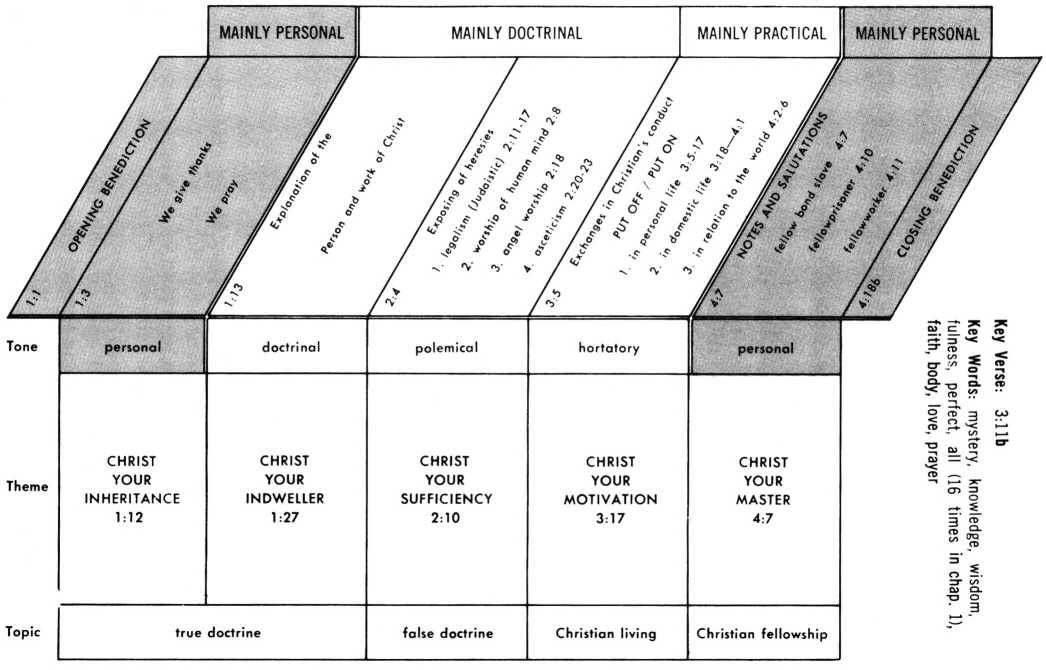
CHRIST IS ALL IN ALL
Click chart to enlarge
Charts from Jensen's Survey of the NT - used by permission
Colossians Overview - Click Chart on right side
| Christ Preeminent in All Things Supreme Lord - Sufficient Savior |
|||
| Colossians 1 | Colossians 2 | Colossians 3 | Colossians 4 |
| Supremacy of Christ |
Submission to Christ |
||
| Doctrinal and Corrective |
Practical and Reassuring |
||
| What Christ Did For Us |
What Christ Does Through Us |
||
| Christ Our Lord |
Christ Our Life |
Christ our Love |
|
| Christ the Head of the Body |
Christ the Lord of the Universe |
Christ the Head of the Home |
|
| Instruction | Warnings | Exhortations | Reminders |
| Reconciliation | Creation | Submission | Conversation |
| His Person and Word |
His Peace and Presence |
||
Colossians 2:14 having canceled out the certificate of debt consisting of decrees against us, which was hostile to us; and He has taken it out of the way, having nailed it to the cross. (NASB: Lockman)
Greek: exaleipsas (AAPMSN) to kath hemon cheirographon tois dogmasin o en (3SIAI) hupenantion hemin, kai auto erken (3SRAI) ek tou mesou proselosas (AAPMSN) auto to stauro
Amplified: Having cancelled and blotted out and wiped away the handwriting of the note (bond) with its legal decrees and demands which was in force and stood against us (hostile to us). This [note with its regulations, decrees, and demands] He set aside and cleared completely out of our way by nailing it to [His] cross. (Amplified Bible - Lockman)
Barclay: and wiped out the charge-list which set out all your self-admitted debts, a charge-list which was based on the ordinances of the law and was in direct opposition to you. He nailed it to his Cross and put it right out of sight. (Westminster Press)
Lightfoot: then and there canceling the bond which stood valid against us (for it bore our own signature), the bond which engaged us to fulfill all the law of ordinances, which was our stern pitiless tyrant. Yes, this very bond Christ has put out of sight forever, nailing it to his cross and rending it with his body and killing it in his death.
Net: He has destroyed what was against us, a certificate of indebtedness expressed in decrees opposed to us. He has taken it away by nailing it to the cross. (NET Bible)
NIV: having canceled the written code, with its regulations, that was against us and that stood opposed to us; he took it away, nailing it to the cross. (NIV - IBS)
NRS: erasing the record that stood against us with its legal demands. He set this aside, nailing it to the cross.
Phillips: Christ has utterly wiped out the damning evidence of broken laws and commandments which always hung over our heads, and has completely annulled it by nailing it over his own head on the cross. (Phillips: Touchstone)
Weymouth: The bond, with its requirements, which was in force against us and was hostile to us, He cancelled, and cleared it out of the way, nailing it to His Cross.
Wuest: having obliterated the hand-written document consisting of ordinances, the one [which was] against us, which was directly opposed to us, and He removed it out of the midst with the result that it is no longer there, having nailed it to the Cross;
Young's Literal: having blotted out the handwriting in the ordinances that is against us, that was contrary to us, and he hath taken it out of the way, having nailed it to the cross;
HAVING CANCELED OUT THE CERTIFICATE OF DEBT: exaleipsas (AAPMSN) to kath hemon cheirographon
Having cancelled and blotted out and wiped away (Amplified)
He did this by erasing the charges (GWT)
He has destroyed what was against us (NET)
He canceled the record that contained the charges against us (NLT)
- Col 2:20; Esther 3:12; 8:8; Lk 1:6; Eph 2:14, 15, 16; Heb 7:18; 8:13; 9:9,10; 10:8,9
- Colossians 2 Resources - Multiple Sermons and Commentaries
- Colossians 2:8-23 The Sufficiency of Christ - John MacArthur
- Colossians 2:8-23 The Sufficiency of Christ Alone - John MacArthur
- Colossians 2:10-15: Complete in Christ - John MacArthur
JESUS PAID
IT ALL
Having canceled out (exaleipho) the certificate of debt - The aorist tense pictures a past completed action - the blotting out has been accomplished by Christ on the Cross. Paul's use in this context pictures God blotting out and totally erasing our certificate of debt (our sin debt).
To understand the word exaleipho is to understand the amazing mercy and lovingkindness of God. The substance on which ancient documents were written was either papyrus, a kind of paper made of the pith of the bulrush, or vellum, a substance made of the skins of animals. Both were fairly expensive and certainly could not be wasted. Ancient ink had no acid in it; it lay on the surface of the paper and did not, as modern ink usually does, bite into it. Sometimes a scribe, to save paper, used papyrus or vellum that had already been written upon. When he did that, he took a sponge and wiped off the writing. Because it was only on the surface of the paper, the ink could be wiped out as if it had never been! God, in his amazing mercy, banished the record of our sins so completely that it was as if it had never been; not a trace remained. Hallelujah!
So when God cancelled out our debt it was accomplished completely and we need to receive and understand this profound truth so that the enemy does not "hound" us with "old sins" that God has completely blotted out! Are you having trouble accepting the forgiveness of God over some sin you have committed? Paul says that it is wiped completely off the slate so forget what lies behind and press on to what lies ahead.
Regarding the vivid imagery of canceled out or blotted out compare these cross references (Ps 109:14 - see Spurgeon's Note, Neh 4:5, Jer 18:23) and those below…
Acts 3:19 Therefore repent (aorist imperative = Do this now. Don't delay!) and return (aorist imperative = Do this now. Don't delay!), so that your sins may be wiped away, in order that times of refreshing may come from the presence of the Lord
Numbers 5:23 ‘The priest shall then write these curses on a scroll, and he shall wash them off into the water of bitterness.
Isaiah 43:25 I, even I, am the one who wipes out your transgressions for My own sake, and I will not remember your sins.
Isaiah 44:22 I have wiped out your (speaking to faithless Israel) transgressions like a thick cloud and your sins like a heavy mist. Return to Me, for I have redeemed you.
Comment: Ed Young writes that "The clouds intervene between heaven and earth as sin and transgressions intervene between God and His people."
King David understood his great need (after his adultery with Bathsheba and killing of her husband Uriah) and God's great grace and mercy writing…
Psalm 51:1 For the choir director. A Psalm of David, when Nathan the prophet came to him, after he had gone in to Bathsheba. Be gracious to me, O God, according to Your lovingkindness (mercy) according to the greatness of Your compassion blot out my transgressions. - see note below
Psalm 51:9 Hide Your face from my sins and blot out all my iniquities. - see Spurgeon's Note
Spurgeon's Note on Psalm 51:1 - What a choice word is that of our English version, a rare compound of precious things: love and kindness sweetly blended in one -- "lovingkindness." According unto the multitude of thy tender mercies. Let thy most loving compassions come to me, and make thou thy pardons such as these would suggest. Reveal all thy gentlest attributes in my case, not only in their essence but in their abundance. Numberless have been thine acts of goodness, and vast is thy grace; let me be the object of thine infinite mercy, and repeat it all in me. Make my one case an epitome of all thy tender mercies. By every deed of grace to others I feel encouraged, and I pray thee let me add another and a yet greater one, in my own person, to the long list of thy compassions.
Blot out my transgressions. My revolts, my excesses, are all recorded against me; but, Lord, erase the lines. Draw thy pen through the register. Obliterate the record, though now it seems engraven in the rock for ever; many strokes of thy mercy may be needed, to cut out the deep inscription, but then thou has a multitude of mercies, and therefore, I beseech thee, erase my sins. (Ed: A good practice for all of us to emulate!)
Spurgeon commenting on Col 2:14 writes that "All the Mosaic ceremonials, from which you were shut out as Gentiles, are abolished. Christ has driven a nail through them and fastened them up to his cross.” As, sometimes, a banker stamps through a cheque when it is paid, so has Christ but through the very heart of all Jewish ordinances by what he has done for his people."
Wendell Kent writes that "The verse of Scripture quoted above is one of those verses which does not yield its value by a surface investigation, but upon greater effort it reveals a wealth of meaning. One writer has called this verse “perhaps the most obscure verse in the New Testament.” (Beet) Another says, “In This difficult verse the meaning of almost every word is disputed.” (A S Peake - Expositor's Greek Testament) With this to caution us against a hasty conclusion as to its meaning, let us seek to discover the truth which the apostle Paul was endeavoring to present in this verse (Colossians 2:15 The Spoiling of Principalities and Powers: A Critical Monograph Grace Journal Volume: GJ 03:1 Winter 1962)
Jesus completely obliterated and wiped out our "certificate of debt consisting of decrees against us". When someone had a debt in ancient times and it was paid off, they would write "Tetelestai" on the certificate of debt. Tetelestai meant PAID IN FULL and is the same word Jesus uttered ("It is finished") just before He died (Jn 19:30). When the Jews nailed Jesus to the cross they drove the nails into their own law. The old covenant was made obsolete by the blood of the new covenant.
Related Resource:
Barnes comments that "The meaning here is, that the burdensome requirements of the Mosaic law are abolished, and that its necessity is superseded by the death of Christ. His death had the same effect, in reference to those ordinances, as if they had been blotted from the statute-book. This it did by fulfilling them, by introducing a more perfect system, and by rendering their observance no longer necessary, since all that they were designed to typify had been now accomplished in a better way.
Eadie writes that exaleipho "signifies to smear or plaster over and then it is used to denote the act by which a law or deed of obligation is cancelled… the word… means here to expunge. That to which the process of obliteration is applied is appropriately termed a handwriting (cheirographon), a note of hand, a written bond (which)… signifies a claim of unpaid debt (and)… is also one of punishment for it was "against us." (Colossians 2)
Having canceled out (1813) (exaleipho from ek = out, intensive [adds sense of "completely" - see also Vincent's note below] + aleipho = wipe, cover over, besmear) means literally to completely wipe off. Literally exaleipho means to remove by wiping off, as when a blackboard is erased. The word was applied to the process of obliterating writing on any material. Some of the uses in Scripture retain this literal meaning but most uses speak of a figurative blotting out or wiping off. The idea in all the uses is to cause something to cease by obliterating or eliminating any evidence. Twice in the Revelation God promises He will wipe away every tear. A number of uses in both OT (Septuagint) and the NT use this verb to describe the blotting out or wiping away of sins. Exaleipho was used by Thucydides of whitewashing a wall.
Exaleipho - Used 5x in the NT - Acts 3:19; Col 2:14; Rev 3:5; 7:17; 21:4
Vincent adds that "The preposition (ek) also carries the sense of removal; hence to smear out; to wipe away.
There are only 5 uses of exaleipho in the NT…
Acts 3:19 (Peter to the Jewish audience that has just heard his sermon on the Messiah) "Repent therefore and return, that your sins may be wiped away, in order that times of refreshing may come from the presence of the Lord."
Colossians 2:14 (note) having canceled out the certificate of debt consisting of decrees against us and which was hostile to us; and He has taken it out of the way, having nailed it to the cross.
Revelation 3:5 (note) 'He who overcomes shall thus be clothed in white garments; and I will not erase his name from the book of life, and I will confess his name before My Father, and before His angels.
Revelation 7:17 (note) for the Lamb in the center of the throne shall be their shepherd, and shall guide them to springs of the water of life; and God shall wipe every tear from their eyes."
Revelation 21:4 (note) and He shall wipe away every tear from their eyes; and there shall no longer be any death; there shall no longer be any mourning, or crying, or pain; the first things have passed away."
There are 34 uses of exaleipho in the Septuagint (LXX) (Gen. 7:4, 23; 9:15; Exod. 17:14; 32:32f; Lev. 14:42f, 48; Num. 5:23; 27:4; Deut. 9:14; 25:6, 19; 29:20; Jdg. 15:16; 21:17; 2 Ki. 14:27; 1 Chr. 29:4; Neh. 13:14; Ps. 9:5; 51:1, 9; 69:28; 109:13, 14; Pr 6:33; Isa. 43:25; Je 18:23; Ezek 9:8; 20:17; 22:30; 25:15; Hos. 11:9) Study the uses in the Septuagint for insight into the meaning of exaleipho…
Genesis 7:4 (Moses records God promise) For after seven more days, I will send rain on the earth forty days and forty nights; and I will blot out from the face of the land every living thing that I have made.
Genesis 9:15 and I will remember My covenant, which is between Me and you (Noah) and every living creature of all flesh; and never again shall the water become a flood to destroy (LXX = exaleipho = blot out) all flesh.
Exodus 17:14 Then the LORD said to Moses, "Write this in a book as a memorial, and recite it to Joshua, that I will utterly blot out (LXX = exaleipho) the memory of Amalek from under heaven."
Exodus 32:32 "But now, if Thou wilt, forgive their sin-- and if not, please blot me out (LXX = exaleipho) from Thy book which Thou hast written!" 33 And the LORD said to Moses, "Whoever has sinned against Me, I will blot him out (LXX = exaleipho) of My book.
Leviticus 14:42 "Then they shall take other stones and replace those stones; and he shall take other plaster and replaster (Hebrew = tuach = to overspread, overlay, coat, besmear; LXX = exaleipho) the house.
Numbers 5:23 'The priest shall then write these curses on a scroll, and he shall wash them off (Hebrew = machah = to wipe, wipe out; LXX = exaleipho) into the water of bitterness.
Deuteronomy 9:14 'Let Me alone, that I may destroy them and blot out their name from under heaven; and I will make of you a nation mightier and greater than they.'
Judges 21:17 And they said, "There must be an inheritance for the survivors of Benjamin, that a tribe may not be blotted out (Hebrew = machah = to wipe, wipe out; LXX = exaleipho) from Israel.
Psalm 51:1 (After his sin with Bathsheba David prayed ) Be gracious to me, O God, according to Thy lovingkindness. According to the greatness of Thy compassion blot out (LXX =exaleipho) my transgressions. (Spurgeon's writes - "My revolts, my excesses, are all recorded against me; but, Lord, erase the lines. Draw thy pen through the register. Obliterate the record, though now it seems engraven in the rock for ever; many strokes of thy mercy may be needed, to cut out the deep inscription, but then thou has a multitude of mercies, and therefore, I beseech thee, erase my sins.")
Psalm 51:9 Hide Thy face from my sins, and blot out all my iniquities. (Spurgeon's note)
Psalm 69:28 May they be blotted out of the book of life, And may they not be recorded with the righteous. (Spurgeon's note)
Isaiah 43:25 (God declares) "I, even I, am the One Who wipes out (LXX =exaleipho) your transgressions for My own sake, and I will not remember your sins."
OUR PROMISSORY
NOTE
Webster says a "bond" is an an interest-bearing certificate of public or private indebtedness.
Certificate of debt (5498) (cheirographon from cheir = hand + grapho = write) is literally handwriting or a handwritten document and then a written record of a debt such as a promissory note. A document is written in one's own hand as a proof of obligation, e.g., a note of indebtedness. The word means primarily a bond written by a person pledging himself to make certain payments.
Friberg writes that figuratively in the only NT use in Colossians 2:14 cheirographon refers not to
the law itself, but to the record of charges (for breaking God's law), which stood against us and which God symbolically removed by "nailing it to the cross," handwritten account, record of debts (Friberg, T., Friberg, B., & Miller, N. F. Analytical Lexicon of the Greek New Testament. Baker Academic)
Thayer writes that cheirographon means "specifically, a note of hand, or writing in which one acknowledges that money has either been deposited with him or lent to him by another, to he returned at an appointed time."
TDNT writes that in Colossians 2:14 cheirographon means "a “promissory note.” God cancels the bond that lies to our charge. This bond is not a compact with the devil, as in some patristic exegesis. It is the debt that we have incurred with God. The forgiveness of sins (Col 2:13) through identification with Christ in his vicarious death and resurrection means that this note is cancelled; God has set it aside and nailed it to the cross. (Kittel, G., Friedrich, G., & Bromiley, G. W. Theological Dictionary of the New Testament. Eerdmans)
For example, in Philemon we find an "IOU" Paul writing
I, Paul, am writing this with my own hand, I will repay it (not to mention to you that you owe to me even your own self as well). (Philemon 1:19)
The idea is that of list of our crimes or moral debt before God, a debt no imperfect person can completely pay. But it can be taken out of the way, by payment from a perfect man, Jesus Christ.
Cheirographon then described a note or bond written by hand thus obligating the writer to fulfill the debt that is written out. In other words it is analogous to an "IOU" signed by hand and obligating the signer to repay the debt. Paul's idea seems to be that the sins of mankind had piled up a list of "I.O.U.'s" so large that they could never be repaid. Paul uses cheirographon not as the law itself, but as the record of charges for breaking God's law and which therefore stood against us.
When a criminal was crucified, the charges against him were written down and nailed to his cross. In this case, the charges against Christ encompassed the whole Law of God because Christ was dying for all the sins of all the world (Gal 3:10,13). In the OT, when presented with God's Law, the Jews had agreed to obey (e.g., Ex 19:8, 24:3,24:7). In the New Testament we find the Gentiles while not the written Law, did have the unwritten law in their hearts and the voice of conscience speaking within (Ro 2:14, 15). Men were in debt to God because of their sins and they knew it. There was a self-confessed indictment against them, a charge-list which, as it were, they themselves had signed and admitted as accurate. The debt was impossible to pay, but God dealt with it; he had blotted it out and cancelled the bond by nailing it to the cross. This is a vivid way of saying that because Christ was nailed to the cross, our debt has been completely forgiven.
Barnes adds that Paul's "allusion is probably to a written contract, in which we bind ourselves to do any work, or to make a payment, and which remains in force against us until the bond is cancelled. That might be done, either by blotting out the names, or by drawing lines through it, or, as appears to have been practiced in the East, by driving a nail through it.
Martin Luther told once how Satan laid heavy condemnation on him because of his sins. Luther told Satan to list them all, and even reminded him of some he had forgotten. Then he told Satan to write across the whole list "paid in full by the blood of Jesus Christ," and Luther rejoiced in the payment Jesus made. We all need an attitude like that of Luther and must keep the list on the cross. Saints get into trouble when they take the list down from the cross and carry it around, forgetting that it was all settled on the almighty cross.
Here Paul describes the "certificate of debt" that was filed against us in the "courtroom of heaven". In other words, because of our sin and rebellion, the laws of God had become a "deadly witness" against us and we were in such deep debt to God that there was no way out.
We owed a debt we could never repay.
He paid a debt He did not owe!
Alas! And Did My Savior Bleed?
by Isaac Watts
But drops of grief can ne'er repay
The debt of love I owe:
Here, Lord, I give myself away,
'Tis all that I can do!
CONSISTING OF DECREES AGAINST US AND WHICH WAS HOSTILE TO US: kath hemon… tois dogmasin o en (3SIAI) hupenantion hemin:
this note with its legal decrees and demands which was in force and stood against us (hostile to us) (Amp)
God wiped out the charges that were against us for disobeying the Law of Moses (CEV)
- Colossians 2 Resources - Multiple Sermons and Commentaries
- Colossians 2:8-23 The Sufficiency of Christ - John MacArthur
- Colossians 2:8-23 The Sufficiency of Christ Alone - John MacArthur
- Colossians 2:10-15: Complete in Christ - John MacArthur
THE LEGAL CHARGES
AGAINST US
Consisting of decrees against us and which was hostile to us - The "certificate of debt" signifies a claim of unpaid debt but "against us" indicates that it therefore signifies a debt warranting punishment. The decrees that were against us are in a sense personified - they have a hostile attitude, even a deep and active antagonism.
Maclaren adds that the "Law is against us, because it comes like a taskmaster, bidding us do, but neither putting the inclination into our hearts nor the power into our hands. And law is against us, because the revelation of unfulfilled duty is the accusation of the defaulter, and a revelation to him of his guilt. And law is against us, because it comes with threatenings and foretastes of penalty and pain. Thus, as standard, accuser, and avenger it is against us."
A picture of the hostile character or "active hostility" of is seen in Romans where "the Law brings about wrath (orge), but where there is no law, neither is there violation." (Ro 4:15). The word for wrath is orge which comes from the idea of a swelling which eventually bursts, and applies more to an anger that proceeds from one’s settled nature. Orge is a settled hostility against sinners, not a petulant, irrational burst of anger, such as humans often exhibit, but a holy, just revulsion against what is contrary to and opposes his holy nature and will. Earlier Paul described the truth that the Colossian saints "were formerly alienated and hostile in mind, engaged in evil deeds." So in effect God did a double cleansing on sinner's hostility toward Him and His hostility toward them.
Decrees (1378) (dogma from dokeo = to think, to seem) refers to a formal statement concerning rules or regulations that are to be observed. Public decrees, binding rules, ordinances, legal demands, obligations, regulations. This Greek word can refer to a formalized rule (or set of rules) prescribing what people must observe. Dogma has the sense of a fixed and authoritative decision or requirement (as in Acts 16:4).
There is another sense of dogma which is not used in the NT and that is to refer to something taught as an established tenet or statement of belief (ie, dogma).
A decree in English is an order usually having the force of law. In the civil law, a decree is a determination or judgment of the emperor on a suit between parties. In general terms, the English meaning of decree is that of an order, edict or law made by a superior as a rule to govern inferiors. T
Dogma refers to a binding law or edict which was placed on a public place for all to see and this is the meaning in this use in Colossians. The decrees of the Law not only convicted us and condemned us but also demanded that we be punished. Thus the Law stood against us and was hostile to us. This law is conceived here as a bond, a bill of debt, standing against those who have not received Christ. As the form of error at Colossae was largely Judaic, insisting on the Jewish ceremonial law, the phrase is probably colored by this fact. Cp [Eph 2:15].
Dogma - is used 5 times in the NT…
Luke 2:1 Now it came about in those days that a decree went out from Caesar Augustus, that a census be taken of all the inhabited earth.
Acts 16:4 Now while they were passing through the cities, they were delivering the decrees, which had been decided upon by the apostles and elders who were in Jerusalem, for them to observe.
Acts 17:7 and Jason has welcomed them, and they all act contrary to the decrees of Caesar, saying that there is another king, Jesus."
Ephesians 2:15 by abolishing in His flesh the enmity, which is the Law of commandments contained in ordinances, that in Himself He might make the two into one new man, thus establishing peace,
Colossians 2:14 having canceled out the certificate of debt consisting of decrees against us and which was hostile to us; and He has taken it out of the way, having nailed it to the cross.
Hostile (5227) (hupenantios from hupó = intensifies meaning + enantios = opposite to, contrary, used by Matthew to describe the wind as contrary, Mt 14:24) literally means set over against or opposite as an enemy or adversary in battle. In the only other NT use, the writer of Hebrews uses this word to describe God's adversaries "but a certain terrifying expectation of judgment, and the fury of a fire which will consume the adversaries. (Heb 10:27)
There are 24 uses of hupenantios in the Septuagint (LXX) A majority of Septuagint uses are translated as enemy or enemies. Ge 22:17; 24:60; Exod. 1:10; 15:7; 23:27; 32:25; Lev. 26:16; Num. 10:9; Deut. 32:27; Jos. 5:13; 2 Chr. 1:11; 20:29; 26:13; Est. 8:13; Job 13:24; 33:10; Ps. 74:10; Isa. 1:24; 26:11; 59:18; 63:18; 64:2; Lam. 2:4; Nah 1:2
Genesis 22:17 indeed I will greatly bless you, and I will greatly multiply your seed as the stars of the heavens, and as the sand which is on the seashore; and your seed shall possess the gate of their enemies (Hebrew = ayab = to be hostile, to be an enemy; LXX = hupenantios).
Vine adds that hupenantios means “contrary, opposed,” is a strengthened form of enantios (en = in + antios = set against). The intensive force is due to the preposition hupo. It is translated “contrary to,” in Col 2:14, of ordinances; in Heb 10:27, “adversaries.” In each place a more violent form of opposition is suggested than in the case of enantios (Vine's Expository Dictionary of Old Testament and New Testament Words)
Moulton and Milligan write that "The strong sense which Lightfoot gives to this word in Col 2:14 (translating it as) “which was directly opposed to us,” may be illustrated from an early second century Will, P Oxy III. 49310, where it is enacted that no one shall be permitted to set aside any of the provisions, or do anything opposed to them
David Jeremiah - THE DECREE COLOSSIANS 2:14
There are two decrees in the Book of Esther: the decree of death and the decree of life.
One of the things we learn in studying the Bible is that God has a way to save sinners. You can’t go to heaven by your own good works. You can’t ever be good enough to go to heaven.
The Bible says, “You must be born again.” The reason you must be born again is because a decree has been written that the wages of sin is death. The decree has been written that no one can go to heaven with his sin.
God will not overturn that decree. We violate God the day we are born because of our own sin that we inherited. But the good news is that, just as the decree in Persia was overruled by another decree, God has given us another decree. That decree is that if we believe on the Lord Jesus Christ, we will be saved. (Sanctuary: Finding Moments of Refuge in the Presence of God)
HE HAS TAKEN THEM OUT OF THE WAY HAVING NAILED IT TO THE CROSS: kai auto erken (3SRAI) ek tou mesou proselosas (AAPMSN) auto to stauro:
- Colossians 2 Resources - Multiple Sermons and Commentaries
- Colossians 2:8-23 The Sufficiency of Christ - John MacArthur
- Colossians 2:8-23 The Sufficiency of Christ Alone - John MacArthur
- Colossians 2:10-15: Complete in Christ - John MacArthur
OUR "I.O.U." WAS
NAILED TO THE CROSS
He has taken (airo) them out of the way having nailed (proseloo) it to the cross - Has taken them out is perfect tense which speaks of a completed action in the past with present effects. You may ask so why is that important? Good question. The perfect tense signifies that Jesus' once for all death on the cross in the past has produced a permanent, eternally efficacious effect, specifically in regard to the removal of the debt that once was against us. The debt is permanently removed and cannot be presented against us again! This truth also helps one understand how it is that he is "complete in Christ" and protects one from persuasive arguments and empty philosophy. Eadie adds that "He took them out of the way and they still remain out of the way… He not only blotted out the writing upon it, but He has taken out of the way the parchment itself.(Colossians 2)
John uses (airo) with a similar meaning in in his first epistle writing in description of Jesus, writing "The next day he saw Jesus coming to him and said, "Behold, the Lamb of God who takes away the sin of the world!" (Jn 1:29) In his epistle John wrote "And you know that He appeared in order to take away sins; and in Him there is no sin." (1Jn 3:5)
Out of the way is more literally out of their midst and conveys the picture that God wholly removed the certificate of debt. Parallel Old Testament pictures include the declaration that God "hast cast all my sins behind Thy back" (Isa 38:17).
In Isaiah 44:22 God Himself declares "I have wiped out your transgressions like a thick cloud, and your sins like a heavy mist. Return to Me, for I have redeemed you."
Micah records this beautiful description of our gracious and compassionate God rhetorically asking "Who is a God like Thee, who pardons iniquity and passes over the rebellious act of the remnant of His possession? He does not retain His anger forever, because He delights in unchanging love. He will again have compassion on us. He will tread our iniquities under foot. Yes, Thou wilt cast all their sins Into the depths of the sea. (Micah 7:18, 19)
Nailed (4338) (proseloo from prós = to + helos = nail, peg, stud) means to affix with nails or spikes and describes the manner in which Christ removed the "I.O.U." (handwriting) against us. God nailed the Mosaic Law with all its decrees to the Cross of Christ when Christ was nailed to the Cross taking upon Himself the curse of the Law. The law with its decrees was abolished in Christ’s death, as if crucified with Him. It was no longer in the midst, in the foreground, as a debtor’s obligation is perpetually before him, embarrassing his whole life.
Vine comments on "nailed" that "the idea in the metaphor of the nailing is not that of the cancellation of the bond, to which the taking out of the way was subsequent, but of nailing up the removed thing in triumph to the Cross. The death of Christ not only rendered the Law useless as a means of salvation, but gave public demonstration that it was so. (Vine's Expository Dictionary of Old Testament and New Testament Words)
Barnes notes that "It is said that there is an allusion here to the ancient method by which a bond or obligation was cancelled, by driving a nail through it, and affixing it to a post. This was practiced, says Grotius, in Asia. In a somewhat similar manner, in our banks now, a sharp instrument like the blade of a knife is driven through a check, making a hole through it, and furnishing to the teller of the bank a sign or evidence that it has been paid. If this be the meaning, then the expression here denotes that the obligation of the Jewish institutions ceased on the death of Jesus, as if he had taken them and nailed them to his own cross, in the manner in which a bond was cancelled.
Another source however records that "It used to be said that in the ancient world when a law or an ordinance was cancelled, it was fastened to a board and a nail was driven clean through it. But it is doubtful if that was the case and if that is the picture here. Rather it is this-on the Cross of Christ the indictment that was against us was itself crucified. It was executed and put clean out of the way, so that it might never be seen again. Paul seems to have searched human activity to find a series of pictures which would show how completely God in his mercy destroyed the condemnation that was against us.
Eadie also gives a view somewhat different than Barnes (above) writing that "The allusion is not to the tablet nailed to the cross above the sufferer… but to the crucifixion of the Redeemer Himself. There seems to be no historical ground for the illustration of Grotius, that it was customary to thrust a nail through papers—declaring them old and obsolete, much in the same way as a Bank of England note is punched through the centre when declared to be no longer of value, and no longer to be put into circulation. The idea of the apostle is, that when Christ was nailed to the cross, the condemning power of the law was nailed along with Him, and died with Him— “Now we are delivered from the law, that being dead in which we were held.” Ro 7:6. In other words, God exempts sinners from the sentence which they merit, through the sufferings and death of Jesus. The implied doctrine is, that the guilt of men was borne by Christ when He died—was laid on Him by that God who by this method took the handwriting out of the way. Jesus bore the sentence of the handwriting in Himself, and God now remits its penalty; having forgiven you all your trespasses, inasmuch as He has blotted out the hostile handwriting and taken it out of the way, for He nailed it to the cross of His Son. (Colossians 2)
Cross (4716) (stauros from hístemi = to stand) was an instrument of capital punishment comprised of an upright pointed stake often with a crossbeam above it or intersected by a crossbeam. Paul had earlier taught on the efficacy of Christ crucified on the Cross writing that "through Him to reconcile all things to Himself, having made peace through the blood of His cross; through Him, I say, whether things on earth or things in heaven. (Col 1:20)
Paul reminds us of the centrality of the Cross writing that "Christ did not send me to baptize, but to preach the gospel, not in cleverness of speech, that the cross of Christ should not be made void. For the word of the cross is to those who are perishing foolishness, but to us who are being saved it is the power of God. (1Cor 1:17-18)
And to the Galatians Paul wrote "may it never be that I should boast, except in the cross of our Lord Jesus Christ, through which the world has been crucified to me, and I to the world." (Galatians 6:14)
REAL CHANGE - J. Vernon McGee told of a man who came to him and said, “I’ll give you $100 if you will show me where the Sabbath day has been changed.” McGee answered, “I don’t think it has been changed. Saturday is Saturday, it is the seventh day of the week, and it is the Sabbath day. I realize our calendar has been adjusted, and can be off a few days, but we won’t even consider that point. The seventh day is still Saturday, and it is still the Sabbath day.”
He got a gleam in his eye and said, “Then why don’t you keep the Sabbath day if it hasn’t been changed?” McGee answered, “the DAY hasn’t changed, but I have been changed. I’ve been given a new nature now, I am joined to Christ; I am a part of the new creation. We celebrate the first day because that is the day He rose from the grave.” That is what it means that the ordinances have been nailed to the cross, Col. 2:14.
Harry Ironside - Why Jesus Was Crucified - Pilate wrote out the inscription to be placed over the head of Christ Jesus, and that in three languages, Hebrew, Greek, and Latin, that all might know why the patient Sufferer from Galilee was being publicly executed. "This is Jesus of Nazareth the King of the Jews." As the people read this they understood that he was being crucified because He made Himself a king and was thus disloyal to Caesar.
But as God looked upon that cross His holy eye saw, as it were, another inscription altogether. Nailed upon the rood above the head of His blessed Son was the handwriting of ten ordinances given at Sinai. It was because this law had been broken in every point that Jesus poured out His blood, thus giving His life to redeem us from the curse of the law. And so all of our sins have been settled for. There the law, which we had so dishonored, has been magnified to the full in the satisfaction which He made to the divine justice. Thus Christ has become the end of the law to every one that believeth. It is of course the Jewish believers Paul has in mind when he says "us," for Gentiles were not under the law. But it is true now in principle for us all, to whom the knowledge of the law has come. Christ has, by His death, met every claim against us and cancelled the bond we could not pay.
Our Daily Bread - More than four hundred years before Jesus' birth, the Greek poet Agathon said, "Even God cannot change the past." Historically speaking, he was right. What happens cannot be undone. Yet when God sent His Son to die on the cross, He provided a way to erase our sinful past.
Here is how Donald Grey Barnhouse described what Jesus did for us
Just as a hole in the ocean floor would let sea water into the volcanic fires, creating force that could blow the world apart, so the Lord Jesus Christ by dying and rising again broke through the past and allowed eternity to pour in, shattering, turning and overturning, changing, and altering all things. He took the past of all believers and cleansed it by His blood and transformed the life in such a way that the time-rooted life gave way to life eternal.
The poet said, "I wish there were a land of beginning again." There is. "The blood of Jesus Christ His Son cleanses us from all sin" (1 John 1:7). And the hymn writer said, "Calvary covers it all, my past with its sin and stain; my guilt and despair Jesus took on Him there, and Calvary covers it all."
This is the wonder of the gospel. For those who have accepted Christ's offer of forgiveness, He "wiped out the handwriting of requirements that was against us, … having nailed it to the cross" (Col. 2:14). God has completely cleansed our sin-stained past. —P. R. Van Gorder (Our Daily Bread, Copyright RBC Ministries, Grand Rapids, MI. Reprinted by permission. All rights reserved)
Salvation can change the worst sinners into the most honored saints.
Paid in Full - The newspaper article reported that a Utah businessman had filed for bankruptcy and declared his debts to be $613 billion. It seemed ridiculous! What's more, the man claimed assets of only $7,310. In other words, if all debts were honored, his creditors would receive about one-millionth of a cent on the dollar. There was no way he could begin to pay his debts.
Sometimes I feel that's how I stand with God. Why should I even try to pay the debt of love that I owe Him? The situation seems hopeless. When I consider His demand of perfect righteousness, I feel totally bankrupt and helpless.
But then I remember that my debt has been taken care of. Jesus the Son of God shed His precious blood to pay the infinite price for my countless sins. Now I'm free to pursue a relationship with God that is motivated by gratitude and energized by the power of the Holy Spirit.
This is what Colossians 2 is all about. The law of God has declared us spiritually bankrupt. But our great debt has been completely removed. It has been paid in full by Jesus Christ on the cross of Calvary. We are free. The only thing we owe now is an eternal debt of thanks and praise to our wonderful Lord. — Mart De Haan (Our Daily Bread, Copyright RBC Ministries, Grand Rapids, MI. Reprinted by permission. All rights reserved)
But drops of grief can ne'er repay
The debt of love I owe:
Here, Lord, I give myself away,
'Tis all that I can do! --Watts
Our salvation is free
because Christ paid an enormous price.
Octavius Winslow - Blotting out the handwriting of ordinances that was against us, which was contrary to us, and took it out of the way, nailing it to his cross; - Colossians 2:14
The atonement of the blessed Redeemer was a full and entire blotting out of the sins of the believer. Need we say anything upon the vast importance of this truth? Need we say how closely it stands connected with the peace, the sanctification, and the eternal glory of the sinner that builds on Christ? The phraseology which the Holy Spirit employs in announcing the doctrine of Divine forgiveness confirms the statement we have made-"I have blotted out, as a thick cloud, your transgressions, and, as a cloud, your sins: return unto me, for I have redeemed you." Where would be the constraining-power of the motive to "return to God," but on the ground of a full and entire blotting out of all sin? This it is that subdues, overcomes, and wins back God's wandering child. This it is that abases the soul, deepens the conviction of its vileness, makes the sin of departure, of ingratitude, of rebellion, so abhorred, when, on the broad basis of a full and free blotting out of sin, God bids the soul "return"-"I have blotted out all your sins, therefore return. Though you have gone after other lovers-though you have departed from me, forgotten, and forsaken me, yet have I blotted out, as a thick cloud, your transgressions: return, for I have redeemed you." Again, "In those days, and in that time, says the Lord, the iniquity of Israel shall be sought for, and there shall be none; and the sins of Judah, and they shall not be found." "He will turn again, He will have compassion upon us; He will subdue our iniquities; and You will cast all their sins into the depths of the sea." What an astounding truth is contained in these two passages! In the one it is declared, that if the iniquity of Israel, and the sin of Judah, be sought for, they shall not be found. So entire was the blotting out, so glorious was the work of Jesus, so perfect His obedience, that if the eye of God's holy law searches-and where can it not penetrate?-it cannot discover them. In the other, it is declared, that, so fathomless are the depths of that sea of atoning blood, which Christ has poured out, that in it are cast, never to be found again, all the sins of the believer. So that the trembling soul may exclaim, "You have, in love to my soul, delivered it from the pit of corruption; for You have cast all my sins behind Your back."
Look up, you saints of God, who are disconsolate through fear of condemnation. See all your sins charged to the account of your mighty Surety. Yes, see them all laid upon Him as your substitute. See Him bearing them away-sinking them in the ocean of His blood-casting them behind His back. Look up and rejoice! Let not the indwelling of sin, the remains of corruption, cause you to overlook this amazing truth-the entire blotting out of all your sins, through the atoning blood of your adorable Immanuel. It is truth, and it is your privilege to live in the holy enjoyment of it. Fully received into the heart by the teaching of the Holy Spirit, its tendency will be of the most holy, sanctifying, abasing character. It will weaken the power of sin-it will draw up the heart in pantings for Divine conformity-it will deaden the influence of the objects of sense-expel the love of the world and of self-impart tenderness to the conscience, and cause the soul to go softly-"walking worthy of the Lord, unto all pleasing, being fruitful in every good work, and increasing in the knowledge of God."
Colossians 2:15 When He had disarmed (AMP) the rulers and authorities,He made a public display (3SAAI) of them having triumphed over (AAP) them through Him (NASB: Lockman)
Greek: apekdusamenos (AMPMSN) tas archas kai tas exousias edeigmatisen (3SAAI) en parrhesia|, thriambeusas (AAPMSN) autous en auto.
Amplified: [God] disarmed the principalities and powers that were ranged against us and made a bold display and public example of them, in triumphing over them in Him and in it [the cross]. (Amplified Bible - Lockman)
Barclay: He stripped the powers and authorities of all their power and publicly put them to shame, and, through the Cross, led them captive in his triumphal train. (Westminster Press)
GWT: He stripped the rulers and authorities of their power and made a public spectacle of them as he celebrated his victory in Christ. (GWT)
Lightfoot: Taking on him our human nature, he stripped off and cast aside all the powers of evil which clung to it like a poisonous garment. As a mighty conqueror he displayed these his fallen enemies to an astonished world, leading them in triumph on his cross.
NET: Disarming the rulers and authorities, he has made a public disgrace of them, triumphing over them by the cross (NET Bible)
Phillips: And then having drawn the sting of all the powers ranged against us, he exposed them, shattered, empty and defeated, in his final glorious triumphant act! (Phillips: Touchstone)
Weymouth: And the hostile princes and rulers He shook off from Himself, and boldly displayed them as His conquests, when by the Cross He triumphed over them.
Wuest: having stripped off and away from himself the principalities and authorities, He boldly made an example of them, leading them in a triumphal procession in it.
Young's Literal: having stripped the principalities and the authorities, he made a shew of them openly--having triumphed over them in it.
WHEN HE HAD DISARMED THE RULERS AND AUTHORITIES: apekdusamenos (AMPMSN) tas archas kai tas exousias:
Having spoiled (Plundered as a victorious army does a conquered country) (KJV)
Principalities and powers he disarmed (Montgomery)
[God] disarmed the principalities and powers that were ranged against us (Amp)
- Ge 3:15; Ps 68:18; Isa 49:24,25; 53:12; Mt 12:29; Lk 10:18; 11:22; Jn 12:31; 16:11; Eph 4:8; Heb 2:14; Ro 12:9; 20:2,3,10
- Col 1:16; 2Cor 4:4; Eph 6:12
- Colossians 2 Resources - Multiple Sermons and Commentaries
- Colossians 2:8-23 The Sufficiency of Christ - John MacArthur
- Colossians 2:8-23 The Sufficiency of Christ Alone - John MacArthur
- Colossians 2:10-15: Complete in Christ - John MacArthur
TAKING AWAY THE
POWER OF THE DEMONS
When He had disarmed (apekduomai) the rulers (arche) and authorities (exousia) - Note that He is God the Father. When was it prophesied? In the beginning! In Ge 3:15 (discussed below). Disarmed is in the aorist tense which speaks of a past completed action (at the Cross of Christ) and the middle voice is "reflexive" ("He himself") indicating that Christ initiated and participated in the disarming and divesting the rulers and authorities (exousia = "right & might"). Vine adds that "the middle voice… indicates that a person has a special interest in the act mentioned. Hence the rendering, “having put off from Himself.” But there is more than this in the form of the verb; it suggests that He was occupied in a special way with the character and the effects of His act. Now this act on the cross and in His death was the consummating triumph over the gathered hosts of the powers of darkness acting under Satan. (Collected writings)
The terms in this verse are all military and the idea is that Christ has achieved complete victory and has subdued our enemies by His death, so that all creation is now in subjection to Christ. Satan and the demons no longer have authority over a believer who is walking in the light.
Paul uses the picture of spoiling one's foe to describe how God in Christ has stripped the powers of evil and control over the lives of men. This description would be familiar to his readers as it was used of a triumphant Roman general who stripped his foes, leading them as captives behind his chariot in a victory procession. The word of the Cross (1Cor 1:18) is the message of hope for all who live in "darkness… and… the dominion of Satan" (Acts 26:18, Col 1:13-note, 2Ti 2:26-note, He 2:14, 15-note, 1Jn 3:8, 5:19, cp Mt 4:16; Jn 1:4,5,7,8,9; 3:19, 20, 21; Jn 8:12; 9:5; 12:36; 2Co 4:4; 6:14; Ep 5:8-note, Eph 5:14-note; Col 1:12, 13-note; 1Th 5:5-note; 1Pe 2:9-note; 1Jn 1:7; 2:8, 9, 10, Isa 35:5; 42:6; 61:1) and in continual fear of the evil, supernatural rulers and authorities.
The phrase rulers and authorities has already been used by Paul to describe the angelic hierarchy, specifically declaring that Jesus not only created them (Col 1:16) but that they are also subject to His authority (Col 2:10).
Utley- the rulers and authorities" These terms were used by the Gnostics (false teachers) for the angelic levels (aeons, cf. Col. 2:10; Eph. 1:21, 3:10; 6:11-12; Rom. 8:38-39; 1 Cor. 15:24).
Paul uses a similar phraseology reminding the Ephesians saints (and us) that our "struggle is not against flesh and blood, but against the rulers (principalities = arche), against the powers, against the world forces of this darkness, against the spiritual forces of wickedness in the heavenly places." (Eph 6:12)
This verse says in effect that God took what looked like Satan’s greatest triumph, the death of the Lamb of God, and turned it into Satan’s greatest defeat. On the cross, Jesus accomplished redemption, the forgiveness of sins (Col 1:14). All believers once were captives in Satan’s domain of darkness, but through the Cross of Christ, God rescued us from one kingdom and transferred us to the Kingdom of His Son (Col. 1:13).
Steven Cole - When Paul speaks of God disarming the rulers and authorities, the picture is of a Roman general’s triumphal parade. The conquered foes were stripped of their armor and paraded in shame through the streets in chains. When Christ willingly gave His life on the cross to pay for our sins, Satan and his evil forces were stripped of their power over us. (YOU MIGHT READ THAT ONE AGAIN! ALTHOUGH, OF COURSE HE CAN STILL TEMPT US.) They can no longer rightfully accuse us, because Christ has paid the debt of our sin. They can no longer hold us captive through the fear of death (Heb 2:14-15), because Christ won the victory over Satan and over death on the cross (1Co 15:55, 57). His victory was confirmed when God raised Him from the dead. And we who believe are raised with Him (Col 2:12), seated in heaven with Him (Eph. 2:6) far above all rule and authority and power and dominion (Eph 1:21). So when the enemy accuses you, tell him to take it up with Jesus and His shed blood. James 4:7 says, “Submit therefore to God. Resist the devil and he will flee from you.” Satan has no power over us because Jesus died and was raised on our behalf. (1Jn 4:4)
THOUGHT - Do you wrestle with shame over past sins and/or sins you have confessed? Remember the truth that if you have confessed them as in 1Jn 1:9 the truth is that God is faithful and righteous and has forgiven you of your sins and has cleansed you from all (HOW MUCH?) unrighteousness. If you are feeling shame, it is not from God, but you are allowing Satan and his minions to throw flaming missiles at your mind (Eph 6:16) and accuse you (cf Rev 12:10, Job 1:9-11) of something of which you are no longer guilty! Now you can walk in the light as He Himself is in the light knowing that the blood of Jesus will continually cleanse you of all sins (1Jn 1:7)
Had disarmed (554) (apekduomai from apo + ek + duo = dress - expression of complete removal) means to take off or strip off clothing and so to to undress or disrobe, stripping off. The idea is to wholly put off for one's self which includes separation from what is put off. The only other NT use of apekduomai is Colossians 3:9 (none in the Septuagint) "Do not lie to one another, since you laid aside the old self with its evil practices." In Christ they had in effect disrobed or stripped off the dirty, rotten garments they wore in Adam, in effect stripping off their old Adamic nature (don't misinterpret, it is still resident in believer's mortal bodies, but its former power to be master over our body has been broken by Christ).
Here is an OT example of the practice of stripping and shaming defeated foes - 1 Chronicles 19:4 "So Hanun took David’s servants and shaved them, and cut off their garments in the middle as far as their hips, and sent them away." Compare 2 Samuel 10:5 "When they told it to David, he sent to meet them, for the men were greatly humiliated. And the king said, “Stay at Jericho until your beards grow, and then return.”
Rulers (746) (arche) in its most sense speaks of primacy (from Latin primus = first) which is the the state of being first as in importance, grade, order, or rank. It speaks of pre-eminence. Arche thus means chief, principle, government and is personified to apply to angels.
Arche - 55x in the NT -Matt. 19:4, 8; 24:8, 21; Mk. 1:1; 10:6; 13:8, 19; Lk. 1:2; 12:11; 20:20; Jn. 1:1f; 2:11; 6:64; 8:25, 44; 15:27; 16:4; Acts 10:11; 11:5, 15; 26:4; Rom. 8:38; 1 Co. 15:24; Eph. 1:21; 3:10; 6:12; Phil. 4:15; Col. 1:16, 18; 2:10, 15; Tit. 3:1; Heb. 1:10; 2:3; 3:14; 5:12; 6:1; 7:3; 2 Pet. 3:4; 1 Jn. 1:1; 2:7, 13f, 24; 3:8, 11; 2 Jn. 1:5f; Jude 1:6; Rev. 3:14; 21:6; 22:13.The NAS renders arche as beginning(37), Beginning(1), corners(2), domain(1), elementary(1), elementary(1),first(1), first preaching(1), principalities(1), rule(4), rulers(6).
Authorities (1849) (exousia from éxesti = it is permitted, it is lawful) means liberty of action. It thus refers to delegated authority and combines the idea of the "right and the might", these attributes having been granted to someone, the one who has the right and the might. Exousía means the power to do something and was a technical term used in the law courts, of a legal right.
Exousia - 102x in NT - Mt 7:29; 8:9; 9:6, 8; 10:1; 21:23, 24, 27; 28:18; Mk. 1:22, 27; 2:10; 3:15; 6:7; 11:28, 29, 33; 13:34; Lk. 4:6, 32, 36; 5:24; 7:8; 9:1; 10:19; 12:5, 11; 19:17; 20:2, 8, 20; 22:53; 23:7; Jn. 1:12; 5:27; 10:18; 17:2; 19:10, 11; Acts 1:7; 5:4; 8:19; 9:14; 26:10, 12, 18; Rom. 9:21; 13:1, 2, 3; 1 Co. 7:37; 8:9; 9:4, 5, 6, 12, 18; 11:10; 15:24; 2 Co. 10:8; 13:10; Eph. 1:21; 2:2; 3:10; 6:12; Col. 1:13, 16; 2:10, 15; 2 Thess. 3:9; Titus 3:1; Heb. 13:10; 1 Pet. 3:22; Jude 1:25; Rev. 2:26; 6:8; 9:3, 10, 19; 11:6; 12:10; 13:2, 4f, 7, 12; 14:18; 16:9; 17:12f; 18:1; 20:6; 22:14. The NAS renders exousia as authorities(7), authority(65), control(1), domain(2), dominion(1), in charge(1),jurisdiction(1), liberty (1), power(11), powers(1), right(11).
Vine explains that exousía evolved "from the meaning of "leave or permission" or "liberty of doing as one pleases" and passed to that of "the ability or strength with which one is endued," then to that of the "power of authority," the right to exercise power or "the power of rule or government," the power of one whose will and commands must be obeyed by others. (Vine's Expository Dictionary of Old Testament and New Testament Words)
Moses records that angels were present at the giving of the Law writing that
The LORD came from Sinai, and dawned on them from Seir. He shone forth from Mount Paran and He came from the midst of ten thousand holy ones. At His right hand there was flashing lightning for them." (Deut 33:2)
The Septuagint (LXX) translates flashing lightning with the Greek word aggelos (messenger or angel) and so this verse translated into English reads "on his right hand were His angels with Him". Although the Deuteronomy passage is not completely clear, Luke records that the Jews "received the law as ordained by angels" (Lk 7:53) which would support the Septuagint interpretation.
Paul adds that
"the Law … was added because of transgressions, having been ordained through angels by the agency of a mediator, until the Seed would come to whom the promise had been made." (Gal 3:19).
The author of Hebrews records that
"the word spoken through angels proved unalterable, and every transgression and disobedience received a just penalty." (Heb 2:2)
So what is the point of all this angel talk? The point is to document that the angels played some role in the giving of the Law, albeit the specifics are far from clearly understood (at least by this writer). The point was that great importance was attached to the angels in later rabbinical teachings. The angels were described as those who assisted in the giving the Mosaic Law at Sinai and that probably influenced the shaping of the doctrine of angel worship which undoubtedly was part of the heretical teaching in Colossae. This background helps explain why Paul repeatedly addresses the rulers and authorities.
God had predicted this "disarming of rulers and authorities" in Genesis, directly declaring to the highest angelic ruler, the devil,
"I will put enmity between you and the woman, and between your seed and her seed. He shall bruise you on the head, and you shall bruise him on the heel." (Gen 3:15) (See What is the protoevangelium? | GotQuestions.org)
Jesus prophesied of Satan's "disarming" at His Crucifixion declaring
"Now judgment is upon this world (sentence is now being passed on this present evil world in darkness) now the ruler (arche) of this world shall be cast out. And I, if I be lifted up from the earth, will draw all men to Myself." (Jn 12:31,32)
In the Temptation of Christ, Satan claimed power over the world, even offering to share it with Jesus (Mt 4:8, 9, 10; Lk 4:5, 6, 7, 8). Jesus did not deny Satan’s power then, but now predicts and proclaims final victory over the Satan, the "prince (arche) of the power of the air".
The writer of Hebrews presents a parallel truth in Hebrews 2 explaining that
Since then the children share in flesh and blood, He Himself likewise also partook of the same, that through death He might render powerless (make of no effect, bring to nought) him who had the power of death, that is, the devil; and might deliver (release or rescue from, set free from, set at liberty) those who through fear of death were subject to slavery all their lives. (Heb 2:14)
Guzik addresses a practical question in light of Paul's teaching asking "Against the believer, what weapons do demonic spirits have? They are disarmed, except for their ability to deceive and to create fear. These are effective "weapons" that aren't tangible weapons at all. Demonic spirits only have power towards us that we grant them by believing their lies."
It is therefore little surprise that in describing the spiritual warfare, Paul like a general in war commands all saints to
Stand firm (aorist imperative - Do this now! Don't delay! The need is urgent for the enemy's fiery missiles are flying all about us continually aimed at their target, our mind!) therefore, HAVING GIRDED YOUR LOINS WITH TRUTH… " (Eph 6:14)
The best way to expose Satan's lies and deceptions
is to arm oneself with the Word of Truth.
HE MADE A PUBLIC DISPLAY OF THEM HAVING TRIUMPHED OVER THEM THROUGH HIM: edeigmatisen (3SAAI) en parrhesia thriambeusas (AAPMSN) autous en auto:
and openly displayed them as his trophies, when he triumphed over them in the cross (Montgomery)
He exposed them, shattered, empty and defeated, in His final glorious triumphant act! (Phillips)
and made a bold display and public example of them, in triumphing over them in Him and in it [the cross] (Amp)
and disgraced them publicly; He triumphed over them by Him (CSB)
He mocked them in public, triumphing over them in it (EMTV)
and put them to open shame, by triumphing over them in Him (ESV)
He made a public spectacle of them by leading them as captives in His victory procession (GNB)
- Lk 23:39, 40, 41, 42, 43; Jn 12:32; 19:30; Acts 2:23, 24, 32, 33, 34, 35, 36
- Colossians 2 Resources - Multiple Sermons and Commentaries
- Colossians 2:8-23 The Sufficiency of Christ - John MacArthur
- Colossians 2:8-23 The Sufficiency of Christ Alone - John MacArthur
- Colossians 2:10-15: Complete in Christ - John MacArthur
PUBLIC DISPLAY OF
VANQUISHED FOE
Here in Colossians 2, Christ makes a public exhibition of the vanquished forces, not just by proclamation, but by public display, as in a triumphal procession. In other words, the Father caused the evil angelic rulers and authorities of the kingdom of darkness to suffer disgrace and shame through His Son Jesus Christ’s death, resurrection and seating at His right hand.
Made display (1165) (deigmatizo from deigma = an example from deiknuo = to show, present to one's sight) is literally "made a show of them openly and boldly" causing them to suffer disgrace or shame. To exhibit. To expose. The verb deigmatizō refers to a public shaming or making an example of, which would be the ultimate humiliation in an honor and shame culture. To make a public show or spectacle, such as in a triumphal procession of a victorious general home from the wars, leading his captives and booty in a procession through the streets of Rome. They exposed their captives and the spoils of the conquered enemies to public view in their triumphal processions.
A T Robertson says that "No idea of disgrace is necessarily involved in the word."
Lightfoot says deigmatizo describes Christ’s act regarding the principalities and powers, displaying them “as a victor displays his captives or trophies in a triumphal procession”
The only other NT use (none in the Lxx) of deigmatizo is by Matthew
Matthew 1:19 And Joseph her husband, being a righteous man, and not wanting to disgrace (deigmatizo = to make public, bring to public notice, to expose) her, desired to put her away secretly.
Public (3954) (parrhesia from pás = all + rhesis = act of speaking > "speaking all things") conveys the idea of freedom to say all. It is that attitude of openness that originates from freedom and lack of fear ("shaking" fear - godly, reverential fear is always appropriate). The Greeks used parrhesia of those with the right to speak openly in the assembly or in public, which is the way Paul uses it here in Colossians 2:15.
Parrhesia - 31x in the NT - Mk. 8:32; Jn. 7:4, 13, 26; 10:24; 11:14, 54; 16:25, 29; 18:20; Acts 2:29; 4:13, 29, 31; 28:31; 2 Co. 3:12; 7:4; Eph. 3:12; 6:19; Phil. 1:20; Col. 2:15; 1 Tim. 3:13; Philemon 1:8; Heb. 3:6; 4:16; 10:19, 35; 1 Jn. 2:28; 3:21; 4:17; 5:14 The NAS renders parrhesia as boldness(4), boldness of speech(1), confidence(13), confidently(1), openly(2),openness(1), plainly(5), public(1), publicly(3).
Commenting on parrhesia in 2Cor 3:12 John MacArthur writes that "So sure, well established, and irrevocable is the hope provided by the new covenant that those who preach it confidently use great boldness in their speech. They fearlessly and unhesitatingly proclaim the gospel message. Parrhesia (boldness) describes courageous, confident, outspoken proclamation of the gospel, without reluctance or wavering no matter how severe the opposition. Paul unhesitatingly preached the liberating message of the new covenant, even though it enraged his Jewish opponents, who clung fiercely to the old."
Vine comments that parrhesia "combines the two ideas of unreservedness and openness. Christ made evident to beings, other than human, that which He had accomplished in thwarting absolutely the last great effort against Him and defeating the machinations and endeavors of His spiritual foes." (Collected writings of W. E. Vine)
Spurgeon commenting on Col 2:15 writes that…
Exhibiting them as his prisoners in a triumphal procession, as the victorious Roman Generals did when they returned from war.
His cross was his triumph. Then he led captivity captive. What more do you want? Your enemy is vanquished, your sins blotted out, your death changed to life, your necessities all supplied. Will you not stay at home with Christ? “Why gaddest thou about so much to change thy way?” Canst thou have a better lover than thy Lord, a dearer husband than the heavenly Bridegroom? Oh, love the Lord, ye his saints; cling to him, and make much of him; let him be all in all to you!
The Lord Jesus Christ has done everything for his people, fought their battle, won their victory, and, on their behalf, celebrated the triumph in the streets of heaven, “leading captivity captive.” What more, then, do we want? Surely Christ is enough for us.
Having triumphed over (2358) (thriambeuo from thríambos = triumph) means to lead prisoners of war (and spoils) in a victory procession demonstrating one's successful conquest of the opposition. To lead in triumph. The picture is that of the triumph of a Roman general returning home from the wars, parading his defeated captives through the streets of Rome. In Colossians 2:15,thriambeuo conveys the idea of the completeness of the victory accomplished by Christ.
Rienecker writes that thriambeuo presents "The picture is the triumphal entry of a military hero into the city of Rome. The victorious Roman general marched into the city in a long procession preceded by the city magistrates. They were followed by trumpeters, then the spoils taken from the enemy, followed by the king of the conquered country, then officials of the victorious army and musicians dancing and playing; and at last the general himself, in whose honor the whole wonderful pageant was taking place (BORROW The New Linguistic and Exegetical Key to the Greek New Testament )
The only other NT use of thriambeuo is by Paul who writes…
2 Corinthians 2:14 But thanks be to God, who always leads us in His triumph in Christ, and manifests through us the sweet aroma of the knowledge of Him in every place.
John MacArthur comments (Triumphing Over Discouragement in the Ministry) that triumph…is a technical term, and it had some very significant meaning in the Roman world. The Romans had what they called, "a triumph." It was the highest honor that could ever by paid to a victorious Roman general. When the Roman government gave a general a triumph, that was the ultimate. Before any Roman general could be granted a triumph, he must have achieved certain things. He must have been the actual commander-in-chief in the field, and not a secondary leader; the campaign that he engaged in must have been completely finished; the region which was conquered completely pacified, and the victorious troops brought home. Furthermore, according to Roman history, 5,000 of the enemy, at least, must have fallen in one engagement so that it fell into the category of a slaughter. Furthermore, as a result of this campaign, a positive extension of Roman territory must have been gained, and not merely a disaster retrieved or an attack repelled. And the victory must have been won over a foreign foe, and not in a civil war. Triumphs didn't happen very often.
But in an actual triumph, the procession of the victorious general marched through the streets of Rome all the way to the capitol. And you can even read about the sequence of that march and the order of the people in the parade itself. First, there came the state officials and the Senate-- always the politicians. Then there came the trumpeters, who were heralding what was coming. Then came the spoils taken from the conquered land, carted along. For example, when Titus conquered Jerusalem in 70 A.D., the seven-branched candlesticks, the golden table of shewbread, the golden trumpets were carried through the streets of Rome in his triumph. Then there came some painted pictures of the conquered land and some models (can you believe it?) of conquered citadels and conquered ships. Then there followed the white bull, which was going to be offered as a sacrifice to the gods. Then there came the wretched captives, the enemy princes, leaders, and generals in chains, shortly to be flung into prison and, in all probability, to be executed. Then there came the, what were called lictors, or punishers, who were beating these people with rods. And then there came the musicians. And then there came the priests swinging their censors with the sweet-smelling incense burning.
And then came the general himself after all of this huge entourage. He was in a chariot drawn by four horses, he was clad in a purple tunic embroidered with gold and palm leaves, and over it a purple toga marked out with golden stars. In his hand he had an ivory scepter with a Roman eagle on the top of it, and over his head a slave held the crown of Jupiter. And after him rode his family. And finally, at the very end, came the army wearing all their decorations and shouting, "Triumph! Triumph! Triumph!" I mean, it's a pretty impressive scene.
And all this massive procession moves through the streets of the city, all decorated and garlanded with flowers all shouting and, along the edge of the road of course are these mobs of people cheering. It was a tremendous day -- a day which probably happened once in a lifetime. That is the picture in Paul's mind. (See the full sermon Triumphing Over Discouragement in the Ministry)
Vine writes that thriambeuo denotes (a) “to lead in triumph,” used of a conqueror with reference to the vanquished, 2 Cor. 2:14. Theodoret paraphrases it “He leads us about here and there and displays us to all the world.” This is in agreement with evidences from various sources. Those who are led are not captives exposed to humiliation, but are displayed as the glory and devoted subjects of Him who leads (see the context). This is so even if there is a reference to a Roman “triumph.” On such occasions the general’s sons, with various officers, rode behind his chariot (Livy, xlv. 40). But there is no necessary reference here to a Roman “triumph” (Field, in Notes on the Trans. of the NT). The main thought is that of the display, “in Christ” being the sphere; its evidences are the effects of gospel testimony. (Vine's Expository Dictionary of Old Testament and New Testament Words)
Vine adds that "the occasion of His most shameful execution at human hands and the most humiliating experience in the days of His flesh (2 Cor 13:4), was the occasion of His crowning victory. In the combination of His accomplishment of the work of redeeming grace in expiatory sacrifice and of the overthrow and exposure of the hosts of darkness, He could cry with a triumphant shout, “It is finished.” (Collected writings of W. E. Vine. )
A T Robertson - "On the Cross the triumph was won. This… verb (thriambeuo) occurs only twice in the NT, once “to lead in triumph” (2Cor 2:14), here to celebrate a triumph (the usual sense). It is derived from thriambos, a hymn sung in festal procession and is kin to the Latin triumphus (our triumph), a triumphal procession of victorious Roman generals. God won a complete triumph over all the angelic agencies."
To worship such defeated and humiliated beings would be the height of folly. The cross is the answer to the heretical insistence on worshiping angelic beings.
Through Him is literally "in Him" or "in it", the latter taken as a reference to the Cross.
Spurgeon - Christ triumphant Colossians 2:15 (Read full sermon Christ Triumphant)
I might describe the mighty pictures at the end of the procession; for in the old Roman triumph, the deeds of the conqueror were all depicted in paintings. The towns he had taken, the rivers he had passed, the provinces he had subdued, the battles he had fought, were represented in pictures and exposed to the view of the people, who with great festivity and rejoicing, accompanied him in throngs, or beheld from the windows of their houses, and filled the air with their acclamations and applauses. I might present to you first of all the picture of hell’s dungeons blown to atoms. Satan had prepared deep in the depths of darkness a prison-house for God’s elect; but Christ has not left one stone upon another. On the picture I see the chains broken in pieces, the prison doors burnt with fire, and all the depths shaken to their foundations. On another picture I see heaven open to all believers; I see the gates that were fast shut heaved open by the golden lever of Christ’s atonement. I see another picture, the grave despoiled; I behold Jesus in it, slumbering for awhile, and then rolling away the stone and rising to immortality and glory. But we cannot stay to describe these mighty pictures of the victories of his love. We know that the time shall come when the triumphant procession shall cease, when the last of his redeemed shall have entered into the city of happiness and of joy, and when with the shout of a trumpet heard for the last time, he shall ascend to heaven, and take his people up to reign with God, even our Father, for ever and ever, world without end.
John MacArthur writes that in this section Paul reminds us that
"Through the Lord Jesus and His work on the cross (cf. notes Ephesians 1:20; 21; 22; 23; Ephesians 3:10), God canceled the believer’s debt, defeating Satan and his fallen angels. That is why Paul can affirm in Ro 8:37–39, “In all these things we overwhelmingly conquer through Him who loved us. For I am convinced that neither death, nor life, nor angels, nor principalities, nor things present, nor things to come, nor powers, nor height, nor depth, nor any other created thing, shall be able to separate us from the love of God, which is in Christ Jesus our Lord.” Though we still wrestle against the forces of evil (see note Ephesians 6:12), they cannot be victorious. Christ, the crucified, risen Lord of all, reigns supreme in the universe. To be united with Him is to be free from Satan’s dominion."
S. Lewis Johnson adds that
"The figure is that of a victorious military leader, the Roman imperator, leading in triumphal procession his captives of war. This was one of the highest honors a Roman general could obtain. Certain conditions must be met before he could have the procession. He must have been the actual commander-in-chief in the field. Furthermore, the campaign must have been completely and successfully concluded. A large number of the enemy must have fallen in battle and a positive extension of territory gained. The figure is peculiarly applicable to Christ’s work in overcoming the powers of evil on the cross. He was the commander-in-chief in the field when the victory was gained. The most powerful of all enemy forces fell, the Satanic kingdom, and a positive extension of blessing secured—spiritual salvation." (Bibliotheca Sacra, Vol 120, Issue 477, page 23)
The general who had won a notable victory, would march his victorious armies through the streets of Rome in a long procession preceded by the city magistrates and followed by trumpeters. The captives and spoils of war would precede him, and the general following in a chariot, a slave holding a jeweled crown over his head. Behind the general came the vanquished kings, the leaders and defeated peoples who were openly branded as his spoils. Paul pictures Jesus as our Conqueror enjoying a kind of cosmic triumph, and in his triumphal procession are the powers of evil, beaten forever, for every one to see.
In the death, burial, and resurrection of Christ, God the Father achieved a great victory over the evil powers of this world, making “a public spectacle of them.” Paul wants us to understand that though the evil powers still exist, they are a defeated foe. Believers need no longer fear the outcome of their battle with evil. Christ has conquered! We have conquered through Him! In the vivid word picture inherent in the verb thriambeuo Paul presents the adequacy of the finished work of Christ. Sin is forgiven and evil is conquered; what more is necessary? There is nothing that Gnostic knowledge and Gnostic intermediaries can do for men-Christ has done it all. By dying for the sins of the world, Christ actually defeated Satan because He paid the price to redeem all men from their Satanic captivity. The writer of Hebrews gives us a parallel truth explaining that
"Since then the children share in flesh and blood, He Himself likewise also partook of the same, that through death He might render powerless him who had the power of death, that is, the devil and might deliver those who through fear of death were subject to slavery all their lives." (see notes Hebrews 2:14; 2:15).
Jesus has stripped the powers and authorities and made them his captives. As we have seen, the ancient world believed in all kinds of angels and in all kinds of elemental spirits. Many of these spirits were out to ruin men. It was they who were responsible for demon-possession and the like. They were hostile to men. Jesus conquered them forever. He stripped them; the word used is the word for stripping the weapons and the armor from a defeated foe. Once and for all Jesus broke their power. He put them to open shame and led them captive in his triumphant train.
The image can be seen in Plutarch’s description of the three-day Triumph given the Roman General Aemilius Paulus upon his return from capturing Macedonia. Great scaffolds were erected in the forum and along the boulevards of Rome for spectator seating, and all of Rome turned out, dressed in festive white. On the first day, 259 chariots displayed in procession the statues, pictures, and colossal images taken from the enemy. On the second day, innumerable wagons bore the armor of the Macedonians. Plutarch writes that the spoils were
"… all newly polished and glittering… piled up and arranged purposely with the greatest art, so as to seem to be tumbled in heaps carelessly and by chance: helmets were thrown upon shields, coats of mail upon graves; Cretan targets, and Thracian bucklers and quivers of arrows, lay huddled amongst horses’ bits, and through these there appeared the points of naked swords, intermixed with long Macedonian sarissas. All these arms were fastened together with just so much looseness that they struck against one another as they were drawn along, and made a harsh and alarming noise, so that, even as spoils of a conquered enemy they would not be held without dread. Following the wagons came 3,000 carrying the enemies’ silver in 750 vessels, followed by more treasure. On the third day came the captives, preceded by 120 sacrificial oxen with their horns gilded and their heads adorned with ribbons and garlands, next Macedonian gold, then the captured king’s chariot, crown, and armor. Then came the king’s servants, weeping, with hands outstretched, begging the crowds for mercy. Next came his children. Then King Perseus himself, clad entirely in black, followed by endless prisoners. Finally came the victorious general… seated on the chariot magnificently adorned, dressed in a robe of purple, interwoven with gold, and holding a laurel branch in his right hand. All the army, in like manner, with boughs of laurel in their hands, divided into their bands and companies, followed the chariot of their commander; some singing verses, according to the usual custom songs of triumph and the praise of Aemilius’s deeds."
John Eadie eloquently summarizes this section writing that
"Most glorious is the thought that the church is released from the bond that held it, and delivered from the hellish powers that tyrannized over humanity—a deliverance achieved for it by Him alone “whose right hand and holy arm” could get Him the victory. Redemption is a work at once of price and power, of expiation and conquest. On the cross was the purchase made; on the cross was the victory gained. The blood that wipes out the sentence was there shed, and the death which was the death-blow of Satan's kingdom was there endured. Those nails which killed Christ pierced the sentence of doom—gave egress to the blood which cancelled it, and inflicted at the same time a mortal wound on the hosts of darkness. That power which Satan had exercised was so prostrated, that every one believing on Christ is freed from his vassalage. Christ's death was a battle, and in it God achieved an immortal victory. The conflict was a furious one, mighty and mysterious in its struggle. The combatant died; but in dying He conquered. Hell might be congratulating itself that it had gained the mastery, and might be wondering what should be the most fitting commemoration and trophy, when He who died arose the victor—no enemy again daring to dispute His power or challenge His right, and then God exhibited His foes in open triumph. “The prince of this world is cast out.” All this teaching bore upon the Colossian church and its crisis. Let not the ritual law—which exhibits the condemning power of the whole law—be enacted among you, for it has been fully and formally abrogated. Let not your minds be dazzled or overawed by esoteric teaching about the spirit-world. All those spirits are beneath the Divine Master; if good, they are His servants; if evil, they are conquered vassals." (Colossians 2)
Consider the following simple study - observe and record the wonderful truths that accrue through Him - this would make an edifying, easy to prepare Sunday School lesson - then take some time to give thanks for these great truths by offering up a sacrifice of praise… through Him.
Jn 1:3 [NIV reads "through Him"], Jn 1:7, John 1:10, Jn 3:17, Jn 14:6, Acts 2:22, 3:16, Acts 7:25, Acts 10:43, Acts 13:38, 39, Ro 5:9 [note], Ro 8:37 [note], Ro 11:36 [note]; 1Co 8:6, Ep 2:18 [note], Php 4:13 [note], Col 1:20 [note], Col 2:15 [note], Col 3:17 [note], Heb 7:25 [note], Heb 13:15 [note], 1Pe 1:21[note], 1John 4:9
Would you like more study on the wonderful topic of through Him? Study also the NT uses of the parallel phrase through Jesus (or similar phrases - "through Whom", "through our Lord", etc) - John 1:17, Acts 10:36, Ro 1:4, 5; Ro 1:8, Ro 2:16, Ro 5:1; Ro 5:2 Ro 5:11, Ro 5:21, Ro 7:25, Ro 16:27, 1Cor 15:57, 2Cor 1:5, 3:4, 5:18, Gal 1:1, Eph 1:5, Php 1:11, 1Th 5:9; Titus 3:6, He 1:2; He 2:10, Heb 13:21, 1Pe 2:5, 1Pe 4:11, Jude 1:25)
All things are from Him, through Him and to Him. To Him be the glory forever. Amen.