Colossians 3:2
Colossians 3:3
Colossians 3:4
Colossians 3:5
Colossians 3:6
Colossians 3:7
Colossians 3:8
Colossians 3:9
Colossians 3:10
Colossians 3:11
Colossians 3:12
Colossians 3:13
Colossians 3:14
Colossians 3:15
Colossians 3:16
Colossians 3:17
Colossians 3:18
Colossians 3:19
Colossians 3:20
Colossians 3:21
Colossians 3:22
Colossians 3:23
Colossians 3:24
Colossians 3:25

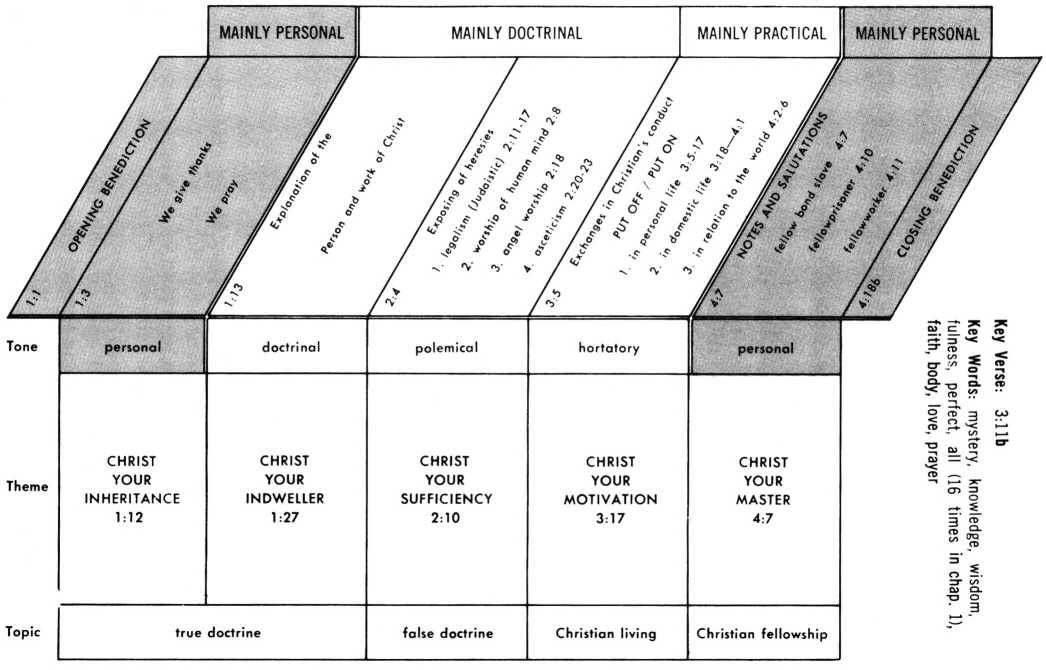
CHRIST IS ALL IN ALL
Click chart to enlarge
Charts from Jensen's Survey of the NT - used by permission
Colossians Overview - Click Chart on right side
| Christ Preeminent in All Things Supreme Lord - Sufficient Savior |
|||
| Colossians 1 | Colossians 2 | Colossians 3 | Colossians 4 |
| Supremacy of Christ |
Submission to Christ |
||
| Doctrinal and Corrective |
Practical and Reassuring |
||
| What Christ Did For Us |
What Christ Does Through Us |
||
| Christ Our Lord |
Christ Our Life |
Christ our Love |
|
| Christ the Head of the Body |
Christ the Lord of the Universe |
Christ the Head of the Home |
|
| Instruction | Warnings | Exhortations | Reminders |
| Reconciliation | Creation | Submission | Conversation |
| His Person and Word |
His Peace and Presence |
||
Colossians 3:15 Let the peace of Christ rule in your hearts, to which indeed you were called in one body and be thankful. (NASB: Lockman)
Greek: kai he eirene tou Christou brabeueto ( 3SPAM ) en tais kardiais humon, eis en kai eklethete (2PAPI) en eni somati; kai eucharistoi ginesthe. (2PPMM)
Amplified: And let the peace (soul harmony which comes) from Christ rule (act as umpire continually) in your hearts [deciding and settling with finality all questions that arise in your minds, in that peaceful state] to which as [members of Christ's] one body you were also called [to live]. And be thankful (appreciative), [giving praise to God always]. (Amplified Bible - Lockman)
Barclay: let the peace of God be the decider of all things within your hearts, for it is to that peace you were called, so that you might be united in one body.
NET Let the peace of Christ be in control in your heart, for you were in fact called to this peace, and be thankful. (NET Bible)
NLT: And let the peace that comes from Christ rule in your hearts. For as members of one body you are all called to live in peace. And always be thankful. (NLT - Tyndale House)
Phillips: Let the peace of Christ rule in your hearts, remembering that as members of the same body you are called to live in harmony, and never forget to be thankful for what God has done for you. (New Testament in Modern English)
Wuest: And the peace of Christ, let it be acting as umpire in your hearts, into which also you were called in one body. And be constantly thankful persons. (Wuest: Expanded Translation: Eerdmans)
Weymouth: And let the peace which Christ gives settle all questionings in your hearts, to which peace indeed you were called as belonging to His one Body; and be thankful
Young's Literal: and let the peace of God rule in your hearts, to which also ye were called in one body, and become thankful.
AND LET THE PEACE OF CHRIST RULE IN YOUR HEARTS: hê eirene tou Christou brabeuetô (3SPAM) en tais kardiais humon:
- Ps 29:11; Isa 26:3; 27:5; 57:15,19; Jn 14:27; 16:33; Ro 5:1; 14:17; 15:13; 2 Co 5:19, 20, 21; Ep 2:12, 13, 14, 15, 16, 17, 18; 5:1; Php 4:7
- Colossians 3 Resources - Multiple Sermons and Commentaries
Eadie on peace of Christ - It is called “the peace of Christ,” a phrase not essentially different in meaning from the common one, “peace of God.” It is given by Christ, or produced and perpetuated by His Spirit. It is the Redeemer's own legacy-John 14:27, “My peace I give unto you; let not your hearts be troubled, neither let them be dismayed.” Christ has secured this peace in His blood as Mediator, and He has the right to dispense it as the result of the reconciliation or atonement. And such tranquility, which in its highest aspect is Christian felicity, was not simply to be in their hearts, but it was to “rule” in them; it was not merely to have existence, but it was to exercise supreme command. (Colossians Commentary)
Peace (1515) (eirene [word study] from verb eiro = to join or bind together that which has been separated) literally pictures the binding or joining together again of that which had been separated or divided and thus setting at one again, a meaning convey by the common expression of one “having it all together”. It follows that peace is the opposite of division or dissension. Peace as a state of concord and harmony is the opposite of war. In this present verse peace is that which Christ gives. So instead of division there is to be a unity or oneness. If you don't feel that peace in a local body, then it may be because the umpire (see "rule" below) is saying that you are "out of bounds" so to speak.
The psalmist promises that…
The LORD will give strength to His people. The LORD will bless His people with peace. (Ps 29:11 - Spurgeon's note)
Isaiah writes…
The steadfast of mind Thou wilt keep in perfect peace, because he trusts in Thee. (Isaiah 26:3)
Before Jesus left this earth He promised His disciples a peace unlike any other declaring…
Peace I leave with you; My (His very own personal) peace) I give to you; not as the world gives, do I give to you. Let not your heart be troubled, nor let it be fearful. (Jn 14:27) (see commentary notes)
The peace of Christ, the peace He gives is not only peace we experience when there is no conflict, but like the Hebrew counterpart (see study of shalom) gives us a sense of wholeness and well-being, completeness and totality. And ultimately, the peace of Christ is even more for it is in its essence the very presence of Christ. (See study on Seven "thieves" that can steal your peace)
And all believers share this same peace Paul writing…
Therefore having been justified by faith, we have peace with God through our Lord Jesus Christ, (Ro 5:1)
John MacArthur writes that eirene…
includes both the concept of an agreement, pact, treaty, or bond, and that of an attitude of rest or security. Both aspects are in view here. (MacArthur, J. Colossians. Chicago: Moody Press)
Johnson (Bib Sac, Jan, 64) writes…
I remember reading somewhere in F. B. Meyer’s writings a story of a man crossing the channel towards a continental port on a dark starless night. One of the passengers was chatting with the captain over the difficulty of making port under such circumstances. The captain pointed to the distant shore and said: “Do you see the three lights shining faintly ahead on land? Well, I steer our ship until the three lights merge into one, and then I head straight into port with the light ahead of me. I know that course is the right course.” In similar fashion the believer may trust the united witness of the Word of God, the witness of the Spirit, and the peace of Christ. When the three agree in a course of action, or approve a particular decision, the believer may have strong assurance of the will of God and head straight in.
Let...Rule (1018) (brabeuo; related word = brabeús = an umpire) (Only use in the NT here) means literally to award the prize and is a cognate (related) to the word "prize" (brabeion = gift received as a prize or reward as result of having won in competition) used by Paul in 1Co 9:24 and Php 3:14. In later Greek brabeuo was frequently used in the sense of rule because a conspicuous part of a ruler’s work was to pronounce decisions in matters open to question.
Brabeuo is used once in the Septuagint (LXX) in the apocryphal work Wisdom 10:12 where "Wisdom" is described as the umpire in Jacob's struggle with the "angel" (Who I think was most likely the Angel of the LORD - see especially Ge 32:30 = see Ge 32:24, 25, 26, 27, 28, 29, 30; see also Hos 12:4-5 "Yes, he (JACOB) wrestled with the Angel and prevailed; He wept and sought His favor. He found Him at Bethel and there He spoke with us, even the LORD, the God of hosts, The LORD is His name.").
The original picture of brabeuo is that of an umpire deciding the outcome of an athletic contest. The umpire would preside over the athletic games so popular in the Greek culture (cp American sports!) and distribute the coveted prize to the winner.
In the present context brabeuo is used figuratively to picture the peace of Christ arbitrating, deciding in arguments, and thereby restraining the passions of the flesh nature that might threaten to disrupt the peace in the body. The peace of Christ would settle any friction and strife so that the believers could remain strong and unified.
Brabeuo is present imperative calling for this to be one's continual attitude. Thus this verse can be rephrased "let the peace of Christ continually decide as umpire or arbitrate in your hearts."
THOUGHT - By way of application, the peace of Christ should act as our umpire when anger, envy, and other such passions arise in our hearts. Let the peace of Christ be the umpire in your heart amidst the conflicts of life, this "divine umpire" helping you decide what is right (However see the discussion below regarding using this passage to "discern the will of God".)
Eadie on peace of Christ - (The Peace of Christ) was to exercise supreme command. For such is the meaning of brabeueto, as it naturally comes from its original and literal signification of presiding at the games, and then of distributing the rewards of victory… This peace was to possess undisputed supremacy-was to be uncontrolled president in their hearts. (Colossians Commentary)
Kent Hughes applies this very practically asking…
How much misery we would avoid if we permitted “the peace of Christ” to umpire in our hearts. How many words we would hold back if he were the arbitrator in our lives. How many sleepless nights we would forego if we did that. How the Church needs this too, “since as members of one body you were called to peace.” (Colossians and Philemon: The Supremacy of Christ)
The KJV Study Bible writes that Paul's intent is that
when believers are at odds with each other, whatever course of action best maintains peace and fosters harmony is the course to be taken. (Online KJV Study Bible. Nelson)
In secular Greek, brabeuo meant to be a brabeús, an umpire, director or arbiter in public Greek games. He would assign a prize in the public games. He was to be a judge and award the prize.
Paul uses a derivative on brabeuo in Colossians 2:18 writing…
Let no one keep defrauding (katabrabeuo = present imperative = with a negative means to stop letting this happen - see our need to depend on the Holy Spirit to obey) you of your prize by delighting in self-abasement and the worship of the angels, taking his stand on visions he has seen, inflated without cause by his fleshly mind…
Paul is using the well known illustration of a the judge at athletic games (brabeus) who would disqualify any athlete from competition if they had broken the rules of the games (see discussion of ancient athletics in context of 2Ti 2:5). They would not be awarded the prize (Greek = brabeion). In ancient Greece although the athlete might be disqualified from competition, they would not cease to be citizens of the country they belonged to but they would forfeit the glory and honor that was associated with wining at the Olympic games. What Paul is saying in Col 2:18 (note) is that some men were coming in and saying to the Christians who failed to keep all there man made rules (self abasement, etc) would lose their reward.
Calvin explains rule in your hearts writing that Paul…
employs, however, a very appropriate metaphor (Ed note: "rule" or "umpire"); for as among wrestlers, he who has vanquished all the others carries off the palm (Ed note: the prize, for the leaf of a palm was a symbol of victory), so he would have the peace of God be superior to all carnal affections, which often hurry us on to contentions, disagreements, quarrels, secret grudges. He accordingly prohibits us from giving loose reins to corrupt affections of this kind. As, however it is difficult to restrain them, he points out also the remedy, that the peace of God may carry the victory, because it must be a bridle, by which carnal affections may be restrained. Hence he says, in our hearts; because we constantly feel there great conflicts, while the flesh lusteth against the Spirit. (Gal 5:17) The clause, to which ye are called, intimates what manner of peace this is — that unity which Christ has consecrated among us under his own direction. For God has reconciled us to himself in Christ, (2Co 5:18) with this view, that we may live in entire harmony among ourselves.
Although this verse is often applied to discern the will of God (eg, if I don't experience the "peace of Christ" then the "umpire" is saying I am out of bounds, so to speak). The idea is that when a believer loses his peace, he can know that he has in some way disobeyed God (or as someone has said “Darkness about going is light about staying.”). There is no question that when a believer obeys the will of God, they will (or should) experience God's peace; and when they disobey intentionally or unintentionally they forfeit His peace. Although certainly peace in our heart is part of discerning God's will, the context speaks more to the interpersonal relationships of those in the body of Christ. Paul's point is that if we have peace, we will certainly be more likely to experience peace in the church. If we are not experiencing peace individually, we are more likely to contribute to discord and disharmony in the church. (Related - The Will Of God; How can I discern the will of God? | GotQuestions.org)
Tyndale Concise Bible Commentary writes that…
Christ’s rule of peace pulls believers together in unity (cf. Col 1:15, 16, 17, 18 - see notes Col 1:15; 16; 17; 18). When differences threaten the unity of the body, the peace of Christ must be accepted as arbitrator. (Hughes, R. B., Laney, J. C., & Hughes, R. B. Tyndale Concise Bible Commentary. Wheaton, Ill.: Tyndale House Publishers).
Matthew Henry explains that this peace is…
God’s being at peace with you, and the comfortable sense of his acceptance and favour: or, a disposition to peace among yourselves, a peaceable spirit, that keeps the peace, and makes peace… We are called to this peace, to peace with God as our privilege and peace with our brethren as our duty. Being united in one body, we are called to be at peace one with another, as the members of the natural body. (Matthew Henry's Commentary on the Whole Bible)
Adam Clarke writes…
No heart is right with God where the peace of Christ does not rule; and the continual prevalence of the peace of Christ is the decisive proof that the heart is right with God. When a man loses his peace, it is an awful proof that he has lost something else; that he has given way to evil, and grieved the Spirit of God. While peace rules, all is safe.
To illustrate the idea of letting the peace of Christ rule in your hearts picture a baseball umpire. Baseball fans know that the man in the black suit who stands behind the catcher rules on the plays and makes the calls. He remains absolutely unruffled no matter what happens. Managers curse him and kick dirt at him, fans throw pop bottles at him, yet he remains unperturbed. That is the idea. Let the calmness of Christ rule among you. Consider Jesus in the gospels. He moves into every situation with total poise. He is not upset by others but remains calm and collected when other people are panicking around him. He is in control. That is to characterize the church in its functioning as a body. Though subjective in nature, yet very really indeed the peace of God produced by the Spirit of God (Ga 5:22) “acts as umpire” in the heart to make definite the right decision in accord with the divine purpose. The means used by the Spirit in making each decision is the written Word (Col 3:16; cf. Ps 119:105). As noted above, it is the Scriptures which are used to prepare the heart and cause it to yield to the sovereign purpose of God. The Spirit of God through the Word of God also produces the peace of God in the heart.
We must beware, however, of a false peace in the heart. Jonah deliberately disobeyed God, yet he was able to go to sleep in the hold of a ship in a storm! “I had peace about it!” is not sufficient evidence that we are in the will of God. We must pray, surrender to His will, and seek His guidance in the Scriptures. The peace of heart alone is not always the peace of God.
Jamieson, Fausset and Brown write…
Let the peace of Christ act as umpire when anger, envy, and such passions arise; and restrain them." in your hearts - Many wear a peaceful countenance and speak peace with the mouth, while war is in their hearts (Psalm 28:3 = Spurgeon's note; Ps 55:21 = Spurgeon's note). (A Commentary, Critical and Explanatory)
Peace is not only objective and subjective, but also relational. Believers were called to live in peace in one body. Individuals who have peace with Christ and in their own hearts will live in unity and harmony with each other.
The Life Application Bible Commentary has an excellent note on application…
When we exercise the traits of compassion, kindness, humility, patience, and, above all, love, we are going to face conflict. Not everyone will be playing by these rules. Not all Christians show the self-restraint needed in conflict. How can we deal with these conflicts and live as God wants? When we are hurt by others or our gracious efforts are rebuked, we must have an umpire inside that says, “Peace.” We need to call a time-out on our passions and reactions; then we can think about the peace that God has won for us in Christ’s death. Paul does not teach “peace at any price.” Instead, he encourages believers to embrace God’s peace and be under his control as they make courageous moral decisions for the truth and the right. (BORROW Life application New Testament commentary)
Lightfoot - Wherever there is a conflict of motives or impulses or reasons, the peace of Christ must step in and decide which is to prevail.
Eadie on in your heart - Let it (peace) not be a state of mind admired or envied, but one actually possessed; let it not be hovering as a hoped-for blessing on the outskirts of your spirits, but let it be within you; let it not be an occasional visitant, often scared away by dominant and usurping passion, but a central power, exercising a full and unlimited administration. Let it so govern, and happiness will be the result, every source of disquietude and element of turbulence being destroyed. The apostle thus wished the Colossians highest spiritual welfare, that their souls might enjoy unbroken quiet. A peace, which is not the peace of Christ, is often rudely disturbed, for it is but a dream and a slumber in the midst of volcanic powers, which are employing the time in gathering up their energies for a more awful conflict. There is no question, if a man possessed and cherished the ripe consciousness of his interest in Christ, if he had full assurance, and felt that God was for him-if the elements of sinful passion, either in its fouler forms of sensuality, or its darker aspects of malignity, were subdued; and if “the gentleness of Christ” were at home within him, and all the graces which possess a kindred character were around him, bound and held together by that “love which is the bond of perfectness,” that then he would enjoy a peace or a bliss second only to the elevation and felicity of heaven. Philippians 4:7. And it was no audacity in them to seek or cultivate that peace, for to it they had been called. (Reference)
Heart (2588) (kardia) (Click in depth study) in this context describes the home and the throne of the peace of Christ. Our heart is like our "control center", a good place to have the peace of Christ ruling!
W H G Thomas once explained this verse by first asking a question…
What does the peace of Christ do? Primarily it gives assurance of acceptance with God (cf. Ro 5:1), and the protection of God (cf. Php 4:7, Gr., "shall garrison," a paradoxical use of a warlike term). But here Christ's peace is to be received into the heart as the arbiter deciding the course and ruling the life (Gr., "umpire"). A similar idea and practically the same Greek word is found in Col 2:18 (note), as we have seen, where the apostle is warning his readers not to let anyone judicially deprive them of their reward as though they were unworthy.
This word, translated here "rule," suggests that which settles differences, especially where there is any conflict of thoughts and feelings. Under such circumstances the peace of Christ is to decide; and if it be asked how peace is able to do this perhaps the explanation is that just as peace with God is the result of our acceptance of Christ as Savior (Ro 5:1), so the experience of peace in the soul, in union with Christ and through the presence of the Holy Spirit, will at once settle every difficulty, resolve every conflict, and show us what is the will of God.
In this case there is a special reason for such divine peace--the essential unity of the body of Christ, the Church, and to this peace, we are told, every believer has been called. When we are one with Christ, in whom God "called us with an holy calling" (2Ti 1:9), and also one with Christians, "called in one body," as Paul says here, there is no question as to the great power of divine peace in our lives. We read of "government and peace" (Isa 9:7 in multiple translations), of "righteousness and peace" (Ps. 85:10 in multiple translations; cf. Isaiah 32:17 in multiple translations), and of "grace… and peace" (Titus 1:4). Until these prevail universally, however, "the God of peace himself" (1Th 5:23, ASV) will be with us, keeping us meanwhile "in perfect peace" (Isaiah 26:3 in multiple translations) (See page 114 of Studies in Colossians and Philemon)
TO WHICH INDEED YOU WERE CALLED IN ONE BODY: eis en kai eklethete (2PAPI) en heni sômati:
- Colossians 3 Resources - Multiple Sermons and Commentaries
Eadie on you were called - it was no audacity in them to seek or cultivate that peace, for to it they had been called. The possession of this peace was a prime end of their Christianity. The gospel summons a man, not to misery, but to happiness-not to internal discord, but to ultimate peace. And they were called to the possession of it (Reference)
Many wear a peaceful countenance and speak peace with the mouth, while war is in their hearts as the psalms testify…
Do not drag me away with the wicked and with those who work iniquity; who speak peace with their neighbors, while evil is in their hearts. (Ps 28:3 - Spurgeon's note)
The psalmist elsewhere describes one whose…
speech was smoother than butter, But his heart was war; His words were softer than oil, Yet they were drawn swords. (Ps 55:21 - see Spurgeon's note)
With one Head (Christ) as in Col 1:18 [note], Col 1:24 [note] if we have peace in our hearts, we will be at peace with others in the church. We are called to one body, and our relationship in that body must be one of harmony and peace. The unity of the body of Christ is a strong reason for peace among the members, and the peace of Christ enables the body to retain its oneness (a body so unified thereby retains its efficacy and its function as salt and light in the spiritual decaying, dark world - see commentary on salt and light in Mt 14, 15, 16 [notes]). If we are out of the will of God, we are certain to bring discord and disharmony (and dysfunction) to the Body of Christ.
Spurgeon exhorts us…Do not fall out with one another. You are called to peace, for you are cared in one body. Does one hand in the body fight with the other hand? Does the foot contend with the eye? Of course not, for they are in one body. So are you in one body with all your fellow-Christians, therefore lay aside all strife. I deeply deplore when I see Christians — and especially eminent Christians — contending with one another about minor matters of small account. Surely, almost anything ought to be borne before there should be public strife among members of the one body. God grant that such a state of things may speedily come to an end wherever it has existed! We have enough to do to “earnestly contend for the faith which was once delivered unto the saints,” without contending for our own dignity or honor.
AND BE THANKFUL: kai eucharistoi ginesthe (2PPMM):
- Col 3:17; Col 1:12; Col 2:7; Ps 100:4; Ps 107:22; Ps 116:17; Jonah 2:9; Lk 17:16, 17, 18; Ro 1:21; 2Co 4:15; 9:11; Ep 5:20; Php 4:6; 1Th 5:18; 1Ti 2:1; Heb 13:15; Re 7:12
- Colossians 3 Resources - Multiple Sermons and Commentaries
Related Passages:
Colossians 3:17 Whatever you do in word or deed (THAT'S EVERYTHING YOU DO!), do all in the name of the Lord Jesus, (present tense - continually) giving thanks through Him to God the Father.
Colossians 1:12 (PAUL PRAYS FOR THIS) giving thanks to the Father, who has qualified us to share in the inheritance of the saints in Light.
Colossians 2:7 having been firmly rooted and now being built up in Him and established in your faith, just as you were instructed, and (present tense - continually) overflowing (ABOUNDING) with gratitude (THANKFULNESS).
1 Thessalonians 5:18 in everything (HOW MUCH? DON'T TRY TO DO THIS IN YOUR OWN "POWER" FOR YOU WILL SURELY EXPERIENCE A "POWER FAILURE!") give thanks (present imperative - see our need to depend on the Holy Spirit to obey); for this is God’s will for you in Christ Jesus.
Psalm 100:4 Enter His gates with thanksgiving And His courts with praise. Give thanks to Him, bless His name.
Psalm 107:22 Let them also offer sacrifices of thanksgiving, And tell of His works with joyful singing.
Psalm 116:17 To You I shall offer a sacrifice of thanksgiving, And call upon the name of the LORD.
GIVE THANKS IN
EVERYTHING
Eadie on be thankful - There is every cause of thankfulness to Him who had called them to the possession of such peace. If that peace dwelt within them, and reigned within them-if Christ had at once provided it for them, and summoned them unitedly to its enjoyment, surely profound gratitude was due to such a benefactor. (Reference)
Keep on becoming thankful (present imperative - see our need to depend on the Holy Spirit to obey) means we need to allow this to be our habitual practice. Praise on the lips naturally flows out of peace in one's heart (what fills you controls you, out of the mouth comes that which fills the heart). When we do not have the peace of Christ ruling in our hearts individually or in the local body, the corporate body, we are not likely to offer up sincere thanks to God. Beloved, there is only one way for a believer to continually be filled with an attitude of gratitude and that is to be continually filled with the Holy Spirit (Eph 5:18), so we should not be surprised that one of the effects of being filled with the Spirit is "always giving thanks for all things." (Eph 5:20) Supernatural power facilitates sustained gratitude. Don't try to accomplish this in reliance on your own "strength."
THOUGHT - Are you presenting yourself to God as your offering and surrendering your rights and your will to His good and acceptable and perfect will each morning (Ro 12:1-2)? If not, you might consider making this part of your daily devotional offering. Then you will be supernaturally empowered to walk out into the world and face the ("pop") tests of your faith that are sure to come!
This spirit of thankfulness is shown by an entry in the diary of the godly Matthew Henry, the famous Biblical commentator, after he had been robbed:
LET ME BE THANKFUL: first, because I was never robbed before; 2nd, because, although he took my purse, he did not take my life; 3rd, because, although he took all I possessed, it was not much; 4th, because it was I who was robbed, and not I who robbed.
Notice the emphasis on thanksgiving placed at the close of the exhortations in this short epistle (Col 1:12; Col 2:7; Col 3:15; Col 4:2)
Kent Hughes - When the buckets we carry are full of Christ, our lives are bathed with the peace of God in thanksgiving. (Colossians and Philemon: The Supremacy of Christ. Preaching the Word)
When a Christian loses the peace of God, he begins to go off in directions that are out of the will of God. He turns to the things of the world and the flesh to compensate for his lack of peace within. He tries to escape, but he cannot escape himself! It is only when he confesses his sin, claims God’s forgiveness, and does God’s will that he experiences God’s peace within. When there is peace in the heart, there will be praise on the lips. The Christian out of God’s will is never found giving sincere praise to God. When David covered up his sins, he lost his peace and his praise (Ps 32; 51). When he confessed his sins, then his song returned.
C H Spurgeon -
It looks like a very small virtue to be thankful. Yet, dear friends, the absence of it is one of the grossest of vices (Ro 1:21). To be ungrateful is a mean thing; to be ungrateful to God is a base thing. And yet how many may accuse themselves of it! Who among us is as grateful as he should be? Be thankful.
When you are grumbling at your plain food, put this as a sandwich between your bread and butter, Be ye thankful.
When you are complaining of the East wind, just try if you cannot spell this little sentence, Be ye thankful.”
When you are murmuring about those sharp pains and that long sickness, this is the kind of tune for the little bird to whistle at your window, Be ye thankful.
We have all much for which we ought to be thankful, however sad we may think our lot to be. Look on the bright side, rejoice in God: Be ye thankful.
William MacDonald comments on "be thankful" writing that…
This refrain is repeated over and over again in Paul’s writings. There must have been a good reason: The Spirit of God must consider a thankful spirit very important. And we believe that it is!—important not only for a person’s spiritual life, but for his physical welfare as well. Doctors have found out what the Scriptures have taught through the years—that a cheerful, thankful attitude of mind is beneficial for the body, and that worry, depression, and a complaining spirit are definitely harmful to one’s health. Usually we think of thankfulness as something that is determined by our immediate circumstances, but Paul here shows that it is a grace to be cultivated. We are responsible to be thankful. Of all peoples of the world, we have the most for which to give thanks (compare Dt 33:29). The fault is not in any lack of subject matter, but only in our selfish hearts. (BORROW Believer's Bible Commentary)
Matthew Henry explains that…
To preserve in us this peaceable disposition, we must be thankful. The work of thanksgiving to God is such a sweet and pleasant work that it will help to make us sweet and pleasant towards all men. "Instead of envying one another upon account of any particular favors and excellence, be thankful for his mercies, which are common to all of you.’’ (Matthew Henry's Commentary on the Whole Bible)
Vine notes that…
Where love is in exercise, and where the peace of Christ rules, thankfulness is inevitably produced, and that out of a sense of entire indebtedness to God for what was wrought by Him in Christ to bring about that peace, and out of a sense of deep gratitude for it and its governing power. (Collected writings of W. E. Vine. Nashville: Thomas Nelson)
F B Meyer writes the following devotional from "Our Daily Homily"…
Let the peace of God rule in your hearts, to the which also ye are called.
The peace of God is the peace of the Divine nature — the very tranquillity which prevails in the heart of the God of Peace. It was of this that Jesus spoke when He said, “My peace I give unto you”; for his own being was filled and blessed with it during his earthly career. In each of us may be a sea of glass, reflecting on its pellucid and tranquil bosom the untroubled calm and rest, which are unspeakable because eternal and Divine. “The Lord of peace Himself give you peace always.”
There are three things against which we must ever be on our guard, lest they rob us of our peace.
First, unconfessed sin;
second, worry;
third, the permission of an unrebuked selfish principle.
As on the Sabbath the good Nehemiah carefully excluded the Tyrian fishwives from Jerusalem, lest they should mar its spirit of rest by their cries and traffic, so we must preserve an unbroken Sabbath-keeping within. “There remaineth therefore a Sabbath rest for the people of God.”
The apostle says, Let it rule. The Greek word means arbitrate. Whenever there is a doubtful issue to be decided, and by one course your peace may be disturbed, whilst by another it may be maintained, choose those things that make for peace, whether for yourselves or others. Let God’s peach act as umpire.
At the same time, this does not mean peace at any price. When the cause of truth is assailed, or the rights of others invaded, we must stand up boldly and strongly for Righteousness. Then the effect of Righteousness will be Peace. Melchizedek was first King of Righteousness, and after that King of Peace.
The apostle Paul had never been to the church in Colossae, but he had heard all about it from Epaphras. He knew it was a church under attack by false teachers, so he prayed fervently for this congregation (Col 1:9, 10, 11, 12, 13, 14; 2:4, 5, 6, 7).
Among his requests, Paul asked that they would give joyful thanks to the Father because He had rescued them, moving them from the kingdom of darkness to the kingdom of His dear Son (Col 1:12, 13-notes Col 1:12; 13). We too need to be thankful for what Christ has done for us.
Thankfulness seems to be a lost art today. Warren Wiersbe illustrated this problem in his commentary on Colossians. He told about a ministerial student in Evanston, Illinois, who was part of a life-saving squad. In 1860, a ship went aground on the shore of Lake Michigan near Evanston, and Edward Spencer waded again and again into the frigid waters to rescue 17 passengers. In the process, his health was permanently damaged. Some years later at his funeral, it was noted that not one of the people he rescued ever thanked him.
Let's take time often to recall how God has rescued us from eternal death and has given us eternal life through His Son. Let's make certain that we never allow thanking the Father to become a lost art. - D C Egner (Our Daily Bread, Copyright RBC Ministries, Grand Rapids, MI. Reprinted by permission. All rights reserved)
Give me a spirit of thankfulness, Lord,
For numberless blessings given;
Blessings that daily come to me
Like the dewdrops falling from heaven.--Dawe
With practice, anyone can master the art of thankfulness.
The story is told about a wounded soldier who was being taken to a hospital tent by some of his comrades. After they had carried him but a short distance, he urged them to put him down and go back to rescue someone else. As he was mortally wounded, he knew there was no hope for him anyway. Granting his request, they left him and returned to the combat area. In a few minutes, however, an officer stopped to ask him whether he could assist him in any way.
The wounded soldier weakly replied,
"No, thank you, sir. There's nothing at all you can do."
"But can't I at least get some water to quench your thirst?" the officer inquired.
The dying man again shook his head saying,
"No, thank you, sir. There is one thing, however, you could do for me. In my knapsack you will find a New Testament. Please open it to John 14. Near the end of the chapter you will find a text beginning with the word `Peace.' I would appreciate it if you would read just that one verse to me."
The officer found the passage and read these words,
"Peace I leave with you, my peace I give unto you; not as the world giveth, give I unto you. Let not your heart be troubled, neither let it be afraid" (Jn 14:27).
"Thank you, sir," said the dying soldier.
"I have that peace and I am going to the Savior who made that promise. God is with me, I want no more."
Shortly after that, the wounded man entered into the presence of his Lord. Because he had Christ, he had peace with God, and since he had learned to commit everything to His care, he also had the peace of God. How important for all of us to remember that the Bible admonishes,
"Be anxious for nothing, but in everything by prayer and supplication with thanksgiving, let your requests be made known unto God. And the peace on God . shall keep your hearts and minds through Christ Jesus!" (Php 4:6, 7-notes Php 4:6; 7)
Yes, in our joys and in our sorrows, in life's sunshine, or in the "valley of the shadow," we who are at peace with God can also know the peace of God which passeth all understanding. (Our Daily Bread, Copyright RBC Ministries, Grand Rapids, MI. Reprinted by permission. All rights reserved)
Peace, perfect peace, in this dark world of sin?
The blood of Jesus whispers peace within.
Peace, perfect peace, with sorrows surging 'round?
On Jesus' bosom naught but calm is found.—E. H. BickerstethPeace rules the day when Christ rules the heart!
Colossians 3:16 Let the word of Christ richly dwell (3SPAM) within you, with all wisdom teaching (PAPMPN) and admonishing (PAPMPN) one another with psalms and hymns and spiritual songs, singing (PAPMPN) with thankfulness in your hearts to God. (NASB: Lockman)
Greek: o logos tou Christou enoikeito (3SPAM) en humin plousios, en pase sophia didaskontes (PAPMPN) kai nouthetountes (PAPMPN) heautous psalmois, humnois, odais pneumatikais en [te] chariti adontes (PAPMPN) en tais kardiais humon to theo
Amplified: Let the word [spoken by] Christ (the Messiah) have its home [in your hearts and minds] and dwell in you in [all its] richness, as you teach and admonish and train one another in all insight and intelligence and wisdom [in spiritual things, and as you sing] psalms and hymns and spiritual songs, making melody to God with [His] grace in your hearts. (Amplified Bible - Lockman)
NLT: Let the words of Christ, in all their richness, live in your hearts and make you wise. Use his words to teach and counsel each other. Sing psalms and hymns and spiritual songs to God with thankful hearts. (NLT - Tyndale House)
Phillips: Let Christ's teaching live in your hearts, making you rich in the true wisdom. Teach and help one another along the right road with your psalms and hymns and Christian songs, singing God's praises with joyful hearts. (New Testament in Modern English)
Wuest: The word of Christ, let it be continually at home in you in abundance; with every wisdom teaching and admonishing each other by means of psalms, hymns, spiritual songs, with the grace singing in your hearts to God. (Wuest: Expanded Translation: Eerdmans)
Weymouth: Let the teaching concerning Christ remain as a rich treasure in your hearts. In all wisdom teach and admonish one another with psalms, hymns, and spiritual songs, and sing with grace in your hearts to God.
Young's Literal: Let the word of Christ dwell in you richly, in all wisdom, teaching and admonishing each other, in psalms, and hymns, and spiritual songs, in grace singing in your hearts to the Lord;
LET THE WORD OF CHRIST RICHLY DWELL WITHIN YOU: ho logos tou Christou enoikeito (3SPAM) en humin plousios:
- Jn 5:39, 40; 2Ti 3:15; He 4:12,13; 1Pe 1:11,12; Re 19:10
- Colossians 3 Resources - Multiple Sermons and Commentaries
Don't read this passage too fast. Paul exhorts us to let. Will you invite His Word into your heart and mind? He won't force His Word upon you beloved. You have to make the volitional choice to allow it entree and might I suggest not just a crack in the door and not with the chain on the door so it cannot open too wide. No, beloved, open widely the door to your heart and mind, and ask God's Spirit to flood your soul so that your very being is saturated with His Word of Truth. You won't regret such a simple prayer, I can assure you.
Eadie feels - “The word of Christ” is the Gospel, the doctrine of Christ, or the truth which has Christ for its subject. In fact, Christ is both the giver of the oracle and its theme. By "in you" (en humin) is meant, not simply among you-unter euch, as Luther translates, or as De Wette contends. Let the Christian truth have its enduring abode “within you”-let it be no stranger or occasional guest in your hearts. Let it not be without you, as a lesson to be learned, but within you, as the source of cherished and permanent illumination. Let it stay within you- plousios, abundantly. That is, let it be completely understood, or let the soul be fully under its influence. Let it dwell not with a scanty foothold, but with a large and liberal occupancy. (Ref)
How important is this verse? I think it is one of the more important passages in Scripture for sustenance of Spirit filled/controlled believers. The parallel passage is found in Ephesians where Paul discusses the effects of being continually filled with the Holy Spirit. The astute observer will note that the "effects" of being filled with the Spirit and being filled with the Word of Christ are virtually identical (see table below).
THOUGHT - Does this give you any clue as to how a believer might be continually filled with the Holy Spirit?
And do not get drunk with wine, for that is dissipation, but be filled with the Spirit, speaking to one another in psalms and hymns and spiritual songs, singing and making melody with your heart to the Lord; always giving thanks for all things in the name of our Lord Jesus Christ to God, even the Father; and be subject to one another in the fear of Christ. (Ep 5:18, 19, 20, 21-See notes Eph 5:18; 19; 20; 21)
| RELATIONSHIP OF BEING FILLED… WITH THE SPIRIT AND THE WORD |
|
| THE HOLY SPIRIT |
THE HOLY WORD |
| Ephesians 5:18, 19, 20 | Colossians 3:16, 17 |
| Be filled with (present imperative) |
Let… dwell within (present imperative) |
| The Spirit (of Christ) |
The Word Of Christ |
| Speaking to One Another |
Teaching and Admonishing One Another |
| In Psalms and Hymns and Spiritual Songs |
With Psalms and Hymns and Spiritual Songs |
| Singing and making melody with your heart to the Lord |
Singing with thankfulness in your hearts to God |
| Always giving thanks | Giving Thanks |
Of Christ - The Greek here (Christou) can be either the subjective genitive (the word delivered by Christ) or the objective genitive (the word about Christ).
Paul is exalting Christ in Colossians. The false teachers came to Colossae with man-made traditions, religious rules, and human philosophies (Col 2:8). They tried to harmonize God’s Word with their teachings, but they could not succeed. God’s Word always magnifies Jesus Christ. It was not the word of false teachers that brought salvation to the Colossians; it was the Word of the truth of the Gospel (Col 1:5). This same Word gives us life and sustains and strengthens us (1Pe 1:22, 23, 24, 25, 2:1, 2, 3 - see notes 1Pe 1:22; 23; 24; 25; 2:1; 2:2; 2:3).
Octavius Winslow puts in a good word about letting the Good Word dwell in the midst of our being…
The diligent and prayerful reading of God's holy word is a great means of increasing and promoting spirituality of mind (cp 1Pe 2:2). This, we fear, is not an element in the Christianity of many. It defines a duty sadly and, to a great extent, totally neglected. The tendency of the age is to substitute the writings of man for the Book of God. Let them come but with the robe of religion gracefully thrown around them, and whether they assume the form of history, or story, or song, they are devoured by the professing multitude, who would deem their true spirituality unquestionable!
But the Divine life of the soul is not to be fed and nourished by the profound discoveries of science, or the recondite axioms of philosophy, or the brilliant flowers of genius, or the dreams of a poetical imagination. It ascends to a higher and a diviner source; it aspires towards the nourishments of its native climate. The bread that comes down from heaven (Jn 6:31, 32, 33, 41, 50, 51, 58) and the water that flows, pure as crystal, from beneath the throne of God and the Lamb, can alone feed, and nourish, and refresh this hidden principle (cp Jn 4:10, 13, 14, 15, 7:37, 38, 1Co 10:4).
Jesus is its sustenance; and the gospel, as it unfolds Him in His glory and grace, is the spiritual granary from where its daily food is drawn. To this it repairs, oftentimes pressed with hunger, or panting with thirst, weary and exhausted, drooping and faint, and it finds its doctrines and its precepts, its promises and its admonitions, its exhortations and revelations, a "a feast of fat things, a feast of wines on the lees; of fat things full of marrow, of wines on the lees well refined." And thus refreshed and satisfied, the grateful soul adoringly exclaims, "Your words were found, and I did eat them; and Your word was unto me the joy and rejoicing of my heart." (Jer 15:16)
Truly did Jesus testify, "Verily, verily, I say unto you, Except you eat the flesh of the Son of man, and drink His blood, you have no life in you;" (Jn 6:53, 54, 55, 56, 57, 58, 59) evidently and solemnly implying, that if there exists no appetite for spiritual food, there is lacking the great evidence of the life of God in the soul. A mere semblance of life, an informed judgment, a "fair show" of religion "in the flesh," can content itself with anything short of the spiritual aliment contained in God's word. But the Divine life of a quickened soul, while it disdains no auxiliary to its spiritual advance, can yet feed on nothing but Divine food.
The "flesh and the blood of Immanuel can alone meet and satiate its hungering and thirsting. It is from heaven, and its supply must be heavenly; it is from God, and its nourishment must be Divine. Jesus, and Jesus alone, received into the heart, rested in, and lived upon by faith, is the food of a believing man. Nothing but Christ-"Christ all" in Himself, and Christ "in all," means "in all" ordinances, "in all" channels, "in all" seasons, sustains a soul whose "life is hid with Christ in God."
Dear reader, do you see the importance and feel the solemnity of this truth? Oh, it is a great and solemn one! Except by faith you "eat the flesh and drink the blood of the Son of man, you have no life in you!" Nothing short of Christ-Christ's righteousness, Christ's atonement, Christ's flesh and blood, Christ in us, Christ without us, Christ risen, Christ alive at the right hand of God, yes, "Christ all and in all" (Col 3:11)-can meet the deep, immortal necessities of your soul. You need all that Christ is in the matter of pardon, and justification, and sanctification, and wisdom, and redemption. If anything less than Jesus had sufficed, if an expedient less magnificent, or if an expenditure less costly, had answered for God and man, then less would save you. But since the incarnate God alone is the Savior of a poor, lost sinner, see that you detract not from, or add to, this salvation by any works of human merit.
Be exhorted, then, to an intimate acquaintance with God's holy word, as supplying a powerful help to the progress of the soul in deep spirituality. And if your time for reading is limited, limit it to one book, and let that one book be-the BIBLE. Let it be the companion of your hours of solitude; the solace in your seasons of sorrow; the store-house in all your necessities; the man of your counsel in all your doubts and perplexities. Then will your blessed experience resemble that of the psalmist: "Your word have I hid in mine heart, that I might not sin against You. This is my comfort in my affliction: for Your word has quickened me. Your word is a lamp unto my feet, and a light unto my path. I rejoice at Your word, as one that finds great spoil." (From Evening Thoughts - A 365 Day Devotional) (See also Morning Thoughts)
Spurgeon exhorts us…
Do try, dear friends, to get so full of the word of Christ in all forms of it, that you may run over with it. You know, it cannot come out of you if it is not first in you. If you do not get the word of Christ into you, you will not be instructive in your general conversation.
Grant Richison writes that…
The word dwell means to keep house. We should live in the Word of God like we live in our homes. We are familiar with our home where all the closets are, where we have items stored. We must thoroughly acquaint ourselves with the Word. The Word should become so familiar to us that we know it like the back of our hand. The idea is to let the Word of God dwell inside and live at home in our lives. The Word of God needs to inhabit us. This is more than just reading the Bible. God wants us to let the peace of Christ rule in our hearts (v. 15) and the Word of Christ dwell in our hearts.
Some treat the Word of God like a rabbit’s foot or charm. We use it like a fetish. We cannot use the Bible that way. We cannot rub the Bible on warts and they disappear. We cannot flip the pages of the Bible and blindly put our finger on a verse and claim it. The Bible is no prayer wheel or magic book. We must systematically study the Bible and memorize pertinent verses to deal with weak areas of our Christian life (Deut. 6:6; 11:18; Josh. 1:8; Job 22:21,22; 23:12: Ps. 1:2;119:9, 10, 11; Jer 15:16).
There are some believers who think that when they get into a jam all they have to do is pray “Oh Lord, help me.” Others think that all they need to do is put their finger on a Bible verse and God will lead them. They give glowing testimonies of how in a time of duress they flipped open their Bible and put their finger on a verse that helped them. The odds of doing that are about as good as loaded dice in a crap game.
Principle: The Word of God needs to find lodgment in our souls.
Application: If we spent as much time in the Word of God as we do in the newspaper, just think how much we would know of God’s will for our lives! We might know how many robberies and murders took place in our city for that week but what difference does that make in our lives? We might be better off if we did not know.
If we generate a serious attitude about letting the Word of God dwell in our lives, we will be richer and our character will grow stronger. Our individual lives will change and our homes will be better.
You may say, “But I do not understand what I read in the Bible.” We must work at it. Gradually we will retain more. We do not learn to ride a bicycle the first time we get on it. Neither do we learn the Bible without effort. It takes time, effort and dedication. The results will gratify our souls.
Most of us do not take the Word of God seriously. We play at it. We do not mark our Bible or memorize it. We do not make it a part of us. There are people who memorize hundreds of plays for a football game. Yet if we memorize a verse of Scripture we want a medal (Colossians 3:16)
In His sermon Christ's Indwelling Word , Spurgeon writes…
THAT is a very beautiful name for Holy Scripture, I hardly remember to have met with it anywhere else: "Let the word of Christ dwell in you." Remember, dear friends, that Christ Himself is the Word of God, and recollect also that the Scriptures are the word of the Word. They are "the word of Christ." I think that they will be all the sweeter to you if you realize that they speak to you of Christ, that He is the sum and substance of them, that they direct you to Christ, in fact, as John says of his Gospel, that they were "written that ye might believe that Jesus is the Christ, the Son of God; and that believing ye might have life through his name." (John 20:31)
Remember, also, that the Scriptures do, in effect, come to us from Christ. Every promise of this blessed Book is a promise of Christ, "for all the promises of God in Him are yea, and in Him Amen, unto the glory of God by us; they all come to us through Christ, God speaks them to us through Him as the Mediator. Indeed, we may regard the whole of the Sacred Scriptures, from the beginning of Genesis to the end of Revelation, as being "the word of Christ."
The text tells us, first, how to treat the Scriptures: "Let the word of Christ dwell in you richly;" and, secondly, it tells us how to profit by them: "in all wisdom; teaching and admonishing one another in psalms and hymns and spiritual songs, singing with grace in your hearts to the Lord."
First, then, we are told here HOW TO TREAT THE SCRIPTURES: "Let the word of Christ dwell in you richly."
In order that it may dwell in you, it must first enter into youit must first enter into you. It is implied, in our text, that the apostle says, "Let the word of Christ enter into you." Then you must read it, or hear it, for, unless you do, you will not know what there is in it. Yet there must be something more than the mere hearing or reading of it; for some hear the truth with one ear, but let it go away out of the other ear; and others are great readers, yet they seem to read only what is on the surface. The letter passes under their eye, but the deep spiritual meaning never enters into their heart. If you read a portion of Scripture every day, I commend you for doing so; if you make a practice of reading right through the Bible in a stated period, I commend you still more.
Some I know read the Bible through every year, in due course. This is well; but all this may be done, and yet "the word of Christ" may never have entered into the reader. You know how children sometimes learn their lessons. I am afraid that, at a great many schools, there is no true instruction; but the scholars have simply to repeat their lessons, without ever getting at the sense and meaning of them; and, a week or two after, they have forgotten all that they were supposed to have learnt. Do not let it be so with our knowledge of Scripture; let us not merely know it so as to be able to turn to its different chapters, or to be familiar with certain passages in it, or even to repeat all its words. This is but to let "the word of Christ" pass by your door, or look in at your window; but Paul says, "Let it dwell in you."
So I say again that, in order that it may dwell in you, it must first enter into you. You must really know the spiritual meaning of it; you must believe it; you must live upon it; you must drink it in; you must let it soak into your innermost being as the dew saturated the fleece of Gideon. It is not enough to have a Bible on the shelf; it is infinitely better to have its truths stored up within your soul. It is a good thing to carry your Testament in your pocket, it is far better to carry its message in your heart.
But mind that you let it get right into you. How differently some people read the Bible from the way in which they read any other book! I have seen a young woman sitting down, on board a steamboat, completely absorbed in a very suspicious-looking book. I have passed behind her, and passed before her, but she has not taken the slightest notice of me. Presently, I saw a tear brushed away from her eye; I knew that she was not reading the Bible, and it was my firm conviction that she was reading a novel. I have often noticed how such people let the novels get right into them, trash as they generally are; but when the most of people do read the Bible, they appear to be anxious to get the unpleasant task finished, and put away. In some cases, they seem to think that they have performed a very proper action; but they have not been in the least affected by it, moved by it, stirred by it.
Yet, if there is any book that can thrill the soul, it is the Bible. If we read it aright, we shall, as it were, lay our fingers among its wondrous harp-strings, and bring out from them matchless music such as no other instrument in the world could ever produce. There is no book so fitted or so suited to us as the Bible is.
There is no book that knows us so well, there is no book that is so much at home with us, there is no book that. has so much power over us, if we will but give ourselves up to it; yet, often, we only let it look in at our window, or knock at our door, instead of inviting it to enter our very heart and soul, and therefore we miss its power.
Then, when it once gets into you, let it remain there. let it remain there. A person could not be said to dwell in a house even though he should enter into the most private part of it, if he only passed through it, and went away. A man who dwells in a house abides, resides, remains, continues there. Oh, to have "the word of Christ" always dwelling inside of us — in the memory, never forgotten; in the heart, always loved; in the understanding, really grasped; with all the powers and passions of the mind fully submitted to its control!
I love those clear Christian people who do not need to refer to the printed page when you speak to them about the things of God, for they have the truth in their hearts. They have a springing well within their souls at all times; and they have only to hear a Scriptural theme started, and straightway they begin to speak of the things which they have looked upon, and their hands have handled, of the Word of life, because it dwells in them.
Further, "let the word of Christ dwell in you" so as to occupy your whole being. so as to occupy your whole being. If it dwells within you, let it take such entire possession of your being that it shall fill you. To push the truth of Christ up into a corner of your nature — to fill the major part of your being with other knowledge and other thought — is a poor way to treat "the word of Christ." It deserves the fullest attention of the best faculties that any man possesses. The truth revealed by the Holy Ghost is so sublime that its poetry outsoars the eagle-wing even of a Milton. It is a deep so profound that the plumb line of Sir Isaac Newton could never find the bottom of it. The greatest minds have been delighted to yield their highest faculties to its wondrous truths. Dear young friends, you who have only lately put on Christ, I beseech you not to let other books stand on the front shelf, and the Bible lie behind. Do not, for the most part, read those other books, and only read small portions of Scripture now and then; let it always have the chief place.
The most excellent of all sciences is the science of Christ crucified, and the Bible is the textbook for all who would learn it. If other forms of knowledge are useful, they are like the planets; but the knowledge of God as revealed in Christ Jesus is as the sun. Let this always be the center of your system of knowledge, and let all the rest that you know move in subordination and subjection to that first and best form of knowledge. If I may know myself, and know my Savior — if I may know my sin, and the atonement by which it is put away — if I may know my way through this life, and my way into the eternal life above, I will be content if I know but little else. Fain would I intermeddle with all knowledge; and, though "much study is a weariness of the flesh," yet would I find a pleasure in such weariness, if I only knew even as much as Solomon knew. But it would be vanity of vanities, and altogether vanity, if you and I were as wise as Solomon, and yet did not know the truth of God. Therefore, "let the word of Christ dwell in you" so as to occupy the whole of your being; let it be the resident, the occupant, the master and ruler of your entire nature.
Once more. "Let the word of Christ dwell in you;" that is, let it be your most familiar friend. let it be your most familiar friend. We know the people who live in our home, but we do not really know other people. When someone asked Mr. Whitefield, "What do you think of Mr. So-and-so’s character?" He answered, "I cannot say, for I never lived with him." Ah! that is the true test; it is living with people that lets you know what they are. In like manner, if you will live with "the word of Christ," especially if you will let it dwell in you, and abide with you as a constant friend, you will get to know it better; and the better you know it, the more you will love it. Ninety-nine times out of a hundred, if you meet with a man who finds fault with the Bible, you may be certain that he never read it. If he would but read it in the right spirit, he would be of another opinion. And if you find a professing Christian indifferent to his Bible, you may be sure that the very dust upon its cover will rise up in judgment against him. The Bible-reader is ever the Bible-lover, and the Bible-searcher is the man who searches it more and more.
Various pursuits have a measure of fascination about them, but the study of God’s Word is fascinating to the highest degree. Jerome said, when he was pondering a certain text, "I adore the infinity of Scripture." I have often felt that I could say the same. The Bible is a book that has no bounds to it. Its thoughts are not as men’s thoughts, a multitude of which may go to make up half an ounce; but any one of the thoughts of God can outweigh all the thoughts of men. This Book is not a book of pence, or a book of silver, or even a book of gold, but a book whose every leaf is of untold value. He shall be enriched indeed who lets "the word of Christ" richly dwell in him.
My dear friends, I should like you so to read the Bible that everybody in the Bible should seem to be a friend of yours. I should like you to feel as if you had talked with Abraham, and conversed with David. I can truly say that there is hardly anybody in the world that I know so well as I know David. In making The Treasury of David, I have labored, year after year, in that rich field of inspiration, the Book of Psalms, till I do assure you that David and I are quite familiar friends, and I think I know more about him than about any man I ever saw in my life, I seem to know the ins and outs of his constitution and experience, his grievous faults and the graces of his spirit. I want you to be on just such intimate terms with somebody or other in the Bible, — John, if you like; or Mary. Sit at Jesus’ feet with her. Oh Martha; it will not hurt you to make the acquaintance of Martha, and do a great deal of serving, though I do not want you to get cumbered with it.
But do find your choicest friends in the Scripture. Take the whole company of Bible saints home to your heart, let them live inside your soul. Let old Noah come in with his ark, if he likes; and let Daniel come in with his lions’ den, if he pleases; and all the rest of the godly men and women of the olden time, take them all into your very nature, and be on familiar terms with them; but, most of all, be specially intimate with him of whom they all speak, namely, Jesus Christ your blessed Lord and Master.
As for the doctrines revealed in the Bible, you should have them at your fingers’ ends. The great truths of the Word of God should be as familiar to you as a scholar makes his much-loved classics to be, or as the mathematician makes his plus and minus, his a and his x, familiar to him from hour to hour. So do you prize "the word of Christ;" "let it dwell in you richly in all wisdom."
II. But now, secondly, I am to tell you How TO PROFIT BY THE WORD OF CHRIST, if we once get it to dwell in us.
First, seek to profit by it yourself: seek to profit by it yourself: "Let the word of Christ dwell in you richly in all wisdom." Let it make you wise. The man who studies his Bible well will become a wise man. If God the Holy Ghost teaches him, I believe that he will become a wise man even in something more than a spiritual sense. Every Scotch child used to be taught the Book of Proverbs, it was one of the class-books of Scotch schools; and I have heard it said that this particular form of instruction has largely helped to make our Scotch friends so sharp and cute; and I should not wonder if that is the case. They certainly are as wise a race of people as we are likely to meet with.
I wish that English people also would read more of the Bible. I can truly say that, when I have met with men in whom "the word of Christ" has dwelt richly, I have often found them very shrewd even about commonplace things. I recollect a man, in a certain workshop, making a great many very rude remarks, and at last he was silenced by one of the workmen who said to him, "I think, sir, you are referred to in the twentieth chapter of Proverbs." He did not explain his meaning; but the man who was thus addressed went home, and when ‘he looked up the chapter, he found these words in the third verse, "Every foot will be meddling." It was an admirable rebuke for him, and all the better because, he had an hour or two before he knew exactly what it was; and when he reached his home, and was at leisure to think, he could look up the passage, and see how appropriate it was to his case. If you will take the Word of God for your guide, even in domestic and business matters, you will often manifest a shrewdness which, perhaps, may not be natural to you, but which will come to you through "the word of Christ" dwelling in you richly in all wisdom. That, however, is only a small part of the profit which it will bring to you.
Do you want wisdom with which to master yourself? "Let the word of Christ dwell in you richly." Do you need something to cheer a naturally sinking spirit? "Let the word of Christ dwell in you richly." Do you wish for that which will calm an angry mind, a temper all too apt to be suddenly excited? "Let the word of Christ dwell in you richly." Are you in a calling where you are sorely tempted, and do you long to know how to be kept from falling into sin? "Let the word of Christ dwell in you richly."
Is your position a very difficult one? Are you scarcely able to balance the claims of different relationships? "Let the word of Christ dwell in you richly." Are you expecting to have a time of intense strain and trial such as you have never experienced before? Prepare yourself for it by letting "the word of Christ dwell in you richly." It shall give you all manner of wisdom by which you shall be able to baffle even the subtlety of the old serpent himself.
We used to have, in many of our churches, a number of solid, substantial men, — "men that had understanding of the times, to know what Israel ought to do;" and an equal proportion of deeply-taught, godly matrons, true mothers in Israel. Well, those stalwart Christians were brought up on such spiritual meat as I have been commending to you. They were diligent students of the Word of God; and if we are to have a succession of such men and women, they can only be qualified by going to the University of Scripture, and taking their degree by permitting "the word of Christ" to dwell in them richly.
The next way of using "the word of Christ" to profit is to seek to profit others by it: to seek to profit others by it: "Let the word of Christ dwell in you richly in all wisdom; teaching and admonishing one another in psalms and hymns and spiritual songs, singing with grace in your hearts to the Lord." We are to know the truth ourselves so as to be able to teach and admonish one another.
First, we are to seek the profit of our fellows by teaching one another. No one man can ever teach such a vast congregation as I have, so as to give the separate instruction that is needed by each one; this work must be done by the members of the church themselves.
"The word of Christ" must dwell in you, and then you must become a Mutual Instruction Society. Every Christian should exercise the office of the pastorate according to his ability and his opportunity. In such a church as this, every one of the members must look well not only to his own spiritual affairs, but also to the well being of others. What sweet and gracious instructions the older ones among you can give if you tell out your experience! It is very interesting to any of us to hear it, but how helpful it is to the beginners in the divine life!
And if, in addition to relating your experience, you talk of the Scriptures that have been opened up to you, — the promises that have been fulfilled to you, — the passages in the Bible that have been applied to your heart by the Holy Spirit who inspired them, — you will greatly instruct your fellow-Christians.
You who are deeply taught in the Scriptures should try to teach others also for their profit. One way of teaching one another is mentioned in the text: "in psalms and hymns and spiritual songs."
A learned divine, a little while ago, discovered that no hymn ought to be sung unless it was distinctly directed and addressed to God, and was intended to be throughout full of praise. Well, we do have some remarkably wise men nowadays, — at least, in their own estimation, — but it appears that the apostle Paul thought that "psalms and hymns and spiritual songs" were to be used for instruction and admonition as well as for the praises of God.
And, to my mind, there is no teaching that is likely to be more useful than that which is accompanied by the right kind of singing. When I am preaching, I often find a verse of a hymn the very best thing I can quote; and I have not the shadow of a doubt that, frequently, a verse of sacred poetry has struck a man who has been altogether missed by the rest of the sermon. Think how compactly truth can be taught by means of "psalms and hymns and spiritual songs," and how likely it is to be remembered when the very measure and rhyme and rhythm help the memory to treasure up the message.
It is well to have truth put into the form of a verse that the memory may be able to lay hold of it, and to retain it.
Do try, dear friends, to get so full of "the word of Christ" in all forms of it, that you may run over with it. You know, it cannot come out of you if it is not first in you.
If you do not get "the word of Christ" into you, you will not be instructive in your general conversation.
In addition to instruction, there is to be admonition. That is a very difficult thing to administer wisely. I have known a brother try to admonish another, and I have felt that he would have done better if he had left the task alone, for he has only caused irritation and resentment; but there is a gracious way of admonishing which cannot be too frequently practiced.
Now and then, if you are discreet, you can quote an appropriate verse — as people say, "accidentally for the purpose," — and you can bring in a portion of a psalm that shall exactly say for you what you might have said in a blundering way; and the dear brother who has done wrong will accept the rebuke without being enraged by it.
What can we do unless you all look after one another? And how shall we ever get on unless, in addition to preaching, there shall be continual mutual instruction going on, wise and joyful and cheerful, and accepted in a kind, loving, and generous spirit? God fill you with "the word of Christ," that you may thus teach and admonish one another!
But, lastly, "the word of Christ," when it dwells in us, is to profit us in our relation to God himself; to profit us in our relation to God himself; for, after all, the main object of our singing — the principal purpose of our teaching and admonishing — must be the glory of God: "singing with grace in your hearts to the Lord." Oh, may "the word of Christ dwell in us" so richly that you shall bless God from morning to night! May you who overflow with holy thought and sacred knowledge that your whole being shall be a hymn of praise to the Most High, and your entire existence shall be a glorious hallelujah! I do not think that we any of us sufficiently value the divine ordinance of praise; neither do I think that we ever shall till "the word of Christ" has taken full possession of our souls.
You have been to pray, you say, and you have got no comfort from the exercise. Let me suggest that, next, you sing a psalm. "Oh, I have been up and down!" says one, "trying to arouse myself into earnestness of supplication." May I also propose to you that you do not try that method again for a while, but begin to praise God. How many times a day do you praise him? I think you do get alone to pray, and you would be ashamed if you did not, once, twice, or three or even more times in the day; but how often do you praise God? Now, you know that you will not pray in heaven; there it will be all praise. Then do not neglect that necessary part of your education which is to "begin the music here."
Start at once praising the Lord. Many of our doubts and fears would fly away if we praised God more; and many of our trials and troubles would altogether vanish if we began to sing of our mercies. Oftentimes, depression of spirit, that will not yield to a whole night of wrestling, would yield to ten minutes of thanksgiving before God.
Praying is the stalk of the wheat, but praise is the very ear of it.
Praying is the leaf of the rose, but praise is the rose itself, redolent with the richest perfume.
Praise God, then, "in psalms and hymns and spiritual songs," and if you say you do not know how to do it, then "let the word of Christ dwell in you richly." It is a praise-begetting thing.
Out of every Book of Scripture will stream praise unto Jehovah.
Out of every promise will spring a sonnet.
Out of every divine truth, enjoyed and lived upon, will rise a spiritual song.
The whole revelation of God is the condensed essence of praise; you have only to give it a fitting opportunity, by setting it simmering on the fire of a graceful heart, and you shall find a sweet cloud of holy incense rising from it acceptable to the Most High.
Therefore, beloved, be much with your Bibles, and let your Bibles be much with you; for your own profit, for the profit of others, and for the glory of God. So be it, for Christ’s sake! Amen.
RICHLY (continuously) DWELL WITHIN YOU: enoikeito (3SPAM) en humin plousios:
- Deuteronomy 6:6, 7, 8, 9; 11:18, 19, 20; Job 23:12; Ps 119:11; Jer 15:16; Lk 2:51; Jn 15:7; 1John 2:14,24,27; 2John 1:2) (1Ti 6:17; Titus 3:6
- Colossians 3 Resources - Multiple Sermons and Commentaries
Spurgeon quipped that "Alexander ("the Great") had a casket of gold studded with gems to carry Homer’s works. Let your own heart be a casket for the command of Christ. “Let the word of Christ dwell in you.”
Dwell within (1774) (enoikeo from en = in + oikéo = dwell) means literally to “dwell in”, to take up residence, make one's home in or among. To live in, inhabit; dwell in. All the NT uses of enoikeo are metaphorical. The idea of “be at home,” defines the depth and extent to which faith has become a vital and integral part of their lives. Apply this same thought to the other things that dwell in believers in the NT -- the Word of Christ, the Spirit, God, sin.
Note also that Paul uses "you" plural, so that he is referring to the body of believers at Colossae which of course includes individual believers. What is the point? The idea is the Word would not make just a short stay or an occasional visit, but that it would take up residence and be given the run of the house. Christ’s teachings are to “live” in the believer.
Vine observes that enoikeo
is used, with a spiritual significance only, of
(a) the indwelling of God in believers, 2Co 6:16;
(b) the indwelling of the Holy Spirit, Ro 8:11; 2Ti 1:14;
(c) the indwelling of the word of Christ, Col 3:16;
(d) the indwelling of faith, 2Ti 1:5
(e) the indwelling of sin in the believer, Ro 7:17. (Vine, W E: Vine's Complete Expository Dictionary of Old and New Testament Words. 1996. Nelson)
In your local body are the sermons sharper than a two edged sword because they are word centered? Are the Sunday School classes taught by a live human being (including the elders) or by a video series of the latest fashionable teaching that includes a few verses for "effect"? Do you individually set out the "welcome mat" for the Word?
James speaks of this exhorting his readers to be…
putting aside all filthiness and all that remains of wickedness, (and) in humility receive (accept deliberately and readily, receive kindly & so to take to oneself what is presented) the word implanted, which is able to save your souls. (James 1:21)
What does letting the word richly dwell look like? Job declares that…
"I have not departed from the command of His lips; I have treasured the words of His mouth more than my necessary food. (Job 23:12)
To richly dwell also means to treasure the word like the psalmist writes…
Thy word I have treasured in my heart, That I may not sin against Thee. (Psalms 119:11) (Spurgeon's comment)
In a difficult and somewhat depressive state, Jeremiah testified…
Thy words were found and I ate them, And Thy words became for me a joy and the delight of my heart; For I have been called by Thy name, O LORD God of hosts. (Jeremiah 15:16)
Notice that Paul is not giving a suggestion but a command (present imperative) that the church as Colossae let the Word continually be at home in their local body? Is His Word truly at home in your local body? Remember that the church at Colossae ceased to exist and so will any church that drifts away from the Word of Christ. There might still be a building that is called a church but there will be no power and no salt and light effect from that church in the local community (see commentary on salt and light in Mt 5:14, 15, 16- see notes)
Wuest has an insightful comment writing that…
Dwell in is enoikeo. The word oikos means “a home.” Oikeō means “to live in a home.” The exhortation is to the effect that the Christian is to so yield himself to the Word that there is a certain at homeness of the Word in his being. The Word should be able to feel al home in his heart. The saint should give it unrestricted liberty in his life. (Wuest, K. S. Wuest's Word Studies from the Greek New Testament: Eerdmans)
John MacArthur - Dwell is from enoikeo and means “to live in,” or “to be at home.” Paul calls upon believers to let the Word take up residence and be at home in their lives. (Colossians. Chicago: Moody Press)
Matthew Henry has an excellent note on the Word dwelling richly in believers writing that…
it must dwell in us, or keep house, not as a servant in a family, who is under another’s control, but as a master, who has a right to prescribe to and direct all under his roof. We must take our instructions and directions from it, and our portion of meat and strength, of grace and comfort, in due season, as from the master of the household. It must dwell in us; that is, be always ready and at hand to us in every thing, and have its due influence and use. We must be familiarly acquainted with it, and know it for our good, Job 5:27. It must dwell in us richly: not only keep house in our hearts, but keep a good house. Many have the word of Christ dwelling in them, but it dwells in them but poorly; it has no mighty force and influence upon them. Then the soul prospers when the word of God dwells in us richly, when we have abundance of it in us, and are full of the scriptures and of the grace of Christ. (Matthew Henry's Commentary on the Whole Bible)
UBS Handbook - In all its richness is a metaphor for all the resources and blessings which are to be found in the Christian message. The phrase in all its richness may characterize either the message or the way in which the message must live in the believer. The meaning is essentially the same in either case. In the first instance, one may speak of the “the wonderful message” and in the second instance, “must live in a wonderful way.”
George Mueller - The vigor of our spiritual life will be in exact proportion to the place held by the Bible in our life and thoughts. I solemnly state this from the experience of 54 years. The first 3 years after conversion I neglected the word of God. Since I began to search it diligently the blessing has been wonderful. Great has been the blessing from consecutive, diligent, daily study. I look upon it as a lost day when I have not had a good time over the word of God.
Richly (4146) (plousios from adjective plousios [4146 see uses below] = rich, in turn from the noun ploutos = wealth, abundance, riches) is an adverb which pertains to that which exists in a large amount with the implication of its being valuable in large amount, in abundance and so can be translated rich or richly. The basic sense is "fullness of goods." A literal sense would be a "rich man." The figurative sense (as in this passage) describes rich in something (non-material).
Plousios (actually the related word ploutos) gives us our English word plutocrat which describes a person whose power derives from their wealth.
Plousios describes incredible abundance, extreme or vast material wealth, enormous affluence, great prosperity, immense riches, magnificent opulence, extravagant lavishness.
NIDNTT - The word-group associated with ploutos is related to polus, much, and means initially abundance of earthly possessions of every kind. Later its meaning divided in two directions. In the one it meant riches in a technical and material sense. In the other it was more general, and occurs with a qualifying word, generally in the gen., e.g. riches of wisdom, honour, mercy, etc. All the words in this group can bear this double meaning: plouteo, be or become rich; ploutizo, make rich; ploutos, possession of many goods, super-abundance of something, riches; and plousios, as an adjective, wealthy, rich and as a noun a rich man.
The adjective plousios (4146) is much more common than the adverb (28x in 28v) = Matt 19:23, 24; Mt 27:57; Mark 10:25; 12:41; Luke 6:24; 12:16; 14:12; 16:1, 19, 21, 22; 18:23, 25; 19:2; 21:1; 2Cor 8:9 (describes the wealth of Christ!); Eph 2:4 (God "rich in mercy"); 1Ti 6:17; Jas 1:10,11; 2:5, 6; 5:1; Rev 2:9; 3:17 (Note the deception produced by riches in the church at Laodicea and the striking contrast with spiritual riches in the church in Rev 2:9!); Rev 6:15; 13:16
To dwell in us “richly” has the twofold meaning of quantity and degree; it means abundantly, applying it and using it in all its teaching, but also using it constantly, at all times and in all circumstances.
Plousios - 4x in NAS - abundantly(1), richly(3).
Colossians 3:16 Let the word of Christ richly dwell within you, with all wisdom teaching and admonishing one another with psalms and hymns and spiritual songs, singing with thankfulness in your hearts to God.
1 Timothy 6:17 Instruct (present imperative - paraggello = to transmit a order. Used by doctor to give instructions or prescription. It was used as a military command calling for unhesitating and unqualified obedience) those who are rich (plousios 4146) in this present world not to be conceited or to fix their hope (Life in Christ is an endless hope, but without Him it is a hopeless end) on the uncertainty of riches, but on God, who richly supplies us with all things to enjoy (“A lavish emphasis to the generosity of God” - Parry).
Titus 3:6 Whom (Titus 3:5 - refers to the Holy Spirit, cp Ro 5:5) He poured out upon us richly through Jesus Christ our Savior,
2 Peter 1:11 for in this way (What way? see context - 2Pe 1:10 and preceding verses) the entrance into the eternal kingdom of our Lord and Savior Jesus Christ will be abundantly supplied to you.
John MacArthur - Plousios (richly) could also be translated “abundantly or extravagantly rich.” The truths of Scripture should permeate every aspect of the believer’s life and govern every thought, word, and deed. The Word dwells in us when we hear it (Mt 13:9), handle it (2Ti 2:15), hide it (Ps 119:11), and hold it fast (Php 2:16). To do those things, the Christian must read, study, and live the Word. (Colossians)
John Wesley comments that "richly" means
"In the largest measure, and with the greatest efficacy; so as to fill and govern the whole soul."
Wuest - Not only must the saint be yielded to the Word, but he must have a good knowledge of it. The Holy Spirit uses the Word of God that we know as He talks to us and guides our lives. He can efficiently talk to us to the extent to which know the Word. That is the language He uses. (Wuest, K. S. Wuest's Word Studies from the Greek New Testament: Eerdmans) (Ed: I would add that this spiritual dynamic [Word in us, indwelling Spirit speaking to us through that indwelling Word] helps us understand the Will of God, which is predominantly found in the Word of God.)
Rick Renner - "Let the Word of God dwell in you richly! Throw open the doors, roll out the red carpet, and give it a grand reception! If you'll let the Word dwell in you in this way, it will produce an amazing amount of spiritual wealth in your life… " You may ask, "How can the Word make us spiritually rich?" Paul continues to tell us what the Word can produce in us if we allow it to do so. He says, "Let the word of Christ dwell in you richly in all wisdom; teaching and admonishing one another in psalms and hymns and spiritual songs, singing with grace in your hearts to the Lord" (Colossians 3:16). These words describe people so full of the Word of God that their entire being is affected. Their hearts are full of joy; their minds are flooded with wisdom and understanding; and their mouths are singing songs to the Lord. This describes people who have struck it rich spiritually! It is a fact that when the Word of God really comes to feel at home in you, dwelling lavishly inside your heart, it enriches you with the wisdom, the gifts, and the power you need for today. You become so filled with the riches of God that you automatically find yourself admonishing and encouraging other people in their faith. When the Word dwells in you richly, there's always a song of rejoicing in your heart! When you are filled with the Word to this extent, those inward spiritual riches will easily flow out of you to bring life to everyone around you. By using the word "richly" in this verse, Paul is painting a picture of what the Word of God will produce for you if you allow it to take up residency in you and become a vital part of your life. So if you're tired of striving with no results—if you're tired of feeling spiritually weak and worn out with nothing to offer—stop right where you are today. Don't take another step without making the decision to let God's Word play a more important role in your life. As you do, the Word of God will enrich you with spiritual wisdom and insight. It will put victory in your heart and a song in your mouth! It will turn you into a spiritual billionaire! It will enrich your life so much that you'll always have something spiritually to donate, to bequeath or to freely share with someone else!… 1. How can you roll out the red carpet and give God's Word a grand reception today? 2. Do you want the wisdom, gifts, and power of God to be more active in your life so you can minister more effectively to those around you? 3. What can you do differently in your private times with the Lord to "let the Word of Christ dwell in you richly"? (Sparkling Gems From The Greek- 365 Greek Word Studies For Every Day Of The Year To Sharpen Your Understanding Of God's Word)
An Illustration of Letting the Word Dwell Richly - A beautiful and touching story is told of a young French girl who had been born blind. After she learned to read by touch, a friend gave her a Braille copy of Mark’s gospel. She read it so much that her fingers became calloused and insensitive. In an effort to regain her feeling, she cut the skin from the ends of her fingers. Tragically, however, her callouses were replaced by permanent and even more insensitive scars. She sobbingly gave the book a goodbye kiss, saying, “Farewell, farewell, sweet word of my heavenly Father.” In doing so, she discovered that her lips were even more sensitive than her fingers had been, and she spent the rest of her life reading her great treasure with her lips. Would that every Christian had such an appetite for the Word of God! The exhortation is to the effect that the Christian is to so yield himself to the Word that there is a certain at hominess of the Word in his being. The Word should be able to feel al home in his heart. The saint should give it unrestricted liberty in his life.
A more tragic illustration of letting the word (sad because it was not God's Word) dwell richly is found in the life of Alexander the Great who had a casket of gold studded with gems to carry Homer's works!
Another illustration of letting the word dwell richly - H. A. Ironside told of visiting a godly Irishman, Andrew Frazer, who had come to southern California to recover from a serious illness. Though quite weak, he opened his worn Bible and began expounding the deep truths of God in a way that Ironside had never heard before. Ironside was so moved by Frazer’s words that he asked him, “Where did you get these things? Could you tell me where I could find a book that would open them up to me? Did you learn them in some seminary or college?” The sickly man gave an answer that Ironside said he would never forget. “My dear young man, I learned these things on my knees on the mud floor of a little sod cottage in the north of Ireland. There with my open Bible before me I used to kneel for hours at a time and ask the Spirit of God to reveal Christ to my soul and to open the Word to my heart. He taught me more on my knees on that mud floor than I ever could have learned in all the seminaries or colleges in the world.”
A pilot was flying his small plane one day, when he heard a noise which he recognized as the gnawing of a rat. Wondering what its sharp teeth were cutting through, he suddenly realized with horror that it might be an electric wire. Then he remembered that rodents can’t survive at high altitudes. Immediately he began climbing until finally he had to put on his oxygen mask. Soon the gnawing sound ceased, and when he landed he found the rat—dead. Do you want to destroy the power of evil in your life? Then read the Bible regularly, meditate upon its truths, and actively do God’s will. Sinful appetites can’t survive in such spiritual heights. Listen to the Heavenly Father as He calls, “Children, come up higher!”
Spurgeon - If other forms of knowledge are useful, they are like the planets; but the knowledge of God as revealed in Christ Jesus is as the sun. Let this always be the center of your system of knowledge, and let all the rest that you know move in subordination and subjection to that first and best form of knowledge… if you find a professing Christian indifferent to his Bible, you may be sure that the very dust upon its cover will rise up in judgment against him… My dear friends, I should like you so to read the Bible that everybody in the Bible should seem to be a friend of yours. I should like you to feel as if you had talked’ with Abraham, and conversed with David. I can truly say that there is hardly anybody in the world that I know so well as I know David. But do find your choicest friends in the Scripture… Take the whole company of Bible saints home to your heart, let them live inside your soul. . Let old Noah come in with his ark, if he likes; and let Daniel come in with his lions’ den, if he pleases; and all the rest of the godly men and women of the olden time, take them all into your very nature, and be on familiar terms with them; but, most of all, be specially intimate with him of whom they all speak, namely, Jesus Christ your blessed Lord and Master.
Dr. Wilbur Chapman once said that…
My rule for Christian living is this: anything that dims my vision of Christ, or takes away my taste for Bible study, or cramps my prayer life, or makes Christian work difficult is wrong for me, and I must, as a Christian, turn away from it.
Not "among you" but "within you" - The Word is to be personalized and personally possessed.
Gipsy Smith - What makes the difference is not how many times you have been through the Bible, but how many times and how thoroughly the Bible has been through you.
R S Candlish - Let the Word of Christ so dwell in you. Let it be Christ Himself, dwelling in you; Christ Himself, the living Word. Let His word, or Himself the word, dwell in you richly; molding, fashioning, vivifying, regulating, your whole inner man; all its powers, faculties, affections; its susceptibilities and sensibilities; its movements of will. Let His word, let Himself in His word, give His own tone and temper to all your emotions of joy and sorrow; of fear, or anxiety or love, or hope. Let all within you be thus imbued, not stiffly and artificially, but spontaneously and gladly, with the word of Christ dwelling in you richly by the Spirit; and so becoming Christ Himself dwelling in you as the word of life. Then, let there go forth from you, not stiffly and artificially, but spontaneously and gladly and lovingly, streams of overflowing benignity and benevolence; rich and gracious influences of holy zeal and love and joy; to the glory of God, celebrated in songs of praise; and the edifying of the church, in wise teaching and admonition.
THOUGHT - What do you need to clean up in your house so that He, the living Word, might dwell richly, as "Master of the house"?
If ''the WORD of Christ richly dwells within'' what comes out of your mouth is what fills you! The Word will come out (when you walk around your home, when you are at work or school and most importantly when you pray!) The Spirit of Christ will be our Teacher and we will be but vessels as He teaches through us by the way we respond to the trials and pressures of life. Your LIFE speaks LOUDER than your WORDS. To ABIDE IN HIS WORD IS TO SUBMIT to the Word and let Him direct and instruct our actions based upon His Word of Truth. This God-ward LIFESTYLE models for the disciple, teaches the teachable and admonishes the faint-hearted and the hypocrites who do not have a genuine faith! This teaching is "In opposition to the doctrine of an intellectual exclusiveness taught by the false teachers" (Col 2:8-10)
As we have already emphasized, to let the word of Christ richly dwell within yields spiritual dividends virtually identical to being filled with the Spirit (Eph 5:18).
MacArthur - The Word in the heart and mind is the handle by which the Spirit turns the will. It is clear that these two concepts are identical because the passages that follow each are so similar. (Ibid)
Illustration of the Power of the Indwelling Word - Michael Billester once gave a Bible to a humble villager in eastern Poland. Returning a few years later, he learned that 200 people had become believers through using it. When the group gathered to hear him preach, he suggested that before he spoke he would like each person to quote some verses of Scripture. One man rose and said, "Perhaps, Brother, we've misunderstood you. Did you mean verses or chapters?" Billester was astonished. "Are you saying there are people here who could recite complete chapters of the Bible?" That was precisely the case. In fact, 13 of them knew half of Genesis and the books of Matthew and Luke. Another had committed all the psalms to memory. Combined, the 200 knew virtually the entire Bible.
WITH ALL WISDOM TEACHING AND ADMONISHING ONE ANOTHER: en pasêi sophiâi didaskontes (PAPMPN) kai nouthetountes (PAPMPN) heautous:
- Col 1:9; 1Ki 3:9, 10, 11, 12,28; Pr 2:6,7; 14:8; 18:1; Isa 10:2; Ep 1:17; 5:17; Jas 1:5; 3:17
- Col 1:28; Ro 15:14; 1Th 4:18; 5:11,12; 2Th 3:15; He 12:12, 13, 14, 15
- Colossians 3 Resources - Multiple Sermons and Commentaries
With all - Literally "in all".
Eadie - Unless the word of Christ dwelt richly within them, they could not fulfil this duty; for they could not teach and admonish unless they knew what lessons to impart, and in what spirit to communicate them; but the lessons and the spirit alike were to be found in the Gospel. Mutual exhortation must depend for its fitness and utility on mutual knowledge of the Christian doctrine. Sparing (minimal) acquaintance with Divine revelation would lead to scanty counsel and ineffective tuition. (Ref)
Wisdom (4678) (sophia) is the ability to judge correctly and to follow the best course of action, based on knowledge and understanding. Thayer makes an excellent point that wisdom is "used of the knowledge of very diverse matters, so that the shade of meaning in which the word is taken must be discovered from the context in every particular case."
Teaching (1321) (didasko) means to provide instruction in a formal or informal setting. Didasko refers to imparting positive truth. “Teaching” is the orderly presentation of Christian truth for converts so that they may know how to grow. Inherent in didasko is the intent to influence understanding of person taught with the aim being to shape will of one taught by communication of knowledge and/or by the content of what is taught.
Admonishing (3560) (noutheteo from noús = mind + títhemi = place, this verb describing exertion of influence upon nous implying resistance) (warning, cautioning, gently reproving, exhorting) literally means to place in the mind and so to warn or give notice to beforehand especially of danger or evil. The idea is to lay it on the mind or heart of the person, with the stress being on influencing not only the intellect, but also the will, emotions and disposition. Noutheteo means to counsel about avoidance or cessation of an improper course of conduct or to warn by giving notice to beforehand especially of potential danger or evil.
Depending on the context noutheteo can convey ideas including encouragement, reproof, and blame.
Noutheteo is in the present tense (as is didasko - teaching) which indicates Paul is calling for saints to be continually admonishing, warning, cautioning, (teaching) etc … one another.
English dictionaries state that to admonish is to indicate duties or obligations to; to express warning or disapproval to especially in a gentle, earnest, or solicitous manner; to give friendly earnest advice or encouragement to; to reprove firmly but not harshly; to advise to do or against doing something; warn; caution.
Noutheteo describes "putting sense into someone’s head", alerting them of the serious consequences of their actions and does not mean being judgmental or critical in a superior manner but instead imparting a caring kind of warning against danger.
It is not clear whether with all wisdom goes with richly or with the participles following. Either would make good sense.
Grant Richison notes that…
Teaching has to do with the communication of truth. If we are going to teach we must learn. If we are going to talk we must listen. If we speak we must hear.
Admonishing has to do with showing someone else how to execute the Christian life. Admonishing means to place in the mind personally. Sometimes the New Testament translates it “warn” (Acts 20:31).
It is our privilege not only to teach others but to warn them. Most of us do not like to become involved in the problems of other people. All of us have a circle of Christian friends to whom we are a blessing (all things being equal). God expects us to warn them graciously when an occasion arises to do so.
Admonish has to do with application. Some people cannot apply Scripture for themselves. They need others to help them. When a person learns to fly, he needs someone there to personally show him how to turn without stalling out. If you stall out things can get quite messy!
Admonishing helps another person make application. We do not teach another person how to shoot by saying, “Here is a gun go out and shoot.” He must squeeze the trigger for an accurate shot. It is in application where we hit the target. (Colossians 3:16c)
One another - Study the "one anothers" - most positive, some negative
WITH PSALMS AND HYMNS AND SPIRITUAL SONGS: psalmois, humnois, odais pneumatikais:
- Matthew 26:30; 1Co 14:26; Ep 5:19; Jas 5:13
- 1Chr 25:7; Neh 12:46; Ps 32:7; 119:54; Song 1:1; Isa 5:1; 26:1; 30:29; Re 5:9; 14:3; 15:3
- Colossians 3 Resources - Multiple Sermons and Commentaries
See John Eadie's discussion of these musical terms in his comments on Ephesians 5:19ff (click here)
Eadie adds "We have there (Eph 5:19) said that probably by Psalms may be understood the Hebrew book of that name, so commonly used in the synagogues; that the hymns might be other compositions divested of Jewish imagery and theocratic allusions, and more adapted to the heathen mind; while the spiritual odes were freer forms of song, the effusion of personal experience and piety, and do not simply point out the genus to which the entire class of such compositions belonged. Still the sentiment hangs on the first clause—“let the word of Christ dwell within you nobly.” These sacred songs, whether in the language of Scripture, or based upon it, could be sung in the right spirit only when the indwelling “word” pressed for grateful utterance. When the gospel so possessed the heart as to fill it with a sense of blessing, then the lips might be tuned to song. Experimental acquaintance with Christianity could only warrant the chanting of the sacred ode." (Ref)
Vincent wrote that in the early Christian Church, it was not unusual to employ verse or rhythm for theological teaching or statement (sadly this is a far cry from most praise music today as discussed below).
Psalms (5568) (psalmos from psállo = to sing, chant) describes a set piece of music, sacred ode (originally accompanied by a stringed instrument). Psalms in OT originally with musical accompaniment. The idea of accompaniment passed away in usage, and the psalm, in NT phraseology, is an OT psalm or a composition having that character.
Hymns (5215) (humnos) is a song or hymn in honor of God. It also came to mean praise to men. Whereas a psalm is the story of man's deliverance or a commemoration of mercies received, a hymn is a magnificat, a declaration of how great someone or something is. A hymn is a direct address of praise and glory to God. According to Augustine a hymn has three characteristics: It must be sung; it must be praise; it must be to God. The word "hymn" nowhere occurs in the writings of the apostolic fathers because it was used as a praise to heathen deities and thus the early Christians instinctively shrank from it.
Spiritual (4152) songs (5603) (oide from ado = to sing in praise or honor of someone) describes a chant or "ode" and is the general term for any words sung whether with or without instrumental accompaniment.
An example of a "spiritual song" might be
O what peace we often forfeit,
O what needless pain we bear,
All because we do not carry
Everything to God in prayer.
—Joseph Scriven
SINGING WITH THANKFULNESS IN YOUR HEARTS TO GOD: en (te) chariti adontes (PAPMPN) en tais kardiais humon to theo:
- Col 4:6; Ps 28:7; 30:11,12; 47:6,7; 63:4, 5, 6; 71:23; 103:1,2; 138:1; 1Co 14:15
- Colossians 3 Resources - Multiple Sermons and Commentaries
Singing (1038) (aido) means to sing and in NT always of praise to God.
More literally Paul says the saints are to "Singing with the grace in their hearts". The phrase “with grace” goes with “singing.”
Thankfulness (5485) (charis) - Charis may mean thanksgiving, and that meaning is consistent with the context, as it indicates a grateful spirit which should characterize singing. Our singing must be from the heart and not just with the lips. If the Word of Christ is not richly dwelling within our heart, we will be much less likely to sing thankfully from our heart.
Colossians 3:16 parallels Ephesians 5:18; 19; 20 where the singing of hymns, etc, is the outgrowth of being filled with (controlled by) the Holy Spirit. Here in Colossians 3:16 the singing is the result of an intake of the Word of God. Do you see the parallel relationship, beloved? A believer who is filled with the Word is much more likely to be a believer who is being controlled by the Spirit.
In your hearts to God "describes the sincerity of the service,-the silent symphony of the heart." (Eadie)
In your hearts (2588) (kardia) (Click for analysis of kardia) Without a new heart that results from the new birth there is no real worship "to God". How can an unregenerate individual lead worship of Christ as Savior? Whether with instrument or with voice or with both it is all for naught if the adoration is not in the heart. It should be noted that the singing is to be "in your hearts," as well as to God. What a difference this would make in our congregational singing!
Vine - While singing involves the audible utterance of harmonious sounds, there is to be a corresponding inward note of praise by which the heart goes out to God, the inner praise finding expression in the audible sounds. All the inmost emotions are the outcome of our relationship with Christ, and all is for the glory of God, who is the one great object of our activities. Everything is to be “unto God. (Vine, W. Collected writings of W. E. Vine. Nashville: Thomas Nelson)
Wiersbe - There is (according to Paul) a definite relationship between our knowledge of the Bible and our expression of worship in song. One way we teach and encourage ourselves and others is through the singing of the Word of God. But if we do not know the Bible and understand it, we cannot honestly sing it from our hearts. (Wiersbe, W: Bible Exposition Commentary. 1989. Victor)
Tragically there is a serious paucity of Scripture in many American churches not only from the pulpits but in the music displayed on the overhead. One of the offshoots of this dearth of sound (healthy) doctrine is a increasing number of insipid, shallow, often times even overtly unbiblical songs. And the sad truth is that the elders are not addressing the failure to retain the standard of sound doctrine (2Ti 1:13) lest they offend the ears of seekers. Shall we forget that our Lord Jesus routinely "offended the ears" of seekers by confronting them with the Word of Truth, which the Spirit uses to convict of sin, righteousness and the judgment to come? The great hymns of the faith (although they do not all exhibit Scripturally sound doctrine) were for the most part written by believers who knew and loved the pure milk of the Word (whereby and only whereby saints grow in grace! - 1Pe 2:2). It is the height of irony to separate the praise of the Living Word from the "pure milk" of His precious Word. Many churches need to re-think their approach to acceptable music and guard through the Holy Spirit Who indwells them the treasure of Truth which has been entrusted to them and for which they will one day give a somber account. I know of one Bible church unapologetically which even posts links overtly non-Christian music favorites on their website. Such things ought not to be true of the spotless Bride of Christ for this world is passing away and even its lusts. Perhaps we need to remember the golden rule that only the God breathed Word is living and active and able to discern the thoughts and intentions of our hearts. So let us sing out psalms and hymns and sound doctrine, the beautiful melodies of which not only touch our senses but which even more radically impact our innermost being, teaching, reproving, convicting and correcting us that we might go forth on Monday through Saturday as men and women who are fully equipped and ready for every good deed!
Praise God that His Spirit has moved in some quarters to prompt a return to the singing of Scripture, especially the Psalms. This practice is laudatory for such music has the potential to edify and equip believers.
Our singing must be with grace (thanksgiving) or because we have God’s grace in our hearts. What does this mean practically? Have you ever sung to the Lord when you were in pain, or when circumstances seemed to be against you? I'm sure you have had this experience, but without His grace, to enable you to sing in such difficult circumstances, worship and praise would not have been possible. Luke records such an instance in Acts where we read that the jailer…
threw them into the inner prison, and fastened their feet in the stocks. but about midnight Paul and Silas were praying and singing hymns of praise to God, and the prisoners were listening to them. (Acts 16:24-25)
Singing is not to be a display of fleshly talent but be a demonstration of the grace of God in our hearts (cp Eph 5:19 " making melody with your heart to the Lord" - only the Lord could hear this melody and He is always to be our ultimate audience.)
Grant Richison adds that…
All Christian music must contain a message. Much Christian music is subjective if not sentimental. This music expresses only personal experience and not the truth of Scripture. Often these experiences do not correspond to reality… (ref)
We do not truly sing until we sing with grace in our hearts. This is the song of the soul. The person may not be able to sing very well but a song breaks out in the heart. That is why the Bible says “Make a joyful noise unto the Lord.” Some can carry a tune and others cannot but the point is the expression of the heart. Maybe that is why God allows for “noise” sung unto him!!
If we have no grace in our hearts we cannot sing unto the Lord. A non-Christian cannot sing with grace in their hearts to the Lord. A Christian with little understanding of God’s provisions cannot sing with grace in their hearts to the Lord (Eph 5:19-notes). Some Christians sound like crippled crows when they sing. God makes crows as well as canaries. Some of us sing best on the inside.
It is not enough to sing true content. God wants us to sing with our hearts as well as our lips.
“With grace” — we need the help of God’s grace to sing out of the heart.
Principle: Grace is the basis of the Christian’s song.
Application: We can tell much about an individual or a church by their singing. We can tell not only by what they sing but how they sing. We can tell by the singing whether the Bible is honored or whether the Savior is preached. If we want John Wesley’s preaching we must have Charles Wesley’s music. If we want D. L. Moody’s preaching we must have Ira Sankey’s music. If we want Billy Graham’s preaching we must have Cliff Barrow’s music. These things go together. Dead music goes with dead preaching. A recognition of the grace of God’s provisions is the basis of true singing.
“But if you have bitter envy and self-seeking in your hearts, do not boast and lie against the truth” (Jas 3:14). If we have a bitter, envious, striving attitude toward someone else we cannot sing with grace in our hearts. A heart full of animosity and criticism cannot sing. We have gone sour and our heart goes off key. (Colossians 3:16d)
Someone has well said that a successful Christian life involves attention to three books…
GOD'S BOOK
THE POCKET BOOK
THE HYMN BOOK
Do you use a hymnal in your devotional time, to help express praise to God?
As believers grow in the knowledge of the Word, they will usually also grow in their expression of praise. They will learn to appreciate the great hymns of the church, the Gospel songs, and the spiritual songs that teach spiritual truths.
Grant Richison - Three words in verse 16 end in “ing:” “teaching,” “admonishing” and “singing.” Some of us would not know the difference between a participle from a pickle! However, these three participles are the by-products or side-effects of the previous part of the verse. If the Word of God finds lodgment in our souls, then we will teach, admonish and sing. These three characteristics will trend in our lives and will become a pattern. It will not be sporadic or intermittent. (Colossians 3:16c)
Are you teaching, admonishing and singing, not just singing? If not could it be the Word of Christ is not RICHLY but minimally dwelling in your heart?
><> ><> ><>
We are encouraged in the Scriptures to sing. Whether songs of praise, worship, adoration, or dedication, they should emanate from the heart. They must never be mere hypocritical vocalizations of nice-sounding sentiments.
Some good questions to ask yourself the next time you pick up a hymnbook in church are these: Do I really mean what I'm singing? Is this coming from my heart, or am I just going through the motions?
On Wednesday evening we sing, "'Tis the Blessed Hour of Prayer" and then allow our thoughts to wander aimlessly while others pray. We plead with enthusiasm, "Bring Them In" and later gripe about the repeated call for Sunday school bus drivers. We sing, "For the Beauty of the Earth" and then litter it with garbage and debris. We raise our voices to ask, "Is it the Crowning Day?" and proceed to live as though we had never heard of the Savior's return. We love the hymn, "Holy Bible, Book Divine" but spend most of our time reading newspapers and periodicals. We declare in song, "I Love to Tell the Story" and can't remember the last time we spoke a word for Christ.
We sing, "Just One Step at a Time" and immediately begin to worry about tomorrow! This is not singing from our hearts. Someone has observed that "when the heart moves devoutly with the voice, true heart-singing results." I would add that it is whenever "the heart and hand move devoutly with the voice." The sincerity of our devotion is demonstrated by what we sing and do. When our songs are matched by our deeds — this is heart music! (Our Daily Bread, Copyright RBC Ministries, Grand Rapids, MI. Reprinted by permission. All rights reserved) (Bolding added)
Singing and praying and working,
Zealously walking His way;
Heart and hand active in service,
Living for Jesus each day!
— G. W.
A SONG coupled with SERVICE
will usually outlive a
SERMON in the memory.
—Giles
><> ><> ><>
Illustration of Letting the Word Dwell in Your Heart - Before Clara Schumann, the widow of German composer Robert Schumann (1810-56), would play any of her husband's music in public, she would first privately read over some of his old love letters. Inspired by his words, she said it seemed as if his very life filled her, and she was then better able to interpret his musical compositions to the public. In the spiritual realm, if we will read God's words of love to us until we are thrilled by their truth, His Spirit will fill our hearts and minds. The Lord can change our selfish attitudes and fretfulness through our meditation on His Word. We will then experience an increasing evidence in our lives of the peace and servant hood that characterized the life of Christ. The words of our Lord are crucial if we are to be able to teach and help others effectively. The apostle Paul encouraged believers by writing, "Let the word of Christ dwell in you richly" (Col 3:16). We can do nothing by ourselves, but as we let our Savior live through us, others will see Christ in all we do. Spend time in God's Word today so that others will see Christ in your attitudes and actions. --H G Bosch (Our Daily Bread, Copyright RBC Ministries, Grand Rapids, MI. Reprinted by permission. All rights reserved)
Give us, O Lord, a strong desire
To look within Your Word each day;
Help us to hide it in our hearts,
Lest from its truth our feet would stray.
-J D Branon
When the Word of God dwells in you,
the love of Christ shines through you.
Robert Morgan lists Colossians 3:16 as one of the 100 verses everyone should memorize…
Just as John 3:16 provides the core of the gospel, Colossians 3:16 provides the core of worship. As you memorize this verse, consider it as Paul’s notes for a sermon he might have preached about church worship services. Here are his points:
1. Worship includes biblical exposition. Paul was concerned the message of Christ be richly presented through teaching and admonition. The word richly means “abundantly, in great measure, in large amounts.”
2. Worship involves “one another.” Teaching and admonition aren’t just pulpit-to-pew affairs. We teach and admonish one another. I’m reminded of another 3:16: Malachi 3:16: “At that time those who feared the LORD spoke to one another. The LORD took notice and listened.”
3. Singing is a big part of worship, and…
4. Variety in musical styles is welcomed. We’re to sing out God’s Word in psalms, hymns, and spiritual songs. Psalms are Bible-based praises that are solid, deep, echoing the words of Scripture (especially the book of Psalms). Hymns are rich and sturdy songs that stand the test of time. Spiritual songs are lighter, livelier expressions of our faith and worship.
5. Worship rises on the wings of thanksgiving. Even though Paul ended the previous verse with the words “Be thankful,” he came right back in this verse to repeat the thought with the phrase “with gratitude.”
6. Worship includes prayer. Notice the last two words of the verse: “to God.”
7. Worship should engage both mind and emotions. Colossians 3:16 tells us to admonish with all wisdom (our minds) and to sing with our hearts (our emotions). This recalls our Lord’s words in John 4, that God desires us to worship Him in spirit and in truth.
As you memorize these verses, you may get them confused with the previous passage from Ephesians 5. Paul wrote Ephesians and Colossians at the same time and from the same cell, and he expressed similar sentiments in both. But there are significant differences. Ephesians 5 tells us that when we’re filled with the Spirit, we’ll be speaking to one another in psalms, hymns, and spiritual songs. Colossians 3:16 says the same will be true when the Word of God dwells richly among us. Think of your automobile. Your engine needs both fuel and spark. For the engine of worship, the fuel is the Word of God, and the fullness of the Holy Spirit gives the spark. Biblical teaching without spiritual power produces cold orthodoxy. Spiritual excitement without the Word of God promotes religious fanaticism. Put both together, and you’ve got biblical worship.
The rule is… that we turn each truth that we learn about God into a matter of mediation before God, leading to prayer and praise to God. —J. I. Packer (100 Bible Verses Everyone Should Know by Heart)