Colossians 2:2
Colossians 2:3
Colossians 2:4
Colossians 2:5
Colossians 2:6
Colossians 2:7
Colossians 2:8
Colossians 2:9
Colossians 2:10
Colossians 2:11
Colossians 2:12
Colossians 2:13
Colossians 2:14
Colossians 2:15
Colossians 2:16
Colossians 2:17
Colossians 2:18
Colossians 2:19
Colossians 2:20
Colossians 2:21
Colossians 2:22
Colossians 2:23
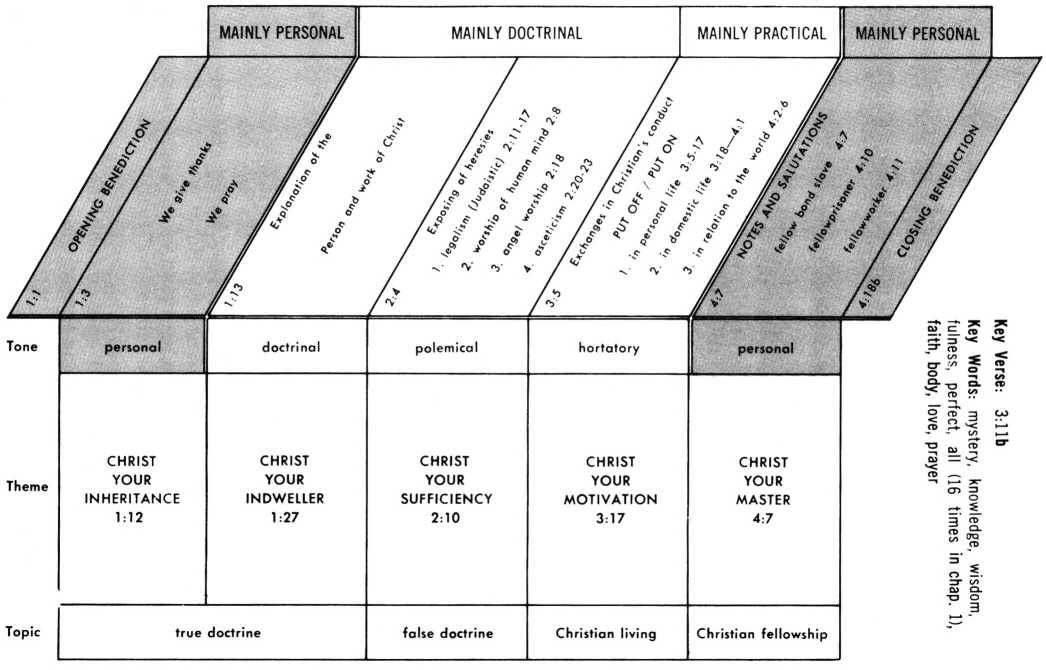
CHRIST IS ALL IN ALL
Click chart to enlarge
Charts from Jensen's Survey of the NT - used by permission
Colossians Overview - Click Chart on right side
| Christ Preeminent in All Things Supreme Lord - Sufficient Savior |
|||
| Colossians 1 | Colossians 2 | Colossians 3 | Colossians 4 |
| Supremacy of Christ |
Submission to Christ |
||
| Doctrinal and Corrective |
Practical and Reassuring |
||
| What Christ Did For Us |
What Christ Does Through Us |
||
| Christ Our Lord |
Christ Our Life |
Christ our Love |
|
| Christ the Head of the Body |
Christ the Lord of the Universe |
Christ the Head of the Home |
|
| Instruction | Warnings | Exhortations | Reminders |
| Reconciliation | Creation | Submission | Conversation |
| His Person and Word |
His Peace and Presence |
||
Colossians 2:1 For I want (1SPAI) you to know (RAN) how great a struggle I have (1SPAI) on your behalf and for those who are at Laodicea and for all those who have not personally seen (3SRAI) my face, (NASB: Lockman)
Greek: Thelo (1SPAI) gar human eidenai (RAN) helikon agona echo (1SPAI) huper humon kai ton en Laodikeia| kai hosoi ouch eorakan (3PRAI) to prosopon mou en sarki
Amplified: For I want you to know how great is my solicitude (Carefulness; concern; anxiety; uneasiness of mind occasioned by the fear of evil or the desire of good) for you [how severe an inward struggle I am engaged in for you] and for those [believers] at Laodicea, and for all who like yourselves] have never seen my face and known me personally. (Amplified Bible - Lockman)
BBE: For it is my desire to give you news of the great fight I am making for you and for those at Laodicea, and for all who have not seen my face in the flesh
Lightfoot: I spoke of an arena and a conflict in describing my apostolic labors. The image was not lightly chosen. I would have you know that my care is not confined to my own direct and personal disciples. I wish you to understand the magnitude of the struggle which my anxiety for you costs me—for you and for your neighbors of Laodicea, and for all who, like yourselves, have never met me face to face in the flesh
NLT: I want you to know how much I have agonized for you and for the church at Laodicea, and for many other friends who have never known me personally. (NLT - Tyndale House)
Phillips: I wish you could understand how deep is my anxiety for you, and for those at Laodicea, and for all who have never met me. (Phillips: Touchstone)
Wuest: For I desire you to know how great a conflict I am having in your behalf and in behalf of those in Laodicea, and as many as have not seen my face in the flesh
Young's Literal: For I wish you to know how great a conflict I have for you and those in Laodicea, and as many as have not seen my face in the flesh,
Hendriksen outlines Colossians 2 as follows:
Col 2:1-10 1.Delusive Philosophy
Col 2:11-17 2. Judaistic Ceremonialism
Col 2:18-19 3.Angel-worship
Col 2:20-23 4.Asceticism
(Baker New Testament Commentary)
FOR I WANT YOU TO KNOW HOW GREAT A STRUGGLE I HAVE ON YOUR BEHALF AND FOR THOSE WHO ARE AT LAODICEA: Thelo (1SPAI) gar humas eidenai (RAN) helikon agona echo (1SPAI) huper humon kai ton en Laodikeia:
- Colossians 4:12, Lk 22:44, Gal 4:19 Php 1:30 1Th 2:2 1Ti 6:12 2Ti 4:7 Heb 12:1
- Colossians 4:13, 4:15,16 Rev 1:11 , 3:14
- Colossians 2 Resources - Multiple Sermons and Commentaries
- Colossians 2: Jesus Plus Nothing Equals Everything - John MacArthur
- Colossians 2:1-2: Strengthen Your Heart - John MacArthur
- Colossians 2:2-7: Paul's Burden for the Church - John MacArthur
PAUL'S GREAT
STRUGGLE
John Eadie introduces this chapter noting that "THE apostle had just spoken of his sufferings for the church, and his conflicts for the realization of the one grand aim of the Christian ministry. That aim filled his spirit and nerved his energies. It made him what he was—a preacher, and at length a martyr. The value of souls and the glory of Christ wrapt themselves up in one burning thought, and created and sustained one dominant and living impulse within him. It was his heart's desire that the gospel should be preserved in its purity and simplicity, free from all admixtures of Judaism and false philosophy. He knew that the introduction of error imperilled the salvation of sinners, hindered the diffusion of the word, and robbed the cross of its special adaptations to a lost world. And his affection was not wholly set upon churches where he had preached in person. He had no little jealousies and no favouritism, but all the believing communities, whatever their age, place, or origin, found in him immediate sympathy and co-operation. The churches which he had not visited in person might scarcely be inclined to believe this fully, and might naturally imagine that their neighbours which had been honoured by his presence had a deeper hold on his affection. But the apostle seeks to dispel this illusion, and says in earnest exhortitude— “For I wish that you knew what a great conflict I have about you… " (Colossians 2 Commentary)
For (gar) is a term of explanation (a "hinge word" - little word that can open "big doors" of understanding) which connects with the foregoing verses to amplify the nature and the object of the struggle he had just described in Col 1:29 (see Eadie's comment below) Paul had just stated that he labored and strived for the saints at Colossae that they might be mature men and women, more like Christ (Col 1:28b). He added that his labor and striving (agonizing) was enabled by the Spirit's provision of power (dunamis) which continually worked mightily within him. Paul was a Spirit filled and Spirit empowered man. Don't miss the vital juxtaposition of Man's responsibility and God's Provision which is the secret for success in any spiritual venture (see "Paradoxical Principle of 100% Dependent and 100% Responsible" 100/100))
MacDonald adds that "This verse is closely linked with the last two verses of Col 1 ("Paul was writing one letter, not four "chapters." - Hendriksen). There the Apostle Paul had been describing his strivings, by teaching and preaching, to present every believer mature in Christ. Here his strivings are of a different nature. Now they are spoken of as great conflict in prayer. And here this great conflict is in behalf of those he had never met. From the first day he had heard of the Colossians, he had prayed for them as well as for those in the neighboring city of Laodicea, and for other Christians whom he had not as yet met (see Rev. 3:14-19 for the later sad state of the church there)." (Believer's Bible Commentary)
Spurgeon - Paul had not met these Colossian Christians, but he had heard of their faith, and hope, and love, and he so desired their good that he had a continual care for them in his heart. He carried that care to God in prayer, yet he still bore them in loving remembrance. They were always on his heart as a sick child is ever on the heart of its mother.
Want (2309) (thelo) expresses a desire that comes from one’s emotions and represents an active decision of the will which implies volition and purpose. Wuest says a better translation of this verse is “For I desire you to know”. Thelo is in the present tense which means that Paul continually had this desire for the saints at Colossae.
Hendriksen on I want you to know - The opening formula, "I want you to know," here and in 1 Cor 11:3, is substantially the same in meaning as the somewhat differently worded one in Phil 1:12. Similar is also the expression, "I (or we) do not wish you to be in ignorance" (Ro 1:13; 11:25; I Cor 10:1; 12:1; 2 Cor. 1:8; 1 Th 4:13). By the use of this formula the apostle stresses the importance of the matter under discussion. He regards the Colossian Heresy, which he is about to refute, as being a very serious danger. (Baker New Testament Commentary).
To know (1492) (eido) refers to absolute, positive, beyond a doubt knowledge. It means to see with the mind’s eye and signifies a clear and purely mental perception. The perfect tense speaks of the permanent or abiding state of knowing. Eido means perception by sight (perceive, see) as in Mt 2:2 where the wise men "saw His star". It describes one as having come to a perception or realization of something.
Eido (oida) then is not so much by experience as an intuitive insight that is "drilled into your heart". In spiritual terms, eido is that perception, that being aware of, that understanding, that intuitive knowledge that only the Holy Spirit of God can give. It is an absolute knowledge, a knowledge that is without a doubt. Oida describes absolute, positive, beyond a peradventure of a doubt, knowledge.
Oida suggests fullness of knowledge, rather than progress in knowledge, which is expressed by ginosko, a distinction illustrated in Jn 8:55, (Jesus said "you have not come to know {ginosko} Him, but I know {oida} Him). Here Jesus says in essence "I know God perfectly (oida)". In John 13:7 Jesus addresses Peter (Jesus answered and said to him, "What I do you do not realize {oida} now, but you shall understand {ginosko} hereafter.")
In Col 1:29-note Paul said in order to see the saints mature in Christ he was "striving according to His power" (the power of the indwelling Spirit of Christ) and the word striving is agonizomai which is derived from agon the word he uses here for struggle. He is agonizing in Col 1:29 and in agony in Col 2:1! Paul continues the athletic metaphor, BDAG noting that the "athletic competition’ transfers to the moral and spiritual realm." It is noteworthy that agonizomai is used only 8 times in the NT but twice in this short epistle. In the second use Paul describes the powerful prayer ministry of Epaphras
Epaphras, who is one of your number, a bondslave of Jesus Christ, sends you his greetings, always laboring earnestly (present tense) for you in his prayers, that you may stand perfect and fully assured in all the will of God. (Col 4:12-note)
How great a struggle I have - Have is in the present tense indicating that Paul is continually having this struggle. And what was the struggle. Most feel that Paul is speaking of "wrestling" in prayer for these saints, even though he has never seen them. This interpretation fits with Col 1:9 "For this reason also, since the day we heard of it, we have not ceased to pray for you and to ask that you may be filled with the knowledge of His will in all spiritual wisdom and understanding...." And in Col 1:3 he said he was "praying always for" the saints at Colossae.
THOUGHT - What a convicting thought but also what an encouraging thought. I frequently pray daily for unreached peoples using the the JOSHUA PROJECT and sometimes wonder about the efficacy of my prayers for believers laboring in the 10/40 Window (see map). Colossians 2:1ff encourages me to keep on keeping on, for one day I will see their face and what a joyous celebration we will experience. Somehow (this is supposition) I am convinced they will know that I had prayed for them while they were on earth, even though they were on the other side of the world. What does this mean? I'm not sure. That God even gives us this privilege is all we need to know for now. Amazing grace indeed! Let me challenge you to consider storing up for yourself eternal treasure in heaven by Praying for People from Every Tribe, Tongue, People and Nation. Revelation 5:8+ describes “golden bowls full of INCENSE, which are the PRAYERS OF THE SAINTS” “on the golden altar which is before the Throne.” (Rev 8:3+) Now observe carefully that in the Rev 5:9+ John describes “men from EVERY TRIBE and TONGUE and PEOPLE and NATION.” From this context we can discern a relationship between SUPPLICATION in Rev 5:8+ and SAVED SOULS in Rev 5:9. Clearly, our prayers for the salvation of the souls of others are safely “stored in a bowl” in Heaven! Our prayers like incense have ascended to the very Throne Room of Heaven! This indeed is amazing grace! For more motivation to pray for those you have never seen read the full discussion Praying for People from Every Tribe, Tongue, People and Nation. YOU WILL NOT REGRET IT FOR ALL ETERNITY. I GUARANTEE IT! And I think Paul would second this guarantee for in 1Th 2:19-20 he writes "For who is our hope or joy or crown of exultation? Is it not even you, in the presence of our Lord Jesus at His coming? For you are our glory and joy." (See explanation)
POSB says agon "is the picture of an athlete exerting every ounce of energy he has in the struggle of the contest. The idea is that Paul labored hard, toiled, strove, agonized, struggled, and wrestled in prayer." (Preacher's Outline and Sermon Bible - Commentary)
THOUGHT - Does agon or agonizomai describe your prayer life? Are you agonizing in prayer (I am speaking to myself also!)? Are you exerting your spiritual "prayer muscles" like the Greek athletes exerted themselves in the Olympic Games, like Epaphras prayed in Col. 4:12? The Greek athletes gave their all for a temporal, fading prize, whereas we have the privilege to give our all for an eternal prize which is imperishable, will not fade away, reserved in heaven for us! (1 Pe 1:4-note) But remember that this type of praying is not a reflection of fleshly energy (that's where analogy with Greek athletes breaks down), but with supernatural energy enabled by the Holy Spirit, Praying in the Spirit. As we spend time in the Word, the Spirit shows us the will of God (Jn 16:13-15). As we discern the will of God in the Word of God, we can then pray in accord with His will for as John writes "This is the confidence which we have before Him, that, if we ask anything according to His will, He hears us. And if we know that He hears us in whatever we ask, we know that we have the requests which we have asked from Him." (1 Jn 5:14-15-note) In addition we can have confidence that "In the same way the Spirit also helps our weakness; for we do not know how to pray as we should, but the Spirit Himself intercedes for us with groanings too deep for words; and He who searches the hearts knows what the mind of the Spirit is, because He intercedes for the saints according to the will of God." (Ro 8:26-27-note).
Related Resources:
- Devotional on Prayer
- Guide to Praying for Missionaries
- Pithy Prayer Phrases
- Prayer - Greek Words for Prayer
- Prayer Devotionals and Illustrations
- Prayer Hymns and Poems
- Prayer Quotes
- Prayer Quotes, Devotionals and Illustrations
- Praying His Word
- Spurgeon's Gems on Prayer
The division of chapters is here unhappy, for this verse (Col 2:1) is but a supplementary explanation of the preceding one (Col 1:29). “I am in an agony,” he had said, and now he adds, “I would ye knew what an agony I am in about you.” The noun agon means deep and earnest solicitude, accompanied with toil and peril. Phil. 1:30; 1Th 2:2; 1Tim. 6:12. It points out that intense and painful anxiety which preyed upon him, now in occasional terror, and now in reviving hopes—that ceaseless conflict which filled his waking hours with effort, and relieved with prayer the watches of the night. His soul was in a perpetual distress for them: every suspicion about them left a pang behind it—the bare possibility of their relapse or apostasy brought with it unutterable dismay and sorrow.
Therefore he says, “How great a struggle.”… It was no easy or supine struggle. He knew what was at stake. They were in danger, and he could not be in the midst of them. The seducer might have been pictured out to him, but he was not privileged to confront him. How the Colossians stood he knew not. He was aware of the hazard they were in generally—but the shiftings of the crisis and its individual results could only be faintly apprehended.
Like the caged bird beating its bared and bleeding breast against the wires of its prison, as it hears the repeated cry of its unseen young ones, the apostle turned ever and anon toward those churches, painted to himself their danger and their need of help, and strained his eager spirit to the utmost as he sighed over the possible desolation which might come upon them.
Nor did he idly chafe in his confinement,—but he wrote this letter, and he wished them to know the depth of the love which he cherished toward them. “I would that ye knew.” Similar construction is found in 1Cor 11:3; Php 1:12; Ro 11:25. If they knew it, they would listen all the more readily to his suggestions and counsels. (Colossians 2 Commentary)
The struggle here is not the struggle against God. While not directly stated as alluded to above, this struggle is undoubtedly describing the intense effort of his praying for the saints. At the time he wrote these words he could not move beyond the walls of his "rented house" (Acts 28:30) being continuously held by the chain linking him to a Roman soldier. But even under these circumstances he could engage in the spiritual warfare through the power of prayer. As additional support that the "struggle" Paul refers to involves prayer, there is another use of the related verb agonizomai, from agon, in Paul's description of
Epaphras, who is… always laboring earnestly (agonizomai from agon) for you in his prayers, that you may stand perfect (cf Col 1:28 - "mature" - same word teleios) and fully assured in all the will of God. (Col 4:12+)
Earlier in this epistle, Paul reminded the Colossian saints that since the day he had heard about their love in the Spirit, he and others had
not ceased to pray for (them) and to ask that (they) may be filled with the knowledge of His will in all spiritual wisdom and understanding so that (they might) walk in a manner worthy of the Lord… (Col 1:9-12+, cf Col 1:3 = "praying always for you")
Moule writes that the powers that wrestled with Paul for the ruin of his work were real and resolute; he therefore had to "meet them, foot to foot, force to force, in Christ".
The supreme example of the "struggle" of prayer is our Lord in the garden of Gethsemane where Jesus "in agony (agonia)… was praying very fervently; and His sweat became like drops of blood, falling down upon the ground." (Lk 22:44+)
THOUGHT: We all know from personal experience that persistence in prayer is a continual struggle. Is there anyone you are "struggling" in prayer for today? Have you let them know to encourage their soul? (See topic of prayer)
Stedman - I want to stress again the tremendous importance of praying for one another. You can do all the right things to help someone, but if his attitude is wrong nothing you do will serve to assist him. What can change that? It is your praying for him! Prayer can change the heart and mind, the inner attitude. It is a powerful force to transform an atmosphere and make something acceptable when otherwise it would appear to be dull and uninteresting. Paul prayed ("agonized" is the word) for these Colossian Christians over and over again, even though he had not personally met most of them. Also, it is evident from his letters that he was alert to every word of information about them. When Epaphras brought news to the apostle in Rome about the church at Colossae, Paul questioned him and extracted from him all the information he could in order that he might know how to pray for the Colossians. That is an indication of his special concern for them. (Read full message Colossians 2:1-7 The Overflowing Life)
Vine adds that "Prayer is such a mighty force that the spiritual powers of darkness are opposed to it in every possible way; see especially (Eph 6:12, 16, 17-See notes Ep 6:12; 16; 17)
And why was Paul struggling? From the context, it is clear that Paul knew false doctrines were already beginning permeate the church. Paul had been agonizing (verb form of agon - agonizomai in Col 1:29) to present every man complete in Christ and now he is explaining that this involved a great struggle. and most commentators feel this refers to his struggle in prayer for these believers. This manifestation of Paul's love even for those he had never met reflects his love for Christ, the Head of the church.
In 1Cor 11:1-note Paul exhorted us all to "Be (present imperative = continually be - only possible by dependence on the Holy Spirit) imitators of me just as I also am of Christ.
ILLUSTRATION - What an example he set as he agonized in prayer for these saints, most of whom he had never seen face to face! Paul's heart was like that of the shoemaker William Carey, some eighteen centuries later, who made a leather globe so he could pray for a world still unseen to him. Ultimately Carey’s “world-class” heart propelled him to India, and to a legacy as founder of the modern missionary movement.
THOUGHT - Have you ever prayed for someone that you've never met face to face? Has God's Spirit laid on your heart a hidden people group who have never heard the gospel? What an example for all of us to imitate (1Cor 11:1+) doing do in the power of the Spirit!
It seems that the church at Laodicea was deluded by "persuasive argument" for only 30 years later Jesus declared "So because you are lukewarm, and neither hot nor cold, I will spit you out of My mouth." (Rev 3:16+)
In this same warning passage Jesus declared "Behold, I stand at the door and knock; if ANYONE hears My voice and opens the door, I will come in to him and will dine with him, and he with Me." (Rev 3:20+)
The Laodiceans had become so deluded that there appears to not even be one genuine believer to "hear what the Spirit says to the churches." (Rev 3:22+)
Paul knew the inherent dangers of false teaching, which is surely in part why he agonized "on their behalf".
Paul's frequent use of agon in his epistles pictures our Christian life variously as a conflict, a contention, a fight, a race and a contest. Yes we know that victory has been won at Calvary (cf 1Jn 5:4, 5). And yet our daily task is to stand firm, holding fast to His Victory, by faith (synonymous with obedience). Why do we think that the struggle is not going to cost us anything (Lk 14:33)?
We have a mortal enemy both within (the old man, the old Adamic nature, the flesh, the sin nature) and without (Rev 20:10-note) and the conflict will continue until we see Jesus face to face. In the meantime we are called to fight the good fight (agon) of faith. (1Ti 6:12)
And those who are at Laodicea - Laodicea [see note] occurs 6x in the NT - Col. 2:1; Col 4:13, 15, 16; Rev. 1:11; 3:14
Struggle (73) (agon gives us our English "agony" something we can all identify with to help understand what Paul is saying) (Click for an in depth word study of agon) was a word well known to the Greek "sports crazed" culture. Agon pictured the struggle of the Greek athletes in the Olympiad agonizing to win at boxing, running, wrestling, etc. The idea is that of an athletic contest which is strenuous and demanding.
Agon - 6x in NT - conflict(1), fight(2), opposition(1), race(1), struggle(1). Php 1:30; Col 2:1; 1Th 2:2; 1Ti 6:12; 2Ti 4:7; Heb 12:1
AND FOR ALL THOSE WHO HAVE NOT PERSONALLY SEEN MY FACE: kai hosoi ouch eorakan (3PRAI) to prosopon mou en sarki:
- Colossians 2 Resources - Multiple Sermons and Commentaries
- Colossians 2: Jesus Plus Nothing Equals Everything - John MacArthur
- Colossians 2:1-2: Strengthen Your Heart - John MacArthur
- Colossians 2:2-7: Paul's Burden for the Church - John MacArthur
and as many as have not seen my face in the flesh [fig., have not met me personally] (Analyzed Literal)
This verse suggests either Paul had not established this church and/or he had not personally met these believers. The fact that he mention of Laodicea (cp Col 4:16-note) suggest that the "Colossian heresy" had spread to that church also.
McGee - Colosse is located about 100 miles inland from ancient Ephesus. When Paul came through that area (which he did twice), he did not come down to Colosse and Laodicea. Even when he attempted to go down into Asia on his second missionary journey, the Spirit of God forbade him; so he turned and took the northern route. Then when he came on his third missionary journey, walking over the land, he again took the northern route, perhaps because he was already familiar with it. It is clear that he had not been to these cities because he writes, "and for as many as have not seen my face in the flesh." This might be interpreted to mean that many new believers had come into the church since he had been there and that they had not seen his face. That meaning is highly unlikely; I think it means that Paul had never been there. (Thru the Bible Commentary: Thomas Nelson)
Richards - It's good to pray for those we know and love. But our vision needs to reach beyond this little circle to other brothers and sisters whom we may not have met, but whose needs we have come to know. (Bible Reader's Companion)
William MacDonald gives us a great application for this passage pointing out that "this is a comfort to those who are never privileged to engage in public ministry. It teaches that we need not be limited by what we can do in the presence of people. We can serve the Lord in the privacy of our rooms on our knees. If we do serve publicly, our effectiveness depends largely on our private devotions before God." (Ibid)
Colossians 2:2 that their hearts may be encouraged, having been knit together in love and attaining to all the wealth that comes from the full assurance of understanding resulting in a true knowledge of God's mystery that is, Christ Himself, (NASB: Lockman)
Greek: hina paraklethosin (3PAPS) ai kardiai auton, sumbibasthenten (APPMPN) en agapen kai eis pan ploutos tes plerophorias tes suneseos, eis epignosin tou musteriou tou theou, Christou,
Amplified: [For my concern is] that their hearts may be braced (comforted, cheered, and encouraged) as they are knit together in love, that they may come to have all the abounding wealth and blessings of assured conviction of understanding, and that they may become progressively more intimately acquainted with and may know more definitely and accurately and thoroughly that mystic secret of God, [which is] Christ (the Anointed One). (Amplified Bible - Lockman)
BBE: So that their hearts may be comforted, and that being joined together in love, they may come to the full wealth of the certain knowledge of the secret of God, even Christ,
GNB: I do this in order that they may be filled with courage and may be drawn together in love, and so have the full wealth of assurance which true understanding brings. In this way they will know God's secret, which is Christ himself.
Lightfoot: I am constantly wrestling in spirit, that the hearts of all such may be confirmed and strengthened in the faith; that they may be united in love; that they may attain to all the unspeakable wealth which comes from the firm conviction of an understanding mind, may be brought to the perfect knowledge of God’s mystery, which is nothing else than Christ—Christ containing in himself all the treasures of wisdom and knowledge hidden away
Montgomery: May their hearts be comforted! May they be knit together in love! May they gain in all its riches the full assurance of their understanding! May they come to a perfect knowledge of the secret truth of God, which is Christ himself.
NET: "My goal is that their hearts, having been knit together in love, may be encouraged, and that they may have all the riches that assurance brings in their understanding of the knowledge of the mystery of God, namely, Christ, " (NET Bible)
Wuest: in order that their hearts may be encouraged, having been knit together in the sphere of love and resulting in all the wealth of the full assurance of the understanding, resulting in an advanced and perfect experiential knowledge of the mystery of God, Christ,
Young's Literal: that their hearts may be comforted, being united in love, and to all riches of the full assurance of the understanding, to the full knowledge of the secret of the God and Father, and of the Christ
THAT THEIR HEARTS MAY BE ENCOURAGED: hina paraklethosin (3PAPS) ai kardiai auton:
- Colossians 2 Resources - Multiple Sermons and Commentaries
- Colossians 2: Jesus Plus Nothing Equals Everything - John MacArthur
- Colossians 2:1-2: Strengthen Your Heart - John MacArthur
- Colossians 2:2-7: Paul's Burden for the Church - John MacArthur
[For my concern is] that their hearts may be braced (comforted, cheered, and encouraged) (Amp)
"I am constantly wrestling in spirit, that the hearts of all such may be confirmed and strengthened in the faith" (Lightfoot),
"My goal is that their hearts, having been knit together in love, may be encouraged" (NET)
"in order that their hearts may be cheered" (Weymouth)
That (hina = term of purpose or result) introduces a purpose clause, explaining why he struggles or agonizes in prayer.
Max Anders sums up Col 2:2-4 - Paul tells how to avoid being deceived. These verses contain three elements which add up to a loving, learning community. Paul’s goal is that believers be (1) encouraged in heart which happens as they are (2) united in love, (3) and as they are settled in their understanding of the truth. (HNTC)
R C H Lenski - These Christians may be induced by the Judaizers to forget, to neglect, or to fear to use some of the knowledge and the wealth of assurance they have in Christ, they may then be deceived by the persuasive speech of the Judaizers. Paul’s great object, therefore, is to encourage them to take and to use this full blessed knowledge, it will make them safe and immune against insidious error.....Their hearts = the mind and the will, yea, the very personality; in the Greek “heart” never refers only to the seat of the feelings as it so generally does in English (BORROW The Interpretation of St. Paul's Epistles to the Colossians, to the Thessalonians, to Timothy, to Titus and to Philemon PAGE 84)
Their hearts - This phrase as discussed below is the chief, vital, efficacious or inner part of any thing and figuratively as here the inner self or seat of the emotion, appetites, affections and passions, as of love, joy, grief, enmity, courage, pleasure, etc. The upshot is that Paul is praying for an inner strengthening of their "control center" brought about by truth not a list of do's and don'ts.
Eadie - “That their hearts might be comforted” In the violent effort described in agon, there is implied a definite design expressed by hina (in order that, so that). The pronoun auton (their), in the third person, comprehends all the classes of persons mentioned in the preceding verse. We agree with Meyer that there is no reason to depart from the ordinary sense of the verb, which plainly means to comfort (Ed: Webster - comfort = to give strength and hope to), in 1Th 3:2; 2Th 2:17; Ep 6:22; Mt 2:18, 5:4; 2Co 1:4. The addition of kardia (heart) renders such a meaning more certain. It appears to us that there is in this earnest wish an allusion to that discomfort which the introduction of error creates, as indeed is more plainly shown by the concluding phraseology of the verse. The conflict of error with truth could not but lead to distraction and mental turmoil; and in proportion to their misconception of the gospel, or their confusion of idea with regard to its spirit, contents, and aim, would be their loss of that peace and solace which the new religion had imparted to them. (Colossians 2 Commentary)
Hearts (2588) (kardia) does not refer to the physical organ but is always used figuratively in Scripture to refer to the seat and center of human life, the inner person. The heart is the center of the personality, and it controls the intellect, emotions, and will. No outward obedience is of the slightest value unless the heart turns to God.
Hughes in comments on Paul's letter to Rome explains that he is saying that "The heart is the wellspring of man’s spiritual life, and that is where the Roman Christians’ obedience was rooted. It was not just a formal obedience—it came from the center of their being. This is the example of slavery Paul holds up for us all: a heartfelt obedience to Christ and his Word. It is an obedience which brings liberation. (Romans: Righteousness from heaven. Preaching the Word)
While kardia does represent the inner person, the seat of motives and attitudes, the center of personality, in Scripture it represents much more than emotion, feelings. It also includes the thinking process and particularly the will. For example, in Proverbs we are told, “As (a man) thinks in his heart, so is he” (Proverbs 23:7). Jesus asked a group of scribes, “Why are you thinking evil in your hearts?” (Matthew 9:4). The heart is the control center of mind and will as well as emotion.
The Scottish writer John Eadie says that "The “heart” belongs to the “inner man,” is the organ of perception as well as of emotion; the centre of spiritual as it is physically of animal life. (Colossians 2 Commentary)
Vine writes that kardia "came to denote man’s entire mental and moral activities, and to stand figuratively for the hidden springs of the personal life, and so here signifies the seat of thought and feeling." (Collected writings of W. E. Vine)
MacArthur commenting on kardia writes that "While we often relate heart to the emotions (e.g., “He has a broken heart”), the Bible relates it primarily to the intellect (e.g., “Out of the heart come evil thoughts, murders, adulteries, fornications, thefts, false witness, slanders,” Mt 15:19). That’s why you must “watch over your heart with all diligence” (Proverbs 4:23-note). In a secondary way, however, heart relates to the will and emotions because they are influenced by the intellect. If you are committed to something, it will affect your will, which in turn will affect your emotions." (Drawing Near. Crossway Books) MacArthur adds that "In most modern cultures, the heart is thought of as the seat of emotions and feelings. But most ancients—Hebrews, Greeks, and many others—considered the heart to be the center of knowledge, understanding, thinking, and wisdom. The New Testament also uses it in that way. The heart was considered to be the seat of the mind and will, and it could be taught what the brain could never know. Emotions and feelings were associated with the intestines, or bowels." (MacArthur, J: Ephesians. 1986. Chicago: Moody Press)
Wiersbe - Encouragement— Our English word encourage means "with heart." To encourage people is to give them new heart, Shallow sympathy usually makes people feel worse, but true spiritual encouragement makes them feel better. It brings out the best in people. (Bible Exposition Commentary)
Encouraged (3870) (strengthened, braced, invigorated, cheered, enlivened) (parakaleo from para = beside + kaleo = call) means literally to call alongside always with the idea of enabling or aiding a person to meet some difficult situation with confidence. And so the noun form was used to describe an advocate in the court of law.
Marvin Vincent says that in the present context parakaleo means "not so much tranquilized as braced" because the Colossians were beset by false teachers and needed to be "braced". The ASV translates it as "comforted" which is not that far removed from "braced" for the English word "comfort" is derived from the Latin confortare, (com = with + fortis = strong) to strengthen greatly, and therefore conveys the idea of strengthening the cause and the courage of another.
Paul prays the church may be filled with courage to cope with any situation, and that they may be strengthened. Strong hearts result in a powerful Christian life. When believers are strengthened by the Spirit, Christ will dwell in their hearts, they will be rooted and grounded in love, they will know the love of Christ and be filled with all the fullness of God (Eph 3:16, 17, 18-see notes Ep 3:16;17; 18). Then Christ, through them, will do “exceeding abundantly beyond all [they can] ask or think” (Ep 3:20-note).
William Barclay gives a secular usage the verb parakaleo which parallels Paul's use in here in Col 2:2 "There was a Greek regiment which had lost heart and was utterly dejected. The general sent a leader to talk to it to such purpose that courage was reborn and a body of dispirited men became fit again for heroic action. That is what [parakaleo] means here. It is Paul's prayer that the Church may be filled with that courage which can cope with any situation. (Daily Study Bible Series)
Matthew Henry adds that "It was their spiritual welfare about which he was solicitous. He does not say that they may be healthy, and merry, and rich, and great, and prosperous; but that their hearts may be comforted. Note, The prosperity of the soul is the best prosperity, and what we should be most solicitous about for ourselves and others. We have here a description of soul-prosperity."
To reiterate the goal of Paul's prayer for these saints is to encourage the hearts and to unite them in love. Many of us are only too ready to jump on someone and try to straighten him out on the spot. It is a great lesson to see how Paul seeks to lift their spirits first and to cause them to appreciate one another. It indicates that building a relationship with individuals is the true way to go about helping them. Have you ever tried to help someone, only to find your efforts fell on deaf ears? The apostle indicates the right way to help is to find something encouraging to say first. None of us like to be corrected by a negative approach. We first need a word of encouragement, as the apostle so beautifully demonstrates here.
The heart is the seat of:
1. EMOTIONS:
- joy (Deut 28:47; John 16:22),
- of pain (Jer 4:19),
- of tranquility (Prov 14:30),
- of grief (John 14:1; Rom 9:2; 2 Cor 2:4),
- of affections (Luke 24:32; Acts 21:13);
2. UNDERSTANDING:
- of knowledge (1 Kings 3:12; Matt 5:9),
- of perception (John 12:40; Eph 4:18),
- of thoughts (Matt 9:4; Heb 4:12),
- of rational powers (Mark 2:6; Luke 24:38),
- of imagination (Luke 1:51);
3. WILL:
- of intentions (1 Kings 8:17; Rom 6:17; Heb 4:12),
- of decisions (Exod 36:2),
- of purpose (Acts 11:23; 2 Cor 9:7);
4. TRUST:
- of faith (Mark 11:23; Rom 10:10; Heb 3:12),
- of obedience (Rom 6:17; 2 Thess 3:5),
- of conscience (Acts 2:37; 1 John 3:20).
(From What the Bible teaches).
HAVING BEEN KNIT TOGETHER IN LOVE: ai kardiai auton sumbibasthentes (APPMPN) en agape:
- Colossians 3:14 Ps 133:1 Jn 17:21 Ac 4:32 Php 2:1
- Colossians 2 Resources - Multiple Sermons and Commentaries
- Colossians 2: Jesus Plus Nothing Equals Everything - John MacArthur
- Colossians 2:1-2: Strengthen Your Heart - John MacArthur
- Colossians 2:2-7: Paul's Burden for the Church - John MacArthur
Related Passages:
Colossians 3:14 Beyond all these things put on love, which is the perfect bond of unity.
WELDED TOGETHER
IN LOVE
Having been knit together (sumbibazo) in love - In their unity they can stand strong against the "Colossian heresy." Notice they are unified by their mutual love for one another, not their knowledge. Knowledge is important but it must be balanced by love otherwise it is like "a noisy gong or a clanging cymbal!" (1 Cor 13:1-3). As Paul says later in this letter "Beyond all these things put on love, which is the perfect bond of unity." (Col 3:14+) It is fascinating that even though they are "knit together in love" Paul still exhorted them to "put on love!" God's supernatural love (agape) is not an arrival in this lifetime, but it is to be our lifelong pursuit! Such love is vital because as John says "The one who does not love does not know God, for God is love." (1 John 4:18+). And so love is the Christian's badge (Jn 13:35+) in a world whose love is growing colder by the day (Mt 24:12+, cf "lovers of self" = 2 Ti 3:1-5+).
Wiersbe - Endearment— The mature Christian loves the brethren and seeks to be a peacemaker, not a troublemaker. He is a part of spiritual unity in the church. An immature person is often selfish and causes division. (Bible Exposition Commentary)
Knit...together (4822) (sumbibazo from sun = union, intimate union + bibazo = to force) means that their hearts having been brought together into a united body, one in the Spirit. The metaphor is that it is like Jesus and His love is the "glue" that causes us to come together. Indeed He holds all things together. Sumbibazo is used in Colossians 2:19+ "held together (knit together) by the joints and ligaments."
Unity produced by Christ's love (and effected or orchestrated by the Holy Spirit, the Spirit of unity - Eph 4:3+) is the basis of the strength of the church, but when error gets in and you get your eyes off of Jesus and the love which He puts in your heart for others, at that moment you're going to start being separated.
THOUGHT : Is your local body fused together as a body, absolutely knit together by the love of the Lord Jesus Christ or are their factions, divisions, things that separate you? Where did that come from? Somebody got their eyes off of Jesus! Somebody stopped allowing that love working in their heart that could make them committed to the spiritual benefit of other people. When this process occurs, the body becomes disunited by error. Paul knows how dangerous this principle is… you let this sort of thing get into the church and you had better look out!! There is nothing but DIVISION from that point on. It is only Christ and His love that unites the body of Christ.
The truth unites. Error divides.
Having been knit is aorist tense which points back to a specific time in the past when their hearts had been knit together in love. The voice of the verb is passive which signifies that they did not knit their hearts together themselves, but that it was Christ's love that united them via His Spirit (Gal 5:22+).
Now mark down this contrasting principle --
ERROR
ALWAYS
SEPARATES
When our hearts are knit together, this union provides a great defense against error. Note that we are not talking about uniformity but unity, for uniformity is the result of compulsion from the outside whereas unity is the result of compassion on the inside, orchestrated by the Spirit.
In love - The divine "atmosphere" (see locative of sphere) in which this divine "knitting" takes place. Sometimes we attempt to "knit" folks together in groups, which by itself is not bad, but here Paul gives us a clue as to what can make these groups really "stick together" -- the "Super glue" of God's supernatural love (see agape below).
Love (26)(agape) is that unconditional, sacrificial love which Biblically is love that God is (1Jn 4:8,16), that God shows (Jn 3:16, 1Jn 4:9) and that God enables in His children (Gal 5:22+). Agape love does not depend on the world’s criteria for love, such as attractiveness, emotions, or sentimentality. Believers can easily fall into the trap of blindly following the world’s demand that a lover feel positive toward the beloved. This is not agape love, but is a love based on impulse. Impulsive love characterizes the spouse who announces to the other spouse that they are planning to divorce their mate. Why? They reason “I can’t help it. I fell in love with another person!” Christians must understand that this type of impulsive love is completely contrary to God’s decisive love, which is decisive because He is in control and has a purpose in mind. There are many reasons a proper understanding of the truth of God's word (and of the world's lie) is critical and one of the foremost is Jesus' declaration that
By this all men will know that you are My disciples, if you have love (agape) for one another. (Jn 13:35+).
Comment: This means supernatural/divine love can be seen by the the lost - it speaks of "love in action." How would believers/unbelievers describe your "love"? In action or inactive?!
Agape may involve emotion, but it must always involve action. Agape is unrestricted, unrestrained, and unconditional. Agape love is the virtue that surpasses all others and in fact is the prerequisite for all the others. Jesus when asked
"Teacher, which is the great commandment in the Law?” replied ”‘You shall love the Lord your God with all your heart, and with all your soul, and with all your mind.’ “This is the great and foremost commandment." (Mt 22:36-38+)
John MacArthur explains that "Agape love is the greatest virtue of the Christian life. Yet that type of love was rare in pagan Greek literature. That’s because the traits agape portrays—unselfishness, self-giving, willful devotion (cp Jn 3:16), concern for the welfare of others (cp Ro 5:8-note)—were mostly disdained in ancient Greek culture as signs of weakness. However, the New Testament declares agape to be the character trait around which all others revolve (cp 1Co 13:1-4+, 1Co 13:5, 6+, 1Co 13:7, 8+). The apostle John writes, “God is love, and the one who abides in love abides in God, and God abides in him” (1Jn 4:16, 8, 12, 13)". (The Power of Integrity : Building a Life Without Compromise, page 133) (Bolding added)
F B Meyer has the following description of agape love - Wherever there is true love, there must be giving, and giving to the point of sacrifice. Love is not satisfied with giving trinkets; it must give at the cost of sacrifice: it must give blood, life, all. And it was so with the love of God. "He so loved the world, that He gave his only-begotten Son." "Christ also loved and gave Himself up, an offering and a sacrifice to God." (Ep 5:2-note) We are to imitate God's love in Christ. The love that gives, that counts no cost too great, and, in sacrificing itself for others, offers all to God, and does all for His sake. Such was the love of Jesus--sweet to God, as the scent of fields of new-mown grass in June; and this must be our model. Not to those who love us, but who hate; not to those who are pleasant and agreeable, but who repel; not because our natural feelings are excited, but because we will to minister, even to the point of the cross, must our love go out. And every time we thus sacrifice ourselves to another for the sake of the love of God, we enter into some of the meaning of the sacrifice of Calvary, and there is wafted up to God the odour of a sweet smell. (Devotional Commentary on Ephesians)
ILLUSTRATION - There is an oft told story about the six young men that were to run a hundred-yard dash. They lined up, waited for the starting gun and then they were off running. About halfway down the track, the young man in front stumbled and fell. Almost immediately, the other five men stopped and helped him up. When they had dusted him off and decided that he was all right, they then decided to finish the race. None of the judges could tell who won the blue ribbon for none of them could see through their tears of joy. No one in the stands that day would ever forget this incident or how proud they for each of the persons that participated in these Special Olympics. Yes, these young men who cared more about their fallen friend than winning a race, were people that some have the nerve to call retarded. Maybe they understand things better than we do. They give us a parable of what God wants from the church.
AND ATTAINING TO ALL THE WEALTH THAT COMES FROM THE FULL ASSURANCE OF UNDERSTANDING: kai eis pan ploutos tes plerophorias sunesis:
- Isa 32:17 1Th 1:5 Heb 6:11; 10:22 2Pe 1:10 1Jn 3:19
- Col 1:9, 2Ti 2:7, Mk 12:33
- Colossians 2 Resources - Multiple Sermons and Commentaries
- Colossians 2: Jesus Plus Nothing Equals Everything - John MacArthur
- Colossians 2:1-2: Strengthen Your Heart - John MacArthur
- Colossians 2:2-7: Paul's Burden for the Church - John MacArthur
"and enjoying all the advantages of a reasonable certainty" (Weymouth)
Attaining to (1519) is translation of the preposition eis which indicates motion and here is used metaphorically or figuratively to describe the condition into which these saints were to come, specifically into a state of "abounding wealth and blessings of assured conviction of understanding" (Amplified) or "more sure in your grasp of God" (Phillips).
Adam Clarke explains that the Colossian saints "might have the most indubitable certainty of the truth of Christianity, of their own salvation, and of the general design of God to admit the Gentiles into his Church. This is the grand mystery of God, which was now laid open by the preaching of the Gospel."
All (pas) - all without exception. Nothing lacking in the wealth that Paul is describing!
Wiersbe - Enrichment—"Paul mentioned the riches of Christ earlier (Col. 1:27). Too many Christians are living like paupers when they could be living like kings. Mature Christians do not complain about what they don't have. Rather, they make use of the vast resources that they do have in Jesus Christ. (Bible Exposition Commentary)
Wealth (4149) (ploutos from pletho = to fill) properly denotes abundance, plentitude, and literally is used to refer to material wealth or prosperity (abundance of earthly, temporal goods) which is the meaning in the parable of the seed and the soils (Mt 13:22, Mk 4:19, Lk 8:14 = Material riches are deceitful and choke out reception of the Word of God. Be careful all you wealthy readers! Contrast spiritual riches - Ep 3:8-note) Indeed, think of the people who know whose whole lives glow with the glory of God for they are rich in spiritual possessions, albeit often poor in material possessions!
Ploutos - 22x in 21v - NAS as riches(19), wealth(3).
Matt. 13:22; Mk. 4:19; Lk. 8:14; Rom. 2:4; 9:23; 11:12, 33; 2 Co. 8:2; Eph. 1:7, 18; 2:7; 3:8, 16; Phil. 4:19; Col. 1:27; 2:2; 1 Tim. 6:17; Heb. 11:26; Jas. 5:2; Rev. 5:12; 18:17
In Greek Plutus was the god of riches. Liddell-Scott records secular uses of ploutos as referring to treasures of gold, silver, the "riches" of the earth. Our English word plutocrat means one who rules because of his wealth. In Greek the word is connected to pleroma, the word for "fullness" so that a rich person is one who is "full of money or property."
Louw and Nida write that ploutos…
an abundance of possessions exceeding the norm of a particular society and often with a negative connotation (Louw, J. P., & Nida, E. A. Greek-English Lexicon of the New Testament: Based on Semantic Domains. United Bible societies)
Francis Havergal alluded to true riches in these lines…
Take my silver and my gold,
Not a mite would I withhold;
Take my intellect, and use
Every power as Thou shalt choose.
(Version by Chris Tomlin)
THE TREASURE OF
FULL ASSURANCE
To all the wealth that comes from the full assurance of understanding - Literally, "to all riches of the full assurance of the understanding" The idea is a clear, comprehensive, heart-establishing acquaintance with divine truth.
John MacArthur says that in other words Paul is saying…
I want you to experience all of the riches that are available to you when you're solid and you're assured of what you have. In other words, you can't claim these things and really enjoy the richness of them unless you're really assured that they're yours, right?
Have you ever just sat down and plain contemplated what Heaven's going to be like? I've done that. Just thinking about it. Man, just think about it. And it's mine, and I get excited about that and I feel rich. I'm going to be up there possessing the whole universe. Oh, the riches of that promise. But if I had doubts, and was saying oh, I don't know if I'm to get there. I know what the Bible says, but I don't have … oh, I couldn't enjoy it. I'd think about it and I'd say, oh, I might miss it, and it would cease to be riches to me and I would become poor. Poor me, I don't know if … You've got to have that confidence that comes with the full settled understanding, and then you know you're rich.
Peter says, you better add to your faith virtue (2Pe 1:5-note), and this and this (2Pe 1:6, 7-note, 2Pe 1:8-note, 2Pe 1:9-note)… that your calling and election might be sure (2Pe 1:10-note). Not sure to God ‑‑ it's already sure to Him, but sure to you. And as your life becomes holy and your behavior manifests what's inside you get a settled understanding of what's your and you can enjoy how rich you are. (Paul's Burden for the Church Grace to You) (References and bolding added)
Full assurance (4136) (plerophoria from pleres = full, replete + phoréo = fill, bear or bring - see related plerophoreo-word study) means perfect, most certain, entire confidence or firm conviction. Plerophoria means assurance but conveys a stronger implication of certainty. It's like having a "wealth of certainty".
Plerophoria - 4x - Col. 2:2; 1Th 1:5; Heb 6:11; Heb 10:22 NAS = conviction(1), full assurance(3).
Full assurance is an interesting expression for according to J Vernon McGee it can mean “to be under full sail.” The idea is that believers should be moving along spiritually—they should be moving along for God. And proper understanding of Who He is and what His purpose is for us through His Word is like putting up our sails so that the Holy Spirit (pneuma = breath, wind) can "blow us" along, enabling us to live a supernatural Christian life! This begs the question - Are your sails up? Are your sins confessed and repented of and are you filled with the Spirit (Eph 5:18-note) so that you can walk by the Spirit (Gal 5:16-note)?
Common sense says that if we could be absolutely sure that our knowledge of God were accurate, then our hearts would be strong and in fact the glorious declaration of Scripture is that we can have full assurance.
As John Flavel wrote "A saving, though an imperfect knowledge of Christ, will bring us to heaven, Jn 17:2, but a regular and methodical, as well as a saving knowledge of him, will bring heaven into us, Col 2:2, 3."
Wiersbe - Enlightenment— The mature believer has assurance in his heart that he is a child of God. The spiritual knowledge that he has in Christ constantly enlightens him and directs him daily. I have often counseled believers who told me they lacked assurance of their salvation. Invariably, they have been neglecting God's Word and living in ignorance. (Bible Exposition Commentary)
John Eadie has a lengthy explanation on full assurance…
The noun plerophoria is full certainty or assurance. “The full assurance of understanding” is the fixed persuasion that you comprehend the truth, and that it is the truth which you comprehend. It is not merely the vivid belief, that what occupies the mind is the Divine verity, but that this verity is fully understood. The mind which has reached this elevation, is confident that it does not misconceive the statements of the gospel, or attach to them a meaning which they do not bear. Believing them to be of God, it is certain that it apprehends the mind of God in His message.
If a man possesses not this certainty—if the view he now cherishes differ from that adopted by him again—if what he holds to-day be modified or explained away to-morrow—if new impressions chase away other convictions, and are themselves as rapidly exiled in turn—if, in short, he is “ever learning and never able to come to the knowledge of the truth,” (2Ti 3:7) then such dubiety and fluctuation present a soil most propitious to the growth and progress of error. And as the mental energy is frittered away by such indecision, the mind becomes specially susceptible of foreign influence and impression.
It was the apostle's earnest desire that the Colossian church, and the members of the other churches referred to, should assuredly understand the new religion—its facts and their evidence—its doctrines and their connections—its promises and their basis—its precepts and their adaptation—its ordinances and their simplicity and power.
The fixed knowledge of those things would fortify their minds against the seductive insinuations of false teachers, who mix just so much truth with their fallacies as often to give them the fascinations of honesty and candor, and who impose them as the result of superior enlightenment, and of an extended and advantageous research.
The mind most liable to be seduced is that which, having reached only an imperfect and one-sided view, is continually disturbed and perplexed by opposite and conflicting ideas which from its position it is unable to reconcile, but is forced to wonder whether really it has attained to just conceptions of the truth.
The traveler who has already made some progress, but who begins gradually to doubt and debate, to lose faith in himself, and wonder whether he be in the right way after all, is prepared to listen to the suggestions of any one who, under semblance of disinterested friendship, may advise to a path of danger and ruin.
No wonder that the apostle describes the value of the full assurance of understanding by his favorite term—“riches”—for it is a precious form of intellectual wealth, and no wonder that he yearns for the Colossian Christians to possess it in no scanty measure, but in all its opulence.(Colossians 2 Commentary)
Adam Clarke commenting on full assurance of understanding - That is, that they might have the most indubitable certainty of the truth of Christianity, of their own salvation, and of the general design of God to admit the Gentiles into his Church. This is the grand mystery of God, which was now laid open by the preaching of the Gospel. (Colossians 2 Commentary)
John Calvin…
As many, contenting themselves with a slight taste, have nothing but a confused and evanescent knowledge, he makes mention expressly of the riches of understanding. By this phrase he means full and clear perception; and at the same time admonishes them, that according to the measure of understanding they must make progress also in love.
In the term assurance, he distinguishes between faith and mere opinion; for that man truly knows the Lord who does not vacillate or waver in doubt, but stands fast in a firm and constant persuasion.
This constancy and stability Paul frequently calls plerophorian, full assurance, (which term he makes use of here also,) and always connects it with faith, as undoubtedly it can no more be separated from it than heat or light can be from the sun. The doctrine, therefore, of the schoolmen is devilish, inasmuch as it takes away assurance, and substitutes in its place moral conjecture, as they term it.
The godly pastor Charles Simeon (See Bio by John Piper) adds that "Christians should never rest until the soul evidences that it is the Lord's… While our interest in His favour is doubtful, what happiness can we enjoy?"
Practically speaking, without full assurance, believers cannot enjoy all the blessings that are their present possession in Christ in this life. And furthermore, they will not look forward to all of the blessings that are their future possession in heaven if they even doubt whether they are going there!
A T Robertson - Paul desires the full use of the intellect in grasping the great mystery of Christ and it calls for the full and balanced exercise of all one’s mental powers.
Warren Wiersbe commenting on this section in Colossians 2 - The mature believer has assurance in his heart that he is a child of God. The spiritual knowledge that he has in Christ constantly enlightens him and directs him daily. I have often counseled believers who told me they lacked assurance of their salvation. Invariably, they have been neglecting God's Word and living in ignorance. (Bible Exposition Commentary) (Bolding added)
To counter the danger which is described by Eadie as to "doubt and debate" or by Calvin as to "vacillate or waver in doubt" Peter offers this exhortation…
Be all the more diligent (spoudazo in the aorist active imperative - Do this now! Don't delay! It's like a wartime command from a general to his soldiers… because we are in a spiritual war! cp 1Pe 2:11-note - See discussion of the Need for the Holy Spirit to obey) to make certain (bebaios = firm, fixed, stable, something upon which one can rely) about His calling (klesis) and choosing (ekloge) you (2Pe 1:10-note).
Comment: Thomas Brooks wrote that "Without the diligent use of means a lazy Christian has no right to expect to receive assurance." So how is this diligence manifested/practiced? Our lives as believers should give evidence that we are truly saved. In the context of 2 Peter 1, if we are applying all diligence seeking in our faith to supply the qualities delineated (2Pe 1:5-note, 2Pe 1:6, 7-note), it follows that we should be observing these qualities increasing or growing which in turn makes us fruitful and useful. When we see these spiritual dynamics in our life, then we can assuredly know that we possess genuine salvation. (2Pe 1:8-note, 2Pe 1:9-note, cp a similar command by Paul in 2Cor 13:5 where "test" and "examine" are both present imperative calling for habitual practice! See also 2Ti 2:19b where abstain is a command in aorist imperative)
When the believer experiences spiritual truth by living out that truth, the truth "marinates" in the mind (mere intellectual knowledge) and "matriculates" to the heart (genuine conviction) (By the Spirit - cp 2Co 3:18). In other words, truth becomes truly understood in a dynamic, pragmatic sense. Truth that is understood and obeyed also leads to assurance and confidence in that truth (in the context of Colossians, the truth of the gospel as opposed to false teachings of Greek philosophy, Oriental mysticism and Jewish legalism) and in the security of one's salvation. Knowing the truth and acting on the truth is imperative if one is to to experience all of the spiritual wealth found in the full assurance of understanding (See Col 1:10 [note] where this same spiritual dynamic of a worthy walk "births" an increasing experiential knowledge of God; compare this same truth taught by Jn 7:17, similar also to Jn 8:31, 32 [cp Jas 1:25-note] - where "abide" ~ obedience leading to a genuine experiential knowledge of the truth, which is then known and appropriated in such a way that it sets that person free and fortifies them against false teaching.).
In Colossians 1 Paul had prayed for understanding (sunesis)
For this reason also, since the day we heard of it, we have not ceased to pray for you and to ask that you may be filled with the knowledge of His will in all spiritual wisdom and understanding, (Col 1:9--note)
Comment: Beloved have you ever prayed for understanding or prayed for another to have understanding? Colossians 1:9-14 is a beautiful prayer to offer up in these situations.
Understanding (4907) (sunesis from suniemi = to comprehend, reason out in turn derived from sun/syn = with + hiemi = send) literally is a sending together or a bringing together. Sunesis describes the putting together, grasping or exhibiting quick comprehension. Sunesis is the ability to understand concepts and see relationships between them and thus describes the faculty of comprehension, intelligence, acuteness, shrewdness. In simple terms in the context of the Bible and spiritual truth, sunesis describes the ability to assemble Scriptural truths into an organized whole so that one may apply these biblical principles to their everyday life.
Sunesis - 7x in NT - Mk. 12:33; Lk. 2:47; 1 Co. 1:19; Eph. 3:4; Col. 1:9; 2:2; 2 Tim. 2:7 and is rendered in NAS as cleverness(1), insight(1), understanding(5).
Sunesis was originally used by Homer in the Odyssey to describe the running together or a flowing together of two rivers.
Sunesis suggests quickness of apprehension, the penetrating consideration which precedes action.
The Strong's entry "Synonyms" (#5826) compares Gnosis - denotes knowledge by itself, Sophia - denotes wisdom as exhibited in action. Gnosis applies chiefly to the apprehension of truths, Sophia adds the power of reasoning about them and tracing their relationships. Sophia denotes a “mental excellence of the highest sense”, Sunesis denotes a critical, apprehending the bearing of things.
Sunesis is the "faculty of quick comprehension, mother-wit, sagacity (pertains to being keen in sense perception or keen and farsighted penetration and judgment) (Liddell, H. G., Scott, R. A Greek-English lexicon)
Sunesis refers to understanding (the power of comprehending; especially the capacity to apprehend general relations of particulars), perception, comprehension (the act or action of grasping with the intellect).
In secular Greek sunesis first meant union and confluence and then comprehension, understanding and discernment.
Sunesis is the ability to understand concepts and see relationships between them.
Sunesis describes Jesus as a youth for "all who heard Him were amazed at His understanding (sunesis) and His answers". (Lk 2:47-note)
After discussion the metaphors of a soldier, an athlete and a farmer, Paul encouraged Timothy to
Consider (noieo means to give deep thought to and is a command to do this continually = present imperative - See discussion of the Need for the Holy Spirit to obey) what I say, for the Lord will give you understanding (sunesis) in everything (In how much?)." (2Ti 2:7-note).
Comment: This principle would apply to all worthwhile spiritual understanding - it is from God's Spirit Who teaches us.
Sunesis describes "a union or bringing together of the mind with an object, and so used to denote the faculty of quick comprehension, intelligence, sagacity… that quality of mind which combines: understanding not only of facts, but of facts in their mutual relations. (Vincent)
In another notation Vincent adds that this word denotes "that peculiarity of mind which brings the simple features of an object into a whole."
Sunesis "is the ability to assess any situation and decide what practical course of action is necessary within it. (Barclay, W: The Daily Study Bible Series, Rev. ed. Philadelphia: The Westminster Press)
Sunesis is the exclusive property of Christians because "a natural man does not accept the things of the Spirit of God; for they are foolishness to him, and he cannot understand them, because they are spiritually appraised (1 Cor 2:14-note).
In Ephesians Paul explains that the reason natural men cannot understand spiritual truth is because "those who are according to the flesh set their minds on the things of the flesh” (Ro 8:5-note) and are “darkened in their understanding” (Ep 4:18-note).
R Kent Hughes - (quoting F F Bruce) Paul emphasizes that the revelation of God cannot be properly known apart from the cultivation of brotherly love within the Christian community. This means that mere intellectual comprehension of the mystery of Christ will not bring full understanding of the mystery, for understanding also comes through the love of Christians one for another. How is this so? When we are loved by other believers, we experience Christ through them, and thus our knowledge of Christ is enhanced… The deepest knowledge of the mystery of Christ comes from both the head and the heart. We must study the Scriptures about Him intensely, with all our heart, and we must love Him and His people with all our heart—and then we will know as we ought. (Hughes, R. K. Colossians and Philemon: The Supremacy of Christ: Crossway Books)
RESULTING IN A TRUE KNOWLEDGE OF GOD'S MYSTERY THAT IS, CHRIST HIMSELF: eis epignosin tou musteriou tou theou Christou:
- Col 1:9, 10,3:10. Ep 1:17, 4:13 Php 1:9, Philemon 1:6, 2Pe 1:2,3,8,2:20
- Eph 3:3, 4, 5:32, 6:19, Col 1:26, 27, 4:3)
- Colossians 2 Resources - Multiple Sermons and Commentaries
- Colossians 2: Jesus Plus Nothing Equals Everything - John MacArthur
- Colossians 2:1-2: Strengthen Your Heart - John MacArthur
- Colossians 2:2-7: Paul's Burden for the Church - John MacArthur
"till at last they attain the full knowledge of God's truth, which is Christ Himself" (Weymouth)
Resulting (1519) is again the preposition eis which indicates motion toward.
Knowledge (1922) (epignosis from gnosis = knowledge gained by experience + epi = here used to intensify the meaning) full, perfect, precise knowledge thus signifying a more complete, more thorough, larger knowledge than that found in gnosis. In the New Testament epignosis is always used of the knowledge of things ethical or divine, and is never ascribed to God. Epignosis implies a more intimate and personal relationship than gnosis. The learner exhibits a more thorough participation in the acquiring of knowledge. In the NT epignosis often refers to knowledge which very powerfully influences the form of one's spiritual life (in contrast to gnosis which Vincent says "may be concerned with the intellect without affecting the character").
Epignosis - acknowledge*(1), knowledge(14), real knowledge(1), true knowledge(4). It occurs 20x in NT and four times in Colossians (the most concentrated use in any NT book other than 2 Peter) which signifies it is a "key word" in this short letter (as it is in 2 Peter). Ro 1:28; 3:20; 10:2; Ep 1:17; 4:13; Phil 1:9; Col. 1:9, 10; 2:2; 3:10; 1 Ti 2:4; 2 Ti. 2:25; 3:7; Titus 1:1; Phile 1:6; Heb. 10:26; 2Pe 1:2, 3, 8; 2:20
Epignosis is not merely an intellectual understanding of the truth, but a heart submission and appropriation of the same. Epignosis is thus a knowledge laying claim to personal involvement. The definite article signifies "the" very specific knowledge & in the case of God's will found primarily in the Word of God. In contrast to the so-called "superior" knowledge claimed by the Gnostics & hidden from all but the initiated, Paul wants the Colossians to be totally controlled by GOD'S knowledge. The knowledge Paul wants the Colossians to have is a deep and thorough knowledge of God's Word and Will and Ways.. Ideally epignosis controls & directs one's behavior. Ignorance contrary to popular thought is NOT bliss. Most of Paul's letter give this pattern of ''knowledge'' or doctrine, then duty.
Wuest adds that epignosis "is a knowledge which grasps and penetrates into an object. It was a favorite word of the Gnostics who used it to designate the superior knowledge which they claimed al their exclusive possession. Paul prays that all the saints might become possessors of this knowledge, indicating that it was open for all to appropriate, not a secret mystery into which only a favored few could be initiated. If the Gnostics had their superior knowledge, so did the Christian Church. The former was speculative and false, the latter, positive and true. Paul prays that they not only might have it but that they might be filled with it.
God's mystery that is Christ Himself - Literally "God's mystery, Christ"! Paul meets the false teachers (who many think were involved in the so-called "mystery religions" where only the initiated understood the "mysteries") on their own ground… and so Paul describes a mystery. This mystery is also is unknowable, except to the initiated. To understand the secrets of the pagan religions, one had to be initiated and enter into the pagan temples. By analogy, the only way to understand the treasures of God’s wisdom and understanding is to enter into Christ by faith for He is consummation and revelation of the treasures of God's mystery. All these treasures are stored away in Him.
As Ryrie reminds us God's mystery, Christ is "the one who reveals God to man, and in Him is everything we need."
Scofield adds that God's mystery "is Christ, as incarnating the fullness of the Godhead, and all the divine wisdom and knowledge for the redemption and reconciliation of man."
Constable - God has revealed in Christ all that a person needs to know to establish a relationship with God. Thinking that the source of true spiritual wisdom is somewhere other than in Christ can produce terrible disorder in the Christian life.
Eadie - The mystery, he says, had been long hid; but God had chosen to reveal the riches of its glory, and therefore he desires that his readers should not only distinctly recognize it, and highly value it, but specially, that they should fully comprehend its contents and lessons. (Colossians 2 Commentary)
The Complete Biblical Library note adds that Paul "wanted them to have a full knowledge, or constantly increasing knowledge of what it meant to have Christ indwelling them, what Paul labeled here "the mystery of God." It is a marvelous mystery that Christ does indwell His people, but the more we understand God's work in the believers, the clearer this "mystery" becomes. This is an excellent reminder that our knowledge of Christ improves progressively throughout the Christian life. While all Christians "know" Christ because of the living relationship that exists between the Lord and His people, Christian maturity enables them to know Christ in an ever-increasing manner.
H A Ironside - Truth unites. Error divides. Paul wanted the hearts of the Colossians to be "knit together in love" as they understood "the mystery of God"… As believers comprehend "the mystery," they are delivered from vain speculations and fleshly strivings, for all perfection is found in Christ.
New American Commentary - The hidden God appeared in Christ—He reveals Him; He explains the mystery. Therefore, if the question is, What is God like? The answer is, Christ. (New American Commentary - Volume 32: Philippians, Colossians, Philemon)
William MacDonald asks…
What does Paul mean when he says that they may know the mystery of God … and of Christ? He is still referring to the truth of the church—Christ, the Head of the Body, and all believers members of the Body. But the particular aspect of the mystery which he has in mind is the headship of Christ. He is anxious that the saints should acknowledge this truth. He knows that if they realize the greatness of their Head, they will not be drawn away by Gnosticism or the other evil cults that threatened them. Paul wants the saints to use Christ, to utilize His resources, to draw upon Him in every emergency. He wants them to see that Christ, who, as Alfred Mace puts it "is in His people, is possessed of every attribute of deity, and of infinite, unutterable, measureless resources, so that they did not need to go outside of Him for anything. “To them God willed to make known what are THE RICHES of the glory of THIS MYSTERY among the Gentiles: WHICH IS CHRIST IN YOU, the hope of glory” (Col 1:27). The truth of this, known in power, is the sure and certain antidote for Laodicean pride, rationalistic theology, traditional religion, demon-possessed spiritualistic mediums, and every other form of opposition or counterfeit. (BORROW Believer's Bible Commentary)
Mystery (3466) ( musterion from mustes = classic Greek word describing one initiated into the sacred mysteries) as defined by the NT is not used of that which is "mysterious" but to the contrary describes a previously hidden truth now divinely revealed to those whose eyes have been opened by the Holy Spirit to understand spiritual truth.
Musterion - 28x in NT - NAS as mysteries(5), mystery(22). Musterion occurs 4 times in Colossians where it is clearly a "key word." God's revealed mystery is highlighted in order to counter the so-called hidden "mystery religions" of Paul's day. Mt. 13:11; Mk. 4:11; Lk. 8:10; Rom. 11:25; 16:25; 1 Co. 2:1, 7; 4:1; 13:2; 14:2; 15:51; Eph. 1:9; 3:3f, 9; 5:32; 6:19; Col. 1:26-27; 2:2; 4:3; 2 Thess. 2:7; 1 Tim. 3:9, 16; Rev. 1:20; 10:7; 17:5, 7
Mystery in classic Greek use conveyed the idea of silence in rites of the so-called "mystery" religions (the Greco-Roman cults), which confided their "religious secrets" only to the select few who were initiated into the cult.
In light of the heresy plaguing them, Paul stresses the need for the Colossians’ understanding to include a true knowledge of God’s mystery. At the heart of this understanding, they need to have a settled conviction about Christ’s Deity and Sufficiency.
As Hughes reminds us "Perceptive Christians have always known that the key to spiritual well-being is an increased knowledge and focus upon Christ. (Ibid)
And so Peter exhorts the beloved in Christ "knowing this (that untaught and unstable men will distort hard to understand Pauline passages as they do also the rest of the Scriptures, to their own destruction) beforehand, be on your guard lest, being carried away by the error of unprincipled men, you fall from your own steadfastness, but grow (present imperative enabled by one's dependence on the Holy Spirit to obey this command to continually grow) in the grace and knowledge of our Lord and Savior Jesus Christ. To Him be the glory, both now and to the day of eternity. Amen. (2 Pe 3:17, 18 -note)
So Peter like Paul says that the best defense against destructive false teaching is continual growth in grace and knowledge of Christ. Note the importance of our need for continual growth, which is simply another way to describe progressive sanctification (Present tense salvation - see the Three Tenses of Salvation), growth in holiness or growth in Christ-likeness. Sanctification is like riding a bicycle. Stop peddling and you fall off. Obviously that picture is not to say we can lose our salvation (genuine salvation CANNOT be lost!), but we can fall into the subtle and deceptive decline known as Backsliding (see also Backsliding-Quotes, Devotionals, Illustrations).
NOTHING is more odious than a boasting spirit. Yet are there occasions on which it may be proper for a minister to declare to his people the greatness of his affection for them, and of his solicitude in their behalf. St. Paul, than whom no man was ever further from indulging this hateful spirit, judged it right, in almost all his epistles, to assure his converts of his remembrance of them night and day in prayer; and of his willingness to impart to them, not the Gospel only, but even his own soul, because they were dear to him. This tended to beget in them a reciprocal affection, and to open their ears to his instructions; and, at the same time to commend to them the Gospel, which had generated in his heart these feelings towards them. True it is, indeed, that he abounded in love far beyond any ministers of the present day: but still every faithful minister may, without pride or arrogance, adopt towards his people the language of our text, and say, “I would that ye knew what great conflict I have in my soul for you.”
That we may enter fully into the Apostle’s words, I will shew you,
I. What he desired in behalf of the Colossian Church—
His object was, “that he might present every man perfect in Christ Jesus.” With this view, he sought,
1. To bring them to a clear knowledge of the Gospel of Christ—
[The Gospel is here called a mystery, even “the mystery of God:” and throughout all his writings he designates it as a great stupendous mystery. It is the mystery of God, even of the Father, and of Christ. It must be viewed as from all eternity concerted between the Father and the Son in the covenant of redemption; wherein the Father agreed to accept the mediation of his Son, in behalf of man; and the Son agreed to assume our nature, and to bear our sins, and to work out a righteousness for us by his own obedience unto death; and so to watch over those whom the Father gave him, that they might all, without exception, attain to everlasting life.
Now all this he would have them “understand;” and not in a mere superficial way, but with such “a full assurance” as should leave not a doubt upon their mind either of its truth or excellency. In it are “riches” that are utterly unsearchable: riches of wisdom, which no finite mind can comprehend: riches of love, which can never be explored: riches of mercy, which eternity will never suffice to celebrate. He would have them see how harmoniously all the divine perfections unite in this mystery, and how wonderfully they are glorified. In a word, he would have them see in it a salvation so worthy of God, and so suited to man, as to carry with it, independently of all other considerations, a satisfactory evidence of its divine origin, and a pledge of the happiness of all who embrace it.
Now this is precisely what every pious minister wishes, and labours to accomplish. Those who are themselves ignorant of this mystery will be satisfied with some loose general statement about Christ, if they do not leave him out altogether. But not so the man who is taught of God: he will endeavour to exhibit to his people all the glory of God in the face of Jesus Christ: and he never will rest, till God has shined into their hearts, to give them a clear, a rich, an assured knowledge of it.]
2. To bring them to an open “acknowledgment” of it—
[“With the heart man believeth unto righteousness: but with the mouth confession is made unto salvation.” Whatever we may know of this mystery, it will be ineffectual for eternal happiness, if we do not confess Christ openly before men. He will never acknowledge those who are afraid to acknowledge him; but will surely “deny them in the presence of his Father and of his holy angels.” Hence St. Paul laboured to effect this also; even to impress their minds so deeply with this mystery, that they might rejoice and glory in it, and be willing to bear all the sufferings that could ever be inflicted on them for their adherence to it.
And for this we also would labour. Against a timid concealment of men’s convictions we would bear the most decided testimony. We know, indeed, that a confession of Christ before men will bring persecution with it. But if any man be unwilling to bear his cross after Christ, or even to lay down his life for his sake, we declare that he is not, nor can ever be, accepted of him. “If he love father or mother more than Christ, he cannot be Christ’ disciple:” “if he love his own life,” so as to save it here, “he shall assuredly lose it” to all eternity. Amongst those for whom a place is prepared in the lake that burneth with fire and brimstone, “the fearful and unbelieving” are no less numbered, than those who have been guilty of idolatry or murder. “If we would approve ourselves the servants of Christ, we must not only bear our cross after him, but rejoice that we are accounted worthy to suffer shame, or even death, for his sake.” “We must be faithful unto death, if ever we would obtain the crown of life.”]
3. To bring them to an union of heart with each other, by means of it—
[“Knowledge,” were it as great as that of angels, would be of no value, without love. Nor would zeal itself, even though it led us to endure the flames of martyrdom for Christ’s sake, be accepted of our God, if it were destitute of love. An union of heart amongst the disciples of our Lord is that by which, in a pre-eminent degree, they are to be distinguished. By love they are to be “knit together;” even as beams of timber, when joined and compacted by the builder of an edifice. In the whole universe, there exists no other bond like this. The ties of nature are feeble, when compared with it. It resembles, as far as any thing can resemble, the union that subsists between the Persons of the Godhead: and by it, more than by any thing else, is the power of religion displayed. “I pray for them,” says our Lord, “that they all may be one; as thou, Father, art in me, and I in thee, that they also may be one in us; that the world may know that thou hast sent me.” This, then, the Apostle sought: and this would we seek: nor would we ever be satisfied, till we see it attained and exercised amongst you.]
Having seen what the Apostle desired for them, we will proceed to shew,
II. Why with such intensity he desired it—
In the close of the preceding chapter he speaks of “labouring and striving” according to the working of the Holy Spirit, who wrought in him mightily. The word, before translated “striving,” he here repeats; conveying to us, thereby, the idea that he exerted himself, for the attainment of these things, with such a kind of “conflict” as wrestlers, racers, or fighters, maintained in the Grecian games. His whole heart and soul were engaged in behalf of all his Christian brethren, whether personally known to himself or not, that these great things might be accomplished in them. And for this end he laboured,
1. Because these things were essential to their comfort—
[In truth, there is no happiness in religion, unless it have its perfect work within us. A superficial and general view of the Gospel calls forth no admiring and adoring thoughts: nor docs it gender in the soul those ardent affections which bind together the members of Christ’s mystical body, and make every one of them ready to “lay down his life for the brethren.” But when all the riches of the Gospel are opened to our view, and the incomprehensible mystery of redemption, in all its inscrutable provisions, in its execution at the appointed period, in the mode of its application to the soul, and in all its stupendous consequences, is unfolded to us, so that we can behold our own interest in it, and are enabled to bear witness to it before an ignorant and ungodly world—what is all this, but heaven already begun in the soul? The glorified saints around the throne have no higher sources of joy than these, no higher theme of praise: and they are only happier than we, because their discovery of these things is more complete, and they are freed from all those infirmities which, in our present state, interrupt our enjoyment of them. To this I may add: when the soul, by virtue of this mystery, is filled with love, even with such love as Christ himself bears to his saints, such love as is the very image of God within us—this is happiness: the man that lives in the exercise of this divine principle breathes a purer atmosphere than others; and can say, “This is the house of God, this is the gate of heaven”
Now the Apostle was anxious that “the hearts” of all his brethren “might be thus comforted.” And what more can I wish for you? or rather I should say, what less than this should satisfy my desires in your behalf? Brethren, this is the state in which I would have you live: this is the comfort which I would have you all enjoy. And for this end it is, that from time to time [endeavour to unfold the mysteries of the Gospel, and to encourage amongst you that communion of saints which is a foretaste of heaven upon earth.]
2. Because, by nothing short of this could the full ends of his ministry be attained—
[A parent would not be satisfied if his children continued year after year in a state of infantine weakness: he would desire to see their stature increased, and their faculties enlarged. Thus the Apostle felt, in behalf of all his spiritual children. He longed that they might “grow up into Christ in all things, as their living Head;” daily increasing in the knowledge of God, daily brought into closer communion with him, daily assimilated more and more to his blessed image.
And this is what we would desire in your behalf. We are thankful when “your understandings are opened in any measure to understand the Scriptures;” and, from being blind, you are able to see, though it be only “men, as trees, walking.” But we cannot be satisfied with this: no; we would “put our hands on your eyes again,” till you should “be restored, so as to see every man clearly.” In truth, whether in respect of faith or love, we never would rest satisfied, till you have attained “the full measure of the stature of Christ.” We would never cease to labour, till we have “perfected that which is lacking in your faith” and till we sec you “standing perfect and complete in all the will of God.”]
Behold, then,
1. What you should desire for yourselves—
[“Who will shew us any good?” says the Psalmist: and then adds, “Lord, lift thou up the light of thy countenance upon us!” Truly, there is nothing in the universe worthy of a thought in comparison of this. What can worldly knowledge do for you, in comparison of the knowledge of Christ? or what can the fondest endearments of mere human affection do, in comparison of the love that is divine? If St. Paul’s judgment may be taken, he “counted all things but Joss for the excellency of the knowledge of Christ Jesus his Lord.” And this is the mind which I would wish to be in you. This, beloved, is your duty: this is your privilege. O! beg of God, that you may rise to this. Be not satisfied with low attainments, when such prospects are before you. You see what exertions men make for the attainment of knowledge, and the acquisition of honour: and will ye be less earnest in the pursuit of heavenly things? In a contest for earthly honours, you might feel discouraged by a consciousness of your inferiority in point of talent and capacity: but no such discouragement need be felt by any one in the conflict to which I call you. The very babe and suckling stands on a level with the wise and prudent; or rather, is raised above him, in proportion to his docility, and his willing submission to the truth of God. It is the heart, and not the head, that is the seat of divine knowledge, and the region of love. I pray you, brethren, let these things become the objects of your ambition, and never account any labour too great for the attainment of them.]
2. With what ardour you should seek after them—
[You have seen “what great conflict” your minister, if faithful, will have for you, in relation to these things: and will ye feel less for yourselves? Go, look at those who are engaged in the race, the wrestling, the combat; do you not see how they put forth their energies? Have they any disposition to look about them, or any time to relax their efforts? Yet is the object of their contest light in comparison of yours, and the consequence of a failure unworthy of a thought. Come, brethren, and be in earnest. Study the sacred volume: study it with much and fervent prayer: entreat of God to reveal his dear Son in your hearts: implore the Holy Spirit to “guide you into all truth:” and see to it, that you “grow in grace, and in the knowledge of our Lord and Saviour Jesus Christ.” Thus will you have in yourselves an evidence of the Gospel, which no human learning can give you; and conviction of its excellency, which nothing but experience can impart.] (Simeon, C. 1832-63. Horae Homileticae).
Colossians 2:3 in Whom are hidden all the treasures of wisdom and knowledge. (NASB: Lockman)
Greek: en ho eisin (3PPAI) pantes oi thesauroi tes sophias kai gnoseos apokruphoi.
Amplified: In Him all the treasures of [divine] wisdom (comprehensive insight into the ways and purposes of God) and [all the riches of spiritual] knowledge and enlightenment are stored up and lie hidden. (Amplified Bible - Lockman)
Lightfoot: Christ containing in himself all the treasures of wisdom and knowledge hidden away
NLT: In him lie hidden all the treasures of wisdom and knowledge. (NLT - Tyndale House)
Phillips: For it is in him, and in him alone, that men will find all the treasures of wisdom and knowledge. (Phillips: Touchstone)
Wuest: in Whom are all the hidden treasures of the wisdom and knowledge.
Young's Literal: in whom are all the treasures of the wisdom and the knowledge hid,
IN WHOM ARE (continually) HIDDEN: en ho eisin (3PPAI)… apokruphoi:
- Colossians 2 Resources - Multiple Sermons and Commentaries
- Colossians 2: Jesus Plus Nothing Equals Everything - John MacArthur
- Colossians 2:1-2: Strengthen Your Heart - John MacArthur
- Colossians 2:2-7: Paul's Burden for the Church - John MacArthur
"stored up and lie hidden" (Amp), "In whom are all the secret stores" (BBE)
In Whom is interpreted by most scholars as a reference to Christ rather than to "mystery". (See related discussion of the important NT phrase = in Christ )
Spurgeon - In whom are hid all the treasures of wisdom and knowledge. He wanted them to know God, and to rest comforted and happy in what he revealed. He saw in them a tendency to look abroad for something more than that, a desire to tack something else on to the gospel, a wish to try and find some fresh light outside the Word, and over this he greatly grieved. He himself was more than satisfied with the gospel, and he wanted them to be, in that respect, as he was.
Hidden (kept secret, unseen, concealed, withheld from sight) (614) (apokruphos from apokrupto = to conceal from apó = from, away + krupto = hide, conceal by covering) which means hidden away or concealed. It is used only metaphorically in the NT (Mk 4:22, Lk 8:17, Col 2:3).
In the present passage apokruphos means to be continually (the modifying verb "are" is in the present tense = continually) kept secret and by implication, laid up in store or treasured. Apokruphos is the root for our English word apocryphal which means writings or statements of dubious authenticity.
In Ephesians 3:9 the verb form apokrupto is used there (and 1Cor 2:7, Col 1:26) in a figurative sense to describe knowledge that cannot be known except through divine revelation. It is used in secular Greek writings of a "hidden trade (craft or skill)".
Apokruphos - 3x in NT - Mk. 4:22; Lk. 8:17; Col. 2:3 and is rendered in the NAS as hidden(1), secret(2).
Mark 4:22 “For nothing is hidden, except to be revealed; nor has anything been secret, but that it would come to light.
Luke 8:17-note “For nothing is hidden that will not become evident, nor anything secret that will not be known and come to light.
NET Note on nothing is hidden - Light also exposes, and Jesus was suggesting that his teaching likewise revealed where people are and where they will be. Truth will be manifest in the future, just as it was declared by him then. Nothing will be concealed.
J C Ryle - The application of these words and their connection with the context are not quite clear. Their primary sense appears to be that the disciples must not suppose that our Lord’s instructions were intended to be kept secret, and reserved from the world. They were not to be confined to a few favored hearers, like the lessons of the heathen philosophers, but to be published, proclaimed, and made known to all mankind. In this way the light given to the apostles would be “placed on a candlestick,” and not covered and hidden. Some think that the words point to the day of judgment, and the account which will then be taken of the use which all who have seen the light of the Gospel have made of it.
Apokruphos - 25x in 25v in the Septuagint - Deut. 27:15; Job 39:28; Ps. 10:8; Ps. 10:9; Ps. 17:12; Ps. 27:5; Ps. 31:20 (="You hide them in the secret place of Your presence from the conspiracies of man") Ps. 64:4; Ps. 81:7; Isa. 4:6; Isa. 45:3 (= "“I will give you the treasures of darkness and hidden wealth of secret places"); Dan. 2:22 (=“It is He who reveals the profound and hidden things"); Dan. 11:43 (= "the hidden treasures of gold and silver")
Ralph Earle (Word Meanings in the New Testament) adds that the term "apocryphal books"… "was used not only for the non-canonical books of the OT, but also for the secret writings of the Gnostics. Against their claims to esoteric knowledge, Paul asserts that all true knowledge is hidden - "stored up, hidden from view" (Weymouth) - in Christ."
Those treasures are hidden from the unbelieving world, from the unassisted intellect; and, are said to be hidden because the preaching of the cross is always foolishness to the world.
If these treasures are hidden then it follows that they must be discovered, disclosed or revealed. The Good News paraphrase emphasizes this truth translating this verse
He is the key that opens all the hidden treasures of God's wisdom and knowledge.
Paul explains to the Corinthians the key to the treasure in Christ -
It is written, "THINGS WHICH EYE HAS NOT SEEN AND EAR HAS NOT HEARD, AND which HAVE NOT ENTERED THE HEART OF MAN, ALL THAT GOD HAS PREPARED FOR THOSE WHO LOVE HIM." For to us (believers) God revealed them through the Spirit; for the Spirit searches all things, even the depths of God. Now we have received, not the spirit of the world, but the Spirit Who is from God, that we might know the things freely given to us by God, which things we also speak, not in words taught by human wisdom, but in those taught by the Spirit, combining spiritual thoughts with spiritual words. but a natural man does not accept the things of the Spirit of God; for they are foolishness to him, and he cannot understand them, because they are spiritually appraised." (1Cor 2:9, 10, 11, 12, 13, 14+)
Jesus said
I praise Thee, O Father, Lord of heaven and earth, that Thou didst hide (verb apokrupto) these things from the wise and intelligent and didst reveal (apokaluptos ~ apocalypse - see study of related word apokalupsis) them to babes. Yes, Father, for thus it was well-pleasing in Thy sight. (Lk 10:21+)
That is, the Father did not reveal spiritual truths to the scribes and Pharisees or for that matter to the wise men of the age, all of whom idolized their own wisdom. Instead God chose to reveal them to the simple and humble of heart. Compare a similar idea in ( Mk 4:22+)
Jesus also helps us understand how the treasure in Him is revealed declaring that
The person who has My commands and keeps them is the one who [really] loves Me; and whoever [really] loves Me will be loved by My Father, and I [too] will love him and will show (reveal, manifest) Myself to him. [I will let Myself be clearly seen by him and make Myself real to him.]. (Amplified Version, Jn 14:21+)
Jesus teaches the inseparable connection between love and obedience -- love is the root, obedience is the fruit. Where a sincere love to Christ is in the heart, there will be obedience, and this is the key intimacy and communion with Christ and disclosure of the "treasure".
Matthew Henry- "Where there is true love to Christ there is a value for His favor, a veneration for His authority, and an entire surrender of the whole man to His direction and government. Where love is, duty follows of course, is easy and natural, and flows from a principle of gratitude. On the other hand, where there is no true love to Christ there will be no care to obey him."
THOUGHT - Stop now for a moment and ask God to search your heart (Ps 139:23-24). "Do I truly love Him?" Ask Him to clear away every obstacle and hindrance that prevents you from loving Him with "all your heart and with all your soul and with all your mind and with all your strength" (Mk 12:30+)
John Eadie adds that Paul "is speaking of the mystery, and he here eulogizes it as worthy of fuller and farther insight. Nay, he places it in sharp contrast with the false and hollow error which was insinuating itself among them. That system which was “not after Christ,” might boast of its stores of philosophy, but they were not to be captivated by its pretences. They needed not to go in quest of higher truth and loftier science; for in that mystery proclaimed among them were deposited all the treasures of wisdom and knowledge… The verse before us is thus a high encomium (glowing and warmly enthusiastic praise) on the mystery, and an inducement to the apostle's readers to value it, to cling to it, to study it, and to enthrone it in a niche so lofty and inaccessible, that it could neither be rivaled nor dethroned." (Colossians 2 Commentary)
William Barclay adds that "Apokruphos means hidden from the common gaze, and therefore secret. We have seen that the Gnostics believed that a great mass of elaborate knowledge was necessary for salvation. That knowledge they set down in their books which they called apokruphos because they were barred to the ordinary man. By using this one word Paul is saying, “You Gnostics have your wisdom hidden from ordinary people; we too have our knowledge, but it is not hidden in unintelligible books; it is hidden in Christ and therefore open to all men everywhere.” The truth of Christianity is not a secret which is hidden but a secret which is revealed. (Daily Study Bible )
ALL THE TREASURES OF WISDOM AND KNOWLEDGE: pantes oi thesauroi tes sophias kai gnoseos
- 1Co 1:24; 30; 2:6 cf Pr 2:6,8:1
- Pr 8:14, 8:22
- Colossians 2 Resources - Multiple Sermons and Commentaries
- Colossians 2: Jesus Plus Nothing Equals Everything - John MacArthur
- Colossians 2:1-2: Strengthen Your Heart - John MacArthur
- Colossians 2:2-7: Paul's Burden for the Church - John MacArthur
The Puritan writer Thomas Brooks has an entire book The Unsearchable Riches of Christ
All (pas) means all without exception! The infinite Christ lacks no treasure of any eternal value! Oh God, cause us to seek for no treasure but that which is in Christ. Amen
J Vernon McGee - All that we need is in Christ. If only we could learn that! He is the reservoir of all knowledge.
Treasures (2344) (thesauros) refers to the place in which precious things are collected and laid up. To search other sources for spiritual truth apart from Christ is an empty enterprise. Paul’s answer to the heretical Colossian philosophy is an explanation of the significance of the believer’s union with Christ. What does human philosophy offer those who are united in faith to the divine Person and thus able to tap into "all the fulness of Deity" (Col 2:9-note)? To be rich in Christ is better than to be rich in all the wealth of this world.
Moses had a choice between worldly wealth and fame and chose to consider
the reproach of Christ greater riches than the treasures of Egypt; for he was looking to the reward. By faith he left Egypt, not fearing the wrath of the king; for he endured, as seeing Him who is unseen. He 11:26-note)
Jesus reminds us that "where your treasure is, there will your heart be also." (Mt 6:21-note) Jesus' words beg the question upon which every person such soberly reflect: Is my treasure …
- in Christ or in the world? …
- eternal or temporal? …
- forever or fleeting? …
- incorruptible or corruptible?
Paul reminds us the inexhaustible nature of the treasures in Christ declaring "Oh, the depth of the riches both of the wisdom and knowledge of God! How unsearchable are His judgments and unfathomable His ways!" (Ro 11:33-note)
You may have much gold and grandeur,
Yet by God be reckoned poor;
He alone has riches truly
Who has Christ, though nothing more.
—Anon.
Thomas Watson writes that "No country has all commodities of its own growth—but Christ has all kinds of fulness—fullness of merit, of spirit, of love. He has a treasury adequate for all our needs."
Wisdom (4678)(sophia) is the ability to judge correctly and to follow the best course of action, based on knowledge and understanding.
Paul's uses of sophia in Colossians - Col. 1:9; Col. 1:28; Col. 2:3; Col. 2:23; Col. 3:16; Col. 4:5
Thayer makes an excellent point that wisdom is "used of the knowledge of very diverse matters, so that the shade of meaning in which the word is taken must be discovered from the context in every particular case."
Hendriksen - Now wisdom is the ability, in concrete situations, to apply knowledge to the best advantage. It uses the most effective means to achieve the highest goal. In the Old Testament the work of creation is ascribed to God's wisdom (Ps. 104:24; Jer. 10:12). Job 28:23 ff. and Prov. 8:22 ff. personify the wisdom by means of which God created all things. The New Testament magnifies the wisdom of God revealed in the foolishness of the cross (I Cor. 1:18-25), in the church (Eph. 3:10), and in the work of God's providence in behalf of Israel and of the Gentiles (Rom. 11:33). (Ibid)
Spiritual wisdom is godly wisdom (contrasting with worldly wisdom - study and make a list of the contrasts in Jas 3:13, 14, 15, 16, 17, 18 and 1Cor 1:1ff thru 1Co 2:1ff) which involves living life in the light of the revelation of God’s Will in His Word and applying this knowledge to specific situations. Biblical wisdom is definable as skill for living. God's plan to redeem us destroyed the wisdom of the worldly wise men (1Cor 1:19). In fact, human wisdom never could comprehend God's plan for salvation (1Cor 1:21). Paul was not bound by the limits of human wisdom because the Holy Spirit conveyed spiritual wisdom through him (1Cor 2:13). Human wisdom is totally inadequate to accept God's salvation (1Cor 3:18-19).
Spiritual wisdom is given only by the Holy Spirit. In the Old Testament, Solomon exemplified this wisdom (Matt 12:42). When Jesus came, His wisdom also outshone the wisdom of the wisest among men (Matt 13:54). This wisdom was seen in the Lord Jesus, even when He was a small Boy (Luke 2:40,52). When leaders became necessary in the Jerusalem church, the apostles set about to select men who possessed this spiritual wisdom (Acts 6:3).
Wisdom is the insight into the true nature of things. Knowledge is the mental possession of powers of perceiving objects, wisdom is the power of right reasoning concerning them and forming right decisions accordingly.
Wisdom is the ability to judge correctly and to follow the best course of action, based on knowledge and understanding.
Wisdom is the art of being successful, of forming the correct plan to gain the desired results. Its seat is the heart, the centre of moral and intellectual decision
Sophia emphasizes understanding of ultimate things—such as life and death, God and man, righteousness and sin, heaven and hell, eternity and time.
Sophia is mental excellence in its highest and fullest sense (Vincent, M. R. Word studies in the New Testament. Vol. 3, Page 1-129).
Sophia is used frequently in the New Testament to describe the ability to discern and conform to God’s will.
In the time of Homer, wisdom was an attribute but in some Greek writings sophia was not infrequently used to describe shrewdness and cunning. To the Greeks sophia was never an action, as saying wise words or doing wise deeds. In fact, in ancient Greece wisdom had a practical aspect, for a "wise" carpenter was one who knew his trade well. In Greek culture the College of Seven Sages was distinguished by both wisdom and political discernment. According to Socrates, wisdom was knowing how little one really knew. Aristotle equated wisdom with "philosophy." The Stoics described wisdom as the application of knowledge. In the Septuagint (LXX), the Greek translation of the Old Testament, is used 135 times, and in the first use Jehovah tells Moses that…
And I have filled him (Bezalel in preparation for the task of fashioning and constructing the tabernacle) with the Spirit of God in wisdom, in understanding, in knowledge, and in all kinds of craftsmanship" (Exodus 31:3) (Comment: Notice how God's work is to be done with God's wisdom and not worldly wisdom)
In Deuteronomy Moses instructed Israel that they should
keep and do them (statutes and judgments which Jehovah had commanded Moses Israel to carry out in the land they were entering to possess it), for that is your wisdom (LXX = sophia) and your understanding in the sight of the peoples who will hear all these statutes and say, 'Surely this great nation is a wise (sophos) and understanding people. (Deut 4:6)
Wisdom is sometimes personified, as in the Proverbs as special knowledge, mainly knowledge concerning Jehovah ("Wisdom shouts in the street. She lifts her voice in the square" Pr 1:20). When Solomon prayed for wisdom to rule,
"Now God gave Solomon wisdom and very great discernment and breadth of mind, like the sand that is on the seashore." (1Kings 4:29) And so Solomon "so King Solomon became greater than all the kings of the earth in riches and wisdom. And all the kings of the earth sought the presence of Solomon, to hear his wisdom, which God had put in his heart." (2Chronicles 9:22, 23) which is what led the Queen of Sheba to come and see and then declare "How blessed are your men, how blessed are these your servants who stand before you continually and hear your wisdom." (2Chr 9:7)
In what is considered to be the oldest book in the Bible we read Job's thoughts on divine wisdom:
But where can wisdom (LXX = sophia) be found? And where is the place of understanding?… "Coral and crystal are not to be mentioned; and the acquisition of wisdom (LXX = sophia) is above that of pearls." So what was the source of this valuable resource? "And to man He said, 'Behold, the fear of the Lord, that is wisdom (LXX = sophia) and to depart from evil is understanding.' (Job 28:12, 18, 28)
Knowledge (1108) (gnosis) is objectively spoken of what is known (or can be known in Christ).
The difference between knowledge and wisdom - Knowledge is the understanding of truth, whereas wisdom is the ability to apply what truth has been learned.
J Vernon McGee comments that "All that we need is in Christ. If only we could learn that! He is the reservoir of all knowledge. In the science building where I went to college there was a motto on the bulletin board. It hung there the whole time that I was in college, and it made a great impression on me. I’m afraid I remember it better than I do the sciences that I studied there. It said, “Next to knowing is knowing where to find out.” I love that. I willingly admit that I don’t know everything—I’m sure you have found that out by now. But I know where to find out, because I know Somebody who does know. Christ has been made unto us wisdom. We need to rest in that. All the treasures of wisdom and knowledge are in Him—how wonderful this is! (McGee, J V: Thru the Bible Commentary: Thomas Nelson)
“Life with Christ is an endless hope; without Him a hopeless end.” - Anonymous
CHRIST
He is a path, if any be misled;
He is a robe, if any naked be;
If any chance to hunger, He is bread;
If any be a bondman, He is free;"
If any be but weak, how strong is He!
To dead men life He is; to sick souls health;
To blind men, sight, and to the needy, wealth;
A pleasure without loss, a treasure without stealth
-- Giles Fletcher, Jr. 1588–16
J C Philpot Devotional on Col 2:3 - What poor, blind fools are we by nature! How insufficient is all our earthly wisdom and all our natural knowledge, to guide us into the truth! When the soul really is under divine teaching, how ignorant it feels as to every single thing it desires to know! What clouds of darkness perpetually hang over the mind! What a veil of ignorance seems continually spread over the heart! The simplest truths of God's word seem hidden in the deepest obscurity, and the soul can neither see the truth, nor see nor feel its personal interest in it.
Now, when a man is here, he does not go to the Lord with lying lips and a mocking tongue, and ask him to give him wisdom, merely because he has heard that other persons have asked it of God, or because he reads in the Bible that Christ is made of God "wisdom" to his people; but he goes as a poor, blind fool, as one completely ignorant, as one totally unable to understand a single spiritual truth of himself, as one thoroughly helpless to get into the marrow of vital godliness, into the mysteries of true religion, or into the very heart of Christ. For it is not a few doctrines received into the head, nor a sound creed, that can satisfy a soul convinced of its ignorance. No; nothing can satisfy him, but to have that divine illumination, whereby he "sees light in God's light;" that spiritual wisdom communicated, whereby he feels himself "made wise unto salvation;" that unctuous light shed abroad in the heart, which is the only key to gospel truth, and is its own blessed evidence, that he knows the truth by a divine application of it to his soul.
“WISDOM,” we are told, “is the principal thing; and therefore we should get wisdom.” In all civilized countries, wisdom has been held in the highest repute: and institutions have been set on foot for the cultivation of it. How highly it was esteemed amongst our ancestors, we may judge from the provision which they made for the education of youth in all succeeding ages. Not that the establishments in this seat of learning were intended merely to reward those who distinguished themselves by early attainments: they were designed to give them also an opportunity of bestowing an undivided attention to literature and science throughout the remainder of their days: and if they be not improved for this end, the fault is not in the institutions themselves, but in those who have been admitted into them. We can have seen but little of the world, if we have not noticed the superiority which a cultivated mind possesses over one that is rude and uninstructed. And though it must be granted, that human learning will not change and sanctify the heart, yet we assert, that it will give a very great advantage for the understanding and explaining of the Holy Scriptures.
We say not that God could not, or did not, make use of weak and unlettered men for the diffusion of his Gospel: but, as he selected Moses, a man “learned in all the wisdom of the Egyptians,” for the instruction and government of the Jewish Church, so he selected Paul, who had “been brought up at the feet of Gamaliel,” to be his messenger of grace to the Gentile world: and, if he was pleased so to adapt the instrument to the work in that age of miracles, much more is such a qualification desirable for his chosen servants, now that miracles have ceased. We must not however forget, that the Scriptures are the fountain of true wisdom. We should ever bear in mind, that the heathen sages, though wiser than their contemporaries, were deplorably ignorant in comparison of those who live under the Christian dispensation: and even the light which some of the most learned amongst them possessed, was most probably obtained, either immediately or remotely, from the inspired volume. There, and there alone, is true wisdom to be found; and therein are contained “all the treasures of wisdom and knowledge.”
To open and unfold these to you, is an employment worthy of the occasion on which we are assembled.
St. Paul in my text is expressing his ardent desire in behalf of the Christians at Colossae, whom he had never seen, that they might be fully instructed in the great mystery of the Gospel of Christ, “in whom, he observes, are hid all the treasures of wisdom and knowledge;” but, in the margin, the word mystery is considered as the antecedent; and the translation is, “wherein;” i. e. “in which mystery are contained all the treasures of wisdom and knowledge;” and this we consider as the better rendering, though the sense will amount to nearly the same either way.
In illustration of these words we shall,
I. Open to you these treasures of wisdom and knowledge—
II. Commend them to your diligent pursuit—
1. We are to open to you these treasures of wisdom and knowledge—
But “who is sufficient for such” an undertaking? Who can enter on such a task, without a fear, not only that he shall betray his own ignorance, and disappoint your expectations, but that he may even expose the Gospel itself to contempt? Indeed, if I were capable of doing justice to my subject, such is the impatience of modern auditories, that I could not have time to do more than merely open to you the casket, and give you a superficial view of its contents: but feeling how incompetent I am to unfold all the hidden mysteries of the Gospel, I must entreat you to make up for my deficiencies by your candour; and to be contented with treasuring up for your benefit what you do hear, when you cannot be gratified with all that you would wish to hear.
There are three points to which I will call your attention; and which may give you some little idea, that the subject, however unworthily handled by me, is at least deserving of the deepest investigation. The points I refer to are at all events such as the most enlightened heathens had no idea of; namely, The real state of man—The eternal counsels of God concerning him—and the stupendous effects produced by those counsels. Let these things be for a while considered by us.
The real state of man was altogether unknown to the heathen world. That he was a weak, guilty, and polluted creature, they knew; but how weak, how guilty, how polluted, they had no conception; much less did they know how he was brought into such a state. It is from the inspired volume alone that we learn the perfection of his original nature, and the loss of that perfection through the fall of his first parents. From thence alone do we learn that obvious truth, that we “cannot bring a clean thing out of an unclean.” Behold then, at the very onset, what a stupendous mystery is here! that we died in Adam! that “those who have never sinned after the similitude of his transgression,” are yet partakers both of his guilt and corruption! that we are “born in iniquity, and conceived in sin,” and are “by nature children of wrath!”
To this I beg your particular attention, because it is the very foundation of all spiritual knowledge; it is the very threshold, by stumbling at which, multitudes are kept from ever entering into the deep recesses of the Gospel. You cannot but know, that men in general, and even learned divines, endeavour to soften down the Scripture declarations of man’s guilt and misery: some deny that we are fallen at all; and assert that we come into the world as pure as Adam did from his Creator’s hands. Others allow that we are fallen, but deny that we are involved in the guilt of our first parents, or that the corruption which we inherit from them is any thing more than what we have an innate power to subdue. They think that the descriptions given of us in the inspired volume are not to be taken in a literal sense; and that to say that we are “dead in trespasses and sins,” is only a metaphor, importing that we are not quite so much alive to God and holiness as we ought to be.
And now mark how entirely such sentiments obstruct the way to true wisdom and knowledge: man being in so good a state, there was no occasion for the counsels of the Most High to suggest a method of deliverance from it: a way of deliverance was obvious enough: there was no necessity for God himself to become incarnate, and to expiate the sins of men by his own blood; (man might be saved without any such sacrifice:) there was no need that the third person in the ever-blessed Trinity should undertake to dwell in the hearts of men, to enlighten their minds, to draw them unto Christ, to renew their nature, and to make them meet for heaven; (man of himself, by the aid of his own reason and resolution, was sufficient for these things:) the obligations conferred upon us by this work of redemption are not such as to call for all the powers of our souls to be consecrated to God in the way of holy obedience; (such a life is needless, enthusiastic, and absurd:) in a word, there is no great cause for alarm to any of us; for we are all in the way to heaven; and when we get there, shall have no great wonders to celebrate, but only to thank God for that which he could not justly or consistently have withheld. Yes, brethren, this it is which obstructs the entrance of light into the souls of men: this it is which makes every one suppose that he understands the Gospel well enough: this it is that leads men to deride all idea of mystery, and to reduce the Gospel to a system of heathen ethics. This view of our state by nature supersedes all occasion for the Gospel; every part of which supposes man to be a guilty, polluted, helpless creature; so guilty, that he deserves the everlasting wrath of God; so polluted, that he must be made an entire new creature before he can have any enjoyment of God, either now or in the eternal world; and so weak, that he cannot of himself either do a good act, or think a good thought: and I do not hesitate to affirm, that the very first step towards true wisdom and knowledge is, to renounce all idea of our being “rich and increased in goods, and in need of nothing;” and to confess, from our inmost souls, that we are “wretched and miserable, and poor, and blind, and naked.”
Next, let us contemplate the counsels of the Most High respecting man. From all eternity, God foresaw the state to which the human race would be reduced, and concerted with his only dear Son how to effect their recovery. The Father proposed to his Son to become our Surety and Substitute; to assume our nature; to bear our sins; to expiate our guilt; to fulfil the law which we had broken, and to satisfy the justice which we had offended; and thus to restore us to happiness, without dishonouring God as the Moral Governor of the universe. The Son accepts the proposal, and undertakes to accomplish the redemption of a ruined world: and the Holy Spirit also undertakes to impart to the souls of the redeemed all that the Lord Jesus should purchase for them. To these counsels the Apostle also constantly refers, as the true source of our redemption: “We speak the wisdom of God in a mystery, even the hidden wisdom, which God ordained before the world, unto our glory:” and he declares that the manifestation of them to the world under the Christian dispensation was eminently committed to him, and was to be a source of knowledge, not to men only, but to the angels themselves: “Unto me, who am less than the least of all saints, is this grace given, that I should preach among the Gentiles the unsearchable riches of Christ; and to make all men see, what is the fellowship of this mystery, which from the beginning of the world hath been hid in God, who created all things by Jesus Christ; to the intent that now unto the principalities and powers might be known by the Church the manifold wisdom of God, according to the eternal purpose which he purposed in Christ Jesus our Lord.”
Behold then here what treasures of wisdom and knowledge are unfolded to us! We see the veil torn away from before our eyes, and the Sacred Three sitting, as it were, in council, to provide for man’s recovery, myriads of ages before his fall: we behold the Father proposing to lay our iniquities on his only-begotten Son; his Son accepting the office of our Substitute; and the Holy Spirit engaging to render those mysterious plans effectual for the salvation of man! Can we see nothing wonderful in all this? Does not this “love surpass all knowledge,” and all conception? Is there not in it “a length, and breadth, and depth, and height” that can never be explored? Yes; and hence St. Paul speaks of “riches of glory” as contained in this mystery; and, in reference even to a subordinate part of it only, exclaims, “O the depth of the riches, both of the wisdom and knowledge of God! how unsearchable are his judgments, and his ways past finding out!”
Let us now pass on to the effects of these counsels, and see whether they also do not unfold the most stupendous mysteries.
From these counsels results all the work of Christ. He in due time left the bosom of his Father, took our nature, was born of a pure virgin, fulfilled the law, offered himself a sacrifice for sin, rose from the dead, and ascended up to heaven to carry on and perfect the work which he began on earth. Think of all this as necessary for our salvation: think of it as concerted from eternity, and executed in time, and at this very moment accomplishing by means of his continual intercession at the right hand of God: Is there nothing wonderful in all this?
From these counsels also results the salvation of man. Not a human being to whom the Gospel comes is ever saved, but by virtue of this work which Christ wrought out for him: and by means of this the vilest of the human race are saved. Those who seek an interest in this Saviour are accepted of him, even though they may have committed sins of a scarlet or crimson die: but they “who, going about to establish their own righteousness, will not submit to the righteousness of God,” are rejected; and the very Saviour who would have been a sanctuary to them, becomes a rock of offence, over which they fall to their eternal ruin. Here is a plain way of salvation for all. In vain do men dispute about the efficacy of their own good works to save them: here is a door; and they who will enter in by it are saved; and those who obstinately stand without, perish. The very builders of the ark themselves perished, because they did not enter into it: and so will all who do not flee for refuge to this hope that is set before them. Is this wisdom, or this knowledge of small value?
Further, from these counsels results the glory of God himself. It is in this way alone that God is, or can be glorified, by any child of man. If man were saved in any other way, every one of the Divine perfections would be dishonoured. What evidence would there be that God is holy, if he suffered his laws to be violated with impunity? What would become of all the rights of justice, if no sacrifice were offered for sin? How could the truth of God be preserved, if his threatenings were not executed, either against the sinner himself, or against one who should be substituted in his place? Men speak of God’s mercy as if that was the only attribute to be displayed, and as if it was of no consequence whether his other attributes were honoured or not: but God will not suffer one of his attributes to be exalted at the expense of all the rest: and therefore has he opened for us a way of salvation whereby all might be displayed and all be glorified. Not only is mercy now exalted, but justice too; and that, not only in the condemnation, but in the salvation also of sinful man: nor is it a whit less glorified in the salvation of a penitent believer, than it is in the condemnation of the impenitent, and unbelieving. Is here then no mystery? are here no treasures of wisdom and knowledge? Verily the angels themselves are made wiser by the revelation of them to the Church; and they are justly represented as “desiring daily to look into them,” in order that their admiration of God may be augmented, and their felicity increased.
We have been constrained to speak only summarily on these points; but enough has been said to shew, that in this subject there are treasures which will amply repay the most laborious investigation.
We proceed, therefore,
II. To commend these treasures to your most diligent pursuit—
Much as we revere human knowledge, we must declare, that, in comparison of that which we have been considering, the wisdom of philosophers is of no account: for this knowledge is at once the most sublime, the most certain, the most attainable, the most useful.
What is there so sublime as this? We grant that many human sciences, and astronomy in particular, are very sublime; and appear to be out of the reach of mortal man: but it is well known that philosophy, in many of its branches, was carried to as high, if not a much higher pitch among the unenlightened heathen, than amongst ourselves. But who amongst the heathen could ever find out God? Who could ever dive into his counsels? Who could account for the actual state of things as they existed in the world? Who could tell how a sinful man might be accepted of his God? Truly, “the world by wisdom knew not God:” this knowledge was “too wonderful and excellent” for unassisted reason to explore: nor can we, even with the Bible in our hands, attain it, unless God by his Spirit open the eyes of our understanding, and shine into our hearts to give it us. We are expressly told, that “eye hath not seen, nor ear heard, nor hath it entered into the heart of man to conceive, the things which God bath prepared for us;” and the things there spoken of are those which are revealed to us in the Gospel. It is not of heaven that the Apostle speaks, but of the Gospel, and the mysteries contained in it. These are the things which are called in Scripture “the wonderful works of God.” And they are “the things of the Spirit, which the natural man cannot receive, nor even know, because they are spiritually discerned.” Well therefore may we covet knowledge which was “hid in God from the foundation of the world,” which the wisest philosophers could never attain, which even the learned among ourselves cannot possess, unless God himself be their teacher, and “open their understandings to understand it.”
In point of certainty, there is nothing that can be compared with it. There are indeed in it many things which we cannot comprehend: but there is much known, and known on the authority of God himself. Most other knowledge is involved in doubt and obscurity; insomuch that hypotheses which have been established for ages, have yet been overthrown by the penetration of a Copernicus or a Newton: but the truth of God is unchangeable; and whether viewed in the promise to Adam, or in subsequent prophecies, or in the types and shadows of the law, or in the fuller revelation of the Gospel, is ever the same; nor can all the subtilty of men or devils invalidate so much as one single point. Indeed, though received on the credit of the inspired writers, it so commends itself to the believer, as to approve to him its divine origin, as soon as ever it is received into his heart: he there finds a counterpart of every truth he has received, and “hath the witness in himself” that it is indeed from God. Now one great discouragement in the pursuit of human knowledge is, that after having laboured for many years, we know not but that we may, after all, be found wrong, in things which we deemed of considerable moment. But here, we never need to fear a disappointment: God’s word, like himself, abideth for ever; nor shall one jot or tittle of it ever fail.
Nor is there any other so attainable. Thousands have not ability to investigate the depths of human science: if they should bestow ever so much labour, for ever so long a time, it would be in vain. But not so the knowledge of the Gospel: for though it is so deep, that no man by the efforts of unassisted reason can enter into it, yet it is so easy of acquisition, that “he who runs may read and understand it.” If God “open our eyes, we shall see wondrous things out of his law:” if he shine into our hearts, the light of the knowledge of the glory of God shall be seen by us. The qualification for this knowledge consists, not so much in the head, as in the heart: “God opened the heart of Lydia to attend to the things that were spoken by Paul.” Here then every one is encouraged to pursue it: for “none teacheth like God:” he can “ordain strength in the mouth of babes and sucklings. “I grant indeed that it is a “hidden knowledge;” it is “a treasure hid” in a field. But it is revealed to us in the word, and shall be revealed in us by the Spirit, if we desire to be taught of him. The promise is, “All thy children shall be taught of God:” and, if only we obtain his teaching, we shall “be guided into all truth;” nor shall “a way-faring man, though a fool, be left to err therein.”
Lastly, What can be compared with it in point of utility? We deny not but that knowledge of various kinds is replete with benefit to man: but that benefit is bounded by this world, and the present state of things. Not so the knowledge of which we are speaking: that extends to the eternal world: in the knowledge of God and of Christ, are all our hopes centered. By this we are justified: as it is said, “By his knowledge shall my righteous servant justify many.” By it also we are sanctified: as it is said, “Sanctify them through thy truth: thy word is truth.” By it also we shall be exalted to glory; for it is said, “This is life eternal, that they might know thee the only true God, and Jesus Christ whom thou hast sent.” What is there then that can be compared with this? Will earthly knowledge save you? If you could travel the whole round of science, and grasp in your mind all that ever was comprehended by human intellect, would it pacify a guilty conscience? Would it take away the sting of death? Would it enable you to look forward with comfort to the eternal world? Would it prepare you to stand at the judgment-seat of Christ, and to give up your account with joy? No; nothing can do this but the knowledge of God as reconciled to us in the Son of his love: this is the sole property of the Gospel, even of that Gospel which is so neglected and despised. If then you would view these things aright, you must study the Gospel, and “count all! things but loss for the excellency of the knowledge of Christ Jesus your Lord.”
Must we then lay aside our earthly knowledge? you will ask. No; but you must get it sanctified by the Spirit of God. The spoils of the Midianites were consecrated to the Lord; but before they were suffered to be brought into his tabernacle, “every thing that would abide the fire, must pass through the fire; and whatsoever would not abide the fire, must be made to go through the water:” for then only could they be an acceptable offering to him, when they were cleansed and purified from their corruption. Thus also must your learning be sanctified: it must not be set in competition with the word of God, but be made subservient to it. Beware then lest it blind your eyes, and fill you with a conceit that you do not need to be taught of God: for what the Apostle says is alike applicable to the philosopher and the peasant, “If any man will be wise in this world, let him become a fool that he may be wise.” We must have the docility of “little children, if we would enter into the kingdom of heaven;” and if we will not humble ourselves in that manner, God has told us, that “he will take the wise in their own craftiness.” In subserviency to the Gospel, your learning will be an invaluable blessing: but in opposition to it, it will prove a curse; for God will “confound the wisdom of the wise, and bring to nothing the understanding of the prudent.”
Are we then desirous of attaining these heavenly treasures? Let us seek after them in the Holy Scriptures: and whilst we seek for knowledge as silver, and “search for it as for hid treasures, let us cry to God for it, and lift up our voice to him; since it is the Lord alone that giveth wisdom, and out of his mouth cometh knowledge and understanding.” Let us beg of God to “give us the Spirit of wisdom and revelation in the knowledge of him; that the eyes of our understanding being enlightened, we may know what is the hope of his calling, and what the riches of the glory of his inheritance in the saints, and what is the exceeding greatness of his power to us-ward who believe, according to the working of his mighty power which he wrought in Christ, when he raised him from from the dead.” In this way we may hope to “acquaint ourselves with God,” and to attain the knowledge of his will in all wisdom and spiritual understanding.” Then we may hope also to “shine as lights in a dark world,” and “be as cities set upon a hill.” Or, if our sphere be circumscribed within narrower limits, we shall at least have this benefit, that we are “made wise unto salvation through faith that is in Christ Jesus.”