Daniel 2:2
Daniel 2:3
Daniel 2:4
Daniel 2:5
Daniel 2:6
Daniel 2:7
Daniel 2:8
Daniel 2:9
Daniel 2:10
Daniel 2:11
Daniel 2:12
Daniel 2:13
Daniel 2:14
Daniel 2:15
Daniel 2:16
Daniel 2:17
Daniel 2:18
Daniel 2:19
Daniel 2:20
Daniel 2:21
Daniel 2:22
Daniel 2:23
Daniel 2:24
Daniel 2:25
Daniel 2:26
Daniel 2:27
Daniel 2:28
Daniel 2:29
Daniel 2:30
Daniel 2:31
Daniel 2:32
Daniel 2:33
Daniel 2:34
Daniel 2:35
Daniel 2:36
Daniel 2:37
Daniel 2:38
Daniel 2:39
Daniel 2:40
Daniel 2:41
Daniel 2:42
Daniel 2:43
Daniel 2:44
Daniel 2:45
Daniel 2:46
Daniel 2:47
Daniel 2:48
Daniel 2:49
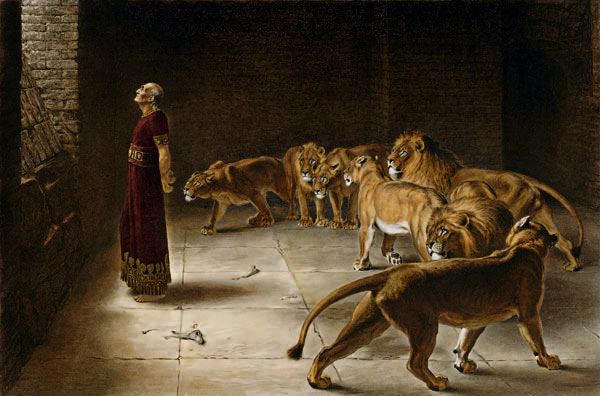
Daniel in the Lion's Den (Daniel 6)
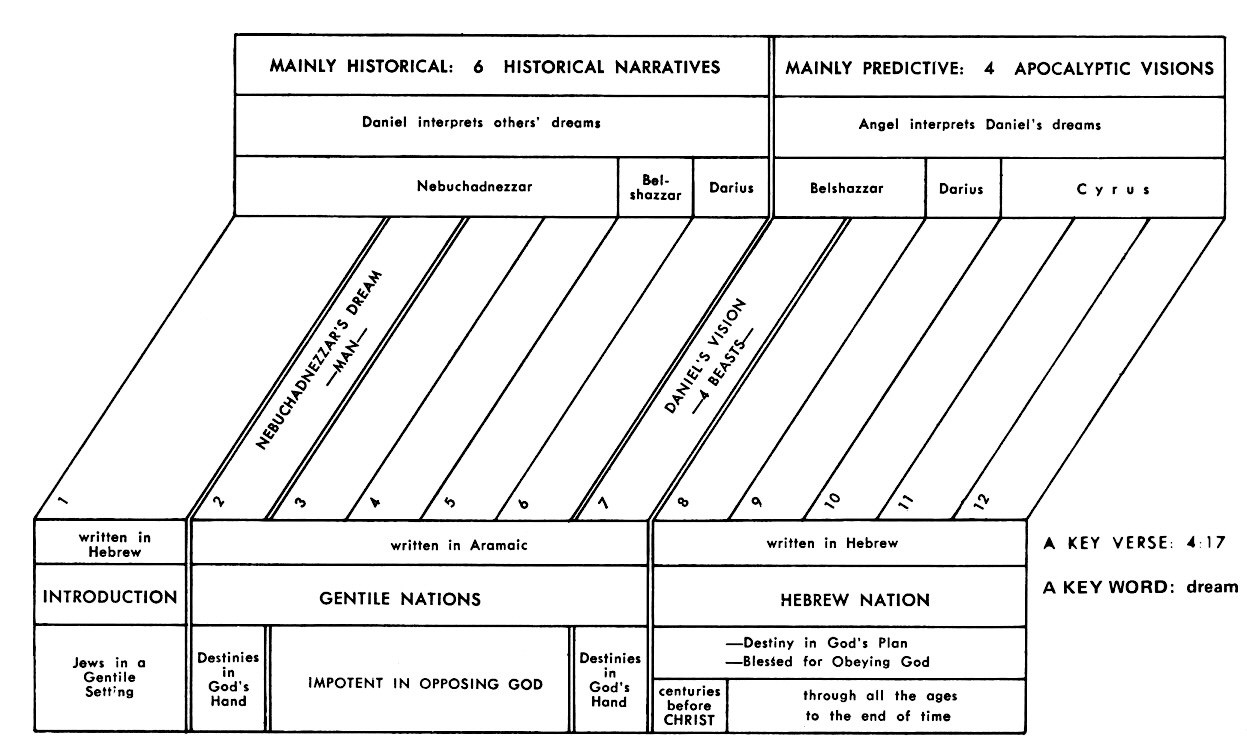
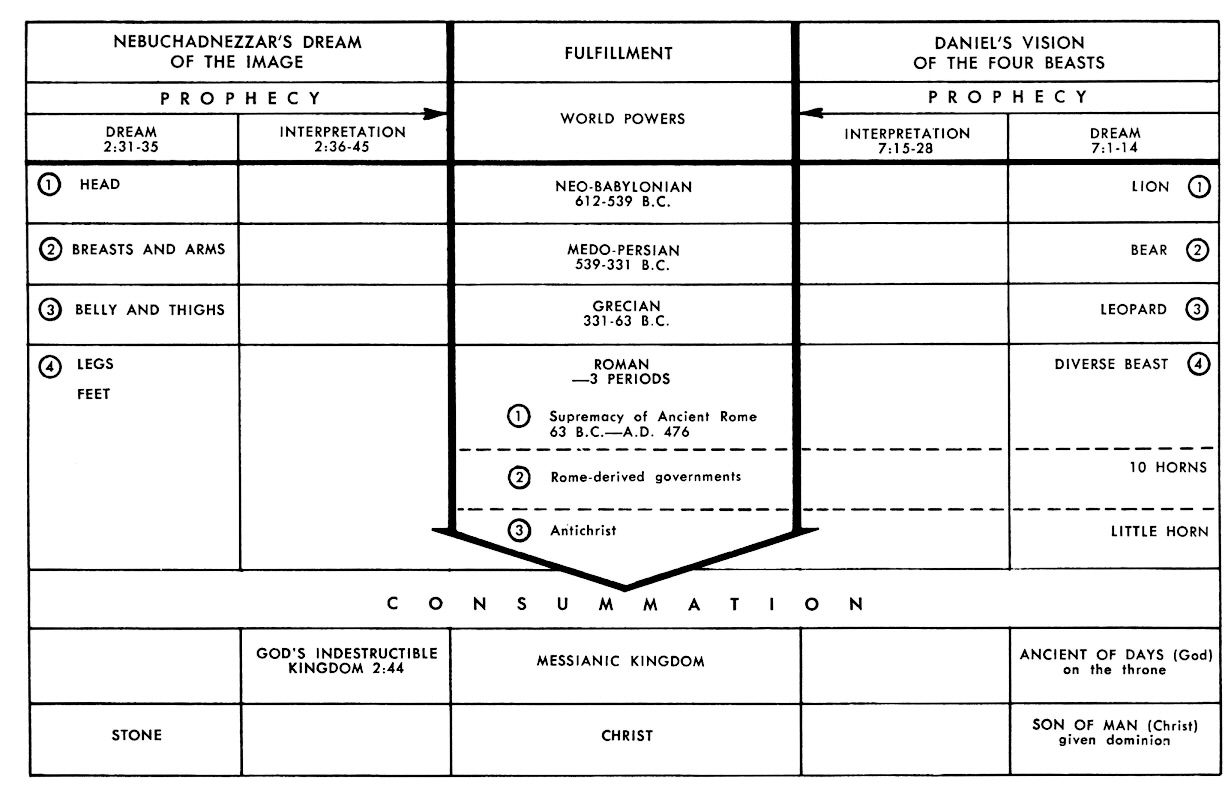
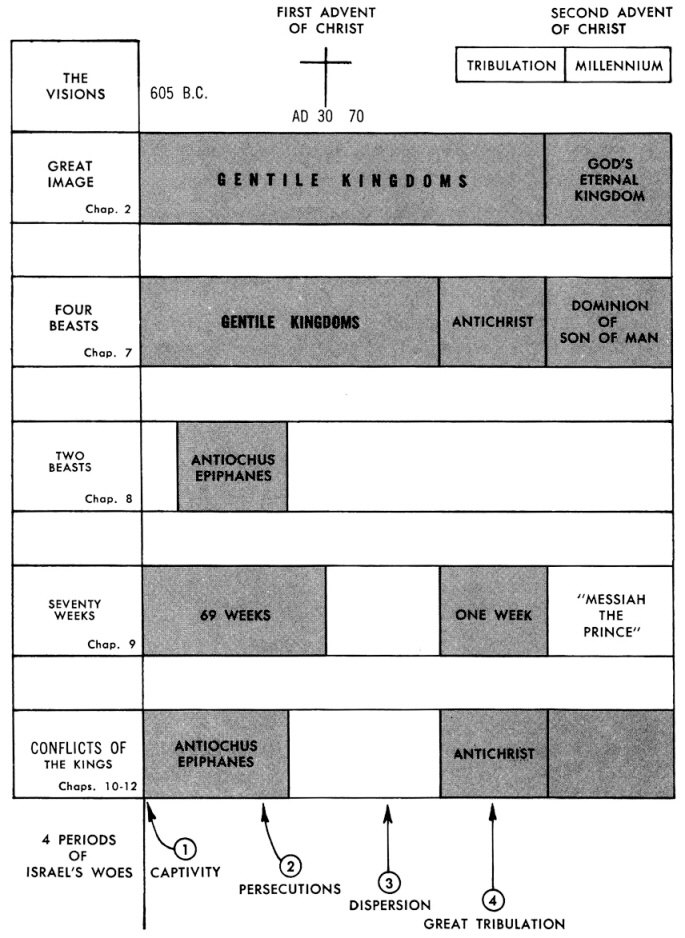
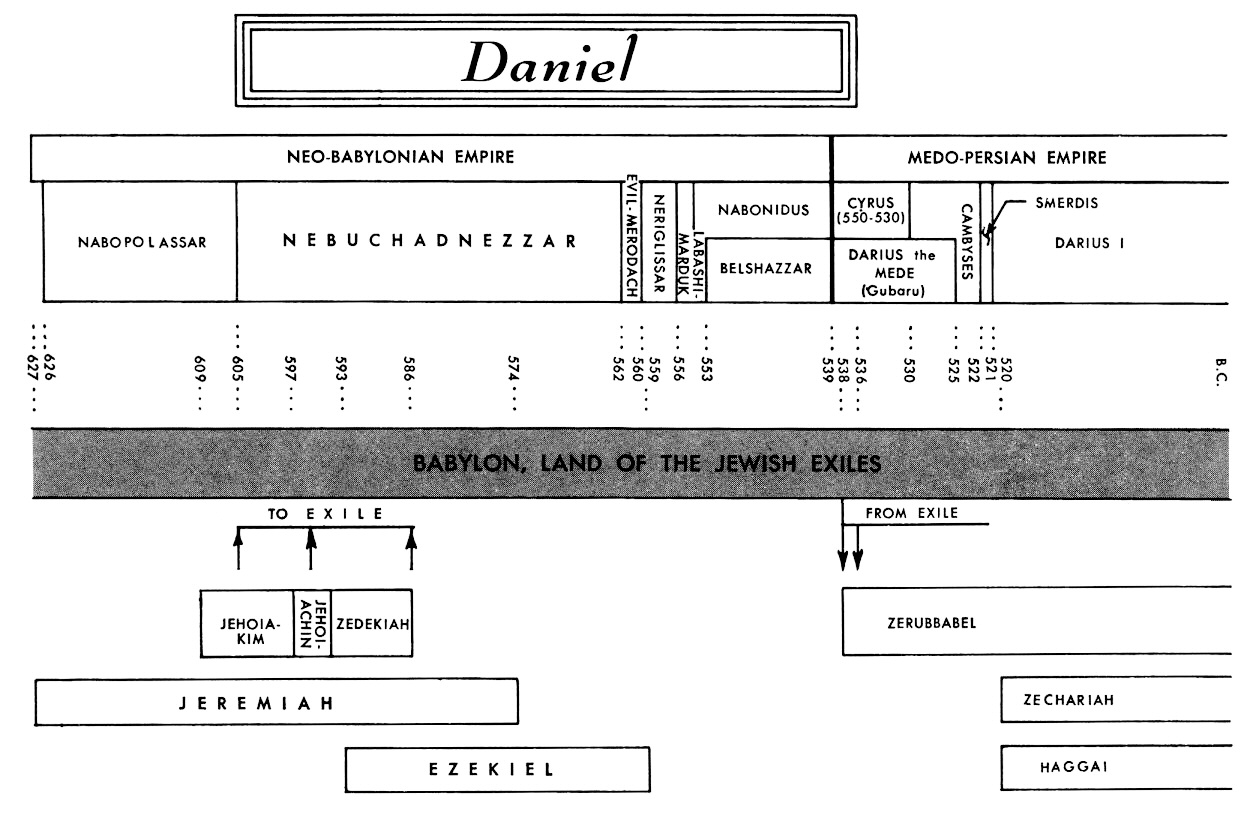
Click chart to enlarge
Charts from recommended resource Jensen's Survey of the OT - used by permission
Daniel Chart from Charles Swindoll
Daniel 2:1 Now in the second year of the reign of Nebuchadnezzar, Nebuchadnezzar had dreams; and his spirit was troubled and his sleep left him.
- in: Da 1:1, 2, 3, 4, 5 2Ch 36:5, 6, 7
- Nebuchadnezzar: Da 2:3 4:5 Ge 40:5, 6, 7, 8 41:1-36 Job 33:15, 16, 17
- and his: Da 6:18 Esther 6:1
- Daniel Resources - Multiple Sermons and Commentaries
KING'S DIVINE
"NIGHTMARES"
Daniel in the Septuagint (Lxx) - "The Book of Daniel with its so-called "Additions" has a special place in the Septuagint because, along with a few other books, it is extant in two complete, ancient versions. The (earlier) OG translation, of which few witnesses remain, had been supplanted by the TH (Theodotion) Version by the first or second century CE." (Click for more detailed discussion)
Here is the NETS Septuagint translation of Daniel -
Dan. 2:1 And in the twelfth year (NOTE: TRANSLATION OF THE THEODOTION VERSION OF THE SEPTUAGINT IS "DEUTERO" WHICH MEANS "SECOND." THE MASORETIC TEXT READS "SHENAYIM" THE HEBREW WORD FOR TWO. THEREFORE THE CORRECT CHRONOLOGY APPEARS TO BE "SECOND YEAR" NOT "TWELFTH YEAR") of Nabouchodonosor’s reign, it happened that visions and dreams befell him, and he was disturbed in his sleep. Da 2:2 And the king ordered that the enchanters and the magicians and sorcerers of the Chaldeans be brought in to tell the king his dreams. And when they arrived, they stood in front of the king. Da 2:3 And the king said to them, “I have seen a dream, and my spirit was shaken. Therefore, I want to find out about the dream.”
Here is the translation from THEODOTION - "In the second year of his reign, Nabouchodonosor dreamed a dream, and his spirit was startled, and his sleep left him. 2 And the king said to summon the enchanters and the magicians and the sorcerers and the Chaldeans to tell the king his dreams. And they came and stood before the king. 3 And the king said to them, “I dreamed, and my spirit was startled so as to know the dream.”
Da 2:4 And the Chaldeans spoke to the king in Syrian, “O lord, you shall live forever! Tell the dream to your servants, and we will explain it.” Da 2:5 Then the king said in reply to the Chaldeans, “Unless you tell me the dream with certainty and disclose its sense, you will be made an example, and your possessions will be expropriated into the royal treasury. Dan. 2:6 But if you make plain to me the dream and tell its sense, you will receive all kinds of gifts, and you will be glorified by me. Therefore, disclose the dream, and interpret.” Dan. 2:7 Then they answered a second time, saying, “O king, state the vision, so your servants will interpret regarding these matters.” Dan. 2:8 And the king said to them, “It is certain you are trying to buy time; therefore, as I have commanded: Dan. 2:9 unless you render to me the dream and disclose its meaning, you will meet up with death. For you have agreed to make lying words in my presence until the occasion changes. Now, therefore, if you state the vision, which I saw during the night, I shall know that you can also disclose its sense.” Dan. 2:10 And the Chaldeans answered in the presence of the king, “Nobody on earth can say to the king what he has seen as you are asking! And, no king or dynast has askeda such a matter of any sage or magician or Chaldean. Dan. 2:11 And the thing that you seek, O king, is difficult and important. And there is no one who can disclose these things except some angel, whose habitation is not with any flesh; therefore, it is not possible that it happen, as you imagine.”
Dan. 2:12 Then the king, being anxious and very sad, ordered to bring forth all the savants of Babylonia. Dan. 2:13 And it was decreed to execute all of them, but Daniel and all those who were with him were sought in order to be killed as well. Dan. 2:14 Then Daniel spoke counsel and knowledge to Arioch, the king’s chief cook, who was ordered to bring forward the savants of Babylonia. Dan. 2:15 And he inquired of him, saying, “Why is it being decreed so harshly by the king?” Then Arioch made the ordinance clear to Daniel. Dan. 2:16 Now Daniel immediately went in to the king and petitioned that time might be given to him, and he would disclose everything in the presence of the king.
Dan. 2:17 Then Daniel, departing to his own home, declared everything in detail to Hananias and Misael and Azarias, his companions. Dan. 2:18 And he proclaimed a fast and supplication and that help be sought from the Lord Most High about this mystery so that Daniel and those who were with him might not be delivered to destruction together with the savants of Babylon. Dan. 2:19 Then the mystery of the king was disclosed to Daniel. In the night in a vision the matter was clearly brought to light. Then Daniel blessed the Lord Most High and crying out he said,
Dan. 2:20 “Let the name of the great Lord be blessed forever,
because wisdom and majesty are his.
Dan. 2:21 And he changes seasons and times,
deposing kings and setting up,
giving to the sages wisdom
and understanding to those who have knowledge
Dan. 2:22 and revealing deep and obscure things
and knowing what is in the darkness and in the light,
and with him there is release.
Dan. 2:23 You, Lord of my ancestors,
I acknowledge and praise,
because you gave me wisdom and intelligence,
and now you have shown as much as I petitioned
in order to disclose regarding these things to the king.”
Dan. 2:24 So when Daniel went in to Arioch, who had been appointed by the king to execute all the savants of Babylonia, he said to him, “Do not destroy the savants of Babylon, but bring me in to the king, and I will disclose everything in detail to the king.”
Dan. 2:25 Then Arioch quickly brought Daniel in to the king and said to him: “I have found a wise person among the captives of the sons of Judea who will disclose everything in detail to the king.” Dan. 2:26 So having answered, the king said to Daniel, but called Baltasar in Chaldean, “Are you able to disclose to me the vision that I have seen and its sense?” Dan. 2:27 So Daniel spoke aloud in the presence of the king and said, “That which the king has seen: the explanation is not of the sages and enchanters and sorcerers and Gazarenes, Dan. 2:28 but there is a Lord in heaven illumining mysteries who has disclosed to King Nabouchodonosor what must happen at the end of days. O King, you shall live forever! The dream and the vision of your head upon your bed is this: Dan. 2:29 You, O king, after you reclined upon your couch, saw everything that must happen at the end of the days, and he that reveals mysteries has disclosed to you what is about to happen. Dan. 2:30 But as for me, this mystery was not brought to light because of wisdom that I have beyond all persons, but it was shown to me what you pondered in your heart by knowledge in order that it might be disclosed to the king.
Dan. 2:31 “And you saw, O king. And lo! There was one image. And that image was exceedingly great. And its appearance, being extraordinary, stood in front of you, and the appearance of the image was frightening. Dan. 2:32 And the head was of good gold, the chest and the arms silver, the belly and the thighs bronze, Dan. 2:33 and the legs iron, the feet partly of iron and partly of earthenware. Dan. 2:34 And you saw until when a stone was cut from a mountain, without hands, and it struck the image on the iron and earthenware feet and crushed them. Dan. 2:35 Then the iron as well as the earthenware and the bronze and the silver and the gold became powdery together and became more powdery, as it were, than the chaff on a threshing floor, and the wind threw them so that nothing remained of them. And the stone that struck the image became a great mountain, and it struck the whole earth.
Dan. 2:36 “This was the vision. Now we will also tell the meaning in the presence of the king. Dan. 2:37 You, O king, are king of kings, and to you the Lord of heaven has given the kingdom and power and honor and glory. Dan. 2:38 In the whole world from humans and wild animals and birds of the air and fish of the sea, he has delivered them into your hands to rule over all—you are the gold head. Dan. 2:39 And after you will rise a kingdom smaller than yours and another kingdom of bronze, which will rule over the whole earth, Dan. 2:40 and another kingdom, strong as iron, which saws everything and cuts down every tree, and the whole earth will be shaken. Dan. 2:41 And as you saw its feet partly of iron and partly of potter’s ware: there will be another kingdom in two parts, and some of the iron base will be in it; just as you saw the iron commixed with the clay ware, Dan. 2:42 part of the kingdom will be strong, and part of it will be broken. Dan. 2:43 And as you saw the iron admixed with the clay ware, they will be commixed in races of humans, but they will not be in agreement or well disposed to one another, even as iron is not able to be blended with earthenware. Dan. 2:44 And in the times of these kings the God of heaven will set up another kingdom that will be forever and will not be corrupted. And this kingdom will never permit another nation, but it will crush and abolish those kingdoms, and it will stand forever, Dan. 2:45 just as you have seen a stone cut out of a mountain, without hands, and it ground the earthenware and the iron and bronze and silver and gold. The great God has shown the king what will be at the end of the days, and the vision is precise, and the meaning of it trustworthy.”
Dan. 2:46 Then Nabouchodonosor the king, falling facedown on the ground, did obeisance to Daniel and ordered that sacrifices and libations be carried out to him. Dan. 2:47 And the king cried out to Daniel and said, “It is certain; your God is God of gods and Lord of lords and Lord of kings who alone brings to light hidden mysteries, because you have been able to disclose this mystery!” Dan. 2:48 Then King Nabouchodonosor, after he magnified Daniel and bestowed many great presents, appointed him over the affairs of Babylonia and designated him ruler and leader of all the savants of Babylon. Dan. 2:49 And Daniel petitioned the king that Sedrach, Misach, Abdenago might be appointed over the affairs of the kingdom of Babylon. And Daniel was in the royal court.
Recall that while Daniel is a book of prophecy, the first 6 chapters deal primarily with his personal life and the last 6 chapters deal with prophecy, specifically prophecy that deals with the nation of Israel. In Daniel 2 we do encounter a great prophecy which outlines the history of the Gentile nations and their interaction with Israel.
DANIEL 2:
THE ABC'S OF
BIBLE PROPHECY
Harry Ironside has said that "THIS second chapter has well been called “The A, B, C of prophecy.” (Ed Note: If Daniel is the ABC's, then Revelation is the XYZ's of Bible prophecy!) I suppose it contains the most complete, and yet the most simple, prophetic picture that we have in all the word of God. Had they been faithful to God, had they always been obedient to Him, royalty never would have departed from Judah. But because of their disobedience God gave their glory to the stranger, and dominion passed to the Gentiles in the person of Nebuchadnezzar. This was, in fact, the beginning of the distinctive period designated by the Lord Jesus in Luke 21:24 as “the times of the Gentiles.” (The glory of God had departed from Jerusalem, and the people of Judah became captives in the land of Shinar: “By the rivers of Babylon, [they] sat down, yea, [they] wept, when [they] remembered Zion” (Psalms 137:1).) This period will continue until all derived power is overthrown and… (Daniel 2 Commentary - Ironside's Notes)
Jesus shall reign where’er the sun
Doth his successive journeys run;
His kingdom spread from shore to shore,
Till moons shall wax and wane no more. AMEN!
Isaac Watts
Play the Hymn - Jesus Shall Reign
Young's Literal - And in the second year of the reign of Nebuchadnezzar, dreamed hath Nebuchadnezzar dreams, and his spirit doth move itself, and his sleep hath been against him
Daniel 2 is the "backbone of Bible prophecy"! As someone has said how you approach the interpretation of Daniel 2, will affect how you interpret every other prophecy in the Bible. If you misinterpret Daniel 2, you are very likely to misinterpret many (if not most) of the end time prophecies, especially the Revelation of Jesus Christ.
Dr. John Walvoord opens his comments on Daniel 2 with these remarks "Beginning with the second chapter of Daniel, the grand outline of the program of God for the period of Gentile supremacy and chastisement of Israel is presented for the first time. Tregelles, in his introduction to chapter 2 of Daniel, observes, “The book of Daniel is that part of Scripture which especially treats of the power of the world during the time of its committal into the hands of the Gentiles, whilst the ancient people of God, the children of Israel, are under chastisement on account of their sin.” (Samuel P. Tregelles, Remarks on the Prophetic Visions in the Book of Daniel, p. 6) What is true of the book in general is especially true of chapter 2. Nowhere else in Scripture, except in Daniel 7, is a more comprehensive picture given of world history as it stretched from the time of Daniel, 600 years before Christ, to the consummation at the second advent of Christ. It is most remarkable that Daniel was not only given this broad revelation of the course of what Christ called “the times of the Gentiles” (Lk 21:24; Ed: Cp Rev 11:1-2-note), but also the chronological prophecy of Israel’s history stretching from the rebuilding of Jerusalem to the second advent of Christ. These two major foci of the book of Daniel justify the general description of the book as world history in outline with special reference to the nation of Israel… Few chapters of the Bible are more determinative in establishing both principle and content of prophecy than this chapter; and its study, accordingly, is crucial to any system of prophetic interpretation. (Daniel 2 Nebuchadnezzar’s Vision Of The Great Image)(Bolding added)
IS THE "SECOND YEAR" AN ERROR?
Second year - Once again the so-called "higher" critics pounce on this verse as evidence of the "inaccuracy" of this book, an attack they are forced to continue because to accept the literal, historical account of Daniel as written in the 6th Century BC is to be forced to accept a sovereign God Who knows the future and is behind the scenes bringing every prophecy to "letter perfect" fulfillment (let God's "Self Revelation" encourage your faith [Ro 10:17-note] for Jehovah Himself declares - Isa 42:9, Isa 44:7-8, Isa 46:9,10, Isa 45:21). So what does this mean? Ultimately, the authenticity of Daniel and his prophecies means these critics and all who have scorned and mocked God and His plan for the ages (2Pe 3:1-7-note, 2Pe 3:8-note, 2Pe 3:9-note, 2Pe 3:10-note, 2Pe 3:11-note), have a Supreme Being before Whom they will one stand to give an accounting for their brief time on earth (Rev 20:11-15+) and before Whom they will bow their knee and confess as LORD to the glory of God the Father (but not their very own Father! - Jn 1:11-13+, 1Jn 3:1+) (Phil 2:10-11+)!
Garland writes - The situation before us is actually evidence of the genuineness of the book because a forgery would have no doubt attempted to smooth over the tension between this verse and Daniel 1:5, 18. "A forger would not introduce difficulties; the author did not then see any difficulty in the case." (A. R. Fausset)
Constable - Daniel opened this new section of his book with another chronological reference (cf. Daniel 1:1; Daniel 1:21). This indicates that his interest in this book was in the progress of events and their relationship to one another. As the book unfolds, chronology plays an important part in what God revealed, though the chronology is not always without interruption. The events related in this chapter happened in the second year of Nebuchadnezzar's reign. According to several reliable scholars, Nebuchadnezzar officially became king on September 7, 605 B.C. On the first of Nisan, 604 B.C., the following spring, the first official year of his reign began. The intervening months constituted his accession year and were credited to his father's reign. The first year of his reign then ended on the first of Nisan the following year, 603 B.C. The second year of his reign (Daniel 2:1) began in 603 and ended in 602 B.C. [Note: Wiseman, pp. 25-26; Thiele, pp. 159-60; Finegan, p. 38.] (Daniel 2 Commentary)
And so the second year is in fact not the literal second year (because according to the Babylonian computation they did not count the first year of a king's reign), but was actually the third year according to the method of the Jews, who count the beginning of Nebuchadnezzar's reign from the time he was associated with his father. (Garland - "For additional information on accession-year reckoning, see When Does a Year Begin?") This corresponds to the calculation of the king's reign according to Babylonian computation in Da 1:1 = third year of the reign of Jehoiakim, and according to Jewish computation in Jer 25:1, 46:2 = the fourth year of Jehoiakim the son of Josiah. The following time frame is adapted from John Walvoord's book (Daniel 2 Nebuchadnezzar’s Vision Of The Great Image) based on the information from Wiseman's "The Mysterious Numbers of the Hebrew Kings" (p159ff) and J. Finegan's "Handbook of Biblical Chronology" (p. 38).
John Walvoord mentions a second possibility - "It is entirely possible that the vision of Daniel 2 and the interpretation of the dream occurred during the third year of Daniel’s training, before the formal presentation of the four youths to the king. This would take away all objections concerning the statement of Daniel 1:20, as it would make Daniel’s graduation after the events of Daniel 2. That the book of Daniel is not written in strict chronological order is evident from the placing of Daniel 5 and Daniel 6 before Daniel 7 and Daniel 8, out of chronological order." Garland notes that "Interpreters who suggest Daniel interpreted the dream prior to graduation include: Combs28 , MacArthur29 , McGee30 , Mills31 , Pentecost32 , and Walvoord33 .
For even more interpretations of the "second year of Nebuchadnezzar" see Daniel Defended.
Garland notes that Da 2:1 "is one of several verses providing clear chronological indicators within the book of Daniel (Da 1:1, 21; 2:1; 5:31; 7:1; 8:1; 9:1; 10:1). This occurred in 603 B.C. See Chronology of Daniel."
May-June, 605 BC
Babylonian victory by General Nebuchadnezzar over the Egyptians and remnants of the Assyrian army at the battle of Carchemish (ref) (3x in Scripture = 2Chr 35:20, Is 10:9, Jer 46:2) (Carchemish in Wikipedia) (Another map of Carchemish)
June-August, 605 BC
1) Jerusalem falls to General Nebuchadnezzar
2) Daniel and his friends are taken captive and deported to Babylon. (Da 1:1)
September 7, 605 BC
1) King Nabopolassar dies
2) General Nebuchadnezzar, son of Nabopolassar, becomes king of Babylon
September 7, 605 BC
to Nisan (March-April) 604 BC
1) Babylonian dating of king's reign = no "credit" to Nebuchadnezzar.
2) Jewish dating king's reign = first year of Nebuchadnezzar.
3) First year (of 3) for Daniel and his friends in "Babylon U" (Da 1:5, 18)
Nisan (March-April) 604 BC
to Nisan (March-April) 603 BC
1) Babylonian dating = First year of Nebuchadnezzar
2) Jewish dating = Second year of Nebuchadnezzar
3) Second year of Daniel in "Babylon U"
Nisan (March-April) 603 BC
to Nisan (March-April) 602 BC
1) Babylonian dating = Second year of Nebuchadnezzar
2) Jewish dating = Third year of Nebuchadnezzar
3) Third year of Daniel in "Babylon U"
4) Year of Nebuchadnezzar’s dream (Da 2:1)
Had dreams - KJV is more literal rendering of the Hebrew which repeats "dream" = dreamed dreams - It is interesting that dreams is plural here and singular in Da 2:3. This could suggest that there was one primary dream that recurred over several nights, but that is speculation. To be sure, the King was pondering what would come to pass in the future (Da 2:29) and God "answered" with dreams!
Eccl 3:11 He has made everything appropriate in its time. He has also set eternity in their heart, yet so that man will not find out the work which God has done from the beginning even to the end.
Garland - Dreams (plural) may refer to a single dream with many details or a dream extending over a long period56 or that the dream occurred on repeated occasions so as to become a continued distraction—perhaps even an obsession—with the king. (Daniel Defended)
NET Bible on dreams in plural - The plural "dreams" has been variously explained. Some interpreters take the plural as denoting an indefinite singular. But it may be that it is describing a stream of related dreams, or a dream state. In the latter case, one might translate: "Nebuchadnezzar was in a trance."
Geoffrey King rightly notes that "As is so often the case, the cares of the day became also the cares of the night. Now Nebuchadnezzar did a thing which no believer in God should ever dream of doing: Nebuchadnezzar took his problems to bed with him!" (Ed: Of course the author is being sarcastic!) (Daniel- Geoffrey R. King).
Driver - In Assyria and Babylonia, as in Egypt, and other countries of the ancient world, dreams were regarded as significant, and as portending future events. The Assyrian inscriptions furnish several instances of deities appearing in dreams with words of encouragement or advice. (The Book of Daniel - Google Books)
Clough - This dream in Daniel 2 didn’t happen out of thin air, it happened to a real man faced with a real historical situation. He was a ruler of a people and he knew just as the Assyrians had exalted themselves to mighty power and been brought down by my power and he was asking himself and he was tormented in his soul, how long will my kingdom last. Will the Babylonians kingdom be like the Assyrians that I just clobbered; will our kingdom be like the Egyptians at Carchemish two years ago; will my kingdom face the same limitations that other kingdoms have faced in history? So one of the things was that he was struggling with his own political, physical and social limitations… he is not really autonomous, even though he tries desperately to pretend he is. (Clough, Charles. Lessons on Daniel. Spokane - 81 minute Audio lecture on Daniel 2-3)
Robert Dean - Every single human being comes to God-consciousness at some point in their life. With some people its earlier, as early as maybe two or three years of age, with others it may be later, some of it is determined by various factors such as culture, background, family life, whatever it may be, but we all have this eternity set in our thinking (Eccl 3:11) so that at some point we begin to realize that there’s something greater than us. At that point we can either be positive or negative, we can either say God I want to know more about this, I know that there’s something greater, I know that I’m a creature, I’m finite, I’m limited, I can’t make life work on my own, I can’t be the source of happiness, the details of life can’t give me happiness. Here’s Nebuchadnezzar, he has everything, more than any of us can ever imagine and he doesn’t have happiness. (Dean Bible Ministries) (Bolding added)
Donald Campbell comments on the king's concern for the future - On the other hand, we commend the king as a man who was concerned about the future. Too often men and women of today are concerned only about the present and turn a deaf ear to those who would remind them of a God in heaven to whom they must give account and of a prophetic Word that sheds light on what is to come. Two men left the factory where they worked and approached a car belonging to one of them. 'What does that mean?" asked one man, pointing to a bumper sticker that read, "Maranatha!" The owner of the car, a Christian, replied, "It means 'The Lord is coming!" "I don't believe that!" his companion snapped. "Well," said the Christian, "I've got news for you. He's not coming for you!" That blunt reply awakened the man to a sense of responsibility and concern regarding the future and his preparation for it. (Ed: This "joke" is only for those who believe in a Rapture!) (Daniel: God's Man in a Secular Society - borrow same book different title Daniel, decoder of dreams)
Ironside - We learn from Daniel’s address to him that this great king had been concerned about what was coming on the earth. Look at the Da 2:29: “As for you, O king, [while] on your bed your thoughts turned to what would take place in the future; and He who reveals mysteries has made known to you what will take place.” Nothing could be more natural. Nebuchadnezzar was the most powerful monarch the world had ever known. As he lay on his bed that night, he began to ponder what would come to pass in the future. He knew he could not stay here forever. He would have to pass away as other potentates had done before him. What would follow? It was not unwise for him to consider these things. All men should be more concerned about what the future has in store. The great business of today seems to be securing wealth and pleasure for the present life; most people seem utterly indifferent about what is to come to pass afterward. God has not left us in ignorance as to the future. He has given us the prophetic word to shed light on what is to come. If people were willing to seriously read the Bible, in subjection to its holy author, they would find that in it the whole course of human events, right up to the great white throne, has been clearly revealed. Anyone who earnestly desires it, may know the truth of God’s ways right on to the end. (Daniel 2 Commentary - Ironside's Notes)
Jesus alludes to the problem of power and riches - "Do not lay up for yourselves treasures upon earth, where moth and rust destroy, and where thieves break in and steal. But lay up for yourselves treasures in heaven, where neither moth nor rust destroys, and where thieves do not break in or steal; for where your treasure is, there will your heart be also." (Mt 6:19-21-note)
Then Jesus warns that "“No one can serve two masters; for either he will hate the one and love the other, or he will hold to one and despise the other. You cannot serve God and mammon." For this reason (What reason? What has He just said? Could this have anything to do with anxiety?) I say to you, do not be anxious for your life, [as to] what you shall eat, or what you shall drink; nor for your body, [as to] what you shall put on. Is not life more than food, and the body than clothing? (Mt 6:24-25--note)
God used dreams elsewhere to give revelation to Gentile rulers - Abimelech (Ge 20:3) and Pharaoh (Ge 41:1-8). Note that dreams is plural in the Hebrew, suggesting that this was a recurring dream, which he describes as one dream in Da 2:3.
The writer of Hebrews records that God has used various methods to reveal Himself "God, after He spoke long ago to the fathers in the prophets in many portions and in many ways, in these last days has spoken to us in His Son, Whom He appointed heir of all things, through Whom also He made the world. (Heb 1:1, 2)
Two vehicles God has used to reveal Himself include dreams and visions, Moses recording "He (Jehovah) said, "Hear now My words: If there is a prophet among you, I, the LORD, shall make Myself known to him in a vision. I shall speak with him in a dream. (Nu 12:6)
Visions are divine presentations to a person's mind while that person is awake, as for example in Isaiah's famous vision of Jehovah (Isa 6:1-13, Jn 12:41 - Isaiah saw the glory of Jehovah = Jesus).
Dreams (02472) (halom) describes a series of thoughts, images, or emotions occurring during sleep, in short, a dream.
There are 16 dreams recorded in the OT (Ge 20:3, 6; 28:12; 31:10, 11, 24 ; 37:5, 9 ; 40:5 ; 41:1, 5 ; Jdg 7:13; 1Ki 3:5; Da 2:1; 4:5 ; 7:1) with Jacob having 3 dreams (Ge 31:10,11), three having 2 dreams (Joseph = Ge 37:5-10, 42:9; Pharaoh = Ge 41:15, 17, 22, 32, Nebuchadnezzar - Da 2:1, 2, 3) and the rest only one dream (Abimelech = Ge 20:3, 6, Laban = Ge 31:24, Pharaoh’s cupbearer = Ge 40:5, 8, 9-11, Pharaoh’s baker = Ge 40:5, 8, 16-17, a soldier = Jdg 7:13, 15, Solomon = 1Ki 3:5, 15, Daniel = Da 7:1), indicating that the dreamers included Jews as well as pagan Gentiles (many of the latter having very troubling dreams as in Daniel 2!). Ten of these 16 dreams involved symbols which necessitated interpretation. The two main interpreters of dreams were Joseph and Daniel. In both the OT and NT God used dreams to reveal His will. (See also Dreams - Thompson Chain Reference Concordance)
Halom - 55 verses - Ge 20:3, 6; 31:10, 11, 24; 37:5, 6, 8, 9, 10, 19, 20; 40:5, 8, 9, 16; 41:7, 8, 11, 12, 15, 17, 22, 25, 26, 32; 42:9; Nu 12:6; Dt 13:1, 3, 5; Jdg 7:13, 15; 1Sa 28:6, 15; 1Ki 3:5, 15; Job 7:14; 20:8; 33:15; Ps 73:20; Ec 5:3, 7; Is 29:7; Jer 23:27, 28, 32; 27:9; 29:8; Da 1:17; 2:1, 2, 3; Joel 2:28; Zech 10:2. NAS = dream(41), dreamer*(1), dreamers(1), dreams(22).
The following verses are all the uses of dream in Daniel (this includes both Hebrew and Aramaic words for "dream") = Da 1:17; 2:1-3, 9, 26, 28, 36, 45; 4:5-9, 18-9; 5:12; 7:1)
The canon of Scripture is completed and has brought to close God's use of dreams to convey divine revelation. The writer of Hebrews records that "God, after He spoke long ago to the fathers in the prophets in many portions and in many ways (including dreams), in these last days has spoken to us in His Son, whom He appointed heir of all things, through whom also He made the world. (He 1:1,2)
Moses alludes to God's use of dreams as a mode of communication with His prophets writing "He said (Jehovah is speaking), "Hear now My words: If there is a prophet among you, I, the LORD, shall make Myself known to him in a vision. I shall speak with him in a dream. Not so, with My servant Moses, He is faithful in all My household; With him I speak mouth to mouth, even openly, and not in dark sayings, and he beholds the form of the LORD… " (Nu 12:6, 7,8)
Jehovah gave strict guidelines for interpreting whether the dream was truly given as Divine revelation "If a prophet or a dreamer of dreams arises among you and gives you a sign or a wonder, 2 and the sign or the wonder comes true, concerning which he spoke to you, saying, 'Let us go after other gods (whom you have not known) and let us serve them,' 3 you shall not listen to the words of that prophet or that dreamer of dreams; for the LORD your God is testing you to find out if you love the LORD your God with all your heart and with all your soul. 4 "You shall follow the LORD your God and fear Him; and you shall keep His commandments, listen to His voice, serve Him, and cling to Him. 5 "But that prophet or that dreamer of dreams shall be put to death, because he has counseled rebellion against the LORD your God who brought you from the land of Egypt and redeemed you from the house of slavery, to seduce you from the way in which the LORD your God commanded you to walk (cp Jer 23:26, 27, 28, 29, 30, 31, 32, Jer 29:8). So you shall purge the evil from among you. (Dt 13:1-5)
What about dreams today? Richard Ruble in his paper "The Doctrine of Dreams" wrote that "Both Thomas Aquinas and A. J. Gordon believed that dreams in the post-Biblical era could come from God. However, it is doubtful that God has communicated with men by dreams since the close of the canon. Arthur B. Fowler says that God “could reveal His will in dreams today, but the written Word of God, and the indwelling Holy Spirit have made dreams of this sort unnecessary.” There is no Biblical evidence for the contention that God speaks today in dreams. God speaks today in His Word (2Ti 3:16, 17). He has given the Holy Spirit to every Christian to lead him into the truth (John 16:13; 1Cor 6:19,20). With the Bible in his hand and the Holy Spirit in his heart, the Christian has ample provision for guidance into God’s perfect will. (Doctrine of Dreams -- click for subscription info)
Here are two interesting articles from folks at Radio Bible Class (Our Daily Bread publishers) (I'm not sure I agree completely with the articles so approach the with Spirit enabled wisdom and discernment)
- What Should I Think of what I Experience in Dreams?
- Can Dreams Have Symbolic Meaning or Messages from God?
- How Did God Use Dreams and Visions in the Bible?
- Does God Still Give Visions to People Today?
- What Does the Bible Say About Nightmares?
- What is the Meaning of Nebuchadnezzar's Dream in Daniel 2?
- Torrey Topical Textbook Dreams
- American Tract Society Dream
- Bridgeway Bible Dictionary Dream
- Easton's Bible Dictionary Dream
- Fausset Bible Dictionary Dream
- Holman Bible Dictionary Dreams
- Hastings' Dictionary of the Bible Dreams
- Hastings' Dictionary of the NT Dream (2) Dream
- Smith Bible Dictionary Dreams
- Kitto Biblical Cyclopedia Dreams
- McClintock and Strong's Bible Encyclopedia Dream
- The Jewish Encyclopedia Dreams
John MacArthur observes that in ancient times "It was not abnormal at all for God to speak in dreams. Now I would say it's abnormal today if God has finished his revelation. So don't go to sleep at night hoping you'll get a revelation from God in your dream. I don't think God is in a business of revelations anymore since Hebrews 1:2-note says He's spoken unto us finally in these last days through His Son. I don't think there is any more revelation but in those days God chose to speak through dreams." (Ed: Some would argue this point as there are a number of reports of dreams of Jesus in men and women in the Middle East and from some reports, the dreams are instrumental in these people coming to faith in Jesus. I suppose we will have to wait to heaven for the full and final answer for now we see in a mirror dimly!) (The Forgotten Dream and the Unforgettable Daniel)
ETHER DREAMS - An Illustration - Oliver Wendell Holmes, Sr., was a doctor. As such he was very interested in the use of ether. In order to know how his patients felt under its influence, he once had a dose administered to himself. As he was going under, in a dreamy state, a profound thought came to him. He believed that he had suddenly grasped the key to all the mysteries of the universe. When he regained consciousness, however, he was unable to remember what the insight was. Because of the great importance this thought would be to mankind, Holmes arranged to have himself given either again. This time he had a stenographer present to take down the great thought. The either was administered, and sure enough, just before passing out the insight reappeared. He mumbled the words, the stenographer took them down, and he went to sleep confident in the knowledge that he had succeeded. Upon awakening, he turned eagerly to the stenographer and asked her to read what he had uttered. This is what she read: “The entire universe is permeated with a strong odor of turpentine.” (Bits & Pieces, November 12, 1992, pp. 20-22)
"DIVINELY INDUCED INSOMNIA"
Constable - These dreams robbed him of rest, as Pharaoh's dreams did him (Genesis 41:1-57), and Ahasuerus' dream did him (Esther 6:1-14). All of these Gentile rulers suffered insomnia as part of God's dealings with them and the people who lived under their authority. Another earlier Gentile ruler who received revelations from God was Abimelech (Genesis 20:3). The ancients regarded dreams as having significance and as portents of events to come. (Daniel 2 Commentary)
Troubled (06470) (pa'am) is a verb meaning to stir, to be disturbed, to be stirred up, to be a in mental state of distress and worry; a deep disturbance which induces a sense of apprehension (Ps 77:4). Used of dreams stirring up Pharaoh (Ge 41:8) and Nebuchadnezzar (Da 2:1, 3). Of the Spirit stirring up Samson (Jdg 13:25).
Troubled = agitated; afflicted; annoyed
Disturbed = Stirred; moved; excited; discomposed; disquieted; agitated; uneasy.
Pa'am - 5v -
Genesis 41:8 (Ge 41:1 "Pharaoh had a dream") Now in the morning his spirit was troubled (Lxx = tarasso = agitated, shaken like water in a glass that has been stirred, used of Herod - Mt 2:3), so he sent and called for all the magicians of Egypt, and all its wise men. And Pharaoh told them his dreams, but there was no one who could interpret them to Pharaoh.
Judges 13:25 And the Spirit of the LORD began to stir (Lxx = sunekporeuomai = to go out with, to go out together with, to accompany) him (Samson) in Mahaneh-dan, between Zorah and Eshtaol.
Psalm 77:4 You have held my eyelids open; I am so troubled (Lxx = tarasso) that I cannot speak.
Daniel 2:1 Now in the second year of the reign of Nebuchadnezzar, Nebuchadnezzar had dreams; and his spirit was troubled (Lxx = tarasso) and his sleep left him… 3 The king said to them, "I had a dream and my spirit is anxious to understand the dream."
Garland adds an interesting insight based on the Hebrew verb form of Troubled in Da 2:1 - The hithpael stem denotes intensive reflexive action indicating Nebuchadnezzar “was in mental state of distress and worry relating to the situation”61 and was contributing to his own anxiety. His anxiety was caused by his desire to know the meaning of the dream. (Daniel Defended)
Here is a man who was truly the king of the empire and who had what all men desire and yet he lacked one thing… peace.
This same scenario occurred in the life of Joseph…
Ge 41:8 Now in the morning his spirit (referring to Pharaoh) was troubled, so he sent and called for all the magicians of Egypt, and all its wise men. And Pharaoh told them his dreams, but there was no one who could interpret them to Pharaoh… 15 Pharaoh said to Joseph, “I have had a dream, but no one can interpret it; and I have heard it said about you, that when you hear a dream you can interpret it.”
Sleep left him (NET Bible = and he suffered from insomnia) - more literally his sleep “was done for.” Although Daniel does not reference God, in context clearly the dream and its disturbing aspects which disturbed his sleep was ordained by God.
Esther 6 records a dream that disturbed another king (See Esther 1:2, 3-note = King Ahasuerus; sleep disturbance Esther 6:1-note), a dream which God allowed in order to provide providential, miraculous deliverance of His people from utter destruction by the Persian king…
During that night the king could not sleep (literally = "sleep fled away") so he gave an order to bring the book of records, the chronicles, and they were read before the king. It was found written what Mordecai had reported concerning Bigthana and Teresh, two of the king’s eunuchs who were doorkeepers, that they had sought to lay hands on King Ahasuerus. (Esther 6:1-2) (See also Ge 20:3)
As Spurgeon quipped "Ahasuerus is master of one hundred and twenty and seven provinces, but not master of ten minutes’ sleep." Nebuchadnezzar was in a similar state.
- Visions in sleep -Job 33:15; Daniel 2:28
- Often by imaginary Job 20:8; Isaiah 29:8
- Excess of business frequently leads to -Ecclesiastes 5:3
- God’s will often revealed in -Numbers 12:6; Job 33:15
FALSE PROPHETS
- Pretended to -Jeremiah 23:25-28; 29:8
- Not to be regarded in -Deuteronomy 13:1-3; Jeremiah 27:9
- Condemned for pretending to -Jeremiah 23:32
- Vanity of trusting to natural Ecclesiastes 5:7
THE ANCIENTS
- Put great faith in -Judges 7:15
- Often perplexed by -Genesis 40:6; 41:8; Job 7:14; Da 2:1; 4:5
- Anxious to have, explained -Genesis 40:8; Daniel 2:3
- Consulting magicians on -Genesis 41:8; Daniel 2:2-4
- God the only interpreter of Genesis 40:8; 41:16; Da 2:27-30; 7:16
MENTIONED IN SCRIPTURE OF
- Abimelech -Genesis 20:3-7
- Jacob -Genesis 28:12; 31:10
- Laban -Genesis 31:24
- Joseph -Genesis 37:5-9
- Pharaoh’s butler and baker -Genesis 40:5-19
- Pharaoh -Genesis 41:1-7
- Midianite -Judges 7:13-15
- Solomon -1 Kings 3:5-15
- Nebuchadnezzar -Daniel 2:1,31; 4:5,8
- Daniel -Daniel 7:1-28
- Joseph -Matthew 1:20,21; 2:13,19,20
- Wise men -Matthew 2:11,12
- Pilate’s wife -Matthew 27:19
ILLUSTRATIVE OF
- Prosperity of sinners -Job 20:5-8; Psalms 73:19,20
- Impure imaginations -Jude 1:8
- Enemies of the church - Isaiah 29:7,8
Daniel 2:2 Then the king gave orders to call in the magicians, the conjurers, the sorcerers and the Chaldeans to tell the king his dreams. So they came in and stood before the king.
- Ge 41:8 Ex 7:11 Dt 18:10, 11, 12 Isa 8:19 19:3 Isa 47:12,13
- Daniel Resources - Multiple Sermons and Commentaries
"Uneasy lies the head that wears a crown!"
Related Resources:
- What does the Bible say about magicians?
- What does the Bible say about Astrology?
- Should a Christian Consult Horoscopes?
- What does the Bible say about divination?
Then (expression of time) - When is then? When the king's sleep left him! That strongly suggest that this was sometime in the still of the night or very early morning. In either event the summons for the counselors must have sent a "shock wave" through them!
Da 2:27 includes another group "wise men" (a misnomer because the only real wisdom of worth is from God and they lacked divine wisdom) not mentioned in this passage (cp also Da 1:20 2:12, 13, 14, 18, 24, 48; 4:6, 18; 5:7, 8) and presumably a more general designation for the entire cadre of occultists and advisors since this term often is found by itself.
Oneiromancy - divination by means of dreams.
Wikipedia - Oneiromancy (from the Greek: όνειροϛ, romanized: oneiros, lit. 'dream', and μαντεία, manteia, 'prophecy') is a form of divination based upon dreams, and also uses dreams to predict the future. Oneirogen plants may also be used to produce or enhance dream-like states of consciousness. Occasionally, the dreamer feels as if they are transported to another time or place, and this is offered as evidence they are in fact providing divine information upon their return.[1][2]
Call in the magicians, etc. - Note that Daniel and friends are not in this group of prognosticators, even though Daniel had "entered the king's personal service" (Da 1:19) and had been found "ten times better than all the magicians and conjurers who were in all his realm." (Da 1:20). And so Daniel had not yet risen to the place of power and influence in Babylon, but God would soon bring Daniel to "center stage" emphasizing the overriding sovereignty of God in the affairs of man!
Magicians (Hebrew = hartom - 10v - Ge 41:8, 24; Ex 7:11, 22; 8:7, 18, 19; 9:11 [Moses caused plagues to come upon Egypt which the magicians could not reverse]; Da 1:20; 2:2) (Babylonian "magicians" = Da 1:20; 2:2 and is related to the corresponding Aramaic word for magicians in Da 2:10, 27; 4:4, 6; 5:11) - Always in the plural and means scribes, writers of hieroglyphics, Egyptian or Babylonian sages, magicians. They practiced the occult, sorcery, and incantations.
Baker - These people seem to have had knowledge of astrology or divination and were commonly associated with the magicians of Egypt in Pharaoh’s court. (Complete Word Study Dictionary- Old Testament)
Septuagint (LXX) = Greek word for magician = Epaoidos (Ex 7:11, 22; 8:3, 14, 15; Lev 19:31; 20:6, 27; 1Sa 6:2; 2Chr 33:6; Isa 47:9; Da 2:2, 27; 5:7, 8) = one who uses charms or incantations to get what one desires. An enchanter.
Conjurers (KJV = Astrologers). This Hebrew word is used only in Da 1:20 and Da 2:2 and because of its limited use has a meaning that can only be determined from these two contextual uses. It describes some variety of occultist but we can say no more.
The LXX translates conjurers with the Greek word magos (from Persian "Magus" = great -). Thayer has an interesting note stating that "a magus; the name given by the Babylonians (Chaldeans), Medes, Persians, and others, to the wise men, teachers, priests, physicians, astrologers, seers, interpreters of dreams, augurs, soothsayers, sorcerers etc. (Ed note: As discussed in more detail below, this is the word used in Mt 2:1, 7, 16 for the oriental wise men who discovered by the rising of the star that the Messiah had just been born and came to Jerusalem to worship Him). Magos is also used of false prophets and sorcerers in Acts 13:6, 8."
Sorcerers (Hebrew = kashaph - 6 uses = Ex 7:11; 22:18; Dt 18:10; 2Chr 33:6; Da 2:2; Mal 3:5) means to practice magi or sorcery. Properly meant to whisper a spell, i.e. to enchant or practise magic. It is used in context with words exhibiting a similar occult meaning in Dt 18:10 and 2Chr 33:6. The penalty for practicing sorcery in Israel was death (Ex 22:18). King Manasseh became deeply involved with the occult as recorded in 2Chr 33:6 (cp 2Ki 24:3, 4). Given the evil nature of this practice it is amazing that Daniel asked that these and the other wise men not be executed! (Da 2:24)
The Hebrew word is translated (Septuagint--LXX) with the Greek noun pharmakos (English = pharmacology) who is defined as "one who prepares and uses drugs for magical purposes or ritual witchcraft" (Friberg - Analytical Lexicon of the Greek NT) and is used in Rev 21:8+ "sorcerers" and Rev 22:15+ (pharmakos - 14x in Scripture = Ex 7:11; 9:11; 22:17; Dt 18:10; Ps 57:6; Mal 3:5; Jer 34:9; Da 2:2, 27; 5:7, 8; Rev 21:8+; Rev 22:15+). The related word pharmakon is used in Rev 9:21+ and another related word pharmakeia [word study] is found in the list of the works of the flesh in Gal 5:20-note. Pharmakon describes the sorcery by which Babylon deceived all the nations (Isa 47:9, 12; Re 18:23+, cp use of the Egyptian sorceries = Ex 7:22+).
Tony Garland comments - Drugs are used in association with sorcery because they place the practitioner into an altered state of consciousness whereby he or she becomes more open to contact with the demonic realm. The following account of a shaman from the Yanomamo tribe illustrates the connection between drug use and the demonic realm—a connection well-known even among “primitive” peoples: "I recently interviewed a man who had spent most of his life communing with spirit entities. There is no doubt as to his “authenticity.” He was a shaman, a medicine man and chief of his Yanomamo tribe, which resides deep in the Amazonian rain forest of Venezuela. At odds with the lie promoted in anthropological circles that the lives of primitive tribes-people are pure, natural and Eden-like and therefore best kept from outside influence —Chief Shoefoot and his peoples' violent, fear-filled existence is documented in a book titled The Spirit of the Rain Forest, written by Mark Ritchie… As a young boy, Shoefoot was singled out as one sensitive to the spirit realm and subsequently initiated into the sorcerers world. Again, a shaman is one who, through knowledge and power obtained from the spirits, heals and guides his people. Although the initial process of enabling him to contact the spirits was brutal, involving days of food and water deprivation and having someone force hallucinogenic drugs into his system by blowing them up his nose, the spirits he met were at first benign and curiously captivating… Shoefoot increased his drug intake in order to go deeper into the spirit world to find more trustworthy and benevolent spirits. That led to even more wicked spirits (Luke 11:26+), greater frustration, and intense despair. (from The Berean Call) (A Testimony of Jesus Christ - Rev 9:21)
Chaldeans (Da 2:2, 4, 5, 10) (NIV - translates them as "astrologers") - This word is used in the book of Daniel both in an ethnic sense (referring to the Babylonian people in general = Da 1:4, 5:30, 9:1) but in the present context (of the wise men/occultists) Chaldeans refers to a professional of Babylonian wise men which the NIV classifies as "astrologers" but we don't really know for certain what their specific role was in Babylon (Chaldeans is used in this sense in Da 2:2, 4, 5, 10; 3:8; 4:7; 5:7, 11).
Constable - Daniel prepared the reader for the failure of all the king’s counselors that follows by pointing out that there were many different groups of them.
Whitcomb makes the interesting observation that "The very careful records which Babylonian astronomers kept of the movements of planets, comets, and the phases of the moon were mainly for the purpose of determining the influence these "gods" might exert upon men and nations. Beginning about 747BC, very accurate records were handed down (and carefully recorded in Ptolemy's Almagest in the second century AD), so that the Babylonian astronomer Naburimannu (c. 500BC) was able to calculate the length of the year at 365 days, 6 hours, 15 minutes, 41 seconds—only 26 minutes and 55 seconds too long!… This is the caliber of men Nebuchadnezzar had in his court, which is God's way of showing us that the very best that men have to offer in the realm of worldly wisdom is utterly insufficient to solve even the most basic spiritual needs of the human heart." (Whitcomb, J. Daniel Everyman's Bible Commentary).
James Montgomery Boice commenting on this verse writes that "If God does not control our lives—from the actions of kings and others in positions of power to the most minute circumstances—then everything in life is uncertain (Ed: We are left in the hands of "fate" or "chance"). We are victims of circumstances, and whatever happens will happen. Que sera, sera! But if God is sovereign, as the Bible declares Him to be, and if He is our God—if the promises He makes and the actions He takes are certain of fulfillment—then we can be confident of the future and know that we will be able to live our lives in a way that will please God. (Boice, J. M. Daniel: An Expositional Commentary. Grand Rapids, Mich.: Baker Books)
Gleason Archer - Why does Daniel refer to soothsayer-priests as Chaldeans?
Daniel 2:2 first introduces the “Chaldeans” (Heb. Kasdim) as a class of astrologer-priests, along with the “magicians, the conjurers, and the sorcerers.” Obviously there is nothing ethnic about this use of the term. From the ethnical standpoint, Nebuchadnezzar himself and most of his political and military leaders were “Chaldeans.” Some have argued that this nonethnic use of the term in Daniel 2:2 and elsewhere reflects a confusion in the understanding of the late author of the Book of Daniel, who probably wrote around 165 B.C. This theory is completely shattered, however, by the fact that the real author of “Daniel” (namely, Daniel himself, writing around 530 B.C.) also uses Kasdim in an ethnic way. In Daniel 5:30 he refers to Belshazzar as “the king of the Chaldeans” (Aramaic malkāʾ Ḵaśdāʾẹ̄). (Probably the certain “Chaldean men” [guḇrîn Kaśdaʾîn] in Daniel 3:8, who were the accusers of Daniel’s three friends, were high government officials rather than soothsayer-priests [so Brown-Driver-Briggs, Lexicon, p. 1098].) Such a varying use of the term cannot be explained by a theory of late authorship. The fact of the matter is that the author of Daniel used this name in two different senses: (1) as astrological, (2) as ethnical. How could this have come about? Is there any explanation for these homonyms? Yes, there is, but it is to be found in the handing down of an ancient term through three languages.
As Robert Dick Wilson of Princeton pointed out (Studies in the Book of Daniel, a discussion of the historical questions, Series 1 [New York: G.P. Putnam’s Sons, 1917]), the Sumerian combination Gal-du would have meant “Master Builder,” a title given to those astrologer-priests who drew star charts by dividing the visible stars up into little rooms on a chart resembling the floor-plan of a house. The term Gal-du so appears in a tablet dated in the fourteenth year of Shamash-shumukin of Babylon (668–648 B.C.).
Confusion of Kal-du (the Akkadian spelling of Sumerian Gal-du) with the name of the Chaldean nation came about as follows: That name, originally Kasdu or Kasdu later came to be pronounced Kaldu in the Babylonian dialect of Akkadian. This resulted from a modification of a sibilant to an l before a dental; thus, the preposition ištu (“out of”) was pronounced ultu in later Babylonian; ašṭur (“I wrote”) was changed to altur. The final stage came in the rise of the Neo-Babylonian Empire under Nabopolassar and his son Nebuchadnezzar; for in this time of national resurgence (having thrown off the Assyrian yoke at last), they tried to restore their literary language to its earlier classical form. This meant that all the sibilants that had become l before dental consonants had to be changed back to their original sibilants. It was only natural, therefore, for the Kaldu, which originally came from Kal-du (Gal-du), to be unhistorically changed to Kasdu (the plural of which was Kasdi, Hebrew Kasdim, Aramaic Kasdin, or Ḵaśdāʾē in the emphatic state). This term thus fell together with the ethnic Kaldu (plural Kaldi), which had come originally from Kasdu. (Note that the Greeks picked up the name before the Neo-Babylonian reform, for they called the nation Chaldaioi, whence comes our English translation “Chaldeans.”) (See page 289 in Encyclopedia of Bible Difficulties)
Daniel 2:3 The king said to them, "I had a dream and my spirit is anxious to understand the dream."
- Da 2:1 Ge 40:8 41:15
- Daniel Resources - Multiple Sermons and Commentaries
Anxious - Same word in Da 2:1.
Donald Campbell - The interpretation of royal dreams was an art in which they were skilled. They even had manuals that listed various symbols that appeared in dreams, along with their probable meanings. There was just one problem-they had to know what the dream was! (Daniel: God's Man in a Secular Society - borrow same book different title Daniel, decoder of dreams)
Daniel 2:4 Then the Chaldeans spoke to the king in Aramaic: "O king, live forever! Tell the dream to your servants, and we will declare the interpretation."
- in Aramaic: Ge 31:47 Ezra 4:7 Isa 36:11
- O king - Da 3:9 4:19 5:10 6:6,21 1Sa 10:24 1Ki 1:25,31 Ne 2:3 Mt 21:9 Mk 11:9,10
- tell: Da 4:7 5:8 Ge 41:8 Isa 44:25
- Daniel Resources - Multiple Sermons and Commentaries
THE TIMES OF THE GENTILES
Luke 21:24+ and they will fall by the edge of the sword, and will be led captive into all the nations; and Jerusalem will be trampled under foot by the Gentiles until (expression of time) the times of the Gentiles be fulfilled. Most scholars believe these "times" began when the Gentile Babylonians "trampled under foot" the city of Jerusalem and the Temple of God and will end when Messiah (See also Messiah - Anointed One and Hebrew mashiach/masiyah - Anointed One) returns in Rev 19:11-16+, as the "Stone" that smashes and puts to an end forever all Gentile powers. ?And all God's children shout "Hallelujah!" (cf Rev 19:1 Rev 19:3 Rev 19:4 Rev 19:6+)
In Aramaic (Da 2:4KJV = "Syriack") - This was the lingua franca or common language of the Assyrian Empire as the diplomatic and commercial language because of its comparatively simple alphabetic script (cp 2Ki 18:26 which took place in about 701BC indicates few Jews could understand it). It's use parallels Daniel's prophecies that lay out the history of all subsequent Gentile empires (Da 2:4-Da 7:28). In Da 8:1 through the end of the book Daniel returns to the Hebrew language. It is interesting to note that Aramaic became more familiar to the Jews in captivity than Hebrew so that after they were released from captivity and a remnant returned to rebuild the Temple, Nehemiah records that "they read from the book, from the law of God, translating to give the sense so that they understood the reading." (Neh 8:8) Note that some commentators favor "translate" (NAS) to mean “to break down” the text into its parts so that the people could understand it, much like a preacher would do today in expository preaching of the Word. In any event we know that by the time of Jesus' day, Aramaic was the language in which He usually conversed.
Constable - "Aramaic was called Chaldean until the latter half of the nineteenth century." [Note: Young, p. 59.] (ibid)
Some critics of Daniel question whether this language was actually spoken in Daniel's day and use this to inject uncertainty as to the overall authenticity but modern scholarship has dealt a shattering blow to the "higher" critics as evidence has surfaced that Aramaic was used prior to the late date (e.g., 166BC) they postulate for the writing of Daniel.
Rob Salvato - we know from the (sentence) structure… that the Aramaic is consistent with the Aramaic writing style of the 6th century BC - The Aramaic used at the time of Christ had a different sentence structure.
Henry Morris on the other hand writes that "From this point, Daniel's account is significantly written in Aramaic (same as Syriac, the language of ancient Syria, and practically identical with the Chaldaic language of the Babylonians). It returns to Hebrew at Daniel 8:1. Thus, the Babylonian section of Daniel is in the language of the Babylonians, a fact that helps confirm the authenticity of the entire book. Because of its remarkably fulfilled prophecies, skeptics and liberals have tried to assign its writing to a much later date, after the events prophesied had taken place. The internal evidence of the book, however, indicates that it could only have been written by a man fluent in the language of Nebuchadnezzar's court. The inclusion of certain Persian and Greek words in the account still further indicates that the writer was connected with the court of Nebuchadnezzar where he would have contact with emissaries from different nations. The authenticity of the book has been further confirmed by his contemporary Ezekiel (Ezekiel 14:14,20; 28:3) and by Christ Himself (Matthew 24:15; Hebrews 11:33). (Borrow The Defender's Study Bible)
Renald Showers comments that "Since chapters 2-7 of Daniel deal with Jehovah’s rule over the Gentiles, Daniel wrote those chapters in the language that Gentiles could understand. Had he written them in Hebrew, their message would have been missed by most Gentiles of that time." (Showers, R. E. The Most High God : Commentary on the Book of Daniel. Bellmawr, NJ: Friends of Israel Gospel Ministry, Inc)
O king (22x in Daniel = Da 2:4, 29, 31, 37; 3:9, 10, 12, 17, 18, 24; 4:22, 24, 27; 5:10, 18; 6:7, 8, 12, 13, 15, 21, 22)
Live forever - Language calculated to please the king (cp 1Ki 1:31, Neh 2:3, Da 3:9, 5:10, 6:6, 6:21)
Gleason Archer notes that this mode of address "represented a wish or hope that the king would live on from one age to another, with no foreseeable termination by death."
Tell us the dream - The chicanery and inadequacy of the wise men is exposed! To meet this requirement required divine revelation, something they did not possess.
Constable - Evidently it was customary for the Babylonian kings to tell their dreams to their advisers, who would then provide a politically correct interpretation that would satisfy the monarch. However, Nebuchadnezzar wanted his wise men not only to give him an interpretation but also to tell him what he had dreamed. (Ibid)
Baldwin - "The [Chaldean] dream manuals, of which several examples have come to light, consist … of historical dreams and the events that followed them, arranged systematically for easy reference. Since these books had to try to cover every possible eventuality they became inordinately long; only the expert could find his way through them, and even he had to know the dream to begin with before he could search for the nearest possible parallel. The unreasonable demands of the king and the protests of the interpreters in Daniel 2:3-11 are in keeping with his character and the known facts concerning dream books." [Note: Baldwin, p. 87. See also A. L. Oppenheim, "The Interpretation of Dreams in the Ancient Near East," Transactions of the American Philosophical Society 46 (1956):179-373.] (Borrow Daniel : an introduction and commentary)
Daniel 2:5 The king replied to the Chaldeans, "The command from me is firm: if you do not make known to me the dream and its interpretation, you will be torn limb from limb and your houses will be made a rubbish heap.
- Da 3:29 1Sa 15:33 Ps 50:22 58:7
- Rubbish heap - Dt 13:16 Jos 6:26 2Ki 10:27 Ezra 6:11
- Daniel Resources - Multiple Sermons and Commentaries
THE INABILITY OF THE OCCULT TO DISCERN THE DIVINE
The command from me is firm - Note that the KJV rendering gives the opposite sense - "The thing is gone from me", implying the king could not remember the details. Obviously he knew he had a dream or he would not have given these commands. The Greek Lxx uses a verb that conveys the sense that the specifics of the dream had been forgotten. The upshot is that either mode of translation may be correct and there is not enough information to allow one to be dogmatic in separating there two possibilities. The fact that the immediate context calls for the wise men to make the dream known tends to support the fact that he was unable to remember the specifics of the dream. Either way the pressure would be on the wise men and occultists for they now they had to start from scratch as it were.
Driver on firm - The king means that the threat which follows is fully resolved upon by him. Azda is a Persian word, meaning sure, certain. (The Book of Daniel - Google Books)
The NET Note is dogmatic (but not everyone agrees as discussed above) - It seems clear from what follows that Nebuchadnezzar clearly recalls the content of the dream, although obviously he does not know what to make of it. By not divulging the dream itself to the would-be interpreters, he intends to find out whether they are simply leading him on. If they can tell him the dream's content, which he is able to verify, he then can have confidence in their interpretation, which is what eludes him. The translation "the matter is gone from me" (cf. KJV, ASV), suggesting that the king had simply forgotten the dream, is incorrect.
if you do not make known to me the dream - This statement would strongly suggest the king knew the dream for how else could he possibly test the accuracy of the wise men? It is notable also that the wise men don't "take a gamble" and give a "conjured" up dream of their own imagination, for to do so might cost them their life if they gave him the wrong dream!
You will be torn (dismembered) - The typical penalty for disobedience to an oriental king's command was destruction of person (dismemberment was well known among the despotic tyrannical ancient rulers as the mode of killing a person) and property (see Ezra 6:11, 7:26)
Gleason Archer describes one method of dismemberment: the victim was tied to four trees with a rope at each limb. The trees were bent inwards and tied together at the top; then the top rope was cut and the body was snapped into four pieces. (The Expositor's Bible Commentary, Vol. 7- Daniel and the Minor Prophets)
Whitcomb - Nebuchadnezzar's ability to follow through on such threats was amply confirmed by his treatment of the Judean king Zedekiah (2Ki 25:7), Ahab and Zedekiah (two Jewish rebels in Babylon, Jer. 29:22), and the three friends of Daniel (Dan. 3). (Ibid)
Rubbish heap (3x Ezra 6:11 = "refuse heap", Da 2:5, 3:29)- KJV is more dramatic = "a dunghill". The idea is their homes will be made veritable piles of useless rubble or refuse. See Da 3:29 and Ezra 6:11 (where Darius decrees the same punishment for any one altering the terms of his edict).
The Apologetics Study Bible notes that "Herodotus, the Greek historian, related a similar instance in which Darius I (about 100 years later) massacred his wise men with the result that the group was almost annihilated (Histories 3.79). Examples of houses and temples being made into refuse sites or public toilets as a mark of contempt are also known from ancient times; Jehu did the same to the temple of Baal in Samaria (2Ki 10:27). (The Apologetics Study Bible: Understanding Why You Believe)
Driver - The violence and peremptoriness of the threatened punishment is in accordance with what might be expected at the hands of an Eastern despot; the Assyrians and Persians, especially, were notorious for the barbarity of their punishments. (The Book of Daniel - Google Books)
Walvoord - "The king was a young man who had been extraordinarily successful in his military conquests. He undoubtedly had developed a great deal of confidence in himself. It is entirely possible that the wise men were much older than the king, having served Nebuchadnezzar's father. It would be understandable that the king might have previously been somewhat frustrated by these older counselors and may have had a real desire to be rid of them in favor of younger men whom he had chosen himself. Nebuchadnezzar might well have doubted their honesty, sincerity, and capability, and may even have wondered whether they were loyal to him. He may also have questioned some of their superstitious practices." (Daniel 2 Nebuchadnezzar’s Vision Of The Great Image)
Daniel 2:6 "But if you declare the dream and its interpretation, you will receive from me gifts and a reward and great honor; therefore declare to me the dream and its interpretation."
- Da 2:48, 5:7,16,29 Nu 22:7,17,37 24:11
- reward - Da 5:17
- Daniel Resources - Multiple Sermons and Commentaries
Da 2:48 Then the king promoted Daniel and gave him many great gifts, and he made him ruler over the whole province of Babylon and chief prefect over all the wise men of Babylon.
Declare (show) - The basic meaning of the root in Daniel (it does not occur elsewhere) is "to explain" or "point out." The root is used only in three chapters of Daniel, always with meanings which are closely related to the basic idea of explanation or interpretation. Also in Da 2:7, 9, 10, 11, 16, 24, 27, Da 4:2, Da 5:7, 12, 15.
But - Always pause and ponder this term of contrast.
Daniel 2:7 They answered a second time and said, "Let the king tell the dream to his servants, and we will declare the interpretation."
- Da 2:4,9 Ec 10:4
- Daniel Resources - Multiple Sermons and Commentaries
A second time - If Nebuchadnezzar had truly forgotten the dream as the KJV suggests (Da 2:5KJV) and excellent expositors like John MacArthur favor, then why not just "make up a dream" and then give the interpretation. If Nebuchadnezzar truly had forgotten the dream, this ploy would potentially work to appease him. This seems to be the greatest argument against the premise that he had totally forgotten the dream. How else could he possibly assess whether or not they were describing the dream he actually had.
Interpretation (06591)(peshar) is a masculine noun which occurs 30x in 26v all in Daniel (Dan 2:4-7, 9, 16, 24-26, 30, 36, 45; 4:6-7, 9, 18-19, 24; 5:7-8, 12, 15-17, 26; 7:16) and means explanation, interpretation or clarification of the meaning or significance of something, the explanation of unintelligible words in language that is intelligible. The act of expounding or unfolding what is not understood or not obvious; as the interpretation of dreams and prophecy.
Driver summarizes Da 2:7-12 - The wise men profess their willingness to interpret the king’s dream: but protest that his demand that they should tell him what his dream was is an extravagant one. Nebuchadnezzar, however, adheres to his original demand: and as they are unable to comply with it, commands them to be put to death. (Ibid)
Daniel 2:8 The king replied, "I know for certain that you are bargaining for time, inasmuch as you have seen that the command from me is firm,
- Eph 5:16 Col 4:5
- Daniel Resources - Multiple Sermons and Commentaries
Bargaining for time (literally "buying time") - It's amazing how many of the sayings we have in our language come from the Bible ("you're just trying to buy time"!) We see the impotence of the occult in the realm of the divine! If you are intrigued by the supernatural, passionately pursue God not the devil, He created!
Driver - Their repeated request to the king to tell them his dream is proof to him that they have no power to reveal secrets, and that they could not therefore interpret his dream, even though he were to describe it to them: hence he charges them with buying the time, i.e. with endeavouring to defer the fatal moment when the truth must appear, and when their inability to interpret his dream must be exposed. (The Book of Daniel - Google Books)
Daniel 2:9 that if you do not make the dream known to me, there is only one decree for you. For you have agreed together to speak lying and corrupt words before me until the situation is changed; therefore tell me the dream, that I may know that you can declare to me its interpretation."
- there is only one - Da 3:15 Esther 4:11
- for you - 1Ki 22:6,22 Pr 12:19 Isa 44:25 Eze 13:6,17,19 2Co 2:17
- until - Da 2:21 5:28,31 7:25
- I may know Isa 41:23
- Daniel Resources - Multiple Sermons and Commentaries
Driver on there is only one decree - Lit. your law (i.e. the law or sentence against you) is one, implying that it is unalterable and inevitable; cf. Esther 4:11 (Ibid).
Dream… interpretation - Nebuchadnezzar raises the bar on the wise men, for only someone with supernatural insight could give both the dream and its interpretation and this sets the stage for God's supernatural revelation through His choice servant Daniel.
Or loosely paraphrased - You know that if you can't tell me my dream, you're doomed. I see right through you—you're going to cook up some fancy stories and confuse the issue until I change my mind. Nothing doing! First tell me the dream, then I'll know that you're on the up and up with the interpretation and not just blowing smoke in my eyes." (Msg)
Daniel 2:10 The Chaldeans answered the king and said, "There is not a man on earth who could declare the matter for the king, inasmuch as no great king or ruler has ever asked anything like this of any magician, conjurer or Chaldean.
- Daniel Resources - Multiple Sermons and Commentaries
The Chaldeans - Speaking for the group, finally (after the third regal request) admit defeat!
Compare their statement with the magicians to Pharaoh when they could not duplicate Moses' feats - they recognized it as supernatural declaring "This is the finger of God." (Ex 8:16-19)
Driver on the reasoning behind their statement - As no king has ever thought of making such a demand, it may be fairly concluded to be one which it is impossible to satisfy.
Daniel 2:11 "Moreover, the thing which the king demands is difficult, and there is no one else who could declare it to the king except gods, whose dwelling place is not with mortal flesh."
- Da 2:27,28 5:11 Ge 41:39 Ex 8:19 Mt 19:26
- Whose - Ex 29:45 Nu 35:34 1Ki 8:27 2Ch 6:18 Ps 68:18 113:5,6 132:14 Isa 8:18 57:15 66:1,2 Joel 3:21 Jn 1:1, 2, 3,14 14:17,23 2Co 6:16 Rev 21:3
- Daniel Resources - Multiple Sermons and Commentaries
Ryrie - In effect, the wise men admitted that their previous interpretations were inaccurate and deceptive. (The Ryrie Study Bible: New American Standard Translation: 1995. Moody Publishers)
Gleason Archer - Never before had an interpreter of dreams—not even Joseph in Egypt—been required to reconstruct the dream itself. But Daniel had confidence that Yahweh could even do this unprecedented miracle and do it for his own glory (Ed: As we see beginning in Da 2:14).
No one… except gods - This admission by the wise men reflects the bankruptcy of human wisdom and occult powers to give divine revelation. These occult practitioner's exclusive domain was supposedly the pagan gods, communication with the spirit world, something they were unable to do. In effect, and possibly without realizing it, these "magic men" have admitted that they are abject charlatans. It follows that they have been deceiving the king (with their prior pronunciations) and are full deserving of his death sentence!
To be sure Satan has power but his power is limited by God's sovereign control. The admission of the inability of anyone except the "gods" to meet the king's stipulations sets the stage for God's revelation to and through His choice servant Daniel who had been prepared for the task in the previous chapter (Da 1:17). Their pagan gods were little "g-o-d-s" but our God is capital "G-o-d" and He desires to communicate with us. In fact, He desired so much to do so that He became flesh so that man could understand Him (Jn 1:18, 14:9 17:6). The Word became flesh (Jn 1:14) because God wanted us to understand His heart and desire for us through Jesus Christ to walk in intimacy with Him. And so Daniel and we have a God Who not only desires to communicate but does communicate with His creatures…
Dt 4:7 For what great nation (referring to Israel, the chosen people) is there that has a God so near to it as is the LORD our God whenever we call on Him?
Amos 3:7 Surely the Lord GOD does nothing unless He reveals His secret counsel (primary meaning = confidential speech -- speaks of intimate communion - same word in Ps 25:14) to His servants the prophets.
Comment: In other words the Sovereign God does nothing in Israel without first revealing it to His prophets who speak His words to the people. This passage says that when a prophet proclaims God’s Word, it is a warning to His people that He is about to do something important. Amos is saying that the judgment of Israel is inevitable and thus the LORD reveals His intentions to those who are in fellowship with Him. In our day, God has spoken with finality through His Son (He 1:1, 2-note) and His written Word, so there is no further need of new revelation. Dear pastor-teacher, let us remember that the great need of the day is to teach and proclaim and warn with His pure, trustworthy Word as it has been revealed without adding to it or taking away from it (cp Dt 4:2, 12:32, Pr 30:6, Re 22:18-note, Re 22:19-note).
Adam Clarke - Such secrets of God are revealed to them (His prophets), that they may inform the people; that, by repentance and conversion, they may avoid the evil, and, by walking closely with God, secure the continuance of His favour.
Difficult (03358)(yaqqir) has diverse meanings of honorable or as here, difficult. The Lxx translates it with the adjective barus which means "weighty, heavy (figuratively of rules and regulations difficult to obey - burdensome, oppressive - 2Cor 10:10; Acts 20:29 = "savage")."
Disciple's Study Bible - God's ability to reveal the mysteries of the future to His servant shows He is the only God. Belief in one true God is not simply a dogmatic statement of faith. It is a valid interpretation of the experiences of history. (Disciple's Study Bible)
Gods (0426)(elah) is used here of gods with a little "g," but is used most often in the Aramaic portions of Ezra and Daniel of the true and living God (95x in 78v - Ezra 4:24; 5:1f, 5, 8, 11ff; 6:3, 5, 7ff, 12, 14, 16ff; 7:12, 14ff, 23ff; Jer 10:11; Dan 2:11, 18ff, 23, 28, 37, 44f, 47; 3:12, 14f, 17f, 25f, 28f; 4:2, 8f, 18; 5:3f, 11, 14, 18, 21, 23, 26; 6:5, 7, 10ff, 16, 20, 22f, 26 - Usage: God - 74, god - 6, gods -15).
Gods… whose dwelling place is not with mortal flesh - Their belief that the gods did not live among men was true. Why? Because their gods didn't even exist! People today chose to believe in "gods" which don't exist, because those "gods" of their own imagination allow they to live anyway they desire with no fear of judgment and condemnation (but also with no hope of salvation!)
ESV Study Bible on whose dwelling place is not with mortal flesh - Their (Ed: the Babylonian counselors, the "wise men") own words reveal the power of Israel’s God, who does exactly what they say is impossible. Israel’s God is not only the high and holy God whose glory fills the heavens, but also the God who dwells with those of a humble and contrite spirit (Isa. 57:15). God by answering Daniel shows that he is the true God, and anticipates the time when God’s dwelling will be in the flesh (John 1:14-note).
Ray Pritchard - Historians tell us that the Babylonians wrote books about how to interpret dreams but they were utterly unable to retrieve the dream itself. In the words of Joseph Seiss, “If these men failed, it was the laying prostrate of all the wisdom, power, and art of man.” (quoted from Voices from Babylon : or, The records of Daniel the prophet) Write over their failure the verdict of Ecclesiastes, “Vanity of vanities. All is vanity.” (The World According to God)
Daniel 2:12 Because of this the king became indignant and very furious and gave orders to destroy all the wise men of Babylon.
- Da 3:13 Job 5:2 Ps 76:10 Pr 16:14 Pr 19:12 Pr 20:2 Pr 27:3,4 Pr 29:22 Mt 2:16 Mt 5:22
- Daniel Resources - Multiple Sermons and Commentaries
Job 5:2 “For vexation slays the foolish man, And anger kills the simple.
Because of this (for this reason) - What reason? The fact that now the king realizes his wise men weren't so wise! The rationalization and excuses of the wise men provoked the ire of the king.
Indignant and very furious (cf. Ge 40:2; 41:10; Dal 3:13, 19).- Septuagint (Lxx) (TH) has thumos and orge respectively. One description wasn't enough to express his boiling anger!. Very furious signifies he was “in a furious rage, implying anger to a very great degree.” (Swanson) Remember this is his response to the wise men who tried to explain the impossibility of the king's request! To contradict or refuse the king's command was an offense punishable by death. This would not be the last time we encounter Nebuchadnezzar's anger management problem…
Dan 3:13 Then Nebuchadnezzar in rage and anger gave orders to bring Shadrach, Meshach and Abed-nego; then these men were brought before the king.
Proverbs speaks to a monarch's propensity toward anger…
Pr 16:14 The wrath of a king is as messengers of death, But a wise man will appease it.
Pr 19:12 The king’s wrath is like the roaring of a lion, But his favor is like dew on the grass.
Pr 20:2 The terror of a king is like the growling of a lion; He who provokes him to anger forfeits his own life.
NET Note - Aram “was angry and very furious.” The expression is a hendiadys (two words or phrases expressing a single idea).
To destroy - execute, slay, kill. Compare Daniel 5:19 where Daniel addresses King Belshazzar…
Dan 5:19 “And because of the grandeur which He (God) bestowed on him (referring to King Nebuchadnezzar), all the peoples, nations, and men of every language feared and trembled before him; whomever he wished he killed, and whomever he wished he spared alive; and whomever he wished he elevated, and whomever he wished he humbled.
Comment: Only God has the final say on life and death. In First Samuel we read "The LORD kills and makes alive; He brings down to Sheol and raises up." (1Sa 2:6)
Wise men - This would include the four classes that were before the king as well as all others such as Daniel and his companions who had been given wisdom and understanding (Da 1:20 = "the king consulted them").
Daniel 2:13 So the decree went forth that the wise men should be slain; and they looked for Daniel and his friends to kill them.
- decree: Da 6:9-15 Esther 3:12, 13, 14, 15 Ps 94:20 Pr 28:15, 16, 17 Isa 10:1
- and they: Da 1:19,20 6:12
- Daniel Resources - Multiple Sermons and Commentaries
THE STAGE IS SET FOR THE HERO OF THE PLAY
So - See discussion of terms of conclusion
The decree went forth - It is interesting that the exact Greek phrase (to dogma exelthe in Theodotion's Lxx) is used by Luke in Lk 2:1 (Now it came about in those days that a decree went out from Caesar Augustus, that a census be taken of all the inhabited earth.)
Should be slain - The NKJV translation reads "they began killing the wise men." This reading implies the killing had begun. In fact some writers suggest the carnage had begun, but most commentaries and translations do not favor this interpretation. For example the NET Bible translation reads "about to be executed" with the explanatory note that "The Aramaic participle is used here to express the imminent future."
Campbell - The abject confession of the "wise men" is striking and set the stage for Daniel who is "a man upon the earth to tell the king's matter," a man in touch with the true God in heaven who will reveal the dream and its interpretation to His servant. But the humiliation of the king's advisers is also the humiliation of human wisdom. Dr. Joseph A. Seiss rightly observes that the failure of the wise men shows "the incompetence of all mere human resources, learning and power to ascertain the mind and will of God apart from His own revelations." In an astute survey of the history of human thought, Seiss asserts, "Here was a full grown heathenism of more than a thousand years. Here were the combined strength and wisdom of the most noted schools in the highest acme of their glory… If these men failed, it was the laying prostrate of all the wisdom, power, and art of man… It proves to me, one brief utterance, that all the religions, arts, sciences, philosophies, attainments, and powers of man, apart from God's inspired prophets and all-glorious Christ, are but emptiness and vanity as regards any true and adequate knowledge of the purposes and will of Jehovah or of the destinies of man… It is to the modest Daniels and the humble Nazarenes, after all, that the proud world must come to find out His mind and purposes" (Borrow Voices from Babylon : or, The records of Daniel the prophet 1879], 47-49). (Daniel: God's Man in a Secular Society - borrow same book different title Daniel, decoder of dreams)
Daniel 2:14 Then Daniel replied with discretion and discernment to Arioch, the captain of the king's bodyguard, who had gone forth to slay the wise men of Babylon;
- with: 2Sa 20:16, 17, 18, 19, 29, 21, 22 Ec 9:13, 14, 15, 16, 17, 18
- captain of Ge 37:36 Jer 39:9 52:12,14
- Daniel Resources - Multiple Sermons and Commentaries
THEN DANIEL: <
DANIEL STEPS UP!
(DANIEL'S GOD STEPS IN)
Then Daniel - Praise God for these words "then Daniel" (same phrase in Da 2:17, 19), for God had prepared and equipped (2Ti 2:21-note) His choice servant for such a time as this (Da 1:9-note, Da 1:17-note, cp Esther 4:14-16-note).
As an aside when you are reading and studying Scripture (especially prophetic passages) be alert for the conjunction "then" as this marks the sequence of events and helps organize the chronology of the passages you are studying. See discussion of the importance of expressions of time.
CRISIS OF FAITH
Campbell - It has been said that the true character of a person is revealed in a time of crisis. Daniel faced a great crisis when the royal executioner stood at his door to carry out the decree of the king! The response of Daniel is an example of how God's children in any time should react to crisis. In addition, he is clearly shown to be a man of sterling character who has learned how to trust God. (Daniel: God's Man in a Secular Society - borrow same book different title Daniel, decoder of dreams)
Note what Daniel did not do - He did not panic! He did not overreact! He did not become "paralyzed" by fear! He was young in years but wise in the ways of God (yes, there is hope for godly teens today!), and recognized that a humanly impossible situation could only be resolved by divine intervention! Our obstacles are God's opportunities to show Himself great and mighty in our behalf! Therefore…
DON'T PANIC!
We see Daniel responding with discretion and discernment in Da 1:10-14-note, but recall that Daniel's response was based on God's provision of favor and compassion in the sight of the Babylonian official (Da 1:9-note), which followed the Daniel's dramatic decision to not be defiled! (Daniel 1:8-note)
Discretion (Prudent counsel = NET; Prudence = ESV, RSV; Tact = CSB) (05843) (etah) is a feminine noun indicating counsel, discretion. It refers to the manner in which someone replies or acts with discernment, prudence, and wisdom.
This is the only use of this Aramaic word in Scripture.
The Lxx translates discretion (etah) with boule which means to resolve to do something as a result of inner deliberation.
NET Note on discretion and discernment - Aramaic = "returned prudence and counsel." The expression is a Hendiadys. (a Latinized form of the Greek phrase [hèn dià duoîn = "one through two"] which is a figure of speech used for emphasis — "The substitution of a conjunction for a subordination". The basic idea is to use two words linked by the conjunction "and" instead of the one modifying the other.) (Or see Webster)
Discretion (Webster 1828) = Prudence, or knowledge and prudence; that discernment which enables a person to judge critically of what is correct and proper, united with caution; nice discernment and judgment, directed by circumspection, and primarily regarding one’s own conduct. Liberty or power of acting without other control than one’s own judgment; as, the management of affairs was left to the, discretion of the prince; he is left to his own discretion Hence, To surrender at discretion, is to surrender without stipulation or terms, and commit one’s self entirely to the power of the conqueror.
Prudence (Webster 1828) = Prudence implies caution in deliberating and consulting on the most suitable means to accomplish valuable purposes and the exercise of sagacity in discerning and selecting them. Prudence differs from wisdom in this, that prudence implies more caution and reserve than wisdom, or is exercised more in foreseeing and avoiding evil, than in devising and executing that which is good. It is sometimes mere caution or circumspection. Prudence is principally in reference to actions to be done, and due means, order, season and method of doing or not doing.
Discernment (Discretion = ESV, CSB, RSV, NLT)(02942)(teem) is literally taste, and so figuratively describes the faculty which discriminates and selects what is suitable for a given occasion. Baker adds it is "An Aramaic masculine noun meaning taste, judgment, command, flavor. Belshazzar held a great feast and tasted wine from the consecrated vessels of God’s Temple (Dan. 5:2). When used figuratively, the word has the meaning of judgment or discretion, such as Daniel’s counsel and wisdom to Nebuchadnezzar’s chief guard (Da. 2:14). This word is also used in relaying a command of God, such as the rebuilding of the Temple (Ezra 6:14), or of a person, as in the decree to worship the golden image of Nebuchadnezzar (Da 3:10)." (Complete Word Study Dictionary- Old Testament)
Lxx translates with gnome = describes the mind as the instrument of knowing and then a "way of thinking" (BDAG)
Teem - 29x in 27v in NAS - Ezra 4:8f, 17, 19, 21; 5:3, 5, 9, 13, 17; 6:1, 3, 8, 11f, 14; 7:13, 21, 23; Dan 2:14; 3:10, 12, 29; 4:6; 5:2; 6:2, 26. NAS translates as accountable(1), command(1), commanded*(1), commander*(3), decree(18), discernment(1), disregarded*(1), orders(1), report(1), tasted(1).
This description of Daniel is reminiscent of Pr 15:1 (A gentle answer turns away wrath, But a harsh word stirs up anger.) and Col 4:5, 6 (gracious speech - see notes).
THOUGHT - Once again Daniel was tactful, tasteful and wise in his approach to the very man who had been assigned to take his life (cp Da 1:11, 12, 13). If you find yourself in a humanly impossible situation like Daniel, remember Daniel 2. Don't reflexively react, don't panic, don't be brash or argumentative, but be like Daniel, discreet and discerning.
Campbell - When under such conditions he (Daniel) might have said unwise and inappropriate things, he had the grace to guard his speech (Ed: cp Ps 141:3, Col 4:5-6) and inquire discreetly as to why the king's decree was so harsh. (Daniel: God's Man in a Secular Society - borrow same book different title Daniel, decoder of dreams)
As an aside, while there is no mention of the Holy Spirit, a survey of the NT demonstrates that one of the aspects of a person's actions which are controlled (when the person is surrendered to the Spirit) is speech (e.g., note the first verb in both English and the original Greek in Eph 5:19 after Paul commands us to be filled with the Spirit in Eph 5:18!). The fact that Daniel responds with "discretion and discernment" and not panic, not compliant, not anger, etc, strongly suggests his gracious speech was controlled by the Holy Spirit. (see more comments in next verse).
Daniel could have easily become frightened, for after all this was truly a real life or death circumstance. He manifested the truth of the proverb which teaches the principle that…
The fear of man (We fear man's criticism, rejection, being left alone) brings a snare (the trap is to become a man pleaser and try to do whatever it takes to make men like us), but he who trusts in the LORD will be exalted (Click discussion of this great Hebrew word "sagab" - this same verb is used in Pr 18:10 translated in NAS as "safe" - the idea being lifted up and out of danger). (Pr 29:25)
Discretion:
- Source of: 1 Ch 22:12; Pr 1:1–4; 8:12
- Persons endowed with: 2 Ch 2:12; Da 2:14 (cf. Pr 26:16)
- Benefits of: Pr 2:11; 19:11
- Exhortation concerning: Pr 3:21; 5:2
- Lack of: Pr 11:22
- In Christian women’s dress: 1Ti 2:9
Captain of the king's bodyguard - The chief of the executioners.
Robert Dean - Daniel 2 also gives us the contrast between the misery, the unhappiness, the turmoil in the unbeliever’s soul in the midst of a crisis and how a believer… a believer who understands the promises of God and who applies them regularly,… a believer is completely dominated in his soul by divine viewpoint thinking, and we’re going to see that even when the executioners come and pound on his door to arrest him and haul him off to the execution block, he has stability, he has strength, he has poise under pressure and he responds to the crisis with a very cool head and applies doctrine. And so there’s a contrast between the most powerful man and one of his servants; the most powerful man who has no doctrine and is in turmoil and his servant Daniel, one of the administrators of the kingdom, who is about to lose his life but has tremendous cool and calm under pressure. (Ibid)
Daniel 2:15 he said to Arioch, the king's commander, "For what reason is the decree from the king so urgent?" Then Arioch informed Daniel about the matter.
- Da 2:9
- Daniel Resources - Multiple Sermons and Commentaries
DANIEL'S REMARKABLE FAITH
Then Arioch - Note that this was to be a "date" with an executioner, not a time for conversation. That Arioch would respect Daniel's query and take time to inform this one who was condemned to death speaks of Arioch's regard which in turn takes us back to Da 1:9 (cp Joseph Ge 39:21-23) and the good hand of the Lord upon this young man who had chosen the uncompromising path (Da 1:8, cp Ezra 7:9-10).
Campbell observes that Daniel "showed wisdom and discretion (Da 2:14-15). When under such conditions he might have said unwise and inappropriate things, he had the grace to guard his speech and inquire discreetly as to why the king's decree was so harsh." (Daniel: God's Man in a Secular Society - borrow same book different title Daniel, decoder of dreams)
Urgent (severe) (hasap) is an Aramaic verb used only here and in Da 3:22 where it describes "the king’s command (as) urgent."
Leon Wood - Whatever the reason, Arioch now took time to inform them. For this he must be commended, for many rough men would have cared little whether their intended victims knew the reasons for their being killed or not. (Commentary on Daniel- Leon Wood borrow his related book Daniel : Bible study commentary)
Daniel 2:16 So Daniel went in and requested of the king that he would give him time, in order that he might declare the interpretation to the king. (
- Requested - Da 2:9, 10, 11 , 1:18,19
- Daniel Resources - Multiple Sermons and Commentaries
BOLD REQUEST FOR STAY OF EXECUTION
So Daniel went in - How is this possible? He wasn't even called in the first gathering of wise men. And yet here he enters the king's presence, the very one who had just angrily ordered his death! Is this not another manifestation of the good hand of the LORD upon His choice vessel of honor (2Ti 2:21) granting him favor and compassion in the sight of his conquering captors? (cp Da 1:9, cp Solomon's prayer 1Ki 8:50 "make them [Daniel and the boys in this case!] objects of compassion before those who have taken them captive [In this case it was Nebuchadnezzar!], that they may have compassion on them" -- 300 years before Daniel 2 -- have you ever considered that prayers you make now might be answered long after you leave this earth? Clearly prayer transcends time and enters into eternity in a way we cannot fully understand! [cp Rev 8:3-4-note] Does this truth not motivate us to be more faithful in our prayer life during our short time on earth?!)
As Pr 29:25 attests the best "antidote" for the snare brought by the fear of man is trust in Yahweh (such trust includes reverential awe - fear of God - Indeed it is a axiom that if fear God, you have no need to fear man!)
Donald Campbell says that in addition to demonstrating discretion and discernment Daniel "demonstrated great boldness (Ed: "the righteous are bold as a lion." - Pr 28:1) and faith (Da 2:16). He was able to persuade Arioch, captain of the king's guard, to get him an audience with the king during which Daniel asked for a delay in execution and promised in time to tell the king what be wanted to know-the dream and its meaning. What audacity or what faith! Which is it? If Daniel failed to produce what he promised, who can imagine his fate?" Sir Wilfred Grenfell also demonstrated a robust faith in a time of crisis. In the course of his work as a medical missionary in Labrador, he set out on a sick call with his dog team. Traveling over the frozen water of an ocean bay, he found himself isolated with his team on an island of ice that as drifting out to sea. Mercifully putting his dogs to death, made a coat for himself out of the hides, hoisted a distress flag-and then lay down and slept! After he was rescued, someone asked him how he could sleep under such frightening conditions. He answered, "There was nothing to fear. I had done all I could. Certainly I had done all that was humanly possible. The rest lay in God's hands. What, then, was there to be afraid of ?" (They Met At Philippi- Carroll E. Simcox [New York: Oxford University Press, 1958], 155ff). (Daniel: God's Man in a Secular Society - borrow same book different title Daniel, decoder of dreams)
Thus clearly Daniel's "regal request" demonstrated boldness as well as faith. While his actions could have been based on the truth of Da 1:17 ("Daniel even understood all kinds of visions and dreams"), we are not told that Daniel was actually aware of this supernatural gift at this time. In any even, his actions demonstrate faith in his God. To be sure faith is an "action verb", for when you truly know and believe what Jehovah alone is the LORD and there is no other (Isa 45:5), then you are prepared to display strength and take action (Da 11:32b).
Archer - Interestingly, Daniel asks the king for time to seek an interpretation for the dream (Da 2:16), when previously the king accused the wise men of stall tactics (Da 2:8). Daniel is most persuasive with the king, but we are given no details as to the exchange between Daniel and Nebuchadnezzar. We can only assume that Daniel’s request for a stay of execution of the wise men is granted because he assures the king that “his God, Yahweh, could reveal the dream and its interpretation to him within a reasonable interval” (Miller, 85). Clearly, God continues to bestow favor on the Hebrew captive Daniel in his encounters with his Babylonian overlords (cf. Seow, 40) (Ed: See Da 1:9 and compare with another "captive" Joseph - Ge 39:3-4, 21, 23, 41:39). As a wise man Daniel has great power (Pr 24:5a), and thus he is able to appease the king’s wrath (Pr 16:14). (Expositor's Bible)
Tony Garland comments on why Daniel went in (a dangerous thing to do without an invitation from an oriental king) - Being familiar with the Scriptural example of Joseph in Egypt and his God-given gift of interpreting dreams before Pharaoh (Ge 40:8; 41:15-16), Daniel may have been prompted by the Spirit to recognize this was a similar opportunity if he would but walk in confidence. (Leupold, Exposition of Daniel adds) "At the root of it all must have been the prompting of God’s Spirit, with whose gifts Daniel was so richly endowed. God’s Spirit it was that emboldened Daniel to think and to know that he had been ordained of God for an emergency such as this.” (Daniel Defended) (Bolding added)
I agree with Garland and Leupold that the Holy Spirit was active in Daniel's life at this time of great crisis (not to mention that He was undoubtedly involved in all the life of this godly man - See Walvoord's Part 2: The Work of the Holy Spirit in the Old Testament and Part 3: The Work of the Holy Spirit in the Old Testament). While there is not a single mention of the Holy Spirit in Daniel, it is abundantly clear that God's Spirit is surely effecting and impacting the demeanor of this righteous man, in Da 2:14-15 and Da 2:16 enabling him to speak boldly. This presumption is supported by Paul's teaching that the first indication of a person being filled with the Spirit (Eph 5:18-note) is that they speak (speaking is the first word in Eph 5:19). In Acts 2:4+ Peter who denied Jesus three times (Mt 26:75) is filled with the Spirit and boldly proclaims Jesus (cp his accusation in Acts 2:36 to the Jewish audience of "this Jesus whom you crucified" - see Acts 2:14-40 where the result was 3000 souls saved Acts 2:41). In Acts 4:31-40+ we see that after praying the saints were "all filled with the Holy Spirit and began to SPEAK the Word of God in BOLDNESS." Finally, in Second Peter we read that "no prophecy was ever made by an act of human will, but men moved by the Holy Spirit spoke from God." (2Pe 1:21-note) Daniel was prophet and was clearly moved by the Spirit.
Other Scriptures attest to the fact that it was no small thing to obtain an audience with an oriental king (Esther 4:11, 16, 5:1, 2, 3, cp Esther 8:1, 2, 3, 4). It's amazing how one individual "sold out" wholly to God and His purposes, can be used in such strategic ways that in turn affect countless numbers of individuals (true of both Daniel and Esther!).
Herodotus informs us, that ever since the reign of Deioces, king of Media (Ed: The kingdom that followed Babylon), for the security of the king's person, it was enacted that no one should be admitted into his presence; but that if any one had business with him, he should transact it through the medium of his ministers.
Requested of the king - Recall that when we last saw the king (Da 2:12), he was enraged to put it mildly. And so this easy entree and subsequent request reminds one of the wise saying by Solomon that "A gentle answer turns away wrath, but a harsh word stirs up anger." (Pr 15:1, cp Pr 16:7)
In order that he might declare the interpretation - This is the confident language of one who is living by faith in the Most High God, not by sight (1Co 5:7). Surely Daniel was aware of the story of how God had shown favor and ability to interpret dreams to Joseph who like Daniel was also a captive under the prevailing pagan world leader Pharaoh (Ge 39:2, 4, 41) But note that Daniel speaks only of interpretation of the dream, not the description of the dream. Presumably the fact that he did not state "you must first tell me the dream" but stated directly and confidently he could interpret the dream if he was given time (and as it turns out the time he asked for was time needed to call a prayer meeting).
Dwight Pentecost regarding Daniel's response to this crisis - Now this reveals a lot about Daniel’s confidence, his knowledge of God, that God would hear the petition, that God can deliver those who trust Him from these awesome circumstances, that the knowledge of the future belongs to God, that God does reveal Himself and His plans and His purposes to men. See all those things are inherent in Daniel’s approach to God. (Class Notes on Daniel, Dallas Theological Seminary.)
Gleason Archer - "The stage was now set to show the reality, wisdom, and power of the one true God-Yahweh-as over against the inarticulate and impotent imaginary gods the magicians worshiped. It is the same general theme that dominates the remainder of the book and serves to remind the Hebrew nation that despite their own failure, collapse, and banishment into exile, the God of Israel remains as omnipotent as he ever was in the days of Moses and that his covenantal love remains as steadfast toward the seed of Abraham as it ever had been." (Ibid)
Tony Garland on why the king heard Daniel - There are a number of reasons why the king acceded to Daniel’s petition. First, Daniel did not challenge the king’s request as being impossible. He knew, by faith, his God could provide the information if it were according to His inscrutable will to save Daniel and his companions. (“Daniel is able to obtain a grace period from the king precisely for the reason that the Chaldeans were not: he does not challenge the king’s insistence that his wise men must recount to him his dream itself before explaining its meaning.”—Steinmann, Daniel, Dan. 2:16.) Second, Daniel did not engage in stalling tactics like the other wise men. Instead, he seems to have requested only a single day (and perhaps only one night) in order to provide the dream and its interpretation. (“Although the king would not give his advisors more time, he granted Daniel’s request. The reason for this is that the king was already convinced of the Chaldeans’ duplicity, because they had sought the substance of the dream before they would interpret it. Daniel made no such stipulation in his petition … ”—Charles Lee Feinberg, A Commentary on Daniel: The Kingdom of the Lord; “It is possible that Daniel’s calm assurance that his God was able to help him somehow impressed the king that here was honesty and integrity quite in contrast to his fawning, older counselors.”—Walvoord, Daniel: The Key to Prophetic Revelation, Dan. 2:16.) Third, the king may have recalled Daniel’s superiority over the other wise men at his earlier interview at the end of his three years of training (Dan. 1:18-20). (“Upon the sight of Daniel, he remembered him again, and how superior in wisdom he was to all his magicians and wise men; and besides, Daniel gave him hope, yea, assurance, of showing his dream, and the interpretation of it, which his mind was very eager after.”—Gill, Exposition of the Old and New Testaments, Dan. 2:26.) Fourth, if Daniel, his companions, and all the wise men were destroyed, then the king would lose all hope of obtaining an interpretation of his dream. (“the king was so much troubled with the dream, that he was so anxious to know its signification, and that he saw so clearly that if the decree was executed, involving Daniel and his friends, ‘all’ hope of recalling and understanding it would be lost, that he was ready to grasp at ‘any’ hope, however slender, of being made acquainted with the meaning of the vision.”—Barnes, Notes on the Bible, Dan. 2:1.(Daniel 2 Commentary) “Nebuchadnezzar knew that killing all the wise men would not bring him any closer to the one thing he really wanted, and that was to have his dream interpreted.”—Benware, Daniel’s Prophecy of Things to Come, Dan. 2:16.) Whatever the case may be, we can assume the king was subject to the providence of God. ( “But chiefly this subsiding of his wrath, and his indulging Daniel in his request, were owing to the overruling providence of God.”—Gill, Exposition of the Old and New Testaments, Dan. 2:26) (Daniel Defended)
Related Resource:
Daniel 2:17 Then Daniel went to his house and informed his friends, Hananiah, Mishael and Azariah, about the matter,
- friends - Da 1:7,11 3:12
- Daniel Resources - Multiple Sermons and Commentaries
DON'T PANIC…
CALL FOR A PRAYER MEETING WITH KINDRED SPIRITS
Then Daniel - Note the sequence of events - Daniel did not go back and consult the "magic" books of Babylon, but to call a prayer meeting to consult the Most High God of the Universe! Daniel 1:17 tells us he had been granted a special gift of understanding "all kinds of visions and dreams". And yet even with this gift, he still makes the wise choice to humble himself before the Giver of every good thing bestowed and every perfect gift and seek His face in prayer.
Thomas Watson wrote "God is to be trusted when His providences seem to run contrary to His promises."
Daniel 2:18 so that they might request compassion from the God of heaven concerning this mystery, so that Daniel and his friends would not be destroyed with the rest of the wise men of Babylon
- they might: Da 3:17 1Sa 17:37 Esther 4:15, 16, 17 Ps 50:15 91:15 Pr 3:5,6 Isa 37:4 Jer 33:3 Mt 18:12,19 Ac 4:24-31 12:4 Ro 15:30 2Ti 4:17,18
- from the God of heaven - Ge 18:28 Mal 3:18 2Pe 2:9
- Daniel Resources - Multiple Sermons and Commentaries
CRISIS TIME?
DON'T PANIC! PRAY!
Prayer is always more effective than panic!
So that - Explains the purpose of their meeting. As an aside, always pause to ponder these strategic terms of purpose or result like so that, in order that, that, as a result.
Might request - They did not know Mt 7:7 but they practiced it - Ask, seek, knock! One wanders what would have happened if they had not asked (cp James 4:2-3)? Notice that this is the first recorded "prayer meeting" in the Bible. Praying together is powerful and sadly seldom practiced in most American churches. Spurgeon explained that his power in the pulpit came from saints in a lower room interceding with God in heaven! And in the book of Acts we see the saints praying together lifting "their voices to God with one accord and said, “O Lord, it is Thou who DIDST MAKE THE HEAVEN AND THE EARTH AND THE SEA, AND ALL THAT IS IN THEM… And now, Lord, take note of their threats, and grant that Thy bond-servants may speak Thy word with all confidence." (Acts 4:24-30). At the end of their prayer offered "with one accord" we see God's answer - "And when they had prayed, the place where they had gathered together was shaken, and they were all filled with the Holy Spirit, and [began] to speak the word of God with boldness (Ed: notice how filling with the Spirit energizes bold speech!)." (Acts 4:31+) In a similar manner, God's answer to the Hebrew's prayer (which was also surely with one accord) was to reveal to Daniel God's plan for the ages, an outline of the history of the world! Little wonder that Daniel was filled with awe and adulation for the God of heaven Who revealed His plan on earth to his humble servant in exile!
THOUGHT - Amazing grace indeed! What an amazing God we serve! May God's Spirit raise up prayer meetings like those in Daniel 2 and Acts 4, uniting our hearts in one accord while we still have time. May Spirit filled men and women sense the urgency of these times and cry out "Our souls cleave to the dust. Revive us according to Thy Word." Amen (Ps 119:25). Can I humbly ask - where are the pastors who are calling their flocks to cry out for revival? As an aside is it worth noting that the phrase "with one accord" is the single Greek word homothumadon which literally means one and the same mind and purpose. It is striking and doubtless no coincidence that homothumadon is used almost exclusively in the book of Acts (Acts 1:14, 2:1, 2:46, 4:24, 5:12, 7:57, 8:6, 12:20, 15:25, 18:12, 19:29).
Archer - Daniel and his friends know that Yahweh is a God of compassion (Ex 34:6), and they know from the accounts of Joseph’s experience in Egypt that God alone reveals the meanings of dreams (Ge 40:8; 41:16). Thus they have good cause to believe in the power of urgent petition in prayer to God. (Ibid)
Request compassion - Daniel had requested the king of Babylon for time and here he and his friends requests the King of heaven for compassion, one of the great characteristics of our God, Who manifests boundless mercy, pity, and love toward His undeserving people. One cannot help but note also the striking contrast of the mercies of God contrasted with the merciless tyrannical decree of death for all the wise men. The wise men could not communicate with their gods, but Daniel and his friends knew they could get in touch with the living God and so they did not panic but instead prayed. A good pattern for saints of all ages to follow. Panic time should be prayer time. Wouldn't you love to have been at this little prayer meeting? Beloved, when you are praying for your life you are really praying with passion and power! (cp the prayer meeting in Acts 12:1-7)
Jon Courson has a pithy comment "Nebuchadnezzar took his problems to bed. Daniel took his to God—and what a difference that makes." (Jon Courson's Application Commentary. Thomas Nelson)
Note that King Solomon had prayed over 300 years earlier for God to make His chosen people "objects of compassion before those who have taken them captive, that they may have compassion on them" (1Ki 8:50, cp 2Chr 30:9) Could the compassion Daniel and his friends were experiencing in this section be in part an answer to Solomon's ancient prayer? Do we really understand the "timeless" significance of our prayers to the Almighty (cp Rev 5:8-note, Re 8:3-note, Re 8:4-note)? I think not (certainly speaking for myself).
Tony Garland in his comments on Rev 5:8 says "The continual cries of God’s elect throughout history are like the fragrance of incense which rises to God (Ps 141:1, 2). “And shall God not avenge His own elect who cry out day and night to Him, though He bears long with them?” (Lk 18:7). Malachi spoke of a time when incense would be offered to God, not just in the Temple, but across the entire world. Not just by the priests of Israel, but by all the Gentiles. This offering pictures the global prayer which even now ascends from the saints as a memorial to His throne (Mal. 1:11; Acts 10:4). When on our knees we are contributing to the contents of these bowls. “And who can reckon up the volumes and oceans of such entreaties, which remain to this day unanswered? But, not one of them is lost. They are carefully treasured in golden bowls.” (note)
Compassion (Aramaic = Rahamiyn) - Compare the Hebrew cognate (Hebrew = racham) used 42 times in the OT and most refer to God's mercy as in the following references (Ge 43:14 Dt 13:17 2Sa 24:14 1Ki 8:50 1Chr 21:13 2Chr 30:9 Neh1:11 9:19, 27, 28, 31 Ps 25:6 40:11 51:1 69:16 77:9 79:8 103:4 106:46 119:77 119:156 145:9 Isa 54:7 63:7,15 Je 16:5 42:12 Da 9:9,18 Ho 2:19 Zech 1:16).
The Psalmist speaks to this episode in Daniel 2 testifying that "He also made them objects of compassion (racham) in the presence of all their captors. (Ps 106:46, cp God's promise to the Jews who remained in Jerusalem after the first deportation [which they refused! Je 43:2!] Jer 42:11, 12)
Comment (Spurgeon): Having the hearts of all men in his hands he produced compassion even in heathen bosoms. Even as he found Joseph friends in Egypt, so did he raise up sympathizers for his captive servants. In our very worst condition our God has ways and means for allaying the severity of our sorrows: he can find us helpers among those who have been our oppressors, and he will do so if we be indeed his people.
This improved feeling towards the Jews through God's influence appears in Da 1:9; as Joseph similarly had his captivity improved by God's favour (Ge 39:21). So Evil Merodach, King of Babylon, treated kindly Jehoiachin, king of Judah (2Ki 25:27). --A. R. Fausset.
Daniel contemporary Jeremiah had this great promise on prayer "Call to Me, and I will answer you, and I will tell you great and mighty (Heb = batsar = to cut off, to fence in, to make inaccessible, like a fortified city; Lxx = ischuros) things, which you do not know. (Jer 33:3)
Comment: Note the meaning of "mighty" is inaccessible implying that God is able to reveal that which has formerly been hidden ("inaccessible").
The psalmist records Jehovah's invitation - "Call upon Me in the day of trouble (this was certainly the "day of trouble" for Daniel!); I shall rescue you, and you will honor Me." (Psalms 50:15-note)
Daniel and friends followed the instructions that centuries later were given by Paul to the saints at Philippi "Be anxious (command, we can fulfill only by jettisoning self-reliance and relying on the Spirit's enabling power) for nothing, but in everything by prayer and supplication with thanksgiving let your requests be made known to God. And the peace of God, which surpasses all comprehension, will guard your hearts and your minds in Christ Jesus. (Philippians 4:6-note, Php 4:7-note)
Daniel was a righteous man (Ezekiel 14:14, 20) and so it is not unexpected that their prayers were "energetic" for "The effective (energeo) prayer of a righteous man can accomplish much." (Jas 5:16)
God of heaven (literally "of heavens" - some Jews believed in 7 heavens; Paul was transported to the "third heaven" 2Cor 12:2 - heaven 1 and heaven 2 are not specifically identified but probably atmosphere, then stars and planets beyond and finally the abode of God, the third heaven) (This exact phrase in NAS 24x in 23v - Ge 24:3, 7; 2Chr 36:23 = even acknowledged by Cyrus a pagan king!; Ezra 1:2; 5:11, 12; 6:9, 10; 7:12, 21, 23; Neh 1:4, 5; 2:4, 20; Ps 136:26; Da 2:18, 19, 37, 44; Jonah 1:9; Rev 11:13; 16:11) - The Babylonians worshiped the creation and Anu their presumptive "god of heaven" but Daniel's God (and our God) is the only true God of heaven!
Walvoord - The reference to “the God of heaven” or literally “of the heavens” is an obvious contrast to the religious superstitions of the Babylonians who worshiped the starry heaven. Daniel’s God was the God of the heavens, not heaven itself. Abraham first used this term in Genesis 24:7, and it is found frequently later in the Bible (Ezra 1:2; 6:10; 7:12, 21; Ne. 1:5; 2:4; Ps. 136:26). (Daniel 2 Nebuchadnezzar’s Vision Of The Great Image)
Archer - The name (God of heaven) speaks to God’s transcendence and supremacy over all that is temporal and earthbound. This is why he knows the deep and hidden things and what lies in darkness (Da 2:22).
Miller - Yahweh was addressed as “the God of heaven” because the information they needed could only come from heaven, as even the pagan wise men of Babylon acknowledged (cf. Dan 2:10-11)… Daniel also was emphasizing the fact that Yahweh “is the God who is over the heavens, i.e., over the sun, moon and stars which the Babylonians worshiped.” [Young, 65-66] (Daniel New American Commentary, 18 - Stephen B. Miller)
Mystery (07328)(raz) is a masculine noun which refers to a secret, in the context of Daniel 2 referring “information or omens so enigmatic or baffling that only revelation from God can make it understandable.” Even Nebuchadnezzar recognized that it was the God of heaven Who alone could reveal mysteries (Da 2:47).
Swanson says raz refers to "information or omens so enigmatic or baffling that only revelation from God can make it understandable."
Raz - 9x in 8v - Dan 2:18-19, 27-30, 47; 4:9 - all translated mystery - mysteries(3), mystery(6).
The Septuagint translates raz with the noun musterion which is a truth never previously known, and a truth which human intellect could never discover, but one which has been made known by divine revelation. In Scripture "mystery" is not something that is impossible or difficult to know but is a truth that once was hidden but is now made known by God.
Raz - 9x in 8v - Dan 2:18-19, 27-30, 47; 4:9 (all are translated in Lxx with musterion)
So that Daniel and his friends would not be destroyed with the rest of the wise men of Babylon - Be alert to the phrase So that which always introduces a purpose or result. One purpose of their prayer was for "preservation!"
THOUGHT - God is always bigger than your biggest problem. And although it is true He is the God of heaven, we need to remember (especially when we are hit by unexpected tragedy, severe testings, afflictions of various kinds, etc) that our God is a heavenly God Who's ear is ever near His beloved children. Do you believe that? Your answer may be "yes" but the truth is that you real "yes" is not just vocalized but put into practice by pleading with Him for mercy. In those crisis times we need to remember the truth about God. And we need to run to Him, and as we run to Him and as we seek Him, we find our answers…
Isaiah 59:1 Behold, the LORD'S hand is not so short that it cannot save; nor is His ear so dull that it cannot hear.
Psalm 139:7-note Where can I go from Your Spirit? Or where can I flee from Your presence? 8 If I ascend to heaven, You are there; If I make my bed in Sheol, behold, You are there. 9 If I take the wings of the dawn, If I dwell in the remotest part of the sea, 10 Even there Your hand will lead me, And Your right hand will lay hold of me.
So when (not "if" but "when") the crisis comes remember these great truths about your God of heaven.
It is possible that Daniel was familiar with the Psalms (some mentioned above) and this Psalm
The LORD is righteous in all His ways, And kind in all His deeds.
The LORD is near to all who call upon Him, To all who call upon Him in truth.
He will fulfill the desire of those who fear Him; He will also hear their cry and will save them.
The LORD keeps all who love Him; But all the wicked, He will destroy. (Ps 145:17-20)
Comment by Tony Garland - Daniel and his companions could have confidence in such a passage because they had already demonstrated their obedience by avoiding defilement during their training (Da 1:8). They had shown themselves to be among those “who fear Him.”
Clough - Now [the book of] Daniel is very, very heavy on sovereignty of God. The book of Daniel would be the Calvinist delight because of its absoluteness on the sovereignty of God. God is the final authority over every event of history. But I want you to notice that along with the sovereignty of God in Daniel is an element that amateur Calvinists always miss and it is the fact that the God of history is dynamic, He interacts with prayer; He is not a fatalistic God because the implication of verse 18 is that if they don’t pray they’re going to die, if they do pray they won’t. In other words, their future destiny does depend upon their response to the situation. If Daniel believed like some amateur Calvinists he would have sat around and said whatever is going to happen is going to happen and done absolutely nothing. But he does do something and he has this big long concerted prayer in response… [Daniel] wants God to personally respond to him. And whatever your belief about sovereignty is, if you’ve gotten to the point in your thinking where now you can’t pray because you keep getting hit with this idea of what’s the use of praying because God knows what I’m going to pray before I pray it so therefore I won’t pray it, if you get stuck in that you’re way off on your Biblical understanding of sovereignty. It’s incorrect and its unbiblical, somewhere along the way you’ve gotten off the track… If Daniel had been interpreted down through the years in fundamentalist circles as a wisdom book, the way it should be interpreted, then we would not have prophecy freaks misusing the contents of God’s prophecies as an excuse to sit around and do nothing, to mope and say the world is getting worse and worse, we can’t do anything so we’ll be spiritual dropouts, we won’t evangelize, we’re not interested in missions, we won’t bother with taking our citizenship responsibilities seriously, etc. Prophecy freaks are basically spiritually dropouts and they are dropouts because they fail to interpret Daniel in its framework. Daniel is a wisdom book. Each chapter in this book deals with a crisis in Daniel’s career and how he meets those particular crises. (Bible Framework)
Garland - We will see this demonstrated again in chapter 9 when, in response to one of the most amazing prayers recorded in all of Scripture (Dan. 9:3-21), the angel Gabriel is dispatched to Daniel (Dan. 9:23) to reveal the famous revelation of the Seventy Sevens (Dan. 9:24-27). Even though Daniel knew from Jeremiah the desolations of Jerusalem would be limited to seventy years, he was still motivated to intercede fervently to bring this about. See commentary on Daniel 9:2. In chapter 10, a heavenly messenger will be sent to Daniel announcing, “I have come in response to your words” (Da 10:12). The prayers of the saints are not lost—they do not “fall to the ground” unheard. No, they come to the remembrance of God, as incense offerings moving Him to action (Rev. 5:8; 8:3). Within a few years of this night, the entire Jewish race will come under threat in Persia. In response, Mordecai, Esther, and the Jews of Persia fast and pray to obtain deliverance (Est. 4:15-16). Effective Biblical prayer is to be consistent (Dan. 6:6), persistent (Luke 18:2-8), fervent (Jas. 5:16), and offered by those who practice righteousness (Jas. 5:16).170 In the midst of stressful situations, those who avail themselves of this powerful tool are promised to find peace in the midst of the storm (Php. 4:6-7). (Daniel Defended)
Illustration of Facing your problems with prayer - Some fifty years ago, one bitter January night, the inhabitants of the old town of Sleswick were thrown into the greatest distress and terror. A hostile army was marching down upon them, and new and fearful reports of the conduct of the lawless soldiers were hourly reaching the place.
In one large, spacious cottage dwelt an aged grandmother with her widowed daughter and her grandson. While all hearts quaked with fear, this aged woman passed her time in crying out to God that he would "build a wall of defense round about" them, quoting the words of an ancient hymn.
Her grandson asked why she prayed for a thing so entirely impossible as that God should build a wall about their house, that should hide it; but she explained that her meaning only was that God should protect them.
At midnight the dreaded tramp was heard, an enemy came pouring in at every avenue, filling the houses to overflowing. But, while most fearful sounds were heard on every side, not even a knock came to their door; at which they were greatly surprised. The morning light made the matter clear; for, just beyond the house, the drifted snow had reared such a massive wall that it was impossible to get over it to them.
"There!" said the good woman triumphantly: "do you not see, my son, that God could raise up a wall around us?"
Daniel 2:19 Then the mystery was revealed to Daniel in a night vision. Then Daniel blessed the God of heaven;
- was revealed: Da 2:22,27, 28, 29 4:9 2Ki 6:8, 9, 10, 11, 12 Ps 25:14 Amos 3:7 1Co 2:9,10
- in a night vision: Da 7:7 Nu 12:6 Job 4:13 33:15,16 Mt 2:12,13
- Daniel Resources - Multiple Sermons and Commentaries
A SPEEDY REPLY!
Then - When is "then"? Or what is this time phrase associated with? Clearly the answer is that the revelation came when they prayed!
The mystery was revealed - The "mystery" (secret or hidden truths) appears in OT only in the Aramaic section of Daniel (= "key word" = Da 2:18, 19, 27, 28, 29, 30, 47; 4:9), where raz (Aramaic) is given the translation of musterion [word study] ("mystery") by the Septuagint (LXX). The Lxx translates "revealed" with the verb apokalupto [note] (cp the noun which is the "title" of John's Revelation = apokalupsis [word study]) which means literally to "take the cover away from" and so to uncover, lay open that which had been veiled or covered up and so to disclose it.
George Muller once made a statement that could well be applied to Daniel in this circumstance
"If our circumstances find us in God,
we shall find God in our circumstances."
Mystery - as noted above mystery (raz) refers to a previously hidden truth now divinely revealed. The secret counsels of God remain hidden from the ungodly (to them they are a true "mystery" as the word is commonly used in English) but when these truths are revealed to the godly, they are understood by them. The mystery is not in the fact that the truths are difficult to interpret, but that they are impossible to interpret until their meaning is revealed at which time the truth becomes plain. Mysteries in the Scripture fall into two categories. Some have already been revealed, and among these are the incarnation of Christ and the salvation of sinners. Others are yet to be seen, such as the general resurrection, the coming Antichrist, and the evil of the last day. It is comforting to realize that all the mysteries which bear on our salvation are already revealed to readers of Scripture.
In a night vision - Not a dream but a supernatural, nocturnal revelation. A vision represents a visual (or it could be auditory) event that reveals some truth which is otherwise unknown.
DANIEL'S FIRST REACTION!
Then - Then what? Then he expresses his gratitude. The context suggest this is his immediate response (Oh, how I need to learn from Daniel). He did not run to Arioch but to God. Daniel seems to always maintain a proper divine perspective. In fact in the following passages we see this takes the form of a hymn of praise and adoration.
Guzik makes an interesting statement - Our level of faith is often indicated by how long it takes us to start praising God. If we won’t praise Him until the answer is in hand, then we don’t have much faith. Greater faith is able to praise God when the promise is given and received. (Daniel 2 Commentary)
Daniel blessed - (cp Ps 113:1,2, Ps 103:1,2, cp He 13:15-note) (barik) conveys the idea of offering worship and praise while on one’s knees
Barik in this context means to give honor to or to speak good of. Thus we see Daniel speak many good words about God, specifically declaring 7 things that give Him the glory. The important point is that Daniel first gave credit to the One to Whom all credit (glory) belongs.
THOUGHT - Do we receive answers to prayer and get so excited over the answer that we forget to thank the Giver? Are we like the one cleansed leper who returned to give thanks to Jesus or like the 9 who never returned? (Lk 17:12-19+)
Pentecost - You will notice Daniel’s initial response is theological. Because you might have expected Daniel to say, God, thank you for saving my neck, I’m not going to be torn limb from limb. That was not his response. He exalts and magnifies God because of who God is and the kind of God He is. (Ibid)
As Tony Garland notes the reaction of the group to praise God after being delivered this "fiery trial" "demonstrates one of the reasons why God allows trials: they strengthen our faith while providing a deeper reservoir of worshipful praise out of the depths from which He rescues us… Daniel’s view of God differs from much worship one hears in Christian media and churches nowadays. The common fare today is man-centered worship. It is “all about me” and “what God did for me.” As we’ll see in the next verse, Daniel’s worship is God-centered. He extols the greatness of God’s attributes and God’s qualities. Of course we are blessed and thankful when we receive benefits from His hand, but mature worship seeks His face, not His hand!
Daniel 2:20 Daniel said, "Let the Name of God be blessed forever and ever, for (term of explanation) wisdom and power belong to Him.
- Blessed: Ge 14:20 1Ki 8:56 1Ch 29:10,20 2Ch 20:21 Ps 41:13 50:23 Ps 72:18,19 103:1,2 113:2 115:18 145:1,2
- for wisdom: Da 2:21, 22, 23 1Ch 29:11,12 Job 12:13,16, 17, 18, 19, 20, 21, 22 Ps 62:11 147:5 Pr 8:14 Jer 32:19 Mt 6:13 Jude 1:24 Rev 5:12
- Daniel Resources - Multiple Sermons and Commentaries
The Name - God's Name speaks of all He is encompassing all of His attributes. It represents His self-revelation, an expression of His revealed character (see on site studies on His various Names which show different facets of His character - Name of the LORD is a Strong Tower: Summary) In short, the Name of God includes many names, each of which indicates a vital truth concerning Him. To study these Names is to grow in knowledge and understanding of God (see Name of the LORD is a Strong Tower: Why Should You Study It?).
W. H. Griffith Thomas discusses the importance of the Name of God in his paper on John's Gospel writing that…
The sphere in which life becomes ours and is enjoyed by us is found in the words in His name (Jn 1:12, 2:23, 20:31). The word name is characteristic of John, and the two prepositions (eis and en) in connection with it are also among the features of this Gospel. The name stands in Holy Scripture for the nature or revealed character of God, and not a mere label or title. It is found very frequently in the Old Testament as synonymous with God Himself in relation to man. It is found very frequently in the Old Testament as synonymous with God Himself in relation to man; for example: “The name of the Lord is a strong tower” (Pr 18:10-note). “In the name of the Lord will I destroy them” (Ps 118:10); and: “Shall the enemy blaspheme thy name?” (Ps 74:10).
In the New Testament the same usage is perfectly clear. For example: “In the name of Jesus” (Php 2:10-note), “Baptizing them into the name” (Mt 28:19, Lk 24:47). In the fourth Gospel we have “Into the name” (eis) as the object of faith (Jn 1:12; 2:23; 3:18, cp Ac 3:16). Then we have “In the name of the Father” (Jn 5:43 ; 10:25), referring to the divine authority and power with which our Lord came. The same phrase occurs no less than nine times in chapters fourteen through seventeen . Then our Lord is said to have manifested and made known His Father’s name to the disciples (Jn 17:6, 26). These passages clearly show the importance and significance of the name as standing for the revealed character and will of God in Christ. Thus, to have life in His name (Jn 20:31) is to have it in union with what we know of Him and of His manifested character and revealed will. Life is thus “in Christ” and not outside or apart from Him. (The Purpose of the Fourth Gospel - Pt1 - W. H. Griffith Thomas - Bibliotheca Sacra Vol 125:499, Page 262, July, 1968)
J C Ryle says "By the "name of God" we mean all those attributes through which He is revealed to us—His power, wisdom, holiness, justice, mercy and truth. By asking that they may be “hallowed,” we mean that they may be made known and glorified. The glory of God is the first thing that God’s children should desire. It is the object of one of our Lord’s own prayers: “Father, glorify (aorist imperative) Your Name!” (John 12:28). It is the purpose for which the world was created; it is the end for which the saints are called and convened: it is the chief thing we should seek—“that in all things God may be praised (glorified through Jesus Christ)” (1Pe 4:11-note).
Blessed - cp Ps 113:2 - "Blessed be the name of the LORD From this time forth and forever." (cp Ps 41:13, 106:48, 1Chr 16:36, 29:10-13) Isn't it an amazing paradox that saints who have themselves received the priceless blessing of redemption from sin can actually return blessings to the Holy One! O the great mysteries of God's grace!
Forever and ever (alam related to Hebrew olam = eternal, everlasting) - While the pagans used alam to greet their king (Da 2:4; 3:9; 5:10), that he might "live forever," Daniel uses alam to ascribe eternal blessing to the King of kings, an activity in which all God's saints will participate forever and ever. Amen (Rev 5:12-13-note, Rev 7:12-note)
Wisdom and power belong to Him (cp Job 12:13) - What a contrast God's wisdom is with the "best" wisdom of man (the Babylonian "wise" men!). Not only does God possess wisdom to order the world, but He alone possesses the power to bring about His purposes and plans. It follows that if we lack wisdom in a given situation, we should seek the All Wise God for James declares "if any of you lacks wisdom, let him ask of God, Who gives to all generously and without reproach, and it will be given to him. (Jas 1:5-note, but he must ask in faith, something Daniel and the boys obviously possessed! = Jas 1:6-note;, cp Heb 11:6-note)
Wisdom (2452)(hokmah related to the Hebrew noun hokmah) speaks of knowledge and the capacity for proper decision-making. It is found 9x in 7v - Ezra 7:25; Dan 2:20-21, 23, 30; 5:11, 14. Webster (1828) defines wisdom as "The right use or exercise of knowledge; the choice of laudable ends, and of the best means to accomplish them." Knowledge is good, but simply knowing something does not guarantee it will be put to wise use! We need wisdom from God (James 1:5-note) coupled with knowledge of God for an optimum outcome!
Constable has an excellent observation - Daniel mentioned God's wisdom and power at the beginning and the end of his praise (Daniel 2:20; Daniel 2:23), and he illustrated both characteristics in between. This entire book clearly reveals God's wisdom and power. Evidence of His power is His control of events; He changes times and seasons. In other words, He determines when in history events will happen and how long each process or phase of history will last. The second evidence of God's power is that He controls the destiny of nations; He sets up kings and deposes them. Daniel identified two evidences of God's wisdom. First, He gives wisdom to the wise; He is the source of all wisdom. Second, He reveals things that would be unknown to humans otherwise. He can do this because He knows what is unknown to people, and the light of knowledge dwells with Him. (Daniel 2 Commentary)
Daniel 2:21 "It is He who changes the times and the epochs; He removes kings and establishes kings; He gives wisdom to wise men and knowledge to men of understanding.
- He changes: Da 2:9 7:25 11:6 1Ch 29:30 Es 1:13 Job 34:24, 25, 26, 27, 28, 29 Ps 31:14,15 Ec 3:1-8 Jer 27:5, 6, 7
- He removes: Da 4:17,32 1Sa 2:7,8 Job 12:18 Ps 75:5,6 113:7,8 Pr 8:15,16 Lk 1:51,52 Ac 13:21,22 Rev 19:16
- He gives: Ex 31:3,6 1Ki 3:8, 9, 10, 11, 12,28 4:29 10:24 1Ch 22:12 2Ch 1:10, 11, 12 Pr 2:6,7 Lk 21:15 1Co 1:30 Jas 1:5,17 3:15, 16, 17
- Daniel Resources - Multiple Sermons and Commentaries
God is behind the scenes
and
controls the scenes He is behind.
He Who changes the times and epochs (e.g., Da 7:12) - The flow of Human History is not determined by earthly rulers but by the hand of God. History is truly "His" Story and He controls the flow of history either in an active or permissive manner.
Delitzsch says times and epochs are "more exactly seasons and times - The meaning is, History does not move with the regularity of a clock: the order of things established at a given time is not necessarily permanent; it frequently happens that kings are overthrown and a new régime is established."
New Jerusalem Bible - It is he who controls the procession of times and seasons, who makes and unmakes kings, who confers wisdom on the wise, and knowledge on those with discernment,
Times (05732)(iddan) indicates a period of time.
James Swanson on iddan - 1. time, occasion in a general sense, without reference to other points of time (Da 2:8, 9, 21; 7:12); 2. (most versions) time, a period of time, as a definite unit: year, (seven) years (Da 4:16,23,25,32); three and a half years (NAB) Da 7:25, formally, time, times and a half time (= 1 + 2 + 1/2).
Iddan - 13x in 11v - Dan 2:8-9, 21; 3:5, 15; 4:16, 23, 25, 32; 7:12, 25
The most notable use of iddan is in Daniel 7:25-note - 'He (little horn) will speak out against the Most High and wear down the saints of the Highest One, and he will intend to make alterations in times and in law; and they will be given into his hand for a time, times, and half a time." Each use so time is translated in the Septuagint with kairos which refers to a season or fixed period of time during which something occurs. It is interesting that kairos is also to translate the parallel phrase "time, times and half a time" in Revelation 12:14-note, a phrase which John explains as equivalent to 1260 days (Rev 12:6-note), which in turn equates with three and one-half years (using 30 days/month). The significance of these associations are discussed in more detail in the comments on Daniel 7.
Jamieson makes an interesting statement regarding times and epochs - The “times” are the phases and periods of duration of empires (compare Daniel 7:25-note; 1Chronicles 12:32; 1Chronicles 29:30); the “seasons” the fitting times for their culmination, decline, and fall (Ecclesiastes 3:1; Acts 1:7; 1Thessalonians 5:1-note). The vicissitudes of states, with their times and seasons, are not regulated by chance or fate, as the heathen thought, but by God. (Daniel 2 Commentary)
Charles Clough offers an intriguing explanation of why Daniel specifically praised God for His control of times and epochs - "What was the central element of Babylonian education? The human viewpoint education of the day corresponded to what that you read in the newspaper every day? The horoscope. What’s the essence of the horoscope (Horoscope - Wikipedia)? That the times and the seasons are fixed by astronomical regularity. In other words, there’s a fatalistic determinism that’s involved in astrology (See Fatalism - Wikipedia), that the universe just sort of runs in a very fatalistic way and the times and the seasons are all preprogrammed. And Daniel says no, times and seasons are not preprogrammed. God changes the times and God changes the seasons… In astrological terms, God will change the constellation. God alters their time and their periods. He introduces an element of Catastrophism into the geophysical universe. God "tampers" with His own creation, He changes the times and the seasons. He’s not bound by His own natural laws. If He wants to change them He does. (Bible Framework) (Bolding added)
Albert Barnes in his comments on Daniel 2:2 adds that "Cicero also remarks (De Divin., p. 3), that ‘the Chaldeans, so named, not from their art, but their nation, are supposed, by a prolonged observation of the stars, to have wrought out a science by which could be predicted what was to happen to every individual, and to what fate he was born." (Daniel 2 Commentary)
He removes kings - The interpretation of the dream (Da 2:36-45) especially when amplified by the truths in Daniel 7-8, clearly show kingdoms (kings) rising and falling in succession, just as God ordains.
Garland - This is a direct reference to the Sequence of Kingdoms revealed as the interpretation of Nebuchadnezzar’s dream. Nebuchadnezzar was raised up by God (Da 1:2; 2:37), but was slow to learn he would also be removed by God (Da 4:25, 31+; 5:21). The last ruler of Babylon, Belshazzar, failed to learn this lesson (Da 5:21, 28)… God turns a king’s heart wherever He wishes (Pr. 21:1). He will soon make use of Cyrus to release the Jews after the Medo-Persian empire overthrows Babylon. Yet Cyrus did not know Him (Isa. 44:28; 45:1-4). At the time of the last Gentile kingdom, God will turn the hearts of the ten toes (ten horns) to give the authority of their kingdoms to the beast (Rev. 17:17-note). (Daniel Defended)
Calvin - Some are raised on high, and others fall to the ground. Experience teaches us these events do not proceed from human skill, or through the equable course of nature, while the loftiest kings are cast down and others elevated to the highest posts of honor.
Other OT passages affirm God's sovereign control over men and history…
Job 12:18 He loosens the bond of kings, And binds their loins with a girdle.
Ps 75:6-7 For not from the east, nor from the west, Nor from the desert [comes] exaltation; But God is the Judge; He puts down one, and exalts another.
Jeremiah 27:5 “I have made the earth, the men and the beasts which are on the face of the earth by My great power and by My outstretched arm, and I will give it to the one who is pleasing in My sight.
1Sa 2:7-8 “The LORD makes poor and rich; He brings low, He also exalts. “He raises the poor from the dust, He lifts the needy from the ash heap To make them sit with nobles, And inherit a seat of honor; For the pillars of the earth are the LORD’S, And He set the world on them.
Gleason Archer notes that "God determines when in history events are to take place and how long each process or phase in history is to endure. Thus Yahweh not only decreed the fall and destruction of Jerusalem in 587 B.C.—an event future for Daniel in 602 B.C.—but also the exact number of years the captivity would last (cf. Da 9:2)." (bolding added)
It is intriguing that just before Jesus ascended, His disciples asked Him if it was "at this time (chronos) You are restoring the kingdom to Israel" (Acts 1:6). Jesus answered them by declaring "It is not for you to know times (chronos) or epochs (kairos) which the Father has fixed by His own authority; but you shall receive power when the Holy Spirit has come upon you; and you shall be My witnesses both in Jerusalem, and in all Judea and Samaria, and even to the remotest part of the earth." (Acts 1:7-8) In other words, Jesus agreed with Daniel that the Father controls the times and epochs!
Tony Garland adds that "Paul used the phrase to describe the coming of the day of the Lord as a thief on an unsuspecting world (1Th. 5:1-2-note "Now as to the times [chronos] and the epochs [kairos]"). In his brief period as a “little-god,” the little horn (Da 7:8-note) will intend to change “times (Ed: Aramaic = iddan; Lxx = kairos) and law” (Da 7:25-note). (Daniel Defended) (Bolding and notes added)
This description speaks especially of God's attributes of sovereignty, omnipotence and providence over the history of mankind. How interesting to see the little horn (the coming antichrist) try to change times (Da 7:25-note)
Things don't just happen to those who love God,
They're planned by His own dear hand,
Then molded and shaped, and timed by His clock;
Things don't just happen--they're planned.
--Fields
Providence is derived from the Latin word providere meaning to foresee or to attend to. The word providence according to Noah Webster's 1828 English Dictionary means "Foresight; timely care; particularly active foresight or foresight accompanied with the procurement of what is necessary for future use, or with suitable preparation. In theology, the care and superintendence which God exercise over His creatures. He that acknowledges a creation and denies a providence, involves himself in a palpable contradiction; for the same power which caused a thing to exist is necessary to continue its existence. Some persons admit a general providence, but deny a particular providence, not considering that a general providence consists of particulars. A belief in divine providence, is a source of great consolation to good men. By divine providence is often understood God himself."
Excellent article by Walter A. Elwell -
Calvin may have been correct when he uttered the following statement "There is nothing of which it is more difficult to convince men than that the providence of God governs this world."
Job spoke of God's sovereignty (and omnipotence) when he declared "I know that you can do all things, and that no purpose of yours can be thwarted." (Job 42:2)
David - The LORD has established His throne in the heavens; and His sovereignty rules over all. (Psalm 103:19)
C H Spurgeon - There is no attribute more comforting to His children than that of God’s Sovereignty. Under the most adverse circumstances, in the most severe trials, they believe that Sovereignty has ordained their afflictions, that Sovereignty overrules them, and that Sovereignty will sanctify them all. There is nothing for which the children ought more earnestly to contend than the doctrine of their Master over all creation—the Kingship of God over all the works of His own hands—the Throne of God and His right to sit upon that Throne. On the other hand, there is no doctrine more hated by worldings, no truth of which they have made such a football, as the great, stupendous, but yet most certain doctrine of the Sovereignty of the infinite Jehovah. Men will allow God to be everywhere except on His throne. They will allow Him to be in His workshop to fashion worlds and make stars. They will allow Him to be in His almonry to dispense His alms and bestow His bounties. They will allow Him to sustain the earth and bear up the pillars thereof, or light the lamps of heaven, or rule the waves of the ever-moving ocean; but when God ascends His throne, His creatures then gnash their teeth. And we proclaim an enthroned God, and His right to do as He wills with His own, to dispose of His creatures as He thinks well, without consulting them in the matter; then it is that we are hissed and execrated, and then it is that men turn a deaf ear to us, for God on His throne is not the God they love. But it is God upon the throne that we love to preach. It is God upon His throne whom we trust. (Divine Sovereignty )
Ray Pritchard tells a humorous story related to sovereignty noting that "this is a clarifying doctrine. It teaches us that there is no such thing as luck, chance, fate or coincidence. You can have God or chance, but you can’t have both. When a cowboy applied for health insurance, the agent routinely asked if he had had any accidents during the previous year. The cowboy replied, “No. But I was bitten by a rattlesnake, and a horse kicked me in the ribs. That laid me up for a while.” The agent said, “Weren’t those accidents?” “No,” replied the cowboy, “They did it on purpose.” The cowboy realized that there are no such things as “accidents.” How about you, Christian? Do you believe that some things catch God by surprise? In the words of a good friend, “God is too sovereign to be lucky." (Read Pastor Pritchard's entire message and see also his series of 16 messages on Our Awesome God) (See also list of sermons by Dr Pritchard and the excellent messages of Pastor Brian Bill that relate to God's sovereignty)
Gleason Archer adds that "God determines when in history events are to take place and how long each process or phase in history is to endure. Thus Yahweh not only decreed the fall and destruction of Jerusalem in 587 B.C.—an event future for Daniel in 602 B.C.—but also the exact number of years the captivity would last (cf. Da 9:2). The rulers of earth may imagine they have attained power by their own might, but it is only by God's choice that they are permitted their transient authority. At any time he may remove them from their thrones and set up others in their place (Da 2:21a).
He removes kings and establishes kings (Job 12:18, Ps 75:6,7) - In this way God orders history, through His removal and establishment of world rulers. Nebuchadnezzar's dream and interpretation give clear testimony to God's sovereign control over kings and kingdoms. See one such removal in Daniel 4 in reference to King Nebuchadnezzar (Da 4:17, 32, cp God's tearing the Kingdom from Solomon in 931BC - 1Ki 11:11-14) And He even controls kings once they are established (Pr 21:1) without jeopardizing their free will or negating their personal responsibility (accountability) for their decisions! Oh, what a marvelous mystery!
Nebuchadnezzar has taken God's people into captivity, but only because God wanted to purify His people. This verse says that no king, no dictator, no president, etc, is a self-made man. God had raised Nebuchadnezzar up to be used during this 70 year period of disciplining (even though Nebuchadnezzar reigned only about the first 43 years) (cp God's declaration "Nebuchadnezzar… My servant" to utterly destroy Judah and Jerusalem - Jer 25:9, 27:6, 43:10)
Gives wisdom to wise men - On one hand this is a pithy pun, for the pagan "wise men" had failed to receive divine wisdom and were unable to address the king's request. On the other hand Daniel acknowledges from Whom his wisdom is derived (Da 1:17 "God gave them… wisdom"). Daniel comments on man’s complete dependence upon God for wisdom from above (Da 2:30).
Delitzsch adds that Daniel's "doxology now assumes special reference to Daniel’s own case. As Joseph ascribed his skill in interpreting dreams to God (Ge 40:8, 41:16), so Daniel acknowledges that He is the source of wisdom to those who possess it."
God's sovereignty overrules every calamity. Let's take a brief look at His sovereignty over historical events. Did you know that two great leaders, Prime Minister Winston Churchill and President Franklin Roosevelt, almost died before the World War II began? In December 1931, Churchill was struck by a car as he crossed Fifth Avenue in New York City. In Miami in December 1933, an assassin's bullet barely missed Roosevelt and killed the man standing beside him. Both leaders survived and contributed mightily to the defeat of Hitler. Why did they survive to lead their nations in this time of crisis? Because God was in control back then and He is still in control. God is sovereign over nations causing their leaders to rise and to fall (Da 2:21; 4:32, 33, 34, 35; 5:21). The prophet Habakkuk complained that it didn't seem right for God to use wicked Babylon to discipline Israel, but God assured him that this did not mean evil would triumph. God was in control and would one day bring about perfect justice
"Is it not indeed from the LORD of hosts That peoples toil for fire, And nations grow weary for nothing? For the earth will be filled With the knowledge of the glory of the LORD, As the waters cover the sea. (Hab 2:13, 14).
Dear brother or sister in Christ, rest assured that your times are also in the omnipotent, omniscient God's hands. No matter what may happen in this world, He is always in control! (Our Daily Bread, Copyright RBC Ministries, Grand Rapids, MI. — Reprinted by permission. All rights reserved)
This Is My Father’s World
Oh, let me ne'er forget
That though the wrong seems oft so strong,
God is the Ruler yet.
--M D Babcock
God Still Rules - As the year 1999 came to a close, great leaders of the century were remembered, including Prime Minister Winston Churchill and President Franklin Roosevelt. During World War II, they led Great Britain and the United States to defeat Nazism and Fascism.
Did you know that both men nearly lost their lives before the war began? In December 1931, Churchill was struck by a car as he crossed Fifth Avenue in New York City. In Miami in December 1933, an assassin's bullet barely missed Roosevelt and killed the man standing beside him.
Both leaders could have died, but they survived. Why? I believe God wanted these two men alive to lead their respective nations to victory over the enemy.
The Bible teaches that God causes nations and their leaders to rise and fall (Da 2:21; 4:32, 33, 34, 35; 5:21). When Habakkuk complained that it didn't seem right for God to use wicked Babylon to discipline Israel, the Lord assured the prophet that this did not mean evil would triumph. God was still in control and would one day bring about perfect justice (Habakkuk 2:13, 14).
We too can be sure that our times are in God's hands. No matter what may happen in this world, God still rules! — David C. Egner (Our Daily Bread, Copyright RBC Ministries, Grand Rapids, MI. — Reprinted by permission. All rights reserved)
This is my Father's world—
Oh, let me ne'er forget
That though the wrong seems oft so strong,
God is the Ruler yet. —Babcock
God's sovereignty
overrules any calamity.
God Moves In A Mysterious Way
William Cowper
God moves in a mysterious way
His wonders to perform;
He plants His footsteps in the sea
And rides upon the storm.
Deep in unfathomable mines
Of never failing skill
He treasures up His bright designs
And works His sovereign will.
Ye fearful saints, fresh courage take;
The clouds ye so much dread
Are big with mercy and shall break
In blessings on your head.
Judge not the Lord by feeble sense,
But trust Him for His grace;
Behind a frowning providence
He hides a smiling face.
Behind The Throne - Herbert Vander Lugt - During my lifetime I have seen evil men rise to political and military power, make colossal blunders, and pass off the scene. Even good leaders leave a record that includes mistakes and weaknesses.
The first chapter of Esther shows us the pride of King Ahasuerus, head of the mighty Persian Empire. He hosted an elaborate festival designed to display his riches and splendor. After 7 days of partying, the king gave orders to his servants to bring Vashti, his queen, before the revelers so they could see her great beauty. But Queen Vashti refused to come, humiliating the great king of Persia (Esther 1:12-18-note).
Ahasuerus was furious and sought counsel from the wise men of his kingdom. They advised him to remove Vashti as queen and “give her royal position to another who is better than she” (v.19). God used these unusual events to place a Jewish girl in a strategic position to preserve His people from destruction.
God’s name is not mentioned in the entire book of Esther, but the message in chapter 1 comes through loud and clear: God can bring good out of everything, even when flawed and mistake-prone humans are involved. He is the real power behind the throne. (Our Daily Bread, Copyright RBC Ministries, Grand Rapids, MI. — Reprinted by permission. All rights reserved)
We comprehend Him not,
Yet earth and heaven tell,
God sits as sovereign on the throne,
And ruleth all things well.
—Gerhardt
The most powerful ruler is but a pawn
in the hand of the King of kings.
Proverbs 21:1
Daniel 2:22 "It is He who reveals the profound and hidden things; He knows what is in the darkness, and the light dwells with Him. (
- reveals: Da 2:11,28,29 Ge 37:5, 6, 7, 8, 9 41:16,25, 26, 27, 28 Job 12:22 Ps 25:14 Isa 41:22,26 42:9 Mt 13:13 Ro 16:25,26 1Co 2:9, 10, 11 Eph 3:5
- knows: Job 26:6 Ps 139:11,12 Jer 23:24 Lk 12:2,3 Jn 21:17 1Co 4:5 Heb 4:13
- and the: Da 5:11,14 Ps 36:9 104:2 Jn 1:9 8:12 12:45,46 1Ti 6:16 Jas 1:17 1Jn 1:5
- Daniel Resources - Multiple Sermons and Commentaries
He who reveals (Lxx = apokalupto/apokalypto) - As discussed above (click) mystery (Lxx = musterion) in Scripture is truth previously hidden and which is revealed by God alone to those to whom He chooses to reveal it. There is no other way for man to know about the future except through a revelation from God (Da 2:19).
Job 12:22 “He reveals mysteries from the darkness, and brings the deep darkness into light."
Amos records that "Surely the Lord God does nothing Unless He reveals His secret counsel To His servants the prophets. (Amos 3:7, cp Isa 44:7-8, 2Ti 2:21 Daniel was a vessel for honor "prepared for every good work")
In Isaiah we read "Thus says the Lord, the King of Israel and his Redeemer, the Lord of hosts: 'I am the first and I am the last, And there is no God besides Me. 'Who is like Me? Let him proclaim and declare it; Yes, let him recount it to Me in order, From the time that I established the ancient nation. And let them declare to them the things that are coming And the events that are going to take place. (Isaiah 44:6, 7, cp Isa 41:22,26 42:9)
We could not comprehend the Scriptures unless God had chosen to reveal the profound truths in them to us - "Now we have received, not the spirit of the world, but the Spirit who is from God, that we might know the things freely given to us by God, which things we also speak, not in words taught by human wisdom, but in those taught by the Spirit, combining spiritual thoughts with spiritual words. But a natural man (unbeliever) does not accept the things of the Spirit of God; for they are foolishness to him, and he cannot understand them, because they are spiritually appraised. (1Cor 2:12, 13, 14)
Peter gives us the NT perspective on God's revelation of the profound and hidden things to Daniel - But know this first of all, that no prophecy of Scripture is a matter of one’s own interpretation (not saying one cannot interpret prophecy but that the prophecy is not a matter of "self" revelation but Spirit revelation as the following context clearly teaches), for no prophecy was ever made by an act of human will, but men moved by the Holy Spirit spoke from God. (2Peter 1:20, 21-note)
Profound (05994)(amiyq) is "an Aramaic adjective meaning profound, deep (Ed: Spatially speaking but not used with this sense in Scripture). It means deep in a physical sense, as a deep valley. It is used (Ed: only here in the Bible) in a figurative sense of the type of things God reveals, deep things that only He knows." (Baker)
The Lxx [TH] translates amiyq with the adjective batheos which is used in Rev 2:24 (note) of the "deep things of Satan." Batheos literally speaks of something deep spatially (well in Jn 4:11), and then comes to refer to an extreme degree of anything (such as when Eutychus was "sinking into a deep sleep" while Paul was speaking - Acts 20:9)
Barnes comments that profound and hidden things refers to "A species of knowledge which lies beyond any natural compass of the human powers, and in which a supernatural influence is needed - such things as the Chaldeans and astrologers claimed the power of disclosing. The assertion here is, that when the highest human wisdom showed itself insufficient for the exigency, God was able to disclose those deep truths which it was desirable for man to understand. Applied generally, this refers to the truths made known by revelation - truths which man could never have discovered by his unaided powers." (Daniel 2 Commentary)
Darkness… light - God "created darkness," (Isa 45:7-note) but "God is light" (1Jn 1:5-note, Ps 36:9-note) and thus darkness hides nothing from Him (Ps 139:12-Spurgeon's note; cp Jer 23:24, Lk 12:2, 3, He 4:13-note). Darkness speaks of things that are hidden, and in the present context speaks of the historical future events described in the king's dream. Compare Ex 14:19, 20. As James says God is "the Father of lights." (James 1:17-note)
John Calvin comments on He knows what is in the darkness explaining that "Scripture, when it wishes to assert what is peculiar to God, joins these two things inseparably; first, God foresees all things, since nothing is hidden from his eyes; and next, he appoints future events, and governs the world by His will, allowing nothing to happen by chance or without His direction. Daniel here assumes this principle, or rather unites the two. (Daniel 2 Commentary)
Light dwells with Him - In context Daniel is referring to God's ability to illuminate those things not discernible to natural eyes. As David explains "Even the darkness is not dark to Thee, And the night is as bright as the day. Darkness and light are alike [to Thee]." (Ps 139:12) After explaining that the Word of God is living and active, the writer of Hebrews says "there is no creature hidden from His sight, but all things are open and laid bare to the eyes of Him with whom we have to do." (Heb 4:13-note) Solomon writes "Prov 15:3 The eyes of the LORD are in every place, Watching the evil and the good."
Daniel 2:23 "To You, O God of my fathers, I give thanks and praise, for (term of explanation) You have given me wisdom and power; Even now You have made known to me what we requested of You, for (term of explanation) You have made known to us the king's matter."
- thanks: 1Ch 29:13 Ps 50:14 103:1, 2, 3, 4 Isa 12:1 Mt 11:25 Lk 10:21 Jn 11:41
- for You: Ge 32:9, 10, 11 Ex 3:15 1Ki 8:57 18:36 1Ch 29:10 2Ch 20:6
- who have given: Da 2:20,21 Pr 8:14 21:22 24:5 Ec 7:19 9:16,18
- and have: Da 2:18,29,30 Ge 18:17 Ps 25:14 Am 3:7 Jn 15:15 Rev 1:1 5:5
- Daniel Resources - Multiple Sermons and Commentaries
THE FAITHFUL COVENANT KEEPING GOD
God of my fathers (cp Ge 31:42) - "Fathers" is a reference to the patriarchs Abraham, Isaac, and Jacob, and thus an allusion to the unconditional Covenant God made with the patriarchs. This was a covenant He would be faithful to keep, even though at the time of Daniel's prayer Israel had been torn from the land promised to Abraham, Isaac and Jacob. Yes, God will discipline Israel, but God will not forget His promises to Israel, because He is the faithful covenant keeping God! There are those in evangelicalism today who feel God is "finished with Israel" and that all the OT promises to her have been shifted to the Church, who they interpret now as the "Israel of God." Some refer to this as replacement theology, and perhaps there were many in Daniel's day who were sure God was finished with Israel as a nation. But they were wrong then and those of that same persuasion are wrong now! The very creation in May, 1949 against all odds and subsequent survival of tiny Israel (I am not commending ALL of their international behavior) surrounded by violently anti-Semitic nations should make it blatantly clear that God is NOT finished with Israel (see Israel of God). And why not? Because He has yet unfulfilled promises which He made with Daniel's fathers, Abraham, Isaac and Jacob! See related resources - Covenant: Abrahamic versus Mosaic and Covenant: Abrahamic vs Old vs New.
In another time of exile in Egypt, we read "So God heard their groaning; and God remembered His covenant with Abraham, Isaac, and Jacob." (Ex 2:24, 3:16, 6:3-4 - all uses of Abraham, Isaac and Jacob = Ex 2:24; 3:16; 6:3, 8; 33:1; Deut 6:10; 9:5, 27; 29:13; 30:20; 34:4; 2Ki 13:23; Jer 33:26; Mt 8:11; Acts 3:13 - note frequent emphasis on "the land")
Tony Garland on God of my fathers - The name emphasizes God’s covenant faithfulness and is rooted in the covenant He established with Abraham, who was called from the very region where Daniel now found himself captive. Abraham left “Ur of the Chaldeans” (Ge 11:28; 15:7; Ne. 9:7) bound for the Promised Land of Israel and now Daniel had come full circle, back to the land of the Chaldeans! Yet Daniel understood that despite all outward appearances, God was still bound by His promise to the fathers (Ge 12:1-3; Ge 15:7; 17:19-21; 21:12; 22:18; 25:5, 11, 23; 26:3-5; 26:24; 27:27; 28:3-4, 13-15; 32:9; 35:11; 48:4; 49:10). It was God’s covenant faithfulness standing as a guarantee behind Daniel and his companions who found themselves back in the region of Ur under foreign domination. (Daniel Defended)
Notice the pronouns (I… me… me… we… us) - Daniel makes sure to include his 3 prayer partners!
Even now You have made known to me what we requested - These words of God's wise man are in striking contrast with the words of the pagan wise men in Da 2:10 (“There is not a man on earth who could declare the matter for the king." - WRONG!). It is interesting that four Hebrews had petitioned God but He spoke specifically only to Daniel, His man in Babylon! He had a mission for His man in Babylon! But as Chapter 3 demonstrates, God would use Daniel's 3 prayer partners to teach one of the more profound lessons on faith in all the Bible! Each had their specific roles to play in God's great drama of redemption. And the same can be said for your life dear saint. You may not have the exalted podium of Daniel, but if you are faithful, you can be assured that you will be fruitful, if not in this life, then certainly in the life to come! So hang in there. It's too soon to quit!
Guzik adds that "Daniel had the certainty of faith to believe that God gave him the answer, even before confirming it before Nebuchadnezzar yet." As Paul would say, Daniel was walking by faith, not by sight. His faith would soon be confirmed. And when it was, his faith would grow even greater (Daniel 2 Commentary)
The king's matter - This refers to the mystery especially the dream aspect (a matter unrevealed to the pagan wise men) and to the interpretation of the dream.