Daniel 4:2
Daniel 4:3
Daniel 4:4
Daniel 4:5
Daniel 4:6
Daniel 4:7
Daniel 4:8
Daniel 4:9
Daniel 4:10
Daniel 4:11
Daniel 4:12
Daniel 4:13
Daniel 4:14
Daniel 4:15
Daniel 4:16
Daniel 4:17
Daniel 4:18
Daniel 4:19
Daniel 4:20
Daniel 4:21
Daniel 4:22
Daniel 4:23
Daniel 4:24
Daniel 4:25
Daniel 4:26
Daniel 4:27
Daniel 4:28
Daniel 4:29
Daniel 4:30
Daniel 4:31
Daniel 4:32
Daniel 4:33
Daniel 4:34
Daniel 4:35
Daniel 4:36
Daniel 4:37
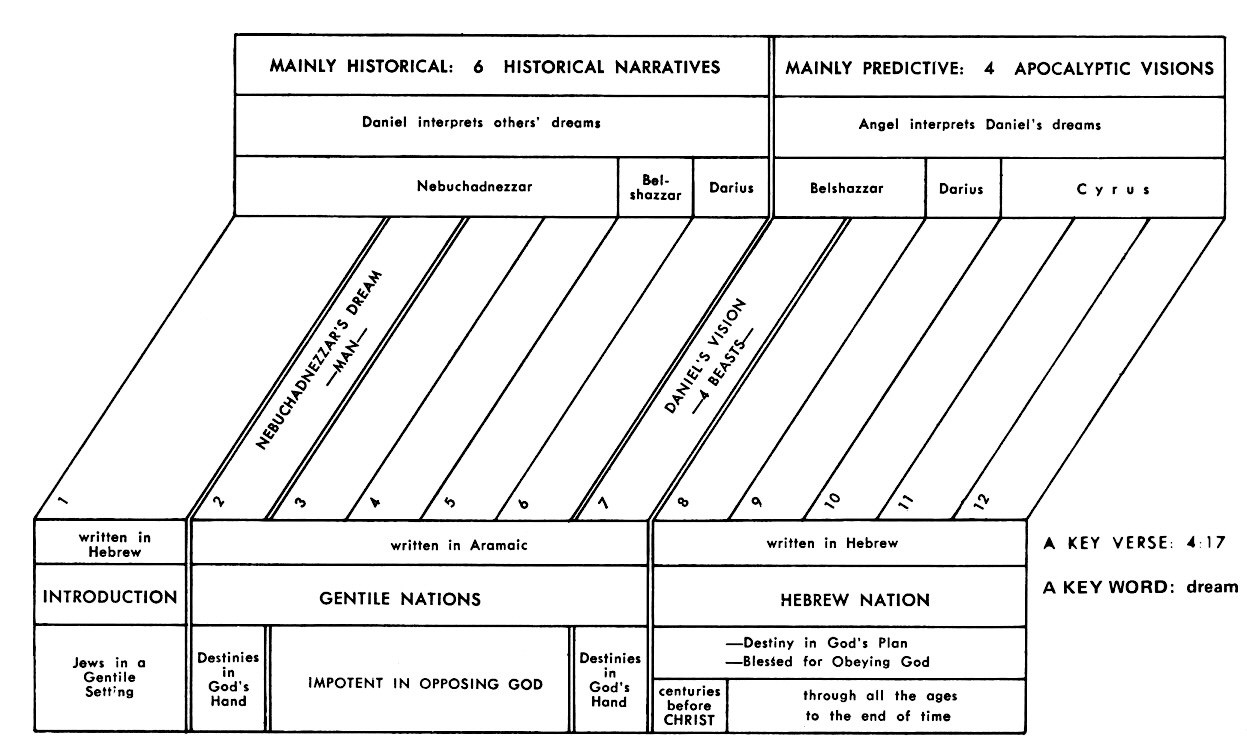
| Daniel 1 | Daniel 2:4-7:28 | Daniel 8-12 |
| Written in Hebrew |
Written in Aramaic |
Written in Hebrew |
|
Daniel's "No Compromise" Stand |
God's Prophetic Plan for Gentile Nations |
God's Prophetic Plan for Israel |
Daniel 4:1 Nebuchadnezzar the king to all the peoples, nations, and men of every language that live in all the earth: "May your peace abound!
- all: Da 3:4,29 7:14 Es 3:12 8:9 Zec 8:23 Ac 2:6
- Peace: Da 6:25,27 1Ch 12:18 Ezra 4:17 5:7 Ro 1:7 Eph 1:2 1Ti 1:2 1Pe 1:2
- Daniel 4 Resources - Multiple Sermons and Commentaries
THOUGHT - As you read Daniel 4 ask yourself - Who spoke it? Who wrote it down? How does this relate to 2Ti 3:16-note and 2Pe 1:21-note? When does Da 4:1-3 take place? In other words, how do these opening verses relate to Da 4:4?
It should be noted that the first three verses (Da 4:1-3) in our English Bibles are actually numbered Da 3:31-33 in the Aramaic text. Similarly the remainder of the verses (Da 4:4-37) in our English Bibles are numbered Da 4:1-34 in the Aramaic text. Most authorities agree that the content of these three verses (Aramaic Da 3:31-33) is such that it fits best with Daniel 4 and thus they are included in this chapter rather than at the end of Daniel 3.
Nebuchadnezzar - This is a very unique chapter in Scripture. Note first that it is written in the first person ("I", "me", "my"). It is therefore essentially Nebuchadnezzar's autobiographical synopsis of his reign, his ruin and his restoration/revival. Notice how the king arrogantly begins in Da 4:4 with a bad case of "perpendicular "I"-itis" (as J Vernon McGee quips), that fatal malady that "infects" all of mankind (Ro 5:12-note) and ends with a humble sense of the Most High God! If (as I believe) Nebuchadnezzar was a new believer in the Most High God, this is the only chapter in Scripture written by a new believer. It is not that Nebuchadnezzar himself was inspired when he spoke but the chapter is inspired in the sense that Daniel recorded it under the inspiration of the Holy Spirit (2Pe 1:21-note and because "all" Scripture is inspired - 2Ti 3:16-note). As this chapter unfolds we read Nebuchadnezzar's personal testimony (his "life journey") explaining how the Most High God caused him to be born again (cp 1Pe 1:3-note). In these introductory 3 verses the king begins in essence at the end of his story (which picks back up in Da 4:34-37) and then recounts his reminiscence or "flashback" to the events that led to this national proclamation (So he begins with the good and then goes to the bad and ugly - "The Good, the Bad and the Ugly"!).
Reginald Showers remarks that...
There are two lines of evidence which indicate that the words of this chapter are actually Nebuchadnezzar’s. First, the literary style of chapter four resembles the style of Nebuchadnezzar’s ancient inscriptions. Second, the character of the king revealed in this chapter agrees with ancient descriptions of the man. (The Most High God- A Commentary on the Book of Daniel).
In H A Ironside's introduction to this chapter, he writes that...
In Job 33:14, 15, 16, 17, 18, we are told,
Indeed God speaks once, Or twice, yet no one notices it. In a dream, a vision of the night, When sound sleep falls on men, While they slumber in their beds, then He opens the ears of men, and seals their instruction, that He may turn man aside from his conduct, and keep man from pride He keeps back his soul from the pit, And his life from passing over into Sheol.
This is how God often speaks to men who will not open a Bible to receive the clear revelation of His will. He has many ways of reaching those who seem bent on their own destruction. In the passage from Job, Elihu goes on to show that when dreams and visions do not avail, God sometimes allows disease to grip the body until the poor sinner is broken in spirit and crushed in heart. Then
"He looks upon men, and if any say, I have sinned, and perverted that which was right, and it profited me not; He will deliver his soul from going into the pit, and his life shall see the light" (Job 33:27-28KJV).
The fourth chapter of Daniel is a remarkable example of God's matchless grace and illustrates most preciously the words of Elihu to Job. The first time God spoke to Nebuchadnezzar He gave him the dream of the great image of the times of the Gentiles. But the heart of the king was willful, and he continued to go on with his own purpose in his pride and folly. God spoke the second time 60by the marvelous vision of the Son of God in the midst of the fiery furnace, keeping His faithful witnesses from all danger and harm. But again the proud king kept on his way with unsubject heart and unsubdued will. Now God speaks the third time in a most humiliating manner to this great world-ruler.
This stirring fourth chapter of Daniel was written by Nebuchadnezzar himself and preserved and incorporated into the inspired volume. In it we have the interesting account of the means God used to bring this haughty king to the end of himself and lead him to abase Himself before the Majesty in Heaven. In other words, this is Nebuchadnezzar's conversion, and it seems clearly to show that a work of grace took place in his soul before he laid down the scepter entrusted to his hand by Jehovah. The account is also illustrative for in Nebuchadnezzar we see a picture of all Gentile power—its departure from God, its degradation and bestial character, and its final subjugation to God in the time of the end. At that time Christ will return in glory, and all nations will prostrate themselves before Him, owning His righteous and benevolent sway.
As Donald Campbell quips - The introduction is actually a conclusion! Chronologically, these opening words belong at the end of the chapter because they grow out of Nebuchadnezzar's experiences that are recorded in the following paragraphs. But the king was so overwhelmed by God's dealings with him that, humiliating though it was, he wanted the world to know about it. (Campbell, D. Daniel God's Man in a Secular Society - well written, practical, recommended)
Walvoord - Those who reject chapter 4 of Daniel without exception assume that the account is not inspired of the Holy Spirit, that an experience like Nebuchadnezzar’s is essentially incredible, and that it is a myth rather than an authentic historical record. Such objections obviously assume that higher criticism is right in declaring Daniel a forgery of the second century B.C. This conclusion is now subject to question not only because of the fallacious reasoning which supports it, but because it is now challenged by the documentary evidence in the Qumran text of Daniel, which on the basis of the critics’ own criteria would require Daniel to be much older than the second century b.c. (see Introduction). Conservative scholarship has united in declaring this chapter a genuine portion of the Word of God, equally inspired with other sections of Daniel. (Chapter 4 Nebuchadnezzar’s Pride And Punishment)
To all the peoples, nations and men of every language that live in all the earth - This sentence identifies this chapter as a divine decree from King Nebuchadnezzar to all men (see Da 4:6). He’s not the God only of Israel. He is also the God of the Gentiles.
Think about what he is saying.
First, this is his royal proclamation, his personal witness of the saving hand of the Most High God. This is Nebuchadnezzar's "Tract" if you will, of how his personal encounter with the one true and living High God. And He’s not only the God of one nation or one people, but He is also the Lord God, the mighty Sovereign and King of all the nations and of all the peoples of the world.
Second, notice that he is not ashamed to share his conversion with others.
Third, note that he is sharing his testimony with the entire world (all the peoples...in all the earth). What a striking contrast with the same phrase but in the context of an order to bow to an idol! Da 3:4, 7 = "peoples, nations and men of every language." What a change in one's worldview a change in one's heart can make! (cp 2Cor 5:17).
One wonders how this was received by the pagan idol worshipping Babylonians, not to mention all the rest of the world. As we have alluded to before, the famous "wise men" from the East who worshipped at the foot of Christ's birthplace had to have heard about the Messiah from someone (Mt 2:2, 11). Given that Nebuchadnezzar's testimony is given in a way that gives God alone the glory, there is no doubt that God's Spirit used it to make significant impact on all the earth. Of course, all the earth clearly was not converted but this chapter suggests that they did at least have an opportunity to hear about the great and mighty Most High God Who is able to deliver one from darkness to light, from the dominion of Satan to God (Acts 26:18, Col 1:13-note, cp Heb 2:14, 15) and unto His everlasting kingdom and eternal dominion.
Adam Clarke - There are no preternatural signs like his! His wonders—miraculous interferences, are mighty—they surpass all human power. He is the Sovereign of all kings, and his dominion is everlasting; and every generation is a proof of his all-governing influence. These are very fine sentiments, and show how deeply his mind was impressed with the majesty of God.
Peter describes God's heartbeat in regard to salvation of the world (in the context of those who because of delay, question the teaching that God will judge the world - 2Pe 3:5, 6-note, 2Pe 3:7, 8-note) noting that...
The Lord is not slow about His promise, as some count slowness, but is patient toward you, not wishing for any to perish but for all to come to repentance. (2Peter 3:9-note, cp 1Ti 2:4)
And during the seven year period referred to as the Tribulation (aka Daniel's Seventieth Week), just before Christ returns, John testifies again to the desire of the Father to save men even as His wrath is being poured out on the earth...
And I saw another angel flying in midheaven, having an eternal gospel to preach to those who live on the earth, and to every nation and tribe and tongue and people; and he said with a loud voice, "Fear God, and give Him glory, because the hour of His judgment has come; and worship Him who made the heaven and the earth and sea and springs of waters." (Rev 14:6-note, Rev 14:7-note)
Comment: Note the similarity of the intended audiences of both the angel's message to the testimony of Nebuchadnezzar (respectively, every nation, etc versus all the peoples...all the earth).
May your peace abound - This was a common form of expression in the ancient world (cp Darius' decree in Da 6:25). However issuing from Nebuchadnezzar's lips, this may have had more meaning, as this chapter strongly suggests that he experienced the peace that comes only to the hearts of those converted by grace through faith. By way of application, if one believes the truth of God's Word by grace through faith, the result is an eternal, abounding peace WITH God (Ro 5:1-note). And when we as believers choose to live by the truth of God's Word, then we experience the surpassing peace OF God (Php 4:7-note). Think about this for a moment...Nebuchadnezzar a man filled with anger and prone to acts of unspeakable cruelty, the destroyer of God's temple, the one who took God's people captive, and yet in spite of all this, the Lord is showing grace and mercy to this pagan king. Is anything too difficult for the Lord? (Ge 18:14) Beloved, do you have a friend, relative or spouse that you think is simply too far away for God to ever be able to reach their heart and bring about conversion? Then think again and remember the lengths to which God went in order to bring about Nebuchadnezzar's repentance and belief.
Jamieson writes that - Peace (was) the usual salutation in the East, shalom, whence "salaam." The primitive revelation of the fall, and man's alienation from God, made "peace" to be felt as the first and deepest want of man. The Orientals (as the East was the cradle of revelation) retained the word by tradition.
Charles Simeon - A MORE remarkable history than this is not found in the annals of the world. Never was such a transition ever heard of, from such an elevation to a state of such extraordinary degradation, as that which is recorded in this chapter. The account is written by Nebuchadnezzar himself; and, doubtless by divine direction, it was incorporated with the writings of Daniel, and made a part of the inspired volume. (Simeon, C. 1832-63. Horae Homileticae Vol. 9: Jeremiah to Daniel. Page 485 - Daniel 4:34-37 NEBUCHADNEZZAR’S DREAM VERIFIED AND IMPROVED - open Vol 9 & scroll down )
Liberal "scholars" go to great lengths in attempts to discredit the authenticity of Daniel 4 for several reasons, including the unusual nature of the events described and the apparent conversion of a famous pagan king. John Walvoord sums this up well writing that "This chapter is no more difficult to believe than any other unusual divine revelation." (Ibid)
When does Daniel 4 take place? There is no internal evidence to allow one to assign a specific date to this Daniel 4, although some commentators do suggest specific timing, but without any clear Biblical substantiation. For example respected expositor John MacArthur writes that "The setting of Daniel 4 probably took place between the thirtieth and thirty-fifth years of his reign, approximately twenty-five to thirty years after the incident of the fiery furnace. Daniel was between forty-five to fifty years of age. (Daniel 4-1-37: How Are the Mighty Fallen! - Study Guide)
Sam Storms on timing - Second, the time when the events of this chapter occurred cannot be determined with any degree of certainty. However, it was sufficiently late in Neb's reign that he could speak of his building projects as complete (Da 4:30). Also, if the 'seven periods of time (Da 4:16) refer to seven years...the dream cannot have occurred later than Neb's 35th year of rule (he ruled 43 years altogether). 'These factors together place the time of the dream likely between the thirtieth and thirty-fifth year of Neb's reign, when Daniel was between forty-five and fifty years old, and when twenty-five to thirty years had elapsed since the deliverance of the three friends from the fiery furnace (Wood, 99). (Daniel 4-1-37)
King Nebuchadnezzar reigned for 43 years (605-562BC) but unfortunately we have only a few fragments of the Babylonian Chronicle, Babylon's official court record, and thus for most part have little official record of of Nebuchadnezzar's life and specific actions including those described in Daniel 4.
W A Criswell - The objection [to the authenticity of Daniel 4] is made that the proud, self-centered king who erected an image of himself at Dura would never condescend to tell a story of his own humiliation. The power of God, however, can change even a king's proud heart. (Criswell, W A. Believer's Study Bible: New King James Version. 1991. Thomas Nelson)
Chuck Swindoll entitles this chapter "Insomnia, Insanity and Insight". He adds that "there is evidence...that this polytheistic ruler became converted in mind and heart to Jewish monotheism and thereby experienced salvation. But if Nebuchadnezzar was not saved as a result of the events recorded in Daniel 4, he at least came to intellectually accept and politically submit to the one true God. In either case, this passage of Scripture relays an incredible story about the Lord's sovereignty and the extent to which He will go to demonstrate His authority."
Ryrie says "This chapter is a public decree or state paper of Nebuchadnezzar." (Ryrie Study Bible)
John MacArthur - Nebuchadnezzar’s praise of God in Da 4:1–3 and Da 4:34b-37 is the theme that brackets the experience the king reiterates in the first person (Da 4:4–34, Ed: The pronoun "I" is found 18x in 13v and "my" 25x in 14v). He began and ended the narrative with praise, and in between told why he converted to such worship of the true God (cf. Ro 11:33). (MacArthur Study Bible)
Donald Campbell writes that Daniel 4 "records the culmination of Nebuchadnezzar's spiritual biography, with God using drastic means to bring this haughty king to the end of himself and to faith in the God of Israel." (Daniel God's Man in a Secular Society)
The eloquent preacher Joseph Parker wrote that Nebuchadnezzar "had seen a new revelation, and he would talk about it; something new had shone upon him from the opening heavens, and he would tell all the empire about it—Armenia, Syria, and the dwellers by the Persian Gulf, and the Elamites, and all who trembled at his frown, should hear that he had seen a new aspect of the universe. Nebuchadnezzar had not yet become so ineffably pious as to say nothing about his piety. There are Christian men concerning whom it would be a revelation if one of their workpeople could be told that they even professed Christianity; an errand-boy might be frightened out of his propriety and sanity if he were told that his employer had family prayer. Nebuchadnezzar did not belong to the silent religious community: he would publish a proclamation, he would announce a fact, he would preach what little Gospel he had; he would say, There is more light in creation than I had imagined: come, let me tell you what the light is like, and what wizardry it works in colour and shadow and suggestion. (Daniel 4 The People's Bible by Joseph Parker)
The Apologetics Study Bible notes that...
Critical scholars consider this section to be literary fiction derived from the same source as the "Prayer of Nabonidus," an Aramaic fragment discovered at Qumran near the Dead Sea in 1952 (known in scholarship as 4QPrNab). Though affinities exist between chapter 4 and that document, they are far outweighed by the differences (e.g., the name of the king, the nature of the illness, and the location). The Nabonidus story is doubtless a distorted version or later application of the biblical narrative. Apocryphal imitations of canonical works were common during the intertestamental period, and several others grew up around the book of Daniel (e.g., Prayer of Azariah, Susanna, Bel and the Dragon). Although these works drew material from biblical sources, they are clearly fictional. (The Apologetics Study Bible- Understand Why You Believe) (Bolding added)
Comment: Here is a snippet of the "Prayer of Nabonidus" - 'I, Nabonidus, was afflicted with an evil ulcer for seven years, and far from men I was driven, until I prayed to the Most High God. And an exorcist pardoned my sins. He was a Jew from among the children of the exile of Judah, and said: "Recount this in writing to glorify and exalt the name of the most high God." Then I wrote this: "When I was afflicted for seven years by the most high God with an evil ulcer during my stay at Temâ, I prayed to the gods of silver and gold, bronze and iron, wood, stone and lime, because I thought and considered them gods..."' [the end is missing]
I like Warren Wiersbe's comments on Daniel 4 - Nebuchadnezzar’s second dream accomplished three things: it warned the king that his pride would lead to judgment (Da 4:37; Prov. 16:18); it exposed the incompetence of his magicians (Da 4:6, 7); and it gave Daniel another opportunity to glorify the God of heaven. (With the Word Bible Commentary- With the Complete Text)
Matthew Henry on Da 4:1-18 - The beginning and end of this chapter lead us to hope, that Nebuchadnezzar was a monument of the power of Divine grace, and of the riches of Divine mercy. After he was recovered from his madness, he told to distant places, and wrote down for future ages, how God had justly humbled and graciously restored him. When a sinner comes to himself, he will promote the welfare of others, by making known the wondrous mercy of God. Nebuchadnezzar, before he related the Divine judgments upon him for his pride, told the warnings he had in a dream or vision. The meaning was explained to him. The person signified, was to be put down from honour, and to be deprived of the use of his reason seven years. This is surely the sorest of all temporal judgments. Whatever outward affliction God is pleased to lay upon us, we have cause to bear it patiently, and to be thankful that he continues the use of our reason, and the peace of our consciences. Yet if the Lord should see fit by such means to keep a sinner from multiplying crimes, or a believer from dishonouring his name, even the dreadful prevention would be far preferable to the evil conduct. God has determined it, as a righteous Judge, and the angels in heaven applaud. Not that the great God needs the counsel or concurrence of the angels, but it denotes the solemnity of this sentence. The demand is by the word of the holy ones, God's suffering people: when the oppressed cry to God, he will hear. Let us diligently seek blessings which can never be taken from us, and especially beware of pride and forgetfulness of God.
Daniel 4:2 "It has seemed good to me to declare the signs and wonders which the Most High God has done for me.
- Jos 7:19 Ps 51:14 71:18 92:1,2) (that: Da 3:26 Ps 66:16 Ac 22:3-16 26:9-16
- Daniel 4 Resources - Multiple Sermons and Commentaries
THE KING'S DESIRE:
THAT ALL MIGHT KNOW THE TRUTH
ABOUT THE MOST HIGH GOD
It seemed good to me to declare - The king explains why he is making this "worldwide" announcement. Clearly he is giving God top billing over his pantheon of so called gods who are really no gods. The rest of this chapter deals with the reason the king has experienced such a radical change in his worldview. His changed (repentant) mind certainly seems to give evidence that he has experienced genuine conversion as a result of the divine humiliation described in Da 4:4-33. The principle declared by John the Baptist is apropos - "Bring forth fruit in keeping with repentance." (Mt 3:8) The fruit of Nebuchadnezzar's lips in offering a sacrifice of praise seem to be clear evidence of genuine spiritual fruit marking genuine spiritual repentance. (cp Heb 13:15).
Nebuchadnezzar's words remind me of Psalm 107:1-2 that speak of the declaration of a redeemed man. I believe he was "redeemed" and simply had to let the world know. O, if we all had the courage and humility (after he was humbled) to give our testimony of redeeming grace!
The psalmist exhorts us to make a declaration of God's word and work of grace in our lives...
Oh give thanks to the Lord, for He is good, for His lovingkindness is everlasting (cp "everlasting" Da 4:3). Let the redeemed of the Lord say so, whom He has redeemed from the hand of the adversary. (Psalms 107:1-2)
I love Spurgeon's exhortative comment on these passages: Whatever others may think or say, the redeemed have overwhelming reasons for declaring the goodness of the Lord. Theirs is a peculiar redemption, and for it they ought to render peculiar praise. The Redeemer is so glorious, the ransom price so immense, and the redemption so complete, that they are under sevenfold obligations to give thanks unto the Lord, and to exhort others to do so. Let them not only feel so but say so; let them both sing and bid their fellows sing.
Whom he hath redeemed from the hand of the enemy. Snatched by superior power away from fierce oppressions, they are bound above all men to adore the Lord, their Liberator. Theirs is a divine redemption, "he hath redeemed" them, and no one else has done it. His own unaided arm has wrought out their deliverance. Should not emancipated slaves be grateful to the hand which set them free? What gratitude can suffice for a deliverance from the power of sin, death, and hell? In heaven itself there is no sweeter hymn than that whose burden is, "Thou hast redeemed us unto God by thy blood."
Although we don't know for certain, as discussed above, many conservative commentaries feel that this chapter takes place toward the middle of Nebuchadnezzar's reign of 43 years (this makes some sense because he speaks as a conqueror who has nothing left to conquer - "all the earth" Da 4:1, "at ease...flourishing" Da 4:4). In any event the psalmist echoes the king's thoughts writing...
And even when I am old and gray, O God, do not forsake me, until I declare Thy strength to this generation, Thy power to all who are to come (NB: This is exactly what Nebuchadnezzar did - the book of Daniel is part of God's eternal word available to all who are to come!). 19 For Thy righteousness, O God, reaches to the heavens, Thou who hast done great things; O God, who is like Thee? 20 Thou, who hast shown me many troubles and distresses, Wilt revive me again, And wilt bring me up again from the depths of the earth. (Ps 71:18, 19, 20)
Signs and wonders - This is a familiar idiom in Scripture (18x in the OT = Ex 7:3, Dt 4:34, 6:22, 7:19, 13:1, 13:2, 26:8, 28:46, 29:3, 34:11 Neh 9:10 Ps 135:9 Isa 8:18 Jer 32:20 32:21 Da 4:2 4:3 6:27) (16x in NT = Mt 24:24; Mk 13:22; Jn 4:48; Acts 2:19, 22, 43; 4:30; 5:12; 6:8; 7:36; 14:3; 15:12; Ro 15:19; 2Cor 12:12; 2Th 2:9; Heb 2:4)
Signs - Archer says the Aramaic word atohi means "`attesting miracles,' natural phenomena that because of their magnitude or timing decisively evidence God's intervention in judgment or redemption". (Gaebelein, F, Editor: Expositor's Bible Commentary 6-Volume New Testament. Zondervan Publishing)
Wonders - Archer says the Aramaic word timhohi means "supernatural manifestations of divine intervention in the course of nature, cognate with Heb tamah, `be astounded,' `dumbfounded." (Ibid)
Jamieson says that signs are "tokens significant of God's omnipotent agency. The plural is used, as it comprises the marvelous dream, the marvelous interpretation of it, and its marvelous issue."
One of the signs and wonders would surely include the fiery furnace deliverance in Daniel 3 as well as the king's dream and Daniel's interpretation in Daniel 2 which led him to declare God to be a "Revealer of mysteries" (Da 2:47). However the most stupendous personal signs and wonders occur in this very chapter detailing the king's strange divine humbling and subsequent restoration to the throne.
Most High God (Key phrase in this chapter - 6x in 6v = Da 4:2, 17, 24, 25, 32, 34) (Other uses in Daniel = Da 3:26, 5:18, 21, 7:25). The first use of this great Name of God as the Most High is found in Genesis 14 as Abraham returns with Lot and spoil which result from his victory against 4 Gentile kings and overwhelming odds...
And Melchizedek king of Salem brought out bread and wine; now he was a priest of God Most High (see study). 19 And he blessed him and said, "Blessed be Abram of God Most High, Possessor of heaven and earth; 20 And blessed be God Most High, Who has delivered your enemies into your hand." And he gave him a tenth of all. 21 And the king of Sodom said to Abram, "Give the people to me and take the goods for yourself." 22 And Abram said to the king of Sodom, "I have sworn to the LORD God Most High, possessor of heaven and earth... (Ge 14:18, 19, 20, 21, 22)
Comment: Note the truths associated with the Most High - (1) He is possessor of heaven and earth, (2) He is worthy of praise, (3) He is our Deliverer. In short, He is sovereign. He rules over all, visible or invisible, in heaven, on earth and under the earth and for all time and eternity.
Walvoord states that "The expression the Most High God is another evidence that Nebuchadnezzar regards the God of Israel as exalted, but it is not in itself proof that he is a monotheist, trusting only in the true God.:
I resonate with H A Ironside's comment - This verse touches my heart in a most striking way. I realize that I am reading the personal testimony of one who was in some respects the greatest monarch this world has ever known. I am privileged to have his own account of how he—a proud, self-willed man—was brought to repentance and to the saving knowledge of the God of all grace. For I gather from this proclamation that a divine work was accomplished in Nebuchadnezzar's soul by God who, in mercy, had revealed Himself to him. What a wonderful miracle this is! The fact is, every conversion is a miracle—every soul that is saved knows what it is to be dealt with in supernatural power. It is God alone who changes men like this...Oh that men might have their eyes opened to see, and their ears to hear, what God in His grace is doing on the basis of His blessed Son's offering for sin on the cross! (Amen!)
Daniel 4:3 "How great are His signs And how mighty are His wonders! His kingdom is an everlasting kingdom And His dominion is from generation to generation.
- great: Da 6:27 De 4:34 Ps 71:19,20 72:18 77:19 86:10 92:5 104:24 105:27 Isa 25:1 28:29 Ro 11:33 Heb 2:4
- his kingdom: Da 4:17,34,35 2:44 6:26 7:14,27 Ps 66:7 145:13 Isa 9:7 Jer 10:10 Lk 1:32,33 1Ti 1:17 Heb 1:8 Rev 11:15
- is from: Job 25:2 1Pe 4:11
- Daniel 4 Resources - Multiple Sermons and Commentaries
What follows is a testimony of God's mercy and grace and power to save from the "guttermost to the uttermost"! (Here is my personal testimony of God's grace) Dear reader, do you have a word of testimony regarding the signs and wonders that the High God has accomplished in your life? Have you ever been brought into direct contact with Him, so that you can speak confidently of what He has done for your soul? If not, then consider God's invitation while the door of His grace remains open and...
Look unto Me, and be ye saved, all the ends of the earth: for I am God, and there is none else. (Isa 45:22KJV)
Comment: The venerable preacher Charles Haddon Spurgeon (Read Spurgeon's testimony) was smitten by the Spirit Who used the living and active words of Isaiah 45:22 to cause him to be born again (cp 1Pe 1:3-note) and Spurgeon spent the rest of his life declaring His signs and His wonders and in so doing became the most prodigious Christian writer the world has ever known!
O, do not let the word depart,
And close thine eyes against the light;
Poor sinner, harden not thy heart;
Thou would'st be saved—why not tonight?The world has nothing new to give,
It has no true, no pure delight;
Look now to Jesus Christ, and live;
Thou would'st be saved—why not tonight?Our blessed Lord refuses none
Who would to Him their souls unite;
Believe, obey, the work is done;
Thou would'st be saved—why not tonight?
--Elizabeth Reed
How great are His signs - The first of 4 things Nebuchadnezzar says about God.
Great - (5x in 4v in Daniel 4-Da 4:3, 4:10, 4:22, 4:30)
Mighty are His wonders - When one has experienced the great mercies of God as Nebuchadnezzar had, the only thing such a soul can do is sing praises to His Name and His attributes (Cp Paul's doxology in response to the overwhelming revelation of the boundless mercies of God - Ro 11:33, 34, 35, 36).
An everlasting kingdom (Da 4:34, 7:27)- He seems to acknowledge (at least indirectly) that there is an end to the Gentile world kingdoms, even as interpreted by Daniel...
And in the days of those kings ("ten toe" stage of "iron and clay") the God of heaven will set up a kingdom which will never be destroyed, and that kingdom will not be left for another people; it will crush and put an end to all these kingdoms, but it will itself endure forever. (Da 2:44)
The psalmist writes words very similar to those of Nebuchadnezzar (some think he was familiar with the Psalm)...
Thy kingdom is an everlasting kingdom, and Thy dominion endures throughout all generations. (Ps 145:13)
His dominion is from generation to generation - While Nebuchadnezzar's rule was finite, God's rule will be without end. Nebuchadnezzar "got the picture" regarding Who was in charge! He now acknowledges God not as just a god (one of many "gods"), but as the one true and living God Whose kingdom rules over all and will continue forever.
Donald Campbell observes "How completely different this proclamation from the ones Nebuchadnezzar had made previously. It can only be explained by God's work in the life of this heathen monarch, bringing him to repentance and faith in Himself. It was clearly a miracle of God's grace—as is every conversion. It was December 7, 1941, when Mitsuo Fuchida (read his story From Pearl Harbor to Calvary), a proud and militant Japanese commander, led the attack on Pearl Harbor. But his brilliant military career ended with the defeat of Japan and the close of the war. Returning to his home village near Osaka, he took up farming. One day Fuchida was summoned to Tokyo to testify in the war crimes trials and was handed a pamphlet as he got off the train. He was intrigued by the title, I Was A Prisoner of Japan (read it). It was the story of Jacob De Shazer, the Doolittle raider who was converted to Christ in a Japanese prison camp while reading the Bible. Fuchida's curiosity was aroused from reading of the incident, and he went to a bookstore and bought a Bible. When he went home he began reading it (See different account of how he got a Bible - Mitsuo Fuchida - another bio)."Every night I read the Bible," he said. "I read while plowing the rice fields. One night I read that Jesus died and that He prayed, 'Father, forgive them, for they know not what they do.' I realized I was one of 'them' for whom Jesus prayed." At the age of 47, on April 12, 1950, Fuchida received Christ as Savior and began a new life. Though later asked to consider heading Japan's air force as commander-in-chief, Fuchida turned down the invitation and spent the rest of his life traveling in Japan, the United States, and Canada, sharing what God had done in his life. Nebuchadnezzar's conversion was no less dramatic. (Daniel God's Man in a Secular Society)
Joseph Alleine writes that...
Conversion is a deep work—a heart-work. It goes throughout the man, throughout the mind, throughout the members, throughout the entire life. Conversion is no repairing of the old building; but it takes all down and erects a new structure.
It should be noted that a few writers like Leupold, Calvin, and surprisingly even modern conservative writers like Thomas Constable, doubt whether the king’s testimony in Daniel 4 reflects his conversion, but I agree with respected expositor John MacArthur who writes...
In Daniel 4 we will see what I believe is Nebuchadnezzar's conversion to faith in the true God. Some commentators have appropriately entitled the chapter, "The Conversion of Nebuchadnezzar." It relates how God broke his pride by humbling him and then turned his heart toward Him in faith. God did so, in part, through another dream. (Daniel 4-1-37: How Are the Mighty Fallen! - Study Guide)
Daniel 4:4 "I, Nebuchadnezzar, was at ease in my house and flourishing in my palace.
- Ps 30:6,7 Isa 47:7,8 56:12 Jer 48:11 Eze 28:2-5,17 29:3 Zeph 1:12 Lk 12:19,20 1Th 5:2,3
- Daniel 4 Resources - Multiple Sermons and Commentaries
Beginning in this passage Nebuchadnezzar is describing events in the past that preceded and led up to his conversion.
At ease - This speaks of Babylon at peace with no internal or external conflicts. Things were "good" for the king, but not for all in his kingdom for later Daniel exhorts him to show "mercy to the poor" (Da 4:27). And as we soon see, his "ease" was deceptive as it is with all the rich and powerful who are not "good" with God! What's the danger to any man, believer or not, when they are "at ease" and "flourishing"? (See Dt 6:10, 11, 12 for the answer where we read of Jehovah's warning to Israel, who in her unfaithfulness to God is a picture of our fallen flesh?)
The fact that the king was at ease would lend some support to the premise that these events occurred later in King Nebuchadnezzar's reign, after the active military conquest that characterized his early reign.
Gingrich- Prosperity is a dangerous thing—It often produces pride, and pride destroys us, Prov. 16:18; 29:23. Let us remember what prosperity and pride did to Saul and Solomon!
Ironside observes that the king at this time still unconverted was "At rest and flourishing while still in his sins and a stranger to God. There is a deceitful rest, a deceitful peace, which lulls many a soul into a false security (Je 6:14, 23:17, Lam 2:14, Ezek 13:22, 2Pe 2:1-note). To be untroubled is no evidence of safety. To be at peace does not prove that all is well. I once caught hold of a blind man and drew him back just in time to keep him from plunging headlong into an open cellar way. He thought all was well and was in peace of mind as he walked along, yet two more steps and he would have gone down! Be sure that your peace is founded on the blood of Christ shed on the cross (Col 1:19, 20-note); then you will have that peace which is true and lasting (Ro 5:1-note). Every other is false and fleeting. The peace of God is that which comes from relying on the testimony of God and follows the confession of sins that have separated the soul from Him. (Daniel 4 Commentary)
As Nebuchadnezzar eloquently testifies, God is able (Da 4:37) to arouse each of us out of our spiritual stupor and false sense of security, regardless of what we are placing our trust in (be it plenty, power, prestige, people, possessions, etc) other than His goodness and grace in Christ. May a Romans 12:1 (note) attitude be foremost in our heart and mind each day of the rest of our lives so that we might continually experience His rest in Christ in our lives.
What had Nebuchadnezzar forgotten? In Daniel 2 in the interpretation of the king's dream the prophet declares...
You, O king, are the king of kings, to whom the God of heaven has given the kingdom, the power, the strength, and the glory; and wherever the sons of men dwell, or the beasts of the field, or the birds of the sky, He has given them into your hand and has caused you to rule over them all. You are the head of gold. (Da 2:37, 38)
Comment: Daniel could not have been clearer about why Nebuchadnezzar was such a mighty king. Three times he emphasized that God sovereignly bestowed his kingdom and his submissive subjects upon the king. It was not the king's incredible military prowess, nor his intelligent rule, nor anything inherently within Nebuchadnezzar. It was from God and should have prompted praise and thanks to God instead of pomposity and pride!
Adam Clarke...
I had returned to my palace in Babylon after having subdued Syria, Phoenicia, Judea, Egypt, and Arabia. It was probably these great conquests that puffed him up with pride, and brought that chastisement upon him which he afterwards describes.
Flourishing in my palace - He was the epitome of self-satisfaction. After all he was in control of everything! Or so he thought! As Campbell says...
Then God spoke—it is well to remember that God can deal with ungodly men, even those in high and secure places, when human resistance cannot reach them (Campbell, D. Daniel God's Man in a Secular Society)
Criswell envisions this great king's self-satisfied and fully satiated state...
His army is at peace. He’s not a general any more. He’s not marching at the head of that ravenous, destructive, Chaldean horde. His enemies on the outside are all vanquished. And all of his fears on the inside are allayed. He is at rest. He has those great fortifications—one of the Wonders of the World, they’re all built—and he has a mighty army ready to rise at the blast of the trumpet in his defense. He is at rest in his house and flourishing in his palace. There is nothing wanting. Every goblet is filled with wine. Every corner of every room echoes with music. Every palace is a refuge from fear and terror. And he lays his head down on a pillow of down. And expects to dream dreams of affluence and wealth and luxury and splendor. He is at rest in his house and flourishing in his palace. Monuments, cities, fortifications: the glory of the greatest golden city the world ever knew, Babylon. (Sermon)
Walvoord sees a more wide ranging prophetic symbolism in this Daniel 4 writing that...
the contest between God and Nebuchadnezzar is a broad illustration of God’s dealings with the entire human race and especially the Gentile world in its creaturely pride and failure to recognize the sovereignty of God. (Chapter 4 Nebuchadnezzar’s Pride And Punishment)
Joseph Parker elaborates on Nebuchadnezzar's declaration observing that...
there was nothing wanting; every goblet full of wine, every corner an echo of music, every chamber a refuge from pagan trouble and imperial excitement: I never was more comfortable or restful in my life; the house never was so charming, the palace was never so grand, and I pillowed my head on down, and expected to see visions that would make me glad by doubling and redoubling all the poetry and music and wealth of my existence: that was my delightful case; and even in the midst of that enjoyment "I saw a dream which made me afraid. (The People's Bible Volume 16)
Archer attempts to nail down a time period for the events in Daniel 4 writing that...
Presumably the events in chapter 4 took place some eight or nine years before the end of the siege of Tyre in 573. (H.W.F. Saggs, The Greatness That Was Babylon [New York. Mentor, 1968], p. 148, estimates that the siege ended in 571 B.C.; See Ezek 26:7, which foretold this major effort against the Phoenician capital.) This would allow for a seven-year interval of mental illness, during which no major military operations were undertaken—say from 582 to 575. Perhaps it was in 583 that Nebuchadnezzar had his dream, with its sinister warning. (Ibid)
Daniel 4:5 "I saw a dream and it made me fearful; and these fantasies as I lay on my bed and the visions in my mind kept alarming me.
- dream: Da 2:1 5:5,6,10 7:28 Ge 41:1 Job 7:13,14
- visions: Da 2:28,29
- Daniel 4 Resources - Multiple Sermons and Commentaries
It made me fearful...kept alarming me - This great king who had never lost a battle, who had defeated all his enemies, who ruled as the king of kings, the head of gold...we would have thought fear and alarm would not be words in his personal vocabulary! Had it been an enemy force approaching his city, he would have called his virile forces to battle stations. But a dream. How can one defend against a dream? Especially a dream sent by the Almighty? And so we see the greatest monarch of all time turning into a craven, cowardly knave.
Ironside comments on the fear and alarm associated with Nebuchadnezzar's dream, noting that...
The vision was sent for this very purpose. God saw that he needed to be troubled—he needed to be awakened from his sleep of death. It was grace that thus exercised him. And in some way every soul that is saved has to pass through this period of soul-anxiety and concern.
Dreams had been God's righteous "weapon" in the past to alert sinners, as when Abimelech sent for Abram's wife Sarai...
But God came to Abimelech in a dream of the night, and said to him, "Behold, you are a dead man because of the woman whom you have taken, for she is married." (Ge 20:2)
Joseph Parker describes this dream in graphic language...
"I saw a dream which made me afraid." Let us not tamper with this graphic language, but take it as it stands in the English tongue. Nebuchadnezzar "saw" a dream: it was part of himself, yet it was wholly outside, so that he could fasten his eyes upon it; it was in him and without him, above him, round about him, beneath him; and he was "afraid." Sometimes we ask the question, Do dreams come true? Why, they are true. A dream does not need to come true, because it is there, a fact; it is already part of the history of the brain. There need be no other hell than a dream. Who can count the resources of God? In a dream we can be burned; in a dream we can be encoiled by serpents; in a dream we can be eternally suffocated; in a dream the serpent's fang may be within one inch of striking our life, and we may have no power of resistance or flight. The dream made Nebuchadnezzar afraid, and Nebuchadnezzar was not accustomed to fear, for he had brass enough, iron enough, chariots enough, horsemen enough; at the blast of his trumpet an empire stood up in his defence: but a dream made a fool of him. You cannot strike a dream; you cannot lay your hands upon it and compel it to make terms with you. These are the resources of God. If he would fight us with lightning we could make some device that might catch the lightning and bear it away; if he would fight us always with whirlwinds we could order our masonry accordingly, and hide ourselves behind the granite wall till the great euroclydon cried itself to rest: but he will not do this; he will trouble us with dreams, and make us afraid with visions; and whilst we are flourishing in the palace he will make the floor tremble under us, or there will be a movement behind the screen, the curtain, the arras, and that movement will frighten us more than we ever were affrighted by thunderstorm at midnight. If Nebuchadnezzar had heard that an army was thundering at one of the gates of Babylon, he would have been delighted: war is the amusement of kings; battle is the recreation of royal luxury and ambition: but this was a dream that came through the great brass gates that made the great wall of Babylon memorable as one of the finest structures in the world. You cannot bar out a dream, or lock it out, or bolt it out, or set a watch to keep it out; a wakeful sentry, armed at every point, may be looking at the dream while it touches him, and he cannot touch it, or blow it back, or threaten it, or defy it; it smiles upon him, and passes on, to work its murder in the king's head and the king's heart, and turn the king's imagination into an intolerable perdition. When Pilate was puzzled about the new king and the new theology and the unheard-of sedition which was not written in the Roman books, "his wife sent unto him, saying, 'Have thou nothing to do with that just Man: for I have suffered many things this day in a dream because of Him'." (Mt 27:19) God has made great use of dreams in history. Spiritual impressions may be laughed at by those who read nothing but cold type; but they are regarded as having unutterable suggestion to those of a more sensitive and exalted order of mind. (The People's Bible: Volume 16)
Made me fearful - Nebuchadnezzar's ease was a false sense of security and serenity and it was soon disrupted by a dream God either sent or allowed.
Fearful...fantasies...alarming - Divine insomnia can have this effect!
Daniel 4:6 "So I gave orders to bring into my presence all the wise men of Babylon, that they might make known to me the interpretation of the dream.
- Da 2:2 Ge 41:7,8 Isa 8:19 47:12-14
- Daniel 4 Resources - Multiple Sermons and Commentaries
The wise men of Babylon - This is essentially the same pagan brain trust that failed miserably to describe and interpret the king's dream in Daniel 2.
Jamieson observes that "It may seem strange that Daniel was not first summoned (Ed: And remember that if the dating of many is correct, Daniel's previous interpretation would have been over 25-30 years earlier!). But it was ordered by God's providence that he should be reserved to the last, in order that all mere human means should be proved vain, before God manifested His power through His servant; thus the haughty king was stripped of all fleshly confidences.
These wise men were not in contact with the All Wise God. Paul spoke about natural man's "defect" in spiritual matters in his first letter to the Corinthians noting that "a natural man does not accept the things of the Spirit of God, for they are foolishness to him; and he cannot understand them, because they are spiritually appraised ("the wise men of Babylon"). But he who is spiritual (cp Daniel) appraises all things, yet he himself is appraised by no one. For who has known the mind of the Lord, that he will instruct Him? But we have the mind of Christ." (1Co 2:14-16)
Daniel 4:7 "Then the magicians, the conjurers, the Chaldeans and the diviners came in and I related the dream to them, but they could not make its interpretation known to me.
- Da 2:1,2
- but: Da 2:7 Isa 44:25 Jer 27:9,10 2Ti 3:8,9
- Daniel 4 Resources - Multiple Sermons and Commentaries
Then - Then what? Well, "old habits die hard" as they say and so once again the king turned to the wrong source for advice in his time of difficulty. How about us beloved? Who do we turn to FIRST in our time of difficulty? To the "best" that humanistic wisdom (the latest best seller telling you how to "fix all that ails you", the talking heads on TV, the bloviating [definition] blogs, etc) has to offer (the magicians, the conjurers, etc) or to the source of true wisdom, to God and His godly representatives?
Could not make its interpretation known - Once again we see the bankruptcy of Babylonian wisdom, surely a picture of all wisdom of fallen man as opposed to the incomparable wisdom of God.
James says human wisdom
is not that which comes down from above, but is earthly, natural, demonic. (Jas 3:15)
In contrast James says that...
the wisdom from above is first pure, then peaceable, gentle, reasonable, full of mercy and good fruits, unwavering, without hypocrisy. (Jas 3:17)
Campbell relates how...
Dietrich Bonhoeffer once delivered a stinging indictment against his American theological education that is reminiscent of Nebuchadnezzar's experience with his "teachers":
A theology is not to be found here. . . . They chatter till all is blue without any factual foundation or any criteria of thought becoming visible. . . . They intoxicate themselves with liberal and humanistic expressions, laugh at the fundamentalists, and basically they are not even a match for them. Often it goes through and through me when here in a lecture they dismiss Christ, and laugh outright when a word of Luther's is quoted on the forgiveness of sin. (Mary Bosanquet, The Life and Death of Dietrich Bonhoeffer [New York: Harper and Row, 19691, 83). (Campbell, D. Daniel God's Man in a Secular Society)
Joseph Parker writes of Nebuchadnezzar that...
He was more earnest this time than he was in the first instance. We have not forgotten that in the first instance he insisted upon the magicians telling him the dream itself, and then the interpretation (Da 2:5-note); now Nebuchadnezzar speaks from the centre of fear, the dark point of mental apprehension, and therefore he tells the magicians all the dream in the hope that they may be able to explain it away. They could make nothing of it; before these ciphers they could set no unit to turn them into value; these men had not the key of this mystery. (The People's Bible: Volume 16)
Daniel 4:8 "But finally Daniel came in before me, whose name is Belteshazzar according to the name of my god, and in whom is a spirit of the holy gods; and I related the dream to him, saying,
- Belteshazzar: Da 1:7 5:12 Isa 46:1 Jer 50:2
- Da 4:9,18 2:11 5:11,14 Nu 11:17-30 Isa 63:11
- Daniel 4 Resources - Multiple Sermons and Commentaries
But finally - At last. Joseph Parker remarks that...
"At the last Daniel came in." It is always so; if we can do without the true man we will. Physicians know the meaning of this; they tell us that not until patients have exhausted every other source of inquiry do they come to them that they may test their skill (Parker goes on to apply this thought to our lives noting that) It is in human nature not to go to Christ first. We begin by doctoring ourselves, by interpreting our own dreams, by asking any liar if he will accept a bribe to flatter us into security. It was always so with Jesus Christ, the Son of God; nobody went to him in the first instance: "He was despised and rejected of men." (The People's Bible: Volume 16)
But finally Daniel came in before me - Not because Nebuchadnezzar had chosen to believe in Daniel's God but because he had come to recognize Daniel's spiritual insight (Da 1:17-note, Da 1:19-note, Da 1:20-note).
Daniel - His Hebrew name means God is Judge or God is my judge.
Belteshazzar (10x in 8v - Da1:7 2:26 4:8 4:9 4:18 4:19 5:12 10:1) - His Babylonian name means something like "protect his life" (Akkadian balusu-usur, ‘may he [Bel] protect his life’). Notice that Nebuchadnezzar calls Daniel by both his Hebrew name and his Babylonian name, but emphasizes the latter name.
Gingrich - Calling upon God or God’s man is usually done as a last resort (Da 4:8)—Finding no help from within or without, we finally look up.
The name of my god - Bel was Nebuchadnezzar's God, despite the fact that he has seen signs and wonders of the Most High God in Daniel 2 and Daniel 3. At the time he is relating the story, Bel would seem to still be his personal god. But by the end of the story, after the period of humbling, the only name on his lips is the Most High God and His praiseworthy attributes.
Pharaoh made a statement similar to Nebuchadnezzar...
"Can we find a man like this, in whom is a divine spirit?" So Pharaoh said to Joseph, "Since God has informed you of all this, there is no one so discerning and wise as you are. (Ge 41:38, 39)
Gods - Clearly despite Nebuchadnezzar's prior revelations of the one true God, he still believed in many gods (polytheism).
In whom is a spirit of the holy gods - The king clearly recognized that there was something different about Daniel and that he was "set apart" from the pagan occultists. What set Daniel apart?
(1) In Daniel 1:8-note Daniel made a decision to obey God which brought God's blessing on his life (Da 1:9-note), and the king witnessed the divine effect.
(2) In Daniel 2 upon the revelation of his dream and interpretation, the king "paid homage to Daniel" and recognized his God as a "revealer of mysteries" (Da 2:47-note).
In short, Daniel's exemplary life made him a "light to the Gentiles", reflecting in his life the God he worshiped.
The axiomatic principle is that a man's life always reflects what he truly worships! Does your life reflect a holy (not a "holier than thou") heart to the pagans in your sphere of influence? Does the way you conduct yourself before others open or shut doors for you to speak the gospel with your lips?
John MacArthur relates the powerful effect of a holy life, in the story of the famous duo, Stanley and Livingstone...
When Henry Stanley found David Livingstone in the heart of Africa, he stayed with him for four months. Stanley was a professed skeptic when he found Livingstone, but came away a Christian. Asked what Livingstone said that converted him, Stanley replied that it was what Livingstone was that brought him to Christ. According to Stanley's report Livingstone never asked him if he was a Christian, never preached to him, and never appeared to pray for his conversion. But Livingstone was so thoroughly a Christian that it dawned on Stanley that one who was not a Christian was something less than a Christian. Livingstone was a man of God who permitted the Lord to live through him. Consequently his life was one of victory and blessing. By the sheer influence and impact of his virtue Livingstone brought Stanley to Christ (see Henry Stanley's How I Found Livingstone, 1913]).
Daniel 4:9 'O Belteshazzar, chief of the magicians, since I know that a spirit of the holy gods is in you and no mystery baffles you, tell me the visions of my dream which I have seen, along with its interpretation.
- master: Da 1:20 2:48 5:11
- the spirit: Da 4:8 Ge 41:38 1Sa 4:8
- no secret: Da 4:5 2:3 Ge 11:6-8 Isa 33:18 54:14 Eze 28:3) (tell: Da 4:18 2:4,5 Ge 40:9-19 41:15-36 Jdg 7:13-15
- Daniel 4 Resources - Multiple Sermons and Commentaries
Centuries earlier the God used His servant Joseph to interpret Pharaoh's dream...
Then Pharaoh said to his servants, "Can we find a man like this, in whom is a divine spirit?" (Ge 41:38)
Spirit of the holy gods - Brenton's English rendering of the Septuagint is "the Holy Spirit of God is in thee".
MacArthur comments that...
The meaning here and in Da 4:18 (as well as Da 5:11,14) is rightly translated as “the Spirit of the holy God.” Wording for the true God in the Heb. of Josh. 24:19 is equivalent to the Aramaic here (which begins in Da 2:4). Some believe he meant “a spirit of the holy gods.” This is unlikely, since no pagan worshipers claimed purity or holiness for their deities. In fact, just the opposite was believed. And since Nebuchadnezzar was rehearsing his conversion, he could genuinely identify the true Spirit of God. (MacArthur, J.: The MacArthur Study Bible Nashville: Word or Logos)
Ryrie comments...
The king may only be acknowledging his own gods’ supposed work in Daniel’s life, or (since gods may be properly translated by the singular, God) it may indicate his recognition of the true God of Israel. (The Ryrie Study Bible: New American Standard Translation: 1995. Moody Publishers)
Gingrich exhorts us to be imitators of the holy man Daniel writing that...
Something supernatural should he seen in our lives (Da 4:9)—Men around us should readily see that God is with us and is living His life through us, Ge 39:3; 2Cor. 4:7
Tell me the visions...along with its interpretations - Young's Literal reads "the visions of my dream that I have seen, and its interpretation, tell". The NIV translates it "here is my dream; interpret it for me." I think from the context the NIV is correct in this instance, but it makes the point that one must be careful when reading any translation that has a significant interpretative component (as does the NIV, in contrast to the NAS and ESV which are more literal).
The NAS translation reflects the Masoretic text (MT) but the NET Bible note comments...
The MT implies that the king required Daniel to disclose both the dream and its interpretation, as in chapter 2. But in the following verses Nebuchadnezzar recounts his dream, while Daniel presents only its interpretation.
Daniel 4:10 'Now these were the visions in my mind as I lay on my bed: I was looking, and behold, there was a tree in the midst of the earth and its height was great.
- tree: Da 4:20-26 Ps 37:35,36 Isa 10:33,34 Jer 12:2 Eze 31:3-18
- Daniel 4 Resources - Multiple Sermons and Commentaries
A tree...great - It takes 3 verses to describe the magnificence of this tree!
In the midst of the earth - This "geographic" phrase denotes the tree's (aka "the king and his kingdom's") conspicuous position at the center of the world from whence the Babylonian authority radiated in all directions.
In Ezekiel we read about the "other" great city which is in the midst of the earth...
Thus says the Lord GOD, 'This is Jerusalem; I have set her at the center of the nations, with lands around her. (Ezek 5:5) (Recall that the most referenced city in Scripture is Jerusalem and the second most referenced is Babylon! City of God versus the City of Man. The best of God versus the best of the Anti-God World system!)
Henry Morris comments: It is remarkable that modern computer studies have shown that Jerusalem is, indeed, very near the geographical center of all the earth's land areas and, therefore, the midst of the nations. (Morris, Henry: Defenders Study Bible. World Publishing)
McGee comments that...
In Scripture, a tree can represent a number of things. A tree can represent a man: “And he shall be like a tree planted by the rivers of water, that bringeth forth his fruit in his season; his leaf also shall not wither; and whatsoever he doeth shall prosper” (Ps 1:3; see also Jer 17:8; Isa 56:3). Also a tree can represent a nation (see Ezek 31:3-14; Mt 24:32,33). The mustard tree in Mt 13:31, 32 represents Christendom today (Ed: The kingdom of heaven manifest in the body of Christ, the Church). The olive tree represents both Israel and the Gentiles (see Ro 11:16, 17, 18, 19, 20, 21, 22, 23 24). The tree here represents Nebuchadnezzar primarily and also his kingdom of Babylon—the king and kingdom are inseparable. (Daniel 4:10-16 - Mp3)
The prophet Ezekiel also used the image of a tree in a figurative description of the kingdom of Assyria...
‘Behold, Assyria was a cedar in Lebanon with beautiful branches and forest shade, and very high, and its top was among the clouds. (Ezek 31:3)
Daniel 4:11 'The tree grew large and became strong And its height reached to the sky, And it was visible to the end of the whole earth.
- reached: Da 4:21,22 Ge 11:4 De 9:1 Mt 11:23
- Daniel 4 Resources - Multiple Sermons and Commentaries
The tree - Metaphor which Daniel identifies with Nebuchadnezzar (Da 4:22).
Adam Clarke notes that...
Great men and princes are often represented, in the language of the prophets, under the similitude of trees, see Ezekiel 17:5, 6; 31:3 and following; Jer 22:15; Ps 1:3; 37:35.
Guzik comments...
The tree in Nebuchadnezzar’s dream was noted for its size, strength, prominence, beauty, fruit, and shelter.
Daniel 4:12 'Its foliage was beautiful and its fruit abundant, And in it was food for all. The beasts of the field found shade under it, And the birds of the sky dwelt in its branches, And all living creatures fed themselves from it.
- the beasts: Jer 27:6,7 Eze 17:23 31:6
- shadow: La 4:20) (the fowls: Mk 13:32 Lk 13:19
- Daniel 4 Resources - Multiple Sermons and Commentaries
Fruit abundant...food for all - The king was benefactor of all the subjects under his rule.
As they often say "so far, so good." The front end of the dream was pleasing and satisfying to Nebuchadnezzar, but that picture would soon change.
The different creatures undoubtedly represent the people under his rule ("dominion to the end of the earth" Da 4:22)
Daniel 4:13 'I was looking in the visions in my mind as I lay on my bed, and behold, an angelic watcher, a holy one, descended from heaven.
- in the: Da 4:5,10 7:1 Da 4:17,23 Ps 103:2
- an holy: Da 8:13 De 33:2 Ps 89:7 Zec 14:5 Mt 25:31 Mk 1:24 Lk 4:34 Jude 1:14 Rev 14:10
- Daniel 4 Resources - Multiple Sermons and Commentaries
An angelic watcher, a holy one - Note that angelic is not in the original Aramaic but is added by the translators of the NAS. The ESV for example reads "a watcher, a holy one"
Watcher (05894)(ir/iyr) is a unique Aramaic word (only in Daniel 4:13, 17, 23) which means watchman and comes from the verb meaning to be wakeful or on watch. The idea is a "waking one", one who is constantly alert.
NET Note - Aram “a watcher and a holy one.” The expression is a Hendiadys; so also in Da 4:23. This “watcher” is apparently an angel. The Greek OT (LXX) in fact has angelos (aggelos), “angel” here. Theodotion simply transliterates the Aramaic word (’ir). The term is sometimes rendered “sentinel” (NAB) or “messenger” (NIV, NLT). (NET translates it "holy sentinel")
Undoubtedly the NAS is correct that this is an angelic being. How do we know? The context would be compatible - (1) Nebuchadnezzar sees something about him that causes him to describe him as a "holy one", suggesting supernatural origin (2) Holy one (not an evil, fallen angel!) describes one set apart for a special purpose. (3) His purpose is to deliver a message, which was frequently the "job description"
Jamieson has a lengthy note on watcher - Only one angel is intended, and he not one of the bad, but of the holy angels. Called a "watcher," because ever on the watch to execute God's will [JEROME], "Bless the Lord, you His angels, Mighty in strength, who perform His word, Obeying the voice of His word! Bless the Lord, all you His hosts, You who serve Him, doing His will." (Ps 103:20, 21). Compare as to their watchfulness, Rev. 4:8-note, "full of eyes within . . . they rest not day and night." (Ed: Rev 4:8 strictly speaking are not angels per se). Also they watch good men committed to their charge (Ps 34:7 Heb 1:14); and watch over the evil to record their sins, and at God's bidding at last punish them (Jer 4:16, 17), "watchers" applied to human instruments of God's vengeance. As to GOD (Da 9:14 Job 7:12 Job 14:16 Jer 44:27). In a good sense (Ge 31:49 Jer 31:28). The idea of heavenly "watchers" under the supreme God (called in the Zendavesta of the Persian Zoroaster, Ormuzd) was founded on the primeval revelation as to evil angels having watched for an opportunity until they succeeded in tempting man to his ruin, and good angels ministering to God's servants (as Jacob, Ge 28:15 Ge 32:1, 2). Compare the watching over Abraham for good, and over Sodom for wrath after long watching in vain for good men it it, for whose sake He would spare it, Ge 18:23-33; and over Lot for good, Ge 19:1-38 Daniel fitly puts in Nebuchadnezzar's mouth the expression, though not found elsewhere in Scripture, yet substantially sanctioned by it (2Ch 16:9 Pr 15:3 Jer 32:19), and natural to him according to Oriental modes of thought.
The writer of Hebrews asks rhetorically about the angels "Are they not all ministering spirits, sent out to render service for the sake of those who will inherit salvation?" (Hebrews 1:14-note)
Comment: Indeed, if Nebuchadnezzar was indeed converted in Daniel 4 as I believe, we see that the watcher that brought him a frightful message, in effect functioned as God's minister or servant, to this pagan king who was soon to inherit salvation!
Dr Henry Morris in his comment on Heb 1:14 says "This important passage indicates that the primary reason why God created the angels is so they could serve to implement His purpose in creating and redeeming men and women in His own image. Angels possess great wisdom (2 Samuel 14:20), great strength (Psalm 103:20), great speed (Daniel 9:21), and great numbers (Hebrews 12:22) in performing this ministry. They accomplish their ministry on behalf of the heirs of salvation in various ways, including: instruction (Acts 10:3-6), deliverance (Psalm 34:7; 91:11), comfort (Matthew 1:20; Luke 22:43) and, finally, reception at death (Luke 16:22). They were created to be ministering spirits, continually sent forth to minister (that is, serve) those who shall be heirs of salvation." (Defender's Study Bible Note on Hebrews 1:14)
The psalmist writes "No evil will befall you, Nor will any plague come near your tent. For (explaining Ps 91:10) He will give His angels charge concerning you, to guard (Heb = shamar = to watch, to keep, to preserve, to guard, to care for; Lxx = to carefully guard, protect and take care of) you in all your ways. They will bear you up in their hands, That you do not strike your foot against a stone." (Ps 91:10-12)
Spurgeon comments on Ps 91:11,12 - Not one guardian angel, as some fondly dream, but all the angels are here alluded to. They are the bodyguard of the princes of the blood imperial of heaven, and they have received commission from their Lord and ours to watch carefully over all the interests of the faithful. When men have a charge they become doubly careful, and therefore the angels are represented as bidden by God himself to see to it that the elect are secured. It is down in the marching orders of the hosts of heaven that they take special note of the people who dwell in God. It is not to be wondered at that the servants are bidden to be careful of the comfort of their Master's guests; and we may be quite sure that when they are specially charged by the Lord himself they will carefully discharge the duty imposed upon them. To keep thee in all thy ways. To be a bodyguard, a garrison to the body, soul, and spirit of the saint. The limit of this protection "in all thy ways" is yet no limit to the heart which is right with God. It is not the way of the believer to go out of his way. He keeps in the way, and then the angels keep him. The protection here promised is exceeding broad as to place, for it refers to all our ways, and what do we wish for more? How angels thus keep us we cannot tell. Whether they repel demons, counteract spiritual plots, or even ward off the more subtle physical forces of disease, we do not know. Perhaps we shall one day stand amazed at the multiplied services which the unseen bands have rendered to us. Verse 12. They, that is the angels, God's own angels, shall cheerfully become our servants. They shall bear thee up in their hands; as nurses carry little children, with careful love, so shall those glorious spirits bear up each individual believer. Lest thou dash thy foot against a stone; even minor ills they ward off. It is most desirable that we should not stumble, but as the way is rough, it is most gracious on the Lord's part to send his servants to bear us up above the loose pebbles. If we cannot have the way smoothed it answers every purpose if we have angels to bear us up in their hands. Since the greatest ills may arise out of little accidents, it shows the wisdom of the Lord that from the smaller evils we are protected. (Treasury of David—Psalm 91)
From heaven - Heaven is a key word in Da 4 - 11x in 10v - Da 4:13, 15, 23, 25, 26, 31, 33, 34, 35, 37.
Morris comments that "This distinctive name for one of God's holy angels occurs in the Bible only in this chapter (Da 4:17,23). It does occur also in extra-Biblical literature (the book of Enoch). The term is insightful, suggesting that angels are watching us, and they "desire to look into" God's dealings with us (1Peter 1:12-note). (Defender's Study Bible Note on Daniel 4:13)
Daniel 4:14 'He shouted out and spoke as follows: "Chop down the tree and cut off its branches, Strip off its foliage and scatter its fruit; Let the beasts flee from under it And the birds from its branches.
- shouted: Da 3:4 Rev 10:3 18:2
- chop: Da 4:23 5:20 Mt 3:10 7:19 Lk 3:9 13:7-9
- let: Da 4:12 Jer 51:6,9 Eze 31:12,13
- Daniel 4 Resources - Multiple Sermons and Commentaries
"ANGELIC
INSOMNIA!"
He shouted out (Actually 2 words in Aramaic, more literally cried out in strength) - Abruptly and without warning the command is shouted out (this would cause anyone to have a frightening night of sleep!) that the great tree which was seemingly indestructible is to be chopped down. The destruction would have been complete except for the next verse.
Daniel 4:15 "Yet leave the stump with its roots in the ground, But with a band of iron and bronze around it In the new grass of the field; And let him be drenched with the dew of heaven, And let him share with the beasts in the grass of the earth.
- leave: Da 4:25-27 Job 14:7-9 Eze 29:14,15
- Daniel 4 Resources - Multiple Sermons and Commentaries
Stump with its roots - This speaks of retention of the potential for revival.
NET Note - Aram “the stock of its root.” So also Da 4:23. The implication here is that although the tree is chopped down, it is not killed. Its life-giving root is spared. The application to Nebuchadnezzar is obvious. The function of the band of iron and bronze is not entirely clear, but it may have had to do with preventing the splitting or further deterioration of the portion of the tree that was left after being chopped down. By application it would then refer to the preservation of Nebuchadnezzar’s life during the time of his insanity.
Let him - Note the occurrence of the masculine pronoun him, which is most closely linked with the stump with its roots in the ground. This is a presaging of the fact that the "him" would not be totally annihilated, despite the tree being chopped down.
Herodotus [7.19] mentions a dream which Xerxes had; namely, that he was crowned with olive, and that the branches of the olive filled the whole earth, but that afterwards the crown vanished from his head: signifying his universal dominion soon to come to an end. (Jamieson)
Isaiah 10:33, 34-Isa 11:1-5 describes a similar image in which God permitted the “tree” of Israel to be cut down by their enemies, but prophesied that out of the stump the Messiah would come.
Daniel 4:16 "Let his mind be changed from that of a man And let a beast's mind be given to him, And let seven periods of time pass over him.
- be changed: Da 4:32,33 Isa 6:10 Heb 1:11 Mk 5:4,5 Lk 8:27-29
- seven times: Da 4:23,25,31 7:25 11:13 12:7 Rev 12:14
- Daniel 4 Resources - Multiple Sermons and Commentaries
Let his mind be changed - More literally "let his heart be changed" as Scripture views our heart as our "control center" (thoughts, emotions, will, etc - the Septuagint translates the Aramaic with kardia [see word study]). The Septuagint translates "changed" with the verb alloioo which means to make different, in passive (as in this passage) meaning to be changed or altered, to become different.
Periods of time (05732)('iddan) is one word in Aramaic. As discussed below in the present context this stands for one year, so that seven periods of time would be 7 years. Every use of the phrase periods of time in NAS is found in Daniel 4.
'Iddan - 11v all in Daniel - Dan 2:8-9, 21; 3:5, 15; 4:16, 23, 25, 32; 7:12, 25. Translated (NAS) as moment(2), situation(1), time(8), times(2).
Swanson on 'iddan - 1. time, occasion in a general sense, without reference to other points of time (Da 2:8, 9, 21; 7:12); 2. (most versions) time, a period of time, as a definite unit: year (Holladay, KB, BDB, NAB, Hermeneia (Collins)), (seven) years (Da 4:16,23,29, 32); three and a half years (NAB) Da 7:25, formally, time, times and a half time (= 1 + 2 + 1/2), note: other commentaries suggest that this may not be a definite unit of time, or possibly a month, or a six-month period (season) of time; the versions tend to keep the exact unit of time ambiguous.
Are we justified in interpreting the Aramaic word for periods as signifying years and not months, weeks, etc? The best commentary on Scripture is always Scripture (See Compare Scripture with Scripture) ! In the book of Daniel in another passage "time" is equated with "year"? So in Da 7:25-note we read of the saints being given into the hand of the Antichrist for time, times and half a time. By comparing parallel passages in the Revelation (Rev 12:6-note and Rev 12:14-note) we can deduce that time (singular) equates with one year and times (plural) equates with two years so that time, times and half a time is 3.5 years. Thus a single time is one year. Additional support is found in one of the two versions of the Septuagint which has the phrase "seven years." Theodoret's version of the Lxx has seven seasons (Lxx = kairos), but does not specify the length. However, if one compares the Septuagint rendering of Da 7:25, the Greek word for time (which in that context equates with one year) is the same word kairos. While this is not direct evidence, it is very suggestive that even Theodoret's translation favors this as a seven year period (reminds me of an old movie name - "The Seven Year Itch!")
Seven - Speaks of completion or perfection, in this case that this time would be necessary to see this arrogant king repent and submit to the Most High God.
Jamieson -"Seven" is the perfect number: a week of years: a complete revolution of time accompanying a complete revolution in his state of mind."
Daniel 4:17 "This sentence is by the decree of the angelic watchers and the decision is a command of the holy ones, in order that the living may know that the Most High is ruler over the realm of mankind, and bestows it on whom He wishes and sets over it the lowliest of men."
- by the: Da 4:13,14 1Ki 22:19,20 1Ti 5:21
- the holy: Da 4:8,9,13 Isa 6:3,8 Rev 4:8
- that the living: Ps 9:16 83:17,18 Ezek 25:17
- the most High: Da 4:25,32, 33, 34, 35 2:21 5:18, 19, 20, 21 Jer 27:5, 6, 7
- bestows: Ps 75:6,7
- the basest: Da 4:25 11:21 Ex 9:16 1Sa 2:8 1Ki 21:25 2Ki 21:6-18 2Ch 28:22 Ps 12:8 113:7,8; Ezek 7:24 1Co 1:28
- Daniel 4 Resources - Multiple Sermons and Commentaries
Decree is by the angelic watchers...command of the holy ones - When compared with Da 4:24 we see that the decree is clearly that of the Most High God and the angels are His "heralds" proclaiming his decree, decision and command.
In order that - The king needed to know that this dream was of divine origin and not a bad "nightmare" related to indigestion!
As an aside, let me encourage you to be on alert for this phrase in order that which is a phrase I refer to as a term of purpose or result. It follows that when you encounter this phrase (or synonymous phrases such as so that, that, as a result) When a term of purpose or result is encountered, it behooves the reader to pause and ponder the context, asking at least "What is purpose (or result or effect)?" There are 161 occurrences of in order that from Genesis to Revelation. The related phrase so that is found some 580 times. While many of your pauses to ponder in order that, so that (or the word "that" used in a similar sense), will lead to a straightforward answer, just the fact that you were prompted to slow down and meditate on the passage can often lead to new insights. It is as if you give your Teacher the Spirit time to speak to you about the text. In the present context, the purpose of the tree vision and the tree being chopped down is to show that "the Most High is the ruler over the realm of mankind." In fact the divine dream really has a three fold purpose, to show that...
(1) The Most High is ruler over the realm of mankind
(2) He bestows in on whom He wishes
(3) He sets over it the lowliest of men
These three purposes can be summarized in one word - Sovereignty
Related Resource: Sovereignty: How Much Does God Control?
Gingrich...
All blessings and gifts are of God—Nebuchadnezzar failed to acknowledge this fact, Da 4:17, 25, 32; 1Cor. 4:7.
As Campbell says in this verse we see...
This is, in essence, a restatement of the great theme of the Book of Daniel: God is sovereign over the affairs of men and rules supremely in the world. He is the final authority, the highest judge. Further, He oversees the appointment of national rulers. "He removes kings and establishes kings" (Da 2:21). "For there is no authority except from God, and those which exist are established by God." (Ro13:1-note). (Ibid)
Sets over it the lowliest of men - Lowliest means humblest. In the NT, the origin of the Greek word for humble indicates one who is low down. This reminds me of Samuel's selection of the king to replace Saul ("He removes kings..." Da 2:21), for even as Jesse's sons were brought before Samuel, he looked at Eliab and reasoned "Surely the LORD's anointed is before Him" to which Jehovah responded
Do not look at his appearance or at the height of his stature, because I have rejected him; for God sees not as man sees, for man looks at the outward appearance, but the LORD looks at the heart. (1Sa 16:7)
Nebuchadnezzar's father Nabopolassar claimed to be of very humble origin as evidenced by his royal inscriptions which have been discovered: “in my littleness, the son of a nobody,” “of me, the insignificant, who among men was not visible,” “I, the weak, the feeble.”
Jamieson says that the idea is...
the lowest in condition (1Sa 2:8 Lk 1:52). It is not one's talents, excellency, or noble birth, but God's will, which elevates to the throne. Nebuchadnezzar abased to the dunghill, and then restored, was to have in himself an experimental proof of this (Da 4:37).
The purpose of God's decree was to directly contradict such thinking as expressed in the famous (? infamous) lines from the poem "Invictus"...
OUT of the night that covers me,
Black as the Pit from pole to pole,
I thank whatever gods may be
For my unconquerable soul...
It matters not how strait the gate,
How charged with punishments the scroll,
I am the master of my fate:
I am the captain of my soul.
William Ernest Henley
God Still Reigns- There's a story from the Eastern Roman Empire of a Christian monk who was horrified by the wickedness of the emperor. He prayed to God and asked, "Why did You allow that evil man to become emperor?" God replied, "Because I couldn't find anyone worse!"
Daniel saw wicked kings reign over God's people in Babylon. It must have been extremely frustrating. In time, the Lord dethroned each proud king, but He replaced them with others just as evil.
King Nebuchadnezzar, for example, exalted himself until God caused him to live like an animal for 7 years. When he regained his mind, he praised God as the one true Ruler (Dan. 4:28-37). But the cycle of evil monarchs continued. Belshazzar, Nebuchadnezzar's descendant, mocked God and used the sacred goblets from the temple in Jerusalem during a drunken orgy (Da 5:2 3, 4).
We must remember that history is God's story. He reigns when the politicians we vote for get into office, and He reigns when those we oppose get elected. God is sovereign over the rulers of this world (Dan. 4:17). We can trust Him to do what is right because His "works are truth, and His ways justice" (Da 4:37). — Haddon W. Robinson (Our Daily Bread, Copyright RBC Ministries, Grand Rapids, MI. Reprinted by permission. All rights reserved)
The Most High still rules over kingdoms of men,
He gives the control to whomever He will;
All people must bow to His sovereign plan,
And know that His purposes He will fulfill. --Hess
The king's heart is in the hand of the Lord. Pr 21:1
Daniel 4:18 'This is the dream which I, King Nebuchadnezzar, have seen. Now you, Belteshazzar, tell me its interpretation, inasmuch as none of the wise men of my kingdom is able to make known to me the interpretation; but you are able, for a spirit of the holy gods is in you.'
- Inasmuch: Da 4:7 2:7 5:8,15 Ge 41:8,15 Isa 19:3 47:12-14
- but: Da 4:8,9 2:26-28 1Ki 14:2,3 Am 3:7
- Daniel 4 Resources - Multiple Sermons and Commentaries
But you are able - He affirms the inability of human wisdom to discern spiritual truth (1Co 2:14).
Daniel 4:19 "Then Daniel, whose name is Belteshazzar, was appalled for a while as his thoughts alarmed him. The king responded and said, 'Belteshazzar, do not let the dream or its interpretation alarm you.' Belteshazzar replied, 'My lord, if only the dream applied to those who hate you and its interpretation to your adversaries!
- Daniel: Da 4:8 1:7 2:26 5:12)
- was appalled: Da 4:9 7:28 8:27 10:16,17 Jer 4:19 Hab 3:10
- let: Da 4:4,5 1Sa 3:17) (My Lord: Da 4:24 10:16 Ge 31:35 32:4,5,18 Ex 32:32 1Sa 1:15 24:8 26:15 2Sa 18:31 1Ki 18:7
- the dream: 2Sa 18:32 Jer 29:7
- Daniel 4 Resources - Multiple Sermons and Commentaries
Appalled - The Lxx uses a verb that means "to become mute"! It seems he was speechless. The NLT renders the Aramaic as "overcome" and the NIV as "greatly perplexed".
For a while - For a while is literally "about one hour" (which is also the Greek Septuagint translation).
The NET Bible note says that
The expression refers idiomatically to a brief period of time of undetermined length.
His thoughts alarmed him - The Lxx uses a verb (suntarasso) which means to be thrown into confusion, confounded, disturbed and the in the imperfect tense pictures this action/attitude as occurring over and over. The NIV renders this phrase "frightened" which seems to give the impression he was afraid, as for example afraid of what the king might do to him. Perhaps, but I think Daniel had counted the cost of integrity and an uncompromising heart and he was prepared for whatever might befall him for speaking the truth. Frightened perhaps for the king would be a better thought and even the context supports that interpretation as Daniel wishes the dream applied to his enemies. Contrary to being concerned about self, he was concerned about the king!
Daniel was astonished at the fate that awaited King Nebuchadnezzar. On one hand he cared for the king and did not want to bring such a somber message. On the other hand we recall that the king was well known for his "fiery" (seven times hotter) temper, and he could have just as easily ordered Daniel executed for giving him such a humiliating interpretation. While the following is a proverb, not a promise, it has generally been true in my personal experience and certainly would apply to Daniel...
When a man's ways are pleasing to the LORD, He makes even his enemies to be at peace with him. (Pr 16:7)
The king responded - He sees Daniel's anguish and hesitation and encourages him to not withhold the truth.
Ironside comments...
Nebuchadnezzar must have discerned the anxiety and sorrow in the face of his minister, for he speaks in a way to give him confidence to proceed with the interpretation. He did not want smooth words made up for the occasion. Little though he (the king) realized what was coming, he still desired to know the truth. It is a blessed thing for any soul to get to the place where he can say: "Give me God's Word, and let me know it is His Word, and I will receive it, no matter how it cuts, and interferes with my most cherished thoughts." (cp 1Th 2:13-note)
Joseph Parker eloquently paints the picture of Daniel's dilemma writing that...
It was like a blow struck upon the very centre of his forehead; when he saw what was going to befall the king he was struck, as it were, with a spear of lightning, his voice altered, as did the fashion of his countenance. He had a message to deliver, and yet he delivered it with tears that were hidden in the tone of his voice. He was not flippant; he was solemn with an ineffable solemnity. Never was he in such a position before. Only the Divine Spirit could make him equal to the responsibilities of that critical hour. Many words we can utter easily, but to pronounce doom upon a life, any life, old man's or little child's, is a task which drives our words back again down the throat. We cannot utter them, yet we must do so; we wait in the hope that some relief will come, but relief does not come from this burden-bearing in the sanctuary of life. The preacher is often as much astonished as the hearer, and as much terrified. In proportion as the preacher is faithful to the book which he has to read, expound, and enforce, will he sometimes come to passages that he would rather not read. It would be delightful if we could expel the idea of penalty from our human intercommunion. Men have tried to fill up the pit of hell with flowers, and all the flowers have been consumed. It would be delightful to hide by concealment of any kind the horrors that await the wicked man, but to hide those horrors is to aggravate them. It can be no joy to any man to go forth and say, "Yet forty days, and Nineveh shall be overthrown." No man could utter such words but in obedience to the election and ordination of God. It is easy, if we consult our own flesh and sense and taste alone, to hide the Cross of agony and shame; but he who hides the Cross hides the salvation which it symbolises, and without which it is impossible. It is not easy for any man, Jonah or Daniel, Hosea or Joel, to say unto the wicked, It shall be ill with thee. We would rather live upon the other side of the hill, where the sun smiles all day, where the flowers grow as if they would never cease to unfold some new secret of colour and beauty, and where the birds trill a song from hour to hour, as if growing in capacity as they multiply in service. But the hill of the Lord is many-sided; we should be unfaithful and unjust if we did not recognise its multifold aspects, and show them to those who have come to see the reality and the mystery of the divine kingdom amongst men. Daniel looks wondrously well in the moment of his astonishment. The man's best self is now in his face. How quiet he is, and what singular tenderness plays around the sternness which befits the message that he is about to deliver! What a mixture of emotion, what an interplay of colour, what an agony of sensation! yet Daniel is a true man, and he will speak the true word, come of it what may, so far as he himself is concerned; furnace of fire or den of lions, he must speak the word which the Lord has given to him. Why do we not follow his example? Why do we try to take out of the divine word all things offensive? It would be easy to pander to human taste, and to flatter human vanity, and to assure the half-damned man that the process cannot be completed, but that after all he will be taken to heaven and made a seraph of. Who can tell lies so thick, so black? Let him eschew the altar and the Cross. (The People's Bible: Volume 16)
Daniel 4:20 'The tree that you saw, which became large and grew strong, whose height reached to the sky and was visible to all the earth
- Da 4:10-12 Eze 31:3,16
- Daniel 4 Resources - Multiple Sermons and Commentaries
Showers comments that...
God’s representation of Nebuchadnezzar as a large tree that provided food and lodging for all was very fitting for at least two reasons. First, in several of his inscriptions Nebuchadnezzar had boasted about the peaceful shelter and abundance of food that he had provided for his subjects through Babylon. Indeed, in these boasts he used language descriptive of a tree when referring to his rule through Babylon. In one inscription he said, “The produce of the lands, the product of the mountains, the bountiful wealth of the sea within her I received. Under her everlasting shadow I gathered all men in peace. Vast heaps of grain beyond measure I stored up within her.” In another inscription he declared, “Under her everlasting shadow I gathered all men in peace. A reign of abundance, years of plenty I caused to be in my land.”
Second, as a result of military campaigns that took him several times through the forests of Lebanon, Nebuchadnezzar became greatly captivated by the huge cedar trees of that land. This attitude was reflected in one of his inscriptions where he described the trees as follows: “mighty cedars, tall and strong, of costly value, whose dark forms towered aloft, the massive growth of Lebanon.” Indeed, in his inscriptions Nebuchadnezzar boasted that he personally had cut down some of these huge trees with his own hands. He even had a picture of himself cutting a cedar inscribed on stone. One gets the impression that the king exalted in the fact that he could cut down such a towering giant of strength. (The Most High God- A Commentary on the Book of Daniel).
Daniel 4:21 and whose foliage was beautiful and its fruit abundant, and in which was food for all, under which the beasts of the field dwelt and in whose branches the birds of the sky lodged--
- Daniel 4 Resources - Multiple Sermons and Commentaries
Daniel 4:22 it is you, O king; for you have become great and grown strong, and your majesty has become great and reached to the sky and your dominion to the end of the earth.
- thou: Da 2:37,38 2Sa 12:7 Mt 14:4
- thy greatness: Da 5:18-23 Ge 11:4 28:12 2Ch 28:9 Ps 36:5 108:4 Jer 27:6-8 Rev 18:5
- Daniel 4 Resources - Multiple Sermons and Commentaries
It is you O King (cp Nathan to King David - 2Sa 12:7) - With one sharp stroke Daniel delivers the solemn interpretation. The tree is Nebuchadnezzar.
Jamieson...
While pitying the king, he uncompromisingly pronounces his sentence of punishment. Let ministers steer the mean between, on the one hand, fulminations against sinners under the pretext of zeal, without any symptom of compassion; and, on the other, flattery of sinners under the pretext of moderation. (Ed note: Or as I once heard someone say, the preaching should be such that it comforts the afflicted, but afflicts the comfortable!)
To this Joseph Parker writes...
There are some things we must speak abruptly, or we never shall speak them at all; they must, so to say, be forced out of us: the word must come like the shot of a musket: "It is thou, O king," a short sharp stroke. Who would vacillate when he knew he was going to deliver sentence of death, worse than death, all deaths in one agonizing humiliation? Better it should be after the pattern of Daniel, clear, simple, prompt, resonant, put in the very smallest words, words that a child could understand and repeat, monosyllables that made the heavens black with unimaginable terror:—"It is thou, O king."...Sometimes the preacher has to say even to a millionaire, It is thou, O rich man: it is with infinite difficulty thou canst get near Christ: how hardly shall they that have riches enter the kingdom of heaven! thou hast wine, and beast's flesh, and fowls of the air, and bread in plentifulness; but thou shalt sleep with strange bedfellows, yea with poverty and affliction and loathsomeness: set thine house in order: riches take unto themselves wings, and flee away; he who yesterday gave orders on the Exchange, tomorrow will beg a piece of bread to break his fast. Sometimes the teacher has to address himself to the boastful man, and say, It is thou, O boastful man: thou didst suppose thyself to be in possession of everything; to be lord and king and mighty man and counsellor and lawgiver; the word shall die on thy blackening lips, and thou who didst serve in the house of vanity shall be a bondman in the house of disappointment. This was personal preaching, the kind of preaching that is resented. We are willing that any man shall be preached to except ourselves. The minister who succumbs to that dire temptation was ordained by men, but the ordaining hand of Christ was never laid upon his faithless head. (Ibid)
Daniel 4:23 'In that the king saw an angelic watcher, a holy one, descending from heaven and saying, "Chop down the tree and destroy it; yet leave the stump with its roots in the ground, but with a band of iron and bronze around it in the new grass of the field, and let him be drenched with the dew of heaven, and let him share with the beasts of the field until seven periods of time pass over him",
- saw: Da 4:13-17
- and let his: Da 4:15 5:21
- Daniel 4 Resources - Multiple Sermons and Commentaries
Chop down the tree and destroy it - Nebuchadnezzar's was every man's (outside of Christ) problem for he imagined that the tree (his kingdom and kingship) had become great and grown strong by virtue of his own strength and ability and it was for this reason that he had to be cut down and humbled. He must for a time (seven times) lose his throne, his wealth, the respect of his subjects and even his sanity in order that he might come to his "spiritual senses".
Band of iron and bronze around it - This is one of the more enigmatic aspects of this description and commentaries offer a wide range of interpretation. Some see the band as figurative allusion to the king's being bound by mental illness. Others see it as a sign that the stump would be protected thus assuring its survival.
Daniel 4:24 this is the interpretation, O king, and this is the decree of the Most High, which has come upon my lord the king:
- the decree: Da 4:17 Job 20:29: Ps 2:7 148:6 Isa 14:24-27 23:9 46:10,11
- come: Job 1:12-19 40:11,12 Ps 107:40
- Daniel 4 Resources - Multiple Sermons and Commentaries
This is the decree of the Most High - In Da 4:17 God's emissaries carried the message of His decree in the dream, but God is the Source of the decree.
Daniel 4:25 that you be driven away from mankind and your dwelling place be with the beasts of the field, and you be given grass to eat like cattle and be drenched with the dew of heaven; and seven periods of time will pass over you, until you recognize that the Most High is ruler over the realm of mankind and bestows it on whomever He wishes.
- drive: Da 4:32,33 5:21-31 Job 30:3-8 Mk 5:3,4
- to eat: Ps 106:20
- Until: Da 4:17,32,34,35 2:21 5:21 Ps 83:18 Jer 27:5
- Daniel 4 Resources - Multiple Sermons and Commentaries
MAN WITHOUT GOD
IS LIKE A BEAST!
Below is William Blake's famous portrait of what the prideful king may have looked like for seven years

You be driven away from mankind - Unlike the story below, Nebuchadnezzar's condition was brought about by the Jehovah's hand of judgment on the king's pride.
The psalmist records that...
But man in his pomp will not endure. He is like the beasts that perish. (Ps 49:12)
Spurgeon - He is not like the sheep which are preserved of the Great Shepherd, but like the hunted beast which is doomed to die. He lives a brutish life and dies a brutish death. Wallowing in riches, surfeited with pleasure, he is fatted for the slaughter, and dies like the ox in the shambles. Alas! that so noble a creature should use his life so unworthily, and end it so disgracefully. So far as this world is concerned, wherein does the death of many men differ from the death of a dog?
The beasts of the field - God used the metaphor of a beast to describe the Gentile kingdoms in Daniel 7 and the last world ruler who would eventually come out of the beastly Gentile kingdoms (Rev 11:7; 13:1ff; 14:9, 11; etc)
Warren Wiersbe rightly concludes that...
Men and women are made in the image of God, but when they leave God out of their lives and resist His will, they can descend to the level of animals. “Do not be like the horse or like the mule,” warns King David, who was guilty of acting like both (Ps. 32:9NKJV). Like the impulsive horse, he rushed into sin when he committed adultery with Bathsheba, and then like the stubborn mule, he delayed confessing his sins and repenting (2Sa 11:1ff). When the Lord arrested Saul of Tarsus on the Damascus Road, He compared the pious rabbi to a stubborn ox when He said, “It is hard for you to kick against the goads” (Acts 9:5NKJV). (Wiersbe, W. W. Be Resolute)
Given grass to eat like cattle - He was to become a strict vegetarian!
Until - This time phrase always signal an end (praise God!). We all do well to remember that it is God Alone Who changes the times and epochs (Da 2:21-note )
The psalmist reminds us...
For not from the east, nor from the west, Nor from the desert comes exaltation But God is the Judge; He puts down one, and exalts another. (Ps 75:6, 7)
Jeremiah echoes this truth of God's sovereignty over His creation...
I (Jehovah) have made the earth, the men and the beasts which are on the face of the earth by My great power and by My outstretched arm, and I will give it to the one who is pleasing in My sight. (Jer 27:5)
Until you recognize (Da 4:32, 5:21) - The clear indication is that after seven years of humiliation and crawling like a beast on the earth, the King will indeed come to the end of himself and will come to recognize the Most God as the only true King of Heaven and Earth.
Parker explains...
When will God take us out of the furnace? When He can see His image enough. When will God cease to lacerate our poor shrinking flesh? When we have learned to obey Him (cp Ps 119:67, 71). When will he take the wolf away from the door, so that we can go out into the meadow and enjoy the sunshine? When we have yielded back all wickedly acquired gain, and have thrown down the thirty pieces of burning silver for which we sold the Christ of God. Why this penal system in the universe? Why loss? Why decrepitude and helplessness? Why burning fevers? Why all the maladies that afflict the body? Why all the ills that flesh is heir to? "Till thou know." (Ibid)
R. K. Harrison attests to a personal encounter with a clinical case with some similarities to the king's condition...
A great many doctors spend an entire, busy professional career without once encountering an instance of the kind of monomania described in the book of Daniel. The present writer, therefore, considers himself particularly fortunate to have actually observed a clinical case of [lycanthropy] in a British mental institution in 1946. The patient was in his early 20's, who reportedly had been hospitalized for about five years. His symptoms were well developed on admission, and diagnosis was immediate and conclusive. He was of average height and weight with good physique, and was in excellent bodily health. His mental symptoms included pronounced anti-social tendencies, and because of this he spent the entire day from dawn to dusk outdoors, in the grounds of the institution....
"His daily routine consisted of wandering around the magnificent lawns with which the otherwise dingy hospital situation was graced, and it was his custom to pluck up and eat handfuls of the grass as he went along. On observation he was seen to discriminate carefully between grass and weeds, and on inquiry from the attendant, the writer was told the diet of this patient consisted exclusively of grass from hospital lawns. He never ate institutional food with other inmates, and his only drink was water....
"The writer was able to examine him cursorily, and the only physical abnormality noted consisted of a lengthening of the hair and a coarse, thickened condition of the finger-nails. Without institutional care, the patient would have manifested precisely the same physical conditions as those mentioned in Daniel 4:33" (Introduction to the Old Testament. Grand Rapids: Eerdmans, 1969).
Joseph Parker comments that...
Some men require violent teaching. We will not obey God's love: when he whispers to us we do not hear him; unless he take up the trumpet of his thunder, we pay no attention to the voice of Heaven. Pleasant angels have come to seek us and bring us home, but we have declined their evangel and their gospel and their company; summer has come, with spring on one side and autumn on the other, all beautiful and rich, abounding in all things lovely and useful; and they have said they have come to bring us back to heaven, and we have defied the whole of them. Not until God takes up the rod of his lightning do we begin to be religious. A plague would fill the church; an epidemic would make a prayer-meeting at five o'clock in the morning seasonable: we are cowards! Yet, blessed be God, he does not withhold violence if it will do us good. If we will not have the company of angels we shall be thrust into the society of beasts, and in that humiliation we may be willing to listen to terms and proposals that otherwise would have fallen upon deaf ears; and there in the open field, with only beasts to talk to, we may begin to pray. (Ibid)
Daniel 4:26 'And in that it was commanded to leave the stump with the roots of the tree, your kingdom will be assured to you after you recognize that it is Heaven that rules.
- to leave: Da 4:15
- the heavens: Mt 5:34 21:20 Lk 15:18,21
- Daniel 4 Resources - Multiple Sermons and Commentaries
After you recognize - Here we see God's grace in using the judgment to humble not harden the king's heart, that he might receive spiritual vision. And thus the time of humiliation is promised to come to an end when the king comes to his senses and sees God for Who He really is, the Most High God.
Harry Ironside applies the importance of divine recognition or rejection on a national scale writing that...
history teaches us the value of a national recognition of God's moral government. A story is told of a heathen chieftain who came from his distant domain to visit Queen Victoria. One day he asked her if she would tell him the secret of England's progress and greatness. In response, it is said the queen presented him with a Bible saying, "This Book will tell you." Who can doubt that according to the measure in which that Book of books has been believed and loved by any people, God has honored them? And every nation that has welcomed and protected the gospel has been cared for and blessed in a special way.
On the other hand, let there be a national rejection of His Word, and you will find disaster following disaster. This was the case of the French people, who were among the first favored by Him in Reformation times but who drove out the truth He gave them. He who cannot lie has said, "Them that honour me, I will honour, and they that despise me shall be lightly esteemed" (1Sa 2:30).
Daniel 4:27 'Therefore, O king, may my advice be pleasing to you: break away now from your sins by doing righteousness and from your iniquities by showing mercy to the poor, in case there may be a prolonging of your prosperity.'
- let: Ge 41:33-37 Ps 119:46 Ac 24:25 2Co 5:11
- break: Job 34:31,32 Pr 16:6 28:13 Isa 55:6,7 Eze 18:21,27-32 Mt 3:8 Ac 8:22 26:20 Jas 4:8-10 1Pe 4:8
- by showing: Ps 41:1-3 Isa 58:5-7,10-12 Eze 18:7 Lk 11:41 Ac 10:2-4 Ga 5:6,13,22 Eph 4:28
- if it: 1Ki 21:29 Joe 2:14 Jon 3:9 Zep 2:2,3
- Daniel 4 Resources - Multiple Sermons and Commentaries
Therefore - Always pause to ponder this strategic term of conclusion. In this case the term of conclusion actually precedes the advice. Because the hammer of the Lord is coming down to smash your pride. In view of that absolute certainty, change your heart and experience the times of refreshing (cp Peter's advice to the stubborn, prideful Jews in Acts 3:19, 20).
May my advice be pleasing to you - Daniel cared enough to confront. Courageous confrontation was necessary. And if we are honest, loving confrontation always takes courage. Let us in the church age be diligent to heed the caution and exhortations of Paul
Brethren, even if a man is caught (passive voice, the Greek means to be overtaken, to be caught unawares = what a pix of sin chasing, surprising and overtaking us!) in any trespass (paraptoma = deviation from living according to what has been revealed as the right way), you who are spiritual (i.e., controlled by the Spirit = Gal 5:16-note, Eph 5:18-note), restore (katartizo in the present imperative = command to make this our lifestyle to put in order, to restore to a former condition, mend, repair. How possible? Only by being continually filled with the Spirit) such a one in a spirit of gentleness (prautes - which also comes from the Spirit = Gal 5:23-note); each one looking (skopeo) to yourself (Why?), lest you too be tempted (cp 1Co 10:12). Bear one another's burdens, and thus fulfill the law of Christ (see Gal 5:15, cp Jn 13:34, Ro 13:8, 9, 10-note). (Gal 6:1, 2)
Illustration of the need to bear one another's burdens: The Sequoia trees of California tower as much as 300 feet above the ground. Strangely, these giants have unusually shallow root systems that reach out in all directions to capture the greatest amount of surface moisture. Seldom will you see a redwood standing alone, because high winds would quickly uproot it. That's why they grow in clusters. Their intertwining roots provide support for one another against the storms.
Archer reminds us "Daniel needed real courage to inform his royal master that his rule was marred by the sin of oppression and callousness toward the poor and disadvantaged among his people. Daniel's candor might have cost him his high office or even his life."
REPENT!
or
BE "CHOPPED DOWN"!
Break away (in the form of a command) now from your sins...from your iniquities - In light of the certainty of the fulfillment of the decree of the Most High, Daniel calls on the king to have a change of heart or to repent and demonstrate the genuineness of his repentance by performing works of righteousness and mercy. Note that the works are the fruit (they are not meritorious, they do not earn salvation), while repentance (and belief -- cp Mk 1:15) is the "root" which leads to the changed behavior. John the Baptist echoed this truth in the NT exhorting his hearers to...
Therefore bring forth fruits in keeping with repentance (Lk 3:8, cp Acts 26:20)
Righteousness...mercy - These are two marks of genuine conversion. Righteousness that God accepts (contrast Isa 64:6) can only be accomplished by grace through faith (cp Ge 15:6, Ro 4:5-note).
Study these related passages pronouncing divine judgment and the response - the cases of Hezekiah, Isa 38:1, 2, 3, 4, 5 and of Nineveh, Jonah 3:5, 6, 7, 8, 9, 10 and Jer 18:7, 8.
Warren Wiersbe applies this section to us, especially those of us who like to preach, teach or study prophecy...
Unlike some preachers, Daniel didn’t divorce truth from responsibility. There was a “therefore” in his message. I have participated in numerous prophetic conferences and heard a great deal of interpretation and some speculation, but I haven’t always heard personal and practical application. Some of the speakers talked a great deal about what God would do in the future, but they said very little about what He expected of His people in the present. An understanding of God’s plan imposes on the hearer the responsibility to do God’s will. (Wiersbe, W. W. Be Resolute)
Daniel 4:28 All this happened to Nebuchadnezzar the king.
- Pr 10:24 Zec 1:6 Mt 24:35
- Daniel 4 Resources - Multiple Sermons and Commentaries
All this happened - God's Word is sure and it will come to pass just as He stated (Isa 14:24, 46:10).
Moses testifies that "God is not a man, that He should lie, Nor a son of man, that He should repent; Has He said, and will He not do it? Or has He spoken, and will He not make it good? (Nu 23:19, cp Joshua's last warning to Israel - Josh 23:15, 16)
Daniel 4:29 "Twelve months later he was walking on the roof of the royal palace of Babylon.
- Ge 6:3 Ec 8:11 1Pe 3:20 2Pe 3:9,10,15 Rev 2:21
- Daniel 4 Resources - Multiple Sermons and Commentaries
GOD'S
"GRACE PERIOD"
God is never in a hurry,
but he is always on time!
Twelve months later - Nebuchadnezzar was without excuse. God gave the pride filled king ample time to repent (Rev 2:21-note, cp Ge 6:3) for personal repentance of every person is God's desire (2Pe 3:9-note, Ezek 18:23, cp 1Ti 2:3,4), but he refused to repent even after the prophet Daniel had lovingly confronted him (Da 4:27).
This passage is clear evidence of God's gracious (truly undeserved) forbearance which Paul described in Romans 2 rhetorically asking...
Or do you think lightly (kataphroneo) of the riches (ploutos) of His kindness (chrestotes) and forbearance (anoche) and patience (makrothumia), not knowing that the kindness of God leads you to repentance (metanoia)? (God had even used His prophet Daniel to call on the king to repent!) (Ro 2:4-note)
In view of the Most High's rich kindness how should we respond when we are confronted by God's word of conviction concerning some aspect of the sin of pride in our life? We would be wise to heed Peter's exhortation...
Humble (tapeinoo in the aorist imperative = command to make this decision now! Don't delay! It is urgent! You make have 12 months like Nebuchadnezzar but you may not!) yourselves, therefore, under the mighty hand of God, that He may exalt you at the proper time (1Peter 5:6-note)
Comment: Yes, pride precedes humiliation, but here we see humiliation precedes exaltation as the remainder of this chapter dramatically illustrates!
On the roof - Better to see the majesty and splendor of his great Babylon. The roof of the palace can be a dangerous place for kings as David found out (Read 2Sa 11:1, 2, 3, 4, 5, 6-17).
Jamieson observes of Nebuchadnezzar that...
At the first announcement of the coming judgment he was alarmed, as Ahab (1Ki 21:27), but did not thoroughly repent; so when judgment was not executed at once, he thought it would never come, and so returned to his former pride (Read Ec 8:11).
Read Joe Stowell's devotional "Who's In the Spotlight?" (at the bottom of the page he references Nebuchadnezzar in Daniel 4:29-31).
Daniel 4:30 "The king reflected and said, 'Is this not Babylon the great, which I myself have built as a royal residence by the might of my power and for the glory of my majesty?'
- Is not: Da 5:20 Ps 73:8 Pr 16:18 Hab 1:15,16 2:4,5 Lk 12:19,20 14:11 1Pe 5:5
- great: Ge 10:10 11:2, 3, 4, 5, 6, 7, 8, 9 Rev 16:19 17:5 18:10,21
- which: 1Ch 29:12, 13, 14 2Ch 2:5,6 Isa 10:8, 9, 10, 11, 12, 13, 14, 15 37:24,25 Eze 28:2, 3, 4, 5 29:3
- and for: Da 5:18, Da 5:19 Es 1:4 Ps 49:20 104:1 145:5, 6, 7, 8, 9, 10, 11, 12 1Co 10:31 Rev 21:24, 25, 26
- Daniel 4 Resources - Multiple Sermons and Commentaries
I myself have built...my power...my majesty - His repeated self affirmation emphasizes his self centered state and is clear evidence that he has a severe case of "perpendicular "I"-itis". Nebuchadnezzar is a classic illustration of man boasting in what he thinks he can do apart from God. Through Jeremiah Jehovah tells man what to boast in...
Let not a wise man boast of his wisdom, and let not the mighty man boast of his might, let not a rich man boast of his riches but let him who boasts boast of this, that he understands and knows Me, that I am the LORD who exercises lovingkindness, justice, and righteousness on earth; for I delight in these things," declares the LORD. (Jer 9:23, 24, 1Cor 1:31, cp Gal 6:14-note, Php 3:3-note)
Here is one of Nebuchadnezzar's prayers to his "god" Marduk...
Like dear life I love thy exalted lodging place: in no place have I made a town more glorious than thy city of Babylon
Showers notes that - From a purely human viewpoint, Nebuchadnezzar had good reason to boast. He probably was the greatest builder in ancient times. Forty-nine building inscriptions of this king have been uncovered thus far. Most of the bricks recovered from ancient Babylon bear this inscription: “I am Nebuchadnezzar, King of Babylon.” He himself declared that his heart impelled him to build. Nebuchadnezzar rebuilt the old palace of his father, then built two more palaces. He built seventeen religious temples in Babylon and its suburb, Borsippa. He completed the two great walls that surrounded the city. The outer wall was wide enough for chariots to pass each other on its top. The king installed great fortifications to protect the city and had canals dug from one end of the city to another to facilitate commerce. One of Nebuchadnezzar’s most splendid projects was the magnificent Ishtar Gate. This was a double gateway through the walls of the city. The walls of this gate were covered with bulls and four-legged dragons in high relief. The approach to the gate was between strong fortress walls on which were rows of lions in relief and covered with brightly colored tiles. The king’s greatest building feat was the Hanging Gardens. One of Nebuchadnezzar’s wives, the princess of Media, grew homesick for the mountains of her homeland. In order to satisfy her, the king had mountains built on the roof of the royal palace complex. These mountains were planted with trees and other kinds of plants. An ingenious hydraulic machine system was devised to lift water from the Euphrates River to water the elevated gardens. These Hanging Gardens became so famous that the Greeks named them one of the Seven Wonders of the World. (The Most High God- A Commentary on the Book of Daniel).
Pride goes before destruction,
and a haughty spirit before stumbling.
(Pr 16:18)
C S Lewis calls pride "the great sin" writing that - There is one vice of which no man in the world is free; which everyone in the world loathes when they see it in others; and of which hardly any people, except some Christians, ever imagine that they are guilty themselves. There is no fault which we are more unconscious of in ourselves; and the more we have it in ourselves, the more we dislike it in others.
THE SUBTLE SIGNS
OF A PROUD HEART
Lest we read over this narrative too quickly thinking it has little application to our life, let us ask the Spirit of the Living God to search each of our hearts (Ps 139:23, 24), for vestiges of that horrid sin that God hates (see Pr 8:13, note which sin is first in the list in Pr 6:16, 17, 18), and which always leads to ruination in one form or another. Ponder the following thoughts as you allow the ultimate Watcher to search your heart (Pr 15:3, 2Chr 16:9)...
Some of the warning signs of a proud heart are:
- - Usually thinks that he is right.
- - Easily offended.
- - Does not like to be corrected.
- - Often complains about circumstances or people.
- - Usually ungrateful.
- - Often impatient with others and sometimes with God.
- - Not afraid of temptations.
- - Secretly ashamed of serving Christ.
- - Likes to talk more than listen; freely offers opinions.
- - Desires to be first or best.
- - Needs to be noticed.
- - Obstinate towards authority.
- - Quick to find fault with others.
- - Bold to contradict others.
- - Demanding and hard to please.
- - Much more sensitive to personal desires than to the needs of others.
- - Boasts about achievements.
- - Lives beyond his means.
- - Has a hard time forgiving others.
- - Pride makes people covetous, liars, flatterers, hypocrites, men-pleasers, and contentious.
NOTE: I do not remember where I found the previous lists of traits of the pride heart. That said here is a link to a very similar listing which is better because it contrasts the proud heart with the broken heart and is used by highly recommended ministry Life Action Ministries as one of their worksheets for the heart that is seeking revival. See Proud/Broken People (and be convicted as I am each time I look at this list!) which is shown below...
PROUD PEOPLE ><> BROKEN PEOPLE
- Focus on the failures of others ><> Overwhelmed with a sense of their own spiritual need
- A critical, fault-finding spirit; look at everyone else’s faults with a microscope, but their own with a telescope ><> Compassionate; can forgive much because they know how much they have been forgiven
- Self-righteous; look down on others ><> Esteem all others better than themselves
- Independent, self-sufficient spirit ><> Have a dependent spirit; recognize their need for others
- Have to prove that they are right ><> Willing to yield the right to be right
- Claim rights; have a demanding spirit ><> Yield their rights; have a meek spirit
- Self-protective of their time, their rights, and their reputation ><> Self-denying
- Desire to be served Motivated to serve others ><> Desire to be a success Motivated to be faithful and to make others a success
- Desire self-advancement ><> Desire to promote others
- Have a drive to be recognized and appreciated ><> Have a sense of their own unworthiness; thrilled that God would use them at all
- Wounded when others are promoted and they are overlooked ><> Eager for others to get the credit; rejoice when others are lifted up
- Unapproachable or defensive when criticized ><> Receive criticism with a humble, open spirit
- Feel confident in how much they know ><> Humbled by how very much they have to learn
- Quick to blame others ><> Accept personal responsibility and can see where they are wrong in a situation
- Keep others at arms’ length ><> Willing to risk getting close to others and to take risks of loving intimately
- Self-conscious ><> Not concerned with self at all
- Unapproachable or defensive when criticized ><> Receive criticism with a humble, open spirit
- Concerned with being respectable, with what others think; work to protect their own image and reputation ><> Concerned with being real; what matters to them is not what others think but what God knows; are willing to die to their own reputation
- Find it difficult to share their spiritual need with others ><> Willing to be open and transparent with others as God directs
- Want to be sure that no one finds out when they have sinned; their instinct is to cover up ><> Once broken, don’t care who knows or who finds out; are willing to be exposed because they have nothing to lose
- Have a hard time saying, “I was wrong; will you please forgive me?” ><> Quick to admit failure and to seek forgiveness when necessary
- Tend to deal in generalities when confessing sin ><> Able to acknowledge specifics when confessing their sin
- Concerned about the consequences of their sin ><> Grieved over the cause, the root of their sin
- Remorseful over their sin, sorry that they got found out or got caught ><> Truly, genuinely repentant over their sin, evidenced in the fact that they forsake that sin ><> Compare themselves with others and feel worthy of honor ><> Compare themselves to the holiness of God and feel a desperate need for His mercy
- Blind to their true heart condition ><> Walk in the light
- Have a subconscious feeling, “This ministry/church is privileged to have me and my gifts”; think of what they can do for God ><> Heart attitude is, “I don’t deserve to have a part in any ministry”; know that they have nothing to offer God except the life of Jesus flowing through their broken lives
- Don’t think they have anything to repent of ><> Realize they have need of a continual heart attitude of repentance
- Wait for the other to come and ask forgiveness when there is a misunderstanding or conflict in a relationship ><> Take the initiative to be reconciled when there is misunderstanding or conflict in relationships; they race to the cross; they see if they can get there first, no matter how wrong the other may have been
Do we see ourselves anywhere in this list beloved? Or perhaps you might be like me, for I looked desperately for a line which did not at times apply to me! Oh my or oh me! Praise God for Pr 28:13, 1John 1:9.
If you "passed the test" of the preceding pride "check list", you might also consider examining your heart using Dr Piper's summary of ten biblical observations about pride...
1) Pride Is Self-Satisfaction (Hos 13:4, 5, 6)
2) Pride Is Self-Sufficiency and Self-Reliance (cp warning in Dt 8:11, 12, 13, 14, 15, 16, 17) - God’s goodness is turned into self-sufficiency.
3) Pride Considers Itself Above Instruction (Jer 13:9, 10) - Pride stubbornly refuses to be taught the way of God, and makes its own wishes the measure of truth.
4) Pride Is Insubordinate (Psalm 119:21) - When the commandments of God are spoken, pride turns away and will not submit. It rejects the right and authority of God to command.
5) Pride Takes Credit for What God Alone Does (Da 4:30, 31, 32; cf. Isa 10:12)
6) Pride Exults in Being Made Much Of (Mt 23:6)
7) Pride Aspires to the Place of God. (Acts 12:21, 22, 23; cf. Is 14:12, 13, 14)
8) Pride Opposes the Very Existence of God (Ps10:4) - Pride knows that the simplest solution for its own survival would be that there be no God at all. That would be, as the Nazi’s might say, “The Final Solution” for the survival of pride.
9) Pride Refuses to Trust in God (Pr 28:25 contrasts arrogance and trust) - Pride cannot trust God. The posture of trust is too weak. Too dependent. It calls too much attention to the strength and wisdom of another. Trusting God is the heartbeat of humility, the opposite of pride. When pride keeps us from trusting in God to take care of us, there are two possibilities: one is that we feel a false security based on our own imagined power and shrewdness to avert catastrophe. The other is that we realize that we cannot guarantee our security, and so we feel anxious.
10) Pride Is Anxious About the Future (Is 51:12, 13) God says to anxious Israel that their problem is pride. (Read the entire message by John Piper - Are You Humble Enough to Be Care-Free?)
John Wesley rightly remarks that "All pride is idolatry."
Simply looking at the word "pride" gives us a clue as to the main problem.
PRIDE
In other words "I" is the problem, that "virus" passed down from Adam to all mankind (Ro 5:12-note), and known as the flesh (self) . Believers need to remember that they also possess the flesh, the evil disposition and anti-God tendency in all mankind. Praise God for the Cross which releases us from the power of sin by the blood of the Lamb (Rev 1:5-note).
Andrew Murray wrote that "All the sin of heathendom, all the sin of Christendom, is but the outgrowth of the one root—God dethroned, self enthroned in the heart of man."
Puritan writer Thomas Manton hits the proverbial nail on the head noting that "Other sins are against God's law, but pride is against God's sovereignty."
James Montgomery Boice - The root of pride is saying that we can do without God.
John Calvin - Everyone flatters himself and carries a kingdom in his breast.
William Secker - Pride is a sinner's torment, but humility is a saint's ornament.
Augustine - It was pride that changed angels into devils; it is humility that makes men as angels.
Spurgeon - Be not proud of race, face, place or grace...Neither God nor man will care to lift up a man who lifts up himself; but both God and good men unite to honour modest worth.
Lord, pride, that fearful enemy,
So quickly takes control;
I plead, this day, Your pardoning grace
To cleanse my heart and soul. —DJD
Pride is the mother of all sins.
Is this not Babylon the great - In human terms, it was great (and in the last days will again be great), but not when weighed on God's scales (cp Da 5:27)! Rebellious men will continue to trust in Babylon the great (See article - Babylon is Babylon!), even until the very end of this age, when God finally says "Enough!" and renders His final verdict on the great city, John recording that the kings of the earth are seen...
standing at a distance because of the fear of her (figuratively speaking of Babylon) torment, saying, 'Woe, woe, the great city, Babylon, the strong city! For in one hour your judgment has come.' (cp Da 4:31!)...And a strong angel (cp "watcher" Da 4:13, 23) took up a stone like a great millstone (great enough to crush and obliterate the great city) and threw it into the sea, saying, "Thus will Babylon, the great city, be thrown down with violence, and will not be found any longer. (Rev 18:10-note, Rev 18:21-note, cp Rev 16:19-note, [note that first "great city" in this verse = Jerusalem = "into three parts"], Rev 17:5, cp Ezekiel's prophecy Ezek 26:17) (See The Destruction of Babylon and Babylon’s Predicted Destruction)

Archer notes that Nebuchadnezzar's...
works there were most impressive. The celebrated Ishtar Gate...seems to have been erected by him, along with the enameled-brick facing, displaying a procession of dragons and bulls. The East India House Inscription, now in London, refers to about twenty temples he rebuilt or refurbished in Babylon and Borsippa, and also to a vast system of fortifications and large shipping docks (cf. Ira M. Price, The Dramatic Story of Old Testament History [Philadelphia: Revell, 1925], p. 356).
On one of his inscriptions, Nebuchadnezzar boasted, "The fortifications of Esagila [the temple of Marduk] and Babylon I strengthened, and established the name of my reign forever" (cf. George A. Barton, Archaeology and the Bible [Philadelphia: American Sunday School Union, 1916], p. 479). To this inscription he appended a prayer to Marduk: "O Marduk, lord of the gods, my divine creator, may my deeds find favor before thee … Thou art indeed my deliverer and my help, O Marduk; by thy faithful word which does not change, may my weapons advance, be sharp and be stronger than the weapons of the foe!" At the time of his enthronement, he had composed a hymn that included this humble petition to Marduk: "I am the prince who obeys thee, the creation of thy hand. Thou art my creator, and the sovereignty over the hosts of men thou hast entrusted to me. According to thy mercy, O lord, which thou hast extended over all of them, incline unto compassion thine exalted power, and set the fear of thy godhead in my heart. Grant that which may seem good unto thee" (Cuneiform Inscriptions of Western Asia, vol. 1, pl. 53).
Below is a 16th century engraving by by Dutch artist Martin Heemskerck depicting the Hanging Gardens of Babylon, one of the seven wonders of the ancient world...
The king reflected - Would that this read "The king repented", but 12 months had passed and no watcher's voice had disturbed his days and apparently no more frightful dreams had disturbed his nights. He was content and consumed with self. He misinterpreted God's silence which is a danger Solomon alluded to (and to which we all should take heed)...
Because the sentence against an evil deed is not executed quickly, therefore the hearts of the sons of men among them are given fully to do evil. (Ec 8:11)
Tony Evans...
We see a great lesson of this in Daniel 4. This is a sweet chapter because sometimes we get the big head. A song from the sixties began “Mister Big Stuff, just who do you think you are?” Well, old Nebuchadnezzar thought he was God’s gift to creation... Some of us are crazy when it comes to thinking about God, because we think wrong about Him. Until we start thinking right about God, we won’t think right about ourselves. Only after Nebuchadnezzar started thinking right about God could he say, “At that time my reason returned to me. And my majesty and splendor were restored to me” (Da 4:36). (Our God is Awesome)
If old Nebby were here, he would tell you, “Don’t ever do what I did, standing on my balcony talking about ‘Look at this great Babylon that I have built.’ “Don’t ever do that because my nails started to grow, and hair started growing out all over me. I crawled like an animal for seven years, but I learned my lesson. When I got my sanity back, I let it be known that there’s only one God in the universe. So let me tell you, God will bring you down to the dirt on your face, if He has to, to teach you this lesson.” (Evans, A. T. The Battle is the Lord's : Waging Victorious Spiritual Warfare)
Babylon the great (See excellent summary and pictures emphasizing the greatness of ancient Babylon) - This affirmation takes us back to the beginning of Babylon in Genesis.
And the beginning of his (Nimrod's) kingdom was Babel (confusion) and Erech and Accad and Calneh, in the land of Shinar. (Ge 10:10).
Now the whole earth used the same language and the same words. 2 And it came about as they journeyed east, that they found a plain in the land of Shinar and settled there. 3 And they said to one another, "Come, let us make bricks and burn them thoroughly." And they used brick for stone, and they used tar for mortar. 4 And they said, "Come, let us build for ourselves a city, and a tower whose top will reach into heaven, and let us make for ourselves a name; lest we be scattered abroad over the face of the whole earth." 5 And the LORD came down to see the city and the tower which the sons of men had built. 6 And the LORD said, "Behold, they are one people, and they all have the same language. And this is what they began to do, and now nothing which they purpose to do will be impossible for them. 7 "Come, let Us go down and there confuse their language, that they may not understand one another's speech." 8 So the LORD scattered them abroad from there over the face of the whole earth; and they stopped building the city. 9 Therefore its name was called Babel, because there the LORD confused the language of the whole earth; and from there the LORD scattered them abroad over the face of the whole earth. (Ge 11:1-9)
Guzik comments that...
Late-daters of Daniel (who say that it was written in the times of the Maccabees, around 167BC) can’t explain how a late writer would have known to accurately attribute the spectacular buildings of Babylon to Nebuchadnezzar. One liberal Bible commentator, R. H. Pfeiffer, says of this problem: “we shall presumably never know.”
Charles Dyer records the following extra-biblical note...
On the brick wall towards the north my heart inspired me to build a palace for the protecting of Babylon. "I built there a palace like the palace of Babylon of brick and bitumen...I raised its summit and connected it with the palace with brick and bitumen. I made it high as a mountain. Mighty cedar trunks I laid on it for roof. Double doors of cedar wood overlaid with copper, thresholds and hinges made of bronze did I set up in its doorways. That building I named "May Nebuchadnezzar live, may he grow old as restorer of Esagila." -- AN ANCIENT INSCRIPTION ABOUT THE BUILDING OF NEBUCHADNEZZAR'S PALACE ON THE NORTHERN EDGE OF BABYLON...
No doubt about it—Babylon was majestic. Nebuchadnezzar had buried the Ishtar Gate built by his father so he could construct a new (and far more magnificent!) Ishtar Gate on top of it. He rebuilt the southern palace, constructed the hanging gardens, repaired the walls around the city, restored the Tower of Babel and the temple to Marduk, and built or extensively repaired most of the other temples in the city. His building exploits were legendary. On many of the bricks he had made for his building projects he stamped the following inscription: "I am Nebuchadnezzar, king of Babylon, king of everything from sea to far sea." Nebuchadnezzar's boasting was not false, but it was prideful. (Charles H Dyer. The Rise of Babylon. Moody)
Below is a depiction of the reconstructed (from material excavated from Babylon) Ishtar gate (named for a Babylonian goddess of love and war - click picture to enlarge) now housed in the Berlin
Steve Zeisler relates the interesting snippet about a modern arrogant ruler...
Kim Jong Il, the ruler of North Korea, celebrated his fifty-ninth birthday last week. The North Korean state press reported without any irony that there were unusual multiple rainbows in the winter sky and that remarkable storms rolled through with unusually resonant thunder. The conclusion was that nature itself was celebrating the birthday of the exalted leader of North Korea.
Throughout history those with great power over nations have imagined that nature bowed to their greatness. They have often believed, as have their subjects, that they were divine in their makeup and authority. One of the oldest and worst of ideas is that you can be like God in defiance of God. This idea was spoken first by the serpent in the garden and has been taken up over and over again in history. (The End of Arrogance)
Who Deserves The Credit - Historian Stephen E. Ambrose believes that heroes made the United States "the best and greatest country that ever was." He attributes its greatness to presidents like Washington and Jefferson and to explorers like Lewis and Clark. Ambrose wrote, "God had nothing to do with it. It was people that made it."
That view focuses on the noteworthy contributions of men and women, yet it fails to recognize that behind the scenes God guides and controls the rise and fall of all nations.
King Nebuchadnezzar thought he was responsible for building his great kingdom. He boasted, "Is not this great Babylon, that I have built . . . by my mighty power and for the honor of my majesty?" (Dan. 4:30).
Those words were still in his mouth when God humbled him so he became like an animal and ate the grass of the field. Seven years later he declared, "All the inhabitants of the earth are reputed as nothing; He does according to His will in the army of heaven and among the inhabitants of the earth" (Da 4:35).
Let's not be deceived by our own accomplishments. It's God who works in us, giving us the desire to obey Him and the power to do His will (Phil. 2:13-note). The Lord is the One who is worthy of praise. He deserves the credit. — Vernon C. Grounds (Our Daily Bread, Copyright RBC Ministries, Grand Rapids, MI. Reprinted by permission. All rights reserved)
Help us, Lord, to see successes
In the context of Your grace;
Keep us from all pride and boasting
That ignores Your rightful place. —SperTrue humility credits God for every success.
Daniel 4:31 "While the word was in the king's mouth, a voice came from heaven, saying,' King Nebuchadnezzar, to you it is declared: sovereignty has been removed from you,
- the word: Da 5:4,5 Ex 15:9,10 Job 20:23 Lk 12:20 Ac 12:22,23 1Th 5:3) (fell: Da 4:24,34 Mt 3:17 Jn 12:28 Ac 9:3-5 Rev 16:7
- Sovereignty...removed: Da 5:28 1Sa 13:14 15:23
- Daniel 4 Resources - Multiple Sermons and Commentaries
HOW TO GET
A QUICK TRANSFER
FROM THE PALACE
TO THE PASTURE!
While the word was in the king's mouth - Immediate judgment from God (Da 4:33) while he was in the very act of speaking, so that there was no doubt as to the connection between the crime and the punishment! God is long-suffering with sinners, but when the time comes for Him to act, there is no delay.
To be sure, sometimes God's judgments are delayed (even as exemplified by the 12 month respite for Nebuchadnezzar), but they are always certain (see the danger of self deception regarding divine delay = Ec 8:11). God's declarations of judgment are as sure as the sun rising, even the writer of Hebrews testifies...
For the word of God is (#1) living and active and (#2) sharper than any two-edged sword, and (#3) piercing as far as the division of soul and spirit, of both joints and marrow, and (#4) able to judge the thoughts and intentions of the heart. 13 And there is no creature hidden from His sight (#5), but all things are open and laid bare (#6) to the eyes of Him with Whom we have to do. (Hebrews 4:12, 13)
Jesus' parable of the rich man is similar...
And I (the rich man) will say to my soul, "Soul, you have many goods laid up for many years to come; take your ease, eat, drink and be merry." "But God said to him, 'You fool! This very night your soul is required of you; and now who will own what you have prepared?' (Luke 12:19, 20)
Sovereignty has been removed from you - This is a clear illustration of Da 2:21 and the fact that God resists the pride of men, be they great or small.
But He gives a greater grace. Therefore it says, "GOD IS OPPOSED (antitasso in the antitasso = He is continually arranging Himself in battle as it were against the pride of men) TO THE PROUD, BUT GIVES GRACE TO THE HUMBLE....Humble (tapeinoo = to make low and is in the aorist imperative = like a military order calling for full attention and immediate obedience. Don't delay!) yourselves in the presence of the Lord, and He will exalt you. (James 4:6-note, Jas 4:10-note)
Comment: Note that the command to humble is passive voice which indicates that the subject acting upon the individual is an outside force, in this case God Himself (the "divine passive"). The idea then is not so much to be humbled but to allow yourself to be humbled or placed in a lower position. It is not to be a forced humiliation, but a voluntary self-abasement. This work of God in humbling us is a work of His grace -- the "gravity of grace" always flows from higher to lower. Archibald Alexander said that "Humility is to the Christian what ballast is to the ship; it keeps him in his proper position and regulates all his thoughts and feelings." The more an unbeliever sees God as He really is, glorious and holy, the more clearly he sees himself as he really is, sinful and depraved. Great thoughts of self and great grace never go together. Self-consciousness is a sure sign that there is not much depth of grace. He who overvalues himself undervalues his Saviour.
Steven Cole rightly draws our attention to an important principle: The key to developing biblical humility is in the phrase, in the presence of the Lord (Jas 4:10). Only those with hardened hearts could be proud in the presence of the Lord! The holy angels in His presence cover their faces (Isa 6:2). When Isaiah had his vision of the Lord, he was undone—personally shattered—and immediately aware of his own sinfulness (Isa 6:5). When God portrayed the wonders of creation before Job, he had no further arguments against God. Instead, he said (Job 42:6), “I retract, and I repent in dust and ashes.” When the apostle John, who formerly had rested his head on Jesus’ chest, saw Him in His glory on the Isle of Patmos, he fell at His feet as a dead man (Rev 1:17-note). (Sermon)
Phil Newton offers insight on why one would humble themselves in God's presence: Consider the many times we see humility taking place in Scripture. It seems that there is a pattern of God's people recognizing the Lord's presence or something of His attributes, and then the response is humility (e.g., Isaiah, Joshua, David, Moses, Peter, John). (1) They caught a glimpse of God, as they had never had before; they saw and experienced something of the divine character before them. (2) Consequently, each responded by seeing his own weakness, unworthiness, and helplessness (Mt 5:3-note). This is the very opposite of the pastor from another generation of whom it was said he could "strut sitting down." So, think upon the Lord; get a clear view of your own selfishness with time, money, conversation, and interests; acknowledge God's worth above all. (Sermons from the Epistle of James)
Dr. Bonar once remarked that he could tell when a Christian was growing. In proportion to his growth in grace he would elevate his Master, talk less of what he was doing, and become smaller and smaller in his own esteem, until, like the morning star, he faded away before the rising sun. Jonathan was willing to decrease, that David might increase; and John the Baptist showed the same spirit of humility.
Peter echoes this divine doctrine writing that...
GOD IS OPPOSED (antitasso -see Jas 4:6 above) TO THE PROUD (huperephanos from huper =over, above, + phaino =shine, show > picture of head held high above others, even "above God"!), BUT (contrast) GIVES GRACE (charis) TO THE HUMBLE (tapeinos = low, not high, not rising far from the ground). Humble (see Jas 4:6 above) yourselves, therefore, under the mighty hand of God, that He may exalt you at the proper time (1Pe 5:5, 6)
John Flavel had it right declaring
They that know God will be humble, and they that know themselves cannot be proud.
As someone once said,
The ears of barley that bear the richest grain always hang the lowest.
Puritan William Secker wrote that
Pride is a sinner's torment, but humility is a saint's ornament.
Andrew Murray once asked...
Do you want to enter what people call "the higher life"? Then go a step lower down.
Luke records the story of King Herod another prideful ruler who was opposed by God...
And on an appointed day Herod, having put on his royal apparel, took his seat on the rostrum (bema) and began delivering an address to them. And the people kept crying out, "The voice of a god and not of a man!" And immediately an angel of the Lord struck him because he did not give God the glory, and he was eaten by worms and died. (Acts 12:21, 22, 23)
In the psalms David speaking for God says...
No one who has a haughty look and an arrogant heart will I endure. (Ps 101:5)
Comment: Pride will sit and show itself in the eyes as soon as anywhere. A man is seen what he is in oculis, in poculis, in loculis (in his eyes, his cups, and his resorts) say the Rabbis. See Pr 6:17. --John Trapp.
And again David writes...
For you save a humble (tapeinos) people, but the haughty (proud) eyes you bring down (low) (Heb = shaphel = to be or become low or abased; Lxx = tapeinoo). (Psalm 18:27ESV-note)
Daniel 4:32 and you will be driven away from mankind, and your dwelling place will be with the beasts of the field. You will be given grass to eat like cattle, and seven periods of time will pass over you until you recognize that the Most High is ruler over the realm of mankind and bestows it on whomever He wishes.'
- they shall drive: Da 4:14-16,25,26 5:21 Job 30:5-7
- until: Da 4:17,25 Ex 8:10 9:14,29 Jos 4:24 Job 12:18-21 Pr 8:15,16 Isa 37:20 45:3 Jer 27:5
- Daniel 4 Resources - Multiple Sermons and Commentaries
This is not a psychosis in the strictest sense but represents God induced humiliation.
Merrill Unger quotes ancient sources that seem to allude to Nebuchadnezzar's 7 periods of beastly "sabbatical"...
Berossus, a Babylonian priest of the 3rd century BC, notes that Nebuchadnezzar after he had reigned 43 years ‘was suddenly invaded by sickness’ (Contra Apionem 1:20 = from Works of Josephus), obviously referring to some unusual malady. Eusebius in his Praeparatio Evangelica (9:41) quotes from Abydenus concerning Nebuchadnezzar in his last days "being possessed by some god [demon] or other’ and who having uttered a prophecy concerning the coming of the Persian conqueror ‘immediately disappeared." Critics disregard these allusions and maintain that Nebuchadnezzar’s madness is a fictitious element of Daniel. But if history were silent, that in itself would not be sufficient evidence to reject the historicity of this chapter. The ‘seven times,’ 16, are likely ‘seven years.’...A Dead Sea Scroll text identifies such a mental malady with Nabonidus. Why then would it be impossible for Nebuchadnezzar? (New Unger's Bible Handbook)
Until - Don't miss this expression of time - Webster says until is "used as a function word to indicate continuance (as of an action or condition) to a specified time. Here until indicates that the beastly behavior would end when he came to his senses.
Until you recognize - Nebuchadnezzar had to be humbled before he could be exalted (Jas 4:10). The chastisement of God is always for a holy and helpful purpose.
Bestows it - This repeats Da 2:21 which states that God removes kings and establishes kings.
Whomever He wishes - God is in control. Over and over this chapter emphasizes God's sovereignty.
John Piper - No king, no president, no premier, no Ayatollah can stay the hand of the Lord when he has purposed to do a thing. “The king’s heart is a stream of water in the hand of the Lord; he turns it wherever he will” (Proverbs 21:1). “Many are the plans of the mind of a man (of a king!), but it is the purpose of the Lord that will be established” (Proverbs 19:21). (Pray for Kings and All in High Positions)
Dyer rightly says that "Like his predecessors at the Tower of Babel, the king of Babylon learned that his greatest achievements fell far short when measured against God's majesty." (Ibid)
Daniel 4:33 "Immediately the word concerning Nebuchadnezzar was fulfilled; and he was driven away from mankind and began eating grass like cattle, and his body was drenched with the dew of heaven until his hair had grown like eagles' feathers and his nails like birds' claws.
- same: Da 5:5 Job 20:5 Isa 30:14 1Th 5:2
- and he was: Da 4:25,32
- Daniel 4 Resources - Multiple Sermons and Commentaries
CHICKENS ALWAYS COME
HOME TO ROOST!
Immediately the word...was fulfilled - As Eccl 8:11 says the fulfillment of God's Word may be delayed, but His Word never fails and will be fulfilled exactly when He desires (see Josh 23:14). In this case the fulfillment was immediate and was directly connected with the king's boasting! Nu 32:23 expresses the principle of paying the piper so to speak - "be sure your sin will find you out!" The Septuagint translates "find you out" with the verb katalambano (the prefix "kata" intensifies the meaning and adds the sense of suddenness) which means to seize with force, (with suddenness) to overtake, which is exactly what happened to Nebuchadnezzar. Even as he spoke with such pomposity and boasting, "shazam," immediately the Word (of God's prophetic promise) was fulfilled." Katalambano is used by Paul to describe the future coming of the Day of the Lord, of a time of spiritual darkness, which will suddenly overtake all who have rejected Christ and this overtaking will be like a thief. (1Th 5:4-note, 1Th 5:2-note) The chickens always come home to roost! The skeletons eventually come out of the closet. Though the wheels of God grind slowly, they grind exceedingly small. Be sure your sin will find you out!
Immediately (08160)(saah) is an Aramaic feminine noun meaning a short time, a brief time span, almost immediately. The people were warned in Da 3:6 and Da 3:15 that they would be thrown immediately into the furnace of fire if they did not bow and worship the golden image. Here in Da 4:33 the Septuagint translates "immediately" with the phrase "in the same hour" (aute te hora).
Although it is difficult to find substantiation in extra-biblical literature, the NLT Study Bible has this intriguing note "Several ancient sources lend support to this account, and the king's annals are notably empty from 582 to 575BC."
Fulfilled (05487)(sup) is an Aramaic verb meaning to be fulfilled, to be ended, to end. In Da 2:44 it is used to describe God's Kingdom which "will crush and put an end to all these kingdoms." Here in Da 4:33 sup is translated in the Lxx (Theodoret) with the verb sunteleo which means to bring something to an end, to finish it, or to complete it. The prophetic promise given in the vision some 12 months earlier is now fulfilled. God always keeps His word.
Hair like eagle's feathers - This simile could refer to length (eagle's feathers grow up to 22" long) and/or the appearance (hair matted together mimicking feathers).
Dr G B Zustiak writes that "From the description given of Nebuchadnezzar, however, he though of himself as an ox; which makes the disease more specifically to have been boanthropy ("ox man")...A. R. Short, in his book, The Bible and Modern Medicine, described another variety of "animal illness" called avianthropy, in which the patient was convinced that he was a cock-pheasant, and roosted in a tree each night instead of sleeping in a bed." (Boanthropy)
Carl Jung (not a believer) would describe "Nebuchadnezzar...[as] a complete regressive degeneration of a man who has overreached himself." (Whatever that means!)
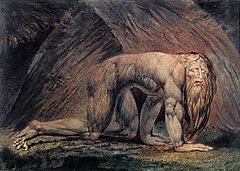
Painting of Nebuchadnezzar
by William Blake
Living Like An Animal - After 60 years and 6 million visitors, the zoo in Milan, Italy, was shut down. Animal-rights activists had protested that conditions in the zoo were unfit for the animals caged there. But when the animals moved out, homeless people moved in. Until city leaders intervened, hundreds of them began sneaking into the cages under the cover of darkness, looking for a night's rest.
Ironically, the zoo was only a 5-minute walk from one of Europe's most expensive shopping districts. Within 400 yards of the cages, the shops of Italian fashion designers lined a street that attracted big spenders from all over the world.
There is something sad about people who live like animals. But who was further from the image of God--those taking shelter in the zoo or the big spenders a few blocks away?
The mighty king Nebuchadnezzar had been warned in a dream that he would be eating grass with the animals unless he changed his proud, sinful ways. The prophet Daniel told him to stop sinning and to show mercy to the poor (Da 4:27). But Nebuchadnezzar refused, and his nightmare came true.
Father, forgive us for our pride. Help us not to live like animals but like people created in Your image. — Mart De Haan (Our Daily Bread, Copyright RBC Ministries, Grand Rapids, MI. Reprinted by permission. All rights reserved)
The pride and arrogance of man
Is evil in God's sight,
Because there's nothing man can do
Without God's strength and might. --Sper
We are never so empty as when we are full of self.
Daniel 4:34 "But at the end of that period, I, Nebuchadnezzar, raised my eyes toward heaven and my reason returned to me, and I blessed the Most High and praised and honored Him who lives forever; For His dominion is an everlasting dominion, And His kingdom endures from generation to generation.
- at the end: Da 4:16,26,32
- raised: Ps 121:1 123:1 130:1,2 Jonah 2:2, 3, 4 Lk 18:13
- I blessed: Job 1:21 Ps 50:14 103:1, 2, 3, 4 107:8,15,22,31 Isa 24:15 La 3:19-23
- the most High: Da 4:17,32 Ps 7:17 9:2 92:1 La 3:38
- him: Da 12:7 Ps 90:2 102:24 146:10 Jer 10:10 Jn 5:26 1Ti 1:17 6:16 Rev 4:10 10:6
- whose: Da 4:3 2:44 7:14 Ps 10:16 145:13 Isa 9:6,7 Jer 10:10 Mic 4:7 Lk 1:33 Rev 11:15
- is from: Ps 90:1
- Daniel 4 Resources - Multiple Sermons and Commentaries
But - A crucial term of contrast for Nebuchadnezzar. A change of direction is about to occur, which ultimately will result in a change in his eternal destiny (in my opinion -- I think he came to personally know the Most High God).
At the end of that period - When? Exactly when God had decreed - at the end of 7 periods of time (as discussed probably seven years). God is never early and never late!
I Nebuchadnezzar raised my eyes - The king makes a choice of his will (enabled by divine grace of course) to raise his eyes toward heaven (from whence came the voice Da 4:31). Here we encounter the interaction of the mysterious truths of man's responsibility (I...raised) and God's sovereignty (My reason returned = God gave it back to him).
Jamieson observes that "Nebuchadnezzar's looking up towards heaven was the first symptom of his "understanding" having "returned." Before, like the beasts, his eyes had been downward to the earth. Now, like Jonah's (Jon 2:1, 2, 4) out of the fish's belly, they are lifted up to heaven in prayer. He turns to Him that smiteth him (Isa 9:13), with the faint glimmer of reason left to him, and owns God's justice in punishing him.
The psalmist has a similar description...
To You I lift up my eyes, O You who are enthroned in the heavens! (Ps 123:1)
Spurgeon comments: The Psalmist looked so high that he could look no higher. Not to the hills, but to the God of the hills he looked. He believed in a personal God, and knew nothing of that modern pantheism which is nothing more than atheism wearing a fig leaf. The uplifted eyes naturally and instinctively represent the state of heart which fixes desire, hope, confidence, and expectation upon the Lord. God is everywhere, and yet it is most natural to think of him as being above us, in that glory land which lies beyond the skies. "O thou that dwellest in the heavens", just sets forth ,the unsophisticated idea of a child of God in distress: God is, God is in heaven, God resides in one place, and God is evermore the same, therefore will I look to him. When we cannot look to any helper on a level with us, it is greatly wise to look above us; in fact, if we have a thousand helpers, our eyes should still be toward the Lord. The higher the Lord is the better for our faith, since that height represents power, glory, and excellence, and these will be all engaged on our behalf. We ought to be very thankful for spiritual eyes; the blind men of this world, however much of human learning they may possess, cannot behold our God, for in heavenly matters they are devoid of sight. Yet we must use our eyes with resolution, for they will not go upward to the Lord of themselves, but they incline to look downward, or inward, or anywhere but to the Lord: let it be our firm resolve that the heavenward glance shall not be lacking. If we cannot see God, at least we will look towards him. God is in heaven as a king in his palace; he is here revealed, adored, and glorified: thence he looks down on the world and sends succours to his saints as their needs demand; hence we look up, even when our sorrow is so great that we can do no more. It is a blessed condescension on God's part that he permits us to lift up our eyes to his glorious high throne; yea, more, that he invites and even commands us so to do. When we are looking to the Lord in hope, it is well to tell him so in prayer: the Psalmist uses his voice as well as his eye.
Notice the progression: (1) Personal choice (enabled by grace) to look up (cp Isa 45:22KJV). (2) Reason returned - God's sovereign will and word fulfilled. (3) Praise Offered - Not for getting his kingdom back but uninhibited praise to the real King, the Most High God.
Piper observes that "When your eyes are Godward, your reason returns. Why? Because your mind was made for God. And when Nebuchadnezzar’s reason returns, he uses it as God intended: “he blessed and praised and glorified the One who lives for ever.” (The First Dark Exchange- Idolatry)
Note that this pagan king's testimony to the goodness and grace of God, which wrought his repentance and conversion, presents a beautiful pattern for every testimony by beginning and ending with praise to the Most High God (Da 4:2). Beloved, let me encourage you to (1) give your testimony (first by living out the supernatural changed life which opens the door for speaking out about the supernatural works of our great God) to those whom God has placed in your purview and (2) begin and end with praise to God, taking care to not grovel in the details of your life "before Christ"!
Blessed the Most High - This reminds one of the David's words (note the parallels to the king's experience in Daniel 4)...
1 Bless the LORD, O my soul; And all that is within me, bless His holy name.
2 Bless the LORD, O my soul, And forget none of His benefits (rewards);
3 Who pardons all your iniquities (including pride);
Who heals all your diseases; (including loss of reason)
4 Who redeems your life from the pit;
Who crowns you with lovingkindness and compassion;
5 Who satisfies your years with good things (cp Da 4:36),
So that your youth is renewed like the eagle (Interesting simile!).
Ps 103:1, 2, 3, 4, 5-Spurgeon's notes
Him Who lives forever...everlasting dominion...kingdom endures - Each of these descriptions emphasizes the eternality of God and His immutable (unchangeable) sovereignty.
Jamieson comments on the significance of the king's praise noting that...
Praise is a sure sign of a soul spiritually healed (Ps 116:12, 14 Mk 5:15, 18, 19).
Daniel 4:35 "All the inhabitants of the earth are accounted as nothing, But He does according to His will in the host of heaven and among the inhabitants of earth and no one can ward off His hand or say to Him, 'What have You done?'
- all: Job 34:14,15,19-24 Isa 40:15-17,22-24
- and he: 1Sa 3:18 Job 23:13 Ps 33:9-11 115:3 135:6 Isa 14:24-27 Isa 46:10,11 Mt 11:25,26 Ac 4:28 Eph 1:11 Php 2:10,11
- the inhabitants: Ps 33:8,14 49:1 Isa 26:9
- none: Job 9:4,13 34:29 40:9-12 42:2 Pr 21:30 Isa 43:13 Ac 5:39 9:5 Ac 11:17 1Co 10:22
- What: Job 9:12 33:12,13 40:2 Isa 45:9-11 Ro 9:19,20 11:33-36 1Co 2:16
- Daniel 4 Resources - Multiple Sermons and Commentaries
There's not a plant or flower below
But makes his glories known;
And clouds arise, and tempests blow
By order from his throne.
Isaac Watts
(Play - I Sing the Mighty Power of God)
He does according to His will - Again His sovereignty is emphasized. See (Ps 115:3 Ps 135:6 Mt 6:10 Eph 1:11).
Wiersbe comments that...
The king acknowledged the sovereignty of God (Dan. 4:35b), which was the main lesson God wanted him to learn through this difficult experience (Da 4:17, 25, 32). It’s too bad that this wonderful Bible doctrine has been so maligned and misinterpreted by amateur Bible students, because an understanding of God’s sovereignty brings the believer assurance, strength, comfort, and the kind of surrender that produces faith and freedom. The Bible teaches both divine sovereignty and human responsibility, and when you accept both, there is no contradiction or conflict. No person is more free than the believer who surrenders to the sovereign will of God. To ignore God’s sovereignty is to exalt human responsibility and make man his own savior, but to deny responsibility is to make man a robot without accountability. The Bible preserves a beautiful balance that exalts God and enables His people to live joyously and victoriously no matter what the circumstances might be (Acts 4:23-31; Ro 8:31-39). (Ibid)
C H Spurgeon had this to say regarding God's sovereignty....
Most men quarrel with this [God's sovereignty]. But mark, the thing that you complain of in God is the very thing that you love in yourselves. Every man likes to feel that he has a right to do with his own as he pleases. We all like to be little sovereigns. Oh, for a spirit that bows always before the sovereignty of God...No doctrine in the whole Word of God has more excited the hatred of mankind than the truth of the absolute sovereignty of God... (but) There is no attribute of God more comforting to his children than the doctrine of divine sovereignty...If God lights the candle, none can blow it out.
J I Packer - To know that nothing happens in God's world apart from God's will may frighten the godless, but it stabilizes the saints.
None can ward off His hand - His hand speaks of His authority and power. He is omnipotent.
J Oswald Sanders rightly remarks that "God can never be outmaneuvered, taken by surprise, or caught at a disadvantage. He is a God who knows no crisis. Before an emergency arises, God in his providence has made adequately and perfectly timed provision to meet it.
Here are some Scriptures that emphasize the doctrine of divine sovereignty...
But our God is in the heavens; He does whatever He pleases. (Ps 115:3).
Isaiah 43:13 "Even from eternity I am He, and there is none who can deliver out of My hand; I act and who can reverse it?"
Isaiah 45:9 "Woe to the one who quarrels with his Maker— An earthenware vessel among the vessels of earth! Will the clay say to the potter, 'What are you doing?' Or the thing you are making say, 'He has no hands'?
Isaiah 46:9, 10 Remember the former things long past, for I am God, and there is no other; I am God, and there is no one like Me, declaring the end from the beginning, and from ancient times things which have not been done, saying, ‘My purpose will be established, and I will accomplish all My good pleasure’;
John Piper - The purposes of God cannot be frustrated; there is none like God. If a purpose of God came to naught, it would imply that there is a power greater than God’s. It would imply that someone could stay His hand when He designs to do a thing. But “none can stay his hand” (Da 4:34, 35) (Desiring God) The antidote to Nebuchadnezzar’s pride was not merely a new knowledge in the head, but a new exultation in the heart. His “praise” and “exultation” reveal the wakening of faith, and the gladness that God ruled the future with the omnipotent grace to establish his plan and humble the proud. He was satisfied with God’s prerogative to do as he pleases in the sovereign freedom of his justice and grace. (Future Grace) (Bolding Added)
See Related Resources:
THE SOVEREIGNTY OF GOD All the peoples of the earth are regarded as nothing
Daniel 4:36 "At that time my reason returned to me. And my majesty and splendor were restored to me for the glory of my kingdom, and my counselors and my nobles began seeking me out; so I was reestablished in my sovereignty, and surpassing greatness was added to me.
- my reason: Da 4:34
- mine: Da 4:15,16,32 2Ch 33:12,13
- added: 1Sa 2:30 Job 13:12 Pr 22:4 Mt 6:33 2Co 4:17
- Daniel 4 Resources - Multiple Sermons and Commentaries
My counselors and my nobles - The fact that the king was not overthrown by these men during his seven years of humiliation is clear testimony to the miraculous nature of these events. Most kings have enough difficulty remaining in power when they are healthy and have full reasoning powers, much less when they begin to get "bats in the belfry"!
Daniel 4:37 "Now I, Nebuchadnezzar, praise, exalt and honor the King of heaven, for all His works are true and His ways just, and He is able to humble those who walk in pride."
- I Nebuchadnezzar: Da 4:3,34 5:4,23 1Pe 2:9,10
- the King: Da 5:23 Mt 11:25 Ac 17:24
- all: De 32:4 1Sa 2:3 Ps 33:4,5 99:4 119:75 145:17,18 Isa 5:16 Rev 15:3 16:7 19:1,2
- those that walk: Da 4:30,31 5:20-24 Ex 18:11 2Ch 33:11,12,19 Job 40:11,12 Eze 16:56,63 Jas 4:6,7 1Pe 5:5,6
- Daniel 4 Resources - Multiple Sermons and Commentaries
Daniel a young Jewish boy fulfilled the goal Jehovah had intended for the entire nation of Israel to fulfill. As Luke (a Gentile) records in Acts 13:47-48 "For thus the Lord has commanded us, 'I HAVE PLACED YOU AS A LIGHT FOR THE GENTILES, THAT YOU SHOULD BRING SALVATION TO THE END OF THE EARTH.' And when the Gentiles heard this, they began rejoicing and glorifying the word of the Lord; and as many as had been appointed to eternal life believed." Daniel was a light who shown forth the light of life (Jn 8:12) to Nebuchadnezzar, the king of kings.
Praise, exalt and honor - He cannot praise God enough, reflecting now not just a return of his reason but a liberation of his heart to worship the one true God. To say that this is just an intellectual response by the king and not evidence of genuine conversion seems to me to be ludicrous. Why else would he go to such lengths to heap word upon word in his exultation of the Most High!
Those who walk in pride - This is Nebuchadnezzar's self-condemnation before the whole world that he walked in pride and for that he was justly humbled by God.
Tony Evans - This is a sobering lesson for any of us who are tempted to develop a “theo-ego,” a God complex. Whenever you get so big that you don’t think you need God, people may as well get your room in the sanitarium ready, because you have already lost your mind. We need to say it again. God is in control. He sets up kings and He brings down kings. Listen to Nebuchadnezzar’s testimony. “He is able to humble those who walk in pride” (Daniel 4:37). You and I are only what God allows us to be. (Evans, A. T. The Best is Yet to Come : Bible Prophecies Through the Ages)
As Wiersbe reminds us "No matter what position we have in life, God gave it to us, and He is sovereign. When man tries to take the place of God, he becomes like a beast. God still resists the proud but gives grace to the humble (Lxx = tapeinos = not rising far from the ground, figuratively of a lowly condition, downhearted, lowly in spirit = humble) (Pr 3:34)." (With the Word Bible Commentary- With the Complete Text)
Jesus gave a similar warning - Whoever exalts himself shall be humbled; and whoever humbles himself shall be exalted. (Mt 23:12)
Wake Up Calls - A strong, young brute often swaggered around town boasting that he could walk a barbed wire fence in his bare feet with a wildcat under each arm. So goes the story according to the Iron County Miner. The braggart got a rude awakening, however, when he married a strong-willed little lady who made him wash the dishes twice a day.
Another rude awakening occurred when a platoon sergeant roused a new recruit after his first night in an army barracks. "It's four-thirty!" bellowed the sergeant. "Four-thirty!" gasped the rookie. "Man, you'd better go to bed. We have a big day tomorrow!"
We are all inclined to dream our way through life until someone or something confronts us with the real world. For Nebuchadnezzar, king of ancient Babylon, the wake-up call lacked humor. Before his encounter with God, he thought he had life well in hand. Suddenly he found himself on his hands and knees eating grass like an animal (Daniel 4:33). After 7 long years (Da 4:32) he learned that in the real world everyone must live under authority, everyone is on God's time, and everything we possess is a gift from His gracious hand.
Father, wake us up today. Make us aware of what it means to live under Your wise and loving authority.— Mart De Haan (Our Daily Bread, Copyright RBC Ministries, Grand Rapids, MI. Reprinted by permission. All rights reserved)
When life is all sunshine and days are bright,
Our thoughts of the Lord may take wings of flight;
But God is still ruler, His kingdom stands,
And we all are subject to His commands. —K. De Haan
A person who thinks too much of himself
thinks too little of God.
Empire Building - After being warned by Daniel about his pride, the Babylonian king Nebuchadnezzar was struck with insanity. The Lord restored his mind, but only after he spent 7 years in a field thinking he was a wild animal.
Nebuchadnezzar went from boasting, "Is not this great Babylon, that I have built for . . . the honor of my majesty?" (Da 4:30) to a humble prayer: "I, Nebuchadnezzar, praise and extol and honor the King of heaven" (Da 4:37). He had repented of prideful empire building.
Bible teacher J. Vernon McGee expressed concern about empire building in the church today. He advised Christian leaders, "Don't try to build a little empire of your church. I started out with that viewpoint, and I had never been more unhappy." He encouraged them to "build into the lives of people" and leave the results to God.
When a church devotes undue energy to statistics, buildings, and programs, pride can enter in and the needs of God's people can be forgotten.
Jesus never forgot the importance of individuals. He invested His time in 12 men (Mark 3:14). Paul discipled Timothy who in turn discipled others (2Ti 2:2-note). God's kingdom grows when we invest in people. — Dennis Fisher (Our Daily Bread, Copyright RBC Ministries, Grand Rapids, MI. Reprinted by permission. All rights reserved)
Churches grow when people pray
And pastors preach the Word,
When love for Christ seeks out the lost
To win them to the Lord. —D. De Haan
Poor is the church that values programs above people.
KING Nebuchadnezzar had it all. Power. Majesty. Greatness. But he forgot where he got it. He pranced around the pal-ace of Babylon boasting,
"Is not this great Babylon, that I have built for a royal dwelling by my mighty power and for the honor of my majesty?" (Daniel 4:30)
Before his last arrogant words had left his mouth, he was startled by the voice of the One who had placed him on the throne. God said,
"Nebuchadnezzar, .. . the kingdom has departed from you!" (Da 4:31)
But that's not all. The mighty king of Babylon also got a quick transfer from the palace to the pasture. As God had warned him in a dream, he became a crazed creature, grazing on grass like an ox. The proud monarch became a picture of humility. Not until this man-creature lifted his head heavenward and "blessed the Most High and praised and honored Him who lives forever" (Da 4:34) was he allowed to return to sanity and to his throne.
Everything we have, our possessions, our position, our potential, comes from God. He is the source of our strength, the giver of our talents, and the One who controls our circumstances. When we forget this, or take the credit, God may find it necessary to transfer us from a position of pride to humiliation.
Knowing our position in relationship to God is the way to keep pride out of our lives. When we know how high and mighty He is, we'll have little trouble remembering how weak and lowly we are.—J D Brannon