Ephesians 1:2
Ephesians 1:3
Ephesians 1:4
Ephesians 1:5
Ephesians 1:6
Ephesians 1:7
Ephesians 1:8
Ephesians 1:9
Ephesians 1:10
Ephesians 1:11
Ephesians 1:12
Ephesians 1:13
Ephesians 1:14
Ephesians 1:15
Ephesians 1:16
Ephesians 1:17
Ephesians 1:18
Ephesians 1:19
Ephesians 1:20
Ephesians 1:21
Ephesians 1:22
Ephesians 1:23

EPHESIANS - CHRIST AND THE CHURCH
Click chart to enlarge
Charts from Jensen's Survey of the NT - used by permission
Ephesians 1:22 And He put all things in subjection under His feet, and gave Him as head over all things to the church (NASB: Lockman)
Greek: kai panta hupetaxen (3SAAI) hupo tous podas autou, kai auton edoken (3SAAI) kephalen huper panta te ekklesia,
BGT καὶ πάντα ὑπέταξεν ὑπὸ τοὺς πόδας αὐτοῦ καὶ αὐτὸν ἔδωκεν κεφαλὴν ὑπὲρ πάντα τῇ ἐκκλησίᾳ,
Amplified: And He has put all things under His feet and has appointed Him the universal and supreme Head of the church [a headship exercised throughout the church], (Amplified Bible - Lockman)
NLT: And God has put all things under the authority of Christ, and He gave Him this authority for the benefit of the church. (NLT - Tyndale House)
NLT (revised) God has put all things under the authority of Christ and has made him head over all things for the benefit of the church.
Phillips: God has placed everything under the power of Christ and has set Him up as head of everything for the Church. (Phillips: Touchstone)
Wuest: And all things He put in subjection under His feet, and Him He gave as Head over all things to the Church, (Eerdmans Publishing - used by permission)
Young's Literal: and all things He did put under his feet, and did give Him -- head over all things to the assembly
KJV And hath put all things under his feet, and gave him to be the head over all things to the church,
ESV And he put all things under his feet and gave him as head over all things to the church,
NET And God put all things under Christ's feet, and he gave him to the church as head over all things.
NIV And God placed all things under his feet and appointed him to be head over everything for the church,
CSB And He put everything under His feet and appointed Him as head over everything for the church,
NKJ And He put all things under His feet, and gave Him to be head over all things to the church,
NRS And he has put all things under his feet and has made him the head over all things for the church,
NAB And he put all things beneath his feet and gave him as head over all things to the church,
NJB He has put all things under his feet, and made him, as he is above all things, the head of the Church;
GWN God has put everything under the control of Christ. He has made Christ the head of everything for the good of the church.
BBE And he has put all things under his feet, and has made him to be head over all things to the church,
AND HE PUT ALL THINGS IN SUBJECTION UNDER HIS FEET: kai panta hupetaxen (3SAAI) hupo tous podas autou,
- And He put all things in subjection under His feet, Ge 3:15; Psalm 8:6-8; 91:13; 1Co 15:25, 26, 27; Heb 2:8
- Ephesians 1 Resources - Multiple Sermons and Commentaries
Psalm 8:6 You make him to rule over the works of Your hands; You have put all things under his feet,
1Cor 15:27 For HE HAS PUT ALL THINGS IN SUBJECTION UNDER HIS FEET. But when He says, “All things are put in subjection,” it is evident that He (the Father) is excepted Who put all things in subjection to Him.
Colossians 2:14-15 (JESUS DEATH ON THE CROSS) having canceled out the certificate of debt consisting of decrees against us, which was hostile to us; and He has taken it out of the way, having nailed it to the cross. 15 When He had disarmed the rulers and authorities, He made a public display of them, having triumphed over them through Him.
Heb 2:8 THOU HAST PUT ALL THINGS IN SUBJECTION UNDER HIS FEET.” For in subjecting all things to him, He left nothing that is not subject to him. But now we do not yet see all things subjected to him.
Comment: "Psalm 8:6 (LXX) is clearly in his mind (cf. Heb 2:8). The Psalmist affirms man’s dominion on earth. Here Paul claims that Christ, as God’s new man, has universal dominion. Man largely forfeited his status through sin but through Christ as the ideal man he is restored to his proper dignity. So far from constituting a threat to the realization of true humanity, the Christian gospel provides the only means by which it can be attained." (Wood)
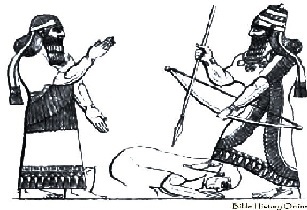
Conqueror's Foot on Head of Enemy
EVERYTHING AND EVERYONE EVERYWHERE
SUBJECT TO THE LORD JESUS CHRIST
And He put all things in subjection under His feet - Note first put is past tense (aorist tense). It is done because of His declaration "It is finished!" (Jn 19:30) If something is under one's feet, as shown in the diagram above, it suggests victory over one's enemies (cf Josh 10:24, 2Sa 22:39). It describes the place of accomplished defeat and complete subjection. The person subjected is controlled or ruled by the one whose foot is on him. This is a another manifestation of the surpassing greatness of the power described in Eph 1:19. Note the adjective all (pas) which means all without exception. The Father has given Christ universal dominion, not just over men and angels but all creation! Everything in the universe is subject to Christ. Period! But this can be somewhat confusing if you consider John's statement that the "whole world lies in the power of the evil one." (1Jn 5:19). If everything is subject under Jesus' feet, how could Satan still have dominion over the world? We know that Satan was defeated at the Cross when we compare Col 2:14-15 (He had disarmed the rulers and authorities, He made a public display of them, having triumphed over them through Him.") and Hebrews 2:14-15 (through death He might render powerless him who had the power of death, that is, the devil). And if we look at the world system, it certainly looks like the Devil has considerable dominion. So the only way to reconcile the fact that Christ is over all with the evidence that the Devil still has significant impact in our world, is to propose that Christ's subjection will not be fully realized until He returns, the Devil is bound and He establishes His Messianic Kingdom. So yes, all things are subject to Christ now, but clearly He is allowing the Devil a "long leash" so to speak. Hoehner (see below) gives a similar explanation for this Christological conundrum.
William MacDonald explains why this putting of all things under Christ is stated as a completed action (put is aorist tense - past completed act) -Though universal dominion belongs to Christ, He does not exercise it as yet. Men, for instance, still rebel against Him and deny Him or resist Him. But God has decreed that His Son will yet wield the scepter of universal dominion, and it is as certain as if it were a present reality. (Related: What does it mean that the scepter will not depart from Judah Genesis 49:10)?)
Paxson - Christ has become both Victor and Ruler. While the full realization of the subjection of all things to the absolute Lordship of Christ awaits His triumphal return to rule on the earth, yet in God's purpose His Son is already King of kings and Lord of lords. (The Wealth, Walk and Warfare of the Christian)
Complete Biblical Library Commentary - This statement comes from Psalm 8:6 with special emphasis on the perfect man, Jesus Christ. The fact that God's plan included the incarnation of Christ still continues to be one of the most outstanding doctrines of the New Testament Church. (Complete Biblical Library - Incredible Resource)
Steven Cole has a helpful note discussing the importance of Jesus' ascension writing that "Peter tells us that Jesus is now “at the right hand of God, having gone into heaven, after angels and authorities and powers had been subjected to Him” (1Pe 3:22). Paul says that Jesus is seated at God’s “right hand in the heavenly places, far above all rule and authority and power and dominion, and every name that is named, not only in this age, but also in the one to come. And He put all things in subjection under His feet” (Eph. 1:20b-22a). And, yet there is a sense in which all things are not yet subject to Him (1 Cor. 15:27-28; Ps. 110:1; Heb. 10:13). His kingdom is both present and yet future. Presently His enemies are not all yet subject to Him. But when He comes again in power and glory, He will conquer every foe and reign forever and ever. (Why the Disciples Rejoiced at Jesus' Ascension)
Hoehner amplifies Cole's remarks - In reality Christ is at the right hand of the Father and everything has been subjected under his feet, but the full exercise of that power will not be evident until his return. This corresponds to 1 Cor 15:24–28 where it states that God has subjected everything under Christ’s feet and that in the end, Christ will subject all enemies and will hand the kingdom over to God the Father. At the present, the manifestation of this control is not always evident to us, for there are many inequities, injustices, disasters, unholy actions, and evidences of outright defiance against Christ and God. However, Christ is exercising control without it being obvious to humankind. Without his control, things would be much worse. Hence, he has the right to exercise his control but chooses not to fully exercise it immediately in every instance of violation against God’s holy character. Certainly, a basic and important illustration of his present use of authority is his current ability to rescue sinners from the most despicable powers of all, Satan and sin, which will be discussed in the next chapter. To summarize, God does have a plan and everything must follow according to that plan which will culminate at Christ’s return where the exercise of his control will be very evident. (Ephesians: An Exegetical Commentary)
Harold Hoehner - A second manifestation of God’s power in Christ is seen in His placing all things under Christ’s feet. Whereas Adam lost his headship over Creation when he sinned, Christ was made Head over all Creation (cf. Eph. 1:10). This will be fully realized in the future (Ps. 8:6; 1 Cor. 15:27; Heb. 2:6–8) (ED: THIS IS EXPLAINED MORE BELOW).(The Bible Knowledge Commentary)
John Piper writes "So when Jesus rose from the dead, he was exalted over all the hosts of hell. They are a defeated foe. They are not yet out of the world. And battles are yet to be fought. But the power from God for us now in these battles is a resurrection power now—to live and die for the glory of Christ." (The Immeasurable Greatness of His Power Toward Us)
Put in subjection (5293) (hupotasso from hupo = under + tasso = arrange in orderly manner) means literally to place under in an orderly fashion. Appropriate to the present context hupotasso as used in secular Greek was a military figure meaning to line up under, place or rank under. The aorist tense speaks of an effective action in the past. When did this subjection occur? Paul says it is after Christ was resurrected and seated at the right hand of the Father. In the active voice (God is the subject and one produces the action) hupotasso means to subject, bring under firm control, or subordinate. The indicative mood simply means that this was an actual event. It really happened in time and eternity. God the Father subjected all things to the authority of God the Son. Hupotasso meant that troop divisions were to be arranged in a military fashion under the command of the leader. In this state of subordination they were now subject to the orders of their commander. Thus, it speaks of the subjection of one individual under or to another. Hupotasso was also used to describe the arrangement of military implements on a battlefield in order that one might carry out effective warfare!
Hupotasso - 38x in 31v - Luke 2:51; 10:17, 20; Rom 8:7, 20; 10:3; 13:1, 5; 1 Cor 14:32, 34; 15:27f; 16:16; Eph 1:22; 5:21, 24; Phil 3:21; Col 3:18; Titus 2:5, 9; 3:1; Heb 2:5, 8; 12:9; Jas 4:7; 1 Pet 2:13, 18; 3:1, 5, 22; 5:5. NAS = put in subjection(5), subject(16), subjected(7), subjecting(1), subjection(4), submissive(3), submit(2).
The truth in this verse had its germination some two thousand years prior to the Crucifixion, Burial and Resurrection of Christ, Moses recording God's decree of defeat (and subjection) of Satan...
And I (God) will put enmity between you and the woman, and between your seed and her seed. He (Eve's seed ultimately the Messiah) shall bruise you on the head, and you shall bruise him on the heel (which is what happened to the heels of those crucified as they repetitively pushed to lift themselves up in order to move their diaphragm and move air into their air starved lungs)." (Genesis 3:15)
Under (5259) (hupo) means literally in or into a position below or beneath something. The common Greek term frequently meant not simply to be beneath but to be totally under the power, authority, and control of something or someone. Adam lost his headship over Creation when he sinned. Christ was made Head over all Creation
Feet (4228) (pous) To put or subdue under one's feet means to make subject to someone, an allusion to the ancient manner of treading down or putting the foot on the necks of vanquished enemies as Paul emphasizes the certainty of God's ultimate victory over Satan writing...
And the God of peace will soon crush Satan under your feet. The grace of our Lord Jesus be with you. (Ro 16:20)
Comment: There is a clear allusion here to the primeval promise of Genesis 3:15, which prophesized the final victory of Christ over Satan. In the meantime, believers, who also in a sense are the woman's seed (Revelation 12:17), can achieve local victories over Satan and his wiles by resisting him "steadfast in the faith" (1Peter 5:9). If we resist him with Scripture as Jesus did, testing and refuting his enticements therewith (Matthew 4:4, 7,10), then he will "flee from you" (James 4:7), just as he did from Jesus, "for a season" (Luke 4:13). The ultimate victory over Satan will be won only by the Lord Jesus Christ when He returns.
Writing to the Corinthians Paul explained that the Lord Jesus Christ...
must reign until He has put all His enemies under His feet. The last enemy that will be abolished is death. For HE HAS PUT ALL THINGS IN SUBJECTION UNDER HIS FEET. But when He says, "All things are put in subjection," it is evident that He (God the Father) is excepted Who put all things in subjection to Him (the Lord Jesus Christ). (1Cor 15:25-27)
Comment: Note that this statement in no way implies that the Son is inferior to the Father, but, when death is conquered at the end of the Millennium, then all things will be under the administration of the triune God.
AND GAVE HIM AS HEAD OVER ALL THINGS TO THE CHURCH: kai auton edoken (3SAAI) kephalen huper panta te ekklesia:
- and gave Him as head over all things to the church Eph 4:15-16; 1Co 11:3; Col 1:8; 2:10,19
- to the church - Ep 3:21; Mt 16:18; Acts 20:28; 1Ti 3:15; Hebrews 12:22, 23, 24
- Ephesians 1 Resources - Multiple Sermons and Commentaries
Related Passages:
Ephesians 4:15 but speaking the truth in love, we are to grow up in all aspects into Him Who is the head, even Christ,
Ephesians 5:23 For the husband is the head of the wife, as Christ also is the head of the church, He Himself being the Savior of the body.
Colossians 1:18 He is also head of the body, the church; and He is the beginning, the firstborn from the dead, so that He Himself will come to have first place in everything.
Colossians 2:10 and in Him you have been made complete, and He is the head over all rule and authority;
CHRIST THE HEAD OF
EVERYTHING
And gave Him as head over all things to the church - Amplified - "has appointed Him the universal and supreme Head of the church [a headship exercised throughout the church]." NLT = "has made Him Head over all things for the benefit of the church" The Father's gift to His Son is a Bride! He is the Head. This points to Christ's preeminence as Lord and Master (Is He your Lord?) He is not the King of the church but the Head and as His Bride she will reign with Him in the future. And this has great practical import for the head of the body determines what the body will (and should) do. Christ as Head gives the direction of the works His Body should accomplish. As Head Christ has full dominion in the affairs of the Church to direct all things pertaining both to its inner life and outer activity.
MacDonald - What follows is almost incredible. This One whose nail-scarred hand will exercise sovereign authority over all the universe—God has given this glorious One to the church! Here Paul makes a startling revelation concerning the mystery of God's will; step by step he has been leading up to this climactic announcement. With graphic skill he has been describing the resurrection, glorification, and dominion of Christ. While our hearts are still awestruck at the contemplation of this all-glorious Lord, the apostle says, "It is in His capacity as head over all things that Christ has been given to the church." If we read this verse carelessly, we might understand it to say that Christ is the Head of the church. While that is true enough, the verse says a lot more. It says that the church is closely associated with Him who has been given universal sway. In Eph 1:21 we learned that Christ is far above every creature in heaven and on earth, in this age and in the coming age. In the first part of Eph 1:22 we learned that all things as well as all created beings are in subjection under His feet. Now we learn that the unique calling of the church is to be associated with Him in His boundless dominion. The church will share His rule. All the rest of creation will be under His rule. (Believer's Bible Commentary: Second Edition)
Lehman Strauss - Now consider the last phrase. God “gave Him to be the head over all things to the church, which is His body, the fullness of Him that filleth all in all” (Eph 1:22-23). Jesus Christ has been exalted to absolute authority over His Church, hence through His sovereign Person and exalted position the Church takes her orders. He is the exalted Head over all. The order of the Church must be His will and every activity must exalt Him, since it is in the capacity of Head over all that God gave Him to the Church. When the members of the Church recognize this, then there will be no lack, for the Church will receive its fullness from Him. As the recognized Head He imparts the needed strength to accomplish every task. When the visible body of Christ on earth recognizes the invisible Head in heaven, the gates of hell will not prevail against the Church. Popes, cardinals, and bishops are merely men; and when any man sets himself up as the head of Christ’s Church, it is sacrilege of the basest sort. Beloved, let us take our position in subjection to our Lord Jesus Christ, that we may enjoy victory all along the way, for we cannot be complete without Him (Col. 2:9-10).(Lehman Strauss Commentary – Devotional Studies on Paul's Letters to the Galatians and Ephesians - online)
Gave Him - Jamieson writes "The Greek order is emphatic: “him He gave as Head over all things to the Church.” Had it been anyone save HIM, her Head, it would not have been the boon it is to the Church."
Harold Hoehner - The third manifestation of God’s power in Christ is His appointment of Christ as Head over … the church. Though the final manifestation of Christ’s headship over all Creation will be in the future, He is now Head over the fellowship of believers. He is also called the church’s “Head” in Ephesians 4:15; Eph 5:23; and Colossians 1:18. Though the church is implied in Ephesians 1:10, it is specifically mentioned for the first time in Ephesians in verse 22b. .(The Bible Knowledge Commentary)
Mal Couch - Paul wants it to be clear that what has been done in Christ is beneficial to his readers. The availability of God’s power, in Him, for those who believe (v. 19), as well as Christ’s rule over the universe, is for their benefit (v. 22). This knowledge should allow these predominantly gentile Christians in Asia Minor, living with the pressures of their pagan surroundings, to take heart because of what God has done, graciously and powerfully, through His Son on their behalf. (Twenty-First Century Biblical Commentary)
Gave (1325) (didomi) (aorist active indicative) give. Not merely set Him over the Church, but gave Him as a gift ("for her special advantage" Jamieson). The aorist tense speaks of past completed action.
Didomi is used 12 times in Ephesians - Eph. 1:17; Eph. 1:22; Eph. 3:2; Eph. 3:7; Eph. 3:8; Eph. 3:16; Eph. 4:7; Eph. 4:8; Eph. 4:11; Eph. 4:27; Eph. 4:29; Eph. 6:19
Wuest - Christ is therefore God’s gift to the Church. He as Head over all things and as Head of the Church is a love gift of God the Father to the Church. (Word Studies - Eerdman Publishing Company Volume 1, Volume 2, Volume 3)
Head (2776) (kephale) speaks of authority and was commonly applied to many people in authority, but to none without governing authority (king of Egypt called head, general of army = head, Roman emperor = head). Christ is over them all over the church.
Wiersbe - Because we are believers, we are in the church, which is Christ’s body—and He is the Head. This means that there is a living connection between you and Christ. Physically speaking, the head controls the body and keeps the body functioning properly. Injure certain parts of the brain and you handicap or paralyze corresponding parts of the body. Christ is our spiritual Head. Through the Spirit, we are united to Him as the members of His body. This means that we share His resurrection, ascension, and exaltation. (Paul will amplify this later.) We too are seated, in the heavenlies (Eph. 2:6), and all things are under our feet. (The Wiersbe Bible Commentary: New Testament)
Over (5228) (huper) refers to a degree which is beyond that of a compared scale of extent. It means more than, to a greater degree than, beyond, over and above, beyond. Adam lost his headship over Creation when he sinned, Christ was made Head over all Creation
All (3956) (pas) all without exception. Paul refers to the cosmic rule of Christ and implies that Christ is sovereign Head over all things.
Church (1577) (ekklesia from ek = out + kaleo = call) means literally the called-out ones. It was used in secular Greek of the assembly of citizens called out to transact city business. “Body of called out individuals” refers to the invisible Church, composed of only saved individuals. It is composed of that company of saints chosen in Him; called out and separated from the world, the flesh and the devil; identified with Christ in His death, resurrection and ascension by which He becomes their Saviour, Lord and Life. There are many individuals sitting each Sunday morning in church (a building) but who not sitting in Christ in the heavenlies, for sadly they have never by grace through faith received Christ Lord and Savior and Head of His body the mystical church (a living spiritually dynamic organism).
John Walvoord in his series in Bibliotheca Sacra on "The Present Work of Christ" writes the following summary regarding the church...
A new work of God, namely, the baptism of the Holy Spirit, is that which forms the new entity. The Holy Spirit is the active agent in the formation of the body of Christ (1 Cor. 12:13), and the Father is said to participate in the undertaking by placing Christ as the Head of the body (Eph. 1:22). Christ does not form the body, but is, nevertheless, the source of its life and the One Who directs its activity. In keeping with this doctrine, the Spirit regenerates the individual believer with the same eternal life which abides in Christ (John 10:28; 1John 5:11-12). The time of the formation of the body of Christ is properly traced to the Day of Pentecost when, for the first time, the baptism of the Holy Spirit took place. According to Acts 1:5, Christ declared on the day of His ascension,
“John indeed baptized with water; but ye shall be baptized in [by] the Holy Spirit not many days hence.”
The expression “in the Holy Spirit” is the instrumental use of the en and is properly translated “by” or “with.” The expression is identical in meaning to that found in 1Corinthians 12:13. Up to this time there is no indication in Scripture that the Holy Spirit had ever baptized believers. All the references in the Gospels are prophetic of the future. Though Old Testament saints were born again and in individual cases indwelt by the Spirit, there is no Scriptural revelation prior to the Day of Pentecost of binding believers together in a living union comparable to that of the church. There were saints in the Old Testament, that is, holy ones, but not believers baptized into the body of Christ. What the Scriptures teach is that a new entity is now being formed beginning on the Day of Pentecost. (The Present Work of Christ—Part III:)
Moule on the church - This great word appears here in its highest reference, the Company of human beings “called out” (as the word Ecclesia implies) from the fallen world into vital union with the glorified Christ. The word occurs nine times in this Epistle (here, Eph 3:10, 21 5:23, 24, 25, 27, 29, 32) and always in the same high connection. Cp. for parallels Col. 1:18, 24; Heb. 12:23; and, in a measure, Acts 20:28; 1 Cor. 15:9. As it stands here, the word rises above the level of visibility and external organization, and has to do supremely with direct spiritual relations between the Lord and the believing Company. In is, in fact, (see Eph 5:32-33), “the Bride, the Lamb’s Wife,” of the Revelation, only not as yet manifested in bridal splendour. It is “the called, justified, and glorified,” of Ro 8:30; “the Church of the Firstborn,” of Heb. 12:23; “the royal priesthood, the people of possession,” of 1Peter 2:9. All other meanings of the word Church are derived and modified from this, but this must not be modified by them. “The Church of Christ, which we properly term His body mystical, can be but one … a body mystical, because the mystery of their conjunction is removed altogether from sense. Whatsoever we read in Scripture concerning the endless love and saving mercy which God shows to His Church, the only proper subject thereof is this Church. Concerning this flock it is that our Lord and Saviour hath promised, ‘I give unto them eternal life, and they shall never perish, neither shall any man pluck them out of my hand.’ They who are of this Society have such marks and notes of distinction from all others as are not objects unto our sense; only unto God who sees their hearts … they are clear and manifest” (Hooker, Eccles. Polity, III. 1.)
F B Meyer writes that...
THE CHURCH IS A BODY OF WHICH CHRIST IS HEAD. (Ephesians 1:22) We repeat such words without emotion now; but there was a time when they could not be uttered save at the cost of much that men hold dear. It is as if we were passing over a battle-field, once raked with shell and soaked with gore; or were handling a banner torn and ragged, around which the conflicting foemen fought for half a day. Let us not forget the brave hearts that were harried to death amid the heather and gorse of Scotland, rather than confess that any but Christ might assume this august title.
The Church, as a whole, must take its commands for suffering or warfare from no other lips than Christ's. Whatever course may be dictated by expediency, policy, or human leadership, she dare not move until Christ gives the signal. But if He bids her advance, protest, or suffer, she has no option but to obey. Though every voice that can reach her may be raised in expostulation and warning, she dare heed none but his.
This position of our Lord is as much for each member of the Church as for the whole Body. Because as in the natural body each several muscle, nerve, and vein, as well as the more prominent members, have direct double communication with the head, from which they derive their unity, direction, and energy; so in the spiritual Body of which Christ is head, there is not one single redeemed spirit that is not connected directly with its Lord. It would not be in the Church at all if that relationship had not first been formed. We are related to one another, only because we are related to Him. We are first members of Christ, then members of each other in Him. First Christ, then the Church.
Each member is united to the head by the afferent nerves that carry impressions from the surface of the body to the head; and there is nothing which happens to any one of us which is not instantly communicated to our Saviour. In all our affliction He is afflicted; He bears our griefs and carries our sorrows; He is touched with the feeling of our infirmity. The glory with which He is surrounded does not act like an insulating barrier to intercept the thrill of pain or joy that passes instantly from the weakest and meanest of his members to Himself.
Each member is united to the head by the efferent nerves, that carry volitions from the imperial court of the brain to the extremities of the body, withdrawing the foot from the thorn, or compelling the hand to plunge into the flame. Thus should we receive the impulses of our life from Jesus Christ; not acting on self-prompted energy, or following our own plans, thinking our own thoughts, or doing our own works, but ever subordinated to his will.
In (Ephesians 5:23) the headship of Christ to his Church is compared to that between husband and wife; and we are reminded of one of those deep verses that reveal the unities of creation as they were present to the apostle's thought. As God is the head of Christ, the glorified Man, and as man is meant to be the head of woman, so is Christ head of each redeemed man, as an individual, and of all such together, in the Church. Thus amid the discord and anarchy of creation we are learning the Divine concords, and shall yet find harmony emanating from the Church to soothe, and still, and unify creation. ("The Church")
QUESTION - Who is the head of the church, biblically speaking?
ANSWER - Two passages in the New Testament make it clear that the head of the church is Jesus Christ. Colossians 1:17–18a teaches, “And he is before all things, and in him all things hold together. And he is the head of the body, the church.” (ED: ACTUALLY 3 PASSAGES - Ephesians 1:22-23) This passage makes a brief comparison between the human body and the church. The church is the body, and Jesus is the head. Jesus was before all things and holds all things together. This includes the church as well.
Ephesians 5:22–25 speaks of the relationship between husband and wife and includes the teaching of Jesus as head of the church:
“Wives, submit yourselves to your own husbands as you do to the Lord. For the husband is the head of the wife as Christ is the head of the church, his body, of which he is the Savior. Now as the church submits to Christ, so also wives should submit to their husbands in everything. Husbands, love your wives, just as Christ loved the church and gave himself up for her.”
In this passage, wives are to submit to their husbands as the church submits to Christ, and husbands are to sacrificially love their wives in the way Christ was willing to die for the church. In this context, Jesus is called the “head of the church, his body.” He is also called its Savior.
What does it mean to be the head of the church? Both Colossians 1 and Ephesians 5 emphasize the leadership of Christ and His power. In Colossians, Christ is head because He holds all things together. In Ephesians, Christ is head because He is Savior.
The implications of this teaching are profound. First, church leaders are to surrender ultimate leadership to the Lord Jesus Christ. He is the One who leads and determines the teachings and practices of the church. Church members are to follow Christ first and earthly leaders second, as those leaders emulate Christ (see 1 Corinthians 11:1 and 1 Peter 5:3–4).
Second, the love Jesus has for the church is expressed in His desire that we also love the church. The church is not a building or organization but a group of people who know and worship Jesus. Christians are taught, “Let us consider how we may spur one another on toward love and good deeds, not giving up meeting together, as some are in the habit of doing, but encouraging one another—and all the more as you see the Day approaching” (Hebrews 10:24–25). Regular connection with other believers honors the Lord, encourages us personally as believers, and allows us to encourage and serve others.
While every church will have its own local leaders, the ultimate leader of any church is the Lord Jesus. He said, “I will build my church” (Matthew 16:18, emphasis added); it belongs to Him. He is the head of the body and the only One with the power to adequately lead and love the church.GotQuestions.org
Ephesians 1:23 which is His body, the fullness of Him Who fills all in all. (NASB: Lockman)
Greek: hetis estin (3SPAI) to soma autou, to pleroma tou ta panta en pasin pleroumenou. (PPMSG)
BGT ἥτις ἐστὶν τὸ σῶμα αὐτοῦ, τὸ πλήρωμα τοῦ τὰ πάντα ἐν πᾶσιν πληρουμένου.
Amplified: Which is His body, the fullness of Him Who fills all in all [for in that body lives the full measure of Him Who makes everything complete, and Who fills everything everywhere with Himself]. (Amplified Bible - Lockman)
NLT: And the church is his body; it is filled by Christ, Who fills everything everywhere with his presence. (NLT - Tyndale House)
NLT (revised) And the church is his body; it is made full and complete by Christ, who fills all things everywhere with himself.
Phillips: for the Church is his body, and in that body lives fully the one Who fills the whole wide universe. (Phillips: Touchstone)
Wuest: which is his body, the fulness of Him Who is filling the all in all, (Eerdmans Publishing)
KJV Which is his body, the fulness of him that filleth all in all.
ESV which is his body, the fullness of him who fills all in all.
NET Now the church is his body, the fullness of him who fills all in all.
NIV which is his body, the fullness of him who fills everything in every way.
CSB which is His body, the fullness of the One who fills all things in every way.
NKJ which is His body, the fullness of Him who fills all in all.
NRS which is his body, the fullness of him who fills all in all.
NAB which is his body, the fullness of the one who fills all things in every way.
NJB which is his Body, the fullness of him who is filled, all in all.
GWN The church is Christ's body and completes him as he fills everything in every way.
BBE Which is his body, the full measure of him in whom all things are made complete.
WHICH IS HIS BODY: hetis estin (3SPAI) to soma autou:
- Which is His body - Ephesians 2:15-16; Eph 4:4,12-16 ; Ro 12:4,5; 1Cor 12:12-31 Col 1:18,24; 3:15
- Ephesians 1 Resources - Multiple Sermons and Commentaries
Related Passages:
Ephesians 2:15-16 by abolishing in His flesh the enmity, which is the Law of commandments contained in ordinances, so that (PURPOSE CLAUSE) in Himself He might make the two into ONE new man, thus establishing peace, 16 and might reconcile them both in ONE BODY to God through the cross, by it having put to death the enmity.
Ephesians 4:4 There is ONE BODY and one Spirit, just as also you were called in one hope of your calling;
Ephesians 4:12-16 for the equipping of the saints for the work of service, to the building up of the BODY of Christ; 13 until we all attain to the unity of the faith, and of the knowledge of the Son of God, to a mature man, to the measure of the stature which belongs to the fullness of Christ. 14 As a result, we are no longer to be children, tossed here and there by waves and carried about by every wind of doctrine, by the trickery of men, by craftiness in deceitful scheming; 15 but speaking the truth in love, we are to grow up in all aspects into Him who is the Head, even Christ, 16 from whom the whole BODY, being fitted and held together by what every joint supplies, according to the proper working of each individual part, causes the growth of the BODY for the building up of itself in love.
BODY BASICS
Which is His Body - Which refers to the Church, Christ's mystical Body with which He is now and forever bound with! It reminds us of Adam and Eve when Adam declared "This is now bone of my bones, And flesh of my flesh." (Ge 2:23) Indeed, the church as Christ's Bride is His present bodily representative on earth. How can the lost world (Eph 2:1-3) see the invisible Christ? By seeing His visible Word centered, Spirit filled church (cf Mt 5:16, Php 2:14-15). The verb "is" (eimi) is in the present tense signifying Jesus Christ is continually (AND FOREVER) the Head of His Body, the Church, not a pastor, not an influential member, not a board of directors, but the Lord of glory!
THOUGHT - Who is "head" of your church? If it is a man, then you have are in effect "cutting yourself off" at the neck from the "nerve center" of the church, Christ Jesus. That's why Paul in his parting words to the Ephesian elders said "And now I commend you to God and to the Word of His grace, which is able to build you up and to give you the inheritance among all those who are sanctified.." (Acts 20:32) So note the order of Paul's parting instruction - pastor/elders are placed first before God (and Christ the Head) and guided by His Word. The pattern is simple, but critical and powerful.
Eph 5:29 for (TERM OF EXPLANATION) no one ever hated his own flesh (BODY), but nourishes and cherishes it, just as Christ also does the church, 30 because (TERM OF EXPLANATION) we are members of His body. 31 FOR (TERM OF EXPLANATION) THIS CAUSE A MAN SHALL LEAVE HIS FATHER AND MOTHER, AND SHALL CLEAVE TO HIS WIFE; AND THE TWO SHALL BECOME ONE FLESH. 32 This mystery is great; but I am speaking with reference to Christ and the church.
Col 1:18 He is also Head of the body, the church; and He is the beginning, the first-born from the dead; so that He Himself might come to have first place in everything.
Col 1:24 Now I rejoice in my sufferings for your sake, and in my flesh I do my share on behalf of His body (which is the church) in filling up that which is lacking in Christ’s afflictions.
Col 3:15 And let the peace of Christ rule in your hearts, to which indeed you were called in one body; and be thankful.
Mal Couch -In the final verse in this chapter, what does the apostle Paul mean when he says that the church “is His body, the fullness of Him, who fills all in all” (v. 23)? The best explanation is that God fills the church with the fullness of moral excellence and power.(Twenty-First Century Biblical Commentary)
Complete Biblical Library Commentary - Paul's emphasis on the necessity of understanding the power of God available to believers (Eph 1:19) comes to a conclusion with a classic reminder that the Church is the beneficiary of that power. Because the Church is a living organism with Christ as its head, God manifests His power through it. "Fullness" (plērōma) was a favorite term of the Gnostics who used the word to refer to the so-called intermediary beings between God and people. Paul used the verb form here in a passive sense. It contains the idea of the Church being not only Christ's body, but of its being filled by Him. (Complete Biblical Library - Incredible Resource)
John MacArthur has an excellent description of the Church, the Body of Christ - "Christ is Head of the body and the Holy Spirit is its lifeblood, as it were." (Introduction)
THOUGHT - This begs the question of your church dear pastor, dear elders, dear saints. "Is your local church a bit "anemic" spiritually? Perhaps you are in need of an "infusion" of the Biblical [emphasis on Biblical, not extra-biblical, false and misleading] doctrines on the Holy Spirit and the Body's desperate need for continual dependence on His supernatural power so that Christ's radiant life might emanate from the individual saints, shining like lights before a rapidly darkening lost world (cf Mt 5:16+, Php 2:12, 13, 14, 15+)." (Suggestion - The teaching would be a good initial infusion - The Holy Spirit-Walking Like Jesus Walked!).
Is (2076) (esti present active indicative 3rd person sing. of eimi = to be).
Body (4983) (soma) refers to an organized whole made up of parts and members. Christ’s mystical body, His church describes the relationship of Christians to Christ the Head, the head being the vital organic center of the whole body. The Body is "that company of saints gathered from both Jews and Gentiles; united to the Lord and to one another through reconciliation by the Cross and made one Body." (Paxson)
It is interesting to observe that Paul uses a variety of terms to describe the body of Christ, the church, each description giving us a different facet of the truth about the church. And so in the Book of Ephesians, Paul describes the church as
- Saints (Ephesians 1:1), (Note the church has a "steeple" but the church is the "people")
- Faithful in Christ Jesus (Ephesians 1:1),
- “us who believe” (Ephesians 1:19), (Non-believers are welcome to come to the church, but are not members of Christ's body).
- the church in all her glory (Ephesians 5:27),
- His body (Ephesians 1:23),
- His Workmanship (Ephesians 2:10),
- One New Man (Ephesians 2:15),
- Fellow Citizens (Ephesians 2:19),
- Fellow Heirs (Ephesians 3:6),
- God's household (Ephesians 2:19),
- a dwelling of God in the Spirit (Ephesians 2:22),
- children of light (Ephesians 5:8),
- the brethren (Ephesians 6:23),
- those who love our Lord Jesus Christ with a love incorruptible (Ephesians 6:24).
QUESTION - How is the church the Body of Christ?
ANSWER - The phrase “the Body of Christ” is a common New Testament metaphor for the Church (all those who are truly saved). The Church is called “one body in Christ” in Romans 12:5, “one body” in 1 Corinthians 10:17, “the body of Christ” in 1 Corinthians 12:27 and Ephesians 4:12, and “the body” in Hebrews 13:3. The Church is clearly equated with “the body” of Christ in Ephesians 5:23 and Colossians 1:24.
When Christ entered our world, He took on a physical body “prepared” for Him (Hebrews 10:5; Philippians 2:7). Through His physical body, Jesus demonstrated the love of God clearly, tangibly, and boldly—especially through His sacrificial death on the cross (Romans 5:8). After His bodily ascension, Christ continues His work in the world through those He has redeemed—the Church now demonstrates the love of God clearly, tangibly, and boldly. In this way, the Church functions as “the Body of Christ.”
The Church may be called the Body of Christ because of these facts:
1) Members of the Body of Christ are joined to Christ in salvation (Ephesians 4:15-16, Colossians 2:19).
2) Members of the Body of Christ follow Christ as their Head (Ephesians 1:22-23).
3) Members of the Body of Christ are the physical representation of Christ in this world. The Church is the organism through which Christ manifests His life to the world today.
4) Members of the Body of Christ are indwelt by the Holy Spirit of Christ (Romans 8:9).
5) Members of the Body of Christ possess a diversity of gifts suited to particular functions (1 Corinthians 12:4-31). “The body is a unit, though it is made up of many parts; and though all its parts are many, they form one body. So it is with Christ” (verse 12).
6) Members of the Body of Christ share a common bond with all other Christians, regardless of background, race, or ministry. “There should be no division in the body, but . . . its parts should have equal concern for each other” (1 Corinthians 12:25).
7) Members of the Body of Christ are secure in their salvation (John 10:28-30). For a Christian to lose his salvation, God would have to perform an “amputation” on the Body of Christ!
8) Members of the Body of Christ partake of Christ’s death and resurrection (Colossians 2:12).
9) Members of the Body of Christ share Christ’s inheritance (Romans 8:17).
10) Members of the Body of Christ receive the gift of Christ’s righteousness (Romans 5:17).GotQuestions.org
Related Resources:
- What is the church? | GotQuestions.org
- What was the first / original church? Is the original / first church the true church? | GotQuestions.org
THE FULLNESS OF HIM WHO FILLS ALL IN ALL: to pleroma tou ta panta en pasin pleroumenou. (PPMSG):
- Fullness of Him - Eph 3:19; 4:10; John 1:16; 1Co 12:6; 15:28; Col 1:19; Col 2:9,10; Col 3:11
- Ephesians 1 Resources - Multiple Sermons and Commentaries
Related Passages:
Ephesians 3:19 (PRAYER THAT WE WOULD) know the love of Christ which surpasses knowledge, that you may be filled up to all the fullness of God.
Ephesians 4:10) He who descended is Himself also He who ascended far above all the heavens, so that He might fill all things
John 1:16 For of His fullness we have all received, and grace upon grace.
Colossians 1:19; For it was the Father’s good pleasure for all the fullness to dwell in Him,
Colossians 2:9 For in Him all the fullness of Deity dwells in bodily form, 10) and in Him you have been made complete, and He is the head over all rule and authority;
Colossians 3:11 (Col 3:10 DESCRIBES) a renewal in which there is no distinction between Greek and Jew, circumcised and uncircumcised, barbarian, Scythian, slave and freeman, but Christ is all, and in all.
CHRIST FILLS EVERYTHING
EVERYWHERE
The fullness of Him Who fills all in all - Phillips = 'the one Who fills the whole wide universe." NIV = "Who fills everything in every way." The Church, His Body, is the fullness of Him. It follows that if He fills all in all, in some indescribably incredible, currently incomprehensible way the Church fills all of creation as His representative. Church, ponder that profundity for a few moments! We will have all eternity to ponder this truth!
Harold Hoehner - The meaning of this description of His body is difficult to determine. The verb “fills” can be taken passively, meaning that Christ, the Head of the body, is filled by the church. That is, as the church grows it completes Christ. However, it is better to understand the word “fills” as in the Greek middle voice: Christ, the Head of the body, fills (for Himself) the church with blessings. The verse could then be rendered, “which is His body, which is being filled by the One who fills all things with all things (blessings).” This interpretation is preferred for these reasons: (1) Nowhere else does the New Testament state that Christ finds fullness from the church. (2) This view fits the context well because the Persons of the Godhead are completing the actions (cf. Eph. 1:10). (3) This view correlates well with 4:10–11 which speaks of Christ giving all things (“the whole universe” is lit., “all things”), namely, gifted people to the church. .(The Bible Knowledge Commentary)
John Piper writes "the first observation in verse 23 is that the church is the body of Christ; and the second observation is that Christ fills all in all. The glory of Christ will pervade "all in all"; that is, the glory of Christ will pervade everything in every way that the wisdom of God ordains for his maximum renown and splendor. There will be no place where his power does not hold sway to accomplish exactly what he wants for the dissemination of his all-filling glory. (His Body: The Fullness of Him Who Fills All in All)
THOUGHT - Paxson - Thus Christ is seen to be the invisible Head of the Church in the heavenlies, while the Church is the visible Body of Christ on earth and each is the fulness of the other. Oh! just here will you pause for a moment to bow in silence before Him as you think of the sacred privilege and the solemn responsibility of the position and possession you have in Christ! To just what extent have you claimed Him as your fullness, and in what measure are you the complement of Him? Do you cower and collapse before human and Satanic powers, or do you conquer as one "far above all"? Do you yield in repeated defeat to discouragement and depression, or are you the victor through your unshakable confidence in the victory of your Lord and Head? Are you above or beneath your circumstances? Is the measure of your faith according to the measurement of His power? (The Wealth, Walk and Warfare of the Christian )
Glenn Spencer on the fullness of him that filleth all in all. The word filleth carries the idea of "accomplishing, completing, or bringing something about." Notice that this action of "accomplishing, completing, or bringing something about" is the responsibility of God's people. The context is clear! Just like the physical head accomplishes it's will trough the physical body, during the Church age, Christ, as the head of the Church, accomplishes His will through the Church. He has purposely limited Himself to what He can accomplish through His people. Are you obedient or are you a crippled member of the body of Christ?
The fullness (4138) (pleroma) means what fills up (full content, enough to fill up Mk 6:34), of cloth used to fill a tear (Mk 2:21), as the entirety of measurement or sum total, full measure, complete amount (Eph 3:19), as something which is beyond measure (Ro 15:29), as the act of filling or completing (Ro 13:10) and finally as a period of time when all that has been intended is accomplished (Eph 1:10, Gal 4:4). Total quantity with emphasis upon completeness. The church is the completeness or complement of Christ for as a head must have a body to manifest glory of the head, so the Lord has His body to manifest His glory." BDAG says "Figuratively, perhaps, of the church which, as the body, is to pleroma, the complement of Christ, Who is the Head Eph 1:23 (so Chrysostom)."
Pleroma in Ephesians - Eph. 1:23; Eph. 3:19; Eph. 4:10; Eph. 5:18
Wuest - The word “fulness” is pleroma ( Thayer gives the following: “that which is or has been filled; used of a ship inasmuch as it is filled (i.e., manned) with sailors, rowers, and soldiers; in the NT, the body of believers, as that which is filled with the presence, power, agency, riches of God and of Christ.” Alford says, “the meaning being, that the Church, being the Body of Christ, is dwelt in and filled with God: it is His plērōma (fulness) in an especial manner—His fulness abides in it and is exemplified by it.” Expositors comments: “The idea is that the Church is not only Christ’s body but that which is filled by Him. In Col 1:19, 2:9, the whole plērōma or every plenitude of the Godhead, the very fulness of the Godhead, the totality of the divine powers and qualities, is said to be recognized as Framer and Governor of the world, and there is neither need nor place for any intermediate beings as agents in those works of creating, upholding and administering. Here the conception is that this plenitude of the divine powers and qualities which is in Christ is imparted by Him to His Church, so that the latter is pervaded by His presence, animated by His life, filled with His gifts and energies and graces. He is the sole Head of the universe, which is supplied by Him with all that is needed for its being and order. He is also the sole Head of the Church, which receives from Him what He Himself possesses, and is endowed by Him with all that it requires for the realization of its vocation.” “The all things” is “the whole system of things, made by Christ, and having in Him the ground of its being, its continuance, its order (Heb. 1:3, Col. 1:16, 17, I Cor. 8:6), ‘with all things,’… the universe itself and all the things that make its fulness” (Word Studies - Eerdman Publishing Company Volume 1, Volume 2, Volume 3)
Eadie says fullness in regard to the Church is “the filled-up receptacle.”
Jamieson adds - The Church is dwelt in and filled by Christ. She is the receptacle, not of His inherent, but of His communicated, plenitude of gifts and graces. As His is the “fulness” (Jn 1:16; Col 1:19; 2:9) inherently, so she is His “fulness” by His impartation of it to her, in virtue of her union to Him (Eph 5:18; Col 2:10).
Matthew Henry - Jesus Christ fills all in all; he supplies all defects in all his members, filling them with his Spirit, and even with the fulness of God, Eph 3:19.
Pleroma - 17x in 17v - Matt 9:16; Mark 2:21; 6:43; 8:20; John 1:16; Rom 11:12, 25; 13:10; 15:29; 1 Cor 10:26; Gal 4:4; Eph 1:10, 23; 3:19; 4:13; Col 1:19; 2:9. NAS = all...contains(1), fulfillment(2), full(2), fullness(10), patch(2).
Fills (4137) (pleroo) be completely filled (completed state ~ net or cup filled to brim) Carries idea of permeation such as salt’s permeating meat in order to flavor preserve it. Also gives idea of total control. The present tense means continuously fills.
Pleroo in Ephesians - Eph. 1:23; Eph. 3:19; Eph. 4:10; Eph. 5:18;
NET Note - The idea of all in all is either related to the universe (hence, he fills the whole universe entirely) or the church universal (hence, Christ fills the church entirely with his presence and power).
All in all All (3956) (ta panta en pasin) is the word "pas" which means all without exception. The Amplified adds this explanatory note "for in that body lives the full measure of Him Who makes everything complete, and Who fills everything everywhere with Himself."
THOUGHT - Take a moment from your anxious thoughts, your busyness, your wanderings, etc. and worship our majestic Lord Jesus Christ, fixing your eyes (Hebrews 12:2) on the Only One Who will forever be our ALL IN ALL. Play the chorus is "You Are My All in All". Now ponder the fact that He loved you from before the foundation of the world - Play Who Am I? Now live the rest of this week in the truth of WHO HE IS and now (and forever) WHO YOU ARE...IN HIM! We praise you O Lamb of God for You have forever taken away our sins and made us Yours.Maranatha Lord. Amen.
Hoehner has a succinct summary to this prayer section Eph 1:15-23 - This ends Paul’s prayer. After demonstrating that believers have all spiritual blessings (1:3–14), Paul prayed that believers would come to know God intimately (v. 17) in order that they might know three facts: (1) the past call of salvation that produced hope (v. 18), (2) the future inheritance that God has in His saints (v. 18), and (3) the present power of God that is available to believers, which (a) was manifested in the past in Christ’s resurrection and Ascension, (b) will be manifested in the future in Christ’s headship over Creation, and (c) is presently manifested in Christ’s headship over the church. .(The Bible Knowledge Commentary)