Ephesians 4:2
Ephesians 4:3
Ephesians 4:4
Ephesians 4:5
Ephesians 4:6
Ephesians 4:7
Ephesians 4:8
Ephesians 4:9
Ephesians 4:10
Ephesians 4:11
Ephesians 4:12
Ephesians 4:13
Ephesians 4:14
Ephesians 4:15
Ephesians 4:16
Ephesians 4:17
Ephesians 4:18
Ephesians 4:19
Ephesians 4:20
Ephesians 4:21
Ephesians 4:22
Ephesians 4:23
Ephesians 4:24
Ephesians 4:25
Ephesians 4:26
Ephesians 4:27
Ephesians 4:28
Ephesians 4:29
Ephesians 4:30
Ephesians 4:31
Ephesians 4:32

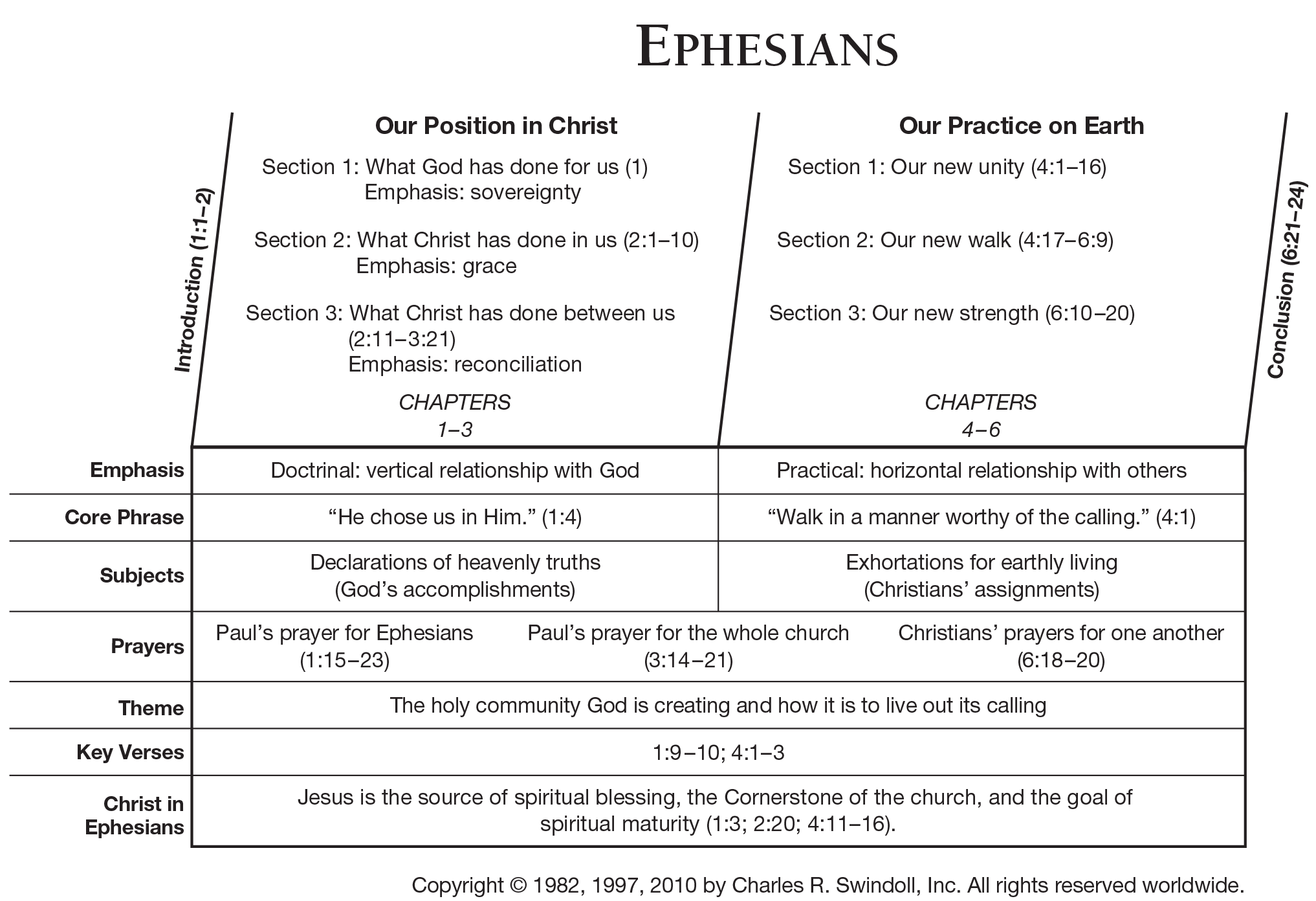
EPHESIANS - CHRIST AND THE CHURCH
Click chart to enlarge
Charts from Jensen's Survey of the NT - used by permission
Click chart by Charles Swindoll -Note "EMPHASIS" --
Ephesians 1-3 = Doctrinal: vertical relationship with God
Ephesians 4-6 = Practical: horizontal relationship with others
Ephesians 4:28 He who steals must steal no longer; but rather he must labor, performing with his own hands what is good, so that he will have something to share with one who has need. (NASB: Lockman)
Greek: o klepton (PAPMSN) meketi klepteto, (3SPAM) mallon de kopiato (3SPAM) ergazomenos (PMPMSN) tais [idiais] chersin to agathon, hina eche (3SPAS) metadidonai (PAN) to chreian echonti. (PAPMSD)
BGT ὁ κλέπτων μηκέτι κλεπτέτω, μᾶλλον δὲ κοπιάτω ἐργαζόμενος ταῖς [ἰδίαις] χερσὶν τὸ ἀγαθόν, ἵνα ἔχῃ μεταδιδόναι τῷ χρείαν ἔχοντι.\
Amplified: Let the thief steal no more, but rather let him be industrious, making an honest living with his own hands, so that he may be able to give to those in need. (Amplified Bible - Lockman)
ESV Let the thief no longer steal, but rather let him labor, doing honest work with his own hands, so that he may have something to share with anyone in need.
Gundry The person who’s stealing is no longer to be stealing, but rather to be laboring, producing the good with his own hands in order that he may have [something] to be sharing with the person who has a need.
Hoehner “Let the stealer no longer steal, but rather let him labor working with his own hands that which is good, in order that he might share with the one who has need.”
KJV Let him that stole steal no more: but rather let him labour, working with his hands the thing which is good, that he may have to give to him that needeth.
NET The one who steals must steal no longer; rather he must labor, doing good with his own hands, so that he may have something to share with the one who has need.
NIV He who has been stealing must steal no longer, but must work, doing something useful with his own hands, that he may have something to share with those in need.
NLT (revised) If you are a thief, quit stealing. Instead, use your hands for good hard work, and then give generously to others in need.
NLT: If you are a thief, stop stealing. Begin using your hands for honest work, and then give generously to others in need. (NLT - Tyndale House)
Phillips: If you used to be a thief you must not only give up stealing, but you must learn to make an honest living, so that you may be able to give to those in need. (Phillips: Touchstone)
Wuest: The one who is stealing, let him no longer be stealing, but rather let him be laboring, working with his own hands that which is good, in order that he may be having that wherewith to be sharing with the one who is having need. (Eerdmans Publishing - used by permission)
Young's Literal: He who has been a thief must steal no more, but, instead of that, should work with his own hands in honest industry, so that he may have something of which he can give the needy a share.
HE WHO STEALS MUST STEAL NO LONGER: o klepton (PAPMSN) meketi klepteto, (3SPAM):
- Let him who steals steal no longer - Ex 20:15,17; 21:16; Pr 30:9; Jer 7:9; Hos 4:2; Zech 5:3; Jn 12:6; 1 Cor 6:10,11
- Must steal no longer - Job 34:32; Pr 28:13; Lk 3:8,10-14; 19:8
- Ephesians 4 Resources - Multiple Sermons and Commentaries
- Ephesians 4:17-32 Solving Conflicts - Steven Cole
- Ephesians 4:28-32 - Wayne Barber
- Ephesians 4:28-29: A Brand New Way of Life - 4 - Wayne Barber
- Ephesians 4:17-5:14 Study Guide (see dropdown menu) - John MacArthur
Related Passages:
1 Corinthians 6:9-11+ Or do you not know that the unrighteous will not inherit the kingdom of God? Do not be deceived; neither fornicators, nor idolaters, nor adulterers, nor effeminate, nor homosexuals, 10 nor thieves, nor the covetous, nor drunkards, nor revilers, nor swindlers, will inherit the kingdom of God. 11 Such were some of you; but you were washed, but you were sanctified, but you were justified in the Name of the Lord Jesus Christ and in the Spirit of our God.
Leviticus 19:11+ (NOTE THIS "LINKED CHAIN" OF SINS) ‘You shall not steal, nor deal falsely, nor lie to one another.
Malachi 3:8+ “Will a man rob God? Yet you are robbing Me! But you say, ‘How have we robbed You?’ In tithes and offerings.
Mark 7:21-23+ “For from within, out of the heart of men, proceed the evil thoughts, fornications, thefts, murders, adulteries, 22 deeds of coveting and wickedness, as well as deceit, sensuality, envy, slander, pride and foolishness. 23 “All these evil things proceed from within and defile the man.”
Matthew 6:19-21+ “Do not store up for yourselves treasures on earth, where moth and rust destroy, and where thieves break in and steal. 20“But store up for yourselves treasures in heaven, where neither moth nor rust destroys, and where thieves do not break in or steal; 21 for where your treasure is, there your heart will be also.
Luke 3:13+ And he said to them, “Collect no more than what you have been ordered to.”
Titus 2:10 not pilfering, but showing all good faith so that they will adorn the doctrine of God our Savior in every respect.
1 Peter 4:15 Make sure that none of you suffers as a murderer, or thief, or evildoer, or a troublesome meddler;
Proverbs 11:1 A false balance is an abomination to the LORD, But a just weight is His delight.
Proverbs 21:6 The acquisition of treasures by a lying tongue Is a fleeting vapor, the pursuit of death.
Hosea 12:7 A merchant, in whose hands are false balances, He loves to oppress.
STOP STEALING LIKE
AN OLD MAN
Paul had just painted a dreadful picture of the Old Man in Ephesians 4:17-19+ and now commands us to stop stealing like we once did when we were in Adam (1Co 15:22+), but instead now to labor and share because we are now wearing the garment of the New Man and are forever attired in Christ's garment of true righteousness and holiness (Eph 4:24+, Gal 3:27+).
He who steals (klepto) must steal (klepto) no longer - Phillips "If you used to be a thief you must not only give up stealing..." Literally the words read: “Let him that steals play the thief no more.” The first "steal" is present tense, which speaks of an ongoing or continuing practice. ("The one who is stealing" - Wuest). The context teaching us two things about a thief -- (1) He is too lazy to work and (2) to selfish to share. He is a taker, but not a giver. He is not even like the legendary thief "Robin Hood!" The second "steal" is a command in the present imperative with a negative meaning to stop an action already in progress or alternatively, do not let it begin. Now that they have put off the old garments of Adam and put on the new garments of Christ, they have access to a new Power (Person) to obey Paul's command as they live in daily dependence on the Holy Spirit. They were once "spiritual kleptomaniacs" but now in Christ's garments they are to cease this sin.
Stealing is an "inside job" (the dirty garment of the Old Man) for Jesus said in Mk 7:21-23+ thefts came "from within, out of the heart of men" and so clearly stealing needs an "inside cure," a heart circumcised and transformed by the Gospel, for "thieves...will (not) inherit the kingdom of God. Such were some of you; but you were washed, but you were sanctified, but you were justified in the name of the Lord Jesus Christ and in the Spirit of our God.” (1Cor 6:9-11+)
W̔illiam Blaikie on steals - The Greek (ho klepton) may be translated either as a noun or as the present participle. In either case it implies that even Christians might continue to steal, and that they had to be warned against the habit. This may seem strange to us, but not to those who consider how little theft was thought of among the pagans, and how liable such habits are to remain among converts from heathenism. (Ephesians 4 Commentary)
How do you stop a believer from stealing -- believers still have the old, evil, selfish nature which must be daily reckoned dead to the power of sin to tempt us to steal (cf Ro 6:11+ and Ro 6:12-13+, also Ro 8:13+). And remember that coveting in a sense is a form of stealing and certainly sets one up for following through with the act. Thoughts (coveting) precede acts (stealing).
Cole points out that Paul’s statement "indicates that a person may make a profession of faith in Christ and yet continue to live in these sins. Such a person is deceived into thinking that he will inherit God’s kingdom, but he will be shocked to hear the Lord say, “I never knew you; depart from Me, you who practice lawlessness” (Matt. 7:23+). In other words, while believers may fall into these sins, if they characterize someone’s life, with no repentance and no effort to change, it is evidence that he is not genuinely converted. So the cure for stealing is to make sure that you have been washed from your sins through faith in Jesus Christ, crucified in your place." (To Cure a Thief - Eph 4:28)
Phillips adds that "One reason for the low ethical standards all too common among professing Christians today is that some leaders no longer preach repentance as a prerequisite to regeneration. They foster an “easy believism” that makes no moral demands on the conscience of the new convert. Yet the very word conversion implies a change of belief and behavior. It seems incredible that the Holy Spirit should have to spell it out: “Now that you’re saved, don’t steal. Go to work.” But there it is in Ephesians 4:28. It is a sad commentary on our moral decay that the Bible must be so specific about what should be an obvious fact. (See Exploring Ephesians & Philippians: An Expository Commentary)
Paul commands a shift from indolence and thievery to industry and charity.
-- Robert Gundry
As Wayne Barber reminds us "Ephesians 4:17-19 says, "Don’t live as the Gentiles live." The Gentiles are darkened in their mentality. They are depraved in their morality. Their inclinations are based on their darkened understanding. They don’t know how to live morally. Their relationships are fragmented. They don’t know how to build up. They only tear down as they live together. We are not to live like that anymore. Ephesians 4:20-24 says we are to put on a new life, a new garment. That garment is Jesus Christ....We are to take off the old and put on the new. The new garment is a lifestyle, a lifestyle that all the world can see. What I say I possess is one thing, but the way I live is another thing. You don’t tell a man about your faith, you live it out. He sees it by the way you live, by the way you speak and by your actions. (A Brand New Way of Life)
Cole - The thief doesn’t want to work, so he steals instead. I have seen people who work so hard at stealing that if they worked that hard at a real job, they’d do okay! But working would take weeks or months to get what you can often steal in a few minutes. So thieves are often lazy people. (To Cure a Thief - Eph 4:28)
Findlay writes that "From the lowest dregs of the Greek cities, from its profligate and criminal classes — the gospel had drawn its converts (cp 1 Cor 6:9-11). In the Ephesian Church there were converted thieves; and Christianity had to make of them honest workmen. The words of verse 28, addressed to a company of thieves, vividly shows the transforming effect of the gospel of Christ. The apostle brings the loftiest motives to bear instantly upon the basest natures, and is sure of a response. He makes no appeal to self interest, he says nothing of the fear of punishment, nothing even of the pride of honest labour. Pity for their fellows, the spirit of self-sacrifice and generosity is to set those pilfering and violent hands to unaccustomed toil. The appeal was as wise as it was bold. Utilitarianism will never raise the morally degraded. Preach to them thrift and self-improvement, show them the pleasures of an ordered home and the advantages of respectability, they will still feel that their own way of life pleases and suits them best. But let the divine spark of charity be kindled in their breast — let the man have love and pity and not self to work for, and he is a new creature. His indolence is conquered; his meanness changed to the noble sense of a common manhood. Love never faileth. (Ephesians 4 Commentary)
Warren Wiersbe has a relevant comment concerning slaves in the ancient world - Stealing was particularly a sin of the slaves in Paul’s day. Usually they were not well cared for and were always in need, and the law gave them almost no protection. When he wrote to Titus, Paul urged him to admonish the slaves not to “purloin” but to be faithful to their masters (Titus 2:10). (Bible Exposition Commentary)
Gregory Brown points out that "Illegal downloading, watching bootleg movies, stealing supplies from employers, and wasting the employer’s time are considered normal by many in our society, and many Christians are guilty of them."
S F D Salmond adds a somewhat surprising note writing that "Stealing was not wholly condemned by ancient heathen opinion. It was even allowed by the Lacedaemonians. It was a vice into which the recently converted living in the old pagan surroundings, especially when unemployed, might all too readily slip. It has been thought strange, scarcely credible indeed, that professing Christians in these Asiatic churches would have given way to thieving. But the Epistles bear witness to the existence of grosser offenses against morality in the churches.” Paul now offers a corrective to stealing, in the words, “but rather let him be laboring, working with his own hands that which is good, in order that he may be having wherewith to be sharing with the one who is having need.”(Ephesians 4 Commentary)
Albert Barnes - Theft, like lying, was, and is, almost a universal vice among the heathen. The practice of pilfering prevails in probably every pagan community, and no property is safe which is not guarded, or so locked up as to be inaccessible. Hence as the Christian converts at Ephesus had been long addicted to it, there was danger that they would fall into it again; and hence the necessity of special cautions on that head. We are not to suppose that pilfering was a common vice in the church; but the cautions on this point proceed on the principle that where a man has been long in the habit of a particular sin, he is in great danger of falling into it again. (Ephesians 4 Commentary)
Paganism would rob others of what is rightfully their own;
Christianity leads me to give to others what is rightfully my own.
-- William Blaikie
POSB - Note that the laws of men are not the determining rule governing whether a person is stealing or not. This is what is so often misunderstood about stealing. Men can sometimes use the law to steal. Men can take from others without ever breaking a law. Men can secure too much of something, well beyond what they need; and when they hoard, they are taking something that by nature belongs to others. Very simply stated, the Bible teaches that stealing is the taking of anything that rightfully or by nature belongs to others. (See Preacher's Outline and Sermon Bible-KJV-Galatians-Colossians)
John MacArthur on manifold ways of stealing - In the past several decades shoplifting has grown alarmingly, a large percentage of it being done by employees. In some large stores up to a third of the price of the merchandise is used to cover theft losses of various sorts. Intentional overestimating, falsified cost overruns, and outright embezzlement are rampant throughout business and industry. Padding expense accounts, reporting more hours than were worked, failing to report income to the IRS, and other such deceptions are accepted as normal by many people. To them, stealing is simply a game in which getting caught is the only cause for regret or shame. Grand larceny, petty theft, taking some of your dad’s money off the dresser, reneging on a debt, not paying fair wages, or pocketing what a clerk overpays in change are all stealing. There is simply no end to ways we can steal, and whatever the ways are and whatever the chances for being caught, stealing is sin and has no part in the new walk of the new man in Christ. (See Ephesians Commentary - Page 186)
Steven Cole on stealing - While few of us would be tempted to pull off an armed robbery, if the situation is just right, it can be very tempting to take what does not belong to us. A 20-year Pinkerton study found that 30 percent of the population will steal, not only if the opportunity arises, but also will create the opportunity whenever possible. Forty percent will steal if there’s little danger of getting caught. Only 30 percent won’t steal at all (L. M. Boyd column, 9/6/1999). But I would venture to say that even the 30 percent would be tempted,
- If there’s no chance of getting caught;
- If it’s something you really need and can use;
- If it’s a small item that won’t be missed;
- If you figure that the company or government agency can afford it; or,
- If you rationalize that everyone else takes little things.
People don’t need much encouragement to steal. According to a 2002 National Retail Security Survey, inventory shrinkage (a combination of employee theft, shoplifting, vendor fraud and administrative error) cost U.S. retailers over $31 billion, which was 1.7 percent of their total annual sales. Inventory shrinkage remains the single largest category of larceny in the United States, more than motor vehicle theft, bank robbery and household burglary combined. Ultimately consumers are hurt the most in the form of higher prices. An average family of four will spend more than $440 per year in higher prices because of inventory theft (http://retailindustry.about.com/od/statistics_loss_prevention/1/ aa021126a.htm). And, that number probably does not include the amount that retailers spend on security and theft prevention!
The Internet has opened up a whole new avenue for thieves, namely, identity theft. Back in 2003, one in four American households were victims of identity theft in the previous five years (USA Today, 9/04/2003). In 2003 alone, identity theft cost individual victims $5 billion in out-of-pocket expenses and nearly $48 billion in losses to businesses and financial institutions (http://www.whitecanyon.com/identity-theft-statistics-ut-09-2003.php).
So, stealing is a widespread human problem. As such, it is a huge temptation for us as Christians living in this evil world. In the context of our text, Paul is spelling out in detail a number of changes that Christians must make as a result of the new birth. In general terms, we must put off the old way of life, be renewed in the spirit of our minds, and put on the new way of life (4:22-24). Specifically, this includes putting away falsehood and speaking the truth (4:25); putting aside sinful anger and being careful with righteous anger (4:26-27); and, not stealing, but instead, working and giving (4:28). Stealing goes hand in hand with falsehood, because thieves must lie and deceive in order not to get caught. (To Cure a Thief - Eph 4:28)
Steals (2813) (Klepto) means to steal furtively or take by stealth. It means to to take secretly and without permission the property of someone. Paul uses the verb klepto in the present tense as a noun, this tense emphasizing this action as one's character trait. That sin was still being committed by the members of the Ephesian church.
No longer (3371) (meketi from me = not + éti = anymore, yet, with k (kappa) inserted for phonics) means no more, no further
BUT RATHER HE MUST LABOR, PERFORMING WITH HIS OWN HANDS WHAT IS GOOD: mallon de kopiato (3SPAM) ergazomenos (PMPMSN) tais [idiais] chersin to agathon:
- But rather let him labor, performing with his own hands what is good - Pr 13:11; 14:23; Acts 20:34-35; 1Th 4:11-12; 2Th 3:6-8,11-12
- Ephesians 4 Resources - Multiple Sermons and Commentaries
- Ephesians 4:17-32 Solving Conflicts - Steven Cole
- Ephesians 4:28-32 - Wayne Barber
- Ephesians 4:28-29: A Brand New Way of Life - 4 - Wayne Barber
- Ephesians 4:17-5:14 Study Guide (see dropdown menu) - John MacArthur
Related Passages:
Proverbs 13:11 Wealth obtained by fraud dwindles, But the one who gathers by labor increases it.
Proverbs 14:23 In all labor there is profit, But mere talk leads only to poverty.
Luke 14:13-14+ “But when you give a reception, invite the poor, the crippled, the lame, the blind, 14 and you will be blessed, since they do not have the means to repay you; for you will be repaid at the resurrection of the righteous (Da 12:2-3+).”
Acts 20:34-35+ (PAUL PRACTICED WHAT HE PREACHED) “You yourselves know that these hands (PAUL'S HANDS) ministered to my own needs and to the men who were with me. 35 “In everything I showed you that by working hard in this manner you must help the weak and remember the words of the Lord Jesus, that He Himself said, ‘It is more blessed to give than to receive.’”
1 Corinthians 4:12+ and we toil, working with our own hands; when we are reviled, we bless; when we are persecuted, we endure;
1 Thessalonians 4:11-12+ and to make it your ambition to lead a quiet life and attend to your own business and work with your hands, just as we commanded you, 12 so that you will behave properly toward outsiders and not be in any need.
2 Thessalonians 3:6-8; 11-12+ Now we command you, brethren, in the name of our Lord Jesus Christ, that you keep away from every brother who leads an unruly life and not according to the tradition which you received from us. 7 For you yourselves know how you ought to follow our example, because we did not act in an undisciplined manner among you, 8 nor did we eat anyone’s bread without paying for it, but with labor and hardship we kept working night and day so that we would not be a burden to any of you...11 For we hear that some among you are leading an undisciplined life, doing no work at all, but acting like busybodies. 12 Now such persons we command and exhort in the Lord Jesus Christ to work in quiet fashion and eat their own bread.
1 Timothy 6:17-19 Instruct those who are rich in this present world not to be conceited or to fix their hope on the uncertainty of riches, but on God, who richly supplies us with all things to enjoy. 18 Instruct them to do good, to be rich in good works, to be generous and ready to share, 19 storing up for themselves the treasure of a good foundation for the future, so that they may take hold of that which is life indeed.
GOOD WORKS
BY GOOD WORKING
But rather let him labor (kopiao), performing (ergazomai) with his own (idios) hands what is good (agathos) - But rather introduces a clear "about face," from life as a stealer to life as a saint, one filled with and controlled by the Spirit Who enables holy living, in this case obeying Paul's command to labor. Labor is in the present imperative again reminding us of our need to depend on the Holy Spirit and describes strenuous work that produces fatigue! Own hands suggests manual labor but does not exclude a desk job in which one "pushes a pencil" (so to speak) with his own hands.
Only Christ can transform
a burglar into a benefactor!
With these incisive comments, Paul extols the magnificent virtue of the old Protestant work ethic. In today’s couch potato society, some people do not know how to work, some people could not spell work. Here Paul lifts it to a higher level when he says: ‘You’re a Christian, don’t be afraid to do it!’ It will do us good and we can be a blessing to others in the process.
Stealing stems from selfishness and greed;
a cure for stealing is to look for opportunities to serve and give.
-- Steven Cole
Jamieson on but rather- it is not enough to cease from a sin, but the sinner must also enter on the path that is its very opposite [Chrysostom].
Cole on what is good - When Paul says, “what is good,” he means a job that is useful in some capacity to people. There are certain jobs that Christians should not work in. For example, Christians should avoid working at casinos or liquor stores. Some jobs may be permissible, but they will put you in situations of strong temptation. If your job is causing you to stumble, look for another job. (To Cure a Thief - Eph 4:28)
Sharing will contribute
to unity in the body.
--cf Eph 4:3
William MacDonald - Grace, not law, is the power of holiness. Only the positive power of grace can turn a thief into a philanthropist. This is radical and revolutionary. The natural approach is for men to work for the supply of their own needs and desires. When their income rises, their standard of living rises. Everything in their lives revolves around self. This verse suggests a nobler, more exalted view of secular employment. It is a means of supplying a modest standard of living for one's family, but also of alleviating human need, spiritual and temporal, at home and abroad. And how vast that need is! (See Believer's Bible Commentary )
Robert Gundry points out that "There was no governmental welfare program and many, probably most, Christians were poor. So it’s not hard to imagine that some of them may have practiced stealing just to survive. On the other hand, Paul’s command to be laboring and his distinguishing between a needy person and the one who should be laboring suggest that some Christians were stealing out of an avoidance of labor." (See Commentary on Ephesians (Commentary on the New Testament ...)
Related Resources:
- What does the Bible say about work? | GotQuestions.org
- What does the Bible say about work ethic? What is a Christian work ethic? | GotQuestions.org
- What is a biblical theology of work? | GotQuestions.org
He...labor (2872) (kopiao from kopos = labor, fatigue) The root word kopos is used in secular Greek of “a beating,” “weariness” (as though one had been beaten) and “exertion,” and was the proper word for physical tiredness induced by work, exertion or heat. Kopiao therefore means to to exhibit great effort and exertion, to the point of sweat and exhaustion. To become worn out, weary or faint by engaging in hard work with potentially the implication that the work may be associated with difficulty and trouble. Kopiao speaks of intense toil even to the point of utter exhaustion if necessary! The work described by kopiao was left one so weary it was as if the person had taken a beating (thus kopos). Kopiao speaks not so much of the actual exertion as the weariness which follows the straining of all one's powers to the utmost. Lightfoot says that kopiao “is used especially of the labor undergone by the athlete in his training." Interesting thought since Paul frequently describes the Christian life with the athletic metaphor (cf 1Co 9:24-27+, 2Ti 2:4+, 2Ti 4:7-8+)
Performing (2038) (ergazomai from érgon = work) means to engage in an activity involving considerable expenditure of effort. It means to be involved in business, with a focus upon the work which is involved
Hands (5495) (cheir) literally one's hands but figuratively here speaking of the "instrument" or means of performing the labor.
Good (18) (agathos) means profitable, benefiting others, whereas the related word kalos means constitutionally good, but not necessarily benefiting others. Click discussion of good deeds. Saints are made adequate and equipped for these "agathos" works by God's Word for "All Scripture is inspired by God and profitable for teaching, for reproof, for correction, for training in righteousness that the man of God may be adequate, equipped for every good (agathos) work." (2Ti 3:16-17+).
SO THAT HE WILL HAVE SOMETHING TO SHARE WITH ONE WHO HAS NEED: hina eche (3SPAS) metadidonai (PAN) to chreian echonti. (PAPMSD):
- So that he may have something - Luke 3:11; 21:1, 2, 3, 4; John 13:29; 2Co 8:2,12
- to share with him who has need - Romans 12:13; 2Co 9:12, 13, 14, 15; 1Ti 6:18
- Ephesians 4 Resources - Multiple Sermons and Commentaries
- Ephesians 4:17-32 Solving Conflicts - Steven Cole
- Ephesians 4:28-32 - Wayne Barber
- Ephesians 4:28-29: A Brand New Way of Life - 4 - Wayne Barber
- Ephesians 4:17-5:14 Study Guide (see dropdown menu) - John MacArthur
Related Passages:
Exodus 20:15+ “You shall not steal."
2 Thessalonians 3:6+ Now we command you, brethren, in the name of our Lord Jesus Christ, that you keep away from every brother who leads an unruly (undisciplined - unwilling to submit to God's Word) life and not according to the tradition which you received from us.
2 Thessalonians 3:11+ For we hear that some among you are leading an undisciplined life, doing no work at all, but acting like busybodies. (Eph 4:28b GIVES THE ANTIDOTE)

Put off the old and put on the new!
A NEW IDEA BIRTHS
A NEW IDEAL
So that (hina) he may have something to share (metadidomi) with him who has need (chreia) - So that (hina) introduces a purpose clause, which expresses the purpose of the "new garment" of working rather than stealing. The new idea is instead of stealing, be working which gives birth to the new ideal of sharing what was gained in our working. Selfish people wearing the garment of the Old Man are transformed into sharing people in the New Man in Christ. In short, the church should be a family of givers, not a family of takers! Are you? Paul’s antidote for taking is to develop a habit of giving!
"It is more blessed to give than to receive."
-- Jesus (Acts 20:32+)
Are you a taker or a giver?
Are you a depleter or a replenisher?
Wealth is a double blessing when you share it with others.
John Stott - Do not steal’ was the eighth commandment of Moses’ law. It had and still has a wide application, not only to the stealing of other people’s money or possessions, but also to tax evasions and customs dodges which rob the government of their dues, to employers who oppress their workers, and to employees who give poor service or work short time. (BORROW The Message of Ephesians PAGE 186)
John Calvin - Paul proceeds one step further regarding the change that he requires of the faithful. He tells them they must not only abstain from defrauding other people and from robbing them of their goods, but they must also try to help those in need. The way the apostle teaches us to abstain from all evil seems to be very hard. Rather than living at our ease, as we have been accustomed to do, and having many goods, we should prepare to scratch our living out of the earth, work with great pain and travail, and in all of that to fare very harshly. Though this way seems very hard, we must go further. When we have the means to make a living without using wicked practices, we must spare something of what God gives us through his blessing and give it to relieve the needy. Therefore, let us not regard our own inclinations, considering that of our own nature we are so perverse and wedded to our own profit that each one of us will always be well stocked. Since we have so little concern for others, even if they are members of the body of our Lord Jesus Christ, we must strive to force ourselves to do them good, for that striving will bring us together. We must bear down upon our affections, then employ ourselves earnestly and sincerely until we confess that the bread we eat comes to us from God’s hand. We are sustained by his goodness as by a father who gives a portion to his children. So let us labor to do good with the little we have and to help those who are in need.
We give Thee but Thine own,
Whate'er the gift may be:
All that we have is Thine alone,
A trust, O Lord, from Thee.
—How
So that (2443) (hina) introduces the purpose for which one should work. Always pause to ponder terms of purpose or result -.
To share (3330) (metadidomi from metá = with, denoting association + dídomi = to give) means to share with someone else what one has. (impart, communicate, give a share of, as distinct from giving). The usual Greek verb for giving is didomi, but the word in here is the intensified metadidomi, which carries the additional meanings of sharing and imparting that which is one’s own. The one who exercises this gift gives sacrificially of himself. "To share" implies to distribute personally rather than by remote control through some agent or official." (Skevington)
Has (2192) (echo) means to have with a wide range of meaning.
Need (5532) (chreia from chréos = debt) refers to that which is needed or is a necessity. Gingrich -1. need, necessity Lk 10:42; Hb 7:11. = have need Mt 3:14; 6:8; Mk 11:3; Lk 19:31, 34; 1 Cor 12:21, 24; Hb 5:12; 10:36.—2. need, lack, want, difficulty = be in need, lack something Mk 2:25; Ac 2:45; 4:35; Eph 4:28; Rev 3:17.—In other expressions Ac 20:34; Ro 12:13; Phil 4:16, 19.—3. the thing that is necessary Eph 4:29.—4. office, duty, service Ac 6:3.
John MacArthur - Theft is a common problem in our world. Shoplifting has become such a problem that a significant percentage of the price of commercial items covers the amount lost from stolen goods. Whether grand theft or petty theft, robbing from the store, or stealing money from a rich man or a family member, it is all stealing. Christians are to “labor,” which refers to hard, manual work. Hard work is honorable. As Christians we should work hard so that we will have enough to give to those in need, not so that we will have more of what we don’t need. The worldly approach to wealth is to hoard what we acquire. But the New Testament principle is to work hard so we might do good and give to those who have needs. (see Truth for Today: A Daily Touch of God's Grace)
ILLUSTRATION - The English preacher Rowland Hill astounded the mourners at his favourite employee’s funeral when he told a story in his funeral oration which he had kept secret for thirty years: his first meeting with the man had been when the man attempted to hold Dr Hill up. Hill had argued with him, offering the highwayman an honest job if he would visit him later. And this the robber did, becoming a devout Christian and devoted worker. This man lived out the standard Paul calls the church to in Ephesians 4:28!
ILLUSTRATION -A few years ago, a Church of England priest made the news when he suggested that it is not a sin to shoplift, as long as the victim is a big store. He said that it is wrong to steal from individuals or from small merchants. But, he rationalized, with giant retail corporations it’s different. He said that he wasn’t encouraging shoplifting, although he said, “if people wander in and wander out without paying for the stuff, I think it is a perfectly comprehensible action” (Arizona Daily Sun, 3/6/97)!
If by “comprehensible” he means, “understandable,” I’d say, “Yes, I understand why people steal.” But if he means that it is justifiable to steal, he is denying God’s Word! Believers must stop stealing and instead work hard so that they can give to those in need. When the former thief becomes a worker and a giver, he has cured the problem!
ILLUSTRATION - A person who steals is obviously not trusting God to provide. Rather, he is disobeying God and probably justifying it by thinking, “I’ve got to do what I’ve got to do to survive.” Martin Luther once came upon a group of peasants who were breaking into a mill to take some corn. “What do you think you’re doing?” he demanded. Terrified, one of the men answered, “We know it’s wrong to steal, but after all, we have to live.” Luther indignantly responded, “I do not know that one must live. But one must be honest!” (In “Our Daily Bread,” Summer, 1979.) Not trusting God leads to stealing.
Work or Waste Away
You wouldn’t ever dream of locking your car up in the garage for a decade or two. Why? A car is designed to work! If you don’t allow it to carry out its function, it will be wasted. God Himself worked for six days and rested on the Sabbath. It’s part of who we are, made in the image of God, that we are workers. To deny ourselves of what God designed us to do will mean that we simply become as useless as that car sitting in the garage, wasting away. —Dr. Larry Osborne
J. C. Penney, who was a devoted Christian and a shrewd business leader, told of an incident that occurred when he was seventeen years old. He had already developed an entrepreneurial flare, and his summer crop of watermelons came ripe just as the county fair opened. Young Jim knew he was doing all right selling his watermelons up and down the main street of his town, but he thought he could make more money outside the gates of the fair. He drove his wagon as close to the main entrance as possible, and people were eager for a slice of his watermelon. Suddenly he felt a firm hand on his shoulder. It was his dad, who said, “Better go home, son. Now.”
Jim was bewildered and embarrassed but he went home. When his dad arrived home, he asked the young man, “Do you know why I told you to go home?”
“No, sir,” replied Jim.
“Did it mean anything to you that the fair was supported by concessions?”
“No,” Jim answered.
His father explained that everyone inside the fair had paid a concession fee, and those vendors were dependent on fair-attendees purchasing their products. Jim protested that he had not gone inside the gates.
“That’s just it,” replied his father. “Without paying anything toward the support of the fair, you were taking advantage of those who did. Everyone is entitled to earn a living, you and everyone else, but never by taking advantage of others.”
It was lessons like that which built bedrock honesty inside the heart of J. C. Penney.
God-Honoring Work
Let him labor, working with his hands what is good. — Ephesians 4:28
Today's Scripture: Proverbs 27:23-27
Several years ago in the South African territory of Kwa-Zulu, the government dug irrigation ditches on both sides of a river. This allowed the rich land to be farmed. The Christian Zulus on one side of the river produced lush crops and prospered. The traditional animist worshipers on the other side continued to live in abject poverty, producing almost nothing on the same kind of soil.
Why? The Christians believed they were responsible before God to work hard and live soberly. Their pagan neighbors, on the other hand, viewed work as the women’s responsibility, while the men spent their time drinking and fighting.
The Bible tells us that as God’s image-bearers we are to “have dominion over . . . every living thing that moves on the earth” (Gen. 1:28). It urges us to work with our hands so that we can provide for ourselves and others (Eph. 4:28; 1 Th. 4:11). Work, when performed with the right attitude, can be pleasurable and rewarding. Proverbs 27:23-27 portrays the beautiful interplay of diligent work on our part and faithful nurture on God’s.
Whatever your job, do it diligently and gratefully. Through it you will find pleasure and experience God’s blessing. By: Herbert Vander Lugt (Our Daily Bread, Copyright RBC Ministries, Grand Rapids, MI. Reprinted by permission. All rights reserved)
We thank You, Lord, for giving us
The opportunity
To work to earn our daily bread
And share it willingly.
—Sper
When God puts work into your life,
He expects you to put life into your work.
Our Daily Bread - "Meaningful Work":
In the London Tube, England's underground rail system, one travel agent's advertisement declared: "Your work is meaningless. And you'll die having achieved comparatively little. You need a holiday." Those words do indeed describe the feeling of many who are "sick and tired" of their work.
Some people may even find their labor so wearisome that they think it must be punishment from God. This could not be further from the truth. Even before sin entered the world, God gave Adam and Eve meaningful work to do (Genesis 1:28; 2:15).
In Ephesians 4:17-32, we are given a list of actions that characterize those who belong to Christ. Included in the list is the command to work for a living (v.28).
The motivation given for work was not to accumulate wealth but to have something to share with others. From the biblical perspective, therefore, work is useful and most fulfilling when it enables us to help others. The apostle Paul said, "Let him labor, working with his hands what is good, that he may have something to give him who has need" (v.28).
Our work does have meaning, especially when we realize that it is God-given, and that we please Him when we share its fruit with others. — Albert Lee (Our Daily Bread, Copyright RBC Ministries, Grand Rapids, MI. Reprinted by permission. All rights reserved)
Lord, teach me how to love and work,
That every deed I do
May be to someone in its turn
A service fine and true.
—Anon.
We make a living by what we earn;
we make a life by what we give.
Givers And Takers
. . . let him labor, working with his hands what is good, that he may have something to give him who has need. —Ephesians 4:28
Today's Scripture: Proverbs 14:15-21
Some young children were talking about what they wanted to be when they grew up. When it was Jimmy’s turn to speak, he didn’t mention one of the more common professions like doctor, lawyer, policeman, and fireman. What he wanted to be was a philanthropist. When the other kids asked him to explain, he replied, “I heard they’re the guys who have all the money.”
Jimmy was only partially right. According to the dictionary, a philanthropist is “one who loves and seeks to benefit mankind.” Simply having a lot of money, then, doesn’t make one a philanthropist. In fact, a poor person who “loves and seeks to benefit mankind” out of his limited resources is more of a philanthropist than a person of great wealth who is a miser and gives grudgingly—even though the amount of his charitable gifts is large.
The apostle Paul encouraged takers to become givers. He said, “Let him who stole steal no longer, but rather let him labor . . . that he may have something to give him who has need” (Ephesians 4:28). That kind of giving will give joy to the giver (Proverbs 14:21).
Regardless of our income or vocation, we can all be philanthropists. By: Richard DeHaan (Our Daily Bread, Copyright RBC Ministries, Grand Rapids, MI. Reprinted by permission. All rights reserved)
It's not what you'd do with a million
If riches should e'er be your lot,
But what you are doing t present
With the dollar and quarter you've got.
—Anon.
God gives us all we need,
so we can give to those in need.
SUMMARY - Dr Wayne Barber explains that Ephesians 4 marks a decisive shift from who believers are in Christ to how they are therefore to live, showing that Scripture is God’s tool not only to inform us but to reform us through reproof and correction (2 Tim 3:16). After establishing our identity and blessings in Christ (Eph 1–3), Paul calls believers to walk in a manner worthy of that calling, displaying a “new garment” of life that is visibly different from the Gentile mindset—darkened in understanding, destructive in relationships, and driven by self-interest. This new way of life is marked by truthfulness instead of deceit, righteous anger instead of sinful temper, unity instead of division, and generosity instead of greed. In particular, Ephesians 4:28 reveals a dramatic transformation: the one who once stole—whether materially or relationally—now works honestly so that he can give, moving from being a taker and depleter to a giver and replenisher. For Dr Barber, this contrast exposes whether one is wearing the old garment of self-centeredness or the new garment of Christ, Whose life in us changes not merely our actions, but our entire disposition toward work, relationships, and the needs of others.
Wayne Barber explains our Brand New Way of Life writing...
I want to remind us of something that I think is very important. We are in some very difficult Scripture and it is going to show us how we are living as compared to how we ought to be living. That is no fun sometimes. Why are we in it? What is God doing in our lives? I want to remind us what all Scripture is for. Look in 2 Timothy 3. "All Scripture is inspired by God and profitable for teaching, for reproof, for correction, for training in righteousness." (2Ti 3:16+)
God wants us to be informed. We want our minds to be renewed so that our behavior can be transformed. Therefore, the Word of God is to inform us for teaching. Secondly it is to reform us. Now to reform somebody, you first of all have to reprove them and then you must correct them. That is what the Word of God is for. It exposes us for what we are, then it corrects us.
The Spirit of God wants to do a work in us through the book of Ephesians. I think He has been whetting our appetite on who we are in Jesus in the three chapters. It is wonderful to know what we have in the Lord Jesus Christ, who we are, whose we are. But in chapter 4 Paul changes directions. He is going to start saying, "Okay, folks, if you say you have Him, then you are to walk in a manner worthy of who you say you are and whose you say you are. You live in a manner worthy. Look, you have every spiritual blessing in Christ Jesus. Now live up to it and walk like you are supposed to walk."
Now let’s turn back to Ephesians and outline the rest of the book to show you how it fits together. Ephesians 4:1-16 show the overview of what the church ought to be, worldwide, locally, wherever you are. People are to preserve the unity of the Spirit in the bond of peace and be strengthened in the inner man by the Spirit of God. That is in his prayer in the last few verses of Ephesians 3. When I am being strengthened in the inner man, I am being given the ability beyond what I can do apart from God. In other words, I am living differently. There is something totally unique and different about my life. When I am doing that, it is going to reflect in the body of Christ. We are going to be seen for how we behave toward one another. We are going to be seen for how we believe, Ephesians 4:4-6. We are going to be seen for how we cooperate in being built together in the body of Christ, Ephesians 4: 7-16.
So we see a picture of what the church ought to be. It begins to show us how we are to walk. It begins to show us individually how we are to live a brand new way. This is when it really goes home with us. Ephesians 4:17-19 says, "Don’t live as the Gentiles live."
The Gentiles are darkened in their mentality. They are depraved in their morality. Their inclinations are based on their darkened understanding. They don’t know how to live morally. Their relationships are fragmented. They don’t know how to build up. They only tear down as they live together. We are not to live like that anymore.
Ephesians 4:20-24 says we are to put on a new life, a new garment. That garment is Jesus Christ. We have already worked through all of that. We are to take off the old and put on the new.
The new garment is a lifestyle, a lifestyle that all the world can see. What I say I possess is one thing, but the way I live is another thing. You don’t tell a man about your faith, you live it out. He sees it by the way you live, by the way you speak and by your actions.
In Ephesians 4:25 Paul starts qualifying what that garment is. He starts showing us what that fabric is really like. He says in Ephesians 4:25 that when you put on the new garment you are going to have a transformed tongue. It is amazing what comes out of the mouth. Jesus said it is not what goes inside a man that defiles him, it is what comes out because it reflects his heart. He says first of all, you are not going to lie. That is the new garment. That is the Lord Jesus in your life. You see, when you tell a lie or when I tell a lie, and it is always easy to do that, what we are doing is protecting ourselves. We are never to protect our flesh. We are to confess our flesh. We are to be open and honest before God. We are never to live deceitful before others because the Lord Jesus is a truthful being. He is truth, and He lives in us. Therefore, we cannot lie.
Secondly, you have a controlled temper. It is amazing. You are angry at the right things for the first time. Now it is not wrong to be angry. He says, "Be angry but do not sin when you are angry."
Now, the anger of man, James tells us, never accomplishes the righteousness of God. So this is a different kind of anger. This is God’s righteous indignation rising up in us. We are not mad at the sinner. We are mad at the sin. We are angry at the right thing and we know where to focus all of our anger. We don’t let the sun go down on our anger. We are making sure consistently that we are quiet in our spirit. It is incredible the disposition of a person who puts on the new garment.
Then in Ephesians 4:27 Paul says we have a frustrated tempter. In the context what Paul is saying is, if you want to frustrate the devil put on the new garment. When you put on Christ you have frustrated the tempter in your life. As a matter of fact, the word for "devil" is even very important to the context. The word "devil" is the word diabolos. It means to cast in between, to separate and to divide. Now what was Ephesians 4:1-16 talking about? Preserving the unity of the Spirit in the bond of peace. How do we continue to do that? We don’t give the devil an opportunity. How does the devil take opportunity? Only when he can tempt us into putting on the old garment and taking off the new. Don’t let him have that opportunity. You continue to walk in the new garment and you will continue to preserve the unity in the bond of peace.
Paul gives two threads and a warning or a principle about the garment. We don’t lie and we control our temper and we frustrate the devil. Let’s look at Ephesians 4:28. I become one who is a giver and not a taker. That is the new disposition. This is the new garment. I don’t lie. My temper is under control. I am frustrating the tempter. Now I am a giver instead of a taker. I’ll explain that in a second.
Do you know there are two kinds of people in this world? There are replenishers and depleters. A depleter is somebody you are around that absolutely sucks everything out of you. You have no energy left to do anything with this person. He is a taker, never giving anything back. That individual has never put on the new garment.
But when you find a person who is a replenisher, he has put on the new garment. He is a person who doesn’t take. He gives and replenishes and replenishes. The difference in wearing the new garment and the old garment is, the old garment wants to be ministered to. The new garment wants to minister. It wants to give. It doesn’t want to take. It wants to give. The new garment changes everything about your disposition towards all relationships whether at home, church or wherever you are.
Let me show you what I am talking about. Eph 4:28 says, "Let him who steals steal no longer."
What does it mean to steal? That is pretty obvious. You break into a store and you steal something." Now wait a minute. The word is klepto. Now what word do you think we might have in the English language that comes from that? Kleptomaniac. That is a person who habitually takes what is not his. He can’t help it. Wherever he is, he is always an opportunist and he grabs for himself whatever he wants to take.
Well, the present tense and the active voice is used. It is a participle. Here is a person who consistently, by his own lifestyle, depletes. He takes. What he takes is not his to take. Interestingly, in checking this word out, I found out how it is associated. It is intermingled with some other things that are very helpful to understand.
Look in Leviticus 19. When you talk about the old garment, somebody who is a taker has all of his relationships messed up. Leviticus 19:11 deals with three things here and ties them together. It says, "You shall not steal, nor deal falsely."
What he is talking about here is living deceitfully with folks. In other words, it is living a lie as much as telling a lie. It is living a deceitful, false life. It is letting people think you care about them when you really don’t. As a matter of fact, you are going to take what is theirs the moment you get an opportunity.
The next thing it says here is, "nor lie to one another."
We have already seen that we are not to lie to one another anymore. Somehow this is all fixed in together. It is in relationships.
When a person doesn’t have the new garment on, he is going to be a deceitful person, a taker, a depleter. He is going to lie to protect. So you see relationships on a wrong level.
Do you realize how this affects our families? Do you realize when I’ve got the old garment on in my family, I will manipulate my wife and others to get what I want out of them? Every one of us are that way. When I have the old garment on all I have are false relationships with anybody. I don’t care who it is. People may think I am their friend. Oh, no. I am a user and I’ll use that person for my own benefit. I’ll step on whoever I need to step on to get what I want out of them. That is what the old garment is. That is why three out of every four marriages are ending in divorce. Why? Because people are takers. They are depleters and they’ve got the old garment on. A marriage cannot work unless you have two people wearing the new garment.
So, it affects my relationships, the way I deal with somebody else. As a matter of fact, if you will go back in the text, I think he gives us another definition right in the very verse that we are looking at in Ephesians 4:28. Let’s just look and see what he says. He gives two characteristics of a person having the wrong garment on, who is a thief. I want to get out of your mind that a thief is somebody who sneaks into somebody’s house and steals something or somebody who breaks into a store to rob them. That is a thief, yes. But there are other ways to steal. You’ve got to go deeper than that.
Look in Ephesians 4:28. After he tells him not to steal any longer He says, "but rather let him labor, performing with his own hands what is good, in order that he may have something to share with him who has need."
There are two things Paul tells us here about a thief.
Number one, he is too lazy to work. He will not go after it on his own energy. He wants to take it. He wants people to give it to him. He thinks the world owes him something.
Secondly, he will not share what he has. He is not a giver. He won’t work and he won’t give. "You mean to tell me if I am wearing the old garment, even though I’m not going out and robbing a store somewhere, I am still a thief?"
Yes, you are. To some extent you are stealing from other people what could have been replenished in their life. What you are doing is you are depleting them, robbing them.
As a matter of fact, in Malachi 3:8 God made the statement, "Will a man rob God? Yet you are robbing Me! But you say, 'How have we robbed Thee?' In tithes and offerings."
What is he talking about? Your tithes and offerings, when you don’t give.
So we find then that there is an area here where we rob from others and we rob from God. It is the attitude that I am going to take. We find that he won’t work and he won’t share. Look over in 2 Thessalonians 3. Paul, being the writer of both of these epistles, says almost the exact same thing in 2 Thessalonians 3. It gives us a little bit more of an idea of a person who is a thief, a person who steals. You’ve got to realize we can be thieves in relationships by being takers and not givers.
In 2 Thessalonians 3:6 Paul says, "Now we command you, brethren, in the name of our Lord Jesus Christ, that you keep aloof [stay away] from every brother who leads an unruly life."
That word "unruly" means undisciplined. Undisciplined here means that he is not willing to submit to the standard of God’s Word. If you are going to discipline yourself, you’ve got to discipline yourself according to a standard. The idea of being unruly or undisciplined in the Christian life means that you don’t give the time of day to the Word of God. You are not willing to line your life up with what God’s Word has to say. You are an undisciplined, unruly individual.
Drop down to 2 Thessalonians 3:11: "For we hear that some among you are leading an undisciplined life, doing no work at all, but acting like busybodies."
You’ve got your nose in everybody else’s business because you are a taker, and you are stealing from them what is rightfully theirs. This is the person who divides and gives the devil an opportunity. That is the very instrument that the devil is using to divide the church of Jesus Christ worldwide. He won’t put on that new garment. He would rather steal, deplete and take rather than give and replenish.
Well, Paul gives an antidote to that. He tells you what the new garment is. It is very clear. He says, "Let him steal no longer; but rather let him labor."
The word "labor" means to be willing to work with your hands and not be ashamed of it. In other words, to go to work, to do whatever you have to do. (Ephesians 4:22-27: A Brand New Way of Life - 3)
Ephesians 4:28 presents one of Scripture’s clearest pictures of gospel transformation—not merely stopping sin, but replacing it with purposeful good. Paul does not say, “Let the thief stop stealing,” and leave it there. He calls for a complete reversal of direction. The hands that once took are now to labor honestly, and the goal of that labor is not self-indulgence, but generosity. Grace does not merely reform behavior; it redeems purpose.
Notice the movement of the verse:
- From taking → to working
- From self → to service
- From harm → to help
Work, in God’s design, is not a punishment—it is a means of love. Honest labor becomes a channel through which God supplies the needs of others. The gospel transforms a consumer into a contributor, a taker into a giver.
This verse also exposes a subtle danger: we can stop stealing yet still miss obedience if our labor ends with ourselves. Christian work always looks beyond the paycheck toward people. The ultimate measure of transformed hands is not productivity alone, but generosity.
Reflection questions:
- What do my hands most often reach for—my own comfort or someone else’s need?
- Has the gospel changed not just what I avoid, but what I actively pursue?
- Who is being helped by the fruit of my labor?
Grace does not merely stop sin—
it redirects a life toward love.