Ephesians 5:2
Ephesians 5:3
Ephesians 5:4
Ephesians 5:5
Ephesians 5:6
Ephesians 5:7
Ephesians 5:8
Ephesians 5:9
Ephesians 5:10
Ephesians 5:11
Ephesians 5:12
Ephesians 5:13
Ephesians 5:14
Ephesians 5:15
Ephesians 5:16
Ephesians 5:17
Ephesians 5:18
Ephesians 5:19
Ephesians 5:20
Ephesians 5:21
Ephesians 5:22
Ephesians 5:23
Ephesians 5:24
Ephesians 5:25
Ephesians 5:26
Ephesians 5:27
Ephesians 5:28
Ephesians 5:29
Ephesians 5:30
Ephesians 5:31
Ephesians 5:32
Ephesians 5:33

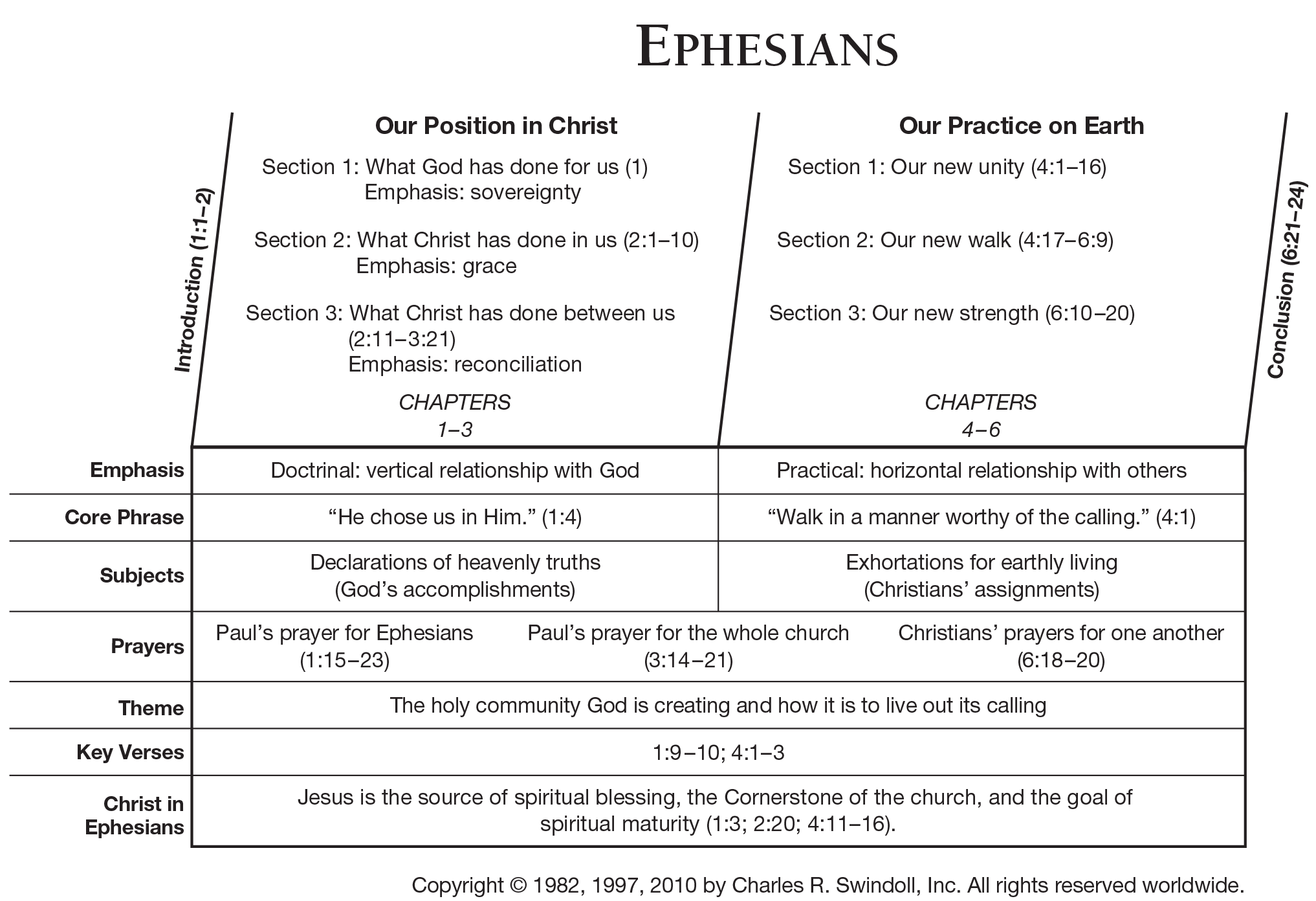
EPHESIANS - CHRIST AND THE CHURCH
Click chart to enlarge
Charts from Jensen's Survey of the NT - used by permission
Click chart by Charles Swindoll -Note "EMPHASIS" --
Ephesians 1-3 = Doctrinal: vertical relationship with God
Ephesians 4-6 = Practical: horizontal relationship with others
Ephesians 5:11 Do not participate in the unfruitful deeds of darkness, but instead even expose them (NASB: Lockman)
Greek: kai me sugkoinoneite (2PPAM) tois ergois tois akarpois tou skotous, mallon de kai elegchete, (2PPAM)
Amplified: Take no part in and have no fellowship with the fruitless deeds and enterprises of darkness, but instead [let your lives be so in contrast as to] expose and reprove and convict them. (Amplified Bible - Lockman)
NLT: Take no part in the worthless deeds of evil and darkness; instead, rebuke and expose them. (NLT - Tyndale House)
Phillips: Steer clear of the activities of darkness; let your lives show by contrast how dreary and futile these things are. (Phillips: Touchstone)
Wuest: And stop having fellowship with the unfruitful works of this darkness, but rather be rebuking them so as to bring out confession and conviction, (Eerdmans Publishing - used by permission)
Young's Literal: and have no fellowship with the unfruitful works of the darkness and rather even convict,
DO NOT PARTICIPATE IN THE UNFRUITFUL DEEDS OF DARKNESS: kai me sugkoinoneite (2PPAM) tois ergois tois akarpois tou skotous:
- Do not: Eph 5:7; Ge 49:5, 6, 7; Ps 1:1,2; 26:4,5; 94:20,21; Pr 4:14,15; 9:6; Jer 15:17; Ro 16:17; 1Co 5:9-11; 10:20,21; 2Cor 6:14-18; 2Th 3:6,14; 1Ti 6:5; 2Ti 3:5; 2Jn 1:10,11; Rev 18:4
- Unfruitful: Pr 1:31; Isa 3:10,11; Ro 6:21; Gal 6:8
- Deeds: Ep 4:22; Job 24:13-17; Jn 3:19, 20, 21; Ro 1:22-32; 13:12; 1Th 5:7
- Ephesians 4:17-5:14 Study Guide (see dropdown menu) - John MacArthur
- Ephesians 5 Resources - Multiple Sermons and Commentaries
DODGE THE DEEDS OF DARKNESS
Paul had just commanded them "Therefore do not be partakers with them (the sons of disobedience upon whom wrath of God is coming) for you were formerly darkness, but now you are light in the Lord; walk (live, behave, move around in society composed predominantly of darkness and dead souls) as children of light (Eph 5:7, 8)
This principle of separation of God's people from evil pervades the Old and New Testaments the psalmist writing…
How blessed is the man who does (1) not walk in the counsel of the wicked, (2) Nor stand in the path of sinners, (3) Nor sit in the seat of scoffers! (Note the axiomatic truth = if #'s 1-3 are disobeyed, the attitude and actions in verse 2 will come to fruition. Corollary -- Are you in the Word regularly? If not perhaps you might want to do an inventory of #'s 1-3) But his delight (Not drudgery or duty, but devotion motivated by love for the Writer of the Law) is in the law of the LORD, and in His law he meditates day and night. (See notes Psalm 1:1; 1:2, cp Ps 26:4, 5, Pr 4, 14,15, Jer 15:17)
In one of his most detailed calls to separate from evil and evil people Paul writes…
Do not be bound together (present imperative with negative = stop doing this!) with unbelievers; for what partnership have righteousness and lawlessness, or what fellowship has light with darkness?
15 Or what harmony has Christ with Belial, or what has a believer in common with an unbeliever?
16 Or what agreement has the temple of God with idols? For we are the temple of the living God; just as God said, "I WILL DWELL IN THEM AND WALK AMONG THEM; AND I WILL BE THEIR GOD, AND THEY SHALL BE MY PEOPLE.
17 "Therefore, COME OUT (aorist imperative - Now! It's urgent.) FROM THEIR MIDST AND BE SEPARATE," says the Lord. "AND DO NOT TOUCH (present imperative with negative = Stop touching the "untouchables" -- Beloved what are you "touching" that is dirty and filthy?) WHAT IS UNCLEAN; and I will welcome you (An incredible motive for purity!).
18 "And I will be a father to you, And you shall be sons and daughters to Me," Says the Lord Almighty.
7:1 Therefore (term of conclusion), having these promises (What promises? Rehearse them in your heart and mind and let them motive you to carry out the last part of this passage), beloved, let us cleanse ourselves from all defilement of flesh and spirit, perfecting holiness in the fear of God. (2Cor 6:14-18, 2Cor 7:1)
John Eadie writes that "This admonition is much the same as that contained in the 7th verse. Ro 6:21, 8:12; Gal. 6:8. A line of broad demarcation was to separate the church from the world; and not only was there to be no participation and no connivance (Ephesians 5 Commentary)
Participate (4790) (sugkoinoneo from sun = with, reflecting intimate association + koinoneo = to partake, have fellowship - word study on koinonia) means to join in fellowship with someone or participate in something with someone. It means to be associated with someone in some activity and so to be connected with them.
An understanding of the more familiar related noun koinonia which is often translated "fellowship" helps us understand why Paul is commanding his these Gentile believers to stop "fellowshipping" with the unfruitful deeds of darkness. Koinonia describes an association involving close mutual relations and involvement. It can also picture the sharing of one's possessions with the implication of some kind of joint participation and mutual interest. It can describe joint-participation in a common interest and activity (like a partnership). Thus we can understand Paul's charge to not let this be our lifestyle (present tense).
The present imperative with a negative particle commands them to stop an action already in progress or forbidding continuation of joining in fellowship in the unfruitful deeds of darkness.
Sugkoinoneo is found only 3 times in all of Scripture…
Ephesians 5:11 And do not participate in the unfruitful deeds of darkness, but instead even expose them;
Philippians 4:14 Nevertheless, you have done well to share with me in my affliction.
Revelation 18:4 And I heard another voice from heaven, saying, "Come out of her, my people, that you may not participate in her sins and that you may not receive of her plagues
Wayne Barber explains it this way - Ephesians 5:7 says, "Therefore be not partakers with them," which is very similar to the word participate in verse 11. But there is a difference. Partakers means simply that you join in with somebody and do what they do. It may be a one-time thing, maybe a two-time thing or whatever. You just happen in a weak moment to come along side of them and you do what they do. But the word (command) "Don’t participate" goes a step further. It means to share in common with. In the first situation you are partaking of the deed. In the other it goes further and you are beginning to absorb within you the very attitudes of the people that are around you. Not only are you partaking in the deeds, but you are sharing things in common with people who wear garments of darkness. We are not to do that but are to wear the garment of light. We have the power in the new garment to refuse the deeds of darkness… We refuse the deeds of darkness when we wear the right garment. We have the power to do that. So we can be in the world, but not of the world. You see, a boat in water is by design. Water in the boat is disaster. We are not to have the water in us, we are to be in the water. We have to reach them for Christ, but not partake with them and not share in common the deeds of darkness. Only in the garment of Christ do we have the power to refuse the deeds of darkness.
Unfruitful (175) (akarpos from a = without, + karpos = fruit, produce) means barren, without fruit, unprofitable.
Akarpos - 7x in the NT - Mt. 13:22; Mk. 4:19; 1 Co. 14:14; Eph. 5:11; Titus 3:14; 2Pet. 1:8; Jude 1:12
Compare works of the flesh…
Now the deeds of the flesh are evident, which are: immorality, impurity, sensuality, idolatry, sorcery, enmities, strife, jealousy, outbursts of anger, disputes, dissensions, factions, envying, drunkenness, carousing, and things like these, of which I forewarn you just as I have forewarned you that those who practice (perform repeatedly or habitually - practice does not make perfect!) such things shall not inherit the kingdom of God. (Galatians 5:19-21-notes)
With the fruit of the Spirit…
But the fruit of the Spirit is love, joy, peace, patience, kindness, goodness, faithfulness, gentleness, self-control; against such things there is no law. (Galatians 5:22-23-notes)
Deeds (2041) (ergon from ergo = to work) refers to toil as an effort or occupation. The implication is that it takes some effort for a believer to push through the light of God's truth, the grace that enables resistance and the "alarm bells" of the Spirit to intertwine oneself with these deeds of darkness.
MacDonald comments that
it was this feature of utter barrenness that once prompted Paul to ask the Roman Christians, “What fruit did you have then in the things of which you are now ashamed?” (Ro 6:21).
Darkness (4655) (skotos) refers literally to physical darkness, the essence of darkness, but in this context is used figuratively to describe spiritual darkness.
Darkness describes the character of the life of the unconverted as void of truth and virtue in intellectual and moral matters. Sin loves the dark and like a decaying parasitic mold thrives in the darkness!
For example, John writes…
And this is the message we have heard from Him and announce to you, that God is light, and in Him there is no darkness at all. If we say that we have fellowship with Him and yet walk in the darkness, we lie and do not practice the truth; but if we walk in the light as He Himself is in the light, we have fellowship with one another, and the blood of Jesus His Son cleanses us from all sin. (1Jn 1:5-7).
The realm of darkness is presided over by the “power of darkness,”
"While I was with you daily in the temple, you did not lay hands on Me; but this hour and the power of darkness are yours." (Lu 22:53, see Colossians 1:13 below)
Satan rules those headed for “eternal darkness”
but the sons of the kingdom shall be cast out into the outer darkness; in that place there shall be weeping and gnashing of teeth." (Mt 8:12).
These are springs without water, and mists driven by a storm, for whom the black darkness has been reserved. (see note 2 Peter 2:17)
Tragically, sinners love the darkness
And this is the judgment, that the light is come into the world, and men loved the darkness rather than the light; for their deeds were evil. For everyone who does evil hates the light, and does not come to the light, lest his deeds should be exposed. But he who practices the truth comes to the light, that his deeds may be manifested as having been wrought in God. (Jn 3:19, 20, 21).
It is that very darkness from which salvation in Christ delivers sinners.
Again therefore Jesus spoke to them, saying, "I am the light of the world; he who follows Me shall not walk in the darkness, but shall have the light of life. (John 8:12)
For He delivered (rhuomai) us from the domain (exousia = right and might) of darkness ("darkness" does have power, especially the prince of darkness and his hordes of God hating minions) (When did God deliver us? At the inception of our salvation), and transferred (methistemi) us to the kingdom of His beloved Son, (See note Colossians 1:13)
But you are A CHOSEN RACE, A royal PRIESTHOOD, A HOLY NATION, A PEOPLE FOR God's OWN POSSESSION, that you may proclaim the excellencies of Him who has called you out of darkness into His marvelous light (What a motivation for ministry!) (see note 1 Peter 2:9)
BUT INSTEAD EVEN EXPOSE THEM: mallon de kai elegchete, (2PPAM):
- But: Genesis 20:16; Leviticus 19:17; Ps 141:5; Proverbs 9:7,8; 13:18; 15:12; 19:25; 25:12; Proverbs 29:1; Isaiah 29:21; Matthew 18:15; Luke 3:19; 1Ti 5:20; 2Ti 4:2 = expose by preaching the Word - corollary "pabulum preaching" = no reproof or exposure of sins of the hearers; Titus 2:15
- Ephesians 5 Resources - Multiple Sermons and Commentaries
EXPOSING THE
DARKNESS
But instead even (but rather even) - This is a verbal "formula" that gives special intensity to Paul's antithesis. Compare a similar formula in Galatians 4:9.
As Eadie says "It was a duty to have nothing to do with the deeds of darkness; but it was a far higher obligation to reprimand them. There was to be not simply negative separation, but positive rebuke—not by the contrast of their own purity, but by formal and solemn reproof. 1Co 14:24; 2Ti 4:2 (Ephesians 5 Commentary)
Expose (1651) (elegcho related to elegchos = bringing to light) strictly speaking means to bring to the light and then to expose, to reveal things hidden, to convince, to reprove.
The idea is to shame or disgrace and thus to rebuke another in such a way that they are compelled to see and to admit the error of their ways. To show someone that they have done something wrong and summon them to repent.
In context Paul's charge is that believers who are light in the Lord are to convict those who are darkness (and in darkness) by turning the light on the darkness, by walking as children of light, their lives convicting those in the dark as much as their words (in fact the testimony of their walk validates the sincerity of their words!)
THOUGHT - I think we would be amazed at how many silent sermons are preached by the way we conduct ourselves each day! Are you convicted? I am! We must purpose in His power to continually walk as children of the light.
The present imperative calls for the Gentile believers to do this as their lifestyle.
Elegcho - 17 times in NT - Matt. 18:15; Lk. 3:19; Jn. 3:20; 8:46; 16:8; 1Co. 14:24; Eph. 5:11, 13; 1Ti 5:20; 2Ti 4:2; Titus 1:9, 13; 2:15; Heb. 12:5; James. 2:9; Jude 1:15; Rev. 3:19.
There are 48 uses in the Septuagint - Ge 21:25; 31:37, 42; Lev. 6:5; 19:17; 2Sa 7:14; 1Chr 12:17; 16:21; 2Chr. 26:20; Job 5:17; 9:33; 13:3, 10, 15; 15:3, 6; 22:4; 32:12; 33:19; 40:2, 4; Ps 6:1; 38:1; 50:8, 21; 94:10; 105:14; 141:5; Pr 3:11; 9:7f; 10:10; 15:12; 18:17; 19:25; 24:25; 28:23; 30:6; Is 2:4; 11:3, 4; 29:21; Jer. 2:19; Ezek 3:26; Ho 4:4; Amos 5:10; Hab 1:12; Hag 2:14;
Trench says that elegcho (elencho) “implies not merely the charge, but the truth of the charge, and further the manifestation of the truth of the charge; nay, more than all this, very often also the acknowledgment, if not outward, yet inward, of its truth on the part of the accused; it being the glorious prerogative of the truth in its highest operation not merely to assert itself, and to silence the adversary, but to silence him by convincing him of his error.” (Synonyms of the New Testament)
Elegcho was used in the Greek law courts not merely of a reply to an opposing attorney, but of a refutation of his argument. No one could prove any charges of sin against our Lord. No one could bring charges against Him in such a way as to convince Him that He was guilty. (because of course He wasn't)
Jesus said that "everyone who does evil hates the light, and does not come to the light, lest his deeds should be exposed (elegcho)." (Jn 3:20) The corollary thought is that if sinners avoid you, it may well be because you have the fragrance of Jesus (and not that you are being overbearing, etc) (cf 2Co 2:14-16)
Jesus describing the role of the Holy Spirit says that "He, when He comes, will convict (elegcho) the world concerning sin and righteousness and judgment" (Jn 16:8).
Wayne Barber writes "I think Paul is talking about something in line with what he said in verse 1. Don’t talk it, walk it. He is saying, "Since you now have a garment that is light, you don’t reprove the world by what you tell them. You reprove the world by how you live." It is my garment that exposes what is going on around me. If I am not wearing my garment, then what I say means nothing anyway. When I am wearing my garment, the garment of love, the garment that reaches out and cares about other people, the garment that speaks of the righteousness and the holiness of God, then that garment begins to reprove the people around me. By wearing the garment of light, we reprove those acts of darkness around us. (Walking As Light)
Charles Hodge comments…
The apostle having in the previous verse insisted on the duty of Christians of so walking as to show by their works that they were the subjects of divine illumination, adds here a statement of their duty in reference to the sins of those still in darkness. Those sins he calls “the unfruitful works of darkness.” By unfruitful is meant not merely barren or worthless, but positively evil. For in a moral subject the negation of good is evil. Works of darkness are those works which spring from darkness, i.e. from ignorance of God; as “works of light” are those works which light or divine knowledge produces.
The duty of Christians in reference to the works of darkness is twofold; first, to have no communion with them; and secondly, to reprove them. The former is expressed by the words me sugkoinoneite have not fellowship with them. Those who have things in common; who are congenial; who have the same views, feelings, and interests; and who therefore delight in each other’s society, are said to be in fellowship. In this sense believers have fellowship with God and with each other. So we are said to have fellowship in anything which we delight in and partake of. To have fellowship with the works of darkness, therefore, is to delight in them and to participate in them. All such association is forbidden as inconsistent with the character of the children of light. Our second duty is to reprove them.
Elegchein is not simply to reprove in the sense of admonishing or rebuking. It means to convince by evidence. It expresses the effect of illumination by which the true nature of anything is revealed. When the Spirit is said to reprove men of sin, it means that he sheds such light upon their sins as to reveal their true character, and to produce the consequent consciousness of guilt and pollution. In 1Corinthians 14:24, Paul says the effect of intelligible preaching of the Gospel is conviction—which is explained by saying “the secrets of the heart are revealed.” The duty, therefore, here enjoined is to shed light on these works of darkness; to exhibit them in their true nature as vile and destructive. By this method they are corrected; as is more fully taught in the following verses. The ethics as well as the theology of the Bible are founded on the principle, that knowledge and holiness, ignorance and sin, are inseparable. If you impart knowledge you secure holiness; and if you render ignorant you deprave. This of course is not true of secular knowledge—i.e. of the knowledge of other than religious subjects; nor is it true of mere speculative knowledge of religious truth. It is true only of that knowledge which the Scriptures call spiritual discernment. Of that knowledge, however, intellectual cognition is an essential element. And so far as human agency in the production of the conviction of sin is concerned, it is limited to holding forth the word of life; or letting the light of divine truth shine into the darkened minds of men, and upon their evil deeds. (Ephesians 5 Commentary)
Source Unknown - One single year is made up of 31,536,000 seconds. Every tick of the clock records the ever-lessening opportunities of life. Time is in perpetual motion. Like a strong, ever-flowing river, it is bearing away everything into the boundless ocean of eternity. We never know the value of time till we know the value of the fragments into which it is broken up. To make the most of a single hour we must make the most of every minute of which it is composed. The most dangerous moments of a man's life are those when time hangs heavily on his hands. He who has nothing to do but kill time is in danger of being killed himself. It is a miracle of divine goodness if he is preserved from serious folly, or something worse; and such miracles rarely occur. The man who has learnt the value of time can learn any lesson this world may have to teach him. Time is the opportunity for the exercise of Christian wisdom, and should be the more sedulously used when the days are evil ”when evil is in power. Oh for wisdom to number our days (Ps 90:12), to grasp the meaning of present opportunity! Here come the moments that can never be had again; some few may yet be filled with imperishable good. Let us apply our hearts ”all our powers” unto wisdom.
Vance Havner has these pithy comments on Ephesians 5:11 (Listen to Vance Havner's presentation)
Some time ago a friend of mine took me to a restaurant where they must have loved darkness rather than light. I stumbled into the dimly-lit cavern, fumbled for a chair, and mumbled that I needed a flashlight in order to read the menu. When the food came I ate it by faith and not by sight. Gradually, however, I began to make out objects a little more clearly. My host said, "Funny, isn't it, how we get used to the dark?" "Thank you," I replied, "You have given me a new sermon subject."
We are living in the dark. The closing chapter of this age is dominated by the prince and powers of darkness. Men love darkness rather than light because their deeds are evil. The night is far spent; the blackness is more extensive and more excessive as it deepens just before the dawn. Mammoth Cave is not limited to Kentucky; it is universal!
Strangely enough, man never had more artificial illumination and less true light. Bodily, he walks in unprecedented brilliance, while his soul dwells in unmitigated night. He can release a nuclear glory that out dazzles the sun, and with it he plans his own destruction. He can put satellites in the sky, and left to himself, he is a wandering star to whom is reserved the blackness of darkness forever.
The depths of present-day human depravity are too vile for any word in our language to describe. We are seeing not ordinary moral corruption, but evil double-distilled and compounded in weird, uncanny, and demonic combinations and concoctions of iniquity never heard of a generation ago. This putrefaction of the carcass of civilization awaiting the vultures of judgment is not confined to Skid Row; it shows up in the top brackets of society. Plenty of prodigals live morally among swine while garbed in purple and fine linen. A Bishop once said: "There is no difference in reality between the idle rich and the idle poor, between the crowds who loaf in gorgeous hotels and the crowds who tramp the land in rags, save the difference in the cost of their wardrobes and the price of their meals."
Man lives in the dark and even his nuclear flashlight cannot pierce it. We not only live in the dark, we get used to it. There is a slow, subtle, sinister brainwashing process going on and by it we are gradually being desensitized to evil. Little by little, sin is made to appear less sinful until the light within us becomes darkness—and how great is that darkness! Our magazines are loaded with accounts of sordid crime, our newsstands with concentrated corruption. We are engulfed in a tidal wave of pornographic filth. Television has put us in the dark with Sodom and Gomorrah—right in the living room. We get used to it, acclimated to it. We accept, as a matter of course, its art, its literature, its music, its language. We learn to live with it without an inner protest.
Lot was a righteous man, but he moved into Sodom, lived in it, probably became its mayor. His soul was vexed from day to day with the Sodomites' unlawful deeds, but he lost his influence with his family and had to flee for his life. He died in disgrace. I have met many Lots in the past few years! "… as it was in the days of Lot;… Even thus shall it be in the day when the Son of man is revealed" (Luke 17:28-30). Modern Lots tell us that we should hobnob with Sodom and get chummy with Gomorrah in order to convert them. But the end does not justify the means. Such people do not turn the light on in Sodom—they merely get used to the dark.
The worst of all is that such people get so used to the dark that they think it is growing brighter. Sit long enough in a dark room and you will imagine that more light is breaking in. Men who dwell too long in darkness fancy the day is dawning. We call "broadminded tolerance" what is really peaceful coexistence with evil. It is an effort to establish communion between light and darkness, a concord between Christ and Belial.
This condition extends into the religious world and even into evangelical Christianity. It is possible to fraternize with unbelievers until false doctrine becomes less and less objectionable. We come to terms with it and would incorporate it into the fellowship of truth. We begin by opening doors to borderline sects who "believe almost as we do." Others find overtures from Rome attractive. Still others would make a crazy quilt of world religions, a syncretism of "the best in all faiths." "Syncretism" is only a big word for "hash." These theological chefs who are busy mixing Mulligan stews think the darkness is lifting; the truth is that they are merely getting used to it.
The same danger exists with regard to worldliness. One may live in a twilight zone, in conditions of low visibility, until he finds the practices of this world less repulsive. He mistakes the stretching of his conscience for the broadening of his mind. He renounces what he calls the "Pharisaism" and "puritanism" of earlier days with a good word for dancing, smoking, and even cocktails now and then. Instead of passing up Vanity Fair, he spends his vacations there. John Bunyan tells us that his pilgrims were quite a novelty to the worldlings: "And as they wondered at their apparel, so they did likewise at their speech; for few could understand what they said. They naturally spoke the language of Canaan; but they that kept the Fair were men of this world. So that from one end of the Fair to the other, they seemed barbarians to each other." How out of date that sounds! Operators of Vanity Fair would see little difference in the clothes, conversation, and conduct of most professing Christians today. If the proprietors of that Fair beheld the modern church member, especially in the summertime, wearing in public a garb in which he should never have left the house or even come downstairs, they would not seem barbarians to each other! Bunyan's pilgrims were not getting used to the dark.
Of course we do not get used to it all of a sudden. Alexander Pope described the gradual process:
Vice is a monster of such frightful mien,
As to be hated needs but to be seen;
Yet seen too oft, familiar with her face,
We first endure, then pity, then embrace.
Here is how it works. A secular journal says: "The desensitization of 20th-century man is more than a danger to the common safety… There are some things we have no right ever to get used to. One… is brutality. The other is the irrational. Both… have now come together and are moving towards a dominant pattern." There was a time when sin shocked us. But as the brainwashing progresses, what once amazed us only amuses us. We laugh at the shady joke; tragedy becomes comedy; we learn to speak the language of Vanity Fair.
I heard a preacher tell a doubtful joke to a man of this world. Evidently he wanted to give the impression that preachers are used to the dark; actually he was accommodating himself to the dungeon of this age. Dr. John H. Jowett describes this peril of the preacher: "We are tempted to leave our noontide lights behind in our study and to move among men with a dark lantern which we can manipulate to suit our company. We pay the tribute of smiles to the low business standard. We pay the tribute of laughter to the fashionable jest. We pay the tribute of easy tolerance to ambiguous pleasures. We soften everything to a comfortable acquiescence. We seek to be all things to all men to please all. We run with the hare and hunt with the hounds. We become the victims of illicit compromise. There is nothing distinctive about our character." That applies to more people than preachers!
The housewife who moves into suburbia and wants to go along with the group spirit of the community faces the same temptation. So does the organization man at the boss's party or the student on a pagan campus. There are new techniques for socializing at Vanity Fair, but Bunyan's pilgrims had the right idea. We are not here to learn how to live in the dark but to walk in the light. We are not here to get along with evil but to overcome it with good.
One of the signs of getting used to the dark is the way we excuse sin. We give it new names: adultery is free love; the drunkard is an alcoholic; sodomy is homosexuality; the murderer is temporarily insane. Church workers fall into grievous sin and move on to new positions without repentance or change of conduct. Parents let down in discipline, saying, "What's the use?" Pastors give up preaching against sin, arguing that the world's evils are here to stay and since church members are not going to be any better we might as well accept the status quo and live with it. We see this mixture of light and darkness in television programs that join worldliness with hymns. We see it in Hollywood portraying the Bible.
The world lives in the dark because it rejects Jesus Christ, the Light of the world: "And this is the condemnation, that light is come into the world, and men loved darkness rather than light, because their deeds were evil" (John 3:19). The word here translated "condemnation" is "crisis" in the original. The coming of Christ precipitated a crisis. It compels men in the very nature of things to come to the light or abide in darkness. This light shines in the Saviour: "I am the light of the world… " (John 8:12). It shines in the Scriptures: "Thy word is a lamp unto my feet, and a light unto my path" (Psalm 119:105). It shines in the saints: "Ye are the light of the world" (Matthew 5:14). "… every one that doeth evil hateth the light, neither cometh to the light, lest his deeds should be reproved" (John 3:20). That explains why some people do not come to church.
I remember a couple in my first pastorate. The husband, an unsaved man, brought his wife to church on Sunday nights, but he sat outside in his car. He was in the dark in more ways than one because he did not like to face the gospel light. His wife enjoyed the service because she loved the light and came to the light that her deeds might be made manifest that they were wrought in God. When you overturn a stone in the field and the sunlight strikes beneath it, all the hidden creeping and crawling things scurry for cover. So do our sinful hearts grow restless under the light of God's truth. In an unlighted cellar you do not see the spiders and snakes and lizards and toads until the light breaks in. So men do not realize their sinfulness until they face the Light. No wonder some live in the dark all week and then blink their eyes and wince in church on Sunday morning when the preacher turns on the Light! They have photophobia—they fear the Light.
Our business as Christians is to let our light shine: "… have no fellowship with the unfruitful works of darkness, but rather reprove [expose, turn the light on] them" (Ephesians 5:11). We expose them not so much by denunciation, although that has its place, but by the contrast of our godly living. Alas, we are so afraid of being offensive that we are not effective! Our Lord said that two things would smother the light of our testimony, a bushel and a bed. Today we dim our light in a third way: we turn it low for fear of creating a disturbance; we shade it to match the dim dungeon of this age. We would rather grieve the Holy Spirit than offend the wicked.
The early Christians did not dim their lights to match the times. Paul exceedingly troubled the places he visited, and even in prison at midnight he turned night into day. The saints in Rome lighted the streets with their burning bodies. Christians met in catacombs, but they illuminated the world.
We are a city set on a hill, not hidden in a dungeon. We are to shine as lights in the world. This is no time to get used to the dark; it is time to turn on the Light! Too long have the caverns of this world been undisturbed. Of course some cave dwellers will squirm, but others will see our good works and glorify our Father in heaven. Light has no communion with darkness. We are not here to commune with it but to conquer it, and "this is the victory that overcometh the world, even our faith" (I John 5:4).
Early Christianity set the world aglow because absolute Light was pitched against absolute darkness. The early Christians believed that the gospel was the only hope of the world, that without it all men were lost and all religions false. The day came when the church and the world mixed light and darkness. The church got used to the dark and lived in it for several centuries, with only occasional flashes of light. Today too many Christians think there is some darkness in our light and some light in the world's darkness. We half-doubt our own gospel andl half-believe the religion of this age. We are creeping around in the dark when we should be flooding the world with light. We need to get our candles out from under bushels and beds, take off the shades of compromise and let them shine in our hearts, our homes, our businesses, our churches, and our communities with that light that shines in the Saviour and in the Scriptures and in the saints. (Why Not Just Be Christians)
Ephesians 5:12 for it is disgraceful even to speak of the things which are done by them in secret. (NASB: Lockman)
Greek: ta gar kruphe ginomena (PMPNPA) up' auton aischron estin (3SPAI) kai legein; (PAN)
Amplified: For it is a shame even to speak of or mention the things that [such people] practice in secret. (Amplified Bible - Lockman)
NLT: It is shameful even to talk about the things that ungodly people do in secret. (NLT - Tyndale House)
Phillips: (You know the sort of things I mean - to detail their secret doings is really too shameful). (Phillips: Touchstone)
Wuest: for concerning the things done in secret by them it is shameful to be speaking. (Eerdmans Publishing - used by permission)
Young's Literal: for the things in secret done by them it is a shame even to speak of,
FOR IT IS DISGRACEFUL EVEN TO SPEAK OF THE THINGS WHICH ARE DONE BY THEM IN SECRET: ta gar kruphe ginomena (PMPNPA) up' auton aischron estin (3SPAI) kai legein; (PAN):
- Ep 5:3; Romans 1:24, 25, 26, 27; 1Peter 4:3
- 2Samuel 12:12; Proverbs 9:17; Ecclesiastes 12:14; Jeremiah 23:24; Luke 12:1,2; Romans 2:16; Revelation 20:12
- Ephesians 5 Resources - Multiple Sermons and Commentaries
Eph 5:3 But do not let immorality or any impurity or greed even be named among you, as is proper among saints
1Pet 4:3 For the time already past is sufficient for you to have carried out the desire of the Gentiles, having pursued a course of sensuality, lusts, drunkenness, carousals, drinking parties and abominable idolatries.
A DIFFICULT PASSAGE
TO INTERPRET
For (gar) - always pause to ponder this strategic term of explanation.
The literal Greek emphasizes the secret things noting them at the beginning of the sentence…
for the things in secret being continually done by them it is a shame even to continue to speak of
Disgraceful (150) (aischros from aischron = Indecent, indecorous, dishonorable, e.g., inappropriate conduct) refers to a shameful thing. In regard to outward appearance aischron describes that which is ugly or ill-favored (see Septuagint uses below). In a moral sense as used in the present verse by Paul, aischron describes that which is disgraceful, base, infamous, dishonorable. Practically speaking, aischron refers to that which is socially or morally unacceptable, such as dishonest or sordid gain (see Titus 1:11).
In a phrase in Greek that is translated from Latin as "virtue and vice", aischron stands for vice.
In secular Greek aischros was used in several ways ranging from from ‘ugly’ in an external sense to ‘base’ in a moral sense (~moral deformity).
Disgraceful in English dictionary - Shameful. Dishonorable. Sinking reputation. Reproachful. Bringing ignominy or dishonor. That which is brings shame or causing one to lose favor or standing (eg, disgraced by a hint of scandal). Scandalous. Shockingly unacceptable. I recall the time a man was baptized and begin to describe (even with a hint of pride as he listed his past "accomplishments") in great detail the lasciviousness and lewdness of his former lifestyle and occupation. Not only was I appalled, but my wife and I both felt defiled by his "testimony" which placed greater emphasis on his sin than on the Savior! While we must expose the things in secret, we can do so without relishing or glorying in them. There is a trend in modern day evangelicalism toward "authenticity" which I fear at times borders on glorying in the shameful acts that are being discussed.
As noted in the heading, while this verse can be somewhat difficult to interpret, I think the following authorities present a balanced approach to the interpretation of this passage…
Hendriksen has an interesting explanation asking…
if one feels ashamed even to mention the horrible deeds of those who live in darkness, how then can he expose these deeds? Lenski’s answer is
To state them in our reproof is shameful not for us who make the statement in reproof, but for those who engage in these works (op. cit., p. 609).
This explanation, however, impresses me as being unnatural. I wonder whether any unbiased reader of Scripture would ever have drawn that conclusion. When the apostle tells the Ephesians to expose the works of darkness, does he not mean that they (and all others for whom the letter was intended throughout the course of history) should expose them? So when he now adds in one breath that it is a shame even to mention these secret practices, is not the obvious meaning:
“You should expose them, for they are so very wicked, that for anyone even to mention them is shameful”?
But how were they able to expose them and yet not mention them? The answer which is clear from the entire context is that by means of a life of goodness and righteousness and truth (Ep 5:9) they must reveal what a vast contrast there is between the works of those who walk in the light and the works of those who walk in darkness. (Exposition of Ephesians in the NT Commentary Set. Baker Book) (Bolding added)
Dr John MacArthur adds that…
Some things are so vile that they should be discussed in as little detail as possible, because even describing them is morally and spiritually dangerous. Some diseases, chemicals, and nuclear by–products are so extremely deadly that even the most highly trained and best–protected technicians and scientists who work with them are in constant danger. No sensible person would work around such things carelessly or haphazardly. In the same way, some things are so spiritually disgraceful and dangerous that they should be sealed off not only from direct contact but even from conversation. They should be exposed only to the extent necessary to be rid of them. Some books and articles written by Christians on various moral issues are so explicit that they almost do as much to spread as to cure the problem. We can give God’s diagnosis and solution for sins without portraying every sordid detail. Our resource for exposing evil is Scripture, which is the light (Ps 119:105, Ps 119:130; Pr 6:23; He 4:12, 13) and is “profitable for teaching, for reproof, for correction, for training in righteousness” (2Ti 3:16).(MacArthur, J: Ephesians. Chicago: Moody Press) (Bolding added)
Warren Wiersbe adds that while we are to expose deeds of darkness…
Ephesians 5:12 gives us a caution. Be careful how you deal with the unfruitful works of darkness. The motto today seems to be, “Tell it like it is!” And yet that can be a dangerous policy when it comes to exposing the filthy things of darkness, lest we unconsciously advertise and promote sin. Paul said, “It is a shame even to speak of those things” (Ep 5:12). Some preachers enjoy reveling in the sensational, so much so that their sermons excite appetites and give to the innocent more information than they need. “But yet I would have you wise unto that which is good, and simple concerning evil” (Ro. 16:19). I recall a friend in youth work who felt it necessary to read all that the teenagers were reading “in order to understand them better,” and it so polluted his mind that he himself fell into sin.
It is not necessary for the believer to perform an autopsy
on a rotting corpse to expose its rottenness.
All he has to do is turn on the light! “For whatsoever doth make manifest is light” (Ep 5:13). (Wiersbe, W: Bible Exposition Commentary - New Testament. 1989. Victor)
Aischron is used 6 times in the Septuagint (LXX) translation of Genesis 41 (Ge 41:3, 4 19 [twice], Ge 41:20, 21) referring to the cows that were starved in Joseph's dream as "very ugly"!
Here are the 4 NT uses of aischron…
1 Corinthians 11:6 For if a woman does not cover her head, let her also have her hair cut off; but if it is disgraceful for a woman to have her hair cut off or her head shaved, let her cover her head.
1 Corinthians 14:35 And if they desire to learn anything, let them ask their own husbands at home; for it is improper for a woman to speak in church.
Ephesians 5:12 for it is disgraceful even to speak of the things which are done by them in secret.
Titus 1:11 who must be silenced because they are upsetting whole families, teaching things they should not teach, for the sake of sordid ("ugly") gain.
Speak (3004) (lego) means speak or talk, with apparent focus upon content of what is said.
Done (1096) (ginomai) means that come into existence. They are inventors of new evil. The present tense indicates this was their continual practice. The use of the shows their active involvement, initiating and participating in the results or effects of their evil deeds.
Hodge - There are two reasons why sins are called works of darkness. The first and principal one is, as before remarked, because they spring from darkness or ignorance of God; and the second is, because they are committed in darkness. They shun the light. The exceeding turpitude of these sins the apostle gives as the reason why they should be reproved. (Ephesians 5 Commentary)
Secret (2931) (kruphe from krúpto = to hide or keep secret) means privately, not openly, kept from knowledge or view. Sin loves the darkness (cp Jn 3:19, 20). As used in English secret implies concealment on any grounds for any motive.
Kruphe is used only here in the NT but 11 times in the Septuagint (LXX) of the OT with some representative uses in the following verses…
Judges 4:21 But Jael, Heber's wife, took a tent peg and seized a hammer in her hand, and went secretly (kruphe) to him and drove the peg into his temple, and it went through into the ground; for he was sound asleep and exhausted. So he died.
Ruth 3:7 When Boaz had eaten and drunk and his heart was merry, he went to lie down at the end of the heap of grain; and she came secretly (kruphe), and uncovered his feet and lay down.
Job 13:10 "He will surely reprove you, If you secretly (kruphe) show partiality.
Psalm 139:15 My frame was not hidden from Thee, When I was made in secret (kruphe) And skillfully wrought in the depths of the earth.
Isaiah 45:19 "I have not spoken in secret (kruphe), In some dark land; I did not say to the offspring of Jacob, 'Seek Me in a waste place'; I, the LORD, speak righteousness Declaring things that are upright.
Isaiah 48:16 "Come near to Me, listen to this: From the first I have not spoken in secret (kruphe), From the time it took place, I was there. And now the Lord God has sent Me, and His Spirit."
Salmond explains that "The secrecy of the works in question is the reason why they require to be openly reproved; and the point is this—the heathen practice in secret, vices to abominable even to mention; all the more is the need open rebuke instead of silent overlooking or connivance. (Ephesians 5 Commentary)