Ephesians 5:2
Ephesians 5:3
Ephesians 5:4
Ephesians 5:5
Ephesians 5:6
Ephesians 5:7
Ephesians 5:8
Ephesians 5:9
Ephesians 5:10
Ephesians 5:11
Ephesians 5:12
Ephesians 5:13
Ephesians 5:14
Ephesians 5:15
Ephesians 5:16
Ephesians 5:17
Ephesians 5:18
Ephesians 5:19
Ephesians 5:20
Ephesians 5:21
Ephesians 5:22
Ephesians 5:23
Ephesians 5:24
Ephesians 5:25
Ephesians 5:26
Ephesians 5:27
Ephesians 5:28
Ephesians 5:29
Ephesians 5:30
Ephesians 5:31
Ephesians 5:32
Ephesians 5:33

EPHESIANS - CHRIST AND THE CHURCH
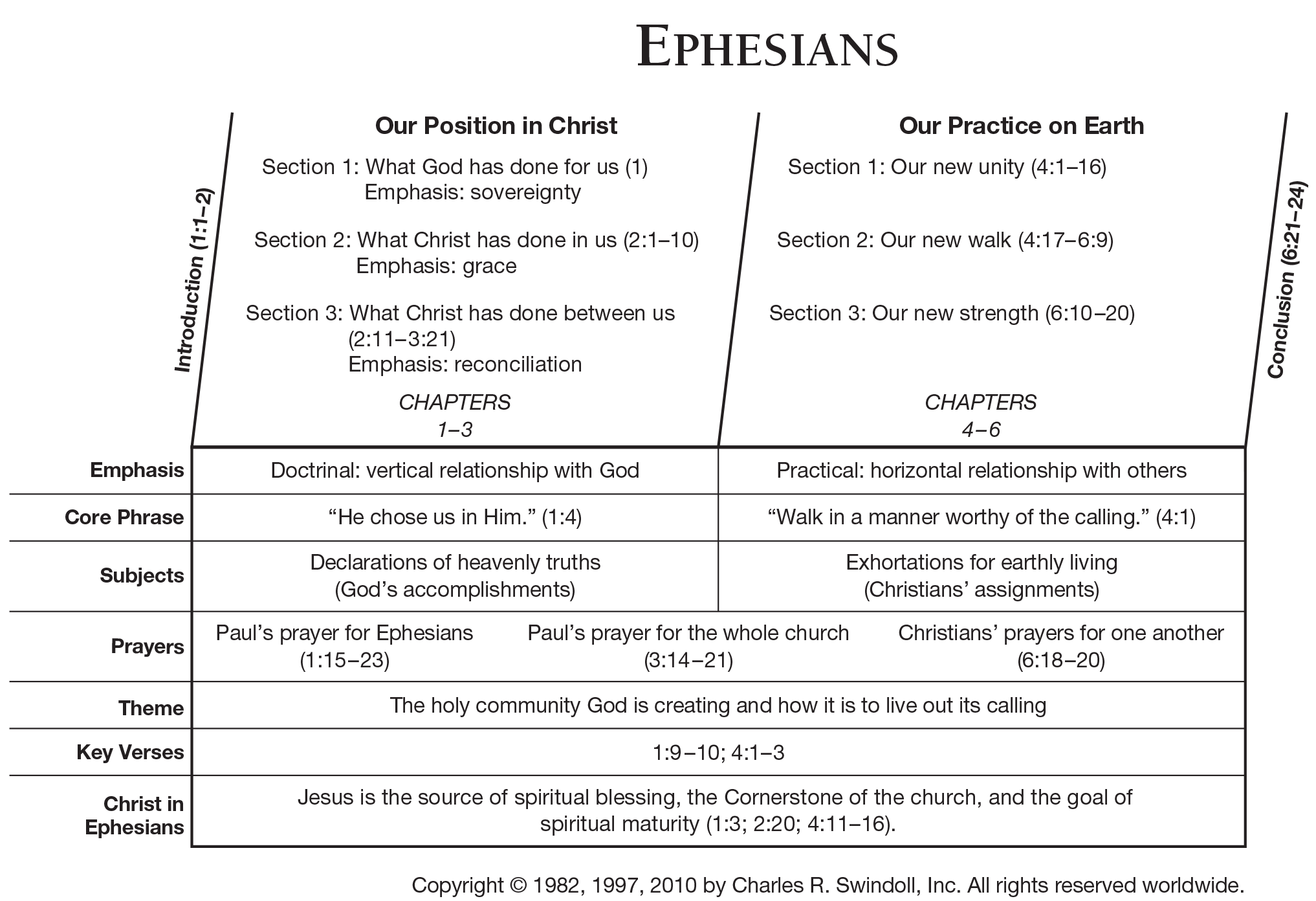
Click chart to enlarge
Charts from Jensen's Survey of the NT - used by permission
Click chart by Charles Swindoll -Note "EMPHASIS" --
Ephesians 1-3 = Doctrinal: vertical relationship with God
Ephesians 4-6 = Practical: horizontal relationship with others
Ephesians 5:13 But all things become visible when they are exposed by the light, for everything that becomes visible is light. (NASB: Lockman)
Greek: ta de panta elegchomena (PPPNPN) hupo tou photos phaneroutai, (3SPPI)
Amplified: But when anything is exposed and reproved by the light, it is made visible and clear; and where everything is visible and clear there is light. (Amplified Bible - Lockman)
BBE But all things, when their true quality is seen, are made clear by the light: because everything which is made clear is light. 14 For this reason he says, Be awake, you who are sleeping, and come up from among the dead, and Christ will be your light.
CSB Everything exposed by the light is made clear, 14 for what makes everything clear is light. Therefore it is said: Get up, sleeper, and rise up from the dead, and the Messiah will shine on you.
ESV But when anything is exposed by the light, it becomes visible, 14 for anything that becomes visible is light. Therefore it says, "Awake, O sleeper, and arise from the dead, and Christ will shine on you."
GWN Light exposes the true character of everything 14 because light makes everything easy to see. That's why it says: "Wake up, sleeper! Rise from the dead, and Christ will shine on you."
KJV: But all things that are reproved are made manifest by the light: for whatsoever doth make manifest is light.
NET But all things being exposed by the light are made evident. 14 For everything made evident is light, and for this reason it says: "Awake, O sleeper! Rise from the dead, and Christ will shine on you!"
NIV But everything exposed by the light becomes visible, 14 for it is light that makes everything visible. This is why it is said: "Wake up, O sleeper, rise from the dead, and Christ will shine on you."
NKJ But all things that are exposed are made manifest by the light, for whatever makes manifest is light. 14 Therefore He says: "Awake, you who sleep, Arise from the dead, And Christ will give you light."
NRS but everything exposed by the light becomes visible, 14 for everything that becomes visible is light. Therefore it says, "Sleeper, awake! Rise from the dead, and Christ will shine on you."
NAB but everything exposed by the light becomes visible, 14 for everything that becomes visible is light. Therefore, it says: "Awake, O sleeper, and arise from the dead, and Christ will give you light."
NJB but anything shown up by the light will be illuminated 14 and anything illuminated is itself a light. That is why it is said: Wake up, sleeper, rise from the dead, and Christ will shine on you.
NLT (Revised) But their evil intentions will be exposed when the light shines on them, 14 for the light makes everything visible. This is why it is said, "Awake, O sleeper, rise up from the dead, and Christ will give you light."
NLT: But when the light shines on them, it becomes clear how evil these things are. (NLT - Tyndale House)
Phillips: For light is capable of "showing up" everything for what it really is. It is even possible (after all, it happened to you!) for light to turn the thing it shines upon into light also. (Phillips: Touchstone)
TLB - But when you expose them, the light shines in upon their sin and shows it up, and when they see how wrong they really are, some of them may even become children of light!
Wuest: But all the aforementioned things, when they are reproved by the light, are made visibly plain, for everything that is being made plain is light. (Eerdmans Publishing - used by permission)
Young's Literal: and all the things reproved by the light are manifested, for everything that is manifested is light;
BUT ALL THINGS BECOME VISIBLE WHEN THEY ARE EXPOSED BY THE LIGHT: ta de panta elegchomena (PPPNPN) hupo tou photos phaneroutai (3SPPI):
- But all things become visible - La 2:14 (see note below); Hosea 2:10; Hos 7:1
- Ephesians 5 Resources - Multiple Sermons and Commentaries
- Ephesians 5:7-14 Children of Light in a Dark World - Steven Cole
- Ephesians 5:8-14: Living in the Light - John MacArthur
- Ephesians 4:17-5:14 Study Guide (see dropdown menu) - John MacArthur
Related Passages:
Hosea 2:10 “And then I will uncover her lewdness In the sight of her lovers, And no one will rescue her out of My hand.
Hosea 7:1 When I would heal Israel, The iniquity of Ephraim is uncovered, And the evil deeds of Samaria, For they deal falsely; The thief enters in, Bandits raid outside,
SECRET SINS ON EARTH
ARE OPEN SCANDAL IN HEAVEN!
But - strong contrast with things done in secret. Whenever you encounter a "but" in a passage, pause and use this encounter as an opportunity to ask what the author is contrasting?, why?, why now?, etc (cp 5W/H questions). You will be amazed at how such a simple technique (of course as you submit to and depend upon to the teaching ministry of the Holy Spirit - cp 1Jn 2 :20, 27, 1Cor 2:12-13) will add to your comprehension, retention and potential application of a given text. Try it next time you are doing morning devotionals and encounter a contrast word ("but," "yet," "on the other hand", etc). While some contrasts are not as enlightening as others, the very fact that you are slowing down and pondering the timeless Word will never be a waste of time. In addition, as you hone your skills of observation, you will find that you are in essence also practicing the blessed discipline of Meditation on the Scriptures (see Ps 1:1-note, Ps 1:2-note, Ps 1:3-note, Joshua 1:8-note)
All things become visible (phaneroo) when they are exposed (elegcho) by the light (phos), for everything that becomes visible is light (phos) - GWT = "Light exposes the true character of everything." All things (pas) means all without exception, in context clearly referring to all the secret sins just alluded to (Eph 5:12+) The idea is that when light shines on anything, then people can know what it really is. The English Version has "their true nature is clearly revealed."
Wayne Barber has the following comment regarding the light writing "That little "the" (definite article in the Greek) is in the text. It is not me, not my garment as much, but it is the Christ Who is in me. He is the essence of my garment. If Jesus is being Jesus in me (Ed: Or if I am allowing His Spirit to shine forth), then the Jesus in me is going to show up (Ed: Expose) others (Ed: Not just unbelievers but backslidden believers or believers living with unconfessed sin) who are not wearing that garment, others who are participating in the deeds of darkness.
John Trapp says that their unfruitful works of darkness (Eph 5:11+) are discovered by the light "so that thereby they grow abashed and abased before God and men."
Matthew Poole adds these things become "visible" "in the minds and consciences of the sinners themselves." They are "convicted" of their sin. Their character is shown for what it really is -- reputation is what others think you are but character is who God knows you are! (Woe!)
Marvin Vincent says Paul's thought is "that Christians should let their light--that is, their example of holiness and purity--shine; as this light would be the means of putting the wickedness of the heathen to shame." (Ephesians 5 Word Studies)
John MacArthur - Our commission as children of light is to hold everything up to the light of Scripture, to expose and seek to remedy whatever is evil. Because they have no windows and are built side–by–side on narrow streets, most shops in Middle Eastern cities are quite dark inside. To get a good look at what he is buying a customer must take the merchandise out into the sunshine. In that bright light the article can be seen for what it really is, and any flaws and imperfections will be obvious.
Jesus declared that "For everyone who does evil hates the light, and does not come to the light, lest his deeds should be exposed (elegcho). But he who practices the truth comes to the light, that his deeds may be manifested as having been wrought in God. (Jn 3:20, 21)
Eadie writes that Ephesians 5:13 "shows why Christians should engage in the work of reproof—it is so salutary: for it exhibits such vices in all their odious debasement, and proves its own purity and lustre in the very exposure. Many and varied have been the interpretations of this statement. (Eadie feels that the "but") has its adversative force—they are done in secret (Eph 5:12), but they may and ought to be exposed. The apostle bids them reprove those sins, and he here states the result. Reprove them, and the effect is, “all these sins being so reproved, are made manifest by the light.” (Ephesians 5 Commentary)
A T Robertson exhorts believers to "Turn on the light. Often the preacher is the only man brave enough to turn the light on the private sins of men and women or even those of a community." (Word Pictures)
Jamieson - The devil and the wicked will not suffer themselves to be made manifest by the light, but love darkness, though outwardly the light shines round them. Therefore, "light" has no transforming effect on them, so that they do not become light (Joh 3:19-20). But, says the apostle, you being now light yourselves (Eph 5:8), by bringing to light through reproof those who are in darkness, will convert them to light. Your consistent lives and faithful reproofs will be your "armor of light" (Ro 13:12) in making an inroad on the kingdom of darkness.
William Blaikie illustrates writing that "for instance, when our Lord reproved the hypocrisy of the Pharisees—their practices had not seemed to the disciples very evil before, but when Christ threw on them the pure light of truth, they were made manifest in their true character—they appeared and they still appear, odious. (The Pulpit Commentary)
One of the major reasons for Israel's downfall and 70 year exile in Babylon was the failure of their so-called prophets (not the prophets recorded in the OT) to reprove them for their unfaithfulness. Judah paid dearly for failing to have their sins exposed, a principle that is still applicable to churches and to nations (cp Pr 14:34+ [Joseph Parker], Ps 107:34+)…
Lam 2:14 Your prophets (So the context here refers primarily to those bring forth the Word - are you listening dear pastor? The Pure Word intrinsically has the power to expose - see 2Ti 3:16+; 2Ti 4:2+; cp 1Co 14:24+, Heb 4:12+; Pr 29:18+) have seen for you false and foolish visions; and they have not exposed (Lxx uses apokalupto - means to uncover or to take the lid off so to speak so that all can see!) your iniquity so as (Note carefully - here is the purpose is to expose not to judge but to make a way for confession and repentance and spiritual healing) to restore (Lxx = epistrepho = a turning to God as used to describe the Gentile idol worshippers in 1Th 1:9+) you from captivity, but they have seen for you false and misleading oracles.
Become visible (5319) (phaneroo from phanerós = manifest, visible, conspicuous in turn from phaino = give light; become visible in turn from phos = light) means made clear or known what has been hidden or unknown. In the passive voice it means to become visible or known, to be revealed. Phaneroo describes an external manifestation to the senses and thus open to all. It means to make visible that which has been hidden. Stated another way, to be manifested, in the Scriptural sense is more than to simply appear. A person may appear in a false guise or without a disclosure of what he truly is but to be manifested is to be revealed in one's true character. It means to render apparent or make manifest, visible or known what has been hidden or unknown, whether by words, or deeds, or in any other way.
Exposed (reproved) (1651) (elegcho from elegchos = bringing to light) is used "in the NT, generally as showing someone that he has done something wrong and summoning him to repent." (Friberg). To set forth or show their fault implying that there is a convincing them of their fault or bringing them to the point of recognizing their wronging.
Elegcho - 17x/17v - Matt 18:15; Luke 3:19; John 3:20; 8:46; 16:8; 1 Cor 14:24; Eph 5:11, 13; 1 Tim 5:20; 2Ti 4:2; Titus 1:9, 13; 2:15; Heb 12:5; Jas 2:9; Jude 1:15; Rev 3:19 translated convict(2), convicted(2), convicts(1), expose(1), exposed(2), rebuke(1), refute(1), reprimanded(1), reprove(4), reproved(1), show… fault(1).
Light (5457) (phos) is used figuratively (metaphorically) in this context to refer to the spiritual "light" in believers. Light makes manifest whatever is in the darkness. So a holy life in the Gentile believers is like a light that exposes the darkness of the sinfulness of those still dead in their trespasses and sins. Appropriate words of rebuke reveal sin in its true character.
FOR EVERYTHING THAT BECOMES VISIBLE IS LIGHT: pan gar to phaneroumenon (PPPNSN) phos estin. (3SPAI):
- Everything that becomes visible - Micah 7:9; John 3:20,21; 1 Corinthians 4:5; Hebrews 1:13
- Ephesians 5 Resources - Multiple Sermons and Commentaries
- Ephesians 5:7-14 Children of Light in a Dark World - Steven Cole
- Ephesians 5:8-14: Living in the Light - John MacArthur
- Ephesians 4:17-5:14 Study Guide (see dropdown menu) - John MacArthur
BROUGHT INTO
THE LIGHT
The idiom bring to light means make something known, to present or bring something or someone to the public eye, to expose.
For everything that becomes visible (phaneroo) is light (phos) - For is term of explanation and is a difficult portion to translate for if one takes it literally it reads “whatever is made manifest is light” or “all things illuminated by the light are themselves light.” Everything (pas) means all without exception. Phillip's paraphrases this passage - "It is even possible (after all, it happened to you!) for light to turn the thing it shines upon into light also."
John MacArthur favors the sense conveyed by the NIV which has "for it is light that makes everything visible." MacArthur explains that "Light is that which makes things manifest, that which shows them to be as they actually are. When sin is revealed, it loses its “hiddenness” and is seen for the ugliness it is." (See The MacArthur New Testament Commentary)
MacDonald explains everything that becomes visible is light writing that "This simply means that when Christians exercise their ministry as light, others are brought to the light. Wicked men are (POTENTIALLY) transformed into children of light through the reproving ministry of light. (Compare Phillip's translation "It is even possible (after all, it happened to you!) for light to turn the thing it shines upon into light also.") It is not a rule without exceptions, of course. Not everyone who is exposed to the light becomes a Christian. But it is a general principle in the spiritual realm that light has a way of reproducing itself. We find an illustration of the principle in 1Pe 3:1 (see note), where believing wives are taught to win their unbelieving husbands to Christ by the example of their lives: “Wives, likewise, be submissive to your own husbands, that even if some do not obey the word, they, without a word, may be won by the conduct of their wives.” Thus the light of Christian wives triumphs over the darkness of heathen husbands, and the latter become light. (Believer's Bible Commentary)
Vincent interprets this passage as "A general proposition, going to show that manifestation can come only through light. Whatever is revealed in its true essence by light is of the nature of light. It no longer belongs to the category of darkness. Manifestation is a law of good and evil alike. That which is of the truth seeks the light and cometh to the light. That which is evil avoids the light, and loves darkness better than light, but none the less is brought to the light and appears in its own light. (Compare NLT "it becomes clear how evil things are") See John 3:20, 21. This truth is embodied in another form in the parable of the Tares. Growth is manifestation. By suffering the tares to grow, their difference from the wheat, which at first is not apparent, is fully revealed. (Ephesians 5 Word Studies)
In view of the difference in interpretations of this passage, it is not surprising that the Bible translations also demonstrate differences. For example the Phillip's paraphrase would parallel the interpretation above by MacArthur and MacDonald…
Phillips: For light is capable of "showing up" everything for what it really is. It is even possible (after all, it happened to you!) for light to turn the thing it shines upon into light also.
On the other hand the New Living Translation would parallel the comment by Vincent that follows…
NLT: But when the light shines on them, it becomes clear how evil these things are.
Below are some other thoughts for your consideration on this confusing passage…
John Eadie after discussing several alternative interpretations writes that he feels the most accurate understanding is that “whatever makes manifest or renders apparent, is light.” Such manifestation is the nature and function of light. These clandestine sins, when reproved, are disclosed by the light so cast upon them, for it belongs to light to make such disclosures. The apostle urges his readers to reprove such sins, which, though done in secret, will and must be exposed; yea, all of them being reproved, are shone upon by the light—that light which radiates from Christianity. And this power of unveiling in Christianity is properly called “light,” for whatever causes such things to disclose themselves is of the essence of light. Such is a natural and simple view of the verse. (Ephesians 5 Commentary)
Hendriksen comments on this section "But when all these (wicked practices) are exposed by the light they are made visible. Meaning: when, by means of contrast with the conduct of believers as “children of light,” the terrible deeds of wickedness that mark “the sons of disobedience” are thus exposed, these horrible practices are shown up for what they really are. That this is true is shown by the rule expressed in the following statement: for everything that is made visible is light; that is, whatever, whether attitudes, words, practices, etc., is made manifest by having been thus contrasted loses its hidden character, takes on the nature of light, and is seen for what it really is. (Ephesians)
The church does the most for the world when the church was the least like the world.
-- G Campbell Morgan (paraphrased)
THOUGHT - Today, many churches have the idea they must imitate the world in order to reach the world. A nation will not decay and collapse because of the darkness of the people who peddle pornography or illicit drugs, but because of Christians who are no longer living as Spirit enabled/energized "lights" that expose darkness, bringing sin to light and showing sin to be what it really is! Sin must be exposed as to its true character for as Hebrews 3:13-note says sin is deceitful. Sinners will act like sinners. But when genuine saints begin to act like sinners, the Spirit is grieved (Ep 4:30-note), His fire is quenched (1Th 5:19-note) and such compromise hurts not only the believer, their family and their church, but also contributes to the decay of the entire nation. Molds and fungi (decay) grow best in darkness. Light retards decay because it exposes darkness. Spirit filled believers are light in the Lord, and the world desperately needs to see that light! Are you convicted yet?
Visible (5319) (phaneroo from phanerós = manifest, visible, conspicuous in turn from phaino = give light; become visible in turn from phos = light) describes an external manifestation to the senses and thus open to all. It means to make visible that which has been hidden. The primary reference is to what is visible to sensory perception.
Light (5457) (phos) (see phos)
Steven Cole (his sermons are in general highly recommended as they read much like verse by verse commentaries) in his message on this section of Ephesians explains what Paul means in this section…
In the context, he seems to mean that by our lives (primarily) and our words (secondarily) we expose the unfruitful deeds of darkness for what they are: disgraceful sin in God’s holy presence. Jesus used this word (John 3:20) when He said, “For everyone who does evil hates the Light, and does not come to the Light for fear that his deeds will be exposed.”
He continues (Jn 3:21), “But he who practices the truth comes to the Light, so that his deeds may be manifested as having been wrought in God.”
In other words, by the obvious difference in how we live, our lives expose the sin of those that are engaging in the unfruitful deeds of darkness.
As Paul says (Eph 5:13), “But all things become visible when they are exposed [same word] by the light, for everything that becomes visible is light.”
That last phrase is difficult, but Paul seems to be arguing that light not only exposes, but also transforms (at least some of the time). J. B. Phillips (The New Testament in Modern English [Geoffrey Bles], p. p. 407) paraphrased it, “It is even possible (after all, it happened with you!) for light to turn the thing it shines upon into light also.”
To illustrate, living in Flagstaff, where it’s cold in the winter with lots of snow, our cars get caked with the salt and grime from the roads, so that after a few weeks of regular snowstorms, they look pretty bad. But, everyone else’s car looks as bad as mine, so I don’t think much about it. But, if I have to drive down to Phoenix, where it’s warm and sunny, I am suddenly surrounded by clean cars! Those clean cars expose the filthiness of my car and make me want to go straight to a car wash. Our clean lives expose the sin of unbelievers’ lives. As God works in their hearts, it often drives them to get their sins washed at the cross. Let me set out the balance of how we expose the deeds of darkness this way:
A. We expose the deeds of darkness by our godly lives as we maintain proper separation from the world.
If we’re no different in our thinking, attitudes, words, and behavior than those that do not know Christ, we have no message to give them. If you profess to know Christ, but you’re not walking in the light, conforming your life to His Word, then please do not let unbelievers know that you claim to be a Christian! If you’re comfortable with your sinful lifestyle, you may not be a genuine Christian. But whether you are or not, don’t link the holy name of the Lord with your disobedient lifestyle (2Sa 12:14).
But, if you’re walking in the light, you can no longer join in the lifestyle of unbelievers. As 1Peter 4:3, 4, 5 (See notes 1 Peter 4 :3, 4 :4, 4 :5) puts it,
For the time already past is sufficient for you to have carried out the desire of the Gentiles, having pursued a course of sensuality, lusts, drunkenness, carousing, drinking parties and abominable idolatries. In all this, they are surprised that you do not run with them into the same excesses of dissipation, and they malign you; but they will give an account to Him who is ready to judge the living and the dead.
As you separate yourself from that kind of sinful lifestyle and live to please the Lord with all goodness, righteousness, and truth, your godly life exposes the dirty lives of those around you.
B. We expose the deeds of darkness by our godly lives and words as we maintain proper contact with the world.
Don’t go out of the world, or you lose any contact for witness. The Corinthian church was confused about this. They had mistaken Paul’s command not to associate with immoral people to mean that they cut off contact with unbelievers. And yet they were welcoming a sinning believer into their fellowship! Paul didn’t mean that they should break off contact with the world. Rather, they should cut off contact with any so-called brother who is immoral or sinning (1Cor. 5:9, 10, 11).
Here are four guidelines to follow as you seek to maintain proper contact with this dark world:
(1) Be on guard—bad company corrupts good morals!
You should not be best friends with an unbeliever once you have come to Christ. Your deepest friendships must be with those that share in common a love for Jesus Christ and the things of God. For a believer to enter into a close friendship, business partnership, or marriage with an unbeliever is to violate the clear command that we read earlier (2Co 6:14, 15, 16, 17, 18). If you do not distance yourself from your former friendships, those godless friends will pull you back into your old way of life. But, what about witness?
(2) Be alert to your purpose—to win the lost to Christ.
Jesus was known as a friend of sinners, but He did not hang out with them to have a good time. He came to seek and to save the lost (Luke 19:10). He said that He didn’t come to call the righteous, but sinners to repentance (Luke 5:32). He kept a fine balance that is difficult to imitate: He maintained His holiness and yet He put sinners enough at ease so that they listened to His message. It is in this sense that we must interpret Ephesians 5:14 (a difficult verse). Most likely it cites an early Christian hymn based on Isaiah 60:1, “Arise, shine; for your light has come, and the glory of the Lord has risen upon you.” Paul cites it as an example of the directives he has just given. It pictures the exposure of an unbeliever to the light with a view to his salvation. He is asleep and dead. God calls him to awake and arise, resulting in the light of Christ shining upon him. It does not imply that dead sinners are able in their own strength to arise from the dead, which would contradict the metaphor. Rather, with the command, God imparts the power to obey, just as when Jesus called out, “Lazarus, come forth!” (John 11:43). Light not only reveals sin; it also dispels the darkness. So we can call on sinners to awake and arise, knowing that God may impart the power to obey, resulting in them becoming children of light, with Christ shining on them.
(3) Be sensitive to show concern for the whole person.
Jesus said (Matt. 5:16-note), “Let your light shine before men in such a way that they may see your good works, and glorify your Father who is in heaven.” Often, of course, we must tell people the message of the gospel. But that message must be backed up with genuine concern for the whole person. If someone is hungry, feed him and tell him about Jesus. The fruit of the light consists in goodness, which means, good deeds that show love for people. In that context we are able to give verbal witness to the gospel.
(4) Be bold to identify verbally with Christ when you are pressured to compromise your convictions.
This gets back to how you respond to dirty jokes or to someone who wants you to view pornography. Here’s the principle: Be as bold in your witness for Christ as the other person is in his solicitation to evil. If they are bold for Satan, why shouldn’t you be just as bold for the Savior? Smile and say firmly, “That offends my Lord,” or, “I can’t do that.” If he presses the matter, say, “I used to love that sort of thing, but now I belong to Jesus Christ and I want to please Him.” And share your concern for him, that he is under God’s judgment, but that Jesus offers him a full and free pardon if he will repent and believe in Christ.
Conclusion -
The church growth movement tells us pastors that we should make the church a place where unbelievers feel comfortable. So, we’re supposed to avoid subjects like sin, righteous living, and the coming judgment. Instead, we’re to focus on how to have a happy family, how to do well in business, how to overcome your addictions, and other upbeat topics. In other words, we’re not supposed to expose the unfruitful deeds of darkness, so that we don’t offend anyone. Just tell them how much God loves them! But Jesus said that the ministry of the Holy Spirit is to convict (same Greek word as “expose”) the world of sin, righteousness, and judgment. Without that conviction, unbelievers will not see their need and flee to the Savior. Forgiven little, they will love Jesus little. Paul’s strategy is better: Walk as a child of light, maintaining proper separation from the world and proper contact with the world. As you do, your godly life and words will expose the deeds of darkness. Some will awake from the dead and Christ will shine on them, as He has on you.
Application Questions
1. If we openly rebuke someone for a dirty joke, it may cut off all future opportunity for witness. How can we be tactful and yet show disapproval?
2. Do you agree that Christians should not have unbelievers as their closest friends? Why/why not? Cite Scripture.
3. Since no one is perfect, how godly should we be before we tell others about Christ? What guidelines apply?
4. Some argue that believers should frequent taverns and have a few beers to witness to those in the taverns. Agree/disagree?
(Children of Light in a Dark World Recommended)
Ephesians 5:14 For this reason it says, "Awake, sleeper, And arise from the dead, And Christ will shine on you." (NASB: Lockman)
Greek: pan gar to phaneroumenon (PPPNSN) phos estin. (3SPAI) dio legei, (3SPAI) Egeire, (2SAAM) o katheudon, (PAPMSVocative) kai anasta (2SAAM) ek ton nekron, kai epiphausei (3SPAI) soi o Christos.
Amplified: Therefore He says, Awake, O sleeper, and arise from the dead, and Christ shall shine (make day dawn) upon you and give you light. (Amplified Bible - Lockman)
BBE But all things, when their true quality is seen, are made clear by the light: because everything which is made clear is light. 14 For this reason he says, Be awake, you who are sleeping, and come up from among the dead, and Christ will be your light.
CSB Everything exposed by the light is made clear, 14 for what makes everything clear is light. Therefore it is said: Get up, sleeper, and rise up from the dead, and the Messiah will shine on you.
ESV But when anything is exposed by the light, it becomes visible, 14 for anything that becomes visible is light. Therefore it says, "Awake, O sleeper, and arise from the dead, and Christ will shine on you."
GWN Light exposes the true character of everything 14 because light makes everything easy to see. That's why it says: "Wake up, sleeper! Rise from the dead, and Christ will shine on you."
KJV: But all things that are reproved are made manifest by the light: for whatsoever doth make manifest is light.
NET But all things being exposed by the light are made evident. 14 For everything made evident is light, and for this reason it says: "Awake, O sleeper! Rise from the dead, and Christ will shine on you!"
NIV But everything exposed by the light becomes visible, 14 for it is light that makes everything visible. This is why it is said: "Wake up, O sleeper, rise from the dead, and Christ will shine on you."
NKJ But all things that are exposed are made manifest by the light, for whatever makes manifest is light. 14 Therefore He says: "Awake, you who sleep, Arise from the dead, And Christ will give you light."
NRS but everything exposed by the light becomes visible, 14 for everything that becomes visible is light. Therefore it says, "Sleeper, awake! Rise from the dead, and Christ will shine on you."
NAB but everything exposed by the light becomes visible, 14 for everything that becomes visible is light. Therefore, it says: "Awake, O sleeper, and arise from the dead, and Christ will give you light."
NJB but anything shown up by the light will be illuminated 14 and anything illuminated is itself a light. That is why it is said: Wake up, sleeper, rise from the dead, and Christ will shine on you.
NLT (Revised) But their evil intentions will be exposed when the light shines on them, 14 for the light makes everything visible. This is why it is said, "Awake, O sleeper, rise up from the dead, and Christ will give you light."
NLT: And where your light shines, it will expose their evil deeds. This is why it is said, "Awake, O sleeper, rise up from the dead, and Christ will give you light." (NLT - Tyndale House)
Phillips: Thus God speaks through the scriptures: "Awake, you who sleep, arise from the dead, and Christ will give you light." (Phillips: Touchstone)
Wuest: Wherefore He says, Be waking up, he who is sleeping, and arise from the dead, and there shall shine upon you the Christ. (Eerdmans Publishing - used by permission)
Young's Literal: wherefore he saith, `Arouse thyself, thou who art sleeping, and arise out of the dead, and the Christ shall shine upon thee.
FOR THIS REASON IT SAYS AWAKE SLEEPER AND ARISE FROM THE DEAD : dio legei, (3SPAI) Egeire, (2SAAM) o katheudon, (PAPMSVocative) kai anasta (2SAAM) ek ton nekron:
- For this reason it says - Isa 51:17; 52:1; 60:1; Ro 13:11,12; 1Co 15:34; 1Th 5:6; 2Ti 2:26
- Awake sleeper - Eph 2:5; Isa 26:19; Ezek 37:4-10; John 5:25-29; 11:43,44; Ro 6:4,5,13; Col 3:1
- Ephesians 5 Resources - Multiple Sermons and Commentaries
- Ephesians 5:7-14 Children of Light in a Dark World - Steven Cole
- Ephesians 5:8-14: Living in the Light - John MacArthur
- Ephesians 4:17-5:14 Study Guide (see dropdown menu) - John MacArthur
WAKE UP AND GET UP!
For this reason it says - For this reason (1352) (dio) is a relatively emphatic marker of a result, usually denoting that the inference is self-evident. Synonyms = So then. Consequently. For that reason. On which account. This genre of phraseology should always pique our attention, prompting us to pause and ponder, specifically asking questions such as "for what “reason”? In context Paul is alluding to the truth of the previous verses in which he had just explained that light exposes the darkness. It says (lego) raises the question of to what does "it" refer? Many commentators interpret this as a quotation from a non-biblical source, possibly a Christian hymn. Others feel Paul may be alluding to Scripture although this is not a direct quote of any known Scripture. One verse that some consider to be a passage Paul was alluding to is "Arise, shine; for your light has come, and the glory of the LORD has risen upon you." (Isaiah 60:1; others suggest Isaiah 26:19)
Awake, sleeper, And arise from the dead, and Christ will shine on you - The question raised by this passage is to whom is it preached--to unbelievers or to believers? Are these (spiritually) sleepy (stuporous) saints? Or are they spiritually dead sinners (Eph 2:1-3)? Both groups need the light of Christ shining on them, even as plants on earth need sunlight for growth. There are excellent commentators on both sides of the interpretative fence on this passage. You will have to pray and read and study to come to your own conclusion. One consideration of course is that Paul wrote this in such a way as to leave open the application to either "sleepy" saints or lost sinners.
Some writers believe that Paul is extending an invitation for salvation to the unsaved, in order that they may be transformed from children of darkness into children of light. Authors favoring this interpretation include John MacArthur (ref), William MacDonald (ref), Calvin, Hodge. On the other side of the interpretative fence are Spurgeon, Pink, Ryrie, Wiersbe, etal.
FOLLOWING FAVOR
ADDRESSED TO BELIEVERS
C H Spurgeon asks To whom is this text addressed? Nine times out of ten when it is preached from, it is taken as though it were addressed to the ungodly. It is a very proper text to address to the ungodly, but I do not see that the connection permits it. There are some who would think it altogether unscriptural and unsound to address these words to those who have no spiritual life. We are not of their number. If we see a man ever so deadly asleep we believe we are commissioned by God to preach the gospel to him, and to say, “Awake, thou that sleepest;” and though more and more persuaded of the want of moral sensibility in man and the desperate character of his depravity, we are not amongst those who fear to preach to dead sinners, but dare to say, even to the dead, “Thus saith the Lord, Ye dry bones, hear the word of the Lord. Thus saith the Lord, Ye dry bones, live!” We can, therefore, very well take this text, and address it to the ungodly. But this is not intended to be a sermon to the unconverted. It appears to me to have been addressed to the church of God at Ephesus, to have been the language of Paul to God’s own people, warning them not to fall into the same habits as did the children of darkness, but to come out and show themselves to be God’s people. I know the objection will be raised, that they are told to come forth from the dead; but I do not see that that is any obstacle at all, for albeit that the people of God may not be spiritually dead in the sense in which the ungodly are, yet how often do we speak of ourselves as feeling as if we were dead, and speak of our graces and of our piety as though they were come into a cold and dead state. It is comparative death that the apostle here means, and we may use the words employed here as we would use them in common conversation, and say that though there are some quivers of spiritual life in the breast of every believer, yet there are multitudes who are outwardly dead as to their usefulness, and there are Christians and churches too of whom we may say, without at all libeling them. “You are dead; awake thou that sleepest.” Whatever objection there may be to addressing the text to the converted, there will be far more difficulty in addressing it to the unconverted, and I think there ought to be no hesitation in directing it to either. To raise difficulties is very easy, but meekly to try to learn what the Savior would say is far better. (Ephesians 5:14 The Church Aroused/ Awakened) (See Spurgeon's outline here)
KJV Bible Commentary - This is a call from drowsiness to spiritual life. Stand up from the dead among you.
FOLLOWING FAVOR
ADDRESSED TO UNBELIEVERS
MacDonald rightly observes that "The life of the believer should always be preaching a sermon, should always be exposing the surrounding darkness, should always be extending this invitation to unbelievers… awake… arise from the dead. (Believer's Bible Commentary: Thomas Nelson)
John Piper applies Paul's cry to awake to the unconverted asking "How do you obey a command to wake up from sleep? If your house has carbon monoxide in it, and someone cries out, “Wake up! Save yourself! Get out!” you don’t obey by waking yourself up. The loud, powerful command itself wakes you up. You obey by doing what wakeful people do in the face of danger. You get up and leave the house. The call creates the waking. You respond in the power of what the call created. (A Godward Life- Savoring the Supremacy of God in All of Life)
In another place Piper writes "To you—children, teenagers, adults—I plead, along with the apostle Paul, “Wake up, O sleeper, and arise from the dead, and Christ shall give you light” (Ephesians 5:14). Don’t be like the person who goes to the Grand Canyon with a little garden shovel in his hand, and on the precipice of that majesty turns his back to the Canyon, kneels down, and digs a little trough with his shovel and shouts, “Hey, look at this! Look at my trough! Isn’t that cool!” I know that the pressing and desirable things of your life seem big. But just a little clearheaded thought will show you they are not. Get up and turn around and look at the Canyon. Don’t live your life walking down the E Concourse thinking that yogurt and sweet rolls and short skirts are really what it’s all about. (Do Not Let Sin Reign in Your Mortal Body, Part 1).
S F D Salmond - The passage is introduced in connection with the reference to the effects of a faithful ‘reproof’ and under the impression of the figure of the light. It takes the form of an appeal to wake out of the pagan condition of sin, described by the two-fold figure of sleep and death, and of a promise that then Christ will shine upon the sinner with the saving light of His truth. The quotation comes in relevantly, therefore, as a further enforcement both of the need for the reproof which is enjoined, and of the good effects of such a reproof faithfully exercised. (Ephesians 5 Commentary)
Jamieson writes - Believers are called on to awake out of sleep; unbelievers, to arise from the dead (compare Mt 25:5; Ro 13:11; 1Th 5:6, with Eph 2:1). (Ephesians 5 Commentary)
In the context of Ephesians 4 and 5, Paul has been speaking to believing Gentiles, those who had once walked in total darkness, and those who were still surrounded by that darkness. The temptation to drift back into that darkness would be an ever present danger (cp "drift away" in Heb 2:1-note). In fact the repetition of negative commands in the present imperative (Stop doing this or that… ) clearly indicates that the readers were involved to some degree in the deeds of darkness. In that context, it would be reasonable for Paul to issue a call to those believers to wake up, the interpretation that this writer favors.
It is also notable that Paul uses the metaphor of sleep in other passages to address saints…
But you, brethren, are not in darkness, that the day should overtake you like a thief; 5 for you are all sons of light and sons of day. We are not of night nor of darkness; 6 so then let us not sleep as others do, but let us be alert and sober (Implying even believers can be lulled into a sense of complacency and lose the sense of urgency stimulated by keeping Imminency of Jesus at the forefront of our thinking). 7 For (term of explanation) those who sleep do their sleeping at night, and those who get drunk get drunk at night. (1Th 5:4-7+)
In the "practical" (a misnomer because all Scripture is practical) section of Romans 12-16, Paul uses the metaphor of sleep, clearly referring to believers, exhorting them…
And this do, knowing the time, that it is already the hour for you to awaken from sleep; for now salvation is nearer to us than when we believed. 12 The night is almost gone, and the day is at hand. Let us therefore lay aside the deeds of darkness and put on the armor of light. 13 Let us behave properly as in the day, not in carousing and drunkenness, not in sexual promiscuity and sensuality, not in strife and jealousy. 14 But put on the Lord Jesus Christ, and make no provision for the flesh in regard to its lusts. (Ro 13:11-14+)
Comment: We ought to be like the little boy whose family clock malfunctioned and struck 15 times so that he rushed wide-eyed to his mother crying, “Mommy, it’s later than it’s ever been before!” What sanctifying logic! We should also keep in mind that if Christ does not return in our time, He will certainly come individually for us in death. Each ache, pain, gray hair, new wrinkle or funeral is another reminder that it is later than it has ever been before. It is time to love our neighbors as ourselves. IT'S LATER THAN YOU THINK. Redeem the time!
As noted above, while there is not a consensus, the majority of evangelical writers interpret Paul's call to "Awake sleeper" not as a call to the spiritually dead to arise but instead as a call to believers who have been lulled asleep and lapsed into some of the "deeds of darkness".
K L Boles writes that…"these words do call the Christian to abandon the domain of darkness and death, and to forsake fellowship with those who dwell there. (Galatians & Ephesians. The College Press NIV Commentary)
A W Pink discusses "the backslidden Christian, who has to all appearances lapsed back into a state of unregeneracy. Is it not faith’s response to that word (addressed to Christians) “Awake thou that sleepest, and arise from the dead, and Christ shall give thee light” (Eph. 5:14)! (Exposition of Hebrews) Pink adds "Our Father subjects us to trials in order to cure our slothfulness. God calls out, “Awake thou that sleepest” (Eph. 5:14), but we heed Him not; and therefore He often employs rough servants to rudely arouse us. (The Lord's Prayer on Mt 6:13).
Charles Ryrie writes that this section (beginning with "Awake sleeper...) is…"Perhaps a portion of an early Christian hymn exhorting the sinning believer to Awake and arise. (The Ryrie Study Bible)
S Lewis Johnson believes this text is addressed to believers writing that "This is a text taken from the Old Testament, but it is applied by the Apostle to the believers. He is telling them that if their lives are not characterized by this purity of which he is talking, they are sleeping morally, and they should awake, and they should arise from the dead and Christ will give them light… Awake thou that sleepest, and arise from the dead, and Christ shall give thee light. It’s a promise that as we, by the grace of God and the enablement of God, get down upon our knees and ask him to deliver us from the failures of our Christian life, well we have the assurance that God will undertake for us and we shall be given light. (Ephesians 5:3-21 Purity in the Christian Life)
Bruce Barton writes that just "As the prophets appealed to Israel to awaken from its state of darkness and death, so Paul was appealing to the Ephesians to wake up, stay alert, and realize the dangerous condition into which some of them had been slipping by listening to false teachings. (The NIV Life Application Commentary)
William Blaikie writes that "This is evidently intended to give an additional impulse to the Ephesians to walk as children of the light.. But the fundamental idea in the prophecy is, that when the Church gets the light of heaven, she is not to lie still, as if she were asleep or dead, but is to be active, is to make use of the light, is to use it for illuminating the world. The apostle maintains that the Ephesian Church had got the light of heaven; she, therefore, was not to sleep or loiter, but spring forth as if from the grave, and pour light on the world. The changes which the apostle makes on the form of the prophecy are remarkable, and show that it was to its spirit and substance rather than to its precise form and letter that he attached the authority of inspiration. (Ephesians 4 Commentary)
Lehman Strauss - There follows next a strong exhortation: “Awake thou that sleepest, and arise from the dead, and Christ shall give thee light” (5:14). Paul quotes in part from Isaiah 60:1, 2, applying it to the Church. In view of the sin all about the people of God, through the Prophet Isaiah He called upon His own to put on the light of Jehovah’s glory in the midst of the surrounding darkness. Israel’s light had not been shining, so that they were as those who were dead; hence the call to arise and stand out as lights in the midst of those who were dead. Many Christians today are as those who are still in death and darkness. Some of you have not been letting your light shine. You are scarcely discernible from the unsaved. If you will arise from your slumber, Christ will bless you and cause His light to shine through you to others. (Ephesians 4-6 The Conduct and Duty of the Church)
Warren Wiersbe - When you think of light, you think of waking up to a new day, and Paul presented this picture (Eph 5:14), paraphrasing Isaiah 60:1. You have the same image in Romans 13:11-13 and 1Th 5:1-10. That Easter morning, when Christ arose from the dead, was the dawning of a new day for the world. Christians are not sleeping in sin and death. We have been raised from the dead through faith in Him. The darkness of the graveyard is past, and we are now walking in the light of salvation. Salvation is the beginning of a new day, and we ought to live as those who belong to the light, not to the darkness. “Lazarus, come forth!” (See The Wiersbe Bible Commentary:)
W E Vine favors arise as referring to believers, calling for their "spiritual awakening from lethargy."
KJV Bible Commentary writes this "is a call from drowsiness to spiritual life. Arise from the dead. Stand up from the dead among you. Christ shall give thee light. Make day dawn upon you. (Dobson, E G, Charles Feinberg, E Hindson, Woodrow Kroll, H L. Wilmington: KJV Bible Commentary: Nelson)
Jon Courson writes "“Wake up!” says Paul. “Look what’s happening in your lives.” I know of young men who could have turned this world upside down for the Lord. I know of young guys who could have really made a mark for the kingdom. But because they weren’t awake to what the Word of God says concerning filthiness, coarse jesting, uncleanness, fornication, and pornography, they’re ineffective to this day. (Jon Courson's Application Commentary)
Harold Hoehner "A believer who has committed “deeds of darkness,” is to wake up and rise from the dead since he was involved with the deeds of evildoers. (The Bible Knowledge Commentary).
R Kent Hughes - Whatever its origin, Paul’s application is clear. Some people who are “light in the Lord” are slumbering and need to wake up. It is an obvious fact that Christians who are asleep do not know it. It is possible to be slumbering light and even to be well-regarded by others in the Church (especially by others who are in the same state). It is possible to be asleep and appear awake. It is possible to pray while asleep, mouthing phrases others have used before. It is possible to sing a hymn without being awake to the words. It is possible to walk while asleep and end up in harm’s way. It is possible to live a dreamy life of unreality in the netherland of inaction. That is why Paul says, “Wake up, O sleeper, rise from the dead …”If we are light we must act as light, manifesting its brilliant functions, both positive and negative. We must live out the ethics of light in “goodness” and “righteousness” and “truth,” and we must at times “expose … the fruitless deeds of darkness.” (See Ephesians: The Mystery of the Body of Christ)
David Legge - Paul is saying here: there are many of you Ephesian Christians that are still sleeping. You were dead in your trespasses and in your sins, but God has quickened you with Christ, He has put you in heavenly places - but the tragedy is this: that is your state, but that is not the way you're living. Paul says: 'Waken up!'. The church today, needs to waken up. We need to start walking in the light that we are in. We need to waken out of our lethargy The church at Ephesus, the church today, needs to waken up. We need to start walking in the light that we are in. We need to waken out of our lethargy - as one writer has said: 'The soldier that sleeps on a battlefield might never ever waken'. There are those within our day, as within Paul's, that are slumbering. The tragedy of slumbering is this - and you beware, my friend: that those who slumber don't even realise it. (Sermon)
William Klein favors Paul is addressing believers - How easily some Christians forget who they really are in Christ. In using this formula, Paul pictures these disobedient Christians as asleep (cf. Ro 13:11; 1 Th 5:6–7). But genuine Christians must not practice behaviors that characterize unbelievers who are truly spiritually dead (Paul also told the Corinthians how they were living as “mere human beings”; 1 Co 3:3 TNIV). “Wake up!” Paul shouts. If they repent, Christ’s light will shine on them. (On Christ as the “light,” see Jn 1:4, 9; 8:12; 12:35–36; 2 Co 4:6.) They will be living as light. But can such language apply to those who are already Christians? Recall that at 4:24 Paul urged his readers to “put on the new self,” which, of course, they already did at conversion. But they must “become what they are” and keep choosing godly behaviors while eschewing sinful ones. So here, employing this same language of conversion, he urges the disobedient to “rise from the dead.” Paul urges his readers to walk in the light and to ensure that all others in the church do as well. (See Ephesians, Philippians, Colossians, Philemon)
Jim Bowcamp - In verse 14, Paul is not directly quoting any one Old Testament scripture, rather there are several places in the Old Testament where people are told to awaken from their spiritual slumber and know and serve the Lord. God’s people sometimes need to be awakened from a life of compromise that can come gradually upon them and if not stopped lead to a life of backsliding. Someone once defined “backsliding” as “slack abiding” and I think that at times we Christians can become lazy and complacent and God does need to awaken and restore us to new and refreshed zeal for Him. (Ephesians 5:1-14 As Beloved Children Be Imitators Of God)
David Guzik - Remember that this exhortation to awake comes to Christians. A Christian may be asleep and not know it. If you are asleep, you probably do not know it. As soon as you become aware of your sleep, it is evidence that you are now awake.. “This sleepiness in the Christian is exceedingly dangerous, too, because he can do a great deal while he is asleep that will make him look as if he were quite awake.....The man who is asleep does not care what becomes of his neighbors; how can he while he is asleep? And oh! Some of you Christians do not care whether souls are saved or damned… It is enough for them if they are comfortable. If they can attend a respectable place of worship and go with others to heaven, they are indifferent about everything else” (Spurgeon)
J Vernon McGee "Here is a command which is humanly impossible to obey. How can a person awake from the dead? How can a person awake out of spiritual death? Only God can awaken us. I think what Paul means here is that the believers who have fallen into a spiritual stupor are to wake up. (Ephesians 5 Commentary) Comment: A supernatural awakening necessitates a supernatural source. McGee is correct. The only way to obey this imperative is to yield to the enabling ministry of the Holy Spirit who indwells believers. If this does refer to unbelievers, the only way they could possibly obey this command is likewise by the supernatural work of the Spirit giving them the desire and the power (Phil 2:13NLT+), for we know that (absolutely) no man (left to himself) seeks after God! (Ro 3:11+ quoting Psalm 14:2+, cp John 6:37, 44, 65)
John Phillips - In Ephesians 5:14 epiphauō means that Christ will “shine upon” the believer. The whole verse is a paraphrase of Isaiah 60:1–2. The Christian has new light and new life. The new light chases away the darkness in which he once groveled. The new life replaces the deadness that once possessed him and held him in corruption and uncleanness. Just as Lazarus, coming forth from the death and darkness of the tomb, was glad to be relieved of his vile graveclothes, so the new Christian throws off with horror the conduct and conversation that characterized him before he came to Christ. Imagine a surgeon wanting to keep on the gloves that he wore while performing an autopsy on a decaying corpse! Obviously the doctor would want to get rid of the contaminated gloves and scrub his hands in antiseptics. Likewise, the idea of a Christian still wanting to walk and talk as he did before he came to know the Savior is incongruous. (See Exploring Ephesians & Philippians: An Expository Commentary)
William Blaikie - This is evidently intended to give an additional impulse to the Ephesians to walk as children of the light. (Ephesians 5 Exposition)
Wayne Barber feels that Paul is speaking to believers writing "Most people think Paul is using that verse to say, "This is God’s plea to the whole world, ‘Wake up and I’ll shine on you. Once I shine on you, you can become light for other people.’" I disagree with that. Looking at the context Paul is saying, "You Christians, you see in Isaiah 60:1 when God spoke that, He spoke it to His people." To me Paul is saying, "God is saying the word to the church, ‘Wake up! You are sleeping! Death is all around you. Darkness has enveloped you. Wake up. Let Jesus shine on you first and reprove you for the things wrong in your life. Then Jesus can shine through you and we can start seeing darkness dissipate because it is light that puts out the darkness.’" Folks, when you walk into a dark room in the morning, you don’t switch the darkness off and switch the light on. No, you just switch the light on and the darkness has to flee. Darkness does not put out light. Folks, darkness is not the problem, and it never has been the problem. The problem is no light. Christians are sound asleep. You don’t have to go out on the street corner and get a box and tell the world. Live it! Your neighbors will see the difference. Your wife will see the difference. Everybody will see the difference. It is incredible when you put the garment on. It is incredible when you are strengthened in the inner man. Immediately people are affected. You don’t even know it, but that light is penetrating the deeds of darkness and the world of evil. When you put on that garment, it puts out darkness. (See Ephesians 5:6-17)
Napoleon said to his executives after touring China, "This nation is a sleeping giant. If she is ever awakened, she will rock the world." The Church is much more a sleeping giant that needs to be aroused out of her sleep." (Golden Nuggets)
Darrell Bock takes somewhat a "middle of the road" approach - The context for the remarks is broad and flexible. It could simply be a description of what the gospel itself offers to those in darkness. It also could be a call to come back into the light for those among the community who have compromised their walk by engaging in such deeds. More naturally the remarks have the former meaning of an original call into light, but the application can extend into the second possibility. By contending that Paul is focused on the deeds and being separated from them, the concern in citing the poetic piece is not with a particular status of the audience. The text can also apply in either direction, although the point is an exhortation to the church not to live inconsistently with what their salvation means and has called them to become (5:8). The call to awake from sleep is an image Paul uses elsewhere to remind believers of their calling (Rom. 13:11–14; 1 Thess. 5:5–6). Romans 6:13 makes the same point with different imagery, as does 2 Corinthians 4:6. (See Ephesians: An Introduction and Commentary)
Alan Carr seems to apply this to lost and saved - Paul closes this section with an invitation for the lost to come to Jesus for salvation. If they will simply wake up, and come to Jesus, He will save them and give them light. He is calling the lost people who might have been in that congregation to come to Jesus for salvation. That is a call that still goes out today. If you are lost, you can be saved. The Lord will change your life, delver you from, darkness and fill you with His light. There is also a call here for believers to walk up. We have wandered through this world in a spiritual slumber for far too long. It is time we woke up and got about the Savior’s business. When we do, we will be light to a world trapped in darkness. It may just be that the Lord will use that light to save sinners.
FOLLOWING WRITERS FAVOR
THIS AS A CALL TO CONVERSION
John MacArthur favors Paul is addressing unbelievers -- "Paul here offers an invitation, a call for those who are not children of light to come to the light and be saved. The words are adapted from Isaiah 60:1, which reads, “Arise, shine; for your light has come, and the glory of the Lord has risen upon you.” Paul shows the prophetic meaning of those texts by declaring that “the glory of the Lord [that] has risen” is none other than Jesus Christ, the Messiah for whom and in whom Isaiah and every other godly Jew had so longed hoped. Many commentators believe verse 14 is taken from an Easter hymn sung by the early church and used as an invitation to unbelievers who might have been in the congregation. The words are a capsule summary of the gospel. Awake, sleeper describes the sinner who is asleep in the darkness of sin and unaware of his lost condition and tragic destiny. Like a spiritual Rip Van Winkle, he will sleep through God’s time of grace unless someone awakens him to his predicament and need. Arise from the dead is a summons to repentance, an appeal to turn away from the dead ways of sin. (See The MacArthur New Testament Commentary)
Steven Cole - Paul cites it as an example of the directives he has just given. It pictures the exposure of an unbeliever to the light with a view to his salvation. He is asleep and dead. God calls him to awake and arise, resulting in the light of Christ shining upon him. It does not imply that dead sinners are able in their own strength to arise from the dead, which would contradict the metaphor. Rather, with the command, God imparts the power to obey, just as when Jesus called out, “Lazarus, come forth!” (John 11:43). Light not only reveals sin; it also dispels the darkness. So we can call on sinners to awake and arise, knowing that God may impart the power to obey, resulting in them becoming children of light, with Christ shining on them.
Charles Hodge - Those asleep and the dead are in darkness, and therefore those involved in spiritual darkness are addressed as sleeping. The light ‘which cornea from Christ has power to reach even the dead—as our Lord, in the use of another figure, says, “The hour is coming, and now is, that the dead shall hear the voice of the Son of God, and they that hear shall live,” John 5:25. This does not mean that the dead must be revived before they hear the voice of the Son of God, but his voice causes them to hear and live. So the passage before us does not mean that those asleep must arise from the dead and come to Christ for light; but that the light which Christ sheds around him, has power to awake the sleeping dead. Thus the passage is a confirmation of what is said in the preceding verse, viz., that every thing made manifest by the light, is light.
Peter O'Brien - we believe that the passage is describing the process by which darkness is transformed into light. The function of the light is twofold: it exposes the sins of unbelievers, and transforms them so that they enter the realm of light (cf. Col. 1:13). (The Letter to the Ephesians)
John Stott favor this as addressed to unbelievers - Here our former condition in Adam is graphically described in terms of sleep, death and darkness, from all of which Christ rescues us. Conversion is nothing less than awaking out of sleep, rising from death and being brought out of darkness into the light of Christ. No wonder we are summoned to live a new life in consequence! (The Message of Ephesians)
Bishop J C Ryle favors that Paul is addressing the lost - I put before you now a simple question. Look through the pages of this paper and you will soon see why I ask it. "Are you asleep about your soul?" There are many who have the name of Christians, but not the character which should go with the name. God is not King of their hearts. They mind earthly things. Such persons are often quick and clever about the affairs of this life. They are, many of them, good men of business, good at their daily work, good masters, good servants, good neighbors, good subjects of the Queen: all this I fully allow. But it is the eternal part of them that I speak of; it is their never dying souls. And about that, if a man may judge by the little they do for it, they are careless, thoughtless, reckless, and unconcerned. They are asleep. I do not say that God and salvation are subjects that never come across their minds: but this I say,—they have not the uppermost place there. Neither do I say that they are all alike in their lives; some of them doubtless go further in sin than others: but this I say,—they have all turned every one to his own way, and that way is not God's. I know no rule by which to judge of a man's estate but the Bible. Now when I look at the Bible I can come to only one conclusion about these people: they are asleep about their souls. These people do not see the sinfulness of sin, and their own lost condition by nature. They appear to make light of breaking God's commandments, and to care little whether they live according to His law or not. Yet God says that sin is the transgression of the law,—that His commandment is exceeding broad,—that every imagination of the natural heart is evil,—that sin is the thing He cannot bear, He hates it,—that the wages of sin is death, and the soul that sinneth shall die. Surely they are asleep. Is this the state of your soul? Remember my question. ARE You ASLEEP? (Are You Asleep)
J C Ryle asks "IS ANY READER OF THIS PAPER ASLEEP AND UTTERLY THOUGHTLESS ABOUT CHRISTIANITY? Oh, awake and sleep no more! Look at the churchyards and cemeteries. One by one the people around you are dropping into them, and you must lie there one day. Look forward to a world to come, and lay your hand on your heart, and say, if you dare, that you ready to die and meet God. Ah! You are like one sleeping in a boat drifting down the stream towards the falls of Niagara! "What meanest you, oh sleeper! Arise and call on your God!"--"Awake you that sheep, and arise from the dead, and Christ shall give you light!"" (Jonah 1:6; Ephesians 5:14). (Practical Religion: Chapter 1 - Self-Inquiry)
Chuck Smith - To those who are sleeping in darkness, the call of the gospel. Arise from that death, that spiritual death, and Jesus Christ will give you spiritual life.
S D F Salmond favors that Paul is addressing unbelievers with his call to Awake… Arise, explaining that " The passage is introduced in connection with the reference to the effects of a faithful ‘reproof’ and under the impression of the figure of the light. It takes the form of an appeal to wake out of the pagan condition of sin, described by the two-fold figure of sleep and death, and of a promise that then Christ will shine upon the sinner with the saving light of His truth. The quotation comes in relevantly, therefore, as a further enforcement both of the need for the reproof which is enjoined, and of the good effects of such a reproof faithfully exercised. (Ephesians 5 Commentary)
Technical note - NET Bible - Ephesians 5:14 has been typeset as poetry because many scholars regard this passage as poetic or hymnic. These terms are used broadly to refer to the genre of writing, not to the content. There are two broad criteria for determining if a passage is poetic or hymnic: "(a) stylistic: a certain rhythmical lilt when the passages are read aloud, the presence of parallelismus membrorum (i.e., an arrangement into couplets), the semblance of some metre, and the presence of rhetorical devices such as alliteration, chiasmus, and antithesis; and (b) linguistic: an unusual vocabulary, particularly the presence of theological terms, which is different from the surrounding context" (P. T. O'Brien, Philippians [NIGTC], 188–89). Classifying a passage as hymnic or poetic is important because understanding this genre can provide keys to interpretation. However, not all scholars agree that the above criteria are present in this passage, so the decision to typeset it as poetry should be viewed as a tentative decision about its genre.
Play the Indelible Grace upbeat version of Charles Wesley's great hymn Arise, My Soul, Arise
Arise, my soul, arise; shake off thy guilty fears;
The bleeding sacrifice in my behalf appears:
Before the throne my Surety stands,
Before the throne my Surety stands,
My name is written on His hands.He ever lives above, for me to intercede;
His all redeeming love, His precious blood, to plead:
His blood atoned for all our race,
His blood atoned for all our race,
And sprinkles now the throne of grace.Five bleeding wounds He bears; received on Calvary;
They pour effectual prayers; they strongly plead for me:
“Forgive him, O forgive,” they cry,
“Forgive him, O forgive,” they cry,
“Nor let that ransomed sinner die!”The Father hears Him pray, His dear anointed One;
He cannot turn away, the presence of His Son;
His Spirit answers to the blood,
His Spirit answers to the blood,
And tells me I am born of God.My God is reconciled; His pardoning voice I hear;
He owns me for His child; I can no longer fear:
With confidence I now draw nigh,
With confidence I now draw nigh,
And “Father, Abba, Father,” cry.
Awake(1453)(egeiro) means to waken, rouse from sleep, from sitting or lying, from disease, from death; from inactivity, ruins, nonexistence. The present imperative is a command calling for the sleepers continually awaken. "Don't hit the snooze alarm!" It is notable that Paul uses egeiro about 30 times to describe rising again from the dead. He uses the following verb anistemi to describe the resurrection two times (1Th 4:14, 16).
Egeiro - 144x in 138v - Mt 1:24; 2:13f, 20f; 3:9; 8:15, 25f; 9:5ff, 19, 25; 10:8; 11:5, 11; 12:11, 42; 14:2; 16:21; 17:7, 9, 23; 20:19; 24:7, 11, 24; 25:7; 26:32, 46; 27:52, 63f; 28:6f; Mark 1:31; 2:9, 11f; 3:3; 4:27, 38; 5:41; 6:14, 16; 9:27; 10:49; 12:26; 13:8, 22; 14:28, 42; 16:6, 14; Luke 1:69; 3:8; 5:23f; 6:8; 7:14, 16, 22; 8:54; 9:7, 22; 11:8, 31; 13:25; 20:37; 21:10; 24:6, 34; John 2:19f, 22; 5:8, 21; 7:52; 11:29; 12:1, 9, 17; 13:4; 14:31; 21:14; Acts 3:6f, 15; 4:10; 5:30; 9:8; 10:26, 40; 12:7; 13:22, 30, 37; 26:8; Rom 4:24f; 6:4, 9; 7:4; 8:11, 34; 10:9; 13:11; 1 Cor 6:14; 15:4, 12ff, 20, 29, 32, 35, 42ff, 52; 2 Cor 1:9; 4:14; 5:15; Gal 1:1; Eph 1:20; 5:14; Phil 1:17; Col 2:12; 1Th 1:10; 2 Tim 2:8; Heb 11:19; Jas 5:15; 1 Pet 1:21; Rev 11:1
Sleeper (2518)(katheudo from katá = an intensifier + heúdo = to sleep) can refer to literal sleep but here is used figuratively to refer to those who are spiritually asleep, feeling secure and unconcerned in sin, indolent and careless in the performance of duty.
Arise (450) (anistemi from ana = up, again + histemi = stand, to cause to stand) means literally to get up, to stand up, to stand again, to cause to rise (thus "to raise"), to stand or be erect (Acts 9:41). To rise from a lying or reclined position. To stand straight up from a prostrate position (Acts 14:10). Most uses of anistemi denote the act of getting up from a seated or reclined position. Anistemi is especially common of the preparation of a journey Lk 1:39, Lk 15.18, 20; 17.19. Anistemi can also can be used in the sense of “to appear” or “to come” (Mt 12:41) Figuratively anistemi can refer to a change of position, of “rising” to a position of preeminence or power; e.g., of Christ as a prophet, Acts 3:22; 7:37; as God’s servant in the midst of the nation of Israel, Acts 3:26; as the Son of God in the midst of the nation, Acts 13:33; as a priest, Heb 7:11, 15; as king over the nations, Ro. 15:12;
Here in Ephesians 5:14, anistemi is in the aorist imperative which is a command calling for the hearer to do this now. It often conveys a sense of urgency -- Do not delay! Anistemi is used metaphorically in Eph 5:14 calling for the hearer (as discussed above some feel the recipients of this command are believers and some feel they are unbelievers) to arise from the darkness of sin (for the first time if referring to the Spirit's enabling unbelievers to arise and receive salvation or if referring to believers a call to discard self-reliance and depend on the Spirit to arise from a state of spiritual sluggishness or "somnolence." - cp Heb 6:11-12+)
Related resource:
In Mt 22:24 the idea of anistemi is to cause to be born. Anistemi is combined with sperma (seed) in an idiom "to raise up seed" meaning to beget or to procreate (Mt 22:24, Lxx of Gen 38:8).
Anistemi is used in the sense of causing someone to appear as in Acts 3:22 (speaking of the prophecy of Jesus in Dt 18:15).
Anistemi is sometimes used of a hostile reaction meaning to stand against, to rise up antagonistically against someone - rising up of Satan = Mk 3:26; officials against people Acts 5:17; seditious leader = Acts 5:36-37; Jews against other Jews = Acts 6:9; false teachers = Acts 20:30; Nu 16:2 (Korah)
The most important figurative use of anistemi is to raise up from the dead or to bring back to life. Below are the 30 uses of anistemi that refer to resurrection -
Mk 5:42, Mark 8:31, 9:9, 31, 10:34, 12:23, 25, Lk 9:8, 19, 16:31, 18:33, Lk 24:7, 46, John 6:39, 40, 44, 54, Jn 11:23, 11:31, Jn 20:9, Acts 2:24, 32, Acts 9:40, 9:41, 10:41, 13:16, 34, Acts 13:33, Eph 5:14, 1Th 4:14, 1Th 4:16.
Comment: The other NT verb used to describe the resurrection is egeiro (the same word used here in Eph 5:14 in the command to "Awake"). The following uses of egeiro describe resurrection from the dead - Jn 12:9, 17; Acts 3:15; 4:10; Acts 5:30; Acts 10:40; Acts 13:30; Acts 13:37, Ro 4:24, 25; Ro 6:4, 9; Ro 7:4; 8:11 (twice), Ro 8:34; 10:9; 1Cor 6:14; 15:4, 12, 13, 14, 15 (twice), 1Cor 15:16 (twice), 1Cor 15:17, 20, 29, 32, 35, 42, 43 (twice), 1Cor 15:52; 2Cor 1:9; 4:14 (twice); 2Cor 5:15; Gal 1:1; Eph 1:20; 5:14; Col 2:12; 1Th 1:10; 2Ti 2:8; 1 Pet 1:21. It is notable that Paul favors the use of egeiro over anistemi when describing the resurrection of Jesus.
Egeiro is used to describe Abraham's belief in resurrection at the time he was called to sacrifice his son Isaac - Heb 11:19. See other uses of egeiro to describe resurrection in Mt 10:8; John 5:21; Acts 26:8; 2Cor 1:9.
Richards summarizes: In the NT, two families of words are used to express this basic doctrine. The verb anistemi means "to raise" or "to arouse [from sleep]." In this word group are also anastasis, exanastasis ("resurrection") and exanistemi ("to raise," "to arouse"). The NT uses all of these words in ordinary senses as well as in the context of resurrection from the dead. These words, almost never used in Greek thought of a recall to life, are used in the NT both of Jesus' resurrection and of the believer's resurrection. Egeiro is a transitive verb meaning "to wake up," "to rouse." Egersis is found only once in the NT (Mt 27:53) and means "an awakening," "a resurrection." Both these groups of words are used when NT writers turn their attention to what happened to Jesus and to what will happen to those who are His. (Expository Dictionary of Bible Words)
Related Study: Noun = Resurrection = anastasis
IS RESURRECTION
IN THE OLD TESTAMENT?
I have heard some make the statement that God never alludes to resurrection in the Old Testament. But what "saith the LORD"? This study of the uses of anistemi takes us to several passages that help answer this question. Other OT passages that clearly allude to resurrection (but do not use anistemi) include…
Job 19:25-27 (Spurgeon’s devotional, Sermon 1, Sermon 2) And as for me, I know that my Redeemer lives, And at the last He will take His stand on the earth. Even after my skin is destroyed, Yet from my flesh I shall see God (Compare Job's question in Job 14:14 "If a man dies, will he live again? All the days of my struggle I will wait, Until my change comes."); Whom I myself shall behold, And whom my eyes shall see and not another. My heart faints within me.
Comment: In addition to Job, the patriarch Job also believed in the resurrection of the dead (Compare Abraham's confident statement in Ge 22:5 with understanding of life after death as explained in the Heb 11:19)
Psalm 16:8+ (Clearly a Messianic Psalm) I have set the LORD continually before me; Because He is at my right hand, I will not be shaken.
9 Therefore my heart is glad, and my glory rejoices; My flesh also will dwell securely.
10 For Thou wilt not abandon my soul to Sheol; Neither wilt Thou allow Thy Holy One to undergo decay. (Ed: This passage foreshadows the Resurrection of Jesus).
11 Thou wilt make known to me the path of life; In Thy presence is fulness of joy; In Thy right hand there are pleasures forever.
Comment: From the NT quotation of this Psalm 16 passage, we know that David's words transcended his own experience of deliverance from death and ultimately were fulfilled by Christ. Thus Peter (Acts 2:25-28) and Paul (Acts 13:35) both applied the truth prophesied in Psalm 16 to the resurrection of the the Lord Jesus Christ.
Hosea 13:14 Shall I ransom them from the power of Sheol? Shall I redeem them from death? O Death, where are your thorns? O Sheol, where is your sting? Compassion will be hidden from My sight.
Comment: This passage is considered by many to speak of resurrection.
Ryrie: The first two statements are rhetorical questions to be answered in the negative: "Will I ransom them from the power of Sheol? No. Will I redeem them from death? No." The next two questions call upon Death and Sheol to unleash their power against Israel. But Paul used this to celebrate victory over death (1 Cor. 15:55). (The Ryrie Study Bible: New American Standard Translation: 1995. Moody Publishers or Wordsearch)
John MacArthur: Placing the strong affirmation of deliverance so abruptly after a denunciation intensified the wonder of His unrequited love (cf. Hos 11:8, 9; Lev 26:44). This can apply to God’s restoration of Israel from Assyria, and in future times from all the lands of the dispersion, preserving them and bringing them back to their land for the kingdom of Messiah (Eze 37). It also speaks of the time of personal resurrection as in Da 12:2, 3. Repentant Israelites will be restored to the land and even raised from death to glory. Paul uses this text in 1Co 15:55 (quoting the LXX) to celebrate the future resurrection of the church. The Messiah’s great victory over death and the grave is the firstfruits of the full harvest to come, when all believers will likewise experience the power of His resurrection. (See The MacArthur Bible Commentary)
In addition the OT records at least two instances of miracles during which a dead individual was restored to life - See 2Ki 4:32-35 and 2Ki 13:21.
Anistemi is used up to 4 times in the Septuagint in passages that describe resurrection…
(1) Isaiah 26:19 (Note the context - Isa 26:20 - the "indignation" for a "little while" refers to the Great Tribulation - see comment by Dr Henry Morris) Your dead will live (Hebrew = chayah = to live; Lxx = anistemi = rise again - Thus the Lxx is translated "The dead will rise"); Their corpses will rise (egeiro). You who lie in the dust, awake and shout for joy, for your dew is as the dew of the dawn, and the earth will give birth to the departed spirits.
Ryrie Comments: (John A Martin in the Bible Knowledge Commentary agrees with Ryrie): This verse, along with Job 19:26 and Da 12:2+, explicitly teaches the bodily resurrection of OT believers.
John MacArthur has a somewhat different interpretation - This speaks of the raising of corporate Israel to participate in the great future banquet (cf. Ezek 37:1ff+). Daniel 12:2+ speaks of the resurrection of individual OT saints.
(2) Jeremiah 30:9+ 'But they shall serve the LORD their God and David their king, whom I will raise up (Hebrew = qum; Lxx = anistemi) for them.
Comment: This use might be questioned by some, for not everyone agrees that David will be raised up literally and literally will reign as a king under the King of kings in the Messianic Kingdom. I believe David here refers to David and not the Son of David. Jesus is never called "David" but is called "Son of David." The angelic messenger in Daniel 10-12 certainly ended with a promise to the man of high esteem that he would arise at the end of the age (Da 12:14-note). What is this time phrase refer to? I think this is at the end of the age we are in now -- the "times of the Gentiles" will come to an end when the "fulness of the Gentiles" has come in and Messiah returns to bring an end to the last horrific 3.5 year period of persecution wrought by the Satanically inspired Anti-Christ and all who oppose God's rule. Messiah then sets up His Kingdom based in the Holy City of Jerusalem and rules as "King of kings." If Daniel was promised future resurrection, surely Jeremiah 30:9 can be interpreted as referring to resurrection of King David, a man after God's own heart. (For more discussion see notes attached to the fascinating 1891 book by Jewish believer David Baron - The Jewish Problem)
(3) Daniel 12:2+ "Many of those who sleep in the dust of the ground will awake (Hebrew = qits; Lxx = anistemi; "will rise again"), these to everlasting life ("believers"), but the others to disgrace and everlasting contempt ("Unbelievers").
(4) Daniel 12:13+ "But as for you (Angel speaking to Daniel - this dialogue began in Daniel 10 and spans chapters 10-12), go your way to the end; then you will enter into rest and rise again (Lxx = anistemi) for your allotted portion at the end of the age.
Richards adds that "While the doctrine of resurrection is not developed in the OT, it is certainly fair to say that the emergence of the NT's clear teaching comes as no surprise. The Pharisees, who held to the doctrine of resurrection, and the Sadducees, who denied it, might argue about the OT's implications for the resurrection, but Jesus justly condemned the denial of the Sadducees, saying, "You are in error because you do not know the Scriptures or the power of God" (Mt 22:29; cf. Mk 12:27; Lk 20:38). (Ibid)
Related Resources on Resurrection:
- Resurrection (noun) = word study of anastasis
- The Two Resurrections - "First" and "Second" - on a timeline
- Seven Resurrections in Scripture
- Resurrection - Is it Taught in the Old Testament?
Christ's Resurrection Prophesied in the Old Testament…
- First Fruits as a prophetic picture of Christ's Resurrection
- The Sign of Jonah as a prophecy of Christ's Resurrection
- The "Third Day" in Hosea - Does it predict Christ's Resurrection?
- Resurrection in the Old Testament
Anistemi - 108x in 107v in the NT (NAS) - NAS translates anistemi as - arise(4), arises(2), arose(4), get(15), getting(1), got(24), raise(7), raised(4), raised… up again(1), raised up again(1), raising(1), rise(3), rise again(10), risen(2), risen again(2), rises(1), rising(1), rose(6), rose again(1), stand(5), stood(13).
Anistemi is used in the non-apocryphal Septuagint (Lxx) in 400 passages -
Gen 4:8; 9:9; 13:17; 19:14f, 33, 35; 21:14, 18, 32; 22:3, 19; 23:3, 7; 24:10, 54, 61; 25:34; 26:31; 27:19, 31, 43; 28:2, 18; 31:13, 17, 35, 55; 32:22; 35:1, 3; 37:7; 38:8, 19; 43:8, 13, 15; 44:4; 46:5; Ex 1:8; 2:17; 12:30f; 24:13; 26:30; 32:1, 6; Lev 26:1; Num 1:51; 7:1; 11:32; 16:2, 25; 22:13f, 20ff; 23:18, 24; 24:9, 17, 25; 32:14; Deut 2:13, 24; 9:12; 13:1; 17:8; 18:15, 18; 22:4; 25:7; 28:9; 29:22; 31:16; 32:38; 33:11; 34:10; Josh 1:2; 6:12, 15; 7:10, 13; 8:1, 3; 18:4, 8; 21:44; 24:9; Jdg 2:10; 3:21, 31; 4:9, 14; 5:7, 12; 7:9, 15; 8:20f; 9:32, 34f, 43; 10:1, 3; 13:11; 16:3; 18:9; 19:3, 5, 7, 9f, 27f; 20:5, 8, 18f, 33; Ruth 1:6; 2:15; 3:14; 4:5, 10; 1 Sam 1:9; 2:8, 35; 3:8; 9:3, 26; 13:15; 15:12; 16:12f; 17:48, 52; 18:27; 20:41f; 21:10; 23:4, 13, 16, 24; 24:4, 7f; 25:1, 29, 41f; 26:2, 5; 27:2; 28:23, 25; 31:12; 2 Sam 2:14f; 3:10, 21; 6:2; 7:12; 11:2; 12:17, 20f; 13:15, 29, 31; 14:23, 31; 15:9, 14; 17:1, 21ff; 19:7f; 22:39; 23:1, 10; 24:11; 1Kgs 1:50; 2:40; 3:4, 12, 15, 20f; 8:20, 54; 9:5; 11:18, 40; 12:24; 17:9f; 19:3, 5ff, 21; 21:7, 15f, 18; 2Kgs 1:3, 15; 3:24; 4:30; 6:15; 7:5, 7, 12; 8:1f, 21; 9:2, 6; 10:12; 12:20; 13:21; 21:3; 23:3, 25; 25:26; 1Chr 17:11; 22:16; 2Chr 6:10, 41; 7:18; 10:15; 13:4, 6; 20:5, 19, 23; 21:4; 23:18; 24:13, 20; 25:5; 28:12, 15; 29:12; 30:14, 27; 35:19; Ezra 1:5; 2:63; 3:2; 5:2; 9:5, 9; 10:3ff, 10; Neh 2:12, 18; 3:1; 4:14; 7:65; 9:5; Job 1:5, 20; 4:16; 7:4; 14:12; 16:8; 19:18, 26; 24:22; 42:17; Ps 1:5; 3:7; 7:6; 9:19; 10:12; 12:5; 17:13; 20:8; 35:2, 11; 41:8, 10; 44:23, 26; 68:1; 74:22; 76:9; 78:5f; 82:8; 88:10; 94:16; 102:13; 132:8; Pr 24:16; 29:4; 31:15, 26; Eccl 12:4; Song 2:10, 13; 3:2; 5:5; Isa 2:10, 19, 21; 11:10; 14:21; 21:5; 24:20; 26:14, 19; 28:21; 32:9; 33:10; 38:9; 39:1; 43:17; 49:7; 51:17; 52:2; 54:17; Jer 1:17; 2:27f; 6:4f; 8:4; 13:4, 6; 18:2; 23:4f, 20; 25:27; 26:17; 30:9, 12; 31:6; 37:10; 41:2; 46:16; 49:14, 28, 31; 50:32; 51:64; Lam 2:19; Ezek 3:22f; 13:5f; 16:60, 62; 26:20; 34:23, 29; Dan 2:39; 3:24; 4:8; 7:5; 8:22f, 27; 11:4, 7, 14, 20f; 12:2, 13; Hos 6:2; Amos 5:2; 7:2, 5, 9; 8:14; 9:11; Obad 1:1; Jonah 1:2f, 6; 3:2f; Mic 2:10; 4:13; 6:1; 7:8; Hab 2:7; Hag 2:9
Here are a few notable examples
Ge 4:8 Cain arising against his brother,
Ge 9:9 God "raises up" [establishes] His covenant with Noah to never destroy the world by flood,
Ge 13:17 God tells Abram "Arise, walk about the land through its length and breadth; for I will give it to you."
Ge 38:8 raise up offspring (Idiomatic expression - anistemi sperma = seed),
Ex 1:8 "a new king arose over Egypt, who did not know Joseph,"
Ex 32:6 "rose up to play" [most take this as licentious behavior] and quoted by Paul in 1Cor 10:7,
Lev 26:1 setting up idols,
Nu 7:1 setting up the Tabernacle,
Dt 18:18 raising up a prophet foretelling Jesus first coming,
Isa 11:10 of Messiah "will stand [arise] as a signal for the" Gentiles quoted in Ro 15:12.
It is also notable that anistemi in the Septuagint frequently introduces divine commissions (e.g., Ge 21:18; Ge 31:13; 1Ki 17:9; Jonah 1:2).
Here are all 108 uses of anistemi in the NT with the uses that refer to resurrection highlighted in yellow…
Matthew 9:9 As Jesus went on from there, He saw a man called Matthew, sitting in the tax collector's booth; and He said to him, "Follow Me!" And he got up and followed Him.
Matthew 12:41 "The men of Nineveh will stand up with this generation at the judgment, and will condemn it because they repented at the preaching of Jonah; and behold, something greater than Jonah is here.
Matthew 22:24 asking, "Teacher, Moses said, 'IF A MAN DIES HAVING NO CHILDREN, HIS BROTHER AS NEXT OF KIN SHALL MARRY HIS WIFE, AND RAISE UP CHILDREN FOR HIS BROTHER.'
Matthew 26:62 The high priest stood up and said to Him, "Do You not answer? What is it that these men are testifying against You?"
Mark 1:35 In the early morning, while it was still dark, Jesus got up, left the house, and went away to a secluded place, and was praying there.
Mark 2:14 As He passed by, He saw Levi the son of Alphaeus sitting in the tax booth, and He said to him, "Follow Me!" And he got up and followed Him.
Mark 3:26 "If Satan has risen up against himself and is divided, he cannot stand, but he is finished!
Mark 5:42 Immediately the girl got (rose) up and began to walk, for she was twelve years old. And immediately they were completely astounded.
Comment: Clearly Jairus' daughter (Mk 5:22) was dead, so the fact that she "got up" is synonymous with her "rising from the dead" (although she would still have to experience death.)
Mark 7:24 Jesus got up and went away from there to the region of Tyre. And when He had entered a house, He wanted no one to know of it; yet He could not escape notice.
Mark 8:31 And He began to teach them that the Son of Man must suffer many things and be rejected by the elders and the chief priests and the scribes, and be killed, and after three days rise again.
Mark 9:9 As they were coming down from the mountain, He gave them orders not to relate to anyone what they had seen, until the Son of Man rose from the dead. 10 They seized upon that statement, discussing with one another what rising from the dead meant.
Mark 9:27 But Jesus took him by the hand and raised him; and he got up.
Mark 9:31 For He was teaching His disciples and telling them, "The Son of Man is to be delivered into the hands of men, and they will kill Him; and when He has been killed, He will rise three days later."
Mark 10:1 Getting up, He went from there to the region of Judea and beyond the Jordan; crowds gathered around Him again, and, according to His custom, He once more began to teach them.
Mark 10:34 "They will mock Him and spit on Him, and scourge Him and kill Him, and three days later He will rise again."
Mark 12:23 "In the resurrection, when they rise again, which one's wife will she be? For all seven had married her."
Mark 12:25 "For when they rise from the dead, they neither marry nor are given in marriage, but are like angels in heaven.
Mark 14:57 Some stood up and began to give false testimony against Him, saying,
Mark 14:60 The high priest stood up and came forward and questioned Jesus, saying, "Do You not answer? What is it that these men are testifying against You?"
Mark 16:9 Now after He had risen early on the first day of the week, He first appeared to Mary Magdalene, from whom He had cast out seven demons.
Luke 1:39 Now at this time Mary arose and went in a hurry to the hill country, to a city of Judah,
Luke 4:16 And He came to Nazareth, where He had been brought up; and as was His custom, He entered the synagogue on the Sabbath, and stood up to read.
Luke 4:29 and they got up and drove Him out of the city, and led Him to the brow of the hill on which their city had been built, in order to throw Him down the cliff.
Luke 4:38 Then He got up and left the synagogue, and entered Simon's home. Now Simon's mother-in-law was suffering from a high fever, and they asked Him to help her. 39 And standing over her, He rebuked the fever, and it left her; and she immediately got up and waited on them.
Luke 5:25 Immediately he got up before them, and picked up what he had been lying on, and went home glorifying God.
Luke 5:28 And he left everything behind, and got up and began to follow Him.
MacArthur comments: The aorist tense of the verb anistemi (got up) coupled with the imperfect tense of the verb akoloutheo (began to follow) illustrates Matthew’s response. There was a decisive decision (Ed: "got up" at a moment in time) to break with his past, then a continual pattern of following Christ (Ed: This is the sense of the imperfect tense). He began to experience new longings, new aspirations, new affections, a new mind, and a new will; in short, he became a new creature (2Cor 5:17-note). The traitor, extortioner, robber, and outcast sinner became the apostle and evangelist of Jesus Christ. Matthew lost a temporal career, but gained an eternal destiny; he forfeited material possessions, but gained “an inheritance which is imperishable and undefiled and will not fade away, reserved in heaven” (1Peter 1:4-note); he lost sinful companions, but gained the fellowship of the Son of God.
Luke 6:8 But He knew what they were thinking, and He said to the man with the withered hand, "Get up and come forward!" And he got up and came forward.
Luke 8:55 And her spirit returned, and she got up immediately; and He gave orders for something to be given her to eat.
Luke 9:8 and by some that Elijah had appeared, and by others that one of the prophets of old had risen again.
Comment: It is interesting that in Lk 9:7 Luke used egeiro, the other NT verb which is most often used for resurrection.
Luke 9:19 They answered and said, "John the Baptist, and others say Elijah; but others, that one of the prophets of old has risen again."
Luke 10:25 And a lawyer stood up and put Him to the test, saying, "Teacher, what shall I do to inherit eternal life?"
Luke 11:7 and from inside he answers and says, 'Do not bother me; the door has already been shut and my children and I are in bed; I cannot get up and give you anything.' 8 "I tell you, even though he will not get up and give him anything because he is his friend, yet because of his persistence he will get up (egeiro) and give him as much as he needs.
Luke 11:32 "The men of Nineveh will stand up (ESV = "rise up") with this generation at the judgment and condemn it, because they repented at the preaching of Jonah; and behold, something greater than Jonah is here.
Luke 15:18 'I will get up and go to my father, and will say to him, "Father, I have sinned against heaven, and in your sight;… 20 "So he got up and came to his father. But while he was still a long way off, his father saw him and felt compassion for him, and ran and embraced him and kissed him.
Luke 16:31 "But he said to him, 'If they do not listen to Moses and the Prophets, they will not be persuaded even if someone rises from the dead.'"
Luke 17:19 And He said to him, "Stand up and go; your faith has made you well."
Luke 18:33 and after they have scourged Him, they will kill Him; and the third day He will rise again."
Luke 22:45 When He rose from prayer, He came to the disciples and found them sleeping from sorrow, 46 and said to them, "Why are you sleeping? Get up and pray that you may not enter into temptation."
Luke 23:1 Then the whole body of them got up and brought Him before Pilate.
Luke 24:7 saying that the Son of Man must be delivered into the hands of sinful men, and be crucified, and the third day rise again."
Luke 24:12 But Peter got up and ran to the tomb; stooping and looking in, he saw the linen wrappings only; and he went away to his home, marveling at what had happened.
Luke 24:33 And they got up that very hour and returned to Jerusalem, and found gathered together the eleven and those who were with them,
Luke 24:46 and He said to them, "Thus it is written (OT Scriptures), that the Christ would suffer and rise again from the dead the third day,
Comment: Jesus states clearly that the doctrine of the resurrection was taught in the OT.
John 6:39 "This is the will of Him who sent Me, that of all that He has given Me I lose nothing, but raise it up on the last day. 40 "For this is the will of My Father, that everyone who beholds the Son and believes in Him will have eternal life, and I Myself will raise him up on the last day."… 44 "No one can come to Me unless the Father who sent Me draws him; and I will raise him up on the last day… 54 "He who eats My flesh and drinks My blood has eternal life, and I will raise him up on the last day.
John 11:23 Jesus said to her, "Your brother will rise again." 24 Martha said to Him, "I know that he will rise again in the resurrection on the last day."
John 11:31 Then the Jews who were with her in the house, and consoling her, when they saw that Mary got up quickly and went out, they followed her, supposing that she was going to the tomb to weep there.
John 20:9 For as yet they did not understand the Scripture, that He must rise again from the dead.
Acts 1:15 At this time Peter stood up in the midst of the brethren (a gathering of about one hundred and twenty persons was there together), and said,
Acts 2:24 "But God raised Him up again, putting an end to the agony of death, since it was impossible for Him to be held in its power.
Acts 2:32 "This Jesus God raised up again, to which we are all witnesses.
Acts 3:22 "Moses said, 'THE LORD GOD WILL RAISE UP FOR YOU A PROPHET LIKE ME FROM YOUR BRETHREN; TO HIM YOU SHALL GIVE HEED to everything He says to you.
Comment: Although some consider the phrase "will raise up" as a foreshadowing on the resurrection of Christ, most do not see this as a prophecy of resurrection.
Acts 3:26 "For you first, God raised up His Servant and sent Him to bless you by turning every one of you from your wicked ways."
Comment: It should be noted that some favor this use as signifying God elevating Jesus to this position (i.e., His incarnation), and not to resurrection of Jesus. To be sure - Jesus was "raised up" both before and after He died. Hallelujah!
Barnes: This expression does not refer to his having raised him from the dead, but is used in the same sense as in Acts 3:22, where God promised that he would raise up a prophet, and send him to teach the people. Peter means that God had appointed his Son Jesus, or had commissioned him to go and preach to the people to turn them away from their sins.
Acts 5:6 The young men got up and covered him up, and after carrying him out, they buried him.
Acts 5:17 But the high priest rose up, along with all his associates (that is the sect of the Sadducees), and they were filled with jealousy.
Acts 5:34 But a Pharisee named Gamaliel, a teacher of the Law, respected by all the people, stood up (first in Greek for emphasis) in the Council and gave orders to put the men outside for a short time.
Acts 5:36 "For some time ago Theudas rose up, claiming to be somebody, and a group of about four hundred men joined up with him. But he was killed, and all who followed him were dispersed and came to nothing.
Acts 5:37 "After this man, Judas of Galilee rose up in the days of the census and drew away some people after him; he too perished, and all those who followed him were scattered.
Acts 6:9 But some men from what was called the Synagogue of the Freedmen, including both Cyrenians and Alexandrians, and some from Cilicia and Asia, rose up and argued with Stephen.
Acts 7:18 until THERE AROSE ANOTHER KING OVER EGYPT WHO KNEW NOTHING ABOUT JOSEPH.
Acts 7:37 "This is the Moses who said to the sons of Israel, 'GOD WILL RAISE UP FOR YOU A PROPHET LIKE ME FROM YOUR BRETHREN.'
Acts 8:26 But an angel of the Lord spoke to Philip saying, "Get up and go south to the road that descends from Jerusalem to Gaza." (This is a desert road.)
Acts 8:27 So he got up and went; and there was an Ethiopian eunuch, a court official of Candace, queen of the Ethiopians, who was in charge of all her treasure; and he had come to Jerusalem to worship,
Acts 9:6 but get up and enter the city, and it will be told you what you must do."
Acts 9:11 And the Lord said to him, "Get up and go to the street called Straight, and inquire at the house of Judas for a man from Tarsus named Saul, for he is praying,
Acts 9:18 And immediately there fell from his eyes something like scales, and he regained his sight, and he got up and was baptized;
Acts 9:34 Peter said to him, "Aeneas, Jesus Christ heals you; get up and make your bed." Immediately he got up.
Acts 9:39 So Peter arose and went with them. When he arrived, they brought him into the upper room; and all the widows stood beside him, weeping and showing all the tunics and garments that Dorcas used to make while she was with them.
Acts 9:40 But Peter sent them all out and knelt down and prayed, and turning to the body, he said, "Tabitha, arise." And she opened her eyes, and when she saw Peter, she sat up.
Acts 9:41 And he gave her his hand and raised her up; and calling the saints and widows, he presented her alive.
Acts 10:13 A voice came to him, "Get up, Peter, kill and eat!"
Acts 10:20 "But get up, go downstairs and accompany them without misgivings, for I have sent them Myself."
Acts 10:23 So he invited them in and gave them lodging. And on the next day he got up and went away with them, and some of the brethren from Joppa accompanied him.
Acts 10:26 But Peter raised him up, saying, "Stand up; I too am just a man."
Acts 10:41 not to all the people, but to witnesses who were chosen beforehand by God, that is, to us who ate and drank with Him after He arose from the dead.
Acts 11:7 "I also heard a voice saying to me, 'Get up, Peter; kill and eat.'
Acts 11:28 One of them named Agabus stood up and began to indicate by the Spirit that there would certainly be a great famine all over the world. And this took place in the reign of Claudius.
Acts 12:7 And behold, an angel of the Lord suddenly appeared and a light shone in the cell; and he struck Peter's side and woke him up, saying, "Get up quickly." And his chains fell off his hands.
Acts 13:16 Paul stood up, and motioning with his hand said, "Men of Israel, and you who fear God, listen:
Acts 13:33 that God has fulfilled this promise to our children in that He raised up Jesus, as it is also written in the second Psalm, 'YOU ARE MY SON; TODAY I HAVE BEGOTTEN YOU.' (Quoting from Psalm 2:7)
Comment: Although I have chosen to classify this use as related to Jesus' resurrection (Henry Alford favors that interpretation), there are those (Expositor's Greek Testament, Charles Ryrie) who favor this use as indicative of His incarnation. Anistemi can certainly have that latter sense as seen in Acts 7:37.
Acts 13:34 "As for the fact that He raised Him up from the dead, no longer to return to decay, He has spoken in this way: 'I WILL GIVE YOU THE HOLY and SURE blessings OF DAVID.'
Acts 14:10 said with a loud voice, "Stand upright on your feet." And he leaped up and began to walk.
Acts 14:20 But while the disciples stood around him, he got up and entered the city. The next day he went away with Barnabas to Derbe.
Acts 15:7 After there had been much debate, Peter stood up and said to them, "Brethren, you know that in the early days God made a choice among you, that by my mouth the Gentiles would hear the word of the gospel and believe.
Acts 17:3 explaining and giving evidence that the Christ had to suffer and rise again from the dead, and saying, "This Jesus whom I am proclaiming to you is the Christ."
Acts 17:31 because He has fixed a day in which He will judge the world in righteousness through a Man whom He has appointed, having furnished proof to all men by raising Him from the dead."
Acts 20:30-note and from among your own selves men will arise, speaking perverse things, to draw away the disciples after them.
Acts 22:10 "And I said, 'What shall I do, Lord?' And the Lord said to me, 'Get up and go on into Damascus, and there you will be told of all that has been appointed for you to do.'
Acts 22:16 'Now why do you delay? Get up and be baptized, and wash away your sins, calling on His name.'
Acts 23:9 And there occurred a great uproar; and some of the scribes of the Pharisaic party stood up and began to argue heatedly, saying, "We find nothing wrong with this man; suppose a spirit or an angel has spoken to him?"
Acts 26:16 'But get up and stand on your feet; for this purpose I have appeared to you, to appoint you a minister and a witness not only to the things which you have seen, but also to the things in which I will appear to you;
Acts 26:30 The king stood up and the governor and Bernice, and those who were sitting with them,
Romans 15:12-note Again Isaiah says, "THERE SHALL COME THE ROOT OF JESSE, AND HE WHO ARISES TO RULE OVER THE GENTILES, IN HIM SHALL THE GENTILES HOPE."
1 Corinthians 10:7 Do not be idolaters, as some of them were; as it is written, "THE PEOPLE SAT DOWN TO EAT AND DRINK, AND STOOD UP TO PLAY."
Ephesians 5:14-note For this reason it says, "Awake, sleeper, And arise from the dead, And Christ will shine on you."
1 Thessalonians 4:14-note For if we believe that Jesus died and rose again, even so God will bring with Him those who have fallen asleep in Jesus.
1 Thessalonians 4:16-note For the Lord Himself will descend from heaven with a shout, with the voice of the archangel and with the trumpet of God, and the dead in Christ will rise first.
Hebrews 7:11-note Now if perfection was through the Levitical priesthood (for on the basis of it the people received the Law), what further need was there for another priest to arise according to the order of Melchizedek, and not be designated according to the order of Aaron?
Hebrews 7:15-note And this is clearer still, if another priest arises according to the likeness of Melchizedek
Dead (3498)(nekros) is a body without life and used figuratively in Ephesians 5:14 either to describe the state of unbelievers who have no spiritual life for they are dead in their trespasses and sins (Eph 2:1-note) or to describe the state of believers, in a "death like" stuporous (state of reduced or suspended sensibility) spiritual condition which results from the dulling, deceiving, stupefying (rendering insensitive) effects of sin (hamartia) (even [or especially] in believers! - See related discussion - Deceitfulness of Sin!)
AND CHRIST WILL SHINE ON YOU: kai epiphausei (3SPAI) soi o Christos :
- John 8:12; 9:5; Acts 13:47; 2Co 4:6; 2Ti 1:10
- Ephesians 5 Resources - Multiple Sermons and Commentaries
- Ephesians 5:7-14 Children of Light in a Dark World - Steven Cole
- Ephesians 5:8-14: Living in the Light - John MacArthur
- Ephesians 4:17-5:14 Study Guide (see dropdown menu) - John MacArthur
The path of the righteous is like the light of dawn,
that shines brighter and brighter until the full day.
Proverbs 4:18
Note by William Arnot (1858)
And Christ will shine on you - A conditional promise. The question is will the hearer "Arise!" (Hear and Heed)?
John MacArthur (who interprets this section as a call to the unregenerate soul to come to the light of the Gospel of Christ and be saved) gives us a sad illustration of failing to lay hold of this promise…
The story is told of a great fire in Edinburgh, Scotland, in which people hurried to exit the building through a passage that led to the street. They were almost safe when a rush of smoke met them, blowing into the passage from the outside. Instead of running through the smoke, they entered a door into a room that seemed safe. But soon all the oxygen was exhausted and they all suffocated. If only they had seen the light they might have lived. (Ibid)
Christ (5547) (Christos from chrio = to anoint, rub with oil, consecrate to an office) is the Anointed One, the Messiah, Christos being the Greek equivalent of the transliterated Hebrew word Messiah.
JESUS AND LIGHT
John 8:12-Spurgeon's Note Again therefore Jesus spoke to them, saying, “I am the light of the world; he who follows (present tense) Me shall not (this is a "double negative" [ou me] in Greek which is the strongest way it could have been stated!) walk in the darkness, but shall have the light of life.”
Comment: Notice that there are only 2 options - chose to follow Christ and walk in His light or refuse to follow Christ and walk in darkness! In the context of Eph 5:14, whether the recipients of the command to "Arise" are believers or unbelievers, the result is the same for those who hear and obey the command - they will receive the "light of life." In other words they will be enabled by the Spirit of Christ to live a life filled with light rather than darkness (of sinful deeds). This is life abundant. This is a life in which one's joy is filled to the brim by Christ's Spirit.
Acts 13:47 “For thus the Lord has commanded us, ‘I HAVE PLACED YOU AS A LIGHT FOR THE GENTILES, THAT YOU SHOULD BRING SALVATION TO THE END OF THE EARTH.’”
Comment: Those who come to the Light receive salvation (cp Jn 8:12).
2Cor 4:6-note (Spurgeon sermon) For God, Who said, “Light shall shine out of darkness,” is the One who has shone in our hearts to give the light of the knowledge of the glory of God in the face of Christ.
2Ti 1:10-note but now (Context = 2Ti 1:9) has been revealed by the appearing of our Savior Christ Jesus (Incarnation), Who abolished (made ineffective) death, and brought life and immortality to light through the Gospel,
Shine on (2017) (epiphauo from epí = upon, to, + phaúo = to shine) means to shine upon, give light to, to illuminate. Epiphauo is used here in its only NT use in a figurative sense referring to spiritual enlightenment (cause to understand). The means employed by Christ are compared to the rays of the rising sun (Son). Epiphauo is used in the Septuagint of heavenly bodies shining (Job 25:5, 31:26) and once in Job 41:10.
Vine says epiphauo means to…
“to shine forth,” is used figuratively of Christ upon the slumbering believer who awakes and arises from among the dead… “shall give … light,” in Eph. 5:14, kjv (rv, “shall shine upon”), of the glory of Christ, illumining the believer who fulfills the conditions, so that being guided by His “light” he reflects His character.
THE SUN OF RIGHTEOUSNESS:
THE RISEN SON WILL RISE WITH HEALING
Observe how this description of the Messiah is compared to the rays of the rising sun (cp "Risen Son"). God’s glory or light appearing exerts life-giving power, even as does the sun as it courses over the earth. This reminds of the beautiful prophetic promise in Malachi that…
for you who fear My name the Sun of righteousness will rise with healing in its wings; and you will go forth and skip about like calves from the stall. (Malachi 4:2)
Comment by A M Hodgkin - Amidst all the hypocrisy and formalism there was a little remnant who feared the Lord. His ear was bent down to hear them as they spoke together of Him. He promised that they should be His own special treasure in the coming Day of the Lord [Mal 3:16-18]. That Day should be as an oven and consume the wicked as stubble, but it should arise upon this faithful remnant as ''The Sun of Righteousness with healing in His wings'' [Mal 4:1,2]. (Christ in All the Scriptures)
Hoehner feels…
Christ’s shining on him speaks of His approval, an indication that he is discerning and following what is pleasing to the Lord (Eph. 5:10). (Walvoord, J. F., Zuck, R. B., et al: The Bible Knowledge Commentary. 1985. Victor).
Thayer comments that…
Christ will pour upon thee the light of divine truth as the sun gives light to men aroused from sleep.
Charles Simeon writes that…
Light in Scripture imports knowledge (Isa 8:20), holiness (1Jn 1:7), comfort (Ps 97:11), and glory (Col 1:12); and all these blessings shall they receive from Christ, the fountain of light (Mal 4:2, John 1:9).
Listen to this beautiful vocal rendition…
I Heard The Voice of Jesus Say
Sung by Joanna Hogg
Written by Horatius Bonar
I heard the voice of Jesus say,
“I am this dark world’s light;
Look unto Me, thy morn shall rise,
And all thy day be bright.”I looked to Jesus, and I found
In Him my star, my sun;
And in that light of life I’ll walk,
Till traveling days are done
That the great intent of Christ in the gospel is to call people out of their woeful estate by sin into the marvellous light of His salvation. This is the great truth here represented; and to clear it up to you—
I. Observe how woeful and dangerous the present case of carnal unregenerate men is. It is represented to us under the notions of spiritual sleep and spiritual death; which I shall speak of both generally and apart, and then conjointly and together. First: To speak of them generally, and apart.
1. They are asleep in sin, whereas the regenerate are awakened (1Thessalonians 5:5, 6). Here, then, is their misery upon the first account, they sleep in sin; and a great misery it is.
(1) Because their insensibility and security make their other sins more dangerous.
(2) Though they sleep, their damnation sleepeth not (2 Peter 2:3).
(3) The sun is up, and shines into their windows (Romans 13:11).
2. The next notion is spiritual death; for we are bidden to "Arise from the dead," which showeth this sleep is deadly (Ephesians 2:1). How are we dead? Two ways—
(1) Dead as we are destitute of spiritual life;
(2) Dead as we are destitute of the favour and peace of God.
Secondly: Let us speak of these terms conjunctly; the one helpeth to explain the other. When we hear that man sleepeth in sin, possibly we might be apt to be conceited that man's heart is not so corrupt as it is, and are ready to say of it, as Christ did of the damsel whom He raised to life, "She is not dead, but sleepeth" (Matthew 9:24). Therefore we must take in the ether expression to help it. We do not only sleep in sin, but are dead in trespasses and sins. So, on the other side, when we hear that we are in the state of the dead, we may misconceive of God's work in conversion, and press the rigour of the notion too far, as if He wrought upon us only as stocks and stones; therefore we must take in the other expression; we sleep in sins. Life natural is still left us; there is reason and conscience still to work upon, though we are wholly disabled from doing anything pleasing to God; that is to say—
1. We have reason. Thou art a man, and hast reason, and therefore art to be dealt with by way of exhortations. God influenceth all things according to their natural inclination, as He enlighteneth the world by the sun, burneth with fire, so he reasoneth with man.
2. We have conscience (which is reason applying things to our case), and can judge of our actions morally considered with respect to reward and punishment, and accuse or excuse as the nature of the action deserveth (Romans 2:14, 15).
3. That we have a natural self-love and desire of happiness (Psalms 4:6), "There be many that say, Who will show us any good?" (Matthew 13:45, 46). So that, though we are dead, so as to do nothing savingly and acceptably, yet we must remember that we are also asleep, ignorant, slight, careless, do not improve our natural reason, conscience, and desires of happiness to any saving purpose, and will not mind things. Both together giveth us a right apprehension of our woeful condition by nature, that we are corrupt, and so are said to be dead; and senseless and secure, so we are said to be asleep, mindless of our danger and remedy.
II. The manner of our recovery out of this wretched estate.
1. In the general, it is by calling of us. "Awake, arise" (see 1 Peter 2:9; 2 Thessalonians 2:14).
2. More particularly, the order of this calling is set down in the text, in these two injunctions, "Awake," and "Arise from the dead." We are reduced and brought home to God two ways—either
(1) Preparatively and dispositively; or
(2) Formally and constitutively.
III. The next thing is, what a blessed estate Christ calleth them into; He doth not only rescue them out of the power of darkness, but "He will give them light." Many things are intended hereby.
1. By light is meant the lively light of the Spirit, or a clear affective knowledge both of our misery and remedy.
2. Light is put for God's favour, and the solid consolation which floweth from thence (Psalm 4:6, 7).
3. It implies eternal glory and happiness, to which we have a right now, and for which we are prepared and fitted by grace. A tender waking conscience is a great mercy, whereas a dead and stupid conscience is a heavy judgment; for then neither reason nor grace is of any use to us; we can neither do the functions of a man or a Christian while we are asleep. First: "Awake thou that sleepest."
Consider these motives—
1. Doth it become any to sleep in your ease, while you know not God to be a friend or an enemy? yea, when you have so much reason to think that He is an enemy to you, for you are enemies to Him by your minds in evil works (Colossians 1:21).
2. You sleep in that ship that is swiftly carried to eternity, and are just upon the entrance into another world: "Lest coming suddenly He find you sleeping" (Mark 13:36).
3. Yon have slept out too much precious time already: "The time past of our life may suffice us" (1 Peter 4:3).
4. Thou hast been long and often called upon. If God had not sought to awaken you, you had the better excuse: "How long wilt thou sleep, O sluggard? when wilt thou arise out of sleep? yet a little sleep, a little slumber, a little folding of the hands to sleep." (Proverbs 6:9, 10).
5. Now is your time and season: "He that gathereth in summer is a wise son; but he that sleepeth in harvest is a son that causeth shame" (Proverbs 10:5). To lose time is sad, but to lose the season worst of all, and a season that bringeth profit as well as labour, as harvest doth.
6. Others care for their souls, and are hard at work for God; their diligence should awaken us (Acts 26:7).
7. The devil is awake, and will you sleep? (1 Peter 5:8).
8. If nature were well awake, it would disprove your courses as much as religion. Secondly: "Arise from the dead"; that is, be converted to God; for the voice of Christ doth not only conduce to awaken us, but to raise us from the dead (John 5:25). Look about you, then; entertain serious thoughts of getting out of a state of sin into a state of grace.
Take two motives to quicken you to this—
1. Better never be awakened if still we continue in our sins, for this aggravateth them (John 3:19).
2. Better never rise in the last day if we be not raised from the death of sin.
(1) Do not say, It is too soon; for we can never soon enough get out of so great a danger.
(2) Do not say, It is too late; for the work is yet possible, as short as your time is like to be in the world; and it will be your fault if it be not done. (Thomas Manton)
I. The character of those addressed.
1. If you allow yourself in the practice of known wickedness, your conscience is asleep.
2. If you live in the customary neglect of self-examination, you are in a state of slumber.
3. If you have never been in any degree affected with a sense of your guilt, and of your dependence on the mercy of God in Christ, you are among those who are asleep.
4. If you have no conflicts with sin and temptation, you are in a state of slumber.
5. The prevalence of a sensual and carnal disposition is a sign of spiritual death.
6. Stupidity under the warnings of God's word and providence, indicates such a state of soul as the Scripture compares to sleep.
II. Apply the call.
1. This awakening must suppose and imply a conviction of your sin, and a sense of your danger.
2. This awakening from sleep, and arising" from the dead, implies a repentance of sin and turning to God.
3. They who have awoke from their sleep and risen from the dead will experience the properties, and maintain the exercises of a holy and spiritual life.
III. The encouragement—"Christ shall give thee light," shall shine upon and enlighten thee.
1. This may be understood as a promise of pardon and eternal life on your repentance.
2. The words farther import God's gracious attention to awakened souls, when they frame their doings to turn to Him. The call is, Awake, arise from the dead, repair to the Saviour. Say not, "We are unable to discern the way." Christ will shine upon you and give you light. Say not, "We are unable to rise and walk." He will meet you with His grace. Arise, He calleth you. He will guide your steps. (J. Lathrop, D. D.)
I. Images of the sinner's state.
1. Sleep. This state, though usually benign and refreshing, is sometimes one of great danger. The traveller who sleeps when exposed to excessive frost, the sailor who sleeps upon the mast, are examples.
2. Darkness. This is emblematical of ignorance, error, and iniquity, and especially of the want of any certain prospect for the future.
3. Death. The insensibility, powerlessness, and immovableness of the corpse are an awful representation of the sinner's state.
II. Representations of the sinner's need.
1. Awakening.
2. Enlightening.
3. Raising to life.
The ministry of our Lord Jesus affords us many and striking instances of the exercise of a Divine power in these ways.
III. A revelation of the sinner's hope.
1. A Divine command: Awake! arise! There is something for man to do in order that he may enjoy the blessings of the gospel.
2. A Divine promise: Christ will enlighten thee. (Clerical World.)
C. H. Spurgeon
I. The state of mind into which a Christian may sometimes get.
1. The insidious character of it,
(1) A Christian may be asleep and not know it. Indeed, if he did know it, he would not be asleep.
(2) A man who is asleep may be kept in very good countenance by his neighbours. They may be in the same state, and sleeping people are not likely to be very active in rebuking one another.
(3) One who is asleep may have taken care before he went to sleep to prevent anybody coming in to wake him. There is a way of bolting the door of your heart against anybody.
(4) A man can do a great deal while asleep that will make him look as if he were quite awake. For instance, some people talk in their sleep, and many professors will talk just as if they were the most active, the most earnest, the most gracious, the most warm-hearted people anywhere.
2. What is the evil itself? It is an unconsciousness of one's own state, and a carelessness of such a kind as not to want to be conscious of it. The man takes everything for granted in religion. He seems, too, to be perfectly immovable to all appeals. The best argument is lost on a sleeping man, and then this slumbering spirit spreads itself over everything else. There is a heartlessness in the manner in which everything is gone about.
3. Now, two or three words upon what makes this evil of Christians being asleep a great deal worse.
(1) It is this: they are Christ's servants, and they ought not to be asleep. If a servant is set to do a certain duty, you do not continue him in your service if he drops off asleep.
(2) It is so bad for us to be asleep, too, because it is quite certain that the enemy is awake. You recollect old Hugh Latimer's sermon, in which he says that the devil is the busiest bishop in the kingdom.
(3) And meanwhile souls are being lost.
4. What is it that sends us to sleep?
(1) We are inclined to slumber from the evil of our nature.
(2) It is easy to send a man to sleep if you give him the chloroform of bad doctrine.
(3) The sultry sum of prosperity sends many to sleep. Fulness of bread is a strong temptation.
(4) In some people it is the intoxication of pride.
(5) In others it is the want of heart which is at the bottom of everything they do. They never were intense, they never were earnest, and consequently they have such little zeal that that zeal soon goes to sleep. This is the age of the Enchanted Ground. He that can go through this age and not sleep must have something more than mortal about him. God must be with him, keeping him awake. You cannot be long in the soporific air of this particular period of time without feeling that in spiritual things you grow lax, for it is a lax age—lax in doctrine, lax in principle, lax in morals, lax in everything—and only God can come in and help the Pilgrim to keep awake in this Enchanted Ground.
II. Christ's message to those of His people who are asleep.
1. Jesus speaks this in love. He would not say "awake," were it not the kindest thing He could say to you. Sometimes a mother's love lulls her child to sleep, but if there is a house on fire the mother's love would take another expression and startle it from its slumbers; and Christ's love takes that turn when He says to you, "Awake! Awake! awake!"
2. It is His wisdom as well as His love that makes Him say it. He knows that you are losing much by sleeping.
3. It is a voice, too, which you ought to own, for it is backed up by the authority of the person from whom it comes.
4. It is a voice which has been very often repeated. Christ has been saying, "Awake! Awake!" to some of us many hundreds of times. You were sick, were you, a few months ago? That was Christ, as it were, shaking you in your sleep, and saying, "Awake, My beloved, awake out of thine unhealthy slumbers!"
5. A personal cry—"Thou." Not, "Awake all of you"; but, "Awake thou!" Shall I pick you out one by one?
6. He puts it very pressingly in the present tense. "Awake! awake now." Not a few years hence, but now. This moment.
III. The promise with which Christ encourages us to awake—"Christ shall give thee light." What means this?
1. Instruction.
2. The light of joy.