Ephesians 5:2
Ephesians 5:3
Ephesians 5:4
Ephesians 5:5
Ephesians 5:6
Ephesians 5:7
Ephesians 5:8
Ephesians 5:9
Ephesians 5:10
Ephesians 5:11
Ephesians 5:12
Ephesians 5:13
Ephesians 5:14
Ephesians 5:15
Ephesians 5:16
Ephesians 5:17
Ephesians 5:18
Ephesians 5:19
Ephesians 5:20
Ephesians 5:21
Ephesians 5:22
Ephesians 5:23
Ephesians 5:24
Ephesians 5:25
Ephesians 5:26
Ephesians 5:27
Ephesians 5:28
Ephesians 5:29
Ephesians 5:30
Ephesians 5:31
Ephesians 5:32
Ephesians 5:33

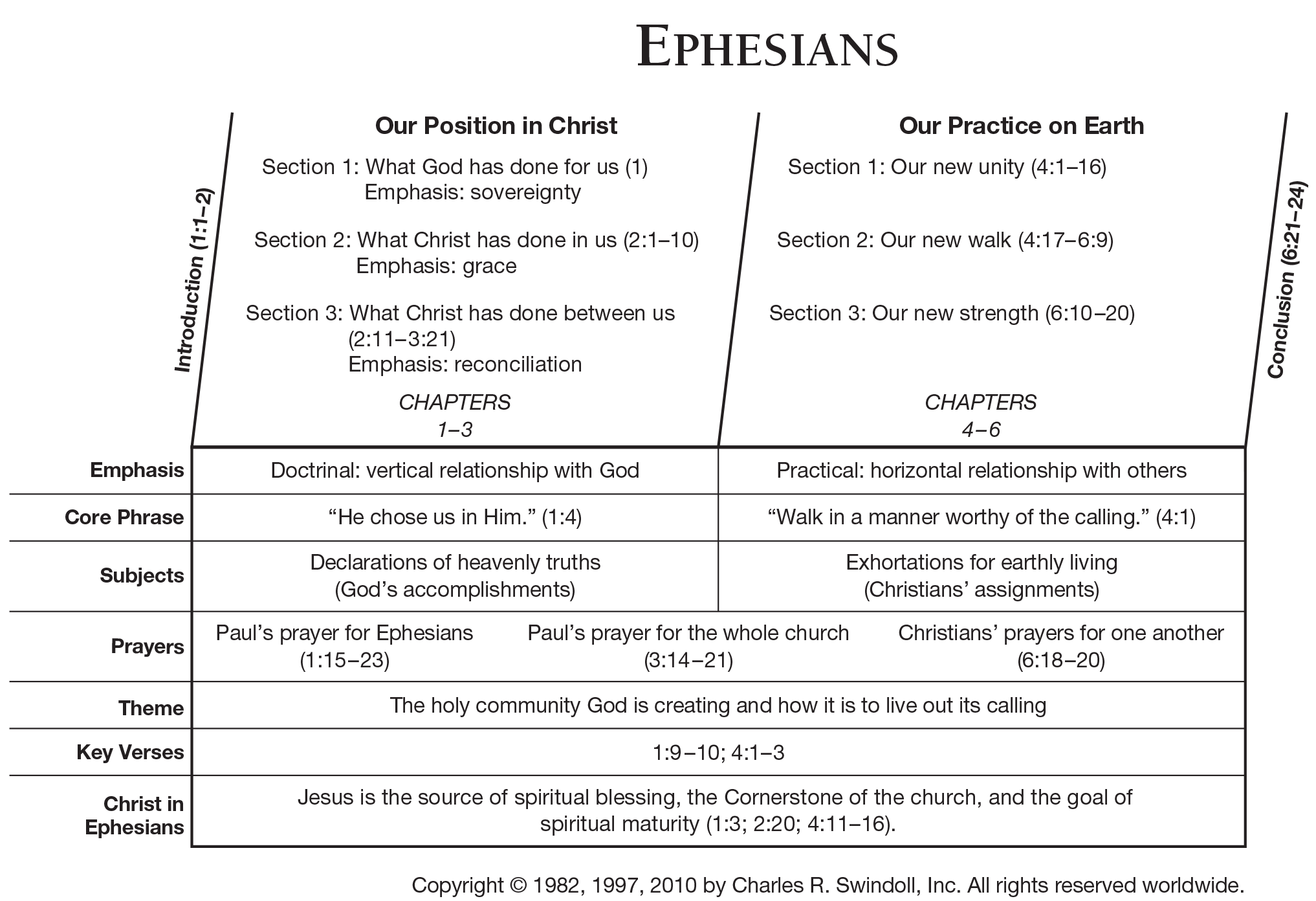
EPHESIANS - CHRIST AND THE CHURCH
Click chart to enlarge
Charts from Jensen's Survey of the NT - used by permission
Click chart by Charles Swindoll -Note "EMPHASIS" --
Ephesians 1-3 = Doctrinal: vertical relationship with God
Ephesians 4-6 = Practical: horizontal relationship with others
Ephesians 5:5 For this you know with certainty, that no * immoral or impure person or covetous man, who is an idolater, has an inheritance in the kingdom of Christ and God. (NASB: Lockman)
Greek: touto gar iste (2PRAM) ginoskontes (PAPMPN) hoti pas pornos e akathartos e pleonektes, o estin (3SPAI) eidololatres, ouk echei (3SPAI) kleronomian en te basileia tou Christou kai theou
Amplified: For be sure of this: that no person practicing sexual vice or impurity in thought or in life, or one who is covetous [who has lustful desire for the property of others and is greedy for gain]—for he [in effect] is an idolater—has any inheritance in the kingdom of Christ and of God. (Amplified Bible - Lockman)
ESV: For you may be sure of this, that everyone who is sexually immoral or impure, or who is covetous (that is, an idolater), has no inheritance in the kingdom of Christ and God.
NET: For you can be confident of this one thing: that no person who is immoral, impure, or greedy (such a person is an idolater) has any inheritance in the kingdom of Christ and God.
NLT: You can be sure that no immoral, impure, or greedy person will inherit the Kingdom of Christ and of God. For a greedy person is really an idolater who worships the things of this world. (NLT - Tyndale House)
Phillips: For of this much you can be certain: that neither the immoral nor the dirty-minded nor the covetous man (which latter is, in effect, worshipping a false god) has any inheritance in the kingdom of Christ and of God. (Phillips: Touchstone)
Wuest: for this you know absolutely and experientially, that every whoremonger or unclean person or covetous person, who is an idolator, does not have an inheritance in the kingdom of the Christ and of God. (Eerdmans Publishing - used by permission)
Young's Literal: for this ye know, that every whoremonger, or unclean, or covetous person, who is an idolater, hath no inheritance in the reign of the Christ and God.
FOR THIS YOU KNOW WITH CERTAINTY: touto gar iste (2PRAM) ginoskontes (PAPMPN):
- 1 Corinthians 6:9,10; Galatians 5:19,21
- Ephesians 5 Resources - Multiple Sermons and Commentaries
- Ephesians 5:1-4 - Wayne Barber
- Ephesians 5:3-4: Be Imitators of God's Love - 2 - Wayne Barber
- Ephesians 5:3-6 Clean Up Your Act! - Steven Cole
- Ephesians 5:3-7: Walking in Love-2 - John MacArthur
- Ephesians 4:17-5:14 Study Guide (see dropdown menu) - John MacArthur
For (gar) introduces an explanation (see discussion of the great value of disciplining yourself to paus and ponder terms of explanation). As Eadie puts it gar "states a reason, and an awful and solemn one it is."
This (3778) (touto) makes reference to an entity regarded as a part of the discourse setting, in this case the vices just mentioned.
You know with certainty - is actually two verbs, the first (eido) means absolute, positive, beyond a peradventure of a doubt, knowledge and the second (ginosko) referring to experiential knowledge. What Paul is doing is reminding these Gentiles believers that they are absolutely convinced of the truth of the solemn conclusion he is about to state, a statement that speaks of one's eternal destiny as it relates to one's behavior. He is not trying to show that one's bad behavior causes them to be lost forever but that a lifestyle of unrighteous, unholy behavior is a reflection that one was never created as a new man in righteousness and holiness of the truth. Paul wants to make sure using this unusual Greek construction of two verbs both of which speak of knowing, that his readers are absolutely sure of what he is about to write!
THOUGHT - And dear reader, you (and I) too need to be absolutely sure! Do not be deceived (Gal 6:7-8+). If there has never been a significant behavioral change in your life (a desire for holiness, for the things of God, for His Word -- NOT perfection, but at least a change in the general direction of your life and lifestyle), then (if there is not holy yearning) there is reason to seriously consider whether you have truly been regenerated by the Holy Spirit, whether you have truly been born again, whether you are indeed a new creation in Christ (cf 2 Cor 5:17-note, 2 Cor 13:5-note).
Wuest attempts to bring out Paul's use of two verbs "for this you know absolutely (iste) and experientially (ginoskontes). (Eerdmans Publishing - used by permission)
Know (1097) (ginosko from gnosis = knowledge) conveys the basic meaning of taking in knowledge in regard to something or someone, knowledge that goes beyond the merely factual. The present tense conveys the sense of continually knowing.
Know (1492) (eido) means knowing beyond a shadow of a doubt. The perfect tense indicates that this is to be the abiding state of their knowledge. The mood of this verb is in the form of an imperative or command which is very difficult to translate into English. In sum, this verb in the perfect imperative means the truth Paul is getting ready to explain is something his readers need to be permanently absolutely, irrevocably certain about. They have come out the lifestyle he is going to describe and he does not want them to forget where that lifestyle is headed in regard to one's eternal destiny!
The Amplified Version probably conveys the sense of the imperative mood better than the NAS...
For be sure of this (Comment: The idea is you {plural} need to know of a surety or to know beyond a shadow of a doubt. This is important!)
Here is my paraphrase in an attempt to translate both verbs that relate to knowing...
For be absolutely sure and certain (command) of this (what he states in last part of verse), knowing from your own experience...
This truth was not to slip from their minds (nor from ours dear brother or sister in Christ)! They knew what Paul explains in the next section from their own direct personal experience. As Paul reminded them earlier in this letter, they had all
formerly walked according to the course of this world, according to the prince of the power of the air, of the spirit that is now working in the sons of disobedience. Among them we too all formerly lived in the lusts of our flesh, indulging the desires of the flesh and of the mind, and were by nature children of wrath, even as the rest. (See notes Ephesians 2:2; 2:3)
How were they to know with certainty that these things were wrong? Because in every man's fallen state in Adam (whether they had access to the Law or not) there is a moral compass, a God given conscience by which God has made Himself evident within them (Ro 1:19-note) and which causes all men to know that the practice of evil things is deserving of death (Ro 1:32-note, cp Ro 2:14,15-note). As believers who had been taught by Paul when he pastored the church in Ephesus, they undoubtedly also knew the truth that
the one who sows to his own flesh shall from the flesh reap corruption, but the one who sows to the Spirit shall from the Spirit reap eternal life. (Gal 6:8)
Barnes adds that Paul is saying...
Be assured of this. The object here is, to deter from indulgence in those vices by the solemn assurance that no one who committed them (Ed note: as a lifestyle) could possibly be saved. (Albert Barnes. Barnes NT Commentary).
THAT NO IMMORAL OR IMPURE PERSON: hoti pas pornos e akathartos:
- Eph 5:3; Hebrews 13:4
- 1 Corinthians 6:9,10; Galatians 5:19,21
- Ephesians 5 Resources - Multiple Sermons and Commentaries
- Ephesians 5:1-4 - Wayne Barber
- Ephesians 5:3-4: Be Imitators of God's Love - 2 - Wayne Barber
- Ephesians 5:3-6 Clean Up Your Act! - Steven Cole
- Ephesians 5:3-7: Walking in Love-2 - John MacArthur
- Ephesians 4:17-5:14 Study Guide (see dropdown menu) - John MacArthur
THE DANGER AND DECEITFULNESS OF
IMMORALITY AND IMPURITY!
That - Be alert and interrogate this strategic word when it is used as a term of purpose or result (e.g., so that, in order that, that, as a result)
No immoral - This is more literally "all immoral." Literally this reads "for this ye know, that every whoremonger, or unclean, or covetous person, who is an idolater, hath no inheritance in the reign of the Christ and God." (Young's) -- Notice that the literal Greek places the "no" before inheritance, whereas the NAS has placed it before "immoral". And by the way, the no is not the Greek negative "me" but is "ou" which speaks of absolutely negation - "absolutely NO inheritance." Beloved, this is Paul's euphemistic way (if you will) of saying these individuals are going to spend their eternity in geenna, the Lake of fire! Very likely you like me are taken aback by this statement. Why? Because we live in a 21st century world literally flooded with "porn," even in routine television advertisements, so frankly, as a believer, it is very easy to "slip up" every now and then. This is not to give any believer an excuse, for sin is still sin and that one sin that one slip up would be sufficient to warrant us spending eternity in hell. That is where the once for all, fully sufficient sacrifice of Jesus for all sins, past, present and future is good news of the Gospel. Now when we "slip up" (sin), we must be quick to confess and repent. What Paul is speaking of is those individuals who may have "professed" to believe in Christ, but they have never truly been regenerated and made new creatures in Christ. They are still "old creatures" in Adam, with a shellacking or veneer or charade of "Christ." They are deceived by their sin (Heb 3:12-13-note), and duped into believing they have a "holy" "fire insurance policy!" They are among the those to whom Jesus gave one of His most frightening warnings in Mt 7:21-23-note! So this begs the question, dear reader, if you took stock of your life, of where your eyes have gone this past week, month or year, would you describe you life as one which is generally "upward," generally pursuing God, Jesus, life in the Spirit, the Gospel, even in the midst of occasional "steps backward." If that is you, then dear reader, you are in the Kingdom and will not be "excommunicated" because you are firmly and forever in Christ, and He (alone) is your righteousness before the Father, now and throughout eternity. Yes, you may struggle with sin. Every believer does, to one degree or another, of one type of sin or another. (see Gal 5:17-note)
Jon Courson makes a strong statement declaring that "Paul says your heart tells you and your spirit confirms that if you are a whoremonger—if you are delighted by and caught up in pornography—you are not part of the kingdom. You can come to church every time we meet; you can show up every time the doors are open. But if you are involved in this stuff—if this is your idol, if this is what you’re living for—you’re not saved. (Courson, J. Jon Courson's Application Commentary. Nashville, TN: Thomas Nelson) (Bolding added)
Wuest says pornos is "a man who prostitutes his body to another’s lust for hire, a male prostitute, a man who indulges in unlawful sexual intercourse, a fornicator. (Wuest Word Studies - Eerdman Publishing Company Volume 1, Volume 2, Volume 3 - used by permission)
Immoral (4205) (pornos from pernáo = sell in turn from peráō = to pass thru, as a merchant would do, passing thru and then coming to mean to sell) (see also study of related word porneia) means a fornicator, one who is sexually immoral or who commits sexual immorality. Pornos originally meant a "male prostitute" but came to be used in the universal meaning of "fornicator" or one who engages in sexual immorality, whether a man or a woman. A pornos in secular Greece was a person who prostituted themselves for gain.
Thayer = a man who prostitutes his body to another's lust for hire, a male prostitute, (Aristophanes), Xenophon, Demosthenes, Aeschines, Lucian); universally, a man who indulges in unlawful sexual intercourse, a fornicator (Vulgate fornicator, fornicarius (Rev. 22:15 impudicus).
The KJV translates pornos as “whoremonger”, which describes one who consorts with whores (a lecher). One can carry on the life of a "whoremonger" in "private" on the internet's plethora of sleazy porn sites, in filthy magazines at the newsstand (or even at the checkout stand at the grocery store!), or at the movies (unfortunately even PG Rated can be contaminated with pornos). In our local cable listings in Austin, Texas (Summer, 2008) there are some 5-10 channels devoted solely to pornography (I don't subscribe to any of them by the way). America is in very serious trouble beloved. Let us pray for revival (2Chr 7:13,14, 6:37, 38, 39)
Here are the 10 uses of pornos in the NT - 1Cor 5:9, 10, 11; 6:9; Eph. 5:5-note; 1Ti 1:10; describing Esau = Heb 12:16-note; describing those who defile the marriage bed = Heb 13:4-note; describing those who will not be in heaven = Rev 21:8-note; Re 22:15-note. The NAS translates pornos as fornicators(2), immoral(2), immoral men(1), immoral people(2), immoral person(1), immoral persons(2). The KJV as noted translates pornos with the word whoremonger (5 times). Pornos is not found in the non-apocryphal Septuagint.
NIDNTT has this note on the classical Greek uses of this word group...
CL porneuo from pernemi (to sell) (Hdt. onwards), means trans. to prostitute. It is usually in the pass. of the woman: to prostitute oneself, become a prostitute. But it is also used of the man, to whore, to fornicate. Derivations include (a) porne (Aristot. onwards), a woman who is for sale, a prostitute, courtesan; (b) pornos (likewise Aristot. onwards), the fornicator who has sexual intercourse with prostitutes, but then also an immoral man, i.e. one who allows himself to be misused for immoral purposes for money, a male prostitute; and (c) porneia (Dem. onwards, rare in cl. Gk) harlotry, unchastity (also of a homosexual nature).
According to G. van der Leeuw, “the instincts of sex and hunger are the two great impelling factors whereby the will climbs to power and even rises to heaven; in the face of these the consciousness of impotence collapses. Food and drink on the one hand, and on the other sexual intercourse, are therefore not merely the two outstanding symbols of community with the god, but are also the means wherewith human potency sets to work” (Religion in its Essence and Manifestation, 19642, 230). For this the most varied religious actions and rites are required. These include cultic prostitution as part of the ancient fertility rites. It was believed that performance of sexual intercourse in the sanctuary would ensure the fertility of everything living in the land and prevent the loss of the procreative and generative faculties. Evidence of cultic prostitution is first found in Babylon. Hdt. recounts that once in her life every Babylonian woman had to “sacrifice” herself to the goddess Mylitta by giving her body to a stranger in the temple precincts (1, 199). Similar customs are attested in other areas, including Cyprus.
In the Gk. world cultic prostitution gained acceptance primarily in the great sanctuaries of Corinth, Eryx and Athens. According to the historian Strabo (8, 378), over a thousand courtesans consecrated to Venus lived in Corinth alone (cf. H. Conzelmann, Korinth und die Mädchen der Aphrodite: zur Religionsgeschichte der Stadt Korinth, 1967). Religious prostitution played a particular role for Israel in the Baal cult. (Brown, Colin, Editor. New International Dictionary of NT Theology. 1986. Zondervan)
Vine in commenting on the use of pornos in the description of Esau in Hebrews 12:16 says that...
the word pornos, fornicator, is not to be limited to the idea of spiritual fornication, it includes the actual sin and all such sensual and lustful practices. Esau’s profanity consisted not merely in his satisfying his immediate desires and abandoning his birthright, but in treating the holy privileges of the patriarchal family, the priesthood, and the title to the land, and the ancestorship of the Messiah, as of no value compared with the satisfaction of a natural hunger of the moment (“one mess of meat”). The warning is against renouncing our privileges and duty and “the recompense of the inheritance” in order to enjoy an indulgence of the flesh or the pleasures of the world. That is profanity as here described. (Vine, W E: Vine's Complete Expository Dictionary of Old and New Testament Words. 1996. Nelson)
One thing that Paul is teaching in this section of Ephesians is that "sexuality is a key revealer of a person's heart (Eph 5:3, 4, 5, 6, 7). In the Sermon on the Mount, Christ declares sexuality to be an issue of the heart, "Whoever looks at a woman to lust for her has already committed adultery with her in his heart" (Mt 5:28-note). It is not enough to say, "Because I have not physically committed adultery, therefore I am pure," for lust itself breaks the command against committing adultery. There is another way of saying this: A person's behavior in the area of sex is a key revealer of what is ruling his heart. Paul states it very plainly in Ephesians 5:5: the sexually immoral person is an idolater. Sex always involves the thoughts, motives, desires, demands, expectations, treasures, or idols of the heart. When we deal with sexual sin, it is not enough to simply avoid committing acts of physical immorality. We must uncover the heart sins that acts of physical immorality reveal. (Paul David Tripp)
Impure (169) (akathartos from a = without + kathaíro = cleanse from katharos = clean, pure, free from the adhesion of anything that soils, adulterates, corrupts, in an ethical sense, free from corrupt desire, sin, and guilt) (See study of related word akatharsia) in a moral sense refers to that which is unclean in thought, word, and deed. It can describe a state of moral impurity, especially especially sexual sin (cf Rev 17:4+) and the word foul is an excellent rendering. The idea is that which is morally indecent or filthy. It is notable that every use of akathartos in the Gospels (19x out of 30 total NT uses) is applied to filthy demonic spirits! As noted below, all of the uses of akathartos in the Gospels refer to unclean spirits or demons. In Acts 5:16+ Luke describes "those afflicted with unclean spirits" who were healed (see Acts 8:7). In Scripture, akathartos pertains to that which may not come into contact with that which is holy and set apart. (Acts 10:14, 28+, Acts 11:8+ - these passages refer to acting in accordance with the Levitical laws - see all the uses below in Leviticus) In the Septuagint akathartos refers almost universally to ceremonial uncleanness or to whatever (or whomever) is ritually defiled .
There are 32 uses of akathartos in the NT - impure person(1), unclean(29), unclean things(1). The KJV translates it as unclean 28, foul 2. As noted above EVERY use in the Gospels refers to demons! Does this give us a clue as to what kind of fiery missiles Satan and his minions will shoot at our minds?! (Eph 6:16+)
Mt. 10:1; 12:43; Mk. 1:23, 26, 27; Mk 3:11, 30; 5:2, 8, 13; 6:7; 7:25; 9:25 (All uses in Gospels = unclean spirits = demons); Lk. 4:33, 36; 6:18; 8:29; 9:42; 11:24; Acts 5:16; 8:7; 10:14, 28; 11:8; 1 Co. 7:14; 2 Co. 6:17; Eph. 5:5; Rev. 16:13; 17:4; 18:2.
2 Corinthians 6:17 “Therefore, COME OUT FROM THEIR MIDST AND BE SEPARATE,” says the Lord. “AND DO NOT TOUCH WHAT IS UNCLEAN; And I will welcome you.
Comment - Paul says to "touch no unclean thing" and in context refers primarily to those things that relate in some way to idolatry which defiles everything it touches and was a common practice among the pagans in Corinth and was part of the "baggage" that many if not most of the Gentile believers brought with them into the church body.
There are 122 uses of akathartos in the Septuagint (LXX)-
Lev. 5:2+; Lev 7:19, 21; Lev 10:10; Lev 11:4, 5, 6, 24, 25, 26, 31, 32, 33, 38, 39, 40, 43, 47; Lev 12:2, 4, 5; Lev 13:11, 15, 36, 45, 46, 51, 55; 14:19, 36, 40f, 44, 45, 57; Lev 15:2, 4, 5, 6, 16, 17, 18; 17:15; Lev 20:25; Lev 22:5, 6; Lev 27:11, 27; Nu 5:2; 9:6, 7, 10; Nu 18:15; 19:7, 8, 10, 11, 13, 14, 19, 20, 21; Deut 12:15, 22; 14:7, 8, 10, 19; 15:22; 26:14; Jdg. 13:4, 7, 14; 2Chr 23:19; Job 15:16; Pr 3:32; 16:5; 17:15; 20:10; 21:15; Eccl 9:2; Isa 6:5; 35:8; 52:1, 11; 64:6; Lam 4:15; Ezek 4:13; 22:5, 26; 24:14; 44:23; Ho 8:13; 9:3; Amos 7:17; Zech 13:2
The related term akatharsia refers to filth or refuse! Akatharsia figuratively describes a filthiness of heart and mind (so it is internal) that makes the person defiled. The unclean person sees dirt in everything. The word akatharsia suggests especially that it defiles its participants, making them unusable for sacred purpose. While akatharsia includes sexual sin, it comes from a wider Septuagint (Greek translation of the Hebrew OT) usage where “unclean” could refer to anything that made a person unfit to go to the temple and appear before God. In a medical sense Hippocrates used this word akatharsia to describe an infected, oozing wound with pus and crusty impurities that gather around the sore or wound. What is “impure” is filthy and repulsive, especially to God. Akatharsia was a general term often used of decaying matter, like the contents of a grave. In short akatharsia describes any excessive behavior or lack of restraint and speaks more of an internal disposition. Immoral filthiness is on the inside whereas the lawless acts of ''immorality'' are on the outside.
William Barclay writes that the related word akatharsia means...
everything which would unfit a man to enter into God’s presence. It describes the life muddied with wallowing in the world’s ways. Kipling prayed
“Teach us to rule ourselves always,
Controlled and cleanly night and day.”
Akatharsia is the very opposite of that clean purity...It can be used for the pus of an unclean wound, for a tree that has never been pruned, for material which has never been sifted. In its positive form (katharos, an adjective meaning pure) it is commonly used in housing contracts to describe a house that is left clean and in good condition. But its most suggestive use is that katharos is used of that ceremonial cleanness which entitles a man to approach his gods. Impurity, then, is that which makes a man unfit to come before God, the soiling of life with the things which separate us from him....Jesus used the word to describe the rottenness of decaying bodies in a tomb (Matthew 23:27). The other ten times the word is used in the New Testament it is associated with sexual sin. It refers to immoral thoughts, passions, ideas, fantasies, and every other form of sexual corruption." (Ephesians 5 Commentary) (Bolding added)
The root word group (katharos, katharizo, kathairo, katharotes) from which this adjective is derived describes physical, religious, and moral cleanness or purity in such senses as clean, free from stains or shame, and free from adulteration. The word group originally meant clean in a physical sense as opposed to rhuparos which meant dirty (e.g. pure, clean water, Eur. Hippolytus 209), then clean, in the sense of free, without things which come between, as opposed to pleres or mestos, full and then ritually clean, as opposed to akathartos, unclean and in a religious sense, morally pure.
NIDNTT - The negative terms formed by the addition of alpha-privative, i.e the adj. akathartos and the noun akatharsia, refer to the whole realm of uncleanness, ranging from menstruation to moral pollution through wrongdoing (Brown, Colin, Editor. New International Dictionary of NT Theology. 1986. Zondervan).
TDNT writes that in secular Greek "At its primitive stage Greek religion follows the customary pattern. At the historical stage, however, the gods are seen as friendly forces, though they must be approached with cultic purity. Rules are thus devised to ward off what is demonic and to protect the holy nature of the gods. These rules are primarily cultic but in personal religion, and especially in philosophy, a sublimation takes place which affects the cultic sphere too. Moral purity as well as ritual purity is demanded in the approach to deity. The Old Testament reflects the same general development. Uncleanness, which may be contracted in contact with birth or death (Lev 12:2, 4, 5,etc, Nu 19:11) is a positive defiling force. So is anything linked to a foreign cult. Animals formerly devoted to deities are disqualified. Hygiene, of course, plays a role (Lev 11:29, 30). Stress also falls, however, on the holiness of God, so that the concept of purity develops with special force. Purifications by washing, sacrifice, or transfer restore forfeited purity and open up access to God. As God's holiness has moral content, ritual purity symbolizes moral purity. The prophets emphasize this aspect even to the point of castigating purely ritual conceptions, though not of totally rejecting them. Some groups in later Judaism tend to the opposite extreme, but Hellenistic Judaism (cf. Philo) strongly spiritualizes the older cultic concept. The cultic rules of cleansing are upheld, but their significance is primarily symbolical; moral purity is what God requires. [F. HAUCK, III, 413-17] (Kittel, G., Friedrich, G., & Bromiley, G. W. Theological Dictionary of the New Testament. Eerdmans)
- Clean, Cleanness - Holman Bible Dictionary
- Impurity - Cyclopedia of Biblical, Theological and Ecclesiastical Literature
- Clean, Unclean - Baker's Evangelical
- Hastings' Dictionary of the Bible Clean and Unclean Unclean, Uncleanness
- Hastings' Dictionary of the NT Unclean
- International Standard Bible Encyclopedia Uncleanness
OR COVETOUS MAN, WHO IS AN IDOLATER: e pleonektes, o estin (3SPAI) eidololatres:
- Galatians 5:21; Col 3:5; 1Ti 6:10,17; Re 21:8; 22:15
- 1 Corinthians 6:9,10; Galatians 5:19,21
- Ephesians 5 Resources - Multiple Sermons and Commentaries
- Ephesians 5:1-4 - Wayne Barber
- Ephesians 5:3-4: Be Imitators of God's Love - 2 - Wayne Barber
- Ephesians 5:3-6 Clean Up Your Act! - Steven Cole
- Ephesians 5:3-7: Walking in Love-2 - John MacArthur
- Ephesians 4:17-5:14 Study Guide (see dropdown menu) - John MacArthur
GREED EQUATES
WITH IDOLATRY
In Colossians Paul equates greed with idolatry - Therefore consider the members of your earthly body as dead to immorality, impurity, passion, evil desire, and greed (pleonexia), which amounts to idolatry. (Col 3:5+) This is an association not to be taken lightly for idolatry is one of the sins that will keep a soul outside of Heaven as John describes in Revelation 21:8+ and Revelation 22:15+!
Covetous (4123) (pleonektes from pleonekteo = to be covetous in turn from pleíon = more + écho = have) describes one who is "grasping", one who wants more, one who is always eager for more and especially for what belongs to someone else. Greedy for gain. One who desires to have more than is due.
There are only 4 uses in the NT -
1 Corinthians 5:10 I did not at all mean with the immoral people of this world, or with the covetous and swindlers, or with idolaters; for then you would have to go out of the world.
1 Corinthians 5:11 But actually, I wrote to you not to associate with any so-called brother if he should be an immoral person, or covetous, or an idolater, or a reviler, or a drunkard, or a swindler-- not even to eat with such a one.
1 Corinthians 6:10 nor thieves, nor the covetous, nor drunkards, nor revilers, nor swindlers, shall inherit the kingdom of God.
Ephesians 5:5 For this you know with certainty, that no immoral or impure person or covetous man, who is an idolater, has an inheritance in the kingdom of Christ and God.
- Covetousness - Baker's Evangelical Dictionary of Biblical Theology
- Torrey Topical Textbook Covetousness
- Easton's Bible Dictionary Covetousness
- Holman Bible Dictionary Covet, Covetous
- Hastings' Dictionary of the Bible Cove tousness
- Hastings' Dictionary of the NT Covetousness
- International Standard Bible Encyclopedia Covetousness
- McClintock and Strong's Bible Encyclopedia Covetousness (2) Covetousness
- The Jewish Encyclopedia Covetousness
The Greeks defined pleonektes as “the spirit which is always reaching after more and grabbing that to which it has no right.” It is aggressive getting. It is not the miser’s spirit, for it aimed to get in order to spend, so that it could live in more luxury and greater pleasure and it cared not over whom it took advantage so long as it could get.
Morris writes that here is...
Another surprising revelation is that a "covetous man" is equivalent to an "idolater." In fact, "Thou shalt not covet" is the last of God's ten commandments (Ex 20:17), whereas the first two are commands against idolatry (Ex 20:3, 4, 5). Covetousness, in God's sight, is equivalent to the worship of the creation rather than the Creator (Ro 1:25-note), the same as the worship of other aspects of nature as personified in various gods and goddesses. The god of money and material things is mammon, and Jesus stressed that "ye cannot serve God and mammon" (Mt 6:24-note). (Morris, Henry: Defenders Study Bible. World Publishing)
This verse says essentially the same thing Paul wrote to the Colossians
Therefore consider the members of your earthly body as dead to immorality, impurity, passion, evil desire, and greed, which amounts (is) to idolatry (Col 3:5-note) (Comment: A greedy person is an idolater because he puts things before God cp note for similar idea where Jesus explains worship of God versus Mammon in Mt 6:24-note).
Who is an idolater? Do not think one has to bow to a piece of wood or a carved stone to be an idolater? As Eadie writes "The covetous man makes a god of his possessions, and offers to them the entire homage of his heart (Ed: which describes an idolater!) That world of which the love and worship fill his nature, is his god, for whose sake he rises up early and sits up late. The phrase...means, that the covetous man deifying the world rejects the true Jehovah. Job 8:13; Mt 6:24. (Ephesians 5 Commentary)
Idolater (1496)(eidololatres from eidolon = idol, image, a phantom or likeness [from eidos = form, appearance, literally that which is seen from eido = to see] + látris = servant, worshiper) (see study of eidololatreia) (See multiple Bile dictionary articles on idolatry) is literally an image worshipper or one who serves idols or images representative of false gods.
Idolatry is the worship of something created which is in direct opposition to the worship of the Creator Himself. Ultimately it is placing anything in the place of God, Who alone deserves the right to be number one in our focus. Originally, a physical idol helped visualize the god it represented but later people worshipped the physical object itself (Ro 1:19; 20; 21; 22; 23 see notes Ro 1:19; 20; 21; 22; 23).
- Idol, Idolatry - Baker's Evangelical Dictionary of Biblical Theology
- Idolatry - International Standard Bible Encyclopedia
- International Standard Bible Encyclopedia Idolatry
- Kitto Biblical Cyclopedia Idolatry
- McClintock and Strong's Bible Encyclopedia Idolatry
Eerdman's explains idolatry - In the Old Testament, the worship of gods other than Yahweh, especially through images representing them. The New Testament extends the concept to include any ultimate confidence in something other than God, e.g., covetousness, surrender to appetites (see Eph 5:5-note; Php 3:19-note; Col 3:5-note; cf. "two masters " - Mt 6:24 -note; 1Sa 15:23). (Myers, A. C.. The Eerdmans Bible dictionary. Grand Rapids, Mich.: Eerdmans) (')
Morris has an interesting note on the meaning of idols writing that they "are either physical images or mental constructs with which men try to explain and control the forces and systems of nature without acknowledging the one true God as Creator and Sustainer of all things. Paganism, with its pantheism and polytheism, worshipping the various forces and systems of nature personified as Mother Earth with all her other personifications as various gods and goddesses, was rife in John's day and, through various forms of evolutionism, has always been arrayed in opposition to the true God of creation and redemption. This is more true today than ever before, and it is absolutely vital that true Christians should refrain from all forms of idolatry, whether rationalistic humanism, economic materialism, or New Age pantheism--all of which are founded on an evolutionary world view. (Morris, Henry: Defenders Study Bible. World Publishing)
Unger adds that...
Idolatry may be classified as follows: (1) the worship of inanimate objects, such as stones, trees, rivers, etc.; (2) of animals; (3) of the higher powers of nature, such as the sun, moon, stars; and the forces of nature, as air, fire, etc.; (4) hero-worship or of deceased ancestors; (5) idealism, or the worship of abstractions or mental qualities, such as justice.
Another classification is suggestive: (1) the worship of Jehovah under image or symbol; (2) the worship of other gods under image or symbol; (3) the worship of the image or symbol itself. Each of these forms of idolatry had its peculiar immoral tendency. (Unger, M. F., Harrison, R. K., Vos, H. F., Barber, C. J., & Unger, M. F. The New Unger's Bible Dictionary. Chicago: Moody Press)
We need to be ever vigilant against the flesh's attraction to idols even in the area of "religion" as sadly illustrated by the trap Israel fell into with the bronze serpent episode...
Then (after the people cried out because they were dying from snake bites) the LORD said to Moses, "Make a fiery serpent, and set it on a standard; and it shall come about, that everyone who is bitten, when he looks at it, he shall live." And Moses made a bronze serpent and set it on the standard; and it came about, that if a serpent bit any man, when he looked to the bronze serpent, he lived. (Numbers 21:8,9)
Comment: During the period of the wilderness wanderings, Israel murmured against the Lord. As a disciplinary measure, God sent “fiery serpents” among them (Nu 21:5-9). When the stricken people imploringly turned to Moses, he at the command of God, made a BRONZE SERPENT, a replica of the viper with the stinging, deadly bite which had already bitten them.
This standard over time (the details are not in Scripture) degenerated into the idolatrous practice of BRONZE SERPENT WORSHIP which persisted to the time of King Hezekiah (729-686 BC, some 700-800 years after the episode in Numbers!) as recorded in Second Kings...
He (King Hezekiah) removed the high places and broke down the sacred pillars and cut down the Asherah. He also broke in pieces the bronze (nechosheth) serpent (nahas/nachash) that Moses had made, for until those days the sons of Israel burned incense to it; and it was called Nehushtan (Hebrew means "a mere piece of brass" which appears to be a play on the word nahas/nachash = serpent). (2 Kings 18:4)
What was originally a symbol of sin judged and salvation given (Jesus made reference to and application of the serpent episode to the salvation through Himself - see John 3:14 - see study of typology), was perverted into an idol for the practice of idolatry. The flesh is incorrigible and if it won't worship the Creator, it will end up worshipping the creation (study Romans 1, beginning in Romans 1:18ff [see notes]) As we walk by and are led by the Spirit, we must continually choose to heed the NT imperatives to guard and to flee from seductive idols which are an abomination to God.
Vine explains that "Heathen sacrifices were sacrificed to demons, 1Co 10:19; there was a dire reality in the cup and table of demons and in the involved communion with demons. In Romans 1:22; 23; 24; 25 (see notes), idolatry, the sin of the mind against God (see Eph 2:3 -note), and immorality, sins of the flesh, are associated, and are traced to lack of the acknowledgment of God and of gratitude to Him. An “idolater” is a slave to the depraved ideas his idols represent, Gal. 4:8, 9; and thereby, to divers lusts, Titus 3:3 (see note) (Vine's Complete Expository Dictionary of Old and New Testament Words. 1996. Nelson)
Vincent reiterates that the "New Testament usage (of eidololatres) does not confine the term to the worship of images, but extends it to the soul’s devotion to any object which usurps the place of God. (Ephesians 5 Word Studies)
As alluded to at the beginning of this note, Paul explains in Colossians that greed or covetousness is synonymous with idolatry because it places selfish desire above obedience to God. Note that covetousness is the root cause of all sin, because when people sin, it is basically people doing what they desire, rather than what God desires. This in turn amounts to worship of self rather than worship of God, and this is the very essence of idolatry! The great Puritan writer Stephen Charnock spared no words in describing it this way...
All sin is founded in a secret atheism.… All the wicked inclination sin the heart… are sparks from this latent fire; the language of everyone of these is, “I would be a Lord to myself, and would not have a God superior to me.”… In sins of omission we own not God, in neglecting to perform what He enjoins; in sins of commission we set up some lust in the place of God, and pay to that the homage which is due to our Maker.… We deny His sovereignty when we violate His laws… Every sin invades the rights of God, and strips Him of one or other of His perfections.… Every sin is a kind of cursing God in the heart; an aim at the destruction of the being of God; not actually, but virtually… A man in every sin aims to set up his own will as his rule, and his own glory as the end of his actions against the will and glory of God. (from his book The Existence and Attributes of God) (Bolding added)
There are 7 uses of eidololatres in the NT (and surprisingly none in the Septuagint)--
1 Corinthians 5:10 I did not at all mean with the immoral people of this world, or with the covetous and swindlers, or with idolaters; for then you would have to go out of the world.
1 Corinthians 5:11 But actually, I wrote to you not to associate with any so-called brother if he should be an immoral person, or covetous, or an idolater, or a reviler, or a drunkard, or a swindler-- not even to eat with such a one.
1 Corinthians 6:9 Or do you not know that the unrighteous shall not inherit the kingdom of God? Do not be deceived; neither fornicators, nor idolaters, nor adulterers, nor effeminate, nor homosexuals,
1 Corinthians 10:7 And do not be idolaters, as some of them were; as it is written, "The people sat down to eat and drink, and stood up to play."
Ephesians 5:5 For this you know with certainty, that no immoral or impure person or covetous man, who is an idolater, has an inheritance in the kingdom of Christ and God.
Revelation 21:8 "But for the cowardly and unbelieving and abominable and murderers and immoral persons and sorcerers and idolaters and all liars, their part will be in the lake that burns with fire and brimstone, which is the second death."
Revelation 22:15 Outside are the dogs and the sorcerers and the immoral persons and the murderers and the idolaters, and everyone who loves and practices lying.
HAS AN INHERITANCE IN THE KINGDOM OF CHRIST AND GOD: ouk echei (3SPAI) kleronomian en te basileia tou Christou kai theou:
- 1 Corinthians 6:9,10; Galatians 5:19,21
- Ephesians 5 Resources - Multiple Sermons and Commentaries
- Ephesians 5:1-4 - Wayne Barber
- Ephesians 5:3-4: Be Imitators of God's Love - 2 - Wayne Barber
- Ephesians 5:3-6 Clean Up Your Act! - Steven Cole
- Ephesians 5:3-7: Walking in Love-2 - John MacArthur
- Ephesians 4:17-5:14 Study Guide (see dropdown menu) - John MacArthur
Literally this reads "hath no inheritance in the reign of the Christ and God" (Young's) - The NAS places the no before "immoral."
Eadie comments that this man (previously described) “has no inheritance," and shall or can have none; the present stating a fact, or law unalterably determined." (Ephesians 5 Commentary)
Has an inheritance in the kingdom of Christ and God - Clearly Paul is warning that those who have a lifestyle characterized by the sins just listed are lost, still dead in their sins (Eph 2:1) and on the way to the Lake of fire (Rev 20:10, 14, 15+, Mt 25:41, 46) and eternal separation from God (2Th 1:9, cp Mt 22:13, Jude 1:13). The kingdom in simple terms is where Christ and God rule as King. Those lives as Paul describes have no part in the present invisible Kingdom (Lk 17:20, 21, 10:9, 10, 11, Mt 12:28, Ro 14:17) nor in the future earthly kingdom of Christ (Rev 20:4, 5, 6+, Mt 25:31,34). Note carefully that Paul is not referring to the Judgment Seat of Christ (bema - 2 Co 5:10+, Ro 14:10+) and loss of rewards (1Co 3:12, 13, 14, 15). The subject is salvation not rewards. They are professors of Christ but lack the power of Christ which would validate them as possessors of Christ. Their lifestyle of sinful conduct discloses their true character as those still in Adam and not those who are by grace through faith now in Christ. Paul is not saying of course that they cannot be saved but that the implication is clear that if the salvation is genuine they will repent of these heinous sins as a lifestyle.
Beware of the teaching that says this passage describes a believer who will not receive rewards. This passage describes a person who will end up in hell and will "inherit" eternal punishment. For more on this topic see the article "Those Who Do Not Inherit The Kingdom . . .Are They Saved or Unsaved?."
J Vernon McGee minces no words making it crystal clear that "It is clearly understood that the unregenerate man who practices these sins has no portion in the kingdom of Christ and God. If a professing Christian practices these sins, he immediately classifies himself. No matter what his testimony may be on Sunday or what position he may have in the church, such a person is saying to the lost world that he is not a child of God. To live in the corruption of the flesh is to place one’s self beyond the pale of a child of God. (McGee, J V: Thru the Bible Commentary: Thomas Nelson)
Has (2192) (echo) is in the present tense which pictures the continuing negative state.
Inheritance (2917) (kleronomia from kleros = lot + némo = hold, have in one’s power, distribute) (see study of related Kleronomos) is originally a portion which one receives by lot in a general distribution. In the NT the idea of chance attaching to the lot is eliminated. It is the portion or heritage which one receives by virtue of birth or by special gift from someone who has died (Lk 12:13). In a figurative sense, kleronomia refers to God's promised gifts as our inheritance (which is the use in Eph 5:5). (See dictionary discussion of Inheritance)
Thayer summarizes kleronomia as (1) an inheritance, property received (or to be received) by inheritance, or (2) what is given to one as a possession.
NIDNTT says that in classical Greek...
kleros is derived from klao, break. In the first instance it means a lot. Used from Homer on it meant originally the fragment of stone or piece of wood which was used as a lot. Lots were drawn to discover the will of the gods. Since land was divided by lot, probably in the framework of common use of the fields, kleros came to mean a share, land received by lot, plot of land, and finally inheritance. The vb. belonging to this is kleroo, to draw lots, apportion by lot. Kleronomia compounded from kleros and nemo, allot, is first the activity of dividing by lot, then the portion so divided, the inheritance. The kleronomos is one who has been given a kleros, the inheritor. synkleronomos is a fellow heir, and kleronomeo means be an heir, inherit
What is the difference between kleros and kleronomia (in the context of the uses in the Septuagint)? Sometimes both terms are used interchangeably for nahªlâh (e.g. Nu. 18:23f.; 32:18f.; Josh 17:4; cf. Jdg. 2:9). However, kleros, which meant originally lot, stresses more the individual piece of land allotted by lot, whereas kleronomia points more to the fact of inheritance with all its connotations already mentioned. kleros may be used in the plural, but kleronomia is never so used. kleronomia has the richer associations in the context of salvation history.
Here are the 14 uses of kleronomia in the NT - Mt 21:38; Mk 12:7; Lk 12:13; 20:14; Acts 7:5; 20:32; Gal 3:18; Eph 1:14, 18; 5:5; Col 3:24; Heb 9:15; 11:8; 1Pe 1:4.
Kleronomia is us 150 times in the Septuagint (LXX) -
Ge 31:14; Ex 15:17; Nu 18:20, 23; 24:18; 26:54, 56; 27:7, 8, 9; 32:18; 34:2; 35:8; 36:2, 3, 4, 7, 8, 9, 12; Deut 2:12; 3:20; 12:9; 19:14; 32:9; 33:4; Jos 1:15; 11:23; 12:6; 13:1, 7, 14, 23, 28; 15:20; 16:5, 8, 9; 17:4; 18:7, 20, 28; 19:1, 8, 9, 10, 16, 23, 31, 39, 47; Jdg. 2:6, 9; 18:1; 20:6; 21:17, 23, 24; Ru 4:5, 6, 10; 1Sa 10:1; 26:19; 2Sa 14:16; 20:1, 19; 21:3; 1Ki 8:12, 36, 51; 12:16, 24; 21:3, 6; 2Ki 21:14; 1Chr 16:18; 21:12; 2Chr 6:27; 10:16; 20:11; 31:1; Esther 4:17; 10:3; Job 31:2; 42:15; Ps 2:8; 16:5f; 28:9; 33:12; 37:18; 47:4; 61:5; 68:9; 74:2; 78:62, 71; 79:1; 94:5, 14; 105:11; 106:5, 40; 111:6; 127:3; 135:12; 136:21, 22; Is 17:14; 19:25; 47:6; 49:8; 54:17; 58:14; 63:17; Je 2:7; 3:19; 10:16; 12:7, 8, 9, 14, 15; 16:18; 50:11; 51:19; La 5:2; Ezek 11:15; 25:4, 10; 44:28; 45:1; 46:16, 17, 18; 47:14, 22, 23; 48:28; Joel 2:17; 3:2; Mic 1:14, 15; 2:2; 7:14, 18; Zech 4:7; Mal. 1:3
- Inheritance - Hastings' Dictionary of the New Testament
- Baker Evangelical Dictionary Inheritance
- Holman Bible Dictionary Inheritance
- Hastings' Dictionary of the Bible Inheritance
- Hastings' Dictionary of the NT Inheritance
- International Standard Bible Encyclopedia Inheritance
- Kitto Biblical Cyclopedia Inheritance
- McClintock and Strong's Bible Encyclopedia Inheritance
- The Jewish Encyclopedia Inheritance
Nave's Topic on Inheritance has the following Scriptural cross references
INHERITANCE
Provisions for inheritance under Levirate marriages,
- Ge. 38:7-11; Num. 36:6-9; Deut. 25:5-10; Ruth 3:1-8; 4:7-17.
Unclassified Scriptures Relating to
- Ge 15:3; 21:9, 10, 11; 24:36; 25:5, 6; 48:21, 22; Nu. 27:6, 7, 8, 9, 10, 11; Deut. 21:15, 16, 17; 1Ki 21:3; 2 Chr. 21:3; Job 42:15; Pr 17:2; 20:21; Eccl. 2:18, 19; Je 32:6-8; Ezek 46:16-18; Lk 15:12, 25-31; Gal 3:15; Heb 9:16, 17
Figurative
- Ps 37:29; Acts 20:32; Acts 26:18; Ro 8:16, 17; Eph. 1:11, 12, 13, 14; Titus 3:7; Heb. 1:14
Kingdom (932) (basileia from basileus = a sovereign, king, monarch) denotes sovereignty, royal power, dominion and refers therefore to the territory or people over whom a king rules.
The basileia
is the kingdom under the special jurisdiction of its King, and no one can or dare enter without His sanction...That kingdom which begins here, but is fully developed in the heavens, is that of Christ and God...the idea here is, that the inheritance is common to Christ and God...Theos appears to be added, not merely to exhibit the authority by which the exclusion of selfish and covetous men is warranted, but principally to show the righteous doom of the idolater who has chosen a different deity.
The kingdom is named Christ's inasmuch as He secures it, prepares it, holds it for us, and at length conveys us to it; and it is God's as it is His originally, and would have remained His though Christ had never come; for He is in Christ, and Christ's mediation is only the working out of His gracious purposes—God having committed the administration of this kingdom into His hands.
Into Christ's kingdom the fornicator and sensualist cannot come; for, unsanctified and unprepared, they are not susceptible of its spiritual enjoyments, and are filled with antipathy to its unfleshly occupations; and specially into God's kingdom “the covetous man, who is an idolater,” cannot come, for that God is not his god, and disowning the God of the kingdom, he is self-excluded. As his treasure is not there (Mt 6:20, 21-note), so neither there could his heart find satisfaction and repose. (Ephesians 5 Commentary)
The Kingdom of Heaven or Christ and God is the sphere in which God is acknowledged as King (In hearts giving Him obedience). In this sense the Kingdom has a spiritual aspect, a present physical aspect, and a future eternal aspect (beginning with the millennium, cf Mt 25:31,34), all of course depending on the context of the passage in which basileia is found. Paul is careful to remind us that the Kingdom of Heaven/God is not in observance of ordinances, external and material, but in the deeper matters of the heart, which are spiritual and essential (Ro 14:17-note)
Click here to study over 100 uses of the "Kingdom" most of which refer to the Kingdom of Heaven/God.
- See also related discussion on the Kingdom of Heaven
- See Kingdom of God notes on Luke 17:20ff
Paul addressed the same issue in the Corinthian church writing...
Or do you not know that the unrighteous shall not inherit the kingdom of God? Do not be deceived (present imperative with a negative = stop being deceived = some were being deceived!); neither fornicators, nor idolaters, nor adulterers, nor effeminate, nor homosexuals, nor thieves, nor the covetous, nor drunkards, nor revilers, nor swindlers, shall inherit the kingdom of God. And such were some of you; but (praise God) you were washed, but you were sanctified, but you were justified in the name of the Lord Jesus Christ, and in the Spirit of our God. (1Cor 6:9-11).
Comment - To reiterate be aware there is a teaching in some evangelical circles which says this passage (and that in Galatians 5:19-21) describes a believer who will not receive rewards. That is a dangerous teaching as it gives those who have "professed Christ" a license to sin, thinking they have been justified by grace through faith even though there has never been a change in their life or lifestyle as Paul describes in 2 Cor 5:17+! This passage describes an unbeliever who will end up in hell and will "inherit" eternal punishment. For more on this topic see the article "Those Who Do Not Inherit The Kingdom . . .Are They Saved or Unsaved?."
And again Paul gave a similar warning to the Galatians writing...
Now the deeds of the flesh are evident, which are: immorality, impurity, sensuality, 20 idolatry, sorcery, enmities, strife, jealousy, outbursts of anger, disputes, dissensions, factions, 21 envying, drunkenness, carousing, and things like these, of which I forewarn you just as I have forewarned you (he is reminding them of something he had already taught - how prone we are to forget, becoming then so prone to wander! Don't forget this warning beloved of the Father!) that those who practice (prasso = perform repeatedly or habitually - present tense emphasizes this refers to one's lifestyle, not isolated occurrences of these sins. NLT picks up this sense rendering it "anyone living that sort of life will not inherit the Kingdom of God") such things shall not inherit the kingdom of God. (Galatians 5:19-21+)
Josh Black - The true church is not comprised of people who live like this; people who live like this will not inherit the kingdom of God....The Spirit of God not only saves people at conversion, the Spirit of God changes the lives of true believers. The Spirit washed the Corinthian believers, justified them, and also sanctified them (1 Cor 6:9-11). The Spirit who washed us, and justifies us, also sanctifies us. The acts of the sinful nature, as a way of life, make sense for those who are not born again, but not for those who have been washed, justified, and sanctified. Paul says in Philippians 1:6, that “he who began a good work in you will carry it on to completion until the day of Christ Jesus.” The same Spirit that saved us will in fact sanctify us. Those who have truly been born again by the Spirit are new creations and there will be evidence of a new life in them. That doesn’t mean that we won’t still sin, but it does mean that we will grow in Christ-likeness. If there is no evidence of growth in Christ-likeness, but rather evidence that we are living our lives according to our sinful nature, then we have no right to claim we have eternal life. If your outside (the way that you live) shows that your inside (heart) is dominated by desires of the sinful nature, then even though you are inside the church you may in fact be outside of the kingdom of God. (Free At Last!)
You stop chasing sin.
Sin starts chasing you.
Wayne Barber writes that...
when you become a Christian, something changes. You stop chasing sin. Sin starts chasing you. It doesn’t mean you can’t fall in one of those areas, but it means you cannot pursue it and claim to know Jesus Christ. The seed of God inside of you will not let that take place (1Jn 3:4, 5, 6, 7, 8, 10+). You’ve got to remember, when you receive Christ (Jn 1:12, 13+) it is not some religious insurance policy, it is the heart change (2 Co 5:17+, cp Ezek 36:26, 27+, 11:19, 20, Jer 31:31, 32, 33, 34+, Jer 32:39, 40, Gal 6:15). The Spirit of the living God comes inside of you (1 Cor 12:13, Ro 8:9+). That doesn’t mean that person can’t have tendencies and weaknesses and times of wearing the wrong garment and fall back into it and be pulled that way, but he cannot habitually (present tense) pursue it anymore and call himself to be a Christian. (Ephesians 5:6-7: Don't Be Deceived)
S Lewis Johnson explains that Paul is not talking about a single act but a lifestyle...
I’m inclined to think the Apostle is thinking about is not an occasional act, a single act, but what he’s talking about is a certain kind of lifestyle characterized by these things. In other words, the person whose lifestyle is characterized by fornication, he is a fornicator who continually commits the sin of fornication, or an unclean person, if that characterizes his life, or a covetous man, if that characterizes his life, then Paul is saying, he doesn’t have any inheritance in the kingdom of Christ and of God because the fact that his life is totally characterized by these things is an evidence that he doesn’t really have salvation.
Because you see, one of the products of genuine salvation is that we are delivered from the lifestyle that we formerly had (2Co 5:17). We are new creatures in Christ Jesus. And so, when the Apostle writes here he does not have any inheritance in the kingdom of Christ and of God, he seems to me to be saying this person is a lost person. But he’s not lost because of the commission of one act, but he’s lost if these things characterize him, if this is the bent of his life. (Purity in the Christian Life)
D Martyn Lloyd-Jones explains the concept of the kingdom of Christ and God (the third "component" below corresponds to the meaning in Ephesians 5:5) noting that...
It means, in its essence, Christ's rule or the sphere and realm in which He is reigning. It can be considered in three ways as follows. Many times when He was here in the days of His flesh our Lord said that the kingdom of heaven was already present. Wherever He was present and exercising authority, the kingdom of heaven was there. You remember how on one occasion, when they charged Him with casting out devils by the power of Beelzebub, He showed them the utter folly of that, and then went on to say, 'If I cast out devils by the Spirit of God, then the kingdom of God is come unto you' (Matt 12:28). Here is the kingdom of God. His authority, His reign was actually in practice. Then there is His phrase when He said to the Pharisees, 'the kingdom of God is within you, or, 'the kingdom of God is among you' (NAS "is in your midst" Luke 17:21). It was as though He were saying,
It is being manifested in your midst. Don't say "look here" or "look there". Get rid of this materialistic view. I am here amongst you; I am doing things. It is here.
Wherever the reign of Christ is being manifested, the kingdom of God is there. And when He sent out His disciples to preach, He told them to tell the cities which received them not, 'Be ye sure of this, that the kingdom of God is come nigh unto you.' (Luke 10:9, 11, cf Luke 19:11, 21:31)
It means that; but it also means that the kingdom of God is present at this moment in all who are true believers...In writing to the Colossians he gives thanks to the Father 'who hath delivered us from the power of darkness, and hath translated us into the kingdom of his dear Son' (Col 1:13-note). The 'kingdom of his dear Son' is 'the kingdom of God, it is 'the kingdom of heaven', it is this new kingdom into which we have entered. Or, again, in his letter to the Philippians he says, 'Our conversation is in heaven,' or, `Our citizenship is in heaven.' We are here on earth, we obey the powers that be, we live our lives in this way. Yes; but 'our citizenship is in heaven; from whence also we wait for a Saviour' (Php 3:20-note). We who recognize Christ as our Lord, and in whose lives He is reigning and ruling at this moment, are in the kingdom of heaven and the kingdom of heaven is in us. We have been translated into the 'kingdom of his dear Son'; we have become a 'kingdom of priests. (cf 1Pe 2:9, 10-note, Rev 1:6 -note; Rev 5:10 -note)
The third and last way of looking at the kingdom is this. There is a sense in which it is yet to come. It has come; it is coming; it is to come. It was here when He was exercising authority; it is here in us now; and yet it is to come. It will come when this rule and reign of Christ will be established over the whole world even in a physical and material sense. The day is coming when the kingdoms of this world will have become 'the kingdoms of our Lord, and of his Christ, when Jesus shall reign where'er the sun Doth his successive journeys run; His kingdom stretch from shore to shore, Till moons shall wax and wane no more. (Play Isaac Watts precious hymn - Jesus Shall Reign sing it out unto the Lord)
It will then have come, completely and entirely, and everything will be under His dominion and sway. Evil and Satan will be entirely removed; there will be `new heavens and a new earth, wherein dwelleth righteousness' (2Pe 3:13-note), and then the kingdom of heaven will have come in that material way. The spiritual and the material will become one in a sense, and all things will be subject to His sway, that 'at the name of Jesus every knee should bow, of things in heaven, and things in earth, and things under the earth; and that every tongue should confess that Jesus Christ is Lord, to the glory of God the Father' (Php 2:10, 11-note). (Lloyd-Jones, D. M. Studies in the Sermon on the Mount) (Bolding added)
Christ (5547) (Christos from chrio = to anoint, rub with oil, consecrate to an office) is the Anointed One, the Messiah, Christos being the Greek equivalent of the transliterated Hebrew word Messiah.
The Disciple's Study Bible has a sobering note on this verse...
God stands totally opposed to sin. His willingness to forgive sin does not at all mean His laxity towards those who practice sinning. His forgiveness only follows our repentance, our turning from the practice of sin. If we do not turn from our sins, we will face God's wrath. No trickery with words by any preacher or teacher can change that. (Disciple's Study Bible)
Wayne Barber comments on those who do not have an entrance into the kingdom of heaven noting first that the...
word "no" means absolutely none of any kind. They do not have an inheritance in the kingdom of Christ and of God.
What is he saying? If you are habitually living the way he has just described, you do not have an inheritance in the kingdom of God. The argument has popped up recently in circles, can a man be a Christian and be a practicing homosexual? Can a man be a Christian and be a habitually practicing adulterer? No way. Let me show you something. Look at 1 John 3:1-8a and see what you think.
"See how great a love the Father has bestowed upon us, that we should be called children of God; and such we are. For this reason the world does not know us, because it did not know Him. Beloved, now we are children of God, and it has not appeared as yet what we shall be. We know that, when He appears, we shall be like Him, because we shall see Him just as He is. And everyone who has this hope fixed on Him purifies himself, just as He is pure. Everyone who practices sin also practices lawlessness; and sin is lawlessness. And you know that He appeared in order to take away sins; and in Him there is no sin. No one who abides in Him sins [habitually]; no one who sins [habitually] has seen Him or knows Him. Little children, let no one deceive you; the one who practices righteousness is righteous, just as He is righteous; the one who practices sin is of the devil; for the devil has sinned from the beginning."
The purpose of the book of Ephesians is to raise people’s view of salvation.
When you have a low view of salvation, it allows for that view. So when you have a high view of salvation, friend, it cuts it out. There is a brand new life. It doesn’t mean you can’t sin. It doesn’t mean you can’t struggle in an area of sin. It doesn’t mean that you can’t repeat that sin. But you are miserable in the process because the Holy Spirit lives within you. The Holy Spirit is there to convict you and bring you back to the cross to where you can repent and go on and wear that new garment.
Well, we have an old garment and a new garment. But what does I John tells us about the one who habitually wears the old garment? The same thing Ephesians says. He in no way has any inheritance in the kingdom of Christ or of God. If you have struggles with that, go to the Scriptures and see what it teaches you. That is the key. Don’t argue with your experience. Go to see what God’s Word has to say. We need a high view of salvation. Salvation means more than just joining a church. It means that something has happened to us and the nature of God has come into us. His Spirit lives in our lives.
F B Meyer has the following devotional thoughts on our inheritance...
THE SAINTS' INHERITANCE IN GOD. When an emigrant first receives the title-deeds of the broad lands made over to him in the far West, he has no conception, as he descends the steps of the Government office and passes into the crowd, of all that has been conveyed to him in the schedule of parchment. And, though acres vast enough to make an English county are in his possession, rich and loamy soil, or stored with mines of ore, yet he is not sensibly the richer. For long days he travels, towards his inheritance and presently pitches his flimsy shanty upon its borders. But even though he has reached it, several years must pass before he can understand its value, or compel it to minister, with all its products, to his need.
O child of God, thy estate has been procured at the cost of blood and tears; but thou didst not buy it! Its broad acres have been made over to thee by deed of gift. They became thine in the Council chamber of eternity, when the Father gave Himself to thee in Jesus. And they became thine in fact, when thou wast born at the foot of the cross. As soon as thou didst open thine eyes to behold the crucified Lord, thou didst all unconsciously become heir to the lengths and breadths, and depths, and heights of God!
No sooner has the emigrant reached his estate, than he commences to prospect it. He makes a circuit of its bounds; he ascends its loftiest hills; he crosses and recrosses it, that he may know all that has come into his ownership. And this is God's message to thee, O Christian soul! Look from the place where thou art, northward, and southward, and eastward, and westward; for all this land is given to thee! Precious things of the sun and of the moon, for God is light; of the ancient mountains of his faithfulness, and the everlasting hills of his truth; of the fountains and brooks of his love, that gush spontaneously forth to satisfy and enrich.
But next to this, the emigrant encloses some small part of his inheritance, placing around it a tentative fence or partition; and here he begins to expend toil and skill. The giant trees are cut down; and their roots burnt out, or extracted by a team of horses. The unaccustomed soil is brought beneath the yoke of the plough. The grassland yields pasture to the cattle; and there is not a square inch of the enclosed territory that does not minister to the needs of the new proprietor. But not content with this, in the following year he pushes his fences back further into the depth of prairie or forest, and again renews his efforts to compel the land to yield him her secret stores. Year after year the process is repeated, until, perhaps when twenty years have come and gone, the fences are needed no longer, because the extent of occupation is commensurate with the extent of the original purchase.
Let every reader mark this, that supposing two men obtained a grant of an equal number of acres, if other things were equal, their wealth would be in exact proportion to the amount of use which each had made of his special acres. If one had learnt a swifter art of appropriating the wealth that lay open to his hand, he would be actually, though perhaps not potentially, richer than his neighbour. All of which is a parable.
The difference that obtains between Christians is not one of grace, but of the use we make of grace. That there are diversities of gift is manifest; and there always will be a vast difference between those who have five talents and those who have two, in the amount of work done for the kingdom of God. But as far as our inheritance of God's grace is concerned, there are no preferences, no step-children's portions, no arbitrary distinctions. It is not as under the laws of primogeniture, that one child takes all, while the younger children are dismissed with meagre allowances. Each soul has the whole of God. God gives Himself to each. He cannot give more; He will not give less than Himself.
If then you would know why it is that some of God's children live lives so much fuller and richer than others, you must seek it in the differences of their appropriation of God. Some have learnt the happy art of receiving and utilizing every square inch if we may use the expression of that knowledge of God which has been revealed to them. They have laid all God's revealed character under contribution. They have raised harvests of bread out of the Incarnation; and vintages of blood-red grape from the scenes of Gethsemane and Calvary; and pomegranates and all manner of fruit out of the mysteries of the Ascension and the gift of the Holy Ghost. In hours of weakness they drew on God's power; in those of suffering, on his patience; in those of misunderstanding and hatred, on his vindication; in those of apparent defeat and despair, on the promises that gleam over the smoke of the battle, as the Cross before the gaze of Constantine; in death itself, on the life and immortality which find their home in the being of Jehovah.
The analogy that we have quoted, however, fails us utterly in its final working out. The emigrant at last covers his estate, its mines become exhausted, its forests levelled, its soil impoverished; but when a million years have passed, the nature of God will lie before us as utterly unexplored and unexhausted, as when the first-born son of light commenced like a Columbus in the spiritual realm to explore the contents of the illimitable continent, God.
When we were children, the map of Africa gave us a few scattered names around the coast line; but the great interior was blank. Modern maps containing the results Of the explorations of Livingstone, Stanley, Burton, tell another story of river, Savannah, tableland, and of myriads of inhabitants. Probably, ere long the whole will have been opened up to European civilization and commerce. But with God this shall never be. We shall never know the far-away springs of the Niles and Congo's of his nature; we shall never unravel the innermost secret of his being. (The Reciprocal Inheritance)
Ephesians 5:6 Let no one deceive you with empty words, for because of these things the wrath of God comes upon the sons of disobedience. (NASB: Lockman)
Greek: Medeis humas apatato (3SPAM) kenois logois, dia tauta gar erchtai (3SPMI) e orge tou theou epi tous huious tes apeitheias.
Amplified: Let no one delude and deceive you with empty excuses and groundless arguments [for these sins], for through these things the wrath of God comes upon the sons of rebellion and disobedience. (Amplified Bible - Lockman)
NLT: Don't be fooled by those who try to excuse these sins, for the terrible anger of God comes upon all those who disobey him. (NLT - Tyndale House)
Phillips: Don't let anyone fool you on this point, however plausible his argument. It is these very things which bring down the wrath of God upon the disobedient. (Phillips: Touchstone)
Wuest: Let no one keep on deceiving you by means of empty words, for because of these things there comes the wrath of God upon the sons of the disobedience. (Eerdmans Publishing - used by permission)
Young's Literal: Let no one deceive you with vain words, for because of these things cometh the anger of God upon the sons of the disobedience,
LET NO ONE DECEIVE YOU WITH EMPTY WORDS: Medeis humas apatato (3SPAM) kenois logois:
- Jeremiah 29:8,9,31; Ezekiel 13:10, 11, 12, 13, 14, 15, 16; Micah 3:5; Matthew 24:4,24; Mark 13:5,22; Galatians 6:7,8; Colossians 2:4,8,18; 2Thessalonians 2:3,10, 11, 12; 1John 4:1
- 2Kings 18:20; Jeremiah 23:14, 15, 16
- 1 Corinthians 6:9,10; Galatians 5:19,21
- Ephesians 5 Resources - Multiple Sermons and Commentaries
- Ephesians 5:6-7: Don't Be Deceived - Wayne Barber
- Ephesians 5:3-6 Clean Up Your Act! - Steven Cole
- Ephesians 5:3-7: Walking in Love-2 - John MacArthur
- Ephesians 4:17-5:14 Study Guide (see dropdown menu) - John MacArthur
The sense of this negative command is nicely conveyed in the Amplified Version which is rendered...
Let no one delude and deceive you with empty excuses and groundless arguments [for these sins]
Let no one deceive you - As discussed below, the idea is stop letting this happen! The implication is that it was occurring in the congregation. Wuest paraphrases it this way "Let no one keep on deceiving you." (Eerdmans Publishing - used by permission)
As Eadie writes "Whatever apologies (in the sense of giving an apologetic or defense for these vices) were made for such sensual indulgences were vain words, or sophistry—words without truth, pernicious in their tendency, and tending to mislead...Such vices have not wanted apologists in every age." (Ephesians 5 Commentary)
No one (3367) (medeis from medé = and not, also not + heís = one ) means not even one, no one = no one whoever he may be. This one might come with words such as “Well, I don’t really think it’s quite as serious as that.”
Illustrations of the danger of letting someone deceive you -
We are informed by chemists that one grain of iodine will give colour to seven thousand times its own weight of water. One indulgence in bad company is enough to communicate much of its contagion to your moral being. If you handle pitch with your bare hand it will adhere for days or weeks, so the connection which you may form with bad company, will pollute you in a way which a whole life may not suffice to remove (Ed: Wow! Woe!). (John Bates in the Biblical Illustrator)
The Rev. John Elliot was once asked by a pious woman who was vexed with a wicked husband, and bad company frequently infesting her house on his account, what she should do? “Take,” said he, “the Holy Bible into your hand when bad company comes in, and that will soon drive them out of the house.” (K. Arvine in the Biblical Illustrator)
Steven Cole writes that...
Paul knew that many, including many Christian leaders, would say, “You’re under grace. God is a God of love who won’t condemn you. He understands your weaknesses.” By such enticing words, they lure unsuspecting people to eternal ruin (2Pe 2:13, 14, 15, 16, 17, esp 2Pe 2:18, 19, 20, 21, 22).
Pulpit Commentary adds
No man, whether pagan or nominal Christian (Nominal = existing in name only; as, a nominal distinction or difference is a difference in name and not in reality): the pagan defending a life of pleasure as the only thing to be had with even a smack of good in it; the Christian mitigating pleasant sins, saying that the young must have an outlet for their warm feelings, that men in business must put all their soul into it, and that life must be brightened by a little mirth and jollity. As opposed to what the apostle has laid down (Eph 5:5), such words are empty, destitute of all solidity or truth. (Ephesians 5 Exposition)
MacArthur writes that...
No Christian will be sinless in this present life, but it is dangerously deceptive for Christians to offer assurance of salvation to a professing believer whose life is characterized by persistent sin and who shows no shame for that sin or hunger for the holy and pure things of God. (MacArthur, John: The MacArthur Study Bible Nashville: Word Pub)
Deceive (538) (apatao from apate = deceit, that which gives a false impression, whether by appearance, statement or influence) (Click in depth study of the root word apate) means to lead astray, mislead, cheat, delude, beguile, seduce into error. Apatao means to cause someone to have misleading or erroneous views concerning the truth. The chief sense in the NT is that of ethical enticement (or probably more accurately enticement to unethical thought, words, and deeds), specifically of enticing to sin.
There are only 3 uses of apatao in the NT - Eph. 5:6; 1Ti 2:14; James 1:26
It is helpful to see the English definitions of the words by which one could translate apatao...
Deceive (from Latin decipere = ensnare, cheat) means to lead astray or frustrate usually by underhandedness; deceive implies imposing a false idea or belief that causes ignorance, bewilderment, or helplessness
Beguile means to lead astray by underhandedness & stresses the use of charm and persuasion in deceiving; deceive by wiles (tricks or stratagems intended to ensnare or deceive = attempts to entrap or deceive with false allurements)
Mislead means to lead in a wrong direction or into a mistaken action or belief often by deliberate deceit
Delude means to mislead the mind or judgment of; implies deceiving so thoroughly as to obscure the truth
The present imperative with a negative commands them to stop an action already in progress or forbidding of a continuation of being deceived. Wuest translates it this way "let no one keep on deceiving you". Stop letting them seduce you and lead you astray into error using big religious words that "contain" nothing of truth or reality (Contrast God's Word Dt 32:47 which is not an idle Word but in fact is your life, cp 2Ti 1:13, 4:2, 3, 4, 5) and especially in regard to arguments they use to justify continuing in a sinful, immoral lifestyle all the while being deceived into thinking they are saved! (cp Jude 1:4) This is the same old deceptive, empty lie "Hath God really said?" (Ge 3:1). Yes He has and the context makes it abundantly clear that those who practice the things just mentioned as their lifestyle are destined for eternal separation from the Kingdom and Christ and God! (Gal 5:20, 21, 1Cor 6:9, Mt 7:21, 22, 23, 26, 27 1Jn 3:4, 8) Do not be deceived, even if the one who says it has been to seminary or has a Thd after his name. It is still the age old lie that God is not serious about His commands and warnings.
The verb Apatao is used 28 times in the Septuagint (LXX) - Ge 3:13; Ex 22:16; Jdg. 14:15; 16:5; 2Sa 3:25; 1Ki. 22:20-21; 2Ki 18:32; 2Chr 18:2, 19, 20; 32:11, 15; Job 31:27; 36:16; Ps. 77:2; 78:36; Pr. 24:15; Is 36:14, 18; 37:10; Jer 4:10; 20:7, 10; 38:22; 49:8. Here is a representative use...
Genesis 3:13 Then the LORD God said to the woman, "What is this you have done?" And the woman said, "The serpent deceived (Lxx = apatao) me, and I ate."
Judges 14:15 Then it came about on the fourth day that they said to Samson's wife (Delilah), "Entice (Lxx = apatao) your husband, that he may tell us the riddle, lest we burn you and your father's house with fire. Have you invited us to impoverish us? Is this not so?"
Judges 16:5 And the lords of the Philistines came up to her, and said to her, "Entice (Lxx = apatao) him, and see where his great strength lies and how we may overpower him that we may bind him to afflict him. Then we will each give you eleven hundred pieces of silver."
As noted, apatao is used only 3 times in the NT, the other two uses being...
1 Timothy 2:14 And it was not Adam (he sinned with his eyes open) who was deceived, but the woman being quite deceived, fell into transgression.
James 1:26 If anyone thinks himself to be religious, and yet does not bridle his tongue but deceives his own heart, this man's religion is worthless
Let's summarize the 3 NT uses of apatao which describe three instances where we can be deceived...
by vain, empty, idle words of others (Eph 5:6)
by Satan (1Ti 2:14)
by vain, external, empty religiosity (instead of a genuine, "internal" [heart] relationship with Jesus) (James 1:26)
Wayne Barber explains the "pathogenesis" of being deceived writing that
First of all for me to be deceived, I am going to have to trust you. I am not going to be deceived by someone who I already have a question about. It is going to be someone who has my ear. It is going to be someone who has my time. When I am listening to them, then I am going to be deceived. The word "deceive" means to be led astray. You are walking on a path and all of a sudden something gets your ear. You trust what you are hearing and all of a sudden you start turning that way. That is what it means to be deceived. (Ephesians 5:6-7: Don't Be Deceived)
John Piper asks...
What does the deceiver say? Who do you think it is today that does what the deceiver does in verse 6
"Let no one deceive you with empty words, for it is because of these things that the wrath of God comes upon the sons of disobedience"?
I would answer that the deceiver is the person today who says that gospel obedience can't be motivated by these words in verses 5 and 6. The deceiver is the person who says that the preaching of wrath belongs only to the law, and produces only legalistic fear.
This is not true. If it were true, Paul wouldn't warn his readers—professing Christians—about the danger of falling short of the kingdom and falling under the final wrath of God. The point of introducing the wrath of God and the danger of missing out on the kingdom of Christ is not to enslave people to unwilling and burdensome obedience. The point is this: evangelical obedience from a renewed mind and a heart brimming with joy and thanksgiving is not optional. (Ephesians 5:3-6: The Enthronement of Desire)
Empty words - False excuses for sins. Words without content. "Hollow" words, words that have no inner substance or kernel of truth or reality (as God and the Bible define Truth and reality). These are "words which contain no truth, and are therefore both false and fallacious, as those will find who trust to them." (Hodge) These are hollow sophistries and apologies and in this context refer especially words regarding sin. In other words these "empty words" may sound quite plausible, but they are devoid of truth and, as Marvin Vincent puts it, are "employed to palliate heathen vices”. Stop being deceived by them! If you are watching television, reading the magazines on the grocery store racks, going to the movies, listening to the top 50 on the radio, then you can be assured you are getting at least a "dose" of "empty words," for the things of God are becoming
John Gill explains these empty words suggested...
that these were not sinful (as) the apostle had condemned or that they were small sins, the frailties of human life; and that God would take no notice of them, and they might continue in them with impunity: such deceivers there were, doctrinal and practical ones, who lay in wait to deceive men with such vain pretences; and there was danger of being carried away with their error; for the heart is deceitful and desperately wicked (Jer 17:9), and is easily taken in such snares: wherefore the apostle cautions against such deceptions.
Matthew Poole (1685) comments on empty words are...
false and deceitful, which cannot secure to you the impunity they promise you, bearing you in hand, either that those things are not sins, or not so dangerous.
John Trapp comments on empty words are those spoken by deceivers...
So as to make you think there is no such danger in fornication, covetousness, etc. There wanted not such proctors (one who is employed to manage the affairs of another) for hell in the primitive times, as may be gathered out of 2Peter 2:1-3; Jdg 1:6-11. Against these he here cautions.
Jamieson comments on empty words...
(that it is natural to indulge in love), "covetousness" (that it is useful to society that men should pursue gain), and "jesting" (that it is witty and clever, and that God will not so severely punish for such things).
The prophet Isaiah's commentary on "empty words" would be something like...
Woe to those who call evil good, and good evil; Who substitute darkness for light and light for darkness; Who substitute bitter for sweet, and sweet for bitter! (Isaiah 5:20)
Charles Hodge writes that "It is not only among the heathen, but among the mass of men in all ages and nations, a common thing to extenuate the particular sins to which the apostle here refers. It is urged that they have their origin in the very constitution of our nature; that they are not malignant; that they may coexist with amiable tempers; and that they are not hurtful to others, that no one is the worse for them if no one knows them, etc. Paul, therefore, cautions his readers in every age of the church, not to be deceived by such vain words; assuring them that for these things (for fornication and covetousness), the wrath of God comes on the children of disobedience. (Ephesians 5 Commentary)
Thomas Manton in The Biblical Illustrator writes that this passage gives...
A caution and a commination (threat or threatening)
I. A caution against error.
1. That we may not deceive ourselves. Frequent warnings are given against this self-flattery (1Co 6:9; 1Jn 3:7; 1Co 15:33; Gal 6:7). Men do what they can to live securely and undisturbedly in their sins, and to guard their hearts against the apprehension of all danger and punishment.
2. That we may not be deceived by others. There were false teachers in those early days, that countenanced profane and licentious Christians; some that taught fornication was an indifferent thing, or at least no such great matter, or not so dangerous.
II. A denunciation of God’s wrath
1. The evil denounced, “The wrath of God comes”; meaning by “wrath,” punishment from God, who is angry and displeased with these sins.
2. The meritorious procuring cause, “For these things,” fornication, uncleanness, and such like gross sins. God is not severe upon ordinary failings and frailties, but these sins are of another nature.
3. The persons upon whom this vengeance comes; it shall light upon “the children of disobedience.”
I. What are the vain words or pretences by which they usually harden their hearts?
1. That God will not call them to an account, or punish them for their sins. If you think He will not, it is because He hath no right, or no power, or no will to do it. You cannot say no right, because man is His creature, and therefore His subject. You cannot say no power, for our life is in His hands.
2. That God will be merciful to them; though they sin against Him, they shall notwithstanding escape well enough; that He will not be severe against His creatures. But you reflect but upon one part of God’s nature, His mercy, without His holiness and justice, and so fancy an unreasonable indulgence in God.
3. That they are Christians, and by external profession have received the faith of Christ. But the name will not save you without the power (2Ti 2:19).
4. That none is perfect, and the rarest saints have fallen into as great faults, and so are persuaded that these gross sins are but frailties and human infirmities. If David fell, why may not I? was an old excuse in Salvian’s time. Did not they smart grievously for these sins? and was not their repentance as remarkable as their fall?
5. Others say they are justified, and depend on the righteousness of Christ. You may, if you have a right to it; but “He that doeth righteousness is righteous” (1Jn 3:7). Where Christ is made righteousness, He is also made sanctification (1Co 1:30).
6. That if they be in an unjustified state for the present, they hope they shall repent at last, and then they will leave off their sins, and cry to God for mercy. But you live in fiat disobedience to God for the present, whereas the Holy Ghost saith, “Today,” etc. (Heb 3:7).
7. That they do make amends for a course of sin in one kind by abounding in other duties. But God will be obeyed in all things. These are some of the sorry fig leaves by which men hope to cover their nakedness, those sandy foundations upon which they build their hopes.
II. The reasons how it cometh to pass that such gross self-flattery can possess their minds. Though it be as plain as noonday that they that live in gross sins shall be damned, yet the most profane have good thoughts of their condition.
1. The causes lie in themselves; as--
(1) Self-love, which is very partial, and loath to think of the evil of our condition (Pr 16:2).
(2) Unbelief el God’s Word and Divine promises and threatenings. Unbelief and obstinate impenitency always go together.
(3) Non-attendance to God’s warnings, if they are not guilty of express unbelief (Mat 22:5).
(4) Non-application: “Lo! this, we have searched it; hear it, and know it for thy good” (Job 5:27), “What nor consider, nor apply, no wonder if self-love carrieth it; and in the greatest soul dangers they flatter themselves into a fool’s paradise, that they shall do well enough though they live in their sins.
2. The devil joined with our self-love, and lulls us asleep in our carnal security and abuse of grace (Gen 3:4-5).
3. He stirs up instruments, that, with the charms of false doctrine, he may hinder the sight of sin and fears of judgment, and strengthen the hands of the wicked (Jer 23:17).
Let no man deceive you.
1. It is sure you are not justified while you are yet in your sins.
2. How much God is concerned to right Himself, the honour of His providence, and the truth of His Word, against such as flatter themselves in their sins (Dt 29:19-20). It should doter us from wilful and heinous sins to think of the wrath of God that shall come upon those that live in them. First: It is a powerful motive; for God’s wrath is very terrible.
Consider--
1. The intension of this wrath. It is compared to a “consuming fire” (Heb 12:29). It is a fire that burns, not only to the ground or the surface of the earth, but to the lowest hell (Dt 32:22).
2. As to extension; the wrath of God comprises all those evils which are the fruit of sin, be they bodily or spiritual, in life or death, or after death.
Secondly: It is a kindly motive. That is a question whether it be so or no; therefore let us state the matter.
1. We are principally to avoid sin as sin, and as displeasing to God (Gen 39:9).
2. We must abstain from it, as it will bring down wrath and judgment upon us. So God urges this argument (Ezek 18:30).
3. The poena damni, to fear the punishment of loss, is out of question. A man cannot love God and not fear the loss of His favour.
4. The poena sensus, the punishment of sense, is necessary also to quicken men to their duty, and to guard their love, and to show that God does not make little reckoning of sin (2Co 5:11).
5. The effect which it must produce is not such a fear as drives us from God, but brings us to Him; not torment, and perplexity, and despairing anguish (1Jn 4:18), but flight and caution.
6. Punishments on others are for our warning. When God’s judgments are upon others for sin, His hand is to be observed with great reverence; as David (Ps 119:119-120). To teach us in what rank to place principles of obedience.
There are several principles by which men are acted and influenced.
1. Some are false and rotten;
As custom: “As I have done these so many years” (Zec 7:3).
Vainglory (Exclusive vanity excited by one's own performances): “To be seen of men” (Mt 6:1).
Rapine (seizing & carrying away by force): “To devour widows’ houses” (Mt 23:14).
Envy (Php 1:15-16).
2. Some are more tolerable; as the hope of temporal mercies (Hos 7:14).
3. Some are very good and sound; as when duties are done out of obedience to God, upon the urgings of an enlightened conscience, without the bent of a renewed heart; for a regenerate man obeyeth, not only as enjoined, but inclined. The principle is sound in the other, but the heart is not fitted.
4. Some are rare and excellent; as when we love God, not only for His benignity, but holiness, and eye our reward for His sake, and love the glory of God above our own happiness, and can subordinate the happy part of our eternal estate to His glory (Ro 9:3). That their condition is of all most miserable who are not only sinners, but stubborn and obstinate in their sin.
The wrath of God comes on the children of disobedience.
1. Who are the disobedient? It may be said of two sorts--First of all, men in their natural condition with respect to the law: “The carnal mind is enmity against God; for it is not subject to the law of God, neither indeed can be.” (Rom 8:7). And, secondly, of those that refuse the gospel: “In flaming fire, taking vengeance on them that know not God, and obey not the gospel” (2Th 1:8). “What shall the end be of them that obey not the gospel?” (1Pe 4:17), viz., those that will not submit themselves to God, or be persuaded to forsake their sins. Now, as to the disobedient sinners.
1. They are slaves to sin (Titus 3:3).
2. They are of the devil’s party (Eph 2:2).
3. They are rebels to God (Job 24:13).
(Thomas Manton, D. D. - The Biblical Illustrator)
Salmond comments that empty words is a general expression "applying to all who sought by their sophistries to palliate the vices in question or make them appear to be no vices. These would be found mostly (though by no manner of necessity exclusively) among the heathen, especially among such Gentiles as heard the truth and remained unbelieving. (Ephesians 5 Commentary)
The wages of a lifestyle of sin, sexual or otherwise, brings death. And yet the Father of Lies and his children use the same empty words that deceived Eve still reverberate down the ages, Moses recording...
And the serpent said to the woman, "You surely shall not die!" (Genesis 3:4)
Comment: As an aside note Satan's (the liar, John 8:44) first point of attack in the entire Bible in Genesis 3:1 (Note why such an awareness is so important in 2Cor 2:11!). Against what did our Adversary the devil launch his deceptive attack? What did he seek to cause Eve to doubt, to not fully trust (believe, have faith in)? Was it not God's clear, immutable Word of Truth and Life? Watch out when you hear (or even find yourself saying) these words "Indeed, has God said?" You are potentially on a "slippery slope!" This begs the question "Husbands are you protecting your wife from the lies and deception of the evil one?" Are you praying with your wife? Are you studying the Word of Truth (which exposes and counters lies) with your wife? If not, why not? God has created you and called you to be her protector, something that Adam seems to have forgotten! And, oh what a price we pay, when we neglect the call of God on our lives!
Empty (2756)(kenos) means vain, fruitless, without usefulness or success. It refers to things that will not succeed or that of no purpose. Kenos in the present verse describes that in which there is nothing of truth or reality (false, fallacious), thus referring to words which have no content, no inner substance or no kernel of truth. Be careful they may have a veneer of truth but their inner substance is empty and this is why they are so deceiving and so destructive!
Kenos - 16v in the NT - Mk. 12:3; Lk. 1:53; 20:10f; Acts 4:25; 1 Co. 15:10, 14, 58; 2 Co. 6:1; Gal. 2:2; Eph. 5:6; Phil. 2:16; Col. 2:8; 1 Thess. 2:1; 3:5; Jas. 2:20
The NAS renders kenos as empty (2), empty-handed(4), foolish(1), futile things(1), vain(10).
Beare calls these specious arguments (Specious = having deceptive attraction or allure. Misleadingly attractive in appearance. Having a false look of truth or genuineness). The essence of these empty words is that they are words of those persons who made light of the forgoing sins of impurity.
These words are characterized not merely by an absence of good, but also, since a vacuum does not exist in man’s moral nature, the presence of evil.
Empty is something you think is one thing, but it ends up being devoid of anything. Paul says these people who are going to deceive you are going to use words that on the outside are going to sound good but "Don’t be deceived by those hollow apologies for immorality." They say things like "As long as you prayed a prayer to receive Jesus when you were a child, it doesn't matter that you are practicing homosexuality, adultery, etc, now...you're "safe" because you have a "fire insurance" policy!" Wrong! Empty words! Deceptive words! Dangerously deceptive words! That behavior as a lifestyle does not characterize the life of genuine believers. Listen to what John writes in some of the last words of the last book of the Bible...
Blessed are those who wash their robes, that they may have the right to the tree of life, and may enter by the gates into the city. Outside (these are the unregenerate, the unsaved) are the dogs and the sorcerers and the immoral persons and the murderers and the idolaters, and everyone who loves and practices lying. (Rev 22:14-15-note)
Many people of in our modern society have adopted an increasingly lenient and tolerant attitude toward sexual immorality. They say (i.e., they use "empty words" that are deceiving saying things like) the gratification of bodily appetites is needful and beneficial, and that their repression produces warped, inhibited personalities. They say morals are entirely a matter of the culture in which we live, and that since “pre-marital,” “extra-marital,” and “gay” sex (which God’s word condemns as fornication, adultery, and perversion) are accepted in our culture, they ought to be legalized. Surprisingly enough, some of the leading (empty word) spokesmen in favor of making sexual sins acceptable are men who hold high positions in the professing church. Thus, the laymen who always thought immorality was immoral are now being assured by prominent clergymen that such an attitude is passé. Christians should not be hoodwinked by such empty double talk.
Words (3056) (logos) means something said but not simply in the grammatical sense as explained in the following. In classical Greek logos meant “the word or outward form by which the inward thought is expressed and made known,” or “the inward thought or reason itself.” Logos referred to power of mind manifested in speech, also to the reason. Logos never meant in classical Greek a word in the grammatical sense as the mere name of a thing, but rather the thing referred to, the material, not the formal part. Greek has 3 words, rhema, onoma, epos which designate a word in its grammatical sense, a function which logos does not have. Logos has the double meaning of thought and speech.
Jon Courson - Concerning uncleanness and pornography, people use vain words when they say to us, “Hey, don’t be so uptight.” The Gnostics, or, literally, “those with special knowledge” did the same thing in Paul’s day. Believing themselves to be especially knowledgeable, the Gnostics essentially said, “Matter is evil and only the spirit is pure. Therefore, it doesn’t matter what one does with his body. Man can indulge his flesh because it’s only his spirit that matters.” The heresy of Gnosticism rears its ugly head in our day in those who say, “God knows you’re a sexual creature and that you need to indulge your flesh. So go ahead.” Don’t be deceived. If you’ve been walking with the Lord, but still succumb to fleshly indulgences, you’re on shaky ground. I’m not talking about the struggle a person has with his flesh. I’m talking about a lifestyle of embracing one’s flesh. If you cater to your flesh day after week after month after year after decade, you need to take a careful look at your spiritual standing. (Courson, J. Jon Courson's Application Commentary. Nashville, TN: Thomas Nelson )
FOR BECAUSE OF THESE THINGS THE WRATH OF GOD COMES UPON THE SONS OF DISOBEDIENCE: dia tauta gar erchtai (3SPMI) e orge tou theou epi tous huious tes apeitheias:
- Numbers 32:13,14; Joshua 22:17,18; Psalms 78:31; Romans 1:18; Colossians 3:6
- Eph 2:2,3
- Hebrews 3:19; 1 Peter 2:8
- Ephesians 5 Resources - Multiple Sermons and Commentaries
- Ephesians 5:6-7: Don't Be Deceived - Wayne Barber
- Ephesians 5:3-6 Clean Up Your Act! - Steven Cole
- Ephesians 5:3-7: Walking in Love-2 - John MacArthur
- Ephesians 4:17-5:14 Study Guide (see dropdown menu) - John MacArthur
For (gar) - This is a term of explanation and should always prompt us to slow down and ponder the passage with the 5W/H'S (in so doing you are in effect meditating on the passage).
These things - Remember to ask "What things?" (See context - Eph 5:3-5) This Greek phrase tauta is emphatic (first in the Greek sentence) and refers most naturally to the vices just listed (cp Col 3:6-note) and not so much to the empty words used to defend such aberrant behavior. And so these things refers to immorality, impurity, coveting, idolatry, all of which characterize the lifestyle of the Old Self or Old Man. In this section Paul amplifies the truth that the phrase has an inheritance in the kingdom of Christ and of God is referring to salvation, specifically those who have not entered into salvation in Christ (cp 1Th 1:9-note; 1Th 1:10-note; 1Th 5:9-note). For here he says that because of these things the wrath of God on the sons of disobedience. The wrath of God falls like the sword of Damocles (picture) on those who are not believers - their "father" is personified as "disobedience" and as the saying goes "like father, like son." (cp Eph 2:1-note, Ep 2:2-note)

Charles Hodge explains that the wrath of God is a fearful expression "because the wrath of man is the disposition to inflict evil, limited by man’s feebleness; whereas the wrath of God is the determination to punish in a being without limit either as to His presence or power. This wrath, the apostle says, comes on the children of disobedience."...The wrath of God against these sins is now manifested in His dealings with those who commit them. He withdraws from them His Spirit, and finally gives them up (paradidomi) to a reprobate mind (Ro 1:28KJV-note = an "adokimos mind"). (Ephesians 5 Commentary)
Wrath (3709) (orge from orgaô = to teem, to swell) (Click study of orge) is God's holy hatred of sin representing His essential divine antagonism against everything that is evil. Orge is derived from the idea of a swelling which eventually bursts, and applies more to an anger that proceeds from one’s settled nature.
Orge - 36 uses in the NT - Note predominance of uses in Romans and Revelation. Matt. 3:7; Mk. 3:5; Lk. 3:7; 21:23; Jn. 3:36; Ro 1:18; 2:5, 8; 3:5; 4:15; 5:9; 9:22; 12:19; 13:4, 5; Eph. 2:3; 4:31; 5:6; Col. 3:6, 8; 1Th 1:10; 2:16; 5:9; 1Ti 2:8; Heb 3:11; 4:3; James 1:19, 20; Rev. 6:16, 17; 11:18; 14:10; 16:19; 19:15.
Paul makes a similar statement in Colossians also in a context of sexual sin writing...
Therefore (BASED ON THE TRUTH IN Col 3:1-4) consider (aorist imperative = Command to do this now! Do it effectively! Be careful! Don't try to do this in your own strength! [We call that "legalism" and it effectively negates the flow of grace which we desperately need to carry out the command!] You can only accomplish this task [mortification of your members] by the power [dunamis] of the indwelling Holy Spirit! cp Ro 8:13+. Surrender your "rights" to Him. Confess you have turned to gratify your selfish lusts! Ask Him to grant you the gift of repentance. And then yield to His filling [Eph 5:18+] and walk in Him [Gal 5:16+] which "activates" His power so that you can carry out the injunction in this passage. But it is not "let go and let God. It is still your responsibility to "work out [present imperative = this is to be our lifestyle, our continual practice] your salvation in fear and trembling" [Php 2:12b+]) the members of your earthly body as dead to immorality, impurity, passion, evil desire, and greed, which amounts to idolatry (Ed: What is a descriptive "definition" of "idolatry" in this context? Is there anything that stirs up greed in your heart? Money? Some possession? etc? If so, it's an idol because it comes between you and God - Paul says "Kill it!"). 6 For (term of explanation - what is Paul explaining?) it is on account of these things that the wrath of God will come, 7 and in them you also once walked (as an unbeliever telling dirty jokes, gazing lustfully at women, etc was your lifestyle), when you were living (CONTINUALLY) in them (BELIEVERS CAN FALL INTO THESE FOR A TIME BUT THESE THINGS ARE NEVER OUR LIFESTYLE - IF THEY ARE WE SHOULD SERIOUSLY PONDER WHETHER WE ARE TRULY BORN AGAIN).. (Col 3:5-7+)
Comment: Note that these Gentile believers "once walked...were living" in the sins in Eph 5:5. In other words it was clearly their habitual practice or lifestyle prior to their conversion. And yet Paul continues to command them to "kill" these (primarily) sexual sins (The ancient Gentile world was notorious for wanton lasciviousness!). The born again readers were new creatures in Christ (2Cor 5:17+) and these lewd practices were no longer to be their lifestyle, but they were still a temptation in which they might be ensnared (a truth all born again men understand all too well...no further explanation needed!). The critical point is that these sins were no longer their "lifeblood". They didn't live and breathe to commit these sins any longer. The corollary as brought out here in Ephesians, it that if anyone has never experienced a "before/after" pattern with these sexual sins, they need to be warned that they are almost surely not saved! Do not be deceived because Jesus warned that not everyone who says to Him "Lord, Lord" will enter the kingdom of heaven (i.e., they are not born again), but only those who do the will of God as their general practice (note this signifies "direction" not "perfection") show themselves by these "works" to be truly born again (See Mt 7:21+, Mt 7:22-23+).
John MacArthur - Orge does not refer to an explosive outburst of temper but to an inner, deep resentment that seethes and smolders, often unnoticed by others. It is therefore an anger that only the Lord and the believer know about. Therefore, it is a special danger, (for the believer because the anger of man does not accomplish the righteousness of God) in that it can be privately harbored. (Macarthur J. James. Moody)
In Romans Paul said that...
the wrath (orge) of God is revealed (present tense = continually and in the passive voice = in effect God's wrath is in process of continually being revealed) from heaven against all ungodliness and unrighteousness of men, who suppress (active voice = they are making a volitional choice, a choice of their will to reject the will of God, the truth of God, which is most clearly stated in the Word of God, the Word of Truth [eg, see 1Th 4:3] - explaining why there is such a ferocious battle to keep the Bible out of schools and any secular setting!) the truth in unrighteousness (Ro 1:18+)
Simply put, God's orge is God’s settled opposition to and displeasure with sin! Only the blood of Jesus propitiates (satisfies) His orge!
Comes (2064) is in the present tense which pictures the wrath of God as on its way as noted in Romans 1:18 above. This tense also pictures the wrath as so sure to come as if it had already come! Do not be deceived by God's delay! (2Pe 3:3-7, 2Pe 3:8-11)
John Gill adds that the wrath of God is seen "in temporal judgments, and in eternal ruin; there have been instances of it; it is usually the case, and always if grace prevents not; this wrath comes down from above, and sometimes suddenly, with great force and power, like a mighty flood; and there is no standing up under it, and against it; and though it falls upon the children of disobedience, such as are disobedient both to law and Gospel, are unbelievers in Christ, and not persuadable by his ministers, are stubborn, obstinate, and rebellious; yet it shows how much these things are displeasing to God, and resented by Him, and therefore should be avoided by His people; and the consideration of their not being appointed to this wrath, though deserving of it as others, and of their deliverance from it by Christ (1Th 1:10, 1Thes 5:9, Mt 1:21, Ro 5:9, 10, Gal 3:13, cp Mt 3:7 Lk 3:7 Heb 10:27), should engage them the more to abstain from these sins.
Pulpit Commentary - The sophistry is swept away by an awful fact the wrath cometh, is coming, and will come too in the future life. It comes in the form of natural punishment, Nature avenging her broken laws by deadly diseases; in the form, too, of disappointment, remorse, desolation of soul; and in the form of judgments, like that which befell Sodom and Gomorrah, or the sword which never departed from David's house. (The Pulpit Commentary)
As Eadie correctly observes "Many...restrict the manifestation of the Divine anger to the other world....but we find the verb comes in the present tense as indicating a present exclusion (cp Ro 1:18-note)—an exclusion which, though specially to be felt in the future (Ro 2:5-note, Ro 2:8-note), was yet ordained when the apostle wrote. So this anger, though it is to be signally poured out at the Second Coming (cp 1Th 1:10-note; see study of Second Coming), is descending at this very time—erchtai. It is thus, on the other hand, too narrow a view of Calvin...to confine this orge to the present life. It begins here—the dark cloud pours out a few drops, but does not discharge all its terrible contents. Such sins especially incur it, and such sinners receive in themselves “that recompense of their error which is meet.” Ro 1:27 (note). The wrath of God is also poured out on impenitent offenders in the other world. Rev 21:8 (note). (Ephesians 5 Commentary)
Wayne Barber comments on the wrath of God writing that...
Paul goes on to say the wrath of God is coming upon them. The word "comes upon them" is in the present tense. Look in Romans 1:18 if you think God is not doing anything right now. Romans 1:18 teaches God is already allowing His wrath to be seen in people like this.
For the wrath of God is "being" (present tense = continually being) revealed from heaven against all ungodliness and unrighteousness of men, who suppress the truth in unrighteousness. (See note Romans 1:18)
Now some of you are saying, "Oh, come on. I don’t see them suffering at all." Folks, remember, they are corrupting at all times. The worse they get, the more intense God’s wrath becomes and they are coming side by side, parallel. Why are we sinners saved by grace? Why? Because Jesus took all that wrath upon Himself. You see, folks, it is either receive the Lamb or take the wrath. Which do you want? Help yourself! "Well, I kind of like my immorality. I kind of enjoy pleasing myself." You want the wrath, help yourself. But brother, don’t call yourself a believer. Remember, Ephesians raises our view of salvation. People don’t think much about being saved anymore. If they did, they would live differently. If they had a high view of salvation, they would have a high view of Christ. They’d have a high view of God’s Word. We would see a revival break out that such as has not been seen since the 1700’s. Our society (and even the church in many instances) is so far off center, I wonder how long it is going to take us to get back.
Sons of disobedience - see Thomas Manton's thoughts below
NET Bible Note explains that "The expression sons of disobedience is a Semitic idiom (Webster's 1828 = A mode of expression peculiar to a language; peculiarity of expression or phraseology. In this sense, it is used in the plural to denote forms of speech or phraseology, peculiar to a nation or language.) that means “people characterized by disobedience.” In this context it refers to “all those who are disobedient.” Cf. Eph 2:2-3.
Jamieson comments...
"sons of disobedience" (see Eph 2:2-note). The children of unbelief in doctrine (Dt 32:20) are "children of disobedience" in practice (Ed: Belief begets behavior!), and these again are "children of wrath" (See Eph 2:3-note).
Sons (5207) (huios) refers to male offspring. Unregenerate men and women are all descendents or offspring of disobedience. In other words this expression indicates the chief characteristic of these individuals is disobedience in general. They have the character of their father, the devil.
Earlier Paul had used this same expression describing his readers before they were converted explaining that
you were dead in your trespasses and sins, in which you formerly walked according to the course of this world, according to the prince of the power of the air, of the spirit that is now working in the sons of disobedience." (Eph 2:2-See note Ephesians 2:2)
Wuest explains that "sons" "is a Hebrew idiom in which one calls a person having a peculiar quality, or subject to a peculiar evil, a son of that quality. The unsaved are called sons of disobedience in the sense that they have the character of being disobedient. (Wuest, K: Word Studies)
Disobedience (545) (apeithes from a = without + peitho = persuade) (See studies on related words apeitheia; apeitheo) is a noun signifying literally one who refuses to believe or to be persuaded. Their life is characterized by intractable disbelief manifest by a lifestyle of continual disobedience (1Jn 3:9 = present tense = no one born of God continually practices sin). There spiritual kingdom is darkness (Acts 26:18, Col 1:13), their father is Satan (Jn 8:44) and so like father, like son. In a parallel passage in Colossians Paul writes that "For it is on account of these things (Col 3:5) that the wrath of God will come, and in them you also once walked (as your habitual practice, not occasional "slip ups"), when you were living in them (they were your "lifestyle"!)" (Col 3:6-7-note)
Apeithes - 6v in the NT - Ro 11:30, 32; Eph. 2:2; 5:6; Heb. 4:6, 11, all rendered as disobedience by the NAS.
Disobedience reflects an attitude of willful, perverse disbelief and is manifest as an unwillingness or refusal to comply with the demands of some authority. For example, in the "sermon" that brought about his martyrdom, Stephen called the Jews that were listening to him "stiff-necked and uncircumcised in heart and ears are always resisting the Holy Spirit, as your fathers did, so do you (sons of disobedient fathers!). (Acts 7:51)
The picture is of a person who because of unbelief cannot be persuaded and remains obstinate and non-compliant.
In studying apeithes it is important to understand that the stem peith- (pith-, poith-) has the basic meaning of trust (cf. Latin = fido, fides; English = fidelity). Trust can refer to a statement, so that it has the meaning to put faith in, to let oneself be convinced, or to a demand, so that it gets the meaning of obey, be persuaded. The active meaning of the verb stem peith- then is to convince and persuade and is especially characteristic of Greek thought. In secular Greek it interesting to note that "Peitho" (art of persuading) was even regarded as a goddess! (see Brown, Colin, Editor. New International Dictionary of NT Theology. 1986. Zondervan)
Apeithes pictures a stubborn, stiff-necked attitude and speaks of disbelief manifesting itself in disobedience. Apeithes is opposed to pistis or belief (trust).
TDNT says apeithes "means “unworthy of belief,” then “disobedient.”
Marvin Vincent in discussing apeitheo in John 3:36 writes that "Disbelief is regarded in its active manifestation, disobedience. The verb peitho means to persuade, to cause belief, to induce one to do something by persuading, and so runs into the meaning of to obey, properly as the result of persuasion...Obedience, however, includes faith. (Ed Note: See discussion of phrase obedience of faith in notes on Ro 1:5-note)." (Vincent, M. R. Word Studies in the New Testament Vol. 2, Page 1-109)
From these comments, it should not surprise you to discover that in the New Testament the Greek words translated disobey, disobedience, disobedient (apeitheo apeitheia; apeithes) do not stand in contrast with obedience but in contrast with faith!
In the present context apeithes describes the person who refuses obedience to God, resisting His Word and remaining steadfastly rebellious against God's natural laws and those which human society requires.
Paul describes a progression is from an unwillingness to use one's mental faculties in order to understand the truth about God and His glorious gospel, inevitably leading to an unwillingness to be persuaded by the truth. Men do not avoid the gospel of Christ because of insufficient facts but because of proud and unrepentant hearts. Such is the natural character of the human heart, Jeremiah recording that the
heart is more deceitful than all else and is desperately sick. (Jer 17:9, 10)
Solomon wrote that "the hearts of the sons of men are full of evil, and insanity is in their hearts throughout their lives (Eccl 9:3).
Puritan writer Thomas Manton expands on the phrase sons of disobedience...
I. Who are children of disobedience?
1. Those who are not only sinners, but stubborn, obstinate, and ignorant sinners; such as are prone to all evil, and are not only indisposed, but averse from all good.
2. This good is either to be determined by the light of nature or the light of the Gospel.
(1) Wicked men are called “children of disobedience” because they rebel against the light of nature (Job 24:13).
(2) Those that have heard the gospel, and will not suffer themselves to be persuaded to embrace the blessed offers made therein, nor will they give up themselves to the obedience of Christ. Their condition is more terrible, for these are desperately sick, and refuse their remedy (1Pe 4:17-note).
3. This obstinacy and disobedience is aggravated.
(1) From the person who is disobeyed. It is not our counsel, but God’s.
(2) From the manner of the persuasion, which is by the Word and Spirit. In the Word there are the highest motives to allure, the strongest arguments to persuade, the greatest terrors to scare men out of their sins.
(3) From the plenty of offers. God hath called often and long: “He that, being often reproved, hardens his neck, shall suddenly be destroyed, and that without remedy” (Pr 29:1). It is dangerous to slight frequent warnings; these are obdurate in their sins.
(4) From the concomitant dispensations of providence. When our obstinacy and resolved continuance in sin is not broken by afflictions; as Pharaoh was Pharaoh still from first to last.
4. This disobedience, the longer it is continued, the more it is increased.
II. The misery of their condition. It is either matter of sense or matter of faith; of sight, because of present judgments, or foresight, because of the threatenings of the Word.
1. It is matter of sight, as God doth inflict remarkable judgments on obstinate sinners in this life, to teach His children to beware of their sins. These judgments are either spiritual or temporal.
2. It is matter of faith and foresight. And so by this wrath of God is meant eternal destruction, which cometh upon them for their disobedience, which is a sin of the highest nature, and a chief cause of their damnation. At death they feel the sad effects of it (1Pe 3:19-20-note).
III. Why this should deter God’s people from being partakers with them. Here I shall inquire
(1) What it is to be partakers with them.
(2) Why God’s wrath should deter us from this?
1. What it is to be partakers with them.
(1) There is a principal sense, and chiefly intended here, that we should not follow their example.
(2) There is a limited sense of the phrase, “Neither be partakers of other men’s sins” (1Ti 5:22). There it signifies not committing the same sins, but being accessory to the sins of others.
(a) By counseling (2Sa 13:5).
(b) By alluring and enticing (Pro 1:10).
(c) By consenting (1Ki 21:19).
(d) By applauding or flattering, and lessening the sin (Ro 1:32).
(e) Conniving, contrary to the duty of our place (1Sa 3:13).
2. Why the wrath of God should deter us from this.
(1) Because of the impartiality of God’s judgment.
(2) Because of the greatness of His mercy.
Use--
1. To show us that we are not to be idle spectators of God’s judgments on others, but judicious observers and improvers of them. Observe here--
(1) The use of observing God’s providences on others.
(2) The manner of it.
First, The use and benefit of observing God’s providences is great in these particulars.
1. To cure atheism (Ps 58:11).
2. To make us more cautious of sin, that we meddle not with it.
3. To humble us, and make us more earnest in deprecating the wrath of God, and suing out our pardon in Christ. We see sin does not go unpunished. Alas! if God should enter into judgment with us, who could stand? (Ps 143:2).
4. To make us thankful for our mercies and deliverances by Christ, that, when others are spectacles of His wrath, we should be monuments of His mercy and grace. Were it not for the Lord’s pardoning and healing grace, we had been in as bad a condition as the worst (Ro 11:22).
Secondly, the manner of making these observations.
This is needful to be stated, because men are apt to misapply providence, and to sit as a coroner’s inquest on the souls of their neighbors, and so rather observe things to censure others than for their own caution.
Rules concerning the observation of God’s providences towards others.
1. Certain it is that judgments on others must be observed. Providence is a comment on the Word, and therefore it is stupidity not to take notice of it. They that will not observe God’s hand shall feel it. If we will not take the warning at a distance, and by others’ smart and rebuke, there is no way left but we ourselves must be taught by experience. He that will plunge himself into a bog or quagmire, where others have miscarried before him, is doubly guilty of folly, because he neither fears the threatening, nor will take warning by their example and punishment. Observe we must (Amos 6:2).
2. This observation must be to a good end; not to censure others, that is malice; or justify ourselves above them, that is pride and self-conceit, condemned by our Lord Christ (Luke 13:2-5).
3. In making the observation we must have a care that we do not make providence speak the language of our fancies.
(T. Manton, D. D. - The Biblical Illustrator)