
EPHESIANS - CHRIST AND THE CHURCH
Click chart to enlarge
Charts from Jensen's Survey of the NT - used by permission
| SYMMETRY OF EPHESIANS |
|
| EPHESIANS 1-3 | EPHESIANS 4-6 |
|
The Root |
The Fruit |
|
Spiritual Wealth |
Spiritual Walk |
|
Christian Privilege |
Christian Conduct |
|
The Position |
The Practice |
|
God Sees |
World Sees |
|
Privilege |
Practice |
|
Doctrine |
Duty |
|
Doctrinal |
Practical |
|
Revelation |
Responsibility |
|
Christian |
Christian |
|
Belief |
Behavior |
|
Privileges |
Responsibilities |
|
Our Heritage |
Our Life |
|
Know your |
Live by faith in the light of your |
|
The Finished Work |
The Faithful Walk |
|
Work |
Work |
|
We |
Christ |
|
Word |
Walk |
|
Heavenly |
Earthly |
|
Who You Are |
Whose You Are |
|
Identity |
Responsibility |
|
Theology |
Ethics |
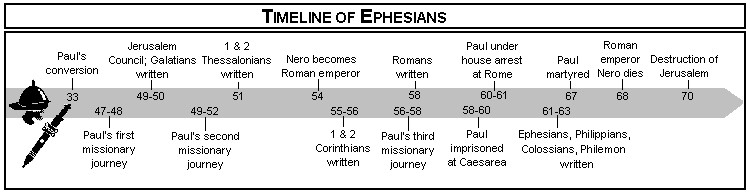
Ryrie Study Bible - NAS
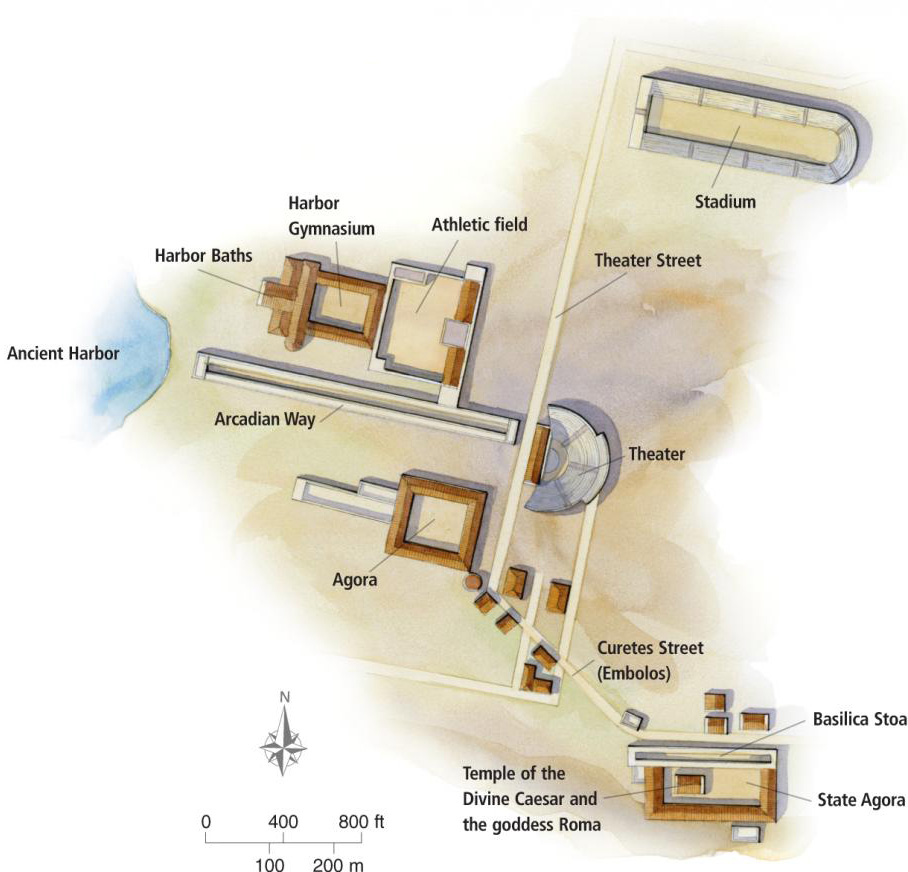
Ephesus in the Time of Paul (c. A.D. 60)
(Click to Enlarge)
Note: These Study Notes roughly correspond with the 10 Lessons of the Precept Upon Precept study of the Book of Ephesians (ESV format, NASB format). They are not meant to replace your personal study of the Word, which is the most important thing you can do if you want to get the Word of Ephesians in your heart and live it out in your walk. (Samples of Lesson 1 Pdf ESV, Lesson 1 Pdf NASB)
- Ephesians Study Questions Lesson 1 - Covers Introduction - Author & Recipients
- Ephesians Study Questions Lesson 2 - Covers Ephesians 1:1-14
- Ephesians Study Questions Lesson 3 - Covers Ephesians 1:15-2:10
- Ephesians Study Questions Lesson 4 - Covers Ephesians 2:11-22
- Ephesians Study Questions Lesson 5 - Covers Ephesians 3:1-21
- Ephesians Study Questions Lesson 6 - Covers Ephesians 4:1-6
- Ephesians Study Questions Lesson 7 - Covers Ephesians 4:7-16
Ephesians 1:15+: How does Paul introduce this section?
"For this reason" =a term of conclusion.
Phrases like "for this reason" always beg the question of "For what reason?" This forces you to examine the previous context.
The most reasonable association is the summary of "every spiritual blessing" in the incredible sentence in Eph 1:3-14.
EXTRA QUESTIONS TO BEGIN THE DISCUSSION:
- What were these spiritual blessings? recall as many as you can (and associate them with the respective member of the Godhead if you can). Don't forget grace! "the riches of His grace which He freely bestowed on us in the Beloved", "lavished on us") (Eph 1:6, 7, 8)
- How did you see the Trinity at work in these blessings? Father elected, Son redeemed, Spirit sealed.
- What was Paul's response after mention of each person of the Trinity? praise to His glory (of His grace) (Eph 1:6, 12, 14).
- How does Paul divide up the 6 chapters? Doctrine/duty (What you believe is critical in regard to how you behave!)
EXTRA:
- How did Paul hear about "the faith"? (Where is he? 800+ miles from Ephesus imprisoned.) - He could still have visitors (Acts 28:30).
- How could others see their "faith?" clearly their works, specifically love (Faith is an action word) Cf 1Th 1:3.
- What is agape love? Unconditional sacrificial love which is the love that that God is and so describes a divine love, a love which is commanded by God, empowered by His Spirit, activated by personal choice of our will, not based on our feelings toward the object of our love and manifested by specific actions
- How do we know their love was supernatural? they had love for ALL. No favorites. All the saints = love of the brethren (1Jn 3:14). Note they did not "play favorites" (human love does, but not supernatural love, which is what they possessed).
- Compare faith and love in Gal 5:6 For in Christ Jesus neither circumcision nor uncircumcision means anything, but faith working through love. Saving faith proves its genuine character by works of love. The one who lives by faith is internally motivated by love for God and Christ (Mt 22:37-40), which supernaturally issues forth in reverent worship, genuine obedience, and self-sacrificing love for others. We are justified by faith, but faith produces works
- What does this say about the saints spiritual condition? They were Spirit filled -- had to be to produce fruit of the Spirit, love (Gal 5:22).
- Or could ask what does the fruit of the Spirit say about their spiritual condition?
- Does this convict you? What would Paul hear about your faith?
Ephesians 1:15+: What had Paul heard (remember he had been gone about 4+ yr)?
Faith (pistis) in the Lord Jesus and Love (agape) for all the saints - faith without love is stringent and love without faith is shallow. Their faith (ROOT) was shown to be real because of the agape love (FRUIT), the same love God demonstrated toward us on Calvary, was flowing forth to all the other saints.
What was the object of their faith? cf "faithful in Christ Jesus" (Eph 1:1)
REVIEW - Ephesians 1:13+ How had they come to faith initially?
Listened to the Message of Truth (What is that a synonym of?), the Gospel of their salvation and they believed it.
EXTRA:
- What is the key point about their coming to faith? they listened, but the key is someone spoke the gospel of salvation to them (Ro 10:14-17, 15)
- What is the result? Salvation = rescue, deliverance fr danger, destruction, peril & slavery to & consequences of sin and unto restoration to a former state of safety, health, well being & preservation fr danger of destruction. (Illustration - Peter sinking - Mt 14:30 = the cognate verb sozo,)
- Have you spoken the gospel of salvation to anyone this week?
- How do we know their faith was real? Repentance, works - Acts 19:18-19
Ephesians 1:13,14+: How sure was their salvation? How eternally secure were they?
Very sure! It was sealed by Spirit of promise
What did a seal convey in Biblical times? ownership, security, authenticity)
EXTRA
- What is the seal? The Holy Spirit
- How do you know you are sealed with the Holy Spirit ? Have you had a victory over sin this past week? Have you been tempted by the flesh and were able to fight it off? If you are a believer surely you can remember some time when sin was tempting you to surrender and you were able to say "no" because of the Spirit indwelling you, the Spirit of the living God. DON'T BE DECEIVED! YOU WERE NOT ABLE TO RESIST THE TEMPTATION USING "NATURAL" POWER BUT SUPERNATURAL POWER. Remember as Paul says in Galatians 5:17 that it is the Spirit who sets His desire against the flesh (so we must constantly depend on His power for victory). You can mark it down that every spiritual victory you experience as a result of the Spirit of God living in you as God's "pledge" is one more indicator of the full payment that’s coming in the future. The Spirit is the first fruits, but a greater harvest is on its way at the return of Jesus Christ, when our redemption is finally completed.
- Do you wrestle with eternal security? meditate on sealed by the (omnipotent) Holy Spirit (Who can break the seal of the omnipotent God?) Study the words sphragizo (verb) and sphragis (noun). Wayne Grudem writes: “Related to the life-giving work of the Holy Spirit is the fact that he also seals His work to us so that He keeps true believers from falling away from God and losing their salvation (Eph. 1:13)”.
- Is "once saved, always saved" accurate? Yes, but only if one is truly born again (he or she cannot be "unborn"!)
What other assurance of their salvation did they possess? Ephesians 1:14+
Pledge of our inheritance until our final redemption
EXTRA:
- What is a pledge? What does that say about our future salvation (redemption)? the best is yet to come
What would this have done for Paul who was in prison?
Surely he would have been encouraged him but it also stimulated him as we see below.
EXTRA:
- What does John say in 3 John 4? I have no greater joy than this, to hear of my children walking in the truth.
Ephesians 1:16 What does Paul do for the saints?
First an attitude of gratitude -
EXTRA:- thanking and praying are both present tense = continually!
- What does this say about Paul's spiritual condition? Recall he is imprisoned but his heart is free to express gratitude - another evidence of a Spirit filled man, for this is a supernatural attitude in these adverse conditions.
- What was he thankful for? Thanked God for their faith (in the Lord Jesus) and love (for all the saints) and prayed for them
- What else does he do? Prays for them. Again evidence of Spirit filling - Eph 6:18
Ephesians 1:17 - What does he pray?
Father of Glory may give a spirit of wisdom and knowledge in the revelation of Him (of God)
This could refer to the Holy Spirit and/or to man's spirit (NIV & ESV interpret it as the Holy Spirit! Point is that all translations are interpretations to some degree)
Paul wants the saints to know Christ
EXTRA:
- What does Isaiah 11:2 say about a spirit of wisdom? Messiah had it. Indicated the Spirit's action.
- What is Greek for "knowledge"? The Greek word epignosis speaks of experiential knowledge, that is, knowledge gained by experience. It means to not only know it but to understand but to experience God. In other words, it means to be drawn into God Himself and not just the facts about Him.
Ephesians 1:18+ What else does Paul pray for?
That the eyes of their heart would be enlightened (by Spirit) = illumination
What in simple terms is Paul praying for these saints?
His prayer is a prayer for a deeper understanding. He has just told them what they possess because of God the Father, God the Son and God the Spirit has done, but now he wants them to know God in a deeper, more intimate way. Paul begins to pray that the Gentile readers (including us today) would come to experientially and intuitively know God in a deeper way and to fully understand their resources in Christ so that they might live in His power to the praise of the glory of God's grace.
Paul is praying for a deeper spiritual understanding, that "Ah Ha" reaction we have when we begin to really understand and exclaim "I see it! I finally see what you’re telling me, Lord!" That's what Paul is praying for here.
Why? Why would he be praying for this "Ah Ha" enlightenment? Remember that the first three chapters are doctrine but the last three begin with how we are to walk. Paul knows that as a man thinks in his heart, his spiritual interior, will determine how he walks. And so he prays that these saints might be able to grasp the breadth and length and height and depth of the great truths in this chapter, so that they might be enabled by the indwelling Spirit and the riches of God's grace to order their steps in a manner which is pleasing to the Lord.
EXTRA
APPLICATION - How do Paul's prayers compare with the prayers of many of us for our fellow believers? What might God do in a family, a church, a nation, when Christians begin to pray like Paul?
Illustration - History tells us that when Crowfoot, the chief of the Blackfoot nation in southern Alberta, gave the Canadian Pacific Railway permission to lay track from Medicine Hat to Calgary, he was given in exchange a lifetime railroad pass. Reportedly, Crowfoot put the pass in a leather pouch and wore it around his neck for the rest of his life—but he never once availed himself of the rights and privileges it spelled out. What a tragedy it is when believers who have been blessed with every spiritual blessing in the heavenly places in Christ do the same thing with their "possessions" (their blessings), using them as a decorative badges of their Christianity, but never availing themselves of the wealth afforded to them in a true knowledge and deeper understanding of these spiritual blessings in Christ. That is what Paul is praying to prevent from occurring!
What is HIs calling?
- Unto salvation
- Romans 8:29-30 HELPS UNDERSTAND CALLING = "and these whom He predestined, He also called; and these whom He called, He also justified; and these whom He justified, He also glorified."
NOTE - What is our "hope" in Romans 8:30?
To be glorified! It is so certain that Paul puts it in the past tense! - Eph 4:4 - you were called in one hope of your calling;
When He saved us, He placed this hope, this absolute assurance of future good, within our hearts.
What is the Biblical meaning of hope?
It is not like we commonly use it today "I hope it will rain", "I hope my favorite team wins this weekend".
Biblical hope in simple terms is an expression of the absolute certainty of future good, the absolute assurance that God will do good to me in the future.It is not "hope so" but "hope sure!"
In this case it is God's calling - it has "hope" as one of its components.
Technical Note on the NAS translation -- Harold Hoehner points out that "The NEB, NASB, and NIV state another request: I pray also that the eyes of your heart may be enlightened. However, this is not a new sentence in Greek. It seems to be parenthetical, as in the KJV, ASV, and RSV (ED: NRSV = "so that, with the eyes of your heart enlightened"). In other words, Paul had prayed (Eph 1:17) that they might have true spiritual insight into God, and then he included the phrase, “having the eyes of your heart enlightened” (RSV). Paul’s request for them to know God was within proper bounds because their hearts had been enlightened (the Greek perfect tense indicates past action with continuing results), as discussed in verses 3–14, especially Eph 1:7–9
How does 1 John 3:1-3+ help us understand the "hope of our calling"?
We are children of God (adopted as sons, possessors of an inheritance)
But it has not appeared as yet what we shall be - hope is what we desire but do not see at present ("the hope of our calling")
When He appears we shall be like Him - then Hope becomes Sight!
This future hope motivates us to purify ourselves just as He is pure
Ro 8:29+ What is the "hope of our calling" or the absolute certainty in this verse?
Predestined to become conformed to the image of His Son
This perfectly parallels 1Jn 3:2 = it is completely fulfilled when we see Him for we shall be like Him, perfect and glorified!
Ro 8:29-30 What is process and culmination of our salvation in these verses? And what is the "hope" in Ro 8:30?
Believers have been foreknown > predestined > called > justified (declared righteous by faith) > glorified
Note: "Have been glorified" is past tense, because God "works all things after the counsel of His will" so what is future to us today is so certain to God that it is described as already accomplished!
Philippians 1:6 What does Paul remind the saints at Philippi that relates to the "hope of our calling"?
He who began a good work in you will perfect it until the day of Christ Jesus. (Again a perfect parallel with 1Jn 3:2 = glorification)
The good (God) work had begun in them (and us) would just as certainly be perfected (completed, brought to its intended goal).
When will this "good work" be finalized?
The day of Christ Jesus or as John explains "when we see Him, we will be like Him"! (1Jn 3:2)
Philippians 1:23 What do you learn about the our "hope"?
But I am hard-pressed from both directions, having the desire to depart and be with Christ, for that is very much better;
Our hope = our desire to be with Christ = very much better
2 Timothy 1:12 How did Paul (writing from a dank prison cell) encourage Timothy? How certain was Paul his "hope" would be realized?
For this reason I also suffer these things, but I am not ashamed; for I know whom I have believed and I am convinced that He is able to guard what I have entrusted to Him until that day.
Paul despite the fact that he was in prison, had been deserted by others and knew that he was being poured out as a drink offering (going to die), had the inner strength in Christ and was filled with His Spirit so that he could write that he was convinced Jesus would keep what he had entrusted to Him until the day when he would see Him face to face. Our hope is not "hope so" but is a "hope sure"!
1Thess 5:23-24 How sure of the hope? What is that certainty based on?
Faithfulness of God - God is faithful to bring to pass what He has promised and that for which Paul prays for the saints at Thessalonica (sanctified entirely, without blame at His coming).
Here are a few of many other aspects of the "hope of our calling" as recorded in the New Testament (See related in depth study of the Believer's Blessed Hope)
EXTRA
In my opinion, there are many other passages that speak more directly to the HOPE Paul is praying for the saints -
- Col 1:27 Christ in you the hope of glory (HOPE = future glory - glorification)
- Ro 5:1-2 exult in the hope of the glory of God (HOPE = glory of God - glorification)
- Col 1:5 the hope laid up for you in heaven (HOPE = FUTURE REWARDS - cf Mt 6:20)
- Titus 2:11-14+; looking for the blessed hope (HOPE = SECOND COMING -future looking motivates present living in Titus 2:12)
- Titus 3:7 hope of eternal life. (HOPE = ETERNAL LIFE - we will live forever with God)
- Heb 6:18-19 we who have taken refuge would have strong encouragement to take hold of the hope set before us. 19 This hope we have as an anchor of the soul, a hope both sure and steadfast and one which enters within the veil, (HOPE = a present refuge)
- Ro 15:13 (HOPE = energized by the Spirit....and prayer to the God of hope)
Ephesians 1:18b
The Riches of His Inheritance
What is the second component of Paul's prayer for his Gentile readers?
That they would know the riches of the glory of God's inheritance in the saints
Note: There are two ways to interpret this phrase:
(1) The saints are His (God's) inheritance He considers a treasure of incomparable worth! Amazing grace! In Ephesians 1:14 Paul spoke of our inheritance, but here seems to speak of God's inheritance in believers. As saints, we’re God’s inheritance, His treasure, His prize!
(2) The other view is that the inheritance means all that we will inherit in Christ.
View (1) is probably the more valid interpretation although both truths are taught in Scripture and the Greek text does allow for both interpretations. The lesson takes it as referring more to our inheritance as judged by their cross references.
Precept Lesson - Notice Paul's move from singular "what is" to plural "what are the riches of the glory of his inheritance in the saints." a. Review the scriptures on inheritance you observed last week. b. Now pause and reflect on the riches of this inheritance. In other words, what is yours because you are His? Look at Colossians 1:9-12 and 2:2-3.
NOTE: I went back to the first edition of this Precept Workbook and note that they have deleted a number of Cross references that they used in the first edition of this Ephesians Study -- my guess is they realized that their references focused on point number (2) above, but a number of good commentaries disagree, so presumably they decided to leave that out of the lesson. They still seem to focus on (1) with the statement "Now pause and reflect on the riches of this inheritance. In other words, what is yours because you are His? Look at Colossians 1:9-12 and 2:2-3."
Ephesians 1:11+ When did we obtain an inheritance?
Predestined = before foundation of world
Have obtained = past tense of something future! That is how certain the inheritance associated with "hope of our calling" is for believers and why Paul is praying for the saints to know beyond a shadow of a doubt about this truth so that they might lay hold of it by faith and might walk in the light (enlightened in their heart, the center of their being) of this life transforming truth.
Ephesians 1:11+ How certain is our inheritance?
If it is according to God's purpose Who works all things out after the counsel of His will, it is absolutely certain.
Ephesians 1:14+ What does this truth explain about the certainty of our inheritance?
God gave us His Spirit as a pledge (see Greek word study), the Holy Spirit representing the first fruits (the foretaste of the harvest to come) of our inheritance, and is in a sense God's "earnest money" or "down payment" representing His promise to give us the full amount in the day of Christ Jesus.
Colossians 2:3+ What is a present aspect of our inheritance?
In Christ are hidden all treasures of wisdom & knowledge Christ Himself is our inheritance
What is the third component of Paul's prayer?
Praying that they would come to realize they had access to surpassing power
How is the power described? To whom?
Surpassing greatness - Huperballo = Literally = throw beyond the usual mark, a degree which exceeds extraordinary
Toward us who believe
Power is dunamis = Inherent power residing in a thing by virtue of its nature; power in the sense of that which overcomes resistance, and is translated "miracle*" 22x (out of 119x) in the NT
What is this power according to (proportionate) to?
Make sure they understand the meaning of "in accordance" -- not a "portion" but "proportionate" to is the thought.
Working of the strength of His might
Here's the main point -- it takes Paul 4 great Greek words on power/strength to even begin to describe the surpassing greatness!
- Working = energeia; Energizing, operative power which describes the working of God.
- Strength = ischus refers to “power as an enduement.” Ischus is the inherent ability which stresses the factuality of the ability, not necessarily the accomplishment. Ischus is inherent power or force. A muscular man’s big muscles display his might, even if he doesn’t use them. It is the reserve of strength.
- Might = kratos refers to manifested power or power that is put forth in action. Kratos represents the exercise of might (ischus). When the muscular man uses his might to bend an iron bar, he uses his power (kratos). Kratos means that the reserve of strength is actually in operation. It is power to overcome resistance or whatever stands in the way.
Ephesians 1:19; 1:20: How does Paul explain this power? What occurred as result of the exercise of this surpassing power?
God raised Jesus from dead (resurrection power)
God Seated Him at right hand (ascension power)
In heavenly places (What else is there? Eph 1:3 every spiritual blessing; Eph 2:6 believers)
EXTRA
Ephesians 4:10 He who descended is Himself also He who ascended far above all the heavens, so that (PURPOSE?) He might fill all things.
Ephesians 1:21 How is Christ's position explained? What are the time phrases?
Far above all rule and authority and power and dominion (See 1Pe 3:22)
Every name that is name
This age and the age to come
EXTRA
- Who is Christ over? Note the similarity of words used = these are spiritual forces (good and evil)
Eph 1:21 arche & exousia (Eph 2:2) & dunamis & kuriotes
Col 1:16 kuriotes & arche & exousia (the right & the might)
Eph 6:12 arche & exousia
1Pe 3:22 aggelos & exousia & dunamis- What does Col 1:16 add regarding the rulers, etc? He created them! Creator superior to the creation! No power struggle here!
- What can we learn about age are we in and age to come?
Mt 24:3 (Jews knew this age would end - wanted to know about next one = Messianic Age),
Mt 28:20 (Jesus with us & Spirit of Jesus until end)
Gal 1:4 (evil age) ,
Titus 2:12 (live sensibly...),
Mt 13:39 (separation at end of this age).
Age to come = Millennium, Messianic age.
Ephesians 1:22 What authority did God give Christ?
Put all things in subjection under His feet
Ephesians 1:23 What is He the head over?
All things
To the Church = His Body
IN HEAVENLY PLACES…
- Ephesians 1:3 Our blessings are there in Christ
- Ephesians 1:20 Christ is there seated at the R hand of God
- Ephesians 2:6 Believers are seated there in Christ
- Ephesians 6:12 Spiritual forces of wickedness are there
What is the Christ's relationship to spiritual forces?
Far above all
What about believers?
Far above all. Why? Because we are seated with Him in Eph 2:6.
What did Luke record in Acts 19:15 that parallels the relationship between believers and the demonic powers?
And the evil spirit answered and said to them, “I recognize Jesus, and I know about Paul, but who are you?”
EXTRA
Warren Wiersbe sums up Paul's prayer for the saints to know the surpassing greatness of His power they possess noting that "In the four Gospels, we see God’s power at work in the ministry of Jesus Christ, but in the Book of Acts, we see that same power at work in ordinary men and women, members of the body of Christ. What a transformation took place in Peter’s life between the end of the Gospels and the beginning of Acts. What made the difference? The resurrection power of Jesus Christ (Acts 1:8). The greatest power shortage today is not in our generators or our gas tanks. It is in our personal lives. Will Paul’s prayer be answered in your life? Will you, starting today, begin to know by experience God—God’s calling—God’s riches—and God’s power? (Wiersbe, W: Bible Exposition Commentary. 1989. Victor)
An apt title for this section Ephesians 2:1-10 "From Wrath to Riches!" (Bryan Williams Christ the Head: Bible Studies in Ephesians)
Ephesians 2:1; 2:2; 2:3 What was the former state of the Gentile believers?
Dead in trespasses and sins,
Formerly walked according to
1) World - course of this world,
2) Devil - the prince of the power of the air, spirit now working in sons of disobedience
3) Flesh - lived according to the lusts of the flesh, indulging desires b
Titus 3:3 What parallel truth does this verse teach about unbelievers?
- We (Paul includes himself) also once were (cf "formerly) foolish ourselves (note)
- Disobedient
- Deceived
- Enslaved to various lusts and pleasures cf Eph 1:7 = Redemption through His blood = pay a price to set slaves or captives free!
- Spending life in malice and envy,
- Hateful and hating one another
How does God describe their spiritual legacy?
Sons of disobedience - sons who are characterized by disobedience
By nature children of wrath (By nature = born that way, Ro 5:12+) - by their being born into Adam, they were destined for eternal wrath (unless God intervened) and they were transferred from in Adam to in Christ.
1 John 5:19 We know that we are (present tense = continually) of God, and the whole world lies in the power of the evil one.
1John 5:19 What is scope of the devil's power? Note "the power of" is added.
Whole world lies in his power = rules world system
Comment: How is it we know we are of God? In Ephesians 1:13 the Holy Spirit of promise is our seal (authentication) and in Romans 8:16…The Spirit Himself bears witness with our spirit that we are children of God
John says "we know" which is the perfect tense conveys the truth that this knowledge is permanent in believers.
The "world" is kosmos which in this moral or ethically use refers to the world system of evil of which Satan is the head, all unsaved people his servants, together with the pursuits, pleasure, purposes, people, and places where God is not wanted.
John 8:44 How does Jesus describe him?
- Jews father (and of all who habitually practice sin = 1Jn 3:8)
- Devil = Murderer from the beginning = Garden of eden = Adam
- Does not stand in the truth = No truth in him
- Speaks = lie = liar and father of lies
Revelation 20:1 And I saw an angel coming down from heaven, having the key of the abyss and a great chain in his hand. 2 And he laid hold of the dragon, the serpent of old, who is the devil and Satan, and bound him for a thousand years, 3 and threw him into the abyss, and shut it and sealed it over him, so that he should not deceive the nations any longer, until the thousand years were completed; after these things he must be released for a short time. ()
Revelation 20:2+ What other names is the devil known by?
- Dragon = Serpent of old (refers to Genesis 3) = Satan
Colossians 1:13 What did God the Father do for us?
Delivered us (rescued) from domain of darkness (the ruler of which was Satan)
Transferred us to the kingdom of His beloved Son
Revelation 12:7-9: Who was with Satan? Where?
His angels = in heaven
Rev 12:9 the serpent of old who is called the devil and Satan, who deceives the whole world; he was thrown down to the earth, and his angels were thrown down with him.
Comment: The events described in this section transpire at the midpoint of Daniel's Seventieth Week)
What will happen to Satan and his angels in the future?
- Wage war w/ Michael and his angels
- Not strong enough = No longer a place in heaven
- Thrown down to the earth
- Deceives whole world
Comment: "Thrown down" is a key phrase occurring three times. This casting down is the first stage in the fulfillment of what was made possible by the triumph of Christ upon the Cross (Luke 10:18; John 12:31; 16:11; Col. 2:15; Heb. 2:14; 1Jn. 3:8). From a study of Revelation, this throwing down coincides with the midpoint of the seven year period of time - Daniel's Seventieth Week - this midpoint marking the beginning of the Great Tribulation. The next stage occurs with Satan's binding for 1000 years -- The Millennium -- in the abyss (see Rev 20:1-3 above) after which he is released for a short time to deceive again and then finally and forever he will be cast into the Lake of Fire (See commentary notes on Rev 20:10).
Who is not described as participating in this angelic struggle?
Jesus Christ - He is the Creator, while Satan is but a created being, which is an unbridgeable gap.
What do you learn about Jesus and demons?
He has power over them (
What does that remind us of in Ephesians 1? What do you remember about Ephesus and casting out demons by Paul?
- Ephesians 1:21, Acts 19:15
Mt 12:22-28 Who is Beelzebul ("lord of the flies") and what is his realm of authority?
Devil = ruler of the demons
Hebrews 2:14-15 Who does "He Himself" refer to?
Jesus
Why did Jesus partake?
He had to be fully man in order to be the perfect sacrificial Lamb and die as our substitute
What did death of Jesus' do to power of devil?
Rendered powerless him who had power of death
What is the deliverance available to believers?
Freedom from fear of death
John 12:30-32 (Context: The Father had spoken from heaven in answer to Jesus' request to "glorify Thy Name." The multitudes heard it but were confused thinking it might be thunder or an angel.) Jesus answered and said, "This voice has not come for My sake, but for your sakes. 31 Now judgment is upon this world; now the ruler of this world shall be cast out. 32 And I, if I be lifted up from the earth, will draw all men to Myself. 33 But He was saying this to indicate the kind of death by which He was to die.
John 12:30-33 What does Jesus mean by "now judgment is upon this world"? (When in His life does this event occur?)
(Context: The Father had spoken from heaven in answer to Jesus' request to "glorify Thy Name." The multitudes heard it but were confused thinking it might be thunder or an angel.)
The judgment in context refers to God's judgment of Jesus on the Cross bearing the sins of all mankind. Sin was judged in the Substitute and the result was death for Christ but justification for the believer.
Who is the ruler of the world and what is his end? Revelation 20:1-10
The ruler of this world is Satan who will be cast down (cf Rev 12:7-9 where "thrown down" is used 3 times). (Comment: At the Cross "sentence was pronounced" against Satan, but it will not be until sometime future when this sentence is carried out. Revelation 12:7-9 describes the first "installment" of this sentence when Satan is thrown down from heaven to which he still has access. The second "installment" of the sentence is when Satan is bound in the abyss for 1000 years so that he is unable to deceive the nations, as described in Revelation 20:1-3. The final "installment" of the sentence occurs when he is cast into the Lake of fire at the end of the 1000 year period, as described in Revelation 20:7-10 - see notes Rev 20:7, 8, 9, 10).
John 12:32-33 How is Satan's power defeated?
At the Cross
Ephesians 2:4 How Paul introduce the contrast with their former state?
But God (see note)
Titus 3:4 How does Paul introduce the contrast?
But when (see note)
In short, God stepped out of eternity and into time and intervened in their dead lives
Ephesians 2:4 What motivated God to save us?
He was rich in mercy because of His great love with which He loved us
What does Paul explain in Titus 3:4?
Titus 3:4 – Kindness of God our Savior, love for mankind
Ephesians 2:5 (Titus 3:5) What did God do?
God saved us (See study of sozo, the verb for saved)
When?
He saved us when we were dead (note repetition which emphasizes that salvation is unmerited favor) in our transgressions - dead to spiritual truths of God and helpless to save ourselves!
Ephesians 2:5, 2:6 How does Paul describe the "process" of salvation "in Christ"?
Made us alive together with Christ (note)
Raised us up with Him (note)
Seated us in the heavenly place in Christ Jesus (note)
Comment: Each of the verbs made alive with, raised with, seated with has the identical prepositional prefix "sun" (syn) which mean "with" in Greek but is significantly different than the other Greek word for with (meta) which conveys the of beside, whereas sun speaks of an intimate, indissoluble union. Let's illustrate using a well known event, the crucifixion. Two criminals were punished with Jesus and both were crucified with (metá) Him, i.e., in His company, but only one was spiritually crucified with (sún) Christ, i.e., bound up or in union with Him while the other thief was not. The first thief entered paradise, while the second entered hell. And so we get a glimpse of the significance of Paul's three combination verbs used to explain our salvation. Clearly, he is driving home not only these basic truths of our salvation but that this salvation is irrevocable. The believer who has been made alive with Christ, raised with Christ and seated with Christ is eternally secure in Christ.
Ephesians 2:7 What will God do for believers in the future?
In ages to come will show surpassing riches of His grace in kindness to us in Christ Jesus -- Believers will be an eternal display of the grace of God. This miracle of transforming grace will be the subject of eternal revelation.
Ephesians 2:8 How does Paul describe salvation?
By grace = Grace is the foundation for our salvation.
Through faith = Faith is the instrument or channel or means by which one accesses the grace of God and receives salvation.
What is faith (or verb "believe") according to the respected lexicon authored by W E Vine?
- It is not just mental assent
- Firm conviction
- Surrender to truth
- Conduct resulting from surrender
Ephesians 2:5 What aspect of salvation does Paul emphasize (repeat)?
Our state of death (and helplessness to save ourselves) in transgressions
The contrasting truth that in spite of our being dead God saved us by grace - this serves to highlight the undeserved nature of grace and our inability to do anything to earn it.
Ephesians 2:8 What does Paul add to explain salvation "by grace through faith"?
That not that of yourselves
It is the gift of God
Comment: Many have debated what the "that" ("that not of yourselves") refers to, but the consensus is that it refers to neither grace nor faith but to the whole process of salvation. (See discussion of interpretation of "that")
Ephesians 2:9 How are are men not saved?
Not the result of works (note)
Salvation is not by works since its basis is grace and its means of reception faith. Paul's point is that no one will be able to boast that they have done anything to merit their salvation and the conclusion is that all the glory will go to God for "so great a salvation".
Titus 3:5 What does Paul add to explanation of salvation?
According to His mercy = washing of regeneration and renewal by the Holy Spirit (note)
What is God's grace?
Ephesians 1:2
Paul begins and ends (Ephesians 6:24) this letter with a "benediction" of grace to his readers - since they were already saved by grace, this indicates the ongoing need of grace in our daily lives and speaks of enabling grace, grace which makes it possible for saved sinners to walk in a supernatural manner worthy of the calling to which they have been called
Grace of God has glory which is praiseworthy.
Grace is that which is freely bestowed on sinners in the Beloved (Christ Jesus)
Grace of God is rich and is that attribute of God which allows our trespasses to be forgiven
These Scriptures validate the familiar acrostic --God's Riches At Christ's Expense.
As noted below believers will be an eternal testimony to the grace of God.
Grace is unmerited favor coupled with divine enablement.
Grace flows from God’s nature through Christ and is irrespective of the worth or merit of the one loved.
Vance Havner once said that someone spelled out "grace" as…
G stands for Gift, the principle of grace.
R [stands] for Redemption, the purpose of grace.
A [stands] for Access, the privilege of grace.
C [stands] for Character, the product of grace.
E [stands] for Eternal Life, the prospect of grace.
John 1:1, 14-17 What do you learn about grace?
Grace and truth were realized in Jesus.
Gods grace is seen in the OT, but not realized until Jesus.
Note that OT believers were saved by grace through faith just as are NT believers. The difference is that the OT believers were looking forward in faith to the Cross, whereas NT believers look back in faith to the Cross of Christ.
Grace was manifested in the OT (Genesis 6:8 "But Noah found favor --grace -- in the eyes of the LORD."), but paled in comparison to the brightness of grace that appeared at the Incarnation (see note Titus 2:11 "the grace of God has appeared, bringing salvation to all men").
Acts 15:11 What do you learn about grace from the context?
V7: Jews heard the word of the gospel and believed
V11: Grace excludes all human achievement ("the yoke") in relation to salvation. The Jews and Gentiles are saved through the same grace
How is grace described?
Gospel of grace - The gospel has grace, grace to save. Paul earlier (Ephesians 1:13) had stated that his Gentile readers had listened to the message of truth, the gospel of their salvation, believed it and were sealed in Him with the Holy Spirit of promise.
Illustration: This same commitment expressed above by Paul was beautifully evident in the life of James Calvert, a young pioneer missionary to the cannibals of the Fiji Islands. En route the ship captain, a humane man, tried to dissuade him, finally crying in desperation, “You will lose your life and the lives of those with you if you go among such savages.” Calvert calmly replied, “We died before we came.” Karl Marx’s remark that “a Communist is a dead man on reprieve” is simply a base parody of this primal Christian principle.
ROMANS 3:23-24 How does Paul explain salvation?
Justified (declared righteous)
It was a gift
It was by God's grace - unmerited favor and divine enablement
It was made available to mankind through the redemption in Christ Jesus
How does faith affect one's walk?
Eph 2:10 what relation of salvation to works?
Believers = God's workmanship
Created in Christ Jesus
For good works
God prepared beforehand (in eternity past)
That we should walk in them
APPLICATION:
- Has you life changed from the "former" things.
- Why or why not?