
EPHESIANS - CHRIST AND THE CHURCH
Click chart to enlarge
Charts from Jensen's Survey of the NT - used by permission
| SYMMETRY OF EPHESIANS |
|
| EPHESIANS 1-3 | EPHESIANS 4-6 |
|
The Root |
The Fruit |
|
Spiritual Wealth |
Spiritual Walk |
|
Christian Privilege |
Christian Conduct |
|
The Position |
The Practice |
|
God Sees |
World Sees |
|
Privilege |
Practice |
|
Doctrine |
Duty |
|
Doctrinal |
Practical |
|
Revelation |
Responsibility |
|
Christian |
Christian |
|
Belief |
Behavior |
|
Privileges |
Responsibilities |
|
Our Heritage |
Our Life |
|
Know your |
Live by faith in the light of your |
|
The Finished Work |
The Faithful Walk |
|
Work |
Work |
|
We |
Christ |
|
Word |
Walk |
|
Heavenly |
Earthly |
|
Who You Are |
Whose You Are |
|
Identity |
Responsibility |
|
Theology |
Ethics |
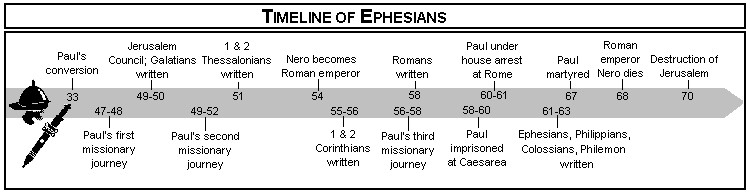
Ryrie Study Bible - NAS
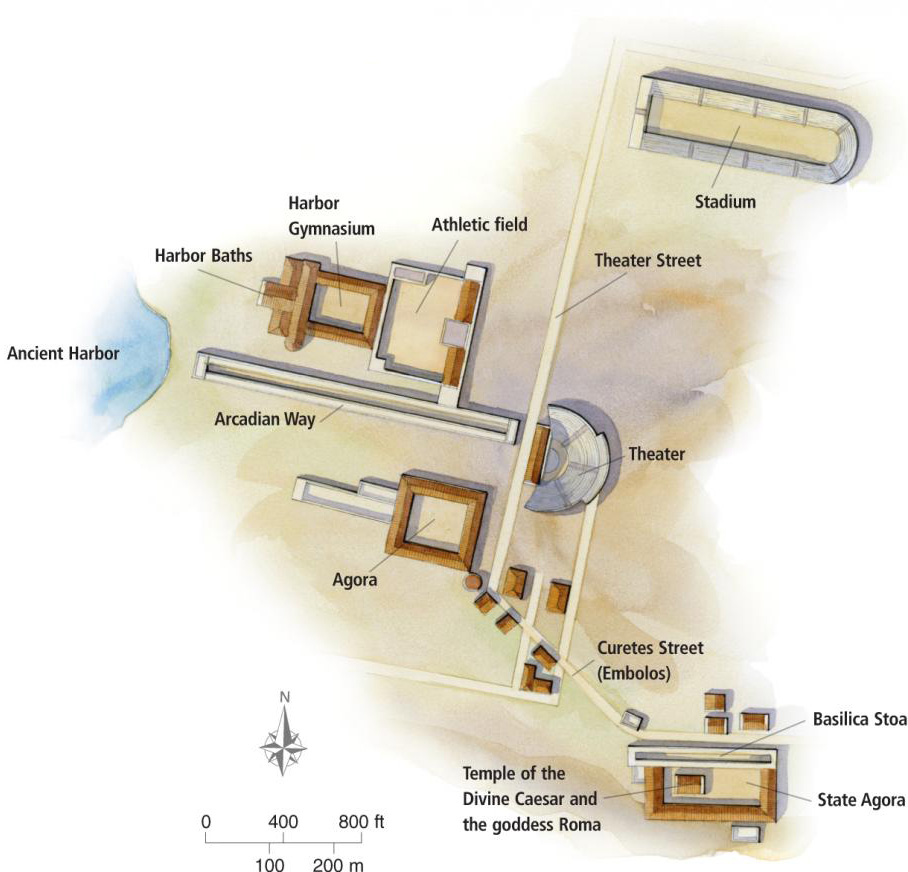
Ephesus in the Time of Paul (c. A.D. 60)
(Click to Enlarge)
Note: These Study Notes roughly correspond with the 10 Lessons of the Precept Upon Precept study of the Book of Ephesians (ESV format, NASB format). They are not meant to replace your personal study of the Word, which is the most important thing you can do if you want to get the Word of Ephesians in your heart and live it out in your walk. (Samples of Lesson 1 Pdf ESV, Lesson 1 Pdf NASB)
- Ephesians Study Questions Lesson 1 - Covers Introduction - Author & Recipients
- Ephesians Study Questions Lesson 2 - Covers Ephesians 1:1-14
- Ephesians Study Questions Lesson 3 - Covers Ephesians 1:15-2:10
- Ephesians Study Questions Lesson 4 - Covers Ephesians 2:11-22
- Ephesians Study Questions Lesson 5 - Covers Ephesians 3:1-21
- Ephesians Study Questions Lesson 6 - Covers Ephesians 4:1-6
- Ephesians Study Questions Lesson 7 - Covers Ephesians 4:7-16
Ruth Paxson has divided Ephesians, "the Grand Canyon of Scripture" into our "Wealth, Walk and Warfare"
What is the "wealth" (some of the "every spiritual blessings in heavenly places") which Paul has revealed in Ephesians 1 and 2?
REVIEW OF
THE BELIEVER'S WEALTH
RICHES IN EPHESIANS 1
Every spiritual blessing (1:3), chosen, holy, blameless (1:4), adopted as sons (1:5), redemption, forgiveness (1:7), mystery revealed (1:10), inheritance (1:11), gospel of salvation, sealed (1:13), pledge of inheritance (1:14).
RICHES IN EPHESIANS 2
| BEFORE FORMERLY FAR OFF |
AFTER BROUGHT NEAR BY BLOOD OF CHRIST (CROSS) |
| Dead in trespasses and sins Slaves to... The world, the flesh, the devil |
Alive with Christ Raised with Christ Seated with Christ |
| Separated from Christ No country No covenants No hope No God |
Enmity abolished One new man Reconciled to each other Reconciled to God Access to God |
| Strangers and Aliens |
Fellow Citizens Family of God Temple of God Dwelling of God |
Remember that these "unfathomable riches in Christ Jesus" are all made possible by the almighty Cross of Christ which abolished the enmity separating God and man and Jew from Gentile.
Christ's efficacious work in regard to the Law is summarized below...
|
THE LAW OF COMMANDMENTS |
|
| MORAL LAW |
CEREMONIAL LAW (Shadow) |
|
Jesus fulfilled the Law's Requirement (Mt 5:17, Ro 8:4) |
|
Why is Paul spending so much time explaining to the Gentiles their "before/after" picture and emphasizing their place of equality with the Jews in one body, the body of Christ?
It is because he wants to be sure that the Gentile believers don't take their new found salvation for granted (which has to a large extent occurred in the church in America, some of whom don't even know that Jesus was a Jew, much less that the early church was virtually all Jewish) so that they have a proper appreciation and sense of gratitude for their salvation. Paul knows that when the Gentiles grasp these truths, this truth has the potential to radically impact their conduct, so that they are motivated to walk worth of their new calling in Christ and not according to their former corrupt way as pagans. For many Gentile believers, there is a tendency to "skim over" the doctrinal truths in the first three chapters (except our favorite verses like Eph 2:8-9) so that we can get into the "practical" section of Ephesians 4-6. The problem is that the character of our walk in the last 3 chapters is intimately related to a proper understanding of the doctrinal truth in the first 3 chapters. We love to talk about being filled with the Spirit, but don't spend much time appreciating the mystery of Christ which makes it possible to even be filled with the Spirit!
Ephesians 3:1 (note) How does Paul begin?
On the basis of the glorious truths Paul has expounded in the first two chapters begins this section "for this reason" (the reason of the truths just described).
Ephesians 3:1 How does Paul identify himself?
Prisoner of Christ (not of man even though he is a prisoner of Rome).
Why did Paul say this and not "I Paul a prisoner of the Romans for you Gentiles"?
Paul looked at things from the divine standpoint
Don't miss that Paul understood his suffering had purpose (see Ephesians 1:11b "God works all things out after the counsel of His will")
When you have a sure hope that anchors your soul, the Spirit can take this truth, renew and transform your thinking so that the temporal can be seen from an eternal perspective.
Application: Have you ever suffered for being a Christian - in your family, at work, at school? Paul would call us to be imitators of him even as he imitated Christ Jesus (2Cor 11:1). He would have us see our suffering from a heavenly perspective (where we are seated in Christ) and productive of a long range purpose. We have a choice when we are in our "prison" (what this is for each of us doesn't take much imagination) - we can regard the time in prison as a privilege of providence or as an opportunity to practice self pity and doubting of God's providential watch care.
Why was Paul a prisoner? What was the purpose? the pathogenesis?
Purpose - For the sake of the Gentiles.
Pathogenesis - Compare (see notes Ephesians 6:19; 6:20) - Paul was an "ambassador in chains" for making known with boldness the mystery of the gospel and the mystery it revealed (which greatly angered unbelieving and even to some extent believing Jews).
In an attempt to understand Paul's flow of thought, when do you see "for this reason" repeated? Verse 13
What did Paul sense might be (or perhaps it had been reported to him) was the reaction of the Gentile believers to Paul's imprisonment?
Verse 13 suggest that they were on the verge of loosing heart at his tribulations.
Notice the similarity between verse 1 and verse 13.
Now with these thoughts in mind, what do you think was Paul doing in verses 2-12?
He is addressing their concerns and questions about why he was in prison so that they might not lose heart.
Did you notice in the NAS, the long dash after "Gentiles---" in verse 1? In light of what we have discussed, why do you think the translators placed it here?
This dash is added by the translators to suggest a parenthesis (), a sort of digression in thought, a parenthetical thought. Again the purpose of the truth in his explanation would have been to quiet their fears.
Ephesians 3:2 (note) What had God graciously given to Paul?
A stewardship of His grace
What is a stewardship?
The idea is like the owner of a house entrusting the proper running of his house to someone, a steward, who managed the household affairs in the owner's absence.
Who was this stewardship for?
The stewardship was for the Gentiles
Since Ephesians 3:2-13 is a digression by Paul in which he summarizes his calling by God, we will take a brief excursus through Scriptures that help us understand God's calling on Paul's life.
Excursus on
God's Stewardship of Grace Given to Paul
John 4:34: What did Jesus explain to His disciples about His calling?
John 4:34 Jesus said to them, "My food is to do the will of Him who sent Me, and to accomplish His work."
Jesus sought to fulfill His Father's will, not His own will.
John 17:4 What does Jesus say the night before He is crucified about the work God had given Him to accomplish?
John 17:4 "I glorified Thee on the earth, having accomplished (brought to an end, to the intended goal = the Cross) the work which Thou hast given Me to do."
God gave to us His only begotten Son to take away the sins of the world and He fully accomplished that goal when He let sinful men crucify Him as the perfect Lamb of God.
1Corinthians 11:1 What was Paul's a command to the saints in Corinth which is applicable to all of us today?
1Cor 11:1 Be imitators of me, just as I also am of Christ.
So as Christ clearly recognized God's work for Him and fully accomplished it, so Paul made this his great objective in life, even as should all believers.
How does this truth correlate with what Paul taught in Ephesians 2:10, that we are God's workmanship created in Christ Jesus for good works which God prepared beforehand that we should walk in them?
Paul did not seek this work but God gave it to him and Paul recognized it and accepted God's "invitation" to join Him in His "good works" which God had prepared beforehand that he should walk in them.
Application: God has prepared good works for every believer to walk in and it behooves us to seek God to reveal them to us in His perfect timing, that we might bring them to fruition, bearing much fruit, fruit that endures for eternity!
Galatians 2:7-8 What does Paul recognize as his ministry?
7 But on the contrary, seeing that I had been entrusted with the gospel to the uncircumcised, just as Peter had been to the circumcised
8 (for He who effectually worked for Peter in his apostleship to the circumcised effectually worked for me also to the Gentiles)
Compare Galatians 1:12-17...
Galatians 1:12 For I neither received it from man, nor was I taught it, but I received it through a revelation of Jesus Christ 13 For you have heard of my former manner of life in Judaism, how I used to persecute the church of God beyond measure, and tried to destroy it; 14 and I was advancing in Judaism beyond many of my contemporaries among my countrymen, being more extremely zealous for my ancestral traditions. 15 But when He who had set me apart, even from my mother's womb, and called me through His grace, was pleased 16 to reveal His Son in me, that I might preach Him among the Gentiles, I did not immediately consult with flesh and blood, 17 nor did I go up to Jerusalem to those who were apostles before me; but I went away to Arabia, and returned once more to Damascus. 18 Then three years later I went up to Jerusalem to become acquainted with Cephas, and stayed with him fifteen days. (Although this specific trip to Arabia is not mentioned in Acts, this 3 year period in Paul's life would fit between Acts 9:22 and 9:23.)
Paul was set apart from birth (cf God "chose us in Him before the foundation of the world" Ephesians 1:4) to preach the gospel ("to preach Him") to the uncircumcised ("among the Gentiles")
Romans 15:20; 21; 22 (notes): What does Paul say about Paul's call to the Gentiles?
And thus I aspired to preach the gospel, not where Christ was already named, that I might not build upon another man's foundation; 21 but as it is written, "THEY WHO HAD NO NEWS OF HIM SHALL SEE, AND THEY WHO HAVE NOT HEARD SHALL UNDERSTAND." 22 For this reason I have often been hindered from coming to you
"Not where Christ was...named" means where He was unknown which would be among the Gentiles, who were far off, "separate from Christ" (Ephesians 2:12) in contrast to the Jews who at least had the name of the Messiah even if they for the most part refused to receive Him as their Redeemer. Paul quotes from Isaiah 52:15, which primarily predicts Christ's second coming, but he applies it to Gentiles many of whom believed when they heard the good news about Christ for the first time.
Acts 26:1-20 What does this passage teach about God's work for Paul? (Context: Paul is making his defense before King Agrippa)
Acts 26:6 "And now I am standing trial for the hope of the promise made by God to our fathers (cf Ephesians 2:12 "strangers to the covenants of promise, having no hope"); 7 the promise to which our twelve tribes hope to attain, as they earnestly serve God night and day. And for this hope, O King, I am being accused by Jews.
(Paul describes initial personal encounter with the risen Lord) 13 at midday, O King, I saw on the way a light from heaven, brighter than the sun, shining all around me and those who were journeying with me. 14 "And when we had all fallen to the ground, I heard a voice saying to me in the Hebrew dialect, 'Saul, Saul, why are you persecuting Me? It is hard for you to kick against the goads.' 15 "And I said, 'Who art Thou, Lord?' And the Lord said, 'I am Jesus whom you are persecuting. (Paul persecuted believers who were in covenant with Jesus, their "Covenant Defender") 16 'But arise, and stand on your feet; for this purpose I have appeared to you, to appoint you a minister and a witness not only to the things which you have seen, but also to the things in which I will appear to you; 17 delivering you from the Jewish people and from the Gentiles, to whom I am sending you, 18 to open their eyes so that they may turn from darkness (cf Ephesians 2:12 "having no hope and without God in the world") to light and from the dominion of Satan to God, in order that they may receive forgiveness of sins and an inheritance among those who have been sanctified by faith in Me.'
Jesus' commissioning of Paul as an apostle (one sent from one in authority with the right and power to carry out the sender's command) to the Gentiles who were spiritual blind and walked under the prince of the power of the air.
Acts 26:19-20 How did Paul respond to the "work" Jesus called him to as an apostle?
Acts 26:19 "Consequently, King Agrippa, I did not prove disobedient to the heavenly vision, 20 but kept declaring both to those of Damascus first, and also at Jerusalem and then throughout all the region of Judea, and even to the Gentiles, that they should repent and turn to God, performing deeds appropriate to repentance.
Unhesitating obedience to the command of the Lord Jesus - from that day forth Paul truly became a man on a mission!
2 Timothy 1:8- 12 (notes) What was Paul's exhortation to Timothy regarding the work God had prepared for him to walk in?
2 Timothy 1:8 Therefore do not be ashamed of the testimony of our Lord, or of me His prisoner; but join with me in suffering for the gospel according to the power of God, 9 who has saved us, and called us with a holy calling, not according to our works (cf notes Ephesians 2:8; 2:9), but according to His own purpose and grace which was granted us in Christ Jesus from all eternity (NIV = "before the beginning of time"), 10 but now has been revealed by the appearing of our Savior Christ Jesus, Who abolished death, and brought life and immortality to light through the gospel, 11 for which I was appointed a preacher and an apostle and a teacher. 12 For this reason I also suffer these things, but I am not ashamed; for I know whom I have believed and I am convinced that He is able to guard what I have entrusted to Him until that day.
This is Paul's last letter shortly prior to his death and he is suffering once again because of preaching the gospel. But he is undeterred and unashamed because He knows Whom he believed.
2Timothy 4:5, 4:6, 4:7, 4:8 (notes) : What does Paul state about accomplishing the work God had prepared for him to walk in?
But you, be sober in all things, endure hardship, do the work of an evangelist, fulfill your ministry. 6 For I am already being poured out as a drink offering, and the time of my departure has come. 7 I have fought the good fight, I have finished the course, I have kept the faith; 8 in the future there is laid up for me the crown of righteousness, which the Lord, the righteous Judge, will award to me on that day; and not only to me, but also to all who have loved His appearing.
He commands Timothy to fulfill his ministry and uses the truth that he is soon to die to motivate Timothy, as well as the truth that he had proven faithful to the call 34 years earlier ("I have fought the good fight, I have finished the course, I have kept the faith" - see note 4:7)
Live as you will wish to have lived after you are dead or as Adoniram Judson the great missionary to Burma said
"The motto of every missionary, whether preacher, printer, or schoolmaster, ought to be 'Devoted for life.'”
We too can end the Christian race well, even if we began late, started slow, or faltered along the way. The secret is to stay true to Christ to the last moment.
2Timothy 4:16, 4:17, 4:18 (notes) : What was Paul's prescription for accomplishing God's work?
2Timothy 4:16 At my first defense no one supported me, but all deserted me; may it not be counted against them. 17 But the Lord stood with me, and strengthened me, in order that through me the proclamation might be fully accomplished, and that all the Gentiles might hear; and I was delivered out of the lion's mouth.18 The Lord will deliver me from every evil deed, and will bring me safely to His heavenly kingdom; to Him be the glory forever and ever. Amen.
Paul relied not on himself but on the Lord's presence and strength to accomplish the charge his Lord had given him 34 years earlier to go to the Gentiles. He fully accomplished the "good work" God had prepared for him
Ephesians 3:3 (note) How did Paul discover the mystery?
God revealed (for in depth study of this word click apokalupsis) it to him ("a revelation" = God "took the lid off exposing what was heretofore hidden from view and thus unknown) - this is spiritual truth and can only be discerned by spiritual men.
In verse 5, Paul says that God revealed it to His holy apostles and prophets in the Spirit (See Gal 1:12-17 above)
What was this revelation called prior to it being uncovered?
A mystery (for more in depth word study see musterion) - so a mystery in the NT is some truth that has been concealed in the past (3:5 "in other generation was not made known") but is revealed by God (so that it is no longer a "mystery" to believers)
Ephesians 3:3b What does "I wrote before in brief" refer to?
This reference could be to his mention of the "mystery" in Ephesians 1:9; 1:10 (clearly chapter 2, especially verses 11-22, deals with this mystery and could also be what Paul is referring to)
He (the Father) made known to us the mystery of His will, according to His (the Father's) kind intention which He purposed in Him (Christ) 10 with a view to an administration suitable to the fulness of the times, that is, the summing up of all things in Christ, things in the heavens and things upon the earth. In Him
Ephesians 3:4 How could the Gentile believers understand Paul's insight in to the mystery of Christ?
By reading what he had written before in brief!
Ephesians 3:5 (note) What does Paul explain about the timing of the mystery being made know?
In other generations it was not made known to the sons of men - this fact is repeated again in verse 9.
Ephesians 3:5 To whom else besides Paul was the mystery revealed?
God's holy apostles and prophets in the Spirit - Note that Paul says "now" so that he is clearly not referring to the Old Testament prophets.
Ephesians 3:6 (note) What is the mystery?
The Gentiles are...
Fellow heirs and fellow members of the body of Christ
Fellow partakers of the promise in Christ Jesus through the gospel
Note: each of these three descriptions (fellow heirs, members, partakers) is a combination word, at least one of which (fellow members) is found no where else in the NT or in secular Greek writings so that it appears to have been "coined" by Paul. Each of these words begins with the preposition "sun" which means with but speaks of intimacy and union in contrast to the other Greek preposition for with (meta) which means beside. Think of the two thieves on the Cross, one who became a believer (he was crucified with Christ in the sense of the preposition "sun") whereas the other thief was crucified next to Christ, also "with" (meta) Christ but not in the sense of an intimate union! Paul repeatedly uses verbs and nouns beginning with "sun" in the book of Ephesians - for more in depth discussion and a list of all the "sun" words in Ephesians click here.
Comment: In other generations it was not a mystery that Gentiles could be saved (by the gospel, by grace through faith - Gal 3:8, Ge 15:6). God first gave the promise to Abraam (although there is also an allusion to the gospel in Ge 3:15) in Genesis 12:3 and repeated it to Abraham in Genesis 22:18
"And in your seed (Masculine Singular = Messiah , the "Seed" in Gal 3:16) all the nations of the earth (clearly includes the Gentiles) shall be blessed, because you have obeyed My voice."
On the other hand, as we have learned the Gentiles were "strangers to the covenants of promise" (see note Ephesians 2:12) and for them to be saved in the Old Testament (prior to the inauguration of the New Covenant) they had to have contact with the Israelites "to whom belongs the adoption as sons and the glory and the covenants...and the promises...and from whom is the Messiah" (see notes Romans 9:4; 9:5).
Colossians 1:24,25, 26,27,28, 29 (notes) : What parallel truths does Paul regarding the mystery?
Colossians 1:24 Now I rejoice in my sufferings for your sake, and in my flesh I do my share on behalf of His body (which is the church) in filling up that which is lacking in Christ's afflictions (Note: Christ's atoning work on the Cross is once for all and "paid in full" for the sin debt, so this has reference to those believers who suffer - when they are persecuted, He is persecuted which speaks of the oneness and identity of covenant -- see Acts 9:5). 25 Of this church I was made a minister according to the stewardship from God bestowed on me for your benefit, that I might fully carry out the preaching of the word of God, 26 that is, the mystery which has been hidden from the past ages and generations; but has now been manifested to His saints, 27 to whom God willed to make known what is the riches of the glory of this mystery among the Gentiles, which is Christ in you, the hope of glory. 28 And we proclaim Him, admonishing every man and teaching every man with all wisdom, that we may present every man complete in Christ. 29 And for this purpose also I labor, striving according to His power, which mightily works within me.
Keeping in mind that Colossians was written primarily to Gentile believers, see the chart comparing the parallel truths...
| THE MYSTERY REVEALED | |
| COLOSSIANS 1 | EPHESIANS 3 |
| Suffering for your sake (24) |
Prisoner for sake of Gentiles (1) |
| Stewardship bestowed for your benefit (25) |
Stewardship given for you (2) |
| Made a minister According to Stewardship from God (25) |
Made a minister According to Gift of God's grace (7) |
| Preaching of the Word (25) |
The gospel... to preach (6; 8) |
| Mystery hidden from past generations (26) |
Mystery... in other generations Not made known (4, 5) |
| Now manifested to His saints (26) |
Now revealed to holy apostles & prophets (5) |
| Riches of the glory of this mystery (27) |
The unfathomable riches of Christ (8) |
| Mystery: Christ in you The hope of glory (27) |
Mystery: Gentiles are... Fellow heirs Fellow members of body Fellow partakers of promise (6) |
| EMPHASIS: Christ Indwelling Both members of Body Gives |
EMPHASIS: Christ Making Both into One Body Makes known |
Ephesians 3:7 (note) What was Paul a minister of?
He was a minister of the gospel - the word used here for minister was used in that day for one who waited on tables, emphasizing menial, serving aspect (although of course there is nothing menial about being a diakonos of God! See study of related word, diakonia).
Ephesians 3:7 How did Paul obtain his job as minister of the gospel? Did he decide that is what he wanted to do for God?
This was according to to the gift of God's grace
It was according to the working of His power - By God's special favor and mighty power, I have been given the wonderful privilege of serving him by spreading this Good News.
Ephesians 3:8 (note) What was Paul's response to the great privilege which God had bestowed on him to be a minister of the gospel?
He saw himself as the least of all saints - the least deserving. This says a lot about Paul - this revelation could have made him proud but that was not the case.
Barclay writes...
If ever we are privileged to preach or to teach the message of the love of God or to do anything for Jesus Christ, we must always remember that our greatness lies not in ourselves but in our task and in our message. Toscanini was one of the greatest orchestral conductors in the world. Once when he was talking to an orchestra when he was preparing to play one of Beethoven’s symphonies with them he said:
“Gentlemen, I am nothing; you are nothing; Beethoven is everything.”
He knew well that his duty was not to draw attention to himself or to his orchestra but to obliterate himself and his orchestra and let Beethoven flow through. (Barclay, William: New Testament Words:. Westminster John Know Press, 1964)
This is not false humility but the attitude of a man who has seen Christ and who recognizes that everything he accomplishes is based on God's unmerited favor bestowed on him.
|
PROGRESSION of PAUL'S |
|
| 55AD |
1Cor 15:9 For I am the least of the apostles, who am not fit to be called an apostle, because I persecuted the church of God. |
|
61AD |
Eph 3:8 To me, the very least of all saints, this grace was given, to preach to the Gentiles the unfathomable riches of Christ, |
|
63-66AD |
1Ti 1:15 It is a trustworthy statement, deserving full acceptance, that Christ Jesus came into the world to save sinners, among whom I am foremost of all. |
As you examine this chart, you see that we come face to face with the phenomenon which is frequently seen in the great Christian leaders and saints of the past. It is that the older they grow, the more acute is their own sense of sin and of weakness in themselves. (cf John 3:30) They see that what they once thought to be natural strengths are really weaknesses. So if this is beginning to happen to you, you are growing as a Christian.
Ephesians 3:8; 3:(note): Why was God's grace manifested to Paul?
1) To preach to the Gentiles the unfathomable riches of Christ -- refer to chapter 1 (chosen, adopted, redeemed, sealed, etc) and chapter 2 (He is our peace, reconciliation with each other and with God, etc) for some of the untraceable, untrackable riches we possess (right now) in Christ. Oh, how we need to learn to live in the light of these unfathomable riches in Christ, for indeed we have been blessed with every spiritual blessing in the heavenly places in Christ Jesus our Lord.
2) And to bring to light what is the administration of the mystery which for ages had been hidden in God Who created all things (to enlighten everyone about God’s secret plan)
Grace was not something just to be received, but to be shared with others
Ephesians 3:10 (note) What was the purpose of bringing the mystery (of the church, Jew and Gentile in one body) to light?
That the manifold wisdom of God might now be made known through the church to the rulers and authorities in the heavenly places - when they see Jews and Gentiles joined together in His church.
When? Now
Where? To the Principalities
Through who? The Church
What? Manifold Wisdom
Application: From a practical standpoint this the word manifold which means in essence "multi-colored" points out that the wisdom of God is sufficient for any circumstance we might encounter in life. Nothing catches God's wisdom "off guard". There is nothing of light or of dark, of sunshine or of shadow, for which God's wisdom is not triumphantly adequate. It follows that we would do well to follow the advise of James who wrote that...
if any of you lacks wisdom, let him ask of God, who gives to all men generously and without reproach, and it will be given to him. (James 1:5)
Ephesians 3:10 Who are the "rulers and authorities"? (Cf, Ephesians 6:12)
The rulers, against the powers, against the world forces of this darkness, against the spiritual forces of wickedness in the heavenly places. Compare Ephesians 6:12 where the same terms clearly refer to the angelic demonic hosts. In the present context, there is no distinction between good or evil angels, and thus it appears that both groups are the audience for the unveiling of the manifold grace of God in the mystery of the Gentiles saved on equal footing with the Jew.
Ephesians 3:11 (note) What do we learn about God's plan for the church?
It was his eternal purpose - God was not caught unawares when Adam sinned and plunged the world into spiritual death. God had in eternity past determined a plan of salvation, part of that plan (the mystery of Jew and Gentile on equal footing as one new man, the body of Christ, the church) being kept hidden until the last days and His revelation to Paul and the other NT apostles and prophets.
He accomplished it in Christ Jesus our Lord (Who is Himself our peace, Who made both groups one and broke down the barrier of the dividing wall)
Ephesians 3:12 (note) What is the church's privilege through faith in Christ Jesus?
We have boldness and confident access (to the Father)
Hebrews 10:19-22 What is the parallel truth taught in this passage?
Since therefore, brethren, we have confidence to enter the holy place by the blood of Jesus, 20 by a new and living way which He inaugurated for us through the veil, that is, His flesh, 21 and since we have a great priest over the house of God, 22 let us draw near with a sincere heart in full assurance of faith, having our hearts sprinkled clean from an evil conscience and our bodies washed with pure water. (Hebrews 10:19-22)
Just as the barrier of the dividing wall has been broken down in Christ, so too has the veil that separated the holy place from the holy of holies in the Jewish Temple. This real event was used by God to symbolize the boldness and access we now have to enter God's very presence through our great High Priest by virtue of the New Covenant in His blood.
Application: Have you ever had a friend who knew some very famous or distinguished person. You would never have any right to enter into that person’s presence, but in your friend’s company you had the right of entry and were able to meet the famous personality and talk with them. That is what our Friend Jesus does for us with the most distinguished of all, Almighty God. Through our Redeemer there is continual entree into God the Father's presence.
Hebrews 10:19-22 What is the parallel truth the writer of Hebrews relates to believing Jews who were being tempted to waver from the faith?
Since therefore, brethren, we have confidence to enter the holy place by the blood of Jesus, 20 by a new and living way which He inaugurated for us through the veil, that is, His flesh, 21 and since we have a great priest over the house of God, 22 let us draw near with a sincere heart in full assurance of faith, having our hearts sprinkled clean from an evil conscience and our bodies washed with pure water.
You might refer to Matthew 27:51 for the parallel passage describing the supernatural tearing of the Temple veil from top to bottom.
In Ephesians the Gentiles had a barrier pictured by the barrier around the Temple forbidding them from entering into the Jewish areas on penalty of death (which the Romans allowed them to carry out in this case). This literal barrier of course pictured a "religious" barrier and the enmity of the Law and commandments in the ordinances, which the Jews took pride in and turned into a barrier rather than be the "lights" God had always intended for them to be to the Gentiles - the point was that in the OT and prior to Acts 10, the only way a Gentile could be saved (which was God's desire from the beginning - compare "all the families of the earth" in Genesis 12:3) was by contact with the Jews who alone had the covenants of promise (specifically the Abrahamic covenant).
Ephesians 3:13 (note) What is Paul's request of his Gentile believers?
He asks them not to lose heart (click word study of ekkakeo) at his tribulations (click word study of thlipsis) - pressing circumstances in this case referring to his imprisonment. Note the "therefore" - Paul is saying because of what he has explained in verses 2-12 regarding the calling on his life (stewardship of grace, revelation of the mystery, ministry of the gospel, preaching of the unfathomable riches of Christ to the Gentiles, bringing to light this mystery and the manifold wisdom of God to the angelic hosts) they are not to become discouraged and give up. To reiterate, this section from verse 2-13 is like a parentheses in which he explains why he is in prison. He apparently had been on the verge of praying for them in verse 1 but digressed for moment to explain his situation and now he resumes his prayer in verse 14.
Ephesians 3:14 (note) What does Paul do beginning in this next section?
To pray to the Father in heaven (he puts into practice the truth just taught in verse 12 about bold access to God -- see note Ephesians 3:12 -- we are to be imitators -- mimetes -- of Paul and need to do the same thing).
He bows in prayer - God is however not so interested in the posture of our body as He is the attitude of our heart. Interestingly, Jewish men often stood and prayed (eg, think of the wailing wall today).
Ephesians 3:15 (note) What does Paul mean by "every family"?
Family - if we keep the context in mind that he is speaking to believers, those who once were far off and who were strangers and aliens but now are in the family of God ("of the household of God" see note Ephesians 2:19), we can understand that Paul is not speaking about every family (saved and unsaved) but is specifically referring to those families that are of His household. Keep the context in mind.
Ephesians 3:16 (note) What is Paul's request? How able is God to answer?
That God would grant them to be strengthened (made mighty) with power
How?
By the Spirit
Where?
In their Inner man - refers to the spiritual part of the believer's new nature where God dwells and works.
Marvin Vincent has this note on the meaning of the "inner man"
In the inward man...is the rational and moral I; the essence of the man which is conscious of itself as a moral personality. In the unregenerate it is liable to fall under the power of sin (see note Romans 7:23); and in the regenerate it needs constant renewing and strengthening by the Spirit of God, as here. Compare the hidden man of the heart, 1 Peter 3:4 (see note)
How able is God?
It is not out of (a portion) but according to (proportional) to His riches.
You need spiritual power to live the spiritual life! So the first thing Paul prays for is that they realize spiritual power.
In chapter 1 Paul prayed for "Revelation" (enlightening) but here he prays for "Realization (strengthening).
He prays that the inherent power that resides in them by virtue of their nature (new creatures in Christ) would be realized, so that they would be shown to be be on the outside (in their real, everyday life) what they are on the inside (possessors of the surpassing greatness of resurrection power) He wants them to live in the reality of that truth).
Remember that this section on prayer immediately precedes the "practical" chapters on walking in a manner worthy of our calling -- we all need the God's supernatural surpassing power to live the supernatural spiritual life! Jesus came that we might have life, and might have it abundantly, but to attain to God's will for us requires total dependence on His Spirit given, enabling power. Are you learning how to surrender your rights to the Holy Spirit, to not grieve or quench Him and to be filled (controlled) by Him?
For more on the practical aspects of being strengthened with power through His Spirit see Wayne Barber's sermon on A PRAYER FOR FULLNESS, Part Two
Ephesians 3:17 (note) What is the purpose of the inner strengthening by the Spirit?
Christ would dwell in their hearts through faith (see below on the meaning of "dwell").
In this section "inner man" is essentially synonymous with "heart". And remember that the heart is the center of an individual’s life - the seat of desires, feelings, affections, passions, impulses.
What does Paul mean by Christ dwelling in their heart? Is he referring to initial salvation?
No, he is speaking to believers - the idea is that Christ would truly be permanently at home in our hearts. What is saying by the verb (katoikeo from kata = down + oikeo = dwell) is that Christ should be comfortable in your hearts. He should be at home and settled down in your heart. If you're a believing, He is already there, but is He "comfortable" and "at home"? We are to make sure He is at home, that whatever He needs is there, that He is not offended or grieved by anything we do, so that He might dwell in our hearts by faith.
Spurgeon put it this way
"That He may dwell does not means that He may call upon you sometimes, as a casual visitor enters into a house and tarries for a night, but that He may “dwell,” that Jesus may become the Lord and Tenant of your heart." (C H Spurgeon, Daily Help)
By faith (not by sight) remembering that faith equates with obedience.
MacDonald writes that...
We enter into the enjoyment of His indwelling through faith. This involves constant dependence on Him, constant surrender to Him, and constant recognition of His “at home-ness.” It is through faith that we “practice His presence,” as Brother Lawrence quaintly put it. (Ibid)
For more on the practical aspects of what it means for Christ to be at home in our heart and what the rooms of our heart should look like for Him to be at home see Wayne Barber's sermon on A PRAYER FOR FULLNESS, Part Three
Ephesians 3:17, 3:18, 3:19 (notes) What other purpose for this prayer?
Rooted and grounded in love is their condition
Able to comprehend what is the breadth and length and height and depth
And to know the love of Christ which surpasses knowledge
Ephesians 3:19 Why?
That you may be filled up with all the fullness of God (you cannot be filled with self in this state) What fills you will control you.
Ephesians 3:20 (note) How certain can we be that God will answer?
He is able to do far more than we ask or think
How can we be sure that we will experience this inner strengthening?
His power works within us
Ephesians 3:21 (note) What is Paul's benediction?
To Him be glory in the church and in Christ Jesus - the church
What are the time phrases? Do you discern any difference in meaning?
Generations - would suggests as long as this first earth exists (children are born)
Forever and ever - in the new heaven and earth
Excursus on Power
Dunamis
What do the following verses reveal about power, dunamis?
Power is the Greek word dunamis (Click word study).
Dunamis describes power residing in a thing by virtue of its nature. It is power that overcomes resistance or is able to effect a change. In Scripture it most often describes supernatural power. Dunamis is used in the NT to speak of miracles from the standpoint of the supernatural power exerted in their performance. Paul writes that the gospel is the "power (dunamis) of God" for salvation. He is saying that within the gospel is the inherent supernatural power to overcome resistance in a non-believer and to bring them to salvation. A miracle is a supernatural act which has it in the inherent (dunamis) power of God.
In the context of Paul's prayer dunamis describes God's power in Christians enabling them to accomplish something that they could not accomplish in their own strength. What Paul is praying is that they might be "strengthened" or shown to be mighty with dunamis or with the inherent ability they possess as believers. In essence Paul is praying that what is on the inside of the believer will be manifest in attitudes and actions that show you to be mighty with power.
William MacDonald writes that believers now have the potential of...
"Unlimited strength is at our disposal. Through the enabling of the Holy Spirit, the believer can serve valiantly, endure patiently, suffer triumphantly, and, if need be, die gloriously." (MacDonald, W., & Farstad, A. Believer's Bible Commentary. Nashville: Thomas Nelson)
There is an instructive use of dunamis later in 2Timothy where Paul describes men...
holding to a form of godliness, although they have denied its power; and avoid such men as these. (See note 2 Timothy 3:5) (Comment: The point is that the so-called godliness of these men is a sham and devoid of any real power (dunamis) to break the power of sin. Those who practice such deception enjoy the external expressions of evangelical worship to be amenable to their lifestyles but they are violently at odds with the gospel’s internal effects of subduing sin and nurturing holiness. They lack the inherent ability or capability, the dunamis, because they lack the indwelling Spirit Who strengthens with power as Paul prays in Ephesians 3:16. The corollary is that those who possess the indwelling Spirit and divine dunamis have the inherent ability to wage victorious battle with the three mortal enemies, the world, the flesh and the devil, all seeking to turn us from God and unto self with its consequent ungodly, unholy attitudes and actions. One can readily see the importance of praying for believers to be strengthened with dunamis power through the Spirit in their inner man - see Ephesians 3:16)
Let's look at some of the verses that use dunamis...
Ephesians 1:19 (note) (Prayer for heart to be enlightened to know) what is the surpassing greatness of His power toward us who believe. These are in accordance with the working of the strength of His might 20 which He brought about in Christ, when He raised Him from the dead, and seated Him at His right hand in the heavenly places, 21 far above all rule and authority and power and dominion, and every name that is named, not only in this age, but also in the one to come.
Power = Resurrection power = surpassing greatness
One of the spiritual riches ("every spiritual blessing in the heavenly places") available to every believer - we possess it but need to pray that the eyes of our heart are enlightened to know (revelation) and the Spirit strengthen us with it (realization)
God's power is far above angelic power
><>><>><>
Luke 4:14 And Jesus returned to Galilee in the power of the Spirit; and news about Him spread through all the surrounding district. (Context: He had just been tempted after 40 days in the wilderness!)
Jesus Himself functioned as the God Man in this same power which we each have access to as believers! Peter says we are to follow in His steps and so if Christ is going to live His life through us, such a supernatural life, is totally dependent on God's divine dunamis and our complete surrender to His power in and through us.
><>><>><>
Acts 1:8 but you shall receive power (dunamis) when the Holy Spirit has come upon you; and you shall be My witnesses both in Jerusalem, and in all Judea and Samaria, and even to the remotest part of the earth."
Divine dunamis is from the Spirit. This power is necessary for witnessing (and by extension is necessary for living the Christ life, the supernatural life). We are to wait on this power and not rely on the power of our flesh
><>><>><>
Acts 3:1-12 Now Peter and John were going up to the temple at the ninth hour, the hour of prayer.
2 And a certain man who had been lame from his mother's womb was being carried along, whom they used to set down every day at the gate of the temple which is called Beautiful, in order to beg alms of those who were entering the temple.
3 And when he saw Peter and John about to go into the temple, he began asking to receive alms.
4 And Peter, along with John, fixed his gaze upon him and said, "Look at us!"
5 And he began to give them his attention, expecting to receive something from them.
6 But Peter said, "I do not possess silver and gold, but what I do have I give to you: In the name of Jesus Christ the Nazarene-- walk!"
7 And seizing him by the right hand, he raised him up; and immediately his feet and his ankles were strengthened.
8 And with a leap, he stood upright and began to walk; and he entered the temple with them, walking and leaping and praising God.
9 And all the people saw him walking and praising God;
10 and they were taking note of him as being the one who used to sit at the Beautiful Gate of the temple to beg alms, and they were filled with wonder and amazement at what had happened to him.
11 And while he was clinging to Peter and John, all the people ran together to them at the so-called portico of Solomon, full of amazement.
12 But when Peter saw this, he replied to the people, "Men of Israel, why do you marvel at this, or why do you gaze at us, as if by our own power or piety we had made him walk?
Acts 4:5-12 And it came about on the next day, that their rulers and elders and scribes were gathered together in Jerusalem;
6 and Annas the high priest was there, and Caiaphas and John and Alexander, and all who were of high-priestly descent.
7 And when they had placed them in the center, they began to inquire, "By what power, or in what name, have you done this?"
8 Then Peter, filled with the Holy Spirit, said to them, "Rulers and elders of the people,
9 if we are on trial today for a benefit done to a sick man, as to how this man has been made well,
10 let it be known to all of you, and to all the people of Israel, that by the name of Jesus Christ the Nazarene, whom you crucified, whom God raised from the dead-- by this name this man stands here before you in good health.
11 "He is the STONE WHICH WAS REJECTED by you, THE BUILDERS, but WHICH BECAME THE VERY CORNER stone.
12 "And there is salvation in no one else; for there is no other name under heaven that has been given among men, by which we must be saved."
Power to heal is God's power not man's power.
><>><>><>
2 Cor 12:7 And because of the surpassing greatness of the revelations, for this reason, to keep me from exalting myself, there was given me a thorn (more literally a stake!) in the flesh, a messenger (aggelos - "angel") of Satan to buffet me-- to keep me from exalting myself! 8 Concerning this I entreated the Lord three times that it might depart from me. 9 And He has said to me, "My grace is sufficient for you, for power is perfected in weakness." Most gladly, therefore, I will rather boast about my weaknesses, that the power of Christ may dwell in me. 10 Therefore I am well content ("pleased", "delighted") with weaknesses, with insults, with distresses, with persecutions, with difficulties, for Christ's sake (not because he was a masochist but); for when I am weak, then I am strong. (Truth provides a proper perspective from which we can honestly view trouble, trials and suffering.)
God's power is perfected in our weakness. This is one of the great principles of the victorious Christian life - living with an attitude of dependence on God's divine dunamis which enables supernatural attitudes and actions (not sensationalistic miracles drawing attention to us but sin defeating miracles which give glory to God as those around us see His divine dunamis working in and through us in the everyday difficulties and adversities of life.)
We should boast of our weakness that the power of Christ might dwell in us ( fires of affliction to burn away the dross of pride and self-confidence - It is when believers are out of answers, confidence, and strength, with nowhere else to turn but to God that they are in a position to be most effective and most dependent on the power of God. No one in the kingdom of God is too weak to experience God’s power, but many are too confident in their own strength. Physical suffering, mental anguish, disappointment, unfulfillment, and failure squeeze the impurities out of believers’ lives, making them pure channels through which God’s power can flow)
><>><>><>
1 Cor 2:4 And my message and my preaching were not in persuasive words of wisdom, but in demonstration of the Spirit and of power, 5 that your faith should not rest on the wisdom of men, but on the power of God.
Paul preached with power of God not relying on his wisdom to persuade. Whether we are a preacher, a teacher, or a saint who is called as we all are to be an ambassador of reconciliation, we can do absolutely nothing of eternal value without reliance on the Vine, and His divine dunamis flowing through us to achieve His desired end.
><>><>><>
Romans 15:13 (note) Now may the God of hope fill you with all joy and peace in believing, that you may abound in hope by the power of the Holy Spirit.
14 And concerning you, my brethren, I myself also am convinced that you yourselves are full of goodness, filled with all knowledge, and able also to admonish one another.
15 But I have written very boldly to you on some points, so as to remind you again, because of the grace that was given me from God,
16 to be a minister of Christ Jesus to the Gentiles, ministering as a priest the gospel of God, that my offering of the Gentiles might become acceptable, sanctified by the Holy Spirit.
17 Therefore in Christ Jesus I have found reason for boasting in things pertaining to God.
18 For I will not presume to speak of anything except what Christ has accomplished through me, resulting in the obedience of the Gentiles by word and deed,
19 in the power of signs and wonders, in the power of the Spirit; so that from Jerusalem and round about as far as Illyricum I have fully preached the gospel of Christ.
We can abound in hope by the Spirit. The power of the Spirit flowed through Paul to accomplish what Christ desired. That same divine dunamis by His Spirit is available to all believers and in fact is the only way we can every truly live the abundant Christian life, a life that God genuinely desires for every believer and not just for a few special saints.
><>><>><>
1Thessalonians 1:5 (note) for our gospel did not come to you in word only, but also in power and in the Holy Spirit and with full conviction; just as you know what kind of men we proved to be among you for your sake. 6 You also became imitators of us and of the Lord, having received the word in much tribulation with the joy of the Holy Spirit, 7 so that you became an example to all the believers in Macedonia and in Achaia.
As stated earlier, the proclamation of the gospel is made by speaking the word (the gospel has inherent power) and in power or divine dunamis. As we give out the gospel, we are to imitate this pattern of reliance on the power of the Word of Truth, the gospel of salvation, and the divine dunamis in and through us.
><>><>><>
1 Peter 1:3 (note) Blessed be the God and Father of our Lord Jesus Christ, who according to His great mercy has caused us to be born again to a living hope through the resurrection of Jesus Christ from the dead, 1:4 to obtain an inheritance which is imperishable and undefiled and will not fade away, reserved in heaven for you, 1:5 who are protected by the power of God through faith for a salvation ready to be revealed in the last time.
Believers are protected by divine dunamis. What a beautiful picture in these two verses - In verse 4 the inheritance is reserved for us. In verse 5 we are be kept for the inheritance. Could our salvation be any more secure?!
><>><>><>
2 Peter 1:3 (note) seeing that His divine power has granted to us everything pertaining to life and godliness, through the true knowledge of Him who called us by His own glory and excellence.
God's divine dunamis grants us everything pertaining to life and godliness.
><>><>><>
Rev 7:12 saying, "Amen, blessing and glory and wisdom and thanksgiving and honor and power and might, be to our God forever and ever. Amen."
It is only right and fitting that the creature returns to the Creator His divine dunamis forever and ever. Amen.