Galatians 5:2
Galatians 5:3
Galatians 5:4
Galatians 5:5
Galatians 5:6
Galatians 5:7
Galatians 5:8
Galatians 5:9
Galatians 5:10
Galatians 5:11
Galatians 5:12
Galatians 5:13
Galatians 5:14
Galatians 5:15
Galatians 5:16
Galatians 5:17
Galatians 5:18
Galatians 5:19
Galatians 5:20
Galatians 5:21
Galatians 5:22
Galatians 5:23
Galatians 5:24
Galatians 5:25
Galatians 5:26
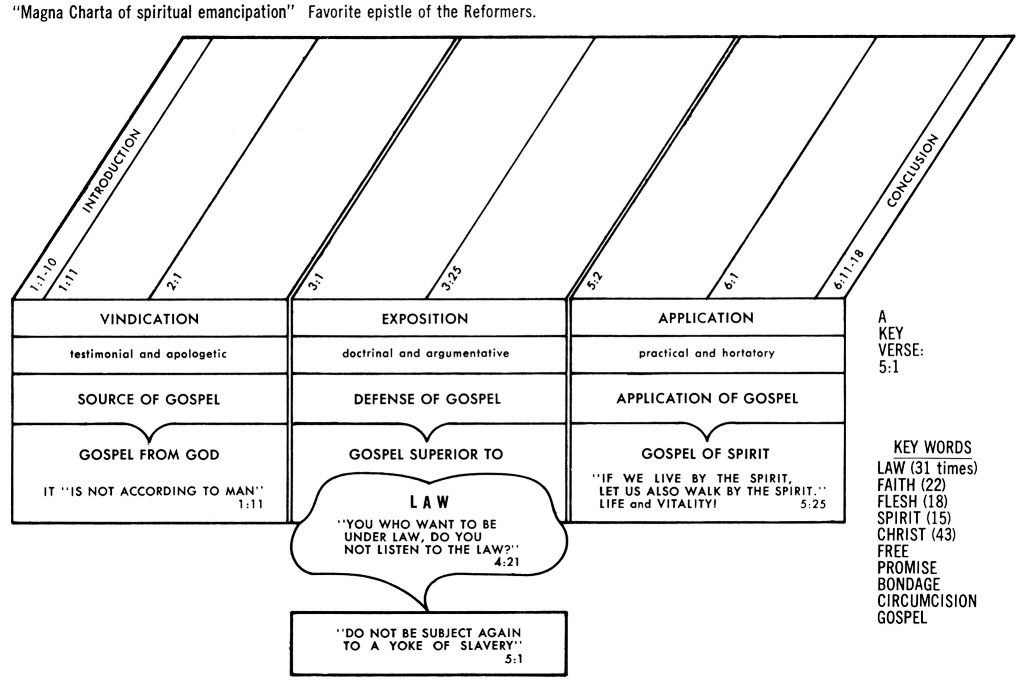
Magna Carta of Spiritual Emancipation
Click chart to enlarge
Charts from Jensen's Survey of the NT - used by permission
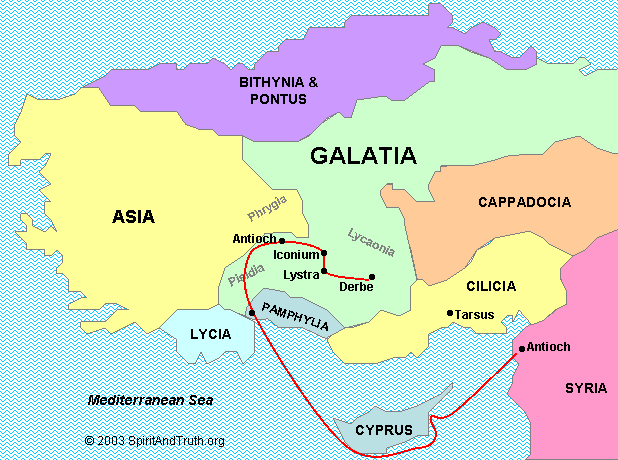
Click to Enlarge
See Also:
Paul's First Missionary Journey
Paul's Second Missionary Journey
Paul's Third Missionary Journey
Maps from Holman Bible Atlas (digital book; Hardcover/Paperback version) copyright © 1998 B&H Publishing Group, used by permission, all rights reserved.
This is one of the best resources for Bible maps as the maps also include helpful short descriptions of the events portrayed on the maps.
| SUMMARY CHART: EPISTLE TO THE GALATIANS |
|||||||
| Gospel of Grace Defended |
Gospel of Grace Explained |
Gospel of Grace Applied |
|||||
| Defense of the Gospel Gal 1:1-2:21 |
Freedom from Legalism Gal 3:1-4:31 |
Freedom to Love and to Serve Gal 5:1-6:18 |
|||||
| Labor | Liberty | Life | |||||
| Authority Not Opinion |
Freedom Not Bondage |
Spirit Not Flesh |
|||||
| Personal Autobiography |
Doctrinal Accuracy |
Practical Application |
|||||
| Paul the Apostle (Gal 1:1-24) |
Paul's Authority (Gal 2:1-21) |
Justified by Faith not Works (Gal 3:1-9) |
Justified by Faith not the Law (Gal 3:10-4:20) |
Grace and Law Cannot Co-Exist (Gal 4:21-31) |
Position and Practice of Liberty (Gal 5:1-15) |
Power of Liberty
(Gal 5:16-26) |
Performance in Liberty
(Gal 6:1-18) |
| Vindication | Exposition | Application | |||||
| Testimonial and Apologetic |
Doctrinal and Argumentative |
Practical and Hortatory |
|||||
| Biographical Explanation |
Doctrinal Exposition |
Practical Exhortation |
|||||
| Authentication of Liberty |
Argumentation for Liberty |
Application of Liberty |
|||||
|
Style or Tone: Vigorous, blunt, aggressive, direct, corrective, urgent, brief, righteous anger, strong words |
|||||||
|
Theme: Justification by Faith and not by Works of the Law |
|||||||
|
Author: Paul in large letters (Gal 6:11) |
|||||||
|
Recipients: Churches in Galatia (Gal 1:2) (Most likely the Southern Region) |
|||||||
|
Christ in Galatians: Jesus is the Source and Power for the believer's New Life. (Gal 2:20, 5:16) |
|||||||
Related Resource: Purpose of the Law
An Outline of Galatians - D Edmond Hiebert
THE INTRODUCTION (Galatians 1:1-10)
1. The salutation (Galatians 1:1-5)
a. The writer (Galatians 1:1-2a)
i. Paul, the Apostle (Galatians 1: 1)
ii. The brethren with him (Galatians 1:2a)
b. The readers (Galatians 1:2b)
c. The greeting (Galatians 1:3-5)
i. The contents of the greeting (Galatians 1:3a)
ii. The source of the grace and peace (Galatians 1:3b-4)
iii. The doxology (Galatians 1:5)
2. The rebuke (Galatians 1:6-10)
a. His astonishment at their fickleness (Galatians 1:6-7)
i. The reason for the astonishment (Galatians 1:6)
ii. The explanation of the departure (Galatians 1:7)
b. His assertion about its seriousness Galatians 1:8-9)
i. The seriousness asserted (Galatians 1:8)
ii. The seriousness reaffirmed (Galatians 1:9)
c. His attitude in the matter (Galatians 1:10)
I. PERSONAL: THE VINDICATION OF HIS APOSTOLIC AUTHORITY (Galatians 1:11-2:21)
1. How he got his Gospel (Galatians 1:11-24)
a. The origin of his Gospel through revelation (Galatians 1: 11-12)
i. The assertion as to its nature (Galatians 1:11)
ii. The manner of its reception (Galatians 1:12)
b. The previous conduct of the one given the revelation (Galatians 1:13-14)
i. The manner of his former life known to them Galatians 1:13a)
ii. The description of his former life (Galatians 1:13b-14)
a. In relation to the Church of God (Galatians 1:13b)
b. In relation to Judaism (Galatians 1:14)
c. The description of the revelation received (Galatians 1:15-17)
i. The source of the revelation (Galatians 1:15)
ii. The subject of the revelation (Galatians 1:16a)
iii. The purpose of the revelation (Galatians 1:16b)
iv. The response to the revelation (Galatians 1:16c-17)
d. His independence of the Jerusalem apostles (Galatians 1:18-24)
i. The first visit to Jerusalem (Galatians 1:18-20)
a. The time of the visit (Galatians 1:18a)
b. The purpose of the visit (Galatians 1:18b)
c. The duration of the visit (Galatians 1:18c)
d. The scope of contacts during the visit (Galatians 1:19-20)
ii. The subsequent absence from Jerusalem (Galatians 1:21-24)
a. The place of his withdrawal (Galatians 1:21)
b. The lack of acquaintance with the Judean churches (Galatians 1:22)
c. The response of the churches to reports about him (Galatians 1:23-24)
2. How his Gospel was confirmed by the apostles at Jerusalem (Galatians 2:1-10)
a. The circumstances of its presentation to them (Galatians 2:1-2)
i. The journey to Jerusalem (Galatians 2:1-2a)
ii. The presentation made at Jerusalem (Galatians 2:2b)
b. The outcome of his presentation of his Gospel to them (Galatians 2:3-10)
i. The maintenance of his position, as seen in Titus Galatians 2:3)
ii. The conflict with the false brethren (Galatians 2:4-5)
a. The presence of the false brethren (Galatians 2:4)
b. The refusal to yield to their demands (Galatians 2:5)
iii. The approval of his Gospel by the Jerusalem leaders (Galatians 2:6-10)
a. Their failure to add anything to his Gospel (Galatians 2:6)
b. Their approval of his Gospel in full (Galatians 2:7-10)
1. The basis of their approval (Galatians 2:7-9a)
2. The expression of their approval (Galatians 2:9b)
3. The one request with their approval (Galatians 2:10)
3. How he rebuked Peter's inconsistent conduct (Galatians 2:11-21)
a. The circumstances when giving the rebuke (Galatians 2:11-13)
i. The fact of his rebuke of Peter (Galatians 2:11)
ii. The reason for his rebuke of Peter (Galatians 2:12)
iii. The effect of the inconsistent conduct of Peter (Galatians 2:13)
b. The justification for giving the rebuke (Galatians 2:14-21)
i. His question of rebuke to Peter (Galatians 2:14)
ii. His explanation of his doctrinal position (Galatians 2:15-21)
a. The insufficiency of the law (Galatians 2:15-18)
1. The discovery of believing Jews about justification (Galatians 2:15-16)
2. The rejection of a conclusion from Peter's action (Galatians 2:17)
3. The significance of a return to law-works (Galatians 2:18)
b. The new life in Christ (Galatians 2:19-21)
1. The effect of the law led to the new life (Galatians 2:19)
2. The nature of the new life (Galatians 2:20)
3. The grace of God nullified by law-keeping (Galatians 2:21)
II. DOCTRINAL: THE EXPOSITION OF JUSTIFICATION BY FAITH (Galatians 3:1-4:31)
1. The elaboration of the doctrine of justification (Galatians 3:1-4:7)
a. The nature of justification as by faith, not law (Galatians 3:1-14)
i. The inconsistency of their conduct (Galatians 3:1-5)
a. The question about their turning from the crucified Christ (Galatians 3:1)
b. The question about the beginning of their Christian life (Galatians 3:2)
c. The question about their method of perfection (Galatians 3:3)
d. The question about their sufferings as believers (Galatians 3:4)
e. The question about the basis of God's work among them (Galatians 3:5)
ii. The example of Abraham's justification (Galatians 3:6-9)
a. The means of Abraham's justification (Galatians 3:6)
b. The identity of the sons of Abraham (Galatians 3:7)
c. The announcement to Abraham concerning Gentile justification by faith (Galatians 3:8)
d. The sharers in the blessings of Abraham (Galatians 3:9)
iii. The deliverance from law-works through Christ (Galatians 3:10-14)
a. The curse upon those under law-works (Galatians 3:10)
b. The inability of law-works to justify (Galatians 3:11-12)
c. The deliverance from the curse through Christ (Galatians 3:13-14)
1. The fact of our deliverance through Christ (Galatians 3:13a)
2. The means of our deliverance from the curse (Galatians 3:13b)
3. The purpose in our deliverance from the curse (Galatians 3:14)
b. The limitations of the law and its relations to faith (Galatians 3:15-4:7)
i. The covenant with Abraham unaltered by the law (Galatians 3:15-18)
a. The illustration of a man's covenant as binding (Galatians 3:15)
b. The fact illustrated is the divine promise to Abraham (Galatians 3:16)
c. The application of the principle of an unalterable covenant (Galatians 3:17-18)
1. The law did not alter the promise (Galatians 3:17)
2. The inheritance is not through law but promise (Galatians 3:18)
ii. The true place and purpose of the law (Galatians 3:19-29)
a. The temporary nature of the law (Galatians 3:19-20)
1. The reason for the adding of the law (Galatians 3:19a)
2. The time limit for the law (Galatians 3:19b)
3. The manner of the establishment of the law (Galatians 3:19c-20)
b. The inability of the law to produce life (Galatians 3:21-22)
1. The law not contrary to the promise (Galatians 3:21a)
2. The law unable to produce life (Galatians 3:21b)
3. The Scripture shut up all to faith in Christ (Galatians 3:22)
c. The law as a child-leader to Christ with His blessings (Galatians 3:23-29)
1. The old position under law (Galatians 3:23-24)
a. The position of confinement under law (Galatians 3:23)
b. The function of the law as child-leader to Christ (Galatians 3:24)
2. The new position in Christ (Galatians 3:25-29)
a. The nature of the new position (Galatians 3:25-26)
b. The entry into the new life (Galatians 3:27)
c. The effect of the new life (Galatians 3:28)
d. The fulfillment of the promise to Abraham (Galatians 3:29)
iii. The contrasted position under law and faith (Galatians 4:1-7)
a. The illustration of the position of the heir as a minor (Galatians 4:1-2)
b. The application of the illustration to believers (Galatians 4:3-6)
1. The condition of bondage as minors (Galatians 4:3)
2. The position as free sons through God's Son (Galatians 4:4-6)
a. The sending of the Son of God (Galatians 4:4-5)
b. The sending of the Spirit of God (Galatians 4:6)
3. The conclusion for the believer (Galatians 4:7)
2. The appeal for them to drop their legalism (Galatians 4:8-31)
a. The acceptance of Jewish legalism is a return to bondage (Galatians 4:8-11)
i. Their past condition of bondage (Galatians 4:8)
ii. Their present deliverance from bondage (Galatians 4:9a)
iii. Their legalism as a return to bondage (Galatians 4:9b-10)
iv. Their action a cause of concern to him (Galatians 4:11)
b. The appeal from his relations to them (Galatians 4:12-20)
i. The appeal for them to adopt his position (Galatians 4:12a)
ii. The reminder of his past relations to them (Galatians 4:12b-14)
iii. The change in their relation to him (Galatians 4:15-18)
iv. The travail he is undergoing for them (Galatians 4:19-20)
c. The appeal from the two contrasted covenants (Galatians 4:21-31)
i. The question to those desiring to be under law (Galatians 4:21)
ii. The story of Abraham's two sons (Galatians 4:22-23)
iii. The allegorical interpretation of the story (Galatians 4:24-30)
a. The two mothers representing two covenants (Galatians 4:24a)
b. The description of the two covenants (Galatians 4:24b-28)
1. The one representing a covenant of bondage (Galatians 4:24b-25)
2. The other representing a covenant of freedom (Galatians 4:26-28)
c. The expulsion of the slave woman and her son (Galatians 4:29-30)
iv. The conclusion from the story (Galatians 4:31)
III. PRACTICAL: THE LIFE OF CHRISTIAN LIBERTY (Galatians 5:1-6:10)
1. The call to maintain their Christian liberty (Galatians 5:1)
2. The peril to Christian liberty (Galatians 5:2-12)
a. The peril to them in circumcision (Galatians 5:2-6)
i. The consequences of accepting circumcision (Galatians 5:2-4)
a. It renders Christ useless to them (Galatians 5:2)
b. It makes a man debtor to do the whole law (Galatians 5:3)
c. It severs them from Christ (Galatians 5:4a)
d. It constitutes a fall from grace (Galatians 5:4b)
ii. The attitude of the true believer (Galatians 5:5-6)
b. The condemnation of the false teacher (Galatians 5:7-12)
i. The explanation for their defection (Galatians 5:7)
ii. The characterization of the teaching (Galatians 5:8-9)
iii. The condemnation of the one troubling them (Galatians 5:10-12)
a. The confidence he has in them (Galatians 5:10a)
b. The troubler will bear his judgment (Galatians 5:10b)
c. The refutation of charges that he preaches circumcision (Galatians 5:11)
d. The wish that these teachers would go to the consistent end (Galatians 5:12)
3. The life of Christian liberty (Galatians 5:13-6:10)
a. It is directed by love (Galatians 5:13-15)
i. The believer called to liberty (Galatians 5:13a)
ii. The use of Christian liberty (Galatians 5:13b)
iii. The fulfillment of the law through love (Galatians 5:14)
iv. The results of the lack of love (Galatians 5:15)
b. It is a walk in the Spirit, not in the flesh (Galatians 5:16-25)
i. The command to walk by the Spirit (Galatians 5:16)
ii. The conflict between the Spirit and the flesh (Galatians 5:17-18)
iii. The contrasted products of the flesh and the Spirit (Galatians 5:19-23)
a. The works of the flesh (Galatians 5:19-21)
b. The fruit of the Spirit (Galatians 5:22-23)
iv. The persons living by the Spirit (Galatians 5:24-25)
c. It is a life of mutual burden-bearing (Galatians 5:26-6:10)
i. The burden of moral faults (Galatians 5:26-6:5)
a. The warning against wrong attitudes towards others (Galatians 5:26)
b. The attitude of humility in restoring the fallen (Galatians 6:1)
c. The duty of mutual burden-bearing (Galatians 6:2)
d. The proper attitude toward self (Galatians 6:3-5)
ii. The burden of temporal needs (Galatians 6:6-10)
a. The exhortation to communicate with their teachers (Galatians 6:6)
b. The law of the spiritual harvest (Galatians 6:7-8)
c. The encouragement to welldoing (Galatians 6:9-10)
THE CONCLUSION (Galatians 6:11-17)
1. His reference to his large letters (Galatians 6:11)
2. His rebuke of his adversaries (Galatians 6:12-13)
3. His confidence in the cross (Galatians 6:14-16)
a. His glorying only in the cross (Galatians 6:14a)
b. His crucifixion through the cross (Galatians 6:14b)
c. His evaluation of things through the cross (Galatians 6:15)
d. His benediction upon those accepting this principle (Galatians 6:16)
4. His marks of apostleship (Galatians 6:17)
THE BENEDICTION (Galatians 6:18)
Galatians 5:16 But I say, walk by the Spirit, and you will not (*) carry out the desire of the flesh. (NASB: Lockman)
Greek: Lego (1SPAI) de, pneumati peripateite (2PPAM) kai epithumian sarkos ou me telesete. (2PAAS)
Amplified: But I say, walk and live [habitually] in the [Holy] Spirit [responsive to and controlled and guided by the Spirit]; then you will certainly not gratify the cravings and desires of the flesh (of human nature without God). (Amplified Bible - Lockman)
Barclay: I tell you, let your walk and conversation be dominated by the Spirit, and don’t let the desires of the lower side of your nature have their way. (Westminster Press)
KJV: This I say then, Walk in the Spirit, and ye shall not fulfill the lust of the flesh.
NLT: So I advise you to live according to your new life in the Holy Spirit. Then you won't be doing what your sinful nature craves. (NLT - Tyndale House)
Phillips: Here is my advice. Live your whole life in the Spirit and you will not satisfy the desires of your lower nature (Phillips: Touchstone)
TLB: I advise you to obey only the Holy Spirit’s instructions. He will tell you where to go and what to do, and then you won’t always be doing the wrong things your evil nature wants you to.
Weymouth: This then is what I mean. Let your lives be guided by the Spirit, and then you will certainly not indulge the cravings of your lower natures
Wuest: But I say, Through the instrumentality of the Spirit habitually order your manner of life, and you will in no wise execute the passionate desire of the evil nature (Eerdmans Publishing - used by permission)
Young's Literal: And I say: In the Spirit walk ye, and the desire of the flesh ye may not complete;
BUT I SAY, WALK BY THE SPIRIT: Lego (1SPAI) de, pneumati peripateite (2PPAM):
- Gal 3:17; 1Cor 7:29
- Gal 5:25; 6:8; Romans 8:1,4,5,12, 13, 14; 1 Pe 1:22; 4:6; Jude 1:19, 20, 21
- Galatians 5 Resources - Multiple Sermons and Commentaries
- The Perfect Model of a Spirit-Empowered Life - Excellent discussion of Jesus walking by the Spirit giving us a model
ONE OF THE MOST IMPORTANT
VERSES IN ALL SCRIPTURE!
Why is the truth of Galatians 5:16 so crucial in the life of the Christian? As you read these notes, you will come to understand the vital ministry of the Spirit Who enables us to walk supernaturally.
Dr Thomas Constable writes "This is one of the most important and helpful verses on Christian living in the Bible"
Dr J Vernon McGee adds that "This verse states the great principle of Christian living—walk by means of the Spirit."
David Platt on Galatians 5:16 - This passage is very important in light of a Christian's desire to spiritually grow. (Exalting Jesus in Galatians)
So let's begin the study, noting that Paul begins with a "but" a term of contrast.
But I say - Whenever you encounter a term of contrast, always pause to ponder and practice interrogating the prior passage (Gal 5:15) or sometimes the previous paragraph (Gal 5:13-15) - What is Paul contrasting?
The RSV rendering is misleading. Read the RSV and see if you can discern the subtle twist in meaning by this translation before you read the following comment.
But I say, walk by the Spirit, and do not gratify the desires of the flesh. (Gal 5:16RSV)
Comment: This verse makes the point that every translation has the potential to add their bias to the passage. In other words, ever translation is to some degree an "interpretation" of the original Greek, Hebrew or Aramaic, and this is a good reason one should use one of the more literal translations as their primary text (NAS, ESV, KJV - see Bible Versions compared). Now, did you see the subtle twist the RSV gives this verse. Look again -- how many "commands" are suggested by the RSV rendering? Two, right? One positive ("Walk") and one negative ("Do not gratify"). The Greek has only one -- walk. Why is this significant? The RSV reading might give someone the false impression that they need not only to walk by the Spirit but also not gratify their desires. That is not what the verse says -- it commands us to walk by the Spirit (a command that frankly we can only obey as the Spirit gives us the desire and power -- we need to learn continually to surrender to His leading, filling, empowering presence.) When we obey that command and walk by the enabling power the Spirit of grace supplies, then and only then will we be enabled to not carry out the desire of the flesh [which does necessitate us making that choice, but again it is a choice empowered by the indwelling Spirit!]. If the first part of the verse is "oil" so to speak, the second part is "water." They don't mix! The former (Spirit) in a sense negates the power of the later (the flesh). The danger of the RSV rendering is to that one might seek to not gratify the desire of the flesh in their own strength. I hope you do not think I am being picky. The point is that not gratifying the flesh is a supernatural result or product or fruit of walking by the Spirit and it simply cannot be accomplished in by fleshly effort. If you are still somewhat unclear about this important spiritual principle, it is discussed again in the comments below.
Proverbs says that "as a man thinketh in his heart, so is he." (Pr 23:7) Dear reader, you will find that the following discussion has a considerable amount of repetition to help you think rightly about the truth of what it means to walk by the Spirit, so that you might come to continually experience the supernatural life of the Spirit. That is my prayer for you (and for myself) in Christ's Name. Amen
THE HOLY SPIRIT:
THE FORGOTTEN GOD!
Ray Pritchard - To many Christians, the Holy Spirit is a mystery. He is the “hidden” member of the Trinity. The Father we know; the Son we know; but what about the Holy Spirit? Few believers understand Who He is, why He came, or what He does in the world today. Fewer still understand the vital (Ed: crucial, basic, fundamental, essential, cardinal, indispensable, necessary, key, dynamic, urgent, important, energetic, critical, requisite, radical) role He plays in the Christian life. I don’t think I’m going overboard in saying that a proper knowledge of the Holy Spirit’s ministry is absolutely essential to finding peace, joy, and victory as a Christian. Many believers live far below their potential because they have never discovered the Holy Spirit. They know nothing about His power, His indwelling, His anointing, His intercession, His gifts, and the fruit He longs to produce in them. But living without the Holy Spirit is like trying to drive a car with an empty gas tank. While we may not understand all the secrets of internal combustion, if we don’t understand the need for gas, the car isn’t going to get out of the driveway. (Names of the Holy Spirit by Ray Pritchard)
I believe Francis Chan would "amen" Pritchard's comments, for Chan has a similar lament in his new book "The Forgotten God" writing that "There is a big gap between what we read in Scripture about the Holy Spirit and how most believers and churches operate today. In many modern churches, you would be stunned by the apparent absence of the Spirit in any manifest way. And this, I believe, is the crux of the problem. If I were Satan and my ultimate goal was to thwart God’s kingdom and purposes, one of my main strategies would be to get churchgoers to ignore the Holy Spirit. The degree to which this has happened (and I would argue that it is a prolific disease in the body of Christ) is directly connected to the dissatisfaction most of us feel with and in the church. We understand something very important is missing. The feeling is so strong that some have run away from the church and God’s Word completely. I believe that this missing something is actually a missing Someone—namely, the Holy Spirit. Without Him, people operate in their own strength and only accomplish human-size results (Ed: In the context of Galatians 5:16, this would be like focusing on the last half of the verse, trying desperately to curtail the strong impulses of our flesh, instead of depending wholly and humbly on the Holy Spirit!). The world is not moved by love or actions that are of human creation. And the church is not empowered to live differently from any other gathering of people without the Holy Spirit. (Forgotten God - Book - Table of Contents, Sample Chapter - Read this book! It's a quick read but is pithy, provocative, poignant, personal and powerful - you won't walk away unchanged -- you'll either be mad or glad!) But when believers live in the power of the Spirit (Ed: E.g., "walk by the Spirit"), the evidence in their lives is supernatural. The church cannot help but be different, and the world cannot help but notice. (Bolding, italics and color mine)
The apostle Peter declared that Jesus left His brethren "an example...to follow in His steps"(1Peter 2:21). Peter's charge begs the question...
HOW CAN SAINTS
"WALK THE TALK?"
A common saying is that "What you don't know won't hurt you." That is not true in the spiritual realm, where what you don't know will hurt you. In other words, if you do not know the promised provision of the presence and power of the Person of the Holy Spirit, you will be "hurt" in the sense that you will not be able to live this Christian life as God intended and desires for you to live...abundantly (Jn 10:10b)...as more than a conqueror through Him Who loved us! (Ro 8:37KJV)
May God open the eyes of our heart that we each may come to know experientially the surpassing greatness of His power (resurrection power thru the ministry of the Holy Spirit) toward us who believe (Eph 1:19) and may He do so for His glory (Ro 11:36>, cp 1Cor 10:31) and on the basis of the finished work of His Son (Jn 19:30), Christ Jesus our Redeemer and Lord. Amen
Paul teaches us that in the incarnation of Jesus...
although He existed in the form of God, did not regard equality with God a thing to be grasped, but emptied Himself, taking the form of a bond-servant, and being made in the likeness of men. (Phil 2:6, 7)
Comment: While Jesus clearly did not cease being God (He was still fully God), He did take on the limitations of humanity. In the following passages from Luke's Gospel we see that one component of His becoming a Man was that He walked by the Spirit, leaving us an example to follow (1Peter 2:21)
Luke teaches us how Jesus walked...
And Jesus, full of the Holy Spirit, returned from the Jordan and was led about by the Spirit in the wilderness 2 for forty days, being tempted by the devil. And He ate nothing during those days; and when they had ended, He became hungry....14 And Jesus returned to Galilee in the power (dunamis = inherent ability to accomplish a task or perform a function) of the Spirit; and news about Him spread through all the surrounding district. (Luke 4:1, 2, 14)
Comment: Jesus as the God-Man was (1) filled with the Holy Spirit, (2) was led by the Holy Spirit and (3) conducted Himself in the power of the Holy Spirit. Filling speaks of control, for what fills you controls you. In Eph 5:18, if wine fills you, it controls you (cp "rage" noting the result of this "filling" in Lk 4:28, 29, 6:11), but if the Spirit fills you, He controls you. Jesus gives us the perfect example of a Man controlled by the Holy Spirit. In being led by the Spirit, Jesus gives us the example of submitting one's will to the will of the Spirit. The power Jesus depended on was not His own, but was the inherent ability of the Holy Spirit, Who enabled Him to carry out His ministry. In sum, Luke teaches us that Jesus functioned on earth as the God-Man by allowing Himself to be controlled by the Spirit, led by the Spirit and empowered by the Spirit. This same Holy Spirit is available to every believer today! Paul commands us to "Be imitators of me (present imperative = command calling for this to be our lifestyle, continually seeking to imitate Paul who imitated Jesus) just as I also am of Christ." (1Co 11:1, cp 1Co 4:16, Jn 13:15). It follows that if we are to imitate Paul who imitated Jesus, we too must allow the Holy Spirit to control us, lead us and empower us.
John MacArthur writes that....
The mystery of this perfect and paradoxical balance (The Holy Spirit in us enabling us and us freely choosing to walk by His enabling power) cannot be fully understood or explained, but it can be fully experienced.
Tim Schoap on walk by the Spirit - Picture a man who needs a cane to get around with. He walks by that cane, he depends upon it. In the same way, we are to walk by the Spirit. We are to depend on the Spirit, to need him. What is the result of walking by the Spirit? In Gal. 5:16, freedom from the flesh. Walk by the Spirit and you will not carry out the desire of the flesh. In other words, don’t walk by the Spirit and you will! In 5:22-23, fruit results from walking by the Spirit. Walk by the Spirit and be fruitful, don’t walk by the Spirit and be fruitless. Whose responsibility is "walking?" Ours again. This command is also continuous – we are to continually be "walking by the Spirit." Walking by is not the same as being nice, or not having any particularly ugly vices. It is specifically a life that is totally dependent upon the Spirit. How do we do this? Both "filling" and "walking" result from mind sets, mental attitudes, conscious patterns of thought. How much "let go, let God" is there in walking/filling? Not much, both are pretty active. Both filling and walking entail a turning from something and a turning to something (Someone). Turning away from self. Turning to the Spirit. Both are absolutely vital to the spiritual life. Filling brings the Spirit’s control, walking by maintains the Spirit’s control. In filling we yield to the Spirit, in walking we depend upon the Spirit. "Be filled with" and "walk by" are the two positive commands in regards to the Spirit. There are also two negative commands, two things we are to avoid. (The Spiritual Life)
WHAT WE MUST KNOW & ACT UPON...
SIN'S POWER HAS BEEN BROKEN
GOD'S POWER HAS BEEN PROVIDED
Kenneth Wuest commenting on Romans 6 helps us associate the truths in that great chapter with Paul's command to walk by the Spirit in Galatians 5:16. Wuest writes that the believer (note that Scriptures and comments in parentheses are added for amplification)...
is to take these facts into his reckoning (Ed: Reference is to Ro 6:11 which is a present imperative or a command to continually consider or recall to mind the truth that as believers we are now dead to the power of Sin as a ruling force in our lives and alive to God. Paul's command for continual reckoning counters our human tendency to continually forget the great things God has accomplished for us through Christ's death on the Cross!) as he deals with temptations that confront him (cp Heb 2:18 where "are tempted" is present passive = we are continually being tempted. Compare Jesus' present tense command calling for continual watching and prayer in face of temptation - Mt 26:41) or evil impulses that come from within (James 1:13). His attitude should be that, in view of the fact that the power of the evil nature (flesh) is broken, he is under no obligation to obey its behests (Ro 8:12). He has been emancipated (freed) from sin (the power of Sin), and the proper procedure is to read God's emancipation proclamation to the insistent demands of the Adamic nature (flesh). The believer must also realize that whereas before salvation, he could not help it when he sinned, yet since God saved him, should he sin, it is because of his free choice (Ed: The believer now commits sins because he wants to not because he is forced to!), since Sin's power has been broken. He is responsible for the sins he commits. This should make him think twice before he contemplates an act of sin at the demand of the evil nature (flesh). (Ed: The evil nature can still "bark" demands but it can't "bite", unless we choose to let him off his chain so to speak. As someone once quipped "Before salvation I chased after sin. Now that I am saved, sin chases after me!" But now I have a choice to say "Yes" to the Spirit of Christ, which enables me to say "No" to Sin.)
Then, he must also count upon the fact of his possession of the divine nature (cp Col 1:27b Christ is now in us in the form of the Spirit of Christ - for that Name see Ro 8:9). This will keep him from depending upon himself and his own strength in his effort to live a life pleasing to the Lord Jesus, and will cause him to throw himself upon the resources of God. He will be trusting the Lord Jesus to fill him with the Holy Spirit (John 7:37, 38), with the result that the Holy Spirit will do two things for him. He will suppress the activities of the evil nature (Gal. 5:16) and He will produce in the believer a Christ-like life (Gal 5:22, Gal 5:23). Paul says in Galatians 5:16, 17, "This I say then, Walk by the Spirit, and you shall not fulfill the cravings of the flesh, for the flesh has a strong desire to suppress the Spirit, and the Spirit has a strong desire to suppress the flesh, and these are entrenched in a permanent attitude of opposition to one another, so that you should not do the things that you would desire to be doing;" and in Galatians 5:22, 23, "The fruit of the Spirit is love, joy, peace, longsuffering, gentleness, goodness, faithfulness, meekness, self-control."
Contrast this adjustment of the intelligent Spirit-taught saint, with that of the believer who is not aware of the fact that God has broken the power of sin in his life, with the result that he is more or less under its compelling power, try as he may to live free from sin.
Since he is ignorant of the fact that God has placed within him His own nature, he depends upon himself and his own strength in an effort to defeat sin in his life and live a life pleasing to God. This believer is living a defeated life because he is not in proper adjustment to the new mechanical set-up of his spiritual being...The translation of Ro 6:11 follows
Thus also, as for you, constantly be taking into account the fact that you are those who are dead with respect to sin, and indeed those who are living ones with reference to God in Christ Jesus.
A paraphrase may make things clearer yet.
Thus also, as for you, constantly be taking into account the fact that you are those who have had the power of Sin broken in your lives and those who have had the divine nature implanted.
The words in Ro 6:12, "let not sin reign," are in a construction in the Greek (present imperative + negative) which forbids the continuation of an action already going on. The word "reign" is in the Greek "reign as king." The present tense speaks of habitual action. "That you should obey" is literally, "with a view to habitually obeying." The word "lusts" (epithumia) is literally "cravings." "Therefore" (term of conclusion) does not go back to "sin" but to "body."..."Lusts therefore" refers to the cravings of the human body, which cravings come from the sinful nature. The translation reads,
Therefore, stop allowing sin to reign habitually as king in your mortal bodies, with a view to your habitually obeying the cravings of that body.
God is never unreasonable in His demands upon His own. What He asks of us is always within our ability to fulfill as we appropriate the divine resources of grace. Since the power to sin is broken and the divine nature is implanted (The Holy Spirit is within us), we are well able to keep sin from reigning in our bodies (Treasures from the Greek New Testament, pp. 96-98).
Related Resource:
- See Wuest's article below The Christian and Trench Warfare.
Jerry Bridges - How the Holy Spirit works in us and through us is a mystery in the sense that we cannot comprehend or explain it. We simply accept the testimony of Scripture that He dwells in us and is at work in us to transform us more and more into the likeness of Christ (see 2 Corinthians 3:18). We do need to actively believe this great truth about the Holy Spirit. We need to believe that, as we seek to deal with our subtle sins, we are not alone. He is at work in us, and we will see progress as we walk by the Spirit.
The respected pastor and writer of one of the best devotional commentaries on the book of Romans, William Newell, said it this way...
There is deep mystery, no doubt, in the great double fact of God is working in us to will (Phil 2:13), and on the other hand, of our choosing His will, moment by moment (Phil 2:12). We can only affirm that both are taught in Scripture, and we ourselves know both to be blessedly true....
How wonderful, how limitless, the patience of the blessed Spirit of God! Moment by moment, day by day, month by month, year by year, through all the conscious and unconscious processes of tens of thousands of believers, the Spirit acts with a uniformity that is called “the law of the Spirit of life in Christ Jesus.” (Ro 8:2) In the newest convert, in the oldest saint, He gives freedom from the law of sin and of death! “Sin in the flesh, which was my torment, is already judged, but in Another (Christ); so that there is for me no condemnation on account of the flesh (Ro 8:1)...We lose communion with God, and dishonor the Lord by our behavior, in not walking, according to the Spirit of life, worthy of the Lord. But we are no longer under the law of sin, but, having died with Christ, and become partakers of a new life in Him and of the Holy Spirit, we are delivered from this law.” (From his comments on Romans 8: Romans Verse by Verse)
So what are we to say about "walking by the Spirit?" Mystical? Yes! Mysterious? Yes! Something possible for only a few select "super saints"? No! Can this really be my experience? Yes! What does it mean practically? The short answer is God commands us to walk by the Spirit (Gal 5:16) and what He commands, He always enables (Pause here - Do you really believe that is true?), providing the desire and power (Php 2:13NLT-note). Below are some resources that may aid you as you seek to learn what it means to walk by the Spirit...
To establish the context, of the letter to the Galatians you might first read slowly and meditatively through the entire letter in your chosen version. Then you might read through a second time using the Amplified Version which is a relatively literal version to which has been added notes that function much like a "mini-commentary". (In the Amplified Version Brackets [...] signify clarifying or explanatory words or phrases not found in the original language. Parentheses (...) signify additional phrases of meaning of the words or phrases in the original language). Once you have established the context, you will better able to profit from the following resources (including the notes on this page)...
- John Piper Mp3- Walk by the Spirit! Audio is better than just reading the transcript (another Mp3)
- Ray Stedman Mp3 - Legalism - excellent on how not to walk by the Spirit (transcript)
- J Vernon McGee Mp3 - Gal 5:16, 5:16; 5:17; 5:18-21; 5:22-23; 5:24-26
- S Lewis Johnson - Life by the Spirit - Mp3 or Transcript
- Dan Duncan Mp3 - Galatians 5:16-26
- Study these Verse by verse notes After you've pondered the principles for yourself. Galatians 5:16; 5:17; 5:18; 5:19; 5:20; 5:21; 5:22; 5:23; 5:24; 5:25; 5:26
- Studies by John Walvoord on
- The Person of the Holy Spirit
- The Spirit at Work in the Spirit-filled Life (Walking by the Spirit)
- The Work of the Holy Spirit in the Believer (Spiritual Gifts)
- The Work of the Holy Spirit in the Believer (Filling)
- The Work of the Holy Spirit in the Believer (Filling -2)
Kistemaker sums up Galatians 5:16...
Keep the context of this epistle in mind as you study "Walking by the Spirit" - This epistle to the Galatians is unlike most of Paul's other epistles because it lacks a commendation section and instead has a severe admonitory tone. Many of the readers had obviously succumbed to the teaching of the Judaizers who taught that one must rigorously follow the Old Testament law in addition to Christ in order to be pleasing to God. These false teachers added that one must add circumcision and therefore in essence were teaching that one needed to add law to the grace of Christ which was not the true Gospel. The law was like a yoke which gives some guidance to an ox but which provides no power. And like a yoke, no external law can give one a desire to obey. And so Paul writes Galatians in an attempt to correct these heretical teachings which cut off those new converts who were "running well" in their Christian life.
Early in this epistle, Paul explained the necessary requirement for walking by the Spirit, emphasizing that one must "begin" in the Spirit (regeneration, justification) before "continuing" in the Spirit (sanctification)...
You foolish Galatians, who has bewitched you, before whose eyes Jesus Christ was publicly portrayed as crucified? This is the only thing I want to find out from you: did you receive the Spirit by the works of the Law or by the hearing of faith? Are you so foolish? Having begun by the Spirit (regeneration, justification) are you now being (present tense) perfected (this describes sanctification - bringing to an end [we will never perfectly attain the goal of Christ likeness in this life but are to continue on this journey]) by the flesh? (Galatians 3:1-3)
PERFORMER
VERSUS
TRANSFORMER
All believers do well to never forget that our fallen flesh that is ever the performer while the Spirit is our heavenly "Transformer." (See Gal 5:17 which describes this lifelong war!)
Clearly Paul's rhetorical question in Galatians 3:3 demands a resounding "No". Spiritual maturity (or progressive sanctification, growth in Christ likeness, present tense salvation) is accomplished by the same faith that allowed the saints to begin in the Spirit. The problem in Galatia was that they had been bewitched and were foolishly and futilely seeking to "grow in grace" by keeping the law, which is like trying to mix oil with water! Grace and law do not mix! Now in Galatians 5:16 Paul proceeds to give the answer to how one attains true spiritual maturity, first by issuing a command, but adding a promise to that command.
Spurgeon - Walk under the Spirit’s power, following His guidance. The Spirit never leads a man into sin. He never conducts him into self-indulgence and excess. Be obedient to that great principle of the Spirit that goes with the doctrine of grace and salvation by faith, and then you will not be obedient to that lusting of the flesh that is in you by nature.
Vance Havner - Walking in the Spirit is exactly what the name means: not taking a "step" or a "stand" to pose like statues on the rock of a Bible truth, but living day by day in the name of Christ by the power of the Holy Spirit....Never has the church had more wire stretched with less power in it. "All is vain unless the Spirit of the Holy One comes down." Sad to say, we seem not even to know that we have not the Spirit in power. If He ceased His work many church members would never know the difference. Like Samson, we wist not that He has departed, but we keep "shaking ourselves" in the prescribed calisthenics. ...Too many people assemble at God's house who don't really believe in the power of God. Having begun in the Spirit, we live in the flesh. I heard of a boys' school where every morning before classes the youngsters were supposed to recite the Apostles' Creed. Each one was given a segment of the creed: "I believe in God the Father Almighty," and so on down the line. One morning they were getting along pretty well until all at once there was a dead stop and a profound silence. Then a lad spoke up and said, "The boy who believes in the Holy Spirit is not here this morning." I'm afraid that's happened in a lot of church prayer meetings these days.
David Platt - Clearly the focus of this passage is on the need to live constantly by the power of the Spirit (Gal 5:16, 18, 25). Paul is not talking to "super Christians" in this passage. ....To "walk" by the Spirit indicates the need to yield to the Spirit every day: at work, at a ball game, in the home, everywhere. The word for walk, peripateite, in its wider usage in Greek means "to walk around after someone or to walk in a particular direction" (George, Galatians, 386). In the days of Aristotle, his students were known as peripatetics because of their habit of following their teacher around (ibid.). For the Christian, to walk by the Spirit, or to be led by the Spirit, means to follow our Teacher around. We must listen to the Spirit's Word, discern His will, and follow His guidance. This is not a deeper life or higher life; this is the normal Christian life. We should note the tension here between God's divine power and the believer's human choice (Schreiner, Galatians, 343). Christians must decide to walk by the Spirit continually, and at the same time the Spirit is at work to create new appetites and give new power to resist the flesh and to please God. The phrase "and you will not carry out the desire of the flesh" is a promise. Those who yield to the Spirit daily have the promise that they will not gratify their fallen human nature. We should see that there is no neutral ground here. We are living in one sphere or the other. Either we are submitting to the Spirit's leadership, or we are gratifying our flesh. If we are submitting to the Spirit, we cannot gratify the flesh. You cannot pray and look at pornography at the same time. The way you deal with your sin is not simply by saying "no" to the flesh, but by also saying "yes" to the Spirit's work. Conquering the flesh does not merely come from theological knowledge. A professor of theology can be addicted to pornography or fly off the handle in rage just the same as a younger believer with little theological knowledge. Growth does not happen because of your ability. Sadly, I have known several gifted ministers who are no longer in ministry because they were not walking by the Spirit. They gave in to various temptations of the flesh and suffered tragic consequences, wrecking themselves and others. Growth does not happen because you attend seminars or read books, as helpful as they may be. God changes us from the inside out through the Spirit. We must daily yield to Him so that we do not gratify the desires of the flesh. (Exalting Jesus In Galatians - Bolding added)
Vance Havner - Marking Time or "Marching to Zion"? - "Walk in the Spirit, and ye shall not fulfil the lust of the flesh." Gal. 5:16 = We speak of a "step of faith" but with some of us it never amounts to more than a step. Now a walk is a succession of steps and having stepped out by faith we are to keep stepping until the stepping is a steady walk. We have thought too much of this matter of faith as one definite move whereas it is a continuous moving onward looking toward Jesus. And some of us just "mark time": there is a sort of activity but it gets nowhere. The faith life takes no vacations. It is not a matter of occasional ventures, excursions now and then from a walk by sight out into side roads of things unseen. It is not a matter of once in a while testing out a certain promise to see whether or not it works. Walking in the Spirit is exactly what the name means: not taking a "step" or a "stand" to pose like statues on the rock of a Bible truth, but living day by day in the name of Christ by the power of the Holy Spirit. So many have grown disappointed because they took a step and the next thing was not another step but a stop. If the step does not become a walk it ends like the little boy who fell out of bed because he slept too close to where he got in! And don't confuse marking time with "marching to Zion!" (Consider Jesus)
Pastor Steven Cole encourages each of us to honestly ask ourselves...
If God were to withdraw His Holy Spirit from me,
would I even notice the difference?
Would my week have gone any differently
if the Spirit had pulled out?
To walk by the Spirit means to depend on Him consciously for everything we do. We depend on Him to resist temptation. We ask Him for insight into His Word. We rely on Him for the right attitude in the midst of our trials. We seek Him for wisdom in difficult decisions. When we live in the power (dunamis) of the Holy Spirit (cp Acts 1:8), our life is marked by hope in God. Paul wrote (Ro 15:13), “Now may the God of hope fill you with all joy and peace in believing, that you may abound in hope by the power (dunamis) of the Holy Spirit.” Joy and peace and hope are the opposite of depression and anxiety and despair. That verse does not just apply to certain personality types, or to those who are in relatively trouble-free situations. As you learn to live in the fullness of God’s Spirit (Ed: See Ep 5:18. Compare how the God-Man Who had emptied Himself [Phil 2:5, 6, 7] walked/conducted Himself in Luke 4:1, 2, 14! Then Walk in His steps! 1Pe 2:21), the God of hope will fill you (Ed: How>? By His Spirit Who indwells every believer [1Co 6:19], the Spirit of Christ [Ro 8:9]) with His joy, peace (Gal 5:22), and abounding hope! If you lack these things, don’t get more depressed in hearing me say this. Get on your knees every day and ask God to fill you with the Holy Spirit. To hope in Christ means to live righteously and expectantly in the power of the Holy Spirit.
LIBERTY...
LICENSE?
or
LEGALISM?
But - Remember that whenever you encounter a contrast word like "but" in a passage, always pause and ponder with the 5W/H'S - "What is the author contrasting?" (Why?, Why now?, How?, etc). These questions will "force" you to go back and re-read the preceding text (thus you are establishing the context which is key to accurate Interpretation). As this discipline becomes a habit, you will find that the practice of slowing down will allow your Teacher, the Spirit (1Jn 2:20, 27) to illuminate the text. You will be amazed at the insights you will glean. And I would submit that as you practice pondering the text, you are in fact beginning to practice the blessed discipline of Biblical Meditation. (E.g. see the promises associated with meditation - Ps 1:1, Ps 1:2, Ps 1:3, Joshua 1:8). As an aside the little conjunction "but" is found 4327 times ("yet" is found 489 times) (NAS77) which will give you many wonderful opportunities to hone your skill of interrogating the text and engaging in Biblical meditation.
But I say - In the context of this section, Paul has been warning his readers of two great dangers in the spiritual life - license and legalism. License in this context is to demonstrate by disregard for standards of personal conduct (cp licentiousness). License conveys the idea of freedom (grace) which is abused (e.g., as was happening in Jude 1:4). Legalism on the other hand is a strict or conformity to laws or rules. Legalism is preoccupation with form at the expense of substance. Legalism is the attempt of the fallen flesh to please God by obeying laws or rules. Paul condemns both extremes and instead offers a middle path, the only path that guarantees true freedom in Christ - walking by the Spirit.
In Galatians 5:1 Paul declares...
It was for freedom (eleutheria) that Christ set us free (eleutheroo); therefore (term of conclusion) keep standing (present imperative = Make this your habitual practice! It speaks of the general direction of your life - not perfection but direction!) firm and do not be subject again to a yoke of slavery.
In Galatians 5:13 Paul alludes the danger of license or of turning freedom in Christ into a "freedom" to freely commit sins.
For you were called to freedom, brethren; only do not turn your freedom (eleutheria - freedom is not the power to do as you wish, but the power to do as you should) into an opportunity (idea is a "foothold" or a "beach head" from which to launch wartime operations - see aphorme) for the flesh, but through love (agape) serve (douleuo in the present imperative= Make this your lifestyle - something that is only supernaturally possible! As you walk by the Spirit! See His fruit in the surrendered saint -Gal 5:22) one another. (Galatians 5:13)
Comment: The Galatian saints might have reasoned that since they were no longer under the heavy yoke of the Law (which is in fact true = Gal 5:18) but were under grace (which is also true) they were free to behave however they were led by their fallen flesh! What Paul is teaching the Galatians and all saints is that the believer's new freedom in Christ is not freedom to sin but freedom from sin. There is a world of difference! Paul says the rule of thumb that should guide their (and our) behavior in this new freedom in Christ is this "Do my thoughts, words and deeds genuinely demonstrate love to others? Am I loving others as I would love myself?"
For the whole Law is fulfilled in one word, in the statement, "YOU SHALL LOVE YOUR NEIGHBOR AS YOURSELF." (Galatians 5:14)
Paul warns them, that if they do not show supernatural, Spirit empowered love to one another, they will be biting and devouring one another and be in danger of destroying each other.
But if you bite and devour one another, take care lest you be consumed by one another. (Galatians 5:15)
Having presented the perverted polar opposites of legalism and license in Galatians 5:16, Paul begins with the important contrast word but, which signifies that instead of biting and devouring one another, by contrast, the Galatians needed to practice "preventative maintenance" so to speak by continually living the Christian life in the power of and under the influence of the Holy Spirit. Then, and only then, could they cease to gratify the desires of their fallen "rotten" flesh. Paul explains that it is the Spirit Alone Who can keep the believer truly free and allow him or her "through love to serve one another."
Illustration - Five-year-old Jason announced that he wanted to grow carrots in a corner of the garden. He dutifully watered his carrot patch, and his mom bought fertilizer. But no carrots emerged. As they puzzled over the absent carrots, his mom asked, “Jason, when did you put the seeds in?” “I forgot about seeds!” he exclaimed. “But–I thought if I watered and fed it right, the carrots could still grow!” Just as the ground doesn’t spontaneously produce carrots, our hearts cannot spontaneously produce obedience without fundamental change. (Today in the Word)
Barton adds that the phrase but I say "ties in with Gal 5:13-15. The strategy for removing the divisiveness that marred the Galatian church was to serve one another in love, but that too was humanly impossible. People cannot, in their own power, show love to all people at all times. But God has provided the means to meet his commands—the Holy Spirit. (Barton, B. B., et al. Life Application Bible Commentary. Romans: Tyndale House Publishers)
Richison agrees writing that "In contrast to letting the flesh form a base of operations in our soul by devouring one another with words, we are to let the Holy Spirit control us. (Galatians 5:16)
Findlay writes that in context Paul has just explained the Galatian believers had been called to freedom and that they could keep from biting and devouring one another only as they learned to "walk in love" (see Gal 5:13,14, cf Eph 5:2). He then explains how it is now possible to "walk in love" writing that...
LOVE is the guard of Christian freedom. The Holy Spirit is its Guide. These principles accomplish what the law could never do. It withheld liberty, and yet did not give purity. The Spirit of love and of sonship bestows both, establishing a happy, ordered freedom, the liberty of the sons of God.
From the first of these two factors of Christian ethics the Apostle passes in Galatians 5:16 to the second. He conducts us from the consequence to the cause, from the human aspect of spiritual freedom to the Divine. Love, he has said, fulfils all laws in one. It casts out evil from the heart; it stays the injurious hand and tongue; and makes it impossible for liberty to give the rein to any wanton or selfish impulse. But the law of love is no natural, automatic impulse. It is a Divine inspiration. ”Love is of God.” It is the characteristic “fruit of the Spirit” of adoption (Gal 5:22), implanted and nourished from above. When I bid you “by love serve each other,” the Apostle says, I do not expect you to keep this law of yourselves, by force of native goodness: I know how contrary it is to your Galactic nature; “but I say, walk in the Spirit,” and this will be an easy yoke; to “fulfil the desire of the flesh” will then be for you a thing impossible. (Galatians 5:16-26 Christ's Spirit and Human Flesh)
Walk by the Spirit is translated as follows...
- walk and live [habitually] in the [Holy] Spirit [responsive to and controlled and guided by the Spirit]; (Amplified)
- let your walk and conversation be dominated by the Spirit (Barclay)
- let the Spirit direct your lives (Good News Bible)
- Let your steps be guided by the Spirit (Montgomery)
- Live by following the Spirit (NCV)
- be guided by the Spirit (New Jerusalem Bible)
- live according to your new life in the Holy Spirit. (NLT)
- Live your whole life in the Spirit (Philips)
- let the Spirit direct your lives (TEV)
- obey only the Holy Spirit’s instructions. He will tell you where to go and what to do (TLB)
- Let your lives be guided by the Spirit (Weymouth)
- In the Spirit walk ye (Young's Literal)
Note some translations and commentaries do not take Spirit as the Holy Spirit but I think that is an incorrect interpretation. For example God's Word Translation is "Live your life as your spiritual nature directs you". Surely they mean to imply that the spiritual nature is that which is empowered by the Spirit, for otherwise we would have no ability to walk counter to the strong desires of the flesh.
Boice comments that "Life by the Spirit is neither legalism nor license - nor a middle way between them. It is a life of faith and love that is above all of these false ways." (Ed note: Life in the Spirit is a brand new manner of supernatural living.)
Walk by the Spirit - Obviously this is not a literal walk (see more discussion below), but speaks of our day to day conduct. Walking was a common figure in the Old Testament for one's conduct ("How blessed is the man who does not walk in the counsel of the wicked..." Psalm 1:1). As Spurgeon notes "It is a rich sign of inward grace when the outward walk is changed, and when ungodliness is put far from our actions." (Ref) As we conduct ourselves each day, we are to do so by allowing the Spirit to guide, lead, control and empower our every thought, word and deed. This is vital for "victorious" Christian living. Positionally every believer is victorious because of Christ's work on Calvary and the truth that we are all in Him. But Paul desires that our daily practice match our secure, eternal position and that we daily live out what we really are - victors over sin, the flesh and the devil. Believers however cannot achieve victory over the flesh by adherence to a set of rules or by self effort, as many of those in Galatia were doing. To do so is like asking the flesh to cast out the flesh, something it will never do! To the contrary, just as we received Jesus by faith, we are charged to walk in His Spirit by faith (cp Col 2:6). The same faith that saved us initially, now sanctifies us daily. Those variegated, manifold "pop tests" which God allows into our life each day will provide plenty of opportunities (not obstacles as we too often see them) to practice "walking" so that we might learn what it means to experientially and practically walk in the power of the Holy Spirit.
One aspect of walking in the Spirit is to have our daily lives under His control, and this in turn is optimized when we are in the Word of God daily and allowing His Word and Spirit to direct us throughout the day (see chart). Meditation is to the heart what digestion is to the body and thus is the taking in of the Word of God and making it a part of the inner being. As the heart and mind think on the Word all day long, the Spirit guides the life. This is what it means to walk in the Spirit.
As an aside remember that it is the Holy Spirit Who is the energizer of new life in the believer. Therefore even though His Name may not be mentioned in a specific passage, a proper understanding of His role in the sanctification process of believers indicates that He is the ultimate "power Source". For example, in the well known passage Galatians 2:20, "Christ lives in" Paul through the power of the Spirit of Christ (Ro 8:9, cp Acts 16:7 = "Spirit of Jesus"). Similarly in Phil 4:13 Paul is able because of the empowering ministry of the indwelling Spirit of Christ. There are countless similar passages one could reference, but the main point is that every believer should be motivated to have a firm doctrinal understanding of the Holy Spirit Who is the One Who energizes their spiritual life. On the other hand we do well to remember that while the Spirit is vitally important to the life of every saint, His great objective is always to glorify Christ (Jn 16:14).
John MacArthur...
Walking by the Spirit is basic to holiness. We can have holiness in our lives without legalism as we walk by the energy of the Holy Spirit, yielding to Him. That is essentially the same concept as being "strengthened with might by [the] Spirit in the inner man" (Eph. 3:16) or being "filled with the Spirit" (Eph. 5:18) (Ed: Although it may be semantics, "Filling" is slightly different in that in order to walk by the Spirit one must be filled with or controlled by the Spirit). The Christian does not set up a list of dos and don'ts to live a holy life. If he concentrates only on external things, he is much like the Pharisees, of whom Jesus said, "You might be careful that you don't do this or that, but your thoughts are foul. You might not murder, but you hate. You might not commit adultery, but you lust after women. The evil intent of your hearts makes you guilty of murder and adultery." I've seen situations where Christians did not do specific things, but their thoughts were so corrupt that God must have been as grieved as if they had actually done them. They knew nothing of walking by the Spirit; they were experts on being circumscribed to an external ethic. They were unaware that faithfully walking by the energy of the Spirit produces the holiness of God.
If I had my choice of being obedient to an external list of rules, or simply walking by the energy of an internal power, I would choose the latter. I am glad I live under the New Covenant, where practical holiness is the product of living by the energy of the indwelling Spirit, who empowers me to do the things that I couldn't force myself to do, no matter what the outside rules were. (Walking by the Spirit, Part 1)
"DEPENDENT
RESPONSIBILITY"
Jerry Bridges explains that
To walk by the Spirit is to live under the controlling influence of the Spirit and in dependence upon Him…Practically speaking, we live under the controlling influence of the Spirit as we continually expose our minds to and seek to obey the Spirit’s moral will for us as revealed in Scripture. We live in dependence on Him through prayer as we continually cry out to Him for His power to enable us to obey His will.
There is a fundamental principle of the Christian life that I call the principle of dependent responsibility; that is, we are responsible before God to obey His Word, to put to death the sins in our lives, both the so-called acceptable sins and the obviously not acceptable ones. At the same time, we do not have the ability within ourselves to carry out this responsibility. We are in fact totally dependent upon the enabling power of the Holy Spirit (see Php 2:12, Php 2:13). In this sense, we are both responsible and dependent.
In the Old Testament God's promise of the New Covenant clearly describes "dependent responsibility"...
And I will put My Spirit within you and cause you to walk in My statutes, and you will be careful to observe My ordinances.
Comment: Observe the first part of the verse describes what God promises to do in the New Covenant -- He will place His Holy Spirit within believers. His Spirit will cause us to walk in His statutes. That is God's part of the "equation." Our responsibility (in dependence on and empowerment by His Spirit) is to obey His ordinances. This is God's clear description of the supernatural life in Christ, a life only possible by dependence on the indwelling Spirit of Christ (see this phrase in Ro 8:9). In the Garden of Eden God gave Adam one prohibitive commandment, but he did not force Adam and Eve to obey. Instead He gave them the freedom of choice. In the New Covenant we have that same choice. God through Paul commands us to walk by the Spirit but we still have to choose daily, moment by moment to yield to His sweet Spirit. And as we do so, we begin to experience a Christian life on a higher plane, life as God always intended to be. Why? Ultimately that He might be glorified before the lost world. When saints live a supernatural, Spirit filled life, such a life is in a sense a "good work" ("God work") because it is in truth a supernatural life. This Spirit filled, controlled, empowered life is put on display and in every sense fulfills Jesus' command
"Let your light shine before men in such a way that they may see your good works, and glorify your Father Who is in heaven." (Mt 5:16)
In a parallel passage Jesus explained that "By this is My Father glorified, that you bear much fruit, and so prove to be My disciples." (Jn 15:8). And so by the visible, audible words and deeds of God's Spirit filled saints, the world (lost and saved) sees a visible picture of the invisible God. Paul said the same thing in a different way writing that...
we (Spirit filled believers who are walking, living, behaving by in dependence on and empowerment of the Holy Spirit) are a fragrance of Christ to God among those who are being saved and among those who are perishing to the one an aroma from death to death, to the other an aroma from life to life. And who is adequate for these things? (2Cor 2:16, 17)
John MacArthur alludes to this concept of "dependent responsibility" of believers writing that...
Scripture is clear that, in some mystical way known only to God, a person begins to walk by the Spirit the moment he believes. But, on the other hand, he is also admonished to walk by the Spirit as he lives out his earthly life under the lordship of Christ and in the power of the Spirit. As with salvation itself, walking by the Spirit comes first of all by God’s sovereign work in the believer’s heart, but it also involves the exercise of the believer’s will. Romans 8:4 is speaking of the first, whereas Galatians 5:25 (“let us … walk by the Spirit”, cp Gal 5:16) is speaking of the second.
As far as a Christians life is concerned, everything that is a spiritual reality is also a spiritual responsibility. A genuine Christian will commune with his heavenly Father in prayer, but he also has the responsibility to pray. A Christian is taught by the Holy Spirit, but he is also obligated to seek the Spirit’s guidance and help. The Holy Spirit will produce spiritual fruit in a believer’s life, but the believer is also admonished to bear fruit. Those truths are part of the amazing and seemingly paradoxical tension between God’s sovereignty and man’s will. Although man’s mind is incapable of understanding such mysteries, the believer accepts them because they are clearly taught in God’s Word
We know little of the relationship between God and Adam before the Fall, except that it was direct and intimate. The Lord had given but one command, a command that was given for Adam and Eve’s own good and that was easily obeyed. Until that one command was transgressed, they lived naturally in the perfect will of God. Doing His will was part of their very being. The believer’s relationship to God is much like that. Although Christians are drawn back to the old ways by the fleshly remnants of their life before salvation, their new being makes obedience to God the “natural” thing to do.
The Christians obligations to God are not another form of legalism. The person who is genuinely saved has a new and divine nature that is, by definition, attuned to God’s will. When he lives by his new nature in the power of the Spirit, his desire is God’s desire, and no compulsion is involved. But because the believer is still clothed in the old self, he sometimes resists God’s will. It is only when he goes against God’s wilt and against his own new nature that the divine commands and standards seem burdensome. On the other hand, the faithful child of God who is obedient from the heart can always say with the psalmist, “O how I love Thy law!” (Ps. 119:97). (MacArthur, J: Romans 1-8. Chicago: Moody Press)
C Norman Bartlett writes that in Galatians 5:16...
lies the key to conquest - not through the terrors of the law, but through the Spirit of the LORD will victory over the flesh (Ed: which is irrevocably, relentlessly opposed to God in every way! It is not like fine wine -- it does not become better with age.) be won. The spirit of the law and the law of the Spirit are poles apart. The injunction to walk by the Spirit implies power of choice on the part of the believer, whether to submit to the bondage of sin or to enter into that freedom in the Spirit which is rightfully his as a child of God. True, the old nature has not been eradicated, but its power over the soul which is trusting in Christ for salvation has been broken. Putting it figuratively, the dogs have been chained; they are no longer at large; but if we fail to keep our distance, and carelessly or deliberately give occasion to sin, we have ourselves to blame for the consequence. We have the privilege of walking in the Spirit; but we are not compelled to do so; it is a voluntary matter.
TRIUMPH OVER THE OLD NATURE...
NOT NEGATIVE REPRESSION
but
POSITIVE POSSESSION!
Approaching the subject from another angle, many a follower of Jesus fails of living a truly victorious life because he tries to study and prescribe for his own symptoms instead of giving the Holy Spirit the right-of-way in his life and letting Him minister as only He can in the treatment of hidden roots of moral and spiritual ailment. It is to be noted that in the main the way to triumph over the old nature is not so much a matter of negative repression as of positive possession of the boundless resources of grace available through the Spirit.
Thomas Chalmers once preached a sermon entitled "The Expulsive Power of a New Affection" (see Pdf with many pictures related to Chalmers - very interesting! The Expulsive Power of a New Affection on 1 John 2:15) and the reverberations of its challenging message still ring out. We turn the hose on dirt. We let in the pure air to drive out the foul. Tuberculosis is held at bay by a changing of climate. Need we enlarge at great length upon the application? There is no more effective way to fortify ourselves against the hurts of the flesh than to walk in the Spirit day by day and hour by hour. (C. Norman Bartlett: Galatians and You: Studies in the Epistle of Paul to the Galatians, 1948)
Andrew Murray gets right to the point observing that Paul's "words suggest to us very clearly the difference, between the sickly and the healthy Christian life. In the former the Christian is content to 'live by the Spirit'. He is satisfied with knowing that he has the new life but be does not 'walk by the Spirit.' The true believer, on the contrary, is not content without having his whole walk and conversation in the power of the Spirit. He walks by the Spirit, and so does not fulfill the lusts of the flesh....
Wuest explains that "Paul now introduces a statement intended to counteract the erroneous impression held by the Galatians, possibly at the suggestion of the Judaizers, that without the restraining influence of the law, they would fall into sin. Instead of an attempted law obedience in their own strength motivated by the terrors of the law, Paul admonishes them to continue to govern their lives by the inward impulses of the Holy Spirit. The type of life and the method of living that life which he here speaks of, Paul had already commended to them in Gal 5:5, in the words “For we through the Spirit wait for the hope of righteousness.” Thus, the secret of victory over sin is found, not in attempted obedience to a law that has been abrogated, but in subjection to a divine Person, the Holy Spirit, Who at the moment the sinner places his faith in the Lord Jesus, takes up His permanent residence in his being for the purpose of ministering to his spiritual needs. (Galatians Commentary - Verse by Verse)
Richison explains walking in the Spirit as follows...
We as Christians do not measure up spirituality by how much prayer, witnessing or service we do but by dependence on the Spirit. We cannot live the Spirit filled life by suppression of sin or by eradicating sin but by the counteracting power of being filled with the Spirit, walking in the Spirit. Victory does not come by self but by the Spirit. When we walk in the Spirit, we are spiritual and produce the fruit of the Spirit. The fruit of the Spirit comes from the Holy Spirit, not from our deeds lived in the power of self (Ep 3:16, 5:18, see notes Ep 3:16; 5:18).
Walking presumes activity; it is not a defensive stand. We enter actively into God’s will by resting in the power of the Holy Spirit. We rest in His sufficiency. The Christian does not attempt to walk; he walks. He maintains a manner of reliance on the Holy Spirit. He lives daily to the glory of God (Ed: The Spirit especially points to Jesus Jn 16:14. Does your life point to Jesus? If not could it be because you have not learned the secret of "walking by the Spirit"?).
A physical walk is an incipient fall. With each step we fall until our other foot catches the fall. Thus walk by the Spirit is dependence for it is a repeated succession of faith steps. Learning to walk in the Spirit should be as common a function as learning to walk physically (Ed: This begs the question are you learning to walk in the Spirit? If not then don't be surprised that you find yourself frustrated in trying to rein in the desires of flesh? Victory in times of turbulent temptation is attained only by reliance on the power of the Spirit, not on self-reliance!). (Galatians 5:16)
Chuck Swindoll explains that "we must “be filled (Ed: "controlled by") with the Spirit” (Eph 5:18) before we can “walk by the Spirit.” A Spirit-controlled Christian is comparable to an airplane on the runway that is pilot-controlled, empowered, and ready for takeoff. The airplane taking off and flying under the pilot’s control depicts a Christian functioning under the Spirit’s control or walking by the Spirit. If our life is Spirit-filled, we can walk by the Spirit, and then all our choices, communication, and conduct can be controlled by Him. Our responsibility to walk by the Spirit correlates with the principle that Christians “walk by faith, not by sight” (2Cor 5:7). Walking by faith means we continually and consciously rely on God and His provision for all our needs. Walking by the Spirit means we continually and consciously rely on the Spirit’s control to prevent sin and to progress in Christlikeness (Ed: Progressive sanctification. "Present tense" salvation). Thus walking by faith and walking by the Spirit are two essential principles in the Christian life that enhance each other. How much the Spirit controls and changes your life depends on how much you respond to these commands (Ed: Both "be filled" and "walk" are in the present imperative. But remember God never commands what He does not also enable! You have no excuses for not being filled with the Spirit and not walking by the Spirit). Christians serious about sanctification will obey these commands immediately and consistently. (Understanding Christian Theology)
John Walvoord on Learning to Walk by the Spirit writes that...
In exhorting the believer to walk by the Spirit, the concept is advanced that the Christian life can be accomplished only by the power of the Holy Spirit. Walking implies progress and direction. Each step is an incipient fall, as the body is supported by one limb and then the other. The verb “walk” in Galatians 5:16 is in the present tense and has the thought of “keep on walking” or continuously walking by the Holy Spirit. The Greek for “by the Spirit” is the dative, pneumati, best translated as “by the Spirit” instead of “in the Spirit,” as in the Authorized Version. While it is true that the believer is walking in the sphere of the Spirit, the thought is rather that it is by the Spirit’s enablement that the believer is able to accomplish the high standard of the Christian walk. As the life of a Christian unfolds step by step, each foot of progress must be marked by the sustaining power and ministry of the Holy Spirit. Learning to walk by the Spirit is realized when one walks in dependence on and is supported by the presence and power of the Holy Spirit.
Why Walk by the Spirit? In the light of the New Testament standards for the Christian life which are far beyond anything which the natural man could attain, it is obvious that only by the grace of God and the indwelling presence of the Holy Spirit can a measure of attainment be achieved in keeping with the will of God for the believer. Accordingly, the believer is exhorted to be as holy as God is holy (1Pe 1:16), and to love as Christ loved (Jn 13:34). As both experience and Scripture demonstrate, man beset by constant temptation (Ed: or "tests" depending on how we respond!) and opposition to the holy life could never even partially attain this high standard of conduct apart from the grace and power of the Holy Spirit
The obstacles confronted by the Christian in the Christian walk are massive and frontal. A Christian is living in a world system which is utterly contrary to the things of God. He is under constant influence to love the world (1Jn 2:15-17), to compromise with the world (James 4:4) and to conform to the world (Ro 12:2). In himself a Christian does not have the resources to confront such a formidable foe and needs the power and presence of the Holy Spirit
In addition to the world itself, the Christian also encounters Satan (devil) as his arch enemy. The warfare with Satan is very real for anyone who attempts to lead a Christian life, and Paul bears witness to wrestling not with flesh and blood but with satanic powers in Ephesians 6:11–18. Satan not only blinds the minds of unbelievers (2Co 4:4), but like a roaring lion is seeking whom he may devour (1Peter 5:8). He is deceptive (Ge 3:1-5, 13, 1Ti 2:14, Rev 12:9), often appearing as an angel of light (2Co 11:14), and according to Christ is both a liar and a murderer (John 8:44). Against such an enemy whose wisdom and power far exceed the resources of an individual Christian (2Cor 2:11), there could be no victory apart from the power and grace of God.
In addition to the confrontation of both the world and Satan, a Christian is faced with his own inner weakness. Although a Christian has a new nature and a new life in Christ (Ro 6:4, Ro 7:6), the old nature (the sinful flesh) is still there trying to reassert itself and gain control (cp Ro 6:12). As Paul makes clear in Romans 6 and Romans 7, in his own resources he was helpless to contend against such an inner betrayer and needed the power of the Spirit to gain victory (Ro 6:12, Ro 7:18, 19, 20).
It is a marvelous testimony to the grace of God that believers with all these problems can nevertheless have a life that is glorifying to God if they are empowered by the Spirit....
The Christian life as a whole is so constituted that not only our salvation is completely dependent upon God and His grace, but also our daily victory is moment-by-moment possible only as the reservoirs of divine power are released in the life of the Christian. This is what is meant by walking by the Spirit, letting the Spirit empower and direct and control.
(READ THESE COMMENTS BY DR. WALVOORD) It is the walk by the Spirit that produces contagious Christian experience, holiness of life, and a glorifying of God. It is only thus that holiness can be achieved and the fruit of the Spirit realized.
Walking by the Spirit is only possible as the Christian is first of all yielded to the Spirit of God and second is walking in unhindered fellowship with the Spirit through confession of sin (Ed comment: Unconfessed sin will grieve or quench the Spirit which is why believers must keep "short accounts" by continually confessing their sin - "confess" in 1Jn 1:9 is present tense = "confession" should be our daily, habitual practice lest we subvert the Spirit's the power to walk supernaturally!).
Walking by the Spirit, however, is a positive moment-by-moment dependence upon the Spirit of God and what the Spirit of God can empower the Christian to do.
The walk by the Holy Spirit includes dependence upon the holy Word of God (cp Col 3:16, Mt 4:4, 1Pe 2:2) as providing the necessary standards of life and instruction in holy living.
As one walks by the Spirit, he must be guided by the Spirit of God (Jn 16:13). Many moral issues are not dealt with explicitly in the Scriptures, and the personal direction of an individual life into a proper sphere of service is possible only as the Spirit guides.
Walking by the Spirit also implies dependence upon prayer, and spiritual power often is directly related to the prayer life of the believer.
Walking by the Spirit is also aided by fellowship with other believers who also are seeking the work of the Spirit in their lives. While the Spirit of God directly empowers, He also uses means in effecting in the individual life a perfect will of God. (Contemporary Issues in the Doctrine of the Holy Spirit—Part V-Spiritual Power Today)
Jack Hayford says "walking by the Spirit (Gal. 5:16) means that one is able to obey the spirit of the Ten Commandments (“the law”) and experience powerful new freedoms to be the person God originally intended (Word in life study Bible)
Ryrie says that to walk by the Spirit means to "walk; i.e., take each step of the Christian life in dependence on the Spirit to have victory over the flesh and its works. The sinful nature is received at birth and never eradicated in this life. But it can be controlled by the Spirit. (The Ryrie Study Bible: New American Standard Translation: 1995. Moody Publishers or Wordsearch)
Robert Gromacki - Just as justification is not possible through the efforts of self, so sanctification cannot be achieved through one’s own energy either. Both come from the provision and power of God....Paul wanted the Galatians to realize that obedience to the law was not necessary for progressive sanctification. The sinner is not only justified by faith, but he is also sanctified by faith (Rom. 1:17). (Stand Fast in Liberty: An Exposition of Galatians)
Johnson unfortunately refers to the Holy Spirit as an "it" writing "Under its (Ed correction: The "it" is a Person, and should be designated "He"!) guidance, as it directs. We have its directions in the words of Christ and the apostles. (The people's New Testament)
The Preacher's Commentary Series...
The miracle of justification and the new birth is that fleshly persons become Spirit-persons. Throughout Christian history, every claim that the Holy Spirit is especially present leads to controversy. But controversy should not cause us to avoid some of the strongest messages of the Bible. These verses (16–26) convey such a strong message. Not only Paul, but countless Christians witness to the fact that the Holy Spirit can become so real that the Spirit is a far more intimate part of our being than some dimensions of the flesh. This is what happened to Paul (Gal. 2:20)....
For Paul, the Spirit is more than the manifestation of a supernatural power, more than the giver of dramatic gifts, more than an explosive force erupting in the believer now and then. The Spirit is the daily sustaining, inspiring, and guiding power of the Christian’s life. The Spirit is the domain of power, the sphere of influence which replaces the flesh as the energy force of our lives.
John Darby - It is not by putting oneself under the law that one has power against sin. It is the Spirit (given in virtue of the ascension of Christ, our righteousness, to the right hand of God) who is the Christian’s strength.
John Trapp - (Gal 5:16 is) an antidote against abuse of Christian liberty. Set the Spirit, as Pharaoh did Joseph, upon the chief chariot of your hearts, and let all be at his beck and check. (Trapp's Commentary on the New Testament)
Radmacher - The only consistent way to overcome the sinful desires of our human nature (the flesh) is to live step-by-step in the power of the Holy Spirit as He works through our spirit (v. 25). Shall not is a striking promise. Walking each moment by faith in God’s word under the Spirit’s control assures absolute victory. (Radmacher, E. D., Allen, R. B., & House, H. W. The Nelson Study Bible: NKJV. Nashville: Thomas Nelson)
Warren Wiersbe - Life, not law, changes behavior; and as you yield to the Spirit, Christ’s life is manifest in the fruit of the Spirit. Law works by compulsion from without, but grace works by compassion from within. J B Phillips says “Every time we say, ‘I believe in the Holy Spirit,’ we mean that we believe there is a living God able and willing to enter human personality and change it.” (Wiersbe, W: With the Word: Chapter-by-Chapter Bible Handbook. Nelson)
Longenecker...
The truly unique feature of Pauline ethics is the role assigned to the Spirit. Here in Gal 5:16 Paul states his thesis regarding how the Christian life is to be lived, viz., “by the Spirit.”...The statement of Gal 5:16 consists of two parts: the first, an exhortation, “live by the Spirit”; the second, a promise, “and you will not gratify the desires of the flesh.” This statement is then elaborated on in Gal 5:17–24, exhorted again in Gal 5:25, and applied directly to the Galatian situation in Gal 5:26–6:10....
Yet behind the individual believer Paul sees two ethical forces that seek to control a person’s thought and activity: the one, the personal Spirit of God; the other, the personified “flesh.” What, in such an ethical dilemma, does the Christian do? The promise of the gospel, as Paul proclaims it, is that life in the Spirit negates life controlled by the flesh. In fact, that promise is stated emphatically by the use of the double negative ou me (“no never”) with the aorist subjunctive telesete. (Word Biblical Commentary: Galatians)
Steve Zeisler has some pithy but practical exhortational comments on what it means to walk in the Spirit noting first that it...
is not referring here to the high moments of our Christian life or to emotionally charged circumstances: taking communion in a candle lit room, praying for hours over some critical decision, etc. He is not talking about serious Bible study, about evangelistic enterprises, about the times when we are quite obviously interested in and concerned with the things of God. He is referring to our walk, the everyday experience of putting one foot in front of the other, the morning to night, inhale-exhale, normal process of living life.
Walk by the Spirit is the command.
Don't bypass today's seemingly mundane circumstances.
Take time to listen to the Lord in today's business.
Be willing to judge the double standards that are so frequently ours, where we expect others to live under stricter standards than we ask of ourselves.
Allow the Lord to have access to the tone of voice you use when you speak to people: judge the little prejudices you have carried around with you all of your life.
That is what this command is referring to: all of these ordinary things, the daily course of events.
Walk by the Spirit, so that when momentous occasions come, or great difficulties arise, when our walk leads us into the "valley of the shadow of death," even--then we are ready to face whatever comes. The choices we make all along to walk in this way have prepared us for the worst the flesh can do to win us to its desire. (Steve Zeisler - Fight the Good Fight)
Chuck Swindoll explains that "In physical walking each new step we take depends on the previous step if we are to maintain our balance. So the metaphor Paul used here tells us we are to “walk” (i.e., conduct our lives) in complete dependence on the Spirit of God. (Understanding Christian Theology. Page 599-600. - Good resource to give you a grasp of "systematic theology" without being too technical)
THE COMMAND:
WALK
Walk (4043) (peripateo from peri = about, around + pateo = walk, tread) means literally to walk around, to go here and there in walking, to tread all around. The 39 uses in the Gospels always refer to literal, physical walking. Seven of the 8 uses in Acts are also in the literal sense (except Acts 21:21). In contrast, Paul uses peripateo only in the metaphorical sense (32 times) meaning to conduct one's life, to order one's behavior, to behave, to make one's way, to make due use of opportunities, to live or pass one’s life (with a connotation of spending some time in a place).
Peripateo "was used for a school of philosophy in Athens, Greece, in which the founder walked up and down as he taught." (McGee)
Walking is used in both the Old and New Testaments to represent a person’s way of life, manner of conduct, or lifestyle (Ge 17:1; Ps 1:1; Eph 2:2; 1Jn 1:7).
Walking is a metaphor for our conduct, behavior or lifestyle and conveys several pictures.
(1) Walking indicates you are going somewhere and thus indicates a destination, the will of God and the glory of God.
(2) Walking implies dependence because when you walk you place all of your weight on one leg allowing you to place the other leg forward. In the same way, when you walk by the Spirit, you must put all of your weight (so to speak) on Him, relying on and depending on His power (not your own) to take the next step in your spiritual walk. Depending on your legs means you are trusting them to hold you, and walking by the Spirit means you are trusting Him, believing He can hold you up spiritually. God wants us to understand that we cannot walk this supernatural walk in our power and in fact He never said we could. On the other hand, He delights to hear us declare (by faith - believing that God's command to walk includes His enablement to walk) we can walk this supernatural walk in dependence on the Holy Spirit's power. Tony Evans gives us the following picture of walking in dependence on the Spirit writing that...
when you start saying, “Holy Spirit, I can’t love that person in my flesh, but You can give me the ability to love him. So I am going to depend on You to give me the love I don’t have in my own strength.” How about this one? “Holy Spirit, I don’t have patience. But You do. So rather than trying to work up the patience I don’t have, I am going to rest in Your ability to express Your patience through me.” See the difference this makes? You can take that same prayer and fill in your particular need, whether you need to control your temper, your passions, or whatever. Then when God does through you what you could never do on your own, guess what? He gets all the glory and all the praise. But you don’t get this kind of Holy Spirit authority by tossing a few mumbled sentences God’s way every couple of days. If you want His power, you start your day with prayer and you call on Him throughout the day. That’s true dependence. (The Promise : experiencing God's greatest gift, the Holy Spirit)
(3) Walking is generally (unless you have broken leg) a continuous activity. Very few people take just one step and stop, but they repeat the process over and over. By the same token a believer is called to walk by the Spirit continually (see present imperative below). Tony Evans adds that walking...
means you keep going. If you fall down, you get up and start walking again. Can you imagine how long it would take you to learn to walk if you only practiced on Sunday and then sat around the rest of the week? A lot of Christians do that spiritually and then wonder why they can’t seem to stay on their feet. (Ibid)
Here in Galatians 5:16 Paul uses the present imperative which is a command to habitually walk or conduct your life by the Spirit. Paul's use of the present (continuous) tense also implies that believers have a continual need to walk in the Spirit. Walking by the Spirit is NOT OPTIONAL if you want to experience the life of Christ flowing throw you on a daily basis. The fact that it is an imperative or command in the active voice indicates the necessity of believers to make a choice to obey, a volitional choice, a choice of their will (but mysteriously even the Spirit energizes us to desire to obey this command - cf Php 2:13NLT). The metaphor of a walk merely consists of two simple steps, repeated over and over again and thus Paul is not commanding a complicated exercise but a necessary thing in order to be able to resist the pull of the flesh toward legalism (in the context of Galatians). Note that to walk by the Spirit is what we do when the holy desires produced by the Spirit are stronger than the desires produced by the fallen flesh. It follows that walking by the Spirit is not something we do in order to get the Spirit’s help, but rather it is something we do by the enablement of the Spirit. Note also that any good, godly and holy desire we have is a reflection of the effect of the Holy Spirit, because apart from the Spirit we are mere flesh and as Paul said in our flesh, there dwells no good thing. It is painful to realize that apart from the grace imparted by the indwelling Spirit, none of our inclinations or desires are holy and good. Paul makes that clear in Romans 8 writing that...
the mind set on the flesh is hostile toward God; for it does not subject itself to the law of God, for it is not even able to do so (see note Romans 8:7) (Comment: This verse primarily describes the unregenerate but it also describes what the flesh that still resides in a believer is capable of doing!)
Henrietta Mears comments that "Children begin to walk by someone holding on to their hand. We begin our walk by the Spirit holding on to us. But He is not only a help outside as in the case of a child, but He helps within. Think of walking arm in arm with the Holy Spirit! This means no running ahead or lagging behind (Galatians 5:16)." (What the Bible is All About)
When we were born again the Holy Spirit took up residence in our physical bodies and imparted an entirely new array of desires, yearnings and longings. It is when these desires are stronger than the opposing desires of the flesh, that we are walking by the Spirit. Why is this true? Because we act or "walk" according to our strongest desires. Compare the OT explanation of the effect of the Spirit's coming to indwell believers in Ezekiel 36, where God promises (to Israel but applicable to all Gentiles who are "grafted in" and become partakers with believing Jews of the rich root of the olive tree)...
I will put My Spirit within you and cause you to walk in My statutes, and you will be careful to observe My ordinances. (Ezekiel 36:27)
Notice what the role of the Holy Spirit is in every believer -- He produces strong desires in us that are according to God's will and which enable us to walk in God's statutes. God does this without making us robots, for He goes on to declare that we have a choice, a choice to be careful and to observe His ordinances. When we are careful and we choose God's way, we are walking by the Spirit and are fulfilling this OT prophecy! But we must not lose sight of the balance in this verse. We walk by the Spirit because the Spirit is in us, giving us the desire to walk that holy path, rather than the path of fleshly independence. As every believer is so painfully aware, we can still choose to walk the latter path but when we do, we are countering the urges and desires of the Spirit and this creates an internal struggle that is "uncomfortable" and lacks the internal peace of God (Gal 5:17). On the other hand Paul explains that "the mind set on the Spirit is life and peace" (Romans 8:6)
John MacArthur study guide...
Are you really walking by the Spirit? The word walk implies step-by- step progress. Are you accepting your responsibility to follow His leading one step at a time, or are you waiting for the Spirit to hurl you into a quantum leap? Many people want others to solve their problems for them because of their lack of discipline and determination. That philosophy is not uncommon in Christian circles. Don't expect the Spirit to miraculously make you holy. Holiness is a joint effort: The Spirit leads, but you must follow. Scripture teaches that we are involved in the growth process. We must discipline ourselves to work toward greater holiness on a daily basis. Make prayer and meditation of Scripture a regular part of your Christian walk as you let the Spirit lead you to the throne of grace and through the Word of God. As you are led, remember to follow. (Walking by the Spirit, Part 1)
Charles Simeon illustrates walking by the Spirit versus the flesh...
I cannot give a more just idea of this new principle, which the Spirit of God imparts to us in our conversion, than by comparing it with the modern invention of the compass. Before the invention of the compass, mariners, in a dark night, were unable with any precision to direct their course. Whilst they were in sight of land, or had a view of the sun or stars, they could proceed with some degree of certainty: but, in the absence of these, they were altogether at a loss. But it is not so with mariners at this time. By the help of the compass they can by night steer the ship, as well as in the day; having constantly at hand, as it were, a sure directory. Now this is the difference between the natural and the spiritual man: the natural man has reason and conscience, which, to a certain degree, are capable of directing his path. But numberless occasions arise whereon they fail him utterly. The spiritual man has, superadded to these, a new and living principle abiding in him (Ed: Ro 8:2 is a clear parallel passage where the word "law" conveys the idea of "principle"); a principle infused into him by the Spirit of God, and in exact accordance with his mind and will: and by this principle the Spirit Himself guides him in all his way. The spiritual man, therefore, in every doubt or difficulty, should consult this divine principle within him; and see its bearings, and follow its directions. And as the mariner, whilst he observes his compass, consults also his chart and maps; so must we, whilst attending to the motions of this principle, consult also the directory which God has given us in the Holy Scriptures: and by means of these observations we shall be kept from any great aberrations from the way of truth. This process, however, must be continued throughout all our way: we must not only live in the Spirit, but must “walk in the Spirit,” every step we take....
The new principle within us may suggest what is right; but it cannot enable us for the performance of it: for all power to do the will of God, we must be indebted altogether to the Spirit of God. Our blessed Lord expressly says, “Without me ye can do nothing.” There is no surer cause of failure than self-confidence and self-dependence. Peter, and with him all the other Disciples, declared that they would follow their Lord even unto death: but no sooner did the trial come, than “they all forsook him and fled.” And we, too, if we make resolutions in our own strength, shall learn, by bitter experience, that “he who trusteth in his own heart, is a fool.” We must be careful, too, not to make any difference between matters of greater or lesser difficulty, as though we were competent for the one any more than the other. We must, in the whole course of our journey, depend on God alone: we are never, for a moment, to feel strong in ourselves, but “strong in the Lord, and in the power of his might:” and in every step that we take, we must cry, “Hold thou me up, and I shall be safe" (Ps. 119:117)...
God will “strengthen us by his Spirit in our inward man,” (Eph 3:16)... Weak as we are in ourselves, “nothing shall be impossible to us,” (Mt 17:20) if we trust in Him: he will “give us more grace (Jas 4:6),” and “strength according to our day.” (Dt 33:25KJV) Whatever be our temptations, “the grace of Christ shall be sufficient for us (2Cor 12:9);” and “we shall be enabled to do all things through Christ, who strengthens us.” (Phil 4:13)...
The old principle, as has been observed, still remains within us: and, if we be not constantly on our guard, it will regain its former ascendency over us. A stronger army, if the sentinels fall asleep, may be surprised and vanquished by troops that are far inferior: and we too, notwithstanding the power given us by the indwelling Spirit, shall surely be overcome, if we be not constantly on our watch-tower. We must be prepared to meet our adversary at his first approach. Our blessed Lord says, “Watch and pray, that ye enter not into temptation” and the sad consequences of sleeping on our post may be seen in the Disciples, when they failed to observe this important admonition (Matt. 26:41, 43, 56). Corruption will often put on the appearance of virtue, and Satan assume the garb of an angel of light (2Cor 11:14): but if we be on our guard, we shall detect his devices; and “if we resist him manfully, he will flee from us (Jas 4:7).
God assures us of success, if only we follow his directions. “If we sow to the flesh, we shall of the flesh reap corruption: but if we sow to the Spirit, we shall of the Spirit reap life everlasting.” (Gal 6:7,Gal 6:8) In two respects shall we be placed on a totally different footing from that on which we stood before: we shall not be judged according to the perfect law, which condemns us for the smallest act of disobedience; for, “if we walk in the Spirit, we are not under the lawz:” on the contrary, our imperfect obedience shall be eternally rewarded: for God would deem himself “unrighteous, if he were to forget” any thing that we do for his sake (Heb 6:10). With boldness, then, I say to every one amongst you, “Be steadfast, immoveable, always abounding in the work of the Lord, and you may rest assured that your labor shall not be in vain in the Lord (1Cor 15:58) (Galatians 5:16 Walking in the Spirit)
Rob Morgan makes an excellent point emphasizing what Paul is not saying in Galatians 5:16...
I had a professor once, Otis Braswell, who talked about this verse one day in class, and he made an interesting comment. He said that many Christians read this verse backward. They think that if they are not fulfilling the lust of the flesh, they can walk in the Spirit. And so they try with all their might to overcome their addictions and lusts, and they try to do it in their own energy. They turn over a new leaf. They make a new resolution.
But we can never overcome our besetting sins by ourselves. We must come in full surrender to Jesus Christ, confessing our sins, and yielding ourselves to Him so that by His grace we can walk in the Spirit. And as we walk in the Spirit, the indwelling Jesus Christ, by the power of His Spirit, begins to live His own life--the Christ-life--through us. And when that happens we find that we are more than conquerors through Him Who loved us (Ro 8:37). (see sermon entitled Seven Ways To Break Bad Habits). (Bolding added for emphasis)
Guzik comments that ...
if we walk in the Spirit (instead of trying to live by the law), we naturally (Ed note: I would add "supernaturally") shall not fulfill the lust (desire) of the flesh. Again, the fear of the legalist - that walking in the Spirit gives license to sin, and that only legalism can keep us holy - is just plain wrong.
Walk is a common picture of traveling the “road of life” and making progress upon it. How are you progressing in life? Also, many people have a distinct walk, and can be identified by the way they walk. So, how do you walk? What can others tell by your walk? It should be a walk in the Spirit.
What does it mean to walk in the Spirit?
First, it means that the Holy Spirit lives in you.
Second, it means to be open and sensitive to the influence of the Holy Spirit.
Third, it means to pattern your life after the influence of the Holy Spirit. (Ed note: Or stated another way, you yield, surrender or submit to His desires rather than the desires of your old flesh nature.)
How does the Holy Spirit influence our life?
First, He reveals His will to us through the message of the Bible. (Ed note: Application question - are you in the Bible daily and better yet is the Bible in you daily? If not, you will be less prone, less likely to walk in the Spirit! The Spirit of truth takes the Word of truth and enables us to walk in the truth, cp Ps 86:11 - Spurgeon adds that "When taught I will practise what I know, truth shall not be a mere doctrine or sentiment to me, but a matter of daily life. The true servant of God regulates his walk by his master's will, and hence he never walks deceitfully, for God's way is ever truth. Providence has a way for us, and it is our wisdom to keep in it. We must not be as the bullock which needs to be driven and urged forward because it likes not the road, but be as men who voluntarily go where their trusted friend and helper appoints their path." [cp 3John 1:4 "I have no greater joy than this, to hear of my children walking in the truth"])
Second, He influences us through others who walk in the Spirit.
Third, He influences us through an inner direction that we become more sensitive to, and respond to better, as we mature in Jesus.
How can you tell if someone walks in the Spirit? They look a lot like Jesus! Jesus told us that the mission of the Holy Spirit would be to promote and speak of Him (John 14:16, 17, 14:26, 15:26, 16:13, 14, 15). When someone walks in the Spirit, they listen to what the Holy Spirit says as He guides us in the path and nature of Jesus. (Galatians 5)
Vine comments that...
The Holy Spirit is received by an act of faith (at the time of the new birth), and by the continued exercise of this receptive faculty, faith, the blessings He brings are appropriated. Thus the whole spiritual life of the Christian is a life of faith, life through the Holy Spirit... the sphere of the operations of the Spirit of God is the human spirit, (Romans 8:16). Every impulse along the line of obedience to the will of God in the spirit of a man is the result of His operations. (Vine, W. Collected writings of W. E. Vine. Nashville: Thomas Nelson)
How saints walk in the midst of a crooked and perverse generation is important to Paul. In his letter to the Colossians Paul used peripateo in his charge to the believers...
As you therefore have received Christ Jesus the Lord, so walk (present imperative) in Him (daily, moment by moment, regulate your lives and conduct yourselves in union with and conformity to Christ, walking in His steps, loving like He loved, etc.) (see note Colossians 2:6)
To walk in Christ is to live a life patterned after His life (eg, see Peter's discussion of in His steps) and empowered by His Spirit. In Colossians 1 Paul explained how this this is possible...
For this reason (because Paul had heard the evidence that the Colossians were genuine believers) also, since the day we heard of it, we have not ceased to pray for you and to ask that you may be filled with (not just knowing but being controlled by) the knowledge of His will in all spiritual wisdom and understanding (clearly this indicates we must be taking in the Word of God, which unveils the "knowledge of His will"), 10 so that you may walk (peripateo) in a manner worthy of the Lord, to please Him in all respects, bearing fruit (see in depth discussion of the fruit of the Spirit in Galatians 5:22) in every good work and increasing in the knowledge of God (notice the spiritual dynamic - as you walk worthy you bear fruit and in turn increase in your knowledge of God which enables you even more to walk worthy and the cycle begins all over); 11 strengthened with all power (cp the enabling power of the indwelling Spirit), according to His glorious might, for the attaining of all steadfastness and patience (note that patience is one aspect of the fruit of the Spirit - see discussion of patience); joyously (note that joy is another aspect of the fruit of the Spirit - see discussion of joy) 12 giving thanks to the Father, who has qualified us to share in the inheritance of the saints in light. (See notes Colossians 1:9; 10; 11; 12)
The highly respected Christian counselor Jay Adams writes that...
the Scriptures must permeate Christian counseling from start to finish. The counselee’s problem can be understood only as it is evaluated biblically. The solution to his problem, likewise, must be found in the Scriptures....
The Scriptures are unequivocal: it is the Spirit of God Who, in opposition to the flesh, leads the believer into a new way of life. Christian counseling therefore requires His work....
From start to finish, counseling is the work of the Spirit of God. He provides the direction and He provides the power. The ways and means, as well as the goals, equally are presented in the Scriptures. The Spirit of God works through His Word to change men. May He thus work through you as you minister that Word in Christ’s Name! (The Use of the Scriptures in Counseling: Part IV: Scriptural Counseling Is Spiritual. Bibliotheca Sacra)
Wayne Barber reminds us that disciplining our walk by the Spirit means that first we need to "stay in bounds" and "walk by Him". Think of a sporting event without rules and the chaos that would result. Similarly if a saint is not walking in His will (according to the rules) under the control of and empowered by the Holy Spirit, then his mind is wide open to the seductive temptations of this fallen world.
Paul reminded the saints at Philippi that he "put no confidence in the flesh." (Php 3:3).
What if we would all have Paul's attitude in our daily walk, simply allowing the Spirit of Christ to do in and through us what we know we cannot do in our own strength.
When you see someone who has stopped thinking about what God can do and started thinking about what he can do for God, he has walked out of the sphere of in Him (or in the Spirit) and into the sphere of "in himself", walking in legalism. Be very careful in this area. It can be very subtle and sound very spiritual to say "I'm going to DO something for Jesus." If it is not the Spirit of Christ in you initiating the action or deed, empowering it and anointing it, you can "hang it up! as dead works" It may look like a "good" work in your eyes and the eyes of others, but it will not bear fruit for eternity (John 15:16) for it originates from the rotten flesh! We call many things "good" that God calls "evil". Things haven't changed for even in Isaiah's day God warned faithless Israel
Woe to those who call evil good, and good evil; who substitute darkness for light and light for darkness; who substitute bitter for sweet, and sweet for bitter! (Isaiah 5:20).
What God initiates is righteous and it all flows out of an attitude that is ever mindful of the following dialogue..
The believer says "Lord, I can't do this."
The Lord answers "I never said you could. But I can and I always said I would through My Spirit Who lives in you to cause you to walk more and more like My Son."
When you awaken each morning with a desire to submit your will to His, and walk step by step as He guides and enables, then you are learning to walk in the Spirit, a walk which is worthy of the Lord.
Paul commanded the saints at Ephesus to
be (present imperative = command calling for this "divine imitation" to be a believer's way of life) imitators of God, as beloved children and walk in love, just as Christ also loved you, and gave Himself up for us, an offering and a sacrifice to God as a fragrant aroma." (Comment: Note that walk is again the verb peripateo in the present imperative commanding a way of life and daily conduct continually in the sphere of unconditional, sacrificial love, the love that God is, the love that is a fruit of His indwelling Spirit in the yielded, obedient saint. This is walking in the Spirit for there is simply no other way to "imitate" the Holy God and His Holy Son, unless we do so by the Holy Spirit.) (See note Ephesians 5:1; 5:2, cf Ephesians 4:1)
John says our lips should match our life declaring that
the one who says he abides (tarries, remains) in Him ought (owes a debt, has a strong obligation) himself to walk (peripateo) in the same manner (even as) as He walked (peripateo). (1John 2:6)
Spurgeon has these words to motivate us to walk in the Spirit, to walk like Christ...
Why should Christians imitate Christ? They should do it for their own sakes. If they desire to be in a healthy state of soul-if they would escape the sickness of sin, and enjoy the vigour of growing grace, let Jesus be their model. For their own happiness' sake, if they would drink wine on the lees (Ed note: the dregs, the sediment of wine in the barrel - sometimes the wine is left in contact with the lees in an attempt to develop more flavor), well refined; if they would enjoy holy and happy communion with Jesus; if they would be lifted up above the cares and troubles of this world, let them walk even as He walked (Ed note: see Luke 4:1, 14 "Jesus, full of the Holy Spirit...in the power of the Spirit"; Mt 4:1 "Jesus was led by the Spirit into the wilderness..."; Acts 1:2 "He had by the Holy Spirit given orders to the apostles whom He had chosen.").
There is nothing which can so assist you to walk towards heaven with good speed, as wearing the image of Jesus on your heart to rule all its motions. It is when, by the power of the Holy Spirit, you are enabled to walk with Jesus in His very footsteps, that you are most happy, and most known to be the sons of God (Ed note: this happy, blessed state is a "fruit" of walking in the Spirit) Peter afar off is both unsafe and uneasy.
Next, for religion's sake, strive to be like Jesus... especially for Christ's own sake, imitate His example. Christian, lovest thou thy Saviour? Is His name precious to thee? Is His cause dear to thee? Wouldst thou see the kingdoms of the world become His? Is it thy desire that He should be glorified? Art thou longing that souls should be won to Him? If so, imitate Jesus; be an "epistle of Christ, known and read of all men." (as you walk in the Spirit) (from Morning and Evening)
PRACTICALLY SPEAKING...
HOW CAN I WALK IN THE SPIRIT?
The key words to a worthy walk (a so-called "victorious" walk) by the Spirit are...
Dependence
Submission
Obedience
John Piper gives us some practical guidelines to help every believer make walking by the Spirit their continual practice rather than their occasional experience...
What, very practically, is involved in obeying the command, “Walk by the Spirit”?
Five Steps Toward Walking by the Spirit
Let me conclude by mentioning five things that I think we must do so that it can be truly said that we are walking by the Spirit.
1. Acknowledge - First, we must acknowledge from our hearts that we are helpless to do good apart from the enablement of the Holy Spirit. As Paul says in Romans 7:18 (note),
“I know that in me, that is, in my flesh, dwells no good thing.”
What did Jesus mean when he said in John 15:5,
“Without me you can do nothing”?
Of course we can do something without Jesus: we can sin! But that’s all we can do. So, the first step of walking by the Spirit is: admit this fact and let it have its devastating effect on our pride. We cannot do anything pleasing to God without the constant enablement of the Spirit.
2. Pray - Second, since it is promised in Ezekiel 36:27 that God will put his Spirit within us and cause us to walk in his statutes, pray that He do it to you by His almighty power. Many of you know the glorious, liberating experience of having an irresistible desire for sin overcome by a new and stronger desire for God and His way. And as you look back, to Whom do you attribute that new desire? Where did it come from? It came from the merciful Holy Spirit. Therefore, let us pray like Paul did in 1Thes 3:12 (note) for that chief fruit of the Spirit:
“Now may the Lord make you increase and abound in love to one another and to all men.”
And let’s pray like the writer to the Hebrews did in Hebrews 13:20; 21 (note),
And now may the God of peace… equip you with everything good that you may do His will, working in you that which is pleasing in His sight through Jesus Christ. (Hebrews 13:20; 21)
If it is God alone Who works in us what is pleasing in His sight, then above all, we must pray.
“Create in me a clean heart, O God, and put a new and right spirit within me” (Psalm 51:10).
3. Trust - The third step involved in walking by the Spirit is faith. We must believe that since we have come under the gracious sway of God’s Spirit, “sin will no longer have dominion over us” (Romans 6:14). This confidence is what Paul meant by “reckoning ourselves dead to sin and alive to God” (Romans 6:11). We simply count on it that the Spirit Who made us alive when we were dead in sin wills our holiness and has the power to achieve what He wills. You may remember in one of my sermons on prayer I said that one of the things we believers can pray for with undoubting faith that God will do it is our sanctification, which is the same as being led by the Spirit. The reason we can is that we know that God will cause His children to be led by the Spirit. And the way we know this is because of Romans 8:14 (note), where Paul says you can’t even be a child of God unless you are led by the Spirit.
“For as many as are led by the Spirit of God, these are the sons of God.”
If you are a child of God, you have a solid and unshakable promise that God will give you victory over those powerful desires of the flesh. One word of caution: do not prejudge the timing of the Holy Spirit’s work. Why He liberates one person overnight but brings another to freedom through months of struggle is a mystery concealed for now from our eyes.
4. Act - The fourth step in walking by the Spirit after you have acknowledged your helplessness without Him, prayed for His enablement, and trusted in His deliverance is to act the way you know is right. Notice: this is not step number one. If this were step number one, all our actions would be works of the flesh, not fruit of the Spirit. Only after we have appealed for the Spirit’s enablement and thrown ourselves confidently on His promise and power to work in us, do we now work with all our might. Only when we act with that spiritual preparation, will we be able to say with Paul in 1 Corinthians 15:10,
"By the grace of God I am what I am, and his grace toward me was not in vain. On the contrary, I worked harder than any of them, though it was not I, but the grace of God which is with me."
Or in Galatians 2:20 (note),
“I have been crucified with Christ, it is no longer I who live, but Christ who lives in me” (Gal 2:20 -note; Ro 15:18; 19 - see notes Ro 15:18; 19).
A person who has acknowledged his helplessness, prayed for God’s enablement to do right, and yielded himself confidently to the sovereignty of the Holy Spirit has this astonishing incentive to do righteousness, namely, the confidence that, whatever righteous act he does, it is God almighty Who is at work in him giving him the will and the power to do it (Php 2:12; 13- see notes 2:12; 13). It is a sign of hasty prejudice when a person says,
“Well, if the Spirit is sovereign and I can’t do any good without his enablement, then I may as well just sit here and do nothing.”
There are two things wrong with that statement: it is self-contradictory, and it is unbiblical. It is a contradiction to say, “I’ll just sit here and do nothing.” If you choose to sit in your chair while the house burns down, you have chosen to do something, just as much as the person who chooses to get up and save himself and others. Why should you think the one choice any more inconsistent with the sovereignty of God than the other? And such a statement is also unbiblical because Philippians 2:12; 2:13 says,
"Beloved, work out your own salvation with fear and trembling (get out of the chair, the house is on fire!) because (not “in spite of” but “because”) God is at work in you both to will and to work for His good pleasure."
It is a great incentive, not discouragement, that all our effort to do what is right is the work of almighty God within us. At least for myself, I am greatly encouraged when the going gets rough that any effort I make to do right is a sign of God’s grace at work in me.
“Let him who serves serve in the strength which God supplies, that in everything God may get the glory” (see note 1 Peter 4:11).
To God be the glory!
5. Thank - The final step in walking by the Spirit is to thank God for any virtue attained or any good deed performed. If without the Spirit we can do no right, then we must not only ask his enablement for it but also thank Him whenever we do it. Just one example from 2Corinthians 8:16. Paul says,
“Thanks be to God Who puts the same earnest care for you into the heart of Titus.”
Titus loved the Corinthians. Where did that come from? God put it in his heart. It was a fruit of the Spirit. So what does Paul do? He thanks God. And Titus should, too. Thanks be to God Who puts love in our hearts!
“If we live by the Spirit, then let us also walk by the Spirit.” (See note Galatians 5:25)
Let us acknowledge from our heart that we are unable to please God without the Spirit’s constant enablement. Let us pray for that enablement. Let us trust confidently in the Spirit’s power and promise to give that enablement. Then let us do what we know is right. And having done it, let us turn and say with all the saints,
“Not I, but the Spirit of Christ within me.”
Thanks be to God! To Him be glory for ever and ever! Amen. (See Dr Piper's sermon Let Us Walk by the Spirit or even better download it to your Ipod and listen to the full message - Right click Audio (Mp3) and select "Save target as" - save to your ITunes)
Don Anderson describes walking by the Spirit...
The command of the apostle is very clear in Gal 5:16: “But I am saying, walk by means of the Spirit and you will by no means fulfill the desire of the flesh.” We can say that it is victory through dependence upon the Spirit. Within the child of God there is this tug-of-war going on between our flesh, our old nature, and the Spirit who energizes the new nature. To live for yourself is to walk after the flesh. To live for God is to walk after the Spirit....When we are living by the law or after the flesh, the focus is off dependence (Ed: off "being") and on doing. It is on performing. It is carrying out the curriculum. It is doing the demands of the law (Ed: In my natural strength, not by the Spiritual supernatural energizing).... To take that which is beautiful and so deform it that it is ugly. To take the finest things and to make them avenues for sin....When we are abiding in Christ, we are depending upon all that He can do, drawing upon all that He provides, and developing into His likeness (Ed: Just as Jesus described in Jn 15:5). (Galatians)
Spirit (4151) (pneuma from pneo = to breathe or blow, Hebrew = ruach [07307], Latin = spiritus) primarily denotes the wind, the air, breath, or life. Pneuma later came to refer to the spirit, which, like the wind, is invisible, immaterial and powerful. It also refers to the incorporeal part of man, which like breath leaves him at death and which has God-consciousness. In this latter sense the animal creation does not have a pneuma or spirit. With the spirit, man has to do with the things of God. He worships God by means of his human spirit when that spirit is energized by the Holy Spirit and He serves God in the same way.
Pneuma can refer to the attitude or disposition of a man or “a disposition or influence which fills and governs the soul of anyone.” Pneuma can also refer refers to the rational spirit, the power by which a human being feels, thinks, wills, decides (Mark 2:8). Finally, spirit refers to incorporeal beings such as angels or demons.
See related topic: Chart contrasting in the flesh versus by the Spirit
In most of the biblical texts, and certainly here in Galatians 5:16, the meaning of the spirit is the Spirit of God (although the reader should be aware that a small percentage of commentaries interpret this as the renewed human spirit). God breathes His spirit or breath into man giving him life. Since the Christian life begins with the Spirit, the only way to continue the Christian life is by the power of the Spirit (which has been Paul's argument earlier - Gal 3:2, 3, 5; 4:6, 29, 5:5). The third member of the Trinity, the Holy Spirit is the Source of a supernatural life (justification - past tense salvation) and the only power Who can to sustain supernatural life (sanctification - present tense salvation - see Three Tenses of Salvation). The Spirit is the only source of power to love in a way that fulfills the whole law which is Paul's charge in Gal 5:13, 14. So the power is really a Person, the third Person of the Trinity, Who produces love in our heart, and it is this love which motivates us to obedience to the law. So far from making a believer lawless, the Spirit of grace" (His Name in Heb 10:29), empowers us to keep the law, which is fulfilled in loving our neighbor as ourselves. The only way to love our neighbors is by continual reliance on a power outside ourselves (although strictly speaking He is now within us - 1Cor 6:19 and is there forever Jn 14:16 - Hallelujah! Thank You Lord!). Jesus explained that real love was not mushy lip service but was a life of obedience.
(Jesus declared) If you love Me, you will keep My commandments. (John 14:15) (see John 14:21, 23, 24)
Comment: Now pause and think about that verse for a moment. What if Jesus had stopped there? The Pharisees may have been pleased (that is conjecture). But Jesus did not stop with that all encompassing declaration of love. In the very next passage He promises One Who will Help us carry out this quality of love, which is supernatural because it is unconditional...
And I will ask the Father, and He will give you another Helper, that He may be with you forever; 17 that is the Spirit of truth, whom the world cannot receive, because it does not behold Him or know Him, but you know Him because He abides with you, and will be in you. (Jn 14:16, 17)
Findlay adds that...
Love is the guard of Christian freedom. The Holy Spirit is the guide. These principles accomplish what the law could never do. It withheld liberty and yet did not give purity. The Spirit of love and of sonship bestows both, establishing a happy, ordered freedom, the liberty of the sons of God. From the first of these two factors of Christian ethics the Apostle passes in ver. 16 to the second. He conducts us from the consequence to the cause, from the human aspect of spiritual freedom to the Divine. Love, he has said, fulfils all laws in one. It casts out evil from the heart; it stays the injurious hand and tongue; and makes it impossible for liberty to give the rein to any wanton or selfish impulse. But the law of love is no natural, automatic impulse. It is a Divine inspiration. "Love is of God." It is the characteristic "fruit of the Spirit" of adoption (Gal 5:22), implanted and nourished from above. When I bid you "by love serve each other," the Apostle says, I do not expect you to keep this law of yourselves, by force of native goodness: I know how contrary it is to your Galatic nature; "but I say, walk in the Spirit," and this will be an easy yoke (cp Mt 11:28, 29, 30); to "fulfill the desire of the flesh" will then be for you a thing impossible.
The word Spirit (pneuma) is written indefinitely; but the Galatians knew well what Spirit the Apostle meant. It is "the Spirit" of Whom he has spoken so often in this letter (Gal 3:2, 3, 5, 14; 4:6, 29; 5:5), the Holy Spirit of God, Who had entered their hearts when they first believed in Christ (Ro 8:9) and taught them to call God Father (Gal 4:6). He gave them their freedom: He will teach them how to use it. The absence of the definite article in Pneuma does not destroy its personal force, but allows it at the same time a broad, qualitative import, corresponding to that of the opposed "desire of the flesh." The walk governed "by the Spirit" is a spiritual walk. As for the interpretation of the dative case (rendered variously by, or in, or even for the Spirit), that is determined by the meaning of the noun itself. "The Spirit" is not the path "in" which one walks; rather He supplies the motive principle, the directing influence of the new life. Gal 5:16 is interpreted by Gal 5:18 and Gal 5:25. To "walk in the Spirit" is to be "led by the Spirit"; it is so to "live in the Spirit" that one habitually "moves" (marches: Gal 5:25) under His direction. (Galatians 5:16-26 Christ's Spirit and the Human Flesh)
Findlay goes on to add that "The walk governed by the Spirit is a spiritual walk...The Spirit is not the path in which one walks; rather He supplies the motive principle, the directing influence of the new life. Galatians 5:16 is interpreted by Gal 5:18 (note) and Gal 5:25 (note). To walk in the Spirit is to be “led by the Spirit”; it is so to “live in the Spirit” that one habitually “moves” (marches: Galatians 5:25 [note]) under His direction. (Ibid)
To reiterate, at the time of regeneration the Spirit of God takes up residence in believers (cp 1Cor 12:13) to enable us to understand spiritual truth (1Cor 2:14), to call God "Father" (Romans 8:15; Gal 4:6), and develop a Christian personality. The Spirit is the presence of God in regenerate men making fellowship with God possible and giving power for winning the warfare against Sin ("Sin" personified by Paul in Romans 6-7 as a "King" or "Slave master") which is still resident in the every redeemed person's mortal (physical) body. In Galatians 5:16, clearly it is the Holy Spirit Who makes victory possible but only to the degree that the believer learns to "walk" by His motivating, enabling power.
Channels Only, Blessed Master,
But with all Thy wondrous power,
Flowing through us, Thou canst use us,
Every day and every hour!
--Mary Maxwell
Richison rightly quips that "Every Christian has the Spirit, but the Spirit does not have every Christian. (ref)
Comment: Do you understand what Richison is saying? He is saying that when a person is born again, entering into the New Covenant by grace through faith, one of the promised gifts of God inherent in the New Covenant is the Holy Spirit sent from His throne to indwell everyone who is regenerated into a new creature in Christ. (eg, see Ro 8:9). What Richison is alluding to is that now believers are faced with a choice daily to die to self (the desires of our old, fallen godless flesh nature) and to make a conscious choice to listen to and depend on the Spirit. The mystery of this spiritual transaction (at least in my mind) is that absolutely no one would desire to die to self in their own energy or strength, so that even this initial "spiritual movement" leading us make the conscious choice to walk in dependence on, faith in, submission to, prayer for the Spirit is actuated by God (as in Php 2:13, Ezek 36:27). As we carry out the latter "spiritual transaction", we in effect are allowing Him to "possess" us. And yet He does so without destroying our personal identity or our free will. Mysterious? Absolutely! But absolutely necessary for us to experience the Spirit filled/controlled victorious life available to all God's children!
J B Phillips wrote that "Every time we say, ‘I believe in the Holy Spirit,’ we mean that we believe there is a living God able and willing to enter human personality and change it.
Spurgeon explains that Paul calls us to...
Walk under the Spirit’s power, following his guidance. The Spirit never leads a man into sin. He never conducts him into self-indulgence and excess.
If your life is guided by the Spirit of God, — if you are spiritual men, and your actions are wrought in the power of the Spirit, “ye shall not fulfill the lust of the flesh.”
Comment: I would add that wherever the Spirit leads and guides us will be into thoughts, words, actions and deeds which glorify (give a proper opinion and ultimately "point to" the Son) Jesus (Jn 16:14) This truth provides us a reasonably good "benchmark" to enable us to evaluate whether we are genuinely walking in the Spirit. A question we might want to ask from time to time (but not to put anyone under law) is "Is my life glorifying Jesus or me?" I am convicted even as I write those words!
John Eadie explains walk by the Spirit - Their whole course of life in thought and act, in all its manifestations, was to be in the Spirit Who is the source of all good and gracious impulse. He is within believers the living, ennobling, and sanctifying power; and susceptibility of influence—of check and guidance—from Him, in all points of daily life, was to characterize them. (Galatians Commentary)
ESV Study Bible note - Having contrasted the flesh with love (Gal 5:13–14), Paul now sets it against the Spirit. The only way to conquer the flesh is to yield to the Spirit. Walk by the Spirit implies both direction and empowerment; that is, making decisions and choices according to the Holy Spirit’s guidance, and acting with the spiritual power that the Spirit supplies. To “walk” in Scripture regularly represents the pattern of conduct of all of one’s life. The desires of the flesh would mean not just bodily cravings but all of the ordinary desires of fallen human nature (see examples in Gal 5:19–21).
J Vernon McGee - Let me illustrate this principle with a ridiculous illustration. What is walking? Walking is putting one foot in front of the other. You may have heard about the knock-kneed girl. One knee said to the other, “If you let me by this time, I will let you by next time.” That is walking, putting one foot in front of the other. This means to learn to walk. How did you learn to walk? Were you given a lecture on the subject? Did you go to a school and take a course in learning to walk? One summer my grandson, who was about twelve months old at the time, stayed with us for a time. He was just standing and wobbling along. I did not put him in his high chair and tell him about the physical mechanism of the foot. I did not give him a lecture on the psychology of walking or the sociological implications of walking. If I had explained all of these things to my grandson, could he have lifted the tray of his high chair and walked off? No, my friend, that is not the way you learn to walk. You learn to walk by trial and error. One time my grandson fell down hard, and he had a big knot on his forehead. He fell many times, but before long he was walking and running andclimbing as surefooted as a mountain goat. He learned to do it by just doing it, by trial and error. This is the way we are to learn to walk in the Spirit—by trial and error. I know people who have attended Keswick conferences, spiritual life conferences, and Bible conferences; they have their notebooks filled with notes on how to live the Christian life. Still they are not living it. What is the problem? You have to learn to walk in the Spirit, which means you are to start out. Why not start now? Say, “I am going to walk in the Spirit. I am going to depend upon the Holy Spirit to produce the fruits in my life.” Perhaps you are thinking that you might fall down. I have news for you—you are going to fall. It will hurt. You say, “How many times will I fall?” I don’t know. I am still falling. But that is the way you are going to walk in the Spirit, and that’s the only way. My friend, you need to step out today and begin leaning upon the Spirit of God. Yield yourself to Him; it is an act of the will. Every day I start my day by saying, “Lord, I can’t live today in a way that pleases You, and I want You to do it through me.” I find there are times when I don’t get but a few blocks from home when something happens. One morning a woman in a Volkswagen cut in front of me. I had been so nice and sweet up to then, but I drove up beside her car and I told her what she had done. And she told me a thing or two right back. When she drove off, I thought, My, I sure fell on my face! When I do that, I just get up and start over again. - Thru the Bible
William MacDonald explains that ...
To walk by the Spirit is to allow Him to have His way. It is to remain in communion with Him. It is to make decisions in the light of His holiness (Ed: if what I just said or did is not holy, I can be assured that I was not walking in the Holy Spirit at that moment). It is to be occupied with Christ, because the Spirit’s ministry is to engage the believer with the Lord Jesus (Jn 16:14). When we thus walk in the Spirit, the flesh, or self-life, is treated as dead (cp Ro 6:11 where Paul commands us to continually reckon ourselves as "dead to sin" but "alive to God" including His Holy Spirit - our regenerate nature can "receive" the Spirit's energizing and empowering input so to speak because we are now alive to God.). We cannot be occupied at the same time with Christ and with sin. Scofield says
The problem of the Christian life is based on the fact that so long as the Christian lives in this world he is, so to speak, two trees—the old tree of the flesh, and the new tree of the divine nature implanted by the new birth; and the problem itself is, how to keep barren the old tree and to make fruitful the new tree. The problem is solved by walking by the Spirit.
In MacDonald's devotional "Truths to Live By" he adds...
Exactly what is involved in walking in the Spirit? Actually it is not as complicated and impractical as some tend to think. Here is what a day’s walk in the Spirit would be like!
First, you start the day in prayer. You confess all known sin in your life; this makes you a clean vessel and therefore usable by God. You spend time in praise and worship; this gets your soul in tune. You turn over control of your life to Him; this makes you available for the Lord to live His life through you. In this act of rededication, you “cease from needless scheming and leave the ruling of your life to Him.”
Next, you spend time feeding on the Word of God. Here you get a general outline of God’s will for your life. And you may also receive some specific indication of His will for you in your present circumstances.
After your quiet time, you do the things that your hands find to do. Ordinarily they will be the prosaic, routine, mundane duties of life. This is where a lot of people have wrong ideas. They think that walking in the Spirit is foreign to the world of aprons and overalls. Actually it is mostly composed of faithfulness and diligence in one’s daily work.
Throughout the day you confess and forsake sin as soon as you are aware of it. You praise the Lord as His blessings come to mind. You obey every impulse to do good, and refuse every temptation to evil.
Then you take what comes to you during the day as being His will for you. Interruptions become opportunities to minister. Disappointments become His appointments. Phone calls, letters, visitors are seen as part of His plan.
Harold Wildish quoted the following summary in one of his books:
“As you leave the whole burden of your sin, and rest upon the finished work of Christ, so leave the whole burden of your life and service, and rest upon the present inworking of the Holy Spirit.”
“Give yourself up, morning by morning, to be led by the Holy Spirit and go forth praising and at rest, leaving Him to manage you and your day. Cultivate the habit all through the day, of joyfully depending upon and obeying Him, expecting Him to guide, to enlighten, to reprove, to teach, to use, and to do in and with you what He wills. Count upon His working as a fact, altogether apart from sight or feeling. Only let us believe in and obey the Holy Spirit as the Ruler of our lives, and cease from the burden of trying to manage ourselves; then shall the fruit of the Spirit appear in us, as He wills, to the glory of God.” (February 10th Devotion - Truths to Live By)
KJV Bible Commentary has a good reminder that
When God saved us, He did not eradicate the old nature (Ed: often referred to as the flesh), neither did He reform the old life; He gave us an absolutely new life (Jn 3:6). The old nature is “not subject to the law of God, neither indeed can be” (Ro 8:7). The Christian can conquer the self-life and have continual victory (Ed: ONLY) by walking by the Holy Spirit! (Dobson, E G, Charles Feinberg, E Hindson, Woodrow Kroll, H L. Wilmington: KJV Bible Commentary: Nelson)
King James Version Study Bible
Walk in (by) the Spirit (i.e., “live by the Spirit”): Christians are to live with the Spirit’s help (Our "Helper" Jn 14:16).
How does one “live by the Spirit”?
(1) The Christian must believe that the Spirit is with him, having been sent by God into his heart (Gal 4:6).
(2) In every spiritual confrontation the believer must yield to the Spirit, that is, submit his own desires to those of the Spirit.
(3) One must depend on the Spirit for help, enabling him to live a God-pleasing life (Gal 4:5).
(4) The believer should anticipate the effects of the Spirit’s help in his daily life.
The believer who “lives by the Spirit” will not fulfill [accomplish, carry out] the lust [ strong desires] of the flesh (sinful nature). (KJV Study Bible. Nashville: Thomas Nelson)
Constable writes that walking by the Spirit...
means living moment by moment submissively trusting in the Holy Spirit rather than in self.
'Walk by the Spirit’ means ‘let your conduct be directed by the Spirit.’” (F F Bruce)
(Ed Comment: Although this may be a bit "picky", I think a better picture is let your conduct be led by the Spirit for He is not to be pictured as a traffic policeman who directs us this way or that. He is our Leader and as such He won't force us to follow Him - cp Gal 5:18)
To ‘walk by the Spirit’ means to be under the constant, moment-by-moment direction, control, and guidance of the Spirit. (Fung)
Walking is a metaphor used...to denote spiritual progress. People in the first century could not travel as fast as we do, with our cars, planes, trains and the like, but even so, for them as for us, walking was the slowest way of going places. But even though walking was slow and unspectacular, walking meant progress. If anyone kept walking, she or he would certainly cover the ground and eventually reach the destination. So for the apostle walking was an apt metaphor. If any believer was walking, that believer was going somewhere. (Morris)
We could translate the Greek present tense imperative “Keep on walking.” To the extent that we do this we will not at all (Greek = ou me, the strongest negative) carry out our fleshly desires. This is a promise.
This does not mean that one must be constantly thinking about his or her dependence on Him to be walking in the Spirit (Ed comment: Although it would not be unreasonable to begin each day by admitting to God we can't live a supernatural life in our strength and therefore asking Him to strengthen us with power through His Spirit in the inner man - Eph 3:16. I think He would answer this prayer beloved! And our day might just be a bit different!). It is, of course, impossible to be thinking about this all the time. Nevertheless we should be trusting in Him all the time. The more we think about our dependence on Him the more consistent we will be in trusting in Him and in walking by the Spirit....This is one of the most important and helpful verses on Christian living in the Bible. (Galatians Expositional Commentary)
Jon Courson...
In the arena of liberty, the key is not to suppress the flesh. The key is to surrender to the Spirit. Legalism says, “Deal with the flesh through ritual, pain, and agony.” Paul says, “There’s a much better way. The solution is not to worry about the flesh, but to walk in the Spirit.” Walking in the Spirit is so exciting. The way the Lord will lead you on any given day, the opportunities that will open before you to do something significant, the insights He’ll give to you as you’re reading the Scriptures, the joy of just looking at a sunset and realizing you know the Creator of such beauty—will be overwhelming to you. Too many believers miss all of that because, caught up in wrestling with sin, they live in a perpetual “sin-drome.”
If I said to you tonight, “Thou shalt not think of a purple elephant,”—suddenly, you would be able to think of nothing else. But, if I then set before you a huge hot fudge sundae—creamy vanilla ice cream, laced with deep dark fudge, topped with mounds of whipped cream, lightly toasted almonds, and a juicy red cherry—the purple elephant wouldn’t enter your mind because you’d be captivated by something much better right before your eyes.
So, too, to overcome preoccupation with sin, walk in the Spirit. Enjoy the Lord. Do what He tells you to do in any given moment, and you’ll forget sin. I see this in Moses’ life. On two occasions, while in the presence of the Lord on Mount Sinai, we are told he did not eat or drink for forty days and nights (Deuteronomy 9:9; 10:10). What was the reason for his fast? Was he trying to impress God? No. He was just so entranced and enthralled in the presence of God, that he forgot to eat. How do people overcome the lusts of the flesh? The simplest, most effective way is to walk in the Spirit. Just be enraptured with the goodness of the Lord. Do what He’s telling you in your heart—whether it be some practical expression of love, a moment of intercession for someone, an encouraging word to share, or a merciful act to do. (Courson, J: Jon Courson's Application Commentary: NT. Nelson. 2004)
Hansen - Walking is excellent exercise, my doctor says! (Ed: And so does the "Great Physician" regarding spiritual walking!) Walking by the Spirit demands active determination (Ed: "active acquiescence" - command to walk is in the active voice = a volitional choice - a choice of my will - but even my will is energized in a Godward direction by the Spirit in Php 2:13! This is mysteriously divine!) to follow the direction of the Spirit in the power of the Spirit. (Galatians 5 Commentary)
Charles Stanley - To walk by the Spirit is to be led by the Holy Spirit (Gal 5:18). We are to take our cues from Him. By sending the Holy Spirit to indwell us, God provided each of us with a personal Guide, a "moral compass," Someone to show us the way. Paul did not say we are directed by the Holy Spirit. That would have presented an inaccurate picture altogether. The Holy Spirit is not out there somewhere directing us like a police officer directs traffic. We are not to envision Him as a controller in a tower telling jets where to land....That is the difference between being led and being directed. The Holy Spirit is a Leader. He is our Guide. He is always with us. He is constantly tuned in to both our emotional state and our surrounding circumstances. He is always sensitive to both. He leads at the perfect pace. He always takes our weaknesses and strengths into consideration. Being led by someone assumes a continuing relationship. It implies fellowship. It brings to mind cooperation, sensitivity, and common goals. When someone is following another, there must be trust, even to the point of dependency. All of these describe the believer’s relationship with the Holy Spirit as the person allows Him to be the guide. To walk by the Spirit is to live with moment-by-moment dependency on and sensitivity to the initial promptings of the Holy Spirit....Let’s face it. Our tendency is to think about all the things we are not allowed to do. Consequently, they become our focus. What we focus on we drift toward. No wonder we don’t make any progress. The Spirit-filled life is not a life of DON’TS, it is a life of DO’S. Do walk in the Spirit, and you will avoid fulfilling your sinful desires. (The Wonderful Spirit-filled life)
Warren Wiersbe - The Christian should walk in the Spirit (Gal 5:16, Gal 5:25) by reading the Word, praying, and obeying God’s will. If he disobeys God, then he is grieving the Spirit (Ep 4:30), and if he persists in doing this, he may quench the Spirit (1Th 5:19). This does not mean that the Holy Spirit will leave him, because Jesus has promised that the Spirit abides forever (Jn 14:16). But it does mean that the Spirit cannot give him the joy and power that he needs for daily Christian living. Believers should be filled with the Spirit (Ep. 5:18, Ep 5:19, 20, Ep 5:21), which simply means “controlled by the Spirit.” This is a continuous experience, like drinking water from a fresh stream (Jn 7:37, 38, 39). (Wiersbe, W: Bible Exposition Commentary. 1989. Victor)
Steven Cole - Assuming that you are a believer, the main requirement for being filled with the Holy Spirit is to be cleansed from all sin and to be yielded to the Spirit. A Spirit-filled person is not self-willed, but rather is submissive to God’s will. Also, being filled with the Spirit implies a moment-by-moment dependence on the Spirit, pictured in the metaphor, “walk by the Spirit” (Gal. 5:16). Since the Holy Spirit’s main ministry is to glorify Jesus Christ (John 16:14), a person who is filled with the Spirit will seek to glorify Jesus....We walk by the Spirit by faith. A walk is a step by step process in which you commit your weight to your legs and trust them to sustain you. A walk in the Spirit is a step by step dependence on the indwelling Spirit of God. You rely upon Him in every situation for power to overcome temptations that stem from the world, the flesh, or the devil. You yield control of your life to Him, rather than being self-willed. As that walk becomes a daily habit, the fruits of the Holy Spirit are gradually formed in your life. Your good deeds, then, are not something that you do for God, but rather, something that God does through you. (Acts 11:23-24 How to Become a Good Person)
Steven Cole in another sermon explains - To walk by the Spirit means to live in moment-by-moment submission to the indwelling Holy Spirit, saying no to self and yes to the Lord. It means to trust in the sufficiency and power of the Spirit because you distrust your own ability (see Pr. 3:5). As we learn to walk by the Spirit, the fruit of the Spirit, including joy, will grow in our lives. ( Philippians 4:4 The Choice to Rejoice)
John Piper - When you walk by the Spirit, you nip the desires of the flesh in the bud. New God-centered desires crowd out old man-centered desires. Verse 16 promises victory over the desires of the flesh—not that there won’t be a war, but that the winner of that war will be the Spirit. In fact, I think what Paul means in Galatians 5:24 (note), when he says the flesh has been crucified, is that the decisive battle has been fought and won by the Spirit. The Spirit has captured the capital and broken the back of the resistance movement. The flesh is as good as dead. Its doom is sure. But there are outlying pockets of resistance. The guerrillas of the flesh will not lay down their arms, and must be fought back daily. The only way to do it is by the Spirit, and that’s what it means to walk by the Spirit—so live that He gives victory over the dwindling resistance movement of the flesh. So the first reason why we must walk by the Spirit is that when we do the flesh is conquered. (See the full sermon The War Within: Flesh vs Spirit)
In another sermon Piper asks "What is the instrument with which I appropriate the power of the Holy Spirit? And the answer is faith. The Spirit flows in the channels of faith. Paul cries out in Galatians 3:2, 3, “Did you receive the Spirit by works of the law, or by hearing with faith? Are you so foolish? Having begun with the Spirit, are you now ending with the flesh?” And our answer should be a resounding, NO! I am not trying to overcome my bitterness and wrath and anger and clamor and slander and malice in the power of the flesh! I am looking to the Holy Spirit to bear his fruit in my life. How am I looking? What am I doing? I am doing what I did to receive him in the first place: I am believing. I am trusting. (See the full sermon Be Kind to One Another)
John Calvin has an interesting comment that needs careful qualification, writing "If we would obey the Spirit, we must labor, and fight, and apply our utmost energy; and we must begin with self-denial." Beloved, we must be careful lest our "self denial" puts emphasis on what the self can do in the spiritual realm. The truth is we can do absolutely nothing pleasing to God in our own strength. We must choose to deny self motivated by and even empowered by the Holy Spirit.
Tabletalk (April 1, 2009) - Walking by the Holy Spirit is the denial of the self and one’s fleshly desires (Ed: One caveat -- Do not invert Gal 5:16, thinking that you can first deny the flesh and by so doing you will walk in the Spirit! That is not Paul's order - Spirit first. Then flesh!) and turning to Christ to follow His example (1Pe 2:21, 1Co 11:1), asking the Spirit to enable us to do so (Ed: Excellent advice - "enable us" not "help us" -- to say we need "help" implies that we have some intrinsic supernatural power. We do not. We are powerless unless He empowers us!). Consider today where you might be following the desires of the flesh and not the way of the Spirit. Repent and ask the Spirit to help you follow Jesus....Living in the Spirit is incompatible with living in the flesh—with being dominated by sin—since the flesh and the Spirit are at odds with one another (Gal 5:17). It is not a life free from all sin, for we will fall into transgression on occasion until death (1John 1:8, 9). But it is a life in which evil does not reign because the Holy Spirit Himself compels us to follow God’s will (Jer 31:31–34 = the "New Covenant", Ed Comment - Notice also the New Covenant "dynamic" promised in Ezekiel 36:27 = “I will put My Spirit within you and CAUSE you to walk in My statutes [GOD'S PROVISION], and you will BE CAREFUL TO OBSERVE My ordinances." [MAN'S PRACTICE]). We who walk by the Spirit uphold the Law, not in our own power but in putting to death any idea that we can keep our Creator’s law in our own strength and drawing upon the Spirit’s might to make (ENABLE) us please the Lord (Eph. 5:18).
S Lewis Johnson - The marvelous third alternative in the Christian way of life comes before us now. It is this that eliminates Judaizing, biting and devouring of one 'another (cf. Ga 5:15).There is a beautiful promise attached to the command to walk in the Spirit. It is, "and ye shall not fulfill the lust of the flesh." He does not say that believers shall never have the lust of the flesh. He rather says that they shall not "fulfill" the lust of the flesh. Christians are not, to use Luther's memorable words, "stocks and stones." They do have desires and passions. There is an inner conflict and struggle in the believer's inner man as long as he lives, but there is a way of deliverance for the Christian man through the enabling power of the Spirit of God. The Spirit is fully able to bring victory in the experiences of life. (Galatians 5:13-26 Life by the Spirit) (Listen to his Mp3 Message)
Ray Pritchard explains walking by the Spirit noting that
Paul’s point is that what the law could not do, the Holy Spirit does. Our hope is not in rules, but in the Person of the Holy Spirit indwelling every believer. By His power we can obey God in the midst of our ongoing struggle with sin.
The Greek word for “walk” is very ordinary. It means to walk from one place to another. It’s in the present tense, which means “keep on walking.” To walk means “to take a series of small steps in the same direction over a long period of time.” Walking implies steady progress in one direction by means of deliberate choices over a long period of time. To walk by the Spirit means something like “let your conduct be directed by the Holy Spirit” or “make progress in your life by relying on the Holy Spirit.” It has the idea of allowing the Holy Spirit to guide every part of your life on a daily basis. Walking is slow compared with driving a car or flying in a plane. It’s not flashy at all. And sometimes walking can be tedious, slow, dull, drab, and downright boring. And yet if you’ve got to get from Point A to Point B, walking will get you there eventually. All you have to do is just start walking and don’t stop until you get there."
Pritchard goes on to explain walking either to the light or the darkness
Every day all of us make thousands of decisions. Most of them seem tiny and inconsequential...There is no such thing as a truly neutral decision. Because every choice we make is intricately linked with every other choice before it and every choice we will make later, all our “little” choices are not really little at all. Every choice we make either takes us a step toward the light or a tiny step toward the darkness. And even the “meaningless” choices lead us in one way or the other. The fact that we can’t always see the implications of a decision don’t mean they aren’t there...
Let me say it very clearly.
Walking in the Spirit is not some mystical experience
reserved for a few special Christians.
It’s God’s design for normal Christian living. It’s nothing more than choosing (by God’s grace) to take tiny steps toward the light day after day after day. Those tiny steps do not remove the struggle but they allow you to walk in the light even while you feel the pull to go in another direction. The pull of the darkness is always with us in one form or another. By the Spirit’s power, we can choose to walk in the light every day.
What should we do in light of the struggle?
1) Stay humble.
2) Watch and pray.
3) Keep your eyes on Jesus.
4) Take little steps in the right direction every day.
5) When you fall, get up and move forward for God. (Ed comment - You WILL fall! But don't let the devil discourage you from keeping on keeping on!)
Remember that our struggle is not sinful. God allows it so that we will look to Him for daily solutions instead of instant miracles. The struggle itself is evidence that you belong to God. We groan even as we wait for a better day. And we hope in God because where sin abounded, grace superabounded. Grace now reigns through righteousness. Through the struggle with sin your soul is made strong and you are being made fit for heaven. Stand and fight, child of God. The Lord is on your side. Amen. " (Galatians 5:16-18)
John Piper - Walking by the Spirit is what we do when the desires produced by the Spirit are stronger than the desires produced by the flesh. This means that “walking by the Spirit” is not something we do in order to get the Spirit’s help, but rather, just as the phrase implies, it is something we do by the enablement of the Spirit. (Ed: Dearly beloved, you may want to read Piper's last comment again! The ONLY way we can "walk by the Spirit" is to be first enabled to do so by the Spirit! We don't just need "help" to walk by the Spirit, for "help" implies we just need a little "push!" No, we need supernatural enabling power to even initiate a desire in us! It is not so much a matter of "trying" but of "dying," giving up on yourself and relying 100% on the enablement of the Spirit!) Ultimately, all the good inclinations or preferences or desires that we have are given by the Holy Spirit. (Ed: A hardy "Amen!") (Let Us Walk by the Spirit) (As an aside, I find it fascinating that this is one of the first sermons Piper gave to his congregation -- little wonder that he remained the pastor of a dynamic Spirit filled body for 3 decades! May his tribe increase!)
Erwin Lutzer has an interesting comment that "Christians often ignore any thought of walking by the Spirit because they think they are not good enough. Their life is too filled with fleshly struggles. But that’s like refusing to accept medicine until you get well and feel worthy of it!" (Ed: The truth is we are NOT good enough, but God's goodness is enough! And His grace is given to men and women who do not deserve it! So remember that NONE of us is "good enough.")
F B Meyer...
The reason why so many are overcome by passion is because they refuse to live on the spiritual level with God, and decline to the lower level of sense. The connection between themselves and the Divine Spirit thus becomes choked or cut.
None of us need be overcome with inordinate desire, if we would live in the Spirit, walk by the Spirit, and be occupied by the Spirit.
If only we would absorb, in living fellowship with the heart of Christ, the spiritual power which is there, no passion, however mighty its fascination, would be able to master the soul. "Walk by the Spirit, and ye shall not fulfil the lust of the flesh. For the flesh lusteth against the Spirit, and the Spirit against the flesh; for these are contrary the one to the other; that ye may not do the things that ye would" (Galatians 5:16–17, R.V.). (Exodus Commentary: Devotional)
S Lewis Johnson writes that "if you want to know how to walk by the Spirit, study walking. Have you ever noticed how babies learn to walk? They don't theorize, they don't sit in their high chair and look and see father and analyze what he's doing. You won't find any child who said, "Walking is rather easy, I've analyzed it philosophically. What you do is you put one foot out, transfer your weight to that foot, then move the next foot out, transfer your weight to that foot. Keeping them apart so that you have good balance."...This happens over a period of time. Finally he can walk, but of course he never reaches the place where he cannot fall...he learned to walk by walking...That's the way we learn to walk by the Spirit, by walking. It's to wake up in the morning and say, "Lord, this is your day, I want to walk by the Spirit. Give me some indication of what your will is for me today." It's expressed in the word of God. Lord, I'm going with the help of the Holy Spirit to trust the Word of God today...through the process of listening for the Spirit's guidance, for His leading, as He leads and directs you, you will come to understand what it is to walk by the Spirit and (thereby) you shall no longer fulfill the lusts of the flesh. And you shall have the joy and happiness of which the apostle speaks when he says, "Brethren, you were called to freedom (eleutheria)." (Gal 5:13) The freedom to be under the Holy Spirit and no longer under Moses code, I commend to you this way, for...it is the way of life, the way of joy (Ed: Walking by the Spirit is the way of freedom and fruitfulness! Gal 5:22, Gal 5:23). (Life By the Spirit)
Tony Evans illustration of walking by the Spirit - ONE TIME, my wife and I were walking through the airport. We were changing flights and had to walk from one terminal to another. I got on the moving sidewalk, but she decided to just walk down the hallway without assistance. So, I am walking down the moving sidewalk with ease, because I am walking in the Spirit. In other words, I was moving, but I was resting my weight on the moving sidewalk, which was carrying me along. She was walking in the flesh, her own human effort, and her own ability. With less effort, I covered more distance in a lot less time. She was huffing and puffing; I was chilling. She was walking in the flesh, I was walking in the Spirit, and so my progress was much greater than her progress. Hers was purely human effort; mine was resting on the movement of something else underneath me. That made me able to enjoy my progress whereas she had to endure hers. After a bit, I turned around and waved just to rub it in how far I was ahead of her. Once I got down to the end of the walkway, I was feeling pretty good and started wondering exactly how far back Sister Evans was. So I looked back and oddly enough didn't see her at all. She was not anywhere to be found. All of a sudden I heard her call my name. I had to turn to look at her because her voice was coming from ahead of me. I was so confused because her position was impossible based on how she and I had traveled through the hallway. I had been walking in the Spirit, making great progress. She had been walking in the flesh and had been delayed. How was this possible? Well, it dawned on my wife that walking in the flesh wasn't going to work. It dawned on her that her human effort wasn't going to get her where she wanted to go. So she saw one of those carts driving by, waved it down, sat down, and passed me up. She hitched a ride on a cart of grace. (Tony Evans' Book of Illustrations: Stories, Quotes, and Anecdotes from More than 30 Years of Preaching and Public Speaking)
WALKING in the Spirit involves direction, dependency, and dedication. When we walk, we do so because we are headed somewhere. That is direction. When we walk, we put one foot in front of another, leaning all of our weight on one leg for each step. That is dependency. When we walk, and are attempting to go somewhere, we take continuous steps. One step is not walking. Continuous steps are. You have to keep taking steps in order to get someplace. This is dedication. Direction, dependency, and dedication are just as necessary in our spiritual walk. (Ibid)
YOU CAN'T put a CD in a cassette tape player. You can't do it. The CD won't fit, nor will it play because the cassette player is not constructed to take that media form. We fail to walk in the Spirit when we attempt to take spiritual information and give it to the flesh to operate. It won't work. (Ibid)
WALKING in the Spirit brings intimacy with God. In movie theaters, the films are shown on large screens so that the picture is visible to all. Moviegoers are usually more than a few feet away. They see the picture but from a distance. In 3-D movies, moviegoers are given special glasses. Looking at the film with these glasses creates a different viewing experience altogether. The pictures leap off the screen and seem close enough to touch.
For many Christians, God seems to be at a distance. He's way out there in the heavens. We know He created the sun, the stars, the moon, and the universe. We believe in God. We love God. But, when it comes to a 3-D experience, He doesn't seem close enough to touch.
Walking in the Spirit magnifies our experience with God and allows us to see Him with special lenses. It allows us to have a 3-D experience.
MANY airports have moving sidewalks. They allow travelers to get around the airports a little faster than they would walking around on their own power. The travelers can still walk but now are able to do so with ease because of the force underneath them propelling them forward. Walking in the Spirit implies that the Christian is still on the move. They are not sitting down or being passive. They walk but with the Spirit's help guiding them, governing them, and getting them to their destination.
LEARNING to walk in the Spirit is like a baby learning how to walk. At first, it can be awkward and a little wobbly. When a baby has been crawling for a while, it takes some time to develop the level of comfort and strength needed to walk well. Falls will happen frequently. Though the learning process is not always smooth, sooner or later the baby discovers that the ability to walk will get him a lot farther than he used to get when he crawled on his knees.
IF YOU have ever seen a fish out of water, you know that it just flops around, wiggling and jumping all over the place. If it's out of water, it's also out of where it's supposed to be. It's out of its intended environment. The fish is trying to move but it can't go anywhere because it's not in the environment it was made to be in. So it flops and twists and flips, absolutely going nowhere. Why? Because it's trying to be fishy in a nonwater environment and it wasn't created for that. So no matter how much flipping and flopping it does, all it's doing is running out of breath. The fish will die because it is not in its home. A lot of Christians are flipping and flopping, trying to do better, but we are running out of breath and getting tired because we are not doing it in the right environment. The environment for living our Christian lives has to be the Spirit.
Spiritual Authority, Concept Of - WHEN a policeman stands and directs traffic, as they put up a hand, cars will stop. But the cars do not stop because of the policeman's power. They stop because of the policeman's legal authority. That blue uniform makes him superman. He can't put out his hands and physically stop a line of cars from running over him, but when he puts out his hands, cars stop because the blue uniform, with the badge, gives him legal authority. That legal authority does what personal power can't. He doesn't have the power to stop the traffic, but he has the authority to stop the traffic. The officer is backed up by a department that backs him up. (Tony Evans' Book of Illustrations: Stories, Quotes, and Anecdotes from More than 30 Years of Preaching and Public Speaking.)
WALKING BY THE SPIRIT by William Newell
When we announce that the Scripture teaching is that walking by the Holy Spirit has taken the place of walking under the rule of the Mosaic law, there remains to be examined, and that most carefully, just what walking by the Spirit means.
1. It does not mean to desert the use of our faculties of moral perception or of moral judgment.
Although there doubtless are occasions in which the believer, being filled with the Spirit, acts in a wholly unanticipated way; and although there may be times when he will be carried quite out of himself in ecstasies of joy or love; and although the believer walking by the Spirit will normally be conscious of the almighty power within, of triumph over the world and the flesh: nevertheless the feet of the believer will never be swept from the path of conscious moral determination. He will always know that so far as decisions of moral matters are concerned, he has still the sense of moral accountability, or, perhaps better, responsibility. The believer's own conscience will protest against any such letting go of himself as has been unfortunately found throughout Church history when people have submitted themselves to such ecstatic states that moral judgment and self-control were cast to the winds.
We do indeed read of most remarkable experiences and that in deeply approved saints, in which their spirits were overwhelmed by the vision of Divine things, and we must adduce that in such experiences they were rapt and ecstatic; but never to the losing of that self-control which, we read in Galatians 5:22, is a fruit of the Spirit. Even in the- exercise of the gifts spoken of by the apostle in 1 Corinthians 12 to 14, it is definitely declared, "The spirits of the prophets are subject to the prophets."
It is in the abandonment of the sense of moral responsibility into unscriptural surrender of the mental and spiritual faculties, -into other control than self-control directed by the Holy Spirit, that such awful extravagances have occurred in Church history.
2. To be led by the Spirit does indeed involve the surrender of our wills to God. But God, on His side, does not crush into fatalistic abandon those very faculties with which He has endowed men. On the contrary, the surrendered saint immediately finds His faculties marvelously quickened, his faculties both of mind and of sensibility. All the powers of his soul-life (which include his intellect, tastes, feelings, emotions, and recollective memory) are renewed. His will being yielded to God, God now "works in Him to will" as well as "to do of His good pleasure" (Phil 2:13)-in which the surrendered saint rejoices.
But while it is indeed God who works in us even to will, yet it is true that walking in the Spirit is still our own choice: "If ye by the Spirit put to death the doings of the body"- we read. The Holy Spirit is infinitely ready, but God leads rather than compels.
The great lesson which each of us must lay to his own heart is that those in Christ, whether Jew or Gentile, are not under law as a principle, but under grace, full, accomplished Divine favor, that favor shown by God to Christ! And the life of the believer now is (1) in faith, not effort: as Paul speaks in Gal 2:20: "The life which I now live in the flesh, I live in faith, the faith which is in the Son of God" (and) (2) in the power of the indwelling Spirit; for walking by the Spirit has taken the place of walking by external commandments (Newell, William: Romans 8: Expository Notes Verse by Verse)
F B Meyer (Our Daily Walk) writes that...
WHEN WE walk in the Spirit we shall be led by Him. In the early stages of life we are apt to be headstrong and impulsive, as Moses when he felled the Egyptian. But as we grow in Christian experience, we wait for the leadings of the Spirit, moving us by His suggestion, impressing on us His will, working within us what afterwards we work out in character and deed. We do not go in front, but follow behind. We are led by the Spirit.
The man or woman who walks in the Spirit has no desire to fulfil the lust of the flesh. The desire for the gratification of natural appetite may be latent in the soul, and may flash through the thoughts, but he does not fulfil it. The desire cannot be prevented, but its fulfilment can certainly be withheld.
When we walk in the Spirit He produces in us the fruit of a holy character. The contrast between the works of the fleshly--i.e., the selfish life.--and the fruit of the Spirit, which is the natural product of His influence, is very marked. In works there is effort, the clatter of machinery, the deafen-hag noise of the factory. But fruit is found in the calm, still, regular process of Nature, which is ever producing in her secret laboratory the kindly fruits of the earth. How quiet it all is! There is no voice nor language. It is almost impossible to realise what is being effected by a long summer day of sunshine. The growing of autumn arrives with noiseless footsteps. So it is with the soul that daily walks in the Spirit. There are probably no startling experiences, no marked transitions, nothing special to record in the diary, but every year those who live in close proximity witness a ripening wealth of fruit in the manifestation of love, joy, peace, long suffering, gentleness, goodness, faith, meekness, self-control.
PRAYER - Gracious Lord! May Thy Holy Spirit keep me ever walking in the light of Thy countenance. May He fill my heart with the sense of Thy nearness and loving fellowship. Order my steps in Thy way, and walk with me, that I may do the thing that pleaseth Thee. AMEN.
Piper adds that "The Spirit is not a leader like the pace car in the "Daytona 500." He is a leader like a locomotive on a train. We do not follow in our strength. We are led by his power. So 'walk by the Spirit' means stay hooked up to the divine source of power and go wherever he leads. (Read the full sermon The War Within)
UNDERRATED VALUES - Why is it that some of the best things in life can sound so unappealing to us -- things like holiness, obedience, Spirit-control, and faith, for instance? Why do they so often trigger a sudden yawn rather than wet eyes of thankful emotions? Could it be that we've underrated their value?
Think how much these values can do for us. A truly Spirit-controlled person won't cheat on a spouse, abuse a child, or fudge on an income tax return. A Christ-controlled person isn't even likely to kick the family dog, or watch the best of intentions evaporate while lounging in front of a television.
Every believer in Christ faces a constant challenge to live a pure life (Gal 5:17). Has that moment- by-moment walk under the Holy Spirit's guidance
seemed too difficult lately? It's possible we've been underrating what should be of greatest value to us. The cost to ourselves and our loved ones may be tremendous.
If we find ourselves yielding to temptation again and again, perhaps we need to take stock of what's really important. It's time to learn to walk in the Spirit instead of sacrificing life's best for the shortsighted, self-destructive desires of the flesh. -- Martin R. De Haan II (Our Daily Bread, Copyright RBC Ministries, Grand Rapids, MI. Reprinted by permission. All rights reserved)
Help me, Lord, to live my life
Free from selfishness and strife
So that others clearly see
Changes You have made in me.-- SperIf we take a stand for Christ, we're not likely to fall for the devil
A FATHER of two teenagers told me it was the worst purchase he ever made. A pastor, writing in a major Christian magazine, told how it fed his desire for pornography. A missionary spoke of the shocking fare her son was exposed to at the home of a Christian family. My children sat through the same surprises while visiting Christian friends. What am I talking about? VCRs. (Ed note: And now add to that list DVD's, Internet, etc)
There is nothing inherently wrong with VCRs. They can be a tool for parents to use in taking control of what their children watch on television. And many fine Christian and non-Christian tapes are available to watch. There's no evil in a box that plays videos, but there is a real danger. The letters V C R should stand for Very Controlled Resource.
The warnings in Galatians 5 give excellent guidelines that we can apply to VCRs. First, "Walk in the Spirit" (Gal 5:16). Allow the Holy Spirit to guide our choices. Second, don't use the VCR to "fulfill the lust of the flesh" (v. 16). Third, avoid giving in to fleshly desires, because by giving in we fail to "do the [good] things" that we wish (Gal 5:17). And fourth, never watch anything that fills our minds with sinful thoughts (Gal 5:19, 20, 21).
These are sensible guidelines to use in determining what we allow our children to watch. But they will be even more useful (and more powerful) if we use them to determine what we watch. —J D Branon (Our Daily Bread, Copyright RBC Ministries, Grand Rapids, MI. Reprinted by permission. All rights reserved)
FARMER Johnson smiled as he strolled out of the hardware store with a new chainsaw guaranteed to cut five big oak trees an hour. Twenty-four hours later, however, his smile was gone. With obvious frustration, Johnson was back at the store complaining that the saw would never cut five trees an hour. "Why, it only cut five trees all day long!" he said.
Puzzled, the store owner took the saw outside, gave the cord a rip, and fired up the steel-toothed beast. The deafening roar of the saw startled Johnson so badly that he stumbled trying to get away. "What's that noise?" he gasped.
Johnson's attempt to cut down trees without starting the chainsaw is like our foolishness when we try to do the work of Christ in our own strength. We get frustrated and spiritually exhausted when we try to make life work on our terms and by our schedule.
The spirit of Christ, who lives within all believers (Ro 8:9, 10, 11), often seems silent when we try to live by our own strength. Yet His presence can become real and powerful when we trust Him for the life we cannot live. —M R De Haan II (Our Daily Bread, Copyright RBC Ministries, Grand Rapids, MI. Reprinted by permission. All rights reserved)
During his term as President of the United States, Lyndon Johnson was somewhat overweight. One day his wife challenged him with this blunt assertion: "You can't run the country if you can't run yourself." Respecting Mrs. Johnson's wise observation, the president lost twenty-three pounds.
As believers in Christ, we are challenged by the author of Hebrews to rid ourselves of "every weight, and the sin which so easily ensnares us" (Hebrews 12:1). This includes anything that encumbers our spiritual effectiveness. By discipline and self-control, we must shed any habit, practice, or attitude that hinders our spiritual welfare and service for the Lord. Such self-discipline is necessary if we are to "run with endurance the race that is set before us" (Heb 12:1).
The way to achieve this self-control is to place ourselves under the Holy Spirit's control. In Galatians 5:16, the apostle Paul admonished, "Walk in the Spirit, and you shall not fulfill the lust of the flesh." And according to Gal 5:23, the fruit of the Spirit includes self-control.
If there are sinful excesses in our lives we need to lose "weight" by submitting ourselves to the Spirit's control and thereby exercising self-control. —R W De Haan (Our Daily Bread, Copyright RBC Ministries, Grand Rapids, MI. Reprinted by permission. All rights reserved)
HOW DOES YOUR GARDEN GROW? - AN elderly man who grew an amazing amount of food in a small garden said, "I have little trouble with weeds because I leave them no room. I fill the ground with healthy vegetables."
I tried his formula a few years ago when I found the weeds out-growing my impatiens in a five-by-five-foot area. After pulling out the weeds, I added another box of flowers and watered them well. Soon the flowers took over, leaving no room for unsightly vegetation.
This principle works not only in keeping weeds out of our gar-dens; it also works in keeping sin out of our lives. Paul put it like this: "Walk in the Spirit, and you shall not fulfill the lust of the flesh" (Galatians 5:16). Peter said that we would neither be "barren nor unfruitful" if we supplement our faith with virtue, brotherly kindness, and love (2Peter 1:5, 6, 7, 8). And in the Old Testament, Isaiah promised the Israelites that the nation would become like a watered garden if they would fill their lives with good deeds (Isaiah 58:11).
Are spiritual weeds taking over your life? If so, pull them out. Confess your sins. Trust God to forgive you. Become account-able. Then fill your life with good things. You'll soon find your garden fruitful and productive, with no room for weeds. —H V Lugt (Our Daily Bread, Copyright RBC Ministries, Grand Rapids, MI. Reprinted by permission. All rights reserved)
Our Daily Bread has an illustration which emphasizes that walking in the Spirit requires a conscious choice of our will...
When we go the wrong way spiritually, we do so, in one sense, on purpose. Douglas Corrigan became known as "wrong-way Corrigan" in 1938 when he took off in his plane from Brooklyn, New York, on an announced flight to Long Beach, California. A little over twenty-three hours later, he touched down in Dublin, Ireland, and asked officials, "Is this Los Angeles?" For years people laughed at his "miscalculations," but finally in 1963 he admitted that his trip across the Atlantic had really been planned. Unable to get clearance to cross the ocean, he went ahead and made the flight "by mistake" on purpose.
There's a striking parallel between Corrigan's action and much of our own experience as Christians. Romans 1 declares that fallen human nature is self-willed and resents God (flesh). Although it describes the unregenerate man, it helps us understand how the sin principle (flesh) still operates in the believer's life. Even though we are new creatures in Christ, the strong, willful tendency remains in us. Some people might think that a Christian would not intentionally choose to do wrong. But the Bible clearly indicates that every believer experiences a struggle between the flesh and the indwelling Spirit (Gal 5:16, 17). That's why we must determine to submit to Him, for He gives us a desire to follow righteousness. (Ed: Don't deceive yourself by saying "Why of course I want to follow righteousness" - it may be so but only if the Spirit gives you the desire and the power!)
Such deliberate surrender will keep us from going the wrong way "by accident" on purpose.—M. R. De Haan II (Our Daily Bread, Copyright RBC Ministries, Grand Rapids, MI. Reprinted by permission. All rights reserved)
Those who are fully surrendered to the Lord
will never deliberately surrender to the enemy.
(Ed note: And our worst enemy lives within us - our flesh)
THE PRECIOUS
PROMISE
AND YOU WILL NOT CARRY OUT THE DESIRE OF THE FLESH: kai epithumian sarkos ou me telesete (2PAAS):
- Gal 5:19, 20, 21; Romans 6:12; 13:13,14; 2Co 7:1-note; Ep 2:3; Col 2:11; 3:5, 6, 7, 8, 9, 10; 1Pe 1:14; 2:11; 4:1, 2, 3, 4; 1Jn 2:15,16
- Galatians 5 Resources - Multiple Sermons and Commentaries
- The Perfect Model of a Spirit-Empowered Life - Excellent discussion of Jesus walking by the Spirit giving us a model
The "actualization" of this promise is by the believer's choosing to walk in the power of the Spirit. And notice that Paul does not say we will no longer have desires of the flesh, but that we will not carry them out. He does promise continual "victory" over the flesh as long as we walk by the Spirit. The way to achieve the victory is by obedience to God's command that we walk by the Spirit.
As we have emphasized many times on this website, the Bible translation you use is very important, and it will affect the way you interpret Scripture. A case in point is the Revised Standard Version's rendering of this passage...
But I say, walk by the Spirit, and do not gratify the desires of the flesh.
What do you observe that distinguishes the RSV? What does the second clause appear to be in this translation? Obviously, it comes across as a command, when to the contrary it is a promise. The point is that one must be aware that every English translation has some degree of translator "bias" which is unavoidable when you recall that we are translating 11,000 plus words from their original language (Hebrew, Aramaic, Greek) with only 6000 English words! If you are serious about wanting to know what God spoke when He inspired the original authors, your goal should be to make it a practice to study Scriptures in a version that is as close to the original Greek and Hebrew as possible. We recommend the NASB, the ESV, the KJV (especially the NKJV), Young's Literal (although this is not good for general reading but is useful to compare to the other versions). The NIV is popular but is definitely more interpretative than the other more literal translations, and is not as useful for serious, in depth Bible study. (See Bible Versions compared for how literal they translate the Hebrew and Greek - and note that the RSV is generally a more literal version.)
Findlay notes that...
This antithesis of Flesh and Spirit presents the following consideration: —
(1) the diametrical opposition of the two forces;
(2) the effect of the predominance of one or the other;
(3) the mastery over the flesh which belongs to those who are Christ’s. In a word, Christ’s Spirit is the absolute antagonist and the sure vanquisher of our sinful human flesh.
“I say, Walk by the Spirit, and you will verily not fulfill the lust of the flesh.”
On what ground does this bold assurance rest? Because, the Apostle replies, the Spirit and the flesh are opposites (Gal 5:17). Each is bent on destroying the ascendancy of the other. Their cravings and tendencies stand opposed at every point. Where the former rules, the latter must succumb. “For the flesh lusteth against the Spirit, and the Spirit against the flesh.” (Galatians 5:16-26 Christ's Spirit and Human Flesh)
Note that believers cannot simply will to overcome the flesh, but we can submit to the control of the Spirit Who Himself overcomes the flesh! Many believers read Galatians 5:16 backward. In other words, they reason that if they are not fulfilling the lust of the flesh, then they can walk by the Spirit. So what do they do? They try with all their will power to overcome their addictions and lusts, but what they are doing is trying to do it in their own power. How often have we heard people say "I've turned over a new leaf." or "I've made a new resolution"? Paul's point is that we can never overcome our besetting sins by ourselves, in our own power. We must come to the point of full surrender to Jesus Christ, confessing our sins, and yielding ourselves to Him so that by His grace we can walk in the Spirit. And as we walk in the Spirit, the indwelling Jesus Christ, by the power of His Spirit, begins to live His supernatural life, the Christ-life, in and through us. And when that happens we find that we are more than conquerors through Him Who loved us. The upshot is -- don't "try", just "die", die to self effort, self improvement, etc, making the continual choice to surrender to the divine desires and "holy urgings" of the indwelling Holy Spirit.
Alan Cole gives us a good reminder - This promise of deliverance from the ‘flesh’ (Gal 5:16b) is not automatic or magical. Failure to realize this has caused much disillusionment among young Christians, as perhaps it did also among the Galatians. Indeed, as suggested, it may have been one of the reasons for their lapse into legalism (Gal 3:2, 3, 5:1). As Betz well says, ‘the promise depends upon the previous imperative—and its result”
Barnes writes that "Never was a better, a safer, or a more easy rule given to overcome our corrupt and sensual desires than that here furnished...the only way to overcome the corrupt desires and propensities of our nature, is by submitting to the influences of the Holy Spirit. It is not by philosophy; it is not by mere resolutions to resist them; it is not by the force of education and laws; it is only by admitting into our souls the influence of religion (Ed note: I like the word "relationship", as in relationship to the Father through the Son, better than "religion"), and yielding ourselves to the guidance of the Holy Spirit of God. If we live under the influences of that Spirit, we need not fear the power of the sensual and corrupt propensities of our nature. (Notes on the New Testament)
Spurgeon - The Holy Ghost, when He comes into us, is the author of all our desires after true holiness. He strives in us against the flesh. The holy conflict that we wage against our corruption comes entirely from Him. We would sit down in willing bondage to the flesh if He did not bid us strike for liberty.
Will not carry out - Some versions render this as gratify (to yield to, to indulge) or fulfill. This statement clearly implies that there is a conflict between the Spirit and the flesh, the believer’s new, Spirit-indwelt, nature and his old, sinful, self. And so the promise that we will not gratify the desire of the flesh is not a guarantee of cancellation of sins or the sin nature (flesh). Believers will struggle with the flesh as long as we are alive in non-glorified bodies. Christ crucified sin judicially on the cross as Paul taught...
our old self was crucified with Him, that our body of sin might be done away with (made ineffective, but not annihilated), that we should no longer be slaves to Sin (see note Romans 6:6)
And yet this body of sin still stimulates us to actively oppose God’s will. The solution for victory over the flesh is not rules and regulations but living a life empowered by the Holy Spirit. And the reason we must continually walk in the Spirit is because the flesh will influence us until we die.
Only as we walk in the Spirit can believers rise above the limitations of the flesh and avoid fulfilling its desires. But if we walk in the Spirit, the promise is emphatic that if we are walking by the power of the Spirit, we cannot be in the control of the other.
Jameison, Fausset and Brown write...
The best way to keep tares out of a bushel is to fill it with wheat. (Ed note: This sounds very reasonable, but one problem with "tares" Jesus explained is that they look a lot like wheat. Our self effort can "look good" to others but be dead works in God's eyes.)
It is promised, not that we should have no evil lusts, but that we should "not fulfil" them. If the spirit that is in us can be at ease under sin, it is not a spirit that comes from the Holy Spirit. The gentle dove trembles at the sight even of a hawk's feather.
Wiersbe adds that...
Life, not law, changes behavior; and as you yield to the Spirit, Christ’s life is manifest in the fruit of the Spirit. Law works by compulsion from without, but grace works by compassion from within.
Boa cautions that...
The flesh is overcome not by resolutions or self-effort, but by walking in submission to the rule of the Holy Spirit. If we fail to appropriate these resources, we will be under the dominion of the flesh. This in turn makes us vulnerable to the other two forces in the spiritual warfare, the world and the devil. The world and its lusts appeal to the flesh and add fuel to the fire....
The power of the Holy Spirit was central in the life of Christ Jesus. He was conceived by the power of the Spirit; the Spirit descended upon Him at His baptism; He was led about by the Spirit in the wilderness; He returned to Galilee in the power of the Spirit; He was anointed by the Spirit to preach the gospel, to heal, and to deliver people from demonic bondage; He spoke of the need to be born of the Spirit; He rejoiced greatly in the Holy Spirit; He promised the gift of the Spirit of truth to His disciples; and He breathed on them after His resurrection saying, “Receive the Holy Spirit.” Christ was engulfed in the Spirit of God and did all things through dependence on the Spirit’s power. This same power now indwells all of Jesus’ followers, both Jew and Gentile, and energizes kingdom living today...
Instead of focusing on “having” the Holy Spirit, we should be more concerned with the Holy Spirit having us. (Ibid)
Not - Paul uses the strong double negative (coupling 2 Greek words both meaning "no") - ou (3756) meaning absolute negation plus me (3361) meaning relative negation. Using these two negatives (ou me) Paul is saying that when you are walking in the Spirit, there is absolutely no way you will carry out the desires of the flesh. In other words it is not even a possibility (as long as you are walking in the Spirit). The two are mutually exclusive. It is as if walking in the Spirit and fulfilling the desires of the flesh are 180 degrees apart. It follows that the best "defense" against the strong desires or lusts of the flesh which continually wage war against a believer (1Peter 2:11) is a good "offense". The "offense" is learning to walk in the Spirit. God guarantees or promises that we will not carry out the desires of the flesh if we walk in the Spirit. The Holy Spirit gives strong desire to do God’s will. Remember if God commands it (which He does), He enables it! We can truly walk in the power of the Spirit, beloved. It is God's will for His children. Are you walking in the Spirit? Is the church in general walking in the Spirit? If not, why not? Remember God's commandments always include His enablements! And walking in the Spirit is to be the normal Christian life!
Surgeon comments that...
They will never agree; these two powers are always contrary one to the other. If you think that you can help God by getting angry, you make a great mistake. You cannot fight God’s battles with the devil’s weapons. It is not possible that the power of the flesh should help the power of the Spirit.
Be obedient to that great principle of the Spirit which goes with the doctrine of grace and salvation by faith, and then you will not be obedient to that lusting of the flesh which is in you by nature.
You are pulled about by two contrary forces; you are dragged downward by the flesh, and you are drawn upward by the Spirit.
Lightfoot phrases it this way...
Between the Spirit and the flesh there is not only no alliance; there is an interminable, deadly feud. (You feel these antagonistic forces working in you: you would fain follow the guidance of your conscience, and you are dragged back by an opposing power.) And if you adopt the rule of the Spirit, you thereby renounce your allegiance to the law.’ In this passage the Spirit is doubly contrasted, first, with the flesh, and secondly, with the law. The flesh and the law are closely allied: they both move in the same element, in the sphere of outward and material things. The law is not only no safeguard against the flesh, but rather provokes it; and he who would renounce the flesh, must renounce the law also. (Ed note: Of course Lightfoot is not advocating we live lawlessly, but just that we do not attempt to "keep it" legalistically or in the sense of having the vain thought we are meriting God's favor or are pleasing Him in any way. He is please with the Son and we are in the Son and when we walk by the Son's Spirit, we please the Father!) We have here germs of the ideas more fully developed in the Epistle to the Romans. (Epistle of St Paul to the Galatians)
Carry out (5055) (teleo from telos = goal, an end, a purpose, an aim, a fulfillment, an achievement; See discussion of related words - Mature = teleios; Maturity [perfect] = teleiotes) means to bring to an end (e.g., Jesus finished speaking - see below) as one brings a process, a course, a task or an undertaking to the end.
Teleo means to accomplish an obligation or demand in the sense of to bring about a result by effort. The idea is to achieve a goal or to conclude it successfully.
The desire of the flesh - the fallen, perverted "lusts" of the flesh. Notice that in a believer's body there still lurks this force Paul refers to as "the flesh" and which he personifies as possessing desires. As discussed the profane desires that emanate from the flesh are diametrically opposed to the holy desires of God. From this analysis you can see that "desire" is not always evil, but can be good and holy (see notes below).
Keep in mind that Paul does more than command us not to fulfill the desires of the flesh but only to live in dependency on and sensitivity to the promptings of the Holy Spirit. Saying "no" to the desires of the flesh will be the natural outcome of walking in the Spirit.
Desire (1939) (epithumia from epi = at, toward {the preposition "epi-" in the compound is directive conveying the picture of "having one’s passion toward"} + thumos = passion. The root verb epithumeo = set heart upon) is a morally neutral term denoting the presence of strong desires or impulses, longings or passionate craving directed toward an object. As discussed below, whether the desires are good or evil (in the latter case, translations often render it as "lusts")
Epithumia can be used in a good sense referring to the natural, legitimate and necessary God given desires (eg, hunger, thirst, sex, etc) which are fulfilled in a God honoring way. In Galatians 5:16 desire in the good sense refers to desires of God's Spirit Who indwells each believer. In marked contrast are the strong perverted and unrestrained desires that originate from our flesh (see meaning below) which is completely corrupt and irrevocably fallen. Lust as used in modern parlance usually refers to a strong desire for sexual gratification but in Scripture, lust usually describes any strong desire, craving or longing after that which is forbidden or which belongs to someone else or the strong desire to engage in an activity that is morally wrong.
Easton's Bible Dictionary writes that...
Lust, the origin of sin, has its place in the heart, not of necessity, but because it is the centre of all moral forces and impulses and of spiritual activity.
Sin within fallen man is often personified in Paul's writings and is portrayed as an organized power [think of SIN as an evil "king" for example] which ever seeks to rule our will and act out through the members of the body. Thus we see Paul explain that
SIN (the source of the desires)...produced in (him) coveting (epithumia) of every kind." (see note Romans 7:8)
Lust does not have to produce an actual physical action in order to be sin. Jesus explained ...
that everyone who looks on a woman to lust for her has committed adultery with her already in his heart. (See note Matthew 5:28)
James also spoke of the evil character of lust writing that
each one is tempted when he is carried away (picture is that of a man, who like a fish is continually drawn out or lured from his retreat) and enticed (enticed by bait) by his own lust. Then when lust has conceived (Technical word describing a woman taking a man's seed in conception), it gives birth to sin and when sin is accomplished (consummated), it brings forth (literally gives birth to) death. (James 1:14, 15)
Oswald Chambers wrote that
Love can wait and worship endlessly; lust says, "I must have it at once."
In his sermon entitled Battling the Unbelief of Lust John Piper defines lust as
a sexual desire that dishonors its object and disregards God. It's the corruption of a good thing by the absence of honorable commitment and by the absence of a supreme regard for God. If your sexual desire is not guided by respect for the honor of others and regard for the holiness of God, it is lust." (As an aside if you are in the grips of "lusts", click here to read John Piper's sobering words on a subject that is too easily avoided from the pulpit lest the "comfortable be afflicted"!)
A Jewish proverb says
Lust is like rot in the bones.
Vine adds that negative aspect of lust...
describes the inner motions of the soul, the natural tendency of men in their fallen estate toward things evil and toward things forbidden."
Vine adds that the phrase
The lust of the flesh” stands for the temptation which proceeds from our corrupt nature, a nature which, owing to sin, stands opposed to the will and commandments of God. (Vine, W. Collected writings of W. E. Vine. Nashville: Thomas Nelson )
Warren Wiersbe explains that lusts are those
fundamental desires of life (which) are the steam in the boiler that makes the machinery go. Turn off the steam and you have no power. Let the steam go its own way and you have destruction. The secret is in constant control. These desires must be our servants and not our masters; and this we can do through Jesus Christ. (Wiersbe, W: Bible Exposition Commentary. 1989. Victor)
Paul instructed the Ephesians that
in reference to (their) former manner of life (as unbelievers), (they were to) lay aside the old self, which (was) being corrupted in accordance with the lusts of deceit. (see note Ephesians 4:22)
As discussed, even believers are vulnerable to the attacks from the lusts of deceit. Note also that the nature of evil lusts is that they attempt to deceive us. In other words, lusts deceive us and lead us astray, promising more than they deliver and producing (spiritual, soul) rottenness when "conceived".
Peter reiterates the detrimental effect of lust, writing about
the corruption (moral decay - corruption is much deeper than defilement on the outside - it is decay on the inside) that is in the world by lust. (epithumia) (see note 2 Peter 1:4)
John adds that
all that is in the world, the lust of the flesh (temptations originating from our corrupt SIN nature which is opposed to the Will and Word of God) and the lust of the eyes (lusts that arise from what we see in the world system ruled by Satan) and the boastful pride of life, is not from the Father, but is from the world (defined as society apart from and thoroughly opposed to God!). And the world is passing away, and also its (evil) lusts..." (1Jn 2:16, 1Jn 2:17)
John says that these evil lusts are temporary, in a continual process of disintegration and ultimately headed for destruction.
Matthew Henry remarks that
Carnal people think they enjoy their pleasures; the Word (of God) calls it servitude and vassalage: they are very drudges (those who labor hard in servile employment) and bond slaves under them; so far are they from freedom and felicity (happiness, blissfulness, blessedness) in them that they are captivated by them, and serve them as taskmasters and tyrants. Observe further, It is the misery of the servants of sin that they have many masters, one lust hurrying them one way, and another; pride commands one thing, covetousness another, and often a contrary. What vile slaves are sinners, while they conceit themselves free! the lusts that tempt them promise them liberty, but in yielding they become the servants of corruption; for of whom a man is overcome of the same is he brought into bondage.
To reiterate, it is important to remember that believers have a new life in Christ but are still continually assailed by lusts that originate from the fallen flesh nature (see discussion of flesh below) that still indwells these mortal bodies.
Paul commands believers...
Do not let Sin reign (present imperative with a negative = stop letting this happen) in your mortal body that you should obey its lusts (see note Romans 6:12)
He is implying that Sin will try to take over the "throne" of our body by lobbing fiery missiles of lustful thoughts (which are not restricted to sexual lusts but are variegated and "multi-colored"!)
In a similar warning, Peter urges us
as aliens and strangers to abstain from (push away from, put some distance between) (present tense = continually hold yourself away from) fleshly (evil, corrupt, depraved) lusts, which (present tense = continually) wage war (the picture here is not of just one battle but of an endless campaign, a campaign which includes a strategy calculated to destroy) against the soul. (see note 1 Peter 2:11)
Believers are called to
flee (present imperative = command to flee continually, the implication being that these lusts are continually bombarding us) from youthful lusts (epithumia) and pursue (present imperative) righteousness, faith, love and peace, with those who call on the Lord from a pure heart. (see note 2 Timothy 2:22)
Comment: This passage parallels Galatians 5:16 where we are called to walk in the Spirit, which is the only way we can effectively flee the lusts of the flesh and pursue what is right.
In this letter Paul writes that the
grace of God has appeared (one important effect of this grace is that believers need not try to "fight" lusts in their own strength but in dependence of God's grace or enabling power)" and is continually "instructing us to deny (once and for all refuse to follow or agree with evil strong desires coming from the evil world system ruled by Satan and opposed to God) ungodliness and worldly desires (lusts - epithumia) and to live sensibly, righteously and godly in the present age. (see note Titus 2:12)
In Romans Paul commands believers to
Put on (aorist imperative = urgent command to do this now and first) the Lord Jesus Christ and make no provision (pronoia = act of making prior preparation) for the flesh (here it means the seat of SIN in man) in regard to its lusts (epithumia). (Ro 13:14)
In Titus Paul refers to the believer's continuing struggle with these lusts writing that...
the grace (charis) of God has appeared (manifest in the Person of Christ, full of grace and truth), bringing salvation to all men (all who receive it by faith, not universal salvation), 12 instructing (paideuo - verb used to describe child rearing) us to deny (a conscious, purposeful act of each believer's will to say "No" and to follow through by turning away from that which is sinful and destructive - be careful here - notice that verse 11 says this denial is possible because of the grace of God and here in Galatians 5:16 it is only possible in the power supplied by the Spirit - it is not self effort and yet it does require a conscious choice - there is a "fine line" which must be navigated lest we fall prey to legalism and pride. An attitude of humility, dependence and thankfulness is continually needed against...) ungodliness (asebeia) and worldly desires (lusts) and to live sensibly, righteously and godly in the present age (why would a believer make the continual choice to walk in the Spirit? What should motivate us? Read on...) 13 looking for the blessed hope (elpis) and the appearing of the glory of our great God and Savior (soter), Christ Jesus (the imminent return of our Lord should continually motivate us to choose to submit to the Spirit, rather than our old nature). (See notes Titus 2:11; 12; 13)
The Jewish historian Josephus, speaking of Cleopatra, says
She was an expensive woman, enslaved to lusts.
Lusts acted upon are indeed costly, which should motivate believers to continually walk in the Spirit!
Barclay has an illustrative note on epithumia as it related to the downfall of one of the great minds of the nineteenth century writing that
The word for desire is epithumia which characteristically means desire for the wrong and the forbidden thing. To succumb to that is inevitably to come to disaster. One of the tragedies of the nineteenth century was the career of Oscar Wilde. He had a brilliant mind, and won the highest academic honours; he was a scintillating writer, and won the highest rewards in literature; he had all the charm in the world and was a man whose instinct it was to be kind; yet he fell to temptation and came to prison and disgrace. When he was suffering for his fall, he wrote his book De Profundis and in it he said:
“The gods had given me almost everything. But I let myself be lured into long spells of senseless and sensual ease. … Tired of being on the heights I deliberately went to the depths in search for new sensation. What the paradox was to me in the sphere of thought, perversity became to me in the sphere of passion. I grew careless of the lives of others. I took pleasure where it pleased me, and passed on. I forgot that every little action of the common day makes or unmakes character, and that therefore what one has done in the secret chamber, one has some day to cry aloud from the house-top. I ceased to be lord over myself. I was no longer the captain of my soul, and did not know it (Ed note: he was deceived for the only man who is truly captain of his soul is the man who has surrendered his will to Christ). I allowed pleasure to dominate me. I ended in horrible disgrace.”
Barclay concludes... Desire is a bad master, and to be at the mercy of desire is to be a slave. And desire is not simply a fleshly thing; it is the craving for any forbidden thing. (Bolding added) (Galatians 5 Commentary)
Illustration - here is no slave like the man free to do as he pleases because what he pleases is self-destructive. A California psychiatrist recently complained that four out of every ten teenagers and young adults who visited his medical center have a psychological sickness he can do nothing about. According to the Los Angeles Times it is simply this
Each of them demands that his world conform to his uncontrolled desires. Society has provided him with so many escape routes that he never has to stand his ground against disappointment, postponement of pleasure and the weight of responsibility—all forces which shape character. If the personality disorder persists far into adulthood there will be a society of pleasure-driven people hopelessly insecure and dependent
Andrew Murray writes that...
One of the deepest secrets of the Christian life is the knowledge that the one great power that keeps the Spirit of God from ruling, that the last enemy that must yield to Him, is the flesh. He that knows what the flesh is, how it works and how it must be dealt with, will be conqueror.
We know how it was on account of their ignorance of this that the Galatians so sadly failed. It was this led them to attempt to perfect in the flesh what was begun in the Spirit (Gal 3: 3). It was this made them a prey to those who desired 'to make a fair show in the flesh' that they might 'glory in the flesh' (Gal 6:12, 13). They knew not how incorrigibly corrupt the flesh was. They knew not that, as sinful as our nature is when fulfilling its own lusts, as sinful is it when making 'a fair show in the flesh;' it apparently yields itself to the service of God, and undertakes to perfect what the Spirit had begun. Because they knew not this, they were unable to check the flesh in its passions and lusts; these obtained the victory over them, so that they did what they did not wish. They knew not that, as long as the flesh, self-effort, and self will had any influence in serving God, it would remain strong to serve sin, and that the only way to render it impotent to do evil was to render it impotent in its attempts to do good.
It is to discover the truth of God concerning the flesh, both in its service of God and of sin, that this Epistle was written. Paul wants to teach then how the Spirit,--and the Spirit alone, is the power of the Christian life, and how this cannot be except as the flesh, with all that it means, is utterly and entirely set aside. And in answer to the question how this can be, he gives the wonderful answer which is one of the central thoughts of God's revelation. The crucifixion and death of Christ is the revelation not only of an atonement for sin, but of a power which frees from the actual dominion of sin, as it is rooted in the flesh. When Paul in the midst of his teaching about the walk in the Spirit (16-26) tells us, 'They that are Christ's have crucified the flesh with its passions and lusts,' he tells us what the only way is in which deliverance from the flesh is to be found. To understand this word, 'crucified. the flesh,' and abide in it, is the secret of walking not after the flesh but after the Spirit. Let each one who longs to walk by the Spirit try to enter into its meaning. (see complete message)
THE
FLESH
Flesh (4561) (sarx) is used frequently in the NT (147 times) but it has many nuances so that some Greek lexicons list as mans as 11 definitions for sarx! No wonder there is so much confusion concerning the nature of the flesh! The diligent student of the Word must carefully observe the context of each use of sarx in order to discern the intended meaning. In a literal sense sarx refers to the physical body ("flesh and blood") but Paul's use here in Galatians 5 is figurative (as are most of his uses).
Most often Paul uses flesh (sarx) to refer to a moral, ethical or spiritual outlook within every human being which is orientated toward self (self will, self effort, selfish, etc). It is that aspect of our fallen nature, inherited from Adam, which is prone to commit sins, is opposed to God and which incessantly seeks its own ends. Flesh is the urge within us toward total autonomy (self-directing freedom and especially moral independence. In Philosophy autonomy = doctrine that the individual human will is or ought to be governed only by its own principles and laws) and rebellion, toward being our own little god accountable to no one, responsible to no one, obeying no one, respecting no one, and running our own little world to suit ourselves. Flesh is that continual tug of self-centeredness and selfishness within each of us that fights to keep us from being completely God's possession. It is that aspect of fallen human nature that does not relish the things of God and prefers to get satisfaction from independence, power, prestige, and worldly pleasures.
In short, the flesh is the mind, the will, the emotions of man which act independent of God and against God, even in defiance of God. Flesh is what we are apart from grace. The flesh produces what J. I. Packer calls "anti-God energy".
See chart contrasting in the flesh vs in the Spirit
The evil nature of the flesh is not eradicated in believers. Yes, the power of the flesh over the believer is broken, and the believer need no longer obey it. Nevertheless, the flesh will always be with believers (until glorification - hallelujah!), continually harassing, tempting and attempting to control believers, just as it did before salvation.
I’m a man and a man’s a mixture
Right down from his very birth;
For part of him comes from heaven,
And part of him comes from earth.
--Studdert Kennedy
Flesh manifests self (remove the h and read flesh backwards > self!). The usual expression of the moral/ethical flesh is through the body (physical flesh), which is itself morally neutral and which can serve as an instrument of either righteousness or unrighteousness (cf notes Romans 6:12; 6:13). The flesh is the willing instrument of sin, the opposite of the believer’s spiritual nature. It is human reasoning and desires autonomous from God and the spiritual life.
FLESH - A SPIRITUAL
"JACK IN THE BOX"!
Swindoll explains that...
The flesh relentlessly urges Christians to fulfill its lusts; yet Christians never have to yield to them. The “sinful flesh” operates like a jack-in-the-box with its suppressed spring. Anytime the spring is not suppressed, the toy figure pops out. And anytime Christians fail to depend on the Spirit to keep the flesh suppressed, the flesh with its sinful deeds pops out. A Christian cannot through self-effort suppress the sin principle anymore than he through self-effort can suppress a physical spring requiring a million pounds of pressure. One of the main purposes of the indwelling Spirit is to do the humanly impossible task for us—to suppress the flesh (Gal. 5:16–21) and to express His fruit (Gal 5:22–23). The flesh in the sense of “sinful flesh” (Ro 8:3) refers to all the sinful habits developed in and through a person’s human nature by the dynamic sin principle. The sinful flesh produces evil thoughts, passions, desires, attitudes, communications, and actions in every area of human life. (Gal 5:19-21). People who fulfill the desires of the flesh manifest the deeds of the flesh...
The sin principle is like a vigorous root that produces a bad tree, and the flesh is like this bad tree. So the flesh is rooted in the sin principle, and the flesh produces its bad fruit called “the deeds of the flesh” (Gal. 5:19). The Spirit opposes the sin principle (Rom. 8:2), the sinful flesh (Gal. 5:16–17), and the deeds of the flesh, which are manifested in and through the human body (Rom. 8:13). Though human nature, including the physical body and its members, is not sinful in itself, human nature influenced and infiltrated by the sin principle constitutes the sinful flesh which is hostile to God....
The flesh does not lie dormant within us like a sleeping enemy that goes into action only when aroused. Scripture teaches and experience confirms that the flesh urges us to carry out its passions, desires, and deeds. (Understanding Christian Theology)
Expositor's Bible Commentary explains that flesh (sarx) as used in Galatians 5:16 describes..
all the evil that man is and is capable of apart from the intervention of God's grace in his life. In this respect sarx is synonymous with "the natural man" or "the old nature." Because fallen man is only flesh apart from the intervention of God's Spirit, "old nature" or "sinful nature" (as in NIV) rather than "lower nature" (NEB, Phillips) or "animal nature" is the better translation in these passages. Sarx also contains thoughts of human limitation, both intellectually (1Cor 2:14, where, however, the term psuchikos is used) and morally (Romans 7:18). Thus, that which is flesh is incapable of knowing God apart from special revelation and the redemption that removes the barrier of sin.
Warren Wiersbe writes that...
By the flesh Paul does not mean the body, because of itself, the body is not sinful; the body is neutral (Ed note: In other words the body of flesh is not in itself sinful or evil). The Spirit may use the body to glorify God, or the flesh may use the body to serve Sin. The flesh refers to that fallen nature that we were born with, that wants to control the body and the mind and make us disobey God. An evangelist friend of mine once announced as his topic, “Why Your Dog Does What It Does,” and, of course, many dog lovers came out to hear him. What he had to say was obvious, but too often overlooked: “A dog behaves like a dog because he has a dog’s nature.” If somehow you could transplant into the dog the nature of the cat, his behavior would change radically. Why does a sinner behave like a sinner? Because he has the nature of a sinner (Ps 51:5; 58:3). This sinful nature the Bible calls the flesh.... The flesh is the old nature that we inherited from Adam, a nature that is opposed to God and can do nothing spiritual to please God. By His death and resurrection, Christ overcame the world (John 16:33; Gal 6:14), and the flesh (Ro 6:1, 2, 3, 4, 5, 6; Gal 2:20), and the devil (Ep 1:19; 20; 21; 22; 23 see note Ep 1:19; 20; 21; 22; 23).
In other words, as believers, we do not fight for victory—we fight from victory! The Spirit of God enables us, by faith, to appropriate Christ’s victory for ourselves... Satan wants to use our external enemy, the world, and our internal enemy, the flesh, to defeat us. (Wiersbe, W: Bible Exposition Commentary. 1989. Victor) (Bolding added)
In short, flesh as used in Galatians 5:16 is that ugly complex of human sinful desires with ungodly motives, affections, words, and actions that Sin generates in our bodies. Furthermore flesh is incapable of knowing God apart from special revelation and the redemption that removes the barrier of sin. To live according to the flesh is to be ruled and controlled by that evil complex. Because of Christ’s saving work, the sinful flesh no longer reigns over believers (re-born in Christ), to deceive, debilitate and drag us back into the depravity we all inherited when we were born into Adam.
Our real battle is not with people around us, but with passions within us. D. L. Moody said,
I have more trouble with D. L. Moody than with any man I know.
John Piper defines the fallen flesh as
the old ego that is self-reliant and does not delight to yield to any authority or depend on any mercy. Flesh craves the sensation of self-generated power and loves the praise of men....in its conservative form it produces legalism -- keeping rules by its own power for its own glory.... (in its more liberal form it) produces grossly immoral attitudes and acts (Gal 5:19; 20; 21 -see notes Ga 5:19; 20; 21) The flesh is the proud and unsubmissive root of depravity in every human heart which exalts itself subtly through proud, self-reliant morality, or flaunts itself blatantly through self-assertive, authority-despising immorality." (Read John Piper's full sermon Walk By the Spirit!)
Tony Evans writes that...
Once you realize the flesh can’t be salvaged and is destined for dust, it will radically change your approach to the Christian life. You will give up trying to tame or fix the flesh and concentrate on building up your inner person by the power of the Spirit. (The Promise : Experiencing God's Greatest Gift, the Holy Spirit)
Flesh is the base camp so to speak of all "enemy" operations that come from (1) Satan the deceiver and (2) the evil, godless world system opposed to and an enemy of God. These enemies gain a foothold in our bodies (and especially our minds) by means of flesh. In this same chapter Paul had just warned about the danger of flesh being a "base camp" for evil operations writing that his readers...
were called to freedom, brethren; only do not turn your freedom into an opportunity for the flesh, but through love serve one another. (Gal 5:13)
Comment: The Greek word for opportunity is aphorme, which was a military term signifying a camping place which becomes a launching pad to capture the opposing army. Don't turn your freedom into a base for enemy operations! Paul was well aware of the continual danger of believers to misuse of the doctrine of grace and practice so-called anti-nomianism [= against law]. Christian liberty might be abused and become become libertinism or license. To counter such thinking from gaining a base of operations, he instructs us to do all out of love for others.
Flesh is the Adamic principle of evil which, apart from the revelation of Scripture, we would never know exists because it continually deceives us into self-effort, self-interest, self-praise, self-pity, self-admiration, and self-centeredness of every kind. Deliverance can come only by the reintroduction into man of a new spirit, which is under the control of the Holy Spirit. The unsaved person does not have the Holy Spirit of God (see note Romans 8:9) and lives in the flesh and for the flesh. His or her mind is centered only on the things that satisfy the flesh. In contrast, the believer can live according to the flesh or in the Spirit. Paul repeatedly encourages believers to overcome the deeds of the flesh by living in the Spirit.
The mind of the flesh describes that attitude or disposition of heart and mind apart from regenerating grace. (see note Colossians 1:28)
As alluded to above, legalism appeals to the fallen flesh. The flesh loves to be “religious”—to obey laws, to observe holy occasions, to fast, etc. Certainly there is nothing wrong with obedience, fasting, or etc, provided that the Holy Spirit does the motivating and the empowering, in which situation we have nothing to boast about except God's power. On the other hand, the flesh loves to boast about its religious achievements.
Flesh-driven people are the children of wrath (Ephesians 2:3-note) and as such cannot inherit the kingdom of God (1Co 6:9, 10; see Ga 5:19; 20; 21, Ep 2:11; 12; 5:5 see notes Ga 5:19; 20; 21; Ep 2:11; 12; 5:5).
Born again believers must remember that there is still a remnant of the fallen flesh within our physical bodies of flesh. The difference for believers, in contrast to the unregenerate , is that we now have the power of the Holy Spirit to say "yes" to God and "no" to the flesh, whereas before we were co-crucified with Christ (Ro 6:1; 6:2; 6:3; 6:4; 6:5; 6:6; 6:7; 6:8; 6:9; 10;11 -- see notes Ro 6:1; 6:2; 6:3; 6:4; 6:5; 6:6; 6:7; 6:8; 6:9; 6:10; 6:11) we had no choice but to obey the lusts of the flesh. An unbeliever can live only in the flesh, but the believer can now live in the Spirit or can fall back into living according to the flesh. It follows that it is not enough for us to have the Spirit (which every believer does possess), but the Spirit must possess and control us! Only then can He produce through us the abundant life in Christ. We no longer have any obligation to the flesh, because the flesh has only brought trouble into our lives. On the other hand as Paul commands here in Galatians 5:16, believers do have an obligation to the Holy Spirit. And because the Spirit is “the Spirit of Life” He can empower us to obey Christ, and enable us to be more like Christ.
John MacArthur addresses the issue of residual flesh still present in believers writing that...
the redeemed soul must reside in a body of flesh that is still the beachhead of Sin , a place that can readily be given to unholy thoughts and longings. It is that powerful force (Sin ) within our “mortal bodies” that tempts and lures us to do evil. When they succumb to the impulses of the fleshly mind, our “mortal bodies” again become instruments of Sin and unrighteousness. It is a fearful thing to consider that, if we allow them to, our fallen and unredeemed bodies are still able to thwart the impulses of our redeemed and eternal souls. The body is still the center of sinful desires, emotional depression, and spiritual doubts. (MacArthur, J: Romans 1-8. Chicago: Moody Press)
Harry Ironside reminds believers to never forget the basic principle that our flesh can never be improved for even...
The flesh in the oldest and godliest Christian is as incorrigibly evil as the flesh in the vilest sinner (Ed note: If you've never heard this before, you may need to stop and ponder what Ironside has just stated)... All efforts to reform or purify it are in vain. The Law (Ed note: Which the "Judaizers" in Galatians were using to try to "improve" the flesh) only demonstrates its incurable wickedness. And this explains why the natural man (unsaved, unregenerate, not born again man) is so completely unprofitable (in spiritual matters)... although he knows the evil and approves the good, the natural man inclines toward the wrong and fails to do the right. Because he is dominated by the flesh, to which he yields his members as instruments of unrighteousness (Romans 6:13), he is powerless to change his nature. The natural man therefore cannot please God (see note Romans 8:8). (Ironside, Harry. Romans and Galatians. Kregel. 2006) (Bolding added)
J Vernon McGee agrees noting that
Anything that Vernon McGee does in the flesh, God hates. God won’t have it; God can’t use it. When it is of the flesh, it is no good. Have you learned that? That is a great lesson. (McGee, J V: Thru the Bible Commentary: Nashville: Thomas Nelson) (Comment: Strictly speaking believers are no longer "in the flesh" but can behave according to the flesh.)
Larry Richards explains the relationship of flesh which is still present in the believer writing that ...
God deals with the flesh in a surprising way. He does not free (believers) now from the fleshly nature. Instead, He provides a source of power that will release us from the domination of the flesh.
Jesus paid for sins (past, present and future) generated by our flesh (and) has also provided us with His Holy Spirit. The Spirit lives within us, and He is the Source of new desires. Even more, the spiritual power unleashed in Christ's resurrection is made available to us in the Spirit...If we choose to rely on (trust in) the Spirit and if we commit ourselves to His (filling and) control, we will experience a resurrection kind of life--now. The limits imposed by our (fallen) fleshly human nature will no longer contain us, and we will be freed from the mastery of the flesh. (Richards, L O: Expository Dictionary of Bible Words: Regency) (Bolding added)
Middletown Bible Church teaching notes (there is some repetition but this helps us get the main points about the flesh) explain that there are five things that will never happen to the flesh...
1) The flesh cannot be changed. The rebellious, non-submissive flesh will never be transformed into submissive, obedient flesh. God’s method of dealing with the flesh is not to change it but to CONDEMN IT (Romans 8:3) and crucify it (see Gal 5:24; Gal 2:20 and compare Ro 6:6).
2) The flesh cannot be reformed. It cannot be corrected or restored to purity. That which is corrupt remains corrupt. That which is desperately wicked remains desperately wicked (Jeremiah 17:9). The Church was reformed (we speak of the Protestant "Reformation") and restored to some degree of purity but the flesh will never have a reformation (Ed note: To reform means to improve something by alteration of abuses). Two thousand years ago the flesh did not have a reformation but it had a crucifixion!
3) The flesh can never be trained. The flesh is stubborn. It refuses to change its ways. It’s immutable (unchangeable). You can never teach the flesh how to please God. The flesh is incorrigible (beyond correction, alteration or reform)--incapable of being corrected or amended. The flesh refuses to change its ways. The works of the flesh always remain the same (Gal 5:19; 20; 21 -see notes Ga 5:19; 20; 21).
4) The flesh cannot be improved. It always remains as it is: depraved (morally bad, debased, corrupt, perverted, marked by evil, "rotten to the core"), corrupt, wicked, sinful, evil, anti-God, rebellious, stubborn, proud, etc.
5) The flesh cannot be reconciled to God. It is always and ever opposed to God (Galatians 5:17 ). It will never be at peace with God; instead there is constant war. God can never be brought into harmony with that which is out of harmony with His holy and righteous character. (Middletown Bible Church)
A Christian has an old nature from his physical birth and a new nature from his spiritual birth. The New Testament contrasts these two natures and gives them various names which are more or less synonyms
| Old Nature | New Nature |
| our old man Ro 6:6 (note) |
the new man Col 3:10 (note) |
| the flesh Gal 5:24 (note) |
the Spirit Gal 5:17 (note) |
| “corruptible seed” 1Pe 1:23 (note) |
“God’s seed” (1Jn 3:9) |
IN THE FLESH
It is important to clarify the meaning of the phrase in the flesh. In the flesh describes an unregenerate person, one who is continually governed by their sinful human nature. The unredeemed, unregenerate person can operate only in the sphere and influence of the flesh. As alluded to above, although we sometimes hear someone accuse a believer of being in the flesh, strictly speaking believers are no longer in the flesh. Believers may act fleshly but their entire sphere of being is no longer solely in the flesh for they now have the Holy Spirit Who indwells a "circumcised" new heart. A person who lives completely in the realm of the flesh cannot belong to Christ.
Hendricksen agrees writing that
To be in the flesh means to be basically controlled by one’s sinful human nature. A person so described is not a believer. (Hendriksen, W., & Kistemaker, S. J. New Testament Commentary Set, 12 Volumes. Grand Rapids: Baker Book House) (Bolding added)
Below are NT passages that use flesh in the moral/ethical sense and should be studied to help understand who this mortal enemy is and how he "works".
FLESH is the base of operations for lusts
Ephesians 2:3 (note) Among them ([those who were] dead in...trespasses and sins...sons of disobedience...) we too all formerly lived in the lusts (strong inclinations and desires of every sort - see notes on epithumia) of our flesh, indulging the desires (thelema = emphasizes strong will-fulness, wanting and seeking something with great diligence) of the flesh and of the mind, and were by nature children of wrath, even as the rest. (cf 1John 2:15 "the lust of the flesh", 1Pe 2:11 "abstain from fleshly [sarkikos] lusts"-see notes)
FLESH serves the Law of Sin
Romans 7:25 I thank God—through Jesus Christ our Lord! So then, with the mind I myself serve the law of God, but with the flesh the law of sin. (see note)
Nothing good dwells in my FLESH
Romans 7:18 For I know that in me (that is, in my flesh) nothing good dwells; for to will is present with me, but how to perform what is good I do not find. (see note)
Comment: Warren Wiersbe explains that
It is important that a believer remember what God says about his old nature, the flesh. Everything God says about the flesh is negative. In the flesh there is no good thing (Ro 7:18). The flesh profits nothing (Jn 6:63). A Christian is to put no confidence in the Flesh (Php 3:3 ). He is to make no provision for the flesh (Ro 13:14 ). A person who lives for the flesh is living a negative life. (Wiersbe, W: Bible Exposition Commentary. 1989. Victor) (Ed note: And I would add that if that person lives continually and solely for the flesh, he is not just "living a negative life" but a dead life, for such a continual lifestyle does not describe a believer but an unbeliever.)
Weakness of the FLESH is manifested in inability to discern spiritual truth.
Romans 6:19 (note) I speak in human terms because of the weakness of your flesh. For just as you presented your members as slaves of uncleanness, and of lawlessness leading to more lawlessness, so now present your members as slaves of righteousness for holiness. (cf Mt 26:41; Mk 14:38)
God condemned sin in the FLESH through the sinless flesh of Christ.
Romans 8:3 (note) For what the law could not do in that it was weak through the flesh (the weakness of our humanness), God did by sending His own Son in the likeness of sinful flesh, on account of sin: He condemned sin in the flesh (physical body)
Believers do not live according to the FLESH
Romans 8:4 (note) that the righteous requirement of the law might be fulfilled in us who do not walk according to the flesh but according to the Spirit. 8:5 (note) For those who live according to the flesh set their minds on the things of the flesh, but those who live according to the Spirit, the things of the Spirit. 8:6 (note) For the mind set on the flesh is death, but the mind set on the Spirit is life and peace. (Although some disagree, this passage describes an unbeliever)
Romans 8:12 (note) Therefore, brethren, we are debtors—not to the flesh, to live according to the flesh. 8:13 (note) For if you live according to the flesh you will die; but if by the Spirit you put to death the deeds of the body, you will live. (see note)
Gal 5:13 For you, brethren, have been called to liberty; only do not use liberty as an opportunity for the flesh, but through love serve one another.
Believers are not to make provision for the FLESH
Romans 13:14 (note) Put on the Lord Jesus Christ, and make no provision for the flesh in regard to its lusts. (If we feed the flesh, we will fail; but if we feed the inner man the nourishing things of the Spirit, we will succeed)
Believers are to place no confidence in the FLESH
Phil 3:3 For we are the circumcision, who worship God in the Spirit, rejoice in Christ Jesus, and have no confidence in the flesh (By “flesh” Paul is referring to man’s unredeemed humanness, his own ability and achievements apart from God. The Jews placed their confidence in being circumcised, being descendants of Abraham, and performing the external ceremonies and duties of the Mosaic law—things that could not save them. The true believer views his flesh as sinful, without any capacity to merit salvation or please God. - MacArthur, J.: The MacArthur Study Bible Nashville: Word Pub)
Believers have crucified the FLESH through Christ.
Galatians 5:24 (note) And those who are Christ’s have crucified the flesh with its passions and desires.
Believers are to cleanse themselves from the filthiness of the FLESH
2Corinthians 7:1 (see notes) Therefore, having these promises, beloved, let us cleanse ourselves from all filthiness of the flesh and spirit, perfecting holiness in the fear of God.
Sanctification cannot occur through the FLESH
Galatians 3:3 Are you so foolish? Having begun in the Spirit, are you now being made perfect by the flesh?
Those who sow to the FLESH, reap corruption.
Galatians 6:8 For he who sows to his flesh will of the flesh reap corruption, but he who sows to the Spirit will of the Spirit reap everlasting life.
Unbelievers live according to FLESH
Romans 8:5 (note) For those who live according to the flesh set their minds on the things of the flesh, but those who live according to the Spirit, the things of the Spirit. 8:6 (note) For the mind set on the flesh is death, but the mind set on the Spirit is life and peace
False teachers live according to the FLESH
2 Peter 2:10 and especially those who walk according to the flesh in the lust of uncleanness and despise authority. They are presumptuous, self-willed. They are not afraid to speak evil of dignitaries (see note)
The works of the FLESH
Gal 5:19-21 Now the works of the flesh are evident, which are: adultery, fornication, uncleanness, lewdness, 20 idolatry, sorcery, hatred, contentions, jealousies, outbursts of wrath, selfish ambitions, dissensions, heresies, 21 envy, murders, drunkenness, revelries, and the like; of which I tell you beforehand, just as I also told you in time past, that those who practice such things will not inherit the kingdom of God.
Satan uses the lust of the FLESH to incite sin.
1 John 2:16 For all that is in the world—the lust of the flesh, the lust of the eyes, and the pride of life—is not of the Father but is of the world.
“In the FLESH” describes unregenerate people.
Romans 7:5 For when we were in the flesh, the sinful passions which were aroused by the law were at work in our members to bear fruit to death. (see note)
Romans 8:8 So then, those who are in the flesh cannot please God. (see note)
BY THE SPIRIT (Gal. 5:16). The best way to keep tares out of the bushel is to fill it with wheat. Abide by the law of the Spirit and you will not fulfill the lusts of the flesh. Notice the order as this is crucial - Jesus first (filled with His Word and His Spirit) effectively counters the lusts of the flesh. The same principle is described by Thomas Chalmers in his great sermon (mentioned earlier) "The Expulsive Power of a New Affection."
J H Jowett-THE SAFETY OF THE OCCUPIED HEART
Galatians 5:16, 17, 18, 19, 20, 21, 22, 23, 24, 25
TWO friends were cycling through Worcestershire and Warwickshire to Birmingham. When they arrived in Birmingham I asked them, among other things, if they had seen Warwick Gaol along the road. “No,” they said, “we hadn’t a glimpse of it.” “But it is only a field’s length from the road!” “Well, we never saw it.” Ah, but these two friends were lovers. They were so absorbed in each other that they had no spare attention for Warwick Gaol. Their glorious fellowship made them unresponsive to its calls. They were otherwise engaged.
“Walk in the Spirit, and ye shall not fulfill the lusts of the flesh.” That great Companionship will make us negligent of carnal allurements. “The world, and the flesh, and the devil” may stand by the wayside, and hold their glittering wares before us, but we shall scarcely be aware of their presence. We are otherwise engaged. We are absorbed in the “Lover of our souls.”
This is the only real and effective way to meet temptation. We must meet it with an occupied heart. We must have no loose and trailing affections. We must have no vagrant, wayward thoughts. Temptation must find us engaged with our Lover. We must “offer no occasion to the flesh.” Walking with the Holy One, our elevation is our safety.
OUR DAILY WALK - WALKING IN THE SPIRIT = "Walk in the Spirit, and ye shall not fulfill the lust of the flesh."-- Gal 5:16.
WHEN WE walk in the spirit we shall be led by Him. In the early stages of life we are apt to be headstrong and impulsive, as Moses when he felled the Egyptian. But as we grow in Christian experience, we wait for the leadings of the Spirit, moving us by His suggestion, impressing on us His will, working within us what afterwards we work out in character and deed. We do not go in front, but follow behind. We are led by the Spirit.
The man or woman who walks in the Spirit has no desire to fulfill the lust of the flesh (Ed: that is not exactly true. We likely will still have the desire as Meyer does go on to qualify. But to say we won't have the desire is misleading!) The desire for the gratification of natural appetite may be latent in the soul, and may flash through the thoughts, but he does not fulfill it. The desire cannot be prevented, but its fulfillment can certainly be withheld.
When we walk in the Spirit He produces in us the fruit of a holy character. The contrast between the works of the fleshly--i.e., the selfish life.--and the fruit of the Spirit, which is the natural product of His influence, is very marked. In works there is effort, the clatter of machinery, the deafening noise of the factory. But fruit is found in the calm, still, regular process of Nature, which is ever producing in her secret laboratory the kindly fruits of the earth. How quiet it all is! There is no voice nor language. It is almost impossible to realise what is being effected by a long summer day of sunshine. The growing of autumn arrives with noiseless footsteps. So it is with the soul that daily walks in the Spirit. There are probably no startling experiences, no marked transitions, nothing special to record in the diary, but every year those who live in close proximity witness a ripening wealth of fruit in the manifestation of love, joy, peace, long suffering, gentleness, goodness, faith, meekness, self-control.
PRAYER = Gracious Lord! May Thy Holy Spirit keep me ever walking in the light of Thy countenance. May He fill my heart with the sense of Thy nearness and loving fellowship. Order my steps in Thy way, and walk with me, that I may do the thing that pleases Thee. AMEN (Our Daily Walk)
The Spirit and the Word - A walk in the Spirit will of necessity be a walk in accordance with the Word the Spirit has inspired. The parallel between Eph. 5:18–21 and Col. 3:15–17 is significant. The same results are said to flow from being filled with the Spirit in the first case, and being filled with the Word in the second. To remain filled with the Spirit, and thus enjoy His continuing sanctifying work, will mean continuing to be filled with the Word. The relationship is obvious. J. O. Sanders
Phil Newton - Everything you do involves your walk with Christ if you are a believer. You are never to compartmentalize your life so that in this area you live like a Christian, but over here you live according to the ways of the world. I would go so far as to say, that if you are comfortable doing that you need to consider whether or not you have ever been born of God. All of us have been on the receiving end of unethical or rude behavior by those who profess to be Christians on Sunday but give no evidence of being a Christian during the week. If you have slipped into such a dichotomy then I urge you to repent! (Galatians 5:16-18 A Different Walk)
Charles Stanley - Be Still and Listen
GALATIANS 5:16 I say then: Walk in the Spirit, and you shall not fulfill the lust of the flesh.
Paul told us that if we walk by the Spirit, we will not carry out the deeds of the flesh (Gal. 5:16). Many times this is not an easy task. The only way you can walk in the Spirit is to be conscious of God’s indwelling presence and your lack of ability.
The moment you try to live like Christ is usually the time you face difficulty. This happens because you set your focus on becoming something instead of allowing Christ to live His life through you. There will be times of failure in your life. These times are the very moments God uses to instruct you in great ways.
However, this can happen only if you are open to listening to the Spirit’s voice. There can be no distraction inside you—no desire to get it right or work things out on your own. Let Jesus show you the way.
Submitting yourself to God’s will opens the way for spiritual discernment. So many people try this or that in an effort to grow spiritually when all they really need to do is to learn how to sit before the Lord and be still in their spirits. Today when irritating thoughts come or something goes awry, allow the new you—the part of you that is controlled by God’s Spirit—to take control of the situation.
Be still, if only for a moment, and listen for His voice. He will provide the wisdom, patience, guidance, and love you need to carry on in this life.
Master, because You live inside me, I have new and glorious freedom. Remove the distractions. Still my restless heart. Let the new me emerge.
(ON HOLY GROUND) (From "I Lift Up My Soul")
Charles Stanley - DOING THE BEST HE CAN
GALATIANS 5:16 I say then: Walk in the Spirit, and you shall not fulfill the lust of the flesh.
Many people think that life will be easy after they get saved. Instead, they frequently find they seem to have even more struggles than before. We should not be dismayed, however; this is the normal Christian life. Before we met the Savior, we were walking aimlessly; but upon our salvation, we commenced a journey that would take us through rough terrain and high mountains.
In the epistle to the Galatians, the apostle Paul warned us not to use our newfound freedom in Christ as an excuse to revert—instead of drifting back into our aimless ways, we must take the yoke of Jesus and learn to walk in the Spirit. Paul specifically said “walk” (Galatians 5:16) because the Christian life has direction. We are climbing new heights toward a specific goal, and climbing means struggling.
Every day, we grapple with jealousy, lust, and pride because we live in a world filled with such things. At the same time, we can learn to walk by the Spirit and rise above our temptations and enemies. Yes, it is tough to be in a perpetual fight, and many people have no stomach for such constant exertion. When they see the high standard of Jesus’ example, they sometimes drop out of the contest and settle for doing the best they can in their own strength.
But doing the best we can is exactly what Paul said will not work—it simply isn’t good enough. That’s why the Holy Spirit came. By fully submitting to Him, we can learn to let the Spirit of God do the best He can. Then we will walk in victory.
Lord, I want to walk in victory, not just do the best I can. Do the best You can through me.
Charles Stanley - WALKING IN THE SPIRIT
Walk in the Spirit, and you shall not fulfill the lust of the flesh. GALATIANS 5:16
The immediate result of walking by the Spirit is not discovering which job to take, which person to marry, or which car to buy. The immediate result is that you will not carry out the desires of the flesh. To do one is not to do the other. Paul does more than command us not to fulfill the desires of the flesh. The command is to live in dependency on and sensitive to the prompting of the Holy Spirit. Saying no to the desires of the flesh will be the natural outcome of walking in the Spirit.
David Guzik - To walk in the Spirit first means that the Holy Spirit lives in you. Second, it means to be open and sensitive to the influence of the Holy Spirit. Third, it means to pattern your life after the influence of the Holy Spirit.
ii. We can tell if someone walks in the Spirit because they will look a lot like Jesus. Jesus told us that the mission of the Holy Spirit would be to promote and speak of Him (John 14:16-17, 14:26, 15:26, 16:13-15). When someone walks in the Spirit, they listen to what the Holy Spirit says as He guides us in the path and nature of Jesus.
iii. “Life by the Spirit is neither legalism nor license – nor a middle way between them. It is a life of faith and love that is above all of these false ways.” (Boice) (EnduringWord)
Billy Graham - THE WALK OF THE WILLING
This I say then, Walk in the Spirit, and ye shall not fulfill the lust of the flesh. GALATIANS 5:16
To paraphrase Galatians 5:16—“Walk by means of the Spirit.” In Romans 8:14 Paul wrote, “As many as are led by the Spirit of God, they are the sons of God.”
To walk in the Spirit is a challenging and inspiring exercise, for it combines activity with relaxation. To walk means to place one foot in front of the other. If you stop doing this, you are no longer walking—you are standing still. Walking always implies movement, progress, and direction.
Living for Christ is a day-to-day going-on with Him. It is a continuous dependence upon the Spirit of God. It is believing in His faithfulness. You cannot live the Christian life by yourself. The Holy Spirit must live in you and express Himself through you.
Sin will no longer rule or dominate you if you are allowing the Holy Spirit to live Christ’s life through you. It is living by faith, living by trust, living in dependence upon God.
If we look to our own resources, our own strength, or our own ability as Peter did when he walked on the water, we will fail.
The first key for usefulness and power for Christians today is humility. The second is the realization that sanctification is only in Christ. The third is reliance on the Holy Spirit.
Realize that God is in control. Habakkuk the prophet cried out to God and said, “O God, why are these terrible evils coming upon the world?” God said, “Habakkuk, don’t be discouraged. I am working a work in your day; if I told you what it is, you would not believe it” (Habakkuk 1:5).
God is at work in the midst of crisis. In the midst of the problems, pessimism, and frustrations of our day, God is doing His own work. Let us realize that there are certain things we cannot do. Let us be faithful in the things He has called us to do.
Our Father and our God, I want to walk with You from here throughout eternity. Hold my hand and keep me by Your side. Remind me often that You are in control of life and that I have nothing to fear when I am with You. Keep me moving forward in my spiritual growth. And please bless me with the wisdom to always be faithful through Jesus Christ, my Lord. In His name. Amen. (Unto the Hills)
David Wilkerson - HOW CAN YOU OBTAIN A WALK IN THE SPIRIT?
I say then: Walk in the Spirit” (Galatians 5:16). The command to walk in the Spirit is given to all, not just to a few “supersaints.”
Here are three things every follower of Jesus may do to obtain this walk:
1. You must go after this walk with everything in you. Ask the Holy Spirit to be your guide and friend. “Ask, and it will be given to you; seek, and you will find; knock, and it will be opened to you” (Luke 11:9).
If you are saved, the Holy Spirit has already been given to you. Now ask Him to take over—surrender to Him! You have to determine in your heart that you want Him to lead and guide you. Moses, speaking of the latter days, said, “But from there you will seek the LORD your God, and you will find Him if you seek Him with all your heart and with all your soul” (Deuteronomy 4:29).
2. Focus on knowing and hearing the Spirit—and get your eyes off your trouble and temptation. Paul, Silas and Timothy would have wallowed in fear and depression if they had focused on their troubles. Instead, they focused on the Lord, praising and worshiping Him.
Most of the time when we go to prayer, we focus on past failures. We replay our defeats, saying, “Oh, how far up the road I would be if I hadn’t failed God and messed up.”
Forget everything in your past—it is all under the blood! Forget about the future, too. Instead, focus only on the Holy Spirit, with your whole mind and heart.
3. Give quality time to communion with the Holy Spirit. Wait patiently on the Lord and minister praises to Him. Take authority over every other voice that whispers thoughts to you. Believe that the Spirit will not let you be deceived or blinded.
“He who is in you is greater than he who is in the world” (1 John 4:4).
John Calvin - Walking in the Spirit
This I say then, Walk in the Spirit, and ye shall not fulfil the lust of the flesh. Galatians 5:16
SUGGESTED FURTHER READING: Romans 6
Paul tells us here that we are to walk in the Spirit. If we do this, “we will not fulfil the lust of the flesh.” By this he issues a warning to all who revel in their sins and allow themselves freedom to do evil under the pretext that they cannot resist it. He stirs them up here and shows them that they have no excuse for sin; that though completely disposed toward evil, they nevertheless ought to search for the remedy.
What is the remedy? It is true that we will not find the answer in ourselves, but God is sufficient for this. He will give us grace to fight against our carnal appetites and evil desires. He will make his Holy Spirit reign in us and have the victory. God has no intention of disappointing us when he makes such a promise. Flee to him, therefore, like a sick person running to a doctor.
Paul anticipates the excuses yet to be made as well as those to which people are already accustomed. They say, “Look at us—we are carnal. Love is an angelic quality; therefore, how can we be expected to exhibit this if we are wholly disposed to evil and overtaken by sin? If we were not under the dominion of sin, we could be expected to be united under God, but we are too weak for that!”
This is what many people say, and they expect to be absolved as a consequence. However, Paul, as it were, says, “It is true that we are full of evil, and yet men choose to remain in this state; they are serving the devil and their minds are increasingly darkened. Nevertheless, we are to seek a remedy. God calls us to himself through the gospel and offers us his Holy Spirit. Therefore, we must condemn evil and hate it. Then God will work in us and overcome all our fleshly desires.”
John Calvin - The Remedy against Sin
For the flesh lusteth against the Spirit, and the Spirit against the flesh: and these are contrary the one to the other: so that ye cannot do the things that ye would. Galatians 5:17
SUGGESTED FURTHER READING: Romans 7
Though we fervently pray and strive to tame our evil desires, we will always have weaknesses in whatever we do. I am not speaking about hypocrites here but the true children of God. Even those who increase in holiness can only approach God by limping. They do not do as they would want to, as Paul goes on to say.
Yet believers, once they have become aware of their wickedness, sincerely and without pretense seek the remedy in God. They feel the need for him to help them overcome their evil desires. Hence, Paul says, “ye shall not fulfil the lust of the flesh” (Gal. 5:16). This does not mean that for the rest of our lives we will never again be tempted by Satan to do evil. For, indeed, our flesh still has many goads urging us to do wrong. All kinds of sin will tempt us, but we can still resist those through the grace of God.
Paul, in exhorting believers not to allow themselves to lose control, speaks of “the flesh having no dominion over them.” He does not say that evil desires and sinful lusts will no longer dwell within us. We will only be rid of sin when it pleases God to take us to himself. Until the day that we leave this world, we will always have spots and stains within us, and we will always be bent down with the burden of our sins and weaknesses. This is to humble us and to show us that our life is a constant battle against sin.
Though sin dwells within us, it must not have dominion, for the Spirit of God must conquer it. This can only happen if we flee to God with fervent zeal, praying that he will remedy the evil that we cannot change and that he would grant us more gifts of his Spirit so that we might overcome everything that has weighed us down.
Don Fortner - ‘Walk in the Spirit’
Read Galatians 5:16–6:10
Paul tells us that if we walk in the Spirit we shall not fulfill the lust of the flesh. And he makes it plain that he is not telling us that we should be seeking some sort of a ‘deeper life experience’. Walking in the Spirit, according to the apostle Paul, is the most practical thing in the world. To walk in the Spirit is to be motivated in life by the Spirit of adoption, faith and love, rather than by legal fear. ‘If ye be led by the Spirit, ye are not under the law’ (Gal. 5:18). Just as an intoxicated man is under the control of wine, the child of God is to be under the control of the Holy Spirit (Eph. 5:18). If you and I are led by the Spirit of Christ and under his influence, there are three things which will mark our lives. These are not the works of the flesh. They are not things produced by us. Rather, they are the fruit of the Holy Spirit.
1. Joy in our own hearts. ‘speaking to yourselves in psalms and hymns and spiritual songs, singing and making melody in your heart to the Lord’ (Eph. 5:19). Being united to Christ by faith, through the operation of the Spirit of God, the children of God have joy. We rejoice in the Lord. We rejoice in what he has done for us. And we rejoice in what he is doing in the world around us. Our songs of praise are but outward expressions of inward joy.
2. Thanksgiving towards God. ‘Giving thanks always for all things unto God and the Father in the name of our Lord Jesus Christ’ (Eph. 5:20). Those who are born of God live by faith and not by sight. This faith, which is the fruit of the Spirit, gives us confidence in God’s power, providence and promises. We therefore give thanks for all things, knowing that God has promised and will accomplish nothing but good for them who are in Christ.
3. Humiliation before our fellow man. ‘submitting yourselves one to another in the fear of God’ (Eph. 5:21). The true believer is one who has learned submission. He submits to Christ as King. And that submission makes him submissive towards others. He does not demand his ‘human rights’. Rather, he submits his rights to the rights of others. ‘This I say, brethren, walk in the Spirit, and ye shall not fulfil the lusts of the flesh.’
John MacArthur - Walk by the Spirit, and you will not carry out the desire of the flesh.”
GALATIANS 5:16
We must focus on God and His Word as we begin to walk by the Spirit.
Paul’s directive to the Galatians in today’s verse may sound like an impractical platitude. But to the apostle this command was a foundational truth for how all Christians should live their daily lives. The Greek for “walk” could be translated, “keep on continually walking.” Life transpires one day at a time, and believers should routinely take each day one step at a time.
In walking by the Holy Spirit, our chief opposition is our own flesh (Gal. 5:17). Therefore, it is crucial that we possess the scriptural strategy for our spiritual walk and that we know how to practically and effectively carry it out.
The first part of our strategy has to be a daily intake of God’s Word. Psalm 1:2 says that the man who walks on a godly path will “delight … in the law of the Lord, and in His law he meditates day and night.” Meditation (patiently and thoroughly reflecting on a passage of Scripture) helps us effectively seal the Word in our hearts so we can obediently apply it and minister it in accordance with God’s Spirit.
Secondly, if we want to walk by the Spirit, we must focus on God and allow Him to renew our minds. The key is found in Paul’s familiar command: “Do not be conformed to this world, but be transformed by the renewing of your mind, that you may prove what the will of God is, that which is good and acceptable and perfect” (Rom. 12:2). The believer who lives that way will undoubtedly walk by the Spirit because he will also be one who worships God “in spirit and truth” (John 4:24). As one Bible teacher so aptly phrased it, “Find me a worshiper of God, and I will show you a stable man with his mind in control, ready to meet the present hour with refreshment from above.”
Suggestions for Prayer: Pray today that the Lord would help you to begin removing everything from your life that is preventing you from worshiping Him wholeheartedly.
For Further Study: Joshua 1:8; Psalm 19:7–8; John 8:31–32; Romans 15:4; 2Timothy 2:15; and Hebrews 4:12 all refer to God’s Word. Read them and write down all the different things they say about the importance of Scripture. ✧ What should motivate you to have a better intake of the Word?
David J Rudolph - Run your lives by the Spirit. Then you will not do what your old nature wants (Gal. 5:16).
Ruach is the Hebrew word for “wind” (it even sounds like the wind). It’s also the Hebrew word for “Spirit.” Ruach HaKodesh literally means “the Holy Wind” or “the Holy Spirit.” This means that when live our lives in opposition to the Spirit—when we walk in sin—it’s like walking against the Wind, so we become tired. Aerodynamically, walking against the wind creates drag. So when we live our lives in opposition to the Ruach, life becomes a drag. God doesn’t want that. That’s why he calls us to walk with the Spirit, in the way of love, faith and purity. It’s a life of dying to self.
It’s not too hard to live God’s way; it’s very hard not to. Walking with the Lord is actually the easiest path. The Spirit is the Ruach, so when we walk in him, the Wind is with us! If we walk with the Ruach, with the Wind at our backs, we won’t get tired, and life won’t drag. Yeshua said, “Come to me, all of you who are struggling and burdened, and I will give you rest.… For my yoke is easy, and my burden is light” (Matt. 11:28–30).
Is life a drag? Do you want real life? The answer, my friend, is blowing in the Ruach. It’s as simple as turning around. Walk in the Spirit, and life won’t be a drag, but a breeze! (The Voice of the Lord)
John MacArthur - THE WAY TO HOLINESS
Blessed are the pure in heart, for they shall see God.—MATT. 5:8
Throughout the history of the church, many have thought the best way to achieve spiritual purity and holiness is by living apart from the normal cares and distractions of the world and devoting oneself entirely to meditation and prayer. The problem with sin, however, is not primarily the world around us but the worldliness within us, which we cannot escape by living in isolation from other people.
But God always provides for what He demands, and He has provided ways for us to live purely. First, we must realize that we are unable to live a single holy moment without the Lord’s guidance and power. “Who can say, ‘I have cleansed my heart, I am pure from my sin’?” (Prov. 20:9). The obvious answer is, “No one.” Cleansing begins with recognition of weakness, which in turn reaches out for the strength of God.
Second, we must stay in God’s Word. It is impossible to stay in God’s will apart from His Word. Jesus said, “You are already clean because of the word which I have spoken to you” (John 15:3).
Third, it is essential to be controlled by and walking in the will and way of the Holy Spirit. Galatians 5:16 says, “Walk by the Spirit, and you will not carry out the desire of the flesh.”
Fourth, we must pray. We cannot stay in God’s will or understand and obey His Word unless we stay near Him. With David we cry, “Create in me a clean heart, O God” (Ps. 51:10).
Begin to pursue the right ways to develop holiness in your life.
ASK YOURSELF
How is impurity showing itself most visibly in your heart—or perhaps disguising itself most subtly? Realize afresh that holy living is impossible outside of a living, active relationship with Christ and the ongoing enablement of the Holy Spirit. Commit yourself to surrendering all to follow Him in righteousness.
Bill Bright - He Will Tell You
“I advise you to obey only the Holy Spirit’s instructions. He will tell you where to go and what to do, and then you won’t always be doing the wrong things your evil nature wants you to.” GALATIANS 5:16
Major conflicts in life are resolved when, by an act of the will, one surrenders to the control of the Holy Spirit and faces temptation in His power.
It should be explained that there is a difference between temptation and sin.
Temptation is the initial impression to do something contrary to God’s will. Such impressions come to all people, even as they did to the Lord, and they are not sin in themselves.
Temptation becomes sin when we meditate on the impression and develop a strong desire, which is often followed by the actual act of disobedience.
For practical daily living, we simply recognize our weakness whenever we are tempted and obey the Holy Spirit’s instructions. When we do yield to temptation, we breathe spiritually and resume our walk with God.
“At what point does one who practices spiritual breathing become carnal again?” Whenever one ceases to believe God’s promise that He will enable us to be victorious over all temptations. The fact is, one need never be carnal again. So long as a believer keeps breathing spiritually, there is no need to live a life of defeat.
The moment you realize that you have done that which grieves or quenches the Spirit, you simply exhale spiritually by confessing immediately, and then inhale as by faith you claim God’s forgiveness and the fullness of the Holy Spirit, and you keep walking in the light as God is in the light. (Promises: A Daily Guide to Supernatural Living)
Charles Stanley - CHRISTLIKE CHARACTER
Galatians 5:16 I say then: Walk in the Spirit, and you shall not fulfill the lust of the flesh.
Notice Jesus’ words when He described the abiding life:
“If anyone does not abide in Me …”
“If you abide in Me, and My words abide in you …”
“If You keep My commandments …”
Bearing Christlike character is not automatic. You are in union with the Vine and indwelt by His Spirit, but the process of developing godly fruit is conditional.
Christ’s character is reproduced in you as you not only live by the Spirit, but also “walk by the Spirit” (Gal. 5:25 NASB). “Walking by the Spirit” is consciously depending on the power of the Holy Spirit. Dependence on the Holy Spirit is unabashed anticipation that He will conform you to the image of Christ.
“Walking by the Spirit” is turning over each area of your personality to His control. You do not become Christlike all at once. It is a process that allows the Spirit of God to transform your thoughts and conduct.
The Holy Spirit will not overwhelm you. Rather, He will reveal a specific area that He desires to change. Your responsibility is to obey at each step.
Make me continually conscious of my dependence on the power of Your Spirit, Lord. I turn over each area of my personality to Your control. Transform my thoughts and conduct. Help me cooperate with the process.
A W Tozer - Toward the Greater
… Walk in the Spirit, and ye shall not fulfil the lust of the flesh.… If we live in the Spirit, let us also walk in the Spirit.
—Galatians 5:16, 25
The Holy Spirit is a living Person and should be treated as a person. We must never think of Him as a blind energy nor as an impersonal force. He hears and sees and feels as any person does. He speaks and hears us speak.
We can please Him or grieve Him or silence Him as we can any other person. He will respond to our timid effort to know Him and will ever meet us over half the way.
However wonderful the crisis experience of being filled with the Spirit, we should remember that it is only a means toward something greater: that greater thing is the lifelong walk in the Spirit, indwelt, directed, taught and empowered by His mighty Person. And to continue thus to walk in the Spirit requires that we meet certain conditions.
These are laid down for us in the sacred Scriptures and are there for all to see. POM135–136
The highest point of Christian experience is to press forward. It is a distinguishing trait in the character of every good man, that he grows in grace.
Believers can be controlled by the fallen FLESH
1 Cor 3:1 And I, brethren, could not speak to you as to spiritual men, but as to men of flesh, (related adjective sarkikos = pertaining to behavior which is typical of human nature, with focus upon more base physical desires) as to babes in Christ.
Comment: Paul explained that there are two kinds of saved people: mature and immature (carnal - note that "carnal" is not necessarily the best translation because in English "carnal" often conveys the sense of one surrendered to bodily appetites, especially of the sexual nature, a fact which may or may not be the case in an immature believer). A Christian matures by allowing the Spirit to teach him and direct him by feeding on the Word. The immature Christian lives for the things of the flesh and has little interest in the things of the Spirit. Note that although they may be controlled for a time by the flesh, they are still not "in the flesh" which is the state of an unregenerate man. Note also that Living for the flesh means grieving the Holy Spirit of God who lives in us. To allow the flesh to control the mind is to lose the blessing of fellowship with God.
Walking in the Spirit - Robert Neighbour - "This I say then, Walk in the Spirit, and ye shall not fulfil the lust of the flesh" (Gal. 5:16).
How many young Christians are very happy in their salvation until, after a few weeks some severe testing comes. Their old nature asserts itself and they fall into sin. Immediately they are prone to think that their salvation was not real. They fear they were not saved because their idea of salvation, was, that they would never sin, nor want to sin again.
Young converts need to know the sinfulness of their carnal nature, and that they, in the flesh, must fail. They need also to know the way to victory which is by walking in the Spirit.
The 7th chapter of Romans which describes the inability of the flesh to keep the Law or to walk in the will and way of God, led to the cry, "O wretched man that I am." Passing from the 7th of Romans into the 8th, we pass from the works of the flesh, to the work of the Spirit. The 8th chapter of Romans, verse 4, explains that the righteousness of the Law may be fulfilled in those "who walk not after the flesh, but after the Spirit."
Let us examine into the word "walk." What does it mean to walk in the Spirit? Does it not mean following the voice of the Spirit, yielding to the will of the Spirit, obeying every command of the Spirit?
The story is told of a little girl, who fell out of bed almost every night. One morning her mother said to her, "Darling, what makes you fall out of bed so much?" The little girl answered, "I dess it's 'cause I goes to sleep too near where I dets in." And is it not true that the reason new converts stumble so frequently and fail in their Christian walk is because they think when they get salvation, that there is nothing that lies beyond. There is no deeper need, today, than to know that the secret of victory, lies altogether in "walking in the Spirit."
The Old Testament gives two beautiful illustrations of the meaning of "walking in the Spirit." First, we quote a familiar passage: "As the hart panteth after the water brook, so panteth my soul after Thee, O God." The word translated "panteth," is the Hebrew word, "dabeg." Now, let us notice the other Old Testament Scripture. Ruth and Orpah had followed Naomi to the parting of the way. The Bible says — that, "Orpah kissed her mother in law; but Ruth clave unto her." The Hebrew word for cleave is the same "dabeg." This word "dabeg" translated in one verse "followeth after" and in the other verse "clave unto" is just what it means to "walk in the Spirit."
To walk in the Spirit, then, is to follow hard after the Spirit, even as the famishing hart, follows hard after the water brook. To walk in the Spirit is to "cleave unto" the Holy Spirit, with the same love and devotion that Ruth manifested when she clave unto Naomi.
To those who "walk after the Spirit," victory is assured, "Ye shall not fulfil the lusts of the flesh." In those who walk after the Spirit, the righteousness of the Law will be fulfilled. Thank God there is a place of victory. He always causeth us to triumph in Christ; He leadeth in the train of His triumph
-----
If we walk in the Spirit, we will not fulfil the lusts of the flesh. If we walk in the Spirit, our moans of despair will be changed into paeans of victory. Instead of self-condemnation, we will have "no condemnation." Instead of the works of the flesh being made manifest, we will bear the fruit of the Spirit. The believer must guard against being overwhelmed by introspection. He must remember that Jesus Christ is stronger than self, that the Holy Spirit will give deliverance from the dominion of the self-life.
Believers should walk by the Spirit. The reference here is that our life submitted to the Holy Spirit should be seen by others. When we walk and live out righteous and biblical principles, those who are around us should be able to see this. In conclusion, believers should not be boastful. Believers should not challenge one another. Believers should not envy one other. Believers should live by the Spirit. And believers should walk by the Spirit. May this be our lifestyle at all moments. Total submission to God! - Nicolas Venditti
In Larry Crabb's book, Shattered Dreams, he wrote: "I shift from walking in the way of flesh to walking in the way of the Spirit when the pain of life destroys my confidence in my ability to make life work and when it exposes as intolerable, insubordinate arrogance my demand to feel good. That is the experience of brokenness."
H A Ironside - An American Indian was giving his testimony in a gathering of Christian members of his tribe. He told of his conversion and of how in the beginning he felt as though he would never sin again; he was so happy in knowing His Saviour. But, he explained, as time went on he became conscious of an inward conflict, which he described somewhat as follows: "It seems, my brothers, that I have two dogs fighting in my heart: one is a very good dog, a beautiful white dog, and he is always watching out for my best interests. The other is a very bad dog, a black dog, who is always trying to destroy the things that I want to see built up. These dogs give me a lot of trouble because they are always quarreling and fighting with each other." One of his hearers looked up and asked laconically, "Which one wins?" The other instantly replied, "Whichever one I say 'Sic 'im' to." Surely there could not be a more apt illustration of the two natures in the believer. "If we walk in the Spirit we shall not fulfil the lusts of the flesh." But if we pander to the flesh, we will be certain to go down in defeat. --
Ed note - The key to victory is focusing on Jesus and when the Spirit of Jesus fills us and enables us to live our day to day life in His power, then, and only then, we will not fulfill the lust of the flesh. Notice that the lusts are not eradicated per se. We will still have the lust of the flesh. But because we are submitted to (humble yourself) or surrendered to the Spirit, we will experience victory over those lusts. Because we are saying "Yes" to the Spirit of Jesus, He will empower us to say "No" to the tempting lusts. Do not (in your own strength) attempt to defeat the lusts. God has provided a better way, the way of the Spirit Who Alone can set us free moment by moment and day by day. And as an aside it strikes me that the moment we think we have "victory over a particular sin" is the moment we are vulnerable to temptation by that specific sin. Victory in Jesus (and His Spirit) is not a one time occurrence but is to be our daily (yea, even our moment by moment) experience. The old hymn "I need Thee every hour" is more accurately rendered "I need Thee every SECOND!"
‘To walk with God’ is such a simple phrase, but who can truly understand its meaning adequately? And how does it apply to us? Matthew Henry says it means ‘… to set Him before us, and to act as if we were always under His eye … It is to make God’s Word our rule and His glory our end in all our actions. It is to make it our constant care and endeavour in everything to please God, and in nothing to offend Him.’ Such close fellowship and communion is a privilege equally possible to the Christian today. Paul says, ‘If we live by the Spirit, let us also walk by the Spirit’ (Gal. 5:25); and, ‘Therefore as you have received Christ Jesus the Lord, so walk in him’ (Col. 2:6). - John Currid
Robert Morgan - When we detect an area in our lives needing mastery, the Lord's grace is sufficient to bring it under self-control as we walk in the Spirit and commit ourselves to obedience. After all, if athletes discipline themselves in all things just to win a wreath that wilts away, shouldn't we do the same for a prize that lasts forever? - My All in All
A LESSON FROM THE OAK TREE - Have you ever noticed that in winter some oak trees retain crisp, dry leaves long after the maples, the elms, and the walnuts have become bare skeletons? Even the strong winter winds and the early spring rains do not strip the oak branches completely. But as springtime progresses, something wonderful happens. Tiny little buds start appearing at the tips of the twigs, pushing off the dried remnants of the preceding season. What the winds and rain could not do from without, the forces of new life do from within.
At times, old habits cling to our lives with the same tenacity as those oak leaves. Even the winds of trial and suffering do not remove all the lifeless leftovers of our fallen human nature. But Christ, who dwells in our hearts by the Holy Spirit, is at work. His life within us continually seeks to push off the old habits, renewing us when we confess our sins, steadying us when
we falter, and strengthening us to do His will.
When every effort to cast off an old sinful habit ends in failure, remember the mighty oak. Thank God for His Spirit who lives in you. Keep saying yes to His gentle urging to be kind, loving, honest, strong, and faithful. He'll push off those "lifeless old leaves." Dennis J. De Haan
When stubborn sins tenaciously
Hold to their former place,
We must rely on Jesus' strength
And His unfailing grace. --Sper
The best way to get rid of a bad habit is to start a good habit-- rely on God.
ILLUSTRATION OF FLESH VERSUS SPIRIT CONFLICT - A number of years ago I was given a tour of the New York Stock Exchange. It was brief, but very interesting. I was taken out onto the floor. It was covered with paper; met a broker and talked about how things worked. On the way out I was shown a bronze statue that's prominently displayed there that is the symbol of the Stock Exchange. It's the figure of a bull and a bear locked in a mortal struggle. The bull, as you know, is the upmarket and the bear the downmarket. And as long as there is a market, that financial struggle will go on every day. But my guide pointed out what is important to notice is the position of the animals in the statue. The bull is on top prevailing over the bear, which reflects the optimism of Wall Street. I don't know how much optimism they had last week, but I've never met a broker that wasn't optimistic about the market. Now, I thought of that statue as I came to our text this morning in Galatians 5, which is all about the struggle we are in as Christians between the flesh and the Spirit. It is a daily struggle, a mortal struggle, but the struggle is not a stalemate. The flesh, what we are by nature, is strong. But the Spirit, not the human spirit, but the Holy Spirit, is stronger and is prevailing. (Dan Duncan)
ILLUSTRATION There are really three ways to live: under the law, without law, or Paul's way, which is with the Author of the Law. All three can be illustrated from three different kinds of dogs. Now this isn't my illustration. I didn't invent it, but I think anyone who owns a dog can appreciate the analogy. One dog lives on a leash. Whenever it goes out, it must be on the leash. And as he goes out, he pulls against the leash. He resists it, doesn't like it. My dog doesn't like it and must be jerked back into line and put back on the path. Well, that's a person under the Law. The second dog lives without the leash. He wanders about freely in the neighborhood without a master, without guidance, getting into trash, getting into fights and ending up in the pound. That's a lawless person. The third is the ideal dog. He comes out of his house with his master and without a leash. He goes about freely, but returns at his master's command. He is bound by love to his master. That is the person who walks by the Spirit He or she obeys out of love. That's the position of the believer in Jesus Christ.(Dan Duncan)
Illustration of the Old Flesh Nature - Several years ago we had a pet raccoon we called Jason. For hours he would entertain us by wrestling with our dog, MacTavish, a kind and gentle Scottish terrier. Jason, on the other hand, was a kind of schizoid terror. One minute he would snuggle up on your lap like a perfect angel and the next he'd be engaged in the most fiendish antics. If unrestrained, he would breakfast on dove eggs, raid the garbage can, or tear up the flowerbed. Although he was a delightful pet, we became increasingly aware that his destructive actions were governed by his wild instincts. Jason would always have the nature of a raccoon, and we had to watch him closely no matter how tame he seemed to be.
Often when I observed Jason's behavior, I thought of the fallen, sinful nature that we as Christians retain even though we are indwelt by the Holy Spirit. Paul referred to this as the "flesh" in which "nothing good dwells" (Ro 7:18). It may be repressed and restrained, but it is always there. Unless we are daily controlled by the Lord, our old "self" will demonstrate its destructive, pleasure-seeking capacity in some way or another.
Although we are new creatures in Christ, we still possess a tendency to sin. But we need not be governed by it, for we are united to Christ and indwelt by the Holy Spirit. By obeying God's Word and yielding to the Spirit, we can be victorious over the flesh—the "nature of the beast" within. —M. R. De Haan II (Our Daily Bread, Copyright RBC Ministries, Grand Rapids, MI. Reprinted by permission. All rights reserved)
The secret of self-control is to give control of ourselves to God.
Kenneth Wuest - The Christian and Trench Warfare
But I say, walk (present imperative see our need to depend on the Holy Spirit to obey) by the Spirit, and you (DOUBLE NEGATIVE = ABSOLUTELY) will not carry out the desire of the flesh. 17 For (EXPLAINS THAT THIS SPIRITUAL WARFARE NEVER CEASES EVERY DAY OF OUR LIFE ON EARTH! DON'T GET LAX! STAY ALERT!) the flesh sets its desire against (epithumeo in present tense - continually sets its strong desires against) the Spirit, and the Spirit against the flesh; for these are in opposition (antikeimai in present tense - continually in opposition = ongoing war until the day we die!) to one another, so that you may not do the things that you please.
THERE ARE some interesting word studies in Galatians 5:16–17. Those we will study are “walk, Spirit, lusteth, against, contrary, cannot.”
The Christian is exhorted to walk in the Spirit. The word “walk” is used in an early Greek manuscript in the sentence, “I am going about in a disgraceful state.” The writer of this sentence was commenting upon the kind of life he was living, how he was conducting himself. The form in the Greek shows that it is a command to be constantly obeyed. “Be constantly conducting yourselves in the Spirit.” The word “Spirit,” referring here to the Holy Spirit, is in the locative of sphere (See article on locative of sphere), and could be charted by a dot within a circle. The dot is ensphered within the circle. The exhortation therefore is, “Be constantly conducting yourselves in the sphere of the Spirit.” That is, determine every thought, word, and deed by the leading of the Spirit through the Word, and think every thought, speak every word, and do every deed, in an attitude of entire dependence upon the Holy Spirit’s empowering energy, “Bringing into captivity every thought to the obedience of Christ” (2 Cor. 10:5).
”If we do this, we have God’s guarantee and promise that we shall not fulfill the lust of the flesh. The word “flesh” refers here to the fallen depraved nature with which we were born, but whose power was broken when we were saved. The word “lust” has changed its meaning. Today it refers to an immoral desire. When the Authorized Version was translated, it meant what the Greek word means from which it is translated, simply a desire. The desire may be a good one or a bad one, according to the context. The word in the Greek has in this verse a preposition prefixed which intensifies its meaning. It is not only a desire, it is a craving. But as we determine our conduct by what the Spirit leads us to do, and yield to Him for the divine energy with which to do it, we have God’s promise that we will not; there is a double negative in the Greek which strengthens the negation, we will absolutely not fulfill the cravings of the fallen nature.
The explanation of how we are delivered from those cravings and the actions which would satisfy those cravings, is found in verse seventeen. The fallen nature lusts against the Holy Spirit. The same word for “lust” is used as in the previous verse. The flesh has a strong desire again the Spirit. The word “against” is from a Greek preposition which literally means “down.” The idea is one of defeat, suppression. One could render the sentence, “The flesh has constantly a strong desire to suppress the Spirit.” The work of the Holy Spirit in the believer is two-fold, namely, to put sin out of the life and to produce His own fruit. The fallen nature has a strong desire to suppress the Holy Spirit in the work of His office. But the Holy Spirit has a strong desire likewise to suppress the fallen nature in its attempt to cause the believer to obey its behests. They are contrary to one another. The words “one another” are a reciprocal pronoun in the Greek. The Spirit and the flesh reciprocate the antagonism each has for the other. The word “contrary,” speaks of a permanent attitude of opposition toward each other on the part of both the flesh and the Spirit. The picture in the Greek word is that of two opposing armies, each digging a system of trenches for the purpose of holding the land they have and conducting a trench warfare. They have dug themselves in for a long drawn-out contest.
This contest is going on all the time in the heart of every child of God. It continues until the death of the believer. The Holy Spirit is the divine provision for victory over sin, “so that ye may not do the things that ye would desire to do.” The part the Christian must play in this trench warfare is found in our previous verse, namely, to be constantly determining his every thought, word, and deed by the leading of the Spirit, yielding to Him for the energy to act in the premises. The entire translation could read, “But I say, be constantly conducting yourselves within the sphere of the Spirit, and ye shall not fulfill the cravings of the flesh. For the flesh has constantly a strong desire to suppress the Spirit, and the Spirit has as constantly a strong desire to suppress the flesh, and these are entrenched in a permanent attitude of opposition to one another, so that ye may not do the things that ye would desire to do.” (Golden Nuggets - Wuest Word Studies - Eerdman Publishing Company Volume 1, Volume 2, Volume 3 - used by permission)
I like Grant Richison's practical summarization of Galatians 5:16...
The onus for living the Spirit-filled life lies on the believer. The Christian must exercise his volition both in salvation and sanctification. In salvation, the Christian must put faith in the finished work of Christ on the cross. In sanctification, the Christian must yield to the power of the Holy Spirit to execute the Christian way of life. The Christian does this by confession of sin (1 John 1:9) and yielding everything in his life to the control of the Holy Spirit (Ephesians 5:18 ). There is no peaceful co-existence between the flesh and the Spirit. Co-existence, yes. Peaceful co-existence, no. There is no compromise between the two domains.
Christians cannot ever be completely free from evil desires that originate in their sin capacity but they do not need to surrender to them because they have the power of the Holy Spirit available to them. God gives us strong assurance that if we depend on the Holy Spirit, He will give us victory over sin.
God puts the onus on the believer to refuse to obey the ruling of sin by placing ourselves under the power of the Holy Spirit. God chained the dogs but if we unchain them, that is our responsibility. By the power of the Holy Spirit we are free to chose the right and refuse the wrong. The Holy Spirit will not do for us what he asks him to do. The believer must cooperate with the work of the Holy Spirit.
The most effective way of keeping water moisture from forming in the gas tank is to fill the tank with gas. Thus the believer must allow himself to be filled with the Spirit to preempt the passions of the soul. (Galatians 5:16; 16b) (Bolding added)
"Keep topping your tank!"
Walk by the Spirit, and ye shall not fulfil the lust of the flesh. They that are of Christ Jesus have crucified the flesh, with the passions and lusts thereof. If we live by the Spirit, by the Spirit let us also walk (Gal. 5:16, 24–25)
“If we live by the Spirit, by the Spirit let us walk.” These words suggest to us very clearly the difference between the sickly and the healthy Christian life. In the former the Christian is content to “live by the Spirit;” he is satisfied with knowing that he has the new life; but he does not walk by the Spirit. The true believer, on the contrary, is not content without having his whole walk and conversation in the power of the Spirit. He walks by the Spirit, and so does not fulfil the lusts of the flesh.
Failure to Walk in the Spirit
As the Christian strives thus to walk worthy of God and well-pleasing to Him in all things, he is often sorely troubled at the power of sin, and asks what the cause may be that he so often fails in conquering it. The answer to this question he ordinarily finds in his want of faith or faithfulness, in his natural feebleness or the mighty power of Satan.
Alas! if he rests content with this solution. It is well for him if he press on to find the deeper reason why all these things, from which Christ secured deliverance for him, still can overcome. One of the deepest secrets of the Christian life is the knowledge that the one great power that keeps the Spirit of God from ruling, that the last enemy that must yield to Him, is the flesh. He that knows what the flesh is, how it works and how it must be dealt with, will be conqueror.
We know how it was on account of their ignorance of this that the Galatians so sadly failed. It was this led them to attempt to perfect in the flesh what was begun in the Spirit (3:3). It was this made them a prey to those who desired “to make a fair show in the flesh” that they might “glory in the flesh” (6:12, 13). They knew not how incorrigibly corrupt the flesh was. They knew not that, as sinful as our nature is when fulfilling its own lusts, as sinful is it when making “a fair show in the flesh;” it apparently yields itself to the service of God, and undertakes to perfect what the Spirit had begun.
Because they knew not this, they were unable to check the flesh in its passions and lusts; these obtained the victory over them, so that they did what they did not wish. They knew not that, as long as the flesh, self-effort, and self-will had any influence in serving God, it would remain strong to serve sin, and that the only way to render it impotent to do evil was to render it impotent in its attempts to do good.
It is to discover the truth of God concerning the flesh, both in its service of God and of sin, that this epistle was written. Paul wants to teach them how the Spirit, and the Spirit alone, is the power of the Christian life, and how this cannot be except as the flesh, with all that it means, is utterly and entirely set aside. And in answer to the question how this can be, he gives the wonderful answer which is one of the central thoughts of God’s revelation. The crucifixion and death of Christ is the revelation not only of an atonement for sin, but of a power which frees from the actual dominion of sin, as it is rooted in the flesh.
When Paul in the midst of his teaching about the walk in the Spirit (16–26) tells us, “They that are Christ’s have crucified the flesh with its passions and lusts,” he tells us what the only way is in which deliverance from the flesh is to be found. To understand this word, “crucified the flesh,” and abide it, is the secret of walking not after the flesh but after the Spirit. Let each one who longs to walk by the Spirit try to enter into its meaning.
“The Flesh”
In Scripture this expression means the whole of our human nature in its present condition under the power of sin. It includes our whole being, spirit, soul, and body. After the fall, God said, “man is flesh” (Gen. 6:3). All his powers, intellect, emotions, will—all are under the power of the flesh. Scripture speaks of the will of the flesh, of the mind of the flesh (fleshly mind), of the passions and lusts of the flesh. It tells us that in our flesh dwelleth no good: the mind of the flesh is at enmity against God.
On this ground it teaches that nothing that is of the flesh, that the fleshly mind or will thinks or does, however fair the show it makes, and however much men may glory in it, can have any value in the sight of God. It warns us that our greatest danger in religion, the cause of our feebleness and failure, is our having confidence in the flesh, its wisdom and its work. It tells us that, to be pleasing to God, this flesh, with its self-will and self-effort, must entirely be dispossessed, to make way for the willing and the working of Another, even the Spirit of God. And that the only way to be made free from the power of the flesh, and have it put out of the way, is to have it crucified and given over to the death.
Crucifying the Flesh
“They that are of Christ Jesus have crucified the flesh.” Men often speak of crucifying the flesh as a thing that has to be done. Scripture always speaks of it as a thing that has been done, an accomplished fact. “Knowing this, that our old man was crucified with Him.” “I have been crucified with Christ.” “They that are of Christ Jesus have crucified the flesh.” “The cross of our Lord Jesus Christ, through which the world hath been crucified unto me, and I unto the world.”
What Christ, through the eternal Spirit, did on the cross, He did not as an individual, but in the name of that human nature which, as its Head, He had taken upon Himself. Every one who accepts Christ receives Him as the Crucified One, receives not only the merit but the power of His crucifixion, is united and identified with Him, and is called on intelligently and voluntarily to realize and maintain that identification. “They that are of Christ Jesus” have, in virtue of their accepting the crucified Christ as their life, given up their flesh to that cross which is of the very essence of the person and character of Christ as He now lives in heaven; they “have crucified the flesh with its passions and lusts.”
But what does this mean: “They have crucified the flesh”? Some are content with the general truth: the cross takes away the curse which there was on the flesh. Others think of causing the flesh pain and suffering, of the duty of denying and mortifying it. Others, again, of the moral influence the thought of the cross will exercise.
In each of these views there is an element of truth. But if they are to be realized in power, we must go to the root-thought: to crucify the flesh is, to give it over to the curse. The cross and the curse are inseparable (Deut. 21:23; Gal. 3:13). To say, “Our old man has been crucified with Him,” “I have been crucified with Christ,” means something very solemn and awful. It means this: I have seen that my old nature, myself, deserves the curse; that there is no way of getting rid of it but by death: I voluntarily give it to the death. I have accepted as my life the Christ who came to give Himself, His flesh, to the cursed death of the cross; who received His new life alone owing to that death and in virtue of it: I give my old man, my flesh, self, with its will and work, as a sinful, accursed thing, to the cross. It is nailed there: in Christ I am dead to it, and free from it. It is not yet dead; but day by day in union with Christ will I keep it there, making dead, as they still seek to rise up, every one of its members and deeds in the power of the Holy Spirit.
Accepting the Power of the Cross
The power of this truth depends upon its being known, accepted, and acted on. If I only know the cross in its substitution, but not, as Paul gloried in it, in its fellowship (Gal. 6:14), I never can experience its power to sanctify. As the blessed truth of its fellowship dawns upon me, I see how by faith I enter into and live in spiritual communion with that Jesus who, as my head and leader, made and proved the cross the only ladder to the Throne. This spiritual union, maintained by faith, becomes a moral one. I have the same mind or disposition that was in Christ Jesus. I regard the flesh as sinful, and only fit for the curse. I accept the cross, with its death to what is flesh, secured to me in Jesus, as the only way to become free from the power of self, and to walk in the new life by the Spirit of Christ.
The way in which this faith in the power of the cross, as at once the revelation and the removal of the curse and the power of the flesh, is very simple, and yet very solemn. I begin to understand that my one danger in living by the Spirit is yielding to the flesh or self in its attempt to serve God. I see that it renders the cross of Christ of none effect (1 Cor. 1:17; Gal. 3:3, 5:12, 13; Phil. 3:3, 4; Col. 2:18–23).
I see how all that was of man and nature, of law and human effort, was for ever judged of God on Calvary. There flesh proved that, with all its wisdom and all its religion, it hated and rejected the Son of God. There God proved how the only way to deliver from the flesh was to give it to death as an accursed thing. I begin to understand that the one thing I need is: to look upon the flesh as God does; to accept of the death-warrant the cross brings to everything in me that is of the flesh, to look upon it, and all that comes from it, as an accursed thing.
As this habit of soul grows on me, I learn to fear nothing so much as myself. I tremble at the thought of allowing the flesh, my natural mind and will, to usurp the place of the Holy Spirit. My whole posture towards Christ is that of lowly fear, in the consciousness of having within me that accursed thing that is ever ready, as an angel of light, to intrude itself in the Holiest of all, and lead me astray to serve God, not in the Spirit of Christ, but in the power that is of nature. It is in such a lowly fear that the believer is taught to believe fully the need, but also the provision, of the Holy Spirit to take entirely the place which the flesh once had, and day by day to glory in the cross, of which he can say, “By it I have been crucified to the world.”
We often seek for the cause of failure in the Christian life. We often think that because we are sound on what the Galatians did not understand—justification by faith alone—their danger was not ours. Oh that we knew to what an extent we have allowed the flesh to work in our religion!
Let us pray God for grace to know it as our bitterest enemy, and the enemy of Christ. Free grace does not only mean the pardon of sin; it means the power of the new life through the Holy Spirit. Let us consent to what God says of the flesh, and all that comes of it: that it is sinful, condemned, accursed. Let us fear nothing so much as the secret workings of our flesh. Let us accept the teaching of God’s word: “In my flesh dwelleth no good thing;” “The carnal mind is enmity against God.”
Let us ask God to show us how entirely the Spirit must possess us, if we are to be pleasing to Him in all things. Let us believe that as we daily glory in the cross, and, in prayer and obedience, yield the flesh to the death on the cross, Christ will accept our surrender, and will, by His divine power, maintain mightily in us the life of the Spirit. And we shall learn not only to live by the Spirit,[cn but, as those who are made free from the power of the flesh, by its crucifixion, maintained by faith, in very deed to walk by the Spirit.
A Prayer to Walk by the Spirit
Blessed God! I beseech Thee to reveal to me the full meaning of what Thy word has been teaching me, that it is as one who has crucified the flesh with its passions and lusts, that I can walk by the Spirit.
O my Father! teach me to see that all that is of nature and of self is of the flesh; that the flesh has been tested by Thee, and found wanting, worthy of nothing but the curse and death. Teach me that my Lord Jesus led the way, and acknowledged the justice of Thy curse, that I too might be willing and have the power to give it up to the cross as an accursed thing. Oh, give me grace day by day greatly to fear before Thee, lest I allow the flesh to intrude into the work of the Spirit, and to grieve Him. And teach me that the Holy Spirit has indeed been given to be the life of my life, and to fill my whole being with the power of the death and the life of my blessed Lord living in me.
Blessed Lord Jesus! who didst send Thy Holy Spirit, to secure the uninterrupted enjoyment of Thy presence, and Thy saving power within us, I yield myself to be entirely Thine, to live wholly and only under His leading. I do with my whole heart desire to regard the flesh as crucified and accursed. I solemnly consent to live as a crucified one. Saviour! Thou dost accept my surrender; I trust in Thee to keep me this day walking through the Spirit. Amen.
|
Two |
|
|
IN THE FLESH |
IN THE SPIRIT |
|
Two |
|
|
Dominated (controlled) by the Flesh "according to the flesh" (Ro 8:5) |
Dominated (controlled) by the Spirit "according to the Spirit" (Ro 8:5) |
|
Two |
|
|
He does not belong to Him |
He belongs to Christ |
|
Two Conceptions |
|
|
In Adam |
In Christ |
|
Two |
|
|
Sets mind on the things of the flesh |
Sets his mind on the things of the Spirit |
|
Present |
|
|
Death |
Life and Peace |
|
Future |
|
|
Eternal Death |
Resurrection life |
|
Present |
|
|
He does not have the Spirit |
He has the Spirit |
|
Two |
|
|
Lawless |
The law is fulfilled |
|
Two |
|
|
An enemy |
A son |
|
Two |
|
|
No supernatural guidance |
Led by the Spirit |
|
Two |
|
|
To live after the flesh (Ro 8:12 note). The unregenerate person simply has no other choice because "That which is born of the flesh is flesh" (John.3:6). The unsaved person is "in the flesh", in total bondage to indwelling Sin and thus can only live dominated by the power of the Sin nature inherited from Adam (Ro 8:7). This person can live only to fulfill the lusts of the sinful flesh nature. |
To mortify (put to death) the deeds of the body (Ro 8:13). Positionally this has already been done (Gal 5:24) but Experientially this needs to be done continually by faith (Col 3:5; Ro 6:11) considering oneself dead to the ruling power of Sin and alive to God in Christ Jesus. |
Dear reader...the striking contrasts in this simple table beg the question...
Which column are you in?
How I pray that the Spirit has drawn you and reborn you,
taking you out of Adam and placing you into Christ. Amen