Hebrews 10:1
Hebrews 10:2
Hebrews 10:3
Hebrews 10:4
Hebrews 10:5
Hebrews 10:6
Hebrews 10:7
Hebrews 10:8
Hebrews 10:9
Hebrews 10:10
Hebrews 10:11
Hebrews 10:12
Hebrews 10:13
Hebrews 10:14
Hebrews 10:15
Hebrews 10:16
Hebrews 10:17
Hebrews 10:18
Hebrews 10:19
Hebrews 10:20
Hebrews 10:21
Hebrews 10:22
Hebrews 10:23
Hebrews 10:24
Hebrews 10:25
Hebrews 10:26
Hebrews 10:27
Hebrews 10:28
Hebrews 10:29
Hebrews 10:30
Hebrews 10:31
Hebrews 10:32
Hebrews 10:33
Hebrews 10:34
Hebrews 10:35
Hebrews 10:36
Hebrews 10:37
Hebrews 10:38
Hebrews 10:39
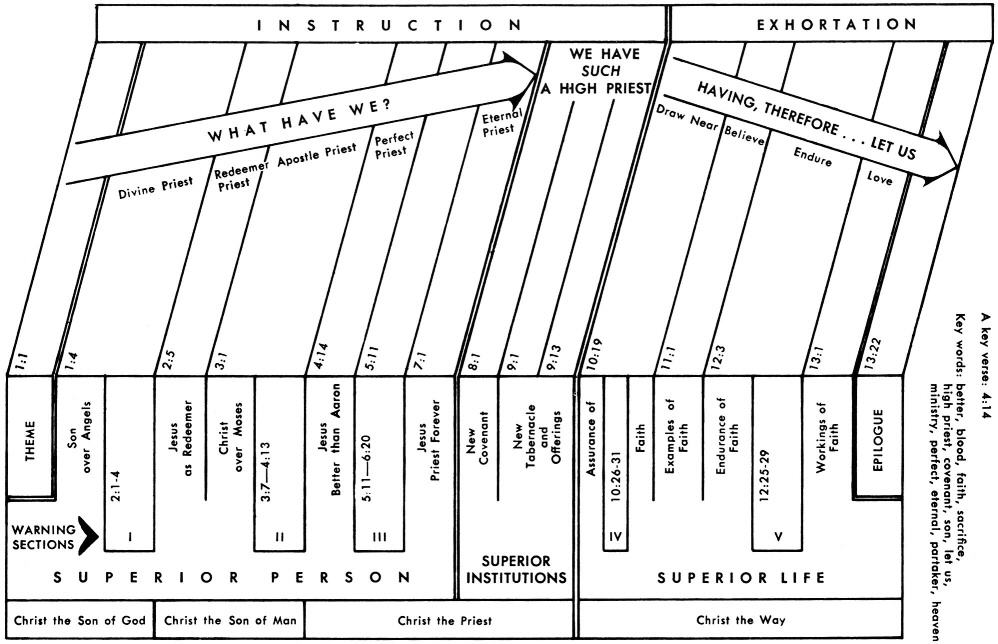
CONSIDER JESUS OUR GREAT HIGH PRIEST
Click chart to enlarge
Charts from Jensen's Survey of the NT - used by permission
Swindoll's Chart, Interesting Pictorial Chart of Hebrews, Another Chart
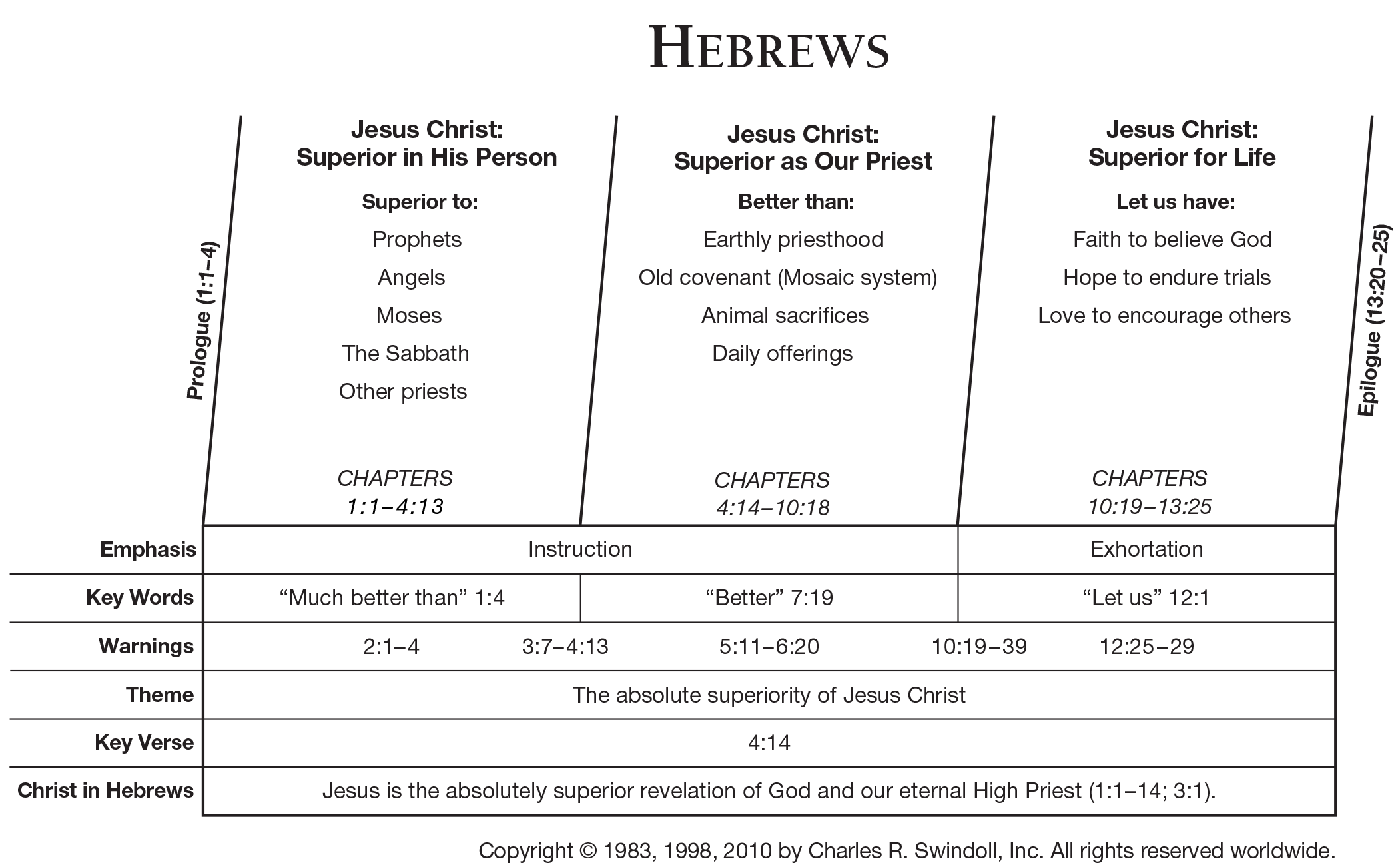
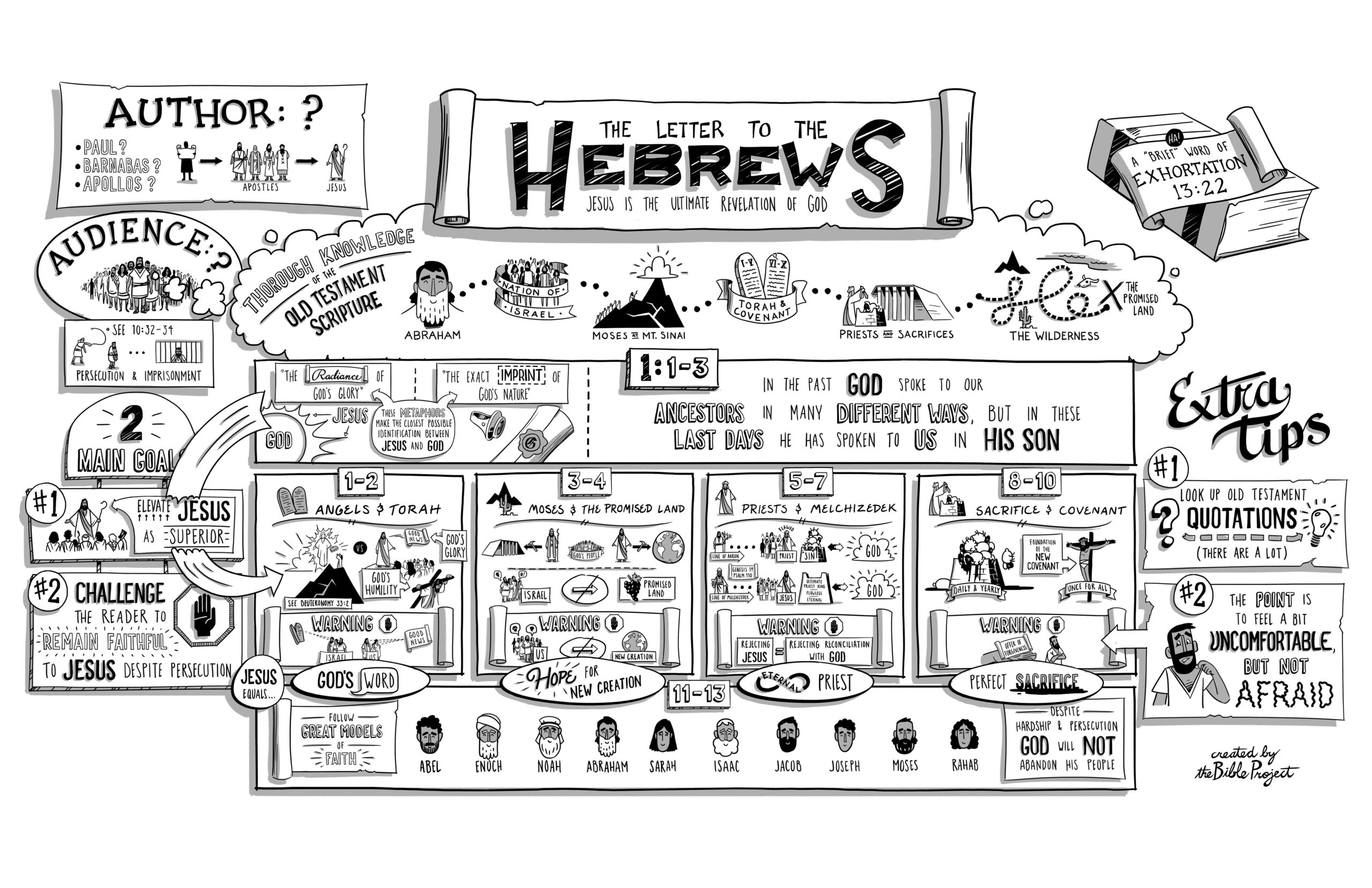
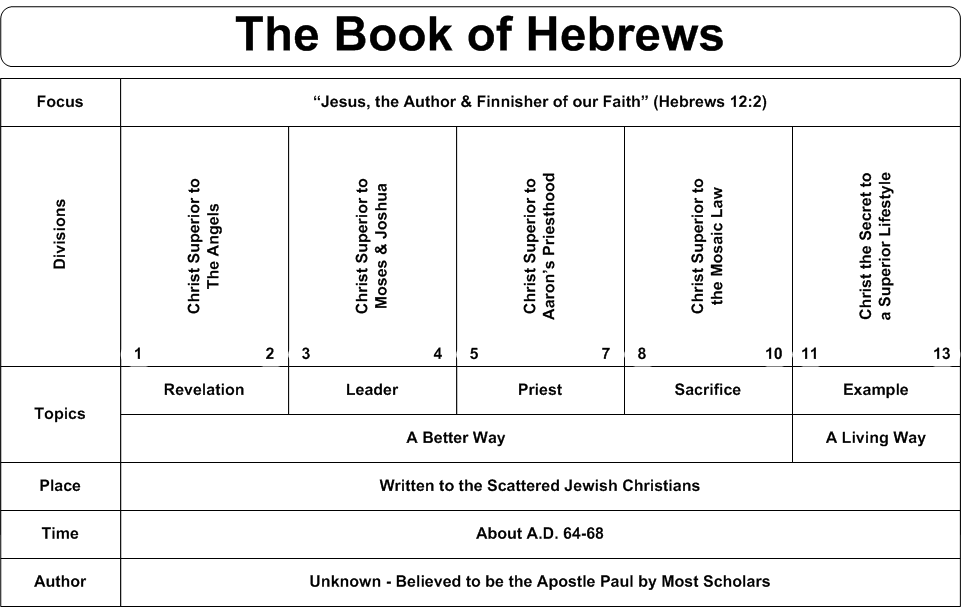
|
The Epistle |
||||
| INSTRUCTION Hebrews 1-10:18 |
EXHORTATION Hebrews 10:19-13:25 |
|||
| Superior Person of Christ Hebrews 1:1-4:13 |
Superior Priest in Christ Hebrews 4:14-10:18 |
Superior Life In Christ Hebrews 10:19-13:25 |
||
| BETTER THAN PERSON Hebrews 1:1-4:13 |
BETTER PRIESTHOOD Heb 4:14-7:28 |
BETTER COVENANT Heb 8:1-13 |
BETTER SACRIFICE Heb 9:1-10:18 |
BETTER LIFE |
| MAJESTY OF CHRIST |
MINISTRY OF CHRIST |
MINISTERS FOR CHRIST |
||
|
DOCTRINE |
DUTY |
|||
|
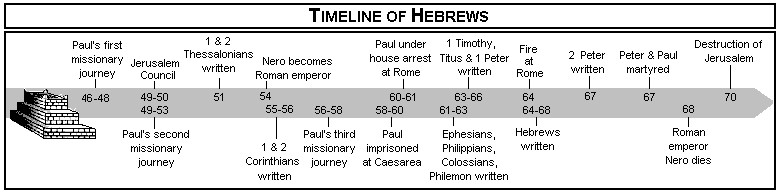
DATE WRITTEN: |
||||

See ESV Study Bible "Introduction to Hebrews"
(See also MacArthur's Introduction to Hebrews)
Borrow Ryrie Study Bible
Hebrews 10:1 For the Law, since it has only a shadow of the good things to come and not the very form of things, can never, by the same sacrifices which they offer continually year by year, make perfect those who draw near. (NASB: Lockman)
Greek: Skian gar echon (PAPMSN) o nomos ton mellonton (PAPNPG) agathon, ouk auten ten eikona ton pragmaton, kat' eniauton tais autais thusiais as prospherousin (3PPAI) eis to dienekes oudepote dunatai (3SPPI) tous proserchomenous (PMPMPA) teleiosai; (AAN)
BGT Σκιὰν γὰρ ἔχων ὁ νόμος τῶν μελλόντων ἀγαθῶν, οὐκ αὐτὴν τὴν εἰκόνα τῶν πραγμάτων, κατ᾽ ἐνιαυτὸν ταῖς αὐταῖς θυσίαις ἃς προσφέρουσιν εἰς τὸ διηνεκὲς οὐδέποτε δύναται τοὺς προσερχομένους τελειῶσαι·
Amplified: FOR SINCE the Law has merely a rude outline (foreshadowing) of the good things to come—instead of fully expressing those things—it can never by offering the same sacrifices continually year after year make perfect those who approach [its altars].
Barclay: Because the law is only a pale shadow of the blessing which are to come and not a real image of these things, it can never really fit for the fellowship of God those who seek to draw near to his presence with the sacrifices which have to be brought year by year and which go on for ever (Westminster Press)
NLT: The old system in the law of Moses was only a shadow of the things to come, not the reality of the good things Christ has done for us. The sacrifices under the old system were repeated again and again, year after year, but they were never able to provide perfect cleansing for those who came to worship. (NLT - Tyndale House)
KJV For the law having a shadow of good things to come, and not the very image of the things, can never with those sacrifices which they offered year by year continually make the comers thereunto perfect.
NKJ For the law, having a shadow of the good things to come, and not the very image of the things, can never with these same sacrifices, which they offer continually year by year, make those who approach perfect.
NET For the law possesses a shadow of the good things to come but not the reality itself, and is therefore completely unable, by the same sacrifices offered continually, year after year, to perfect those who come to worship.
CSB Since the law has only a shadow of the good things to come, and not the actual form of those realities, it can never perfect the worshipers by the same sacrifices they continually offer year after year.
ESV For since the law has but a shadow of the good things to come instead of the true form of these realities, it can never, by the same sacrifices that are continually offered every year, make perfect those who draw near.
NIV The law is only a shadow of the good things that are coming--not the realities themselves. For this reason it can never, by the same sacrifices repeated endlessly year after year, make perfect those who draw near to worship.
Phillips: The Law possessed only a dim outline of the benefits Christ would bring and did not actually reproduce them. Consequently it was incapable of perfecting the souls of those who offered their regular annual sacrifices. (Phillips: Touchstone)
Wuest: For the law having a shadow of the good things about to be, and not the image itself of the actual things, is never able by means of the same sacrifices which they are offering year after year, continually to make those who come to it complete.
Young's Literal: For the law having a shadow of the coming good things -- not the very image of the matters, every year, by the same sacrifices that they offer continually, is never able to make perfect those coming near,
Paraphrase: The Law was only a faint outline of the good things God intended, not the reality itself. Because of that, its repeated sacrifices year after year could never make those who approach God fully right with Him.”
Paraphrase: The Law functioned like a sketch, not the finished picture. Its sacrifices, offered endlessly year after year, could never bring worshipers into complete acceptance
Paraphrase:The Law, with its rituals and sacrifices, was only a shadow cast by the greater blessings to come in Christ. Because it was not the real substance, its offerings—repeated endlessly year after year—could never bring worshipers into lasting perfection or full access to God.
- For the law since it has only a shadow - He 8:5; 9:9,11,23; Col 2:17
- Hebrews 10 Resources - Multiple Sermons and Commentaries
Related Passages:
Hebrews 8:5+ who serve a copy and shadow of the heavenly things, just as Moses was warned by God when he was about to erect the tabernacle; for, “SEE,” He says, “THAT YOU MAKE all things ACCORDING TO THE PATTERN WHICH WAS SHOWN YOU ON THE MOUNTAIN.”
Hebrews 9:9+ which is a symbol for the present time. Accordingly both gifts and sacrifices are offered which cannot make the worshiper perfect in conscience,
Hebrews 9:11+ But when Christ appeared as a high priest of the good things to come, He entered through the greater and more perfect tabernacle, not made with hands, that is to say, not of this creation;
Hebrews 9:23+ Therefore it was necessary for the copies of the things in the heavens to be cleansed with these, but the heavenly things themselves with better sacrifices than these.
The shadow of the Law pointed to
the substance of the Lord.Colossians 2:16-17+ Therefore no one is to act as your judge in regard to food or drink or in respect to a festival or a new moon or a Sabbath day– 17 things which are a mere shadow of what is to come; but the substance belongs to Christ.
FAINT SHADOW OF THE LAW
FULL LIGHT IN CHRIST
The writer begins this climactic chapter by restating to his Jewish readers the insufficiency of the old covenant system. The Law, with all its sacrifices and ceremonies, was never the reality but only a shadow—a faint outline—of the good things God promised to bring in Christ. Year after year, the same sacrifices were offered, yet they never achieved their goal: to perfect the worshiper and bring full access to God. At best, the Law pointed forward to the substance yet to come, but it could never provide what only Christ’s once-for-all sacrifice would accomplish. This verse prepares the reader to see the radical contrast between repetitive shadows and the single, sufficient sacrifice of the Son of God.
Ray Stedman - In Heb 10:1-4, the author builds on a point he has made earlier---that the annual repetition of sacrifices in the old order indicated their inability to actually remove sins. Once again he uses a logical-deduction argument. Had they truly cleansed the conscience, there would have been no need to repeat them for the offerers; they would have seen themselves as cleansed from sin's defilement forever. But these sacrifices could not remove sin because they were based only on the death of animals. The annual repetition did remind offerers that they were still very much sinners and still very much in need of an adequate substitute if their sin was ever to be removed. The sacrifices were but a shadow of the good things that are coming---not the realities themselves. (ibid)
For the Law (nomos), since it has only a shadow (skia - a dim outline, a faint representation) of the good things (agathos - the truly beneficial, lasting blessings) to come (mello - the divinely appointed realities soon to be revealed) and not (ouk - absolutely not) the very form (eikon - the exact image, the full reality) of things - Law (nomos) can mean the law of Moses, but in context refers to the entire Mosaic system with its sacrifices, priesthood, and ceremonies which regulated worship but never reached the ultimate goal. A shadow (skia) refers to the Law's silhouette, not the substance in Christ. It could suggest, prefigure, and remind — but never accomplish redemption. The sacrificial system hinted at and pointed to Christ but could never embody Him. The importance of the shadow is that it shows a reality exists, but it falls short of the reality, since it cannot accomplish the desired goal. The Law was shadow, not substance; anticipation, not fulfillment; outline, not image.
Very form (eikon) refers to a visible manifestation of an invisible and heavenly reality form. In this context it refers to the true image (eikon), the actual reality of Christ and His sacrifice in contrast to the shadow (skia) of the Law (nomos). Good things (agathos) would include the blessings of forgiveness, eternal redemption, and access to God in Christ. These are the “better things” of the New Covenant (cf. Heb 9:11; 10:34).
Put yourself in the position of a Jewish person who had been raised to read the Torah, pray the Torah, go to the Temple (which was very likely still standing or the writer would have made allusion to the destruction in 70AD), and at the Temple they would offer sacrifices, and in addition they would weekly celebrate the Sabbath, and seven times a year they would celebrate the prescribed feasts like Passover and Pentecost (etc), and yearly they would celebrate the Day of Atonement, which our Jewish friends today refer to as Yom Kippur. This is the way they had been taught all of their life. They had memorized the Torah but sadly most of the Jews century after century had failed to see the true significance of the Old Testament system. Somewhere in all of this those Jews who had now heard the Gospel and were attracted by it and beginning to respond to it, were at the same time feeling intense pressure to step back into the shadows of the old system. But in chapter 10, the writer of this book continued his eloquent plea for them to take the final step of faith out of the shadows and into the light of Jesus Christ Who Himself declared "I am the Light of the world; he who follows Me will not walk in the darkness, but will have the Light of life." (Jn 8:12). As we the writer of Hebrews has been showing them over and over, there was really nothing for them to go back to. He is arguing why go back to a shadow with the Substance has come? (Col 2:17) Since Christ had rendered the Law obsolete by His atoning death, God was not pleased by the continual offering of sacrifices (Heb 10:8). The priests may stand and offer their sacrifices day after day, but the fact has already been established that those sacrifices can never take away sins (Heb 10:11). Since atonement for sin could never be achieved through the bodies of sacrificial animals, God prepared a body for His Son. It was in that body that Jesus offered Himself on the Cross as the final sacrifice. The Hebrews, and all believers before and since, were the beneficiaries of Jesus' death. But that good thing, that benefit could only be grasp by grace through faith.
🙏 THOUGHT - Have you taken that step of faith, taking hold by faith of the Light of the world? Or are you still living in the shadows, not really sure that Jesus is the only way, the only truth and the only life and that no soul will ever come to God the Father but through God the Son, Jesus, the "Mediator" or "go between" of the New Covenant (Jn 14:6+, Heb 9:15+)? Dear reader, "behold now is the acceptable time, behold, now is the day of salvation." (2 Cor 6:2+) Don't put off today, what you may not be able to do tomorrow, for as James says "you do not know what your life will be like tomorrow. You are just a vapor that appears for a little while and then vanishes away." (James 4:14+) God is saying to you today "Look unto me, and be ye saved." (Isaiah 45:22KJV - the verse God used to save C H Spurgeon)
For - Term of explanation - always pause and ponder these "hinge" word as it will open a door and give understanding to the passages in context. For introduces an explanation (always seek to discover "What is the author explaining?) Here the for connects chapter 10 to the end of chap 9 (NIV does not render the for). The writer is offering a further explanation of "the finality of Messiah’s one sacrifice and thus of its superiority to the sacrifices of the law." (Wuest - Hebrews Commentary online)
S Lewis Johnson on "for" - Notice the first word of chapter 10, “For.” Now, this makes the connection, carrying on from verse 26 of chapter 9, where he said, “He then would have had to suffer often since the foundation of the world, but now once at the end of the ages, He has appeared to put away sin by the sacrifice of Himself, for” to further explain, “the law, having a shadow of the good things to come, and not the very image of the things, can never with these same sacrifices, which they offer continually year by year, make those who approach perfect.” In other words, the Old Testament presents us with an in-efficacious system of salvation. Now, one might ask, “Since he has just said in verse 26, ‘That He has appeared to put away sin by the sacrifice of Himself, once at the end of the ages,’ why does the author go over this?” And say the same thing in chapter 10, verse 1 through verse 4, essentially, that what he seems to be saying. Well, I could take my place behind that and say the author is repeating his message, and so I’m repeating my message to you tonight, but that isn’t precisely the sense. If you’ll notice carefully, chapter 9, and we don’t have time to do it, and you don’t have time to study it either while I’m speaking because I want you to pay attention to what I’m saying now, but, anyway, you’ll note in chapter 9, when he talks about the sacrifice of the Lord Jesus Christ, he talks about the objective benefits of the Cross of Christ, primarily. But, in chapter 10, now, verse 1 through verse 18, he emphasizes the subjective effects of the work of the Lord Jesus Christ. Like verse 10, “By that will we have been sanctified through the offering of the body of Jesus Christ once for all.” Verse 14, “For by one offering He has perfected forever those who are being sanctified.” In other words, the stress in chapter 10, is on the benefits that are ours whereas in chapter 9, the stress is on the objective benefits of what Christ has done. But the insufficiency of the Mosaic sacrifices is stated first of all. “The law having a shadow of good things to come.” Coming events cast their shadow before them, is one of our modern sayings and here we have an illustration of it, because in the Old Testament Law and the types of the Old Testament are designed to cast their shadow before them so that we would see the Lord Jesus Christ when he did come and recognize him. (The Shadow and the Reality)
Brian Bell - Here in Hebrews 10:1-4 the writer wraps up this contrast between the earthly lambs/daily sacrifices and The Heavenly Lamb/Jesus.
Earthly lambs - Frequency (again & again) & Failure (never to take sin away).
The sacrifices under the Old Covenant brought a reminder of sin, not a remission of sin.
Heavenly Lamb - Frequency (just once for all) & Fulfillment (for by one offering He has perfected forever those who are being sanctified).
So, Jesus had Mastery/Superiority over this old system, old covenant, shadow, copy. (Sermon)
Spurgeon says the law here "refers to the old ceremonial law, under which the Jews lived so long. They always had to go on, year after year, offering the same kind of sacrifices, because the work of atonement was never done perfectly. Men were not cleansed or saved by it, so the process had to be constantly repeated."
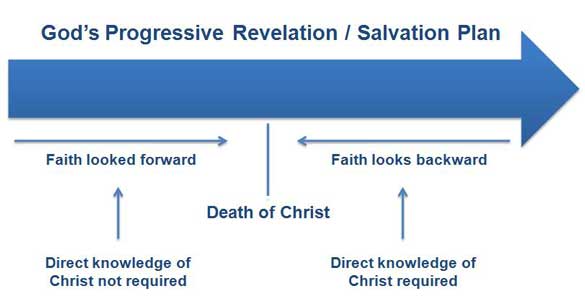
🙏 THOUGHT - One might ask at this point that if the law was only a shadow and all the Jews in the OT had was the Law, how could they ever be saved? Good question. Many believers are confused on this point. How are we saved? By grace through faith in Jesus Christ (Eph 2:8-9+), the once for all time Sacrifice! And indeed that is the only way any man is saved. The patriarch Abraham was saved by faith as a prototype of all who would come after him - "Then he believed in the LORD; and He reckoned it to him as righteousness (HE WAS JUSTIFIED)." (Ge 15:6+). Forgiveness was not extended to the Israelites based on the animal sacrifices the priest offered on their behalf, but was based on the future fulfilment of what those sacrifices represented, the DEATH OF CHRIST (see diagramatic illustration of this vital principle above). It was never God’s intention for the Mosaic Covenant to solve the problem of sin but always to point a "divine finger" to the Sin Bearer, the perfect sacrificial offering of the Lamb of God Who alone takes away the sins of the world. (See Purpose of the Law)
C H Spurgeon - This refers to the old ceremonial law, under which the Jews lived so long. They always had to go on, year after year, offering the same kind of sacrifices, because the work of atonement was never done perfectly. Men were not cleansed or saved by it, so the process had to be constantly repeated....A man could go to the Levitical sacrifices twenty years running, and yet be no forwarder. He must go again and again as long as he lived. They were only figures and shadows and types; the real sacrifice is Christ.
The Law’s dim reflection revealed
the Lord’s divine perfection.
ILLUSTRATION - Children are fond of shadow pictures. Painters, before they introduce the living colors by the pencil, are wont to mark out the outlines of what their intend to represent. This indistinct representation is called by the Greeks skiagraphia. God the consummate "Painter" of beauty has (so to speak) penciled in the outlines in the OT sacrifices that point to the Better Sacrifice for all to see. It's like looking a a cookbook with pictures of beautiful, sumptuous meals and saying "Boy that really satisfies my hunger." That would be ridiculous… by the same token how silly reach out to grasp the shadow when you can lay hold of the "very form of things".
Rich Cathers - The Law was just a model of what was coming. A model airplane can give you an idea of what an airplane is like, but it’s not going to take you anywhere. The Law was not intended to make anyone “perfect”. (Sermon)
J Vernon McGee notes that "the nation of Israel had the Old Testament, which was (and still is) a picture book, a book of ABCs. That is the reason so many folk miss its meaning. When theologians come to it, they have to find something profound in it. But it is a simple picture book in which God is trying to tell all of us little children down here that He died for us. It is just as simple as that, my friend. (See Thru the Bible Vol. 52: The Epistles Hebrews 8-13)
R Kent Hughes - Soon after I began to date my future wife, Barbara, I obtained her picture—a beautiful black-and-white 8 x 10 photograph taken the year before we met—and it immediately became an item of pre-nuptial “worship.” It was one of those bare-shouldered, sorority-style pictures so popular at the time. She looked like an angel floating in the clouds. It became my portable hope, most often sitting on my desk, sometimes in my car, at other times propped in front of my plate and my love-struck eyes. However, the day came when we stood before God and our families and friends and pledged our lives to each other as she became mine. Suddenly I had gone from the possession of a one-dimensional portrait to the possession of the real thing, who smiled, talked, and laughed—a real, three-dimensional wife—a living, life-loving soul! And the picture? It remained just as beautiful, but from then on it received relatively scant attention. But imagine that one day I appear before my wife holding the black-and-white photograph, and I say, “My dear, I’ve missed your picture, and I’m going back to it. I really am attached to the silhouette and the monochrome shading and the matte finish.” Then I passionately kiss the glass protecting the photograph, clutch it to my chest, and exit mumbling my devotion to the picture—“I love you, O photograph of my wife. You’re everything to me.” People’s suspicions that pastors are weird would be confirmed. Time to call for the men in the white jackets! How absurd for anyone, once having the substance, to go back to the shadow. Yet, some in the early church were forsaking the Covenant of Grace for the Old Covenant of the Law. And this is what the author of Hebrews wants to steel his people against as he concludes his comparison of the Old and New Covenants in 10:1–18. (See Hebrews: An Anchor for the Soul)
William Barclay - To the writer to the Hebrews the whole business of sacrifice was only a pale copy of what real worship ought to be. The business of religion was to bring a man into a close relationship with God and that is what these sacrifices could never do. The best that they could do was to give him a distant and spasmodic contact with God. (Hebrews)
A shadow indicates a reality,
but has no substance in itself.
Ray Stedman illustrates a shadow - A shadow indicates a reality, but has no substance in itself. I waited on a downtown street comer one day for a friend who always wore a Western hat. Suddenly I saw his distinctive shadow on the sidewalk and knew that he was standing just around the comer. I could not actually see him, but I knew he was there. So the offerings witnessed to the person of Christ and his sacrifice, though they were not that reality themselves. They were but his shadow that indicated he was soon to appear. (ibid)
The pale shadow of the Law pointed
to the Powerful Savior Who kept the Law.
S Lewis Johnson - The expression shadow means the outline, the silhouette, the law having the outline of the good things to come, the silhouette of the good things to come. We read the Old Testament in that way. We read through the Old Testament and we, on the authority of the New Testament, we look for the things that remind us of the things that we know have come to pass and further explain it. That’s one of the great benefits of reading the Bible. (The Shadow and the Reality)
Spurgeon - Ceremonies under the old dispensation were precious because they set forth the realities yet to be revealed, but in Christ Jesus we deal with the realities themselves. This is a happy circumstance for us, for both our sins and our sorrows are real, and only substantial mercies can counteract them. In Jesus, we have the substance of all that the symbols set forth. He is our sacrifice, our altar, our priest, our incense, our tabernacle, our all in all. The law had “the shadow of good things to come,” but in Christ we have “the form of things itself.”
Charles Pfeiffer - As a shadow the Law served to prepare men’s hearts for the reality, but after Jesus came the shadows would no longer be meaningful. The annual repetition of the Levitical offerings was itself evidence that there was nothing final about them. (See Hebrews- Everyman's Bible Commentary - Page 77)
Ray Stedman has an interesting illustration to this chapter…
It would be foolish indeed to prefer reading a cookbook to eating a good meal when one is hungry. Not that there is anything wrong with reading a cookbook—it can be very enlightening—but it is not very nourishing! Yet some of the original readers of Hebrews were doing something very much like that. They preferred to content themselves with the externals of faith—such as the law, the Aaronic priesthood and animal offerings—and to ignore the fulfillment of these things in the death, resurrection and ascension of Jesus. They wanted the cookbook rather than the meal!
As we have seen, the tabernacle in the wilderness, with its regulations and sacrifices, was an accurate and divinely drawn picture of the sacrifice of Jesus and the new arrangement for living which would be available to believers in Christ. But it could only describe these realities up to a point. It was both a comparison and a contrast.
I carry a picture of my wife in my wallet and, when I am away from home, I find it comforting to look at it. But it is quite inadequate, for it is not my wife, only a picture of her. I can look at it, but I cannot have a conversation with it. I cannot laugh together with it, and I cannot persuade it to cook any meals! It is an accurate representation of the real thing, but also a far cry from it. So the law and the tabernacle could never do for believers of any age what the living Christ can do. This is the continuing argument of the writer in chapter 10. (Hebrews 10:1-39 Let Us Go On!)
These animal deaths were unwilling, even unconscious, sacrifices of a lower and quite different nature and therefore inadequate substitutes for humans made in the image of God. It is impossible, says the author, for the blood of bulls and goats to take away sin. Isaiah had quoted God long before saying, "I have no pleasure in the blood of bulls and lambs and goats" (Is 1:11). Nevertheless, despite this limitation, through the deaths of many animals, one unchanging message was being pounded out. Every sacrifice declared it and every offering told the same story. It was burned in blood and smoke into every listening heart. The essential point for a God-approved dealing with sin in one's life was that a life be laid down. Every dying animal meant a life brought to an end. Sin was serious; it forfeited life. Unless the sin could actually be removed, the sinner must die. To save the sinner from such a fate, an equal and willing substitute must be found. Such a substitute the author now finds described in the words of Psalm 40. (Hebrews Commentary)
Ceremonies under the old dispensation were precious
because they set forth the realities yet to be revealed,
but in Christ Jesus we deal with the realities themselves.
C H Spurgeon - Ceremonies under the old dispensation were precious because they set forth the realities yet to be revealed, but in Christ Jesus we deal with the realities themselves. This is a happy circumstance for us, for both our sins and our sorrows are real, and only substantial mercies can counteract them. In Jesus, we have the substance of all that the symbols set forth. He is our sacrifice, our altar, our priest, our incense, our tabernacle, our all in all. The law had “the shadow of good things to come,” but in Christ we have “the form of things itself.” (Sermon All Fullness in Christ)
Max Alderman illustrates the shadow and the substance - From time to time, I will pull out a certain old video which was made over twenty years ago. When I do, it brings me joy to watch and hear my parents, who are deceased, once again speak. The image is of them and the voice is theirs, but it is only a shadow of what was. The “law having a shadow of good things to come” is only a shadow of Him who is. In regards to my parent’s shadow, if I could I would trade the shadow for them. The shadow follows them. In regards to Him, I will not trade Him for the shadow. In His case the shadow came first. The law is that shadow. With Him being the substance which the shadow represented, we now have a better offering. (Ref)
Marcus Dods writes - The explanation consists in this that the law had only ‘a shadow of the good things that were to be, not the very image of the things.’ Skian (shadow) is in the emphatic place (FIRST WORD IN GREEK SENTENCE), as that characteristic of the law which determines its inadequacy. ‘A shadow’ suggests indefiniteness and unsubstantiality; a mere indication that a reality exists. Eikon (image) suggests what is in itself substantial and also gives a true representation of that which it images. The eikon (image) brings before us under the conditions of space, as we can understand it, that which is spiritual’ (Westcott)…The contrast is between a bare intimation that good things were to be given, and an actual presentation of these good things in an apprehensible form. It is implied that this latter is given in Christ; but what is asserted is, that the law did not present the coming realities in a form which brought them within the comprehension of the people. (The Expositor's Greek Testament)
Free from the law, O happy condition,
Jesus hath bled, and there is remission;
Cursed by the law and bruised by the fall,
Grace hath redeemed us once for all.
- Phillip Bliss
The good things in context probably refer back to the “salvation” of He 9:28 (Ro 10:15+) and all of the "good things" associated with salvation - accepted in the Beloved, fellow heirs with Christ, recipients of the gift of the indwelling Holy Spirit, and the list goes on and on.
A T Robertson makes an excellent point that "The contrast here between skia (shadow, shade caused by interruption of light as by trees, Mk 4:32) and eikon (image or picture) is striking. In Col 2:17+ Paul draws a distinction between skia for the Jewish rites and ceremonies and soma for the reality in Christ. Children are fond of shadow pictures. The law gives only a dim outline of the good things to come (He 9:11+)." (Hebrews 10 Commentary)
Morris - "The 'shadow' [Gr. skia] then is the preliminary outline that an artist may make before he gets to his colors, and the eikon [lit. image, "form"] is the finished portrait. The author is saying that the law is no more than a preliminary sketch. It shows the shape of things to come, but the solid reality is not there."
William Barclay says form (eikon) "means a complete representation, a detailed reproduction. It actually does mean a portrait, and would mean a photograph, if there had been such a thing in those days. In effect he is saying: "Without Christ you cannot get beyond the shadows of God."
The form (eikon) or image to which the writer is directing his Jewish readers is to Yeshua, to the Masyiach, to Jesus their long expected Messiah. He has come. He is the very "Image (eikon) of God" and they need to stop holding onto shadows by their works by which they sought to attain righteousness but take hold of Christ by faith Who thereby becomes their perfect righteousness, a righteousness that they could never obtain by dead works (cf Isaiah 64:6, Heb 6:1).
Kenneth Wuest - Eikon (image) suggests what is in itself substantial and also gives a true representation of that which it images. The eikon (image) brings before us under the conditions of space, as we can understand it, that which is spiritual’ (Westcott) … The contrast is between a bare intimation that good things were to be given, and an actual presentation of these good things in an apprehensible form. It is implied that this latter is given in Christ; but what is asserted is, that the law did not present the coming realities in a form which brought them within the comprehension of the people.” The fact that the sacrifices were constantly renewed, shows that the law possessed no more than a mere shadow of the coming good which was exhibited in those sacrifices. Expositor’s quotes Davidson as saying in this connection; “No repetition of the shadow can amount to the substance.” (Hebrews Commentary online)
Kent Hughes - Imperfect Cleansing
Of course, the author of Hebrews was not the first to understand that animal blood would not atone for sins. Scriptural writers had been alert to this for hundreds of years. David’s repentant words head the list: “You do not delight in sacrifice, or I would bring it; you do not take pleasure in burnt offerings. The sacrifices of God are a broken spirit; a broken and contrite heart, O God, you will not despise” (Psalm 51:16, 17). Consider also Samuel’s words to King Saul: “Does the Lord delight in burnt offerings and sacrifices as much as in obeying the voice of the Lord? To obey is better than sacrifice, and to heed is better than the fat of rams” (1 Samuel 15:22). And Isaiah said:
“The multitude of your sacrifices—what are they to me?” says the Lord. “I have more than enough of burnt offerings, of rams and the fat of fattened animals; I have no pleasure in the blood of bulls and lambs and goats. When you come to appear before me, who has asked this of you, this trampling of my courts? Stop bringing meaningless offerings!” (Isaiah 1:11–13a)
Later Isaiah expressed God’s displeasure at offerings when one’s heart is not right:
But whoever sacrifices a bull is like one who kills a man, and whoever offers a lamb, like one who breaks a dog’s neck; whoever makes a grain offering is like one who presents pig’s blood, and whoever burns memorial incense, like one who worships an idol. They have chosen their own ways.… For when I called, no one answered, when I spoke, no one listened. (66:3, 4)
Similarly, Jeremiah inveighed against sacrifices presented without an obedient heart:
“This is what the Lord Almighty, the God of Israel, says: Go ahead, add your burnt offerings to your other sacrifices and eat the meat yourselves! For when I brought your forefathers out of Egypt and spoke to them, I did not just give them commands about burnt offerings and sacrifices, but I gave them this command: Obey me, and I will be your God and you will be my people.” (Jeremiah 7:21–23)
God said through Hosea, “For I desire mercy, not sacrifice, and acknowledgment of God rather than burnt offerings” (Hosea 6:6). And Amos shared God’s thoughts about wrong-hearted sacrifices:
“I hate, I despise your religious feasts; I cannot stand your assemblies. Even though you bring me burnt offerings and grain offerings, I will not accept them. Though you bring choice fellowship offerings, I will have no regard for them. Away with the noise of your songs! I will not listen to the music of your harps. But let justice roll on like a river, righteousness like a never-failing stream!” (Amos 5:21–24)
Lastly, we include the famous words of Micah:
With what shall I come before the Lord and bow down before the exalted God? Shall I come before him with burnt offerings, with calves a year old? Will the Lord be pleased with thousands of rams, with ten thousand rivers of oil? Shall I offer my firstborn for my transgression, the fruit of my body for the sin of my soul? He has showed you, O man, what is good. And what does the Lord require of you? To act justly and to love mercy and to walk humbly with your God. (Micah 6:6–8) (See Hebrews: An Anchor for the Soul)
ILLUSTRATION of knowing the word in the OT but missing the Living Word to Whom the entire OT pointed! - While studying in the Holy Lands, a seminary professor of mine met a man who claimed to have memorized the Old Testament--in Hebrew! Needless to say, the astonished professor asked for a demonstration. A few days late they sat together in the man's home. "Where shall we begin?" asked the man. "Psalm 1," replied my professor, who was an avid student of the psalms. Beginning with Psalm 1:1, the man began to recite from memory, while my professor followed along in his Hebrew Bible. For two hours the man continued word for word without a mistake as the professor sat in stunned silence. When the demonstration was over, my professor discovered something even more astonishing about the man--he was an atheist! Here was someone who knew the Scriptures better than most Christians ever will, and yet he didn't even believe in God. (Jack Kuhatschek, Taking The Guesswork Out of Applying The Bible, IVP, 1991, p. 16.) And of course the devil has memorized Scripture (which he used on Jesus in the wilderness temptation) but it has no impact on him!impact on him!
Law (3551) (nomos from nemo = to parcel out, divide among, allot) is first of all something parceled out or allotted and so what one has in possession. The primary meaning relates to that which is conceived as a standard or refers to generally recognized rules of civilized conduct especially as sanctioned by tradition. In addition to rules that take hold through tradition, the state or other legislating body may enact ordinances that are recognized by all concerned and in turn become legal tradition. The law is thus a plumbline as used to determine straightness. But just as plumblines cannot straighten the building but only determine how crooked it is and where change is needed, so too the law acts as a plumbline to show us where we fall short and to tutor us and lead us to faith in the gospel through which one can meet God's righteous standard.
Gingrich - law—(1) rule, principle, norm Ro 7:21, 23; 8:2b; Heb 7:16.—(2) of any kind of law Ro 3:27; perh. Ro 7:1f.—(3) of the Mosaic law Mt 22:36; Lk 2:22; 16:17; Jn 7:23, 51; 18:31; Ac 13:38; 18:13; 21:24; Ro 2:25; 3:19; 4:14; 7:2; Gal 3:12f, 17, 19; 5:23; 1 Ti 1:9; Heb 7:19. Almost equivalent to (Jewish) religion Ac 23:29. Specifically of the written law, the Pentateuch Mt 7:12 ; 12:5; Lk 2:23; 24:44; 1 Cor 9:9; Gal 3:10; 4:21b. Of the scriptures generally Mt 5:18; J 10:34; Ro 3:19.—(4) of Christianity as a ‘new law’ Ro 3:27b; 8:2a; Gal 6:2; Js 1:25; 2:8f, 12. [-nomy, a combining form, as in agronomy, astronomy, theonomy] (Borrow Shorter Lexicon of the Greek New Testament)
Friberg - with a basic meaning law, i.e. what is assigned or proper; (1) generally, any law in the judicial sphere (Ro 7.1); (2) as rule governing one's conduct principle, law (Ro 7.23); (3) more specifically in the NT of the Mosaic system of legislation as revealing the divine will (the Torah) law (of Moses) (Lk 2.22); in an expanded sense, Jewish religious laws developed from the Mosaic law (Jewish) law (Heb 10:1 Jn 18.31; Acts 23.29); (4) as the collection of writings considered sacred by the Jews; (a) in a narrower sense, the Pentateuch, the first five books of the Bible, as comprising the law (Mt 12.5; Gal 3.10b); (b) in a wider sense, the Old Testament Scriptures as a whole (Mt 5.18; Ro 3.19); (5) figuratively, as the Christian gospel, the new covenant, as furnishing a new principle to govern spiritual life law (Ro 8.2a; Heb 10.16) (Borrow Analytical Lexicon of the Greek New Testament)
Gilbrant - The noun nomos is related to the verb nēmō, “to distribute, to divide.” Some lexicons distinguish between nomos (accented on the first syllable, i.e., the “penult”) and nomos (accented on the last syllable, i.e., the “ultima”), defining nomos as “pasture, apportionment, district, and sphere of command” (Liddell-Scott). From these meanings nomos was then used to denote “custom, that which is habitual practice, statute, ordinance made by authority and law” (ibid.). Inherent within all of these meanings is the idea of an authoritative apportionment that becomes an accepted statute. Eventually nomos came to be used to denote anything that was legally prescribed, regulated, or customarily practiced in any given society’s social, cultural, and political structure. Its wide variety of uses attests its versatility of meaning: from local “customs” to civil “ordinances,” from “martial law” to “general laws,” and from rules of musical “composition” to “courses” of building masonry—just to give a few examples (cf. Liddell-Scott).
Nomos was an essential ingredient for the unity and success of the Greek city-state (polis [4032]). In the Fifth Century B.C. Greeks began to document and codify their laws. Soon nomos came to represent the law(s) enacted by the city-state governing body. It was administered by the judicial system. The idea of nomos as “custom” disappeared; ethos (1478), “custom,” came to depict the commonly held, unwritten laws of society (see Esser, “Law,” Colin Brown, 2:439).
Because laws were instituted through the actions of city government as a result of the political process, nomos was regarded principally from a human perspective. This human-centeredness contrasted the initial idea of nomos as a religious enactment. Nomos was linked to the divine, as is indicated by Greek philosophy which maintained this relationship.
Philosophy asserted that human laws could be imperfect. It offered as a solution obedience to the law of the universe that controlled the world (kosmos). Only when the mind (nous) of man attained harmony with the cosmic divine law could inner peace be achieved. In contrast to Biblical usage, therefore, secular Greek usage often regarded nomos as covering political, social, and religious territory (ibid.).
Septuagint Usage - Nomos occurs in the Septuagint over 400 times; about 200 of these lack a Hebrew original. On some occasions nomos translates dāth (16 times) and chōq/chuqqāh (12 times), but the predominant Hebrew word translated by nomos is tôrāh, “law, instruction.”
Law in the Old Testament - Tôrāh occurs more than 200 times in the Old Testament. Its original stem is uncertain and it has many different meanings. It is the Word of God spoken by the prophets (Isaiah 1:10; 8:16,20; 30:9f.) and equals the duties and instructions of the priests (Haggai 2:11f.; Malachi 2:6f.). Tôrāh extensively denotes the truth of God’s revelation (Isaiah 2:3; 42:24; 51:4,7; Micah 4:2). It also refers to the Law or the Ten Commandments, the Decalogue (Deuteronomy 27:3,8; 31:26), the Pentateuch (2 Chronicles 23:18), and includes other Old Testament teaching and instruction as well (2 Chronicles 17:9; Nehemiah 8). In general terms tôrāh also involves understanding divine teaching and law.
The Law expressed God’s rule over Israel and His demands upon the lives of those He graciously called His own. Because Israel—God’s people—was to have fellowship with the Holy God, they too must be holy (Leviticus 19:2; cf. 20:7). The Law provided the standard and expectations of God for His covenant people. It outlined the blessings that resulted from obedience and the curses that would come from rebellion.
The Law was fulfilled when the community, in response to God’s redemptive grace, rejoiced and abandoned itself to being obedient to the will of God. Obedience is not a requirement before experiencing God’s mercy; rather, it is a response of faith to the mercy received. Fulfilling the Law’s requirements did not bring life in God; on the contrary, life was given to those who did not deserve it. Life came through the election and sanctification provided in the “blood of the covenant” (Exodus 24:8). This fundamental viewpoint shaped the understanding of the purpose and meaning of the Law (see Gutgrod, “nomos,” Kittel, 4:1037).
1. The Law did not declare what Israel must do in order to become God’s chosen people. Instead, the Law explained what behavior would destroy the existing relationship. This was verified in the form of the commandments: “Thou shalt not....” As well, it explained the attitudes and actions that would strengthen the relationship. These were expressed in the form of the commandments: “Thou shalt....”
2. The Law cautioned against certain behavior and offered practical advice. By encouraging obedience because of the benefit of doing so, tôrāh sought to eliminate transgressions. Deuteronomy especially reflects such a positive attitude toward the rewards of heartfelt obedience to God and devotion to His will. God’s goodness and redemption are the bases for obedience, not threats (Deuteronomy 4:31-40; 5:6f.; cf. Exodus 20:2f.). God’s great love for Israel was intended to cause Israel to respond in love and carry out the Law.
3. Keeping the Law was not simply to be an external commitment. The Law was to be followed “with all thine heart, and with all thy soul, and with all thy might” (Deuteronomy 6:5; cf. 10:12; 26:16).
4. Israel’s religion, therefore, was not founded upon the necessity of keeping the Law in order to enter into fellowship with God. The promises of “reward” for keeping the Law (Deuteronomy 28:1-14), the sayings that to keep the commandments is “to live (by) in them” (Leviticus 18:5), were not enticements to faithfulness. These were to be regarded as promises to be experienced as Israel, through faithful obedience, continued in communion with God. The basis for this expectation was God’s grace alone.
The ritual laws were primarily designed to carry out—especially in the atonement sacrifice—the covenant obligations that enabled the sinful nation to reestablish its relationship with the absolute and holy God through the offering of glory and thanksgiving (Exodus 25-30; Leviticus 1-4).
The moral laws were intended to guide the nation in its individual and social life (Exodus 24:12). They present a high ethical standard: “And what nation is there so great, that hath statutes and judgments so righteous as all this law, which I set before you this day?” (Deuteronomy 4:8).
Later in the history of Israel the prophets were sent from God to proclaim impending judgment on a backslidden people, who in unfaithfulness and disobedience had rejected the covenant. Idolatry, a denial of the first commandment, was a chief sin of this time. The prophets based their messages on the premise that Israel was the chosen people of God. Israel had seen the blessings of the Lord but it chose to fall away from God. The prophets lamented over Israel’s apostasy (Isaiah 1:2; 5:1-7; Jeremiah 2:12-14; Hosea 7:13; Amos 2:9-12; 3:2). The nation’s disregard for God’s ordinances indicated its disdain of God. Such a “stiff-necked” attitude was thoroughly condemned by the prophets (Hosea 5:10; Amos 5:7; 5:10-12). Any superficial ritual carried out by the unrepentant and sinful was also condemned (Isaiah 1:12f.; Jeremiah 7:9f.; 8:7; Hosea 6:6; Amos 2:6-8; 8:4-14; Micah 6:7f.).
The prophets announced that Israel had broken its covenant relationship with God (Isaiah 24:5; Jeremiah 31:32; Hosea 6:7). Israel’s future salvation could, as a result, only occur through a new divine intervention—the coming of Messiah. The redemption brought by the Messiah would establish a new and better covenant between God and His people (Isaiah 42:6; 49:8; 55:3; Jeremiah 31:31f.; 32:40; Ezekiel 16:60; Daniel 9:27; Malachi 3:1). The new covenant would not only be for Israel; the Gentiles would also share in the messianic salvation (Isaiah 42:6; 49:6).
The creative power of the Holy Spirit would “circumcise the hearts” of the members of this new covenant. God’s law would be written on tablets of the heart rather than tablets of stone. The Lord himself would effect a new obedience and fulfillment that was in keeping with the original intent and purpose of the Law (Jeremiah 31:33; Ezekiel 36:26,27). The prophet’s message was that the Servant of the Lord, through the offering of himself, would provide absolute forgiveness of sins, the basis of the new covenant (Isaiah 53:5-11; Jeremiah 31:34; 33:8; Ezekiel 36:25; Zechariah 13:1).
Law in the Intertestamental Period - In the time between the testaments the Law became increasingly looked to as the source of salvation. More and more emphasis was placed upon keeping the letter of the Law. The Law acquired such a place of prominence in Judaism that it was believed to provide the means to win God’s grace as well as the means to remain in His favor. From internal pressures within Judaism itself the religion of Israel drifted into a legalistic system that adopted the idea of earning salvation by works (law-keeping). This view permeates the pseudepigraphal and apocryphal literature. Such a legalistic attitude toward a relationship with God and an obsession with fulfilling the letter of the law occurs especially in rabbinic Judaism. God’s revelation was evaluated solely in terms of mankind’s behavior and conduct. Tôrāh was regarded as the only site of God’s revelation; consequently, any relationship with God was judged in terms of keeping the Law as reflected in the Pentateuch. The prophetical writings were evaluated in terms of the Law. Indeed the entire canon of the Old Testament was viewed in connection with the Law (cf. Matthew 7:12; 22:40). Later Judaism might not have succeeded in totally keeping the requirements of the Law, but it did regard such compliance as theoretically possible (see Gerstner, “Law in the New Testament,” International Standard Bible Encyclopedia, 3:90). Legalism developed because it was believed that life could be attained only by keeping the Law. It was hoped that one could offset one’s transgressions by performing acts of “obedience,” such as prayer, fasting, and almsgiving. If the balances favored good deeds then God would be obligated to save that person by his grace. God’s grace was often praised, but in the context of legalistically causing this grace to occur. The Pharisees represented the most extreme form of such legalism. Two consequences might result from such extremism: anxious uncertainty about one’s status before God or the opposite, i.e., arrogant self-righteousness and self-glorification. It is crucial to understand the legalism of Judaism was quite distinct from the Old Testament appreciation of the Law. Only from this basis can we realize the nature of the struggle that Jesus and Paul waged. The Biblically revealed religion of the Old Testament in no way represents a legalistic religion, or a religion in which one could earn salvation. The Abrahamic covenant was of the same essence of obedience based upon faith as the covenant brought by Jesus (Galatians 3:8). God’s covenant with Abraham was not declared void by the Law (Galatians 3:17). This implies that the Mosaic covenant was subordinate to Abraham’s; both covenants were in effect in the religious life of Israel. Only in this light can it be recognized that the entire Old Testament is a prelude to that which was to come. Israel’s history and its religion anticipated the Church (Romans 15:4; 1 Corinthians 10:11; 2 Timothy 3:16; Hebrews 9:9).
New Testament Usage - In the New Testament nomos can only be understood in view of the Torah. Nomos occurs over 175 times in the New Testament; of these, no less than 113 are in Paul’s writings, 75 of which occur in Romans and 32 in Galatians.
Law in the Gospels - Like tôrāh in the Old Testament, nomos includes many different nuances in the New Testament. In the Synoptic Gospels nomos stands for: (1) the Books of Moses (i.e., the Pentateuch; cf. Luke 24:44) and (2) the law of Moses as the guide for behavior before God. Although it is found in different applications in the New Testament, the Mosaic law is still understood in a threefold manner: (1) moral law, as summarized in the Decalogue; (2) ceremonial law, prescribing the rituals of the sacrificial system; and (3) civil or political law, guiding Israel’s national and political life (ibid.). Jesus did not refer to oral tradition as tôrāh/nomos, as was customary in Judaism at this time; however, He occasionally used nomos to signify the entire Old Testament (John 10:34; 12:34; 15:25). The phrase “the Law and the Prophets” refers to the Old Testament canon. The Law and the Prophets recalls the demands of the Scriptures (Matthew 5:17; 7:12; 22:40). The “prophets and the law” emphasizes the promissory nature of Scripture (Matthew 11:13).
Jesus’ relationship with the Law was both positive and negative. Such a dual attitude was not unique to Him but was typical of the prophets (see above). Jesus adamantly rejected the legalism of Judaism that had made the Law the mediator between God and man. This perversion of the Law had changed the relationship based originally upon grace into one dependent upon man’s actions. Jesus stepped on the scene as the replacement of the Law. He is the only mediator (Matthew 5:17,18). Jesus considered the covenant relationship between God and Israel as broken, just as the prophets had done before Him. Therefore Jesus summoned the entire nation to repent by offering to establish a new community of God based upon a new covenant. This is precisely what the prophets had prophesied would happen in the last days (Matthew 26:28). As the Old Testament initially intended, any relationship between God and humanity depends upon God’s sovereign and free grace. Now God’s redemptive act on behalf of a sinful people is accomplished in Christ Jesus (Luke 1:68f.). The new covenant of Christ brought new implications to the Law of the “old” covenant. The burden of its ceremonial and civil aspects would be lifted because the sacrifices they required would be fulfilled by Jesus on Calvary (cf. Matthew 5:17). However, God’s moral laws would never pass away (Matthew 5:18). Jesus not only fulfilled the moral law by obeying it, He charged any one who would follow Him to do the same (Matthew 5:48). Therefore the Sermon on the Mount was an intense reaffirmation of the moral law. Jesus condemned the scribes and Pharisees for neglecting these “weightier matters” (Matthew 23:23). Their zeal to legalistically follow ceremonial and civil law without “justice, mercy, and faith” was unable to give life or to grant a share in the kingdom Christ came to establish. Any notion of ceremonial righteousness by the Law was denounced (Matthew 23; Luke 11:39). The Law was unable to give life or to grant a share in the eschatological reign of God; only the fellowship based upon faith in Jesus permits this (Matthew 11:28-30). Therefore, tax-collectors and sinners who repented will enter God’s kingdom before those who profess to “keep the law” (the Pharisees) (Luke 15:1f.; 18:9-14). Jesus acknowledged fully the claim that the Law was the expression of God’s will (Matthew 5:17-19). He recognized the Law when He forgave (Luke 7:40f.), and when He cared for the lost in an effort to restore their lives in accordance with the will of God (Luke 19:8; John 8:11). Jesus’ forgiveness always rests upon the fact that as the sacrificial Lamb of God He carried the curse of the Law (death) which affects all mankind.
Nomos occurs 14 times in the Gospel of John in reference to the full Law, Torah (that is, to the Pentateuch). But first and foremost, in John’s Gospel the Law is the revelation of God in the Old Testament. Law is not some ethical demand which seeks to dominate mankind. “For the law was given by Moses, but grace and truth came by Jesus Christ” (John 1:17). Jesus Christ is God’s final and ultimate revelation of the truth of God. Jesus enlisted several phrases to describe himself and His gift of salvation. These phrases were commonly used by Judaism in praise of the Law: the light (John 8:12; 9:5; 12:35); living water (chapter 4); the bread of life (chapter 6); the way, the truth, and the life (14:6). At the same time that the Gospel of John highlights the contrast between Jesus and the Law, it also exhibits a positive interrelationship between Jesus and the Law. The Law testifies to Jesus (John 5:39f.; 7:19f.). He is the fulfillment of the Law (John 8:17; 10:34; 12:34; 15:25). True obedience to the law of Moses and the revealed will of God will lead to acknowledgment of Jesus as Lord (John 5:39f.; 8:39f.).
The early Jewish-Christian congregation in Jerusalem, for the most part, continued to live according to the framework of the Law as long as the temple cultus remained (until about A.D. 70; cf. Acts 21:20).
Law in the Early Church - The problem of law and grace came to the forefront with the advent of the Gentile mission. The Apostolic Council as recorded in Acts 15 (cf. Galatians 2) reveals the basic attitude of the Early Church. The Jerusalem Council debated whether or not righteousness could be provided by the Law. They concluded that righteousness could only be obtained by grace—this held true for Jew and Greek alike. Both had to trust in the grace of God (Acts 15:10,11; Galatians 2:16). The Gentiles were not required to submit to the “yoke” of the Law in order to participate in the new community of God. They were only under the Lordship of Christ and must follow His teaching and commandments (Matthew 28:20). An extremist group within early Jewish Christianity, the “Judaizers,” insisted that a Gentile convert must undergo circumcision and keep the law of Moses (i.e., live as a Jew) in order to be counted as one of God’s people (Galatians 1:7; 2:4). In spite of the fact that the Apostolic Council in Jerusalem clearly rejected such a stance, the “Judaizers” continued to spread their teaching and attempted to undermine the work of Paul which presented a “gospel which was free from the Law.” They even appealed to Jesus’ obedience to the Law and that of the earliest church as “proof” of their position. They also probably contended that a gospel that was free from the Law would lead to lawlessness.
Law in Pauline Literature The place of the Law is a principal theme in Paul’s writings. Paul’s instruction regarding the Law can only be interpreted against the background of his past life as a law-abiding Pharisee and against the prevalent Jewish understanding of the Law as the means to salvation and righteousness. Paul showed an understanding of nomos that was variegated and complex rather than one-dimensional. For Paul nomos equaled the law of the Old Testament, including the Ten Commandments (Romans 13:8f.; 2:20f.; 7:7), the law of Moses in the extended sense (Romans 7:4; Galatians 4:4), and the single commands (Romans 7:2). More than anything else the Law was a power which demanded something from man, a power of the will that confronted man with its claims. Some claimed to “keep” and practice the Law (Romans 2:25; Galatians 5:3); consequently, “works of the law” is a frequent topic of discussion in Paul’s writings. Works of the Law are those demands of the Law which the natural man performs in hope of fulfilling the Law and thus receiving “righteousness.” The works-religion of Judaism was consequently devoid of any power to save according to the message “the just shall live by faith” found in the New Testament (cf. Habakkuk 2:4). Any concept of an earned righteousness is truly remote to the Bible (e.g., Romans 3:20,27,28; Galatians 2:16; Ephesians 2:9; Philippians 3:9).
Like Christ, Paul equated nomos with the Five Books of Moses, the Pentateuch (Romans 3:21; Galatians 4:21). Paul often distinguished between the “law” and the “prophets” of the Old Testament. His scriptural support for his arguments was often drawn from both groups (Romans 9:12,13; 10:5-21; 12:19,20; and elsewhere). The entire Old Testament was also regarded as nomos as well (1 Corinthians 14:21). Nomos also carries a general sense of a rule (Romans 7:21), a principle of power (the law of sin, Romans 7:25; the law of the Spirit, Romans 8:2; the law of the members and the mind, Romans 7:23).
Paul’s writings are reminiscent of Jesus because he both endorsed and rejected the Law. To understand Paul’s attitude toward the Law one must first examine his teaching about the Cross (Esser, “Law,” Colin Brown, 2:445). For Paul the Cross is the axis around which everything else revolves (Romans 7:1f.; Galatians 2:19-21; Philippians 3:3-11).
With regard to Paul’s negative attitude toward the Law, it can be noted that being freed from the power of the Law through the power of the Cross was a principal concern for Paul. This is reflected on many occasions in his writings; the letter to the Galatians especially has this as a theme. The struggle to be free from the Law should be considered under two headings.
First, Paul waged his greatest battle against an interpretation of the Law that would see it as a means of salvation (e.g., Pharisaism). Paul knew the inability to become righteous through “works” (Romans 3:20f.; Galatians 2:16). “If righteousness come by the law, then Christ is dead in vain” (Galatians 2:21). Paul rejected any hope of righteousness through the keeping of the Law when he encountered the risen Lord. He had to confess that all his “righteousness” (obtained by keeping the Law) was really worthless (Philippians 3:7f.). Paul, therefore, radically challenged his contemporaries within Judaism who believed the Law to be a way to salvation (Galatians 3:10-14).
Second, any attempt to obtain righteousness through the Law was, from Paul’s point of view, a terrible sin that had set Israel over against the true righteous relationship proclaimed by the prophets. Even since the Abrahamic covenant righteousness depended upon God’s election and grace, i.e., righteousness is by faith (Romans 4; Galatians 3). Paul denied that the Law had any power to bring life to the people (Galatians 3:21). A relationship with God cannot be earned. Judaism’s hope of righteousness through the Law and Christianity’s hope of a right relationship through faith are, thus, diametrically opposed to one another (Galatians 3:10; 4:22f.).
Those passages in Paul’s letters that seem to imply that Moses’ covenant—and the Old Testament—teaches two ways of salvation (faith/works) must be considered in light of Paul’s accommodating himself to the argumentation of his opponents. Instead, Paul considered the statement “the just shall live by faith” as fundamental to all of his theology. Scripture as a whole is entirely in keeping with this teaching (Habakkuk 2:4; Romans 1:17).
Paul also rejected the power of the Law to make righteous because of its “weakness” and inability to overcome the power of sin and the sinful nature of man (Romans 8:3). The Law is able only to expose sin and condemn it (Romans 3:19,20; 7:7). The Law makes us aware of our sins and consequently shows us how we deserve the judgment and wrath of God (Romans 4:15; 5:13,14). Through the commandment, sin becomes “exceedingly sinful” (Romans 7:13). Paul’s rejection of a “works-righteousness” theology was also influenced by his understanding of God’s saving activity in history. Paul took seriously Jesus’ words: “For all the prophets and the law prophesied until John” (Matthew 11:13). Paul not only refused to compromise on his position that Gentiles do not need to “bear the yoke of the law,” he also believed the same holds true for Jewish Christians (cf. Galatians 5:1; Philippians 3:3f; Colossians 2:16f.; cf. Acts 15:1; Galatians 2:1f.; cf. 1 Corinthians 9:20). Paul would agree that Moses’ law, with its commands and ordinances, was only “a shadow of good things to come” (Hebrews 10:1). That is to say, the reality of what the Law symbolized is realized in Christ (Colossians 2:17). Christ has “abolished...the law of commandments contained in ordinances” (Ephesians 2:15), He has “broken down the middle wall of partition between us,” the dividing wall between Israel and the nations (Ephesians 2:14). Therefore, the abolishing of the Law and the instituting of the new covenant makes Jews and Gentiles “co-participants”—by faith—in the promises of God. The freedom from the Law experienced by the believer was for Paul related to: (1) freedom from the condemning power of the Law for those who violate its commands (Galatians 3:13; Colossians 2:14); (2) freedom from the Law as the required expression of the Old Testament covenant (Romans 7:1f.; Galatians 3:23-25; 4:1-5; Ephesians 2:15); (3) freedom from the bondage of trying to obtain righteousness by works of the Law (Galatians 2:16; Philippians 3:7f.). Paul fully confirmed and endorsed as valid the words of the Law as divine words of revelation. The Law expresses God’s will: “Wherefore the law is holy, and the commandment holy, and just, and good” (Romans 7:12). In this regard the Law informs, instructs, and explains (Romans 2:18f.). God reveals His wrath through the Law (Romans 4:15); it shows our guilt before God (Romans 3:19f.). The Law’s restraining force acted as a “schoolmaster” or “tutor” to prepare Israel for the redemption that comes in Christ (Galatians 3:23,25; 4:1-5). Originally the commandment was intended to bring life, not death (Romans 7:10; cf. Leviticus 18:5). Furthermore, Paul wrote that Christ lived in full compliance with the demands of the Law (Galatians 4:4). Through His atoning death and substitutional sacrifice Christ satisfied all the legal demands for the punishment of offenders of the Law (Romans 3:25f.; Galatians 3:13; Colossians 2:14). Therefore, the Law itself was legally declared void, having been fulfilled in every way. Paul posed the question: “Do we then make void the law through faith? God forbid: yea, we establish the law” (Romans 3:31). The Law is further affirmed because its ethical demands are more fully met in the new obedience of the Church through the power of the Spirit. The Law is fulfilled by a life lived in love, the chief fruit of the Spirit (Galatians 5:22). “Love fulfills the law” (cf. Romans 13:8,10; Galatians 5:14). The fulfillment of the Law can only take place in the Church under the power of God himself, “which worketh in you both to will and to do of his good pleasure” (Philippians 2:13).
Law in the Epistle to the Hebrews - The relationship of the Law in light of the new covenant is a theme throughout the Letter to the Hebrews. There nomos primarily denotes the covenant agreement expressed in the Old Testament. The Law is evaluated in light of God’s saving activity in history, and it belongs solely to the former agreement which was only a shadow of things to come (Hebrews 8:5f.; 9:23f.). During the period of the new covenant the salvation promised by the old is realized. The Law in the Book of Hebrews is not of crucial ethical importance as it was in Paul’s, epistles; rather, it is examined from its ritual and ceremonial side (Hebrews 8:1f.). The “law” includes the guidelines for priestly service and worship in the old covenant. Christ is presented as the reality of what these rituals were intended to represent (Hebrews 7:11). He is the ultimate expression of perfection, sanctification, and holiness. He is totally able to forgive sins and to provide ethical renewal (Hebrews 9:12,26; 10:14f.; 12:1f.). As the true High Priest, Christ offers the perfect sacrifice for sin. He restores fellowship with God and brings salvation to man. Much of this theme is woven around the fulfillment of prophecy and the fulfillment of the Law. As the Law is fulfilled it becomes replaced by the reality it represents (Hebrews 9:9-12).
Law in the Book of James - The Epistle of James has a distinct understanding of “law” (nomos). James speaks of the “perfect law of liberty” (1:25), the “royal law” (2:8). Both of these expressions are capsulized expressions of Old Testament law. Christianity, however, reduces the laws of that economy to the “perfect law of liberty.” Therefore, the “law of liberty” equals the saving “word of truth” (James 1:18f.), the “engrafted word, which is able to save your souls” (1:21f.). This word is a creative and life-giving force which implants love as the fulfillment of the Law. Love creates doers of love and promotes loving acts of faith. The royal commandment is the commandment of love (2:8).
As this survey has shown, nomos in the New Testament is extremely diverse in its meaning. Simple secular definitions are inadequate. The background of nomos in the New Testament is the Old Testament concept of tôrāh and its revelation history. Furthermore, not only Paul and Jesus but all of the New Testament join with the Old Testament to present a unified understanding of the nature of God’s holy law. (Complete Biblical Library)
NOMOS - 155V - Matt. 5:17; Matt. 5:18; Matt. 7:12; Matt. 11:13; Matt. 12:5; Matt. 22:36; Matt. 22:40; Matt. 23:23; Lk. 2:22; Lk. 2:23; Lk. 2:24; Lk. 2:27; Lk. 2:39; Lk. 10:26; Lk. 16:16; Lk. 16:17; Lk. 24:44; Jn. 1:17; Jn. 1:45; Jn. 7:19; Jn. 7:23; Jn. 7:49; Jn. 7:51; Jn. 8:5; Jn. 8:17; Jn. 10:34; Jn. 12:34; Jn. 15:25; Jn. 18:31; Jn. 19:7; Acts 6:13; Acts 7:53; Acts 13:15; Acts 13:39; Acts 15:5; Acts 18:13; Acts 18:15; Acts 21:20; Acts 21:24; Acts 21:28; Acts 22:3; Acts 22:12; Acts 23:3; Acts 23:29; Acts 24:6; Acts 24:14; Acts 25:8; Acts 28:23; Rom. 2:12; Rom. 2:13; Rom. 2:14; Rom. 2:15; Rom. 2:17; Rom. 2:18; Rom. 2:20; Rom. 2:23; Rom. 2:25; Rom. 2:26; Rom. 2:27; Rom. 3:19; Rom. 3:20; Rom. 3:21; Rom. 3:27; Rom. 3:28; Rom. 3:31; Rom. 4:13; Rom. 4:14; Rom. 4:15; Rom. 4:16; Rom. 5:13; Rom. 5:20; Rom. 6:14; Rom. 6:15; Rom. 7:1; Rom. 7:2; Rom. 7:3; Rom. 7:4; Rom. 7:5; Rom. 7:6; Rom. 7:7; Rom. 7:8; Rom. 7:9; Rom. 7:12; Rom. 7:14; Rom. 7:16; Rom. 7:21; Rom. 7:22; Rom. 7:23; Rom. 7:25; Rom. 8:2; Rom. 8:3; Rom. 8:4; Rom. 8:7; Rom. 9:31; Rom. 10:4; Rom. 10:5; Rom. 13:8; Rom. 13:10; 1 Co. 9:8; 1 Co. 9:9; 1 Co. 9:20; 1 Co. 14:21; 1 Co. 14:34; 1 Co. 15:56; Gal. 2:16; Gal. 2:19; Gal. 2:21; Gal. 3:2; Gal. 3:5; Gal. 3:10; Gal. 3:11; Gal. 3:12; Gal. 3:13; Gal. 3:17; Gal. 3:18; Gal. 3:19; Gal. 3:21; Gal. 3:23; Gal. 3:24; Gal. 4:4; Gal. 4:5; Gal. 4:21; Gal. 5:3; Gal. 5:4; Gal. 5:14; Gal. 5:18; Gal. 5:23; Gal. 6:2; Gal. 6:13; Eph. 2:15; Phil. 3:5; Phil. 3:6; Phil. 3:9; 1 Tim. 1:8; 1 Tim. 1:9; Heb. 7:5; Heb. 7:12; Heb. 7:16; Heb. 7:19; Heb. 7:28; Heb. 8:4; Heb. 8:10; Heb. 9:19; Heb. 9:22; Heb. 10:1; Heb. 10:8; Heb. 10:16; Heb. 10:28; Jas. 1:25; Jas. 2:8; Jas. 2:9; Jas. 2:10; Jas. 2:11; Jas. 2:12; Jas. 4:11
Hebrews 7:5 Receive the priest’s office have commandment in the Law to collect a tenth from the people
Hebrews 7:12 when the priesthood is changed, of necessity there takes place a change of law also.
Hebrews 7:16 who has become such not on the basis of a law of physical requirement
Hebrews 7:19 for the Law made nothing perfect
Hebrews 7:28 For the Law appoints men as high priests who are weak
Hebrews 7:28 the word of the oath, which came after the Law, appoints a Son, made perfect forever.
Hebrews 8:4 since there are those who offer the gifts according to the Law;
Hebrews 8:10 I WILL PUT MY LAWS INTO THEIR MINDS,
Hebrews 9:19 had been spoken by Moses to all the people according to the Law,
Hebrews 9:22 And according to the Law, one may almost say, all things are cleansed with blood
Hebrews 10:1 For the Law, since it has only a shadow of the good things to come
Hebrews 10:8 which are offered according to the Law
Hebrews 10:16 I WILL PUT MY LAWS UPON THEIR HEART
NOMOS IN THE SEPTUAGINT - Exod. 12:43; Exod. 12:49; Exod. 13:9; Exod. 13:10; Exod. 16:4; Exod. 16:28; Exod. 18:16; Exod. 18:20; Exod. 24:12; Lev. 6:9; Lev. 6:14; Lev. 6:22; Lev. 6:25; Lev. 7:1; Lev. 7:7; Lev. 7:11; Lev. 7:37; Lev. 11:46; Lev. 12:7; Lev. 13:59; Lev. 14:2; Lev. 14:32; Lev. 14:54; Lev. 14:57; Lev. 15:3; Lev. 15:32; Lev. 19:19; Lev. 19:37; Lev. 26:46; Num. 5:29; Num. 5:30; Num. 6:13; Num. 6:21; Num. 9:3; Num. 9:12; Num. 9:14; Num. 15:15; Num. 15:16; Num. 15:29; Num. 19:2; Num. 19:14; Num. 31:21; Deut. 1:5; Deut. 4:8; Deut. 4:44; Deut. 17:11; Deut. 24:8; Deut. 27:3; Deut. 27:8; Deut. 27:26; Deut. 28:58; Deut. 28:61; Deut. 29:20; Deut. 29:21; Deut. 29:27; Deut. 29:29; Deut. 30:10; Deut. 31:9; Deut. 31:11; Deut. 31:12; Deut. 31:24; Deut. 31:26; Deut. 32:44; Deut. 32:46; Deut. 33:4; Deut. 33:10; Jos. 1:8; Jos. 8:30; Jos. 22:5; Jos. 23:6; Jos. 24:25; Jos. 24:26; 2 Sam. 7:19; 1 Ki. 2:3; 2 Ki. 10:31; 2 Ki. 14:6; 2 Ki. 17:13; 2 Ki. 17:34; 2 Ki. 17:37; 2 Ki. 22:8; 2 Ki. 22:11; 2 Ki. 23:24; 2 Ki. 23:25; 1 Chr. 16:40; 1 Chr. 22:12; 2 Chr. 6:16; 2 Chr. 14:4; 2 Chr. 15:3; 2 Chr. 17:9; 2 Chr. 23:18; 2 Chr. 25:4; 2 Chr. 31:3; 2 Chr. 31:21; 2 Chr. 33:8; 2 Chr. 34:14; 2 Chr. 34:15; 2 Chr. 34:19; 2 Chr. 35:19; 2 Chr. 35:26; Ezr. 3:2; Ezr. 7:6; Ezr. 7:10; Ezr. 7:12; Ezr. 7:14; Ezr. 7:21; Ezr. 7:25; Ezr. 7:26; Ezr. 10:3; Neh. 8:1; Neh. 8:2; Neh. 8:3; Neh. 8:7; Neh. 8:8; Neh. 8:9; Neh. 8:13; Neh. 8:14; Neh. 8:18; Neh. 9:3; Neh. 9:13; Neh. 9:14; Neh. 9:26; Neh. 9:29; Neh. 9:34; Neh. 10:28; Neh. 10:29; Neh. 10:34; Neh. 10:36; Neh. 13:3; Est. 1:8; Est. 1:13; Est. 1:15; Est. 1:19; Est. 1:20; Est. 3:8; Est. 3:13; Est. 4:16; Est. 8:11; Est. 8:12; Job 34:27; Ps. 1:2; Ps. 19:7; Ps. 37:31; Ps. 40:8; Ps. 78:1; Ps. 78:5; Ps. 78:10; Ps. 89:30; Ps. 94:12; Ps. 105:45; Ps. 119:1; Ps. 119:18; Ps. 119:29; Ps. 119:34; Ps. 119:44; Ps. 119:51; Ps. 119:53; Ps. 119:55; Ps. 119:57; Ps. 119:61; Ps. 119:70; Ps. 119:72; Ps. 119:77; Ps. 119:85; Ps. 119:92; Ps. 119:97; Ps. 119:109; Ps. 119:113; Ps. 119:126; Ps. 119:136; Ps. 119:142; Ps. 119:150; Ps. 119:153; Ps. 119:163; Ps. 119:165; Ps. 119:174; Ps. 130:4; Prov. 3:16; Prov. 4:2; Prov. 6:20; Prov. 6:23; Prov. 9:10; Prov. 13:14; Prov. 13:15; Prov. 28:4; Prov. 28:7; Prov. 28:9; Prov. 29:18; Isa. 1:10; Isa. 2:3; Isa. 5:24; Isa. 8:16; Isa. 8:20; Isa. 19:2; Isa. 24:5; Isa. 24:16; Isa. 30:9; Isa. 33:6; Isa. 42:24; Isa. 51:4; Isa. 51:7; Jer. 2:8; Jer. 6:19; Jer. 8:8; Jer. 9:13; Jer. 16:11; Jer. 18:18; Jer. 23:27; Jer. 31:33; Jer. 31:36; Jer. 44:23; Jer. 49:12; Lam. 2:9; Ezek. 7:26; Ezek. 22:26; Dan. 7:25; Dan. 9:10; Dan. 9:11; Hos. 4:6; Hos. 8:1; Amos 2:4; Amos 4:5; Mic. 4:2; Hab. 1:4; Zeph. 3:4; Hag. 2:11; Zech. 7:12; Mal. 2:6; Mal. 2:7; Mal. 2:8; Mal. 2:9; Mal. 4:4
Good things (18) (agathos) means profitable, benefiting others, whereas the related word kalos means constitutionally good, but not necessarily benefiting others. Other uses in Hebrews - Heb 9:11, Heb 13:21 "equip you in every good thing to do His will" - this refers to good works.
Come (3195) ( mello) means to to occur at a point of time in the future which is subsequent to another event and closely related to it.
Gingrich - 1. be about to, be on the point of Mk 13:4; Lk 7:2; 19:4; 22:23 ; Ac 12:6; 16:27; Ro 8:18; 1 Ti 1:16; 1 Pe 5:1; Rev 3:2, 16 .—2. be destined, must Mt 17:12, 22; Jn 11:51; Ac 26:22; Gal 3:23; Heb 1:14; Rv 1:19.—3. intend Mt 2:13; Lk 10:1; Jn 6:15, 71; 7:35; Ac 17:31; 20:3, 7, 13.—4. the participle often means future, to come Mt 12:32; Ro 8:38; Eph 1:21; Col 2:17; 1 Ti 6:19; Heb 2:5; 13:14.—5. delay Ac 22:16 (Borrow Shorter Lexicon of the Greek New Testament)
MELLO IN HEBREWS - Heb. 1:14; Heb. 2:5; Heb. 6:5; Heb. 8:5; Heb. 10:1; Heb. 10:27; Heb. 11:20; Heb. 13:14
Hebrews 1:14 for the sake of those who will inherit salvation?
Hebrews 2:5 For He did not subject to angels the world to come
Hebrews 6:5 and have tasted the good word of God and the powers of the age to come,
Hebrews 8:5 just as Moses was warned by God when he was about to erect the tabernacle
Hebrews 10:1 Law, since it has only a shadow of the good things to come
Hebrews 10:27 THE FURY OF A FIRE WHICH WILL CONSUME THE ADVERSARIES.
Hebrews 11:20 By faith Isaac blessed Jacob and Esau, even regarding things to come.
Hebrews 13:14 but we are seeking the city which is to come.
Shadow (4639) skia refers to a pale shadow, as contrasted with a sharp, distinct one. Used in Heb 8:5 and Heb 10:1. Skia is used of a literal shadow (the shape cast by an object as it blocks rays of light) in Acts 5:15 and of literal shade in Mark 4:32 (Here skia refers to the shelter from light and any heat associated with it), but the other 5 NT uses are figurative. Two uses describe the "shadow" of death, that sphere of existence which of men in which they are alienated from God (Mt 4:16, Lk 1:79) and into which Messiah comes as the Light of the world. Poetically the OT Septuagint (see below) speaks of the sheltering shadow of God's wings. Other OT uses speak of human transitoriness (see examples below from Job and the Psalms). The Jewish historian Josephus uses skia to in his description of a besieged city in Jewish War 6.194 where only the shadow of food seemed to be available.
Jewish Rabbis used skia literally but also compared human life to the shadow of a flying bird. The rabbis gave advice that it is better to eat simply and sit in the shade than to eat dainties and be exposed to creditors.
The figurative uses of skia in Colossians and Hebrews describe a mere representation of something that is real. In this figurative use Old Testament historical truths were like shadows cast by those objects (truths) and which represented the form or substance of that truth. Or stated another way, the OT truth was the type which foreshadowed the NT fulfillment, the antitype (see discussion of Typology - Study of Biblical types, rationale, cautions, guidelines, contrasts with allegory)
The shadow showed the shape;
the Savior supplied the substance
Form (1504) (eikon) is an artistic representation, as one might see on a coin or statue (an image or a likeness, as in Mt 22.20). It is a mirror-like representation, referring to what is very close in resemblance (like a "high-definition" projection, as defined by the context). Eikon is the basis for such English terms as icon ( a conventional religious image typically painted or engraved on a small wooden panel and venerated in Eastern Orthodox Churches), "iconography" (the illustration of a subject by drawing), or "iconoclast" (the medieval zealots who broke up religious statues and then anyone who attacks cherished beliefs or practices).
EIKON - 23x/20v - NAS = form(1), image(19), likeness(3). Matt 22:20; Mark 12:16; Luke 20:24; Rom 1:23; 8:29; 1 Cor 11:7; 15:49; 2 Cor 3:18; 2 Cor 4:4; Col 1:15; 3:10; Heb 10:1; Rev 13:14f; 14:9, 11; 15:2; 16:2; 19:20; 20:4.
Image exactly reflects its source or what it directly corresponds to. In the present passage to whom does the image refer? Let's look at a parallel use of this same Greek word for image...
And even if our Gospel is veiled, it is veiled to those who are perishing, in whose case the god of this world has blinded the minds of the unbelieving so that they might not see the light of the Gospel of the glory of Christ, Who is the image (eikon) of God. (2 Cor 4:3-4+, cf Heb 1:3+)
🙏 THOUGHT - What is exciting is that once a Jew (or any lost person) stepped by faith from the shadow of the law into the light of Christ, they immediately began to enjoy some of the good things that resulted from God's gracious gift of His Son, and one of those incredible blessings uses the very same Greek word for "form." Paul explains this good thing writing "But we all, with unveiled face, beholding as in a mirror the glory of the Lord, are being transformed into the same image (eikon) from glory to glory, just as from the Lord, the Spirit.." (2 Cor 3:18+) And what is the image into which the Holy Spirit is transforming us from one degree of glory to another? It is none other than the image of Christ Himself.
Paul echoes this truth in Ro 8:29+ " those whom He foreknew, He also predestined to become conformed to the image of His Son." So this is ongoing transformation into Christlikeness. But it gets even better for John writes "Beloved, now we are children of God, and it has not appeared as yet what we will be. We know that when He appears, we will be like Him, because we will see Him just as He is." (1 Jn 3:2+) WE SHALL BE LIKE CHRIST SOME DAY SOON (all time relative to eternity is "soon" whether you are 7 or 70 years of age!) This is the believer's blessed hope, not a worldly hope which is a "hope so," but it is a heavenly hope which is a "hope sure." And John does not stop by giving us that glorious hope, but he makes that truth practical by calling for application to our day to day lives writing that "everyone who has this hope fixed on Him purifies himself, just as He is pure." (1 Jn 3:3+) In Or as John Piper says in “You can’t put your hope in all that God promises to be for us in Christ and live like everyone else who depends on money, security, and prestige for contentment.” Piper adds that "A person who hopes intensely in Jesus Christ, who longs to see Him and be with Him, will inevitably start to think and feel and act like Jesus." Or to say it another way "What we are looking for, will radically affect what we are living for." If we we are looking for Jesus to return every morning, you are more likely to be daily living for His Return. And so to come back full circle to the "good things" - one of those good things of the Gospel is motivation to live a holy life Coram Deo (before the face of God).
The Law was the frame;
Christ is the full portrait.
CAN NEVER BY THE SAME SACRIFICES YEAR BY YEAR WHICH THEY OFFER CONTINUALLY MAKE PERFECT THOSE WHO DRAW NEAR: tais autais thusiais as prospherousin (3PPAI) eis to dienekes oudepote dunatai (3SPPI) tous proserchomenous (PMPMPA) teleiosai (AAN):
- Can never by the same sacrifices - Heb 10:3-4,11-18; Heb 7:18-19; Heb 9:8,9,25
- Hebrews 10 Resources - Multiple Sermons and Commentaries
Related Passages:
Hebrews 7:18-19+ For, on the one hand, there is a setting aside of a former commandment because of its weakness and uselessness 19 (for the Law made nothing perfect), and on the other hand there is a bringing in of a better hope, through which we draw near to God.
OT SACRIFICES NEVER
MAKE "PERFECT"
The writer of Hebrews now stresses the utter inadequacy of the Old Covenant sacrifices. Though offered repeatedly — the same rituals, year after year — they could never accomplish what was needed: the perfecting of those who came to worship. Instead of bringing full cleansing and final access to God, the sacrifices only reminded the people of sin and highlighted their ongoing need. The endless repetition revealed their weakness, pointing forward to the one sacrifice of Christ that truly makes worshipers perfect in conscience and standing before God.
Can (dunamai) never (oudepote), by the same sacrifices (thusia) which they offer (prosphero) continually (dienekes - without interruption or break) year (eniautos) by year (eniautos), make perfect (teleioo) those who draw near (proserchomai) - Can (dunamai) never (oudepote) means the OT sacrificial system absolutely never had the power, the achieving power, the intrinsic power to cleanse the heart of a sinner from sin. In short, the yearly sacrifices were utterly powerless to perfect the sinner. The same sacrifices (thusia) were those commanded under the Old Covenant, which the priests continually offer showing the utter inadequacy of this old system. Year (eniautos) by year (eniautos) refers to the the annual Day of Atonement cycle (Lev 16+), repeated endlessly across generations.
Make perfect (teleioo) means that the continual animal sacrifices were unable to reach the goal of granting worshipers full acceptance with God, unhindered access to His presence, and a cleansed conscience. The failure of the Old Testament system to achieve its intended goal did not lie in the obedience of priests or people—for they carried out what God commanded—but in the very nature of the sacrifices. Animal blood could provide temporary covering, but it could never cleanse the conscience or grant true access to God. The blood of bulls and goats could cleanse externally (ceremonial purity), but it could not reach into the conscience to remove the deep sense of guilt before a holy God. As the writer will show later in this chapter only Christ’s once-for-all sacrifice could achieve that perfection (Heb 10:14).
Draw near (proserchomai) carries the idea of approaching God with reverence and confidence in worship, prayer, and fellowship. It is the language of intimacy and access, describing the worshiper’s movement toward God’s presence. Under the Law, worshipers were invited to come, but always at a distance—through priests, through sacrifices, through veils. The approach was partial and imperfect, for the sacrifices could never cleanse the conscience or give them a permanent standing before God. In contrast, the New Covenant in Christ not only invites but actually enables believers to come boldly into God’s presence (Heb 4:16+), with sins forgiven and consciences cleansed, enjoying true fellowship with the living God.
Repetition proves imperfection.
In short, the writer argues that if something truly accomplishes its purpose, it needs no repetition. The very fact that the sacrifices had to be repeated is conclusive proof that they were never able to cleanse the soul or provide full access to God.”
The idea here is that the ceremonial law could not actually save the believer.
Its work was always short of completeness.
-- Kenneth Wuest (Hebrews Commentary)
Spurgeon on make perfect (teleioo) - Those that were sprinkled with the blood of the Old Testament sacrifices did not feel that their sin was forever put away. They went back, after the victim had been offered, with a certain measure of rest and relief, but not with that perfect rest which is the accompaniment of the pardon that Jesus gives to those who come unto God through Him....There is the word perfect, which is implied in the verse that follows: “For then [if they had been perfect] would they not have ceased to be offered?” (Heb 10:2). Why offer any more, if you are already a perfect man? Because, if the sacrifice is perfect, “the worshippers once purged should have had no more conscience of sins” (v. 2).
And so Ray Stedman says that "To make perfect (teleioo) a sinner before God would be to have sin and its effects totally removed. These include not only the effects on the spirit and soul but the body also—regeneration, full sanctification and resurrection. Though resurrection awaits the final coming of Christ, nevertheless, full and continuing access to God, “without the constant necessity of removing the barrier of freshly accumulated sin” (F F Bruce 1964:227 - The Epistle to the Hebrews - Page 236), was available by faith to every believer in Jesus throughout the believer’s lifetime (Ro 5:1, 2). (Hebrews Commentary)
This same verb make perfect (teleioo) is used in Hebrews 10:14 to explain that "by one offering He (JESUS) has perfected (teleioo) for all time those who are (continually being) sanctified (speaks of ongoing or progressive sanctification)."
Why, then, did God go to all the trouble to establish the Old Covenant,
with its shadow ceremonies, its shadow rituals, its shadow sacrifices
In light of the fact that the Law and its required sacrifices were only shadows, John MacArthur asks "Why, then, did God go to all the trouble to establish the Old Covenant, with its shadow ceremonies, its shadow rituals, its shadow sacrifices? What was the point? As we have learned, the first point was simply that, even as a shadow, it had a purpose—to reflect the reality of which it was the shadow. It pointed to the salvation that was to come. It was to make God’s people expectant. “As to this salvation, the prophets who prophesied of the grace that would come to you made careful search and inquiry” (1 Pet. 1:10). A shadow of something—certainly a God-given shadow—is immeasurably better than no evidence at all. Second, the purpose of the shadow sacrifices was to remind God’s people that the penalty of sin is death. The blood that sometimes flowed from the altar came from animals who were killed as sacrifices for sin. The people were constantly being reminded that the wages of sin is death, because death was going on all day long throughout their history as animals were being slaughtered. Third, God gave His people the sacrifices as a covering for sin. Even a shadow is better than nothing if it can to some degree cover sin. When properly offered from a true heart of faith, the old sacrifices removed immediate, temporal judgment from God. To despise the sacrifices was to be cut off from His people and to incur His temporal punishment, because it betrayed an unbelieving, disobedient heart. Those sacrifices were temporal and they had some temporal effect and value. They could not bring a person into God’s presence, but they were important in maintaining a demonstration of a person’s covenantal relationship to Him. (See Hebrews MacArthur New Testament Commentary - Page 248)
Rich Cathers - This is a word we’ve seen several times through Hebrews, and it not only carries the idea of “perfect”, but even “mature”. You are not going to be a mature Christian if you are clinging to the Law. (Sermon)
The Law made nothing perfect. In context (He 10:2) the Law can never give the worshiper a clear conscience, that sense that he is not guilty and conversely the sense that he has been pleasing to God. Why not? because animal blood can not take away sins (and the associated guilty conscience).
Max Alderman - Everything which lies underneath the curse will be insufficient in meeting God’s holy requirements. God’s standard is way above man’s and any offering that he is capable of offering apart from that of faith and obedience will only be a “Cain-like” offering in which God will have no respect (Genesis 4:5). The entire creation is underneath the sin curse and thus is so affected that nothing eternally satisfying can be extracted as an offering from it. Though the offering made according to the law was inefficient and insufficient in and of itself, the Lord honored it, because when it was being offered, the person offering it demonstrated a faithful obedience to the Lord. They were exercising a faith that was anticipating the better offering of Christ, Himself. They in doing so may not have understood all of the theology that was involved, but they obeyed anyway while making their offerings unto the Lord. The Lord was not saying that the offering was sufficient at this time, only the exercising of faith was sufficient in anticipation of the Offering that was perfect. (Ref)
As much as those living under the law desired to approach God, the Levitical system provided no way to enter His holy presence (cf. Ps 15:1; 16:11)
There is a story of an English village whose chapel had an arch on which was written: “We Preach Christ Crucified.”
For years godly men preached there and they presented a crucified Savior as the only means of salvation. But as the generation of godly preachers passed, a generation arose that considered the blood of Christ and the Cross and its message antiquated and repulsive. They began to preach salvation by Christ’s example rather than by His blood. They did not see the necessity of His sacrifice. After a while, ivy crept up the side of the arch and covered the word “Crucified,” and only “We Preach Christ” was visible.
Then the church decided that its message need not even be confined to Christ and the Bible. So the preachers began to give discourses on social issues, politics, philosophy, moral rearmament, and whatever else happened to spark interest. The ivy on the arch continued to grow until it covered the third word. Then it simply read, “We Preach.” (See Hebrews Commentary - Page 246)
How vast the benefits divine
which we in Christ possess!
We are redeemed from guilt and shame
and called to holiness.
—Augustus M. Toplady
The Shadow and the Substance
The Law cast long its shadowed frame,
A hint, a whisper, not the flame;
Year after year the priests would stand,
With blood of beasts and weary hand.Yet never could those rites impart,
A cleansed or guiltless, peaceful heart;
They spoke of mercy still delayed,
Of sins recalled, but none allayed.Then came the Christ, the promised Son,
The shadow fled—the work was done;
One sacrifice, once and for all,
Broke sin’s strong chain, reversed the fall.Now through His blood we draw so near,
No veil, no dread, no lingering fear;
The Law gave form, but not release—
In Christ, the shadow ends in peace.
Never (3763) (oudepote from oude = not even, and poté = ever) means (absolutely and objectively) not even at any time, never at all, neither at any time, never, nothing at any time. Observe in the following NT passages some things which can never, ever happen (interesting)!
Oudepote - 16x/15v - ever(1), never(14), nothing(1), nothing… ever(1). Mt 7:23; 9:33; 21:16, 42; 26:33; Mk. 2:12, 25; Lk. 15:29; Jn. 7:46; Acts 10:14; 11:8; 14:8; 1Co 13:8; Heb 10:1+, He 10:11+.
Sacrifices (2378) thusia from thuo/thyo = to slay, sacrifice or kill a sacrificial victim; to bring a religious offering to a deity) refers literally to animal sacrifices that were slain and offered on the altar. Homer (about nine centuries before Christ) used thusia to describe the "smoke or burnt offering." Later the sense of thusia was broadened to mean the actual slaying of a sacrifice. According to Pindar, thusia was the very ritual of sacrifice, the religious service in which a sacrifice was brought.
Thusia is used figuratively in the NT. Thusia refers to the death of Christ as an offering of Himself to God (Ep 5:2+). Thusia is used to refer to the volitional choice of a believer to make a consecration or surrender of one's whole life unto God (Ro 12:1+). thusia refers to the believer's offering of praise and good deeds (He 13:16+) to God, an offering that is acceptable to God only through Jesus, only on the basis of His shed blood (He 13:15+). Peter concurs saying we are "to offer up spiritual sacrifices acceptable to God through Jesus Christ." (1Pe 2:5+)
THUSIA IN HEBREWS - Heb. 5:1; Heb. 7:27; Heb. 8:3; Heb. 9:9; Heb. 9:23; Heb. 9:26; Heb. 10:1; Heb. 10:5; Heb. 10:8; Heb. 10:11; Heb. 10:12; Heb. 10:26; Heb. 11:4; Heb. 13:15; Heb. 13:16
Hebrews 5:1 in order to offer both gifts and sacrifices for sins;
Hebrews 7:27 who does not need daily, like those high priests, to offer up sacrifices,
Hebrews 8:3 every high priest is appointed to offer both gifts and sacrifices;
Hebrews 9:9 both gifts and sacrifices are offered which cannot
Hebrews 9:23 the heavenly things themselves with better sacrifices than these.
Hebrews 9:26 He has been manifested to put away sin by the sacrifice of Himself.
Hebrews 10:1 by the same sacrifices which they offer continually year by year
Hebrews 10:5 He says, “SACRIFICE AND OFFERING YOU HAVE NOT DESIRED
Hebrews 10:8 After saying above, “SACRIFICES AND OFFERINGS AND WHOLE BURNT OFFERINGS AND
Hebrews 10:8 sacrifices FOR SIN YOU HAVE NOT DESIRED
Hebrews 10:11 offering time after time the same sacrifices
Hebrews 10:12 He, having offered one sacrifice for sins for all time
Hebrews 10:26 there no longer remains a sacrifice for sins,
Hebrews 11:4 By faith Abel offered to God a better sacrifice than Cain
Hebrews 13:15 let us continually offer up a sacrifice of praise to God
Hebrews 13:16 for with such sacrifices God is pleased.
Year (1763) (eniautos) a year or any definite time. The phrase year by year points to the yearly sacrifices associated with the annual Day of Atonement ceremonies.
Friberg - (1) year (Jn 11.49); kat eniauton = every year, annually (Heb 9.25); (2) a cycle of seasons or years, perhaps sabbatical years (Gal 4.10); (3) as an extended period time, age, era (Lk 4.19) (Borrow Analytical Lexicon of the Greek New Testament)
Gilbrant - Eniautos has referred to a year’s length of time from classical times through the patristic age. The exact meaning comes out of the context and genre of the text. The time frame usually has some specificity such as “one year from today.” It occurs in relation to the terms of a contract, for example, in rental agreements which have been preserved from the ancients. The Septuagint uses the term many times. One representative usage is Exodus 12:2 where the Lord tells the Israelites that 10 days before the Passover will begin the first month of their year. This same usage is common in the New Testament. For instance, James wrote of Elijah’s prayer which held back rain for 3 1/2 years (James 5:17). John, in his Gospel, spoke of the high priest for that year (John 11:49). The New Testament also uses eniautos in a more general reference to denote a longer, nonspecific time frame. Thinking in terms of messianic eschatology, Luke 4:19 refers to the age of the Messiah, thus the year (eniautos) of the Lord’s favor is the age of salvation for men. (Complete Biblical Library)
ENIAUTOS - 17X/14V - Lk. 4:19; Jn. 11:49; Jn. 11:51; Jn. 18:13; Acts 11:26; Acts 18:11; Gal. 4:10; Heb. 9:7; Heb. 9:25; Heb. 10:1; Heb. 10:3; Jas. 4:13; Jas. 5:17; Rev. 9:15
ENIAUTOS IN SEPTUAGINT - Gen. 1:14; Gen. 17:21; Gen. 26:12; Gen. 47:17; Gen. 47:28; Exod. 12:2; Exod. 23:14; Exod. 23:16; Exod. 23:17; Exod. 23:29; Exod. 30:10; Exod. 34:22; Exod. 34:23; Exod. 34:24; Lev. 16:34; Lev. 23:41; Lev. 25:5; Lev. 25:10; Lev. 25:11; Lev. 25:15; Lev. 25:29; Lev. 25:30; Lev. 25:50; Lev. 25:52; Lev. 25:53; Lev. 27:17; Lev. 27:18; Lev. 27:23; Lev. 27:24; Num. 10:11; Num. 14:34; Num. 28:14; Deut. 11:12; Deut. 14:22; Deut. 14:28; Deut. 15:20; Deut. 16:16; Deut. 24:5; Deut. 31:10; Jos. 5:12; Jdg. 11:40; 1 Sam. 1:7; 1 Sam. 7:16; 2 Sam. 11:1; 2 Sam. 21:1; 1 Ki. 2:35; 1 Ki. 4:7; 1 Ki. 5:11; 1 Ki. 5:17; 1 Ki. 10:14; 1 Ki. 10:25; 1 Ki. 12:24; 1 Ki. 14:21; 1 Ki. 14:25; 1 Ki. 15:9; 1 Ki. 16:28; 1 Ki. 18:1; 1 Ki. 20:22; 1 Ki. 20:26; 1 Ki. 22:2; 2 Ki. 8:26; 2 Ki. 13:20; 2 Ki. 17:4; 2 Ki. 18:9; 2 Ki. 18:10; 2 Ki. 19:29; 2 Ki. 24:18; 2 Ki. 25:8; 2 Ki. 25:27; 1 Chr. 27:1; 2 Chr. 8:13; 2 Chr. 9:13; 2 Chr. 9:24; 2 Chr. 22:2; 2 Chr. 24:5; 2 Chr. 24:23; 2 Chr. 27:5; 2 Chr. 36:10; Neh. 10:32; Neh. 10:34; Neh. 10:35; Job 3:6; Ps. 65:10; Prov. 2:19; Isa. 6:1; Isa. 21:16; Isa. 29:1; Isa. 32:10; Isa. 34:8; Isa. 37:30; Isa. 61:2; Isa. 63:4; Jer. 11:23; Jer. 17:8; Jer. 23:12; Jer. 28:16; Jer. 32:1; Jer. 36:1; Jer. 45:1; Jer. 48:44; Jer. 52:31; Ezek. 4:6; Ezek. 15:4; Dan. 10:1; Dan. 11:1; Dan. 11:6; Dan. 11:13; Zech. 14:16
ENIAUTOS USES IN HEBREWS -
Hebrews 9:7 only the high priest enters once a year, not without taking blood
Hebrews 9:25 the high priest enters the holy place year by year with blood that is not his own.
Hebrews 10:1 can never, by the same sacrifices which they offer continually year by year
Hebrews 10:3 But in those sacrifices there is a reminder of sins year by year.
Offer (4374) (prosphero from prós = to, toward + phéro = bring) means to carry or bring something into the presence of someone usually implying a transfer of something to that person carry to, bring (to). It means to bring near, to present, to offer and is a technical cultic term in LXX and NT for presenting a sacrificial offering to God. Thus prosphero describes an offering, whether of gifts, prayers, or sacrifices.
Friberg - (1) active bring to; passive be brought to; (a) with the accusative of person bring someone to someone (Mt 4.24); as a legal technical term hand over, bring before a magistrate ( Lk 23.14); (b) with the accusative of the thing bring, offer, hand something to someone (Mt 22.19); (2) of offerings, gifts, sacrifices, prayers to a deity present, bring, offer (Mt 2.11; Acts 7.42; Heb 5.7); (3) passive with the dative of person deal with, treat, act toward (Heb 12.7) (BORROW Analytical Lexicon of the Greek New Testament)
Gilbrant - As a compound of the preposition pros and the verb pherō, prospherō usually has the rather literal meaning of “to bring to.” This meaning is very common in classical literature. Prospherō can also mean “to present, offer,” especially of food or drink (Liddell-Scott). Further senses are “to address, to convey, to attack, to add,” and “to contribute” (ibid.). In the Septuagint prospherō is used quite extensively to refer to sacrifices being brought to God (Leviticus 2:8; Numbers 6:13), although cases exist of its being used simply to refer to anything or anybody brought to someone or something (Leviticus 8:6; Proverbs 19:24). In the New Testament we see many instances of the Old Testament usage in reference to sacrifices, particularly in the Book of Hebrews with its emphasis on the sacrifices. Here Weiss notes that prospherō is used to refer to the accomplishing of the sacrifice and not just to the bringing of it (“pherō,” Kittel, 9:67). Another common usage is that of the sick, lame, and demon possessed being brought to Jesus, although it is also used to indicate anyone’s being brought to another (Luke 23:14, Jesus is brought to Pilate). Of particular interest is John 16:2 where the King James Version reads, “He doeth God service.” A more literal translation would be “he offers God a service” or “he brings a service to God.” (Complete Biblical Library)
PROSPHERO IS A KEYWORD IN HEBREWS - 18X OUT OF 44 NT USES - Heb. 5:1; Heb. 5:3; Heb. 5:7; Heb. 8:3; Heb. 8:4; Heb. 9:7; Heb. 9:9; Heb. 9:14; Heb. 9:25; Heb. 9:28; Heb. 10:1; Heb. 10:2; Heb. 10:8; Heb. 10:11; Heb. 10:12; Heb. 11:4; Heb. 11:17; Heb. 12:7
Hebrews 5:1 in order to offer both gifts and sacrifices for sins;
Hebrews 5:3 because of it he is obligated to offer sacrifices for sins
Hebrews 5:7 In the days of His flesh, He offered up both prayers and supplications
Hebrews 8:3 For every high priest is appointed to offer both gifts and sacrifices;
Hebrews 8:4 since there are those who offer the gifts according to the Law
Hebrews 9:7 not without taking blood, which he offers for himself
Hebrews 9:9 both gifts and sacrifices are offered
Hebrews 9:14 blood of Christ, who through the eternal Spirit offered Himself without blemish to God
Hebrews 9:25 nor was it that He would offer Himself often, as the high priest
Hebrews 9:28 so Christ also, having been offered once to bear the sins of many
Hebrews 10:1 by the same sacrifices which they offer continually year by year,
Hebrews 10:2 Otherwise, would they not have ceased to be offered
Hebrews 10:8 which are offered according to the Law
Hebrews 10:11 Every priest stands daily ministering and offering time after time the same sacrifices
Hebrews 10:12 but He, having offered one sacrifice for sins for all time
Hebrews 11:4 By faith Abel offered to God a better sacrifice than Cain
Hebrews 11:17 By faith Abraham, when he was tested, offered up Isaac
Hebrews 12:7 It is for discipline that you endure; God deals with you as with sons
Continually (1336) (dienekes) means uninterruptedly, perpetually, continuously. It is used in the Greek idiomatic phrase "eis to dienekes" which means unlimited duration of time with particular focus upon the future, and therefore means always, forever, forever and ever, eternally, continually.
DIENEKES - 4V - Heb. 7:3; Heb. 10:1; Heb. 10:12; Heb. 10:14
The writer used this same phrase earlier in his description of the priesthood of Melchizedek writing…
Hebrews 7:3 Without father, without mother, without genealogy, having neither beginning of days nor end of life, but made like the Son of God, he abides a priest perpetually. (Comment: No mere earthly king was ever "made like unto the Son of God," nor was there ever one who "abides a priest perpetually" or "forever". These descriptions strongly suggest that the Lord Jesus Christ came to encourage Abraham in a unique, pre-incarnate experience, assuming a human form "made like" that which He would assume forever when He became the incarnate Son of God.)
This phrase eis to dienekes is used 3 other times in Hebrews 10…
Hebrews 10:1 For the Law, since it has only a shadow of the good things to come and not the very form of things, can never, by the same sacrifices which they offer continually year by year, make perfect those who draw near.
Hebrews 10:12 but He, having offered one sacrifice for sins for all time, SAT DOWN AT THE RIGHT HAND OF GOD,
Hebrews 10:14 For by one offering He has perfected for all time those who are sanctified.
Make perfect (5048) (teleioo related to teleios from telos = a goal) means to be complete, mature, fully developed, full grown, brought to its end, finished, wanting nothing necessary to completeness or in good working order. It means not merely to terminate a thing but to carry out a thing to the full and in the present context clearly speaks of salvation. One could illustrate the reaching of the end or aim by comparing it to an old pirate's telescope, which unfolds or extends out one stage at a time until it is fully extended and thereby able to function at full-capacity. The sacrifices were like the first column of the telescope and could go no farther than point to the object which in this case was the Cross of Christ, which was the goal of the sacrifices. Stated another way the sacrifices could only point to fact that shedding of blood was necessary to remove sins, but the sacrifices could not remove the sins. Only the blood of Christ can wash away my sins. Only the blood of Christ can make a soul perfect.
In sum the fundamental idea of teleioo is the bringing of a person or thing to the goal fixed by God.
It is interesting and doubtless no mere coincidence that in the Septuagint (LXX) teleioo is translated numerous times as consecrated or consecration, especially speaking of consecration of the priests (cf Jesus our "great High Priest") (Ex 29:9, 29, 33, 35 Lv 4:5; 8:33; 16:32; 21:10; Nu 3:3). The LXX translators gave the verb teleioo a special sense of consecration to priestly service and this official concept stands behind the writer's use in this passage in Hebrews 5:9 (note). It signifies that Jesus has been fully equipped to come before God in priestly action.
Teleioo signifies the attainment of consummate soundness and includes the idea of being made whole. Interestingly the Gnostics used teleios of one fully initiated into their mysteries and that may have been why Paul used teleios in this epistle.
In Hebrews 12:2+ Jesus is designated as the Author and Perfecter of faith where perfecter is teleiotes, the Completer, the One Who reached the goal (which the law could never attain) so as to win the prize so to speak.
Wuest has this note on the NT word group (telos, teleioo, teleios, teleiosis, teleiotes) - Teleios the adjective, and teleioo the verb. The adjective is used in the papyri, of heirs being of age, of women who have attained maturity, of full-grown cocks, of acacia trees in good condition, of a complete lampstand, of something in good working order or condition. To summarize; the meaning of the adjective includes the ideas of full-growth, maturity, workability, soundness, and completeness. The verb refers to the act of bringing the person or thing to any one of the aforementioned conditions. When applied to a Christian, the word refers to one that is spiritually mature, complete, well-rounded in his Christian character.
Richards commenting on the word group (telos, teleioo, teleios, teleiosis, teleiotes) writes that - These words emphasize wholeness and completeness. In the biological sense they mean "mature," or "full grown": the person, animal, or plant achieved the potential inherent in its nature. The perfect is the thing or person that is complete, in which nothing that belongs to its essence has been left out. It is perfect because every potential it possesses has been realized. (Richards, L O: Expository Dictionary of Bible Words: Regency)
TELEIOO - 24x/23v - Lk. 2:43; Lk. 13:32; Jn. 4:34; Jn. 5:36; Jn. 17:4; Jn. 17:23; Jn. 19:28; Acts 20:24; Phil. 3:12; Heb. 2:10; Heb. 5:9; Heb. 7:19; Heb. 7:28; Heb. 9:9; Heb. 10:1; Heb. 10:14; Heb. 11:40; Heb. 12:23; Jas. 2:22; 1 Jn. 2:5; 1 Jn. 4:12; 1 Jn. 4:17; 1 Jn. 4:18
Teleioo is used 9/24 times in Hebrews, often in the sense of to make perfect or fully cleanse from sin in contrast to ceremonial (Levitical) cleansing. The writer is emphasizing the importance of perfection… (which should cause any Jew who is contemplating the worth of Christ and the New Covenant to realize his utter hopelessness to every attain perfection under the Old Covenant).
Hebrews 2:10+ For it was fitting for Him, for Whom are all things, and through Whom are all things, in bringing many sons to glory, to perfect the author of their salvation through sufferings.
Comment: This does not imply any moral imperfection in the Lord Jesus, but speaks of the consummation of the human experience of suffering the death of the Cross, through which He must pass if He is to become the Author or Captain of our salvation.
Hebrews 5:9+ And having been made perfect, He became to all those who obey Him the source of eternal salvation,
Hebrews 7:19+ (for the Law made nothing perfect), and on the other hand there is a bringing in of a better hope, through which we draw near to God.
Comment: This means to carry through completely, to make complete, to finish, bring to an end. The old covenant could bring nothing to conclusion. The Mosaic economy could reveal sin but it could never remove sin, and so it had to be removed. It gave no security. It gave no peace. A man never had a clean conscience.
Hebrews 7:28+ For the Law appoints men as high priests who are weak, but the word of the oath, which came after the Law, appoints a Son, made perfect forever.
Hebrews 9:9+ which is a symbol for the present time. Accordingly both gifts and sacrifices are offered which cannot make the worshiper perfect in conscience,
Hebrews 10:1+ For the Law, since it has only a shadow of the good things to come and not the very form of things, can never by the same sacrifices year by year, which they offer continually, make perfect those who draw near.
Comment: Contrast with Jesus in Hebrews 5:9 above. The idea in Hebrews 10:1 is that the law could not actually save the believer, because its work was always short of completeness.
Hebrews 10:14+ For by one offering He has perfected for all time those who are sanctified.
Comment: Wuest writes "Here, the completeness of the state of salvation of the believer is in view. Everything essential to the salvation of the individual is included in the gift of salvation which the sinner receives by faith in Messiah’s sacrifice. The words “for ever” here are to be construed with “perfected.” It is a permanent state of completeness in salvation to which reference is made. The words “them that are sanctified” are descriptive of the believer. He is one set apart for God) (ibid)
Hebrews 11:40+ because God had provided something better for us, so that apart from us they should not be made perfect.
Hebrews 12:23+ (But you have come… ) 23 to the general assembly and church of the first-born who are enrolled in heaven, and to God, the Judge of all, and to the spirits of righteous men made perfect,
Draw near (4334) (proserchomai from prós = facing + érchomai = come) means literally to come facing toward and so to approach or come near. To come to visit or associate with. It describes the approach to or entry into a deity’s presence. In the Septuagint (LXX) proserchomai was the verb used to describe the approach of the priests to Jehovah for worship and to perform of their priestly (Levitical) functions. But here in Hebrews, under the New covenant, all seven uses of proserchomai refer to believers possessing the privilege of access to God the Father through Christ the Great High Priest.
PROSERCHOMAI - 86V - 7X IN HEBREWS Heb. 4:16; Heb. 7:25; Heb. 10:1; Heb. 10:22; Heb. 11:6; Heb. 12:18; Heb. 12:22;
Hebrews 4:16+ Let us therefore draw near with confidence to the throne of grace, that we may receive mercy and may find grace to help in time of need.
Comment: "Let us… " emphasizes that this privilege is always available to those under the New Covenant. Do we really comprehend and avail ourselves of the profundity of this privilege?
Hebrews 7:25+ Hence, also, He is able to save forever those who draw near (present tense = emphasizes continual activity) to God through Him, since He always lives to make intercession for them.
Hebrews 10:1+ For the Law, since it has only a shadow of the good things to come and not the very form of things, can never by the same sacrifices year by year, which they offer continually, make perfect those who draw near.
Hebrews 10:22+ let us draw near with a sincere heart in full assurance of faith, having our hearts sprinkled clean from an evil conscience and our bodies washed with pure water.
Hebrews 11:6+ And without faith it is impossible to please Him, for he who comes (drawn near) to God must believe that He is, and that He is a rewarder of those who seek Him.
Hebrews 12:18+ For you have not come (drawn near) to a mountain that may be touched and to a blazing fire, and to darkness and gloom and whirlwind,
Hebrews 12:22+ But you have come (drawn near) to Mount Zion and to the city of the living God, the heavenly Jerusalem, and to myriads of angels
FUTILITY OF THE OLD TESTAMENT SACRIFICES
- Same Sacrifices, Same Shortcomings
- Year by Year, Yet Never Enough
- Continual Offerings, Constant Inadequacy
- Repetition Without Redemption
- The Futility of Endless Sacrifice
- Always Offered, Never Effective
- Continual Ritual, No Real Renewal
- Perpetual Sacrifice, Perpetual Reminder
- Same Rites, Same Results
- Never Perfected by Repetition
- Sacrifices Without Satisfaction
- Unfinished by Design
- Ceaseless Offerings, Hopeless Outcome
- Ritual Without Resolution
- Continual but Ineffectual
In 1873, Philip P. Bliss caught a vision of the believers’ exalted position through Christ’s once-for-all sacrifice on their behalf:
FREE FROM THE LAW
Click to play acapella
(or here)
Free from the law, O happy condition,
Jesus hath bled, and there is remission;
Cursed by the law and bruised by the fall,
Grace hath redeemed us once for all.
Now are we free—there’s no condemnation,
Jesus provides a perfect salvation;
“Come unto Me,” O hear His sweet call,
Come, and He saves us once for all.
“Children of God,” O glorious calling,
Surely His grace will keep us from falling;
Passing from death to life at His call,
Blessed salvation once for all.
REFRAIN
Once for all, O sinner, receive it;
Once for all, O brother, believe it;
Cling to the cross, the burden will fall,
Christ hath redeemed us once for all.
BACKGROUND ON THE HYMN BY PHILIP BLISS - Just before Christmas, 1871, Mrs. Bliss asked a friend, What shall I get for my husband as a Christmas present and, at the suggestion of this friend, purchased and presented him with the bound volume of a monthly English periodical called Things New and Old. Many things in these books of interpretation of Scripture and illustrations of Gospel truth were blessed to him, and from the reading of something in one of these books…suggested this glorious Gospel song. (Memoirs of Phillip Bliss by D W Whittle)
"It was while singing from this scrap book, 'Jesus of Nazareth Passeth By,' 'Prodigal Child, Come Home,' and Mr. Bliss's 'Hold the Fort,' 'Jesus Loves Even Me,' and 'Free from the Law,' in the old cathedral city of York, and in Sunderland, England, that we began fully to realize the wonderful power there was in these Gospel songs. (DID YOU HEAR THAT WORD - THESE OLD, OLD HYMNS HAD "POWER!" WHY HAVE WE CEASED TO PLAY THEM IN OUR CHURCHES? SO SAD AND SUCH A LOSS OF POTENTIAL POWER!) (P. P. Bliss, His Life & Life Works)
QUESTION - Why did God require animal sacrifices in the Old Testament? Gotquestions.org WATCH VIDEO
ANSWER - God required animal sacrifices to provide a temporary covering of sins and to foreshadow the perfect and complete sacrifice of Jesus Christ (Leviticus 4:35, 5:10). Animal sacrifice is an important theme found throughout Scripture because “without the shedding of blood there is no forgiveness” (Hebrews 9:22). When Adam and Eve sinned, animals were killed by God to provide clothing for them (Genesis 3:21). After the flood receded, Noah sacrificed animals to God (Genesis 8:20-21).
God commanded the nation of Israel to perform numerous sacrifices according to certain procedures prescribed by God. First, the animal had to be spotless. Second, the person offering the sacrifice had to identify with the animal. Third, the person offering the animal had to inflict death upon it. When done in faith, this sacrifice provided a temporary covering of sins. Another sacrifice called for on the Day of Atonement, described in Leviticus 16, demonstrates forgiveness and the removal of sin. The high priest was to take two male goats for a sin offering. One of the goats was sacrificed as a sin offering for the people of Israel (Leviticus 16:15), while the other goat was released into the wilderness (Leviticus 16:20-22). The sin offering provided forgiveness, while the other goat provided the removal of sin.
Why, then, do we no longer offer animal sacrifices today? Animal sacrifices have ended because Jesus Christ was the ultimate and perfect sacrifice. John the Baptist recognized this when he saw Jesus coming to be baptized and said, “Look, the lamb of God who takes away the sin of the world!” (John 1:29). You may be asking yourself, why animals? What did they do wrong? That is the point—since the animals did no wrong, they died in place of the one performing the sacrifice. Jesus Christ also did no wrong but willingly gave Himself to die for the sins of mankind (1 Timothy 2:6). Jesus Christ took our sin upon Himself and died in our place. As 2 Corinthians 5:21 says, “God made him [Jesus] who had no sin to be sin for us, so that in him we might become the righteousness of God.” Through faith in what Jesus Christ accomplished on the cross, we can receive forgiveness.
In summation, animal sacrifices were commanded by God so that the individual could experience forgiveness of sin. The animal served as a substitute—that is, the animal died in place of the sinner, but only temporarily, which is why the sacrifices needed to be offered over and over. Animal sacrifices have stopped with Jesus Christ. Jesus Christ was the ultimate sacrificial substitute once for all time (Hebrews 7:27) and is now the only mediator between God and humanity (1 Timothy 2:5). Animal sacrifices foreshadowed Christ’s sacrifice on our behalf. The only basis on which an animal sacrifice could provide forgiveness of sins is Christ who would sacrifice Himself for our sins, providing the forgiveness that animal sacrifices could only illustrate and foreshadow.
Related Resources:
- Why did the sacrificial system require a blood sacrifice?
- Will there be animal sacrifices during the millennial kingdom?
- If God hates human sacrifice, how could Jesus' sacrifice be the payment for our sins?
- If the Jewish people do not offer animal sacrifices, how do they believe they can receive forgiveness from God?
- What were the various sacrifices in the Old Testament?
- What does the Bible have to say that would apply to animal testing?
- Why would the aroma of a sacrifice be important to God?
- How do we bring blemished offerings to God (Malachi 1:8)?
Today in the Word - ILLUSTRATION OF SHADOW - U.S. critic and lecturer John Mason Brown was giving a lecture at the Metropolitan Museum of Art when he noticed in the light of the slide projector that someone in the audience was mimicking his every move. Brown, annoyed, invited the person to leave. No one moved, and he continued his lecture. The mimicking shadow appeared. It took the nervous Brown another ten minutes to realize that he was seeing his own shadow. That story illustrates the problem with focusing on a shadow. Since it's not the real thing, you can get distracted from the business at hand. The writer of Hebrews called the Law of Moses a shadow--not the reality. That was not a negative statement toward God's holy Law, but simply a statement of the old covenant's built-in temporary nature. The system of sacrifices instituted under Moses was designed by God to foreshadow the coming of Christ and His once-for-all sacrifice. But by the time Christ came, many in Israel did not recognize Him. They were so caught up in the rituals of Judaism that what was intended to be a shadow had become a thick cloud, obscuring the very Person the Law was meant to foreshadow.
(EDITORIAL COMMENT - SUGGESTION FOR ILLUSTRATING THE BIBLICAL ILLUSTRATION! HAVE THE LIGHTS IN SANCTUARY DIMMED. THEN GET A BRIGHT FLASHLIGHT AND MAKE A RABBIT WITH YOUR HAND. ASK EVERYONE WHAT THEY SEE AND MOST WILL HOPEFULLY SAY A RABBIT. YOU CAN THEN EXPLAIN THE ANALOGY THAT THE LAW WAS ONLY A SHADOW POINTING TO THE REALITY THAT MADE THE SHADOW, IN THE CASE OF THE BIBLE, NOT A MAN'S HAND BUT THE MAN CHRIST JESUS. A VARIATION COULD BE TO MAKE A SIMPLE WOODEN CROSS AND SHINE THE FLASHLIGHT ON THE CROSS TO MAKE THE POINT THAT THE SHADOW WAS NOT THE CROSS BUT THAT THE CROSS AS THE REALITY BEHIND THE SHADOW AND THUS THE OLD TESTAMENT AND THE SACRIFICIAL SYSTEM WAS A DIVINELY ORDAINED SHADOW THAT POINTED TO THE CROSS OF CHRIST)
Somewhere in all of this were the people we know as the Hebrews, apparently feeling intense pressure to step back into the shadows of the old system. But in chapter 10, the writer of this book continued his eloquent plea for them to come back to the light of Jesus Christ. As we have seen time and time again, there was really nothing for them to go back to. Since Christ had rendered the Law obsolete by His atoning death, God was not pleased by the continual offering of sacrifices (He 10:8). The priests may stand and offer their sacrifices day after day, but the fact has already been established that those sacrifices can never take away sins (He 10:11). Since atonement for sin could never be achieved through the bodies of sacrificial animals, God prepared a body for His Son. It was in that body that Jesus offered Himself on the Cross as the final sacrifice. The Hebrews, and all believers before and since, were the beneficiaries of Jesus' death.
ILLUSTRATIONS - These illustrations keep pressing the truth: repetition exposed inadequacy. The Old sacrifices reminded of sin; Christ removed it. Each illustration shows the futility of repetition without real effect:
1. Washing with Dirty Water
Imagine trying to wash clothes in muddy water. You may scrub day after day, but the dirt is never truly removed. The Old Covenant sacrifices were like that — repeated endlessly, but never able to cleanse the heart.
2. A Locked Door with the Wrong Key
Picture trying to open a locked door with the wrong key. You may try it every day, but the lock never opens. Israel kept bringing sacrifices year after year, but they were the wrong key for full access to God. Christ alone is the right key.
3. Prescription Without Cure
A doctor gives a patient medicine that only manages symptoms but never heals the disease. The patient takes it faithfully every day, but the illness remains. The sacrifices managed the guilt of sin temporarily, but never cured it.
4. Endless IOUs
A man in debt keeps writing IOUs to his creditor. He never pays off the balance, only acknowledges it again and again. That was the sacrificial system: a continual reminder of the debt, but no final payment. Christ alone paid it in full.
5. Leaky Bucket
Imagine trying to fill a bucket with water, but it has a hole in the bottom. No matter how much you pour in, it never fills up. In the same way, the continual sacrifices could never “fill up” righteousness or perfection before God.
6. Temporary Bandage
A serious wound is covered with a bandage. Day after day the bandage is changed, but the wound itself is never healed. That was the effect of sacrifices: cover after cover, but no final cure.
7. Repeating the Same Broken Tool
Think of a worker trying to build a house with a bent hammer. Day after day he strikes, but the work is flawed and never finished. The sacrifices were the bent hammer — repeated strikes, but never achieving perfection.
8. Repainting Rust
Think of painting over rust on a metal fence. The fresh coat looks good for a moment, but soon the rust bleeds back through. That’s what the sacrifices did — they covered sin temporarily, but never dealt with the root problem.
9. Mowing Weeds
You can mow down weeds week after week, but unless you pull them out by the root, they’ll always come back. The sacrifices “mowed” sin’s reminder but never uprooted it. Christ pulled sin out at the root.
10. Resetting a Broken Clock
Every morning a man resets a broken clock, but it still runs off-time and never keeps accuracy. The sacrifices were like that — constant resets, but never true correction. Christ alone resets the heart.
11. Paying Interest, Never the Debt
Imagine making interest payments on a loan forever, without touching the principal. You never escape debt. That’s the Old Covenant system — it postponed judgment, but never canceled the debt. Christ’s blood wiped the slate clean.
12. Sweeping Dust in the Wind
Someone sweeps a dusty floor, but the wind blows it right back in. Day after day, the sweeping continues, but the house is never truly clean. Sacrifices swept sin aside for a moment, but never cleansed it away.
13. Temporary Patch on a Tire
A leaky tire is patched, but slowly deflates again. The driver returns to the shop every week for another patch. That’s how the sacrifices worked — temporary fixes, no lasting solution. Christ’s sacrifice is the permanent repair.
14. Classroom Eraser Smudge
A teacher erases the chalkboard, but instead of wiping it clean, the eraser leaves gray smudges. The writing is gone, but the stain remains. Sacrifices smudged the record of sin, but Christ wiped it away completely.
15. Shadow Instead of the Substance
Looking at someone’s shadow shows their outline, but never their face. Sacrifices were the shadow — repeated reminders that the real solution had not yet come. Christ is the substance that brings reality.
Hebrews 10:2 Otherwise, would they not have ceased to be offered, because the worshipers, having once been cleansed, would no longer have had consciousness of sins? (NASB: Lockman)
Greek: epei ouk an epausanto (3PAMI) prospheromenai, (PPPFPN) dia to medemian echein (PAPMPA) eti suneidesin amartion tous latreuontas (PAPMPA) apac kekatharismenous? (RPPMPA)
Amplified: For if it were otherwise, would [these sacrifices] not have stopped being offered? Since the worshipers had once for all been cleansed, they would no longer have any guilt or consciousness of sin. (Amplified Bible - Lockman)
Barclay: For if these sacrifices could achieve that, would they not have stopped being brought because the worshipper had been once and for all brought into a state of purity and no longer had any consciousness of sin? (Westminster Press)
NLT: If they could have provided perfect cleansing, the sacrifices would have stopped, for the worshipers would have been purified once for all time, and their feelings of guilt would have disappeared. (NLT - Tyndale House)
KJV For then would they not have ceased to be offered? because that the worshippers once purged should have had no more conscience of sins.
NKJ For then would they not have ceased to be offered? For the worshipers, once purified, would have had no more consciousness of sins.
NET For otherwise would they not have ceased to be offered, since the worshipers would have been purified once for all and so have no further consciousness of sin?
BGT ἐπεὶ οὐκ ἂν ἐπαύσαντο προσφερόμεναι διὰ τὸ μηδεμίαν ἔχειν ἔτι συνείδησιν ἁμαρτιῶν τοὺς λατρεύοντας ἅπαξ κεκαθαρισμένους;
CSB Hebrews 10:2 Otherwise, wouldn't they have stopped being offered, since the worshipers, once purified, would no longer have any consciousness of sins?
ESV Otherwise, would they not have ceased to be offered, since the worshipers, having once been cleansed, would no longer have any consciousness of sins?
NIV If it could, would they not have stopped being offered? For the worshipers would have been cleansed once for all, and would no longer have felt guilty for their sins.
Phillips: For if it had, surely the sacrifices would have been discontinued - on the grounds that the worshippers, having been really cleansed, would have had no further consciousness of sin. (Phillips: Touchstone)
Wuest: since then would they not have ceased to be offered, because the worshippers once cleansed would not be having any longer even one compunction of conscience with respect to sins?
Young's Literal: since, would they not have ceased to be offered, because of those serving having no more conscience of sins, having once been purified?
Paraphrase If those sacrifices had actually been able to make the worshipers perfect, then logically they would have stopped being offered — because once truly cleansed, they would no longer be aware of sin or feel guilt.
- He 10:17; 9:13,14; Psalms 103:12; Isaiah 43:25; 44:22; Micah 7:19
- Hebrews 10 Resources - Multiple Sermons and Commentaries
Related Passages:
Hebrews 9:9+ which is a symbol for the present time. Accordingly both gifts and sacrifices are offered which cannot make the worshiper perfect in conscience,
Hebrews 9:13-14+ For if the blood of goats and bulls and the ashes of a heifer sprinkling those who have been defiled sanctify for the cleansing of the flesh, 14 how much more will the blood of Christ, who through the eternal Spirit offered Himself without blemish to God, cleanse your conscience from dead works to serve the living God?
SACRIFICES DID NOT CEASE BECAUSE
THEY DID CLEANSE THE CONSCIENCE
The writer continues his argument about the inadequacy of the old covenant sacrifices. If those offerings had truly cleansed the worshipers, then they would have stopped being offered. Once the conscience was cleared, there would be no need for further sacrifice or reminder of sin. But the very repetition of the rituals proved their insufficiency. Instead of bringing final cleansing, they left worshipers still conscious of guilt, pointing forward to the one sacrifice of Christ that would truly and forever purify the conscience.
Otherwise (epei), would they not have ceased (pauo - stopped or brought to an end) to be offered (prosphero - present tense - continually offered), because the worshipers (latreuo), having once been cleansed (katharizo purified inwardly and outwardly), would no (medeis = not even one) longer have had consciousness (suneidesis - "joint knowledge," awareness or sense of guilt) of sins (hamartia) - Otherwise in Hebrews 10:1 introduces a logical, causal conclusion. The Law cannot make worshipers perfect because it possesses only a shadow of the good things to come, not their true reality. If the sacrifices had actually achieved full forgiveness, there would be no need for further offerings. In stating the sacrifices would have ceased (pauo ) to be offered the writer argues that a truly effective sacrifice ends repetition. The very fact that the sacrifices continued year after year proves they never achieved their goal.
The worshipers (latreuo) refers not merely to casual attendees but to those actively serving even as an act of worship. In other words, worshipers (latreuo) are not merely showing outward religious devotion, but engaging in priestly service—active, consecrated ministry rendered unto God. Having once been cleansed (katharizo) means if their sin and guilt had been completely removed, the worshipers would have stood before God without stain or fear. Would no longer have had consciousness (suneidesis) of sins (hamartia) would have been the result if the OT forgiveness had been full, for their consciences would no longer accuse them (cf Ro 2:15+). But the continual offerings kept the awareness of sin alive rather than removing it. It speaks of refers to the consciousness of sin’s guilt as being still objectively unremoved. The continued consciousness of sins despite offering sacrifices for sins sums up the the problem with the Old Covenant which could not cleanse the heart and mind of guilt (Heb 9:9+, Heb 9:14+, cf David in Ps 51:3 "my sin is ever before me."). In marked contrast, the new covenant in Christ provides a clean conscience and access to God to Whom worshipers can now draw near with boldness.
F F Bruce - When he speaks of the worshipers as having been “cleansed once for all,” he emphasizes this by his use of the perfect tense. The sense is much the same as that of our Lord’s words to Peter in John 13:10+: ““He who has bathed (perfect tense - past completed action, continuing effect) needs only to wash his feet (ED: EQUIVALENT TO CONTINUAL CONFESSION - 1Jn 1:9+), but is completely clean; and you are clean, but not all of you.”” This cleansing (ED: has bathed in perfect tense) marks the beginning of the Christian life." (See The Epistle to the Hebrews - Page 236)
I agree with Marcus Dods who wrote “The sinner once cleansed may (ED: NOT "MAY" BUT "WILL SURELY BE"!), no doubt, be again defiled and experience a renewed consciousness of guilt (ED: ASSUMING THE CONSCIENCE IS NOT SEARED!). But in the writer’s view this consciousness is at once absorbed in the consciousness of his original cleansing (ED: OF COURSE THIS "ABSORPTION" IS CONTINGENT UPON SINCERE CONFESSION!).” (Hebrews 10 Commentary)
To reiterate, the writer's argument shows the logical weakness of the old covenant system. True atonement in Christ brings rest to the conscience, but the endless repetition of sacrifices only kept guilt in memory. The “consciousness of sins” was not erased, but in fact was renewed each year, which was clear proof to his readers that the blood of animals could not take away sin their sin!
🙏 THOUGHT - Are you wrestling with continued consciousness of sins you have committed in the past and yet you have sincerely confessed them. Then STOP WRESTLING and START RESTING in God's full and complete forgiveness! You need to pause and ponder (memorize) 1 John 1:9+ where confess is in the present tense calling for this to be our lifestyle, while Forgive and cleanse are both in the aorist tense which states the kind of action (aspect), whether complete or whole event. Aorist does not express the time of action (past, present, future) which is determined by context, not by the tense itself. So in 1Jn 1:9+ both "forgive us" and "cleanse us" are in the aorist tense which speaks of complete (not partial) forgiveness and cleansing, decisive (not gradual) forgiveness and cleansing, effective (not tentative) forgiveness and cleansing. When genuine confession occurs, genuine forgiveness and cleansing occur! God’s forgiveness and cleansing are viewed as whole events — instantly and fully accomplished! If you are holding on to consciousness of sins, especially some guilt after you have confessed, you need to "let the pot drop" because God does (Heb 8:12b+)! Think of your confession as like a light switch. Our confession is the turning on of the switch (present tense, ongoing whenever needed, probably needed most of the day!). God’s forgiveness and cleansing is the full flow of light (cf walking in the light in 1Jn 1:7+) that comes instantly and completely when the switch is flipped. If that does not light (pun intended) your fire dear child of God who has sinned against God but confessed it, then I do not know what will! Receive His full forgiveness and cleansing, forget what lies behind (Php 3:13+) and press on toward the goal for the prize of the upward call of God in Christ Jesus. (Php 3:14+) Hallelujah! What a Savior! How great a salvation! This is not cheap grace, but costly grace (Jn 19:30+)!
Sin should prick the conscience, not paralyze it.
Be conscious of sin, but not crushed by it.
Conviction, yes — condemnation, no.
Sin’s sting should awaken, not annihilate.
John MacArthur writes that "It is not that the Christian, who really is cleansed of sin, is no longer conscious of sin in his life. No one should be more aware of his own sin than the Christian, because, just as the faithful and godly Old Testament saint, he is more aware of God’s holiness and standards of righteousness. The Christian should be conscious of his sin, but his conscience should no longer be unduly burdened by it. It is the unbeliever, and the carnal or untaught believer, who is deluded about the presence of sin in his life. “If we say that we have no sin, we are deceiving ourselves, and the truth is not in us,” and “we make Him a liar” (1 John 1:8, 10). Proverbs 28:13 is true in every dispensation—“He who conceals his transgressions will not prosper, but he who confesses and forsakes them will find compassion.” The forgiven sinner is not insensitive to sin, but he knows he is forgiven in Christ and is thereby delivered from fear of judgment." (See Hebrews Commentary - Page 250)
C H Spurgeon - There would have been no need to bring another lamb to be offered if the one which was presented had put away sin; there would have been no need of another day of atonement if the sacrifice on the one day had really made atonement for sin.
Barclay reasons that 'Year by year the sacrifices of the Tabernacle and especially of the Day of Atonement go on. An effective thing does not need to be done again; the very fact of the repetition of these sacrifices is the final proof that they are not purifying men's souls and not giving full and uninterrupted access to God."
David Gooding on the phrase "Otherwise, would they not have ceased to be offered" : “At no point did they feel that the price of sin had finally been paid completely. If they had, they would not have offered another sacrifice ever. After all, you don’t keep on paying monthly installments when the mortgage on your house has been completely paid off.” (Borrow An Unshakeable Kingdom: The Letter to the Hebrews for Today page 198)
C H Spurgeon - Why offer any more, if you are a perfect man? Now mark: the Jewish sacrifice was never intended to make the Jews’ moral character any better, and it did not. It had no effect upon what we call his sanctification; all the sacrifice dealt with was his justification. Now that is the meaning of the word “perfect” here. It does not mean that the sacrifice did not make the man perfectly holy, and perfectly moral, and so forth. The sacrifice had no tendency to do that; it was quite another matter. It means that it did not perfectly make him justified in his own conscience and in the sight of God, because he had to come and offer again. Now, here comes a man who is troubled in his conscience. He comes sighing up the temple, and he must speak to the priest. He says to the priest, “I have committed such-and-such a sin.” “Ah,” says the priest, “You will never have any ease to your conscience unless you bring a sin offering.” He brings a sin offering, and it is offered, and the man sees it burn and goes away. He has got faith—faith in the great sin offering that is to come—and his conscience is easy. A day or two after, the same feelings arise; and what does he do? He goes to the priest again. “Ah!” says the priest, “you must bring another offering; you must bring a trespass offering.” He does that, and his conscience grows easier for a time. But the more his conscience gets quickened, the more he sees the unsatisfactory character of the offering he brings. God well knew that the sacrifices were themselves imperfect, only a shadow of the great substance, and that His people would need to have the service renewed, not only every year, but every day; not only every day, but every morning and every evening. (Sermon Perfection in Faith)
Sleep with clean hands, either kept clean all day by integrity
or washed clean at night by repentance.
--John Donne
Roy Hession noted that one of the dominant themes of the great awakening (revival) in East Africa was a constant cleansing from sin which prompted him to write "We do not lose peace with God over another person's sin, but only over our own. Only when we are willing to be cleansed, will we have His peace." (BORROW - The Calvary Road page 20 - recommended read - there are a couple of things which I would disagree with but it generally gives a good picture of personal revival.)
Kenneth Wuest - Concerning this verse, Expositor’s has a helpful note: “The constant renewal of the yearly round sacrifices proves that they were inefficacious, for had the worshippers once been cleansed they would have had no longer any consciousness of sins and would, therefore, have sought no renewal of sacrifice … So far from these Old Testament sacrifices once for all cleansing the conscience and thus perfecting the worshippers, ‘by and in them there is a yearly remembrance of sins,’ that is, of sins not yet sufficiently atoned for by any past sacrifice … The remembrance was not of sins previously atoned for but of sins committed since the previous sacrifice.” While this was the viewpoint of the Old Testament worshipper, yet actually, the Jew who would come to the tabernacle, present his animal for sacrifice, look ahead in faith to the God appointed Lamb who would some day bear his sins, was saved in Jesus’ precious blood and saved forever. This, of course is from God’s viewpoint. The blood of Jesus was just as powerful to save and keep saved for time and eternity before the Cross as since the Cross, for we have a God who takes things that are not in existence to bring to naught the things that are. (Hebrews Commentary online)
The Jews should have known, however,
that these animal sacrifices were totally inadequate.
Animal sacrifices were mere substitutions, nothing more.
Simon Kistemaker - The Jews should have known, however, that these animal sacrifices were totally inadequate. Animal sacrifices were mere substitutions, nothing more. Although God had instituted these practices so that man would not have to offer his own life, they were only substitutes. The writers of the Old Testament Scriptures voice God’s dissatisfaction with the sacrificial system. They write that the significance of a sacrifice to God ought to be found not in the animal that was offered but in the worshiper’s heart that was broken and contrite (1Sam. 15:22; Ps. 40:6; 50:8–10; 51:16–17; Isa. 1:10–12; Jer. 7:21–23; Hos. 6:6; Amos 5:21–23). God takes sin seriously. He is not satisfied with a sacrifice that is presented to him without a broken and a contrite heart. He desires a life of obedience and dedication to doing his will. Believers in Old Testament times knew that an animal sacrifice would not be able to cleanse them from sin. Every year on the Day of Atonement the high priest would enter the Most Holy Place with blood of a slain animal. But the high priest could never say to the worshipers: “This blood has removed your sins once for all, and therefore this sacrifice has been the last.” No, the annual return of the high priest from the inner sanctuary on the Day of Atonement proved that the sacrifices were inadequate and ineffective. The worshipers continued to feel guilty for their sins. The covenant that God had made with the people of Israel had one serious deficiency: it was unable to take away the consciousness of sin. “The main deficiency in the old covenant was that it could not accomplish forgiveness.” (Borrow TDNT, Volume 2 page 584) The blood of sacrificial animals cannot take away sin. Only the blood of Christ, shed once for all, removes sin and cleanses man’s consciousness of guilt. The sacrifice of Christ put an end to the sacrifices stipulated by Old Testament law. “Christ is the end of the law,” says Paul (Rom. 10:4). (Borrow Exposition of the Epistle to the Hebrews page 272)
Many Christians desire to "worship" the Lord on Sunday but are too busy to "serve" Him at other times. The New Testament knows nothing of this dichotomy. On the other hand notice that the order in Scripture is first “worship” and then “serve”. Acknowledgment of God Himself must have precedence over activity in His service. Service to God derives its effectiveness from engagement of the heart with God. Any true worshipper of God is also a servant, ready to do his Master's bidding, discharging his or her priestly duties. Anna the prophetess exemplifies latreuo in action for even thought she was "a widow … age of eighty-four… she never left the temple, serving (latreuo) night and day with fastings and prayers." (Lk 2:37) How did she "serve"? "Fastings and prayers"! From Anna's example, one can see how the serving aspect of latreuo overlaps with the idea of worship.
Otherwise (1893) epei (epi = upon + ei = if) is a conjunction which means in other respects or under different conditions. The KJV has "For then" the point being that if they had been effectual, would not they have ceased? And the answer is of course they would have ceased. But they did not cease, so the writer's logic is that they were not effective. The New Living Translation helps understand "If they could have provided perfect cleansing, the sacrifices would have stopped, for the worshipers would have been purified once for all time, and their feelings of guilt would have disappeared." In secular Greek epei is frequently used to show time (“since, when, after,” etc.) or cause (“because, since, for, for otherwise,” etc.). The Septuagint utilizes epei the same way. Hence, Genesis 15:17 uses epei to indicate time (“When the sun went down . . . ”), while Psalm 38:20 has a causal sense (because I follow what is good). In the New Testament epei is used to show causation. (Matthew 18:32; Luke 1:34; Romans 3:6; 1 Corinthians 14:12.)
Friberg - conjunction; (1) with a causal sense since, because (Mt 18.32 ); (2) inferentially else, otherwise, in that case (Heb 9.26); (3) with a temporal sense when, after (Lk 7.1) (BORROW Analytical Lexicon of the Greek New Testament)
Gingrich - 1. when, after Lk 7:1 v.l.—2. because, since, for Mt 18:32; Mk 15:42; Lk 1:34; Jn 19:31; 1 Cor 14:12; 2 Cor 13:3; Heb 5:2, 11; for otherwise Ro 3:6; 1 Cor 14:16 (Borrow Shorter Lexicon of the Greek New Testament)
EPEI - 24V - because(5), otherwise(8), since(11).Matt. 18:32; Matt. 21:46; Matt. 27:6; Mk. 15:42; Lk. 1:34; Jn. 13:29; Jn. 19:31; Rom. 3:6; Rom. 11:6; Rom. 11:22; 1 Co. 7:14; 1 Co. 14:12; 1 Co. 14:16; 1 Co. 15:29; 2 Co. 11:18; 2 Co. 13:3; Heb. 2:14; Heb. 4:6; Heb. 5:2; Heb. 5:11; Heb. 6:13; Heb. 9:26; Heb. 10:2; Heb. 11:11
EPEI IN SEPTUAGINT - Gen. 15:17; Gen. 46:30; Exod. 2:3; Deut. 2:16; Jos. 4:1; Jos. 7:8; Jos. 10:24; Jos. 17:13; Job 13:15; Job 35:7; Ps. 38:20; Ps. 78:20; Ps. 119:136; Dan. 4:26; Dan. 6:4
EPEI IN HEBREWS -
Hebrews 2:14 Therefore, since the children share in flesh and blood,
Hebrews 4:6 Therefore, since it remains for some to enter it,
Hebrews 5:2 since he himself also is beset with weakness;
Hebrews 5:11 since you have become dull of hearing.
Hebrews 6:13 since He could swear by no one greater, He swore by Himself,
Hebrews 9:26 Otherwise, He would have needed to suffer often since the foundation of the world;
Hebrews 10:2 Otherwise, would they not have ceased to be offered,
Hebrews 11:11 since she considered Him faithful who had promised.
Cease (3973) (pauo) means to cease from an activity in which one is engaged. This verse implies that the Temple sacrifices were still being carried out, which would date the writing of Hebrews prior to 70 AD, the date of the destruction of the Jewish Temple in Jerusalem by the Roman general Titus (who later became Emperor).
PAUO - 15V - Lk. 5:4; Lk. 8:24; Lk. 11:1; Acts 5:42; Acts 6:13; Acts 13:10; Acts 20:1; Acts 20:31; Acts 21:32; 1 Co. 13:8; Eph. 1:16; Col. 1:9; Heb. 10:2; 1 Pet. 3:10; 1 Pet. 4:1
To be offered (4374) (prosphero from prós = to, toward + phéro = bring) means to carry or bring something into the presence of someone usually implying a transfer of something to that person carry to. It refers to an offering, whether of gifts, prayers, or sacrifices.
Friberg - (1) active bring to; passive be brought to; (a) with the accusative of person bring someone to someone (Mt 4.24); as a legal technical term hand over, bring before a magistrate ( Lk 23.14); (b) with the accusative of the thing bring, offer, hand something to someone (Mt 22.19); (2) of offerings, gifts, sacrifices, prayers to a deity present, bring, offer (Mt 2.11; Acts 7.42; Heb 5.7); (3) passive with the dative of person deal with, treat, act toward (Heb 12.7) (BORROW Analytical Lexicon of the Greek New Testament)
Gilbrant - As a compound of the preposition pros and the verb pherō, prospherō usually has the rather literal meaning of “to bring to.” This meaning is very common in classical literature. Prospherō can also mean “to present, offer,” especially of food or drink (Liddell-Scott). Further senses are “to address, to convey, to attack, to add,” and “to contribute” (ibid.). In the Septuagint prospherō is used quite extensively to refer to sacrifices being brought to God (Leviticus 2:8; Numbers 6:13), although cases exist of its being used simply to refer to anything or anybody brought to someone or something (Leviticus 8:6; Proverbs 19:24). In the New Testament we see many instances of the Old Testament usage in reference to sacrifices, particularly in the Book of Hebrews with its emphasis on the sacrifices. Here Weiss notes that prospherō is used to refer to the accomplishing of the sacrifice and not just to the bringing of it (“pherō,” Kittel, 9:67). Another common usage is that of the sick, lame, and demon possessed being brought to Jesus, although it is also used to indicate anyone’s being brought to another (Luke 23:14, Jesus is brought to Pilate). Of particular interest is John 16:2 where the King James Version reads, “He doeth God service.” A more literal translation would be “he offers God a service” or “he brings a service to God.” (Complete Biblical Library)
PROSPHERO IS A KEYWORD IN HEBREWS - 18X OUT OF 44 NT USES - Heb. 5:1; Heb. 5:3; Heb. 5:7; Heb. 8:3; Heb. 8:4; Heb. 9:7; Heb. 9:9; Heb. 9:14; Heb. 9:25; Heb. 9:28; Heb. 10:1; Heb. 10:2; Heb. 10:8; Heb. 10:11; Heb. 10:12; Heb. 11:4; Heb. 11:17; Heb. 12:7
Hebrews 5:1 in order to offer both gifts and sacrifices for sins;
Hebrews 5:3 because of it he is obligated to offer sacrifices for sins
Hebrews 5:7 In the days of His flesh, He offered up both prayers and supplications
Hebrews 8:3 For every high priest is appointed to offer both gifts and sacrifices;
Hebrews 8:4 since there are those who offer the gifts according to the Law
Hebrews 9:7 not without taking blood, which he offers for himself
Hebrews 9:9 both gifts and sacrifices are offered
Hebrews 9:14 blood of Christ, who through the eternal Spirit offered Himself without blemish to God
Hebrews 9:25 nor was it that He would offer Himself often, as the high priest
Hebrews 9:28 so Christ also, having been offered once to bear the sins of many
Hebrews 10:1 by the same sacrifices which they offer continually year by year,
Hebrews 10:2 Otherwise, would they not have ceased to be offered
Hebrews 10:8 which are offered according to the Law
Hebrews 10:11 Every priest stands daily ministering and offering time after time the same sacrifices
Hebrews 10:12 but He, having offered one sacrifice for sins for all time
Hebrews 11:4 By faith Abel offered to God a better sacrifice than Cain
Hebrews 11:17 By faith Abraham, when he was tested, offered up Isaac
Hebrews 12:7 It is for discipline that you endure; God deals with you as with sons
The worshipers (3000) (latreuo from latris = one hired or latron = reward, wages) means to work for reward, for hire or for pay, to be in servitude, render cultic service. Latreuo was used literally for bodily service (e.g., workers on the land, or slaves), and figuratively for “to cherish.” In the NT the idea is to render service to God, to worship, to perform sacred services or to minister to God in a spirit of worship. Latreuo can therefore convey either the idea of "worship" or "service" and frequently appears to mean both which suggests that "service" cannot be separated from "worship."
John MacArthur explains that latreuo "might best be translated “to render respectful spiritual service.” True worship goes beyond praising God, singing hymns, or participating in a worship service. The essence of worship is living a life of obedient service to God. “Do not neglect doing good and sharing,” exhorts the writer of Hebrews, “for with such sacrifices God is pleased” (Hebrews 13:16-note). True worship involves every aspect of life." (See Philippians Commentary - Page 221)
LATREUO - Matt. 4:10; Lk. 1:74; Lk. 2:37; Lk. 4:8; Acts 7:7; Acts 7:42; Acts 24:14; Acts 26:7; Acts 27:23; Rom. 1:9; Rom. 1:25; Phil. 3:3; 2 Tim. 1:3; Heb. 8:5; Heb. 9:9; Heb. 9:14; Heb. 10:2; Heb. 12:28; Heb. 13:10; Rev. 7:15; Rev. 22:3
Hebrews 8:5 who serve a copy and shadow of the heavenly things,
Hebrews 9:9 cannot make the worshiper perfect in conscience,
Hebrews 9:14 cleanse your conscience from dead works to serve the living God?
Hebrews 10:2 because the worshipers, having once been cleansed,
Hebrews 12:28 we may offer to God an acceptable service with reverence and awe;
Hebrews 13:10 an altar from which those who serve the tabernacle have no right to eat.
Once (530) (hapax) means literally once or one time. It is used to describe a simple numerical occurrence of once (2Cor 11:25). It can also be used to convey the sense of something done uniquely and thus means once for all. It is that which is so done as to be of perpetual validity, and never needs repetition (see note Hebrews 9:28). The idea is that which is done has perpetual validity and never needs repetition. The animal sacrifices could not effect such a "cure".
Friberg - adverb; once; (1) as a strictly numerical concept in the sense of one time once (2Co 11.25); once a year (Heb 9.7); (2) of something done uniquely only once, once for all (Heb 9.28); (3) idiomatically a[. kai. di,j literally once and twice, i.e. more than once, several times (Php 4.16) (BORROW Analytical Lexicon of the Greek New Testament)
Gilbrant - From the time of Homer, classical Greek writings contain this term as an actual numeral. However, this word, like the Latin semel, also could refer to the quality of perpetual validity, that which did not need repetition. Sometimes it was employed in connection with the enactment of a law that was given once and for all. This once-for-all sense came to be far more important than the simple numerical significance. (Complete Biblical Library)
HAPAX IN HEBREWS - Heb 6:4 Heb 7:27 Heb 9:7, 12, 26, 27, 28 Heb 10:2, 10 Heb 12:26, 27
Hebrews 6:4 (note) For in the case of those who have once been enlightened and have tasted of the heavenly gift and have been made partakers of the Holy Spirit,
Hebrews 9:7 (note) but into the second only the high priest enters, once a year, not without taking blood, which he offers for himself and for the sins of the people committed in ignorance.
Hebrews 9:26-28 (note) Otherwise, He would have needed to suffer often since the foundation of the world; but now once at the consummation of the ages He has been manifested to put away sin by the sacrifice of Himself. 27 (note) And inasmuch as it is appointed for men to die once and after this comes judgment, 28 (note) so Christ also, having been offered once to bear the sins of many, shall appear a second time for salvation without reference to sin, to those who eagerly await Him.
Hebrews 10:2 (note) Otherwise, would they not have ceased to be offered, because the worshipers, having once been cleansed, would no longer have had consciousness of sins?
Hebrews 12:26-27 (note) And His voice shook the earth then, but now He has promised, saying, "Yet once more I will shake not only the earth, but also the heaven." 27 (note) And this expression, "Yet once more," denotes the removing of those things which can be shaken, as of created things, in order that those things which cannot be shaken may remain.
Cleansed (2511) (katharizo from katharos = pure, clean, without stain or spot; English words - catharsis = emotional or physical purging, cathartic = substance used to induce a purging, Cathar = member of a medieval sect which sought the purging of evil from its members) means to make clean by taking away an undesirable part. To cleanse from filth or impurity. Click here (and here) for more background on the important Biblical concept of clean and cleansing. Figuratively katharizo referred to cleansing from ritual contamination or impurity as in (Acts 10:15). In a similar sense katharizo is used of cleansing lepers from ceremonial uncleanness (Mt 8:2-3, et al) Another figurative use in 1 John 1:9 (cf James 4:8, Hebrews 10:2) describes the purifying or cleansing from sin and a guilty conscience thus making one acceptable to God and reestablishing fellowship. To cause to become clean as from physical stains and dirt (Mt 23:25). This word group conveys the idea of physical, religious, and moral cleanness or purity in such senses as clean, free from stains or shame, and free from adulteration. In secular Greek katharizo occurs in inscriptions for ceremonial cleansing.
KATHARIZO - 31X/30V - Matt. 8:2; Matt. 8:3; Matt. 10:8; Matt. 11:5; Matt. 23:25; Matt. 23:26; Mk. 1:40; Mk. 1:41; Mk. 1:42; Mk. 7:19; Lk. 4:27; Lk. 5:12; Lk. 5:13; Lk. 7:22; Lk. 11:39; Lk. 17:14; Lk. 17:17; Acts 10:15; Acts 11:9; Acts 15:9; 2 Co. 7:1; Eph. 5:26; Tit. 2:14; Heb. 9:14; Heb. 9:22; Heb. 9:23; Heb. 10:2; Jas. 4:8; 1 Jn. 1:7; 1 Jn. 1:9
NOTE ESPECIALLY THE TWO IMPORTANT FIGURATIVE USES OF KATHARIZO
1 John 1:7+ but if we walk in the light as He Himself is in the light, we have fellowship with one another, and the blood of Jesus His Son cleanses (present tense - continually cleanses) us from all sin.
1 John 1:9+ If we confess our sins, He is faithful and righteous to forgive us our sins and to cleanse (aorist - effectively cleanse) us from all unrighteousness. (See full devotional thought)
KATHARIZO IN HEBREWS:
Hebrews 9:14 cleanse your conscience from dead works to serve the living God?
Hebrews 9:22 And according to the Law, one may almost say, all things are cleansed with blood,
Hebrews 9:23 it was necessary for the copies of the things in the heavens to be cleansed with these
Hebrews 10:2 having once been cleansed, would no longer have had consciousness of sins?
Katharizo is used 93 times in the Septuagint (LXX) (Note the predominance of uses in Leviticus) Gen. 35:2; Exod. 20:7; 29:36f; 30:10; 34:7; Lev. 8:15; 12:7f; 13:6f, 13, 17, 23, 28, 34f, 37, 59; 14:2, 4, 7f, 11, 14, 17ff, 23, 25, 28f, 31, 48, 57; 15:13, 28; 16:19f, 30; 22:4; Num. 6:9; 8:15; 12:15; 14:18; 30:5, 8, 12; 31:23f; Deut. 5:11; 19:13; Jos. 22:17; 1 Sam. 20:26; 2 Ki. 5:10, 12ff; 2 Chr. 29:15; 34:3, 5, 8; Ezra 6:20; Neh. 12:30; 13:9, 22, 30; Job 1:5; Ps. 12:6; 19:12f; 51:2, 7; Prov. 25:4; Isa. 53:10; 57:14; 66:17; Jer. 13:27; 25:29; 33:8; Ezek. 24:13; 36:25, 33; 37:23; 39:12, 14, 16; 43:26; 44:26; Dan. 8:14; 11:35; Hos. 8:5; Mal. 3:3
Here are a few representative uses…
Genesis 35:2 So Jacob said to his household and to all who were with him, "Put away the foreign gods which are among you, and purify (Lxx = katharizo) yourselves, and change your garments
Psalm 12:6 The words of the LORD are pure words; As silver tried in a furnace on the earth, refined (Lxx = katharizo = purified with the perfect tense = describing the persistent state of purification of God's Word) seven times.
Psalm 19:13 Also keep back Thy servant from presumptuous sins; Let them not rule over me; Then I shall be blameless, And I shall be acquitted (Lxx = katharizo = cleansed of) of great transgression.
Psalm 51:2 Wash me thoroughly from my iniquity, And cleanse (Lxx = katharizo) me from my sin.
Psalm 51:7 Purify me with hyssop, and I shall be clean (Lxx = katharizo); Wash me, and I shall be whiter than snow.
Malachi 3:3 "And He (Messiah) will sit as a smelter and purifier (Lxx = katharizo) of silver, and He will purify (Lxx = katharizo) the sons of Levi and refine them like gold and silver, so that they may present to the LORD offerings in righteousness.
Consciousness (conscience)(4893) (suneidesis from sun = with + eido = know) literally means a "knowing with", a co-knowledge with oneself or a being of one's own witness in the sense that one's own conscience "takes the stand" as the chief witness, testifying either to one's innocence or guilt. It describes the witness borne to one's conduct by that faculty by which we apprehend the will of God. Conscience is our innate awareness of wrong in our life and of our sense of guilt because of it. (Click here for more notes on on this website on conscience) Suneidesis is that process of thought which distinguishes what it considers morally good or bad, commending the good, condemning the bad, and so prompting to do the former and avoid the latter. The Greek noun suneidesis is the exact counterpart of the Latin con-science, “a knowing with,” a shared or joint knowledge. It is our awareness of ourselves in all the relationships of life, especially ethical relationships. We have ideas of right and wrong; and when we perceive their truth and claims on us, and will not obey, our souls are at war with themselves and with the law of God. Webster defines "conscience" as the sense or consciousness of the moral goodness or blameworthiness of one’s own conduct, intentions, or character together with a feeling of obligation to do right or be good.
Webster defines "conscience" as the sense or consciousness of the moral goodness or blameworthiness of one’s own conduct, intentions, or character together with a feeling of obligation to do right or be good.
Someone has said that many people have
only their bad memory to thank for their clear conscience!The Greek noun suneidesis is the exact counterpart of the Latin con-science, “a knowing with,” a shared or joint knowledge. It is our awareness of ourselves in all the relationships of life, especially ethical relationships. We have ideas of right and wrong; and when we perceive their truth and claims on us, and will not obey, our souls are at war with themselves and with the law of God.
Marvin Vincent on conscience - In Scripture we are to view conscience, as Dr. Ellicott remarks, not in its abstract nature, but in its practical manifestations. The conscience may be weak (1 Cor 8:7,12) – even "evil or defiled" (Heb 10:22; Tit 1:15). It may be "seared" (1 Tim 4:2) becoming hardened and insensible to good. "On the other hand, it may be 'pure' (2 Tim 1:3) unveiled, and giving honest and clear moral testimony. It may be 'void of offence' (Ac 24:16) unconscious of evil intent or act; 'good,' or 'honorable' (Heb 13:18)"
To have a "clear conscience" does not mean that we have never sinned or do not commit acts of sin. Rather, it means that the underlying direction and motive of life is to obey and please God, so that acts of sin are habitually recognized as such and faced before God (1Jn 1:9)
A "clear conscience" (cf 2Ti 1:3) consists in being able to say that there is no one (God or man) whom I have knowingly offended and not tried to make it right (either by asking forgiveness or restoration or both). Paul wanted Timothy to have no doubt that he endured his present physical afflictions, as he had countless others, because of his unswerving faithfulness to the Lord, not as a consequence of unfaithful, ungodly living. So as Paul neared his death, he could testify that his conscience did not accuse or condemn him. His guilt was forgiven, and his devotion was undivided. To continually reject God’s truth causes the conscience to become progressively less sensitive to sin, as if covered with layers of unspiritual scar tissue. Paul’s conscience was clear, sensitive, & responsive to its convicting voice. Click on the books below to study the NT picture of conscience.
SUNEIDESIS - 30x/29v - NAS = conscience(24), conscience'(4), consciences(1), consciousness(1). Acts 23:1; 24:16; Rom 2:15; 9:1; 13:5; 1 Cor 8:7, 10, 12; 10:25, 27ff; 2 Cor 1:12; 4:2; 5:11; 1 Tim 1:5, 19; 3:9; 4:2; 2 Tim 1:3; Titus 1:15; Heb 9:9, 14; 10:2, 22; 13:18; 1 Pet 2:19; 3:16, 21.
SUNEIDESIS - KEY WORD IN HEBREWS - 29V - Acts 23:1; Acts 24:16; Rom. 2:15; Rom. 9:1; Rom. 13:5; 1 Co. 8:7; 1 Co. 8:10; 1 Co. 8:12; 1 Co. 10:25; 1 Co. 10:27; 1 Co. 10:28; 1 Co. 10:29; 2 Co. 1:12; 2 Co. 4:2; 2 Co. 5:11; 1 Tim. 1:5; 1 Tim. 1:19; 1 Tim. 3:9; 1 Tim. 4:2; 2 Tim. 1:3; Tit. 1:15; Heb. 9:9; Heb. 9:14; Heb. 10:2; Heb. 10:22; Heb. 13:18; 1 Pet. 2:19; 1 Pet. 3:16; 1 Pet. 3:21
Hebrews 9:9+ cannot make the worshiper perfect in conscience,
Hebrews 9:14+ cleanse your conscience from dead works to serve the living God?
Hebrews 10:2+ having once been cleansed, would no longer have had consciousness of sins?
Hebrews 10:22+ hearts sprinkled clean from an evil conscience
Hebrews 13:18+ Pray for us, for we are sure that we have a good conscience,
Sin (266) (hamartia) originally conveyed the idea of missing the mark as when hunting with a bow and arrow and then came to mean missing or falling short of any goal, standard, or purpose. In Scripture sin often describes our thoughts, words and deeds that miss the ultimate purpose God has for each individual, these thoughts, words and deeds falling short of God’s perfect standard of holiness. In this verse Sin speaks of the principle or propensity inherited from Adam which causes us to commit sins (plural).
W. H. Auden, a well- known twentieth century poet, has said "All sin tends to be addictive and the terminal point of addiction is what is called damnation (Ed: cp He 9:27).
Vincent calls us to "Note the singular number, sin. The sacrifice of Christ dealt with Sin as a principle: the Levitical sacrifices with individual transgressions (Ed: But still did not remove them completely!). (Ibid)
Spurgeon - Sin.” It is a very little word, but it contains an awful abyss of meaning. “Sin” is transgression against God, rebellion against the King of kings, violation of the law of right, commission of all manner of wrong. Sin is in every one of us. We have all committed it; we have all been defiled with it. Christ came to put away sin. You see, the evil is put in one word, as if wrongdoing was made into one lump, all heaped together, and called, not “sins,” but “sin.” Can you catch the idea? All the sinfulness, all the omissions, all the commissions, and all the tendencies to rebel that ever were in the world are all piled together, hill upon hill, mountain upon mountain, and then called by this one name, “sin.” Christ was revealed to put away sin. He did not come into the world to palliate it merely, or to cover it up, but He came to put it away. Observe, He not only came to put away some of the attributes of sin, such as the filth of it, the guilt of it, the penalty of it, the degradation of it; He came to put away sin itself. For sin, you see, is the fountain of all the mischief. He did not come to empty out the streams, but to clear away the fatal source of the pollution. He appeared to put away sin itself, sin in its essence and being.
HAMARTIA IS A KEY WORD IN HEBREWS - 25X OUT OF 150V IN NT - Heb. 1:3; Heb. 2:17; Heb. 3:13; Heb. 4:15; Heb. 5:1; Heb. 5:3; Heb. 7:27; Heb. 8:12; Heb. 9:26; Heb. 9:28; Heb. 10:2; Heb. 10:3; Heb. 10:4; Heb. 10:6; Heb. 10:8; Heb. 10:11; Heb. 10:12; Heb. 10:17; Heb. 10:18; Heb. 10:26; Heb. 11:25; Heb. 12:1; Heb. 12:4; Heb. 13:11
Hebrews 1:3 When He had made purification of sins, He sat down at the right hand of the Majesty on high,
Hebrews 2:17 to make propitiation for the sins of the people.
Hebrews 3:13 so that none of you will be hardened by the deceitfulness of sin.
Hebrews 4:15 One who has been tempted in all things as we are, yet without sin.
Hebrews 5:1 in order to offer both gifts and sacrifices for sins;
Hebrews 5:3 and because of it he is obligated to offer sacrifices for sins
Hebrews 7:27 who does not need daily, like those high priests, to offer up sacrifices, first for His own sins
Hebrews 7:27 then for the sins of the people, because this He did once for all when He offered up Himself.
Hebrews 8:12 AND I WILL REMEMBER THEIR SINS NO MORE.”
Hebrews 9:26 He has been manifested to put away sin by the sacrifice of Himself.
Hebrews 9:28 so Christ also, having been offered once to bear the sins of many
Hebrews 10:2 having once been cleansed, would no longer have had consciousness of sins?
Hebrews 10:3 But in those sacrifices there is a reminder of sins year by year.
Hebrews 10:4 For it is impossible for the blood of bulls and goats to take away sins.
Hebrews 10:6 IN WHOLE BURNT OFFERINGS AND sacrifices FOR SIN YOU HAVE TAKEN NO PLEASURE.
Hebrews 10:8 WHOLE BURNT OFFERINGS AND sacrifices FOR SIN YOU HAVE NOT DESIRED
Hebrews 10:11 the same sacrifices, which can never take away sins;
Hebrews 10:12 but He, having offered one sacrifice for sins for all time
Hebrews 10:17 AND THEIR SINS AND THEIR LAWLESS DEEDS I WILL REMEMBER NO MORE
Hebrews 10:18 there is no longer any offering for sin
Hebrews 10:26 there no longer remains a sacrifice for sins,
Hebrews 11:25 than to enjoy the passing pleasures of sin,
Hebrews 12:1 let us also lay aside every encumbrance and the sin which so easily entangles us
Hebrews 12:4 You have not yet resisted to the point of shedding blood in your striving against sin;
Hebrews 13:11 whose blood is brought into the holy place by the high priest as an offering for sin
F B Meyer on the word "once"…Hebrews 9:26, 27, 28, 10:2-10
ONCE
THERE is a word here which recurs, like a note on an organ beneath the tumult of majestic sound. Five times, at least, it rolls forth its thunder, pealing through all ages, echoing through all worlds, announcing the finality of an accomplished redemption to the whole universe of God "ONCE!" And there is another phrase which we must couple with it, spoken by the parched lips of the dying Saviour, yet with a loud voice, as though it were the cry of a conqueror: "When Jesus, therefore, had received the vinegar, he said, 'It is finished'; and he bowed his head and gave up the ghost." It is very seldom that man can look back on a finished life-work. The chisel drops from the paralyzed hand ere the statue is complete; the chilling fingers refuse to guide the pen along another line, though the book is so nearly done; the statesman must leave his plans and far-reaching schemes to be completed by another, perhaps his rival. But as from his cross Jesus Christ our Lord looked upon the work of redemption which he had undertaken, and in connection with which he had suffered even to the hiding of his Father's face, he could not discover one stitch, or stone, or particle deficient. For untold myriads for thee and me and all there was done that which never needed to be done again, but stood as an accomplished fact forevermore.
I. THE "ONCE" OF A COMPLETED WORK
(Heb. 9:26). In these words there is a sigh of relief. A thought had for a moment flashed across the sunlit page of Scripture, which had suggested an infinite horror. In pursuing the parallels between the incidents of the great day of atonement and the great day when Jesus died, we had been suddenly reminded of the fact that the solemn spectacle was witnessed once a year " The high-priest entereth into the holy place every year with blood of others" (Heb. 9:25). Every year the same rites performed, the same blood shed, the same propitiation made. Suppose that, after the same analogy, Jesus had suffered every year! Every year the agony of the shadowed garden! Every year the bitter anguish of the cross! Every year the burial in the garden tomb! Then earth would have been overcast with midnight, and life would have been agony! Who could bear to see him suffer often! But there was no necessity for him to suffer more than once; because repetition means imperfection, of which, in his work, there is no sign or trace. There petition of the sacrifices of the Jewish law meant that they could not take away sin, or make the comers thereunto perfect. Again and again the crowd of pious Jews gathered, driven to seek deliverance from the conscience of sins, which brooded deeply and darkly over their souls. Perhaps they would receive momentary respite as they saw the elaborate ceremonial, and felt that they were included in the high-priest's confession and benediction. And so they wended their way homeward; but ere long a weary sense of dissatisfaction would again betake them: they would reflect on the inadequacy of the atonement which stood only in the offering of the life of slain beasts. Sins were remembered, but not put away; it was impossible that the blood of bulls and goats could do that (Heb. 10:4). And so, doubtless, in the more thoughtful, hearts must have failed, and consciences moaned out their weary plaint unsatisfied. Therefore the sacrifices had to be presented continually. On the other hand, Christ's work needs no repetition. It is final because it is perfect. Its perfection is attested, because it has never been repeated. "In that he died, he died unto sin once." Our Saviour set his hand to save us: he did not mean to faith he came into our world with this distinct purpose; he died to do it; and, having done it, he went home to God. But if from the vantage-ground of the throne, reviewing his work, he had discerned any deficiency or flaw, he would have come back to make it good; and, inasmuch as he has not done so, we may be sure that the death of the cross is perfectly satisfactory. "Now once, in the end of the ages, hath he appeared to put away sin by the sacrifice of himself." Oh, ponder these wondrous words! Once. He liveth forevermore; and shall never again pass for a moment under the dark shadow of death.
He hath appeared (or been manifested). What then? He must have existed previously. The incarnation was but the embodiment in visible form of One who existed before all worlds; and the death of the cross was the unfolding in a single act of eternal facts in the nature of God. As the great sun-disk may be mirrored in a tiny mountain tarn, so in the one day of crucifixion, there were set forth to men, angels, and devils, love, sacrifice, and redeeming mercy, which are part of the very essence of God. Marvelous, indeed, the rending of the veil, by which such marvels are revealed.
In the end of the world (or of the ages). God is called the King of Ages. Time is probably as much a creation as space or distance or matter. It is an accommodation to finite thought; a parenthesis in eternity; a rainbow flung across the mighty age of deity. We break time into hours; God breaks it into ages. There are ages behind us, and ages before. We stand on a narrow neck of land between two seas. The first age of which we know anything is that of creation. The second, of Paradise. The third, of the world before the flood. The fourth, of the Patriarchs. The fifth, of Moses, ending with the fall of Jerusalem, and the death of the Messiah. The sixth, of the Gentiles, in which we live. And before us, we can dimly descry the forms of the Age of Millennium; the Age of Regeneration and Restitution; the Age of Judgment; and the Age in which the kingdom shall be delivered to the Father. There is thus a complete analogy between the creation of the material world, and the creation of the new heavens and earth. Geologists love to enumerate the strata of the earth's formation through which the processes of world -building were carried; and we shall probably discover some day that God has been building up the new creation through successive ages of history and development. Christ's death is here said to have happened at the end of the ages; and we should at once see the force of this, even though there may remain several great ages to be fulfilled, ere time run out its course, if only we knew how many ages have preceded. Compared to the number that have been, this is the end, the climax, the ridge of the weary climb; what lies beyond are the miles of level surface, to the sudden dip down of the cliffs in face of the ocean of eternity.
He hath put away sin. Oh, marvelous word! It might be rendered to annihilate, to make as if it had never been. The wreath of cloud may disappear, but the separated drops still float through space. The bubble may break on the foam-tipped wave, but the film of water has gone to add its attenuated addition to the ocean depth. But Jesus has put sin away as when a debt is paid, an obligation is canceled, or a sin-laden victim was slain, burned, and buried in the old days of Moses. All sin, the sin of the world, the accumulated sin of mankind was made to meet in Jesus. He was made sin. He stood before the universe as though he had drawn upon himself all the human sin which has ever rent the air or befouled the earth, or put the stars of night to the blush; and, bearing the shame, the horror, the penalty during those dread hours which rung from him the cry of desolate forsakenness, he put it away, and wiped it out forever; and, in doing this, he has put away the penal results of Adam's fall. The inherited tendencies to evil remain in all the race; but the spiritual penalty which Adam incurred for himself and all of us, as our representative and head, has been canceled by the sufferings and death of our glorious representative and head, the Second Adam, the Lord from heaven. Men will still have to suffer the penalty of sins which they voluntarily commit, and for which they do not seek forgiveness and cleansing through the blood; but men will not have to suffer the penalty which otherwise must have accrued to them, as members of a fallen race-fallen with their first parents and father, because Jesus put away that when he died. And thus it is that the multitudes of sweet babes, idiots, and others who belong to Adam's race, but have had no opportunity of personal transgression, are able to enter without let or hindrance into the land where there entereth nothing which defileth.
By the sacrifice of himself. Not by his example, fair and lovely though it was. Not by his teaching, though the food of the world. Not by his works, the source and fountain-head of modern philanthropy. But by his death, and by his death as a sacrifice. If you want to understand a writer, you must know the sense in which he uses his characteristic words, and you must carefully study the definitions which he gives of them. And if you would understand the meaning of Christ's death, you must go back to the definitions, given in minute detail in Leviticus, of the meaning of sacrifice, atonement, and propitiation, by which that death is afterward described; and Only so much you dare to interpret. Whatever sacrifice meant in Leviticus, it means when applied to the death of the cross. And surely there can be no controversy that of old it stood for the substitution of the innocent for the guilty; the canceling of deserved penalty because it had been borne by another; the wiping out of sin by the shedding of blood. All this it must mean when applied to the death of Christ, with this difference, that of old the suffering was borne and death endured involuntarily; but in the case of our blessed Redeemer, God in him took home to himself, voluntarily and freely, the accumulated results of a world's sin, and suffered them, and made them as if they had never been. "He put away sin by the sacrifice of himself." What was the death of Christ? "A martyrdom," cries modern thought. "A mischance in an unenlightened age," replies the reviewer. "An outcome of all such efforts to battle with evil," says the broad-church teacher.
II. "A SACRIFICE!"
Thunders this Book. A voluntary sacrifice! A voluntary sacrifice by which sin has been borne and put away. Here we rest, content to abide, in a world of mystery, at the foot of one mystery more, which, despite all its mystery, answers the cry of a convicted conscience, and sheds the peace of heaven through our hearts.
III. THE "ONCE" OF MORTALITY
(Heb. 9:27). With a few exceptions mentioned on the page of Scripture, where miracles of raising are recounted, men die but once. For those there was one cradle, two coffins; one birth, two burials. But for most it is mercifully arranged that the agony and pain of dissolution should be experienced only once. And this, which is the ordinary lot of humanity, also befell Jesus Christ. He could not die often, because he was literally man, and it would have been inconsistent to violate in his case the universal law. He must become man, because only through the portal of birth could he reach the bourne of death; but, having been born, and assumed our nature, he must obey the laws of that nature, and die but once.
IV. THE "ONCE" OF DEITY
(Heb. 9:28). There must have been something more than mortal in him, who in his one death could bear away the sins of many. Good and great men have died, who would have done anything to cancel or atone for the sins of their nation, their family, and their beloved; but in vain. How marvelous then must be his worth, whose sufferings and death will counterveil for a world's sin! And we can see the imperious necessity that our Saviour should be God manifest in the flesh; and that he who became obedient to the death of the cross should be also he who was in the form of God, and thought it not robbery to be God's equal. If it be true that his death "once" has put away sin, then, bring hither your songs of worship, your wreaths of empire, your ascriptions of lowliest adoration; for he must be God. No being of inferior make could do for man what, in that brief but dreadful darkness, he has done once for all, and forever.
V. THE "ONCE" OF A PURGED CONSCIENCE
(Heb. 10:2). We are not in the position of the Jews, needing to repeat their sacrifices year by year, in sad monotony; our sacrifice has been offered once for all. Therefore, we have not, like them, the perpetual conscience of sins. Our hearts are, once and forever, sprinkled from an evil conscience (Heb. 9:22). There is no necessity to ask repeatedly for forgiveness for the sins that have been once confessed and forgiven. God does not accuse us of them; we need not accuse ourselves. God does not remember them; we may well forget them, save as incentives to gratitude and humility. There is daily need for fresh confession of recent sin; but when once the soul realizes the completeness of Christ's work on its behalf, it cries with great joy: "As far as the east is from the west, so far hath he removed our transgressions from us."
VI. THE "ONCE" OF A FULFILLED PURPOSE
(Heb. 10:10). Space forbids our lingering longer. In our next chapter we may show how completely the purpose of God has been realized in Jesus, and, therefore, that there is no necessity for a repetition of his sacrificial work. The will or purpose of God for man's redemption asks for nothing more than that which is given it in the life and death of our Saviour. Nothing more is required for the glory of God, for the accomplishment of the divine counsels, or for the perfect deliverance and sanctification of those who believe.
"Once for all, O sinner, receive it!
Once for all, O brother, believe it!
Cling to the cross, the burden will fall;
Christ has redeemed us, once for all"
F. B. Meyer. The Way Into the Holiest
ILLUSTRATION of the consciousness of sins in our conscience! - Sir Arthur Conan Doyle, the author of the Sherlock Holmes detective novels, was a practical joker. One time he sent a telegram to twelve famous people in London whom he knew. It read: “Flee at once. All is discovered.” Although all twelve were upright citizens, they all quickly left the country. That story may be fictitious, but it illustrates the fact that a guilty conscience is a common thing. Even in the church many are uncertain about their standing before God because of past sins. These ghosts from the past stay out of sight for a while, but then they come out of nowhere to haunt them. They wonder if anyone else knows what they have done. They’re fearful that the truth may leak out. But even more seriously, they wonder if God has truly forgiven them. They’re not sure how it will go when they stand before Him someday. Will God punish them in this life or in eternity for the terrible things that they have done? Such people need the assurance that our text hammers home (really in Hebrews 10:1-18) (Steven Cole)
Pfeiffer - The worshiper who brought his sacrifice to the Tabernacle or the Temple did not leave with the thought that his problems were solved. He had performed the prescribed rite, but he carried with him a continuing consciousness of sin. He knew it would be necessary to return again and again. The guilt of sin lay heavy on the sinner. (Ibid)
NIV = and would no longer have felt guilty for their sins.
Adoniram Judson has a good word that relates to no consciousness of sins...
A life once spent is irrevocable. It will remain to be contemplated through eternity… If it has been a useless life, it can never be improved. Such will stand forever and ever. The same may be said of each day. When it is once past, it is gone forever. All the marks which we put upon it, it will exhibit forever… Each day will not only be a witness of our conduct, but will affect our everlasting destiny (Note: Not in loss of salvation but of rewards - cp 1Co 3:11-15+, Jn 15:5, 2Co 5:10+, cp 1Ti 4:7, 8+). No day will lose its share of influence in determining where shall be our seat in heaven. How shall we then wish to see each day marked with usefulness! It will then be too late to mend its appearance. It is too late to mend the days that are past. The future is in our power. Let us, then, each morning, resolve to send the day into eternity in such a garb as we shall wish it to wear forever. And at night let us reflect that one more day is irrevocably gone, indelibly marked. (See page 33-34 of A memoir of the life and labors of the Rev. Adoniram Judson)
TODAY IN THE WORD - “Climax” is a narrative term meaning a very important or exciting moment--a moment at which the main character’s fate is decided, or at which the audience discovers what the story is about or if the story has a happy or sad ending. At least one “climax” is required in any form of story, whether a novel, television drama, or classical opera. This might take the form of a confrontation, a conversation or speech, a revealed secret or sudden insight, a fight or battle, an escape, a choice, or any event to which a storyteller or character gives great weight or emphasis.
In the story of salvation, Jesus Christ is the “climax” of the Old Testament sacrificial system. His actions determined the outcome of the story, which is already guaranteed by God (cf. Eph. 1:4-10).
Why was Christ the climax or fulfillment of the old system? First, His sacrifice was the reality, of which the preceding sacrifices had been only shadows or forerunners (He 10:1; cf. Col 2:17). Second, His sacrifice was powerful and effective, while the sacrifices that had gone before were powerless to take away sin (He 10:3, 4, 10-14). His sacrifice actually did all that the Law had only shadowed.
When Ro 10:4 calls Christ’s sacrifice the “end” of the Law, the Greek word used is “telos.” “Telos” can mean a
stopping or cessation; or a goal, culmination, or fulfillment; and in this case it probably suggests both. Christ’s sacrifice put a stop to the old system, because the goal had been reached. The price for sin had been paid.
A whole “new” system is now established. Instead of worshipers making burnt offerings and sin offerings, we see the total submission and obedience of our Savior (Heb. 10:5, 6, 7, 8, 9, 10). His once-for-all sacrifice is the basis for faith and worship. It has already made us perfect forever, yet paradoxically is still working to make us holy (He 10:14). (MBI - Today in the Word)
WE have now seen the Priest for ever, able to save completely (Hebrews 7.); the true sanctuary in which He ministers (Hebrews 8.); and the blood through which the sanctuary was opened, and we are cleansed to enter in (Hebrews 9.). There is still a fourth truth of which mention has been made in passing, but which has not yet been expounded, What is the way into the Holiest, by which Christ entered in? What is the path in which He walked when He went to shed His blood and pass through the veil to enter in and appear before God? In other words, what was it that gave His sacrifice its worth, and what the disposition, the inner essential nature of that mediation that secured His acceptance as our High Priest. The answer to be given in the first eighteen verses of this chapter will form the conclusion of the doctrinal half of the Epistle, and especially of the higher teaching it has for the perfect.
To prepare the way for the answer, the chapter begins with once again reminding us of the impotence of the law. The law having a shadow of the good things to come, not the very image of the things. The law had only the shadow, not the substance. The gospel gives us the very image. The image of God in which man was created was an actual spiritual reality. The Son Himself, as the image of the Father, was His true likeness---ever in possession of His Father's life and glory.
When man makes an image, it is but a dead thing. When God gives an image it is a living reality, sharing in the life and the attributes of the original. And so the gospel brings us not a shadow, a picture, a mental conception, but the very image of the heavenly things, so that we know and have them, really taste and possess them.
A shadow is first of all a picture, an external figure, giving a dim apprehension of good things to come. Then, as the external passes away, and sight is changed into faith, there comes a clearer conception of divine and heavenly blessings. And then faith is changed into possession and experience, and the Holy Spirit makes the power of Christ's redemption and the heavenly life a reality within us. Some Christians never get beyond the figures and shadows; some advance to faith in the spiritual good set forth; blessed they who go on to full possession of what faith had embraced.
In expounding what the law is not able to do, the writer uses four remarkable expressions which, while they speak of the weakness of the law with its shadows, indicate at the same time what the good things to come are, of which Christ is to bring us the very image, the divine experience.
The priests can never make perfect them that draw nigh. This is what Christ can do. He makes the conscience perfect. He hath perfected us for ever. These words suggest the infinite difference between what the law could do, and Christ has truly brought. What they mean in the mind of God, and what Christ our High Priest in the power of an endless life can make them to be to us, this the Holy Spirit will reveal. Let us be content with no easy human exposition, by which we are content to count the ordinary low experience of the slothful Christian--the hope of being pardoned, as an adequate fulfilment of what God means by the promises of the perfect conscience. Let us seek to know the blessing in its heavenly power.
The worshippers once cleansed would have had no more conscience of sins. This is the perfect conscience--when there is no more conscience of sins--a conscience that, once cleansed in the same power in which the blood was once shed, knows how completely sin has been put away out of that sphere of spiritual fellowship with God to which it has found access.
In those sacrifices there is a remembrance made of sins year by year. The cleansing of the heavens and the putting away of sin is so complete that with God our sins are no more remembered. And it is meant that the soul that enters fully into the Holiest of All, and is kept there by the power of the eternal High Priest, should have such an experience of His eternal, always lasting, always acting redemption, that there shall be no remembrance of aught but of what He is and does and will do. As we live in the heavenly places, in the Holiest of All, we live where there is no more remembrance of sins.
It is impossible that the blood of bulls and goats should take away sins. What is impossible for the law is what Christ has done. He takes away not only guilt but sins, and that in such power of the endless life that those that draw nigh are made perfect, that there is no more conscience of sins, that there be no more remembrance of sins.
To how many Christians the cross and the death of Christ are nothing so much as a remembrance of sins. Let us believe that by God's power, through the Holy Spirit, revealing to us the way into the Holiest, it may become the power of a life, with no more conscience of sins, and a walk with a perfect conscience before God.
1. Here we have again the contrast between the two systems. In the one God spake by the prophets, giving thoughts and conceptions--shadows of the good things to come. But now He speaks to us in His Son, the likeness of God, who gives us his very image, the actual likeness, in our experience of the heavenly things. It is the deep contrast between the outward and the inward--the created and the divine.
2. A perfect conscience. No more conscience of sin. Let me not fear and say, Yes, this is the conscience Christ gives, but it is impossible for me to keep it or enjoy its blessing permanently. Let me believe in Him who is my Priest, after the power of an endless life, who ever lives to pray, and is able to save completely, because every moment His blood and love and power are in full operation,--the perfect conscience in me, because He is for me in heaven a Priest perfected for evermore.
Andrew Murray. The Holiest of All