Hebrews 13:1
Hebrews 13:2
Hebrews 13:3
Hebrews 13:4
Hebrews 13:5
Hebrews 13:6
Hebrews 13:7
Hebrews 13:8
Hebrews 13:9
Hebrews 13:10
Hebrews 13:11
Hebrews 13:12
Hebrews 13:13
Hebrews 13:14
Hebrews 13:15
Hebrews 13:16
Hebrews 13:17
Hebrews 13:18
Hebrews 13:19
Hebrews 13:20
Hebrews 13:21
Hebrews 13:22
Hebrews 13:23
Hebrews 13:24
Hebrews 13:25
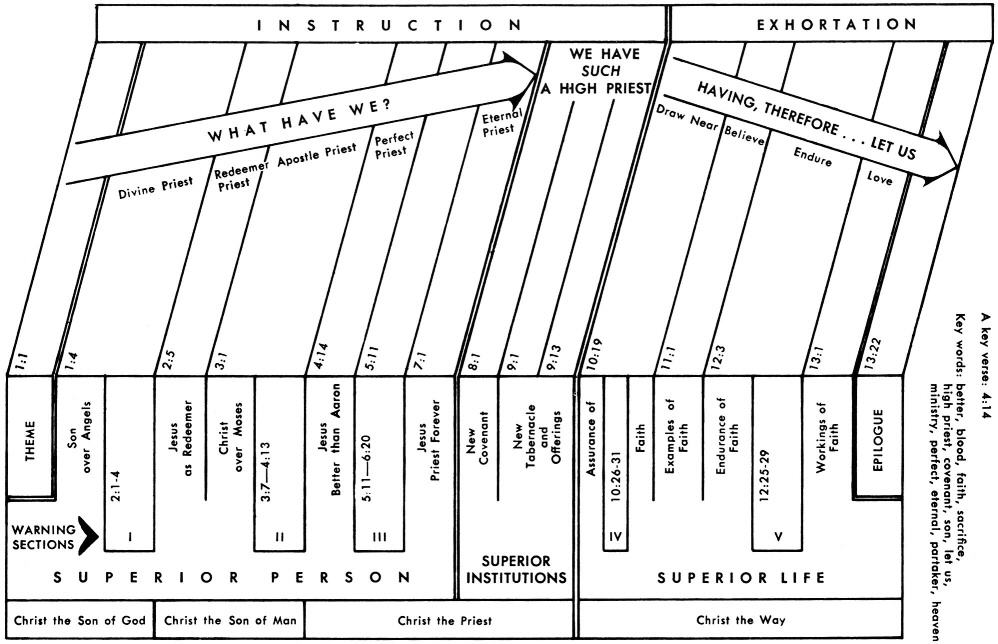
CONSIDER JESUS OUR GREAT HIGH PRIEST
Click chart to enlarge
Charts from Jensen's Survey of the NT - used by permission
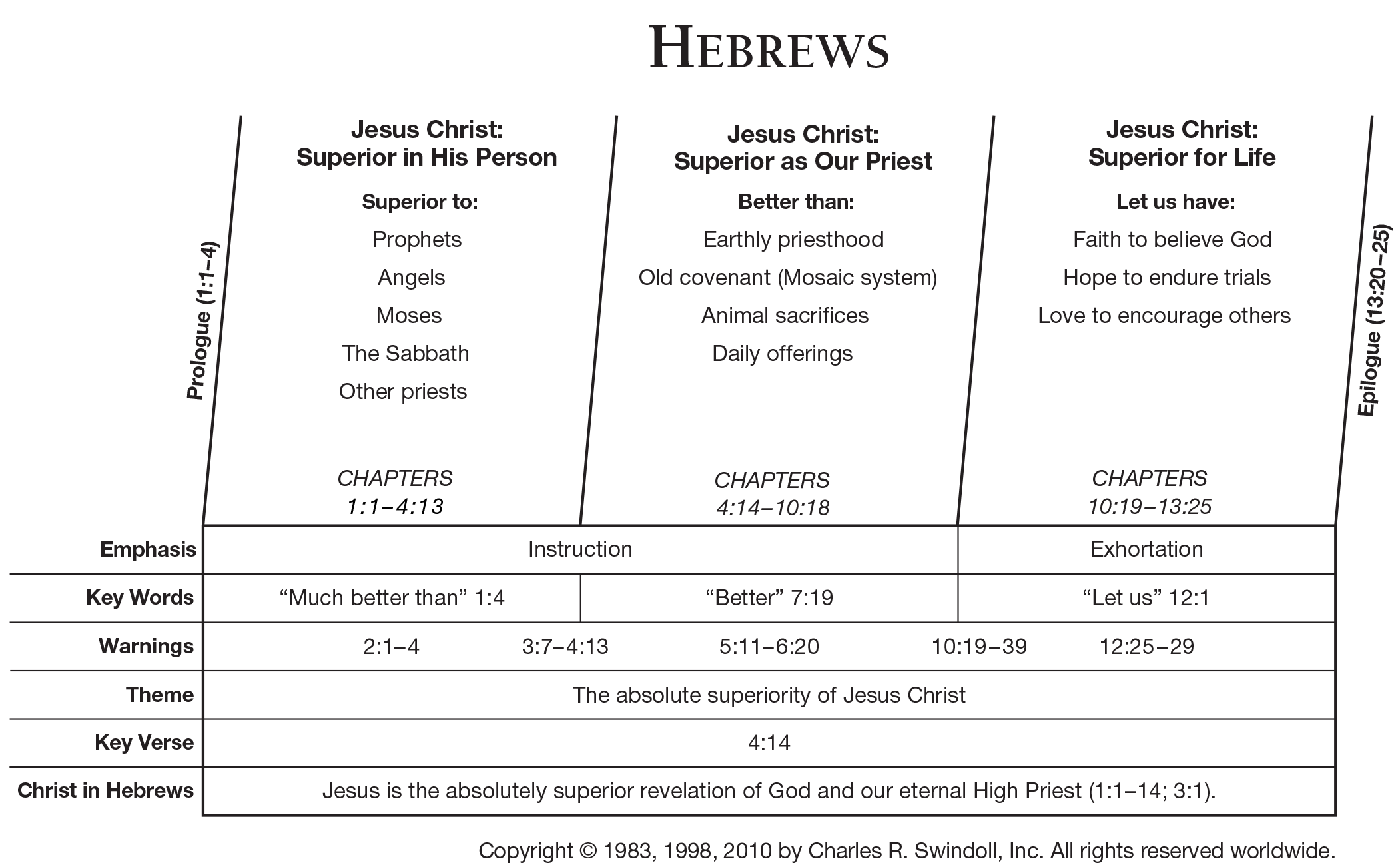
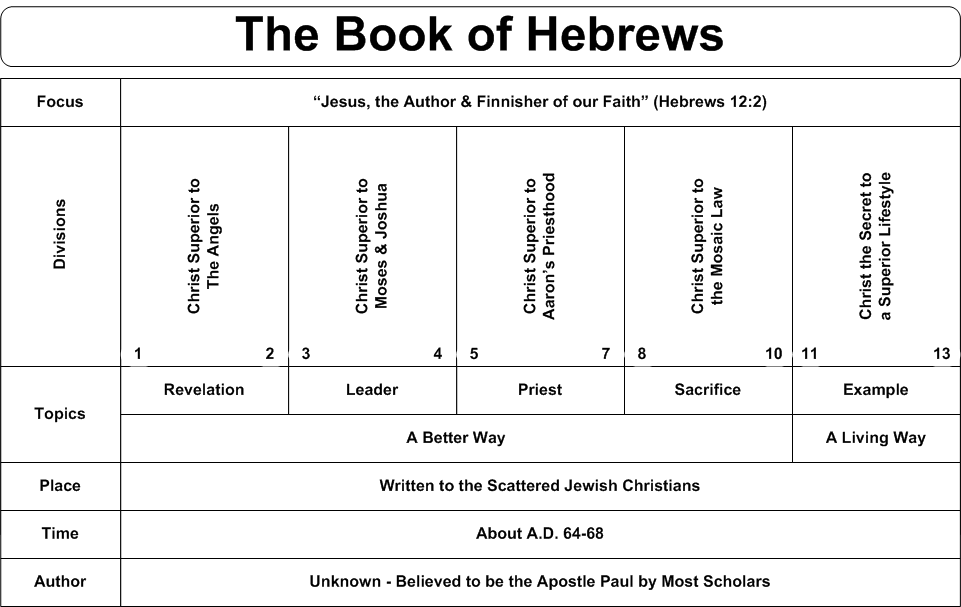
Swindoll's Chart, Interesting Pictorial Chart of Hebrews, Another Chart

|
The Epistle |
||||
| INSTRUCTION Hebrews 1-10:18 |
EXHORTATION Hebrews 10:19-13:25 |
|||
| Superior Person of Christ Hebrews 1:1-4:13 |
Superior Priest in Christ Hebrews 4:14-10:18 |
Superior Life In Christ Hebrews 10:19-13:25 |
||
| BETTER THAN PERSON Hebrews 1:1-4:13 |
BETTER PRIESTHOOD Heb 4:14-7:28 |
BETTER COVENANT Heb 8:1-13 |
BETTER SACRIFICE Heb 9:1-10:18 |
BETTER LIFE |
| MAJESTY OF CHRIST |
MINISTRY OF CHRIST |
MINISTERS FOR CHRIST |
||
|
DOCTRINE |
DUTY |
|||
|
DATE WRITTEN: |
||||

See ESV Study Bible "Introduction to Hebrews"
(See also MacArthur's Introduction to Hebrews)
Borrow Ryrie Study Bible
Hebrews 13:12 Therefore Jesus also, that He might sanctify the people through His own blood, suffered outside the gate (NASB: Lockman)
Greek: dio kai Iesous, ina agiase (3SAAS) dia tou idiou aimatos ton laon, exo tes pules epathen. (3SAAI)
Amplified: Therefore Jesus also suffered and died outside the [city’s] gate in order that He might purify and consecrate the people through [the shedding of] His own blood and set them apart as holy [for God]. (Amplified Bible - Lockman)
Barclay: That was why Jesus suffered outside the gate, so that he might make men fit for the presence of God by his own blood. (Westminster Press)
ESV: So Jesus also suffered outside the gate in order to sanctify the people through his own blood.
KJV: Wherefore Jesus also, that he might sanctify the people with his own blood, suffered without the gate.
NLT: So also Jesus suffered and died outside the city gates in order to make his people holy by shedding his own blood. (NLT - Tyndale House)
NIV: And so Jesus also suffered outside the city gate to make the people holy through his own blood. (NIV - IBS)
Phillips: That is why Jesus, when he sanctified men by the shedding of his own blood, suffered and died outside the city gates. (Phillips: Touchstone)
Wuest: Wherefore, also Jesus, in order that He might set apart for God and His service the people through His own blood, suffered outside the gate.
Young's Literal: Wherefore, also Jesus -- that he might sanctify through his own blood the people -- without the gate did suffer;
THEREFORE JESUS ALSO, THAT HE MIGHT SANCTIFY THE PEOPLE THROUGH HIS OWN BLOOD SUFFERED OUTSIDE THE GATE: Dio kai Iesous, hina hagiase (3SAAS) dia tou idiou haimatos ton laon dia tou idiou haimatos exo tes pules epathen (3SAAI):
- Heb 2:11 9:13,14,18,19 10:29 John 17:19 19:34 1Co 6:11 Eph 5:26 1Jn 5:6-8
- Josh 7:24 Mk 15:20-24 John 19:17,18 Ac 7:58
- Hebrews 13 Resources - Multiple Sermons and Commentaries
- Hebrews 13:7-14 The Antidote for False Teaching - Steven Cole
- Hebrews 13:7-14 Steadfastness, Separation, Sacrifice - John MacArthur
Amplified - Therefore Jesus also suffered and died outside the [city’s] gate in order that (expresses the purpose) He might purify and consecrate the people through [the shedding of] His own blood and set them apart as holy [for God].
NLT (Heb 13:11-12) - Under the old system, the high priest brought the blood of animals into the Holy Place as a sacrifice for sin (Ed: The Day of Atonement), and the bodies of the animals were burned outside the camp. 12 So also Jesus suffered and died outside the city gates (Ed: Golgotha is located outside the city gates of Jerusalem) to make his people holy by means of His own blood.
MacArthur (note on Hebrews 13:10-13) explains - The writer presents an analogy for the believers’ identification with Christ in His rejection by Jews. The bodies of animals offered on the Day of Atonement were not eaten but burned “outside the camp” (Lev 4:21; 16:27). Jesus, who was the ultimate atoning sacrifice, was similarly crucified outside the gates of Jerusalem (Jn 19:17). Figuratively, believers must join Him outside the camp of the world, no longer being a part of its unholy systems and practices (cf. 2Ti 2:4). By extension, this would also depict the departure from the Levitical system. The uncommitted Hebrews needed to take the bold step of leaving that system and being outside the camp of Old Covenant Israel.
That - purpose clause - Giving the purpose for which Jesus was crucified.
Might sanctify (37) (hagiazo) means to set apart. By His blood sinners are set apart from sin and unto God as His saints! Glory!
As Wuest explains "Jerusalem was the center of the apostate Judaism that crucified its Messiah and continued the temple sacrifices in defiance of God’s plainly revealed will (Heb 9:8). When the Jew would leave the temple sacrifices in order to place his faith in their fulfilment, the crucified, risen Messiah, he would necessarily be separated, thus, set apart (sanctified) from that Judaism which he had formerly espoused. The word “sanctify” in the Greek means “to set apart for God.” Thus, our Lord by becoming a sacrifice under the jurisdiction of the New Testament and as an outcast from Israel, set apart from the First Testament (the Old Covenant of Law), and Israel, the Jew who placed his faith in Him, and consecrated that person to God. It was with His own blood He did this. (Hebrews - Wuest's word studies from the Greek New Testament)
Spurgeon - Christian, in your sanctification, look to Jesus. Remember that the Spirit sanctifies you, but that He sanctifies you through Jesus. He does not sanctify you through the works of the law, but through the atonement of Christ. And therefore remember that, the nearer you live to the cross of Jesus, the more sanctification, and growth, and increase in all spiritual blessings His Spirit will give to you.
Spurgeon - Note how remarkably Providence provided for the fulfillment of the type (Ed: The "Sin Offering" specifically the offering on the Day of Atonement). Had our Lord been killed in a tumult, He would most likely have been slain in the city; unless He had been put to death judicially, He would not have been taken to the usual Mount of Doom (Ed: Golgotha). And it is remarkable that the Romans should have chosen a hill on the outside of the city to be the common place for crucifixion and for punishments by death. We might have imagined that they would have selected some mount in the center of the city, and that they would have placed their gibbet ("gallows") in a conspicuous spot, that so it might strike the multitude with the greater awe. But, in the providence of God, it was arranged otherwise. Christ must not be slain in a tumult, and He might not die in the city. When He was delivered into the hands of the Romans, they did not have a place of execution within the city, but one outside the camp, that by dying outside the gate, He might be proved to be the Sin Offering for His people.
Hebrews 13:13 So, let us go out to Him outside the camp, bearing His reproach (NASB: Lockman)
Greek: toinun exerchometha (1PPMS) pros auton exo tes paremboles, ton oneidismon autou pherontes; (PAPMPN)
Amplified: Let us then go forth [from all that would prevent us] to Him outside the camp [at Calvary], bearing the contempt and abuse and shame with Him. [Lev. 16:27.] (Amplified Bible - Lockman)
Barclay: So then let us go to him outside the camp, bearing the same reproach as he did, (Westminster Press)
ESV: Therefore let us go to him outside the camp and bear the reproach he endured.
KJV: Let us go forth therefore unto him without the camp, bearing his reproach.
NLT: So let us go out to him outside the camp and bear the disgrace he bore. (NLT - Tyndale House)
NIV: Let us, then, go to him outside the camp, bearing the disgrace he bore. (NIV - IBS)
Phillips: Let us go out to him, then, beyond the boundaries of the camp, proudly bearing his "disgrace".(Phillips: Touchstone)
Wuest: Therefore, let us be going out to Him outside of the camp, bearing His reproach.
Young's Literal: now, then, may we go forth unto him without the camp, his reproach bearing;
HENCE LET US GO OUT TO HIM OUTSIDE THE CAMP: toinun exerchometha (1PPMS) pros auton exo tes paremboles:
- Heb 11:26 12:3 Mt 5:11 10:24,25 16:24 27:32,39-44 Lu 6:22 Ac 5:41 1Co 4:10-13 2Co 12:10 1Pe 4:4,14-16
- Hebrews 13 Resources - Multiple Sermons and Commentaries
- Hebrews 13:7-14 The Antidote for False Teaching - Steven Cole
- Hebrews 13:7-14 Steadfastness, Separation, Sacrifice - John MacArthur
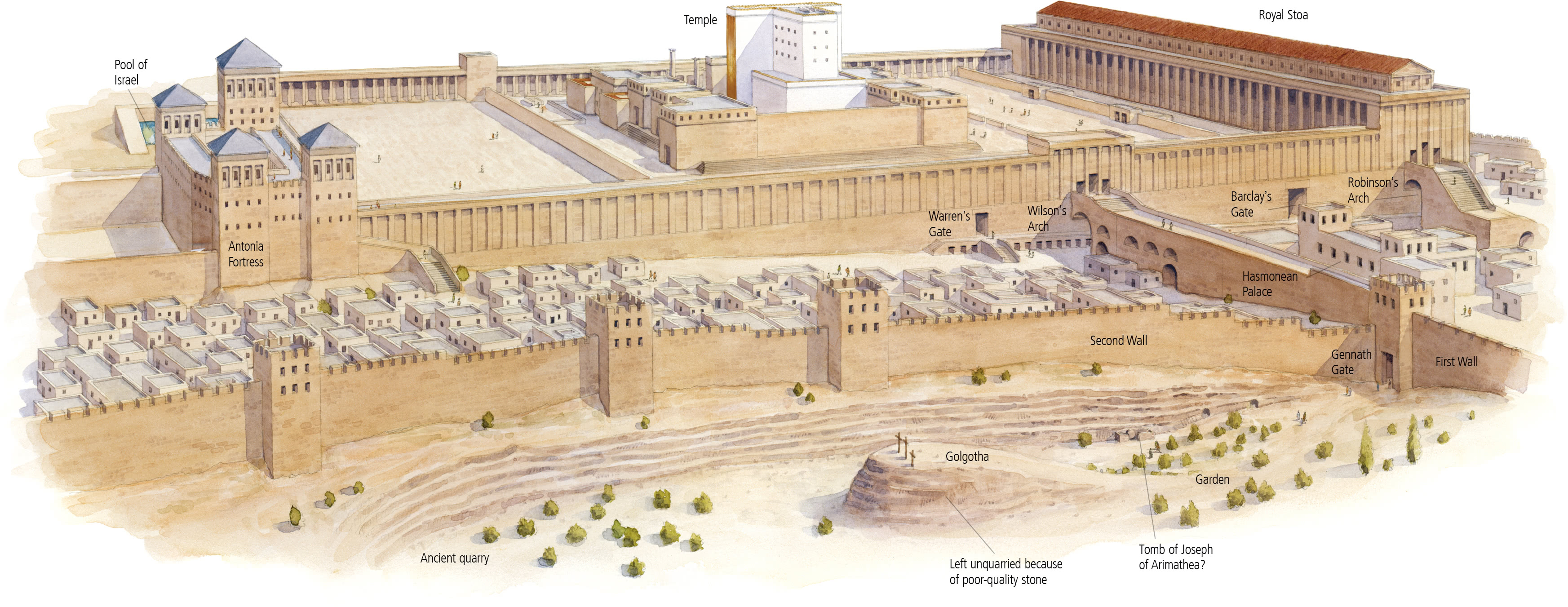
OUTSIDE THE CAMP
Note the diagram above which has the proposed site of Golgotha outside the city gates, i.e., "outside the camp." (Click to enlarge picture - from ESV Study Bible)
Hence - This inferential particle draws a conclusion from the preceding (term of conclusion). The subj. is hortatory "let us go out." The pres. tense expresses vividly the immediate effort. This could be a call for the readers to refuse to go back into Judaism
Let us - 12 exhortations in Hebrews - Heb 4:1, 11, 14, 16; 6:1; Heb 10:22-25; 12:1, 28; 13:13, 15
It is interesting that another verb (proserchomai = draw near) has the same root (erchomai - to go or come) as exerchomai in this exhortation. Let us draw near to Jesus by going out to Jesus, for the things of this world grow strangely dim in the light of His glory and grace.
MacArthur explains that "The practical point is that, as Christians, we must be willing to go out from the system, to bear the reproach and the shame that both the sin offering and Christ Himself bore, and to be rejected by men. This is the attitude Moses had toward the world. He considered “the reproach of Christ greater riches than the treasures of Egypt” (Heb. 11:26-note)."
Spurgeon - It would be a very pleasant thing if we could please men and please God too, if we could really make the best of both worlds, and have the sweets of this and of the next also. But a warning cry arises from the pages of Holy Scripture, for the Word of God talks very differently from this. It talks about a straight and narrow way, and about few that find it. It speaks of persecution, suffering, reproach, and contending even unto blood, striving against sin; it talks about wrestling and fighting, struggling and witnessing. I hear the Savior say, not “I send you forth as sheep into the midst of green pastures,” but, “like sheep in the midst of wolves” (Matt 10:16).
Wuest - The writer now exhorts his first-century readers to leave apostate Judaism and the temple sacrifices, and placing their faith in the Messiah as High Priest, bear His reproach, the reproach of exclusion from the Jewish commonwealth. This exhortation was addressed, of course, to those Jews who, while they had outwardly left the temple, yet had not placed their faith in Messiah, and were in danger of going back to the sacrifices. (Hebrews - Wuest's word studies from the Greek New Testament)
Outside the gate - Jesus was crucified outside the city gate. We know from the Gospels that he was crucified at Golgotha (Mk 15:22) which must have been outside the gate for we read that Simon of Cyrene, who was forced to bear the cross of Jesus, “a passer-by coming from the country” (Mk 15:21) while “they were coming out” (Mt 27:32) As an aside it should be noted that "the topographical evidence against the identification of its site with that of the modern Church of the Holy Sepulcher is apparently very strong." (Westminster Bible Dictionary)
Outside the camp - several of the following notes discuss this topic (this exact phrase 28x in 27v in NAS) -
Ex 29:14; 33:7; Lev 4:12, 21-note; Lev 6:11-note.; Lev 8:17-note.; Lev 9:11; Lev 13:46-note.; Lev 16:27-note (good note by Richard Phillips).; Lev 17:3-note.; Lev 24:14, 23-note.; Nu 5:3-4; 12:14-15; 15:35-36; 19:3, 9; 31:13, 19; Dt 23:10, 12; Josh 6:23; Heb 13:11-note Heb 13:13-note. and "outside the gate" in Heb 13:12-note.
BEARING HIS REPROACH: ton oneidismon autou pherontes (PAPMPN):
- Heb 10:33, 11:26 Mt 5:11,10:22,23, 16:24 27:39-44 Lk 6:22 Cp. Acts 5:41
- Hebrews 13 Resources - Multiple Sermons and Commentaries
- Hebrews 13:7-14 The Antidote for False Teaching - Steven Cole
- Hebrews 13:7-14 Steadfastness, Separation, Sacrifice - John MacArthur
LET US BE IMITATORS AND
BEAR HIS REPROACH
You have to hold to this truth whether you have to suffer for it or not. The corollary thought is we have to hold fast to the truth so that it holds us fast and then we can suffer courageously knowing the joy which is set before us (cf Heb 12:2). When you know that what (Who) you are suffering for is greater and grander than anything this world has to offer, you are much more likely to be willing to be "bearing His reproach!"
As God's "little children, (let us) abide in Him, so that when He appears, we may have confidence and not shrink away from Him in shame at His coming." (1 John 2:28-note)
May our Father grant us His Spirit of grace (Heb 10:29-note) His power which enables us to "realize the full assurance of hope until the end, so that we will not be sluggish, but imitators of those who through faith and patience inherit the promises" in Christ Jesus in Whom every promise of God is yes and amen (2 Cor 1:20KJV). Amen and amen. (Heb 6:11-12-note)
Indeed may we be imitators of those Spirit filled men in Acts who after being flogged (Acts 5:40) "went on their way from the presence of the Council, rejoicing that they had been considered worthy to suffer shame for His name." (Acts 5:41)
Let us bear His reproaches for as Peter wrote "you have been called for this purpose, since Christ also suffered for you, leaving you an example for you to follow in His steps." (1 Peter 2:21-note, cf 1 John 2:6-note, 1 Cor 11:1-note)
Jews considered one crucified to be cursed (Dt 21:23; Gal 3:13; 1Cor 1:23). Jesus was crucified as a traitor and a criminal. Through their sufferings, which included insult and persecution (10:33), the readers were bearing his disgrace.
Reproach (3680)(oneidismos from oneidizo = to defame, find fault in a way that demeans another [Mt 5:11] <> from oneidos = disgrace, insult, Lk 1:25) is a noun which means reproach, which is an expression of rebuke or disapproval. It means to insult, abuse, disgrace. The idea in some context (Ro 15:3, He 10:33, 11:26, 13:13) is that the insult or reviling represents unjustifiable verbal abuse inflicted on someone. In other contexts it describes justifiable disgrace or reproach (1Ti 3:7). Look at some of the uses of oneidismos in the Septuagint (see verse list below) to see other saints who suffered reproach (e.g., Neh 1:3, 4:4, etc; see also what suffered reproach in Jer 6:10!). The narrow "way of the Cross" has always been the way of reproach, even before the Cross!
Hebrews 13:14 For here we do not have a lasting city, but we are seeking the city which is to come (NASB: Lockman)
Greek: ou gar echomen (1PPAI) ode menousan (PAPFSA) polin, alla ten mellousan (PAPFSA) epizetoumen. (1PPAI)
Amplified: For here we have no permanent city, but we are looking for the one which is to come. (Amplified Bible - Lockman)
Barclay: for here we have no abiding city but are searching for the city which is to come. (Westminster Press)
ESV: For here we have no lasting city, but we seek the city that is to come.
KJV: For here have we no continuing city, but we seek one to come.
NLT: For this world is not our home; we are looking forward to our city in heaven, which is yet to come. (NLT - Tyndale House)
NIV: For here we do not have an enduring city, but we are looking for the city that is to come. (NIV - IBS)
Phillips: For we have no permanent city here on earth, we are looking for one in the world to come. (Phillips: Touchstone)
Wuest: for we do not have here an abiding city, but we are seeking that one which is to come.
Young's Literal: for we have not here an abiding city, but the coming one we seek;
FOR HERE WE DO NOT HAVE A LASTING CITY BUT WE ARE SEEKING THE CITY WHICH IS TO COME: ou gar echomen (1PPAI) hode menousan (PAPFSA) polin alla ten mellousan (PAPFSA) epizetoumen (1PPAI):
- Heb 11:10, Heb 12:22, 2 Pe 3:13,14
- Hebrews 13 Resources - Multiple Sermons and Commentaries
- Hebrews 13:7-14 The Antidote for False Teaching - Steven Cole
- Hebrews 13:7-14 Steadfastness, Separation, Sacrifice - John MacArthur
WE ARE PILGRIMS JUST
PASSING THROUGH
For - term of explanation - What is the writer explaining?
Wuest - Let us go forth outside the (city) gate to Jesus; for the system (Levitical sacrificial system) which has its center in Jerusalem, the Holy City, is no more ours. We are excluded from its religious fellowship by embracing the faith of Him Who suffered outside the gate. The city itself is not abiding. As a holy city, it is the center and representative of a system of shadows and figures (Heb 8:5; 9:9, 23, 24; 10:1), which is to be shaken and removed, even as is the city itself (Heb 12:27); Heb 8:13; 9:10; 10:9, 18.” (Hebrews - Wuest's word studies from the Greek New Testament)
Vincent rightly argues that the Epistle must have been written before the destruction of Jerusalem else a reference to that event could hardly have been avoided here.
Spurgeon - Then do not look for a continuing city here. Do not build your nest on any one of the trees of earth, for they are all marked for the axe, and they will all have to come down, and your nest too, if you have built upon them. Our holy faith makes us a separated people, because our Lord in whom we trust was separated and covered with reproach for our sakes. Mere going out from society is nothing; going forth to Him is the great matter. With joy do we follow Him into the place of separation, expecting soon to dwell with Him forever.
Dods says the writer is encouraging his vacillating readers to not hesitate to abandon their "old associations and being branded as outcasts and traitors and robbed of your privileges as Jews. This is the reproach of Christ, in bearing which you come nearer to Him. And the surrender of your privileges need not cost you too much regret, “for we have not here (on earth) an abiding city, but seek for that which is to be,” that which has the foundations, Heb 11:10, the heavenly Jerusalem, Heb 12:22. That which is spiritual and eternal satisfies the ambition and fills the heart. Cf. Phil. 3:20. The want of recognition and settlement on earth may therefore well be borne." (Hebrews 13 Commentary - The Expositor's Greek Testament)
The lack of need for materially expressed religion is underscored by this statement. Like Abraham of old, believers are aliens and strangers in this present evil age (1Pe 2:11-note), looking forward with great anticipation as did the saints of old to the city with foundations, whose architect and builder is God (Heb 11:10-note). This heavenly mindset frees the believer from seeking after material benefits, and especially from the passing pleasures of sin. We have already attained to that “city that is to come” in our spirits (Heb 12:22-note) and will enter that city in glorified bodies at the resurrection when Jesus returns (Rev 21:2-4-note). We are in no need now of buildings, ceremonies and ritual, for Jesus is our all in all!
Every empire and every city of the earth will one day be crushed by the returning Stone (Christ Jesus) (Da 2:35-note). We must flee to Jesus outside the camp, and embrace His "shame." Jesus Christ, Who is “the same yesterday and today and forever,” is our constant sufficiency in this life and that to come and ever supplies grace upon grace.
As Peter says
But according to His promise we are looking for new heavens and a new earth, in which righteousness dwells. Therefore, beloved, since you look for these things, be diligent to be found by Him in peace, spotless and blameless,(2 Pe 3:13,14-note)
Beloved, I urge you as aliens and strangers to abstain from fleshly lusts which wage war against the soul. (1Peter 2:11-note)
Seeking (searching) (1934)(epizeteo from epi = intensifies meaning + zeteo = try to learn location of something, searching for) means to search or look for (people [Jesus] Lk 4:42). The present tense depicts this as our lifestyle!
This reminds me of Paul's command to "Set your mind (present imperative - We can only obey this as we are filled with and led by the Spirit!) on the things above, not on the things that are on earth.3 For (term of explanation = Paul explains why it is wrong to seek things on earth) you have died and your life is hidden with Christ in God." (Col 3:2-3-note)
Recall that the writer is primarily addressing Jews of the First Century who were interested in Christ but who were being drawn back to the Old Covenant Levitical system. Those Jews who choose Jesus and refused to be drawn back to the Old system were subject to reproach, including abusive verbal insults from Jews who held fast to the Levitical system.
Practically speaking, the principles of this section are applicable to all believers in Christ, for as Paul made clear to young (possibly a bit timid - 2 Ti 1:7-note) Timothy, "all who desire to live godly in Christ Jesus will be persecuted." (2 Ti 3:12-note). And so if you have taken a stand for Christ (in your family, at your workplace, at school, etc) and for the Good News of the Cross, then there is no doubt that you have suffered revilings, reproaches, insults, and persecutions for His Name's sake! But let this section of Hebrews encourage you (even as the writer was encouraging first century Jewish believers) to hold fast to Christ and His Cross, remembering that it is by faith we see an eternal city, the heavenly Jerusalem, our eternal abode with and in Christ (Revelation 21:1-22:21-note). Many will call you foolish for believing such a "fairy tale" or "fabrication" (as reasoned in their natural minds - 1 Cor 2:14-note), but let the Spirit open your eyes to the eternal truth portrayed in the Scriptures (like those in Hebrews 13), for we look not at the things which are seen, but the things which are unseen, for the things seen are temporal, but the things unseen are eternal (2 Cor 4:18-note).
Spurgeon - The path of separation (Ed: From the world and unto Christ) may be a path of sorrow, but it is the path of safety. And though it may cost you many pangs, and make your life like a long "martyrdom," and every day a battle, yet it is a happy (blessed) life after all. There is no such life as that which the soldier of Christ leads; for though men frown upon him, Christ so sweetly smiles upon him that he cares for no man. Christ reveals Himself as a sweet refreshment to the warrior after the battle, and so blessed is the vision that the warrior feels more calm and peace in the day of strife than in his hours of rest. If the end of all things is at hand, let them end; but our praises of the living God shall abide world without end. Set free from all the hamper of citizenship here below, we will begin the employment of citizens of heaven. It is not ours to arrange a new Socialism or to set up to be dividers of heritages; we belong to a kingdom that is not of this world—a city of God, “eternal in the heavens” (2 Cor 5:1). It is not ours to pursue the dreams of politicians, but to offer the sacrifices of God-ordained priests. As we are not of this world, it is ours to seek the world to come, and press forward to the place where the saints in Christ shall reign forever and ever.
GLAD TO GET HOME - In wintertime, a condition known as a "whiteout" sometimes occurs along the Lake Michigan shoreline. The air becomes so filled with powdery snow that you can't see more than a few feet ahead. You feel totally helpless, especially if you're driving, and that's what we were doing on a bitterly cold December day.
Our family had been invited to my sister's house for Christmas dinner. As we headed west toward Lake Michigan, the weather became treacherous, but we made it to our destination. Later, however, as we were driving home after dark, the situation grew even worse. The expressway was covered with ice, traffic slowed to a crawl, and several cars were in the ditch. Then all at once we were enveloped by a brief whiteout. Believe me, it was frightening. After a slow, tedious journey, we finally reached Grand Rapids and pulled into our driveway. I think every member of the family said, "I'm sure glad to get home!"
I wonder if we'll have a similar feeling when we enter heaven. The dangerous "whiteouts" of our earthly journey will be over. The temptations, stresses, and failures will all be in the past. Best of all, we'll be safe with our Savior.
Yes, we'll be so glad to get home!— David C. Egner (Our Daily Bread, Copyright RBC Ministries, Grand Rapids, MI. Reprinted by permission. All rights reserved)
When we all get to heaven,
What a day of rejoicing that will be!
When we all see Jesus,
We'll sing and shout the victory.
—Hewitt
Heaven for the Christian is best spelled H-O-M-E.
TO BE CONTINUED - Do you like continued stories? Let’s say you’re reading a magazine article or watching a television program for half an hour, and you come to the place where the hero plunges into the water to rescue his drowning sweetheart. Then you’re left hanging in the air with the words: “To be continued.” How disappointing!
I have quite a different response to the inscription on the tombstone of a follower of Christ. It reads: “To Be Continued Above.”
Yes, this life is but the first chapter of the book of life. Whether that chapter is long or short—it is not the end, but it is to be continued. For the believer, it will be continued in heaven with our Lord. There is no break between the chapters; you don’t have to wait till next month’s installment or tune in next week to hear the concluding episode. Chapter two follows chapter one without interruption. It is continued immediately, for “to be absent from the body [is] to be present with the Lord” (2Cor 5:8-note).
What will the next chapter be for you? It will be written sooner or later, either in heaven or in hell. Remember, when your time comes to die, that is not the end. Your story is “to be continued”—but where?--by M. R. De Haan (Our Daily Bread, Copyright RBC Ministries, Grand Rapids, MI. Reprinted by permission. All rights reserved)
Life's fleeting days will soon be o'er
When death ends all that's gone before;
Yet life in Christ continues still,
For all who lived to do His will.
—DJD
Death is the last chapter of time,
but the first chapter of eternity.