Hebrews 2:2
Hebrews 2:3
Hebrews 2:4
Hebrews 2:5
Hebrews 2:6
Hebrews 2:7
Hebrews 2:8
Hebrews 2:9
Hebrews 2:10
Hebrews 2:11
Hebrews 2:12
Hebrews 2:13
Hebrews 2:14
Hebrews 2:15
Hebrews 2:16
Hebrews 2:17
Hebrews 2:18
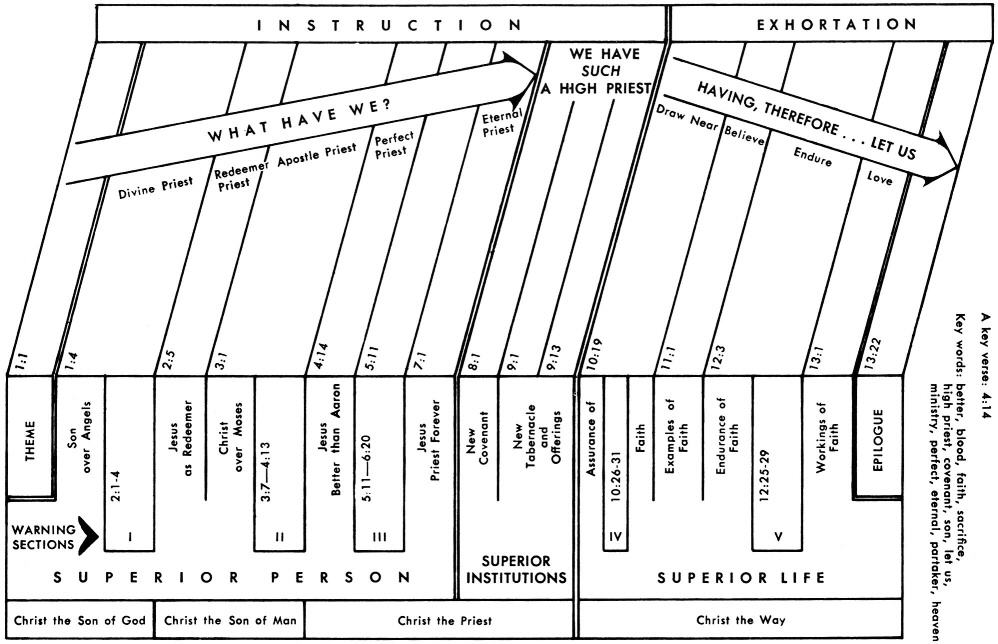
CONSIDER JESUS OUR GREAT HIGH PRIEST
Click chart to enlarge
Charts from Jensen's Survey of the NT - used by permission
Swindoll's Chart, Another Chart
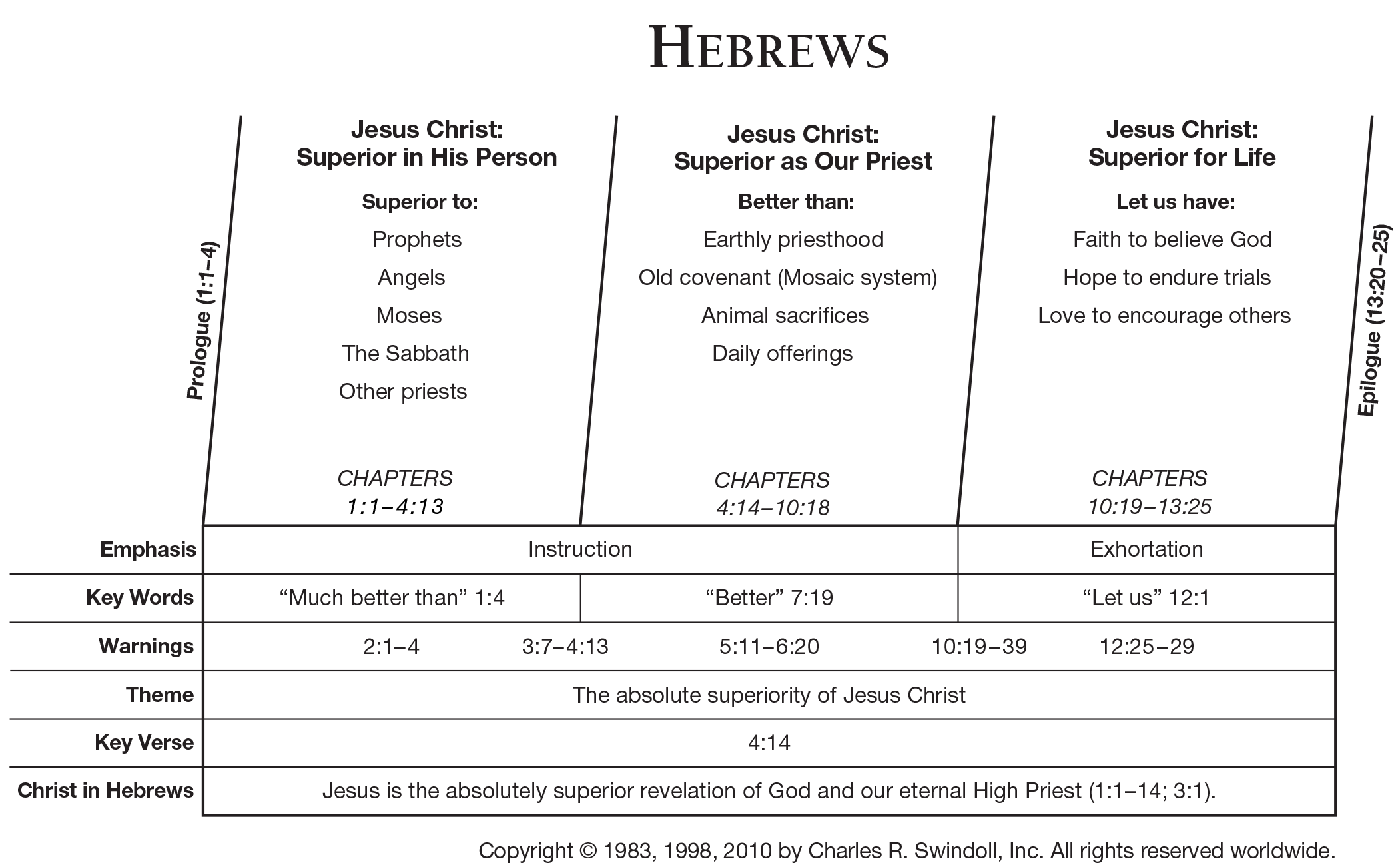
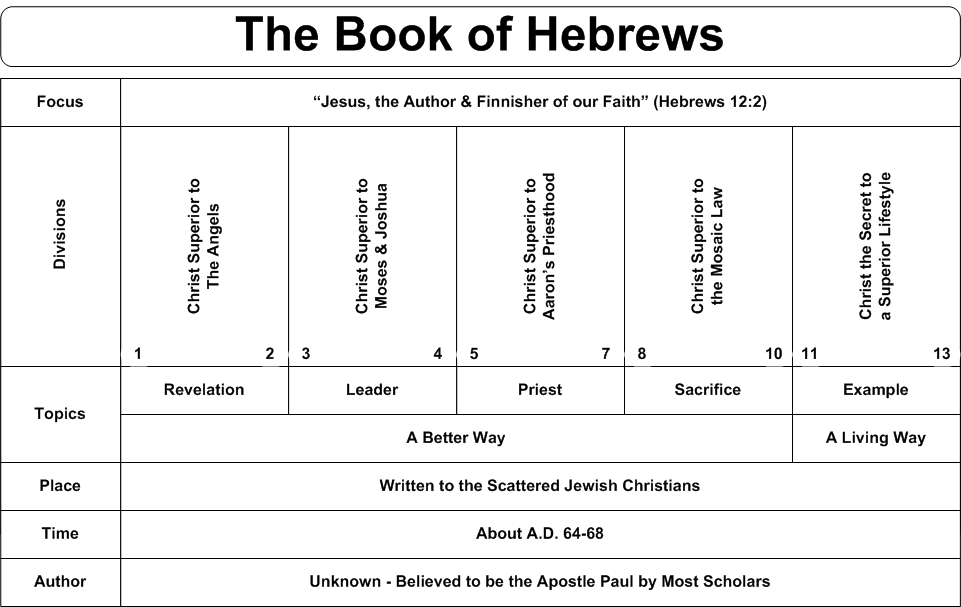
|
The Epistle |
||||
| INSTRUCTION Hebrews 1-10:18 |
EXHORTATION Hebrews 10:19-13:25 |
|||
| Superior Person of Christ Hebrews 1:1-4:13 |
Superior Priest in Christ Hebrews 4:14-10:18 |
Superior Life In Christ Hebrews 10:19-13:25 |
||
| BETTER THAN PERSON Hebrews 1:1-4:13 |
BETTER PRIESTHOOD Heb 4:14-7:28 |
BETTER COVENANT Heb 8:1-13 |
BETTER SACRIFICE Heb 9:1-10:18 |
BETTER LIFE |
| MAJESTY OF CHRIST |
MINISTRY OF CHRIST |
MINISTERS FOR CHRIST |
||
|
DOCTRINE |
DUTY |
|||
|
DATE WRITTEN: |
||||

See ESV Study Bible "Introduction to Hebrews"
(See also MacArthur's Introduction to Hebrews)
Borrow Ryrie Study Bible
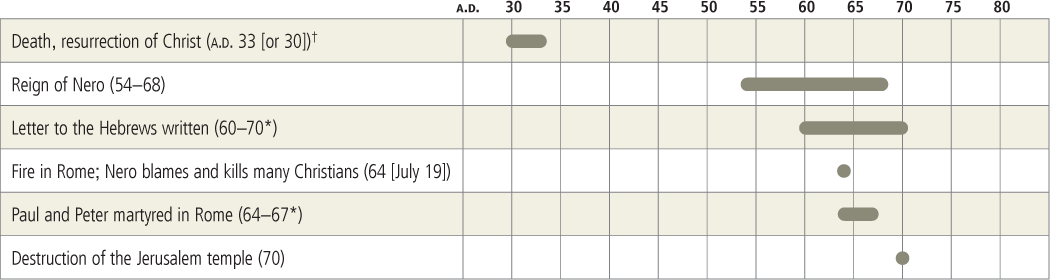
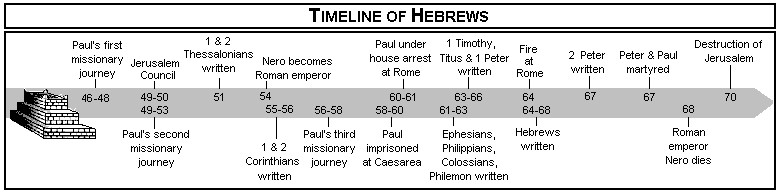
Timeline of Hebrews - ESV Study Bible
Hebrews 2:4 God also testifying with them, both by signs and wonders and by various miracles and by gifts of the Holy Spirit according to His own will. (NASB: Lockman)
Greek: sunepimarturountos (PAPMSG) tou theou semeiois te kai terasin kai poikilais dunamesin kai pneumatos agiou merismois kata ten autou thelesin.
Amplified: [Besides this evidence] it was also established and plainly endorsed by God, Who showed His approval of it by signs and wonders and various miraculous manifestations of [His] power and by imparting the gifts of the Holy Spirit [to the believers] according to His own will. (Amplified Bible - Lockman)
Barclay: while God himself added his own witness to it by signs and wonders and manifold deeds of power, and by giving us each a share of the Holy Spirit, according as he willed it? (Westminster Press)
NLT: and God verified the message by signs and wonders and various miracles and by giving gifts of the Holy Spirit whenever he chose to do so. (NLT - Tyndale House)
Phillips: and God moreover has plainly endorsed their witness by signs and miracles, by all kinds of spiritual power, and by gifts of the Holy Spirit, all working to the divine plan. (Phillips: Touchstone)
Wuest: God also bearing joint-testimony with them, both with attesting miracles and miracles of a startling, imposing, amazement-waking character, and with variegated miracles, and with distributions [of spiritual gifts] from the Holy Spirit according to His will?
Young's Literal: God also bearing joint-witness both with signs and wonders, and manifold powers, and distributions of the Holy Spirit, according to His will.
GOD ALSO TESTIFYING WITH THEM BOTH BY SIGNS AND WONDERS AND BY VARIOUS MIRACLES: sunepimarturountos (PAPMSG) tou theou semeiois te kai terasin kai poikilais dunamesin:
- God also testifying with them Mark 16:20; John 15:26; Acts 2:32-33; Acts 3:15-16; Acts 4:10; Acts 14:3; Acts 19:11-12; Ro 15:18-19
- Hebrews 2 Resources - Multiple Sermons and Commentaries
Related Passages:
John 15:26+ “When the Helper comes, whom I will send to you from the Father, that is the Spirit of truth who proceeds from the Father, He will testify about Me,
Acts 2:22+ “Men of Israel, listen to these words: Jesus the Nazarene, a Man attested to you by God with miracles and wonders and signs which God performed through Him in your midst, just as you yourselves know–
Acts 2:32-33+ “This Jesus God raised up again, to which we are all witnesses. 33 “Therefore having been exalted to the right hand of God, and having received from the Father the promise of the Holy Spirit, He has poured forth this which you both see and hear (THE SIGNS ASSOCIATED WITH THE GIVING OF THE SPIRIT).
Acts 14:3+ Therefore they spent a long time there speaking boldly with reliance upon the Lord, who was testifying to the word of His grace, granting that signs and wonders be done by their hands.
Acts 15:12+ All the people kept silent, and they were listening to Barnabas and Paul as they were relating what signs and wonders God had done through them among the Gentiles.
Acts 19:11-12+ God was performing extraordinary miracles by the hands of Paul, 12 so that handkerchiefs or aprons were even carried from his body to the sick, and the diseases left them and the evil spirits went out.
Romans 15:18-19+ For I will not presume to speak of anything except what Christ has accomplished through me, resulting in the obedience of the Gentiles by word and deed, 19 in the power of signs and wonders, in the power of the Spirit; so that from Jerusalem and round about as far as Illyricum I have fully preached the gospel of Christ.
GOD "SEAL OF APPROVAL"
ON THE SPOKEN WORDS
God also testifying with (sunepimartureo) them - God was continually (present tense) testifying thus giving additional testimony to that of the words spoken by Jesus and then by those who heard him. The verb testifying with (sunepimartureo) does not mean they preached the Word and then 10 days later there were supernatural events but that when they preached, the supernatural activity could be clearly associated by the hearers with the person's proclamation thus adding the divine stamp of approval and authenticity, corroborating their spoken testimony. They proclaimed and God called the supernatural events to the witness stand to say "Their spoken words are from the Throne room, from Me!" It is as if Almighty God placed what they said in bold letters, italicized and followed with an exclamation point! When Jesus preached the gospel, He also did some things that made it even more believable. He said, "Though you do not believe Me, believe the (SUPERNATURAL) works, that you may know and understand that the Father is in Me, and I in the Father." (Jn 10:38+). When He claimed to be God and then did things that only God could do, the supernatural events confirmed His divinity and, consequently, the truth of His message. On the Day of Pentecost Peter also reminded his hearers that "Jesus the Nazarene [was] a man attested to you by God with miracles and wonders and signs." (Acts 2:22+)
🙏 THOUGHT - If you are a skeptic, an agnostic, indifferent, curious, etc about Jesus, do not say you would believe in Jesus as Lord and Savior (Ro 10:9-10+) if you saw Jesus Himself or saw testifying supernatural signs, wonders or miracles like the entire nation of Israel saw for 3 years! Jesus performed thousands of supernatural acts in Israel during His three years and most Jews did not place their faith in Him. John documents that Jesus "came to His own (JEWS), and those who were His own did not receive Him." (John 1:11+). Most of the nation was "stiff-necked and uncircumcised in heart and ears" continually resisting the Holy Spirit when Jesus clearly presented Himself as their Messiah (Acts 7:51+). They had physical ears but only ears to hear physical sounds, not spiritual sounds taught by the Spirit. In Acts 7:57+ the Jews literally "covered their ears" and rushed to stone to death God's witness, Stephen. Their ears were closed just like they had been throughout most of Israel's history (Jer 6:10, 7:26, Isa 6:9-10+). This is why Jesus repeated commanded "He who has ears, let him hear (present imperative see the need to depend on the Holy Spirit to obey, the very One they resisted!)." (Mk 4:9+, Mt 11:15+, Mt 13:9+, Mt 13:43+, Lk 14:35+) So I say to you dear skeptic, etc, hear His Word "repent and believe the Gospel." (Mk 1:15). And I can guarantee that THEN you will see a supernatural sign, for you will be born again. As Paul said " Therefore if anyone is in Christ, he is a new creature (supernatural creation); the old things passed away; behold, new things (including supernatural desire to live sensibly, righteously and godly in this present age Titus 2:12+) have come." (2Co 5:17+)
ANOTHER THOUGHT - What about signs and wonders today in closed countries? See Is God giving people in closed countries dreams and visions to bring them to faith in Christ?
God gave similar confirming signs through the apostles, the first preachers of the gospel after Christ Himself. Many of their listeners no doubt said, “Why should we believe them? What proof do we have that their message is from God? There have always been false teachers. How can we know that these are true?” So God provided His apostles supernatural witnesses (so to speak) by giving them the ability to do what Jesus had done - signs, wonders, and miracles.
Spurgeon on God also testifying observes that "Those who doubt the truth of the gospel, or who say they do, are often found believing historical statements that are not half as well proved. A man sits down, and reads the book of the Gallic wars, and he believes that Julius Caesar wrote it; yet there is not a half or a tenth as much evidence to prove that he did write it as there is to prove that our Lord Jesus lived, and died, and rose again from the dead. The witness to the truth of these great matters of fact has been borne by God himself with signs, and wonders, and miracles. Honest and true men, apostles and others, have witnessed to them; and they have also been certified by Incarnate Deity, even by the Lord who deice to speak to us by his Spirit. We cannot, therefore, trifle with this gospel without incurring most serious guilt. Observe, then, that this gospel comes to us by Christ, and it is confirmed to us by His apostles, and further confirmed by those signs and wonders, and divers miracles, which God sent as the seals of apostolic teaching; so that this spell is not one about which we can raise any question whatever. It comes by a medium which we must not dare to question, it has confirming seals in it which it is blasphemous for us to dispute. Oh, how gladly should we receive it! How tenderly should we treat it? How devoutly grateful should we be for it; and how earnestly should we comply with all its requirements? This gospel of ours is stamped with the seal of God; He has set His mark upon it, to attest its genuineness and authority. The miraculous gifts of the Holy Spirit were the seal that the gospel was no invention of man, but that it was indeed the message of God. Gifts of healing, gifts of tongues, gifts of miracles of divers kinds, were God’s solemn declaration to man, “This is the gospel; this is My gospel which I send to you; therefore, refuse it not.” (Spurgeon's Expositional Commentary on Hebrews)
Pulpit Commentary - The passage is instructive as expressing the grounds of acceptance of the gospel. Its truth was already "confirmed" to believers by the testimony of unimpeachable witnesses to that which, so attested, carried with it its own evidence. But the signs attending the apostolic ministry were granted for further attestation. Thus "signs and wonders," the craving for which as a condition of belief was so condemned by our Lord, have their true evidential value assigned them. They did not furnish the original basis of belief, which rested on Christ himself, his Person. and his work, as unimpeachably attested. They came in only as suitable accompaniments of a Divine dispensation, and as additional confirmations. (Hebrews 2 Commentary)
Andrew Corbett - It’s interesting how many people throughout history have claimed to be prophets of God yet have not had any miraculous demonstration of their message. Buddha did no miracles. Mohammed did no miracles. Charles Taze Russell did no miracles and neither did Joseph Smith.
Testifying (bearing witness) with them (4901) (sunepimartureo from sun/syn = with, speaks of intimate relation + epi - upon + martureo - to bear witness) to attest jointly with. To testify at the same time, confirm, add one's witness to. In other words, this verb pictures the apostles (or Jesus) proclaiming the Word of God and this proclamation was accompanied by the supernatural signs, etc. The signs, etc, in effect served as God's "witnesses" that the message proclaimed was true and was divine in origin. 1) at attest together with 2) to join in bearing witness, to unite in adding testimony
Gilbrant - Classical Greek - Sunepimartureō is a compound verb made up by sun, “with,” epi, “on, upon, in addition to,” and martureō “to witness or testify.” The verb means “to bear witness together or in addition to another.” It can be found as far back as the Fourth Century B.C. meaning “join in attesting” and “add one’s evidence” in a legal sense (Liddell-Scott). It is not found in the Septuagint. Sunepimartureō is rare in the New Testament. The verb is used in Hebrews 2:4. God is said to be the One who bears witness, in addition to the Lord Jesus, to the Word, that is, the gospel. God bore witness through signs, wonders, and miracles. This confirms what Jesus said (Mark 16:12-18) would happen following the preaching of the gospel. (Complete Biblical Library)
Use of this verb group martureo in Nonbiblical Greek.
1 Legal Witness to Facts. The proper sphere of the terms is the legal one, e.g., in trials or legal transactions. What is signified is personal testimony to events, relations, persons, etc. The verb may mean “to come forward as a witness,” but with the dative it can mean testifying for somebody, and with the accusative, peri and genitive, or a hoti clause, it may denote giving witness to something specific. martyria signifies both the act and the actual witness. The more objective martyÃrion comes into more general use for anything that may be adduced to confirm a fact or statement.
2 Witness to Facts, Truths, and Views. The whole group finds a more general use. In so doing, it may still refer to facts of which there is direct personal knowledge. But it may also refer to truths of views which are proclaimed with conviction but cannot be verified empirically. Aristotle makes this distinction between witness as objective statement and witness as personal conviction. He also refers to witness to future events, which by its very nature is based on faith rather than fact.
3. Application of the General Use in the Sense of Witness to Facts. Along these lines appeal is made to the gods as witnesses to oaths, treaties, etc. Another common use is for the witness of the senses. We also find instances of the citing of impersonal witnesses. The poverty of Socrates is a witness that he is not a philosopher for gain.
4. Application of the General Use in the Sense of Witness to Truths or Views. Plato offer many instances of this kind of witness in respect of such matters as happiness, homosexuality, etc. The life of Socrates in particular is a witness to the truth of his teaching. In Epictetus the philosopher is the divinely called witness to practical wisdom not only by his teaching but above all by his equanimity in misfortune and affliction. The use is not technical, however, for health bears witness to the truth of the Stoic lifestyle, and while death may be a witness to truth, it does not have to be, for Epictetus does not call Socrates a maÃrtys.
BOTH BY SIGNS AND WONDERS AND BY VARIOUS MIRACLES: semeiois te kai terasin kai poikilais dunamesin:
- Hebrews 2 Resources - Multiple Sermons and Commentaries
SIGNS, WONDERS
MIRACLES
Both by (instrumental case used with all following four items) signs (semeion) and wonders (teras) and by various (poikilos - "many colored", variegated) miracles (dunamis) - Signs speak of the "fingerprints" of God, valuable not so much for what they are as for what they indicate of the grace and power of the Almighty. The use of the Greek word semeion indicates that the event is not an empty show of power, but significantly points to the reality of the mighty hand of God in operation. (See Acts 3:7-9,11-12,16; Acts 5:12-16; Acts 9:32-41; Acts 14:3,8-9; Acts 19:11-12; Acts 28:8-9) Wonders attract attention. Miracles demonstrate divine (supernatural) power.
🙏 THOUGHT - The greatest sign, wonder and miracle is when bad men are made holy and righteous by God's grace through faith as testified by changed lives. Truly miracles in Christianity are still evident today for all to behold. People are hungry to see the power of Christ in reality, not the charade of charlatans masquerading as spiritual magicians or carnival side show freaks.
Lenski - “Signs and wonders” refer to the apostolic miracles which were great and glorious indeed. Others, too, like Stephen, were given this grace. “Signs” is the greater word because it is ethical and designates the miracles as signifying something; “wonders” or portents indicates only their astonishing character so that the New Testament never uses this word alone as it does “signs.” The latter is broader; a sign does not always need to be a wonder. Moreover, pagan religion had wonders and portents which, however, were never true signs. (BORROW The Interpretation of the Epistle to the Hebrews)
Spurgeon - “God also testified by signs and wonders.” Those who doubt the truth of the gospel are often found believing historical statements that are not half as well proved. Many believe that Julius Caesar wrote The Gallic Wars, yet there is not a tenth as much evidence to prove that he did as there is to prove that our Lord Jesus lived, died, and rose again from the dead. The witness to the truth of these great matters of fact has been borne by God himself with signs, wonders, and miracles. Honest and true men, apostles and others, have witnessed them.
William Newell - So we have (1) the Lord Himself, (2) those that heard from His lips, (3) the direct “confirming” witness from God, from Pentecost on (Mk. 16:20): the “greater” works which Jesus said His disciples would do after He should go to the Father (Jn 14:12); the “many signs and wonders wrought among the people” by Stephen; the “signs which Philip did”; the catching away of Philip by “the Spirit of the Lord”; Peter’s healing of Aeneas and raising Dorcas from the dead; the deliverance of Peter from prison; the healing of the cripple at Lystra by Paul; the “special miracles” at Ephesus; and the “signs and wonders”† God wrought everywhere among both Gentiles and Jews where the gospel came! (Hebrews 2 Commentary)
Signs (4592) (semeion from sema = sign or mark) describes an event which is regarded as having some special meaning. Semeion is that by which something is known or distinguished. The word indicates that the event is not an empty ostentation of power; it is significant in pointing beyond itself to the reality of the mighty hand of God in operation. The related verb semaino means to cause something to be both specific and clear. The root word sema, was used for example by Homer to describe optical impressions that convey insights, e.g., signs like lightning that indicate the will of Zeus. Thus the signs may be simply pointers and as such are characterized by prominence and visibility.
TDNT observes that signs refer to "The general sense of a mark by which someone or something is recognized makes possible a varied use, e.g., for monuments, finishing posts in races, or identifying marks on the body. Despite divergent use, the sense is uniform. What is meant is an object or circumstance that conveys a perception or insight. The perception may be moral or religious, but the term as such is not intrinsically a religious one." (Kittel, G., Friedrich, G., & Bromiley, G. W. Theological Dictionary of the New Testament. Eerdmans)
Semeion may or may not be supernatural like the dunamis and teras. They are "signs" in the sense of being comparable to prophecies or spiritual truths. Semeion stresses the spiritual truth embodied in the miracle (Jn 20:30, 31).
SEMEION - 69V - Matt. 12:38; Matt. 12:39; Matt. 16:1; Matt. 16:3; Matt. 16:4; Matt. 24:3; Matt. 24:24; Matt. 24:30; Matt. 26:48; Mk. 8:11; Mk. 8:12; Mk. 13:4; Mk. 13:22; Mk. 16:17; Mk. 16:20; Lk. 2:12; Lk. 2:34; Lk. 11:16; Lk. 11:29; Lk. 11:30; Lk. 21:7; Lk. 21:11; Lk. 21:25; Lk. 23:8; Jn. 2:11; Jn. 2:18; Jn. 2:23; Jn. 3:2; Jn. 4:48; Jn. 4:54; Jn. 6:2; Jn. 6:14; Jn. 6:26; Jn. 6:30; Jn. 7:31; Jn. 9:16; Jn. 10:41; Jn. 11:47; Jn. 12:18; Jn. 12:37; Jn. 20:30; Acts 2:19; Acts 2:22; Acts 2:43; Acts 4:16; Acts 4:22; Acts 4:30; Acts 5:12; Acts 6:8; Acts 7:36; Acts 8:6; Acts 8:13; Acts 14:3; Acts 15:12; Rom. 4:11; Rom. 15:19; 1 Co. 1:22; 1 Co. 14:22; 2 Co. 12:12; 2 Thess. 2:9; 2 Thess. 3:17; Heb. 2:4; Rev. 12:1; Rev. 12:3; Rev. 13:13; Rev. 13:14; Rev. 15:1; Rev. 16:14; Rev. 19:20
Wonders (5059) (teras from tereo = to keep, watch) emphasizes that which due to its extraordinary character is apt to be observed and kept in the memory. It is a miracle regarded as startling, imposing or amazing.
Signs emphasizes the divine communication in the miraculous. Attests the truth of that which was preached/spoken.
Wonders stresses impression made by something out of the common course of things, arresting one's attention or causing one to "look again".
Miracles is better rendered "powers" and calls attention to the awesome abilities which produce the miraculous.
Signs reveal the purpose of God in the miracles.
Wonders attract attention.
Miracles show God's power.
TERAS - 16V - Matt. 24:24; Mk. 13:22; Jn. 4:48; Acts 2:19; Acts 2:22; Acts 2:43; Acts 4:30; Acts 5:12; Acts 6:8; Acts 7:36; Acts 14:3; Acts 15:12; Rom. 15:19; 2 Co. 12:12; 2 Thess. 2:9; Heb. 2:4
Various (4164) (poikilos) means existence in various kinds or modes, diversified, manifold, variegated, many colored. Poikilos was used to describe the skin of a leopard, the different-colored veining of marble or an embroidered robe and thence passes into the meaning of changeful, diversified, applied to the changing months or the variations of a strain of music. Poikilos is used in Heb 13:9 in the phrase "varied and strange teachings."
POIKILOS - 10V - Matt. 4:24; Mk. 1:34; Lk. 4:40; 2 Tim. 3:6; Tit. 3:3; Heb. 2:4; Heb. 13:9; Jas. 1:2; 1 Pet. 1:6; 1 Pet. 4:10
Miracles (1411) (dunamis from dunamai = to be able, to have power) speaks of power and especially of achieving power. The chief idea is that of something with intrinsic power or inherent ability, the power or ability to carry out some function, the potential for functioning in some way (power, might, strength, ability, capability), the power residing in a thing by virtue of its nature. Dunamis emphasizes the dynamic character of the event, with particular regard to its outcome or effect. Dunamis is the implied ability or capacity to perform. It conveys the idea of effective, productive energy, rather than that which is raw and unbridled. Dunamis is the word generally used by Paul of divine energy. The writer of Hebrews uses dunamis to describe deeds that exhibit the ability to function powerfully -- deeds of power or miracles. These miracles attested the spoken word of the apostles before it was given in written form
DUNAMIS IN HEBREWS - Heb. 1:3 - "upholds all things by the word of His power."; Heb. 2:4; Heb. 6:5 - "the powers of the age to come"; Heb. 7:16 - "according to the power of an indestructible life"; Heb. 11:11 - "By faith even Sarah herself received ability to conceive"; Heb. 11:34 - " quenched the power of fire"
Related Resource:
- Why do so many people seek after signs and wonders? | GotQuestions.org
- Are the miracles in the Bible to be taken literally? | GotQuestions.org
- What does it mean that God is a God of miracles? | GotQuestions.org
- What is the definition of a miracle?
- What does it mean that God is a God of wonders?
- What does the Bible say about demonic/satanic miracles?
- What was the purpose of the biblical sign gifts?
- How can we discern counterfeit miracles?
AND BY GIFTS OF THE HOLY SPIRIT ACCORDING TO HIS OWN WILL: kai pneumatos hagiou merismois kata ten autou thelesin:
- According to His Own will - Daniel 4:35; Ephesians 1:5,9
- Hebrews 2 Resources - Multiple Sermons and Commentaries
Related Passages:
Daniel 4:35+ (NEBUCHADNEZZAR'S TESTIMONY) “All the inhabitants of the earth are accounted as nothing, But He does according to His will in the host of heaven And among the inhabitants of earth; And no one can ward off His hand Or say to Him, ‘What have You done?’
Ephesians 1:5, 9+ He predestined us to adoption as sons through Jesus Christ to Himself, according to the kind intention of His will,...9 He made known to us the mystery of His will, according to His kind intention which He purposed in Him
GIFTS GIVEN BY
GOD'S SOVEREIGN PLEASURE
And by gifts (merismos) of the Holy Spirit according to His own will (thelesis)- These gifts are not the "classic" miraculous gifts described above, but they are nevertheless manifestations of the supernatural Source behind the gifts, proofs of His divine control. If spiritual gifts draw attention to us, they are being sadly misused and abused! The purpose of these gifts in context is to validate and authentic the words spoken by Jesus and by His apostles (who carried out various signs, wonders and miracles). The placement (so to speak) of these gifts in individuals was not because the individual sought the gift but because the Spirit of God saw fit to distribute the gifts in accord with His good and acceptable and perfect will. Gifts of the Holy Spirit could be a subjective genitive (“distribution which the Holy Spirit gives”), or perhaps better objective genitive (“distribution of the Holy Spirit”) emphasizing God’s distribution of spiritual gifts to His people.
Adam Clarke - all these were proved to come from himself; for no man could do those miracles at his own pleasure, but the power to work them was given according to God's own will; or rather, God himself wrought them, in order to accredit the ministry of his servants. (Hebrews 2 Commentary)
John MacArthur explains that as a result of the exercise of God's will "Every believer receives the exact gift and resources best suited to fulfill his role in the body of Christ… every person has his own special but limited set of capabilities. Trying to operate outside those capabilities produces frustration, discouragement, guilt feelings, mediocrity, and ultimate defeat. We fulfill our calling when we function according to God’s sovereign design for us. (See context in Romans Commentary)
THOUGHT - THIS TRUTH BEGS THE QUESTION - DO YOU SEEK THE GIFTS OR THE GIVER?
S Lewis Johnson - These evidences were further extended by the giving of gifts to believers by the Holy Spirit. Such signs, wonders, powers, and gifts are faithfully recorded in the four Gospels and in the record in the Acts. The gifts are mentioned in Rom 12; 13; 1 Cor 7:7; 1 Cor 12. Not the least of the reinforcing witnesses was the oneness of believers of every racial and national background. The implication is transparent. God was in Christ and in the Gospel, and therefore this message of salvation was to be heeded. To fail to pay attention held the threat of judgment. It is so today. (Borrow the Wycliffe Bible Commentary)
MacArthur tells the story of "Dr. Earl Radmacher, president of Western Conservative Baptist Seminary, once told me of his receiving a pamphlet in the mail that gave the steps necessary to get the Holy Spirit. First you were to say two phrases, "Praise the Lord" and "Hallelujah," three times faster than normal for a period of ten minutes. If you did that long enough you would lapse into a strange language and then get the Holy Spirit. That is as ridiculous as it is blasphemous. Gifts of the Spirit are according to His own will, not our efforts. (See context in Hebrews MacArthur New Testament Commentary)
Believer's Study Bible notes that "Gifts of the Holy Spirit" could mean that God distributes the Holy Spirit to each believer (Gal. 3:5) or that the Holy Spirit gives gifts to believers (1 Cor. 12:11). The verse employs all three of the terms generally used in the N.T. to convey the idea of the miraculous. "Signs" emphasizes the divine communication in the miraculous. "Wonders" stresses the impression made upon those witnessing the miracle. "Miracles" is better rendered "powers" and calls attention to the awesome abilities which produce the miraculous (cf. Acts 2:22).
The Holy Spirit's role in giving of spiritual gifts is described in 1 Corinthians 12 about which Newell writes "Here we have the same two thoughts together, the Spirit “dividing” various gifts to individual believers, and doing this according to His will—the will of God":
Now there are varieties of gifts, but the same Spirit. 5 And there are varieties of ministries, and the same Lord. 6 And there are varieties of effects, but the same God who works all things in all persons. 7 But to each one is given the manifestation of the Spirit for the common good. 8 For to one is given the word of wisdom through the Spirit, and to another the word of knowledge according to the same Spirit; 9 to another faith by the same Spirit, and to another gifts of healing by the one Spirit, 10 and to another the effecting of miracles, and to another prophecy, and to another the distinguishing of spirits, to another various kinds of tongues, and to another the interpretation of tongues. 11 But one and the same Spirit works all these things, distributing to each one individually just as He wills." (1 Corinthians 12:4-11+)
In Ephesians Paul records that
"WHEN HE ASCENDED ON HIGH, HE LED CAPTIVE A HOST OF CAPTIVES, AND HE GAVE GIFTS TO MEN." 9 (Now this expression, "He ascended," what does it mean except that He also had descended into the lower parts of the earth? 10 He who descended is Himself also He who ascended far above all the heavens, that He might fill all things.) 11 And He gave some as apostles, and some as prophets, and some as evangelists, and some as pastors and teachers, 12 for the equipping of the saints for the work of service, to the building up of the body of Christ; 13 until we all attain to the unity of the faith, and of the knowledge of the Son of God, to a mature man, to the measure of the stature which belongs to the fulness of Christ. 14 As a result, we are no longer to be children, tossed here and there by waves, and carried about by every wind of doctrine, by the trickery of men, by craftiness in deceitful scheming" (Eph 4:8-11+)
John MacArthur sums up Hebrews 2:1-4 - Thus, the three great reasons why a man should not neglect the gospel of salvation are: the character of Christ, the certainty of judgment, and the confirmation of God. God has attested to this gospel with signs, wonders, miracles, and special spiritual gifts; but now He attests to it in the miracle and authority of His written Word. (See context in Hebrews MacArthur New Testament Commentary)
According to the His own will - This is the qualifying phrase regarding the gifts. They are not capriciously given or at random but are divinely in accord with the will of God. In other words the Holy Spirit distributed the gifts to each one individually (thus every believer has at least one gift - see 1 Pe 4:10-11+) and just as He wills.
Gifts (3311) (merismos from merizo = to divide into parts) refers to the act of distribution, separation, or that which is distributed and is used only here and in Hebrews 4:12+ where it is translated "piercing as far as the division (merismos) of soul and spirit, of both joints and marrow… " Friberg says merismos is (1) as a process dividing up, division, separation (Heb 4.12); (2) as a result distribution, apportionment, distributed gifts (Heb 2.4)
Will (2308) (thelesis) refers to the act of willing as contrasted to thelema which objectively is that which is willed. Thelesis emphasizes the active exercise of will. God's free and sovereign will, assigning one gift of the Spirit to one, another to another as He choose. In other words God as the Sovereign Ruler of all creation gave where He pleased, and imparted in such measure as He chose.
Summary of some of the supernatural manifestations in Acts...
- The healing of the lame man at the gate Beautiful (Acts 3:1-11).
- The deaths of Ananias and Sapphira (Acts 5:1-12).
- (This narrative actually ends with the observation that "many signs and wonders" were wrought among the people).
- The healing of the sick in Jerusalem (Acts 5:16).
- The opening of prison doors (Acts 5:19).
- The cure of the palsied man (Acts 9:32-34).
- The raising of Dorcas (Acts 9:36-41).
- The opening of prison gates (a second time) (Acts 12:5-10).
- The fearful death of Herod (Acts 12:21-23).
- The blindness of Elymas the sorcerer (Acts 13:8-12).
Hebrews 2:4 Demonstrating For God
God also bearing witness . . . with various miracles . . . according to His own will. —Hebrews 2:4
Read: Hebrews 2:1-9 | Bible in a Year: 1 Chronicles 4-6; John 6:1-21
We can’t put God in a box. He shows the world His supernatural power according to His own will, not ours—and sometimes in ways that don’t look miraculous.
In the film based on the novel The Robe, a Roman centurion named Marcellus was mystified as he watched a crippled woman playing a lyre and singing praises to God. He was told that when she was 15 she was stricken with paralysis and became severely embittered. When she met Christ, though, she was transformed into a joyful woman. “But she still can’t walk,” Marcellus protested angrily. “If Jesus had such great power, why didn’t He cure her?” “He did!” was the reply.
A modern-day disciple named Michael has a similar testimony. Although paralyzed and bound to a wheelchair, he travels the world in the energizing power of Christ and for His cause. Whenever people ask why God hasn’t healed him, he replies, “I am healed. I just can’t walk!”
In the past, God authenticated His messengers with signs, wonders, miracles, and gifts of the Holy Spirit (Heb. 2:4). Today, the greatest demonstration of God’s power is the miracle of new birth and changed lives. Does a watching world see in us that He is a miracle-working God?
New life in Christ—miraculous
That we're no longer bound by sin;
The power of God—how glorious
That we've been healed and changed within!
—Sper
When Jesus makes a difference in you,
you'll make a difference in your world.
Related Resources:
- Spiritual Gifts Chart and
- Resources on Spiritual Gifts
- Spiritual gifts survey - what are the different spiritual gifts the Bible mentions? | GotQuestions.org
- How does God distribute spiritual gifts? | GotQuestions.org
- Is there any value to a spiritual gifts test/inventory/assessment? | GotQuestions.org
- Is there a biblical spiritual gifts list? | GotQuestions.org
- What are the spiritual gifts of the word of wisdom and the word of knowledge? | GotQuestions.org
- What is the difference between a talent and a spiritual gift? | GotQuestions.org
- How do I identify my spiritual gift? | GotQuestions.org
- What is continuationism? What is a continuationist? | GotQuestions.org
- What is the spiritual gift of administration? | GotQuestions.org
- The Gifts of the Holy Spirit — Article Index | GotQuestions.org
Adrian Rogers - God also testified by signs and wonders … and distributions of gifts from the Holy Spirit. Hebrews 2:4
In the days ahead, we are going to look at the various gifts the Holy Spirit has distributed. There are two primary places in the Bible where spiritual gifts are listed: 1 Corinthians 12:8-10 and Romans 12:6-8. These passages are not an exhaustive listing of spiritual gifts, but they are illustrative and helpful.
I have broken the list into three categories:
• Teaching/Leadership Gifts
• Service Gifts
• Sign Gifts
To some degree these may seem arbitrary, but I believe it will give insight as we consider them.
John Piper - IS THE HOLY SPIRIT PHASE THREE OF GOD’S WORD? Preserving the Finality of Phase Two
Meditation on Hebrews 2:3–4RSV
How shall we escape if we neglect such a great salvation? After it was at the first spoken through the Lord, it was confirmed to us by those who heard. God also bearing witness with them, both by signs and wonders and by various miracles and by distributions of the Holy Spirit according to His own will.
The point of Hebrews 1 is to make us realize the enormous value of God’s speaking to us through the Son of God and revealing to us a way of salvation. We know this because the chapter begins with the trumpeting of the superior value of God’s speaking “in these last days by a Son,” and because chapter 2 begins by saying, “For this reason we must pay much closer attention to what we have heard.” In other words, the whole first chapter is to help us pay attention to the Word of God spoken through the Son.
Then again in Hebrews 2:2–3 this great Word of salvation is contrasted with the word of angels: “For if the word spoken through angels proved unalterable, and every transgression and disobedience received a just recompense, how shall we escape if we neglect so great a salvation?” So again the point is the superiority of the Word that God has spoken through Jesus concerning our salvation. Listen! Listen! Take heed! Don’t take it for granted! That is the message.
Then, in Hebrews 2:3, the writer tells us how this Word comes to the generations who were not there to hear it from Jesus himself or to see it with their own eyes when he died and rose again. There are three stages. Look for them in this text: “After it was at the first spoken through the Lord, it was confirmed to us by those who heard.”
The three stages in this verse are: 1) the Lord spoke, once for all, by his life and teaching and death and resurrection, 2) those who heard and saw him (the apostles) testify and confirm the truth of the Lord’s Word, and finally, 3) others hear or read the confirming testimony of the apostles.
But what is the role of the Holy Spirit in this connection? The answer is given in Heb 2:4: “God also bearing witness with them, both by signs and wonders and by various miracles and by distributions of the Holy Spirit according to His own will.” This verse says that God himself testified to the Word in three ways: 1) by signs and wonders, 2) by various miracles, and 3) by distributions of the Holy Spirit.
The function of the “distributions of the Holy Spirit” was to testify to the Word, that is, the “great salvation” which was “at the first spoken through the Lord” (verse 3). In other words, the role of the Holy Spirit is to direct attention and conviction toward the Word of the Son of God which has been spoken “in these last days.” Which means that the work of the Holy Spirit is not a “third phase” of divine communication after phase one (the Old Testament) and phase two (the incarnation of the Son of God). The work of the Holy Spirit is a clarification and application and certification of phase two.
Thus one test of the Spirit’s voice is whether it orients us more and more on the Word of God spoken once for all “in these last days” through the Son of God, Jesus Christ, in his decisive work of redemption. If a claim to spiritual revelation leads us to depend less on the once-for-allness of the historical Word that comes to us by Jesus Christ through the apostles (2:3), then that claim is dubious.
“In these last days God has spoken to us in His Son” (Heb 1:2, emphasis added). The “us” in this verse is a third generation of Christians—the ones to whom the apostles delivered the message in Heb 2:3. This means that, in principle, any of us after the apostles, whether third generation or fiftieth generation, can hear God in the Son. He has spoken to us. This is where we hear God. He is not silent. Nor has any of us exhausted this Word. Oh, let us read and ponder and meditate and memorize and saturate our minds in this great, final Word—which the Holy Spirit serves by all his gifts. (Taste and See - download)
Don Fortner - Hebrews 2:4 ‘Gifts of the Holy Ghost’
Read 1 Corinthians 12:29–13:13
There is much talk today about the miraculous gifts of the Holy Spirit. Many claim to possess these gifts. And some of God’s people are confused about them. I want to answer briefly some questions you might have about the gifts of the Spirit.
What miraculous gifts did the apostles possess by the Holy Spirit? As you read through the book of Acts you will see that the apostles had the ability to speak in tongues. (They could preach the gospel to men in foreign languages which they never learned.) The apostles cast out demons. They healed the sick. They did not try to heal the sick; they did it. Every time an apostle of Christ commanded a man to be healed, that man was immediately healed, no matter what his disease. Neither the poison of serpents nor deadly mixtures could harm them, as Paul demonstrated to the astonishment of men on the island of Melita. And they raised the dead to life. All of the apostles possessed all of these gifts. And they all exercised them with absolute efficacy. I defy anyone to find such a man today.
Why were the gifts given? These gifts were bestowed upon the apostles to prove and confirm them before men as the inspired messengers of the enthroned Messiah (Joel 2:28–32; Matt. 11:2–5; Acts 2:14–36; Heb. 2:3–4).
Is there any place for these gifts in the church of Christ today? No, these miraculous apostolic gifts ceased with the apostolic age. In Acts 8:5–18 we read of the apostles coming to Samaria to communicate the gift of the Holy Spirit to the believers there. Philip, though he possessed those gifts, could not communicate them, because Philip was not an apostle. If the gifts could only be communicated by an apostle, they must have ceased when the last of the apostles died. There is no need for such gifts today. We have the complete inspired revelation of God in Holy Scripture (2 Peter 1:9–2 1). Since there are no forthcoming revelations from God, there is no need for miraculous signs to confirm such revelations. The Word of God is complete, final and sufficient.
R C Sproul - Signs, Wonders, and Powers
God also testified to it by signs, wonders, and various miracles, and gifts of the Holy Spirit distributed according to his will. [Heb. 2:4]
Signs, wonders, and various miracles present God’s attestation of salvation. A sign (semeion in Greek) communicates information. None of the miracles Jesus or the apostles did was merely to impress the crowd or even to improve the quality of life for someone. Each miracle communicated information. Each wonderful work fit into the larger revelation of God’s truth. When Jesus healed people, it signified the removal of the curse. When he turned water into wine, it signified the blessing of his kingdom. When he walked on water, it signified that he had power over the elements of nature.
The Greek for “wonder” is teras. “Wonder” is the right translation, since one purpose of a miracle is to attract the attention of people. In a miracle the God who constantly runs the world does something dramatically different. This gets our attention. If miracles are commonplace, as some fringe groups in Christendom claim they are, such occurrences would not be wonders. Consider Israel in the wilderness. They ate manna for forty years. Their shoes and clothes did not wear out. After a while it no longer seemed wonderful and miraculous. Only when something is exceptional do we see it as a wonder.
The world dunamis is translated “miracle.” Dunamis is often translated “power” (hence, its ancestry to the word dynamite). Miracles reveal the power of God over his creation. By faith we know that God in his providence constantly manages everything in creation, but we are not normally conscious of this fact. When God does something exceptional, it shows his power. Miracles demonstrate power that God and he alone possesses. Only God divides water into two walls. Only God turns water to blood or wine; only God raises dead people back to life. The “miracles” done by quacks and pagans are tricks involving no power. We may rightly question any miracle that points to the power of Mary. Mary and those who truly served God during their lives are not miracle-working “saints.” They would be the first to deny that any power or superhuman sanctity lies within them.
Miracles, when they actually occur, are always attesting signs and attention-getting wonders. It is not that some are signs and others are wonders. Every miracle is a sign, a wonder, and a demonstration of power.
Coram Deo -- Do you seek the information accompanying the signs? Do you marvel at the great wonders told of in the Bible? Have you considered the unfathomable magnitude of the strength of his power? Read 2 Kings 6:15–17, praying that your eyes might be opened, and your heart moved to worship the omnipotent God.
For further study: 1 Kings 18:16–39; 2 Kings 6:15–17; Matthew 21:23–27; Luke 8:22–25
A W Tozer - Confirming Signs
And they went forth, and preached every where, the Lord working with them, and confirming the word with signs following. —Mark 16:20
Such words as these in the second chapter of Hebrews stand as a rebuke to the unbelieving Christians of our day: “God also bearing them witness, both with signs and wonders, and with divers miracles, and gifts of the Holy Ghost, according to his own will” (Hebrews 2:4). A cold Church is forced to “interpret” such language. She cannot enter into it, so she explains it away. Not a little juggling is required, and not a few statements for which there is no scriptural authority, but anything will do to save face and justify our half-dead condition. Such defensive exegesis is but a refuge for unbelieving orthodoxy, a hiding place for a Church too weak to stand.
No one with a knowledge of the facts can deny the need for supernatural aid in the work of world evangelization. We are so hopelessly outclassed by the world’s superior strength that for us it means either God’s help or sure defeat. The Christian who goes out without faith in “wonders” will return without fruit. No one dare be so rash as to seek to do impossible things unless he has first been empowered by the God of the impossible. “The power of the Lord was there” is our guarantee of victory. PTP012–013
May the power of the Lord be with me in my ministry, so that I might not be “outclassed by the world’s superior strength.” Amen.
A W Tozer - GIFTS AND GRACES
…gifts of the Holy Ghost, according to his own will. Hebrews 2:4
I go back often to Genesis 24 for the illustration and the figure in the Old Testament reminding us of the adornments of grace and beauty that will mark the believing Body of Christ. Abraham sent his trusted servant to his former homeland to select a bride for Isaac.
The adornment of Rebekah’s beauty consisted of jewels and the raiment that came as gifts of love from the bridegroom whom she had not yet seen.
It is a reminder of what God is doing in our midst right now. Abraham typifies God the Father; Isaac, our Lord Jesus Christ, the heavenly Bridegroom. The servant who went with the gifts into the far country to claim a bride for Isaac speaks well of the Holy Spirit, our Teacher and Comforter.
He gives us, one by one, the gifts and the graces of the Holy Spirit that will be our real beauty in His sight. Thus we are being prepared, and when we meet our coming Lord and King, our adornment will be our God-given graces!
James Smith - POWER FOR SERVICE.
"When the Comforter is come, whom I will send unto you from the Father, even the Spirit of truth, He shall testify of Me; and ye also shall bear witness" (John 15:26, 27).
"Ye shall receive power, after that the Holy Ghost is come upon you, and ye shall be witnesses unto Me" (Acts 1:8).
"God bearing them witness, both with signs and wonders, and with divers miracles, and gifts of the Holy Ghost" (Heb. 2:4).
When the Holy Spirit was given through Jesus Christ from the Father He came as the Comforter (Advocate), and as the Spirit of truth to bear witness of the resurrection and ascension of Christ, and to endow His followers with power to testify of Him. Every son of God should be a servant. "Son, go work to-day in My vineyard." Every delivered one should serve Him without fear in holiness all the days of his life (Luke 1:74, 75). For divine service divine equipment is required.
I. Power is Needed.
"Tarry ye in the city of Jerusalem until ye be endued with power from on high" (Luke 24:49). The Lord Jesus tarried for thirty years until the time of His showing Himself when He was endued with power from on high at the Jordan. But it is not their tarrying we wish to emphasise so much as the fact that they were not to go in His Name until they had received a special spiritual endowment for this definite work of witnessing. Jesus Christ knew the strength of the forces of evil to be overcome, and that without the presence of the Holy Spirit of power all their self-effort would be worthless. "He wrestled not against flesh and blood, but against principalities and powers, against the rulers of darkness" (Eph. 6:12). Therefore the whole Armour of God must be put on ere they set out on this holy warfare. A man may as soon hope to beat back the tide with a pitch-fork as to overcome the works of darkness without the power of the Holy Ghost. The enduement or baptism of the Holy Spirit stamps the service of the man of God with divine authority. Without this power our work for God will only be a laughing stock to wicked spirits.
II. Power is Provided.
"Ye shall receive power when the Holy Ghost is come upon you" (Acts 1:8, R.V.). "This is that which was spoken. ... I will pour out My Spirit" (Acts 2:16; 10:45). When the Holy Spirit came He came as a Mighty Rushing Wind, the symbol of power. As wind He is within the reach of all, and all the pressing powers of hell shall not be able to withstand His mighty rushing (Isa. 59:19). Fling thyself into this mighty rushing current and take full advantage of this all-sufficient spiritual influence waiting in the person of the Holy Ghost to be linked on to your weakness. We may well glory in our infirmities when the power of Christ rests upon us (2 Cor. 12:9).
III. The Nature of this Power.
It is spiritual—the power of the Holy Spirit. It consists of a fitness to adapt with unerring and convincing rectitude the "things of God" to the helpless and destitute spirits of men. It is not so much a gift of the Spirit as it is the working of the Holy Ghost Himself in and through the heart that has been wholly yielded to Him as an habitation of God. It is something entirely different from the powers that dominate in this present evil world. 1. It is not money power. "Silver and gold have I none, but such as I have I give." 2. It is not intellectual power. "They were unlearned and ignorant men" (Acts 4:13). It is the foolish and the weak things that God hath chosen as channels of His wisdom and power, that no flesh may glory in His presence (1 Cor. 1:27). 3. It is not social power. Those mighty men who stood in front of the battle in the early days were neither princes nor peers, but poor peasants clothed with the armour of God. This power is not of man, nor of the will of the flesh, but of God.
IV. How this Power may be Received.
"Ye shall receive power, after that the Holy Ghost is come upon you" (Acts 1:8). Just as we receive life by receiving Christ, so shall we receive power by receiving the Holy Ghost. Salvation is in the personal Saviour; power is in the personal Spirit. Your heavenly Father will give the Holy Spirit to them that ask Him (Luke 11:13). Ask, and ye shall receive; ask of Him, and He will give you the living water (John 4:10) Some, like Simon, would like to buy this power, if not with money, at least with prayers and works (Acts 8:18-20). It cannot be purchased, it is the gift of God. When the suffering disciples prayed that "with all boldness they might speak His Word" God answered their cry by filling them with the Holy Ghost (Acts 4:29-31). The only way by which God can give us power for service is by filling us with His Holy Spirit. It is not ye that speak, but the Spirit of your Father which is in you. "Have ye received the Holy Ghost since ye believed?" (Acts 19:2).
V. How this Power is to be Used.
If we are not using this power we are abusing it. We must use the gift of the Holy Spirit as the servants were to use the pound delivered to them—in "occupying till He comes." We can only in a true sense occupy His place when we are entirely possessed by His Spirit. In doing His business we are to trade with His gift. He has not sent us on this great warfare on our own charges. We are to use this power as Peter and John used it when they healed the lame man in the Name of the risen Christ. We are to use it as Elisha used the mantle that was given him by his risen and glorified Master (2 Kings 2:14, 15). We are to use it as Gideon used the "sword of the Lord" (Judges 7:20). We appropriate the power of the Holy Spirit when by faith we act, depending on Him to accomplish the work and will of God in us and by us. This is the victory, even out faith, "I will go in the strength of the Lord God, making mention of His righteousness, even of His only" (Psa. 71:16).
Wayne Grudem - THE PURPOSES OF MIRACLES - See page 309 Systematic Theology (Chapter 17 "MIRACLES" begins on page 305)
One purpose of miracles is certainly to authenticate the message of the gospel. This was evident in Jesus’ ministry, as people like Nicodemus acknowledged: “We know that you are a teacher come from God, for no one can do these signs that you do unless God is with him” (John 3:2). It also was evident as the gospel was proclaimed by those who heard Jesus, for as they preached, “God also bore witness by signs and wonders and various miracles and by gifts of the Holy Spirit distributed according to his will” (Heb. 2:4). Whether this purpose was valid only when the gospel was first preached (before the New Testament was written) or it holds good throughout the church age depends on what we think the miracles are confirming: Are they confirming only the absolute truthfulness of the words of Scripture (as the very words of God), or are miracles given to confirm the truthfulness of the gospel generally, whenever it is preached? In other words, do miracles confirm Scripture or the gospel? As we shall see below, miracles were not limited to those who wrote Scripture or spoke with absolute apostolic authority.11 This suggests that miracles given in confirmation of the gospel might be expected to continue throughout the church age.
When miracles occur, they give evidence that God is truly at work in connection with the gospel of Christ, and so miracles serve to advance the gospel: the Samaritan woman proclaimed to her village, “Come, see a man who told me all that I ever did” (John 4:29), and many of the Samaritans believed in Christ. This was frequently true in Jesus’ ministry, but it was also true in the early church: when Philip went to a city in Samaria,
the crowds with one accord paid attention to what was being said by Philip, when they heard him and saw the signs that he did. For unclean spirits, crying out with a loud voice, came out of many who had them, and many who were paralyzed or lame were healed. So there was much joy in that city. (Acts 8:6–8)
When Aeneas the paralytic was healed, “all the residents of Lydda and Sharon saw him, and they turned to the Lord” (Acts 9:35). When Tabitha was raised from the dead, “it became known throughout all Joppa, and many believed in the Lord” (Acts 9:42). In all of these instances, miracles authenticated the message of the gospel. These verses and others like them repeatedly show the positive value of miracles in bringing people to faith.12
A second purpose of miracles in the New Testament is to show that the kingdom of God has come and has begun to expand its beneficial results into people’s lives, for the results of Jesus’ miracles show the characteristics of God’s kingdom: Jesus said, “If it is by the Spirit of God that I cast out demons, then the kingdom of God has come upon you” (Matt. 12:28). His triumph over the destructive forces of Satan showed what God’s kingdom was like. In this way, every miracle of healing or deliverance from demonic oppression advanced the kingdom and helped fulfill Jesus’ ministry, for he came with the Spirit of the Lord on him “to proclaim good news to the poor … to proclaim liberty to the captives and recovering of sight to the blind, to set at liberty those who are oppressed” (Luke 4:18).
Similarly, Jesus gave his disciples “power and authority over all demons and to cure diseases, and he sent them out to proclaim the kingdom of God and to heal” (Luke 9:1–2). He commanded them, “Proclaim as you go, saying, ‘The kingdom of heaven is at hand.’ Heal the sick, raise the dead, cleanse lepers, cast out demons” (Matt. 10:7–8; cf. Matt. 4:23; 9:35; Acts 8:6–7, 13).
A third purpose of miracles is to help those who are in need. The two blind men near Jericho cried out, “Have mercy on us,” and Jesus “in pity” healed them (Matt. 20:30, 34). The miraculous feeding of the 5,000 (Matt. 14:13–21) also falls in this category. Similarly, when Jesus saw a great crowd of people, “he had compassion on them and healed their sick” (Matt. 14:14; see also Luke 7:13). Here miracles give evidence of the compassion of Christ toward those in need.
A fourth purpose of miracles is to remove hindrances to people’s ministries. As soon as Jesus had healed Peter’s mother-in-law, “she rose and began to serve him” (Matt. 8:15). When God had mercy on Epaphroditus and restored his health (whether through miraculous means or not, Paul attributes it to God’s mercy in Phil. 2:27), Epaphroditus was then able to minister to Paul and complete his function as a messenger returning to the Philippian church (Phil. 2:25–30). Although the text does not explicitly say that Tabitha (or Dorcas) resumed her “good works and acts of charity” (Acts 9:36) after the Lord through Peter raised her from the dead (Acts 9:40–41), by mentioning her good works and those who bore witness to her selfless care for the needs of others (Acts 9:39), it suggests that she would resume a similar ministry of mercy when she was raised from the dead. Related to this category would be the fact that Paul expects people to be edified (or “built up”) when miraculous gifts are used in the church (1 Cor. 12:7; 14:4, 12, 26), and removing physical hindrances to people’s ministries would certainly serve to build up the church.
Finally, a fifth purpose for miracles (and one to which all the others contribute) is to bring glory to God. After Jesus healed a paralytic, the crowds “were afraid, and they glorified God, who had given such authority to men” (Matt. 9:8). Similarly, Jesus said that the man who had been blind from birth was blind “that the works of God might be displayed in him” (John 9:3).
D. WERE MIRACLES RESTRICTED TO THE APOSTLES?
1. An Unusual Concentration of Miracles in the Apostles’ Ministry
Some have argued that miracles were restricted to the apostles or to the apostles and those closely connected with them. Before considering their arguments, I want to acknowledge that an unusual concentration of miracles was characteristic of the apostles as special representatives of Christ. For example, God was pleased to allow extraordinary miracles to be done through the apostles, and especially through Peter and Paul:
Many signs and wonders were regularly done among the people by the hands of the apostles.… And more than ever believers were added to the Lord, multitudes of both men and women, so that they even carried out the sick into the streets and laid them on cots and mats, that as Peter came by at least his shadow might fall on some of them. The people also gathered from the towns around Jerusalem, bringing the sick and those afflicted with unclean spirits, and they were all healed. (Acts 5:12–16)
Similarly, when Paul was in Ephesus, “God was doing extraordinary miracles by the hands of Paul, so that even handkerchiefs or aprons that had touched his skin were carried away to the sick, and their diseases left them and the evil spirits came out of them” (Acts 19:11–12).13 Another example is found in the raising of Tabitha: when she had died, the disciples at Joppa sent for Peter to come and pray for her to be raised from the dead (Acts 9:36–42), apparently because they thought that God had given an unusual concentration of miraculous power to Peter (or to the apostles generally). And Paul’s ministry generally was characterized by miraculous events because he summarizes his ministry by telling the Romans of the things that Christ had worked through him to win obedience from the gentiles “by the power of signs and wonders, by the power of the Spirit of God” (Rom. 15:19).
Nevertheless, the unusual concentration of miracles in the ministries of the apostles does not prove that no miracles were performed by others! As we have clearly seen, the “working of miracles” (1 Cor. 12:10) and other miraculous gifts (1 Cor. 12:4–11 mentions several) were part of the ordinary functioning of the Corinthian church, and Paul knows that God “works miracles” in the churches of Galatia as well (Gal. 3:5).
2. What Are the “Signs of an Apostle” in 2 Corinthians 12:12?
Why then have some argued that miracles were uniquely the signs that distinguished an apostle? Their case is largely based on 2 Corinthians 12:12, where Paul says, “The signs of a true apostle were performed among you with utmost patience, with signs and wonders and mighty works” (2 Cor. 12:12).14 They say that this implies that others who were not the apostles (or their close companions) did not have that authority or could not work these miraculous signs.15 They further maintain that the working of the miracles ceased when the apostles and their close associates died. Therefore, they conclude, no further miracles are to be expected today. (Those who hold this position are sometimes known as “cessationists” since they hold to the “cessation” (or ceasing) of miracles early in the history of the church.)
The key passage used to establish this point is 2 Corinthians 12:12:
The signs of a true apostle were performed among you with utmost patience, with signs and wonders and mighty works.
In considering how to interpret this verse, it is crucial to pay attention to the context. When Paul speaks about “the signs of a true apostle,” he is not attempting to prove that he is an apostle in distinction from other Christians who are not apostles. Rather, he is attempting to prove that he is a true representative of Christ in distinction from others who are “false apostles” (2 Cor. 11:13), false representatives of Christ, servants of Satan who are disguising themselves as “servants of righteousness” (2 Cor. 11:14–15). In short, the contrast is not between apostles who could work miracles and ordinary Christians who could not but between genuine Christian apostles through whom the Holy Spirit worked and non-Christian pretenders to the apostolic office through whom the Holy Spirit did not work at all. Therefore, even if we understand the “signs of an apostle” to be miracles, we should recognize that those who use this passage to argue that miracles cannot be done through Christians today are taking the phrase “signs of an apostle” out of its context and using it in a way that Paul never intended. Paul is distinguishing himself from non-Christians, whereas they use the passage to distinguish Paul from other Christians.
Moreover, a close examination of 2 Corinthians 12:12 shows it to be doubtful that the phrase “signs of an apostle” in this passage means miraculous signs. In this very verse, Paul distinguishes the “signs of a true apostle” from miracles, which he calls “signs and wonders and mighty works,” noting that the miracles were done along with the signs of an apostle: “The signs of a true apostle were performed among you with utmost patience, with signs and wonders and mighty works.”16 The latter phrase, “with signs and wonders and mighty works,” piles up all three terms used for miracles and therefore must refer to miracles (note “signs and wonders” in Acts 4:30; 5:12; 14:3; 15:12; Rom. 15:19; Heb. 2:4, et al.). Therefore the former phrase, “signs of a true apostle,” must refer to something different, something that was accompanied by (done “with”) these signs and wonders.
Although the word sign in Greek (sēmeion) often refers to miracles, it has a much broader range of meaning than just miracle. Sēmeion simply means “something which indicates or refers to something else.”17 In 2 Corinthians 12:12, the “signs” of an apostle are best understood as everything that characterized Paul’s apostolic mission and showed him to be a true apostle.18 We need not guess at what these signs were, for elsewhere in 2 Corinthians Paul tells what marked him as a true apostle:
1. Spiritual power in conflict with evil (10:3–4, 8–11; 13:2–4, 10)
2. Jealous care for the welfare of the churches (11:1–6)
3. True knowledge of Jesus and his gospel plan (11:6)
4. Self-support (selflessness) (11:7–11)
5. Not taking advantage of churches; not striking people physically (11:20–21)
6. Suffering and hardship endured for Christ (11:23–29)
7. Being caught up into heaven (12:1–6)
8. Contentment and faith to endure a thorn in the flesh (12:7–9)
9. Gaining strength out of weakness (12:10).
The first item may have included miracles, but that is certainly not the primary focus of his reference to the “signs of a true apostle.”
Another evidence that the “signs of a true apostle” in 2 Corinthians 12:12 were all these things and not simply miracles is the fact that Paul says, “The signs of a true apostle were performed among you with utmost patience.” Now it would make little sense to say that miracles were performed “with utmost patience,” for many miracles happen quite quickly, but it would make much sense to say that Paul’s Christlike endurance of hardship for the sake of the Corinthians was performed “with utmost patience.”
We should note that nowhere in this list does Paul claim miracles to prove his genuine apostleship. In fact, most of the things he mentions would not distinguish him from other true Christians. But these things do distinguish him from servants of Satan, false apostles who are not Christians at all: their lives will be marked not by humility but by pride, not by selflessness but by selfishness, not by generosity but by greed, not by seeking the advantage of others but by taking advantage of others, not by spiritual power in physical weakness but by confidence in their natural strength, not by enduring suffering and hardship but by seeking their own comfort and ease.19 When Paul acted in a Christlike manner among them, his actions were “signs” that his claim to be an apostle was a true claim: thus, these things were “signs of a true apostle.” In this context, the “signs” that mark a true apostle need not be things that showed an absolute difference between him and other Christians but rather things that showed his ministry to be genuine, in distinction from false ministries. He is not here telling the Corinthians how to know who an apostle was in distinction from other Christians (he did that in 1 Cor. 9:1–2; 15:7–11; Gal. 1:1, 11–24, mentioning seeing the risen Christ and being commissioned by him as an apostle), but here he is telling how to recognize what a genuine, Christ-approved ministry was.
Why then does he add that all these signs of a true apostle were done among the Corinthians “with signs and wonders and mighty works”? He is simply adding one additional factor to all the previous marks of his genuine apostleship. Miracles of course had a significant function in confirming the truth of Paul’s message, and Paul here makes explicit what the Corinthians may or may not have assumed to be included in the phrase “signs of a true apostle.” In addition to all these other signs of a true apostle, his ministry showed miraculous demonstrations of God’s power as well.20
There is yet another very significant reason why miracles did not prove someone to be an apostle. In the larger context of the New Testament, miracles were worked by those who were not apostles, such as Stephen (Acts 6:8), Philip (Acts 8:6–7), Christians in the several churches in Galatia (Gal. 3:5), and those with gifts of “miracles” in the body of Christ generally (1 Cor. 12:10, 28). Miracles cannot then be regarded as exclusively signs of an apostle. In fact, “miracles” and “healers” are actually distinguished from “apostles” in 1 Corinthians 12:28: “God has appointed in the church first apostles, second prophets, third teachers, then miracles, then gifts of healing.”
Similar evidence is seen in Mark 16:17–18. Though there are serious questions about the authenticity of this passage as part of Mark’s gospel,21 the text is nonetheless very early,22 and even if we do not count it as part of Mark’s gospel, at least it bears witness to one strand of tradition within the early church. This text reports Jesus as saying,
And these signs will accompany those who believe: in my name they will cast out demons; they will speak in new tongues; they will pick up serpents with their hands; and if they drink any deadly poison, it will not hurt them; they will lay their hands on the sick, and they will recover.
Here also the power to work miracles is assumed to be the common possession of Christians. Those who wrote and passed on this early tradition and who thought it represented the genuine teaching of Jesus were certainly not aware of any idea that miracles were to be limited to the apostles and their close associates.23
The argument that many other Christians in the New Testament worked miracles is sometimes answered by the claim that it was only the apostles and those closely associated with them or those on whom the apostles laid their hands who could work miracles.24 However, this really proves very little because the story of the New Testament church is the story of what was done through the apostles and those closely associated with them. A similar argument might be made about evangelism or the founding of churches: “In the New Testament, churches were only founded by the apostles or their close associates; therefore, we should not found churches today,” or “In the New Testament, missionary work in other countries was only done by the apostles or their close associates; therefore, we should not do missionary work in other countries today.” These analogies show the inadequacy of such an argument. The New Testament primarily shows how the church should seek to act, not how it should not seek to act.
But if many other Christians throughout the first-century church were working miracles by the power of the Holy Spirit, then the power to work miracles could not be a sign to distinguish the apostles from other Christians.
3. Norman Geisler’s Restrictive Definition of Miracles
A more recent attempt to deny that miracles occur today has been made by Norman Geisler.25 Geisler has a much more restrictive definition of miracle than that presented in this chapter, and he uses that definition to argue against the possibility of contemporary miracles. Geisler says that “miracles (1) are always successful, (2) are immediate, (3) have no relapses, and (4) give confirmation of God’s messenger.”26 He finds support for this thesis largely in the ministry of Jesus, but when he passes beyond the life of Jesus and attempts to show that others who had the power to work miracles were never unsuccessful, his thesis is much less convincing. With regard to the demon-possessed boy whom the disciples could not set free from the demon (Matt. 17:14–21), Geisler says that “the disciples simply forgot for the moment to faithfully exercise the power that Jesus had already given them.”27 But this is an unpersuasive argument: Geisler says that the power to work miracles was always successful, and when the Bible talks about some who were unsuccessful (and who contradict his thesis), he simply says they “forgot.”28 Jesus, however, gives a different reason than Geisler: “Because of your little faith” (Matt. 17:20). Lesser faith resulted in lesser power to work miracles.
With regard to Paul’s failure to heal Epaphroditus (Phil. 2:27), Geisler is forced to make the dubious claim that perhaps Paul never attempted to heal Epaphroditus (though he had come to him in prison and was so ill he almost died), or that “Paul no longer possessed the gift of healing at this time.”29 He employs the same claim to explain the fact that Paul “left Trophimus, who was ill, at Miletus” (2 Tim. 4:20). In these instances Geisler goes well beyond the usual cessationist claim that miracles ended with the death of the apostles—he is claiming that miracles ceased in the life of the greatest apostle before his first Roman imprisonment. That is simply an unconvincing argument with respect to the apostle whose ministry was repeatedly characterized “by the power of signs and wonders, by the power of the Spirit of God” (Rom. 15:19) and who could say with triumph in his last epistle, “I have fought the good fight, I have finished the race, I have kept the faith” (2 Tim. 4:7).
Geisler’s description of miracles does not fit the case of the blind man upon whom Jesus laid his hands, for at first the man did not see clearly but said he saw men who “look like trees, walking.” After Jesus laid his hands on him a second time, the man “saw everything clearly” (Mark 8:24–25). Geisler responds that it was Jesus’ intention to heal in two stages, to teach the disciples by using an object lesson about the gradual growth of their spiritual lives.30 Though the text says nothing to this effect, it may have been true, but even so it disproves Geisler’s thesis, for if it was Jesus’ intention to heal in two stages then, it may also be his intention to heal people in two stages today—or in three or four or more stages. Once Geisler admits that it may be God’s intention to work a miracle in stages in order to accomplish his purposes, then his entire claim that miracles must be immediate and complete is lost. Geisler also has much difficulty explaining Mark 5:8 (where Jesus more than once commanded some demons to leave) and Mark 6:5 (where the text says that Jesus was not able to do any miracles in Nazareth because of the unbelief of the people there).31
Instead of accepting Geisler’s definition, it seems better to conclude that even those whom God gifts with the ability to perform miracles may not be able to perform them whenever they wish, for the Holy Spirit continually is apportioning them to each person “as he wills” (1 Cor. 12:11; the word apportions translates a present participle in Greek, indicating a continuing activity of the Holy Spirit). Moreover, there seems no reason to exclude (as Geisler apparently wants to do) unusual or remarkable answers to prayer from the category of “miracle,” thus making the definition extremely restrictive. If God answers persistent prayer, for instance, for a physical healing for which there is no known medical explanation and does so only after several months or years of prayer, yet he does so in such a way that it seems quite clearly to be in response to prayer so that people are amazed and glorify God, then there seems no reason to deny that a miracle has occurred simply because the earlier prayers were not answered immediately.
Finally, Geisler fails to recognize that several New Testament texts indicate that spiritual gifts, whether miraculous or nonmiraculous in nature, may vary in strength or degree of intensity.32
4. Hebrews 2:3–4
Another passage that is used to support the idea that miracles were limited to the apostles and their close associates is Hebrews 2:3–4. There the author says that the message of salvation “was declared at first by the Lord, and it was attested to us by those who heard, while God also bore witness33 by signs and wonders and various miracles and by gifts of the Holy Spirit distributed according to his will.”
Since the miracles here are said to come through those who heard the Lord firsthand (“those who heard”), it is argued that we should not expect them to be done through others who were not firsthand witnesses to the Lord’s teaching and ministry.34
But this argument also attempts to draw more from the passage than is there. First, the phrase “those who heard” (Heb. 2:3) is certainly not limited to the apostles, for many others heard Jesus as well. But more importantly, this position is claiming something that the text simply does not say. The fact that (1) the gospel message was confirmed by miracles when it was preached by those who heard Jesus says nothing at all about (2) whether it would be confirmed by miracles when preached by others who did not hear Jesus. Finally, this passage says the message was confirmed not only by “signs and wonders and various miracles” but also by “gifts of the Holy Spirit.” If someone argues that this passage limits miracles to the apostles and their companions, then he or she must also argue that gifts of the Holy Spirit are likewise limited to the first-century church. But few would argue that there are no gifts of the Holy Spirit today.35
5. Conclusion: Were Miracles Restricted to the Apostles?
If ministry in the power and glory of the Holy Spirit is characteristic of the new covenant age (2 Cor. 3:1–4:18), then our expectation would be just the opposite: we would expect that second and third and fourth generation Christians, who also know Christ and the power of his resurrection (Phil. 3:10), who are continually being filled with the Holy Spirit (Eph. 5:17), who are participants in a war that is not a worldly war, but one that is carried on with weapons that have divine power to destroy strongholds (2 Cor. 10:3–4), who have not been given a spirit of timidity but “of power and love and self-control” (2 Tim. 1:7), who are strong in the Lord and in the strength of his might, and who have put on the whole armor of God in order to be able to stand against principalities and powers and spiritual hosts of wickedness in the heavenly places (Eph. 6:10–12), would also have the ability to minister the gospel not only in truth and love but also with accompanying miraculous demonstrations of God’s power. It is difficult to see, from the pages of the New Testament, any reason why only the preaching of the apostles should come “not in plausible words of wisdom, but in demonstration of the Spirit and of power, so that your faith might not rest in the wisdom of men but in the power of God” (1 Cor. 2:4–5).
Though there does seem to have been an unusual concentration of miraculous power in the ministry of the apostles, this is not a reason for thinking that there would be few or no miracles following their deaths. Rather, the apostles were the leaders in a new covenant church whose life and message were characterized by the power of the Holy Spirit at work in miraculous ways. They set a pattern that the church throughout its history may well seek to imitate in its own life, insofar as God the Holy Spirit is pleased to work miracles for the edification of the church.36