Hebrews 5:2
Hebrews 5:3
Hebrews 5:4
Hebrews 5:5
Hebrews 5:6
Hebrews 5:7
Hebrews 5:8
Hebrews 5:9
Hebrews 5:10
Hebrews 5:11
Hebrews 5:12
Hebrews 5:13
Hebrews 5:14
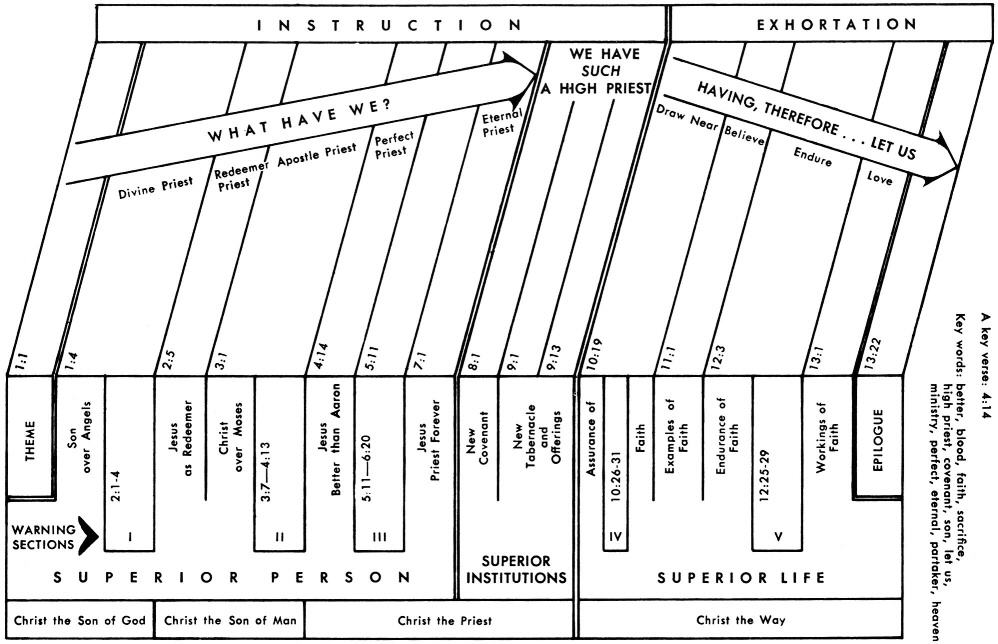
CONSIDER JESUS OUR GREAT HIGH PRIEST
Click chart to enlarge
Charts from Jensen's Survey of the NT - used by permission
Swindoll's Chart, Interesting Pictorial Chart of Hebrews, Another Chart
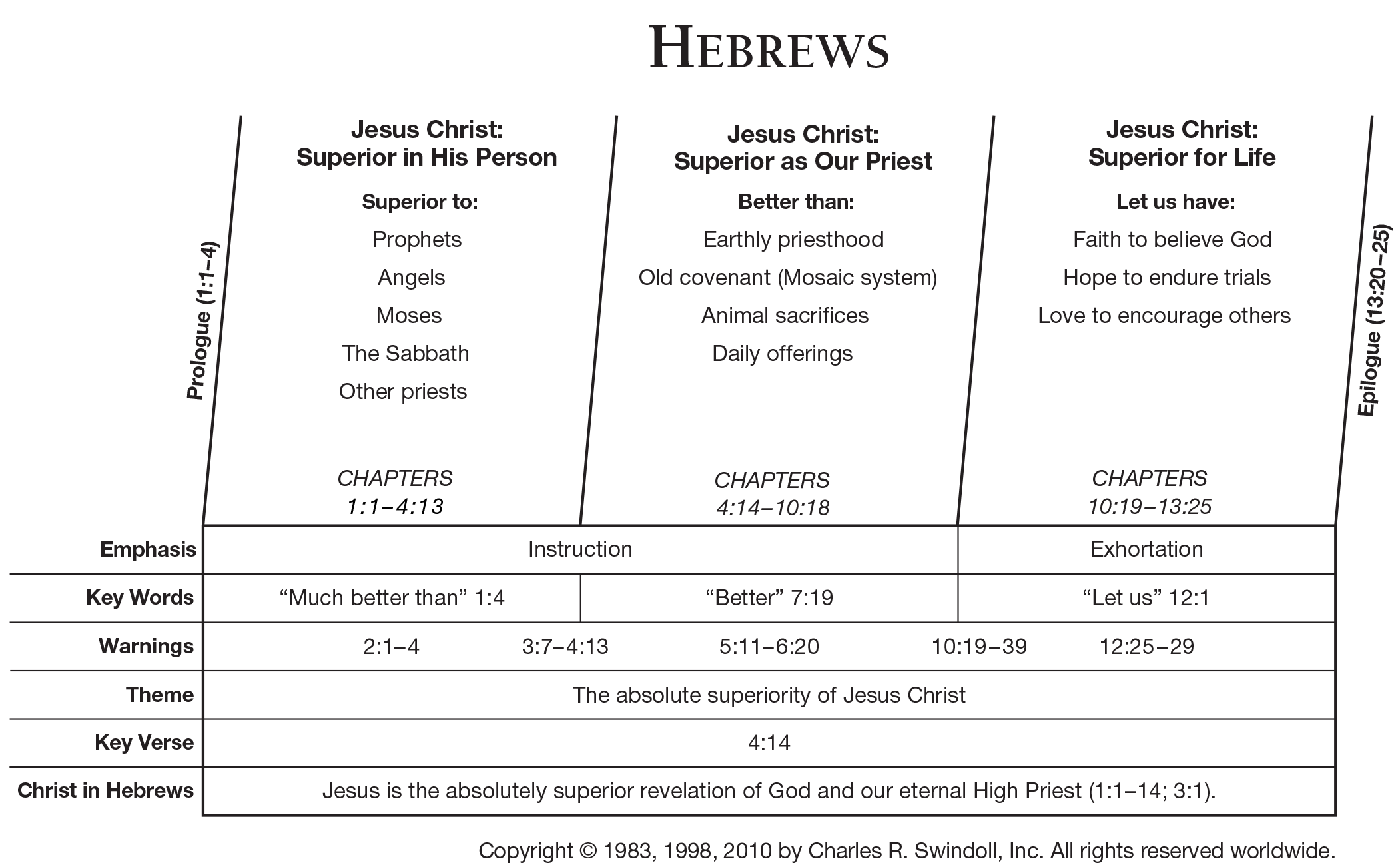

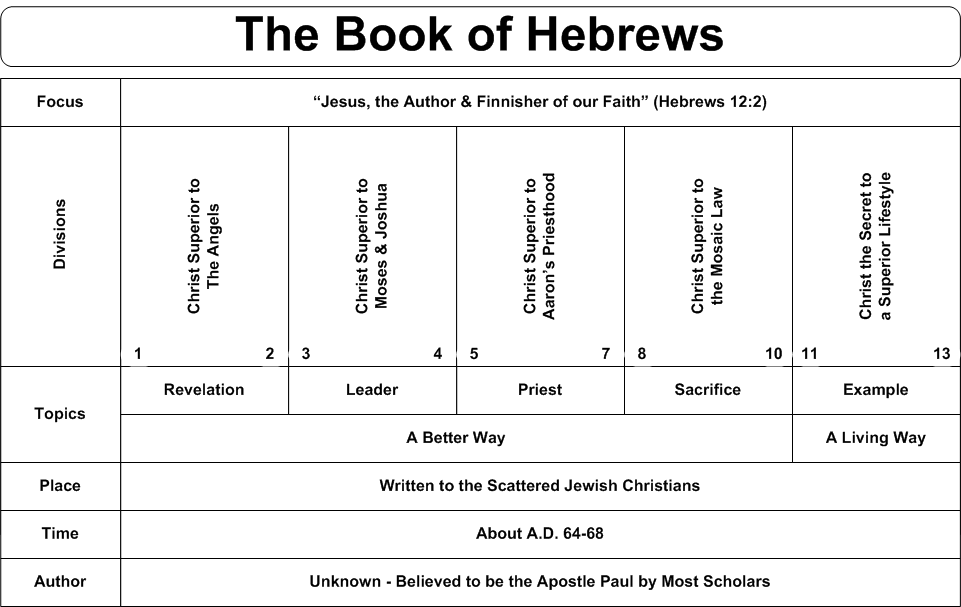
|
The Epistle |
||||
| INSTRUCTION Hebrews 1-10:18 |
EXHORTATION Hebrews 10:19-13:25 |
|||
| Superior Person of Christ Hebrews 1:1-4:13 |
Superior Priest in Christ Hebrews 4:14-10:18 |
Superior Life In Christ Hebrews 10:19-13:25 |
||
| BETTER THAN PERSON Hebrews 1:1-4:13 |
BETTER PRIESTHOOD Heb 4:14-7:28 |
BETTER COVENANT Heb 8:1-13 |
BETTER SACRIFICE Heb 9:1-10:18 |
BETTER LIFE |
| MAJESTY OF CHRIST |
MINISTRY OF CHRIST |
MINISTERS FOR CHRIST |
||
|
DOCTRINE |
DUTY |
|||
|
DATE WRITTEN: |
||||

See ESV Study Bible "Introduction to Hebrews"
(See also MacArthur's Introduction to Hebrews)
Borrow Ryrie Study Bible
| CONSIDER JESUS OUR GREAT HIGH PRIEST |
||||
| INSTRUCTION He 1:1-10:18 |
EXHORTATION He 10:19-13:25 |
|||
| REVELATION He 1:1-10:18 |
RESPONSE He 10:19-13:25 |
|||
| PRECEPTS He 1:1-10:18 |
PRACTICE He 10:19-13:25 |
|||
| DOCTRINE He 1:1-10:18 |
DUTY He 10:19-13:25 |
|||
| SUPERIORITY of CHRIST'S PERSON He 1:1-7:28 |
SUPERIORITY of CHRIST'S PRIESTHOOD He 8:1-10:18 |
SUPERIORITY of the CHRISTIAN'S PRACTICE He 10:19-13:25 |
||
|
MAJESTY |
MINISTRY |
MINISTERS |
||
|
SUPERIORITY |
SUPERIORITY |
SUPERIORITY |
||
|
Christ |
Christ |
Christ |
Christ |
|
|
This chart is adapted in part from Jensen's Survey of the NT and Wilkinson's Talk Thru the Bible |
||||
Hebrews 5:9 And having been made perfect, He became to all those who obey Him the source of eternal salvation (NASB: Lockman)
Greek: kai teleiotheis (APPMSN) egeneto (3SAMI) pasin tois hupakouousin (PAPMPD) auto aitios soterias aioniou,
Amplified: And, [His completed experience] making Him perfectly [equipped], He became the Author and Source of eternal salvation to all those who give heed and obey Him (Amplified Bible - Lockman)
Barclay: When he had been made fully fit for his appointed task, he became the author of eternal salvation to all who obey him, for he had been designated by God a high priest after the order of Melchizedek. (Westminster Press)
KJV: And being made perfect, he became the author of eternal salvation unto all them that obey him;
NLT: In this way, God qualified him as a perfect High Priest, and he became the source of eternal salvation for all those who obey him. (NLT - Tyndale House)
Phillips: Then, when he had been proved the perfect Son, he became the source of eternal salvation to all who should obey him, (Phillips: Touchstone)
Wuest: and having been brought to the place of completeness, He became to all those who obey Him, the One who brought into being eternal salvation,
Young's Literal: and having been made perfect, he did become to all those obeying him a cause of salvation age-during,
AND HAVING BEEN MADE PERFECT: kai teleiotheis (APPMSN):
- Having been made perfect - Heb 2:10; 11:40; Daniel 9:24; Luke 13:32; John 19:30
- Hebrew 5 Resources - Multiple Sermons and Commentaries
Related Passages:
Hebrews 2:10+ For it was fitting for Him, for Whom are all things, and through Whom are all things, in bringing many sons to glory, to perfect the author of their salvation through sufferings (COMMENT - What sufferings? Certainly one would consider His temptation by Satan in the barren wilderness [see Mt 4:1-11, Lk 4:1ff, Mk 1:12, 13] and Gethsemane [Mt 26:36,44, Lk 22:39,44][in agony He was praying very fervently] This does not imply any moral imperfection in the Lord Jesus, but speaks of the consummation of the human experience of suffering the death of the Cross, through which He must pass if He is to become the Author or Captain of our salvation.).
John 19:30+ (THE CROSS, THE CONSUMMATE PERFECTION!)Therefore when Jesus had received the sour wine, He said, “It is finished (IT IS "PERFECTED" = same word group teleo in perfect tense = tetelestai)!” And He bowed His head and gave up His spirit.
PERFECTING THE
PERFECT ONE
Having been made perfect - Clearly Jesus was perfect and did not need to be "perfected" in the moral sense. The idea of made made perfect was that He was reached the goal for which He became a Man, this goal ultimately being consummated in His substitutionary death on the Cross which opened "salvation's door" to lost sinners. We read a similar description in He 2:10+ where the writer says "it was fitting for Him, for Whom are all things, and through Whom are all things, in bringing many sons to glory, to perfect (teleioo) the Author of their salvation through sufferings." In Hebrews 12:2+ Jesus is designated as "the Author and Perfecter of faith" where Perfecter is teleiotes, (same word group as teleioo) the Completer, the One Who reached the goal so as to win the prize so to speak.
W Griffith Thomas says: By means of this discipline Christ was made "perfect," that is, mature, ripe, fitted for His work, and because of this fitness He became unto all them that obey Him the author of eternal salvation. (BORROW Hebrews; a Devotional Commentary)
Believer's Study Bible explains the relation between the obedience Jesus learned and His being made perfect… The phrase "learned obedience by the things which He suffered" (He 5:8+) does not mean that Jesus was ever disobedient but rather that He learned through experience as a Man and through all His temptation and suffering what it meant to suffer and triumph in a way He did not experience before the incarnation. His humanity was in this sense "completed," which is the meaning of the Greek word translated "perfected"in this context. (Believer's Study Bible)
Steven Cole… “Having been made perfect” does not imply that Jesus was imperfect previously. Rather, the idea is that His experience of obediently suffering unto death qualified Jesus as the Savior (we saw the same idea in He 2:10). (Hebrews 5:1-10 The Kind of Priest You Need)
John MacArthur says: In His suffering and death, Jesus fulfilled the third requirement for high priest. He offered the sacrifice of Himself and thereby became the perfect High Priest and the source of eternal salvation. Jesus went through everything He had to go through, and accomplished all He needed to, so He could be such a perfect High Priest. He was not, of course, made perfect in the sense of having His nature improved. He was eternally perfect in righteousness, holiness, wisdom, knowledge, truth, power, and in every other virtue and capability. Neither His nature nor His person changed. He became perfect in the sense that He completed His qualification course for becoming the eternal High Priest. In offering His sacrifice, however, Jesus differed in two very important ways from other high priests. First, He did not have to make a sacrifice for Himself before He could offer it for others. Second, His sacrifice was once-and-for-all. It did not have to be repeated every day, or even every year or every century....By His death, Jesus opened the way of eternal salvation. All the priests of all time could not provide eternal salvation. They could only provide momentary forgiveness. But by one act, one offering, one sacrifice, Jesus Christ perfected forever those who are His. The perfect High Priest makes perfect those who accept His perfect sacrifice, those who obey Him (See Hebrews Commentary)
Vincent writes that teleioo is used here "of Christ’s having reached the end which was contemplated in His divinely-appointed discipline for the priesthood. The consummation was attained in his death, Php. 2:8: His obedience extended even unto death."
Barclay explains that "teleios can quite correctly be translated perfect so long as we remember what the Greek meant by that perfection. To him a thing was teleios if it perfect carried out the purpose for which it was designed. When he used the word he was not thinking in terms of abstract and metaphysical perfection; he was thinking in terms of function. What the writer to the Hebrews is saying is that all the experiences of suffering through which Jesus passed perfectly fitted Him to become the Saviour of men (Ed: And in context, their Great High Priest).
Marcus Dods on teleioo (teleiotheis) means… having been perfectly equipped with every qualification for the priestly office by the discipline already described. (Expositor's Greek Testament)
Messiah's perfection equated with His holding fast His sinless integrity in face of the most extreme trial and suffering and thus accomplishing His intended goal. (cp Jn 4:34, Jn 17:4 same verb teleioo, to help understand "perfect" as it applies to Jesus and cp teleo in Jn 19:30)
Note that made perfect does not imply any imperfection in Christ ("One who has been tempted in all things as we are, yet without sin" - He 4:15-note), which might be the way one reads it based on the common way be made perfect is used in English language. The meaning of teleioo (idea of reaching the intended goal - see above) in Greek clearly explains the author's intended thrust in the original Greek language in which the letter was written and read. It is difficult to translate this succinctly into English. The original readers would have had no difficulty understanding the intended meaning.
The appointed way to Savior of the World involved treading the path of testing, the Cross preceding the Crown. In the face of even the most pressing hardship and suffering, Jesus remained obedient to His Father. Having successfully endured the trial of life He was proven fit to be the Savior of God’s people.
Spurgeon - What,” says one, “did Christ need to be made perfect?” Not in His nature, for He was always perfect in both His divine and His human nature; but perfect as a Savior, perfect as a Sympathizer—above all, according to the connection, perfect as a High Priest. “Being perfected, he became the source of eternal salvation to all those who obey him.” Christ will not save those who refuse to obey Him, those who will not believe in Him. There must be an obedient faith, rendered unto Him, or else the virtue of His passion and death cannot come to us. As a high priest He is perfect, because He has suffered to the end all that was needful to make Him like unto His brothers. He has read the book of obedience quite through. He was not spared one heavy stroke of divine discipline. You and I never go to the end of grief. We are spared the utmost depth; but not so our Lord. The Lord sets us a service proportioned to our strength; but what a service was exacted of the Son of God! Ours is a lightened burden; but the Well-beloved was not spared the last ounce of crushing sorrow. “For it was fitting for him for whom are all things and through whom are all things in bringing many sons to glory to perfect the originator of their salvation through sufferings” (Heb 2:10).
It is so common to think that Jesus has done a wonderful job,
but there's a little left for me to do to finish the task of salvation.
Phil Newton…And having been made perfect implies that there was no stone left unturned when it comes to your salvation; there is nothing left dangling. I dare say that there are some among us who are likely struggling over this. It is so common to think that Jesus has done a wonderful job, but there's a little left for me to do to finish the task of salvation. What can you add to that which Jesus has fulfilled? Can you be more obedient than Him Who is "without sin"? Can you add to the satisfaction of God in the smiting of His own Son with His fully measured wrath? Can you do more than the One Who was raised from the dead?…Do you know Christ, not as a mediator, but as your Mediator? "Yes I do," you say. Then continue on in the faith, obediently following Jesus Christ. "Be diligent to enter His rest." He continues to mediate for you. Every breath you draw in Jesus' name, every prayer you utter, and every act of service comes because he mediates for you. You may find yourself weak and your spiritual limbs barely dragging along. But you have a high priest who represents you before God and who invites you to the bounty of his grace for weary pilgrims. "Come to Me, all who are weary and heavy-laden, and I will give you rest. Take My yoke upon you, and learn from Me, for I am gentle and humble in heart, and you will find rest for your souls. For My yoke is easy and My burden is light" (Mt 11:28, 29, 30). (Jesus Christ: Qualified as High Priest Hebrews 5:1-10)
Having been made perfect (5048) (teleioo related to teleios from teleo = an end, a purpose, an aim, a goal, consummate soundness, idea of being whole) means to accomplish or bring to an end or to the intended goal (telos). Teleioo does not mean simply to terminate something but to carry it out to the full finish which is picked up in the translation "perfected". Teleioo signifies the attainment of consummate soundness and includes the idea of being made whole. The fundamental idea in teleioo is the bringing of a person or thing to the goal fixed by God. Being made perfect was something that could never happen to the priests under the Old Covenant of Law (He 10:1-note) In summary, the fundamental idea of teleioo is the bringing of a person or thing to the goal fixed by God.
Telioo is used 19 times in Hebrews out of a total of 24 NT uses. The uses in Hebrews often convey the sense of to make perfect or fully cleanse from sin in contrast to ceremonial (Levitical) cleansing (but see the uses below). The writer is emphasizing the importance of perfection… (which should cause any Jew who is contemplating the worth of Christ and the New Covenant to realize his utter hopelessness to every attain perfection under the Old Covenant).
It is interesting and doubtless no mere coincidence that in the Septuagint (LXX) teleioo is translated numerous times as consecrated or consecration, especially speaking of consecration of the priests (cf Jesus our "great High Priest") (Ex 29:9, 29, 33, 35 Lv 4:5; 8:33; 16:32; 21:10; Nu 3:3). The Septuagint translators used the verb teleioo in the special sense of consecration to priestly service and this official concept most likely stands behind the writer's use in this passage in He 5:9 where it signifies that Jesus has been fully equipped to come before God His priestly role on behalf of all who believe in Him.
Lk. 2:43; Lk. 13:32; Jn. 4:34; Jn. 5:36; Jn. 17:4; Jn. 17:23; Jn. 19:28; Acts 20:24; Phil. 3:12; Heb. 2:10; Heb. 5:9; Heb. 7:19; Heb. 7:28; Heb. 9:9; Heb. 10:1; Heb. 10:14; Heb. 11:40; Heb. 12:23; Jas. 2:22; 1 Jn. 2:5; 1 Jn. 4:12; 1 Jn. 4:17; 1 Jn. 4:18
Here are some of the other uses in Hebrews where teleioo is a key word...
Hebrews 7:19+ (for the Law made nothing perfect), and on the other hand there is a bringing in of a better hope, through which we draw near to God.
Comment: The Old Covenant could reveal sin but it could never remove sin, and so it had to be removed. It gave no security. It gave no peace for a man never obtained a clean conscience.
Hebrews 7:28+ For the Law appoints men as high priests who are weak, but the word of the oath, which came after the Law, appoints a Son, made perfect forever.
Hebrews 10:1+ For the Law, since it has only a shadow of the good things to come and not the very form of things, can never by the same sacrifices year by year, which they offer continually, make perfect those who draw near.
Comment: Contrast with Jesus in Hebrews 5:9. The idea in Hebrews 10:1 is that the ceremonial law could not actually save the believer. Its work was always short of completeness.
Hebrews 10:14+ For by one offering He has perfected for all time those who are sanctified.
Comment: Wuest writes "Here, the completeness of the state of salvation of the believer is in view. Everything essential to the salvation of the individual is included in the gift of salvation which the sinner receives by faith in Messiah’s sacrifice. The words “for ever” here are to be construed with “perfected.” It is a permanent state of completeness in salvation to which reference is made. The words “them that are sanctified” are descriptive of the believer. He is one set apart for God) (ibid)
HE BECAME TO ALL THOSE WHO OBEY HIM: egeneto (3SAMI) pasin tois hupakouousin auto:PAP:
- He became - Heb 12:2; Ps 68:18-20; Isaiah 45:22; 49:6; Acts 3:15; Acts 4:12
- To all those who obey - Heb 11:8; Isa 50:10; 55:3; Zech 6:15; Mt 7:24, 25, 26, 27; 17:5; Acts 5:32; Ro 1:5; Ro 2:8; 6:17; 10:16; 15:18; 2Cor 10:5; 2Ths 1:8; 1Pe 1:22
- Hebrew 5 Resources - Multiple Sermons and Commentaries
SPIRIT ENABLED OBEDIENCE
IS THE FRUIT OF GENUINE FAITH
He became to all who obey (hupakouo) Him the source (aitios) of eternal (aionios) salvation - The NLT has " In this way, God qualified him as a perfect High Priest, and he became the source of eternal salvation for all those who obey him." Became (ginomai) means to come into existence and in the aorist tense indicates a completed action in the past. This indicates a change of relationship that follows Christ's perfecting. The suffering that led to the perfecting did something, and specifically brought into existence Jesus as the source of eternal salvation. Jesus has always been the One through Whom redemption of this fallen world would come, having been promised by God in the Garden of Eden after Adam sinned, where it was foretold that the Seed (Christ) would crush the head of Satan (Ge 3:15 ~ the so-called "protevangelium" or "first giving" of the Gospel). But it was not until Christ's incarnation and His perfection that the promise became reality.
Don't misunderstand -- sinners have always been saved by faith in the Promised Seed, the Messiah. The OT saints were saved by a faith that looked forward to the Cross (Old Testament way of salvation), while NT saints look back to the finished work of Christ on Calvary. In both instances that faith was shown to be genuine in that it brought forth the fruit of obedience. As discussed more below obedience per se does not save anyone, but it does demonstrate the reality of one's faith.
To all those who (present tense = continuously) obey Him. This is descriptive of the saved (the fruit = obedience) not the grounds of their salvation (the root = faith). See related study of "obedience of faith" in Ro 1:5+ and contrast Paul's teaching in 2Th 1:8+. If one is not obedient (we are not talking perfect obedience but a lifestyle [present tense] that tends toward obedience. In short = "Not perfection, but direction!"), then he or she needs to ponder Paul's words in 2Cor 13:5+.
Obedience involves active listening and choosing to respond positively to Christ’s call and command. Obedience is an evidence of true discipleship, as Jesus Himself stated…
And why do you call Me "'Lord, Lord' and do not (Greek = "ou" = strongest negative = absolutely) do (present tense = as their habitual practice or direction) what I say?" (Luke 6:46+).
But He said, "On the contrary, blessed are those who hear the word of God, and observe (present tense = as their habitual practice or direction) it." (Lk 11:28+)
Not everyone who says to Me, 'Lord, Lord,' will enter the kingdom of heaven; but he who does (present tense = as a lifestyle = direction not perfection - "Doing" does not save them but serves as a "marker" of their genuine salvation) the will of My Father who is in heaven. Many will say to Me on that day, 'Lord, Lord, did we not prophesy in Your name, and in Your name cast out demons, and in Your name perform many miracles?' And then I will declare to them, 'I never knew you; DEPART FROM ME, YOU WHO PRACTICE (present tense = as a lifestyle) LAWLESSNESS.'
Therefore everyone who hears these words of Mine, and acts (present tense = as their lifestyle) upon them, may be compared to a wise man, who built his house upon the rock. "And the rain descended, and the floods came, and the winds blew, and burst against that house; and yet it did not fall, for it had been founded upon the rock.
And everyone who hears these words of Mine, and does not act (present tense = as a lifestyle) upon them, will be like a foolish man, who built his house upon the sand. And the rain descended, and the floods came, and the winds blew, and burst against that house; and it fell, and great was its fall." (Mt 7:21+, Mt 7:22, 23+, Mt 7:24, 25+, Mt 7:26, 27+)
Steven Cole… Jesus became the cause of salvation “to all those who obey Him.” This is not teaching salvation by works. Rather, to have saving faith is to obey Jesus, who commanded, “Repent and believe in the gospel” (Mk 1:15). Paul refers to “the obedience of faith” (Ro 1:5+; see also 1Pe 1:2+). You cannot separate saving faith from obedient faith, or unbelief from disobedience (Ed: Compare especially He 3:18, 19+) (He 4:18, 19; 4:6, 11). Those who truly believe in Jesus as Savior live in obedience to Him as Lord. Those who claim to believe but who live in disobedience to Him are not truly saved (Mt 7:21+, Mt 7:22, 23+). (Hebrews 5:1-10 The Kind of Priest You Need)
Phil Newton does not mince words writing "Let's be honest. Much of what is claimed to be Christian is pure antinomianism (Ed: Anti = against + nomos = law ~ and so living as if there were no laws). That is, there are many who want the eternal benefits of Christians without desiring the present, ongoing walk of obedience as Christians. They are lawless-without Christ. Does that describe you? Then wake up to what is truly Christian. Turn from your hypocrisy to the High Priest who has mediated before God on your behalf." (Jesus Christ: Qualified as High Priest Hebrews 5:1-10)
Marvin Vincent… If the captain of salvation must learn obedience, so must his followers. (cf 2Th 1:8+).
Spurgeon on all who obey - Not to some few, not to a little select company here and there, but “to all those who obey him.” To obey Christ is in its very essence to trust Him, or believe in Him; and we might read our text as if it said, “The author of eternal salvation to all those who believe in him.” If you would be saved, your first act of obedience must be to trust Jesus wholly, simply, heartily, and alone. Recline your soul wholly on Jesus and you are saved now. Is that all? Certainly, that is all! But it says “obey”? Precisely so; and do you not know that every man who trusts Christ obeys him? The moment you put yourself into His hands you must obey Him, or you have not trusted Him.
Related Resource:
Obey (5218) (hupakouo from hupó = under + akoúo = physical hearing and apprehension of something with the mind - akouo gives us our English acoustics - the science of design which helps one hear) (Click study on related noun hupakoe) literally means to listen under with attentiveness and to respond positively to what is heard. The sense is that one understands and responds accordingly. Note that hupakouo implies an inward attitude of respect and honor, as well as external acts of obedience. (See Torrey's Topic on Obedience)
Guzik notes… that this salvation is extended to all who obey Him. In this sense, all who obey Him is used synonymously for believing on Him - which simply assumes that believers will obey! (Hebrews 5)
Faith and obedience are closely related, C H Spurgeon writing that…
Faith and obedience are bound up in the same bundle. He that obeys God, trusts God; and he that trusts God, obeys God.
If you desire Christ for a perpetual guest, give him all the keys of your heart; let not one cabinet be locked up from him; give him the range of every room and the key of every chamber.
The doctor feels your pulse. “I will send you some medicine,” says he, “that will be very useful, and besides that, you must take a warm bath.” He comes the next day; you say to him, “Doctor, I thought you were going to heal me. I am not a bit better.” “Why,” said he, “you do not trust me.” “I do, sir; I am sure I have every faith in you.” “No,” says he, “you do not believe in me, for there is that bottle of medicine untouched; you have not taken a drop of it. Have you had the bath?” “No, sir.” “Well, you are making a fool of me; the fact is I shall not come again. You do not believe in me. I am no physician to you.” Every man who believes Christ obeys Him; believing and obeying always run side by side.
There are at least four NT uses of hupakouo that relate to the gospel and salvation - Acts 6:7, Ro 6:17-note, Ro 10:16-note, 2Thess 1:8 and Hebrews 5:9 (See these verses below). These uses of hupakouo are closely related to the phrase "obedience of faith" Dr Charles Ryrie summarizing the two main ways one might interpret this phrase explaining that it could refer to "Either obedience that leads to initial faith (as in Acts 6:7) or obedience that results from faith. (The Ryrie Study Bible: New American Standard Translation: 1995. Moody Publishers)
After some study on this phrase obedience of faith including review of a balanced, well written analysis by D. B. Garlington (below), leads me to favor this phrase as referring to obedience that emanates from genuine faith. Here are links to the excellent articles by D B Garlington…
- The Obedience of Faith in the Letter to the Romans Part I: The Meaning of Hupakoen pisteos (Ro 1:5; 16:26);
- The Obedience of Faith in the Letter to the Romans Part II- The Obedience of Faith and Judgment by Works
- The Obedience of Faith in the Letter to the Romans — Part III- The Obedience of Christ and the Obedience of the Christian
- The Obedience of Faith in the Letter to the Romans — Part III Continued
A T Robertson writes that in Romans 1:5 obedience of faith in the original Greek text reflects what is referred to as the… Subjective genitive as in Ro 16:26, the obedience which springs from faith (the act of assent or surrender). (Word Pictures in the NT)
Marvin Vincent another respected Greek scholar says that… Obedience of faith is the obedience which characterizes and proceeds from faith. (Vincent, M. R. Word studies in the New Testament Vol. 3, Page 1-5)
Expositor's Bible Commentary explaining the "obedience of faith" writes that… The desired response to the gospel message is "obedience that comes from faith" (Expositor's Bible Commentary)
Robert Haldane commenting on the "obedience of faith" writes that… Some understand this of the obedience which faith produces; but the usual import of the expression, as well as the connection in this place, determines it to apply to the belief of the Gospel. Obedience is no doubt an effect produced by that belief; but the office of an Apostle was, in the first place, to persuade men to believe the Gospel. This is the grand object, which includes the other. The Gospel reforms those who believe it; but it would be presenting an imperfect view of the subject to say that it was given to reform the world. It was given that men might believe and be saved. The obedience, then, here referred to, signifies submission to the doctrine of the Gospel. (Haldane, R. An exposition of Romans)
The UBS translator's handbook comments that "Believe and obey translates “obedience of faith.” This is not “obedience to the faith” (Moffatt), but obedience that is caused by faith (NEB “to faith and obedience”; Goodspeed “obedience and faith”). Although “obedience” and “faith” are nouns in Greek, they describe events rather than objects, and so are better rendered by verbs. The last clause in verse 5, introduced by in order to lead, reflects only a preposition in Greek. However, the relationship between the “apostleship” and the “obedience of faith” involves obvious purpose. Furthermore, in most languages one must make explicit the role of Paul with respect to the people of all nations, and for this reason the TEV makes this relationship explicit by means of the somewhat expanded rendering in order to lead people of all nations to believe and obey. (Newman, B. M., & Nida, E. A.. A handbook on Paul's letter to the Romans. UBS handbook series; Helps for translators Page 12. New York: United Bible Societies)
Life Application Bible Commentary writes that "obedience of faith" refers to "the obedience that comes from faith. This was the desired response to the gospel message and the goal of Paul’s ministry to the Roman Christians—that they would obey God because of their faith in God. The only source for the kind of obedience expected is faith in the one true God and in Jesus Christ, his Son. Faith and obedience are inseparable. Where one is lacking, the other will not be found either. Real faith will always lead to obedience; real obedience comes from faith. (Barton, B, et al: The NIV Life Application Commentary Series: Tyndale)
Beyond Culture Wars by Michael S. Horton - This is precisely what we see today. More than four in five (83 percent) of the American adult population believe that people are basically good. But those are just those "secular humanists" out there, right? No, 77 percent of the "born again," evangelical constituency buy into this secular view of human nature. In fact, when it comes to salvation, "God helps those who help themselves," according to four out of five "born again," evangelical Christians. Evangelicals are actually more likely than non-Christians to agree with this "pull yourself up by the bootstraps," self-help program. One-third of the evangelicals agree that "all good people will go to heaven, whether they have embraced Jesus Christ or not," so redemption seems to depend on one's own goodness rather than on faith in Christ. Indeed, in this scheme, Jesus is not even necessary, except as a moral guide. But, of course, we recognize this as theological liberalism and as secularism when it is in the world, but I think Barna is quite entitled to demand of us as evangelicals, "What is being taught in our churches about the nature of salvation?"
Warren Wiersbe - There is a well-known story told about George Whitefield, the evangelist. He asked a man what he believed, and the man replied, "I believe what my church believes." "What does your church believe?" Whitefield asked. "My church believes what I believe," was the answer. "Well, what do you both believe?" asked the evangelist. "We both believe the same thing!" That man thought he had convictions, but all he really had were secondhand opinions. (BORROW God isn't in a hurry : learning to slow down and live)
"Ah, but," says someone, "I don't believe in sudden conversions." Don't you? Well, how long did it take Naaman to be cured? The seventh time he went down, away went the leprosy! Read the great conversions recorded in the Bible--Saul of Tarsus, Zacchaeus, and a host of others; how long did it take the Lord to bring them about? They were effected in a minute. We are born in iniquity, shaped in it, dead in trespasses and sin; but when spiritual life comes it comes in a moment, and we are freed both from sin and death. D. L. Moody
Warren Wiersbe - Scripture: Read Hebrews 5:9-10 NO REPUTATION (BORROW Pause for power : a 365-day journey through the Scriptures)
No matter what trials we meet, Jesus Christ is able to understand our needs and help us. We need never doubt His ability to sympathize and strengthen. It is also worth noting that sometimes God puts us through difficulties that we might better understand the needs of others and become able to encourage them.
When Charles Haddon Spurgeon was a young preacher in London, his successful ministry aroused the envy of some of the clergy, and they attacked him with various kinds of slander and gossip. His sermons were called "trashy," and he was called "an actor" and "a pulpit buffoon." Even after his ministry was established, Spurgeon was lied about in the press (including the religious press), and this was bound to discourage him.
After one particularly scurrilous report in the press, Spurgeon fell before the Lord and prayed, "O Lord Jesus, Thou didst make Thyself of no reputation for me. I willingly lay my reputation down for Thy sake." From that time on, Spurgeon had peace in his heart. He knew that his Great High Priest understood his need and would give him the grace that he needed for each hour.
Applying God's Truth:
1. What trials are you facing today in which Jesus is the only person who can help you?
2. Have you ever been so devoted to Jesus (and your own spiritual growth) that your motives or reputation were called into question by others? If so, how did you respond?
3. Try to recall a difficulty you once faced, after which you were able to minister effectively to someone else facing the same or a similar problem. How did you feel to be able to help someone based on your previous personal experience?
THE SOURCE OF ETERNAL SALVATION: aitios soterias aionios:
- Eternal salvation - Heb 2:3; 9:12,15; Ps 45:17; 51:6,8; 2Th 2:16; 2Ti 2:10; 1Jn 5:20; Jude 1:21
- Hebrew 5 Resources - Multiple Sermons and Commentaries
THE SOLE SOURCE OF
SOUL SALVATION
The Source (aitios) of eternal (aionos) salvation (soteria)- This is a radical difference from any benefits of the Levitical priestly work, for their mediatorial works could only result in "covering" over the sins of the people (as on the Day of Atonement with the scapegoat sent into the wilderness picturing the potential of forgiveness). Jesus' efficacious work resulted in literal sending away of all of the sins for all who receive Him as their High Priest and Savior.
Denney - Jesus is Author of ‘eternal’ salvation (He 5:9KJV), i.e., of final salvation, which has no peril beyond; all that salvation can mean is secured by Him. (Death of Christ)
The Source - Compare the writer's other descriptions of Jesus…
"The Captain (author, founder, leader, pioneer, prince leader) of their salvation" (KJV, see Heb 2:10+)
"as a Forerunner ("scout") for us" (Hebrews 6:20+)
"Jesus, the Author and Perfecter of faith" (Hebrews+)
Spurgeon comments on Jesus our Source Who is also our Captain, our Forerunner - If you were on board a vessel, and had lost your bearings, you would be glad enough to see a pilot in the offing. Here he is on board, and you say, “Pilot, do you know where we are?” “Yes,” says he, “of course I do. I can tell you within a yard.” “It is well, Mr. Pilot, but can you bring us to the port we want to make?” “Certainly,” says he. “Do you know the coast?” “Coast, sir! I know every bit of headland, and rock, and quicksand, as well as I know the cut of my face in a looking-glass. I have passed over every inch of it in all tides and all weathers. I am a child at home here.” “But, pilot, do you know that treacherous shoal?” “Yes, and I remember almost running aground upon it once, but we escaped just in time. I know all those sands as well as if they were my own children.” You feel perfectly safe in such hands. Such is the qualification of Christ to pilot sinners to heaven. There is not a bay, or a creek, or a rock, or a sand between the Maelstrom of hell and the Fair Havens of heaven but what Christ has sounded all the deeps and the shallows, measured the force of the current, and seen the set of the stream. He knows how to steer so as to bring the ship right away by the best course into the heavenly harbor.
Jesus is the Source of Eternal Salvation because He is the…
- Purification ("Purifier") (Hebrews 1:3+)
- Author (Captain, Pioneer, Champion, Leader) (Hebrews 2:10+)
- Propitiation ("Propitiator") (Hebrews 2:17+)
- Anchor (Hebrews 6:19+)
- Forerunner (Hebrews 6:20+)
- Torn Veil (Hebrews 10:20+)
- Great Shepherd (Hebrews 13:20+)
Why is He our eternal Source? Because His sacrifice was once for all and thus He abides a Priest forever according to the order of Melchizedek. And from a practical standpoint eternal salvation is a deliverance which keeps the believer safe both in time and in eternity. In other words "in Christ' (see discussion in Christ and in Christ Jesus) the believer is safe for ever. There are no circumstances that can pluck him from Christ’s hand.
Spurgeon - He is the designer, creator, worker, and cause of salvation. By Him salvation has been accomplished: “His right hand and His holy arm have secured His victory” (Psa 98:1); “He has trodden the wine press alone, and of the people there was none with him.” He is the author of salvation in this sense: that every blessing comes through Him. All the various departments of salvation, whether they be election, calling, justification, or sanctification, all bless us through Him, according as the Father has chosen us in Him from before the foundation of the world. In Him we are called, in Him preserved, in Him accepted; all grace flows from Him. Christ is all, and in all. Salvation within us is all His work. When the Jewish high priest had offered a sacrifice, the worshiper went home satisfied, for the blood was sprinkled and the offering accepted. But in a short time he sinned again, and he had to bring another sacrifice. Once a year, when the high priest entered within the veil and came out and pronounced a blessing on the people, all Israel went home glad; but next year there must be the same remembrance of sin, and the same sprinkling with blood, for the blood of bulls and of goats could not really put away sin. It was only a type. How blessed is the truth that our Lord Jesus will not need to bring another sacrifice at any time, for He has obtained eternal salvation through His one offering. Jesus does not save us today, and leave us to perish tomorrow. He knows what is in man, and so He has prepared nothing less than eternal salvation for man. A salvation that was not eternal would turn out to be no salvation at all. Those whom Jesus saved are saved indeed. Man can be the author of temporary salvation; but only He who is “a high priest forever” can bring in a salvation that endures forever.
Eternal salvation - It is somewhat surprising that there are only three adjectives used in the New Testament to describe our salvation…
so great salvation (He 2:3+)
eternal salvation (He 5:9+)
the common salvation (Jude 1:3)
Steven Cole…Eternal salvation is contrasted with the temporary nature of the Old Testament sacrifices, which could never make perfect those who offered them (He 10:1, 2, 3, 4). The word translated “the source” (NASB, NIV; “author,” NKJV) of eternal salvation means “the cause.” The cause of our salvation is not that God foresaw that we would believe. The cause of our salvation is that the triune God “chose us in Him before the foundation of the world” (Eph. 1:4). (The Kind of Priest You Need Hebrews 5:1-10)
Praise Him, praise Him—Jesus, our blessèd Redeemer,
For our sins He suffered, and bled, and died;
He our rock, our hope of eternal salvation,
Hail Him, hail Him, Jesus the Crucified.
(Praise Him, Praise Him)
Vincent comments that an eternal salvation is… a salvation of which all the conditions, attainments, privileges, and rewards transcend the conditions and limitations of time.
Phillip Hughes… In this affirmation, too, the thought of Hebrews 2:10-note is recapitulated, for the description of Christ here as "the source of eternal salvation" corresponds to his designation there as "the pioneer of our salvation." He, and no one else, is the cause of man's redemption: it is from him that it flows to us. His bearing of our imperfection, the punishment of which he endured and exhausted, made available his perfection for the rehabilitation of mankind—with the qualification, however, that the eternal salvation of which he is the source is a reality in the experience only of those who obey him. As Westcott observes, "continuous active obedience is the sign of real faith"; and this applies quite pointedly to the recipients of this letter whose obedience shows signs of wavering. Here again, then, they are being reminded, as previously they have more forcefully been reminded (cf. He 2:3+; He 3:12, 13+, He 3:14, 15+, He 3:16, 17+, He 3:18, 19+.; He 4:11+), that this great salvation belongs only to those who persevere in obedience to Christ. (A Commentary on the Epistle to the Hebrews)
Source (159) (aitios from aitéo = ask) describes the relation existing between two or more objects or events, specifically referring to the cause or source, the point at which something begins its course or existence. Aitios means that in which the cause of anything resides. Note that because of this meaning some translations render aitios author. “that in which the cause of anything resides.” Messiah in His death on the Cross is the Source, Author and Cause of our salvation. His death is the Source from which our salvation proceeds.
In English source is defined as a spring or fountain head from which a river or stream issues, which is an interesting thought in regard to Jesus and salvation.
Aitios was a technical, legal term describing the grounds for an accusation in court or the content of the legal charges brought against someone (thus an accusation, charge, complaint)
Luke 23:4 And Pilate said to the chief priests and the multitudes, "I find no guilt in this man… 14 and said to them, "You brought this man to me as one who incites the people to rebellion, and behold, having examined Him before you, I have found no guilt in this man regarding the charges which you make against Him… 22 And he said to them the third time, "Why, what evil has this man done? I have found in Him no guilt demanding death; I will therefore punish Him and release Him.
Acts 19:40 For indeed we are in danger of being accused of a riot in connection with today's affair, since there is no real cause for it; and in this connection we shall be unable to account for this disorderly gathering.
Hebrews 5:9 And having been made perfect, He became to all those who obey Him the source of eternal salvation
Eternal (166) (aionios from aion) means perpetual eternal, everlasting, without beginning or end (as of God), that which is always. Eternal is a key word Hebrews: blood of eternal covenant (He 13:20+). He offered Himself through His eternal spirit (He 9:14+) and has become the Author/Source of eternal salvation (He 5:9+). He has obtained eternal redemption (He 9:12+) and enables men to receive of the eternal inheritance (He 9:15+; He 13:20+).
Aionios in Hebrews - Heb. 5:9; Heb. 6:2; Heb. 9:12; Heb. 9:14; Heb. 9:15; Heb. 13:20;
Salvation (4991) (soteria from soter = Savior in turn from sozo = save, rescue, deliver) (Click here or here for in depth discussion of the related terms soter and sozo) describes the rescue or deliverance from danger, destruction and peril. "Salvation" is a broader term in Greek than we often think of in English. Other concepts that are inherent in soteria include restoration to a state of safety, soundness, health and well being as well as preservation from danger of destruction. The idea of salvation is that the power of God rescues people from the penalty of sin, which is spiritual death which is followed by eternal separation from the presence of His Glory. Salvation delivers the believer from the power of sin (see discussion on Romans 6:1 thru Ro 8:31 beginning with notes at Romans 6:1-3) Salvation carried tremendous meaning in Paul’s day, the most basic being “deliverance,” and it was applied to personal and national deliverance. The emperor was looked on as a "savior" as was the physician who healed you of illness.
Soteria in Hebrews - Heb. 1:14; Heb. 2:3; Heb. 2:10; Heb. 5:9; Heb. 6:9; Heb. 9:28; Heb. 11:7
It is interesting that Collin's (secular) dictionary defines "salvation" as "the act of preserving or the state of being preserved from harm… deliverance by redemption from the power of sin and from the penalties ensuing from it."!
In short, this so great a salvation (He 2:3+) is not just escape from the penalty of sin but includes the ideas of safety, deliverance from slavery and preservation from danger or destruction. In addition, this so great a salvation includes the idea of what is often referred to as the Three Tenses of Salvation (justification = past tense salvation = deliverance from sin's penalty, sanctification = present tense salvation = deliverance from sin's power and glorification = future tense salvation = deliverance from sin's presence). It follows that the discerning student will check the context to determine which of the three "tenses" a given use of soteria is referring to.
Mankind has continually looked for salvation of one kind or another. Greek philosophy had turned inward and begun to focus on changing man’s inner life through moral reform and self-discipline. The Greek Stoic philosopher Epictetus called his lecture room “the hospital for sick souls.” Epicurus called his teaching “the medicine of salvation.” Seneca taught that all men were looking ad salutem (“toward salvation”) and that men are overwhelmingly conscious of their weakness and insufficiency in necessary things and that we therefore need “a hand let down to lift us up”. Seneca was not far from the truth as Scripture testifies
"(Jehovah speaking) Is My hand so short that it cannot ransom? Or have I no power to deliver?… Behold, the LORD'S hand is not so short that it cannot save… (Jeremiah speaking) 'Ah Lord GOD! Behold, Thou hast made the heavens and the earth by Thy great power and by Thine outstretched arm! Nothing is too difficult for Thee" (Isa 50:2… Isaiah 59:1… Jeremiah 32:17)
Salvation through Christ is God’s powerful hand extended down to lost souls to lift them up.
In context of Hebrews 1, this great salvation has first of all such a great Savior, Who has completed the purification for our sins (which deserved death) and has furnished us with His ministering angels to help those who will inherit salvation. This salvation was first spoken thru the Lord Jesus (it not so clearly spoken in the OT)
Harry Ironside observes… How carefully the Holy Ghost guards against the least suggestion of defilement in Christ's nature while insisting on the reality of His humanity. Great indeed is the mystery of godliness, for He, the Holy One, appeared in flesh. And now as the exalted Priest, He enters into all the sorrows of His people, sympathizing with them in all their infirmities. He does not sympathize with our sins, and indeed we would not wish Him to, but He does feel for us in all our weakness and is waiting to supply needed strength for every trial. (Expository Commentary)
THE PERFECTING OF CHRIST by F B Meyer
FOR THE long and steep ascent of life, our Father has given us a Companion, a Captain of the march, a Brother, even Jesus our Lord, who passed through the suffering of death, and is now crowned with glory and honour (Heb 2:9, 10, 11). He has passed along our pathway, and climbed our steep ascents, that He might become our merciful and faithful Friend and Helper. In this sense He was perfected, and became unto all them that obey Him the Author of eternal salvation.
As regards His Nature, it was impossible for Him to be otherwise than perfect. In Him all the fullness of the Divine Nature dwelt without let or hindrance. But since the children partook of flesh and blood, He also Himself partook of the same; it behooved Him in all things to be made like unto His brethren. To each of us He says: "I have trodden this path before Thee, and know every inch of the way."
Christ is the Great-Heart,
the Companion for all pilgrim souls.
But if we are to walk with Him, and realize His eternal salvation, we must learn to obey. This is the lesson taught to the scientist by Nature. He must be exact, minute, microscopic in his attention and obedience to details. If he should fail in one tiny point, his best-conceived plans and experiments must fail. Exact obedience is essential to the engineer. The slightest inadvertence will clog and stop the mightiest machine that human ingenuity ever invented. It is, however, in the spiritual sphere that disobedience brings the greatest and most momentous catastrophes.
We must learn to obey, even in the dark! (Ed: "Especially" in the dark!) Not ours to make reply, or to question God's dealings. He withholds His reasons, but demands our obedience.
The strength to obey is God given. (Php 2:13, Ezek 36:27a) There appeared an angel from Heaven to strengthen Christ, and to each of us treading dark and hard paths, that angel comes still (Ed: Even better than an "angel", we now have the eternally indwelling Spirit of Christ!). But you never know the angel till you reach your Gethsemane. It is because our Lord learned these things by experience, that He is perfected to impart eternal salvation to every soul of man.
PRAYER - Eternal Saviour, who knowest each step of this difficult pathway of life, we come to Thee for Thy gracious help; enable us to obey Thy promptings, and in every hour of mortal weakness and fear stand beside us to be our very present help. AMEN. (F B Meyer. Our Daily Walk)
He became the source of eternal salvation for all who obey Him. - Hebrews 5:9
TODAY IN THE WORD
More than a century ago, a young English preacher of great promise suddenly lost confidence in the Bible. The liberal thought of the late-nineteenth century left him confused and questioning the Scriptures. So 21-year-old G. Campbell Morgan locked all of his books about the Bible in a cupboard and sat down to study the Bible itself. Morgan came away so convinced of the truth of God's Word that he spent the next sixty years preaching and teaching it on both sides of the Atlantic.
We can be sure that given his experience, Campbell Morgan would have been sympathetic to any sincere doubter he met. We tend to be more patient and understanding with those who have our weaknesses.
In the same way, Israel's high priests were able to ""deal gently"" with struggling sinners (v. 2). Why? Because the high priest was a redeemed sinner himself. The sacrifices he offered for the people's sins were necessary to cover his sins as well.
Clearly, the Spirit-inspired writer of Hebrews was appreciative of the office the high priest held. After all, these priests were called by God, just as Aaron was called to be Israel's first high priest and the model for priestly ministry.
But as honored as the office of high priest was, the men who occupied that post could not help but pale in comparison to Jesus Christ--God's perfect, sinless, eternal High Priest.
We said at the beginning of the month that the author of Hebrews is concerned with demonstrating Christ's superiority. Today's passage is a perfect example of this emphasis. Just as earthly high priests had to meet certain qualifications, so Jesus met, and far exceeded, those qualifications.
For instance, Jesus was also appointed to His priestly post by God. And He offered a sacrifice for the people's sins.
But that's where the comparison ends. Jesus is the Son of God, He holds His priesthood forever, He Himself was the sacrifice for sin, and He is the source of salvation ""for all who obey Him"" (v. 9). And Jesus' priesthood is not after the order of Aaron, but after the order of Melchizedek, a mysterious figure we will meet again.
TODAY ALONG THE WAY
The ""loud cries and tears"" of Jesus were most evident in His prayer in Gethsemane just before His crucifixion.
Gethsemane takes on added significance for us during this special week, as we see a Savior who can sympathize with our human limitations. It was in the garden that Jesus ""learned obedience"" by submitting Himself to His Father's will--and it was on behalf of us, to take the burden of our sins upon Himself! For Him, it would mean suffering and death on the Cross. Today, let's worship, praise, and adore the Savior, our permanent High Priest who offered Himself up for us!
Not Even Close! - A 33-year-old Frenchman was nailed to a cross in the patio of a plush hotel in the Dominican Republic as his "contribution to salvation and peace among mankind." He wanted to hang there for 3 days, but within 24 hours he was so weak that he was forced to give up his plan. Even before that, the cross had to be laid horizontally on the ground to alleviate his suffering. It was obvious to all that he couldn't continue to endure the terrible ordeal he had imposed on himself.
The failure of this man's "sacrifice" stands in striking contrast to the unique atoning work of the Lord Jesus, who truly became "the author of eternal salvation" (Hebrews 5:9). The writer of Hebrews explained that Christ is our High Priest forever, interceding continually before God's throne on our behalf (7:25). As God in the flesh, He alone could become our substitute and offer Himself as a sacrifice for sins "once for all" (10:10). No other human being is able to take "this honor to himself" (5:4).
Throughout history, many have claimed to be the Messiah. But Jesus Christ is in a class by Himself—and He died on Calvary's cross for you. Have you trusted in the crucified and risen Savior? If not, do so today! —Mart De Haan (Our Daily Bread, Copyright RBC Ministries, Grand Rapids, MI. Reprinted by permission. All rights reserved)
Won't you accept this dear Savior?
For time is swift passing away;
There's no one to save you but Jesus,
There's no other way but His way. —Hunter
Only God's gift can erase man's guilt.
Hebrews 5:1–10
A new generation of American socialites, sometimes dubbed “celebutantes,” has achieved fame for their narcissistic antics. They flaunt their families’ riches and publicize their wild, spoiled lifestyles. One such starlet, whose net worth is estimated at over $45 million, epitomized the trend with this quote: “The only rule is don’t be boring and dress cute wherever you go. Life is too short to blend in.”
Inheriting a position of wealth, rank, or influence doesn’t mean much without honor, responsibility, and meaningful achievements of one’s own. Jesus, the Son of God, didn’t simply inherit the role of high priest through a sense of entitlement or a grand coronation. Jesus was heard by the Father due to His “reverent submission” (v. 7). How is it that the Son of God had to learn obedience? Because the highest royalty in the universe took on humility for our sakes.
A student of the law might question Jesus’ qualifications to be a priest since He was from the tribe of Judah, not Levi. But Jesus didn’t cut corners to gain that title. He was a priest in the order of Melchizedek, a distinction we’ll explore in further detail later. For now we’ll focus on the fact that He was appointed by God to the position. Therefore, there’s no question that Jesus can relate to the people He represents.
Verse 9 states that Jesus was made perfect, which is not to say He was ever imperfect. Through His sufferings, Jesus was made complete as the perfect high priest who, like other priests, could relate to our sufferings and struggles as humans. But unlike other priests, Jesus had no sins of His own to confess. Thus, He is not merely a go–between who confesses our sins on our behalf; instead, He is the true source of our salvation (v. 9).
This passage is encouraging because it emphasizes not only the high qualifications of Christ but also the humble way He ascended to that position. As the Son of God, He had nothing to prove. But as one of us, He knows just what we’re going through.
Apply the Word
It has become fashionable in recent years to speculate about what it would have been like to be Jesus, with an increased fascination on the details of Christ’s humanity. Ironically, Jesus doesn’t have to wonder at all what it’s like to be us. He can sympathize completely with our struggles, and He assumed that position by choice. Rejoice today in the knowledge that Jesus relates to your pain. It should make obeying His Word that much easier to know His demands are never unreasonable
Having been perfected, He became the author of eternal salvation to all who obey Him. —Hebrews 5:9
Today's Scripture: Hebrews 5:1-11
A 33-year-old Frenchman was nailed to a cross in the patio of a plush hotel in the Dominican Republic as his “contribution to salvation and peace among mankind.” He wanted to hang there for 3 days, but within 24 hours he was so weak that he was forced to give up his plan. Even before that, the cross had to be laid horizontally on the ground to alleviate his suffering. It was obvious to all that he couldn’t continue to endure the terrible ordeal he had imposed on himself.
The failure of this man’s “sacrifice” stands in striking contrast to the unique atoning work of the Lord Jesus, who truly became “the author of eternal salvation” (Hebrews 5:9). The writer of Hebrews explained that Christ is our High Priest forever, interceding continually before God’s throne on our behalf (7:25). As God in the flesh, He alone could become our substitute and offer Himself as a sacrifice for sins “once for all” (10:10). No other human being is able to take “this honor to himself” (5:4).
Throughout history, many have claimed to be the Messiah. But Jesus Christ is in a class by Himself—and He died on Calvary’s cross for you. Have you trusted in the crucified and risen Savior? If not, do so today! By: Mart DeHaan
Won't you accept this dear Savior?
For time is swift passing away;
There's no one to save you but Jesus,
There's no other way but His way.
—Hunter
Only God's gift can erase man's guilt.
(Click to go to the full devotional including a related picture and a link at the bottom of the page to one of their excellent devotional booklets. Reprinted by permission from Our Daily Bread Ministries. Please do not repost the full devotional without their permission.)
Fanny Crosby exhorts us in her hymn to lay hold on eternal salvation …
The Hope Set Before You
Lay hold on the hope set before you,
And let not a moment be lost,
The Savior has purchased your ransom,
But think what a price it hath cost!
Refrain
Lay hold on eternal salvation,
Lay hold on the gift of God’s only Son;
Lay hold on His infinite mercy,
Lay hold on the Mighty One!
Lay hold on the hope set before you,
Of life that you now may receive,
If, gladly His mercy accepting,
You truly repent and believe.
Refrain
Lay hold on the hope set before you,
Of joy that no mortal can speak;
It telleth of rest for the weary,
Through Jesus, the lowly and meek.
Refrain
Lay hold on the hope set before you,
A hope that is steadfast and sure;
O haste to the blessèd Redeemer,
The loving, the perfect and pure.
Refrain
J C Philpot's devotional on He 5:9…
By his sufferings in the garden and upon the cross the Lord Jesus was made perfect. But what perfection was this? It clearly does not mean that by these sufferings in the garden and upon the cross our Lord was made perfect as the Son of God, nor perfect as the Son of man, for he was perfect before as possessing infinite perfection in his eternal Godhead, and was endued also with every possible perfection of which his sacred humanity was capable. He needed no perfection to be added to his Godhead; it was not susceptible of it; no perfection to be added to his manhood, for it was "the holy one" in union with eternal Deity.
But he needed to be made perfect as a High Priest. It was through his sufferings that he was consecrated or dedicated in an especial manner to the priesthood, for this corresponds with his own words--"And for their sakes I sanctify myself" (John 17:19); that is, I consecrate or dedicate myself to be their High Priest. The two main offices of the high priest were to offer sacrifice and make intercession. Sacrifice came first; and the sufferings of our Lord in the garden and upon the cross were a part of this sacrifice. He was therefore "made perfect through suffering," that is, through his sufferings, blood-shedding, and death he was consecrated to perform that other branch of the priestly office which he now executes.
Thus as Aaron was consecrated by the sacrifice of a bullock and a ram, of which the blood was not only poured out at the bottom of the altar and sprinkled upon it, but put also on his right ear and hand and foot, so was his great and glorious Anti-type consecrated through his own sacrifice and blood-shedding on the cross; and thus being made perfect, or rather, as the word literally means, being perfected, he became the author of eternal salvation unto all those who obey him. (J. C. Philpot. Daily Portions).
Hebrews 5:10 being designated by God as a high priest according to the order of Melchizedek (NASB: Lockman)
Greek: prosagoreutheis (APPMSN) hupo tou theou archiereus kata ten taxin Melchisedek.
Amplified: Being designated and recognized and saluted by God as High Priest after the order (with the rank) of Melchizedek. (Amplified Bible - Lockman)
Barclay: for he had been designated by God a high priest after the order of Melchizedek. (Westminster Press)
KJV: Called of God an high priest after the order of Melchisedec.
NLT: And God designated him to be a High Priest in the line of Melchizedek. (NLT - Tyndale House)
Phillips: being now recognised by God himself as High Priest "after the order of Melchizedek. (Phillips: Touchstone)
Wuest: designated by God a high priest after the order of Melchizedek;
Young's Literal: having been addressed by God a chief priest, according to the order of Melchisedek,
BEING DESIGNATED BY GOD AS A HIGH PRIEST ACCORDING TO THE ORDER OF MELCHIZEDEK: prosagoreutheis (APPMSN) hupo tou theou archiereus kata ten taxin melchisedek:
- Heb 5:,6; 6:20
- Hebrew 5 Resources - Multiple Sermons and Commentaries
JESUS THE LEGITIMATE
HIGH PRIEST OF A DIFFERENT ORDER
Being designated (prosagoreuo) by God as a High Priest (archiereus) according to the order (taxis) of Melchizedek (see below) - Note the critical phrase being designated by God! This settles whether Jesus is a legitimate High Priest or not! This is the main point the writer is shooting for in Hebrews 4:14-5:10. He wanted to prove to the Jewish readers that Jesus was a legitimate High Priest. In fact all the OT priests were simply "fingers" toward the perfect and eternal High Priest Jesus Christ.
What the writer has been trying to convince his Jewish readers of is the truth that Jesus must be a priest of another (different) order, an order which the Jews should have had at least an "inkling" concerning, because it had been clearly declared in Psalm 110 some 1000 years prior to His first advent.
John Phillips on Melchizedek - That one name, Melchizedek, swept away 1,500 years of Jewish ritual and religion. When Rip Van Winkle fell asleep, George III ran the country; when he awoke, George Washington was in power. He almost lost his head by shouting for the wrong George! There was a new order in the country. The name "Washington" swept away an entire political system. Similarly, that one name "Melchizedek" was a revolutionary name. It swept away an entire system of religion and replaced it with something far greater. At this second mention of the name Melchizedek, all within a few sentences, the intelligent Hebrew reader would begin to pace the floor with a thousand tumultuous thoughts racing through his mind. Aaron! Melchizedek! A ritual priest! A royal priest! A priest installed by the Law of Moses! A priest installed before Moses ever was born! So then, Christ is not only a real Priest, He is a rightful Priest (BORROW Exploring Hebrews)
Hewitt adds "This pronouncement by God meant that the Aaronic priesthood had been passed by, for Christ was a priest not of law but of promise. The original dispensation was wider than Judaism under the law, and the Christian dispensation is the full expansion of the original economy rather than of the later." (BORROW The Epistle to the Hebrews)
Steven Cole - Then (He 5:10) the author comes back to God’s designating Jesus as a high priest according to the order of Melchizedek, which places Him in a category by Himself, above the Levitical priests. He will develop this further in chapter 7, after the extended exhortation of chapter 6. His point, then, in this section is to show that Jesus Christ perfectly fulfills and exceeds the qualifications of the high priest in the Old Testament. To go back to that old system would be to return to a severely inferior system and to abandon the high priest that we desperately need. (Hebrews 5:1-10 The Kind of Priest You Need)
Wuest adds that Jesus "was addressed or saluted by God as a high priest after the order of Melchisedec. God thus addressed Him because He had passed through and completed His earthly discipline." (Hebrews Commentary online)
When did God solemnly ascribe the name and title of high priest to the Messiah? Here are at least 3 thoughts to consider (the following note by Hughes adds another thought)…
(1) The first was alluded to in shadow form in the OT, by the historical appearance of Melchizedek some 2000 years earlier (prior to His first advent).
(2) Then through His prophet David some 1000 years before Messiah's first advent, God had formally ascribed to Him the title of Priest in Psalm 110:4.
(3) There was another public giving of Christ's name as Priest at His first advent. When would that have occurred? Recall that when Messiah died on the Cross the veil separating the outer Holy Place from the inner Holy of Holies was torn from top to bottom. The ripping of the veil from top to bottom marked a setting aside of the old and a public hailing so to speak that Christ had inaugurated a new priesthood. (cp Mt 27:51, Heb 10:19, 20, 21-note)
Phillip Hughes answers the question of when Christ was designated High Priest in a slightly different way noting that… The "designation" of Christ as high priest both precedes and follows the incarnation. It precedes it in that the coming of the Son into the world was in accordance with the predetermined purpose of God for the redemption of the world—thus those who are God's redeemed people were chosen in Christ before the foundation of the world (Eph 1:4-note); and it follows the incarnation in that what was before intended and anticipated is now completed, so that through His life, death, and exaltation Christ is revealed as our great High Priest. Moreover, he is this in a unique sense; hence the definition, in fulfilment of Psalm 110:4, after the order of Melchizedek, which places him in a category quite distinct from that of the Levitical order of the old covenant. (A Commentary on the Epistle to the Hebrews)
Spurgeon - It is a glorious mark of our Lord Jesus that He was “called of God a High Priest.” He did not assume this office to Himself, but this high honor was laid upon Him by God Himself. Then the apostle appeared to be going on to enlarge upon the Melchizedek priesthood, but he stopped. Perhaps he recollected what his Master said to his disciples on one occasion, “I have yet many things to say unto you, but you cannot hear them now.”
CHRIST and MELCHIZEDEK
It is instructive to recall how Christ is similar to Melchizedek.
(1) Both Christ and Melchizedek were men
Hebrews 7:4+ Now observe how great this man was to whom Abraham, the patriarch, gave a tenth of the choicest spoils.
1 Timothy 2:5+ For there is one God, and one mediator also between God and men, the man Christ Jesus,
(2) Both were king-priests
Genesis 14:18 And Melchizedek king of Salem brought out bread and wine; now he was a priest of God Most High.
Zechariah 6:12 "Then say to him, 'Thus says the LORD of hosts, "Behold, a man whose name is Branch, for He will branch out from where He is; and He will build the temple of the LORD.13 "Yes, it is He who will build the temple of the LORD, and He who will bear the honor and sit and rule on His throne. Thus, He will be a priest on His throne, and the counsel of peace will be between the two offices."' (see also notes on "King of kings" Revelation 19:16)
(3) Both were appointed directly by God
Hebrews 7:21+ (for they indeed became priests without an oath, but He with an oath through the One who said to Him, "THE LORD HAS SWORN AND WILL NOT CHANGE HIS MIND, 'THOU ART A PRIEST FOREVER'")
(4) Both were called "King of righteousness" and "King of peace"
Hebrews 7:2+ to whom also Abraham apportioned a tenth part of all the spoils, was first of all, by the translation of his name, king of righteousness, and then also king of Salem, which is king of peace.
Isaiah 11:5+ Also righteousness will be the belt about His loins, And faithfulness the belt about His waist.
Jeremiah 23:5 "Behold, the days are coming," declares the LORD, "When I shall raise up for David a righteous Branch; And He will reign as king and act wisely And do justice and righteousness in the land.
Believers, Jewish and Gentiles now have a great High Priest. The writer is exhorting his readers to hold fast to Him. Don't drift. Don't go back to the ritual and the ceremony of the Aaronic priesthood. There is now a Priest of a totally different order. By way of application to all Gentile believers who read this letter, the writer is saying in essence don't run to anyone else for mercy, for grace, for sympathy, for aid in your time of need. Run to your Great High Priest. Are you in need of mercy, grace, sympathy, help? If you think you are not, then in fact you are in greater need than you can even imagine!
I need Thee every hour, most gracious Lord;
No tender voice like Thine can peace afford.Refrain
I need Thee, O I need Thee;
Every hour I need Thee;
O bless me now, my Savior,
I come to Thee.I need Thee every hour, stay Thou nearby;
Temptations lose their power when Thou art nigh.Refrain
I need Thee every hour, in joy or pain;
Come quickly and abide, or life is in vain.Refrain
I need Thee every hour; teach me Thy will;
And Thy rich promises in me fulfill.Refrain
I need Thee every hour, most Holy One;
O make me Thine indeed, Thou blessèd Son.Refrain
Words by Annie S Hawks/Music by Robert Lowry - Click to read the fascinating story of how this hymn came into being! It might not be inspired as Scripture is inspired but this powerful hymn certainly appears to have been initiated by God Himself!
Ray Stedman sums up Hebrews 5:9,10 writing that these passages… take us to the Cross. Having learned obedience in Gethsemane, Jesus is now perfectly qualified to become at once the sin offering and the high priest who offers it. This anticipates the clause of He 9:14, "through the eternal Spirit [he] offered himself unblemished to God." This perfect sacrifice, offered by the perfect priest, entirely supersedes the Aaronic priesthood and is again designated by God as of the order of Melchizedek. The phrase appears five times in Hebrews and becomes the subject of the epistle from He 5:6 to He 7:28. It is the Melchizedek priesthood that is described by He 2:18: "Because he himself suffered when he was tempted, he is able to help those who are being tempted." In view of this help so easily available, why do we insist so strenuously on obtaining only human help? The mutual assistance of others like ourselves is scripturally valid and often helpful, but it was never intended to replace the help available from our great "Melchizedek." Let us go boldly and much more frequently to our high priest who sits on the throne of grace, ready and able to help. (Hebrews Commentary)
Come, Ye Disconsolate
Come, ye disconsolate, where'er ye languish,
Come to the mercy seat, fervently kneel.
Here bring your wounded heart, here tell your anguish,
Earth has no sorrows that heaven cannot heal!
Designated (4316) (prosagoreuo [only found here in the NT] from prós = to, + agoreúo = speak in turn from agora = market place, town square which provided a public platform for speakers) means to address or accost by name, to call by name or to give a name in public. It can convey the idea of a formal and solemn ascription of a title.
High priest (749) (archiereus from arche = first in a series, the leader or ruler + hiereus = priest) (Dictionary articles - Easton's; ISBE) refers to the priest that was chief over all the other priests in Israel. This office was established by God through Moses instructions in the Pentateuch. The high priest functioned as the mediator (another article on "Mediator") between Jehovah and Israel performing sacrifices and rituals like other priests, but in addition acting to expiate the sins of the nation on the annual Day of Atonement. (See excellent article on Priest, Priesthood in Baker's Evangelical Dictionary of Biblical Theology)
The irony is that the high priest Caiaphas was residing over the Sanhedrin during trial of Jesus, the trial which would lead to His death and pave the way for His eternal High Priesthood!
Eerdman's Bible Dictionary explains that "The high priest descended from Eleazar, the son of Aaron. The office was normally hereditary and was conferred upon an individual for life (Nu 25:10-13). The candidate was consecrated in a seven-day ceremony which included investiture with the special clothing of his office as well as anointments and sacrifices (Ex 29:1-37; Lev 8:5-35). The high priest was bound to a higher degree of ritual purity than ordinary Levitical priests. He could have no contact with dead bodies, including those of his parents. Nor could he rend his clothing or allow his hair to grow out as signs of mourning. He could not marry a widow, divorced woman, or harlot, but only an Israelite virgin (Lev. 21:10-15). Any sin committed by the high priest brought guilt upon the entire nation and had to be countered by special sacrifice (Lev 4:1-12). Upon a high priest’s death manslayers were released from the cities of refuge (Nu 35:25, 28, 32). (Eerdman's Bible Dictionary)
Archiereus occurs only in the Gospels (Matthew - 25x, Mark 21x, Luke 15x, John 20x, Acts 22x and Hebrews 17x). The references to the high priests in the Gospels and Acts refers primarily to their bitter opposition to Jesus Who the writer of Hebrews identifies as our everlasting High Priest. Clearly archiereus is a key word in the book of Hebrews, and these 17 verses reveal various characteristics of Jesus role as the great High Priest (some of the uses of high priest obviously do not refer to Jesus but to the Jewish high priests).
Hebrews 2:17 (note) Hebrews 3:1 (note) Hebrews 4:14 (note) Hebrews 4:15 (note) Hebrews 5:1 (note) Hebrews 5:5 (note) Hebrews 5:10 (note) Hebrews 6:20 (note) Hebrews 7:26 (note) Hebrews 7:27 (note) Hebrews 7:28 (note) Hebrews 8:1 (note) Hebrews 8:3 (note) Hebrews 9:7 (note) Hebrews 9:11 (note) Hebrews 9:25 (note) Hebrews 13:11 (note)
Order (5010) (taxis from tasso = arrange in order) means a setting in order, hence order, arrangement, disposition. Tasso was used to describe troops in an order or rank. A military line is ordered and thus unbroken, intact. Tasso is a fixed succession (of rank or character) and here describes a priest of the same order, rank, or quality as Melchizedek. [Heb 7:11], not according to the order or rank of Aaron.
Robert Neighbour - Christ Our King-Priest
"The Lord hath sworn, and will not repent, Thou art a priest for ever after the order of Melchizedek" (Ps. 110:4).
Our ascended Lord is a priest after the order of Melchisedec. This includes kingship as well as priesthood. Melchisedec was priest of the Most High God. He was also King of Salem, which is "king of peace."
In the Psalm from which we take our "key verse" there are some striking things in connection with the proclamation of the Melchisedec order of the priesthood.
1. In verse 1 of Psalm 110, Christ is seen sitting at the right hand of God, until His enemies are made His footstool.
In the 1st chapter of Hebrews in connection with Christ, as the "first begotten," coming again into the inhabited earth, this quotation from Psalm 110:1 is used. See Hebrews 1:6, 13.
In Hebrews 10:11-13 Christ is strikingly contrasted with the Aaronic priesthood thus: "And every priest standeth daily ministering and offering oftentimes the same sacrifices, which can never take away sins: but this man, after He had offered one sacrifice for sins for ever, sat down on the right hand of God from henceforth expecting till His enemies be made His footstool."
Thus we see plainly that Christ, in fulfilling the larger type of the Melchisedec priesthood is sitting, even now at the Father's right hand awaiting the hour of His throne rights.
Peter, as recorded in Acts 3:19-21, called upon Israel to repent that so God might send Jesus, Whom "the Heavens must receive until the times of the restitution of all things."
Christ our High Priest, is surely anticipating the taking of the Davidic throne, and His reign as King of kings and Lord of lords. This throne will give to our Lord both an ecclesiastical and a governmental reign, fulfilling perfectly the type of the king-priest, Melchisedec.
2. In verses 2 and 3 of Psalm 119, we read: "The Lord shall send the rod of thy strength out of Zion: rule Thou in the midst of Thine enemies. Thy people shall be willing in the day to Thy power, in the beauties of holiness from the womb of the morning: Thou hast the dew of Thy youth." Here again we see Christ the perfect Melchisedec type, exercising His Kingly rule. His enemies will be overwhelmed by the "rod of His strength" which Christ will send out of Zion, (Jerusalem). His own people, Israel, will be willing in the day of His power. Israel, who once cried, "Away with Him!" will, receive Him with open arms.
He will come "in the dew of His youth," for He is the eternal of the Father, Whose years fail not.
He comes in the beauty of holiness, for He is the sinless and holy One of Israel.
He shall reign until He has put all things under His feet. His Kingdom shall be an everlasting dominion.
3. In verses 5 and 6 of Psalm 110, following the Melchisedec statement, we learn how Christ is to secure to Himself His Kingly heritage. The verses read: "The Lord at thy right hand shall strike through kings in the day of His wrath. He shall judge among the heathen, He shall fill the places with the dead bodies; He shall wound the heads over many countries."
These passages, as all others describing the inauguration of the reign of Christ, show that His Kingdom is to be established through fiery judgments and overwhelming catastrophes.
In this connection we do well to read Psalms 45-47. The 2d Psalm is another Scripture in point. In fact the Prophets present many statements and many types of the coming of Christ to take upon Himself the Melchisedec king-priest rule. All of these statements foretell terrific judgments from the hand of God. Nebuchadnezzar's dream with the little stone grinding to powder the whole colossus; while the little stone, in turn, becomes a great mountain and fills the whole earth, is a most graphic picture of how Christ will take the Kingdom.
Revelation 19, and its Rider on the white horse is another striking revelation of this hour. Surely Christ, when He comes, will wound the "heads over many countries; He shall fill the places with dead bodies." In all of this terrible conflict He shall never grow weary nor be discouraged. Like the three hundred of Gideon's band, He shall "drink of the brook in the way: therefore shall He lift up His head."
God hath sworn and will not repent; Christ shall reign as king-priest, after the order of Melchisedec.
QUESTION - Who was Melchizedek?
ANSWER - Melchizedek, whose name means “king of righteousness,” was a king of Salem (Jerusalem) and priest of the Most High God (Genesis 14:18–20; Psalm 110:4; Hebrews 5:6–11; 6:20—7:28). Melchizedek’s sudden appearance and disappearance in the book of Genesis is somewhat mysterious. Melchizedek and Abraham first met after Abraham’s defeat of Chedorlaomer and his three allies. Melchizedek presented bread and wine to Abraham and his weary men, demonstrating friendship. He bestowed a blessing on Abraham in the name of El Elyon (“God Most High”) and praised God for giving Abraham a victory in battle (Genesis 14:18–20).
Abraham presented Melchizedek with a tithe (a tenth) of all the items he had gathered. By this act Abraham indicated that he recognized Melchizedek as a priest who ranked higher spiritually than he.
In Psalm 110, a messianic psalm written by David (Matthew 22:43), Melchizedek is presented as a type of Christ. This theme is repeated in the book of Hebrews, where both Melchizedek and Christ are considered kings of righteousness and peace. By citing Melchizedek and his unique priesthood as a type, the writer shows that Christ’s new priesthood is superior to the old levitical order and the priesthood of Aaron (Hebrews 7:1–10).
Some propose that Melchizedek was actually a pre-incarnate appearance of Jesus Christ, or a Christophany. This is a possible theory, especially given that Abraham received such a visit later, in Genesis 17—18, when Abraham saw and spoke with the Lord (Yahweh) in the form of a man.
Hebrews 6:20 says, “[Jesus] has become a high priest forever, in the order of Melchizedek.” This term order would ordinarily indicate a succession of priests holding the office. None are ever mentioned, however, in the long interval from Melchizedek to Christ, an anomaly that can be solved by assuming that Melchizedek and Christ are really the same person. Thus the “order” is eternally vested in Him and Him alone.
Hebrews 7:3 says that Melchizedek was “without father or mother, without genealogy, without beginning of days or end of life, resembling the Son of God, he remains a priest forever.” The question is whether the author of Hebrews means this actually or figuratively.
If the description in Hebrews is literal, then it is indeed difficult to see how it could be properly applied to anyone but the Lord Jesus Christ. No mere earthly king “remains a priest forever,” and no mere human is “without father or mother.” If Genesis 14 describes a theophany, then God the Son came to give Abraham His blessing (Genesis 14:17–19), appearing as the King of Righteousness (Revelation 19:11,16), the King of Peace (Isaiah 9:6), and the Mediator between God and Man (1 Timothy 2:5).
If the description of Melchizedek is figurative, then the details of having no genealogy, no beginning or ending, and a ceaseless ministry are simply statements accentuating the mysterious nature of the person who met Abraham. In this case, the silence in the Genesis account concerning these details is purposeful and better serves to link Melchizedek with Christ.
Are Melchizedek and Jesus the same person? A case can be made either way. At the very least, Melchizedek is a type of Christ, prefiguring the Lord’s ministry. But it is also possible that Abraham, after his weary battle, met and gave honor to the Lord Jesus Himself. GotQuestions.org
QUESTION - What is the Melchizedek priesthood?
ANSWER - In biblical Christianity, the Melchizedek priesthood is an office that applies only to Christ. Melchizedek is introduced in Genesis 14:18 and is described as the king of Salem and “priest of God.” Abram (later Abraham) offers Melchizedek a tithe and is blessed. The name Melchizedek is the combination of the Hebrew words for “king” and “righteous,” making Melchizedek a righteous, kingly priest.
In Matthew 22 Jesus debates the Pharisees. In verse 44 Jesus cites Psalm 110:1, stating that the Messiah is David’s “lord” in that verse. Melchizedek is mentioned in the same psalm: “The Lord has sworn and will not change his mind: ‘You are a priest forever, in the order of Melchizedek’” (Psalm 110:4). So the Messiah, David’s lord, was given Melchizedek’s priesthood. Melchizedek is therefore a type of Christ—some commentators say Melchizedek’s appearance to Abraham was actually a Christophany, an early revelation of Jesus Christ.
Much of chapters 6 and 7 of the book of Hebrews is given to explaining why Jesus’ Melchizedek priesthood is superior to that of Aaron. Hebrews 7:23–24 implies that Jesus holds His priestly office eternally, using a Greek word that suggests something that cannot be passed down or changed. Hebrews 7:26 calls this priest “exalted” and sinless. For all of these reasons, Christ alone can fulfill the office of the Melchizedek priesthood (Hebrews 6:20).
Mormonism holds a different, unbiblical view of the priesthood of Melchizedek. According to Mormon doctrine, the office the Melchizedek priesthood stopped until it was re-instituted through the ministry of Joseph Smith (Doctrine and Covenants 107:1–5). Mormonism teaches that men may be ordained into this priesthood, through offices such as Apostle, Patriarch, or Elder. The invoking of Melchizedek and, to a lesser extent, Aaron, is used by Mormonism to arrogate priestly authority for their offices. GotQuestions.org
QUESTION - What is the order of Melchizedek (Psalm 110:4; Hebrews 7:17)?
ANSWER - The priest Melchizedek appears in three sections of Scripture. He is briefly introduced in Genesis 14:18–20. In a messianic psalm (Psalm 110:4), David addresses the “order of Melchizedek” specifically: after describing the victory and glory of the Messiah, David says,
“The Lord has sworn
and will not change his mind:
‘You are a priest forever,
in the order of Melchizedek’” (Psalm 110:4).
The author of Hebrews, in speaking of Christ, quotes this verse in Hebrews 7:17. So, Genesis provides background regarding the identity of Melchizedek, Psalm 110 connects Melchizedek to the Messiah, and Hebrews chapters 5, 6, and 7 describe the supremacy of Jesus as the Great High Priest, using Melchizedek’s role as an illustration of Jesus’ priesthood and kingship.
The Bible utilizes the phrase the order of to point to a lineage. An Aaronic priest would have been a priest according to “the order of” Aaron (Hebrews 7:11). These priests would have come from the lineage of Aaron, sharing a similar function and nature. So, another translation of Psalm 110:4 says that the Messiah will be a priest “after the pattern of Melchizedek” (NET) or “after the manner of Melchizedek” (ISV).
Genesis 14 describes Melchizedek as the king of Salem (which would later become Jerusalem) and a priest of God Most High. Abram recognized Melchizedek’s priesthood through his tithing of the possessions he had taken in battle (Genesis 14:16). Interestingly, this incident took place before the institution of the Aaronic line (part of the Levitical priesthood), which was to mediate between God and man under the Mosaic Law. Melchizedek was not a priest of Israel, as that nation did not exist—Abraham had no children yet. The Levites would not become a priestly tribe for another four centuries.
Psalm 110 describes the messianic nature of Jesus’ future rule, with an emphasis on Jesus’ eternality. It is in the context of Jesus’ kingship (cf. Psalm 110:2) that David writes about the Messiah’s being “a priest forever, in the order of Melchizedek” (Psalm 110:4). Priests according to the order of Aaron were not kings but priests alone. However, as the author of Hebrews says, Melchizedek was both a priest and a king (Hebrews 7:1). In the same way, Jesus holds the dual role of king and priest.
The eternal nature of the order of Melchizedek is presented in Hebrews 7:3: “Without father or mother, without genealogy, without beginning of days or end of life, resembling the Son of God, he remains a priest forever.” In other words, Melchizedek appears in history with no record of a genealogy or ancestral line, no record of his birth, and no record of his death. The point is, Melchizedek appears to transcend earthly existence; this makes him a type of Christ, who truly does transcend earthly existence as the eternal King-Priest who has no predecessor and no successor in His high office.
One implication of Jesus’ priesthood according to the order of Melchizedek is that the Mosaic Law was insufficient to save: “If perfection could have been attained through the Levitical priesthood—and indeed the law given to the people established that priesthood—why was there still need for another priest to come, one in the order of Melchizedek, not in the order of Aaron? For when the priesthood is changed, the law must be changed also” (Hebrews 7:11–12). We needed a better priesthood—an eternal priesthood—to save us from our sins for eternity. We needed Jesus, “one who has become a priest not on the basis of a regulation as to his ancestry but on the basis of the power of an indestructible life” (Hebrews 7:16).
A priest is a mediator between God and man. Within the Old Testament, the Aaronic or Levitical priests would make sacrifices on behalf of the nation of Israel (Leviticus 16:1–28). Those sacrifices had to be repeated over and over. Eventually the priest would die, and his work as mediator would cease. Jesus, our High Priest “in the order of Melchizedek,” is not only our mediator but also our sacrifice (see 1 John 2:1–2). Because of His resurrection, death does not interrupt His work; Jesus remains our eternal High Priest.
Not only is Jesus the sympathetic High Priest (Hebrews 4:14–16), but He is the King as well (Revelation 19:16). Jesus will physically reign as king in Jerusalem (Psalm 110:2), and His kingship will be everlasting (2 Samuel 7:13). Much like Melchizedek was both priest and king, Jesus is also both priest and king. He is the eternal mediator between God and man and the final authority as reigning king, soon to return and establish His physical kingdom in the same city where Melchizedek was from, Jerusalem.GotQuestions.org
QUESTION - What does it mean that Jesus is our High Priest?
ANSWER - High Priest is only one of the many titles applied to Jesus: Messiah, Savior, Son of God, Son of Man, Friend of Sinners, etc. Each one focuses on a particular aspect of who He is and what that means for us. In the book of Hebrews, Jesus is called a High Priest (Hebrews 2:17; 4:14). The word “priest” carries a couple of primary meanings. First, it means one who mediates in religious services. It also means one who is holy or set apart to perform those services.
The first place we find the word used in the Bible is in Genesis 14. Abraham, the friend of God, entered into battle to rescue his nephew Lot, who had been captured by the army of Elam. On his return, Abraham was met by Melchizedek, King of Salem and priest of the Most High God. This man, whose name means the “king of righteousness,” blessed Abraham and the Most High God who gave victory to Abraham. In return for this blessing, Abraham gave a tithe (10 percent) of all the spoils of war to Melchizedek. By this act, Abraham acknowledged Melchizedek’s high position as the priest of God.
Years later, Abraham’s great-grandson Levi was singled out by God to be the father of the priestly tribe. When the Law was given on Mount Sinai, the Levites were identified as the servants of the Tabernacle, with the family of Aaron becoming the priests. The priests were responsible for making intercession to God for the people by offering the many sacrifices that the law required. Among the priests, one was selected as the High Priest, and he entered into the Most Holy Place once a year on the Day of Atonement to place the blood of the sacrifice on the Ark of the Covenant (Hebrews 9:7). By these daily and yearly sacrifices, the sins of the people were temporarily covered until the Messiah came to take away their sins.
When Jesus is called our High Priest, it is with reference to both of these previous priesthoods. Like Melchizedek, He is ordained as a priest apart from the Law given on Mount Sinai (Hebrews 5:6). Like the Levitical priests, Jesus offered a sacrifice to satisfy the Law of God when He offered Himself for our sins (Hebrews 7:26-27). Unlike the Levitical priests, who had to continually offer sacrifices, Jesus only had to offer His sacrifice once, gaining eternal redemption for all who come to God through Him (Hebrews 9:12).
One other important point about Jesus’ priesthood—every priest is appointed from among men. Jesus, though God from eternity, became a man in order to suffer death and serve as our High Priest (Hebrews 2:9). As a man, He was subject to all the weaknesses and temptations that we are, so that He could personally relate to us in our struggles (Hebrews 4:15). Jesus is greater than any other priest, so He is called our “Great High Priest” in Hebrews 4:14, and that gives us the boldness to come “unto the throne of grace, that we may obtain mercy, and find grace to help in time of need” (Hebrews 4:16 KJV).GotQuestions.org
J Vernon McGee - The Great High Priest and the Priests—Access Hebrews 5:1–10; 7:23–28; 8:1–6 (from The Best of J Vernon McGee - Volume 1 - Page 184 - BORROW THIS VOLUME)
Customarily we choose only one text as the basis for a discussion, but in this instance we shall employ two texts. We invite you first to a reading of the third chapter of the epistle to the Hebrews, verse one: “Wherefore, holy brethren, partakers of the heavenly calling, consider the Apostle and High Priest of our profession, Christ Jesus.” And then our second text is found in 1 Peter 2:9: “But ye are a chosen generation, a royal priesthood, an holy nation, a peculiar people; that ye should shew forth the praises of him who hath called you out of darkness into his marvellous light.”
I am a priest. I am a catholic priest, but I am not a Roman Catholic priest. As we look at the term Roman Catholic, we find a contradiction lying there, for Roman means particular and catholic means general. And it is very difficult to have a “particular general” anything. However, I can truly say that I am a catholic priest. Every believer is a priest. You do not have to turn your collar around in order to be a priest—the important thing is to turn your life around.
In Great Britain the clergy, for the most part, wear their collars buttoned in the back. The story is told of a curate who was making his rounds on a motorcycle one cold, slippery morning. As he attempted to make a turn, the motorcycle skidded and went into a telephone pole. It was a very serious accident. One of the first to arrive on the scene was a simple–minded boy who made efforts to give aid. When the police finally arrived, the man was dead, and they asked the boy in what condition he found the man. “Well,” he said, “when I got here he was still alive but in a very bad fix. He had hit the telephone pole so hard that it had knocked his head all the way around and the back of his collar was in the front. By the time I got his head turned around he was dead.”
My friend, there is danger in just turning the collar around in order to be a priest and not turning your life around. You are a priest if your life has been turned around and you have turned to Jesus Christ.
One of the greatest difficulties, which is a source of confusion in the church today, is the fact that men are not making a distinction between Israel in the Old Testament and the church in the New Testament.
In the Old Testament Israel had a priesthood, but in the New Testament the church is a priesthood. Every believer is a priest unto God. “Ye are a royal priesthood,” and you must remember that it was Simon Peter who said that.
New Testament ministers are never called priests in the Bible; they are called teachers, evangelists, ministers, shepherds, and they are called elders. They are never called priests because every believer is a priest.
Priesthood is the very basis of religion, of all religion. Every pagan religion, regardless of how corrupt and degenerate it might be, has a priesthood. Judaism has a priesthood. Roman Catholicism has a priesthood. The human heart cries out for a priest.
That was the heart cry of Job. You will recall in the ninth chapter, verses 32–33, he said concerning God: “For he is not a man, as I am, that I should answer him, and we should come together in judgment. Neither is there any daysman betwixt us, that might lay his hand upon us both.”
Job is saying here that he needs someone to represent him before God, someone who will take his side. My friend, is the heart cry of the human family and the heart cry of the Christian to be denied? Scripture answers that: “We have such an high priest, who is set on the right hand of the throne of the Majesty in the heavens” (Hebrews 8:1).
Every saved Protestant has a priest—a Great High Priest; and every believer is a priest unto God today. We feel that there is a reason why Protestantism has neglected this great truth. In rebounding from the great error of Romanism at the time of the great Reformation, unconsciously the reformers turned from this subject altogether. John Knox made the statement that “priestism and demonism are synonymous,” and when this great Scottish reformer so spoke, it is easy to understand why they turned from this subject.
I can recall what a tremendous impression was made upon my heart when, as a young minister, I got hold of this great truth.
PRIEST DEFINED
We began with the figure of the shepherd and the sheep—the animal world; then followed with that of the vine and the branches—the vegetable kingdom; and now we are in the realm of religion in dealing with the High Priest and the priests.
First of all we must define the term priest. Who or what is a priest? The Scripture is very explicit in its answer on this subject. Notice what the writer to the Hebrews says in chapter five, verse one: “For every high priest taken from among men is ordained for men in things pertaining to God, that he may offer both gifts and sacrifices for sins.”
In this passage we see that the priest is one who moves from man to God. He is the godward aspect of service. He represents men before Almighty God. He goes to God on man’s behalf. Actually, he is the opposite of the prophet. Let us turn back to the sixth chapter of Exodus, the last clause through verse one of the seventh chapter in which Moses said before the Lord: “And how shall Pharaoh hearken unto me? And the LORD said unto Moses, See, I have made thee a god to Pharaoh: and Aaron thy brother shall be thy prophet.” That is, he will speak for you. So a prophet is manward—he speaks for God to man. A priest goes from man to God, and they pass each other on the way. That is something to keep in mind. The Lord Jesus Christ came from God to this earth with a message from God. He was a prophet. He went back to God from man as a priest.
Every priest must have his credentials, and certainly the Lord Jesus has His. He is our Great High Priest. First of all, He must have fellowship with man. He must be taken from among men. Obviously He must be a man; obviously the Lord Jesus was a man. No one denies that today; everyone accepts the fact that He was a man. That is important. A priest must be a man to represent man. Only a man can understand a man. You will remember that Paul said in 1 Corinthians 2:11: “For what man knoweth the things of a man, save the spirit of man which is in him?” He became a man that He might enter into our infirmities and sympathize with us. He became a man that He might enter into our family and know us, and thus He might be a faithful High Priest and represent us before Almighty God. The Lord Jesus Christ became a man.
The second essential: He must be divinely appointed. “And no man taketh this honour unto himself, but he that is called of God, as was Aaron” (Hebrews 5:4).
Certainly our Lord Jesus Christ has His credentials here, for He was divinely appointed. That point would always be the question in my mind in going through any human priest down here in any religion. I would want to know that he was acceptable to Almighty God. This credential is most important.
CHRIST AS PRIEST
The Lord Jesus Christ was acceptable to God not only because He was a man, but because He was also God. He is called the Son of God. In reading the fifth chapter of Hebrews, verse five, we find that statement of fact: “So also Christ glorified not himself to be made an high priest; but he that said unto him, Thou art my Son, today have I begotten thee.”
That refers to His resurrection because He became a priest by His resurrection from the dead. The Lord Jesus was not a priest before His resurrection. This you must note. We are not being tedious when we ask that you turn to another passage of Scripture, for we follow along in the reading to our proof in Hebrews 8:4: “For if he were on earth, he should not be a priest, seeing that there are priests that offer gifts according to the law.”
He was of the tribe of Judah; He could not be a priest on this earth. It is interesting that you do not see Him performing that function at all down here. He was the sacrifice here. When John marked Him out, he did not say, “Behold the High Priest that taketh away the sin of the world.” No, he said, “Behold the Lamb of God.” He is the sacrifice on the cross. He becomes the offering and the offerer, for He offered Himself. But it is not until after His resurrection that He became the High Priest—our High Priest!
A beautiful picture of Christ becoming our High Priest after His resurrection is given us in the case of Aaron, the high priest of Israel.
You will recall that there were those of Korah and his band who were calling his priesthood into question. They rose up and said, in effect, “We do not like the idea of Aaron going in for us before God. We do not want him to represent us. We shall do it ourselves.” God said, in effect, “No man takes this upon himself, for he must be appointed by Me, and I put My badge on Aaron. Let all the heads of the tribes bring a rod into My presence.” Twelve rods were brought, and Aaron’s rod was one of them. All twelve of those rods were completely dead—not one spark of life in them. When the men returned to the place in the morning, eleven of them were still as dead as before, but one of the rods was in blossom. It bloomed and had fruit upon it; this rod was an almond bough and life had come into it. God commanded that that rod be put in the ark for that was the badge of the priesthood of Aaron—life out of death! In Romans 1:4 it is said of Jesus: “And declared to be the Son of God, [not made to be the Son of God] with power, according to the spirit of holiness, by the resurrection from the dead.”
Christ became our Great High Priest by His resurrection from the dead, and that is His present ministry. We read further of Him in Hebrews 9:11, 12:
But Christ being come an high priest of good things to come, by a greater and more perfect tabernacle, not made with hands, that is to say, not of this building; neither by the blood of goats and calves, but by his own blood he entered in once into the holy place, having obtained eternal redemption for us.
Back in the Old Testament we find the great Day of Atonement when the high priest went into the holy of holies, tarried a moment to sprinkle the blood on the mercy seat, and returned as quickly as he entered. This he did once a year. Now that has passed away—it was a shadow. There is no longer a priesthood, for our Great High Priest, by His own blood, entered into heaven itself. He has not hurried to come back out. Some of us think He is taking a long time. Well, He sat down at God’s right hand, and today we have a Great High Priest who has entered there. “For Christ is not entered into the holy places made with hands, which are the figures of the true, but into heaven itself, now to appear in the presence of God for us” (Hebrews 9:24). Thus we have a Great High Priest, the living Almighty Christ, seated in power at God’s right hand. The only way known in which you can go to God is through Him, but you can go through Him. Everyone is bidden to go through Him.
Again we want to turn to the Old Testament and look at the garments Aaron wore which were called garments of beauty and glory. On them were precious stones. One of these garments was an ephod on which were two stones, one on each shoulder. On one stone were the names of six of the tribes of Israel, and on the other the names of the other six tribes. When Aaron went into the holy of holies, he carried the nation Israel on his shoulders, and he carried them there by name.
What a lovely picture that is of our Almighty Christ who carries us on His mighty shoulders into the very presence of God. Scripture says, “He is mighty to save.” “He is able to save to the uttermost those that come unto God through Him.”
We are told of the shepherd who went out on the hillside and found the little sheep that was lost. He put it on his shoulder. There never was any question that he could carry the little sheep on his shoulder, and today our Shepherd carries you and me on His shoulder. If you are His today, your name is on the shoulder of the Almighty Son of God!
Then there was another garment called the breastplate. On it were twelve stones. On these twelve stones were the names of the twelve tribes of Israel. He wore this over his heart. Let us look from Aaron to our Great High Priest who is entered into heaven and not only has us on His shoulders but also has us on His heart.
We can well understand that in Old Testament times when some folk might come to the high priest and he might say to them, “I do not know you, I do not have any special interest in you—I do not love you,” that is, if he told the truth he would have to say that. But you and I have a compassionate Great High Priest, and you have no notion how much He loves you. Can you, with Paul, stand beneath the cross with the fixed confidence that He loves you, that He gave Himself for you, and that you are engraved upon His heart? My friend, if you are His child you are engraved upon His heart—He could never forget you, nor could He ever cease loving you. We have a Great High Priest who is entered into the heavens. We are on His shoulder; we are on His heart. Could we ask God to do any more for us?
ACCESS
With this knowledge, the writer to the Hebrews sends out an invitation:
Having therefore, brethren, boldness to enter into the holiest by the blood of Jesus, by a new and living way, which he hath consecrated for us, through the veil, that is to say, his flesh; and having an high priest over the house of God, let us draw near (Hebrews 10:19–22).
So today we have an invitation that has been sent out to us, “Let us come with boldness to His throne of grace that we might obtain mercy and find grace to help in time of need.”
Somehow I have the feeling that in our conservative churches we are too flippant with God—there is a great danger of that. Some use the name of Christ as if it were commonplace, but we must remember that it is a high and holy privilege to come to God.
If we were to ask for the privilege of a talk with the president of the United States, do you feel it would be granted us? It doubtless would not. Though God is infinitely higher than the president, yet in the next five seconds we can be in His presence and have an audience with Him! That high privilege comes through our Great High Priest, and we ought to be very reverent in our approach to Him.
Then there is something else we must watch. There is the grave danger we will not come, that we might be timid and reluctant. But the invitation is pressed upon us:
“Let us therefore come boldly unto the throne of grace, that we may obtain mercy, and find grace to help in time of need” (Hebrews 4:16).
Do you need Him? Do you wish that you might go to the throne? Well, go there. He bids you come, and to come with boldness—not in yourself, but in Christ. I rejoice today that we do not need someone to go to God for us. We do not have to go through some human instrumentality, but we can go immediately and directly to God through Christ. That is a privilege that you and I should value above everything else.
PRIESTHOOD OF BELIEVERS
We have had this study of the theme of our Great High Priest, and now we want to look at the other aspect of this great subject of priesthood, that of the priesthood of believers. We must enquire about that which we can do down here as priests with such a Great High Priest. Since we have access through Him to God, then there is something that we can do; we can be intercessors on behalf of others. Do you realize what a glorious, holy privilege it is to be an intercessor for others? We, as priests, are enjoined to be that. In 1 Timothy 2:1, Paul admonishes the young preacher: “I exhort therefore, that, first of all, supplications, prayers, intercessions, and giving of thanks, be made for all men.”
Have you as a believer interceded on behalf of someone who is not praying for himself, who is not even interested in his salvation? You as a priest have the privilege of taking that one right to the throne of grace and talking to God about that individual. What a privilege that is!
Dr. George Gill frequently said that one of the reasons in our day we are not seeing more people born again is because when anyone is born in the physical realm, some woman must travail, and if anyone is to be born again, someone must travail spiritually. But it is difficult in this day to get someone to travail on behalf of others.
In the fourth chapter of Colossians, verse twelve, we are told something else that should set our hearts on fire: “Epaphras, who is one of you, a servant of Christ, saluteth you, always labouring fervently for you in prayers, that ye may stand perfect and complete in all the will of God.”
Epaphras was a great Christian in the early church. We do not know how much he gave to missions. Neither do we know whether he was chairman of some committee or not. Further, we do not know if he ever preached a sermon, but the record says that this man was a great intercessor on behalf of other believers. He entered into their ministry because he interceded to God for them.
It would be interesting to know how many of you reading this ever mention your missionaries before the throne in prayer. You can be an intercessor for them and help in their ministry. Then how many pray for the ministry of the man who stands behind the pulpit of the church in which you worship?
When I was a senior in seminary, a terrible trouble broke in a church, dividing that body. However, they called a man to the pastorate who was later to become nationally known and beloved; that man was Peter Marshall. He was to come in the summer. It was deemed advisable to secure a seminary student as supply until he arrived, for the student could not hurt the congregation either way. So they asked me to supply. On the first Sunday the atmosphere was frigid. Each member glared at the other and hoped to twist anything the preacher said to their advantage. The evening service was the most difficult service I have ever had, and I cried out to God about it. I told the professor who sent me that I did not want to return, but he insisted that I return since it was only for a few Sundays.
The next Sunday I did return. It was a different congregation, but I did not know what had happened. I was to make a discovery later on. The evening service was Youth Night, and many of the State Tech students were there. Though this was a very dignified church, I felt led to give an invitation at the close of the sermon, and five young people came forward. Then I knew something had happened.
After the service a dear little lady in her eighties—she was so tiny and frail—came to me and said, “Mr. McGee, I sensed the difficulty that you have been having, so I arose at five o’clock this morning and stayed on my knees in prayer until church time, praying that God would move in a mighty way here.” Thus a little intercessor had realized her privilege and had gone to God through Christ and had laid hold of God in a mighty way.
The world has heard much of Peter Marshall, who went there, but I have a notion that no one has ever heard of that little lady until I have mentioned her here in these pages. I cannot tell you her name for I have forgotten it, but I am confident that she shared heavily in the ministry of the man who became great there! Hers was intercessory prayer in action.
WHAT CAN THE PRIEST OFFER?
Every priest (believer) must offer a sacrifice. We are conscious of the fact that we are moving into a delicate field on this point, for this is a day when we do not hear much about folk making sacrifices. At earlier times we used to have periods of “self–denial” in the church, but we hear nothing of that now. Some folk suggest that they do not come to church because it is difficult. Of course it is difficult. If you are going to worship God, it is going to cost you something. What must the unsaved world think of the price tag we have put upon our position as priests? Some of us have certainly brought it down to a position of little value. A priest must offer a sacrifice to God.
A priest can offer his possessions. The Philippians, who were so close to Paul, sent him a gift for which he thanked them, but in thanking them he also called their attention to the fact that they were not just giving an offering to him, but that it went beyond him to God as a sacrifice acceptable and pleasing: “But I have all, and abound: I am full, having received of Epaphroditus the things which were sent from you, an odour of a sweet smell, a sacrifice acceptable, well–pleasing to God” (Philippians 4:18).
When you bring your possessions to God, you are a priest offering a sacrifice that is acceptable to Him. Actually, we have fallen so low in our privilege of making an offering to the Lord, that all too often either an amusing or a sad story must be told just before the ushers take the offering. We have come to the place where we must be moved by our emotions! Oh, my friend, we are priests making an offering before God, and that offering should have on it the mark of blood—the mark of sacrifice that it might be acceptable to God!
As priests we can offer praise unto God. Every Christian can do this today. In Hebrews 13:15 we learn: “By him therefore let us offer the sacrifice of praise to God continually, that is, the fruit of our lips giving thanks to his name.” That does not mean just to sing the doxology on Sunday morning and then follow it with the “blues” on Monday morning. It means that for seven days a week we should have a paean of praise unto God upon our lips continually and in every circumstance of life. God says that is acceptable to Him.
Not only can we offer our possessions and our praise, but we can offer our person. That is what Paul is talking about in Romans 12:1 when he says: “I beseech you therefore, brethren, by the mercies of God [by His glorious salvation], that ye present your bodies a living sacrifice … unto God which is your reasonable service [spiritual worship].”
That is something which you and I can do as priests. If you have never done this, you have left undone the basic function of a priest. If you are a Christian, it is your privilege as a priest to go into His presence through the Great High Priest and lay yourself upon the altar. First of all, lay there your possessions, then your praise and adoration—then yourself!
WHAT OF THE UNBELIEVER?
If you are not a Christian, we trust that you will understand that what is written here has no application to you. Christ is not asking for your possessions, your praise, or your person. He does not want anything from you, but He does long to give you something.
My friend, He wants you to know that the way to God is open and that all may come directly and immediately to Him. The only thing that can possibly hold you back is your will.
Many people give an intellectual assent to the great historical facts of our faith—even church people. They will say, “Yes, I believe that Jesus died and that He rose again. I believe the Bible is the Word of God.” Those persons are not saved, for they have not come the way He has made back to God, a way of access. He says that by our will we are to come to God.
Perhaps a simple illustration will make clear this point. The highway to San Diego is wide open, and a few Sundays ago I went down there. Hundreds of cars were going that way. I did not worry because hundreds of cars were coming back this way. The highway was open. That Sunday I pulled up in front of the hotel at five o’clock in San Diego, but I shall not be there next Sunday afternoon. Do you know why? The way is still open, but I do not have the will to go. So I say to those out of Christ, the way to God is open. All you have to do is come—just have the will to come. Christ has made the way, and it is open to God through Him. You can come. Anybody can come.