Hebrews 6:1
Hebrews 6:2
Hebrews 6:3
Hebrews 6:4
Hebrews 6:5
Hebrews 6:6
Hebrews 6:7
Hebrews 6:8
Hebrews 6:9
Hebrews 6:10
Hebrews 6:11
Hebrews 6:12
Hebrews 6:13
Hebrews 6:14
Hebrews 6:15
Hebrews 6:16
Hebrews 6:17
Hebrews 6:18
Hebrews 6:19
Hebrews 6:20
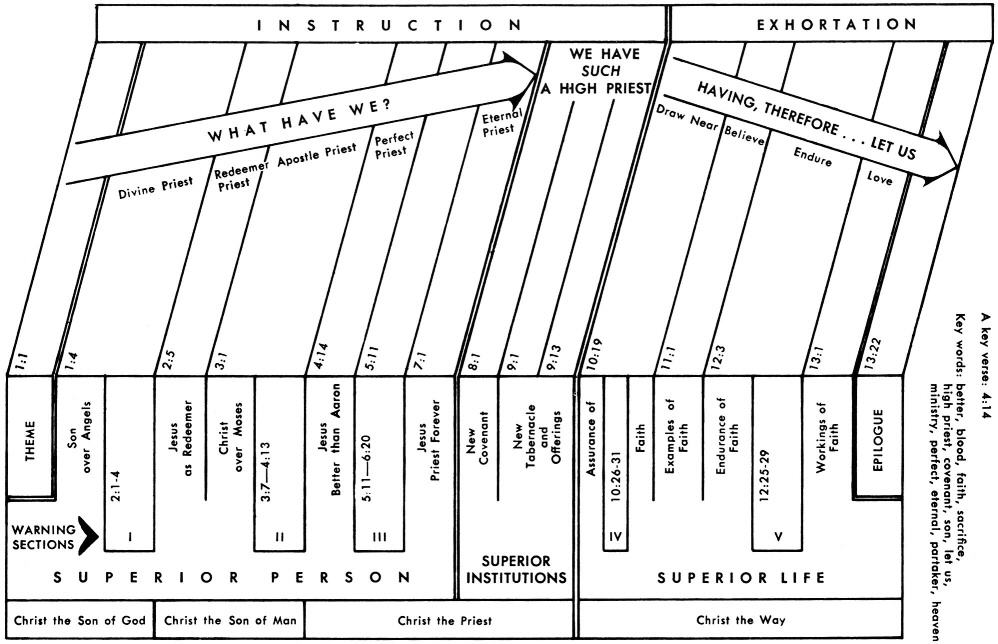
CONSIDER JESUS OUR GREAT HIGH PRIEST
Click chart to enlarge
Charts from Jensen's Survey of the NT - used by permission
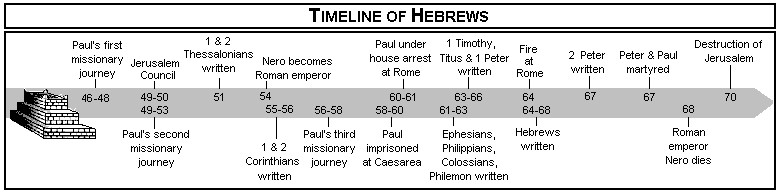
Swindoll's Chart, Interesting Pictorial Chart of Hebrews, Another Chart
|
The Epistle |
||||
| INSTRUCTION Hebrews 1-10:18 |
EXHORTATION Hebrews 10:19-13:25 |
|||
| REVELATION | RESPONSE | |||
| PRECEPTS | PRACTICE | |||
| DOCTRINE | DUTY | |||
| Superior Person of Christ Hebrews 1:1-4:13 |
Superior Priest in Christ Hebrews 4:14-10:18 |
Superior Life In Christ Hebrews 10:19-13:25 |
||
| BETTER THAN PROPHETS, ANGELS MOSES Hebrews 1:1-4:13 |
BETTER THAN AARON'S PRIESTHOOD Heb 4:14-7:28 |
BETTER THAN THE OLD COVENANT Heb 8:1-13 |
BETTER THAN ANIMAL SACRIFICES Heb 9:1-10:18 |
BETTER LIFE IN CHRIST THAN IN ADAM! |
| MAJESTY OF CHRIST |
MINISTRY OF CHRIST |
MINISTERS FOR CHRIST |
||
|
DATE WRITTEN: |
||||

See ESV Study Bible "Introduction to Hebrews"
(See also MacArthur's Introduction to Hebrews)
Borrow Ryrie Study Bible
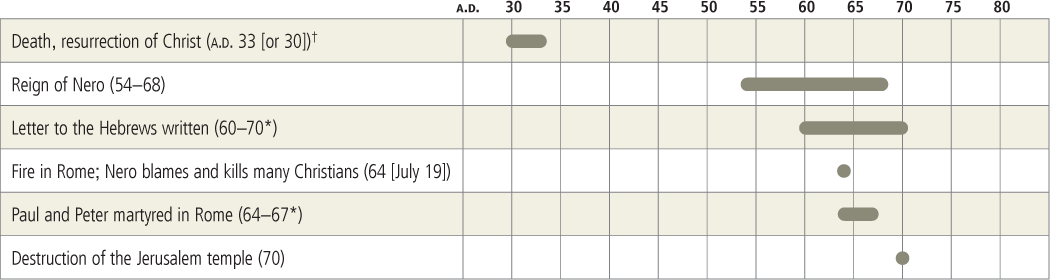
Timeline of Hebrews - ESV Study Bible
Hebrews 6:11 And we desire that each one of you show the same diligence so as to realize the full assurance of hope until the end, (NASB: Lockman)
Greek: epithumoumen (1PPAI) de ekaston umon ten auten endeiknusthai (PMN) spouden pros ten plerophorian tes elpidos achri telous,
Amplified: But we do [strongly and earnestly] desire for each of you to show the same diligence and sincerity [all the way through] in realizing and enjoying the full assurance and development of [your] hope until the end, (Amplified Bible - Lockman)
NLT: Our great desire is that you will keep right on loving others as long as life lasts, in order to make certain that what you hope for will come true. (NLT - Tyndale House)
Phillips: It is our earnest wish that every one of you should show a similar keenness in fully grasping the hope that is within you. (Phillips: Touchstone)
Wuest: But we are strongly desirous that each one of you exhibit the same diligence which will develop your hope into full assurance until the end (Eerdmans)
Young's Literal: and we desire each one of you the same diligence to shew, unto the full assurance of the hope unto the end,
- We desire - Ro 12:8,11 1Co 15:58; Gal 6:9 Php 1:9-11; 3:15 1Th 4:10 2Th 3:13 2Pe 1:5-8; 3:14
- To realize full assurance - Heb 3:6,14; 10:22 Isa 32:17 Col 2:2 1Th 1:5 2Pe 1:10 1Jn 3:14,19
- Hope - Heb 6:18-20 Ro 5:2-5; 8:24,25; 12:12; 15:13 1Co 13:13 Gal 5:5 Col 1:5,23 2Th 2:16,17 1Pe 1:3-5,21 1Jn 3:1-3
- To the end - Heb 3:6,14; 10:32-35 Mt 24:13 Rev 2:26
DILIGENCE ENDURING
TO THE END
Having recalled their past service and affirmed that their good work was continuing in the present, the writer now turns their attention to the future.
And we desire (epithumeo) that each one (hekastos) of you show (endeíknumi) the same (autos) diligence (spoude) so as to realize the full assurance (plerophoria) of hope (elpis) until (time phrase) the end (telos) - With a pastoral tone, the writer expresses his continual, intense, earnest desire (epithumeo present tense) that (hekastos - each and every one) of the readers show the same diligence (spoude) so that their hope (potentially in danger of faltering) might grow into full assurance, carrying them onward to the end of the present season of trial to its blessed consummation. Same refers to the diligence they had demonstrated at the beginning of their life in Christ! Repeat it the writer is saying! Note the pattern = Hope grows into full assurance as we daily show diligence. Show (endeíknumi) is in the present tense calls for the saints to continually demonstrate the same diligence exemplified by the patriarchs (illustrated by "father" Abraham - see Heb 6:13-15+). The middle voice indicates that each believer must each consciously initiate this action (empowered by the Spirit of course) so that they continually show forth or demonstrate a zealous urgency.
It is important to point out that believers cannot be truly diligent in their own strength; they are called to exert effort, but only as they consciously rely on the Spirit’s empowering presence, who makes diligence fruitful and enduring. Think of a sailboat: The sailor raises the sails (human diligence). But the wind (Spirit) provides the power that moves the boat. No sails = no movement. No wind = no movement. Both are essential. See chart below on natural versus supernatural diligence. See "Paradoxical Principle of 100% Dependent and 100% Responsible"
What the Bible teaches – His expressed desire for them is not just a general thing, viewing them abstractedly as a company. His concern is for "each one" of them. His ambition for them is a noble one and he uses a very strong word for "desire", epithumeō, that same word used by the Saviour on the night of His betrayal, "With desire I have desired to eat this passover with you before I suffer" (Luke 22:15)....This brings out the strength of the word and of the inner feeling which is implied.
Just as there has been a continuance in work and love he desires for them a similar perseverance in diligence. Diligence signifies zeal and earnestness and carries also the thought of the careful haste which is appropriate when there are things requiring to be done. The writer here earnestly longs that such zeal in spiritual things would characterize these Hebrews in the days that lay ahead.
Note that full assurance of hope comes from diligence. If we are diligent in living for Christ, our hearts are filled with assurance. If we are not diligent, then we cannot be assured that all things will be well. Living an up and down life—sometimes living for Christ and other times not living for Christ, sometimes living in sin and sometimes living in righteousness—causes doubt, questioning, and wondering about salvation. And it should. We should fear lest we fall away from Christ and His Word.
F B Hole writes that…
Being thus assured of the salvation of the mass of those to whom he wrote, there is but one word of exhortation at this point. The writer urges them to go on doing as they had done — to continue diligently in this good way to the end, in the full assurance that their hope was not misplaced.
Hope has a very large place in connection with the faith of Christ, just as it had in the bygone dispensation. Then, whether patriarchs or prophets or just the people of God, they all had their eyes directed forward to the good things to come at the advent of the Messiah. Now the good things have been manifested in Christ — full atonement has been made, our consciences have been purged, we have received the gift of the Spirit. Yet even so we are not in the full enjoyment of the good things. For that we await the second coming of the Lord. What we actually have at the present moment we have in faith, and we enjoy by the power of the Spirit, for He is the Earnest of all we shall inherit. We are saved, in hope of all that is to come.
It is very important for us to be clear as to this, and even more important it was for these converted Hebrews to be clear as to it. How often did they get reproached by their unconverted relations! How often taunted with their folly in giving up all the outward glories of the Mosaic system with its temple, its altar, its sacrifices, its priesthood — and for what? For a Master whom they could not see, for He had left them, and for a whole range of things as invisible as He! What fools they appeared to be! But were they really fools?
They were not. And if instructed in that which our chapter says they would be able to give very good reason for what they had done. They would be able to say, "It is really we and not you who are following in the footsteps of our father Abraham. Promises were made to him and you seem to have forgotten them, settling down as though contented with the shadow system of the law, which was given through Moses as a provisional thing. We have received Christ, and in Him we have the pledge of the fulfilment of every promise which ever was given, and we have fresh, and even brighter promises besides."
We need to have a hope which is resting upon a very weld established basis if we are to hold it with full assurance. It is this thought which leads to verses 13-18. (Hebrews Commentary Notes)
THE GOAL OF DILIGENCE:
ASSURANCE OF HOPE UNTIL THE END
So as to realize - This is all one word in Greek, the preposition pros which normally expresses motion toward and in some contexts such as the present passage (cf Jn 11:4, Acts 3:10, 1 Pe 4:12) indicates or shows purpose. The purpose for our desire and diligence is your attainment of full assurance of hope.
The full assurance (plerophoria) of hope (elpis) until (time phrase) the end (telos) - Full assurance is God’s will for us. Note that hope generates full assurance. Believers do not have a "hope so" type of hope, but a "hope sure" type of hope. We have confidence that God will do good to us in the future, in that glorious day with hope becomes sight! The phrase until (time phrase) the end (telos) is calling for diligence not just today, but every day of our lives, all the way to the end of the race. The same phrase until the end is found in Heb 3:6 and Heb 3:14 both of which speak of the doctrine of perseverance. Don't say perseverance is a Calvinist doctrine, unless you believe Calvin wrote Hebrews! Perseverance (which is disputed by a number of evangelicals) is the doctrine promulgated by the writer of Hebrews! What is the end? It could be the end of their trials (their persecutions), the end of their lives or the end of this age when Messiah returns.
🙏 THOUGHT - Remember that the in the Pauline writings the early church (Titus 2:11-13+, Phil 3:20-21+, 1Co 1:7+, 1Th 1:10+, 1Th 4:15-18+, etc) clearly lived with a future focus mentality, a "Maranatha mindset," a "Vertical Vision" mindset. Beloved, where is your focus? What are you living for, today or tomorrow? Are you being diligent in ministry for the Lord so that you may realize the full assurance of hope until the end?
J Vernon McGee - Full assurance is an interesting expression; it literally means “to be under full sail.” It means that believers should be moving along spiritually—they should be moving along for God. (ED: CAVEAT - FULL SAIL REQUIRES BELIEVERS TO PUT THE SAIL UP AND DEPEND ON THE SPIRIT'S "WIND" TO EMPOWER SUPERNATURAL DILIGENCE! SEE Table below)
See result of Abraham's faith...
In hope against hope he believed, so that he might become a father of many nations according to that which had been spoken, “SO SHALL YOUR DESCENDANTS BE.” 19 Without becoming weak in faith (pistis) he contemplated his own body, now as good as dead since he was about a hundred years old, and the deadness of Sarah’s womb; yet, with respect to the promise (epaggelia) of God, he did not waver in unbelief but grew strong in faith (pistis), giving glory to God, and being fully assured (plerophoreo) that what God had promised (epaggello), He was able also to perform." (Ro 4:18-21+)
Pleophoreo describes Abraham's assurance that God would keep His promise and give him a son. Note that this verb (plerophoreo) is the root from which the noun full assurance (plerophoria) is derived.
MacDonald - Abraham did not know how God would fulfill His word, but that was incidental. He knew God and had every confidence that God was fully able to do what He had promised. In one way it was wonderful faith, but in another way it was the most reasonable thing to do, because God's word is the surest thing in the universe, and for Abraham there was no risk in believing it! (Borrow Believer's Bible Commentary)
When hope animates us
there is a vigour in the whole body.
-- John Calvin
How does one in fact "realize the full assurance of (the) hope"? It is thru faith and patience and so the writer gets very pragmatic, reminding his predominantly Jewish audience of one they would be very familiar with (Abraham) and in fact quoting directly from the Lxx of Ge 22:17, as probably the ultimate example of Abraham's faith… he had believed God in Ge 15:6 but God's call to sacrifice his son Isaac was the ultimate test of Abraham's faith (obedience) by which he became the father of all those who believe.
A patient diligent pursuit of deeds of kindness and labors of love is
the way to the real enjoyment of that full assurance of hope.
J Flanigan adds "In such diligent continuance in well-doing they could enjoy the fullness of the hope that was theirs. A patient diligent pursuit of deeds of kindness and labors of love is the way to the real enjoyment of that full assurance of hope. This joy is not to be had in idleness or sloth, but in busy ministering to others. In such loving ministries the writer desires that they should continue, until, eventually, their hope is realised. He will speak of this hope again, further down this same chapter (Heb 6:18+), but his immediate desire for them is that they should be in the fullness of the joy of it, and the sure way to this enjoyment is to be engaged busily in the work of the Lord. The hope is certain. It will be realised one day. For the present, while we await the fulfillment of it, we are to be in the fullness of the joy of it. And this exhortation is but a repetition of that similar exhortation of Heb 3:6. "Hold fast", he had there exhorted, "the confidence and rejoicing of the hope firm unto the end". We must persevere. We must continue. "The end" is undoubtedly the end of our pilgrimage. The realisation of our hope will come when we shall see Him (1Jn 3:2, 3+), whom we have loved without seeing. In the certain hope of His coming and in the equally certain hope of a resurrection out from among the dead for those who have died in Christ, we live and labour and wait and watch, and thus engaged we arrive even now at the full enjoyment of all that for which we hope. (What the Bible teaches – Hebrews)
Assurance is grounded in hope (in turn anchored in God’s promise and oath), but cultivated and brought to maturity through diligence. Without diligence, hope withers into uncertainty, but with diligence, hope blossoms into full assurance.
Only as we apply zeal and apply faith and patience can we have an assurance that we will one day "inherit the promises". Without faith and patience, we can become sluggish, and as such expose ourselves to the danger of drifting and ultimately even apostasy. This idea of applying diligence is very important if you desire a sense "spiritual security". Peter describes this need for diligence writing...
2 Peter 1:5+ Now for this very reason also (SEE "PROMISES" IN 2Pe 1:4+), applying all diligence (spoude), in your faith supply (aorist imperative see our need to depend on the Holy Spirit to obey) moral excellence, and in your moral excellence, knowledge,
2 Peter 1:10; 11+ Therefore, brethren, be all the more diligent (aorist imperative see our need to depend on the Holy Spirit to obey) to make certain (COMPARE THIS WITH FULL ASSURANCE) about His calling and choosing you; for as long as you practice these things, you will never stumble; 11 for in this way the entrance into the eternal kingdom of our Lord and Savior Jesus Christ will be abundantly supplied to you.
Note hope is modified by the definite article the (tes") in the Greek so this is a very specific hope, not some generalization or "pie in the sky by and by". This reflects the absolute certainty of future good, because as taught below Jesus has entered thru the veil and will be there as our High Priest forever. That is a sure & steadfast anchor for our souls when storms of life assail us, which are in fact guaranteed if we are truly His children (Philippians 1:29+, Jn 16:33+)
Until the end (telos - consummation) - Let me ask again what is the end of what? This could be the trial they are going through (persecution), the end of their lives or the end of this age when Messiah returns. The writer is urging diligence to keep on keeping on, persevering, for he know this perseverance is one proof of genuine faith. Stated another way a sure evidence of true regeneration is a faith that endures to the end of life. Though it may falter at times and grow dim under trials and pressures (I can attest to that!), it can never be utterly abandoned. As one wag observed, ‘If your faith fizzles before the finish, it was faulty from the first!’”
Recall that this is the third time we have seen until the end in Hebrews...
Hebrews 3:6+ but Christ was faithful as a Son over His house --whose house we are, if we hold fast our confidence and the boast of our hope firm until the end (telos).
Hebrews 3:14+ For we have become partakers of Christ, if we hold fast the beginning of our assurance firm until the end (telos)
COMMENT - Other uses of until the end - Daniel 11:35 Daniel 12:4, 6, 9+, 2Co 1:13+, Rev 2:26+.
Since we know the future (hope),
we can be certain of the future (full assurance).
ILLUSTRATION - Ray Stedman - I recall once receiving a phone call from a young new Christian who said, “I’ve decided to give up being a Christian; I can’t handle it anymore.” Knowing him well, I said, “I agree. That’s probably what you ought to do.” There was silence on the line for a moment, and then he said, “You know I can’t do that!” And I said, “No, I know you can’t.” And he couldn’t—and he didn’t!
Desire (1937) (epithumeo from epí = upon, used intensively + thumos = passion, impulse) (Click epithumia) means literally to fix the desire upon (whether things good or bad). The "epi-" meaning upon adds emphasis to the focus of the desire (it is not desire in general but focused on a specific object). Literal idea is to have a strong desire to do or secure something. Note that the preposition "epi" can express motion toward! And so it means to have one's passions or affections directed toward something (good or bad). Neutral/Positive meaning is to have an earnest longing or desire for a good thing (Luke 22:15; 1 Pet 1:12; Heb 6:11). The Negative or Moral sense speaks of coveting or sexually charged lust contrary to God’s will (Matt 5:28; Rom 7:7; 1 Cor 10:6; Gal 5:17; Jas 4:2; Rev 9:6). In short, depending on the context, epithumeo depicts either desire itself which is not evil or misdirected desire which is evil. It is interesting that most uses are in the active voice indicating that the desire reflects a volitional choice, a choice of one's will. Epithumeo is used in the Septuagint of Ex 20:17 and Deut 5:21 “You shall not covet.”
A Brief Theology of Desire - At Creation desire was part of God’s good design. God "desire" that Adam desire Eve, for joy and for procreation of the species! But because of Adam's fall into sin desire (energized by the fallen flesh) became bent, aimed at wrong objects or aimed at right objects in wrong ways or wrong measure (Ge 3; Ro 7:7–11). But because of redemption, believers in Christ have their desires reordered (Gal 5:16–24, 2Co 5:17). The Spirit produces new loves that counter-desire the flesh “the flesh desires (epithumeo - present tense = continual warfare) against the Spirit, and the Spirit against the flesh” (Gal 5:17+). Sanctification is to be a believer's progressive growth in regard to desire. Not that he or she is not to have desires but that their desires be rightly-directed desire, learning to desire the good, at the right time, in the right proportion, and ever for God’s glory (Phil 1:9–11; Col 3:1–5 with "evil desires" part of the “old self”).
EPITHUMEO -16V - Matt. 5:28; Matt. 13:17; Lk. 15:16; Lk. 16:21; Lk. 17:22; Lk. 22:15; Acts 20:33; Rom. 7:7; Rom. 13:9; 1 Co. 10:6; Gal. 5:17; 1 Tim. 3:1; Heb. 6:11; Jas. 4:2; 1 Pet. 1:12; Rev. 9:6
Each (1538) (hekastos from hékas = separate) every single one. This idea of separation or singling out is expressed still more strongly by heís hékastos. It means each and every one of you. The writer gets very personal and does not want to leave anyone out.
HEKASTOS IN HEBREWS - Heb. 6:11; Heb. 8:11; Heb. 11:21
Show (1731) (endeíknumi from preposition en = in, to + deíknumi = to show) means to point out, to demonstrate, to put on display, to prove, to show proof, to show forth, to show oneself, to give visible proof, to show in anything and implies an appeal to facts. The preposition (in) in the compound suggests more than the simplest demonstration. It is like laying the index finger, as it were, on the object. It means to to show something in someone. It can mean to do something to someone, as Alexander the coppersmith "did" (endeíknumi) Paul much harm (2 Timothy 4:14 note). In the papyri it could have a quasi-legal sense of proving a petition or charge or of proving that a charge was wrong. Josephus used endeíknumi to describe Herod Agrippa’s display of generosity to those of other nations (Josephus, Antiquities, 19:330).
ENDEIKNUMI - 12V - Rom. 2:15; Rom. 3:25; Rom. 9:17; Rom. 9:22; 2 Co. 8:24; Eph. 2:7; 1 Tim. 1:16; 2 Tim. 4:14; Tit. 2:10; Tit. 3:2; Heb. 6:10; Heb. 6:11
Diligence (4710) (spoude from speudo = hasten, make haste) refers to eagerness, earnestness, willingness or zeal. It denotes quick movement or haste accompanying the eagerness, etc, in the interest of a person or cause. Thus spoude can refer to swiftness of movement or action and means haste or speed (like our expression "in a hurry"). It can refer to an earnest commitment in discharge of an obligation or experience of a relationship.
Diligence means faithfully, carefully, and persistently applying yourself to what is good and necessary, day after day — not in a frantic way, but in a steady, wholehearted way that builds reliability and lasting results.
SPOUDE - 12V - Mk. 6:25; Lk. 1:39; Rom. 12:8; Rom. 12:11; 2 Co. 7:11; 2 Co. 7:12; 2 Co. 8:7; 2 Co. 8:8; 2 Co. 8:16; Heb. 6:11; 2 Pet. 1:5; Jude 1:3
Spoude was often used in Greek and Roman literature and found on inscriptions in reference to extraordinary commitment to civic and religious responsibilities, which were frequently intertwined, and also of concern for personal moral excellence or optimum devotion to the interests of others.
Spoude is primarily an attitude which leads to an action. Spoude means to do something with intense effort and motivation, with quick movement and is in opposition to the attitude of slothfulness. The individual who is "spoude" who is eager to do something and ready to expend the necessary energy and effort.
Spoude describes zeal (eagerness and ardent interest in pursuit of something), passion (passion applies to an emotion that is deeply stirring-- how wonderful to so fully be in love with Christ so as to be fully governed by His Spirit).
Diligence means steady, careful, and persistent effort toward a goal. It is not just hard work, but attentive and intentional work — marked by care, focus, and consistency. The word carries the idea of doing something thoroughly, not half-heartedly or in a careless rush.
Etymology: From Latin diligere — “to value highly, to esteem, to take delight in.” This shows that diligence is not merely drudgery, but treating the task as something worth doing well.
Practically speaking, diligence shows itself in everyday life in several ways:
Consistency over bursts of effort - Instead of cramming or rushing at the last minute, diligence shows up in daily, steady progress.
Example: A student studying a little each day instead of pulling one frantic all-nighter.
Attention to detail - Diligent people don’t cut corners. They check their work, read instructions carefully, and avoid sloppy mistakes.
Example: An accountant double-checking numbers before submitting reports.
Persistence through obstacles - Diligence is tied to perseverance — keeping at the task even when it’s hard, boring, or progress feels slow.
Example: A gardener who faithfully waters and weeds even when growth is not immediately visible.
Prioritizing what matters most - Diligence isn’t just “working a lot.” It’s about giving focused energy to what truly counts.
Example: A parent making time daily for their children despite a busy schedule.
Dependability and trustworthiness - Diligent people can be counted on to follow through on commitments.
Example: An employee who always finishes projects by the deadline without being reminded.
Full assurance (4136) (plerophoria from pleres = full + phoreo = to bear ; cf plerophoreo = to fulfill) literally means complete carrying or bearing. In the NT it then comes to mean entire confidence, perfect certitude, full conviction. This noun carries a strong implication of certainty, a wealth of certainty, an absolute and entire confidence. The book of Hebrews defines hope as that which gives full assurance (Heb 6:11). Thus we can have strong confidence that God is going to do good to us in future. The opposite of hope is despair, (hopelessness; a hopeless state; a destitution of hope or expectation) which is all that those without Christ as Savior can know, for Paul defines hope as "Christ Jesus, Who is our Hope" (1Ti 1:1). Thus genuine Biblical hope is not a concept but a Person, Christ Jesus!
Herman Witsius, the seventeenth-century Dutch theologian, writes: Plerophoria, “full assurance,” is an expression which occurs more than once in the writings of the Apostle Paul. He speaks of plerophoria suneseos, “the full assurance of understanding” (Col. 2:2); plerophoria tes elpidos, “the full assurance of hope” (Heb. 6:11); and plerophoria pisteos, “the full assurance of faith” (Heb. 10:22). According to its etymology, this word denotes “a carrying with full sail”; the metaphor being taken, probably, from ships when their sails are filled with favourable gales. Thus it may here signify the vehement inclination of the mind, impelled by the Holy Spirit, towards an assent to the truth perceived.
Notice that full assurance for believers is linked to faith, understanding and hope....
(1) Full assurance of faith—we rest on God’s word, His testimony to us (Hebrews 10:22+). Faith gives us full assurance (like Abraham in Ro 4:21)
(2) Full assurance of understanding—we know and are assured (Colossians 2:2+). Understanding (spiritual things) gives us full assurance.
(3) Full assurance of hope—we press on with confidence as to the outcome (Hebrews 6:11+). Hope gives us full assurance.
Plerophoria - 4x in 4v - conviction(1), full assurance(3). This noun is not found in the Septuagint or the secular Greek writings.
Colossians 2:2+ that their hearts may be encouraged, having been knit together in love, and attaining to all the wealth that comes from the full assurance of understanding, resulting in a true knowledge of God's mystery, that is, Christ Himself,
1 Thessalonians 1:5+ for our gospel did not come to you in word only, but also in power and in the Holy Spirit and with full conviction; just as you know what kind of men we proved to be among you for your sake.
Hebrews 6:11 And we desire that each one of you show the same diligence so as to realize the full assurance of hope until the end,
Hebrews 10:22+ let us draw near with a sincere heart in full assurance of faith, having our hearts sprinkled clean from an evil conscience and our bodies washed with pure water.
Comment: To be near to God, then, means that we have total confidence in His promises, absolute assurance of His provision, and full trust in His sovereignty. The more we doubt Him, the more we question Him, the farther away from Him we drift.
Hope (1680) (elpis) in Scripture is not the world's definition of "I hope so", with a few rare exceptions (e.g., Acts 27:20) but is is an absolute certainty of future good. Hope is defined as a desire for some future good with the expectation of obtaining it or as Peter Anderson put it "Hope is faith in the future tense." Hope is confident expectancy. Hope is the looking forward to something with some reason for confidence respecting fulfillment. See related study on the Believer's Blessed Hope.
Hope is a repeated theme in Hebrews. Study the 5 uses in context…
- Hebrews 3:6+ but Christ was faithful as a Son over His house --whose house we are, if we hold fast our confidence and the boast of our hope firm until the end.
- Hebrews 6:11+ And we desire that each one of you show the same diligence so as to realize the full assurance of hope until the end,
- Hebrews 6:18+ so that by two unchangeable things in which it is impossible for God to lie, we who have taken refuge would have strong encouragement to take hold of the hope set before us.
- Hebrews 7:19+ (for the Law made nothing perfect ), and on the other hand there is a bringing in of a better hope, through which we draw near to God.
- Hebrews 10:23+ Let us hold fast the confession of our hope without wavering, for He who promised is faithful;
Hope is biblical shorthand
for unconditional certainty.
-- John Blanchard
Hope as the world typically defines it is a desire for some future occurrence of which one is not assured of attaining. The ancient world did not generally regard hope as a virtue, but merely as a temporary illusion. Historians tell us that a great cloud of hopelessness covered the ancient world. Philosophies were empty; traditions were disappearing; religions were powerless to help men face either life or death. People longed to pierce the veil and get some message of hope from the other side, but there is none outside of Christ.
In the OT there are several Hebrew words translated "hope" but each has the idea of inviting us to look ahead eagerly with confident expectation, the same idea conveyed by elpis. Each Hebrew word for "hope" calls for patience, reminding us that the fulfillment of our hope lies in the future ("hold on… the best is yet to come").
Hope is by no means a passive attitude but a stimulant to action for Thomas Brooks writes that "A man full of hope will be full of action… Hope can see heaven through the thickest clouds."
Gabriel Marcel said, “Hope is for the soul what breathing is for the living organism.”
A study of concentration camp survivors found that those prisoners who were able to hold onto their sense of hope (‘things are going to get better’ or ‘we’re going to get out of here one day’) were much more likely to survive. Hope then is not optional but for these prisoners proved to be a matter of life and death.
Vincent writes that hope "in classical Greek, has the general signification of expectancy, relating to evil as well as to good. Thus Plato speaks of living in evil hope (“Republic,” i., 330); i.e., in the apprehension of evil; and Thucydides, of the hope of evils to come; i.e., the expectation or apprehension. In the New Testament the word always relates to a future good." (Vincent, M. R. Word Studies in the New Testament Vol. 1)
Seneca, Rome's leading intellectual figure, tutor of the depraved emperor Nero (who forced Seneca to commit suicide!) and contemporary of Paul tragically defined hope as “an uncertain good”, the antithesis of Biblical hope! What a difference the new birth in Christ makes in one's perspective.
The cynical editor H. L. Mencken also inaccurately defined hope as “a pathological belief in the occurrence of the impossible.”
His cynical definition does not even agree with the secular Webster's Collegiate dictionary which defines "Hope" much like the NT declaring that hope means "to cherish a desire with anticipation, desire with expectation of obtainment, expect with confidence."
Biblical hope is not "finger crossing", but is alive and certain because of the resurrection of Jesus Christ from the dead. Life without Christ is a hopeless end whereas life in Christ is an endless hope.
Jeremiah pleaded with God on the basis of His Name, "Hope of Israel" (God's Names all reveal some aspect or attribute of His character), declaring "Thou Hope of Israel, its Savior in time of distress. Why art Thou like a stranger in the land Or like a traveler who has pitched his tent for the night?" (Jer 14:8)
Again Jeremiah says "O LORD, the hope of Israel, all who forsake Thee will be put to shame. Those who turn away on earth will be written down, because they have forsaken the fountain of living water, even the LORD." (Jer 17:13)
The psalmist declares "Thou art my hope; O Lord GOD, Thou art my confidence from my youth." (Ps 71:5)
Paul uses makes an allusion to this OT name ("Hope of Israel") speaking to the Jews explaining that "I requested to see you and to speak with you, for I am wearing this chain for the sake of the hope of Israel." (Acts 28:20)
Although the Old revealed spoke of the Hope of Israel and predicted His coming to save His people as well as Gentiles, there was no mention that the Messiah of hope would actually live within each member of His redeemed church. Paul explained that in the New Covenant, "God willed to make known what is the riches of the glory of this mystery among the Gentiles, which is Christ in you, the hope of glory." (Col 1:27+) The unsaved are born into the world but have "no hope and (are) without God in the world" (Ephesians 2:12+, 1Thes 4:13+) and if they die without Christ, he will be hopeless forever.
The Italian poet, Dante, in his Divine Comedy, put this inscription over the world of the dead: “Abandon all hope, you who enter here!”
In other words, life without Christ is a hopeless end whereas life in Christ is an endless hope.
Hope in Scripture is the absolute certainty of future good and believers are to be continually, actively, expectantly "looking for the blessed hope and the appearing of the glory of our great God and Savior, Christ Jesus." (Titus 2:13+).
A living hope should motivate a "looking" hope, so that we are waiting anxiously for Christ's return at any time, this event providing great incentive to "discipline (one's self) for the purpose of godliness" (1Timothy 4:7+) knowing that godliness "is profitable for all things, since it holds promise for the present life and also for the life to come." (1Timothy 4:8+)
G K Chesterton said that "Hope means hoping when things are hopeless or it is no virtue at all… As long as matters are really hopeful, hope is mere flattery or platitude. It is only when everything is hopeless that hope begins to be a strength."
Hope is an essential and fundamental element of Christian life, so essential indeed, that, like faith and love, Peter refers to it in this verse to designate the essence of Christianity
Hope is one component of the great triad of Christian virtues, along with faith and love. “But now abide faith, hope, love, these three; but the greatest of these is love” (1Cor 13:13+; 1Th 1:3+; 1Th 5:8+; Gal 5:5, 6+; Eph 1:15-18+; +,Eph 4:2-5+; Col 1:4-5+; Heb 10:22-24+; 1Pe 1:21-22+). Faith and hope are inseparably linked. We believe and so we hope.
Paul prayed for believers "that the eyes of (our) heart may be enlightened, so that (we) may know what is the hope of His calling." (Eph 1:18+)
Hope is a "helmet of salvation" for we know that "God has not destined us for wrath but for obtaining salvation through our Lord Jesus Christ (1Th 5:8+).
Hope as you can see is a deep well, which is well worth lingering over if you have time. To renew your mind with this great Biblical truth go over the following Scriptures, asking what each teaches about the "source" of hope, the stabilizing effect of the truth, the sanctifying effect, etc. Then study the chart summary at the end of the references -- Job 8:13; 27:8, Ps 31:24; Ps 42:5-6; 71:5; Ps 119:49-50; Ps 130:7; Ps 146:5 Pr 10:28; 13:12 Jer 14:8; 29:11; Jn 5:45 Acts 2:26; Acts 23:6, 24:15; 26:6; 28:20; Ro 4:18; 5:1-2; 8:25; 12:12; 15:4; 15:13 1Co 13:13; 15:19, 21-23 2Cor 3:12 Eph 1:15-18, 2:12; 4:2-5; Gal 5:5, 6 Col 1:4, 5, 1:27 1Th 1:3; 1Thes 2:19; 4:13-18; 1Thes 5:8; 2Thes 2:16; 1Tim 1:1; Titus 2:11-13; 3:7 Heb 6:11, Heb 6:18-20; 7:19; 10:22-24; 1Pet 1:3; 1:21–22, 1Pet 3:15; 1Jn 2:25; 1Jn 3:2-3 ; Jude 1:21
End (5056) (telos) refers to the goal.
- End/termination — the finish of a process or period (Mt 10:22, Mt 24:13-14, Heb 3:14)
- Goal/aim/purpose — the intended target or consummating purpose (teleology). (Ro 10:4, 1Ti 1:5)
- Outcome/result — what something comes to or produces. (Ro 6:21-22 = "outcome")
- Consummation/fulfillment — the climactic completion of a plan or promise. (1Co 15:24, 1Pe 4:7, Rev 21:6)
- Dues/tolls/customs (esp. τέλη in the plural) — monetary “end-payments,” hence “taxes/duties.” (Mt 17:25 and Ro 13:7 = "custom")
- Uttermost/full - Jn 13:1 describing Christ's love
Theological Implications of Telos:
- Perseverance: τέλος marks the finish line of faith. Salvation language often couples perseverance “to the end” with eschatological hope (Mt 24:13; Heb 3:14; 6:11).
- Christological Fulfillment: Rom 10:4 showcases Christ as telic center—the law’s purpose reaches its consummation in Him.
- Ethics & Love: 1 Tim 1:5 grounds ethics teleologically: the aim of instruction is love from a pure heart, good conscience, sincere faith.
- Eschatology: 1 Cor 15:24; 1 Pet 4:7 locate history’s τέλος in God’s sovereignty—Christ brings creation to its appointed consummation.
Telos is used 5x in Hebrews…
Hebrews 3:6+ but Christ was faithful as a Son over His house --whose house we are, if we hold fast our confidence and the boast of our hope firm until the end (telos).
Hebrews 3:14+ For we have become partakers of Christ, if we hold fast the beginning of our assurance firm until the end (telos),
Hebrews 6:8+ but if it yields thorns and thistles, it is worthless and close to being cursed, and it ends (telos) up being burned.
Hebrews 6:11+ And we desire that each one of you show the same diligence so as to realize the full assurance of hope until the end (telos),
Hebrews 7:3+ Without father, without mother, without genealogy, having neither beginning of days nor end (telos) of life, but made like the Son of God, he remains a priest perpetually.
An incredible illustration of diligence…
The Proceedings of the U.S. Naval Institute: The USS Astoria (CA-34) was the first U.S. cruiser to engage the Japanese during the Battle of Savo Island, a night action fought 8-9 August 1942. Although she scored two hits on the Imperial flagship Chokai, the Astoria was badly damaged and sank shortly after noon, 9 August.
About 0200 hours a young midwesterner, Signalman 3rd Class Elgin Staples, was swept overboard by the blast when the Astoria's number one eight-inch gun turret exploded. Wounded in both legs by shrapnel and in semi-shock, he was kept afloat by a narrow lifebelt that he managed to activate with a simple trigger mechanism.
At around 0600 hours, Staples was rescued by a passing destroyer and returned to the Astoria, whose captain was attempting to save the cruiser by beaching her. The effort failed, and Staples, still wearing the same lifebelt, found himself back in the water. It was lunchtime. Picked up again, this time by the USS President Jackson (AP-37), he was one of 500 survivors of the battle who were evacuated to Noumea.
On board the transport Staples, for the first time, closely examined the lifebelt that had served him so well. It had been manufactured by Firestone Tire and Rubber Company of Akron, Ohio, and bore a registration number.
Given home leave, Staples told his story and asked his mother, who worked for Firestone, about the purpose of the number on the belt. She replied that the company insisted on personal responsibility for the war effort, and that the number was unique and assigned to only one inspector. Staples remembered everything about the lifebelt, and quoted the number. It was his mother's personal code and affixed to every item she was responsible for approving.
Fifty years ago, a mother's unheralded diligence in an anonymous wartime job assured her soon-to-be shipwrecked son's survival. But how much greater are the stakes in eternal matters, and how much greater is the challenge to diligence in eternal matters! "We want [literally, we long for] each one of you," says the writer in v11, "to show this same diligence to the very end, in order to make your hope sure."
C H Spurgeon - How peremptory are the words of Christ in John 10:28–29, “I give them eternal life”—not temporal life, which may die—“and they will never perish forever, and no one will seize them out of my hand. My Father, who has given them to me, is greater than all, and no one can seize them out of the Father’s hand.” The apostle tells us, in Romans 11:29, that “the gifts and calling of God are irrevocable”; that is, whatever gifts the Lord gives, He never repents of having given them so as to take them back again. And whatever calling He makes of any man, He never retracts it, but He stands to it still. There is no playing fast and loose in divine mercy; His gifts and calling are without repentance.
Keep it up; be as earnest today as you were twenty years ago, when you were baptized and joined the church: “Demonstrate the same diligence unto the end.” Still, “work out your own salvation with fear and trembling. For the one at work in your, both to will and to work for his good pleasure, is God” (Phil 2:12).
I stood in the cold pre-dawn darkness outside a New York City hotel waiting for the airport bus. The street was deserted. My attention was drawn to one lone man who was cleaning the glass on the doors at the entrance of the hotel. With great care he removed every smudge. He even dusted overhead so that no dirt or cobwebs would collect. What made his work so noteworthy was that no one was inspecting it, and throughout the day many people would go through those doors, smearing the windows with their handprints. Nevertheless, he worked diligently and faithfully with special care to make sure those glass panels were spotless.
What a lesson, I thought, for Christians! All of our work should be characterized by such diligence and thoroughness. Even when no human eye looks on and no tongue commends our efforts, we must strive to do our best as to the Lord. Our willingness to work hard should not result from a desire to win the approval of others but from a deep awareness that we are "servants of Christ." —P R. V (Reprinted by permission from Our Daily Bread Ministries. Please do not repost the full devotional without their permission.)
THE WORLD CROWNS SUCCESS;
GOD CROWNS FAITHFULNESS.
TODAY IN THE WORD
Isabel Smith was a happy young nursing student when she was diagnosed with tuberculosis in 1928. Her family sent her to a nursing home for what they thought was a few months of treatment, but Isabel wound up spending the next twenty-one years in bed. She refused to give up, however. She read widely and wrote letters and taught other patients to read and write. She even met a young man, a fellow tuberculosis patient, and dreamed of marriage. Although Isabel came close to death several times, she eventually married the man she loved. She then went on to write a book, Wish I Might, about all the good things life had brought her.
In several ways, the remarkable life of Isabel Smith pictures what the epistle writer hoped for in the lives of the Hebrews. They had been afflicted with a debilitating spiritual disease that was severely stunting their growth in Christ. So serious was the problem that dire warnings were called for.
Verses 4-6 are difficult to interpret, and at least four different scenarios are suggested. It seems best to understand these words as a warning to true believers against being disqualified for God's service by failing to remain faithful to the truth they know (see 1 Cor. 9:24-27, which describes a similar problem).
The fire in this text, then, is not the fire of hell, but the scorching of an unproductive field so that it could be replanted in hopes of a fruitful crop. The danger for the Hebrews was not losing their salvation, but living such unproductive lives that everything they did would be burned up in the end (1 Cor. 3:10-15).
Verse 10 shows that these believers had known better days, having logged faithful service in the past. They needed to continue on this path (v. 11), the end of which is a secure hope.
The Hebrews had a great example of faithfulness in Abraham, a man who believed God and received His unchangeable promise. Even more encouraging is the truth that a believer's hope is secure because it is anchored in heaven, where Jesus Christ now serves as our ever-faithful High Priest.
TODAY ALONG THE WAY
The day before Easter gives us a great reminder of the faithfulness that our Lord showed, even in the face of death.
With Jesus as our model of perseverance and faithfulness, as well as the One who paid for our sins on the Cross, how can we fail to be faithful to the God who has called us? Paul told the Galatians they were running a good race--until someone ""cut in on"" them and tripped them up (Gal. 5:7). How is your Christian race today?
MIT turned down Jack Kilby's application for admission because his Math scores were too low. As a result, Kilby never received much training in physics and didn't get the education he desired. But on December 10, 2000 the Royal Swedish Academy of Sciences gave him the Nobel Prize in physics.
Why? Well he only invented something that has probably changed your life and has definitely changed history-the microchip.
Failure doesn't have to be fatal.—Reader's Digest, July 2001, p. 132
If I do not practice one day, I know it. If I do not practice the next, the orchestra knows it. If I do not practice the third day, the whole world knows it.
Be Diligent - Proverbs 22:29 says, “Do you see a man diligent and skillful in his business? He will stand before kings; he will not stand before obscure men.” A diligent man lives by the principle of “just do it!” He is the one who does it, does it, does it, and then does it some more, until whatever he set out to do is finished. Never give up on anything God has told you to believe for; never quit doing anything He has clearly shown you to do. Your diligence will pay off with a blessing from God.
After a remarkable display of eloquence, in Parliament, by the famous Edmund Burke, his brother Richard was found in deep thought by a friend, who asked him its cause.
He answered, "I have been wondering how Ned has contrived to monopolize all the talents of the family; but then again I remember when we were at play he was always at work."
Former President Ronald Reagan never Bothered to answer insults he just laughed them off. Speaking at his alma mater, Eureka College, where he had graduated with a C average, the president joked: "Even now I wonder what I might have accomplished if I had studied harder."
When a reporter asked about his light work schedule as president, Mr Reagan replied, "they say hard work never killed anyone, but I figure, why take a chance?"
Stan Toler - Diligence Requires Consistent Performance. The path to eternal inheritance lies in performing consistently on a daily basis. There are no back doors to spiritual triumph, either in private devotion or in matters of ministry. Ordinary moments infused with diligence create the momentum that accomplishes what others thought impossible.
Diligence Requires Focus. Remember that today’s headline is not the final draft of history. Rumors echo, emotions fluctuate, and people move on. Amidst the chaos, diligent leaders continue to minister because the tale is still unfolding; the exclamation point goes at the end, not halfway through. Those in ministry have no time to worry about crafting their legacy; they are too busy being diligent in matters that advance the mission.
Diligence Births Victory. William Penn said, “Patience and diligence, like faith, remove mountains.” Ministry is all about mountain-moving; the diligent see the rocks crumble.
O JESUS, I HAVE PROMISED John E. Bode, 1816–1874 - Borrow Kenneth Osbeck Amazing Grace
God is not unjust; He will not forget your work and the love you have shown Him as you have helped His people and continue to help them … show this same diligence to the very end, in order to make your hope sure. (Hebrews 6:10, 11)
I asked the New Year for some motto sweet,
Some rule of life by which to guide my feet.
I asked and paused; it answered soft and low,
“God’s will to know.”
—Unknown
The beginning of the new year is usually a time for reflecting on and evaluating the past as well as for setting serious goals for the future. Because it is so easy to get caught up in a blur of daily sameness, special days and events are important in life. We need these highlights for our growth and development.
“O Jesus, I Have Promised” was written by an English clergyman on such a special day. It was penned especially for a confirmation service in which John Bode’s own daughter and two sons were making their life’s vows of commitment to God and His service. He told his three children: “I have written a hymn containing all the important truths I want you to remember when you are fully confirmed.”
Without doubt, the three children of John Bode never forgot that confirmation service and their father’s concern for them as they sang these words throughout their lives:
O Jesus, I have promised to serve Thee to the end; be Thou forever near me, my Master and my Friend: I shall not fear the battle if Thou art by my side, nor wander from the pathway if Thou wilt be my guide.
O let me feel Thee near me—the world is ever near; I see the sights that dazzle, the tempting sounds I hear: My foes are ever near me, around me and within; but Jesus, draw Thou nearer, and shield my soul from sin.
O Jesus, Thou hast promised to all who follow Thee, that where Thou art in glory, there shall Thy servant be; and, Jesus, I have promised to serve Thee to the end; O give me grace to follow, my Master and my Friend.
Do you need to stop today and do some reflecting and evaluating?
For Today: Ecclesiastes 5:5; John 12:26; Romans 12:11; Colossians 3:24; Revelation 14:13
Think seriously about ways in which your spiritual life can be deepened and developed during this coming year. Why not begin even now?
John James Audubon is considered a pioneer in wildlife study and preservation. But in the early 1800s, he was merely an unsuccessful shopkeeper in Louisville, Kentucky. He attempted to support himself and his wife, Lucy, in that occupation, but after struggling for eleven years he finally went bankrupt. That failure prompted him to pursue his life's work, observing, drawing, and painting wildlife, the thing for which he will always be remembered.
If you're repeatedly experiencing failure but you want to fail forward, allow your mistakes to redirect you..
James Smith - Seek therefore for the full assurance of hope; the inward consciousness that you are "out of danger." We cannot make too sure, and therefore ought not to rest short of certainty. Unrepentant sinner, you are certainly in danger, in the greatest danger, you may be cut down and sent to Hell at any moment! You are never safe, nowhere safe, nor can you be — until you flee to Jesus, believe in Jesus, and become one with Jesus. Hear his own solemn words, "Preach the Gospel to every creature: he who believes and is baptized shall be saved; but he who believes not shall be damned." The Gospel is this, that Jesus Christ came into the world to save sinners; that he wrought out a righteousness and made an atonement, on the ground of which any sinner may be saved. To believe is to give credit to this fact, and take advantage of it, by trusting to the blood and righteousness of Christ alone, for acceptance with God; and committing the soul to Jesus to be saved by him.
My seven-year-old daughter wanted to take violin lessons, so I took her to a music store to rent an instrument. Hoping she would understand the importance of practicing, I explained that violin lessons were expensive so she would have to work hard. "There may be times when you feel like giving up," I said, "but I want you to hang in there and keep on trying."
She nodded and then in her most serious voice said, "It will be just like marriage, right Mommy?"
| Aspect | Self-Strength Diligence | Spirit-Empowered Diligence |
|---|---|---|
| Source of Power | Human willpower, self-discipline alone | The indwelling Holy Spirit (Phil 2:13) |
| Motivation | Pride, fear of failure, desire to prove oneself | Love for Christ, trust in His promises (2 Cor 5:14; Heb 6:12) |
| Sustainability | Short-lived; often leads to burnout or discouragement (Rom 7:18) | Enduring; produces perseverance and fruit (Gal 5:22–23) |
| Attitude | Self-reliant, anxious, often comparing with others | Humble, prayerful, reliant on God’s strength (1 Pet 5:6–7) |
| Result | Works of the flesh: frustration, pride, legalism, or quitting | Fruit of the Spirit: faithfulness, joy, hope, endurance (Gal 5:22; Col 1:29) |
| Glory | Self gets the credit | God gets the glory (1 Cor 15:10) |
| Outcome | "Doing things for God" in the flesh; wood, hay, stubble (1 Cor 3:12–13) | True works of faith; gold, silver, precious stones (1 Cor 3:14) |
Hebrews 6:12 so that you will not be sluggish, but imitators of those who through faith and patience inherit the promises. (NASB: Lockman)
Greek: hina me nothroi genesthe, (2PAMS) mimetai de ton dia pisteos kai makrothumias kleronomounton (PAPMPG) tas epaggelias.
BGT ἵνα μὴ νωθροὶ γένησθε, μιμηταὶ δὲ τῶν διὰ πίστεως καὶ μακροθυμίας κληρονομούντων τὰς ἐπαγγελίας.
Amplified: In order that you may not grow disinterested and become [spiritual] sluggards, but imitators, behaving as do those who through faith (by their leaning of the entire personality on God in Christ in absolute trust and confidence in His power, wisdom, and goodness) and by practice of patient endurance and waiting are [now] inheriting the promises. (Amplified Bible - Lockman)
NLT: Then you will not become spiritually dull and indifferent. Instead, you will follow the example of those who are going to inherit God's promises because of their faith and patience. (NLT - Tyndale House)
Phillips: We do not want any of you to grow slack, but to follow the example of those who through sheer patient faith came to possess the promises. (Phillips: Touchstone)
Wuest:in order that you may become not sluggish, but imitators of those who through faith and patience are now inheriting the promises. (Eerdmans)
Young's Literal: that ye may not become slothful, but followers of those who through faith and patient endurance are inheriting the promises.
KJV That ye be not slothful, but followers of them who through faith and patience inherit the promises.
NKJ that you do not become sluggish, but imitate those who through faith and patience inherit the promises.
NET so that you may not be sluggish, but imitators of those who through faith and perseverance inherit the promises.
CSB so that you won't become lazy but will be imitators of those who inherit the promises through faith and perseverance.
ESV so that you may not be sluggish, but imitators of those who through faith and patience inherit the promises.
NIV We do not want you to become lazy, but to imitate those who through faith and patience inherit what has been promised.
MIT Lest you become apathetic, be emulators of those who through faith and patience inherit the promises.
NJB never growing careless, but taking as your model those who by their faith and perseverance are heirs of the promises.
NRS so that you may not become sluggish, but imitators of those who through faith and patience inherit the promises.
RSV so that you may not be sluggish, but imitators of those who through faith and patience inherit the promises.
NAB so that you may not become sluggish, but imitators of those who, through faith and patience, are inheriting the promises.
GWN Then, instead of being lazy, you will imitate those who are receiving the promises through faith and patience.
BBE So that you may not be slow in heart, but may take as your example those to whom God has given their heritage, because of their faith and their long waiting.
ASV that ye be not sluggish, but imitators of them who through faith and patience inherit the promises.
- We desire - Heb 5:11, Pr 12:24, 13:4, 15:19, 18:9, 24:30-34, Mt 25:26, Ro 12:11, 2Pe 1:10
- but imitators - He 12:1 13:7 Song 1:8 Jer 6:16 Ro 4:12 Jas 5:10,11 1Pe 3:5,6
- faith: He 6:15 10:36 11:8-16 Lu 8:15 Ro 2:7 8:25,26 1Th 1:3 Rev 13:10 14:12
- inherit: He 1:14 Heb 10:36 Heb 11:9,17,33 Mt 22:32 Lu 16:22 20:37,38 1Jn 2:25 Rev 14:13
Related Passages:
2 Peter 1:10+ Therefore, brethren, be all the more diligent (aorist active imperative = not a suggestion but a command to do this now! Do it effectively! Don't delay! see our need to depend on the Holy Spirit to obey) to make certain (bebaios) about His calling (klesis) and choosing (ekloge = "electing") you; for as long as you practice these things, you will never stumble .
Hebrews 1:14+ Are they not all ministering spirits, sent out to render service for the sake of those who will inherit salvation?
Hebrews 10:36+ For you have need of endurance, so that when you have done the will of God, you may receive what was promised.
Hebrews 11:9+ By faith he lived as an alien in the land of promise, as in a foreign land, dwelling in tents with Isaac and Jacob, fellow heirs of the same promise;
Hebrews 11:17+ By faith Abraham, when he was tested, offered up Isaac, and he who had received the promises was offering up his only begotten son;
Hebrews 11:33+ who by faith conquered kingdoms, performed acts of righteousness, obtained promises, shut the mouths of lions,
Numbers 26:55+ “But the land shall be divided by lot. They shall receive their inheritance according to the names of the tribes of their fathers.
Deuteronomy 4:21+ “Now the LORD was angry with me on your account, and swore that I would not cross the Jordan, and that I would not enter the good land which the LORD your God is giving you as an inheritance.
Galatians 3:29+ And if you belong to Christ, then you are Abraham’s descendants, heirs according to promise.
1 Peter 1:4+ to obtain an inheritance which is imperishable and undefiled and will not fade away, reserved in heaven for you,
Genesis 12:1-4+ (PROMISES MADE TO "FATHER" ABRAHAM) Now the LORD said to Abram, “Go forth from your country, And from your relatives And from your father’s house, To the land which I will show you; 2 And (1) I will make you a great nation, And (2) I will bless you, And (3) make your name great; And so (4) you shall be a blessing; 3 And (5) I will bless those who bless you, And (6) the one who curses you I will curse. And (7) in you all the families of the earth will be blessed (THROUGH THE "SEED" - SEE Ge 22:17-18 BELOW).” 4So Abram went forth as the LORD had spoken to him; and Lot went with him. Now Abram was seventy-five years old when he departed from Haran.
Genesis 15:6+ (THE KEY VERSE IN THE OT AS TO HOW ANYONE BECAME RIGHTEOUS OR JUSTIFIED!) Then he believed in the LORD; and He reckoned it to him as righteousness. (MEMORIZE THIS VERSE SO YOU CAN SHARE IT WITH JEWS AND GENTILES ALIKE!)
Genesis 15:18+ On that day the LORD made a covenant with Abram, saying, “To your descendants I have given this land, From the river of Egypt as far as the great river, the river Euphrates:
Genesis 22:17-18+ (PROMISES MADE TO "FATHER" ABRAHAM REGARDING THE "SEED") indeed I will greatly bless you, and I will greatly multiply your seed as the stars of the heavens and as the sand which is on the seashore; and your SEED (SINGULAR, NOT PLURAL IN HEBREW AND GREEK) shall possess the gate of their enemies. 18 “In your SEED (SINGULAR, NOT PLURAL IN HEBREW AND GREEK) all the nations of the earth shall be blessed, because you have obeyed My voice (NOTE THAT HIS OBEDIENCE PROVED HIS FAITH IN Ge 15:6+ WAS GENUINE SAVING FAITH).”
Galatians 3:16+ (PROMISE OF THE SEED = THE MESSIAH) Now the promises were spoken to Abraham and to his seed (ALL WHO ARE OF THE FAITH OF ABRAHAM). He does not say, “And to seeds,” as referring to many, but rather to one, “And to your seed,” that is, Christ (MESSIAH).
Galatians 3:19+ Why the Law then? It was added because of transgressions, having been ordained through angels by the agency of a mediator, until (TIME PHRASE) the seed (MESSIAH) would come to Whom the promise had been made.
NOT DULL OF DOING
BUT FULL OF FOLLOWING
So that (hina) you will not be sluggish (nothros), but imitators (mimetes) of those who through faith (pistis) and patience (makrothumia) inherit (kleronomeo) the promises (epaggelia) - So that (hina) introduces a purpose clause (See importance of observing and interrogating terms of purpose or result - so that, in order that, that, as a result). The purpose for his reader's diligence, zealousness and eagerness (discussed in the previous verse) is that they might not fall into the trap of "sloppy spirituality", becoming veritable spiritual sloths. May not be (ginomai) means to become or come into existence in aorist tense and can indicate a decisive act with consequent results. Note it is better rendered “become,” not merely “be” for become warns against drifting into sluggishness ("spiritual torpor"). They were already dull of hearing (Heb 5:11+). The writer's desire here is that they might not now also become dull in conduct! NLT renders sluggish "spiritually dull and indifferent."
Spiritual sluggishness is an ever present danger for all believers and a tendency we must fight against (enabled by the Spirit, cp Ezekiel 36:27 - note the "balance" in God's promise of the New Covenant in Ezekiel - first God's part, then our part! Not "Let go, let God," but "Let God, let's go!"), for just as friction stops a train that lacks a consistent source of power so will each of us wind down (or burn out) without complete dependence on His power (Php 4:13+, 2Ti 2:1+, Eph 6:10+ cp Phil 2:12+; Philippians 2:13NLT+)The great enemy of perseverance is sloth or laziness. Diligence yields full assurance of hope which protects against becoming sluggish (when one's hope is not in the world but on Christ Who is the personification of hope [1Ti 1:1+], for then the cares of this world will grow dim in the light of His glory and grace - play Turn Your Eyes Upon Jesus). It is almost like the writer is offering up a request a prayer that his readers not be sluggish, but instead become imitators of the faithful, patient saints who have preceded them.
NOT SLOTHFUL
BUT FAITHFUL
But (striking term of contrast) imitators (mimetes) of those who through faith (pistis) and patience (makrothumia) inherit (kleronomeo) the promises (epaggelia) - This contrast emphasizes they were to get out of the spiritual doldrums! Become (this verb is not in Greek but assumed from context) imitators (mimetes) — literally, "mimes" who act the part with gesture and action usually without words. Mimetes means "do as I do." Don’t talk it, walk it. Indeed, believers are called to let their lives "speak louder than their words" for such visible faith in action provides a platform for proclaiming the word of salvation, the Gospel! Through (dia) describes the means or channel (faith and patience) through which the promises are inherited. Through trusting (pistis) the promise keeping God (like Abraham in Ro 4:20-21+, Heb 11:6+ cp Heb 11:1-40+) and patiently forbearing and clinging fast (makrothumia) to His promises (epaggelia) we become inheritors of those promises! Those who through faith refers primarily (from the context) to Abraham (Heb 6:13-15) a man who would be very familiar to his Jewish readers. Those (ton) is masculine plural indicating other faithful OT saints which the writer will enumerate in Hebrews 11 the "hall of faith."
🙏 THOUGHT - The writer knows that these weary, persecuted believers needed living examples to inspire them, so he points them to father Abraham (and later those in Heb 11) as a model worth following. We may not face the same trials as these early readers, yet every one of us still needs faithful examples to stir our hearts and strengthen our walk with Christ. So pause and consider: Is there someone in your circle of Christ-followers whose faith and perseverance you are intentionally imitating? And just as important—are you living in such a way that others could be spurred on by following you? If you do not have anyone to imitate, let me suggest considering 1Co 11:1+ where Paul commands "Be (present imperative see our need to depend on the Holy Spirit to obey) imitators (mimetes) of me, just as I also am of Christ." See discussion of IMITATIO CHRISTI
Moody Bible Commentary on faith - But some of the readers of Hebrews did not have faith and were in danger of not resting in Christ.
John Piper - Notice three steps to the inheritance in verse 12. First, faith; second, patience or longsuffering; and third, the inheritance. Faith is foundational; it leads to patient endurance in a life of holiness or righteousness. And that life, then, is the sure path to the inheritance. (Doctrine of Perseverance)
Albert Barnes on faith and patience - By faith, or confidence in God, and by patience in suffering-referring to those who in times of trial had remained faithful to God, and had been admitted to heaven. In Hebrews 11 the apostle has given a long list of such persevering and faithful friends of God.
Imitate the prophets - James 5:10-11 As an example, brethren, of suffering and patience, take the prophets who spoke in the name of the Lord. 11We count those blessed who endured. You have heard of the endurance of Job and have seen the outcome of the Lord’s dealings, that the Lord is full of compassion and is merciful.
Blessing of endurance James 1:12 Blessed is a man who perseveres under trial; for once he has been approved, he will receive the crown of life which the Lord has promised to those who love Him.
The writer's strong desire is that they not miss their "lot" (kleronomeo) because of slothfulness, disobedience or impatience (unable to "wait" for those promises). It is interesting that inherit (kleronomeo) is in present tense indicating they are in the process of inheriting now (Gal 3:29+, Ro 8:17+), but the best is yet to come (cf Eph 1:14+). Some would call this an "already/not yet" tension. In short, the present tense stresses the ongoing appropriation of God’s promises, not just a one-time event. The (definite article = specific) in "the promises" does not identity general promises people might receive from God in daily life, but rather a recognized set of covenantal promises that the Hebrews would be familiar with in the Old Testament. Stated another way the definite article ("the") makes it clear in context that these are the promises Abraham and the fathers clung to. The readers inherit with them (cf. Heb 11:9, 13, 17). In other words the Promises (epaggelia) (plural) are given to Jewish believers and the context expounds on promises by giving the example of their "father" Abraham, so that the promises speak of the Abrahamic covenant promises (Ge 15:18+) including land, blessing, offspring (Ge 12:1-3) and ultimately the Messiah and His rest and our eternal inheritance in Him.

Mime
MIME - The basic meaning of mimetes is seen in a mime. An English woman went to France to study under the famous mime artist, Marcel Marceau. All day he taught his students how to make the movements of mime, and each evening they went to see him perform. Their performances were marked indelibly by the style of the master. This is an excellent picture of a Christian who imitates the Lord by exposure to Him. A person who mimes acts a part with mimic gesture and action, usually without words. Let your actions speak louder than your words and then you will have a platform to proclaim the word of truth, the gospel. As believers in their message the Thessalonians began to pattern their lives after the example set by the missionaries. This fact rejoiced the heart of Paul as it was open evidence of the reality of the Thessalonian believers' conversion and therefore of their divine election. The Thessalonians had become third generation mimics of Christ. Christ is the first; Paul is the second; and the Thessalonians are the third. The Thessalonian believers imitated the Lord and Paul (Silvanus, Timothy) in that they responded to the gospel in spite of affliction. Note that Paul did not write what reportedly was said by one pastor "Do as I say; not as I do." Unfortunately this saying has characterized numerous preachers, many of whom have reputations as great teachers of God’s Word. However, when their lives are measured by the Bible’s qualifications for communication and character, such ministers come up woefully short. Make sure you mime the right model!
Leon Morris says "The readers are to “imitate” those who get the promises, “imitate” and not simply “follow.”" (The Expositor's Bible Commentary )
Richard Phillips - By imitation, the writer certainly does not mean that we simply go through the motions like robots, but that we look to the examples in the faith that have walked before us. His point is that we should learn what faith and patience are all about through the lives of other Christians. The writer of Hebrews plants here an idea that will blossom into full life in chapter 11, where we have the hall of the heroes of the faith. But, starting in Hebrews 6:13, he gives us a foretaste by means of the example of Abraham. (Hebrews)
The writer again calls for them to be imitators writing "Remember (present imperative see our need to depend on the Holy Spirit to obey) those who led you, who spoke the word of God to you; and considering the result of their conduct, imitate (mimeomai in present imperative see our need to depend on the Holy Spirit to obey) their faith.." (Heb 13:7+)
Sluggish (3576) (nothros from negative nê = no + ôtheô = to push means no push in the hearing) is literally "no push" and thus means slow, sluggish, "numbed" in mind as well as in the ears. The idea is they are slow, slothful, slack, obtuse, languid, lazy, sluggish. Nothros was used in secular Greek to describe the numbed limbs of a sick lion and the stupid hopes of the wolf that heard the nurse threaten to throw the child to the wolves! In the Greek papyri the corresponding verb is used of sickness. Plato calls some students nôthroi (stupid). "When they have to face study they are stupid (nothroi) and cannot remember.” (Theaet. 144 B) In the Septuagint (LXX) nothros is used only in Proverbs 22:29 (slothful, lazy, sluggish men).
In NT nothros is found only here and Hebrews 5:11+ "Concerning him we have much to say, and it is hard to explain, since you have become dull of hearing.
Imitators (3402)(mimetes) describes one who follows. Mimetes basically means to copy or imitate someone's behavior and has many related words in English - "mime" (one who acts out an imitation of another person or animal), "pantomime" (a theater production which originally was without words), "mimeograph" (a machine which makes many copies from one stencil). It is one who does what others do, so it's not lip service. Teachers based their whole educational procedure on imitation, as students imitated the behavior of teachers. Slowly the idea developed that people should imitate the (false) gods, and Plato emphasized this idea, having become futile in his speculations, and his brilliant mind and foolish heart was darkened, for he professed to be wise, but became a fools, exchanging the glory of the incorruptible God for an image in the form of corruptible man (Greek gods). (cf Ro 1:21-23+). Aristotle was also futile in his speculations using mimetes to describe how people imitated animals, postulating that at the beginning of civilization men learnt from animals-weaving and spinning from spiders, and house-building from swallows.
Larry Richards writes that mimetes "is a call to reproduce in our own way of life those godly qualities that result from salvation and that we see in others. The idea is intimately linked with the thought that teachers and leaders ought to be clear, living examples of the practical implications of commitment to Jesus." (BORROW Expository Dictionary of Bible Words)
W. Bauder - Very early on (in Democritus of the pre-Socratics) the words were used to express ethical demands made on men. One should take as one’s model the boldness of a hero, or one should imitate the good example of one’s teacher or parents… The Rabbis were the first to speak of imitation of God in the sense of developing the image of God in men. In the Pseudepigrapha in addition to the exhortation to imitate men of outstanding character (Test. Ben. 3:1; 4:1) one can also find the thought of the imitation of God (i.e. keeping his commands, Test. Ash. 4:3) and of particular characteristics of God (Aristeas 188, 210, 280 f.). (See full discussion in the New International Dictionary of NT Theology)
Related Resources:
- What does “imitate me as I imitate Christ” mean (1 Corinthians 11:1)?
- See commentary on 1 Corinthians 11:1
- What does it mean to be imitators of God (Ephesians 5:1)?
Faith (4102)(pistis) is synonymous with trust or belief and is the conviction of the truth of anything, but in Scripture usually speaks of belief respecting man's relationship to God and divine things, generally with the included idea of trust and holy fervor born of faith and joined with it.
- See 12 page discussion on pistis in New International Dictionary Of New Testament Theology
Larry Richards has an excellent discussion on faith writing that…
Originally this word group seems linked with a more formal contract between partners. It stressed faithfulness to the agreement made or trustworthiness in keeping promises. In time the use expanded. In the classical period, writers spoke of trust in the gods as well as trust in people. In the Hellenic era, "faith in God" came to mean theoretical conviction about a particular doctrine, a conviction expressed in one's way of life. As different schools of philosophy and religion developed, the particular emphasis given pistis was shaped by the tradition within which it was used. The NT retains the range of meanings. But those meanings are refined and reshaped by the dynamic message of the gospel.
The verb (pisteuo) and noun (pistis) are also used with a number of prepositions. "To believe through" (dia) indicates the way by which a person comes to faith (Jn 1:7; 1Pe 1:21 a). "Faith en" indicates the realm in which faith operates (Eph 1:15; Col 1:4; 2Ti 3:15). The most important construction is unique to the NT, an invention of the early church that expresses the inmost secret of our faith. That construction links faith with the preposition eis, "to" or "into." This is never done in secular Greek. In the NT it portrays a person committing himself or herself totally to the person of Jesus Christ, for our faith is into Jesus. (Ed note: Leon Morris in "The Gospel According to John" agrees with Richards writing that “Faith, for John, is an activity which takes men right out of themselves and makes them one with Christ” indicating that Morris likewise understands the Greek preposition eis in the phrase pisteuo eis, to be a significant indication that NT faith is not just intellectual assent but includes a “moral element of personal trust.")
One other aspect of the NT's use of faith words is fascinating. Usually the object of faith is Jesus. Only twelve verses have God as the object of faith (Jn 12:44; 14:1; Ac 16:34; Ro 4:3, 5, 17, 24; Gal 3:6; 1Th 1:8; Titus 3:8; Heb 6:1; 1Peter 1:21). Why? The reason is clearly expressed by Jesus himself: "I am the way and the truth and the life. No one comes to the father except through me" (Jn 14:6). God the Father has revealed himself in the Son. The Father has set Jesus before us as the one to whom we must entrust ourselves for salvation. It is Jesus who is the focus of Christian faith. (BORROW Expository Dictionary of Bible Words page 116)
Kenneth Wuest in his study of pistis and the related words in this family, pisteuo and pistos, explains that "When these words refer to the faith which a lost sinner must place in the Lord Jesus in order to be saved, they include the following ideas; the act of considering the Lord Jesus worthy of trust as to His character and motives, the act of placing confidence in His ability to do just what He says He will do, the act of entrusting the salvation of his soul into the hands of the Lord Jesus, the act of committing the work of saving his soul to the care of the Lord. This means a definite taking of one’s self out of one’s own keeping and entrusting one’s self into the keeping of the Lord Jesus. (Hebrews Commentary online)
William Barclay notes that - "Faith begins with receptivity. It begins when a man is at least willing to listen to the message of the truth. It goes on to mental assent. A man first hears and then agrees that this is true. But mental assent need not issue in action. Many a man knows very well that something is true, but does not change his actions to meet that knowledge. The final stage is when this mental assent becomes total surrender. In full-fledged faith, a man hears the Christian message, agrees that it is true, and then casts himself upon it in a life of total yieldedness. (Daily Study Bible Series)
Faith is relying on what God has done rather than on one’s own efforts. In the Old Testament, faith is rarely mentioned. The word trust is used frequently, and verbs like believe and rely are used to express the right attitude to God. The classic example is Abraham, whose faith was reckoned as righteousness (Ge 15:6). At the heart of the Christian message is the story of the cross: Christ’s dying to bring salvation. Faith is an attitude of trust in which a believer receives God’s good gift of salvation (Acts 16:30,31) and lives in that awareness thereafter (Galatians 2:20+).
Note that this discussion of pistis is only an overview and not a detailed treatise of this vitally important subject. Those interested are directed to respected, conservative books on systematic theology for more in depth discussion (eg, Dr Wayne Grudem's book See page 616 in Systematic Theology for an excellent, uncompromising, imminently readable resource for the lay person. Chapter 35 "What is saving faith?") Much of this "definition" deals with the general word group for faith (pistis = noun, pistos = adjective, pisteuo = verb)
Clearly faith is a key word in Hebrews. Study the 31 uses of pistis in Hebrews in context …
Hebrews 4:2 - For indeed we have had good news preached to us, just as they also; but the word they heard did not profit them, because it was not united by faith in those who heard.
Hebrews 6:1 - Therefore leaving the elementary teaching about the Christ, let us press on to maturity, not laying again a foundation of repentance from dead works and of faith toward God,
Hebrews 6:12 -so that you will not be sluggish, but imitators of those who through faith and patience inherit the promises.
Hebrews 10:22 - let us draw near with a sincere heart in full assurance of faith, having our hearts sprinkled clean from an evil conscience and our bodies washed with pure water.
Hebrews 10:38 - BUT MY RIGHTEOUS ONE SHALL LIVE BY FAITH; AND IF HE SHRINKS BACK, MY SOUL HAS NO PLEASURE IN
Hebrews 10:39 - But we are not of those who shrink back to destruction, but of those who have faith to the preserving of the soul.
Hebrews 11:1 - Now faith is the assurance of things hoped for, the conviction of things not seen.
Hebrews 11:3 - By faith we understand that the worlds were prepared by the word of God, so that what is seen was not made out of things which are visible.
Hebrews 11:4 - By faith Abel offered to God a better sacrifice than Cain, through which he obtained the testimony that he was righteous, God testifying about his gifts, and through faith, though he is dead, he still speaks.
Hebrews 11:5 - By faith Enoch was taken up so that he would not see death; AND HE WAS NOT FOUND BECAUSE GOD TOOK HIM UP; for he obtained the witness that before his being taken up he was pleasing to God.
Hebrews 11:6 - And without faith it is impossible to please Him, for he who comes to God must believe that He is and that He is a rewarder of those who seek Him.
Hebrews 11:7 - By faith Noah, being warned by God about things not yet seen, in reverence prepared an ark for the salvation of his household, by which he condemned the world, and became an heir of the righteousness which is according to faith.
Hebrews 11:8 - By faith Abraham, when he was called, obeyed by going out to a place which he was to receive for an inheritance; and he went out, not knowing where he was going.
Hebrews 11:9 - By faith he lived as an alien in the land of promise, as in a foreign land, dwelling in tents with Isaac and Jacob, fellow heirs of the same promise;
Hebrews 11:11 - By faith even Sarah herself received ability to conceive, even beyond the proper time of life, since she considered Him faithful who had promised.
Hebrews 11:13 - All these died in faith, without receiving the promises, but having seen them and having welcomed them from a distance, and having confessed that they were strangers and exiles on the earth.
Hebrews 11:17 - By faith Abraham, when he was tested, offered up Isaac, and he who had received the promises was offering up his only begotten son;
Hebrews 11:20 - By faith Isaac blessed Jacob and Esau, even regarding things to come.
Hebrews 11:21 - By faith Jacob, as he was dying, blessed each of the sons of Joseph, and worshiped, leaning on the top of his staff.
Hebrews 11:22 - By faith Joseph, when he was dying, made mention of the exodus of the sons of Israel, and gave orders concerning his bones.
Hebrews 11:23 - By faith Moses, when he was born, was hidden for three months by his parents, because they saw he was a beautiful child; and they were not afraid of the king's edict.
Hebrews 11:24 - By faith Moses, when he had grown up, refused to be called the son of Pharaoh's daughter,
Hebrews 11:27 - By faith he left Egypt, not fearing the wrath of the king; for he endured, as seeing Him who is unseen.
Hebrews 11:28 - By faith he kept the Passover and the sprinkling of the blood, so that he who destroyed the firstborn would not touch them.
Hebrews 11:29 -By faith they passed through the Red Sea as though they were passing through dry land; and the Egyptians, when they attempted it, were drowned.
Hebrews 11:30 - By faith the walls of Jericho fell down after they had been encircled for seven days.
Hebrews 11:31 - By faith Rahab the harlot did not perish along with those who were disobedient, after she had welcomed the spies in peace.
Hebrews 11:33 -who by faith conquered kingdoms, performed acts of righteousness, obtained promises, shut the mouths of lions,
Hebrews 11:39 - And all these, having gained approval through their faith, did not receive what was promised,
Hebrews 12:2 - fixing our eyes on Jesus, the author and perfecter of faith, who for the joy set before Him endured the cross, despising the shame, and has sat down at the right hand of the throne of God.
Hebrews 13:7 - Remember those who led you, who spoke the word of God to you; and considering the result of their conduct, imitate their faith.
"A Long Fuse"

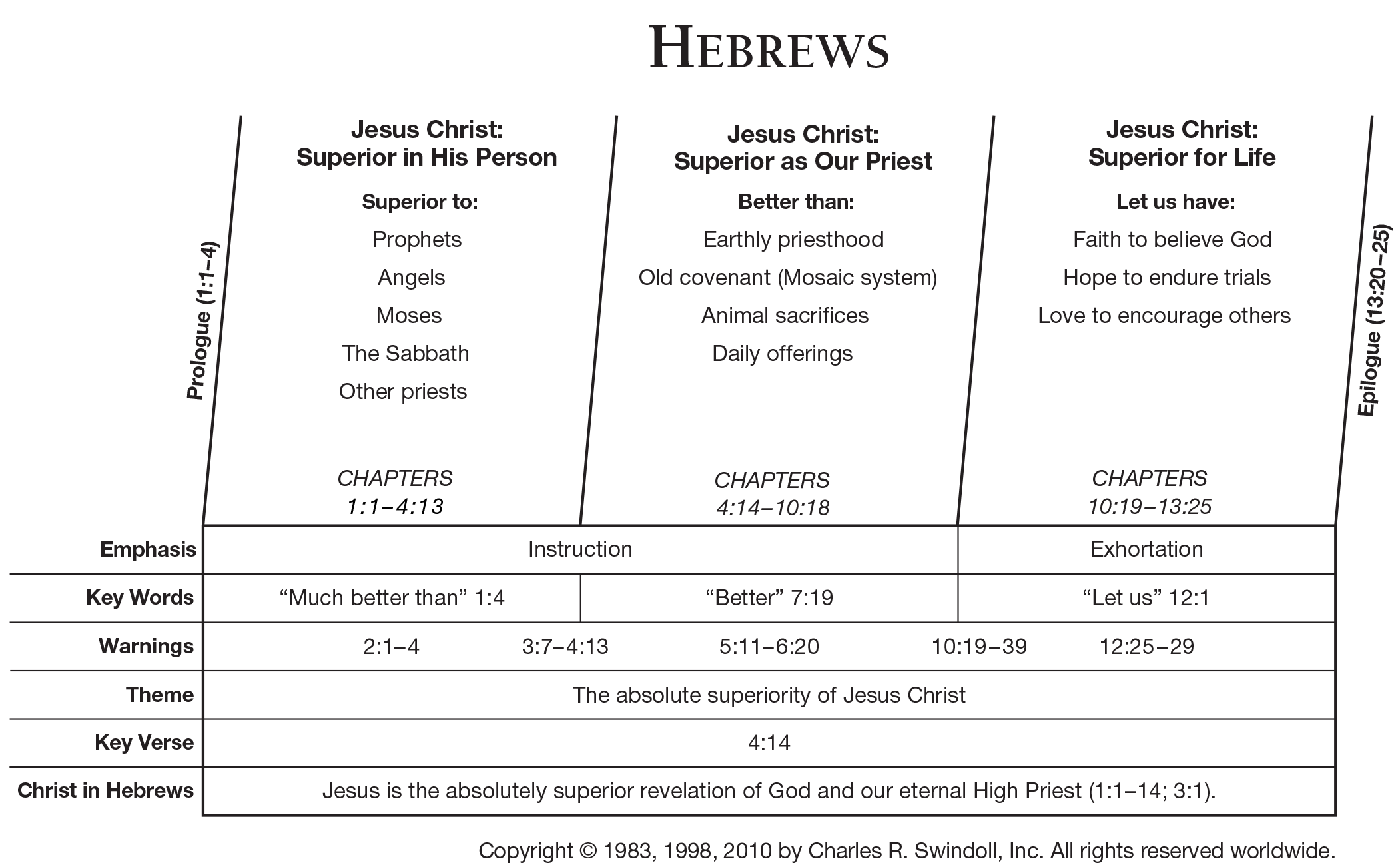
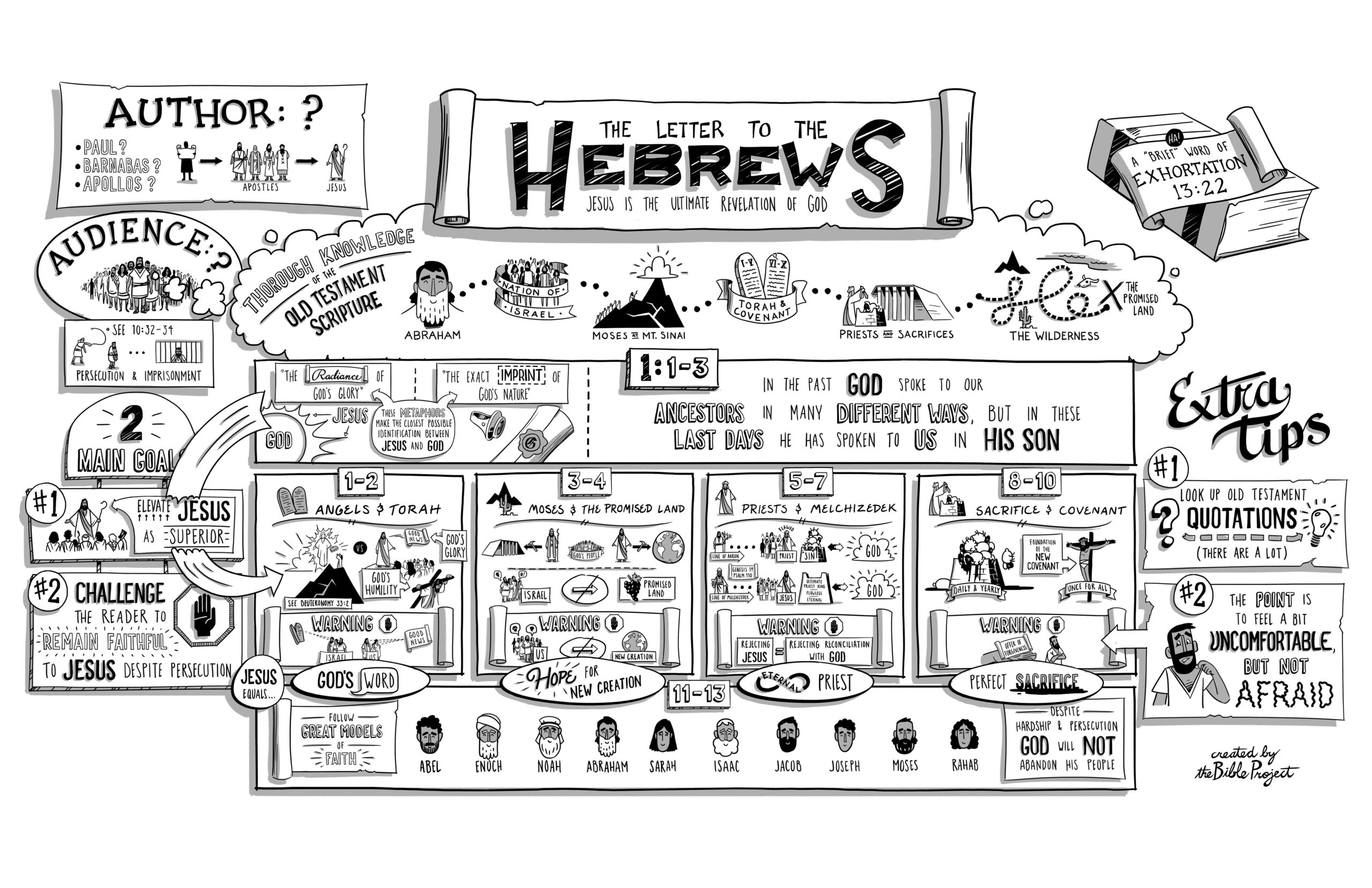
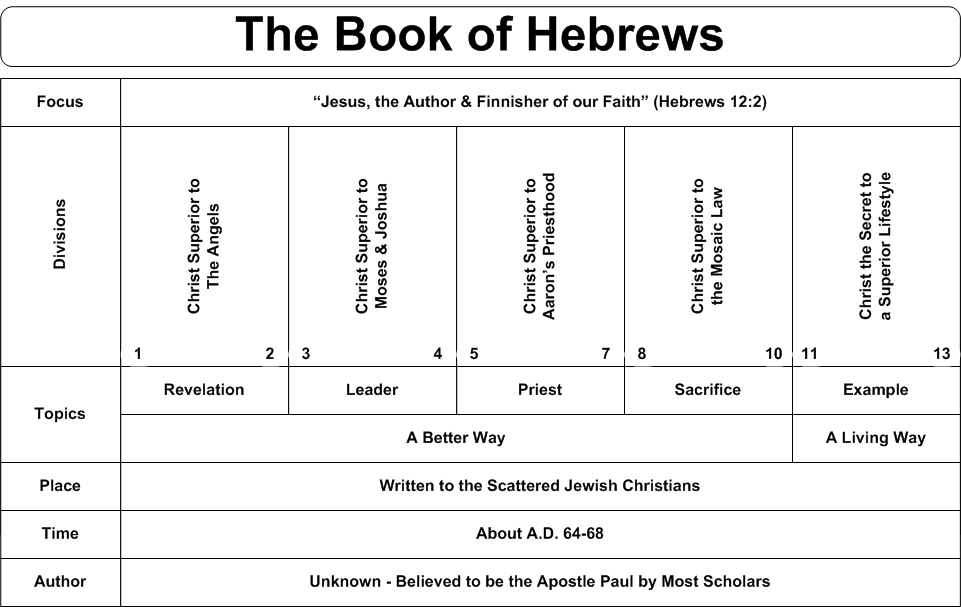
Patience (3115) (makrothumia from makros = long, distant, far off, large + thumos = temper, passion, emotion or thumoomai = to be furious or burn with intense anger) is literally long-temper (as opposed to "short tempered - picture a "long fuse" on a stick of dynamite!), a long holding out of the mind before it gives room to action or passion. It describes a state of emotional calm or quietness in the face of provocation, misfortune or unfavorable circumstances. Makrothumia is the capacity to be wronged and not retaliate. It is the ability to hold one's feeling in restraint or bear up under the oversights and wrongs afflicted by others without retaliating. It is manifest by the quality of forbearance under provocation. It is used of God's patience toward sinful men (see note Romans 2:4) and of the attitude which Christians are to display. Patience is the spirit which never gives up for it endures to the end even in times of adversity, exhibiting self-restraint such that it does not hastily retaliate a wrong. Vine says makrothumia is the opposite of anger. It follows that a lack of patience often leads to wrath or revenge.
MAKROTHUMIA - 14V- Rom. 2:4; Rom. 9:22; 2 Co. 6:6; Gal. 5:22; Eph. 4:2; Col. 1:11; Col. 3:12; 1 Tim. 1:16; 2 Tim. 3:10; 2 Tim. 4:2; Heb. 6:12; Jas. 5:10; 1 Pet. 3:20; 2 Pet. 3:15
Makrothumia is often used in the OT to translate the Hebrew phrase ('erekh 'appayim) which is literally “long of nose” (or “breathing”), and, as anger was indicated by rapid, violent breathing through the nostrils, “long of anger,” or “slow to anger.” This Hebrew phrase ('erekh 'appayim) and the LXX translation as makrothumia (and the cognates makrothumos, makrothumeo) is included in the catalog of His attributes that runs through the OT like a refrain, a God "slow to anger" (Click 14 occurrences of this phrase in the OT).
J Vernon McGee writes that makrothumia…"means “long-burning”—it burns a long time. We shouldn’t have a short fuse with our friends and Christian brethren. We shouldn’t make snap judgments." (See Thru the Bible)
Evans writes that makrothumia "could be translated “large emotions,” signifying wells of endurance that will not dry up, no matter how much is drawn from them. The Christian with this patience will have refreshing water to sustain continual effectiveness even in the face of unrelenting pressures. Those with such patience and faith are those who receive or “inherit the promises.” (The Preacher's Commentary Series, )
Calvin said makrothumia refers to that quality of mind that disposes us “to take everything in good part and not to be easily offended.”
Larry Richards writes that "The NT contains many exhortations to be patient. But just what is patience? The Greek word group (makrothumeo/makrothumia) focuses our attention on restraint: that capacity for self-control despite circumstances that might arouse the passions or cause agitation… This is not so much a trait as a way of life. We keep on loving or forgiving despite provocation, as illustrated in Jesus' pointed stories in Mt 18." (BORROW Expository Dictionary of Bible Words)
This long-suffering is not added to faith but is an integral part of it, because faith’s vision will produce patient tenacity. To the storm-tossed, persecuted little church that was facing mounting waves, the message was clear: fix your eyes on Jesus (see Fix Your Eyes On Jesus - 44 excellent meditations), looking by faith (seeing the unseeable 2Co 4:18, see Heb 11:26-27+, Heb 12:1-2+) on the great unseen heavenly realities that await you and do so with longsuffering and do it diligently, which will make your hope sure.
Inherit (2816) (kleronomeo from kleros = a lot + nemomai = to possess) means receive a share of that which has been "allotted" to one and so to inherit a portion of something.
KLERONOMEO - 17V - Matt. 5:5; Matt. 19:29; Matt. 25:34; Mk. 10:17; Lk. 10:25; Lk. 18:18; 1 Co. 6:9; 1 Co. 6:10; 1 Co. 15:50; Gal. 4:30; Gal. 5:21; Heb. 1:4; Heb. 1:14; Heb. 6:12; Heb. 12:17; 1 Pet. 3:9; Rev. 21:7
Peter uses this verb exhorting his readers "not returning evil for evil, or insult for insult, but giving a blessing instead; for you were called for the very purpose that you might inherit a blessing. (see note 1 Peter 3:9)
Kleronomeo is used in the Septuagint (LXX) translation of Genesis 22:17 describing the inheritance of Abraham's offspring…"indeed I will greatly bless you (blessing I will bless you = this Hebrew construction stresses the intensive nature of the action; i.e., I will bless you hyper-superabundantly!), and I will greatly multiply your seed as the stars of the heavens, and as the sand which is on the seashore; and your seed shall possess (Lxx = kleronomeo) the gate of their enemies. (Comment: This verse is quoted in part by the writer - "I WILL SURELY BLESS YOU, AND I WILL SURELY MULTIPLY YOU.")
Promises (1860) (epaggelia/epangelia from epí = upon or intensifier of meaning + aggéllo = tell, declare = to announce with certainty as to what one will do) is a declaration to do something with implication of obligation to carry out what is stated. Epaggelia was a legal term denoting promise to do or give something. It was a legally binding declaration giving one to whom it is made right to expect or claim performance of the specific act. Most often epaggelia is used to describe the promises of God. and provides firm assurance of His future action.
Epaggelia is used in Hebrews 14 times in 13 verses (27.4% of all 51 NT uses) (See notes Hebrews 4:1, Hebrews 6:12, 6:15, 6:17, Hebrews 7:6, Hebrews 8:6, Hebrews 9:15, Hebrews 10:36, Hebrews 11:9, 11:13, 11:17, 11:33, 11:39)
TDNT summarizes this word group writing that it has the following nuances - a. The first sense is “to indicate,” “declare,” “declaration,” “report.” b. When the state declares something, it becomes an “order.” c. In law we find the senses “accusation” and “delivery of a judgment.” d. We then find the senses “to declare an achievement,” “to show one's mastery,” “to profess a subject.” e. Another sense is “to offer,” “to promise,” “to vow.” As regards promises, tension between word and deed is felt, so that promises are often seen as worthless. f. A special type of promise is the “promise of money,” and in this sense the idea of a “subscription” or “donation” arises (state liturgies, gifts to rulers at their accession, priests promising gifts in support of their candidature). g. In the Hellenistic period we also find a sacral use for the “proclamation” of a festival. Among all the instances, only one example has been found for the promise of a deity. (Kittel, G., Friedrich, G., & Bromiley, G. W. Theological Dictionary of the New Testament. Eerdmans)And so the writer proceeds forthwith to remind the Jewish readers of the example of "father Abraham" who serves as the prototype illustration of a man who through faith and patience inherited the promises. All the examples of faith in Hebrews 11 also serve to illustrate and motivate a long outlook of faith, for many of these examples are accompanied by patient waiting and endurance (see notes on Abraham Hebrews 11:9; 11:10). The example of Abraham also reaffirms that the promise of God is sure and trustworthy, because that promise is founded on the absolute faithfulness of the covenant keeping God. (Related resource: Covenant: Abrahamic vs Old vs New)
As an African chief once said: "A good example is the tallest kind of preaching."
Here is a life to imitate - John Berridge - A LIFE TO IMITATE – The writer of Hebrews exhorts us be “imitators of those who through faith and patience inherit the promises.”(Heb 6:12) John Berridge (1716-1793) was a man who inherited the promises and is one we would all do well to imitate. C H Spurgeon thought highly of Berridge whom he dubbed the “countryside peddler of the Gospel” a peddler in the Pauline mold and “not like many, peddling (adulterating and corrupting for profit) the Word of God, but as from sincerity (clarity, purity), but as from God, (speaking) in Christ in the sight of God.” (2Cor 2:17). Indeed, John Berridge was a “peddler”, a prolific proclaimer of “Christ crucified.” (1Cor 1:23) His words in the following verse typify his Gospel centered, Spirit controlled life...
By thy Word we fain [gladly] would steer,
Fain [gladly] Thy Spirit’s dictates hear;
Save us from the rocks and shelves,
Save us chiefly from ourselves!
(Shelves = sand banks rendering sea shallow & dangerous to ships)
In the 1700’s John Berridge attracted some of the largest crowds to ever hear the Gospel preached in the open air. In one year more than 4000 souls came to Christ under his preaching.
My favorite story about Berridge based on Second Timothy 4:2 “Preach the Word in season & out of season.” Berridge had been wonderfully saved some 5 years AFTER entering the ministry (yes you read correctly – he was SAVED while in the ministry!) and he began boldly preaching the Gospel in surrounding parishes at all hours on EVERY day of the week! Angry clergy complained that the Anglican bishop must reprove Berridge for his preaching. The Bishop declared “I hear you are ALWAYS PREACHING, you don’t seem to be doing anything else.” Berridge replied, “My lord, I only preach during two seasons of the year.” The bishop said, “I’m glad to know that. What seasons are they?” Berridge quickly responded, “IN SEASON & OUT OF SEASON, my lord!” Hallelujah!
May his tribe increase!
Amen
John Piper gives us a example of a saint of days past to imitate - Charles Simeon - Brothers, We Must Not Mind a Little Suffering Meditations on the Life of Charles Simeon - here is a snippet. If you don't know Charles Simeon, you are missing out! In fact I would suggest that you listen to Piper's study (link is on the page above) (I found them better than the written versions).
The vicar of Trinity Church died in October, 1782, just as Charles Simeon was about to leave the university to live in his father's home. Simeon had often walked by the church, he tells us, and said to himself, "How should I rejoice if God were to give me that church, that I might preach the Gospel there and be a herald for Him in the University" (Moule, 37). His dream came true when Bishop Yorke appointed him "curate-in-charge" (being only ordained a deacon at the time). His wealthy father had nudged the Bishop and the pastor at St. Edwards, where Simeon preached that summer, gave him an endorsement. He preached his first sermon there November 10, 1782.
But the parishioners did not want Simeon. They wanted the assistant curate Mr. Hammond. Simeon was willing to step out, but then the Bishop told him that even if he did decline the appointment he would not appoint Hammond. So Simeon stayed – for fifty-four years! And gradually – very gradually – overcame the opposition.
The first thing the congregation did in rebellion against Simeon was to refuse to let him be the Sunday afternoon lecturer. This was in their charge. It was like a second Sunday service. For five years they assigned the lecture to Mr. Hammond. Then when he left, instead of turning it over to their pastor of five years they gave it to another independent man for seven more years! Finally, in 1794, Simeon was chosen lecturer. Imagine serving for 12 years a church who were so resistant to your leadership they would not let you preach Sunday evenings, but hired as assistant to keep you out.
Simeon tried to start a later Sunday evening service and many townspeople came. But the churchwardens locked the doors while the people stood waiting in the street. Once Simeon had the doors opened by a locksmith, but when it happened again he pulled back and dropped the service.
The second thing the church did was to lock the pew doors on Sunday mornings. The pewholders refused to come and refused to let others sit in their personal pews. Simeon set up seats in the aisles and nooks and corners at his own expense. But the churchwardens took them out and threw them in the churchyard. When he tried to visit from house to house, hardly a door would open to him. This situation lasted at least ten years. The records show that in 1792 Simeon got a legal decision that the pewholders could not lock their pews and stay away indefinitely. But he didn't use it. He let his steady, relentless ministry of the word and prayer and community witness gradually overcome the resistance.
But I mustn't give the impression that all the troubles were over after the first 12 years. After years of peace, in 1812 (after he had been there 30 years!) there were again opponents in the congregation making the waters rough. He wrote to a friend, "I used to sail in the Pacific; I am now learning to navigate the Red Sea that is full of shoals and rocks." Who of us would not have immediately concluded at age 53, after thirty years in one church that an upsurge of opposition is a sure sign to move on? But again he endured patiently and in 1816 he writes that peace had come and the church is better attended than ever.
Matthew Henry- Hebrews 6:11-12
The hope here meant, is a sure looking for good things promised, through those promises, with love, desire, and valuing of them. Hope has its degrees, as faith also. The promise of blessedness God has made to believers is from God’s eternal purpose, settled between the eternal Father, Son, and Spirit. These promises of God may safely be depended upon; for here we have two things which cannot change, the counsel and the oath of God, in which it is not possible for God to lie; it would be contrary to his nature as well as to his will. And as he cannot lie; the destruction of
the unbeliever, and the salvation of the believer, are alike certain. Here observe, those to whom God has given full security of happiness, have a title to the promises by inheritance. The consolations of God are strong enough to support his people under their heaviest trials. Here is a refuge for all sinners who flee to the mercy of God, through the redemption of Christ, according to the covenant of grace, laying aside all other confidences. We are in this world as a ship at sea, tossed up and down, and in danger of being cast away. We need an anchor to keep us sure and steady. Gospel hope is our anchor in the storms of this world. It is sure and steadfast, or it could not keep us so
Robert Morgan has an illustration entitled "It Stirs Me Up Much"…
Jim Elliot, who gave his life while trying to reach the Auca Indians, was largely shaped through the reading of Christian biography.
“I see the value of Christian biography tonight,” he wrote in his journal, “as I have been reading Brainerd’s Diary much today. It stirs me up much to pray and wonder at my nonchalance while I have not power from God. I have considered Hebrews 13:7 (note) just now, regarding the remembrance of certain ones who spake the word of God, ‘consider the outcome of their life, and imitate their faith.’
I recall now the challenge of Goforth’s Life and By My Spirit, read in the summer of 1947, the encouragement of Hudson Taylor’s Spiritual Secret, and The Growth of a Soul. There are incidents which instruct me now from the reading of J. G. Paton’s biography, read last winter. And now this fresh Spirit-quickened history of Brainerd. O Lord, let me be granted grace to ‘imitate their faith.’ ”
It has since been through the reading of Elliot’s journals that scores of young people have given their lives to the service of the Gospel. (Morgan, R. J. Nelson's Complete Book of Stories, Illustrations, and Quotes: Thomas Nelson Publishers) (I highly recommend reading Hudson Taylor's "Spiritual Secret" which can be downloaded free at here)
Instant Nothing - In a lighthearted Time magazine essay, Sarah Vowell tells that she signed up for a 3-hour, $39 course called "Instant Piano for Hopelessly Busy People." Regretting that she didn't stick with music lessons as a child, she made it her goal to learn to play one piece by memory. What she found was that even this seemingly simple task required hours of practice. There is no such thing as "instant" piano. But as she continued to practice, a recognizable melody began to emerge from her fingers.
Her experience is a good reminder that though we often desire immediate results in our walk of faith, this too is a matter of patient practice. The writer of Hebrews encouraged Christians to be spiritually diligent throughout their lives. He urged them not to become sluggish but to "imitate those who through faith and patience inherit the promises" (Hebrews 6:12).
Our efforts do not make God's promises come true. But like Abraham, who patiently endured, we focus on the power and integrity of the living God, whose promises give us hope. "This hope we have as an anchor of the soul" (Hebrews 6:19).
Since there are no instant results, let's keep practicing the Lord's instructions as we walk patiently by faith toward the fulfillment of all He has promised. —David C. McCasland (Our Daily Bread, Copyright RBC Ministries, Grand Rapids, MI. Reprinted by permission. All rights reserved)
We run with patience day by day,
By drawing strength from Christ our Lord;
And if we falter by the way,
He will renew us through His Word. —D. De Haan
We conquer by continuing.
The Treasure Chest -- When I was a young girl, my mother often let me rummage through her button box as I recovered from an illness. It always cheered me to come across old, familiar buttons and remember the garments they once adorned. I especially liked it when she picked out an old, overlooked button and used it again.
Similarly, I often leaf through my Bible during distressing times and recall familiar promises that have strengthened me. But I'm always encouraged to find help from promises I've never noticed before.
I remember one dark morning during my husband's terminal illness when I was looking for a word from God to sustain me in our painful circumstances. In Hebrews 11, I noted that God had rescued His suffering people in some very dramatic ways. Yet I couldn't always identify with their particular situations. Then I read about some who "out of weakness were made strong" (Heb 11:34). God used that phrase to assure me that I too could be made strong in my weakness. At that very moment I began sensing His strength, and my faith was renewed.
Are you being tested today? Remember, there are many promises in the Bible, God's treasure chest. Generations have proven them true, and so can you. —Joanie Yoder (Our Daily Bread, Copyright RBC Ministries, Grand Rapids, MI. Reprinted by permission. All rights reserved)
Standing on the promises that cannot fail,
When the howling storms of doubt and fear assail,
By the living word of God I shall prevail,
Standing on the promises of God. —Carter
God's promises are treasures waiting to be discovered