Judges 14:2
Judges 14:3
Judges 14:4
Judges 14:5
Judges 14:6
Judges 14:7
Judges 14:8
Judges 14:9
Judges 14:10
Judges 14:11
Judges 14:12
Judges 14:13
Judges 14:14
Judges 14:15
Judges 14:16
Judges 14:17
Judges 14:18
Judges 14:19
Judges 14:20
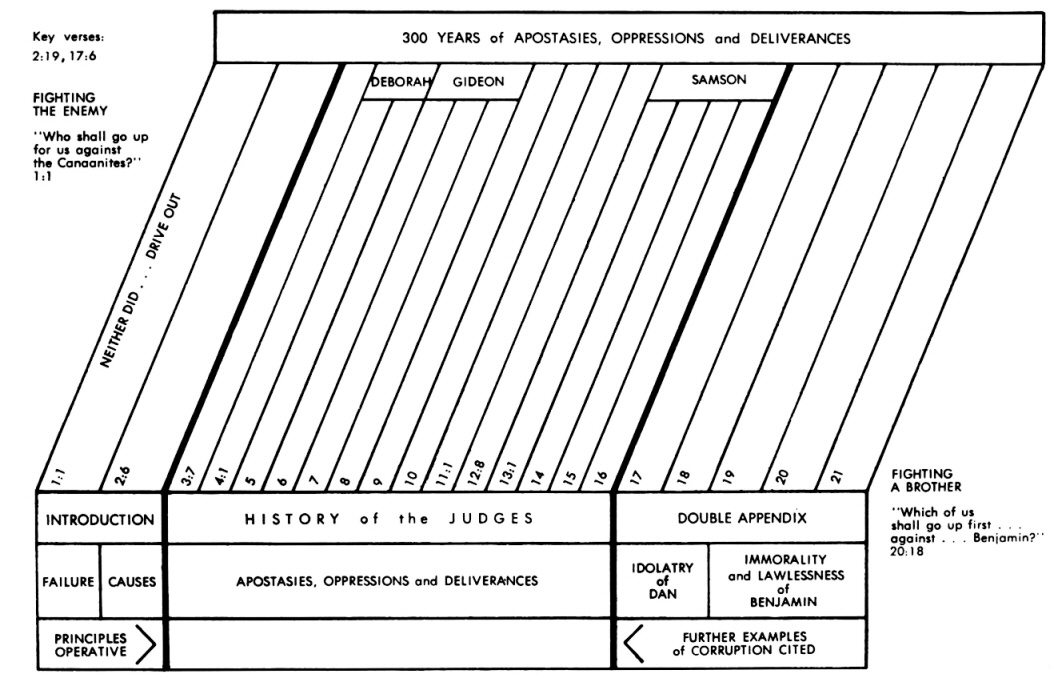
Chart from recommended resource Jensen's Survey of the OT - used by permission
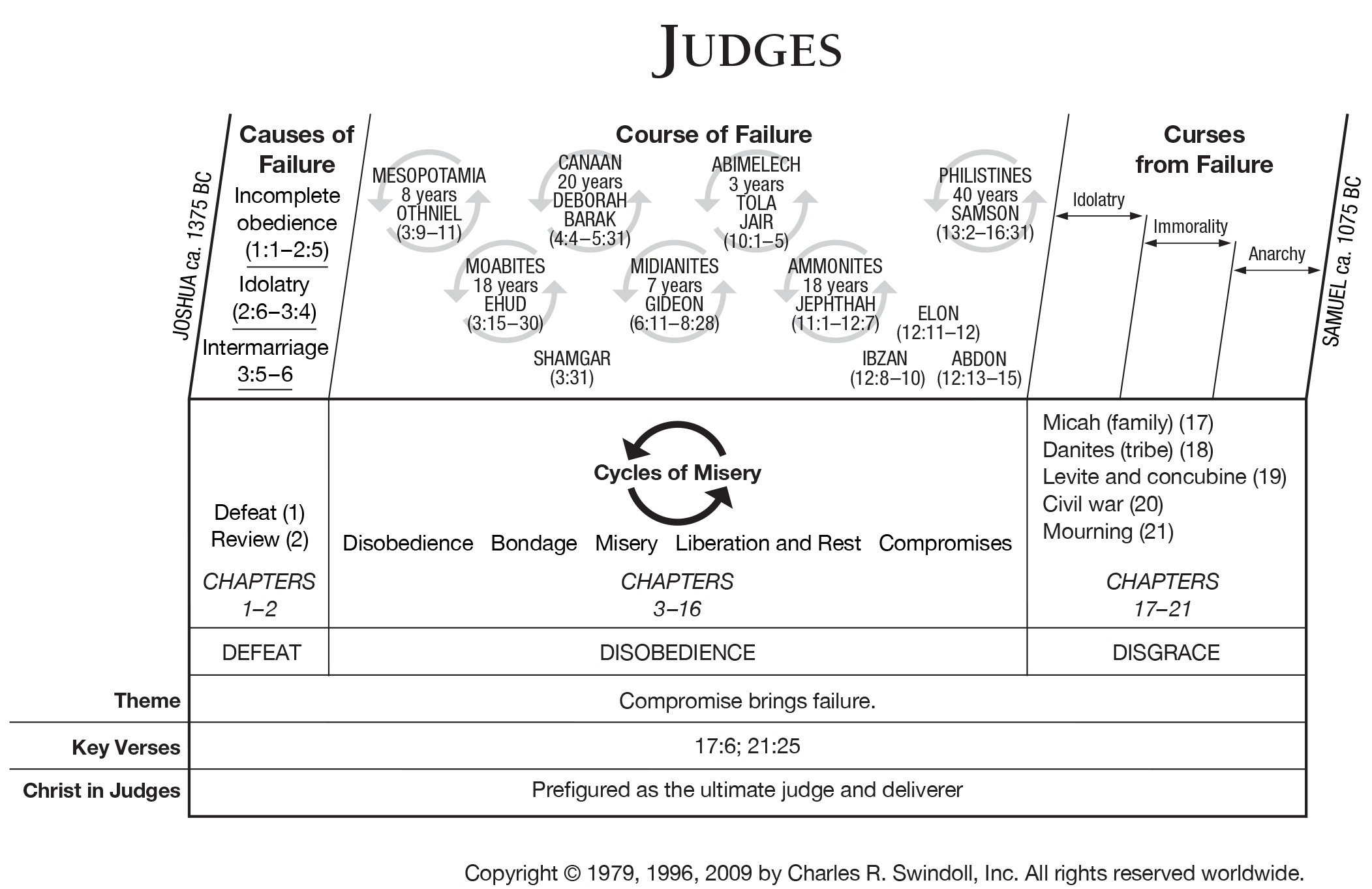
Chart on Judges - Charles Swindoll
|
RECYCLING SIN |
|||||
| Jdg 1:1-3:6 | Jdg 3:7-16:31 | Jdg 17:1-21:25 | |||
| Introduction | History of the Judges | Appendix | |||
| Causes of the Cycles THE REASON |
Curse of the Cycles THE RECORD |
Conditions in the Cycles THE RESULTS |
|||
| Failure to Complete Conquest Jdg 1:1-36 God's Judgment for Failure Jdg 2:1-3:6 |
Curse of the Cycles |
Conditions in the Cycles |
|||
| Living with Canaanites |
War with the Canaanites |
Living Like the Canaanites |
|||
| Religious Laxity |
Political Uncertainty |
Moral Anarchy |
|||
| About 350 Years of Israel's History - Almost 25%! From Compromise to Confusion! |
|||||

Another Timeline of Israel's History
Click to Enlarge
from Jensen's Survey of the OT
Click to Enlarge
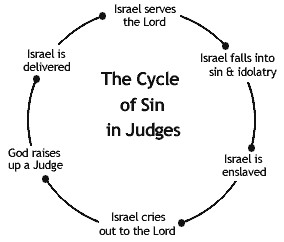
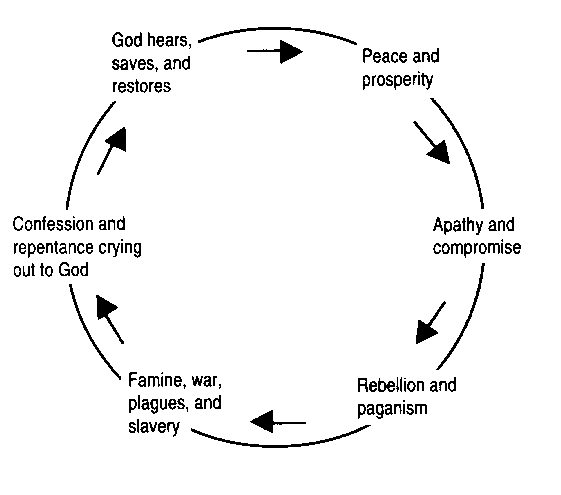
Other ways to describe Israel's cycle…
- Rest > Rebellion > Retribution > Repentance (?) > Restoration
- Sin > Suffering/Servitude > Supplication > Salvation
- Apathy > Apostasy > Affliction > Answered Prayer
- Disobedience > Desperation > Deliverance
- Disobedience > Bondage >Misery > Liberation and Rest > Compromises
Dale Ralph Davis - For convenience chapters 14–16 can be divided into six main episodes. Each episode is structured around these two basic elements: a Philistine success followed by a Samsonite disaster. The outline is this:
Episode 1 Jdg 14:5–20
Solution—answer to riddle
Failure—slaughter at Ashkelon
Episode 2 Jdg 15:1–6a
Solution—Samson gone, peace
restored, girl given to best man
Failure—flaming foxes
Episode 3 Jdg 15:6b–8
Solution—burn up Timnite woman
and father
Failure—slaughter by Samson
Episode 4 Jdg 15:9–17
Solution—Samson bound,
handed over
Failure—‘Jawbone Hill’
Episode 5 Jdg 16:1–3
Solution—Ambushing the playboy
Failure—portable gates
Episode 6 Jdg 16:4–30
Major pattern:
Solution—hair shaved
Failure—tragedy at Dagon’s Place
Subsidiary patterns:
Solution/failure—7 bowstrings (Jdg 16:6–9a/9b)
Solution/failure—new ropes (Jdg 16:10–12a/12b)
Solution/failure—loom (Jdg 16:13–14a/14b)
Solution/success—razor (Jdg 16:15–19a/19b–21)
From Judges: Such a Great Salvation - highly recommended resource - get it if you are going to preach or teach Judges!
Judges 14:1 Then Samson went down to Timnah and saw a woman in Timnah, one of the daughters of the Philistines.
- Timnath: Ge 38:12,13 Jos 15:10 19:43, Ge 6:2 34:1,2 2Sa 11:2 Job 31:1 Ps 119:37 1Jn 2:16
- Judges 14 Resources
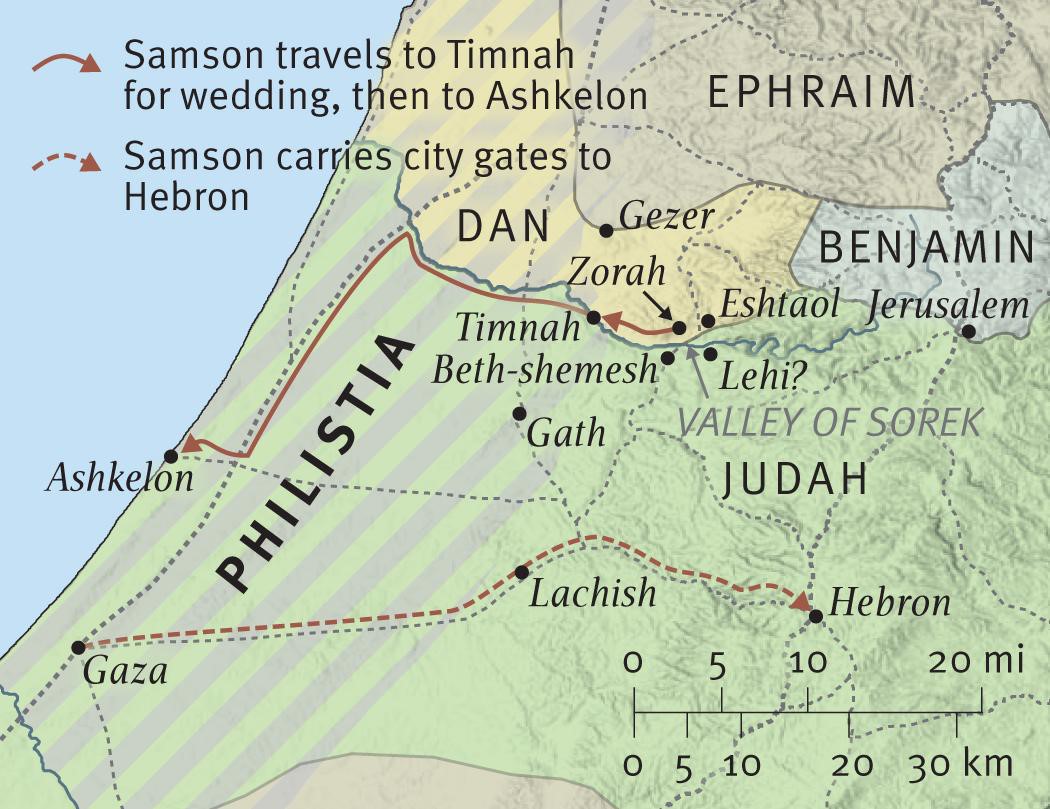
Down...Down...Down...to Timnah (see above)
(ESV Study Bible)
DOWN...DOWN...DOWN
Then - This word often marks succession or sequence (see expressions of time) so that whenever a "then" is encountered one should always ask questions like "When is then?" or "What is the sequence of events that is being emphasized?" At times this interrogation can yield very fruitful answers which help greatly in the interpretation of a section of Scripture. Observation of "then" in prophetic writings can be especially valuable to explain a succession of prophetic events. In this case the then follows the phrase that "the Spirit of the LORD began to stir him" (Jdg 13:25). However the events that follow clearly indicate that Samson was not obedient to the Spirit's stirring (and warning)! In fact, Samson's subsequent actions seem more representative of the "national motto" in which everyone did that which was right in his own eyes (Jdg 21:25+) rather than what was right in God's eyes! So here we have a man who was set apart (Nazarite conveys the idea of separated and in context specifically to the LORD and His uses) from his mother's womb with the appointed task to begin to deliver (see Jdg 13:5+) Israel from the hand of the Philistines. Instead one of his first "official functions" as Israel's deliverer was to spy out a Philistine woman!
Samson went down to Timnah (note) - He went down physically and spiritually! His entire life as a Nazirite judge of Israel was downward! Beware when you began to go "down!" (cf Backsliding) In the map above note that Timnah is on the border with Philistia and about 4 miles westward down the valley of Sorek, about 5 miles west of Beth-shemesh, a little over 20 miles straight west of Jerusalem, approximately 4 miles southwest of Zorah (Jdg 13:25).
Down in Judges 14 - Jdg. 14:1; Jdg. 14:5; Jdg. 14:7; Jdg. 14:10; Jdg. 14:18; Jdg. 14:19;
Down in Judges 15-16 - Jdg. 15:8; Jdg. 15:11; Jdg. 15:12; Jdg. 16:21; Jdg. 16:31;
Cundall - Timnah was a little more than 4 miles to the south-west of Zorah, on the other side of the vale of Sorek. Its occupation by the Philistines demonstrates their penetration of Israelite territory and its peaceful nature, for Samson appears quite free to come and to go, and there was no barrier to his marriage from their side. But the fact of Philistine domination, however peaceful, is noted in 4b. It is also attested by archaeological evidence, for ‘Philistine’ ware, a distinctive type of pottery manufactured in this period, is widely distributed at sites in the Shephelah and Negeb dating from the period after c. 1150 BC. The proximity of Timnah and Zorah—a little more than an hour’s stroll separated them—may account for the apparent confusion which some commentators have found in the narrative concerning the journeys to and from Timnah, e.g. the visit of Samson’s parents to Timnah is noted in verse 5 but no account is given of their return. However, in view of the insignificant journey involved this was hardly worth mentioning. (Borrow Judges & Ruth: Tyndale Old Testament Commentary)
ESV Study note on Timnah - Timnah is located at modern Tel Batash (ED: picture of ruins) which lies in the Shephelah (foothills) near the southern bank of the Nahal (or dry river bed) Sorek. Excavations here have uncovered a thriving Philistine city during the period of the Judges (Early Iron Age) with impressive fortifications constructed of mud-brick on stone. (See context in ESV Study Bible or borrow the ESV study Bible).

And saw a woman in Timnah, one of the daughters of the Philistines: The saga of Samson begins and ends the same way, with Samson displaying an unwillingness to control his passions one manifestation of which was a fatal weakness for Philistine women. It was "lust" at first sight! In the Israelite society the father was recognized as the head of the family and as such chose wives for his sons (cp Ge 21:21). But Samson made his own choice. Even though called to live a separated life to God he directly betrayed his calling as well as directly disobeyed the Word of God (Ex 34:12-15,16; Dt 7:1-2,3; cp 2Co 6:14-18). Samson was living by sight and not by faith. He was controlled by “the lust of the eyes” (1Jn2:16) rather than by the Law of the Lord & the Spirit of the LORD (cp Ro 8:13). The important thing to Samson was not pleasing the Lord, or even pleasing his parents, but pleasing himself (Jdg 14:3, 7, cp 2Co5:14,15, Php 2:3,4).
Gary Inrig on saw a woman in Timnah - That innocuous statement is a window into Samson’s soul: he is a man dominated by his appetites and his desires, and he has a particular weakness for foreign women. (borrow Hearts of Iron, Feet of Clay or see his Journey Through Judges a 50 part series).
Guzik has an interesting note - This seemed to be a case of “love at first sight” for Samson. He saw this woman and he instantly wanted to marry her.. She pleases me well is literally, “she is right in my eyes.” What Samson really cared about was how things looked to himself, not how they looked to the LORD. Love at first sight is a powerful, but dangerous thing. It is entirely possible for us to fall in love with someone that we have no business falling in love with—which was exactly the case with Samson here. As well, love at first sight feels wonderful, but doesn’t last in its initial form forever. We can be attracted more to the feeling of love itself than the person we focus upon—whom we don’t really know at first sight. (Judges 14)
Samson willfully disregarded loyalty to Yahweh and sought a pagan wife. The presence of Philistines at Timnah reveals their occupation of Israelite territory. Philistine rule was more subtle and peaceful than the other periods of oppression, since Samson and presumably others were free to intermarry with the Philistines. Even the tribe of Judah was content to let the Philistines control them, a sign that a fairly normal life was possible (15:11).
Three things were wrong about Samson's relationship:
1) It is evident from this paragraph that he really cared nothing for this girl as a person. He simply saw her and wanted her. She was an object to be used, to be possessed. There was no recognition that she was a person with needs, a person of worth and value. This is "impulse" buying at its worst!
2) The Old Testament scriptures, which Samson possessed, were very clear about God's prohibition of intermarriage between the Israelites and surrounding pagan nations (ED: BUT SEE MACARTHUR'S NOTE BELOW). This provision stemmed from God's love. He knew that if they married into these idolatrous peoples the nation of Israel itself would become idolatrous. Heathen wives would pollute the households with their idols. And God knew that wives chosen out of these nations would be miserable as well. To be unequally yoked in this way would result in a relationship which would chafe both parties. So because he loved his people, and because he loved the world, God had commanded that they were not to intermarry with unbelievers. But Samson cared nothing for this. He saw the girl and he wanted her.
3) He disobeyed his parents. Again, the Scriptures which Samson had were very clear. Children were to obey their parents so that they might live long in the land which the Lord had given to them. God never stuttered at that point. That was Standard Operating Procedure. It is clear that these parents were interposed by God between this girl and their son in order to save Samson from a disaster. But he would not listen; he disobeyed. He insisted on having his own way. So he said to his father, "Get her for me, for she pleases me well." His passions reigned. This was the area of his life which ultimately brought him to defeat, because he would not deal with it.
All of this wonderful heritage the grown Samson despised! Instead of putting himself in God’s hands to accomplish his God-given task, he chose to live to please himself. How tragic it is when God gives a young person a wonderful heritage and a great opportunity, and he or she treats it lightly.
What a name Samson had been given -- "sunlight, sun-like, sunny". Samson is a sobering reminder that great abilities or potential do not necessarily equate with great great faith, specifically faith that shows itself in obedience (see related discussion - Obedience of faith). Samson had a miraculous birth, godly parents, a life-long Nazarite vow and special ministry by the Spirit. God had given the Spirit to Samson in an unparalleled way, so that whenever Samson stood in need of physical strength, it was unreservedly supplied to him. As Paul pointed out, one can “speak with the tongues of men and of angels” yet live a life of loveless emptiness (1Co 13:1+). Let us not just read about Samson, but learn from Samson! We can be in the Bible (even daily) and yet not allow the Bible in our heart and mind and soul (allowing it to transform [2Co 3:18+] and empower us to live a life of "strong faith," faith that enables us to resist the powerful temptations to sin and faith that enables us to obey, even when it is costly!
THOUGHT - Believers today can live like Samson, failing to exert self discipline and refusing to wholeheartedly commit to the Lord Jesus Christ (cf Dt 10:12-13+, Micah 6:8+, Mk 12:30-31). The result? Just like Samson, even though blessed with every spiritual blessing in the heavenly places in Christ (Ep 1:3) and having been granted by our Lord Jesus Christ everything necessary for life and godliness (2 Pe 1:3), they fail to live up to their potential in Christ, in fact falling far short of what God had designed (Ep 2:10) and desired for them as men and women redeemed out of bondage by the blood of Christ. And so Samson's story makes for painful reading to most all saints, as we tend to see various aspects of our failings brought out by his glaring failures.
God used 15% of the book of Judges (96/618v) to portray the warning of Samson's life to all saints of all ages! And so we wince as we read Samson's story. Let us read and heed though (1Co 10:6,11,12) not deluded into thinking that this could never happen to us! Samson may well have been the strongest man who ever lived but sadly he proved one of the weakest when it came to self control
Proverbs 16:32; He who is slow to anger is better than the mighty, And he who rules his spirit, than he who captures a city.
Proverbs 16:25 There is a way which seems right to a man, But its end is the way of death.
Proverbs 19:11 A man’s discretion makes him slow to anger, And it is his glory to overlook a transgression.
These were sad times and needed a godly judge to deliver Israel. The priesthood was corrupt under Eli's sons Hophni and Phinehas who were "worthless men" (1Sa 2:12 where the literal Hebrew reads "sons of Belial"!) and profaned the offerings ("despised the offering of the LORD" 1Sa 2:17). Scripture sums up these times in [1Sa 3:1] -- "word from the LORD was rare in those days… "
Warren Wiersbe - According to Hebrews 11:32, Samson was a man of faith, but he certainly wasn’t a faithful man. He wasn’t faithful to his parents’ teaching, his Nazirite vow, or the laws of the Lord. It didn’t take long for Samson to lose almost everything the Lord had given him, except his great strength; and he finally lost that as well. (See context in The Bible Exposition Commentary)
Ray Pritchard - He Went to The Wrong Place - Judges 14 begins this way: “Samson went down to Timnah.” (1) the writer is telling us two things in that little phrase. First, he is telling us something about geography. Timnah was in Philistine territory, about four miles from Samson’s village of Zorah. To get there, you walked down a ridge into the Sorek River valley and up the other side. So it’s literally true—Samson went down to Timnah. But the writer is also telling us about the decline in Samson’s spiritual life. In this, his very first public act, he leaves the land of Israel for the land of the Philistines. To put it bluntly, Samson left his friends to visit his enemies. Verse 2 informs us that this was more than just a casual visit or a weekend shopping trip. Samson went to Timnah looking for a wife. But that was his first mistake: If he was looking for a wife, he shouldn’t have gone to the Philistines. If he wasn’t looking for a wife, he didn’t have any business there at all. Either way, he shouldn’t have been there. By going to Timnah, home of his sworn enemies, Samson is indeed “going down.” (Out of Control)
George Bush Samson went down to Timnah. A frontier town of Dan, lying close upon the borders of the Philistines’ country. It originally belonged to Judah, but was afterwards assigned to Dan. It was situated about twenty miles west of Jerusalem, and about twelve north-east of Eshtaol. There evidently had been some remissness on the part of Israel in driving out the Philistines from this place, but as the latter had now the upper hand; it is not surprising that they dwelt in the cities of the former, whom they had probably put under tribute, and although the two races were in an attitude of hostility towards each other, yet it seems not at this time to have interrupted all intercourse between them. Indeed the terms on which the Israelites lived and mingled with their devoted neighbors the Canaanites, as is evident from many parts of their history, were such as we should scarcely have expected from people so related. But ‘the holy seed’ in all ages has been too prone to cultivate intimacies and form alliances with the world of the ungodly. (resource)
Life In Conflict Judges 14:1-15:8 Samson's life was full of conflict, as this passage shows us.
- STUBBORN WILL - Jdg 14:1-4
- SECRET ADVENTURE - Jdg 14:5-9
- STRANGE RIDDLE - Jdg 14:10-14
- SURRENDERED ANSWER - Jdg 14:15-20
- SECURED REVENGE - Jdg 15:1-8
Warren Wiersbe - Samson had wandered four miles into enemy territory where he was captivated by a Philistine woman and decided to marry her. This, of course, was contrary to God’s Law (Ex. 34:12–16; Deut. 7:1–3; and see 2 Cor. 6:14–18). Samson was living by sight and not by faith. He was controlled by “the lust of the eyes” (1 John 2:16-note) rather than by the Law of the Lord. The important thing to Samson was not pleasing the Lord, or even pleasing his parents, but pleasing himself (Jdg. 14:3, 7, see 2 Cor. 5:14–15-note). The phrase “pleases me well” is literally “right in my eyes.” It reminds us that during the period of the Judges “every man did that which was right in his own eyes” (Jdg 17:6-note; Jdg 21:25-note). Instead of following the Lord, Samson was following the crowd and doing the “in” thing. (Be Available)
Keil and Delitzsch Commentary - Jdg. 14. Samson’s First Transactions with the Philistines.—Vv. 1–9. At Tibnath, the present Tibne, an hour’s journey to the south-west of Sur’a (see at Josh. 15:10), to which Samson had gone down from Zorea or Mahaneh-Dan, he saw a daughter of the Philistines who pleased him; and on his return he asked his parents to take her for him as a wife (לָקַח, to take, as in Ex. 21:9). (Judges 14 - Keil & Delitzsch Commentary)
TIMNAH [ISBE] tim'-na (timnah, timnathah (Josh 19:43; Jdg 14:1,2,5), "allotted portion; Codex Vaticanus Thamnatha; also several Greek variations; King James Version has Timnath in Gen 38:12,13,14; Jdg 14:1,2,5; and Thimnathah in Josh 19:43):
(1) A town in the southern part of the hill country of Judah (Josh 15:57). Tibna proposed by Conder, a ruin 8 miles West of Bethlehem, seems too far N. (PEF, III, 53, Sh XVII). It is possible this may be the "Timnah" of Gen 38:12,13,14.
(2) A town on the northern border of Judah (Josh 15:10), lying between Beth-shemesh and Ekron. It is probably the same Timnah as Judah visited (Gen 38:12-14), and certainly the scene of Samson's adventures (Jdg 14:1 f); his "father-in-law" is called a "Timnite" (Jdg 15:6). At this time the place is clearly Philistine (Jdg 14:1), though in Josh 19:43 it is reckoned to Dan. Being on the frontier, it probably changed hands several times. In 2 Ch 28:18 it was captured from the Philistines by Ahaz, and we learn from Assyrian evidence (Prison Inscription) that Sennacherib captured a Tamna after the battle of Alteka before he besieged Ekron (Schrader, Die Keilinschriften und das Altes Testament, 170). The site is undoubted. It is now a deserted ruin called Tibneh on the southern slopes of the Wady es Surar (Valley of Sorek), about 2 miles West of Beth-shemesh. There is a spring, and there are evident signs of antiquity (PEF, II, 417, 441, Sh XVI).
(3) There was probably a Timna in Edom (Gen 36:12,22,40; 1 Ch 1:39,51). Eusebius and Jerome (in Onomasticon) recognized a Thamna in Edom at their time.
(4) The "Thamnatha" of 1 Macc 9:50 (the King James Version) is probably another Timnah, and identical with the Thamna of Josephus (BJ, III, iii, 5; IV, viii, 1). This is probably the Tibneh, 10 miles Northwest of Bethel, an extensive ruin. E. W. G. Masterman
Judges 14:2 So he came back and told his father and mother, "I saw a woman in Timnah, one of the daughters of the Philistines; now therefore, get her for me as a wife."
Exodus 34:13-16+ (GOD'S INSTRUCTIONS SAMSON SHOULD HAVE KNOWN - HE HAD GODLY PARENTS - DID THEY TEACH HIM?) “But rather, you are to tear down their altars and smash their sacred pillars and cut down their Asherim 14 –for you shall not worship any other god, for the LORD, whose name is Jealous, is a jealous God– 15 otherwise you might make a covenant with the inhabitants of the land and they would play the harlot with their gods and sacrifice to their gods, and someone might invite you to eat of his sacrifice, 16 and you might take some of his daughters for your sons, and his daughters might play the harlot with their gods and cause your sons also to play the harlot with their gods.
Deuteronomy 7:3-4+ “Furthermore, you shall not intermarry with them; you shall not give your daughters to their sons, nor shall you take their daughters for your sons. 4 “For (TERM OF EXPLANATION - WHY NOT TO INTERMARRY) they will turn your sons away from following Me to serve other gods; then the anger of the LORD will be kindled against you and He will quickly destroy you
2 Corinthians 6:14-18+ (SAME INSTRUCTIONS APPLY TO BELIEVERS IN NT!) Do not be bound (present imperative with a negative see our need to depend on the Holy Spirit to obey) together with unbelievers; for what partnership have righteousness and lawlessness, or what fellowship has light with darkness? 15 Or what harmony has Christ with Belial, or what has a believer in common with an unbeliever? 16 Or what agreement has the temple of God with idols? For we are the temple of the living God; just as God said, “I WILL DWELL IN THEM AND WALK AMONG THEM; AND I WILL BE THEIR GOD, AND THEY SHALL BE MY PEOPLE. 17 “Therefore, COME OUT FROM (aorist imperative see our need to depend on the Holy Spirit to obey) THEIR MIDST AND BE SEPARATE (aorist imperative see our need to depend on the Holy Spirit to obey),” says the Lord. “AND DO NOT TOUCH (aorist imperative see our need to depend on the Holy Spirit to obey) WHAT IS UNCLEAN; And I will welcome you. 18 “And I will be a father to you, And you shall be sons and daughters to Me,” Says the Lord Almighty.
LOOKING FOR LOVE IN
ALL THE WRONG PLACES!
That title is taken from the name of an old country and western song that had a lot of Biblical truth in it! Indeed, Samson's life reminds me of the old cowboy song from the movie The Urban Cowboy - Looking for Love. As I listened to this old classic, I could not help but imagine these were almost exactly the "lyrics" of Samson's life song! While it is not a Christian song, you might give it a listen as you ponder the sad saga of Samson! And saddest of all Samson's song doesn't end like the song does, with the words "God bless the day I discovered you!" One could also subtitle this first scene in the saga of Samson - "Lust (not love) at first sight!"
So he came back and told his father and mother, "I saw a woman in Timnah, one of the daughters of the Philistines: These are the first words out of Samson's mouth!!! Samson was living by sight and not by faith. He was controlled by “the lust of the eyes” (1Jn 2:16) rather than by the Law of the Lord and the Spirit of the Lord. It becomes clear that the important thing to Samson was not pleasing the Lord, or even pleasing his parents, but pleasing himself (Jdg 14:3, 7, 2Co 5:14,15). This is amazing - Samson had not even talked with this woman if one reads the text literally. Instead, the text suggests that this set apart, Spirit endued man simply saw her and he wanted this pagan idol worshiper.
Warren Wiersbe - One evidence of spiritual decline can be the way we get along with our loved ones. “Samson went down… ” (Jdg 14:1) is true both spiritually and geographically. Instead of staying in the borders of Israel, he went into enemy territory and fell in love with a heathen woman. He knew the laws of separation God had given to the Jews, but he chose to ignore them (Ex 34:16 Dt 7:3 2Co 6:14-18; Ge 24:1-4). Note that he told his parents; he did not ask them. And when they reminded him of God’s law, he defied them. “Get her for me,” he insisted, “for she pleases me well!” It did not bother Samson that his desires displeased his parents. Note that in this instance God mercifully was going to overrule his sin and use it to weaken the Philistines (v4). Christian young people need to stop and consider carefully when they find themselves defying godly parents who know God’s Word. (See context Wiersbe's Expository Outlines on the Old Testament or borrow Wiersbe's expository outlines on the Old Testament - excellent summary points for preaching and teaching)
Cundall - Samson’s lack of concern on such an important religious issue was matched by his lack of submission to his parents. In Israelite society the father was the head of the family and as such exercised control over all of its members, including the choice of wives for his sons (e.g. Gen. 24:4; 38:6). It was exceptional for a son to contravene the wishes of his parents in this or any other realm (Gen. 26:34, 35; 27:46), for the unit was the clan and personal preference was subordinated to it. The remonstrances of Samson’s parents were dismissed curtly in the light of his overwhelming desire for this Philistine woman.(Borrow Judges & Ruth: Tyndale Old Testament Commentary)
Now therefore, get her for me as a wife: Samson is not asking permission but demanding (literally "get" is a command)! A godly home is no guarantee of a godly life if the spiritual influence is rejected by the children. The parents were not at fault; Samson was. The Lord had given Samson a godly heritage, and he had been raised to honor the Lord; but when Samson fell in love, he wouldn’t listen to his parents when they warned him. Samson had wandered 4 miles into enemy territory where he was captivated by a Philistine woman and decided to marry her. This, of course, was contrary to God’s Law (Ex 34:12-16; Dt7:1-3; 2Co 6:14-18). Note the demanding "tone" in Samson calling for his parents to get her for me! Negotiations for marriage were customarily carried on by the parents. Samson’s parents appear to be initially involved in this marriage contract (vv. 1-5).
THOUGHT - Bound by romantic feelings, there are many people who still demand from God a mate out of God’s will. (Guzik - Judges 14)
See [Ge 34:4]. As the head of the family, the father exercised authority in all matters, often including the choice of wives for his sons (12:9; Ge 24:3-9; Ne 10:30).
As we study Samson's heart and his choices we would do well to pay heed to what the modern day prophet A W Tozer once said "In every Christian’s heart there is a cross and a throne, and the Christian is on the throne till he puts himself on the cross; if he refuses the cross, he remains on the throne. Perhaps this is at the bottom of the backsliding and worldliness among gospel believers today. We want to be saved, but we insist that Christ do all the dying. No cross for us, no dethronement, no dying. We remain king within the little kingdom of Mansoul and wear our tinsel crown with all the pride of a Caesar; but we doom ourselves to shadows and weakness and spiritual sterility.
THOUGHT - A principle that is found throughout Scripture can be expressed this way: If there is any area in our life where we are resisting the Lordship of Christ, and if we continue to resist, then we will discover that, in other areas also, our life will begin to fall under the dominion of the flesh. If God is speaking to you, for instance, about a resentful spirit, or an unforgiving heart, or lustful thoughts, or whatever, and if you are unwilling to deal with that, then you will find yourself falling back into sins that you felt had long since been vanquished in your life, slipping back into habits from which you have been delivered for years. Perhaps your old jealous spirit returns, or your former bad temper comes back, and, whereas once you had complete control in this area, now you find that you've lost control. Samson's life is a clear illustration of this principle. Old Testament people are so fascinating because they show us, in such a realistic way, the principles laid out in the New Testament.
Gary Inrig on get her for me - With that statement, Samson’s parents’ world wobbled on its axis. They knew all about his miraculous birth and God’s calling on his life, and probably they had been praying about the way he would “begin to deliver Israel,” as God had declared he would. Now this very son, the “deliverer of his people,” was intending to follow a course of action that God clearly prohibited. There was to be no intermarriage with the Canaanites (Deut 7:3, 4). This marriage, therefore, represented not only a betrayal of his calling but also direct disobedience to God Himself. (borrow Hearts of Iron, Feet of Clay or see his Journey Through Judges a 50 part series)
Ray Pritchard - Notice carefully what the text says. “Samson went down to Timnah and saw there a young Philistine woman.” (1) When he returned home, he told his parents, “I have seen a Philistine woman.” (2) After his father objects, he says, “Go get her for me. She’s the right one for me.” (3) Literally, the phrase in verse 3 reads, “She is right in my eyes.” The Bible is telling us something crucial about Samson. He is a man motivated purely by physical appearance. He saw this young woman, she looked good, and now he wants her for his wife. That’s all there is to it. In fact, it doesn’t seem like he even bothered to meet her. But why should that surprise us? Samson is a red-blooded young man. His hormones are boiling within him like steam inside a pressure cooker. He’s away from home, away from his parents, away from his family and away from his spiritual heritage. He sees some hot young Philistine fox and she turns him on. Why not marry her? The only problem is, he doesn’t know her at all. He doesn’t know her name or who her parents are. He doesn’t know if she can cook or keep house. He doesn’t know if she has any brothers or sisters or whether she is musical or mean or mousy or messy. He doesn’t know if she wants a career or children or both. All he sees is this beautiful babe in front of him. The rest of it doesn’t matter to Samson. Samson was looking in the wrong place for the wrong thing for the wrong reason. And he found it! But that shouldn’t surprise us either. In life, you get what you pay for and Samson is investing in all the wrong places.(Out of Control)(Bolding added)
Guzik has some excellent points of application regarding Samson's poor choice for a wife - The command to the Israelis to not intermarry with the pagan nations around them applies to the Christian today in that a Christian must not marry someone who is not a Christian, joining themselves together with an unbeliever (2 Corinthians 6:14). It isn’t because those who are not Christians are not lovable—they are sometimes more lovable than believers. It is not because they aren’t good enough, or worthy of our love, or that they are somehow inherently incapable of being a good marriage partner. It is simply because to be a Christian means Jesus Christ is the most important thing in your life; and when a Christian and a non-Christian get together, you have two people who disagree on the most important things in life. By extension, a Christian should never date a non-Christian. Those who do run a serious risk of falling in love with someone they have no business falling in love with. Additionally, a Christian is advised to carefully discern the Christian commitment of the one they are interested in. There have been many pretended conversions, calculated to merely entice a Christian to marriage. If someone goes against God’s plan and marries an unbeliever or if someone becomes a Christian before their spouse, there are specific commands applying to their situation. The Apostle Paul clearly wrote that this one must do all that is possible to stay in the marriage, and be the best spouse they can be (1 Corinthians 7:10–16).
George Bush (recommended resource) Get her for me to wife. That is, take measures for that purpose; endeavor to bring it about. No part of the Scripture has afforded more occasion for the doubts of sceptics, or the scoffs of infidels, than the history of Samson. His character is indeed dark, and almost inexplicable. By none of the judges of Israel did God work so many miracles, and yet by none were so many faults committed. He is enrolled by Paul in the list of ancient worthies, in the eleventh of Hebrews, which affords a strong presumption, though not, we conceive, a positive proof, of his being a truly pious man. It must be recollected, however, that his history is very short, and that the peculiarity of the dispensation under which he lived, may account for many things, which, if done at this time and without the special appointment of Heaven, would be highly criminal. Besides, there may have been in him many exercises of true piety, which, if recorded, would have reflected a different light upon his character. In the present instance, it must be admitted that his conduct in suffering his affections to be ensnared by a Philistine woman, had an ill appearance. Marriage connexions with the Philistines, who were not of the devoted nations, were not indeed prohibited to the Israelites by the letter of the law, though by its spirit they undoubtedly were. The danger of being enticed to idolatry was the reason of the law as it respected alliances with the Canaanites, and this reason we cannot but suppose was equally applicable to connexions with the Philistines. Still the law was merely ceremonial, and if God saw fit to dispense with it in regard to any of his servants, he could do so unimpeached. That this was the case in the present instance, there are strong grounds from the actual event to believe. At least, we do not feel at liberty, from a view of the facts recorded, to pronounce positively a sentence of condemnation on this part of Samson’s conduct. But whatever judgment we may form of the measure on the whole, his mode of procedure was in one respect highly deserving of commendation. He took no step towards forming the connexion, not even so much as paying his addresses to her, without first making his parents acquainted with the matter, and obtaining their consent. In his example we read an admonition that addresses itself to all children in similar circumstances. Next to the sanction of heaven, the concurrence of parents is requisite to render that relation a source of comfort and happiness to the parties concerned. Consulting them is consulting our own welfare, as well as acting up to the spirit of the divine injunction in the fifth commandment.
Dave Roper writes:In Old Testament symbolism the Philistines represent the flesh in our life. They were related to Egypt which symbolizes the world. As the flesh they constitute the enemy of the Spirit of God. The flesh is that principle of evil which gained entrance into man at the fall of Adam and Eve. It is responsible for our tendency to go our own way and to try to live our lives independently of God. It is an alien intruder; it has no right to reside in our life. And yet it has taken up residence there and is constantly at war there with the Spirit of God. Paul says in Galatians 5 that the flesh lusts against the Spirit, and the Spirit against the flesh, and these are contrary to one another, to keep you from doing what you would. So these Philistines, as we see them in this book, will be portraying the activity of the flesh in our life.
The story continues with the angel of Jehovah, the pre-incarnate Lord Jesus, who appears to Samson's mother before Samson is born. He promises that Samson will deliver Israel, at least partially. Two very interesting things emerge from their conversation. One is that Samson was to be a Nazirite from his birth. We need to distinguish between a Nazirite and a Nazarene. A Nazarene is someone who lives in the vicinity of the town of Nazareth. Jesus was a Nazarene, but he was not a Nazirite. A Nazirite was a person who took a vow of separation for service to God. There was a provision under the Mosaic covenant by which a Jew could vow to set himself apart for a period of time in order to accomplish some particular purpose. The word comes from the Hebrew verb "nazar," which means to separate, to cut off.
There were three conditions a Nazirite had to observe: 1) He could not touch a dead body of any kind. 2) He was not allowed to drink wine or strong drink, or even to have any contact with the fruit of the vine. 3) He was to let his hair grow long. That sounds very contemporary.
These Old Testament provisions, again, are symbolic snapshots of things which are true of our life today. A Nazirite in the Old Testament symbolizes sanctification. In the New, "sanctified" means "set apart for a particular purpose." Those of us who know Jesus Christ as Lord are said to be sanctified, to be set apart to serve him. And the same three conditions obtained under the Nazirite vow are true for us in the spiritual realm:
1) We are not to touch anything dead, either. We are to have nothing to do with the old life. Paul says, "You have died, and your life is hid with Christ in God." (Col 3:3) We are not to go back and attempt to resurrect the old life, the flesh which has been crucified with Christ, and try to live out of that resource. We have a new life, a resurrection life, which Paul says is life indeed.
2) We are not to attempt to derive our joy in life, and our sense of well-being, from wine or any other natural source, but rather, from the Spirit of God.
3) The provision regarding long hair is very interesting. In the Scriptures long hair is said to be a shameful thing for a man. It is a sign of weakness. This refers, of course, to excessively long hair--longer than the accepted length for women at any particular time. It is a relative judgment, depending upon culture. I'm not against long hair; I just wish mine would grow at all. But excessively long hair is a sign of weakness. A Nazirite would put himself under that condition in order to indicate his weakness, because his strength would grow out of that weakness.
The same is true for us. The Scriptures say that where we are weak that is where we are strong. If we sense our need for dependence upon another resource, if we are not counting upon our own credentials, our own strength, our own abilities--that is proper recognition of our weakness. It is in weakness that we discover our strength in our indwelling Lord. So, just as a Nazirite was to fulfill these three conditions of separation, so we as sanctified individuals set apart for the particular purpose of serving the Lord, are to operate on the basis of these same three conditions.
It is interesting that Samson was called to be a Nazirite from his birth, which was unusual. Ordinarily a person would take this vow later on in life, generally for only a short term. But Samson was to be one from his birth. We, as well, are Nazirites from our birth, our new birth. From the time we are born into God's family these conditions become applicable to us.
The second thing of interest is the statement by the angel of the Lord that Samson "will begin to deliver Israel from the hand of the Philistines." "He will begin to deliver … " As we go through the story we will discover that in reality he never did deliver them, because he never delivered himself. There was frequent partial victory, but never a complete victory and final, total domination of the enemy, because he could never deal with one particular area in his life--at least, he never would deal with it. So he only began to deliver Israel. (Judges 13-16 Samson and Delilah - Dave Roper)
DISCIPLINE - Samson said to his father, "Get her for me, for she pleases me well" (Judges 14:3).
Failure to exercise self-discipline can ruin a person's health and happiness. A girl I know will probably die young if she doesn't control her eating habits. And I'm acquainted with a young man who is destroying himself because he never learned self-discipline. He grew up in a wealthy family and inherited a position that pays a high salary, but he is on the brink of financial disaster because of his drinking and gambling.
Lack of self-discipline caused Samson to make the mistakes that led to his capture by the Philistines, who put out his eyes and forced him to work like an animal. His downfall began when he wanted to marry a heathen girl and wouldn't listen to the objections of his parents. His demand, "Get her for me, for she pleases me well," set the pattern of self-indulgence that ruined his life.
Without self-control, we can squander great talents and waste wonderful opportunities. Our appetites for food, our sexual desires, our enjoyment of recreation, and our drive to succeed can become all-consuming if we fail to hold them in check. People who excel in their sport for many years do so because they eat properly, exercise, and practice regularly. Likewise, people who consistently walk with God discipline themselves to read the Bible, pray, and obey Him.—H. V. Lugt (Our Daily Bread, Copyright RBC Ministries, Grand Rapids, MI. Reprinted by permission. All rights reserved)
Self-indulgence guarantees failure; self-discipline assures victory.
Discipline yourself so others won't have to.
Judges 14:3 Then his father and his mother said to him, "Is there no woman among the daughters of your relatives, or among all our people, that you go to take a wife from the uncircumcised Philistines?" But Samson said to his father, "Get her for me, for she looks good to me."
- woman among the daughters of your relatives: Ge 13:8 Ge 21:3,4,27
- uncircumcised Philistines: Jdg 15:18 Ge 34:14 Ex 34:12-16 De 7:2,3 1Sa 14:6 17:26,36 31:4 2Sa 1:20
- Judges 14 Resources
Related Passages: See above
Joshua 13:3 (PHILISTINES ARE CONSIDERED "CANAANITES"!) From the Shihor which is east of Egypt, even as far as the border of Ekron to the north (it is counted as Canaanite); the five lords of the Philistines: the Gazite, the Ashdodite, the Ashkelonite, the Gittite, the Ekronite; and the Avvite
REJECTION OF
GODLY COUNSEL
Then his father and his mother said to him, "Is there no woman among the daughters of your relatives, or among all our people, that you go to take a wife from the uncircumcised (arel; Lxx - aperitmetos) Philistines?" The word uncircumcised (arel) should have jolted Samson for he (surely) knew that circumcision was the sign of the Abrahamic Covenant, the sign that Israel was to be separate from the pagan world! "Circumcision was not a surgical procedure so much as a spiritual symbol (ED: See circumcision of the heart - Jer 9:26)." (Inrig) Being uncircumcised appears as a cause for disdain or derision several times in Scripture & is used as a term of reproach in the following verses (15:18; 1Sa14:6; 17:26, 36; 18:25; 31:4; 2Sa1:20; 1Ch10:4, Ac11:3) and the Philistines appear to be the one pagan tribe that refused circumcision. Note that the very enemy that Samson had been raised up to deliver Israel from was now one he was fraternizing with! Samson himself later used “uncircumcised” as an epithet for the pagan Philistines (15:18; cf. 2Sa1:20).
"If I want to do it, I am going to do it."
-- Gary Inrig on Samson's life principle
While this is the only mention of the exact phrase uncircumcised (arel) Philistines, the idea of uncircumcised (arel) is repeated in the days of Israel's kings - Jdg 15:18; 1Sa 14:6; 1Sa 17:26, 36; 1Sa 31:4; 2Sa 1:20; 1Chr 10:4.
THOUGHT - Don't let your strong-willed child break down your Biblical convictions for what is best for their life! Don't give in! Don't capitulate!
But Samson said to his father, "Get (a command) her for me, for she looks good to me - Samson does not even say "At least let me pray about it!" He just barks out a command to Get her for me." Literally the Hebrew reads ''For she is right in my eyes''. The Septuagint can be translated "is pleasing or satisfies my eyes". So first he rejects God's ordained parenteral authority (children obey your parents) and secondly he shows us he is driven and dominated by his fallen flesh, not at all controlled by the Spirit Who had begun to "stir in him" (Jdg 13:25+)! The statement about his eyes is almost identical to the expression in Jdg 17:6+ and Jdg 21:25+ which says “Everyone did what was right in his own eyes (SAME PHRASE AS SAMSON!).” Samson who should have been transforming the Israelite society as a Spirit empowered judge was actually conforming to the undisciplined life-style of his age.
Note the striking contrast of being right in his own eyes with what God truly desires
Deuteronomy 6:18+ “You shall do what is right and good in the sight (eyes) of the LORD, that it may be well with you and that you may go in and possess the good land which the LORD swore to give your fathers,
Deuteronomy 12:25+ “You shall not eat it, so that it may be well with you and your sons after you, for you will be doing what is right in the sight (eyes) of the LORD.
The great battleground of our time is the battleground of authority.
-- Gary Inrig
Samson's reply to his father's plea speaks volumes about the character of the man. As nothing else could, that simple sentence epitomizes Samson's heart. (cp Mt 12:34) Furthermore it appears Samson had not even met her but chose her based on her physical appearance. How ironic it would be -- his seeing a woman who looked good to him, when those very eyes would be put out because of the betrayal of another eye-pleasing woman! God is surely not mocked and when Samson sowed to his flesh he was sowing the seeds of corruption (Ga6:7,8). His emphatic reply might be paraphrased, “She’s the one I want and that’s it!”
Samson’s words revealed his self-centered attitude. Instead of seeking to serve God, he was seeking to please himself. Samson’s comment here foreshadows the author’s summary of the entire period of the judges that "everyone did what was right in his own eyes." (Jdg 17:6; 18:1; 19:1; Jdg 21:25)
(1) rejected authority: (God's & his parents) intermarriage w. pagans was directly contrary to God's command & against the wishes of his godly father, Manoah. Samson refused to submit to parental authority, saying if I want to do it, then I am going to do it.
(2) refused practice of self-discipline. His obedience to God was legalistic and incomplete. He kept the Nazirite vow in part but missed the intent of that vow, to be separated unto God for God's holy purposes. Samson focused on the code of separation, not the concept of holiness.
We are all potentially just like Samson, legalistically careful not to do certain things, yet having huge rooms of our heart in which we entertain as guests the enemy of our souls bc we desire to do what is pleasing in our sight. And to the death of our souls!
Inrig makes an excellent application to our modern world - Somehow that makes Samson a very modern man, because if there is a phrase that describes twenty-first-century Western society, it is “Everyone is doing what is right in his or her own eyes.” “If it feels good, do it.” “Let it all hang out.” It does not take a genius to recognize that we live in a period of moral, spiritual, and ethical anarchy. But what is especially sad is when believers adopt that worldview as their own. There are many excuses or sophisticated arguments that we may try to use, but, ultimately, it all comes down to whether we are going to live by God’s authority or by the authority of what is right in our own eyes. The great battleground of our time is the battleground of authority. (borrow Hearts of Iron, Feet of Clay or see his Journey Through Judges a 50 part series).
George Bush Is there never a woman, &c. His parents, aware of the divine prohibitions relative to foreign alliances, and also of the high and solemn designation of their son, of course remonstrate with him and endeavor to dissuade him from what they conceived so imprudent and unbecoming a connexion. They inquire whether among the daughters of his ‘brethren,’ i. e. of the tribe of Dan, he could not find a more suitable object of choice. If not, there was the whole nation of Israel—‘all my people,’—that afforded him a field of selection. Why then should he have occasion to go to the daughters of a heathen race? ‘I wish,’ says an old divine, ‘that Manoah and his wife could speak so loud that all our Israel could hear them.’ By nothing is the heart of a pious parent more grieved than by the prospect of the unequal yoking of his children with profane or irreligious partners; for he knows that nothing is so likely to prove injurious to their spiritual interests, and subject them to heartrending trials.(resource)
Ray Pritchard - The downward spiral continues but now takes an ominous turn. So far, Samson has made some mistakes but they are not fatal. That is about to change. There is the reaction of his parents to the news that he wants to marry a Philistine girl. “Isn’t there an acceptable woman among your relatives or among all our people? Must you go to the uncircumcised Philistines?” (Jdg 14:3) His parents recognized that marrying a Philistine woman was not in his interest and they tried to warn him. But Samson would have none of it. There are many things that need to be said about this. For one thing, God had already spoken on the matter. In Exodus 34:16+ and Deuteronomy 7:1-4+ the children of Israel are explicitly commanded not to seek husbands or wives from the surrounding pagan nations. The reason is clear—if you marry a pagan, he (or she) will turn you away from God. In fact, the warning against mixed-faith marriages is one of the clearest teachings in the whole Bible. Over and over again the people of God are warned not to intermarry with those who do not share their faith. I have talked with many, many Christians (mostly women) who violated this command. Some of them have been married to unbelievers for 30 or 40 years. It’s not an easy life. They have struggled to win their husbands to Jesus Christ, mostly to no avail. All because early on, in a rush of emotion, they decided to ignore what God said. More than a few have said to me, “Pastor Ray, it was the biggest mistake of my life. Please warn the young people not to make the same mistake I did.” That’s what I’m doing in this message. As your pastor, I’m warning you not to do what Samson did. We have many singles in our church. Some of you are sorely tempted to neglect this teaching. Please don’t do it. It’s okay to be single. You’re all right just the way you are. God loves you and we love you. You don’t have to get married, but if you do, marry someone who loves the Lord as much as you do. Remember, it’s better to be single for 50 years than to be married for even one day outside the will of God. As the saying goes, it’s better to be single than to wish you were. I realize this is not an easy teaching. After all, it’s the Philistines who always seem to have the money and the power and the good looks. They laugh, they smile, they don’t seem so different from us. It’s only after you get married that you realize that they are uncircumcised. Then it’s too late. So Samson rejected godly counsel from his parents. In so doing he also rejected God’s counsel. But that was inevitable. When you go to the wrong place looking for the wrong thing with the wrong values in your heart, this is what happens. You end up rejecting the counsel of those who know better. Some people may wonder if Jdg 14:4 somehow contradicts this point when it notes that Samson’s parents did not know that the marriage was from the Lord, who was seeking an occasion to confront the Philistines. The answer is No. The verse is not saying that Samson was right to marry the Philistine girl. After all, the Scriptures are clear on that point. It is saying that God was working behind the scenes to bring about a confrontation between the people of God and the pagans. Samson was wrong to make the marriage, but God allowed it in order to bring about something good from it. That doesn’t justify what Samson did. After all, he wasn’t looking to stir up trouble; he was motivated by lust. This verse is teaching us something about the providence of God, that he can bring something good out of the stupid things we do. That, however, is no excuse for stupidity. .(Out of Control)
ILLUSTRATION - Gary Inrig - Donald Grey Barnhouse tells about a friend who raised strawberry plants and once sent him a shipment of a thousand plants. Barnhouse gave them to a farmer who was working his land on shares to plant. Around the beginning of June, Barnhouse was delighted to look at the patch and see thousands of blossoms; his mouth watered in anticipation. The next day, around noon, he asked the farmer what he had been doing that morning. The farmer replied, “I have been picking the blossoms off the strawberry plants.” Barnhouse just about had a heart attack. Then the farmer said, “If you have strawberries the first year, the strength goes into the berries and the plants become weak, and they will never produce much in the future. But if you let the strength go into the plants the first year, you will have magnificent berries.” I fear using illustrations like that because usually someone misses the point and tells me, “That was very helpful. Now I know what I’ve been doing wrong with my strawberries.” I will not vouch for the horticulture, but the spiritual application is very true. God takes nothing good from my life that He will not give back either in a more perfect form or for which He will provide a better replacement. There is nothing wrong with strawberries, but for the sake of something better, there is a time to do without them. Self-discipline is not stoically denying our drives and desires; it is submitting them to the will of God and to the timing of God. Samson’s mistake was not in being attracted to a woman but in failing to submit his sexual drives to the Lord’s control. His purpose is to produce rich fruit in my life, and that comes as I refuse to walk in the flesh and, instead, put myself under the control of His Spirit. In His time, there is a wonderfully satisfying harvest. (borrow Hearts of Iron, Feet of Clay or see his Journey Through Judges a 50 part series).
George Bush - For she pleaseth me well. Heb. היא ישרה בעיני hi yasherâh beënai, she is right in mine eyes. Taking these words in connexion with what is said in the next verse, we very much doubt whether our present translation does full justice to Samson’s motives. According to this, he urges no stronger reason for the step proposed than that the woman pleased his fancy, and for aught that appears from the rendering it was on this ground alone that his parents acceded to his request. But if they conceived the measure to be directly contrary to the precepts of the law, how could they, as true believers and obedient servants of God, yield their consent and co-operation, merely to gratify the headstrong passion of their son, unless they had some intimation that God himself had authorized in this instance a departure from his established ordinance? Should we look for such a concession to human infirmity from the pious pair who had so devoutly entertained a messenger from heaven, and listened to his commands? The fact is, if we mistake not, Samson does not intend mainly to say in these words, ‘she is well-pleasing in my sight,’ for the original word is not an adjective, having the sense of beautiful, engaging, attractive, but a verb conveying indeed the idea of right, but of right relative to an end, purpose, or object; in other words, of fitness or adaptation. See Gussetius on the root ישר yâshar, and compare the use of it, 2 Sam. 17:4; 1 Kings 9:12; 2 Chron. 30; Num. 23:27. This then we conceive affords the true clue to Samson’s meaning; ‘she is right in my eyes;’ i. e. adapted to the end which I have in view; she may be used, she is available for a purpose entirely ulterior to the immediate connexion which I propose. That Samson, however, entertained a genuine affection for the woman, and was not influenced solely by views of policy in the transaction, we see no reason to doubt. But that he intended at the same time to make this alliance subservient to the great purpose of delivering his country from oppression, there are very strong grounds for believing. (resource)
Keil and Delitzsch - His parents expressed their astonishment at the choice, and asked him whether there was not a woman among the daughters of his brethren (i.e., the members of his own tribe), or among all his people, that he should want to fetch one from the Philistines, the uncircumcised. But Samson repeated his request, because the daughter of the Philistines pleased him. The aversion of his parents to the marriage was well founded, as such a marriage was not in accordance with the law. It is true that the only marriages expressly prohibited in Ex. 34:16 and Deut. 7:3, 4, are marriages with Canaanitish women; but the reason assigned for this prohibition was equally applicable to marriages with daughters of the Philistines. In fact, the Philistines are reckoned among the Canaanites in Josh. 13:3 upon the very same ground. But Samson was acting under a higher impulse, whereas his parents did not know that it was from Jehovah, i.e., that Jehovah had so planned it; “for Samson was seeking an opportunity on account of the Philistines,” i.e., an occasion to quarrel with them, because, as is afterwards added in the form of an explanatory circumstantial clause, the Philistines had dominion over Israel at that time. תֹּאֲנָה, ἁπ. λεγ., an opportunity (cf. הִתְאַנֶּה, 2 Kings 5:7). (Commentary)
Uncircumcised (06189) arel from orlah = foreskin) is an adjective which means one with foreskin intact or "having foreskin." The majority of passages which use this term refer to the literal state of being uncircumcised (e.g., Ge 17:14; Exo. 12:48; Josh. 5:7+; Jdg. 14:3+; Jdg 15:18+; 1Sa 14:6; 17:26, 36; 31:4; 1Chr. 10:4). Arel was a word of contempt, particularly of Philistines who did not practice circumcision (Jdg 14:3; 15:18; 1Sa 14:6; 17:26, 36; 31:4 thru 1Chr 10:4; 2Sa 1:20). The Israelites looked upon the Philistines with contempt, due to their lack of conformity to the practice of circumcision, thus illustrating the Philistines' opposition to Israel's God (2Sa 1:20). Foreign nations who remained uncircumcised were considered pagan and unclean. It was a serious covenant violation to bring uncircumcised individuals into the Temple, because it desecrated the holiness and purity of the Lord's sanctuary (Ezek. 44:7, 9). Moses described himself as having "uncircumcised lips," an indication of his speech impediment and difficulty in making people listen to him (Ex 6:12, 30). This term was associated with moral and spiritual uncleanness (Isa 52:1) as well as with organs that did not function properly (Ex 6:12, "uncircumcised lips" do not speak well; Jer 6:10, "uncircumcised ears" cannot listen). See circumcision of the heart as used in Jer 9:26.
Arel - 32v - Gen. 17:14; Exod. 6:12; Exod. 6:30; Exod. 12:48; Lev. 19:23; Lev. 26:41; Jos. 5:7; Jdg. 14:3; Jdg. 15:18; 1 Sam. 14:6; 1 Sam. 17:26; 1 Sam. 17:36; 1 Sam. 31:4; 2Sa 1:20; 1Chr. 10:4; Isa. 52:1; Jer. 6:10; Jer. 9:26; Ezek. 28:10; Ezek. 31:18; Ezek. 32:19; Ezek. 32:21; Ezek. 32:24; Ezek. 32:25; Ezek. 32:26; Ezek. 32:27; Ezek. 32:28; Ezek. 32:29; Ezek. 32:30; Ezek. 32:32; Ezek. 44:7; Ezek. 44:9
Judges 14:4 However, his father and mother did not know that it was of the LORD, for He was seeking an occasion against the Philistines. Now at that time the Philistines were ruling over Israel.
- did not know that it was of the LORD: Jos 11:20 1Ki 12:15 2Ki 6:33 2Ch 10:15 22:7 25:20 Ps 115:3
- the Philistines were ruling over Israel: Jdg 13:1 15:11 Dt 28:48
- Judges 14 Resources
Related Passages:
Proverbs 16:33 - The lot is cast into the lap, but its every decision is from the LORD.
GOD CAUSES SAMSON'S
SIN TO WORK FOR GOD'S GOALS
However, his father and mother did not know that it was of the LORD: We clearly see the mystery of God's sovereign purpose being worked out even in the midst of man's waywardness. Human freedom, including our poor sinful choices does not undermine or derail the sovereign workings of God. In this case His ultimate purpose was to begin to deliver Israel from the hand of the Philistines. This verse does not suggest that God condoned Samson's rebellion. The writer is saying that God was going to overrule in this situation for a good purpose. God never condoned the sins Samson.
When God isn’t permitted to rule in our lives,
He overrules and works out His will in spite of our decision!
-- Warren Wiersbe
Criswell on did not know that it was of the LORD - This verse should not be taken to mean that the Lord caused or even favored Samson's marriage to a pagan, but that He would use Samson's actions to accomplish His goals. If Samson's level of spirituality had been higher, perhaps the Lord would have been more direct in His use of him. Instead, the Lord used his pagan marriage to "plant" Samson among the Philistines and so to begin the deliverance. The Lord's plans superseded Samson's (cf. Pr 16:33), which reminds us that we should always walk by faith and not be depressed by appearances. (The Believer's Study Bible)
MacArthur - The Philistines were not among the 7 nations of Canaan which Israel was specifically forbidden to marry. Nonetheless Samson's choice was seriously weak. Samson sins here, but God is sovereign and was able to turn the situation to please Him (Jdg 14:14). He was not at a loss, but used the opportunity to work against the wicked Philistines and provided gracious help to His people. He achieved destruction of these people, not by an army, but by the miraculous power of one man.. (See MacArthur Study Bible)
William MacDonald - Verse 4 does not mean that the LORD approved of Samson’s disobedience, but that He permitted it and planned to overrule it for Israel’s welfare and for the punishment of the enemy. (See context in Believer's Bible Commentary or borrow Believer's Bible Commentary)
Guzik - As the rest of the chapter shows, some good ultimately came out of this ungodly marriage. Many Philistines were killed and they were kept off balance in their attempts to dominate the Israelites.. However, none of that justified Samson’s actions. Though God can make even the evil of man to serve His purposes, it never justifies the evil that man does. In accomplishing this purpose, God did not make a reluctant Samson pursue the Philistine woman for marriage. God allowed Samson to do what he wanted to do, though the act itself was sinful. God allowed it for reasons in both Samson’s life and for reasons on a larger scale. Someone today might justify their desire to marry a non-Christian because they trust some good will come out of it—such as their non-Christian partner eventually coming to Jesus. Things may work out that way, but even though God used Samson’s marriage to a Philistine woman, it all came at a great personal cost to Samson. No matter how much good God can bring out of even the bad things we do, He can always bring far more good out of our obedience—and we ourselves experience much less pain. (Judges 14)
Pritchard - The verse is not saying that Samson was right to marry the Philistine girl. After all, the Scriptures are clear on that point. It is saying that God was working behind the scenes to bring about a confrontation between the people of God and the pagans. Samson was wrong to make the marriage, but God allowed it in order to bring about something good from it. That doesn’t justify what Samson did. After all, he wasn’t looking to stir up trouble; he was motivated by lust. This verse is teaching us something about the providence of God, that he can bring something good out of the stupid things we do. That, however, is no excuse for stupidity.) .(Out of Control)
God is sovereign over human affairs. What appears to be chance is really part of God's sovereign design. We saw this aspect of God’s sovereignty in Judges 3:1-2+. Other instances of God's sovereignty in action: Joshua 11:20+; 1Ki 12:15. The Lord uses even the sinful weaknesses of men to accomplish his purposes and bring praise to his name (Ge 45:8; 50:20; 2Chr 25:20; Acts 2:23+; Acts 4:28+; Ro 8:28,29+).
Warren Wiersbe rightly says that "When God isn’t permitted to rule in our lives, He overrules and works out His will in spite of our decisions. Of course, we’re the losers for rebelling against Him; but (Esther 4:10-14+). Samson should have been going to a war instead of to a wedding, but God used this event to give Samson occasion to attack the enemy. Because of this event, Samson killed thirty men (Jdg 14:19), burned up the enemy crops (Jdg 15:1-5), slaughtered a great number of Philistines (Jdg 15:7,8), and slew 1,000 men (Jdg 15:15). Samson hadn’t planned these things, but God worked them out just the same. (See context in The Bible Exposition Commentary)
Treasury of Scripture Knowledge on his father and mother did not know that it was of the LORD - That is, God permitted it, that it might be a means of bringing about the deliverance of Israel. Such marriages were forbidden to the Israelites, to keep them separate from the idolatrous nations.
George Bush on his father and his mother knew not - These words appear to be inserted parenthetically for the purpose of intimating the reason to which it was owing, that Samson’s parents declined giving their consent to the proposed marriage. They did not know God’s purposes in respect to it. Had they known them, the implication is that their decision would have been different; and as we learn from the next verse that their objections were overruled, and that they went with their son to Timnath in reference to the object of his suit, the inference is fair, that in some way they did become acquainted with the divine counsels. Their going is to be considered, we think, rather in the light of an acquiescence in the will of heaven, than of a yielding to the mere importunities of their son. In what particular manner they became enlightened in respect to the ultimate bearings of the measure, we are not informed, and must of course be left to mere conjecture. To us it appears most probable that Samson frankly laid open to them all his mind, and that in these disclosures they saw satisfactory evidence that he was moved by the Spirit of God in this transaction in a way that they did not dare to resist. (resource)
For He was seeking an occasion against the Philistines - For is a term of explanation. What is the writer explaining? The Samson story is a fascinating study in the relationship between human freedom and divine sovereignty. It shows the Lord working all things together for the good of his people, even when they were least aware of it, and despite the waywardness of the one he had chosen to use. He is still the same gracious, sovereign God today. He still works all things together for the good of his people, whether they are aware of it or not. In his perfect servant, Jesus, however, there is no trace of the waywardness that we see in Samson (Ro 5:6-8; Ro 8:28).
George Bush on He was seeking an occasion against the Philistines - That is, an occasion of avenging the wrongs inflicted by the Philistines on the Israelites. It is worthy of note that the Hebrew, instead of ‘against the Philistines,’ has, ‘of or from the Philistines;’ clearly implying that the occasion sought should be one that originated on the side of the Philistines. The sense exhibited by our common rendering is not indeed essentially different from this, but we prefer to express the exact shade of the original wherever it can be done. As far as the grammatical construction is concerned, there is nothing to prevent this being understood of the Lord himself as the proper subject of the verb. But it seems on the whole more natural and plausible to understand it of Samson—that he sought occasion against the Philistines—though at the same time with the connivance and under the prompting of the Most High, who saw fit in this indirect way to bring about the accomplishment of his designs of retribution towards his enemies. If it be asked why infinite wisdom chose to adopt this peculiar method of compassing the object, although our inability to answer the question would not at all affect the claims of the sacred narrative, yet it may be suggested, that the reason is perhaps to be drawn from the special design of God in raising up Samson as a deliverer. His leading purpose in this seems to have been to baffle the power of the whole Philistine nation by the prowess of a single individual. The champion of Israel therefore was not appointed so much to be the leader of an army like the other judges, as to be an army in himself. In order then that the contest might be carried on in this way, it was necessary that the entire opposition of the Philistines should be concentrated, as far as possible, against the person of Samson. This would array the contending parties precisely in such an attitude as to illustrate most signally the power of God in the overthrow of his enemies. But how could this result be brought about except by means of some private quarrel between Samson and the enemy with which he was to contend? and who can say that the scheme now projected was not the very best that could have been devised for accomplishing the end which God had in view? To what extent Samson foresaw all the events that were to grow out of this transaction, or how far he had a plan distinctly laid corresponding with the results that actually ensued, it is difficult to determine. The probability, we think, is that he had rather a general strong impression, wrought by the Spirit of God, than a definite conception, of the train of events that were to transpire. It was, however, a conviction as to the issue sufficiently powerful to warrant both him and his parents in going forward with the measure. They were in some way assured that they were engaged in a proceeding which God would overrule to the furtherance of his designs of mercy to his people and of judgment to their oppressors. God foresaw, though they did not, how basely and perfidiously his wife’s friends and relations would act towards Samson, and what just grounds of war would on this account arise. In all this, however, they would act freely and without compulsion, so that there would be no injustice in their punishment; and what should prevent the righteous Lord God from availing himself of his omniscience in working out to his enemies the due recompense of their deeds? (resource)
Now at that time the Philistines were ruling over Israel - On previous occasions the Israelites had repented of their sin and cried to the Lord for help. Now there was no cry. Now the Israelites had become content to live under pagan domination, accepting their oppressed status as the status quo, with a defeatist mentality. And so as see in the next chapter Israelites of Judah seek to turn their Nazirite judge Samson over to the Philistines because "the Philistines are rulers over us!" (Jdg 15:11+) Israel clearly has capitulated to "captivity"! But it did not stop there for more ominously, they had embraced Canaanite values and were increasingly assimilated to their pagan neighbors. In contrast to prior oppressions which severely afflicted them, this does not appear to be the case with the Philistine rule which makes it that much more dangerous. God’s purpose for Samson was to cause a breach between Israel and Philistia, and to reestablish Israel’s sense of separateness and covenant identity.
THOUGHT - Christian, look out! You are on a "slippery slope" when you love anything or anyone more than you love Jesus! I understand this is a challenge for all believers, because the sinful, godless "Canaanites" surrounding us are sensual and seductive and our fallen flesh is easy prey if we do not constantly guard our hearts! (Pr 4:23+).
George Bush - Philistines had dominion over Israel. Added in order to intimate the general moving cause which prompted Samson to exert himself in behalf of his people. They were suffering under the despotic and tyrannical sway of their oppressors. It was in this fact that a justification was to be sought for the commencement of hostilities. Schmid, however, expresses the belief that a still deeper sense is couched under these words, viz. that they are intended to assign a reason why Samson should have felt it necessary to seek any occasion at all for entering upon warlike operations. His curious conceit on the subject is as follows;—The Philistines, although they were now cruelly oppressing the Israelites, yet by the acknowledged rights of war, they had justly acquired this dominion over them, and such is God’s abhorrence of all rebellions and insurrections against existing powers, that they were not at liberty, on the simple plea or pretence of tyranny, to endeavor to shake off the yoke. Consequently some just occasion was to be sought as a warrant for the attempt, and unless such a plausible pretext should arise, our commentator would have us understand that the bare fact of the Philistines’ having the ascendency over Israel was a sufficient reason for their abstaining from all efforts to regain their liberties. This he supposes to be the genuine drift of the illative ‘for’ in the clause before us. Samson sought an occasion against the Philistines, ‘for (because) at that time the Philistines had dominion over Israel,’ and therefore it would be unlawful to rise against them without such an occasion! In connexion with this exposition he quotes with applause the remarks of Brent, commending the singular prudence and moderation of Samson, that although he had ample grounds in the divine commission implied in the very fact of his being raised up and set apart as a national deliverer, yet to avoid offence, he will not undertake the work till a just and legitimate cause of war occurs. All this reasoning, savoring as it does so strongly of the doctrine of passive obedience, we leave to the reader to estimate according to its worth; but we believe a much more correct view of the reason of Samson’s ‘seeking an occasion against the Philistines is given in a preceding note. If a general movement had been made by the Israelites for the assertion of their liberties, an equally general attempt to crush it would of course have been made on the other side. But God designed that Samson personally should be the butt of the enemies’ wrath and machinations, that he might display his own glory in conquering them by the might of a single arm. (resource)
Norman Geisler - JUDGES 14:4—How could God use Samson’s lust after the Philistine girl to accomplish the deliverance of Israel from oppression?
PROBLEM: When Samson went to Timnah, he saw a Philistine woman whom he wanted to marry. Although his parents warned him not to pursue such a relation with this godless pagan woman, Samson refused to listen to their counsel. However, Judges 14:4 indicates that Samson’s desire for this woman was the work of God to use Samson to defeat the Philistines. How could God use the evil lusts of Samson to accomplish the deliverance of Israel from Philistine oppression?
SOLUTION: It must be realized that, although Samson had been dedicated by his parents from birth to serve the Lord as a Nazarite, he was not totally committed to the Lord. Samson became a willful and self-centered person. He was not of a mind to go to battle against the Philistines for spiritual reasons. Consequently, to arouse him to do battle with the Philistines, God used Samson’s own self-interests to incite his anger against the Philistines and to bring about the deliverance of Israel from oppression. God sometimes uses evil men to accomplish His good purposes. v
Judges 14:2–4 Samson’s Marriage Was from the Lord? from HARD SAYINGS BIBLE
God had clearly forbidden the Israelites to intermarry with the Canaanites (Ex 34:11–16; Deut 7:1–4). The Philistines, not technically listed as Canaanites, were actually cousins to the Egyptians (Gen 10:14). Nevertheless, it would seem that the principle of avoiding intermarriage would apply to the Philistines as well as to the Canaanites, since the rule was based not on race but on religion. Believers were not to marry unbelievers.
Furthermore, there is an ambiguity in verse 4. Who sought the occasion against the Philistines: God or Samson? The Hebrew text simply says “he.” Some commentators, such as George Bush, J.K. F. Keil and Andrew Robert Fausset, take Samson as the intended reference; others, such as Dale Ralph Davis, Leon Wood and Luke Wiseman, make God the antecedent.
The story of Samson serves as the thematic climax to the book of Judges. The refrain of the book is “everyone did as he saw fit” or “everyone did what was right in his own eyes” (Jdg 17:6; 21:25). The narrator of Judges uses the same refrain to describe Samson in chapter 14. A literal translation of verse 3 would render his demand as “Get her for me, for she is right in my eyes.” Again, Judges 14:7 comments, “She was right in Samson’s eyes” (NIV “he liked her”). In this respect, Samson was typical of his period of Israelite history—it was the day for doing one’s own thing.
It is probably best to assume that the antecedent of who or he in Judges 14:4 is meant to be Yahweh, since to think otherwise would strain grammatical construction. Samson appears to be governed more by his glands than by any secret purpose on behalf of his nation. He was doing his own thing. The purpose was not his but God’s.
But that will only seem to make the difficulty of this passage worse. How could the Lord go back on his own rules in order to accomplish some other goal, even a high purpose?
James Jordan argues that God was guiding Samson to move toward marriage, even though Samson was doing his own thing. The purpose of such a marriage, in Jordan’s view, was evangelism. Had the nation of Philistia accepted the olive branch symbolized by this marriage and recognized that they were occupying Israel’s land, the war would have ended. But instead, the riddle Samson put forth at the banquet (14:10–20) allowed the Philistines’ true colors to show. Most of the Israelites had failed to see the domination of the Philistines for what it was; they needed to be stirred up. Since the Philistines were cousins to the Egyptians, the captivity of Israel to the Philistines was equivalent to captivity in Egypt. The lionlike Sphinx is the guardian of Egypt, and it was a lion that attacked Samson as he went down to Philistia.
But Jordan’s argument seems obscure and depends too much on symbolism—especially since a particularly difficult theological issue has been raised. His solution seems contrived when judged from the standpoint of an outsider.
Better is the approach of Dale Ralph Davis. For him, the one who was seeking an occasion against the Philistines was Yahweh. But that does not mean God condoned everything Samson did or the way he did it. Says Davis, “Many Christian parents have stood in the sandals of Manoah and his wife. They have, though realizing their own sinful inadequacies, faithfully taught, prayed for, disciplined, and loved a son or a daughter only to see that child willfully turn from the way of the Lord. No one can deny it is anything but devastating. Yet one should not forget verse 4: ‘But his father and mother did not realize it was from Yahweh.’ What we don’t know may yet prove to be our deepest comfort.”
The sin of Samson must not be attributed to the Lord, but the deliverance of the Israelites by Samson was from the Lord. Remember, scriptural language frequently attributes directly to God what he merely permits.
Samson surely was directed by God to seek an occasion against the Philistines and to lead the Israelites in breaking out from under their yoke. But Samson did not take the time to inquire of the Lord how, or in what legitimate ways, he might do this. We do not find him asking, as his successor Samuel did, “Speak, Lord, for your servant is listening.” Nor did he seek divine guidance when his parents questioned his seeking a bride among the Philistines. All that mattered was whether he was pleased—whether his choice was “right in his own eyes.” Little wonder, then, that he would only begin to deliver Israel from the Philistines. Perhaps his potential for greatness was truncated by his vices, his partaking too deeply of the cultural appetites of his day.
My conclusion is that Samson was neither directed nor tempted by God to do what God had specifically prohibited in his Word. God wanted the defeat of the Philistines, but that did not give Samson carte blanche. Moreover, God’s blessing on one or more aspects of a person’s life is no indication that everything that person does is approved. Samson was plain bullheaded about this decision, and he refused to listen to his parents or to God. But neither Samson’s foolishness nor his stubbornness would prevent the design of God from being fulfilled.
Judges 14:5 Then Samson went down to Timnah with his father and mother, and came as far as the vineyards of Timnah; and behold, a young lion came roaring toward him.
Related Passage:
1 Samuel 17:34; 35 But David said to Saul, “Your servant was tending his father’s sheep. When a lion or a bear came and took a lamb from the flock, 35 I went out after him and attacked him, and rescued it from his mouth; and when he rose up against me, I seized him by his beard and struck him and killed him.
SAMSON GOING
"DOWN" AGAIN
Then Samson went down to Timnah with his father and mother, and came as far as the vineyards of Timnah: A vineyard was a dangerous place for a man who was not supposed to have anything to do with grapes (Nu 6:1-4). The Sorek Valley (in which Timnah was located) and its surrounding areas were noted for their luxurious vineyards. Though Samson’s parents objected to his marrying a Philistine, they allowed Samson’s wishes to prevail and went down with him, but were not with him at the time the lion attacked (we know because he did not tell his parents of this encounter).
Inrig writes "There were no witnesses to this act, and Samson chooses not to tell his parents about it. This is curious, because it is precisely the kind of event you would expect someone to talk about. There was also an opportunity of praise to his Lord. Why the secrecy? Was it because involvement with killing was a violation of the Nazirite prohibition of contact with the dead? We are not told, but we are left to wonder." (borrow Hearts of Iron, Feet of Clay or see his Journey Through Judges a 50 part series).
Bush conjectures (it is conjecture) on the parents going down with Samson - "Having changed their minds; having yielded to the evidence that he was under a divine prompting in the measure proposed. (resource)
And behold, a young lion came roaring toward him: Toward him, not toward them as the parents were elsewhere. Lions were once common in southern Canaan (see 1Sa 17:34; 2Sa 23:20; 1Ki 13:24; 20:36). Did God send the lion as a warning to Samson that he was walking on the wrong path? The Holy Spirit gave Samson power to defeat the enemy, but Samson persisted on his path of disobedience into enemy territory and an unlawful wedding. This underscores the point that one can have the power of the Spirit but not be under the control of the Spirit.
The appearance, in this story, of the lion is very significant. God was trying to teach Samson something about the degree of power that he possessed. We read that the lion charged him and he tore it apart as one would a lamb. They must have been a lot stronger back in those days than we are. I'm not sure we could even accomplish that with a lamb. Now, what was the Lord trying to teach him? Just this: that he had adequate power to live in victory over his passions. His desires, his drives, were not beyond his control. In the Spirit of God there was available to him adequate authority and power to live in victory over every area of life, whatever it might be. There is a lion in our life, as well. Peter writes in his first letter that our adversary, the devil, goes about as a roaring lion seeking whom he may devour. (1Pe 5:8) He is our lion, seeking to tempt us, to draw us away from obedience to Jesus Christ. But in John's first letter he says that, in Christ, we have already overcome that lion. We have already had our encounter with him and he has already been torn asunder. Twice John says, "I write to you, young men, because you have [already] overcome the evil one." (1Jn 2:13-14) When we chose Jesus Christ, we chose a complete victory in him. The cross has already dealt with the lion in our life. He has been put away; he is no longer a threat. We have everything we need to stand against his pressures and the temptations that he throws against us.
In John Bunyan's "Pilgrim's Progress" there is an incident recorded in which Christian is walking down the road toward the Celestial City. As he is going through a mountain pass he sees a pair of lions crouched beside the path. He is frightened and intimidated by them, immobilized, unable to continue his journey. Standing there in fear he hears a man calling to him from farther down the trail. The man tells him that the lions have been chained. At first it is hard for him to believe, but as he ventures closer to them he sees for himself that this is true. The lions are shackled. And although they are right by the road, ready to spring, they are restrained so that they can't harm Christian as he makes his way on toward the Celestial City. God has done that for you in Jesus Christ. Satan has been dealt with (Heb 2:14). The lion in your life has already been torn asunder and there is adequate power to live in victory over any area of your life. I don't care how deep-seated, how long-term the bad habits may be in your life. It doesn't matter. There is adequate power to subdue them. Jesus Christ has done that for you.
George Bush Behold a young lion roared against him. Heb. חנח כפיר אריות שאג לקראתו hinnëh kephir arâyoth shoëg likrâtho, behold, a young lion of the lionesses roaring in his meetting. From v. 6 it is obvious that his parents were not with him when this remarkable incident occurred. ‘He was all alone in the vineyards, whither he had rambled from his father and mother (who kept the high road) probably to eat grapes. Children consider not that they expose themselves to the roaring lion that seeks to devour, when, out of a foolish fondness for liberty, they wander from under the eye of their prudent, pious parents. Nor do young people consider what lions lurk in the vineyards, the vineyards of red wine, as dangerous as snakes under the green grass.’ Henry. It is to be observed, that ‘young lion’ does not here mean a whelp, for which the Hebrew has quite a different word, but a young lion arrived at its full strength and size, when it is far more fierce than at a later period. It is evident from this and other passages of Scripture, that lions formerly existed in Judea. We do not know that they are now to be met with in that country; but this is not surprising, as numerous instances might be cited of the disappearance of wild animals, in the course of time, from countries where they were once well known. (esource)
Keil and Delitzsch - When Samson went down with his parents to Timnath, a young lion came roaring towards him at the vineyards of that town. Then the Spirit of Jehovah came upon him, so that he tore the lion in pieces as a kid is torn (lit. “like the tearing in pieces of the kid”), although he had nothing, i.e., no weapon, in his hand. David, when a shepherd, and the hero Benaiah, also slew lions (1 Sam. 17:34, 35; 2 Sam. 23:20); and even at the present day Arabs sometimes kill lions with a staff (see Winer, Bibl. R. W. Art. Löwe). Samson’s supernatural strength, the effect of the Spirit of Jehovah, which came upon him, was simply manifested in the fact that he tore the lion in pieces without any weapon whatever in his hand. But he said nothing about it to his parents, who were not eyewitnesses of the deed. This remark is introduced in connection with what follows. ( Commentary)
Samson’s Ten Feats of Strength and Heroism
|
Part 1: Three mentions of the “Spirit of the LORD” |
||
|---|---|---|
|
1. The killing of the lion |
Jdg 14:5–9 |
“The Spirit of the LORD rushed upon him” (Jdg 14:6). |
|
2. The killing of 30 Philistines |
Jdg 14:19 |
“The Spirit of the LORD rushed upon him” (Jdg 14:19). |
|
3. The burning of the fields |
Jdg 15:4–6 |
|
|
4. Another slaughter of the Philistines |
Jdg 15:7–8 |
|
|
5. Escape from ropes and killing of 1,000 Philistines |
Jdg 5:14–17 |
“The Spirit of the LORD rushed upon him” (Jdg 15:14). |
|
Part 2: No mention of the “Spirit of the LORD” |
||
|
6. The Gaza-gate incident |
Jdg 16:3 |
|
|
7. Escape from the bowstrings |
Jdg 16:9 |
|
|
8. Escape from the new ropes |
Jdg 16:12 |
|
|
9. Escape from the loom |
Jdg 16:14 |
|
|
10. Final destruction of 3,000 Philistines |
Jdg 16:28–30 |
|
Judges 14:6 And the Spirit of the LORD came upon him mightily, so that he tore him as one tears a kid though he had nothing in his hand; but he did not tell his father or mother what he had done.
- the Spirit: Jdg 3:10 Jdg 11:29 Jdg 13:25 1Sa 11:6
- so that he tore him: Jdg 15:8,15 Jdg 16:30 1Sa 17:34-37,46 Zec 4:6 1Jn 3:8
- but he did not tell his father or mother what he had done: Isa 42:2 Mt 11:29
- Judges 14 Resources
Related Passages:
Judges 3:10+ The Spirit of the LORD came upon him, and he judged Israel. When he went out to war, the LORD gave Cushan-rishathaim king of Mesopotamia into his hand, so that he prevailed over Cushan-rishathaim.
Judges 11:29+ Now the Spirit of the LORD came upon Jephthah, so that he passed through Gilead and Manasseh; then he passed through Mizpah of Gilead, and from Mizpah of Gilead he went on to the sons of Ammon.
Judges 13:25+ And the Spirit of the LORD began to stir him in Mahaneh-dan, between Zorah and Eshtaol.

THE SPIRIT OF THE LORD
GIVES SUPERNATURAL POWER
And the Spirit of the LORD came upon (rushed on) him mightily (tsalach): The Spirit of the LORD "took control of him" (CSB), "rushed upon him" (ESV, NET, NRSV), "seized upon him" (NJB), "came powerfully upon him," (NLT). Earlier we saw the Spirit began to "stir" him. This first mention in Jdg 13:25 of the Spirit is like a preview of his future "power encounters." There are at least Seven "power encounters" - (1) Jdg 14:6, (2) Jdg 14:19, (3) Jdg 15:4-5 (power implied), (4) Jdg 15:8 (power implied), (5) Jdg 15:14-15, (6) Jdg 16:3 (power implied) and (7) Jdg 16:30 (power implied). Seven is the number of completion (just wondering!) Came upon mightily (tsalach) is the same Hebrew word used in Amos 5:6 "He will break forth like a fire" which is interesting in light of the fact that Samson used 300 foxes to set fire to the Philistine fields!
Study the Spirit of the LORD came - 7 verses - Jdg 3:10; Jdg 6:34; Jdg 11:29; Jdg 14:6; Jdg 14:19; Jdg. 15:14; 1Sa 16:13, 2Chr. 20:14. Cf related phrase Spirit of God came - 7 verses - Nu 24:2; 1Sa 10:10; 1Sa 11:6; 1Sa 19:20; 1Sa 19:23; 2Chr. 15:1; 2Chr. 24:20
Clearly Samson did not take on the lion in his own natural strength, but by the supernatural strength communicated by the Spirit of the Lord coming mightily upon him. It is worth noting that there is no record that he called upon God to give him strength but it came on him by the sovereign will of God. It was not until he uttered he last words of his life that he actually called on God to give him strength (Jdg 16:30+).
THOUGHT - Do you ever call on the Lord to give you strength in some trial, affliction or temptation? Or do you just assume since you have the Spirit permanently abiding in your "temple," there is no need for you to cry out? May God give us humility and grace to cry out quickly and with a sense of urgency (and dependency) in our time of need (which is essentially all the time), that it would be shown to clearly be His power and not ours. Amen. (Play Cry Out)
George Bush - The Spirit of the Lord came mightily upon him. Well rendered from the original, which is in numerous instances employed to signify a supernatural influence raising the bodily or mental powers to an unwonted (unusual) pitch of energy, "clothing one" with courage, fortitude, skill, wisdom, and strength, and enabling him to perform achievements to which his unassisted powers would be entirely unequal. The expression seems to denote an occasional illapse of this kind of influence, and it may be doubted whether even Samson was able ordinarily to display these prodigies of valor and prowess which he from time to time put forth, though perhaps habitually a stronger man than others. (resource)
The Spirit "comes mightily upon" men. The phrase "comes mightily upon" literally implies that He attacked men; as a greater force He compelled them to accomplish His task. It was thus He came upon:
- Samson. "The Spirit of the Lord came mightily upon him" (Judg. 14:6, 19; 15:14).
- Saul. "The Spirit of God came mightily upon Saul" (cf. 1 Sam. 10:6, 10).
- David. "The Spirit of the Lord came upon David" (1 Sam. 16:13).
"Was upon" is a milder phrase and expresses a divine endowment for the time being. For illustrations of this action turn to Numbers 11:17; 24:2; Judges 3:10; 11:29; 1 Samuel 19:20, 23; 2 Chronicles 15:1; 20:14; Isaiah 59:21; 61:1.
So that (term of purpose) he tore him as one tears a kid though he had nothing in his hand; but he did not tell his father or mother what he had done: Tearing a goat in half by pulling apart its hind legs is still practiced in Arab countries. Tearing a lion would take far more strength! It is interesting that this story of physical strength is situated in the midst of his spiritual sin of marrying a pagan. Sadly, he was made physically strong by the Spirit, but his sinful passions were untouched by the Spirit.
Why didn't Samson tell his parents? One thought is that Samson knew his contact with a dead body was a violation of his Nazarite vow and he did not want to tell his parents. Some commentators say "no, this was not a breach of the Nazarite vow because that applied to dead people, not dead animals (cp difference in translations - Nu 6:6+ = "dead people" versus Nu 6:6ESV = dead body)." Then why didn't he even boast about his fantastic feat? One thought is his silence supports a sense of guilt. It also suggests that he still had a sense of conscience and did not want to disappoint his parents who had been so faithful to help him keep his Nazarite vows in childhood.
George Bush on not telling his parents - An instance of singular discretion, modesty, and self-control, view it in whatever light we may. How few people are there in the world, who, if they had performed such an exploit as this, would have suffered it to remain hid from their dearest friends. But the presumption is, that before this Samson himself was not fully aware of the extent to which ‘the power of the Highest rested on him, and without a distinct foresight of the events that followed, he may still have concluded that to divulge the possession of such astonishing strength would be likely to defeat the ends to which it might be applied. He would not therefore betray so important a secret,—not even to his own parents, lest a premature disclosure, by putting his enemies on their guard, should render the endowment comparatively useless. (resource)
Maxine Hancock has an interesting comment on Peter Paul Rubens painting (the picture above) writing that this painting "shows Samson in the beauty and power of muscled youth, grappling a lion by the jaws, illustrating the instance told in Judges 14:5-6. The lion's head is pulled back by Samson wh bows over with the strain, so that man and lion create a circular configuration in the center of the canvas. More than just a picture of "mighty opposites" in conflict, the presentation is symbolic, for Samson's conflict with passion was much like his struggle with the lion as pictured by Rubens. In the painting, the tension between the antagonists is unresolved. The structure is circular, so that it is easy to imagine the picture turned upside down to show the lion on top of Samson, as passion and desire dominated that man throughout his adult life."
Came upon mightily (06743)(tsalach) means to rush or rush upon, to break forth, to come mightily. As discussed below this verb describes the Holy Spirit’s affect on persons, making them powerful (Jdg. 14:6, 9; 15:14; 1 Sa 16:13); or causing persons to prophesy (1 Sam. 10:6, 10; 11:6). It indicates the effect of an evil spirit as well (1 Sa 18:10). It has the sense of persons breaking out, rushing forward in battle (2 Sam. 19:17); and of God breaking out in acts of judgment (Amos 5:6).
TSALACH has a separate meaning of advancing powerfully toward a goal so that it succeeds, and thus it means to prosper, to succeed, to accomplish effectively, or to be brought to a successful outcome. It is used both of circumstances being made successful and of persons experiencing success, but in Scripture the emphasis consistently falls on the truth that success is not self-generated but God-given. For example, the servant of Abraham watched to see whether the LORD had “made his journey successful” (Genesis 24:21), and the LORD “caused all that he did to prosper” in Joseph’s hand (Genesis 39:2). In this sense, tsālaḥ describes the effective accomplishment of an intended purpose, whether in a journey, an endeavor, or even the flourishing of a righteous life (Psalm 1:3).
At the same time, the word makes clear that true prosperity is morally conditioned and theologically governed. Those who walk in obedience are promised success because God Himself grants it (Joshua 1:8; 2 Chronicles 31:21), while those who rebel cannot ultimately prosper, even if they appear to do so temporarily (Numbers 14:41; Deuteronomy 28:29; Jeremiah 12:1). Thus, Scripture distinguishes between apparent success and divinely sustained success, showing that the wicked may “prosper” for a time, but their success is fleeting, whereas the righteous prosper in a way that endures (Psalm 37:7). The verb is even used to show that no weapon formed against God’s people will ultimately succeed (Isaiah 54:17), underscoring that all outcomes are subject to God’s sovereign will.
Ultimately, tsālaḥ reaches its highest theological significance in passages like Isaiah 53:10, where “the will of the LORD will prosper in His hand,” referring to the Suffering Servant. Here the word points to the certainty that God’s redemptive purposes cannot fail, a truth echoed in Isaiah 55:11, that His word always accomplishes what He desires. Therefore, the core meaning of tsālaḥ is not merely “to succeed” in a human sense, but to be carried forward by God’s power so that His intended purpose is fully accomplished, whether in an individual life, a nation, or His overarching plan of salvation.
The Septuagint gives us a vivid word picture of the Spirit's coming upon someone mightily! In 1 Sa 10:6 (and 1Sa 11:6, 1 Sa 16:13) the Greek verb used to translate tsalach is ephallomai which means to leap or jump upon and was the verb used by Luke in Acts 19:16 to describe the evil spirit leaping upon "sons of one Sceva"! In 1 Sa 10:10 the verb is allomai meaning to leap or spring up (used in Acts 3:8, Jn 4:14).
Tsalach - 10x - Usage: break forth(1), came upon him mightily(4), came upon mightily(1), came mightily(2), come upon you mightily(1), rushed(1). Jdg. 14:6; Jdg. 14:19; Jdg. 15:14; 1Sa 10:6; 1Sa 10:10; 1Sa 11:6; 1Sa 16:13; 1Sa 18:10; 2Sa 19:17; Amos 5:6.
For Samson the presence of God’s Spirit meant tremendous physical strength (cf. Jdg 14:19; 15:14).
Then the Spirit of the LORD came upon him mightily, and he went down to Ashkelon and killed thirty of them and took their spoil and gave the changes [of clothes] to those who told the riddle. And his anger burned, and he went up to his father’s house.
When he came to Lehi, the Philistines shouted as they met him. And the Spirit of the LORD came upon him mightily so that the ropes that were on his arms were as flax that is burned with fire, and his bonds dropped from his hands.
In 1 Samuel the Spirit came powerfully on Saul, enabling him to prophesy (1 Sa 10:6, 10) or to prepare for battle (1Sa 11:6).
1 Samuel 10:6) “Then the Spirit of the LORD will come upon you mightily, and you shall prophesy with them and be changed into another man.
1 Samuel 10:10) When they came to the hill there, behold, a group of prophets met him; and the Spirit of God came upon him mightily, so that he prophesied among them.
1 Samuel 11:6 Then the Spirit of God came upon Saul mightily when he heard these words, and he became very angry.
David experienced the “rush” of the Spirit when he was anointed as king (1Sa 16:13).
Then Samuel took the horn of oil and anointed him in the midst of his brothers; and the Spirit of the LORD came mightily upon David from that day forward. And Samuel arose and went to Ramah.
In the OT as a whole, there are multiple references (see below)to “the Spirit of the Lord” or “the Spirit of God,” as well as various other references such as “His Spirit” or “Your Spirit” or “the Spirit.” (these are not including in the list below) The Old Testament speaks numerous times of God’s Spirit coming mightily upon individuals, usually to empower them physically for great feats of strength. Other judges received this power: Othniel (Jdg 3:10), Gideon (Jdg 6:34), and Jephthah (Jdg 11:29).The Spirit empowered others for the important task of speaking God’s word (Nu 24:2; 1Sa 10:6, 10; 19:20, 23; 2 Sa 23:2). Probably the most important manifestation of the Spirit in the Old Testament was the Spirit’s ongoing presence. 1 Sa 16:13 states that the Spirit lived with David from that day forward, and this is confirmed by David’s statement in Ps 51:11. As an aside it is fascinating that the most concentrated use of the phrase the Spirit of the Lord is in the darkest days of Israel, the period of Judges. This fact gives me great hope as I think about the rapid rise of spiritual darkness in America in the twenty-second century. It makes me think that God has a remnant of genuinely Spirit filled believers who will be able to fight the good fight of faith for the glory of the Lord, regardless of how dark the days become.
Spirit of the Lord - 24x in the OT and 4x in the NT - Jdg. 3:10; Jdg. 6:34; Jdg. 11:29; Jdg. 13:25; Jdg. 14:6; Jdg. 14:19; Jdg. 15:14; 1 Sam. 10:6; 1 Sam. 16:13; 1 Sam. 16:14; 2 Sam. 23:2; 1 Ki. 18:12; 1 Ki. 22:24; 2 Ki. 2:16; 2 Chr. 18:23; 2 Chr. 20:14; Isa. 11:2; Isa. 40:13; Isa. 61:1; Isa. 63:14; Ezek. 11:5; Ezek. 37:1; Mic. 2:7; Mic. 3:8; Lk. 4:18; Acts 5:9; Acts 8:39; 2 Co. 3:17
Spirit of God - Gen. 1:2; Exod. 31:3; Exod. 35:31; Num. 24:2; 1 Sam. 10:10; 1 Sam. 11:6; 1 Sam. 19:20; 1 Sam. 19:23; 2 Chr. 15:1; 2 Chr. 24:20; Job 33:4; Ezek. 11:24; Matt. 3:16; Matt. 12:28; Rom. 8:9; Rom. 8:14; 1 Co. 2:11; 1 Co. 2:14; 1 Co. 3:16; 1 Co. 7:40; 1 Co. 12:3; Eph. 4:30; Phil. 3:3; 1 Jn. 4:2
Judges 14.6 G Campbell Morgan And the Spirit of the Lord came mightily upon him. Judges 14.6
The story of Samson is one of the strangest in the Old Testament. It is surely that of a great opportunity and a disastrous failure. Everything would seem to have been in his favour. The story of beginnings is full of tragic pathos in the light of the after years. His birth was foretold, and the method of his training indicated by the Angel of Jehovah, whose name was given as Wonderful. Of his earlier years it is said that "the Spirit of Jehovah began to move him." Had he but yielded wholly to the impulses of the Spirit, how different a story might have been recorded! In this chapter the boy is seen, having grown to manhood's estate. full of strength and of passion. Going to Timnah, he saw a woman of the Philistines, and desired to take her to wife. His parents attempted to dissuade him, but he determined to follow his own inclination. This action was a direct violation of the law of God. There is nothing to admire in this man in these transactions. In the course of the reading, two statements arrest our attention. The first is in verse 4: "His father and mother knew not that it was of Jehovah"; and the second in verse 6: "The Spirit of Jehovah came mightily upon him." They both reveal God over-ruling the life of this man, and giving him renewed opportunities, in spite of his failure. The phrase, "It was of Jehovah," is used in the same sense as in Joshua 11.20+. God makes the folly of man to contribute finally to the fulfilment of His own purpose. (Borrow Life applications from every chapter of the Bible).
Judges 14:7 So he went down and talked to the woman; and she looked good to Samson.
KJV And he went down, and talked with the woman; and she pleased Samson well.
NET Samson continued on down to Timnah and spoke to the girl. In his opinion, she was just the right one.
CSB Then he went and spoke to the woman, because Samson wanted her.
ESV Then he went down and talked with the woman, and she was right in Samson's eyes.
GWN Then he went to talk to the young woman. She was the one he wanted.
NIV Then he went down and talked with the woman, and he liked her.
NJB He went down and talked to the woman, and he became fond of her.
NLT When Samson arrived in Timnah, he talked with the woman and was very pleased with her.
THE EYES
HAVE IT!
So he went down and talked to the woman: Here we go again - down, down, down! Went down could be the key words in Samson's life - he went down in Jdg 14:1, 5, 7, 10. Conversations between a man and a woman were not generally culturally acceptable during this time, unless the couple was betrothed. So again Samson is "stepping across the line."
THOUGHT- How many pastors have begun a tragic slide into adultery by being a "compassionate ear" for some attractive woman who has problems, especially when they are marital problems! I personally know of two extremely popular pastors in Central Texas who began the slide from the listening couch to the lying bed! I have steadfastly refused to counsel women but have always referred them to my wife. Billy Graham would counsel women but only with an open door and only in full visibility of his secretary (I personally think that is still potentially dangerous!)
And she looked good to Samson: Samson's "eye problem" surfaces again! Literally "She was the right one in the eyes of Samson." In Samson's eyes, she was the one or as the CSB says "Samson wanted her." Samson was the "poster boy" for the "eye disease" that had infected most of Israel in the days of the Judges...
Judges 14:3 Then his father and his mother said to him, “Is there no woman among the daughters of your relatives, or among all our people, that you go to take a wife from the uncircumcised Philistines?” But Samson said to his father, “Get her for me, for she looks good to me.”
Judges 17:6 In those days there was no king in Israel; every man did what was right in his own eyes.
Judges 21:25 In those days there was no king in Israel; everyone did what was right in his own eyes.
Ray Pritchard - “Then he went down to the woman, and he liked her.” Evidently he has not met her before now. But that doesn’t matter because Samson is motivated entirely by her physical appearance. He is hormone-driven, not Spirit-driven, at this point. He’s not looking for Mother Teresa or Florence Nightingale. This is the Old Testament version of “Hello, I love you, won’t you tell me your name?” It fits. One bad move leads to another. He is going down, down, down, and it all started when he went to the wrong place. His fate was sealed when he rejected godly counsel. So now Samson is out on his own—away from God, away from godly influence, away from his family, away from his friends, away from his past. Just write Proverbs 16:25 over verse 7, “There is a way that seems right to a man but in the end it leads to death.” Samson is all smiles because he thinks he has found the girl of his dreams. But the smile won’t last and the dream soon turns into a nightmare. (Out of Control)
George Bush And talked with the woman. Rather according to the Heb. לאשה ידבר yedabbër lâishâh, talked concerning the woman. Marriages in the East, from the earliest periods, have always been arranged by parents in behalf of their children. It was doubtless so in the present case. Indeed, for what other purpose did his parents go down? According to the letter, indeed, the talking is referred to Samson, and he undoubtedly had a voice in it, but not, we imagine, to the exclusion of his father and mother. The whole three negotiated the matter with the parents of the young woman.(resource)
Keil and Delitzsch Commentary - When he came to Timnath he talked with the girl, and she pleased him. He had only seen her before (v. 1); but now that his parents had asked for her, he talked with her, and found the first impression that he had received of her fully confirmed. (Commentary)
Judges 14:8 When he returned later to take her, he turned aside to look at the carcass of the lion; and behold, a swarm of bees and honey were in the body of the lion.
- take her: Ge 29:21 Mt 1:20
- Judges 14 Resources
BREAKING THE NAZIRITE VOW
BY TOUCHING DEAD CARCASS
When he returned later to take her (NET, NIV - to marry her), he turned aside to look at the carcass of the lion; and behold, a swarm of bees and honey were in the body of the lion: The time when he returned to take her is not stated but in that time and culture it was usually to be one year. Did Samson wait a year? The text does not say. What is he doing here again? The text doesn't state but from Jdg 14:5 this implies he was at the grape vineyards again. And the Nazarite vow stipulated that he was not to eat even the skins of grapes (Nu 6:4). So it seems at the very least he was tempting himself (We never do that do we?) Paul told the Roman believers to make no provision (don't think about it before you do it) the flesh in regards to its lusts or strong desires. (Ro 13:14+) for our hearts are more deceitful than all else (Jer 17:9). Samson's willingness to succumb to his appetite foreshadows the seduction by Delilah, where Samson's sexual obsession caused him to fully compromise his Nazirite status by cutting his hair.
Treasury of Scripture Knowledge - It is probable, that the flesh had been entirely consumed off the bones, which had become dry; and the body having been throw into some private place, (for Samson turned aside to visit it,) a swarm of bees had formed their combs in the cavity of the dry ribs, or region of the thorax; nor was it a more improper place than a hollow rock.
Ray Pritchard - He Played Fast And Loose With His Spiritual Commitment Jdg 14:6-10 Two things now happen that point out the spiritual deterioration in Samson’s soul. The first occurs as he and his parents make their way down to Timnah to arrange the marriage. While they are traveling, Samson turns aside to a vineyard and there encounters a young lion. The Spirit of the Lord comes upon him and he tears the lion apart with his bare hands. Verse 6 notes that “he told neither his father or his mother what he had done.” Why? You would think a man would be glad to tell of a mighty deed like that. He doesn’t tell them because killing the lion meant touching its corpse after it was dead. That is a violation of the spirit of the Nazirite vow. Remember, Numbers 6 specifies that a Nazirite could not touch a dead body. In handling the lion’s corpse, Samson has now become ceremonially unclean and defiled before God. But the same thing happens again in verse 9. This time Samson is traveling alone and stops by the vineyard to revisit the scene of his great exploit. He finds that bees have built a honeycomb inside the dried-out carcass of the lion. Stooping down, he scoops out the honey with his hands and eats it as he walks along. Later he gave some honey to his parents but did not tell them where it came from. Why? Because it would force him to reveal that he had touched a dead body. That’s not all. According to verse 10 Samson made a feast “as was customary for bridegrooms.” The feast was like a rehearsal dinner or like a stag party. The Hebrew word for feast is misteh which means “a banquet, an occasion for drinking, a drinking party.” That particular word was used for parties where people got drunk. But Numbers 6 is clear that a Nazirite was not to drink wine or any intoxicating beverages. And here Samson is throwing a key party just before his wedding. Does that mean Samson himself took a drink? No, but it certainly implies that he might have. Let’s just take these two incidents and put them together—Samson and the lion and Samson and the feast. Both of them are coming very close to breaking his Nazirite vow. Samson is now living close to the edge. He’s pushing the outside of the envelope. The only part of his vow that he is clearly keeping is the command not to cut his hair. But if he keeps going down this road, he’ll break that part too. Samson at this point pictures a believer going further and further away from God. If you simply look at his long hair he appears to be dedicated to God, but his lifestyle tells another story. On the outside he looks like a man of God, but on the inside he’s no different than a man of the world. That’s what eventually happens when you drift away from God. You start out innocently enough, testing the water, carefully wandering where you don’t belong, following your emotions to see where they will lead you, casually going your own way, oblivious to those who would warn you of the danger ahead. Eventually your spiritual commitments don’t mean much to you anymore. You end up like Samson, looking spiritual on the outside, but worldly on the inside. (Out of Control)
George Bush After a time he returned to take her. An interval of some time, usually ten or twelve months, elapsed between the ceremony of espousals and the marriage. During this time the betrothed bride remained with her parents, that she might provide herself with nuptial ornaments suitable to her station; after which the bridegroom came to fetch her home and take her fully as his wife. The Jews still keep up this custom; the parties being betrothed at least six or twelve months before marriage. During this interval, oriental usage appears to have allowed to the parties but slight communication with each other. Yet what little intercourse they had at all previous to marriage, seems to have been restricted to this term. For, ‘in point of fact, we apprehend,’ says the editor of the Pictorial Bible, ‘that the betrothal was considered necessary to enable a young man to pay to a woman even that limited degree of particular attention which eastern manners allowed.’ This suggestion still further confirms the idea advanced above respecting the ‘talking’ there alluded to. It is quite improbable that it should have taken place between Samson and the young woman herself. The kind of intimacy expressed by the word ‘courtship,’ and so familiar to European manners, appears to have been from remote antiquity entirely unknown in the East.
Turned aside to see the carcass of the lion. Heb. מפלת mappeleth, the ruins, the fallen heap. ‘Whilst Samson concealed the event from others, he pondered it in himself; and when he returned to Timnath, went out of the way to see his dead adversary, and could not but recall to himself his danger and deliverance; “Here the beast met me; thus he fought; thus I slew him!” The very dead lion taught Samson thankfulness. The mercies of God are ill bestowed upon us, if we cannot step aside to view the monuments of his deliverances. As Samson had not found his honey-comb, if he had not turned aside to see his lion, so we shall lose the comfort of God’s benefits, if we do not renew our perils by meditation.’ Bp. Hall.
A swarm of bees and honey in the carcass. In one respect the preceding note is strikingly confirmed by the present text. It is evident that several months must have elapsed between the first and second visit to Timnath, in order to allow time for the carcass of the lion to become reduced to a dry naked skeleton. The cleanly habits of bees, and their repugnance to impure smells, would not otherwise have permitted them to select it as a habitation. The beautiful episode in the fourth Georgic of Virgil, proves that the ancients believed that bees might be engendered in the dead body of an ox. (resource)
Keil and Delitzsch Commentary - he came again to fetch her (take her home, marry her), accompanied, as we learn from v. 9, by his parents. On the way “he turned aside (from the road) to see the carcase of the lion; and behold a swarm of bees was in the body of the lion, also honey.” The word מַפֶּלֶת, which only occurs here, is derived from נָפַל, like πτῶμα from πίπτω, and is synonymous with נְבֵלָה, cadaver, and signifies not the mere skeleton, as bees would not form their hive in such a place, but the carcase of the lion, which had been thoroughly dried up by the heat of the sun, without passing into a state of putrefaction. “In the desert of Arabia the heat of a sultry season will often dry up all the moisture of men or camels that have fallen dead, within twenty-four hours of their decease, without their passing into a state of decomposition and putrefaction, so that they remain for a long time like mummies, without change and without stench” (Rosenmüller, Bibl. Althk. iv. 2, p. 424). In a carcase dried up in this way, a swarm of bees might form their hive, just as well as in the hollow trunks of trees, or clefts in the rock, or where wild bees are accustomed to form them, notwithstanding the fact that bees avoid both dead bodies and carrion (see Bochart, Hieroz, ed. Ros. iii. p. 355). (Judges 14 - Keil & Delitzsch Commentary)
Spurgeon's Sermon - Hands full of Honey - Judges 14:8-9 - Here is Spurgeon's introduction (click link for entire message)
IT was a singular circumstance that a man unarmed should have slain a lion in the prime of its vigour; and yet more strange that a swarm of bees should have taken possession of the dried carcase, and have filled it with their honey. In that country, what with beasts, birds, and insects, and the dry heat, a dead body is soon cleansed from all corruption, and the bones are clean and white: still the killing of the lion, and the finding of the honey, make up a remarkable story. These singular circumstances became afterwards the subject of a riddle; but with that riddle we have no concern at this time. Samson himself is a riddle. He was not only a riddle-maker; but he was himself an enigma very difficult to explain: with his personal character I have at this time little or nothing to do. We are not to-day resting at the house of “Gaius, mine host,” where the pilgrims amused themselves with a dish of nuts after dinner; but we are on the march, and must attend to the more important matter of refreshing and inspiriting those who are in our company. Neither are we going to discuss difficulties; but as Samson took the honey without being stung, so would we gain instruction without debate. We have in these days so much to do, that we must make practical use of every incident that comes before us in the word of God. My one design is to cheer the desponding and stir up all God’s people to greater diligence in his service. I conceive that the text may legitimately be employed for this purpose. By the help of the divine Spirit, even after this lapse of time, we may find honey in the lion.
The particular part of the incident which is recorded in these two verses appears to have been passed over by those who have written upon Samson’s life: I suppose it appeared to be too inconsiderable. They are taken up with his festive riddle, but they omit the far more natural and commendable fact of his bringing forth the honey in his hands and presenting it to his father and mother. This is the little scene to which I direct your glances. It seems to me that the Israelitish hero with a slain lion in the background, standing out in the open road with his hands laden with masses of honeycomb and dripping with honey, which he holds out to his parents, makes a fine picture, worthy of the greatest artist. And what a type we have here of our Divine Lord and Master, Jesus, the conqueror of death and hell. He has destroyed the lion that roared upon us and upon him. He has shouted “victory” over all our foes. “It is finished” was his note of triumph; and now he stands in the midst of his church with his hands full of sweetness and consolation, presenting them to those of whom he says, “these are my brother, and sister, and mother.” To each one of us who believe in him he gives the luscious food which he has prepared for us by the overthrow of our foes; he bids us come and eat that we may have our lives sweetened and our hearts filled with joy. To me the comparison seems wonderfully apt and suggestive: I see our triumphant Lord laden with sweetness, holding it forth to all his brethren, and inviting them to share in his joy.
But, beloved, it is written, “As he is, so are we also in this world.” All that are true Christians are, in a measure, like the Christ whose name they bear, and it is to his image that we are finally to be conformed. When he shall appear we shall be like him, for we shall see him as he is; and meanwhile, in proportion as we see him now. “we are changed into the same image, from glory to glory, even as by the Spirit of the Lord.” The Samson type may well serve as the symbol of every Christian in the world. The believer has been helped by divine grace in his spiritual conflicts, and he has known “the victory which overcometh the world, even our faith.” He has thus been made more than a conqueror through him that loved us, and now he stands in the midst of his fellow-men inviting them to Jesus. With the honey in his hands, which he continues still to feast upon, he displays the heavenly sweetness to all that are round about him, saying, “O taste and see that the Lord is good: blessed is the man that trusteth in him.” I have before now met with that popular artist Gustave Doré, and suggested subjects to him. Had he survived among us, and had another opportunity occurred, I would have pressed him to execute a statue of Samson handing out the honey: strength distributing sweetness; and it might have served as a perpetual reminder of what a Christian should be—a Conqueror and a Comforter, slaying lions and distributing honey. The faithful servant of God wrestles with the powers of evil; but with far greater delight he speaks to his friends and companions, saying, “Eat ye that which is good, and let your souls delight themselves in sweetness.” Set the statue before your mind’s eye, and now let me speak about it.
Three touches may suffice. First, the believer’s life has its conflicts; secondly, the believer’s life has its sweets; and, thirdly, the believer’s life leads him to communicate of those sweets to others. Here is room for profitable meditation. See Hands full of Honey
Judges 14:9 So he scraped the honey into his hands and went on, eating as he went. When he came to his father and mother, he gave some to them and they ate it; but he did not tell them that he had scraped the honey out of the body of the lion.
- 1Sa 14:25-30 Pr 25:15
- Judges 14 Resources
Related Passage:
Numbers 6:6+ ‘All the days of his separation to the LORD he shall not go near to a dead person (ED: MOST VERSIONS SAY A DEAD BODY - SEE NET NOTE).
NET NOTE on "dead person." - The Hebrew has נֶפֶשׁ מֵת (nefesh met), literally a “dead person.” But since the word נֶפֶשׁ can also be used for animals, the restriction would be for any kind of corpse. Death was very much a part of the fallen world, and so for one so committed to the LORD, avoiding all such contamination would be a witness to the greatest separation, even in a family.
NOW SAMSON MAKES PARENTS
RITUALLY UNCLEAN!
So he scraped the honey into his hands and went on, eating as he went. When he came to his father and mother, he gave some to them and they ate it; but he did not tell them that he had scraped the honey out of the body of the lion Some scholars suggest that Samson violated his Nazirite standard by coming in contact with a dead body (Jdg 13:5). Others reason that Numbers 6:6 specifies the body of a dead person, not an animal. Assuming this was a sin, sad to say, Samson passed the sin along to his parents, and then he made a joke about it to entertain his friends! As a Nazarite and a Jew, he had no right to be sharing in a worldly Philistine wedding. The marriage was never completed, but the seeds of sin had already been planted in his heart.
THOUGHT - How many Christians today defile themselves just to enjoy a "little honey in the carcass of a lion" (so to speak) -- watch a popular Netflix series (even though it is Mature Audience rated - e.g., I know of a number of believers who partook of the foul series Game of Thrones), etc.
Always beware of "defiled honey," regardless of how "sweet" it is!
Warren Wiersbe - When Samson ate the honey from the lion’s carcass, he was defiled by a dead body (ED: BUT SEE COMMENT ABOVE); and that part of his Nazirite dedication was destroyed. In fact, two thirds of his vow was now gone; for he had defiled himself by going into the vineyard and by eating food from a dead body. (See context in The Bible Exposition Commentary)
Brensinger: Typically, bees avoid rotting bodies, preferring drier and more amicable conditions. You would expect flies and maggots, but not bees; the hand of God has prepared this test for Samson Samson caused his parents unknowingly to become defiled as well – although they acted in innocence –not knowing the source of the honey Key: God overrides the normal laws of nature to set up a test which will appeal to Samson’s unbridled appetites
Inrig - We may wonder why the author is giving us such details. The fact is that he is painting a portrait of a man who is a law unto himself, who believes that he is the exception to any rule. He is a man who runs all the stop signs. In that way, he is a living illustration of the spiritual anarchy of his people, and that attitude will bring him to a premature death. (borrow Hearts of Iron, Feet of Clay or see his Journey Through Judges a 50 part series).
Stone - Samson's eating the honey from the carcass of the lion violated his Nazirite vow to avoid any contact with the dead. Indeed, eating anything from a dead body would violate any Israelite's commitment to avoid uncleanness. (See context in Joshua, Judges, Ruth)
George Bush And he took thereof in his hands. Heb. ירדהו yirdëhu, from רדה râdâh, to subdue, a very peculiar term to be applied to the act of ‘taking’ a quantity of honey from its place of deposit, be that what it might. The most common Hebrew word for ‘take,’ is לקח, lâka’h and if nothing more is meant in the present case than the simple act so denominated, why is not the usual term employed? We adopt the suggestion of Schmid in reply, that a word was purposely chosen which should imply some resistance and difficulty in getting possession of the prize; that it was not without an encounter, and a species of subjugation, that he succeeded in wresting the honey from the bees; such at any rate is the import of the word, whatever be the reason of its use. (resource)
Keil and Delitzsch Commentary - Samson took it (the honey) in his hands, ate some of it as he went, and also gave some to his father and mother to eat, but did not tell them that he had got the honey out of the dead body of the lion; for in that case they would not only have refused to eat it as being unclean, but would have been aware of the fact, which Samson afterwards took as the subject of the riddle that he proposed to the Philistines. רָדָה, to tread, to tread down; hence to get forcible possession of, not to break or to take out, neither of which meanings can be established. The combination of רָדָה and אֶל־כַּפָּיו is a pregnant construction, signifying to obtain possession of and take into the hands. (Commentary)
Judges 14:10 Then his father went down to the woman; and Samson made a feast there, for the young men customarily did this.
- made: Ge 29:22 Es 1:7-22 Ec 10:19 Mt 22:2-4 Joh 2:9 Rev 19:9
- Judges 14 Resources
FEASTING BEFORE
THE WEDDING
Then his father went down to the woman; and Samson made a feast (mishteh) there: Why his father went and not his mother is unclear. The feast for a wedding was normally 7 days and included drinking of wine, which strongly suggests that Samson may have broken the Nazirite prohibition of no grape products.
Believer's Study Bible is more direct stating that "Hebrew mishteh indicates this was a drinking party, another breaking of the Nazirite vow (Jdg 13:3). Such a special feast was common in the ancient Near East (Ge 29:22) and here lasted seven days (Jdg 14:12; Ge 29:27). Since it would have included drinking wine, Samson may have violated his Nazirite vow (Jdg 13:4, 7).
For the young men customarily did this: These festivities normally would have taken place in the bridegroom’s home, and Samson would have had Israelite companions and an Israelite best man. Samson’s marriage would be called a sadiqa marriage in Arab society today, where arrangements are made directly with the bride’s family. The wife continues to live at home with her father, and her husband visits her periodically.
George Bush His father went down unto the woman. Rendered by the Chaldaic, ‘went down relative to the affair of the woman;’ a sense of the words decidedly approved by the Jewish critic David Kimchi. From the connexion it appears moreover, quite evident that Samson’s father here is not to be understood exclusive of Samson himself. The probability is, that both his father and mother and a company of friends attended him on the occasion, but the father alone, as the natural head of the party, is mentioned. Compare with this the Note on v. 7. (resource)
And Samson made there a feast. A wedding feast, such as is customary all over the East, as well as in most other countries, during which every species of merriment prevails. This nuptial festivity used to continue seven days, as we see from v. 12 compared with Gen. 29:27. After this the bride was brought home by, or to her husband. We must understand probably, in conformity with existing usages in the East, that Samson made his feast at the house of some acquaintance, or in one hired for the occasion, as his own house was distant; while at the same time the woman entertained her female friends and relatives at her father’s house. The different sexes never feasted together on these or any other occasions, and the bride and bridegroom did not even give their respective entertainments in the same house, unless under very peculiar circumstances. In reading this narrative we must not forget that Samson was a mere sojourner at Timnath. (resource)
So used the young men to do. ‘I do not hear Samson plead his Nazaritism for a color of singularity; it is both lawful and fit, in things not prohibited, to conform ourselves to the manners and rites of those with whom we live. God never misliked moderate solemnities (festivities) in the severest life.’ Bp. Hall. (resource)
Keil and Delitzsch Commentary - Samson’s Wedding and Riddle.—V. 10. When his father had come down to the girl (sc., to keep the wedding, not merely to make the necessary preparations for his marriage), Samson prepared for a feast there (in Timnath), according to the usual custom (for so used the young men to do). Judg. 14:11. “And when they saw him, they fetched thirty friends, and they were with him.” The parents or relations of the bride are the subject of the first clause. They invited thirty of their friends in Timnath to the marriage feast, as “children of the bride-chamber” (Matt. 9:15), since Samson had not brought any with him. The reading כִּרְאֹותָם from רָאָה needs no alteration, though Bertheau would read כֵּרְאֹתָם from יָרֵא, in accordance with the rendering of the LXX (Cod. Al.) and Josephus, ἐν τῷ φοβεῖσθαι αὐτούς. Fear of Samson would neither be in harmony with the facts themselves, nor with the words וַיִּהְיוּ אִתֹּו, “they were with him,” which it is felt to be necessary to paraphrase in the most arbitrary manner “they watched him.” (Commentary)
Feast (04960)(mishteh from satah = drink or consume a liquid) has the basic meaning of "drinking, but the meaning extends to a feast or a festive meal. And so in Daniel 1:5, 8, 16 and in Ezra 3:7 it refers to that which is drunk, such as wine. Elsewhere it means a "banquet" or a "feast." Mishteh is used also of wedding feasts such as Jacob's in Genesis 29:22 and the seven day wedding feast of Samson in Judges 14:10-17. Anything that called for a celebration might be marked by a mishteh.
Gilbrant - Nearly half of the occurrences of mishteh in the OT are found in Esther. Mishteh is used to describe feasts given by the king (Est. 1:3), feasts for women (Est. 1:9), banquets at which a request is made (Est. 5:4ff) and feasts of celebration (Est. 8:17; 9:18).Daniel and his companions were commanded to eat of the king's meat and the wine which he drank (Dan. 1:5, 8, 10, 16). Used together in Daniel, yayin (HED #3302), "wine," and mishteh can be translated "the wine of his drink." Mishteh is also used for feasts that celebrate birthdays (Gen. 40:20) and marriages (Judg. 14:10, 12, 17). Mishteh is also used figuratively. A banquet would be prepared by Yahweh for Babylon to make them drunk unto ruin (Jer. 51:39). Once again, the elements of food and drink are combined with an emphasis on the effects of the drink in this instance.
Mishteh - 48v - banquet(16), banquets(1), drank(2), drink(3), drinking(1), feast(15), feasting(7), where they were drinking(1), which he drank(2). Gen. 19:3; Gen. 21:8; Gen. 26:30; Gen. 29:22; Gen. 40:20; Jdg. 14:10; Jdg. 14:12; Jdg. 14:17; 1 Sam. 25:36; 2 Sam. 3:20; 1 Ki. 3:15; Ezr. 3:7; Est. 1:3; Est. 1:5; Est. 1:9; Est. 2:18; Est. 5:4; Est. 5:5; Est. 5:6; Est. 5:8; Est. 5:12; Est. 5:14; Est. 6:14; Est. 7:2; Est. 7:7; Est. 7:8; Est. 8:17; Est. 9:17; Est. 9:18; Est. 9:19; Est. 9:22; Job 1:4; Job 1:5; Prov. 15:15; Eccl. 7:2; Isa. 5:12; Isa. 25:6; Jer. 16:8; Jer. 51:39; Dan. 1:5; Dan. 1:8; Dan. 1:10; Dan. 1:16
Judges 14:11 And it came about when they saw him that they brought thirty companions to be with him.
- saw him: 1Sa 10:23 16:6
- thirty: Mt 9:15 Joh 3:29
- Judges 14 Resources
PREPARING FOR THE
WEDDING DAY
And it came about when they saw him that they brought thirty companions to be with him - Who is "they"? Philistines not his Israelite brethren! He seems to always be testing the limits! These were like 30 Philistine groomsmen of the bridegroom Samson! It is highly unlikely these men were there to encourage this Israelite man marrying a Philistine woman!
Inrig remarks that "Samson was a loner by nature. Even though he was to deliver his nation, we always see him acting alone. When he takes revenge, it is by himself. And, in such cases, one is a very dangerous number. This is dangerous, especially for strong men who tend to go it on their own. Samson, like all of us, needed the accountability of the support, the restraint, the counsel, and the rebuke of those who would care enough to get involved in his life." (borrow Hearts of Iron, Feet of Clay or see his Journey Through Judges a 50 part series).
Ray Pritchard - He Couldn’t Bear To Hear The Truth Jdg 14:11-17 - Now the time has come for the wedding. In order to understand this, we need to know a little bit about the marriage customs of Samson’s day. Basically it all started with an agreement to be married. That agreement—called a betrothal—was usually arranged by the parents. The betrothal period lasted anywhere from six months to a year, at the end of which there was a seven-day wedding feast. At the end of the feast, the marriage was consummated. That is the basic picture behind Judges 14. We pick up the story in Jdg 14:11 on day one of the seven-day wedding feast. Samson begins by offering a riddle to the 30 Philistine groomsmen. It was a kind of friendly battle of wits very common in those days. The riddle involved the honey that Samson took from the carcass of the lion he had killed. The riddle (which happens to be an excellent example of Hebrew poetry) went this way: Out of the eater, something to eat; Out of the strong, something sweet. (Jdg 14:14) No doubt the riddle was announced with great fanfare and with much amusement. But there was a catch. Samson offered a wager along with the riddle. The 30 groomsmen had 7 days to solve the riddle. If they did, Samson would give them 30 linen garments and 30 sets of clothes. If they couldn’t, they would give Samson the same things. The first day came and went but the groomsmen couldn’t figure it out. The second day passed the same way, and so did the third day. By the fourth day the groomsmen were getting nervous so they approached Samson’s bride and made her an offer she couldn’t refuse: “Coax your husband into explaining the riddle for us, or we will burn you and your father’s household to death.” (Jdg 14:15) Suddenly things turn ugly. These are not nice people. They are deadly serious in what they are threatening. The word they use is crucial. “Coax” is the Hebrew patah, meaning “to seduce a simple-minded person.” The Philistines would say the same thing to Delilah some 20 years later. (Jdg 16:5) Samson was coaxable because he was all hormones and no brain. Here’s the sad part: Samson’s weakness was apparent to everyone but him. His enemies knew it, but he didn’t. So his bride uses the number-one strategy of brides everywhere: When in doubt, cry. For three days she cried, wept and pleaded with him to tell her the riddle. Finally, the seventh day came and just before sundown, he told her the secret. Why did he wait three days and then finally tell her? Because on the evening of the seventh day the marriage would be consummated and that’s what Samson was waiting for. Remember, he’s a man driven entirely by his flesh. Lust finally overcame good sense and he gave in. One other point. When she pleads with him, she makes a telling statement: “You hate me! You don’t really love me.” (Jdg 14:16) As a matter of fact, that’s true. There is no evidence that Samson truly loved this woman. From the beginning, his interest has been on the physical level. He didn’t love her, she knew it and in the crunch she used the truth against him. That was a blow to his ego and he dare not admit it was true. So to cover up, to prove he loved her, he revealed the secret of the riddle. The point is, Samson was a weak man. He is putty in the hands of a cunning woman. She tapped into his ego and he was, quite literally, defenseless. Delilah would use the same tactic 20 years later. Samson never saw his weakness, refused to admit he had one and consequently never came to grips with it. In the end it would prove his undoing. For the moment, hold this thought in mind: It is our refusal to deal with our weaknesses that most often gets us in trouble. Most of us are just like Samson—we will do anything to avoid dealing with the real issues in our lives. It’s easier and less painful (we think) to pretend that everything’s okay, even when deep inside we know it isn’t. (Out of Control)
George Bush (recommended resource) It came to pass when they saw him. That is, when they (the citizens) observed or considered him, when they noted his stature, form, countenance and bearing.
They brought thirty companions to be with him. A class of persons called elsewhere in the Scriptures ‘friends of the bridegroom,’ or, ‘children of the bride-chamber,’ Mat. 9:15; John 3:29. Although these companions were brought to him with a show of paying him respect and honor in conformity to custom, yet it was undoubtedly with the secret purpose of stationing spies about his person. A remarkable something in his external appearance told them that he was a man to be watched; and jealous as they now were of him, they would have been still more so, had they known of his exploit in killing the lion, which he had industriously kept from them. ‘The favors of Philistines have often some mischief or other designed in them.’ Henry.
Judges 14:12 Then Samson said to them, "Let me now propound a riddle to you; if you will indeed tell it to me within the seven days of the feast, and find it out, then I will give you thirty linen wraps and thirty changes of clothes.
- riddle: 1Ki 10:1 Ps 49:4 Pr 1:6 Eze 17:2 20:49 Mt 13:13,34 Lu 14:7 Joh 16:29 1Co 13:12
- the seven days: Ge 29:27,28 2Ch 7:8
- Judges 14 Resources
SAMSON PROPOSES
TO PROPOUND A RIDDLE
Then Samson said to them, "Let me now propound a riddle (chidah; Lxx- problema) to you: Literally reads “let me riddle you a riddle,” using repetition to grab the reader’s attention. This is hardly the statement of a Spirit-filled man but in fact seems more like the type of wager one would hear from the lips of a "spirits" (as in wine or beer) filled man enjoying his wedding feast. Not only that but Samson is also in a sense making a joke about his sins (defiled himself by touching dead carcass, defiled his parents by giving them honey)! The Hebrew word for riddle occurs 21 times in the Old Testament, 11 of them in Judges 14. The queen of Sheba posed riddles to Solomon (1 Ki 10:1), and Daniel had skill in “interpreting dreams, solving riddles, and explaining enigmas” (Da 5:12).
George Bush - It was a very ancient custom among different nations to relieve their entertainments by proposing difficult and obscure questions, to the solution of which a reward was usually annexed, while a proportionate forfeiture was the consequence of a failure. They were particularly common among the Greeks, who were accustomed to call riddles contrived to puzzle and perplex by, the name of ‘banquet-riddles,’ or ‘cup-questions.’ Devices of this sort were especially necessary for amusement and pastime in a festival of seven days’ continuance like the present. (resource)
If you will indeed tell it to me within the seven days of the feast, and find it out, : As you ponder the record of Samson’s life, you get the impression that he was a fun-loving fellow with a good sense of humor; and sometimes he didn’t take his gifts and his work seriously. A sense of humor is a good thing to have, but it must be balanced with serious devotion to the things of the Lord. “Serve the Lord with fear, and rejoice with trembling” (Ps2:11). Samson’s power was a weapon to fight with and a tool to build with, not a toy to play with.
Then I will give you thirty linen wraps and thirty changes of clothes.: Large rectangular sheets worn next to the skin or slept in at night. linen garments is not the usual word for clothes, but appears only three times in the Bible, here and in two others. In [Pr31:24; Isa3:23], it refers to fine linens worn or sold by women. Samson’s offer was extravagant given the value of such finery. Thirty changes of clothes is mentioned, together with silver, as gifts of great value in Ge 45:22; 2Ki 5:22 (cf Zec 14:14). These were very expensive items of apparel. A man might expect to own one in his entire lifetime! Now Samson is obligating himself to give each companion two such garments, a total of sixty, if he should lose
Ray Pritchard - Then came the "rehearsal dinner" and the boasting contest between Samson and the Philistines (who probably weren’t too happy about seeing one of their girls marry an Israelite). Eventually Samson challenged the Philistines to solve his riddle. So confident was he that he made a bet with the groomsmen. Do you remember that part? There were 30 Philistine groomsmen at the wedding feast listening to Samson make jokes and tell stories. He was a wisecracker, the kind of man who always has a joke or a witty saying or a pun. Samson stood up and made a bet with the groomsmen, a typical occurrence in those days (and one that wouldn’t be all that unusual at a modern rehearsal dinner). He said, “I’m going to tell you a riddle. If you can solve the riddle, I’ll give you thirty changes of clothes—one for each of you. But if you can’t solve the riddle you’ve got to give me thirty changes of clothes.” Not a bad deal. Samson wanted a new wardrobe for the start of his marriage. Samson was sure they could never solve his riddle. He was laughing all the way to the bank. The celebration went on for seven days, so that gave the thirty groomsmen plenty of time to put pressure on the bride to get the answer from Samson and then tell them on the sly. On the fourth day they threatened to burn her and her household if she didn’t tell. (These weren’t very nice people. This wasn’t an idle threat, although I imagine it did put a damper on the festive spirit.) So she started begging Samson who eventually broke down and told her. She told the 30 Philistine groomsmen and they came back to Samson on the evening of the seventh day and said “Samson, we know your riddle.” Suddenly, Samson the gambler has lost his bet and now Samson has to pay off with the thirty changes of clothing. But that’s not the real point. The real point of this part of the story is that Samson is upset, angry, embarrassed and humiliated. All of the thoughts of love and romance had gone far out of his mind. (How An Angry Man Gets Even)
George Bush (recommended resource) Thirty sheets and thirty changé of garments. The original word סדינים sedinim, from which comes the Greek Σινδων, Sindon, fine linen, probably denotes a kind of body linen, more like our shirts than sheets. ‘It cannot easily be imagined they were what we call sheets, for Samson might have slain thirty Philistines near Askelon, and not have found one sheet; or if he slew them who were carrying their beds with them on their travels, as they often do in present times, the slaughter of fifteen had been sufficient, for in the East, as in other countries, every bed is provided with two sheets; but he slew just thirty, in order to obtain thirty sedinim, or shirts. If this meaning of the term be admitted, the deed of Samson must have been very provoking to the Philistines; for since only people of more easy circumstances wore shirts, they were not thirty of the common people that he slew, but thirty persons of figure and consequence. The same word is used by the prophet Isaiah, in his description of the splendid and costly dress in which people of rank and fashion then delighted, rendered in our translation fine linen; which seems to place it beyond a doubt that they were persons of rank that fell by the hand of Samson on that occasion.’ Paxton. By the ‘thirty change of garments’ is probably to be understood the upper vestments or tunics common in the East, usually called caftans, and answering nearly to our cloaks. The idea of the passage seems to be, that Samson offered thirty dresses, which there is reason to suppose consisted only of a shirt and upper garment.
Keil and Delitzsch Commentary - At the wedding feast Samson said to the guests, “I will give you a riddle. If you show it to me during the seven days of the meal (the wedding festival), and guess it, I will give you thirty sedinim (σινδόνες, tunicae, i.e., clothes worn next to the skin) and thirty changes of garments (costly dresses, that were frequently changed: see at Gen. 45:22); but if ye cannot show it to me, ye shall give me the same number of garments.” The custom or proposing riddles at banquets by way of entertainment is also to be met with among the ancient Grecians. (For proofs from Athenaeus, Pollux, Gellius, see Bochart, Hieroz. P. ii. l. ii. c. 12; and K. O. Müller, Dorier, ii. p. 392). As the guests consented to this proposal, Samson gave them the following riddle (v. 14): “Out of the eater came forth meat, and out of the strong came forth sweetness.” This riddle they could not show, i.e., solve, for three days. That is to say, they occupied themselves for three days in trying to find the solution; after that they let the matter rest until the appointed term was drawing near.(Keil & Delitzsch Commentary)
Judges 14:13 "But if you are unable to tell me, then you shall give me thirty linen wraps and thirty changes of clothes." And they said to him, "Propound your riddle, that we may hear it."
SAMSON SPECIFIES
THE SPOIL OF THE WINNER
But if you are unable to tell me, then you shall give me thirty linen wraps and thirty changes of clothes." And they said to him, "Propound your riddle (chidah; Lxx- problema), that we may hear it - The reward for solving the riddle or not was no small prize.
Arthur Cundall explains "In fact, the stakes were high. The sheets (12, 13, AV) were large rectangular pieces of fine linen which were worn next to the body by day or by night. The change of garments (AV; cf. RV) were properly festal garments (RSV) which were equivalent to the modern ‘Sunday best’. These were garments of superior quality and decoration, which were not for everyday use but for special occasions such as weddings. The average person would possess only one such garment. Such attire was often the principal source of spoil in battle (cf. 5:30)." (Borrow Judges & Ruth: Tyndale Old Testament Commentary )
Warren Wiersbe - Sad to say, he constructed the riddle out of the experience of his sin! He didn’t take seriously the fact that he had violated his Nazirite vows. It’s bad enough to disobey God, but when you make a joke out of it, you’ve sunk to new depths of spiritual insensitivity. (See context of The Bible Exposition Commentary)
Judges 14:14 So he said to them, "Out of the eater came something to eat, And out of the strong came something sweet." But they could not tell the riddle in three days.
- Out of the eater: Ge 3:15 De 8:15,16 1Ki 17:6 2Ch 20:2,25 Isa 53:10-12 Ro 5:3-5 Ro 8:37 2Co 4:17 12:9,10 Php 1:12-20 Heb 2:14,15 12:10,11 Jas 1:2-4 1Pe 2:24
- they could: Pr 24:7 Mt 13:11 Ac 8:31
- Judges 14 Resources
PHILISTINES PUZZLED
So he said to them, "Out of the eater came something to eat, And out of the strong came something sweet." But they could not tell the riddle (chidah; Lxx- problema) in three days - Three days with only 4 more and Samson gets a new wardrobe.
Riddle is also rendered in other ways in other passages such as "dark saying," "hard question," "difficult questions."
Inrig - Such riddles and word games were a common form of entertainment in the ancient world. And this one was virtually indecipherable. In the original, there are only six cryptic words: “From eater, food; from strong, sweetness.” Samson was convinced of his own cleverness. There was no way he could lose! (borrow Hearts of Iron, Feet of Clay or see his Journey Through Judges a 50 part series).
George Bush Out of the eater came forth meat, &c. Or, Heb. יצא מאכל yetzë maakal, came forth food. The antithesis in the first clause is sufficiently obvious, viz. that an all-devouring creature, contrary to what might naturally be expected, should afford food to others. But in the second, it is less plain; for the opposite of strength is not sweetness, but weakness. If it had been, ‘Out of the sharp or bitter came forth sweetness,’ the opposition would have been perfect. Bochart, however, has very plausibly shown that the original for bitter is occasionally used for strong, and sharp for both. So in the Arab. Mirra, strength, and Marir, strong, robust, come from the root Marra, which signifies to be bitter. Thus, too, in the Latin, acer, sharp, applied to a man, denotes one who is valiant, who eagerly engages his enemy; and what is worthy of notice, this very term is employed by Ovid as an epithet for lions;—‘Genus acre leonum,’ the sharp or fierce kind of lions. The true antithesis of the riddle, therefore, may be stated thus:—‘Food came from the devourer, and sweetness from that which is sharp;’ i. e. eager, fierce, violent. The Syr. and Arab. both render the original by bitter instead of strong, and some copies of the Gr. Sept. instead of απο ισχυρου from the strong, exhibit the reading απο πικρου from the bitter. Josephus gives the enigma in this form, ‘A great devourer produced sweet food out of itself, though itself was very disagreeable.’ Probably to a Hebrew ear, when the riddle was found out, the terms would be as expressive and suitable as any that could have been chosen. This enigma, though soluble, was one well calculated to task their ingenuity to the utmost, notwithstanding Henry’s remark, that ‘if they had but so much sense as to consider what eater is most strong, and what meat is most sweet, they would have found out the riddle; and neither lions nor honey were such strangers to their country, that the thoughts of them needed to be out of their way.’ But the point was, not to conceive of these objects separately, but in a peculiar relation to each other, and the difficulty of this arose from the fact that they would naturally conceive of the eater as still alive. It was, however, well adapted to the purpose for which Providence designed it should be overruled.(resource)
Riddle (02420)(chidah) refers to an enigmatic saying, question, or story whose meaning must be determined by the audience. Most uses (8) refer to Samson's riddle in Judges 14. A riddle is a question, puzzle or statement so phrased that ingenuity is required to answer or understand. The queen of Sheba "came to test (Solomon) with difficult questions." (1Ki 10:1, 2Chr 9:1)
The Septuagint translates chidah with the Greek word problema which means anything projecting and then anything put before on, such as put forward as an excuse or screen, a hindrance, an obstacle, and that which is proposed, including a problem (as in Geometry - Plato). In the Logic of Aristotle problema referred to a question as to whether a statement is so or not.
Gilbrant - This noun occurs seventeen times in the Hebrew Bible, and it covers a wide variety of public utterances, all of which have some hidden meaning. Chîdhāh has cognates in Aramaic and Ugaritic, and it is related to a noun which means "to lock," as in "to hide the meaning away." Seven times the noun appears in the account of Samson's marriage to the Philistine woman of Timnah (Judg. 14). Samson proposed a "riddle" based upon a personal experience, a meaning which only he could have known. He had killed a lion and later found honey in the carcass, a phenomenon that is very rare in nature. Thus, as a challenge he proposed the difficult riddle, "Out of the eater, something to eat; out of the strong, something sweet." Obtuseness is a characteristic of riddle in Israelite society. Yahweh's response to the challenge of Miriam and Aaron to the authority of Moses was to assert his uniqueness, "With him I speak face to face, clearly and not in riddles" (Num. 12:8). Prophets received revelation from Yahweh via visions and dreams, but Yahweh simply spoke to Moses, an indication of the intimacy Moses shared with Yahweh. He was allowed to be in Yahweh's presence to be taught directly.
Chîdhāh is employed in wisdom contexts to denote sayings which are obscure apart from reflection and the insight of teachers. Wisdom is the key to unlocking the hidden content of a riddle, in whatever form it is presented. The riddle of the psalmist holds that the rich are just like beasts of the field, in that all die (Ps. 49:4). There is a common denominator between the groups, but the connection must be revealed. The meaning of "riddle" in Ps. 78:2 is probably hyperbolic, as the psalmist is clearly stating the historical relationship of Yahweh with the Israelites, "I will utter riddles from of old." The introduction to the first section of Proverbs proclaims that the purpose of the collection is "for understanding proverbs and parables, the sayings and riddles of the wise" (Prov. 1:6). Solomon's reputation brought the queen of Sheba, who came with riddles to challenge him (1 Ki. 10:1; 2 Chr. 9:1). Whether this was a common form of entertainment among the ruling classes is a matter of debate.
Allegory is a form of riddle, according to Ezek. 17:2. The allegory of a pair of eagles and a transplanted shoot (representing the political intrigue surrounding the Babylonian puppet king of Judah, Zedekiah, who formed a treaty with Egypt against Babylon) is introduced by the formula, "Riddle a riddle, and tell the house of Israel a parable."
The last two occurrences of chîdhāh carry the meaning of "a difficult saying." In his prophetic vision of a ram and goat, Daniel foresaw a time when a king would arise who is "strong faced and a knower of riddles" (Dan. 8:23). It is likely that the knowledge centers on political intrigue, that this manipulator will be able to rise to power. In Hab. 2:6, the noun refers to some sort of taunt. The context is Yahweh's answer to Habakkuk's second complaint, that the Babylonians used by Yahweh to punish Judah were even more depraved than the Judeans. Yahweh promised that the pride of Babylon would be its undoing, and "Will not all of them lift up against him a saying, even a taunting with riddles." The ensuing taunt is tinged with irony, as the oppressor becomes the victim of his debtor's wrath. The words were difficult for the Chaldeans to understand, because they could not believe they would come to ruin. So it is the result of pride. (Complete Biblical Library)
Chidah - 17v - dark sayings(2), difficult questions(2), insinuations(1), intrigue(1), riddle(10), riddles(1). Num. 12:8; Jdg. 14:12; Jdg. 14:13; Jdg. 14:14; Jdg. 14:15; Jdg. 14:16; Jdg. 14:17; Jdg. 14:18; Jdg. 14:19; 1 Ki. 10:1; 2 Chr. 9:1; Ps. 49:4; Ps. 78:2; Prov. 1:6; Ezek. 17:2; Dan. 8:23; Hab. 2:6
Judges 14:14 F B Meyer Our Daily Homily - Out of the eater came forth meat.
Young lions roar at the saints. The lion of hell gives them no little trouble. Though he may not come upon the path of holiness — for no lion shall be there — yet he comes very near it. “He goeth about like a roaring lion.” (1Pe 5:8+) Temptation may well be compared to the attack on Samson by the young lion of Timnath.
The lion’s carcass, lying where Samson had rent and cast it, became the home of honey-bees. And as the hero went back to look at it in after-days, he obtained meat and sweetness.
How apt the parable! Every conquered temptation yields these two things — strength and sweetness. We are more than conquerors (Ro 8:37+), not only vanquishing the foe, but dividing the spoils of victory.
It yields strength. — Each time we overcome sin, the strength of the temptation passes into our hearts; as the Indian warrior supposes that the might of each warrior whom he levels to the dust, enters into himself. To resist impatience, makes us more patient in proportion to the strength of the temptation we resist. “Blessed is the man that endureth temptation: for when he is tried, he shall receive the crown of life, which the Lord hath promised to them that love Him.” (Jas 1:12+)
It gives sweetness. — There is a new gentleness to those who have been tempted; a humility, a modesty, a consciousness of the presence of God, through Whom the victory has been secured (Ps 98:1-Spurgeon note; Pr 21:31, Je 51:14, 1Co 15:57); a new zest for the Word of God. How sweet are thy words to my taste! sweeter than honey and the honeycomb (Ps 19:10-Spurgeon's note; Ps 119:103-Spurgeon's note). The life that is hid with Christ in God is full of sweetness and gentleness. “The fruit of the Spirit is gentleness.” (Ga 5:23+)
Judges 14:15 Then it came about on the fourth day that they said to Samson's wife, "Entice your husband, that he may tell us the riddle, lest we burn you and your father's house with fire. Have you invited us to impoverish us? Is this not so?"
- Entice : Jdg 16:5 Ge 3:1-6 Pr 1:11 5:3 6:26 Mic 7:5
- we burn: Jdg 12:1 Jdg 15:6
- Judges 14 Resources
PHILISTINES THREATEN
SAMSON'S PROSPECTIVE BRIDE
Then it came about on the fourth day that they said to Samson's wife, "Entice your husband, that he may tell us the riddle (chidah; Lxx- problema), lest we burn you and your father's house with fire. Have you invited us to impoverish us? Is this not so?" This is the fourth day of the feast. Have ye invited us to the feast for the purpose of impoverishing us by taking away what we have?
TECHNICAL NOTE - KJV says on the "seventh day" - The LXX. reads "on the fourth day;" with which the Syriac and Arabic agree. "The difference is only one letter in Hebrew, which could easily have been miscopied by a scribe in an early manuscript. “Fourth” fits better with the immediate context (Jdg 14:14 mentions three days of futile guessing about the riddle)." (See ESV Study Bible) This, as Dr. Wall observes, is certainly right; for it appears from Jdg 14:17, that she wept the remainder of the seven days; for which there could have been no time, if they did not threaten her till the seventh.
Keil and Delitzsch - “Persuade thy husband to show us the riddle,” through thee, without his noticing it, “lest we burn thee and thy father’s house with fire. Have ye invited us to make us poor; is it not so?” In this threat the barbarism and covetousness of the Philistines came openly to light. הַלְיָרְשֵׁנוּ without Metheg in the יָ is the inf. Kal of יָרַשׁ, to make poor,—a meaning derived from inheriting, not the Piel of יָרַשׁ = רוּשׁ, to be poor. הֲלֹא, nonne, strengthens the interrogative clause, and has not the signification “here” = הֲלֹם. Samson’s wife, however, wept over him, i.e., urged him with tears in her eyes, and said, “Thou dost but hate me, and lovest me not; thou hast put forth a riddle unto the children of my people (my countrymen), and hast not shown it to me.” חַדְתָּה is from חוּד. Samson replied, that he had not even shown it to his father and mother, “and shall I show it to thee?” (Commentary)
Judges 14:16 And Samson's wife wept before him and said, "You only hate me, and you do not love me; you have propounded a riddle to the sons of my people, and have not told it to me." And he said to her, "Behold, I have not told it to my father or mother; so should I tell you?"
- You only hate me: Jdg 16:15
- I have not told it: Ge 2:24
- Judges 14 Resources
A WEEPING WIFE BEGINS
TO WEAR ON SAMSON
And Samson's wife wept before him and said, "You only hate me, and you do not love me; you have propounded a riddle (chidah; Lxx- problema) to the sons of my people, and have not told it to me." And he said to her, "Behold, I have not told it to my father or mother; so should I tell you?" Delilah used the same tactics (Jdg 16:15+)
George Bush Wept before him. Heb. ותבך עליו vattëbk âlauv, wept upon him. The sequel showed, however, that they were crocodile tears which she shed on this occasion. (resource) I have not told it to my father, nor my mother. Though I have had more experience of their fidelity, and more reason to trust their taciturnity than thine. ‘In all parts of the world, I believe, people are pretty much alike, as to their capability of keeping secrets. The Hindoos, however, improperly reflect upon the female sex in their proverb, “To a woman tell not a secret.” That secret must be great indeed which will prevent a son or daughter from telling it to the father or mother. The greatest proof of confidence is to say, “I have told you what I have not revealed to my father.” In proof of the great affection one has for another, it is said, “He has told things to him that he would not have related to his parents.” “My friend, do tell me the secret.”—“Tell you? yes, when I have told my parents.” ’ Roberts. (resource)
Judges 14:17 However she wept before him seven days while their feast lasted. And it came about on the seventh day that he told her because she pressed him so hard. She then told the riddle to the sons of her people.
- because she pressed him so hard: Jdg 16:6,13,16 Ge 3:6 Job 2:9 Pr 7:21 Lu 11:8 18:4,5
- she then told: Pr 2:16,17
- Judges 14 Resources
PROLONGED PRESSURE
BREAKS SAMSON'S RESOLVE
However she wept before him seven days while their feast lasted. And it came about on the seventh day that he told her because she pressed him so hard (tsug). She then told the riddle to the sons of her people. Women were Samson's weakness. He could overcome lions. He could overcome Philistines. But using a modern idiom, he couldn't overcome the Philistine women. But more to the truth, he could not overcome his own fallen flesh! What is sad is that he potentially had access to the only One Who could overcome the fallen flesh and that is the Holy Spirit (See Gal 5:16+). A key word (repeated by Delilah in Jdg 16:6+) in this interchange is pressed hard (tsug) and is translated in the Lxx by parenochleo which means to cause unnecessary trouble, cause difficulty, trouble greatly, annoy (as in Acts 15:19+). As we might say today "he caved in!" (See What does the Bible say about nagging?)
It is our refusal to deal with our weaknesses that most often gets us in trouble.
-- Ray Pritchard
Wiersbe - First the Philistine woman enticed him (Jdg 14:1), then she controlled him (v17), and then she betrayed him (v17), which is the way the world always treats the compromising believer. Samson could kill lions and break ropes, but he couldn’t overcome the power of a woman’s tears. (See context in The Bible Exposition Commentary)
George Bush Lay sore upon him. Rather, Heb. ‘strongly urged, solicited, or pressed him.’ (resource)
She told the riddle. The meaning of the riddle. When we trust a secret out of our own breast, we must not expect it will long continue such. It was not the mark of a wise man in Samson to suppose that another would be more faithful to him than he was to himself. (resource)
Keil and Delitzsch - “Thus his wife wept before him the seven days of the banquet.” This statement is not at variance with that in v. 15, to the effect that it was only on the seventh day that the Philistine young men urged her with threats to entice Samson to tell the riddle, but may be explained very simply in the following manner. The woman had already come to Samson every day with her entreaties from simple curiosity; but Samson resisted them until the seventh day, when she became more urgent than ever, in consequence of this threat on the part of the Philistines. And “Samson showed it to her, because she lay sore upon him;” whereupon she immediately betrayed it to her countrymen. (Commentary)
Pressed...hard (06693)(tsug) means to constrain, bring into straits, press upon, oppress, distress. It refers to refers to strong inner motivation or great external pressure. Forcing someone to do something under duress, even using violence (Deut. 28:53, 55, 57; Isa. 29:7; Jer. 19:9). In Isa 29:2 God says "I will bring distress (tsug) on Ariel (Israel)." The two uses in Judges describe women who are persistently nagging Samson and in both cases he succumbs to their pestering him! (Jdg 14:17, Jdg 16:16). Elihu described the strong inclination within him to address Job and his comforters as "the spirit within me constrains me" (Job 32:18). The enemy may be called literally "one who brings distress" (Isaiah 51:13).
TWOT - The strongest curse of judgment that God brings against his disobedient people is the distress of siege and captivity. The distress will become so severe that they will even eat their children (Deut. 28:53, 55, 57; Jeremiah 19:9). Isaiah declares that during such a time Israel will unfortunately fail to seek comfort in the Creator God, but will instead continue to fear the destroying oppressor (Isaiah 51:13). But fortunately God is able to bring relief to his people (Isaiah 51:14). (See TWOT online)
Gilbrant - The verb tsûq is widely attested in the Semitic languages, with cognates in Ugaritic, Akkadian, Arabic, Syriac and Ethiopic, among others. Its meaning involves pressure, usually exerted on an individual or group by an outside agent. In one instance, however, the pressure or constraint comes from within the individual. In Deuteronomy, the finite verbal form of tsûq occurs in contexts describing siege actions and conditions. The Lord envisions dire circumstances for the nation of Israel when the enemy oppresses them (Deut. 28:53, 55, 57). Jeremiah 19:9 depicts a similar situation. Isaiah prophesied woe to Ariel/Jerusalem when God would allow Assyria and Babylon to besiege her. The participial form is used as a nominal to mean "the oppressor." Because Israel had forgotten the Lord, she should fear the "fury of the oppressor" (Isa. 51:13).
Pressure can also come in the form of psychological force upon an individual to wear down his resistance. Samson relented and told his wife the riddle he had devised because she had cried for a week and had pressed him so hard (Judg. 14:17). Similarly, Delilah "pressed him daily with her words, and urged him, so that his soul was vexed unto death," and he told her the secret of his strength (Judg. 16:16). Job 32:18 offers an example of constraint or pressure within an individual. Elihu had apparently listened to the dialog between Job and his friends and could wait no longer to offer his counsel: "I am full of the matter, the spirit within me constrains me." And so in speaking, he gave vent to his opinions. (Complete Biblical Library)
Tsug - 11x in 10v bring distress(1), constrains(1), distress(2), oppress(3), oppressor(2), pressed(1), pressed him so hard(1). Deut. 28:53; Deut. 28:55; Deut. 28:57; Jdg. 14:17; Jdg. 16:16; Job 32:18; Isa. 29:2; Isa. 29:7; Isa. 51:13; Jer. 19:9
Judges 14:18 So the men of the city said to him on the seventh day before the sun went down, "What is sweeter than honey? And what is stronger than a lion?" And he said to them, "If you had not plowed with my heifer, You would not have found out my riddle."
Related Passage:
Deuteronomy 21:3+ (HEIFERS WERE OCCASIONALLY USED FOR PLOWING) “It shall be that the city which is nearest to the slain man, that is, the elders of that city, shall take a heifer of the herd, which has not been worked and which has not pulled in a yoke;
PLOWING WITH
MY HEIFER
So the men of the city said to him on the seventh day before the sun went down, "What is sweeter than honey? And what is stronger than a lion?" And he said to them, "If you had not plowed with my heifer, You would not have found out my riddle (chidah; Lxx- problema)." - The Hebrew is as disparaging to this woman as is the English! It is not a good thing to call a woman a cow! In calling her a “heifer” he was ridiculing her for her untamed and stubborn spirit (cf. Jer 50:11; Hos 4:16). His statement also accuses the Philistines of "cheating" on determination of the riddle's meaning. One wonders what the result of this whole story would have been had he not plowed with their heifer. He had no right to her because she was part of an alien nation. And yet in willful disobedience he had determined to have her.
Wiersbe - We wonder how his wife felt being compared to a heifer? The proverb simply means, “You couldn’t have done what you did if you hadn’t broken the rules,” because heifers weren’t used for plowing. Since the guests had played foul, technically Samson could have refused to pay the prize; but he generously agreed to keep his promise. Perhaps he found out that his wife’s life had been threatened and he didn’t want to put her and her family into jeopardy again. (See context in The Bible Exposition Commentary)
Arthur Cundall - Samson, anticipating the consummation of the marriage, was anxious to stop the flow of tears. But the shared secret meant that the marriage was, in fact, never consummated, for, as the seventh day drew to its close, the riddle was answered. Samson never entered the bridal chamber and without this the marriage was considered invalid. (Borrow Judges & Ruth: Tyndale Old Testament Commentary )
Ray Pritchard - He Couldn’t Face Up To His Own Stupidity Jdg 14:18-20 This little episode is almost over. The groomsmen know the secret of the riddle and they come to Samson at the last moment with the answer. His reply is filled with sarcasm: “If you had not plowed with my heifer, you would not have solved my riddle.” (Jdg 14:18) But now Samson had lost the bet. He has to find 30 linen garments and 30 changes of clothes. Here is his solution: “He went down to Ashkelon, struck down thirty of their men, stripped them of their belongings and gave their clothes to those who had explained the riddle.” (Jdg 14:19) That’s fine, except it meant that Samson killed 30 Philistines to pay off his bet. It also means he had to touch their dead bodies in order to get the clothes off—a clear violation of the Nazirite vow. But it doesn’t matter now. Samson is angry because he has been publicly humiliated—betrayed by his bride and embarrassed by the groomsmen. But what was there to be angry about? —He’s the one who went to Philistine territory in the first place. —He’s the one who picked out the girl.—He’s the one who decided to marry her.—He’s the one who thought up the riddle.—He’s the one who made the bet.—He’s the one who named the price.—He’s the only one who knew the secret.—He’s the one who gave the secret away!!! Samson, if you want to get angry with somebody, try looking in the mirror. The only fool you’ll see is the one looking back at you. He paid off the debt and then returned to his father’s house (20). But what about his bride? What about the consummation? What about the marriage? Samson leaves his bride standing at the altar and her father (who is understandably embarrassed) gives her to the best man. He married her and the story is over. Empowered But Not Controlled - This is a strange chapter in many ways. What starts out with lust ends up with anger. In the beginning, Samson wants romance; in the end, he wants revenge. In between, he makes one mistake after another. Samson’s basic problem is that he never learned to control his own emotions. Time and again they get him into trouble—first in romance, then in revenge. Samson is the perfect picture of a believer out of control. And here’s the irony. He was empowered by the Spirit but he was never controlled by the Spirit. That can happen to any of us. When it does, we’re just like Samson—capable of great accomplishments and incredibly stupid mistakes at the same time. Incidentally, that explains how some Christian leaders can accomplish great things for God and yet fall into terrible sin. They are empowered by the Spirit, but they are not controlled by the Spirit. Unfortunately that happens more often than we think. The Truth Will Set You Free But …Several weeks ago I shared with the folks at snow camp the most important spiritual truth I have learned in the last several years. I stumbled across it when my brother Ron came to visit us in Dallas. He told me about a counselor he had been seeing who had given him a lot of help. A few weeks later I had the opportunity to travel to Jackson, Mississippi, to visit the counselor myself. He gave me a personality inventory and later mailed the results to me. When he mailed them back, my brother Ron also enclosed some sheets of paper the counselor had given him. On one page the counselor had done a takeoff on the famous words of Jesus, “You shall know the truth and the truth shall make you free.” (John 8:32) He had taken the last phrase and printed it like this: THE TRUTH SHALL MAKE YOU FREE … BUT IT WILL HURT YOU FIRST. It startled me, and then it was as if someone had turned on a light above my head. Yes, of course, it makes perfect sense. The truth will set you free but it will hurt you first. In a flash I realized why most people have trouble growing spiritually. It’s not because we don’t know the truth. My soul, we’ve got so much truth it’s running out our eyeballs. We hear the truth at church, on the radio, from our friends, from books and tapes and seminars and concerts. And we get it straight from the Bible. That’s not our problem. If just knowing the truth were all we needed, we’d all be candidates for permanent sainthood. No, the problem runs deeper than that. We know the truth but we don’t want to let it hurt us so we deflect it, ignore it, deny it, attack it, argue with it and in general avoid it in any way we can. Our approach is like a spaceship being attacked by aliens. We put up the force field so we can deflect the incoming bullets of truth. After awhile we get so good at deflection that the truth never gets through to us at all. We hear the truth … we know the truth … but we deflect the truth so it never gets close enough to hurt. Therefore, we are not set free. And that’s why …We’re still angry...We’re still stubborn ...We’re still bitter...We’re still greedy...We’re still arrogant...We’re still filled with lust...We’re still self-willed...We’re still unkind...We refuse to let the truth hurt us! Are You Willing To Let The Truth Hurt You? Samson thought he was free, but he wasn’t. He was in bondage to his own uncontrolled emotions. Strangely enough, the truly free man is not the man who does whatever he wants. The truly free man is the man who has dared to let the truth hurt him and in the process of being hurt, he has been set free. “The truth shall set you free … but it will hurt you first.” For some, that will be the most important thing you hear in this series on Samson. Take some time to think about it. It’s the most important truth I’ve heard in the last two years. So here’s the question: Are you willing to let the truth hurt you? Whenever you decide to say, Yes, the words of Jesus will come true for you and the truth will at last set you free. (Out of Control)
George Bush What is sweeter than honey? what is stronger than a lion? This must be understood merely as a compend of the solution of the riddle, for it was not simply the two distinct objects, the lion and the honey, which constituted its point, but the ‘coming out’ of the one from the other, and unless the manner of this was stated, we do not see how the riddle could properly be considered as solved. (resource)
Bush - lf ye had not ploughed with my heifer, &c. A proverbial expression, intimating that the Philistines could not have obtained the solution of the riddle without availing themselves of the assistance of his wife. (resource)
Keil and Delitzsch - Thus on the seventh day, before the sun went down (חַרְסָה = חֶרֶס, Judg. 8:13; Job 9:7, with a toneless ah, a softening down of the feminine termination: see Ewald, § 173, h.), the men of the city (i.e., the thirty young men who had been invited) said to Samson, “What is sweeter than honey, and what stronger than a lion?” But Samson saw through the whole thing, and replied, “If ye had not ploughed with my heifer, ye had not hit upon (guessed) my riddle,”—a proverbial saying, the meaning of which is perfectly clear.(Commentary)
Judges 14:19 Then the Spirit of the LORD came upon him mightily, and he went down to Ashkelon and killed thirty of them and took their spoil, and gave the changes of clothes to those who told the riddle. And his anger burned, and he went up to his father's house.
- Spirit: JdG 14:6 Jdg 3:10 Jdg 13:25 Jdg 15:14 1Sa 11:6
- Judges 14 Resources
Ashkelon on coast about 23 miles from Timnah
(ESV Global Study Bible)
THE SPIRIT CAME
UPON SAMSON
Then the Spirit of the LORD came upon him mightily (cf Jdg 14:6+), and he went down to Ashkelon and killed thirty of them and took their spoil, and gave the changes of clothes to those who told the riddle (chidah; Lxx- problema) - Notice the Spirit gave him physical power but no self control. Empowered by God's Spirit, Samson killed 30 Philistines and stole their clothes in order to pay off his debt to the groomsmen. Unlike Ehud, who was conscious of his role as a liberator, Samson seems to be unaware of his role as God's deliverer. In this context he was simply expressing his anger at being cheated. But Samson's vengeance was part of him beginning to deliver Israel from the Philistines, even if the way he did it was not "ideal."
The man with unbridled passion was also a man with an uncontrolled temper!
MacArthur - The battle with the men at Ashkelon, about 23 mi. away, was a part of the war between Israel and Philistia. (See MacArthur Study Bible or borrow the MacArthur study Bible)
Gary Inrig has an insightful comment on this section - The only positive thing to be said for Samson in this entire episode is that he paid his wager, although in a brutal and violent way. Traveling twenty miles southwest to the coastal Philistine town of Ashkelon, he acquired the means of paying his bet by viciously taking the lives and clothes of thirty uninvolved Philistines. What is unexpected is that the power to carry this act out is attributed to the Holy Spirit, who “came upon him in power.” Whatever we make of the morality of Samson’s actions (and Jdg 15:3 suggests that he had a troubled conscience about them), God is at work in all these things to bring about the deliverance of His people. As we read in Jdg 14:4, “the Lord . . . was seeking an occasion to confront the Philistines.” The Lord did not direct Samson into disobedience or immoral actions. We cannot escape responsibility or accountability for our sins, but in the providential purpose of God, it is His intentions that triumph. God is at work through Samson, accomplishing His plans through this very unworthy instrument. (borrow Hearts of Iron, Feet of Clay or see his Journey Through Judges a 50 part series).
And his anger burned, and he went up to his father's house - Literally "His nose became hot". In the "heat of his nose," he now adds to the marriage fiasco by becoming the runaway groom! Went up to his father's house is where Jdg 14 began but his disobedience to his parents and to God would now begin to reap the the consequences. As Cundall pointed out above, on the seventh day, when the marriage should have been consummated, Samson returned home.
Wiersbe - Those who can’t control their tongue can’t control their bodies (James 3:2); and in Samson’s case, the consequences of this lack of discipline were disastrous.Samson lost his temper (Jdg 14:19–20). (See context in The Bible Exposition Commentary)
Criswell quips that "This is the first of a series of turnovers, when the Philistines think they have defeated Samson, then find themselves the losers."
George Bush (resource) The Spirit of the Lord came upon him. See on Jdg 14:6-note. (resource) Went down to Ashkelon, and slew thirty men of them, &c. Ashkelon was a city possessed at this time by the Philistines, and one of their five lordships, though it had previously been taken and for some time held by Judah, ch. 1:18. It was situated fifteen miles north of Gaza, nine north of Ashdod, and about forty west from Jerusalem. The divine predictions respecting it have been so literally fulfilled, that there is not, says Richardson, an inhabitant within its walls; its lofty towers lie scattered on the ground, and the ruins within its walls do not shelter a human being. Samson’s going to this distant city and taking the lives of thirty of its inhabitants can only be justified on the general ground of his being raised up to be a judge and deliverer of his people, and to avenge their Philistine oppressors. The inference is reasonable, that the Spirit of the Lord came upon him not only to enable, but also to authorize him to perform the deed here mentioned. ‘It is just with God to destine what enemies he pleases to execution. It is not to be inquired, why this man is stricken rather than another, when both are Philistines.’ Bp. Hall. (resource) Took their spoil. Their apparel; the garments which they had on, and of which he stripped their dead bodies. Express mention, it is true, is not here made of the sheets or shirts, but they are evidently implied from v. 13. The Jewish critics make it a question how Samson, being a Nazarite, and consequently forbidden to touch a dead body, Num. 6:6, could, without pollution, have possessed himself of the raiment of these slain Philistines. The question is one of no great moment, as the facts in the case force us to the conclusion, either that this prohibition was binding only upon the temporary, and not upon the perpetual Nazarites, or that God through his Spirit acting in and by Samson, granted him a dispensation in this particular; as the same authority which binds has power also to loose in regard to ceremonial observances. (resource) His anger was kindled. Against his perfidious wife and his thirty companions, whose treatment of him had been so treacherous and unprincipled. (resource) He went up to his father’s house. Abandoning for the present his new-married wife, but not, we think, with the design of a permanent desertion. It was probably with a view, in a mild way, to signify his displeasure at her recent conduct, and to bring her to the expression of a suitable regret. The result, however, was different from what he anticipated. (resource)
Keil and Delitzsch - Nevertheless he was obliged to keep his promise (v. 12). Then the Spirit of Jehovah came upon him. He went down to Ashkelon, slew thirty men of them, i.e., of the Ashkelonites, took their clothes (חֲלִיצֹות, exuviae: see 2 Sam. 2:21), and gave the changes of garments to those who had shown the riddle. This act is described as the operation of the Spirit of Jehovah which came upon Samson, because it showed to the Philistines the superior power of the servants of Jehovah. It was not carnal revenge that had impelled Samson to the deed. It was not till the deed itself was done that his anger was kindled; and even then it was not against the Philistines, to whom he had been obliged to pay or give the thirty garments, but against his wife, who had betrayed his secret to her countrymen, so that he returned to his father’s house, viz., without his wife.(Commentary)
Judges 14:20 But Samson's wife was given to his companion who had been his friend.
ANOTHER ACT OF
TREACHERY
But Samson's wife was given to his companion who had been his friend: By deduction it is clear Samson left the site of the wedding and returned home, apparently still angry (and a bit "petulant"). It was a disgrace for a bride to be deserted at the completion of the wedding feast and thus the father gave his daughter to his companion (? "best man"). On the other hand there is no evidence that Samson had said he would not return, so this represents an act of treachery on the part of the father, one which would have dire consequences.
Wiersbe thinks that "If Samson had won his way and married a Philistine woman, that relationship would have crippled the work God had called him to do. Believers today who enter into unholy alliances are sinning and hindering the work of the Lord too (2Cor. 6:14–18+). If Samson had sought God’s leading, the Lord would have directed him. Instead, Samson went his own way, and the Lord had to overrule his selfish decisions. “I will instruct you and teach you in the way you should go; I will guide you with My eye. Do not be like the horse or like the mule, which have no understanding, which must be harnessed with bit and bridle, else they will not come near you” (Ps. 32:8–9NKJV). If we’re looking by faith into the face of the Lord, He can guide us with His eye, the way parents guide their children. But if we turn our backs on Him, he has to treat us like animals and harness us. Samson was either impetuously rushing ahead like the horse or stubbornly holding back like the mule, and God had to deal with him." (See context of The Bible Exposition Commentary)
George Bush Samson’s wife was given to his companion, &c. Heb. תהי למרעהו tehi lemëreëhu, became to his companion. The consent and agency of her parents in this disposal of her are not expressed, but implied. It is probable that they were by this time, on further acquaintance with Samson, quite willing to have the connexion broken up, and to be rid of one whose intimate relation to them augured no good, and accordingly seized the colorable pretence of his temporary withdrawment to make the separation lasting. ‘What pretence of friendship soever he make, a true Philistine will soon be weary of an Israelite.’ Bp. Hall. (resource)
Whom he had used as his friend. With whom he had been upon the most intimate terms. This person, technically termed the paranymph, was probably what is called in the New Testament the ‘friend of the bridegroom.’ He was a trusted friend, and charged with a peculiarly delicate and confidential office. He devoted himself for a time almost entirely to the affairs of the bridegroom; before the day of marriage, he was usually the medium of communication between the bridegroom and the bride; during the marriage festivity, he was in constant attendance, doing his best to promote the hilarity of the entertainments, and rejoicing in the happiness of his friend. Nor did his duties terminate with the completion of the marriage, but he was considered the patron and confidential friend of both parties, and was usually called in to compose any differences that might arise between them. Samson’s friend must, as his paranymph, have had peculiar facilities for forming an acquaintance with the woman, and of gaining her favorable notice; and the treachery of one whom he had so largely trusted, must have been peculiarly distressing to him. Wrongs done by a friend wound the spirit more deeply than any others. ‘It was thou, my friend,’ says David. (resource)
James Smith - SAMSON’S LIFE AND DEATH Judges 14–16
“What Heaven bestows, with thankful eyes receive;
First ask thy heart, and then through faith believe;
Slowly we wander o’er a toilsome way,
Shadows of life, and pilgrims of a day.
‘Who restless on this world receives a fall,’
Look up on high, and trust thy God for all.”—CHAUCER.
The fuller the cup the more easily is it to spill the contents. The higher the spiritual privilege the more need for lowliness of walk before God. The stronger we are the greater the temptation to trust in our strength. The more frequently the Spirit of God moves us the more powerfully will the world and the flesh oppose us. The life of Samson alternates with light and shade. A Nazarite who seemed to be partially unconscious of the sacredness of his life, a fatal flaw in his character as a servant in the work of God. “Know ye not that Christ dwelleth in you?” Let us look at his—
I. Amazing Exploits. “He rent a young lion like a kid” (Jdg 14:6). “With the jawbone of an ass he slew a thousand men” (Jdg 15:15). “He carried away the gates of the city of Gaza” (Jdg 16:3). In Samson that promise was literally fulfilled: “One man of you shall chase a thousand” (Joshua 23:10). It is as easy for God to work with one man as with three hundred (Judges 7:7). Samson had no followers; he asked for none. He alone was commissioned and empowered; he alone must do it. In olden times God usually began with one man. Jesus began with two (John 1:37). We will never do exploits for God if we wait on others to help us. One man in the power of the Spirit is always equal to the occasion. “Greater is He that is in you than he that is in the world.” The weapons used by Samson were worthy of the mighty Spirit of the Lord. “Foolish and base things” (1 Cor. 1:27–29).
II. Superhuman Strength. “Delilah said to Samson, Tell me, I pray thee, wherein thy great strength lieth” (Jdg 16:6). Samson was not a giant; his great sttength did not, therefore, lie in an arm of flesh. No human muscle can be developed into spiritual power. The secret of his great strength lay in the presence of the Almighty Spirit of God with him, as one consecrated to the will of God. “Ye shall receive the power of the Holy Ghost coming upon you, and ye shall be witnesses unto Me” (Acts 1:8). This is still the secret of the great strength of any servant of Jesus Christ, and it may be yours. This great strength cannot be purchased by intellectual wisdom or social position. It is the gift of God (Acts 8:18–20), and should be to our souls what our physical strength is to our bodies, only in a superhuman degree, the mighty power of God.
III. Sore Temptation. “She pressed him daily with her words, and urged him, so that his soul was vexed unto death” (Jdg 16:16). You will notice that the whole force of this temptress’ energy is brought to bear upon that one thing that distinguished Samson from other men, “Wherein thy great strength lieth” (v. 15). In falling in love with Delilah he deliberately steps into the fires of trial. This was clearly an unequal yoke; from the very first she sought his ruin as a Nazarite (vv. 5, 6), and proved herself an enemy to the divine purpose in the life of Samson. It is a melancholy sight to see one trifling so with the secret of his power for God. Unholy alliances are deadly enemies to spiritual power. Whatever would mar our relationship with God must be looked upon as the poison of a serpent. Our strongest point for God will be the point most incessantly assaulted by the devil and the Spirit-resisting world. “Call upon ME in the day of trouble” (Psa. 50:15).
IV. Complete Failure. “She made him sleep upon her knees; and he awoke, and said, I will go out, as at other times, and shake myself. But he wist not that the Lord was departed from him” (Jdg 16:19, 20). While he slept his locks were cut off, and his strength went from him. He shakes himself as at other times, but it is only himself he shakes. The mighty enemy-shaking power of the presence of the Lord was gone. He is now but a withered branch, fit to be cast into the fire at the hands of men (John 15:6). When the Spirit of God is grieved our defence as servants is gone (Num. 14:9). When the Spirit of the Lord departed from Saul, at that moment he began to fall (1 Sam. 18:12). His strength lay not in his locks, but that head that had never felt the touch of a razor was a witness of his consecration to the will of God. In losing his hair he lost his testimony for God. The power of the Spirit of God alone can make us true witnesses for Christ. Without this we may shake ourselves in feverish effort, but this will only reveal our utter weakness. For a servant of Christ to be as weak as other men is doing dishonour to the Spirit of God. Samson is not the only servant of God who has lost his power through worldliness and self-indulgence (v. 19). Much of the powerless preaching of to-day may be traced to the same cause. No one can possibly fail in the work of the Lord who lives and acts in the power of the Holy Spirit (Phil. 2:13).
V. Terrible Bondage. “The Philistines took him, and put out his eyes, and bound him with fetters of brass; and he did grind in the prison-house” (Jdg 16:21). He was betrayed by the woman whom he loved, and on whose knees he slept the fatal sleep. The pleasures of sin always deliver over its votaries to spiritual blindness and bondage. Poor Samson. How are the mighty fallen! Let us take warning, and beware of worldly pleasures that ensnare the soul to the grieving of the Holy Ghost. Is there none among us whose service for God and His Christ is performed under the same conditions as Samson worked in the prison-house of Gaza? Blind and fettered servants, to whom the house of prayer becomes as a prison, a place to be got out of as soon as possible. We have neither eyes to see nor liberty to serve, unless we are filled with the Holy Spirit. Apart from this the Lord’s work will become a drudgery and a slavery. Prison grinders instead of triumphant warriors.
VI. Final Victory. “And Samson called unto the Lord,” etc. (Jdg 16:28–30). Out of the depths of his sorrow and helplessness he cried unto the Lord. This is the only time we read of him acknowledging the Lord. His urgent and pitiful request is granted. “His hair began to grow again” (v. 22); his separation unto God began to appear once more. If we have lost our power for God there is only one way whereby it can be restored—confession and fresh consecration. Samson’s dying cry was for one more manifestation of the old power, that he might die as a victor; and like Jesus Christ, our unfailing Conqueror, by the grace of God he overcame more by his death than his life. Our own restoration to God must precede the ingathering of souls (Ps. 51:12, 13).
F B Meyer JUDGES 14 SAMSON'S MARRIAGE FEAST
Samson is the type of a man who, guarding against ceremonial laxity, and so keeping the Nazarite vow intact, is at the same time extremely lax in his morals. Though he touched neither wine nor strong drink, and ate no unclean thing, he was carried by passion, like a leaf before the autumn wind.
Judges 14:1-4 Samson's illicit love. --As in so many other cases this great mistake lay at the root of much of the misery and sin of Samson's life. He had no right to allow his heart to go out towards any woman of an alien race (Deut. 7:3); but apparently it was quite enough for a woman to please him well, and he insisted that his father should get the Philistine woman to be his wife. How foolish is it to be ensnared by a pretty or a handsome face, unless we know something of the inner life also! God overruled the results, though that did not relieve Samson of blame (comp. Judges 14:4 and Acts 2:23).
Judges 14:5-9 Samson's first exploit. -- The rending of the lion was accomplished by Divine power (Judges 14:6), but the contact with the carcass rendered Samson unclean (Lev. 11:27), and when, later, he returned to fetch his wife, and found the carcass full of honey, he would not tell his parents the origin of the honey, lest they might have scrupled to partake of it. In these little acts of laxity, he was already laying the foundation of his fall. The borer-worm prepares the oak for its fall, long before it snaps before the northeast blast.
Not once or twice in our lives have we met with a close analogy to this old story; circumstances which have roared against us, threatening our lives, have finally yielded honey and meat. We think as we meet them that they will involve us in unmitigated disaster; but as we look back upon them in after years, we count them the sources of unutterable delight. Everything depends upon how we meet them. It is only they on whom the Spirit of the Lord comes mightily, to whom the strong yields sweetness.
Judges 14:10-20 Samson's marriage-feast, and riddle. -- The proposal of riddles was a favorite Oriental pastime. It was the seventh day of the week, but the fourth of the feast (Judges 14:14-15). The sheets (Judges 14:12) were the hykes still worn in the East. When, at the end of the seven day limit, the Philistines were unable to solve the riddle, they sought the aid of the bride, so that they should not become impoverished (Judges 14:15, marg.), by forfeiting the penalty. Their threats caused this Philistine girl to waver in her allegiance to Samson, and she worked until she had extracted from him the answer. Her efforts, however, to avoid the fate with which she was threatened (Judges 14:15) only obtained for her a temporary respite, as the identical punishment she dreaded was afterwards meted out to her and her people (Judges 15:6). How weak human love may be unless it is sanctified by the love of God! Even the love of a newly-married wife may fail, unless it is possessed by a stronger passion, and held true by a mightier hand than her own.
Let us never forget the sense in which Samson's riddle has been realized in the destruction of death by Christ (1 Tim. 1:10; 1 Cor. 15:54; Heb. 2:14-15). Some of our bitterest foes yield us strength and sweetness beneath the gracious influences of the Holy Spirit. (F. B. Meyer. CHOICE NOTES ON JOSHUA THROUGH 2 KINGS)
Keil and Delitzsch Commentary - “And Samson’s wife was given to his friend, whom he had chosen as a friend.” מֵרֵעַ is not doubt to be understood here in the sense of “the friend of the bridegroom” (John 3:29), ὁ νυμφαγωγός (LXX), the conductor of the bride,—namely, one of the thirty companions (v. 10), whom Samson had entrusted with this office at the marriage festival. The faithlessness of the Philistines towards the Israelites was no doubt apparent here; for even if Samson went home enraged at the treacherous behaviour of his wife, without taking her with him, he did not intend to break the marriage tie, as Judg. 15:1, 2 clearly shows. So that instead of looking at the wrong by which Samson felt himself aggrieved, and trying to mitigate his wrath, the parents of the woman made the breach irreparable by giving their daughter as a wife to his companion. (Commentary)
We have seen what Nazariteship is. The history of Samson shows us, that in it lies our spiritual power.
Christ only has fully made good His Nazariteship, an absolute moral separation, throughout the whole of His life down here, and it is still the case in heaven where He abides the true Nazarite "separate from sinners" (He 7:26-note).
Samson, the Nazarite, is hardly a type of Christ except as to his mission (Judges 13:5). He is really, rather the type of the testimony which the church of God renders in separation from the world, in the power of the Spirit and in communion with the Lord. The history of this man of God, although abounding in acts of power, is notwithstanding one of the most sorrowful recitals contained in the word. Samson (the church likewise, founded on an ascended Christ) should have been a true representative of separation to God. Alas! he was nothing of the sort. In comparing his Nazariteship with that of Christ, how striking does the deficiency of Samson's appear!
Christ, the true Nazarite, encountered Satan in two characters: in the desert, as the serpent subtle and enticing; and, at the end of His course, as the roaring lion that rends and devours. In the desert, the Lord met the wiles of the enemy, with the word of God and entire dependence upon Him, and gained the victory. Samson, at the beginning of his career, encountered the serpent, who sought to entice him by means of one of the daughters of the Philistines. Twice is it said that "she pleased him well" (Jdg 14:3, 7). From that time he formed the intention of uniting himself to this woman who belonged to the race of Israel's oppressors. It is just the same with the individual or with the church when in conflict with the deceiver; Satan, who had nothing in Christ (John 14:30), easily finds a response in our hearts: By means of the eyes, our hearts are lured to the object presented by him and find pleasure in acquiring it. It does not necessarily follow that we must fall. If such objects are attractive to our eyes, grace and the word which reveals this grace to us are able to keep us. Notwithstanding the tendencies of his heart, Samson, kept by the providential grace of God, never married the daughter of the Philistines.
The desire of Samson showed that the word of God had not its right weight with him. His parents, knowing much less of the counsels, but more of the word, of God than he did, said to him: "Is there never a woman among the daughters of thy brethren, or among all my people, that thou goest to take a wife of the uncircumcised Philistines?" (Jdg 14:3) The word of God was indeed explicit on this point: "Neither shalt thou make marriages with them; thy daughter thou shalt not give unto his son, nor his daughter shalt thou take unto thy son, for they will turn away thy son from following me, that they may serve other gods" (Dt 7:3, 4). Why did not Samson take heed to this? Christ, the perfect Nazarite, recognized the absolute authority of the Scriptures and fed upon every word that proceedeth out of the mouth of God. The word of God not having its right weight with Samson, he started on a downward path which could only lead to a fall. In the life of Samson, three women mark the three stages which led to the loss of his Nazariteship. The first was pleasing to his eyes; he formed a passing connection with the second (Judges 16: 1), and he loved the third (Judges 16:4). When his affections were engaged, the last hour of his Nazariteship had sounded.
Nevertheless Samson was not devoid of affection for Jehovah and His people. It is said, "But his father and his mother knew not that it was of Jehovah, that he sought an occasion against the Philistines" (Jdg 14:4). The domination of the latter was hateful to him. He was looking for a favorable opportunity to strike the blow which should break the yoke weighing upon the children of Israel. But Samson was not single-eyed; he brought a divided heart to the work. Trying to reconcile pleasing his own eyes with his hatred against the enemy of his people, he was holding out his left hand to the world and at the same time wanting to fight it with his right. Yet God took note of what there was for Him in this divided heart. "It was of the Lord" who could use even the weaknesses of Samson to accomplish His purposes of grace towards His people.
This proneness to seek in the world that which "pleases the eyes," led Samson into endless difficulties from which only the power of God could deliver him. There are many instances in the word where a first look turned toward the world involves the believer in irreparable trouble. We have to watch against that with fear and trembling, for we can never foretell what abyss a single lust may open for us. Such was the case with Adam, with Noah, with Lot, with David. Grace can keep us, but it will not do to trifle with it, nor to imagine that we can use it as a cloak to cover our lusts or to excuse our sins Let us rely on it in order to be sustained and preserved from falling, and if we have been so unhappy as to have abandoned for an instant this support, let us quickly return to it for restoration and for the recovery of our lost communion.
Samson was on slippery ground. His eyes were enamoured, and he desired to take this woman for his wife; for alliance with the world follows the lust of the eyes. Then he made a feast (Jdg 14:10), and seated himself at it, guarding no doubt the external marks of his Nazariteship, for we are not told that he drank wine with the Philistines; yet this repast had a sorrowful termination for him.
Before going any further let us take into consideration what preceded the feast in Samson's history. We have already said that Satan not only presents himself as a serpent, but also as a roaring lion. It was in this character that the Lord Jesus met him in Gethsemane and at the cross. Nothing is more terrifying than the roar of the lion. Satan sought to frighten the holy soul of Christ in order to make Him abandon the divine path which led down to the sacrifice. In the power of the Holy Spirit and in perfect dependence on His Father, the Lord withstood him in the garden of the Mount of Olives. At the cross, where he opened his mouth against Christ "as a ravening and a roaring lion" (Ps 22:13-note), the Lord in "the weakness of God" (see 1Co 1:25), overcame "the strong man," and, through death, nullified his power (He 2:14-note). In just the same form does Satan present himself to the children of God. "Your adversary, the devil, as a roaring lion, walketh about, seeking whom he may devour" (1Pe 5:8-note). If he does not succeed in beguiling us, he tries to frighten us. Samson was now confronted by the young lion, coming up against him from the country of the Philistines, and here his Nazariteship was manifested in its full power, which is that of the Spirit of God. "And the Spirit of Jehovah came mightily upon him, and he rent him as he would have rent a kid, and he had nothing in his hand" (Jdg 14:6). Such is the way that we have to act when meeting Satan. We should not spare him in the least, for if we do he will return to the charge. We must, in our struggle, rend him as we would rend a kid. He can do nothing to us so long as we resist him fearlessly (see Jas 4:7; 1Pe 5:9-note); for, weapons (if we may so speak), Jesus has already overcome him for us at the cross.
Later on, Samson, passing by the same road, turned aside to see the carcass of the lion, and found in it "a swarm of bees and honey;" he ate some of it as he went along, and gave some to his parents. As the fruit of Christ's victory on the cross, all heavenly blessings have been placed in our hands, and these blessings are taken from the spoil of the defeated enemy. And if we, obtaining a victory over him (henceforth rendered easy), treat him as a vanquished foe, our souls will be filled with strength and sweetness. We shall be able to impart of what we have got to others; but, like Samson who ate as he went along our own souls will have first been fed. Let us never treat Satan as a friend; if we do, we shall come away from such a meeting beaten and enfeebled, embittered and famished.
The victory of Samson over the lion of Timnath was not only a proof of strength; it was a secret between him and God. When his eyes were attracted to the daughter of the Philistines, he told his parents of it; concerning his victory he told no one. I he life of Samson abounded with secrets and at the same time with acts of power. Even his Nazariteship was a secret, a link, unknown to any, between his own soul and Jehovah. This link is for us communion. We meet with four secrets in this chapter. Samson had not divulged his intentions to his parents, nor the part that Jehovah had in these things (Jdg 14:4); he had not told them of his victory (Jdg 14:6), nor the place whence he had procured the honey (Jdg 14:9), nor his riddle (Jdg 14:16). All that, kept unbroken between his soul and God, was for him the only means of following a path of blessing in the midst of this world.
Let us return to Samson's feast. He put forth his riddle to the Philistines, rightly supposing that they would understand nothing about it; indeed, had it not been for the feast, he would not have been in danger of betraying himself. But the enemy succeeded in robbing him of that which he had so carefully concealed. The world has an insidious effect upon us, leading to loss of our communion with God. If our hearts, like Samson's, in any way cling to what the world may present to us, it will not be long before we lose our communion. Absence of communion does not at first imply loss of strength; it is, however, the road which leads to it; for, as long as Nazariteship exists, even externally, strength will not be lacking, as Samson proved to the Philistines in the matter of the thirty changes of garments. But did this man of God have much peace and joy during the days of the feast? On the contrary, it was a struggle with tears, care and pressure (Jdg 14:17). He was betrayed by the very woman of his choice. One can scarcely conceive that association with the world would produce the bad results which, as a matter of fact, it does. Samson would never have thought that his thirty companions, aided by his wife, would lay traps to plunder him, for the thirty changes of garments by right belonged to him. Satan may separate us from communion with the Lord, may make us unhappy; he may also hinder our being witnesses here below, but, thanks be to God, he cannot pluck us out of the hand of Christ.
The grace of God preserved Samson from the final consequences of his error, and delivered him from an alliance which God could not approve of. The Spirit of Jehovah having come upon him he performed mighty deeds. "And his anger was kindled" (Jdg 14:19). Samson was a man of a very selfish character and was guided in his action by the sense of the wrong that had been done him. Nevertheless he was victorious over the enemies of Jehovah, and kept for himself none of their spoil, it went back to the world, from whence it had been taken. Then he quitted the scene of so much unhappiness and "went up to his father's house," which he never should have left to settle among the Philistines. May we profit by this lesson; and if, in our intercourse with the world, we have passed through painful experiences, let us hasten to return to the Father's house (which we never should have left, even in thought), where He dwells whose communion is the source of our peace and happiness all our pilgrimage way, till that moment comes when we shall enter forever into that house — our eternal dwelling-place!
In the next chapter (Judges 13) we begin a new kind of instrument God raised up for His purpose; and in this case the state of the people was such that God severs him to Himself as a Nazarite. A stronger proof there could not be desired, that the people, as a whole, were far from God. In all ordinary cases a Nazarite was one who had taken a peculiar vow of separation to God, but lasting only for a short time. In the instance before us it was an extraordinary Nazariteship, stretching through the whole life. But what a Nazarite was Samson! Outwardly indeed he was separate. We have here one of the strangest and most humbling of histories recorded in Scripture, and withal singularly marking that very truth that we have so often ere this referred to: how little moral strength keeps pace with physical power as it wrought in and by Samson. Of all the deliverers that grace ever raised up, there was not one who for personal prowess was to be compared with Samson; but of all those, where was the man who fell so habitually below even that which would have disgraced an ordinary Israelite? Yet was he a Nazarite from his mother's womb! It seems therefore that the two extremes of moral weakness and of outward strength find each its height in this extraordinary character.
But we must look a little into the great principles of divine truth that meet us in weighing the history of Samson. His very birth was peculiar, and the circumstances too before it; for there never had been as yet a time when Israel had been so enslaved; and undoubtedly the deliverer, as we have traced regularly hitherto, so here again to the last, is seen to be according to the estate of the people, with whatever might or success God might be pleased to clothe him. "And the children of Israel did evil again in the sight of Jehovah; and Jehovah delivered them into the hand of the Philistines forty years." It was a long time, we might have justly thought, in the days of Gideon, to have known seven years' subjection; but we hear of a far longer period in the case of the Philistines, the hottest and most pertinacious of the hostile neighbours of Israel, and so much the more galling as being within their border. For forty years the people groaned under their hard mastery. We shall find too that Samson's feats of power, great as they were, in no way broke the neck of Philistine oppression. For on the contrary after Samson's days, the sufferings of the children of Israel reached even a higher degree than they had ever attained under Samson or before.
However this may have been, we may notice first the quarter whence deliverance was to come: "There was a certain man of Zorah, of the family of the Danites." It was ordered of God that it should spring from that tribe, which was more than any other marked, not merely by a weakness that portended danger to themselves, as we shall see, but by a moral laxity which would finally afford a suited subject, as indeed from the beginning it had been intimated prophetically in the last words of their father Jacob a-dying, for the fatal result of departure and apostasy from God. Of this tribe Samson was born.
The circumstances also were highly remarkable. "His wife was barren, and bare not. And the angel of Jehovah appeared unto the woman" with the promise that a child should be born, at the same time enjoining that she was to drink no wine nor strong drink, nor eat any unclean thing; and that, when the child was born, no razor was to come upon his head. "For the child shall be a Nazarite unto God from the womb: and he shall begin to deliver Israel out of the hand of the Philistines."
There was another whom God would employ at a later date to destroy the power of the Philistines, a man of another spirit, and of a hand very different from Samson's. I speak of course of David, the son of Jesse. Whatever might be wrought now was but the beginning of deliverance for Israel. God would magnify His power, but only as a witness now and then; nothing more. Anything like full deliverance must await that day, itself a type of the day of Jehovah.
The woman then tells her husband of the angel's visit, and they both entreat Jehovah, Manoah particularly, that the man of God might be sent again. Jehovah listens, and His angel appears to the woman, who summons her husband, when both see the angel as he repeats his message with its solemn injunction. Separateness from what was allowed to an Israelite was not only commanded but made life-long in Samson's case, as I cannot but believe it significant of what was due to God in consequence of the state in which the people of God then lay.
In due time the child was born, "and the Spirit of Jehovah began to move him at times in the camp of Dan between Zorah and Eshtaol." His chequered history follows. "And Samson went down to Timnath, and saw a woman in Timnath of the daughters of the Philistines, and he came up, and told his father and his mother, and said, I have seen a woman in Timnath of the daughters of the Philistines: now therefore get her for me to wife" (Judges 14). His father and mother remonstrate in vain. ''Is there never a woman among the daughters of thy brethren, or among all my people, that thou goest to take a wife of the uncircumcised Philistines?" Samson was just as self-willed as he was strong. "And Samson said unto his father, Get her for me; for she pleaseth me well. But his father and his mother knew not that it was of Jehovah, that he sought an occasion against the Philistines."
Now that the occasion calls for it, one may notice by the way the transparent boldness of Scripture, as wonderfully instructive as the reserve we have already remarked. If man had the writing of the story, would he have dared to speak out thus plainly? I doubt that any believer, without inspiration, would have felt it desirable to write that verse, and many more, as God has done it. If unveiling the fact at all, he would have apologized for it, denounced its evil to clear himself, spoken much perhaps of God's permitting and overruling. Now I am far from denying that it is right for us to feel the pain and shame of Samson's ways. But there is one thing that God's Spirit always assumes — the perfect goodness and the unswerving holiness of God. And this, beyond all doubt or fear, we are entitled always to keep before our hearts in reading the Bible.
Never then let the breath of suspicion enter your soul. Invariably, when you listen to the written word of God, range yourself on His side. You will never understand the Bible otherwise. You may be tried; but be assured that you will be helped out of the trial. The day may come when nobody appears to lend you a helping hand. What is to become of you then? Once allow your soul to be sullied by judging those living oracles, and real faith in the Bible is gone as far as you are concerned. If I do not trust it in everything, I can trust it in nothing.
So dangerous is apt to be the reaction against one ever so honest; the more you have trusted, when you begin to doubt, the worse it is apt to be, even with poor erring man, who knows not what a serious thing it is. Nor ought anyone to allow a suspicion until he has the certainty of that which can be accounted for in no way save by guilt. And this, I need scarce say, is still more due on the score of brotherly relation and divine love, not merely on the ground of that which we might expect for our own souls.
But when God and His word are in question, it ought to be a simple matter for a child of God. How often it is ourselves who make the difficulties of which the enemy greedily avails himself against our own souls and His glory! For objections against scripture are always the creation of unbelief. Difficulties, where they exist for us, would only exercise faith in God. The word of God is always in itself not only right, but fraught with light. It makes wise the simple; it enlightens the eyes. "The entrance of thy words giveth light; it giveth understanding unto the simple."
Undoubtedly there are many things in scripture of which we are ignorant; but then we are not entitled to interpret the word of God by ourselves. There is such a thing as to be taught of God. The Holy Ghost is given for this as for other purposes. It may often be doubtless that we are obliged to wait, and a wholesome thing too for our souls it should be. It is well sometimes for all those who teach that they should be obliged to learn; well that they should be forced to feel that they do not know; an excellent moral lesson that they should confess it — not only be conscious of it, but own it; for indeed the necessary claim of scripture is that it be confided in as the word of God, though it does not thence follow that we are competent to explain all. By the Holy Spirit only can we enter in and enjoy.
It is not here meant that there is any special difficulty in that which has been the occasion of these general remarks; still less is it implied that he who speaks makes any pretension to know anything as he ought to know, more than those he sees around him. If through the unction from the Holy One we know all, it is equally true that we all are but learners.
Again, it is not of course any attainment of mine that leads me to speak as I have done now. If I have spoken strongly, it is only, I trust, what becomes every believer. I have taken no ground beyond your own, my brethren; but surely this is a ground that calls you to assert the very same inestimable privilege that I boast as by grace a man of faith. It is not the vanity of setting up oneself as possessed of exclusive powers or special means of attaining or explaining anything; for I should distrust anyone who pretended to anything of the sort, no matter who or where he might be. But that which does good to every saint and to every soul is the unqualified confidence in God and His word, which, if it does not reproduce itself in hearts purified by faith, at least deals with the consciences of all others till utterly blinded by Satan. Nor are you thus called to believe anything like an extravagance, though it surely would be so if the Bible were a human book, and so to be treated like any other, which after all even infidels do not: witness their occupation with it and zeal against it. Who troubles himself with the Koran or the Shastres, save their votaries?
But scripture claims always to be the word of God — never the word of Isaiah or Ezekiel, of Peter or Paul (1Co 14: 37; 2Pe 3:15, 16); for, whatever the instrument may be, it is as truly God's word as if the Holy Ghost had written it without a single instrumental means. If this be submitted to (and you might more consistently reject the Bible altogether, if you do not submit), one sees the hollowness and falsehood of sitting in judgment upon it: for who can question that to doubt that which comes directly from God Himself would be to take the place, not merely of an unbeliever, but of a blasphemer or an atheist? And if unbelief be probed home, it comes to this: it is a virtual denial of God's veracity, of His revelation, if not of His being.
But returning from this to the simple tale of Samson's life, I take it as the plain fact that God meant us to learn that He saw fit at that time to deliver by an unworthy instrument, by a man who showed how low he was, if only by the moral incongruity of an Israelitish Nazarite seeking a wife from the fiercest of Israel's uncircumcised enemies. The grossness of such conduct is left to tell its own tale; and yet God, by the man that was thus pursuing his own self-willed course, meant to overrule the occasion for His glory, snapping the more violently the ties which Samson's ungoverned passion and low thoughts induced him to form. The descent is great, when one bearing the name of the Lord slights His word and seeks a path of his own. If God permits him for a season to do his own will, what shame and pain he must reap ere long! Meanwhile the man, morally speaking, is ruined — his testimony to His name being worse than lost. Even if God interfere and produce the direct opposite of the fleshly enjoyment which self-will had sought, it is in no way to the man's praise if God effects his purposes by his acts, spite of wrong and folly. Never indeed is good the fruit of man's will, but of God's. This only gains the day; for it alone is as wise and holy as it is good. I take it therefore, that in the present case there is nothing to stumble the simplest believer, though no doubt there may be to one who knows not God and His word. Alas! how many there are in these days of audacious free-thinking who are disposed to sit in judgment on His word, and give His revelation no credit for telling us the truth as it was and is.
Whatever then might be Samson's motives and conduct, it was the Holy One, as we are told, who prompted him against the aggressors of Israel. "It was of Jehovah, that he sought an occasion against the Philistines: for at that time the Philistines had dominion over Israel. Then went Samson down, and his father and his mother, to Timnath, and came to the vineyards of Timnath: and, behold, a young lion roared against him." Thus there was an arrest on the road. We know that the spirit of ease and self-indulgence readily finds a lion in the way — can make one where none is; but here was a real lion that roared against the self-willed youth. "And the Spirit of Jehovah" — to some minds a marvellous fact under the circumstances — "came mightily upon him." It is the expression of the agent of divine power — in no way the seal of redemption or the earnest of the inheritance, as we know Him dwelling in us now since the shedding of the blood of Jesus. It was the energy of His Spirit who thought of His people showing out by the way, as we have remarked, in that wayward man the fallen state to which they were reduced by their own sin, with the highest claims outwardly but morally in as low a condition as could then be conceived. "And the Spirit of Jehovah came mightily upon him, and he rent him as he would have rent a kid, and he had nothing in his hand."
Samson stands alone; of Israel none with him, as with the others before him. There was the plainest proof of what God could be, even where there was but one man to work by; but this very fact showed to what a depth was Israel now sunk. It was bad enough when Gideon had only three hundred that God would employ. What was it when there was only one, and such an one as Samson? In order to have communion, we must have some good which is shared together. There was, there could be, none any longer as Israel was.
What a picture of the true state of things! Even his father and mother knew nothing about their son's movements. Everything was out of course. Scanty honour paid he to his parents, but ardently gave himself up to the pursuance of his own plans. Yet was God behind and above all; and God, deigning to employ even such a man, at such a time, and under such circumstances, to accomplish, or at least to begin, the deliverance of His people.
Samson was afterwards about to put a riddle to the Philistines from this lion. But did he heed the lesson conveyed in the fact himself? Resist the devil, and he will flee from you. Treat Satan as Satan when he betrays himself; and what can he do against the name of the Lord? Yet is the victory won by God's Spirit, without anything in the hand; but it is by direct antagonism to the enemy, not by guilty connection with his instruments. Grave truth! Ah! why did not the strong man learn wisdom in the fear of Jehovah, as he again visited the place where his first lesson was given? His victories had then been as holy as they were brilliant; for he surely needed not to have defiled his Nazariteship by an unholy marriage in order to have punished the Philistines.
Alas! we next hear of Samson's visit to the Philistine woman who pleased him well: no small sin for an Israelite, as it is worse for a Christian, to marry one of the world. "And after a time he returned to take her, and he turned aside to see the carcass of the lion: and, behold, there was a swarm of bees and honey in the carcass of the lion. And he took thereof in his hands, and went on eating, and came to his father and mother, and he gave them, and they did eat: but he told not them that he had taken the honey out of the carcass of the lion. So his father went down unto the women: and Samson made there a feast; for so used the young men to do." Then follows the story of his companions and the riddle — a riddle which he was clever enough to put, but which he had little faith to understand or appropriate himself. Is it not evident that Samson feebly knew what God was teaching him by the lion which he slew, and by the lion's carcass which he found with the honey in it? Carried away by his uncurbed feelings (to whatever end God might turn all, for He always governs), he was mighty to act; but as to intelligence, little more than an unconscious instrument. yet did he propose a most instructive riddle, which set forth justly the then condition of the people of God.
In that image we have the enemy in great power, but God infinitely above him, able as well as seeing fit to use the least worthy vessel of His power, and out of the slain enemy to furnish the sweetest refreshment. How triumphantly has it been done in Christ our Lord, but in how different a way! Absolutely immaculate Himself, He was made sin for us, that we might become God's righteousness in Him who for us by death annulled him that had the power of death, and gave us out of that defeat our unfailing comfort. Bright contrast between Samson and the man that overthrew Satan on that cross where He Himself reached the very climax of weakness! For He won by no external strength but by suffering. He was crucified in weakness, but rose in the power of God; but there, instead of folly, instead of shame, instead of unhallowed alliance with the enemies of God, how does unsullied perfection shine in Him of whom we boast! The result in the type alas! is that, whatever might be the victory over the lion and whatever the sweetness of the honey, the effort to connect himself with the woman of Timnath turns out no small trouble to the man of might, whose anger was kindled at the treachery which sold his riddle, and, when his wife was given to the companion he had used as his friend, issued in such vexation for the Philistines as is known to us all. (Judges 15: 4, 5)
This again leads to a bitter vengeance of the Philistines on those of Timnath who had served him so ill — the very fate befalling them at last, to escape which at first the woman had lent herself to the basest treachery. (Compare Judges 14: 15 with Judges 15: 6.) Now it was that God wrought for His glory. He extricated failing Samson from the direct consequences of his sinful association; but He dealt retributively with treachery by the hands of their own people. For "the righteous Lord loveth righteousness"; and in its measure it is very striking to see the way in which this came out even in the case of the worldly uncircumcised enemy. We can all understand righteousness where the ground is clearly sanctioned of God; but is it not also strengthening to our hearts to find that, even where all was dark and faulty, God knows how to give effect to His principles? He has no doubt secrets of grace above all difficulties and wrongs: of this we cannot doubt for a moment; and indeed we have abundant proofs of it here. The earth is destined to be the theatre where God will display righteousness reigning; but even now, while things are out of course, and His enemy is in power, He holds to His own character, owning and using all He can.
After this we see the Philistines the object of the severest chastisement from Samson, who smote "them hip and thigh with a great slaughter, and went down and dwelt at the top of the rock Etam." There he encounters a new trial, which sets before us the state of Israel in the most painful light. Is it not increasingly true that we can go no lower, whether we look at the people of God or the last deliverer in the book of Judges? Is it possible to conceive a conjuncture of its kind more humiliating? Not till they desired a king like the nations. But alas! even when God gave them one in a man after His own heart, we then trace greater abominations under the lines either of those who broke off in self-will or of those who turned the line of promise to nothing but corruption. We are arrived at the end of this sad history. Picture in imagination, if you can, how God could descend more to meet a degraded people; yet was it just then that the outward exploits against the foe were so brilliant. But if God's people have got into subjection to the world, none are so heartless about, if not bitter against, him who breaks fully with the enemy.
Samson is now absolutely isolated on the rock Etam. There is not a man that sympathizes with him, not even in Judah; yet Judah, we know, was the royal tribe in the purpose of God from the beginning, as in fact its type followed in David. This makes their behaviour the more remarkable here. "Then the Philistines went up, and pitched in Judah, and spread themselves in Lehi. And the men of Judah said, Why are ye come up against us? And they answered, To bind Samson are we come up, to do to him as he hath done to us. Then three thousand men of Judah went to the top of the rock Etam, and said to Samson, Knowest thou not that the Philistines are rulers over us?" Judah! is this the tribe for the praise of Jehovah? is this the tribe that men praise? Could, at the beck of the Philistine, there be found at once three thousand men so willing and prompt to betray the champion of Israel? three thousand men of Judah! One could understand three thousand men of the Philistines; but to what a deplorable pass in Israel were things come, when three thousand men of the worthiest tribe were thus obedient to the Philistines, and joined against the strong deliverer to hand him over, bound a prisoner, to the tender mercies of those that hated him and despised them! Is it they who say to Samson, "Knowest thou not that the Philistines are rulers over us?" Not only were they in slavery, but content to be slaves, yea, traitors. Could a people descend lower in human things?
Alas! it is no new thing to faith; Jesus knew it to the bottom. It was His brethren who sought to lay hold on Him as beside Himself, His brethren who did not believe on Him. It was not for their lives, but for the truth He confessed, that His own people would have Him die.
"What is this that thou hast done unto us? And he said unto them, As they did unto me, so have I done unto them." There is little moral elevation in Samson, little in any way to command respect or love. "As they did unto me, so have I done unto them." We see a man, not without faith indeed (Heb. 11: 32), though his confidence was largely in the strength with which God had invested him, rather than in Him who would yet prove Himself the sole source of it; a man who was roused by personal affront and desire of vengeance, not by a solemn duty; a man who slowly and weakly wakes up to any sense of his mission, who is ever too ready to sink down again into the lowest indulgence of fallen nature among the enemy. In short Samson appears to me a man with as little, or as low, an appreciation of what it was to fight the battles of the Lord, as God had been pleased to use in any epoch throughout inspired history. "And they said unto him, We are come down to bind thee, that we may deliver thee into the hand of the Philistines. And Samson said unto them, Swear unto me, that ye will not fall upon me yourselves." What an opinion he had of them! And as naturally as possible too they take it. They have no shame nor resentment on their part at this accusation of treachery. Their moral condition indeed was the very lowest, below nature itself, towards their deliverer. "And they spake unto him, saying, No; but we will bind thee fast, and deliver thee into their hand: but surely we will not kill thee. And they bound him with two new cords, and brought him up from the rock. And when he came unto Lehi, the Philistines shouted against him: and the Spirit of Jehovah came mightily upon him, and the cords that were upon his arms became as flax that was burnt with fire, and his bands loosed from off his hands. And he found a new jawbone of an ass and put forth his hand, and took it, and slew a thousand men therewith. And Samson said, With the jawbone of an ass, heaps upon heaps, with the jaw of an ass have I slain a thousand men."
Nor was this the only intervention of the Lord, but personal succour follows at His hand. For "it came to pass, when he had made an end of speaking, that he cast away the jawbone out of his hand, and called that place Ramathlehi. And he was sore athirst, and called on Jehovah, and said, Thou hast given this great deliverance into the hand of thy servant: and now shall I die for thirst, and fall into the hand of the uncircumcised? But God crave an hollow place that was in the jaw, and there came water thereout; and when he had drunk, his spirit came again, and he revived: wherefore he called the name thereof En-hakkore, which is in Lehi unto this day." We have seen before, from the earlier part of the book, the remarkable manner in which, either personally or in the weapons that were employed, God was acting mysteriously at this period of Israel's history. To those who discern what a witness it is that the people were far gone from Him here the principle reappears in all its strength — the isolation of the man himself, the circumstances that had brought about the rupture with the foe, the mind of Judah, if not treacherous to the Israelite, cowering before the uncircumcised, and now the strangest of weapons for war that Samson uses against them — the jawbone of an ass.
Never was there failure of divine power with Samson against the foe; but moreover the pitifulness of Jehovah is marked towards His poor servant (for did He disdain when the thirsty man called on Himself, as he cried to God in his distress?). Bad as were the features we have seen, we have to see even worse still; yet he was heard and answered when he called.
We do not find in Samson the generous disinterestedness of grace that could suffer affliction with the people of God, and is willing to be a sacrifice upon that faith. We have nothing like a Moses in Samson. Not without faith, he was a combatant ready to fight the Philistines at any odds. No doubt it was a wonderful display of physical force on the one hand; as on the other those he vanquished were the unrelenting enemies of God's people. Still the overt thing to Samson seems to have been that they were his enemies. This certainly stimulated him though I am far from insinuating no better underneath. But the good was hard to reach or even to discern, the evil abundant and obvious, "And he judged Israel in the days of the Philistines twenty years." It appears to me that the Spirit of God brings in this little notice of his judging Israel here in order to show that this is the normal close of his history. Nor should we wonder at it. Not that God did not work mightily afterwards, and even more in his death than in his life. But it need surprise none that the proper history of this judge terminates according to the mind of God here; for what has the Lord to tell in the next chapter? We have seen how grace overruled, broke up an evil association before it was consummated, and gave him righteous ground to take vengeance on the Philistines, followed by his judging Israel for twenty years.
"Then went Samson to Gaza, and saw there an harlot;" yet here, though fallen lower than ever, we find power put forth under these deplorable circumstances. "And they compassed him in, and laid wait for him all night in the gate of the city, and were quiet all the night, saying, In the morning, when it is day, we shall kill him. And Samson lay till midnight, and arose at midnight, and took the doors of the gate of the city, and the two posts, and went away with them, bar and all, and put them upon his shoulders, and carried them up to the top of an hill that is before Hebron." The man thus went forth in the confidence of his strength, and to outward appearance did things just to make the enemy feel what he could do, with as little exercise toward God as could well be found in one that feared Him.
But again, "And it came to pass afterward that he loved a woman in the valley of Sorek, whose name was Delilah." And here we confront not simply the old offence repeated, and in the grossest form of fleshly corruption, but along with it an infatuation as extraordinary as his degradation. This indeed becomes distinctly the moral of the tale. Delilah sells herself to the Philistine lords to entangle the champion of Israel, now beguiled by his lusts: else the various efforts to seize him must have otherwise opened his eyes to her guile and their murderous malice. But the wages of transgressors are hard, and the guilty man falls under the strange woman's spell again and again. Such is the blinding power of sin; for was he ignorant of her vileness or of his own danger? But the crisis came; and we see that at last, pressed by the harlot's toils, he tells out the secret of Jehovah. On his unshorn locks hung his invincible might by divine will. There was but one thing really involved — obedience. Alas! he fell, as did Adam at the beginning, and all since save one — Christ. But how perfectly He stood, though tried as none ever was or could be but Himself! Do we know what a thing obedience is in God's eyes, even though it may be displayed in the simplest manner? It is the perfection of the creature, giving God His place, and man his own; it is the lowliest, and withal the morally highest place for one here below, as for the angels above. In Samson's case, tested in a seemingly little sign but a sign of entire subjection to God, and this in separation from all others, it was obedience; not so in our case, where we have the highest treasure in earthen vessels, but obedience in everything, and this formed and guided by the Spirit according to the written word, now set in the fullest light, because seen in the person, and ways, and work, and glory of Christ. It is no mere external sign for us who know the Lord Jesus. But the secret of the Lord in our case involves that which is most precious to God and man. We are sanctified both by the Father's word and by Christ glorified on high. But we are sanctified by the Spirit unto the obedience and the sprinkling of the blood of Jesus, and are called to obey, as the wife her husband. Therein are involved thus the very highest and deepest privileges that God could communicate to the souls of men on earth.
To Samson, as we see, it was far different. His secret was to keep his hair uncut, with all strength annexed to it. But if it was his hidden power, it acted also as a test; and now the enemy possessed it, disclosed to a harlot, who had wrung it for gold from his foolish heart. Whatever might have been his low state through unchecked animal nature, whatever his delinquencies before, so long as he kept his secret with God, strength never failed him from God, be the strain what it might. Jehovah at least was — could not but be — true to the secret. But now, as we know, the one whom he had made partner of his sin wheedled it from him that she might sell it to the Philistines.
Degraded to the utmost, Samson becomes their sport as well as their slave. But God was about to magnify Himself and His own ways. "And it came to pass when their hearts were merry that they said, Call for Samson, that he may make us sport. And they called for Samson out of the prison house; and he made them sport: and they set him between the pillars. And Samson said unto the lad that held him by the hand, Suffer me that I may feel the pillars whereupon the house standeth, that I may lean upon them. Now the house was full of men and women; and all the lords of the Philistines were there; and there were upon the roof about three thousand men and women, that beheld while Samson made sport. And Samson called unto Jehovah, and said, O Lord God, remember me, I pray thee, and strengthen me, I pray thee, only this once, O God, that I may be at once avenged of the Philistines for my two eyes." Again we see the man, and his character in its weakness is before us, even at that solemn moment.
I am far from doubting that God wrought in him whom He had made the champion of His people. Let no man question that Samson was in prison or that he lost his eyes for nothing. I feel pretty assured that he saw clearer morally without them than he had seen in any sense with them. He had far too often made a wretched use of them in times that were past; and even now, in spite of the work of God in his soul, was there nothing weightier, was there nothing deeper, was there nothing to lament over more than the loss of those two eyes? It was Samson feeling for himself, yet not unpitied of the Lord; for there was One above Samson Who heard. And this is the great point for us that we can and ought to count on. Let us not forget that we have got a nature exempt from nothing we deplore in Samson, and the person that does not believe it may live to prove it, especially if a believer, who should know himself better; whilst he who does take it home to his soul is thereby enabled to judge himself by the Spirit before God.
But what a God we have to do with, as Samson had! and how He magnified Himself in that hour of supreme chagrin and of his deep agony, when he was made to sport before those uncircumcised haters of Israel, and the witness, as they fondly hoped, of their idol's triumph over Jehovah. Samson felt it easier to die for His name than to live thus in Philistia. But God reserved great things for his death. What a figure of, but contrast with, His death who only pursued to that final point His absolute devotedness to the will of God, not doing it only but suffering it to the uttermost, and thus righteously by His death securing what no living obedience could have touched!
Nevertheless, I have little doubt that, though the dying hour of Samson brought more honour to God than all his life, its manner was in itself a chastening in its character; and in this, too, may one discern a representation of the condition to which Israel had come similar to what was noticed in the life and person of Samson. For what can be more humiliating than that one's death should be more important than one's life? Such was the point to which things had come (an inglorious one it was for those concerned), that the best thing for Israel and Judah, the best thing for God's glory and for Samson himself, was that he should die. "And Samson took hold of the two middle pillars upon which the house stood, and on which it was borne up, of the one with his right hand, and of the other with his left. And Samson said, Let me die with the Philistines. And he bowed himself with all his might; and the house fell upon the lords, and upon all the people that were therein. So the dead which he slew at his death were more than they which he slew in his life." And his brethren, as we find, came up, took him away, and buried him. "He judged Israel twenty years," is the repetition of the word at this point.