Judges 15:2
Judges 15:3
Judges 15:4
Judges 15:5
Judges 15:6
Judges 15:7
Judges 15:8
Judges 15:9
Judges 15:10
Judges 15:11
Judges 15:12
Judges 15:13
Judges 15:14
Judges 15:15
Judges 15:16
Judges 15:17
Judges 15:18
Judges 15:19
Judges 15:20
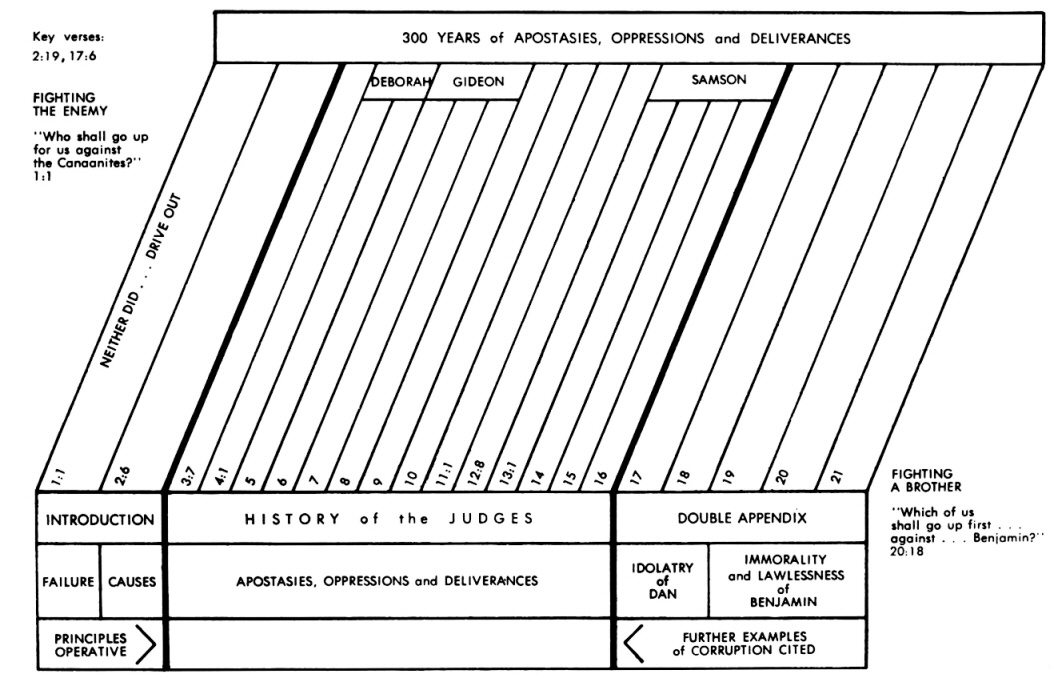
Chart from recommended resource Jensen's Survey of the OT - used by permission
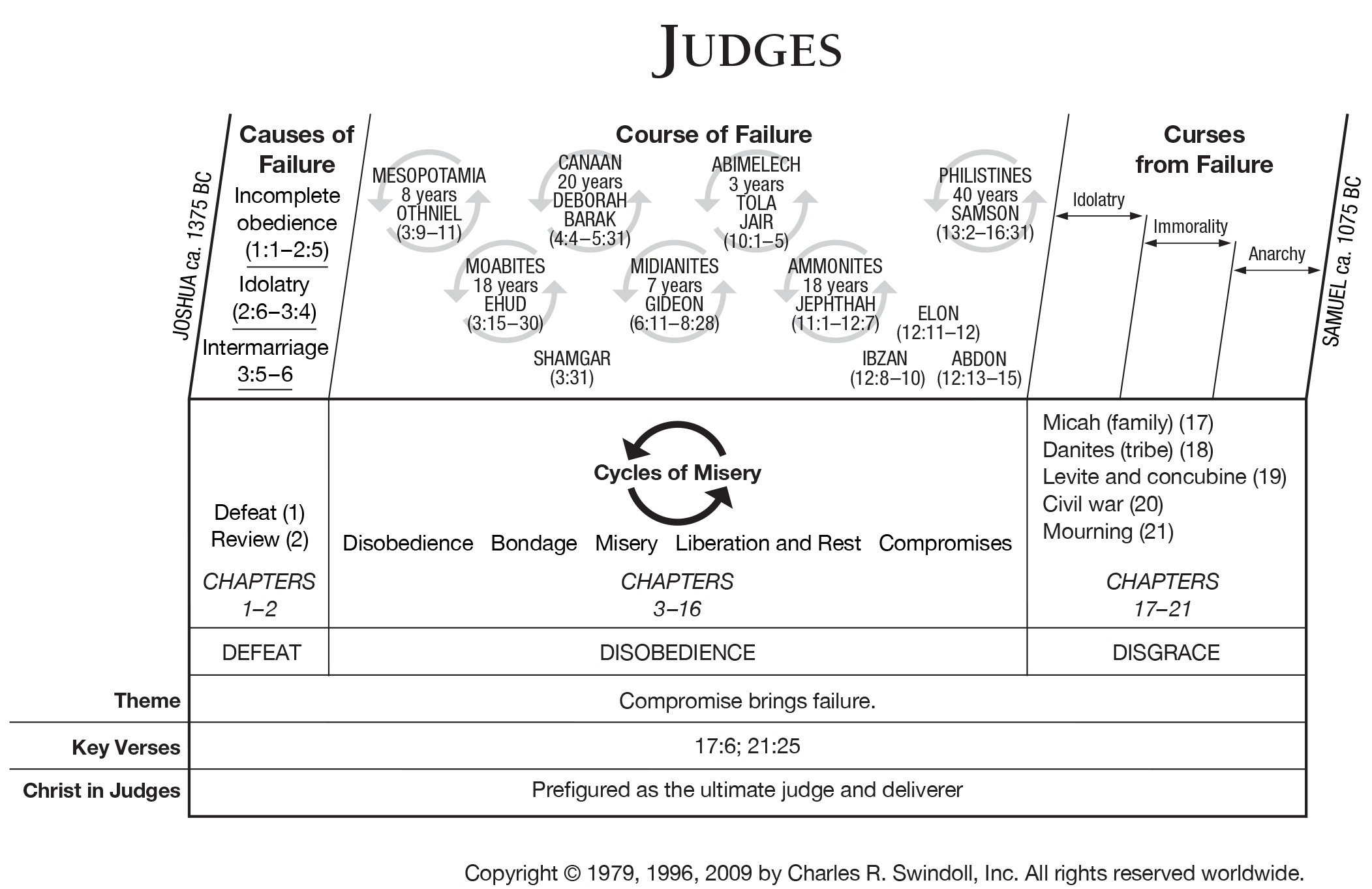
Chart on Judges - Charles Swindoll
|
RECYCLING SIN |
|||||
| Jdg 1:1-3:6 | Jdg 3:7-16:31 | Jdg 17:1-21:25 | |||
| Introduction | History of the Judges | Appendix | |||
| Causes of the Cycles THE REASON |
Curse of the Cycles THE RECORD |
Conditions in the Cycles THE RESULTS |
|||
| Failure to Complete Conquest Jdg 1:1-36 God's Judgment for Failure Jdg 2:1-3:6 |
Curse of the Cycles |
Conditions in the Cycles |
|||
| Living with Canaanites |
War with the Canaanites |
Living Like the Canaanites |
|||
| Religious Laxity |
Political Uncertainty |
Moral Anarchy |
|||
| About 350 Years of Israel's History - Almost 25%! From Compromise to Confusion! |
|||||

Another Timeline of Israel's History
Click to Enlarge
from Jensen's Survey of the OT
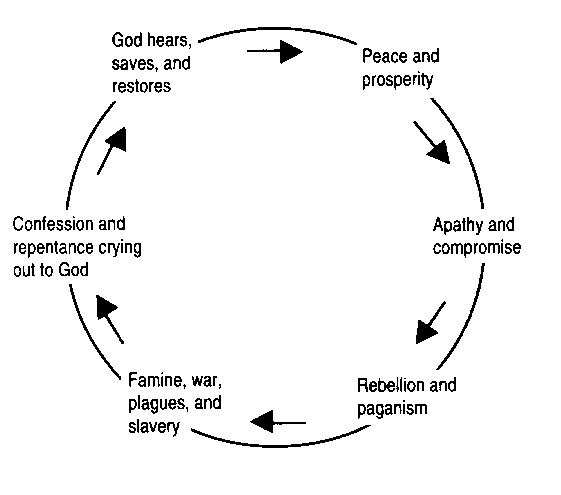
Click to Enlarge
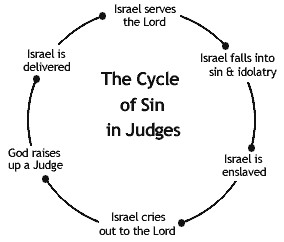
Other ways to describe Israel's cycle…
- Rest > Rebellion > Retribution > Repentance (?) > Restoration
- Sin > Suffering/Servitude > Supplication > Salvation
- Apathy > Apostasy > Affliction > Answered Prayer
- Disobedience > Desperation > Deliverance
- Disobedience > Bondage >Misery > Liberation and Rest > Compromises
Dale Ralph Davis - For convenience chapters 14–16 can be divided into six main episodes. Each episode is structured around these two basic elements: a Philistine success followed by a Samsonite disaster. The outline is this:
Episode 1 Jdg 14:5–20
Solution—answer to riddle
Failure—slaughter at Ashkelon
Episode 2 Jdg 15:1–6a
Solution—Samson gone, peace
restored, girl given to best man
Failure—flaming foxes
Episode 3 Jdg 15:6b–8
Solution—burn up Timnite woman
and father
Failure—slaughter by Samson
Episode 4 Jdg 15:9–17
Solution—Samson bound,
handed over
Failure—‘Jawbone Hill’
Episode 5 Jdg 16:1–3
Solution—Ambushing the playboy
Failure—portable gates
Episode 6 Jdg 16:4–30
Major pattern:
Solution—hair shaved
Failure—tragedy at Dagon’s Place
Subsidiary patterns:
Solution/failure—7 bowstrings (Jdg 16:6–9a/9b)
Solution/failure—new ropes (Jdg 16:10–12a/12b)
Solution/failure—loom (Jdg 16:13–14a/14b)
Solution/success—razor (Jdg 16:15–19a/19b–21)
From Judges: Such a Great Salvation - highly recommended resource - get it if you are going to preach or teach Judges!
Judges 15:1 But after a while, in the time of wheat harvest, it came about that Samson visited his wife with a young goat, and said, "I will go in to my wife in her room." But her father did not let him enter.
- with a young goat: Ge 38:17 Lu 15:29
- I will go: Ge 6:4 29:21
- Judges 15 Resources
SAMSON SEEKS TO
CONSUMMATE MARRIAGE
Samson fulfilled the old saying "too little, too late" which means not enough help to save the situation, and arriving too late.
Judges 15:1-8 is subtitled "Retaliation back and forth" by Guzik.
Gary Inrig introduces this chapter:
Not long ago, there was a news story about three hundred whales that were found marooned on a beach. Scientists could only explain the mystery by speculating that the whales had been chasing sardines and became trapped in shallow water when the tide went out.
For most of his life, Samson was like a whale chasing sardines—a great power pursuing small goals. He was finally beached by his pursuit of the sardine of sexual pleasure and the sardine of self-centered rule breaking. When we come to Judges 15, we see the pattern of squandered resources continuing, even though Samson seems to experience some impressive victories. However, even his great feats of power and strength only leave us with a lingering sense of regret—if only he had been willing to trust in and submit to the Lord!
- Samson, the “deliverer,” never leads his people out in battle or to a military victory.
- Samson, God’s leader, never fights a battle for God’s honor but only for his own revenge against the Philistines (and each of the Philistines’ actions was the consequence of Samson’s own sin or stupidity).
- Samson, God’s agent, never publicly gives praise to the Lord or even prays publicly.
(Borrow Hearts of Iron, Feet of Clay. See also his 50 part series online Journey Through Judges)
But after a while, in the time of wheat harvest, it came about that Samson visited his wife with a young goat, and said, "I will go in to my wife in her room." But her father did not let him enter - The time of the wheat harvest indicates this was near the end of May or the beginning of June. Samson comes bearing gifts (a gift was customary, as with Judah and Tamar Ge 38:17) and seeking to consummate the marriage, but the Philistine father has already given her to another man.
Cundall on the time of wheat harvest - Climatic conditions are slightly variable in the various regions of Palestine, so that the time of the wheat harvest is not uniform throughout the country. In Israel, of course, it was associated with the second of the three great harvest festivals, Passover (barley), Weeks or Pentecost (wheat), and Tabernacles (figs, grapes, olives, etc.). In the region of Timnah the wheat harvest would come somewhere near the end of May or the beginning of June. (Borrow Judges & Ruth: Tyndale Old Testament Commentary)
NET Note on I will go in to my wife in her room - Heb “I will go to my wife in the bedroom.” The Hebrew idiom בּוֹא אֶל (bo’ ’el, “to go to”) often has sexual connotations. The cohortative form used by Samson can be translated as indicating resolve (“I want to go”) or request (“let me go”).
Warren Wiersbe writes "The life of Samson illustrates the ancient truth that a good beginning doesn’t guarantee a good ending. No doubt you can think of many more examples from the Scriptures. Lot had the privilege of walking with Abraham and yet ended in a cave, drunk and committing incest with his daughters. King Saul began as a humble man but ended up a suicide, destroyed by his stubborn pride. King Uzziah was a godly man until he became strong. When he tried to usurp the place of the priests, God judged him by giving him leprosy. Ahithophel was David’s most trusted advisor, but he ended up hanging himself. Paul’s helper Demas abandoned the ministry because he “loved this present world” (2Ti 4:10). May the Lord help us all to end well! The American poet Henry Wadsworth Longfellow said, “Great is the art of beginning, but greater is the art of ending.” That’s why Solomon wrote, “The end of a matter is better than its beginning” (Ecc 7:8NIV). At the beginning of his career, Samson served in a blaze of glory, but the light began to flicker as he yielded to his passions. In the closing scenes of his life, we watch Samson’s light finally go out; and the blind champion ends up buried in the rubble of a heathen temple. Granted, he killed more in his martyrdom than he killed during his judgeship; but how different it would have been had he first conquered himself before he sought to conquer the Lord’s enemies. “His whole life,” said Spurgeon, “is a series of miracles and follies.” (See context in Be Available )
Ray Pritchard - The exciting thing about Samson is he is a man who is easy to understand. Sometimes when I start reading about the really great heroes of the Bible I have a hard time relating to them. It’s easy to read about David and Abraham and Moses and the incredible things they did and to think to yourself, “I could never be like them.” It’s almost as if you read about the really great heroes and you think they’re in a class of special saints and the rest of us are in the class of regular people. One of the nice things about Samson is there’s no question he doesn’t belong in with the special saints. He belongs here with the regular people (or maybe with the irregular people). At least Samson is a man whose life is understandable to us. He’s a lot like us, and we’re a lot like him. He’s sort of a spiritual zigzag who’s up and down and all over the map. He’s totally unpredictable and that’s what makes the story so exciting. We’ve seen his beginning—how Samson had it all. No Bible character ever had a more promising start in life. Then, right out of the gate, he begins to make mistakes. It’s one dumb move after another. Now we’re going to trace his life as he begins to fulfill God’s purposes. You won’t be surprised to know that Samson wasn’t trying to do God’s will; he was just trying to get even with the Philistines. Chasing Sardines - In his book Hearts of Iron, Feet of Clay, Gary Inrig tells a little illustration that brings Samson’s life into perspective. The real question that you have when you read Samson’s story is, “How did a guy who started so well end up so poorly?” It’s hard to understand. Gary Inrig tells a story about something unusual that happened out on the West coast about 15 years ago. When I say the West coast, I mean literally the west coast—out on the beaches of Oregon or California. It seems that some whales were beached out there. They came in too close and when the tide went out, the whales were stuck on the sand. The only thing that was unusual was that there were 300 whales beached at the same time and in the same place. Sadly, before they could get the whales moved all 300 had died. It was a great mystery until the marine biologists discovered that the 300 whales had come to the beach and had met their death because they were chasing sardines. Have you ever seen sardines? Do you know how small sardines are and how big a whale is? But even a little sardine can bring a whale to its death if the whale keeps chasing it long enough. That’s a parable of the life of Samson. A man of enormous resources who wasted his life chasing small goals. He was a whale chasing sardines. I mentioned to you earlier that there are four things that make Samson’s life interesting: Love, Sex, Revenge, and Violence. We’re already past the love and sex part. Don’t worry, we’ll come back to it later. But we’re past it for the moment. We’re into the last two things this morning: Revenge and violence. This is one of the amazing stories of Samson’s life. This is the story of how a man who started so well and went down so far, turned around and accomplished an amazing feat for God. A man who started high and went low, now goes high again. It’s one of the amazing paradoxes of his life. (How an Angry Man Gets Even)
George Bush - In the time of wheat-harvest. Which in that country was in April and May. The time of the visit is specified in reference to the exploit subsequently mentioned, v. 4, 5. Visited his wife with a kid. Carrying a kid in token of reconciliation. Time had now cooled his resentment, and probably not knowing that she had meanwhile been given to another, he was willing to make the first overtures of returning amity. ‘The wisest, though offended, will be the first to seek peace, and the readiest to pass by a transgression.’ Haweis. He said, I will go in, &c. He said to himself; he proposed; he formed the purpose. Into the chamber. Into the interior apartments appropriated to the women; the harem. (resource)
Criswell - Having abandoned his wife in anger, Samson returned to restore the relationship, only to find her remarried. He responded in revenge, and again found himself the instrument of the Lord's deliverance of Israel (Jdg 14:19; 15:8, 14-17).
Pritchard - “Sweetheart, I Brought You A Goat” He decides that he wants his wife back. A few months have passed. It is now the time of the wheat harvest—that’s May or June—and Samson takes a young goat as a gift for his bride. He still thinks he’s married. He thinks that he just walked out on her but he can come back when he wants to. Sounds like a man, doesn’t it? Today we bring chocolates or we bring perfume or we bring candy or maybe we bring a new car—it just depends on how far in the hole we think we are. In that same spirit, Samson brings a young goat. That’s sure to win her heart over. When he arrives at her house, he says to her father, “I’m going to go visit my wife’s room.” And let’s face it—we all know what Samson is thinking. He’s not going to have a prayer meeting with her. He wants to go see her up close and personal. But her father would not let him go in. Why not? “Well, because she’s married now. Someone else is in there with her.” (How an Angry Man Gets Even)
Keil and Delitzsch Commentary - His Revenge upon the Philistines.— Some time after, Samson visited his wife in the time of the wheat harvest with a kid,—a customary present at that time (Gen. 38:17),—and wished to go into the chamber (the women’s apartment) to her; but her father would not allow him, and said, “I thought thou hatedst her, and therefore gave her to thy friend (Judg. 14:20): behold her younger sister is fairer than she; let her be thine in her stead.” (Judges 15 Commentary)
Judges 15:2 And her father said, "I really thought that you hated her intensely; so I gave her to your companion. Is not her younger sister more beautiful than she? Please let her be yours instead."
- I really though: Jdg 14:16,20 Ac 26:9
- I gave: Jdg 14:20 Ge 38:14
- Judges 15 Resources
THE FATHER-IN-LAW'S
BIG MISTAKE!
Adam Clarke - On her betraying him, he had, no doubt, left her in great disgust. After some time his affection appears to have returned and, taking a kid, or perhaps a fawn, as a present, he goes to make reconciliation
And her father said, "I really thought that you hated (sane; Lxx - miseo) her intensely (sane repeated); so I gave her to your companion. Is not her younger sister more beautiful (tob - pleasant, agreeable, good) than she? Please let her be yours instead - Although he had never consummated the marriage, Samson thought he was legally married to the woman of Timnah. Therefore, he took a gift and went to visit her in her father’s house. How shocked he was to learn that not only was he no longer married, but also the woman he "loved" (in quotes because Samson's idea of love seems to be more physical then unconditional) was now married to one who had in effect been best-man!
Samson’s father-in-law thought that Samson hated his wife probably because "he (father-in-law) was conscious she had given him (Samson) great cause so to do." (Adam Clarke)
It is interesting to recall that there are several surprised bridegrooms in the Bible - (1) Adam went to sleep a single man and woke up to learn (happily) that he was married (Ge 2:21-25). (2) Jacob woke up and discovered he was married to the wrong woman (Ge 29:21-30). (3) Boaz woke up to find his prospective wife lying at his feet on the threshing floor (Ru 3:1-13). Life is full of interesting "awakenings!"
Ray Pritchard - Her father tries to make a deal saying “I was so sure you thoroughly hated her that I gave her to your friend. Isn’t her younger sister more attractive? Take her instead.” (Jdg 15:2) Doesn’t that sound like something a father would say? “The older one is taken. Why don’t you take the younger one? She’s better looking anyway.” Now Samson is upset for two reasons. (1) he’s upset because his wife is gone and (2) he’s upset because the father has now insulted him. (How an Angry Man Gets Even) Samson is not a good man to make angry!
George Bush - I verily thought that thou hadst utterly hated her. Heb. אמר אמרתי âmor âmarti, saying, I said that thou, &c. I said in my heart, I certainly concluded. The excuse was very frivolous, for it does not appear that Samson was long absent, and at any rate, he had no right to bestow her again in marriage without first apprising him of his intention. The act of repudiation in the East was always supposed to originate with the husband, and not with the wife. Is not her younger sister fairer than she? Heb. טובח ממנח tobâh mimmenâh, better than she. Words expressive of moral qualities are, in Hebrew and other languages, frequently applied to personal endowments. Thus in English we have ‘good-looking’ for handsome. Take her. Heb. תחי לך tehi lekâ, let her be to thee. Thus, in fact, proposing what would have been to Samson an incestuous marriage, Lev. 18:18, however the Philistines regarded it. (resource)
Gary Inrig sums up this first part of Judges 15 explaining that "at the doorway of her home he learns a shocking truth: he is not a married man at all. The marriage had never taken place or had been annulled (the technicalities of Philistine marriage law are unclear). His “father-in-law” would obviously have been terrified when he heard news of Samson’s Ashkelon butchery, which showed what this man was capable of. But he was forced to tell him that he had assumed that Samson had rejected his daughter and abandoned the marriage. He had tried to do right by her by giving her to another man, one of Samson’s drinking companions at the aborted marriage. But he had a proposal to meet Samson’s desires: he had a much prettier, younger daughter he would be glad to give in marriage, if Samson would accept her. Sadly, once again we see that women are treated as bargaining chips, to be used at the whim of men. Samson would have nothing to do with a substitute. If he had been angry before, he was furious now, and he determined to get revenge. Rather than focusing on the immediate problem of his stolen bride, he attacked the real enemy: not the girl or her father but the Philistines who had blackmailed the girl into betraying him. So he turned his fury upon them and hit them where it hurt—in the stomach.
Hated (08130) sane means to detest, abhor, loathe, be hostile, have a feeling of open hostility and intense dislike (Ge 37:4), to be unwilling, the opposite of to love (ahab, 0157). To be an enemy with open hostility and strife toward another (Pr 29:24) Sane represents an emotion ranging from intense “hatred” to the much weaker “set against” and is used of persons and things (including ideas, words, inanimate objects).
Stone says sane "connotes not merely malice and hostility, but rejection. This word figures in divorce proceedings, so that the father-in-law actually was implying that he interpreted Samson's behavior as divorce." (See context in Joshua, Judges, Ruth)
Judges 15:3 Samson then said to them, "This time I shall be blameless in regard to the Philistines when I do them harm."
- when I do them harm Jdg 14:15
- Judges 15 Resources
SAMSON CLAIMS HE
WILL BE INNOCENT
Samson then said to them, "This time I shall be blameless (ESV - "innocent") in regard to the Philistines when I do them harm - NLT = "I cannot be blamed for everything I am going to do." NET = "This time I am justified in doing the Philistines harm!" (Jdg 15:3NET)" NIV - "This time I have a right to get even with the Philistines" (Jdg 15:3NIV) Samson’s claim of innocence (of any charges of wrong-doing the Philistines might bring against him) may have been correct. Even the Philistines still referred to him as “the Timnite’s son-in-law” (Jdg 15:6). True, he had not immediately consummated the marriage, but was this sufficient ground for the divorce that was in effect brought about by her father? It is interesting to note that later David did not hesitate to take back his wife Michal forcibly, though Saul had given her to another man (1Sa 25:44; 2Sa 3:13-15).
Guzik - God used Samson’s ungodly anger for His purposes. As Psalm 76:10 says, Surely the wrath of man shall praise You. This doesn’t justify Samson’s anger, but it shows the glory and power of God to use all things to His purposes.
Pritchard - Samson said to them “This time I have a right to get even with the Philistines. I will really harm them.” Now underline this. The first two things he did—he killed thirty men and then he left his wife—those are relatively small things if you can call killing thirty men relatively small. But now he’s going to get serious. (How an Angry Man Gets Even)
There is a very significant omission here. It does not say that the Spirit of God either moved him or empowered him to do this. This was not divine judgment, it was the venting of Samson's personal resentment and anger. It grew out of his pique and had nothing to do with God's will. It was a very cruel and inhumane thing to do. But it evened the score: Samson - 2; the Philistines - 2.
The passion to get even seemed to govern Samson’s life. His motto was, “As they did unto me, so have I done unto them” (Jdg 15:11). Certainly as the defender of Israel, Samson’s calling was to defeat the enemy; but you long to see him fighting “the battles of the Lord” and not just his own private wars. When David faced the Philistines, he saw them as the enemies of the Lord and sought to honor the name of the Lord in his victory (1Sa 17). Samson’s attitude was different. As Christians, we need to beware of hiding selfish motives under the cloak of religious zeal and calling it “righteous indignation.” Personal vengeance and private gain rather than the glory of the Lord has motivated more than one “crusader” in the church. What some people think is godly zeal may actually be ungodly anger, fed by pride and motivated by selfishness. There is a godly anger that we should experience when we see wickedness prosper and defenseless people hurt (Ep 4:26), but there’s a very fine line between righteous indignation and a “religious temper tantrum.”
George Bush - Samson said concerning them. Said to himself. It is very improbable that he would have announced verbally to any one the purpose which he had now conceived in his mind. In forming this resolution, he acted rather in a public than a private capacity. Had he aimed to avenge only his personal injuries, he would have been sufficient to have chastised his rival and his father-in-law only: but as the slight which excited his indignation had no doubt been put upon him because he was an Israelite, he determines as an Israelite to seek revenge. He had done what was proper in endeavoring by a present to effect a reconciliation with his wife, but as his overtures had been repulsed, no one could blame him if he now showed his just resentments. When we have done our best to prevent a quarrel, we cannot be charged with the consequences of it. (resource)
Keil and Delitzsch - Enraged at this answer, Samson said to them (i.e., to her father and those around him), “Now am I blameless before the Philistines, if I do evil to them.” נִקָּה with מִן, to be innocent away from a person, i.e., before him (see Num. 32:22). Samson regarded the treatment which he had received from his father-in-law as but one effect of the disposition of the Philistines generally towards the Israelites, and therefore resolved to avenge the wrong which he had received from one member of the Philistines upon the whole nation, or at all events upon the whole of the city of Timnath.(Judges 15 Commentary)
Judges 15:4 And Samson went and caught three hundred foxes, and took torches, and turned the foxes tail to tail, and put one torch in the middle between two tails.
HOW TO START
A FOX FIRE
And Samson went and caught three hundred foxes, and took torches, and turned the foxes tail to tail, and put one torch in the middle between two tails - Hebrew = “He turned tail to tail and placed one torch between the two tails in the middle.” The “foxes” Samson were probably jackals, a closely related animal that moves in packs and can be more readily caught. Either animal would, however, be difficult to catch in such quantities. The fire spread with incredible speed, and soon the Philistines’ crops were ruined. It is worth noting that Dagon was the god of grain! He could not prevent destruction of the grain. The fire destroyed the sheaves of stacked grain and also the grain ready to be harvested in the fields (Dt 23:25). Keep in mind what time of year this was in Philistia the time of wheat harvest (Jdg 15:1), so the wheat was ripe for Samson to harvest with his fox brigade!
Guzik - Some object that Samson could not have captured 300 foxes. Yet the word translated foxes probably refers to a jackal, not a fox, and jackals are known to run in large packs, sometimes up to 200. Second, there is nothing that says Samson did this all by himself. Third, there is nothing that says he did it all in one day.
Adam Clarke on three hundred foxes - In other countries, where ferocious beasts were less numerous, great multitudes have been exhibited at once. Sylla, in a public show to the Roman citizens, exhibited one hundred lions; Cæsar, four hundred; and Pompey, nearly six hundred. The Emperor Probus let loose in the theatre, at one time, one thousand ostriches, one thousand stags, one thousand wild boars, one thousand does, and a countless multitude of other wild animals: at another time he exhibited one hundred leopards from Libya, one hundred from Syria, and three hundred bears.—See Flavius Vopiseus in the Life of Probus, cap. xix., beginning with Dedit Romanis etiam voluptates, &c.
Foxes (shual) - 6v - Jdg. 15:4; Neh. 4:3; Ps. 63:10; Song 2:15; Lam. 5:18; Ezek. 13:4
Warren Wiersbe - Had he tied the firebrands to individual animals, they each would have immediately run to their dens. But by putting two animals together and turning them loose, Samson could be fairly sure that their fear of the fire and their inability to maneuver easily would make them panic. Thus they would run around frantically in the fields and ignite the grain. The fire then would spread into the vineyards and olive groves. It was a costly devastation. (See context in The Bible Exposition Commentary)
Ray Pritchard - Fox Fire - So he caught three hundred foxes (or jackals, possibly) and tied them tail to tail in pairs. This is harder than it looks. If you’ve ever tried to do this, you know this is not an easy thing to do. (Just get two dogs, or cats, and try to tie their tails together. It’s not a fun way to spend an evening.) Once he had the tails tied together, he fastened a torch to every pair of tails and lit them. Now I don’t know how he did that, but that’s what he did. (The animal-rights people would probably condemn the whole Bible if they read this story.) Samson lit the torches and let the foxes loose in the standing grain of the Philistines. This basically is on the level of a college fraternity prank. That’s about the level that Samson is working on here. It must have been a bizarre sight: Catch the foxes, tie them together, put the torches on the tails, light the torches, let the foxes go. The foxes are scared to death. They go north, south, east and west and Samson’s over there laughing hysterically. This is the greatest thing he’s done yet. Jdg 15:5 says he burned up the shocks (that’s the wheat that had already been cut), the standing grain (that which hasn’t been harvested yet), together with the vineyards and the olive groves. Now the only thing you need to know about this is that the Philistines only had three cash crops. One was wheat, one was olives, and the other was grapes—vineyards. Samson single-handedly destroys the economic base of the whole nation. (How an Angry Man Gets Even)
George Bush - Went and caught three hundred foxes. From the subsequent narrative it would appear that the destruction of the cornfields extended widely over the territories of the Philistines. Comp. v. 6. As to the kind of animal employed on this occasion, there has been no small controversy among expositors. The Heb. word שועלים shualim, is now generally agreed to have included in its meaning not only ‘foxes,’ but also ‘jackals,’ an animal rightly described as something between the wolf and the fox, and hence sometimes termed by naturalists ‘the wolf-fox.’ These animals, which were very numerous in Palestine, associate together in large herds or packs, sometimes to the amount of two or three hundred; differing in this respect from the fox, which is not gregarious, and is far more cunning. Like foxes, however, they live in holes, which they form under ground, and they are particularly prone to resort to ruined towns, not only because they there find numerous secure retreats ready made, but because the same facilities attract to such places other animals, on whose dead bodies they prey. From this circumstance, the prophets in describing the future desolation of a city, say it shall become ‘the habitation of jackals,’ a prediction verified by the actual condition of many places to which their prophecies apply. Thus it is said by travellers that the ruins of Ascalon in particular afford habitation to great numbers of these animals. The howlings of these packs of jackals are frightful, and give great alarm to travellers; whence they are also called in Heb. איים Ayim, howlers, improperly rendered ‘wild beasts of the islands.’ Is. 13:22; Jer. 50:39. But it appears that the common fox is also of frequent occurrence in Palestine, and as both are included under the common term Shual, it must generally be left to the bearing of the context to determine when the jackal and when the fox are respectively denoted. That the jackal is intended in the text now before us, we may infer from the number of animals taken by Samson, which must have been easier with creatures prowling in, large droves, than with a solitary and very wily animal like the fox. (resource)
Bush - Took torches Heb. לפדים lappidim, torches. A firebrand, in such a position, if sufficiently ignited to kindle a blaze in the shocks of corn, would soon have burnt itself free from the tails of the foxes, or have been extinguished by being drawn over the ground. A torch or flambeau, on the other hand, made of resinous wood or artificial materials, being more tenacious of flame, would have answered a far better purpose; and such is the legitimate import of the original. tail to tail. This was doubtless intended to prevent them from making too rapid a retreat to their holes, or, indeed, from going to their holes at all. They were probably not so tied that they should pull in different directions, but that they might run deviously and slowly, side by side, and so do the more effectual execution. Had he put a torch to the tail of each, the creature, naturally terrified at fire, would instantly have betaken itself to its hole or some place of retreat, and thus the design of Samson would have been wholly frustrated. But by tying two of them together by the tail they would frequently thwart each other in running, and thus cause the greater devastation. If it be asked why Samson resorted to such an expedient at all, instead of firing the cornfields with his own hand, which would have been a much simpler and easier method of compassing his object, we may say perhaps in reply, that by the meanness and weakness of the instruments employed he designed to put a more signal contempt upon the enemies with whom he contended, thus mingling ridicule with revenge. (resource)
Keil and Delitzsch - He therefore went and caught three hundred shualim, i.e., jackals, animals which resemble foxes and are therefore frequently classed among the foxes even by the common Arabs of the present day (see Niebuhr, Beschr. v. Arab. p. 166). Their European name is derived from the Persian schaghal. These animals, which are still found in great quantities at Joppa, Gaza, and in Galilee, herd together, and may easily be caught (see Rosenmüller, Bibl. Althk. iv. 2, pp. 155ff.). He then took torches, turned tail to tail, i.e., coupled the jackals together by their tails, putting a torch between the two tails, set the torches on fire, and made the animals run into the fields of standing corn belonging to the Philistines. Then he burned “from the shocks of wheat to the standing grain and to the olive gardens,” i.e., the shocks of wheat as well as the standing corn and the olive plantations. כֶּרֶם זַיִת are joined together in the construct state. (Judges 15 Commentary)
Norman Geisler - JUDGES 15:4—How could Samson capture 300 foxes?
PROBLEM: According to Judges 15:4, Samson captured 300 foxes, tied torches between the tails of two foxes, lit the torches, and released the foxes into the fields of the Timnite farmers. But, how could Samson have captured this many foxes?
SOLUTION: It must be remembered that Samson was endowed with supernatural strength. Although the passage does not describe how Samson was able to capture so many foxes, it is not difficult to see that a man who could use the jawbone of an ass to kill “a thousand” warriors (Jud. 15:15) would have little problem capturing 300 foxes. (When Critics Ask: A Popular Handbook on Bible Difficulties )
Gleason Archer - How could Samson catch three hundred foxes for his prank at Timnah?
Judges 15 relates how Samson sought vengeance against the Philistine town of Timnah after his bride had been given to some other man. Verse 4 states that “Samson went and caught three hundred foxes, and took torches, and turned [the foxes] tail to tail, and put one torch in the middle between two tails.” Then he lit the torches and let them run loose into the standing grain of the Timnite farmers so that they might lose their entire crop. As to the methods Samson may have used to capture so many foxes, when most people find it difficult enough to hunt down even one of them, we find no information at all in the text. Whether his superhuman strength was matched by a superhuman agility that enabled him to outrun them as they tried to escape, we cannot be sure. Or else he may have devised a set of unusually enticing traps and imprisoned them in cages until he had gathered a sufficient number for his purpose. Presumably he used a pair of thick leather gloves as protection against their sharp teeth. However he managed it, he was certainly in a class by himself. But any warrior who could slay a thousand armed soldiers with the jawbone of an ass as his only weapon (v.15) could surely take care of a mere three hundred foxes without too much difficulty (Borrow Encyclopedia of Bible difficulties by Archer, Gleason L - or here with no restrictions)
Judges 15:5 When he had set fire to the torches, he released the foxes into the standing grain of the Philistines, thus burning up both the shocks and the standing grain, along with the vineyards and groves.
- he let them go: Ex 22:6 2Sa 14:30
- Judges 15 Resources
SAMSON DESTROYS PHILISTINES'
MAJOR CASH CROPS
When he had set fire to the torches, he released the foxes (NET - jackals) into the standing grain of the Philistines: Under the law (Ex 22:6), burning crops and fields was considered a serious offense.
Thus burning up both the shocks (ESV - stacked grain) and the standing grain, along with the vineyards and (olive) groves: the Philistines were distressed and rightly so because this was a major blow to their economy for grain, wine and olives were their major cash crops. Remember however that even though Samson's arson was almost like a prank, he was causing significant damage to the Philistines and thus God was using even his errant behavior to deliver Israel from the oppression of the Philistines. Samson's efforts would prepare the way for later defeat of this enemy in the time of Samuel and David.
Cundall on the shocks and the standing grain - The burning of standing corn was a common method of retaliation or revenge in the ancient world and its effect in an agricultural community was very serious. The prompt reaction of Joab to the ruse of Absalom to attract his attention may be instanced (2 Sam. 14:28–31). We can imagine the delight with which the Israelites would tell this story of revenge against the nation which was to oppress them so sorely. But such wanton cruelty to animals, whose sufferings must have been hideous, cannot be condoned. The harvest was being gathered in at the time, for shocks (5) refers to the heaped sheaves. (Borrow Judges & Ruth: Tyndale Old Testament Commentary)
Stone writes that "commentators often charge Samson with an excessively violent response, destroying a whole town's economy. They forget, however, that the Philistines invaded land that Yahweh had promised to Israel, and thus were oppressors of Israel (13:1). This was land under the conquest mandate. Samson's vengeance, though far from the dispassionate dispensing of justice admired by moderns, nevertheless embodied Yahweh's quest for an opportunity against the Philistines as a whole (cf. Jdg 14:4). (See context in Joshua, Judges, Ruth)
Judges 15:6 Then the Philistines said, "Who did this?" And they said, "Samson, the son-in-law of the Timnite, because he took his wife and gave her to his companion." So the Philistines came up and burned her and her father with fire.
- and burned: Jdg 12:1 14:15 Pr 22:8 1Th 4:6
- Judges 15 Resources
EVERYONE LOST
Then the Philistines said, "Who did this?" And they said, "Samson, the son-in-law of the Timnite, because he took his wife and gave her to his companion." So the Philistines came up and burned her and her father with fire: How ironic because burning his wife and father is what they said they would do if she did not tell them what the riddle was (Jdg 14:15+). The tragedy is that in seeking his retaliation, he also brought harm to his wife. Note the Philistines call Samson the son-in-law which does suggest they regarded Samson as married to this woman.
Wiersbe - Violence breeds violence, and the Philistines weren’t about to stand around doing nothing while their food and fortune went up in flames. They figured out that Samson was behind the burning of their crops, and they knew they had to retaliate. Since they couldn’t hope to overcome Samson, they did the next thing and vented their wrath on his wife and father-in-law. In the long run, her betrayal of Samson didn’t save her life after all (Jdg 14:15+). (See context in The Bible Exposition Commentary)
Wiersbe in another resource writes "When life is motivated by retaliation, the consequences are usually painful. Responding to Samson’s anger, his intended father-in-law retaliated by giving away Samson’s bride. Then Samson retaliated by burning the Philistines’ harvest, and the Philistines in turn burned the bride and her father. Who finally won?" (See context in With the Word: The Chapter-by-Chapter or borrow With the Word)
George Bush - And they answered, &c. ‘The mention of the offence draws in (that of) the provocation; and now the wrong to Samson is scanned and revenged; because the fields of the Philistines are burned for the wrong done to Samson by the Timnite in his daughter, therefore the Philistines burn the Timnite and his daughter. The tying of the firebrand between two foxes was not so witty a policy, as the setting of a fire of dissension betwixt the Philistines.’ Bp. Hall. Burnt her and her father with fire. A most inhuman and barbarous act, on the part of its perpetrators, yea wonderfully overruled in the Providence of God to chastise the guilty. The Philistines had threatened Samson’s wife that if she did not obtain and disclose her husband’s secret, they would burn her and her father’s house with fire. She, to save herself and oblige her countrymen, betrayed her husband; and now by so doing brought upon herself the very doom which she so studiously sought to avoid! To seek to escape suffering by sin, is the surest way to bring it upon us! ‘The fear of the wicked it shall come upon him.’ (resource)
Keil and Delitzsch - The Philistines found out at once, that Samson had done them this injury because his father-in-law, the Timnite, had taken away his wife and given her to his companion. They therefore avenged themselves by burning her and her father,—probably by burning his house down to the ground, with its occupants within it,—an act of barbarity and cruelty which fully justified Samson’s war upon them. (Judges 15 Commentary)
Judges 15:7 And Samson said to them, "Since you act like this, I will surely take revenge on you, but after that I will quit."
- Since you act like this: Judges 14:4,19 Ro 12:19
- Judges 15 Resources
SAMSON
RETALIATES...AGAIN
And Samson said to them, "Since you act like this, I will surely take revenge (naqam;Lxx - ekdikesis) on you, but after that I will quit - Samson's ongoing quest for vengeance is tragic. Rather than viewing his deeds as acts of holy war against Israel's oppressor (the role to which he had been set aside and empowered to accomplish - Jdg 13:5+), he was concerned only for personal vengeance and failed to understand his God ordained role in the "holy war" against Israel's enemies.
Guzik - We have here the bitter story of retaliation—of trying to avenge wrongs done to us. Retaliation is a never-ending story, and one that never wins in the end. Those who trust in God must be able to say, “Retaliation belongs to God. I’ll let Him settle the score.”. Much of the war, disaster, deep-seated hatred, and pain in our world come from this instinct to retaliate. But Jesus told us to not retaliate an eye for an eye, but to take control of the situation by giving even more (Matthew 5:38–42). When we do this, we act like God, who did not retaliate against man for his sin and rebellion, but instead gave His only Son to die for man.
Herbert Wolf - Though he intended to “stop” when he got even, neither side quit seeking revenge till Samson and thousands of Philistines were dead. How rapidly the effects of sin and hatred spread! (See context in The Expositor's Bible Commentary)
Stone has an interesting thought - Samson was to avenge a deed done against his own wife and father-in-law. To reduce this to a petty, personal vendetta is to deny the historical, human ties depicted in the story. Standing before the smoking ruins of the home of his brutally murdered wife, living in a culture whose fundamental notion of justice was rooted in reciprocal actions of honoring and shaming, who would not have vowed to even the score? To walk away would also have left the Philistines confident that they could defy Israel with impunity. Samson's vengeance is therefore much more than a personal grudge. (See context Joshua, Judges, Ruth)
George Bush - Though ye have done this, &c. Though you have thought by this act of cruelty to my wife and kindred, to make amends for the injury done to me, yet flatter not yourselves that I am thereby appeased, and that I shall forbear farther hostilities. He doubtless saw that his wife and her family were victims to a hasty indignation occasioned by their own losses, rather than the subjects of a righteous and well-considered retribution, and that accordingly there was no reason for him, as a public judge, called and appointed of God to deliver his country from oppression, to cease to prosecute that work. (resource)
Take revenge (05358) naqam means to avenge, take vengeance, revenge, avenge oneself, be avenged, be punished. To exact punishment for a wrong. To inflict a punishment or penalty in return or retaliation for a harm or injury. To avenge, take vengeance, to entertain revengeful feelings. Naqam in Judges - Jdg 15:7, Jdg 16:28.
NET Note - The Niphal of נָקָם (naqam, “to avenge, to take vengeance”) followed by the preposition ב (bet) has the force “to get revenge against.” See 1Sa 18:25; Jer 50:15; Ezek 25:12.
Judges 15:8 And he struck them ruthlessly with a great slaughter; and he went down and lived in the cleft of the rock of Etam.
- Isa 25:10 63:3,6
- Judges 15 Resources
SAMSON'S SLAUGHTER
CAUSES HIM TO SEEK SHELTER
And he struck them ruthlessly with a great slaughter: That evened the score at 3-all. KJV = "smote them hip and thigh" which is more literal. The Hebrew "leg on thigh" is an idiom for a complete or total massacre. It may be an expression from wrestling terminology indicating a complete victory. As Pritchard says below "It’s a metaphor which stands for a violent, bloody massacre. Do you know what Samson did at this point? His anger has consumed him. When he kills them, he rips them apart hip and thigh. Arms over here, legs over here, heads over here, and chests over here. Boling suggests Samson "left them a tangle of legs and thighs." We are not told how many died except that the number was great.
When you try to seek revenge for wrongs done to you,
you set in motion an unending cycle of violence.
-- Ray Pritchard
Ray Pritchard - Samson is not finished yet. He does one more thing to get revenge on the Philistines. Fourth, he slaughtered many of the Philistines. He said to them, “Since you acted like this, I won’t stop until I get my revenge on you.” All bets are off now. Samson is an extremely angry man. By the way, do you notice what’s happened here? Do you see the cycle of revenge? The Philistines do something and then Samson does something. And then they do something and Samson does something back to them. And they do something again and Samson does something again. Only each time it’s getting more and more serious, and more and more brutal, and more and more bloodthirsty. That’s what happens when you try to seek revenge in your life. When you try to seek revenge for wrongs done to you, you set in motion an unending cycle of violence. The only way to get off the cycle of violence is to not seek revenge in the first place. As long as you want to get even, you’re going to go down, down, down and down. But now look what happens here. Samson says to them, “I won’t stop until I get my revenge on you.” Jdg 15:8 says, “He attacked them viciously and slaughtered many of them.” The KJV has a more accurate translation of this verse. It gives a very literal rendering of the Hebrew—"He smote them hip and thigh.” What does that mean? It’s a metaphor which stands for a violent, bloody massacre. Do you know what Samson did at this point? His anger has consumed him. When he kills them, he rips them apart hip and thigh. Arms over here, legs over here, heads over here, and chests over here. Do I have to go any further? This is the Old Testament version of the Texas Chainsaw Massacre. This is it right here. Samson was a guy you didn’t want to get mad at you because he could lose control real fast and just go way over the line and it would be too late. (How an Angry Man Gets Even)
And he went down and lived in the cleft of the rock of Etam: Following the attack, he retreated to a cave in the “rock of Etam.” This is not the Etam mentioned either in 1Chr 4:32 (too far away) or 2Ch11:6 (hadn’t been built yet) but was some elevated place in Judah, near Lehi, from which Samson could safely and conveniently watch the enemy. It is interesting that the same combination of ca'iyph (“cave”) and cela‘ (“rock”) occurs in Isa 2:21+, which speaks of men fleeing to the hills to escape the terror of the Day of the Lord.
Pritchard on "Samson the Caveman" - So Samson slaughtered the Philistines. “Then he went down and stayed in a cave in the rock of Etam.” (Jdg 15:8) All you see so far is revenge, revenge, revenge, revenge. Now Samson goes and stays in a cave in the rock of Etam. That seems odd. Why hide in a cave? Because he is scared of the Philistines. And you say, “my gracious, I thought it would be the other way around.” That’s the strange thing about Samson. Even though he is a violent killer in his heart, he is scared to death of the Philistines. Scared of what they are going to do to him because of what he has done to them. I’m going to tell you something that I cannot prove. I cannot prove the following statement, but I do believe it’s true. I believe that the beginning of a spiritual turn around in Samson’s life took place in the cave of Etam, while he was hiding from the Philistines. I believe he, like David who would come after him, began to think about his life and his background and the kind of family he had and his godly heritage. And I think Samson began to re-evaluate the course of his life. I say that because as soon as Samson comes out of the cave of Etam his life is beginning to change. He has gone from the top down, down, down. He’s made an unending series of stupid decisions. Now he has become nothing more than a violent, bloodthirsty terrorist kind of killer. He’s at the bottom now. When he comes out of the cave, he begins to act like a different man. (How an Angry Man Gets Even)
George Bush - Smote them hip and thigh. Heb. יך אותם סוק על ירך yak othâm shōk al yârëk, smote them leg upon thigh. Apparently a proverbial expression, implying, according to Gesenius, that he cut them in pieces, so that their limbs, their legs and thighs, were scattered and heaped promiscuously together; equivalent to saying, that he totally destroyed them. Whether this be the genuine interpretation admits of some doubt, but as we have nothing more plausible to propose, it is left to the reader’s judgment, as one of the cases where entire satisfaction as to the writer’s meaning, is unattainable. That a signal overthrow and a great slaughter is intended, seems to be unquestionable. Dwelt in the top of the rock Etam. Rather, according to the Heb., ‘in a cleft, in a fissure of the rock.’ Of the exact position of this place, or of Samson’s motive in resorting thither, we are not informed. It was probably a natural fortress, affording peculiar advantages for defence, of which Samson no doubt foresaw, that he would soon be in need of availing himself. Their recent defeat would naturally rouse the wrath of his enemies and bring them upon him in all their force. It seems altogether likely from his words in the concluding part of v. 7, that he had accomplished his present purpose of revenge, and designed no farther annoyance to the Philistines unless provoked to it by new aggressions on their part. If they then will rouse the sleeping lion, let them expect to pay dear for their temerity. (resource)
Keil and Delitzsch - “Then he smote them hip and thigh (lit. ‘thigh upon hip;’ עַל as in Gen. 32:12), a great slaughter.” שֹׁוק, thigh, strengthened by עַל־יָרֵךְ, is a second accusative governed by the verb, and added to define the word אֹותָם more minutely, in the sense of “on hip and thigh;” whilst the expression which follows, מַכָּה גְדֹולָה, is added as an adverbial accusative to strengthen the verb וַיַּךְ. Smiting hip and thigh is a proverbial expression for a cruel, unsparing slaughter, like the German “cutting arm and leg in two,” or the Arabic “war in thigh fashion” (see Bertheau in loc.). (Commentary)
Judges 15:9 Then the Philistines went up and camped in Judah, and spread out in Lehi.
- Lehi: Judges 15:17,19
- Judges 15 Resources
PHILISTINES PREPARE
TO DESTROY SAMSON
Then the Philistines went up and camped in Judah, and spread out in Lehi (jawbone): Went up denotes the advance of an army and they are seeking revenge for Samson's slaughtering of their countrymen. It looks like the Philistines are going to take out their revenge on the Judahites. Since Lehi means "jawbone," it is probable that Lehi was not named until after the battle took place. The writer uses the name Lehi in anticipation of those events which is a common device used in Hebrew narrative. The exact site of Lehi is not known.
The Philistines disarmed the Jews (1Sa 13:19-23) and therefore had little fear of a rebellion. Jdg 15:9-13 in fact indicates that the Jews were apparently content with their lot and didn’t want Samson to “rock the boat.” It’s frightening how quickly we can get accustomed to bondage and learn to accept the status quo.
George Bush - Pitched in Judah and spread themselves in Lehi. Etam, the stronghold to which Samson had now taken himself, was in the tribe of Judah, and the Philistines probably intended by suddenly appearing with a large army in their borders, to intimidate that tribe, and make them subservient to their design of capturing Samson. ‘Lehi’ (jawbone) is so called here by anticipation, as it received that name from the slaughter with the jaw-bone, which had not yet taken place. (recommended resource)
Judges 15:10 And the men of Judah said, "Why have you come up against us?" And they said, "We have come up to bind Samson in order to do to him as he did to us."
JUDAHITES CONFRONT
SAMSON
And the men of Judah said, "Why have you come up against us?" And they said, "We have come up to bind Samson in order to do to him as he did to us Instead of seeing Samson as their deliverer, the men of Judah considered him a troublemaker. What a contrast with the relationship godly Samuel had with all Israel (cp 1Sa 25:1). The goal of the men of Judah was to deliver Samson to the hands of the Philistines so that they might appease them and remove any desire for revenge against Israel (Judah).
They would rather please their oppressors than support their deliverer.
-- David Guzik
Ray Pritchard - When God’s People Sell Out - Three simple words tell us the story. In verse 10 we have intimidation. The Israelites were scared to death of the Philistines. They were so frightened that they approached Samson asking him to surrender. In verse 11 we have accommodation. They were too accustomed to the status quo. They said, “We like having the pagans rule over us. We’re scared of what they’ll do if you upset the apple cart.” And in verse 12 you have the inevitable result of intimidation and accommodation—cooperation. This is one of the saddest verses in the whole story. “They said to him, ’We’ve come to tie you up and to hand you over to the Philistines.’” We who are supposed to be your friends have come to hand you over to the Philistines. Israel, whose side are you on? Are you on the side of God or are you on the side of the devil? The people of God are now doing the pagan’s dirty work for them. This is a tragic picture of the spiritual decline of the whole nation. They didn’t want to be set free because they were too scared to fight. They were scared of the unbelievers, intimidated by what the unbelievers might do to them. So they just said, “It’s supposed to be this way, Samson. It isn’t good but it’s supposed to be this way. Don’t rock the boat.” (How an Angry Man Gets Even)
Gary Inrig - “It is a sad fact of Christian experience that if you are a Christian committed to growing and maturing in Jesus Christ, you will often be hindered the most by other Christians who have become accustomed and accommodated to an anemic, wishy-washy spiritual life.
George Bush (recommended resource) To bind Samson are we come up, &c. From the sequel it would appear that their answer included also a demand upon the men of Judah for their services and co-operation in making a prisoner of Samson.
Keil and Delitzsch Commentary- Jdg 15:10ff. When the Judaeans learned what was the object of this invasion on the part of the Philistines, three thousand of them went down to the cleft in the rock Etam, to bind Samson and deliver him up to the Philistines. Instead of recognising in Samson a deliverer whom the Lord had raised up for them, and crowding round him that they might smite their oppressors with his help and drive them out of the land, the men of Judah were so degraded, that they cast this reproach at Samson: “Knowest thou not that the Philistines rule over us? Wherefore hast thou done this (the deed described in v. 8)? We have come down to bind thee, and deliver thee into the hand of the Philistines.” Samson replied, “Swear to me that ye will not fall upon me yourselves.” פָּגַע with בְּ, to thrust at a person, fall upon him, including in this case, according to v. 13, the intention of killing. (Judges 15 Commentary)
Judges 15:11 Then 3,000 men of Judah went down to the cleft of the rock of Etam and said to Samson, "Do you not know that the Philistines are rulers over us? What then is this that you have done to us?" And he said to them, "As they did to me, so I have done to them."
- Philistines: Judges 13:1 14:4 De 28:13,47,48 Ps 106:41
- Judges 15 Resources
WHEN IT TAKES 3000
MEN TO BIND ONE MAN!
Then 3,000 men of Judah went down to the cleft of the rock of Etam and said to Samson, "Do you not know that the Philistines are rulers (mashal) over us? - 3000 men to bind one man! You have to be kidding! Samson's reputation as a man of strength had spread far and wide! What a sad question to pose to their deliverer! As also described in Jdg 14:11 God's Chosen People had clearly capitulated to a state of submissive surrender to the uncircumcised Philistines. Virtual prisoners in God's Promised Land! This is tragic! (THOUGHT - There are a lot of Christians living at "peace" with the pagans for fear of ruffling feathers by living a righteous lifestyle!) And so despite Samson's capacity to defeat the Philistines, the people did not rally around him. In fact they saw Samson's antics (as a God ordained deliverer Jdg 13:5) as a threat to their "peace" with the Philistines! If you don't want to be free, God will let you remain in bondage!
Israel is a people who can forsake Yahweh instantly
but who would not think of being faithless to the Philistines!
What a pitiful question!
-- Dale Ralph Davis
What then is this that you have done to us? - Look at that first question! Note the pronoun "us" (Judah) not "them" (Philistines)! What had Samson done to Judah? Nothing! They were stuck in the quicksands of their passivity to the pagans. The spiritual climate had reached such a low point that there is not even a record of Israel crying out (see note below) during this time as they had in times of past pagan oppression! Their only "crying out" now was directed against Samson! And so they protested his behavior, reminding him that the Philistines were their rulers. When the men of Judah learned that the Philistines wanted only to capture and bind Samson, they offered to help. They were content to be subjugated to the Philistines which is consistent with no reference to Israel crying to the Lord for deliverance. A nation is in a sad state indeed when the citizens cooperate with the enemy and hand over their own God-appointed leader! This is the only time during Samson’s judgeship that the Jews mustered an army, and it was for the purpose of capturing one of their own! Tragic! But this is what happens when a nation begins to do what is right in their own eyes, not God's eyes!
And he said to them, "As they did to me, so I have done to them." - I just gave them tit for tat. What they did to me, I did to them. We are "even steven" now! It's not his fault that the Philistines are overreacting!
What some people think is godly zeal may actually be ungodly anger,
fed by pride and motivated by selfishness.
-- Warren Wiersbe
Warren Wiersbe - The passion to get even seemed to govern Samson’s life. His motto was, “As they did unto me, so have I done unto them” (Jdg 15:11). I realize that as the defender of Israel, Samson’s calling was to defeat the enemy; but you long to see him fighting “the battles of the Lord” and not just his own private wars....As Christians, we need to beware of hiding selfish motives under the cloak of religious zeal and calling it “righteous indignation.” Personal vengeance and private gain rather than the glory of the Lord has motivated more than one “crusader” in the church. What some people think is godly zeal may actually be ungodly anger, fed by pride and motivated by selfishness. There is a godly anger that we should experience when we see wickedness prosper and defenseless people hurt (Eph 4:26+), but there’s a very fine line between righteous indignation and a “religious temper tantrum.” (See context in The Bible Exposition Commentary)
Life Application note - Samson’s reply in Jdg 15:11 tells the story of this chapter: “I only did to them what they did to me.” Revenge is an uncontrollable monster. Each act of retaliation brings another. It is a boomerang that cannot be thrown without cost to the thrower. The revenge cycle can be halted only by forgiveness. (LASB - you will need to borrow to see note on page 380)
George Bush - the Philistines are rulers over us? A most degrading confession to come from the lips of an Israelite, and plainly showing that they had become contented slaves, more fearful of offending the Philistines than anxious to assert their independence. But their spirits were broken by the base bondage which their iniquities had brought upon them, and instead of bravely setting Samson at their head, to fight for their liberty, they meanly resolve to make a sacrifice of him to his enemies! preferring ignominious servitude to a generous struggle for their country. Instead of honoring him for his courage, they blame him for his rashness, and desire him peaceably to submit to their bonds.’(resource)
There are 8 passages recording Israel crying out to the LORD and none occur after Judges 10!
Jdg 3:9 Jdg 3:15 Jdg 4:3 Jdg 6:6 Jdg 6:7 Jdg 7:20 Jdg 10:10 Jdg 10:12 and one crying out to the sons of Dan in Jdg 18:23!
Rulers (4910) (mashal) means to reign, or to have dominion over, to be lord over. It is applied to people who rule: a servant over his master’s household (Gen. 24:2); a king over his country (Josh. 12:5); or his people (Judg. 8:22, 23); a people over another people (Judg. 14:4). God is also said to rule over His people (Jdg. 8:23); not over His adversaries (Isa. 63:19); over the nations (2 Chr. 20:6; Ps. 22:28[29]); over Jacob (Ps. 59:13[14]); over all things (1 Chr. 29:12)."
Mashal in Judges - Jdg. 8:22; Jdg. 8:23; Jdg. 9:2; Jdg. 14:4; Jdg. 15:11
Judges 15:12 And they said to him, "We have come down to bind you so that we may give you into the hands of the Philistines." And Samson said to them, "Swear to me that you will not kill me."
- to bind: Mt 27:2 Ac 7:25
- Swear to me that you will not kill me: Judges 8:21 1Ki 2:25,34
- Judges 15 Resources
SAMSON TALKED INTO
SURRENDER
And they said to him, "We have come down to bind you so that we may give you into the hands of the Philistines - This verse could have been subtitled "Mission Impossible!" There is no way 3000 are going to bind one angy, very strong man! Their actions are evidence that they had accepted the domination of the Philistines and lived in fear of being overrun by them. The antidote for fear is faith and if they had manifested faith in Yahweh, it would have "mashed" fear of Philistines! Clearly the Israelites did not want to fight the Philistines but preferred a policy of "peaceful (even if a bit anxious) coexistence" and were greatly agitated by Samson's disturbing of the relative "peace."
And Samson said to them, "Swear to me that you will not kill me (Literally - fall upon me yourselves) - Samson must have reasoned that, if he didn’t give himself up to the enemy, the Philistine army would bring untold suffering to the land and so he willingly surrendered, one of the most selfless actions of his 20 year judgeship! If he defended himself, he would have had to fight his own people. If he escaped, which he could easily have done, he would have left 3,000 men of Judah easy prey for the Philistine army. There was actually a touch of the heroic about Samson’s decision, but the men of Judah missed it because they were only worried about their own skin!
George Bush - Swear unto me that ye will not fall upon me yourselves. Though he had abundant occasion to expostulate with them on account of their ingratitude, and to upbraid them with their cowardice and infatuation, yet he generously forbears reproaches, and merely demands assurance that he should receive no harm at their hands. He does not make the stipulation for fear of them, for he could as easily have freed himself from the hands of his brethren as from those of the Philistines, but he would avoid the necessity of acting towards them as enemies. His motive for consenting thus readily to be bound and delivered up to the Philistines undoubtedly was, that he knew the issue of it would be to afford him a new occasion of inflicting vengeance upon that oppressive race. ‘Samson abides to be tied by his own countrymen, that he may have the glory of freeing himself victoriously. Even so, O Saviour, our better Nazarite, thou, which couldst have called to thy father, and have had twelve legions of angels for thy rescue, wouldst be bound voluntarily that thou mightest triumph! So the blessed martyrs were racked and would not be loosed, because they expected a better resurrection. If we be not as well ready to suffer ill as to do good, we are not fit for the consecration of God.’ Bp. Hall. (resource)
Judges 15.12 G Campbell Morgan (Borrow Life applications from every chapter of the Bible). We are come down to bind thee.—Judges 15.12
What a contemptible action is recorded here on the part of the men of Judah. Three thousand of them went down to bind Samson, in order to hand him over to the Philistines. Their words revealed their meanness of spirit. They said: "Knowest thou not that- the Philistines are rulers over us?" What terrible abjectness was this on the part of the people who had been made a nation having God as their one and only Ruler! So low had they sunk at this time that they were willing to bind, and hand over, the one man who Was a menace to their enemies. There is no situation more tragic than that in which the people of God, in cringing fear of their enemies, are prepared to sacrifice a man who alone among them has the courage and the ability to oppose those enemies. And yet the. same kind of thing has often been done in the long process of the enterprise of faith.. As we see Samson, the Spirit of Jehovah again coming upon him mightily, breaking the bonds, and then with terrific onslaught, armed only with the jawbone of an ass, slaying a thousand of their number, we are conscious of what he might have been and done, had he been wholly yielded to that "Spirit of Jehovah," instead of governed so largely by the fires of his own passion. No force employed against him, whether that of the direct hostility of his enemies, or that of the treachery of his kinsmen, Could have over-come him. In him was powerfully illustrated the truth of Shakespeare's words:
The fault, dear Brutus, is not in our stars,
But in ourselves, that we are underlings.
Judges 15:13 So they said to him, "No, but we will bind you fast and give you into their hands; yet surely we will not kill you." Then they bound him with two new ropes and brought him up from the rock.
WHAT A JOKE - 2 ROPES
BOUND FAST
So they said to him, "No, but we will bind you fast and give you into their hands; yet surely we will not kill you." Then they bound him with two new ropes and brought him up from the rock - Note what they do not say -- they do not say THEY will not kill you! As Davis quips "Oh, no, Samson, we don’t want to kill you; we only want to bind you and give you to the Philistines so they can kill you." Two new ropes were like two thin pieces of thread to Samson. The Judahites were not in touch with the reality that Samson had superhuman strength!
Davis points out the sad declension in the tribe of Judah noting that "The tribe that had formerly waded into battle after battle (Jdg 1:1–20) has become a collection of spineless wimps (Jdg 15:13). They regard the Philistines as their rulers and Samson as their enemy. They don’t even want to be Yahweh’s free people; they don’t even see that as a possibility."
Guzik - It seems that Samson submitted to this. Assuming this was true; it showed great faith on Samson’s part. He was willing to put himself in a difficult position and to trust God to take care of him.
George Bush (recommended resource) Brought him up from the rock. From the cleft or cave of the rock in which he had taken shelter. See on Jdg 15:8. From hence he was brought to Lehi, where the Philistines had pitched their camp.
Keil and Delitzch - Jdg. 15:13. When they promised him this, he let them bind him with two new cords and lead him up (into the camp of the Philistines) out of the rock (i.e., the cleft of the rock). (Judges 15 Commentary)
Ray Pritchard - What you have in verses 13-17 is the pinnacle of Samson’s faith. He’s on the bottom but now he’s starting to rise to the top. And what you’re going to see in the next few verses is Samson rising to the top to the highest point he’s ever going to reach in his whole life. See what happens. It all begins at the end of verse 12: Samson said, “Swear to me that you won’t kill me yourselves.” “Agreed,” they answered. “We will only tie you up and hand you over to them. We will not kill you.” Those cowards. Those sniveling cowards. Those peace-at-any-price compromisers. Those lousy bums. “We won’t kill you, we’ll just hand you over to those guys.” What do you think those guys are going to do with him? They’re going to kill him. O, that really stinks. But notice how Samson responds. He says, “If you want to hand me over to the Philistines, that’s all right.” Notice how graciously he treats his countrymen. So here comes Samson, his hands bound with two new ropes, walking toward the Philistines. Verse 14 says that as he approached, the Philistines came toward him shouting. Well, I guess so. They think they’ve got him now. They think they’ve got the man who’s been terrorizing their crops and killing their people. They think they’ve finally got Samson. “The Spirit of the Lord came upon him in power. The ropes on his arms became like charred flax (that is, the ropes that bound him just fell off) and the bindings dropped from his hands.” (15:14) Keep reading. It gets better: “Finding a fresh jawbone of a donkey …” That word for fresh really means moist. It means a donkey that hasn’t been dead very long. Samson found it, stripped off the skin, picked it up and waded into the Philistines. Donkeys have narrow chins so picking up a jawbone is like squeezing a boomerang. Verse 15 says that he took the fresh jawbone and with it he struck down one thousand men. You say, how did he do it? Well, I don’t know. But I discovered an intriguing suggestion in one book. Maybe he took a rope and tied it on to the end of the jawbone and tied the other end around his wrist and swung it over his head. You could do some serious damage that way. The Bible says he killed one thousand men with the jawbone of a donkey. Eventually it’s all over. The Philistines have fled, leaving the battlefield littered with corpses. Then Samson, as he surveys the carnage, composes a little poem. That’s Samson again. He’s into gloating. Verse 16 records his poetry: With a donkey’s jawbone I have made donkeys of them. With a donkey’s jawbone I have killed a thousand men. Actually the Hebrew word for donkey and the Hebrew word for heaps sound alike. That’s why some of the translations will say, “With a donkey’s jawbone, heaps upon heaps.” This little bit of poetry tells us what happened. Samson would take the jawbone and kill a few men and then make a heap of dead bodies and then kill a few more and make another heap and kill a few more and make another heap. Or if you want to use the King James terminology it’s something like this: “With the jawbone of a jackass I have made jackasses out of them.” With a donkey’s jawbone I have killed one thousand men. When he had finished speaking he threw away the jawbone and the place was called Ramath Lehi. Ramath means hill and Lehi means jawbone. Ramath Lehi means Jawbone Hill. Just a reminder of the great victory he had won. (How an Angry Man Gets Even)
Judges 15:14 When he came to Lehi, the Philistines shouted as they met him. And the Spirit of the LORD came upon him mightily so that the ropes that were on his arms were as flax that is burned with fire, and his bonds dropped from his hands.
- the Philistines: Judges 5:30 16:24 Ex 14:3,5 1Sa 4:5 Job 20:5 Mic 7:8
- the Spirit: Judges 3:10 14:6,19 Zec 4:6
- the ropes: Judges 16:9,12 1Sa 17:35 Ps 18:34 118:11 Php 4:3
- Judges 15 Resources
SAMSON AT
"JAWBONE" RIDGE
When he came to Lehi, the Philistines shouted as they met him. The Philistines’ battle cry was a sign that they sensed victory over their hated foe. Notice they give out their cry of victory before the bursting of the ropes! Israel was later to raise a shout as they pursued the Philistines staggered by Goliath’s death (1Sa 17:52). Shouting provided a psychological advantage over the enemy (cf. 1Sa 4:5), but not this time! In this instance the shouting only served to arouse Samson.
And the Spirit of the LORD came upon him mightily (tsalach) (ESV - "rushed upon him") so that the ropes that were on his arms were as flax that is burned with fire, and his bonds dropped from his hands - Note God's perfect timing. Samson bound on Jawbone Ridge, prime meat for the bloodthirsty Philistines! Before the charge they let out a war whoop, probably a victory cry. But before they can rush on Samson, the Spirit rushes in to save the day! I like that picture of the Spirit, the Ruach (Wind) of God, rushing to the rescue! Have you ever experienced the "rush" of the Spirit in a time of temptation? I pray you have. He is there, waiting for us to cry out, something Samson actually did not do!
The first mention in Jdg 13:25 of the Spirit is like a preview of his future "power encounters." There are at least Seven "power encounters" - (1) Jdg 14:6, (2) Jdg 14:19, (3) Jdg 15:4-5 (power implied), (4) Jdg 15:8 (power implied), (5) Jdg 15:14-15, (6) Jdg 16:3 (power implied) and (7) Jdg 16:30 (power implied). Seven is the number of completion (just wondering!)
Study the Spirit of the LORD came - 7 verses - Jdg 3:10; Jdg 6:34; Jdg 11:29; Jdg 14:6; Jdg 14:19; Jdg. 15:14; 1Sa 16:13, 2Chr. 20:14. Cf related phrase Spirit of God came - 7 verses - Nu 24:2; 1Sa 10:10; 1Sa 11:6; 1Sa 19:20; 1Sa 19:23; 2Chr. 15:1; 2Chr. 24:20
George Bush (recommended resource) Became as flax that was burnt. A flaxen or hempen cord that has been burnt in the fire will still retain its form when taken out, but it has no strength; it is henceforth a mere cinder and falls to pieces at the slightest touch. Such, in point of weakness, were the cords with which Samson was now bound. In the ensuing clause, ‘his bands loosed (Heb. melted),’ the figure is varied and the bands represented as flowing off his limbs like a liquid substance.
Keil and Delitzsch Commentary - But when he came to Lechi, and the Philistines shouted with joy as they came to meet him, the Spirit of Jehovah came upon him, “and the cords on his arms became like two that had been burnt with fire, and his fetters melted from his hands.” The description rises up to a poetical parallelism, to depict the triumph which Samson celebrated over the Philistines in the power of the Spirit of Jehovah. (Judges 15 Commentary)
Came upon mightily (06743)(tsalach) means to rush or rush upon, to break forth, to come mightily. As discussed below this verb describes the Holy Spirit’s affect on persons, making them powerful (Jdg. 14:6, 9; 15:14; 1 Sa 16:13); or causing persons to prophesy (1 Sam. 10:6, 10; 11:6). It indicates the effect of an evil spirit as well (1 Sa 18:10). It has the sense of persons breaking out, rushing forward in battle (2 Sam. 19:17); and of God breaking out in acts of judgment (Amos 5:6). Tsalach is used of the Spirit rushing mightily on Samson in Jdg 14:6 and Jdg 14:19.
Judges 15:15 And he found a fresh jawbone of a donkey, so he reached out and took it and killed a thousand men with it.
- slew (KJV): Judges 3:31 4:21 7:16 Lev 26:8 Jos 23:10 1Sa 14:6,14 17:49,50 1Co 1:27,28
- Judges 15 Resources

NO WEAPON - NO PROBLEM
I'M AT JEHI - A JAWBONE WORKS
And he found a fresh jawbone of a donkey, so he reached out and took it and killed a thousand men with it. - Note the providential provision of Yahweh! Not only does He give Samson the supernatural power, but He gives him a fresh jawbone! Why fresh? Because a fresh one would be decayed and brittle and would still have the teeth, making it a wicked weapon in the hands of the strongest man in the world!. Again (as most likely in Jdg 15:8) the men of Judah had a chance to follow up Samson devastating defeat and throw off Philistine domination, but they remained sadly inactive. Passivity had set in like concrete that is hardened over time!
There is similarity to the exploits of Shamgar, who struck down 600 Philistines with an oxgoad (Jdg 3:31) with not additional action of Israelites mentioned. Samson's slaughter however was different for it lacked the commentary on Shamgar's judgeship that "he also saved Israel."
G Campbell Morgan - With this remarkable victory, “We are conscious of what he might have done had he been wholly yielded to that ‘Spirit of Jehovah’ who came mightily upon him, instead of being so largely governed by the fires of his own passion.
Keil and Delitzsch Commentary - As soon as he was relieved of his bands, he seized upon a fresh jaw-bone of an ass, which he found there, and smote therewith a thousand men. He himself commemorated this victory in a short poetical strain (v. 16): “With the ass’s jaw-bone a heap, two heaps; with the ass’s jaw-bone I smote a thousand men.” The form of the word חֲמֹור = חֹמֶר is chosen on account of the resemblance to חֲמֹור, and is found again at 1 Sam. 16:20. How Samson achieved this victory is not minutely described. But the words “a heap, two heaps,” point to the conclusion that it did not take place in one encounter, but in several. The supernatural strength with which Samson rent asunder the fetters bound upon him, when the Philistines thought they had him safely in their power, filled them with fear and awe as before a superior being, so that they fled, and he pursued them, smiting one heap after another, as he overtook them, with an ass’s jaw-bone which he found in the way. The number given, viz., a thousand, is of course a round number signifying a very great multitude, and has been adopted from the song into the historical account. (Judges 15 Commentary)
Judges 15:16 Then Samson said, "With the jawbone of a donkey, Heaps upon heaps, With the jawbone of a donkey I have killed a thousand men."
SAMSON THE INWARD FOCUSED POET
COMMEMORATES CONQUEST OF THE BIG "I"
Then Samson said, "With the jawbone of a donkey, Heaps upon heaps, With the jawbone of a donkey I have killed a thousand men." To commemorate the triumph, Samson composed another short poem. Like the couplet in Jdg 14:18, this poem uses repetition but is difficult to interpret. Notice the sad omission! Do you see it in his little ditty? He says "I have killed a thousand men." Right! You did it Samson, all by yourself? Absolutely not and Samson missed a golden chance to have words of praise to God be immortalized forever in the written word! Pride causes us to take credit when the credit should go to God and God Alone. What can you thank Him for right this very second? Breath? Heart beat? Family? Roof over your head? And the list goes on!!!
THOUGHT - The "big I" is the middle letter of sIn and this "I" (eye) obscures (blinds) our view to the true Source of all our strength - it is the "big" HIM, the Great "I", the Great I Am! Samson and his "magical jawbone" were ABSOLUTELY POWERLESS without the free flowing, undeserved, supernatural omnipotence of the Holy Spirit! Beloved, let this ring in your ears the next time you have the privilege of experiencing some spiritual success, or the next time you are able to fend off the enemy of temptation screaming from your own fallen flesh! Thank God. Praise God. Give God ALL the glory in Jesus Christ. Amen.
One other point is that when the Israelites defeated Sisera and his iron chariots in Judges 4, Deborah broke out in a hymn of praise to God. Not so with Samson, another indicator of not only the declension of the nation but of the declension in the quality of the judges over time.
Moffatt's rendering is
With the jawbone of an ass
I have piled them in a mass!
Warren Wiersbe - Samson had a way with words. At his wedding feast, he devised a clever riddle (Jdg 14:14); and after this great victory, he wrote a poem. It’s based on the similarity between the sounds of the Hebrew words hamor (“donkey”) and homer (“heap”). James Moffatt renders it: “With the jawbone of an ass I have piled them in a mass. With the jawbone of an ass I have assailed assailants.” (See context in The Bible Exposition Commentary)
NET Note on Heaps upon heaps - The precise meaning of the second half of the line (חֲמוֹר חֲמֹרָתָיִם, khamor khamoratayim) is uncertain. The present translation assumes that the phrase means, “a heap, two heaps” and refers to the heaps of corpses littering the battlefield. Other options include: (a) “I have made donkeys of them” (cf. NIV; see C. F. Burney, Judges, 373, for a discussion of this view, which understands a denominative verb from the noun “donkey”); (b) “I have thoroughly skinned them” (see HALOT 330 s.v. IV cj. חמר, which appeals to an Arabic cognate for support); (c) “I have stormed mightily against them,” which assumes the verb חָמַר (khamar, “to ferment; to foam; to boil up”).
George Bush - Heaps upon heaps. Heb. חמור חמרתם ’hamor ’hamorâthâyim, an heap, two heaps. The original contains a peculiar play upon the sound of the words, which cannot be transferred into any other language. The same word in Hebrew, חמור ’hamor, signifies both a donkey and a heap, thus forming an elegant paranomasia, and representing the Philistines falling as tamely as donkeys. Some have considered this short paean (expression of joyful praise) of Samson as faulty in not ascribing his victory more directly and unequivocally to God, who had enabled him to accomplish it. The words, it is true, contain no express mention of the name of Jehovah, but it cannot, we think, be fairly inferred that the recognition of the divine power was not present to his thoughts, or that he intended to ascribe the result to the prowess of his own arm. It is perhaps rather to be understood as an exclamation of grateful and adoring wonder, that he, who was in himself a poor, weak worm, should have been enabled, with such a contemptible instrument, to effect so signal an overthrow of his enemies. (resource)
One preacher came up with a five-point sermon on the jawbone of a donkey, likening it to the weapon of the gospel:
• It was a novel weapon
• It was a most convenient weapon
• It was a simple weapon
• It was a ridiculous weapon
• It was a successful weapon
Judges 15:17 And it came about when he had finished speaking, that he threw the jawbone from his hand; and he named that place Ramath-lehi.
"HACKSAW RIDGE" RENAMED
JAWBONE HEIGHTS
And it came about when he had finished speaking, that he threw the jawbone from his hand; and he named that place Ramath-lehi ("height of a jaw-bone") - Samson memorialize the site of the Philistine slaughter. But who does this truly commemorate? Not Yahweh, but ultimately the one who fought with the jawbone! The name memorialized the site as Samson, his revenge, his miraculous victory. Samson was not a good judge in this sense, because it is the task of the spiritual leader to point others to Jehovah, making much of Him, declaring His glory and the fame of His Name. Samson missed a golden opportunity!
THOUGHT - When we experience a spiritual victory or success, whether teaching, preaching, serving, etc, we must be so careful to not miss the golden opportunity to give glory to the Almighty God!
Adam Clarke on renaming of this ridge - The lifting up or casting away of the jaw-bone. Lehi was the name of the place before, Ramath was now added to it here; he lifted up the jaw-bone against his enemies, and slew them.
George Bush - Ramath-lehi. And by contraction ‘Lehi;’ as was usual with proper names, as Salem for Jerusalem, Sheba for Beersheba, and many others. The exact import of the original רמת לחי ramath-lehi, is not easily determined. It may mean either ‘the casting away of the jaw-bone,’ ‘the lifting up of the jaw-bone,’ or ‘the hill of the jaw-bone.’ The last is most consistent with grammatical structure, and unites in its support the suffrages of the greatest number of modern critics. (resource)
ISBE on Ramath-lehi - (ramath lechi, "the hill" or "height of Lehi"; Anairesis siagonos): So the place is said to have been called where Samson threw away the jawbone of a donkey, with which he had slain 1,000 Philistines (Judges 15:17). The Septuagint seems to have supposed that the name referred to the "heaving" or throwing up of the jaw-bone. The Hebrew, however, corresponds to the form used in other place names, such as Ramath-mizpeh, and must be read as "Ramah of Lehi." The name Lehi may have been given because of some real or imagined likeness in the place to the shape of a jaw-bone (Judges 15:9, 14, 19).
Judges 15:18 Then he became very thirsty, and he called to the LORD and said, "You have given this great deliverance by the hand of Your servant, and now shall I die of thirst and fall into the hands of the uncircumcised?
- Then he became very thirsty: Jdg 8:4 Ps 22:14,15 John 19:28 2Co 4:8,9
- You have given this great deliverance: Ps 3:7,8 18:31-40
- And now shall I die of thirst: Ge 32:31 2Co 12:7,8
- and fall: Ge 12:12,13 20:11 1Sa 27:1 2Co 1:8,9 Heb 11:32
- the uncircumcised: 1Sa 17:26,36 2Sa 1:20
- Judges 15 Resources
HIS FIRST PRAYER
TO YAHWEH
Then he became very thirsty, and he called to the LORD and said - This is the first prayer recorded. There is no prayer recorded before any of his previous feats of strength. There is a prayer at the end of his life in Jdg 16:28, 30 calling for strength to avenge himself against the Philistines.
Guzik - Samson needed this thirst to remind himself of his own weakness and need right after such a great victory. After a great victory we need to remember our mortality.
You have given this great deliverance by the hand of Your servant ('ebed; Lxx - doulos) - His prayer begins with acknowledging the gracious gift of power from the Lord ("You" is emphatic in the Hebrew) that brought about the great victory. It worth noting that for the first and only time in Jdg 13-16 Samson does see himself as a servant of Yahweh and he is the only judge that calls himself a servant of the LORD. The Hebrew word for servant ('ebed) is translated in the Septuagint with the word doulos which generally describes one who serves in obedience to the master's will and who is under the total control of his master. Samson was hardly a "poster child" for a doulos most of his life.
Samson’s weariness after the battle sound's like Elijah's when he won a triumph over the prophets of Baal only to feel as if he was near death shortly after...
But he himself (Elijah) went a day’s journey into the wilderness, and came and sat down under a juniper tree; and he requested for himself that he might die, and said, “It is enough; now, O LORD, take my life, for I am not better than my fathers.” (1 Ki 19:4)
And now shall I die of thirst and fall into the hands of the uncircumcised (arel; Lxx - aperitmetos) - A wonderful theocentric prayer quickly turns into a self-centered complaint! Samson has a little "pity party!" Woe is me! I'll be undone without a drop of water! Mark it down that you are a prime target for attack after spiritual victory! Samson may have even thought "God you owe me for my great victory." All it took was thirst to remind Samson of his weakness and his total dependence on God. Had he prayed as earnestly for character as he did for physical help, he would have been a better man and a more successful judge. Or even if he had just prayed "Lord help me? Give me a drink please." But in fact he actually does not even ask for help, but just laments about dying of thirst (exaggeration! He is not going to die!) or fall into Philistine hands (which would be bad for them, not him)! Good grief. he's just decimated an uncircumcised platoon! Does he fully grasp the power of the God he serves? At this moment, it sure does not sound like it. Samson is a bit like the prodigal son, who prayed, “Give me!” (Lu 15:12+) but sadly not like the repentant one who prayed “Make me!” (Lu 15:19+).
Gary Inrig - Once again it is all about him, and again he misses the point. Besides, the reason that Samson was in such a situation was because of the consequences of his own actions. Not once before has there been any suggestion that Samson has been attentive to God’s direction. The fire in the fields and the brutal revenge on the murderers of his fiancée had been his idea, not God’s. How often we complain to God about things that are the result of our own foolish choices! Regardless, suddenly the man who had walked fearlessly into a horde of bloodthirsty Philistines and been delivered through God’s enablement is complaining about dying of thirst. For a moment, let me give Samson the benefit of the doubt. His experience is not unique. Victory often makes us vulnerable to a letdown. It is a short journey from the mountain peak of excitement to the bottom of the valley of depression. We must be careful that in the middle of victory we do not lose fellowship with the Lord. We also need to learn to protect ourselves against the inevitable letdown that follows great emotional experiences.
Matthew Poole is probably correct in pointing out that Samson’s great thirst "was “partly sent by God, that by the experience of his own impotency he might be forced to ascribe the victory to God only, and not to himself.”
Spurgeon - “It is very usual for God’s people, when they have had some great deliverance, to have some little trouble that is too much for them. Samson slays a thousand Philistines, and piles them up in heaps, and then he must needs die for want of a little water!”
Warren Wiersbe rightly points out that "Samson's victory celebration didn’t last very long, for God reminded him that he was only a man and had to have water to stay alive. So often in Scripture, testing follows triumph. No sooner had the Israelites crossed the Red Sea than they became thirsty (Ex 15:22-27) and hungry (Ex 16). Elijah’s victory on Mount Carmel was followed by his humiliating flight to Mount Horeb (1Ki 18,19). If triumphs aren’t balanced with trials, there’s a danger that we’ll become proud and self-confident. If Samson had only heeded this warning and asked God not only for water but for guidance! “Lead us not into temptation” would have been the perfect prayer for that hour. (Mt 6:13) How quick we are to cry out for help for the body when perhaps our greatest needs are in the inner person. It’s when we’re weak that we’re strong (2 Cor. 12:10+); and when we’re totally dependent on the Lord, we’re the safest. (See context in The Bible Exposition Commentary)
Servant (05650) 'ebed from 'abad = work in any sense) means a slave or bondservant. Slavery in Israel amounted to indentured servitude. A fellow Israelite could not be held indefinitely against his will. In fact, his time of service was limited to 6 yr (Ex 21:2). The master could be punished if evil intent against the slave was proven (Ex 21:14) or if the slave died (Ex 21:20). These types of servants held a position of honor (Ge 24:2ff; 41:12, 15:2).
Uncircumcised (06189) arel from orlah = foreskin) is an adjective which means one with foreskin intact or "having foreskin." The majority of passages which use this term refer to the literal state of being uncircumcised (e.g., Ge 17:14; Exo. 12:48; Josh. 5:7+; Jdg. 14:3+; Jdg 15:18+; 1Sa 14:6; 17:26, 36; 31:4; 1Chr. 10:4). Arel was a word of contempt, particularly of Philistines who did not practice circumcision (Jdg 14:3; 15:18; 1Sa 14:6; 17:26, 36; 31:4 thru 1Chr 10:4; 2Sa 1:20). The Israelites looked upon the Philistines with contempt, due to their lack of conformity to the practice of circumcision, thus illustrating the Philistines' opposition to Israel's God (2Sa 1:20). Foreign nations who remained uncircumcised were considered pagan and unclean. It was a serious covenant violation to bring uncircumcised individuals into the Temple, because it desecrated the holiness and purity of the Lord's sanctuary (Ezek. 44:7, 9). Moses described himself as having "uncircumcised lips," an indication of his speech impediment and difficulty in making people listen to him (Ex 6:12, 30). This term was associated with moral and spiritual uncleanness (Isa 52:1) as well as with organs that did not function properly (Ex 6:12, "uncircumcised lips" do not speak well; Jer 6:10, "uncircumcised ears" cannot listen). See circumcision of the heart as used in Jer 9:26.
Arel - 32v - Gen. 17:14; Exod. 6:12; Exod. 6:30; Exod. 12:48; Lev. 19:23; Lev. 26:41; Jos. 5:7; Jdg. 14:3; Jdg. 15:18; 1 Sam. 14:6; 1 Sam. 17:26; 1 Sam. 17:36; 1 Sam. 31:4; 2Sa 1:20; 1Chr. 10:4; Isa. 52:1; Jer. 6:10; Jer. 9:26; Ezek. 28:10; Ezek. 31:18; Ezek. 32:19; Ezek. 32:21; Ezek. 32:24; Ezek. 32:25; Ezek. 32:26; Ezek. 32:27; Ezek. 32:28; Ezek. 32:29; Ezek. 32:30; Ezek. 32:32; Ezek. 44:7; Ezek. 44:9
Morning and Evening - C H Spurgeon
Samson was thirsty and ready to die. The difficulty was totally different from any which the hero had met before. Merely to get thirst assuaged is nothing like so great a matter as to be delivered from a thousand Philistines! but when the thirst was upon him, Samson felt that little present difficulty more weighty than the great past difficulty out of which he had so specially been delivered. It is very usual for God’s people, when they have enjoyed a great deliverance, to find a little trouble too much for them. Samson slays a thousand Philistines, and piles them up in heaps, and then faints for a little water! Jacob wrestles with God at Peniel, and overcomes Omnipotence itself, and then goes “halting on his thigh!” Strange that there must be a shrinking of the sinew whenever we win the day. As if the Lord must teach us our littleness, our nothingness, in order to keep us within bounds. Samson boasted right loudly when he said, “I have slain a thousand men.” His boastful throat soon grew hoarse with thirst, and he betook himself to prayer. God has many ways of humbling his people. Dear child of God, if after great mercy you are laid very low, your case is not an unusual one. When David had mounted the throne of Israel, he said, “I am this day weak, though anointed king.” You must expect to feel weakest when you are enjoying your greatest triumph. If God has wrought for you great deliverances in the past, your present difficulty is only like Samson’s thirst, and the Lord will not let you faint, nor suffer the daughter of the uncircumcised to triumph over you. The road of sorrow is the road to heaven, but there are wells of refreshing water all along the route. So, tried brother, cheer your heart with Samson’s words, and rest assured that God will deliver you ere long.
Ray Pritchard - Now our story is almost over but there is one more part: Samson’s humble prayer to the Lord. Because he was very thirsty (Killing one thousand men really works up a thirst) he cried out to the Lord, “You have given your servant this great victory. Must I now die of thirst and fall into the hands of the uncircumcised?” (15:18) This is the greatest prayer Samson ever prayed. He’s saying, “Lord I know that this victory did not come by my power.” It’s the one place where he really acknowledged God’s presence in his life.
And God opened up a hollow place in Lehi, and water came out of it. When Samson drank, his strength returned and he revived. So the spring was called En Hakkore (which means the spring of one who cries out to God). And it is still there in Lehi. (15:19)
That last little phrase is interesting. The writer of Judges is telling us that, even though many years have passed, there was still water coming out of that spring. The flow of water was a present reminder of God’s past provision for his people.
Samson’s great prayer comes after his greatest victory. His prayer is immediately answered and it reveals to us something which we might not have known otherwise. Beneath the carnality and beneath the worldliness and beneath all that compromise that there was a bedrock of faith in Samson’s life. Samson was a man of faith. That’s unbelievable. After all that carnage and all that killing and all that lust and all that anger, God is saying Samson is a man of faith. And he let this spring keep on flowing as a monument to Samson’s faith and as a rebuke to the compromising, cowardly men of Judah. It was a perpetual reminder that when things were at their worst, there was one man who was willing to stand up and fight.
This is one of the wonderful stories of the Old Testament. What a sinner Samson is. Samson sins and sins. And he doesn’t do it by halves either. When he sins, he really sins. He went down, down, down, down and then he begins to come up and his faith at the end is clear. In the end, Samson wins a great victory for God.
Three Abiding Principles
This story has a lot to say to us. Let me point out three abiding principles.
1. Whenever we come to one of those all too rare moments of spiritual victory we ought not to be surprised that other people do not understand us.
Whenever we come to one of those places of great spiritual victory, when we have prayed and worked and we have fought through, we ought not to be surprised that other people don’t understand us. If anything is clear from Judges 15, it’s that they were ready to give Samson up. They handed him over to the enemy because they didn’t understand that Samson, at this point, is God’s freedom fighter. It’s the one point where Samson’s faith is really shining. The men of Judah just look like a bunch of cowards, and that’s what they really are.
I was talking this week with a young lady who works in one of the stores here in Oak Park. She told me this week that she had to give up her job. I said, “Why?” She said, “Because I’m a Christian.” I said, “What do you mean?” She said, “When my boss found out I was a Christian, he put so much pressure on me that finally I could not work there anymore.” That’s in Oak Park, U.S.A.
We should not be surprised that when we reach the moment of real spiritual insight, some of the people who are closest to us will not understand. A husband won’t understand, or a wife won’t understand, or your brothers and sisters won’t appreciate the fact that you have discovered Jesus Christ. Your relatives won’t understand or your kids won’t understand or your grandparents or your neighbors or your friends at school or the people where you work won’t understand. We shouldn’t be surprised that when we decide to go all out for Jesus Christ, some people who ought to understand won’t understand at all and some of them will actively oppose what we are doing. It happened to Samson. It will happen to you and me, too.
2. Whenever the Spirit of God starts to work, incredible victories can be accomplished by means of the most unlikely instruments.
Suppose you were going to fight one thousand Philistines, what would you take? I’d take Rambo and a pickup full of Uzis. I’d bring along an AK-47 and a bag full of grenades. I’d take my chances that way. I wouldn’t go out with the jawbone of a donkey. I’m not that stupid. Or maybe, I’m just not that smart. When Samson defeated one thousand Philistines, he only had two things: he had the jawbone of a donkey, and he had the Spirit of God. And with the jawbone and with the Spirit he had enough to defeat one thousand men and set the army of the Philistines to flight.
I like that little gospel chorus: “Little is much when God is in it. Labor not for wealth or fame. There’s a crown and you can win it if you go in Jesus’ name.” It’s true. And that’s one of the lessons of this chapter. Little is much when God is in it.
Anybody here this morning feel like the jawbone of a donkey? Anybody here feel you’re about as useless as that? Let me tell you something. When the Spirit of God begins to move, with the jawbone of a donkey a whole army is put to flight. When the Spirit of God begins to move, incredible victories are accomplished by the most unlikely instruments.
3. When we yield ourselves to the Spirit of God the life of Jesus is reproduced in us.
If you read the old commentators on the life of Samson, you discover something fascinating. Those old commentators (I’m thinking of the Puritans and the 19th-century English writers) find in Samson a type of the Lord Jesus Christ. Do you know what a type is? It’s an Old Testament picture of a New Testament truth. They find that Samson is an Old Testament picture of the Lord Jesus Christ. Do you realize how incredible that sounds? But it’s true.
Samson And Jesus
This is how they put it together:
Samson was rejected by his countrymen. Jesus was rejected by his countrymen.
Samson was arrested by his own people. Jesus was arrested by his own people.
Samson was handed over to certain death. Jesus was handed over to die.
Samson didn’t resist his own people when they betrayed him. Jesus said not a word to those who attacked him. Samson’s hands were bound with cords. Jesus’ hands were bound as he went off to trial.
Samson broke the cords which bound him. Jesus in his resurrection broke the cords of death.
Samson in his mighty victory put the army of the Philistines to flight. Jesus in his victorious resurrection from the dead defeated Satan and the demons and all the powers of the devil. He disarmed the devil and made a public spectacle of all the demons. He led captivity captive when he ascended on high.
Samson in his victory delivered his people. And Jesus in his victory delivered his people.
Do you want to know why this picture of Christ is in the Bible? Because Samson is the last man on earth that you would ever think would be like the Lord Jesus. You couldn’t think of a more unlikely person. It’s there to encourage people like you and me, who have a whole lot of Samson in us, that we can be like the Lord Jesus Christ. Samson the man who went down and down and down and down at this moment is a type of Jesus. What happened to Samson could happen to you and to me. When we yield our life to the Spirit of God the life of Jesus is reproduced in us.
Hope For Modern-Day SamsonsThis is Samson’s finest moment, his greatest victory, his noblest prayer, and his most holy character. You want to know the most amazing thing I’ve said yet? It’s Samson’s greatest moment—the pinnacle of his faith—and it comes at the end of a whole series of incredibly stupid decisions.
He went to the wrong place. He looked for the wrong thing. He married the wrong girl. He made a bad bet. He gave in to revenge, and in uncontrollable anger he went down, down, down, down. And it is at this hopeless moment Samson achieved greatness. His past didn’t matter. It really didn’t matter. That’s the grace of God.
Some of you are laboring under the burden of a long string of bad decisions, stupid moves, wrong choices, blind alleys, dead end streets, broken relationships and broken promises. Every time you think about doing something great for God a voice inside whispers, “You’re dirty. You’re unclean. You’re no good. You’re a fake, a fraud, and a hypocrite.”
I’ve got good news for you. I don’t care if you’ve been like Samson, or worse. Your past doesn’t matter. If you will come to Jesus Christ you will find in one shining moment that you are forgiven. Your past does not have to hold you back unless you let it. You already know what’s holding you back, don’t you? Those mistakes and bad decisions from the past, those blind alleys and broken relationships, and those stupid choices. You’ve condemned yourself a thousand times for them; they’re like chains around your neck. You need to take all that ugliness and place it at the foot of the cross. You need to leave it there and never go back for it again.
It is my privilege to introduce you to the Lord Jesus Christ who died on the cross. His broken body and his shed blood have opened the way into heaven. Do you want a new life this morning? You can get one. Do you need a new start this morning? You can have one. Do you need to be forgiven? You can be forgiven right now. Do you need a new beginning? Now is the time, this is the place. Jesus Christ has made it possible.
Good News, Samson! Good News! And Good News to all of Samson’s twentieth-century sons and daughters. Your best days may be just ahead of you! (How an Angry Man Gets Even)
Judges 15:18 F B Meyer Our Daily Homily - And now shall I die for thirst?
It had been a great victory. With the jawbone of an ass Samson had smitten a thousand men. But he knew where to attribute the glory. It was not he, but the Spirit of the Lord which had come mightily upon him. This is distinctly recognized when he called unto God, and said, “Thou hast given this great deliverance by my hand.” It was because he had been expending his strength for God, had been, so to speak, burnt up by the Divine fire, that he was able to claim God’s interposition for his thirst.
This is the great law of prayer. We have no right to count on God in the agony of a crisis, unless we have been walking in fellowship with Him previously, or are exhausted in fighting his battles. There is nothing that we may not claim of Him when we are living in the current of his life, or when we are exhausted in his service. “Thou hast given this great deliverance by the hand of thy servant; and now shall I die for thirst?”
God’s springs burst out in unlikely spots. He is never at a loss. If there is no natural spring, He can create one. If all around the mighty rocks reflect the sultry heat, and our spirit seems on the point of exhaustion, then in the wilderness He will cause streams to break out. Be of good courage, fainting warrior! The God who made thee, and has used thee, knows thy frame, and what thou needest before thou askest. Hereafter the place shall be known as “the spring of him that called!” He can cause the refreshing stream to pour forth from the flinty rock; He can turn the bitter water sweet for thee to drink thereof; He quenches thy soul-thirst with the water of life.
Keil and Delitzsch Commentary - The pursuit of the Philistines, however, and the conflict with them, had exhausted Samson, so that he was very thirsty, and feared that he might die from exhaustion; for it was about the time of the wheat-harvest (v. 1), and therefore hot summer weather. Then he called to the Lord, “Thou hast through (בְּיַד) “Thy servant given this great deliverance; and now I shall die for thirst, and fall into the hand of the uncircumcised!” From this prayer we may see that Samson was fully conscious that he was fighting for the cause of the Lord. And the Lord helped him out of this trouble. God split the hollow place at Lechi, so that water came out of it, as at Horeb and Kadesh (Ex. 17:6, and Num. 20:8, 11). The word מַכְתֵּשׁ, which is used in Prov. 27:22 to signify a mortar, is explained by rabbinical expositors as denoting the socket of the teeth, or the hollow place in which the teeth are fixed, like the Greek ὁλμίσκος, mortariolum, according to Pollux, Onom. ii. c. 4, § 21. Accordingly many have understood the statement made here, as meaning that God caused a fountain to flow miraculously out of the socket of a tooth in the jaw-bone which Samson had thrown away, and thus provided for his thirst. This view is the one upon which Luther’s rendering, “God split a tooth in the jaw, so that water came out,” is founded, and is has been voluminously defended by Bochart (Hieroz. l. ii. c. 15). But the expression אֲשֶׁר בַּלֶּחִי, “the maktesh which is at Lechi,” is opposed to this view, since the tooth-socket in the jaw-bone of the ass would be simply called מַכְתֶּשׁ הַלְּחִי or מַכְתֵּשׁ בַּלֶּחִי; and so is also the remark that this fountain was still in existence in the historian’s own time. And the article proves nothing to the contrary, as many proper names are written with it (see Ewald, § 277, c.). Consequently we must follow Josephus (Ant. v. 8), who takes הַמַּכְתֵּשׁ as the name given to the opening of the rock, which was cleft by God to let water flow out. “If a rocky precipice bore the name of jaw-bone (lechi) on account of its shape, it was a natural consequence of this figurative epithet, that the name tooth-hollow should be given to a hole or gap in the rock” (Studer). Moreover, the same name, Maktesh, occurs again in Zeph. 1:11, where it is applied to a locality in or near Jerusalem. The hollow place was split by Elohim, although it was to Jehovah that Samson had prayed, to indicate that the miracle was wrought by God as the Creator and Lord of nature. Samson drank, and his spirit returned, so that he revived again. Hence the fountain received the name of En-hakkore, “the crier’s well which is at Lechi,” unto this day. According to the accents, the last clause does not belong to בַּלֶּחִי (in Lechi), but to קָרָא וגו׳ (he called, etc.). It received the name given to it unto this day. This implies, of course, that the spring itself was in existence when our book was composed.—In v. 20 the account of the judicial labours of Samson are brought to a close, with the remark that Samson judged Israel in the days of the Philistines, i.e., during their rule, for twenty years. What more is recorded of him in Judg. 16 relates to his fall and ruin; and although even in this he avenged himself upon the Philistines, he procured no further deliverance for Israel. It is impossible to draw any critical conclusions from the position in which this remark occurs, as to a plurality of sources for the history of Samson. (Judges 15 Commentary)
Judges 15:19 But God split the hollow place that is in Lehi so that water came out of it. When he drank, his strength returned and he revived. Therefore, he named it En-hakkore, which is in Lehi to this day.
- so that water came out of it: Isa 44:3
- When he drank, his strength returned: Ge 45:27 1Sa 30:12 Isa 40:26
- Judges 15 Resources
Related Passages:
Exodus 17:6+ “Behold, I will stand before you there on the rock at Horeb; and you shall strike the rock, and water will come out of it, that the people may drink.” And Moses did so in the sight of the elders of Israel.
Numbers 20:11+ Then Moses lifted up his hand and struck the rock twice with his rod; and water came forth abundantly, and the congregation and their beasts drank
GOD ANSWERS
SAMSON'S SUPPLICATION
But God (note) - There's another one of those great "But God" statements marking a strategic change of direction.
Split the hollow place that is in Lehi ("jawbone") so that water came out of it - NET = "So God split open the basin at Lehi and water flowed out from it." CSB = "God split a hollow place in the ground at Lehi." Hollow place is used only one other time in Pr 27:22 translated "mortar." God provided water for Samson just as He had miraculously done for Israel in the desert. (Ex 17:1-7+; Nu 20:2-13+).
NET NOTE says hollow place (basin) "refers to a circular-shaped depression in the land’s surface."
When he drank, his strength returned and he revived (chayah) - Strength is ruach which means breath, wind, spirit. Samson experiences a little "R & R" return and revival. Unfortunately Samson's revival was physical not spiritual (cf Jdg 16:1+!)
Physical water revives the body, but spiritual water revives the soul
My soul cleaves to the dust; Revive me according to Your word.
- Ps 119:25+
Therefore, he named it En-hakkore, which is in Lehi ("jawbone") to this day - Given his renewed state of spirit and body, he memorializes the site. The spring was thereafter called “Caller’s Spring” (or "Spring of the One Who Cries Out" or "Suppliant's Spring" = Constable) because of God’s wonderful answer to prayer.
Davis explains that "Samson had to rename the place: Jawbone Hill became Caller’s Spring (v. 19b). God’s servants often do that, whenever they realize their endurance does not come from their own adrenaline but from Yahweh’s refreshing grace."
Adam Clarke on En-hakkore - The well of the implorer; this name he gave to the spot where the water rose, in order to perpetuate the bounty of God in affording him this miraculous supply.
Gary Inrig on Samson's second name, this time for the water well - Note that once again Samson misses the point. The spring is called “En Hakkore,” which means “the Spring of the Caller.” In other words, it memorializes the one who prays, Samson the “Caller,” rather than the God who answers. Once again, Samson—Mr. Me-First—directed attention to the wrong place.
George Bush - God split the hollow place. That is, He cleaved the ground or the rock as to make a hollow place. Thus Ps. 74:15, ‘Thou didst cleave the fountain;’ i. e. thou didst cleave the rock so as to cause a fountain to spring up in it. Thus Is. 47:2, ‘Take the millstones and grind meal;’ i. e., grind corn into meal. The original for ‘hollow-place,’ elsewhere, signifies a mortar, and here denotes undoubtedly that a cavity was now made in the earth of the form of a mortar. his strength returned and he revived. His strength and spirits, exhausted by the excessive fatigue of the recent encounter, were effectually revived. he named it En-hakkore. That is, ‘the fountain of him that called or prayed.’ Geddes, ‘invocation-well.’ Instead of ‘he called,’ the proper rendering undoubtedly is, ‘it was called,’ i. e. this became its popular appellation, as it seems to have become henceforward a perennial spring. (resource)
Revived (02421) chayah means to have life, to live, to be alive, to keep alive. To revive, refresh, restore, recover. There are only 3 uses in Judges - Jdg 8:19, Jdg 15:19, Jdg 21:14.
But God in NAS - 41x - Gen. 8:1; Gen. 17:19; Gen. 20:3; Gen. 21:12; Gen. 45:8; Gen. 48:21; Gen. 50:20; Gen. 50:24; Exod. 21:13; Num. 22:22; Jdg. 15:19; 1 Sam. 23:14; 1 Chr. 28:3; Job 34:5; Ps. 49:15; Ps. 52:5; Ps. 64:7; Ps. 73:26; Ps. 75:7; Jon. 4:7; Mk. 2:7; Lk. 5:21; Lk. 12:20; Lk. 16:15; Acts 2:24; Acts 7:6; Acts 7:42; Acts 13:30; Rom. 5:8; 1 Co. 1:27; 1 Co. 3:6; 1 Co. 3:7; 1 Co. 6:13; 1 Co. 7:15; 1 Co. 12:24; 1 Co. 15:38; 2 Co. 7:6; Gal. 3:18; Eph. 2:4 (ONE OF THE BEST IN THE BIBLE!); Phil. 2:27; 1 Thess. 2:4
David Guzik - This is an example of the principle that God’s work, done God’s way, will always be provided for by God. Here the LORD showed His faithfulness to Samson by supplying the needs of His servant.
In his sermon The Fainting Hero, Charles Spurgeon pointed out that the believer can look at heaps upon heaps of defeated enemies: Heaps of your sins, heaps of your doubts and fears, heaps of our temptations, heaps of many of your sorrows. Yet, despite all these victories, fresh challenges will come, even as a deadly thirst and fatigue overcame Samson. Through this all, Samson could count on the fact that the past victory was a promise of future deliverance.
“With that simple minded faith which was so characteristic of Samson, who was nothing but a big child, he turned his eye to his heavenly Father, and cried, ‘O Jehovah, thou hast given me this great deliverance, and now shall I die for thirst? After all that thou hast done for me, shall the uncircumcised rejoice over me because I die for want of a drink of water?’ Such confidence had he, that God would interpose on his behalf.” (Spurgeon)
“Be of good courage, fainting warrior! The God who made thee, and has used thee, knows thy frame, and what thou needest before thou askest.” (Meyer)
Judges 15:20 So he judged Israel twenty years in the days of the Philistines.
SAMSON JUDGED
FOR 30 YEARS
Samson, unlike other judges who gave their generations rest from their enemies, never threw off the enemy yoke. During his judgeship the Philistines continued to dominate Israel (Jdg 14:4+).
So he judged Israel twenty years in the days of the Philistines: Samson judged Israel 20 years, but he brought her no rest to the nation of Israel. He only began to deliver them, even as the Angel of the LORD had predicted in Jdg 13:5+. If the story had ended here it would be a story of triumph, because Samson learned that God was adequate to meet any need he had, that the Spirit of God could be to him a well of water springing up to eternal life, satisfying every desire giving him the capacity to slay the Philistines.
This verse marks a turning point in the account of his life. The first stage in the account (Judges 14; 15) began with Samson seeing a woman and ends with his calling upon the Lord's provision (Jdg 15:19). The second stage (Jdg 16:1) begins with Samson seeing a harlot and ends with his calling upon the Lord's power before his death (Jdg 16:28). It is interesting to note that there are 3 references to the Spirit in Judges 14-15 (Jdg 14:6, 19; Jdg 15:14), but no references in Judges 16.
Gary Inrig - With all his shortcomings, we must never forget that Samson stood almost alone. Weak as he was, he did what no one else did. He began to loosen the Philistine chokehold on his people. But how sad to think of how much more he might have accomplished had he not kept missing the point, always perceiving his circumstances to be about him, and not about his God.
George Bush - His administration is supposed not to have been strictly universal or extended over the whole of Israel, but limited rather to the southwestern district of Palestine, where the oppression of the people was most severe. The phrase, ‘in the days of the Philistines,’ is peculiar, implying the days or the period during which the Philistines had the upper hand of Israel; leaving us to infer that Samson’s efforts did not avail entirely to crush, but only to restrain, limit and weaken the power of the oppressors. The Lord did not grant a full deliverance, because his people were not yet sufficiently chastised for their sins. Indeed it was not till the days of David that the Philistine yoke was completely shaken off, 2 Sam. 3:18. Of the adjustment of the period of twenty years here mentioned, see ch. 13:1. (resource)
Ray Pritchard has some thoughts on Samson’s Mid-Life Crisis - The key to the story is found in the last verse of Judges 15. “Now Samson led Israel for twenty years in the days of the Philistines.” (Jdg 15:20) That’s exactly the kind of verse we would tend to pass right over, but it’s very crucial to properly understand what is about to happen. Samson, from such a great beginning, went down, down, down and then came back and won a great victory and delivered his people. He was about 20 years old when he burst on the scene. This verse is telling us that he led Israel for 20 years. From the time he was 20 until the time he was about 40: twenty years of peace, twenty years of prosperity, and twenty years of relative freedom from the Philistines (ED: WITH THE CAVEAT OF THE FACT THAT THE PHILISTINES WERE RULING OVER ISRAEL - Jdg 14:4+). So it was that Samson, as he approached the mid-life years, began to feel restless. He began to feel ill at ease. He began to wonder if there wasn’t more to life. And Samson at the age of 40 begins to take a turn for the worse (see Jdg 16:1ff). Not that it appeared obvious. I imagine his old friends looked at him and said, “At last he has conquered his problems.” They would have said, “When he was growing up, he had quite a temper. Back in those days, you didn’t want to get him mad at you.” And when his buddies would get together and talk would turn to the old days, someone was bound to say with a snicker, “He used to be the biggest skirt-chaser in town.” They would laugh and then somebody would say, “I guess he just grew up or something.” It truly looked like Samson had finally put all his problems behind him.
The truth of the matter is, Samson hasn’t put all his problems behind him. He’s covered them up. He’s ignored them. He’s played them down. He’s pushed them away. He’s managed to live a pretty straight life. Samson never really dealt with the problems that plagued him way as a young man. And now at the end of twenty years, those same problems are about to come out of hibernation and trip him again. Only this time they’re not just going to trip him. The same problems he refused to deal with are the same problems that are going to bring him down now.
The hardest thing that you will ever say in your life is, “I have a problem.”
That’s the way it always is, isn’t it? The hardest thing that you will ever say in your life is, “I have a problem.” Nobody likes to say that. Samson is just like you or me. He wanted to forget what had happened. He wanted to rock along peacefully, to pretend the things of the past were in the past. And as long as they were twenty years behind him he didn’t want to have to worry about them anymore. But the jig is up. It’s time to pay the piper. Because he hasn’t dealt with his problems, they’re going to come up again, and this time they are going to destroy him. (Little Steps to a Big Fall)
In the roll-call of God's heroes, Samson is spoken of as a man of faith (Heb. 11:32). It is so strange to find him classed with David, and Moses, and Enoch, for as we look upon the deeds recited in this chapter, they seem to us altogether so stormy, and boisterous, and savage. We find it hard to think of him as being inspired by the same holy purpose as filled the hearts of the saints, and that the hand of faith was indeed there beneath the plated armor of the warrior. Truly, "God fulfils Himself in many ways:' And yet it is comforting that God's children are clad in a very different guise, speak many dialects, and are not expected to live higher than according to the light they have.
Samson was a genial, good-natured, happy soul; full of joke and mirth (Judges 16:25); willing enough to forgive and forget; and so he made new advances to the woman who had so basely betrayed his confidence, but he found that she had become the wife of another (Judges 15:1, 2).
Judges 15:3-8 His acts of vengeance were terrible. -- The destruction of the standing crops and the vineyards, with the "great slaughter" (Judges 15:8) of the Philistines proved that Samson was moved by anger in a very high degree. But there is a sense in which we may emulate Samson, who, when he had completed his act of vengeance, went down and dwelt in the cleft of the rock. There we are secure from the attempts of faithless friends and the assaults of bitter foes.
Judges 15:9-17 Judah's treachery was mean in the extreme. It shows to how low a pitch of servility those will come who yield meanly to a foreign despot's yoke. The men of Judah treated Samson, as in after years they treated Christ, whom they bound and delivered to the Gentiles. But as Samson could not be restrained by the ropes, so did the bands of death fall off the limbs of Christ, when raised from the dead on the third day in the might of the Holy Ghost (Acts 2:24).
If any should read these words who have been bound by strong ropes and rendered powerless to do God's work as aforetime, let them trust and not be afraid, for there is that in the mighty descent of the Holy Spirit which shall set them free.
The Philistines had not allowed any weapon to remain in the possession of the Israelites (1Sa 13:19, 20, 21, 22), so that Samson was dependent upon the jaw-bone of an ass to avenge himself upon his enemies; but in the hand of God a little thing is sufficient to accomplish a great result. Often the "weak things" confound "the things that are mighty," and "the things that are not" bring to nought "the things that are"
Judges 15:18-20 A lesson of dependence. -- Samson gloried too much in his own strength. It was in the moment of exultation that this great thirst came, from which his right arm could not save him. He was driven to plead that he might be delivered for God's glory, lest the uncircumcised should rejoice. So when flushed with success, we are often reminded that it is not ours, but God's good gift. Many a well of comfort opened to us might be called En-hakkore "the fount of him that cried" (Ps. 34:6).(CHOICE NOTES ON JOSHUA THROUGH 2 KINGS)
Judges 14 and 15 form really a single narrative, and before going further, I would like to return to the consideration of two or three points common to both.
The first is, that God always works out His ways, and that too through a multitude of circumstances that are far from answering to His thoughts. Yea, further, He uses these very circumstances to make good His purposes, which are, in the case we are considering, the deliverance of Israel by an instrument moulded by Him with this end in view; and this explains the words, "It was of the Lord" (Judges 14:4). God brings about His ways, not only by means of things that He approves of, but also by making, our very faults, His discipline, the opposition of Satan and of the world, in a word, everything to conduce to the desired result. Unfaithfulness on our part does not disturb the ways of God. This is seen, in a remarkable manner, all through the life of Samson, and can be verified in the history of the Church. These ways of God all culminate in victory and in the blessings consequent thereon. How encouraging to prove it! Very often, to our confusion, our own ways come to nothing. Witness Samson, who did not take the daughter of the Philistine as his wife. Frequently do the children of God find themselves unable to proceed farther in the path they are upon, because of some divine obstacle blocking up the way, and they are forced to retrace their steps with humiliation. At other times, our course, which should have been continued in the power of service, is suddenly interrupted without return to the point of deviation being possible. Samson again furnishes us with the proof. Nothing like this ever occurs in the ways of God. They overrule our ways. It was by the death of a blind Samson that Jehovah achieved the greatest victory. A Moses, whose way was stopped before entering the land of promise, was forthcoming on the holy mount in the same glory as Christ.
The second point is, that mixed as Samson's motives were, "he sought an occasion" in a time of ruin (Judges 14:4). And wherefore? To deliver Israel by smiting the enemy that held them in bondage. May this motive be ours also. "Redeeming the time" (seizing opportunities), says the apostle, "because the days are evil" (Eph 5:16-note). May we then, Nazarites ourselves, have our hearts filled with tender pity for our brethren who are still in bondage, under the world's yoke, and seek occasion, in love and the energy of the Spirit, to deliver them from it. These two chapters strikingly illustrate the fact that Samson sought an occasion against the Philistines, and that the intensity of his desire enabled him to find it, and that too when the slothful and indifferent, meeting an obstacle in their path, would have turned back.
A third expression constantly occurs in these chapters: "The Spirit of Jehovah came upon him" (Judges 13:25; Judges 14:6, 19; Judges 15:14). When we see these words we may be sure that the conflict is entirely according to God and without mixture. We likewise may achieve such victories, not by being dependent upon a temporary action of the Holy Spirit coming upon us from without, but because we have, in virtue of redemption, been sealed by the Holy Spirit, which is the Spirit of power. Nevertheless, it is important to remark that we cannot estimate the moral worth of a man of God by the greatness of his gift. Nowhere in the Scripture do we find a stronger man than Samson, nor one weaker morally. The New Testament gives us a similar example in the Assembly at Corinth, which came behind in no gift of power, and yet permitted every sort of moral evil in their midst. Samson was a Nazarite, upon whom the Spirit of God often came, but he was also a man whose heart had never been judged, and so his state was not in keeping with the gift he exercised. Not once, from the beginning to the end of his career, did he hesitate following the path of his lusts; going, without a struggle, wherever his heart led him. Notwithstanding the power of the Spirit, he was a carnal man. When he visited his wife with a kid, his kindness was carnal; when the world proposed giving him another woman, which he did not care for, in exchange for the one he so earnestly desired, his anger was carnal. Yet thus it ever is that the world treats us, to our loss and shame, when we have desired anything from it. That which it gives, after so many fine promises, has no value to the child of God, and cannot satisfy him. In the matter of the three hundred foxes, the Spirit of Jehovah did not come upon him, for, as I have already said, his anger was carnal. He wanted to "do a displeasure" to the Philistines, by attacking them in their outward circumstances; and, with a view to this, resorted to a device which does not at all seem to be according to the mind of God. The enraged Philistines went up and burnt his wife, who was their accomplice, and her father.
Samson found in their vengeance (Jdg 15:7) a fresh opportunity for doing the work of God. Here again we find much mixture: "Yet will I be avenged of you," and it is not added that the Spirit of Jehovah came upon him; but if He did not openly appear, God was behind the scene, and, in spite of all, it was a deliverance for the people. "And he went down and dwelt in the top of the rock Etam." It must necessarily be the case, that the believer finds himself isolated, when he takes sides with God against the world, and Samson understood this. Those who would be witnesses for Christ in a day of ruin must expect to be set aside, and this, too, alas! by the people of God.
The three thousand men of Judah, the stillness of whose servitude was disturbed by Samson's testimony, consent to help the world which wishes to get rid of him; preferring the yoke of the Philistines to the difficulties and risks arising from this testimony. Nowhere in the hook of Judges do we find a lower moral state than this. Not only does Israel no longer cry to Jehovah, but they do not wish to be delivered. The man of God, their rightful deliverer, was an encumbrance to them. The Philistines said: "We are come up, to do to him as he hath done to us" (Jdg 15:10). Judah said: "What is this that thou hast done unto us?" (Jdg 15:1). In thus identifying themselves with the enemy who enslaved them, Judah was no longer Judah, but morally exchanged their name for that of the Philistines. Fellowship between them was complete; both were enemies of the testimony, though Judah was far the worse, preferring slavery to the unhindered power of the Spirit of God, of which Samson was the instrument.
Samson allowed them to bind him, and this finds its counterpart in the history of Christendom. The people of God have acted towards the Holy Ghost in a similar manner that Judah did to Samson. His power disturbed them; and not wanting the liberty of the Spirit, they have hindered His action, fettering Him, as it were, with their new methods, like the new cords with which Judah bound their liberator, saying to him all the time: "Surely we will not kill thee." Samson could have acted very differently, for these worthless fetters were to him like so many spider's webs, as he proved later on. The strong man laughed at their new cords, but he consented to be bound. What a responsibility for the three thousand men of Judah who had such a slight appreciation of the gift that God had given them! What shame for them! Surely there was no shame for Samson. If anything casts merited reproach upon the Christians that are linked with the world, it is the restraint put upon the free working of the Holy Spirit among them, because His action embarrasses them, and they are at a loss what to do.
But, at a given moment, the power of the Spirit bursts all bonds. "The Spirit of Jehovah came mightily upon him, and the cords that were upon his arms became as flax that was burnt with fire, and his bands loosed from off his hands" (Jdg 15:14). Then God made use of a bone cast away in the fields, the worthless jawbone of an ass, to gain a signal victory, and the place was called Ramath-lehi, from the name of the despicable instrument used in the combat. Such instruments are we m the hands of the Spirit of God (see 1Co 1:27, 28, 29), but it pleases the Lord to associate our names with His victory, as if the jawbone of an ass had slain "heaps upon heaps."
After his victory Samson "was sore athirst" (Jdg 15:18). The activity of the believer is not all; conflict does not quench the thirst. Something was necessary for Samson to meet his personal need, otherwise, as he said, "I shall die for thirst, and tall into the hand of the uncircumcised." If we do not wish to lose the results of conflict, we must use the word of God for our refreshment, and not only for combat. In his extremity, Samson called on Jehovah, who showed him a refreshing spring flowing out of a rock cleft by God's hand. The rock everywhere and always is Christ. "If any man thirst, let him come unto Me, and drink" (John 7:37). Let us get back into Christ's presence after conflict. His word will refresh us Samson was alive to the dangers which closely attend victory. The fact that God had "given this great deliverance into the hand of His servant" would be very likely to make us "fall into the hands of the uncircumcised," if the soul does not at once seek shelter, refreshment and strength by the waters of grace, of which Christ is the dispenser. In that day of blessing, Samson was characterized by these two things: a great activity in conflict for others, and, as to himself, a humble dependence upon God, which enabled him to avail himself of the resources in Christ.
The first part of Samson's history closes with these words: "And he judged Israel in the days of the Philistines twenty years" (Jdg 15:20), It contains, notwithstanding all the failures which we have pointed out, God's approbation of the public career of His servant. The ensuing chapter shows us the loss of his Nazariteship.