Judges 20:2
Judges 20:3
Judges 20:4
Judges 20:5
Judges 20:6
Judges 20:7
Judges 20:8
Judges 20:9
Judges 20:10
Judges 20:11
Judges 20:12
Judges 20:13
Judges 20:14
Judges 20:15
Judges 20:16
Judges 20:17
Judges 20:18
Judges 20:19
Judges 20:20
Judges 20:21
Judges 20:22
Judges 20:23
Judges 20:24
Judges 20:25
Judges 20:26
Judges 20:27
Judges 20:28
Judges 20:29
Judges 20:30
Judges 20:31
Judges 20:32
Judges 20:33
Judges 20:34
Judges 20:35
Judges 20:36
Judges 20:37
Judges 20:38
Judges 20:39
Judges 20:40
Judges 20:41
Judges 20:42
Judges 20:43
Judges 20:44
Judges 20:45
Judges 20:46
Judges 20:47
Judges 20:48
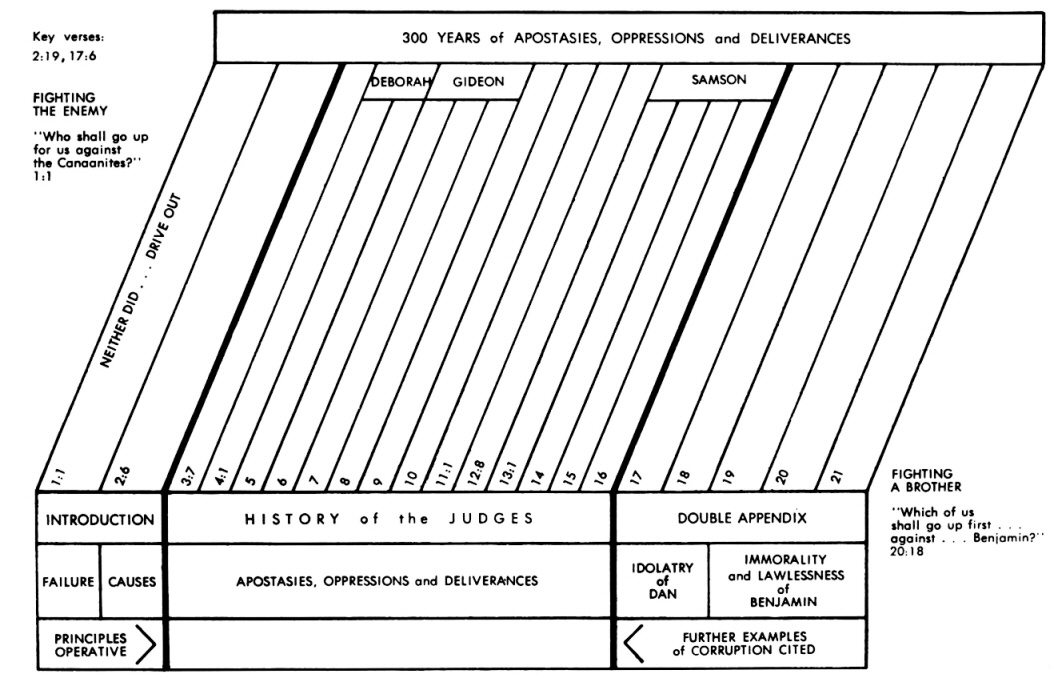
Chart from recommended resource Jensen's Survey of the OT - used by permission
|
RECYCLING SIN |
|||||
| Jdg 1:1-3:6 | Jdg 3:7-16:31 | Jdg 17:1-21:25 | |||
| Introduction | History of the Judges | Appendix | |||
| Causes of the Cycles THE REASON |
Curse of the Cycles THE RECORD |
Conditions in the Cycles THE RESULTS |
|||
| Failure to Complete Conquest Jdg 1:1-36 God's Judgment for Failure Jdg 2:1-3:6 |
Curse of the Cycles |
Conditions in the Cycles |
|||
| Living with Canaanites |
War with the Canaanites |
Living Like the Canaanites |
|||
| Religious Laxity |
Political Uncertainty |
Moral Anarchy |
|||
| About 350 Years of Israel's History - Almost 25%! From Compromise to Confusion! |
|||||

Another Timeline of Israel's History
Click to Enlarge
from Jensen's Survey of the OT
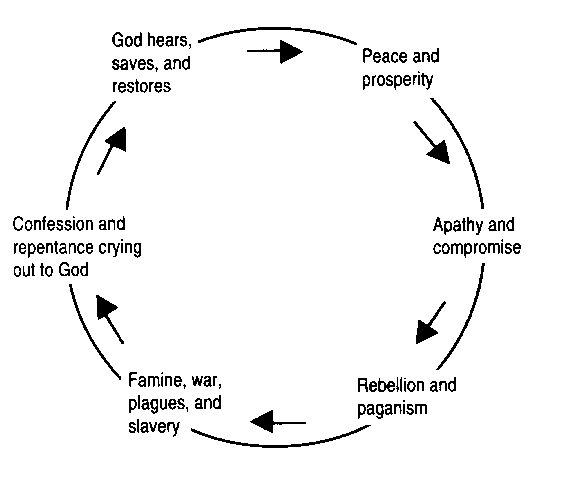
Click to Enlarge
Judges 20:1 Then all the sons of Israel from Dan to Beersheba, including the land of Gilead, came out, and the congregation assembled as one man to the LORD at Mizpah.
- Then all - Jdg 20:2,8,11 21:5 De 13:12-18 Jos 22:12
- as one man - 1Sa 11:7,8 2Sa 19:14 Ezr 3:1 Ne 8:1
- from Dan - Jdg 18:29 1Sa 3:20 2Sa 3:10 24:2 1Ch 21:2 2Ch 30:5
- including the land of Gilead - Nu 32:1,40 Jos 17:1 2Sa 2:9
- to the LORD at Mizpah - Jdg 20:18,26 11:11
- Judges 20 Resources - Multiple Sermons and Commentaries
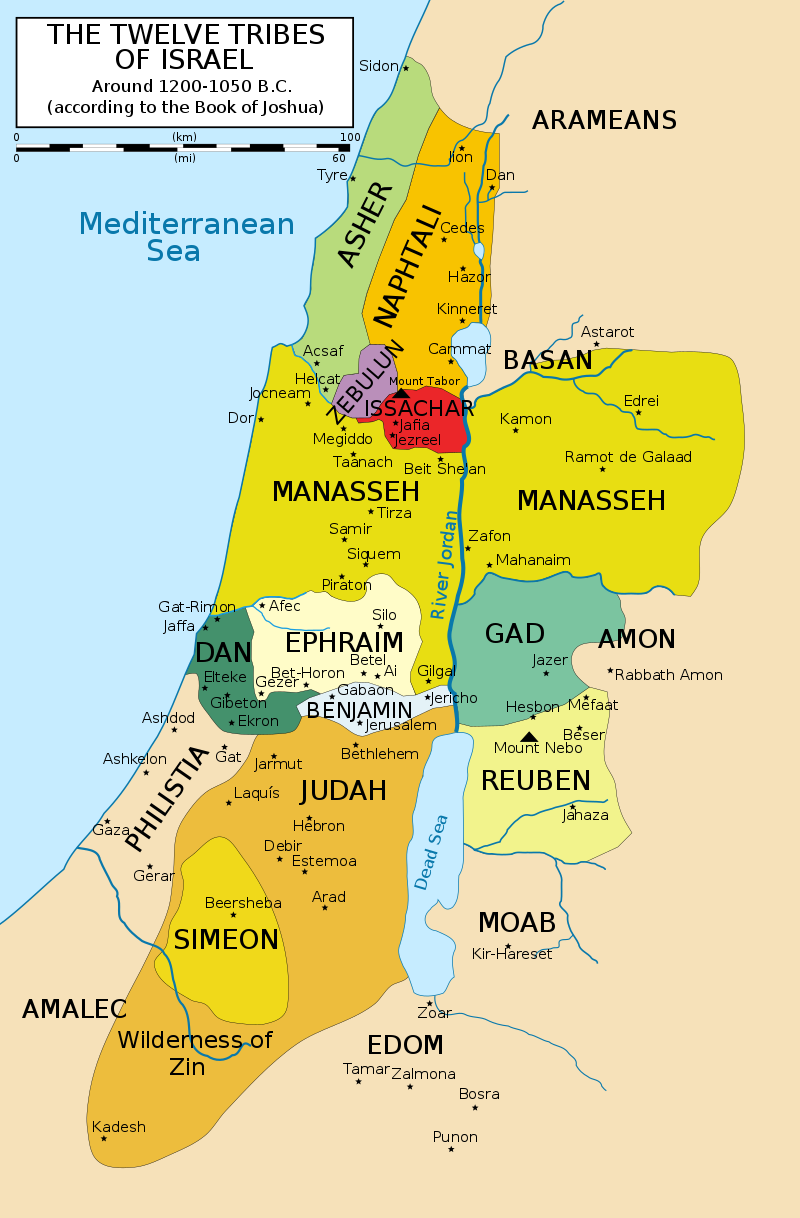
Location of Beersheba (in Simeon) & Dan (in Naphtali)
THE GRUESOME BODY PART
POSTCARDS ILLICIT A REACTION
Then all the sons of Israel from Dan to Beersheba (well of the seven), including the land of Gilead, came out - Dan to Beersheba (1Sa 3:20, 2Sa 2:10, 17:11, 24:2, 15, 1Chr 21:2, 1Ki 4:25, 2Chr 30:5) is a geographic way to say all of Israel from the North (Dan) to South (Beersheba). Beersheba was 48 miles S of Jerusalem, midway between the coast and the Dead Sea. From the northern tip to southern extremity of Israel (from the perspective of the author who wrote after Dan moved north).All the sons of Israel gathered with the exception of Jabesh Gilead (see Jdg 21:8-9). Also missing is the entire tribe of Benjamin for they knew (Jdg 20:3) this assembly was to take action against them and Gibeah and so naturally they "boycotted" the conference. It is worth noting that immorality was a root cause of the subsequent civil war. Immorality can divide and destroy a nation (are you listening America?)!
THOUGHT - "The chapter is a good illustration of the principles taught in James 3:13-18+. When we operate on the basis of human wisdom, we create one problem after another, but when we pause to pray and seek the mind of the Lord, He shows us what to do." (See Wiersbe - With the Word) God’s people today need to deal with sin in their lives (2Co 7:1+) and in the church family (1Co 5:1-13+). Unconfessed sin is like uncontrolled disease which spreads and it kills. Or to use a modern example (2020-21) it is like a COVID infection which will make you as sick as you have ever felt and can kill you!
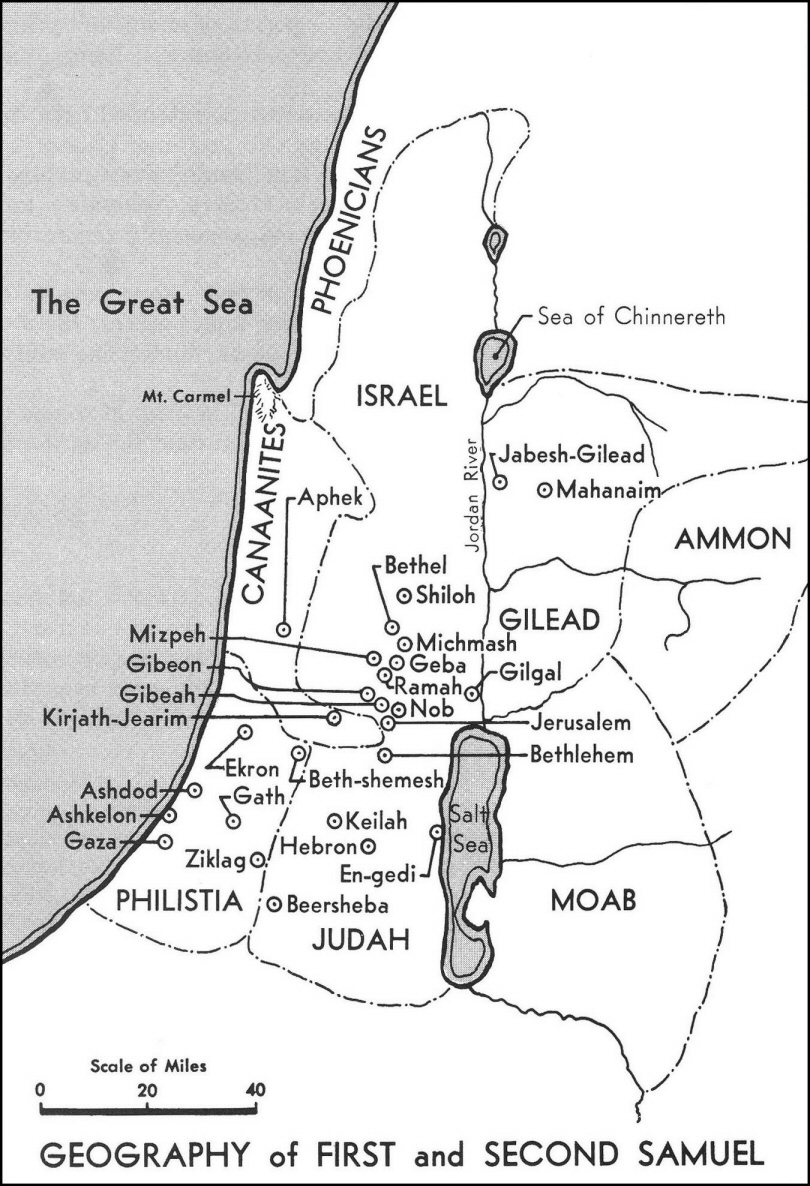
Central Location of Mizpah
N of Jerusalem, S of Bethel
(Click to enlarge)
It does not appear that the Israelites on this occasion, were summoned by the authority of any one common head, but they came together by the consent and agreement, as it were, of one common heart, fired with a holy zeal for the honour of God and Israel. The place of their meeting was Mizpah which was near to Shiloh, the residence of the priests that attended the tabernacle.
G Campbell Morgan adds that “A great moral passion flamed out. Underneath all the degeneracy was a true stratum of religious conviction, which in the presence of the iniquity of the men of Gibeah sprang to life and action."
Guzik makes a sad but probably true statement - It seems that the crime of Gibeah shocked the conscience of Israel. Today it seems that the crime at Gibeah would be material for tabloid news, cable television, daytime talk shows, and talk radio—more than a national call to righteousness and repentance.
And the congregation assembled as one man to the LORD at Mizpah - Locate Mizpah (also spelled "Mezpah" = watchtower) on the map above - it was 8 miles N of Jerusalem (Jos 18:26; 1Sa 7:5) and was S of Bethel and Shiloh. This is where Samuel later gathered the tribes to intercede for the them (read this great story in 1Sa 7:5-17; cp 1Sa10:17). The word "to" in Hebrew is a preposition that denotes motion toward, in this case "toward Yahweh." What does "to" or "toward" the LORD mean? Not sure. But they were not at Shiloh or even at Bethel (where the Ark was in those days for reasons that are unclear - Jdg 20:27). Also although the congregation assembled as one man there is no record of prayer or what the LORD God would have Israel do. The phrase as one man clearly speaks of their unity of purpose and is repeated in Jdg 20:8-9 and Jdg 20:11 so that the sons of Israel were united in their opposition to the evil that had taken place in Gibeah. The fact that there was still considerable unity among the 12 tribes is additional evidence to support this event occurred relatively early in the period of Judges (cf the event in 1Sa 11:7).
Predictably, since they did not inquire of what God would have them do, the nation reacted from their fleshly instinct with burning indignation (Jdg 20:30). After all they must have reasoned the Israelites had been guilty of numerous sins since the Exodus, but never of anything so repulsive as this. They needed to appraise the situation and then plan a course of action. As in the case of Saul's appeal in [1Sa11:7], the nation "came out as one man" (Jdg 20:1). They came even from the distant borders of Israel, including many from Gilead in Transjordan.
Keil and Delitzsch —The expectation of the Levite was fulfilled. The congregation of Israel assembled at Mizpeh to pass sentence upon Gibeah, and formed the resolution that they would not rest till the crime was punished as it deserved (vv. 1–10). But when the Benjaminites refused to deliver up the offenders in Gibeah, and prepared to offer resistance, the other tribes began to make war upon Gibeah and Benjamin (vv. 11–19), but were twice defeated by the Benjaminites with very great loss (vv. 20–28). At length, however, they succeeded by an act of stratagem in taking Gibeah and burning it to the ground, and completely routing the Benjaminites, and also in putting to death all the men and cattle that they found in the other towns of this tribe, and laying the towns in ashes, whereby the whole of the tribe of Benjamin was annihilated, with the exception of a very small remnant (vv. 29–48).
A C Gaebelein Summary…CHAPTER 20 The Horrible War
1. The Levite's story (Jdg 20:1-7)
2. The uprising (Jdg 20:8-11)
3. The slaying of the Israelites (Jdg 20:12-25)
4. Benjamin exterminated except six hundred men (Jdg 20:26-48)
This and the concluding chapter bring before us the awful harvest of what had been sown. "For whatsoever a man soweth, that shall he also reap" (Gal. 6:7). They had sown the wind and now reaped the whirlwind. Violence and lawlessness result in the slaying of 40,000 Israelites and 23,000 of the tribe of Benjamin. Nearly the entire tribe was wiped out. From Dan to Beersheba into the land of Gilead they gathered at Mizpeh to hear the story of the Levite. Benjamin refused to give up the wicked men and instead of humbling themselves, acknowledging the dreadful guilt and bringing the guilty ones to judgment, they gathered themselves together to fight their own brethren. Their company was small in comparison with the mighty host of Israel . The divine counsel was that Judah should go up first to battle with Benjamin. What a contrast with the beginning of the book! There they were to fight against the common foe; here against their own brethren.
"But to be fit to be used of God to deal with evil involves much more than readiness to be His instrument. They are too ready, as we see in the result. Their wrath is too prompt, too implacable, too unsparing. Theirs is the reckless haste of vengeance, and not the solemn discrimination of divine judgment. They remember not their own sins, bring no sin offering to God, no tears of penitence. They build on their numbers; no doubt on the justice of their cause, also, but in self-righteousness and without self-suspicion. Thus they go up to smite, and they are smitten heavily, disastrously. Benjamin, the wrong-doer, is wholly victorious."
Here too are the lessons for God's people in judging what is evil amongst them. Then the children of Israel went to Bethel (House of God) and with prayer and fasting waited on the Lord and brought the offerings. Then the Lord gave them the assurance of victory. Benjamin is smitten, their women and children are wiped out. Only six hundred men escaped to the rock of Rimmon. All their cities were burned.
To even greater scenes of violence, bloodshed and dissolution this poor world, which has rejected God and His beloved Son, is hastening on.
Judges 20:2 And the chiefs of all the people, even of all the tribes of Israel, took their stand in the assembly of the people of God, 400,000 foot soldiers who drew the sword.
- drew the sword - Jdg 20:15,17 8:10 2Sa 24:9 2Ki 3:26
- Judges 20 Resources - Multiple Sermons and Commentaries
ISRAEL CALLS
A SOLEMN ASSEMBLY
And the chiefs of all the people, even of all the tribes of Israel, took their stand in the assembly of the people of God, 400,000 foot soldiers who drew the sword - Chiefs Hebrew "corner, cornerstone". Israel was "the people of God", though the actions of Benjamin belied that title. The leaders bore the solemn responsibility of meting out the proper punishment for the crime, and a large army supported them. The phrase drew the sword indicates these were not farmers who milked cow but were trained to cut and slice!
Guzik - Deuteronomy 13:12–18 instructed Israel how to deal with such abominations among them. It said they must first test the truth of the accusations. If the charges were true, they must then utterly destroy those who committed such an abomination.
John Trapp on meaning of chiefs' name - The corners of all the people: for the chieftains and rulers bear up the people, and hold them together, as the corner stones do the whole building, which else would soon shatter and fall to ruin.
Judges 20:3 (Now the sons of Benjamin heard that the sons of Israel had gone up to Mizpah.) And the sons of Israel said, "Tell us, how did this wickedness take place?"
- sons of Benjamin heard - Pr 22:3 Mt 5:25 Lu 12:58,59 14:31,32
- how did this wickedness take place - Jdg 19:22-27
- Judges 20 Resources - Multiple Sermons and Commentaries
ISRAEL DOES A
"FACT CHECK"
(Now the sons of Benjamin heard that the sons of Israel had gone up to Mizpah.) - This would not have been difficult as Gibeah was about 3 miles from Mizpah. Sons of Israel would have been the other 11 tribes, but apparently none from Benjamin. In other words this solemn assembly was not clandestine but out in the open. Benjaminite consciences should have kicked into gear about the best way to avoid a tribal disaster! So much for wishful thinking, because remember these were those days when there was no authority over the nation and men were left to be "free thinkers" (which usually leads to "foul" thinking). The theme verse of the book Judges 21:25 would prove true in this sad scenario.
And the sons of Israel said, "Tell us, how did this wickedness take place?" - This is still showing cooler heads and wiser thinking was still present even in the beginning of these dark days. Let's get our facts straight before we jump to conclusions and add wicked actions to wicked acts. Presumably they had at least 2 witnesses, the Levite and his servant, but possibly also the old man, the Ephraimite who was sojourning at Gibeah. And yet as best we can determine they heard only the Levite's story which was false testimony (in part). Was Israel guilty of jumping to conclusions and not hearing the second witness? Just asking?
Mizpah (Easton's Bible Dictionary) - A city of Benjamin, "the watch-tower", where the people were accustomed to meet in great national emergencies (Josh. 18:26; Jdg. 20:1, 3; 21:1, 5; 1Sa 7:5-16). It has been supposed to be the same as Nob (1Sa 21:1; 22:9-19). It was some 4 miles north-west of Jerusalem, and was situated on the loftiest hill in the neighbourhood, some 600 feet above the plain of Gibeon. This village has the modern name of Neby Samwil, i.e., the prophet Samuel, from a tradition that Samuel's tomb is here. Samuel inaugurated the reformation that characterized his time by convening a great assembly of all Israel at Mizpeh, now the politico-religious centre of the nation. There, in deep humiliation on account of their sins, they renewed their vows and entered again into covenant with the God of their fathers. It was a period of great religious awakening and of revived national life. The Philistines heard of this assembly, and came up against Israel. The Hebrews charged the Philistine host with great fury, and they were totally routed. Samuel commemorated this signal victory by erecting a memorial-stone, which he called "Ebenezer" (q.v.), saying, "Hitherto hath the Lord helped us" (1 Sam. 7:7-12).
Judges 20:4 So the Levite, the husband of the woman who was murdered, answered and said, "I came with my concubine to spend the night at Gibeah which belongs to Benjamin.
- I came with my concubine - Jdg 19:15-28
- Judges 20 Resources - Multiple Sermons and Commentaries
THE WITNESS
TAKES THE STAND
So the Levite, the husband of the woman who was murdered, answered and said "I came with my concubine to spend the night at Gibeah (map) which belongs to Benjamin - This is simple enough and so far the Levite is telling the truth (assuming he was not the murderer which some writers have suggested!)
GIBEAH [ISBE] - gib'-e-a (gibh`ah, "hill"): The Hebrew word denotes generally an eminence or hill, in distinction from har, which is used for mountain, or mountain range. A city described as belonging to Benjamin (Josh 18:28; Jdg 19:14) Gibeah of Benjamin (1Sa 13:2,15; 14:16), Gibeah of the children of Benjamin (2 Sam 23:29), Gibeah of Saul (1 Sam 11:4; Isa 10:29), and possibly, also, Gibeah of God (1 Sam 10:5 margin);
- Related Resource - See picture of Tel and Wikipedia article

1. History:
The narrative in which it first appears is one of extraordinary and tragic interest, casting priceless light on the conditions prevailing in those days when "there was no king in Israel" (Jdg 19 ff). A Levite sojourning on the farther side of Mt. Ephraim was deserted by his concubine who returned to her father's house in Beth-lehem-judah. Thither he went to persuade her to return. Hospitably entertained by her father, he tarried till the afternoon of the fifth day. The evening was nigh when they came over against Jebus--Jerusalem--but, rejecting his servant's suggestion that they should lodge in this "city of a stranger"--i.e. the Jebusite--the Levite pressed on, and when they were near to Gibeah the sun set. They entered the city and sat down in the street. The laws of hospitality today do not compel the entertainment of strangers who arrive after sunset. But it may have been through disregard of all law that they were left unbefriended. An old man from Mt. Ephraim took pity on them, invited them to his house, and made himself responsible for their necessities. Then follows the horrible story of outrage upon the Levite's concubine; the way in which he made known his wrongs to Israel; and the terrible revenge exacted from the Benjamites, who would not give up to justice the miscreants of Gibeah.
Gibeah was the home of Saul, the first king of Israel, and thither he returned after his election at Mizpah (1 Sam 10:26). From Gibeah he summoned Israel to assemble for the relief of Jabesh-gilead, which was threatened by Nahash the Ammonite (1 Sam 11:4 ff). In the wars of Saul with the Philistines, Gibeah seems to have played a conspicuous part (1 Sam 13:15). Here were exposed the bodies of the seven sons of Saul, slain by David's orders, to appease the Gibeonites, furnishing the occasion for Rizpah's pathetic vigil (2 Sam 21:1 ff). Gibeah is mentioned in the description of the Assyrian advance on Jerusalem (Isa 10:29).
2. Identification:
The site now generally accepted as that of Gibeah is on Teleil el-Ful, an artificial mound about 4 miles North of Jerusalem, a short distance East of the high road to Shechem. A little way North of Teleil el-Ful, the high road bifurcates, one branch turning eastward to Jeba`, i.e. Geba (which should be read instead of "Gibeah" in Jdg 20:31); the other continuing northward to Bethel. Not far from the parting of the ways, on the road to Jeba` lies erRam, corresponding to Ramah (Jdg 19:13). At Gibeah, about 30 furlongs from Jerusalem, Titus encamped for the night on his advance against the city from the North Teleil el-Ful (See picture and Wikipedia article) quite satisfactorily suits all the data here indicated.
The words in Jdg 20:33 rendered by the King James Version "the meadows of Gibeah," the Revised Version (British and American) "Maareh-geba"--simply transliterating--and the Revised Version, margin "the meadow of Geba" (or Gibeah), by a slight emendation of the text, read "from the west of Gibeah," which is certainly correct. W. Ewing
Gibeah - 45x in 44v - Jos. 15:57; Jos. 18:28; Jos. 24:33; Jdg. 19:12; Jdg. 19:13; Jdg. 19:14; Jdg. 19:15; Jdg. 19:16; Jdg. 20:4; Jdg. 20:5; Jdg. 20:9; Jdg. 20:10; Jdg. 20:13; Jdg. 20:14; Jdg. 20:15; Jdg. 20:19; Jdg. 20:20; Jdg. 20:21; Jdg. 20:25; Jdg. 20:29; Jdg. 20:30; Jdg. 20:31; Jdg. 20:34; Jdg. 20:36; Jdg. 20:37; Jdg. 20:43; 1 Sam. 10:26; 1 Sam. 11:4; 1 Sam. 13:2; 1 Sam. 13:15; 1 Sam. 14:2; 1 Sam. 14:16; 1 Sam. 15:34; 1 Sam. 22:6; 1 Sam. 23:19; 1 Sam. 26:1; 2 Sam. 21:6; 2 Sam. 23:29; 1 Chr. 11:31; 2 Chr. 13:2; Isa. 10:29; Hos. 5:8; Hos. 9:9; Hos. 10:9
Gibeah was a city given notoriety in the subsequent history of Israel...
Hosea 9:9 They have gone deep in depravity As in the days of Gibeah; He will remember their iniquity, He will punish their sins.
Hosea 10:9 From the days of Gibeah you have sinned, O Israel; There they stand! Will not the battle against the sons of iniquity overtake them in Gibeah?
Judges 20:5 "But the men of Gibeah (map) rose up against me and surrounded the house at night because of me. They intended to kill me; instead, they ravished my concubine so that she died.
- the men - Jdg 19:22
- rose up against me- Ge 19:4-8
- they ravished, De 22:24 Eze 22:10,11
- my concubine - Jdg 19:25,26
- Judges 20 Resources - Multiple Sermons and Commentaries
Related Passage:
Judges 19:25 But the men would not listen to him. So the man seized his concubine and brought her out to them; and they raped her and abused her all night until morning, then let her go at the approach of dawn.
LEVITE GIVES ONLY
PART OF THE STORY
Famous radio commentator Paul Harvey (I REALIZE THIS DATES ME AND MOST OF YOU PROBABLY DON'T HAVE A CLUE WHO THIS IS) is best known for his iconic line "And now for the rest of the story (listen)...." The Levite is not the least bit interested in giving his best "Paul Harvey imitation!"
But the men of Gibeah (map) rose up against me and surrounded the house at night because of me. They intended to kill me - This is NOT the "rest of the story," but only part of the story. This is not the whole truth and nothing but the truth, so help him God. It is a lie! This unholy "holy man" breaks the command "You shall not bear false witness against your neighbor." (Ex 20:16+) The worthless men did not want to kill him but to sodomize him! In short, he lied to protect his own skin from culpability! You've never done that have you? (Rhetorical!)
Instead, they ravished ('anah; Lxx - tapeinoo and empaizo - ridiculed, mocked) my concubine so that she died - The Levite leaves out the critical, incriminating detail that it was he who grasped (Lxx uses a verb that pictures seizing her himself). Clearly the Levite is hardly innocent in this rape/murder. Indeed his hands were stained with her blood and the ground cried out for retribution. To save himself from being sodomized, he "volunteered" his concubine to the worthless men, instead of defending her life.
Gary Inrig comments on this "trial" gone wrong from the beginning - They asked the Levite to recount what had happened, and he does so. Predictably, his account is distorted and one-sided. Biblical law required that another witness be sought, but again, the spirit of revenge pushes for immediate, not measured, response. But rather than turning to God, they did what was right in their own eyes. Those present took three vows that would shape their future actions but were made without reference to seeking God’s will:
- No one would go home until Gibeah was obliterated. They jump immediately to military action, without attempting judicial negotiation or solutions.
- Any person or group that did not join in the crusade against Gibeah was to be treated the same way as Gibeah.
- No one present was to allow his daughter to marry a Benjamite. (Borrow Hearts of Iron, Feet of Clay )
Ravished (Humbled, afflicted) (06031) 'anah means to be afflicted, be bowed down, be humbled, be meek. 'Anah frequently expresses the idea God sends affliction to discipline (Dt 8:2-3, see context Dt 8:5, 1Ki 11:39; Ps 90:15 Luke 3:5). It often speaks of harsh and painful treatment (Isa 53:4, Ge16:6). Anah in Judges - Jdg 16:5, 6, 19, 19:24, 20:5
Judges 20:6 "And I took hold of my concubine and cut her in pieces and sent her throughout the land of Israel's inheritance; for they have committed a lewd and disgraceful act in Israel.
- cut her - Jdg 19:29
- in Israel - Jdg 20:10 19:23 Ge 34:7 Jos 7:15 2Sa 13:12,13
- Judges 20 Resources - Multiple Sermons and Commentaries
HOW TO MAKE A
JURY CRINGE!
And I took hold of my concubine and cut her in pieces and sent her throughout the land of Israel's inheritance; for they have committed a lewd (zimmah) and disgraceful act (nebalah) in Israel - Lewd is zimmah, used often of sexual perversions worthy of death (cf. Lv18:17; 19:29). Disgraceful (nebalah) is a strong term for active moral rebellion against the divine standards, including crimes such as in rape (2Sa13:14), homosexual acts (Jdg 19:23,24) and general promiscuity (Dt. 22:21). While the Levite was mute about his own role in the affair, the acts of the worthless fellows in Gibeah deserved to die according to the OT Law (Jdg 20:13).
Lewd (02154) (zimmah) means an evil plan, purpose, or scheme; a wicked thought, especially with reference to sexual unchastity; lewdness, ideas and practices that are indecent and disgraceful. Lust; sexual unchastity; licentiousness. Zimmah refers to the plans and purposes of the mind which give rise to one’s actions. Yet the word rarely pertains to good intentions (Job 17:11). It is used in reference to the evil plotting of the wicked (Isa. 32:7); the thoughts of foolish people (Pr 24:9); and mischievous motivations (Ps. 119:150). Moreover, it relates to sexual sins that spring from lustful intentions - incest (Lev. 18:17); prostitution (Lev. 19:29); adultery (Job 31:11); and rape (Jdg. 20:6). Figuratively, the word represents the wickedness of the people of Israel in their idolatry, calling to mind the connection with adultery (Jer. 13:27; Ezek. 16:27).
Judges 20:7 "Behold, all you sons of Israel, give your advice and counsel here."
- all - Ex 19:5,6 De 4:6 14:1,2 1Co 5:1,6,10-12
- give - Jdg 19:30 Jos 9:14 Pr 20:18 24:6 Jas 1:5
- Judges 20 Resources - Multiple Sermons and Commentaries
Related Passage:
Judges 19:30 All who saw it said, “Nothing like this has ever happened or been seen from the day when the sons of Israel came up from the land of Egypt to this day. Consider it, take counsel and speak up!”
LEVITE CALLS
FOR VERDICT
Behold (hinneh), all you sons of Israel, give your advice and counsel here - NET has "All you Israelites, make a decision here!" What they did not do but should have done is ask God first. Now what is interesting is that we have no record of any other witnesses of this horrid act. For example there was a servant who had been with the Levite (Judges 19:3, 9, 11, 13). Why was he not called to he witness stand? God had said they were to have 2 or more witnesses (Dt 19:15+). The Hebrew in Jdg 20:3 is plural in the verb "tell us" implying there may have been more than one witness. It may well have been that drastic action was called for, but what would become of Israel when its assembly could be convened and manipulated by a person of such dubious morals as this Levite? That is the serious question posed by this second episode.
Judges 20:8 Then all the people arose as one man, saying, "Not one of us will go to his tent, nor will any of us return to his house.
- as one man - Jdg 20:1,11
- will - Jdg 21:1,5 Pr 21:3 Ec 9:10
- Judges 20 Resources - Multiple Sermons and Commentaries
Related Passage:
Judges 21:1 Now the men of Israel had sworn in Mizpah, saying, “None of us shall give his daughter to Benjamin in marriage.”
THE VERDICT IS
UNANIMOUS!
Then all the people arose as one man (cf unity in Jdg 20:1) - There would be no "hung jury" in this case. It was too glaring, too gory, and worthless fellows at Gibeah were too guilty to even deserve an appeal. In fact the guilty parties were not even allowed to testify. So much for "innocent until proven guilty!" Keep in mind that this event took place early in the period of the Judges, at a time when the nation wasn’t under foreign oppression. Though they had no central government, the tribes were still united and able to muster troops and wage war together.
Not one of us will go to his tent nor will any of us return to his house - The unanimous verdict called forth a unanimous vow, for their statement here is tantamount to declaring a "vow" even though not expressly stated. This thought is supported by the fact that the Israelites actually did take a vow as described in Jdg 21:1, 7, 18 to see this through to the end.
Judges 20:9 "But now this is the thing which we will do to Gibeah; we will go up against it by lot.
- by lot - Jos 14:2 1Sa 14:41,42 1Ch 24:5 Ne 11:1 Pr 16:33 Jon 1:7 Ac 1:26
- Judges 20 Resources - Multiple Sermons and Commentaries
LOTS TO LEAD
THE CHARGE
But now this is the thing which we will do to Gibeah (map); we will go up against it by lot - The purpose of lots was to determine who would be in the front lines (obviously the most dangerous) of the battle charge. Objects were cast on the ground or drawn from a container as a means of seeking guidance from God. As Proverbs 16:33 says "The lot is cast into the lap, But its every decision is from the LORD."
The lot may have been for determining the 1/10 of men who would be responsible for securing provisions as described in the following verse.
QUESTION - What was the practice of casting lots?
ANSWER - The practice of casting lots is mentioned seventy times in the Old Testament and seven times in the New Testament. In spite of the many references to casting lots in the Old Testament, nothing is known about the actual lots themselves. They could have been sticks of various lengths, flat stones like coins, or some kind of dice; but their exact nature is unknown. The closest modern practice to casting lots is likely flipping a coin.
The practice of casting lots occurs most often in connection with the division of the land under Joshua (Joshua chapters 14-21), a procedure that God instructed the Israelites on several times in the book of Numbers (Numbers 26:55; 33:54; 34:13; 36:2). God allowed the Israelites to cast lots in order to determine His will for a given situation (Joshua 18:6-10; 1 Chronicles 24:5,31). Various offices and functions in the temple were also determined by lot (1 Chronicles 24:5, 31; 25:8-9; 26:13-14). The sailors on Jonah’s ship (Jonah 1:7) also cast lots to determine who had brought God’s wrath upon their ship. The eleven apostles cast lots to determine who would replace Judas (Acts 1:26). Casting lots eventually became a game people played and made wagers on. This is seen in the Roman soldiers casting lots for Jesus’ garments (Matthew 27:35).
The New Testament nowhere instructs Christians to use a method similar to casting lots to help with decision-making. Now that we have the completed Word of God, as well as the indwelling Holy Spirit to guide us, there is no reason to be using games of chance to make decisions. The Word, the Spirit, and prayer are sufficient for discerning God’s will today—not casting lots, rolling dice, or flipping a coin.GotQuestions.org
Judges 20:10 "And we will take 10 men out of 100 throughout the tribes of Israel, and 100 out of 1,000, and 1,000 out of 10,000 to supply food for the people, that when they come to Gibeah of Benjamin, they may punish them for all the disgraceful acts that they have committed in Israel."
- Ge 24:60
- Judges 20 Resources - Multiple Sermons and Commentaries
ONE OUT OF TEN
WILL BE SUPPLIER
And we will take 10 men out of 100 throughout the tribes of Israel, and 100 out of 1,000, and 1,000 out of 10,000 to supply food for the people, that when they come to Gibeah of Benjamin - This preparation shows how serious they were and also hints that this might not be a quick "mop up" job.
They may punish them for all the disgraceful acts (nebalah) that they have committed in Israel - The disgraceful nature of the crime committed by the men in Gibeah shows that most Israelites still had a conscience with some degree of an intact moral compass.
Disgraceful (05039)(nebalah from nabal - to be senseless or foolish) means senselessness, disgrace, folly, foolish. It describes a general disregard for moral and spiritual claims. One who is nebalah is senseless, impious and a disgrace, and his actions are sinful folly. Sins of immorality such as request for homosexual relations are an act of folly (Jdg 19:23,24). Premeditated rape was a deed of folly, "a disgraceful thing." (2Sa 13:12) Taken something that was under the ban, as Achan did, was a crime worthy of death (Josh 7:15). Lying with Jacob's daughter was a disgraceful thing (Ge 34:7). Vine writes "Its use in 1 Sam. 25:25 signifies "disregarding God's will." Nebālâ is most often used as a word for a serious sin (Ge. 34:7)."
Gibrant - The noun nevālāh is derived from the verb nāval, "to wither," "to be foolish." It is attested in Middle Hebrew and Jewish Aramaic, with the nuance here of "something repulsive." The concept of foolishness is inextricably bound to that of ungodliness in Hebrew thought.
In an ironic twist at the conclusion of the Book of Job, the comforters are commanded by Yahweh to bring sacrifices to Job to atone for their "folly, in that you have not spoken of me the thing which is right, like my servant Job" (42:8). The implication is that they in their self-righteousness had spoken of condemnation, ignoring Job's defense, as they presented traditional wisdom.
In a moderate extension of the concept, the noun also denotes a willful sin. It usually is applied to the category of sexual sins. Three cases of rape are denoted by this noun, though all differ in details. The rape unto death of the Levite's concubine by the Benjamites is referred to as "folly" (Jdg. 19:23f; 20:6). Dinah's rape by Shechem, a Canaanite prince who intended to right the situation by marriage, was folly. Likewise, Tamar's rape by her half-brother Amnon and his dismissal of her was folly. A common thread among the latter two is that the brideprice given for a non-virgin was greatly reduced. However, a woman who would engage in sex prior to marriage would do so under the threat of capital punishment (Deut. 22:21). Adultery with a neighbor's wife is folly (Jer. 29:23).
Non-sexual transgressions are also folly. Achan's sin of withholding booty proscribed as being sacred was a sin, worthy of death for his family. Godlessness in general is considered folly in Isaiah, as the wicked plot evil (Isa 32:6) and speak stupidly (Isa 9:17). There is no discernible commonality of these cases to distinguish the usage of this noun over against that of its synonyms. They implied that the perpetrator was behaving in a godless fashion, as all sing do. Indeed, during the remainder of his life, Ammon was to be marked as a "fool," for this deed (2Sa 13:13).
Nebalah - 13v - act of folly(2), disgraceful act(1), disgraceful acts(1), disgraceful thing(3), folly(3), foolishly(1), foolishness(1), nonsense(1). Gen. 34:7; Deut. 22:21; Jos. 7:15; Jdg. 19:23; Jdg. 19:24; Jdg. 20:6; Jdg. 20:10; 1 Sam. 25:25; 2 Sam. 13:12; Job 42:8; Isa. 9:17; Isa. 32:6; Jer. 29:23
Judges 20:11 Thus all the men of Israel were gathered against the city, united as one man.
- Judges 20 Resources - Multiple Sermons and Commentaries
UNITED THEY WOULD STAND
AGAINST WICKEDNESS
Thus all the men of Israel were gathered against the city, united as one man - This is the third use of the expression "as one man" (cf. Jdg 20:1, 8), a fact the author clearly wants to get across. Their actions were no based on the impulse of a few Israelites but reflected a national conscience and outage are the depraved nature of the crime in Gibeah. The Israelites were knit together as a unit, in marked contrast to the days of Deborah and Barak (Jdg 5:15-17+) so as stated above this supports the event in Jdg 20-21 occurring very early after Joshua and the elders died. When godly leaders die the leaven of sin spreads like wildfire inflaming the lusts of men's unredeemed, unregenerate flesh nature!
David Jackman - Without trying to deal with the root causes of the problem, they determined to pay back the men of Gibeah and give them what they deserved. That was a very natural human reaction, and an extremely destructive one. As Shakespeare puts it in The Tempest, “the rarer action is in virtue than in vengeance”; rarer in the double sense of less frequent, but also more valuable. Revenge is sweet, the proverb says, but Sir Walter Scott called it “the daintiest morsel ever cooked in hell.” The moral collapse exemplified by this incident was in all their hearts, as it is, at least potentially, in all our ours, too. Because their hearts were equally culpable in being turned away from the living God, they escaped from their paralysis into greater confusion and, eventually, civil war. What does this say to our congregations today? It reminds us of the emptiness of human solutions. Neither the right wing law-and-order brigade, nor the left wing redistribution-of-wealth advocates can change the hearts of people. There always will be a moral paralysis in society until those hearts are transformed by men and women being set free from their sin and themselves to live as God’s children. The passage reminds us that we shall not bring in God’s kingdom by programs of legislation, by marches and lobbying, by committees, or by law and politics. (See context in Preacher's Commentary)
Judges 20:12 Then the tribes of Israel sent men through the entire tribe of Benjamin, saying, "What is this wickedness that has taken place among you?
- sent men - De 13:14 Dt 20:10 Jos 22:13-16 Mt 18:15-18 Ro 12:18
- Judges 20 Resources - Multiple Sermons and Commentaries
Related Passage:
Deuteronomy 20:10 “When you approach a city to fight against it, you shall offer it terms of peace.
SEEKING THE
SINNERS
Then the tribes of Israel sent men through the entire tribe of Benjamin, saying, "What is this wickedness that has taken place among you - The fact that they sent men indicates they were seeking another solution other than all out civil war.
Judges 20:13 "Now then, deliver up the men, the worthless fellows in Gibeah, that we may put them to death and remove this wickedness from Israel." But the sons of Benjamin would not listen to the voice of their brothers, the sons of Israel.
- deliver - 2Sa 20:21,22
- children of Belial - Jdg 19:22 De 13:13 1Sa 30:22 2Sa 20:1 23:6 1Ki 21:13 2Ch 13:7
- put - De 17:7,12 19:19 21:21 22:21,24 24:7 Ec 11:10
- would not listen - 1Sa 2:25 2Ch 25:16,20 Pr 29:1 Ho 9:9 10:9 Ro 1:32 Rev 18:4,5 The conduct of the Israelites was very equitable in this demand; but perhaps the rulers or elders of Gibeah ought previously to have been applied to, to deliver up the criminals to justice. However, the refusal of the Benjamites, and their protection of those who had committed this horrible wickedness, because they were of their own tribe, prove them to have been deeply corrupted, and (all their advantages considered) as ripe for divine vengeance as the inhabitants of Sodom and Gomorrah had been. Confiding in their own valour and military skill, they seen to have first prepared for battle in this unequal contest with such superior numbers.
- Judges 20 Resources - Multiple Sermons and Commentaries
Related Passage:
Deuteronomy 13:12-18+ “If you hear in one of your cities, which the LORD your God is giving you to live in, anyone saying that 13 some worthless men have gone out from among you and have seduced the inhabitants of their city, saying, ‘Let us go and serve other gods’ (whom you have not known), 14 then you shall investigate and search out and inquire thoroughly. If it is true and the matter established that this abomination has been done among you, 15 you shall surely strike the inhabitants of that city with the edge of the sword, utterly destroying it and all that is in it and its cattle with the edge of the sword. 16 “Then you shall gather all its booty into the middle of its open square and burn the city and all its booty with fire as a whole burnt offering to the LORD your God; and it shall be a ruin forever. It shall never be rebuilt. 17 “Nothing from that which is put under the ban shall cling to your hand, in order that the LORD may turn from His burning anger and show mercy to you, and have compassion on you and make you increase, just as He has sworn to your fathers, 18 if you will listen to the voice of the LORD your God, keeping all His commandments which I am commanding you today, and doing what is right in the sight of the LORD your God.
PURGE THE EVIL
FROM AMONG YOU
Now then, deliver up the men, the worthless (beliyyaal; Lxx - beliar = Satan) fellows in Gibeah, that we may put them to death and remove (ba'ar) this wickedness from Israel." - Even though they had failed to consult God & were doing what was right in their own eyes, at this time they only wanted those directly guilty of the crime. The sin of the men of Gibeah called for the death penalty, and Israel had to punish the sin which would purge out the evil influence and would cause others to fear committing similar abomination.
Worthless fellows = literally "sons of Belial, a phrase found 9x in the OT - Dt 13:13 Jdg 19:22 Jdg 20:13 1Sam 2:12 10:27 25:17 1Ki 21:10 21:13 2Chr 13:7 (See convicting use of Belial in Ps 101:3+)
Wiersbe on what would justify the death penalty- Since the Levite had willingly given his concubine to the men of Gibeah, their sin can hardly be called adultery (Deut. 22:22). The penalty for rape was death, and gang rape would be even more serious (Deut. 22:25–26+). Perhaps the tribes were citing the law concerning wicked men in a city (Deut. 13:12–18) and using that as the basis for their action. (See context The Wiersbe Bible Commentary)
Remove this wickedness from Israel - One is reminded of Paul's command in 1Cor 5:13 to "REMOVE (aorist imperative) THE WICKED MAN FROM AMONG YOURSELVES." Note this same Hebrew combination (ba'ar ra') "remove or purge the evil" is found ten times in Deuteronomy. (Read these slowly asking God to search your heart for any "evil" that needs to be purged! - Dt 9:15, 13:5, 17:7, 12, 19:19, 21:21, 22:21, 22, 24, 24:7) Pfeiffer adds that "In the Jewish liturgy the verb translated put away is used of the complete removal of leaven on the eve of Passover."
THOUGHT - Beloved, God is clearly serious about the polluting, destructive influence of "evil" in the midst of His holy people! What "evil" are you refusing to purge? If you continue in your resistance and stubbornness, on the authority of God's Word, you will one day reap what you are today sowing. Cease sowing and repent, while today is still called "today"! Don't procrastinate. If you are a believer, the vitality of your spiritual life and communion with the Holy God depends on you choosing to serve Him rather than the idols of this passing world!)
Sadly the Israelites did not see the evil that pervaded their own community and this "sin in their camp" (toleration of the sin of the Levite) may have been the cause of their powerlessness and defeats in the first 2 battles. (Just a thought - but unconfessed sin always saps us of supernatural strength!) (See Related Discussion: The Deceitfulness of Sin)
Wiersbe adds that "When God’s people refuse to obey God’s Word, the results are always tragic. The spiritual life of a church is crippled and eventually destroyed when the congregation shuts its eyes to sin and will not discipline offenders. There can never be unity among the people of God as long as some of them cover up sin and allow it to infect the body. (See context The Wiersbe Bible Commentary)
But the sons of Benjamin would not listen to the voice of their brothers, the sons of Israel - This is a sad "but" as giving over the guilty parties would spare many other lives (as we see from the number of "body bags" in the following account. The sons of Benjamin were harboring the sons of Belial and were guilty by association, in a sense accomplices to one of the most violent crimes in Israel's history. Like many today (even in the church), the Benjaminites were unable to accept reproof and had a false sense of loyalty in protecting men who were guilty of a heinous crime. The only solution would be that they would have to learn the hard way. (cf Pr 29:1, Pr 6:15).
When sin isn’t exposed, confessed, and punished,
it pollutes society and defiles the land.
-- Warren Wiersbe
Wiersbe - Some people may have interpreted the stubbornness of Benjamin as an act of patriotism (ED: OR "LOYALTY") They were only trying to protect their own citizens. But their refusal to cooperate was definitely an act of rebellion against the Lord. By coming to the aid of Gibeah rather than joining in the punishment of that city the tribe identified with the wicked men and merited their punishment. When sin isn’t exposed, confessed, and punished, it pollutes society and defiles the land (ED: WOE TO AMERICA WHERE CRIMINALS ARE LET OUT OF JAIL ESPECIALLY IN STATES LIKE CALIFORNIA!!! THE LAW OF SOWING AND REAPING IS IMMUTABLE!). The wicked men of Gibeah were like a cancerous tumor in the body that had to be cut out. (1Co 5:6+, 1Co 15:33+) (See context in The Wiersbe Bible Commentary)
Block has an interesting thought on why the Benjaminites refused to hand over the guilty men - “The extent to which people will stand up to defend evil and evildoers is a measure of how deeply rooted is the Canaanizing rot in a culture.” (Borrow Judges, Ruth. Vol. 6: New American Commentary)
Worthless (wicked, Belial)(01100) beliyyaal from belî + yaʿal: "not, without" and "to be of use, worth, or profit.") A worthless person, good for nothing to himself or others, and capable of nothing but mischief.The LXX renders it according to the context by the terms paranomos, anomia, and aphrōn, i.e. "lawless, lawlessness, witless." By the NT time, Belial had become synonymous with Satan (cf. 2 Cor. 6:15).
Remove (purge as in the 8 uses below) (01197) ba'ar is a verb used more often figuratively than literally and is normally translated "to burn," "to be kindled" or "to consume."
The sons of Benjamin had either forgotten or choose to ignore God's repeated warning about purging evil for their midst. This principle was given by God so that the evil would not spread like leaven, that power would not be dissipated or as in the present case an entire tribe might not disappear! Below are the 9 passages and it is no accident that they are all in Deuteronomy, Israel's "instruction manual" (so to speak) on how to live and prosper in the Promised Land...
Deuteronomy 13:5 “But that prophet or that dreamer of dreams shall be put to death, because he has counseled rebellion against the LORD your God who brought you from the land of Egypt and redeemed you from the house of slavery, to seduce you from the way in which the LORD your God commanded you to walk. So you shall purge the evil from among you.
Deuteronomy 17:7 “The hand of the witnesses shall be first against him to put him to death, and afterward the hand of all the people. So you shall purge the evil from your midst.
Deuteronomy 17:12 “The man who acts presumptuously by not listening to the priest who stands there to serve the LORD your God, nor to the judge, that man shall die; thus you shall purge the evil from Israel.
Deuteronomy 19:19 then you shall do to him just as he had intended to do to his brother. Thus you shall purge the evil from among you.
Deuteronomy 22:21 then they shall bring out the girl to the doorway of her father’s house, and the men of her city shall stone her to death because she has committed an act of folly in Israel by playing the harlot in her father’s house; thus you shall purge the evil from among you.
Deuteronomy 22:22 “If a man is found lying with a married woman, then both of them shall die, the man who lay with the woman, and the woman; thus you shall purge the evil from Israel.
Deuteronomy 22:24 * then you shall bring them both out to the gate of that city and you shall stone them to death; the girl, because she did not cry out in the city, and the man, because he has violated his neighbor’s wife. Thus you shall purge the evil from among you.
Deuteronomy 24:7 “If a man is caught kidnapping any of his countrymen of the sons of Israel, and he deals with him violently or sells him, then that thief shall die; so you shall purge the evil from among you.
THOUGHT - What is your church's stand on Biblical church discipline? God is serious about purging evil from His people and this surely applies to His Church. Not being willing to purge the evil from the tribe of Benjamin cost them dearly! Believers today need to deal with sin in their lives personally (2Co 7:1+) and corporately (1Cor 5:1-13+)
“Sin is the mother and nurse of all evil, the egg of all mischief,
the fountain of all bitterness, the root of misery.”
-- C H Spurgeon
QUESTION - What does the Bible say about church discipline?
ANSWER - Church discipline is the process of correcting sinful behavior among members of a local church body for the purpose of protecting the church, restoring the sinner to a right walk with God, and renewing fellowship among the church members. In some cases, church discipline can proceed all the way to excommunication, which is the formal removal of an individual from church membership and the informal separation from that individual.
Matthew 18:15–20 gives the procedure and authority for a church to practice church discipline. Jesus instructs us that one individual (usually the offended party) is to go to the offending individual privately. If the offender refuses to acknowledge his sin and repent, then two or three others go to confirm the details of the situation. If there is still no repentance—the offender remains firmly attached to his sin, despite two chances to repent—the matter is taken before the church. The offender then has a third chance to repent and forsake his sinful behavior. If at any point in the process of church discipline, the sinner heeds the call to repent, then “you have gained your brother” (verse 15, ESV). However, if the discipline continues all the way through the third step without a positive response from the offender, then, Jesus said, “let him be to you as a Gentile and a tax collector” (verse 17, ESV).
The process of church discipline is never pleasant just as a father never delights in having to discipline his children. Sometimes, though, church discipline is necessary. The purpose of church discipline is not to be mean-spirited or to display a holier-than-thou attitude. Rather, the goal of church discipline is the restoration of the individual to full fellowship with both God and other believers. The discipline is to start privately and gradually become more public. It is to be done in love toward the individual, in obedience to God, and in godly fear for the sake of others in the church.
The Bible’s instructions concerning church discipline imply the necessity of church membership. The church and its pastor are responsible for the spiritual well-being of a certain group of people (members of the local church), not of everyone in the city. In the context of church discipline, Paul asks, “What business is it of mine to judge those outside the church? Are you not to judge those inside?” (1 Corinthians 5:12). The candidate for church discipline has to be “inside” the church and accountable to the church. He professes faith in Christ yet continues in undeniable sin.
The Bible gives an example of church discipline in a local church—the church of Corinth (1 Corinthians 5:1–13). In this case, the discipline led to excommunication, and the apostle Paul gives some reasons for the discipline. One is that sin is like yeast; if allowed to exist, it spreads to those nearby in the same way that “a little yeast works through the whole batch of dough” (1 Corinthians 5:6–7). Also, Paul explains that Jesus saved us so that we might be set apart from sin, that we might be “unleavened” or free from that which causes spiritual decay (1 Corinthians 5:7–8). Christ’s desire for His bride, the church, is that she might be pure and undefiled (Ephesians 5:25–27). The testimony of Christ Jesus (and His church) before unbelievers is important, too. When David sinned with Bathsheba, one of the consequences of his sin was that the name of the one true God was blasphemed by God’s enemies (2 Samuel 12:14).
Hopefully, any disciplinary action a church takes against a member is successful in bringing about godly sorrow and true repentance. When repentance occurs, the individual can be restored to fellowship. The man involved in the 1 Corinthians 5 passage repented, and Paul later encouraged the church to restore him to full fellowship with the church (2 Corinthians 2:5–8). Unfortunately, disciplinary action, even when done correctly and in love, is not always successful in bringing about restoration. Even when church discipline fails to bring about repentance, it is still needed to accomplish other good purposes such as maintaining a good testimony in the world.
We have all likely witnessed the behavior of a youngster who is always allowed to do as he pleases with no consistent discipline. It is not a pretty sight. Nor is the overly permissive parent loving, for a lack of guidance dooms the child to a dismal future. Undisciplined, out-of-control behavior will keep the child from forming meaningful relationships and performing well in any kind of setting. Similarly, discipline in the church, while never enjoyable or easy, is necessary at times. In fact, it is loving. And it is commanded by God. GotQuestions.org
F B Meyer Our Daily Homily Judges 20:13
And put away evil from Israel.
The earnestness and promptness with which Israel dealt with and put away this evil thing were very commendable. They had gathered from all the land, even from Gilead beyond the Jordan. They were knit together in a perfect unity of feeling and action. They resolved to subordinate all things beside to the excision of this evil.
So must it be in the Church. The Lord Himself took Ananias and Sapphira out of the infant Church, and the Apostle very earnestly besought and commanded the Corinthians to put away from among them the wicked person, who had committed a sin that would not be named among the Gentiles. “Christ our Passover is sacrificed for us; therefore let us keep the feast, not with old leaven, neither with the leaven of malice and wickedness; but with the unleavened bread of sincerity and truth” (1Co 5:7,8).
At the close of this age God will send forth his angels, to sever the wicked from among the just, and to cast them into the furnace of fire.
In our own life it is impossible altogether to avoid contact with such people. Indeed, to do so, as the Apostle says truly, we must go out of the world. But we can abstain from their friendship and company. It is an altogether different thing to have dealings with a worldly man in business, and to admit him into bosom fellowship and comradeship in our leisure hours. The first is permissible, but not the second; else our companions will seduce us from our loyalty to God. Beware of taking on the color of the ground on which you lie. “I pray not that Thou shouldest take them out of the world, but that Thou shouldest keep them from the evil.”
Judges 20:14 And the sons of Benjamin gathered from the cities to Gibeah, to go out to battle against the sons of Israel.
- Nu 20:20 21:23 2Ch 13:13 Job 15:25,26
BENJAMINITES PREPARE
TO PAY THE PIPER!
Pay the piper is an idiom that means to face, accept, or suffer repercussions for one's actions or words, especially those that would be expected to incur punishment.
And the sons of Benjamin gathered from the cities to Gibeah, to go out to battle against the sons of Israel - Not only did the tribe of Benjamin refuse to give up the guilty men, but they in effect declare war on the other 11 tribes! So even though this event was likely early in the 300+ year period of Judges, it demonstrates that their logic and sense of "right and wrong" was already dysfunctional! What had begun as a punitive operation against one city now turned into full-scale civil war. Later the tribes of Ephraim and Manasseh were to engage in bitter fighting (Jdg 12:4-6), but here it was not a regional but a national conflict of 11 tribes against 1! The men of Benjamin had a good reputation as excellent soldiers, as had been predicted by Jacob in Ge 49:27. Their ability with the bow and the sling shot were well known (Jdg 20:16), and even in the time of Saul some Benjamites could use the sling with either hand (1Chr 8:40; 1Chr 12:2). Perhaps pride muddled their thinking and they thought that their superior skill could offset the great numerical disadvantage. Pride and self-confidence would prove costly, and sadly for both sides!
The foolish, sinful action of the tribe of Benjamin reminds me of the "right in your own eyes" mindset that has in effect stolen righteousness from this nation as deceived men and women now call evil good and good evil (Isaiah 5:20+). We are "cruising for a bruising" in this country. Send revival Lord and if you don't, send your Son to jettison us out of this mucky moral mess! Please!
Paul spoke of this general acceptance of evil as the final stage in rejecting the knowledge of God in Romans 1 writing
"and although they know the ordinance of God, that those who practice such things are worthy of death, they not only do the same, but also give hearty approval to those who practice them." (WOE! - THAT'S MY ADDITION NOT PAUL'S!) (Romans 1:32+).
A society that refuses to accept guilt, in the sense of distinguishing right from wrong
and punishing the offender, will soon prove impossible to govern!
-- David Jackman
David Jackman has some superb observations and powerful, pithy applications - "There is not the slightest doubt as to the action the leaders of the tribe of Benjamin should have taken when they were confronted with the moral responsibility of the crime they allowed the citizens of Gibeah to perpetrate. Either they should have punished the offenders themselves or handed them over to the nation’s representatives, as demanded in verse 13. But they refused to do this, although the guilt of the men of Gibeah was proved beyond question. Instead, they chose to regard the accusation as a personal attack on the tribe and began to mobilize an army of twenty-six thousand men to defend the guilty. By way of application, we need to remember that there is no clearer indication of moral sickness than when wrongdoing is condoned or even defended on the grounds of family or national solidarity and loyalty… In our society… Sins are laundered verbally to make them acceptable, or at least tolerated, to an increasingly undisciplined populace. Adultery is redefined as “wife swapping” or “having an affair.” Homosexuality becomes “a gay lifestyle.” Theft at work is acceptable if it is “the perks of the job.” Lies are always “white,” the truth always “selective.” Greed is sanitized as “upward social mobility.” The examples are endless. The purpose is always the same—to remove my sense of moral guilt, and so to pretend that if something sounds OK and people feel comfortable with it, that’s all that matters. Whether it is in the TV ads or in the newspapers, the circumstances are glamorized and visual images of social acceptability, fun, wealth, and vitality are all used to anaesthetize the conscience, to pretend that “anything goes.” This was the situation in Israel; but the lesson, then and now, is that a society that refuses to accept guilt, in the sense of distinguishing right from wrong and punishing the offender (ED: AS IS OCCURRING IN CALIFORNIA), will soon prove impossible to govern. Everyone will do what is right in his or her own eyes, and there will be no ultimate restraints. Might becomes right (ED: WITNESS THE GANGS TAKING TO STREETS LOOTING STORES UNDER THE GUISE OF SOCIAL JUSTICE!), and civilization ceases… The tragedy of Israel was that these symptoms were not dealt with when they first appeared, because there was no king. Those of us who are entrusted with authority within the biblical structures of home, church, or nation, have a heavy responsibility before God to use it responsibly in love to Him and to our neighbor." (See context in Jackman, D., & Ogilvie, L. J. Vol. 7: The Preacher's Commentary Series, Judges, Ruth. Page 285)
Judges 20:15 And from the cities on that day the sons of Benjamin were numbered, 26,000 men who draw the sword, besides the inhabitants of Gibeah who were numbered, 700 choice men.
- Jdg 20:25,35,46,47 Nu 26:41
- Judges 20 Resources - Multiple Sermons and Commentaries
BENJAMITES PUT THEIR TROOPS
WHERE THEIR MOUTH IS
Put your money where you mouth is means to do, live up to, or follow through on something one talks about, threatens, or promises, especially (but not always) when it involves spending money. The Benjaminites said they would defend the parties guilty of the gruesome murder of the concubine. So ready, set, go! Action, camera! The show is about to begin and what a tragic drama is about to play out!
And from the cities on that day the sons of Benjamin were numbered, 26,000 men who draw the sword, besides the inhabitants of Gibeah who were numbered, 700 choice men - They will clearly be outnumbered but not necessarily outgunned (so to speak). Remember they have these 700 crack "black ops" troops who will help neutralize their numbers disadvantage!
Dale Ralph Davis notes that the "crack Seven Hundred Unit (v. 16) will have to be reckoned with. This number formed an elite corps of left-handed super-slingers, renowned for their deadly accuracy. They may have been the reason Benjamin had initial success against the other tribes. Most soldiers were probably right-handed and carried their shields on their left arms. That would provide normal defense against right-handed slingers, but lefty slingers would be hurling at a different angle toward the unguarded side,11 and, if these left-handers could hit a hair (v. 16), they could surely smash a right ear." (Judges: Such Great Salvation)
Judges 20:16 Out of all these people 700 choice men were left-handed; each one could sling a stone at a hair and not miss.
NOT 007 BUT 700
JAMES BOND LIKE MEN!
Out of all these people 700 choice men were left-handed - These guys were the cream of the crop, the best of the best. And they were did not even need runners to bring in artillery shells, for if you have ever been to Israel, you know there is no rock shortage for these straight shooting soldiers! The word left-handed (Itter yad yemeeno) is literally "obstructed in his right hand;" so the Chaldee Targum, {gemid beedaih deyammeena,} contracted or impeded in his right hand." Lev Clerc observes, that the 700 men left-handed seem therefore to have been made slingers, because they could not use the right hand, which is employed in managing heavier arms; and they could discharge the stones from the sling in a direction against which their opponents were not on their guard, and thus do even greater damage. Ehud was another hand picked (pun) left-handed jabber! (Jdg 3:15+)
The king to be, David had some crack troops in the men who joined his "Robin Hood" band as describe in 1Ch 12:1-2
Now these are the ones who came to David at Ziklag, while he was still restricted because of Saul the son of Kish; and they were among the mighty men who helped him in war. 2 They were equipped with bows, using both the right hand and the left to sling stones and to shoot arrows from the bow; (THIS IS AN INCREDIBLE FEAT - I PLAYED FAIRLY GOOD BASKETBALL AND NEVER COULD SHOOT AS WELL WITH MY LEFT HAND AS WITH MY RIGHT! THESE GUYS ARE "NBA" MATERIAL FOR SURE!) they were Saul’s kinsmen from Benjamin.
Each one could sling a stone at a hair and not miss. (KJV ~ "at an hair breadth") - They formed an important component in the armies of Jehoram (2Ki 3:25) and Uzziah (2Chr 26:14) several centuries later. Slingstones, weighing one pound or more, could be propelled at speeds up to 90-100mph (THAT'S PRETTY FAST AND DOES NOT GIVE MUCH TIME TO DUCK OUT OF THE WAY. A BULLET TRAVELS AT ABOUT 1772.727 MPH AND THERE IS VIRTUALLY CHANCE TO DUCK), and thus were extremely effective weapons in the hands of a skilled slinger like David proved in his victory over Goliath.
Arthur Cundall adds that "“The sling, which was employed with a left-handed motion, must not be confused with the modern schoolboy’s catapult; it was a formidable weapon of war used in the Assyrian, Egyptian, and Babylonian armies as well as in Israel. David’s encounter with the Philistine, Goliath, is a telling example of the power and accuracy of this weapon (I Sa. 17:49). It has been estimated that stones weighing up to one pound could be projected with uncanny accuracy at speeds up to 90 m.p.h.!" (Borrow Judges & Ruth: Tyndale Old Testament Commentary)
The phrase miss is the Hebrew verb chata' which is the common word for sin, sin being the missing of the mark of God's law. If we "miss God's mark" even by a millimeter (so to speak), it is still a miss and therefore is just as much a sin before God as if we have missed by a mile!
HISTORICAL NOTE - Sling stones - The sling was a very ancient warlike instrument; and, in the hands of those who were skilled in the use of it, produced astonishing effects. The inhabitants of the islands of Baleares, now Majorca and Minorca, were the most celebrated slingers of antiquity. They did not permit their children to break their fast, till they had struck down the bread they had to eat from the top of a pole, or some distant eminence. Vegetius tells us, that slingers could in general hit the mark at 600 feet distance (THINK ABOUT THAT AS YOU PONDER THAT THE NORMAL FOOTBALL FIELD IS 360 FEET! I AM 76 AND CAN'T EVEN SEE THINGS 600 FT FROM ME, MUCH LESS HIT THEM WITH A ROCK FROM A SLING!) . 1Sa 17:40,49,50 25:29 2Ch 26:14
Miss (02398) chata' means to miss the way, to fail; to err, to swerve from truth, to go wrong, to sin. The literal use describes an accurate shot by slingshot Jdg 20:16 - they could "not miss (chata')." Pr 19:2 conveys a related meaning of chata' in those versions that translate it as "miss the way." (Pr 19:2NIV) As Vine says "From this basic meaning comes the word’s chief usage to indicate moral failure toward both God and men, and certain results of such wrongs." When man sins he has missed the mark, the goal, or the way that God has set as standard. In an ironic use, the intensive (Piel) stem can mean "purified" or "to de-sin" and to to cleanse (Ex 29:36, David's request of God to purify him - Ps 51:7, Lxx = rhantizo = to sprinkle, figuratively = inward cleansing = "hearts sprinkled" - Heb 10:22; cf purify in Nu 8:21; 19:12,13, 20; 31:19, 20, 23).
Judges 20:17 Then the men of Israel besides Benjamin were numbered, 400,000 men who draw the sword; all these were men of war.
- four hundred - Jdg 20:2 Nu 1:46 26:51 1Sa 11:8 15:4 1Ch 21:5 2Ch 17:14-18
- Judges 20 Resources - Multiple Sermons and Commentaries
TALK ABOUT A
NUMBERS ADVANTAGE!
Then the men of Israel besides Benjamin were numbered, 400,000 men who draw the sword; all these were men of war - This is almost a 20 to one advantage. Surely there is no way they could lose! Right? Wrong! The forces of Israel comprised a powerful army, but remember the immutable principle (even though it is found in a proverb) that "The horse is prepared for the day of battle, But victory belongs to the LORD." (Proverbs 21:31, cf Ps 144:10NIV) And here's a fact for your next Christian party where you play Bible Trivia! This was the largest army the nation of Israel had ever assembled up to this point!
Keil and Delitzsch Commentary…The forces of the other tribes amounted when numbered to 400,000 men. These numbers (26,000 Benjaminites and 400,000 Israelites) will not appear too great if we consider that the whole of the congregation of Israel took part in the war, with the simple exception of Jabesh in Gilead (Jdg. 21:8), and that in the time of Moses the twelve tribes numbered more than 600,000 men of twenty years old and upwards (Num. 26), so that not much more than two-thirds of the whole of the fighting men went out to the war. (Judges 20 Commentary)
Judges 20:18 Now the sons of Israel arose, went up to Bethel, and inquired of God, and said, "Who shall go up first for us to battle against the sons of Benjamin?" Then the LORD said, "Judah shall go up first."
- Bethel - Jdg 18:31 19:18 Jos 18:1 Joe 1:14
- inquired of God- Jdg 20:7,23,26,27 1:1 Nu 27:5,21 Jos 9:14
- Judah - Jdg 1:1,2 Ge 49:8-10
- Judges 20 Resources - Multiple Sermons and Commentaries
SEEKING THE GUIDANCE OF GOD
IS IT BETTER LATE THAN NEVER?
Better late than never describes the delayed occurrence or achievement of something that one desires and which is better than it not happening at all. I suppose one could argue that it is still better to inquire of God later rather than never, but he subsequent opening events in this civil war would seem to argue against that premise in this particular case.
Now the sons of Israel arose, went up to Bethel (house of God)(map of bethel), and inquired of God, and said - This is interesting. In Judges 20:1-10 Israel seems to rely on their human wisdom to guide them as to how best handle the guilty "sons of Belial" protected by the Benjaminites. Do we see any prayers to Yahweh in the first ten verses? You are correct! None (unless there were some silent ones the Spirit failed to record). Now they come to the House of God and say "Here's our plan God. Give us Your guidance and blessing."
TECHNICAL NOTE - The mention of Bethel poses a problem, since the tabernacle was located at Shiloh (cf. Jdg 18:31). Some have suggested that the Israelites inquired of "the house of God" at Shiloh, but normally this is expressed by bet 'elohim and not bet 'el. Besides, the city Bethel is clearly intended in [Jdg 20:31, 21:19]. Bethel had been a revered location ever since the Lord revealed himself to Jacob at that site (Ge 28:11-19); so, like Mizpah (Jdg 20:1), Bethel could have been one of several suitable holy places (at least "right in their own eyes"). The ark of the covenant appears to have been moved from Shiloh to Bethel (cf. Jdg 20:26, 27). The ark frequently accompanied Israel into battle (cf. Nu 10:35). Since Phinehas the high priest stayed with the ark, it was possible to inquire of the Lord wherever Phinehas happened to be. In 2Ch 1:3-4 it is plain that at the start of Solomon's reign the tabernacle was at Gibeon while the ark was in Jerusalem.
Most of the space in [Jdg 20:18-48] is devoted to a description of the fighting, with the fluctuating fortunes of the opposing sides. But the three enquiries (by the Israelites) and responses (by the Lord) in [Jdg 20:18, 23, 28] let us see what was going on at a deeper level. They show us what was happening in the minds of the Israelites and between them and the Lord as the war proceeded through its various phases. The Israelites were confident about the rightness and eventual outcome of their cause (Jdg 20:18). They were already committed to the war, and the Lord’s approval was assumed. They therefore raised a purely procedural matter: how was the campaign to be conducted? The Lord commanded Judah to go first, appropriately so possibly since the ravished concubine was from Judah (Jdg 19:1). But there was no promise of victory and none materialized; quite the reverse (Jdg 20:19, 20, 21). The second enquiry (Jdg 20:23) shows the drastic loss of confidence the enquirers had suffered as a result of their disastrous defeat. They were doubtful about the wisdom of continuing the war, and struck a conciliatory note by referring to the Benjamites as their ‘brothers’. But the Lord sent them into battle again—to another resounding defeat (Jdg 20:23, 24, 25).
The Benjamites undoubtedly deserved to be punished. But the moral and spiritual state of the nation as a whole was such that holy war almost destroyed it instead of preserving it. The Lord appears to be as angry with the rest of Israel as He is with the Benjamites, and He shows it by distributing defeat and victory in such a way that the whole of Israel is judged. He is both the Judge and preserver of His wayward people.
THOUGHT - They had made their plans and now were asking God to bless them! Don't we all do this for time to time? The memory of God’s past guidance in the days of Joshua sends them to the shrine at Bethel, not to ask God what they should do, or seek His help, but to go through the religious motions of receiving the divine guidance and blessing. We already know that their motivation is revenge so they could not possibly expect God’s approval.
And said "Who shall go up first for us to battle against the sons of Benjamin?" Then the LORD said, "Judah shall go up first"- how different the circumstances from the similar question of Jdg 1:1+ "Who shall go up first for us against the Canaanites, to fight against them?”! IN the opening verse of this book it was a united Israel waging a war of occupation to dispossess the Canaanites and possess the land promised by God. Here the inquiry is from a divided Israel, about to engage in a bloody civil war in which brother is pitted against brother (Jdg 20:28). The victory in answer to the first prayer was given at once (Jdg 1:4). Here the victory is withheld until Israel is thoroughly broken and demoralized (Jdg 20:26-28). Indeed, the ‘holy’ war of this chapter scarcely rates as such. It was decided on at a solemn assembly (sans supplication) instigated by a Levite, a man of bad character, and concluded in a bloodbath that reeked more of vengeful excess than dispensation of justice.
Guzik on Israel being defeated even though they heard from the LORD - In the first battle, Israel sought the LORD—yet they were defeated. We can speculate that though they inquired of God, they still trusted in the might of their army and in the goodness of their cause, but not in the LORD.
Keil and Delitzsch Commentary…They went to Bethel, not to Shiloh, where the tabernacle was standing, because that place was too far from the seat of war. The ark of the covenant was therefore brought to Bethel, and Phinehas the high priest inquired of the Lord before it (POSSIBLY) through the Urim and Thummim (vv. 27, 28). Bethel was on the northern boundary of the tribe of Benjamin, and was consecrated to this purpose before any other place by the revelations of God which had been made to the patriarch Jacob there (Gen. 28 and 35). (Judges 20 Commentary)
house of God. (1.) A place in Central Palestine, about 10 miles north of Jerusalem, at the head of the pass of Michmash and Ai. It was originally the royal Canaanite city of Luz (Gen. 28:19). The name Bethel was at first apparently given to the sanctuary in the neighbourhood of Luz, and was not given to the city itself till after its conquest by the tribe of Ephraim. When Abram entered Canaan he formed his second encampment between Bethel and Hai (Gen. 12:8); and on his return from Egypt he came back to it, and again "called upon the name of the Lord" (Ge 13:4). Here Jacob, on his way from Beersheba to Haran, had a vision of the angels of God ascending and descending on the ladder whose top reached unto heaven (Ge 28:10, 19); and on his return he again visited this place, "where God talked with him" (Ge 35:1-15), and there he "built an altar, and called the place El-beth-el" (q.v.). To this second occasion of God's speaking with Jacob at Bethel, Hosea (Ge 12:4,5) makes reference.
In troublous times the people went to Bethel to ask counsel of God (Judg. 20:18, 31; 21:2). Here the ark of the covenant was kept for a long time under the care of Phinehas, the grandson of Aaron (Jdg 20:26-28). Here also Samuel held in rotation his court of justice (1 Sam. 7:16). It was included in Israel after the kingdom was divided, and it became one of the seats of the worship of the golden calf (1 Kings 12:28-33; 13:1). Hence the prophet Hosea (Hos. 4:15; 5:8; 10:5, 8) calls it in contempt Beth-aven, i.e., "house of idols." Bethel remained an abode of priests even after the kingdom of Israel was desolated by the king of Assyria (2 Kings 17:28, 29). At length all traces of the idolatries were extirpated by Josiah, king of Judah (2 Kings 23:15-18); and the place was still in existence after the Captivity (Ezra 2:28; Neh. 7:32). It has been identified with the ruins of Beitin, a small village amid extensive ruins some 9 miles south of Shiloh.
(the house of God) well known city and holy place of central Palestine, about 12 miles north of Jerusalem. If we are to accept the precise definition of (Genesis 12:8) the name of Bethel would appear to have existed at this spot even before the arrival of Abram in Canaan. (Genesis 12:8; 13:3,4) Bethel was the scene of Jacob?s vision. (Genesis 28:11-19; 31:13) Jacob lived there. (Genesis 35:1-8) The original name was Luz. (Judges 1:22,23) After the conquest Bethel is frequently heard of. In the troubled times when there was no king in Israel, it was to Bethel that the people went up in their distress to ask counsel of God. (Judges 20:18,26,31; 21:2) Authorized Version, "house of God." Here was the ark of the covenant. (Judges 20:26-28; 21:4) Later it is named as one of the holy cities to which Samuel went on circuit. (1 Samuel 7:16) Here Jeroboab placed one of the two calves of gold. Toward the end of Jeroboam?s life Bethel fell into the hands of Judah. (2 Chronicles 13:19) Elijah visited Bethel, and we hear of "sons of the prophets" as resident there. (2 Kings 2:2,3) But after the destruction of Baal worship by Jehu Bethel comes once more into view. (2 Kings 10:29) After the desolation of the northern kingdom by the king of Assyria, Bethel still remained an abode of priests. (2 Kings 17:27,28) In later times Bethel is named only once under the scarcely-altered name of Beitin . Its ruins still lie on the right hand side of the road from Jerusalem to Nablus.
BETHEL [ISBE] - beth'-el (beth-'el; Baithel and oikos theou, literally, "house of God"):
(1) A town near the place where Abraham halted and offered sacrifice on his way south from Shechem.
1. Identification and Description:
It lay West of Ai (Gen 12:8). It is named as on the northern border of Benjamin (the southern of Ephraim, Josh 16:2), at the top of the ascent from the Jordan valley by way of Ai (Josh 18:13). It lay South of Shiloh (Jdg 21:19). Eusebius, Onomasticon places it 12 Roman miles from Jerusalem, on the road to Neapolis. It is represented by the modern Beitin, a village of some 400 inhabitants, which stands on a knoll East of the road to Nablus. There are four springs which yield supplies of good water. In ancient times these were supplemented by a reservoir hewn in the rock South of the town. The surrounding country is bleak and barren, the hills being marked by a succession of stony terraces, which may have suggested the form of the ladder in Jacob's famous dream.
2. The Sanctuary:
The town was originally called Luz (Gen 28:19, etc.). When Jacob came hither on his way to Paddan-aram we are told that he lighted upon "the place" (Gen 28:11. Hebrew). The Hebrew maqom, like the cognate Arabic maqam, denotes a sacred place or sanctuary. The maqom was doubtless that at which Abraham had sacrificed, East of the town. In the morning Jacob set up "for a pillar" the stone which had served as his pillow (Gen 28:18; see PILLAR, matstsebhah), poured oil upon it and called the name of the place Bethel, "house of God"; that is, of God whose epiphany was for him associated with the pillar. This spot became a center of great interest, lending growing importance to the town. In process of time the name Luz disappeared, giving place to that of the adjoining sanctuary, town and sanctuary being identified. Jacob revisited the place on his return from Paddan-aram; here Deborah, Rebekah's nurse, died and was buried under "the oak" (Gen 35:6 f). Probably on rising ground East of Bethel Abraham and Lot stood to view the uninviting highlands and the rich lands of the Jordan valley (Gen 13:9 ff).
3. History:
Bethel was a royal city of the Canaanites (Josh 12:16). It appears to have been captured by Joshua (8:7), and it was allotted to Benjamin (Josh 18:22). In Jdg 1:22 ff it is represented as held by Canaanites, from whom the house of Joseph took it by treachery (compare 1 Ch 7:28). Hither the ark was brought from Gilgal (Jdg 2:1, Septuagint). Israel came to Bethel to consult the Divine oracle (Jdg 20:18), and it became an important center of worship (1 Sam 10:3). The home of the prophetess Deborah was not far off (Jdg 4:5). Samuel visited Bethel on circuit, judging Israel (1 Sam 7:16).
With the disruption of the kingdom came Bethel's greatest period of splendor and significance. To counteract the influence of Jerusalem as the national religious center Jeroboam embarked on the policy which won for him the unenviable reputation of having "made Israel to sin." Here he erected a temple, set up an image, the golden calf, and established an imposing ritual. It became the royal sanctuary and the religious center of his kingdom (1 Ki 12:29 ff; Am 7:13). He placed in Bethel the priests of the high places which he had made (1 Ki 12:32). To Bethel came the man of God from Judah who pronounced doom against Jeroboam (1Ki 13:1-34), and who, having been seduced from duty by an aged prophet in Bethel, was slain by a lion. According to the prophets Amos and Hosea the splendid idolatries of Bethel were accompanied by terrible moral and religious degradation. Against the place they launched the most scathing denunciations, declaring the vengeance such things must entail (Am 3:14; 4:4; 5:11; 9:1; Hos 4:15; 5:8; 10:5,8,23). With the latter the name Bethel gives place in mockery to Beth-aven. Bethel shared in the downfall of Samaria wrought by the Assyrians; and according to an old tradition, Shalmaneser possessed himself of the golden calf (compare Jer 48:13). The priest, sent by the Assyrians to teach the people whom they had settled in the land how to serve Yahweh, dwelt in Bethel (2 Ki 17:28). King Josiah completed the demolition of the sanctuary at Bethel, destroying all the instruments of idolatry, and harrying the tombs of the idolaters. The monument of the man of God from Judah he allowed to stand (2 Ki 23:4,25). The men of Bethel were among those who returned from Babylon with Zerubbabel (Ezr 2:28; Neh 7:32), and it is mentioned as reoccupied by the Benjamites (Neh 11:31). Zechariah (7:2) records the sending of certain men from Jerusalem in the 4th year of King Darius to inquire regarding particular religious practices. Bethel was one of the towns fortified by Bacchides in the time of the Maccabees (1 Macc 9:50;Josephus Antiquities XIII, i, 3). It is named again as a small town which, along with Ephraim, was taken by Vespasian as he approached Jerusalem (BJ, IV, ix, 9).
Judges 20:19 So the sons of Israel arose in the morning and camped against Gibeah.
- arose - Jos 3:1 6:12 7:16
- Judges 20 Resources - Multiple Sermons and Commentaries
So the sons of Israel arose in the morning and camped against Gibeah. Confident of victory, the Israelites moved their forces and equipment near Gibeah and lined up for battle. After all they had heard from the LORD (Jdg 20:18).
Lindsey - The location and topography of Gibeah made it easy to defend. (See context in The Bible Knowledge Commentary)
Judges 20:20 And the men of Israel went out to battle against Benjamin, and the men of Israel arrayed for battle against them at Gibeah.
- Judges 20 Resources - Multiple Sermons and Commentaries
And the men of Israel went out to battle against Benjamin, and the men of Israel arrayed for battle against them at Gibeah - Gibeah of course is the site of the abominable crime against the concubine.
Judges 20:21 Then the sons of Benjamin came out of Gibeah and felled to the ground on that day 22,000 men of Israel.
- sons of Benjamin - Ge 49:27 Ho 10:9
- felled to the ground- De 23:9 2Ch 28:10 Ps 33:16 73:18,19 77:19 Ec 9:1-3 Jer 12:1
- Judges 20 Resources - Multiple Sermons and Commentaries
BENJAMITES ONE
ISRAEL ZERO
Then the sons of Benjamin came out of Gibeah and felled to the ground on that day 22,000 men of Israel - This is a veritable slaughter. There is no mention of the losses of Benjamin but they must have been few.
Judges 20:22 But the people, the men of Israel, encouraged themselves and arrayed for battle again in the place where they had arrayed themselves the first day.
- encouraged - Jdg 20:15,17 1Sa 30:6 2Sa 11:25 Ps 64:5
- Judges 20 Resources - Multiple Sermons and Commentaries
ENCOURAGING SELF
NOT ENQUIRING OF SAVIOR
But the people, the men of Israel, encouraged (NET - "took heart") themselves and arrayed for battle again in the place where they had arrayed themselves the first day - In the same place where the former battle was fought, with the hope of retrieving their credit upon the same spot of ground where they had lost it, which they would not superstitiously change, as if there were any thing unlucky in the place. The startling defeat brought Israel to its knees. On other occasions such slaughter had followed blatant national sin - Witness the tragic stories in Nu 25:1-9+ and Joshua 7:1-26+, the latter because of what? Because there was sin in the camp! And in our present situation, there also appears to still be sin "in the camp" of Israel. What was it? What about the main "witness," the Levite? Was he not in blatant sin in not revealing the actual events that led to his concubine's gang rape? Mark it down, when we go out to war with "sin in the camp," the results will almost always be defeat and/or disaster. The sons of Israel and the sons of Benjamin both needed to purge the evil in their midst before they could deal with the "speck that was in their brother's eye."
Strengthened (02388)(chazaq) conveys the basic meaning of to be or become strong, to make strong or strengthen, in the Hiphil to take hold of or seize ("retain His anger" - Mic 7:18+), in the Hithpael to strengthen oneself (to take courage 1 Sa 30:6). To be courageous. To overpower.
Judges 20:23 And the sons of Israel went up and wept before the LORD until evening, and inquired of the LORD, saying, "Shall we again draw near for battle against the sons of my brother Benjamin?" And the LORD said, "Go up against him."
- Judges 20 Resources - Multiple Sermons and Commentaries
WEEPING BEFORE
THE LORD
And the sons of Israel went up and wept before the LORD until evening, and inquired of the LORD, saying, "Shall we again draw near for battle against the sons of my brother Benjamin?" And the LORD said, "Go up against him: The phrase my brother Benjamin suggests that Israel may have wondered whether the defeat was punishment for attacking a "brother" tribe.
Matthew Henry writes: "What, and yet miscarry thus! 1. God’s judgments are a great deep, and his way is in the sea. Clouds and darkness are often round about him, but judgment and justice are always the habitation of his throne. We may be sure of the righteousness, when we cannot see the reasons, of God’s proceedings. 2. God would hereby show them, and us in them, that the race is not to the swift nor the battle to the strong, that we are not to confide in numbers, which perhaps the Israelites did with too much assurance. We must never lay the weight on an arm of flesh, which only the Rock of ages will bear. 3. God designed hereby to correct Israel for their sins. They did well to show such a zeal against the wickedness of Gibeah: but were there not with them, even with them, sins against the Lord their God? Those must be made to know their own iniquity that are forward in condemning the iniquity of others."
Judges 20:24 Then the sons of Israel came against the sons of Benjamin the second day.
- Judges 20 Resources - Multiple Sermons and Commentaries
Then the sons of Israel came against the sons of Benjamin the second day - Since they had wept before the LORD, and He told them to "Go" they assumed the results would now be in their favor.
Keil and Delitzsch Commentary…on the second day also the Benjaminites brought 18,000 of them to the ground. “The second day” is not the day following the first engagement, as if the battles had been fought upon two successive days, but the second day of actual fighting, which took place some days after the first, for the inquiry was made at Bethel as to the will of God between the two engagements. (Judges 20 Commentary)
Judges 20:25 And Benjamin went out against them from Gibeah the second day and felled to the ground again 18,000 men of the sons of Israel; all these drew the sword.
- felled to the ground - Jdg 20:21 Ge 18:25 Job 9:12,13 Ps 97:2 Ro 2:5 3:5 11:33
- Judges 20 Resources - Multiple Sermons and Commentaries
ONE-TENTH OF ISRAEL'S
ARMY HAS BEEN FELLED
And Benjamin went out against them from Gibeah the second day and felled to the ground again 18,000 men of the sons of Israel; all these drew the sword - This must have been devastating as almost 1/10 of their huge army were killed and as best can be discerned was "soundly defeated."
God was very likely using these 2 defeats to humble the whole nation. This was not merely the result of the sin of one man (although in a sense it certainly did have it's inception with one man, a profane, unholy Levite, not living a life wholly given to God (that's an understatement!). The whole nation had to be humbled, because they first thought that "THEY" (BENJAMIN) had a sin problem, but they came to see that "WE" have a sin problem. Israel had to get the beam out of its own eye before could deal with the speck in the eye of Benjamin (Mt 7:3-5+).
Hindson makes an interesting observation of how so few could defeat so many - The hilly terrain in the vicinity of Gibeah favored a defensive force, rather than an attacking force. Great numbers of men were of limited value, since they could not be deployed effectively. (ED: WHILE THIS IS REASONABLE, ULTIMATELY GOD ALLOWED THE SONS OF ISRAEL TO BE DEFEATED). (Borrow KJV Bible Commentary)
Judges 20:26 Then all the sons of Israel and all the people went up and came to Bethel and wept; thus they remained there before the LORD and fasted that day until evening. And they offered burnt offerings and peace offerings before the LORD.
- all the children - Jdg 20:18,23
- wept - 1Sa 7:6 2Ch 20:3 Ezra 8:21 9:4,5 Joe 1:14 2:12-18 Jon 3:5-10
- Judges 20 Resources - Multiple Sermons and Commentaries
WEEPING, FASTING
AND OFFERING
Lindsey - Perhaps one reason the Lord permitted their initial defeats was to bring them back in a spirit of repentance to the neglected sacrificial worship. This time their inquiry about whether they should continue the battle not only received a positive reply (Go) but also included a promise of victory (See context in The Bible Knowledge Commentary)
Then all the sons of Israel and all the people went up and came to Bethel and wept; thus they remained there before the LORD and fasted that day until evening - Notice who comes to Bethel now -- all the sons of Israel and all the people. Again they went up to Bethel. And again they wept, went without and waited (fasted that day until evening) and then offered sacrifices. It is likely that sin in the camp accounted for their failure to win the battles the first 2 times (much like the situation in Jos 7:1-26). Another consideration is that God says that "vengeance is Mine. I will repay." And here Israel was taking "vengeance" into their own hands. It was not necessarily wrong to punish the men of Gibeah who murdered the woman and shed innocent blood. But it was wrong to put themselves in the place of God. As support for this thought note Who it is Who finally "strikes" Benjamin in (Jdg 20:35) where we read "the LORD struck Benjamin before Israel."
Now they were doing something they had not done before they went into their first and second battles. Earlier the nation had wept and sacrificed to the Lord when judgment was threatened (Jdg 2:4-5+) but there was no mention made of genuine repentance at that time. Later King David fasted and wept as he begged the Lord to spare the life of Bathsheba's child (2Sa 12:21, 22). These episodes reflect bitter tears as the result of sin. We've all shed them. Revelation 7:17+ and Rev 21:4+ say that God will wipe away our tears. While the context does not allow a dogmatic interpretation, commentators such as Erwin Lutzer feel these will be tears the redeemed shed not for sins which are covered by the blood of the Lamb, but of the manifold opportunities missed during life to bring glory to the Father by good deeds, good deeds that could be "missed" because at that time we were living in unconfessed sin (See related discussion related to the Bema Seat Judgment of Believers - 2Co 5:9+, 2Co 5:10+). Perhaps these prophetic tears have another meaning but this interpretation certainly merits pondering while we still have breath allotted with which to redeem the time in these evil days!
In 1827, Adam Clarke wrote about fasting: "At present it is but little used; a strong proof that self-denial is wearing out of fashion." What would he say about our present day?
Matthew Henry - "Before they only consulted God’s oracle, Who shall go up first? And, Shall we go up? But now they implored His favour, fasted and prayed, and offered burnt-offerings and peace-offerings , to make an atonement for sin and an acknowledgment of their dependence upon God, and as an expression of their desire towards Him. We cannot expect the presence of God with us, unless we thus seek it in the way He has appointed. And when they were in this frame, and thus sought the Lord, then he not only ordered them to go up against the Benjamites the third time, but gave them a promise of victory: Tomorrow I will deliver them into thy hand, Jdg 20:28."
And they offered burnt offerings and peace offerings before the LORD - Burnt offerings (Lev 1:1-17) were voluntary offerings that speak of consecration. The burnt offering (Lev 1:1ff) symbolized the complete consecration of the offerrer to God. Peace offerings (Lev 3:1ff) included a meal and symbolized restored fellowship/communion with God.
Keil and Delitzsch offers an explanation of why after the first 2 visits to God and His telling them to go ahead and fight that they still lost these two battles - The congregation now discovered, from this repeated defeat, that the Lord had withdrawn His grace, and was punishing them. Their sin, however, did not consist in the fact that they had begun the war itself,—for the law in Deut. 22:22, to which they themselves had referred in Jdg 20:13, really required this,—but rather in the state of mind with which they had entered upon the war, their strong self-consciousness, and great confidence in their own might and power. They had indeed inquired of God (Elohim) who should open the conflict; but they had neglect to humble themselves before Jehovah the covenant God, in the consciousness not only of their own weakness and sinfulness, but also of grief at the moral corruption of their brother-tribe.It is certainly not without significance, that in Jdg 20:18 it is stated that “they asked God” (יִשְׁאֲלוּ בֵאלֹהִים), i.e., they simply desired a supreme or divine decision as to the question who should lead the van in the war; whereas, after the first defeat, they wept before Jehovah, and inquired of Jehovah (Jdg 20:23), the covenant God, for whose law and right they were about to contend. But even then there were still wanting the humility and penitence, without which the congregation of the Lord could not successfully carry on the conflict against the ungodly. The remark in Jdg 20:22, “The people felt (showed) themselves strong, and added (continued) to set in array the war,” is thoroughly expressive of the feeling of the congregation. They resolved upon the continuance of the war, in the full consciousness of their superior power and numerical strength; and it was not till afterwards that they complained to the Lord of their misfortune, and inquired whether they should renew the conflict. The question was followed by a corresponding answer on the part of God, “Go up against him,” which certainly sanctioned the continuance of the war, but gave no promise as to the result, because the people, thinking that they might be certain of success, had not inquired about that at all. It was not till after the second severe defeat, when 22,000 and 18,000, the tenth part of the whole army, had fallen, that they humbled themselves before the Lord. They not only wept because of the calamity which had befallen them, but fasted the same day before the Lord,—the fasting being the manifest expression of the bending of the heart before God,—and offered burnt-offerings and peace-offerings. The shelamim here are not thank-offerings, but supplicatory offerings, presented to implore the gracious assistance of God, and to commemorate the enjoyment of fellowship with the Lord, through the sacrificial meal associated with this sacrifice (as in Jdg. 21:4, 1 Sam. 13:9, 2 Sam. 24:25). (Judges 20 Commentary)
Wolf adds the thought on the 2 defeats and loss of almost 40,000 men that "the two-day total to a staggering forty thousand, 10 percent of their entire force! It seemed catastrophic; but by reducing the size of the army, God was showing them that numbers alone did not guarantee victory. They needed to trust God to accomplish the impossible, as he did for Gideon’s three hundred (cf. Jdg 7:7). (See context in The Expositor's Bible Commentary)
Judges 20:27 And the sons of Israel inquired of the LORD (for the ark of the covenant of God was there in those days,
- inquired - Jdg 20:18,23 Nu 27:21
- the ark - Jos 18:1 1Sa 4:3,4 Ps 78:60,61 Jer 7:12
- Judges 20 Resources - Multiple Sermons and Commentaries
And the sons of Israel inquired of the LORD (for the ark of the covenant of God was there in those days The only mention of the ark in Judges! In this period the ark was sometimes moved from the central sanctuary, especially in wartime (cf. 1Sa4:4, 5 where, as here, the central sanctuary was at Shiloh).
The loss of two battles at length brought this stiff-necked people to enquire of the Lord; for all the company at this time met at Shiloh, and kept a day of fasting and prayer with great earnestness and solemnity. Isa 59:1 Behold, the LORD'S hand is not so short That it cannot save; Neither is His ear so dull That it cannot hear.
Keil and Delitzsch The expression “in those days” implies that the ark of the covenant was only temporarily at Bethel, and therefore had been brought thither from the tabernacle at Shiloh during this war. (Judges 20 Commentary)
Judges 20:28 and Phinehas the son of Eleazar, Aaron's son, stood before it to minister in those days), saying, "Shall I yet again go out to battle against the sons of my brother Benjamin, or shall I cease?" And the LORD said, "Go up, for tomorrow I will deliver them into your hand."
- Phinehas - Nu 25:7-13 Jos 22:13,30-32 24:33
- stood - De 10:8 18:5
- Shall I yet - Jos 7:7 1Sa 14:37 23:4-12 30:8 2Sa 5:19-24 6:3,7-12 Pr 3:5,6 Jer 10:23
- Go up - Jdg 1:2 7:9 2Ch 20:17
- Judges 20 Resources - Multiple Sermons and Commentaries
PHINEHAS PRESIDES
and Phinehas the son of Eleazar, Aaron's son, stood before it to minister in those days), saying, "Shall I yet again go out to battle against the sons of my brother Benjamin, or shall I cease?" And the LORD said, "Go up, for tomorrow I will deliver them into your hand." Ministering at Bethel was Phinehas, the zealous grandson of Aaron who had stopped the terrible plague on the plains of Moab, where 24,000 Israelites had perished in the worship of the Baal of Peor (Nu 25:9). Once more he was called on to intercede in a time of national disaster.
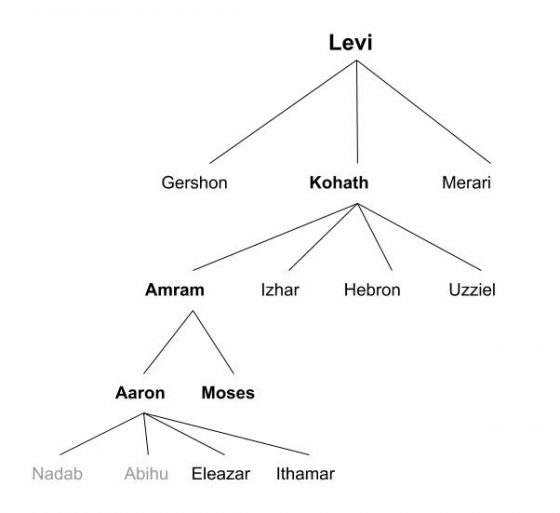
Phinehas Family Tree- Father = Eleazar
In the family tree above, note that Aaron's son was Eleazar and Phinehas was his son although he is not shown on the diagram. The fact that Phinehas was still serving as priest at the tabernacle at Shiloh indicates that this distressing series of events occurred soon after the death of Joshua and the elders that outlived Joshua, during the first anarchistic period in the land of Canaan (Jdg 2:7-10+). The rapid descent of the post-Joshua generation of Israelites into apostasy, immorality and inter-tribal warfare (illustrated in these last three chapters of the book of Judges) is a doleful commentary on the utter depravity of human nature (Cp Ro 3:10+, Ro 3:18+, Ro 3:23+, Ro 7:18+). Yet, despite it all, God was still merciful and ready to forgive.
PHINEHAS [ISBE] PHINEHAS - fin'-e-as, -az, fin'-e-has, -haz (pinechac, "mouth of brass"):
(1) Son of Eleazar and grandson of Aaron (Ex 6:25; cp 1 Ch 6:4; Ezr 7:5, where he is seen to be an ancestor of Ezra). He took a leading part in cleansing Israel from whoredom at Shittim. He there punished the brazen licentiousness of Zimri, prince of Simeon, by slaying both him and the Midianite woman he had brought into camp (Nu 25:6-18). This incident is referred to in Ps 106:30,31 (compare 1 Macc 2:26,54; Sirach 45:23,24). As priest he accompanied the expedition sent by Moses against Midjan (Nu 31:6). He was chief of the Korahite Levites (1 Ch 9:20), and succeeded his father as high priest. While he was in that office the civil war with Benjamin occurred, and it was he who delivered the oracle's decision to fight Benjamin (Jdg 20:28ff). His faithful services secured to his house the succession of the priesthood (Nu 25:11-13). He was sent as ambassador to inquire into the reported idolatry of Reuben, Gad and part of Manasseh (Josh 22:13 ff,30-32). According to Septuagint he was buried with his father in Ephraim on the hill Gibeah Phinehas (see Josh 24:33). His character was marked with strong moral indignation and fine integrity.
(2) The younger son of Eli (1 Sam 1:3; 2 Esdras 1:2, "Phinees"). See HOPHNI AND PHINEHAS.
(3) Father of a priest named Eleazar (Ezr 8:33; compare 8:2; 1 Esdras 8:63, "Phinees").
Judges 20:29 So Israel set men in ambush around Gibeah.
- Set men - Jdg 20:34 Jos 8:4 2Sa 5:23
- Judges 20 Resources - Multiple Sermons and Commentaries
Judges 20:29-46 can be a bit hard to follow. Lindsey helps us by pointing out that first there is "A general account of the battle (Jdg 20:29–36a) is followed by a detailed and supplementary account (Jdg 20:36b–46).....These verses supplement the previous account by detailing the ambush and the aftermath of the major battle. (See context in The Bible Knowledge Commentary)
So - Term of conclusion. Yahweh had promised them success. One might have thought they would have gone head on toward Gibeah as in the first two battles, but even with the promise of success, they orchestrated a plan of deception and ambush of the Benjamites. Whether God gave them this plan or in their humility from 2 defeats they hatched it themselves is a moot point, because as the battle unfolds, this plan worked.
Israel set men in ambush around Gibeah - Though God had promised them success, they knew they could expect it only by the use of proper means. Hence they used all prudent precaution, and employed all their military skill. The ambush was a strategy successfully used by Joshua at Ai (where the Lord himself commanded the use of an ambush) (Jos 8:2) and by Abimelech at Shechem (Jdg 9:32, 33-44+).
Guzik makes an interesting comment - The strategy used by the tribes of Israel against Gibeah was remarkably similar to the strategy used at Ai (Joshua 8). Perhaps they got this strategy by reading the writings of Joshua and Moses; this may reflect that that they returned to God’s word in the course of their repentance. (ED: THAT'S POSSIBLE BUT IF SO THEIR REPENTANCE DID NOT LAST LONG AS EVIDENCED BY THE REPEATED CYCLES OF SIN DURING THE 300+ YEARS).
Boling - In their third battle with the Benjamites, the Israelites used strategy that had been used successfully by Joshua at Ai (Josh 8:4-29). (See context in Wycliffe Bible Commentary)
Judges 20:30 And the sons of Israel went up against the sons of Benjamin on the third day and arrayed themselves against Gibeah, as at other times.
- Judges 20 Resources - Multiple Sermons and Commentaries
And the sons of Israel went up against the sons of Benjamin on the third day and arrayed themselves against Gibeah, as at other times - This looked to Gibeah as if the sons of Israel were using the same strategy, so undoubtedly Gibeah was convinced of a third victory (cf Jdg 20:32).
Judges 20:31 And the sons of Benjamin went out against the people and were drawn away from the city, and they began to strike and kill some of the people, as at other times, on the highways, one of which goes up to Bethel and the other to Gibeah, and in the field, about thirty men of Israel.
- drawn - Jos 8:14-16
- Beth-el, Gibeah. Jdg 19:13,14 Isa 10:29
- thirty - Jos 7:5
- Judges 20 Resources - Multiple Sermons and Commentaries
And the sons of Benjamin went out against the people and were drawn away from the city, and they began to strike and kill some of the people, as at other times, on the highways, one of which goes up to Bethel and the other to Gibeah, and in the field, about thirty men of Israel - These 30 men of Israel were a cry from the 1000's that had died before.
Keil and Delitzsch Commentary…the mode in which they were drawn away from the town is not described more fully till Jdg 20:32, 33. The men of Gibeah began to smite the beaten of the people (who pretended to fly) as formerly upon the roads (where two roads part), of which one led up to Bethel and the other to Gibeah, into the field (Judges 20 Commentary)
Judges 20:32 And the sons of Benjamin said, "They are struck down before us, as at the first." But the sons of Israel said, "Let us flee that we may draw them away from the city to the highways."
- Judges 20 Resources - Multiple Sermons and Commentaries
And the sons of Benjamin said, "They are struck down before us, as at the first." - Benjamin was drawn into the snare by their pride - "We beat them twice and the third time is the charm!"
But the sons of Israel said, "Let us flee that we may draw them away from the city to the highways." - Let us flee was done because they had placed men in an ambush behind Gibeah, who would enter and burn the city as soon as the Benjamites left it.
Judges 20:33 Then all the men of Israel arose from their place and arrayed themselves at Baal-tamar; and the men of Israel in ambush broke out of their place, even out of Maareh-geba.
- arose - Jos 8:18-22
- Judges 20 Resources - Multiple Sermons and Commentaries
Then all the men of Israel arose from their place and arrayed themselves at Baal-tamar; and the men of Israel in ambush broke out of their place, even out of Maareh-geba - There appear to have been three divisions of the Israelite army: one at Baal-tamar, (which was situated, says Eusebius, near Gibeah;) a second behind the city in ambush; and a third, who skirmished with the Benjamites before Gibeah.
Judges 20:34 When ten thousand choice men from all Israel came against Gibeah, the battle became fierce; but Benjamin did not know that disaster was close to them.
- ten thousand - Jdg 20:29
- did not know - Jos 8:14 Job 21:13 Pr 4:19 29:6 Ec 8:11,12 9:12 Isa 3:10,11 Isa 47:11 Mt 24:44 Lu 21:34 21:34 1Th 5:3
- Judges 20 Resources - Multiple Sermons and Commentaries
When ten thousand choice men from all Israel came against Gibeah, the battle became fierce; but Benjamin did not know that disaster was close to them. NET = "Ten thousand men, well-trained soldiers from all Israel, then made a frontal assault against Gibeah– the battle was fierce. But the Benjaminites did not realize that disaster was at their doorstep."
Judges 20:35 And the LORD struck Benjamin before Israel, so that the sons of Israel destroyed 25,100 men of Benjamin that day, all who draw the sword.
- Jdg 20:15,44-46 Job 20:5
- Judges 20 Resources - Multiple Sermons and Commentaries
And the LORD struck Benjamin before Israel Though the numbers of the Israelites were immensely superior to those of Benjamin, though the stratagem was well laid and ingeniously executed, and the battle bravely fought, yet the inspired historian ascribes the victory to the hand of the Lord, as if He had smitten the Benjamites by a miracle
so that the sons of Israel destroyed 25,100 men of Benjamin that day, all who draw the sword: Note God's sovereignty interacting once again with man's responsibility - the LORD struck Benjamin....Israel destroyed 25,100. It is an easy thing to trample upon those who have made God their enemy.
And the Lord smote Benjamin before Israel. Judges 20.35
These words briefly recall the real meaning of the awful judgment that fell upon Benjamin. It was the stroke of God. The chapter gives the result of the consideration, taking counsel, and speaking, of the nation in answer to the call of the Levite. His action served its purpose. The nation was stirred to its centre. A great moral passion flamed out. Underneath all the degeneracy there was a very definite stratum of religious conviction, and it was this which, in the presence of the iniquity of the men of Gibeah, sprang to life and action, It is very remarkable how, in the case of nations backsliding from religious ideals, this is ever so. In the midst of the most soiled and debased times, in the presence of some more than usually violent manifestation of evil, the slumbering convictions of a people will flame into new sensitiveness and demand recognition. In response to the ghastly and bloody appeal of the Levite, Israel gathered itself together before God, seeking to know how to act. The low level of morality which had manifested itself in so fearful a form, could only be dealt with by general suffering. The men who were in the wrong were brutally defiant. Moreover, they were strong enough at first to defeat the army of Israel. This fact at least suggests that Israel was not clean enough her-self to punish wrongdoers. Again the people gathered before God, and this time in weeping and lamentation. After this, they again went forward, this time to victory and the sore punishment of the sinning people, and those who had condoned their sin. Thus not Israel, but God, smote Benjamin. (Borrow Life applications from every chapter of the Bible).
Judges 20:36 So the sons of Benjamin saw that they were defeated. When the men of Israel gave ground to Benjamin because they relied on the men in ambush whom they had set against Gibeah,
- for the men - Jos 8:15-29
- Judges 20 Resources - Multiple Sermons and Commentaries
So the sons of Benjamin saw that they were defeated. When the men of Israel gave ground to Benjamin because they relied on the men in ambush whom they had set against Gibeah - NET = "Then the Benjaminites saw they were defeated. The Israelites retreated before Benjamin, because they had confidence in the men they had hid in ambush outside Gibeah." NLT = "The Israelites had retreated from Benjamin's warriors in order to give those hiding in ambush more room to maneuver against Gibeah." Details of how the victory described above came about.
Judges 20:37 the men in ambush hurried and rushed against Gibeah; the men in ambush also deployed and struck all the city with the edge of the sword.
- the men in ambush - Jos 8:19
- the men in ambush also deployed, Ex 19:13 Jos 6:5
- Judges 20 Resources - Multiple Sermons and Commentaries
the men in ambush hurried and rushed against Gibeah; the men in ambush also deployed and struck all the city with the edge of the sword - NET = "The men hiding in ambush made a mad dash to Gibeah. They attacked and put the sword to the entire city."
Judges 20:38 Now the appointed sign between the men of Israel and the men in ambush was that they should make a great cloud of smoke rise from the city.
- sign Ge 17:21 2Ki 4:16
- Judges 20 Resources - Multiple Sermons and Commentaries
Now From this verse to the end of the chapter, we have the details of the same operations which are mentioned, in a general way, in the preceding verses of this chapter.
The appointed sign between the men of Israel and the men in ambush was that they should make a great cloud of smoke rise from the city - NET - "The Israelites and the men hiding in ambush had arranged a signal. When the men hiding in ambush sent up a smoke signal from the city"
Judges 20:39 Then the men of Israel turned in the battle, and Benjamin began to strike and kill about thirty men of Israel, for they said, "Surely they are defeated before us, as in the first battle."
- Then - Jdg 20:31
- Judges 20 Resources - Multiple Sermons and Commentaries
Then the men of Israel turned in the battle, and Benjamin began to strike and kill about thirty men of Israel, for they said, "Surely they are defeated before us, as in the first battle - NET = "the Israelites counterattacked. Benjamin had begun to strike down the Israelites; they struck down about thirty men. They said, "There's no doubt about it! They are totally defeated as in the earlier battle."
Keil and Delitzsch - the men of Israel turned in the battle - that is to say, as is afterwards more fully explained in Jdg 20:39, 40, in the form of a long new circumstantial clause, while Benjamin had begun to smite, etc. (repeated from Jdg 20:31, 32), and the cloud had begun to ascend out of the city as a pillar of smoke, and Benjamin turned back, and behold the whole city ascended towards heaven (in smoke), Israel turned (fighting) and Benjamin was terrified, for it saw that misfortune had come upon it (see Jdg 20:34). In Jdg 20:41a, the thread of the narrative, which was interrupted by the long circumstantial clause, is again resumed by the repetition of “and the men of Israel turned.” (Judges 20 Commentary)
Judges 20:40 But when the cloud began to rise from the city in a column of smoke, Benjamin looked behind them; and behold, the whole city was going up in smoke to heaven.
- a column of smoke - Ge 19:28 Song 3:6 Joel 2:30 Rev 19:3
- Benjamin looked behind them - Jos 8:20
- Judges 20 Resources - Multiple Sermons and Commentaries
But when the cloud began to rise from the city in a column of smoke, Benjamin looked behind them; and behold, the whole (kalil) city was going up in smoke to heaven - Whole is the Hebrew word kalil used of "whole burnt offerings" (Dt 33:10) and of burning a town whose people have become involved in idolatry (Dt 13:16). The entire town of Gibeah had literally become a "burnt offering" to heaven! Moreover, the Benjamites’ end was like that of the inhabitants of Sodom and Gomorrah
And (ABRAHAM) looked down toward Sodom and Gomorrah, and toward all the land of the valley, and he saw, and behold, the smoke of the land ascended like the smoke of a furnace. (Ge 19:28).
Judges 20:41 Then the men of Israel turned, and the men of Benjamin were terrified; for they saw that disaster was close to them.
- were amazed - Ex 15:9,10 Isa 13:8,9 33:14 Lu 17:27,28 21:26 1Th 5:3 2Pe 2:12 Rev 6:15-17 18:8-10
- Judges 20 Resources - Multiple Sermons and Commentaries
PRETENDED RETREAT
REVERSED BY SMOKE SIGNAL
Then the men of Israel turned, and the men of Benjamin were terrified; for they saw that disaster was close to them - They had sown the wind of evil and now were reaping a whirlwind of evil
Terrified (disturbed) (0926) bahal means dismayed, disturbed, terrified. Bahal can also mean to hasten (2 Chr 26:20, Eccl 8:3). Bahal usually means to tremble inwardly, to become agitated, to palpitate, to make alarmed.
Judges 20:42 Therefore, they turned their backs before the men of Israel toward the direction of the wilderness, but the battle overtook them while those who came out of the cities destroyed them in the midst of them.
- the battle overtook - La 1:3 Ho 9:9 10:9
- Judges 20 Resources - Multiple Sermons and Commentaries
Therefore, they turned their backs before the men of Israel toward the direction of the wilderness, but the battle overtook them while those who came out of the cities destroyed them in the midst of them The Benjamites headed east toward the desert area extending from Bethel to Jericho (cf. Josh 16:1). Perhaps they hoped to cross the Jordan and escape into the deserts beyond, but the sheer numbers of Israelites made this impossible. The pursuing forces were augmented by men from nearby cities. Whenever Israel had the enemy on the run, it seemed that volunteers flocked to join in the pursuit. The Midianites (Jdg 7:23-24) and Philistines (1Sa 14:22) were also routed by rapidly growing armies.
Judges 20:43 They surrounded Benjamin, pursued them without rest and trod them down opposite Gibeah toward the east.
NET They surrounded the Benjaminites, chased them from Nohah, and annihilated them all the way to a spot east of Geba.
BBE And crushing Benjamin down, they went after them, driving them from Nohah as far as the east side of Gibeah.
ESV Surrounding the Benjaminites, they pursued them and trod them down from Nohah as far as opposite Gibeah on the east.
- They surrounded Benjamin - Joshua 8:20-22
- Judges 20 Resources - Multiple Sermons and Commentaries
They surrounded Benjamin, pursued them without rest and trod them down opposite Gibeah toward the east
NET Note on Nohah - The translation assumes the reading מִנּוֹחָה (minnokhah, “from Nohah”; cf. 1 Chr 8:2) rather than the MT’s מְנוּחָה (ménukhah, “resting place”).
NET Note on Gibeah - Heb "unto the opposite of Gibeah toward the east." Gibeah cannot be correct here, since the Benjaminites retreated from there toward the desert and Rimmon (see v. 45). A slight emendation yields the reading "Geba."
Judges 20:44 Thus 18,000 men of Benjamin fell; all these were valiant warriors.
- Judges 20 Resources - Multiple Sermons and Commentaries
Thus 18,000 men of Benjamin fell; all these were valiant warriors
Judges 20:45 The rest turned and fled toward the wilderness to the rock of Rimmon, but they caught 5,000 of them on the highways and overtook them at Gidom and killed 2,000 of them.
- Rimmon - Jos 15:32 1Ch 6:77 Zec 14:10
- Judges 20 Resources - Multiple Sermons and Commentaries
The rest turned and fled toward the wilderness to the rock of Rimmon, but they caught 5,000 of them on the highways and overtook them at Gidom and killed 2,000 of them: NET - The rest turned and ran toward the wilderness, heading toward the cliff of Rimmon. But the Israelites caught five thousand of them on the main roads. They stayed right on their heels all the way to Gidom and struck down two thousand more." Rimmon was a conical limestone hill surrounded by wadis and located about 4 miles E of Bethel. Numerous caves provided hiding places from the relentless pursuers.
RIMMON [ISBE] - rim'-on: The rock Rimmon (cela` rimmon; he petra Rhemmon): The place of refuge of the 600 surviving Benjamites of Gibeah (Jeba`) who "turned and fled toward the wilderness unto the rock of Rimmon, and abode in the rock of Rimmon four months" (Jdg 20:45,47; 21:13). Robinson's identification (RB, I, 440) has been very generally accepted. He found a conical and very prominent hill some 6 miles North-Northeast of Jeba` upon which stands a village called Rummon. This site was known to Eusebius and Jerome (OS 146 6; 287 98), who describe it as 15 Roman miles from Jerusalem. Another view, which would locate the place of refuge of the Benjamites in the Mugharet el jai, a large cavern on the south of the Wady Suweinit, near Jeba`, is strongly advocated by Rawnsley and Birch (see PEF, III, 137-48). The latter connects this again with 1 Sam 14:2, where Saul, accompanied by his 600, "abode in the uttermost part of Gibeah" under the pomegranate tree (Rimmon).
Judges 20:46 So all of Benjamin who fell that day were 25,000 men who draw the sword; all these were valiant warriors.
- Jdg 20:15,35
- Judges 20 Resources - Multiple Sermons and Commentaries
So all of Benjamin who fell that day were 25,000 men who draw the sword; all these were valiant warriors - Jdg 20:15 says there were 26,000 men of Benjamin that "drew the sword." Since 25,000 fell on "that day," evidently a thousand had already been slain during the previous days of fighting. The number 25,000 seems here to be a "round number" for the more accurate count (25,100) mentioned in Jdg 20:35.
It is important to realize that the sons of Israel did not just defeat the army of the Benjaminites at Gibeah and kill almost all of the men, but also destroyed the other cities of the Benjaminites. You ask what is the basis for this statement? Read Jdg 21:16 "Then the elders of the congregation said, “What shall we do for wives for those who are left, since the women are destroyed out of Benjamin?” So clearly the sons of Israel went on an unreasonable rampage probably motivated in part by their anger at having suffered such heavy losses two times! That is why there were not any women for the male Benjaminite survivors.
The sons of Israel forgot God's instruction in Leviticus 19:18
‘You shall not take vengeance, nor bear any grudge against the sons of your people, but you shall love your neighbor as yourself; I am the LORD.
G Campbell Morgan on Israel's zeal almost wiping out the entire tribe - “Uninstructed zeal, even in the cause of righteousness, often goes beyond its proper limits.”
Judges 20:47 But 600 men turned and fled toward the wilderness to the rock of Rimmon, and they remained at the rock of Rimmon four months.
- six hundred - Jdg 21:13 Ps 103:9,10 Isa 1:9 Jer 14:7 La 3:32 Hab 3:2,
- Judges 20 Resources - Multiple Sermons and Commentaries
BENJAMINITES AN
"ENDANGERED SPECIES!"
But 600 men turned and fled toward the wilderness to the rock of Rimmon, and. The rock Rimmon was doubtless a strong place; but it is uncertain where situated. It is probable however, that it was near, and took its name from, the village of Remmon, mentioned by Eusebius, fifteen miles north from Jerusalem. It appears that rocks are still resorted to in the East, as places of security; and some of them are even capable of sustaining a siege.
they remained at the rock of Rimmon four months until there was a peace treaty (Jdg 21:13,14) were the only survivors of the entire tribe of Benjamin.
Judges 20:48 The men of Israel then turned back against the sons of Benjamin and struck them with the edge of the sword, both the entire city with the cattle and all that they found; they also set on fire all the cities which they found.
- Stuck them - De 13:15-17 2Ch 25:13 28:6-9 Pr 18:19
- Judges 20 Resources - Multiple Sermons and Commentaries
The men of Israel then turned back against the sons of Benjamin and struck them with the edge of the sword, both the entire city with the cattle and all that they found; they also set on fire all the cities which they found - All the cities refers to all the Benjaminite cities and their inhabitants, women and children! The sons of Israel were doing a better job of utterly destroying their own brothers than they did against the pagans God had told them to utterly destroy!
Basically the land of Benjamin is ravaged as a result of their foolish (stupid) decision to defend the sin of the "sons of Belial" in Gibeah -- what were they defending? homosexuality, rape, murder, not to mention their failure to show Oriental hospitality to the Levite's traveling party in Jdg 19. What was now right in their eyes was an abomination in the eyes of God. O, how we need to read and heed the seriousness of straying from God's holy word, which alone is the light (Ps 19:8+, Ps 119:105+, Pr 6:23+) to guide us on the the highway of holiness (Isa 35:8) in the midst of a dark, crooked and perverse generation (Php 2:15+) at the outset of the 21st century.
Since the destruction included the animals and everything else they found, apparently they had placed the Benjamite towns under the ban as in holy war (cf. Jdg 1:17+). In holy war (war waged at the Lord’s direct command) the Israelites were sometimes told not to take any loot but to destroy everything as a way of offering it to God (under the ban) It was also an extreme form of divine judgment on Israel's enemies (Jos 6:21; 1Sa15:1, 2, 3) and, in certain circumstances, on Israelites themselves (Dt 13:12-18). Here it seems to be applied without any specific instruction from the Lord to do so!
The problem with revenge is that it is uncontrollable. This was one of the main reasons the Old Testament punishment code, “an eye for an eye, and a tooth for a tooth,” was first given. It was to restrict the escalation of revenge before things got out of control. But the Israelites chose to jettison that principle. If every man does what is right in his own eyes, then force becomes the arbiter while truth and justice are the first casualties.
Gary Inrig - Ironically, a people who refused to carry out holy war against the Canaanites had carried it out with thoroughness against one of their own tribes. (Borrow Hearts of Iron, Feet of Clay)
Breach and Recovery Judges 20 Henri Rossi
Following on the crime of Gibeah, all the tribes from the extreme North to the extreme South were gathered together as one man unto Jehovah in Mizpeh" (Jdg 20:1). Very little seemed wanting in this unanimous protest against evil. There was zeal to enquire into, and to purify themselves from, it, and also a sense of Israel's corporate responsibility, which, later on under Deborah, Gideon and Jephthah, was lacking. The assembling together, the actions and the sentiments of the eleven tribes presented above all a fair appearance of unity (Jdg 20:1, 8, 11), for the smallest tribe, and what was more a guilty one, was the only one absent. The centre of the people's unity was acknowledged, for it was "unto Jehovah" that they gathered together in Mizpeh (Jdg 20:1). What then was wanting in Israel? One thing, "the first love,"which finds expression both towards God and towards those that are His. Towards God, this love had waxed cold in Israel. They had hearkened, deliberated, decided, and then consulted God (Jdg 20:18). In place of commencing with the word of God they had left it to the last. Not that it was omitted, but it no longer occupied the first place. This was a mark of having left their first love. "He that hath My commandments, and keepeth them, he it is that loveth me." "If a man love Me, he will keep My word" (Jn 14:21, 23). "This is the love of God, that we keep His commandments" (1Jn 5:3). Another mark was, that their hearts were more alive to the shame inflicted on Israel, than to the dishonour done to God (Jdg 20:6, 10, 13). How often does this tendency show itself in assembly discipline! It is because God no longer has His right place in our hearts.
The forsaking of first love also betrays itself in our conduct towards our brethren; indeed intercourse with God and with our brethren are closely connected. "And this commandment have we from Him, that he who loveth God love his brother also" (1Jn 4:21). Israel looked upon Benjamin as an enemy, and, notwithstanding the fair appearance of unity, did not regard the sin of one tribe as that of all of the people. They said: "What wickedness is this that is done among you?" (Jdg 20:12) - not "among us." What a difference between this love and that which is described in 1Co 13:4, 5, 6, 7 (see commentary -1Cor 13:4; 1Cor 13:5; 1Cor 13:6; 1Cor 13:7; 1Cor 13:8)! Zeal was not wanting, but that did not make up for having left their first love. "Thou canst not bear them which are evil" of Rev. 2:2-note, was found here; but, as further on in the address to Ephesus, the Lord could say to His people: "I have somewhat against thee." They added: "that we may put away the evil from Israel" (Jdg 20:13), but where was their brotherly affection? This is indeed always thedanger in connection with discipline, and the Corinthians were exhorted to confirm their love toward the one who had fallen, after the discipline had done its work. If on the one hand, the people addressing Benjamin said "you" in place of "us" in Jdg 20:12; on the other, "us" and "we" usurp an undue place in the next verse: "Deliver as the men … that we may put themto death and put away evil from Israel." Leaving the first love opens the door to self‑importance.
As for Benjamin, they had grievously sinned in upholding evil in their midst, and the remonstrance of Israel, instead of humbling them, incited them to the most serious act: "to go out to battle against the children of Israel" (Jdg 20:14), and then what was far worse - they allied themselves with evil. The children of Benjamin gathered themselves together at Gibeah, they numbered the inhabitants of Gibeah, and they went forth out of Gibeah and destroyed down to the ground of the Israelites (Jdg 20:14, 15, 21). The absence of humiliation on their part led to terrible results; not only did they not judge the evil, but as a necessary consequence, they fatally excused it, taking sides with the evil‑doers against the people of God. It is true that they put on an appearance of being without the inhabitants of Gibeah (Jdg 20:15), but they numbered them and availed themselves of their seven hundred chosen warriors. In this army the "left‑handed" were equal in numbers to the chosen men of Gibeah, weakness which became strength in the Lord's service when it was an Ehud who fought. Here the left‑handed were skilful against the Lord; the hand which ought to have been apt in defence, was strong to attack and deceive those who confronted them.
When every preliminary was exhausted, Israel asked counsel of God (Jdg 20:18). Judah shall go up first, was the reply of Him who was about to discipline Israel, and twenty‑two thousand men of Judah were destroyed down to the ground. What grace God displayed in this defeat! Israel must learn that, in contests between brethren, there could be neither victors nor vanquished, but that all must be vanquished for the Lord to triumph at the end. God made use of this defeat for the restorationof His beloved people. Israel came forth strengthened from a combat which had cost him his troops, for he came out of it judged in reality by God himself. When the twenty‑two thousand fell, the men of Israel encouraged themselves (Jdg 20:22).
See what fruit their chastisement bore:
• First: it led them to seek again the presence of Jehovah.
• Secondly: instead of human indignation, they were filled with sorrow according to God and their tears were the proof of it.
• Thirdly: their sorrow was not transient, for they wept until even.
• Fourthly: they learnt to depend more truly on the word of God, and no longer say, "Which of us shall go up first?" but "Shall I go up again?"
• Fifthly: affection for their brother in his fall is at length revived, for they say: "The children of Benjamin my brother" (Jdg 20:23).
How worthy of God was such a result! It was not victory but defeat which brought about these things, blessed fruits of the discipline, and meanwhile other fruits were yet to be produced. "And Jehovah said, go up against him."
Eighteen thousand men of the children of Israel were destroyed down to the ground in the second defeat.
• Then, in the first place, "All the children of Israel, and all the people went up, and came unto the house of God." No one was missing; they were unanimous in seeking Jehovah.
• Secondly: Instead of weeping until even, they wept, and sat there before Jehovah. Their sorrow before God was deepened and of longer duration.
• Thirdly: They "fasted that day until even." That was more than sorrow; it was humiliation, judgment of the flesh and repentance.
• Fourthly and fifthly: They "offered burnt offerings and peace offerings before Jehovah." They recovered those two things of inestimable value, a true sense of the value of the sacrifice and of communion. Dependence on the word of God and the realization of His presence became more highly valued, through God's discipline. The people had the consciousness of being before God Himself, who dwelleth between the cherubims over the ark, and drew near to Him, by a living High Priest who interceded for Israel.
• Sixthly: Their own will at last completely broken. "Shall I yet again go out or shall I cease?" (Jdg 20:26, 27, 28)
What thorough restoration! And that which brought it about was a horrible evil; not that God makes light of the enormity of the evil, but in the interest He bears towards His people, He makes use even of the evil for their blessing. From that time God could bless and assure them of victory.
Then the battle took place in which Israel restored, yet experiencing his own weakness and insufficiency, obtained the victory, but lost nearly a whole tribe. Benjamin was defeated by a humbled people who showed themselves weaker than he. It is the principle of all discipline in the assembly. Without love, without dependence on God and His word, without self-judgment, discipline will always be defective, and it is only under such conditions that an assembly can purge out the old leaven.
L M Grant…JUDGES 20 JUSTICE FOR THE GUILTY REFUSED BY BENJAMIN (JUDGES 20:1-13)
All the tribes were united in their insistence that judgment must be carried out against those who were guilty of criminal abuse and murder. They did not have the same zeal for God's glory in judging the idolatry of Dan. In fact, Dan was included in the stand against this moral wickedness. Dan wanted to cast out the speck in his brother's eye while ignoring the plank in this own eye! (Mt. 7:4-note)
These tribes gathered at Mizpah (Jdg 20:1, 2), and heard from the Levite the account of what had happened at Gibeah (Jdg 20:4, 5, 6). He then appealed to them as Israelites, to give counsel and advice as to what to do (Jdg 20:7). Israel agreed together to take ten men out of every hundred in their tribes to go against Gibeah, all being united as one man with no dissenting voice (Jdg 20:8, 9, 10, 11).
Yet, rather than attacking first, they sent messengers through the tribe of Benjamin, focusing on the great wickedness that had taken place in Gibeah and demanding that the perverted men be delivered up to suffer for it. It may have been wiser to appeal first to the city of Gibeah to give up these men, in which case great bloodshed might have been avoided, but if this was not done, still the tribe of Benjamin ought to have responded positively to this request, though it was given more in the form of a demand than a request. But they refused, thus expressing their approval of the wicked actions of these men and defending them.
WAR: ONE TRIBE AGAINST ELEVEN
(Jdg 20:14-48)
Thus Benjamin, foolishly taking sides with wickedness, gathered their armies to fight against Israel (Jdg 20:14). They had 26,000 warriors as well as 700 men of Gibeah. Among this 26,700 were 700 left handed men who were expert with slingshots, so that Benjamin was a formidable warrior tribe (Jdg 20:15-16). Israel's army numbered 400,000, over 15 times the size of Benjamin (Jdg 20:17). Therefore, it would be natural to think that Israel should triumph. However, Israel knew they should inquire of God, and asked Him which tribe should go first, and were told, "Judah first" (Jdg 20:18). Judah means "praise," but Israel was more intent on revenge than on praise, and did not realize their attitude was wrong.
If we think we can triumph over evil, we shall find ourselves badly defeated, as Israel did, for on the first attack they were defeated with the slaughter of 22,000 men (Jdg 20:21). Should this be surprising to us? No, it should not, for if we judge others without first judging ourselves, God will cause us to be humiliated.
Instead of being broken down before the Lord, however, Israel "encouraged themselves," but it is not said "in the Lord," as was the case with David in 1 Samuel 30:6. Yet they wept before the Lord and asked the Lord's counsel as to going against Benjamin. In fact, they say, "My brother Benjamin, "which showed at least a better attitude than that of anger (Jdg 20:23).
When Israel asked the Lord, "Shall I go up against my brother Benjamin," God told them to go, for His judgment against evil must be carried out. But why did they not ask the Lord what was the reason for their shameful defeat before? They did not ask this, and God did not answer any more than they had asked.
Therefore, when they went out the second day, Benjamin repeated their conquest of Israel, killing another 18,000 men (Jdg 20:25). What a terrible toll to pay in seeking the just judgment of the wicked men of Gibeah! But this has a lesson for us, telling us that sin is far too strong for us. We can never gain the victory over it in our own strength. Even a majority cannot win in such a battle. Only God can defeat the awful power that sin has wielded in raising itself against His people.
The second defeat of Israel shocked them enough to add fasting to their weeping. Fasting is symbolic of self-judgment, which is always vitally important when we think of judging others. But this was not all. They also offered burnt offerings and peace offerings before the Lord (Jdg 20:26). Fasting was an admission of their own unworthiness, which is the negative side, but the offerings speak positively, for they picture the one great offering of the Lord Jesus on Calvary, which is the only basis for either forgiveness of sins or for judging sin. So that in offering these sacrifices, Israel was giving God the place that is rightly His. The burnt offering reminds us that the glory of God is paramount, for this all ascended in fire to God. If Israel's motives were only for their own relief, this is not good enough. God's glory is far more important than Israel's honor. Yet the peace offering (in which the offerer had a share (Lev. 7:1, 2, 3, 4, 5, 6, 7, 8, 9, 10, 11, 12, 13, 14, 15), was added to indicate Israel's sharing with God in the value of the sacrifice of Christ, which would give Israel the right to share with God's work in judging evil.
At this time too we are told that the ark of God was present and Phinehas the priest stood before the ark to enquire of God (Jdg 20:28). Phinehas pictures the Lord Jesus as our Great High Priest, and the ark reminds us of Christ as the Sustainer of the throne of God, the One therefore in absolute authority. Priesthood speaks of His compassionate intercession, a lovely complement of His authority.
Thus, we are to learn that when God is given His true place and Christ is given His place, there will be no more defeat. The Lord told Israel, "Go up, for tomorrow I will deliver them into your hand" (Jdg 20:28).
However, the battle was not an easy one. Israel set men in ambush all around Gibeah (Jdg 20:29) and others advanced toward the city (Jdg 20:30). The Benjamites came out and began to strike down and kill some of the Israelites, about thirty men (Jdg 20:30). The Benjamites were evidently strong, determined warriors, and thought they were in command of the situation again (Jdg 20:32). The Israelites encouraged this vain confidence of Benjamin by fleeing before Benjamin, but with the object of drawing them away from the city. Thus the forces of Benjamin were divided, and Israel's men in ambush burst forth from their places and ten thousand select men of Israel came against Gibeah (Jdg 20:33, 34). The men of Benjamin did not even suspect they were in a desperate situation.
But it was the Lord who defeated Benjamin before Israel (Jdg 20:35), enabling them this time to destroy 25,100 Benjamites. This was a terrible decimation, for their entire army had numbered only 26,700, leaving only 1600 who were not killed. But it was still not as many as those of Israel killed by Benjamin!
AN EXPLANATION OF THE VICTORY
(Jdg 20:36-48)
These last verses in the chapter form are capitulation of the victory of Israel that caused Benjamin to realize they were defeated (Jdg 20:36). The men of Israel had retreated at first from Benjamin because they relied on those who were in ambush, who, after the greater part of Benjamin's army was drawn away, rushed to attack the city (Jdg 20:37). They captured Gibeah without difficulty and set in on fire. The signal for the rest of Israel's army had been appointed as a cloud of smoke rising from the city (Jdg 20:38).
Therefore, when the Benjamites thought they were winning, the great cloud of smoke arose from Gibeah. Not only did the men of Israel see it, but also the Benjamites who were pursuing them (Jdg 20:40). The fleeing army of Israel turned back to face Benjamin; and Benjamin, seeing they were trapped between two companies of Israelites and that the one company had already vanquished Gibeah, were panic stricken (Jdg 20:41). They turned to one side and ran toward the wilderness, but the Israelites were prepared for this and therefore overtook Benjamin, surrounding them and "easily trampling them down" (Jdg 20:43).
In this first onslaught 18,000 men of Benjamin were killed (Jdg 20:44). The rest turned and fled toward the wilderness to the rock of Rimmon. Israel pursued them relentlessly, killing 5000 of them on the highways and another 2000 who were able to flee farther into the wilderness (Jdg 20:45). Thus the total number of Benjamin killed was 25,000, all capable warriors.
Though Benjamin had been defeated with a terrible slaughter, there were 600 of their men who were able to escape to the Rock of Rimmon in the wilderness and remained there for four months (v.47). But Israel was not content with gaining the victory. In returning they burned the cities they came to in Benjamite territory and killed both men and beasts (Jdg 20:48). If the 600 men had not escaped, what would have happened to the tribe of Benjamin?
This whole history is extremely sad. Counting the men of Israel killed, -- 22,000 and 18,000 -- plus those killed in the last engagement, added to the 25,100 of Benjamin, the total number of deaths was over 65,000! If only Benjamin had honorably judged the men who were guilty of the horrible crime against the woman, this would have avoided the awesome slaughter of so many thousands. It is a lesson for us, a warning not to take sides with evil in any way. It will bring dire results, as well as being a dishonor to God.
F B Meyer…JUDGES 20 NATIONAL INDIGNATION
The Levite's appeal to Israel had an immediate effect. We are reminded of Saul's appeal (1Sa 11:7), and of the Fiery Cross in more recent times. Mizpeh had already become the rallying-place of the people (Judges 20:10-17).
Judges 20:3-11 A judicial inquiry was instituted, which issued in the unanimous determination to avenge the tragedy which had filled all hearts with detestation (Judges 20:11).
Amid the horror of a battlefield, there is one redeeming feature in the brave devotion of men for their country. And amid the horrors of this chapter, there is at least evidence that the conscience of Israel was growing in their detestation of the crime we have considered, though we must remember that it is always easier to denounce sins in other people, and vow vengeance against them, than to exterminate them in ourselves. Would that each reader would appropriate the words of Israel, "We will not any of us go to his tent till we have put away this evil from Israel" (Judges 20:10).
Judges 20:12-14 Benjamin refused the opportunity of disavowing the perpetrators of the crime. -- This made the whole tribe accessory to the deed, and therefore liable to the punishment.
Judges 20:17-29 The double defeat. -- It is at first difficult to understand why, in so good a cause, and after asking God in all sincerity for guidance on two occasions, the children of Israel fled in battle before Benjamin. But we must notice that it was only on the evening of the second day, in answer to fasting and prayer, that God promised to deliver Benjamin into their hand. And we must remember that God was compelled to speak in language that they could understand, and to teach them, through scenes of blood and tears, that higher morality to which they were yet to come.
Judges 20:30-48 The terrible victory. -- This was a fearful act of vengeance. Benjamin was practically exterminated (Judges 20:47).
One turns from this chapter with a sad consciousness that it is a leaf out of the chronicles of human history which has had, and is having, many counterparts. The story of the extermination of native races, the mowing down of tens of thousands by the introduction of spirits and of opium, may read as darkly in the annals of eternity. Well may creation travail, and the saints cry, Lord! how long! (F. B. Meyer. CHOICE NOTES ON JOSHUA THROUGH 2 KINGS)