Judges 3:2
Judges 3:3
Judges 3:4
Judges 3:5
Judges 3:6
Judges 3:7
Judges 3:8
Judges 3:9
Judges 3:10
Judges 3:11
Judges 3:12
Judges 3:13
Judges 3:14
Judges 3:15
Judges 3:16
Judges 3:17
Judges 3:18
Judges 3:19
Judges 3:20
Judges 3:21
Judges 3:22
Judges 3:23
Judges 3:24
Judges 3:25
Judges 3:26
Judges 3:27
Judges 3:28
Judges 3:29
Judges 3:30
Judges 3:31
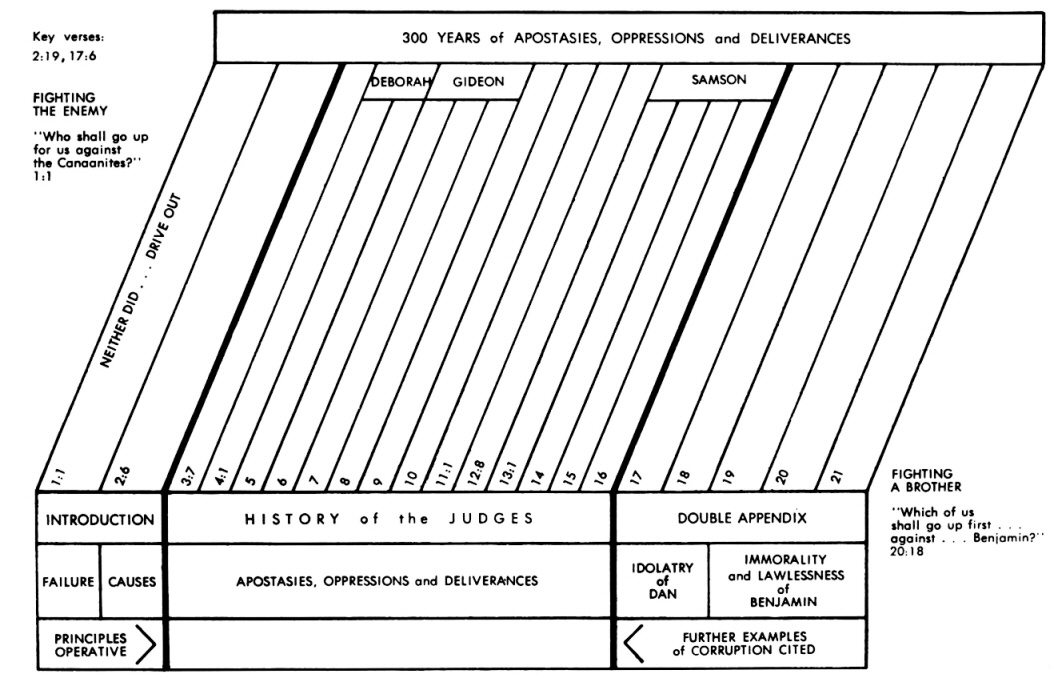
Chart from recommended resource Jensen's Survey of the OT - used by permission
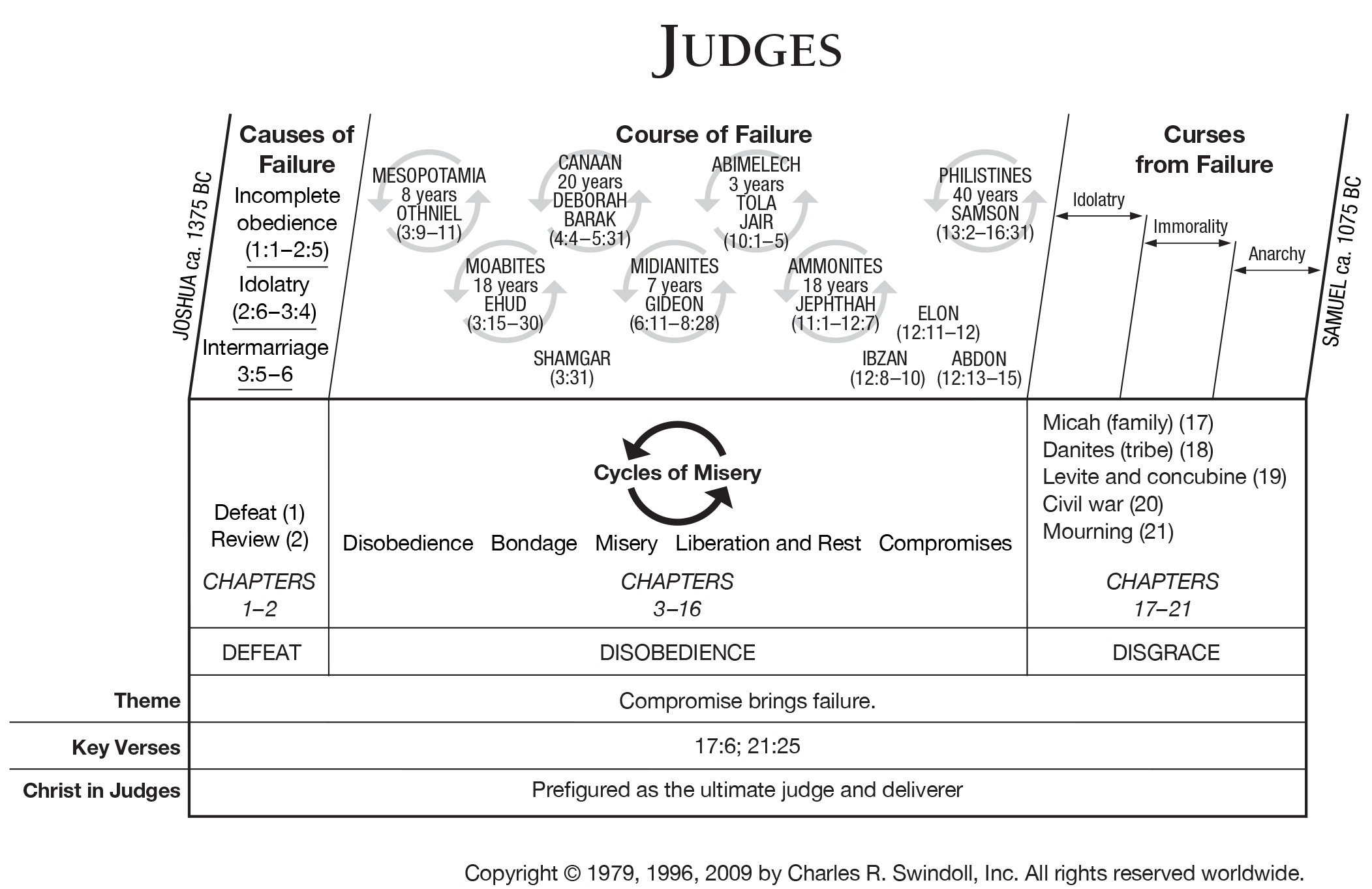
Chart on Judges - Charles Swindoll
|
RECYCLING SIN |
|||||
| Jdg 1:1-3:6 | Jdg 3:7-16:31 | Jdg 17:1-21:25 | |||
| Introduction | History of the Judges | Appendix | |||
| Causes of the Cycles THE REASON |
Curse of the Cycles THE RECORD |
Conditions in the Cycles THE RESULTS |
|||
| Failure to Complete Conquest Jdg 1:1-36 God's Judgment for Failure Jdg 2:1-3:6 |
Curse of the Cycles |
Conditions in the Cycles |
|||
| Living with Canaanites |
War with the Canaanites |
Living Like the Canaanites |
|||
| Religious Laxity |
Political Uncertainty |
Moral Anarchy |
|||
| About 350 Years of Israel's History - Almost 25%! From Compromise to Confusion! |
|||||

Another Timeline of Israel's History
Click to Enlarge
from Jensen's Survey of the OT
Click to Enlarge
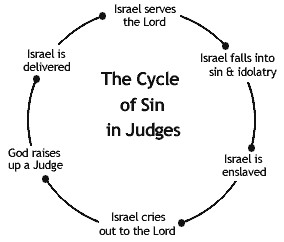
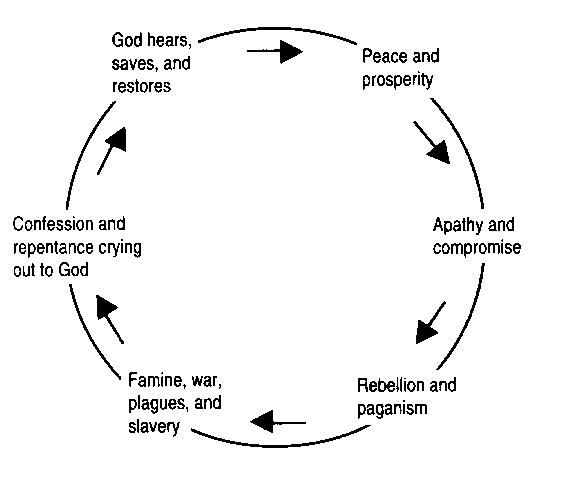
Other ways to describe Israel's cycle…
- Rest > Rebellion > Retribution > Repentance > Restoration
- Sin > Suffering/Servitude > Supplication > Salvation
- Apathy > Apostasy > Affliction > Answered Prayer
- Disobedience > Desperation > Deliverance
- Disobedience > Bondage >Misery > Liberation and Rest > Compromises
|
The Book of Judges |
|
| RUTH | JUDGES |
| Spiritual light |
Spiritual darkness |
| Purity | Immorality |
| Deciding for the One true God |
Pursuing Idols who are no gods |
| Devotion | Disloyalty |
| Love | Lust |
| Peace | War |
| Kindness | Cruelty |
| Obedience brings blessing |
Disobedience brings sorrow |
| Oasis of righteousness |
Desert of rebellion |
| Faithfulness of a Gentile alien |
Faithlessness of the "chosen people" |
FOLLOWING NOTES ARE COMPLETELY REVISED
SPRING, 2022
Judges 3:1 Now these are the nations which the LORD left, to test Israel by them (that is, all who had not experienced any of the wars of Canaan;
- Deut 8:2,16; 2Chr 32:31; Job 23:10; Pr 17:3; Jer 6:27; Jer 17:9,10; Zechariah 13:9; Jn 2:24; 1Pe 1:7; 1Pe 4:12; Jas 1:2 Rev 2:23
Related Passages:
Deuteronomy 8:2; 16 “You shall remember all the way which the LORD your God has led you in the wilderness these forty years, that He might humble you, testing you, to know what was in your heart, whether you would keep His commandments or not. (8:16) “In the wilderness He fed you manna which your fathers did not know, that He might humble you and that He might test you, to do good for you in the end.
Numbers 14:22 “Surely all the men who have seen My glory and My signs which I performed in Egypt and in the wilderness, yet have put Me to the test these ten times and have not listened to My voice,
2 Chronicles 32:31 (GOD WAS TESTING HEZEKIAH) Even in the matter of the envoys of the rulers of Babylon, who sent to him to inquire of the wonder that had happened in the land, God left him alone only to test him, that He might know all that was in his heart. (HEZEKIAH DID NOT PASS THIS TEST - IN HIS PRIDE, HE SHOWED THE ENEMY ALL THE TREASURE OF THE TEMPLE AND IT WOULD PROVE COSTLY 115 YEARS LATER! READ 2Ki 2012-13, 14-18).
Now these are the nations which the LORD left, to test (nacah/nasah; Lxx = peirazo) Israel by them: Note God left them to test and not to learn to tolerate (cf compromise) them! Test here refers to testing which shows what someone is really like and generally involves difficulty or hardship. It is interesting to note the first use of nacah was when God tested Abraham in Genesis 22:1 (Abraham "passed"! > Ge 22:15-18) As noted, the Septuagint translated nacah with peirazo, a morally neutral word simply meaning “to test.” Whether the testing is for good (as in He 11:17+, Ge 22:11) or evil (Mt 4:1+) depends on the intent of the one giving the test. Obviously God does not tempt anyone to evil (James 1:13+) so His purpose was to discern what was in their heart.
THOUGHT - Are you being tested by the "nations" (cp "the world system" - see Word Study on Kosmos) now? How are you faring? Are you losing heart and being tempted to give up (Heb 12:3-4+)?
Nacah - all 34 OT uses- Ge 22:1; Ex. 15:25; 16:4; 17:2, 7; 20:20; Nu 14:22; Deut. 4:34; 6:16; 8:2, 16; 13:3; 28:56; 33:8; Jdg. 2:22; 3:1, 4; 6:39; 1 Sam. 17:39; 1 Ki. 10:1; 2 Chr. 9:1; 32:31; Job 4:2; Ps. 26:2; 78:18, 41, 56; 95:9; 106:14; Eccl. 2:1; 7:23; Isa. 7:12; Dan. 1:12, 14
The Septuagint (LXX) translates the Hebrew verb nacah with peirazo [word study].
The presence of the enemy in the land
was an opportunity for teaching, testing, and trusting.
-- Warren Wiersbe
Sometimes we wonder why God didn’t remove all the enemies from the Promised Land before He let the children of Israel go in. But in these verses (Jdg 3:1, 2, 3, 4) we see that God had a definite reason. He uses the results of our lack of faith in Him to prove to us our sin and weakness. He does not forget His covenant, but He allows our very weakness, our guilty weakness, to drive us back to Him. God wanted the chosen people to realize that they were a holy people. They must not mix with the wicked nations about them. They must continually separate themselves. God knew that separation makes a people strong. Christians today must remember that they cannot mix with the world. They must keep close to God and war against sin and unrighteousness. God wants us to be good warriors. And so we see that an uncritical toleration toward a people so utterly corrupt resulted in the undoing of God’s chosen people.
| OPPRESSOR | YEARS OF PUNISHMENT | DELIVERER AND JUDGE |
|
| Judges 3:7-11 | Mesopotamians | 8 | Othniel-40 yr rest |
| Judges 3:12-30 | Moabites | 18 | Ehud-80 yr rest |
| Judges 3:31 | Philistines | - | Shamgar |
| Judges 4:1-5:31 | Canaanites | 20 | Deborah and Barak |
| Judges 6:1-8:32 | Midianites | 7 | Gideon |
| Judges 8:33-10:5 | Abimelech | 3 | Tola and Jair |
| Judges 10:6-12:15 | Ammonites | 18 | Jephthah and successors |
| Judges 13:1-16:31 | Philistines | 40 | Samson |
Joshua had no successor. After his death, each tribe acted independently. There was no capital and no fixed government. There was no unity of action, except in the time of danger when the tribes combined for their own good. When the people sinned against God, their enemies defeated them and ruled them. When in their distress they sought the Lord, He sent judges who delivered them. God is always brooding over His disobedient children. He promises us that He will never leave us nor forsake us (He 13:5-note). We see defeat on our part but deliverance on God’s part. “Where sin increased, grace increased all the more” (Ro 5:20-note). We see His dealings with His own rebellious people whom He has crowned with His best blessings and upon whom He has lavished His tender love. We find the patience of God and His constant readiness to respond to the least sign of penitence in His people (Judges 3:9, 15; Jdg 4:3, 4, 5, 6,7, 6:6, 7, 8, 9, 10, 11, 12, 10:15, 16-see notes Judges 4; Judges 6; Judges 10). He repeated His mercy again and again although it was never appreciated. If you think on these things it will draw you nearer to this God of mercy and love and grace. Look up, repent and trust God.
We have found that God fulfilled His purpose for Israel by leaving around them in Canaan a circle of strong tribes unlike each other. It is said,
“These are the nations the Lord left to test all those Israelites who had not experienced any of the wars in Canaan… They were left to test the Israelites to see whether they would obey the Lord’s commands, which he had given their forefathers through Moses” (Judges 3:1, 4).
THOUGHT - Look up each cross reference (at the end of this paragraph) to discern why God "tested Israel" and then NT parallels to allow one to apply God's testing of Israel to the believer's life today. This exercise might greatly encourage you if you are currently going through the REFINER'S FIRE and questioning whether God even loves you or cares. Ask God to open these verses to you that you might know what are His purposes when He sends TESTS into your life -- Ex 16:4, Dt 8:2-4, 5, 16, Ex 20:20, Ps 26:2, Mal 3:10 Pr 17:3. Parallel with He 11:17+ (Ge 22:1, 11), Re 2:2+, Re 2:10+, 2Ti 2:15-note, 1Co 9:27+).
Is God bending, shaping, or polishing me right now? What's my attitude: Am I thanking and praising God, or am I complaining about the process? Remember that trials are intended not to provoke us but to prove us (and "improve" us!).
Tthat is, all who had not experienced any of the wars of Canaan - Compare Jdg 2:10+ explaining that they did not know the LORD or His mighty deeds. No experience with war would mean no experience with the Captain of the Lord's host. It will all be "hearsay" to them. One implication is that it was through their experience of wars the prior generation had come to know God as the Almighty, Omnipotent God (His Sufficiency, His Faithfulness to His promises, His Protection, etc). And in Judges 3:2 the explanation is that Israel might be taught war… but ultimately the battle is the Lord's so to learn war is to learn about God and His ways, His power, His sufficiency. In Judges 3:4 another reason for the testing by the pagan, idolatrous nations was to determine if Israel would obey God as their fathers had (cp Jdg 2:21-23+). One other point is that God tests His people, not to break us or destroy us but to refine us and make us better.
“When God puts His own people into the furnace,
He keeps His eye on the clock and His hand on the thermostat.
He knows how long and how much.”
-- Warren Wiersbe
God is not an arsonist, but a Refiner!
“Though times be dark, the struggles grim,
And cares rise like a flood,
This sweet assurance holds to Him:
My God is near and good.”
-- Hager
Related Resources:
- The Refiner's Fire
- Does God tempt us to sin? What about Abraham in Genesis chapter 22?
- See onsite commentaries that relate to suffering
- 1Pe 1:6-7+
- 2Cor 4:17-18+
- Ro 5:3-5+
- Job 23:10+
- James 5:7-11+
Test (tempt) (05254) nacah/nasah Lxx = peirazo) in most OT uses has idea of testing or proving quality of someone or something and doing so often through adversity or hardship. As the following context makes clear (note "to see," lit., "to know," in 3:4), the purpose of this divine test was to determine if Israel was truly loyal. An examination of parallel passages shows that such divine tests were designed to reveal otherwise hidden character qualities. Testing which shows what someone is really like generally involves difficulty or hardship.
Swanson sums up Nacah - 1. (piel) test, try, i.e., attempt to learn the true nature of something (1Ki 10:1); 2. (piel) attempt, try, i.e., exert oneself to do something (Dt 4:34); 3. (piel) test, try, i.e., cause or allow hardship or trouble in a circumstance, often with choices within the situation, implying a different outcome is possible (Jdg 2:22)
Baker - 5254. נָסָה nāsāh: A verb meaning to test, to try, to prove. Appearing nearly forty times in the Old Testament, this term often refers to God testing the faith and faithfulness of human beings, including Abraham (Gen. 22:1); the nation of Israel (Ex. 15:25; 16:4; 20:20; Deut. 8:2, 16; 13:3[4]; Judg. 2:22; 3:1, 4); Hezekiah (2 Chr. 32:31); David (Ps. 26:2). Although people were forbidden from putting God to the test, they often did so (Ex. 17:2, 7; Num. 14:22; Deut. 6:16; 33:8; Ps. 78:18, 41, 56; 95:9; 106:14; Isa. 7:12). Testing, however, does not always suggest tempting or enticing someone to sin, as when the Queen of Sheba tested Solomon’s wisdom (1 Kgs. 10:1; 2 Chr. 9:1); and Daniel’s physical appearance was tested after a ten-day vegetarian diet (Dan. 1:12, 14). Finally, this term can refer to the testing of equipment, such as swords or armor (1 Sam. 17:39). (Complete Word Study Dictionary- Old Testament)
Nacah - 34x in OT - See these use below. Translated in NAS = make a test(1), proved(1), put(1), put to the test(2), tempted(3), test(13), tested(9), testing(3), tried(1), try(1), venture(1), ventures(1). Gen. 22:1; Exod. 15:25; Exod. 16:4; Exod. 17:2; Exod. 17:7; Exod. 20:20; Num. 14:22; Deut. 4:34; Deut. 6:16; Deut. 8:2; Deut. 8:16; Deut. 13:3; Deut. 28:56; Deut. 33:8; Jdg. 2:22; Jdg. 3:1; Jdg. 3:4; Jdg. 6:39; 1 Sam. 17:39; 1 Ki. 10:1; 2 Chr. 9:1; 2 Chr. 32:31; Job 4:2; Ps. 26:2; Ps. 78:18; Ps. 78:41; Ps. 78:56; Ps. 95:9; Ps. 106:14; Eccl. 2:1; Eccl. 7:23; Isa. 7:12; Dan. 1:12; Dan. 1:14
Warren Wiersbe - Judges 3 - The presence of the enemy in the land was an opportunity for teaching, testing, and trusting.
- The younger generation could learn how to fight, and that would keep them from taking their inheritance for granted.
- God could test His people and encourage them to trust Him for victory.
- Even though the tribes had failed to drive out the enemy, God was still with His people and wanted to help them.
God’s people must live in the world, but they must not live like the world (Jn 17:14-17). Israel forgot the Lord and adopted the ways of the enemy. It began with intermarriage, which led to the worship of idols. After all, when you visit your in-laws, you must be polite to their gods!
Chastening The key passage is Hebrews 12:1–11. The word chastening (paideuo) means “child training” and refers to the process God uses to mature us and make us more like Jesus Christ (cf Ps 119:67, 71, Pr 6:23). He tests (peirazo) us to bring out the best in us, but Satan tempts (peirazo) us to bring out the worst in us (ED: NOTE THE SENSE OF peirazo DEPENDS ON WHO ALLOWS OR BRINGS THE "TEST!"). If we persist in disobeying God, He will discipline us to bring us to submission. This is an act of love, a Father maturing a child and not a Judge punishing a criminal (Pr 3:11–12). (With the Word - borrow for 1 hour - Devotional Commentary)
THE STORY OF THE STEINWAY The Steinway piano has been preferred by keyboard masters such as Rachmaninoff, Horowitz, Cliburn, and Liszt--and for good reason. It is a skillfully crafted instrument that produces phenomenal sound.
Steinway pianos are built today the same way they were 140 years ago when Henry Steinway started his business. Two hundred craftsmen and 12,000 parts are required to produce one of these magnificent instruments. Most crucial is the rim-bending process, where 18 layers of maple are bent around an iron press to create the shape of a Steinway grand. Five coats of lacquer are applied and hand-rubbed to give the piano its outer glow. The instrument then goes to the Pounder Room, where each key is tested 10,000 times to ensure quality and durability. Followers of Jesus Christ are also being "handcrafted." We are pressed and formed and shaped to make us more like Him. We are polished, sometimes in the rubbing of affliction, until we "glow." We are tested in the laboratory of everyday human experience. The process is not always pleasant, but we can persevere with hope, knowing that our lives will increasingly reflect the beauty of holiness to the eternal praise of God.
Listen to the words of Cowper’s incomparable hymn “God Moves in a Mysterious Way”
Ye fearful saints, fresh courage take;
The clouds ye so much dread
Are big with mercy and shall break
In blessings on your head.
Judge not the Lord by feeble sense,
But trust Him for His grace;
Behind a frowning providence
He hides a smiling face.
His purposes will ripen fast,
Unfolding every hour;
The bud may have a bitter taste,
But sweet will be the flower.
Something Else To Serve - If you were to spend 26 hours a week staring at the same object, what would you call that? If you were so mesmerized by what you saw that you couldn't tear yourself away from it, what would it become to you? If you let it change the way you think and act, would it be too powerful? If you let this object show and tell you things that you knew were wrong and that God didn't want you to be involved with, would it be replacing Him? Wouldn't that be called an idol?
The average American family spends 26 hours a week watching television. It certainly isn't the only idol we have in our society, but it's one of the most powerful. Other things that might be displacing our devotion to God are sports, money, work, hobbies, or even other people. Perhaps music or movies or the Internet has captured our devotion.
Idols come in various forms, and they can control our lives. When they do, we need to look again at God's anger with the Israelites to see what He thinks of idols. They served Baals and Asherahs (Jdg 3:7), and "the anger of the Lord was hot" against them (Jdg 3:8).
Let's check our devotion. Have we given our allegiance to anything other than the Almighty God who created us? We should serve nothing but Him. — Dave Branon (Our Daily Bread, Copyright RBC Ministries, Grand Rapids, MI. Reprinted by permission. All rights reserved)
The gods of this world are empty and vain,
They cannot give peace to our heart;
The living and true One deserves all our love--
From Him may we never depart.
—DJD
An idol is anything that takes the place of God.
QUESTION - Why does God test us? (See related video)
ANSWER - When we ask why God tests us or allows us to be tested, we are admitting that testing does indeed come from Him. When God tests His children, He does a valuable thing. David sought God’s testing, asking Him to examine his heart and mind and see that they were true to Him (Psalm 26:2; 139:23). When Abram was tested by God in the matter of sacrificing Isaac, Abram obeyed (Hebrews 11:17–19) and showed to all the world that he is the father of faith (Romans 4:16). In both the Old and New Testaments, the words translated “test” mean “to prove by trial.” Therefore, when God tests His children, His purpose is to prove that our faith is real. Not that God needs to prove it to Himself since He knows all things, but He is proving to us that our faith is real, that we are truly His children, and that no trial will overcome our faith.
In His Parable of the Sower, Jesus identifies the ones who fall away as those who receive the seed of God’s Word with joy, but, as soon as a time of testing comes along, they fall away. James says that the testing of our faith develops perseverance, which leads to maturity in our walk with God (James 1:3–4). James goes on to say that testing is a blessing, because, when the testing is over and we have “stood the test,” we will “receive the crown of life, which God has promised to those who love him” (James 1:12). Testing comes from our heavenly Father who works all things together for good for those who love Him and who are called to be the children of God (Romans 8:28).
The testing or trials we undergo come in various ways. Becoming a Christian will often require us to move out of our comfort zones and into the unknown. Perseverance in testing results in spiritual maturity and completeness. This is why James wrote, “Consider it pure joy, my brothers, whenever you face trials of many kinds” (James 1:2). The testing of faith can come in small ways and daily irritations; they may also be severe afflictions (Isaiah 48:10) and attacks from Satan (Job 2:7). Whatever the source of the testing, it is to our benefit to undergo the trials that God allows.
The account of Job is a perfect example of God’s allowing one of His saints to be tested by the devil. Job bore all his trials patiently and “did not sin by charging God with wrongdoing” (Job 1:22). However, the account of Job’s testing is proof that Satan’s ability to try us is limited by God’s sovereign control. No demon can test or afflict us with beyond what God has ordained. All our trials work toward God’s perfect purpose and our benefit.
There are many examples of the positive results of being tested. The psalmist likens our testing to being refined like silver (Psalm 66:10). Peter speaks of our faith as “of greater worth than gold,” and that’s why we “suffer grief in all kinds of trials” (1 Peter 1:6–7). In testing our faith, God causes us to grow into strong disciples who truly live by faith and not by what we see (2 Corinthians 5:7).
When we experience the storms of life, we should be like the tree that digs its roots ever more deeply for a greater grip in the earth. We must “dig our roots” more deeply into God’s Word and cling to His promises so we can weather whatever storms come against us.
Most comforting of all, we know that God will never allow us to be tested beyond what we are able to handle by His power. His grace is sufficient for us, and His power is made perfect in our weakness (2 Corinthians 12:9). “That is why,” Paul said, “for Christ’s sake, I delight in weaknesses, in insults, in hardships, in persecutions, in difficulties. For when I am weak, then I am strong.”GotQuestions.org
Judges 3:2 only in order that the generations of the sons of Israel might be taught war, those who had not experienced it formerly.
- might be taught war, Ge 2:17; Ge 3:5,7; 2Chr 12:8; Mt 10:34-39; Jn 16:33; 1Co 9:26,27; Eph 6:11-18; 1Ti 6:12; 2Ti 2:3; 2Ti 4:7
Related Passages:
Exodus 13:17 Now when Pharaoh had let the people go, God did not lead them by the way of the land of the Philistines, even though it was near; for God said, “The people might change their minds when they see war, and return to Egypt.”
LEARNING TO
FIGHT THE ENEMY
only in order that (purpose clause) the generations of the sons of Israel might be taught war, those who had not experienced it formerly -
Gary Inrig explains that "The Lord uses those difficulties to teach us how to wage spiritual war. He wants to shake us out of our apathy and teach us to trust Him. Often it is only when the enemy has run all over us, and our resources are gone, that we develop a teachable spirit. There are times in our lives when the roof gets blown off, and everything seems to fall to pieces. Those times of failure and crisis become teaching times as the Lord shows us how to make war—how to trust Him. The implication of this strategy of God in our lives is clear. We cannot stand still in our Christian experience. There are enemies to be faced. There is ground to be gained. If we try to stand still, we can be sure that the principalities and powers, against which we contend, do not. Either we advance, or we perish. There are areas of need in our lives. There is ground to be won in our families and churches. And as long as we live in a world of more than 4 billion people, more than half of whom have never heard of the Lord Jesus, we cannot stand still. We cannot stand by while men and women rush toward hell. (Hearts of Iron, Feet of Clay - borrow for an hour)
Believers today need to be taught war - Temptations and trials detect the wickedness of the hearts of sinners; and strengthen the graces of believers today in their daily conflict with Satan, flesh [the main, root problem], and this evil world. They must live in this world, but they are not of it and are forbidden to conform to it
But may it never be that I should boast, except in the cross of our Lord Jesus Christ, through which the world has been crucified to me, and I to the world. (Gal 6:14+)
Do not love (present imperative with a negative = stop doing this) the world, nor the things in the world. If anyone loves the world, the love of the Father is not in him. 16 For all that is in the world, the lust of the flesh and the lust of the eyes and the boastful pride of life, is not from the Father, but is from the world. 17 And the world is passing away, and also its lusts; but the one who does the will of God abides forever. (1Jn 2:15+, 1Jn 2:16+, 1Jn 2:17+)
You adulteresses, do you not know that friendship with the world is hostility toward God? Therefore whoever wishes to be a friend of the world makes himself an enemy of God. (Jas 4:4+)
And do not be conformed (present imperative with a negative = stop doing this) to this world, but be transformed (present imperative = keep on continually allowing this transformation to take place by yielding to the Spirit and the Word) by the renewing of your mind, that you may prove what the will of God is, that which is good and acceptable and perfect. (Ro 12:2+).
Friendship of the world is more fatal than its enmity; the latter can only kill the body, but the former can kill the soul. While we cannot be absolutely sure of Demas' eternal fate, Paul was clearly disappointed that "Demas, having loved this present world, has deserted me and gone to Thessalonica; Crescens has gone to Galatia, Titus to Dalmatia." (2Ti 4:10+)
Those who had not experienced it formerly - With the basic conquest completed, Joshua was told (Jos 13:1-7) to begin the allotment of the land that remained to be possessed. This allocation is described in Jos 13-21 (the main section given in Jos 14-19). Although Joshua had done a great work, great work remained to be done. This is always the case and as one has said "God's workers die, but His work goes on." As predicted in Ex. 23:27-33, the complete conquest was to be a gradual process. The area yet to be subdued by the tribes is described in Jos 13:2-6, moving from S to N.
Austin-Sparks wrote that “So often in the battle we go to the Lord, and pray, and plead, and appeal for victory, for ascendancy, for mastery over the forces of evil and death, and our thought is that in some way the Lord is going to come in with a mighty exercise of power and put us into a place of victory and spiritual ascendancy as in an act. We must have this mentality corrected. What the Lord does is to enlarge us to possess. He puts us through some exercise, through some experience, takes us by some way which means our spiritual expansion, and exercise of spirituality so we occupy the larger place spontaneously. ‘I will not drive them out from before thee in one year; lest the land become desolate, and the beast of the field multiply against thee. By little and little I will drive them out before thee, until thou be increased’ (Ex 23:29, 30).
Judges 3:3 These nations are: the five lords of the Philistines and all the Canaanites and the Sidonians and the Hivites who lived in Mount Lebanon, from Mount Baal-hermon as far as Lebo-hamath.
- five lords of the Philistines Jdg 10:7; 14:4; Josh 13:3; 1Sa 4:1,2; 6:18; 13:5,19-23; 1Sa 29:2
- Canaanites - Jdg 4:2,23,24; Genesis 10:15, 16, 17, 18, 19; Numbers 13:29
- Sidonians - Jdg 10:12; 18:7; Ge 49:13; Joshua 11:8, 9, 10, 11, 12, 13; 19:28
- Hivites - Numbers 34:8; Deuteronomy 1:7; 3:9; Joshua 11:3; 13:5
These nations are: the five lords of the Philistines: The famous Philistine pentapolis was composed of (1) Gaza, strategically located a few miles from the Mediterranean and controlling the Maritime Plain and caravan routes to Egypt and Arabia. (2) Ekron. This was a very wealthy market in the valley of Sorek, close to Danite territory. (3) Ashdod was on the main road to Joppa and lay E. of Lydda. (4) Askelon was a strong fort on the coast, controlling principal caravan routes. (5) Gath was N.E. of Gaza and bordered on the Shephelah.
And all the Canaanites and the Sidonians and the Hivites who lived in Mount Lebanon, from Mount Baal-hermon as far as Lebo-hamath - The rest of the "ites" functioned much like "termites!" They ate away at the moral fiber of the Israelites, until they fell away from God and fell for the idolatry of the "ites!" The result was destruction as it always is with "termites!"
Judges 3:4 And they were for testing Israel, to find out if they would obey the commandments of the LORD, which He had commanded their fathers through Moses.
- And they were for testing Israel, Jdg 3:1 2:22 Ex 15:25 Dt 33:8 1Co 11:19 2Th 2:9-12
ANOTHER PURPOSE FOR
THE DIVINE TEST
And they were for testing (nacah/nasah; Lxx = peirazo) Israel, to find out if they would obey the commandments of the LORD: Note that it was the LORD Who left the idolatrous pagans and since the LORD does not tempt anyone to sin, His testing was for their good, not their destruction. When Satan "tests" us we call that "temptation" because he is trying to take us down. God's "testing" is His instrument to build us up. But whether it builds us up depends on how we respond to it. If we respond with trust in the good purposes of the LORD, the outcome of the test is positive. Unfortunately for the most part, Israel failed God's test and thus it became a temptation, one which the gave into and which angered the LORD. And so God's first purpose was that His inexperienced sons might learn war. And of course as they learned war they would learn about their God Who the ultimate Warrior and the Source of power for victory over the pagan enemies. And so this inexperienced generation needed to know Him personally/experientially and to know His ways (power, faithfulness, etc), which was their great lack as described in Jdg 2:10 which says they "did not know the LORD, nor yet the work which He had done for Israel."
THOUGHT - A New Testament passage to help understand God's "tests" of His children is Hebrews 12:5-11+ (see esp He 12:11+) where "discipline" or “child training” and refers to the process God uses to mature us and make us more like Jesus Christ. He tests us to bring out the best in us, but Satan tempts us to bring out the worst in us. If we persist in disobeying God, He will discipline us to bring us to submission. This is an act of love, a Father maturing a child and not a Judge punishing a criminal (Pr 3:11,12).
Hebrews 12:5-11+ and you have forgotten the exhortation which is addressed to you as sons, “MY SON, DO NOT REGARD LIGHTLY THE DISCIPLINE OF THE LORD, NOR FAINT WHEN YOU ARE REPROVED BY HIM; 6 FOR THOSE WHOM THE LORD LOVES HE DISCIPLINES, AND HE SCOURGES EVERY SON WHOM HE RECEIVES.” 7 It is for discipline that you endure; God deals with you as with sons; for what son is there whom his father does not discipline? 8 (TESTING SHOWS YOU ARE LEGITIMATE SONS) But if you are without discipline, of which all have become partakers, then you are illegitimate children and not sons. 9 Furthermore, we had earthly fathers to discipline us, and we respected them; shall we not much rather be subject to the Father of spirits, and live? 10 (TESTING IS FOR OUR GOOD THAT WE MIGHT BE HOLY AS HE IS HOLY) For they disciplined us for a short time as seemed best to them, but He disciplines us for our good, so that we may share His holiness. 11+ (TESTING IS TRAINING WHICH LEADS TO RIGHTEOUSNESS) All discipline for the moment seems not to be joyful, but sorrowful; yet to those who have been trained by it, afterwards it yields the peaceful fruit of righteousness.
Which He had commanded their fathers through Moses: Note that the fathers of this generation had heard directly from God's "mouthpiece" Moses in preparation for entering the Promised Land. This generation had no direct revelation, but presumably they did have the written record of the Pentateuch to consult. Still the question lingers -- did the fathers fail to pass on these commandments or did the current generation simply refuse to heed what they heard?
Dt 7:1-5+ gives us a good summary of Yahweh's commands to the fathers of the current generation...
When the LORD your God shall bring you into the land where you are entering to possess it, and shall clear away many nations before you, the Hittites and the Girgashites and the Amorites and the Canaanites and the Perizzites and the Hivites and the Jebusites, seven nations greater and stronger than you, 2 and when the LORD your God shall deliver them before you, and you shall defeat them, then you shall utterly destroy them. You shall make no covenant with them and show no favor to them. 3 "Furthermore, you shall not intermarry with them; you shall not give your daughters to their sons, nor shall you take their daughters for your sons. 4 "For they will turn your sons away from following Me to serve other gods; then the anger of the LORD will be kindled against you, and He will quickly destroy you. 5 "But thus you shall do to them: you shall tear down their altars, and smash their sacred pillars, and hew down their Asherim, and burn their graven images with fire.
God had made it very clear to the Jews that they were not to study “comparative religion” and get interested in the pagan practices of the Canaanites. It was that kind of curiosity that had brought divine judgment on Israel in the land of Moab (Nu 25:1-7+), because curiosity is often the first step toward conformity. Of course, Israel should have been a witness to the pagan nations and should have sought to win them to the true and living God, but they failed in that responsibility. What a difference it would have made if the Jews had won the Canaanites to the Lord instead of the Canaanites winning the Jews to Baal!
ILLUSTRATION - The story is told of an old man who was traveling on an ocean liner, when a huge storm blew up without warning. One woman lost her balance and fell overboard. People stood frozen with horror. Suddenly, a man plunged into the waves, grabbed her, and held her until a rescue boat came. When they were pulled out, everyone was astonished and embarrassed to discover that the hero was the oldest man on the boat—a man in his eighties. That evening they held a party to honor him. When they called on him to make a speech, the old man rose slowly. He looked around at the people, then said, "I would like to know just one thing." There was an embarrassed silence. "Who pushed me?" Sometimes that is the only way we start moving. The Lord will keep pushing us out of our complacency, out of the second-generation syndrome, into a fresh, vital experience of walking with the Lord Jesus. Are you already moving, or do you need a push?
Judges 3:5 And the sons of Israel lived among the Canaanites, the Hittites, the Amorites, the Perizzites, the Hivites, and the Jebusites;
ISRAEL IN THE WORLD
AND OF THE WORLD!
And the sons of Israel lived among (LXX = mesos = in the middle of) - Among is a keyword (in my opinion) and found 6 times in the book of Judges, all in this introductory section (Jdg 1:29 Jdg 1:30 Jdg 1:32 Jdg 1:33 Jdg 2:12 Jdg 3:5) To be sure believers today are "in" the world, but are not to be "of" the world. The proximity of the promiscuous idolatry to Israel presented a powerful, seductive temptation. Recall Israel was Chosen to be holy to the Lord and here they are situated in the midst of abominable unholiness. This reminds me of the call in James 1:27 "to keep oneself unstained by the world." As Judges unfolds, it is clear that Israel became "stained" by the immoral world around them, a "clear and present danger" for all believers today in our sensual, sex crazed society that has lost all sense of moral decorum!
THOUGHT Judges is a powerful book for America in 2022 as it sends a loud warning to believers to "not be bound together with unbelievers...COME OUT FROM THEIR MIDST AND BE SEPARATE,”...“AND DO NOT TOUCH WHAT IS UNCLEAN." (2Cor 6:14-18+)
Judges 3:5-7 summarizes the total helplessness of Israel. We find the Israelites settling among the Syrian nations. They seemed too ready to live at peace with these other nations and to yield not a little for the sake of peace. They intermarried to make their position safer. They traded with the Amorites, Hivites and Perizzites. They determined on boundary lines to make things run smoothly. Next they accepted their neighbors’ religion (Jdg 3:7) and then their bad customs. She lives among the pagans, intermarries with the pagans, apes the pagan worship of the pagans and so a "generation's degeneration" is complete.
Living among the pagans was a direct violation of the commands of God… instead of destroying the enemies, they surrounded themselves with them! Rebellion is really stupid when seen in such a dramatic context (see consequences below v6-8). But let us not be too critical of Israel -- we need to continually remember that these things happened as an example that we should not follow (1Co 10:6, 11, Ro 15:4+).
God has not changed. He still judges rebellion. We have the advantage of "time compression" so to speak and can see what their rebellion cost them years later.
THOUGHT - Is there any sin you are committing today that will cost you or your loved ones years later? Unrepentant sin is like the old commercial that speaks of the "gift which keeps on giving!" Do not be deceived, we will reap what we sow. We must all be brutally honest in our self examination (Ps 139:23-24, 2Co 13:5, 1Co 9:24-27). God desires to bless His children but if they refuse to obey, He must punish them because He is holy and because judgment begins in the household of God (1Pe 4:17). So again the question is: Do you live among any "enemies"? Have you in fact surrounded yourself with them and failed to annihilate them? Be honest.
God had put a wall between Israel and her neighbors, not because Israel was better than any other nation, but because she was different or at least supposed to be different. Instead of worshiping idols, the Jews worshiped the one true God who made the heavens and the earth. Humans did not devise the laws and covenants of Israel; God did. Israel alone had the true sanctuary, where God dwelt in His glory; it was the true priesthood, ordained by God; and it had the true altar and sacrifices that God would respect (Ro 9:4, 5- see notes Ro 9:4; 5). Only through Israel would all the nations of the earth be blessed (Ge 12:1, 2, 3). When Israel obeyed the Lord, He blessed them richly; and both their conduct and God’s blessing were a testimony to their unbelieving neighbors. (Ge 23:6; 26:26, 27, 28, 29, 30, 31, 32, 33; 30:27; 39:5) The pagan people would say, “These Jews are different! The God they worship and serve is a great God!” And the Jewish people would then have had opportunities to tell their neighbors how to trust Jehovah and receive His forgiveness and blessing. (Dt 4:1, 2, 3, 4, 5, 6, 7, 8, 9, 10, 11, 12, 13.)
Alas, instead of trusting God to change their neighbors, the gods of their neighbors changed the Jews; and everything Moses warned them not to do, they did. The Jews broke down the wall of separation between themselves and their godless neighbors, and the results were tragic. Contrary to God’s law, Jewish men married pagan wives, and Jewish women married pagan husbands (Ge 24:3; 26:34,35; 27:46; Ex 34:15, 16; Dt 7:3,4; Jos 23:12). The idolaters gradually stole the hearts of their mates from worshiping Jehovah to worshiping false gods. King Solomon made this same mistake. After all, when you marry outside the will of God, you have to do something to keep peace in the family! (1Ki 11:1, 2, 3, 4, 5, 6, 7, 8, 9, 10, 11, 12, 13; 2Co 6:14, 15, 16, 17, 18, 2Co 7:1)
THE CANAANITES: (note) (71 uses in OT - Gen. 10:18f; 12:6; 13:7; 15:21; 24:3, 37; 34:30; 38:2; 46:10; 50:11; Exod. 3:8, 17; 6:15; 13:5, 11; 23:23, 28; 33:2; 34:11; Num. 13:29; 14:25, 43, 45; 21:1, 3; 33:40; Deut. 1:7; 7:1; 11:30; 20:17; Jos. 3:10; 5:1; 7:9; 9:1; 11:3; 12:8; 13:3f; 16:10; 17:12f, 16, 18; 24:11; Jdg. 1:1, 3ff, 9f, 17, 27ff, 32f; 3:3, 5; 2 Sam. 24:7; 1 Ki. 9:16; 1 Chr. 2:3; Ezr. 9:1; Neh. 9:8, 24; Job 41:6; Prov. 31:24; Ezek. 16:3; Obad. 1:20; Zech. 14:21)
Remember that at this time all of these people were semi-nomadic and that, even though cities had been established in the land, no single group seems to have had clear possession of them. The term “Canaanites” is used as a general designation of all of the inhabitants of the land at the time of the Israelite conquest.
THE HITTITES: (note) (47 uses in OT - Gen. 15:20; 23:10; 25:9; 26:34; 36:2; 49:29f; 50:13; Exod. 3:8, 17; 13:5; 23:23, 28; 33:2; 34:11; Num. 13:29; Deut. 7:1; 20:17; Jos. 1:4; 3:10; 9:1; 11:3; 12:8; 24:11; Jdg. 1:26; 3:5; 1 Sam. 26:6; 2 Sam. 11:3, 6, 17, 21, 24; 12:9f; 23:39; 1 Ki. 9:20; 10:29; 11:1; 15:5; 2 Ki. 7:6; 1 Chr. 11:41; 2 Chr. 1:17; 8:7; Ezr. 9:1; Neh. 9:8; Ezek. 16:3, 45)
The Hittites, by contrast, were an Indo-European people who established a great empire in Asia Minor during the period from 1800-1200 b.c. On the significance of Hittite archaeological discoveries and their bearing upon patriarchal customs, and especially the significance of suzerainty treaties
THE AMORITES, (note) (86 uses in OT - Gen. 10:16; 14:7, 13; 15:16, 21; 48:22; Exod. 3:8, 17; 13:5; 23:23; 33:2; 34:11; Num. 13:29; 21:13, 21, 25f, 29, 31f, 34; 22:2; 32:33, 39; Deut. 1:4, 7, 19f, 27, 44; 2:24; 3:2, 8f; 4:46f; 7:1; 20:17; 31:4; Jos. 2:10; 3:10; 5:1; 7:7; 9:1, 10; 10:5f, 12; 11:3; 12:2, 8; 13:4, 10, 21; 24:8, 11f, 15, 18; Jdg. 1:34ff; 3:5; 6:10; 10:8, 11; 11:19, 21ff; 1 Sam. 7:14; 2 Sam. 21:2; 1 Ki. 4:19; 9:20; 21:26; 2 Ki. 21:11; 1 Chr. 1:14; 2 Chr. 8:7; Ezr. 9:1; Neh. 9:8; Ps. 135:11; 136:19; Ezek. 16:3, 45; Amos 2:9f)
THE PERIZZITES, (note) (23 uses in OT - Gen. 13:7; 15:20; 34:30; Exod. 3:8, 17; 23:23; 33:2; 34:11; Deut. 7:1; 20:17; Jos. 3:10; 9:1; 11:3; 12:8; 17:15; 24:11; Jdg. 1:4f; 3:5; 1 Ki. 9:20; 2 Chr. 8:7; Ezr. 9:1; Neh. 9:8)
THE HIVITES (note) (25 uses in OT - Gen. 10:17; 34:2; 36:2; Exod. 3:8, 17; 13:5; 23:23, 28; 33:2; 34:11; Deut. 7:1; 20:17; Jos. 3:10; 9:1, 7; 11:3, 19; 12:8; 24:11; Jdg. 3:3, 5; 2 Sam. 24:7; 1 Ki. 9:20; 1 Chr. 1:15; 2 Chr. 8:7)
THE JEBUSITES: (note)(39 uses in OT - Gen. 10:16; 15:21; Exod. 3:8, 17; 13:5; 23:23; 33:2; 34:11; Num. 13:29; Deut. 7:1; 20:17; Jos. 3:10; 9:1; 11:3; 12:8; 15:8, 63; 18:16, 28; 24:11; Jdg. 1:21; 3:5; 19:11; 2 Sam. 5:6, 8; 24:16, 18; 1 Ki. 9:20; 1 Chr. 1:14; 11:4, 6; 21:15, 18, 28; 2 Chr. 3:1; 8:7; Ezr. 9:1; Neh. 9:8; Zech. 9:7)
Judges 3:6 and they took their daughters for themselves as wives, and gave their own daughters to their sons, and served their gods.
- they took their daughters for themselves as wives Ex 34:16; Dt 7:3,4; 1Ki 11:1, 2, 3, 4, 5; Ezra 9:11,12; Neh 13:23, 24, 25, 26, 27; Ezek 16:3
A DECEPTIVE
DEADLY LIAISON
And they took their daughters for themselves as wives: The Israelites failed God’s test, being enticed into (1) marriages with Canaanites and {2) worship of their gods. Disobedience was repeated frequently through the centuries, and led God to use the Assyrians (2Ki 17:6-18, 2Ki 17:19 = the southern kingdom, 2Ki 17:20-30) and Babylonians (2Ki 24:7-20; Following passages describe the 3rd and final siege of Jerusalem = 2Ki 25:1-17) to expel them from the land.
To "pass the TEST" believer's today must separate from intimate, "yoke type" association with unbelievers, must not love and must not be conformed to the world…
Do not be bound (present imperative with a negative = stop doing this) together with unbelievers; for what partnership have righteousness and lawlessness, or what fellowship has light with darkness? (2Cor 6:14+) (See Jdg 3:2+ 1Jn 2:15, Jas 4:4+, Ro 12:2-+)
And gave their own daughters to their sons, and served their gods: This was a bad exchange because when their daughters married they became one flesh with the idol worshipping husbands, making it difficult for them to remain faithful to Yahweh, their spiritual Husband!
The Israelites ignored the warning of Moses (Dt 7:1-12. cp ) and intermarried with the pagan, gentile, natives, the consequence being the adoption of their seductive cults. Even the wisest man Solomon became seduced by pagan, idol worshipping women, reflecting his unfaithfulness to Yahweh, which cost him the kingdom (1Ki 11:1-11).
And served their gods (Cp Ps 106:28 - Spurgeon's note):
To review note that the Israelites descended three steps in their cultural accommodation to paganism - (1) they lived among the Canaanites, (2) they intermarried with them, and (3) they served their gods, each step naturally leading to the next level of degradation.
Israel's apathy (to God's commandments) led inevitably to apostasy.
THOUGHT - Today those who profess to know Christ and yet exhibit apathy toward the Word of God (and the God of the Word) are at risk of sliding into apostasy.
It began with intermarriage, which led to idol worship. After all, when you visit your in-laws, you must be polite to their gods! As Israel compromised her call to be holy as God is holy, the surviving pagan nations adopted a “good neighbor” policy toward Israel that eventually corrupted Israel from within and led to God's sending enemies from without to oppress them. Sometimes Satan comes as a lion to devour, but often he comes as a serpent to deceive (1Pe 5:8+; 2Cor 11:3, Re 12:9, 2Cor 11:3, 13-15, Ge 3:1-5, 13, 2Th 2:9-11). The clarion, eternal, call to God's people has always been come out from their midst and be separate and do not touch what is unclean (Isa 52:11, 2Co 6:17, 2Ti 2:21, 22+).
Judges 3:7 And the sons of Israel did what was evil in the sight of the LORD, and forgot the LORD their God, and served the Baals and the Asheroth.
- Did what was evil - Jdg 3:12 Jdg 2:11-13
- The Asheroth (KJV = the groves) - Ex 6:25; Ex 34:13; Dt 16:21; 1Ki 16:33; 18:19; 2Ki 23:6,14; 2Chr 15:16; 24:18; 33:3,19; 34:3,7
THE PRODIGAL
PEOPLE
We are all familiar with the story of the prodigal son, but in Judges we see the entire nation becomes a prodigal people.
And the sons of Israel did what was evil in the sight of the LORD: - Evil doers is the repeated refrain in the book of Judges. Indeed, by the time one is finished reading Judges he has had his fill of the cycle of sin.
This phrase (evil in the sight of the LORD) occurs 56 times with increasing frequency in Kings & Chronicles… interestingly it is found only 2x in 1 or 2 Samuel! Here are all 56 uses of "evil in the sight of the LORD" (Gen. 38:7; Num. 32:13; Deut. 4:25; 9:18; 17:2; 31:29; Jdg. 2:11; 3:7, 12; 4:1; 6:1; 10:6; 13:1; 1 Sam. 15:19; 2 Sam. 11:27; 1 Ki. 11:6; 14:22; 15:26, 34; 16:19, 25, 30; 21:20, 25; 22:52; 2 Ki. 3:2; 8:18, 27; 13:2, 11; 14:24; 15:9, 18, 24, 28; 17:2, 17; 21:2, 6, 16, 20; 23:32, 37; 24:9, 19; 2 Chr. 21:6; 22:4; 29:6; 33:2, 6, 22; 36:5, 9, 12; Jer. 52:2)
Secret sin on earth is open scandal in heaven!
How humiliating that the pagan nations Israel imitated were used as the instruments of God’s discipline! The conquerors were now the conquered. Wiersbe comments "They regretted their sufferings, but they did not repent of their sins. They experienced a painful cycle of disobedience, discipline, despair, and deliverance, only to go back into disobedience again." (With the Word)
And forgot the LORD (see Jdg 2:1 note) their GOD: Forgot is Qal Impf which means again and again they ignored, became oblivious, and ceased to care for Yahweh. Moses had predicted this would occur declaring it as if it had already occurred "You neglected the Rock who begot you, and forgot the God who gave you birth." (Dt 32:18+, cf 1Sa 12:9) The Septuagint (LXX) translates forgot with the verb epilanthanomai which means to completely forget! Note that the forgetting of God precedes the commission of evil. The corollary of course is that keeping God in our remembrance is a strong preventative to doing evil. In Job 1:1 we read "There was a man in the land of Uz whose name was Job; and that man was blameless, upright, fearing God and turning away from evil." Why did Job turn away from evil? Clearly it was his holy, reverential awe of God that served to buttress him from the temptations to commit evil.
THOUGHT - Do you have a holy fear of the LORD? Holy fear will lead to a healthy life.
ILLUSTRATION - After stopping in Montgomery, Alabama, for gas, Sam drove more than 5 hours before noticing he had left someone behind--his wife. So at the next town he asked police to help him get in touch with her. He admitted with great embarrassment that he just hadn't noticed her absence. It's hard to understand how Sam could forget his wife, but we're not much different in our relationship with God. We actually fail to remember the One Who created us and redeemed us. We're no different from Israel in the OT. If God seems far away, guess who moved?
To forget the Lord involves neglect of his covenant demands, ingratitude for his blessings, and a self-sufficient attitude, which in turn opens the door to idolatry. Moses had given clear warning…
"Then it shall come about when the LORD your God brings you into the land which He swore to your fathers, Abraham, Isaac and Jacob, to give you, great and splendid cities which you did not build, and houses full of all good things which you did not fill, and hewn cisterns which you did not dig, vineyards and olive trees which you did not plant, and you shall eat and be satisfied, then watch yourself, lest you forget the LORD who brought you from the land of Egypt, out of the house of slavery. (Dt 6:10-12, cf Dt. 8:10-20; Dt 32:15-18)
Note the progression:
>>> lived in the middle of & surrounded by their enemies
>>> intermarried
>>> ensnared with their idols
>>>did evil in sight of God
>>> forgot God (they weren't even "syncretistic"!) (2:12 "forsook" God)
>>> served abominable sex gods Baal, Asheroth (2:12 "followed" "bowed")
>>> anger of Lord kindled
>>> God sold to enemies
Cp Judges 2:13+ which is appears to be a SUMMARY STATEMENT: "FORSOOK the LORD and SERVED Baal"
How quickly they went downhill when they failed to obey the first command to be a SEPARATED, HOLY people (cp similar commands to believers 2Co 6:14, 17+, 2Co 7:1+, 1Co 5:9,11+, Ro 16:17, 18+, Mt 9:9-12+) and have no other gods before Him (Ex 20:3-5+, 1Co 10:14+, 1Jn 5:21+, Isa 43:10, Isa 42:8). This is a sad but very instructive admonition to modern day believers. Paul writes...
Now these things happened as examples for us, so that we would not crave evil things as they also craved....Now these things happened to them as an example, and they were written for our instruction, upon whom the ends of the ages have come.(1Cor 10:6,11+)
And served (became enslaved to) the Baals - The word Baal is instructive because it means masters, lords, possessors,and even husbands! Israel had a faithful Husband, Yahweh (Isa 54:5, Jer 31:32) and yet committed spiritual adultery. Instead of being bound to Yahweh, they became enslaved to their false gods because everyone who commits sin is the slave of sin (Jn 8:34). And notice the contrast between one true and living God (monotheism - cf Dt 6:4) and many false, dead "gods" (polytheism). And as alluded to above, not one Husband but many husbands.
Israel's defection from the LORD and devotion to the world reminds one of the passage in James...
You adulteresses, do you not know that friendship with the world is hostility toward God? Therefore whoever wishes to be a friend of the world makes himself an enemy of God. (Jas 4:4+)
Similarly Paul wrote to the Corinthian church who was being seduced by the worldly ways of pagan Corinth...
For I am jealous for you with a godly jealousy; for I betrothed you to one husband, that to Christ I might present you as a pure virgin. (2Co 11:2+)
AND THE ASHEROTH - The Septuagint translates it with the Greek word "alsos" which refers to a glade or grove, referring in context to a "sacred" grove or a "hallowed precinct" because that is often where this despicable, detestable, abominable false worship took place.
Asheroth = transliterated from the Hebrew word Asherah use 40 times in OT = Ex 34:13; Deut. 7:5; 12:3; 16:21; Jdg. 3:7; 6:25, 26, 28, 30; 1Ki. 14:15, 23; 15:13; 16:33; 18:19; 2Ki. 13:6; 17:10, 16; 18:4; 21:3, 7; 23:4, 6, 7, 14, 15; 2Chr. 14:3; 15:16; 17:6; 19:3; 24:18; 31:1; 33:3, 19; 34:3, 4, 7; Isa. 17:8; 27:9; Jer. 17:2; Mic 5:14. Notice the prevalence in Judges, Kings and 2Chronicles. It is curiously absent from first and second Samuel, the reigns of Saul and David! Interesting.
Baker writes that Asheroth is
A feminine noun which signifies the Canaanite fertility goddess believed to be the consort of Baal. Because of this association, the worship of Baal and Asherah was often linked together (Jdg. 3:7; 1Ki 18:19; 2Ki 23:4). The noun is most often used for a carved wooden image of the goddess instead of a proper name (Jdg 6:26; 1Ki 14:15). This image was frequently associated with high places and fresh (i.e., green) trees—the latter contributing to the misleading translations of the Septuagint and Vulgate that the word denoted “groves” (Dt. 12:3; 1Ki 14:23; Jer 17:2). The Israelites were commanded by God to cut down and burn the images (Ex 34:13; Dt. 12:3), and occasionally the Israelites took steps to eliminate them (1Ki 15:13; 2Ki 23:4, 6, 7). Nevertheless, throughout much of Israel’s pre-exilic history, false worship was a problem, even to the extent that Asherah’s image was erected in God’s temple itself (2Ki 21:7; Isa. 27:9). (Complete Word Study Dictionary- Old Testament)
Groves or Asherahs, like high places, have been associated w idolatrous worship. Sometimes = "Asherah poles" [NIV] = also the idol enshrined there (Dt 16:21). This idol seems often to have been a sacred tree, the figure of which is constantly found on Assyrian monuments. In apostate Israel, however, such places were associated with every form of idolatry (2Ki 17:16,17). See "high places" (1Ki 3:2), and "Asthoreths" (Jdg 2:13-see note Jdg 2:13).
David Jeremiah on 3:7-16:31 - The heart of the Book of Judges is the cycles section, which tells the stories of Israel's rebellion and God's deliverance. Together, these cycles form a downward spiral as the quality of the deliverers and their leadership deteriorates. With each cycle, the Israelites became more like their pagan neighbors, the Canaanites. (Jeremiah Study Bible - borrow for 1 hour).
Judges 3:8 Then the anger of the LORD was kindled against Israel, so that He sold them into the hands of Cushan-rishathaim king of Mesopotamia; and the sons of Israel served Cushan-rishathaim eight years.
CSB The LORD's anger burned against Israel, and He sold them to Cushan-rishathaim king of Aram-naharaim, and the Israelites served him eight years.
ESV Therefore the anger of the LORD was kindled against Israel, and he sold them into the hand of Cushan-rishathaim king of Mesopotamia. And the people of Israel served Cushan-rishathaim eight years.
KJV Therefore the anger of the LORD was hot against Israel, and he sold them into the hand of Chushanrishathaim king of Mesopotamia: and the children of Israel served Chushanrishathaim eight years.
NET The LORD was furious with Israel and turned them over to King Cushan-Rishathaim of Aram-Naharaim. They were Cushan-Rishathaim's subjects for eight years.
- the anger of the LORD was kindled Jdg 2:14,20; Exodus 22:24; Deuteronomy 29:20; Psalms 6:1; 85:3
- so that He sold them Jdg 4:9; Deuteronomy 32:30; 1Samuel 12:9; Isaiah 50:1; Ro 7:14
Related Passage:
Psalm 106:40-45 Therefore the anger of the LORD was kindled against His people, and He abhorred His inheritance. 41 Then He gave them into the hand of the nations; And those who hated them ruled over them. 42 Their enemies also oppressed them, And they were subdued under their power. 43 Many times He would deliver them (BELOVED LET US READ THIS PERSONALLY!); They, however, were rebellious in their counsel, And so sank down in their iniquity. 44 Nevertheless He looked upon their distress, When He heard their cry; 45 And He remembered His covenant for their sake, And relented according to the greatness of His lovingkindness. (Spurgeon's comment)
Judges 2:14 The anger of the LORD burned against Israel, and He gave them into the hands of plunderers who plundered them; and He sold them into the hands of their enemies around them, so that they could no longer stand before their enemies.
Judges 4:2 And the LORD sold them into the hand of Jabin king of Canaan, who reigned in Hazor; and the commander of his army was Sisera, who lived in Harosheth-hagoyim.
Judges 4:9 She said, “I will surely go with you; nevertheless, the honor shall not be yours on the journey that you are about to take, for the LORD will sell Sisera into the hands of a woman.” Then Deborah arose and went with Barak to Kedesh.
Judges 10:7 The anger of the LORD burned against Israel, and He sold them into the hands of the Philistines and into the hands of the sons of Ammon.
YAHWEH'S WRATH
FLAMES UP AGAIN
Then the anger (aph-nose) of the LORD was kindled (charah) against Israel - Literally "Yahweh's nose became hot" as is rendered in KJV. This is a vivid (frightening) and expressive metaphor for the anger of Yahweh (Lxx here = orgizo) and one of the most obvious examples of the anthropomorphisms for God in the OT. This is true righteous anger, fully justified by the actions of Israel in the face of the truth about Jehovah and repeated warnings and commands regarding the "clear and present danger" of enemies in the land (and Israel in the very midst of those enemies).
THOUGHT - Fallen flesh does not like to be told what to do… in the Old Testament or the New Testament (cp Ro 5:12+, Jn 8:34). That's why a believer needs to know and appropriate the truth of co-crucifixion with Christ & the rendering inoperative of our former master Sin (Ro 6:1-10+ = what you need to know; Ro 6:11+ = what you need to reckon or consider as the truth; Ro 6:12, 13, 14+ = what you are to do and who you are now to surrender to because you have the power to do so, Cp Gal 5:16-18+).
Is it any wonder that God became angry? Is it any wonder He humiliated Israel by using pagan nations to discipline His own people? Since Israel was acting like the pagans, God had to treat them like pagans!
“With the kind Thou dost show Thyself kind; With the blameless Thou dost show Thyself blameless; With the pure Thou dost show Thyself pure; And with the crooked Thou dost show Thyself astute.” (Ps 18:25,26). (Spurgeon)
So that (purpose clause) He sold (makar) them - This is God's way of doing business (so to speak, a play on "sold") with rebels who refuse to submit to His loving leadership! (See makar in Jdg 2:14+ and Jdg 10:7+) In Isaiah 50:1+ we read Yahweh's question "to whom of My creditors did I sell you? Behold, you were sold (makar) for your iniquities, and for your transgressions your mother was sent away (PROPHECY OF FUTURE EXILE OF NORTH AND SOUTH KINGDOMS)."
Sidlow Baxter comments that…
Israel's servitudes were not just accidents. They were punishments. This is a point for serious consideration. God may confer special privileges on certain persons and nations, but He is no respecter of persons in any sense of indulgence to favourites. Those who sin against extra privilege bear heavier responsibility and incur heavier penalty. God may give many privileges, but He never gives the privilege to sin. Let us beware lest a sense of privilege should beguile our own hearts into the sin of presumption.
As we read this book of Judges we may well feel amazed that such low living could go with such high calling. Yes - high calling and low living! A convention chairman once said: "It is possible to be moral without being spiritual: and it is even possible to be spiritual without being moral!" Paradoxical? Impossible? Yet have we not come across persons knowing the deeper and higher truths of the Christian life, able to converse freely in a most spiritual vein, and who, nevertheless, could stoop to behaviour that the average non-Christian would shrink from in disgust? It is only too easy for familiarity to engender callousness, and then for callousness to be hypocritically covered with an outer garment of seeming spirituality. We must watch and pray, lest we ourselves enter into this temptation…
This recurrent emphasis is meant to do its own work in the reader's mind. Let us read, mark, learn, and inwardly digest. There are things in the moral realm which are indissolubly wedded. Sin and suffering always go together. They cannot be divorced. Oh that human hearts might be persuaded of this! It is also true that supplication and salvation are similarly joined. God will be entreated by a true supplication in which there is a putting away of the evil thing; and then He will show His salvation. (J. Sidlow Baxter. Explore the Book)
Davis has some thought provoking comments on this cycle of sin and slavery noting that…
This sequence is not a natural episode of cause and effect but flows from the searing heat of Yahweh’s wrath. We are so accustomed to our secularized, non-revelatory view of history that depicts events as resulting from various observable causes, conditions, and factors, and, paradoxically, we are so familiar with biblical historiography that we fail to recognize how strange biblical (prophetic) history is. Not a tame natural process but blazing supernatural wrath explains Israel’s servitude. Yahweh is the God who makes and orders history. And
“who considers the power of thy anger, / and thy wrath according to the fear of thee?” (Ps. 90:11 RSV - Spurgeon's note).
Yet even here, in Yahweh’s anger, is hope for Israel, for his anger shows that he will not allow Israel to serve Baal unmolested. Yahweh’s wrath is the heat of his jealous love by which he refuses to let go of his people; he refuses to allow his people to remain comfortable in sin. Serving Cushan–rishathaim may not sound like salvation to us — and it isn’t, but, if it forces us to lose our grip on Baal, it may be the beginning of salvation. We must confess that Yahweh’s anger is not good news nor is it bad news but good bad news. It shows that the covenant God who has bound himself to his people will not allow them to become cozy in their infidelity. “Steadfast love” pursues them in their iniquity and is not above inflicting misery in order to awaken them. The burning anger of Yahweh is certainly no picnic, but it may be the only sign of hope for God’s people, even though they may be yet unaware of that fact. (Judges: Such a Great Salvation - Focus on the Bible) (Bolding added)
Into the hands of Cushan-rishathaim king of Mesopotamia: Into the hands is the repeated Hebrew idiom (and an idiom in English) for giving someone into the power or control of another. The meaning of "Cushan-Rishathaim" is not certain but the most frequent translations are "dark one of double evil"; "doubly-wicked Cushan"; "Cushan of Double Wickedness" or "Cushite of the double outrage". The "two fold" increase aspect of the name seems to be universally accepted, so in some way this man was especially evil, Hitleresque, so to speak! To the Greeks and Romans the term "Mesopotamia" ("between the rivers") was used to denote the area between the Tigris and Euphrates, and the lands around the headwaters and southernmost courses of those rivers. In the Bible it is restricted to Aram Naharaim, a rather vaguely defined region centering about the city of Haran in the NW sector of the broader region (cf. Ge 24:10).
It is interesting that the Greek translation of "sold them into the hands" is the verb apodidomi which means to give or pay back which has a bad sense in this context but for believers has a good sense as in 2Ti 4:8+ ("will award"). God's giving Israel over was His righteous way of rendering just recompense. Indeed is not the pay (wages) of sin death? (Ro 6:23+ - cf "Pay day, some day") And so here we see Israel choose death rather God's gracious offer of life, clearly forgetting the memorable words (words that should have been memorable!) words of Moses...
“I call heaven and earth to witness against you today, that I have set before you life and death, the blessing and the curse. So choose life in order that you may live, you and your descendants," (Dt 30:19+).
Into the hand* is a "key phrase" in the book of Judges - Jdg. 2:14; Jdg. 2:23; Jdg. 3:8; Jdg. 4:2; Jdg. 4:9; Jdg. 6:1; Jdg. 6:13; Jdg. 7:16; Jdg. 10:7; Jdg. 11:21; Jdg. 13:1; Jdg. 15:12; Jdg. 15:18
And the sons of Israel served Cushan-rishathaim eight years: God's judgment of releasing Israel into the control of sinful people is living proof of the truth in Proverbs 5:22+ that "His own iniquities will capture the wicked, and he will be held with the cords of his sin." (O MY - WHAT A WARNING TO ALL OF US!) Since they chose not to serve Jehovah but gods who are really no gods, Jehovah gave them into the hands of this "doubly wicked" pagan king to serve him.
THOUGHT - Be aware (BEWARE!) that God sometimes gives us what we want if we persist in rebelling against His loving leadership. Woe!
Israel learned by an oppressive experience that there is a way which seems right to a man but its end is death. (Pr 14:12,16:25) How foolish they had been to think they must adopt Baal worship in order to prosper in the new land. One motive for Baal worship that may have enticed them (in addition to the sensual gratification motives of promiscuous Baal worship) was the "fairy tale" of fecund fertility of the land as the "fruit (rotten)" engaging in the lewd, abominable Baal/Astheroth "fertility" rites! Had not Jehovah promised fertility, prosperity, and security to His people when they obeyed His commands? That's rhetorical of course (Read Dt 28:1-12+). By turning from God and to "no gods" they had brought upon themselves God's righteous CURSES instead of His BLESSINGS (Dt 28:15-19+). In the next verse we see that this distress drove Israel to cry out, as trials and tribulations in our life are prone to do! And the ever merciful, gracious Lord heard although He could have ignored them.
Charles Spurgeon was as usual correct when he said that God never allows His people to sin successfully! Sin will either destroy us or it will invite the chastening hand of God (He 12:5-11). If the history of Israel teaches the contemporary church anything (cp 1Co 10:6, 11+) it’s the obvious lesson of the proverb that “Righteousness exalts a nation, but sin is a disgrace to any people” (Pr 14:34) (ARE YOU LISTENING AMERICA, 2022?)
Sold (sell)( 04376)(makar) means sold or surrender but as discussed above the Septuagint (LXX) translates with a verb that adds the nuance of paying back what is owed (Israel had sown to the flesh and from the flesh was being paid back with corruption cp Galatians 6:8) and given the meaning of the name (below) of the evil one to whom they were "sold" to, we get a sense of the meaning of (Hosea 8:7 "For they sow the wind, and they reap the whirlwind"), where sowing of the wind reaps multiplied grief pictured by the whirlwind.
Makar means to sell, to dispose of or transfer or be disposed of or transferred to a purchaser in exchange for money or other consideration. The first use is by Jacob calling on Esau to "sell me your birthright" (Ge 25:31, 33). The verb can be defined variously as "to sell," "to sell one's self," "to be given over" and "to abandon." A variety of items are sold in the OT - Cattle (Ex. 21:35), sheep (Zech. 11:5), houses (Lev. 25:29), clothes (Pr 31:24), oil (2 Ki. 4:7), grain (Neh. 10:31) fish (Neh. 13:15). The Lord required fairness in the exchange, and warned, "Do not take advantage of each other" (Lev. 25:14NIV). Makar could describe the sale of person - Joseph to the Midianites (Ge 37:28), a fellow Jew who becomes indebted (is to be treated as a hired man) (Lev 25:39-40), a Jew sold to a foreigner could be redeemed (Lev 25:47) Israelites were not allowed to sell a wife taken as prisoner of war should he decide to break the marriage (Dt. 21:14). Selling a fellow Israelite was forbidden (Ex 21:16). If land in Israel was sold to cover debts, provision was made for the nearest kinsman (goel) to redeem it for that individual if he could not do it himself (Lev 25:25f). In the Year of Jubilee, all property reverted to the original landowner or family (Lev 25:28). Property could not be permanently sold, for ultimately it belonged to Yahweh. Makar is frequently applied figuratively, most often to apostasy. In another figurative use we are commanded to "Buy truth, and do not sell" (Pr 23:23)
Makar - 75v - certainly sell(1), destruction(1), make(1), merchants(1), offer yourselves for sale(1), sell(23), seller(3), selling(1), sells(8), sold(40). Gen. 25:31; Gen. 25:33; Gen. 31:15; Gen. 37:27; Gen. 37:28; Gen. 37:36; Gen. 45:4; Gen. 45:5; Gen. 47:20; Gen. 47:22; Exod. 21:7; Exod. 21:8; Exod. 21:16; Exod. 21:35; Exod. 22:1; Exod. 22:3; Lev. 25:14; Lev. 25:15; Lev. 25:16; Lev. 25:23; Lev. 25:25; Lev. 25:27; Lev. 25:29; Lev. 25:34; Lev. 25:39; Lev. 25:42; Lev. 25:47; Lev. 25:48; Lev. 25:50; Lev. 27:20; Lev. 27:27; Lev. 27:28; Deut. 14:21; Deut. 15:12; Deut. 21:14; Deut. 24:7; Deut. 28:68; Deut. 32:30; Jdg. 2:14; Jdg. 3:8; Jdg. 4:2; Jdg. 4:9; Jdg. 10:7; Ruth 4:3; 1 Sam. 12:9; 1 Ki. 21:20; 1 Ki. 21:25; 2 Ki. 4:7; 2 Ki. 17:17; Neh. 5:8; Neh. 10:31; Neh. 13:15; Neh. 13:16; Neh. 13:20; Est. 7:4; Ps. 44:12; Ps. 73:18; Ps. 105:17; Prov. 23:23; Prov. 31:24; Isa. 24:2; Isa. 50:1; Isa. 52:3; Jer. 34:14; Ezek. 7:12; Ezek. 7:13; Ezek. 30:12; Ezek. 48:14; Joel 3:3; Joel 3:6; Joel 3:7; Joel 3:8; Amos 2:6; Nah. 3:4; Zech. 11:5
Judges 3:9 And when the sons of Israel cried to the LORD, the LORD raised up a deliverer for the sons of Israel to deliver them, Othniel the son of Kenaz, Caleb's younger brother.
- Cried - Jdg 2:15; 4:3; 6:7; 10:10; 1Sa 12:10; Neh 9:27; Ps 22:5; 78:34; 106:41, 42, 43, 44; Ps 107:13, 14, 15, 16, 17, 18, 19
CRY OUT TO THE
HEAVENLY FATHER
And when the sons of Israel cried (za'aq) to the LORD: - Sons of Israel speaks of the nation. Did they meet together to cry out or did they more likely do so from their individual homes? We cannot know with certainty. Notice the word "when"! One gets the picture that Yahweh was patiently waiting to hear their cry for deliverance! The LXX translates za'aq with krazo which can be used of urgent prayer or supplication, Krazo also means to make a vehement outcry, which can mean to scream or shriek, as when one utters loud cries, without words capable of being understood. Did Israel ask "Lord please deliver us?" We cannot state with certain. They may have been like the people on an airliner that suddenly loses power and begins to plunge to the earth, the passengers screaming and crying out, usually voicing the phrase "O God," even when they don't necessary believe in Him or have a personal relationship. Israel's "airline" was "crashing" down so they began crying out! When the context does not specifically indicate that the cry was accompanied by a confession of sin, it is best not to assume that repentance took place. Therefore we need not assume that Israel's cry for help in the present context constituted repentance. All we can safely say is that oppressed Israel cried out to the Lord to intervene.
THOUGHT - Affliction makes those cry to God who before would scarcely speak to Him before. When you are at the end of yourself cry out for the Deliverer: Even better is to pray incessantly. He will hear. Say ''I can't Lord but You can!''
As alluded to above, although Israel cried out in their distress, there was no clear mention of repentance. Compare the previous descriptions that support the premise that as a nation they had no genuine change of heart (and remember that they are still living in the midst of the abominable Canaanites!)
Judges 2:17+ Yet they did not listen to their judges, for they played the harlot after other gods and bowed themselves down to them. They turned aside QUICKLY from the way (NOT A DESCRIPTION OF A REPENTANT HEART) in which their fathers had walked in obeying the commandments of the LORD; they did not do as their fathers.
Judges 2:19+ But it came about when the judge died, that they would turn back and act more corruptly (AS IF THEY HAD BEEN MAKING PROVISION FOR THE SIN, JUST WAITING FOR THE JUDGE TO DIE - cf Ro 13:14+) than their fathers, in following other gods to serve them and bow down to them; they did not abandon their practices or their stubborn ways (FURTHER EVIDENCE THAT THEY WERE NOT TRULY REPENTANT).
Dale Ralph Davis comments that the conclusion that there is no evidence that Israel repented is important "for it shows that when “Yahweh raised up a savior” for Israel he was not reacting to any repentance on Israel’s part. If anything, he was responding to their misery rather than to their sorrow, to their pain rather than to their penitence. Who then can ever plumb the abyss of Yahweh’s pity for his people, even his sinful people, who are moved more by their distress than by their depravity? Yahweh is indeed the one “who could bear Israel’s suffering no longer” (Jdg 10:16NJB+). What sheer grace then when Yahweh delivers! Our primary problem is that verse 9 moves us only to yawn. After all, we already know the theological truth of Jdg 3:9 — we’ve read that sort of thing often before. So we respond with a, pleasant, nodding ho–hum. Isn’t God nice? What’s for supper? If we fail to see, to feel, to delight in the miracle of God’s own nature, are we not strangers to rather than partakers of such unbelievable grace?" (Judges: Such a Great Salvation)
Despite lack of evidence that the people genuinely repented of their sins when they cried out to God for help, the Lord responded to their plight and gave them a deliverer. It was the Exodus experience all over again:
Now it came about in the course of those many days that the king of Egypt died. And the sons of Israel sighed because of the bondage, and they cried out (za'aq) ; and their cry for help because of their bondage rose up to God. So God heard their groaning; and God remembered His covenant with Abraham, Isaac, and Jacob. And God saw the sons of Israel, and God took notice (yada). ” (Ex 2:23-25+)
COMMENT - The word “took notice" (yada) means much more than intellectual understanding, for God knows everything. It means that God identified with their trials and felt a concern for their welfare (cf yada in Ps 1:6 = "knows"), "for since (Jesus) Himself was tempted (peirazo) in that which He has suffered, He is able to come to the aid of (boetheo) those who are tempted (peirazo in present tense, passive voice - BELIEVERS ARE CONTINUALLY BEING TESTED!)." (Hebrews 2:18+).
THOUGHT - Are you suffering affliction beloved? Then cry out for your Deliver, Yeshua. You might want to listen to this "oldie, but goodie" Maranatha song Cry Out.
The LORD raised up a deliverer (yasha'; Lxx = soter = savior) for the sons of Israel to deliver (yasha'; Lxx = sozo = to rescue) them - Yahweh responded with action. The words deliverer/deliver (both yasha) mean to save, to help, to deliver, to defend. The underlying idea is bringing to a place of safety or broad pasture as opposed to a narrow strait, symbolic of distress and danger. Here the deliverer refers to a Spirit ordained man who He used as His instrument to rescue Israel from oppression
With God there are no extraordinary people—
only ordinary ones through whom He chooses to do extraordinary things.
Alfred Edersheim - The Judges were Israel’s representative men—representative of its faith and hope, but also of its sin and decay.
Othniel the son of Kenaz, Caleb's younger brother -- Othniel means "God is might" and clearly he lived up to his name. He was already a proven conqueror (Josh 15:17+, Jdg 1:13+). God used a man but we must not think it was the man who delivered them. God was ultimately their Deliverer, their Savior (Titus 1:3+, Titus 2:10+).
NET NOTE on Othniel - "Caleb's younger brother" may refer to Othniel or to Kenaz (in which case Othniel is Caleb's nephew).
Cried out (02199)(za'aq) means to cry out, to call out for help (especially when in distress), to appeal (even making public sounds of physical and/or emotional anguish - Ex 2:23, 2Chr 20:9, Job 35:9). It is basically a cry of pain, often accompanied by a lament over one's condition and/or by a request for divine help. Za'aq can be summoned in the sense of to be assembled (Jos 8:16; Jdg 6:34, 35; 18:22, 23) Finally, za'aq can mean to issue a proclamation by sending out an official written document with instructions or principles (Jonah 3:7) There are several passages (Psalm 107:13, 19) where za’aq may seem to approach a hint of repentance; yet in each case the emphasis remains on the condition of distress rather than on any expression of repentance.
Za'aq - 74x in OT - NOTE CONCENTRATION IN JUDGES - Ex 2:23; Jos. 8:16; Jdg. 3:9; Jdg. 3:15; Jdg. 4:10; Jdg. 4:13; Jdg. 6:6; Jdg. 6:7; Jdg. 6:34; Jdg. 6:35; Jdg. 10:10; Jdg. 10:14; Jdg. 12:2; Jdg. 18:22; Jdg. 18:23; 1 Sam. 4:13; 1 Sam. 5:10; 1 Sam. 7:8; 1 Sam. 7:9; 1 Sam. 8:18; 1 Sam. 12:8; 1 Sam. 12:10; 1 Sam. 14:20; 1 Sam. 15:11; 1 Sam. 28:12; 2 Sam. 13:19; 2 Sam. 19:4; 2 Sam. 19:28; 2 Sam. 20:4; 2 Sam. 20:5; 1 Ki. 22:32; 1 Chr. 5:20; 2 Chr. 18:31; 2 Chr. 20:9; 2 Chr. 32:20; Neh. 9:4; Neh. 9:28; Est. 4:1; Job 31:38; Job 35:9; Ps. 22:5; Ps. 107:13; Ps. 107:19; Ps. 142:1; Ps. 142:5; Eccl. 9:17; Isa. 14:31; Isa. 15:4; Isa. 15:5; Isa. 26:17; Isa. 30:19; Isa. 57:13; Jer. 11:11; Jer. 11:12; Jer. 20:8; Jer. 25:34; Jer. 30:15; Jer. 47:2; Jer. 48:20; Jer. 48:31; Lam. 3:8; Ezek. 9:8; Ezek. 11:13; Ezek. 21:12; Ezek. 27:30; Hos. 7:14; Hos. 8:2; Joel 1:14; Jon. 1:5; Jon. 3:7; Mic. 3:4; Hab. 1:2; Hab. 2:11; Zech. 6:8
Deliverer (savior) (03467)(yasha' is often translated by LXX with "sozo) means to save, to help, to deliver, to defend signifying primarily bringing to a place of safety or broad pasture as opposed to a narrow strait, symbolic of distress and danger - Deliverance from tribulation (Jdg. 10:13, 14); Deliverance from death (Ps. 22:21). Rescue from enemies (Dt. 28:31; Jdg. 6:14) Victory in war (1Sa 14:6). Shepherd's protection (Ezek. 34:22; cf. Jdg. 10:1); Avenging wrongs (1Sa 25:33); Aid in a time of need (2Ki. 6:26, 27; Ps. 12:1). Yasha describes the salvation that comes only from God (Isa. 33:22; Zeph. 3:17). First use in OT is of Moses who "helped" (yasha') Israel (Ex 2:17) but in truth the "LORD saved (yasha') Israel." (Ex 14:30). So judges would move the people from distress to safety which would equate with deliverance and liberation to those in bondage to evil masters.
Yasha' in Judges - A Key Word - Jdg. 2:16; Jdg. 2:18; Jdg. 3:9; Jdg. 3:15; Jdg. 3:31; Jdg. 6:14; Jdg. 6:15; Jdg. 6:31; Jdg. 6:36; Jdg. 6:37; Jdg. 7:2; Jdg. 7:7; Jdg. 8:22; Jdg. 10:1; Jdg. 10:12; Jdg. 10:13; Jdg. 10:14; Jdg. 12:2; Jdg. 12:3; Jdg. 13:5
CHARACTERISTICS OF OTHNIEL - Outstanding solid family background which gave him the privilege of seeing the principles of trust & obedience demonstrated in the life of Caleb. He was a man of proven ability (see note Judges 1:13), of courage (and trust in God's promises) (Kiriath-sepher was a stronghold of giants), of faith (Judges 3:10 ). Jewish rabbis were so impressed with Othniel that they ranked him "first" among the judges. But the key to God's using Othniel is found in (Judges 3:10 ) - the Lord was his strength in the Person of the Holy Spirit Who every believer today possesses (1Cor 12:12, Acts 1:8). Thus Israel was kept from apostasy by this one godly leader.
God + one man = a majority.
As a young man Othniel had fought giants at Debir; as an older man he moved against the powerful Aramaeans. He was a man of faith, and at Kadesh-barnea he heard his older brother Caleb exhort the Israelites not to fear the giants in Canaan but to trust the Lord. (Nu 14:9). God is a God of great mercy… look what He had said to Abraham regarding the lands of the Kennizites [Caleb's & Othniel's relatives] = (Ge 15:19).
QUESTION - Who was Othniel?
ANSWER - Othniel, the first judge, is first mentioned in Joshua 15:17 as “Othniel son of Kenaz, Caleb’s brother.” As a nephew of Caleb, Othniel took on the challenge of conquering the city of Debir (or Kiriath Sepher) and driving out the Canaanites there. As the victor, Othniel received the reward of Achsah, Caleb’s daughter, as his wife. Othniel had two sons named Hathath and Meonothai and was from the tribe of Judah (1 Chronicles 4:13).
Othniel lived in Debir in the land of Judah after this time. Through his wife’s influence, he obtained from his uncle Caleb the upper and lower springs in the land of the Negeb (Joshua 15:19).
Othniel is important in biblical history as the first judge listed in the Book of Judges. After eight years of bondage to Cushan-Rishathaim, king of Mesopotamia, the people cried out to God for help (Judges 3:9). In response, the LORD “raised up for them a deliverer, Othniel son of Kenaz, Caleb’s younger brother, who saved them. The Spirit of the Lord came on him, so that he became Israel’s judge and went to war. The Lord gave Cushan-Rishathaim king of Aram into the hands of Othniel, who overpowered him. So the land had peace for forty years, until Othniel son of Kenaz died” (Judges 3:9–11).
We find in this passage that 1) Othniel was raised up as a judge and leader in Israel, 2) he defeated the king of Mesopotamia, and 3) Othniel and the Israelites lived in peace following this time. Othniel’s leadership spanned a long time, covering approximately 1350—1310 BC.
Othniel is the first of 12 judges listed in the Book of Judges. His judgeship covered a transitional period connecting the leaders of the past to the leaders of his time. He was related to Caleb, who had left Egypt as a freed slave and entered the Promised Land as a leader.
Important lessons learned from the life of Othniel include the influence of family, the role of the Holy Spirit in empowering a person’s life, and the tremendous value of godly leadership in keeping peace among a community of people.
Interestingly, the tomb of “Othniel Ben Kenaz” is believed to be located in Hebron. Preceded by Joshua and followed by Ehud in Israel’s history, Othniel’s important legacy endures still today among the great leaders of Israel.GotQuestions.org
Judges 3:10 And the Spirit of the LORD came upon him, and he judged Israel. When he went out to war, the LORD gave Cushan-rishathaim king of Mesopotamia into his hand, so that he prevailed over Cushan-rishathaim.
- Spirit of the LORD came upon him Jdg 6:34; 11:29; 13:25; 14:6,19; Nu 11:17; 27:18; 1Sa 10:6; 11:6; 16:13; 2Chr 15:1; 20:14; Ps 51:11; 1Co 12:4, 5, 6, 7, 8, 9, 10, 11; Heb 6:4
THE SPIRIT - THE SOURCE
OF OTHNIEL'S STRENGTH
And the Spirit of the LORD came upon him: The Spirit of the Lord appears seven times in Judges. Note the prophetic passage in Isaiah 11:2 "And the Spirit of the LORD will rest on Him, The spirit of wisdom and understanding, The spirit of counsel and strength, The spirit of knowledge and the fear of the LORD."
Spirit of the LORD - 28x in the NAS OT and NT = Jdg. 3:10; 6:34; 11:29; 13:25; 14:6, 19; 15:14; 1 Sam. 10:6; 16:13f; 2 Sam. 23:2; 1 Ki. 18:12; 22:24; 2 Ki. 2:16; 2 Chr. 18:23; 20:14; Isa. 11:2; 40:13; 61:1; 63:14; Ezek. 11:5; 37:1; Mic. 2:7; 3:8; Lk. 4:18; Acts 5:9; 8:39; 2Co. 3:17
It is interesting that the OT rarely links the terms holy and spirit, in the expression “Holy Spirit, a phrase appearing only three times in -- Ps 51:11; Isa 63:10, 11. Judges 3:9-10 emphasizes Jehovah's power and providential control, for His Spirit equips and empowers Othniel and by His power the enemy is given into Othniel's hand. There can be no missing the truth that “salvation (deliverance) is from the LORD” (Jonah 2:9)
Brensinger summarizes the roles of the Spirit in the Old Testament writing that
Generally speaking, the Spirit of God appears in the OT in three distinct contexts.
First, the Spirit of God actively participates in both the creation and the preservation of the world (Gen. 1:2; Job 26:13, KJV and Heb.; Ps. 33:6; 104:30). In this way, the Spirit powerfully brings order and life out of chaos.
Second, the Spirit of God frequently serves to energize and inspire Israel’s leaders (e.g., Ex 31:3; Nu 11:25-29). The Former Prophets typically envision the Spirit in this way—coming upon and empowering selected individuals assigned to perform specific tasks (Jdg 6:34, 11:29, 13:25, 14:6, 15:14-see notes Judges 6:34; 11:29; 13:25; 14:6; 14:19; 15:14; 1Sa 10:10; 11:6; 16:13). So too do the prophets themselves refer to the enabling operation of the Spirit in their ministries (Ezek 11:5; Mic. 3:8; Zech. 4:6; 7:12).
Third, the Spirit of God plays a crucial role in ancient Israel’s eschatological hopes, in her dreams concerning the future. The same life-giving Spirit, for example, will restore flesh to parched bones and reestablish Israel (Ezek. 37:14). Furthermore, an anticipated outpouring of God’s Spirit upon all people resounds within the prophetic proclamation (Isa. 32:15; 44:3; Ezek. 39:29; Joel 2:28). With this outpouring will come transformation, renewal, and a longed-for spiritual vitality.
Reflected in the OT’s depiction of the Holy Spirit, then, is a progression of sorts. What begins with the movement of the Spirit at creation and continues with the empowering of selected individuals eventually gives way to a remarkably comprehensive hope in which the Spirit of God will indwell all of God’s people—young and old, men and women. Herein lies a major qualitative difference between the OT and the New. What formerly could only be imagined has now come to pass: God’s Spirit not simply coming upon selected individuals, but actually dwelling within the hearts of the members of the entire community of faith (Acts 2:1-6f+; 1Cor. 3:16; Gal. 5:25+;). (Judges. Believers Church Bible Commentary. Page 232. Scottdale, Pa.: Herald Press)
The Spirit came upon several other men in OT - Gideon - Jdg 6:34+, Jephthah Jdg 11:29+, Jdg 13:25+; 1Sa 10:9-10,1Sa 19:20,23; 2Chr 20:14; Nu 24:2; 16:13; 1Chr 12:18. The Spirit was also temporarily in some people (Nu 27:18+; Da 4:8; Da 6:3; 1Pe 1:11+) and filled some for special service (Ex 31:3; Ex 35:31). These relationships are characterized by the Lord, as the Spirit, being "with" them, in contrast to His permanent indwelling of all believers from the Day of Pentecost on (Jn 14:17).
Not by might nor by power, but by My Spirit’ says the LORD of Hosts
-- Zechariah 4:6)
The presence and power of the Spirit was the secret of Othniel’s, of Gideon (Jdg 6:34+), of Jephthah (Jdg 11:29+) and of Samson (Jdg 14:6, 19+, Jdg 15:14+). The Spirit must continually be the source of the believer’s power (Acts 1:8+; Ep 5:18+, Gal 5:16+, Gal 5:18+, Gal 5:25+. Believers are commanded to imitate Paul (1Cor 11:1+) who himself imitated Jesus' example - See Mt 4:1+, Mark 1:12+, Luke 4:1, 14, 18+, , Acts 10:38+ - See The Holy Spirit-Walking Like Jesus Walked!
Little wonder that John Wesley was so used by God for he once declared that “I am sensible indeed that without [the Spirit of God,] we can do nothing”
Brensinger emphasizes that "Obedience without divine empowerment, as self-driven activists often illustrate, is ultimately resourceless. Divine empowerment without obedience, as later judges will all too clearly demonstrate, is mournfully fruitless. (Believers Church Bible Commentary: Judges)
One of the former directors of The Evangelical Alliance Mission, T. J. Bach, said, “The Holy Spirit longs to reveal to you the deeper things of God. He longs to love through you. He longs to work through you. Through the blessed Holy Spirit you may have: strength for every duty, wisdom for every problem, comfort in every sorrow, joy in His overflowing service.”
THOUGHT - What is the NT parallel of Othniel's power to defeat the enemy as the result of God's Spirit descending upon him? The NT believer's power to wage spiritual war against and live victoriously over his or her enemies (world, flesh, devil) comes from the Holy Spirit Who indwells us and empowers us (e.g., "walk by the Spirit, and you will not carry out the desire of the flesh… if you are led by the Spirit, you are not under the Law." see Gal 5:16, 17, 18-see notes Gal5:16; 5:17; 5:18, cf Acts 1:8, Ro 8:13-note)
Arthur Lewis makes an interesting comment - "In most cases, we may assume the personal salvation of these men, but the Spirit's work in convicting and forgiving sinners is not necessarily prerequisite in the OT to His work of guiding or empowering His instruments in history (ED: I THINK OF KING CYRUS - see 2Chr 36:22-23). At times we will come across a man such as Jephthah, whose life shows almost no evidence of spirituality, yet he too was moved by the Spirit to rescue the people of God." (Everyman's Bible Commentary Judges/Ruth - borrow for 1 hour) Be a Berean (Acts 17:11+) and think about this comment… don't take it as definitive.
And he judged (shaphat) Israel - This meant that he exercised authority in managing the affairs of the nation, and it was his spiritual and civil leadership that brought rest to the land. Never underestimate the good that one person can do who is filled with the Spirit of God and obedient to the will of God.
When he went out to war, the LORD gave Cushan-rishathaim king of Mesopotamia into his hand, so that he prevailed over Cushan-rishathaim: This was Othniel's responsibility. He could have stayed at home and said "Well I have His Spirit now, so I can just 'let go and let God'". But God's sovereign anointing always demands the recipient's obedient response to His gift. And so Othniel responded & God kept His part of the promise ("the LORD gave"), which He always does.
Henrietta Mears comments on "The Holy Spirit in Judges—Othniel: “The Spirit of the LORD came upon him” (Judges 3:10); Gideon: “The Spirit of the LORD came upon Gideon” (Judges 6:34); Jephthah: “The Spirit of the LORD came upon Jephthah” (Judges 11:29); Samson: “The Spirit of the LORD began to move him” (Judges 13:25; see also 14:6 and 15:14, among other passages). Zechariah’s words, “Not by might, nor by power, but by my spirit, saith the LORD of hosts,” might be written as a guide to the spiritual interpretation of Judges (Zechariah 4:6). (What the Bible is All About - borrow for one hour)
G Campbell Morgan - The Spirit of the Lord came upon him, and he judged Israel.
Othniel was the first of the judges. The circumstances which made his appointment necessary were those of the oppression of the people of God by the king of Mesopotamia. For eight years they had been subject to him. That subjection was due to their sin. They "forgat Jehovah their God, and served the Baalim and the Asheroth." The method of the statement suggests a gradual deterioration, ending in complete degeneracy. The stern discipline of the eight years brought them back to remembrance of God, and they cried unto Him. Then He raised up Othniel, who was to them a saviour, judging them, and leading them to victory over their enemies. The words we have emphasized are those which reveal his equipment for this work. Here the phrase, "The Spirit of Jehovah," occurs for the first time in the Bible story. We have read before. of "the Spirit of God"; we have heard Moses say: "Would that Jehovah would put His Spirit upon them." But now it is said that "The Spirit of Jehovah came upon" this man. There is no doubt that the reference is to the Holy Spirit; but the suggestion is not so much that of the might of God, as in the phrase "the Spirit of God" or Elohim, as of the grace and condescension of God. It was "the Spirit of Jehovah," that is, of the One Who was ever pledged to the need of His people, and Who became to them exactly what they needed in order to rescue them. This Spirit came upon a man, whose relationship to Caleb at least suggests that he was a man loyal to God amidst the prevalent declension of the people. By that enduement of love and power, he was perfectly equipped for his work. (Life Applications from Every Chapter of the Bible can borrow for 1 hour)
Judged (08199)(shaphat) is a verb that means to judge or govern. While it frequently translated judge, this is somewhat misleading as shaphat is not typical of the modern concept of judge (as in a court of law), but is much more inclusive -- to function as ruler or governor - individuals (Jdg. 16:31; 1 Sa 7:16), king (1 Ki. 3:9); even God Himself (Ps. 50:6; 75:7) because He is the source of authority and will eventually conduct all judgments (Ps. 96:13). In a judicial sense shaphat could refer to the arbitration of civil, domestic, and religious disputes (Dt. 25:1), fulfilled by the congregation (Nu 35:24), by individual judges (Ex 18:16; Dt. 1:16), by the king (1 Sa 8:5, 6, 20) or by God Himself (Ge 16:5; 1 Sa 24:12, 15).
Judges 3:11 Then the land had rest forty years. And Othniel the son of Kenaz died.
- Jdg 3:30; 5:31; 8:28; Joshua 11:23; Esther 9:22
Related Passages:
Joshua 11:23 So Joshua took the whole land, according to all that the LORD had spoken to Moses, and Joshua gave it for an inheritance to Israel according to their divisions by their tribes. Thus the land had rest (saqat) from war.
Joshua 14:15 Now the name of Hebron was formerly Kiriath-arba; for Arba was the greatest man among the Anakim. Then the land had rest (saqat) from war.
Judges 3:30 So Moab was subdued that day under the hand of Israel. And the land was undisturbed (saqat; Lxx - hesuchazo - live a quiet life) for eighty years.
THE JUDGE "DELIVERS"
AND THE LAND RESTS
Then - The word then is always a "time sensitive" word meaning next in time, at that time and generally marks progression in a narrative. Observing "then" can be very helpful in eschatological passages to follow the flow.
the land had rest (saqat; Lxx - hesuchazo - live a quiet life) forty years.: The statement "the land had rest (or "undisturbed)" concludes each of the first four cycles of Judges (Jdg 3:11, Jdg 3:30+; Jdg 5:31+; Jdg 8:28+) and all 4 are Hebrew saqat and all rendered in the Lxx with hesuchazo (live a quiet life). The Hebrew verb saqat also conveys a sense of safety and security. Security can paradoxically be a time of potential vulnerability, for we all tend to "let our guard down" (pray less, commune less with God, etc) when the "pressure" is off. Israel fell into this "trap" (and I have as well).
This period of "rest" should have been appreciated and acknowledged by Israel as the "kindness" of the Lord and they should have responded with genuine repentance. As Paul rhetorically asks his reader (Romans 2 speaking especially to Jewish readers)…
Or do you think lightly of the riches of His kindness and forbearance and patience, not knowing that the kindness of God leads you to repentance? (Ro 2:4+)
Davis adds that "This rest is an opportunity that can be enjoyed only in ongoing fidelity to Yahweh. Israel cannot merely piddle with it, for it will not always be extended. As Carl Armerding has observed: "The first five judges, all of whom, including the mysterious Shamgar, were deliverer–figures, represent a time when the land periodically enjoyed rest from conflict…. (Jdg 3:11, 30, 5:31+, Jdg 8:28+) In contrast, the latter period is characterized by minor judges … together with the rather unorthodox deliverers Jephthah and Samson. The land is never said to “have rest” and the picture is one of increasing moral, political and military decline leading to the shameful climax of events in the Epilogue (Judges 17–21). The lesson is clear: a people which fails to give wholehearted obedience to the LORD can only sink lower and lower." The rest that God gives must be met by the constancy of his people. A footnote. Let us not as Christians be too hasty to spiritualize this rest into heavenly rest. It was the land that enjoyed rest. Even Christians, I would hold, should keep to the earthiness of the text here. There is no need to fly off to heaven at this point. Does not the apostle command us to pray "for kings and all those in authority, that we may live peaceful and quiet lives in all godliness and holiness." (1Ti 2:2+)? To have rulers in one’s country who can maintain social and civil order is one of God’s wonderful gifts to his flock. And if your land has relative rest, you should thank the kind King who has granted it to you. (Judges: Such a Great Salvation - Focus on the Bible)
THOUGHT- Have you entered His REST or are still striving in your strength? (cf how Paul labored and strived in Col 1:29+). Are you experiencing His rest today? If not, could it be that have been like Israel and not remained faithful? See Rest in the Bible.
When did Israel have rest? When the ''judge'' (the "savior") was there! (cp Judges 2:19+) For 40 years. Here's the cycle: you see, you covet, you want it like the commercial ''your way'' so God says ''Okay, I'll give it to you.'' And so we become a slave to that old taskmaster, the flesh which is being corrupted by its lusts (2Pe 1:4+, cp 1Jn 2:16+, Ro 13:14+, 1Pe 2:11+) of the flesh. The flesh is not getting any better folks. When you realize you can't escape the snare/bondage of whatever it was you thought you wanted, you cry out for the Deliverer and He hears and He delivers you from the wrath to come. Amen. And then when He is ruling (AND ONLY THEN) can I have the peace that passes all human understanding (Php 4:6+).
Many have failed to enter that rest by faith (which equates with obedience in this passage in Hebrews 3), failing to surrender to the rule (cf Lordship) of ''Judge'' Who Alone gives true rest to our souls (see Matthew passage below).
And to whom did He swear that they should not enter His rest, but to those who were disobedient? 19 And so we see that they were not able to enter because of unbelief. (Hebrews 3:18, 19+)
Listen to the Judge/Savior's words that are still valid two millennia later...
“Come to Me, all who are weary and heavy-laden, and I will give you rest. (anapauo) 29 “Take (aorist imperative see our need to depend on the Holy Spirit to obey) My yoke upon you and learn (aorist imperative see our need to depend on the Holy Spirit to obey)from Me, for I am gentle and humble in heart, and YOU WILL FIND REST (anapausis) FOR YOUR SOULS. 30 “For My yoke is easy and My burden is light.” (Mt 11:28-30+).
And Othniel the son of Kenaz died: This is almost like an "Oh, by the way" type statement, but in truth it is a crucial fact. It is like the curtain goes down on Othniel's life and 40 years of rest and without a pause the "audience" leaves the theater and immediately begins their pursuit of fleshly pleasure! Let's P-A-R-T-Y! Woe! It is evidence such as this which leads me to believe Israel had never truly repented. O yes, they had experienced remorse and they had practiced a measure of reform. But where is the record of their return to the practice of the annual Passover and other designated feasts, all given to continually remind them of the greatness and goodness of their God. In fact there is no mention of Israel celebrating the Passover during the 300+ years of the book of Judges!
Rest (08252)(saqat) means to be still, quiet or undisturbed and describes a state of tranquility, as during the absence of war. It indicates that equilibrium was restored to the land after a period of oppression. The expression disappears after the time of Gideon, for it appears that Abimelech's reign of terror marked a turning point in the era, as turmoil replaced peace.
Gilbrant - The basic idea of shāqat is "to be tranquil." It suggests the absence of strife and war, but it also suggests the absence of worry and anxiety. The meaning "to be at rest from war" is most pronounced in Joshua (Josh. 11:23; 14:15), Judges (Judg. 3:11; 5:31) and 1 and 2 Chronicles (1 Chr. 4:40; 2 Chr. 14:1, 6; 23:21). An obedient people "enjoyed peace" as a result of God's blessings. At times, they experienced his judgment for their sin. Shāqat is used in the sense of "being peaceful" or "being quiet." The people of Moab had been "undisturbed" for a long time like wine on its dregs (Jer. 48:11), but God would judge them. Even the nations that had troubled Israel were "untroubled" (Zech. 1:11), yet God would bring judgment upon them. However, Israel would be brought back to the land where God would cause the people "to [live in] peace" (Jer. 30:10; 46:27), and the whole earth would be at peace when Babylon had fallen (Isa. 14:7). Shāqat is also used of a sick person who cannot get rest (Job 3:26) and of a dead person who has been laid to rest (v. 13). The Qal participle denotes "peaceful ones" (Jdg. 18:7, 27). Shāqat also means "to be quiet" or "to maintain a quiet attitude" (Ruth 3:18; Isa. 18:4). The Lord said that He could not keep quiet while Jerusalem was afflicted (62:1), nor could the sword of the Lord rest until it had finished its mission of judgment (Jer. 47:6f). The psalmist pled with the Lord not to rest as long as his enemies were threatening his people (Ps. 83:1), but God said that when his judgment was finished He would be quiet or pacified and no longer angry (Ezek. 16:42). In the Hiphil stem, shāqat means "to give peace" or "to keep the peace." It denotes relief from adversity (Ps. 94:13) and pacification of anger (Prov. 15:18). It also refers to maintaining quietness (Isa. 32:17), lying in peace (Job 37:17) and keeping oneself quiet (34:29; Isa. 7:4; 30:15). Isaiah 57:20 says, "The wicked are like the troubled sea, when it cannot rest" (cf. Jer. 49:23). Finally, shāqat speaks of "careless ease" or "carefree peace" (Ezek. 16:49). (Complete Biblical Library - Incredible Resource)
Herman Austel - shāqaṭ occurs forty-one times, in the Qal and Hiphil. Some of the words with which it is associated or whose meanings it sometimes overlaps are 1) beṭaḥ "security," "a feeling of confidence"; 2) nûah "settle down," "rest"; 3) ḥārash "be silent," "be inactive"; 4) dāmâ "be silent"; 5) dāmam "be motionless, physically quiet"; 6) shaʾănān "ease," "undisturbed, without anxiety" and 7) shābat "cease, rest from activity."
The basic idea of the root is "tranquility." It implies the absence of strife, war, or trouble on the one hand, and worry or anxiety on the other. It may also imply the absence of a pressing obligation, or again, of some disturbing element that mars a relationship between individuals.
The meaning "rest from war" is found particularly in Joshua, Judges, and Chronicles. Thus Joshua 11:23 says, "The land had rest from war," that is, Joshua's portion of the task was now complete. Judges shows a pattern of peace, then apostasy, oppression, deliverance, followed once again by peace and rest from war and oppression. This state of peace and tranquillity is clearly seen to be dependent on, and a direct result of, God's blessing on an obedient people. Both Asa and Jehoshaphat were godly kings whose kingdoms were blessed by God with lengthy periods of quiet (2 Chron. 14:1, 5-6 and 2 Chron. 20:30).
Moab in Jeremiah 48:11 is depicted as having for a long time been untroubled (shāqaṭ), like wine sitting too long on the lees. Now God will pour it out, i.e. judge the nation. Similarly in Zech. 1:11 the nations that have troubled Israel are themselves untroubled, but God will judge them as well. On the other hand God will bring Israel back to his land and cause him to live in tranquility, with no threats or dangers to disturb him (Jeremiah 30:10; Jeremiah 46:27). Isaiah 14:7 states that the whole earth will be at rest when Babylon has fallen.
But shāqaṭ is not only used when the threatening or disturbing element has been actually removed; God repeatedly challenges his people to rest in him, no matter how great the threat and danger might be. Thus he challenges Ahaz to be calm, completely at rest, despite the threat of an invasion. This sense of calm is not dependent on some sort of psychological legerdemain, but in a willingness to put his trust in a God who is far greater than all his foes. The wicked on the other hand cannot know this peace, for they are like the tossing sea which never finds rest, but is in constant turmoil (Isaiah 57:20).
Another aspect of the verb is seen in Isaiah 62:1: He cannot keep quiet as long as Jerusalem is afflicted. He cannot be still until his full redemptive purpose is fulfilled. In Jeremiah 47:6-7, the sword of the Lord cannot rest until it has completed its mission of judgment; and in Psalm 83:1 [H 2] the Psalmist implores God not to rest while his enemies are raging and threatening his people. But in Ezekiel 16:42, God says that when his ministry of judgment has been completed he will be quiet, and no longer angry. And Job asks pertinently, "When he keeps quiet, who can condemn?" (Theological Wordbook of the Old Testament - borrow for 1 hour)
Saqat - 41x in OT - been quiet(1), been undisturbed(1), calm(1), calmed(1), calms(1), careless(1), grant him relief(1), had rest(3), keep quiet(1), keeps quiet(1), pacified(1), peace(1), quiet(12), quietly(1), quietness(2), rest(2), still(3), undisturbed(7). Jos. 11:23; Jos. 14:15; Jdg. 3:11; Jdg. 3:30; Jdg. 5:31; Jdg. 8:28; Jdg. 18:7; Jdg. 18:27; Ruth 3:18; 2 Ki. 11:20; 1 Chr. 4:40; 2 Chr. 14:1; 2 Chr. 14:5; 2 Chr. 14:6; 2 Chr. 20:30; 2 Chr. 23:21; Job 3:13; Job 3:26; Job 34:29; Job 37:17; Ps. 76:8; Ps. 83:1; Ps. 94:13; Prov. 15:18; Isa. 7:4; Isa. 14:7; Isa. 18:4; Isa. 30:15; Isa. 32:17; Isa. 57:20; Isa. 62:1; Jer. 30:10; Jer. 46:27; Jer. 47:6; Jer. 47:7; Jer. 48:11; Jer. 49:23; Ezek. 16:42; Ezek. 16:49; Ezek. 38:11; Zech. 1:11
The Septuagint (LXX) translates "rest" in Judges 3:11 with the verb hesuchazo which Hiebert explains "basically means "to be at rest" and was used of silence after speech, rest after labor, peace after war, and the like; it was also used of tranquility or peace of mind; here it is used to urge the living of a calm, restful life."
Judges 3:12 Now the sons of Israel again did evil in the sight of the LORD. So the LORD strengthened Eglon the king of Moab against Israel, because they had done evil in the sight of the LORD.
- again did evil - Jdg 2:19, Hos 6:4
- The LORD strengthened Eglon the king of Moab against Israel - Ex 9:16; 2Ki 5:1; Isa 10:15; 37:26; Isa 45:1, 2, 3, 4; Ezek 38:16; Da 4:22; Da 5:18; Jn 19:11
Related Passages:
Judges 2:17+ Yet they did not listen to their judges, for they played the harlot after other gods and bowed themselves down to them. They turned aside quickly from the way in which their fathers had walked in obeying the commandments of the LORD; they did not do as their fathers.
Judges 2:19+ But it came about when the judge died, that they would turn back and act more corruptly than their fathers, in following other gods to serve them and bow down to them; they did not abandon their practices or their stubborn ways.
Hosea 6:4 What shall I do with you, O Ephraim? What shall I do with you, O Judah? For your loyalty is like a morning cloud And like the dew which goes away early.
ONCE AGAIN ISRAEL
PLAYS THE FOOL
Now the sons of Israel again did evil in the sight of the LORD: Don't miss the emphasis of this note twice in one verse, as if the writer of the inspired text can hardly believe what he is writing! Some writers suggest Israel was repentant during the "rest period" and that is possible, but the fact that they almost immediately return to evil would indicate their hearts had not truly turned to God.
THOUGHT - Do not miss the little word "again" which means once more, another time, and in the idiom "again and again" speaks of with many repetitions or often. Sadly this adverb recurs "again and again" in the book of Judges. What about your life? Does the little "fox" (that "pet sin") keep returning "again and again" to ruin your vineyards (think of the fruit of the Spirit - Gal 5:22-23+) while your vineyards are in blossom (Song 2:15+)? We must kill the little "foxes" before they destroy our entire vineyard (Ro 8:13+)!
Here is the word again occurring "again and again" in Judges - Jdg 3:12, Jdg 4:1, Jdg 8:33, Jdg 10:6, Jdg 13:1,
ARCHAEOLOGICAL NOTE - "When British archaeologist John Garstang excavated Jericho in 1933 he discovered a large structure that he identified as the palace of Eglon. He dubbed it the "middle Bilding," since it was sandwiched between Iron Age structures above and the destroyed Bronze Age city below. I had been erected sometime during the second half of the fourteenth century B.C., precisely the time of Eglon. " (Borrow the Archaeological Study Bible)
The sons of Israel's quick return to evil (cf "quickly" in Jdg 2:17+) reminds me of the book of Revelation where Jesus is reigning in person and power in Jerusalem for 1000 years, and in spite of His glorious presence, at the end of the 1000 years the devil is released and he is able to gather unbelievers "the number of (which) is like the sand of the seashore" (Rev 20:8+)! And keep in mind that these were men and women born to believers (who had survived the Great Tribulation and entered the Kingdom) during the 1000 years who now QUICKLY give their allegiance to Satan (Rev 20:7-10+) As Jeremiah said "The heart is more deceitful than all else and is desperately sick. Who can understand it?." (Jer 17:9)
One is also reminded of the young man in Proverbs 7 who encounters the "enemy" (a seductive woman) and who "Suddenly (cf "quickly" in Jdg 2:17+) follows her as an ox goes to the slaughter, or as one in fetters to the discipline of a fool, ." (Pr 7:22+) One must "kill" quickly the thought before it suddenly becomes an act!
Did evil in the sight of the LORD 36 x -Jdg. 2:11; Jdg. 3:12; Jdg. 4:1; Jdg. 10:6; Jdg. 13:1; 1 Ki. 14:22; 1 Ki. 15:26; 1 Ki. 15:34; 1 Ki. 16:25; 1 Ki. 16:30; 1 Ki. 22:52; 2 Ki. 3:2; 2 Ki. 8:18; 2 Ki. 8:27; 2 Ki. 13:2; 2 Ki. 13:11; 2 Ki. 14:24; 2 Ki. 15:9; 2 Ki. 15:18; 2 Ki. 15:24; 2 Ki. 15:28; 2 Ki. 17:2; 2 Ki. 21:2; 2 Ki. 21:20; 2 Ki. 23:32; 2 Ki. 23:37; 2 Ki. 24:9; 2 Ki. 24:19; 2 Chr. 21:6; 2 Chr. 22:4; 2 Chr. 33:2; 2 Chr. 33:22; 2 Chr. 36:5; 2 Chr. 36:9; 2 Chr. 36:12; Jer. 52:2
Related Resources:
- Two Strategies to Win the War on Lust | Desiring God
- Six Steps to Defeating Sexual Sin LOOK AT THE BOOK - 6 video lessons on "ANTHEM" from John Piper
This description of rapid return to evil is a repeated phrase in Judges (Jdg 2:11+, Jdg 3:12+, Jdg 4:1+, Jdg 6:1+, Jdg 10:6+, Jdg 13:1+). And in the list of Scriptures above, note that the phrase did evil is also common in 1 & 2 Kings (24 times), increasing in frequency in second Kings (implying that the level of evil was intensifying, which is the nature of sin that is not cut off quickly). It is as if the closer they got to judgment, the more evil they became or the more certain the judgment had to be. Just a thought to ponder, in view of the rapid decline in morality in America (ILLUSTRATION - A PARENT HANDED OUT CONDOMS FILLED WITH CANDY TO THE PRE-SCHOOLERS, INCLUDING MY GRANDSON EASTER WEEK 2022!)! Note it is also interesting that this phrase did evil is not found in 1 & 2 Samuel. Could it be that the reason is that the leaders were godly men like Samuel and David? Note also that the evil began with Baalim (plural) but progressed to the point documented in Judges 10:6+!
A man controlled by the Spirit may change his generation for good as Othniel did, but that is not a guarantee of the spirituality of the future generation. The question that must be asked is how is it that the Israelites fell so quickly into idolatry? Did the judges such as Othniel not teach about the great and mighty deeds of God? Or was their heart so hardened that they would not receive the Word implanted which was able to save their soul? (Jas 1:21+) We get a clue from Judges 2:17+ which says "they did not listen (shama) to their judges" and instead "they played the harlot after other gods and bowed themselves down to them. They turned aside quickly from the way in which their fathers had walked." The key word is listen (shama) which means hear and heed what you hear and thus conveys the sense of hearing with reverence and obedient assent. The clear implication is that the judges spoke truth but the sons of Israel flatly rejected the truth, reflecting the hardness of their hearts!
So the LORD strengthened (chazaq) Eglon the king of Moab against Israel - So functions as a term of conclusion. The conclusion was God had to judge Israel for their evil actions. This clearly shows God's sovereignty (see His attribute = Sovereign) in human affairs. God is not battling against Satan in some kind of "power struggle". The Hebrew word means give a person strength to overcome or oppress another [Dt 31:17+]. The irony of this passage is that earlier this same word was used of Israel "It came about when Israel became strong." (Jdg 1:28+).
The origin of Moab (Ge 19:30-38) and its relations with Israel during the wilderness wanderings (Nu 22:1-25:18) resulted in God's judgment against both the Moabites and the Ammonites (Dt 23:1-3, 6). In the OT God in His sovereignty frequently chose to use pagan rulers to accomplish His purpose of punishing Israel (Isa 10:5, Isa 45:1, Ezek 30:24, etc).
Because they had done evil in the sight of the LORD - Because is a straightforward term of explanation in this passage! Compare how they turned aside quickly (Jdg 2:17+) and acted more corruptly (Jdg 2:19+)
Phrase in the sight of the LORD - 93x in 92v (and in 57 uses the word EVIL precedes this phrase most often in Kings and Chronicles!) - Gen. 38:7; Gen. 38:10; Lev. 10:19; Num. 32:13; Deut. 4:25; Deut. 6:18; Deut. 9:18; Deut. 12:25; Deut. 12:28; Deut. 13:18; Deut. 17:2; Deut. 31:29; Jdg. 2:11; Jdg. 3:7; Jdg. 3:12; Jdg. 4:1; Jdg. 6:1; Jdg. 10:6; Jdg. 13:1; 1 Sam. 12:17; 1 Sam. 15:19; 1 Sam. 26:24; 2 Sam. 11:27; 2 Sam. 15:25; 1 Ki. 3:10; 1 Ki. 11:6; 1 Ki. 14:22; 1 Ki. 15:5; 1 Ki. 15:11; 1 Ki. 15:26; 1 Ki. 15:34; 1 Ki. 16:7; 1 Ki. 16:19; 1 Ki. 16:25; 1 Ki. 16:30; 1 Ki. 21:20; 1 Ki. 21:25; 1 Ki. 22:43; 1 Ki. 22:52; 2 Ki. 3:2; 2 Ki. 3:18; 2 Ki. 8:18; 2 Ki. 8:27; 2 Ki. 12:2; 2 Ki. 13:2; 2 Ki. 13:11; 2 Ki. 14:3; 2 Ki. 14:24; 2 Ki. 15:3; 2 Ki. 15:9; 2 Ki. 15:18; 2 Ki. 15:24; 2 Ki. 15:28; 2 Ki. 15:34; 2 Ki. 16:2; 2 Ki. 17:2; 2 Ki. 17:17; 2 Ki. 18:3; 2 Ki. 21:2; 2 Ki. 21:6; 2 Ki. 21:16; 2 Ki. 21:20; 2 Ki. 22:2; 2 Ki. 23:32; 2 Ki. 23:37; 2 Ki. 24:9; 2 Ki. 24:19; 1 Chr. 2:3; 2 Chr. 14:2; 2 Chr. 20:32; 2 Chr. 21:6; 2 Chr. 22:4; 2 Chr. 24:2; 2 Chr. 25:2; 2 Chr. 26:4; 2 Chr. 27:2; 2 Chr. 28:1; 2 Chr. 29:2; 2 Chr. 29:6; 2 Chr. 33:2; 2 Chr. 33:6; 2 Chr. 33:22; 2 Chr. 34:2; 2 Chr. 36:5; 2 Chr. 36:9; 2 Chr. 36:12; Ps. 116:15; Isa. 49:5; Jer. 52:2; Mal. 2:17; Lk. 1:15; 2 Co. 8:21
Related Resources:
- What is the significance of Moab in the Bible? | GotQuestions.org
- When did Moab and Ammon eventually worship the Lord (Zephaniah 2:11)? | GotQuestions.org
- Who were the Moabites? | GotQuestions.org
Strengthen (02388) chazaq means to make strong, giving the ability to accomplish what is intended implying an element of resolve is needed as well. God commanded Joshua to "be strong." (Joshua 1:6)
Chazaq in Judges - Jdg. 1:28; Jdg. 3:12; Jdg. 7:8; Jdg. 7:11; Jdg. 7:20; Jdg. 9:24; Jdg. 16:26; Jdg. 16:28; Jdg. 19:4; Jdg. 19:25; Jdg. 19:29; Jdg. 20:22;
Judges 3:13 And he gathered to himself the sons of Ammon and Amalek; and he went and defeated Israel, and they possessed the city of the palm trees.
- And he gathered to himself the sons of Ammon Jdg 5:14; Psalms 83:6
- Amalek Ex 17:14,16, Dt 25:17,19, Ge 36:12, Esther 3:1
- City of the palm trees - Jdg 1:16+, Dt 34:3
Related Passages:
Exodus 17:8-16+ (AMALEK)Then Amalek came and fought against Israel at Rephidim. 9 So Moses said to Joshua, “Choose men for us and go out, fight against Amalek. Tomorrow I will station myself on the top of the hill with the staff of God in my hand.” 10 Joshua did as Moses told him, and fought against Amalek; and Moses, Aaron, and Hur went up to the top of the hill. 11 So it came about when Moses held his hand up, that Israel prevailed, and when he let his hand down, Amalek prevailed. 12 But Moses’ hands were heavy. Then they took a stone and put it under him, and he sat on it; and Aaron and Hur supported his hands, one on one side and one on the other. Thus his hands were steady until the sun set. 13 So Joshua overwhelmed Amalek and his people with the edge of the sword. 14 Then the LORD said to Moses, “Write this in a book as a memorial and recite it to Joshua, that I will utterly blot out the memory of Amalek from under heaven.” 15 Moses built an altar and named it The LORD is My Banner; 16 and he said, “The LORD has sworn; the LORD will have war against Amalek from generation to generation.”
ISRAEL DEFEATED
BY HER SINS
And he gathered to himself the sons of Ammon and Amalek (E & N of Moab): () Ammon was the son by the youngest daughter of Lot (Moab by the oldest daughter). Amalek is the grandson of Esau (Esau I hated [Ro 9:13+] = because he never had any desire to obey God). GOD IS USING: a people whose legacy is nothing but evil and God had even said the Amalekites were to be blotted out. YET GOD RAISED THEM UP. The Amalekites had followed the Israelites all across the wilderness with harassing and warlike thrusts, going back to the battle at Rephidim, when Moses held up his hands with help of Aaron & Hur and God (Jehovah Nissi) gave Israel the victory under Joshua's command
Amalek - 37 OT uses - Gen. 36:12, 16; Ex 17:8ff, 13f, 16; Num. 13:29; 24:20; Deut. 25:17, 19; Jdg. 3:13; 5:14; 6:3, 33; 7:12; 10:12; 1 Sam. 14:48; 15:2f, 5ff, 18, 20, 32; 28:18; 30:18; 2 Sam. 1:1; 8:12; 1 Chr. 1:36; 4:43; 18:11; Ps. 83:7):
THOUGHT - DO YOU THINK THAT YOUR SIN IS NOT SERIOUS BEFORE GOD? FALLEN FLESH NEVER GETS BETTER BELOVED (Gal 5:16, 17+). We must learn from Israel rather than being judgmental of their waywardness. The people that God has right now in your life who are driving you crazy are probably those who reflect the same sinful tendencies you have expressed!
Related Resources:
And he went and defeated Israel, and they possessed (yarash; Lxx - kleronomeo - "receive as a possession") the city of the palm trees - City of the Palm trees is Jericho which was under a curse (Joshua 6:26+), and there’s no evidence that the city per se had been rebuilt but the location was ideal for directing military operations, as it was centrally positioned along major roadways and known for its fresh water oases (fed by the Jordan River) providing an abundance of water. Note the bitter irony that it was the city of Jericho that marked the first victory for Israel after they crossed the Jordan River into the promised land. And now it was once again in enemy hands!
THOUGHT - There is no partiality with God (Dt 10:17+, 1Pe 1:17+, cf attribute Impartiality)! God does not play favorites, so even (or "especially") as believers in Jesus Christ we must all be careful in playing with sin, lest the "(spiritual) land we once possessed" be allowed by God to be conquered by the enemy. What do I mean? That is to say that areas of our spiritual life where we formerly had sweet victory could end up like the city of Jericho and become areas of dismal defeat if we persist in the sin which so easily entangles us (Heb 12:1+). Rest assured that Sin is incorrigible and insatiable and will always "take more territory" over time if it is not killed (Ro 8:13+, Col 3:5+)! Sin does not remain static but is like water, seeking its lowest point. In other words, the gravity of sin is progressively down, down, down! Do not be deceived beloved brethren (Gal 6:7-8+)!
Another bitter irony in this passage is the fact that the Moabites possessed what Israel should have possessed! The use of the verb possessed (yarash - also means to "drive out") is a keyword in Judges 1.
For example in Judges 1:19 "Judah, and they took possession (yarash) of the hill country; but they could not drive out (yarash) the inhabitants of the valley because they had iron chariots." In Judges 1:20 Caleb "drove out (yarash) from there the three sons of Anak." In Judges 1:21 "Benjamin did not drive out (yarash) the Jebusites who lived in Jerusalem." In Judges 1:27 "Manasseh did not take possession (yarash) of Beth-shean and its villages." In Judges 1:28 "when Israel became strong, that they put the Canaanites to forced labor, but they did not drive them out (yarash) completely." HERE IS THE POINT - Because Israel did not drive out the idolatrous enemies and possess their land, like a boomerang, this failure to execute was in fact executed by Yahweh on the sons of Israel who became possessions (slaves) of their enemies! Sin (Sin = Principle) is a cruel depot who continually seeks to usurp the rightful rule of Jesus and reign on the throne of our heart, and thus Paul commands us to continually "not let sin reign (present imperative with a negative see our need to depend on the Holy Spirit to obey) in your mortal body so that you obey its lusts." (Ro 6:12+)
Related Resources:
- What is the significance of Jericho in the Bible? | GotQuestions.org
- Why did Joshua curse Jericho in Joshua 6:26? | GotQuestions.org
Possessed (03423) yarash to take possession of, inherit, dispossess, to drive out. Possession of the land was directly connected to a person's relationship with the Lord; breaking the covenantal relationship led to dispossession. But even in exile, Israelites awaited the day when they would repossess the land (Jer. 30:3). The verb yārash is an especially important word in contexts dealing with Israel's conquest of and possession of the land of Canaan.
Yarash in Judges - Jdg. 1:19; Jdg. 1:20; Jdg. 1:21; Jdg. 1:27; Jdg. 1:28; Jdg. 1:29; Jdg. 1:30; Jdg. 1:31; Jdg. 1:32; Jdg. 1:33; Jdg. 2:6; Jdg. 2:21; Jdg. 2:23; Jdg. 3:13; Jdg. 11:21; Jdg. 11:22; Jdg. 11:23; Jdg. 11:24; Jdg. 14:15; Jdg. 18:7; Jdg. 18:9;
Judges 3:14 And the sons of Israel served Eglon the king of Moab eighteen years.
- Lev 26:23-25; Dt 28:40,47-48
Related Passages:
Deuteronomy 28:47-48+ “Because you did not serve the LORD your God with joy and a glad heart, for the abundance of all things; 48 therefore you shall serve your enemies whom the LORD will send against you, in hunger, in thirst, in nakedness, and in the lack of all things; and He will put an iron yoke on your neck until He has destroyed you.
ENSLAVED TO AN
IDOL WORSHIPPING KING
And the sons of Israel served (abad) Eglon the king of Moab eighteen years - This result is exactly what Moses had warned Israel would come to pass (see passage above). The Hebrew verb served (abad) is translated in the Septuagint by the verb douleuo which means in essence to be owned by another, to be subjected to them, to be forced to conduct oneself as one it total service to the other (King Eglon in this case) and thus to perform the duties of a slave. There is also an ironic twist, because douleuo figuratively describes spiritual or moral enslavement, as to sin the NT. The point is that since they would not be enslaved to the living God, He allowed them to become enslaved to the sin of idolatry and to serve those like Eglon who gladly worshipped the false gods.
It is interesting that the listed periods of servitude in the book of Judges total 111 years and included subjection to no less than nine different nations. Israel's periods of apostasy were costly.
Served (enslave, serve) (05647) abad means to work (to cultivate, till - Ge 2:5, 15 - Lxx = ergazomai before the fall! Ge 3:23 after the fall, Lxx = ergazomai), to serve (be enslaved or hold in bondage - Ex 6:6 - Lxx = katadouloo = make a slave; Lev 25:38, 39 Lxx = douleuo)(Ge 14:4, 15:13, 14 - Lxx = douleuo), worship. Labor (as when Israel was in Egyptian bondage - Ex 1:13,14 but same word abad translated worship after redemption Ex 3:12, 7:16, 8:1, 8:20, 9:1, et al where Lxx = latreuo).
Judges 3:15 But when the sons of Israel cried to the LORD, the LORD raised up a deliverer for them, Ehud the son of Gera, the Benjamite, a left-handed man. And the sons of Israel sent tribute by him to Eglon the king of Moab.
- But when the sons of Israel cried to the LORD Jdg 3:9 Ps 50:15 Ps 78:34 Ps 90:15 Jer 29:12,13 Jer 33:3
- Ehud the son of Gera, the Benjamite, a left-handed man Jdg 20:16 1Chr 12:2
- sent tribute by him to Eglon the king of Moab (1Sa 10:27; Pr 18:16; 19:6; 21:14; Isa 36:16)
Related Passages:
Judges 20:16 Out of all these people 700 choice men were left-handed; each one could sling a stone at a hair and not miss.
1 Chronicles 12:2 They were equipped with bows, using both the right hand and the left to sling stones and to shoot arrows from the bow; they were Saul’s kinsmen from Benjamin.
But when - This is an important combination (term of contrast + a time phrase). It marks a change in Yahweh's disposition from His anger being kindled to His mercy and grace flowing forth on His needy people.
The sons of Israel cried to the LORD - Cried is the same Hebrew word (za'aq) used in Jdg 3:9 translated in the Septuagint by the same Greek verb krazo. It only says they cried, but it does not say they expressed contrition or repentance.
The LORD raised up a deliverer for them - Note it is not recorded that the Spirit of the Lord came upon Ehud as in the case of Othniel. Yet Ehud clearly knows by Whose power the battle is fought and won (Jdg 3:28+). "History is His story,” but as God executes His divine decrees, He never violates human responsibility, but rules and overrules in the affairs of individuals and nations to accomplish His purposes on earth (cf Isa 55:8- 9, Ro 11:33-36+).
The Apostle Paul wrote in to the believers in Corinth reminding them of a principle every Christian needs to take to heart:
we walk in the flesh, we do not war according to the flesh, for the weapons of our warfare are not of the flesh, but divinely powerful for the destruction of fortresses. We are destroying speculations and every lofty thing raised up against the knowledge of God, and we are taking every thought captive to the obedience of Christ" (2Cor 10:3-5+)
When God goes to war, He usually chooses the most unlikely soldiers, hands them the most unusual weapons, and accomplishes through them the most unpredictable results. For example, God gave Shamgar an ox goad, and with it he killed 600 men (Jdg 3:31+). Jael used a hammer and tent peg to kill a captain (Jdg 4:21+), and Gideon routed the whole Midianite army with only pitchers and torches as weapons (Jdg 7:20+). Samson slaughtered 1,000 Philistines using the jawbone of a donkey (Jdg 15:15+), and young David killed the giant Goliath with a stone hurled from a shepherd’s sling (1Sa 17:34-54). West Point Military Academy isn’t likely to offer courses on how to use these weapons! Though our technologically advanced world has changed dramatically since the days of the Judges, our internal enemy, the flesh, and our external enemy, the world, are both the same relentless adversaries in this "Holy War" (a war for holiness) because human nature hasn’t changed (1Jn 2:15-17+, Ro 5:12+, Ep 2:2-3+). As long as we are in this world, God’s people are also involved in a spiritual war against our third enemy the devil, our invisible adversary and the one in control of this godless world (1Jn 5:19+). God is still looking for men and women who have what it takes to win - power (made strong in weakness 2Cor 12:9+; 2Cor 12:10+), strategy, and courage (1Cor 15:58+). These three essentials for victory are illustrated in this chapter in the lives of the first three judges.
Ehud the son of Gera, the Benjamite, a left-handed man - Ehud means unity or united, perhaps reflecting the fact that God would use him to unite the Israelites against Moab and bring unity to the nation for the next 80 years (but this is speculation on my part!). Benjamite means a "of Benjamin" and Benjamin (ben = son + yamin = right hand) means son of the right hand. The phrase left-handed man literally reads that Ehud was "hindered (bound or handicapped) in the right hand" an ironic situation for a descendant of the tribe of Benjamin which means "son of my right hand"!
Ehud concealed his dagger on his right side, an unexpected place. Many of the tribe of Benjamin were left-handed (Jdg 20:16+) and perhaps even ambidextrous (1Chr 12:2). Note the Septuagint (LXX) translates "left-handed" with the Greek word for ambidextrous adding support to the supposition that this may have been the case. Certainly if Ehud were able to function with his right hand it would have made his ruse even more subtle. In any event the battle and the victory was the LORD's.
Treasury of Scripture Knowledge has this note on left-handed man - Hebrew = shut of his right hand, This Hebrew phrase intimates that, either through disease or disuse, he made little or no use of the right hand, but of his left only, and so was the less fit for war, because he would most likely wield a dagger awkwardly. Yet God chose this left-handed man to be the minister of his retributive justice. It was God's right hand that gained Israel the victory, Ps 44:3; not the right hand of the instruments he employed. Jdg 20:16 1Ch 12:2
Psalm 44:3 For by their own sword they did not possess the land, And their own arm did not save them, But Your right hand and Your arm and the light of Your presence, For You favored them.
And the sons of Israel sent tribute by him to Eglon the king of Moab - How the sons of Israel came to select Ehud for this job is not known. Also it is not known if they understood Ehud was to go on an assassination mission. As part of their enslavement to Eglon they had to pay the piper. Sin is costly!
Tribute (offering) (04503) minchah means a gift (given to another without compensation = Ge 32:13, 2Ki 8:8), tribute ( payment by one ruler or nation to another in acknowledgment of submission or as the price of protection = Jdg 3:14, 2Sa 8:2; Hos 10:6) or offering (as a gift offered to God).
In Judges 3 note these overriding principles:
1). God uses completely different kinds of men. Don't look for a stereotype of the kind of person God uses. You may not be an Othniel but remember Judges 3 and the fact that God uses Ehud's and Shamgars.
2). God uses those who draw their strength from Him. See Isaiah 40:31 where the word renew is really exchange or replace. So those who wait for the Lord will exchange their weaknesses for His strength.
3). God uses those who step out in faith and trust Him. All 3 of these judges had to take a risk & step out in faith (not sight), humbly taking God at His word & in that assurance confronting the enemy.
Related Resources
- Spiritual Warfare: Ephesians 6:10-18 exposition by Wayne Barber
- Ephesians 6:10: SPIRITUAL WARFARE, PT 1
- Ephesians 6:11: SPIRITUAL WARFARE, PT 2
- Ephesians 6:14: SPIRITUAL WARFARE, PT 3
- Ephesians 6:15-16:SPIRITUAL WARFARE, PT 4
- Ephesians 6:17: SPIRITUAL WARFARE, PT 5
- Ephesians 6:12-13:SPIRITUAL WARFARE, PT 6
- Ephesians 6:18: SPIRITUAL WARFARE, PT 7
- 1Pe 5:8, 9 -Resisting the Roaring Lion (1Peter 5:8) (1Pet 5:9)
- Spiritual Warfare: Battle Strategy For the War with Satan by Ray Stedman
- See also Ep 6:10, 11, 12, 13, 14, 15, 16, 17- Verse by Verse notes on Ephesians 6:10; 11; 12; 13; 14; 15; 16; 17
QUESTION - Who was Ehud?
ANSWER - Who was Ehud? Ehud served as the second judge of Israel following Othniel. After Othniel’s death, the people of Israel sinned and fell to the king of Moab, serving him for 18 years (Judges 3:13–14). When the Israelites cried out for help, God sent Ehud to serve as judge.
Facts about Ehud include that he was the son of Gera and belonged to the tribe of Benjamin. He was also noted as a left-handed man (Judges 3:15). This detail would become important to the success of his mission.
Beginning in Judges 3:16, we read that Ehud made himself a small sword (about 16 inches long) and strapped it to his right thigh under his clothes—had Ehud been right-handed, he would have carried the sword on his left side. Next, he visited the Moabites’ King Eglon under pretense of paying a tribute. When Ehud was checked for weapons, his small sword was apparently missed as it was in an unexpected location.
Following the presentation of his tribute, Ehud said that he had a secret message for the king. Everyone left the room except Ehud and King Eglon. Ehud then pulled out his sword and stuck it into the king’s stomach. The king was obese, and the sword disappeared inside his belly. Ehud left the sword and escaped through a porch opening.
When Eglon’s servants later found the king dead, Ehud had already escaped and rallied the people of Israel. Going to the town of Seraiah, located in Ephraim, Ehud sounded a horn or shofar. The Israelites cut off the Moabites at the Jordan River. Judges 3:29 records that about 10,000 Moabites were killed in the battle. Once free from Eglon’s rule, the Israelites enjoyed 80 years of peace, the longest peaceful period recorded during the time of the judges (Judges 3:30).
While this account is one of the more graphic scenes in Scripture, it is also very insightful. The original readers would have seen the power of God in this story for a variety of reasons.
First, a lone man walked into the king’s palace, assassinated the king, and walked out without being captured. This was a highly unexpected event that involved great risk.
Second, one battle changed the next 80 years of Israel’s history. Ehud’s story involves more than removing a wicked leader; it includes a change in national history for an entire generation.
Third, Ehud’s success is a story of freedom. Just as God had redeemed Israel from Pharaoh and the land of Egypt when they cried out for help, God redeemed Israel from their bondage under King Eglon when they turned to Him.
What can we learn by asking the question, “Who was Ehud?” Ehud’s actions offer a valuable look at how God can change the course of a nation in a single day when He responds to the cries of His people. Further, we see God being faithful to His promise to help Israel when they repented of their sins and turned to Him—a lesson relevant still today.GotQuestions.org
Judges 3:16 And Ehud made himself a sword which had two edges, a cubit in length; and he bound it on his right thigh under his cloak.
- Psalm 149:6; Hebrews 4:12; Revelation 1:16; 2:12
- Jdg 3:21; Psalm 45:3; Song of Solomon 3:8
DELIVERANCE WITH A
HOMEMADE DAGGER
And Ehud made himself a sword which had two edges, a cubit in length: The sword was from the elbow to knuckles, about 18 inches
and he bound it on his right thigh under his cloak - In this location it would be easier to reach for the sword with his left hand. Also it would be less likely to be discovered by the guards as they would concentrate on the left hip because most people were right handed and would draw a dagger from their left hip.
Henrietta Mears comments on "God’s delight in using the weak things (see 1 Corinthians 1:26–29)—Note the stories of Ehud, an assassin with a homemade dagger (see Judges 3); Deborah, a woman (see Judges 4; see also Judges 9:53); Gideon, a man from an obscure family in the smallest tribe (see Judges 6); Shamgar, a rustic with an ox goad (see Judges 3:31); Gideon’s little pitcher-armed band (see Judges 7); the jaw bone used by Samson (see Judges 15:14–19). (What the Bible is All About - borrow for one hour)
Leadership Lessons From A Left-Handed Guy 3 questions every leader should ask
Scott Martin, a lefty himself, draws an interesting series of questions from the story of Ehud, questions which are especially relevant to those who are leaders in their churches. He emphasizes that Ehud was a man who took risks for his scheme posed major problems. What if the curious bulge on his right thigh was detected? What about the Moabite equivalent of metal detectors? Would he receive a private audience with the king? Would his entourage escape? Martin goes on to note that…
Your idea may present problems, too. Where is your follow-through? Ehud did not stop with killing Eglon. What good would it have done to kill one Moabite king? The Moabites would simply replace him with another just as cruel, and kill a few hundred Israelites out of revenge. Some plan, Ehud! However, Jdg 3:27 (note) says Ehud “blew a trumpet in the hill country of Ephraim,” and Israelite warriors streamed out of the hills, “taking possession of the fords of the Jordan that led to Moab” (Jdg 3:28). This, too, was part of Ehud’s plan. His fellow Jews from all over Israel had secretly prepared to fight at this prearranged signal. Because of Ehud’s follow-through, the Israelites drove the Moabites out of their land, striking down 10,000 men. “Not a man escaped” (Jdg 3:29).
This raises a second question for leaders: Where is your follow-through? Without the infrastructure of a prepared army, Ehud would have accomplished little except to anger the Moabites. Because of infrastructure, the Moabites were driven out, and Israel enjoyed peace for 80 years. Today a lot is being written about the importance of vision for leaders. Leaders must cast a vision for followers, we are told. Inspire them. Paint a big, exciting picture. But too many leaders stop there. They don’t think beyond the heroic deed. Ehud’s vision was exciting, but it was his prearranged infrastructure that brought success. I confess—I find it easier to start stuff than to finish it… Some leaders are forever starting new programs. Good programs… But before launching still another new program, consider what it will take to follow through. Have you identified the obstacles? Do you have the skills to make it happen? The staff? The money? The equipment? Don’t let questions about infrastructure stop you from dreaming. But unless you think your dreams through to completion, you will be merely a visionary, perhaps even a hero, but not a leader… Planning infrastructure takes energy. Sometimes leaders are tempted to delegate the hard work of follow-through so they can major on dreaming. Not Ehud. According to Judges 3:27 (note), when the Israelites came streaming out of the hills to fight the Moabites, Ehud was in the lead. Follow-through is an important difference between a leader and a visionary. Who are you training to carry on your vision? In Judges 4:1 we read, “After Ehud died, the Israelites once again did evil in the eyes of the Lord.” That is the final verse of Scripture about Ehud. Even though the land was undisturbed by enemies for 80 years (Jdg. 3:30), the children of Israel went back to doing evil after their leader Ehud died. Would the history of Israel have been different if Ehud had left a legacy of strong, godly leaders? The same question could be asked of other leaders in the Bible. Whom did Gideon leave behind? Or Joshua? Or Rehoboam? Paul exhorted Timothy in 2Ti 2:2 (note) to entrust the teaching he’d learned from Paul to “faithful men, who shall be able to teach others also” (KJV). Similarly, although Jesus was busy with public ministry, He purposely took time to train 12 disciples. Look carefully at where Jesus spent His time, especially in His closing months. Developing future leaders does not happen by accident. Are you purposely recruiting and developing protégés who believe in your vision as much as you do? Who will carry out your dreams once you are gone?
Dawson Trotman (Born to Reproduce), founder of The Navigators, constantly asked, Where’s your man? Where’s your woman? Where is that one you are giving your life to?
Too many of us are preoccupied with just getting through our weekly do-list. We seldom think about training replacements or grooming our followers to carry more responsibility. As you lead, let the legacy of Ehud challenge you. Ask yourself these three questions:
Am I taking initiative … or waiting? Do I have an infrastructure for my initiatives? Am I recruiting and training protégés?
I have found these questions to be a helpful checklist as I attempt to serve Christ. They are simple but profound, even if they do come from a left-handed guy we’ve barely heard of! (Martin, Scott: Leadership Lessons From A Left-Handed Guy 3 questions every leader should ask - originally published in Discipleship Journal 96 - Nov/Dec - 1996)
Judges 3:17 And he presented the tribute to Eglon king of Moab. Now Eglon was a very fat man.
And he presented the tribute to Eglon king of Moab. Now Eglon was a very fat man.. (Jdg 3:29; *marg:; 1Samuel 2:29; Job 15:27; Psalms 73:7,19; Jeremiah 5:28; 50:11; Ezekiel 34:20)Judges
Judges 3:18 And it came about when he had finished presenting the tribute, that he sent away the people who had carried the tribute.
And it came about when he had finished presenting the tribute, that he sent away the people who had carried the tribute - After presenting the gift, Ehud dismissed the people who had carried the present to their own homes; namely, as we learn from [v19] after they had gone some distance from Jericho. But he himself returned from the IDOLS at Gilgal to Jericho to king Eglon. One thing is for certain. Ehud was willing and brave enough to carry out this task by himself, and ultimately we see his "power Source" was God (cp v28).
Judges 3:19 But he himself turned back from the idols which were at Gilgal, and said, "I have a secret message for you, O king." And he said, "Keep silence." And all who attended him left him.
- the idols - Joshua 4:20
- secret message - Jdg 3:20; 2Ki 9:5,6; Acts 23:18,19
- And all who attended him left him. - Ge 45:1
But he himself turned back from the idols which were at Gilgal, and said, "I have a secret message for you, O king."- The context seems to require that we understand Ehud "said" in the sense of "he had the king told" since Ehud himself did not go in to the king, who was sitting in his room until afterwards (v20). In consequence of this message the king said lit. be silent (the imperative); here it is a proclamation, "Let there be quiet".
Judges 3:20 And Ehud came to him while he was sitting alone in his cool roof chamber. And Ehud said, "I have a message from God for you." And he arose from his seat.
- Jdg 3:19; 2Sa 12:1-15; 24:12; Micah 6:9
- Ps 29:1; Jeremiah 10:7
And Ehud came to him while he was sitting alone in his cool roof chamber. : A room on the flat roof with many latticed windows to catch the summer breezes.
And Ehud said, "I have a message from God for you." And he arose from his seat - "Message from God" is literally "a Word of God" and elsewhere refers to a prophetic oracle.
F B Meyer - Judges 3:20 I have a message from God unto thee. - (ED: Meyer seems to take a bit of liberty with this passage as he in essence allegorizes the message)
God’s Messages are often secret. — When Eglon was assured that Ehud had brought a Divine message, which could only be delivered in secret, “a secret errand” (Judges 3:19), he fearlessly bade all his retinue go forth from the audience chamber. And in utter loneliness the one passed to the other the message of death. So there are crises in our lives when God’s messengers bring us the secret message, in which none can intrude or interfere.
God’s Messages must be received with, reverence. — When Ehud said, “I have a message for thee,” Eglon rose out of his seat. This was a mark of respect, the attitude of attention. It is with similar awe that we should ever wait for the revelation of the Divine will. “What saith my Lord unto his servant?”
God’s Messages leap out from unexpected quarters. — Ehud was left-handed; his sword was therefore on his right side, and he appeared unarmed. No one dreamed of looking for his sword, except on his left side; he was therefore allowed to pass unchallenged into the presence of the king. So Nathan strode into David’s presence, who thought his sin was undiscovered, and said, “Thou art the man.” Cultivate this surprise with sinners.
God’s Messages are sharp as a two-edged sword, and cause death. — A scimitar is sharp at the edge, and blunt at the back to strike; whilst a two-edged sword is made to pierce. God’s Word pierces as a two-edged sword to the dividing of soul and spirit in the recesses of the being, and is a discerner of the thoughts and intents of the heart. When the Eglon of self has received its death-wound, the glad trumpet of freedom is blown on the hills. (Meyer, F. B. Our Daily Homily).
Judges 3:21 And Ehud stretched out his left hand, took the sword from his right thigh and thrust it into his belly.
- Nu 25:7,8; 1Sa 15:33; Job 20:25; Zech 13:3; 2Co 5:16

Ehud Makes His Point!
Dear observant student, what is the problem with the picture?
DIVINE DELIVERANCE
BY A DAGGER!
And Ehud stretched out his left hand, took the sword from his right thigh and thrust it into his belly - Ehud is God's undercover agent in Moab. While this is one of the gory descriptions in Scripture, clearly it was in the will of God.
Judges 3:22 The handle also went in after the blade, and the fat closed over the blade, for he did not draw the sword out of his belly; and the refuse came out.
EHUD SLAUGHTERS
THE FATTED CALF
The handle also went in after the blade, and the fat closed over the blade, for he did not draw the sword out of his belly; and the refuse came out - It is interesting that King Eglon’s name means “little bull calf” and to make a bad pun, Ehud in effect killed the “fatted calf.” The somewhat offensive phrase the refuse came out is not even translated in the LXX!
Judges 3:23 Then Ehud went out into the vestibule and shut the doors of the roof chamber behind him, and locked them.
Then - As noted the word then marks progression in a narrative so it always provides a good opportunity to review the context to see the flow of the narrative.
Ehud went out into the vestibule and shut the doors of the roof chamber behind him, and locked them - So Ehud is on the roof and will use that as his escape root. God's Spirit did not lift him and transport him back to Israel (as He did with the prophet Ezekiel). Ehud used his reason to escape. This was clearly a feat that was dangerous and required great bravery and courage.
Judges 3:24 When he had gone out, his servants came and looked, and behold, the doors of the roof chamber were locked; and they said, "He is only relieving himself in the cool room."
CALL OF NATURE
COVER UP
When he had gone out, his servants came and looked, and behold (hinneh), the doors of the roof chamber were locked; and they said, "He is only relieving himself in the cool room." - Literally relieving himself (1Sa 24:4) reads 'He is only covering his feet in the inner chamber of the wall.'" Clearly covering his feet is a euphemism for responding to the call of nature.
Judges 3:25 And they waited until they became anxious; but behold, he did not open the doors of the roof chamber. Therefore they took the key and opened them, and behold, their master had fallen to the floor dead.
TWO "BEHOLDS"
And they waited until they became anxious; but behold, he did not open the doors of the roof chamber - How long they waited is uncertain, but however long the delay, it was enough to Ehud to make his great escape.
Behold (02009)(hinneh) is an interjection meaning behold, look, now; if. "It is used often and expresses strong feelings, surprise, hope, expectation, certainty, thus giving vividness depending on its surrounding context." (Baker)
Therefore they took the key and opened them, and behold, their master had fallen to the floor dead - It is fascinating that the attendants heard nothing after Ehud made his point. As a medical doctor I would not a expect sudden, immediate death for Eglon, but at least a few seconds of breath (even if Ehud had severed the abdominal aorta) during which he could have moaned or cried out. Also a fat man falling down would have made some noise. It would appear that God took care of the "acoustics" to make sure His servant Ehud was safely out of the palace. Alternatively it is possible the attendants were not even on the level of the roof chamber and could not have heard anything but a loud shriek.
Keil-Delitzsch is a generally conservative well done commentary make a remark with which I disagree - "Ehud's conduct must be judged according to the spirit of those times, when it was thought allowable to adopt any means of destroying the enemy of one's nation. The treacherous assassination of a hostile king is not to be regarded as an act of the Spirit of God, and therefore is not set before us as an example to be imitated. (ED: OBVIOUSLY WITH THIS ASPECT OF THEIR COMMENT I WOULD AGREE) Although Jehovah raised up Ehud as a deliverer to His people when oppressed by Eglon, it is not stated (and this ought particularly to be observed) that the Spirit of Jehovah came upon Ehud, and still less that Ehud assassinated the hostile king under the impulse of that Spirit."
ED COMMENT - K-D forget that this is the same God Who hates sin and Who destroyed the entire world except for 8 people in the FLOOD. So although this act of Ehud is not to be considered normative, neither is it to be considered barbaric or outside of the will of the LORD Who had willed to deliver Israel through Ehud. We must not forget that God had said to utterly destroy the enemies in the land (Jdg 2:11+, et al). In 1Sa 15:20ff King Saul only partially obeyed (aka "disobeyed") God in not hewing King Agag to death with a sword. In Sa 15:31-32 the obedient prophet Samuel followed through by hewing Agag and clearly was not held guilty of an atrocity but to contrary his slaughtering Agag was a manifestation of his obedience to God. Although the text does not say that the Spirit came upon Ehud as He had upon Othniel (Jdg 3:10+), the context clearly says that Ehud was raised up by the LORD. Why is it that the assassination of an evil idol worshiper is thought to be so aberrant in God's economy of repaying evil for evil? Why do we want to give Eglon a "pass" for the evil he had committed against Israel? I think it is the same sentiment that prompts many to say we should outlaw capital punishment, a punishment God Himself has ordained (Genesis 9:5, Ex 21:12+)!
Judges 3:26 Now Ehud escaped while they were delaying, and he passed by the idols and escaped to Seirah.
EHUD ESCAPES IN
FULL VIEW OF THE IDOLS
Now Ehud escaped while they were delaying, and he passed by the idols and escaped to Seirah - The idols mentioned in Jdg 3:19 are mentioned again. Why? One thought is that Ehud's entrance and exit were not "seen" by these lifeless idols. They had no power to come to the rescue of their worshippers! The name Seirah means "toward Seir" and on one had might seem to point to Mount Seir in Edom, but the context ("when he arrived...in the hill country of Ephraim" v27) would make that very unlikely (for Ehud would be going into more enemy territory and not into the safety of Israel.) The best we can say is that Seirah's location is not known.
David Jeremiah comments - The entire episode encourages us with the truth that when God's people find themselves in bondage, God delivers them in the most surprising, unexpected ways. Who would have thought God would use a a lefthander from a right handed tribe to get rid of the oppressive king (Jdg 3:22-24)? Surprising deliverances such as these anticipate the most wonderfully unexpected deliverance of all time--when the Word (God Himself) became flesh and redeemed all who would believe from their bondage to sin (Jn 1:14, 29, Gal 4:4-5). (Jeremiah Study Bible - borrow for 1 hour).
Judges 3:27 And it came about when he had arrived, that he blew the trumpet in the hill country of Ephraim; and the sons of Israel went down with him from the hill country, and he was in front of them.
- he blew - Jdg 5:14; 6:34; 1Sa 13:3; 2Sa 20:22; 2Ki 9:13
- hill country - Jdg 7:24; 17:1; 19:1; Josh 17:15,18
Related Passages:
Judges 6:34 So the Spirit of the LORD came upon Gideon; and he blew a trumpet, and the Abiezrites were called together to follow him.

EHUD'S CALL
TO ARMS
And it came about when he had arrived that he blew the trumpet (shophar) in the hill country of Ephraim; and the sons of Israel went down with him from the hill country, and he was in front of them - Ehud's courage continues to be amazing for here he is willing to lead the Israelites from the front, the most dangerous position.
Blew (taqa') expresses idea of "giving a blast" on a trumpet, but can also mean to thrust and in fact is used above in Judges 3:21 to describe Ehud's "thrust" of the sword into Eglon! The repetition of taqa' therefore seems to link Ehud's two decisive actions, which were the defining moments in his revolt against the Moabite tyrant.
Trumpet (horn, ram's horn)(07782) shophar/shopar/sopar is masculine noun referring to a trumpet or a ram's horn and is made out of a curved ram's horn. At Mt Sinai the trumpet was the signal that Israel could approach the awesome site (Ex 19:16; 19; 20:18). It was used to signal the year of Jubilee (Lev 25:9). Seven trumpets were to be carried before the Ark of the Covenant as the priests and blown on the seventh day after marching around the city seven times (Josh 6:4-9, 12, 16, 20). The trumpet was used by Gideon and his men to route the enemy (Jdg 7:8, 16, 18-20, 22). In short, these first three uses of the shophar were all associated with miraculous events! The shophar was sounded to announce a new king in Israel (1 Ki. 1:34, 39, 41; 2 Ki. 9:13). The trumpet was sounded at the celebration of God as King over all the earth (Ps. 47:5). The trumpet sound was used to warn of approaching danger (Hos. 5:8; 8:1), and here in Joel, to warn of the dread Day of the Lord (Joel 2:1, 15).
Austel notes that "The general word for the horn of an animal is qeren. This is used only once as a reference to a musical instrument. The word yôbēl means basically "ram" (so also in Phoenician and Arabic), but in the Old Testament it is used as an instrument and then as a name of the year whose beginning it signalled, the Jubilee (Year). The word yôbēl is seemingly interchangeable with shôpār (cf., for example, Exodus 19:13, 16; Joshua 6:4-5). Another word for "trumpet" is ḥăṣōṣrâ. This latter is a straight tube, often metallic." (Theological Wordbook of the Old Testament)
Judges 3:28 And he said to them, "Pursue them, for the LORD has given your enemies the Moabites into your hands." So they went down after him and seized the fords of the Jordan opposite Moab, and did not allow anyone to cross.
- Pursue them - Jdg 4:10; 7:17
- The LORD has given Jdg 7:9,15; 1Sa 17:47
- the fords of the Jordan - Jdg 12:5 Jos 2:7
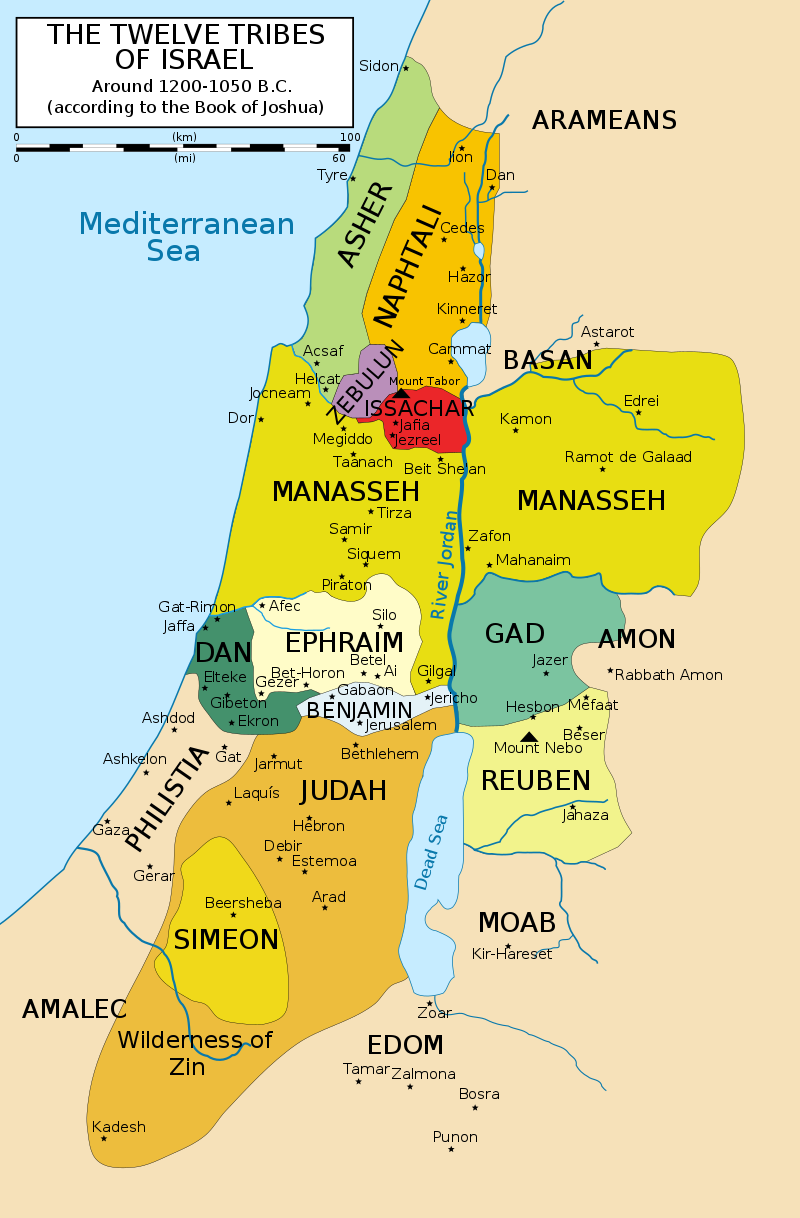
Note Locations of Ephraim, Jordan and Moab
And he said to them, "Pursue (imperative - command) them, for the LORD has given (Lxx - paradidomi) your enemies the Moabites into your hands - Ehud encouraged the sons of Israel that the victory was guaranteed because the Lord had given the Moabites into their hands. As explained earlier to "give into the hand of" is an idiom which means "to deliver over to the power of," and in essence "to enable to conquer."
TECHNICAL NOTE - While there is no mention of the Spirit coming on Ehud, do you think he would tell the Israelites to pursue the Moabites unless the Spirit of the Lord was giving him direction one way or another? I don't think so, especially since he in essence uttered a prophecy that came true -- and Who inspired the prophets but the Spirit (cf 2Pe 1:21)? Undoubtedly all of the judges God raised up were led by and empowered by the Holy Spirit of God.
Notice that for dramatic ("faith encouraging") effect Ehud uses the Hebrew perfect tense for the verb "has given" which describes a future action as if it were a completed, past event (and as described below was in effect a form of a "prophecy"). This is how certain Israel's defeat was because of God's faithful word!
THOUGHT - All of the events of the Revelation including Jesus' triumphant return (Rev 19:11-16+) and our time with Him in His Messianic Kingdom and the New Heaven and Earth are in effect written to us in the "perfect tense," because these future events are so certain to come to pass! Dear tried and afflicted saint (I am experiencing the most intense trial of my 36 years as a believer as I write these words), God's Word of hope to us is not a hope so but a hope sure! May you (we) encouraged in the Spirit of Christ. Amen.
So they went down after him and seized the fords of the Jordan opposite Moab, and did not allow anyone to cross - So means the Israelites heard Ehud and heeded Ehud's command to pursue and the promise of the LORD. Think about this a moment -- these Moabite enemies had oppressed and suppressed Israel for 18 years (Jdg 3:14) but now, all of a sudden, they become in effect fearless warriors! Was this just because of Ehud's charismatic leadership style? I do not think so. I believe God was moving in their hearts to change fear to faith, faith in the promise that He had given (Hebrew perfect tense describing future event as good as done) the enemy into their hands. Note the phrase went down after him, indicating that even though Ehud had told them to pursue the enemy, he did not then fall back behind the forces, but led the forces from the front.
Judges 3:29 And they struck down at that time about ten thousand Moabites, all robust and valiant men; and no one escaped.
Related Passages:
Joshua 23:10+ "One of your men puts to flight a thousand, for (EXPLANATION OF ISRAEL'S OVERPOWERING STRENGTH) the LORD your God is He who fights for you, just as He promised you.
Deuteronomy 28:7+ “The LORD shall cause your enemies who rise up against you to be defeated before you; they will come out against you one way and will flee before you seven ways.
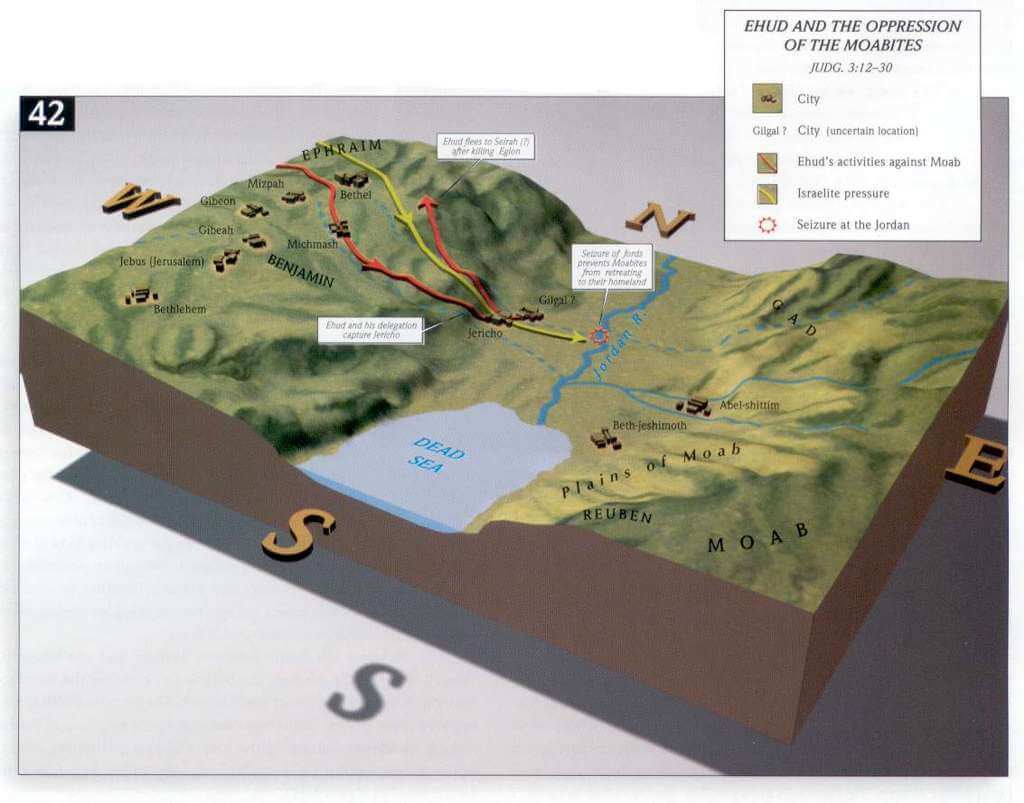
Click to enlarge - from the Holman Bible Atlas (digital book; Hardcover)
copyright © 1998 B&H Publishing Group,
Used by permission, all rights reserved.
One of the best resources for maps.
Please do not reproduce this map on any other webpage. Thank you.
EHUD'S PROPHECY
PROVES TRUE
And they struck down at that time about ten thousand Moabites, all robust and valiant men; and no one escaped. (cp "utterly destroy" Dt 7:2): We do not know how many Israelites came against the 10,000 Moabites, but as noted below when God was for Israel, who could be against her? Answer - No one! This same principle applies to us in Christ beloved (Ro 8:31+). Notice that the Moabites were all robust and valiant soldiers (NIV = all vigorous and strong; NLT = their strongest and bravest warriors) which underscores the point that it was not Israel's military prowess that defeated such a formidable foe, but it was Israel's God providing the supernatural power.
THOUGHT The same principle applies in our lives beloved -- any and all victory we experience over the world, the flesh and the devil is not the result of our ingenuity or fleshly power, but the result of the Spirit's supernatural power. Therefore ultimately it is God Who should receive all glory, honor and praise for any and every victory we experience in our lives on earth!
Moses rhetorical question in Deuteronomy gives us insight into how Ehud, et al, could route a large, strong force when he asked Israel “How could one chase a thousand, And two put ten thousand to flight, Unless their Rock had sold them, And the LORD had given them up? ." (Dt 32:30+) This was a repeat of his statement in Lev 26:8+ declaring "five of you will chase a hundred, and a hundred of you will chase ten thousand, and your enemies will fall before you by the sword."
Judges 3:30 So Moab was subdued that day under the hand of Israel. And the land was undisturbed for eighty years.
MOAB UNDER THE
HAND OF ISRAEL
So Moab was subdued that day under the hand of Israel - Under the hand of Israel, or literally by the left hand of an otherwise unknown man, a hand that clearly was enabled by the Spirit of God. The irony is that Israel who had been (in effect) given over to the hand of the enemy (Jdg 3:12 Yahweh strengthened Eglon), now subdued that same enemy under their God strengthened hand!
And the land was undisturbed (saqat; Lxx - hesuchazo - live a quiet life) for eighty years - It is easy to lose a sense of time in Judges 3 for this one chapter actually covers well over a century (at least 146 years), 8 years of bondage to Cushan-rishathaim, 40 years after Othniel's deliverance and then 18 years in bondage to Eglon, followed by 80 years after Ehud's deliverance. The word undisturbed is the same word as rest in Jdg 3:11+.
It is interesting that after one of the stranger deliverances in the book of Judges, Israel experienced one of the longest periods of rest recorded in Judges.
Ehud is an interesting character. Think about it… If the Jews had been asked to vote on a leader, Ehud probably would have lost on the first ballot. But God does not look at men the way men look at men and thus Ehud was God’s man for the task. God used this "nobody" to set the nation free. Moses was slow of speech and Paul was not imposing in his appearance, but Moses and Paul, like Ehud, were men of faith who led others to victory. Ehud turned a disability into a possibility because he depended on the Lord. God is in the reclamation business and is able to make any nobody a somebody who He can use mightily!
GotQuestions.org has an excellent comment on the unusual story of Ehud (repeated from above)...
While this account is one of the more graphic scenes in Scripture, it is also very insightful. The original readers would have seen the power of God in this story for a variety of reasons.
First, a lone man walked into the king’s palace, assassinated the king, and walked out without being captured. This was a highly unexpected event that involved great risk.
Second, one battle changed the next 80 years of Israel’s history. Ehud’s story involves more than removing a wicked leader; it includes a change in national history for an entire generation.
Third, Ehud’s success is a story of freedom. Just as God had redeemed Israel from Pharaoh and the land of Egypt when they cried out for help, God redeemed Israel from their bondage under King Eglon when they turned to Him.
Judges 3:31 And after him came Shamgar the son of Anath, who struck down six hundred Philistines with an oxgoad; and he also saved Israel.
- Shamgar Jdg 5:6,8
- Ox goad Jdg 15:15; 1Sa 13:19, 20, 21, 22; 17:47,50; 1Co 1:17, Eccl. 12:11; Acts 26:14
- Saved Israel - Jdg 4:1,3-24; Jdg 10:7,17; Jdg 11:4-33; 1Sa 4:1
Related Passages:
1 Corinthians 1:27+ but God has chosen the foolish things of the world to shame the wise, and God has chosen the weak things of the world to shame the things which are strong,
And after him This time God doesn't even bother to describe their forsaking Him to serve other gods but goes directly to the savior He raised up to deliver them from the Philistines.
Came Shamgar the son of Anath: Shamgar Here we see God use a "no name" man, probably a peasant farmer (because of his weapon the ox goad) (cp 1Co 1:27, 1Ti 1:12). God's requirement for usefulness in His kingdom work is not ABILITY but AVAILABILITY. It has always been so because His ways are not man's ways. He will use whomever will trust & obey. One individual endued with God's power can accomplish impossible tasks against evil forces, no matter how entrenched or how powerful.
Davis quips that "This note about Shamgar is almost like one of those newsbreaks sandwiched between regular programming on radio or television. The writer slips him in between Ehud and Deborah in the briefest sort of way. Yet “he too saved Israel.” So, if anything, we have a salvation break. (Judges: Such a Great Salvation)
Anath (note) was in northern Israel & was apparently also the name of the Canaanite goddess of sex and war. Could Shamgar have been a Canaanite convert from paganism to Jehovah? At least his father's name suggest that there was a deep influence of paganism in his family background.
Who struck down six hundred Philistines with an oxgoad; and he also saved Israel : An Oxgoad is a rod, generally about 8' long, at the bigger end about 6" in circumference and with a lesser end with a pointed end used to control oxen. At the other end there was a small paddle of iron, strong and massive, for cleansing the plough from the clay. In the hand of a powerful man such an instrument must be more dangerous and fatal than a sword.
During the time of the judges, the Israelites hired Philistine blacksmiths to "sharpen the goads" (1Sa 13:21), either by fashioning metal points for the pointed ends or making metal casings for the blunt end which might be used to knock dirt clods from the plow. Goads might be used as a weapon (Judges 3:31). The sayings of the wise are "goads" that "prod" thought (Eccl 2:11). God warned Paul not to "kick against the goads" (KJV pricks) by refusing to submit to the heavenly vision (Acts 26:14).
Paul wrote that "God has chosen the foolish things of the world to shame the wise, and God has chosen the weak things of the world to shame the things which are strong" (1Cor 1:27) Judges is replete with an interesting, colorful list of "foolish things which Jehovah used to deliver His people:
- Ehud's dagger
- Shamgar's oxgoad
- Jael's hammer and tent peg
- Gideon's trumpets, jars and torch
- The woman's millstone (Jdg 9:53+)
- Samson's jawbone
Joseph Parker once said “What is a feeble instrument in the hands of one man is a mighty instrument in the hands of another, simply because the spirit of that other burns with holy determination to accomplish the work that has to be done.”
Brensinger adds that "It has often been said that you can be too big for God to use, but you can never be too small. The overwhelming majority of people who make up the church today are, as always, ordinary. The Lord, however, can use ordinary people to do extraordinary things. In the words of Lesslie Newbigin, “The Church is not an organization of spiritual giants. It is broken men and women who can lead others to the Cross” (Newbigin: 146–147). The Shamgars of the past, not to mention the countless others who do not even have a single verse to preserve their memory, can become the often-unnoticed and perhaps modestly equipped servants who faithfully carry out the work of God’s kingdom today. (Believers Church Bible Commentary: Judges)
Hudson Taylor looking back over his 30 years as a missionary during which he had seen 600 missionaries respond to his vision to reach China through China Inland Mission summarized what he had learned declaring that…
God is sufficient for God's work… God chose me because I was weak enough. God does not do His great works by large committees. He trains someone to be quiet enough and little enough, and then He uses him.
By that standard, which is God's standard, all of us qualify. The issue is not whether He can or will use us, to His glory. The great question is whether or not we will trust Him to use us. Amen.
How often we think to ourselves "God if you will just save ole 'so and so'', he would be so useful to you." God doesn't think the way men think as Isaiah says…
For My thoughts are not your thoughts, Neither are your ways My ways," declares the LORD. 9 "For as the heavens are higher than the earth, So are My ways higher than your ways, And My thoughts than your thoughts. 10 "For as the rain and the snow come down from heaven, And do not return there without watering the earth, And making it bear and sprout, And furnishing seed to the sower and bread to the eater; 11 So shall My word be which goes forth from My mouth; It shall not return to Me empty, Without accomplishing what I desire, And without succeeding in the matter for which I sent it. (Isaiah 55:8-11)
Below is an illustration of a man named Telemachus who proved to be a "vessel for honor, sanctified, useful to the Master, prepared for (God's) good work":
The Incredible Story of Telemachus In the 4th Century a monk named Telemachus wanted to live his life in pursuit of God, so he lived alone in the desert praying, fasting, and meditating. One day as he prayed, he realized his life was based on a selfish love of God, not self-less. If he were to serve God, he must serve men. He decided to return to the city were there was sin and need so he headed for Rome. He arrived at a time when the Roman general Stilicho, had won a great victory over the Goths. Since Rome was officially Christian, triumph brought people pouring into the churches. But one pagan practice still lingered in "Christian" Rome -- gladiator games. While Christians were not thrown to the lions, prisoners of war were cast into the arena to fight and kill each other. Spectators roared with blood lust as the gladiators battled. Telemachus arrived on the day of the games. Following the noise, he made his way to the arena where 80,000 people had gathered to celebrate. The fights began and Telemachus stood aghast. Men for whom Christ had died were about to kill each other to amuse a supposedly Christian populace.
Telemachus jumped the wall and in a moment stood between 2 gladiators. For an instant they stopped but the crowd screamed "Let the games go on." So they pushed the old man in monk's robes aside. Again he came between the gladiators. The crowd hurled stones at him; they urged the gladiators to kill him and get him out of the way. The commander of the games gave the order - a sword flashed and Telemachus lay dead.
Suddenly the crowd hushed silent, shocked that a holy man had been killed. The games ended abruptly that day -- and were never resumed again. Telemachus by dying had ended them. As historian Edward Gibbon observed "His death was more useful to mankind than his life."! (May his tribe increase)
Rossi writes "Shamgar, the son of Anath, who followed Ehud, gained a signal victory over the Philistines: he also delivered Israel. Ehud's sword was mighty, though short. Shamgar wrought deliverance by the means of a weapon which seemed wholly unsuited to such a work; a contemptible instrument, to all appearance only suitable for goading brute creatures. Without wishing to press unduly here a typical meaning — a tendency to do which in teaching is dangerous in more ways than one — I would like to compare the ox-goad of Shamgar with the short sword of Ehud. We have one weapon, the Word of God; it may be presented in different aspects, but it is the only one that the man of faith makes use of in the warfare. To the intellectual and unbelieving world it is like an ox-goad, fit, at the best, only for women, children and uneducated persons, full of fiction and contradictions; yet it is this instrument, despised by men, that God uses to gain the victory. In making use of it, faith finds a weapon where the world only sees folly, for the weakness of God is stronger than men. Doubtless, it is written for the unlearned and suited to their needs and to their walk; but this very ox-goad can kill six hundred Philistines. Let us, then, make use of the Word with which God has entrusted us, always remembering that faith only can make it effectual, and that, too, when the soul has found therein for itself communion with God, the knowledge of Christ, and, therewith blessing, joy and strength, Judges - Meditations by Henri Rossi (Plymouth Brethren)
Use The Tools You Have - Warren Wiersbe
Only one verse (Judges 3:31) is devoted to Shamgar in the Book of Judges. What was significant about Shamgar was the weapon that he used. An ox goad was a strong pole about eight feet long. At one end was a sharp metal point for prodding the oxen and at the other end a spade for cleaning the dirt off the plow. It was the closest thing Shamgar could find to a spear because the enemy had confiscated the weapons of the Israelites (Jdg 5:8; see 1 Sam. 13:19–22).
Here was a man who obeyed God and defeated the enemy even though his resources were limited. Instead of complaining about not possessing a sword or spear, Shamgar gave what he had to the Lord, and the Lord used it. To stand his ground against the enemy, having only a farmer’s tool instead of a soldier’s full military equipment, marks Shamgar out as a brave man with steadfast courage.
Charles Spurgeon once gave a lecture at his Pastor’s College entitled "To Workers with Slender Apparatus." Shamgar didn’t hear that lecture, but I’m sure he could have given it! And I suspect he would have closed his lecture by saying, "Give whatever tools you have to the Lord, stand your ground courageously, and trust God to use what’s in your hand to accomplish great things for His glory."
Don’t forget: "Whatever you do, work at it with all your heart, as working for the Lord, not for men, since you know that you will receive an inheritance from the Lord as a reward. It is the Lord Christ you are serving" (Col. 3:23–24, niv).
Read: Judges 3 - Action assignment: What are some of the tools you can use to serve the Lord? A pen, to write a letter? Or better, a computer? Your kitchen? Your hands? Think about a way you can use one or more of these tools to reach out in love to someone. (Copyright Back to the Bible. Used by permission. All rights reserved)
We have here an enumeration of the nations of Canaan left to try Israel (Judges 3:1-7). They ought to have been destroyed; but, as the chosen people failed to fulfil the Divine purpose and command, they had to suffer the fret of perpetual conflict. Difficulty and temptation, though due to our own failure and sin, may be used for blessed purposes, overruled by the providence of God, to teach us priceless lessons. The presence of the Canaanites, due to the disobedience and unbelief of Israel, proved them and taught them to be strong in war, and revealed to them many a trait in the Divine character to which otherwise they had been oblivious. But what a lamentable record is here that they forgot God. Intermarriage with the sinful peoples around had the effect of infecting them with their vices and sins, and it became only too convenient to ignore and forget the all-holy God. Be not yoked with unbelievers.
Judges 3:8-11 The first captivity and deliverance. -- It is a bitter record which here begins. The Holy Ghost says the Lord "sold them into the hands of the king of Mesopotamia" (Judges 3:8), who probably invaded the trans-Jordanic tribes which lay nearest to him; but it is also true that the people sold themselves. In their distress the people cried unto the Lord. Those who had called upon Baal and Ashtaroth in their mirth were glad enough to call on God in the day of their trouble. Let backsliders, and those that are reaping a bitter harvest from the results of their wrong-doing, take heart from the next record, that when the people cried, "the Lord raised them up a saviour:' Twice that statement is made in this chapter. Othniel was specially anointed for his work (Judges 3:10), and it would be well, if we would distinguish between the grace of the Spirit within us for character, and upon us for work, and if we would claim each. This anointing may be ours (2 Cor. 1:21, 22; 1 John 2:27).
Judges 3:12-30 Ehud's achievements stand next. -- Eglon was permitted by God to wax strong and to prevail against Israel. But again, when the people repented, deliverance came through a man who might not have been supposed most suited for the purpose. Throughout this book we shall have occasion to notice the kind of instruments which God selected for His work. All of them to be classed among the things that are not, but which bring to nought the things that are. Here a left-handed man (Judges 3:21). Let us take courage from this. Out of weakness He makes strong. To those that have no might He increases strength.
Judges 3:31 Shamgar. -- When it is said (Judges 3:30) that the land had rest for eighty years, it probably refers to that part of Canaan which lay east of the Jordan, and had been oppressed by Moab; but the other side, which lay southwest, was infested by Philistines, against whom Shamgar was victor. Deborah afterwards told how far-spread their plunderings or robbery had been (Judges 5:6). An ox-goad would be simply a piece of pointed iron from six feet to eight feet in length; but, though a formidable weapon, it would have failed to do this deed; unless God had been mighty with its owner. What may not the weakest weapons do with God behind them! (F. B. Meyer. CHOICE NOTES ON JOSHUA THROUGH 2 KINGS)
GOD frequently is pleased to make use of his enemies for the correction of his own people: but when he has accomplished by them the purposes of his grace, he then calls them also into judgment for the acts which they have performed. In executing his will they have no respect to him, but follow only the wicked inclinations of their own hearts; and therefore he recompenses them, not as obedient servants, but according to the real quality of their actions. Thus he dealt with Sennacherib, who was only gratifying his own ambition, whilst, as a sword in Jehovah’s hand, he was inflicting punishment on Israel: and thus he dealt with Eglon also, whom he had raised up to power for the purpose of chastising his offending people. Yet there is something very remarkable in the way in which God requited the wickedness of Eglon, and in which he delivered his people out of his hand. The man whom God raised up as his instrument, was Ehud; who, by a stratagem, effected the death of Eglon.
We will briefly set before you,
I. The conduct of Ehud—
Eglon, king of Moab, having subdued Israel, himself resided in Canaan, in the city of Palm-trees: and Ehud was sent, as the representative of Israel, to offer to him their accustomed tribute. But Ehud, hoping for an opportunity to assassinate Eglon, took a dagger with him: and, after having presented the tribute and left the city with his attendants, went back alone to Eglon, pretending to have a secret errand to him. Eglon ordered all other persons to depart from his presence, and thus gave Ehud a good opportunity of accomplishing his design. Ehud availed himself of it with great success: being left-handed, he drew forth the dagger without any suspicion, and plunged it, even the haft together with the blade, into the belly of Eglon, who instantly fell down dead. Ehud then retired from the secret chamber where the transaction had taken place, and locked the doors after him, and went composedly away, as though nothing particular had happened; and thus effected his escape; and instantly stirred up Israel to cast off the yoke of Moab, before their enemies should have had time to concert their measures under another head.
Now to form a correct estimate of this action, we must consider it in two different points of view;
1. As voluntarily undertaken—
[In this view it was altogether indefensible. Treachery and murder can never be justified. Though Eglon was an usurper and a cruel oppressor, still the Israelites professed subjection to him; and Ehud went as their messenger, to present to Eglon their acknowledgments of that subjection. If he had chosen to cast off the yoke of Moab, he was at liberty to do so in a way of open warfare: but to become an assassin he had no right: nor could the end which he proposed, sanctify the means he used: the means were wrong; and he had “no right to do evil that good might come.”]
2. As divinely commissioned—
[No created power could have authorized Abraham to slay his son, or Israel to plunder Egypt, and extirpate the inhabitants of Canaan: nor could any human being have executed such things of his own mind, without contracting very heinous guilt. But God is not bound by the rules which he has imposed on us: he may act towards his creatures as he sees best, and may employ instruments in any way that he pleases: nor would even an angel contract defilement in executing any commission that God had given him. An angel slew in one night all the first-born in the land of Egypt; and on another occasion, a hundred and eighty-five thousand Assyrians: yet no one thinks of imputing guilt to him on that account:—so Ehud, if appointed to the work by God, might innocently effect it in the way he did. Jehu was commissioned by God to dethrone Ahab, and destroy his family: and, though he was punished afterwards because he was not actuated by a becoming zeal for the glory of God, yet for the action itself he was rewarded even to the fourth generation. Precisely thus may Ehud at this moment be receiving a reward from God for that act of his, which, under other circumstances, would have been highly sinful. And there is reason to believe that he was directed by God in that action; since not only were his wisdom, courage, and success, beyond all that could have been expected in a merely human enterprise, but we are expressly told that “God raised up this man to be the deliverer of his people.”
We must not however imagine, that his conduct is to be followed as a precedent: for no man can dare to follow it, unless he have infallible evidence that he is called of God to do so: but, as no man can expect such a call at this time, no man can without the deepest criminality presume to imitate his example.]
Having thrown what light we can on the dubious conduct of Ehud, we proceed to suggest,—
II. Some reflections arising from it—
Supposing Ehud to have been divinely commissioned, he might well say to Eglon, “I have a message from God to thee.” At all events his language leads us to observe,
1. That God does send messages to mortal men—
[The whole creation is delivering to us, as it were, a message from God, and conveying to us the knowledge of his perfections (Ro 1:20-note; Ps. 19:1, 2, 3, 4-note) — — — Every providential dispensation also has some important lesson to communicate: the mercies of God declare his goodness to us, and invite us to repentance (Ro 2:4-note), and his judgments are intended to discover to us some truths which we did not previously discern: “Hear ye the rod,” saith the prophet, “and Him that hath appointed it.” (Mic 6:9) But it is in his word more especially that God comes down to commune with sinful man. His Gospel is so called from the very circumstance of its being a message of mercy, or, as the word means, good tidings from God to man: and ministers are ambassadors from him, sent to beseech you in his name to accept reconciliation with him through the death of his Son. Indeed this message contains the substance of all that we have to speak to you in God’s name; and from hence it is called by God himself, “the ministry of reconciliation.” Behold then this day we come unto you and say, “We have a message from God to you!” He sends us this day to invite you to come to him for all the blessings of salvation, and to receive them freely at his hands, “without money, and without price.” (Is 55:1, 2, 3) — — —]
2. That, by whomsoever his messages are delivered, we should attend to them with the profoundest reverence—
[Though Eglon was a king, and Ehud an oppressed servant, yea, though Eglon was a heathen that did not worship the true God, yet, the very instant that Ehud announced that he had a message from God unto him, he rose up from his seat, that he might receive it with the greater reverence. And does not this idolatrous heathen reproach us, who, when God’s servants are delivering messages to us in his name, scarcely pay any attention to them, or perhaps fall asleep in the midst of them? Behold, how Israel listened to the reading of God’s word in the days of Nehemiah (Neh 8:3, 5, 6) — — — that is the way in which we should read or hear the word of God at this time. We should not come to the house of God as critics, to sit in judgment; or as curious persons, to be entertained; but as sinners, to “hear what the Lord God will say concerning us.” Beautiful is the example of Cornelius and his family (Acts 10:33): they did not regard Peter as a man, but as a messenger from God: and in like manner should we also “receive the word, not as the word of man, but, as it is in truth, the word of God.” (1Th 2:13-note) O that the spirit of Samuel were more visible in us (1Sa 3:10), and that we sought instruction from the word, only in order to obey it!” (John 9:36)]
3. That we should ever be prepared for whatsoever message he may send—
[Who can tell but that as his message to Eglon was a message of death, so he may send to us this day, saying, “Set thine house in order; for thou shalt die and not live.” He needs not the aid of an assassin to take away our lives: there are millions of ways in which death may seize upon us. As for our security, the more secure we are in our own apprehension, the more likely are we to receive such a message from God. (1Th 5:3-note) It was when the rich fool was looking forward to years of enjoyment, that God said to him, “This night thy soul shall be required of thee:” and it was when Job fondly expected he should “die in his nest,” (Job 29:18. See also Ps 30:6, 7) that God pulled down his nest, and despoiled him of all that he had. Let us not then promise ourselves an hour’s continuance even of life itself (Pr 27:1): but be standing “with our loins girt, and our lamps trimmed, that at whatever hour our Lord may come, he may find us watching” — — —]
Application — — —
This may be more appropriate or more general: in the former case, a message may be delivered as from God himself to Oppressors, and the Oppressed; (to awe the one, as Isa 10:5-18 and encourage the other, as Isa 10:24, 25, 26, 27.) in the latter case, an Address may be made to the Careless, the Backsliding, and the Faithful, with the prefatory Remark to each, “I have a message from God to thee.” (Simeon, C. Horae Homileticae Vol. 3: Judges to 2 Kings)