Matthew 5:2
Matthew 5:3
Matthew 5:4
Matthew 5:5
Matthew 5:6
Matthew 5:7
Matthew 5:8
Matthew 5:9
Matthew 5:10
Matthew 5:11
Matthew 5:12
Matthew 5:13
Matthew 5:14
Matthew 5:15
Matthew 5:16
Matthew 5:17
Matthew 5:18
Matthew 5:19
Matthew 5:20
Matthew 5:21
Matthew 5:22
Matthew 5:23
Matthew 5:24
Matthew 5:25
Matthew 5:26
Matthew 5:27
Matthew 5:28
Matthew 5:29
Matthew 5:30
Matthew 5:31
Matthew 5:32
Matthew 5:33
Matthew 5:34
Matthew 5:35
Matthew 5:36
Matthew 5:37
Matthew 5:38
Matthew 5:39
Matthew 5:40
Matthew 5:41
Matthew 5:42
Matthew 5:43
Matthew 5:44
Matthew 5:45
Matthew 5:46
Matthew 5:47
Matthew 5:48
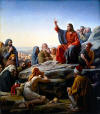
Sermon on the Mount


Click chart to enlarge
Charts from Jensen's Survey of the NT - used by permission
Another Chart from Charles Swindoll
THE LIFE OF JESUS AS COVERED
BY MATTHEW (shaded area)

Click chart to enlarge
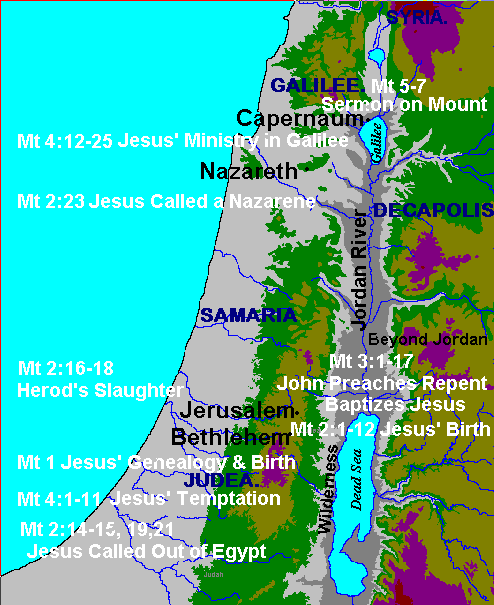
Jesus Birth and Early Years
Leading up to the Sermon on the Mount
Matthew 1-7

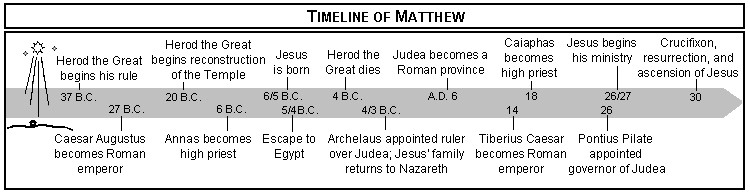
Source: Ryrie Study Bible
Matthew 5:13 "You are the salt of the earth; but if the salt has become tasteless, how * can it be made salty again? It is no longer good for anything, except to be thrown out and trampled under foot by men. (NASB: Lockman)
Greek: Humeis este (2PPAI) to halas tes ges; ean de to halas moranthe, (3SAPS) en tini alisethesetai? (3SFPI) eis ouden ischuei (3SPAI) eti ei me blethen (APPNSN) exo katapateisthai (PPN) hupo twn anthropon.
Amplified: You are the salt of the earth, but if salt has lost its taste (its strength, its quality), how can its saltness be restored? It is not good for anything any longer but to be thrown out and trodden underfoot by men. (Amplified Bible - Lockman)
KJV: Ye are the salt of the earth: but if the salt have lost his savour, wherewith shall it be salted? it is thenceforth good for nothing, but to be cast out, and to be trodden under foot of men.
NLT: "You are the salt of the earth. But what good is salt if it has lost its flavor? Can you make it useful again? It will be thrown out and trampled underfoot as worthless. (NLT - Tyndale House)
Philips: "You are the earth's salt. But if the salt should become tasteless, what can make it salt again? It is completely useless and can only be thrown out of doors and stamped under foot. (New Testament in Modern English)
Wuest: As for you, you are the salt of the earth. But if the salt loses its pungency, by what means can its saltness be restored? For not even one thing is it of use any longer, except, having been thrown out, to be trampled under foot by men.
Young's Literal: 'Ye are the salt of the land, but if the salt may lose savour, in what shall it be salted? for nothing is it good henceforth, except to be cast without, and to be trodden down by men.
YOU ARE THE SALT OF THE EARTH
- Leviticus 2:13; Colossians 4:6
- Matthew 5 Resources - Multiple Sermons and Commentaries
- Matthew 5:13 You Are the Salt of the Earth - John MacArthur
- What did Jesus mean when He described His followers as the salt of the earth?
- What does it mean that believers are to be salt and light (Matthew 5:13-16)?
ARE YOU SALTING
YOUR SOCIETY?
Related Resources:
- Salt - ISBE Dictionary
- Torrey's Topic
- Hastings' Dictionary of the Bible -Salt
- Hastings' Dictionary of the New Testament - Salt
- Hastings' Dictionary of the New Testament - Salt (2)
Don't miss a the key principle in Jesus' metaphors of salt and light. Citizens of the Kingdom of Heaven impact society because they are different (not weird or bizarre but distinct) from the Kingdom of this World. When salt and light try to accommodate to and/or be conformed by the Kingdom of this World, they lose their distinctiveness and their potential to impact the decay and the darkness of the this world which is passing away. In the Revelation John records the triumphant cry when
"the seventh angel sounded; and there arose loud voices in heaven, saying, "The kingdom of the world has become the kingdom of our Lord, and of His Christ; and He will reign forever and ever." (Revelation 11:15-note)
Until then God has left believers in the Kingdom of Darkness and Decay to dispel the darkness and retard decay, as peacemakers giving out the word of reconciliation (2Cor 5:14-21), a word which in some will birth new life and to others will cause them to hate and persecute you (John 3:19-21, Mt 5:10, 11, 12-see notes Mt 5:10; 11; 12, Lk 6:22). Persecution for the sake of Christ and the Kingdom of Heaven therefore becomes a sign that one truly belongs to the glorious coming Kingdom of our Lord (cp Ro 8:16, 17, 18-notes Ro 8:16; 17; 18). Beloved, don't let this world squeeze you into it's mold (Ro 12:2)
Charles Simeon writes…
LITTLE does the world think how much they are indebted to those very saints whom they “revile and persecute for righteousness’ sake.” (Mt 5:11) The extirpation of them (which is so much desired by many) would leave the world an entire mass of corruption, without any thing to heal its disorders, or to stop its progress towards utter destruction. Were they removed out of it, the rest would soon become as Sodom and Gomorrah (Is 1:9). The representation given of them in the text fully justifies this idea. They are called “the salt of the earth.” This, of course, must be understood of those only who have the spirit of religion in them: for all others, whatever they may possess, are as vile and worthless as the real Christians are good and excellent.
The words before us will lead us to consider, the worth and excellence of truly spiritual Christians— The use of salt, as intimated in this expression of our Lord, is to keep other things from putrefaction and corruption. This is the office that has been executed by all the saints of old— [View them from the beginning; and they will all be found active in their generation, and zealous in benefiting the world around them. Noah preached to the antediluvians an hundred and twenty years, indefatigably exerting himself to bring them to repentance. Lot, in Sodom, “vexed his righteous soul from day to day with their unlawful deeds,” and strove to turn the people from their horrible abominations. All the prophets in successive ages laboured in the same blessed work, using all their efforts to lead their hearers to the knowledge of the only true God, and to an obedience to his holy laws. How the Apostles acted in relation to this, it is needless to observe. They lived for no other end, but to make known the way of life, and to “turn men from darkness unto light, and from the power of Satan unto God.” (Read the entire sermon - Matthew 5:13 Christians the Salt of the Earth)
Stuart Weber introduces this section with the following comment…
In Matthew 5:13, 14, 15, 16, before embarking on the body of the sermon, Jesus explained in two word pictures the impact that a truly righteous person will have on his or her world. The entire sermon, including the Beatitudes before and the many teachings after, shows us how to live as "salt and light" in the world as representatives of another kingdom. These word pictures also serve Matthew's purpose—to encourage believers to change their world (Matt. 28:18, 19, 20). (Weber, Stuart, Max Anders, Ed: Holman New Testament Commentary: Matthew Broadman & Holman)
Dave Guzik summarizes Mt 5:13-16 writing that…
A key thought in both the pictures of salt and light is distinction. Salt is needed because the world is rotting and decaying and if our Christianity is also rotting and decaying, it won't be any good. Light is needed because the world is in darkness, and if our Christianity imitates the darkness, we have nothing to show the world. To be effective we must seek and display the Christian distinctive. We can never affect the world for Jesus by becoming like the world. The figures of salt and light also remind us that the life marked by the beatitudes is not to be lived in isolation. We often assume that those inner qualities can only be developed or displayed in isolation from the world, but Jesus wants us to live them out before the world.. Jesus points to a breadth in the impact of disciples that must have seemed almost ridiculous at the time. How could these humble Galileans salt the earth, or light the world? But they did. Jesus never challenges us to become salt or light. He simply says that we are - and we are either fulfilling or failing that responsibility. (Matthew 5) (Bolding added)
| THE SERMON ON THE MOUNT An Outline |
|
| Chapter | Subject |
| Mt 5:3-9 | Character |
| Mt 5:10-12 | Conflict |
| Mt 5:13-7:27 | Conduct |
You [emphatic: you alone] are the salt of the earth. "You", not governmental institutions, not educational institutions, not organizations, but "you" and "you alone" are the salt of the earth.
Note that in this section Jesus shifts from "those" ("blessed are those… ") to the second person "you". He shifts from character to influence of this character.
The point is that those who live out the Beatitudes (Mt 5:3-12) in the power of the Spirit, not might be, but actually are "the salt of the earth". How do we know that is what He means? "Are" is in the indicative mood which is the mood of reality. In other words, they really are the specific salt factor in this world. Furthermore, the present tense expresses a constant condition and indicates that saltiness is to continually be the lifestyle of every citizen of the Kingdom of Heaven every day of their life on earth.
Think of the implications - you have a great purpose in God's plan and you have it all the time in every place you go! It does not matter whether you are rich or poor, highly educated or not, tall or short, etc, etc. You are an invaluable pawn in God's great chess match! What an incredible privilege citizens of the Kingdom of Heaven have been granted by their King, Jesus Christ! This is privilege we should not only cherish but one that should also create in us a sense of divine accountability. We are stewards of salt so to speak and one day we will give an account for how salty we were (cf 2Cor 5:10). The King does not give us an option at this point but calls us to a central responsibility to be salt to the world about us. How are you doing? Are you really living like a Christian? Are you using your money like a Christian? Are you talking like a Christian? Are you conducting your family like a Christian? Are you using your leisure time like a Christian? Does the language change when you are around? Does the attitude of the workplace improve because you work without complaining, you show up on time, you treat everyone with kindness, you refuse to enter into gossip?
In Jesus' prayer (the real "Lord's Prayer") to His Father, He explains why believers are not just automatically jettisoned up to heaven when they are saved. We have a distinct purpose as He relates in His prayer…
"I have given them (those who are "the salt") Thy word; and the world has hated them (cf persecution see notes Matthew 5:10; 5:11; 5:12), because they are not of the world (explains "why" the poor in spirit, mourning, meek ones are persecuted), even as I am not of the world. I do not ask Thee to take them out of the world, but to keep them from the evil one. They are not of the world, even as I am not of the world. Sanctify (set them apart from the world) them in the truth; Thy word is truth. As Thou didst send Me into the world, I also have sent them into the world." (John 17:14-18)
There it is, Jesus' disciples are sent into the world to be "the salt" in the world (note how often "world" is repeated in this passage).
The renowned Baptist pastor, George Truett once said…
"You are either being corrupted by the world or you are salting it."
Jesus' declaration of the state of believers leaves no room for a middle ground.
Earth (1093) is used instead of ‘world’ as a metaphor for the people of the world
Salt (217) (halas) is natural salt which purifies, cleanses, preserves from corruption. Its literal sense of “seasoning salt” is found in Matthew 5:13; Mark 9:50; Luke 14:34). Figuratively (see metaphor and terms of comparison simile metaphor)) salt appears in conjunction with believers’ characters and concerning their speech (Mark 9:50; Colossians 4:6).
For an interesting discussion of salt see Pliny the Elder's (who is he?) article in Natural History, Book 31, chapter 41.
Zodhiates - (I) Natural salt which purifies, cleanses, and preserves from corruption (Luke 14:34; Sept.: Lev. 2:13; Judg. 9:45). In Matt. 5:13 and Mark 9:50 applied spiritually to the disciples of Christ who were to circulate among and purify the corrupted mass of mankind by their heavenly doctrines and holy examples. (II) Metaphorically used of wisdom and prudence (Matt. 5:13; Mark 9:50 [cf. Acts 15:9; Col. 4:6; 1 Pet. 1:4; 1 John 3:3]). (Complete Word Study Dictionary – New Testament)
The Greek noun halas is not found in the Septuagint, but the related noun hals is found 31x in 29v (hals is not found in the NT, only halas) -
Ge 14:3; Gen. 19:26; Lev. 2:13; Lev. 24:7; Num. 18:19; Deut. 29:23; Jos. 3:16; Jos. 12:3; Jos. 15:62; Jos. 18:19; Jdg. 9:45; 2 Ki. 2:20; 2 Ki. 2:21; 1 Chr. 18:12; 2 Chr. 13:5; 2 Chr. 25:11; Ezr. 6:9; Ezr. 7:22; Job 6:6; Ps. 60:1; Ezek. 16:4; Ezek. 43:24; Ezek. 47:11
Halas - 8x in 4v
Matthew 5:13 "You are the salt of the earth; but if the salt has become tasteless, how can it be made salty again? It is no longer good for anything, except to be thrown out and trampled under foot by men.
Mark 9:50 "Salt is good; but if the salt becomes unsalty, with what will you make it salty again? Have salt in yourselves, and be at peace with one another."
Luke 14:34 "Therefore, salt is good; but if even salt has become tasteless, with what will it be seasoned?
Colossians 4:6 Let your speech always be with grace, as though seasoned with salt, so that you will know how you should respond to each person.
Vine - halas - a late form of hals (found in some mss. in Mark 9:49 ), is used (a) literally in Matthew 5:13 (2nd part); Mark 9:50 (1st part, twice); Luke 14:34 (twice); (b) metaphorically, of "believers," Matthew 5:13 (1st part); of their "character and condition," Mark 9:50 (2nd part); of "wisdom" exhibited in their speech, Colossians 4:6. Being possessed of purifying, perpetuating and antiseptic qualities, "salt" became emblematic of fidelity and friendship among eastern nations. To eat of a person's "salt" and so to share his hospitality is still regarded thus among the Arabs. So in Scripture, it is an emblem of the covenant between God and His people, Numbers 18:19; 2 Chronicles 13:5; so again when the Lord says "Have salt in yourselves, and be at peace one with another" (Mark 9:50 ). In the Lord's teaching it is also symbolic of that spiritual health and vigor essential to Christian virtue and counteractive of the corruption that is in the world, e.g., Matthew 5:13 , see (b) above. Food is seasoned with "salt" (see B); every meal offering was to contain it, and it was to be offered with all offerings presented by Israelites, as emblematic of the holiness of Christ, and as betokening the reconciliation provided for man by God on the ground of the death of Christ, Leviticus 2:13 . To refuse God's provision in Christ and the efficacy of His expiatory sacrifice is to expose oneself to the doom of being "salted with fire," Mark 9:49 .While "salt" is used to fertilize soil, excess of it on the ground produces sterility (e.g., Deuteronomy 29:23; Judges 9:45; Jeremiah 17:6; Zephaniah 2:9 ). (Vine's Expository Dictionary of NT Words - Salt, Saltness)
Salt was one of the earliest of all preservatives and was a valued commodity in the ancient world. Without any source of refrigeration, salt became the means of preserving meat from decaying, as the ancients rubbed down meat and fish to preserve it for regular use. Seafarers just a century ago would salt down their fish and meat to preserve them for the long transatlantic journeys. Salt was so important as a corruption preventative in the ancient world that wars were fought over it, and entire economies were based on it. In short, salt could literally make the difference between life and death in a time when fresh food was unavailable.
The Greek writer Plutarch said that meat is a dead body and part of a dead body, and will, if left to itself, go bad, but salt preserves it and keeps it fresh, and is therefore like a new soul inserted into a dead body. Dead meat left to itself went bad, but, pickled in salt, it retained its freshness. The salt seemed to put a kind of life into it. The point is that salt preserves corruption.
Salt was used as a figure of speech in the ancient world of sparkling conversation, speech dotted with witty or clever remarks. In Colossians 4:6 (note), salt indicates speech which gives a flavor to the discourse and recommends it to the pallet as well as speech which preserves from corruption and renders wholesome
The Greeks called salt "charitas" (grace) because it gave flavor to things. Our speech must not be corrupt (Ep 4;29) and salt (God's grace) holds back corruption. A thoughtless word of criticism, a questionable remark, an angry word—any of these could tear down in a minute whatever Christian testimony others have tried to build up. No believer ought ever to say, “Now take this with a grain of salt!” Instead we need to put the salt into our speech!
When we wish to stress a person's solid worth and usefulness we often say "That person is the salt of the earth." Salt was a valuable commodity in the dry Middle East and was used to barter. Our English word “salary” comes from the Latin salarius (“salt”). A person lacking integrity might have mixed white sand with the salt and then had more for trade. But salt mixed with sand lost some of its salty quality and became useless. Christians are to be the "salt of the earth".
Salt acts secretly. We know that it combats decay, though we cannot see it perform its task. Its influence is very real nonetheless.
Spurgeon - Our Savior was speaking of the influence of his disciples upon the fellows, and he first of all mentioned that secret but powerful influence which he describes under the figure of salt: “Ye are the salt of the earth.” No sooner is a man born unto God than he begins to fellow-men with an influence which is rather felt than seen. The very existence of a believer operates upon unbelievers. He is like a handful of salt cast upon flesh; he has a savor in himself, and this penetrate those who are in contact with him. The unobserved almost unconscious influence of a holy life is most effectual to serving of society and the prevention of moral putrefaction. May there be salt in every one of us, for “salt is good.” Have salt in yourselves, and then you will become a blessing to all around you.
J Vernon McGee has a pithy ("peppery") note on Christians as salt writing that "God’s people in any age and under any condition are both salt and light in the world. The Scots translate “savour” by the more expressive word tang. I like their word much better. “If the salt has lost its tang.” The problem today is that most church members have not only lost their tang as salt, but as pepper they have lost their pep also. We have very few salt and pepper Christians in our day. Now salt doesn’t keep fermentation and that type of thing from taking place, but it will arrest it. You and I ought to be the salt in the earth and have an influence for good in the world. (McGee, J V: Thru the Bible Commentary Nashville: Thomas Nelson)
Barclay explains that "In the ancient world salt was highly valued. The Greeks called salt divine (theion). (Matthew 5 Commentary - Daily Study Bible online)
The domestic and medicinal value of salt both as condiment and preservative was as universal in the ancient world as it is today. Pliny declared that "salt has something of the nature of fire", and he quotes a current saying, "To the whole body nothing is better than sun and salt"
Lasting alliances or covenants were made by eating bread and salt, or salt alone (Aristotle). (Ed: See Trumbull's book = Covenant of Salt) See also What is a salt covenant?
Cato, Virgil, and Pliny all refer to the ability of salt to improve the productivity of the soil.
Dwight Pentecost gives an excellent summary of some of the Biblical uses of salt…
Salt has been valued from time immemorial. Roman soldiers were paid in salt and, if one were derelict in his duties, he was said to be "not worth his salt."
Salt was used throughout ancient societies as a sign of friendship, (Ed note: see The Oneness of Covenant: Friend) a concept that continues to the present day. In the Arab world, if one man partakes of the salt of another man, that is, eats a meal with him, he is under his protection and care. If a man's worst enemy came into his tent and ate of his salt, he would be obliged to protect and to provide for him as though he were his dearest friend.
Out of that idea grew the concept of a salt covenant, referred to in 2 Chronicles 13:5 (cf Nu 18:19), where God speaks of a covenant of salt made with David. Before the days of a notary public who could authenticate the legality of a document, when two men entered into a business agreement, they would haggle over terms until they had settled on the agreement. Then they would eat salt or portions of food together; eating salt bound them together in what they called a salt covenant. This covenant established a contract that was not to be broken.
God prescribed salt as a necessary part of the sacrifices.
"Every oblation of thy meat-offering shalt thou season with salt; neither shalt thou suffer the salt of the covenant of thy God to be lacking from thy meat-offering: with all thine offerings thou shalt offer salt" (Lev 2:13, cf Ezekiel 43:23, 24, Ezra 9:9, 10).
God said that if they left salt out of their offering to God, it was an unacceptable offering. The offering demanded the whole, and the offering was incomplete without salt.
Job refers to salt as a necessary ingredient of food as he asked the question,
"Can that which is unsavory be eaten without salt? or is there any taste in the white of an egg?" (Job 6:6).
As early as Job's time, men recognized the importance of salt, and attached special significance to it. (Pentecost, J. D. Design for living: Lessons in Holiness from the Sermon on the Mount. Kregel Publications) (Bolding added)
SALT PRESERVES
Someone has said that there are some 14,000 industrial uses for salt! And frankly, this is where we must sound a note of caution… interpretation of metaphors can be "tricky" especially if the expositor has a vivid imagination. Unfortunately, such interpretations may not be what God really intended by using a given metaphor like "salt". For example, some say salt was white and then reason that this whiteness pictures purity (and even compare it with purity of heart in Mt 5:8). Now while there may be some element of truth in such an interpretation, that is probably not the primary message Jesus intended to convey to His audience. Let's think for a moment about the context. Jesus is speaking in a time when there were no ice makers or refrigerators. There was need for a simple method of preservation of foodstuffs from decay and corruption and this was the primary function of salt. In fact the only way to preserve meat in the hot climate of Palestine was to salt it or soak it in a salt solution. This practice is still common in many remote areas of the world. It follows that the primary interpretation of the meaning of the metaphor of salt is that it speaks of a preservative agent which impedes corruption, decomposition and decay. The world, in contrast to what many "enlightened" members teach, is not evolving but devolving. The world is not going toward order but disorder. It is slowly decomposing and rotting away.
What happened when God left the world to itself after the fall of Adam? Several centuries passed until we come to Genesis 6…
Then the LORD saw that the wickedness of man was great on the earth, and that every intent of the thoughts of his heart was only evil continually. (Genesis 6:5)
Even the "salty effect" of Noah was not enough to preserve the world and impede the moral decay and spiritual rot, Peter recording that as a result God…
and did not spare the ancient world, but preserved Noah, a preacher of righteousness, with seven others, when He brought a flood upon the world of the ungodly; (2Pe 2:5)
Even with another chance man fell into total debauchery leading to the wickedness of Sodom and Gomorrah which God again condemned
to destruction by reducing them to ashes, having made them an example to those who would live ungodly thereafter (2Pe 2:6)
So history proves the point that our world continually tends toward decay not divinity. Enter the citizens of the Kingdom of heaven who are the decay retardants and preservatives of a disintegrating world. Thus even as salt arrests decay in meat or fish, the influence of Christian character can halt the downward spiral of the world and help to stem the natural degeneration that occurs in the world’s rebellion against God. Christians have a moral influence on the world around them, affecting every part of society. If you are not having a moral influence on those around you then something is gravely amiss in regarding your morality, for as Alan Redpath once said…
If it is possible for your closest contacts to be neutral about Christ then there is something wrong with your Christianity.
Sinclair Ferguson explains the preservative effect of salt noting that…
it calls for radical and costly application. Christians whose lives exhibit the qualities of the 'blessed' will have a preserving impact upon a society that, if left to itself, will rot and deteriorate. Without the influence of the gospel, society will suffer moral decay and become putrid, unfit for the consumption of good men and women… It is all too easy for us to despair as Christians because of our frailty and insignificance, personally or numerically. However, we must never give in to Satan's lie that we can be effective only when we have large numbers and a show of strength. Jesus' illustration of salt is an encouraging reminder that the apparently cheap and insignificant can influence its environment out of all proportion to our expectation.
Sometimes this happens on a national scale. It is said, with some justification, that the only thing that saved England from a revolution as horrible and bloody as the French Revolution was the evangelical revival under the preaching and teaching of men like John Wesley and George Whitefield during the eighteenth century.
More frequently it will happen on a small scale: your companions will moderate their language; the name of Jesus will not be so easily blasphemed; those with whom you work will develop something of a conscience about the standard of their work; the conversations of men or women will be brought under control; respect for others will be more common. Your life will save others from yielding to the immoral pressures by which our contemporary world is characterised. When you are the salt of the earth, you preserve society. (Ferguson, Sinclair: Sermon on the Mount :Banner of Truth)
Christians make plenty of negative comments and vent tons of frustration over the putrefaction of our society. But our culture is simply doing what comes natural, rotting because it has no preservative. As hard as it is to admit, we should quit leveling the blame of decadence on pagans and start asking why the Church is not more effectively preventing decay (especially of our ethical and moral values) from accelerating and exerting an ever increasing negative influence in our society. A Christian should be in the world and yet not of the world. How can this be? Consider the fish who, though he lives in the salty sea, does not taste salty.
As John Stott points out, “And when society does go bad, we Christians tend to throw up our hands in pious horror and reproach the non-Christian world; but should we not rather reproach ourselves? One can hardly blame unsalted meat for going bad. It cannot do anything else. The real question to ask is: where is the salt?” (Stott, John: The Message of the Sermon on the Mount: 1978, Intervarsity Press)
The impact of salty Christians has effected entire countries. Consider impact of the First Great Awakening (revival) on England at a time when the rest of Europe was embroiled in political upheavals. Even secular writers acknowledge that it was because of the impact of salty Christians like John Wesley and George Whitefield that England was spared the effects of the horribly bloody revolution that swept through France (see French Revolution) in the late 1700's. Salty believers really do prevent from corruption and decay!
Phil Newton tells an encouraging story about the "after taste" left by "salty" missionaries relating that "Pastor Paul Ndungu from Kenya, told us of a missionary couple that served for fifteen years among a particular people group in Kenya without seeing any outward response. He said they labored faithfully, serving the people, teaching the gospel, and doing all they could to set Christ before these people. But none responded until a couple of days after their departure. The missionary family’s maid, two gardeners, and milkman converged upon the empty house, related how they now missed these Christians. All wept about this sense of loss, and reflected upon what they saw in them and what they had taught them. One by one they called upon the Lord, coming to faith in Christ. The church among that people group was born without a missionary but not without the salt and light influence of that Christian family that lived among these people for fifteen years, faithfully living unto the Lord. What they did not accomplish with their missiological approach they accomplished by being Christians in a decaying world. (Matthew 5:13: Problem of Tasteless Christianity)
Barclay writes that "The individual Christian must be the conscience of his fellows; and the church the conscience of the nation. The Christian must be such that in his presence no doubtful language will be used, no questionable stories told, no dishonorable action suggested. He must be like a cleansing antiseptic in the circle in which he moves. (Matthew 5 Commentary - Daily Study Bible online)
Hughes - This matter of being a preservative has a positive and a negative side. On the negative side, the presence of a salty Christian will retard decay simply because his or her life is a reproach to the sin of those they are around. We all know there are certain people in whose presence a filthy story is naturally told, and there are others before whom no one would think of telling such a story. The salty Christian is not self-righteous or condemning, but his or her life makes ungodly conversation seem shabby and inappropriate. I believe such Christians exert an incalculable influence on society! Their mere presence reduces crime, restrains ethical corruption, promotes honesty, quickens the conscience, and elevates the general moral atmosphere. The presence of such people in the military, in business, in education, in a fraternity or sorority will amazingly elevate the level of living. And their absence will allow unbelievable depths of depravity. Believers, salty believers, are the world's preservative. The question we must ask ourselves is, what happens when we get to know people without Christ? Does it make a difference in their lives? Are we salt? (Hughes, R. K. Sermon on the Mount: The Message of the Kingdom. Crossway Books)
John MacArthur offers two excellent illustrations of the leavening effect of salty "salt"…
Andrew Murray lived an exceptionally holy life. Among those on whom his influence was the greatest were his children and grandchildren. Five of his six sons became ministers of the gospel and four of his daughters became minister’s wives. Ten grandsons became ministers and thirteen grandchildren became missionaries.
Woodrow Wilson told the story of being in a barbershop one time.
"I was sitting in a barber chair when I became aware that a powerful personality had entered the room. A man had come quietly in upon the same errand as myself to have his hair cut and sat in the chair next to me. Every word the man uttered, though it was not in the least didactic, showed a personal interest in the man who was serving him. And before I got through with what was being done to me I was aware I had attended an evangelistic service, because Mr. D. L. Moody was in that chair. I purposely lingered in the room after he had left and noted the singular affect that his visit had brought upon the barber shop. They talked in undertones. They did not know his name, but they knew something had elevated their thoughts, and I felt that I left that place as I should have left a place of worship." (Matthew 1-7 Macarthur New Testament Commentary Chicago: Moody Press)
John A. Huffman, Jr describing the body of Christ said "This sanctuary can be a salt shaker. You can come in here once a week, have a lot of fellowship with all the other salt and think your job is accomplished. Instead, God wants to pick up this sanctuary and shake you out all over this city. He has brought you together as His salt only to scatter you. He wants you to be an influence for Jesus."
Salt sitting in a salt shaker will never exert its preservative effect until it is shaken into the decaying world. As A T Pierson said…
We are not responsible for conversion, but we are responsible for contact.
Jesus calls His loyal subjects to be pungent people who penetrate every level of society. Are you sitting or shaking? Be careful not to lose your saltiness.
Dr John MacArthur spoke at length about salt on July 26, 2020 when his church defied California's orders not to assemble as a church and his remarks are worth pondering (listen to full message here) as we move ever closer to the glorious return of our Lord Jesus Christ...
I want to draw your attention to what He said in Matthew 5 in the famous Sermon on the Mount, and I want to talk about this a bit. Matthew 5:13, Jesus speaking to those of His disciples who were gathered with Him, said,
“You are the salt of the earth; but if the salt has become tasteless, how can it be made salty again? It’s no longer good for anything, except to be thrown out and trampled under foot by men. “You are the light of the world. A city set on a hill cannot be hidden; nor does anyone light a lamp and put it under a basket, but on the lampstand, and it gives light to all who are in the house. Let your light shine before men in such a way that they may see your good works, and glorify your Father who is in heaven.”
This is the church influencing the world.
This is not easy. We know it’s not easy because before our Lord said that, go back to Mt 5:10 and see what He said.
“Blessed are those who have been persecuted for the sake of righteousness, for theirs is the kingdom of heaven. Blessed are you when people insult you and persecute you, and falsely say all kinds of evil against you because of Me. Rejoice and be glad, for your reward in heaven is great; for in the same way they persecuted the prophets who were before you.”
Yes, we are salt and light in the world. That doesn’t mean we’re going to be accepted by the world; we understand that. I showed you why (listen here). The Scripture gives us a diagnosis of the human heart that makes it impossible for the world to accept us. It will not be easy. But we are the most essential force in all the world. We are – put it simply – Jesus Christ in the world. We are His body, the church, and we are the only salt and light.
We are the most essential force in all the world.
We are – put it simply – Jesus Christ in the worldSalvation in Christ transforms us from being part of the decaying, corrupt, diseased world (2 Pe 1:4). We become salt. We’re transformed from being part of the kingdom of darkness to the kingdom of light (Col 1:13-14). We are living influences in the world, we’re the only hope (Col 1:27). Sinners have no hope but the church (Eph 2:12). No virus should stop us.
What about salt? What is our Lord saying? Well, we take salt rather lightly – no pun intended. But the Greeks used to call salt divine. Homer said it was divine. In ancient times couples carried salt to their wedding. In Germany brides’ shoes once were sprinkled with salt. There’s a French tale about a princess who came to the king and said, “Your majesty, I love you like salt.” He was angry and banished her from the kingdom. Story goes he ran out of salt and realize that was an expression of love and got her back.
Roman Catholic Church has had holy salt. The Romans used to say nothing’s more valuable than sun and salt. Roman soldiers were paid in salt; and if a soldier was derelict in his duty, he was not paid because he wasn’t worth his salt. Salt was a sign of friendship in ancient times. Today even a man in the Arab world, when he partakes of the salt of another man in a meal comes under that man’s protection and care. We saw that, by the way, with some of our military who were protected in the Middle East. If a man’s worst enemy ate his salt, he would be obliged to be protecting.
Covenants were made with salt. God speaks of a covenant of salt with David. I read about a caravan of 40,000 camels – that’s a lot of camels – carrying salt across the Sahara. Each camel had two 200-pound blocks, and the camels went 435 miles. That’s how important salt was. Wars were fought over salt. Salt was a form of currency. Salt is significant.
Listen to what Leviticus 2:13 says about salt being part of a sacrifice:
“Every oblation of your meat offering shall you season with salt; neither shall you allow the salt of the covenant of your God to be lacking from your meat offering; with all your offerings you shall offer salt.”
And here Jesus says, “You’re the salt of the earth.” What’s He talking about?
Salt is used to season food (cf Col 4:6). Salt is used more importantly, and has been used through the centuries, to preserve. Ezekiel 16 talk about the fact that when babies were born they were rubbed with salt as a disinfectant. On Friday nights, the Jews dipped their Sabbath bread into salt.
What is going with this salt? Some suggest that it could mean purity because of its glistening white property. Some think it could mean flavor; and that which has no flavor be eaten without salt is even a biblical comment. Those things could be true. Some suggest it has to do with the fact that salt stings, and so it is a sort of purifying element in society. Others suggest that salt creates thirst, and that the primary function of salt is to create thirst. If you don’t have enough salt, you don’t get thirsty and you get dehydrated and death can come. That would be particularly true in some desert climates.
But I think when you look at all of it it’s really the preservative character of it. We are in the world, in the sense of salt, the way salt has been used throughout all of human history, to preserve something from corruption. We’re in the world to prevent corruption, to restrain wickedness. We are the force for anti-decay. The holy living of believers halts the corruption. We hold it back to some degree. We check the rottenness of a decaying, perishing society. By virtue of our lives, by virtue of the fact that we will not accept blatant, overt, godless, immoral, sinful behavior as a norm. We fight that. We retard moral degeneration if we’re acting as salt. Take all the salt out and you get the great tribulation. Our presence should restrain crime. It should restrain evil. It should put a gag on vile words, wicked deeds.
The church is the only preservative in society. We have to be rubbed into the world. That is to say we have to mingle. Even salt has to dissolve to do its work. The whole world is like a rotting, putrefying, relentlessly deteriorating carcass, and we’re the only moral spiritual disinfectant. We must influence the world and not be influenced by it. There’s a sense in which this is a quiet witness, the power of the influence of a godly, righteous, virtuous life in your family, in your neighborhood, at your job, your school. The power of influence holds back the corruption to some degree.
But we need to be more than salt, we need to be light. We are the light of the world and we need to be set on a hill. That’s why we’re here today, right? This is our hill; and the light will shine. This is our calling.
Salt is somewhat hidden. Salt works quietly. Light openly, visibly shatters the darkness. The influence of godly character, though quiet, is powerful, and it does retard the spread of evil; and it starts in the home where you raise godly children. But salt can’t change evil into good, only light can do that. There is no believing person who has made another person righteous by influence or example. Sooner or later the light of the truth must shine. Example alone isn’t going to change the sinner. Salt, in a sense, is negative. It retards corruption. Light is positive, it displays the truth, it delivers from corruption. So we are salt in our character, we are light in our message.
What’s the danger? Oh, great danger: salt losing its saltiness, acquiring a kind of stale alkaline taste becomes good for nothing. And light put under a basket? Pointless. Salt has to be salt, light has to be light for God’s glory. I love what was said of John the Baptist. He was a burning and shining light. (listen to full message here)
Bullinger comments "Ye are the salt of the earth”: i.e., you are (or represent) with regard to the earth what salt is to other things, preserving it from total corruption and destruction; just as the few righteous in Sodom would have preserved that city. (Figures of speech used in the Bible)
Where are you going to go tomorrow morning?
-- Dick Halverson
Dr. Dick Halverson, former chaplain of the U. S. Senate once asked
"Where are you going to go tomorrow morning? Christ is there in your body (Colossians 1:27). Christ is there as much as He is in his own body. He is literally present where you are tomorrow morning, and Tuesday, Wednesday, Thursday, etc. We preachers have been communicating for years the idea that the only time anything is done for Christ is when we do something consciously spiritual. As though one can turn Christ on and off in the body. He said you are the salt of the earth (Mt 5:13). He didn't say you may be or you ought to be, he said you ARE the salt of the earth. He said you are the light of the world. He didn't say you may be or you ought to be, he said you ARE the light of the world (Mt 5:14). You are the light of the world-I didn't say that. Jesus said it. Now salt is no good when it's not salty, and light is no good when it's covered. And just as he was in the Garden of Eden, Satan is busy all the time, every moment of every hour in history trying to get you and me to think that we can substitute something we do for the light and the salt of Jesus Christ. And Jesus said if the salt has lost its saltiness, what is it good for? It's good for nothing. There's no program, no plan, no method that can be conceived by the mind of man which will compensate for salt that is not salty. We go around with our little programs, when all the time God dwells in our body and says, 'Just cut out your programs and let Me live My life in you and through you.' He just says: Believe this. How infinitesimally insignificant what we do or say our witness is, compared to the presence of Christ in our bodies wherever we are.
Dictionary of Biblical Imagery discussion of SALT (page 2527)
Salt has literally hundreds of uses. Like other natural compounds, salt can be used negatively or positively. The Bible’s writers made generous use of salt imagery, sprinkling references to its use and abuse throughout Scripture, particularly in the OT . Biblical writers are well aware of salt’s properties, associating it with images of seasoning, preserving and purifying—or with powerful images of death, desolation and curse. References to salt’s positive qualities emphasize its seasoning, preserving and purifying properties. Job asks, “Can something tasteless be eaten without salt .. ?” (Tob 6:6). Paul admonishes the Colossians, “Let your speech always be with grace, seasoned, as it were, with salt” (Col 4:6). References to the covenant of salt capitalize on salt’s preserving qualities as symbolic of a permanent indissoluble relationship between God and his people (Lev 2:13; Num 18:19; 2 Chron 13:5). Likewise, salt is listed as a required addition to all burnt offerings because of its preserving qualities (Ezra 6:9).
There is also a connection between salt and new beginnings or separation. Newborn babies were rubbed with salt: “On the day you were born your cord was not cut, nor were you washed with water to make you clean, nor were you rubbed with salt or wrapped in cloths” (Ezek 16:4). To Abimelech, spreading salt on a captured city symbolized a curse: he “razed the city and sowed it with salt” (Jdg 9:45). Salt in the soil would inhibit the growth of food crops, but also it symbolized a break from the past. When Elisha treated a bad water supply at Jericho with salt, it may have symbolized a new beginning in terms of removing the curse Joshua had leveled on it: “And he went out to the spring of water, and threw salt in it and said, “Thus says the Lord, “I have purified these waters” ’ (2 Kings 2:21).
Jesus contrasts salt’s positive and negative potential: “You are the salt of the earth; but if the salt has become tasteless, how will it be made salty again? It is good for nothing any more’ (Mt 5:13). The Salt Sea (Dead Sea), the Valley of Salt and the City of Salt all connote death, desolation, despair and deserts. “All its land is brimstone and salt, a burning waste, unsown and unproductive, and no grass grows in it” (Deut 29:23). Jeremiah associates images of bushes in deserts, stony wastes, wildernesses and a land of salt with a person who turns away from God (Jer 17:6). Likewise, Ezekiel contrasts salt marshes and swamps with fertile freshwater sources capable of growing all kinds of trees whose leaves will not wither (Ezek 47:11). In Ezekiel’s vision of a flourishing and vibrant Dead Sea, salt is so essential that marshes remain for its production.
SALT FLAVORS
It's amazing what a pinch of salt can do to bring out the flavor of food. A big bowl of popcorn is absolutely bland without salt. Christianity is to life what salt is to unsalted popcorn!. Christianity gives flavor and seasoning to life. But too much salt can be distasteful.
Even a little salt will make itself known as history as proven. One of those shining examples was a man named William Wilberforce, a small, even somewhat distorted man who took up a career in politics eventually gaining election to the House of Commons in England. He subsequently became a citizen of the Kingdom of Heaven in 1784, at age 25 proved his saltiness by taking an active stand against the slave trade despite repeated defeats in parliament. William Wilberforce died on 29th July, 1833. One month later, Parliament passed the Slavery Abolition Act that gave all slaves in the British Empire their freedom. He was a little salt that made his present felt. It has been documented that 0.04 ounces of table salt dissolved in 530 quarts of water can be tasted!
Ferguson - 'Seasoning' society is not a matter of being Scrooge-like personalities whose presence brings a pall of depression and whose entrance marks the exit of joy. On the contrary, the presence of God's people should 'increase the flavour' of life in many different ways. After all, we come to our friends, neighbours, co-workers, or fellow students as those who have been – and still are – in the presence of Jesus Christ, who has given us abundant life (John 10:10). Everything about us should express the attractiveness as well as the holiness of our Lord. (Ferguson, Sinclair: Sermon on the Mount :Banner of Truth)
Barclay reasons that "Food, without salt, can be revoltingly insipid. The Christian, then, must be the man who brings flavour into life. The Christianity which acts like a shadow of gloom and a wet blanket is no true Christianity. The Christian is the man who, by his courage, his hope, his cheerfulness and his kindness brings a new flavour into life. (Matthew 5 Commentary - Daily Study Bible online)
What's the effect of Christians who fail to express the fullness of joy found in an abundant life? We never know who is observing our life! Oliver Wendell Holmes once said…
"I might have entered the ministry if certain clergymen I knew had not acted and looked so much like undertakers."
Paul picks up the theme of saints as salt in society writing to the Corinthian saints (who lived in a metropolis that desperately need their "salt")…
But thanks be to God, who always leads us in His triumph in Christ (the picture of this Greek word is that of a victorious general, home from the wars, leading a triumphal procession through the streets of Rome. The captives and spoils of war would precede him, and he would follow in a chariot, a slave holding over his head a jeweled crown. Then would come the victorious army), and manifests (cause to become visible = external manifestation to senses open to all = make visible that which has been hidden primary reference is to what is visible to sensory perception) through us the sweet aroma of the knowledge of Him in every place. For we are a fragrance of Christ to God among those who are being saved (present tense salvation = sanctification - see Three Tenses of Salvation) Christians are those who are being saved) and among those who are perishing (destruction but not annihilation and basically has to do with that which is ruined and is no longer usable for its intended purpose); to the one an aroma from death to death, to the other an aroma from life to life. And who is adequate for these things? (1Cor 2:14-16)
Paul's point is that we are to live the Christ life (for example characterized by the be attitudes). Not everyone will respond favorably to our life as we have seen in (Mt 5:10-12).
SALT STIMULATES THIRST
As we have often heard, you can lead a horse to water and yet not make him drink. However add a little salt to his hay and you will "encourage" him to drink. Is your witness making unbelievers thirsty?
At a missionary meeting some young people were discussing the text, "Ye are the salt of the earth." One suggestion after another was made as to the meaning of salt in this verse. "Salt imparts a desirable flavor," said one. "Salt preserves from decay," another suggested. Then at last a Chinese Christian girl spoke out and shared an experience none of the others had shared. She said, "Salt creates thirst." There was a sudden hush in the room. Everyone was thinking, "Have I ever made anyone thirsty for the Lord Jesus Christ?"
Here are a couple of resources (each a 20-30 page booklet) you might want to read to give you some thoughts on how to be salty salt..
- How Can I Break The Silence? - Strategies for sharing faith in Christ
- How Can I Share My Faith Without An Argument? - Letting God do the work of evangelism
Paul explains that citizen's of the Kingdom of heaven need to have salty speech exhorting believers to…
Let your speech always (not just most of the time but at all times, whether addressing a group or speaking to your neighbor) be with grace (speaking what is spiritual, wholesome, fitting, kind, sensitive, purposeful, complementary, gentle, truthful, loving, thoughtful), seasoned, as it were, with salt (it has a pungent effect as salt when rubbed in a wound, it prevents corruption and has a purifying influence on filthy conversations, it adds flavor and is not empty or insipid but thought provoking and relevant), so that you may know how you should respond to each person (know how to say the right thing at the right time to the right person). (see note Colossians 4:6)
That Paul intended our speech to have a preservative effect we note the parallel passage in Ephesians…
Let no unwholesome (rotten, corrupt, putrid) word proceed from your mouth, but only such a word as is good for edification (building up) according to the need of the moment, that it may give grace to those who hear. (see note Ephesians 4:29)
Ferguson adds a very important qualification regarding salty speech noting that…
Speech is like salt: too little, and we do not taste the flavour of the food; too much, and we are left with the unpleasant taste of the salt. Like salt, our lives and our speech are to bring out the 'flavour' of Jesus Christ. Too much of ourselves – too much of our talk – will likewise leave an unpleasant taste. Be like Christ, then, lest others are not able to tell the difference between the salt and the meat, between the poverty of our witness and the goodness of the Lord Jesus they are invited to taste (Ps. 34:8 - See Spurgeon's comment). (Ferguson, Sinclair: Sermon on the Mount :Banner of Truth)
Oswald Chambers comments that…
Some modern teachers seem to think our Lord said "Ye are the sugar of the earth," meaning that gentleness and winsomeness without curative-ness is the ideal of the Christian. Our Lord's illustration of a Christian is salt, and salt is the most concentrated thing known. Salt preserves wholesomeness and prevents decay. It is a disadvantage to be salt. Think of the action of salt on a wound, and you will realise this. If you get salt into a wound, it hurts, and when God's children are amongst those who are "raw" towards God, their presence hurts. The man who is wrong with God is like an open wound, and when "salt" gets in it causes annoyance and distress and he is spiteful and bitter. The disciples of Jesus in the present dispensation preserve society from corruption; the "salt" causes excessive irritation which spells persecution for the saint.
How are we to maintain the healthy, salty tang of saintliness? By remaining rightly related to God through Jesus Christ. In the present dispensation, Jesus says, “The kingdom of God cometh not with observation: … for, behold, the kingdom of God is within you.” Men are called on to live out His teaching in an age that will not recognise Him, and that spells limitation and very often persecution. This is the day of the humiliation of the saints; in the next dispensation it will be the glorification of the saints, and the Kingdom of God will be outside as well as inside men. (Chambers, O. Studies in the sermon on the mount. Hants UK: Marshall, Morgan & Scott)
Phil Newton issues a poignant challenge by way of a modern day prophet Dr Gresham Machen writing tha "Gresham Machen, in the last century, exhorts us, “Let us stop soothing ourselves with columns of statistics and face the spiritual facts; let us recall this paper currency and get back to a standard of gold” [God Transcendent a collection of 20 of his sermons with the final four sermons preached in the last four Sunday's of Dr Machen's life! "The Bible and the Cross" was preached 5 days before he died Jan 1, 1937!]. Though written half a century ago, Machen spoke like a prophet to our present day that values the showy, glitzy statistics of how many nickels and noses we have in our churches, but gives precious little attention to holiness in character and walk. Have we forgotten that it was a Rome that claimed grand statistics as a “Christian empire” that fell to the barbarians? While the show and numbers meant so much to the church in that day, the saltiness in society was lost so that the barbarians easily conquered them. Professing Christians failed to live like Christians, and their whole society crumbled. “You are the salt of the earth” is a truth to cherish, a reality to live in day after day, and a necessity for a civil, peaceable society.
William Barclay on Salt - When Jesus said this, he provided men with an expression which has become the greatest compliment that can be paid to any man. When we wish to stress someone's solid worth and usefulness, we say of him, "People like that are the salt of the earth."
In the ancient world salt was highly valued. The Greeks called salt divine (theion, Greek #2303). In a phrase, which in Latin is a kind of jingle, the Romans said, "There is nothing more useful than sun and salt." (Nil utilius sole et sale.) In the time of Jesus salt was connected in people's minds with three special qualities.
(i) Salt was connected with purity. No doubt its glistening whiteness made the connection easy. The Romans said that salt was the purest of all things, because it came from the purest of all things, the sun and the sea. Salt was indeed the most primitive of all offerings to the gods, and to the end of the day the Jewish sacrifices were offered with salt. So then, if the Christian is to be the salt of the earth he must be an example of purity.
One of the characteristics of the world in which we live is the lowering of standards. Standards of honesty, standards of diligence in work, standards of conscientiousness, moral standards, all tend to be lowered. The Christian must be the person who holds aloft the standard of absolute purity in speech, in conduct, and even in thought. A certain writer dedicated a book to J. Y. Simpson "who makes the best seem easily credible." No Christian can depart from the standards of strict honesty. No Christian can think lightly of the lowering of moral standards in a world where the streets of every great city provide their deliberate enticements to sin. No Christian can allow himself the tarnished and suggestive jests which are so often part of social conversation. The Christian cannot withdraw from the world, but he must, as James said, keep himself "unstained from the world" (James 1:27).
(ii) In the ancient world salt was the commonest of all preservatives. It was used to keep things from going bad, and to hold putrefaction at bay. Plutarch has a strange way of putting that. He says that meat is a dead body and part of a dead body, and will, if left to itself, go bad; but salt preserves it and keeps it fresh, and is therefore like a new soul inserted into a dead body.
So then salt preserves from corruption. If the Christian is to be the salt of the earth, he must have a certain antiseptic influence on life.
We all know that there are certain people in whose company it is easy to be good; and that also there are certain people in whose company it is easy for standards to be relaxed. There are certain people in whose presence a soiled story would be readily told, and there are other people to whom no one would dream of telling such a tale. The Christian must be the cleansing antiseptic in any society in which he happens to be; he must be the person who by his presence defeats corruption and makes it easier for others to be good.
(iii) But the greatest and the most obvious quality of salt is that salt lends flavour to things. Food without salt is a sadly insipid and even a sickening thing. Christianity is to life what salt is to food. Christianity lends flavour to life.
The tragedy is that so often people have connected Christianity with precisely the opposite. They have connected Christianity with that which takes the flavour out of life. Swinburne had it:
"Thou hast conquered, O pale Galilaean; the world has grown gray from Thy breath."
Even after Constantine had made Christianity the religion of the Roman Empire, there came to the throne another Emperor called Julian, who wished to put the clock back and to bring back the old gods. His complaint, as Ibsen puts it, was:
"Have you looked at these Christians closely? Hollow-eyed, pale-cheeked, flat-breasted all; they brood their lives away, unspurred by ambition: the sun shines for them, but they do not see it: the earth offers them its fulness, but they desire it not; all their desire is to renounce and to suffer that they may come to die."
As Julian saw it, Christianity took the vividness out of life.
Oliver Wendell Holmes once said, "I might have entered the ministry if certain clergymen I knew had not looked and acted so much like undertakers." Robert Louis Stevenson once entered in his diary, as if he was recording an extraordinary phenomenon, "I have been to Church to-day, and am not depressed."
Men need to discover the lost radiance of the Christian faith. In a worried world, the Christian should be the only man who remains serene. In a depressed world, the Christian should be the only man who remains full of the joy of life. There should be a sheer sparkle about the Christian but too often he dresses like a mourner at a funeral, and talks like a specter at a feast. Wherever he is, if he is to be the salt of the earth, the Christian must be the diffuser of joy.
Jesus went on to say that, if the salt had become insipid, it was fit only to be thrown out and trodden on by men. This is difficult, because salt does no lose its flavour and its saltness. E. F. F. Bishop in his book Jesus of Palestine cites a very likely explanation given by Miss F. E. Newton. In Palestine the ordinary oven is out of doors and is built of stone on a base of tiles. In such ovens "in order to retain the heat a thick bed of salt is laid under the tiled floor. After a certain length of time the salt perishes. The tiles are taken up, the salt removed and thrown on the road outside the door of the oven … It has lost its power to heat the tiles and it is thrown out." That may well be the picture here.
But the essential point remains whatever the picture, and it is a point which the New Testament makes and remakes again and again--uselessness invites disaster. If a Christian is not fulfilling his purpose as a Christian, then he is on the way to disaster. We are meant to be the salt of the earth, and if we do not bring to life the purity, the antiseptic power, the radiance that we ought, then we invite disaster.
It remains to be noted that sometimes the early Church made a very strange use of this text. In the synagogue, among the Jews, there was a custom that, if a Jew became an apostate and then returned to the faith, before he was received back into the synagogue, he must in penitence lie across the door of the synagogue and invite people to trample upon him as they entered. In certain places the Christian Church took over that custom, and a Christian who had been ejected by discipline from the Church, was compelled, before he was received back, to lie at the door of the Church and to invite people as they entered, "Trample upon me who am the salt which has lost its savour." (William Barclay's Daily Study Bible - Matthew 5)
Characterized as good and useful Mark 9:50
Used For
- Seasoning food Job 6:6
- Seasoning sacrifices Leviticus 2:13; Ezekiel 43:24
- Ratifying covenants Numbers 18:19; 2 Chronicles 13:5
- Strengthening new-born infants Ezekiel 16:4
Partaking of another’s a bond of friendship Ezra 4:14
Lost its savour when exposed to the air Matthew 5:13; Mark 9:50
OFTEN FOUND
- In pits Joshua 11:8; Zephaniah 2:9
- In springs James 3:12
- Near the Dead Sea Numbers 34:12; Deuteronomy 3:17
Places where it abounded barren and unfruitful Jeremiah 17:6; Ezekiel 47:11
The valley of, celebrated for victories 2Samuel 8:13; 2Kings 14:7; 1Chronicles 18:12
MIRACLES CONNECTED WITH
- Lot’s wife turned into a pillar of Genesis 19:26
- Elisha healed the bad water with 2Kings 2:21
Places sown with, to denote perpetual desolation Judges 9:45
Liberally afforded to the Jews after the captivity Ezra 6:9; 7:22
ILLUSTRATIVE
- Of saints Matthew 5:13
- Of grace in the heart Mark 9:50
- Of wisdom in speech Colossians 4:6
- (Without savour,) of graceless professors Matthew 5:13; Mark 9:50
- (Pits of,) of desolation Zephaniah 2:9
- (Salted with fire,) of preparation of the wicked for Destruction Mark 9:49
Related Resources:
- What is a salt covenant? | GotQuestions.org
- What did Jesus mean when He described His followers as the salt of the earth? | GotQuestions.org
- What does it mean that believers are to be salt and light (Matthew 5:13-16)? | GotQuestions.org
BUT IF THE SALT HAS BECOME TASTELESS, HOW WILL IT BE MADE SALTY AGAIN? ean de to halas moranthe, (3SAPS) en tini alisethesetai? (3SFPI)
- Mark 9:49,50; Luke 14:34,35; Hebrews 6:4-6; 2 Peter 2:20,21
- Matthew 5 Resources - Multiple Sermons and Commentaries
- Matthew 5:13 You Are the Salt of the Earth - John MacArthur
- What did Jesus mean when He described His followers as the salt of the earth?
- What does it mean that believers are to be salt and light (Matthew 5:13-16)?
But - always pause to ponder this term of contrast.
Become tasteless (3471) (moraino from morós = foolish) can refer to physical sloth or dullness, but the main reference is to intellectual life.
Moraino carries the idea of ‘to play the fool’ or ‘to become foolish’ and in a sense isn't that what Christians are doing when they lose their saltiness by playing the fool for the world or ignoring Christian disciplines or giving in to lusts or disregarding warnings about sin? In the present passage moraino is used more figuratively meaning to cause something to lose its taste or purpose for which it exists.
For the disciples, the salt of the earth, to lose their saltiness was equivalent to becoming foolish. It would in effect be to lose their identity.
In secular Greek it took on various meanings in different contexts. Thus it meant insipid of insufficiently seasoned foods.
Pure salt cannot lose its savor ("saltiness"), but the salt commonly used in the ancient world was rock salt, containing various impurities (especially gypsum). As the true salt was leached away, or otherwise removed, the so-called "salt" could indeed lose its savor and become tasteless. When those who profess to be Christians cease to be different from the world, we cease to be useful as retardants of decay. Jesus emphasized that our ability to preserve the world in order that it may see Christ in us depends on our being different. It is dangerously easy for Christians to lose their salty, preserving influence in the world. Remember that many people who never read the Bible are constantly reading us! If our conduct is untrue to our calling, our words will avail very little. Gospel preaching without holy, supernatural living is futile.
Warren Wiersbe in his preface to "Be Holy", an exposition of Leviticus writes "Whatever else the professing Christian church may be known for today—great crowds, expensive buildings, big budgets, political clout—it’s not distinguished for its holiness. Bible-believing evangelical Christians make up a sizable minority in the United States, but our presence isn’t making much of an impact on society. The salt seems to have lost its saltiness, and the light is so well hidden that the marketplace is quite dark. (Wiersbe, W. W. Be Holy. Wheaton, Ill.: Victor Books)
Phil Newton illustrates becoming tasteless relating that he knew of "two men, one a theologian and another a pastor that was arrested in two different parts of the country for perverted, immoral behavior. That is the extreme, I grant you, yet it is not something that we can take lightly or think we are immune to in our own lives. Our propensity for sin is great; so we must constantly be anchored in the cross of Christ and His gospel. They have lost their saltiness in the world. But many more do that without ever being arrested for a crime. Complaining Christians are tasteless Christians. Those that are lazy, undisciplined, arrogant, prideful, critical, mean-spirited have lost their pungent influence upon the world about them. How about your pungency? Are you salty where God has put you? Or have you so given in to the world that you are in danger of becoming tasteless to a world that desperately needs your saltiness in Christ? (Problem of Tasteless Christianity)
Salty Salt. The story has often been told about Dr. Will H. Houghton, who pastored the Calvary Baptist Church in New York City and later served as president of Chicago’s Moody Bible Institute till his death in 1946. When Dr. Houghton became pastor of the Baptist Tabernacle in Atlanta, a man in that city hired a private detective to follow Dr. Houghton and report on his conduct. After a few weeks, the detective was able to report to the man that Dr. Houghton’s life matched his preaching. As a result, that man became a Christian.
Wiersbe summarizes salt and light noting that "Salt speaks of inward character that influences a decaying world; light speaks of the outward testimony of good works that points to God. Our task is to keep our lives pure that we might “salt” this earth and hold back corruption so that the Gospel can get out. Our good works must accompany our dedicated lives as we let our lights shine. (Wiersbe, W. W. Wiersbe's Expository Outlines on the New Testament. Wheaton, Ill.: Victor Books)
S. Lewis Johnson quipped that ""Often the only version of the Bible the world reads is that of the believer's life, and, if that is true, in the light of the weakness of the church's testimony today surely the world could use a revised version!"
Vance Havner reminds us that…
We are the salt of the earth, not the sugar, and our ministry is truly to cleanse and not just to change the taste.
Too many Christians live their Christian lives inside their heads; it never gets out through hands and feet and lips.
Salt must be brought into close contact with whatever it is meant to affect if it is to do any good. Christians are the salt of the earth. We must be willing to be rubbed into the decaying carcass of an unregenerate society. Most of us are content to sit on Sunday in our little salt‑shakers, far removed from a needy and lost humanity. A box of garden seeds looks very attractive with its pretty colored packages but those seeds must be emptied from the pretty packages into the dirty earth to die and come up again if we are to have anything to eat. Christians look pretty enough in church on Sunday morning but "Except a corn of wheat fall into the ground and die, it abideth alone. ." (John 12:24).
George Barna alludes to another potential source of tasteless salt noting that four out of ten people who call themselves evangelical Christians don't believe there is such a thing as absolute truth. Barna concludes "That's the heart of the problem we're struggling with. Think about the implications for evangelism, personal spiritual growth, and having a church that really is the salt and the light. It's pretty frightening."
UBS Handbook notes that the phrase "become tasteless" "is difficult to interpret. Salt that is used for food does not lose its taste or its saltness even if unused for a long period of time. This expression must therefore refer to the salt being diluted or somehow mixed with other substances so that it becomes ineffective. (Newman, B. M., & Stine, P. C. A Handbook on the Gospel of Matthew. UBS handbook series New York: United Bible Societies)
Made salty (233) (halizo from háls = salt) means to season or sprinkle with salt. To preserve by salting. There is also one figurative use as discussed below.
There is only one other NT use of halizo by Mark…
Mark 9:49 For everyone will be salted with fire. (Halizo is used figuratively in this passage. That's the easy part. The interpretation is not absolutely certain but it could refer to God's judgment which is like fire, and everyone suggest will be applied chasten believers while they are on earth, test the worth of the "works" of believers at the Judgment seat and to punish unbelievers. There may be an association with the use in Leviticus [see below] so as the Old Testament priests salted the animal sacrifices, so God will season His living sacrifices with fiery trials to purify their faith.)
Wuest comments on Mark 9:49: Verse 49, taken in its context, reaches back to the unquenchable fire of Gehenna (v. 48), and forward to the self-discipline of verse 50. Expositors says: “Every one must be salted somehow, either with the unquenchable fire of Gehenna or with the severe fire of self-discipline. Wise is he who chooses the latter alternative.” Robertson reminds us of the fact that the Lord Jesus once called His disciples the salt of the earth (Matt. 5:13). He warns them now (v. 50) not to lose their saltness. (Wuest, K. S. Wuest's Word Studies from the Greek New Testament: Eerdmans )
There is one use of halizo in the Septuagint (LXX)-
Leviticus 2:13 'Every grain offering of yours, moreover, you shall season (Lxx = halizo) with salt (literally "salt with salt"), so that the salt of the covenant of your God shall not be lacking from your grain offering; with all your offerings you shall offer salt.
Marvin Vincent commenting on "tasteless" (Have lost his savour) (moraino - moranthe) explains that
The kindred noun (moros) means dull, sluggish; applied to the mind, stupid or silly; applied to the taste, insipid, flat. The verb here used of salt, to become insipid, also means to play the fool. Our Lord refers here to the familiar fact of salt losing its pungency and becoming useless. Dr. Thompson (“The Land and the Book”) cites the following case: “A merchant of Sidon, having farmed of the government the revenue from the importation of salt, brought over a great quantity from the marshes of Cyprus — enough, in fact, to supply the whole province for many years. This he had transferred to the mountains, to cheat the government out of some small percentage of duty. Sixty-five houses were rented and filled with salt. Such houses have merely earthen floors, and the salt next the ground was in a few years entirely spoiled. I saw large quantities of it literally thrown into the road to be trodden under foot of men and beasts. It was ‘good for nothing.’ ”
(Vincent, M. R. Word Studies in the New Testament Vol. 1, Page 3-39) (Bolding added)
Vance Havner has some salty words on how to be salty Christians (keeping in mind that the primary function of salt in Jesus' day was preservation and which undoubtedly was His main meaning, although it does not preclude some of these other nuances of significance - the danger with metaphors is that we take them further than God intended, so keep that in mind as you read this and any commentary on the meaning of "salty Christians")…
It might have seemed ridiculous to a casual bystander for Jesus to say to a handful of ordinary men, "You are the salt of the earth and I am sending you out to permeate and infiltrate and season the whole world." Yet that little band, that pinch of salt, started something that has survived the centuries and changed the history of mankind.
Our Lord used the simplest figures of speech. Nothing is plainer, more universal and old‑fashioned than salt. It is such a common commodity that we take it for granted, but if suddenly no salt could be had, what a difference that would make! What would life be without salt! A little boy said, "Salt is what tastes bad when you don't have it." Christians are the salt of the earth and we ought to make a difference.
1. Salt has a seasoning influence. There ought to be a flavor, a tang, a relish, and a zest about us Christians. Someone has said that our main trouble today is not that our doctrine is false, but that our experience is flat.
2. Salt preserves. Civilization has been saved from destruction by the restraining influence of the Holy Spirit in Christians. Salt prevents decay and restrains corruption. One godly person in a group will restrain evil conversation.
3. Salt purifies and cleanses. The best gargle for a sore throat is plain salt water. The church of Jesus Christ has had a purifying influence wherever it has gone. You may think that your community is in a bad state, but take out the church and you would not want to live there.
4. Salt heals. Lives are changed, souls saved, homes rescued from disaster, broken hearts mended, sorrows eased, burdens lifted, sick bodies and minds made well because of the antiseptic and therapeutic power of the Holy Spirit working through God's people, the salt of the earth.
5. Salt creates thirst. God's people should develop in the hearts of men a desire to know God. We ought so to live that others would want the peace and joy they see in us. Does anybody want to be a Christian like you? The best argument for Christianity is a Christian.
6. Salt irritates. When the salt of God's truth is rubbed into this diseased old world, sick souls may smart. When the light is turned on, some will wince. The devil hates the Gospel and fights back… We are not the sugar of the earth‑nor the vinegar‑but we are salt and we will not be welcomed by a generation full of wounds, bruises and putrefying sores.
We need to get into the salt business and we must start with a few. This is God's program today. It sounds old‑fashioned, but salt is old‑fashioned, sin is old‑fashioned and so is the Gospel. We have been tickling palates with fancy flavors, spicy relishes, and clever recipes borrowed from the world. Too many pulpit gourmets and theological epicures with menus from Hollywood are trying to please the jaded appetites of a fed up humanity. We need old‑fashioned salt, and if we do not start producing more of it in our churches, we shall be good for nothing but to be cast out and trodden under foot of men.
Albert George Butzer said "Some Christians are not only like salt that has lost its savor, but like pepper that has lost its pep."
Does God Ever Restore One's Saltiness?
Kent Hughes addresses the question "How will it be made salty again?" asking "Can a church be re-salted? The Lord brought this question up when he asked, "How can it be made salty again?" As we have said, salt cannot lose its saltiness, and therefore it cannot again be made salty. I believe Jesus is talking about salt that is so adulterated it has lost its preservative powers. In the context of His times Christ is saying that if salt has lost its savor, there is no natural hope for it. Is there any hope for us if we have become desalted? The answer is no - not in ourselves anyway. However, Jesus extends the metaphor into the supernatural, and here we must say that the answer is yes! Jesus is not saying that if a Christian loses his pungency, he cannot get it back, even by going to the source from which it came. Nothing but our own sin can keep us from being resalted. I once met a man who, in his sixties, was re-salted. He told me about how his life had become bland and insipid, and then he was confronted again with the necessity of a vital life for Jesus Christ and committed his life to him. For the next ten years of his life he was incredibly salty in the world. The effect of his life is literally known by thousands. So one can be re-salted! (Hughes, R. K. Sermon on the Mount: The Message of the Kingdom. Crossway Books) (Bolding added)
In Genesis 20:1-18, Abraham illustrates one who for a time lost his savor when he went to Gerar (capital of the Philistine colony on the seacoast) and lied to the pagan king Abimelech about Sarah, telling the king she was his wife. Abraham became tasteless salt for a time -- how could he talk to the pagan King about His God of truth when he himself was living a lie? And yet even while still in Gerar, Abraham was apparently "re-salted" supernaturally as evidenced by his interceding with God for Abimelech's life (see Ge 20:7). Surely this indicates that Abraham had confessed his sin and God had restored him (cf Ps 66:18, 19). Also see the testimony of the pagan king in Ge 21:22 "God is with you in all that you do". This further supports that God had restored His erring saint to saltiness.
In Mark 9:50 Jesus tells His disciples who in context had been bickering over which one was the greatest (Mk 9:34, cf their attempt to hinder another believer Mk 9:38)…
"Salt is good (kalos = beautiful, attractive); but if the salt becomes unsalty, with what will you make it salty again? (the idea is "you" cannot but it leaves open the possibility that God can supernaturally) Have (continually be having = present imperative) salt in yourselves, and be (continually be = present imperative) at peace with one another."
So Jesus does leave open the possibility that although man can in no way "re-salt" savorless salt, God can just as He did in the case of Abraham's life and in the life of every believer who is willing to walk in the light as He Himself is in the light. That believer will find that the blood of Jesus God's Son will continually cleanse him from all sin. (1John 1:7) Thus cleansed and "re-salted", he can function as salt in society.
Notice also the phrase "be at peace with one another" in (Mark 9:50). In context this suggests that one of the conditions of continually having saltiness is that we are continually at peace with our brethren!
Matthew 5:13-20 Needed: A Big Thaw
You are the salt of the earth . . . . You are the light of the world. —Matthew 5:13-14
Several years ago, a fire destroyed a building that contained tons of ice. Author Carl Franke said that although the building had contained thousands of gallons of potential extinguisher, the water was not in usable form. The building was full of frozen assets!
Unfortunately, many individuals and churches have a similar problem. In spite of being blessed with tons of resources for witness and service, God’s chosen people are often God’s “frozen people.”
Jesus said that we are salt and light, but He warned against losing our saltiness and hiding our light (Mt. 5:13-20). Here are two safeguards to prevent this from happening:
1. Salt as a seasoning is useless unless it’s in contact with food and mixed into it. Jesus calls us to “flavor” society in His name through close involvement with people.
2. Light is meant to be visible. Secret believers need to come out of hiding and be known as disciples. Their profession of faith must become self-evident through their good works. D. L. Moody said, “Lighthouses don’t fire cannons to call attention to their shining. They just shine.”
We are to season society and light up our world for Christ. It’s time to thaw out the frozen assets in our lives.By Joanie Yoder (Our Daily Bread, Copyright RBC Ministries, Grand Rapids, MI. — Reprinted by permission. All rights reserved)
Lord, help us be a shining light
So others then may see
Your mercy and Your love displayed
In what we strive to be.
—Sper
Our purpose on earth is not to get used to the dark, but to shine as lights.
Matthew 5:13-16 A Big Man Playing Small
Whatever you do in word or deed, do all in the name of the Lord Jesus. —Colossians 3:17
A journalism professor disguised himself as a homeless person and spent a few nights on the streets of a large city. He reported that the shelters provided him with sandwiches and soft drinks, but that nobody—not even at a church-run shelter—offered a word of spiritual counsel.
Columnist William Raspberry says that when the church fails to offer spiritual help, it is “playing away from its strength.” It’s like a 7-foot basketball player who attempts long jumpshots, or when he’s near the basket keeps bringing the ball down to chest level before shooting. Coaches refer to a tall player who wastes his height advantage as “a big man playing small.”
We are like that basketball player when we focus solely on meeting physical needs but fail to give out the life-transforming salvation message that God has entrusted to us. It’s commendable to be kind and generous in providing for others. But if we fail to point them to the answer for their deepest need, if we do not introduce them to Jesus Christ, we are “playing away from our strength.” We are doing what any unbeliever could do, and not doing what only we can do. We are like salt that has lost its saltiness (Matthew 5:13), like a light hidden under a basket (vv.14-16), like “a big man playing small.” —HVL
Thinking It Over
How can acts of compassion open doors to witness?
Do others think of you not only as a nice person,
but also as a follower of Jesus Christ?
Good deeds are no substitute for the Good News.
By Herbert VanderLugt (Our Daily Bread, Copyright RBC Ministries, Grand Rapids, MI. — Reprinted by permission. All rights reserved)
Matthew 5:13-16 Your Life's Handwriting
You are our epistle written in our hearts, known and read by all men. —2 Corinthians 3:2
Some people believe that our hand-writing reveals our character. Experts in the field of graphology watch for things like the slant of letters, the way they are formed, where the “t” is crossed, and how the “i” is dotted. Based on these distinctions, conclusions are drawn about one’s personality. We are told that the style of our writing shows whether we are outgoing or withdrawn, individualistic or of a conforming nature.
While some may question the reliability of this practice, it reminds me of what the apostle Paul said in 2 Corinthians 3:2. He told us that Christians are epistles “known and read by all men.” The way we compose the letters of our conduct indicates the kind of persons we really are.
If we are trying to please the Lord Jesus Christ, the handwriting of our lives will reveal a love for others and a responsiveness to their needs. We will also express an individuality and a willingness to stand alone for righteousness’ sake if duty demands it. Each day we will try to adjust our behavior to the will of our heavenly Father.
Allow the Savior to live through you by relying on His power. Then let the handwriting of your life tell others you belong to Him. By Richard DeHaan (Our Daily Bread, Copyright RBC Ministries, Grand Rapids, MI. — Reprinted by permission. All rights reserved)
You are writing a gospel, a chapter each day,
By the deeds that you do, by the words that you say;
People read what you write, whether faithless or true—
Say, what is the gospel according to you?
—Anon.
The Christian's life is the world's Bible.
Matthew 5:13-16 In The Driver's Seat
Let your light so shine before men, that they may see your good works and glorify your Father in heaven. —Matthew 5:16
I love the story of the stressed-out woman who was tailgating a man as they drove on a busy boulevard. When he slowed to a stop at a yellow light, the woman hit the horn, cussing and screaming in frustration and gesturing angrily. As she was still in mid-rant, she heard a tap on her window and looked up into the face of a police officer who ordered her to exit the car with her hands up. He took her to the police station and placed her in a holding cell.
An hour later, the officer returned and said, “I’m sorry, Ma’am. This has been a big mistake. When I pulled up behind you, I noticed your ‘What Would Jesus Do?’ license plate holder and your ‘Follow Me to Sunday School’ bumper sticker. I assumed the car was stolen!”
Satan doesn’t care so much if you’re a Christian as long as you don’t act like one. If he can get you to live by his signals, he can damage and disarm you every time and dishonor the name of Christ in the process.
Instead, Jesus calls believers to be “salt” and to “Let your light so shine before men, that they may see your good works and glorify your Father in heaven” (Matt. 5:16).
With Jesus in the driver’s seat of our lives, we can show off the love and glory of God. By Joe Stowell (Our Daily Bread, Copyright RBC Ministries, Grand Rapids, MI. — Reprinted by permission. All rights reserved)
Called to be salt and light in this world,
Called to preserve and to shine,
Called to reflect the glory of God—
Oh, what a calling is mine!
—Fitzhugh
Don't let Satan manage the details of your life.
IT IS GOOD FOR NOTHING ANYMORE, EXCEPT TO BE THROWN OUT AND TRAMPLED UNDER FOOT BY MEN: eis ouden ischuei (3SPAI) eti ei me blethen (APPNSN) exo katapateisthai (PPN) hupo twn anthropon.
- Matthew 5 Resources - Multiple Sermons and Commentaries
- Matthew 5:13 You Are the Salt of the Earth - John MacArthur
- What did Jesus mean when He described His followers as the salt of the earth?
- What does it mean that believers are to be salt and light (Matthew 5:13-16)?
Spurgeon - A professing Christian with no grace in him,-a religious man whose very religion is dead,-what is the good of him? And he is himself in a hopeless condition. You can salt meat, but you cannot salt salt… There are people who believe that you can be children of God to-day, and children of the devil to-morrow; then again children of God the next day and children of the devil again the day after; but, believe me, it is not so. If the work of grace be really wrought of God in your soul, it will last through your whole life, and if it does not so last, that proves that it is not the work of God. God does not put His hand to this work a second time. There is no regeneration twice over, you can be born again, but you cannot be born again, and again, and again, as some teach there is no note in Scripture of that kind. Hence I do rejoice that regeneration once truly wrought of the Spirit of God, is an incorruptible seed which liveth and abideth for ever. But beware, professor, lest you should be like salt that has lost its savor, and that therefore is good for nothing.
Good (2480) (ischuo from is = strength + écho = have) means to be strong in body or in resources and so to be worth something, to have efficacy, to avail, have force and value
Nothing (3762) (oudeis from ou = not + dé = but + heis = one) is literally translated "but absolutely not one", denying absolutely and objectively the possibility that it can be used again
Without saltiness, salt is worthless. Without Christian character, Christians are worthless to the society in which God has placed them.
NET notes feel that "With this illustration Jesus warned about a disciple who ceased to follow him." (Biblical Studies Press. NET Bible)
Trampled under foot (2662) (katapateo from katá = down or used to intensify meaning + patéo = tread, trample, fig to treat contemptuously;
Here is a sad example of tasteless salt… Gandhi says in his autobiography that in his student days he was truly interested in the Bible. Deeply touched by reading the Gospels, he seriously considered becoming a convert, since Christianity seemed to offer the real solution to the caste system that was dividing the people of India. One Sunday he went to a nearby church. He decided to see the minister and ask for instruction in the way of salvation and enlightenment on other doctrines. But when he entered the sanctuary, the ushers refused to give him a seat and suggested that he go worship with his own people. Gandhi left and never came back. He reasoned that "If Christians have caste differences also, I might as well remain a Hindu." The partiality showed by those Christians had a devastating effect on India and the world. As we have studied, they failed to manifest the sweet aroma and saltiness of the fifth beatitude, demonstrating mercy (Mt 5:7) Mahatma Gandhi was also quoted as answering a missionary's question "What is the greatest hindrance to Christianity in India?" with the trite reply "Christians"!
In his pithy, penetrating devotional Daily Walking with God, Octavius Winslow (1808-1878) has the following thoughts on Matthew 5:13 …
You are the salt of the earth. Matthew 5:13
WHEN our Lord reminds His people that they are "the salt of the earth," He describes the gracious state of all real believers. The grace of God is that "salt," apart from which all is moral corruption and spiritual decay. Where Divine grace exists not, there is nothing to stunt the growth, or to check the progress, or to restrain the power, of the soul's depravity. The fountain pours out its streams of corruption and death, bidding defiance to all human efforts either to purify or restrain. But let one grain of the salt of God's grace fall into this corrupt fountain, and there is deposited a counteracting and transforming element, which at once commences a healing, purifying, and saving process. And what parental restraint, and the long years of study, and human law, had failed to do, one hour's deep repentance of sin, one believing glance at a crucified Savior, one moment's realization of the love of God have effectually accomplished. Oh the intrinsic preciousness, the priceless value, the sovereign efficacy of this Divine salt—God's converting, sanctifying grace! Effecting a lodgment in the most debased and corrupt heart, it revolutionizes the whole soul—changing its principles, purifying its affections, and assimilating it to the Divine holiness.
Thus all true believers in Jesus, from their gracious character, are denominated "the salt of the earth." And why so? Because all that is divine, and holy, and precious, exists in them, and in them only. It is found in that nature which the Holy Spirit has renewed, in that heart which Divine grace has changed, in that soul humbled in the dust before God for sin, and now, in the exercise of faith which He has given, reposing on the atoning work of Jesus, exclaiming—
Other refuge have I none,
Hangs my helpless soul on you
There, where God's love is felt—there, where the Holy Spirit is possessed—there, where the Savior's atonement is received, and His image is reflected—there is found the precious "salt of the earth." The world does not know it, and even the lowly grace may be veiled from the eye of the Church—few mark the silent tear, or see the deep prostration of the Spirit before the Lord, or are cognizant of its hidden joy, or measure the extent of the holy influence, noiselessly yet effectually exerted; but God, looking from His throne of glory through the ranks of pure intelligences that encircle Him, beholds it; and in that humble mind, and in that believing heart, He sees the divine and precious "salt," which beautifies, sanctifies, and preserves the world. He sees true holiness nowhere else; He recognizes His own moral image in no other. The Christian is emphatically "the salt of the earth."
F B Meyer in his book The Directory of the Devout Life has a chapter entitled…
SILENT INFLUENCE
(Matt. 5:13-16)
BEING IS DOING. Our greatest work for God and man is to be. The influence of a holy life is our greatest contribution to the salvation and blessing of the world. Though you cannot preach, or teach, or engage in some sphere of Christian service, do not be greatly moved, if only you can live the life of God amongst men. Our Lord for thirty years was content to live an absolutely holy life, as the Lamb of God without blemish and without spot; and His supreme work in the world was not only to give His life as a ransom, but to live His life that He might leave us an example that we should follow in His steps.
Too many Christians seem to suppose that the main object of life is to engage in a sphere of direct service, whilst they leave their personal character to take care of itself, and to develop almost at haphazard; whereas our main thought and care should be that Christ should be formed in us, and be revealed in every look and gesture, every word and act. Out of that will come naturally, inevitably, and blessedly, our direct Christian service. The best work is that which arises out of the simplicity and beauty of our witness for truth and love.
We must, of course, guard against extremes. On the one hand, we may attempt so much service as to neglect that inner culture which is priceless in its effect on service, and our personal inconsistencies will neutralize the effect of our Christian activities. On the other hand, we may sincerely believe that we are cultivating our character, when, in fact, we are sinking into a dreamy lethargy, from which we need to be aroused by the trumpet-call of duty to a dying world. We are apt to forget that the development of the inner life is not perfect, unless it issue in such going about doing good, as was the flower and fruit of our Saviour's thirty years.
Though Persecuted. Our Lord had been describing the reception which the type of character that He had come to implant would certainly encounter. Instead of attracting men by its heavenly beauty, it would certainly repel them. Instead of commendation and welcome, it would arouse dislike and rebuff. The great world of men would not appreciate the poor in spirit, the mourner, the meek and merciful, the pure in heart or maker of peace, but would reproach, and persecute, and say all manner of evil falsely. But, notwithstanding all, He insisted that they should continue to bless the world by the silent and gracious influence of holy lives. Reviled, they must bless; persecuted, they must endure; defamed, they must entreat; threatened with death, they must still be as salt to their persecutors, and as light to their defamers.
However men receive our testimony, whatever they may say and do against us, notwithstanding the unreasonableness of their dislike, we must continue to be what our Lord would have us be, nay, we must let Him who is within us shine forth through us, so that men may be compelled to admit that the unearthly beauty of our lives is the supreme proof of the divinity and glory of our religion.
You ask what is the good of being good. Your detractors and oppressors vaunt themselves over you, take every advantage of your quiet, unresisting gentleness, and misinterpret your self-restraint. It would almost appear that they are driven to greater extremes of wickedness because of the provocation of your goodness. The soldiers of the Roman governor probably never mocked one of their ordinary victims as they did the holy, unresisting Saviour. The gentle and loving wife will sometimes extract the most malignant and bitter hatred of her husband, such as he would show to no other. But you do not know how your behaviour is beginning to thaw that iron-frozen soil, how often and deeply compunction is at work, or how nearly the hatred of your oppressor is being overcome by love. The spring warmth may seem to fall on the frozen masses of snow and ice in vain, but every hour of sunshine is sapping the reign of the ice-king, and hastening the inevitable break-up of his supremacy.
That workingman who has borne the insults of his shopmates for Christ will presently have the ringleader come to beg his pardon, and with tears in his eyes ask him to pray for him. That oppressed wife will have the pleasure of leading her penitent husband to the cross. That sister will be won by her sister, who has borne contumely and reproach with unswerving gentleness. Be of good cheer, your sufferings will have their most blessed result in overcoming evil by good, as we have said. Remember, the Apostle speaks of "the kingdom and patience of Jesus," which means that patient suffering ultimately secures a blessed supremacy, a royalty, an over-mastery of hardness and unkindness by gentleness, truth, and love.
When the Forth Bridge was in making, the workmen came to a crucial point, where two of the most important iron girders refused by some inches to come together for the bolts to be driven through, a process which was absolutely essential to their union and the stability of the whole fabric. Every mechanical method to bring them together was tried with no purpose; and finally, in despair, all further efforts were abandoned for the night. It was summer weather, and the sunshine of the following morning was very hot, so much so that the great masses of metal expanded beneath the genial rays, and the results were achieved by the silent touch of the sun which had defied the utmost efforts of force. So in human life. Consistency of character, purity, gentleness, sweetness, such holy living as issues from the qualities which our Lord has enumerated, will avail when the keepers of the house shall tremble, and the strong men will bow themselves.
The Lord knew well the condition of the world. To His holy and unerring judgment it was a carcase slowly rotting to putrefaction, and sorely needing some influence to stay its corruption. There was never an epoch in the world's history fuller of dazzling genius than that in which He was born. Some of the most brilliant names of history were shining still in the midnight sky when the bright and morning star arose over Bethlehem. But the grossness of the age was unparalleled and indescribable. The allusions made to it in the Epistles are sufficiently terrible, but the whole truth is only revealed in classic literature itself, which survives to show that the earth was corrupt before God, and that every imagination of the thoughts of man's heart was only evil continually.
In our Lord's eyes, also, to advert to the other metaphor, the world lay under the power of thick darkness. In its wisdom it knew not God. Professing themselves wise, men had become fools. The god of this world had blinded the eyes of those who believed not, and they groped in the noontide as in the murky midnight. Such has been, is, and will be, the condition of men without the Gospel. The history of the human family is always repeating itself. We cannot be surprised either at the description given by missionaries of the awful condition of heathen countries, or at the outbreaks of lawlessness and crime in nations which are only nominally Christian. Our inventions, organizations, and boasted civilization, may affect the exterior of our society, but if it were not for the presence of the Church of the Lord Jesus, and the witness borne by the lives and words of her members, there would be nothing to save it from the pit of corruption, which has swallowed up every great nation that has risen to lead the race.
Men rage against "Exeter Hall," and revile what is called "the Nonconformist Conscience," as they did against the Puritans in bygone centuries, not realizing that they evince the antagonism of corruption to the salt, and of darkness to the light, and that the very existence of our society is more largely due than they suppose to the very elements they so much dislike.
Salt
Our consistent holy living will act as an antiseptic to arrest the corruption around us. It is said that the presence of a little child, with its blue-eyed simplicity and purity, has often arrested the commission of dark crimes; and as much should be said of the influence of our own daily living. A sudden silence should fall on certain kinds of conversation when we enter the room. This or the other form of worldly amusement, which has entered professedly Christian homes, should be felt out of place when we are staying there. And right through the society in which we move there should be a consciousness that there is an incongruity between our character and all that savours of impurity, falsehood, or selfishness.
We do not want to impose a sense of restraint and gloom on social gatherings when we enter. Our presence should be an incentive to the merriment of the children, the cheer of the depressed, the gladness of young and old. Flowers should burst into beauty at our steps, songs should overflow in our paths, and innocent laughter should be our accompaniment. The mountains and the hills should break forth before us into singing, and all the trees of the field should clap their hands. Instead of the thorn should come up the fir-tree, and instead of the briar the myrtle-tree. But to all that is unseemly and unworthy our presence should act as an antiseptic.
A young boy, fresh from his mother's teaching and prayers, was plunged suddenly into a large lawyer's office, where he was articled. At first he was bewildered by his strange surroundings, then the crimson mantled his cheek, and tears brimmed in his eyes. "What's the matter with you, youngster?" said a coarse voice. "Do you want to go back to your mother's apron-strings? … No," was the reply, "but we never said such things in my mother's home as you say here." The answer elicited a burst of laughter, but the head of the office said: "Gentlemen, this lad is right, and as long as he stays with us I must request that you modify your speech." And from that moment the whole tone of that office was altered. The lad's presence acted as salt.
We may easily lose our savour. Salt left in contact with a damp soil ceases to be salty, and is good for nothing but to be trodden under foot. It is neither fit for the ground nor the dunghill. Lot lost his savour. Sodom went on its way, regardless of his presence in its midst. The Seven Churches of Asia lost their savour, and, with those of Northern Africa, were trodden down by the Moslem. Nothing is so useless and worthless as an inconsistent and powerless Christian (Ezek. 15:3-5). Oh, break your heart if sin is as shameless and reckless in your presence as in your absence! What have you done to forfeit the power you should exert? Repent, and do the first works! Yea, ask the Lord Jesus to infuse into you His own strong, sweet, pure nature, before whom the demons were driven forth, and by whose presence, through His Church in the world, an arrest has been placed on many of those grosser forms of sin which disgraced the world of His time, and still hold sway in countries where His name is not known.