Matthew 5:2
Matthew 5:3
Matthew 5:4
Matthew 5:5
Matthew 5:6
Matthew 5:7
Matthew 5:8
Matthew 5:9
Matthew 5:10
Matthew 5:11
Matthew 5:12
Matthew 5:13
Matthew 5:14
Matthew 5:15
Matthew 5:16
Matthew 5:17
Matthew 5:18
Matthew 5:19
Matthew 5:20
Matthew 5:21
Matthew 5:22
Matthew 5:23
Matthew 5:24
Matthew 5:25
Matthew 5:26
Matthew 5:27
Matthew 5:28
Matthew 5:29
Matthew 5:30
Matthew 5:31
Matthew 5:32
Matthew 5:33
Matthew 5:34
Matthew 5:35
Matthew 5:36
Matthew 5:37
Matthew 5:38
Matthew 5:39
Matthew 5:40
Matthew 5:41
Matthew 5:42
Matthew 5:43
Matthew 5:44
Matthew 5:45
Matthew 5:46
Matthew 5:47
Matthew 5:48
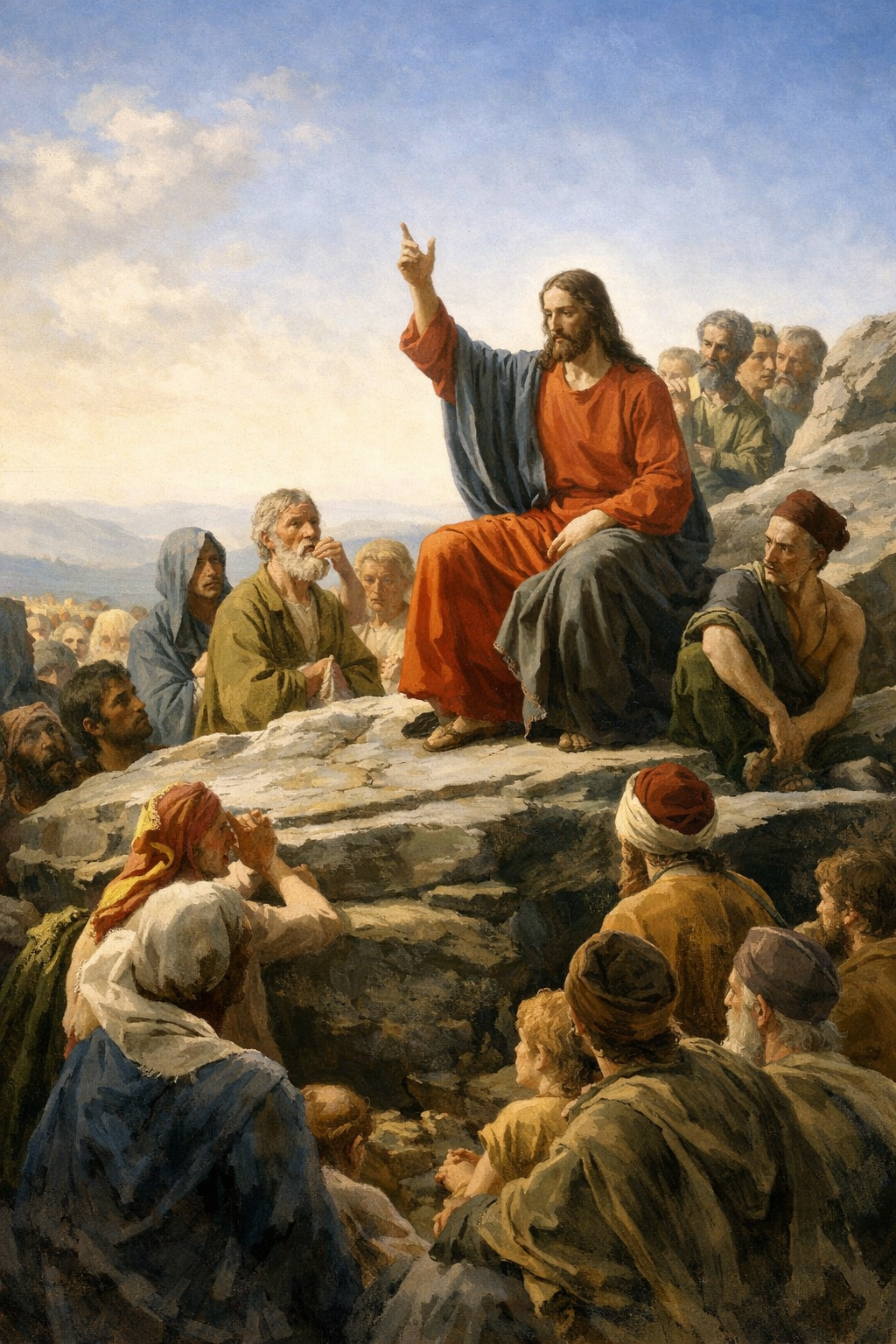
Sermon on the Mount
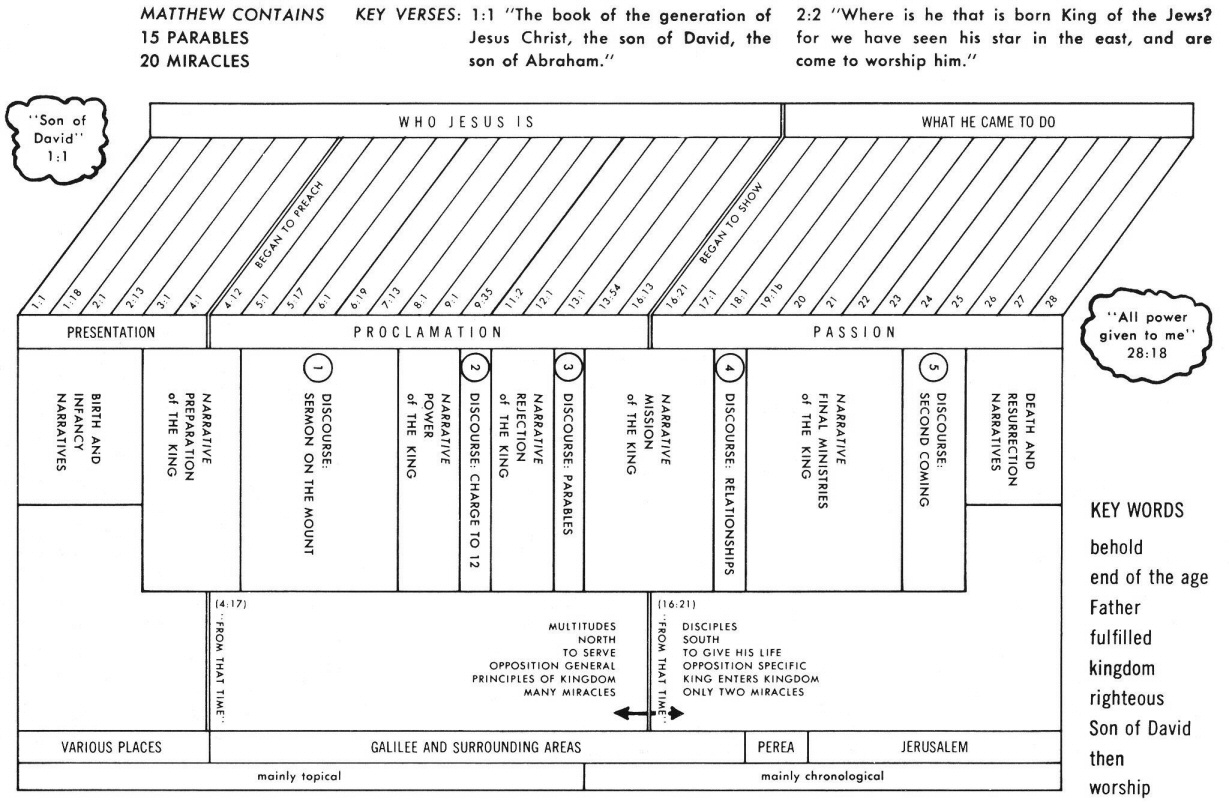
Click chart to enlarge
Charts from Jensen's Survey of the NT - used by permission
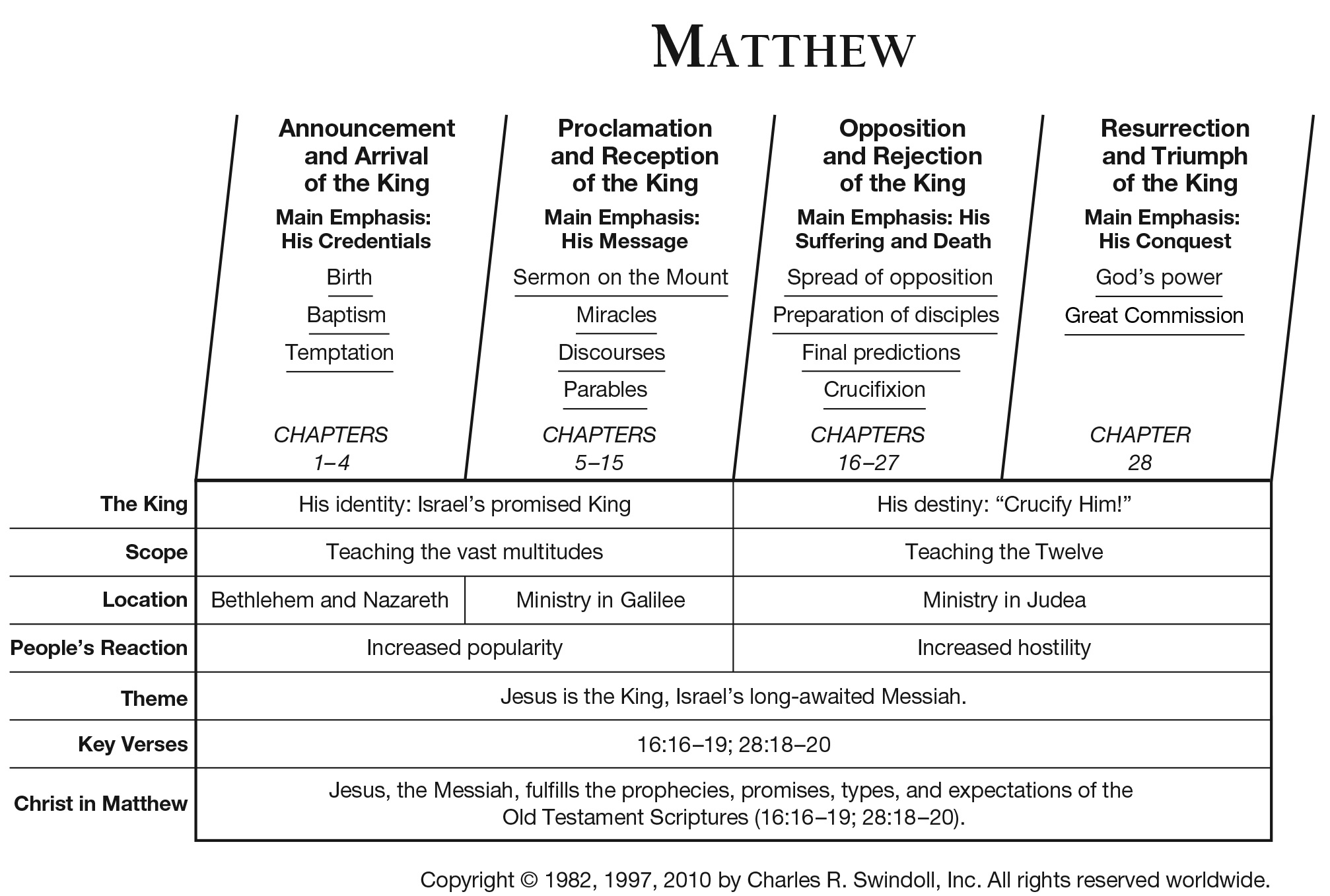
Another Chart from Charles Swindoll
THE LIFE OF JESUS AS COVERED
BY MATTHEW (shaded area)
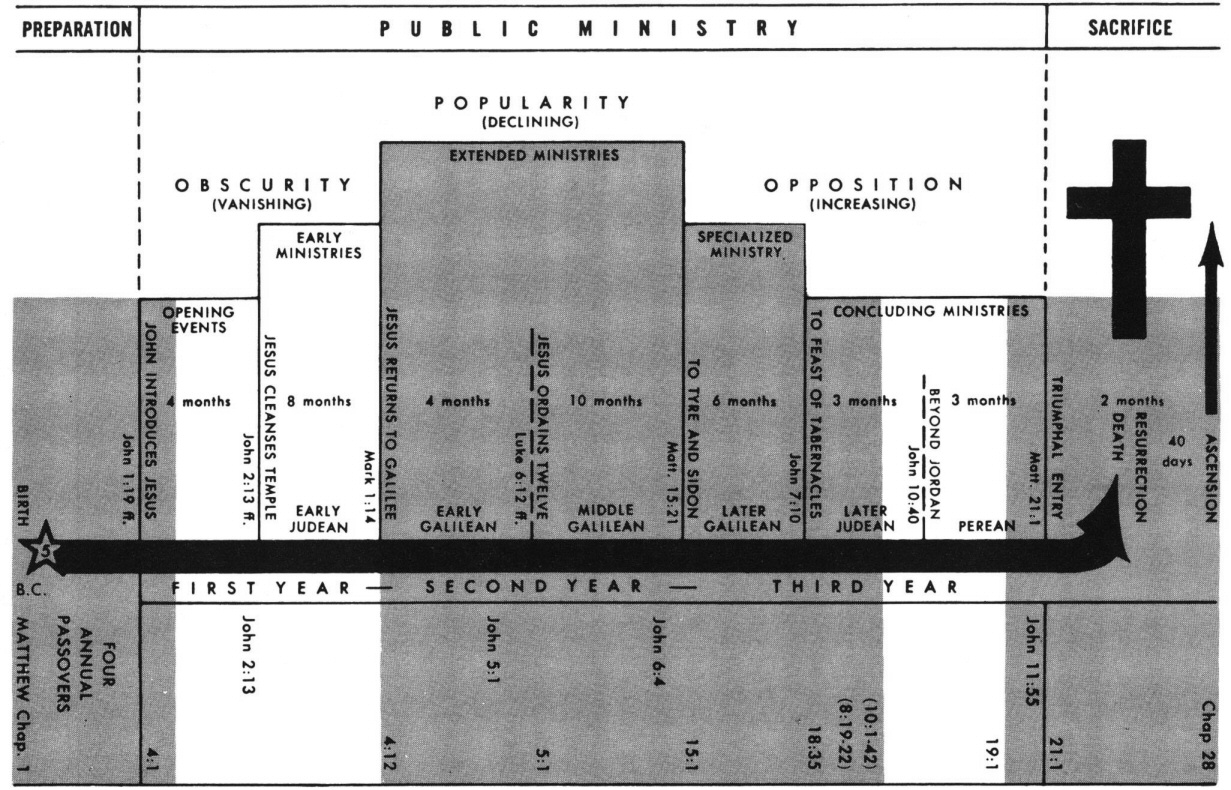
Click chart to enlarge
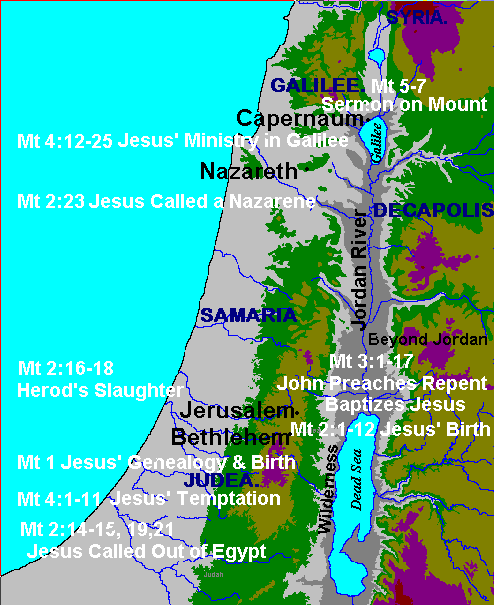
Jesus Birth and Early Years
Leading up to the Sermon on the Mount
Matthew 1-7

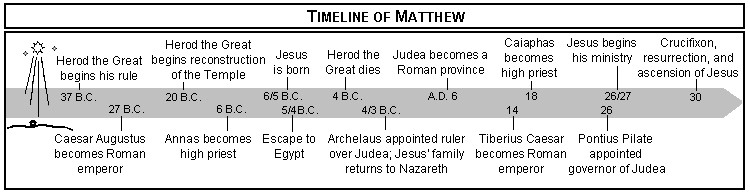
Source: Ryrie Study Bible
Matthew 5:23 "Therefore if you are presenting your offering at the altar, and there remember that your brother has something against you, (NASB: Lockman)
Greek: ean oun prospheres (2SPAS) to doron sou epi to thusiasterion kakei mnesthes (2SAPS) oti o adelphos sou echei (3SPAI) ti kata sou,
Amplified: So if when you are offering your gift at the altar you there remember that your brother has any [grievance] against you (Amplified Bible - Lockman)
KJV: Therefore if thou bring thy gift to the altar, and there rememberest that thy brother hath ought against thee;
NLT: "So if you are standing before the altar in the Temple, offering a sacrifice to God, and you suddenly remember that someone has something against you (NLT - Tyndale House)
Philips: So that if, while you are offering your gift at the altar, you should remember that your brother has something against you, you must leave your gift there before the altar and go away. (New Testament in Modern English)
Wuest: Therefore, if you bring your gift to the altar of whole burnt-offerings and there you remember that your brother has something against you (Wuest: Expanded Translation: Eerdmans)
Young's Literal: 'If, therefore, thou mayest bring thy gift to the altar, and there mayest remember that thy brother hath anything against thee,
THEREFORE IF YOU ARE PRESENTING YOUR OFFERING AT THE ALTAR: ean oun prospheres (2SPAS) to doron sou epi to thusiasterion
- Mt 8:4; 23:19; Dt 16:16,17; 1Sal 15:22; Isa 1:10, 11, 12, 13, 14, 15, 16, 17; Ho 6:6; Amos 5:21, 22, 23, 24
Therefore - Always take a moment to pause and ponder and query this term of conclusion.
Charles Simeon - THE explanation which our Lord has given us of the sixth commandment, shews, that we are not to confine the import of the commandments to the mere letter of them, but to regard them as extending to the words of our lips, and the dispositions of our hearts. Nor must we imagine that they are intended solely to prohibit sin: they must be understood as inculcating all those virtues which are opposed to the sin forbidden. This is evident from the connexion in which our text stands with the preceding context. Our blessed Lord had declared, that a wrathful word was in fact a species and degree of murder: and from thence he takes occasion to inculcate the necessity of exercising in every respect a spirit of love, so as, not only to entertain no anger in one’s own heart against others, but so as not to leave room for the exercise of it in the hearts of others towards us. The direction which he gives us respecting it will lead us to shew, I. The duty of seeking reconciliation with men— Wild beasts are scarcely more prone to injure their own species, than man is to oppress and injure his fellow-man. Indeed, considering what tempers we have, and what tempers exist in others, and what frequent occasions of interference with each other must of necessity arise, it would be a miracle if any of us had so conducted himself on all occasions, that no brother should on any account “have ought against him.” We apprehend that no one who knows any thing of his own heart, would profess himself so perfect, as never to have done towards another any thing differently from what he would have wished to be done towards himself. Supposing then that “a brother have ought against us,” what is to be done? I answer, 1. We should be willing to see our fault...2. We should be ready to ask pardon for it...3. We should be desirous to make reparation for it....Such is our duty towards an offended brother. (Read the entire sermon - Matthew 5:23-24 The Necessity of Seeking Reconciliation with Men)
The setting is worship in the Temple in Jerusalem (or church in our day). Here are Hebrew word studies related to the various Temple offerings...
- Burnt offering (05930) 'olah
- Contribution (offering, heave offering) (08541) terumah
- Freewill offering (05071) nedabah
- Grain offering (offering) (04503) minchah
- Guilt Offering (Trespass offering) (0817) asam
- Offering (07133) qorban/korban
- Offering (grain offering) (04503) minchah
- Offering by fire (0801) ishsheh
- Ordination (setting, offering)(04394) millu
- Peace offerings (08002) selem/shelem
- Perfect (whole, whole burnt offering) (03632) kalil
- Sin (sin offering) (02403) chattat/chattath
- Wave offering (08573) tenupah
Offering (1435) (prosphero from prós = to, toward + phéro = bring - cf related word phosphora see Offering, Offerings) means to carry or bring something into the presence of someone usually implying a transfer of something to that person. Here it refers to an offering that can include gifts, prayers, or sacrifices.
Prosphero - 47x in 45v - Mt 2:11; 4:24; 5:23f; 8:4, 16; 9:2, 32; 12:22; 14:35; 17:16; 18:24; 19:13; 22:19; 25:20; Mk 1:44; 2:4; 10:13; Luke 5:14; 18:15; 23:14, 36; John 16:2; 19:29; Acts 7:42; 8:18; 21:26; Heb 5:1, 3, 7; 8:3f; 9:7, 9, 14, 25, 28; 10:1f, 8, 11f; 11:4, 17; 12:7. renders prosphero = bringing to(3), brought(2), brought to(8), brought up to(1), deals with(1), get to(1),make an offering(1), offer(8), offered(12), offering(4), offers(1), present(2), presented(1), presenting(1).
- Baker Evangelical Dictionary Offerings and Sacrifices
- Holman Bible Dictionary Sacrifice and Offering
- Hastings' Dictionary of the Bible Sacrifice and Offering
- Morrish Bible Dictionary Burnt Offering or Sacrifice
- International Standard Bible Encyclopedia Daily Offering or Sacrifice
Altar (2379) (thusiasterion from thusia = that which is offered as a sacrifice - see Altar) refers to any type of altar or object where gifts may be placed and ritual observances carried out in honor of supernatural beings.
The majority of the uses of thusiasterion refer to literal altars - (1) the altar of burnt offering of court of tabernacle or temple (Heb 7:13, (2) the altar of incense before the Holy of holies (Lk 1:11) and (3) the (golden) altar in heaven (Rev 8:3, 5, 9:13, 14:18, 16:7).
In the NT thusiasterion is employed to refer to a number of different types of altars, including the altar for burnt offerings in the Temple, the altar of incense, the altar which Abraham built, and the heavenly altar mentioned in the book of Revelation.
Wikipedia - Altars (Hebrew: מזבח, mizbe'ah, "a place of slaughter or sacrifice") in the Hebrew Bible were typically made of earth or unwrought stone. Altars were generally erected in conspicuous places. The first altar recorded in the Hebrew Bible is that erected by Noah.Altars were erected by Abraham, by Isaac, by Jacob,and by Moses, (Adonai-nissi).
See the Hebrew word study on mizbeah a masculine noun that is frequent in the OT (338x) and describes the place of sacrifice where offerings were made to a deity. The first use in Ge 8:20 describes the altar built by Noah as his first act after he survived the flood. Abraham is associated with an altar in Ge 12:7,8; 13:4, 18; Ge 22:9. Not surprisingly the majority of OT occurrences are in Leviticus (88x in 72v and Exodus is not far behind - 61x in 53v). The first offering by Cain and Abel does not mention a specific altar (Ge 4:3). "In the developed temple ritual, the same word (mizbeah) is used for both the altar of holocausts and the altar of incense. Thus, an altar is a place where sacrifice is offered, even if it is not an event involving slaughter." (Thomas W Davis)
After the theophany on Mount Sinai, in the Tabernacle—and afterwards in the Temple—only two altars were used: the Altar of Burnt Offering, and the Altar of Incense.
Related Resources:
- American Tract Society Altar
- Bridgeway Bible Dictionary Altar
- Baker Evangelical Dictionary Horns of Altar Altar
- Charles Buck Dictionary Altar
- Easton's Bible Dictionary Altar
- Fausset Bible Dictionary Altar
- Holman Bible Dictionary Altar Incense Altar
- Hastings' Dictionary of the Bible Incense, Altar of Altar
- Hastings' Dictionary of the NT Altar Altar
- Torrey Topical Textbook Altars Altar of Burnt-Offering, the Altar of Incense
- International Standard Bible Encyclopedia Altar Horns of the Altar
- Kitto Biblical Cyclopedia Altar Altars forms of
- The Jewish Encyclopedia Altar
Thusiasterion - 23x in 21v - see all uses below.
In the present context "the altar" refers to the one in the inner court of the Temple in Jerusalem. There amidst a background of solemn worship, the worshiper experiences recollection of a brother with something against him (see Mark 11:25) and Jesus says this should prompt immediate efforts to be reconciled for only then is formal worship acceptable.
THOUGHT - One wonders how many in church each Sunday would be well advised to pay heed to Jesus' instruction in this passage? What would our worship services look like if this principle were diligently practiced (under grace not law)? How brightly would the light of Christ's life in us through His Spirit shine into the darkness of the unregenerate world if brothers and sisters were diligent to practice this principle of personal reconciliation! One is reminded of the words of Tertullian who preserved the amazing pagan observation of the Christians, “Look...how they love one another; and how they are ready to die for each other.” Is that what the lost world says about your church?
The principle is obedience begets genuine worship as Samuel recorded in his address to the disobedient King Saul who had offered to the Lord sacrifices that were to have been destroyed...
And Samuel said, "Has the LORD as much delight in burnt offerings and sacrifices As in obeying the voice of the LORD? Behold, to obey is better than sacrifice, and to heed than the fat of rams. (1 Samuel 15:22)
In Psalm 51 apparently motivated by David's sins of adultery and murder records a similar train of thought...
For Thou dost not delight in sacrifice, otherwise I would give it; Thou art not pleased with burnt offering. The sacrifices of God are a broken spirit; A broken and a contrite heart, O God, Thou wilt not despise. (Psalm 51:16-17 - See comments)
Spurgeon on verse 17 - The sacrifices of God are a broken spirit. All sacrifices are presented to thee in one, by the man whose broken heart presents the Saviour's merit to thee. When the heart mourns for sin, thou art better pleased than when the bullock bleeds beneath the axe. "A broken heart" is an expression implying deep sorrow, embittering the very life; it carries in it the idea of all but killing anguish in that region which is so vital as to be the very source of life. So excellent is a spirit humbled and mourning for sin, that it is not only a sacrifice, but it has a plurality of excellences, and is preeminently God's sacrifices. A broken and a contrite heart, O God, thou wilt not despise. A heart crushed is a fragrant heart. Men contemn those who are contemptible in their own eyes, but the Lord seeth not as man seeth. He despises what men esteem, and values that which they despise. Never yet has God spurned a lowly, weeping penitent, and never will he while God is love, and while Jesus is called the man who receiveth sinners. Bullocks and rams he desires not, but contrite hearts he seeks after; yea, but one of them is better to him than all the varied offerings of the old Jewish sanctuary.
THOUGHT - How are you doing in this area? Is your worship perfunctory? hypocritical? devoid of obedience and a brokenness over your sin? Below are a few devotional thoughts to help you search your heart with the Spirit's omnipotent assistance:
MAN TO MAN RECONCILIATION - THE STRAIGHT STORY - Watch this true story (IT GETS 8/10 STARS!). "The Straight Story" chronicles a trip made by 73-year-old Alvin Straight from Laurens, Iowa, to Mt. Zion, Wis., in 1994 while riding a lawn mower. The man undertook his strange journey to mend his relationship with his ill, estranged, 75-year-old brother Lyle.
Our Daily Bread Devotional - GOING STRAIGHT - How far would you travel to put things right with a brother who hadn’t spoken to you in 10 years? Would you go 300 miles from Iowa to Wisconsin? On a riding lawn mower? Unable to drive a car and despising bus travel, Alvin Straight did exactly that in the intriguing film The Straight Story (watch it on youtube). It is the true-life drama of a 73-year-old man who decided it was time to end the silence, stop the hating, and break down the wall of anger he and his brother had built between them. As I watched the film in a packed theater, where the audience was silent from beginning to end, I thought of all the broken relationships that must have surfaced in the minds of people sitting there in the darkness. I also pondered the words of Jesus about setting things right with those from whom we’ve been estranged. He said, “If you bring your gift to the altar, and there remember that your brother has something against you, leave your gift there before the altar, and go your way. First be reconciled to your brother, and then come and offer your gift” (Matthew 5:23-24). Is there a relative, a friend, or a brother in Christ with whom you need to make things right? Then why not go straight to that person and do it today?
Lord, let me feel the pain of a wounded soul
And seek to heal that wounded one I pray;
Yes, I would take the reconciling role,
And bring an end to pain and strife today.
—Hess
An offense against your neighbor builds a fence between you and God.
SPIRITUAL CLEANSING - Read: Exodus 30:17-21 |Cleanse your hands, you sinners; and purify your hearts, you double-minded. —James 4:8
Plutonium, a naturally radioactive element, is one of the deadliest substances known to man. Its radiation can make normal cells cancerous. For that reason, it was headline news a number of years ago when two scientists from the University of California announced they had found a substance that could remove plutonium from living tissue.
Today, man is rightly concerned about the importance of decontamination. But long ago, God showed mankind the more critical need for spiritual cleansing. This is seen in that wonderful “house of symbols” known as the tabernacle. Between the bronze altar of sacrifice and the “tabernacle of meeting” was a bronze washbasin where the priest of God cleansed his hands and his feet before going into the holy place (Ex. 30:17-21). Bronze symbolizes judgment. Germs were not the issue—sin was. God was teaching His people that after He had provided a sacrifice at the altar, a continual self-judging and cleansing from personal defilement was necessary.
This principle still applies today. Only the cleansed person can move into the “holy place” of worship, fellowship, and service. Since believers are priests (Rev. 1:6), we must be careful to wash our hands and our hearts daily.
Search me, O God, and know my heart today;
Try me, O Savior, know my thoughts, I pray.
See if there be some wicked way in me;
Cleanse me from every sin and set me free. —Orr
The road to worship begins at the cross.
THOUGHT - Is there any "spiritual plutonium" in your life which has resulted in estrangement from another human soul, be they spouse or stranger? First, "wash" off your "spiritual radioactivity" in the blood of the Lamb (1 John 1:7), confessing your toxic sins to your Father (1 John 1:9). Then reconcile your irreconcilable differences with the one (or ones) with whom you are estranged. Then walk forth filled with the Spirit of Jesus our great Reconciler and seek reconciliation as much as it is possible with you. Beloved, when we begin to fathom the infinite distance that Jesus "walked" to cleanse us for our toxic, deadly sins and effect our eternal RECONCILIATION with His Father, how can we not walk across the room, across the street, or across the land to reconcile with our those with whom we are at active enmity? Or even ride a lawnmower tractor hundreds of miles to mend a broken fence (as did Alvin Straight in the The Straight Story)! What's your excuse? Pride? Stubbornness? An unforgiving spirit? Deep seated bitterness? You need to "get on your lawn tractor" today and make the trip to mend that fence!
EIGHT COWS ON THE ALTAR - Pastor Ed Dobson was speaking to a congregation on “putting all on the altar” in total surrender to Christ. After the service, an old German farmer came forward. He told Dobson that he had eight cows that were dying, which would mean great financial loss, and he had been struggling with accepting this as God’s will. Then he said, “Because of your message, I have found peace. Tonight I put them all on the altar.” Christ’s lordship touches every area, every relationship, every concern of our lives. If we are willing to submit to Him, any loss in life will be seen as an opportunity of giving back to God what is rightfully His and trusting Him to provide what is needed. When God told Abraham to sacrifice Isaac, He seemed to be undermining His own purposes. Isaac was the son of promise through whom God would bless the world. Yet Abraham’s faith had grown strong over the years, and baffled though he must have been, he said, “God will provide for Himself the lamb” (Genesis 22:8). The issue is the same for us. Can we entrust everything to God—our possessions, job, health, family? If we commit ourselves to Him each day and thank Him for every blessing, our confidence in Him will survive any test.
You have longed for sweet peace and for faith to increase,
And have earnestly, fervently prayed;
But you cannot have rest or be perfectly blest
Until all on the altar is laid. —Hoffman
Submission to God means taking our hands off what belongs to Him.
- I would add, cleansing our hands of everything that offends Him, such as unforgiveness or bitterness!
KEEP THE FIRE BURNING - Modern furnaces have taken the work out of keeping warm in cold climates. We simply set the timer on the thermostat, and the house is warm when we get up in the morning. But in former days, fire was carefully tended and fuel supplies were closely monitored. Running out could be deadly. The same is true spiritually. If we think our “spiritual fire” can be ignited as easily as a modern furnace, we risk losing our fervor for the Lord. In ancient Israel, the priests were instructed not to let the fire on the altar go out (Lev. 6:9,12-13). This required a lot of work, not the least of which was collecting firewood in a land not known for its dense forests. Some scholars see the fire on the altar as a symbol for the flame of our devotion for the Lord. Spiritual passion is not something to be treated lightly or taken for granted. It will grow cold if we fail to keep it supplied with fuel. The apostle Paul addressed the subject of spiritual fervor in his letter to the Romans 12:1-2,11. To keep the fire of our devotion burning strong, we must continue the hard work of stocking our fuel supply with hope, patience, steadfast prayer, generosity, hospitality, and humility (Ro 12:11-16).
O God, my heart is the altar
And my love for you is the flame;
I’ll keep the fire burning for You, Lord,
And I will rejoice in Your name. —Hess
Our love for Jesus is the key to spiritual passion.
- And I would add that our love for Jesus, our great Reconciler, should serve as a strong motivator for us (enabled by His Spirit) to reconcile our differences with those with whom we are estranged, whether they be spouses, children, relatives, co-workers, etc!
TIME FOR A CHANGE - There he built an altar to the Lord and called on the name of the Lord. —Genesis 12:8
Many believers long to spend daily time with God, praying and reading His Word. Yet, we are often distracted by a busy schedule. Frustrations mount as busyness seems to crowd out an opening in our schedules.
Popular Bible teacher Oswald Chambers once wisely commented on the power of even 5 minutes in the presence of the Lord. Indeed, even a short time spent in prayer and the Word still has great value: “It is not the thing on which we spend the most time that moulds us, but the thing that exerts the greatest power. Five minutes with God and His Word is worth more than all the rest of the day.” Now, it may sound like Chambers has made an overstatement. Yet powerful results can come from even a short time of prayer because God is powerful. Sometimes our days are filled with busy demands that crowd out time spent in listening to and responding to God. But no matter where we are, any time taken to build our own spiritual “altar” to the Lord as Abram did (Gen. 12:8) opens the door to His transforming power. If you are having trouble finding time with God, you could start with just 5 minutes and see where it leads. Our God longs to meet with us and show His power in our lives. - Dennis Fisher
TALK WITH GOD—HE WANTS TO SPEND TIME WITH YOU.
- But remember that in order to enjoy perfect communion with Him, make sure you are at amity not enmity with others, be they near or far away!
AS IT IS WRITTEN - Read: Ezra 3:1-6 | [They] built the altar . . . to offer burnt offerings on it, as it is written. —Ezra 3:2
When it comes to putting things together—electronics, furniture, and the like—my son and I have differing approaches. Steve is more mechanically inclined, so he tends to toss the instructions aside and just start in. Meanwhile, I’m poring over the “Read This Before Starting” warning while he has already put the thing halfway together. Sometimes we can get by without the instructions. But when it comes to putting together a life that reflects the goodness and wisdom of God, we can’t afford to ignore the directions He’s given to us in the Bible. Jesus shows us the way to live. The Israelites who had returned to their land after the Babylonian captivity are a good example of this. As they began to reestablish worship in their homeland, they prepared to do so “in accordance with what is written in the Law of Moses” (Ezra 3:2). By building a proper altar and in celebrating the Feast of Tabernacles as prescribed by God in Leviticus 23:33-43, they did exactly what God’s directions told them to do.
Christ gave His followers some directions too. He said, “Love the Lord your God with all your heart and with all your soul and with all your mind.” And “love your neighbor as yourself” (Matt. 22:37,39). When we believe in Him and come to Him, He shows us the way to live. The One who made us knows far better than we do how life is supposed to work. Remind us, Lord, as we start each day that You have already shown us by Your example how to live. Help us to read Your Word and follow the directions You so graciously provide for us.
If we want God to lead us, we must be willing to follow Him.
THOUGHT - And we must be willing to LOVE OUR NEIGHBOR AS OURSELVES which may mean we need to initiate RECONCILIATION with our neighbor (Greek = plesion which literally means near, quite near, nearby = position quite close to another position. Figuratively, plesion means to be near someone). Is there someone who used to be NEAR TO but are now FAR FROM because of "irreconcilable differences" (man's viewpoint, not God's!)? Then ask God to enable you by His Spirit's giving you the desire and the power to "mend the fence" for the glory of God. Amen!
AND THERE REMEMBER THAT YOUR BROTHER HAS SOMETHING AGAINST YOU
- Ge 41:9; 42:21,22; 50:15, 16, 17; Lv 6:2, 3, 4, 5, 6; 1Ki 2:44; Lam 3:20; Ezek 16:63; Lk 19:8
Remember ( (3415) (mnaomai - see more detail below) means to recall information from memory. Paul uses the perfect tense which emphasizes the continuing state. Timothy is always remembered by Paul!
Why would one "remember"? Undoubtedly the convicting ministry of the Holy Spirit plays the key roll in prompting such a recall. And when you remember act on that truth. Don’t wait for your angry brother or sister to take the first step. You take it, and take it quickly before things get worse!
Brother (80) (adelphos from a = denoting unity + delphus = womb) refers to one from the same womb, and in this case is used by Jesus more generally to refer to one of the same nature, for all men are born into Adam. So here Jesus refers to a fellow man as a brother
Jesus is calling for the offender to take the initiative in this process. That is, even if we hold nothing against him, if he is angry with or hates us, we should do everything in our power to be reconciled to him. We might have expected Jesus to focus primarily on the offended party, since they are the most likely to feel anger towards another. Instead, in these verses it is the offender who initiates the process of reconciliation. Elsewhere Jesus urges the offended party to make the first move (Mt 18:15). Both share an obligation to work for resolution when there has been a conflict. Ideally, the two would meet en route to one another and settle their differences “on the way.”
How important is it to deal with enmity, disagreements, animosity, or anger? Reconciliation is so important that it takes priority over everything else. It even takes precedence over worship. God would rather see us resolve our differences than receive our offerings!
THOUGHT - Let's get practical for a moment. Do you know someone who is angry with you? Is there someone who has offended you? How can you take the initiative in each case to reconcile with that person? Before attempting to reconcile, take some time to think through your strategy. For example, reconciliation may be better attempted face to face rather than over the phone. You may even want to write out what you will say in advance. Note that there is no way to guarantee how the other person will respond, but you can be certain of God’s help as you “make every effort” to be at peace with all men.
Luke gives us an excellent example of a new citizen of the Kingdom of heaven who put this into practice "And Zaccheus (a chief tax gatherer) stopped and said to the Lord, "Behold, Lord, half of my possessions I will give to the poor, and if I have defrauded anyone of anything, I will give back four times as much." And Jesus said to him, "Today salvation has come to this house, because he, too, is a son of Abraham. For the Son of Man has come to seek and to save that which was lost." (Luke 19:8-10)
The Preacher's Commentary has the following illustration of reconciliation (albeit it deals with anger in the one who remembers) "At a communion service in the South Pacific Islands, a man kneeling at the altar to receive the emblems suddenly got up and moved to the back of the auditorium with an agitated expression. Later he rejoined the communicants and participated in the sacrament. When asked, following the service, about his action, he revealed that he had seen the man kneeling at the other end of the altar rail who had killed his father. He was so angry in his spirit that he could not partake of the emblems until God enabled him to experience a forgiving spirit. Just so, Jesus elevates reconciliation with one’s brother to a greater importance than religious rites. And the ministry of reconciliation was ultimately expressed by the Master who, while we were enemies, died for us. (Augsburger, M. S., & Ogilvie, L. J. Vol. 24: The Preacher's Commentary Series, Volume 24: Matthew. Nashville, Tennessee: Thomas Nelson Inc) (Ed note: see the serious warning regarding taking communion in an unworthy manner in 1Cor 11:27-34 )
Today in the Word has the following devotional on Jesus' teaching in Mt 5:23-24...
Writer Shannon Woodward relates this recent experience in a bookstore. A little boy came running into the store and rushed up to his father who was calmly browsing the children's books. The boy had a request to make, but before he could finish, his father exploded and angrily told him to go back to the family van. A few minutes later an older girl came into the store and tried to talk to the father. But in a voice that turned every head in the store, he screamed at her to go outside and stay put. As the girl left red-faced, the man calmly resumed his browsing.
Woodward watched sadly, amazed at the way this father erupted with anger and then browsed as if nothing had happened. Such scenes are painful to witness, yet if we are honest with ourselves we would admit this is often the way we approach our worship of God.
We may come into God's presence, ready to worship Him, yet we come knowing that things are not right ""outside,"" where family or friends are feeling the effects of our disrupted relationships with them.
God wants us to remove this hindrance before we bring Him our praise and our gifts--a necessary step of preparation for worship that Jesus addressed in the Sermon on the Mount... Applying this to our worship, Jesus turned the situation around from what we might expect (Matt. 5). The problem here is not what others have done to offend us, but what we might have done to cause offense to a brother or a sister.
Why did Jesus state the case this way? Probably because we are a lot quicker to forget our own offenses than we are to forget the offenses other people commit against us. The altar Jesus was talking about was located in the inner portion of the temple, where solemn worship took place (v. 23)
Remember (3415)(mnaomai) means to recall to mind, to recollect, to remember, to come (or have) to one's remembrance.
Mnaomai refers primarily to people remembering as an act of mental recall (e.g., Mt 5:23; 27:63; Lk 16:25; Jn 2:17, 22; Acts 11:16; 2Ti 1: 4; 2Pe 3:2; Jude 1:17).
Some uses of mnaomai convey the idea of “be mindful of,” with a view to acting in a certain way. The penitent thief on the cross, for example, pleads for Christ to remember him in paradise (Lk 23:42, cp Lxx us Ps 106:4). In other words, the idea is to recall or be aware of information, and as a result to respond in an appropriate manner (e.g., punishing = Rev 16:19, helping = Ge 8:1, Ge 30:22, Heb 13:3, etc) depending on context.
To remember means to bring an image or idea from the past into the mind. To recall information from memory, but without necessarily an implication that one has actually forgotten.
In Ps 143:5 we see remember is associated with meditation. It is difficult to meditate on what one does not remember.
Renn - When predicated of God, mnaomai mnaomai refers to divine remembering in the anthropomorphic sense of initiating an aspect of his redemptive purposes. Lk 1:54 speaks of God “remembering” to be merciful (cf. also Acts 10:31).Lk 1:72 affirms that God will remember his covenant. Heb. 8:12; 10:17 promise that God will remember the sins of his people no more. God is said to remember Babylon in Rev. 16:19, with a view to punishing her for her sins. (Expository Dictionary)
Gary Hill makes an interesting observation based on the fact that all of the uses of mnaomai are in the middle voice (the subject initiates the action and participates the the process or results) - "The high level of personal involvement and personal interest motivating this remembering accounts for why it is always in the middle voice." (The Discovery Bible).
Many of the uses of mnaomai in the Septuagint are very instructive and encouraging as they speak of God remembering His covenant (see uses at the end of this note), remembering individuals (Noah, Abraham, Rachel), and remembering His Chosen People. Perhaps you are in time of doubting God's goodness and His remembrance of you, especially if you are experiencing difficult circumstances. If so, let me strongly recommend prayerfully pondering some of the uses of mnaomai, especially those in the Septuagint. In Nu 15:39-40 God instructs His people to use the tassels on their garments to aid their remembering the commandments so that they might keep them.
The last words of the godly leader Nehemiah were a prayer - "Remember (Lxx = mnaomai) me, O my God, for good." (Neh 13:31)
In the Septuagint and in the NT in Heb 8:12, 10:17 (see note below) mnaomai can convey the idea of not remembering someone’s sins or to let someone’s sins go unpunished - Ps 25:7; 79:8; Is 43:25; Heb 8:12; 10:17 (both quoting from Jer 31:34 where in the New Covenant Jehovah says to Israel "their sin I will remember no more.")
It is interesting to note that the Greek word for "tomb" (Acts 13:29) is mnēmeíon (3419) which is derived from mnáomai and thus a tomb is a memorial, sepulcher or monument (something set up so that a departed one is remembered)
Webster on remember - to bring to mind or think of again, to keep in mind for attention or consideration. We are said to remember any thing, when the idea of it arises in the mind with the consciousness that we have had this idea before.
BDAG (summary) - 1. to recall information from memory = remember, recollect, remind oneself 2. to think of and call attention to something or someone = to make mention of someone (Acts 10:31, Rev 16:19) 3. give careful consideration to = to remember, think of, care for, be concerned about, keep in mind (Ge 30:22, Lk 23:42, Heb 2:6, 13:3
Friberg on mnaomai - 1) reflexively; (a) of recollection remember, call to mind, think about again (Heb 10.17); (b) of solicitous concern be mindful of, think of, care for (Lk 23.42); (2) passive be mentioned, be noticed (Acts 10.31); the perfect passive has a derived meaning have been reminded equivalent to remember (2Ti 1.4) (Analytical Lexicon)
Liddell-Scott state that the primary meaning of Mnaomai in classical literature is “to be mindful of, to turn one’s mind to a thing.” After Homer the term was used to describe one’s pursuit for appointment to an office or solicitation of a favor. So, when a young man turned his mind to seeking a bride, mnaomai described the courtship process.
Mnaomai - 21x in 21v - Usage: recall(1), remember(12), remembered(8), rememberest(1), remembrance (m)(1).
Matthew 5:23 "If therefore you are presenting your offering at the altar, and there remember that your brother has something against you,
Matthew 26:75 And Peter remembered the word which Jesus had said, "Before a cock crows, you will deny Me three times." And he went out and wept bitterly.
Matthew 27:63 and said, "Sir, we remember that when He was still alive that deceiver said, 'After three days I am to rise again.'
Luke 1:54 "He has given help to Israel His servant, In remembrance of His mercy,
Luke 1:72 To show mercy toward our fathers, And to remember His holy covenant,
Luke 16:25 "But Abraham said, 'Child, remember that during your life you received your good things, and likewise Lazarus bad things; but now he is being comforted here, and you are in agony.
Comment: What a horrible remembrance it will be for those who are separated eternally from the glorious presence of the Holy One! To have such memories eternally is simply unfathomable to me (although I believe that is what the Scriptures clearly teach).
Luke 23:42 And he was saying, "Jesus, remember me when You come in Your kingdom!" (And Jesus said He would - Luke 23:42)
Comment: There was a prayer petition found on gravestones that one be remembered at the resurrection
Luke 24:6 "He is not here, but He has risen. Remember how He spoke to you while He was still in Galilee,
Luke 24:8 And they remembered His words,
John 2:17 His disciples remembered that it was written, "Zeal for Thy house will consume me."
John 2:22 When therefore He was raised from the dead, His disciples remembered that He said this; and they believed the Scripture, and the word which Jesus had spoken.
John 12:16 These things His disciples did not understand at the first; but when Jesus was glorified, then they remembered that these things were written of Him, and that they had done these things to Him.
Acts 10:31 and he said, 'Cornelius, your prayer has been heard and your alms have been remembered before God.
Acts 11:16 "And I remembered the word of the Lord, how He used to say, 'John baptized with water, but you shall be baptized with the Holy Spirit.'
1 Corinthians 11:2 Now I praise you because you remember (perfect tense - speaks of permanence of their memory of Paul) me in everything, and hold firmly to the traditions, just as I delivered them to you.
2 Timothy 1:4 longing to see you, even as I recall your tears, so that I may be filled with joy.
Hebrews 8:12 "For I will be merciful to their iniquities, And I will remember (Divine passive indicating God as the agent) their sins no more."
Zodhiates on remember in this context (cp Heb 10:17) - This does not mean that God does not exercise memory with which He has so beneficially endowed His creatures; nor does it mean that when we appear before Him to have our lives reviewed and judged that God will forget all that we have ever done (Rom. 14:10; 1 Cor. 3:11–15; 2 Cor. 5:10; Rev. 20:11–15). The apportionment of rewards to the believers necessitates God’s and their remembrance of their works (James 2:12, 13). The Heb. 8:12 and 10:17 passages specifically speak of the new covenant of the Lord with Israel which, being accepted, brings an end to His remembrance by Him regarding whether or not they kept the old covenant. This is equivalent to God forgetting all the sins of the individual before he was saved and ushered into the kingdom of God. However, there is certainly a remembrance of all one’s works, whether good or bad (2 Cor. 5:10), performed during his entire life of faith from the moment he has been attached to the body of Jesus Christ (1 Cor. 12:13). (The complete word study dictionary: New Testament)
Hebrews 10:17 "And their sins and their lawless deeds I will remember no more."
Hebrews 13:3 Remember (present imperative) the prisoners, as though in prison with them, and those who are ill-treated, since you yourselves also are in the body.
2 Peter 3:2 that you should remember the words spoken beforehand by the holy prophets and the commandment of the Lord and Savior spoken by your apostles.
Jude 1:17 But you, beloved, ought to remember the words that were spoken beforehand by the apostles of our Lord Jesus Christ,
Revelation 16:19 And the great city was split into three parts, and the cities of the nations fell. And Babylon the great was remembered before God (Here in the sense that He remembers the sins -- just the opposite of the idea in Heb 8:12, 10:17, the latter reflecting His gracious new covenant), to give her the cup of the wine of His fierce wrath.
Mnaomai - 271 uses in the Septuagint - Gen. 8:1; 9:15-16; 19:29; 30:22; Ge 40:13-14, 20, 23; 42:9; Exod. 2:24; 6:5; 20:8; 32:13; Lev. 26:42, 45; Num. 11:5; 15:39f; Deut. 5:15; 7:18; 8:2, 18; 9:7, 27; 15:15; 16:3, 12; 24:9, 18, 20, 22; 25:17; 32:7; Jos. 1:13; Jdg. 8:34; 9:2; 16:28; 1 Sam. 1:11, 19; 4:18; 25:31; 2 Sam. 19:19; 2 Ki. 20:3; 2 Chr. 6:42; 24:22; Neh. 1:8; 4:14; 5:19; 6:14; 9:17; 13:14, 22, 29, 31; Est. 2:1; 4:8, 17; 10:3; Job 4:7; 7:7; 10:9; 21:6; 28:18; 36:24; 41:8; Ps. 8:4; 9:12; 16:4; 20:3; 22:27; 25:6f; 42:4, 6; 45:17; 71:16; 74:2, 18, 22; 77:3, 5, 11; 78:35, 39, 42; 79:8; 83:4; 87:4; 88:5; 89:47, 50; 98:3; 103:14, 18; 105:5, 8, 42; 106:4, 7, 45; 109:16; 111:5; 115:12; 119:49, 52, 55; 132:1; 136:23; 137:1, 6f; 143:5; Prov. 31:7; Eccl. 5:20; 9:15; 11:8; 12:1; Isa. 12:4; 17:10; 26:16; 38:3; 43:25f; 44:21; 46:8f; 47:7; 48:1; 54:4; 57:11; 62:6; 63:7, 11; 64:5, 7, 9; 65:17; 66:9; Jer. 2:2; 11:19; 14:10, 21; 15:15; 18:20; 31:20, 34; 33:8; 44:21; 51:50; Lam. 1:7, 9; 2:1; 3:19f; 5:1; Ezek. 3:20; 6:9; 16:22, 43, 60f, 63; 18:22, 24; 20:43; 21:23; 23:27; 36:31; Dan. 5:10; Hos. 2:17; 7:2; 8:13; 9:9; Amos 1:9; Jon. 2:7; Mic. 6:5; Nah. 2:5; Hab. 3:2; Zech. 10:9; Mal. 4:4
The first 5 uses of mnaomai in the Septuagint of Genesis are powerful as they speak of the Holy God Who condescends to remember His creatures.
THOUGHT - Dear believer do you ever feel like God has forgotten about you, especially if you are experiencing adversity or affliction? Then meditate on the passages below and ask the Spirit to open the eyes of your heart to see the Father's great unconditional love for you. You may feel like Joseph, forgotten by men, but ultimately ((when all was said and done) remembered by God. (Ge 40:23) Joseph's God is your God beloved!
Genesis 8:1 But God remembered Noah and all the beasts and all the cattle that were with him in the ark; and God caused a wind to pass over the earth, and the water subsided.
Genesis 9:15 and I will remember My covenant, which is between Me and you and every living creature of all flesh; and never again shall the water become a flood to destroy all flesh.
Genesis 9:16 “When the bow (rainbow) is in the cloud, then I will look upon it, to remember the everlasting covenant between God and every living creature of all flesh that is on the earth.”
Genesis 19:29 Thus it came about, when God destroyed the cities of the valley, that God remembered Abraham, and sent Lot out of the midst of the overthrow, when He overthrew the cities in which Lot lived.
Genesis 30:22 Then God remembered Rachel, and God gave heed to her and opened her womb.
Ex 2:24 So God heard their groaning; and God remembered His covenant with Abraham, Isaac, and Jacob.
Ex 6:5 “And furthermore I have heard the groaning of the sons of Israel, because the Egyptians are holding them in bondage; and I have remembered My covenant.
Lev 26:42 then I will remember My covenant with Jacob, and I will remember also My covenant with Isaac, and My covenant with Abraham as well, and I will remember the land.
Lev 26:45 ‘But I will remember for them the covenant with their ancestors, whom I brought out of the land of Egypt in the sight of the nations, that I might be their God. I am the LORD.’”
Num 15:39 “And it shall be a tassel (tassels on the corner of their garments - Nu 15:38) for you to look at and remember all the commandments of the LORD, so as to do them and not follow after your own heart and your own eyes, after which you played the harlot, Num 15:40 in order that you may remember to do all My commandments, and be holy to your God.
One of the most encouraging uses of mnaomai is in Isaiah 65:17 where God says “For behold, I create new heavens and a new earth; And the former things shall not be remembered or come to mind."
Matthew 5:24 leave your offering there before the altar and go; first be reconciled to your brother, and then come and present your offering. (NASB: Lockman)
Greek: aphes (2SAAM) ekei to doron sou emprosthen tou thusiasteriou, kai hupage (2SPAM) proton diallagethi (2SAPM) to adelphos sou, kai tote elthon (AAPMSN) prosphere (2SPAM) to doron sou.
Amplified: Leave your gift at the altar and go. First make peace with your brother, and then come back and present your gift. (Amplified Bible - Lockman)
KJV: Leave there thy gift before the altar, and go thy way; first be reconciled to thy brother, and then come and offer thy gift.
NLT: leave your sacrifice there beside the altar. Go and be reconciled to that person. Then come and offer your sacrifice to God. (NLT - Tyndale House)
Philips: you must leave your gift there before the altar and go away. Make your peace with your brother first, then come and offer your gift. (New Testament in Modern English)
Wuest: leave there your gift before the altar of whole burnt-offerings and be going away. First be reconciled to your brother, and then, having come, be offering your gift. (Wuest: Expanded Translation: Eerdmans)
Young's Literal: leave there thy gift before the altar, and go -- first be reconciled to thy brother, and then having come bring thy gift.
LEAVE YOUR OFFERING THERE BEFORE THE ALTAR AND GO: aphes (2SAAM) ekei to doron sou emprosthen tou thusiasteriou kai hupage (2SPAM)
- Mt 18:15, 16, 17; Job 42:8; Proverbs 25:9; Mark 9:50; Romans 12:17,18; 1Corinthians 6:7,8; 1Timothy 2:8; James 3:13, 14, 15, 16, 17, 18; 5:16; 1Peter 3:7,8
THE RIGHT WAY
TO WORSHIP!
Spurgeon - It is said that, in Hindostan, there is a complete divorce of religion from morality, so that a man may be supposed to be eminently religious even while living in the utmost filthiness and vice; but it must never be so among us. We must never imagine that God can accept an offering from us while we harbor any enmity in our hearts. Perhaps, after reading this passage, you say, “If I had anything against my brother, I would go to him at once, and seek to be reconciled to him.” That would be quite right; but you must go further than that, for Christ says, “If thou bring thy gift to the altar, and there rememberest that thy brother hath ought against thee.” It is much more easy to go to the man who has wronged you than to the one whom you have wronged. Yet the second is evidently the clearer duty, and should be attended to at once: neither can we expect the Lord to attend to us unless we attend to this duty.
Leave (863) (aphiemi [word study] from apo = prefix implies separation + hiemi = put in motion, send) conveys the basic idea of an action which causes separation and means to send from one's self, to forsake, to hurl away, to put away, let alone, disregard, put off. It conveys the basic idea of an action which causes separation and refers to total detachment, total separation, from a previous location or condition. It means to send forth or away from one's self. It refers to the act of putting something away or of laying it aside. In secular Greek aphiemi initially conveyed the sense of to throw and in one secular writing we read "let the pot drop" (aphiemi). From this early literal use the word came to mean leave or let go.
This verb presents the interesting picture - "Let go of your offering". How often do we give to God, but in a sense (with our heart for example) try to hold on to it? He owns the cattle on a thousand hills. Everything we have belongs to Him. O, so slow to learn this liberating truth!
Offering (1435) (doron) a gift offered to God (eg, to honor Him, Mt 2:11). A present. An offering (used to support gift to maintain divine service, Lk 21:4 ~ the "offering box") .
Doron - 19x in 17v - Matt 2:11; 5:23f; 8:4; 15:5; 23:18f; Mark 7:11; Luke 21:1, 4; Eph 2:8; Heb 5:1; 8:3f; 9:9; 11:4; Rev 11:10. The renders doron as gift(1), gifts(8), given(2), offering(8).
Before (1715) (emprosthen) in front of.
Emprosthen - 48x in 45v - Matt 5:16, 24; 6:1f; 7:6; 10:32f; 11:10, 26; 17:2; 18:14; 23:13; 25:32; 26:70; 27:11, 29; Mark 2:12; 9:2; Luke 5:19; 7:27; 10:21; 12:8; 14:2; 19:4, 27f; 21:36; John 1:15, 30; 3:28; 10:4; 12:37; Acts 10:4; 18:17; 2 Cor 5:10; Gal 2:14; Phil 3:13; 1 Thess 1:3; 2:19; 3:9, 13; 1 John 3:19; Rev 4:6; 19:10; 22:8. The renders it as ahead(3), before(30), higher rank(2), in front(1), in front of(3), in the presence of(4), in the sight of(3).
Altar (2379)(thusiasterion from thusia = that which is offered as a sacrifice) is the place of sacrifice and thus an altar where gifts may be placed and ritual observances carried out in honor of supernatural beings (the Living God of course in this context). An altar "is a structure used in worship as the place for presenting sacrifices to God or gods."
Related Resource:
Jesus' point is that anger and hatred affect our relationship to God. As long as there is internal sin, outward acts of worship are not acceptable to God. Reconciliation must precede worship because unresolved conflict has priority and must be settled. Settle the breach between you and your brother before you try to settle the breach between you and God. Not to do that is to be a hypocrite by asking for forgiveness without repenting.
THOUGHT - Mark it down beloved. If you bring anger to the altar, you cannot worship God, so get rid of the anger quickly. Do not be deceived. Is there someone God's Spirit is bringing to your mind to reconcile with so that you might then worship Him in spirit and in truth? The Father desires and seeks true worshipers (John 4:23). Don't put off until tomorrow what you should deal with today. And remember your obligation is only as far as it is possible (the other party may make it totally impossible) for you to be at peace with all men (see Romans 12:14-17; 12:18-21). A clear, clean conscience is a wonderful thing.
Ray Pritchard on the Interpersonal Animosity Jesus described in Mt 5:23-24 - The principle is easy to grasp: Solving problems now saves trouble later. And delayed reconciliation means increased animosity. Jesus is speaking about the priority of reconciliation. It’s more important than coming to church; it’s more important than giving money; it’s more important than praying in public or going to a Bible study. Sometimes we can harbor hatred toward others even while attending church on Sunday morning. If that’s true of you, then when we pass the offering plates in a little while, please kindly keep your money to yourself. God doesn’t want money from a murderer! That’s what you are if you harbor bitterness and resentment in your heart toward someone else.
FIRST BE RECONCILED TO YOUR BROTHER AND THEN COME AND PRESENT YOUR OFFERING: proton diallageqi (2SAPM) to adelphos sou, kai tote elthon (AAPMSN) prosphere (2SPAM) to doron sou
- Mt 23:23; 1Co 11:28
RECONCILIATION
BETWEEN MEN
First (4413) (proton) means first in time, place, order or importance. Here Jesus speaks of the priority, and the necessity that reconciliation of an animosity should take over worship.
Be reconciled (1259) (diallasso from diá = denoting transition + allasso [word study] = conveys basic sense is “to make other than it is,” - see Reconciliation or Reconcile) means to change one's feelings towards another and so to become reconciled. It means to be restored to normal relations or harmony with someone. This could apply to a enmity, animosity or a quarrel in which the fault may be two-sided or one-sided. The context must show which side the active enmity is on, but in this case it is the brother who is somehow offended.
Friberg on diallasso - as dealing with mutual hostility change from enmity to friendship, reconcile; only passive in the NT become reconciled, make peace with someone (Analytical Lexicon)
BDAG on diallasso - to be restored to normal relations or harmony with someone, become reconciled
Vine - diallasso - "to effect an alteration, to exchange," and hence, "to reconcile," in cases of mutual hostility yielding to mutual concession, and thus differing from No. 1 (under which see Lightfoot's remarks), is used in the Passive Voice in Matthew 5:24 , which illustrates the point. There is no such idea as "making it up" where God and man are concerned. (Reconcile, Reconciliation - Vine's Expository Dictionary of NT Words)
Liddell-Scott on diallasso - (I) Med. to change one with another, interchange, to make an exchange. (II) Act. to exchange, i.e., (1) to give in exchange (2) to take in exchange; to change one land for another - to pass through a land (3) Simply to change (III) to change enmity to friendship, to reconcile one to another, to make friends, to be reconciled
Thayer on diallasso - (1) to change (2) to change the mind of anyone, to reconcile
Diallasso is used in the Septuagint in 1 Sa 29:4 1 where the Philistines questioned David's loyalty to King Achish - "But the commanders of the Philistines were angry with him (Achish), and the commanders of the Philistines said to him, “Make the man go back, that he may return to his place where you have assigned him, and do not let him go down to battle with us, lest in the battle he become an adversary to us. For with what could this man make himself acceptable (Lxx = diallasso) to his lord? Would it not be with the heads of these men?"
Jesus teaches that we should take every reasonable step to promote an effect opposite of murder (whether it is with or without guns or knives). In this case, instead of murdering by hand or mouth, citizens of the Kingdom of Heaven are those who should seek with all their power to establish right relationships with their brothers.
Guzik phrases it this way "Jesus considers it far more important to be reconciled to a brother than to perform a religious duty. Jesus says we must first be reconciled to your brother. We can’t think that our service towards the Lord justifies bad relationships with others. We should do what Paul commanded in Romans 12:18: If it is possible, as much as depends on you, live peaceably with all men."
Ray Pritchard - In the Bible, whenever you find the word reconcile or reconciliation, it always implies at least two things. 1) Reconciliation between people, nations, races, groups or individuals and God. Reconciliation always involves first of all a removal of that which caused the enmity in the first place. Reconciliation is impossible until you deal with the problem that caused the separation, that has forced people apart, that has forced the wedge between. Reconciliation, then, is impossible without dealing with the sin and failure that divides us and pushes us apart. 2. Reconciliation always involves the restoration of a relationship of friendship and conciliation. Whenever you see the word reconcile or reconciliation in the Bible, whether between people or people and God, it always involves the removal of the problem and the restoration of friendship. (Reconciliation - Enemies No More)
RELATED RESOURCES:
- Reconciliation-Enmity to Amity
- Reconciliation - Baker's Evangelical Dictionary of Biblical Theology
- Reconciliation - Hastings' Dictionary of the New Testament Torrey Topical Textbook
- American Tract Society Reconciliation
- Bridgeway Bible Dictionary Reconciliation
- Baker Evangelical Dictionary Reconciliation
- Charles Buck Dictionary Reconciliation
- CARM Theological Dictionary Reconcile, reconciliation
- Fausset Bible Dictionary Reconciliation
- Hastings' Dictionary of the Bible Reconciliation
- Hastings' Dictionary of the NT Reconciliation Reconciliation Reconciliation with God
- International Standard Bible Encyclopedia Reconcile; Reconciliation
- McClintock and Strong's Bible Encyclopedia Reconciliation
- What is ultimate reconciliation?
- What is Christian reconciliation? Why do we need to be reconciled with God
- Reconcile (2644) katallasso
- Reconcile (604) apokatallasso
- Reconciliation (2643) katallage
Brothers is not used in the sense of Christian brotherhood but in the sense that all mankind is related through Adam's lineage ("the brotherhood of mankind") and all are to be treated as those made in the image of God.
Present (4374) (prosphero from pros = before + phero = bear) to bear before and so to bring unto.
Vine - prosphero - primarily, "to bring to" (pros, "to," phero, "to bring"), also denotes "to offer," (a) of the sacrifice of Christ Himself, Hebrews 8:3; of Christ in virtue of his High Priesthood (RV, "this high priest;" AV, "this man"); Hebrews 9:14,25 (negative),28; 10:12; (b) of offerings under, or according to, the Law, e.g., Matthew 8:4; Mark 1:44; Acts 7:42; 21:26; Hebrews 5:1,3; 8:3; 9:7,9; 10:1,2,8,11; (c) of "offerings" previous to the Law, Hebrews 11:4,17 (of Isaac by Abraham); (d) of gifts "offered" to Christ, Matthew 2:11 , RV, "offered" (AV, "presented unto"); (e) of prayers "offered" by Christ, Hebrews 5:7; (f) of the vinegar "offered" to Him in mockery by the soldiers at the cross, Luke 23:36; (g) of the slaughter of disciples by persecutors, who think they are "offering" service to God, John 16:2 , RV (AV, "doeth"); (h) of money "offered" by Simon the sorcerer, Acts 8:18 . See BRING , A, No. 8, DEAL WITH, No. 2. (Offer, Offering - Vine's Expository Dictionary of NT Words)
Offering (gift) (1435) (doron from didomi = to give) is related to dorea which describes a free gift, stressing its gratuitous character. Something offered in expression of honour. A gift is something voluntarily transferred by one person to another without compensation. Something presented as an act of worship and/or devotion (Mt 2:11). Doron is used of offerings to God except in Eph 2:8 and Rev 11:10. In classical Greek doron referred to a votive (expressing a vow, wish or desire) gift or offering to a god (little g) or a gift from the gods, as well as a present given as a tribute or even as a bribe. Of the 166+ uses of doron in the non-apocryphal Septuagint, most are used in the context of an offering to God (cf Ge 4:4, Lev 1:2, 3, 10, 2:1, Nu 5:15, Dt 12:11, 1Chr 16:29, Jer 33:11, etc).
Vine - doron is akin to didomi, “to give,” is used (a) of “gifts” presented as an expression of honor, Matt. 2:11; (b) of “gifts” for the support of the temple and the needs of the poor, Matt. 15:5; Mark 7:11; Luke 21:1, 4; (c) of “gifts” offered to God, Matt. 5:23, 24; 8:4; 23:18, 19; Heb. 5:1; 8:3, 4; 9:9; 11:4; (d) of salvation by grace as the “gift” of God, Eph. 2:8; (e) of “presents” for mutual celebration of an occasion, Rev. 11:10. (Gift, Giving - Vine's Expository Dictionary of NT Words)
John MacArthur wisely comments that "Obviously we cannot change another person’s heart or attitude, but our desire and effort should be to close the breach as much as is possible from our side and to hold no anger ourselves even if the other person does. Regardless of who is responsible for the break in relationship-and often there is guilt on both sides-we should determine to make a reconciliation before we come before God to worship. True worship is not enhanced by better music, better prayers, better architecture, or even better preaching. True worship is enhanced by better relationships between those who come to worship. Worship may be improved by our staying away from church until we have made things right with those with whom we know our relationship is strained or broken. When there is animosity or sin of any sort in our heart there cannot be integrity in our worship. (MacArthur, J: Matthew 1-7 Macarthur New Testament Commentary Chicago: Moody Press) (Bolding added)
Sinclair Ferguson draws an illustration "Picture a man in church. He is about to express his devotion to the Lord in worship and in his offering. But he has not been enjoying fellowship with his brother. There is disharmony in the relationship. Jesus says the man should leave his offering, be reconciled to his brother, and then return to worship God with a clear conscience and full heart. Is Jesus saying that the only important thing in worship is right relationships with our fellow men? Hardly! He recognizes that our relationship with God is primary, but we always appear before God as those who are related, rightly or wrongly, to our fellow men. What we are before God involves how we are related to others (cf 1Jn 1:6, 7). And if we are at enmity with others, how can we come into the Lord's presence with clean hands and a pure heart (cf Mt 5:8)? It is monstrous to think that he will find our hypocritical offering acceptable. Obedience is better than sacrifice (1Sa 15:22). As Peter shows, this principle extends to the home and family: husbands are to treat their wives with respect and as heirs of the gracious gift of life so that nothing will hinder their prayers (1Pe 3:7). The principle is clear: right relationships with others are part of the meaning of the commandment not to murder. They are essential if our righteousness is to go down deeper than that of the scribes and Pharisees. (Ferguson, Sinclair: Sermon on the Mount :Banner of Truth) (Bolding added)
Max Lucado quips "As far as I know, this is the only time God tells you to slip out of church early. Apparently, he’d rather have you give your olive branch than your tithe. If you are worshiping and remember that your mom is hacked-off at you for forgetting her birthday, then get off the pew and find a phone. Maybe she’ll forgive you; maybe she won’t. But at least you can return to your pew with a clean conscience. (Lucado, M. When God Whispers Your Name. Page 127. Dallas: Word Pub).
G Campbell Morgan writes that "God seeks and values the gifts we bring Him—gifts of praise, thanksgiving, service, and material offerings. In all such giving at the altar we enter into the highest experiences of fellowship. But the gift is acceptable to God in the measure to which the one who offers it is in fellowship with Him in character and conduct; and the test of this is in our relationships with our fellow men. We are thus charged to postpone giving to God until right relationships are established with others. Could the neglect of this be the explanation of the barrenness of our worship?
Charles Ellicott - The words describe an act which would appear to men as a breach of liturgical propriety. To leave the gift and the priest, the act of sacrifice unfinished, would be strange and startling, yet that, our Lord teaches, were better than to sacrifice with the sense of a wrong unconfessed and unatoned for, and, à fortiori, better than the deeper evil of not being ready to forgive. The Talmud gives a curious rule, to which the words may perhaps allude: “If a man is on the point of offering the Passover, and remembers that there is any leaven left in the house, let him return to his house, and remove it, and then come and finish the Passover” (Pesachim, f. 49). What the scribes laid down as a duty in regard to the “leaven of bread,” our Lord applies to the leaven of malice and wickedness. It is not enough to see in this only a command to remove ill-will and enmity from our own mind, though that, of course, is implied. There must be also confession of wrong and the endeavour to make amends, to bring about, as far as in us lies, reconciliation, or atonement. (Matthew 5 Ellicott's Commentary for English Readers)
F B Meyer has the following devotional thoughts entitled "First, Reconciliation" focusing on Mt 5:23-24...
THERE IS a marked difference between memory and recollection.
Memory resembles a great box or chest into which a man casts his letters, accounts, and MSS.; recollection is the readiness, be it less or more, with which he can lay his hand on what he requires. We know that it is somewhere in our possession, we remember to have seen and turned it over, but search as we may we cannot find or recall it.
But there is a moment of quickened recollection when we stand before God: "When thou bringest thy gift to the altar and rememberest." As the Divine searchlight plays upon our past life it reveals many things which had passed from our mind. Conscience is a keen quickener of our powers of recollection.
What has your brother against you? This--that you flamed out against him in passion, with bitter, angry words, in hatred and contempt; or this--that you have been sullen and sulky, scarcely answering his advances, meeting his salutations with grudging courtesy. Perhaps you have done him a positive wrong, and have taken from him his only covering, or have forborne to help him when he stood in sore need (Ex 22:26, 27; 23:4, 5, 6, 7, 8, 9).
We are bidden to get right with man, as the first step to acceptance with God--" first be reconciled to thy brother." Humility is necessary in every approach to God, and nothing so humbles our pride as to confess our faults to our brethren. Truth is necessary to all right dealings with God, and nothing will so promote truth in our inward parts as to be transparent and simple in our dealings with our fellows. Sincerity in confession of sin is an essential beginning of peace with God, but how can we be sure that our confession is sincere unless it costs us something more than words. "'First, be reconciled with thy brother"--not only with the brother of human flesh--but with our great Brother in the Glory (Ge 1:17, 18, 19, 20, 21; He 2:11 [note]). Then comet Offer thyself, as thy gift; He will accept thee, and thy gifts.
PRAYER Give unto us, O Lord, we beseech Thee, broken and contrite hearts. Help us to do all that ought to be done to make amends, and grant unto our brother the willingness to meet us with forgiveness and peace. So shall we have peace with Thee, our Elder Brother, against whom we have grievously sinned. AMEN. (Our Daily Walk)
Today in the Word has the following devotional thoughts on Mt 5:23, 24...
When D. L. Moody was four years old, his father died, leaving a large, impoverished family. The eldest son ran away from home, but each night his mother put a light in the window, hoping for his return. Mr. Moody recalled that when his older brother did come home, he was barely recognizable behind a heavy beard. It was only as he began to cry that Mrs. Moody realized it was her son and invited him in. ""No, mother,"" he said, ""I will not come in until I hear first that you have forgiven me."" Mrs. Moody threw her arms around her son and brought him indoors. Moody's older brother was clearly in the wrong and he knew it, which made his mother's gift of forgiveness and reconciliation a special one. We as believers have the gift of re-conciliation to offer others, and Jesus urges us to give it freely. In fact, Jesus commands us to initiate reconciliation whether we are in the right or in the wrong. In Matthew 5:23-24, Jesus doesn't define who is the guilty party or who is responsible for the broken relationship. The point is not to assign blame, but to make the situation right. The same is true in the courtroom scene Jesus outlined in verses 25-26. He didn't say the person being taken to court will definitely be found guilty, although that seems to be the likely outcome if the case goes to trial. It doesn't matter who's right or who's wrong--again, the point is to ""settle matters quickly.""
Taking the first step in re-conciliation is our responsibility as believers. When we fail to do so, we often try to justify ourselves by saying something like, ""I'm not mad at her, she's mad at me. It's her problem. She needs to deal with it."" But Jesus turns that kind of logic upside-down. God wants us to do everything we can to remove barriers and offenses between us and other Christians. Otherwise, our acts of worship are hollow to Him. That ought to be motivation enough to seek peace! Let's admit it. These are tough commands to follow. Why? Because it's difficult for us to set aside the issue of blame. When we feel we are innocent, most of us want justice. It's only when we are in the wrong that we want mercy.
Our Daily Bread has the following devotionals - These are used by permission of Radio Bible Class (Our Daily Bread, Copyright RBC Ministries, Grand Rapids, MI. Reprinted by permission. All rights reserved)
Going Straight- How far would you travel to put things right with a brother who hadn't spoken to you in 10 years? Would you go 300 miles from Iowa to Wisconsin? On a riding lawn mower?
Unable to drive a car and despising bus travel, Alvin Straight did exactly that in the intriguing film The Straight Story. It is the true-life drama of a 73-year-old man who decided it was time to end the silence, stop the hating, and break down the wall of anger he and his brother had built between them.
As I watched the film in a packed theater, where the audience was silent from beginning to end, I thought of all the broken relationships that must have surfaced in the minds of people sitting there in the darkness. I also pondered the words of Jesus about setting things right with those from whom we've been estranged. He said, "If you bring your gift to the altar, and there remember that your brother has something against you, leave your gift there before the altar, and go your way. First be reconciled to your brother, and then come and offer your gift" (Matthew 5:23, 24).
Is there a relative, a friend, or a brother in Christ with whom you need to make things right? Then why not go straight to that person and do it today? —D C McCasland
Lord, let me feel the pain of a wounded soul
And seek to heal that wounded one I pray;
Yes, I would take the reconciling role,
And bring an end to pain and strife today. —Hess
An offense against your neighbor builds a fence between you and God.
Apology Hotline - Marvin Williams - Matthew 5:24 - Jesse Jacobs has created an apology hotline that makes it possible to apologize without actually talking to the person you’ve wronged. People who are unable or unwilling to unburden their conscience in person call the hotline and leave a message on an answering machine. Each week, 30 to 50 calls are logged, as people apologize for things from adultery to embezzlement. “The hotline offers participants a chance to alleviate their guilt and, to some degree, to own up to their misdeeds,” said Jacobs.
The apology hotline may seem to offer some relief from guilt, but this is not how Jesus instructed His followers to handle conflict. In the Sermon on the Mount, Jesus told us to deal with conflict by taking the initiative and going to the offended brother to apologize for the offense (see also Matt. 18). In fact, Jesus taught that the problem of human estrangement is so serious that we should even interrupt our worship to go on a personal mission of reconciliation (Matt. 5:24). The Master encouraged His followers to be reconciled with one another eagerly, aggressively, quickly, and personally (Mt 5:25).
Are any of your relationships broken or estranged because of something you said or did? Take the initiative. Go now and do all you can to be reconciled.
God cannot prosper those who try
To cover sin and wrong deny;
But all who humbly will confess,
The Savior with His love will bless.
—D. De Haan
At the heart of all conflict is a selfish heart.
$7.23 Plus Pride- As I was studying the Old Testament law about making restitution for theft and property loss, I began to wonder how it applied to me. Immediately the words Bill's pump came to mind. Months before, I had borrowed my neighbor's pump to inflate a bicycle tire. It broke while I was using it. But I'm ashamed to admit that I returned it without saying anything to him.
It was obvious that God wanted me to confess my wrong to Bill and buy him a new pump. But my rationalizations were swift: It was old, and it would have broken anyway. It would be embarrassing to reveal my failure and show what a weak Christian I am.
My excuses sounded hollow. I knew the Lord wanted me to make it right. So I bought a pump and went over to Bill's house, but he was out of town. At church the next morning, I started to drop my offering in the plate and remembered, "First be reconciled to your brother, and then come and offer your gift" (Mt. 5:24). The money went back in my pocket.
When Bill returned, I told him what I'd done, apologized, and gave him the new pump. He graciously understood. It cost $7.23 plus pride--a small price to restore a relationship with a neighbor and a clear conscience with God. --D C McCasland
Show us, Lord, where we have failed
And sinned against a brother;
Give us courage to confess
Our faults to one another. --Sper
The only way to make things right is to admit that you've been wrong.
Matthew 5:25 "Make friends quickly with your opponent at law while you are with him on the way, so that your opponent may not hand you over to the judge, and the judge to the officer, and you be thrown into prison. (NASB: Lockman)
Greek: isthi (2SPAM) eunoon (PAPMSN) to antidiko sou tachu eos otou ei (2SPAI) met' autou en te odo, mepote se parado (3SAAS) o antidikos to krite, kai o krites to uperete, kai eis phulaken blethese; (2SFPI)
Amplified: Come to terms quickly with your accuser while you are on the way traveling with him, lest your accuser hand you over to the judge, and the judge to the guard, and you be put in prison. (Amplified Bible - Lockman)
KJV: Agree with thine adversary quickly, whiles thou art in the way with him; lest at any time the adversary deliver thee to the judge, and the judge deliver thee to the officer, and thou be cast into prison.
NLT: Come to terms quickly with your enemy before it is too late and you are dragged into court, handed over to an officer, and thrown in jail. (NLT - Tyndale House)
Philips: Come to terms quickly with your opponent while you have the chance, or else he may hand you over to the judge and the judge in turn hand you over to the officer of the court and you will be thrown into prison. (New Testament in Modern English)
Wuest: Be friendly and well-disposed toward your opponent in a suit at law, quickly while you are with him in the road, lest at any time the opponent deliver you over to the judge and the judge to the officer, and into prison you are thrown. (Wuest: Expanded Translation: Eerdmans)
Young's Literal: 'Be agreeing with thy opponent quickly, while thou art in the way with him, that the opponent may not deliver thee to the judge, and the judge may deliver thee to the officer, and to prison thou mayest be cast,
MAKE FRIENDS QUICKLY WITH YOUR OPPONENT AT LAW WHILE YOU ARE WITH HIM ON THE WAY: isthi (2SPAM) eunoon (PAPMSN) to antidiko sou tachu eos otou ei (2SPAI) met' autou en te hodo
- Genesis 32:3, 4, 5, 6, 7, 8,13-22; 33:3, 4, 5, 6, 7, 8, 9, 10,11; 1Sa 25:17-35; Pr 6:1, 2, 3, 4, 5; 25:8; Luke 12:58,59; 14:31,32
Charles Simeon - IT is thought by many, that prudential considerations are unworthy the attention of a Christian. That he ought to be influenced by higher principles, we readily admit. The love of Christ should be to him in the place of all other incentives, so far at least that he should not need any other motive for doing the will of God. But Christians are men, and feel the force of every principle which can operate upon the human mind: and therefore subordinate motives may fitly be proposed to them in aid of those which are more worthy of their regard. Our blessed Lord, having explained the sixth commandment, inculcates the duties contained in it, particularly that of seeking reconciliation with an offended brother: and this he does, first from the consideration of the offence which a want of a conciliatory spirit gives to God, and next from a consideration of the danger to which it exposes ourselves. In the former view we have treated of it in the foregoing verses; in the latter view we are to speak of it at this time. But the peculiarly emphatic manner in which our Lord speaks in the words before us, will naturally, and almost necessarily, lead our thoughts beyond the mere concerns of time, to another tribunal before which we must all appear. (Read the entire sermon - Matthew 5:25, 26 The Necessity of Seeking Reconciliation with God)
Literally this read "be well minded towards" where the verb "be" (1510) is a command in the present imperative, calling for it to be the continual attitude and action of citizens of the kingdom of heaven.
Spurgeon - There is nothing like ending disputes at once, before the rancor grows, and your adversary becomes determined to push you to extremes. Oh, for more of that spirit of yielding! You know how people say, “If you tread on a worm: it will turn;” but, brethren, a worm is not an example for a Christian, even if the poor wounded creature does turn toward you in its agony. If you turn, turn to kiss the hand that smites you, and to do good to them that evil entreat you.
Make friends (only use in the Bible)(2132) (eunoeo from eúnoos = benevolent, kindly from eú = well + noús = mind) means be well–disposed, well-minded towards or well–intentioned toward another, to be friends (Mt 5:25) and inclined to satisfy by paying or compromising. Jesus is using an illustration from the common practice of imprisoning a person for an unpaid debt. He is teaching that if someone holds a debt of any sort against us, he is to make it good as soon as possible and before it is too late and he is imprisoned.
Moulton cites a secular use "where a woman comes under a solemn promise eunoein, “to be well-disposed” towards her husband."
Quickly (5035) (tachu) pertains to a very short extent of time and so means this making of friends is to be carried out hurriedly, speedily or with haste. Jesus is calling for reconciliation to be sought eagerly, aggressively and quickly even if it involves self-sacrifice. Paul alludes to the fact that it is better to be wronged than to allow a dispute between brethren to be a cause for dishonoring Christ
Actually, then, it is already a defeat for you, that you have lawsuits with one another. Why not rather be wronged? Why not rather be defrauded? (1Cor. 6:7).
Opponent (476) (antidikos from antí = against + díke = cause or suit at law) refers to an opponent in a lawsuit. Antidikos is used once of the devil (see notes 1 Peter 5:8) the accuser of the brethren. Roman law provided that a plaintiff could bring the accused with him to face the judge. The two themselves could settle the matter on the way, but not after the court became involved.
Here the antidikos, the opponent or adversary is some kind of opponent to whom we apparently owe money and who is apparently in a position to take legal action, without further specific information as to his identity or the nature of the case.
On the way or on the road while not specific adds obviously emphasis to the urgency of the call to reconcile. In other words, don't wait until you get to the lobby of the courthouse! Once the legal process is set in motion, the judge will pass sentence and its too late to settle. Don't miss the golden opportunity to settle. It is interesting that the background here seems to be non-Jewish since the Jews did not imprison for debt.
Freeman in Manners and Customs of the Bible has the following summary of Mt 5:25 - According to Roman law, if a person had a quarrel that he could not settle privately, he had the right to order his adversary to accompany him to the praetor (Roman magistrate ranking below a consul and having chiefly judicial functions). If he refused, the prosecutor took someone present to witness by saying, “May I take you to witness?” If the person consented, he offered the tip of his ear, which the prosecutor touched; a form that was observed toward witnesses in some other legal ceremonies among the Romans. Then the plaintiff (one bringing the legal action) might drag the defendant to court by force in any way, even by the neck, but worthless persons such as thieves and robbers might be dragged before the judge without the formality of calling a witness. If on the way to the judge the difficulty was settled, no further legal steps were taken. Jesus refers to this custom in the text. When the accused is thus legally seized by the accuser, he is urged to make up his quarrel while on the way to the judge, so that no further legal process should be necessary. (Freeman, J. M., & Chadwick, H. J. Manners & Customs of the Bible. 1996. Whitaker House)
SO THAT YOUR OPPONENT MAY NOT HAND YOU OVER TO THE JUDGE AND THE JUDGE TO THE OFFICER, AND YOU BE THROWN INTO PRISON: mepote se parado (3SAAS) o antidikos to krite, kai o krites to huperete, kai eis phulaken blethese; (2SFPI)
- Job 22:21; Psalms 32:6; Isaiah 55:6,7; Luke 13:24,25; 2Cor 6:2; Hebrews 3:7,13; Hebrews 12:17) (1Ki 22:26,27
So that - This is a term expressing purpose (See term of explanation). Always asks "What is the purpose?" It seems pedantic or simple but it gives you an opportunity to review the context and allow the Spirit to give added insights!
Opponent (476) (antidikos from anti = against + dike = a cause or suit at law) was used first as a word for an opponent in a lawsuit and then came to mean an adversary or enemy without reference to legal affairs. It describes one who is actively and continuously hostile toward someone. An adversary is one that contends with, opposes, or resists.
Antidikos - 5x in 4v - Matt 5:25; Luke 12:58; 18:3; 1 Pet 5:8. renders it as adversary(1), opponent(3), opponent at law(1).
Hand over (3860)( paradidomi [word study] from para = alongside, beside, to the side of, over to + didomi = to give) conveys the basic meaning of to give over from one's hand to someone or something, especially to give over to the power of another. Synonyms used for paradidomi include surrender, yield up, entrust, deliver up, give over.
Paradidomi -119x in 117v - Matt 4:12; 5:25; 10:4, 17, 19, 21; 11:27; 17:22; 18:34; 20:18f; 24:9f; 25:14, 20, 22; 26:2, 15f, 21, 23ff, 45f, 48; 27:2ff, 18, 26; Mark 1:14; 3:19; 4:29; 7:13; 9:31; 10:33; 13:9, 11f; 14:10f, 18, 21, 41f, 44; 15:1, 10, 15; Luke 1:2; 4:6; 9:44; 10:22; 12:58; 18:32; 20:20; 21:12, 16; 22:4, 6, 21f, 48; 23:25; 24:7, 20; John 6:64, 71; 12:4; 13:2, 11, 21; 18:2, 5, 30, 35f; 19:11, 16, 30; 21:20; Acts 3:13; 6:14; 7:42; 8:3; 12:4; 14:26; 15:26, 40; 16:4; 21:11; 22:4; 27:1; 28:17; Rom 1:24, 26, 28; 4:25; 6:17; 8:32; 1 Cor 5:5; 11:2, 23; 13:3; 15:3, 24; 2 Cor 4:11; Gal 2:20; Eph 4:19; 5:2, 25; 1 Tim 1:20; 1 Pet 2:23; 2 Pet 2:4, 21; Jude 1:3. The renders paradidomi as betray(13), betrayed(9), betraying(9), betrays(3), commended(1), committed(3),deliver(10), deliver up(7), delivered(17), delivered over(2), delivered up(16), delivering(3), delivers up(1), entrusted(3),entrusting(1), gave over(3), gave up(3), given over(1), handed down(3), handed over(4), permits(1), put(1), putting(1),risked(m)(1), taken custody(2), turn over(1).
Judge (2923) (krites) is one who has the right to render a decision in legal matters, one who passes judgment on anything or who makes decisions based on examination and evaluation (refers to both human and divine judges - God in Acts 10:42).
Krites - 19x in 17v - Matt 5:25; 12:27; Luke 11:19; 12:14, 58; 18:2, 6; Acts 10:42; 13:20; 18:15; 24:10; 2 Tim 4:8; Heb 12:23; Jas 2:4; 4:11f; 5:9
Officer (5257) (huperetes from hupó = under, beneath + erétes = a rower or eresso = to row) is literally an under rower or an under-oarsman on the ship with several ranks of rowers. These were the men down in the ship's, doing one thing -- rowing and with their eyes on one man, the man standing at the front of the hull, shouting "Row, Row, Row."!
Huperetes - 20x in 20v - Mt 5:25; 26:58; Mark 14:54, 65; Luke 1:2; 4:20; John 7:32, 45f; 18:3, 12, 18, 22, 36; 19:6; Acts 5:22, 26; 13:5; 26:16; 1 Cor 4:1. The renders huperetes as attendant(1), helper(1), minister(1), officer(1), officers(13), servants(3).
Huperetes described the bottom rower, the galley-slave, then any servant, the attendant in the synagogue (Luke 4:20). Luke describes John Mark in his relation to Barnabas and Saul (Acts 13:5) as a huperetes. Luke also applies huperetes to the “ministers of the word” (Luke 1:2). The idea is that of a subordinate, a servant, an attendant, or an assistant in general. Here Jesus refers to the subordinate official who waited to accomplish the commands of his superior.
Prison (5438) (phulake from phulasso = watch, keep from escaping, be on guard) describes the place where someone is watched, guarded or kept in custody and thus a prison. In context Jesus is referring to debtor’s prison, (as implied by the phrase "until you have paid up the last cent") where the person could work to earn back what he had defrauded.
Phulake - 47x in 45v - Matt 5:25; 14:3, 10, 25; 18:30; 24:43; 25:36, 39, 43f; Mark 6:17, 27, 48; Luke 2:8; 3:20; 12:38, 58; 21:12; 22:33; 23:19, 25; John 3:24; Acts 5:19, 22, 25; 8:3; 12:4ff, 10, 17; 16:23f, 27, 37, 40; 22:4; 26:10; 2 Cor 6:5; 11:23; Heb 11:36; 1 Pet 3:19; Rev 2:10; 18:2; 20:7. The renders phulake as guard(1), imprisonment(1), imprisonments(2), prison(34), prisons(3), time of the night(1),watch(4).
Jesus is using this illustration from secular life as a picture of sin against another person. He is emphasizing that such sin, like unpaid debts, must be resolved quickly to avoid having to face a sentence from the divine Judge. We are to make every effort, with no delay, to make our relationship right with our brother (not speaking of Christian brothers but of mankind in general) before our relationship can be right with God and we can avoid chastening.
MacDonald notes that "While there is some disagreement among scholars about the identity of the people in this parable, the point is clear: if you are wrong, be quick to admit it and make things right. If you remain unrepentant, your sin will eventually catch up with you and you will not only have to make full restitution but suffer additional penalties as well. And don’t be in a hurry to go to court. If you do, the law will find you out, and you will pay the last penny. (MacDonald, W., & Farstad, A. Believer's Bible Commentary : Old and New Testaments. Nashville: Thomas Nelson)
Hagner sums up Mt 26-27 noting that "In His exegesis of the truest meaning of the Mosaic commandment—and presentation of the level of righteousness required by the kingdom—Jesus goes far beyond the letter of the text (where some may have been inclined to stop). By his explication of “thou shalt not murder,” Jesus penetrates to the spirit of the commandment. Since the spring of a person’s conduct is the heart, or inner person, the transforming power of the kingdom must be especially experienced there. Anger and insults spoken from anger are evil and corrupting, and they therefore call forth God’s judgment, just as the act of murder itself does. Accordingly, the worship and service of God cannot be performed as long as anger infects the soul. Thus, the recipient of the grace of the kingdom is one who initiates and seeks reconciliation, both with members of the community of faith and with adversaries (cf. Mt 5:9). The underlying and key message of these astonishingly authoritative words is that a person is held accountable for his or her angry thoughts, not merely for external acts of violence against others. Here, as in the beatitudes, the truly revolutionary character of the kingdom and its ethics makes itself felt. (Hagner, D. A. Vol. 33A: Word Biblical Commentary: Matthew 1-13. Word Biblical Commentary Page 118. Dallas: Word, Incorporated)
Virgil Hurley has the following illustration entitled "Even in Wartime" - On April 1, 1945, in the Taiwan Strait, the U.S. submarine Queenfish fired multiple torpedoes at what the ship’s radar suggested was a Japanese destroyer. When the sub later pulled aboard the only survivor, the captain learned he had sunk the Awa Maru, a Japanese cargo ship the U.S. State Department had guaranteed safe passage for a round-trip from Japan to Singapore. With white crosses painted on her hull and two thousand tons of relief supplies for American soldiers in Japanese prison camps in her hold, the Awa Maru was to pass unharmed through the gauntlet of submarines swarming the depths in her path. The Queenfish never received a clear version of that order. On April 17, the U.S. State Department and the U.S. Navy issued an official apology to the Japanese government, offering to replace the Awa Maru with a similar ship. It didn’t have to be done because the war ended four months later. Most of our apologies will not be so dramatic, but, when we are wrong, they should be as direct. We should assume total responsibility for our mistakes and offer restitution if at all possible. Accepting more than our share of guilt and allowing another more than his share of innocence disarms the egotism that won’t and empowers the humility that will … apologize. (Hurley, V. Speaker's Sourcebook of New Illustrations Page 8. Dallas: Word Publishers)
Matthew 5:26 "Truly I say to you, you will not come out of there until you have paid up the last cent. (NASB: Lockman)
Greek: amen lego (1SPAI) soi, ou me echeltes (2SAAS) ekeithen eos an apodos (2SAAS) ton eschaton kodranten.
Amplified: Truly I say to you, you will not be released until you have paid the last fraction of a penny. (Amplified Bible - Lockman)
KJV: Verily I say unto thee, Thou shalt by no means come out thence, till thou hast paid the uttermost farthing.
NLT: I assure you that you won't be free again until you have paid the last penny. (NLT - Tyndale House)
Philips: Believe me, you will never get out again till you have paid your last farthing! (New Testament in Modern English)
Wuest: Assuredly, I am saying to you, you will not in any case come out from there until you have paid off the last farthing. (Wuest: Expanded Translation: Eerdmans)
Young's Literal: verily I say to thee, thou mayest not come forth thence till that thou mayest pay the last farthing.
TRULY I SAY TO YOU, YOU WILL NOT COME OUT OF THERE UNTIL YOU HAVE PAID UP THE LAST CENT
- Mt 18:34; 25:41,46; Luke 12:59; 16:26; 2 Th 1:9; James 2:13
Truly (281) (amen from aman = be firm, steady) was a term of strong, intense affirmation and means firm, trustworthy, surely. Amen acknowledges that which is valid and binding. The OT often used "Amen" at the end of a sentence to confirm the preceding words and invoke their fulfillment.
Only the Lord Jesus uses "Amen" at the beginning of a sentence and when He began by saying in essence "I tell you the truth" it was time to be quiet and listen for this is a weighty statement that you need to hear.. "Amen" thus guarantees the truth of His saying and affirms His authority. In the present context Jesus uses "Amen" to confirm the special importance of what He was about to say. Jesus was saying, “I say this to you absolutely, without qualification and with the fullest authority.”
Jesus not infrequently mentions the peril of judgment is a theme in Jesus' teaching to stress the fact that these instructions are not optional for men and women who are citizens of the kingdom of heaven. To neglect or ignore what Jesus says has awful consequences as indicated by the emphatic phrase "you will not come out". In fact He uses the "double negative" (ou me) which strengthens the denial and says in essence, "no never", "not at all", "in no case". These are strong words that all need to heed.
In Jesus' instruction to Peter (and all of us) on what forgiveness seven times seventy means, Jesus emphasized that the forgiven but then unforgiving slave would be punished...
"And his lord, moved with anger, handed him over to the torturers until he should repay all that was owed him. So shall My heavenly Father also do to you, if each of you does not forgive his brother from your heart." (Mt 18:33-34)
Hendriksen summarizes verses 25,26 paraphrasing them as follows "as if Jesus were saying, “Be not surprised about the urgency of my command that you be reconciled; for, should it be that you were to pass from this life with a heart still at variance with your brother, a condition which you have not even tried to change, that wrong would testify against you in the day of judgment. Moreover, dying with that spirit of hatred still in your heart, you will never escape from the prison of hell.” (Hendriksen, W., & Kistemaker, S. J. Vol. 9: New Testament commentary : Exposition of the Gospel According to Matthew)
Let me add to Hendriksen's comment that the emphasis I would place is on his statement "a condition which you have not even tried to change". Jesus is not saying we can earn our salvation or lose our salvation. What He is saying is that if you are genuinely saved, you are in a New Covenant (Jeremiah 31:31, 32, 33, 34), possess a new heart and a new Spirit (Ezekiel 36:26, 27), and so you have the motivation (the Law is now written in your heart and the Spirit will cause you to walk in God's statutes) to seek reconciliation. The person who never has any desire whatsoever to seek reconciliation is not manifesting a new heart which seeks to deal with hatred. Now, you may be asking "How far do I go? Is the burden on me entirely? What happens when the one in adversarial relation refuses?" The answer is when you have done all in your power to seek to bring about a reconciliation, and the one at enmity refuses, the guilt will rest on the adversary. Jesus Himself sought reconciliation with evil men who repeatedly refused and who themselves will pay the penalty.
Ferguson - These two examples are not pieces of advice, or laws, either for church behaviour or for solving legal problems! They are, rather, illustrations of how vital it is to have right relationships with others. The illustration of the man in church underlines the necessity of reconciliation. The illustration of two men going to court underlines the urgency of reconciliation. Animosity is a time bomb; we do not know when it will `go off.' We must deal with it quickly, before the consequences of our bitterness get completely out of control. Most human relationships that are destroyed could have been preserved if there had been communication and action at the right time. Jesus says that the right time is as soon as we are conscious that we are at enmity with our brother (Matt. 5:23).... Jesus is telling us that we should, as far as possible, remove all basis for enmity. But he is not urging us to share every thought in our hearts during the process of reconciliation. Our secret thoughts and sins will not be sanctified by telling others about them. Doing so has led many Christians (and those they have spoken to) into unhappy and sometimes disastrous situations. Jesus is not telling us to 'hang out our dirty linen in public,' but rather to deal urgently and fully with all breakdowns in fellowship before they lead to spiritual assassination. (Ferguson, Sinclair: Sermon on the Mount :Banner of Truth) (Bolding and italics added)
Paid up (591) (apodidomi from apó = from + didomi = give) means to give back and speaks of fulfilling an obligation or expectation as in paying one's taxes or paying wages owed.
Apodidomi - 48x in 46v - Matt 5:26, 33; 6:4, 6, 18; 12:36; 16:27; 18:25f, 28ff, 34; 20:8; 21:41; 22:21; 27:58; Mark 12:17; Luke 4:20; 7:42; 9:42; 10:35; 12:59; 16:2; 19:8; 20:25; Acts 4:33; 5:8; 7:9; 19:40; Rom 2:6; 12:17; 13:7; 1 Cor 7:3; 1 Thess 5:15; 1 Tim 5:4; 2 Tim 4:8, 14; Heb 12:11, 16; 13:17; 1 Pet 3:9; 4:5; Rev 18:6; 22:2, 12. The renders apodidomi as account*(1), award(1), fulfill(2), gave back(2), give(3), give back(1), given over(1),giving(1), make(m)(1), paid(2), paid up(1), pay(2), pay back(4), recompense(1), render(7), repay(10), repayment to be made(1), repays(1), returning(1), sold(3), yielding(1), yields(1)
Cent (2835) (kodrantes) is the same as assárion, a Roman brass coin equal to one tenth of a denarion (the usual pay for a day's labor). It was a small brass coin equal to two leptá (mite) the smallest coin in use among the Jews.
Wayne Grudem - Jesus here tells us that whenever we come to worship we should be sure that our relationships with others are right, and if they are not, we should act quickly to make them right and then come to worship God. This admonition ought to be especially true when we come to the Lord’s Supper. (Systematic Theology)
Thusiasterion - 23x in 21v - all uses translated "altar" (once plural). Matt. 5:23f; 23:18ff, 35; Lk. 1:11; 11:51; Rom. 11:3; 1 Co. 9:13; 10:18; Heb. 7:13; 13:10; Jas. 2:21; Rev. 6:9; 8:3, 5; 9:13; 11:1; 14:18; 16:7. Notice that about 1/3 of the uses of altar are found in the book of the Revelation!
Matthew 5:23 "Therefore if you are presenting your offering at the altar, and there remember that your brother has something against you,
24 leave your offering there before the altar and go; first be reconciled to your brother, and then come and present your offering.Matthew 23:18 "And, 'Whoever swears by the altar, that is nothing, but whoever swears by the offering on it, he is obligated.'
19 "You blind men, which is more important, the offering, or the altar that sanctifies the offering?
20 "Therefore, whoever swears by the altar, swears both by the altar and by everything on it.
35 so that upon you may fall the guilt of all the righteous blood shed on earth, from the blood of righteous Abel to the blood of Zechariah, the son of Berechiah, whom you murdered between the temple and the altar.Luke 1:11 And an angel of the Lord appeared to him, standing to the right of the altar of incense.
Luke 11:51 from the blood of Abel to the blood of Zechariah, who was killed between the altar and the house of God; yes, I tell you, it shall be charged against this generation.'
Romans 11:3 "Lord, THEY HAVE KILLED YOUR PROPHETS, THEY HAVE TORN DOWN YOUR ALTARS, AND I ALONE AM LEFT, AND THEY ARE SEEKING MY LIFE."
1 Corinthians 9:13 Do you not know that those who perform sacred services eat the food of the temple, and those who attend regularly to the altar have their share from the altar?
1 Corinthians 10:18 Look at the nation Israel; are not those who eat the sacrifices sharers in the altar?
Hebrews 7:13 For the one concerning whom these things are spoken belongs to another tribe, from which no one has officiated at the altar.
Hebrews 13:10 We have an altar from which those who serve the tabernacle have no right to eat.
James 2:21 Was not Abraham our father justified by works when he offered up Isaac his son on the altar?
Revelation 6:9 When the Lamb broke the fifth seal, I saw underneath the altar the souls of those who had been slain because of the word of God, and because of the testimony which they had maintained;
Revelation 8:3 Another angel came and stood at the altar, holding a golden censer; and much incense was given to him, so that he might add it to the prayers of all the saints on the golden altar which was before the throne.
5 Then the angel took the censer and filled it with the fire of the altar, and threw it to the earth; and there followed peals of thunder and sounds and flashes of lightning and an earthquake.Revelation 9:13 Then the sixth angel sounded, and I heard a voice from the four horns of the golden altar which is before God,
Revelation 11:1 Then there was given me a measuring rod like a staff; and someone said, "Get up and measure the temple of God and the altar, and those who worship in it.
Revelation 14:18 Then another angel, the one who has power over fire, came out from the altar; and he called with a loud voice to him who had the sharp sickle, saying, "Put in your sharp sickle and gather the clusters from the vine of the earth, because her grapes are ripe."
Revelation 16:7 And I heard the altar saying, "Yes, O Lord God, the Almighty, true and righteous are Your judgments."
Thusiasterion - 334 verses.
Genesis 8:20 ¶ Then Noah built an altar to the LORD, and took of every clean animal and of every clean bird and offered burnt offerings on the altar.
Genesis 12:7 The LORD appeared to Abram and said, "To your descendants I will give this land." So he built an altar there to the LORD who had appeared to him.
8 Then he proceeded from there to the mountain on the east of Bethel, and pitched his tent, with Bethel on the west and Ai on the east; and there he built an altar to the LORD and called upon the name of the LORD.
Genesis 13:4 to the place of the altar which he had made there formerly; and there Abram called on the name of the LORD.
18 Then Abram moved his tent and came and dwelt by the oaks of Mamre, which are in Hebron, and there he built an altar to the LORD.
Genesis 22:9 ¶ Then they came to the place of which God had told him; and Abraham built the altar there and arranged the wood, and bound his son Isaac and laid him on the altar, on top of the wood.
Genesis 26:25 So he built an altar there and called upon the name of the LORD, and pitched his tent there; and there Isaac's servants dug a well.
Genesis 33:20 Then he erected there an altar and called it El-Elohe-Israel.
Genesis 35:1 ¶ Then God said to Jacob, "Arise, go up to Bethel and live there, and make an altar there to God, who appeared to you when you fled from your brother Esau."
3 and let us arise and go up to Bethel, and I will make an altar there to God, who answered me in the day of my distress and has been with me wherever I have gone."
7 He built an altar there, and called the place El-bethel, because there God had revealed Himself to him when he fled from his brother.
Exodus 17:15 Moses built an altar and named it The LORD is My Banner;
Exodus 20:24 'You shall make an altar of earth for Me, and you shall sacrifice on it your burnt offerings and your peace offerings, your sheep and your oxen; in every place where I cause My name to be remembered, I will come to you and bless you.
25 'If you make an altar of stone for Me, you shall not build it of cut stones, for if you wield your tool on it, you will profane it.
26 'And you shall not go up by steps to My altar, so that your nakedness will not be exposed on it.'
Exodus 21:14 "If, however, a man acts presumptuously toward his neighbor, so as to kill him craftily, you are to take him even from My altar, that he may die.
Exodus 24:4 Moses wrote down all the words of the LORD. Then he arose early in the morning, and built an altar at the foot of the mountain with twelve pillars for the twelve tribes of Israel.
6 Moses took half of the blood and put it in basins, and the other half of the blood he sprinkled on the altar.
Exodus 27:1 ¶ "And you shall make the altar of acacia wood, five cubits long and five cubits wide; the altar shall be square, and its height shall be three cubits.
3 "You shall make its pails for removing its ashes, and its shovels and its basins and its forks and its firepans; you shall make all its utensils of bronze.
5 "You shall put it beneath, under the ledge of the altar, so that the net will reach halfway up the altar.
6 "You shall make poles for the altar, poles of acacia wood, and overlay them with bronze.
7 "Its poles shall be inserted into the rings, so that the poles shall be on the two sides of the altar when it is carried.
Exodus 28:43 "They shall be on Aaron and on his sons when they enter the tent of meeting, or when they approach the altar to minister in the holy place, so that they do not incur guilt and die. It shall be a statute forever to him and to his descendants after him.
Exodus 29:12 "You shall take some of the blood of the bull and put it on the horns of the altar with your finger; and you shall pour out all the blood at the base of the altar.
13 "You shall take all the fat that covers the entrails and the lobe of the liver, and the two kidneys and the fat that is on them, and offer them up in smoke on the altar.
16 and you shall slaughter the ram and shall take its blood and sprinkle it around on the altar.
18 "You shall offer up in smoke the whole ram on the altar; it is a burnt offering to the LORD: it is a soothing aroma, an offering by fire to the LORD.
20 "You shall slaughter the ram, and take some of its blood and put it on the lobe of Aaron's right ear and on the lobes of his sons' right ears and on the thumbs of their right hands and on the big toes of their right feet, and sprinkle the rest of the blood around on the altar.
25 "You shall take them from their hands, and offer them up in smoke on the altar on the burnt offering for a soothing aroma before the LORD; it is an offering by fire to the LORD.
36 "Each day you shall offer a bull as a sin offering for atonement, and you shall purify the altar when you make atonement for it, and you shall anoint it to consecrate it.
37 "For seven days you shall make atonement for the altar and consecrate it; then the altar shall be most holy, and whatever touches the altar shall be holy.
38 ¶ "Now this is what you shall offer on the altar: two one year old lambs each day, continuously.
44 "I will consecrate the tent of meeting and the altar; I will also consecrate Aaron and his sons to minister as priests to Me.
Exodus 30:1 ¶ "Moreover, you shall make an altar as a place for burning incense; you shall make it of acacia wood.
18 "You shall also make a laver of bronze, with its base of bronze, for washing; and you shall put it between the tent of meeting and the altar, and you shall put water in it.
20 when they enter the tent of meeting, they shall wash with water, so that they will not die; or when they approach the altar to minister, by offering up in smoke a fire sacrifice to the LORD.
27 and the table and all its utensils, and the lampstand and its utensils, and the altar of incense,
28 and the altar of burnt offering and all its utensils, and the laver and its stand.
Exodus 31:8 the table also and its utensils, and the pure gold lampstand with all its utensils, and the altar of incense,
Exodus 32:5 Now when Aaron saw this, he built an altar before it; and Aaron made a proclamation and said, "Tomorrow shall be a feast to the LORD."
Exodus 35:16 the altar of burnt offering with its bronze grating, its poles, and all its utensils, the basin and its stand;
Exodus 38:1 ¶ Then he made the altar of burnt offering of acacia wood, five cubits long, and five cubits wide, square, and three cubits high.
3 He made all the utensils of the altar, the pails and the shovels and the basins, the flesh hooks and the firepans; he made all its utensils of bronze.
4 He made for the altar a grating of bronze network beneath, under its ledge, reaching halfway up.
30 With it he made the sockets to the doorway of the tent of meeting, and the bronze altar and its bronze grating, and all the utensils of the altar,
Exodus 39:38 and the gold altar, and the anointing oil and the fragrant incense, and the veil for the doorway of the tent;
Exodus 40:5 "Moreover, you shall set the gold altar of incense before the ark of the testimony, and set up the veil for the doorway to the tabernacle.
6 "You shall set the altar of burnt offering in front of the doorway of the tabernacle of the tent of meeting.
10 "You shall anoint the altar of burnt offering and all its utensils, and consecrate the altar, and the altar shall be most holy.
26 Then he placed the gold altar in the tent of meeting in front of the veil;
29 He set the altar of burnt offering before the doorway of the tabernacle of the tent of meeting, and offered on it the burnt offering and the meal offering, just as the LORD had commanded Moses.
30 He placed the laver between the tent of meeting and the altar and put water in it for washing.
33 He erected the court all around the tabernacle and the altar, and hung up the veil for the gateway of the court. Thus Moses finished the work.
Leviticus 1:5 'He shall slay the young bull before the LORD; and Aaron's sons the priests shall offer up the blood and sprinkle the blood around on the altar that is at the doorway of the tent of meeting.
7 'The sons of Aaron the priest shall put fire on the altar and arrange wood on the fire.
8 'Then Aaron's sons the priests shall arrange the pieces, the head and the suet over the wood which is on the fire that is on the altar.
9 'Its entrails, however, and its legs he shall wash with water. And the priest shall offer up in smoke all of it on the altar for a burnt offering, an offering by fire of a soothing aroma to the LORD.
11 'He shall slay it on the side of the altar northward before the LORD, and Aaron's sons the priests shall sprinkle its blood around on the altar.
12 'He shall then cut it into its pieces with its head and its suet, and the priest shall arrange them on the wood which is on the fire that is on the altar.
13 'The entrails, however, and the legs he shall wash with water. And the priest shall offer all of it, and offer it up in smoke on the altar; it is a burnt offering, an offering by fire of a soothing aroma to the LORD.
15 'The priest shall bring it to the altar, and wring off its head and offer it up in smoke on the altar; and its blood is to be drained out on the side of the altar.
16 'He shall also take away its crop with its feathers and cast it beside the altar eastward, to the place of the ashes.
17 'Then he shall tear it by its wings, but shall not sever it. And the priest shall offer it up in smoke on the altar on the wood which is on the fire; it is a burnt offering, an offering by fire of a soothing aroma to the LORD.
Leviticus 2:2 'He shall then bring it to Aaron's sons the priests; and shall take from it his handful of its fine flour and of its oil with all of its frankincense. And the priest shall offer it up in smoke as its memorial portion on the altar, an offering by fire of a soothing aroma to the LORD.
8 'When you bring in the grain offering which is made of these things to the LORD, it shall be presented to the priest and he shall bring it to the altar.
9 'The priest then shall take up from the grain offering its memorial portion, and shall offer it up in smoke on the altar as an offering by fire of a soothing aroma to the LORD.
12 'As an offering of first fruits you shall bring them to the LORD, but they shall not ascend for a soothing aroma on the altar.
Leviticus 3:2 'He shall lay his hand on the head of his offering and slay it at the doorway of the tent of meeting, and Aaron's sons the priests shall sprinkle the blood around on the altar.
5 'Then Aaron's sons shall offer it up in smoke on the altar on the burnt offering, which is on the wood that is on the fire; it is an offering by fire of a soothing aroma to the LORD.
8 and he shall lay his hand on the head of his offering and slay it before the tent of meeting, and Aaron's sons shall sprinkle its blood around on the altar.
11 'Then the priest shall offer it up in smoke on the altar as food, an offering by fire to the LORD.
13 and he shall lay his hand on its head and slay it before the tent of meeting, and the sons of Aaron shall sprinkle its blood around on the altar.
16 'The priest shall offer them up in smoke on the altar as food, an offering by fire for a soothing aroma; all fat is the LORD'S.
Leviticus 4:7 'The priest shall also put some of the blood on the horns of the altar of fragrant incense which is before the LORD in the tent of meeting; and all the blood of the bull he shall pour out at the base of the altar of burnt offering which is at the doorway of the tent of meeting.
10 (just as it is removed from the ox of the sacrifice of peace offerings), and the priest is to offer them up in smoke on the altar of burnt offering.
18 'He shall put some of the blood on the horns of the altar which is before the LORD in the tent of meeting; and all the blood he shall pour out at the base of the altar of burnt offering which is at the doorway of the tent of meeting.
19 'He shall remove all its fat from it and offer it up in smoke on the altar.
25 'Then the priest is to take some of the blood of the sin offering with his finger and put it on the horns of the altar of burnt offering; and the rest of its blood he shall pour out at the base of the altar of burnt offering.
26 'All its fat he shall offer up in smoke on the altar as in the case of the fat of the sacrifice of peace offerings. Thus the priest shall make atonement for him in regard to his sin, and he will be forgiven.
30 'The priest shall take some of its blood with his finger and put it on the horns of the altar of burnt offering; and all the rest of its blood he shall pour out at the base of the altar.
31 'Then he shall remove all its fat, just as the fat was removed from the sacrifice of peace offerings; and the priest shall offer it up in smoke on the altar for a soothing aroma to the LORD. Thus the priest shall make atonement for him, and he will be forgiven.
34 'The priest is to take some of the blood of the sin offering with his finger and put it on the horns of the altar of burnt offering, and all the rest of its blood he shall pour out at the base of the altar.
35 'Then he shall remove all its fat, just as the fat of the lamb is removed from the sacrifice of the peace offerings, and the priest shall offer them up in smoke on the altar, on the offerings by fire to the LORD. Thus the priest shall make atonement for him in regard to his sin which he has committed, and he will be forgiven.
Leviticus 5:9 'He shall also sprinkle some of the blood of the sin offering on the side of the altar, while the rest of the blood shall be drained out at the base of the altar: it is a sin offering.
12 'He shall bring it to the priest, and the priest shall take his handful of it as its memorial portion and offer it up in smoke on the altar, with the offerings of the LORD by fire: it is a sin offering.
Leviticus 6:9 "Command Aaron and his sons, saying, 'This is the law for the burnt offering: the burnt offering itself shall remain on the hearth on the altar all night until the morning, and the fire on the altar is to be kept burning on it.
10 'The priest is to put on his linen robe, and he shall put on undergarments next to his flesh; and he shall take up the ashes to which the fire reduces the burnt offering on the altar and place them beside the altar.
12 'The fire on the altar shall be kept burning on it. It shall not go out, but the priest shall burn wood on it every morning; and he shall lay out the burnt offering on it, and offer up in smoke the fat portions of the peace offerings on it.
13 'Fire shall be kept burning continually on the altar; it is not to go out.
14 ¶ 'Now this is the law of the grain offering: the sons of Aaron shall present it before the LORD in front of the altar.
15 'Then one of them shall lift up from it a handful of the fine flour of the grain offering, with its oil and all the incense that is on the grain offering, and he shall offer it up in smoke on the altar, a soothing aroma, as its memorial offering to the LORD.
Leviticus 7:2 'In the place where they slay the burnt offering they are to slay the guilt offering, and he shall sprinkle its blood around on the altar.
5 'The priest shall offer them up in smoke on the altar as an offering by fire to the LORD; it is a guilt offering.
31 'The priest shall offer up the fat in smoke on the altar, but the breast shall belong to Aaron and his sons.
Leviticus 8:10 ¶ Moses then took the anointing oil and anointed the tabernacle and all that was in it, and consecrated them.
15 Next Moses slaughtered it and took the blood and with his finger put some of it around on the horns of the altar, and purified the altar. Then he poured out the rest of the blood at the base of the altar and consecrated it, to make atonement for it.
16 He also took all the fat that was on the entrails and the lobe of the liver, and the two kidneys and their fat; and Moses offered it up in smoke on the altar.
19 Moses slaughtered it and sprinkled the blood around on the altar.
21 After he had washed the entrails and the legs with water, Moses offered up the whole ram in smoke on the altar. It was a burnt offering for a soothing aroma; it was an offering by fire to the LORD, just as the LORD had commanded Moses.
24 He also had Aaron's sons come near; and Moses put some of the blood on the lobe of their right ear, and on the thumb of their right hand and on the big toe of their right foot. Moses then sprinkled the rest of the blood around on the altar.
28 Then Moses took them from their hands and offered them up in smoke on the altar with the burnt offering. They were an ordination offering for a soothing aroma; it was an offering by fire to the LORD.
30 ¶ So Moses took some of the anointing oil and some of the blood which was on the altar and sprinkled it on Aaron, on his garments, on his sons, and on the garments of his sons with him; and he consecrated Aaron, his garments, and his sons, and the garments of his sons with him.
Leviticus 9:7 Moses then said to Aaron, "Come near to the altar and offer your sin offering and your burnt offering, that you may make atonement for yourself and for the people; then make the offering for the people, that you may make atonement for them, just as the LORD has commanded."
8 ¶ So Aaron came near to the altar and slaughtered the calf of the sin offering which was for himself.
9 Aaron's sons presented the blood to him; and he dipped his finger in the blood and put some on the horns of the altar, and poured out the rest of the blood at the base of the altar.
10 The fat and the kidneys and the lobe of the liver of the sin offering, he then offered up in smoke on the altar just as the LORD had commanded Moses.
12 ¶ Then he slaughtered the burnt offering; and Aaron's sons handed the blood to him and he sprinkled it around on the altar.
13 They handed the burnt offering to him in pieces, with the head, and he offered them up in smoke on the altar.
14 He also washed the entrails and the legs, and offered them up in smoke with the burnt offering on the altar.
17 Next he presented the grain offering, and filled his hand with some of it and offered it up in smoke on the altar, besides the burnt offering of the morning.
18 ¶ Then he slaughtered the ox and the ram, the sacrifice of peace offerings which was for the people; and Aaron's sons handed the blood to him and he sprinkled it around on the altar.
20 they now placed the portions of fat on the breasts; and he offered them up in smoke on the altar.
24 Then fire came out from before the LORD and consumed the burnt offering and the portions of fat on the altar; and when all the people saw it, they shouted and fell on their faces.
Leviticus 10:9 "Do not drink wine or strong drink, neither you nor your sons with you, when you come into the tent of meeting, so that you will not die-- it is a perpetual statute throughout your generations--
12 ¶ Then Moses spoke to Aaron, and to his surviving sons, Eleazar and Ithamar, "Take the grain offering that is left over from the LORD'S offerings by fire and eat it unleavened beside the altar, for it is most holy.
Leviticus 14:20 "The priest shall offer up the burnt offering and the grain offering on the altar. Thus the priest shall make atonement for him, and he will be clean.
Leviticus 16:12 "He shall take a firepan full of coals of fire from upon the altar before the LORD and two handfuls of finely ground sweet incense, and bring it inside the veil.
18 "Then he shall go out to the altar that is before the LORD and make atonement for it, and shall take some of the blood of the bull and of the blood of the goat and put it on the horns of the altar on all sides.
20 ¶ "When he finishes atoning for the holy place and the tent of meeting and the altar, he shall offer the live goat.
25 "Then he shall offer up in smoke the fat of the sin offering on the altar.
33 and make atonement for the holy sanctuary, and he shall make atonement for the tent of meeting and for the altar. He shall also make atonement for the priests and for all the people of the assembly.
Leviticus 17:6 "The priest shall sprinkle the blood on the altar of the LORD at the doorway of the tent of meeting, and offer up the fat in smoke as a soothing aroma to the LORD.
11 'For the life of the flesh is in the blood, and I have given it to you on the altar to make atonement for your souls; for it is the blood by reason of the life that makes atonement.'
Leviticus 21:23 only he shall not go in to the veil or come near the altar because he has a defect, so that he will not profane My sanctuaries. For I am the LORD who sanctifies them.'"
Leviticus 22:22 'Those that are blind or fractured or maimed or having a running sore or eczema or scabs, you shall not offer to the LORD, nor make of them an offering by fire on the altar to the LORD.
Numbers 3:31 Now their duties involved the ark, the table, the lampstand, the altars, and the utensils of the sanctuary with which they minister, and the screen, and all the service concerning them;
Numbers 4:11 "Over the golden altar they shall spread a blue cloth and cover it with a covering of porpoise skin, and shall insert its poles;
13 "Then they shall take away the ashes from the altar, and spread a purple cloth over it.
14 "They shall also put on it all its utensils by which they serve in connection with it: the firepans, the forks and shovels and the basins, all the utensils of the altar; and they shall spread a cover of porpoise skin over it and insert its poles.
Numbers 5:25 'The priest shall take the grain offering of jealousy from the woman's hand, and he shall wave the grain offering before the LORD and bring it to the altar;
26 and the priest shall take a handful of the grain offering as its memorial offering and offer it up in smoke on the altar, and afterward he shall make the woman drink the water.
Numbers 7:1 ¶ Now on the day that Moses had finished setting up the tabernacle, he anointed it and consecrated it with all its furnishings and the altar and all its utensils; he anointed them and consecrated them also.
10 The leaders offered the dedication offering for the altar when it was anointed, so the leaders offered their offering before the altar.
11 Then the LORD said to Moses, "Let them present their offering, one leader each day, for the dedication of the altar."
84 ¶ This was the dedication offering for the altar from the leaders of Israel when it was anointed: twelve silver dishes, twelve silver bowls, twelve gold pans,
88 and all the oxen for the sacrifice of peace offerings 24 bulls, all the rams 60, the male goats 60, the male lambs one year old 60. This was the dedication offering for the altar after it was anointed.
Numbers 16:38 "As for the censers of these men who have sinned at the cost of their lives, let them be made into hammered sheets for a plating of the altar, since they did present them before the LORD and they are holy; and they shall be for a sign to the sons of Israel."
39 So Eleazar the priest took the bronze censers which the men who were burned had offered, and they hammered them out as a plating for the altar,
46 Moses said to Aaron, "Take your censer and put in it fire from the altar, and lay incense on it; then bring it quickly to the congregation and make atonement for them, for wrath has gone forth from the LORD, the plague has begun!"
Numbers 18:3 "And they shall thus attend to your obligation and the obligation of all the tent, but they shall not come near to the furnishings of the sanctuary and the altar, or both they and you will die.
5 "So you shall attend to the obligations of the sanctuary and the obligations of the altar, so that there will no longer be wrath on the sons of Israel.
7 "But you and your sons with you shall attend to your priesthood for everything concerning the altar and inside the veil, and you are to perform service. I am giving you the priesthood as a bestowed service, but the outsider who comes near shall be put to death."
17 "But the firstborn of an ox or the firstborn of a sheep or the firstborn of a goat, you shall not redeem; they are holy. You shall sprinkle their blood on the altar and shall offer up their fat in smoke as an offering by fire, for a soothing aroma to the LORD.
Deuteronomy 12:27 "And you shall offer your burnt offerings, the flesh and the blood, on the altar of the LORD your God; and the blood of your sacrifices shall be poured out on the altar of the LORD your God, and you shall eat the flesh.
Deuteronomy 16:21 ¶ "You shall not plant for yourself an Asherah of any kind of tree beside the altar of the LORD your God, which you shall make for yourself.
Deuteronomy 26:4 "Then the priest shall take the basket from your hand and set it down before the altar of the LORD your God.
Deuteronomy 27:5 "Moreover, you shall build there an altar to the LORD your God, an altar of stones; you shall not wield an iron tool on them.
6 "You shall build the altar of the LORD your God of uncut stones, and you shall offer on it burnt offerings to the LORD your God;
Deuteronomy 33:10 "They shall teach Your ordinances to Jacob, And Your law to Israel. They shall put incense before You, And whole burnt offerings on Your altar.
Joshua 8:30 ¶ Then Joshua built an altar to the LORD, the God of Israel, in Mount Ebal,
Joshua 9:27 But Joshua made them that day hewers of wood and drawers of water for the congregation and for the altar of the LORD, to this day, in the place which He would choose.
Joshua 22:19 'If, however, the land of your possession is unclean, then cross into the land of the possession of the LORD, where the LORD'S tabernacle stands, and take possession among us. Only do not rebel against the LORD, or rebel against us by building an altar for yourselves, besides the altar of the LORD our God.
28 "Therefore we said, 'It shall also come about if they say this to us or to our generations in time to come, then we shall say, "See the copy of the altar of the LORD which our fathers made, not for burnt offering or for sacrifice; rather it is a witness between us and you."'
29 "Far be it from us that we should rebel against the LORD and turn away from following the LORD this day, by building an altar for burnt offering, for grain offering or for sacrifice, besides the altar of the LORD our God which is before His tabernacle."
Judges 2:2 and as for you, you shall make no covenant with the inhabitants of this land; you shall tear down their altars.' But you have not obeyed Me; what is this you have done?
Judges 6:24 Then Gideon built an altar there to the LORD and named it The LORD is Peace. To this day it is still in Ophrah of the Abiezrites.
25 ¶ Now on the same night the LORD said to him, "Take your father's bull and a second bull seven years old, and pull down the altar of Baal which belongs to your father, and cut down the Asherah that is beside it;
26 and build an altar to the LORD your God on the top of this stronghold in an orderly manner, and take a second bull and offer a burnt offering with the wood of the Asherah which you shall cut down."
28 ¶ When the men of the city arose early in the morning, behold, the altar of Baal was torn down, and the Asherah which was beside it was cut down, and the second bull was offered on the altar which had been built.
30 Then the men of the city said to Joash, "Bring out your son, that he may die, for he has torn down the altar of Baal, and indeed, he has cut down the Asherah which was beside it."
31 But Joash said to all who stood against him, "Will you contend for Baal, or will you deliver him? Whoever will plead for him shall be put to death by morning. If he is a god, let him contend for himself, because someone has torn down his altar."
32 Therefore on that day he named him Jerubbaal, that is to say, "Let Baal contend against him," because he had torn down his altar.
Judges 13:20 For it came about when the flame went up from the altar toward heaven, that the angel of the LORD ascended in the flame of the altar. When Manoah and his wife saw this, they fell on their faces to the ground.
Judges 21:4 It came about the next day that the people arose early and built an altar there and offered burnt offerings and peace offerings.
1 Samuel 2:28 'Did I not choose them from all the tribes of Israel to be My priests, to go up to My altar, to burn incense, to carry an ephod before Me; and did I not give to the house of your father all the fire offerings of the sons of Israel?
33 'Yet I will not cut off every man of yours from My altar so that your eyes will fail from weeping and your soul grieve, and all the increase of your house will die in the prime of life.
1 Samuel 7:17 Then his return was to Ramah, for his house was there, and there he judged Israel; and he built there an altar to the LORD.
1 Samuel 14:35 And Saul built an altar to the LORD; it was the first altar that he built to the LORD.
2 Samuel 24:18 ¶ So Gad came to David that day and said to him, "Go up, erect an altar to the LORD on the threshing floor of Araunah the Jebusite."
21 Then Araunah said, "Why has my lord the king come to his servant?" And David said, "To buy the threshing floor from you, in order to build an altar to the LORD, that the plague may be held back from the people."
25 David built there an altar to the LORD and offered burnt offerings and peace offerings. Thus the LORD was moved by prayer for the land, and the plague was held back from Israel.
1 Kings 1:50 And Adonijah was afraid of Solomon, and he arose, went and took hold of the horns of the altar.
51 Now it was told Solomon, saying, "Behold, Adonijah is afraid of King Solomon, for behold, he has taken hold of the horns of the altar, saying, 'Let King Solomon swear to me today that he will not put his servant to death with the sword.'"
53 So King Solomon sent, and they brought him down from the altar. And he came and prostrated himself before King Solomon, and Solomon said to him, "Go to your house."
1 Kings 2:28 ¶ Now the news came to Joab, for Joab had followed Adonijah, although he had not followed Absalom. And Joab fled to the tent of the LORD and took hold of the horns of the altar.
29 It was told King Solomon that Joab had fled to the tent of the LORD, and behold, he is beside the altar. Then Solomon sent Benaiah the son of Jehoiada, saying, "Go, fall upon him."
35 The king appointed Benaiah the son of Jehoiada over the army in his place, and the king appointed Zadok the priest in the place of Abiathar.
1 Kings 3:4 The king went to Gibeon to sacrifice there, for that was the great high place; Solomon offered a thousand burnt offerings on that altar.
15 ¶ Then Solomon awoke, and behold, it was a dream. And he came to Jerusalem and stood before the ark of the covenant of the Lord, and offered burnt offerings and made peace offerings, and made a feast for all his servants.
1 Kings 6:20 The inner sanctuary was twenty cubits in length, twenty cubits in width, and twenty cubits in height, and he overlaid it with pure gold. He also overlaid the altar with cedar.
1 Kings 7:48 ¶ Solomon made all the furniture which was in the house of the LORD: the golden altar and the golden table on which was the bread of the Presence;
1 Kings 8:22 ¶ Then Solomon stood before the altar of the LORD in the presence of all the assembly of Israel and spread out his hands toward heaven.
31 ¶ "If a man sins against his neighbor and is made to take an oath, and he comes and takes an oath before Your altar in this house,
54 ¶ When Solomon had finished praying this entire prayer and supplication to the LORD, he arose from before the altar of the LORD, from kneeling on his knees with his hands spread toward heaven.
64 On the same day the king consecrated the middle of the court that was before the house of the LORD, because there he offered the burnt offering and the grain offering and the fat of the peace offerings; for the bronze altar that was before the LORD was too small to hold the burnt offering and the grain offering and the fat of the peace offerings.
1 Kings 12:32 Jeroboam instituted a feast in the eighth month on the fifteenth day of the month, like the feast which is in Judah, and he went up to the altar; thus he did in Bethel, sacrificing to the calves which he had made. And he stationed in Bethel the priests of the high places which he had made.
33 Then he went up to the altar which he had made in Bethel on the fifteenth day in the eighth month, even in the month which he had devised in his own heart; and he instituted a feast for the sons of Israel and went up to the altar to burn incense.
1 Kings 13:1 ¶ Now behold, there came a man of God from Judah to Bethel by the word of the LORD, while Jeroboam was standing by the altar to burn incense.
2 He cried against the altar by the word of the LORD, and said, "O altar, altar, thus says the LORD, 'Behold, a son shall be born to the house of David, Josiah by name; and on you he shall sacrifice the priests of the high places who burn incense on you, and human bones shall be burned on you.'"
3 Then he gave a sign the same day, saying, "This is the sign which the LORD has spoken, 'Behold, the altar shall be split apart and the ashes which are on it shall be poured out.'"
4 Now when the king heard the saying of the man of God, which he cried against the altar in Bethel, Jeroboam stretched out his hand from the altar, saying, "Seize him." But his hand which he stretched out against him dried up, so that he could not draw it back to himself.
5 The altar also was split apart and the ashes were poured out from the altar, according to the sign which the man of God had given by the word of the LORD.
32 "For the thing shall surely come to pass which he cried by the word of the LORD against the altar in Bethel and against all the houses of the high places which are in the cities of Samaria."
1 Kings 16:32 So he erected an altar for Baal in the house of Baal which he built in Samaria.
1 Kings 18:26 Then they took the ox which was given them and they prepared it and called on the name of Baal from morning until noon saying, "O Baal, answer us." But there was no voice and no one answered. And they leaped about the altar which they made.
30 ¶ Then Elijah said to all the people, "Come near to me." So all the people came near to him. And he repaired the altar of the LORD which had been torn down.
33 Then he arranged the wood and cut the ox in pieces and laid it on the wood.
35 The water flowed around the altar and he also filled the trench with water.
1 Kings 19:10 He said, "I have been very zealous for the LORD, the God of hosts; for the sons of Israel have forsaken Your covenant, torn down Your altars and killed Your prophets with the sword. And I alone am left; and they seek my life, to take it away."
14 Then he said, "I have been very zealous for the LORD, the God of hosts; for the sons of Israel have forsaken Your covenant, torn down Your altars and killed Your prophets with the sword. And I alone am left; and they seek my life, to take it away."
2 Kings 11:11 The guards stood each with his weapons in his hand, from the right side of the house to the left side of the house, by the altar and by the house, around the king.
18 All the people of the land went to the house of Baal, and tore it down; his altars and his images they broke in pieces thoroughly, and killed Mattan the priest of Baal before the altars. And the priest appointed officers over the house of the LORD.
2 Kings 16:10 ¶ Now King Ahaz went to Damascus to meet Tiglath-pileser king of Assyria, and saw the altar which was at Damascus; and King Ahaz sent to Urijah the priest the pattern of the altar and its model, according to all its workmanship.
11 So Urijah the priest built an altar; according to all that King Ahaz had sent from Damascus, thus Urijah the priest made it, before the coming of King Ahaz from Damascus.
12 When the king came from Damascus, the king saw the altar; then the king approached the altar and went up to it,
13 and burned his burnt offering and his meal offering, and poured his drink offering and sprinkled the blood of his peace offerings on the altar.
14 The bronze altar, which was before the LORD, he brought from the front of the house, from between his altar and the house of the LORD, and he put it on the north side of his altar.
15 Then King Ahaz commanded Urijah the priest, saying, "Upon the great altar burn the morning burnt offering and the evening meal offering and the king's burnt offering and his meal offering, with the burnt offering of all the people of the land and their meal offering and their drink offerings; and sprinkle on it all the blood of the burnt offering and all the blood of the sacrifice. But the bronze altar shall be for me to inquire by."
2 Kings 18:22 "But if you say to me, 'We trust in the LORD our God,' is it not He whose high places and whose altars Hezekiah has taken away, and has said to Judah and to Jerusalem, 'You shall worship before this altar in Jerusalem '?
2 Kings 21:3 For he rebuilt the high places which Hezekiah his father had destroyed; and he erected altars for Baal and made an Asherah, as Ahab king of Israel had done, and worshiped all the host of heaven and served them.
4 He built altars in the house of the LORD, of which the LORD had said, "In Jerusalem I will put My name."
5 For he built altars for all the host of heaven in the two courts of the house of the LORD.
2 Kings 23:9 Nevertheless the priests of the high places did not go up to the altar of the LORD in Jerusalem, but they ate unleavened bread among their brothers.
12 The altars which were on the roof, the upper chamber of Ahaz, which the kings of Judah had made, and the altars which Manasseh had made in the two courts of the house of the LORD, the king broke down; and he smashed them there and threw their dust into the brook Kidron.
15 ¶ Furthermore, the altar that was at Bethel and the high place which Jeroboam the son of Nebat, who made Israel sin, had made, even that altar and the high place he broke down. Then he demolished its stones, ground them to dust, and burned the Asherah.
16 Now when Josiah turned, he saw the graves that were there on the mountain, and he sent and took the bones from the graves and burned them on the altar and defiled it according to the word of the LORD which the man of God proclaimed, who proclaimed these things.
17 Then he said, "What is this monument that I see?" And the men of the city told him, "It is the grave of the man of God who came from Judah and proclaimed these things which you have done against the altar of Bethel."
20 All the priests of the high places who were there he slaughtered on the altars and burned human bones on them; then he returned to Jerusalem.
1 Chronicles 6:49 ¶ But Aaron and his sons offered on the altar of burnt offering and on the altar of incense, for all the work of the most holy place, and to make atonement for Israel, according to all that Moses the servant of God had commanded.
1 Chronicles 16:40 to offer burnt offerings to the LORD on the altar of burnt offering continually morning and evening, even according to all that is written in the law of the LORD, which He commanded Israel.
1 Chronicles 21:18 ¶ Then the angel of the LORD commanded Gad to say to David, that David should go up and build an altar to the LORD on the threshing floor of Ornan the Jebusite.
22 Then David said to Ornan, "Give me the site of this threshing floor, that I may build on it an altar to the LORD; for the full price you shall give it to me, that the plague may be restrained from the people."
26 Then David built an altar to the LORD there and offered burnt offerings and peace offerings. And he called to the LORD and He answered him with fire from heaven on the altar of burnt offering.
29 For the tabernacle of the LORD, which Moses had made in the wilderness, and the altar of burnt offering were in the high place at Gibeon at that time.
1 Chronicles 22:1 ¶ Then David said, "This is the house of the LORD God, and this is the altar of burnt offering for Israel."
1 Chronicles 28:18 and for the altar of incense refined gold by weight; and gold for the model of the chariot, even the cherubim that spread out their wings and covered the ark of the covenant of the LORD.
2 Chronicles 1:5 Now the bronze altar, which Bezalel the son of Uri, the son of Hur, had made, was there before the tabernacle of the LORD, and Solomon and the assembly sought it out.
6 Solomon went up there before the LORD to the bronze altar which was at the tent of meeting, and offered a thousand burnt offerings on it.
2 Chronicles 4:1 ¶ Then he made a bronze altar, twenty cubits in length and twenty cubits in width and ten cubits in height.
11 ¶ Huram also made the pails, the shovels and the bowls. So Huram finished doing the work which he performed for King Solomon in the house of God:
19 ¶ Solomon also made all the things that were in the house of God: even the golden altar, the tables with the bread of the Presence on them,
2 Chronicles 5:12 and all the Levitical singers, Asaph, Heman, Jeduthun, and their sons and kinsmen, clothed in fine linen, with cymbals, harps and lyres, standing east of the altar, and with them one hundred and twenty priests blowing trumpets
2 Chronicles 6:12 ¶ Then he stood before the altar of the LORD in the presence of all the assembly of Israel and spread out his hands.
22 ¶ "If a man sins against his neighbor and is made to take an oath, and he comes and takes an oath before Your altar in this house,
2 Chronicles 7:7 ¶ Then Solomon consecrated the middle of the court that was before the house of the LORD, for there he offered the burnt offerings and the fat of the peace offerings because the bronze altar which Solomon had made was not able to contain the burnt offering, the grain offering and the fat.
9 On the eighth day they held a solemn assembly, for the dedication of the altar they observed seven days and the feast seven days.
2 Chronicles 8:12 ¶ Then Solomon offered burnt offerings to the LORD on the altar of the LORD which he had built before the porch;
2 Chronicles 14:3 for he removed the foreign altars and high places, tore down the sacred pillars, cut down the Asherim,
5 He also removed the high places and the incense altars from all the cities of Judah. And the kingdom was undisturbed under him.
2 Chronicles 15:8 ¶ Now when Asa heard these words and the prophecy which Azariah the son of Oded the prophet spoke, he took courage and removed the abominable idols from all the land of Judah and Benjamin and from the cities which he had captured in the hill country of Ephraim. He then restored the altar of the LORD which was in front of the porch of the LORD.
2 Chronicles 23:10 He stationed all the people, each man with his weapon in his hand, from the right side of the house to the left side of the house, by the altar and by the house, around the king.
17 And all the people went to the house of Baal and tore it down, and they broke in pieces his altars and his images, and killed Mattan the priest of Baal before the altars.
2 Chronicles 26:16 ¶ But when he became strong, his heart was so proud that he acted corruptly, and he was unfaithful to the LORD his God, for he entered the temple of the LORD to burn incense on the altar of incense.
19 But Uzziah, with a censer in his hand for burning incense, was enraged; and while he was enraged with the priests, the leprosy broke out on his forehead before the priests in the house of the LORD, beside the altar of incense.
2 Chronicles 28:24 Moreover, when Ahaz gathered together the utensils of the house of God, he cut the utensils of the house of God in pieces; and he closed the doors of the house of the LORD and made altars for himself in every corner of Jerusalem.
2 Chronicles 29:18 ¶ Then they went in to King Hezekiah and said, "We have cleansed the whole house of the LORD, the altar of burnt offering with all of its utensils, and the table of showbread with all of its utensils.
19 "Moreover, all the utensils which King Ahaz had discarded during his reign in his unfaithfulness, we have prepared and consecrated; and behold, they are before the altar of the LORD."
21 They brought seven bulls, seven rams, seven lambs and seven male goats for a sin offering for the kingdom, the sanctuary, and Judah. And he ordered the priests, the sons of Aaron, to offer them on the altar of the LORD.
22 So they slaughtered the bulls, and the priests took the blood and sprinkled it on the altar. They also slaughtered the rams and sprinkled the blood on the altar; they slaughtered the lambs also and sprinkled the blood on the altar.
24 The priests slaughtered them and purged the altar with their blood to atone for all Israel, for the king ordered the burnt offering and the sin offering for all Israel.
27 Then Hezekiah gave the order to offer the burnt offering on the altar. When the burnt offering began, the song to the LORD also began with the trumpets, accompanied by the instruments of David, king of Israel.
2 Chronicles 30:14 They arose and removed the altars which were in Jerusalem; they also removed all the incense altars and cast them into the brook Kidron.
2 Chronicles 32:12 'Has not the same Hezekiah taken away His high places and His altars, and said to Judah and Jerusalem, "You shall worship before one altar, and on it you shall burn incense "?
2 Chronicles 33:4 He built altars in the house of the LORD of which the LORD had said, "My name shall be in Jerusalem forever."
5 For he built altars for all the host of heaven in the two courts of the house of the LORD.
15 He also removed the foreign gods and the idol from the house of the LORD, as well as all the altars which he had built on the mountain of the house of the LORD and in Jerusalem, and he threw them outside the city.
16 He set up the altar of the LORD and sacrificed peace offerings and thank offerings on it; and he ordered Judah to serve the LORD God of Israel.
2 Chronicles 34:4 They tore down the altars of the Baals in his presence, and the incense altars that were high above them he chopped down; also the Asherim, the carved images and the molten images he broke in pieces and ground to powder and scattered it on the graves of those who had sacrificed to them.
5 Then he burned the bones of the priests on their altars and purged Judah and Jerusalem.
7 he also tore down the altars and beat the Asherim and the carved images into powder, and chopped down all the incense altars throughout the land of Israel. Then he returned to Jerusalem.
2 Chronicles 35:16 ¶ So all the service of the LORD was prepared on that day to celebrate the Passover, and to offer burnt offerings on the altar of the LORD according to the command of King Josiah.
Ezra 3:2 Then Jeshua the son of Jozadak and his brothers the priests, and Zerubbabel the son of Shealtiel and his brothers arose and built the altar of the God of Israel to offer burnt offerings on it, as it is written in the law of Moses, the man of God.
3 So they set up the altar on its foundation, for they were terrified because of the peoples of the lands; and they offered burnt offerings on it to the LORD, burnt offerings morning and evening.
Ezra 7:17 with this money, therefore, you shall diligently buy bulls, rams and lambs, with their grain offerings and their drink offerings and offer them on the altar of the house of your God which is in Jerusalem.
Nehemiah 10:34 Likewise we cast lots for the supply of wood among the priests, the Levites and the people so that they might bring it to the house of our God, according to our fathers' households, at fixed times annually, to burn on the altar of the LORD our God, as it is written in the law;
Esther 4:17 So Mordecai went away and did just as Esther had commanded him.
Psalm 26:6 I shall wash my hands in innocence, And I will go about Your altar, O LORD,
Psalm 43:4 Then I will go to the altar of God, To God my exceeding joy; And upon the lyre I shall praise You, O God, my God.
Psalm 51:19 Then You will delight in righteous sacrifices, In burnt offering and whole burnt offering; Then young bulls will be offered on Your altar.
Psalm 84:3 The bird also has found a house, And the swallow a nest for herself, where she may lay her young, Even Your altars, O LORD of hosts, My King and my God.
Psalm 118:27 The LORD is God, and He has given us light; Bind the festival sacrifice with cords to the horns of the altar.
Isaiah 6:6 ¶ Then one of the seraphim flew to me with a burning coal in his hand, which he had taken from the altar with tongs.
Isaiah 19:19 ¶ In that day there will be an altar to the LORD in the midst of the land of Egypt, and a pillar to the LORD near its border.
Isaiah 56:7 Even those I will bring to My holy mountain And make them joyful in My house of prayer. Their burnt offerings and their sacrifices will be acceptable on My altar; For My house will be called a house of prayer for all the peoples."
Isaiah 60:7 "All the flocks of Kedar will be gathered together to you, The rams of Nebaioth will minister to you; They will go up with acceptance on My altar, And I shall glorify My glorious house.
Lamentations 2:7 The Lord has rejected His altar, He has abandoned His sanctuary; He has delivered into the hand of the enemy The walls of her palaces. They have made a noise in the house of the LORD As in the day of an appointed feast.
Ezekiel 6:4 "So your altars will become desolate and your incense altars will be smashed; and I will make your slain fall in front of your idols.
5 "I will also lay the dead bodies of the sons of Israel in front of their idols; and I will scatter your bones around your altars.
6 "In all your dwellings, cities will become waste and the high places will be desolate, that your altars may become waste and desolate, your idols may be broken and brought to an end, your incense altars may be cut down, and your works may be blotted out.
13 "Then you will know that I am the LORD, when their slain are among their idols around their altars, on every high hill, on all the tops of the mountains, under every green tree and under every leafy oak-- the places where they offered soothing aroma to all their idols.
Ezekiel 8:16 ¶ Then He brought me into the inner court of the LORD'S house. And behold, at the entrance to the temple of the LORD, between the porch and the altar, were about twenty-five men with their backs to the temple of the LORD and their faces toward the east; and they were prostrating themselves eastward toward the sun.
Ezekiel 9:2 Behold, six men came from the direction of the upper gate which faces north, each with his shattering weapon in his hand; and among them was a certain man clothed in linen with a writing case at his loins. And they went in and stood beside the bronze altar.
Ezekiel 40:46 but the chamber which faces toward the north is for the priests who keep charge of the altar. These are the sons of Zadok, who from the sons of Levi come near to the LORD to minister to Him."
47 He measured the court, a perfect square, a hundred cubits long and a hundred cubits wide; and the altar was in front of the temple.
Ezekiel 41:22 The altar was of wood, three cubits high and its length two cubits; its corners, its base and its sides were of wood. And he said to me, "This is the table that is before the LORD."
Ezekiel 43:13 ¶ "And these are the measurements of the altar by cubits (the cubit being a cubit and a handbreadth): the base shall be a cubit and the width a cubit, and its border on its edge round about one span; and this shall be the height of the base of the altar.
18 ¶ And He said to me, "Son of man, thus says the Lord GOD, 'These are the statutes for the altar on the day it is built, to offer burnt offerings on it and to sprinkle blood on it.
20 'You shall take some of its blood and put it on its four horns and on the four corners of the ledge and on the border round about; thus you shall cleanse it and make atonement for it.
22 'On the second day you shall offer a male goat without blemish for a sin offering, and they shall cleanse the altar as they cleansed it with the bull.
26 'For seven days they shall make atonement for the altar and purify it; so shall they consecrate it.
27 'When they have completed the days, it shall be that on the eighth day and onward, the priests shall offer your burnt offerings on the altar, and your peace offerings; and I will accept you,' declares the Lord GOD."
Ezekiel 45:19 "The priest shall take some of the blood from the sin offering and put it on the door posts of the house, on the four corners of the ledge of the altar and on the posts of the gate of the inner court.
Ezekiel 47:1 ¶ Then he brought me back to the door of the house; and behold, water was flowing from under the threshold of the house toward the east, for the house faced east. And the water was flowing down from under, from the right side of the house, from south of the altar.
Hosea 3:4 For the sons of Israel will remain for many days without king or prince, without sacrifice or sacred pillar and without ephod or household idols.
Hosea 4:19 The wind wraps them in its wings, And they will be ashamed because of their sacrifices.
Hosea 8:11 Since Ephraim has multiplied altars for sin, They have become altars of sinning for him.
12 Though I wrote for him ten thousand precepts of My law, They are regarded as a strange thing.
Hosea 10:1 ¶ Israel is a luxuriant vine; He produces fruit for himself. The more his fruit, The more altars he made; The richer his land, The better he made the sacred pillars.
2 Their heart is faithless; Now they must bear their guilt. The LORD will break down their altars And destroy their sacred pillars.
8 Also the high places of Aven, the sin of Israel, will be destroyed; Thorn and thistle will grow on their altars; Then they will say to the mountains, "Cover us!" And to the hills, "Fall on us!"
Hosea 12:11 Is there iniquity in Gilead? Surely they are worthless. In Gilgal they sacrifice bulls, Yes, their altars are like the stone heaps Beside the furrows of the field.
Joel 1:9 The grain offering and the drink offering are cut off From the house of the LORD. The priests mourn, The ministers of the LORD.
13 Gird yourselves with sackcloth And lament, O priests; Wail, O ministers of the altar! Come, spend the night in sackcloth O ministers of my God, For the grain offering and the drink offering Are withheld from the house of your God.
Joel 2:17 Let the priests, the LORD'S ministers, Weep between the porch and the altar, And let them say, "Spare Your people, O LORD, And do not make Your inheritance a reproach, A byword among the nations. Why should they among the peoples say, 'Where is their God?'"
Amos 2:8 "On garments taken as pledges they stretch out beside every altar, And in the house of their God they drink the wine of those who have been fined.
Amos 3:14 "For on the day that I punish Israel's transgressions, I will also punish the altars of Bethel; The horns of the altar will be cut off And they will fall to the ground.
Amos 9:1 I saw the Lord standing beside the altar, and He said, "Smite the capitals so that the thresholds will shake, And break them on the heads of them all! Then I will slay the rest of them with the sword; They will not have a fugitive who will flee, Or a refugee who will escape.
Zechariah 9:15 The LORD of hosts will defend them. And they will devour and trample on the sling stones; And they will drink and be boisterous as with wine; And they will be filled like a sacrificial basin, Drenched like the corners of the altar.
Zechariah 14:20 ¶ In that day there will be inscribed on the bells of the horses, "HOLY TO THE LORD." And the cooking pots in the LORD'S house will be like the bowls before the altar.
Malachi 1:7 "You are presenting defiled food upon My altar. But you say, 'How have we defiled You?' In that you say, 'The table of the LORD is to be despised.'
10 "Oh that there were one among you who would shut the gates, that you might not uselessly kindle fire on My altar! I am not pleased with you," says the LORD of hosts, "nor will I accept an offering from you.
Malachi 2:13 ¶ "This is another thing you do: you cover the altar of the LORD with tears, with weeping and with groaning, because He no longer regards the offering or accepts it with favor from your hand.
Matthew 5:23 "Therefore if you are presenting your offering at the altar, and there remember that your brother has something against you,
24 leave your offering there before the altar and go; first be reconciled to your brother, and then come and present your offering.