Matthew 5:2
Matthew 5:3
Matthew 5:4
Matthew 5:5
Matthew 5:6
Matthew 5:7
Matthew 5:8
Matthew 5:9
Matthew 5:10
Matthew 5:11
Matthew 5:12
Matthew 5:13
Matthew 5:14
Matthew 5:15
Matthew 5:16
Matthew 5:17
Matthew 5:18
Matthew 5:19
Matthew 5:20
Matthew 5:21
Matthew 5:22
Matthew 5:23
Matthew 5:24
Matthew 5:25
Matthew 5:26
Matthew 5:27
Matthew 5:28
Matthew 5:29
Matthew 5:30
Matthew 5:31
Matthew 5:32
Matthew 5:33
Matthew 5:34
Matthew 5:35
Matthew 5:36
Matthew 5:37
Matthew 5:38
Matthew 5:39
Matthew 5:40
Matthew 5:41
Matthew 5:42
Matthew 5:43
Matthew 5:44
Matthew 5:45
Matthew 5:46
Matthew 5:47
Matthew 5:48
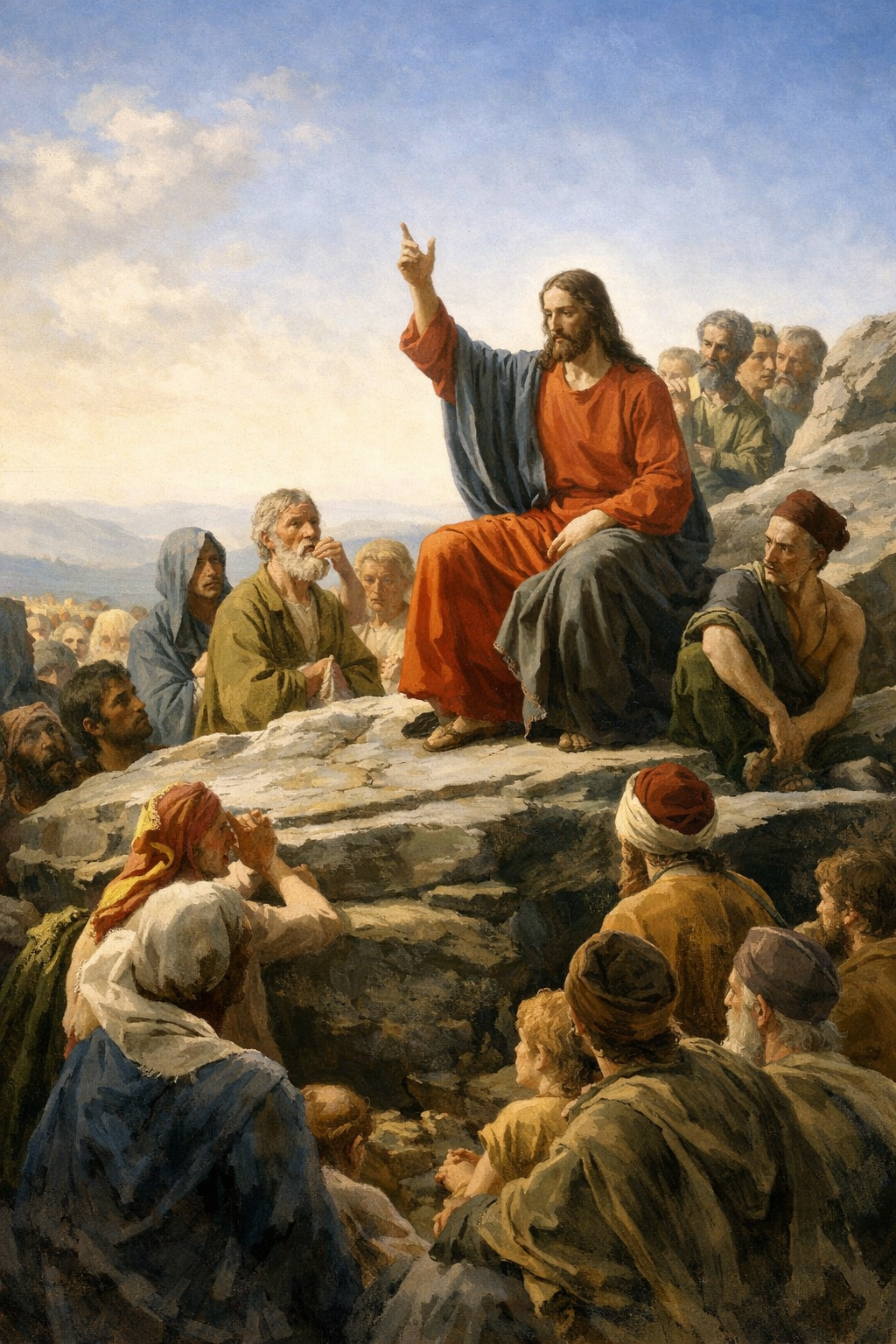
Sermon on the Mount
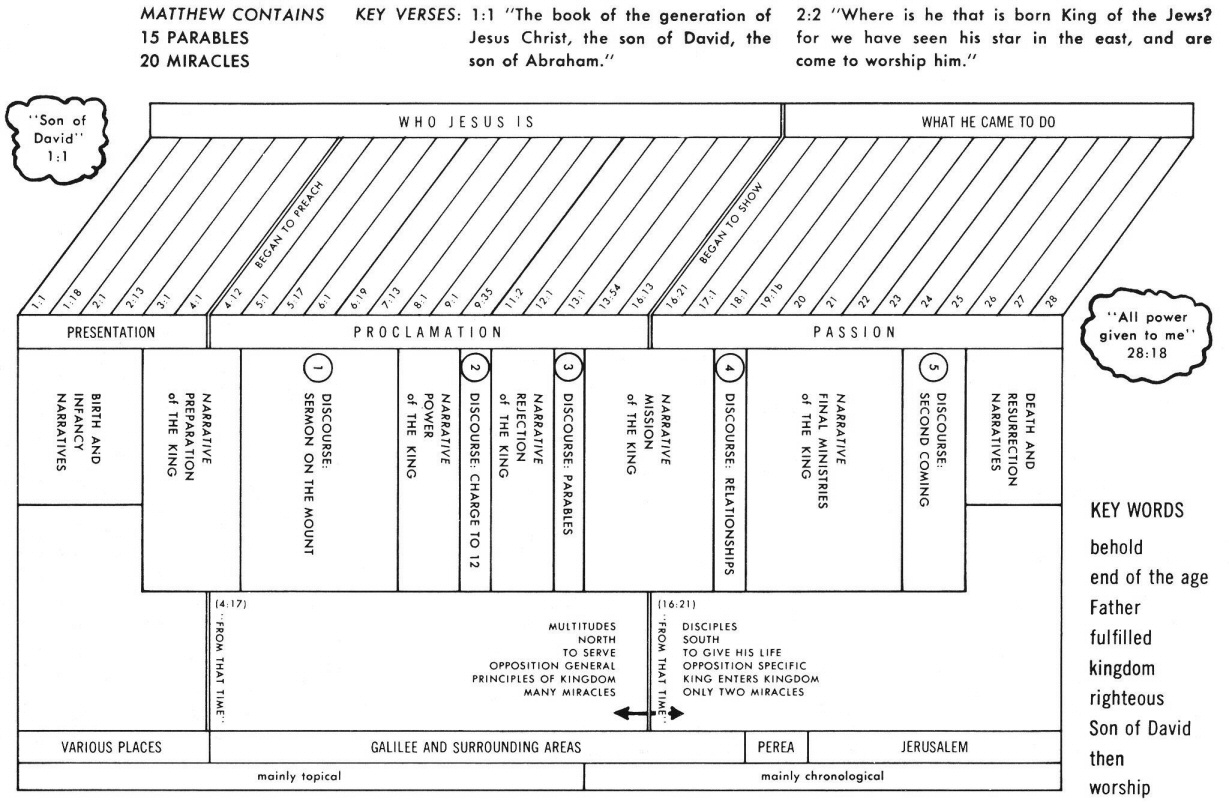
Click chart to enlarge
Charts from Jensen's Survey of the NT - used by permission
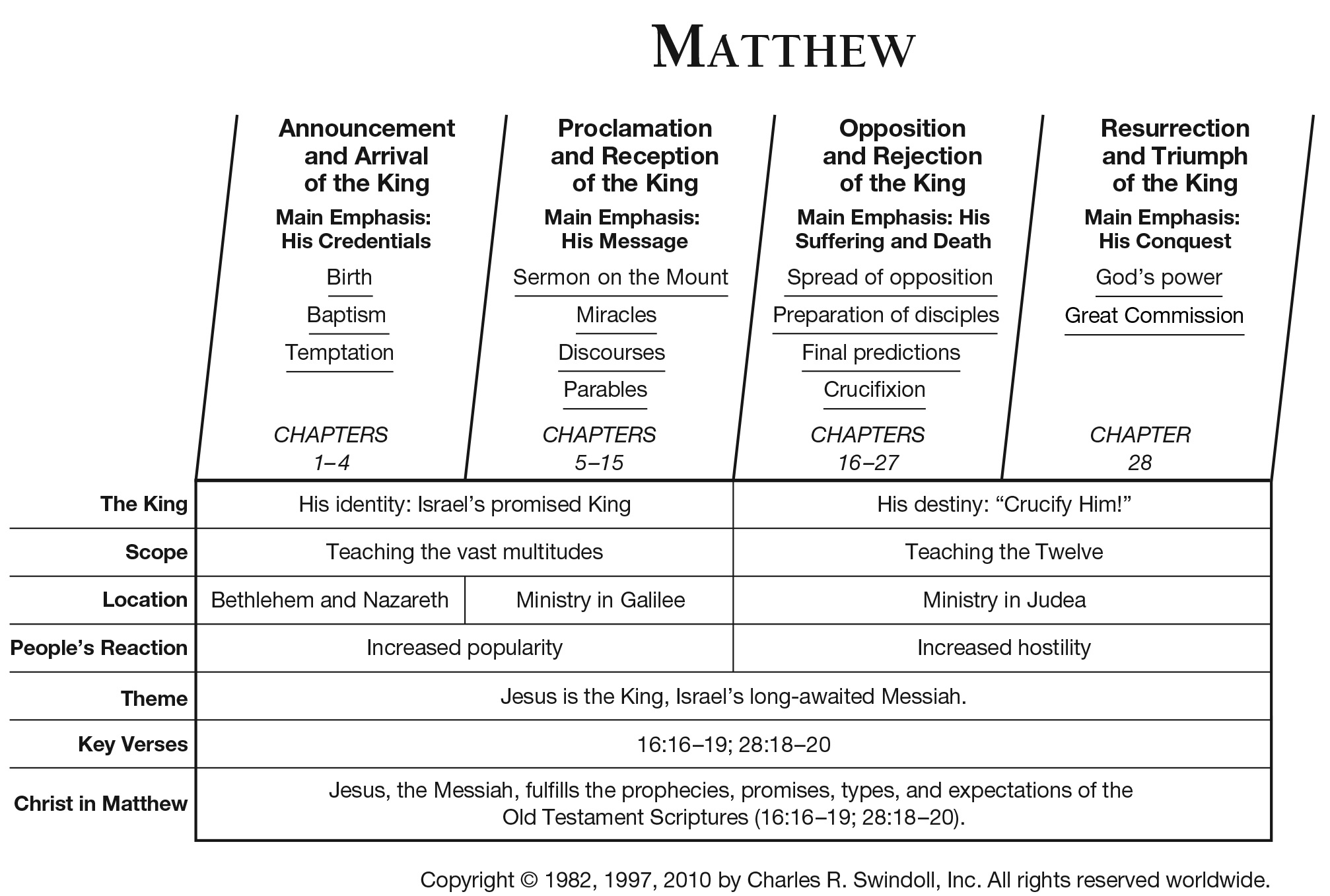
Another Chart from Charles Swindoll
THE LIFE OF JESUS AS COVERED
BY MATTHEW (shaded area)
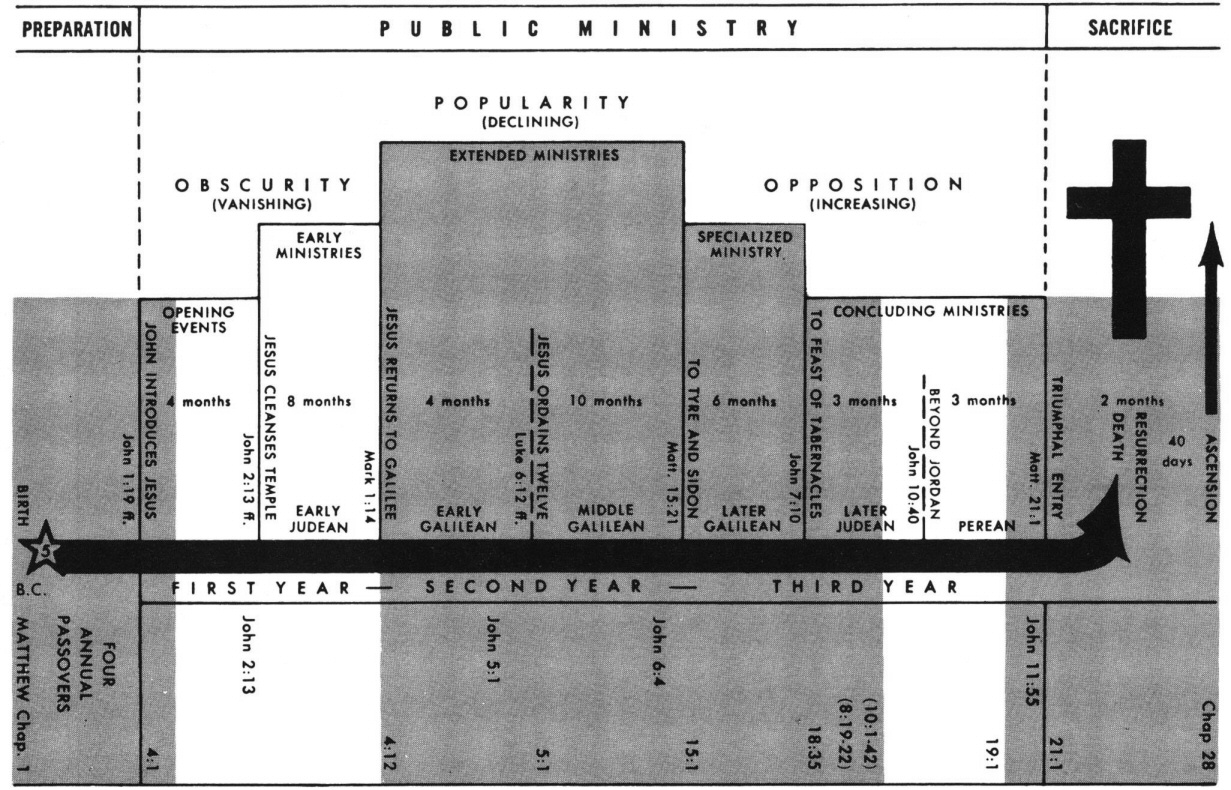
Click chart to enlarge
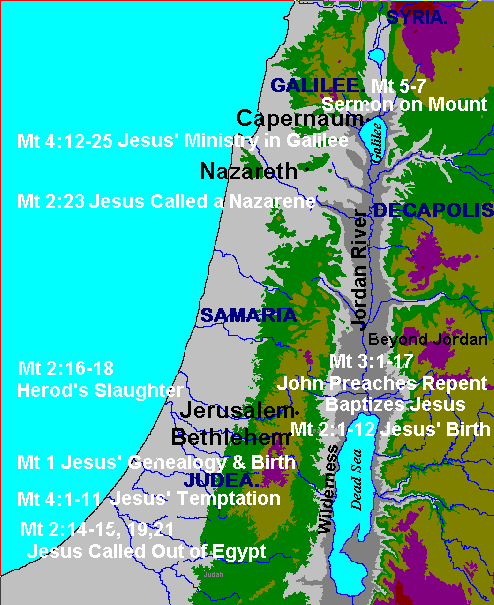
Jesus Birth and Early Years
Leading up to the Sermon on the Mount
Matthew 1-7
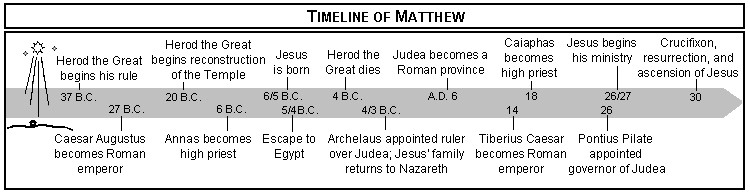
Source: Ryrie Study Bible
Matthew 5:36 "Nor shall you make an oath by your head, for you cannot * make one hair white or black. (NASB: Lockman)
Greek: mete en te kephale sou omoses, (2SAAS) oti ou dunasai (2SPMI) mian tricha leuken poiesai (AAN) e melainan.
Amplified: And do not swear by your head, for you are not able to make a single hair white or black. (Amplified Bible - Lockman)
NLT: Don't even swear, 'By my head!' for you can't turn one hair white or black. (NLT - Tyndale House)
Philips: No, and don't swear by your own head, for you cannot make a single hair - white or black! (New Testament in Modern English)
Wuest: Neither put yourself under oath by your head, because you are not able to make one hair white or black, (Wuest: Expanded Translation: Eerdmans)
Young's Literal: nor by thy head mayest thou swear, because thou art not able one hair to make white or black;
NOR SHALL YOU MAKE AN OATH BY YOUR HEAD, FOR YOU CANNOT MAKE ONE HAIR WHITE OR BLACK: mete en te kephale sou omoses, (2SAAS) oti ou dunasai (2SPMI) mian tricha leuken poiesai (AAN) e melainan
- Mt 23:16, 17, 18, 19, 20, 21
- Mt 6:27; Luke 12:25
- Matthew 5 Resources - Multiple Sermons and Commentaries
See Background on Oaths and Vows in commentary on Matthew 5:33
Make no oath (3660) (Omnuo) means to affirm the truth of a statement by calling on a divine being to execute sanctions against a person if the statement in question is not true.
Vine - omnuo is used of "affirming or denying by an oath," e.g., Matthew 26:74; Mark 6:23; Luke 1:73; Hebrews 3:11,18; 4:3; 7:21; accompanied by that by which one swears, e.g., Matthew 5:34,36; 23:16; Hebrews 6:13,16; James 5:12; Revelation 10:6 (Vine's Expository Dictionary of NT Words - Swear, Sworn)
Omnuo - 26x in 20v - Matt 5:34, 36; 23:16, 18, 20ff; 26:74; Mark 6:23; 14:71; Luke 1:73; Acts 2:30; Heb 3:11, 18; 4:3; 6:13, 16; 7:21; Jas 5:12; Rev 10:6. NAS = make an oath(2), swear(6), swears(10), swore(6), sworn(2).
See F B Meyer's related comments Simplicity in Speech
The Mishnah (note) devotes one whole section called Shebuoth (“oaths”) which is an elaborate discussion of when oaths are binding and when they are not. As previously discussed, in Jesus' day the swearing of oaths had degenerated to a system which indicated when a man could lie and when not.
Jesus insists that whatever a man swears by is related to God in some way, and therefore every oath is implicitly in God's name. Thus He also condemned swearing by one's own head. What validity does that add to the oath? What they meant by using the expression “by my head” was something like
“May I lose my head (i.e., my life) if what I am telling you is not true, or if I fail to fulfill my promise.”
Jesus logic is that how can they control their life? No man can even change the intrinsic color of his hair. Ultimately even the hairs of the head are all under God's sway and ownership. He Alone determines whether at any given moment a hair is black or white. Therefore, it follows that even swearing by one’s head is in the final analysis swearing by God and is just as binding as an oath using the specific name of God.
Matthew Poole asks…
Doth our Saviour here oppose himself to the law of God, which saith, Deut 6:13 10:20,
“Thou shalt fear the Lord thy God, and swear by His name?”
Doth he condemn Abraham, who sware his servant by the Lord God of heaven and earth? Ge 24:3.
Doth he destroy such a useful means for the end of strife? (see note Hebrews 6:16).
None of all these. We must consider that our Saviour is here opposing himself to the corruptions of that age brought in by the Pharisees, who had taught people that swearing was nothing, if they did not forswear themselves; or at least swearing “by the heaven, by the earth, by Jerusalem, by their head,” or in suchlike forms, was no sin, if they forbore the name of God; that they were only obliged to swear by the name of God in public courts of justice, but they were not tied up to it at other times.
To these and such like corruptions our Saviour offers these opposing words, “I say unto you, Swear not at all;” not at all voluntarily, but where it is necessary for the end of strife; not at all in your common discourse, James 5:12: and so it is expounded in the next verse.
The law doth not only forbid false swearing, but common and ordinary swearing, needless swearing, which speaks a great want of reverence in the heart of the name of God.
And let not your teachers cheat you, in telling you God, or the name of God, is not concerned, in your swearing by heaven: is not heaven the throne of God? Or by earth: is not that the footstool of God? Or by Jerusalem: is not that the city of God? Or by your head: is it not God that hath given you your life and bodily members? Is it in your power to make a hair of your head white or black?
So as the great thing here forbidden, is common and ordinary swearing, where God calleth us not unto it for the determination of strife. Do not only think that false swearing, but be assured that ordinary, common, needless swearing, is forbidden by God. (Matthew Poole's Commentary on the NT)
William Barclay on oaths - One of the strange things about the Sermon on the Mount is the number of occasions when Jesus was recalling to the Jews that which they already knew. The Jewish teachers had always insisted on the paramount obligation of telling the truth. "The world stands fast on three things, on justice, on truth, and on peace." "Four persons are shut out from the presence of God--the scoffer, the hypocrite, the liar, and the retailer of slander." "One who has given his word and who changes it is as bad as an idolater." The school of Shammai was so wedded to the truth that they forbade the ordinary courteous politenesses of society, as, for instance, when a bride was complimented for her charming appearance when in fact she was plain.
Still more did the Jewish teachers insist on the truth, if the truth had been guaranteed by an oath. Repeatedly that principle is laid down in the New Testament. The commandment has it: "You shall not take the name of the Lord, your God, in vain; for the Lord will not hold him guiltless who takes his name in vain" (Exodus 20:7). That commandment has nothing to do with swearing in the sense of using bad language; it condemns the man who swears that something is true, or who makes some promise, in the name of God, and who has taken the oath falsely. "When a man vows a vow to the Lord, or swears an oath to bind himself by a pledge, he shall not break his word" (Numbers 30:2). "When you make a vow to the Lord your God, you shall not be slack to pay it; for the Lord your God will surely require it of you, and it would be sin in you" (Deuteronomy 23:21-22).
But in the time of Jesus there were two unsatisfactory things about taking oaths.
The first was what might be called frivolous swearing, taking an oath where no oath was necessary or proper. It had become far too common a custom to introduce a statement by saying, "By thy life," or, "By my head," or, "May I never see the comfort of Israel if… " The Rabbis laid it down that to use any form of oath in a simple statement like: "That is an olive tree," was sinful and wrong. "The yes of the righteous is yes," they said, "and their no is no."
There is still need of warning here. Far too often people use the most sacred language in the most meaningless way. They take the sacred names upon their lips in the most thoughtless and irreverent way. The sacred names should be kept for sacred things.
The second Jewish custom was in some ways even worse than that; it might be called evasive swearing. The Jews divided oaths into two classes, those which were absolutely binding and those which were not. Any oath which contained the name of God was absolutely binding; any oath which succeeded in evading the name of God was held not to be binding. The result was that if a man swore by the name of God in any form, he would rigidly keep that oath; but if he swore by heaven, or by earth, or by Jerusalem, or by his head, he felt quite free to break that oath. The result was that evasion had been brought to a fine art.
The idea behind this was that, if God's name was used, God became a partner in the transaction; whereas if God's name was not used, God had nothing to do with the transaction. The principle which Jesus lays down is quite clear. In effect Jesus is saying that, so far from having to make God a partner in any transaction, no man can keep God out of any transaction. God is already there. The heaven is the throne of God; the earth is the footstool of God; Jerusalem is the city of God; a man's head does not belong to him; he cannot even make a hair white or black; his life is God's; there is nothing in the world which does not belong to God; and, therefore, whether God is actually named in so many words or not, does not matter. God is there already.
Here is a great eternal truth. Life cannot be divided into compartments in some of which God is involved and in others of which he is not involved; there cannot be one kind of language in the Church and another kind of language in the shipyard or the factory or the office; there cannot be one kind of standard of conduct in the Church and another kind of standard in the business world. The fact is that God does not need to be invited into certain departments of life, and kept out of others. He is everywhere, all through life and every activity of life. He hears not only the words which are spoken in his name; he hears all words; and there cannot be any such thing as a form of words which evades bringing God into a transaction. We will regard all promises as sacred, if we remember that all promises are made in the presence of God.
The End Of Oaths (Matthew 5:33-37 Continued)
This passage concludes with the commandment that when a man has to say yes, he should say yes, and nothing more; and when he has to say no, he should say no, and nothing more.
The ideal is that a man should never need an oath to buttress or guarantee the truth of anything he may say. The man's character should make an oath completely unnecessary. His guarantee and his witness should lie in what he is himself. Isocrates, the great Greek teacher and orator, said, "A man must lead a life which will gain more confidence in him than ever an oath can do." Clement of Alexandria insisted that Christians must lead such a life and demonstrate such a character that no one will ever dream of asking an oath from them. The ideal society is one in which no man's word will ever need an oath to guarantee its truth, and no man's promise ever need an oath to guarantee its fulfilling.
Does this saying of Jesus then forbid a man to take an oath anywhere--for instance, in the witness box? There have been two sets of people who completely refused all oaths. There were the Essenes, an ancient sect of the Jews. Josephus writes of them: "They are eminent for fidelity and are ministers of peace. Whatsoever they say also is firmer than an oath. Swearing is avoided by them and they esteem it worse than perjury. For they say that he who cannot be believed without swearing is already condemned."
There were, and still are, the Quakers. The Quakers will not in any situation submit to taking an oath. The utmost length to which George Fox would go was to use the word Verily. He writes: "I never wronged man or woman in all that time [the time that he worked in business]. While I was in that service, I used in my dealings the word Verily, and it was a common saying, 'If George Fox says Verily, there is no altering him.'"
In the ancient days the Essenes would not in any circumstances take an oath, and to this day the Quakers are the same.
Are they correct in taking this line in this matter? There were occasions when Paul as it were, put himself upon oath. "I call God to witness against me," he writes to the Corinthians, "It was to spare you that I refrained from coming to Corinth" (2 Corinthians 1:23). "Now the things that I write unto you," he writes to the Galatians, "In what I am writing to you, before God, I do not lie!" (Galatians 1:20). On these occasions Paul is putting himself on oath. Jesus himself did not protest at being put on oath. At his trial before the High Priest, the High Priest said to him: "I adjure you by the living God--I put you on oath by God himself--tell us if you are the Christ, the son of God" (Matthew 26:63). What then is the situation?
Let us look at the last part of this verse. The Revised Standard Version has it that a man must answer simply yes or no, "anything more than this comes from evil." What does that mean? It can mean one of two things.
(a) If it is necessary to take an oath from a man, that necessity arises from the evil that is in man. If there was no evil in man, no oath would be necessary. That is to say, the fact that it is sometimes necessary to make a man take an oath is a demonstration of the evil in Christless human nature.
(b) The fact that it is necessary to put men on oath on certain occasions arises from the fact that this is an evil world. In a perfect world, in a world which was the Kingdom of God, no taking of oaths would ever be necessary. It is necessary only because of the evil of the world.
What Jesus is saying is this--the truly good man will never need to take an oath; the truth of his sayings and the reality of his promises need no such guarantee. But the fact that oaths are still sometimes necessary is the proof that men are not good men and that this is not a good world.
So, then, this saying of Jesus leaves two obligations upon us. It leaves upon us the obligation to make ourselves such that men will so see our transparent goodness that they will never ask an oath from us; and it leaves upon us the obligation to seek to make this world such a world that falsehood and infidelity will be so eliminated from it that the necessity for oaths will be abolished. (William Barclay's Daily Study Bible - Matthew 5)
Dr. Helmut Thielicke, who resisted compromising his integrity during the Hitler era, made an interesting observation regarding oaths writing that…
Whenever I utter the formula “I swear by God,” I am really saying, “Now I’m going to mark off an area of absolute truth and put walls around it to cut it off from the muddy floods of untruthfulness and irresponsibility that ordinarily overruns my speech.” In fact, I am saying even more than this. I am saying that people are expecting me to lie from the start. And just because they are counting on my lying I have to bring up these big guns of oaths and words of honor. (Helmut Thielicke, Life Can Begin Again)
Matthew 5:37 "But let your statement be, 'Yes, yes' or 'No, no'; anything beyond these is of evil (NASB: Lockman)
Greek: esto (3SPAM) de o logos humon nai nai, ou ou; to de perisson touton ek tou ponerou estin. (3SPAI)
Amplified: Let your Yes be simply Yes, and your No be simply No; anything more than that comes from the evil one. (Amplified Bible - Lockman)
NLT: Just say a simple, 'Yes, I will,' or 'No, I won't.' Your word is enough. To strengthen your promise with a vow shows that something is wrong. (NLT - Tyndale House)
Philips: Whatever you have to say let your 'yes' be a plain 'yes' and your 'no' a plain 'no' - anything more than this has a taint of evil. (New Testament in Modern English)
Wuest: but let your word be, Yes, Yes, No, No; and that which is more than these things is of the evil which is in active opposition to the good. (Wuest: Expanded Translation: Eerdmans)
Young's Literal: but let your word be, Yes, Yes, No, No, and that which is more than these is of the evil.
- 2Co 1:17-20; Col 4:6; James 5:12
- Matthew 5 Resources - Multiple Sermons and Commentaries
Related Passages:
2 Corinthians 1:17-20+ Therefore, I was not vacillating when I intended to do this, was I? Or what I purpose, do I purpose according to the flesh, so that with me there will be yes, yes and no, no at the same time? 18 But as God is faithful, our word to you is not yes and no. 19 For the Son of God, Christ Jesus, who was preached among you by us–by me and Silvanus and Timothy–was not yes and no, but is yes in Him. 20 For as many as are the promises of God, in Him they are yes; therefore also through Him is our Amen to the glory of God through us.
Colossians 4:6+ Let your speech always be with grace, as though seasoned with salt, so that you will know how you should respond to each person.
INTEGRITY IN SPEECH:
SAYING WHAT YOU MEAN
But let your statement be, 'Yes, yes' or 'No, no' - Jesus is teaching that all (NOT MOST BUT ALL) our speech should carry the weight of truthfulness, as though we were ALWAYS speaking under oath. The believer’s word should be so reliable that no added vows, formulas, or emphatic assurances are necessary. When a follower of Jesus affirms something, a simple “Yes” should suffice; when denying something, a simple “No” should be enough. Any attempt to strengthen one’s words beyond this, by invoking oaths or exaggerated guarantees, reveals a breakdown of integrity and trust. Such speech does not arise from righteousness but, as Jesus warns, finds its source in the deceptive impulse of Satan, who thrives wherever truth needs embellishment to be believed. Jesus calls His followers to a level of integrity where a plain yes or no is trustworthy—no vows, formulas, or emphatic add-ons required.
In Jesus’ day, people used graded oaths to sound truthful while leaving loopholes. Jesus dismantles that system: say what you mean and mean what you say.
Speak so truthfully that extra
assurances are unnecessary.
Let… be - The present imperative is a command calling for this to be the believer's lifestyle only possible as we learn to depend on the Holy Spirit to obey.
Refer also William Barclay's comments at the end of the previous verse.
See F B Meyer's related comments Simplicity in Speech
Dwight Pentecost summarizes what Jesus is saying - Let your character, your reputation for honesty, your word be so obviously true and undefiled and without duplicity, that no man would think it necessary to put you under an oath because he suspects you are of deception… Some words can have a double meaning, and some words can be interpreted in two different ways. But there is only one possible way of interpreting yes. Yes does not mean no. There is only one way you can interpret no. You can never interpret that as meaning consent. When you say yes, it means yes; when you say no, it means no. The Lord demanded that one's speech be so trustworthy that men would not have to debate what was meant and interpret what was said. They would know what was meant because he was an honest man.' (BORROW Design for living: Lessons in Holiness from the Sermon on the Mount PAGE 112)
The Believer's Study Bible has a good summary note - "Complete honesty should be typical of the kingdom citizen, so that no oath is necessary to guarantee trustworthiness for one's "yes" or "no." The law regarding oaths was based upon the third Commandment. False testimony resulted in severe consequences, since it consisted of taking God's name in vain (Ex. 20:7; Lev. 19:11, 12; Num. 30:2; Deut. 19:16-20). The rabbis taught that oaths which omitted God's name could be broken and were not binding. Jesus maintains that God is involved in heaven, earth, Jerusalem, and all things. Hence, all oaths are binding, and any attempt to avoid an oath while pretending to keep it profanes the divine name. The reference is neither to taking oaths in court nor to profanity. (Believer's Study Bible. Thomas Nelson)
Here are some modern examples of how we often embellish our speech (YOU'VE NEVER SAID ANY OF THESE HAVE YOU?)...
- “Honestly…” This often signals that honesty has not been consistent before. Simple truth shouldn’t need a warning label.
- “I swear to God…” This adds weight because the speaker fears their word alone won’t be believed.
- “Trust me.” This is usually spoken when trust has already been strained.
- “I’ll definitely have it done by Friday—no matter what.” Over-promising to impress, rather than giving a truthful yes or no.
- “You have my word… I guarantee it.” A guarantee replaces integrity when reliability is uncertain.
- “I promise I’ll change—this time I really mean it.” (BOY HAVE I HEARD THIS ONE FROM MY 2 ADDICT CHILDREN!) Repeated promises reveal that past “yeses” weren’t true yeses.
- “I would never lie to you.” This "assurance" ironically raises suspicion rather than removing it.
- “The Lord told me…” (used casually) (BELIEVERS BEWARE) Invoking God’s name to add authority where clarity or humility is lacking.
- “God is my witness…” WOE! This is precisely what Jesus warns against: using sacred language to prop up our speech in an attempt to add credibility where simple truth should suffice.
To sum up, Jesus is saying that when our words need reinforcement in any way, truth has already been weakened. He calls us to a level of integrity so consistent that a simple yes or no is enough.
Related Resources:
COMMITMENT
Dolly Parton was unable to receive her 1999 Grammy Award in person because she had other plans. What could be so important that she couldn't make it to the award's ceremony? She had promised a friend she would go to her shower and she wasn't about to break her word, not even for a Grammy.
"But let your statement be, 'Yes, yes' or 'No, no'; and anything beyond these is of evil." Matthew 5:37 NASB
—Live with Regis & Kathy Lee, 2-29-2000
Vance Havner - YES OR NO
But let your communication be, Yea, yea; Nay, nay: for whatsoever is more than these cometh of evil. Matthew 5:37.
We cannot be neither/nor in a world where the real issues are either/or. Jesus recognized no middle ground, no neutral territory: "He that is not with me is against me; and he that gathereth not with me scattereth abroad" (Matthew 12:30). There are, to use the words of Joseph Parker, "no graded lines, light compounded with shadow in a graceful exercise of give and take." It is up or down, in or out, saved or lost, heaven or hell. Anything more than that is of the devil.
Lost Language
I really detest political-speak. Words like "the people," for example, have lost their meaning. We have to fight against fossilized language. Not only in the case of the Marxists who have petrified the language most, but the liberals too. "Democracy" is another such word. The Soviets say they're democratic; the Americans say they're democratic; El Salvador does, and Mexico too. Everyone who can organize an election says he's democratic. "Independence" is another one. These are words that have come to mean very little. They're disconnected; they don't describe the reality they represent. —Latin American novelist Gabriel Garcia Marquez in the New York Times Book Review (Feb. 21, 1988), Christianity Today, Vol. 32, no. 9. See: Matthew 5:37; Proverbs 17:27
James Smith - PURE SPEECH. James 5:12.
There is a closer connection between this verse and the subject of the oppression of the hireling already dealt with, than at first sight imagined. Under the galling pressure of injury and oppression one is tempted to the use of expletives, of impure and unwise speech, as one outlet, but this is here forbidden.
Is not this verse but an echo of words spoken on the Mount by the illustrious Brother of James, as recorded in Matthew 5:33-37.
Our speech, to be golden, must be:
I. Pure. "Swear not."
II. Unadorned. "Let your yea be yea," etc.
III. Dignified. As becometh believers.
IV. Inspired. By and from the right source. "For whatsoever is more than these cometh of evil" (Matt. 5:37); or, as Weymouth, "Comes from the evil one," suggesting that the Evil One is the author of impure and undignified speech.
V. Disturbing. Anything else causes us "to fall into condemnation," disturbing our own consciences, and grieving the Lord.
Swear Not!
"But I tell you, Do not swear at all: Simply let your ’Yes’ be ’Yes,’ and your ’No,’ ’No’; anything beyond this comes from the evil one. Matthew 5:34 a, 37 NIV (Spiritual Snacks for Hungry Christians - Monroe Gaultney)
Some fatherly advice came to Bob Hendricks years ago when his dad, Howard, told him, “Be so dependable that if you say you will be somewhere and don’t show up, they send flowers.” Lax dependability characterizes many believers today. Whether it’s a promise for a favor or a commitment to perform a task, “let your yes mean yes …” (Matt. 5:37).205 McHenry's Quips, Quotes and Other Notes - Page 66
John MacArthur - JESUS ON GENUINE TRUTHFULNESS Daily Readings From the Life of Christ - Page 24
But let your statement be, “Yes, yes” or “No, no”; anything beyond these is of evil.—MATT. 5:37
Keeping your word is the mark of a genuine worshiper and demonstrates that you, as a child of God, hate lies. Everything in God’s kingdom is sacred and all truth is His truth, so truth has no degrees or shades. Thus even what seems to be the most minor false statement dishonors God’s name.
The Lord has never had any standard other than absolute truthfulness. He wants every one of us to possess “truth in the innermost being” (Ps. 51:6). And it follows that “lying lips are an abomination to the Lord” (Prov. 12:22; cf. 6:16–17; Ps. 58:3–4).
Because God has the ultimate criterion of complete truthfulness, even our most routine conversations should be truthful and dependable in every detail. Our everyday talk ought to be plain and straightforward, uncluttered by qualifiers, exaggerations, or hedges on the truth. Our word must be as good as our bond or as any vow or oath we ever make. James’s admonishment agrees with Jesus’ teaching, “But above all, my brethren, do not swear, either by heaven or by earth or with any other oath; but your yes is to be yes, and your no, no, so that you may not fall under judgment” (James 5:12).
ASK YOURSELF
Truth and honesty will never be your default setting until you pursue it deliberately—spending your words carefully and keeping your word completely. In what particular areas of your life is it hardest for you to keep your promises?
I Want A Principle Within - N D Hillis Facts of the Matter
“I want a principle within,
Of watchful, godly fear,
A sensibility of sin,
A pain to feel it near.” (Charles Wesley)
The Principle Within is that commitment to absolute INTEGRITY … To uncompromising, honest living that squares with the character of God as revealed in Scripture.
“If you abide in My word … you will know the truth … Thou dost desire truth in the innermost being.” (John 8:31, 32; Psalm 51:6)
How would I know if I am living by that “Principle Within”? Here are three specifics:
• Motives: I am resolved that in my dealings with people, there will be no hidden agenda: No manipulation of others toward my own ends.
“Let your love be without hypocrisy.” (Romans 12:9)
• Impressions: I am resolved to not knowingly allow any impressions about myself or my business that do not square with reality: No shading of the truth. No delaying of payments. No cutting of corners on the quality of service or on the quality of the product.
“You … outwardly appear righteous to men, but inwardly you are full of hypocrisy …” (Matthew 23:28)
• Speech: I am resolved to discipline my conversation in such a way that the verbalization and the reality are precisely the same:
“Whatever you have to say let your ‘yes’ be a plain ‘yes’ and your ‘no’ be a plain ‘no’—anything more than this has a taint of evil.” (Matthew 5:37 Phillips Translation)
Wesley went on to write:
“Help me the first approach to feel
Of pride or wrong desire:
To catch the wandering of my will,
And quench the kindling fire.”
Principled men and women who are determined to adhere to that godly “Principle Within” are sensitive to the slightest inkling of compromise within their breast. QUESTION: “Are you man or woman enough to belong to that rare breed of principled disciples of Christ in an age of unprincipled people?” I know you are!
Adrian Rogers - If you’re going to live for God anywhere, live for God in your home. And when you name the name of Jesus, do not take that name in hypocrisy. Let your yes be yes, your no, no (Matthew 5:37). And let your children know, beyond the shadow of any doubt, that you love the Lord. When you pray in the name of Jesus, don’t just forge His name to the end of the prayer. That’s a hypocritical prayer. When you praise the Lord, praise Him with all of your heart.
In Other Words
Don’t bind your commitments and promises with anything. Give simple, truthful answers without vain or profane embellishments.
Small Bites
- Don’t swear on a stack of Bibles
- Don’t swear on your mother’s grave
- Don’t swear by God or by heaven
- Don’t “damn” anything in God’s name
- Don’t use Jesus’ name to indorse your actions
- Don’t swear by using God’s name as an exclamation
- Don’t swear or declare in your own name, either
- Speak simply, truthfully, and directly
- Say what you mean and mean what you say
Questions and Thoughts to Aid Digestion
- What is the difference between swearing and cursing?
- Does God give us the authority to use His name to seal promises?
- Why is Jesus teaching us this? Why is it important?
- How is swearing harmful?
- What will you do differently in your everyday speaking as a result of this Scripture?
Prayer: Yes, Lord, I refuse to use Your name as an endorsement on my declarations anytime. I will stand behind my commitments and promises on my own. Amen.
AUTHENTICITY
The state road directorate on the remote Norwegian Island of Svalbard has agreed to make changes to their road signs after tourists and residents complained the signs needed to be more realistic.
The Arctic archipelago, off the coast of Norway, is home to an estimated 2,000 polar bears. The road signs are standard issue depicting a black bear against a white backdrop. The signs have been popular with tourists who like to pose beneath it and take photographs. The sign is the only black bear for hundreds of miles around.
The road directorate says it will make a new sign, reversing the colors to depict a white bear against a dark background to make sure motorists watch for the right type of bear, while visiting Svalbard. —Reuters, Black Polar Bear Gets Realistic Makeover, Friday, September 5, 2003. Submitted by Jim Sandell. Matthew 5:37 NIV “Simply let your ‘Yes’ be ‘Yes’ and your ‘No,’ ‘No’, anything beyond this comes from the evil one
ANYTHING BEYOND THESE IS OF EVIL: to de perisson touton ek tou ponerou estin (3SPAI)
- Mt 13:19; 15:19; John 8:44; Ephesians 4:25; Colossians 3:9; James 5:12
- Matthew 5 Resources - Multiple Sermons and Commentaries
Related Passages:
Matthew 15:19+ “For out of the heart come evil thoughts, murders, adulteries, fornications, thefts, false witness, slanders.
Ephesians 4:25+ Therefore, laying aside (apotithemi - like putting off, casting aside dirty clothes) falsehood, SPEAK (present imperative see our need to depend on the Holy Spirit to obey) TRUTH EACH ONE of you WITH HIS NEIGHBOR, for (See youtube video on "for" as a term of explanation) we are members of one another.
Colossians 3:9+ Do not lie (present imperative with a negative see our need to depend on the Holy Spirit to obey) to one another, since you laid aside the old self with its evil practices (praxis)
Proverbs 10:19 When there are many words, transgression is unavoidable, But (term of contrast) he who restrains his lips is wise.
THE DANGER OF
EXTRA WORDS
Of evil points to the source, not just the behavior. The phrase means that such practices originate from the evil realm—either from the deceitfulness of the human heart or from Satan, “the father of lies” (John 8:44+). In short, when words need padding, promises, or oaths to be believed, something is already wrong and that wrongness traces back to sin. Going “beyond” yes or no often aims to control how others perceive us rather than simply convey truth. This is where evil enters—not always blatant lying, but truth shaped to manage outcomes. A simple yes or no flows from inner unity. Excessive qualifiers reveal inner conflict. It is like saying “I want to sound truthful, but I also want an escape hatch.” In Jesus’ day, people ranked oaths by what they swore by (heaven, earth, Jerusalem), believing some vows were binding and others weren’t. Jesus cuts through the loopholes. He has a way of doing that, doesn't He!
🙏 THOUGHT TO PONDER: Do my words carry weight because of my character, or do I rely on extra assurances to be believed?
David gives us an excellent prayer to pray so that we might avoid anything beyond yes and no…
Set a guard, O LORD, over my mouth; Keep watch over the door of my lips. (Psalm 141:3)
Spurgeon's comment - Set a watch, O LORD, before my mouth. That mouth had been used in prayer, it would be a pity it should ever be defiled with untruth, or pride, or wrath; yet so it will become unless carefully watched, for these intruders are ever lurking about the door. David feels that with all his own watchfulness he may be surprised into sin, and so he begs the Lord himself to keep him. When Jehovah sets the watch the city is well guarded: when the Lord becomes the guard of our mouth the whole man is well garrisoned. Keep the door of my lips. God has made our lips the door of the mouth, but we cannot keep that door of ourselves, therefore do we entreat the Lord to take the rule of it. O that the Lord would both open and shut our lips, for we can do neither the one nor the other aright if left to ourselves. In times of persecution by ungodly men we are peculiarly liable to speak hastily, or evasively, and therefore we should be specially anxious to be preserved in that direction from every form of sin. How condescending is the Lord! We are ennobled by being door keepers for him, and yet he deigns to be a door keeper for us.)
The phrase "of evil" is rendered "of the evil one" in some of the translations (NIV, NKJV, NET). The NET Bible adds that…
The term ("evil") may be understood as specific and personified, referring to the devil, or possibly as a general reference to evil. It is most likely personified, however, since it is articular (i.e, it has a definite article "the" preceding it).
It therefore seems very reasonable to translate and interpret this as a reference to the devil who is the master deceiver and whose pattern of guileful, manipulative speech is to be scrupulously avoided by all citizens of the Kingdom of Heaven.
In John we read that Jesus declares to a group of unbelieving Jews that…
"You are of your father the devil, and you want to do the desires of your father. He was a murderer from the beginning, and does not stand in the truth, because there is no truth in him. Whenever he speaks a lie, he speaks from his own nature; for he is a liar, and the father of lies. (John 8:44+)
James has a warning explaining why it is better to simply speak the truth…
But above all, my brethren, do not swear, either by heaven or by earth or with any other oath; but let your yes be yes, and your no, no; so that (here's the reason one should simply speak the truth without oaths) you may not fall under judgment. (James 5:12+)
James is not forbidding the taking of a solemn oath per se (see discussion below). Jesus and James are stressing the need for integrity in speech, and the sinfulness of carelessly or flippantly using God's name or a sacred object to guarantee truthful speech.
Let's be honest. We all find it difficult to be truthful. George MacDonald put it this way…
I always try—I think I do—to be truthful. All the same I tell a great many petty lies, e.g. things that mean one thing to myself though another to other people. But I do not think lightly of it. Where I am more often wrong is in tacitly pretending I hear things which I do not, especially jokes and good stories, the point of which I always miss; but, seeing every one laugh, I laugh too, for the sake of not looking a fool. My respect for the world’s opinion is my greatest stumbling-block, I fear. (See Reminiscences of a Specialist)
Paul made a statement that is in the form of an oath in Romans when he declared that…
God, Whom I serve in my spirit in the preaching of the gospel of His Son, is my witness as to how unceasingly I make mention of you, always in my prayers making request, if perhaps now at last by the will of God I may succeed in coming to you. (Ro 1:9-10+).
Paul's phrase "God… is my Witness" is an appeal to God, and therefore is in the form of an oath, probably because he was personally unknown to the Roman saints and they to him. They might doubt his affection to them, a case which was only known to God and himself, and hence his appeal to God for the truth of it.
J Vernon McGee quips that "When a man says to me, “I’d swear on a stack of Bibles a mile high,” that is the fellow I do not believe because I think the lie he’s telling is a mile high. (See Thru the Bible Vol. 34: The Gospels Matthew 1-13)
Evil (4190 ) (poneros from poneo = work or toil, Robertson says the idea is that labor is an annoyance, bad, evil; Noun poneria derived from poneros) refers to that which is actively harmful. The idea is one who is pernicious, which means highly injurious or destructive, exceedingly harmful, and vicious. Evil, malignant character, pernicious, that which is morally or socially worthless, wicked, base, bad, degenerate. Poneros denotes determined, aggressive, and fervent evil that actively opposes what is good. Poneros is not just bad in character (like kakos - see below), but bad in effect (injurious)!
Poneros describes evil in active opposition to good. It means not only evil in its nature but viciously evil in its influence and actively harmful. Poneros used to describe Satan (ho poneros = "Evil one"), the god of this age, who is corrupting man and dragging him to destruction. This denotes someone who is not content in being corrupt themselves. They seek to corrupt others and draw them into the same destruction!
PONEROS IN MATTHEW - Matt. 5:11; Matt. 5:37; Matt. 5:39; Matt. 5:45; Matt. 6:13; Matt. 6:23; Matt. 7:11; Matt. 7:17; Matt. 7:18; Matt. 9:4; Matt. 12:34; Matt. 12:35; Matt. 12:39; Matt. 12:45; Matt. 13:19; Matt. 13:38; Matt. 13:49; Matt. 15:19; Matt. 16:4; Matt. 18:32; Matt. 20:15; Matt. 22:10; Matt. 25:26
Someone suggested the top ten lies told in America:
10) Your table will be ready in a minute. 9) One size fits all. 8) This will hurt me more than it hurts you. 7) I’m sorry I’m late; I got stuck in traffic. 6) The check is in the mail. 5) This offer is limited to the first 50 callers. 4) It’s not the money; it’s the principle of the thing. 3) I need just five minutes of your time. 2) I’ll start my diet tomorrow. 1) I’m from the IRS and I’m here to help you. Our culture doesn’t place much value on integrity, but Scripture does. (Morgan, R. J. Nelson's Annual Preacher's Sourcebook : 2004 Edition Page 132. Nashville, TN: Thomas Nelson Publishers)
THOUGHTS:
- What would others say about your word?
- Are you a person of your word? Is it "as good as gold"?
- If you say you will do something do you follow through?
- Is your word perfect as your heavenly Father's word is perfect?
- Do you exaggerate or embellish? (If so what does that say about the truthfulness of your word)?
- Do you tell someone "I'll pray for you" and then you fail to follow through (only to be reminded of your promise by their phone call "God answered. Thanks so much for praying!" And you say "Uh… Sure… you're welcome", when you know you did not really pray for them! Sin begets more sin.)
- As Citizens of the Kingdom of Heaven, who will one day give account for every word we have uttered, we must choose to be men and women of integrity.
Why should kingdom citizens tell the truth all the time? As Jesus taught elsewhere our words are a barometer of the condition of our heart…
"You brood of vipers, how can you, being evil, speak what is good? For the mouth speaks out of that which fills the heart. "The good man out of his good treasure brings forth what is good; and the evil man out of his evil treasure brings forth what is evil. "And I say to you, that every (all, no exceptions!) careless word that men shall speak (read that warning again - careless is the Greek word argos from "a" = without + "ergon" = work which literally means "not working, idle, ineffective"!) , they shall render account (pay back, implying a debt = carries the idea of obligation and responsibility for something, in this case "careless" words!) for it in the day of judgment (beloved did you ever realize that every word you ever speak is "headed for eternity so to speak"?!). (Matthew 12:34-36+)
Kent Hughes has some poignant thoughts on what proceeds out of our mouth - "The avoidance of one small fib… may be a stronger confession of faith than a whole 'Christian philosophy' championed in lengthy, forceful discussion." When people know that you do not lie, your testimony will have more effect than all the theology you could ram at them. What a difference a truthful life can make! (See The Sermon on the Mount: The Message of the Kingdom)
Samuel Johnson had wise advise for parents writing…
Accustom your children constantly to this [the telling of the truth]; if a thing happened at one window, and they, when relating it, say that it happened at another, do not let it pass, but instantly check them; you do not know where deviation from truth will end… It is more from carelessness about truth than from intentional lying, that there is so much falsehood in the world.
Matthew Henry has an excellent comment summarizing the use of oaths writing that…
"The worse men are, the less they are bound by oaths; the better they are, the less there is need for them. Our Lord does not enjoin the precise terms wherein we are to affirm or deny, but such a constant regard to truth as would render oaths unnecessary."
Today in the Word has the following devotional on Mt 5:33-37 and James 5:12 (see above)…
In the 18th century, when commerce was developing very fast, merchants had no need for written documents to complete a business deal. Big money transactions were made just on the basis of the parties' 'word of honor' and a handshake. When nowadays we listen to public figures toss words around, it becomes clear that in the 1990s, words can mean whatever the speaker wants them to mean. A simple 'yes' or 'no' is not enough. We need contracts signed in the presence of lawyers, notarized documents, oaths in courts. And even all this may not be a guarantee of complete truthfulness of words and intent. People break contracts, renege on their agreements, and commit perjuries.
Yes, the world has become more complex and our lives more hectic at the end of the 20th century. We do things differently now. But there are some principles of God's Kingdom that don't change for the followers of Jesus no matter when they live. Can you imagine the apostle James engaging in deliberate doublespeak to cloud his true intent? Neither can we! This straight-talking spokesman for God had no tolerance for false words of any kind, especially those that were cloaked in the guise of a solemn oath… People in James' day had developed an elaborate system of oath-taking to avoid invoking God's name, which would make the pledge binding. They would swear by almost anything else to leave themselves a hole through which they could wriggle and not keep their word. The Bible does not disapprove of making oaths. God 'swore by Himself' when He made His covenant with Abraham (Heb. 6:13). In a world of liars, people are often asked to swear to the truthfulness of their words. But the apostle's point, which echoed perfectly the teaching of Jesus, was that for God's people a simple yes or no should do the job. The intent behind our words should be so transparent we don't need to call heaven and earth to witness that we're telling the truth. Keep it simple, James says, or expect God's judgment. He doesn't tolerate liars.
Here's an exercise in truth-telling that you can do with the family or a group of friends this weekend. Sit down together and brainstorm a list of situations in which people are asked to take vows or swear to the truthfulness of information (for example, a wedding, a courtroom, applying for a license or other legal document). Talk about the consequences a person might suffer for lying in these cases, and then discuss God's demand for honesty on the part of His people. (See another devotional from Today in the Word on Matthew 5:33-37)
Jawbone Credit - In 1878, a merchant in Bozeman, Montana, extended to Andrew Garcia what was called "jawbone credit." Without putting anything into writing, he gave Garcia $300 worth of supplies for a hunting and trapping expedition. The trapper promised to return and pay his debt with hides and pelts from his expedition.
While Garcia was away, hostile Indians moved into the area around Bozeman. Weather conditions got bad. Fellow trappers told him to forget about returning to Bozeman, but Garcia wouldn't hear of it. After a series of harrowing experiences, he returned to the merchant with hides and pelts to pay his debt. He kept his word.
We usually can't put that much stock in verbal promises these days. Many people make pledges but fail to keep them. Every divorce means at least one person has broken a sacred vow. People in trouble with the law may promise to change their ways if only they can have another chance. But when they receive clemency, they often forget the vows they had made.
God too makes vows, but He always keeps His word. If He didn't, we would have no basis for hope. Let's thank Him for being a God of integrity and resolve that we will be people whose word can be trusted. --H V Lugt (Our Daily Bread, Copyright RBC Ministries, Grand Rapids, MI. Reprinted by permission. All rights reserved)
Integrity is what we gain
By walking in the light;
More valuable than precious gold,
It's built on truth and right. --DJD
People who trust God's Word
should be people who can be trusted.
Be True To Your Word - Shortly before his death, the Duke of Burgundy was presiding over the Cabinet Council of France. A proposal was made that would violate an existing treaty but would secure important advantages for the country. Many "good" reasons were offered to justify this action. The Duke listened in silence. When all had spoken, he closed the conference without giving approval. Placing his hand on a copy of the original agreement, he said with firmness in his voice, "Gentlemen, we have a treaty!"
It's a strong temptation these days to abandon our word in favor of personal advantage or financial gain. As believers in Christ, however, our responsibility is to remain true to our word so that our Lord is glorified.
So, when you give your word, keep it! "Let your 'Yes' be 'Yes,' and your 'No,' 'No'" (Mt. 5:37). If you make a commitment, honor it! If you take on an obligation, fulfill it! Your honesty and reliability should be so evident that you can be trusted for any contract you make. If non-Christians can trust you in business matters, they will be more likely to believe you when you speak about the gospel.
When we're tempted to break a promise, let's think again of these words: "Gentlemen, we have a treaty!" --R W De Haan (Reprinted by permission from Our Daily Bread Ministries. Please do not repost the full devotional without their permission.)
Lord, by Your Spirit grant to me
A deep desire for honesty,
That when I simply give my word
No one will doubt what they have heard. --DJD
When you give your word, keep it.
Reverend Fred Holloman, chaplain of the Kansas Senate had an interesting prayer before an opening session…
Omniscient Father: Help us to know who is telling the truth. One side tells us one thing, and the other just the opposite. And if neither side is telling the truth, we would like to know that, too. And if each side is telling half the truth, give us the wisdom to put the right halves together. In Jesus’ name, Amen.