Matthew 5:2
Matthew 5:3
Matthew 5:4
Matthew 5:5
Matthew 5:6
Matthew 5:7
Matthew 5:8
Matthew 5:9
Matthew 5:10
Matthew 5:11
Matthew 5:12
Matthew 5:13
Matthew 5:14
Matthew 5:15
Matthew 5:16
Matthew 5:17
Matthew 5:18
Matthew 5:19
Matthew 5:20
Matthew 5:21
Matthew 5:22
Matthew 5:23
Matthew 5:24
Matthew 5:25
Matthew 5:26
Matthew 5:27
Matthew 5:28
Matthew 5:29
Matthew 5:30
Matthew 5:31
Matthew 5:32
Matthew 5:33
Matthew 5:34
Matthew 5:35
Matthew 5:36
Matthew 5:37
Matthew 5:38
Matthew 5:39
Matthew 5:40
Matthew 5:41
Matthew 5:42
Matthew 5:43
Matthew 5:44
Matthew 5:45
Matthew 5:46
Matthew 5:47
Matthew 5:48
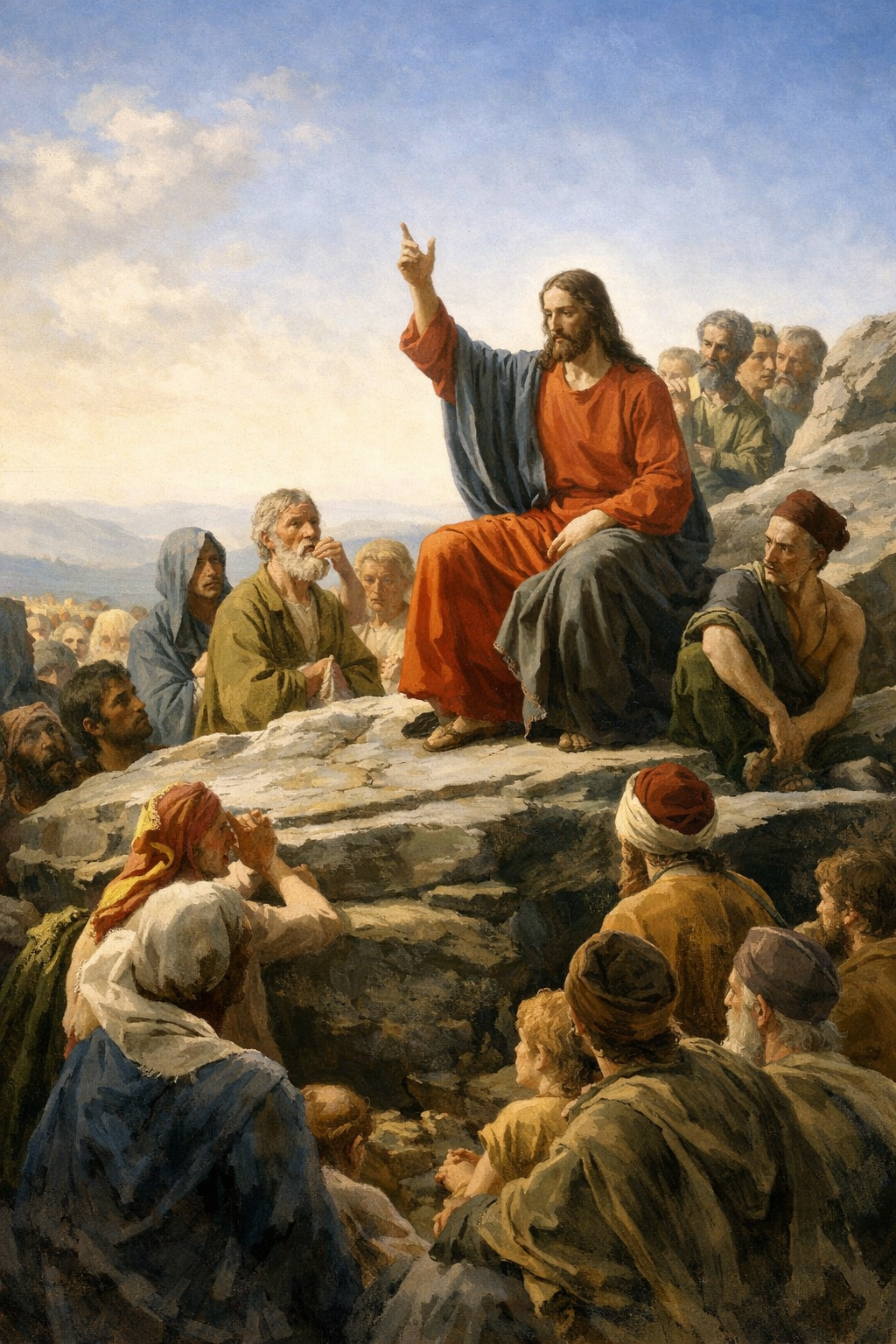
Sermon on the Mount
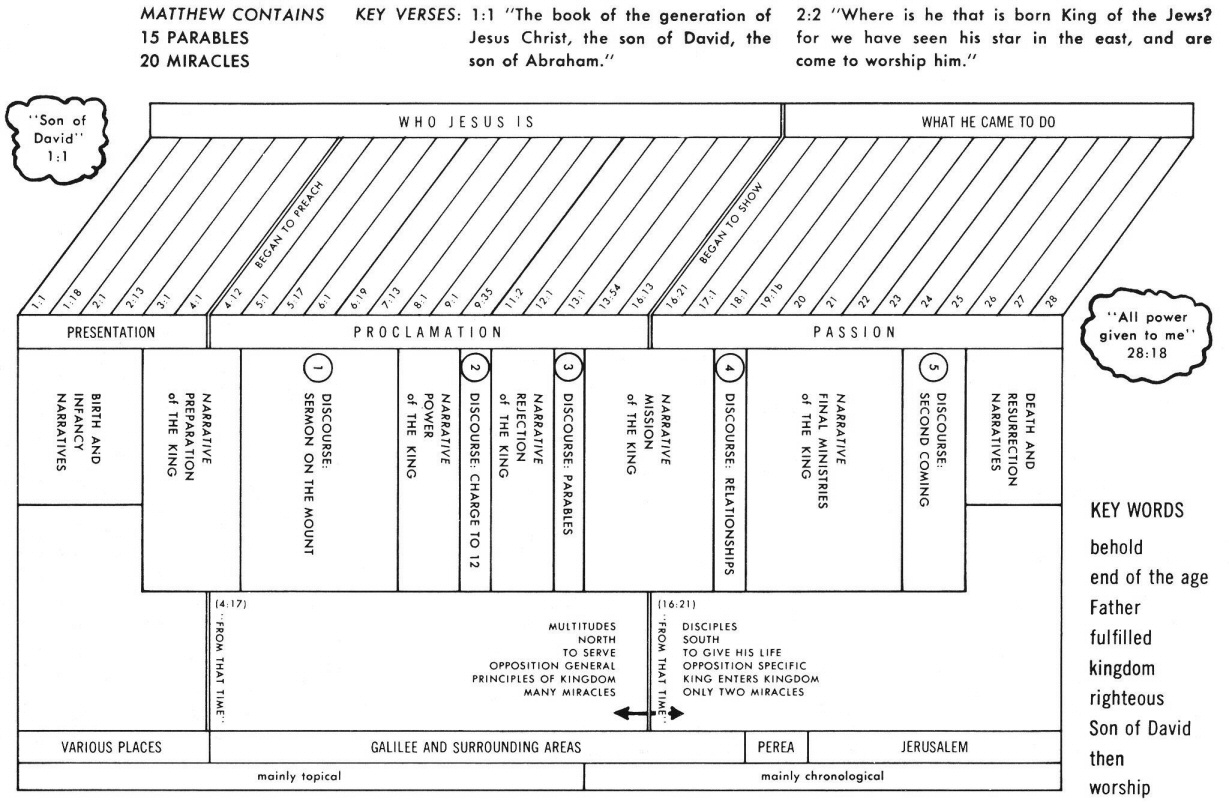
Click chart to enlarge
Charts from Jensen's Survey of the NT - used by permission
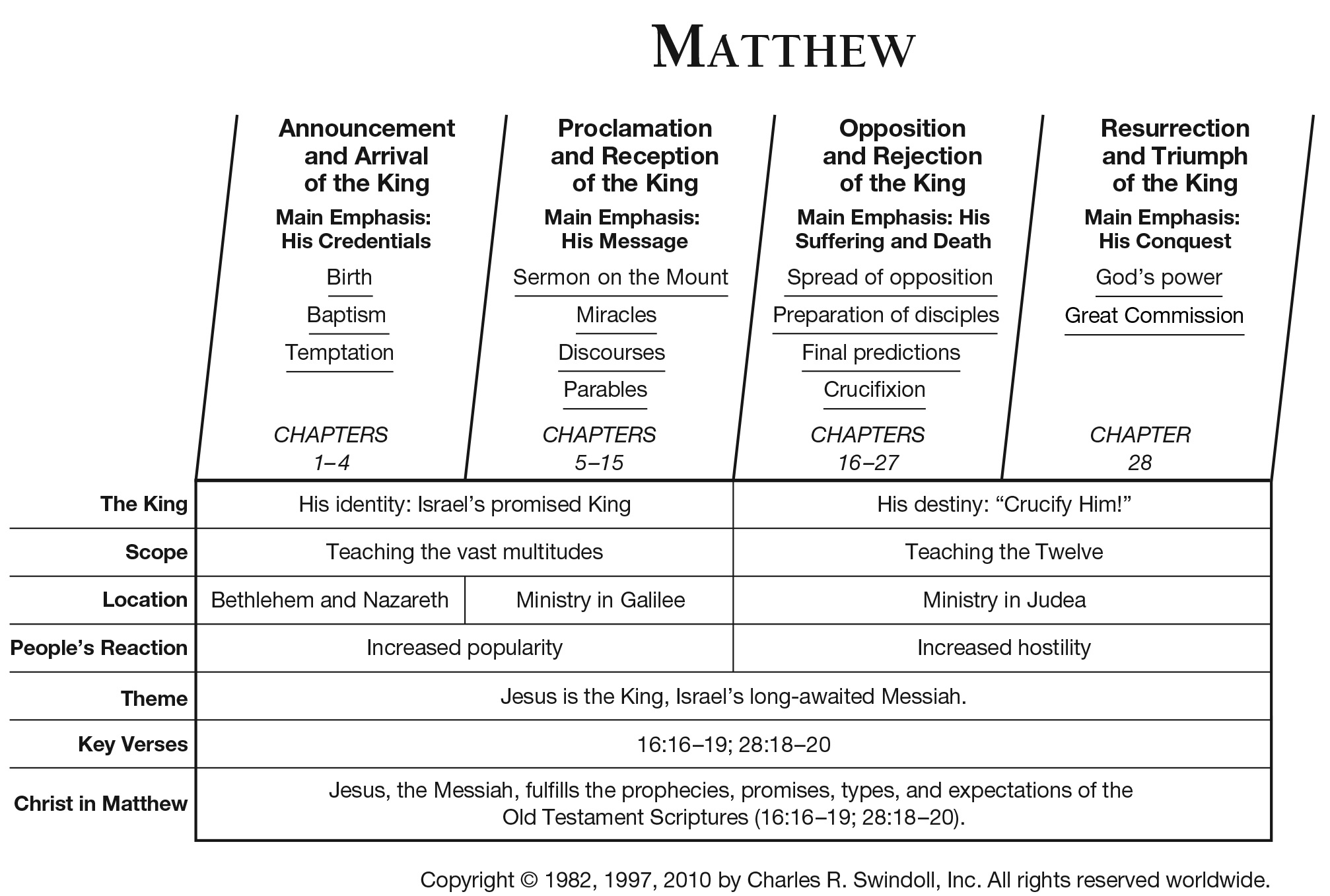
Another Chart from Charles Swindoll
THE LIFE OF JESUS AS COVERED
BY MATTHEW (shaded area)
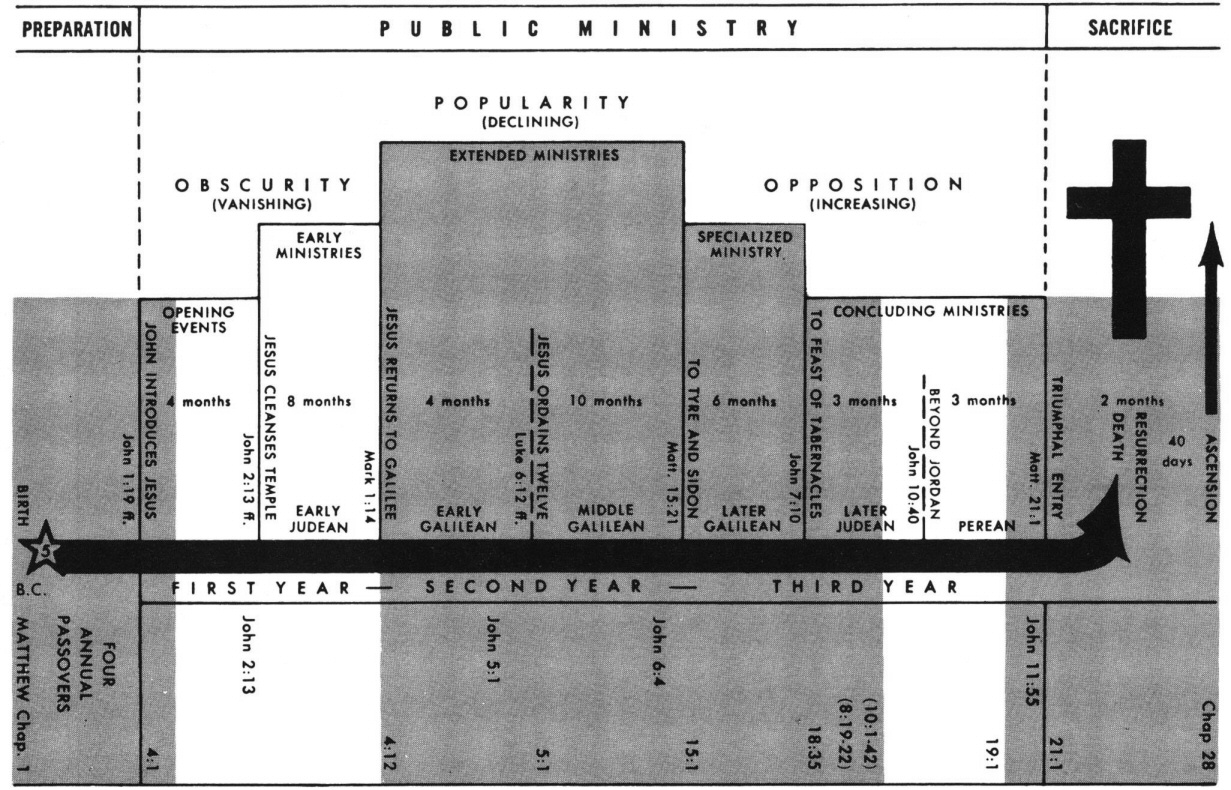
Click chart to enlarge
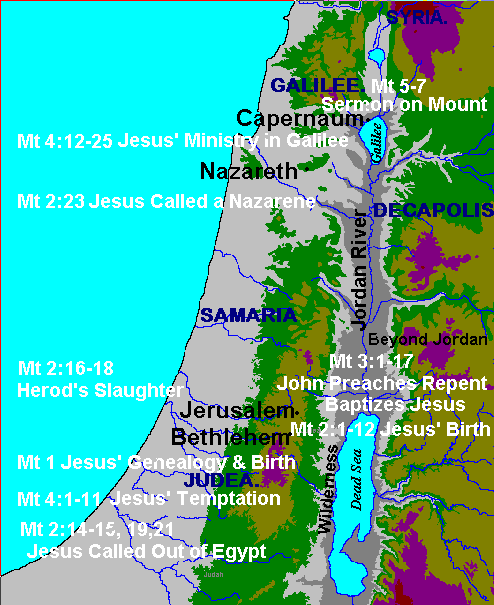
Jesus Birth and Early Years
Leading up to the Sermon on the Mount
Matthew 1-7

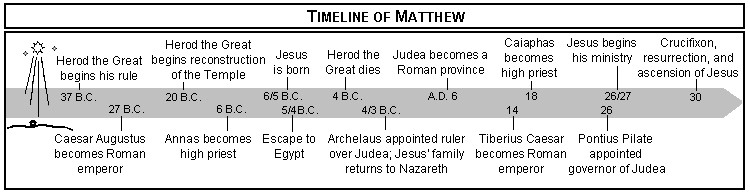
Source: Ryrie Study Bible
Matthew 5:40 If anyone wants to sue you and take your shirt, let him have your coat also (NASB: Lockman)
Greek: kai to thelonti (PAPMSD) soi krithenai (APN) kai ton chitona sou labein, (AAN) aphes (2SAAM) auto kai to himation
Amplified: And if anyone wants to sue you and take your undershirt (tunic), let him have your coat also. (Amplified Bible - Lockman)
NLT: If you are ordered to court and your shirt is taken from you, give your coat, too. (NLT - Tyndale House)
Philips: "If a man wants to sue you for your coat, let him have it and your overcoat as well. (New Testament in Modern English)
Wuest: And to the one who desires to summon you to be put on trial and have judgment passed upon you for the purpose of taking away your under-garment, yield up your outer-garment also.
Young's Literal: and whoever is willing to take thee to law, and thy coat to take -- suffer to him also the cloak.
IF ANYONE WANTS TO SUE YOU AND TAKE YOUR SHIRT, LET HIM HAVE YOUR COAT ALSO: kai to thelonti (PAPMSD) soi krithenai (APN) kai ton chitona sou labein, (AAN) aphes (2SAAM) auto kai to himation
- Luke 6:29; 1Corinthians 6:7
- Matthew 5 Resources - Multiple Sermons and Commentaries
See F B Meyer's related comments on The Second Mile
Sue (2919) (krino) means primarily to distinguish, separate or discriminate between good and evil or between right and wrong. In the present context krino means go to law or to sue, seeking justice or retribution from a person by the process of the law.
Shirt (5509) (chiton) describes a close–fitting inner vest, a type of tunic worn as an inner garment or undergarment. At times two tunics seem to have been worn, probably of different materials for ornament or luxury.
Chiton - 11x in 10v - Matt 5:40; 10:10; Mark 6:9; 14:63; Luke 3:11; 6:29; 9:3; John 19:23; Acts 9:39; Jude 1:23. NAS = clothes(1), garment(1), shirt(2), tunic(2), tunics(5).
Spurgeon comments that believers are to…
Let him have all he asks, and more. Better lose a suit of cloth than be drawn into a suit in law. The courts of our Lord’s day were vicious, and his disciples were advised to suffer wrong sooner than appeal to them. Our own courts often furnish the surest method of solving a difficulty by authority, and we have known them resorted to with the view of preventing strife. Yet even in a country where justice can be had, We are not to resort to law for every personal wrong. We should rather endure to be put upon than be for ever crying out, “I’ll bring an action.”
At times this very rule of self-sacrifice may require us to take steps in the way of legal appeal, to stop injuries which would fall heavily upon others; but we ought often to forego our own advantage, yea, always when the main motive would be a proud desire for self-vindication.
Lord, give me a patient spirit, so that I may not seek to avenge myself, even when I might righteously do so!
Let him have (863) (aphiemi from apo = prefix implies separation + hiemi = put in motion, send) (Click study of aphiemi) means literally to send away and thus conveys the basic idea of an action which causes separation -- to send from one's self, to forsake, to hurl away, to put away, to let alone, to disregard, to put off. As a legal term it meant to repay or cancel a debt or to grant a pardon.
Aphiemi refers to that which causes separation and to total detachment, total separation as from a previous location or condition. In secular Greek aphiemi initially conveyed the sense of to throw and in one secular writing we read "let the pot drop" (aphiemi). From this early literal use the word came to mean leave or let go.
Jesus issues this as a command in the aorist imperative means do it now. Don't delay.
Coat (2440) (himation) was general term for any garment but here appears to refer to the outer garment, mantle or cape which was different from the tunic, over which the coat was worn. The himation seems to have been a large piece of woolen cloth nearly square, which was wrapped around the body or fastened about the shoulders, and served also to wrap oneself in at night. Thus we find himation in the Septuagint translation of the following verse in Exodus where Moses records that…
"If you ever take your neighbor's cloak as a pledge, you are to return it to him before the sun sets (Exodus 22:26)
Because the tunic was necessary to protect one from the night elements, it might not be taken by a creditor, even though the tunic could be (cf. Mt 5:40; Lu 6:29). Most people of that day owned only one coat and probably only one or two shirts.
This verse gives rise to the familiar saying of "the shirt off your back" in such contexts as one person giving another to such an extent it is as if he gives him "the shirt off of his back." In Jesus' day it was literally possible to sue someone for the very shirt on their back! When a person had no money or other possessions, the court often would require the fine or judgment be paid by clothing. Now, the coat (as explained above) was another story and was to be one's permanent, twenty-four-hour-a-day possession. In short, if you were sued and lost your shirt (chiton) and your coat (himation), by Jewish civil law your adversary had to return your coat "before the sun set" (see Exodus 22:26, cf similar though in Deut 24:12-13) so you could sleep in it.
So what Jesus is saying to citizens of the Kingdom of heaven, is that we should be willing to surrender even our valuable outer garment, our coat, even though the plaintiff could not legally take it. We should do this if necessary to meet the required debt rather than offend our adversary.
J Vernon McGee humorously quips…
If you have a banker who says that he is living by the Sermon on the Mount, give this verse to him and see how far you get with it.
It's Only Candy - At first the man was annoyed. But he became angry as groups of teenagers without costumes kept coming to his door shouting, "Trick or treat!"
"I'm not going to put up with this!" he announced to his wife. "If any more older kids without costumes show up tonight, they're not getting anything from me. And if they don't move on, I'll call the police."
As he talked, his face became red and his breathing rapid. His wife looked at him with a curious gaze and said, "George, it's only candy."
I've often pondered those three words: "It's only candy." That put the issue in perspective. How easily we become agitated over our rights, our property, and our preferences, only to be reminded that we have allowed something inconsequential to consume us.
The words of Jesus sound so strange to us: "If anyone wants to sue you and take away your tunic, let him have your cloak also. And whoever compels you to go one mile, go with him two" (Mt. 5:40-41). The Lord wants us to respond to our circumstances in ways that reflect our trust in Him and our commitment to heaven's values.
So much of our anger could be avoided if we would only pause and say, "You're right, Lord. It's only candy." --D C McCasland (Our Daily Bread, Copyright RBC Ministries, Grand Rapids, MI. Reprinted by permission. All rights reserved)
Thinking It Over: Am I ever tempted to take justice into my own hands?
What do these verses from Proverbs say about anger? Proverbs 15:1; 16:32; 19:11; 29:22
Always keep a cool head and a warm heart.
Matthew 5:41 "Whoever forces you to go one mile, go with him two (NASB: Lockman)
Greek: kai hostis se aggareusei (3SFAI) milion en, hupage (2SPAM) met' autou duo.
Amplified: And if anyone forces you to go one mile, go with him two [miles]. (Amplified Bible - Lockman)
NLT: If a soldier demands that you carry his gear for a mile, carry it two miles. (NLT - Tyndale House)
Philips: If anybody forces you to go a mile with him, do more - go two miles with him. (New Testament in Modern English)
Wuest: And whoever commandeers your services as a courier for a mile, be going off with him two miles.
Young's Literal: 'And whoever shall impress thee one mile, go with him two,
WHOEVER FORCES YOU TO GO ONE MILE, GO WITH HIM TWO: kai hostis se aggareusei (3SFAI) milion en, hupage (2SPAM) met' autou duo.
- Mt 27:32; Mark 15:21; Luke 23:26
- Matthew 5 Resources - Multiple Sermons and Commentaries
GO THE
EXTRA MILE
To go the extra mile is an ideiom which means to go beyond what is necessary or expected in order to please someone, achieve something, or get something done correctly.
Whoever forces (aggareuo) you to go one mile, go (present imperative see our need to depend on the Holy Spirit to obey) with him two - In the Roman world, soldiers had legal authority to compel civilians to carry their gear, food, or equipment for up to one mile. This practice was called “impressment.” It was burdensome, humiliating, and deeply resented by Jews because it symbolized oppression and loss of freedom. So Jesus chooses something His audience hated… and flips it completely:Instead of resisting, resenting, or doing the bare minimum, do more than is demanded! Of course the only way one could obey this command as their habitual practice is by being supernaturally energized by the Spirit (cf Php 2:13NLT+). In other words, the only one who could even possibly obey this as their lifestyle is a person who has been born again and therefore possesses the indwelling, empowering Holy Spirit, enabling them to walk by the Spirit (Gal 5:16+) and carry the gear two miles!
See F B Meyer's comments on The Second Mile
Spurgeon explains that "Governments in those days demanded forced service through their petty officers. Christians were to be of a yielding temper, and bear a double exaction rather than provoke ill words and anger. We ought not to evade taxation, but stand ready to render to Caesar his due. “Yield” is our watchword. To stand up against force is not exactly our part; we may leave that to others. How few believe the long-suffering, non-resistant doctrines of our King!
What the Bible teaches - Being compelled to go a mile reflects on a Persian and Roman custom. Officialdom could demand people to act as slaves, providing personal attendance and carriages for authorities on an official journey. Go further than the distance intended; submit even beyond unreasonable demands.
Forces (29) (aggareuo related to ággaros = courier, a word derived from Persian language) means to press into service, to send off an or public courier. The aggaroi originally described couriers who had authority to press into service men, horses, ships or anything which came in their way and which might serve to hasten their journey. Later the verb aggareuo came to mean to press into service for a journey. The Persians initiated a kind of "Pony Express" in which the mail-carrying rider simply "borrowed" horses, pressing them into his service so that he could continue his journey. When that horse became tired he would press another into service, etc.
The other two uses of aggareuo in the NT describe the seizing and compelling of Simon of Cyrene to bear Jesus' cross:
Matthew 27:32 And as they were coming out, they found a man of Cyrene named Simon, whom they pressed into service to bear His cross.
Mark 15:21 And they pressed into service a passer-by coming from the country, Simon of Cyrene (the father of Alexander and Rufus), to bear His cross.
Robertson notes that aggareuo was "The word is of Persian origin and means public couriers or mounted messengers (aggaroi) who were stationed by the King of Persia at fixed localities, with horses ready for use, to send royal messages from one to another. So if a man is passing such a post-station, an official may rush out and compel him to go back to another station to do an errand for the king. This was called impressment into service. This very thing was done to Simon of Cyrene who was thus compelled to carry the cross of Christ (Matt. 27:32, [ēggareusan]).
Vincent has a similar note on the meaning of aggareuo "This word throws the whole injunction into a picture which is entirely lost to the English reader. A man is travelling, and about to pass a post-station, where horses and messengers are kept in order to forward royal missives as quickly as possible. An official rushes out, seizes him, and forces him to go back and carry a letter to the next station, perhaps to the great detriment of his business. The word is of Persian origin, and denotes the impressment into service, which officials were empowered to make of any available persons or beasts on the great lines of road where the royal mails were carried by relays of riders.
Roman law gave a Roman soldier the right to conscript civilians to carry their burdens for one mile (and only for one mile), the equivalent of a Roman mile, slightly shorter than the modern mile. The purpose of this law was to relieve the soldier but it was extremely inconvenient to the citizen pressed into service. To add "insult to injury" those carrying the soldiers equipment or weapons were the very ones the Romans were oppressing! Not surprisingly therefore, the Jews had a particular hatred for this law and soldiers who pressed them into carrying their packs! In fairness, it should be noted that this law could be invoked by any Roman soldier of any citizen anywhere in the Roman Empire, regardless of who the citizen was or what their circumstances were. Undoubtedly, most of Jesus' audience had been forced "to go one mile" and now He is saying go two!
What is Jesus' message? He is choosing something that is particularly despicable and stating that citizens of the Kingdom of heaven should go the second mile willingly and with a right attitude of heart, actions and attitudes that can only come about supernaturally from a new heart controlled by God's Spirit.
Dwight Pentecost explains it this way…
Our Lord said that, if someone conscripted you to carry his burden the required mile and you came to the end of the mile and the soldier released you, you should gladly carry it further. The conscripted one had his rights. They were protected by law, but he had the right to give up his rights to manifest the righteousness of Christ. (BORROW Design for living: Lessons in Holiness from the Sermon on the Mount) (Bolding added)
🙏 THOUGHT - Dear Kingdom Citizen, how do you respond when someone "robs" you of your cherished freedom to do what you want to do and ask you to carry their burden ("even the first mile!")? Do you gratefully surrender your rights and "go the extra mile" or do you yield only to the "first mile" and even that only begrudgingly?
Scripture speaks of a man named Cyrene whom the Roman soldiers pressed into duty, Luke recording that…
when they (the Roman soldiers) led Him (Jesus) away, they laid hold of one Simon of Cyrene, coming in from the country, and placed on him the cross to carry behind Jesus. (Luke 23:36+)
Kent Hughes explains Jesus' charge this way…
What Jesus was enjoining here was willing cheerfulness for any of his followers who would come under this form of persecution. There are two ways to do any task. You can mow the lawn with a hangdog expression, like you are mowing the Mojave desert. Or you can mow it and say, "There are birds in the sky, there are clouds above, it is not raining - this is a great day!" When you wash dishes, you can water them with your tears or you can sing hymns. Jesus calls for a revolutionary response in a difficult situation - cheerfulness. The kind that would cause a hardened soldier to say, "What's with him? This person has something I do not understand." Ridiculous? Impractical? Pollyannaish? I do not think so! This is the way Rome was won! Revolutionarily righteous people possessing revolutionary joy even when treated unfairly call everyone's hearts upward. (See The Sermon on the Mount: The Message of the Kingdom) (Bolding added)
Freeman in Manners and Customs of the Bible adds these comments on going the extra mile…
The reference here is to an ancient Persian custom. The Persians introduced the use of regular couriers to carry letters or news. The king’s courier had absolute command of all help that was necessary in the performance of his task. He could press horses into service, and compel the owners to accompany him if he desired. To refuse compliance with his demands was an unpardonable offense against the king. There was also a practice in Roman-occupied territory that any Roman soldier could require a citizen to carry his equipment, cloak, or other burdens for one mile. This may have been the practice that the Lord was specifically referring to when He instructs His followers to unselfishly “go the extra mile” as testimony to the generosity of the Christian spirit. The expression has come to mean to help someone beyond what is required or expected of you. (BORROW Freeman, J. M., & Chadwick, H. J. Manners & Customs of the Bible)
F B Meyer has the following devotional thoughts entitled "The Christian Extra"…
OUR LORD refers here to the usage of the East in the transmission of royal messages, which were carried forward by relays of messengers, much in the fashion of the fiery cross in the Highlands, as described in "The Lady of the Lake." The messengers were "press-men"; each town or village was compelled to forward the message to the next, and the first man happened upon was bound to forward the courier with his horses or mules.
In some such way emergencies are continually happening to us all. We arise in the morning not expecting any special demand for help, or any other circumstance to interfere with the regular routine of the day's work, and then suddenly and unexpectedly a demand bursts upon us, and we are obliged to go in a direction which we never contemplated. We are compelled to go one mile! Then the question arises. Now you have done your duty, performed what you were bound to perform, given what any other person would have given, what are you going to do about the next mile? You had no option about the first; about the second you have an opportunity of choice. Your action in the Matter which is optional determines whether or not you have entered into the spirit and ministry of Christ.
Let us not be stingy and niggardly in our dealings with men. There are certain things that must be done, but let us go beyond the must, and do our duty with a smile, and with generous kindness. It is not enough to pay our servants or employees, let us be thankful for their service; it is not enough to pay our debts, let us give the word also of appreciation; it is not enough to simply do the work for which our employer remunerates us, let us do it with alacrity and eagerness, willing to finish a piece of necessary service even at cost to ourselves. As the followers of Christ, we are to be stars bearing our light on the vault of night; flowers shedding fragrance on the world; fountains rising in the arid wastes; always giving love and helpful ministry to this thankless and needy world, and as we break and distribute our barley loaves and fishes, our hands will become filled again, and with the measure we mete, it shall be measured to us again (Luk6:38).
PRAYER - O God, may we be more gracious to those around us. May we fill up the measure o four possibilities, and so be perfect, as Thou, our Father, art perfect in love. AMEN. (Our Daily Walk)
F B Meyer also has a discourse on this section entitled…
THE SECOND MILE
(Matt. 5:38-42.)
IT is the second mile that tests our character. About the first there is no controversy. We must traverse it whether we will or not.
Our Lord refers to the usage of the East in the transmission of the royal messages. They are carried forward by relays of messengers, much in the fashion of the Fiery Cross in the Highlands, as Sir Walter Scott describes it in "The Lady of the Lake." But the messengers were pressed men, i. e., each village or township was bound to forward the message to the next, and the first man that was happened on, however pressing his own business, was obliged to afford the use of his horses or mules, and go forward with the royal courier, giving him a mount and accompanying him.
In the same way emergencies are continually happening to us all. We leave our homes in the morning not expecting any demand for help or any other circumstance to interfere with the regular routine of the day's engagements; and then, all suddenly and unexpectedly, there are the sounds of horses' hoofs. A great demand has burst in on our lives, and we are obliged to go off in a direction which we never contemplated. We have no option. We are compelled to go one mile, and then the question will arise: Now you have performed what you were bound to perform, and given what any other man would have given, what are you going to do? The next mile is of prime necessity; it is in your option to go or not to go, and your action will determine whether or not you have entered into the inner heart of Christ, and are His disciple, not in word only, but" in deed and in truth."
What as to the left cheek? That the right should have been struck is an incident which has happened to you altogether apart from your choice. It does not reveal your character in one way or the other, but your behaviour with respect to the left cheek will show immediately what you are.
What as to your cloak? Apparently your creditor can claim your tunic, and there is no merit in giving this up, any must have done as much; but when that is gone, what will you do about your cloak? This is the test of what you really are.
But does our Lord mean that we should do literally as He says? Are we really to go the second mile, and turn the left cheek, and let our cloak go in the wake of our coat? These questions have been asked all along the ages, and answered as we answer them still. Each questioner must be fully persuaded in his own mind; and according to your faith, so it will be done unto you.
Many saintly souls have yielded a literal obedience to these precepts. It is recorded of the eccentric but devoted Billy Bray that in going down into the pit, shortly after his remarkable conversion, an old companion gave him a stinging blow on the cheek. "Take that," he said, "for turning Methodist." In former times such an insult would never have been attempted, for the whole country knew that Billy Bray was an inveterate pugilist. All the answer that he gave, however, was, "The Lord forgive thee, lad, as I do, and bring thee to a better mind; I'll pray for thee." Three or four days after his assailant came to him under the deepest conviction of sin and asked his forgiveness.
The head of the constabulary in a great district in India told me that when he became a Christian he found it necessary to withdraw from the Gymkana (which is the European club and society rendezvous in most Indian cities), and his action in this matter aroused very strong feeling against him amongst his former associates. One day, as he was driving on the highroad, a well-known society man, driving past him in the other direction, rose up in his dog-cart and cut at him a tremendous blow with his whip, saying as he swore, "Take that, you." My friend, who is a very powerful man and of commanding presence, took it quietly, waited his opportunity of doing this man a kindness, and I believe it was the means of his conversion also.
In connection with a missionary society working among the tribes on the Congo, in which I am deeply interested, one of the missionaries resolved that he would teach a literal obedience to these words of our Lord, lest any evasion of them might lessen their authority over the hearts and lives of His people. His hearers were greatly interested and excited, and were not slow in putting the missionary to the test. On one memorable day they gathered around his house, and began asking for the articles which excited their cupidity, and which he had brought at such cost from home. In an hour or two his house was literally stripped, and his wife and he betook themselves to prayer, for, of course, it is impossible for Europeans to live in that climate without many accessories which are needless for the natives. But, in the evening, under the shadow of the night, one after another stole back bringing the articles which he had taken away, and confessing that it was impossible to retain it in his possession, because of the burden which had come upon his heart.
Many such instances are probably occurring every day, and compel us to believe that there is a range of laws which should govern our dealings with our fellows, and which are only unfolded to those who live not by sight, but by faith in the Son of God. Faith has been called the sixth sense, and lays its hands on a third key-board of the great organ of existence.
Far be it from us, therefore, to judge any who feel it to be their duty to obey these words of the Master in all literality.
But even if to be taken literally there must be some reserves. For instance, when our Lord says, Resist not evil, it is impossible to apply His words universally. Suppose, for instance, as we pass along a road, we encounter a brutal man grossly maltreating a woman or a little child, or a gang of roughs assaulting a fellow traveller, it cannot be that we are forbidden to resist the wrongdoer to utmost of our power. The whole machinery of the eternal and invisible world is continually being called into requisition to succour us against" foul fiends," as Spencer puts it, and surely we may do much in these scenes of human existence. Clearly our Lord only forbids us to strike for purposes of private retaliation and revenge; we are not to be avengers in our personal quarrels, we are to guard against taking the law into our own hands lest our passion should drift us outside the warm zone of the love of God.
It is the personal element in the resistance of wrong that our Lord forbids; but He would surely never arrest the soldier, policeman, or even the private citizen, from stopping, so far as possible, deeds of wrong and acts of criminal assault. If thieves break into your home, or wicked men should try to injure wife or child; or you should come on some poor Jew who is set on by robbers which strip him of his property, and beat him almost to death, you are bound to interfere with a prayer to God that He would succour you.
And when the wrong has been done, as the Lord teaches us by His own behaviour, we may reprimand and remonstrate and appeal to the conscience and heart. When one of the officers of the court struck Jesus with his hand, Jesus answered him, "If I have spoken evil, bear witness of the evil; but if well, why smitest thou Me?" But there we must stop. We must not say in our heart, "I will be even with thee, and give thee as much as thou hast given me."
It is equally our duty, as it seems to me, to take measures to arrest and punish the wrongdoer. Supposing that a man has wronged you, and that you have good reason to believe that he is systematically wronging others; if you have an opportunity of having him punished, you are absolutely obliged; as it seems to me, to take such action against him as will make it impossible for him to pursue his career of depredation. If your lot should be cast in a mining-camp in the Far West, which was dominated by some swaggering ruffian, and he assaulted you, I do not think that you would be contravening the law of Christ if you were to give him so strong a handling that his power for evil would be arrested from that hour. It being clearly understood that you put out of your heart all private revenge, all personal malice, and are living in a land where it is impossible to bring the wrongdoer before judge or jury, you may be compelled to act in a judicial capacity, doing for society what society could not do through its legalized officers and methods. Expostulation, argument, appeals to reason, might be employed first; but if these failed there would be necessity to use the only other argument that might be available.
It is clear, also, that we cannot literally obey the Lord's injunction to give to everyone that asks. Else the world would become full of sturdy beggars, who lived on the hard-earned wages of the thrifty. And this would result in the undoing of society, and of the beggars themselves. Does God give to all who ask Him? Does He not often turn aside from the borrower? He knows what will hurt or help us; knows that to many an entreaty His kindest answer is a rebuff; knows that if He were to give us all we ask we should repent of having asked so soon as we awoke in the light of eternity. So when the drunkard or the drone asks me for money I steadfastly refuse. It is even our duty not to give money indiscriminately, and without full acquaintance with the applicant and his circumstances, for we may be giving him the means of forging more tightly the fetters by which he is bound to his sins. A piece of bread is the most we may bestow upon the mendicant until we have some knowledge of his character, his mode of life, and his real intentions. If only Christian people would resist the impulse to give money to beggars of all kinds, and reserve themselves for the more modest poor who suffer without making appeals, how much of the evil and sorrow of our time would be remedied!
WHAT THEN DOES THE LORD REQUIRE OF US?
(1) Do not take the law into your own hands. In the old Mosaic legislation it was enacted that as a man had done, so it should be done to him. "Eye for eye, tooth for tooth ", " hand for hand, foot for foot, burning for burning, wound for wound, strife for strife" (Exod. 21:24-25). But in the time of our Lord this had been interpreted as conferring on a man the right to retaliation and revenge. The Jews conveniently ignored Lev. 19:17-18, which expressly forbade the private infliction of punishment.
When we are wronged we must refer the wrong to the great organized society of which we are part. Society will lay its hand on the wrongdoer. The judge who sits on the bench is not an individual, but the embodiment of society, the representative of law and order; and if he condemns a fellow-creature to penal servitude for life there is no kind of malice or vindictive feeling in his breast.
(2) Turn Retaliation into Redemption. When struck on the cheek the instant impulse of the natural man is to strike back on the cheek of the smiter. There should be a second blow. But the Master says if there be a second blow, let it fall on your other cheek. Instead of inflicting it, suffer it. Instead of avenging yourself on the wrongdoer, compel yourself to suffer a second blow, in the hope that when you oppose your uncomplaining patience to his brutality you may effect his redemption. The first blow was of his malice, the second blow will be of your love, and this will set new looms at work within his heart, weaving the fabric of a new life. Thus the wrongs that men have done to God led Him to present the other cheek to them, when He sent them His only begotten Son, who, when He was reviled, reviled not again; when He suffered, He threatened not, but committed Himself to Him' that judgeth righteously. The patient sufferings of our Lord have melted the hearts of men; and, as in His case, so in a lesser extent it will be in ours.
(3) Be large-hearted. "Freely ye have received, freely give." Do not be stingy and niggard in your behaviour towards men. You are obliged to yield the coat, give the cloak; you are compelled to go for one mile at least, now, out of sincere desire to serve the purposes of the commonwealth, go another. The law compels you to give your cabman a shilling for two miles; but give him an extra sixpence if you go to the extreme margin of that distance. The law compels you to pay your debts; but if you have incurred them, and they are rightfully due, pay them without haggling. There are certain duties in the home which fall to our lot to be performed: do them with a smile; that is the second mile. The husband must give the needed money to his wife for household expenditure; let him do it without grudging; that is his second mile. The employe must render certain services to his employer. If he renders these with a grudging spirit, doing only what he is paid to do, not entering into the spirit of his work, or doing it to the utmost of his power, he is like an impressed labourer, carrying the messages against his will; but as soon as he does his duty with alacrity and eagerness, even staying overtime to finish a piece of necessary service, that is his second mile.
(4) The Master insists that we should cultivate an ungrudging, unstinting, and generous spirit. "God loveth a cheerful giver." Think of God in His incessant giving. Giving His sun and His rain; giving to the Church and the miser, the thankless and heartless, equally as to the loving and prayerful. That is to be our great model. We are to be stars, ever pouring our light on the vault of night; flowers, shedding fragrance, though on the desert air; fountains, though we rise in the lonely places of the world, where only the wild things of nature come to drink. Always giving love and help to this thankless and needy world, because so sure that as we give, we shall get; as we break our barley loaves and small fishes, our hands will be filled, and filled again, out of the storehouses of God. Freely ye have received, freely give; and in what measure ye mete, it shall be measured to you again.
I want to add my testimony to the literal truth of these words. In my life I have found repeatedly that in proportion as I have given I have gotten, and that men have given into my bosom, according to heaven's own measure, pressed down, heaped up, and running over.
For all this we need to have a new Baptism of Love. The love of God must be poured into our hearts by the Holy Spirit, who is given unto us. We must learn to unite ourselves with our Father's redemptive purpose, looking at the wrong done to us, not so much from our standpoint, but from that of the wrongdoer, with an infinite pity for all the poisonous passion which is filling his heart, and an infinite desire to deliver and save him. One thought for his welfare will thus overmaster all desire for our personal revenge, and we shall heap on his head the hot coals of our love, to melt his heart and save him from himself. (F. B. Meyer. The Directory of the Devout Life)
Matthew 5:42 "Give to him who asks of you, and do not turn away from him who wants to borrow from you. (NASB: Lockman)
Greek: to aitounti (PAPMSD) se dos, (2SPAM) kai ton thelonta (PAPMSA) apo sou danisasthai (AMN) me apostraphes. (2SAPS)
Amplified: Give to him who keeps on begging from you, and do not turn away from him who would borrow [at interest] from you. (Amplified Bible - Lockman)
NLT: Give to those who ask, and don't turn away from those who want to borrow. (NLT - Tyndale House)
Philips: Give to the man who asks anything from you, and don't turn away from the man who wants to borrow." (New Testament in Modern English)
Wuest: To the one asking you for something, give, and from the one who desires to borrow money from you at interest, do not turn away.
Young's Literal: to him who is asking of thee be giving, and him who is willing to borrow from thee thou mayest not turn away.
GIVE TO HIM WHO ASKS OF YOU, AND DO NOT TURN AWAY FROM HIM WHO WANTS TO BORROW FROM YOU: to aitounti (PAPMSD) se dos, (2SPAM) kai ton thelonta (PAPMSA) apo sou danisasthai (AMN) me apostraphes. (2SAPS)
- Mt 25:35-40; Dt 15:7-14; Job 31:16, 17, 18, 19, 20; Ps 37:21,25,26; 112:5, 6, 7, 8, 9; Pr 3:27,28; 11:24,25; 19:17; Eccl 11:1,2,6; Isa 58:6-12; Da 4:27; Lk 6:30-36; 11:41; 14:12, 13, 14; Ro 12:20; 2Co 9:6-15; 1Ti 6:17-19; Heb 6:10; 13:16; Jas 1:27; 2:15,16; 1Jn 3:16-18
- Matthew 5 Resources - Multiple Sermons and Commentaries
Related Passages:
Proverbs 3:27 Do not withhold good from those to whom it is due, When it is in your power to do it.
Psalm 112:5 It is well with the man who is gracious and lends; He will maintain his cause in judgment.
Luke 6:34-35+ “If you lend to those from whom you expect to receive, what credit is that to you? Even sinners lend to sinners in order to receive back the same amount. 35 “But love (present imperative see our need to depend on the Holy Spirit to obey) your enemies, and do good (present imperative see our need to depend on the Holy Spirit to obey), and lend (present imperative see our need to depend on the Holy Spirit to obey), expecting nothing in return; and your reward will be great, and you will be sons of the Most High; for He Himself is kind to ungrateful and evil men.
1 John 3:17+ But whoever has the world’s goods, and sees his brother in need and closes his heart against him, how does the love of God abide in him?
OPEN-HANDED GENEROSITY
COMPASSIONATE RESPONSIVENESS
Give (didomi) to him who asks (aiteo - present tense) of you, and do not turn away (apostrepho) from him who wants (thelo - present tense) to borrow (daneizo) from you.- Jesus has just dismantled the misuse of “eye for eye and tooth for tooth” by teaching His followers to forgo personal retaliation and respond with radical grace. Verse 42 flows from this spirit of sacrificial, non-defensive love. Jesus is not laying down a legalistic rule but is describing a moral principle that characterizes His disicples. And such an attitude of "generous giving" is only possible for a Spirit controlled person (Eph 5:18+). In support of this premise note that Jesus says give in the present imperative which calls for the giver to depend on the Holy Spirit to obey. Jesus is commanding His disciples to keep being a giver! Make giving your lifestyle, your habitual practice. He is calling for radical (supernaturally enabled) generosity, compassion, and self-giving love. This quality (and quantity) of giving is not about mechanical charity but is about a transformed heart (Ezek 36:26,27+) that reflects the Father’s heart. Jesus is calling for generosity which is beyond calculation, a willingness to help which knows no limits. This is the Spirit enabled attitude of those who have discovered that everything they have is God’s gift and so they can afford to be generous. Note that this is is not to be interpreted as a rule for indiscriminate charity, Jesus is not outlawing prudent discernment but is prohibiting the self-centered, excuse-making, tight-fisted attitude that is slow to help and quick to protect possessions. The command is not that we should rashly bestow our gifts upon every frivolous request, but that we should not harden ourselves against the needy. Instead Jesus means believers should cultivate a disposition that says yes to legitimate needs and does not withhold assistance out of greed or fear.
🙏 THOUGHT - Jesus' command to His disciples begs the simple question - Am I a generous, Spirit-led giver?
As D A Carson says "Don't be asking yourself all the time,"What's in it for me? What can I get out of it?" (Borrow The Sermon on the mount : an evangelical exposition of Matthew 5-7 page 52)
Charles Simeon writes that "TO render good for evil is a duty of indispensable obligation; and many commentators consider it as particularly enjoined in the words which we have just read. If we take the passage as connected with the directions which immediately precede it, its meaning will be, that we must not be contented with a patient submission to injuries, but must actively exert ourselves to render to our enemies any service which they may require. But, as this is plainly enjoined in the verses following our text, we rather understand the text as expressing in general terms the duty of liberality, without confining it to any particular description of persons: and in that light we propose now to insist upon it. (Read the entire sermon - Matthew 5:42 Liberality Enjoined)
Give (1325) (didomi) means to give, to bestow, to confer, to make a present of something, to put something into another's possession. The 1828 Noah Webster's Dictionary has an excellent definition of give as "to pass or transfer the title or property of a thing to another person without an equivalent or compensation" (Ed: What a great description of grace - unmerited favor).
Spurgeon exhorts us to "Be generous. A miser is no follower of Jesus. Discretion is to be used in our giving, lest we encourage idleness and beggary; but the general rule is, “Give to him that asketh thee.” Sometimes a loan may be more useful than a gift, do not refuse it to those who will make right use of it. These precepts are not meant for fools, they are set before us as our general rule; but each rule is balanced by other Scriptural commands, and there is the teaching of a philanthropic common-sense to guide us. Our spirit is to be one of readiness to help the needy by gift or loan, and we are not exceedingly likely to err by excess in this direction; hence the boldness of the command.
What the Bible teaches – Here the Lord visualises unreasonable asking, either for possession or for borrowing, perhaps by a beggar. There should be no unmerciful refusal to meet a real need. Thus in Acts 3:3 the lame man "asked an alms", and Peter went further using the power of Christ instead of silver and gold. Overall, the lesson is: Don't insist on one's rights; go further than expected, following the example of Christ.
Asks (154) (aiteo) (present tense = keeps on asking) means to ask for with urgency, even to the point of demanding and refers to the seeking by the inferior from the superior (Acts 12:20), by a beggar from the giver (Acts 3:2), by the child from the parent (Mt 7:9-note) or by a man from God (Mt 7:7-note; cf Js 1:5 1Jn 3:22). Aiteo is also a specific word for prayer which signifies to ask for something to be given, not done, giving prominence to the thing asked for rather than the person.
Turn away (654) (apostrepho from apo = away from, a marker of dissociation, implying a rupture from a former association and indicates separation, departure, cessation, reversal + strepho = turn quite around, twist, reverse, turn oneself about) means literally to turn back or away
Apostrepho - 9x in 9v - Matt 5:42; 26:52; Luke 23:14; Acts 3:26; Rom 11:26; 2 Tim 1:15; 4:4; Titus 1:14; Heb 12:25. NAS = incites to rebellion(1), put back(1), remove(1), turn away(4), turned away(1), turning(1).
Do not turn away - A T Robertson comments that this verb is a "Second aorist passive subjunctive in prohibition. “This is one of the clearest instances of the necessity of accepting the spirit and not the letter of the Lord’s commands (see Mt 5:32, 34, 38). Not only does indiscriminate almsgiving do little but injury to society, but the words must embrace far more than almsgiving” (McNeile). Recall again that Jesus is a popular teacher and expects men to understand his paradoxes. In the organized charities of modern life we are in danger of letting the milk of human kindness dry up." (Matthew 5)
Jamieson adds that to turn them away would be "a graphic expression of unfeeling refusal to relieve a brother in extremity. (Matthew 5)
Borrow (1155) (daneizo/danizo from dáneion = debt, neut from dános, a gift or loan, something that is lent) means to give a loan, to lend (active voice - Lk 6:34) or to borrow (middle voice - Mt 5:42). To lend for interest in a business transaction. The active form of daneizo means “to lend money” (often for excessive interest). The middle form means “to borrow.” It is a very common word from the classical through Koine periods, and it also occurs in the Septuagint. Daneizō is often found in contracts, public deeds, and business records. Jesus said to “lend” even to enemies, expecting nothing in return except God’s reward (Luke 6:34,35). In a similar context (Matthew 5:42), He said not to turn away from one who wished to “borrow” (middle form).
DANEIZO - 3V - Matt. 5:42; Lk. 6:34; Lk. 6:35 Not found in Septuagint
Moulton-Milligan - A few examples will suffice of this very common verb—P Fay 116 (c. B.C. 115) ἐδάνεισα [Θεοτ]ε̣ίμῳ … πυρῶν ἀρ(τάβας) [ζ̄ (ἥμισυ)], “I lent to Theotimus 7½ artabae of wheat,” P Cairo Preis 4310 (A.D. 59) δρ]α̣χμὰς … [ἃς ἐδ]άνεισεν α[ὐτ]ῷ, P Oxy III. 48512 (A.D. 178) ἐδάνεισα κατὰ δημόσιον χρηματισμόν, “I lent in accordance with a public deed,” ib. 5106 (A.D. 101) ἃς ἐδάνεισεν αὐτοῖς κατὰ δανείου συνγραφήν, “which he lent to them in accordance with a contract of loan.” For the middle, see P Oxy IV. 836 (i/B.C.) ἀποδότωσαν δὲ οἱ δεδανεισμένοι Θ. τὰς τριάκοντα δύο ἀρτάβας τῶν πυρῶν, “but let the borrowers restore to T. the thirty-two artabae of wheat,” ib. X. 12815 (A.D. 21) δεδάνισμαι τὴν τειμήν, “I have borrowed the price,” ib. III. 47191 (ii/A.D.) ὥστε καὶ ἐπίδειξις ἦν αὐτῶι πρὸς τοὺς δανειζομένους ἃ ἔπραττεν, “showed off to the borrowers what he had been doing (Edd.). P Flor I. 13 (A.D. 153) combines them—δραχμὰς διακοσίας ἃς ἀνείρηται ἡ δεδανισμένη παρὰ τῆς δεδανικυίης. Wackernagel ThLZ 1908, Sp. 637, observes that the new future δανιῶ in LXX proves that itacisim goes back to the translators and not merely the scribes. Δανείζω could not make an “Attic future” δανιῶ until the last vestige of difference between ει and ι had gone.
As alluded to above Jesus does not mean we are to give indiscriminately to panhandlers who take the money and spend it on illicit drink or drugs. In other words, Jesus does not command us to give to everybody who asks whatever they desire, for in so doing we might do them harm. We must give them what they need the most and not what they want the most.
So when someone asks us to borrow something we are not to turn them away, with the qualification that they have a genuine, legitimate need. Jesus is not calling for a begrudging acquiescence to the person's request for help, but willing, generous, and loving desire to help. He is calling for genuine generosity that originates in a new heart, which is counter to our natural tendency toward possessiveness.
In a similar way, Jesus is not calling for a token external obedience jus to assuage one's own conscience. We measure our giving by Christ, Who gave everything, rather than by laws or percentages.
The fulfillment of this illustration calls for not only interest-free loans (Ex 22:25; Lev 25:37; Deut 23:19) but also a generous spirit (cf. Deut 15:7, 8, 9, 10, 11; Ps 37:26; 112:5). On the other hand as noted Jesus is not calling on citizens of the Kingdom of Heaven to give endless amounts of money to every one who seeks a "soft touch" (cf. Pr 11:15; 17:18; 22:26).
A W Pink writes that "This (charge to give to those who asks of us) supplies a further illustration of that noble and generous spirit which the righteousness of Christ’s kingdom requires of its subjects. That righteousness will not only deter them from standing on every point of individual rights, but it will incline them to do good unto others. Interpreting this precept in the light of its setting, it sets forth the positive side of our duty: not only does Christ forbid men to requite evil for evil, but He commands them to return good for evil. It is better to give unto those who have no claims upon us and to lend unto those who would impose upon kindness, than to cause strife by a selfish or surly refusal. Our possessions are to be held in stewardship for God and at the disposal of the real need of our followers. (Matthew 5:38-42: The Law and Retaliation)
Alexander Maclaren writes that…
Jesus' advice is not a set of mechanical rules… In the matter of loaning, the Lord wants his followers to reject a tightfisted, penny-pinching attitude that says, "This is mine and I'll never share it!"
Dwight Pentecost beautifully sums up this section quoting from Romans 13:10…
“Love worketh no ill to his neighbour: therefore love is the fulfilling of the law.”
The Law gives us rights, but also gives us the liberty to forego our rights so that we might show the righteousness of Christ. We have our rights; our rights are protected by the Word of God. But we also have liberty to forego our rights to manifest the love of Christ. It is not the demanding of his rights that marks a righteous man—but the giving up of his rights that characterizes the man who pleases God. (BORROW Design for living: Lessons in Holiness from the Sermon on the Mount) (Bolding added)
Snow Shovel Witness - In her book Just Say It! Nellie Pickard tells the story of Dorcas, who nearly lost a great opportunity to witness. A new person had moved into the neighborhood, and Dorcas learned that she was an immigrant. That didn't bother her, but when the new neighbor borrowed Dorcas' snow shovel without asking, she was quite upset. She marched over to the woman's house, rang the doorbell, grabbed the shovel, and stomped away while the woman tried to explain in broken English.
Dorcas had her shovel back, but she also had a good case of bitterness. "The nerve of that woman," she told friends. "She obviously thinks, 'What's theirs is mine.'" Soon, however, God's Spirit helped Dorcas to see that she needed to show mercy. Prompted by Jesus' words "Blessed are the merciful" (Mt. 5:7), she bought the woman a shovel. When she gave it to her, the neighbor told her that she was alone with two children and had no way to buy a shovel. Dorcas' kindness touched her heart, and as a result she allowed her children to attend church, where one of them accepted Jesus.
It's easy to think the worst of people to protect our own interests. But God's Word makes it clear that we are to serve others. When we do, we strengthen our witness. --J D Brannon (Our Daily Bread, Copyright RBC Ministries, Grand Rapids, MI. Reprinted by permission. All rights reserved)
Helping the widows and orphans in their need,
Healing the sick ones and binding hearts that bleed,
Feeding the hungry concerns the Lord above--
By this we serve Him and demonstrate His love. --Peterson
A helping hand can open the door
of a person's heart to the gospel.
QUESTION - What does the Bible say about lending money? | GotQuestions.org
ANSWER - God’s Word says that many people wander from the faith and pierce themselves with many griefs when they allow money to have an improper hold on their hearts. That’s why the Bible contains hundreds of verses on how God wants us to treat money, and this includes the lending of it.
Moses addressed this issue in the Old Testament. Essentially, the Israelites were not permitted to charge interest when they loaned money to an impoverished brother. They could, however, charge interest on loans made to foreigners. This rule was part of the Mosaic Law: “If you lend money to one of my people among you who is needy, do not be like a moneylender; charge him no interest” (Exodus 22:25; see also Psalm 15:5). This prohibition against charging interest actually included “food or anything else that may earn interest” (Deuteronomy 23:19). The purpose of the law was two-fold: an interest-bearing loan would only exacerbate the plight of the poor, and God promised a blessing on the gracious lender that would far surpass any interest he would make. Additionally, at the end of every seven years, creditors were to cancel all the debts they were owed by fellow Israelites (Deuteronomy 15:1).
In the New Testament, Jesus tells us not to “turn away from the one who wants to borrow from you” (Matthew 5:42). He applied this principle even to our enemies in their time of need: “But love your enemies and lend to them without expecting to get anything back. Then your reward will be great” (Luke 6:35, emphasis added). Indeed, there are numerous passages throughout the Bible exhorting us to have a generous and giving heart, especially to the less fortunate. Moses taught his people, “If there is a poor man among your brothers in any of the towns of the land that the LORD your God is giving you, do not be hardhearted or tightfisted toward your poor brother. Rather be openhanded and freely lend him whatever he needs” (Deuteronomy 15:7-8).
The clear teaching of the Bible is that God expects His children to act righteously when lending money. And it helps us to remember that our ability to produce wealth comes from God (Deuteronomy 8:18) and it is God who “sends [both] poverty and wealth; He humbles and He exalts” (1 Samuel 2:7). Now, there is nothing wrong with legitimately loaning money and expecting to be repaid at a fair rate of interest. Yet we need to remember that the Bible’s teaching on money matters also includes borrowing money and indebtedness. Although the Bible does not expressly forbid borrowing money, it doesn’t encourage it, either. It is not God’s best for His people, as debt essentially makes one a slave to the lender (Proverbs 22:7). God would rather have us look to Him for our needs than rely on lenders. Additionally, as the psalmist makes clear, we are to repay our debts (Psalm 37:21). When we loan money to someone, we increase that person’s debt load and make it easier for him to stumble.
Someone once said, “Before borrowing money from a friend, decide which you need most.” There is no doubt that friendships have been strained or even lost due to the lending of money. Yet, if both parties stay within biblical parameters, there shouldn’t be a problem. Nonetheless, to forego jeopardizing a relationship you value, in some situations a gift may be better than a loan. God expects His children to give to those in need, so we give of our time, talents and treasure. As Jesus taught us, “Give, and it will be given to you. A good measure, pressed down, shaken together and running over, will be poured into your lap. For with the measure you use, it will be measured to you” (Luke 6:38).
QUESTION - What does the Bible say about generosity? | GotQuestions.org
ANSWER - Generosity is the quality of being kind and unselfish, especially as it pertains to sharing money and other valuables with others. The Bible has a lot to say about generosity as a desirable character trait. Proverbs 22:9 says, “The generous will themselves be blessed, for they share their food with the poor.” God is generous, and He expects us to follow His example.
God’s generosity is evidenced all around us. God created this planet that is specially suited to sustain us and provide for our needs and pleasures. He supplies us with color, light, sound, air, and the ability to taste and enjoy, hear and appreciate, touch and be satisfied. Above all, God demonstrated His generosity when He offered His Son as a sacrifice to atone for our sin. In the face of such generosity, we can only say, “Thanks be to God for his indescribable gift!” (2 Corinthians 9:15). The gift of Jesus to sinful mankind was the ultimate act of generosity.
As we have been forgiven, we are to forgive (Ephesians 4:32). And as we see God being generous, we are to be generous. Generosity can be manifested in many ways. We can give of our time, our material resources, our hospitality, and our friendship. The Bible teaches the general principle that those who are generous will find favor: “One person gives freely, yet gains even more; another withholds unduly but comes to poverty. A generous person will prosper; whoever refreshes others will be refreshed. People curse the one who hoards grain, but they pray God’s blessing on the one who is willing to sell” (Proverbs 11:24–26). God’s Word is clear that the generous are remembered and rewarded, whether in this life or the next.
God challenges us to be generous because He wants us to receive the blessing that comes from it. Jesus said, “Give, and it will be given to you. A good measure, pressed down, shaken together and running over, will be poured into your lap. For with the measure you use, it will be measured to you” (Luke 6:38). This promise is a reflection of the truth of 2 Chronicles 16:9 that “the eyes of the Lord range throughout the earth to strengthen those whose hearts are fully committed to him.”
We should show generosity to everyone, as we have opportunity: “Give to the one who asks you, and do not turn away from the one who wants to borrow from you” (Matthew 5:42). Former thieves must leave their past life behind and “work, doing something useful with their own hands, that they may have something to share with those in need” (Ephesians 4:28). The rich should “be generous and willing to share” (1 Timothy 6:18).
In our generosity, we are not to expect repayment in kind. Our reward will come from the Lord, in His way and in His time. We are to show generosity even to our enemies: “If someone takes your coat, do not withhold your shirt from them. . . . If you lend to those from whom you expect repayment, what credit is that to you? . . . But love your enemies, do good to them, and lend to them without expecting to get anything back. Then your reward will be great, and you will be children of the Most High, because he is kind to the ungrateful and wicked” (Luke 6:29, 34–35).
God is seeking people who will reflect His character and model His generosity. He delights to bless them and show Himself strong on their behalf. In 2 Corinthians 9:6–15, Paul exhorts the church to be generous in their giving to the Lord’s work. And he praises the Philippians for being so generous to him, adding that it is not for himself that he rejoices but for them—they will be blessed because of their gift (Philippians 4:17). We can apply these encouragements to our own lives and strive to be generous and wise with everything God has entrusted to us.
Alexander Maclaren has summarizes Mt 5:38-42 in the following sermon…
THE old law directed judges to inflict penalties precisely equivalent to offences — ‘an eye for an eye, and a, tooth for a tooth’ (Exodus 21:24), but that direction was not for the guidance of individuals. It was suited for the stage of civilisation in which it was given, and probably was then a restriction, rather than a sanction, of the wild law of retaliation. Jesus sweeps it away entirely, and goes much further than even its abrogation. For He forbids not only retaliation but even resistance. It is unfortunate that in this, as in so many instances, controversy as to the range of Christ’s words has so largely hustled obedience to them out of the field, that the first thought suggested to a modern reader by the command’ Resist not evil’ (or, an evil man) is apt to be, Is the Quaker doctrine of uniform non-resistance right or wrong, instead of, Do I obey this precept? If we first try to understand its meaning, we shall be in a position to consider whether it has limits, springing from its own deepest significance, or not. What, then, is it not to resist? Our Lord gives three concrete illustrations of what He enjoins, the first of which refers to insults such as contumelious blows on the cheek, which are perhaps the hardest not to meet with a flash of anger and a returning stroke; the second of which refers to assaults on property, such as an attempt at legal robbery of a man’s undergarment; the third of which refers to forced labour, such as impressing a peasant to carry military or official baggage or documents — a form of oppression only too well known under Roman rule in Christ’s days. In regard to all three cases, He bids His disciples submit to the indignity, yield the coat, and go the mile. But such yielding without resistance is not to be all. The other cheek is to be given to the smiter; the more costly and ample outer garment is to be yielded up; the load is to be carried for two miles.
The disciple is to meet evil with a manifestation, not of anger, hatred, or intent to inflict retribution, but of readiness to submit to more. It is a hard lesson, but clearly here, as always, the chief stress is to be laid, not on the outward action, but on the disposition, and on the action mainly as the outcome and exhibition of that. If the cheek is turned, or the cloak yielded, or the second mile trudged with a lowering brow, and hate or anger-boiling in the heart, the commandment is broken. If the inner man rises in hot indignation against the evil and its doer, he is resisting evil more harmfully to himself than is many a man who makes his adversary’s cheeks tingle before his own have ceased to be reddened. We have to get down into the depths of the soul, before we understand the meaning of non-resistance. It would have been better if the eager controversy about the breadth of this commandment had oftener become a study of its depth, and if, instead of asking, ‘Are we ever warranted in resisting?’ men had asked, ‘What in its full meaning is non-resistance?’ The truest answer is that it is a form of Love, — love in the face of insults, wrongs, and domineering tyranny, such as are illustrated in Christ’s examples. This article of Christ’s New Law comes last but one in the series of instances in which His transfiguring touch is laid on the Old Law, and the last of the series is that to which He has been steadily advancing from the first — namely, the great Commandment of Love. This precept stands immediately before that, and prepares for it. It is, as suffused with the light of the sun that is all but risen, ‘Resist not evil,’ for ‘ Love beareth all things.’
It is but a shallow stream that is worried into foam and made angry and noisy by the stones in its bed; a deep river flows smooth and silent above them. Nothing will enable us to meet ‘evil’ with a patient yielding love which does not bring the faintest tinge of anger even into the cheek reddened by a rude hand, but the ‘love of God shed abroad in the heart,’ and when that love fills a man, ‘out of him will flow a river of living water,’ which will bury evil below its clear, gentle abundance, and, perchance, wash it of its foulness. The ‘quality of’ this non-resistance ‘is twice blessed,’ ‘it blesseth him that gives and him that takes.’ For the disciple who submits in love, there is the gain of freedom from the perturbations of passion, and of steadfast abiding in the peace of a great charity, the deliverance from the temptation of descending to the level of the wrong-doer, and of losing hold of God and all high visions. The tempest-ruffled sea mirrors no stars by night, nor is blued by day. If we are to have real communion with God, we must not flush with indignation at evil, nor pant with desire to shoot the arrow back to him that aimed it at us. And in regard to the evil-doer, the most effectual resistance is, in many cases, not to resist. There is something hid away somewhere in most men’s hearts which makes them ashamed of smiting the offered left cheek, and then ashamed of having smitten the right one. ‘It is a shame to hit him, since he does not defend himself,’ comes into many a ruffian’s mind. The safest way to travel in savage countries is to show oneself quite unarmed. He that meets evil with evil is ‘overcome of evil’; he that meets it with patient love is likely in most cases to ‘overcome evil with good.’ And even if he fails, he has, at all events, used the only weapon that has any chance of beating down the evil, and it is better to be defeated when fighting hate with love than to be victorious when fighting it with itself, or demanding an eye for an eye.
But, if we take the right view of this precept, its limitations are in itself. Since it is love confronting, and seeking to transform evil into its own likeness, it may sometimes be obliged by its own self not to yield. If turning the other cheek would but make the assaulter more angry, or if yielding the cloak would but make the legal robber more greedy, so, if going the second mile would but make the press-gang more severe and exacting, resistance becomes a form of love and a duty for the sake of the wrongdoer. It may also become a duty for the sake of others, who are also objects of love, such as helpless persons who otherwise would be exposed to evil, or society as a whole. But while clearly that limit is prescribed by the very nature of the precept, the resistance which it permits must have love to the culprit or to others as its motive, and not be tainted by the least suspicion of passion or vengeance. Would that professing Christians would try more to purge their own hearts, and bring this solemn precept into their daily lives, instead of discussing whether there are cases in which it does not apply! There are great tracts in the lives of all of us to which it should apply and is not applied; and we had better seek to bring these under its dominion first, and then it will be time enough to debate as to whether any circumstances are outside its dominion or not.