Matthew 5:2
Matthew 5:3
Matthew 5:4
Matthew 5:5
Matthew 5:6
Matthew 5:7
Matthew 5:8
Matthew 5:9
Matthew 5:10
Matthew 5:11
Matthew 5:12
Matthew 5:13
Matthew 5:14
Matthew 5:15
Matthew 5:16
Matthew 5:17
Matthew 5:18
Matthew 5:19
Matthew 5:20
Matthew 5:21
Matthew 5:22
Matthew 5:23
Matthew 5:24
Matthew 5:25
Matthew 5:26
Matthew 5:27
Matthew 5:28
Matthew 5:29
Matthew 5:30
Matthew 5:31
Matthew 5:32
Matthew 5:33
Matthew 5:34
Matthew 5:35
Matthew 5:36
Matthew 5:37
Matthew 5:38
Matthew 5:39
Matthew 5:40
Matthew 5:41
Matthew 5:42
Matthew 5:43
Matthew 5:44
Matthew 5:45
Matthew 5:46
Matthew 5:47
Matthew 5:48

Sermon on the Mount
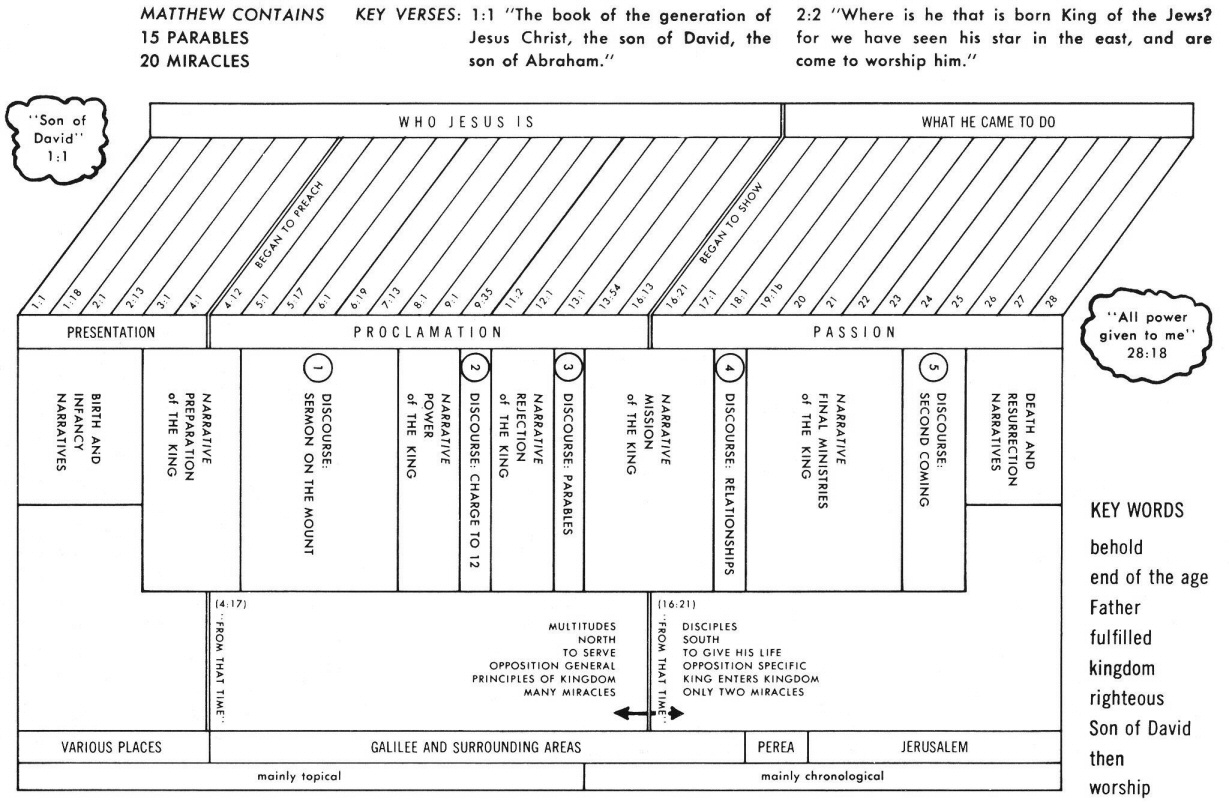
Click chart to enlarge
Charts from Jensen's Survey of the NT - used by permission
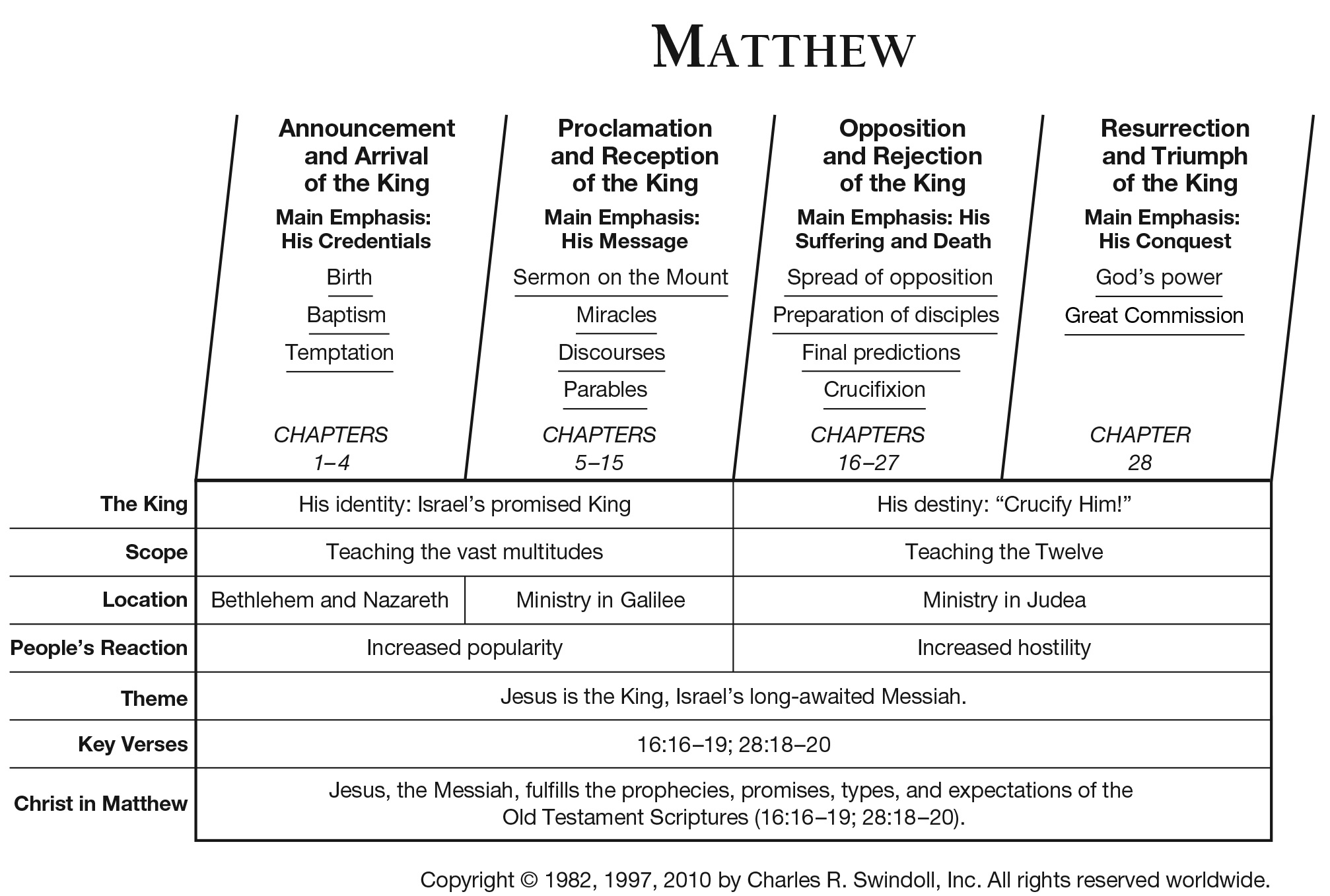
Another Chart from Charles Swindoll
THE LIFE OF JESUS AS COVERED
BY MATTHEW (shaded area)
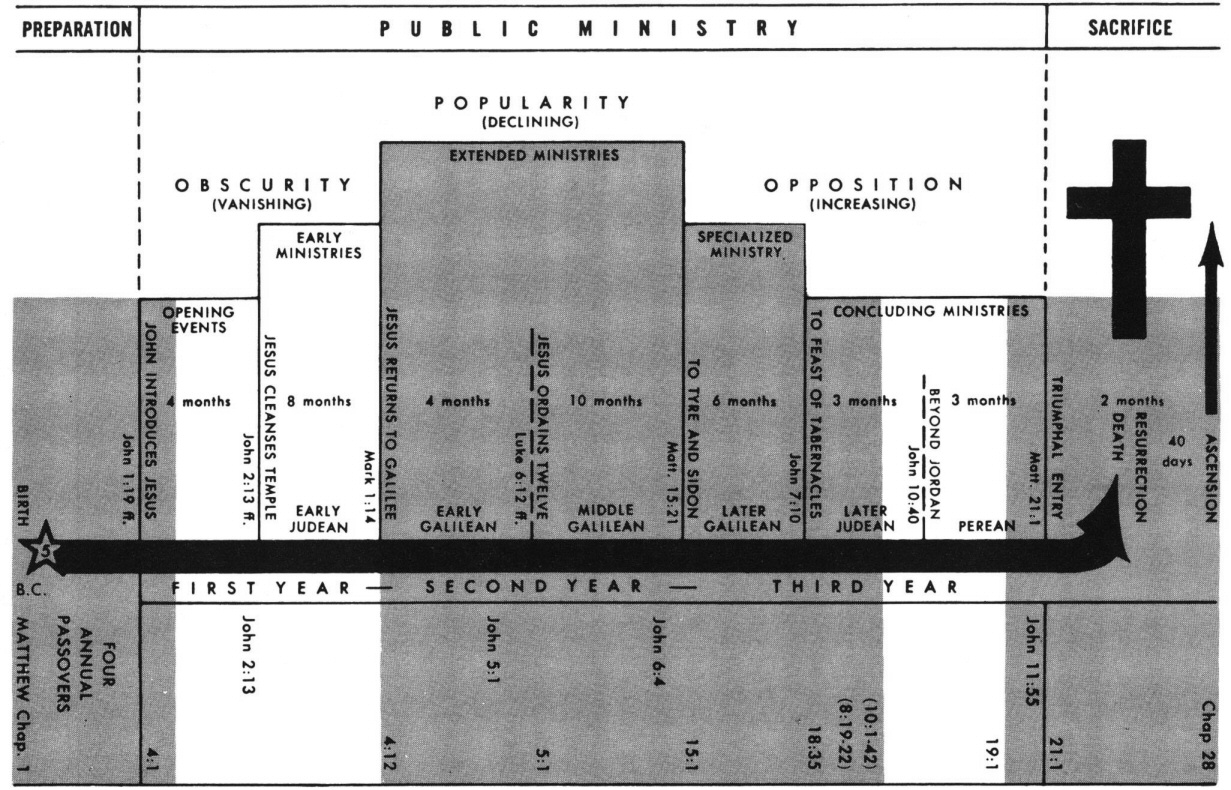
Click chart to enlarge
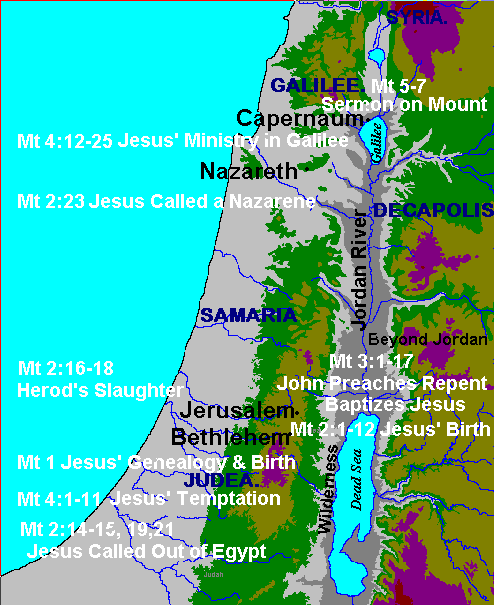
Jesus Birth and Early Years
Leading up to the Sermon on the Mount
Matthew 1-7

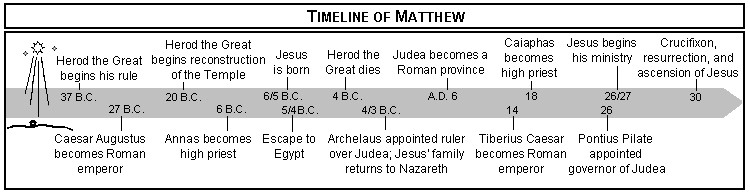
Source: Ryrie Study Bible
Matthew 5:43 "You have heard that it was said, 'YOU SHALL LOVE YOUR NEIGHBOR and hate your enemy.' (NASB: Lockman)
Greek: Ekousate ( 2PAAI ) oti errethe, ( 3SAPI ) Agaphseis (2SFAI) ton plesion sou kai miseseis (2SFAI) ton echthron sou.
Amplified: You have heard that it was said, You shall love your neighbor and hate your enemy; (Amplified Bible - Lockman)
NLT: "You have heard that the law of Moses says, 'Love your neighbor' and hate your enemy. (NLT - Tyndale House)
Philips: "You have heard that it used to be said, 'You shall love your neighbour', and 'hate your enemy' (New Testament in Modern English)
Wuest: You heard that it was said, You shall love your friend and hate the one who is hostile to you, hates you, and opposes you.
Young's Literal: 'Ye heard that it was said: Thou shalt love thy neighbour, and shalt hate thine enemy;
YOU HAVE HEARD THAT IT WAS SAID, 'YOU SHALL LOVE YOUR NEIGHBOR AND HATE YOUR ENEMY: Ekousate (2PAAI) hoti errethe, (3SAPI) Agapheseis (2SFAI) ton plesion sou kai miseseis (2SFAI) ton echthron sou:
- Mt 19:19; 22:39,40; Lv 19:18; Mk 12:31, 32, 33, 34; Lk 10:27, 28, 29; Ro 13:8, 9, 10; Gal 5:13,14; Jas 2:8
- Ex 17:14, 15, 16; Dt 23:6; 25:17; Ps 41:10; 139:21,22
- Matthew 5 Resources - Multiple Sermons and Commentaries
You have heard - "You have heard"—that's the human standard. Then He said, "But I say to you"—that's God's standard.
Love (25) (agapao [word study] see related study of noun agape) means to love unconditionally and sacrificially as God Himself loves sinful men (John 3:16), the way He loves the Son (Jn 3:35, 15:9, 17:23, 24). This verb as used in the Scripture (and here by Jesus) expresses the purest, noblest form of love, which is volitional (personal choice), is not motivated by the recipient's superficial appearance, by one's emotional attraction, or by a sentimental relationship.
This quality of love is not just a feeling but ultimately can be known only by the actions it prompts in the one who displays agape love. For example, God gives the supreme example of this love in the sending of His only Son (see 1Jn 4:9, 10) to die for undeserving sinners. Obviously then, agapao is not the love of complacency nor is it a love that is dawn out by some excellency in its recipients (e.g., as shown in Ro 5:8 [note]). This type of love was perfectly present in and modeled by Jesus when He lived among men (Ep 5:22).
From these brief notes it is clear that to love your neighbor (whether they are "lovable" or not) requires a self denial. In other words agape is a selfless love that thinks of others before it thinks of self. It follows that the only way one can truly love… another (with this quality of love) is by divine enablement, which Paul explains is the fruit of His Spirit in Gal 5:22 (note).
This OT command to love your neighbor is from Lv 19.18, and was interpreted by the Jews so as to apply to fellow Israelites, not to aliens.
Jamieson adds this comment regarding "and hate thine enemy"…
as if the one (hate… enemy) were a legitimate inference from the other (love… neighbor), instead of being a detestable gloss, as Bengel indignantly calls it. Lightfoot quotes some of the cursed maxims inculcated by those traditionists (Jewish teachers) regarding the proper treatment of all Gentiles. No wonder that the Romans charged the Jews with hatred of the human race.
Neighbor (4139) (plesion from pélas = near, near to) literally means near, quite near, nearby = position quite close to another position. Figuratively, plesion means to be near someone and thus be a neighbor.
Plesion - 17x in 17v - Mt 5:43; 19:19; 22:39; Mk 12:31, 33; Lk 10:27, 29, 36; Jn 4:5; Acts 7:27; Ro 13:9f; 15:2; Gal 5:14; Ep 4:25; Jas 2:8; 4:12. NAS = near(1), neighbor(16).
The lawyer’s question, “Who is my neighbor?” reflects a key ethical issue: for whom are we responsible in justice and mercy? In the Old Testament, Israel’s sense of being God’s chosen people often led to special care for fellow Israelites, while laws still required compassion toward foreigners. Over time this “special love” could become favoritism and neglect of outsiders. By Jesus’ day, “neighbor” was generally limited to Jews and proselytes. Jesus radically widened the definition: a neighbor is anyone we encounter in need—Jew, Samaritan, or Gentile. In the Good Samaritan parable, Jesus removes all limits on compassion. This teaching, along with His command to love enemies, shaped the early church, calling believers to love all people while still showing special care for fellow Christians.
In the Old Testament, the idea of “neighbor” primarily referred to fellow Israelites—the covenant community—toward whom special benevolence was expected, though laws also required justice and compassion for foreigners. To be a “neighbor” was closely tied to kinship and community identity, and legal regulations governed interactions among neighbors (e.g., debt release among Hebrew brethren). Over time, Jewish understanding tended to restrict neighborly obligation to fellow Jews. Jesus, however, redefined the concept expansively, teaching through the parable of the Good Samaritan that a neighbor is anyone in need, regardless of ethnic or religious boundaries, thus breaking down traditional barriers and directing compassion toward all whom we encounter (Luke 10:25-37). Early Christianity affirmed this broader understanding, urging believers to show love to both Jewish and Gentile neighbors (e.g., Gal 5:14), emphasizing that loving one’s neighbor expresses the heart of God’s law.
The point of this Greek word especially in the context in which Jesus uses it is that our "neighbor" is anyone "near" (plesion), and thus is anyone we encounter in our life who needs our help. Love is (or at least ideally should be) the inevitable response of the heart in which God's love has been poured by the Holy Spirit (Ro 5:5).
Vincent explains that neighbor is…
Another word to which the Gospel has imparted a broader and deeper sense. Literally it means the one near (so the English., neighbor = nigh-bor), indicating a mere outward nearness, proximity. Thus a neighbor might be an enemy. Socrates (Plato, “Republic,” ii., 373) shows how two adjoining states might come to want each a piece of its neighbor’s (ton plesion) land, so that there would arise war between them; and again (Plato, “Theaetetus,” 174) he says that a philosopher is wholly unacquainted with his next-door neighbor, and does not know whether he is a man or an animal.
The Old Testament expands the meaning to cover national or tribal fellowship, and that is the sense in our Lord’s quotation here. The Christian sense is expounded by Jesus in the parable of the Good Samaritan (Luke 10:29), as including the whole brotherhood of man, and as founded in love for man, as man, everywhere. (Matthew 5)
Hate (3404) (miseo from misos = hatred) means dislike strongly, with the implication of aversion and hostility. Miseo usually implies active ill will in words and conduct. Miseo means to hate, detest, or strongly dislike, often expressing hostile opposition or rejection. In Scripture it can describe: Human hatred toward others (hostility, persecution); God’s righteous hatred of evil, sin, and hypocrisy; Comparative priority (e.g., “hate father and mother”—Luke 14:26) meaning to love less by comparison, not literal emotional hatred. In essence, miseō conveys a decisive stance of rejection—either morally (God toward sin) or relationally (choosing loyalty to Christ over all else).
Miseo - 42x in 38v - NAS = hate(13), hated(12), hateful(1), hates(12), hating(2). Matt 5:43f; 6:24; 10:22; 24:9f; Mark 13:13; Luke 1:71; 6:22, 27; 14:26; 16:13; 19:14; 21:17; John 3:20; 7:7; 12:25; 15:18f, 23ff; 17:14; Rom 7:15; 9:13; Eph 5:29; Titus 3:3; Heb 1:9; 1 John 2:9, 11; 3:13, 15; 4:20; Jude 1:23; Rev 2:6, 15; 17:16; 18:2.
Enemy (hostile) (2190)(echthros from échthos = hatred, enmity; noun = echthra = enmity, hostility) is an adjective which pertains to manifesting hostility or being at enmity with another, where enmity is a deep seated animosity or hatred which may be open or concealed or a "deep-rooted hatred."
In the active sense echthros means to be hateful, hostile toward, at enmity with or adversary of someone, hating and opposing another.
In the passive sense echthros pertains to being subjected to hostility, to be hated, to be odious or to be regarded as an enemy.
Echthros is one who has the extreme negative attitude that is the opposite of love and friendship. An enemy is one that is antagonistic to another; especially seeking to injure, overthrow, or confound the opponent. Scripture often uses echthros as a noun describing "the adversary", Satan! Like father like son!
Echthros - 32x in 32v - Matt 5:43f; 10:36; 13:25, 28, 39; 22:44; Mark 12:36; Luke 1:71, 74; 6:27, 35; 10:19; 19:27, 43; 20:43; Acts 2:35; 13:10; Rom 5:10; 11:28; 12:20; 1 Cor 15:25f; Gal 4:16; Phil 3:18; Col 1:21; 2 Thess 3:15; Heb 1:13; 10:13; Jas 4:4; Rev 11:5, 12. NAS = enemies(20), enemy(10), enemy*(1), hostile(1).
Hate your enemy - On this statement A T Robertson comments that
This phrase is not in Lev. 19:18, but is a rabbinical inference which Jesus repudiates bluntly. The Talmud says nothing of love to enemies. Paul in Ro 12:20 quotes Pr 25:22 to prove that we ought to treat our enemies kindly. Jesus taught us to pray for our enemies and did it himself even when he hung upon the cross.
Our word “neighbour” is “nigh-bor,” one who is nigh or near like the Greek word [plēsion] here. But proximity often means strife and not love. Those who have adjoining farms or homes may be positively hostile in spirit. The Jews came to look on members of the same tribe as neighbours as even Jews everywhere. But they hated the Samaritans who were half Jews and lived between Judea and Galilee. Jesus taught men how to act as neighbours by the parable of the Good Samaritan (Luke 10:29ff.). (Matthew 5)
MacDonald adds that…
Although they were never explicitly commanded to hate their enemy, this spirit underlay much of their indoctrination. This attitude was a summary of the OT’s outlook toward those who persecuted God’s people (see Ps. 139:21, 22). It was a righteous hostility directed against the enemies of God. (BORROW Believer's Bible Commentary)
Spurgeon…
In this case a command of Scripture had a human antithesis fitted on to it by depraved mind; and this human addition was mischievous. This is a common method — to append to the teaching of Scripture a something which seems to grow out of it, or to be a natural inference from it: which something may be false and wicked. This is a sad crime against the Word of the Lord. The Holy Spirit will only father his own words. He owns the precept, “Thou shall love thy neighbor ”, but he hates the parasitical growth of “hate thine enemy. ” This last sentence is destructive of that out of which it appears legitimately to grow; since those who are here styled enemies are, in fact, neighbors. Love is now the universal law; and our King, who has commanded it, is himself the Pattern of it. He will not see it narrowed down, and placed in a setting of hate. May grace prevent any of us from falling into this error! Mt 5:44, 45. But I say unto you, Love your enemies, bless them that curse you, do good to them that hate you, and pray for them which despitefully use you, and persecute you; that ye may be the children of your Father which is in heaven: for he maketh his sun to rise on the evil and on the good, and sendeth rain on the just and on the unjust. (CHAPTER 5)
Ours it is to persist in loving, even if men persist in enmity. We are to render blessing for cursing, prayers for persecutions. :Even in the cases of cruel enemies, we are to; do good to them, and pray for them. ” We are no longer enemies to any, but friends to all. We do not merely cease to hate, and then abide in a cold neutrality; but we love where hatred seemed inevitable. We bless where our old nature bids us curse, and we are active in doing good to those who deserve to receive evil from us. Where this is practically carried out, men wonder, respect, and admire the followers of Jesus. The theory may be ridiculed, but the practice is reverenced, and is counted so surprising, that men attribute it to some Godlike quality in Christians, and own that they are the children of the Father who is in heaven. Indeed, he is a child of God, who can bless the unthankful and the evil: for in daily providence the Lord is doing this on great scale, and none but his children will imitate him. To do good for the sake of the good done, and not because of the character of the person benefited, is a noble imitation of God. If the Lord only sent the fertilizing shower upon the land of the saintly, drought would deprive whole leagues of land of all hope of a harvest. We also must do good to the evil, or we shall have a narrow sphere, our hearts will grow contracted, and our sonship towards the good God will be rendered doubtful. Mt 5:46. For if ye love them which love you, what reward have ye? Do not even the publicans the same?
Spurgeon has the following devotional thought regarding "Love thy neighbour"…
Perhaps he rolls in riches, and thou art poor, and living in thy little cot side-by-side with his lordly mansion; thou seest every day his estates, his fine linen, and his sumptuous banquets; God has given him these gifts, covet not his wealth, and think no hard thoughts concerning him. Be content with thine own lot, if thou canst not better it, but do not look upon thy neighbour, and wish that he were as thyself. Love him, and then thou wilt not envy him.
Perhaps, on the other hand, thou art rich, and near thee reside the poor. Do not scorn to call them neighbour. Own that thou art bound to love them. The world calls them thy inferiors. In what are they inferior? They are far more thine equals than thine inferiors, for "God hath made of one blood all people that dwell upon the face of the earth. " It is thy coat which is better than theirs, but thou art by no means better than they. They are men, and what art thou more than that? Take heed that thou love thy neighbour even though he be in rags, or sunken in the depths of poverty.
But, perhaps, you say, "I cannot love my neighbours, because for all I do they return ingratitude and contempt." So much the more room for the heroism of love. Wouldst thou be a feather-bed warrior, instead of bearing the rough fight of love? He who dares the most, shall win the most; and if rough be thy path of love, tread it boldly, still loving thy neighbours through thick and thin. Heap coals of fire on their heads, and if they be hard to please, seek not to please them, but to please thy Master; and remember if they spurn thy love, thy Master hath not spurned it, and thy deed is as acceptable to him as if it had been acceptable to them. Love thy neighbour, for in so doing thou art following the footsteps of Christ. (Morning and Evening)
Violent hatred sinks us below those we hate. -Anon.
Animosity cloaked in piety is a demon even if it sits in church praising the Creator. - Calvin Miller
QUESTION - Where did “love your neighbor and hate your enemy” come from? GOTQUESTIONS.ORG
ANSWER - In Matthew 5:43, Jesus challenges a common teaching of His day: “You have heard that it was said, ‘Love your neighbor and hate your enemy.’” This verse appears in the Sermon on the Mount, where Jesus reinterprets many familiar teachings and elevates the moral expectations of His followers. But where did the saying “Love your neighbor and hate your enemy” come from?
The first part of this teaching, “Love your neighbor,” originates directly from the Old Testament. In Leviticus 19:18, God commands, “Do not seek revenge or bear a grudge against anyone among your people but love your neighbor as yourself. I am the Lord.” This command was foundational to the ethical life of ancient Israel and shaped much of the moral instruction in Jewish society.
In its original context, neighbor was generally understood to mean “one’s fellow Israelite” or “member of the covenant community.” The command to love one’s neighbor as oneself was a call to seek the welfare of others within the shared religious and national identity of Israel. The command was clear: instead of holding grudges or seeking revenge, people were called to extend love, compassion, and fairness to their fellow Israelites.
There are glimpses in the Old Testament of the idea of neighbor love being broadened. For instance, in Leviticus 19:34, God commands, “The foreigner residing among you must be treated as your native-born. Love them as yourself, for you were foreigners in Egypt.” This command expands the definition of neighbor to include even those outside of Israel’s covenant community, particularly the vulnerable or marginalized.
However, by the time of Jesus, many in Israel interpreted neighbor more narrowly, excluding foreigners, Gentiles, or perceived enemies. This limited interpretation made it easier to justify hostility or hatred toward those not part of their group.
Unlike the command to “love your neighbor,” there is no explicit Old Testament command to “hate your enemy.” However, Israel’s tumultuous history may have contributed to an attitude of hatred toward enemies. The Israelites were frequently at war with neighboring nations, and some Old Testament texts describe actions that seem harsh by modern standards. For example, in Deuteronomy 7:2, God instructs Israel to destroy the Canaanite nations and show them no mercy. Such passages focused on the preservation of Israel’s holiness and may have influenced a mindset that viewed enemies with contempt and hatred.
Additionally, certain psalms express a strong emotional response toward the enemies of God. In Psalm 139:21–22, David writes, “Do I not hate those who hate you, Lord, and abhor those who are in rebellion against you? I have nothing but hatred for them; I count them my enemies.” This psalm reflects the intensity of righteous indignation against those who oppose God and may have given rise to the teaching that hatred toward personal enemies was justified.
While these Old Testament texts express strong language about enemies, they are not commands to harbor personal hatred. Instead, they reflect moments in Israel’s history or specific attitudes toward the enemies of God. Over time, however, some Jewish teachers and interpreters may have taken these ideas to mean that hating one’s enemies was permissible or even virtuous, especially in contrast to the command to love fellow Israelites.
In Matthew 5:43–44, Jesus acknowledges this common belief: “You have heard that it was said, ‘Love your neighbor and hate your enemy.’ But I tell you, love your enemies and pray for those who persecute you.” Here, Jesus completely overturns the accepted norms of His day. Rather than limiting love to one’s immediate community and allowing hatred for enemies, Jesus commands a revolutionary love that extends even to those who oppose or harm us.
- Christ prayed for his -Lk 23:34
- The lives of, to be spared -1Sa 24:10; 2Sa 16:10,11
- The goods of, to be taken care of -Ex 23:4,5
SHOULD BE
- Loved -Matthew 5:44
- Prayed for -Acts 7:60
- Assisted -Proverbs 25:21; Ro 12:20
- Overcome by kindness -1Sa 26:21
- Rejoice not at the misfortunes of -Job 31:29
- Rejoice not at the failings of -Pr 24:17
- Desire not the death of -1Ki 3:11
- Curse them not -Job 31:30
- Be affectionately concerned for -Ps 35:13
- The friendship of, deceitful -2Sa 20:9,10; Pr 26:26; 27:6; Mt 26:48,49
- God defends against -Ps 59:9; 61:3
- God delivers from -1Sa 12:11; Ezra 8:31; Ps 18:48
- Made to be at peace with saints -Proverbs 16:7
- Pray for deliverance from -1Sa 12:10; Ps 17:9; 59:1; 64:1
- Of saints, God will destroy -Ps 60:12
- Praise God for deliverance from -Ps 136:24
Hostage of Guerrilla Soldiers - In August 1983, Russell Stendal was taken hostage into the jungle of Columbia, South American, by a band of guerrilla soldiers. For nearly 5 months he learned what it really means to love one’s enemies. He wrote a letter home, saying, “I am in danger only of losing my life; they are in danger of losing their souls.” Through kindness, Russell befriended his guards. One day the commander told him, “We can’t kill you face to face; we like you. So we will have to kill you in your sleep.” God enabled Russell to forgive, but for the next 10 days and nights he couldn’t sleep. A submachine gun was repeatedly thrust in his face under his mosquito net, but the guards couldn’t bring themselves to pull the trigger. On January 3, 1984, Russell was released. When he said goodbye, tears fill the eyes of some of his captors. (Our Daily Bread, Copyright RBC Ministries, Grand Rapids, MI. Reprinted by permission. All rights reserved)
A HEART FREE OF HATRED - THE message of Jesus is simple yet astounding: Love your enemies; do good to those who mistreat you; repay evil with kindness. When we live by these principles, we keep our hearts free of hatred no matter how others feel toward us.
Steve Estes reported a remarkable example of this in the Wycliffe Bible Translator. In January 1981, Colombian rebels kidnapped Chet Bitterman, shot him, and left his body in a hijacked bus. Imagine how his parents and loved ones must have felt at the senseless death of this young man!
But in April 1982, as a demonstration of international good will, the churches and civic groups of Bitterman's native area, Lancaster County, Pennsylvania, gave an ambulance to the state of Meta in Colombia, where the young linguist was killed.
Bitterman's parents traveled to Colombia for the presentation of the ambulance. At the ceremony his mother explained, "We are able to do this because God has taken the hatred from our hearts."
This is the power of Christ in action! When we are wronged and ill will begins turning to hatred in our hearts, we need to ask God to change us and enable us to show kindness to the one who has wronged us. This is the way to turn hatred into love.—D C Egner
Difficult People - I haven't always appreciated every member of the churches I pastored. Early in my ministry one man berated me in front of a group of people for my deep and dull sermons. A week later a deacon said my sermons were interesting but too simple--like little Sunday school lessons.
At the time I didn't thank God for those cantankerous people. Nor did I thank the Lord for the person who disheartened our new assistant organist by placing an anonymous note on the organ criticizing her makeup.
I have learned, though, that I can appreciate and even show love to people who irritate me.
As I read the words of the apostle Paul in his letters to the Corinthians, I find him expressing both deep hurt and powerful love. He received unjust criticism from several people in Corinth (2 Cor. 10:10), yet he continued to minister to them. He knew that difficult people, like difficult situations, teach us to rely on the Lord and to allow Him to show His power at work in our lives (12:9-10).
Over the years, the Lord has helped me to show love to those who have irritated me. Many have become my friends. Dealing with difficult people will never be easy for us, but through the Spirit's power we can do it. — Herbert Vander Lugt , Copyright RBC Ministries, Grand Rapids, MI. Reprinted by permission. All rights reserved)
Thinking It Over
How do you respond when someone criticizes you?
Why is it so hard to respond with love and patience?
How does Matthew 5:43, 44, 45, 46, 47, 48 apply to these situations?
The worst criticism against you can bring out the best in you.
(Mt 5:43, 44, 45, 46, 47, 48) F B Meyer
IN the garden the serpent suggested to our first parents that they should be as God, in knowing good and evil; but the Master tells us that we are to be as God in the character and temper of our inner life. If His words here are compared with the parallel ones in Luke 6., we discover that He desires us to resemble our Heavenly Father, not in our knowledge-which would, of course, be impossible, but in our love and mercy. The perfection on which He insists is a perfection of love. Our natures are, of course, limited in extent and shallow in depth as compared to the ocean fulness of the Infinite God; but a cup may be in its measure as brimming full as an ocean when the tide is high. Up to our measure we may become as full of Love as, in His far greater measure, our Father is; and this is what Christ demands when He says:
"Be ye therefore perfect,even as your Father which is in heaven is perfect."
This is the fifth illustration which He gives, that He is come, not to destroy, but to fulfil the Law by shedding abroad in our hearts that love which is the fulfilling of that Law; and it is interesting to notice exactly the change which He wrought in the ancient code.
The precept which our Lord quotes: "Thou shalt love thy neighbour and hate thine enemy," cannot be found in the Old Testament. On the contrary, its pages are strewn with the most moving exhortations to love. If any of my readers would take the pains to investigate the matter, they would be startled to find the numerous exhortations to love which are scattered through the ancient code, generally considered so rigorous and severe. "If," said Moses, "thou meet thine enemy's ox or his ass going astray, thou shalt surely bring it back to him again." And again: "If thou see the ass of him that hateth thee lying under his burden, woudst thou forbear to help him? Thou shalt surely help with him" (Exod. 23:4-5). In a later age the same kindly spirit appears in the injunction of the preacher: "Rejoice not when thine enemy falleth, and let not thine heart be glad when he stumbleth, lest the Lord see it, and it displease Him."" When, therefore, our Lord said: "Ye have heard that it hath been said, ' Love your neighbour and hate your enemy,'" He did not mean to refer to the inspired teachers of His people, but to those later Rabbis and Scribes who had overlaid the pure gold of Moses with their own incrustations.
There were two ways in which the teachers of the corrupt periods of Hebrew history had vitiated the scope of these ancient laws. First, they had obliterated the words "as thyself," and whittled down the precept from "Thou shalt love thy neighbour as thyself," to "Thou shalt love thy neighbour." Next, they had, out of their own bad hearts, added the words, "and hate thine enemy" lowering the Word of God to suit their own tradition.
Was it not high time that the moss and grit of centuries should be removed from the ancient characters which the Spirit of God had cut in the legislation of Sinai, and that Christ should re-edit the old law, doing away with the hateful additions, and enlarging the significance of that word "neighbour"? They had delighted in limiting it. He rejoiced to level the walls of religious bigotry, jealousy, and national exclusivism, and taught that our neighbour is simply anyone to whom we can show kindness, so that the word stands for the universal brotherhood of man.
Our Lord desires that we should show love and kindness not only to man as man, but equally to our enemies as to our friends; to those that curse, hate, and despitefully use us, as to those who will sacrifice everything on our behalf.
To enable us to realize such a command He suggests the Inspiration of a great Nature, a great Example, and a great Hope.
(1) WE NEED THE INSPIRATION OF A GREAT NATURE.
"Sons of your Father which is in Heaven "; "Sons of the Highest" (Luke 6:35). Men count much on ancestry. To be connected, however distantly, with the great of bygone times, is a subject of never-ceasing congratulation. To be able to point to some tomb, where the cross-legged effigy on the stone denotes the Knight Templar, or the shell indicates the pilgrim who crossed the seas on the Crusades, is of prouder boast than wealth and lands. To wear a coat-of-arms, which proves royal affinity, ah, how much is this! And there is ground for it, because descent and blood undoubtedly count for something. When the special call comes there is something in heredity that answers it.
How much then must it not count for, when we stand face to face with urgent duty, that the capacity for its due discharge is certainly within us by virtue of our relationship to God through Jesus Christ?
We have been born again by the Word and the Spirit. From the family of the first Adam we have become grafted into the family of the second. We are all the children of God by faith in Him, and if children then heirs, heirs of God, and joint heirs with Christ. And because we are sons God hath sent forth the Spirit of His Son into our hearts. Since, then, we are partakers of the Divine Nature, we have within us the capacity for Divine Love. We may not be aware of its presence within us, but it is there, and if only we would dare to give it exercise, and allow it to make for itself an outlet in our kindly advances towards those who have served us ill, we should find that through the channels of outward expression the very fountains of Divine Love which are within us would pour their crystal tides.
You can love as God, not in quantity, but in quality, because God's own nature has been begotten in you, and awaits the opportunity of approving itself before men and angels.
(2) BUT WE NEED, ALSO, THE INSPIRATION OF A GREAT EXAMPLE.
Who is there that has not sometimes stood on the mountain of Transfiguration with Moses and Elias? A visit from some celestial nature, a biography, a noble act, a reunion which has revealed depths and emotion that surpass all previous experiences these have greatly influenced our lives, and made us resolve that life should henceforth be new. And so our Lord brings us face to face with a marvellous illustration of the love which He desires us to show.
Of course, He Himself, as He sat there, was the supreme instance of God's impartial love. But the time had not arrived when He could speak plainly of Himself; so He selected His example from the humbler book of Nature, which He had often studied in His highland home, and which lies open before all men's eyes.
It was the month of April. Before His eyes was spread a charming landscape, on which probably the natural incidents to which He referred were at that moment taking place.
At that moment the sun was shining. It was the Father's sun, " He maketh His sun to shine." It was His thought, His creation, the instrument of His benediction. "See," said the Master, "how the sun is shining on the children as they play their merry games, and at the same moment on the prison filled with hardened criminals; on the casement of the cottage to revive the sick girl's drooping life, and on the path of the poor fallen one, as she avoids it, and steals into the shade; upon the little patch of ground belonging to the poor widow, which barely affords her a living, and the acres of the avaricious tyrant, who cares neither for God nor man, and would despoil her of her holding if he could. The sun shines equally on them all."
Then the Master may have pointed towards the heavy rain-cloud, born from the Mediterranean, which came trailing over the country, dropping its beneficent showers from its impartial buckets. Yonder lie two fields with but a narrow fence between. That to the right belongs to an atheist of the worst type, who blasphemes God's name, underpays his servants, robs the widow, and browbeats the poor. That to the left is the holding of one who is as careful of his religious observances as the other is careless. The swift shadow of the cloud draws near. If it were steered by a human hand, it would probably be guided, so as to leave the one untouched whilst it poured its stores on the other. But there is no shade of difference in the distribution. The abundant and refreshing showers fall on either side of the fence.
Life is like an April day. It is not all sun, nor all cloud. The saddest lives have some patches of blue, some hours of sun. The happiest have some showers, and are overspread now and again with shadow. And surely this is best, for those characters are not the noblest which are spent always on the tableland, and never descend unto the valley of shadow. For Sun, you have had love at home, a happy childhood, a loving wife, sweet children, prosperous years in business, long spells of good health, happy episodes, weeks and months of country or sea. For Rain, you have had seasons of ill-health, of business anxiety, and of bereavement. Now, if we were to compare experiences between the men and women of our acquaintance in the same position of life, putting away all considerations of the inner peace of heart which religion gives, I do not suppose that in the outward life there would be much apparent difference. There are thousands of homes where God's name is not honoured, where but goodness and mercy, like guardian angels, follow the inmates all the days of their lives.
Why? Because the course of events in this world moves by a blind machinery? No. Because God has no special care whether a man be good or bad? No. But because God loves His enemies, blesses those that curse Him, and is kind to the unthankful and unloving. If anything, He seems more bountiful to those who oppose Him most, that by His mercy He may lead them to repentance.
A man will sometimes speak thus: "I am one of the luckiest fellows living; all my dreams have been realized; I have a good wife, have not had an hour's illness, and have never wanted for money." Such men do not realize that it is God who has given them all things richly to enjoy, making no distinction between them and His dearest children, because so set on breaking in upon their shameful neglect of His claims. He gives "rain from heaven and fruitful seasons, filling our hearts with good and gladness," that we may turn from vanity unto the living God, which made heaven and earth, and the sea, and all things that are therein (Acts 14:15-17).
We might, from the experience of these men, edit a new edition of the parable of the Prodigal in this wise: that when the father in the distant home heard that his son had spent all that he had, instead of letting him come down to the herding of pigs and the eating of their husks, he sent him day by day supplies of sumptuous food, on each hamper of which these words were inscribed, "I love thee still; come home, haste to come home."
But God has given us another and better Sun than that which He has hung in heaven's porch. "He commendeth His Love towards us, in that while we were yet sinners, Christ died for us." And the benefits of the death of the Redeemer are for the world. Therefore it was possible to carry the Gospel, in the' first instance, to Jerusalem. The men who had used Him most despitefully lived there, therefore the Master bade His disciples to begin at Jerusalem. "Tell Caiaphas, who sneered at My royalty, that I love him. Tell the grey-haired Annas, the irresolute Pilates and the mocking Herod, that I desire to bless them. Go and find out the men who drove the nails into My hands and laughed at My dying anguish, that I will pray for them." So the Master left us an example, that we should follow in His steps.
And God has given another and better Rain than that which fertilizes the fields, the rain of the Holy Spirit's influence and grace, which is for the most stubborn and obdurate offenders. Did He not descend in copious effusion upon the city of Jerusalem at the first, though it had but lately crucified the world's Redeemer? Take heart, you who think that you have grieved Him away, who have done Him despite, who fear that you have committed the unpardonable sin; even to you He comes with a shower of grace, falling with refreshing bounty.
This is the example that we are to follow. Nothing less than God's even-handed love is to be our model. We are to be perfect, even as our Heavenly Father is perfect. We are called to be imitators of God, as dear children, walking in love, as Christ also hath loved us, even to the point of giving Himself for us (Eph. 5:1, 2). Anything short of this is not Christianity as our Lord taught it.
Dr. Abbott has said that he remembers, when he was a boy, sitting by the fireside of a little country inn in Maine, and hearing some men discuss the Sermon on the Mount. They were rough fellows, and one of them, scoffing at Christianity, said, "Thou shalt love thy neighbour, nonsense! It is not in human nature." Exactly; such love is not in human nature. Men love those who love them, and salute their brethren, and stop there. But it was in Christ's nature, and it is in the Divine nature; and it is in the Divine nature to be imparted through Christ to those who claim it.
(3) WE REQUIRE, LASTLY, THE INSPIRATION OF A GREAT HOPE.
What animates a woman to spend her life on some brutal husband or ungrateful son? Is it not the hope that, at last, her love will conquer? And is it not this, in an infinitely higher sphere, that leads God, our Father, to pour out the ceaseless tides of His heart on the disobedient and rebellious? Does He not see the consummation when the heavens and the earth shall have become new as the result of His unstinted love? And ought not the same purpose to animate us?
It is recorded of a certain Chinese emperor that, on being apprised that his enemies had raised an insurrection in a distant province, he said to his officers: "Come, follow me, and we shall quickly destroy them." On his arrival the rebels submitted to him, and all expected that he would take the most signal revenge. Instead of this the captives were treated with the utmost humanity. "How!" cried his first Minister of State, "is this the manner in which your promise is fulfilled? Your royal word was given that your enemies should be destroyed, and, lo, you have pardoned them all, and even some of them have been caressed." "I promised," said the Emperor, generously, "to destroy my enemies. I have fulfilled my word, for, see, they are enemies no longer; I have made friends of them."
We must henceforth amend our ways, lest we be counted not worthy of Christ. We must rise to the level of His high demands, not in our own strength but His. And let us remember two things: First, not to wait for an emotion, but to obey by the sheer power of our will; and, secondly, to begin with individual's.
Have we an enemy who is always trying to curse us? We must be willing to bless him with the benediction of our goodwill.
Is there someone in our life who envies and hates us? We must be willing to be kind and good so long as we are sure that our behaviour is not misinterpreted or hurtful to his independence and moral life.
Is there one who despitefully uses and persecutes us? We must compel ourselves to pray for him, until presently a warm feeling of compassion fills our hearts.
Are there within our reach churlish and bearish people? Let us salute them, when we meet, with Christian courtesy and grace.
Thus you will reach perfection. It will not be the absolute and infinite perfection of God, for at best it can be only relative and finite. It will not be the perfection of angels, for they have never left their first estate. It will not be a perfection of knowledge, for we are all liable to error. It will not be freedom from temptation, or from such infirmities as weakness of body, dullness of understanding, and incoherence of thought. But it will be after your measure a full-orbed, equable, and loving nature, which shall go through the world shedding sunshine and rain on weary and hopeless souls until they be led to take up heart and hope again.
A little child gets into a railway carriage. In perfect simplicity she begins to play with some austere-looking man until he relaxes and the two become friends; and from them a genial warmth steals through the carriage, until everyone begins to talk kindly with his neighbour, and the tedium of the journey is relaxed. Oh, to go through the world like that, with God's radiance on our faces and His love in our hearts! Every day be sunshine or rain to someone, and especially to your enemies, and the people from whom you are naturally repelled.
You say that all this is impossible for you. It is high: you cannot attain unto it. But remember those sweet old words: "When Israel was a child, then I loved him, and called my son out of Egypt. I taught Ephraim also to go" (Hos. 11:1, 2, 3). Ask your Heavenly Father to teach you to go; to put His Spirit within you as the fountain of His life and love; to work in you to will and to do of His good pleasure.
Everything lies in the will. Are you willing that His will should be done in and through you in respect to the life of love of which we have been treating? If so, then yield yourself to Him, saying, "I cannot be perfect in love, unless Thou dost undertake to realize in me and through me the image of Thine own perfection." (F. B. Meyer. The Directory of the Devout Life)
Matthew 5:44 "But I say to you, love your enemies and pray for those who persecute you, (NASB: Lockman)
Greek: ego de lego ( 1SPAI ) humin, agapate (2SPAM) tous echthrous humon kai proseuchesthe (2PPMM) huper ton diokonton (PAPMPG) humas
Amplified: But I tell you, Love your enemies and pray for those who persecute you, (Amplified Bible - Lockman)
KJV: But I say unto you, Love your enemies, bless them that curse you, do good to them that hate you, and pray for them which despitefully use you, and persecute you; (Note: Textus Receptus has the added phrase in bold. NET Bible note = "bless those who curse you, do good to those who hate you, and pray for those who mistreat you," is surely a motivated reading, importing the longer form of this aphorism from Lk 6:27, 28. The shorter text is found in a a B ¦1 pc as well as several fathers and versional witnesses.)
NLT: But I say, love your enemies! Pray for those who persecute you! (NLT - Tyndale House)
Philips: but I tell you, Love your enemies, and pray for those who persecute you, (New Testament in Modern English)
Wuest: But, as for myself, I am saying to you, be loving with a divine, self-sacrificial love those who are hostile to you and hate and oppose you, and be praying for those who are persecuting you
Young's Literal: but I -- I say to you, Love your enemies, bless those cursing you, do good to those hating you, and pray for those accusing you falsely, and persecuting you,
BUT I SAY TO YOU, LOVE YOUR ENEMIES: ego de lego (1SPAI) humin, agapate (2SPAM) tous echthrous humon:
- Matthew 5 Resources - Multiple Sermons and Commentaries
Related Resources: Given the fact that inherent in the love of our enemy is an attribute of forgiveness here are some resources on forgiveness (Of love there be two principal offices, one to give, another to forgive - John Boys).
- Exposition of "Forgiveness" in Ephesians 4:32
- Exposition of "Forgiveness" in Colossians 3:13
- Exposition of "Forgiveness" in Matthew 6:12 and Matthew 6:14-15.
- Illustrations and quotes on forgiveness
NT words for forgive/forgiveness:
- Forgiveness (859) aphesis
- Forgive (send away from, cancel the debt, release, let go) (863) aphiemi
- Forgive (grant, freely give, bestow) (5483) charizomai
Excellent 5 Part Sermon Series on Forgiveness by Dr Ray Pritchard: following messages are also in his book - The Healing Power of Forgiveness (see reviews by readers)
- 1) Forgiveness Healing the Hurt We Never Deserved
- 2) Forgiveness and the Lord's Prayer
- 3) Judge Not!
- 4) Is Total Forgiveness Realistic
- 5) The Final Step-Blessing Your Enemies
Other Resources on Forgiveness
- Father, Forgive Them by Dr. Ray Pritchard
- Forgiving the Unforgivable by Dr. Ray Pritchard
- How Can I Learn to Forgive? by Dr. Ray Pritchard
- Unless You Forgive by Dr. Ray Pritchard
- Forgiving the Unforgivable article by Dr. Ray Pritchard
- Forgiveness of Injuries (Mt 18:21-22) by John Angell James
- Forgiveness of Sins by Henry Law - 17 Chapter Treatise!
- The Forgiveness Of God
- Avoiding The Dangers Of Superficial Forgiveness
- When Forgiveness Seems Impossible
- What Is True Forgiveness?
- What Is Real Love = God's definition of love from 1 Corinthians 13
- How Has God Loved Us? = Understanding the truth of God's love for us
LOVE
WITHOUT LIMITS
Love (25) (agapao from the noun agape) (Click study of agape) describes an unconditional, sacrificial love, which ultimately is the love that God is (1Jn 4:8,16) and that God demonstrates (Ro 5:8) (Jn 3:16, 1Jn 4:9) in its supreme form at Calvary.
Agapao is not love of the emotions but of the will . Thus this type of love is not borne from mere human affection but is divine love, commanded by God, produced as fruit in the heart of a surrendered saint by the Holy Spirit (Who is at work in us to will and to work to His good pleasure - Php 2:13) (Ro 5:5; Gal 5:22), self-sacrificial in nature, seeking the benefit of the one who is loved (Love seeks one thing only: the good of the one loved. It leaves all the other secondary effects to take care of themselves.- Thomas Merton), a love which means death to self (Mk 8:34) and defeat for sin since the essence of sin is self-will and self-gratification, a love activated by personal choice of our will (working out our salvation in fear and trembling - Php 2:12; cp Ezek 36:27 = note God's "part" and man's responsibility! This OT passage refers to the promise of the New Covenant) not based on our feelings toward the object of our love (in this case to enemies who may actually hate us) and manifested by specific actions (summarized in 1Co 13:4, 5, 6, 7, 8 an excellent pragmatic, "real time" definition of "love in action" - see notes 1Cor 13:4 13:5 13:6 13:7 13:8). This type of love may involve emotion, but it must always involve action. It is not passive, but active. Love is service rather than sentiment (Stott). Love is the outgoing of the entire nature in self-sacrificing service. (W. H. Griffith Thomas)
As Amy Carmichael so aptly said…
You can give without loving, but you cannot love without giving.
John Owen - Love is that jewel of human nature which commands a valuation wherever it is found.
This quality of love is not just a feeling but ultimately can be known only by the actions it prompts in the one who displays agape love. For example, God gives the supreme example of this love in the sending of His only Son (see 1John 4:9, 10) to die for undeserving sinners. Obviously then, agapao is not the love of complacency nor is it a love that is drawn out by some excellency in its recipients (e.g., as shown in Ro 5:8 [note]). This type of love was perfectly present in and modeled by Jesus when He lived among men (Ep 5:2).
From these brief notes it is clear that to love your enemies (whether they are "lovable" or not) requires a self denial. In other words agape is a selfless love that thinks of others before it thinks of self. It follows that the only way one can truly love… another (with this quality of love) is by divine enablement, which Paul explains is the fruit of His Spirit in Gal 5:22 (note).
Note that in using the present imperative Jesus commands (rather than suggests) this supernatural love as a lifestyle or continual practice. Clearly this command can only be obeyed by grace through faith in the fact that the Spirit of Christ Who indwells will manifest His love through us. It is impossible but is Him-possible!
W. H. Griffith Thomas wrote that…
Love is the outgoing of the entire nature in self-sacrificing service.
G K Chesterton once quipped that
The Bible tells us to love our neighbors, and also to love our enemies; probably because they are generally the same people.
Hunt illustrates the principle of loving (and forgiving) your enemy…
The year is 1944. Nazi Germany occupies Holland. An elderly watchmaker and his family are actively involved in the Dutch Underground. By hiding Jewish people in a secret room of their home, members of the Ten Boom family courageously help Jewish men, women, and children escape Hitler's roll call of death.
Yet one fateful day, their secret is discovered. The watchmaker is arrested, and soon after being imprisoned, he dies. His tenderhearted daughter Betsie also cannot escape the jaws of death at the hands of her cruel captors. In the Nazi concentration camp, she perishes. And what about Corrie, the watchmaker's youngest daughter? Will she live… and, if so, will she ever be able to forgive her captors, those who caused the death of her father and her sister? While she is trying to survive the ravages of Ravensbruck, one of Hitler's most horrific death camps, can anything sustain Corrie ten Boom? To what can she cling? Indeed, Corrie does survive. Her God sustains her. She lives the truth of these words…
False witnesses rise up against me, breathing out violence. I am still confident of this: I will see the goodness of the Lord in the land of the living. Wait for the Lord; be strong and take heart and wait for the Lord. (Ps 27:12, 13, 14)
Two years after the war, Corrie is speaking at a church in Munich. She has come from Holland to a defeated Germany, bringing with her the message that God does indeed forgive. There in the crowd, a solemn face stares back at her. As the people file out, a balding, heavyset man moves toward her—a man in a gray overcoat, a man clutching a brown felt hat. Suddenly a scene flashes back in her mind: the blue uniform; the visored cap with its skull and crossbones; the huge room with its harsh, overhead lights; the humiliation of walking naked past this man… this man who is now standing before her.
"You mentioned Ravensbruck in your talk. I was a guard there," he says. "But since that time I have become a Christian. I know that God has forgiven me for the cruel things I did there, but I would like to hear it from your lips as well."
He extends his hand toward her and asks, "Will you forgive me?" Corrie stares at the outstretched hand. The moment seems like hours as she wrestles with the most difficult decision she has ever had to make. Corrie knows Scripture well, but applying this passage seems to be too much…
If your brother sins, rebuke him, and if he repents, forgive (aphiemi in the aorist imperative = command conveying a sense of urgency - Do this now and do it effectively!) him. If he sins against you seven times in a day, and seven times comes back to you and says, 'I repent,' forgive (aphiemi) him." (Luke 17:3, 4)
Here stands the enemy, the former Nazi SS officer. His very presence stands for cruelty and the stench of crematoriums at Ravensbruck. As Corrie ten Boom stares at the rough hand offered by her former captor, she knows in her head what she has to do—forgive! (Ed: But compare Jesus' charge in Mt 18:35!) But her emotions scream silently in opposition. The very message she has been sharing with the victims of Nazi brutality emphasizes that she must forgive those who persecuted her. Forgiveness is a necessity. But Corrie stands paralyzed as the battle rages between her mind and her emotions.
And I stood there—I whose sins had again and again to be forgiven—and could not forgive. [My sister] Betsie had died in that place—could he erase her slow terrible death simply for the asking?
Imagine Corrie's dilemma. She knows that those who have forgiven their enemies have also been able to rebuild their lives regardless of the physical horrors they suffered. But those who continue to nurse their bitterness remain imprisoned… not in Hitler's horrid concentration camps… but within their own wounded souls. Corrie knows the cost of bitterness—the very bitterness she is battling—because the Bible says,
See to it that no one misses the grace of God and that no bitter root grows up to cause trouble and defile many. (Hebrews 12:15, quoting from Dt 29:17
Corrie ten Boom learned that she not only needed to be forgiven by God, but also that she needed to forgive as God forgives… She needed to show mercy, for Jesus said,
"Go and learn (aorist imperative = command conveying a sense of urgency - Do this now and do it effectively!) what this means: 'I desire mercy (kindness or good will toward the miserable and afflicted, joined with a desire to relieve them), not sacrifice.' For I have not come to call the righteous, but sinners." (Mt 9:13, cp Jas 2:13, Mt 5:7)
The horrors of World War II are now far behind Corrie, but the horrors of the war between forgiveness and unforgiveness still rage. How can she find the strength to take the hand of someone who represents the evil regime that destroyed the two people she held most dear? How can she forgive this man? To Corrie's dismay, she discovers she cannot!
His hand was thrust out to shake mine. And I, who had preached so often… the need to forgive, kept my hand at my side. Even as the angry, vengeful thoughts boiled through me, I saw the sin of them. Jesus Christ had died for this man; was I going to ask for more? Lord Jesus, I prayed, forgive me and help me to forgive him. I tried to smile. I struggled to raise my hand. I could not. I felt nothing, not the slightest spark of warmth or charity. And so again I breathed a silent prayer. Jesus, I cannot forgive him. Give me Your forgiveness. As I took his hand, the most incredible thing happened. From my shoulder along my arm and through my hand a current seemed to pass from me to him, while into my heart sprang a love for this stranger that almost overwhelmed me. And so I discovered that it is not on our forgiveness any more than on our goodness that the world's healing hinges, but on His. When He tells us to love our enemies, He gives, along with the command, the love itself. (The Hiding Place)
THE TORMENT OF
AN UNFORGIVING HEART
In Mt 18:21 Peter asked Jesus about the degree of forgiveness a disciple should exhibit. In response to Peter's generous offer of forgiving up to seven times (the Rabbis taught that 3 times was sufficient), Jesus replied that one must forgive "seventy times seven"! (Mt 18:22). Jesus then illustrated this degree of forgiveness in a parable in which He also explained the grave "danger" of unforgiveness…
Then summoning him, his lord said to him, 'You wicked slave, I forgave (aphiemi) you all that debt because you entreated me. 'Should you not also have had mercy on your fellow slave, even as I had mercy on you?' (So what is having mercy equated with? Clearly showing forgiveness of the debt. cp Mt 5:7, Jas 2:13) And his lord, moved with anger, handed him over to the torturers (basanistes - the jailers - see comment) until (Don't miss this "time phrase" - the idea is that it could be minutes, hours, months, years or even a lifetime - how many of us know someone who has gone their entire life imprisoned in a jail cell of their own choosing because of their unwillingness to forgive as God in Christ has forgiven us, Ep 4:32?!) he should repay all that was owed him. "So (therefore, consequently) shall My heavenly Father also do to you (remember he is addressing Peter and the other disciples - "you" is plural in the Greek, and by way of application includes all believers of all ages!), if each of you does not forgive (aphiemi) his brother from your heart (What does this mean? See comment below)." (Mt 18:32, 33, 34, 35)
Comment: Notice first that this parable is directed at believers. Why "believers"? "Seventy times seven" [Mt 18:22] is not naturally possible but only supernaturally possible [i.e., only possible for believers all of whom are indwelt by Spirit Who alone can enable such supernatural power] and Jesus also introduces the parable with the words "the kingdom of heaven may be compared" implying again that this parable explains principles important for kingdom living which would again relate especially to believers [Mt 18:23]. The unforgiving slave was to be given over to the "torturers" (basanistes - the jailers) which teaches that unforgiveness puts the unforgiving person in "prison"! The word for torturers (basanistes) is derived from the verb basanizo (see in depth word study of this interesting Greek verb), which means to afflict with pain, to harass, to vex, to torment, all "sequelae" that can be seen in believers who choose to cling to the "venom" of an unforgiving spirit! Unforgiving Christians are like the boat described in Mt 14:24 (where basanizo = battered) or like the servant in Mt 8:6 who was lying "tormented" (basanizo) in his paralysis (think of a believer who is virtually "paralyzed" [in a manner, spiritually "paralyzed" as was Corrie Ten Boom in the preceding story] by his or her unyielding, unforgiving spirit!). Notice that the torture was to endure until the debt was paid in full, signifying that it could range anywhere from a few seconds (if one recognizes it quickly and makes the choice to forgive) or it could last for a lifetime if the person stubbornly refuses to forgive! What a tragic picture of the effect of unforgiveness! Note also that in Mt 18:35, Jesus calls us not to simply mouth forgiveness, but to forgive from our heart (Mt 18:35), so that life (actions) matches our lips (profession of forgiveness). Superficial forgiveness is specious (has a false look of genuineness) forgiveness and clearly is really not forgiveness at all! Don't deceive yourself by thinking otherwise.
In sum, Jesus' point is clearly that the sin of unforgiveness extracts a fearful toll on the one who chooses to cling to unforgiveness and not choose to "cancel the debt" of one who has "injured" them in word or deed. For more discussion of this vitally important topic of forgiveness/unforgiveness see notes on Ephesians 4:32, Colossians 3:13, Matthew 6:12. As discussed in those notes, the number one problem in Christian churches in America is UNFORGIVENESS (from Bryon Paulus, director of Life Action Revival Ministries, a revival oriented ministry, who based his conclusion is based on their experience with 100's of churches and millions of believers over the past several decades). It follows that it behooves every shepherd to (in my humble opinion) to lead his flock at least once a year back into the green pastures and refreshing waters of the doctrinal truths on forgiveness (doctrine directs duty, revelation calls for a reasoned response, creed calls for conscious conduct, precepts precede and lead to appropriate practice), so that the sheep might be set free from their entrapment in the "brambles and thorns" wrought by a spirit of unforgiveness. I dare say that there would be families and marriages restored and revived, "factious friends" once again made friends, walls of resentment ripped down by the Word and Spirit of Truth, etc, etc. Jesus came to set the captives free (cf Lk 4:18, Jn 8:31, 32, 36) and unforgiveness is the number "prison" of each person's own making, and will yield rotten fruit "until" the debt has been paid from the heart (cf Mt 18:34, 35).
Jesus would never tell you to "love your enemies, do good to those who hate you" (Luke 6:27) without giving you the power to do it. And Corrie ten Boom was living proof of this love until her death in 1983. Perhaps no words reflect Corrie's heart of forgiveness and life of love more than these: "My brothers, I want you to know that through Jesus the forgiveness of sins is proclaimed to you" (Acts 13:38). (Adapted from June Hunt - Biblical Counseling Keys) (Links, bolding and color added for emphasis and amplification)
Dwight Pentecost explains agape love writing that…
When the Lord spoke of the love of God, He was not speaking in the context of emotions, but in the context of the will. While all men may not cause an emotional response within us, yet we can will to meet those needs that we know. The love of God is a love of the will; it recognizes the needs of the object of His affection, and moves His mighty hands to meet the need. When one sees another in need (Ed note: cf the teaching on the "good Samaritan" Luke 10:25-37 where a neighbor is defined as the one who shows mercy and meets the another's need) and, apart from or in spite of emotions, does something about that need, he is loving as God loves. To love your enemies means to seek the good or the benefit of your enemies. (BORROW - Design for living: Lessons in Holiness from the Sermon on the Mount. PAGE 124)
Enemies (2190) (echthros from échthos = hatred, enmity) (Click word study on echthros) describes one who is hateful, hostile or contentious toward another and thus opposes and resists.
Corrie Ten Boom (who should know about loving one's enemy) once said…
You never so touch the ocean of God's love as when you forgive and love your enemies.
An enemy is one that is antagonistic to another; especially seeking to injure, overthrow, or confound an opponent. Echthros refers to those whose actions and words manifest hatred for you, like that in-law who refuses to speak to you, the work associate who tried to get you fired, and the list goes on.
Jesus says hateful ("hate full") people (with their enmity directed at us) are the very ones we are called to love! Jesus leaves no room for speculation in this passage, commanding love for those who hate, despise, and persecute us. Such love is only possible through the indwelling power of the Spirit of Christ, manifesting Christ's very love in and through us supernaturally (clearly it cannot be natural) Jesus Himself loved in that way and now seeks vessels through whom to love again the hate-filled who assail Him as they oppose you. Remember Jesus' words of encouragement and warning to His disciples…
"This I command you, that you love one another. "If the world hates you, you know that it has hated Me before it hated you. "If you were of the world, the world would love its own; but because you are not of the world, but I chose you out of the world, therefore the world hates you. "Remember the word that I said to you, 'A slave is not greater than his master.' If they persecuted Me, they will also persecute you; if they kept My word, they will keep yours also. "But all these things they will do to you for My name's sake, because they do not know the One who sent Me. (John 15:17-20)
John Piper explains that there are…
Two Main Reasons Why We Should Love Our Enemies. One is that it reveals something of the way God is. God is merciful. “He makes his sun rise on the evil and on the good, and sends rain on the just and on the unjust” (Matthew 5:45). “He does not deal with us according to our sins, nor repay us according to our iniquities” (Psalm 103:10). “Be kind to one another, tenderhearted, forgiving one another, as God in Christ forgave you” (Ephesians 4:32). So when Christians live this way, we show something of what God is like.
The second reason is that the hearts of Christians are satisfied with God and are not driven by the craving for revenge or self-exaltation or money or earthly security. God has become our all-satisfying treasure and so we don’t treat our adversaries out of our own sense of need and insecurity, but out of our own fullness with the satisfying glory of God. Hebrews 10:34: “You joyfully accepted the plundering of your property [that is, without retaliation], since you knew that you yourselves had a better possession and an abiding one.” What takes away the compulsion of revenge is our deep confidence that this world is not our home, and that God is our utterly sure and all-satisfying reward.
So in both these reasons for loving our enemy we see the main thing: God is shown to be who he really is as a merciful God and as gloriously all-satisfying. The ultimate reason for being merciful is to glorify God—to make him look great in the eyes of man. (Read the full message on When is it Right to Repay Evil With Pain?)
Kent Hughes remarks that Jesus' call to love one's enemies
is supremely radical! "To return evil for good is devilish; to return good for good is human; to return good for evil is divine." That is true! To love an enemy is divine, and to pray for an enemy - a persecutor - is supremely divine! The fact that the text mentions "enemies" (plural) suggests that Jesus means personal enemies who are presently doing us harm. This is amazing teaching. To the man on the street, the mere idea of loving his enemies is absurd and offensive and beyond his capability. It offends his natural sense of right and wrong. To those under the Old Testament Law, the idea of loving one's enemies was completely contrary to their perception of God's Law, which they thought required rejection and hatred of enemies - a limited love. Jesus commanded a love without limits, that loves everyone regardless of what they say or do to us. This is revolutionary, whatever one's culture. In fact, if practiced by you and me, it would change our entire community. (See The Sermon on the Mount: The Message of the Kingdom)
Today in the Word had the following illustration in their devotional…
In the fall of 1987 an Iraqi fighter jet attacked the USS Stark and killed 37 American sailors. The event received worldwide news coverage, but going almost unnoticed was the response of the widow of one of the slain men. She sent a letter to the Iraqi pilot, forgiving him for his act. She also included an Arabic New Testament with the words, “Father, forgive them” underlined.
J C Ryle writes that…
The Lord Jesus enjoins on us a spirit of universal love and charity.
"I say unto you, Love your enemies." We ought to put away all malice: we ought to return good for evil, and blessing for cursing. Moreover we are not to love in word only, but in deed; we are to deny ourselves, and take trouble, in order to be kind and courteous: if any man "compel thee to go a mile, go with him twain." We are to put up with much and bear much, rather then hurt another, or give offence. In all things we are to be unselfish. Our thought must never be, "How do others behave to me?" but
"What would Christ have me to do?"
A standard of conduct like this may seem, at first sight, extravagantly high. But we must never content ourselves with aiming at one lower. We must observe the two weighty arguments by which our Lord backs up this part of His instruction. They deserve serious attention.
For one thing, if we do not aim at the spirit and temper which are here recommended, we are not yet children of God.
What does our "Father which is in heaven" do? He is kind to all: He sends rain on good and evil alike; He causes "His sun" to shine on all without distinction.--A child should be like his father; but where is our likeness to our Father in heaven if we cannot show mercy and kindness to everybody? Where is the evidence we are new creatures if we lack charity? It is altogether wanting. We must yet be "born again." (John 3:7.)
For another thing, if we do not aim at the spirit and temper here recommended, we are manifestly yet of the world.
"What do ye more then others?" is our Lord's solemn question. Even those who have no religion can "love those who love them;" they can do good and show kindness when affection or interest moves them. But a Christian ought to be influenced by higher principles then these.--Do we flinch from the test? Do we find it impossible to do good to our enemies? If that be the case we may be sure we have yet to be converted. As yet we have not "received the Spirit of God." (1 Cor. 2:12.)
There is much in this that calls loudly for solemn reflection. There are few passages of Scripture so calculated to raise in our minds humbling thoughts. We have here a lovely picture of the Christian as he ought to be. We cannot look at it without painful feelings: we must all allow that it differs widely from the Christian as he is. Let us carry away from it two general lessons.
In the first place, if the spirit of these ten verses were more continually remembered by true believers they would recommend Christianity to the world far more than they do.
We must not allow ourselves to suppose that the least words in this passage are trifling and of small moment: they are not so. It is attention to the spirit of this passage which makes our religion beautiful: it is the neglect of the things which it contains by which our religion is deformed. Unfailing courtesy, kindness, tenderness, and consideration for others, are some of the greatest ornaments to the character of a child of God. The world can understand these things if it cannot understand doctrine. There is no religion in rudeness, roughness, bluntness, and incivility. The perfection of practical Christianity consists in attending to the little duties of holiness as well as to the great.
In the second place, if the spirit of these ten verses had more dominion and power in the world, how much happier the world would be then it is.
Who does not know that quarrelings, strifes, selfishness, and unkindness, causes half the miseries by which mankind is visited? Who can fail to see that nothing would so much tend to increase happiness as the spread of Christian love, such as is here recommended by our Lord? Those who fancy that true religion has any tendency to make men unhappy, are greatly mistaken: it is the absence of it that does this, and not the presence. True religion has the directly contrary effect: it tends to promote peace, and charity, and kindness, and goodwill among men. The more men are brought under the teaching of the Holy Spirit, the more they will love one another, and the more happy they will be. (Matthew 5:38-48 Expository Thoughts)
AND PRAY FOR THOSE WHO PERSECUTE YOU: kai proseuchesthe (2PPMM) uper ton diokonton (PAPMPG) humas:
- Ex 23:4,5; 2Ki 6:22; 2Chr 28:9, 10, 11, 12, 13, 14, 15; Ps 7:4; 35:13,14; Pr 25:21,22; Lk 6:27,28,34,35; 23:34; Ac 7:60; Ro 12:14,20,21; 1Co 4:12,13; 1Co 13:4, 5, 6, 7, 8; 1Pe 2:23; 3:9
- Matthew 5 Resources - Multiple Sermons and Commentaries
Jamieson comments that…
The best commentary on these matchless counsels is the bright example of Him who gave them. (See 1Pe 2:21–24; and compare Ro 12:20, 21; 1Co 4:12; 1Pe 3:9). But though such precepts were never before expressed—perhaps not even conceived—with such breadth, precision, and sharpness as here, our Lord is here only the incomparable Interpreter of the law in force from the beginning; and this is the only satisfactory view of the entire strain of this discourse. (Matthew 5)
Pray (4336) (proseuchomai from prós = to, toward + eúchomai = wish, pray) describes prayer directed consciously to God, with a definite aim. The prefix "pros" in the verb pictures the idea of motion towards and adds the idea of a conscious direction of one’s prayer to God, and a consciousness on the part of the one praying, of God’s presence and attention. This word for pray is always used of requests addressed to God, whereas deomai “to pray,” may be used of requests addressed to man as well. Proseuchomai carries with it a notion of worship which is not present in the word deomai. (see study of related word deesis)
Note that not just the verb love but also the verb pray are both present imperative which calls for a lifestyle of love and prayer for those we would in our natural (flesh - evil disposition) state least like to pray for! God never commands that which He does not also empower. Just try to do these in your own strength! (see our need to depend on the Holy Spirit to obey)
Proseuchomai - 85x in 80v - Matt 5:44; 6:5ff, 9; 14:23; 19:13; 24:20; 26:36, 39, 41f, 44; Mark 1:35; 6:46; 11:24f; 12:40; 13:18; 14:32, 35, 38f; Luke 1:10; 3:21; 5:16; 6:12, 28; 9:18, 28f; 11:1f; 18:1, 10f; 20:47; 22:40f, 44, 46; Acts 1:24; 6:6; 8:15; 9:11, 40; 10:9, 30; 11:5; 12:12; 13:3; 14:23; 16:25; 20:36; 21:5; 22:17; 28:8; Rom 8:26; 1 Cor 11:4f, 13; 14:13ff; Eph 6:18; Phil 1:9; Col 1:3, 9; 4:3; 1 Thess 5:17, 25; 2 Thess 1:11; 3:1; 1 Tim 2:8; Heb 13:18; Jas 5:13f, 17f; Jude 1:20. NAS = make prayers(1), offer prayers(2), pray(44), prayed(14), prayer(1), praying(24),prays(1).
Recall the example of our our Lord Jesus (1Pe 2:21) Who prayed for His persecutors even while the spikes were being driven through his hands and feet. Luke in fact uses the imperfect tense in the following verse which suggests that Jesus kept praying and kept repeating over and over his entreaty,
Father, forgive them; for they know not what they do (Luke 23:34).
Persecute (1377) (dioko from dío = pursue, prosecute, persecute) means to follow or press hard after, and so literally to pursue as one follows after a fleeing enemy. Dioko also includes the nuances of to chase, to harass, to vex (to bring trouble, distress, or agitation to another) or to pressure and was used for chasing down criminals. Dioko speaks of an intensity of effort leading to a pursue with earnestness and diligence in order to lay hold of and oppress or harass. And these are the very ones Jesus is commanding us to pray for! And furthermore Jesus uses the present tense which indicates their continual attitude and action toward us is to persecute us! Have you ever been on the receiving end? This is a difficult passage to practice! In fact, it is impossible, outside of the empowerment of the Holy Spirit and the all sufficient grace by which we in our weakness are made strong (and able not to respond "in kind") (see 2Cor 12:9; 2Co 12:10)
Dioko - 44x in 45v - Matt 5:10ff, 44; 10:23; 23:34; Luke 11:49; 17:23; 21:12; John 5:16; 15:20; Acts 7:52; 9:4f; 22:4, 7f; 26:11, 14f; Rom 9:30f; 12:13f; 14:19; 1 Cor 4:12; 14:1; 15:9; 2 Cor 4:9; Gal 1:13, 23; 4:29; 5:11; 6:12; Phil 3:6, 12, 14; 1 Thess 5:15; 1 Tim 6:11; 2 Tim 2:22; 3:12; Heb 12:14; 1 Pet 3:11; Rev 12:13. NAS = persecute(10), persecuted(13), persecuting(7), persecutor(1), practicing(1), press on(2), pursue(7), pursuing(2), run after(1), seek after(1).
Jesus has set the bar very high for us. If the torture of crucifixion did not prevent our Lord from praying for His enemies, what insult, injury, enmity, pain, cruel word, etc from our persecutors should silence our prayer?! Are you as convicted as I am? How quick my reaction is to "Get even!", when it should be "Get on your knees!" And not to pray "Get 'em Lord!" but "Forgive them Lord!" As Stephen was being stoned (an ultimate form of persecution!), Luke records Stephen's supernatural, Spirit empowered response to his persecutors…
falling on his knees, he cried out with a loud voice, "Lord, do not hold this sin against them!" And having said this, he fell asleep. (Acts 7:60)
Jesus set the example as He was being crucified by His persecutors and yet was still able to say…
Father, forgive them; for they do not know what they are doing. (Luke 23:34a)
Kent Hughes comments that…
When you pray for someone while they are persecuting you, you are assaulting the throne of God on their behalf: "God, help this person." That is supernatural! If you do that, you are walking in the heavenlies with Jesus. One of the benefits of praying for our enemies is that it changes us. It is impossible to go on praying for another without loving him or her. Those for whom we truly pray will become objects of our conscious love. (see The Sermon on the Mount: The Message of the Kingdom)
General Robert E. Lee was riding through a battlefield when a wounded Union soldier, lying nearby, began to curse and revile the Confederate leader. Very deliberately, Lee dismounted, walked toward the stranger, and knelt beside him. The man ceased his torrent of abuse, and Lee said,
Son, I am very sorry you are hurt. I pray that you will recover soon.
- Christ suffered -Psalms 69:26; John 5:16
- Christ voluntarily submitted to -Isaiah 50:6
- Christ was patient under -Isaiah 53:7
- Saints may expect -Mark 10:30; Luke 21:12; John 15:20
- Saints suffer, for the sake of God -Jeremiah 15:15
- Of saints, is a persecution of Christ -Zechariah 2:8; Acts 9:4,5
- All that live godly in Christ, shall suffer -2 Timothy 3:12
ORIGINATES
- Ignorance of God and Christ -John 16:3
- Hated to God and Christ -John 15:20,24
- Hatred to the gospel -Matthew 13:21
- Pride -Psalms 10:2
- Mistaken zeal -Acts 13:50; 26:9-11
- Is inconsistent with the spirit of the gospel -Matthew 26:52
- Men by nature addicted to -Galatians 4:29
- Preacher of the gospel subject to -Galatians 5:11
- Is sometimes to death -Acts 22:4
- God forsakes not his saints under -2 Corinthians 4:9
- God delivers out of -Daniel 3:25,28; 2 Corinthians 1:10; 2 Timothy 3:11
- Cannot separated from Christ -Romans 8:35
- Lawful means may be used to escape -Matthew 2:13; 10:23; 12:14,15
SAINTS SUFFERING, SHOULD
- Commit themselves to God -1 Peter 4:19
- Exhibit patience -1 Corinthians 4:12
- Rejoice -Matthew 5:12; 1 Peter 4:13
- Glorify God -1 Peter 4:16
- Pray for deliverance -Psalms 7:1; 119:86
- Pray for those who inflict -Matthew 5:44
- Return blessing for -Romans 12:14
- The hope of future blessedness supports under -1 Corinthians 15:19,32; Hebrews 10:34,35
- Blessedness of enduring, for Christ’s sake -Matthew 5:10; Luke 6:22
- Pray for those suffering -2 Thessalonians 3:2
- Hypocrites cannot endure -Matthew 4:17
- False teachers shrink from -Galatians 6:12
THE WICKED
- Addicted to -Psalms 10:2; 69:26
- Active in -Psalms 143:3; Lamentations 4:19
- Encourage each other in -Psalms 71:11
- Rejoice in its success -Psalms 13:4; Revelation 11:10
- Punishment for -Psalms 7:13; 2 Thessalonians 1:6
- Illustrated -Matthew 21:33-39
Spirit of-Exemplified
- Pharaoh &c -Exodus 1:8-14
- Saul -1 Samuel 26:18
- Jezebel -1 Kings 19:2
- Zedekiah &c -Jeremiah 38:4-6
- Chaldeans -Daniel 3:8-30
- Pharisees -Matthew 12:14
- Jews -John 5:16; 1 Thessalonians 2:15
- Herod -Acts 12:1
- Gentiles -Acts 14:5
- Paul -Philippians 3:6; 1 Timothy 1:13
Suffering of-Exemplified
- Micaiah -1 Kings 22:27
- David -Psalms 119:161
- Jeremiah -Jeremiah 32:2
- Daniel -Daniel 6:5-17
- Peter &c -Acts 4:3
- Apostles -Acts 5:18
- The Prophets Acts 7:52
- The Church -Acts 8:1
- Paul and Barnabas -Acts 13:50
- Paul and Silas -Acts 16:23
- Hebrews -Hebrews 10:33
Saints of old -Hebrews 11:36
SUMMARY - Scripture teaches that persecution is inseparable from the life of Christ and His people: Christ Himself suffered and patiently submitted to mistreatment (Ps 69:26; Jn 5:16; Isa 50:6; Isa 53:7), and believers should expect the same because all who live godly in Him will face opposition (Mk 10:30; Lk 21:12; Jn 15:20; 2 Tim 3:12). Persecution springs from ignorance of God, hatred toward Christ, hostility to the gospel, pride, and misguided zeal (Jn 16:3; Jn 15:20,24; Mt 13:21; Ps 10:2; Acts 13:50; 26:9–11), is contrary to the spirit of Christ (Mt 26:52), and may extend even to death (Acts 22:4). Yet God never forsakes His saints under persecution—He sustains, delivers, and assures that nothing can separate them from Christ (2 Cor 4:9; Dan 3:25,28; 2 Cor 1:10; 2 Tim 3:11; Rom 8:35). Therefore believers are called to entrust themselves to God and respond with patience, joy, prayer, blessing, and God-glorifying endurance, supported by the hope of eternal reward (1 Pet 4:19; 1 Cor 4:12; Mt 5:12; 1 Pet 4:13,16; Ps 7:1; 119:86; Mt 5:44; Rom 12:14; 1 Cor 15:19,32; Heb 10:34–35). Though the wicked often unite in persecuting God’s people (Ps 10:2; 69:26; Ps 143:3; Lam 4:19) and rejoice in it for a season (Ps 13:4; Rev 11:10), God will ultimately judge them (Ps 7:13; 2 Th 1:6), while those who suffer faithfully for Christ are blessed and upheld before Him (Mt 5:10; Lk 6:22).
How can such radical behavior by citizens of the kingdom of heaven impact such a dark society? The story of Jacob DeShazer gives us a powerful answer to that question…
Mitsuo Fuchida, commander of the Japanese Air Force, led the squadron of 860 planes that attacked Pearl Harbor on December 7, 1941.
American bomber Jacob DeShazer was eager to strike back, and the following April 18th, he flew his B-25 Bomber, the Bat Out of Hell, on a dangerous raid over Japan. After dropping his bombs on Nagoya, DeShazer lost his way in heavy fog and ejected as his plane ran out of fuel. He was taken prisoner, tortured by the Japanese, and threatened with imminent death. For almost two years, DeShazer suffered hunger, cold, and dysentery.
In May of 1944, he was given a Bible. “You can keep it for three weeks,” said the guard. DeShazer grabbed it, clutched it to his chest, and started reading in Genesis. Scarcely sleeping, he read the Bible through several times, memorizing key passages. On June 8, after reading to Romans 10:9, Jacob prayed to receive Jesus Christ as his Savior.
Immediately Matthew 5:44 became a critical text for DeShazer as he determined to treat his Japanese guards differently. His hostility toward them evaporated, and every morning he greeted them warmly. He prayed for them and sought to witness to them. He noticed their attitude toward him also changed, and they would often slip him food or supplies.
After the war, DeShazer returned to Japan as a missionary. Copies of his testimony, “I Was a Prisoner of the Japanese,” flooded the country, and thousands wanted to see the man who could love and forgive his enemies. DeShazer settled down to establish a church in Nagoya, the city he had bombed.
One man in particular, deeply affected by DeShazer’s testimony, was led to Christ by Glenn Wagner of the Pocket Testament League. Shortly afterward, the man paid a visit to Jacob DeShazer at his home, and the two became dear friends and brothers. It was Mitsuo Fuchida, who had led the Pearl Harbor attack. As DeShazer served as missionary in Japan, Fuchida became a powerful evangelist, preaching throughout Japan and around the world. (Morgan, R. J. Nelson's Complete Book of Stories, Illustrations, and Quotes Page 318. Nashville: Thomas Nelson Publishers)
Compliments For An Enemy - Why did David say that Saul and Jonathan were "beloved and pleasant in their lives"? (2Sa 1:23). We can understand why he would say this of Jonathan, his good friend. But why say this of King Saul, who had brought him so much sorrow?
There were good things David could say of Jonathan that he could not say of Saul. Yet, instead of pointing out Saul's faults and failures, he commended what was good in him: his courage, his military victories, and his prosperous kingdom (2Sa 1:21, 22, 23, 24).
David's graciousness causes me to wonder: How often have I brooded over and judged the flaws of my opponents? How often have I been offended when others have found good in those who have harmed me? How much do I dwell on the bad I see in someone rather than the good that God and others can see?
The Bible says that we need to leave judgment in the Lord's hands, for when Jesus returns He will "reveal the counsels of the hearts. Then each one's praise will come from God" (1Co 4:5).
Do we focus only on the traits that make our enemies so unlikeable? Accentuating the positive qualities of those who trouble us is a good way to deal with resentment, and to transform our hatred into love (Mt 5:44). — David H. Roper (Reprinted by permission from Our Daily Bread Ministries. Please do not repost the full devotional without their permission.)
We're told to love our enemies
Who in this life we face,
For showing love that's not deserved
Reveals to them God's grace. —BoschIt's hard to hate someone when you're complimenting him.
How To Destroy An Enemy - Someone has said that the best way to destroy an enemy is to make him your friend. This is consistent with Christ's command that we are to love those who hate us (Mt. 5:44).
Our Lord gave three reasons we should love our adversaries. First, when we show them kindness, we are imitating the heavenly Father, who "makes His sun rise on the evil and on the good, and sends rain on the just and on the unjust" (Mt 5:45).
Second, we are to love our foes because there's no reward for loving only those who love us (see note Matthew 5:46).
Third, gracious treatment of our enemies sets us apart from the ungodly. Jesus said, "If you greet your brethren only, what do you do more than others?" (see note Matthew 5:47). Genuine concern for all should be a distinguishing mark of a Christian (1Jn 4:7-21).
Obeying Jesus' command to love our enemies doesn't come naturally, however. Often our first response is to retaliate. But when we choose to display an attitude of love and helpfulness toward those who despise us, we may actually break down their hostility and eventually win their favor.
Yes, the best way--the Christ-like way--to destroy an enemy is to make him your friend! --R W De Haan(Reprinted by permission from Our Daily Bread Ministries. Please do not repost the full devotional without their permission.)
We're told to bless our enemies
That in this life we face,
For showing love that's not deserved
Reveals to them God's grace. --HGB
To melt an enemy, try the warmth of love.
Not Enough Mercy - A nationally known radio commentator once went on a tirade against Christians. He ridiculed their views of the end times, particularly the return of Christ for His church. He said that "the evaporation of 4 million people who believe this nonsense would leave this world a better place."
It wasn't long before the network apologized to any listeners who were offended. But the commentator himself refused to say he was sorry. He received hate mail, venomous condemnations, and even death threats from professing believers. This convinced him more than ever that the world would be better off without people filled with this kind of hatred.
It's unfortunate and sad to see Christians become so enraged. As Joseph Stowell, President of Moody Bible Institute, said,
"There's too much mean and not enough mercy."
When followers of Jesus spend more time condemning their enemies than praying for them or showing love to them, they lose their spiritual credibility.
Jesus expects us to stand out from the world by letting our "light so shine before men, that they may see [our] good works and glorify [our] Father in heaven" (Mt 5:16). One way we live that out is by obeying His command to love our enemies (Mt 5:44). —David C. Egner (Reprinted by permission from Our Daily Bread Ministries. Please do not repost the full devotional without their permission.)
It's easy to love one who loves in return,
There's no test of character—nothing to learn;
The real lesson comes when we follow Christ's call
To love those who'd rather see us take a fall. —Carbaugh
The warmth of love can melt the heart of an enemy.
Let The Healing Begin- What goes through the minds of people whose lives are torn apart by a tragedy like murder? What keeps them going when a cherished loved one has been gunned down?
For Mae Allen, the answer is prayer. Her husband Jimmy, a small-town Virginia jeweler, had a loyal clientele and a reputation for fair treatment of his customers. He was shot to death in his store 15 years ago, and his murderer is still unknown.
On that cold winter afternoon, Jimmy Allen's grandchildren were deprived forever of their loving Grandpa. Jimmy and Mae Allen's 38-year marriage was cut short. And their daughter Vickie Fuquay, the mother of two of their grandchildren, had to depend on her mother's comforting words to help her face the future without bitterness.
Mae Allen told Vickie, "Before you go to bed tonight, pray for the man who shot your daddy. The fact that he did this shows he doesn't know Jesus." Pray for a killer? It's not the natural response to such a tragedy, but it was the best way to let the healing begin.
Anytime someone wrongs us, let's search for the godly response. Praying for that person is perhaps the best medicine for a wounded heart. — Dave Branon (Reprinted by permission from Our Daily Bread Ministries. Please do not repost the full devotional without their permission.)
When the trials of this life make you weary
And your troubles seem too much to bear,
There's a wonderful solace and comfort
In the silent communion of prayer. --Anon.
To see beyond earth's shadows,
look to Christ the light.
When You're Unappreciated - Samuel was a Mount Everest personality who appeared when the historical landscape was monotonously flat. As God's prophet, he judged the people. Since Israel was a theocracy (ruled by God), Samuel was virtually a king. He discharged his duties with skill and dedication to both God and the people.
But the people wanted a king such as the pagan nations around them had (1Sa 8:5). So they asked the man of God to step aside. Samuel was hurt by their rejection. He understood the scope of their disobedience (1Sa 12:17, 18, 19).
The prophet could have turned his back on the new king and his rebellious people. Instead he declared, "Far be it from me that I should sin against the Lord in ceasing to pray for you" (1Sa 12:23).
Why did Samuel say that? He knew that even as doors were being slammed in his face, another door was open to him--the door of intercessory prayer. Samuel demonstrated his godliness by the way he reacted. He was still God's man, and he would still care for God's people.
When we are snubbed by those we try to serve, we must resolve not to sin against the Lord by snubbing them in return. Instead, by God's grace, we can pray sincerely for those who may not value our best efforts. — Haddon W. Robinson (Reprinted by permission from Our Daily Bread Ministries. Please do not repost the full devotional without their permission.)
How deep does it wound you when others despise
Your labor of love? Don't despair—
It's then you must view them with Spirit-filled eyes
And love your offenders with prayer. —Gustafson
Pray for those who spitefully use you. —Jesus
(Matthew 5:44)
A Forgiving Spirit - During the war in Kosovo in 1999, three Americans were captured and held hostage for more than a month. After intense negotiations, a breakthrough occurred and the prisoners were allowed to go free.
Roy Lloyd was part of the delegation that secured their release. He reported, "Each of the three young soldiers was very religious. One of them, Christopher Stone, would not leave until he was allowed to go back to the soldier who served as his guard and pray for him."
Here was a young man who knew something about the principles of Jesus. He could have resented his circumstances and hated his captors. He could have developed a bitter, vengeful spirit. He could have carried a burning rage out of that difficulty. But following the command of Jesus (Matthew 5:44) and the example of Paul and Silas in Philippi (Acts 16:25, 26, 27, 28, 29, 30, 31, 32, 33, 34), he forgave his captor and ministered to him.
In a world where retaliation is common, believers are called to be different. We are to pray for our persecutors, forgive them, and minister to them.
Jesus' principles for His followers are challenging, but with the help of the Holy Spirit who lives in us we can choose to have a forgiving spirit. —David C. Egner (Reprinted by permission from Our Daily Bread Ministries. Please do not repost the full devotional without their permission.)
For Further Study:
Why should we forgive? (Matthew 6:14, 15).
Whom should we forgive? (Luke 17:3,4).
How can we forgive? (Galatians 5:22, 23, 24, 25).
We are never more Christlike than when we choose to forgive.
Returning Good For Evil - A soldier was astonished when he heard General Robert E. Lee speak in complimentary terms about a fellow officer. "General," he said, "do you know that the man you spoke so highly of is one of your worst enemies, and that he misses no opportunity to slander you?"
"Yes," said the General, "but I was asked for my opinion of him, not his of me."
Lee's kindness is an inspiring illustration of returning good for evil. Now, I realize that's not an easy thing to do. In fact, it sometimes seems impossible. That's why we need to listen to what Jesus said about praying for our enemies (Mt. 5:44). If we obey our Savior in this—that is, if we spend time talking to our heavenly Father about those who treat us badly—it will be much easier to love them and to speak well of them. It would be inconsistent and even unthinkable to mistreat someone we have just remembered in prayer.
Abraham Lincoln once said, "The best way to destroy an enemy is to make him your friend." With God's help, therefore, let us love our foes, bless them, do good to them, and pray for them. Like our Lord, let's be ready to return good for evil—even to our enemies. —Richard De Haan (Reprinted by permission from Our Daily Bread Ministries. Please do not repost the full devotional without their permission.)
When wrongs to me from others come,
From truth let me not stray;
May I love those who persecute,
And for them ever pray. —Bosch
Returning good for good is commendable;
returning good for evil is Christlike.
In August 1983, Russell Stendal was taken hostage into the jungle of Columbia, South American, by a band of guerrilla soldiers. For nearly 5 months he learned what it really means to love one’s enemies. He wrote a letter home, saying, “I am in danger only of losing my life; they are in danger of losing their souls.” Through kindness, Russell befriended his guards. One day the commander told him, “We can’t kill you face to face; we like you. So we will have to kill you in your sleep.” God enabled Russell to forgive, but for the next 10 days and nights he couldn’t sleep. A submachine gun was repeatedly thrust in his face under his mosquito net, but the guards couldn’t bring themselves to pull the trigger. On January 3, 1984, Russell was released. When he said goodbye, tears fill the eyes of some of his captors.
Ruby Bridges - In Christianity Today, psychiatrist Robert Coles told an amazing story of a girl who had learned to pray for those who were hostile to her. Coles was in new Orleans in 1960 when a federal judge ruled that the city schools must be integrated. A 6-year-old girl, Ruby Bridges, was the only black child to attend the William T. Frantz School. Every day for weeks as she entered and left the building, a mob would be standing outside to scream at her and threaten her. They shook their fists, shouted obscenities, and threatened to kill her. One day her teacher saw her lips moving as she walked through the crowd, flanked by burly federal marshals. When the teacher told Coles about it, he asked Ruby if she was talking to the people. “I wasn’t talking to them,” she replied. “I was just saying a prayer for them”
Coles asked her, “Why do you do that?”
“Because they need praying for,” came her reply
What Passes for Love - In our relationships with others, often what passes for love is little more than a neat business transaction. People are kind to us, so we repay them with equal consideration. When they threat us unjustly, our negative response is really what they asked for. Everything is so balanced, so fair, so logical with this eye-for-an-eye and tooth-for-a-tooth kind of justice. But Christian love never settles for only what’s reasonable. It insists on giving mercy as well as justice. It breaks the chain of logical reactions.”…
(Matt. 5:44)
WHAT must be done for life, eternal life, the deepest and best? Everyone desires to know that. We all want to drink of the goblet of life, and to drink it to the last drop, to know everything that can be known in the brief limits of our existence, of true enjoyment. Everyone asks the question, in one form or another, How can I taste the inner meaning of life?
This is the answer,
Love is life; and every man that loves perfectly God and his fellows is already drinking of the River of Water of Life that flows from the throne of God and the Lamb.
You may be startled for a moment, having been wont to hear from the lips of teachers and preachers the formula, Believe and live.
Is there then a contradiction when the Master says, Love and live? No, as you will discover as soon as you endeavour to live a life of perfect love without believing in Christ. You cannot do it. If you could the Gospel would be needless; but because it is impossible for man to love like this, the Lord Jesus came to renew our natures and teach us to love; yea, He ascended on high to send the Holy Spirit, that He might shed abroad the love of God in our hearts.
Love is not indigenous to the children of Adam's race; it must be implanted as an exotic from heavenly soil.
But when we speak of love, we do not mean that it is primarily an emotion of the soul; it is the expression of the soul in action. Love consists in being willing to do. "Thou shalt love the Lord thy God with all thy strength." Many are disappointed because they try to love God with their hearts before they make Him first in their will. They who begin by serving another will end in loving Him with warmth and tenderness of sympathy.
How beautiful it is to see the amenities of human life, the trust of man in his fellow, the love of parent to child, the devotion of wife to husband. These things, like the flowers that festoon unsightly ruins, adorn the lives and characters and homes of men who lay no claim to godliness. The abandoned woman presses her babe to her breast with maternal pity; the bandit is attached to his comrade, who shares his rug and spoils and plunder; and even the grim tyrant is attached to the woman he calls wife. These virtues are the wild flowers that grow over the rugged nature of man. But they are not the test of our religious life. If you simply love those who love you, and are kind to those that are generous, and salute those who salute you, you are not doing more than those who act at the prompting of their own human heart.
The children of God must do more than this. If the religion of Jesus Christ does not lift its professors out of the ordinary level of mankind into an altogether new atmosphere, to stand amid a fresh environment, and to give proof that they have found something which others do not possess, it can boast nothing better than was yielded by the hoary religions of the past, and is doomed to pass away. No; the Lord demands that, as there are men and women in our social circles whom naturally we dislike, whose temperament offends us, and whose prosperity is a matter for which naturally we cannot pray, so we cannot attain His ideal until we have learnt to love, pray for, and bless them with a Divine and heaven-born unselfishness.
How many Christians form a false estimate of themselves! Their friends flatter them that are generous and kind, and with such estimates they are only too ready to concur. We judge ourselves by the way in which we behave to wife, child, or friend, to those in our own circles of life, where it is easy to be open in heart and hand. That, however, is far from being an adequate test of what we really are. Men of the world can be attractive and winsome under similar surroundings. The only adequate gauge of the quality of our religious life is furnished by our attitude towards those from whom we are separated by prejudice, temper, or the consciousness of unfair and unkind behaviour. These relationships furnish the real test of what we are before God; since we are towards God what we are to them. Such an attitude of kindness and prayerful sympathy is impossible to men of the world. Thus Christ's command is a profound and searching test when He reiterates the ancient law: "Thou shalt love thy neighbour."
(1) Every man loves himself.
That is universally true. The whole tendency and drift of human life which has not been regenerated by the Holy Spirit is to revolve around the pivot and centre of one's own individuality. This is the result of being born of the first Adam, proving the necessity of being born again of the Holy Spirit.
(2) Every man has a neighbour.
This is also taken for granted. You are not only the centre of your own life, but part of the circumference of someone else's life. That circumference may be a very wide and far-extended one, but you cannot evade the fact that you have been born into a community or family of people; and, as we shall see, the point is not, who is your neigh-hour, so much as whom you will neighbour. Any man whom you shall encounter within the next hour on the king's highway needing your help is your neighbour.
(3) The world's method is at variance with God's.
The children of this world try to limit as far as possible the number of their neighbours, and to admit as few as possible within the pale of their generosity; whereas God's principle is to go forth to all who need comfort and help. The Scribes said, "Who is my neighbour?" (Luke 10:29), hoping that Christ would limit the duty of neighborliness within as narrow limits as possible, a blood relation, or such like; whereas our Lord always taught that we were to be on the outlook to prove our neighborliness. Go through the world proving as far as possible your neighborliness. The Scribes said, "Who is my neighbour?" But the Lord answered, "Go, and show yourself a neighbour."
IN SHOWING OURSELVES NEIGHBOURS
THERE ARE THREE CHARACTERISTICS.
(1) Every man has his rights.
There are his inherited rights, such as his right to freedom; for no man enslave his fellow, and everyone in whose heart there is a part of God's love is bound, so far as he may, to secure liberty for the enslaved. Every man has a right also to fresh air, fresh water, sufficient land for the maintenance of life (whether cultivated by himself or by others is not material). Every man also has a right to freedom of conscience; so that no man is justified in imposing his creed o; manner of Divine worship on another.
These are rights which every individual member of the human family has a claim to; and, if we would live a life of perfect love, we must respect these rights in every man, though a beggar; in every woman, though a servant-girl.
We all have acquired rights, such as those of character and of reputation. No one has a right to take another's character or impair his reputation. If there is some blemish in another's character which calls for reprehension and blame, dare to tell it him between himself and yourself; but do not filch away his reputation.
There are also the rights of property. These must be respected. Anything like a compulsory division of property is impossible to Christ's disciples, though we all may proceed on the voluntary principle which was practised by the early Church, and of which the early chapters of the Acts tell so wonderful a story. Directly we begin to live the life of perfect love, we begin to respect the rights of another, and to care for them as if they were our own.
(2) Every man has his necessities.
How infinite the variety of need! The master needs the servant quite as much as the servant the master. We are bound to each other by a network of necessities, and the man in whose heart is God's perfect love learns to minister to those needs, whatever they may be and whenever there is an opportunity, it being always remembered, of course, that a man may be compelled to turn aside from some needs he would like to meet because of the call of other and more clamant ones.
A recent writer has contrasted the demand of Christ with the demand of the world, as the contrast between ministry and mastery.
The devil says, "Ye shall be as gods."
Christ says, "Ye shall be perfect, as My Father is perfect."
But, in order to be as gods, the devil says you must be prepared to trample men beneath your feet.
Christ says, "If you would be perfect, go, sell what you have, and give to the poor, and you shall treasure in heaven."
The difference is that one set of men go blustering over the world showing the strength of their arm, and insisting on other men serving them; whilst the other set are perpetually giving themselves away in ministry, losing their souls to find them.
(3) Every man has his sins.
We often seem to forget how clearly Christ has laid down our duty about our behaviour to such. "If thy brother trespass against thee" (Matt. 18:15), what do we do? We are cool to him, do not speak to him, give him a wide berth. He has done us a wrong, and we tell our wife and child to have no intercourse with his wife and child. If we meet him in the street, we bow stiffly and pass. But Jesus 'says, "Go and tell him his fault between thee and him alone." Go? Let him come to me. Go? Why should I? If he should be in need or at the point of death I would go, but why should I go now? Yet the Lord will have us go, and go now, that we may gain and win our brother to a better mind. Ah, we shall never do it until we have learned to love.
Yet another text,
"If a man be overtaken in a fault, ye which are spiritual, restore such an one" (Gal. 6:1).
Too often we whisper to this and the other the story of his sin, saying, "Of course you will not tell."
But that is not God's way. No, says the Lord; lovingly lift that fallen man or woman up again in the spirit of meekness, remembering how easily tempted you are, too. Then go to your place of secret prayer, and pray God that you may not be tempted to your undoing, and, if you are, that someone's love should do for you what your love has done for him.
Once more,
"If any man see his brother sin a sin which is not unto death, he shall pray .. "(1 John 5:16).
Instead of talking of it, let us hasten away to a secret place and cry to God. What will be the result? "God shall give him life for those that sin not unto death." And the man who has sinned shall feel life coming back into his soul. He may not know whence, but in heaven he will discover that it was because his brother, who saw the act, went away and prayed for him. Why do we not act thus? Ah! We need "the love of God shed abroad in our hearts by the Holy Ghost which is given unto us" (see note Romans 5:5). (F. B. Meyer. The Directory of the Devout Life)
Martyn Lloyd-Jones - LOVE YOUR ENEMIES
We come now to Mt 5:43–48 in which we have the last of the six illustrations which our Lord has used to explain and display His teaching with regard to the meaning of God’s holy law for man, as contrasted with the perversion of it by the Pharisees and scribes. There is just one textual point which we must dismiss first. You will notice that in the Revised Version there is a slight difference in verse 44. In the Authorized Version we read: ‘But I say unto you, Love your enemies, bless them that curse you, do good to them that hate you, and pray for them which despitefully use you, and persecute you.’ In the Revised Version it is just: ‘Love your enemies, and pray for them that persecute you.’ The Authorized Version is therefore fuller than the Revised Version and contains a number of clauses which the latter lacks. The explanation of course is simply a matter of textual criticism. There are many ancient manuscripts containing the Gospels, and there are slight variations in them here and there, not with regard to any vital matter of doctrine, but with regard to certain details such as this. Now many of the recognized best manuscripts do not contain this fullness which is to be found in the Authorized Version, and that is why these statements are absent from the Revised. However, as the same teaching is certainly to be found elsewhere, I think it is best for us to take the teaching as given in the Authorized Version.
Once more, the way to approach this statement is to start with the teaching of the Pharisees and scribes. They said: ‘Thou shalt love thy neighbour, and hate thine enemy.’ That was actually what they taught. The question at once arises in one’s mind, where did they find this in the Old Testament? Is there anywhere there a statement to that effect? And the answer is, of course, ‘No’. But that was the teaching of the Pharisees and scribes and they interpreted it like this. They said that the ‘neighbour’ meant only an Israelite; so they taught the Jews to love the Jews, but they told them at the same time to regard everybody else not only as an alien but as an enemy. Indeed they went so far as to suggest that it was their business, almost their right and their duty, to hate all such people. We know from secular history of the hatred and the bitterness which divided the ancient world. The Jews regarded all others as dogs and many Gentiles despised the Jews. There was this terrible ‘middle wall of partition’ dividing the world and causing intense animosity in that way. Thus there were many amongst the zealous Pharisees and scribes who thought they were honouring God by despising everybody who was not a Jew. They thought it was their business to hate their enemies. But these two statements are not found in juxtaposition anywhere in the Old Testament.
Nevertheless, there does seem to be a certain amount to be said for the teaching of the Pharisees and scribes. It is not surprising in a sense that they taught what they did and tried to claim justification for it from the Scriptures. We must say this, not by any means because we are anxious to mitigate the crimes of the Pharisees and scribes, but because this point has often caused, and still causes, considerable difficulty in the minds of many Christian people. Nowhere in the Old Testament, I repeat, do we find ‘Love your neighbour and hate your enemy’; but we do find many statements that may have encouraged people to hate their enemies. Let us consider some of them.
When the Jews entered the Promised Land of Canaan, they were commanded by God, you will remember, to exterminate the Canaanites. They were literally told to exterminate them, and though they did not in fact do this, they should have done so. Then they were told that the Amorites, the Moabites and the Midianites were not to be treated with kindness. That was a specific command from God. Later we read that the memory of the Amalekites was to be blotted out from under heaven because of certain things they had done. Not only that, it was part of God’s law that if any man murdered another, the relative of the murdered man was allowed to kill the murderer if he could catch him before he had entered one of the cities of refuge. That was part of the law. But perhaps the main difficulty which people encounter as they face this subject is the whole problem of the so-called imprecatory Psalms in which curses are called down upon certain people. Perhaps one of the most famous examples of this is Psalm 69 in which the Psalmist says: ‘Let their eyes be darkened, that they see not; and make their loins continually to shake. Pour out thine indignation upon them, and let thy wrathful anger take hold of them. Let their habitation be desolate; and let none dwell in their tents,’ and so on. There can be little question but that it was Old Testament teaching of that type and order that seemed to the Pharisees and scribes to justify their injunction to the people that, while they were to love their neighbours, they must hate their enemies.
What is the answer to this problem? Surely there is only one way of facing it and that is to regard all these various injunctions, including the imprecatory Psalms, as always being judicial and never something individual. In writing his Psalms, the Psalmist is not so much writing about himself as about the Church; and his Psalms, you will find, are concerned in every single instance, in every imprecatory Psalm, with the glory of God. As he talks about the things that are being done to him, he is speaking of things that are being done to God’s people and to God’s Church. It is the honour of God that he is concerned about, it is his zeal for the house of God and for the Church of God that moves him to write these things.
But perhaps it can best be put like this. If you do not accept that principle which says that all these imprecations are always judicial in character, then at once you are involved in an insoluble problem with regard to the Lord Jesus Christ Himself. Here He is telling us we are to love our enemies. Turn then to Matthew 23 and listen to Him thundering out woes upon the heads of the Pharisees. How do you reconcile the two things? How do you reconcile the exhortation to love your enemies with these woes pronounced upon the Pharisees, and all the other things that He said with respect to them? Or, indeed, let us look at it in this way. Here our Lord tells us to love our enemies, because, He says, that is exactly what God does: ‘That ye may be the children of your Father which is in heaven: for he maketh his sun to rise on the evil and on the good, and sendeth rain on the just and on the unjust.’ There are people who have foolishly interpreted this to mean that the love of God is universal absolutely, and that it does not matter whether a man sins or not. Everybody is going to heaven because God is love; because God is love He can never punish. But that is to deny the teaching of Scripture from beginning to end. God punished Cain, and the ancient world in the flood; He punished the cities of Sodom and Gomorrah; and He punished the children of Israel when they were recalcitrant. Then the whole teaching of the New Testament from the lips of Christ Himself is that there is to be a final judgment, that, finally, all the impenitent are going to a lake of fire, to the place where ‘their worm dieth not, and the fire is not quenched’. If you do not accept this judicial principle, you must just say that there is a contradiction running right through not only the teaching of the Bible, but even through the teaching of the Lord Jesus Christ Himself; and that is an impossible position.
The way to resolve the problem, therefore, is this. We must recognize that, ultimately, there is this judicial element. While we are in this life and world, God does indeed cause His sun to rise on the evil and on the good, He blesses people who hate Him, and He does send rain upon those who defy Him. Yes, God goes on doing that. But at the same time He announces to them that, unless they repent, they shall finally be destroyed. Therefore there is no ultimate contradiction. People like the Moabites and the Amorites and the Midianites had deliberately rejected the things of God, and God, as God and as the righteous Judge Eternal, pronounced judgment upon them. It is the prerogative of God to do that. But the difficulty with the Pharisees and scribes was that they did not draw that distinction. They took this judicial principle and put it into operation in their ordinary affairs and in their daily lives. They regarded this as a justification, on their own part, for hating their enemies, hating anybody they disliked, or anybody who was offensive to them. Thus they deliberately destroyed the principle of God’s law, which is this great principle of love.
Let us now consider this positively and perhaps it will throw still further light upon the matter. Our Lord, again contrasting the perverted teaching of the Pharisees and the scribes with His own teaching, says: ‘But I say unto you, Love your enemies.’ Then, as an illustration: ‘Bless them that curse you, do good to them that hate you, and pray for them which despitefully use you, and persecute you.’ Once more we are dealing with exactly the same principle as we had in verses 38–42. It is a definition of what the attitude of the Christian should be towards other people. In the previous paragraph we had that in a negative form, here we have it positively. There the position was that of a Christian man subjected to insults by others. They come and strike him a blow, and inflict other kinds of injury upon him. And all our Lord says in the previous paragraph is that you must not hit back. ‘Ye have heard that it hath been said, An eye for an eye, and a tooth for a tooth: But I say unto you, That ye resist not evil.’ That is the negative. Here, however, our Lord leaves that and goes on to the positive and it is, of course, the very climax of Christian living. Here He leads us on to one of the greatest and most glorious things that are to be found even in His own teaching. The principle that guides and governs our exposition, once more, is this simple and yet profound one of our attitude towards ourselves. It was the principle with which we expounded the previous paragraph. The only thing that enables a man not to hit back, to turn the other cheek and to go the second mile, to give his cloak as well as his coat when that is forcibly demanded, and to help others in desperate need, the vital thing is that a man should be dead to himself, dead to self-interest, dead to a concern about self. But our Lord goes very much further here. We are told we must positively love these people. We are even to love our enemies. It is not simply that we are not to strike back at them, but that we must be positive in our attitude towards them. Our Lord is at pains to have us see that our ‘neighbour’ must of necessity include even our enemy.
The best way of facing this is to see it in the form of a number of principles. It is the most exalted teaching that we can find anywhere, for it ends on this note: ‘Be ye therefore perfect, even as your Father which is in heaven is perfect.’ It all concerns this matter of love. What we are told, therefore, is that you and I in this world of time, faced as we are by problems and difficulties and people and many things that assail us, are to behave as God behaves, are to be like Him, and to treat others as He treats them. Do this, says Christ, ‘that ye may be the children of your Father which is in heaven: for he maketh his sun to rise on the evil and on the good, and sendeth rain on the just and on the unjust.’ You are to be like that, He says, and to behave like that.
What does this mean? The first thing, of necessity, is that our treatment of others must never depend upon what they are, or upon what they do to us. It must be entirely controlled and governed by our view of them and of their condition. Clearly that is the principle which He enunciates. There are people who are evil, foul and unjust; nevertheless God sends rain upon them and causes the sun to shine upon them. Their crops are fructified like the crops of the good man; they have certain benefits in life, and experience what is called ‘common grace’. God does not bless only the efforts of the Christian farmer; no, at the same time He blesses the efforts of the unjust, the evil, the unrighteous farmer. That is a common experience. How does He do so? The answer must be that God is not dealing with them according to what they are or according to what they do to Him. What is it, if one may ask such a question with reverence, that governs God’s attitude to them? The answer is that He is governed by His own love which is absolutely disinterested. In other words, it does not depend upon anything that is in us, it is in spite of us. ‘For God so loved the world, that he gave his only begotten Son, that whosoever believeth in him should not perish, but have everlasting life.’ What made Him do it? Was it something loving, or lovely, or lovable in us or in the world? Was it something that stimulated the eternal heart of love? Nothing whatsoever. It was entirely and altogether in spite of us. What moved God was His own eternal heart of love unmoved by anything outside itself. It generates its own movement and activity—an utterly disinterested love.
This is a tremendously important principle, because according to our Lord that is the kind of love that we are to have, and the love that we are to manifest with respect to others. The whole secret of living this kind of life is that man should be utterly detached. He must be detached from others in the sense that his behaviour is not governed by what they do. But still more important, he should be detached from himself, for until a man is detached from himself he will never be detached from what others do to that self. As long as a man is living for himself, he is sensitive, watchful and jealous; he is envious and is therefore always reacting immediately to what others do. He is in intimate contact with them. The only way to detach yourself from what others do to you is that you first of all detach yourself from yourself. That is the principle that governs not only this paragraph but the previous one also, as we have already seen. The Christian is a man who is taken out of this present evil world. He is placed in a position apart and lives on a higher level. He belongs to a different kingdom. He is a new man, a new creature, a new creation. Because of that, he sees everything differently, and therefore reacts in a different manner. He is no longer of the world, but outside it. He is in a position of detachment. ‘There’, says Christ, ‘you can become like God in this respect, that you will no longer be governed exclusively by what other people do to you; you will have something within you that will determine your conduct and behaviour.’
We must not linger over this; but I think that, if we examine ourselves, we shall see at a glance that one of the most tragic things about us is that our lives are so much governed by other people and by what they do to us and think about us. Try to recall a single day in your own life. Think of the unkind and cruel thoughts that have come into your mind and heart. What produced them? Somebody else! How much of our thinking and acting and behaviour is entirely governed by other people. It is one of the things that make life so wretched. You see a particular person and your spirit is upset. If you had not seen that person you would not have felt like that. Other people are controlling you. ‘Now’, says Christ in effect, ‘you must get out of that condition. Your love must become such that you will no longer be governed and controlled by what people say. Your life must be governed by a new principle in yourself, a new principle of love.’
The moment we have that, we are enabled to see people in a different way. God looks down upon this world and sees all the sin and shame, but He sees it as something that results from the activity of Satan. There is a sense in which He sees the unjust man in a different way. He is concerned about him and about his good and welfare, and He therefore causes the sun to shine upon him and sends the rain upon him. Now we must learn to do that. We must learn to look at other people and say: ‘Yes, they are doing this, that and the other to me. Why? They are doing it because they are dupes of Satan; because they are governed by the god of this world and are his helpless victims. I must not be annoyed. I see them as hell-bound sinners. I must do everything I can to save them.’ That is God’s way of doing it. God looked at this sinful, arrogant, foul world, and He sent His only begotten Son into it to save it because He saw its condition. What was the explanation of that? He did it for our good and our welfare. And we must learn to do this for other people. We must have a positive concern for their good. The moment we begin to think of it like this it is not so difficult to do what He asks us to do. If we know in our hearts something of this compassion for the lost and the sinful and those who are perishing, then we shall be able to do it.
Why should we do this? There is often a great deal of sentimentalizing about this. People say we should do it in order to turn them into friends. That is often the basis of pacifism. They say: ‘If you are nice to people they will become nice to you.’ There were people who thought that could be done even with Hitler. They thought that you simply had to speak to him across a table and he would soon become nice if you were nice to him. There are people who still think that way; but let us be realists, not sentimentalists, because we know that that is not true and it does not work. No, our action is not aimed at turning them into friends.
Others say, ‘God regards and treats them not so much as they actually are, but in terms of what they are capable of becoming.’ That is the modern psychological view of this matter. It governs the way in which some school-teachers handle children. They must not punish them or exercise discipline. They must not treat children as they are, but rather as they ought to be and as they are capable of becoming, in order that they may become that. Some would like to see the same principle put into operation more widely with regard to the treatment of prisoners in prison. We must not punish, we must just be nice. We must see in that man what he can become, and we must draw it out of him. But what of the results? No; it is not because our action will somehow change these people psychologically and turn them into what we want them to be, that we are to do these things. We must do them for one reason only, not that we can ever redeem or make anything of them, but that in this way we can display to them the love of God. It is not looking for that spark of divinity in the heart which would save it, and then fanning it into a flame. No, men are born in sin and shapen in iniquity, they are not capable, in and of themselves, of becoming anything that is right. But God has so ordained it that His wonderful gospel of redemption has sometimes been conveyed to men and women in the following manner. They look at a person and ask: ‘What has made that person different?’ and that person says: ‘I am what I am by the grace of God. It is not because I am born different, it is because God has done something to me. And what the love of God has done to me, it can do for you.’
How then may we manifest this love of God in our contact with other people? Here it is: ‘Bless them that curse you’, which, in more ordinary language, we put like this: reply to the bitter words with kind words. When people say harsh and unkind things we all tend to reply in kind—‘I told him; I answered him; I gave it to him’. And so we put ourselves on their level. But our rule must be kind words instead of bitter words.
Secondly: ‘Do good to them that hate you’, which means benevolent actions for spiteful actions. When somebody has been really spiteful and cruel to us we must not be the same to them. Rather we must respond with actions of benevolence. Though that farmer may hate God, and is unjust, and is a sinner, and has rebelled against Him, God causes His sun to shine upon him and sends the rain that is going to fructify the crops. Benevolent actions for cruel ones.
Lastly: ‘Pray for them which despitefully use you, and persecute you.’ In other words, when we are being cruelly persecuted by another person, we must pray for them. We must get on our knees, and talk to ourselves before we talk to God. Instead of being bitter and harsh, instead of reacting in these terms of self and in a desire to get our own back, we must remind ourselves that in everything we do we are under God, and before God. Then we must say: ‘Well now; why should this person be behaving like this? What is it? Is it something in me, perchance? Why do they do it? It is because of that horrible, sinful nature, a nature which is going to lead them to hell.’ Then we should go on thinking, until we see them in such a way that we become sorry for them, until we see them as going to their terrible doom, and at last become so sorry for them that we have no time to be sorry for ourselves, until we are so sorry for them, indeed, that we begin to pray for them.
This is the way in which we should test ourselves. Do you pray for people who persecute you and who use you despitefully? Do you ask God to have mercy and pity upon them, and not to punish them? Do you ask God to save their souls and open their eyes before it is too late? Do you feel a great concern? It is that which brought Christ to earth and sent Him to the cross. He was so concerned about us that He did not think about Himself. And we are to treat other people like that.
In order that we may be quite clear as to what this means and involves we must understand the difference between loving and liking. Christ said: ‘Love your enemies,’ not ‘Like your enemies’. Now liking is something which is more natural than loving. We are not called upon to like everybody. We cannot do so. But we can be commanded to love. It is ridiculous to command anyone to like another person. It depends upon the physical constitution, temperament and a thousand and one other things. That does not matter. What does matter is that we pray for the man whom we do not like. That is not liking but loving him.
People have stumbled at this. ‘Do you mean to say that it is right to love and not to like?’ they ask. I do. What God commands is that we should love a man and treat him as if we do like him. Love is much more than feeling or sentiment. Love in the New Testament is very practical—‘For this is the love of God, that we keep his commandments.’ Love is active. If, therefore, we find we do not like certain people, we need not be worried by that, so long as we are treating them as if we did like them. That is loving, and it is the teaching of our Lord everywhere. We have some glorious examples of it in the New Testament. You remember the parable of the Good Samaritan told by our Lord in response to the question ‘who is my neighbour?’ The Jews traditionally hated the Samaritans and were their bitter enemies. However our Lord tells us in the parable that when the Jew was attacked by thieves and robbers on the road between Jericho and Jerusalem, several Jews passed by and did not help him. But the Samaritan, the traditional enemy, went across the road and cared for him and did everything for him. That is loving our neighbour and our enemy. Who is my neighbour? Any man who is in need, any man who is down through sin or anything else. We must help him, whether he is a Jew or a Samaritan. Love your neighbour, even if it means loving your enemy. ‘Do good to them that hate you.’ And our Lord, of course, not only taught it, but He did it. There we see Him dying upon the cross, and what has He to say about those men who condemned Him to that, and who drove in the cruel nails? These are the blessed words that come from His holy lips: ‘Father, forgive them; for they know not what they do.’
It also became the teaching and the practice of the apostles everywhere in the New Testament. How foolish to say that the Sermon on the Mount does not apply to Christians now but refers to the future, when the kingdom comes. No, it is for us now. Paul says: ‘If thine enemy hunger, feed him; if he thirst, give him drink’, which is exactly the same teaching. It is everywhere. And the apostles not only taught it; they lived it. Look at that wonderful man, Stephen, being stoned to death by cruel, foolish enemies. These were his last words: ‘Lord, lay not this sin to their charge.’ He has reached the level of his Master; he is loving, as God in heaven loves this sinful world. And, thank God, the saints throughout the centuries have done the same. They have manifested the same, glorious, wonderful spirit.
Are we like that? This teaching is for us. We are meant to love our enemies and to do good to them that hate us and to pray for those that despitefully use and malign us; we are meant to be like this. I go further; we can be like this. The Holy Spirit, the Spirit of love and joy and peace, is given to us, so that, if we are not like this, we are without excuse and we are doing great dishonour to our great and gracious Lord.
But I have a word of comfort for you. For unless I am greatly mistaken, every person confronted by these things feels at this moment condemned. God knows I feel condemned; but I have a word of comfort at this point. I believe in a God who ‘maketh his sun to rise on the evil and on the good, and sendeth rain on the just and on the unjust’. But the God whom I know has done more than that; He has sent His only begotten Son to the cruel cross of Calvary that I might be saved. I fail; we all fail. But, ‘If we confess our sins, he is faithful and just to forgive us our sins, and to cleanse us from all unrighteousness.’ Do not feel that you are not a Christian if you are not living this kind of life fully. But, above all, having received this comfort, do not presume upon it, but rather feel that it breaks your heart still more because you are not like Christ, and not as you ought to be. If only we all might begin to love like this, and every Christian in the world were loving in this way! If we did, revival would soon come, and who knows what might happen even in the whole world.
‘Love your enemies, bless them that curse you, do good to them that hate you, and pray for them which despitefully use you, and persecute you,’ and then you will be like your Father who is in heaven. (PAGE 359 Sermon on the Mount)
QUESTION: What did Jesus mean when He instructed us to love our enemies? GOTQUESTIONS.ORG
ANSWER: When Jesus said we are to love our enemies, He was creating a new standard for relationships. He proclaimed to the crowds listening to His Sermon on the Mount that they knew they were to love their neighbor because the command to love our neighbor was a law of God (Leviticus 19:18). That we must therefore hate our enemy was an inference incorrectly drawn from it by the Jews. While no Bible verse explicitly says “hate your enemy,” the Pharisees may have somewhat misapplied some of the Old Testament passages about hatred for God’s enemies (Psalm 139:19-22; 140:9-11). But Jesus replaced this idea with an even higher standard: “Love your enemies and pray for those who persecute you, that you may be sons of your Father in heaven” (Matthew 5:44-45). Jesus goes on to explain that loving those who love us is easy and even unbelievers can do that. Then He commands us to “be perfect, therefore, as your heavenly Father is perfect” (Matthew 5:43-48).
Jesus explained to His followers that they should adhere to the real meaning of God’s law by loving their enemies as well as their neighbors. A Pharisee once asked Jesus, “Who is my neighbor?” (Luke 10:29). Jesus then told the Parable of the Good Samaritan. Here Jesus taught that His followers must demonstrate love to all kinds of people—no matter what faith, nationality, or personality—enemies included. If you love your enemies and “pray for those who persecute you,” you then truly reveal that Jesus is Lord of your life.
By using an illustration of the sun rising and the rain falling on both the good and the evil, Jesus shows God’s undiscriminating love to all people. His disciples then must reflect His character and exhibit this same undiscriminating love for both friends and enemies. Jesus is teaching us that we must live by a higher standard than what the world expects—a standard that is impossible for us to attain by our own efforts. It’s only through the power of God’s Spirit that His people can truly love and pray for those who intend to do them harm (Romans 12:14-21).
Finally, after giving us the admonition to love our enemies, Jesus then gives us this command: “Be perfect, therefore, as your heavenly Father is perfect” (Matthew 5:48). As sons of our Father (Matthew 5:45), we are to be perfect, even as He is perfect. This is utterly impossible for sinful man to achieve. This unattainable standard is exactly what the Law itself demanded (James 2:10). So how can Jesus demand the impossible? He later tells us, “With man this is impossible, but with God all things are possible” (Matthew 19:26). That which God demands, only He can accomplish, including the demand to love our enemies. What is impossible for man becomes possible for those who give their lives to Jesus Christ through the power of the Holy Spirit who lives in our hearts.
Related Resources from Gotquestions.org:
- What does it mean to pray for your enemies?
- What does the Bible say about revenge?
- What does it mean to love your neighbor as you love yourself?
- What is the significance of Jesus repeating “but I say to you” in Matthew 5?
- What did Jesus mean when He instructed us to turn the other cheek?
Matthew 5:45 so that you may be sons of your Father who is in heaven; for He causes His sun to rise on the evil and the good, and sends rain on the righteous and the unrighteous (NASB: Lockman)
Greek: opos genesthe (2PAMS) uioi tou patros umon tou en ouranois, oti ton elion autou anatellei (3SPAI) epi ponerous kai agathous kai brechei (3SPAI) epi dikaious kai adikous
Amplified: To show that you are the children of your Father Who is in heaven; for He makes His sun rise on the wicked and on the good, and makes the rain fall upon the upright and the wrongdoers [alike]. (Amplified Bible - Lockman)
NLT: In that way, you will be acting as true children of your Father in heaven. For he gives his sunlight to both the evil and the good, and he sends rain on the just and on the unjust, too.
Philips: so that you may be sons of your Heavenly Father. For he makes the sun rise upon evil men as well as good, and he sends his rain upon honest and dishonest men alike. (New Testament in Modern English)
Wuest: in order that you may become sons of your Father in heaven, because His sun He causes to shine on those who are actively opposed to that which is good and upon those who are good, and causes it to rain on those who are fair and equitable in their dealings with others and on those who are not. (Wuest: Expanded Translation: Eerdmans)
Young's Literal: that ye may be sons of your Father in the heavens, because His sun He doth cause to rise on evil and good, and He doth send rain on righteous and unrighteous.
SO THAT YOU MAY BE SONS OF YOUR FATHER WHO IS IN HEAVEN FOR HE CAUSES HIS SUN TO RISE ON THE EVIL AND THE GOOD, AND SENDS RAIN ON THE RIGHTEOUS AND THE UNRIGHTEOUS: hopos genesthe (2PAMS) huioi tou patros humon tou en ouranois, hoti ton helion autou anatellei (3SPAI) epi ponerous kai agathous kai brechei (3SPAI) epi dikaious kai adikous:
- Mt 5:9; Luke 6:35; John 13:35; Ephesians 5:1; 1John 3:9)
- Job 25:3; Psalms 145:9; Acts 14:17
- Matthew 5 Resources - Multiple Sermons and Commentaries
So that - Introduces why we should love and pray like Jesus' commands. That we might fulfill the maxim, "Like father, like son".
Or as Jamieson writes…
The meaning is, “that ye may show yourselves to be such by resembling Him” (compare Matthew 5:9 [note]; Eph 5:1).
Therefore be imitators of God, as beloved children (see note Ephesians 5:1)
Be (1096) (ginomai) means to become or to come into being. Doing these things does not make us sons nor merit God's Fatherhood, but the fact that He is our Father and we are His sons (and daughters) should motivate (e.g., His amazing love displayed to us) and empower us (His grace, His Spirit)
Spurgeon comments that…
God constantly does that which many people regard almost as a crime, namely, doing good to the undeserving. It is the very genius of Christianity to help those who are utterly unworthy, — to be kind and generous even to those who are pretty certain to repay us with ingratitude and malice.
For He causes His sun to rise on the evil and the good - Jamieson rightly states that…
When we find God’s own procedure held up for imitation in the law, and much more in the prophets (Le 19:2; 20:26; and compare notes 1 Peter 1:15, 16), we may see that the principle of this surprising verse was nothing new: but the form of it certainly is that of One who spake as never man spake. (Reference)
Good (18) (agathos) (Click word study on agathos) means intrinsically good, inherently good in quality but with the idea of good which is also profitable, useful, benefiting others, benevolent (marked by or disposed to doing good). Agathos is one whose goodness and works of goodness are transferred to others. Good and doing good is the idea. Agathos describes that which is beneficial in addition to being good.
Righteous (1342) (dikaios from dike = right, just) (Click word study on dikaios) defines that which is in accordance with high standards of rectitude. It is that which is in right relation to another and so in reference to persons defines the one who is morally and ethically righteous, upright or just. From a legal viewpoint dikaios refers to one who is law-abiding (doing all that law or justice requires), honest and good in behavior and from a religious viewpoint one who is rightly related to God. In simple terms this trait describes being in accordance with what God requires. The righteous man does what he ought. He is the person who conforms to the standard, will or character of God.
For example, Luke describes Zacharias and Elizabeth (John the Baptist's parents) as
both righteous (dikaios) in the sight of God, walking blamelessly in all the commandments and requirements of the Lord. (Lu 1:6, see Luke 2:25 "Simeon… was righteous")
They were rightly related to God and because of that right relationship, they walked accordingly. Notice that righteous character is associated with righteous conduct.
Rain on the righteous and the unrighteous - As Paul said in his great apologetic speech on Mars Hill…
(God) did not leave Himself without witness, in that He did good and gave you rains from heaven and fruitful seasons, satisfying your hearts with food and gladness. (Acts 14:17)
This principle is found in the OT also, the Psalmist declaring that…
The LORD is good to all, and His mercies are over all His works. (Psalms 145:9) (Spurgeon's note)
So that you may be sons of your Father - Jesus is saying that loving without limits (or "asterisks" or "fine print" exception clauses) will demonstrate a love which is like our Father Who art in heaven. And oh the power of the Father's love. This quality of love will light up a household, a church, a school, a town, a nation! Impartially demonstrating love to one's enemies as well as to one's friends is to love sacrificially and supernaturally like God loves.
Clearly from this teaching one cannot conclude that God's love toward men is completely without distinction, and (as some falsely teach) that therefore all will be saved in the end (see discussion on The Eternal Punishment of the Lost). The Scriptures clearly do not teach universal salvation. And yet they do teach that God is impartial, as demonstrated in this verse. And His sons and daughters are to go and live likewise in a world filled with evil.
As Dwight Pentecost says…
God’s love is not discriminatory. Nor is it selective… Sun and rain are representative of all the blessings that come to men from the hand of God. But God does not send cloudy weather to the unjust and cause the sun to shine on his just neighbor. God does not send rain to one man’s field and deny it to the field next door because the man is unjust. When God sends His blessings, they are showered upon the whole earth, whether men are just or unjust. Such is the nature of God’s love. When God ultimately provided the blessing of salvation for sinners, it was provided for all men, for Jesus Christ became, “the propitiation for our sins: and not for ours only [who believe], but also for the sins of the whole world (1 Jn 2:2). While all the world does not reap the benefit of salvation, Christ died for the sins of the world. Such was the love of God, that salvation was showered upon the just and the unjust. If a man is discriminatory in his affections, he does not manifest the love of God, which is without bounds.(BORROW - Design for living: Lessons in Holiness from the Sermon on the Mount. PAGE 124)
Rabbi Joshua ben Nehemiah wrote,
Have you ever noticed that the rain fell on the field of A, who was righteous, and not on the field of B, who was wicked? Or that the sun rose and shone on Israel, who was righteous, and not upon the Gentiles who were wicked? God causes the sun to shine both on Israel and on the nations, for the Lord is good to all. (Quoted in Hughes, R. K. Sermon on the Mount: The Message of the Kingdom. Crossway Books)
D A Carson adds that…
Theologians since Calvin have related God's love in Matthew 5:44-45 to his "common grace" (i.e., the gracious favor God bestows "commonly," without distinction, on all men). He could with justice condemn all; instead he shows repeated and prolonged favor on all. That is the point here established for our emulation, not that God's love is amoral or without any distinctions whatsoever.
It is equally unsound to conclude that the OT requires harsh terms for an enemy, but that the NT overcomes this dark portrait with new demands for unqualified love. Counter evidence refutes this notion: the OT often mandates love for others (e.g., Exod 23:4-5; Lev 19:18, 33-34; 1Sam 24:5; Job 31:29; Ps 7:4; Pr 24:17, 29; 25:21-22 [cf. Rom 12:20], and the NT speaks against the reprobate (e.g., Luke 18:7; 1Cor 16:22; 2 Thess 1:6-10; 2Tim 4:18; Rev 6:10). Rather, Mt 5:44-45 insist that the OT law cited (v. 43) points to the wealth of love exercised by the heirs of the kingdom, a love qualitatively different from that experienced by other people (see on vv. 46-47). (SEE Expositor's Bible Commentary) (Bolding added)
F B Meyer writes the following homiletical note…
We are made sons by regeneration, through faith in the Son; but we are called to make our calling and election sure — to approve and vindicate our right to that sacred name. We can only do this by showing in word and act that the Divine life and principles animate us.
Jesus teaches that the life of God in the hearts of his children will show itself in pure and unaffected love. He says in effect, “God is good: God forgives: God bears with wrong and sin: God loves those who hate Him, blesses those who curse, bestows his favors on the false and unjust, suffers long and is kind; believes, hopes, bears all things. Therefore, if you are his children, do as He does, as I do: follow Me: live as I live: become as a bird, a lily, a little child: be pure, merciful, lowly, gentle, strong in righteousness — and you will be called the sons of God; yours will be the kingdom of heaven.”
There were several things the Lord could not say fully in this opening statement. That obedience to his precepts would inevitably conduct them to a cross; that the strength for such a life could only be secured through the coming of the Comforter; that the progress of the Kingdom would be slow and arduous — these things were for the time veiled and hidden. But his main object was to teach that Christianity must be a life after the model of God’s. Christian disciple, art thou living this life? Not by a creed, a ritual, a profession; but by living the life, is thy true nature discerned, whether then art wheat or tare, child or hypocrite. Sometimes we are called to be as the sun, ripening souls by our genial love; at other times we refresh them as rain watering the grass. (Our Daily Homily)
The Way God Works - My bill came to $4.40. The dollar bills and change in my pocket left me 40 cents short.
A man standing nearby quickly handed me 40 cents. "Here," he said, "and God bless!" His generosity took me by surprise. Before leaving, I thanked him again. "That's the way the world works," he replied.
That man's kindness reminded me of the common grace God extends to a fallen world. Our world works because of God's unconditional generosity. Let me explain.
Jesus said that our heavenly Father gives warmth, light, and all the life-giving benefits of the sun to this world's inhabitants, good and bad alike (Mt. 5:45). Imagine what would happen to our world if we went one day without the sun. Even more generous, however, is God's immeasurable love in making forgiveness and eternal life available through Jesus' death on the cross to atone for our sins.
What ingratitude I would have shown to the man who gave me 40 cents if I had ignored him, or rejected his offer! Yet that's how we often treat God. And His response? He keeps giving while holding open the offer of forgiveness.
Let's thank God daily for His generosity, and help others know that God's grace is what makes the world work. —Dennis J. De Haan (Reprinted by permission from Our Daily Bread Ministries. Please do not repost the full devotional without their permission.)
His love has no limit, His grace has no measure,
His power has no boundary known unto men;
For out of His infinite riches in Jesus
He giveth, and giveth, and giveth again. --Flint
© Renewal 1969 Lillenas Publishing Company
Fools twist God's grace to live as they please;
the wise trust God's grace and live as He pleases.
Fools take grace as an excuse to wander;
the wise take grace as strength to walk with God.
Fools abuse grace to justify their desires;
the wise embrace grace to obey God’s will.
Fools distort grace to indulge the flesh;
the wise depend on grace to pursue righteousness.