Matthew 5:2
Matthew 5:3
Matthew 5:4
Matthew 5:5
Matthew 5:6
Matthew 5:7
Matthew 5:8
Matthew 5:9
Matthew 5:10
Matthew 5:11
Matthew 5:12
Matthew 5:13
Matthew 5:14
Matthew 5:15
Matthew 5:16
Matthew 5:17
Matthew 5:18
Matthew 5:19
Matthew 5:20
Matthew 5:21
Matthew 5:22
Matthew 5:23
Matthew 5:24
Matthew 5:25
Matthew 5:26
Matthew 5:27
Matthew 5:28
Matthew 5:29
Matthew 5:30
Matthew 5:31
Matthew 5:32
Matthew 5:33
Matthew 5:34
Matthew 5:35
Matthew 5:36
Matthew 5:37
Matthew 5:38
Matthew 5:39
Matthew 5:40
Matthew 5:41
Matthew 5:42
Matthew 5:43
Matthew 5:44
Matthew 5:45
Matthew 5:46
Matthew 5:47
Matthew 5:48
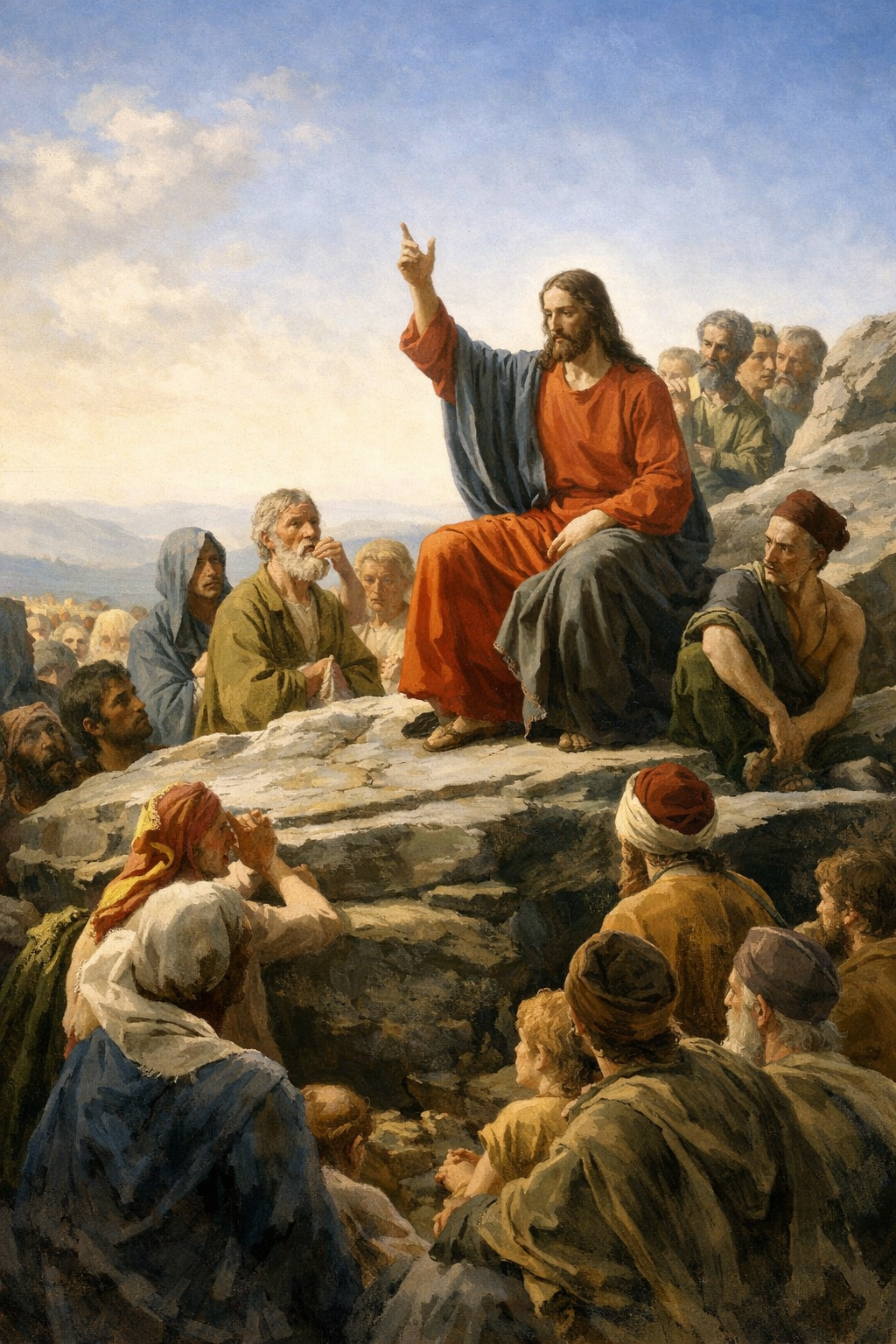
Sermon on the Mount
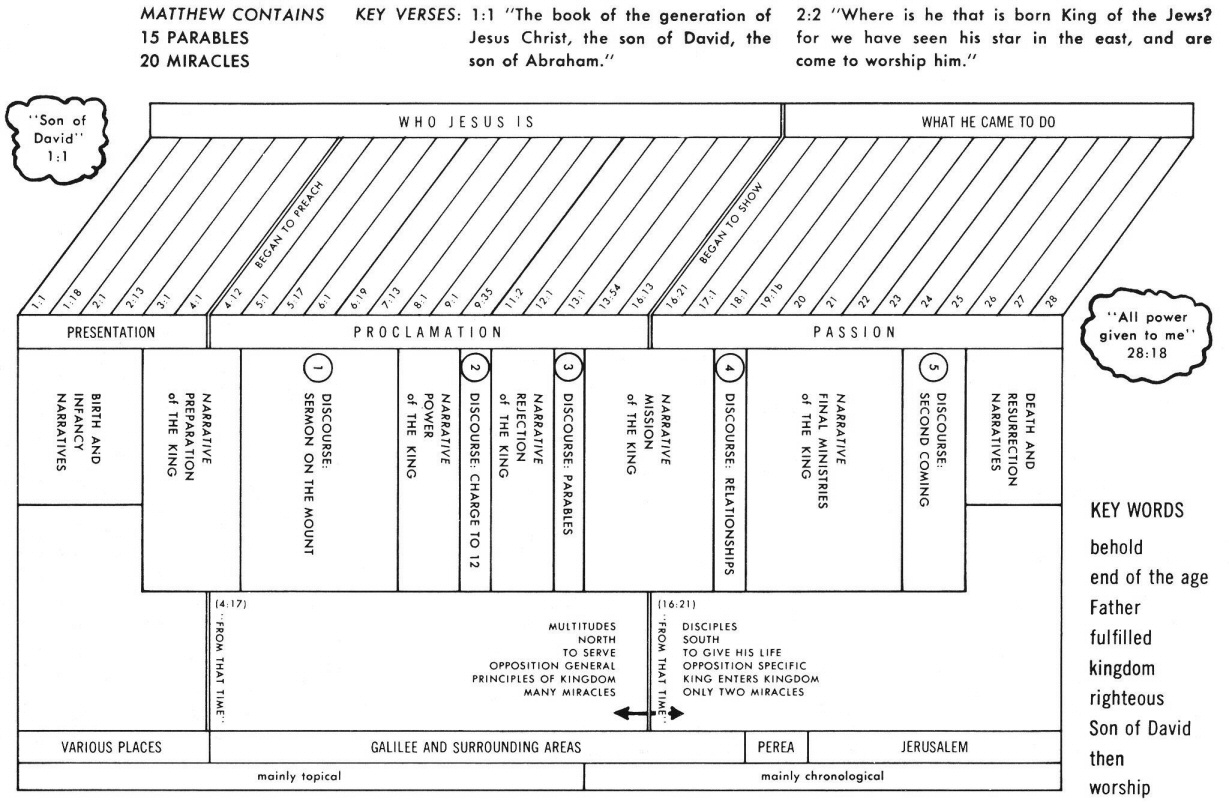
Click chart to enlarge
Charts from Jensen's Survey of the NT - used by permission
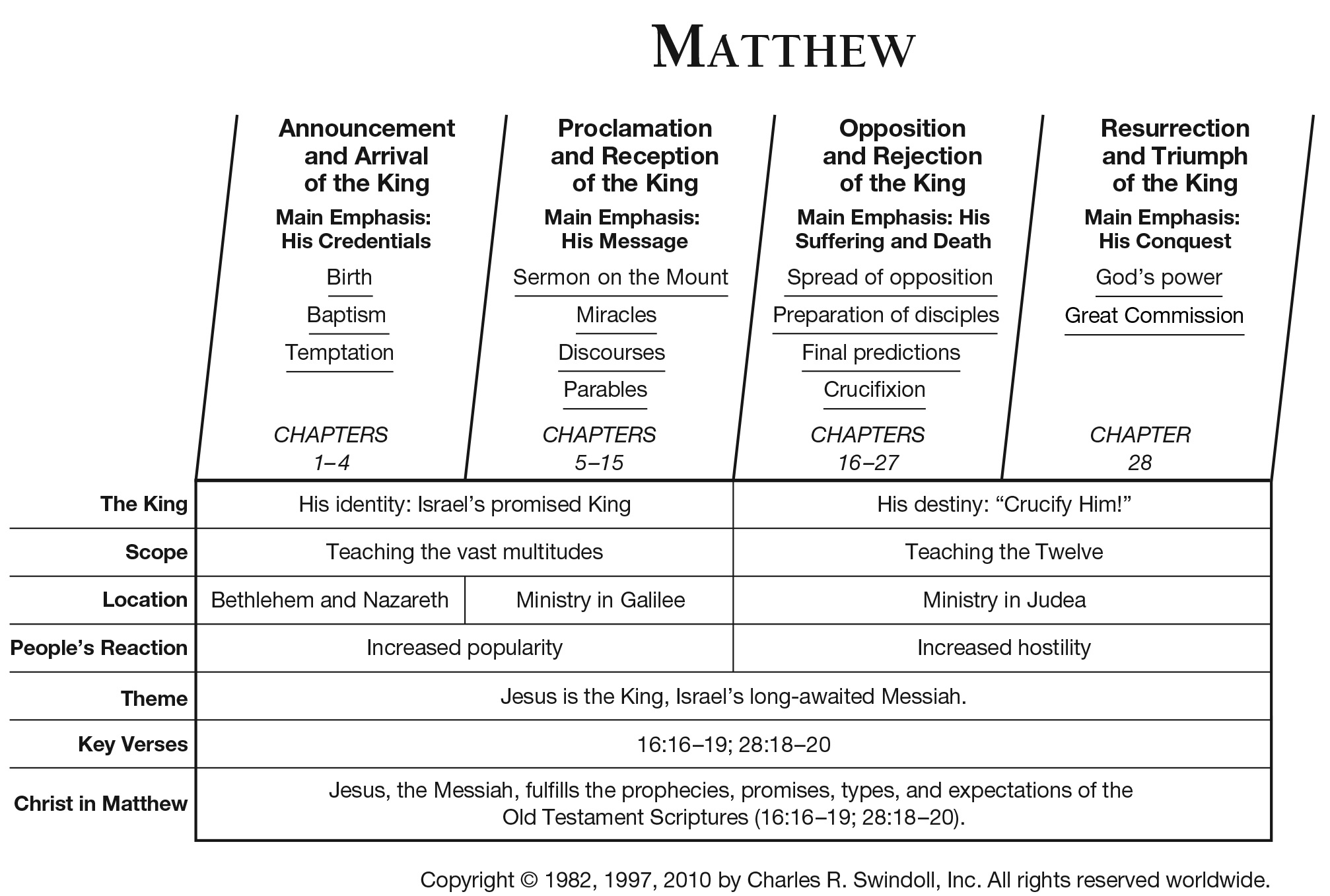
Another Chart from Charles Swindoll
THE LIFE OF JESUS AS COVERED
BY MATTHEW (shaded area)
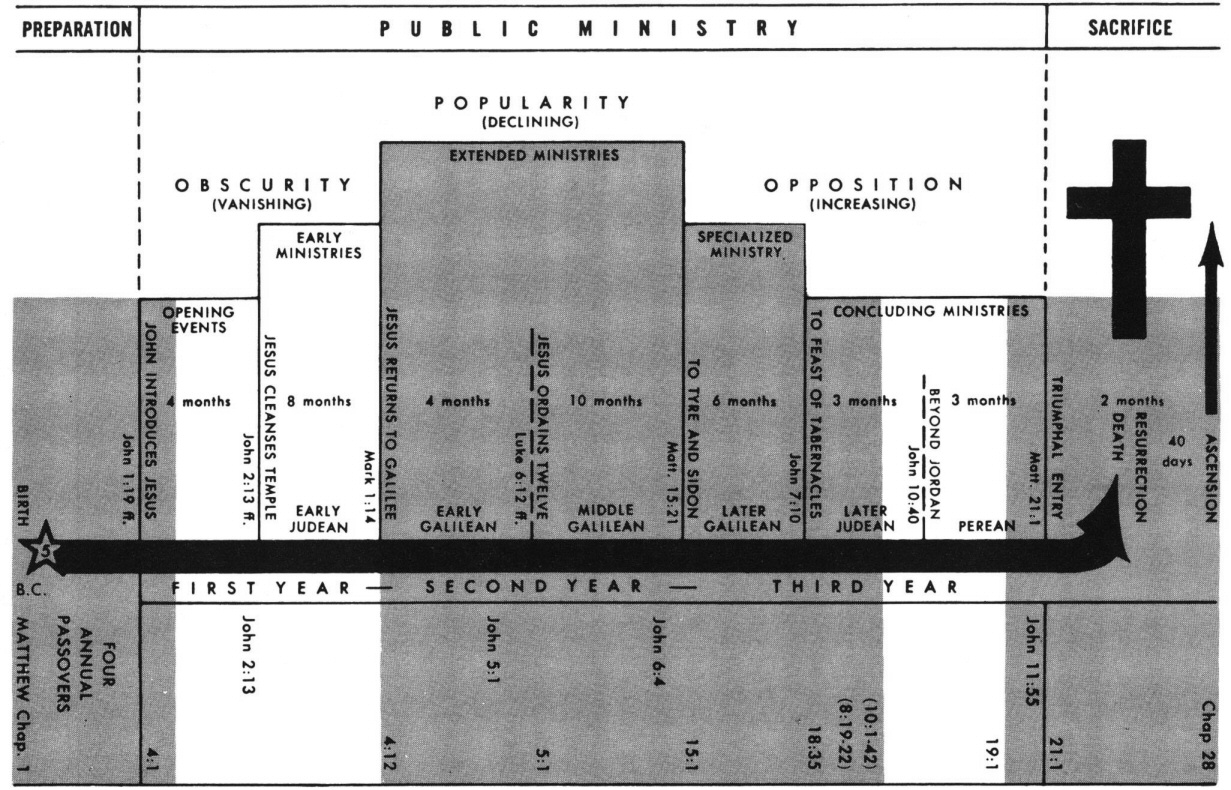
Click chart to enlarge
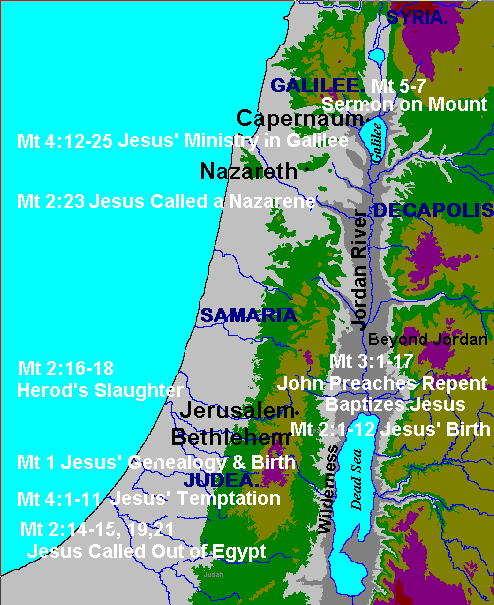
Jesus Birth and Early Years
Leading up to the Sermon on the Mount
Matthew 1-7

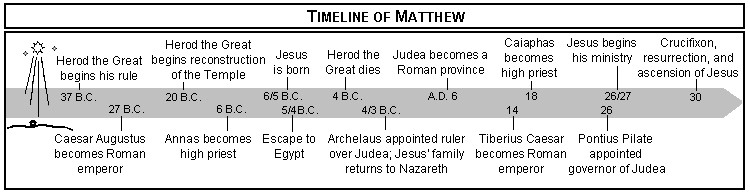
Source: Ryrie Study Bible
Matthew 5:46 For if you love those who love you, what reward do you have? Do not even the tax collectors do the same? (NASB: Lockman)
Greek: ean gar agapesete (2PAAS) tous agapontas (PAPMPA) humas tina misthon echete? (2PPAI) ouchi kai oi telonai to auto poiousin? (3PPAI)
Amplified: For if you love those who love you, what reward can you have? Do not even the tax collectors do that? (Amplified Bible - Lockman)
KJV: For if ye love them which love you, what reward have ye? do not even the publicans the same?
NLT: If you love only those who love you, what good is that? Even corrupt tax collectors do that much. (NLT - Tyndale House)
Philips: For if you love only those who love you, what credit is that to you? Even tax-collectors do that! (New Testament in Modern English)
Wuest: For if you are loving those who are loving you, what reward are you having? Are not even the collectors of taxes doing the same?
Young's Literal: 'For, if ye may love those loving you, what reward have ye? do not also the tax-gatherers the same?
FOR IF YOU LOVE THOSE WHO LOVE YOU WHAT REWARD DO YOU HAVE? DO NOT EVEN THE TAX COLLECTORS DO THE SAME?: ean gar agapesete (2PAAS) tous agapontas (PAPMPA) humas tina misthon echete? (2PPAI) ouchi kai oi telonai to auto poiousin (3PPAI)
- If you love - Mt 6:1; Luke 6:32, 33, 34, 35; 1Peter 2:20, 21, 22, 23
- Tax Collectors - Mt 9:10,11; 11:19; 18:17; 21:31,32; Luke 15:1; 18:13; 19:2,7
- Matthew Resources - Multiple Sermons and Commentaries
Charles Simeon - IT is well said by the Psalmist, that “the commandment of God is exceeding broad;” since it reaches to every disposition of the mind, and requires infinitely more than man, in his present weak and degenerate state, can perform. Indeed, though many traces of the law still remain upon the heart, and are discoverable by the light of reason, there are depths in it which unaided reason could never have fathomed, and a breadth and length which it could never have explored. Amongst the precepts which we consider as known only through the medium of Revelation, we would particularly specify that which is contained in the text. Human nature would itself approve of love to friends; but our Lord commands us to love our enemies. (Read the entire sermon - Matthew 5:43-48 Love to Enemies Enjoined)
Love (25) (agapao from the noun agape) (Click study of agape) describes an unconditional, sacrificial love, which ultimately is the love that God is (1Jn 4:8,16) and that God demonstrates (Ro 5:8) (Jn 3:16, 1Jn 4:9) in its supreme form at Calvary.
Jesus said we are to love our enemies because it shows we are loving like God loves His enemies (Ro 5:6, 8, 10-see notes Ro 5:6, 5:8, 10). Here Jesus adds that when we love like God does, such love distinguishes us from the way the world loves.
To reiterate agapao is not love of the emotions but of the will. Thus this type of love is not borne from mere human affection but is divine love, commanded by God, produced as fruit in the heart of a surrendered saint by the Holy Spirit (Who is at work in us to will and to work to His good pleasure - Php 2:13) (Ro 5:5; Gal 5:22), self-sacrificial in nature, seeking the benefit of the one who is loved, a love which means death to self (Mk 8:34) and defeat for sin since the essence of sin is self-will and self-gratification, a love activated by personal choice of our will (working out our salvation in fear and trembling - Php 2:12; cp Ezek 36:27 = note God's "part" and man's responsibility! This OT passage refers to the promise of the New Covenant) not based on our feelings toward the object of our love (in this case to enemies who may actually hate us) and manifested by specific actions (summarized in 1Co 13:4, 5, 6, 7, 8 an excellent pragmatic, "real time" definition of "love in action" - see notes 1Cor 13:4 13:5 13:6 13:7 13:8). This type of love may involve emotion, but it must always involve action.
Related Resource:
- What Is Real Love - God's definition of love from 1 Corinthians 13
- How Has God Loved Us? = Understanding the truth of God's love for us
Reward (wage) (3408) (misthos) literally refers to pay which is due for labor performed or dues paid for work. Misthos is used in two general senses in the NT, either to refer to wages or to reward, recognition or recompense. In this latter figurative usage, misthos refers to rewards which God bestows for the moral quality of an action, such rewards most often to be bestowed in eternity future.
Misthos - 29x in 28v -
Matt 5:12, 46; 6:1f, 5, 16; 10:41f; 20:8; Mark 9:41; Luke 6:23, 35; 10:7; John 4:36; Acts 1:18; Rom 4:4; 1 Cor 3:8, 14; 9:17f; 1 Tim 5:18; Jas 5:4; 2 Pet 2:13, 15; 2 John 1:8; Jude 1:11; Rev 11:18; 22:12. NAS = pay(2), price(1), reward(19), wage(1), wages(6).
Although Paul does not use misthos in the following passage, the principle of spiritual reaping clearly is related to rewards both here and in the future…
For the one who sows to his own flesh shall from the flesh reap corruption, but the one who sows to the Spirit shall from the Spirit reap eternal life. (Gal 6:8)
Jesus associates rewards with giving, fasting and praying, teachings that are dependent upon one's motive (see notes Matthew 6:1; 6:2; 6:5; 6:16) and who receives the glory by those acts (giving, fasting and praying). Note especially future rewards for having suffered for the Name of Christ in this life (Mt 5:12; Lk6:23).
Do not even the tax collectors do the same? - Answer? Yes, of course.
Tax collectors (Publicans = KJV) (5057)(telones from télos = tax + onéomai = to buy) describes the revenue officers or toll collectors who were considered to be disloyal Jews hired by the Romans to tax fellow Jews for personal profit and as a result this group became symbolic of the worst kind of people
W E Vine on telones - primarily denoted "a farmer of the tax" (from telos, "toll, custom, tax"), then, as in the NT, a subsequent subordinate of such, who collected taxes in some district, "a tax gatherer;" such were naturally hated intensely by the people; they are classed with "sinners," Matthew 9:10,11; 11:9; Mark 2:15,16; Luke 5:30; 7:34; 15:1; with harlots, Matthew 21:31,32; with "the Gentile," Matthew 18:17; some mss. have it in Matthew 5:47 , the best have ethnikoi, "Gentiles." See also Matthew 5:46; 10:3; Luke 3;12; 5:27,29; 7:29; 18:10,11,13 . (Vine's Expository Dictionary of NT Words - Publican)
Zodhiates has an excellent discussion on telones - A reaper of the taxes or customs, tax–collector, one who pays to the government a certain sum for the privilege of collecting the taxes and customs of a district. The public revenues of the Greeks and Romans were usually farmed out. Among the latter, the purchasers were chiefly of the equestrian order and were distinguished as being of a higher class because they rode horses, or they were at least persons of wealth and rank like Zacchaeus who is called the chief tax collector (architelonēs [754] in Luke 19:2). These farmers also had subcontractors or employed agents who collected the taxes and customs at the gates of cities, in seaports, on public ways and bridges. These, too, were called telonai (pl.), publicans, or eklégontes (n.f.), (from ek [1537], out of, and légō [3004], in its original sense meaning to collect), those who collected out of the people. Such publicans in countries subject to the Roman Empire were the objects of hatred and detestation so that none but persons of worthless character were likely to be found in this employment. They were called hárpages (n.f.), extortioners, from harpage (724), extortion. Chrysostom calls them kapelous (n.f.), hucksters, from kapēleúō (2585), to retail, adulterate, take advantage of, corrupt, and pornoboskoús (n.f.), shepherds of fornication. They were also called kólakes (n.f.), flatterers, from kolakeía (2850), flattery. In the NT, they were toll–gatherers, collectors of customs or public dues and were the objects of bitter hatred and scorn by the Jews. (Complete Word Study Dictionary: New Testament)
Feltoe - PUBLICAN (Gr. τελώνης ).The Roman practice of selling to the highest bidder the task of collecting the taxes and dues of a province or district for a definite period is well known. The persons thus engaged were called publicani , and usually belonged to the wealthy equestrian order. They, in their turn, employed local agents to get in the revenues, who were also called publicani . This lower class are probably the men referred to in the Gospels, wherever they belong to Judaea (or Samaria), except possibly in the case of Zacchaeus, who was architelones of Jericho (Luke 19:2), and may have farmed the revenues of that important commercial centre on his own account. In Galilee the publicans had to collect, not for the Imperial treasury (as in Judaea), but for Herod Antipas the tetrarch. Such an official was Matthew (Levi), who was called to be an Apostle from the place of toll (telonion) on the shores of the Lake of Galilee at Capernaum (Matthew 9:9 , Mark 2:14 , Luke 5:27). And in his house afterwards our Lord met many other publicans of the tetrarchy at a great entertainment. Whether in the service of the hated Roman Emperor or of Herod Antipas, who was in complete subservience to him, the tax-gatherer was most unpopular with the Jews; for, apart from the obvious liability of the method to abuse, the mere fact of the money being thus raised for an alien power was detestable in their eyes. And no doubt the publicans were often drawn from the lowest ranks in consequence. Hence common talk associated them not only with the Gentiles (Matthew 18:17 ), but with harlots (Matthew 21:31; Matthew 21:22 ) and sinners in general (Matthew 9:10-11; Matthew 11:19 , Mark 2:15-16 , Luke 5:30; Luke 7:34; Luke 15:1 ). John the Baptist's preaching attracted many publicans to him, and when they inquired in what they must mend their ways after being baptized by him, his answer indicated that extortion was their besetting danger, as we should expect (Luke 3:12-13 ). (Hastings' Dictionary of the New Testament - Publican )
Telones - 21x in 20v - Matt. 5:46; 9:10f; 10:3; 11:19; 18:17; 21:31f; Mk. 2:15f; Lk. 3:12; 5:27, 29f; 7:29, 34; 15:1; 18:10f, 13
Tax gathers were disloyal Israelites hired by the Romans to tax other Jews for personal profit and were crooks, who most Jews literally loathed. Matthew himself belonged to this disgusting, despised brotherhood. What is Jesus saying? He is saying "Look, even these despicable tax gatherers loved their own kind! So how will your love show itself distinctive if the only ones you love are your own kind? If you are only showing love to friends, you're no better in loving than the thieving tax collector!" One can just imagine the stir that went through Jesus' listeners when he presented this pithy comparison!
Jamieson comments that "The publicans (tax collectors), as collectors of taxes due to the Roman government, were ever on this account obnoxious to the Jews, who sat uneasy under a foreign yoke, and disliked whatever brought this unpleasantly before them. But the extortion practiced by this class made them hateful to the community, who in their current speech ranked them with “harlots.” Nor does our Lord scruple to speak of them as others did, which we may be sure He never would have done if it had been calumnious. The meaning, then, is, “In loving those who love you, there is no evidence of superior principle; the worst of men will do this: even a publican will go that length.”
If we treat our enemies as they treat us, we are stooping to their low level. And if we treat them just like tax-gatherers treat those who treat them well, what are we doing that's more than lost men do? What makes us any different from them, if that is all they see? How can we act as salt and light if we respond only the unregenerate men do? Nor should we be satisfied to do what the average professing Christian does. Jesus "raises the bar" exhorting us to go higher and imitate our Heavenly Father.
Spurgeon - Ours it is to persist in loving, even if men persist in enmity. We are to render blessing for cursing, prayers for persecutions. :Even in the cases of cruel enemies, we are to; do good to them, and pray for them. ” We are no longer enemies to any, but friends to all. We do not merely cease to hate, and then abide in a cold neutrality; but we love where hatred seemed inevitable. We bless where our old nature bids us curse, and we are active in doing good to those who deserve to receive evil from us. Where this is practically carried out, men wonder, respect, and admire the followers of Jesus. The theory may be ridiculed, but the practice is reverenced, and is counted so surprising, that men attribute it to some Godlike quality in Christians, and own that they are the children of the Father who is in heaven. Indeed, he is a child of God, who can bless the unthankful and the evil: for in daily providence the Lord is doing this on great scale, and none but his children will imitate him. To do good for the sake of the good done, and not because of the character of the person benefited, is a noble imitation of God. If the Lord only sent the fertilizing shower upon the land of the saintly, drought would deprive whole leagues of land of all hope of a harvest. We also must do good to the evil, or we shall have a narrow sphere, our hearts will grow contracted, and our sonship towards the good God will be rendered doubtful. 46. For if ye love them which love you, what reward have ye? Do not even the publicans the same? (CHAPTER 5)
Related Resources:
- International Standard Bible Encyclopedia Publican
- Kitto Biblical Cyclopedia Publican
- McClintock and Strong's Bible Encyclopedia Publican
- The Nuttall Encyclopedia Publicans
- The Jewish Encyclopedia Publican
- American Tract Society Publican
- Easton's Bible Dictionary Publican
- Fausset Bible Dictionary Publican
- Holman Bible Dictionary Publican
- Hastings' Dictionary of the Bible Publican
- Hastings' Dictionary of the NT Publican
- Hawker's Poor Man's Dictionary Publican
- Smith Bible Dictionary Publican
- Whyte's Bible Characters The publican
- Wilson's Bible Types Publican
- Webster Dictionary Publican
- Watson's Theological Dictionary Publican
Good For Nothing - I attended a get-together with some people I had pastored 40 years ago when they were in their teens. Several men said their most vivid memories centered around the snowball fights we had after our midweek Bible class. I was glad that at least a few remembered some of the things I had said.
One man reminded me that I once told him to be a "good-for-nothing person." We had been discussing Matthew 5:43-48 when he piped up,
"I'm through going out of my way to be nice to the old people who live next door. I mowed part of their lawn one evening, but the very next day he yelled at me when I ran into his yard to get a football that got away from me. What good do you get from being nice to a person like that?"
In answer to his question, I said, "Jesus wants you to be a good-for-nothing person." He grinned and replied, "I've been called that before." But he got the point.
Being a "good-for-nothing person" by repeatedly going out of our way to be nice to someone who doesn't return even a smile of appreciation isn't easy. But that is what Jesus expects from us. And it becomes easier when we remember His continued goodness in spite of our selfishness and ungratefulness. —Herbert Vander Lugt (Our Daily Bread, Copyright RBC Ministries, Grand Rapids, MI. Reprinted by permission. All rights reserved)
It's easy to be kind and good
To those who show us love,
But loving those who won't respond
Takes grace from God above. --Sper
Love helps those who may never return the favor.
Matthew 5:47 "If you greet only your brothers, what more are you doing than others? Do not even the Gentiles do the same? (NASB: Lockman)
Greek: kai ean aspasesthe (2PAMS) tous adelphous humon monon, ti perisson poieite (1SPAI)? ouchi kai oi ethnikoi to auto poiousin? ( 1SPAI )
Amplified: And if you greet only your brethren, what more than others are you doing? Do not even the Gentiles (the heathen) do that? (Amplified Bible - Lockman)
KJV: And if ye salute your brethren only, what do ye more than others? do not even the publicans so?
NLT: If you are kind only to your friends, how are you different from anyone else? Even pagans do that. (NLT - Tyndale House)
Philips: And if you exchange greetings only with your own circle, are you doing anything exceptional? Even the pagans do that much. (New Testament in Modern English)
Wuest: And if you greet with deference and respect your brethren only, what more are you doing? Are not even the pagan Gentiles doing the same?
Young's Literal: and if ye may salute your brethren only, what do ye abundant? do not also the tax-gatherers so?
IF YOU GREET ONLY YOUR BROTHERS, WHAT MORE ARE YOU DOING THAN OTHERS? DO NOT EVEN THE GENTILES DO THE SAME?: kai ean aspasesthe (2PAMS) tous adelphous humon monon, ti perisson poieite (1SPAI)? ouchi kai oi ethnikoi to auto poiousin? (1SPAI)
- Mt 10:12; Luke 6:32; Mt 10:4,5)
- Mt 5:20; 1Peter 2:20
- Matthew Resources - Multiple Sermons and Commentaries
The unsaved greet each other so there is nothing distinctively Christian about it. If our standards are no higher than the world’s, it is certain that we will never be very salty salt or clear bright lights.
Dr. Martyn Lloyd-Jones speaks to this call to be distinct (not weird, but distinct) explaining that "The Christian is the man who is above, and goes beyond, the natural man at his very best and highest… There are many people in the world who are not Christian but who are very moral and highly ethical, men whose word is their bond, and who are scrupulous and honest, just and upright. You never find them doing a shady thing to anybody; but they are not Christian, and they say so. They do not believe on the Lord Jesus Christ and may have rejected the whole of the New Testament teaching with scorn. But they are absolutely straightforward, honest and true… Now the Christian, by definition here, is a man who is capable of doing something that the best natural man cannot do. He goes beyond and does more than that; he exceeds. He is separate from all others, and not only from the worst among others, but from the very best and highest among them. (Lloyd-Jones, D. M. Studies in the Sermon on the Mount) (Bolding added)
Dwight Pentecost elaborates on loving those other than brethren with a question "Would you prove before the world you are a child of God? Our Lord says prove it by your care and concern for one with whom there are no emotional ties. Take one outside the family circle or your circle of friends or perhaps even your circle of acquaintances. Love your enemies. To respond to the needs of those who are in your family is to show natural affection. The natural man loves his wife and his children, seeks their welfare, provides for their needs. Such is natural affection. To love those who are in the family of God is only to display a natural affection. To go beyond the bounds of those with whom we are one, and have concern for those who are outside of the family is to display a supernatural affection. Our Lord calls for this in Matthew 5:46-48." (Pentecost, J. D. Design for living: Lessons in Holiness from the Sermon on the Mount. Kregel Publications) (Bolding added)
Jesus command to love and pray for enemies begs the questions…
Is there something "supernatural" about my love, something that cannot be explained in natural terms?
Is there in my love something which is not present in the love even unbeliever's show to one another?
If our answers to these questions is not "Yes" (at least to some degree) then we must each ask ourselves "Why not?"
Jesus' teaching probes and searches deep within our hearts, in those secret places that no one else sees or even knows. We are called to be radically, distinctively different. Salty salt. Bright clear light. The world is in desperate need of seeing such supernatural love without limits and you are the salt that someone needs to taste and the light that someone needs to see today. Let your light shine before men in such a way that when they see the way you love without limits or conditions, they will receive a proper opinion of and be drawn to our Father Who art in heaven.
OUR Lord is here rescuing the law from the false glosses with which the Scribes and Pharisees had obscured it. It is quite a mistake to imagine that he extended the law beyond its original meaning. The law was perfect, being a perfect transcript of God’s mind and will. Had it required less than it now does, it would have been unworthy of God: in fact, unless its demands are now extended beyond what they ought to be (which we know is not the case,) it must have given men a license to love God and our neighbour less than we really ought: or, in other words, it would have given a license to sin. The particular command to which our Lord refers in the context was, “Thou shalt love thy neighbour as thyself.” This the Scribes and Pharisees interpreted as giving a liberty, if not an absolute command, to hate our enemies. But our Lord shews, that every man, whether friend or enemy, is comprehended in the term “neighbour,” and that every man therefore has a claim upon us to be loved by us as ourselves. If we extend our regards to friends only, “What,” says our Lord, “do ye more than others?.” This is a very pointed question, importing that the Lord’s people ought to do more than others, and may reasonably be expected so to do. In confirmation of this truth, I will,
I. Shew why the Lord’s people may reasonably be expected to do more than others—
The question is founded in reason and justice: for, if we be the Lord’s people in truth,
1. We are more indebted to him than others—[All are indebted to him for the gift of a Saviour, and for the offer of eternal life through him. (Of temporal blessings such as the whole world partake of, I forbear to speak.) But true Christians are indebted not merely for a gift of the Saviour to them, but for having from eternity been given to the Saviour as his peculiar people, whom he should redeem from death, and enjoy for ever as “his purchased possession.” It is surprising how often our blessed Lord speaks of them under this character in his last intercessory prayer — — — And it is always mentioned as a distinguishing mercy, that raises them far above the rest of the world, and entails the greatest obligations upon them. Moreover, the faith by which they are brought into this union with Christ is also the gift of God. “To them it is given in the behalf of Christ to believe in him.” And this is no less a distinguishing mercy than the other: for the whole world, with the exception of this little remnant, are in unbelief. The peace too that flows from this union, O what an inestimable gift is that! “To the wicked there is no peace:” but these have “a peace which passeth all understanding,” and “a joy that is unspeakable and glorified.”
Say, whether this be not a very abundant reason for our shewing to God more gratitude than others, and labouring to serve him with every faculty both of body and soul?]
2. We have greater assistances from him than others—[Every man has, more or less, what may be called the common influences of the Spirit. For there is no man who has not occasionally felt some compunction for his sins, and some desire of amendment. But whence do “these good thoughts and holy desires proceed, but from God?” They would no more arise in the heart of fallen man than of the fallen angels, if they were not suggested by the Spirit of God. But believers have what may be called the special grace of God; by which I understand, not a different kind of grace, but a different degree, even such a degree as shall prevail over all the resistance which it meets with in the soul. Nor is it only in order to their first conversion to God that they are so wrought upon, but through the whole of their lives are they preserved and strengthened by the same Spirit, in order to their final salvation. To what a degree this strength is communicated to them, may be seen in various passages of Holy Writ: it is equal to that which God exerted in raising up Jesus Christ from the dead, and setting him at his own right hand, above all the principalities and powers of earth and hell. It is such as to display the powers of Omnipotence itself, and to approve itself the workmanship of Him who created the universe out of nothing.
All this is unknown to others, who, having never earnestly implored this aid, are left under the power of Satan, and are “carried captive by the devil at his will.” And is not this a call upon them for exertion? And does it not afford a just ground of expectation, that they shall do more than others who have no such assistance?]
3. We make a greater profession of zeal for God than others—[The generality not only make no particular profession of love to God, but account this very want of profession a sufficient reason for all the carelessness and indifference which they manifest. But the believer does not thus glory in his shame. He knows his obligations to God; nor is he ashamed to confess them. He knows that he has been redeemed by the blood of God’s only dear Son; and that, “having been bought with a price, he is bound to glorify God with his body and his spirit, which are God’s.” He considers himself as called to die unto the world,” yea, to be “crucified unto it, and to have it crucified unto him, by the cross of Christ.” He acknowledges that “his affections are to be set, not upon things below, but on things above:” and that he has nothing to do in this world but to prepare for a better. Hence, if occasion require, he speaks of himself as running in a race, wrestling for the mastery, and engaged in a warfare. These things he professes, not from vain ostentation, but from necessity; or rather, he does not so much profess them as do them: and the profession is rather the result of his efforts, than any declaration independent of them. As far as mere profession is concerned, he would rather be silent than talkative: but his life speaks; and he is content that it should speak, if only it may afford a light which may be instructive and animating to those around him.
But this profession, whether voluntary or not, calls for consistency in his conduct, and makes it indispensable for him, whilst calling himself “a child of light and of the day,” not to walk as those who are “children of darkness and of the night.”]
4. God’s honour is more involved in our conduct than in that of others—[Others may do what they will, and no one thinks of reflecting on religion on their account. Nay, even the grossest immoralities may he committed by them, without exciting any surprise, or attracting any notice. But let a follower of the Lord Jesus Christ do any thing amiss, and the whole world hears of it: nor is he alone blamed, who commits the evil condemned, but all who are connected with him in the same religious society are blamed also; yea, and all religious persons generally, as being all alike. Even the Gospel itself too is condemned as sanctioning such conduct, and as having a natural tendency to produce it. The general feeling on such an occasion is that of exultation and triumph: “There, there, so would we have it.” Had Saul committed the evils which David did, though the act might have been blamed, God’s honour would not have suffered. But when David sinned, “the name of God was everywhere blasphemed on his account.”
What an obligation then does this lay on Christians to “walk holily, justly, and unblameably” before men, that “the way of truth may not be evil spoken of through them!” If there is a “woe unto the world because of the offences” which are committed in the Church, and which harden multitudes in their infidelity, much more does woe attach to that man who commits the offences, and casts a stumbling-block in the way of others, to the destruction of their souls as well as of his own. In proportion therefore as any deviation from the path of duty in us may prove injurious to God’s honour and the interests of his Gospel, we are bound to “walk circumspectly, not as fools, but as wise;” that all who behold our light may be led rather to approve of our principles, and to glorify our God.]
If our obligation to approve ourselves “more excellent than our neighbours” has been established, let us,
II. Inquire what we do more than others—
What do we more,
1. For our own souls?
[The world, alas! evince but little concern for their own souls. A formal round of duties is all that they judge necessary: and if they are observant of the outward decencies of religion, such as frequenting the House of God, attending upon the Lord’s table, maintaining family prayer, and repeating some form of devotion twice a day in their closets, they think they have done all that is required of them, and are ready to say, “What lack I more?” But all this may be only “a form of godliness, without the power,” and a service wholly unacceptable to the heart-searching God.
“What then do ye more than this?” Are all of you doing even as much? Are not even these forms neglected by too many? But supposing you to be observant of these, what do ye more? Alas! the generality would be utterly at a loss to answer this question. But the true Christian shall answer it, even though he be only at present as “a babe in Christ.” Do you ask me, What I do more? (he may say,) I search out my sins yet daily, in order to humble myself before God on account of them. I mourn over all that I have seen amiss in my whole conduct through life. I sigh, I groan, I weep, I smite upon my breast from day to day, crying, “God be merciful to me a sinner!” I flee to the Lord Jesus Christ for refuge: I renounce utterly all other ground of hope: I trust altogether in his atoning sacrifice, as expiating my guilt, and reconciling me to my offended God. I set my face towards Zion: and, though I travel not so expeditiously as I could wish, I make it my daily labour to advance; and I make no account of any difficulties, if only I may get forward in my heavenly way. The one concern of my life from day to day is, how shall I save my soul? “What shall it profit me if I gain the whole world, and lose my own soul?”
Now, my dear brethren, is this your state? are you thus concerned about your souls? and does your conscience bear witness, that, whilst others are occupied chiefly about the things of time and sense, “you account the whole world but as dross and dung, that you may win Christ, and be found in him, not having your own righteousness, but his?” Is this, I say, your state? Is it the state of all amongst you? of all? O would to God it were! But, if the truth were known, and it is most assuredly known to God, there are but few who can truly declare this to be the daily habit of their minds: yet must it be your habit, if ever you would be Christians indeed, and behold the face of God in peace.]
2. For the honour of our God?
[Little is this thought of by the world at large. But the true Christians are not unconcerned about it. They know that God may be honoured by them: and it is their most anxious desire to bring glory to their God. There is not a perfection of the Deity which they do not endeavour to honour and exalt: his omniscience, by walking as in his immediate presence: his omnipotence, by committing altogether to him their every concern: his love, his mercy, his truth, his faithfulness, by embracing his gracious offers in the Gospel, and relying on his promises as a sure ground of their hope. They walk with him, as Enoch did: they maintain “fellowship with him and with his Son Jesus Christ” all the day long: accounting it their chief joy to have a sense of his presence, and the light of his countenance lifted up upon them. In their actions, they consider not what will advance their own honour or interests, but what will promote his glory: and, having ascertained that, they go forward in the prosecution of it, without any regard to consequences: a fiery furnace, or a den of lions, has no terrors for them: they fear nothing but sin: and account it an honour and a privilege to lay down life itself in His service, and for His glory.
And now let me ask, is it thus with all of you? Are all of you thus studious to exalt, to honour, and to glorify your God? Have earthly things no value in your eyes, in comparison of God’s favour, and of his love shed abroad in your hearts? Yet without this you cannot be Christians indeed. Our blessed Lord has said, that “whoso loveth his life shall lose it; and that he only who is willing to lose it for his sake, shall find it unto life eternal.”]
3. For the benefit of mankind?
[To this there is a special respect in my text. The Pharisees maintained, that we were at liberty to hate our enemies: but our Lord said, “If you love your friends only, what do ye more than others?” The loving of enemies is an attainment far above the reach of the world at large. If they abstain from revenge, it is quite as much as they ever aim at. And as for endeavouring to “win the souls” of their enemies, the thought never so much as enters into their minds. But the true Christian has a far higher standard of duty in reference to these things. He feels, indeed, that it is no easy thing to “love his enemies, to bless them that curse him, to do good to them that hate him, and to pray for them that despitefully use him and persecute him;” but he labours to do it, and implores grace from God that he may be able to do it; and determines, through grace, “not to be overcome of evil, but to overcome evil with good.” Nor is he forgetful of his obligation to seek the eternal welfare of mankind. Hence he labours for the diffusion of the sacred oracles throughout the world: he finds delight in aiding every effort that is made for the salvation both of Jews and Gentiles: and in his more immediate neighbourhood he strives to promote, as far as in him lies, the spiritual and eternal interests of all around him. In his relative duties also especially he endeavours to shew the influence of true religion: as a parent or child, as a husband or wife, as a master or servant, as a ruler or subject, he makes a point of fulfilling his duties, so that the most watchful enemy shall have no reason to speak reproachfully.
Once more then let me ask, is it thus with you? Is there amongst all of you such government of your own tempers, and such a victory over all your evil passions, as that you adorn the doctrine of God our Saviour, and exhibit in the whole of your deportment his blessed image? As followers of Christ, all this is required of you: you are called, “as the elect of God, holy and beloved, to put on bowels of mercies, kindness, humbleness of mind, meekness, long-suffering; and to be forbearing one another and forgiving one another, if you have a quarrel against any man, even as God for Christ’s sake hath forgiven you:” and if you will approve yourselves to be Christ’s, “your righteousness must exceed that of the Scribes and Pharisees.” You must take even God himself for your pattern, and seek to be “perfect, even as your Father which is in heaven is perfect.”]
See then,
1. How vain is that plea, that you are as good as others! [Before that plea can be of any avail, you must inquire whether others are as holy as they ought to be: for if they be not, your equality with them can be no ground of satisfaction in the prospect of the future judgment. What consolation will it be to those who shall experience the wrath of God in hell, that they were as good as any who walked in “the broad road that led them to destruction?” It is not by any human standard that you will be judged in the last day, but by the standard of God’s unerring word: and whether you be as good or better than others, it will avail you nothing, if you be not found such as God requires, “Israelites indeed, and without guile” — — —]
2. How desirable is it to have our evidences of piety clear and decisive! [The question put to us in the text, will be put to us in the last day; “What did ye more than others?” This question we ought to be able to answer now, in order that we may give a satisfactory answer then: and the more satisfactorily we can answer it now, the more comfort we shall have in looking forward to that day, and the more boldness when we shall stand at the judgment-seat of Christ. Whatever then ye have attained, forget it all, and press forward for yet higher attainments, that so, whenever the day of Christ shall arrive, ye may rejoice, “and not be ashamed before him at his coming.”] (Matthew 5:47 Christians Do More than Others)