Matthew 6:2
Matthew 6:3
Matthew 6:4
Matthew 6:5
Matthew 6:6
Matthew 6:7
Matthew 6:8
Matthew 6:9
Matthew 6:10
Matthew 6:11
Matthew 6:12
Matthew 6:13
Matthew 6:14
Matthew 6:15
Matthew 6:16
Matthew 6:17
Matthew 6:18
Matthew 6:19
Matthew 6:20
Matthew 6:21
Matthew 6:22
Matthew 6:23
Matthew 6:24
Matthew 6:25
Matthew 6:26
Matthew 6:27
Matthew 6:28
Matthew 6:29
Matthew 6:30
Matthew 6:31
Matthew 6:32
Matthew 6:33
Matthew 6:34
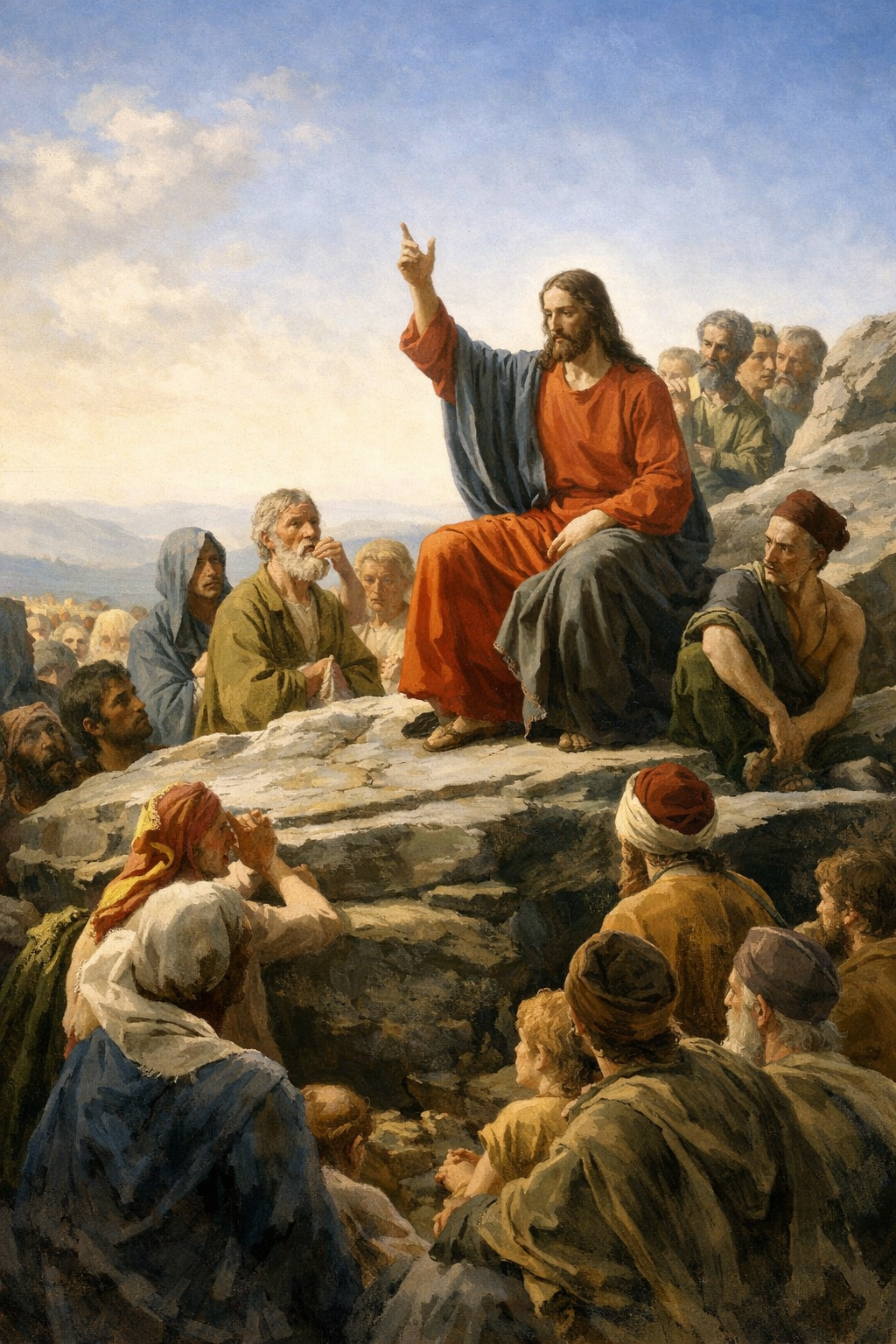
Sermon on the Mount
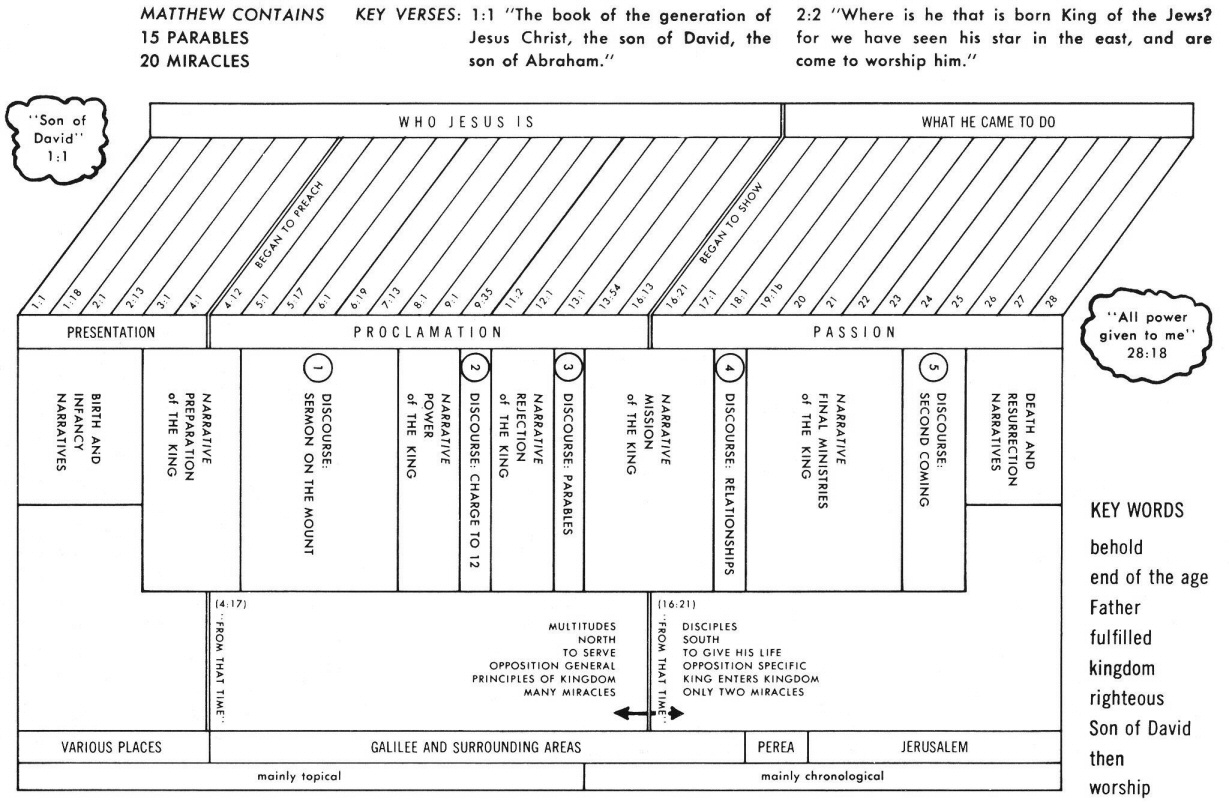
Click chart to enlarge
Charts from Jensen's Survey of the NT - used by permission
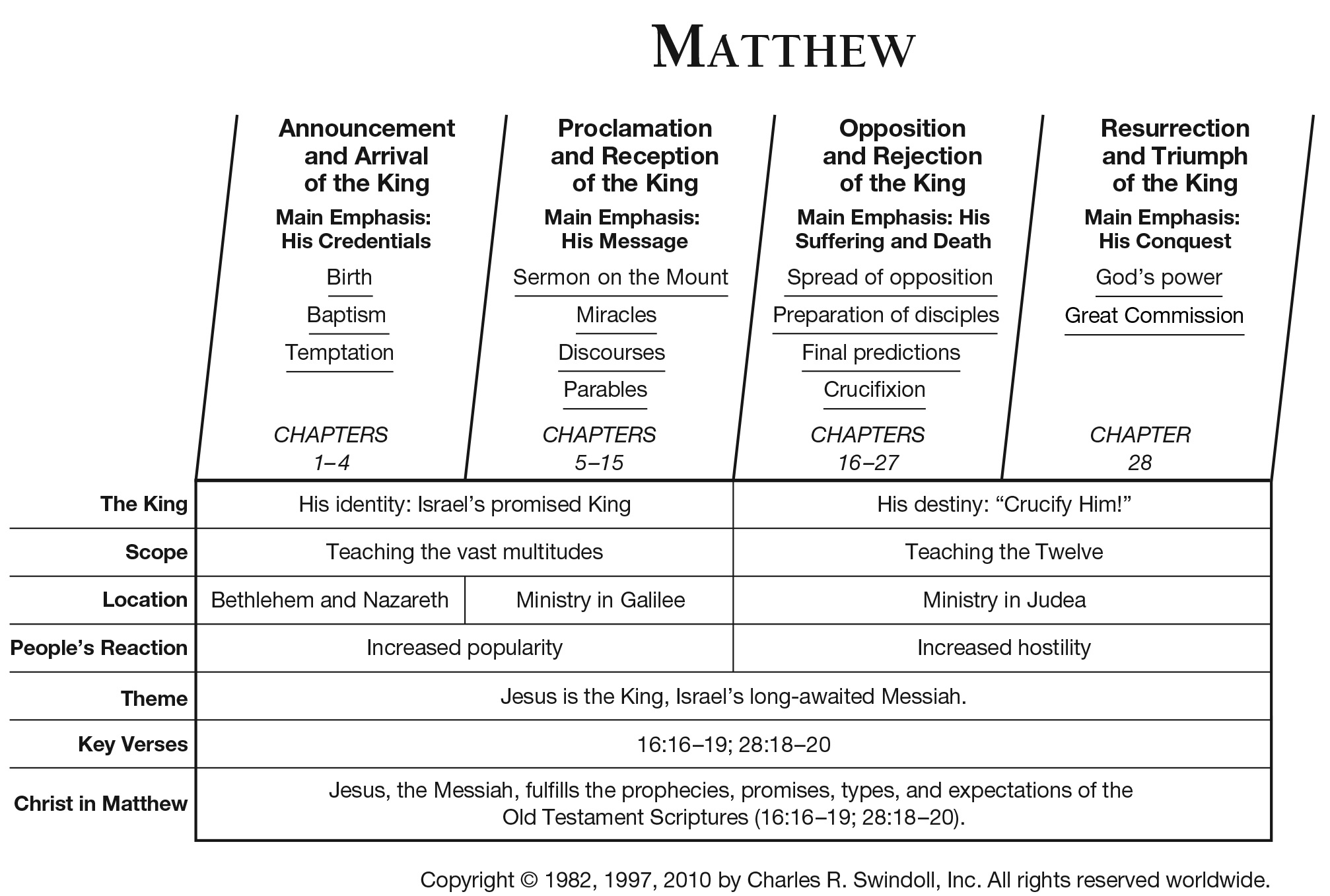
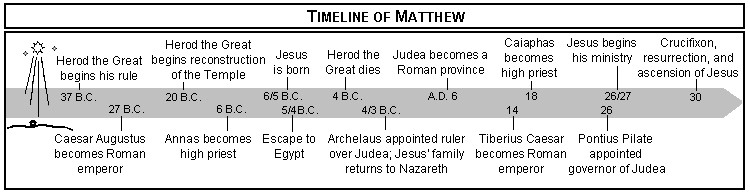
Another Chart from Charles Swindoll
THE LIFE OF JESUS AS COVERED
BY MATTHEW (shaded area)
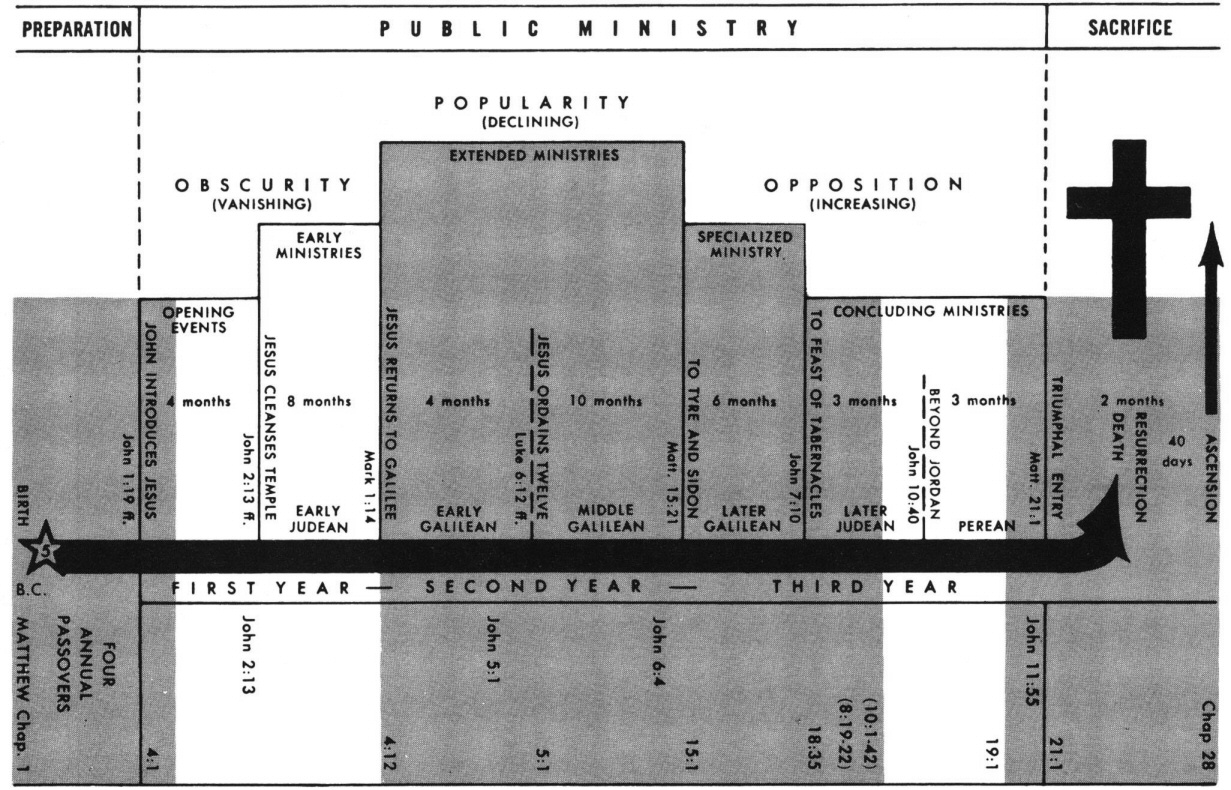
Click chart to enlarge
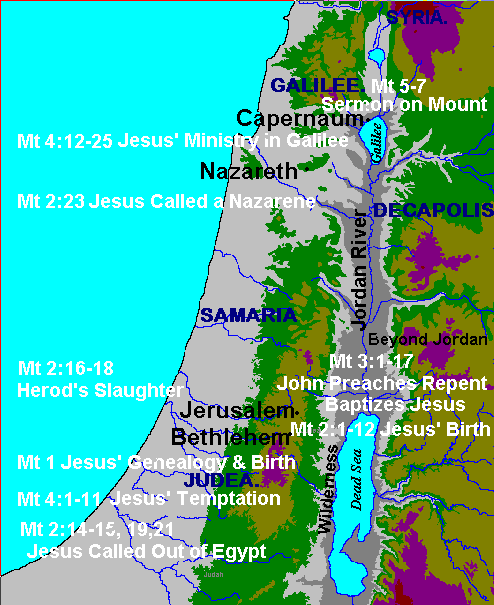
Jesus Birth and Early Years
Leading up to the Sermon on the Mount
Matthew 1-7

Source: Ryrie Study Bible
Matthew 6:1 Beware of practicing your righteousness before men to be noticed by them; otherwise you have no reward with your Father who is in heaven. (NASB: Lockman)
Greek: Prosechete (2PPAM) [de] ten dikaiosunen humon me poiein (PAN) emprosthen ton anthropon pros to theathenai (APN) autois; ei de me ge, misthon ouk echete (2PPAI) para to patri humon to en tois ouranois.
BGT Προσέχετε [δὲ] τὴν δικαιοσύνην ὑμῶν μὴ ποιεῖν ἔμπροσθεν τῶν ἀνθρώπων πρὸς τὸ θεαθῆναι αὐτοῖς· εἰ δὲ μή γε, μισθὸν οὐκ ἔχετε παρὰ τῷ πατρὶ ὑμῶν τῷ ἐν τοῖς οὐρανοῖς.
Amplified: Take care not to do your good deeds publicly or before men, in order to be seen by them; otherwise you will have no reward [reserved for and awaiting you] with and from your Father Who is in heaven. (Amplified Bible - Lockman)
My Amplified Paraphrase: Beware—be continually on guard, stay alert, pay careful attention—not to practice your righteousness (your acts of devotion, piety, and obedience) before people in order to be seen by them, seeking their admiration or applause; otherwise, you will have absolutely no reward—no divine approval, no heavenly commendation—from your Father Who is in heaven.
KJV: Take heed that ye do not your alms before men, to be seen of them: otherwise ye have no reward of your Father which is in heaven.
NKJ "Take heed that you do not do your charitable deeds before men, to be seen by them. Otherwise you have no reward from your Father in heaven.
NET "Be careful not to display your righteousness merely to be seen by people. Otherwise you have no reward with your Father in heaven.
CSB "Be careful not to practice your righteousness in front of people, to be seen by them. Otherwise, you will have no reward from your Father in heaven.
ESV "Beware of practicing your righteousness before other people in order to be seen by them, for then you will have no reward from your Father who is in heaven.
NIV "Be careful not to do your 'acts of righteousness' before men, to be seen by them. If you do, you will have no reward from your Father in heaven.
NLT: Take care! Don't do your good deeds publicly, to be admired, because then you will lose the reward from your Father in heaven. (NLT - Tyndale House)
Philips: "Beware of doing your good deeds conspicuously to catch men's eyes or you will miss the reward of your Heavenly Father. (New Testament in Modern English)
Wuest: Moreover, be holding your mind on the matter of not practicing your correctness of thinking, feeling, and acting before men in order to be attentively viewed by them as a spectacular performer. Otherwise, a reward you do not have in the presence of your Father in heaven.
Young's Literal: Take heed your kindness not to do before men, to be seen by them, and if not -- reward ye have not from your Father who is in the heavens
BEWARE OF PRACTICING YOUR RIGHTEOUSNESS BEFORE MEN TO BE NOTICED BY THEM: Prosechete (2PPAM) [de] ten dikaiosunen humon me poiein (PAN) emprosthen ton anthropon pros to theathenai (APN) autois
- Mt 16:6; Mark 8:15; Luke 11:35; 12:1,15; Hebrews 2:1
- Deut 24:13; Ps 112:9; Da 4:27; 2 Cor 9:9,10
- Mt 6:5,16; 5:16; 23:5,14,28, 29, 30; 2Ki 10:16,31; Ezek 33:31; Zech 7:5; 13:4; Luke 16:15; John 5:44; 12:43; Gal 6:12
- Matthew 6 Resources
- Matthew 6:1-4 Flashy Givers - Jack Arnold
- Matthew 6:1 Beware of Hypocrisy - John MacArthur
- Matthew 6:1-4 Giving Without Hypocrisy - John MacArthur

HOW TO LOSE YOUR REWARD
AT THE BEMA SEAT
Beware (present imperative see our need to depend on the Holy Spirit to obey) of practicing (poieo) your righteousness (dikaiosune) - Jesus commands us to be constantly on guard and keep watching carefully (prosechō [used of mooring a ship to keep from drifting! That'll preach!]—stay alert, be constantly vigilant, guard your heart, keep your spiritual radar on), lest you engage in acts of righteousness—your (note YOUR!) giving, praying, fasting, serving, teaching, worshipping—with an eye toward human approval, applause, or admiration. Jesus makes this a standing command because He knows the trap of hypocrisy is subtle and always waiting to ensnare us! Do not perform outwardly righteous deeds or acts of "piety" with the hidden motivation of being seen, praised, or elevated by people (WHO DOES NOT FALL INTO THIS TRAP OCCASIONALLY!), for when you do your ‘good works’ as a spiritual performance, your Father in heaven refuses to honor such divided motives.
Before men to be noticed (theaomai) by them - The verb noticed (theaomai) means to put your "righteous deeds" on display, as if they are to be viewed like they were on a stage. In a sense when you do that, you are indeed on a stage, play acting out your ostensibly righteous deeds. It is notable that the word hypocrite was related to actors who wore a mask on stage! Jesus is saying do not turn any aspect of worship into a performance (and beloved we can even do that in the service on Sunday -- I am not saying do not raise your hands or do not say "Amen" but just make sure it is the Spirit that energizes these actions and they are for your King, not your fellow worshipers!)
Beware of doing the right things
with the wrong reasons.
Otherwise you have (absolutely) no reward with your Father Who is in heaven - You receive no "well done" and "no credit" for hypocritical activities! The applause of people (if that is what you seek) and the reward from God are mutually exclusive.
Hypocrites seek approval from men.
True disciples seek approval from the Father
C H Spurgeon's comments…
MATTHEW 6:1-18 THE KING CONTRASTS THE LAWS OF HIS KINGDOM WITH THE CONDUCT OF OUTWARD RELIGIONISTS IN THE MATTERS OF ALMS AND PRAYER 1. TAKE heed that ye do not your alms before men, to be seen of them: otherwise ye haVe no reward of your Father which is in heaven.
Our King sets men right as to Almsgiving. It is taken for granted that we give to the poor. How could we be in Christ’s kingdom if we did not?
Alms may be given publicly, but not for the sake of publicity. It is important that we have a right aim; for if we obtain the result of a wrong aim, our success will be a failure. If we give to be seen, we shall be seen, and there will be an end of it: “Ye have no reward of your father which is in heaven ”: we lose the only reward worth having. But if we give to please our Father, we shall find our reward at his hands. To the matter of our intent and design we must “take heed ”; for nobody goes right without carefully aiming to do so. Our giving of alms should be a holy duty, carefully performed, not for our own honor, but for God’s pleasure. Let each reader ask himself, how much he has done, in the way the King prescribes. (Commentary)
As R Kent Hughes reminds us "None of us completely meets the standard of the Sermon on the Mount. But at the same time, if we are true believers, something of the character of the kingdom, something of each of the Beatitudes, will be authentically present in our lives - spiritual poverty, humility, spiritual thirst, mercy, peacemaking. Along with this, there will be the presence of the surpassing righteousness of Christ. We may fall at times, but we will practice righteousness. Anger, adulterous thoughts, insincere talk, and retaliation will progressively vanish from our lives. Agape love will become characteristic of us. When we are filled with the Holy Spirit and with his Word, including the explicit teaching of the Sermon on the Mount, we will practice righteousness. However, this is where the danger lies. For once you begin to fulfill the righteousness of God, once you are flying spiritually, once you are living a life full of good deeds, it is very easy to begin "doing your 'acts of righteousness' before men, to be seen by them." (See The Sermon on the Mount: The Message of the Kingdom)
In Matthew 6:1-18, the three righteous practices (giving, praying, fasting) are supposed to be worship rendered to God, never displays of self righteousness to gain the admiration of others. Not only was the Pharisees’ interpretation of the Law perverted in Matthew 5:21-48, but also the their religious practice was a sham.
Phil Newton - After commanding perfection he immediately warns of the subtleties of hypocrisy that can creep into our spiritual pursuits. The problem does not rest in the pursuits but in the individual heart. Motives of love and devotion can become colored with self-centeredness. Because of sin’s deceitfulness, the Christian must be on guard against hypocrisy. It can slip into the most devoted Christian’s life so our Lord calls attention to the need for holy motivations in righteous pursuits… He has been addressing the matter of personal righteousness in terms of doing the will of God in the realm of morality. Now he considers doing the will of God in religious practice. (Sermon)
Barclay adds that "To the Jew there were three great cardinal works of the religious life, three great pillars on which the good life was based—almsgiving, prayer and fasting. Jesus would not for a moment have disputed that; what troubled him was that so often in human life the finest things were done from the wrong motives. (Daily Study Bible )
Beware (4337) (prosecho from pros = before + echo = hold) means literally to hold before and then to take heed, be in a state of high alert , watch out for or be on guard. The idea is to turn one’s mind or attention to a thing by being on one’s guard against it. In this context beware points to the motives behind the Christian’s devotion and duty. When we give our offering or preach our sermons or offer our public and even private prayers or help the poor or discipline our bodies, what has been the motive behind it?
The present imperative calls for the wise citizen of the kingdom of heaven to be continually on the look out for this sometimes not so blatant temptation to give, pray or fast so that you are recognized or honored by men. Wuest picks up the sense of the present imperative writing…
Moreover, be holding your mind on the matter of not practicing your correctness of thinking, feeling, and acting before men in order to be attentively viewed by them as a spectacular performer.
To "beware" means that one must continually (present tense) be vigilant to the ever present danger even in believers (because we still have the old "flesh") to practice righteous acts out of the wrong motivation.
Prosecho - 24x in 24v - addicted to(1), be on guard(m)(3), beware(8), give attention(1), giving attention(3),officiated(1), pay attention(3), paying attention(2), respond to(1), take care(1). Matt 6:1; 7:15; 10:17; 16:6, 11f; Luke 12:1; 17:3; 20:46; 21:34; Acts 5:35; 8:6, 10f; 16:14; 20:28; 1 Tim 1:4; 3:8; 4:1, 13; Titus 1:14; Heb 2:1; 7:13; 2 Pet 1:19.
Practicing (4160)(poieo = to do, perform) is in the present tense which pictures this as one's lifestyle.
Righteousness - There are two varieties and both can "look good", but those acts initiated and carried out in our own fleshly energy and calculated to impress others, do not impress God! See below for a brief discussion of the second type of righteousness which is the only type acceptable to our Father.
Righteousness (1343) (dikaiosune from dikaios = being proper or right in the sense of being fully justified being or in accordance with what God requires) is the quality of being upright. In its simplest sense dikaiosune conveys the idea of conformity to a standard or norm. In this sense righteousness is the opposite of hamartia (sin), which is defined as missing of the mark set by God. In this sense righteousness is the opposite of hamartia (sin), which is defined as missing of the mark set by God.
Dikaiosune is rightness of character before God and rightness of actions before men. (Click here to read Pastor Ray Pritchard's interesting analysis of righteousness in the Gospel of Matthew).
The word “righteousness” comes from a root word that means “straightness.” It refers to a state that conforms to an authoritative standard. Righteousness is a moral concept. God’s character is the definition and source of all righteousness. God is totally righteous because He is totally as He should be.
God pleasing righteousness is all that God is, all that He commands, all that He demands, all that He approves, all that He provides through Jesus Christ. In the present context righteousness is the general description for acts of devotion and religious duty which conform to the will of God.
Righteousness before men to be noticed by them is self righteousness. Righteousness that God accepts is His character reproduced in and through us for His good pleasure. Then when others see this "supernatural righteousness" in our lives, they give the glory to God. Compare this to Jesus' purpose statement for our lives in Matthew 5…
Let your light shine before men in such a way that they may see your good works, and glorify your Father who is in heaven. (see note Matthew 5:16) (Notice the "red letters" which I usually use to signify a verb is in the form of a command - here in the form of the aorist imperative = do it effectively. This is a permissive imperative which means to permit your light to shine. Don’t do anything that will cover it, hide it or snuff it out. To shine is not optional! If we fail to obey our Lord's command we will fail to fulfill His purpose for us in His glorious plan.)
Before (1715) (emprosthen from en = in + prós = toward + suffix -then) is used only to refer to place or position (not time) and means in front of, in the presence of or in the sight of.
Noticed (2300) (theaomai) means to look closely at. It describes a calm, continuous contemplation of some object which remains before the spectator. It is interesting to note that the derivative English word is "theatrical" (marked by pretense or artificiality of emotion, marked by extravagant display or exhibitionism, having the character like that of acted plays) which gives us a clue as to the real motivation behind acts of self righteousness! Although others may observe these acts (e.g., the church accountant will see your donations), this fact must not be the motive behind the deeds.
Phil Newton warns that…
Sinful motives can slip into our lives when we may not even realize it. On one occasion, the Apostle Peter had been enjoying fellowship meals with the Gentile believers at Antioch. But when a group of strong-minded Jews that professed to be Christians came into Antioch (Judaizers), Peter withdrew from the fellowship with the Gentiles, and held himself aloof from them. Paul confronted him, calling Peter’s action “hypocrisy.” The problem was not just when the Jews came into town. It was deeper as Peter’s motive for being with the Gentile Christians lacked the integrity to keep him steadfast. He was doing the right thing in being with them, but he did so out of convenience and maybe even the desire for attention rather than for the right motive to honor the Lord in relationships with Gentile believers. The coming of the Judaizers exposed Peter’s latent hypocrisy. He wanted “to be noticed” by the Gentiles when convenient and then by the Judaizers. In both cases he showed hypocrisy in motivation, and as Paul put it, “stood condemned” (Gal 2:11-14)…
The greatest hindrance in right motives is the desire to please yourself rather than the Lord. Selfishness can lead to doing great exploits in the name of Christ when we really do so for ourselves. It can show up by going to the mission field and receiving the accolades of men for such sacrifice, when the real reason is to make a name for one’s self. John Wesley traveled to the primitive colonial state of 18th C. Georgia to do missionary work before he was converted. He thought that such action would improve his standing with God – a self-centered motive. Though he did a noble deed he found it to be a miserable experience wrought out with wrong motives. (Sermon)
Martyn Lloyd-Jones comments on practicing our righteousness before men noting that "Ultimately our only reason for pleasing men around us is that we may please ourselves. Our real desire is not to please others as such; we want to please them because we know that, if we do, they will think better of us. In other words, we are pleasing ourselves and are merely concerned about self-gratification” (Online Studies in the Sermon on the Mount)
Though others may not observe us
And see how we serve God today,
Our job as servants of Jesus
Is to please Him in every way.
—JDB
Related Resources:
- See multiple Quotes, Illustrations, Devotionals on Hypocrisy-Hypocrites
- What does the Bible say about hypocrisy?
- Why did God kill Ananias and Sapphira for lying?
- Why are all Christians hypocrites? Are all Christians hypocrites?
- Bridgeway Bible Dictionary Hypocrisy
- Baker Evangelical Dictionary Hypocrisy
- Charles Buck Dictionary Hypocrisy
- Spurgeon's Illustration Collection Hypocrisy Hypocrisy (2) Hypocrisy (2)
- Holman Bible Dictionary Hypocrisy
- Hastings' Dictionary of the NT Hypocrisy Hypocrisy
- 1911 Encyclopedia Britannica Hypocrisy
- McClintock and Strong's Bible Encyclopedia Hypocrisy
- The Jewish Encyclopedia Hypocrisy
- International Standard Bible Encyclopedia Hypocrisy
OTHERWISE YOU HAVE NO REWARD WITH YOUR FATHER WHO IS IN HEAVEN : ei de me ge, misthon ouk echete (2PPAI) para to patri humon to en tois ouranois
- Mt 6:4,6; 5:46; 10:41,42; 16:27; 25:40; 1Corinthians 9:17,18; Hebrews 6:10; 11:26; 2John 1:8
- Matthew 6 Resources
- Matthew 6:1-4 Flashy Givers - Jack Arnold
- Matthew 6:1 Beware of Hypocrisy - John MacArthur
- Matthew 6:1-4 Giving Without Hypocrisy - John MacArthur
Otherwise - In a different way. If not. This word in a sense combines an explanation and a contrast.
No (3756) (ou, ouk, ouch) means absolutely not. Ou and ouk express direct and full negation (action of making negative), independently and absolutely, and hence, objectively.
Spurgeon observes that…
You cannot expect to be paid twice, if therefore you take your reward in the applause of men, who give you a high character for generosity, you cannot expect to have any reward from God. We ought to have a single eye to God’s accepting what we give, and to have little or no thought of what man may say concerning our charitable gifts.
---
The motive which leads a man to give, will form the true estimate of what he does. If he gives to be seen of men then when he is seen of men he has the reward he sought for, and he will never have any other. Let us never do our alms before men, to be seen of them.
--
If the action is not done in the Lord's service, but with a view to our own honour, we cannot expect a reward from above.
When you receive glory from men, you receive no reward from your Father in heaven. Why? For His Name is Qanna', Jealous, (Ex 34:14) and His declaration is
"For My own sake, for My own sake, I will act; for how can My name be profaned? And My glory I will not give to another. (Isaiah 48:11)
Paul gives us a similar truth in a positive teaching…
And whatever you do in word or deed, do all in the name of the Lord Jesus, giving thanks through Him to God the Father… Whatever you do, do your work heartily, as for the Lord rather than for men knowing that from the Lord you will receive the reward of the inheritance. It is the Lord Christ whom you serve. (see notes Colossians 3:17, Colossians 3:23-24)
Note Jesus condemns the motive and not the deed. Wrong motive means no reward from your Father. Paul reaffirmed this writing…
The Lord will come and will both bring to light (cause light to shine upon and so cause to be fully known by clearly revealing down to the smallest detail) the things hidden (krupto - gives us "crypt" = concealed, in secret where others cannot see! But God sees) in the darkness and disclose (make externally manifest to the senses and thus open to all making visible that which has been hidden) the motives (that which has been purposed and planned, the willful intention) of men's hearts; and then each man's praise will come to him from God. (1Cor 4:5)
In Proverbs the wisest man of his day explained that as smelting brings forth impurities, praise from men helps him rid his heart of all motives that are base, insincere and non-God glorifying, writing that…
The crucible is for silver and the furnace for gold, and a man is tested by the praise accorded him. (Proverbs 27:21)
John warned the believers that because there were many deceivers it was imperative that they…
Watch yourselves (keep your eye first on yourself for your spirit is willing but your flesh is weak), that you might not lose (Greek word is apollumi which pertains to destruction but not annihilation. It basically has to do with that which is ruined and is no longer usable for its intended purpose) what we have accomplished, but that you may receive (receive in full what is one’s due including idea of receive back) a full (abounding, abundant) reward (Ed: All believers will receive praise at the judgment seat of Christ according to 1Co 4:5, but some will receive more rewards than others 1Cor. 3:11-15). (2 John 1:8)
Reward (3408) (misthos [word study]) literally refers to pay which is due for labor performed or dues paid for work. Misthos is used in two general senses in the NT, either to refer to wages or to reward, recognition or recompense. In this latter figurative usage, misthos refers to rewards which God bestows for the moral quality of an action, such rewards most often to be bestowed in eternity future.
Some uses as in this present passage in 2 Peter refer to "wages" obtained through iniquity, similar to the "wages" paid to Judas for his betrayal of Christ (see Acts 1:18).
Although Paul does not use misthos in the following passage, the principle of spiritual reaping clearly is related to rewards both here and in the future…
For the one who sows to his own flesh shall from the flesh reap corruption, but the one who sows to the Spirit shall from the Spirit reap eternal life. (Gal 6:8-note)
Jesus associates rewards with giving, fasting and praying teaching that are dependent upon one's motive (Mt 6:2, 5, 16-see notes 6:2; 6:5; 6:16). Note especially future rewards for having suffered for the Name of Christ in this life (Mt 5:12-note; Lk 6:23).
To both the Greek and Hebrew mind the idea of reward had to do with the wholeness of an action or stated another way with the completion of a deed. The reward was part of the action or deed. Therefore, just as work completed would result in the payment of wages, so it was assumed that an action naturally carried certain results, either reward or punishment. The concept of a reward also involved a return commensurate with the action or deed performed.
The concept of rewards for good behavior and punishment for bad behavior is common in the Old Testament and in Jewish literature. Deuteronomy 28 lists a series of rewards and punishments (blessing and cursing) that are distributed according to Israel’s faithfulness to the covenant (cf Isa. 65:6, 7; 66:6).
The Father will reward us…
For God is not unjust so as to forget your work and the love which you have shown toward His name, in having ministered and in still ministering to the saints. (Heb 6:10-note)
Father (3962) (pater) (see discussion of "father" on Mt 6:9) is found ten times in Mt 6:1-18 and is a key word which helps us understand them that practical deeds of righteousness should be done for His approval, not for men’s.
In the Sermon on the Mount Jesus has associated certain character traits (the beatitudes in Mt 5:3-12) with the "reward" of different blessings.
The principle that all believers need to understand in this section is that it is possible for a believer to perform ostensibly wonderful deeds and yet receive no reward from God. For example, we may pray for those who persecute us and yet still receive no reward. Why not? Jesus alludes to the ever present danger that it is possible even for believers to do these things for the recognition of men and not of God.
Unger has an excellent summary of rewards writing that…
Rewards are offered by God to a believer on the basis of faithful service rendered after salvation. It is clear from Scripture that God offers to the lost salvation and for the faithful service of the saved, rewards. Often in theological thinking salvation and rewards are confused. However, these two terms must be carefully distinguished. Salvation is a free gift (John 4:10; Ro 6:23; Eph. 2:8, 9, whereas rewards are earned by works (Matt. 10:42; cf. Luke 19:17; 1Cor. 9:24-25; 2Ti 4:7, 8). Then, too, salvation is a present possession (Luke 7:50; John 5:24). On the other hand, rewards are future attainment to be dispensed at the second coming of Christ for His own (Matt. 16:27; 2Ti 4:8). Rewards will be dispensed at the judgment seat of Christ (2Cor. 5:10; Ro 14:10). The doctrine of rewards is inseparably connected with God’s grace. A soul is saved on the basis of divine grace; there is no room for the building up of merit on the part of the believer. Yet God recognizes an obligation on His part to reward His saved ones for their service to Him. Nothing can be done to merit salvation, but what the believer has achieved for God’s glory, God recognizes with rewards at the judgment seat of Christ. For the central passages on rewards see 1Cor. 3:9, 10, 11, 12, 13, 14, 15 and 1Cor 9:16, 17, 18, 19, 20, 21, 22, 23, 24, 25, 26, 27; 2Cor 5:10. (ONLINE NO RESTRICTIONS The New Unger's Bible Dictionary) (Bolding added)
- Is from God -Romans 2:7; Colossians 3:24; Hebrews 11:6
- Is of grace, through faith alone -Romans 4:4,5,16; 11:6
- Is of God’s good pleasure Matthew 20:14,15; Luke 12:32
- Prepared by God -Hebrews 11:16
- Prepared by Christ -John 14:2
- As servants of Christ -Colossians 3:24
- Not on account of their merits -Romans 4:4,5
DESCRIBED AS
- Being with Christ -John 12:26; 14:3; Philippians 1:23; 1Th 4:17
- Beholding the face of God -Psalms 17:15; Mt 5:8; Rev 22:4
- Beholding the glory of Christ -John 17:24
- Being glorified with Christ -Ro 8:17,18; Col 3:4; Php 3:21; 1Jn 3:2
- Sitting in judgment with Christ -Da 7:22; Mt 19:28; Lk 22:30; 1Co 6:2
- Reigning with Christ -2 Timothy 2:12; Revelation 3:21; 5:10; 20:4
- Reigning for ever and ever -Revelation 22:5
- A crown of righteousness -2 Timothy 4:8
- A crown of glory -1 Peter 5:4
- A crown of life -James 1:12; Revelation 2:10
- An incorruptible crown -1 Corinthians 9:25
- Joint heirship with Christ -Romans 8:17
- Inheritance of all things -Revelation 21:7
- Inheritance with saints in light -Acts 20:32; 26:18; Col 1:12
- Inheritance eternal -Hebrews 9:15
- Inheritance incorruptible -1 Peter 1:4
- A kingdom -Matthew 25:34; Luke 22:29
- A kingdom immovable -Hebrews 12:28
- Shining as the stars -Daniel 12:3
- Everlasting light -Isaiah 60:19
- Everlasting life -Lk 18:30; Jn 6:40; 17:2,3; Ro 2:7; 6:23; 1Jn 5:11
- An enduring substance -Hebrews 10:34
- A house eternal in the heavens -2 Corinthians 5:1
- A city which had foundation -Hebrews 11:10
- Entering into the joy of the Lord -Matthew 25:21; Hebrews 12:2
- Rest -Hebrews 4:9; Revelation 14:13
- Fulness of joy -Psalms 16:11
- The prize of the high calling of God in Christ -Philippians 3:14
- Treasure in heaven -Matthew 19:21; Luke 12:33
- An eternal weight of glory -2 Corinthians 4:17
- Is great -Matthew 5:12; Luke 6:35; Hebrews 10:35
- Is full -2 John 1:8
- Is sure -Proverbs 11:18
- Is satisfying -Psalms 17:15
- Is inestimable -Isaiah 64:4; 1 Corinthians 2:9
- Saints may feel confident of -Ps 73:24; Isa 25:8,9; 2Co 5:1; 2Ti 4:8
- Hope of, a cause of rejoicing -Romans 5:2
- Be careful not to lose -2 John 1:8
THE PROSPECT OF REWARDS IN HEAVEN SHOULD MOTIVATE IN US…
- Diligence -2 John 1:8
- Pressing forward -Philippians 3:14
- Enduring suffering for Christ -2Corinthians 4:16-18; Hebrews 11:26
- Faithfulness to death -Revelation 2:10
- Endurance of present afflictions for they are not to be compared with future glory -Ro 8:18; 2Co 5:17
- Shall be given at the second coming of Christ -Mt 16:27; Rev 22:12
JOIN THE SECRET SERVICE! - When we serve God in secret, we receive a double reward. Not only will God one day reward us “openly” (Mt. 6:4), but we will enjoy the memory of what we did.
Thomas La Mance wrote: “Several years back … I was lounging around in the living room listening to the radio when my dad came in from shoveling snow. He looked at me and said, ‘In 24 hours you won’t even remember what you are listening to now. How about doing something for the next 20 minutes that you’ll remember the next 20 years? I promise that you’ll enjoy it every time you think of it.’
“‘What is it?’ I asked. ‘Well, Son, there are several inches of snow on Mrs. Brown’s walks,’ he replied. ‘Why don’t you go see if you can shovel it off and get back home without her knowing you did it?’
“I did the walk in about 15 minutes. She never knew who did the job, and my dad was right. It’s been a lot more than 20 years, and I’ve enjoyed the memory every time I’ve thought about it.”
Jesus said that when we do good to get men’s applause, we have our reward. Instead, let’s serve Him in secret. And remember, the memory is part of the reward! - David Egner
DON'T BE A FAKE - Every day, thousands of people travel from Hong Kong to Shenzhen, China, and head straight for Lo Wu Commercial City, a giant shopping mall that sells imitations of luxury items. In a New York Times article, Mark Landler says, “With five floors and 500,000 square feet of retail space, Lo Wu may be the world’s capital of counterfeit goods.”
People eagerly pay $58 for a bogus Rolex watch. They buy imitation Gucci shoes, Fendi clothing, and Chanel wallets for a fraction of the prices charged for the real thing. Scuffles often break out as shoppers struggle for the most popular goods.
What a commentary on man’s tendency to value outward appearance more than reality! We pay big money to have the right label and “look,” even if the merchandise is not authentic.
This tendency can also be seen in spiritual matters. In Matthew 6, Jesus condemned the Pharisees for their hypocrisy. They did good deeds (Mt 6:2), prayed (Mt 6:5), and fasted (Mt 6:16) to create an appearance of being devoted to God. They seemed genuine, but their hearts were far from Him.
The solution to hypocrisy is found in the prayer Jesus taught His disciples (Mt 6:9-13). As we pray it sincerely, we will stop faking it and get real with God.— by David C. McCasland
Oh, how we fear to drop our masks!
We know so well what lies within;
Yet Christ could use our lives to bless
If we would first be cleansed from sin.
—Fasick
The harder you work at what you should be,
the less you'll try to hide what you are.
The Spotlight Test
A stage actor once said, “I only feel alive when the spotlight is on me.”
Jesus warns that some disciples feel the same way—their spiritual life seems to exist only when someone is watching.
But heaven’s reward goes only to those who can serve with the lights off.
The question: If the spotlight vanished, would you keep going?
The Anonymous Envelope
A Christian man put a large cash gift into an envelope for a needy family and left it without a name.
Years later they discovered who had given it. When asked why he didn’t sign it, he simply said,
“If I put my name on it, I take God’s name off it.”
That is Matthew 6:1 in one sentence.
The Grain of Incense
In Roman times, everyone was required once a year to burn a pinch of incense before Caesar’s image.
It was a tiny act—but it screamed, “I want Caesar’s approval.”
Some Christians died rather than perform a symbolic show for human praise.
The question today is softer but similar: Who do you want to notice your righteousness—men, or God?
The Two Offering Plates
A church placed two plates at the back: one labeled “For God’s Eyes Only” and one labeled “For Public Recognition.”
Some instinctively moved toward the second—until conviction made them stop.
This simple illustration reminds us that the heart always moves toward the plate it loves.
The Quiet Janitor
A church noticed something odd:
every Sunday morning the building was clean, the hymnals straightened, the trash emptied—yet no one ever saw who did it.
Finally someone realized: the janitor came at 2:00 A.M., long before anyone arrived, “so the Lord alone would see.”
Jesus says this is the kind of righteousness the Father rewards—hidden, unseen, unadvertised.
The Fogged-Up Glass
A man cleaned a window to show off how hard he had worked.
But as people approached, they noticed something embarrassing: he had wiped only the middle, the parts people could see; the corners were untouched and dirty.
So it is when we perform righteousness only for human praise—it looks clean in the visible center, but God sees the corners.
The Hidden Roots
A massive oak fell in a storm.
To everyone’s surprise, the roots were shallow and spread outward—only where people could see—but not deep where no one watched.
A tree is only as strong as its unseen life.
So too a disciple: secret piety determines public stability.
- Hidden motives matter more than visible motions.
- God sees in secret; man sees the show. Choose your audience.
- When applause is the goal, reward ends on earth.
- Righteousness that needs a spotlight isn’t righteous!
- The Father rewards the quiet servant, not the loud performer.
- If you serve to be seen, being seen is all you get.
- Secret sacrifice pleases the Father; public performance pleases the flesh.
- Showy holiness is hollow holiness.
- Heavenly reward is lost when earthly praise is sought.
- You can’t seek God’s glory and your own at the same time. (1Co 6:20)
- God weighs motives, not marketing.
- What you do unseen reveals who you truly are. Woe! (Reputation is what men think of us. Character is what God knows is true of us!)
- Better to be unnoticed by men and honored by God.
- The Father applauds deeds men never hear. (Rewards in heaven will surely surprise all believers).
- A quiet heart pleases God more than a loud religion.
- The secret place is the proving place.
- The humble servant is the most rewarded one.
HYPOCRITES - Speechwriter Peggy Noonan, in her book Life, Liberty, and the Pursuit of Happiness, noted that appearances can be deceiving. “People never look like what they are,” Noonan wrote. Of one unscrupulous businessman she commented that if we could see him as he really is, “He’d be sitting there at the dinner party with a dagger in his teeth.” To all outward appearances he was an upstanding citizen, yet he was a hypocrite to the core.
Jesus called the religious leaders of His day “hypocrites” (Mt. 23:13-15). He meant that they were actors. In ancient theaters, each actor played several parts. To change identities, he would simply wear a different mask. Those religious leaders were changing masks. They were putting on a performance to win the applause of the community, but they didn’t care what they were like deep inside.
Jesus instructed us not to be like the hypocrites, who perform their religious “duties” to be seen by others (Mt. 6:1-6). He said, “When you do a charitable deed, do not let your left hand know what your right hand is doing” (v.3).
God isn’t impressed by the masks we wear to get approval. Instead, He reserves His applause for those who worship Him and give themselves in love to others. — by Haddon W. Robinson
Oh, how we fear to drop our masks!
We know so well what lies within;
Yet Christ could use our lives to bless
If we would first be cleansed from sin.
—Fasick
BEWARE! DON'T DECEIVE YOURSELF!
A false life never goes with a true faith.
IN the former paragraph of this wonderful sermon (Matt. 6:17) our Lord began by laying down a general principle and then proceeded to illustrate it by five particular instances.
First, He announced that His attitude towards the Mosaic institutions was not one of destruction, but of fulfilment; and then He showed that the love which He had brought to earth would realize all that Moses asked and more.
The structure of the present paragraph is precisely similar, as appears from a study of the R.V., which substitutes for Alms (Matt. 6:1, A.V.) the word Righteousness, so that the first verse is a general heading for all that follows. First we have the general proposition that righteousness should not he done for the, sake of display; and then we have that principle applied to alms, prayer, and fasting, the three departments into which the Jews divided their religious life.
That word "Take heed" is very searching. We are all liable to the temptation to put more and better goods in the window than we have anywhere else in the shop, and to show fairer samples than we can supply in bulk. Three times over in these paragraphs the Lord speaks of the hypocrites (Matt. 6:2, 5, 16); and the hypocrite; as the Greek word intimates, is a strange actor. We are all tempted to perform our religious duties for the show of them before others, and to appear in public arrayed in garments that we do not wear day by day. Our Lord called this spirit "the leaven of the Pharisees," referring without doubt to the slight and subtle beginnings of this spirit, and its rapid growth, filling the heart with fermentation and decay. Once you begin to think that you must keep up appearances as a religious man, and endeavour to do so; once you listen, as Simon Stylites, to the murmur of applause which greets you as above the average; once you assume the robes of purity and piety to attract the gaze of your fellows, you have admitted a principle into your heart which not only will rob you of your reward in heaven, but will ultimately eat out all the purity and loveliness of your religious life.
We are all tempted to Outwardness in Religion.
Some, of course, seek to acquire a reputation for piety to serve as a cloak for their nefarious purposes. They weave with assiduous care a rich vestment of alms, prayers, and self-privations, to hide their unhallowed and self-indulgent lives. Such people are, of course, mortified when any of their religious acts do not come to the front and secure notice. And when they have built up for themselves a great reputation by their charitable deeds, they devour widows' houses and take a mean advantage of their wards. Judas was one of these people; he had built up so great a reputation that none of his follow-disciples guessed he was about to do the deed of treachery, and beneath the cover of such reputation he was able to filch the contents of the bag.
There are others again who, with sincere and transparent motives, began to love and serve God for Himself; but as the days have passed they discover that they are regarded as saints, and the sense of being held in reverence by their fellows as "unco guid," fascinates them. They become as proud of their grace as other people of their lace, their place, or their race. They realize that they must maintain their reputation at all costs. Of course, the best way to maintain and increase such a reputation is to cease to think about it, and live only for the Lord Jesus; but directly we fail to do this and occupy ourselves with our reputation and the long shadow it casts on the lawn, We are tempted to do things, not because God asks them of us but to resuscitate our waning credit. Our native character is getting a little threadbare, and instead of cleaving closer to God, we put a patch on the elbow or knee by a generous gift, or a call to prayer, or the assumption in tone and manner of special sanctity.
As to alms. The Jews were trained from their earliest days to be merciful and charitable. The law of Moses continually inculcated remembrance of the stranger, the fatherless, and the widow. Liberality to the poor was reckoned as part of religious duty towards God. The prophets never forgot to urge the people to deal bread to the hungry, to bring the outcast home, and to cover the naked. A row of alms-boxes stood in the Temple courts to receive the offerings of worshippers; and at every Sabbath morning service in the synagogues appointed officers collected money for the poor of the town, which was distributed the same afternoon But in our Lord's time men gave their money to secure merit with God and admiration from men, They bestowed their charity at the doors of the synagogue, where beggars congregated and passers-by could see; or distributed it as they came along the streets.
Mrs. Judson, in her account of the first Burman convert, says: "A few days ago I was reading with him the Sermon on the Mount. He was deeply impressed and unusually solemn. "These words," said he, take hold of my very heart. They make me tremble. Here God commands us to do everything in secret, and not to be seen of men. How unlike our religion is! When Burmans make offerings at the pagodas, they make a great noise with trumpets and musical instruments that others may see how good they are. But this religion makes the mind fear God."
Probably what has been said of the Jews and Burmans is true of us all. It is apt to make a considerable difference to our gift if the open plate is handed to us, and our coin lies open to all eyes, or whether the offering be taken with a bag.
First as to prayer.
Our Lord, of course, is referring not to social, but private prayer. For the greater part of the day the doors of the synagogues stood open, as the doors of mosques or Roman Catholic churches do in foreign countries; and the Pharisees, at the three hours of prayer observed by all pious Jews, were not content with kneeling in the privacy of their own homes, but deliberately left their homes with the avowed intention and purpose of being seen in the place of public prayer. They took care, also, to be frequently overtaken in the streets, at the hour of prayer, that they might go through their long liturgies of prayer within view of all the passers-by.
Amongst ourselves the tendency is certainly to conceal, rather than parade, our private prayers; and yet there is a subtle temptation to be more reverent in our demeanour, more careful in saying our prayers and reading our Bibles, when we are in the company of religious people, than when we are alone.
As to Fasting.
There were several fast-days-in the Jewish year, in addition to the Great Day of Atonement, when the people were called upon to afflict their souls by public fasting. Yet this exercise did not always involve entire abstinence, but often consisted only in the sacrifice of a single meal. The Pharisees and others, however, gave evidence of their exceptional piety by exceptional austerities, and took care to let it be known that they were fasting, by their gloomy countenances and squalid dress.
Our temptation is not in the direction of fasting too much, but of never checking the indulgence of appetite in any degree or on any occasion. Probably we would be much healthier and stronger if now and again we were to reduce our meals and rest the organs of nutrition. But our temptation comes in another way. We affect a depression, a melancholy, a concern for our country, the state of our churches, the unorthodoxy of certain ministers or a self-depreciation, as miserable sinners, which we do not really feel. It gives us a certain character amongst our fellows, but it is hypocrisy in the sight of God.
There are those among us who never shed real tears of heartbroken grief before God for the state of things which they affect to deplore, but who pose among us as Jeremiahs. There are others who never take a glimpse of real and pure fellowship with God or of themselves but they rush with it into print or speech; and whilst they are passing through such experiences they congratulate themselves that now, at length, they have something worth narrating in the experience meeting or the religious press.
This outwardness of religion is most injurious to us all. Plants subjected to sunlight by day and the electric light by night soon fade. What is the cure for it?
The cure for Outwardness in Religion is the cultivation of a Filial Spirit.
Our Lord lived the filial life to its perfection, and shows us what it is. Notice how all His thoughts seem to run up into the one absorbing central thought of the Father, "which is in Heaven." He is thy Father, His relationship to each soul is personal. He is in secret, and is" thy Father, which seeth in secret," and He waits "to reward openly." There is no need of vain repetitions with Him, because He knows what we have need of. All prayer is to be directed to Him. It is He who forgives sins. It is He who clothes and feeds ravens, lilies, and His children. From beginning to end this chapter is full of the Father, who was the One Spectator and Audience before whom our Lord lived His earthly life.
Not only did our Lord paint the blessedness of that filial life, but He came to give it to us all. This is what we are called to know, and He has the power to make it ours. Let us ask Him to do this great thing for us here and now. "To them who receive Him He gives the privilege of becoming sons of God, even to them that believe on His Name " " and because we are sons, God sends the Spirit of His Son into our hearts." Then the Father finds the child, and the child finds the Father; and such community and closeness of intimacy ensue from this finding that the Father's smile and good pleasure become all the reward that the child cares for. Oh, let us never be content until, in our inner experience, God our Father becomes All in All!
Then we shall never think of doing our righteousness before men. We shall be good, not to win the approval of our conscience; not because we are inspired by an abstract love of virtue, as climbers may be ambitious to climb to some hitherto inaccessible peak; not even out of regard for the welfare of others, but because we desire, above all things, to give pleasure to the Father who is in secret. Religion will thus become a sacred inward secret. We shall have boldness to enter into the Holiest of All by the blood of Jesus, and shall dwell in the secret place of the Most High. Even when no earthly temple invites us, we shall enter the temple of our own heart and find God waiting there, in those hidden depths which lie below consciousness, and there shall worship Him, who is Spirit, in spirit and in truth.
To the Christian, it has been truly said, so far as any influence on his moral condition is concerned, privacy and publicity are words without meaning. He acts before men as he does alone, and acts alone as he does before men; for he is never "alone" from that one Spectator, who sees in secret, and whom he seeks to please. One presence fills, possesses, dominates him.
Do you know what this is? Since I have been forbidden to use my eyes for reading in a railway train, I have learnt some wonderful lessons along this line. Sitting quietly in the carriage I have sought to unite myself with God, not asking Him to help me, but asking if I may help Him; not seeking His sanction on my schemes, but seeking that I may enter into His Redemptive purposes for those whom I love, for His Church and the poor hungry, needy world. It has been a fruitful experience, and I see how it is possible so to cultivate the sense of the presence of God, and the endeavour to know what is passing in His heart and thought, that one's absorbing impression tends to be of Him, and His will, and His good pleasure.
We must cultivate this openness of heart towards God.
There must be no lie in our life, no lack of transparency or sincerity, no concealment or withholding. All the secrets of heart and life must be naked and bare before the eyes of Him with whom we have to do. We must watch against any attempt to seem more and better than we are. We must guard our life in secret as our most sacred jewel. And before we give, or pray, or fast, there must be the quiet gathering of the soul up before God, the silencing of every voice, the screening of all footlights and sidelights, the descent into those deepest depths which no eagle's eye has seen. Thus God will become the supreme object of our endeavour, as we admonish ourselves, saying, "My soul, wait thou only upon God, for my expectation is from Him."
The manifestation of this inward fellowship will he instantly and abundantly manifest.
(1) We shall realize the Brotherhood of the Filial Life.
When we are near God we shall begin to be occupied with the condition of His children, our brethren and sisters; shall look upon all our possessions as given to us in trust by Him for them; we shall ask what He would have us expend on His behalf. Alms-giving will at once become a sacred thing, into which the stranger may not intrude, it is entirely a matter between the Father and His child. Even the left hand knows not what the right hand gives.
Christian charity is not alms in the usual acceptation of the term, but the service of the Father. Indeed, Christ belittles the alms, and thinks only of the Father's glory and pleasure. Alas, that the Christian Church has reversed this, magnifying the alms and not stopping to inquire the motive. What has been the result? Millions have been given, but the miseries of the world are no less. We have pauperized and demoralized those whom, with the best intentions, we meant to help. Before our alms can really help men we must get on our Lord's level. The alms must be fed from love to God, as an inland lake is fed from some secret burn, which pours into it waters from mountains far away.
(2) We shall become identified with the Father's Purposes.
Our hearts are deeply wrought upon as we continue in this blissful fellowship, until they pour themselves out in prayer. "Ye people, pour out your heart before Him." But we no longer pray for our way or plans. Instead of this we say: "Thou art holy and precious to me; I want to see Thee revered and loved; I desire that others shall see what I see; I find Thy will my heaven, and long to see all resistance and indifference brought to an end." Then daily bread, forgiveness, and deliverance from temptation, become so many means to the one common purpose and goal of our choice.
The soul that really gets quiet before God, realizing that He is in secret, is compelled to pray thus. You might as well stop the tide from flowing, birds from song, and children from laughter, as stop that soul from prayer.
"Prayer is the Christian's vital breath,
The Christian's native air."
(3) Radiancy of Joy.
We may in out heart of hearts be laying aside this and the other weight. But we know there is no merit in it. We only desire to lessen the influence of the flesh, that we may promote the vigilance and clear vision of the spirit. It is entirely a matter between God and us, of which we breathe no word to others; and when we meet our fellowmen there is a gladness on our face, and a ringing joy-note in our voice, that greatly commend the gospel of our Lord.
Is there enough of this anointed head, and the face from which all marks of tears have been removed, in our modern Christian life? How often we make no effort to be happy, and make the best of things. We have had a bad night, and have no scruple about imposing our miseries on a whole breakfast table full. We have a great anxiety gnawing at our heart, and we affect the appearance of bearing a heavy burden. I suppose there is in all of us a longing to be the object of our friends' solicitude; and there are times when we may freely unburden ourselves to get advice and sympathy; but we have no right to add unduly to the sorrows and anxieties of others, or to the travail of the world.
The life which is hid with Christ in God is a very radiant one, because it hands over all its burdens and anxieties to the Father in secret, and leaves them with Him. Thus it is at leisure from itself to enter into the anxieties of others.
What the future rewards may be of that inner life I do not care to speculate, and what the present rewards are words fail to tell. The reward of the hypocrite is the gaping wonder of spectators, who smile, criticise, and forget. The reward of the soul that lives with God in secret consists not in thrones or crowns of gold, but in a growing sense of nearness, of affinity, and of mutual understanding, which issue also in a growing likeness, though the saint knows not that His face shines. (From F. B. Meyer. The Directory of the Devout Life)