Matthew 6:2
Matthew 6:3
Matthew 6:4
Matthew 6:5
Matthew 6:6
Matthew 6:7
Matthew 6:8
Matthew 6:9
Matthew 6:10
Matthew 6:11
Matthew 6:12
Matthew 6:13
Matthew 6:14
Matthew 6:15
Matthew 6:16
Matthew 6:17
Matthew 6:18
Matthew 6:19
Matthew 6:20
Matthew 6:21
Matthew 6:22
Matthew 6:23
Matthew 6:24
Matthew 6:25
Matthew 6:26
Matthew 6:27
Matthew 6:28
Matthew 6:29
Matthew 6:30
Matthew 6:31
Matthew 6:32
Matthew 6:33
Matthew 6:34
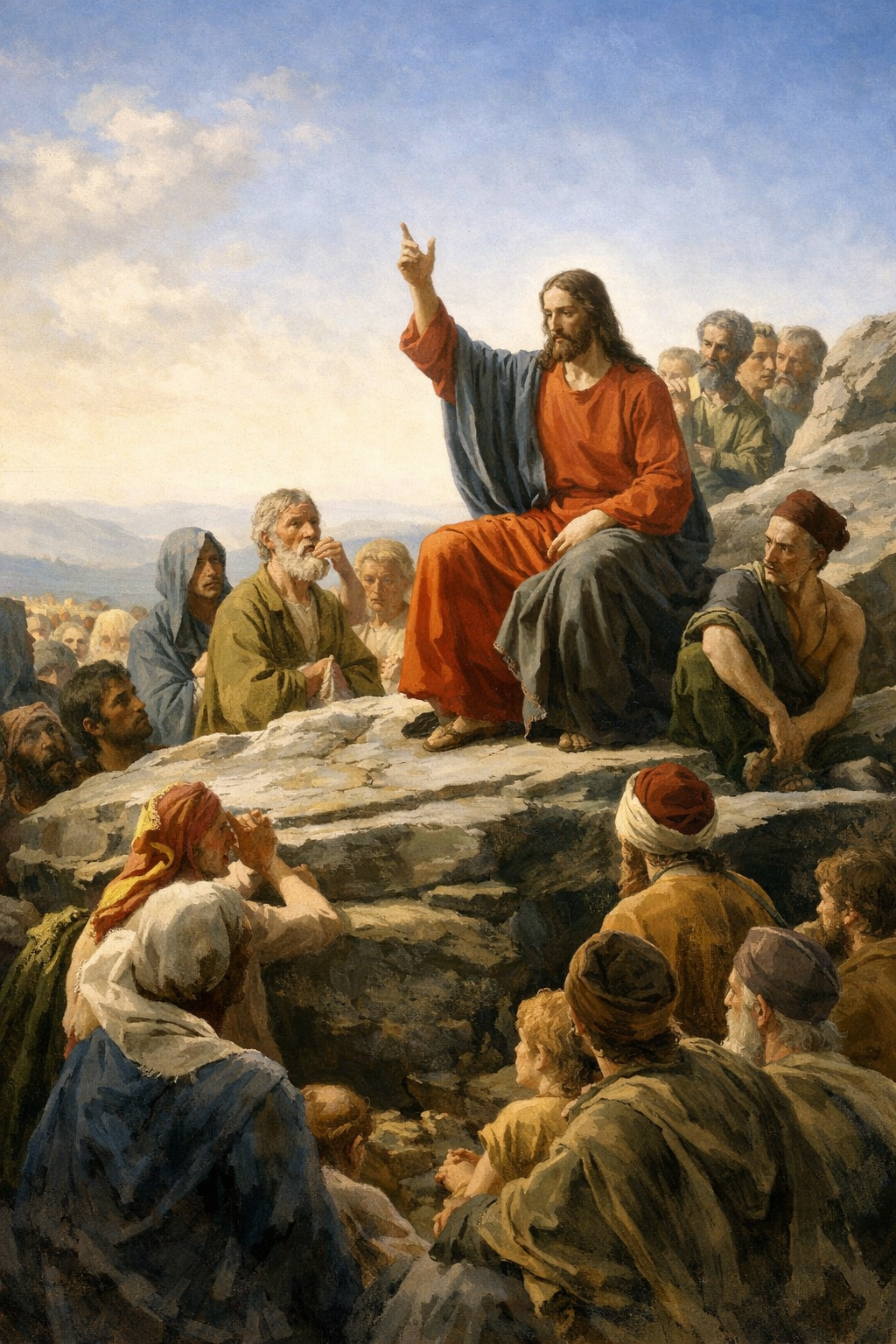
Sermon on the Mount
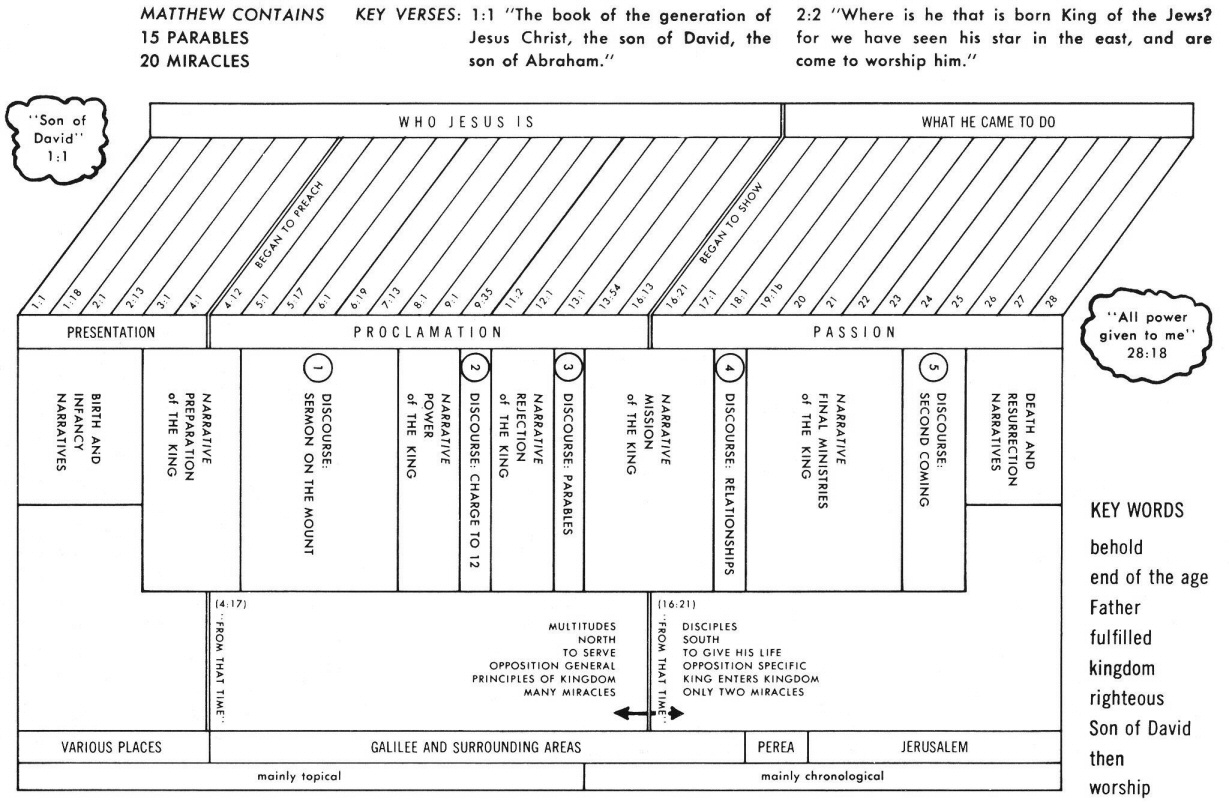
Click chart to enlarge
Charts from Jensen's Survey of the NT - used by permission
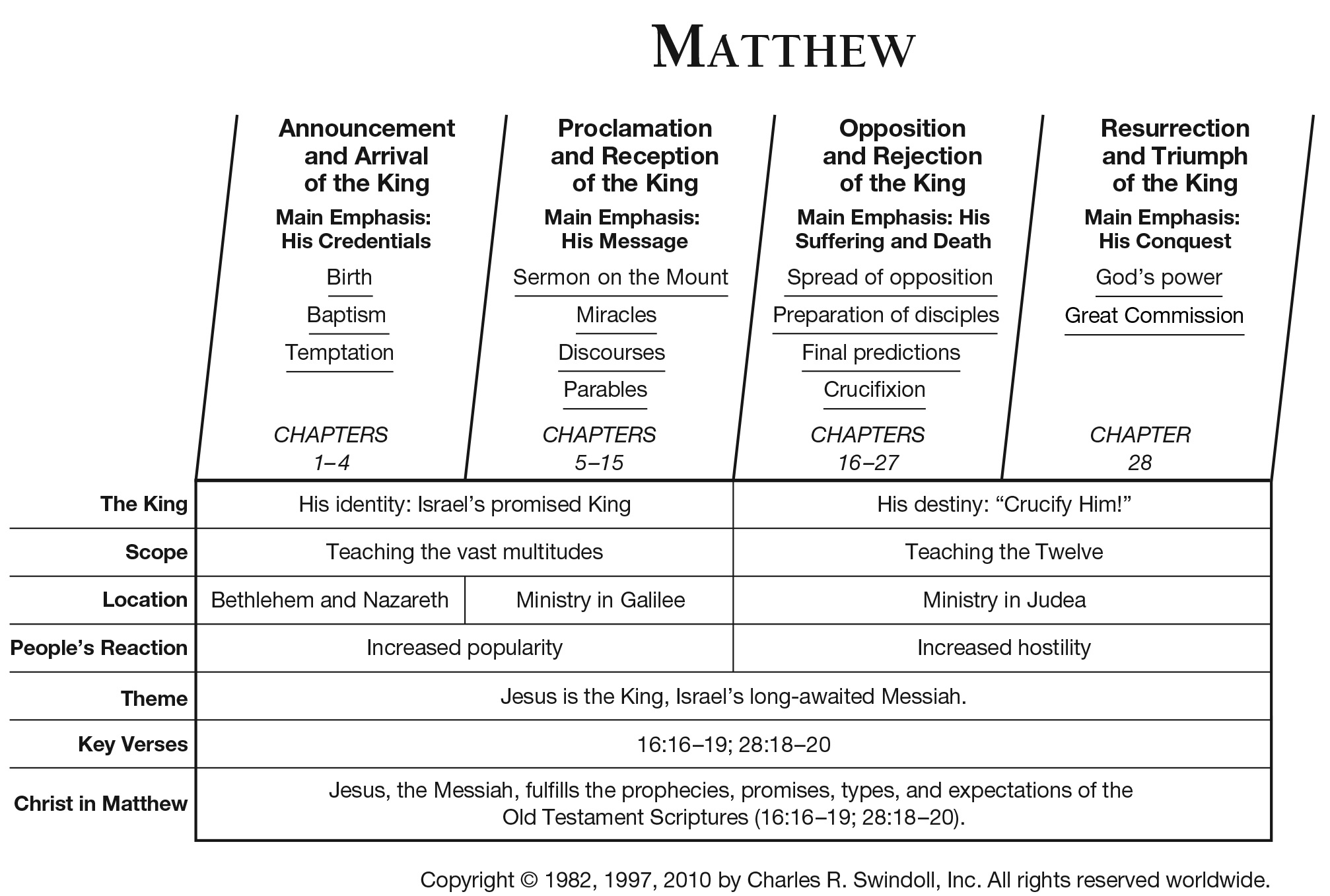
Another Chart from Charles Swindoll
THE LIFE OF JESUS AS COVERED
BY MATTHEW (shaded area)
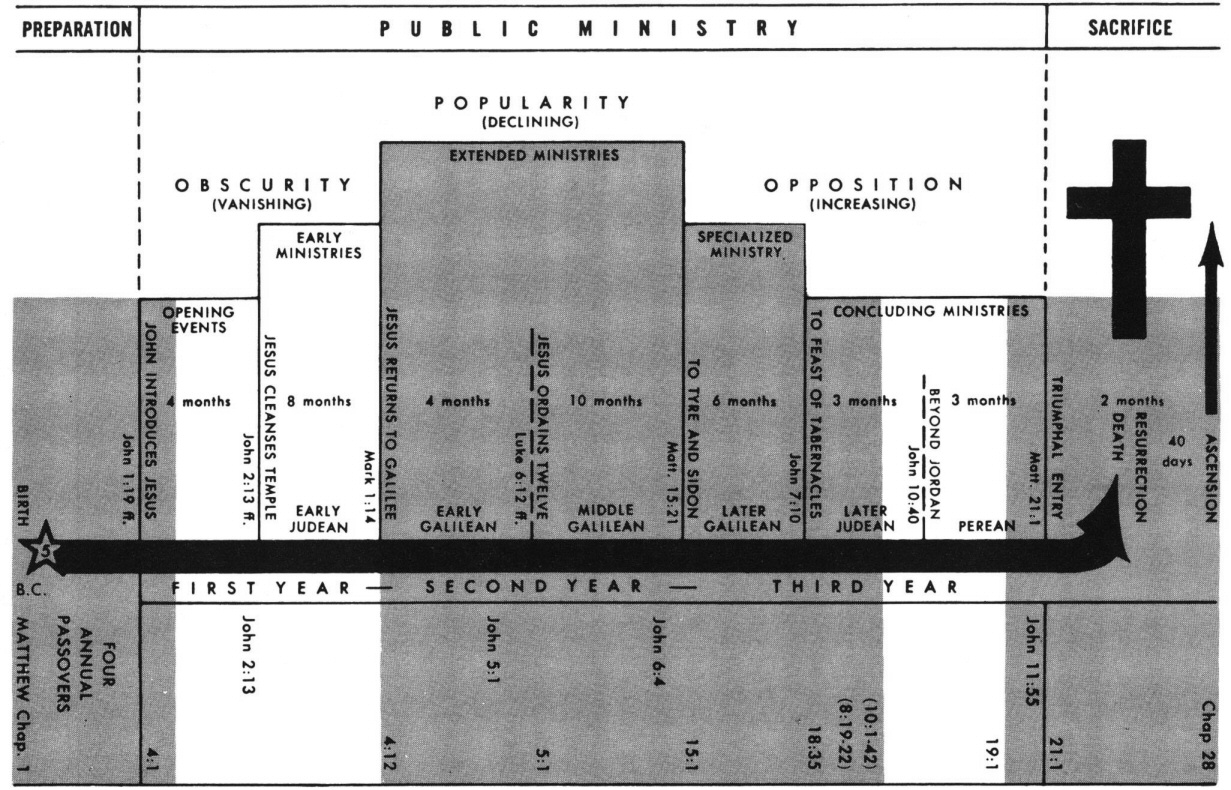
Click chart to enlarge
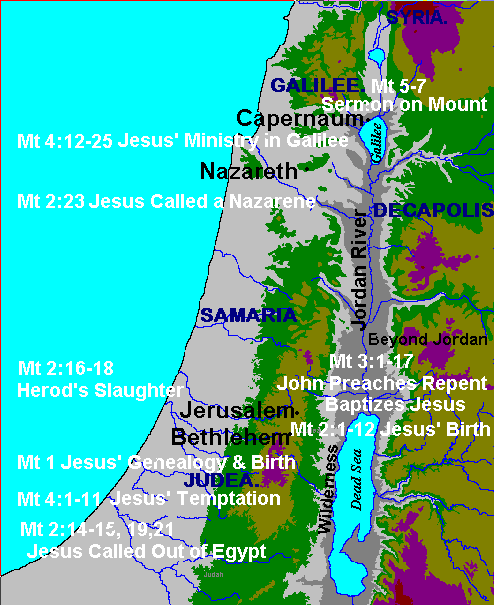
Jesus Birth and Early Years
Leading up to the Sermon on the Mount
Matthew 1-7

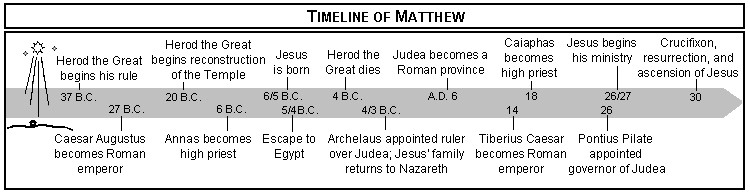
Source: Ryrie Study Bible
Matthew 6:2 So when you give to the poor, do not sound a trumpet before you, as the hypocrites do in the synagogues and in the streets, so that they may be honored by men. Truly I say to you, they have their reward in full. (NASB: Lockman)
Greek: Hotan oun poies (2SPAS) eleemosunen, me salpises (2SAAS) emprosthen sou, hosper hoi hupokritai poiousin (3PPAI) en tais sunagogais kai en tais rumais, opos doxasthosin (3PAPS) hupo ton anthropon; amen lego (1SPAI) humin apechousin (3PPAI) ton misthon auton.
Amplified: Thus, whenever you give to the poor, do not blow a trumpet before you, as the hypocrites in the synagogues and in the streets like to do, that they may be recognized and honored and praised by men. Truly I tell you, they have their reward in full already. (Amplified Bible - Lockman)
My Amplified Paraphrase: So when you give—when you perform acts of mercy, generosity, and charitable giving—do not sound a trumpet before you, do not announce or draw attention to yourself, as the hypocrites do in the synagogues and in the streets, who put their giving on display so that they may be honored by people; truly I say to you, they have already received—in full and with nothing left over—their reward.
Barclay: Take care not to try to demonstrate how good you are in the presence of men, in order to be seen by them. If you do, you have no reward with your Father in heaven.
KJV: Therefore when thou doest thine alms, do not sound a trumpet before thee, as the hypocrites do in the synagogues and in the streets, that they may have glory of men. Verily I say unto you, They have their reward.
NLT: When you give a gift to someone in need, don't shout about it as the hypocrites do--blowing trumpets in the synagogues and streets to call attention to their acts of charity! I assure you, they have received all the reward they will ever get. (NLT - Tyndale House)
Philips: So, when you do good to other people, don't hire a trumpeter to go in front of you - like those play-actors in the synagogues and streets who make sure that men admire them. Believe me, they have had all the reward they are going to get! (New Testament in Modern English)
Wuest: Therefore, whenever you are practicing the virtues of mercy or beneficence, do not sound a trumpet before you as the actors on the stage of life do in the synagogues and in the streets in order that they may be held in honor by men. Assuredly, I am saying to you, they have their reward and the receipt for the same in full. (
Young's Literal: whenever, therefore, thou mayest do kindness, thou mayest not sound a trumpet before thee as the hypocrites do, in the synagogues, and in the streets, that they may have glory from men; verily I say to you -- they have their reward!
SO WHEN YOU GIVE TO THE POOR: Hotan oun poies (2SPAS) eleemosunen
- So when you give to the pour - Job 31:16, 17, 18, 19, 20; Ps 37:21; 112:9; Pr 19:17; Eccl 11:2; Isa 58:7,10, 11, 12; Luke 11:41; 12:33; Jn 13:29; Acts 9:36; 10:2,4,31; 11:29; 24:17; Ro 12:8; 2Co 9:6-15; Gal 2:10; Eph 4:28; 1Ti 6:18; Phile 1:7; Heb 13:16; James 2:15,16; 1Pe 4:11; 1Jn 3:17, 18, 19
- Matthew 6 Resources - Multiple Sermons and Commentaries
- Matthew 6:1-4 Flashy Givers - Jack Arnold
- Matthew 6:1 Beware of Hypocrisy - John MacArthur
- Matthew 6:1-4 Giving Without Hypocrisy - John MacArthur

WOE!
LET YOUR GIVING BE
IN SILENCE
So (oun- term of conclusion) when you give (poieo - make/do) to the poor (eleemosune - alms) - Poor is added by NAS. More literally the text reads "do or make charity" (alms).
Do not sound a trumpet before you, as the hypocrites (hupokrites) do in the synagogues (sunagoge) and in the streets, so that (term of purpose) they may be honored (doxazo) by men. Truly (amen) I say to you, they have their reward (misthos) in full (apecho).
The cultural context in Jesus' day is important to understand so that you might better appreciate why our Lord emphasizes the topic of righteousness and specifically aid to the poor. In Jesus’ time, the word righteousness was closely linked to the word alms. And thus one can see why the Jewish rabbis laid such great stress upon charity and good deeds in general as a means of attaining righteousness and as a means of pleasing God and of being rewarded by Him. To this present day if you ask a Jewish person how they expect to get into the Kingdom of God, many will answer "By doing good deeds". But their definition of "good deeds" is not the same as God's definition of "good deeds" and so Jesus immediately strikes at the very heart and foundation of the beliefs of Judaism. Imagine for a moment that you were a strictly orthodox Jew or even a member of the party of the Pharisees and you were among the multitude who heard these piercing words calculated to produce a reaction in the heart and minds of the hearers. Jesus came to seek and to save the lost but first He had to show men that they were lost and spiritually dead in their trespasses and sins.
When (whenever not "if ever"!) assumes citizens of the Kingdom of heaven will give to the poor.
🙏 THOUGHT - Giving to the poor is good, but Jesus presses us to ask a deeper question! How are we doing this good deed, and why are we doing it? What is our true motivation? Are we seeking to impress people, to gain admiration, to be seen as generous and spiritual? Or are we giving quietly, humbly, and sincerely for the pleasure of God alone? Be honest with your heart, because God already knows. The value of the gift is not measured merely by what is given, but by the spirit in which it is offered. When we give to please men, we gain only their fleeting praise. When we give to please God, we gain His eternal approval.
Give to the poor - more literally do or make charity (alms).
Poor (1654) (eleemosune from eleemon = merciful from eleos = mercy, kindness, compassion) signifies mercy or pity and came to be applied particularly in giving alms (alms = something such as money or food given freely to relieve the poor. Our English word "alms" is from Latin eleemosyna in turn from the Greek word eleemosune). Stated another way alms represents money given out of mercy for the poor.
Giving was an important part of ancient Judaism where even those gleaning the fields were told to leave behind some of the sheaves so that the poor could gather and have food, Moses recording that…
'Now when you reap the harvest of your land, you shall not reap to the very corners of your field, neither shall you gather the gleanings of your harvest. 'Nor shall you glean your vineyard, nor shall you gather the fallen fruit of your vineyard; you shall leave them for the needy and for the stranger. I am the LORD your God. (Lev 19:9-10)
The same practice of giving passed into Christianity. But with every act of giving there is the danger of mixed motives creeping into something that is so necessary.
Many a Christian, many a church, has everything
in the showcase and nothing on the shelves.
--Vance Havner
William Barclay -
To the Jew almsgiving was the most sacred of all religious duties. How sacred it was may be seen from the fact that the Jews used the same word—tzedakah—both for righteousness and almsgiving. To give alms and to be righteous were one and the same thing. To give alms was to gain merit in the sight of God, and was even to win atonement and forgiveness for past sins.
“Prayer with fasting is good, but better than both is almsgiving with righteousness. A little with righteousness is better than wealth with wrongdoing. It is better to give alms than to lay up gold. For almsgiving saves from death and purges away every sin. Those who give alms will enjoy a full life, but those who commit sin and do wrong are their own worst enemies. (Tobit 12:8)…
There was a rabbinic saying:
“Greater is he who gives alms than he who offers all sacrifices.”
Almsgiving stood first in the catalogue of good works. It was then natural and inevitable that the man who desired to be good should concentrate on almsgiving. The highest teaching of the Rabbis was exactly the same as the teaching of Jesus. They too forbade ostentatious almsgiving.
“He who gives alms in secret,” they said, “is greater than Moses.”
The almsgiving which saves from death is that
“when the recipient does not know from whom he gets it, and when the giver does not know to whom he gives it.”
There was a Rabbi who, when he wished to give alms, dropped money behind him, so that he would not see who picked it up.
“It were better,” they said, “to give a man nothing, than to give him something, and to put him to shame.”
There was one particularly lovely custom connected with the Temple. In the Temple there was a room called The Chamber of the Silent. People who wished to make atonement for some sin placed money there; and poor people from good families who had come down in the world were secretly helped by these contributions. (Gospel of Matthew - Daily Study Bible ) (Bolding added)
Dwight Pentecost adds that…
The Pharisees had gone far beyond any legitimate interpretation of (the OT Law). The people had been told:
“Lay up alms in thy storehouse, it shall deliver thee from affliction.”
“Alms delivers from death and will purge away all sin.”
“Almsgiving will deliver from hell and make one perfectly righteous.”
We recognize this as heretical teaching, for giving alms cannot cleanse a man from sin. But such was the Jewish concept of almsgiving that they said,
“Giving of alms will make restitution to God for sins that the giver has committed.”
Now, the Pharisees had concluded that if a man gave, but gave in secret, he lost all benefit from giving. There must be an audience before one could gain any benefit from God through the giving. Thus they concluded they lost gains if there were no spectators. (BORROW Design for living: Lessons in Holiness from the Sermon on the Mount)
C H Spurgeon's comments…
MATTHEW 6:1-18 THE KING CONTRASTS THE LAWS OF HIS KINGDOM WITH THE CONDUCT OF OUTWARD RELIGIONISTS IN THE MATTERS OF ALMS AND PRAYER 1. TAKE heed that ye do not your alms before men, to be seen of them: otherwise ye have no reward of your Father which is in heaven.
Our King sets men right as to Almsgiving. It is taken for granted that we give to the poor. How could we be in Christ’s kingdom if we did not?
Alms may be given publicly, but not for the sake of publicity. It is important that we have a right aim; for if we obtain the result of a wrong aim, our success will be a failure. If we give to be seen, we shall be seen, and there will be an end of it: “Ye have no reward of your father which is in heaven ”: we lose the only reward worth having. But if we give to please our Father, we shall find our reward at his hands. To the matter of our intent and design we must “take heed ”; for nobody goes right without carefully aiming to do so. Our giving of alms should be a holy duty, carefully performed, not for our own honor, but for God’s pleasure. Let each reader ask himself, how much he has done, in the way the King prescribes.
Therefore when thou doest thine alms, do not sound a trumpet before thee, as the hypocrites do in the synagogues and in the streets. that they may have glory of men. Verily I say unto, They have their reward.
We must not copy the loud charity of certain vainglorious persons: their character is hypocritical, their manner is ostentatious, their aim is to be seen of men, their reward is in the present. That reward is a very poor one, and is soon over. To stand with a penny in one hand and a trumpet in the other is the posture of hypocrisy. “Glory of men ” is a thing which can be bought: but honor from God is a very different thing. This is an advertising age, and too many are saying, “Behold my liberality!” Those who have Jesus for their King must wear his livery of humility, and not the scarlet trappings of a purse-proud generosity, which blows its own trumpet, not only in the streets, but even in the synagogues. We cannot expect two rewards for the same action: if we have it now we shall not have it hereafter. Unrewarded alms will alone count in the record of the last day. (Commentary)
DO NOT SOUND A TRUMPET BEFORE YOU, AS THE HYPOCRITES DO IN THE SYNAGOGUES AND IN THE STREETS: me salpises (2SAAS) emprosthen sou, hosper hoi hupokritai poiousin (3PPAI) en tais sunagogais kai en tais rumais
- Do not sound a trumpet - Proverbs 20:6; Hosea 8:1
- As the hypocrites do - Mt 6:5; 7:5; 15:7; 16:3; 22:18; 23:13-29; 24:51; Isaiah 9:17; 10:6; Mark 7:6; Luke 6:42; 12:56; 13:15
- In the synagogues - Mt 6:5; 23:6; Mark 12:39; Luke 11:43; 20:46
- Matthew 6 Resources - Multiple Sermons and Commentaries
- Matthew 6:1-4 Flashy Givers - Jack Arnold
- Matthew 6:1 Beware of Hypocrisy - John MacArthur
- Matthew 6:1-4 Giving Without Hypocrisy - John MacArthur
MUFFLE THE
TRUMPET
Do not sound a trumpet before you, as the hypocrites (hupokrites) do in the synagogues (sunagoge) and in the streets - Jesus warns against making a show of generosity, saying we must not draw attention to ourselves like hypocrites who publicly display their giving in religious settings and public places just to gain admiration from people.
Ron Mattoon has an interesting note on sound a trumpet writing "that there is a custom in the East similar to this. The dervishes carry horns with them, which they frequently blow, when any thing is given to them, in honor of the donor. It is not impossible that some of the poor Jews who begged alms might have been furnished with some kind of horn, like the Persian dervishes, who were a sort of religious beggar. These hypocrites might have been inclined to confine their charitable giving to those that they knew would pay them this honor. A. T. Robertson pointed out that a missionary told him that in India the Hindu priests did indeed sound a literal trumpet in order to get a crowd when they were about to give alms or do some other religious deed. (Ron Mattoon - Treasures From Proverbs, Volume One)
What you are in public will never
blind God to what you are in private.
--John Blanchard
This is the wrong way to give to the poor. If you "toot your own horn" (one wonders if this modern expression is related to Jesus' illustration!) you are a hypocrite or an actor, manifesting a solemn, pious appearance of godliness when in fact on the inside you are not at all what you appear to be. You are doing it all for show and the praise of men.
What if those donors were told that their donations
would all be treated anonymously?!
In the secular world this syndrome is obvious… buildings named for big donors, etc. What if those donors were told that their donations would all be treated anonymously?! The answer doesn't take much imagination does it? Jesus' point is that giving for the express purpose that others honor us and think good of us and our extravagant generosity is hypocrisy, whether it is in the secular world or the church! People may not sound a trumpet to project the image of generosity, but they still know how to call attention to their giving, because the heart is more deceitful than all else and is desperately sick (cf Jer 17:9)
Phil Newton - In some church settings, the offering is taken by the members parading to the front and laying their gifts on the table for all to see. In other settings those that give their gifts expect to have certain privileges and even control. One pastor in a southern city refused to violate his convictions of not performing a marriage of a believer and unbeliever. It just happened that the one this affected was a wealthy lady that gave hundreds of thousands of dollars each year to this debt-strapped church. She told the pastor that if he refused to perform this wedding, then she was leaving and her hundreds of thousands with her. He showed her the door. Her entire motive for giving was not out of a desire to honor the Lord but to control. She has already had her “reward in full.”… There was a dear little lady, now deceased, that I had known for many years that followed the progress of our church in its early days. When we came to the time of building a new building and furnishing it, she sent me a sizeable gift to purchase a desk, chairs, and office equipment. I was pretty bowled over by her generosity, especially since she did not even live in our community. But I still remember her note: “This is our little secret.” She wanted no recognition or applause or plaque commemorating her generosity. She just found great joy in being able to give as unto the Lord for the work of ministry. Her left hand did not know what her right hand was doing. (Sermon)
D A Carson - The reference to trumpet announcements is difficult. Many commentators still say this refers to "the practice of blowing trumpets at the time of collecting alms in the Temple for the relief of some signal need" (Hill, Matthew, following Bonnard); but no Jewish sources confirm this, and the idea seems to stem only from early Christian expositors who assumed its correctness. Likewise there is no evidence (contra Calvin) that the almsgivers themselves really blew trumpets on their way to the temple… public fasts were proclaimed by the sounding of trumpets. At such times prayers for rain were recited in the streets (cf. v. 5), and it was widely thought that alms-giving insured the efficacy of the fasts and prayers (e.g., b Sanhedrin 35a; P. Tannith 2:6; Leviticus R 34:14). But these occasions afforded golden opportunities for ostentation. (See Matthew)
A CRITICAL LOOK
AT HYPOCRITE
Hypocrite (5273) (hupokrites from hupó = under, indicating secrecy + krino = to judge) describes one who acts pretentiously, a counterfeit, a man who assumes and speaks or acts under a feigned character. A hypocrite is someone who pretends to be something he or she is not.
Will Durant - The actor – who is always a male – is not disdained as in Rome, but is much honored; he is exempt from military service, and is allowed safe passage through the lines in time of war. He is called hypocrites, but this word means answerer – i.e., to the chorus; only later will the actor’s role as an impersonator lead to the use of the word as meaning hypocrite. (The Story of Civilization II, The Life of Greece, by Will Durant, page 380)
Related Resources:
- See study on the related word Hypocrisy (5272) = Hupokrisis
- Who Is a Hypocrite? by I. Howard Marshall - BSAC 159:634 (Apr 2002)
The 1828 Webster's English dictionary says a hypocrite is "One who feigns to be what he is not; one who has the form of godliness without the power (cf 2Ti 3:5+), or who assumes an appearance of piety and virtue, when he is destitute of true religion (cf Jas 1:27+ for definition of "true religion").
Hupokrites - 17x in 17v - Hupokrites is a "favorite" of Jesus in Matthew!
Matthew 6:2 "So when you give to the poor, do not sound a trumpet before you, as the hypocrites do in the synagogues and in the streets, so that they may be honored by men. Truly I say to you, they have their reward in full.
Matthew 6:5 "When you pray, you are not to be like the hypocrites; for they love to stand and pray in the synagogues and on the street corners so that they may be seen by men. Truly I say to you, they have their reward in full.
Matthew 6:16 "Whenever you fast, do not put on a gloomy face as the hypocrites do, for they neglect their appearance so that they will be noticed by men when they are fasting. Truly I say to you, they have their reward in full.
Matthew 7:5 "You hypocrite, first take the log out of your own eye, and then you will see clearly to take the speck out of your brother's eye.
Matthew 15:7 "You hypocrites, rightly did Isaiah prophesy of you:
Matthew 22:18 But Jesus perceived their malice, and said, "Why are you testing Me, you hypocrites?
Matthew 23:13 "But woe to you, scribes and Pharisees, hypocrites, because you shut off the kingdom of heaven from people; for you do not enter in yourselves, nor do you allow those who are entering to go in.
Matthew 23:15 "Woe to you, scribes and Pharisees, hypocrites, because you travel around on sea and land to make one proselyte; and when he becomes one, you make him twice as much a son of hell as yourselves.
Matthew 23:23 "Woe to you, scribes and Pharisees, hypocrites! For you tithe mint and dill and cummin, and have neglected the weightier provisions of the law: justice and mercy and faithfulness; but these are the things you should have done without neglecting the others.
Matthew 23:25 "Woe to you, scribes and Pharisees, hypocrites! For you clean the outside of the cup and of the dish, but inside they are full of robbery and self-indulgence.
Matthew 23:27 "Woe to you, scribes and Pharisees, hypocrites! For you are like whitewashed tombs which on the outside appear beautiful, but inside they are full of dead men's bones and all uncleanness.
Matthew 23:29 "Woe to you, scribes and Pharisees, hypocrites! For you build the tombs of the prophets and adorn the monuments of the righteous,
William Barclay - The word hypocrite occurs here again and again. Originally the Greek word hupokrites (Greek #5273) meant one who answers; it then came to be specially connected with the statement and answer, the dialogue, of the stage; and it is the regular Greek word for an actor. It then came to mean an actor in the worse sense of the term, a pretender, one who acts a part, one who wears a mask to cover his true feelings, one who puts on an external show while inwardly his thoughts and feelings are very different. To Jesus the Scribes and Pharisees were men who were acting a part. What he meant was this. Their whole idea of religion consisted in outward observances, the wearing of elaborate phylacteries and tassels, the meticulous observance of the rules and regulations of the Law. But in their hearts there was bitterness and envy and pride and arrogance. To Jesus these Scribes and Pharisees were men who, under a mask of elaborate godliness, concealed hearts in which the most godless feelings and emotions held sway. And that accusation holds good in greater or lesser degree of any man who lives life on the assumption that religion consists in external observances and external acts. There is an unwritten saying of Jesus which says, "The key of the Kingdom they hid." His condemnation of these Scribes and Pharisees is that they are not only failing to enter the Kingdom themselves, they shut the door on the faces of those who seek to enter. What did he mean by this accusation? We have already seen (Matthew 6:10) that the best way to think of the Kingdom is to think of it as a society on earth where God's will is as perfectly done as it is in heaven. To be a citizen of the Kingdom, and to do God's will, are one and the same thing. The Pharisees believed that to do God's will was to observe their thousands of petty rules and regulations; and nothing could be further from that Kingdom whose basic idea is love. When people tried to find entry into the Kingdom the Pharisees presented them with these rules and regulations, which was as good as shutting the door in their faces. The Pharisees preferred their ideas of religion to God's idea of religion. They had forgotten the basic truth that, if a man would teach others, he must himself first listen to God. The gravest danger which any teacher or preacher encounters is that he should erect his own prejudices into universal principles and substitute his own ideas for the truth of God. When he does that he is not a guide, but a barrier, to the Kingdom, for, misled himself, he misleads others. (Matthew 23 - William Barclay's Daily Study Bible)
Matthew 24:51 and will cut him in pieces and assign him a place with the hypocrites; in that place there will be weeping and gnashing of teeth.
Mark 7:6 And He said to them, "Rightly did Isaiah prophesy of you hypocrites, as it is written: 'THIS PEOPLE HONORS ME WITH THEIR LIPS, BUT THEIR HEART IS FAR AWAY FROM ME.
William Barclay - He accused them of hypocrisy. The word hupokrites has an interesting and revealing history. It begins by meaning simply one who answers; it goes on to mean one who answers in a set dialogue or a set conversation, that is to say an actor; and finally it means, not simply an actor on the stage, but one whose whole life is a piece of acting without any sincerity behind it at all. Anyone to whom religion is a legal thing, anyone to whom religion means carrying out certain external rules and regulations, anyone to whom religion is entirely connected with the observation of a certain ritual and the keeping of a certain number of tabus is in the end bound to be, in this sense, a hypocrite. The reason is this--he believes that he is a good man if he carries out the correct acts and practices, no matter what his heart and his thoughts are like. To take the case of the legalistic Jew in the time of Jesus, he might hate his fellow man with all his heart, he might be full of envy and jealousy and concealed bitterness and pride; that did not matter so long as he carried out the correct handwashings and observed the correct laws about cleanness and uncleanness. Legalism takes account of a man's outward actions; but it takes no account at all of his inward feelings. He may well be meticulously serving God in outward things, and bluntly disobeying God in inward things--and that is hypocrisy. The devout Mohammedan must pray to God a certain number of times each day. To do so he carries his prayer mat; wherever he is, he will unroll the mat, fall upon his knees, say his prayers and then go on. There is a story of a Mohammedan who was pursuing a man with upraised knife to murder him. Just then the call to prayer rang out. Immediately he stopped, spread out his prayer mat, knelt, said his prayer as fast as he could; then rose and continued his murderous pursuit. The prayer was simply a form and a ritual, an outward observance, merely the correct interlude in the career of murder. There is no greater religious peril than that of identifying religion with outward observance. There is no commoner religious mistake than to identify goodness with certain so-called religious acts. Church-going, bible-reading, careful financial giving, even time-tabled prayer do not make a man a good man. The fundamental question is, how is a man's heart towards God and towards his fellow-men? And if in his heart there are enmity, bitterness, grudges, pride, not all the outward religious observances in the world will make him anything other than a hypocrite. (Mark 7 - William Barclay's Daily Study Bible)
Luke 6:42+ "Or how can you say to your brother, 'Brother, let me take out the speck that is in your eye,' when you yourself do not see the log that is in your own eye? You hypocrite, first take the log out of your own eye, and then you will see clearly to take out the speck that is in your brother's eye.
Luke 12:56+ "You hypocrites! You know how to analyze the appearance of the earth and the sky, but why do you not analyze this present time?
William Barclay - When we read this passage we are reminded again of the Jewish definition of preaching--charaz (Hebrew 02737), which means stringing pearls (The Rabbis held that the preacher must never linger more than a few moments on any topic but, in order to maintain interest, must move quickly from one topic to another. Jewish preaching, therefore, often gives us the impression of being disconnected.). This passage, too, is a collection of pearls strung together without the close connection which modern preaching demands. But in it there are certain dominant ideas. (i) It tells us of the forbidden sin, which is hypocrisy. The word hypocrite began by meaning someone who answers; and hypocrisy originally meant answering. First the words were used of the ordinary flow of question and answer in any talk or in any dialogue; then they began to be connected with question and answer in a play. From that they went on to be connected with acting apart. The hypocrite is never genuine; he is always play-acting. The basis of hypocrisy is insincerity. God would rather have a blunt, honest sinner, than someone who puts on an act of goodness. (Luke 12 - William Barclay's Daily Study Bible)
Comment on Jn 13:21-30 = The treachery of Judas is seen at its worst. He must have been the perfect actor and the perfect hypocrite. One thing is clear--if the other disciples had known what Judas was about, he would never have left that room alive. All the time Judas must have been putting on an act of love and loyalty which deceived everyone except Jesus. He was not only a bare-faced villain; he was a suave hypocrite. There is warning here. By our outward actions we may deceive men; but there is no hiding things from the eye of Christ.
Luke 13:15+ But the Lord answered him and said, "You hypocrites, does not each of you on the Sabbath untie his ox or his donkey from the stall and lead him away to water him?
Hupokrites occurs 2 times in the Septuagint (LXX) = Job 34:30; 36:13
Hypocrite as discussed more below had its origins in Greek theater, in which it described a character who wore a mask. In the theater the "hypocrite" held the painted mask in front of his face to portray a character. Today, hypocrites are those who try to disguise their true identity. They say they are one thing, but their actions prove otherwise.
In the New Testament a hypocrite normally refers to an unregenerate person who is self-deceived. Unless prompted by the right motives, religious activities, including doing good deeds to others, are of no real spiritual value and receive no commendation from God. It does matter greatly why we do what we do. The hypocrite has a duplicitous life – often without realizing it – giving appearance of one motive when in reality there is a hidden motive. Beloved, I don't know about you, but I can state without reservation that the most difficult type of hypocrisy to discern is not that in others but self-hypocrisy! (My wife reminds me of this frequently!) How easy it is to spot improper motives others but make excuses for similar motives in our own heart or even worse (and probably more often) never even see them (that's called self-deception)!
The hypocrite is the man or woman who puts on a mask and pretends to be what he or she is not in the inner person or in modern parlance is not "authentic". A parallel thought is what others see what's on the outside, which we refer to as reputation. God sees what's really present on the inside, which is what we call character. Clearly, God is interested in our character, not our reputation. Who do you seek to please in your various religious activities? Are you "playing the part" like an actor/actress or are you seeking to please only your Father Who art in heaven? (cf passages that speak of pleasing God - Ep 5:10+, Ro 12:1NIV+, Php 4:18b+, He 11:6+, 1Jn 3:22)
When (not if but when) you give, pray and fast, don't be an "play actor" hiding behind your mask of religious activity trying to convince people (or even yourself) you are someone who is wholly devoted to God and perfectly pious, when you are not.
🙏 THOUGHT - By way of application it would be wise to apply this warning by our Lord to all our "religious activities". Be honest and ask yourself "Why am I doing what I am doing at church?" Remember Jesus is always more interested in "being" than in "doing". The latter should always proceed from the former.
Wuest adds that this Greek word "is made up of hupo “under,” and krino “to judge” and referred originally to “one who judged from under the cover of a mask,” thus, assuming an identity and a character which he was not. This person was the actor on the Greek stage, one who took the part of another. The Pharisees were religious actors, so to speak, in that they pretended to be on the outside, what they were not on the inside… Our word hypocrite comes from this Greek word. It usually referred to the act of concealing wrong feelings or character under the pretence of better ones."
In another note Wuest explains that ""The Greek word for “hypocrite” was used of an actor on the Greek stage, one who played the part of another. The word means literally, “to judge under,” and was used of someone giving off his judgment from behind a screen or mask… The true identity of the person is covered up. It refers to acts of impersonation or deception. It was used of an actor on the Greek stage. Taken over into the New Testament, it referred to a person we call a hypocrite, one who assumes the mannerisms, speech, and character of someone else, thus hiding his true identity. Christianity requires that believers should be open and above-board. They should be themselves. Their lives should be like an open book, easily read." (Ibid)
Barclay - The word hypocrite began by meaning someone who answers; and hypocrisy originally meant answering. First the words were used of the ordinary flow of question and answer in any talk or in any dialogue; then they began to be connected with question and answer in a play. From that they went on to be connected with acting apart. The hypocrite is never genuine; he is always play-acting. The basis of hypocrisy is insincerity. God would rather have a blunt, honest sinner, than someone who puts on an act of goodness. (Luke 12 - William Barclay's Daily Study Bible)
- A hypocrite is like a clean glove which hides a dirty hand. He acts as if he is good but isn't.
- A hypocrite preaches by the yard but practices by the inch.
- A hypocrite prays on his knees on Sunday and preys on his neighbors on Monday!
- A hypocrite is a man who lets his light so shine before men that they can't tell what is going on behind! Contrast Mt 5:16+
William Barclay adds that "Hupokrites (hypocrite) is a word with a curious history. It is the noun from the verb hupokrinesthai which means to answer; a hupokrites begins by being an answerer. Then it it goes on to mean one who answers in a set dialogue or a set conversation, that is to say an actor, the man who takes part in the question and answer of the stage… It then came to mean an actor in the worse sense of the term, a pretender, one who acts a part, one who wears a mask to cover his true feelings, one who puts on an external show while inwardly his thoughts and feelings are very different… it comes to mean a hypocrite, a man who all the time is acting a part and concealing his real motives… one whose whole life is a piece of acting without any sincerity behind it at all. Anyone to whom religion is a legal thing, anyone to whom religion means carrying out certain external rules and regulations, anyone to whom religion is entirely connected with the observation of a certain ritual and the keeping of a certain number of taboos is in the end bound to be, in this sense, a hypocrite. The reason is this—he believes that he is a good man if he carries out the correct acts and practices, no matter what his heart and his thoughts are like. To take the case of the legalistic Jew in the time of Jesus, he might hate his fellow man with all his heart, he might be full of envy and jealousy and concealed bitterness and pride; that did not matter so long as he carried out the correct handwashings and observed the correct laws about cleanness and uncleanness. Legalism takes account of a man’s outward actions; but it takes no account at all of his inward feelings. He may well be meticulously serving God in outward things, and bluntly disobeying God in inward things—and that is hypocrisy… There is no greater religious peril than that of identifying religion with outward observance. There is no commoner religious mistake than to identify goodness with certain so-called religious acts. Church-going, bible-reading, careful financial giving, even time-tabled prayer do not make a man a good man. The fundamental question is, how is a man’s heart towards God and towards his fellow-men? And if in his heart there are enmity, bitterness, grudges, pride, not all the outward religious observances in the world will make him anything other than a hypocrite… The hypocrite is the man whose alleged Christian profession is for his own profit and prestige and not for the service and glory of Christ." (Barclay, W: The Daily study Bible series)
The world doesn't doubt Christianity as much as it does some who claim to be Christians, so that the hypocritical "Christian" is one of the devil's best workers!
The Dictionary of Biblical Imagery notes that "The Pharisees are the prototypical hypocrites of the Bible. A composite portrait is easy to assemble from Jesus' denunciations of them. They are ostentatious when they give alms with the intent that people will praise them (Mt 6:2). They pray in the synagogues and street corners so people will take note (Mt 6:5). When they fast, they disfigure their faces (Mt 6:16). They tithe their garden produce but neglect “the weightier matters of the law, justice and mercy and faith” (Mt 23:23). In Jesus' caricature of them, they clean the outside of a drinking cup but ignore the filth inside it (Mt 23:25). They are self-righteous (Mt 23:29, 30), they teach people false religious beliefs (Mt 23:16, 17, 18, 19, 20, 21, 22), and they prevent people from entering the kingdom of heaven (Mt 23:13, 14, 15). They try to trap Jesus by pretending to be perplexed about issues (Mt 22:15, 16, 17, 18, 19, 20, 21, 22). We are not surprised that they have a special place in hell (Mt 24:51). Jesus' climactic exposure of hypocrites is to picture them as “whitewashed tombs, which outwardly appear beautiful, but within are full of dead men’s bones and all uncleanness” (Mt 23:27RSV). (FREE ONLINE - Dictionary of Biblical Imagery)
Leo Tolstoy - Hypocrisy in anything whatever may deceive the cleverest and most penetrating man, but the least wide-awake of children recognizes it, and is revolted by it, however ingeniously it may be disguised.
Thomas Brooks - The hypocrite is a cloud without rain, a blossoming tree without fruit, a star without light, a shell without a kernel.
Richard Glover spared no words when he said that "Hypocrisy not only covers faults, but swiftly eats out of the soul every remnant of truth and honour left in it.
John Mason's spiritual sayings offer some pithy portrayals of a hypocrite "A hypocrite is one who neither is what he seems; nor seems what he is. A hypocrite is the picture of a saint; but his paint shall be washed off and he shall appear in his own colors.
A hypocrite is hated by the world for seeming to be a Christian; and hated by God for not being one. (Grace Gems!)
Thomas Brooks on hypocrite - Many are much in and for church ordinances and activities, whose hearts are very carnal, and whose lives are very vain. It is nothing to be much in those religious duties and performances wherein the worst of sinners may go beyond the best of saints. The most refined hypocrites labor only to be seen by others in their praying, fasting, talking, hearing, giving, etc. Let them have but man's eye to see them, and man's ear to hear them, and man's tongue to commend them, and man's hand to reward them—and they will sit down and bless themselves. They say of the nightingale, that when she is solitary in the woods, she is careless of her melody. But when she perceives that she has any auditors, or is near houses, then she composes herself more harmoniously and elegantly. Truly, this is the frame and temper of the best of hypocrites.
Puritan writer Thomas Watson in his description of trees of righteousness said "Fruitfulness is one of the most distinctive characteristics of a Christian." Pr 12:12: "The root of the righteous yields fruit."
Fruitfulness distinguishes a saint from a hypocrite. The hypocrite is all for show and pretense; he has fair leaves—but "the root of the righteous yields fruit." Fruit can no more be separated from faith—than moisture from the air; it is the very definition of a branch in Christ; it bears fruit (Jn 15:2). As a man differs from a beast by reason, a beast differs from a plant by sense, and a plant differs from a stone by fruit—so a sincere Christian differs from a hypocrite by fruit. Fruitfulness puts a difference between the sound tree—and the hollow tree.
QUESTION. But may not hypocrites bring forth fruit?
ANSWER. They do not bring forth fruit in the Vine; they bring forth in the strength of their abilities, not in the strength of Christ.
Hypocrites bring forth something like fruit—but it is not the right fruit. The fruit they bear is not so sweet. The crab-apple tree may bear fruit as well as the pear-tree—but the pear excels in sweetness. The hypocrite may pray and give alms as well as a child of God—but there is a difference in the fruit. The fruit of the regenerate is wholesome; it is sweetened with faith and ripened with love. The hypocrite's fruit is sour and harsh; he does not bring forth sweet pomegranates—but crab-apples; not figs—but wild grapes.
The seeming fruit of hypocrites dies and comes to nothing. John 15:6: "He is like a branch that is thrown away and withers; such branches are picked up, thrown into the fire and burned." The hypocrite's fruit is like the grass upon the housetops, which withers before it grows up (Ps 139:6; Mt 13:6). (The Trees of Righteousness Blossoming and Bringing Forth Fruit)
Pumped Up - According to Reuters news agency, on April 28 at the 1992 Galveston County Fair and Rodeo, a steer named Husker, weighing in at 1,190 pounds, was named grand champion. The steer was sold at auction for $13,500 and slaughtered a few days after the competition. When veterinarians examined the carcass, said a contest official, they found something suspicious. They discovered evidence of what is called "airing." To give steers a better appearance, competitors have been known to inject air into their animals' hides with a syringe or a needle attached to a bicycle pump. Pump long enough, and they've got themselves what looks like a grand champion steer, though of course it's against the rules. The Galveston County Fair and Rodeo Association withdrew the championship title and sale money from Husker. A pumped-up steer is like a hypocritical person. Hypocrites appear more virtuous than they are.
Horrible Hypocrisy - According to the Chicago Tribune, a man named Joe from Rock-ford, Illinois, ran a live Internet sex site called Video Fantasy. Joe had a ten-year-old son. On his home computer Joe installed filtering software to limit the surfing that his son could do on the Internet. Joe explained, "It's not that I keep him sheltered, but my wife and I pay close attention to what he reads, what he watches on TV and what he does on the computer because we have a responsibility to him to be the best parents we can." Joe's sense of responsibility to his son is commendable. Joe's sense of responsibility to the children of other parents (and the parents themselves!) is deplorable. Can there be a more stark illustration of hypocrisy? (From 750 Engaging Illustrations)
Thomas Watson in his explanation of spiritual hunger describes…
the difference between true and false desires, spiritual hunger and carnal hunger.
1. The hypocrite does not desire grace for itself. He desires grace only as a bridge to lead him over to heaven. He does not so much search after grace—as glory. He does not so much desire the way of righteousness—as the crown of righteousness. His desire is not to be made like Christ—but to reign with Christ. This was Balaam's desire. 'Let me die the death of the righteous' (Numbers 23:10). Such desires as these are found among the damned. This is the hypocrite's hunger. But a child of God desires grace for itself, and Christ for himself. To a believer not only is heaven precious, but Christ is precious, "Yes, He is very precious to you who believe!" (1Peter 2:7).
2. The hypocrite's desire is conditional. He would have heaven and his sins too, heaven and his pride, heaven and his covetousness. The young man in the gospel would have had heaven, provided he might keep his earthly possessions. Many a man would have Christ—but there is some sin he must gratify. This is the hypocrites' hunger; but true desire is absolute. Give me, says the soul, Christ on any terms. Let God propound whatever articles he will, I will subscribe to them. Would he have me deny myself? Would he have me mortify sin? I am content to do anything—just so I may have Christ. Hypocrites would have Christ—but they will not part with their beloved lust for Him!
3. Hypocrites' desires are but desires. They are lazy and sluggish. 'The desire of the slothful kills him, for his hands refuse to labor' (Proverbs 21:25). Men would be saved but they will take no pains. Does he desire water. Who will not let down the bucket into the well? But true desire is quickened into endeavor. 'All night long I search for you; earnestly I seek for God.' (Isaiah 26:9). The 'violent take heaven by force (Matthew 11:12). The lovesick spouse, though she was wounded, and her veil taken away—yet she seeks after Christ (Song 5:7). Desire is the weight of the soul, which sets it a going; as the eagle which desires her prey makes haste to it. 'Where the slain are, there is she' (Job 39:30). The eagle has sharpness of sight to discover her prey, and swiftness of wing to fly to it. So the soul who hungers after righteousness, is carried swiftly to it in the use of all holy ordinances.
4. The hypocrite's desires are cheap. He would have spiritual things—but will be spend nothing for them. He cares not how much money he parts with for his lusts; he has money to spend upon a drunken companion; but he has no money to part with for the maintaining of God's ordinances. Hypocrites cry up religion—but cry down supporting the church. But true desires are costly. David would not offer burnt-offerings without cost (1Chronicles 21:24). A hungry man will give anything for food; as it fell out in the siege of Samaria (2Kings 6:25). That man never hungered after Christ, who thinks much of parting with a little silver for 'the Pearl of great price'.
5. Hypocrites' desires are flashy and transient. They are quickly gone, like the wind which does not stay long in one corner. Or like a hot fit which is soon over. While the hypocrite is under terror of conscience, or in affliction, he has some good desires—but the hot fit is soon over. His goodness, like a fiery comet, soon spends and evaporates. But true desire is constant. It is observable that the word in the text is: 'Blessed are those who are hungering.' Though they have righteousness—yet they are still hungering after more. Hypocrites desire it like the motion of a watch—which is quickly run down. The desire of a godly man is like the beating of the pulse—which lasts as long as life. 'My soul breaks for the longing that it has to your judgments' (Psalm 119:20). And that we might not think this pang of desire would soon be over he adds, 'at all times'. David's desire after God was not a high color in a fit—but the constant complexion of his soul. In the temple the fire was not to go out by night. 'The fire shall ever be burning upon the altar' (Leviticus 6:13). There was, says Cyril, a mystery in it, to show that we must be ever burning in holy affections and desires.
6. Hypocrites' desires are unseasonable. They are not well-timed. They put off their hungering after righteousness until it is too late. They are like the foolish virgins, who came knocking when the door was shut (Matthew 25:11). In time of health and prosperity the stream of their affections ran another way. It was sin the hypocrite desired, not righteousness. When he is about to die and can keep his sins no longer, now he would have grace as a passport to carry him to heaven (Luke 13:25). This is the hypocrite's fault. His desires are too late. He sends forth his desires when his last breath is going forth; as if a man should desire a pardon after the sentence is passed. These bedridden desires are bogus! But true desires are timely and seasonable. A gracious heart 'seeks first the Kingdom of God' (Matthew 6:33). David's thirst after God was early (Psalm 63:1). The wise virgins got their oil early before the bridegroom came. Thus we see the difference between a true and false hunger. Those who can find this true hunger are blessed, and may take comfort in it. (Spiritual Hunger)
Thomas Watson in his exposition of Pr 4:23 writes that…
With regard to our graces, the heart is like a flattering mirror which will make a hypocrite look good. The foolish virgins thought they had oil; many strongly think that they have grace, when they have none. The hypocrite's knowledge is no better than ignorance (1 John 2:4). He has illumination—but not assimilation; he has not been made like Christ. He 'believes'—but his heart is not purified. He pretends to trust God in greater matters—but dares not trust Him in lesser ones. He will trust God with his soul—but not with his estate.
Ron Mattoon - play acting was seen during times of mourning. In New Testament times some people made their living as professional mourners, who were paid to weep, wail, and tear their garments at funerals and on other occasions of sadness. It is said that some mourners were careful to tear their clothing at a seam, so that the material could easily be sewn back together for the next "mourning" opportunity. Both the professional mourners and those who hired them were hypocrites, hiring and being hired to put on a display of mourning that was entirely fake. This word "hypocrite" accurately describes professional mourners, but also those who do their almsgiving or any other deed for the praise of men. They want more praise than their deeds merit. Hypocrites are acting the part of another, for they are trying to act the part of one who has done a great deal more than they are actually doing. Furthermore, in their almsgiving, they are acting the part of one who is concerned about the poor, but in reality they are not interested in the poor at all. Instead, they are interested only in the praise of men. Their efforts to appear interested in the poor are nothing but play-acting. Their almsgiving is mostly a staged act. They are hypocrites and phonies. We always need to be on guard of this ever-present problem of becoming a hypocrite. (Ron Mattoon - Treasures From Proverbs, Volume One)
David Jeremiah recounts the following story…
Consider the story Dr. Harry Ironside told about a missionary in China who was translating the New Testament into the Chinese language. He was assisted by an eminent Chinese scholar, a Confucianist who had never before been exposed to Christianity. Week after week and month after month they sat side by side working through the biblical text.
When the project was nearly completed, the missionary told his friend, “You have been of great help to me. I could never have gotten along without you. Now I want to ask you a question. As we have gone together through the New Testament, hasn’t the beauty of Christianity touched you? Wouldn’t you like to become a Christian/”
The Confucianist replied, “Yes, Christianity does appeal to me. I think it presents the most wonderful system of ethics I have ever known. I believe that if I ever saw a Christian, I might become more interested in becoming one myself.”
“But,” exclaimed the missionary, “I am a Christian!”
“You?” the scholar replied. “You, a Christian? I hope you will not take offense, but I must tell you that I have observed you and listened to you from the beginning. If I understand the New Testament, a Christian is one who follows Jesus; and Jesus said, ‘By this all will know that you are My disciples, if you have love for one another.’
“You cannot be a Christian, for I have listened to you as you have talked about others in an unkind way. I have observed, too, that whereas your New Testament says that God will supply all our needs, you do not trust Him. You worry about this and about that; and if your check is a day late, you become dreadfully concerned. No, you cannot be a Christian. But I think that if I ever see one, I should like to be one.”
Pierced to the heart, the missionary broke down, sobbed out a confession, and asked God for forgiveness. He asked for the scholar’s forgiveness as well. This man was so broken that the Confucianist later remarked, “Well, perhaps I have seen a Christian after all.”… (David Jeremiah, Signs of Life, p. 225)
Lehman Strauss - We live in a world of make-believe. We are actors. It was the custom of Greek and Roman actors to wear large masks with mechanical devices to regulate the inflections and intonations of the voice. The Greek word for a play actor is hupokrites, from which we derive the English word hypocrite, a pretender, one who appears in a false guise and thus does not disclose what he truly is. In Satan's world, where man has his earthly sojourn, men and women apply their make-up almost daily before presenting themselves on the stage of life. This superficial camouflage is applied both physically and morally. Recently (June 21, 1960) in a four-page spread in Look magazine, there appeared an advertisement with the caption, "Skin-Deep Beauty: a $1 Billion Business." It went on to say, "Today, the face a girl wakes up with is rarely revealed in public." And most of us must admit that too frequently the heart we wake up with is rarely revealed in public… Are you guilty of play acting? Did you ever pretend that you were glad to see someone when in reality you were not? (Lehman Strauss - The Book of Revelation).
Hypocrite: Someone who complains that there is too much sex and violence on his VCR.- Current Comedy (Reader’s Digest, October, 1991, page 183)
Hypocrites – Great Methodist preacher Sangster once asked, “Are some people outside the church because you’re inside?"
Ron Mattoon notes that hypocrites hate rejection…
They thrive on being accepted by the crowd and are willing to pay any price to have approval. In fact, on the French Riviera, it is such an important status symbol to have a balcony on an apartment, that it is quite common to see balconies painted on the walls of apartment buildings. People even paint wet laundry hanging on a clothesline, just to give a touch of reality. All of this is done in order to be accepted.
Why do hypocrites pay any price for praise or acceptance? They may have suffered the pain of rejection earlier in their lives or may have not had much approval or praise as they were growing up. Some folks may have had a bad reputation when they were younger and want people to think they are good without being good. Others are addicted to praise and approval. They can't live without it. The reasons for hypocritical behavior are many. Nevertheless, hypocrites think nothing of deceiving others by their hypocrisy.
The biggest victim is the hypocrite himself, for he has deceived himself into thinking his behavior is appropriate or will have merit with the Lord. It doesn't. This is what the Lord was condemning because He alone is to be glorified, not ourselves. God condemns hypocritical praying because He knows that seeking praise inflates our pride, creating further spiritual problems in our lives. Praying, for self-glory or without sincerity, is a waste of time for the Lord is not fooled by our phoniness. (Ron Mattoon - Treasures From Proverbs, Volume One)
The New Unger's Bible Dictionary definition of "hypocrite"…
The hypocrite is a double person, natural and artificial. The first he keeps to himself, and the other he puts on, as he does his clothes, to make his appearance before men. Hypocrites have been divided into four classes:
(1) The worldly hypocrite, who makes a profession of religion and pretends to be religious, merely from worldly considerations (Matthew 23:5).
(2) The legal hypocrite, who relinquishes his vicious practices, in order thereby to merit heaven, while at the same time having no real love for God (Romans 10:3).
(3) The evangelical hypocrite, whose religion is nothing more than a bare conviction of sin; who rejoices under the idea that Christ died for him, and yet has no desire to live a holy life (Matthew 13:20).
(4) The enthusiastic hypocrite, who has an imaginary sight of his sins and of Christ and talks of remarkable impulses and high feelings, etc., while living in the most scandalous practices (2 Cor. 11:14).
Spurgeon gives us..
A Picture of a Hypocrite - I recollect when a child seeing on the mantel-piece a stone apple, wonderfully like an apple, too, and very well coloured. I saw that apple years after, but it was no riper. It had been in unfavourable circumstances for softening and sweetening, if it ever would have become mellow; but I do not think if the sun of the Equator had shone on it, or if the dews of Hermon had fallen on it, it would ever have been fit to be brought to table. Its hard marble substance would have broken a giant's teeth. It was a hypocritical professor, a hard-hearted mocker of little children, a mere mimic of God's fruits. (Flashes of Thought)
Hypocrites in the Church - Doubtless there are thousands in all Christian churches who have the stamp and the impress of the King upon them, and look like the genuine shekels of the sanctuary, who after all are only fit to be, like bad money, fastened down on the footstool of the judgment seat, with a nail driven through them, to their everlasting reprobation and disgrace. How can we tell a bold man from a coward? Two soldiers wear the same regimentals: they will talk equally loudly of what they will do when the enemy shall come. It is the battle that tests and proves them; some peculiar phase of the conflict will bring out the difference; but till the battle comes how easy it is for the poltroon to play the hero, while perhaps the bravest man may modestly shrink into the rear! (Flashes of Thought)
Providence revealing Hypocrites - A lion may lie all day asleep, you may scarce know but what it is tame; but when the night brings the time for it to go forth to its prey, then it howls, and displays its ferocity. And so an ungodly man may lie down in the church of God with the lambs of the flock, and nothing may lead you to suspect his true character; but when the time comes for him to make profit by sin, or to get pleasure by sin, or to escape from persecution by sin, then you find out what he is. These providences are the King's coming in to scrutinise the guests. Changes in the conditions of the church, changes in the condition of the individual, all sorts of providential events go to make up the great sieve by which the wheat and the chaff are separated. (Flashes of Thought)
Hypocrites love the gold of the altar better than the God of the altar. (FULL SERMON RIPE FRUIT)
Six Marks of Hypocrites (Mark 12:38-40):
1. Parade in fine clothing and religious robes (Mark 12:38; Matthew 23:5)
2. Love salutations in public (Mark 12:38)
3. Chief seat in church (Mark 12:39; notes, Matthew 23:2,6)
4. Chief couches at banquets (Mark 12:39; Matthew 23:6; Luke 14:7-11; Luke 20:46)
5. Take advantage of widows (Mark 12:40; note, Matthew 23:14)
6. Make long prayers (Mark 12:40; Matthew 23:14)
- God knows and detects Isaiah 29:15, 16
- Christ knew and detected Matt 22:18
- God has no pleasure in Isaiah 9:17
- Shall not come before God Job 13:16
- Described as
- Willfully blind Matt 23:17 Matt 23:19 Matt 23:26
- Vile Isaiah 32:6
- Self-righteous Isaiah 65:5 Luke 18:11
- Covetous Ezek 33:31 2Peter 2:3
- Ostentatious Matt 5:2 Matt 5:5 Matt 5:16 Matt 23:5
- Censorious Matt 7:3, 4, 5 Luke 13:14, 15
- Regarding tradition more than the word of God Matt 15:1, 2, 3
- Exact in minor, but neglecting important duties Matt 23:23, 24
- Having but a form of godliness 2Ti 3:5
- Seeking only outward purity Luke 11:39
- Professing but not practicing Ezek 33:31, 32 Mt 23:3 Ro 2:17, 18, 19, 20, 21, 22, 23
- Using but lip-worship Isaiah 29:13 Matt 15:8
- Glorying in appearance only 2Cor 5:12
- Trusting in privileges Jer 7:4 Matt 3:9
- Apparently zealous in the things of God Isaiah 58:2
- Zealous in making proselytes Matt 23:15
- Devouring widows' houses Matt 23:14
- Loving pre-eminence Matt 23:6, 7
- Worship of, not acceptable to God Isa 1:11, 12, 13, 14, 15 Isa 58:3, 4, 5 Mt 15:9
- Joy of, but for a moment Job 20:5
- Hope of perishes Job 8:13 Job 27:8, 9
- Heap up wrath Job 36:13
- Fearfulness shall surprise Isaiah 33:14
- Destroy others by slander Prov 11:9
- In power, are a snare Job 34:30
- The Apostasy to abound with 1Tim 4:2
- Beware the principles of Luke 12:1
- Spirit of, hinders growth in grace 1Peter 2:1
- Woe to Isaiah 29:15 Matt 23:13
- Punishment of Job 15:34 Isaiah 10:6 Jer 42:20 Jer 42:22 Matt 24:51
- Illustrated Matt 23:27. 28 Luke 11:44
Exemplified
- Cain Gen 4:3
- Absalom 2Sa 15:7, 8
- The Jews Jer 3:10
- Pharisees, etc Matt 16:3
- Judas Matt 26:49
- Herodians Mark 12:13 Mark 12:15
- Ananias Acts 5:1, 2, 3, 4, 5, 6, 7, 8
- Simon Acts 8:13, 14, 15, 16, 17, 18, 19, 20, 21, 22, 23
SUMMARY - Hypocrisy is never hidden from God. He sees and exposes it (Isa 29:15–16; Matt 22:18), takes no pleasure in it (Isa 9:17), and will not allow the hypocrite to stand before Him (Job 13:16). Scripture describes hypocrites as willfully blind, vile, self-righteous, covetous, showy, harshly judgmental, more devoted to tradition than truth, meticulous about minor things while neglecting what truly matters, outwardly religious but inwardly empty, trusting in privilege, zealous in appearance yet destructive in practice. Their worship is unacceptable, their joy is brief, their hope will perish, and judgment awaits them. The Bible repeatedly warns us to beware hypocrisy, for it hinders spiritual growth, harms others, and invites God’s woe and discipline—and it gives numerous sobering examples to prove it! WOE TO HYPOCRITES!
HYPOCRITES IN THE CHURCH: Woe unto you … hypocrites. Matthew 23:27
Webster defines a hypocrite as "one who feigns to be some-thing he is not." According to this, he is a "counterfeit," a mere pretender. Jesus, in speaking to the scribes and Pharisees, called them "blind guides" and "whited sepulchers," and said they were "full of … all uncleanness." He added that they appeared outwardly righteous, but were "full of iniquity."
One of the weakest excuses offered by Christ-rejecters today, and yet one of the most common, is this: "I'm not interested be-cause there are too many hypocrites in the church." A born-again believer, presenting the Gospel to a certain man, ran into this objection. Mentioning the name- of a prominent person who had been a church member, the unbeliever said, "Look at the awful crime he committed, while parading under the name of religion." The other replied, "Do you suppose that man ever was a true Christian?" "Of course not," said the unbeliever. "Exactly!" answered the saved one. "He was not actually one of us. He was just trying to play along with God's people."
"But," I can hear someone say, "I know of those who really do seem to be what you would call `born again,' and yet they're quite inconsistent. They surely don't `walk' the way they 'talk!'" Much as I dislike it, I must admit this is true. There are some like this in our churches today, but is that an excuse for rejecting Christ? Was He a hypocrite? We are amazed that intelligent people should use such a flimsy argument as this.
Remembering Jesus' words, "Woe unto you, hypocrites," never allow such a one to stand between you and Christ, lest you be included in their condemnation. (Reprinted by permission from Our Daily Bread Ministries. Please do not repost the full devotional without their permission.)
As many men, their vows fulfilling,
By God's grace are true and willing,
You must not let the false "professors"
Quell your faith in true "possessors"!
—Anon.Christianity isn't worth a snap of your finger
if it doesn't straighten out your character.
—Moody
SOME opponents of Christianity are not so much against Christ as they are against hypocrisy. Apparently it hasn't occurred to them that no one was more opposed to hypocrisy than Christ Himself.
We've all met scoffers who mindlessly parrot the phrase, "The church is full of hypocrites!"
But let's not be equally mindless in our response to them by dismissing their pronouncements with-out heeding the part that is true.
We all want to believe that the term hypocrite does not describe us. But how many times have we behaved like the Christian woman who glanced through her kitchen window and saw a nosy neighbor approaching the back door.
"Oh, no—not her again!" she groaned in the presence of her young children.
Seconds later she greeted the woman at the door with a warm, friendly welcome, "How very nice to see you!"
Our lips and our lives often preach conflicting sermons. Jesus described the hypocritical teachers of the law and warned His disciples,
"Do not do according to their works; for they say, and do not do" (Matthew 23:3).
God forbid that some opponent of Christ would be influenced by careless hypocrisy in our lives.—J E Yoder (Reprinted by permission from Our Daily Bread Ministries. Please do not repost the full devotional without their permission.)
You Become What You Are - Max Beerbohm wrote a story entitled, "The Happy Hypocrite." The title sounds like a paradox, doesn't it? The story was about a character whose face personified evil. The man was faced with a dilemma: the woman he loved refused to marry him because he didn't look saintly. To solve the problem, the suitor put on a mask with a kind face. The young woman married him despite the face underneath the mask. Her husband proved to be an attentive, unselfish husband.
One day in a moment of rage, an enemy abruptly tore off her husband's mask before his wife's eyes. Instead of a cruel, grotesque face, the man had become what he had lived for many years. Kindness, not evil, radiated from his face!
The Bible urges us to "keep the faith" because someday we will look like Him in whom we believe (1John 3:2+). (A Treasury of Bible Illustrations)
A life consistently lived in Christ will slowly reshape us on the inside until,
one day, who we have become truly matches the faith we profess.
Several customers were waiting in line at a London cheese shop one day when the famous preacher C. H. Spurgeon came in to make a purchase. Not one to stand around calmly, he became a little fidgety as he stood behind the others and waited his turn. Noticing a fine block of cheese in the shop window, he couldn't resist touching it, and gently tapped the cheese with his walking stick. To his surprise, the "cheese" made an empty metallic sound—like the ring of a big bread pan. Spurgeon later recounted, "I came to the conclusion that I had found a very well-got-up hypocrite in the window."
People can be like fake cheese—they look like something they aren't. Many use the name Christian and make a rather pretty display on Sunday morning, yet they have the hollow sound of a hypocrite. A person may look like a Christian but lack genuine faith. When tapped with temptation or spiritual duty, the sham becomes evident. What seemed to be spirituality is a veneer of profession—without the sub-stance of possession. Many give Christianity their countenance but not their heart.
Our society encourages hypocrisy. Even before our children enter school they begin to master the art of artificiality. It isn't long until they become as sophisticated as their adult counterparts at the slick little deceptions of modern life.
This practice is bad enough in social circles, but it is even worse when it occurs in the church. When Sunday morning comes, we adjust our behavior to fit what others expect of a good Christian. We sit piously in our "Sunday best," hiding from everyone that we are selfish, stingy, unforgiving people.
In his book Improving Your Serve, Charles Swindoll tells of speaking at a singles retreat in a Rocky Mountain resort. He had purposely brought along a full-faced rubber mask that his children had given him as a funny present. One evening he wore it as he began to speak on authenticity. As expected, the crowd went wild with laughter. Each new sentence increased the effect. After removing the mask, he observed, "It's a funny thing, when we wear literal masks, nobody is fooled. But how easy it is to wear invisible ones and fake people out by the hundreds… Servants who are `pure in heart' have peeled off their masks. And God places special blessing on their lives."
We all struggle with the problem of hypocrisy. But when our hearts are pure, we will have no reason to cover our faces. —D. C. Egner (Reprinted by permission from Our Daily Bread Ministries. Please do not repost the full devotional without their permission.)
A hypocrite is a person who isn't himself on Sunday.
A hypocrite is someone who acts like a saint on Sunday
but lives like a stranger to God the rest of the week.
Jesus reminded the hypocrites of His day that God had declared through Isaiah, "These people … honor Me with their lips, but have removed their hearts far from Me" (Is 29:13). He could just as well have cited God's rebuke to Israel through Ezekiel, "They hear Your words, but they do not do them" (Ezek 33:32).
The Christian life is like a coin. One side is belief; the other is behavior. If our behavior isn't consistent with our belief, we are hypocrites. By God's enabling grace, we need to bring practice and profession into alignment. We must walk our talk, then we can talk our walk. -- Vernon C. Grounds (Our Daily Bread, Copyright RBC Ministries, Grand Rapids, MI. Reprinted by permission. All rights reserved)
Unless my talk about my faith
Is mirrored in my walk,
The faith that glibly I profess
Is merely empty talk.
--Anon.
How we behave reveals
what we truly believe.
SO THAT THEY MAY BE HONORED BY MEN: hopos doxasthosin (3PAPS) hupo ton anthropon
- honored by men 1 Sa 15:30; John 5:41,44; 7:18; 1Th 2:6
- Matthew 6 Resources - Multiple Sermons and Commentaries
SEEKING PRAISE
FROM MEN
So that (term of purpose) - “So that” is used as a subordinate clause to show purpose or reason or to give an explanation (This begs several questions the engaged reader should ask, prayerfully trusting their Teacher, the Spirit, to answer [1Cor 2:10-13] = "What is the author explaining?", In Mt 6:2 "Why are men honored by men?", etc). It is used to show an action producing an intended result or a cause producing an effect (and if you are like me, you may need to read that again!). As you read the Bible and spot "so that," pause and practice asking as many relevant questions as you can, and over time, this will become your default mode as you read Scripture. You will be pleasantly surprised at how much better you begin to observe and interpret the Bible! Don't become frustrated at first. Some passages are more difficult to observe than others. I can assure you that with practice you will become proficient! Illustrations: "He must die SO THAT others might live." (You could ask = "Who must die?" and that would force you to examine the context. Why must he die? What is the result of his death?, etc) As an aside, you should encounter plenty of opportunities to practice, as there are 991 occurrences of "so that" in the NAS (1995 Version).
H A Ironside - Nothing is more objectionable than advertised charity. It is extremely humiliating to the one who receives, and hurtful to the soul of him who gives.
They may be honored (doxazo) by men. Truly (amen) I say to you, they have their reward (misthos) in full (apecho). Those who give to be admired by others may indeed get the applause they crave. People may praise them, speak well of them, and honor them. But that fleeting approval is the only “reward” they will ever receive. Heaven will remain silent toward their act because it wasn’t done for God — it was done for self.
There are many who are lip-servants
but not life-servants. (Woe!)
--William Jenkyn
Honored (1392) (doxazo from doxa = glory) means to render or esteem glorious. The consequential meaning from the opinion which one forms is to recognize, honor, praise, invest with dignity. To give anyone esteem or honor by putting him into an honorable position.
Doxazo - 53v - full of glory(m)(1), glorified(20), glorifies(1), glorify(19), glorifying(12), had glory(1), has glory(1), honor(1), honored(2), magnify(1), praised(1), praising(1).Matt 5:16; 6:2; 9:8; 15:31; Mark 2:12; Luke 2:20; 4:15; 5:25f; 7:16; 13:13; 17:15; 18:43; 23:47; John 7:39; 8:54; 11:4; 12:16, 23, 28; 13:31f; 14:13; 15:8; 16:14; 17:1, 4f, 10; 21:19; Acts 3:13; 4:21; 11:18; 13:48; 21:20; Rom 1:21; 8:30; 11:13; 15:6, 9; 1 Cor 6:20; 12:26; 2 Cor 3:10; 9:13; Gal 1:24; 2 Thess 3:1; Heb 5:5; 1 Pet 1:8; 2:12; 4:11, 16; Rev 15:4; 18:7.
TRULY I SAY TO YOU, THEY HAVE THEIR REWARD IN FULL: amen lego (1SPAI) humin apechousin (3PPAI) ton misthon auton
- Truly - Mt 6:5,16; 5:18
- Matthew 6 Resources - Multiple Sermons and Commentaries
A FULL REWARD IN TIME
NOTHING IN ETERNITY!
Truly (amen) I say to you, they have their reward (misthos) in full (apecho). - Jesus is solemnly declaring with absolute certainty that those who do good works only to gain human praise have already received all the reward they will ever get, and nothing further will come to them from God.
As Erwin Lutzer said "We play the game; God keeps the score." That's good, but don't let guilt motivate you. Let the liberating Spirit of Christ and the love of Christ control your thoughts, words and deeds!
Truly (amen ) - Jesus is calling for their strict attention to not miss this conclusion.
Amen (Amen in the NT) (Amen in the OT) - 104v in NAS -Matt 5:18, 26; 6:2, 5, 13, 16; 8:10; 10:15, 23, 42; 11:11; 13:17; 16:28; 17:20; 18:3, 13, 18; 19:23, 28; 21:21, 31; 23:36; 24:2, 34, 47; 25:12, 40, 45; 26:13, 21, 34; Mark 3:28; 8:12; 9:1, 41; 10:15, 29; 11:23; 12:43; 13:30; 14:9, 18, 25, 30; Luke 4:24; 12:37; 18:17, 29; 21:32; 23:43; John 1:51; 3:3, 5, 11; 5:19, 24f; 6:26, 32, 47, 53; 8:34, 51, 58; 10:1, 7; 12:24; 13:16, 20f, 38; 14:12; 16:20, 23; 21:18; Rom 1:25; 9:5; 11:36; 15:33; 16:24, 27; 1 Cor 14:16; 16:24; 2 Cor 1:20; Gal 1:5; 6:18; Eph 3:21; Phil 4:20; 1 Tim 1:17; 6:16; 2 Tim 4:18; Heb 13:21; 1 Pet 4:11; 5:11; 2 Pet 3:18; Jude 1:25; Rev 1:6f; 3:14; 5:14; 7:12; 19:4; 22:20f. Translated Amen(31), truly(99).
Spurgeon commenting on their receipt of full reward adds that "they will have no more; there is, in their case, no laying up of any store of good works before God. Whatever they may have done, they have taken full credit for it in the praise of men.
Have… in full (received… in full) (568) (apecho from apó = from + écho = have) means to receive in full what is due, to be paid in full or to receive in full. Apecho was a technical term in the Greek culture used to describe commercial transactions. The idea is to receive a sum in full and give a receipt for it.
As Ron Mattoon says "The hypocrite has his reward. He is paid in full, but is broke and has nothing. This is a devastating comment. It may not appear that way to the casual reader, but the examination of the language will make it plain that it is a devastating comment. The word "have" comes from the Greek word apecho. The language of Jesus here is emphatic or decisive. Apecho is a technical term for commercial transactions and means to "receive a sum in full and give a receipt for it." Men's praise is all the reward that hypocritical or glory-givers will receive. (Ron Mattoon - Treasures From Proverbs, Volume One)
(2) Apecho can mean to be away, absent, distant or at some distance away from a certain point (Mk 14:24, Lk 15:20 = "off", Lk 7:6 = with negative = not far from , Lk 24:13, 15:8, Mk 7:6, Lxx use in Ge 44:4 Isa 29:13, Joel 4:8 "distant nation")
(3) Apecho can mean to avoid contact with something and so to refrain, abstain or keep away from (Study what one is to abstain from - interesting! 1Ti 4:3, 1Pe 2:11, Acts 15:20, 1Th 4:3, 1Th 5:22 - note that most of these uses are in the middle voice = pictures the subject initiating the action and participating in the results)
(4) Mark 14:41 has an unusual use of apecho which conveys the sense "it is enough", but the meaning is not absolutely clear. Constable says…
He could have meant that Judas had received the betrayal money from the chief priests since the Greek word apechei can mean “he has received it.” Another possibility is that He meant that He now understood that the Cross was inevitable. Perhaps Jesus meant the disciples had had enough sleep and it was time to wake up. Fourth, He may have meant that He had finished His praying. I prefer the third and fourth views because they are the simplest explanations and because they make good sense.
Barclay explains that apecho "in the Greek… was the technical business and commercial word for receiving payment in full. It was the word which was used on receipted accounts. For instance, one man signs a receipt given to another man: “I have received (apecho) from you the rent of the olive press which you have on hire.” A tax collector gives a receipt, saying, “I have received (apecho) from you the tax which is due.” A man sells a slave and gives a receipt, saying, “I have received (apecho) the whole price due to me.”(The Gospel of Matthew The Daily Study Bible)
Apecho - 19x in 19v - Mt 6:2+, Mt 6:5+, Mt 6:16+; Mt 14:24; 15:8; Mark 7:6; 14:41; Luke 6:24; 7:6; 15:20; 24:13; Acts 15:20, 29; Phil 4:18+; 1Th 4:3+; 1Th 5:22+; 1Ti 4:3; Philemon 1:15; 1Pe 2:11+. NAS = abstain(5), abstaining(1), away(1), away*(1), enough(1), have… back(1), have… in full(3), have received(1), have received in full(1), off(1), receiving… in full(1).
Mt 6:2+ "So when you give to the poor, do not sound a trumpet before you, as the hypocrites do in the synagogues and in the streets, so that they may be honored by men. Truly I say to you, they have their reward in full.
Mt 6:5+ "When you pray, you are not to be like the hypocrites; for they love to stand and pray in the synagogues and on the street corners so that they may be seen by men. Truly I say to you, they have their reward in full.
Mt 6:16+ "Whenever you fast, do not put on a gloomy face as the hypocrites do, for they neglect their appearance so that they will be noticed by men when they are fasting. Truly I say to you, they have their reward in full.
Matthew 14:24 But the boat was already a long distance from the land, battered by the waves; for the wind was contrary.
Matthew 15:8 'THIS PEOPLE HONORS ME WITH THEIR LIPS, BUT THEIR HEART IS FAR AWAY FROM ME.
Mark 7:6 And He said to them, "Rightly did Isaiah prophesy of you hypocrites, as it is written: 'THIS PEOPLE HONORS ME WITH THEIR LIPS, BUT THEIR HEART IS FAR AWAY FROM ME.
Mark 14:41 And He came the third time, and said to them, "Are you still sleeping and resting? It is enough; the hour has come; behold, the Son of Man is being betrayed into the hands of sinners.
Luke 6:24 "But woe to you who are rich, for you are receiving your comfort in full.
Luke 7:6 Now Jesus started on His way with them; and when He was not far from the house, the centurion sent friends, saying to Him, "Lord, do not trouble Yourself further, for I am not worthy for You to come under my roof;
Luke 15:20 "So he got up and came to his father. But while he was still a long way off, his father saw him and felt compassion for him, and ran and embraced him and kissed him.
Luke 24:13 And behold, two of them were going that very day to a village named Emmaus, which was (KJV = which was from [apecho] Jerusalem) about seven miles from Jerusalem.
Acts 15:20 but that we write to them that they abstain from things contaminated by idols and from fornication and from what is strangled and from blood… 29 that you abstain from things sacrificed to idols and from blood and from things strangled and from fornication; if you keep yourselves free from such things, you will do well. Farewell."
Phil 4:18+ But I have received everything in full and have an abundance; I am amply supplied, having received from Epaphroditus what you have sent, a fragrant aroma, an acceptable sacrifice, well-pleasing to God.
1Th 4:3+ For this is the will of God, your sanctification; that is, that you abstain from sexual immorality
1Th 5:22+ abstain (present imperative = command calling for continual obedience, enabled of course by the indwelling Spirit) from every form (How much?) of evil.
1Timothy 4:3 men who forbid marriage and advocate abstaining from foods which God has created to be gratefully shared in by those who believe and know the truth.
Philemon 1:15 For perhaps he was for this reason separated from you for a while, that you would have him back forever,
1Pe 2:11+ Beloved, I urge you as aliens and strangers to abstain (present tense and middle voice) from fleshly lusts which wage war (present tense) against the soul.
Apecho - 19x in the non-apocryphal Septuagint - Gen 43:23; 44:4; Num 32:19; Deut 12:21; 18:22; 1 Sam 21:5; Job 1:1, 8; 2:3; 13:21; 28:28; Ps 103:12; Pr 3:27; 9:18; 15:29; 22:5; 23:4, 13; Isa 29:13; 54:14; 55:9; Jer 7:10; Ezek 8:6; 11:15; 22:5; Joel 1:13; 2:8; 3:8; Mal 3:6; Below are some interesting, instructive uses of apecho in the Septuagint…
Job 1:1 (same idea in Job 1:8, Job 2:3 - three times apecho is used of Job - interesting!) There was a man in the land of Uz whose name was Job; and that man was blameless, upright, fearing God and turning away from (Lxx = apecho in middle voice = pictures the subject initiating the action and participating in the results) evil. (Why did Job turn away from evil? Has the modern church grown too "familiar" with the Transcendent God that it has lost some sense of the fear of God? )
Job 28:28 "And to man He said, 'Behold, the fear of the Lord, that is wisdom; and to depart from (Lxx = apecho in the middle voice!) evil is understanding.'" (Comment: This begs the question - do you desire understanding? Are you having difficulty understanding what God desires for you in some area of your life? Then perhaps you might consider meditating on Job 28:28)
Psalm 103:12 As far as (Lxx = apecho = as the distance) the east is from the west, So far has He removed our transgressions from us.
Proverbs 15:29 The LORD is far from (Lxx = apecho) the wicked, But He hears the prayer of the righteous. (Does this verse help understand Job 28:28 above, specifically how one might or might not have understanding?)
Proverbs 22:5 Thorns and snares are in the way of the perverse; He who guards himself will be far from (Lxx = apecho) them.
Proverbs 23:4 Do not weary yourself to gain wealth, Cease from (Lxx = apecho = aorist imperative - a command in the and middle voice) your consideration of it. (What a wise saying - what a picture of the angst so many experience on even a daily basis as they look at the latest Dow Jones! Apecho means to "put some distance" between your heart and mind and your daily angst over your stock portfolio! If not don't be surprised when you are "weary".)
Isaiah 29:13 Then the Lord said, "Because this people draw near with their words And honor Me with their lip service, But they remove their hearts ("The heart is viewed here as the seat of the will, from which genuine loyalty derives." NET Bible note) far from (Lxx = apecho) Me, And their reverence for Me consists of tradition learned by rote
Ezekiel 8:6 And He said to me, "Son of man, do you see what they are doing, the great abominations which the house of Israel are committing here, so that I would be far from (Lxx = apecho) My sanctuary? But yet you will see still greater abominations."
Reward (3408) (misthos [word study]) literally refers to pay which is due for labor performed or dues paid for work. Misthos is used in two general senses in the NT, either to refer to wages or to reward, recognition or recompense. In this latter figurative usage, misthos refers to rewards which God bestows for an action that passes His "eye test" (i.e., the Omniscient God sees the heart motive behind every action), and while there may be some reward in this present life (there is always the "reward" of knowing you have been pleasing to your Father - cf 2Co 5:8; cf profit of disciplining one's self for godliness 1Ti 4:7, 8+) such rewards most often to be bestowed in eternity future.
Jesus' point is the honor one receives from other men, be it verbal praise, laudatory looks, etc, is the only reward one will ever receive for works that basically are designed to draw attention to self. The implication is these individuals best savor their temporal, passing applause and take all the "curtain calls" they can because that is all they will ever receive for self-centered giving. It is possible to be the most generous member in the church, in amount and proportion of giving, and yet have no reward except what the immediate praise from men. This truth should cause us all to be very sober minded regarding our giving, praying and fasting. Unless we continually abide in the Vine, we can do absolutely nothing of eternal value (Jn 15:5).
Mattoon reminds each of us…Your spiritual sight is dim if you clutch for the fleeting rewards of earth and let the rewards of Heaven slip through your fingers like sand from a beautiful beach. An Aesop's fable tells of a wolf who wanted to have a sheep for his dinner and decided to disguise himself as a lamb and follow the flock into the fold. While the wolf waited until the sheep went to sleep, the shepherd decided he would have mutton for his own meal. In the dark he picked out what he thought was the largest, fattest sheep, but after he had killed the animal, he discovered it was a wolf. What that shepherd did inadvertently to a wolf in sheep's clothing, God does intentionally. The Lord judges hypocrisy. (Ron Mattoon - Treasures From Proverbs, Volume One)
Matthew 6:3 "But when you give to the poor, do not let your left hand know what your right hand is doing, (NASB: Lockman)
Greek: sou de poiountos (PAPMSG) eleemosunen me gnoto (3SAAM) e aristera sou ti poiei (3SPAI) e dexia sou,
BGT σοῦ δὲ ποιοῦντος ἐλεημοσύνην μὴ γνώτω ἡ ἀριστερά σου τί ποιεῖ ἡ δεξιά σου,
Amplified: But when you give to charity, do not let your left hand know what your right hand is doing (Amplified Bible - Lockman)
My Amplified Paraphrase: But when you give to the needy, when you carry out an act of mercy or generosity, do not let your left hand know what your right hand is doing—keep your giving so quiet, so discreet, so unselfconscious that even your own heart is not preoccupied with it.
KJV: But when thou doest alms, let not thy left hand know what thy right hand doeth:
NKJ "But when you do a charitable deed, do not let your left hand know what your right hand is doing,
NET But when you do your giving, do not let your left hand know what your right hand is doing,
CSB But when you give to the poor, don't let your left hand know what your right hand is doing,
ESV But when you give to the needy, do not let your left hand know what your right hand is doing,
NIV But when you give to the needy, do not let your left hand know what your right hand is doing,
NLT: But when you give to someone, don't tell your left hand what your right hand is doing. (NLT - Tyndale House)
Philips: No, when you give to charity, don't even let your left hand know what your right hand is doing, so that your giving may be secret. Your Father who knows all secrets will reward you. (New Testament in Modern English)
Wuest: But while you are practicing the virtues of mercy or beneficence, do not allow your left hand to know what your right hand is doing
Young's Literal: 'But thou, doing kindness, let not thy left hand know what thy right hand doth,
BUT WHEN YOU GIVE TO THE POOR, DO NOT LET YOUR LEFT HAND KNOW WHAT YOUR RIGHT HAND IS DOING: sou de poiountos (PAPMSG) eleemosunen me gnoto (3SAAM) e aristera sou ti poiei (3SPAI) e dexia sou
- Do not let your left hand - Mt 8:4; 9:30; 12:19; Mark 1:44; John 7:4
- Matthew 6 Resources - Multiple Sermons and Commentaries
- Matthew 6:1-4 Flashy Givers - Jack Arnold
- Matthew 6:1 Beware of Hypocrisy - John MacArthur
- Matthew 6:1-4 Giving Without Hypocrisy - John MacArthur

AA: GIVING
ANONYMOUS ALMS
But - (always pause to ponder and query this "change of direction" word = Term of Contrast) Jesus calls for a radical contrast in one's attitude to what He has just described. (See HOW UNDERSTANDING ONE WORD CAN CHANGE THE WAY YOU READ THE BIBLE)
When you give to the poor - Note not IF but WHEN—giving is assumed for every disciple. The issue is motive and manner, not the act itself. This passage ("poiountos eleemosunen") is more literally "doing acts of charity or acts of mercy (including giving alms)" and thus Wuest paraphrases it as "practicing the virtues of mercy or beneficence". (See below for more on the Greek word eleemosune.)
Do not let your left hand know what your right hand is doing - Jesus uses a vivid metaphor which speaks of total secrecy, inward humility, avoidance of self-congratulation, giving without self-awareness, refusing to replay, announce, or magnify the act. In other words Jesus saying give in such a self-forgetting way that your own ego never gets involved. Try to do that in your flesh! This is only possible as the Spirit gives us the desire and power (cf Php 2:13NLT+). It is interesting that Jesus' left hand/right hand imagery signifies the impossibility of literal secrecy. What Jesus emphasizes is our attitude, not our mechanics. This one is difficult. For many, the desire for human approval is subtle. Jesus says not only avoid external applause, but also avoid internal applause—self-admiration! Let's summarize Jesus' command - But when you give, do it with such quiet humility that even your own heart is not dwelling on it, letting your giving remain hidden from both others and yourself!
Considering the left versus the right hand, a question that arises is "Are you giving God what is right or what is left?" (Gulp!)
Billy Graham also alluded to the left hand and right hand when he said that "God has given us two hands—one to receive with and the other to give with. We are not cisterns made for hoarding; we are channels made for sharing."
When you give to the poor - To reiterate not if but when. Spurgeon writes "Our blessed Lord does not tell His disciples to give alms, but he takes it for granted that they do that. How could they be His disciples if they did not so? But He tells them to take care that they do not do this in order to get honor and credit from it. Oh! how much is done in this world that would be very good, but it is spoilt in the doing through the motive done to be seen of men."… We are to give to the poor out of pity. Not to be seen and applauded, much less to get influence over them; but out of pure sympathy and compassion we must give them help.
Alms (charity) (1654) (eleemosune from eleemon = merciful from eleos = mercy, kindness, compassion) signifies mercy or pity particularly in giving alms.
Alms (Webster, et al) - something (as money or food) given freely to relieve the poor. Any thing given gratuitously to relieve the poor, as money, food, or clothing, otherwise called charity. money given out of mercy for the poor. The Israelite was commanded to be generous in opening his hand wide to the poor and needy (Deut. 15:11). Gleanings from vineyards, orchards, olive groves, and fields should be made available to the poor (Lev. 19:9–10; Ruth 2:2, 7–8). Blessings were promised to those who were generous in aiding the poor (Pr. 14:21; 19:17). Eventually, the false notion developed that almsgiving had power to atone for the giver’s sins! "By Jesus’ time, the word “righteousness” was tied closely to the word “alms.” Thus, when Jesus taught about “charitable deeds” (or almsgiving; Matt. 6:2–4), prayer (Mt. 6:5–15), and fasting (Matt. 6:16–18), he prefaced his teachings by saying, “Beware of practicing your piety [literally, righteousness] before men in order to be seen by them” (Mt. 6:1). In this way he taught that the giving of alms to the poor must not become a theatrical display to win people’s applause; the praise that comes from God is more important." (Nelson's illustrated Bible dictionary) "Almsgiving is a pervasive part of the biblical tradition and is practiced to maintain community harmony. In the OT, caring for the poor is associated with living a just life, and kindness to the poor is viewed as the basis for a happy life (Pr 14:21). Isaiah emphasizes giving to the poor as a prerequisite for hearing the voice of God. Almsgiving must involve facing the poor with whom one lives, and sharing one’s food and one’s home; it is not simply the giving of financial resources. Care for the poor must also include the three-year tithing of the produce of the land (Deut. 14:28–29) and the leaving behind of grain in the field (Dt 24:19–22)." (Eerdmans dictionary of the Bible) ". Although no word with the specific meaning of “alms” or “to give alms” occurs in the Old Testament, the practice does seem to have existed. Hebrew tsaddiyq (06662) “righteous deeds” (Ps. 11:5) came to have the more restricted meaning of gifts to the poor. (The Eerdmans Bible dictionary)
RELATED RESOURCES:
- Alms - The 1901 Jewish Encyclopedia (Interesting Article as you might imagine!) Here is a short excerpt of this long article = A word derived from the Greek eleesosune (mercifulness), used by Greek-speaking Jews to denote almost exclusively the offering of charity to the needy, from a feeling of both compassion and righteousness. (See Proverbs 21:21) The word "almsgiving," however, is far from expressing the full meaning of the Hebrew ẓ edaḳ ah, which is, charity in the spirit of uprightness or justice. According to the Mosaic conception, wealth is a loan from God, and the poor have a certain claim on the possessions of the rich while the rich are positively enjoined to share God's bounties with the poor. A systematic mode of relief of the needy was, therefore, provided by the law and by the institutions of the synagogue). (See related interesting article for Jewish perspective on Charity and Charitable Institutions - The 1901 Jewish Encyclopedia)
- What does the Bible say about Christian tithing? Should a Christian tithe?
- What does the Bible say about paying taxes?
- I am a Christian in debt. What should I do?
- What was the firstfruits offering? Should Christians give a firstfruits offering today?
- Should we tithe off our gross or net income?
- Should a church tithe 10% of the offerings it receives?
- If you have a lot of debt, can you temporarily stop tithing while paying off the debt?
Eleemosune - 13v in NAS translated as alms, charity, giving.
Matthew 6:2 "So when you give to the poor (alms), do not sound a trumpet before you, as the hypocrites do in the synagogues and in the streets, so that they may be honored by men. Truly I say to you, they have their reward in full.
3 "But when you give to the poor (alms), do not let your left hand know what your right hand is doing,
4 so that your giving will be in secret; and your Father who sees what is done in secret will reward you.
Note: Give to the poor (better "give alms") = two words poieo = to do, to make + eleemosune = alms, charity
Barclay - To the Jew there were three great cardinal works of the religious life, three great pillars on which the good life was based--almsgiving, prayer and fasting. Jesus would not for a moment have disputed that; what troubled him was that so often in human life the finest things were done from the wrong motives. It is the strange fact that these three great cardinal good works readily lend themselves to wrong motives. It was Jesus' warning that, when these things were done with the sole intention of bringing glory to the doer, they lost by far the most important part of their value. A man may give alms, not really to help the person to whom he gives, but simply to demonstrate his own generosity, and to bask in the warmth of some one's gratitude and all men's praise. A man may pray in such a way that his prayer is not really addressed to God, but to his fellow-men. His praying may simply be an attempt to demonstrate his exceptional piety in such a way that no one can fail to see it. A man may fast, not really for the good of his own soul, not really to humble himself in the sight of God, but simply to show the world what a splendidly self-disciplined character he is. A man may practise good works simply to win praise from men, to increase his own prestige, and to show the world how good he is.
As Jesus saw it, there is no doubt at all that that kind of thing does receive a certain kind of reward. Three times Jesus uses the phrase, as the Revised Standard Version has it: "Truly I say to you, they have their reward" (Matthew 6:2; Matthew 6:5; Matthew 6:16). It would be better to translate it: "They have received payment in full." The word that is used in the Greek is the verb apechein (Greek 568), which was the technical business and commercial word for receiving payment in full. It was the word which was used on receipted accounts. For instance, one man signs a receipt given to another man: "I have received (apecho, 568) from you the rent of the olive press which you have on hire." A tax collector gives a receipt, saying, "I have received (apecho, Greek #568) from you the tax which is due." A man sells a slave and gives a receipt, saying, "I have received (apecho, 568) the whole price due to me." What Jesus is saying is this: "If you give alms to demonstrate your own generosity, you will get the admiration of men--but that is all you will ever get. That is your payment in full. If you pray in such a way as to flaunt your piety in the face of men, you will gain the reputation of being an extremely devout man--but that is all you will ever get. That is your payment in full. If you fast in such a way that all men know that you are fasting, you will become known as an extremely abstemious and ascetic man--but that is all you will ever get. That is your payment in full." Jesus is saying, "If your one aim is to get yourself the world's rewards, no doubt you will get them--but you must not look for the rewards which God alone can give." And he would be a sadly short-sighted creature who grasped the rewards of time, and let the rewards of eternity go.
To the Jew almsgiving was the most sacred of all religious duties. How sacred it was may be seen from the fact that the Jews used the same word--tsedaqah (Hebrew 06666)--both for righteousness and almsgiving. To give alms and to be righteous were one and the same thing. To give alms was to gain merit in the sight of God, and was even to win atonement and forgiveness for past sins. "It is better to give alms than to lay up gold; almsgiving doth deliver from death, and it purges away all sin" (Tobit 12:8).
"Almsgiving to a father shall not be blotted out,
And as a substitute for sins it shall stand firmly planted.
In the day of affliction it shall be remembered to thy credit.
It shall obliterate thine iniquities as the heat, the hoar-frost." (Sirach 3:14-15).
There was a rabbinic saying: "Greater is he who gives alms than he who offers all sacrifices." Almsgiving stood first in the catalogue of good works. It was then natural and inevitable that the man who desired to be good should concentrate on almsgiving. The highest teaching of the Rabbis was exactly the same as the teaching of Jesus. They too forbade ostentatious almsgiving. "He who gives alms in secret," they said, "is greater than Moses." The almsgiving which saves from death is that "when the recipient does not know from whom he gets it, and when the giver does not know to whom he gives it." There was a Rabbi who, when he wished to give alms, dropped money behind him, so that he would not see who picked it up. "It were better" they said, "to give a man nothing, than to give him something, and to put him to shame." There was one particularly lovely custom connected with the Temple. In the Temple there was a room called The Chamber of the Silent. People who wished to make atonement for some sin placed money there; and poor people from good families who had come down in the world were secretly helped by these contributions. But as in so many other things practice fell far short of precept. Too often the giver gave in such a way that all men might see the gift, and gave far more to bring glory to himself than to bring help to someone else. During the synagogue services, offerings were taken for the poor, and there were those who took good care that others should see how much they gave. J. J. Wetstein quotes an eastern custom from the ancient days: "In the east water is so scarce that sometimes it had to be bought. When a man wanted to do a good act, and to bring blessing on his family, he went to a water-carrier with a good voice, and instructed him: 'Give the thirsty a drink.' The water-carrier filled his skin and went to the market-place. 'O thirsty ones,' he cried, 'come to drink the offering.' And the giver stood by him and said, 'Bless me, who gave you this drink.'" That is precisely the kind of thing that Jesus condemns. He talks about the hypocrites who do things like that. The word hupokrites (Greek 5273) is the Greek word for an actor. People like that put on an act of giving which is designed only to glorify themselves… The synagogue had certain officials. There was the Ruler of the synagogue. He was responsible for the administration of the affairs of the synagogue and for the arrangements for its services. There were the distributors of alms. Daily a collection was taken in cash and in kind from those who could afford to give. It was then distributed to the poor; the very poorest were given food for fourteen meals per week. (Matthew 6 - William Barclay's Daily Study Bible)
In Barclay's Note on James 2 - To a Jew almsgiving was of paramount importance. So much so that righteousness and almsgiving mean one and the same thing. Almsgiving was considered to be a man's one defence when he was judged by God. "Water will quench a flaming fire," writes Ben Sirach, "and alms maketh an atonement for sin" (Sirach 3:30). In Tobit it is written, "Everyone who occupieth himself in alms shall behold the face of God, as it is written, I will behold thy face by almsgiving" (Tobit 4:8-10). When the leaders of the Jerusalem Church agreed that Paul should go to the Gentiles the one injunction laid upon him was not to forget the poor (Galatians 2:10). This stress on practical help was one of the great and lovely marks of Jewish piety. (ii) There was a strain of Greek religion to which this stress on sympathy and almsgiving was quite alien. The Stoics aimed at apatheia, the complete absence of feeling. The aim of life was serenity. Emotion disturbs serenity. The way to perfect calm was to annihilate all emotion. Pity was a mere disturbance of the detached philosophic calm in which a man should aim to live. So Epictetus lays it down that only he who disobeys the divine command will ever feel grief or pity (Discourses 3: 24, 43). When Virgil in the Georgics (2: 498) draws the picture of the perfectly happy man, he has no pity for the poor and no grief for the sorrowing, for such emotions would only upset his own serenity. This is the very opposite of the Jewish point of view. For the Stoic blessedness meant being wrapped up in his own philosophic detachment and calm; for the Jew it meant actively sharing in the misfortunes of others. (iii) In his approach to this subject James is profoundly right. There is nothing more dangerous than the repeated experiencing of a fine emotion with no attempt to put it into action. It is a fact that every time a man feels a noble impulse without taking action, he becomes less likely ever to take action. In a sense it is true to say that a man has no right to feel sympathy unless he at least tries to put that sympathy into action. An emotion is not something in which to luxuriate; it is something which at the cost of effort and of toil and of discipline and of sacrifice must be turned into the stuff of life. (James 2 - William Barclay's Daily Study Bible)
Luke 11:41 "But give that which is within as charity, and then all things are clean for you.
Luke 12:33 "Sell your possessions and give to charity; make yourselves money belts which do not wear out, an unfailing treasure in heaven, where no thief comes near nor moth destroys.
Acts 3:2 And a man who had been lame from his mother's womb was being carried along, whom they used to set down every day at the gate of the temple which is called Beautiful, in order to beg alms of those who were entering the temple.
3 When he saw Peter and John about to go into the temple, he began asking to receive alms.
10 and they were taking note of him as being the one who used to sit at the Beautiful Gate of the temple to beg alms, and they were filled with wonder and amazement at what had happened to him.
Acts 9:36 Now in Joppa there was a disciple named Tabitha (which translated in Greek is called Dorcas); this woman was abounding with deeds of kindness and charity which she continually did.
Acts 10:2 a devout man and one who feared God with all his household, and gave many alms to the Jewish people and prayed to God continually.
4 And fixing his gaze on him and being much alarmed, he said, "What is it, Lord?" And he said to him, "Your prayers and alms have ascended as a memorial before God.
31 and he said, 'Cornelius, your prayer has been heard and your alms have been remembered before God.
Acts 24:17 "Now after several years I came to bring alms to my nation and to present offerings;
When you do not let your right hand know what your left hand is doing, you are conducting your affairs between yourself and God, unknown to anyone else.
When we are exercising acts of devotion such as giving or other acts of Christian duty such as praying and fasting, we are not to call attention to ourselves or be impressed with ourselves or to think that we are adding merit by our deed.
Note that Jesus is not prohibiting any gift that might be seen by someone else for it would be virtually impossible to make all contributions strictly anonymous. Jesus is simply condemning the showy, ostentatious display when one gives.
As someone once rightly said "Work for the Lord. The pay isn't much, but the retirement benefit is out of this world."
Spurgeon put it this way…
God is a sure paymaster, though he does not always pay at the end of every week.
Spurgeon commenting on not letting your left hand know what your right hand is doing exhorting us to…
Do it so by stealth as scarcely to know it thyself; think so little of it with regard to thyself that thou shalt scarcely know that thou hast done it. Do it unto God; let Him know it.
Do not let what you have done be so known, even to yourself as to become the subject of self-approbation. Do not count over what has been given, rather go on to give more.
C H Spurgeon's comments…
But when thou doest alms, let not thy left hand know what thy right hand doeth: that thine alms may be in secret: and thy Father which seeth in secret himself shall reward thee openly.
Seek secrecy for your good deeds. Do not even see your own virtue. Hide from yourself that which you yourself have done that is commendable; for the proud contemplation of your own generosity may tarnish all your alms.
Keep the thing so secret that even you yourself are hardly aware that you are doing anything at all praiseworthy. Let God be present, and you will have enough of an audience. He will reward you, reward you “openly ”, reward you as a Father rewards a child, reward you as one who saw what you did and knew that you did it wholly unto him.
Lord, help me, when I am doing good, to keep my left hand out of it, that I may have no sinister motive, and no desire to have a present reward of praise among my fellow-men. (Commentary)
Phil Newton - While almsgiving relieves human suffering, there is a bigger aim that the Christian keeps in mind. He desires to help others but more than anything, he offers his gift with a sense of gratitude for the great mercy that the Lord has shown him. He keeps the Lord in his eyes – so to speak – as he makes his gift. It is with a view toward pleasing Him that the Christian gives. It is because the believer has so thought upon the character and practice of Jesus Christ that he desires to do as Christ did in giving, and all to the glory of God. (Sermon)
Clearly Jesus is speaking figuratively to emphasize the degree of privacy that one needs to manifest when giving to the church, to missionaries, etc. Simply put, do not tell anyone of your giving! There is a more subtle danger. We refrain from telling anyone and then we feel a sense of self-satisfaction because we are such humble donors. Jesus is saying that our giving is to be in a sense hidden even from ourselves. Don't let your right hand shake your left hand in congratulations. Don’t praise yourself for your giving. Deny your flesh any temptation to pat yourself on the back because you are such a generous giver. This can be very subtle so as Jesus commanded at the outset of this section continually "beware"! You should have such pure motives of concern for the poor that when giving, you have no self-awareness and no self-serving motives at all.
Chip Bell - I heard a story about a little seven-year-old girl that came to church with her parents one Sunday morning. She watched her parents singing songs. She sat and listened through the sermon and the pastor’s prayer. She saw the offering go by, and watched her parents put something in the basket. And then after church, as the family was driving home, the mother commented, "I thought the music this morning was just awful." And the father added, "And the sermon was not only too long. It was boring." Their little daughter in the back seat heard all this and it really made her think. Finally, after a few moments of silence, she said, "Well, Mom and Dad, you've got to admit it was a pretty good show for a dollar." (See his full message Matthew 6:1-4 Clink. Clink. Ta Da!)
QUESTION: What are alms? What is almsgiving? GOTQUESTIONS.ORG
ANSWER: Alms are money or goods given to those in need as an act of charity. The word alms is used many times in the King James Version of the Bible. It comes from the Old English word ælmesse and ultimately from a Greek word meaning “pity, mercy.” In its original sense, when you give alms, you are dispensing mercy.
Almsgiving is a long-standing practice within the Judeo-Christian tradition. “Whoever is kind to the needy honors God” (Proverbs 14:31; see also Proverbs 19:17; 21:13; 22:9; and 29:7). Jesus and His disciples gave money to the poor (John 12:6), and believers are to “remember the poor” (Galatians 2:10). The godly Tabitha was eulogized as one who was continually “helping the poor” (Acts 9:36).
The word alms is used nine times in five chapters of the King James Version of the New Testament. Matthew 6:1-4 contains four occurrences:
“Take heed that ye do not your alms before men, to be seen of them: otherwise ye have no reward of your Father which is in heaven. Therefore when thou doest thine alms, do not sound a trumpet before thee, as the hypocrites do in the synagogues and in the streets, that they may have glory of men. Verily I say unto you, They have their reward. But when thou doest alms, let not thy left hand know what thy right hand doeth: That thine alms may be in secret: and thy Father which seeth in secret himself shall reward thee openly.”
Here, Jesus taught that almsgiving is for God to see, not to show off before others. Those giving out of their love for God are not to announce their giving or draw attention to it.
In Luke 11:40-42, Jesus rebukes the Pharisees for giving alms but “neglect[ing] justice and the love of God.” In other words, these religious leaders gave to charity, yet they did not have true charity in their hearts. Giving to the needy does not necessarily prove a right relationship with God.
In Luke 12:32, Jesus tells a rich young ruler to sell all he had, give alms to the poor, and follow Him. Jesus’ challenge was meant to reveal where the young man’s devotion lay: did he love money more than the Lord? The man turned and walked away from Jesus, unwilling to part with his fortune. Doing so showed that he was not ready to become a disciple.
In Acts 3, a crippled man asks Peter and John for money. The apostles explain that they had no money, and they heal him instead. This miracle was much greater than any alms they could have given!
Biblically, giving financially to those in need is an important expression of the Christian faith. However, we should make sure our giving is done out of a true love for God, without drawing attention to ourselves. When we invest what God has given us to impact the lives of others, we can trust that the results will make a difference both now and for eternity.
QUESTION: What does it mean that we should not let our left hand know what our right hand is doing (Matthew 6:3–4)? GOTQUESTIONS.ORG - WATCH VIDEO
ANSWER: In the Sermon on the Mount, Jesus said, “But when you give to the needy, do not let your left hand know what your right hand is doing, so that your giving may be in secret. Then your Father, who sees what is done in secret, will reward you” (Matthew 6:3–4). Jesus’ command to give in such a way that one hand is unaware of what the other hand is doing is obviously not to be taken literally.
The context suggests that the injunction to “not let your left hand know what your right hand is doing” refers to giving alms in secret and stands in contrast with drawing attention to our giving. Those who give in order to receive accolades from others have already received their reward (Matthew 6:2). God will reward those who give in secret.
Of course, hands do not have a mind of their own, and a person cannot really hide something in one hand without the other hand knowing about it. Jesus’ illustration makes use of hyperbole—purposeful exaggeration to make a point. We should perform our charitable giving with such confidentiality that, if possible, our right hand won’t even know what the left hand is giving. In other words, we should maintain an extremely low profile when giving gifts and performing acts of mercy. Modesty, not ostentation, is the hallmark of a follower of Christ.
Jesus’ illustration of the left hand not knowing what the right hand is doing follows His serious condemnation of “hypocrites,” likely the Jewish religious leaders, in the previous verse: “So when you give to the needy, do not announce it with trumpets, as the hypocrites do in the synagogues and on the streets, to be honored by others. Truly I tell you, they have received their reward in full” (Matthew 6:2). Jesus also refers to these hypocrites in Matthew 6:5 regarding prayer and Matthew 6:16 regarding fasting.
After dealing with three common religious practices—almsgiving, prayer, and fasting—Jesus says not to store up treasures on earth but in heaven: “For where your treasure is, there your heart will be also” (Matthew 6:21; cf. Colossians 3:2). When we give “with stealth”—without our left hand knowing what our right hand is doing—we avoid the temptation of hypocrisy and lay up a truly priceless reward in eternity.
Do Jesus’ words “do not let your left hand know what your right hand is doing” mean we should never let others know about our giving? Not necessarily. The focus is on the motive of our giving. Our generosity is to be motivated by our love for God and our focus on eternity rather than the temporary praises of people. Because of the temptation for pride associated with public displays of generosity, it is best not to draw attention to our gifts to those in need.
Matthew 6:4 so that your giving will be in secret; and your Father who sees what is done in secret will reward you. (NASB: Lockman)
Greek: hopos e (3SPAS) sou e eleemosune en to krupto; kai o pater sou o blepon (PAPMSN) en to krupto apodosei (3SFAI) soi.
BGT ὅπως ᾖ σου ἡ ἐλεημοσύνη ἐν τῷ κρυπτῷ· καὶ ὁ πατήρ σου ὁ βλέπων ἐν τῷ κρυπτῷ ἀποδώσει σοι.
Amplified: So that your deeds of charity may be in secret; and your Father Who sees in secret will reward you openly. (Amplified Bible - Lockman)
My Amplified Paraphrase: So that—for the purpose that—your giving may be in secret, hidden from public view and free from the desire to be seen; and your Father, the One who sees everything, Who sees in secret, observing even the smallest unseen act of genuine obedience, will reward you—openly, graciously, and eternally—according to His perfect justice and generous heart.
KJV: That thine alms may be in secret: and thy Father which seeth in secret himself shall reward thee openly.
NKJ "that your charitable deed may be in secret; and your Father who sees in secret will Himself reward you openly.
NET so that your gift may be in secret. And your Father, who sees in secret, will reward you.
CSB so that your giving may be in secret. And your Father who sees in secret will reward you.
ESV so that your giving may be in secret. And your Father who sees in secret will reward you.
NIV so that your giving may be in secret. Then your Father, who sees what is done in secret, will reward you.
NLT: Give your gifts in secret, and your Father, who knows all secrets, will reward you. (NLT - Tyndale House)
Philips: so that your giving may be secret. Your Father who knows all secrets will reward you.(New Testament in Modern English)
Wuest: in order that your mercy or beneficence may be in secret. And your Father who sees in secret will reward you.
Young's Literal: that thy kindness may be in secret, and thy Father who is seeing in secret Himself shall reward thee manifestly.
SO THAT YOUR GIVING WILL BE IN SECRET: hopos e (3SPAS) sou e eleemosune en to krupto; kai o pater sou o blepon (PAPMSN) en to krupto apodosei (3SFAI) soi
- Matthew 6 Resources - Multiple Sermons and Commentaries
- Matthew 6:1-4 Flashy Givers - Jack Arnold
- Matthew 6:1 Beware of Hypocrisy - John MacArthur
- Matthew 6:1-4 Giving Without Hypocrisy - John MacArthur
Related Passages:
Proverbs 15:3+ The eyes of the LORD are in every place, Watching the evil and the good.
2 Chronicles 16:9+ “For the eyes of the LORD move to and fro throughout the earth that He may strongly support those whose heart is completely His. You have acted foolishly in this. Indeed, from now on you will surely have wars.”
SECRET GIVING
DIVINELY REWARDED
So that - “So that” is used as a subordinate clause to show purpose or to give an explanation (This begs several questions the engaged reader should ask, prayerfully trusting their Teacher, the Spirit, to answer [1Cor 2:10-13+] = "What is the purpose?" "What is the author explaining?" "What is the explanation?", etc). It is used to show an action producing an intended result or a cause producing an effect. In the format Sentence 1 “so that” Sentence 2, the first sentence is the action/cause and the second is the intended result/effect. In the format “So that” Sentence 1 , Sentence 2 the first subject-verb clause is the intended result/effect and the second is the action/cause
Jesus is not simply recommending quiet giving—He is giving the purpose behind His instruction: to protect the heart, to purify motives, to eliminate hypocrisy, to ensure God, not people, becomes the audience. This is one of the strongest purpose clauses in the NT. Jesus is saying “This is why you must give secretly—so that your worship remains genuine.”
Your giving (eleemosune) carries more than donating money, but includes acts of mercy, compassion in action, tangible kindness, helping the needy quietly. In short, it is mercy expressed, not merely money transferred.
Your giving will be in secret (kruptos - hidden, known only by God); and your Father who sees what is done in secret will reward you. Regarding your giving, if you choose to not give away what God has given you to give away, then you really don't own it… it owns you for as Spurgeon said "Giving is true having"!
Public giving easily breeds: pride, spiritual exhibitionism, the desire for control, the need to be thanked, quiet self-congratulation (cf Left hand/right hand warning), the subtle urge to be admired. Secret giving denies all of these. Jesus is not merely preventing others from seeing, but He is preventing you from rehearsing your own generosity.
There is also another conclusion one can reach for as Oswald Chambers declared, it is not how much we give "but how much we do not give, (that) is the test of our Christianity."
Hypocrites give in public.
Followers of Jesus give in private.
Secret (2927) (kruptos from krupto = keep secret. Eng., “crypt,” “cryptic,” etc) means hidden, concealed, and thus secret or in secret where it cannot be seen by others. Though present and real, in this context kruptos describes that which is spiritual and unknown to most people, unfortunately even to many "professing" believers.
Paul explains a believer's "spiritual vision" writing that "while we look not at the things which are seen, but at the things which are not seen; for the things which are seen are temporal, but the things which are not seen are eternal. (2Cor 4:18+)
You may ask "I gave 'in secret' and still someone found out about it. Does that disqualify me?" The issue is not whether someone finds out. The primary principle in each of these spiritual disciplines is what is my motive? God sees the heart so that if we give for our personal aggrandizement, it doesn't matter if no one finds out because we will still receive no reward from God. On the other hand if we give for God's glory, it doesn't matter who finds out, because our reward will be from God.
Writing to the Corinthians Paul presented a principle that applies to all believers in the consideration of giving, praying or fasting, explaining that when "the Lord comes (back, He) will both bring to light the things hidden in the darkness and disclose the motives of men's hearts; and then each man's praise will come to him from God." (1Cor 4:5)
Charles Hodge spoke to this issue of motive when he declared "Unless we feel it is an honour and a joy to give, God does not accept the offering."
J C Lavater - The manner of giving shows the character of the giver, more than the gift itself.
Andrew Murray - When a man gives, the world still asks, 'What does he give?' Christ asks, 'How does he give?'
Robert Rodemayer - There are three kinds of giving: grudge giving, duty giving and thanksgiving. Grudge giving says, 'I have to'; duty giving says, 'I ought to'; thanksgiving says, 'I want to'.
Spurgeon has a devotional entitled Giving Without a Whisper…
“But when thou doest alms, let not thy left hand know what thy right hand doeth: that thine alms may be in secret: and thy Father which seeth in secret himself shall reward thee openly.”—Matthew 6:3–4
NO promise is made to those who give to the poor to be seen of men. They have their reward at once, and cannot expect to be paid twice.
Let us hide away our charity; yes, hide it even from ourselves. Give so often and so much as a matter of course that you no more take note that you have helped the poor than that you have eaten your regular meals. Do your alms without even whispering to yourself, “How generous I am!” Do not thus attempt to reward yourself. Leave the matter with God, who never fails to see, to record, and to reward. Blessed is the man who is busy in secret with his kindness: he finds a special joy in His unknown benevolences. This is the bread which, eaten by stealth, is sweeter than the banquets of kings. How can I indulge myself today with this delightful luxury? Let me have a real feast of tenderness and flow of soul.
Here and hereafter, the Lord Himself will personally see to the rewarding of the secret giver of alms. This will be in His own way and time, and He will choose the very best. How much this promise means it will need eternity to reveal. (Faith's Checkbook)
Those who are anxious to have their donations publicly acknowledged, and will give nothing unless it be put down upon a printed list, should take warning from these words. We also should learn to give to the cause of God and to the poor in the quietest manner possible.
THOUGHT - Give quietly, without seeking recognition—even from yourself—trusting that God, who sees what is done in secret, will personally and perfectly reward the hidden giver in His own way and time.
AND YOUR FATHER WHO SEES WHAT IS DONE IN SECRET WILL REWARD YOU: kai o pater sou o blepon (PAPMSN) en to krupto apodosei (3SFAI) soi.
- Your Father Who sees - Mt 6:6,18; Psalms 17:3; 44:21; 139:1, 2, 3,12; Jeremiah 17:10; 23:24; Hebrews 4:13; Revelation 2:23
- Will reward - Mt 6:10:42; Mt 25:34-40; 1 Samuel 2:30; Luke 8:17; 14:14; 1Corinthians 4:5; Jude 1:24
- Matthew 6 Resources - Multiple Sermons and Commentaries
- Matthew 6:1-4 Flashy Givers - Jack Arnold
- Matthew 6:1 Beware of Hypocrisy - John MacArthur
- Matthew 6:1-4 Giving Without Hypocrisy - John MacArthur
The NAS rendering misses one nuance that is picked up in the Young's literal rendering "thy Father Who is seeing in secret Himself shall reward thee manifestly."
Spurgeon comments on this rendering (Himself is also retained in the KJV) - There is a blessed emphasis upon that word “Himself” for, if God shall reward us, what a reward it will be! Any praise from His lips, any reward from His hands, will be of priceless value. Oh, to live with an eye to that alone! (Amen!)
Our motive for giving is "Sola deo Gloria". We all say this but God sees our heart. Do we really mean what we say? Our desire should be His glory and His words "Well done, good and faithful slave" (Mt 25:21).
Your Father sees (Mt 6:6, 18) - His eye is ever upon His children, and He will reward all that is done for His glory.
Ps 139:3 You scrutinize my path and my lying down, And are intimately acquainted with all my ways.
Jer 17:10 “I, the LORD, search the heart, I test the mind, Even to give to each man according to his ways, According to the results of his deeds.
Jer 23:24 “Can a man hide himself in hiding places So I do not see him?” declares the LORD. “Do I not fill the heavens and the earth?” declares the LORD.
Heb 4:13 And there is no creature hidden from His sight, but all things are open and laid bare to the eyes of Him with whom we have to do.
1Cor 4:5 Therefore do not go on passing judgment before the time, but wait until the Lord comes who will both bring to light the things hidden in the darkness and disclose the motives of men’s hearts; and then each man’s praise will come to him from God.
Sees (991)(blepo) basically means to have sight, to see, to look at, then to observe, to discern, to perceive with the eye, and frequently implies special contemplation.
Andrew Bonar said it this way "The best part of all Christian work is that part which only God sees."
As Harry Ironside rightly said "To do good secretly, knowing that one has the Lord's approval and that he is imparting happiness to others in their distress, should be reward enough to the true child of God. But God, who takes note of all that is done in His name, will not fail to recognize it when we see Him as He is.
In the OT we see a a vivid anthropomorphism describing the eyes of Jehovah, scrutinizing the entire earth in search of men who will rely on Him (and prayer is one way we demonstrate our dependence) "the eyes of the LORD move to and fro throughout the earth that He may strongly support those whose heart is completely (wholeheartedly devoted) His. (2Chronicles 16:9)
Will reward (591) (apodidomi from apó = from + dídomi = give) means to pay or give back, implying a debt. This word carries the idea of obligation and responsibility for something that is not optional. The prefixed preposition apo (off, away from) makes the verb mean “to give off” from one’s self. To give back or pay back or to do something necessary in fulfillment of an obligation or expectation.
Apodidomi - 48x in 46v in NAS -
Matt 5:26, 33; 6:4, 6, 18; 12:36; 16:27; 18:25f, 28ff, 34; 20:8; 21:41; 22:21; 27:58; Mark 12:17; Luke 4:20; 7:42; 9:42; 10:35; 12:59; 16:2; 19:8; 20:25; Acts 4:33; 5:8; 7:9; 19:40; Rom 2:6; 12:17; 13:7; 1 Cor 7:3; 1 Thess 5:15; 1 Tim 5:4; 2 Tim 4:8, 14; Heb 12:11, 16; 13:17; 1 Pet 3:9; 4:5; Rev 18:6; 22:2, 12.
NAS renders it as account*(1), award(1), fulfill(2), gave back(2), give(3), give back(1), given over(1),giving(1), make(m)(1), paid(2), paid up(1), pay(2), pay back(4), recompense(1), render(7), repay(10), repayment to be made(1), repays(1), returning(1), sold(3), yielding(1), yields(1).
Matt 25:34-40 “Then the King will say to those on His right, ‘Come, you who are blessed of My Father, inherit the kingdom prepared for you from the foundation of the world.:35 ‘For I was hungry, and you gave Me something to eat; I was thirsty, and you gave Me something to drink; I was a stranger, and you invited Me in; 36 naked, and you clothed Me; I was sick, and you visited Me; I was in prison, and you came to Me.’ 37 “Then the righteous will answer Him, ‘Lord, when did we see You hungry, and feed You, or thirsty, and give You something to drink? 38 ‘And when did we see You a stranger, and invite You in, or naked, and clothe You? 39 ‘When did we see You sick, or in prison, and come to You?’ 40 “The King will answer and say to them, ‘Truly I say to you, to the extent that you did it to one of these brothers of Mine, even the least of them, you did it to Me.’
A. W. Tozer - Before the judgment seat of Christ my service will not be judged by how much I have done but by how much of me there is in it.
- Secret giving kills the root of pride.
- Hidden hands produce heavenly rewards.
- Give quietly so that God is loud in your heart.
- When men don’t see your charity, God does.
- Silent gifts sing the sweetest praise.
- What is buried in secrecy blossoms in heaven.
The novelist Dr. A. J. Cronin was once a practicing physician in a small Welsh mining village. He worked with a nurse who for twenty years had given her patients loving attention and care. Dr. Cronin was greatly impressed with her ability and considered her an exemplary member of her profession.
When he learned how small her salary was, he said, "Nurse, why don't you make them pay you more? It's ridiculous that you should work for so little." She replied that she was getting enough to meet her needs. "But you deserve more," the doctor replied. "God knows you're worth it." The nurse was silent for a moment. Then, with a smile on her face she exclaimed, "Dr. Cronin, if God knows I'm worth it, that's all that matters!"
Are you discouraged today—unrecognized, or unappreciated? Then remember these reassuring words: "God is not unjust to forget your work and labor of love which you have shown toward His name" (Heb. 6:10+). He overlooks nothing that is done in His name. —R. W. De Haan (Our Daily Bread, Copyright RBC Ministries, Grand Rapids, MI. Reprinted by permission. All rights reserved)
Reward in eternity does not depend on recognition in life!
- Eternal reward is never measured by earthly applause.
- Heaven’s approval is not tied to human recognition.
- God’s reward does not depend on man’s applause.
- Eternal gain is not earned by public praise.
- What God remembers does not require man to notice.
- Heaven crowns what earth may never see.
- God rewards faithfulness, not visibility.
- Eternal reward is not decided by earthly reputation.
- What is unseen by men is often most honored by God.
- Man’s applause fades; God’s reward endures forever.
If we do good only for the gratitude, recognition, or applause of others, then we have already received all the reward we will ever get. But if we serve for God’s sake—seeking His pleasure rather than man’s praise—the reward is certain, for God never forgets faithful obedience. His return will be as sure as His promises and as generous as His heart.
The applause of men fades; the approval of God endures.
When we live for man’s praise, we forfeit heaven’s reward.
If man’s opinion is your reward, you have already been paid in full.
God does not reward those who trade obedience for recognition.
What is done for God’s eyes alone is what God alone will reward.
Hidden faithfulness is more precious to God than public religiosity.
Those who hunger for man’s praise starve themselves of God’s blessing.
The more we crave human applause, the less we care about God’s smile.
God crowns the unseen acts that men never notice.
Heaven’s reward belongs to hearts that serve when no one is watching.
As Spurgeon reminds us…
There is no reward from God to those who seek it from men.
***
You remember the old Romish legend, which contains a great truth. There was a brother who preached very mightily, and who had won many souls to Christ, and it was revealed to him one night in a dream, that in heaven he would have no reward for all he had done. He asked to whom the reward would go, and the angel told him it would go to an old man who used to sit on the pulpit stairs and pray for him. Well, it may be so, but both would most likely share their Master's praise. We shall not be rewarded, however, simply according to our apparent success. (Barbed Arrows)
***
Occasionally a benevolent action wrought in faith brings with it an instantaneous recompense in kind; therein Providence is seen as smiling upon the deed. The late John Andrew Jones, a poor Baptist minister, whilst walking in Cheapside, was appealed to by some one he knew for help. He had but a shilling (a former British coin and monetary unit equal to one twentieth of a pound) in the world, and poised it in his mind, to give or not to give? The greater distress of his acquaintance prevailed, and he gave his all, walking away with a sweet remembrance of the promise, "He that hath pity upon the poor, lendeth unto the Lord, and that which he hath given, will he pay him again." He had not gone a hundred yards further before he met a gentleman who said, "Ah, Mr. Jones, I am glad to see you. I have had this sovereign (a former British gold coin worth one pound sterling) in my waistcoat pocket this week past for some poor minister, and you may as well have it." Mr. Jones was wont to add, when telling the story, "If I had not stopped to give relief I should have missed the gentleman and the sovereign too." (Feathers for Arrows)
***
I recollect when I was able to journey through the country preaching, I, for several years, stayed occasionally with a fine old English farmer. He used to have a piece of beef upon the table; I do not know how many pounds it weighed, but it was enormous, and I said to him one day, "Why is it that whenever I come here you have such immense joints? Do you think that I can eat like a giant? If so, it is a great mistake. Look at that joint, there," I said, "if I were to take it home, it might last me a month." "Well," he said, "if I could get a bigger bit I would, for I am so glad to see you; and if you could eat it all, you should be heartily welcome. I want everybody who comes here today to feel that I will do my very best for you." He did not measure my necessities to the half ounce, but he provided on a lavish scale. I quote this homely instance of giving heartily, to show you how, on a divine scale, the Lord makes ready for His guests. (Barbed Arrows from the Quiver of C. H. Spurgeon)
***
There is a way of turning a penny into stone or into gold, according to the way in which you give it to a poor man. You can fling it at him as if he were a dog, and he will be about as grateful to you as a dog, or not so much. But there is a way in which you can say, "I am sorry for your needs; this is all I can afford you now. Take it and do what you can with it." Given with a brotherly look, it will be gratefully received, and made the most of. There is much in the manner, as well as in the matter of the gift. The mannerism of Christ is grandly gracious: He saves us rejoicingly. (Barbed Arrows from the Quiver of C. H. Spurgeon)
***
When Calvin was banished from ungrateful Geneva, he said, "Most assuredly if I had merely served man, this would have been a poor recompense; but it is my happiness that I have served Him who never fails to reward His servants to the full extent of His promise."
***
Charles H. Spurgeon once made a trip to Bristol, England, to preach in the three largest Baptist chapels there. He hoped to collect three hundred pounds which were needed immediately for his orphanage. He got the money.
Retiring to bed on the last night of his visit, Spurgeon heard a voice, which to him was the voice of the Lord, saying, "Give those three hundred pounds to George Muller." "But, Lord, I need it for my dear children in London." Again came the words, "Give those three hundred pounds to Mr. Muller." It was only when he had said, "Yes, Lord, I will," that sleep came to him.
The following morning he made his way to Muller's orphanage, and found Mr. Muller on his knees before his open Bible, praying. The famous preacher placed a hand on his shoulder and said, "George, God has told me to give you these three hundred pounds." "Oh," said George Muller, "dear Spurgeon, I have been asking the Lord for that very sum." Then those two prayerful men rejoiced together.
Spurgeon returned to London, and on his desk he found a letter awaiting him. He opened it and found it contained three hundred guineas. "There," he cried with joy, "the Lord has returned my three hundred pounds with three hundred shillings interest."
Kent Hughes has an interesting perspective on the subject of "rewards" writing that
we are in error if we believe we must never seek rewards. Some think that serving with an eye to a reward is crass and mercenary, even when the reward comes from God. Why not give just to give? Such a view comes from a mistaken understanding. The rewards that God gives are not ribbons or medals but actually something of himself. C. S. Lewis explained it perfectly:
We must not be troubled by unbelievers when they say that this promise of reward makes the Christian life a mercenary affair. There are different kinds of reward. There is the reward which has no natural connexion with the things you do to earn it, and is quite foreign to the desires that ought to accompany those things. Money is not the natural reward of love; that is why we call a man a mercenary if he marries a woman for the sake of her money. But marriage is the proper reward for a real lover, and he is not mercenary for desiring it… The proper rewards are not simply tacked on to the activity for which they are given, but are the activity itself in consummation.
Men who do works so they will be seen by men receive the applause of men. Those who do works for God's glory receive God's smile. The reward for the latter is overwhelming - and always will be. (Hughes, R. K. Sermon on the Mount: The Message of the Kingdom. Crossway Books)
DELAYED RETURNS IN A FUTURE DAY - Have you ever gone out of your way to do something for someone and had it go unnoticed? Almost killed you, didn't it? Perhaps I'd better not speak for you, but I've had the problem. At times I've wondered if doing good to others is worth the effort, especially when I don't receive a thank you in return. And yet, serving without looking for reward is what walking with God is all about. As Christians, we should not display a "cash and carry" attitude that expects immediate appreciation for the good we do. God wants us to remember that someday He Himself will richly reward us.
A newspaper article reminded me of the kind of "delayed returns" we should be living for. A car dealer went out of his way to give a foreign student an honest deal on a new automobile. Fifteen years later, the young man became the sole purchasing agent for the Iranian Contractors Association. He showed his gratitude to the car dealer by placing a multimillion-dollar order with that dealer for 750 heavy dump trucks and 350 pickups. "It's unbelievable!" exclaimed the businessman. The good he had done was rewarded years later beyond his wildest imagination.
Just as that salesman's reward came later, so too God will commend us in Heaven. If we do good to others for the immediate thanks we receive, we already have our reward. But if we do it for God, the future return will be as sure and generous as He is. —M. R. De Haan II (Reprinted by permission from Our Daily Bread Ministries. Please do not repost the full devotional without their permission.)
Serve faithfully even when no one notices, because what goes unseen by people is never forgotten by God, and His eternal reward will far surpass any earthly thanks.
WHO GETS THE CREDIT? - Grand Rapids woman was excited to have a visit from an old college roommate who lived in another part of the country. As she listened to her friend's story, though, she was touched by the problems her guest faced as a single mom struggling to keep things together. The hostess decided to do something to help. She got on the phone to her friend's home church and told them of her concern. The people in that town 2,000 miles away immediately went to work. They cleaned the woman's house inside and out. They stocked the shelves and filled the refrigerator with prepared meals. When the woman got home, she was stunned by what had happened. And not knowing who had taken care of her and why, all she could do was give the glory to God.
That's a great model of how our work for the Lord should be done -- not for us to receive honor and praise but to let God receive the glory. In Matthew 6, Jesus gave guidelines for doing "charitable deeds." They are to be done without fanfare, without calling attention to ourselves.
It's not easy to turn away from the applause after doing something for others. Yet if we want to do God's work His way, we will. Then we'll be sure who gets the credit. -- J. David Branon (Reprinted by permission from Our Daily Bread Ministries. Please do not repost the full devotional without their permission.)
Let others have the honors,
The glory and the fame --
I seek to follow Jesus
And glory in His name.
There's no limit to the good we can do
if we don't care who gets the credit.
Do good quietly so that God—not we—receives the glory,
for true service seeks His honor, not human applause.