Matthew 6:2
Matthew 6:3
Matthew 6:4
Matthew 6:5
Matthew 6:6
Matthew 6:7
Matthew 6:8
Matthew 6:9
Matthew 6:10
Matthew 6:11
Matthew 6:12
Matthew 6:13
Matthew 6:14
Matthew 6:15
Matthew 6:16
Matthew 6:17
Matthew 6:18
Matthew 6:19
Matthew 6:20
Matthew 6:21
Matthew 6:22
Matthew 6:23
Matthew 6:24
Matthew 6:25
Matthew 6:26
Matthew 6:27
Matthew 6:28
Matthew 6:29
Matthew 6:30
Matthew 6:31
Matthew 6:32
Matthew 6:33
Matthew 6:34
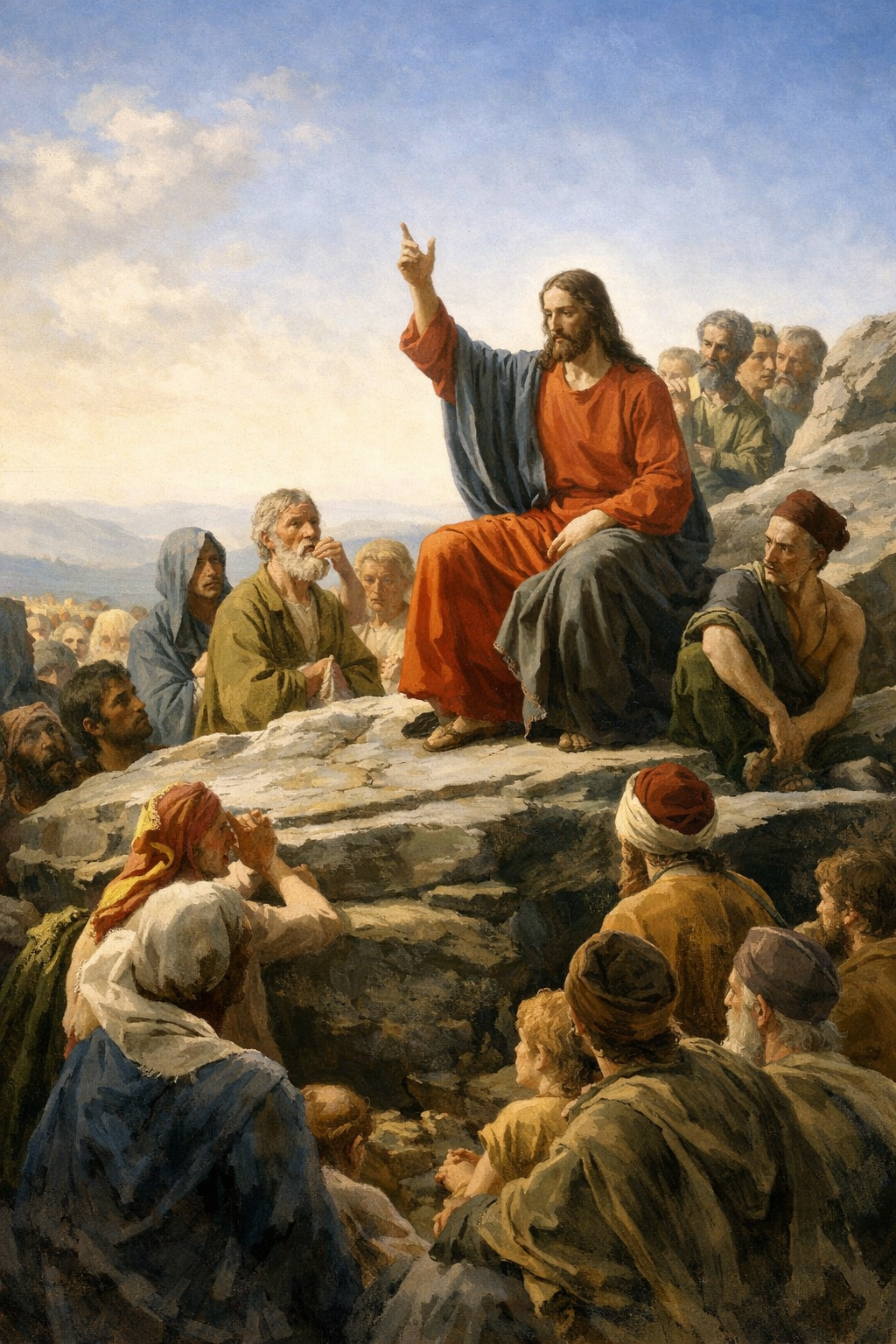
Sermon on the Mount
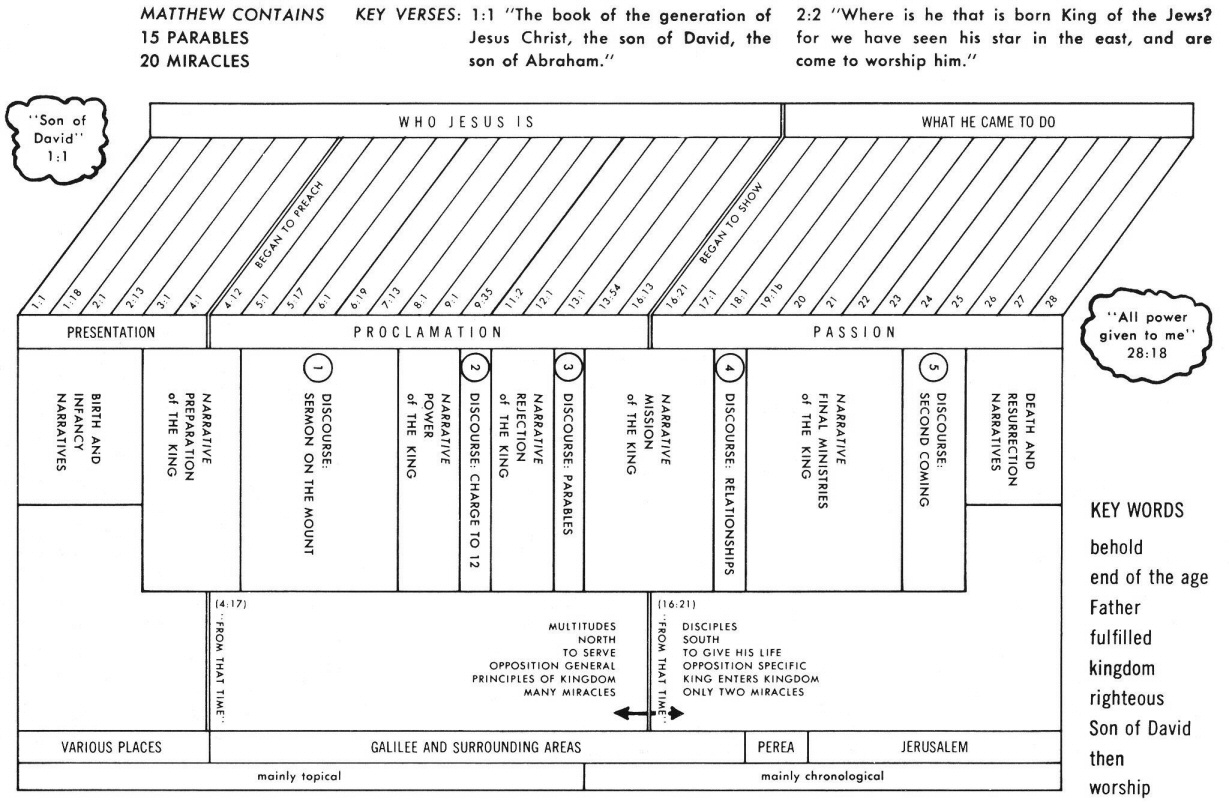
Click chart to enlarge
Charts from Jensen's Survey of the NT - used by permission
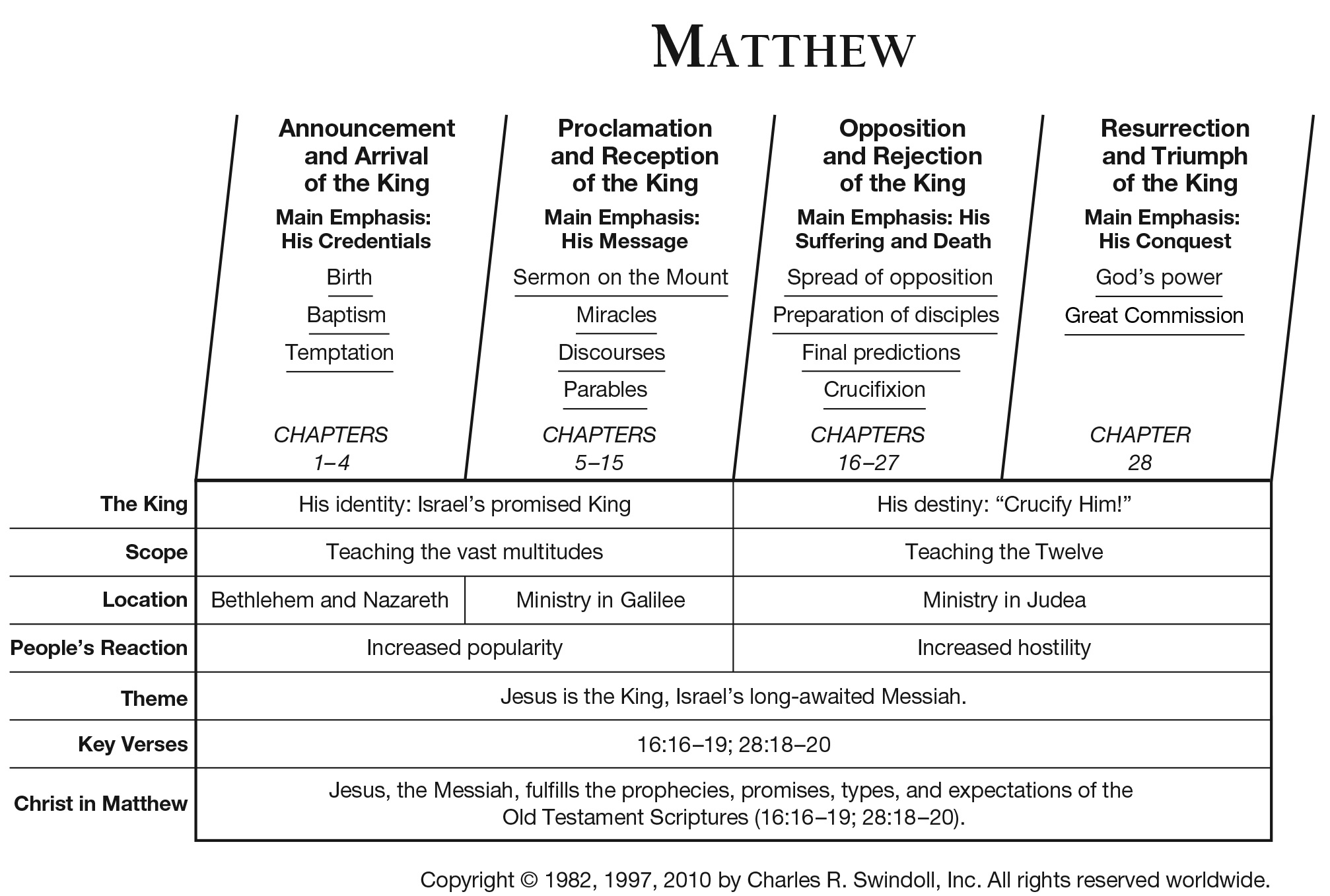
Another Chart from Charles Swindoll
THE LIFE OF JESUS AS COVERED
BY MATTHEW (shaded area)
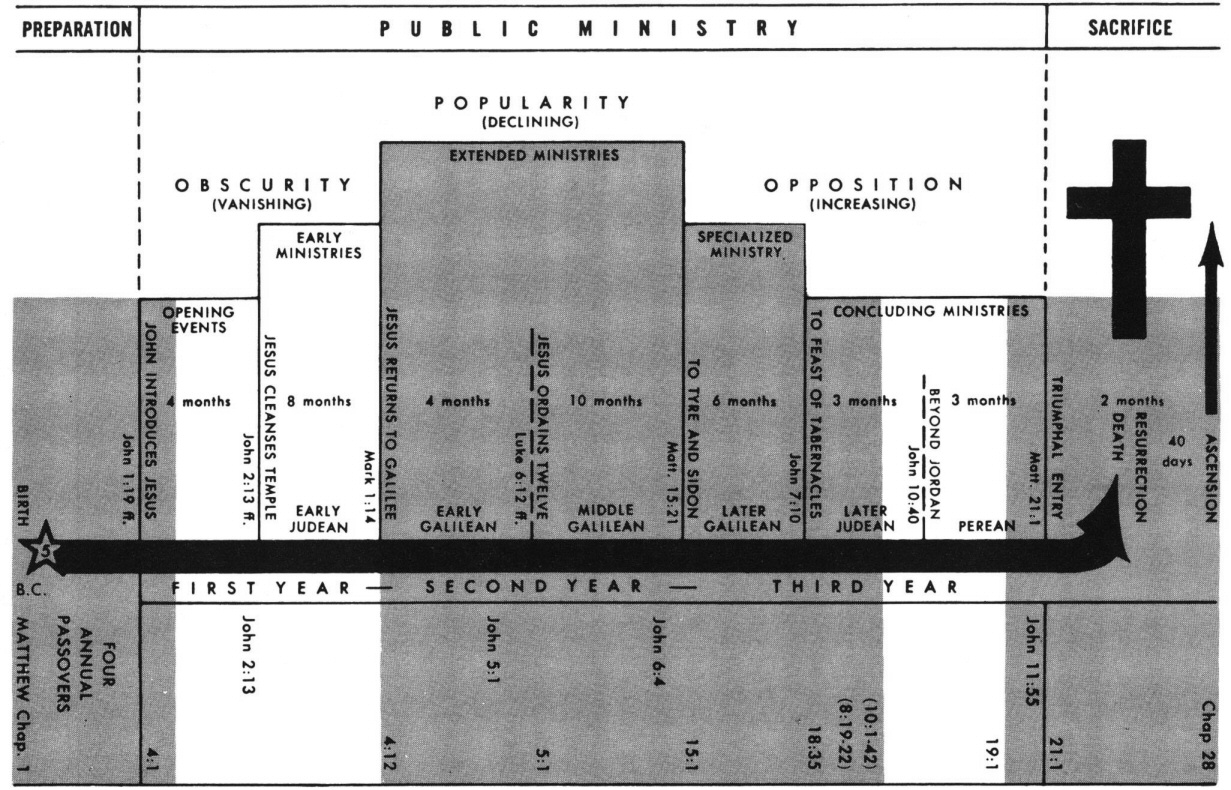
Click chart to enlarge
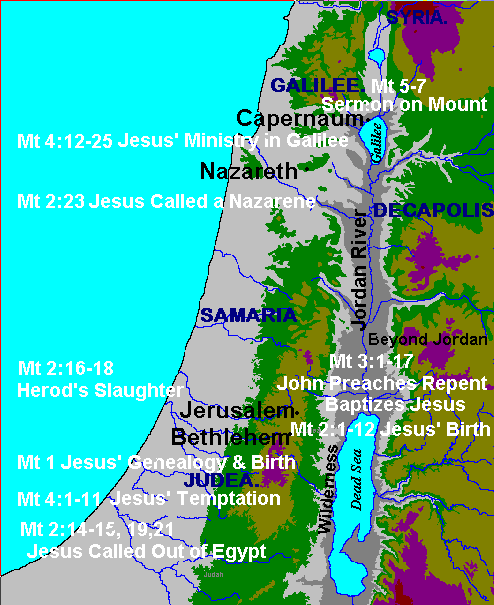
Jesus Birth and Early Years
Leading up to the Sermon on the Mount
Matthew 1-7
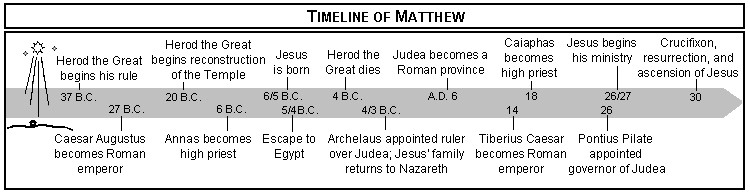
Source: Ryrie Study Bible
Matthew 6:24 "No one can serve two masters; for either he will hate the one and love the other, or he will be devoted to one and despise the other. You cannot * serve God and wealth. (NASB: Lockman)
Greek: Oudeis dunatai (3SPPI) dusi kuriois douleuein; (PAN) e gar ton ena misesei (3SFAI) kai ton heteron agaphesei, (3SFAI) e enos anthexetai kai tou (3SFMI) heterou kataphronesei; (3SFAI) ou dunasthe (2PPPI) theo douleuein (PAN) kai mamona.
Amplified: No one can serve two masters; for either he will hate the one and love the other, or he will stand by and be devoted to the one and despise and be against the other. You cannot serve God and mammon (deceitful riches, money, possessions, or whatever is trusted in). (Amplified Bible - Lockman)
KJV: No man can serve two masters: for either he will hate the one, and love the other; or else he will hold to the one, and despise the other. Ye cannot serve God and mammon.
NLT: No one can serve two masters. For you will hate one and love the other, or be devoted to one and despise the other. You cannot serve both God and money. (NLT - Tyndale House)
Philips: No one can be loyal to two masters. He is bound to hate one and love the other, or support one and despise the other. You cannot serve God and the power of money at the same time. (New Testament in Modern English)
Wuest: No one is able to be habitually serving two masters, for either he will hate the one and the other one of a different kind he will love, or one he will hold to firmly as against the other, and the other one of a different kind he will disdain. You are not able to be rendering a slave’s obedience to God and to a passion for accumulating wealth.
Young's Literal: None is able to serve two lords, for either he will hate the one and love the other, or he will hold to the one, and despise the other; ye are not able to serve God and Mammon.
- No one can serve two masters - Mt 4:10; Josh 24:15,19,20; 1Sa 7:3; 1Ki 18:21; 2Ki 17:33,34,41; Ezek 20:39; Zeph 1:5; Luke 16:13; Ro 6:16-22; Gal 1:10; 2Ti 4:10; Jas 4:4; 1Jn 2:15,16
- Matthew 6 Resources - Multiple Sermons and Commentaries
- Matthew 6:19-24: Treasure in Heaven 2 - Study Guide - John MacArthur
- Matthew 6:19-24: Treasure in Heaven 2 - John MacArthur
Related Passages:
Joshua 24:15 “If it is disagreeable in your sight to serve the LORD, choose for yourselves today whom you will serve: whether the gods which your fathers served which were beyond the River, or the gods of the Amorites in whose land you are living; but as for me and my house, we will serve the LORD.”
James 4:4-Commentary You adulteresses, do you not know that friendship with the world is hostility toward God? Therefore whoever wishes to be a friend of the world makes himself an enemy of God.
1 John 2:15-Commentary Do not love the world nor the things in the world. If anyone loves the world, the love of the Father is not in him. 16 For (term of explanation - why we should not love world) all that is in the world, the lust of the flesh and the lust of the eyes and the boastful pride of life, is not from the Father, but is from the world.
Hebrews 13:5-Commentary Make sure that your character is free from the love of money, being content with what you have; for He Himself has said, “I WILL NEVER DESERT YOU, NOR WILL I EVER FORSAKE YOU,”
Luke 16:13 “No servant can (dunamai - is able present tense) serve (douleuo - present tense- continually serve) two masters (kurios - lords, owners) ; for either he will hate the one and love the other, or else he will be devoted to one and despise the other. You cannot serve God and wealth.”
1 Timothy 6:9 But those who want to get rich fall into (1) temptation and (2) a snare and (3) many foolish and harmful desires which (4) plunge men into ruin and destruction.
THE IMPOSSIBILITY OF
SERVING TWO MASTERS
Jesus knows that our hearts follow what we treasure (Mt 6:21). And because money so powerfully competes for our devotion, He warns us plainly: divided loyalty is impossible. Matthew 6:24 confronts us with a choice—will we serve the God who satisfies, or the wealth that never does?
Jesus carefully choose the picture of a slave. There could be no doubt about the issue of control. Jesus' point is that our will will be enslaved by either God or materialism ("mammon"). Either Jesus Christ is our Lord, or money is our lord, but both cannot be lord at the same time (cp 1 Ti 6:9)
No one (oudeis = absolutely) can (dunamai - is able present tense) serve (douleuo - present tense- continually serve) two masters (kurios - lords, owners) - Wuest "No one is able to be habitually serving two masters." Jesus' point is that there is absolutely no man or woman who can serve two masters—two supreme authorities, two ruling powers, two competing lords—at the same time. Serve douleuo means to be a slave to, to be owned by, to be completely subject to, to be devoted to, and to live under the absolute authority of a master. It describes exclusive ownership (a slave cannot divide allegiance), total obedience (the master’s will determines the slave’s actions), full-time devotion (not occasional, but continual service), unshared loyalty (two masters cannot simultaneously command the same heart). In this context, Jesus is not speaking of casual service, part-time commitment, or simple employment, but He is speaking of out and out slavery, where one master rules the whole person's, his/her mind, will, desires, and loyalties. Thus douleuō carries the force of “to live under the control and demands of a master who owns you.” You cannot be owned by God and owned by money at the same time—one will always take the throne of the heart.
Can serve - Absolutely no person can continually live in bondage to, or give total allegiance to, two supreme authorities. It is impossible. Any attempt to do so results in a divided heart—and a divided heart is, in truth, loyal to neither master. This mirrors the idea behind the word double-minded (dipsuchos), a person pulled in two directions and fully committed to none. And what is the result of being double minded or pulled in two directions? This person becomes anxious, the Greek word merimnao (root merizo = to divide, to separate) which means to be pulled apart, divided, torn in different directions. Anxiety is a heart and mind that are split, pulled both ways, divided between fear and trust, stretched so tightly it begins to tear. This matches the experience of worry perfectly, for in worry your thoughts are dragged one way by fear and another way by faith. Worry tears you between what is and what might be. Worry is the tug-of-war between God’s promises and our fears. A divided heart always feels a divided peace. This is why Jesus will say in essence "Don’t let your mind and heart be pulled apart by competing fears and concerns.” (Mt 6:25) A divided heart always feels a divided peace. Or as someone has said anxiety is what happens when tomorrow’s fears invade today’s faith!
An anxious mind
is a divided mind.
Zodhiates - At the end of this section, Jesus returned to the dichotomy between treasures on earth (mammon, money) and treasures in heaven (God). The contrasts are varied: serving and not serving, loving and hating, holding and despising, and, from prior verses, temporal and eternal (Mt 6:19, 20), and light and darkness (Mt 6:21-23). It's one or the other-God or money. Serving, loving, and holding are conjoined, as are not serving, hating, and despising. The absence of neutrality is conspicuous. It goes without saying that multiple bosses never work. Two owners will fight over the priorities and work of a single employee. If both impose equal work, the employee either has to work two shifts or prioritize at the risk of angering one of his bosses. Contradictory orders from two owners are impossible to carry out. Opposing employers wear out their employees. In plain language, Jesus said, it cannot be done. (Exegetical Commentary on Matthew)
Mattoon on serve (douleuo) - To understand all that this means and implies we must remember two things about the slave in the ancient world. First, the slave in the eyes of the law was not a person but a thing. He had absolutely no rights of his own; his master could do with him absolutely as he liked. In the eyes of the law the slave was a living tool. His master could sell him, beat him, throw him out, and even kill him. His master possessed him as completely as he possessed any of his material possessions. Second, in the ancient world, a slave had literally no time which was his own. Every moment of his life belonged to his master. The slave had literally no moment of time which belonged to himself. Every moment belonged to his owner and was at his owner's disposal. The slave then could only meet the demands of one master. In our relationship to the Lord Jesus Christ, as Christians, we have no rights of our own. God must be the undisputed, unchallenged master of our lives. Paul made this very clear to us in 1 Corinthians 6:19-20. Our attitude is not to be "What do I want to do with my life?" Instead, we should ask, "What does the Lord wish me to do?" We have no time which is our own. We cannot sometimes say, "I will do what God wants me to do," and, at other times, say, "I will do my own thing." Do you realize and understand the fact that the Christian has no time off from being a Christian? There is no time when he can relax his Christian standards, as if he was off duty, and remain right with God. A partial or a spasmodic service of God is not tolerated or acceptable. Being a Christian is a full-time responsibility that demands consistent obedience to God's Word and will for our life. ILLUSTRATION The March 17th, 2005, issue of the Suburban Chicago News records the story of Roger Powell. According to fans and sportswriters, Roger Powell looks a lot like Michael Jordan. This forward for the University of Illinois Fighting Illini basketball team is an impressive player. He seems like a natural for the NBA. However, the 22-year-old senior from Joliet, Illinois, is leaning in the direction of full-time ministry. Although Roger was raised in Mt. Zion Full Gospel Church, his commitment to Christ was half-hearted. His love of basketball was one of several competing interests. In March, 2004, when the Fighting Illini were in Indianapolis to compete in the Big Ten tournament, something happened that changed Roger's motivation. It was as if the Holy Spirit had given him a full-court press. When the rest of the team headed into town to look for some excitement, Roger was reluctant to go along. Seeing a stream of young people headed into a downtown hotel for a Christian music concert, he followed them. What began as simply a way to pass the time before the team meeting later that night, became much more. During the concert, Roger felt God asking him to fully surrender his life and help spread God's Word. When the Illini's season ended, Roger totally dedicated his life to the Lord and proceeded toward becoming a licensed preacher of the Gospel. While completing his senior year at the U of I, and contributing to his team's near flawless season, he's been actively involved in the Fellowship of Christian Athletes, leading small group Bible studies and preaching at his home church. "It was kind of like a struggle from my freshman year to junior year," said Powell. "It was back and forth, but once God came into my life and revealed my purpose, I just gave it all to Him, and He's been blessing me." Roger made the decision to serve one master the best he could. He realized that a castle can only have one king. Beloved, you cannot go two ways at once. You cannot do business on both sides of the street. You cannot be for and against. No man can serve two masters. It is a simple axiom and an irrefutable one, yet many try to beat it, but no one has. If you are a Christian that desires to bring honor to Christ with your life, your master cannot be yourself, people you want to please or be accepted by, money, power, popularity, possessions, or positions. Christ must be the king of your castle. This leads us to this question, "Why can't we serve two masters?" Notice the conflict in verse twenty-four. (Mattoon's Treasures from The Sermon on the Mount, Volume 2)
Pink comments that Jesus "refutes the common persuasion that it is possible for us to seek both, and lay up for ourselves treasures on earth and treasure in heaven as well. Men think to compound with God and the world, dividing their affections and energies between them; but Christ here exposes the utter fallacy of such an idea and the impossibility of such a course…Our minds must be fixed supremely upon God in Christ, and the world sought only in strict subservience to Him. Our hearts must he given to the Lord, wholly or without reserve, and the eyes of our soul he fixed upon Him alone. Here, then, is the reason why spiritual blindness must inevitably be our portion unless both our eyes are fixed steadfastly on a heavenly Object: a man’s affections cannot be divided; if he attempts to love the things of the world as well as love God, he will certainly fail of the latter, for "the friendship of the world is enmity with God: whosoever therefore will be a friend of the world, is the enemy of God" (Jam. 4:4). The serving of two masters is absolutely opposed to the single eye, for the eye will be at the master’s hand: "Unto Thee lift I up mine eyes, O Thou that dwellest in the heavens. Behold, as the eves of servants look unto the hand of their masters, and as the eyes of a maiden unto the hand of her mistress; so our eyes wait upon the Lord our God, until that He have mercy upon us" (Ps. 123:1, 2). (Serving God Matthew 6:24)
Phil Newton - As has been the case throughout the Sermon on the Mount, the Lord probes each subject of this sermon from every angle. He looks at our values, and declares that the things that we treasure reveal the condition of our hearts. He looks at our vision - the way we understand the issues of life and obedience, and declares that either we have the light of single-mindedness or the darkness of double-mindedness. Now he looks at our service - who or what we pledge our unfeigned devotion.
1. Shocking impossibility
I do not use the word shocking lightly. Hear the words of Christ. "No one can serve two masters; for either he will hate the one and love the other, or he will be devoted to one and despise the other. You cannot serve God and wealth." In the current atmosphere that seems to delight in duplicity and half-heartedness and non-commitment, the words of Jesus Christ are shocking! He states an impossibility: you cannot serve two masters; you cannot serve God and wealth. It cannot be done. He will not have it. The nature of the God that created us will not tolerate mixed devotion and strange love. We must not try to understand this verse by substituting "serve" for employment. Some of you have more than one employer, and you are able to function quite efficiently in that arrangement. But that is not the case between master and slave. That is one thing that makes Christianity and the gospel message so radical. The world is comfortable with dallying in Christianity but Christ will not accept it. As long as you do not draw an exclusive line in your discussions on the gospel and the Christian life, then the world will accept you. They did that with the godly Stephen until he drew a clear line in declaring man's sinfulness and his only hope in Christ alone. Then they stoned him to death. The same thing happens to tens of thousands of Christians every year across the globe. Even without opening their mouths - by their very lifestyles - they draw a clear line in the sand that declares absolute loyalty to Christ, and the world reacts vehemently.
"No one can serve two masters.... You cannot serve God and wealth." Jesus does not give room for dabbling in Christianity. My observation is that many are satisfied to be dabblers. They want Christianity by convenience and on their own terms. But Christ is master, and we are the slaves. Do you recall the men that came to Christ and stated their desire to follow him? Then a scribe came and said to Him, "Teacher, I will follow You wherever You will go." Jesus said to him, "The foxes have holes and the birds of the air have nests, but the Son of Man has nowhere to lay His head. Another of the disciples said to Him, "Lord, permit me first to go and bury my father." But Jesus said to him, "Follow Me, and allow the dead to bury their own dead" (Matt 8:19-22). They would follow, but on their own terms. They wanted to set the conditions, to turn the relationship around so that Christ did their bidding. But what may seem to be austerity by Christ is the reality that being a Christian allows no room for dabbling or pretending. Christ is master - we are slaves. But I think it is important that we see the distinction Christ gives in this passage. He is not so much talking about embracing two religions as the ancient Samaritans attempted to do with their animism and worship of Yahweh. He goes back to the arena of treasure - "wealth." The transliteration used in the King James Version, "mammon," was an Aramaic term that personified material things as objects of worship. There is probably no greater distraction to knowing Christ as Lord than this matter of loving things and trying instead to use Christ to further one's own agenda. Instead of our possessions being instruments and tools for service as Christians, we may find ourselves embracing and cherishing them as the love of our lives. But Jesus calls that "two masters." And he declares that he brooks no rivals to his Lordship over our lives.
John Frame has written, "The first thing, and in one sense the only thing, we need to know about God is that he is Lord" [The Doctrine of God, 21]. That is precisely why we "cannot serve God and wealth." When the focus of our heart is upon possessions or positions in life, then our love and loyalty is really toward ourselves and not on the Lord as Lord of all. The use of the figure of serving a master is not hyperbole. Being a kingdom citizen means that you gladly submit to Christ's mastery over your life.
2. Single-minded loyalty
The nature of the master-slave relationship calls for single-minded loyalty. Jesus explains that dual loyalty is impossible, "for either he will hate the one and love the other, or he will be devoted to one and despise the other." Judas Iscariot attempted to straddle this fence, to acknowledge Christ as master but also to cling to his own passionate love for money. But the longer he walked that road the more intense the distinction became, so that eventually his hatred for Christ and love for money led to his betrayal of Christ. "No one can serve two masters."Jesus describes the same problem in the parable of the soils (Matt 13:18-23). In the seed that fell among the thorns, the person professes to be a follower of Christ - and by the immediate evidence it seems that he is of a serious mind. But Jesus says that what happens to this man who has heard the Word and made a response to it is that "the worry of the world and the deceitfulness of wealth choke the word, and it becomes unfruitful." For a while the person tries to walk the road of two masters but soon discovers that these roads are distinctly different paths so that he is devoted to one and despises the other.
It is true that some have misunderstood these verses to the point of becoming virtual hermits out of fear of being encumbered with material things. We must face the reality that living in this life means that we will have to face the material world. The Bible does not take a Gnostic approach that calls all material things evil. Material things are for the most part (a few exceptions in the moral and legal realm, of course) neither good nor evil. The evil comes when we place the wrong kind of value upon them - when we begin to make them our treasures. That is when material possessions become mammon - objects of worship and devotion, another master.
We still have to live in the world, maintain jobs, have a place to live, spend money, etc. Christ is not calling for escapism but single-minded loyalty to him alone. So as we look at the reality that we cannot serve two masters, how do we see this working out in our daily lives as kingdom citizens? How do we keep our single-minded loyalty to Christ while still having a bank account, owning a house, receiving a salary, and going about the normal functions of life in our culture? How do we keep those things from becoming master over us?
First, we must find dissatisfaction with the world, possessions, selfish ambition, and worldly honor by seeing devotion to them as a contradiction to loyal love for Christ. They are only means to serve Christ. As we saw in our previous study (Matt 6:19-21), these things are temporal, and on their way out. So we need not become enamored with them any more than we should fall in love with a snowman in Memphis. If we will but realize that our lives are but a vapor, here for a moment and gone the next, then we will hold the things of this world lightly since we will not carry them with us into eternity.
Second, we must find our delight in Christ that springs from understanding his work for us on the cross. There are many people that admire Jesus Christ, his sayings, and his kind deeds toward the needy. But they are not followers of Christ. They admire him but they do not delight in him because they deny the necessity of his death on the cross. They see no need to know him as Redeemer from sin. The cross is foolishness to them. But the kingdom citizen lives in the light of the cross. The death and resurrection of Christ mean everything to him. He delights in the One that bore eternal judgment on his behalf. With Paul we echo, "But may it never be that I would boast, except in the cross of our Lord Jesus Christ, which the world has been crucified to me, and I to the world" (Gal 6:14). Such delight in Christ affects the way we hear and obey the commands of God's Word, the way we pursue spiritual disciplines, the way we worship and serve, the way we use our money, and the way we treat others.
Third, we must order the priorities of our lives to give first-love to Christ. This has to do with our sanctification and perseverance as Christians. We cannot cruise through life on automatic pilot. Priorities reflect our affections. In what we love most we devote our thoughts, time, energy, emotions, resources, desires, and ambitions. Kingdom citizens have but one master - Jesus Christ the Lord - and to him belongs our all.
Conclusion - Are you seeing as a kingdom citizen with the brilliant light of gospel understanding? Are you serving as a kingdom citizen with loyalty to one master - Jesus Christ? (Matthew 6:22-24 One Master)
Spurgeon illustrates the necessity of on single mindedness…
Suppose you see a lake, and there are twenty or thirty streams running into it. Why, there will not be one strong river in the whole country; there will be a number of little brooks which will be dried up in the summer and will be temporary torrents in winter. Every one of them will be useless for any great purpose because there is not enough water in the lake to feed more than one great stream. Now, a man’s heart has only enough life in it to pursue one object fully. You must not give half your love to Christ and the other half to the world. “No man can serve two masters… Ye cannot serve God and mammon” (Matt. 6:24).
---
Two opinions in the matter of soul-religion you cannot hold. If God is God, serve Him, and do it thoroughly. However, if this world is God, serve it, and make no profession of religion. If you think the things of the world the best, serve them. But remember, if the Lord is your God, you cannot have Baal, too; you must have one thing or else the other. “No man can serve two masters” (Matt. 6:24). If God is served, He will be a master. If the devil is served, it will not be long before he will be a master, and “no man can serve two masters.” Oh! Be wise, and think not that the two can be mingled together. (Daily Help)
---
This is often misunderstood. Some read it, "No man can serve two masters." Yes he can; he can serve three or four. The way to read it is this: "No man can serve two masters." He can serve two, but they cannot both be his master.
---
When the Romans erected the statue of Christ and put it up in their pantheon, saying that He should be one among their gods, their homage was worthless. And when they turned their heads, first to Jupiter, then to Venus, and then to Jesus Christ, they did no honor to our Lord; they did but dishonor Him. Their service was not acceptable. And so if you imagine in your heart that you can sometimes serve God and sometimes serve self and be your own master, you have made a mistake.
---
God and mammon cannot abide in the same house (Matt. 6:24). You serve a jealous God (Exod. 34:14), so be very careful not to provoke Him to jealousy. Every idol must be cast down, and the Lord must be before all things in our worship, or His comfortable presence cannot be enjoyed.
---
Now this is often misunderstood. Some read it, "No man can serve two." Yes, he can-he can serve three or four. The way to read it is this, "No man can serve two masters." They cannot both be masters. He can serve two, but they cannot both be his master. A man can serve two who are not his masters, or even twenty. He may live for twenty different purposes, but he cannot live for more than one master purpose. There can only be one master purpose in his soul. (Ed note: What is the "master purpose" you are living for?)
However, Balaam labored to serve two. It was like the people of whom it was said, "They feared the LORD, yet served their own gods." (2 Kings 17:33). Or like Rufus, who was cut from the same cloth. You know our old king Rufus painted God on one side of his shield and the devil on the other, and had underneath the motto: "Ready for both; catch who can."
There are many such people who are ready for both. They meet a minister, and how pious and holy they are! On the Sabbath, you would think they are the most respectable and upright people in the world. Indeed, they affect a drawling in their speech which they presume to be eminently religious. But on a week day, if you want to find the greatest rogues and cheats, they are some of those men who are so sanctimonious in their piety.
Now, rest assured that no confession of sin can be genuine unless it is a wholehearted one. It is of no use for you to say, "I have sinned," and then keep on sinning. "I have sinned," say you, and it is a fair, fair face you show. But, alas, for the sin you will go away and commit!
Some men seem to be born with two characters. I remarked when in the library at Trinity College, Cambridge, about a very fine statue of Lord Byron. The librarian said to me, "Stand here, sir." I looked and said, "What a fine intellectual countenance! What a grand genius he was!" "Come here," the librarian said, "to the other side." "Ah, what a demon! There stands the man that could defy the Deity." He seemed to have such a scowl and such a dreadful leer in his face, even as Milton would have painted Satan when he said, "Better to reign in hell than serve in heaven." I turned away and asked the librarian, "Do you think the artist designed this?" "Yes," he said, "he wished to picture the two characters-the great, the grand, the almost superhuman genius that he possessed, and yet the enormous mass of sin that was in his soul."
There are some men of the same sort. I dare say, like Balaam, they would overthrow everything in argument with their enchantments. They could work miracles, and yet at the same time there is something about them which betrays a horrid character of sin, as great as that which would appear to be their character for righteousness. Balaam, you know, offered sacrifices to God upon the altar of Baal. That was just his character type. So many do the same. They offer sacrifices to God on the shrine of Mammon; while they will give to the building of a church and distribute to the poor, they will at the other door of the counting house grind the poor for bread and press the very blood out of the widow, that they may enrich themselves.
Ah! It is idle and useless for you to say, "I have sinned," unless you mean it from your heart. That double-minded man’s confession is of no avail.
Vernard Eller rightly said that "One's ultimate loyalty must converge at a single point. To try to go two ways at once will rip a person down the middle."
Remember a related truth Jesus' declared to Martha (and all of us other "Martha's" out there) "Only one thing is necessary." (Luke 10:42)
C H Spurgeon's - Here our King forbids division of aim in life. We cannot have two master passions: if we could, it would be impossible to serve both; their interests would soon come into conflict, and we should be forced to choose between them. God and the world will never agree, and however much we may attempt it, we shall never be able to serve both. Our danger is that in trying to gain money, or in the pursuit of any other object, we should put it out of its place, and allow it to get the mastery of our mind. Gain and godliness cannot both be masters of our souls: we can serve two, but not “two masters. ” You can live for this world, or live for the next; but to live equally for both is impossible. Where God reigns, the lust of gain must go. Oh, to be so decided, that we may pursue one thing only! We would hate evil and love God, despise falsehood and hold to truth! We need to know how we are affected both to righteousness and sin; and when this is ascertained to our comfort, we must stand to the right with uncompromising firmness. Mammon is the direct opposite of God as much today as in past ages, and we must loathe its greed, its selfishness, its oppression, its pride; or we do not love God. (Commentary)
James Montgomery Boice has an interesting story - "You cannot serve both God and Money," says Jesus. We like to think we can; we are great compromisers. Or we think we are serving God by making money. True, we can use our money to serve God. Some do. But if our hearts are set on our possessions, which is probably an accurate description of most of us, we are not actually serving God whatever we may suppose we are doing. D. Martyn Lloyd-Jones tells of a farmer who reported happily to his wife that his best cow had given birth to twin calves, one red and one white. He said, "You know, I have been led of the Lord to dedicate one of the calves to him. We will raise them together. Then when the time comes to sell them, we will keep the money from the one calf and give the money from the other to the Lord." His wife asked which one he was going to dedicate to the Lord, but he answered that there was no need to decide that now since he was going to treat both of them alike. Several months later he came into the kitchen looking very sad. When his wife asked what was troubling him he answered, "I have bad news. The Lord's calf is dead." "But you had not decided which was to be the Lord's calf," she objected. "Oh, yes," he said. "I had always determined that it was to be the white one, and it is the white one that has died."[D. Martyn Lloyd-Jones, Studies in the Sermon on the Mount Grand Rapids: Eerdmans, 1967, vol. 2, 95-96] Sadly, it is always that way with us—it is always the Lord's calf that dies—unless we decide from the beginning that we are here to serve God above everything else and that everything we possess has been given to us by God and is to be held in stewardship for him. If we make such a decision, we will find when we die that we have actually been laying up eternal spiritual treasure in heaven and that nothing has destroyed it.
Warren Wiersbe - If God grants riches, and we use them for His glory, then riches are a blessing. But if we will to get rich, and live with that outlook, we will pay a great price for those riches. (Bible Exposition Commentary. 1989. Victor)
Adam Clarke - The master of our heart may be fitly termed the love that reigns in it. We serve that only which we love supremely. A man cannot be in perfect indifference betwixt two objects which are incompatible: he is inclined to despise and hate whatever he does not love supremely, when the necessity of a choice presents itself. Our blessed Lord shows here the utter impossibility of loving the world and loving God at the same time; or, in other words, that a man of the world cannot be a truly religious character. He who gives his heart to the world robs God of it, and, in snatching at the shadow of earthly good, loses substantial and eternal blessedness. How dangerous is it to set our hearts upon riches, seeing it is so easy to make them our God!
William Barclay explains that "To understand that this means and implies we must remember two things about the slave in the ancient world. First, the slave in the eyes of the law was not a person but a thing. He had absolutely no rights of his own; his master could do with him absolutely as he liked. In the eyes of the law the slave was a living tool. His master could sell him, beat him, throw him out, and even kill him. His master possessed him as completely as he possessed any of his material possessions. Second, in the ancient world a slave had literally no time which was his own. Every moment of his life belonged to his master… The slave had literally no moment of time which belonged to himself. Every moment belonged to his owner and was at his owner’s disposal… In regard to God we have no rights of our own; God must be undisputed master of our lives. We can never ask, “What do I wish to do?” We must always ask, “What does God wish me to do?” We have no time which is our own. We cannot sometimes say, “I will do what God wishes me to do,” and, at other times, say, “I will do what I like.” The Christian has no time off from being a Christian; there is no time when he can relax his Christian standards, as if he was off duty. A partial or a spasmodic service of God is not enough. Being a Christian is a whole-time job. Nowhere in the Bible is the exclusive service which God demands more clearly set forth. (Matthew 6 Commentary)
WHO IS YOUR MASTER?
Two - Only two options. No middle ground allowed. No straddling the fence. Compare Joshua 24:15, 19, 20, 1Sa 7:31Ki 18:21, Hosea 10:2KJV, Jas 4:4, 2Ti 4:10
Dear believer, guard your heart carefully, lest it be deceived by sin and you try to create heaven on earth rather than setting your mind on things above. Remember that whatever you store up, will cause you to spend much of your time and energy thinking about! It is the early part of 2009 as I write this note and America is reeling from a painful recession (or worse). As one who is fully retired, I have lost about 25% of my retirement fund, and this has served as a poignant test of my heart and where my allegiance and trust lies. I never gave money much thought before this recession, but God has used this down time to expose the roots of evil in my heart. He has shown me that my love for money was more than I would have ever realized in times of plenty. Blessed be the ways of the Lord, Who lovingly discloses our "blind spots" that we might grow in grace and the knowledge of our Lord and Savior Jesus Christ.
Ask yourself "Does Christ or money occupy more of my thoughts, time, and efforts?" Or "Have I bowed to Christ or financial security as my lord and master?" The answer might be painful as it was to me, but if properly responded to, it will yield a sharing in His holiness (Heb 12:10) and the peaceful fruit of righteousness (Heb 12:11)
Jay comments in regard to the two masters that "Their orders are diametrically opposed. The one commands you to walk by faith, the other to walk by sight; the one to be humble, the other to be proud; the one to set your affections on things above, the other to set them on the things that are on the earth; the one to look at the things unseen and eternal, the other to look at the things seen and temporal; the one to have your conversation in heaven, the other to cleave to the dust; the one to be careful for nothing, the other to be all anxiety; the one to be content with such things as ye have, the other to enlarge your desires as hell; the one to be ready to distribute, the other to withhold; the one to look at the things of others, the other to look only at one’s own things; the one to seek happiness in the Creator, the other to seek happiness in the creature. Is it not plain there is no serving two such masters? If you love the one, you must hate the other; if you cleave to the one, you must despise the other. You cannot serve God and mammon."
John Phillips - We cannot be a slave to material possessions and at the same time own the lordship of Christ in our lives. No compromise is possible. We have to decide which world we are going to live for and which master we are going to serve.
As someone has well said chains of gold
are stronger than chains of iron.
Mattoon - There is no passage or command anywhere in the New Testament asking the believer to make Christ "Lord of his life" after salvation. The very experience of receiving Christ as Savior is looked upon throughout the Scriptures as an acknowledgment of His lordship and ownership. When you receive Christ as your Savior, you are acknowledging Him as your Lord. If you are not, then your decision is not sincere or genuine....
Be Submissive to God's will in your life—The captain of the ship looked into the dark night and saw faint lights in the distance. Immediately he told his signal-man to send a message, "Alter your course 10 degrees south!" Promptly a return message was received: "Alter your course 10 degrees north." The captain was angered; his command had been ignored. So he sent a second message: "Alter your course 10 degrees south—I am the captain!" Soon another message was received: "Alter your course 10 degrees north—I am seaman third class Jones." Immediately the captain sent a third message, knowing the fear it would evoke: "Alter your course 10 degrees south—I am a battleship." Then the reply came "Alter your course 10 degrees north—I am a lighthouse."In the midst of our dark and foggy times, all sorts of voices are shouting orders into the night, telling us what to do, how to adjust our lives. Out of the darkness, one voice signals something quite opposite to the rest—something almost absurd, but the voice happens to be the Light of the World, and we ignore it at our peril. The smartest thing we can do is be submissive to God's will for our lives. This was David's attitude for most of his life.(Treasures from The Sermon on the Mount, Volume 2)
In ancient times "two masters rarely shared slaves, but when they did it always led to divided interests." (Bible Background Commentary) Robertson writes that "Many try it, but failure awaits them all. Men even try "to be slaves to God and mammon""!
John MacArthur has an excellent discussion of these two masters noting that…
by definition, a slave owner has total control of the slave. For a slave there is no such thing as partial or part-time obligation to his master. He owes full-time service to a full-time master. He is owned and totally controlled by and obligated to his master. He has nothing left for anyone else. To give anything to anyone else would make his master less than master. It is not simply difficult, but absolutely impossible, to serve two masters and fully or faithfully be the obedient slave of each.
Over and over the New Testament speaks of Christ as Lord and Master and of Christians as His bondslaves. Paul tells us that before we were saved we were enslaved to sin, which was our master. But when we trusted in Christ, we became slaves of God and of righteousness (Ro 6:16, 17, 18, 19, 20, 21, 22see notes).
We cannot claim Christ as Lord if our allegiance is to anything or anyone else, including ourselves. And when we know God's will but resist obeying it, we give evidence that our loyalty is other than to Him. We can no more serve two masters at the same time than we can walk in two directions at the same time. We will either… hate the one and love the other, or… hold to one and despise the other.
John Calvin said, "Where riches hold the dominion of the heart, God has lost His authority" (A Harmony of the Evangelists Matthew, Mark, and Luke, vol. 1 [Grand Rapids: Baker, 1979], p. 337)
Our treasure is either on earth or in heaven, our spiritual life is either full of light or of darkness, and our master is either God or mammon (possessions, earthly goods). The orders of those two masters are diametrically opposed and cannot coexist. The one commands us to walk by faith and the other demands we walk by sight. The one calls us to be humble and the other to be proud, the one to set our minds on things above and the other to set them on things below. One calls us to love light, the other to love darkness. The one tells us to look toward things unseen and eternal and the other to look at things seen and temporal. The person whose master is Jesus Christ can say that, when he eats or drinks or does anything else, he does "all to the glory of God" (1Co 10:31). He can say with David, "I have set the Lord continually before me" (Ps 16:8), and with Caleb when he was eighty-five years old, "I followed the Lord my God fully" (Josh 14:8). (MacArthur, J: Matthew 1-7 Chicago: Moody Press)
Spurgeon has an interesting note that "This is often misunderstood. Some read it, “No man can serve two masters.” Yes he can; he can serve three or four. The way to read it is this: “No man can serve two masters.” He can serve two, but they cannot both be his master. He can serve two persons very readily. For the matter of that, he can serve twenty, but not two masters. There cannot be two master principles in a man’s heart, or master passions in a man’s soul. “No man can serve two masters.” Either the one or the other will be master, they are so opposed to each other that they will never agree to a divided service. “Ye cannot serve God and mammon.” It is the Lord Jesus Christ who says this, so do not attempt to do what he declares is impossible.
In another note Spurgeon writes that "When the Romans erected the statue of Christ and put it up in their pantheon, saying that he should be one among their gods, their homage was worthless. And when they turned their heads, first to Jupiter, then to Venus, and then to Jesus Christ, they did no honor to our Lord; they did but dishonor him. Their service was not acceptable. And so if you imagine in your heart that you can sometimes serve God and sometimes serve self and be your own master, you have made a mistake."
In his devotional Daily Help Spurgeon has this note…
Suppose you see a lake, and there are twenty or thirty streams running into it. Why, there will not be one strong river in the whole country; there will be a number of little brooks which will be dried up in the summer and will be temporary torrents in winter. Every one of them will be useless for any great purpose because there is not enough water in the lake to feed more than one great stream. Now, a man’s heart has only enough life in it to pursue one object fully. You must not give half your love to Christ and the other half to the world. “No man can serve two masters… Ye cannot serve God and mammon” (Mt 6:24).
Two opinions in the matter of soul-religion you cannot hold. If God is God, serve Him, and do it thoroughly. However, if this world is God, serve it, and make no profession of religion. If you think the things of the world the best, serve them. But remember, if the Lord is your God, you cannot have Baal, too; you must have one thing or else the other. “No man can serve two masters” (Matt. 6:24). If God is served, He will be a master. If the devil is served, it will not be long before he will be a master, and “no man can serve two masters.” Oh! Be wise, and think not that the two can be mingled together.
The same result follows when an idol is set up in the heart. As long as we worship the Lord alone, the temples of our hearts will be filled with His glory; but if we set an idol upon His throne, we will soon hear the rushing of wings and the divine voice saying, “Let us go hence” (Jn 14:31). God and mammon cannot abide in the same house (Matt. 6:24). You serve a jealous God (Ex 34:14), so be very careful not to provoke Him to jealousy. Every idol must be cast down, and the Lord must be before all things in our worship, or His comfortable presence cannot be enjoyed.
John Piper writes that in Mt 6:19-24 Jesus is saying that…
Evidently there are two ways to live: you can live with a view to accumulating valuable things on earth, or you can live with a view to accumulating valuable things in heaven. Jesus says: the mark of a Christian is that his eyes are on heaven and he measures all his behavior by what effect it will have on heaven – everlasting joy with God.
And something else is clear: laying up treasures in heaven and laying up treasures on earth are not good bedfellows. You have to choose between them. You can’t say, "Well how about both?" That’s the point of verse 24: "No one can serve two masters, for either he will hate the one and love the other, or he will be devoted to the one and despise the other. You cannot serve God and money."
There is something about God and money that makes them tend to mastery. Either you are mastered by money and therefore ignore God or make him a bellhop for your business, or you are mastered by God and make money a servant of the kingdom. But if either tries to master you while you are mastered by the other you will hate and despise it. This is why Jesus said it is hard for a rich man to enter the kingdom of heaven. Much money makes a cruel master. (Matthew 6:19-34: Don’t Be Anxious, Lay Up Treasures in Heaven)
Spurgeon gave these illustrations of the dangers of mammon…
A holy woman was wont to say of the rich—"They are hemmed round with no common misery; they go down to hell without thinking of it, because their staircase thither is of gold and porphyry." (Feathers for Arrows)
Crossing the Col D'Obbia, the mule laden with our luggage sank in the snow, nor could it be recovered until its load was removed; then, but not till then, it scrambled out of the hole it had made, and pursued its journey. It reminded us of mariners casting out the lading into the sea to save the vessel, and we were led to meditate upon the dangers of Christians heavily laden with earthly possessions, and the wise way in which the gracious Father unloads them by their losses that they may be enabled to pursue their journey to heaven, and no longer sink in the snow of carnal-mindedness. (Feathers for Arrows)
There cannot be two master principles in a man’s heart, or master passions in a man’s soul.
We must be separated to him, that we may pursue his object. We cannot follow him unless we leave others. Matthew 6:24. We must belong to him, that his design may be our design.
No one (3762) (oudeis from ou = not +dé = but + heis = one) means literally "but absolutely not one", and emphasizes not even one or not the least. Absolutely no man has the inherent ability to be a slave to two owners at the same time in the sense that they both can be his master.
OUDEIS IN MATTHEW - Matt. 5:13; Matt. 6:24; Matt. 8:10; Matt. 9:16; Matt. 10:26; Matt. 11:27; Matt. 17:8; Matt. 17:20; Matt. 20:7; Matt. 21:19; Matt. 22:16; Matt. 22:46; Matt. 23:16; Matt. 23:18; Matt. 24:36; Matt. 27:24
Can (1410) (dunamai) conveys the basic meaning of that which has the inherent ability to do something or accomplish some end. Thus dunamai means to be able to, to be capable of, to be strong enough to do or to have power to do something. It is usually translated able (50x), can (61x and cannot 58x) or could. To reiterate, dunamai means to have power by virtue of inherent ability and resources and thus to be able. The present tense indicates that no one can as a habit of their life serve two masters.
Zodhiates explains that - The phrase, "Not even one can [from dunamai = to be able] serve" (a.t.) implies that prior to conversion, men and women are enslaved to treasures on earth. Accordingly, they are not neutral (free) toward God; they hate and despise Him, so they are unable to serve Him. In Romans 1:30 Paul called them "haters of God" (from theostugḗs). At conversion, they love, hold to, and serve God while now hating, despising, and not serving the world. (Ibid)
DUNAMAI IN MATTHEW - Matt. 3:9; Matt. 5:14; Matt. 5:36; Matt. 6:24; Matt. 6:27; Matt. 7:18; Matt. 8:2; Matt. 9:15; Matt. 9:28; Matt. 10:28; Matt. 12:29; Matt. 12:34; Matt. 16:3; Matt. 17:16; Matt. 17:19; Matt. 19:12; Matt. 19:25; Matt. 20:22; Matt. 22:46; Matt. 26:9; Matt. 26:42; Matt. 26:53; Matt. 26:61; Matt. 27:42
Serve (1398) (douleuo from doulos) means to be a slave, to serve, to do service, to be in the position of a slave and thus act accordingly. To be in bondage. It means to act or conduct oneself as one in total service to another. Douleuo means to be owned by another, either literal master or a figurative master (see following discussion). Some NT uses refer to literal servitude as abject slaves (Luke 15:29, John 8:33, 1Ti 6:2 - serving believing masters). Most NT uses are figurative -- serving God or mammon (Mt 6:24, Lk 16:13, Ro 9:12), enslaved to sin (Ro 6:6), serving God (Ro 7:6; 1Th 1:9), serving law of God or sin (Ro 7:25), slaves serving Christ (Ro 14:18; Col 3:24), slaves of their own appetites (old nature, Ro 16:18), slaves to idols which are not really gods (Gal 4:8), serving Christian brethren out of love (Gal 5:13), enslaved to lusts and pleasures (Titus 3:3).
DOULEUO - 23V - bondage(1), enslaved(3), render service(1), serve(10), served(1), serves(1), serving(4), slavery(1), slaves(3) Matt. 6:24; Lk. 15:29; Lk. 16:13; Jn. 8:33; Acts 7:7; Acts 20:19; Rom. 6:6; Rom. 7:6; Rom. 7:25; Rom. 9:12; Rom. 12:11; Rom. 14:18; Rom. 16:18; Gal. 4:8; Gal. 4:9; Gal. 4:25; Gal. 5:13; Eph. 6:7; Phil. 2:22; Col. 3:24; 1 Thess. 1:9; 1 Tim. 6:2; Tit. 3:3
Masters (2962)(kurios from kuros = might or power) has a variety of meanings/uses in the NT and therefore one must carefully examine the context in order to discern which sense is intended by the NT author. The main sense of kurios is that of a supreme one, one who is sovereign and possesses absolute authority, absolute ownership and uncontested power. Kurios refers to the master or the one who exercises absolute control and is the Greek word used to translate the Hebrew word Jehovah (in Ps 118:6). In secular Greek, kurios could refer to a landowner, a head of household, or a political ruler. However, in the New Testament, its significance is elevated and deepened, especially when applied to Jesus Christ. The word kurios is far more than a title of respect—it is a declaration of divine authority. The master demands total allegiance from his servants!
KURIOS IN MATTHEW - Matt. 1:20; Matt. 1:22; Matt. 1:24; Matt. 2:13; Matt. 2:15; Matt. 2:19; Matt. 3:3; Matt. 4:7; Matt. 4:10; Matt. 5:33; Matt. 6:24; Matt. 7:21; Matt. 7:22; Matt. 8:2; Matt. 8:6; Matt. 8:8; Matt. 8:21; Matt. 8:25; Matt. 9:28; Matt. 9:38; Matt. 10:24; Matt. 10:25; Matt. 11:25; Matt. 12:8; Matt. 13:27; Matt. 13:51; Matt. 14:28; Matt. 14:30; Matt. 15:22; Matt. 15:25; Matt. 15:27; Matt. 16:22; Matt. 17:4; Matt. 17:15; Matt. 18:21; Matt. 18:25; Matt. 18:26; Matt. 18:27; Matt. 18:31; Matt. 18:32; Matt. 18:34; Matt. 20:8; Matt. 20:30; Matt. 20:31; Matt. 20:33; Matt. 21:3; Matt. 21:9; Matt. 21:30; Matt. 21:40; Matt. 21:42; Matt. 22:37; Matt. 22:43; Matt. 22:44; Matt. 22:45; Matt. 23:39; Matt. 24:42; Matt. 24:45; Matt. 24:46; Matt. 24:48; Matt. 24:50; Matt. 25:11; Matt. 25:18; Matt. 25:19; Matt. 25:20; Matt. 25:21; Matt. 25:22; Matt. 25:23; Matt. 25:24; Matt. 25:26; Matt. 25:37; Matt. 25:44; Matt. 26:22; Matt. 27:10; Matt. 27:63; Matt. 28:2; Matt. 28:6
The Bat's Mistake - "No man can serve two masters" (Matt. 6:24). Aesop speaks in one of his fables about a time when the beasts and fowl were engaged in war. The bat tried to belong to both parties. When the birds were victorious, he would wing around telling that he was a bird; when the beasts won a fight, he would walk around them assuring them that he was a beast. But soon his hypocrisy was discovered and he was rejected by both the beasts and the birds. He had to hide himself, and now only by night can he appear openly. One is our Master, even Christ. Serve Him!—Sunday School Times
for either he will hate the one and love the other, or he will be devoted to one and despise the other. You cannot serve God and wealth: e gar ton ena misesei (3SFAI) kai ton heteron agaphesei, (3SFAI) e enos anthexetai kai tou (3SFMI) heterou kataphronesei; (3SFAI) ou dunasthe (2PPPI) theo douleuein (PAN) kai mamona.
- Luke 16:9,11,13; 1Timothy 6:9,10,17
- Matthew 6 Resources - Multiple Sermons and Commentaries
- Matthew 6:19-24: Treasure in Heaven 2 - Study Guide - John MacArthur
- Matthew 6:19-24: Treasure in Heaven 2 - John MacArthur
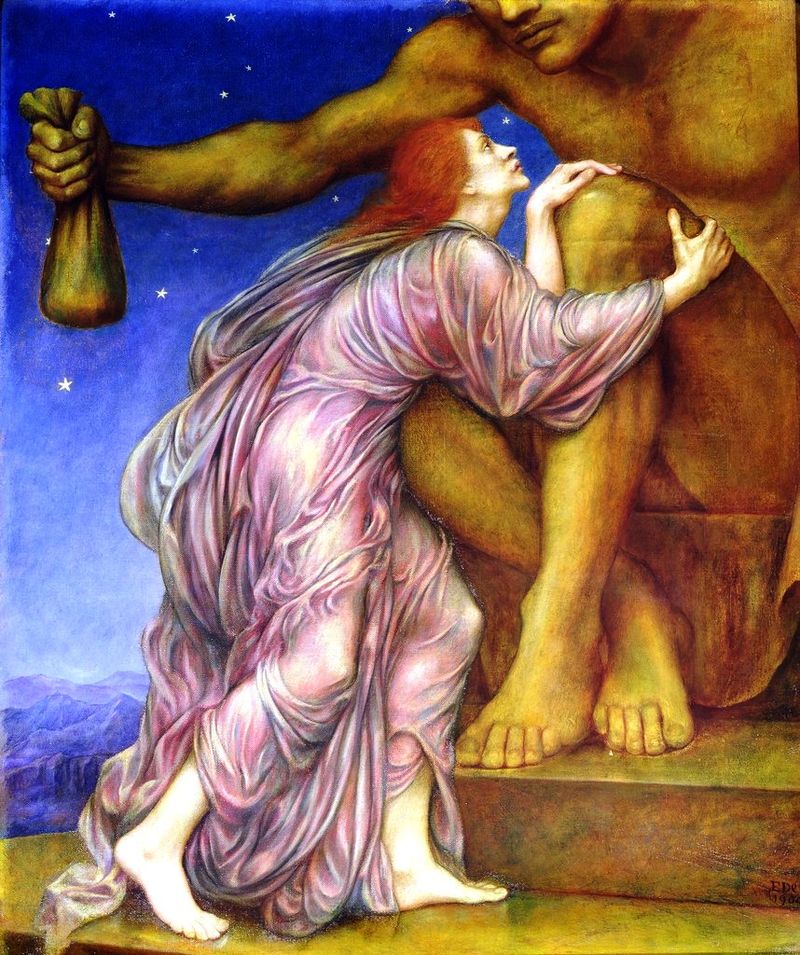
The Worship of Mammon
Evelyn De Morgan
LOVE OF GOD
OR MAMMON
For (gar) is a strategic term of explanation which can be very helpful to unravel a passage, especially in the intricately related Pauline epistles. “For” introduces the REASON why no one can serve two masters. Jesus deals with the attitudes or affections - hate versus love, then devotion versus despising. Jesus explains the logic behind the impossibility of divided allegiance.
For (gar) explains the nature of slavery (douleuō) which means “to be a slave to; to be owned by.” Thus For (gar) explains why serving two is impossible: Slavery demands exclusive ownership. Exclusive ownership demands exclusive devotion. So one has two masters producing two competing demands. Competing demands produce divided affections and divided affections produce spiritual impossibility. Thus For (gar) explains that one master will always win your heart and rule your life. Two masters cannot both command your heart, because love and devotion will ultimately go to one and not the other. BEWARE!
Hate (3404) (miseo from misos = hatred) means dislike strongly, with the implication of aversion and hostility. Miseo usually implies active ill will in words and conduct.
Miseo - 40x in 36v - Matt 5:43; 6:24; 10:22; 24:9f; Mark 13:13; Luke 1:71; 6:22, 27; 14:26; 16:13; 19:14; 21:17; John 3:20; 7:7; 12:25; 15:18f, 23ff; 17:14; Rom 7:15; 9:13; Eph 5:29; Titus 3:3; Heb 1:9; 1 John 2:9, 11; 3:13, 15; 4:20; Jude 1:23; Rev 2:6; 17:16; 18:2
Adam Clarke makes the point that "The word hate has the same sense here as it has in many places of Scripture (cp Luke 14:26); it merely signifies to love less—so Jacob loved Rachel, but hated Leah; i.e. he loved Leah much less than he loved Rachel. God himself uses it precisely in the same sense: Jacob have I loved, but Esau have I hated; i.e. I have loved the posterity of Esau less than I have loved the posterity of Jacob: which means no more than that God, in the course of his providence, gave to the Jews greater earthly privileges than he gave to the Edomites, and chose to make them the progenitors of the Messiah, though they ultimately, through their own obstinacy, derived no more benefit from this privilege than the Edomites did. How strange is it, that with such evidence before their eyes, men will apply this loving and hating to degrees of inclusion and exclusion, in which neither the justice nor mercy of God are honored!
Love (25) (agapao) means to love unconditionally and sacrificially love. Agapao is not love of the emotions but of the will. This quality of love is not just a feeling but ultimately can be known only by the actions it prompts in the one who displays agape love.
H A Ironside - The love of one crowds out love for the other (see Luke 11:34, 35, 36).
A. W. Tozer - The streets of gold do not have too great an appeal for those who pile up gold here on earth.
Devoted (472) (antechomai from antí = against + echo = have, hold) means literally to hold oneself face to face with. The idea of this verb in the present verse is to strongly cling or adhere to, to hold firmly, to cleave to and then to join with and to maintain loyalty to.
Antechomai - 4x in 4v - Matt 6:24; Luke 16:13; 1 Thess 5:14; Titus 1:9
Antechomai expresses the sense of a strong attachment to someone or something. To be devoted (feeling or demonstrating loyalty and thus ardent, devout, loving). To cling to (adhere as if glued firmly to and so to hold on tightly and tenaciously).
Despise (2706) (kataphroneo from katá = down or against + phroneo = think) means literally to think down upon or against and so to despise, to think lightly of, to neglect, to not care for, to hold in contempt or to feel contempt for someone or something because it is thought to be bad or without value. NAS = despise(5), despising(1), disrespectful(1), look down(1), think lightly(1).
Kataphroneo - 9x in 9v - Matt 6:24; 18:10; Luke 16:13; Rom 2:4; 1 Cor 11:22; 1 Tim 4:12; 6:2; Heb 12:2; 2 Pet 2:10
You cannot serve both God and wealth - Trying to serve two different masters creates instability because many times two masters are going in two different directions, have two different philosophies of living or doing things, and have two different demands. To please one, you will offend the other and be torn between these two masters. Children of divorced parents are confronted with this kind of emotional trauma all the time. They are torn between pleasing their mother and father who many times pressure their children to take sides. When serving two masters, the service to each master also becomes weak and frustrating for that master who is depending upon you because what he has commanded or expects is not completed or performed in a competent manner. James warned of the instability of being double-minded which is a trait of those who have two masters. James 1:8—A double minded man is unstable in all his ways. The word "unstable" is from the Greek word akatastatos which means "unstable, reckless, uncontrollable, or fickle." This is a description of those who are double-minded. An old African proverb put it this way, "The man who tries to walk two roads will split his pants." When you are double-minded, you will bring embarrassment to yourself. Your walk or life will be affected just like a man who has split his pants. Beloved, a castle can only have one king. (Mattoon's Treasures)
Wealth (mammon) (3126) (mammonas) is a transliteration of an Aramaic word meaning wealth, riches or earthly good. In the present context uses it to personify wealth or riches. Jesus personifies mammon/wealth as if it were one's master or lord!
Boice adds that "Mammon came from a Hebrew verb meaning "to entrust" or "to place in someone's keeping." The noun, therefore, referred to the wealth one entrusted to another for safekeeping. At this stage the word did not have any bad connotations. If something bad was meant, it was necessary to put another word with it, as in "mammon of unrighteousness." Yet as time went by, the meaning of mammon shifted from the passive sense of "that which is entrusted" to the active sense of "that in which one trusts." When that happened, the word originally spelled with a small "m" came to be spelled with a capital "M," as designating a god, which is why the New International Version capitalizes the word Money!
Possessions are interesting for if one is not careful he or she will be possessed by their possessions! The two great tests of character are wealth and poverty (but both can be mastered by wealth, one because they have it and the other because they covet it! For example, as has been well said gold is the heaviest of all metals, but is made more heavy by covetousness. There is but one letter difference between gold and God! And as Matthew Henry said "Worldlings make gold their god; saints make God their gold." And as George Swinnock said "Many a man's gold has lost him his God."
Matthew Henry however reminds us that "Poor people are as much in danger from an inordinate desire towards the wealth of the world as rich from an inordinate delight in it."
J C Ryle wisely reminds us that "Wealth is no mark of God's favor. Poverty is no mark of God's displeasure. Money, in truth, is one of the most unsatisfying of possessions. It takes away some cares, no doubt; but it brings with it quite as many cares as it takes away. There is the trouble in the getting of it. There is anxiety in the keeping of it. There are temptations in the use of it. There is guilt in the abuse of it. There is sorrow in the losing of it. There is perplexity in the disposing of it."
Mammon is the comprehensive word for all kinds of possessions, earnings, and gains, a designation of material value and materialism. Mammon per se does not carry a negative value, but as used here Jesus clearly is using it in a negative context.
A T Robertson - Mammon is a Chaldee, Syriac, and Punic word like Plutus for the money-god (or devil). The slave of mammon will obey mammon while pretending to obey God. The United States has had a terrible revelation of the power of the money-god in public life in the Sinclair-Fall-Teapot-Air-Dome-Oil case. When the guide is blind and leads the blind, both fall into the ditch. The man who cannot tell road from ditch sees falsely as Ruskin shows in Modern Painters. He will hold to one (enos antexetai). The word means to line up face to face (anti) with one man and so against the other.
NET Bible note - The term money is used to translate mammon, the Aramaic term for wealth or possessions. The point is not that money is inherently evil, but that it is often
Craig Bloomberg - Many perceptive observers have sensed that the greatest danger to Western Christianity is not, as is sometimes alleged, prevailing ideologies such as Marxism, Islam, the New Age movement or humanism but rather the all-pervasive materialism of our affluent culture. We try so hard to create heaven on earth and to throw in Christianity when convenient as another small addition to the so-called good life. Jesus proclaims that unless we are willing to serve him wholeheartedly in every area of life, but particularly with our material resources, we cannot claim to be serving him at all (cf. under Mt 8:18-22) (See Getz, A Biblical Theology of Material Possessions (Chicago: Moody, 1990) and R. J. Sider, Rich Christians in an Age of Hunger, rev. Dallas: Word, 1990). (New American Commentary)
Many people may think they possess mammon or wealth, but Jesus shows that more often the mammon owns the person. People end up serving mammon rather than mammon serving them. They are possessed by their possessions! Mammon is a stern master who holds its subjects firmly in its grip as it did the rich young ruler in Mt 19:21-23 who had asked "Teacher, what good thing shall I do that I may obtain eternal life?"…
Jesus said to him, "If you wish to be complete, go and sell your possessions and give to the poor, and you shall have treasure in heaven; and come, follow Me." But when the young man heard this statement, he went away grieved; for he was one who owned much property. And Jesus said to His disciples, "Truly I say to you, it is hard for a rich man to enter the kingdom of heaven. (Mt 19:21-23)
Vine writes that mammon is the word "Mamonas, a common Aramaic word for riches, akin to a Hebrew word signifying to be firm, stedfast (whence Amen), hence, that which is to be trusted; Gesenius regards it as derived from a Heb. word signifying “treasure” (Gen. 43:23);
The TDNT agrees with Vine writing that "mamomas seems to come from an Aramaic noun which most probably derives from the root 'mn ("that in which one trusts")" (Kittel, G., Friedrich, G., & Bromiley, G. W. Theological Dictionary of the New Testament. Eerdmans)
Mammon then can refer to anything in which one puts his trust (which is really just another name for an idol, which in turn is a "false god", which is in essence anything that gets between us and God so that we don't focus on Him. Greed for example amounts to idolatry).
See Wikipedia article on MAMMON
Here are the other 3 uses of mammon in the NT…
Luke 16:9 "And I say to you, make friends for yourselves by means of the wealth of unrighteousness, so that when it fails, they will receive you into the eternal dwellings.
Luke 16:11 "Therefore if you have not been faithful in the use of unrighteous wealth, who will entrust the true riches to you?
Luke 16:13 "No servant can serve two masters; for either he will hate the one and love the other, or else he will be devoted to one and despise the other. You cannot serve God and wealth."
R Kent Hughes writes that "Wealth has its disadvantages. It is difficult to have it and not trust in it. Material possessions tend to focus one's thoughts and interests on this world alone. It can enslave so that one becomes possessed by possessions, comforts, and recreations. Jesus said, "The deceitfulness of wealth and the desire for other things come in and choke the word" (Mark 4:19)." (Preaching the Word - Hebrews, Volume II: An Anchor for the Soul)
William Barclay - Originally mammon was not a bad word at all. The Rabbis, for instance, had a saying, “Let the mammon of thy neighbor be as dear to thee as thine own.” That is to say, a man should regard his neighbor’s material possessions as being as sacrosanct as his own. But the word mammon had a most curious and a most revealing history. It comes from a root which means to entrust; and mammon was that which a man entrusted to a banker or to a safe deposit of some kind. Mammon was the wealth which a man entrusted so someone to keep safe for him. But as the years went on mammon came to mean, not that which is entrusted, but that in which a man puts his trust. The end of the process was that mammon came to be spelled with a capital M and came to be regarded as nothing less than a god. The history of that word shows vividly how material possessions can usurp a place in life which they were never meant to have. Originally a man’s material possessions were the things which he entrusted to someone else for safe-keeping; in the end they came to be the things in which a man puts his trust. Surely there is no better description of a man’s god, than to say that his god is the power in whom he trusts; and when a man puts his trust in material things, then material things have become, not his support, but his god… One thing emerges from all this—the possession of wealth, money, material things is not a sin, but it is a grave responsibility. If a man owns many material things it is not so much a matter for congratulation as it is a matter for prayer, that he may use them as God would have him to do. (Matthew 6 Commentary)
Colin Brown on mammon - A number of etymologies have been suggested… Hauck prefers to link it with the verb. 'aman as “that in which one trusts”, but Nestle suggests that it might also mean what is entrusted to man, or that which supports and nourishes men. The Syriac lexicographers favoured the latter view. In Luke16:11 there is an apparent play on words with this root: “If then you have not been faithful [pistoi] in the unrighteous mammon, who will entrust [pisteusei] to you the true [alethinon] riches?” The three Gk. words pistoi, pisteusei and alethinon all appear to translate words from the same root 'mn from which mammon appears to be formed. This root is also found in Amen. In rabbinic writing (mamonas) means not merely money in the strict sense but a man’s possessions, everything that has value equivalent to money, and even all that he possesses apart from his body and life. In itself the word may be neutral, but it acquired in negative contexts the connotation of possessions dishonestly gained and wealth dishonestly used, as in bribery. (Brown, Colin, Editor. New International Dictionary of NT Theology. 1986. Zondervan)
ISBE on mammon - The Greek transliteration of the common Aramaic term māmônā (the emphatic state of the noun māmôn), meaning wealth of any kind. The meaning, however, is clear; it refers to wealth, property, anything of value. The word appears frequently in the Targums and rabbinic literature. Although the word could be applied to something gained dishonestly, it had no bad connotation in Jewish usage. It referred simply to property in general. This makes Jesus’ statements about mammon all the more arresting, because He always used it in a derogatory sense. In Matthew 6:24 and in Luke 16:9,11,13. the Aramaic term mammon was retained and was personified as a master in direct and unequivocal opposition to God. The context refers to a slave who becomes the property of two owners and finds that divided loyalties are impossible. Similarly, one cannot devote oneself to making money (we still are called to word and support our families but this is not to be our focus) and to serving God at the same time.
Robert Hall once wrote the word “God” on a small slip of paper, showed it to a friend, and asked whether he could read it. He replied, “Yes.” He then covered the word with a coin, and again asked, “Can you see it?” and was answered, “No.” He did this to show his friend how easy it is for the world to shut out of the mind a sight and sense of God. The love of riches may so fill the mind that there is no place in it for the great God of the universe. In the view of such a mind, a coin is larger than God.
Philip Graham Ryken in his commentary on Exodus writes that "God's people have always faced a choice. Religious pluralism is not a recent development. There have always been plenty of other gods clamoring for our attention, and God has always demanded our exclusive loyalty. (Preaching the Word - Exodus: Saved for God's Glory.)
Wealth can do us no good unless it help us toward heaven. - Thomas Adams
Spurgeon -- A gentleman of Boston (U. S.), an intimate friend of Professor Agassiz, once expressed his wonder that a man of such abilities as he (Agassiz) possessed should remain contented with such a moderate income. "I have enough," was Agassiz's reply. "I have not time to make money. Life is not sufficiently long to enable a man to get rich, and do his duty to his fellow men at the same time." Christian, have you time to serve your God and yet to give your whole soul to gaining wealth? The question is left for conscience to answer. (Feathers for Arrows)
A.W. Pink - These two are diametrically opposed, God and money. One commands you to walk by faith, the other to walk by sight; one to be humble, the other to be proud; one to set your affection on things above, the other to set them on the things that are on the earth; one to look at the things that are unseen and eternal, the other to look at the things that are seen and temporal; one to have your conversation in heaven, the other to cleave to the dust; one to be anxious for nothing, the other to be all anxiety; one to be content with such things as you have, the other enlarge your desires; one to be ready to distribute, the other to withhold; one to look at the things of others, the other to look at only one's own things; one to seek happiness in the Creator, the other to seek happiness in the creature. Is it not plain, "You can't serve two such masters." (From Pink's exposition Sermon on the Mount - Matthew 6:24).
Matthew Henry illustrates how these two masters are in diametric opposition to one another…
| GOD SAYS | MAMMON SAYS |
| "My son, give me thy heart.’’ | "No, give it me.’’ |
| "Be content with such things as ye have." | "Grasp at all that ever thou canst. Rem, rem, quocunque modo rem Money, money; by fair means or by foul, money.’’ |
| "Defraud not, never lie, be honest and just in all thy dealings.’’ |
"Cheat thine own Father, if thou canst gain by it.’’ |
| "Be charitable.’’ | "Hold thy own: this giving undoes us all.’’ |
| "Be careful (anxious) for nothing.’’ | "Be careful (anxious) for every thing.’’ |
| "Keep holy thy sabbath-day.’’ | "Make use of that day as well as any other for the world.’’ |
|
Thus inconsistent are the commands of God and Mammon, so that we cannot serve both. Let us not then halt between God and Baal, but choose ye this day whom ye will serve, and abide by our choice. (Matthew 6) |
|
Ray Pritchard offers some practical thoughts on these two masters…
It’s not wrong to own a bicycle, even a nice one, but it’s wrong if your bicycle owns you. It’s not wrong to own a big home, a summerhouse, a motorcycle, nice clothes, fine jewelry, an expensive sound system, a fishing boat, or any of the other marks of success in modern life. None of those things is inherently evil. You can enjoy them as long as you understand that everything you have belongs to God, and the things you have are only temporarily loaned to you by the Lord. It’s not wrong to own nice things, but you are in a dangerous place when those nice things own you. How do you know when something “owns” you?
§ When you need that “thing” as a major source of happiness or fulfillment in your life.
§ When you can’t imagine living without it.
§ When you get angry at the thought of losing it.
§ When that possession is the first thing you think about in the morning and the last thing you think about at night.
§ When you find yourself thinking about it in every spare moment.
§ When you are gripped with fear at the thought of losing it.
§ When you find yourself bringing it up in almost every conversation.
§ When you get upset if someone else touches it or comes near it.
§ When you plan your schedule around it.
§ When you enjoy that “thing” more than being with family and friends.
§ When others warn you about your attachment to your possessions.
§ When worries and concerns about your possessions crowd out the joy in your life.
… When you know deep in your soul that something you own has started to own you, give it away. Find someone who needs it and give it to them. Don’t make a big deal about it. Just give it away. You will be free, and someone else will be blessed. And your heart will start to sing again. (Matthew 6:19-34 The Treasure Principle)
ILLUSTRATION - The conflict between two masters is seen in the story of a middle-aged man who seriously courted two women at the same time. This is not a good idea at all. This man's hair had begun to turn gray. One of the women he was courting was young, and the other was well-advanced in years. The elder woman, ashamed to be courted by a man younger than herself, made a point, whenever her admirer visited her, to pull out some portion of his black hair. The younger woman, on the contrary, not wishing to become the wife of an old man, was equally zealous in removing every gray hair she could find on his head. Thus, it came to pass that between them both, he soon found that he had not a hair left on his head. The lesson here is if you court two women at the same time, you'll get scalped! In a nutshell the idea is you cannot serve or devote yourself to two different loves or lords. (Mattoon)
ILLUSTRATION - In 1923 a group of the world’s most successful financiers met at the Edgewater Beach Hotel in Chicago. Collectively, these tycoons controlled more wealth than there was in the United States Treasury, and for years newspapers and magazines had been printing their success stories and urging the youth of the nation to follow their examples.
Twenty-seven years later, let’s see what happened to them.
(1) CHARLES SCHWAB—the president of the largest independent steel company—lived on borrowed money the last five years of his life, and died penniless.
(2) ARTHUR CUTTEN—the greatest wheat speculator—died abroad insolvent.
(3) RICHARD WHITNEY—the president of the New York Stock Exchange—was released some time ago from Sing Sing.
(4) ALBERT FALL—the member of the President’s Cabinet—was pardoned from prison so he could die at home.
(5) JESSE LIVERMORE—the greatest bear in Wall Street—committed suicide.
(6) LEON FRASER—the president of the Bank of International Settlement—committed suicide.
(7) IVAR KREUGER—the head of the world’s greatest monopoly—committed suicide.
All of these men had learned how to make money, but not one of them had learned how to live.
“For what good does it do a person to gain the whole world, and forfeit his soul?” — Mark 8:36
Howard Hughes - Once one of the richest men in the world, Hughes died a recluse, mentally unstable, and physically deteriorated. Despite his wealth, he was tormented by fear, isolation, and paranoia. His life is often used to illustrate Ecclesiastes 5:10 – “He who loves money will not be satisfied with money…”
Jay Gould - A 19th-century railroad magnate who amassed great wealth. On his deathbed, he reportedly said, “I suppose I am the most miserable man on earth.” His story echoes 1 Timothy 6:10, where the love of money leads to grief and ruin.
A FEW "RICHISM'S"
Naismith has written, “Where is happiness found? John D. Rockefeller, a Christian millionaire, said, “I have made many millions, but they have brought me no happiness. I would barter them all for the days I sat on an office stool in Cleveland and counted myself rich on three dollars a week.” Broken in health, he employed an armed guard.
There are two ways in which a Christian may view his money—‘How much of my money shall I use for God?’ or ‘How much of God’s money shall I use for myself?’ W. Graham Scroggie
Money, in truth, is one of the most unsatisfying of possessions. It takes away some cares, no doubt; but it brings with it quite as many cares as it takes away. There is the trouble in the getting of it. There is anxiety in the keeping of it. There are temptations in the use of it. There is guilt in the abuse of it. There is sorrow in the losing of it. There is perplexity in the disposing of it. J. C. Ryle
Two-thirds of all the strifes, quarrels and lawsuits in the world arise from one simple cause—money! J. C. Ryle
How we use our money demonstrates the reality of our love for God. In some ways it proves our love more conclusively than depth of knowledge, length of prayers or prominence of service. Charles Caldwell Ryrie
W. H. Vanderbilt said, “The care of 200 million dollars is too great a load for any brain or back to bear. It is enough to kill anyone. There is no pleasure in it.”
When I have any money I get rid of it as quickly as possible, least it find a way into my heart. John Wesley
John Jacob Astor left five million, but had been martyr to dyspepsia and melancholy. He said, “I am the most miserable man on earth.”
Henry Ford, the automobile king, said, “Work is the only pleasure. It is only work that keeps me alive and makes life worth living. I was happier when doing a mechanic’s job.”
Andrew Carnegie, the multi-millionaire, said, “Millionaires seldom smile.””
The two great tests of character are wealth and poverty.
Wealth can do us no good unless it help us toward heaven. Thomas Adams
The greater our wealth, the greater our dangers. Aristotle
Whenever wealth keeps a man from thinking about God it is not a blessing but a curse. John Blanchard
Worldlings make gold their god; saints make God their gold. Matthew Henry
Gold will be slave or master. Horace
The real measure of our wealth is how much we’d be worth if we lost all our money. John Henry Jowett
Few people have the spiritual resources to be both wealthy and godly. Erwin W. Lutzer
God gave us wealth, not that we should be hoarders but dispensers. Thomas Manton
Wealth often ends in pride. Thomas Manton
Wealth is no mark of God’s favour. Poverty is no mark of God’s displeasure. J. C. Ryle
Wealth ruins far more souls than poverty. J. C. Ryle
The wealthiest man is he who is contented with least. Socrates
Many a man’s gold has lost him his God. George Swinnock
The streets of gold do not have too great an appeal for those who pile up gold here on earth. A. W. Tozer
Money is like sea-water; the more a man drinks, the more thirsty he becomes
Money often unmakes the man who makes it.
There are no pockets in a shroud.
You can blot out the sun if you hold a penny close enough to your eye.
Money is like muck, no good unless it is spread. Francis Bacon
Nearly half the parables Jesus told have the use of money as their main subject. It is sometimes said that we should give until it hurts. But Jesus teaches that it should hurt when we cease to give! Ian Barclay
Few things test a person’s spirituality more accurately than the way he uses money. John Blanchard
We cannot serve God and mammon, for as the thoughts of the one rise up, the other goes down. Donald Cargill
Lust and lucre follow one another as closely akin, both seducing the heart from the Creator to the creature. A. R. Fausset
Make money your god, it will plague you like the devil. Henry Fielding
Time and money are the heaviest burdens of life, and the unhappiest of all mortals are those who have more of either than they know how to use. Samuel Johnson
If a man’s religion does not affect his use of money, that man’s religion is vain. Hugh Martin
The poorest man I know is the man who has nothing but money. John D. Rockefeller
By doing good with his money a man, as it were, stamps the image of God upon it, and makes it pass current for the merchandise of heaven. John Rutledge
It is possible to love money without having it, and it is possible to have it without loving it. J. C. Ryle
The late Robert Horton once said the greatest lesson he learned from life was that people who set their minds and hearts on money are equally disappointed whether they get it or whether they don’t.
Upon the statue of Joseph Brotherton, the English church reformer and political activist of the early 1800’s, is the inscription, “A man’s riches consist not in the amount of his wealth, but in the fewness of his wants.”
God's Presence
"When you have closed your doors, and darkened your room, remember never to say that you are alone, for you are not alone; God is within, and your genius is within—what need have they of light to see what you are doing."—Epictetus SEE: DEUTERONOMY 31:6-8; MATTHEW 6:6; JOHN 8:12; HEBREWS 13:5
There is a mild southerly wind in Europe called the foehn. It blows up from the Mediterranean Sea bringing spring-like weather right in the midst of winter. So, too, even in the dark winters of the soul, it is possible to feel the gentle warmth of the presence of God and the blessed influence of the Holy Spirit. SEE: DEUTERONOMY 31:6-8; PSALMS 42; PSALMS 62:7-8; MATTHEW 6:6; JOHN 8:12; HEBREWS 13:5
Three years ago a slum in Manila was called "Poor Walang Dios," the place without God. Impoverished peasants coming to the city were squatters there. There was no sewage disposal, no garbage disposal. The sewers and drains were open and diseases rampant. The place has now been cleaned up and given a new name, "Bagong Paraiso," which means New Paradise. Paradise it isn't but it is proof that there really is no such thing as a place without God.
ILLUSTRATION OF THE RICH MAN'S INDIFFERENCE TO ETERNAL MATTERS - When Henry David Thoreau was on his deathbed, he was visited by a minister who urged his dying friend to be ready for death: “Do you know where you’re going in the next world?” Thoreau waved him away with the words, “One world at a time.” His attitude has caused humanists to uphold him as a man of moral courage, resisting a cowardly flight to religion. He was, in fact, the model of a fool. Imagine a man in Florida boarding a plane to Alaska in mid-winter with no baggage, who answers the question, “Do you know where you’re going?” with “One city at a time, my friend.” Only a fool fails to plan ahead for the inevitable.
ILLUSTRATION - Money or mammon can get such a grip on a person's life that he will do almost anything to get it. For example, just when you thought advertisers had made use of every available location, another prime spot for advertising has been identified. Andrew Fischer recognized his forehead was going to waste. Fischer, a Web page designer, decided to auction off the empty space to the highest bidder on e-Bay. Amazingly, Fischer attracted a great deal of interest. The snoring remedy, SnoreStop, rented the blank space above his eyes. SnoreStop's CEO commended Fischer as "a man who clearly has a head for business in every sense of the word." Renting out his forehead as a billboard for 30 days earned Fischer $37,375. Beloved, don't get yourself into a position where you will do sinful, embarrassing, or foolish things just to make a buck. Don't let material things become your master. A castle can only have one king. Make sure that king is the Lord Jesus Christ. (Mattoon)
Matthew 6:24-34 Contentment
No one can serve two masters. —Matthew 6:24
A gripping photograph of an old woman sitting in a pile of garbage made me ponder. She was smiling as she ate a packet of food she had foraged from the garbage dump. It took so little for the woman to be satisfied.
There is much talk about a struggling economy and the cost of living going higher. And many are getting increasingly anxious about their livelihood. Is it possible to heed our Lord Jesus’ teaching in Matthew 6:25, “Do not worry about your life, what you will eat or what you will drink; nor about your body, what you will put on”?
Our Lord was not saying that we don’t need to work, that we don’t need to eat, or that we shouldn’t bother about how we dress. He was warning against those things becoming so important that we become slaves of money instead of trusting Him. “No one can serve two masters,” He said (v.24).
Seeking first “the kingdom of God and His righteousness” (v.33) is recognizing that no matter how much effort we expend to make a better life for ourselves and our families, ultimately it is the Lord who takes care of our needs. And since God is our heavenly Father, we will have enough. By C. P. Hia (Reprinted by permission from Our Daily Bread Ministries. Please do not repost the full devotional without their permission.)
Hidden in the hollow of His blessed hand,
Never foe can follow, never traitor stand;
Not a surge of worry, not a shade of care,
Not a blast of hurry touch the spirit there.
—Havergal
Money serves us well if we receive it as God’s provision.
• “Wealth is a useful tool, but a terrible master.”
• “Money can serve you, but it cannot share you.”
• “Possessions bless us when they stay in their place—under God, never over Him.”
• “Resources are good servants, but ruthless tyrants when they become masters.”
• “What you own can serve you, but once it rules you, it owns you.”
• “Money adds value to life when held loosely; it becomes a lord when held tightly.”
• “Material things help us when we steward them, but hurt us when we serve them.”
• “We cannot ask God to lead us while allowing money to lord over us.”
• “You can steward money or serve it—but you cannot do both.”
• “Money is safe when it’s your servant; dangerous when it becomes your master.”
• “Your heart cannot bow to two thrones—one will always push the other out.”
Matthew 6:19-24 The“What Then?”Test
Riches are not forever. —Proverbs 27:24
From the 16th century comes a story of a probing conversation between an ambitious young man and a devout Christian named St. Philip Neri. The youth said to him excitedly,“My parents finally agreed to my studying law!”Philip asked simply,“What then?”
He replied,“Then I shall become a lawyer!“And then?” pursued Philip.“ Then I shall earn lots of money, buy a country house, get a carriage and horses, marry a beautiful woman, and lead a delightful life!”he responded.
Again Philip asked,“And then?“Then . . .”The young man began reflecting for the first time on death and eternity. He realized that he had not acknowledged God in his plans and was building his life on temporal values.
The point of this story is not that riches are wrong. But if they become our central goal, we are ignoring eternity and trusting money, not God. Jesus said it’s impossible to love both money and God (Matthew 6:24), and He warned,“Do not lay up for yourselves treasures on earth, . . . but lay up for yourselves treasures in heaven”(vv.19-20).
Young and old alike must make important life-plans. But let’s keep eternity in mind by always subjecting them to the“what then?” test. By Joanie Yoder (Reprinted by permission from Our Daily Bread Ministries. Please do not repost the full devotional without their permission.)
Shall the great Judge say, when my task is through,
That my soul had gathered some riches too?
Or shall at the last it be mine to find
That all I had worked for I had left behind?
—Anon.
The true measure of our wealth is the treasure we have in heaven.
Matthew 6:24–34 The Money
You cannot serve both God and money. Matthew 6:24
Early in my career while doing work that I saw as more of a mission than a job, another company offered me a position that would give a significant increase in pay. Our family could surely have benefited financially from such a move. There was one problem. I hadn’t been looking for another job because I loved my current role, which was growing into a calling.
But the money . . .
Lord, help us not to see the obstacles but to see what You are teaching us.
I called my father, then in his seventies, and explained the situation. Though his once-sharp mind had been slowed by strokes and the strain of years, his answer was crisp and clear: “Don’t even think about the money. What would you do?”
In an instant, my mind was made up. The money would have been my only reason for leaving the job I loved! Thanks, Dad.
Jesus devoted a substantial section of His Sermon on the Mount to money and our fondness for it. He taught us to pray not for an accumulation of riches but for “our daily bread” (Matt. 6:11). He warned against storing up treasures on earth and pointed to the birds and flowers as evidence that God cares deeply about His creation (vv. 19–31). “Seek first his kingdom and his righteousness,” Jesus said, “and all these things will be given to you as well” (v. 33).
Money matters. But money shouldn’t rule our decision-making process. Tough times and big decisions are opportunities to grow our faith in new ways. Our heavenly Father cares for us. By Tim Gustafson (Reprinted by permission from Our Daily Bread Ministries. Please do not repost the full devotional without their permission.)
Never confuse temptation with opportunity.
INSIGHT: One of the most remarkable aspects of today’s reading is the harmony our Lord maintains between a heavenly perspective and the practical issues of daily life. He uses examples in nature to show how our heavenly Father tenderly cares for animal and plant life. Since we are of far more value than they are, Christ counsels us to trust Him to care for us one day at a time (v. 34).
GARBAGE IN THE SALAD- If we live in the Spirit, let us also walk in the Spirit. Galatians 5:25 - Our Christian walk should square with our Christian talk! Many who know the Lord as Savior are not ready for the life of full surrender and discipleship which is necessary for true joy, victory, and fruitfulness in the Christian life. They love to dabble in the world while still clinging to Christ for salvation. As a result they live defeated lives and their testimony is almost worth-less. It was Jesus Himself who declared, "No man can serve two masters" (Matt. 6:24). Paul says: "If we live in the Spirit, let us also walk in the Spirit!" After what Jesus has done to redeem our soul, can we do anything' less than obey this admonition if we truly love Him and wish to bring others to His side?
Many years ago the Home Life Magazine published the following illustration: One day as a mother was scraping and peeling the vegetables for a salad, her daughter came to ask her permission to go to a worldly center of amusement. On the defensive, the daughter admitted it was a questionable place, but all the other girls were going, and they did not think it would actually hurt them. As the girl talked, suddenly she saw her mother pick up a handful of discarded vegetable scraps and throw them into the salad. In a startled voice she cried, "Mother, you are putting the garbage in the salad!" "Yes," her mother replied, "I know; but I thought that if you did not mind garbage in your mind and heart you certainly would not mind a little in your stomach!" Thoughtfully the girl removed the offending material from the salad, and with a brief, "Thank you," to her mother, she went to tell her friends she would not be going with them.
If you have spiritual indigestion, and have a "sick" testimony, maybe it's because you have allowed too much "garbage in the salad"! (Reprinted by permission from Our Daily Bread Ministries. Please do not repost the full devotional without their permission.)
Earthly pleasures vainly call me,
I would be like Jesus;
Nothing worldly shall enthrall me,
I would be like Jesus!
—J. Rowe
You must separate yourself from the fellowship of the world,
or the world will separate you from the fellowship of God!
Joseph Parker on Mt 6:24…
"No man can serve two masters, for either he will hate the one and love the other, or else he will hold to the one and despise the other. Ye cannot serve God and mammon." I venture to say that the true meaning of this passage has not been always represented. The common notion is that a man may try to serve God and mammon. Jesus Christ does not ask you for one moment to believe so flagrant an absurdity. The experiment cannot even be tried. What, then, becomes of your interpretation of your neighbour about whom you have said, many a time, "That man is trying to serve God and mammon." The experiment does not admit of trial. You must get into the profound meaning of this word cannot. It indicates an impossibility even so far as the matter of trial or experiment is concerned. So the passage is a consolatory one; it is not a warning against any kind of practical hypocrisy and double-handedness—Jesus is not lifting up his voice against the ambidexters who are trying to do the same thing with both hands—he lays down, as he always does, a universal and everlasting law; ye cannot serve God and mammon, equal to—ye cannot go east and west at the same time. Have you ever tried to do that, have you ever made such a fool of yourself as to endeavour to cross the Atlantic by staying on shore? The meaning is, if a man's supreme purpose in life be to seek God and to glorify him, whatever his business upon earth may be, he elevates that business up to the level of his supreme purpose.
Where, then, is the value of your criticism upon the rich Christian man? You have said, mockingly, "That man has served God and mammon to some purpose, for he has accumulated immense wealth." Your reasoning I would call childish but for my fear of degrading the sweet name of child. Where a man's heart burns with the love of God, if he be the owner of the Bank of England, he lifts up all his property to the high level of the purpose which inspires him.
I now see a new and gracious light upon the Saviour's words. I have198 cudgelled myself mercilessly in many a piece of self-discipline, by imagining with the foolish that I could be serving God with one hand and serving mammon with the other. I thought the Saviour was teaching that narrow lesson. To-day he says to me, "I lay it down as a law that the supreme purpose of a man's life gives a character to all he does."
Now let us look at the subject from the other end, and thus get double light upon it. Ye cannot serve mammon and God. The meaning is—If your supreme purpose in life be selfish, narrow, little, worldly—if your one object in life be to accumulate property, power, renown, anything that is sublunary, ye cannot serve God, though you may sing hymns all the day long, though you may attend church whenever the gates are open, though you may give your body to be burned and your goods to feed the poor.
All these, are but so many mammon arrangements, without religious value. The supreme purpose of your life is to be satisfied with the things at hand, within the circumference of this world, and therefore ye cannot be religious, ye cannot serve God, God can only be served by the supreme purpose, the dominating and all-inspiring impulse that moves the heart and controls the behaviour.
Poor soul, you thought when you asked for an increase of income that the people would suspect you of being something of a mammon-worshipper. Never mind: they were cruel and foolish, and they did not know Christ's great gospel. You were no money-lover, no money-grubber, you only wanted to work your way honestly in the world, and to eat the wealth gotten by honest labour. And you, when you told that huge lie, so black that there is no paint in the darkness grim and gloomy enough to give it right character, when you said that if you had a thousand pounds more you would feed the poor and support the church and did not mean a bit of it, it was a lie you told—you were serving mammon. As the poet says of you, anticipating your coming into the world, "You stole the livery of the court of heaven to serve the devil in."
The passage no longer affrights me, I understand its glorious meaning now. It is impossible to go east and west at the same time: the whole law of gravitation says "No," in an instant. It cannot be done. And so if I want to be heavenly and worldly it is impossible; if I am heavenly I sanctify the world, if I am worldly I debase the heaven. You are therefore one of two things, and there is no mixture in your character. Judge ye what I say. (The People's Bible)
Flavell L Mortimer (18-2-1878)…
Matthew 6:24-33 Christ forbids worldly anxiety.
Our Savior had charged his disciples not to lay up treasures upon earth. In this passage He gives them another command that appears much more difficult to obey, that is, He forbids them to be anxious about needful food and clothing. We are naturally inclined to think it impossible not to be anxious about the means of our support; but God graciously offers many arguments to prevent our indulging in such cares.
Do we doubt God's power to provide for us? Who was it gave us life, and made our bodies? Is it not much easier to clothe, and to feed, than to create us? Do we doubt the kindness of the Lord? Does He not condescend to feed the ravens, and clothe the lilies? And are we not much better than they, that is, much more precious in his sight than birds or flowers? Therefore we see that we dishonor God by doubting whether He will provide for our needs.
It is also useless to be anxious about the future. By being anxious, we cannot add one inch to our height, nor one moment to our lives. We know from other parts of scripture, that God does not desire us to be idle or improvident—he only forbids useless tormenting fears about the future.
And why does He forbid such thoughts? Because there is a nobler object set before us, which requires all our thoughts—"The kingdom of God and his righteousness." This kingdom we must seek earnestly, or we shall not obtain it. If our thoughts are occupied about earthly things, we shall lose this earthly inheritance. Christ said, "You cannot serve God and mammon," (or the world.) Neither can we be intent upon what we shall eat, and drink, and wear, and at the same time be seeking God. Christ said, that the Gentiles thought of these things. The Gentiles at that time were ignorant heathens, they knew not God, therefore they were occupied with earthly cares; but we ought not to be like them.
If we wish to discover our state before God, let us examine with what subjects our thoughts are generally occupied. Of course, while we are engaged upon any business, our minds must be on that business; but after it is done, our thoughts fly to the objects we most delight in. If we are God's children, our thoughts will often fly to heaven, our Father's house; but if we are not born again they will grovel upon the earth. This is God's own rule, "Those who are after the flesh mind the things of the flesh; but those who are after the Spirit mind the things of the Spirit."
It may appear to us a trifling sin to be engrossed with earthly thoughts; but it is a sign that we are in the flesh, not born again of the Spirit. Now it is written, "Those who are in the flesh cannot please God." (Rom. 8:8.) How dreadful it would be to die in this state!
How kindly God undertakes to keep us from need, while we are seeking spiritual blessings with all our hearts! "Seek first the kingdom of God and his righteousness, and all these things shall be added unto you."
How happy should we be even in this world, if we would obey this command! "Sufficient unto the day is the evil thereof." It is much pleasanter to be thinking of heaven and Christ, than to be dwelling upon the evils of life; and O! how much safer is it! For though it is useless to take thought about earthly things, it is of the greatest use to take thought about spiritual things. By thinking of hell we shall be led to flee from it; by thinking of sin, to dread it; by thinking of righteousness, to implore God to bestow it upon us, even Christ's righteousness upon us His guilty creatures.
THERE are two things which distort our eye-sight, i.e., which hinder the pure intention of the soul: the one is the temptation of the prosperous and well-to-do; the other of the poor, reminding us of the seed that was sown among the thorns. "This is he that heareth the word, and the cares of this world (this is the temptation of the poor and struggling), and the deceitfulness of riches (this is the temptation of those who are endeavouring or beginning to obtain property), choke the word, and it becometh unfruitful."
It is of the temptations which accrue in dealing with money that we have now to speak. Our message is to those who, to use the words of the Apostle, desire to be rich. These are they who "fall into temptation and a snare, and into many foolish and hurtful lusts, which drown men in destruction and perdition" (1 Tim. 6:9).
Our Lord, first, alludes' to the ephemeral 'and destructible character of earthly riches. Oriental wealth consisted largely of magnificently embroidered dresses; and in a land where there were no banks (in our sense of the term), coin would be buried in the earth, often, as in the case of Achan, in a hole dug within the precincts of the house. We are reminded also of the parable of our Lord about the hidden treasure in the field, the owner of which had no idea of the buried wealth that lay beneath the surface of the soil, until the ploughshare came into collision with it, and the metallic ring indicated that he should stay his oxen in order to disentomb the jar of coins, hidden when invasion swept the country, and which the proprietor never returned to claim.
Our Lord remands His hearers that moth or rust will destroy all earthly treasures, and that thieves may at any moment break through the slight clay walls of their homes and carry off their hoarded stores. And surely His words are capable of an extended reference to that "crowned and sceptred thief," who shall one day dig through the clay walls of our mortal house, and take from us the raiment in which we have been attired, the wealth we may have amassed, the shares that stand in our name, the lands that we have purchased at such cost, sending us forth naked and despoiled, stripped of everything, into a world where we shall land as paupers, because we shall have failed to lay up treasure there.
Our Lord could not for a moment have meant to denounce every kind of saving. For instance, the Apostle Paul enjoins on parents the duty of laying up for their children (2 Cor. 12:14). It is surely right for us to take advantage of the great laws of life insurance that we may make a reasonable and moderate provision against old age, and especially that we should, by a small annual payment, secure for those who may survive us an adequate competence. I seriously think that every young man and woman should, in the early years of their life, commence to pay into one of our large insurance offices, so that at the age of fifty-five, or sixty, a sum may be forthcoming which will be of use to them in their declining years, the same sum being paid to mother, wife, or sister, in case of their premature death; and I cannot for a moment believe that the spirit or letter of our Lord's words contradict this item of Christian economics.
It seems also certain that there is nothing in these words of the Master to prohibit the setting apart of a certain sum as capital, which may be used for the development of business, and therefore in the employment of a large number of operatives. Nothing seems to me more beneficent than that a manufacturer should add to his capital, and therefore to his machinery and yearly output, for all this means the widening of his influence and the provision of work to larger numbers of men, women, girls, and lads, the more especially if he contributes to the building up of some garden city, free from the facilities of drink, free from the confinement of the great city, free from the vices which are incident to every great aggregation of humanity, where every home is within sight of trees and flowers, where every working man has his plot of land, and where the children breathe fresh health-giving air.
But neither of these methods of laying aside money is contrary to our Lord's injunction, "Treasure not treasures upon the earth." What He forbids is the amassing of money, not for the use we make of it, not for the securing of our loved ones from anxiety, but for its own sake, to such an extent as that the endeavour to hoard engrosses affections which ought to be fixed on nobler and diviner things, and leads to the concentration of the whole being upon the growing balance in the bank or the increase of Real Estate. In the judgment of eternity it is altogether unworthy of an immortal being to imperil his highest interests, his vision of God, his spiritual power, his peace and blessedness, for things which are so lightly held and easily lost as riches. Granted that the things for which men strive are no longer to be destroyed by moth and rust, or stolen by the night thief, yet the uncertainty of riches is proverbial; at any moment they may take to themselves wings and fly away. A panic on the Stock Exchange, depreciation in the value of securities, some new invention, the diversion of trade from one port to another, or the competition of the foreigner, may in a very brief space cause the carefully hoarded winnings of our lifetime to crumble and subside like the Venice Campanile.
Our Lord might with good reason have denounced the practice of laying up treasure because of the temptation which the desire to gain it involves. When a young man enters life with the one intention of making a fortune as quickly as he can, he is almost sure to begin making it according to the maxims and practices which prevail in the world around him. From afar he sees the goal that beckons, and he is tempted to take the shortest cut to reach it, along a road strewn thick with lies and roguery, with lost reputations and blasted characters. That road is taken by myriads in the mad rush to become rich, irrespective of the misery which may be involved to others, and the injury which is being wrought for themselves. Well may our Lord describe riches as "the unrighteous mammon" (Luke 16:11). Therefore, with the utmost urgency one would reiterate to all who are commencing life, in the words with which the great Apostle to the Gentiles closed one of the last Epistles: "Charge them that are rich in this present world, that they be not high-minded, nor have their hope set on the uncertainty of riches, but on God, who giveth us richly all things to enjoy."
The amassing of treasure by His disciples
Let us turn now to the reasons which our Lord adduces for His urgent prohibition against the amassing of treasure by His disciples.
First, the hoarding of money induces an inordinate love for it.
"Where thy treasure is, there will thy heart be also." There is a strong temptation to the most devout man who begins his life consecrated to God and to the best service of his fellows, when he sees money beginning to accumulate in his possession, to be attracted from the main object of life to his rising pile. Let young business men who bear the name of Christ test themselves, and ask whether their hearts are not being insensibly stolen away. They may not be aware of what is happening. Grey hairs are becoming plentifully strewn upon their heads without their knowing it. The fascination of money is one of the strongest in the whole world. It is almost impossible to handle it, whether it has come down as an inheritance from the past, or has been gained by successful trading in the present, without coming to like it for its own sake, to congratulate oneself when it increases, and to scheme for its further accumulation. Thus the heart becomes unconsciously bound by ever-tightening chains, as the balloon filled with the light gas, and meant to hold commerce with the clouds, chafes at the strong hawsers by which it is held to the earth.
It is not difficult for onlookers to discern the process by which the heart is being weaned away from the Unseen and the Eternal to the temporal and transient. There is a slackening of interest in religious worship and Christian service; an absorption amid the home-circle which shows that the heart is no longer there; a reluctance to part with money that used once to be freely given for home and foreign missions. It becomes increasingly difficult to engage the attention in anything which involves the diversion of time or thought from the bank, the factory, or the store. The process is very subtle; but, on the comparison of years, those who love the tempted and fascinated nature, shake their heads gravely as they realize that the heart is being betrayed to its ruin, and that another life will soon be cast beneath the wheels of the terrible Juggernaut Car of worldly ambition and success.
FIVE TESTS…
There are five tests by which we may become aware whether this parasite is wrapping itself around us. Let us dare to question our hearts, and ask God to search them by His Holy Spirit. These five will suffice:
(1) Do we find our mind going towards the little store of money which we have made, with a considerable amount of complacency, casting up again and again its amount, and calculating how much more may be added in the course of another year? When we are sleepless at night, or sit back in the corner of our railway carriage, do we find ourselves habitually going in the one direction of that growing competence? If so, is it not clear that our heart is being fascinated and attracted?
(2) Does the thought constantly intrude in our mind that there is now less likelihood than ever of our spending the end of our days in a respectable workhouse, or being dependent upon others, even upon God Himself? Do we look back upon the days of early manhood and compare them with the present, feeling that we are becoming independent? Is our trust in God less complete than it used to be? Is there not danger, therefore, of our weak and deceitful heart trusting in these uncertain riches, and being robbed of that simple faith which used to be the charm of earlier days, when we were content to do His work and trust Him for all that was necessary?
(3) Do we envy other men who are making money more rapidly than we are, and count ourselves ill-used if we cannot keep pace with them?
(4) Do we look at every service we perform, at our extending knowledge of men, at every new piece of information that we gather, in the light of their monetary advantage?
(5) Is it our habit to measure the gains of the year simply by what we have made, and with no reference to what we are, to the money we have accumulated, rather than the good we have done?
It becomes us to ask ourselves such questions as these reverently, as in the sight of God, and thoughtfully for our own highest interests, for they will reveal to us almost certainly whether the slow poison of an absorbing love of money may not he stealing through our heart, robbing it of its noblest attributes. It is a terrible thing for us to love gold for its own sake, rather than for the use that we may make of it, because the heart is liable to become like that which it loves. Not only is the heart buried in the place where the treasure is, but the heart becomes like the treasure. Ossification is a terrible physical disease, when the heart turns to a hard, bony substance; but it has a spiritual counterpart for those beneath whose love for gold the heart shrivels into something little better than metal.
The second reason, hoarding money diverts the pure intention of the soul.
It is not necessary for us to dwell at length on the second reason which our Lord adduces against treasuring our treasures, viz., that hoarding money diverts the pure intention of the soul and blinds all spiritual light. We all know that faith is only possible for the pure heart. The faculty of spiritual vision and receptivity depends upon the simplicity and integrity of our moral life. When, therefore, the heart is filled with thoughts of its earthly riches, it becomes gross and insensible to the spiritual and eternal realm. Things of God fade from the vision, the love of God declines from the heart, the soul is no longer single in its purpose, the eye becomes dim, the, spiritual force abated, moral paralysis sets in, and the whole body becomes full of darkness, under the cover of which evil things creep forth. Oh, do not let your spiritual eyes become dazzled by the glitter of this world's goods, lest you be unable, like Bunyan's man with the muck-rake, to see the angel who, with golden crown in hand, waits to bless you. Instead of crouching over the heap of transient treasure, rise to your full stature, and claim the crown that fadeth not away!
Third reason, hoarding money enslaves.
The third reason that our Lord adduces is that hoarding money finally enslaves. He says that "No man can serve two masters, for either he will hate the one and love the other, or else he will hold to the one and despise the other. Ye cannot serve God and Mammon." He employs two significant words, the one, Mammon (an old Chaldaic word for the god of wealth); the other, to serve, the subjection of the slave to the caprice of an owner. Our Lord puts in juxtaposition the two masters, God the Beneficent Father, and Mammon the god of wealth, and says everyone must choose between them. Whichever you elect to serve will become the supreme dominating force in your life, giving you no option, save the obedience of a slave.
Notice then the peril of the Christian man who is falling under the sway of covetousness which the Apostle calls idolatry (Col. 3:5; Eph. 5:5). At the end of the process, be it longer or shorter, he will renounce entirely the service of God, and become the slave of money-making. The slightest acquaintance with commercial circles will give evidence of the tyranny of Mammon, which compels its abject slaves to toil day and night, demands the sacrifice of love and health, of home enjoyments and natural pleasures, insists that every interest shall be subordinate to its all-consuming service, and at the end of life casts its votary, bankrupt and penniless, upon the shores of eternity. Drink itself, stripping men of everything worth living for, is not more to be dreaded.
What then is the alternative to this prohibited hoarding of money? Are we to give away promiscuously and to everyone that asks? I confess I have no faith in this indiscriminate giving which demoralizes him who gives and him who receives; which creates a plentiful harvest of loafers and ne'er-do-wells, to the detriment of the thrifty and industrious poor, and which satisfies the sentiment of pity by a lazy dole, when it ought to set itself to a radical amelioration of the suppliant beggar. It is comparatively fruitless to give a meal here and there, without endeavouring, by practical sympathy and helping hand, to assist families by putting them in the way of helping themselves. This is what is needed; and to put one individual, or houseful, in the way of standing upon their own feet and securing their own livelihood, is immensely more important than to furnish temporary relief, that supplies the need of to-day, but makes no permanent alteration in the circumstances of to-morrow or of the future. It is much more difficult to use our money thoughtfully and thriftily to help others than to place half-a-crown or a sovereign in their hands. Here, for instance, is a poor woman, whose case appeals to your sympathy.
It is, of course, quite easy to give her a few shillings and to dismiss her from your mind, but the noblest thing would be to secure her a sewing-machine or a mangle, thus furnishing her with the opportunity of self-help. It is quite as important not to give money indiscriminately as it is not to hoard. The ideal method of life is to use what you have to help others, to regard your possession of money as a stewardship for the welfare of the world, and to consider yourself a trustee for all who need. Instead of letting your dresses hang in the wardrobe, give them to the respectable poor whose own are threadbare, that they may be able to occupy suitably the position on which their livelihood depends. This is the best way of keeping them free from moth. Whatever you have in the way of books, recreation, spare rooms, elegantly furnished homes, look upon them all as so many opportunities of helping and blessing others.
If you are in business, at the end of the year put aside what is needed for the maintenance of your family in the position to which God has called them; next, put aside what may be required for the development of your business; third, be sure that by a system of life insurance you are providing for the failure of old age; but when all this is done, look upon the remainder as God's, to be used for Him. Never give God less than a tenth, but give Him as much more as possible. If you have money by inheritance, you have no right to give that away or squander it; but pass it down as you received it, always considering, if you will, that the interest is God's, awaiting your administration as His steward and trustee.
Let every Christian adopt the principle of giving a certain proportion of the income to the cause of Christ, and whenever the fascination of money begins to assert itself, instantly make a handsome donation to some needy cause. Every time the temptation comes to look at money from a selfish standpoint, meet it by looking up to God and saying, "I thank Thee that Thou hast given me these things richly to enjoy, and desire wisdom and grace to use them for Thee and Thine."
What will be the result of a spiritual attitude like this? Ah, the full blessedness cannot be put in words, but this you will find, you will have treasure in heaven, for what you invest in ministering to others is capital laid up in God's Bank, the interest of which will always be accruing to you. I have a very distinct belief that actual interest comes from money which is being invested in doing good; and at last those we have helped will welcome us into the eternal mansions (Luke 16:9). Moreover, your heart will be increasingly fixed where your treasure is, in the Unseen and the Eternal. Your eye will be single, your life harmonious, your hold upon earthly things slender, your love for your Master, Christ, becoming a passion. Ultimately you will find that the yearning which you used to have for selfish satisfaction and comfort will pass away, as the blessing of Him that was ready to perish falls upon your head, and the thanks of the widow and orphan anticipate the "Well done!" of your Lord. (1.1) (F. B. Meyer. The Directory of the Devout Life)
FORESIGHT and foreboding are two very different things. It is not that the one is the exaggeration of the other, but the one is opposed to the other. The more a man looks forward in the exercise of foresight, the less he does so in the exercise of foreboding. And the more he is tortured by anxious thoughts about a possible future, the less clear vision has he of a likely future, and the less power to influence it. When Christ here, therefore, enjoins the abstinence from thought for our life and for the future, it is not for the sake of getting away from the pressure of a very unpleasant command that we say, He does not mean to prevent the exercise of wise and provident foresight and preparation for what is to come. When this English version of ours was made, the phrase ‘taking thought’ meant solicitous anxiety, and that is the true rendering and proper meaning of the original. The idea is, therefore, that here there is forbidden for a Christian, not the careful preparation for what is likely to come, not the foresight of the storm and taking in sail while yet there is time, but the constant occupation and distraction of the heart with gazing forward, and fearing and being weakened thereby; or to come back to words already used, foresight is commanded, and, therefore, foreboding is forbidden. My object now is to endeavour to gather together by their link of connection, the whole of those precepts which follow my text to the close of the chapter; and to try to set before you, in the order in which they stand, and in their organic connection with each other, the reasons which Christ gives for the absence of anxious care from our minds.
I mass them all into three. If you notice, the whole section, to the end of the chapter, is divided into three parts, by the threefold repetition of the injunction, ‘Take no thought.’ ‘Take no thought for your life, what ye shall eat, or what ye shall drink; nor yet for your body, what ye shall put on.’ The reason for the command as given in this first section follows:—‘Is not the life more than meat, and the body than raiment?’ The expansion of that thought runs on to the close of the thirtieth verse. Then there follows another division or section of the whole, marked by the repetition of the command, ‘Take no thought,’—saying, ‘What shall we eat? or, What shall we drink? or, Wherewithal shall we be clothed?’ The reason given for the command in this second section is—‘(for after all these things do the Gentiles seek): for your heavenly Father knoweth that ye have need of all these things. But seek ye first the kingdom of God.’ And then follows a third section, marked by the third repetition of the command, ‘Take no thought—for the morrow.’ The reason given for the command in this third section is—‘for the morrow shall take thought for the things of itself.’
Now if we try to generalise the lessons that lie in these three great divisions of the section, we get, I think, first,—anxious thought is contrary to all the lessons of nature, which show it to be unnecessary. That is the first, the longest section. Then, secondly, anxious thought is contrary to all the lessons of revelation or religion, which show it to be heathenish, and lastly, anxious thought is contrary to the whole scheme of Providence, which shows it to be futile. You do not need to be anxious. It is wicked to be anxious. It is of no use to be anxious. These are the three points,—anxious care is contrary to the lessons of Nature; contrary to the great principles of the Gospel; and contrary to the scheme of Providence. Let us try now simply to follow the course of thought in our Lord’s illustration of these three principles.
I. The First Is The Consideration Of The Teaching Of Nature.
‘Take no thought for your life, what ye shall eat, or what ye shall drink; nor yet for your body, what ye shall put on. Is not the life more than meat, and the body than raiment?’ And then comes the illustration of the fowls of the air and the lilies of the field.
The whole of these verses fall into these general thoughts: You are obliged to trust God for your body, for its structure, for its form, for its habitudes, and for the length of your being; you are obliged to trust Him for the foundation—trust Him for the superstructure. You are obliged to trust Him, whether you will or not, for the greater—trust Him gladly for the less. You cannot help being dependent. After all your anxiety, it is only directed to the providing of the things that are needful for the life; the life itself, though it is a natural thing, comes direct from God’s hand; and all that you can do, with all your carking cares, and laborious days, and sleepless nights, is but to adorn a little more beautifully or a little less beautifully, the allotted span—but to feed a little more delicately or a little less delicately, the body which God has given you. What is the use of being careful for food and raiment, when down below these necessities there lies the awful question—for the answer to which you have to hang helpless, in implicit, powerless dependence upon God. Shall I live, or shall I die? shall I have a body instinct with vitality, or a body crumbling amidst the clods of the valley? After all your work, your anxiety gets but such a little way down; like some passing shower of rain, that only softens an inch of the hard-baked surface of the soil, and has no power to fructify the seed that lies feet below the reach of its useless moisture. Anxious care is foolish; for far beyond the region within which your anxieties move, there is the greater region in which there must be entire dependence upon God. ‘Is not the life more than meat? Is not the body more than raiment?’ You must trust Him for these; you may as well trust Him for all the rest.
Then, again, there comes up this other thought: Not only are you compelled to exercise unanxious dependence in regard to a matter which you cannot influence—the life of the body—and that is the greater; but, still further, God gives you that. Very well God gives you the greater; and God’s great gifts are always inclusive of God’s little gifts. When He bestows a thing, He bestows all the consequences of the thing as well. When He gives a life, He swears by the gift, that He will give what is needful to sustain it. God does not stop half way in any of His bestowments. He gives royally and liberally, honestly and sincerely, logically and completely. When He bestows a life, therefore, you may be quite sure that He is not going to stultify His own gift by retaining unbestowed anything that is wanted for its blessing and its power, You have had to trust Him for the greater; trust Him for the less. He has given you the greater; no doubt He will give you the less. ‘The life is more than meat, and the body than raiment.’ ‘Which of you, by taking thought, can add one cubit unto his stature? And why take ye thought for raiment?’
Then there is another thought. Look at God’s ways of doing with all His creatures. The animate and the inanimate creation are appealed to, the fowls of the air and the lilies of the field, the one in reference to food and the other in reference to clothing, which are the two great wants already spoken of by Christ in the previous verses. I am not going to linger at all on the exquisite beauty of these illustrations. Every sensitive heart and pure eye dwell upon them with delight. The ‘fowls of the air,” the lilies of the field,” they toil not, neither do they spin’; and then, with what an eye for the beauty of God’s universe,—‘Solomon, in all his glory, was not arrayed like one of these!’ Now, what is the force of this consideration? It is this—There is a specimen, in an inferior creation, of the divine care which you can trust, you men who are ‘better than they.’ And not only that:—There is an instance, not only of God’s giving things that are necessary, but of God’s giving more, lavishing beauty upon the flowers of the field. I do not think that we sufficiently dwell upon the moral and spiritual uses of beauty in God’s universe. That everywhere His loving, wooing hand should touch the flower into grace, and deck all barren places with glory and with fairness—what does that reveal to us about Him? It says to us, He does not give scantily: it is not the mere measure of what is wanted, absolutely needed, to support a bare existence, that God bestows. He ‘taketh pleasure in the prosperity of His servants.’ Joy, and love, and beauty, belong to Him; and the smile upon His face that comes from the contemplation of His own fairness flung out into His glorious creation, is a prophecy of the gladness that comes into His heart from His own holiness and more ethereal beauty adorning the spiritual creatures whom He has made to flash back His likeness. The flowers of the field are so clothed that we may learn the lesson that it is a fair Spirit, and a loving Spirit, and a bountiful Spirit, and a royal Heart, that presides over the bestowments of creation, and allots gifts to men.
But notice further, how much of the force of what Christ says hero depends on the consideration of the inferiority of these creatures who are thus blessed; and also notice what are the particulars of that inferiority. We read that verse, ‘They sow not, neither do they reap, nor gather into barns,’ as if it marked out a particular in which their free and untoilsome lives were superior to ours. It is the very opposite. It is part of the characteristics that mark them as lower than we, that they have not to work for the future. They reap not, they sow not, they gather not;—are ye not much better than they? Better in this, amongst other things that God has given us the privilege of influencing the future by our faithful toil, by the sweat of our brow and the labour of our hands. These creatures labour not, and yet they are fed. And the lesson for us is—much more may we, whom God has blessed with the power of work, and gifted with force to mould the future, be sure that He will bless the exercise of the prerogative by which He exalts us above inferior creatures, and makes us capable of toil. You can influence to-morrow. What you can influence by work, fret not about, for you can work. What you cannot influence by work, fret not about, for it is vain.
‘They toil not, neither do they spin.’ You are lifted above them because God has given you hands that can grasp the tool or the pen. Man’s crown of glory, as well as man’s curse and punishment, is, ‘In the sweat of thy brow shalt thou eat bread.’ So learn what you have to do with that great power of anticipation. It is meant to be the guide of wise work. It is meant to be the support for far-reaching, strenuous action. It is meant to elevate us above mere living from hand to mouth; to ennoble our whole being by leading to and directing toil that is blessed because there is no anxiety in it, labour that will be successful since it is according to the will of that God who has endowed us with the power of putting it forth.
Then there comes another inferiority. ‘Your heavenly Father feedeth them.’ They cannot say ‘Father!’ and yet they are fed. You are above them by the prerogative of toil. You are above them by the nearer relation which you sustain to your Father in heaven. He is their Maker, and lavishes His goodness upon them: He is your Father, and He will not forget His child. They cannot trust: you can. They might be anxious, if they could look forward, for they know not the hand that feeds them; but you can turn round, and recognise the source of all blessings. So, doubly ought you to be guarded from care by the lesson of that free joyful Nature that lies round about you, and to say, ‘I have no fear of famine, nor of poverty, nor of want; for He feedeth the ravens when they cry. There is no reason for distrust. Shame on me if I am anxious, for every lily of the field blows its beauty, and every bird of the air carols its song without sorrowful foreboding, and yet there is no Father in heaven to them!’
And the last inferiority is this: ‘To-day it is, and to-morrow it is cast into the oven.’ Their little life is thus blessed and brightened. Oh, how much greater will be the mercies that belong to them who have a longer life upon earth, and who never die! The lesson is not—These are the plebeians in God’s universe, and you are the aristocracy, and you may trust Him; but it is—They, by their inferior place, have lesser and lower wants, wants but for a bounded being, wants that stretch not beyond earthly existence, and that for a brief span. They are blessed in the present, for the oven to-morrow saddens not the blossoming to-day. You have nobler necessities and higher longings, wants that belong to a soul that never dies, to a nature which may glow with the consciousness that God is your Father, wants which ‘look before and after,’ therefore, you are ‘better than they’; and ‘shall He not much more clothe you, O ye of little faith?’
II. Dispel All Anxious Care.
And now, in the second place, there is here another general line of considerations tending to dispel all anxious care—the thought that it is contrary to all the lessons of Religion, or Revelation, which show it to be heathenish.
There are three clauses devoted to the illustration of this thought: ‘After all these things do the Gentiles seek’; ‘your heavenly Father knoweth that ye have need of all these things’; ‘seek ye first the kingdom of God, and His righteousness, and all these things shall be added unto you.’
The first clause contains the principle, that solicitude for the future is at bottom heathen worldly-minded-ness. The heathen tendency in us all leads to an overestimate of material good, and it is a question of circumstances whether that shall show itself in heaping up earthly treasures, or in anxious care. These are the same plant, only the one is growing in the tropics of sunny prosperity, and the other in the arctic zone of chili penury. The one is the sin of the worldly-minded rich man, the other is the sin of the worldly-minded poor man. The character is the same in both, turned inside out! And, therefore, the words, ‘ye cannot serve God and Mammon,’ stand in this chapter in the centre between our Lord’s warning against laying up treasures on earth, and His warning against being full of cares for earth. He would show us thereby that these two apparently opposite states of mind in reality spring from that one root, and are equally, though differently, ‘serving Mammon.’ We do not sufficiently reflect upon that. We say, perhaps, this intense solicitude of ours is a matter of temperament, or of circumstances. So it may be: but the Gospel was sent to help us to cure worldly temperaments, and to master circumstances. But the reason why we are troubled and careful about the things of this life lies here, that our hearts have taken an earthly direction, that we are at bottom heathenish in our lives and in our desires. It is the very characteristic of the Gentile (that is to say, of the heathen) that earth should bound his horizon. It is the very characteristic of the worldly man that all his anxieties on the one hand, and all his joys on the other, should be ‘cribbed, cabined and confined’ within the narrow sphere of the visible. When a Christian is living in the foreboding of some earthly sorrow coming down upon him, and is feeling as if there would be nothing left if some earthly treasure were swept away, is that not, in the very root of it, idolatry—worldly-mindedness? Is it not clean contrary to all our profession that for us ‘there is none upon earth that we desire besides Thee’? Anxious care rests upon a basis of heathen worldly-mindedness.
Anxious care rests upon a basis, too, of heathen misunderstanding of the character of God. ‘Your heavenly Father knoweth that you have need of all these things.’ The heathen thought of God is that He is far removed from our perplexities, either ignorant of our struggles, or unsympathising with them. The Christian has the double armour against anxiety—the name of the Father, and the conviction that the Father’s knowledge is co-extensive with the Father’s love. He who calls us His children thoroughly understands what His children want. And so, anxiety is contrary to the very name by which we have learned to call God, and to the pledge of pitying care and perfect knowledge of our frame which lies in the words ‘our Father.’ Our Father is the name of God, and our Father intensely cares for us, and lovingly does all things for us.
And then, still further, Christ points out here, not only what is the real root of this solicitous care—something very like worldly-mindedness, heathen worldly-mindedness; but He points out what is the one counterpoise of it—‘seek first the kingdom of God.’ It is of no use only to tell men that they ought to trust, that the birds of the air might teach them to trust, that the flowers of the field might preach resignation and confidence to them. It is of no use to attempt to scold them into trust, by telling them that distrust is heathenish. You must fill the heart with a supreme and transcendent desire after the one supreme object, and then there will be no room or leisure left for anxious care after the lesser. Have inwrought into your being, Christian man, the opposite of that heathen over regard for earthly things. ‘Seek first the kingdom of God.’ Let all your spirit be stretching itself out towards that divine and blessed reality, longing to be a subject of that kingdom, and a possessor of that righteousness; and ‘the cares that infest the day’ will steal away from out of the sacred pavilion of your believing spirit. Fill your heart with desires after what is worthy of desire; and the greater having entered in, all lesser objects will rank themselves in the right place, and the ‘glory that excelleth’ will outshine the seducing brightness of the paltry present. Oh! it is want of love, it is want of earnest desire, it is want of firm conviction that God, God only, God by Himself, is enough for me, that makes me careful and troubled. And therefore, if I could only attain unto that sublime and calm height of perfect conviction, that He is sufficient for me, that He is with me for ever,—the satisfying object of my desires and the glorious reward of my searchings,—let life and death come as they may, let riches, poverty, health, sickness, all the antitheses of human circumstances storm down upon me in quick alternation, yet in them all I shall be content and peaceful. God is beside me, and His presence brings in its train whatsoever things I need. You cannot cast out the sin of foreboding thoughts by any power short of the entrance of Christ and His love. The blessings of faith and felt communion leave no room nor leisure for anxiety.
III. The Morrow Is Contrary To All The Scheme Of Providence, Which Shows It To Be Vain.
Finally, Christ here tells us, that thought for the morrow is contrary to all the scheme of Providence, which shows it to be vain. ‘The morrow shall take thought for the things of itself. Sufficient unto the day is the evil thereof.’
I interpret these two clauses as meaning this:
To-morrow has anxieties enough of its own, after and in spite of all the anxieties about it to-day by which you try to free it from care when it comes. Every day—every day will have its evil, have it to the end. And every day will have evil enough to task all the strength that a man has to cope with it. So that it just comes to this: Anxiety,—it is all vain. After all your careful watching for the corner of the heaven where the cloud is to come from, there will be a cloud, and it will rise somewhere, but you never know beforehand from what quarter. The morrow shall have its own anxieties. After all your fortifying of the castle of your life, there will be some little postern left unguarded, some little weak place in the wall left uncommanded by a battery; and there, where you never looked for him, the inevitable invader will come in. After all the plunging of the hero in the fabled waters that made him invulnerable, there was the little spot on the heel, and the arrow found its way there! There is nothing certain to happen, says the proverb, but the unforeseen. To-morrow will have its cares, spite of anything that anxiety and foreboding can do. It is God’s law of Providence that a man shall be disciplined by sorrow; and to try to escape from that law by any forecasting prudence, is utterly hopeless, and madness.
And what does your anxiety do? It does not empty to-morrow, brother, of its sorrows; but, all! it empties to-day of its strength. It does not enable you to escape the evil, it makes you unfit to cope with it when it comes. It does not bless to-morrow, but it robs to-day. For every day has its own burden. Sufficient for each day is the evil which properly belongs to it. Do not add to-morrow’s to to-day’s. Do not drag the future into the present. The present has enough to do with its own proper concerns. We have always strength to bear the evil when it comes. We have not strength to bear the foreboding of it. ‘As thy day, thy strength shall be.’ In strict proportion to the existing exigencies will be the God-given power; but if you cram and condense to-day’s sorrows by experience, and to-morrow’s sorrows by anticipation, into the narrow round of the one four-and-twenty hours, there is no promise that ‘as that day thy strength shall be.’ God gives us (His name be praised!)—God gives us power to bear all the sorrows of His making; but He does not give us power to bear the sorrows of our own making, which the anticipation of sorrow most assuredly is.
Then: contrary to the lessons of Nature, contrary to the teachings of Religion, contrary to the scheme of Providence; weakening your strength, distracting your mind, sucking the sunshine out of every landscape, and casting a shadow over all the beauty—the curse of our lives is that heathenish, blind, useless, faithless, needless anxiety in which we do indulge. Look forward, my brother, for God has given you that royal and wonderful gift of dwelling in the future, and bringing all its glories around your present. Look forward, not for life, but for heaven; not for food and raiment, but for the righteousness after which it is blessed to hunger and thirst, and wherewith it is blessed to be clothed. Not for earth, but for heaven, let your forecasting gift of prophecy come into play. Fill the present with quiet faith, with patient waiting, with honest work, with wise reading of God’s lessons of nature, of providence, and of grace, all of which say to us, Live in God’s future, that the present may be bright: work in the present, that the future may be certain! They may well look around in expectation, sunny and unclouded, of a blessed time to come, whose hearts are already ‘fixed, trusting in the Lord.’ He to whom there are a present Christ, and a present Spirit, and a present Father, and a present forgiveness, and a present redemption, may well live expatiating in all the glorious distance of the unknown to come, sending out (if I may use such a figure) from his placid heart over all the weltering waters of this lower world, the peaceful seeking dove, his meek hope, that shall come back again from its flight with some palm-branch broken from the trees of Paradise between its bill. And he that has no such present has a future dark, chaotic, a heaving, destructive ocean; and over it there goes for ever—black-pinioned, winging its solitary and hopeless flight—the raven of his anxious thoughts, which finds no place to rest, and comes back again to the desolate ark with its foreboding croak of evil in the present and evil in the future. Live in Christ, ‘the same yesterday, and today, and for ever’; and His presence shall make all your past, present, and future—memory, enjoyment, and hope—to be bright and beautiful, because all are centred in Him.