Matthew 6:2
Matthew 6:3
Matthew 6:4
Matthew 6:5
Matthew 6:6
Matthew 6:7
Matthew 6:8
Matthew 6:9
Matthew 6:10
Matthew 6:11
Matthew 6:12
Matthew 6:13
Matthew 6:14
Matthew 6:15
Matthew 6:16
Matthew 6:17
Matthew 6:18
Matthew 6:19
Matthew 6:20
Matthew 6:21
Matthew 6:22
Matthew 6:23
Matthew 6:24
Matthew 6:25
Matthew 6:26
Matthew 6:27
Matthew 6:28
Matthew 6:29
Matthew 6:30
Matthew 6:31
Matthew 6:32
Matthew 6:33
Matthew 6:34
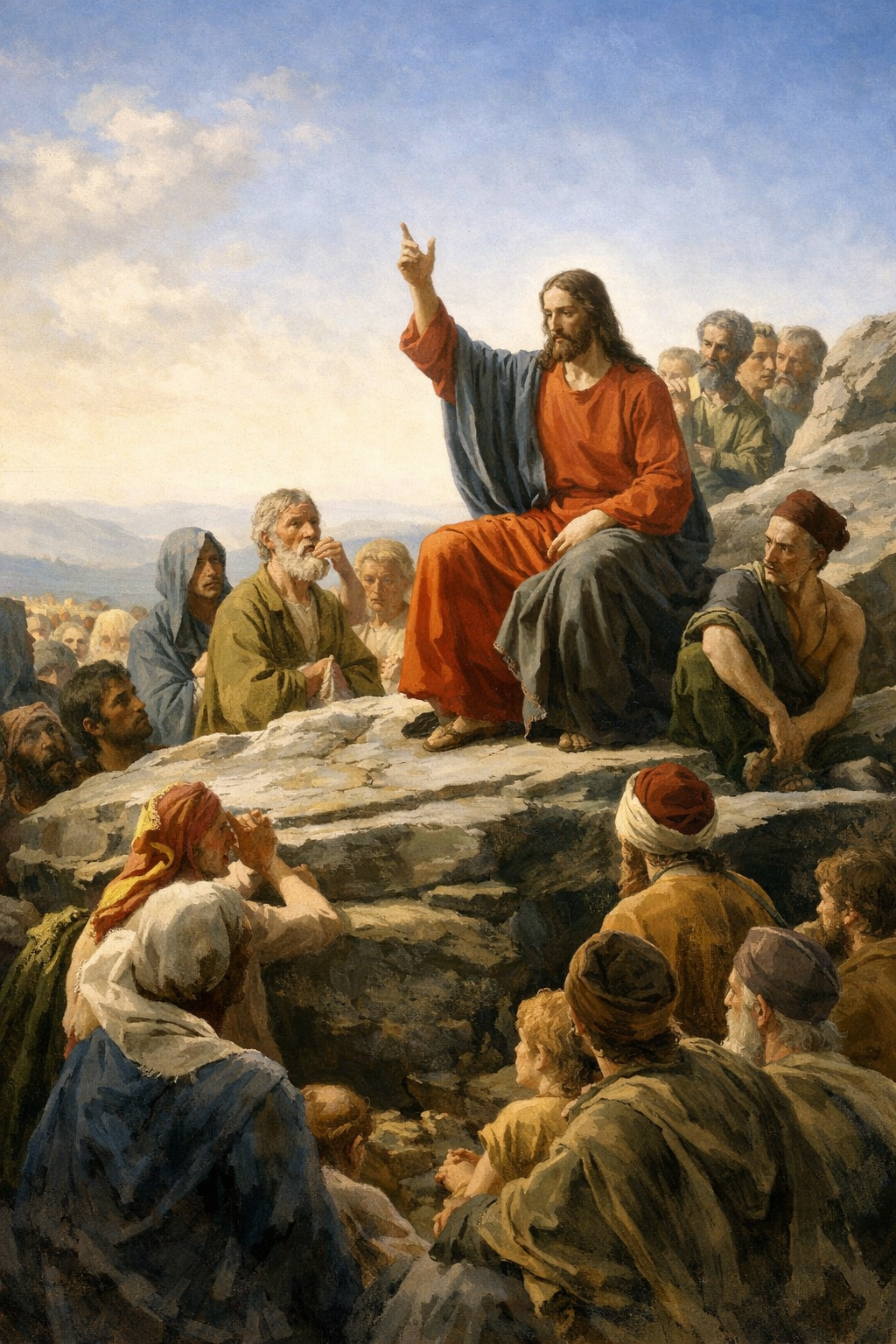
Sermon on the Mount
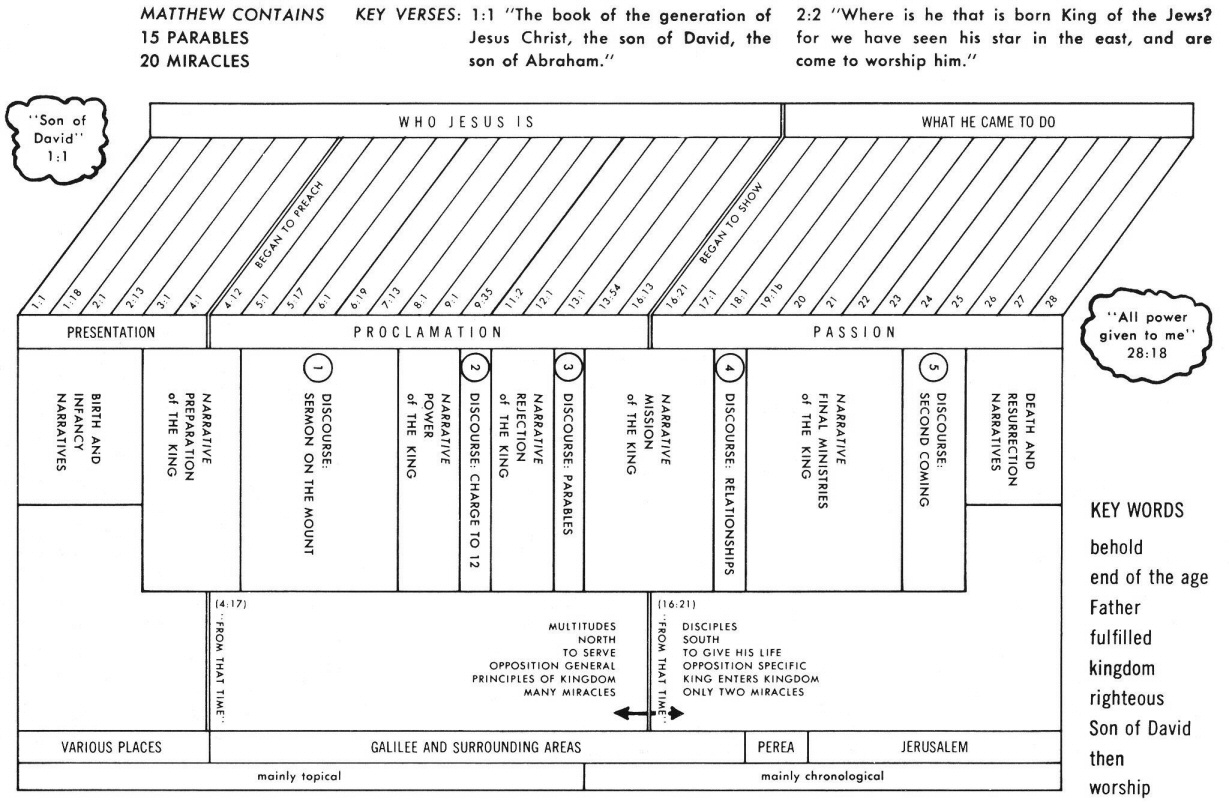
Click chart to enlarge
Charts from Jensen's Survey of the NT - used by permission
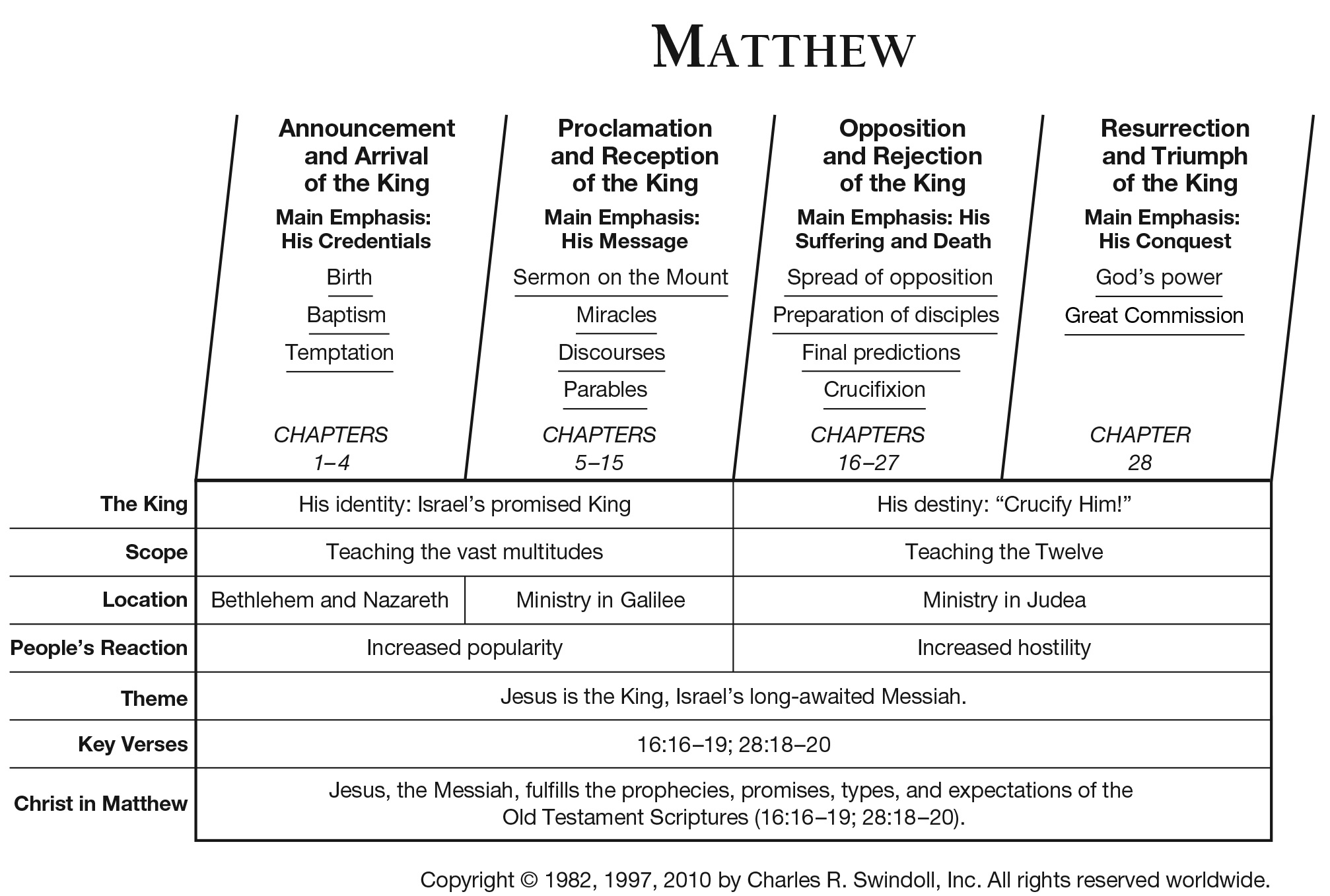
Another Chart from Charles Swindoll
THE LIFE OF JESUS AS COVERED
BY MATTHEW (shaded area)
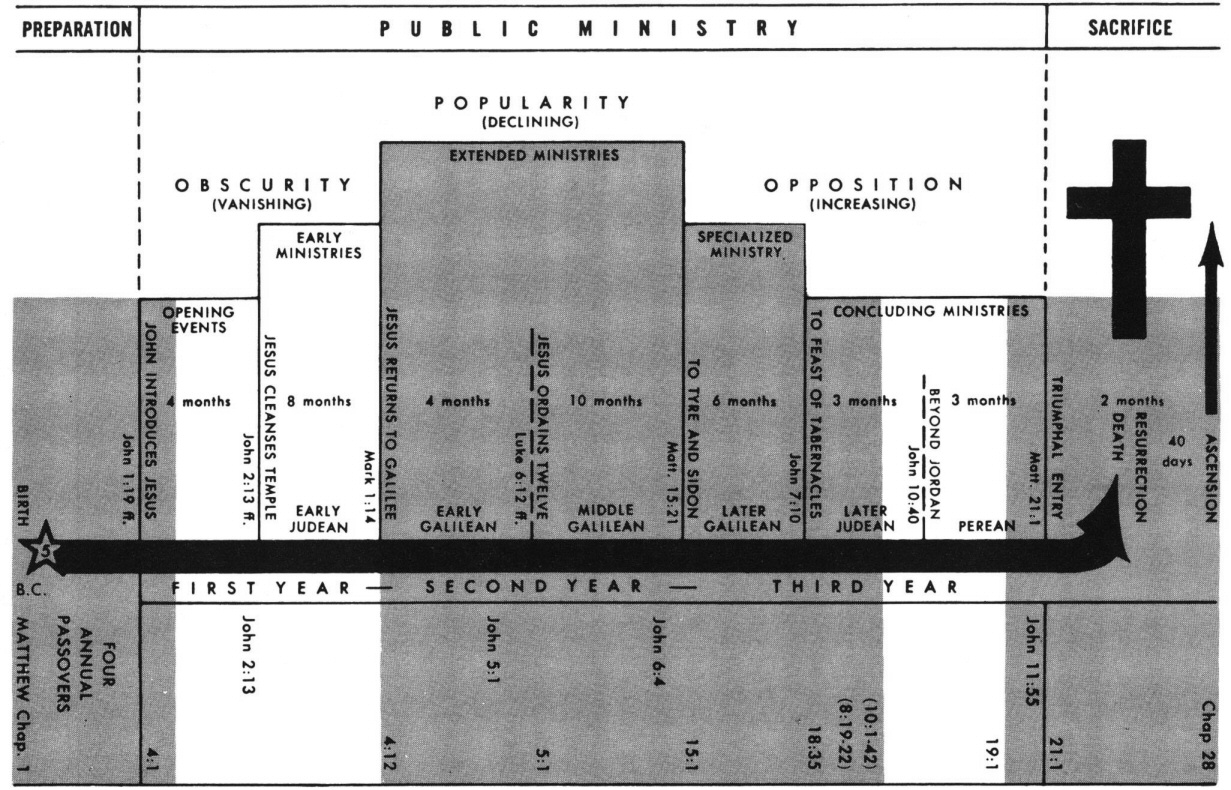
Click chart to enlarge
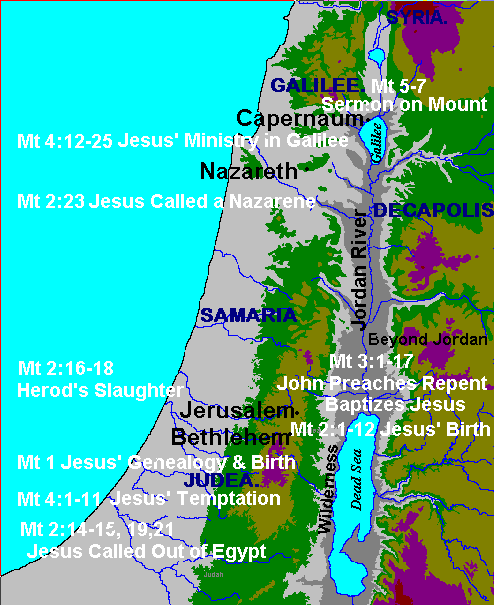
Jesus Birth and Early Years
Leading up to the Sermon on the Mount
Matthew 1-7

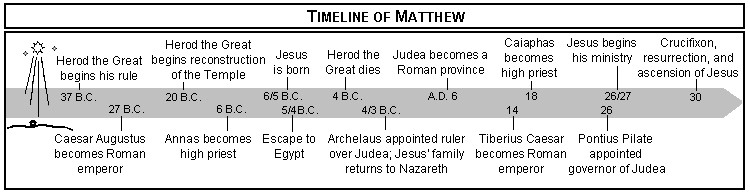
Source: Ryrie Study Bible
Matthew 6:33 "But seek first His kingdom and His righteousness, and all these things will be added to you. (NASB: Lockman )
Greek: zeteite (2PPAM) de proton ten basileian [tou theou] kai ten dikaiosunen autou, kai tauta panta prostethesetai (3SFPI) umin.
Amplified: But seek (aim at and strive after) first of all His kingdom and His righteousness (His way of doing and being right), and then all these things taken together will be given you besides. (Amplified Bible - Lockman)
KJV: But seek ye first the kingdom of God, and his righteousness; and all these things shall be added unto you.
NLT: and he will give you all you need from day to day if you live for him and make the Kingdom of God your primary concern. (NLT - Tyndale House)
Philips: Set your heart on the kingdom and his goodness, and all these things will come to you as a matter of course. (New Testament in Modern English)
Wuest: But be seeking first the kingdom and His righteousness, and these things, all of them, shall be added to you.
Young's Literal: but seek ye first the reign of God and His righteousness, and all these shall be added to you.
But seek first His kingdom and His righteousness: zeteite (2PPAM) de proton ten basileian [tou theou] kai ten dikaiosunen autou
- 1Ki 3:11, 12, 13; 17:13; 2Chrs 1:7, 8, 9, 10, 11, 12; 31:20,21; Pr 2:1-9; 3:9,10; Hag 1:2-11; 2:16, 17, 18, 19; Luke 12:31; John 6:27
- Mt 3:2; 4:17; 13:44, 45, 46; Acts 20:25; 28:31; Romans 14:17; Colossians 1:13,14; 2Th 1:5; 2Pe 1:11
- Matthew 6 Resources - Multiple Sermons and Commentaries
- Matthew 6:25-34 Overcoming Materialism - Study Guide- John MacArthur
- Matthew 6:25-34 Overcoming Materialism- John MacArthur
- Matthew 6:25-30a: Overcoming Financial Worry 1 - Study Guide- John MacArthur
- Matthew 6:25-30a: Overcoming Financial Worry 1- John MacArthur
- Matthew 6:25-30a: Overcoming Financial Stress- John MacArthur
- Matthew 6:25-34: Overcoming Financial Worry 2 - Study Guide- John MacArthur
- Matthew 6:25-34: Overcoming Financial Worry 2- John MacArthur
SETTING PROPER PRIORITIES
SEEK FIRST THE KING OF KINGS!
But (1161) makes the contrast with the Gentiles. Jesus is saying rather than being like the pagans who are concerned about their physical needs, the citizens of the Kingdom of Heaven should be concerned about and seek after the things of God.
Seek first His kingdom - He does not say seek for the kingdom which is what Jesus would have said if He was addressing this command to unbelievers. Seek for it to get into it was not what He was saying. He was speaking to those who are kingdom citizens to make the interests of God's kingdom their priority. Kingdom citizens should ponder "Is what I am going to say or do going to advance God's kingdom and glory?"
G Campbell Morgan...
Do not be anxious about these lower things, but there is something you ought to be anxious about. Do not always be planning and scheming even to the point of anxiety about food and raiment; "but seek."
No life is complete that does not feel upon it some great compulsion, driving it. We want to learn to be loving and patient with all sorts of people, but it is difficult to have patience with some men! Their eye never gleams, they have no passion, no power; they drift. A man that is a real man has something that drives, something that creates enthusiasm.
Now, says the Master, I have told you not to be anxious about these things. But there is something you are to be anxious about, something to seek, something to consume you. There is something that ought to drive you, making every nerve tingle and throb, and every artery flow with force. What is it?
“The Kingdom of God.”
So the Master would save us from the anxiety of a lower level, which makes force impossible on a higher, in order that He may develop force on the higher. Do not be anxious about the lower things, "But seek ye first the kingdom of God, and his righteousness." Seek it in essence. Let it be the underlying passion. Seek it in enterprise. Seek it everywhere.
But is there not an immediate application?
Food, drink, raiment. Do not be anxious about them, but seek the Kingdom in them. Dress for the Kingdom of GOD. Eat for the Kingdom of GOD. Let the great underlying passion, which is the great principle of the life, find its throbbing way into the extremities of the life. Things about which you are not to be anxious in themselves, and for themselves; you are to be anxious about, in order that through them also the Kingdom of GOD may come. Seek that in essence, in enterprise, and in individual application.
With a touch of fine and beautiful disdain, which is not contempt if we may make so fine a distinction the Lord says, "All these things shall be added unto you."
"Added unto you."
Mark the conception food, drink, raiment, added. That is, the necessary luggage with which you travel, the added things which are nevertheless impedimenta. Some people are always worrying, when travelling, about their luggage, and that is just what a great many are doing about food and raiment. “These things shall be added.”
Trust them to your Father. Trust them after your toil is over, after your planning is done. After you have sown and reaped and gathered, leave the rest. And if you do not think by your calculation that your doing, and reaping, and gathering is enough for all, then let there be no anxiety. Your Father knows, and here is your blank check for necessities "These things shall be added unto you."
Anxiety...
Care About the Future
Once again, anxiety is always care about the future. To-morrow, that is it. It is always tomorrow, and so JESUS sums the whole thing up finally, and says:
"Take therefore no thought for the morrow: for the morrow shall take thought for the things of itself."
By which we do not understand the Lord to mean that it is a proper function of to-morrow to be anxious about to-morrow, but by which we do understand Him to mean, Do what you will, there will be something in to-morrow to be anxious about.
You cannot kill to-morrow's anxiety by being anxious about it to-day. And so He says, "Sufficient unto the day is the evil thereof."
Evil does not mean sin. It means adversity.
Every day that comes will have in it evil - adversity - things calculated to make us anxious. Tomorrow will be anxious. The evil will come whatever you do. All of which may be stated thus: Live, oh child of thy Father, subject of thy King, live to-day.
"Lord, for to-morrow and its needs I do not pray.
Keep me, O Lord, from stain of sin just for to-day."
There is no suspicion of asceticism in this section. Our Father knows that His people will be here in the world, and will have to do with earthly things. He does not even say it is wrong to lay up treasure. He only advises us as to how we shall make our investment of treasure. Do not lay it up on earth. Lay it up in heaven.
There is nothing ascetic here. There is no warrant for improvidence here. The man who will go out and say, Very well, I will be like the sparrow, I will not sow, or reap, or gather - well, we know the issue, and neither we nor anyone else will pity him. If a man shall say, I will go and be as the flower of the field, I will not toil or spin - well, we see at once the unutterable folly of such an argument.
Do not imagine that the King commands us not to think for the future. Do not say, that because GOD cares, you are not to provide for your wife, and your bairns (Scottish word for "child"), in the case of your dying. Let us have no nonsense talked about the evil of insurance. "If any provide not for his own, and specially for those of his house, he hath denied the faith, and is worse than an infidel (unbeliever)," says the apostle; and the whole teaching of JESUS is, not that we are not to reap, sow, gather, toil, spin; but that through our toil and planning we are not to be anxious; through reaping we are to trust; in our gathering we are to sing; as we toil we are to rejoice; as we spin we are to be quiet. It is a call to the life that is frictionless, because by the principle of faith man takes hold upon GOD, and, submitting, knows what it is to have His power operating through his work, and His life providing for his need. (Matthew 6:25-34 Commentary)
Spurgeon writes that...
When I had resolved to enter college, walking across Midsummer Common, just outside of Cambridge, revolving in my mind the joys of scholarship and the hope of being something in the world, that text came to my heart,
"Seekest thou great things for thyself? Seek them not" (Jer. 45:5)
"Seek first the kingdom of God and his righteousness, and all these things shall be added unto you."
All was given up, everything was renounced, the finest prospects seemed to melt into thin air, merely on the strength of that text, believing that God would most certainly fulfill to me his promise if I could keep his precept.
God will always keep His word to the letter. Actually He will usually go beyond what the letter seems to mean. In this instance (cf "And the LORD gave Solomon wisdom, as he promised him" 1 Kings 5:12), while He gave Solomon wisdom, He also added to him riches and a thousand other things which did not appear in the compact.
Seek ye first the kingdom of God and His righteousness, and all these things shall be added unto you (Matt. 6:33).
He who makes promises about infinite blessings will throw in everyday things as if they were of small account and were given in as a matter of course, like the grocer’s paper bags in which he packs up our purchases.
Seek (2212) (zeteo) means to try to learn where something is or try to find as a searching for what is lost seek. To attempt to learn something by careful investigation or searching. Seeking in the present context speaks of a single minded focus, as when one's eye is "single" (clear) (Mt 6:22, 23-notes)
Zeteo is in the present imperative so what Jesus is saying is that the antidote to worrying is to make a daily choice, your habitual practice to prioritize God's kingdom and righteousness. The world won't stop tempting you to seek it's passing pleasures, and one of the best "defenses" is a good "offense", in this case seeking the things above where the King sits at the right hand of His Father (Col 3:1, Col 3:2).
Caveat - Don't attempt to obey Jesus' command to seek in your own (old man) strength! You will fail and experience frustration. And you will in effect place yourself under the yoke of legalism. The only way to obey this command to seek as our practice (present tense = continually, habitually and remember we're talking about "direction" not "perfection") is by daily dying to self and jettisoning self-effort and self-sufficiency (to live the supernatural/Christian life), daily seeking to be wholly controlled by the Holy Spirit. The Spirit is in us and is continually energizing us, giving us the supernatural desire and the supernatural power we need (Phill2:13NLT) so that we might effectively, successively work out our salvation in fear and trembling (Phil 2:12). To put it another way, we need to learn to depend on the Spirit's power to enable us to work out what He works in! Do you see the difference? Self-effort versus Spirit energization! The first is natural and the second supernatural power. And this command (not to mention all >1500 commands in the NT! See discussion of commands and need for the Spirit) can only be obeyed supernaturally. This is a process which we need to practice, daily seeking to be filled with (controlled by) the Spirit of Jesus (Eph 5:18) so that we might continually walk by the self-same Spirit and then (and only then) we will not carry out the desires of our flesh (Gal 5:16). It follows that we will need to be sensitive to those thoughts, words and action in our life which quench the Spirit (1Thes 5:19) or grieve the Spirit (Eph 4:30) lest we "short circuit" our Source of power (dunamis)! Paul reminded the saints at Galatia of their abject need to for dependence on the Holy Spirit asking "Are you so foolish? Having begun by the Spirit, are you now being perfected by the flesh?" (Galatians 3:3) Of course the answer is a resounding "No" as all of us can attest from personal experience!
Notice then that Jesus is not suggesting but commanding all citizens of the Kingdom of heaven who still live on earth to cease making material things the center of their life ("stop worrying" Mt 6:25-32). Instead the believer's lifelong pursuit is not for things but the presence, pleasure and Person of Jesus Christ our Lord and our King ("kingdom" always indicates a "king"). See related resource by Anne Ortlund - Fix Your Eyes on Jesus
Dear Lord, may the words of Johnson Oatman's great hymn be our soul's deepest desire...
Higher Ground
I’m pressing on the upward way,
New heights I’m gaining every day;
Still praying as I’m onward bound,
“Lord, plant my feet on higher ground.”
Refrain
Lord, lift me up and let me stand,
By faith, on Heaven’s table land,
A higher plane than I have found;
Lord, plant my feet on higher ground.
My heart has no desire to stay
Where doubts arise and fears dismay;
Though some may dwell where those abound,
My prayer, my aim, is higher ground.
Refrain
I want to live above the world,
Though Satan’s darts at me are hurled;
For faith has caught the joyful sound,
The song of saints on higher ground.
Refrain
I want to scale the utmost height
And catch a gleam of glory bright;
But still I’ll pray till Heav’n I’ve found,
“Lord, plant my feet on higher ground.”
Refrain
In Mt 6:25-24 what Jesus has done is reduce what we seek for to effectively two categories, the essentials of life versus God's Kingdom and righteousness. Seeking for the former will make us anxious and worried. Seeking for God will give us peace that passes human understanding.
Jesus gives God's key to open the door to freedom from worry and anxiety - make the conscious, volitional choice every day of your life that your thoughts and actions will demonstrate that the kingdom of God is your priority in this world which is passing away.
Have you every heard of "worry beads" (fidget beads or komboloi [from kombos = knot or large number of knots + loi = a group that sticks together] in modern Greece) which is a string of beads that when fingered or played with supposedly relieves nervous tension? You can get them at some great prices on EBay but they don't work! However Jesus' powerful teaching beginning in Matthew 6:25 and culminating in His command in Matthew 6:33 is the truth that can set you free if diligently "fingered" (i.e., mediated upon and put into daily practice).
What Jesus is saying is that in essence "What you seek, you find." This principle reverberates throughout the Bible...
But from there you will seek the LORD your God, and you will find Him if you search for Him with all your heart and all your soul. (Deut 4:29)
As for you, my son Solomon, know the God of your father, and serve Him with a whole heart and a willing mind; for the LORD searches all hearts, and understands every intent of the thoughts. If you seek Him, He will let you find Him; but if you forsake Him, He will reject you forever. (1Chronicles 28:9)
R C Sproul explains that...
Seeking demands an intensity, a perseverance that will not be denied, and a zeal to achieve the desired objective. In addition to refocusing your goal of righteousness, allow the Scriptures to speak to your motivation and commitment. (Sproul, R. Vol. 1: Before the Face of God: Baker Book House; Ligonier Ministries)
J R Miller (Biography) wrote that...
We need have only one care, that we put the first thing first—faithfulness to God. Then all else we need for both worlds will be supplied. God will never fail us; but we forget, sometimes, in our rejoicing over such an assurance, that we must fulfill our part if we would claim the divine promise.
It will not always be easy. Tomorrow it may mean a distasteful task, a disagreeable duty, a costly sacrifice for one who does not seem worthy. Life is full of sore testings of our willingness to follow the Good Shepherd. We have not the slightest right to claim this assurance unless we have taken Christ as the guide of our life.
First (4413) (proton from protos = leading, foremost, prominent, most important) means first in time, place, order, importance. The word first indicates one’s first and ever dominant concern.
The concept of “seeking first” for the things of God is a predominant biblical concept that touches one's motivation and priorities including how one spends their "leisure" time, the goals one sets in their life, and whether or not they experience spiritual growth.
What do you “seek first”? If you are like me, then people, possessions, power, prestige, pleasure, and other desires compete for your priority. All of these things can quickly bump God out of first place if we don’t actively choose to give Him first place in every area of life. A good way to begin each day is by declaring Romans 12:1 (see note Romans 12:1) and then living out the rest of that day as a "living sacrifice".
It is interesting that Jesus does not say we are to refrain from pursuing the material treasures of this world, but that we are replace those desires with a pursuit that has far greater significance in this life and the life to come.
For many of us one of the major obstacles to seeking first His kingdom is the persistent, pesky Problem with Priorities - Steven Cole gives this illustration - I’ve shared before the story of the time management expert who was speaking to a group of business students. He pulled out a large, wide-mouth jar and filled it with fist-sized rocks. When he couldn’t put any more in, he asked, “Is this jar full?” The class responded, “Yes.” He said, “Really?” Then he pulled out a bucket of gravel and poured it in, shaking it down through the cracks. Then he asked, “Is the jar full?” The students were onto him, so they said, “No.” “Good,” he replied. He dumped in a bucket of sand. Once more he asked, “Is the jar full?” “No,” they shouted. Again he said, “Good.” He poured in a pitcher of water until the jar was full to the brim. Then he asked, “What is the point of the illustration?” One student ventured, “No matter how full your schedule, if you try hard, you can always fit more in.” “No,” the speaker replied, “that is not the point. The point is, if you don’t put the big rocks in first, you’ll never get them in at all.” (First Things First, by Stephen Covey, Roger & Rebecca Merrill [Simon & Schuster], pp. 88-89.) Editorial comment - What should our “big rocks” be? Jesus and His Word! Put them first in your life! If we put the pebbles, or sand, etc, in first, we won't find time (room) for Jesus the King of kings and His living Word which endures forever!
Kingdom (932)(basileia from basileus = a sovereign, king, monarch) denotes sovereignty, royal power, dominion. Basileia can also refer to the territory or people over whom a king rules
C H Spurgeon's comments...
Lord, enable me to be a non-anxious one. May I be so eager after heavenly things, that I altogether leave my earthly cares with thee!
Mt 6:33. Seek God first, and the rest will follow in due course. As for “all these things ”, you will not need to seek them; they will be thrown in as a matter of course. God who gives you heaven will not deny you your bread on the road thither. The kingdom of God, and the righteousness suitable to that kingdom—seek these first and foremost, and then all that you can possibly need shall be your portion. To promote the reign of Christ, and to practice righteousness, are but one object; and may that be the one aim of our lives!
Let us spend life on the one thing, and it will be well spent: as for the twenty secondary objects, they also will be ours if we pursue the one thing only. (Commentary)
Related Resource on One Thing - See Commentary on Luke 10:42 = "only one thing is necessary"
The topic Kingdom of God (synonymous term = Kingdom of Heaven) can be confusing as the interpretation depends on the context in which it is used - It can mean a spiritual Kingdom, a Millennial Kingdom or a Kingdom in the New Heaven and New Earth. Many who espouse the teaching of replacement theology or supersessionism do not accept a literal earthly Kingdom of God. I am firmly convinced (from Scripture) that there will be a literal earthly Kingdom of God ruled by the King of kings, the Lord Jesus Christ. For that reason I have several detailed discussions on the Kingdom of God in the commentaries on the following verses...
- Luke 17:20-21-commentary
- Luke 19:11ff-commentary
- Acts 1:6-commentary
Righteousness (1343) (dikaiosune from dikaios = being proper or right in the sense of being fully justified being or in accordance with what God requires) is the quality of being upright. In its simplest sense dikaiosune conveys the idea of conformity to a standard or norm. In this sense righteousness is the opposite of hamartia (sin), which is defined as missing of the mark set by God. In this sense righteousness is the opposite of hamartia (sin), which is defined as missing of the mark set by God.
Dikaiosune is rightness of character before God and rightness of actions before men. Righteousness of God could be succinctly stated as all that God is, all that He commands, all that He demands, all that He approves, all that He provides through faith in Christ (Click here to read Pastor Ray Pritchard's interesting analysis of righteousness in the Gospel of Matthew).
What does it mean to pursue God's righteousness? One aspect is surely to submit to God's will that His children live righteously as described in the beatitudes - poor in spirit, mourning over sin, meek in spirit, hungering and thirsting for righteousness, etc. In a word this pursuit equates with sanctification or present tense salvation (see discussion of the Three Tenses of Salvation)
Barnhouse gives a practical illustration of what this righteousness looks like in a kingdom citizen...
A butcher was once asked what difference it made to him when Christ entered his life. He replied, “I stopped weighing my thumb.” He then told how, before becoming a Christian, he put meat on the scales in such a way that his thumb trailed down, approximately the weight of an ounce. He had included that thumb in the weight of beef, pork, lard, and every other item of his merchandise. But after Christ came into his heart, he stood away from the scales and gave a full sixteen ounces of meat. And when he served customers whom he had formerly cheated, he added an ounce to make up for past peculations. The Kingdom of God produces complete integrity in a believer. (Barnhouse, D. G. God's Glory : Romans 14:13-16:27. Page 13. Grand Rapids, MI.: William B. Eerdmans Publishing Company)
Charles Spurgeon tells the story of a young man who openly confessed his decision to trust Christ. This decision sorely offended his father, who advised him,
“James, you should first get yourself established in a good trade, and then think of the matter of religion.”
“Father,” said the son, “Jesus Christ advises me differently; He says, ‘Seek ye first the kingdom of God’ “ (Matt. 6:33).
Lord of the cloud and fire,
I am a stranger, with a stranger's indifference;
My hands hold a pilgrim's staff,
My march is Zionward,
My eyes are toward the coming of the Lord.
--Old Puritan prayer.
In Faith's Checkbook, Spurgeon has a devotional on Mt 6:33 entitled God First, Then Extras...
SEE how the Bible opens: “In the beginning God.” Let your life open in the same way. Seek with your whole soul, first and foremost, the kingdom of God, as the place of your citizenship, and His righteousness as the character of your life. As for the rest, it will come from the Lord Himself without your being anxious concerning it. All that is needful for this life and godliness (see note 2 Peter 1:3) “shall be added unto you.”
What a promise this is! Food, raiment, home, and so forth, God undertakes to add to you while you seek Him.
You mind His business,
and He will mind yours.
If you want paper and string, you get them given in when you buy more important goods. And just so, all that we need of earthly things we shall have thrown in with the kingdom. He who is an heir of salvation shall not die of starvation, and he who clothes his soul with the righteousness of God cannot be left of the Lord with a naked body. Away with anxious care. Set all your mind upon seeking the Lord (see notes Colossians 3:1; Colossians 3:2).
Covetousness is poverty, and anxiety is misery:
Trust in God is an estate,
and likeness to God is a heavenly inheritance.
Lord, I seek thee, be found of me.
John Stott sums it up “In the end, just as there are only two kinds of piety, the self-centered and the God-centered, so there are only two kinds of ambition: one can be ambitious either for oneself or for God. There is no third alternative.” (Borrow The Message of the Sermon on the Mount)
Constable asks and answers an interesting question....
In view of this promise how can we explain the fact that some committed believers have perished for lack of food? There is a wider sphere of context in which this promise operates. We all live in a fallen world where the effects of sin pervade every aspect of life. Sometimes the godly, through no fault of their own, get caught up in the consequences of sin and perish. Jesus did not elaborate this dimension of life here but assumed it as something His hearers would have known and understood. (Expository Notes on the Bible)
A QUESTION OF PRIORITIES...
WHERE DO YOU SPEND
YOUR TIME AND MONEY?
Pastor Ray Pritchard offers some insights on seeking writing that...
Everyone seeks something. We are all by nature seeking people. Some people seek for money, others for fame, others for pleasure, others for self-validation, others for sexual fulfillment, and others for worldly power. We may seek a husband or a wife or we may seek children or a new job or a better education or a new home or new friends or a new church. The tragedy of our time is that so many people are wasting their lives chasing after three things that can never satisfy—money, sex and power. We want money, so we sacrifice our families to get it. We want sex so we sacrifice our morals to get it. We want power so we sacrifice our friends to get it. And when we finally get it, it doesn’t satisfy...
Here’s a simple test to help you discover what you truly seek in life. This test is absolutely foolproof. You tell me how you spend your time and your money and I’ll tell you what you are seeking. You can say anything you like, you can come to church and look very religious, but your time and your money don’t lie. Time is life and money is nothing but the time it takes to make the money. Show me your calendar and your checkbook and I’ll know the truth about your priorities.
This week I read about a man who looked at his life and concluded that he was just like the Professor on Gilligan’s Island. “The Professor knew how to turn banana peels into diesel fuel and he could take algae and make chocolate fudge, but he never got around to fixing that hole in the boat so he could get off the island. Same as me. I spent my life learning to do amazing things that didn’t matter, and I ignored the hole in my boat. And that’s why I’m stuck where I am.”...
If you want righteousness, you can have it. Let me go out on a limb and make a bold statement. Whatever righteous thing you desire in the spiritual realm, you can have if you want it badly enough. I don’t think we appreciate the importance of that truth. Most of us are about as close to God now as we want to be. We have about as much joy as we want, about as much peace as we want. Abraham Lincoln said that “most people are about as happy as they want to be.” Totally true. We are the way we are because that’s the way we want to be. Either we’re happy that way or we’ve accepted that this is who we are and we’re not going to change. For the most part, you are where you are right now because that’s where you want to be. If you were hungry for something better from God, you could have it....
What we seek, we find. This is true in every area and realm of life. Unless we seek, we will not find. And what we seek, for good or for ill, we eventually find. (Matthew 6:33 The Fourth Law: What You Seek, You Find)
Are you a God seeking person? Do you really want to know? Ask a brother or sister in Christ? Or better yet ask an unsaved person who knows you. They many not know the Scriptures like you do but you may be surprised at their answer. If the answer surprises you and you discover others don't see you as a God seeker, consider Pastor Pritchard's five suggestions to stimulate your seeking first God's kingdom and His righteousness...
First, admit your need. You cannot change until you admit that you need to change. If you are happy the way you are, then I have nothing to do say to you. But if you are tired of turning banana peels into diesel fuel while there’s a hole in your boat, then pay attention because your life could be radically changed.
Second, cry out to God for help. Early on Sunday morning I met a man who said, “It happened 16 years ago today.” What happened? “Sixteen years ago my life hit rock bottom. Alcohol had destroyed me. My marriage was gone, my career was ruined, and my life was a wreck. I had tried everything the world had to offer and nothing seemed to make a difference. When I finally had nowhere else to turn, I cried out to Jesus. Sixteen years ago today, he heard my cry and changed my life.” That man was in our early worship service on Sunday. He is living proof of the life-changing power of Jesus Christ. He cried out and the Lord heard him and saved him from the pit of destruction. If you need the Lord, cry out to him today. Seek him with all your heart and you will find him.
Third, surround yourself with God-seeking people. You know who they are. God-seekers aren’t hard to spot. Find some friends who truly seek the Lord and glue yourself to them. Go where they go, do what they do. Follow their example. Eventually one of two things will happen. Either they will drive you nuts and you will leave them or they will rub off on you and you will become a God-seeker too.
Fourth, wait on the Lord. This is a hard discipline for most of us to practice. Our message to God is, “Give me patience, and give it to me right now!” We want spiritual maturity and we want it by 11:30 a.m. We’re not accustomed to waiting patiently on the Lord. But waiting has many positive benefits. The very act of waiting purifies our hearts and increases our longing to know the Lord intimately. As we wait and as we pray, we become like the deer panting for the water. Our souls grow hungry to know the Lord.
Fifth, spend time in fasting. I believe there is a direct connection between biblical fasting and seeking the Lord. For some, that might mean going without a meal once a week in order to wait on God. For others, it might mean going a day without a meal. The ancient discipline of biblical fasting can be practiced many different ways. I have found it beneficial to take a day a week and fast from sunrise to sundown. And on occasion I have fasted for several days at a time. Fasting slows us down, reorients our perspective, weans us away from our love of the world, and puts us in a spiritual position where we can seek God with fewer distractions. (If you would like instruction in this area, I highly recommend the book A Hunger for God by John Piper from Crossway Books.) (Ed note: A Hunger for God is available free online. Also see notes on fasting from Matthew 6:16-18)
The great mystic Thomas a Kempis (who wrote The Imitation of Christ) said, “Seek God, not happiness.” We have it all backwards. We seek happiness and hope to have God thrown in as a bonus. But we end up with neither. The paradox of the gospel is that when we truly seek God, we find him, and we get happiness (deep fulfillment, lasting joy, the abundant life) too. But it takes years for many of us to figure that out, and some of us never get it straight. To the very end, we pursue earthly happiness and our own agendas and we wonder why life leaves us frustrated and disillusioned. (Matthew 6:33 The Fourth Law: What You Seek, You Find)
David encourages us...
O fear the LORD, you His saints; For to those who fear Him, there is no want. The young lions do lack and suffer hunger; But they who seek the LORD shall not be in want of any good thing. (Ps 34:9,10)
Spurgeon comments: "Jehovah will not allow his faithful servants to starve. He may not give luxuries, but the promise binds him to supply necessaries, and he will not run back from his word. Many whims and wishes may remain ungratified, but real wants the Lord will supply. The fear of the Lord or true piety is not only the duty of those who avow themselves to be saints, that is, persons set apart and consecrated for holy duties, but it is also their path of safety and comfort. Men seek a patron and hope to prosper; he who has the Lord of Hosts to be his friend and defender prospers surely. They are fierce, cunning, strong, in all the vigor of youth, and yet they sometimes howl in their ravenous hunger, and even so crafty, designing, and oppressing men, with all their sagacity and unscrupulousness, often come to want; yet simple-minded believers, who dare not act as the greedy lions of earth, are fed with food convenient for them. No really good thing will be denied to those whose first and main end in life is to seek the Lord.)
The LORD knows the days of the blameless; And their inheritance will be forever. 19 They will not be ashamed in the time of evil; And in the days of famine they will have abundance...25 I have been young, and now I am old; Yet I have not seen the righteous forsaken, Or his descendants begging bread. (Ps 37:18,19,25)
Spurgeon comments: "None can deprive them of it, and none shall destroy it. What they have on earth is safe enough, but what they shall have in heaven is theirs without end... Their bread will be given them. Our Lord stayed himself on this when he hungered in the wilderness, and by faith he repelled the tempter. If God’s providence is our inheritance, we need not worry about the price of wheat. Faith, if it do not preserve the crop, can do what is better, namely, preserve our joy in the Lord.")
and all these things will be added to you: kai tauta panta prostethesetai (3SFPI) humin
- Mt 19:29; Lev 25:20,21; Ps 34:9,10; 37:3,18,19,25; 84:11,12; Mk 10:30; Lk 18:29,30; Ro 8:31; 1 Cor 3:22; 1Ti 4:8
- Matthew 6 Resources - Multiple Sermons and Commentaries
- Matthew 6:25-34 Overcoming Materialism - Study Guide- John MacArthur
- Matthew 6:25-34 Overcoming Materialism- John MacArthur
- Matthew 6:25-30a: Overcoming Financial Worry 1 - Study Guide- John MacArthur
- Matthew 6:25-30a: Overcoming Financial Worry 1- John MacArthur
- Matthew 6:25-30a: Overcoming Financial Stress- John MacArthur
- Matthew 6:25-34: Overcoming Financial Worry 2 - Study Guide- John MacArthur
- Matthew 6:25-34: Overcoming Financial Worry 2- John MacArthur
All (3956) (pas) means all without exception and in context all "these things", the things we "need" (not greed) to live this life for the glory of our Father Who art in heaven.
Added (4369) (prostithemi from prós = to or besides + títhemi = put) means to add something to an existing quantity. We have food and clothing for today but God will add necessary essentials in the future as the need arises. When our priority is spiritual, God will take care of the material, for where God guides, He provides.
Elsewhere Jesus declared...
"Truly I say to you, there is no one who has left house or brothers or sisters or mother or father or children or farms, for My sake and for the gospel's sake, but that he shall receive a hundred times as much now in the present age, houses and brothers and sisters and mothers and children and farms, along with persecutions; and in the age to come, eternal life. But many who are first, will be last; and the last, first." (Mark 10:29-31)
As Paul wrote...
What then shall we say to these things? If God is for us, who is against us? (see note Romans 8:31)
The psalmist writes that...
the LORD God is a sun and shield; The LORD gives grace and glory. No good thing does He withhold from those who walk uprightly. O LORD of hosts, How blessed is the man who trusts in Thee! (Psalm 84:11,12) Spurgeon comments on these verses writing
There is no good apart from God, and there is no good which He either needs to keep back or will on any account refuse us, if we are but ready to receive it. We must be upright and neither lean to this or that form of evil; and this uprightness must be practical—we must walk in truth and holiness, then shall we be heirs of all things, and as we come of age all things will be in our actual possession; and meanwhile, according to our capacity for receiving shall be the measure of the divine bestowal. This is true, not of a favored few, but of all the saints forevermore. Verse 12. Here is the key of the psalm. The worship is that of faith, and the blessedness is peculiar to believers. No formal worshiper can enter into this secret. We must know the Lord by the life of real faith, or we can have no true rejoicing in the Lord’s worship, his house, his Son, or his ways.
F W Grant wrote that...
Here the Lord’s words mean plainly, in the connection in which they stand, “Care you for what belongs to God, and suits Him, and He will care for you:” and “His righteousness means all that suits His character, as revealed. Important as the lesson is, it is evidently not what we need to dwell upon in connection with the present inquiry. (Grant, F. W. Leaves From The Book)
J C Ryle writes that Jesus
offers us a gracious promise as a remedy against an anxious spirit. He assures us that if we “seek first” and foremost to have a place in the kingdom of grace and glory, everything that we really want in this world will be given to us “as well” as our heavenly inheritance. “In all things God works for the good of those who love him” (Romans 8:28).. (Matthew 6:25-34 Expository Thoughts)
First Things First - In the late 19th century John Wanamaker opened a department store in Philadelphia. Within a few years that enterprise had become one of the most successful businesses in the country. But operating his store wasn’t Wanamaker’s only responsibility. He was also named Postmaster General of the United States, and he served as superintendent for what was then the largest Sunday school in the world at Bethany Presbyterian Church. When someone asked him how he could hold all those positions at once, he explained. “Early in life I read, ‘Seek ye first the kingdom of God, and His righteousness, and all these things shall be added unto you.’ The Sunday school is my business, all the rest are the things.”
One evidence of Wanamaker’s desire to keep the Lord’s work first in his life was a specially constructed soundproof room in his store. Every day he spent 30 minutes there praying and meditating upon God’s Word. He had his priorities straight!
WHO'S FIRST?- But seek ye first the kingdom of God, and his righteousness, and all these things shall be added unto you. Matthew 6:33
When a young man made a public profession of Christ, his worldly father was greatly upset and later complained in a critical tone, "Jim, you should have established yourself in a good trade first. Then, once you had made your way in the world, it would have been time enough to think about religion." "Father," came the spiritual reply, "my Savior advises me very differently. He says, 'Seek ye first the kingdom of God!' "
If we put the Lord first, nothing else will get out of order. He should have priority in our thoughts, motives, and deepest desires. Making a living is a - mere incident, but making a life is the reason for which we have been placed in this world. If we put God first, all other good things will be added to us.
Many years ago a package was sent from England to a South African town. The man to whom the box was consigned, however, refused to pay the delivery charges, and for fourteen years it was used as a footstool in the express office. Finally, the consignee died and the box was put up at auction with other unclaimed articles. Out of curiosity a man bid on it and secured it at a very low price. When he opened it, he was greatly surprised to find several thousand pounds in English bank notes. Because the man to whom it had been sent refused to pay the comparatively trifling delivery charges, he had missed a considerable fortune. So, too, he who refuses to meet the requirements of Jesus in regard to discipleship is even more shortsighted. What the Lord asks in regard to complete dedication may seem too much for the non-Christian, but those who heed His call find He gives infinitely more in return than anything they are required to surrender for His sake.
Are you seeking first the gratification of self, men's applause, piled-up wealth — or the approval of the Savior. H G Bosch (Our Daily Bread, Copyright RBC Ministries, Grand Rapids, MI. Reprinted by permission. All rights reserved)
O the peace of full surrender;
All my joy to do His will!
If I seek His blessed kingdom,
He His promise will fulfill! —Anon.
He who puts God first will find God with him at the last!
HOW TO BE TRULY SUCCESSFUL: But seek ye first the kingdom of God, and his righteousness; and all these things shall be added unto you. Matthew 6:33
A very rich man, who had run after the things of the world and had overtaken them, lay dying. He was visited by the daughter of a friend with whom he had been associated in early youth, but who had left their profitable business to serve Christ. Now he too was dying but with great peace of mind and holy confidence. "You may wonder why I cannot be as happy and quiet as he," said the unsaved millionaire, "but just think of the difference between us. He is going to his treasure and I — I must leave mine!"
One who feels wretched and defeated cannot be considered successful regardless of how much wealth he may have amassed, or how many honors may have been heaped upon him. Nor can any person be termed "successful" if he has lived his life with-out God. I can think of some very happy people who never acquired wealth or fame. An elderly couple I know are still deeply in love with each other and radiate spiritual joy. They have four children, all married and in full-time Christian service. They are truly successful!
Some men will risk anything, will lie, cheat, and traffic in all sorts of dishonesty and immorality in order to obtain that illusive will-o'-the-wisp called fame!
The rich fool — mentioned in Luke 12:16, 17, 18, 19, 20, 21 — looked upon himself as a successful man, but God didn't agree. True success is to find one's place and to fill it — to seek first the kingdom of God and his righteousness! You may be poor, have relatively little talent, and be quite unable to do anything that looks big; how-ever, if you are faithfully handling the task God has given to you, in complete yieldedness to His will, you will find true happiness. God eventually will give an accurate estimate of your life; then "many who are last shall be first; and the first last!' H G Bosch (Ibid)
Seek ye first, not earth's aspirings,
Ceaseless longings, vain desirings
But your precious soul's requirings,
"Seek ye FIRST"!
—Anon.
Happiness is not having and getting;
it consists in giving and serving!
—H. Drummond
During the reign of Queen Elizabeth I, a busy merchant was chosen by Her Majesty to fulfill an important ambassadorial mission. Informed of this honor, he asked to be excused, saying that it would cause him monetary loss and severely interrupt the supervision of his industrial activities. To this the Queen replied, "You look after my business abroad, and I will look after yours at home." The gentleman accepted the appointment and was gone for several years. When he returned, he found that the Queen, true to her word, had more than adequately taken care of his affairs.
To be faithful disciples of Jesus requires that we give the Savior top priority in all things, trusting Him fully to take care of our needs.
God gives His best blessings to those who put Christ first. Does He have top priority in your life? —H. G. Bosch (Ibid)
He who offers God second place
offers him no place.
Planned Neglect - Have you ever noticed how the saints in the Bible were eager to let God have His way in their lives? They bestirred themselves as soon as dawn touched the sky in order to worship Him and seek His leading. For example, Abraham got up very early to stand before the Lord (Gen. 19:27). Jacob in like manner arose from his stony pillows to worship God after having seen a vision of angels in the night (Gen. 28:18). Moses went early to meet the Lord at Sinai (Ex. 34:4). Joshua did the same when he pre-pared to capture Jericho (Josh. 6:12), and Gideon followed their example when he made his way at dawn to examine the fleece that he had cast upon the ground to discern Jehovah's will (Judg. 6:38). Hannah and Elkanah arose early to worship God (1 Sam. 1:19), as did Samuel when he went to meet Saul (1 Sam. 15: 12). Job left his warm bed to offer sacrifices for his children (Job 1:5), and the faithful women who had followed the Savior arose at daybreak that they might go to the sepulcher on the first Easter morn (Mark 16:2). Say, have you ever gotten up early to study God's Word, to pray, and to seek His will? Does He have priority in all you do?
A noted young concert artist was asked the secret of her success with the violin. "Planned neglect!" she replied, and then explained. "Years ago I discovered that there were many things which demanded my time. After washing breakfast dishes, I made my bed, straightened my room, dusted the furniture, and did a host of other things. I then turned my attention to violin practice. That system, however, failed to accomplish the desired results. So I realized I had to reverse things. I deliberately set aside every-thing else until my practice period was ended. That program of planned neglect accounts for my success!"
Christian, put priority on daily Bible study and prayer, even if you must neglect some secondary things. "Seek ye first the kingdom of God!"
He who puts God first will find God with him at the last!
SEEK YE FIRST
by Eliza Hewitt
Seek ye first the kingdom; not the things of earth.
Priceless are the treasures of immortal worth.
Like a flitting shadow, time will pass away,
But the heav’nly riches change not, nor decay.
Refrain
“Seek ye first the kingdom,” ’tis the Master’s voice;
In His precious promise evermore rejoice.
“All things else,” His words are true, “shall be added unto you.”
In His precious promise, evermore rejoice.
Seek ye first the kingdom; seek the gift of God.
’Tis the Savior’s offer purchased by His blood.
Seek ye first His glory; be it life’s sweet aim;
Him to serve and honor, trusting in His Name.
Refrain
SEEKING THE BEST KINGDOM (AND KING) (from D L Moody - read his entire encouraging book entitled HEAVEN) - What has been, and is now, one of the strongest feelings in the human heart? Is it not to find some better place, some lovelier spot, than we have now? It is for this that men are seeking everywhere; and they can have it if they will; but instead of looking down, they must look up to find it. As men grow in knowledge, they vie with each other more and more in making their homes attractive, but the brightest home on earth is but an empty barn, compared with the mansions in the skies.
What is it that we look for at the decline and close of life? Is it not some sheltered place, some quiet spot, where, if we cannot have constant rest, we may at least have a foretaste of the rest that is to be? What was it that led Columbus, not knowing what would be his fate, across the unsailed western seas, if it were not the hope of finding a better country? This it was that sustained the hearts of the Pilgrim Fathers, driven from their native land by persecution, as they faced an iron-bound, savage coast, with an unexplored territory beyond. They were cheered and upheld by the hope of reaching a free and fruitful country, where they could be at rest and worship God in peace.
Somewhat similar is the Christian's hope of heaven, only it is not an undiscovered country, and in attractions cannot be compared with anything we know on earth. Perhaps nothing but the shortness of our range of sight keeps us from seeing the celestial gates all open to us, and nothing but the deafness of our ears prevents our hearing the joyful ringing of the bells of heaven. There are constant sounds around us that we cannot hear, and the sky is studded with bright worlds that our eyes have never seen. Little as we know about this bright and radiant land, there are glimpses of its beauty that come to us now and then.
"We may not know how sweet its balmy air,
How bright and fair its flowers;
We may not hear the songs that echo there,
Through these enchanted bowers.
"The city's shining towers we may not see
With our dim earthly vision,
For Death, the silent warder, keeps the key
That opes the gates Elysian.
"But sometimes when adown the western sky
A fiery sunset lingers,
Its golden gate swings inward noiselessly,
Unlocked by unseen fingers.
"And while they stand a moment half ajar,
Gleams from the inner glory
Stream brightly through the azure vault afar,
And half reveal the story."
It is said by travelers that in climbing the Alps the houses of far distant villages can be seen with great distinctness, so that sometimes the number of panes of glass in a church window can be counted. The distance looks so short that the place to which the traveler is journeying appears almost at hand, but after hours and hours of climbing it seems no nearer yet. This is because of the clearness of the atmosphere. By perseverance, however, the place is reached at last, and the tired traveler finds rest. So sometimes we dwell in high altitudes of grace; heaven seems very near, and the hills of Beulah are in full view. At other times the clouds and fogs caused by suffering and sin cut off our sight. We are just as near heaven in the one case as we are in the other, and we are just as sure of gaining it if we only keep in the path that Christ has pointed out.
I have read that on the shores of the Adriatic sea the wives of fishermen, whose husbands have gone far out upon the deep, are in the habit of going down to the sea-shore at night and singing with their sweet voices the first verse of some beautiful hymn. After they have sung it they listen until they hear brought on the wind, across the sea, the second verse sung by their brave husbands as they are tossed by the gale--and both are happy.
Perhaps, if we would listen, we too might hear on this storm-tossed world of ours, some sound, some whisper, borne from afar to tell us there is a Heaven which is our home; and when we sing our hymns upon the shores of the earth, perhaps we may hear their sweet echoes breaking in music upon the sands of time, and cheering the hearts of those who are pilgrims and strangers along the way. Yes, we need to look up--out, beyond this low earth, and to build higher in our thoughts and actions, even here!
You know, when a man is going up in a balloon, he takes in sand as ballast, and when he wants to mount a little higher, he throws out some of it, and then he will mount a little higher; he throws out a little more ballast, and he mounts still higher; and the more he throws out the higher he gets, and so the more we have to throw out of the things of this world the nearer we get to God.
Let go of them; let us not set our hearts and affections on them, but do what the Master tells us--lay up for ourselves treasures in heaven.(Colossians 3:2, Matthew 6:19-21)
In England I was told of a lady who had been bedridden for years. She was one of those saints whom God polishes up for the kingdom; for I believe there are many saints in this world whom we never hear about; we never see their names heralded through the press; they live very near the Master; they live very near heaven; and I think it takes a great deal more grace to suffer God's will than it does to do it; and if a person lies on a bed of sickness, and suffers cheerfully, it is just as acceptable to God as if they went out and worked in His vineyard.
Now this lady was of those saints. She said that for a long time she used to have a great deal of pleasure in watching a bird that came to make its nest near her window. One year it came to make its nest, and it began to build so low down she was afraid something would happen to the young; and every day that she saw that bird busy at work making its nest, she kept saying, "O bird, build higher!"
She could see that the bird was likely to come to grief and disappointment. At last the bird got its nest done, and laid its eggs and hatched its young; and every morning the lady looked out to see if the nest was there, and she saw the old bird bringing food for the little ones, and she took a great deal of pleasure looking at it. But one morning she awoke, looked out, and she saw nothing but feathers scattered all around, and she said: "Ah, the cat has got the old bird and all her young." It would have been a kindness to have torn that nest down. That is what God does for us very often--just snatches things away before it is too late. Now, I think that is what we want to say to professing Christians--if you build for time you will be disappointed. God says: Build up yonder. It is a good deal better to have life with Christ in God than anywhere else. I would rather have my life hid with Christ in God than be in Eden as Adam was. Adam might have remained in Paradise for 16,000 years, and then fallen, but if our life is hid in Christ, how safe!
THOUGHTS OF HOME
--Anna Shipton
O Lord, 'twas Thine to labor and wear the thorns for me;
Thou sharest all my sorrows; Thou knowest what 'twill be
To see the Father's glory, to hear Thy welcome there,
Where never cross or burden remains for us to bear.
I seem to pace the glittering street, and hear the harps of gold,
The echo of the new song that never groweth old;
I hear Thy praise, Lord Jesus, my Life, my Lord, my King,
Until my worn heart pineth the strains of heaven to sing.
Safe in the better country my loved ones I shall find,
And some in that bright multitude I feared were left behind;
Then loud shall sound our praises within the jasper wall,
As cherubim and seraphim before the Holiest fall.
With folded wings, expectant, the angel bands will come
To listen to the tale of grace that wooed the children home;
And sitting at Thy feet, Lord, my joyful lips shall tell
How much He hath forgiven, Who "doeth all things well."
Thou blessed Spirit, cheering this valley land for me,
With glimpses of the glory of that which soon shall be;
Each harpstring, dull and broken, Thy gentle breath awaits;
Then let me sing of JESUS up to the golden gates.
Matthew 6:34 "So do not worry about tomorrow; for tomorrow will care for itself. Each day has enough trouble of its own (NASB: Lockman)
Greek: me oun merimnesete (2PAAS) eis ten aurion, e gar aurion merimnesei (3SFAI) eautes; arketon te emera e kakia autes.
Amplified: So do not worry or be anxious about tomorrow, for tomorrow will have worries and anxieties of its own. Sufficient for each day is its own trouble.(Amplified Bible - Lockman)
KJV: Take therefore no thought for the morrow: for the morrow shall take thought for the things of itself. Sufficient unto the day is the evil thereof.
NLT: So don't worry about tomorrow, for tomorrow will bring its own worries. Today's trouble is enough for today. (NLT - Tyndale House)
Philips: Don't worry at all then about tomorrow. Tomorrow can take care of itself! One day's trouble is enough for one day. (New Testament in Modern English)
Wuest: Therefore, do not begin to worry about tomorrow, for the next day will take care of its own interests. Sufficient to the day is its trouble
Young's Literal: Be not therefore anxious for the morrow, for the morrow shall be anxious for its own things; sufficient for the day is the evil of it.
So do not worry about tomorrow; for tomorrow will care for itself: me oun merimnesete (2PAAS) eis ten aurion, e gar aurion merimnesei (3SFAI) heautes
- Mt 11,25; Exodus 16:18-20; Lamentations 3:23
- Deuteronomy 33:25; 1Kings 17:4, 5, 6,14-16; 2Kings 7:1,2; Luke 11:3; Hebrews 13:5,6
- Matthew 6 Resources - Multiple Sermons and Commentaries
- Matthew 6:25-34 Overcoming Materialism - Study Guide- John MacArthur
- Matthew 6:25-34 Overcoming Materialism- John MacArthur
- Matthew 6:25-30a: Overcoming Financial Worry 1 - Study Guide- John MacArthur
- Matthew 6:25-30a: Overcoming Financial Worry 1- John MacArthur
- Matthew 6:25-30a: Overcoming Financial Stress- John MacArthur
- Matthew 6:25-34: Overcoming Financial Worry 2 - Study Guide- John MacArthur
- Matthew 6:25-34: Overcoming Financial Worry 2- John MacArthur
So (therefore) (3767) (oun) is the conclusion derived from the truth that God will provide all we truly need, on the condition that we seek His kingdom and righteousness. Since we have such a promise backed up by the testimony of divine providence, we should not fret about tomorrow. It is not that we "earn" or "merit" His gifts, but our seeking shows we are surrendering our independence and throwing ourselves on Him to take care of what we need.
Worry (3309) (merimnao from merimna from merizo = divide - draw different directions ~ distraction) ( Click in depth word study of Anxiety= merimna). Worriers are consumed by fear which makes it difficult to trust God. Don’t let worries about tomorrow affect your relationship with God today. Worry about the future and material things is pointless because God gives us one day at a time (and there is usually daily plenty of trouble to fill our proverbial plate!)
While this exhortation is in aorist subjunctive and not aorist imperative, nevertheless, in the context it functions essentially as a command to not worry. Now just try to not worry. What do you do? Worry! As discussed above regarding the command to seek first His kingdom, Jesus' exhortation/command here clearly also calls for dependence on the Spirit, not self. We need supernatural sufficiency, not self-sufficiency to obey this exhortation. Be filled (controlled) by the Spirit. Walk by the Spirit. Do not grieve the Spirit. Do not quench the Spirit. Then He will enable you to jettison the worries of earth and replace them with wonders of heaven and eternity, which is always a good antidote for temporal worry. He will enable us to fix our eyes on Jesus (Heb 12:2). He will enable us to gird our mind for action, keep sober in spirit and fix our completely on future grace, the grace to be brought to us at the revelation of Jesus Christ. (1Pe 1:13) He will enable us to think upon the things which are true, honorable, right, pure, lovely, of good repute, things of excellence and things that are worthy of praise (cp Phil 4:8).
Ray Pritchard paraphrases Jesus' words writing...
Don’t borrow trouble. There’s plenty to be thinking about right now. So many people are frozen with fear over what might happen two or three months down the road. Listen, if God could create the world in seven days, He can surely handle your problems in June or July. Each day has enough trouble to keep you plenty busy. You take care of today and God will take care of tomorrow. (Matthew 6:19-34 The Treasure Principle)
The Life Application Bible Commentary notes that
One of the best ways to avoid dealing with today’s challenges and difficulties is to get wrapped up in tomorrow’s. It seems easier to worry about what might not happen in the future than to deal with what is happening in the present! Tomorrow may require plans and forethought, but not worry. Today requires work and trust. Worry immobilizes us today and reveals a lack of trust in God’s ability to hold tomorrow and preserve us. Jesus left no doubt that troubles of one kind or another will be part of the daily routine. But he also described those troubles as “enough” for each day. Can we not also trust God to provide whatever we need for the day? When we worry about tomorrow, we misuse the strength God has provided for today. We need to take “one day at a time” in our relationship with God. (Barton, B. B. Matthew. Life Application Bible Commentary.1996. Tyndale House Publishers)
Take care (3309) (merimnao from merimna from merizo = divide - draw different directions) (see in depth study of merimnao and anxiety= merimna) means to take thought of. Tomorrow can be anxious about itself.
Warren Wiersbe comments that "Worrying about tomorrow does not help either tomorrow or today. If anything, it robs us of our effectiveness today—which means we will be even less effective tomorrow. Someone has said that the average person is crucifying himself between two thieves: the regrets of yesterday and the worries about tomorrow. It is right to plan for the future and even to save for the future (2Cor. 12:14; 1Ti 5:8). But it is a sin to worry about the future and permit tomorrow to rob today of its blessings." (Wiersbe, W: Bible Exposition Commentary. 1989. Victor)
D L Moody once wrote "People say to me, have you the grace to die? I say no; I have only the grace now to hold this meeting. The Lord promises to give grace when we need it and not before, and when death comes, and not before, he will give us dying grace."
STEP BY STEP
by Kate Ulmer
When the shadows thickly gather,
Clouding all thy onward way,
Think not what shall be tomorrow;
Seek God’s help just for today.Refrain
Step by step He leads me onward,
Step by step the way reveals;
But what in the future lieth,
In His mercy He conceals.
Should the coming days bring burdens,
Or be fraught with grief or care,
Trust Him in the hour of trial,
He will make thee strong to bear.
Refrain
Daily strength He ever giveth,
For each day rich grace bestows;
And each morrow, as it dawneth,
Still His lovingkindness shows.
Refrain
Then why should we shrink or falter
When the onward path looks dim,
Knowing light will never fail us
While we walk by faith with Him?
Refrain
In Octavius Winslow's devotional (Morning Thoughts - Daily Walking with God) we read...
JANUARY 14. "Sufficient unto the day is the evil thereof." Matthew 6:34.
It is a matter of much practical importance, that you take heed not to anticipate or to forestall the promised grace. For every possible circumstance in which you may be placed, the fullness of Christ and the supplies of the covenant are provided. That provision is only meted out as the occasions for whose history it was provided occur. Beware of creating trouble by ante-dating it. Seen through the mist, the advancing object may appear gigantic in size, and terrific in appearance; and yet the trouble you so much dread may never come; or coming, it will assuredly bring with it the "word spoken in due season." In the case of every child of God, calamity never comes alone; it invariably brings Jesus with it.
C H Spurgeon's comments...
Mt 6:34. Take therefore no thought for the morrow: for the morrow shall take thought for the things of itself. Sufficient unto the clay is the evil thereof.
Understand the former verses as the argument to this “therefore. ” Anxiety cannot help you (Mt 6:27); it is quite useless, it would degrade you to the level of the heathen (Mt 6:32); and there is no need for it (Mt 6: 33) — therefore do not forestall sorrow by being anxious as to the future. Our business is with today: we are only to ask breed day by day, and that only in sufficient abundance for the day’s consumption. To import the possible sorrows of tomorrow into the thoughts of today is a superfluity of unbelief.
When the morrow brings sorrow, it will bring strength for that sorrow.
Today will require all the vigor we have to deal with its immediate evils; there can be no need to import cares from the future. To load today with trials not yet arrived, would be to overload it. Anxiety is evil, but anxiety about things which have not yet happened is altogether without excuse. “Cast foreboding cares away, God provideth for today.” O my heart, what rest there is for thee if thou wilt give thyself up to thy Lord, and leave all thine own concerns with him! Mind thou thy Lord’s business, and he will see to thy business. (Commentary)
Each day has enough trouble of its own: arketon te hemera e kakia autes
- John 14:27; 16:33; Acts 14:22; 1 Thessalonians 3:3,4
- Matthew 6 Resources - Multiple Sermons and Commentaries
- Matthew 6:25-34 Overcoming Materialism - Study Guide- John MacArthur
- Matthew 6:25-34 Overcoming Materialism- John MacArthur
- Matthew 6:25-30a: Overcoming Financial Worry 1 - Study Guide- John MacArthur
- Matthew 6:25-30a: Overcoming Financial Worry 1- John MacArthur
- Matthew 6:25-30a: Overcoming Financial Stress- John MacArthur
- Matthew 6:25-34: Overcoming Financial Worry 2 - Study Guide- John MacArthur
- Matthew 6:25-34: Overcoming Financial Worry 2- John MacArthur
DAILY TROUBLE
Jesus personifies "each day" as like a person having its own worries, cares or anxieties.
You're only cooking up trouble when you stew about tomorrow!
Though I know not what awaits me,
What the future has in store,
Yet I know the Lord is faithful,
For I've proved Him oft before.
-Anon.
William Cowper rightly said that "Quick is the succession of human events; the cares of today are seldom the cares of tomorrow; and when we lie down at night, we may safely say to most of our troubles, “You have done your worst, and we shall meet no more.”
As someone has well said you can't change the past, but you can ruin a perfectly good day by worrying about the future.
Ironside says that the thrust of Jesus' exhortation is "to leave tomorrow with God while seeking to please Him today. When tomorrow comes He will provide all needed grace for whatever problems we have to face. Today is ours to glorify Him."
Each day has its own troubles and challenges to be responsibly handled, without worrying about the hypothetical problems which could arise tomorrow.
Trouble (evil, KJV) (2549) (kakia) describes a state involving affliction or difficult and distressing circumstances. It is notable that almost every other use of kakia describes either evil, wickedness or malice, which helps understand that believers still live in a fallen world and this will experience trouble or evil today. However the trouble we anticipate tomorrow may never materialize. God provides only enough grace so we can deal with life one day at a time. Tomorrow He will provide enough grace (help) for what we will face then. Planning for tomorrow is time well spent; worrying about tomorrow is time wasted.
Vance Havner explained that since every day has enough trouble of its own "Therefore, there is no sense in borrowing from tomorrow, crossing bridges before we come to them. This universe is so arranged that a generous supply of trouble has been provided for each day; but some of us are not satisfied with our portion and so we create and invent a surplus for fear the stock should run low."
C. Kingsley writes that instead of being anxious about tomorrow you are to...
Do today's duty, fight today's temptations, and do not weaken and distract yourself by looking forward to things which you cannot see and could not understand if you saw them. Enough for you that the God for whom you fight is just and merciful, for He rewardeth every man according to his work.
Jesus comforted His disciples with these great words...
"Peace I leave with you; My peace I give to you; not as the world gives, do I give to you. Let not your heart be troubled, nor let it be fearful. (John 14:27)
"These things I have spoken to you, that in Me you may have peace. In the world you have tribulation, but take courage; I have overcome the world." (John 16:33)
Paul and Barnabas were going through the churches in Asia that had been planted...
strengthening the souls of the disciples, encouraging them to continue in the faith, and saying, "Through many tribulations we must enter the kingdom of God." (Acts 14:22)
Paul wrote the saints at Thessalonica who were undergoing affliction writing...
so that no man may be disturbed by these afflictions; for you yourselves know that we have been destined for this. For indeed when we were with you, we kept telling you in advance that we were going to suffer affliction; and so it came to pass, as you know. (1 Thessalonians 3:3,4)
Always with Us
With us when the storm is sweeping,
O’er our pathway dark and drear;
Waking hope within our bosoms,
Stilling every anxious fear.
The devil would have us continually crossing streams that do not exist
Someone else wrote that the average person’s worry and anxiety focuses on...
• 40% of things that will never happen
• 30% of things about the past that can’t be changed
• 12% of things about criticism by others, mostly untrue
• 10% about health, which gets worse with stress
• 8% about real problems that will be faced
Leave tomorrow’s trouble to tomorrow’s strength; tomorrow’s work to tomorrow’s time; tomorrow’s trial to tomorrow’s grace and to tomorrow’s God. (Anon)
No man ever sank under the burden of the day. It is when tomorrow’s burden is added to the burden of today that the weight is more than a man can bear. Never load yourself so. (George Macdonald)
It is not work, but worry makes us weary. (S I McMillen)
Only one type of worry is correct: to worry because you worry too much. (Jewish Proverb)
D Martyn Lloyd-Jones put it this way - Worry has an active imagination.
J C Ryle said it in a slightly different way writing that "Half our miseries are caused by things that we think are coming upon us.
Worry and anxiety are the interest paid on trouble before it is even due and most of which never even occurs. So focus on today, not tomorrow!
Charles Spurgeon once said that "our anxiety does not empty tomorrow of its sorrow, but only empties today of its strength."
Edward Everett Hale (1822-1909), former US Senate chaplain, said, "Never attempt to bear more than one kind of trouble at once. Some people bear three kinds--all they have had, all they have now, and all they expect to have."
Thomas Jefferson - How much have cost us the evils that never happened!
J C Ryle writes that Jesus
Last of all, seals up all his instruction on this subject by laying down one of the wisest maxims. “Tomorrow will worry about itself. Each day has enough trouble of its own”. We are not to carry cares before they come: we are to attend to today’s business, and leave tomorrow’s anxieties till tomorrow dawns. We may die before tomorrow: we know not what may happen tomorrow; we may only be sure of this one thing, that if tomorrow brings a cross, he who sends it can and will send grace to bear it.
In all this passage there is a treasury of golden lessons. Let us seek to use them in our daily life: let us not only read them, but turn them to practical account; let us watch and pray against an anxious and over careful spirit. It deeply concerns our happiness to do so. Half our miseries are caused by fancying things that we think are coming upon us: half the things that we expect to come upon us never come at all.
Where is our faith? Where is our confidence in our Saviour’s words? We may well be ashamed of ourselves when we read these verses and then look into our hearts. We may be sure that David’s words are true:
“I was young and now I am old, yet I have never seen the righteous forsaken or their children begging bread” (Psalm 37:25). (Matthew 6:25-34 Expository Thoughts)
Dwight Pentecost sums up Jesus' teaching on worry reminding each of us...
You are your Father’s child, and He assumes an obligation to take care not only for your soul but also for your body. He asks you to trust, rather than to worry. God’s antidote to worry, anxiety, love of material things, is very simple —trust a faithful God. God has yet to fail His children. Therefore, do not be so enslaved to material things that their love produces anxious care in your life. Rather, trust the loving Father to do what He said He would do.
“My God shall supply all your need according to his riches in glory by Christ Jesus” (Phil 4:19).
You cannot serve the wrong master and experience the peace of God in your life. When you pursue the righteousness of Christ, and trust Him to work out His perfect will in you, you are delivered from slavery to things and from worry over them. May God give us such a confidence in Him that we will trust Him and not worry. (Pentecost, J. D. Design for living: Lessons in Holiness from the Sermon on the Mount. Kregel Publications)
Warren Wiersbe has an excellent summary of Jesus' prescription for worry writing that...
Three words in this section point the way to victory over worry:
(1) faith (Matt. 6:30), trusting God to meet our needs;
(2) Father (Matt. 6:32), knowing He cares for His children; and
(3) first (Matt. 6:33), putting God’s will first in our lives so that He might be glorified. If we have faith in our Father and put Him first, He will meet our needs. (Wiersbe, W: Bible Exposition Commentary. 1989. Victor)
From Octavius Winslow's devotional Daily Walking With God...
JANUARY 14.
"Sufficient unto the day is the evil thereof." Matthew 6:34.
It is a matter of much practical importance, that you take heed not to anticipate or to forestall the promised grace. For every possible circumstance in which you may be placed, the fullness of Christ and the supplies of the covenant are provided. That provision is only meted out as the occasions for whose history it was provided occur. Beware of creating trouble by ante-dating it. Seen through the mist, the advancing object may appear gigantic in size, and terrific in appearance; and yet the trouble you so much dread may never come; or coming, it will assuredly bring with it the "word spoken in due season." In the case of every child of God, calamity never comes alone; it invariably brings Jesus with it.
PLAYING GOD - Do not worry about tomorrow, for tomorrow will worry about its own things.--Matthew 6:34
I had never thought of worry as a form of taking on God's responsibility. But the more I thought about it, the more I realized that worry, in its naked form, comes close to doing just that. I thought of this after seeing a sign in a church foyer that read:
DO NOT FEEL TOTALLY, PERSONALLY, IRREVOCABLY RESPONSIBLE FOR EVERYTHING. THAT'S MY JOB. --GOD
This advice does not absolve us of all responsibility, however. The force of the statement lies in the words "totally, personally, irrevocably, and everything." We often feel we must solve all our problems ourselves, and that unless we come up with the right solution all will be lost.
Of course, we must take responsibility for our own lives. Yet God wants us to rely on His guidance. When problems arise, our first duty is to bring them to Him in prayer. He may show us that we've created our own difficulty, and may reveal that we must make changes to resolve it. He'll grant forgiveness and give the strength to change. Or He'll assure us that we're doing all we can, and say, "Leave it with Me. Just do your next duty."
Only God has sufficient energy and wisdom to handle everything well. Worry will gradually lose its hold on our lives if we learn to stop playing God.-- Dennis J. De Haan (Our Daily Bread, Copyright RBC Ministries, Grand Rapids, MI. Reprinted by permission. All rights reserved)
I walked life's path with worry,
Disturbed and quite unblest,
Until I trusted Jesus;
Now faith has given rest.
-HGB
When worry walks in, strength runs out,
but strength returns when we let God in.
One Day At A Time - Perhaps you've seen the phrase "One Day At A Time" on a bumper sticker, plaque, or refrigerator magnet. The slogan is often used by recovering alcoholics as a reminder that a person doesn't have to stay sober forever—just for today. A month, or even a week, without alcohol may seem impossible for them. But the key to success is to trust God for the strength to say no to a drink today.
The thread of living "one day at a time" is woven throughout the fabric of Scripture. God supplied the Israelites with manna daily (Ex. 16:4). Our heavenly Father's mercies are new every morning (Lam. 3:22-23). Jesus taught His followers to ask for their "daily bread" (Mt. 6:11) and to refuse to worry about tomorrow (v.34). It's a lesson we seem to learn with difficulty, but one that holds the key to life and peace.
When we face a situation that seems overwhelming, we may drift toward hopelessness or despair, wondering how we'll be able to see it through to the end. But God's words of comfort and encouragement remind us that He "daily loads us with benefits" (Ps. 68:19).
Daily bread. Daily light. Daily strength. When tomorrow seems too long to endure, God reminds us to trust Him—one day at a time. —David C. McCasland (Ibid)
Day by day and with each passing moment,
Strength I find to meet my trials here;
Trusting in my Father's wise bestowment,
I've no cause for worry or for fear. —Berg
God doesn't ask us to bear tomorrow's burdens with today's strength.
One Day At A Time - A frail, elderly woman fell and broke her hip. The doctor set the bones as best he could, but he knew that she would have a long and uncomfortable recovery.
The next day when he visited her in the hospital, he found her in great anxiety. "Oh, Doctor," she asked, "how long am I going to have to stay in bed?"
With wisdom and kindness he gently replied, "Only one day—one day at a time!"
That was a wise answer. It reminds me of the words of the Lord Jesus. He taught a similar lesson when He said, "Do not worry about tomorrow, for tomorrow will worry about its own things. Sufficient for the day is its own trouble" (Matthew 6:34).
Not only that, tomorrow's worries may never come to pass. A godly woman who had lived long enough to learn some important lessons about life said, "I've had a lot of trouble in my life—and most of it never happened!"
Are you burdened by worries about what might happen tomorrow? Do the days ahead seem dark and full of difficulties? Remember that grace and guidance are given to us like manna in the wilderness (Exodus 16:4), one day at a time! —Henry G. Bosch (Ibid)
Each day God sends His grace
To strengthen you and me;
We need to use today's supply,
And let tomorrow be. —Anon.
God gives grace just when we need it.
Dandelions And Dollars - Several years ago I was a missionary home on furlough, feeling anxious about my mounting financial needs. One morning at the farmhouse where I was staying, I talked with the Lord and finally handed over these needs to Him.
Later I was strolling through a field full of dandelions. Glancing down, I saw at my feet a crisp one-dollar bill! As I picked it up, I sensed that God wanted me to know that He would take care of me and my needs. If He wanted to, He could turn dandelions into dollars! I've carried that dollar bill with me ever since as a reminder of God's power to provide.
In Matthew 6, Jesus referred to His Father's care of the "birds of the air" and the "lilies of the field" to illustrate His eagerness to meet our material needs (vv.26,28-29). He also taught that we will have what we need if we focus on spiritual priorities. Instead of being preoccupied with worry about personal needs, we should be occupied with God's kingdom and His righteousness. And when we are, we can be assured that not some, not most, but all things that we need will be supplied.
Let's ask ourselves often: Am I preoccupied with material concerns or occupied with God's kingdom and His righteousness? We can't do both. —Joanie Yoder (Ibid)
The One who feeds the birds
And clothes the lilies fair
Will surely meet our needs
If we His purpose share. --DJD
If all we want is to please the Lord,
we'll have everything we need.
Which World?- "How is your son John doing?" said a pastor to the father of a prosperous young man.
"Oh," said the proud father, "John is doing very well. He is really getting along in the world."
After a moment's hesitation, the pastor asked, "Which world?"
Yes, that is the important question. As you get ready to go to your work in the shop, the factory, the office, or the home, what is your chief interest? Is it merely to make money and enjoy yourself, or is your desire to live your life today for Christ?
Jesus said, "Seek first the kingdom of God" (Mt. 6:33). Put first things first. Your life here will last at best a few years, but the life hereafter will last for eternity. If you have settled your eternal destiny by trusting the Lord Jesus, surely you can trust Him for material things.
What is your greatest desire for today? Is it to please God and lay up riches for eternity? Or is it merely to "get along" in this world?
Jesus said, "Do not lay up for yourselves treasures on earth, . . . but lay up for yourselves treasures in heaven . . . . For where your treasure is, there your heart will be also" (Mt. 6:19-21). —M. R. De Haan (Ibid)
I am resolved no longer to linger,
Charmed by the world's delight;
Things that are higher, things that are nobler--
These have allured my sight. --Hartsough
To make the most of today,
Keep eternity in mind.
Worry: Fear’s Extravagance - Worry is fear’s extravagance. It extracts interest on trouble before it comes due. It constantly drains the energy God gives us to face daily problems and to fulfill our many responsibilities. It is therefore a sinful waste.
A woman who had lived long enough to have learned some important truths about life remarked, “I’ve had a lot of trouble—most of which never happened!” She had worried about many things that had never occurred, and had come to see the total futility of her anxieties.
An unknown poet has written:
“I heard a voice at evening softly say,
‘Bear not your yesterdays into tomorrow,
Nor load this week with last week’s load of sorrow.
Lift all your burdens as they come, nor try
To weigh the present with the by-and-by.
One step and then another, take your way;
Live day by day!’“
No Record of Failure - In the book Streams in the Desert, Mrs. Lettie B. Cowman tells of a minister who was heavily burdened under a load of anxiety and care. After carrying this weight for quite some time, he one day imagined that he could place his burden on the ground and stand back a pace or two. Then he could look at it and analyze it. When he did, he discovered that it was made up almost entirely of borrowed things. A good portion of it belonged to tomorrow. An even larger amount of it belonged to the week to come. And a sizable percentage was a carryover from his yesterdays.
Mrs. Cowman indicated that this pastor was guilty of “a very stupid but a very ancient blunder.” He had made the mistake of burdening himself in the “now” with things that belonged to “yesterday and tomorrow.” “Never yield to gloomy anticipations,” she concluded. “Who told you that the night would never end in day? Who told you that the winter of your discontent should proceed from frost to frost, from snow and hail and ice to deeper snow? Do you not know that day follows night, . that spring and summer succeed winter? Place your hope and confidence in God. He has no record of failure.”
Peaceless In Pittsburgh - A follower of Christ can find a lot to worry about these days—the moral degeneration of society, the stock market, anti-Christian sentiment, Middle East turmoil, anthrax scares, and on and on. Often we are troubled about what could happen in the future, or we spend way too much time dwelling on the past. Our minds whirl and emotions rise because of some sin we committed or a sad event that occurred years ago.
Because we can neither change the past nor manipulate the future, we are peaceless in Pittsburgh, fretful in Fresno, or worried in Washington. How fruitless! How wasteful!
Author Jean-Pierre de Caussade said that every day we can experience the peace of God when we stop stewing about what might be or what might have been and focus on what is. He wrote,
"It is necessary to be disengaged from all we feel and do, in order to walk with God in the duty of the present moment. . . . Each moment imposes a virtuous obligation on us which committed souls faithfully obey."
But how can we walk with the Lord and experience His peace when we're paralyzed with worry about the past or the future? We can't! No wonder Jesus told us, "Do not worry" (Matthew 6:34). —David C. Egner (Ibid)
The past with its sin is forgiven,
The future's secure in God's hands;
To fret about either is pointless
And keeps us from His clear commands. —DCE
Worry is like a rocking chair—
it will give you something to do, but it won't get you anywhere
Waiting For The Rooster - The story is told of a man who raised chickens. Among them was a rooster whose occasional crowing greatly annoyed a neighbor. Early one morning the disgruntled neighbor called the farmer and complained, "That miserable bird of yours keeps me up all night!"
"I don't understand," came the reply. "He hardly ever crows; but if he does, it's never more than two or three times."
"That isn't my problem," retorted the neighbor. "It's not how often he crows that irritates me! What keeps me awake is not knowing when he might crow!"
Many of us are like that man. We worry about the difficulties and distressing circumstances that could arise tomorrow. Rather than living a day at a time and rejoicing in the Lord's sufficiency for the present, we become anxious by borrowing trouble from the future.
If you know Christ as Savior, take to heart His words in Matthew 6:34, "Do not worry about tomorrow, for tomorrow will worry about its own things." As you choose to trust Him, He will give you rest for your soul, and the peace of God will fill your heart and mind.
Friend, stop foolishly "waiting for the rooster"! —Richard De Haan (Ibid)
Why worry? Are tomorrow's skies more blue
If on our beds we restless roll and toss
With burning, sleepless eyes until the morn,
Just building bridges we may never cross? --Anon.
Worrying is paying interest on troubles that may never come due!
Unopened Tomorrows - We walk by faith, not by sight. - 2 Corinthians 5:7
We often wish we could see what lies around the corner in life. Then we could prepare for it, control it, or avoid it.
A wise person has said, "Though we can't see around corners, God can!" How much better and more reassuring that is!
Recently my 10-year-old granddaughter Emily and I were boiling eggs for breakfast. As we stared into the boiling water and wondered how long it would take to get the eggs just right, Emily said, "Pity we can't open them up to see how they're doing." I agreed! But that would have spoiled them, so we had to rely on guesswork, with no guarantee of results.
We began talking about other things we would like to see but can't--like tomorrow. Too bad we can't crack tomorrow open, we said, to see if it's the way we would like it. But meddling with tomorrow before its time, like opening a partly cooked egg, would spoil both today and tomorrow.
Because Jesus has promised to care for us every day--and that includes tomorrow--we can live by faith one day at a time (Mt. 6:33-34).
Emily and I decided to leave tomorrow safely in God's hands. Have you? --J E Yoder (Ibid)
Though I know not what awaits me,
What the future has in store,
Yet I know the Lord is faithful,
For I've proved Him oft before. --Anon.
You're only cooking up trouble
when you stew about tomorrow.
Are You A Worrywart? - Worry is sin. It is caused by lack of faith, a failure to believe God's Word. Yet it is a sin that many Christians find hard to overcome.
Stop and think of the things you have worried about. How many actually happened? And how many of the things that did happen had never entered your mind? We tend to be filled with anxiety over what might happen but never does.
I once read about a paratrooper in the US Army who had made more than 50 successful parachute jumps without a single serious injury. But the first day back home after being discharged, he stumbled over a rug, fell against a table, and broke four of his ribs! He had worried a great deal about his parachute jumps, but then something happened he had never worried about: He tripped over a rug.
So why worry? Jesus said that it's futile to fret, for worrying can't change anything (Matthew 6:27). We need to remember that our heavenly Father knows all about our situation and watches over us (vv.28-34). We can be sure that He will take care of our needs no matter what tomorrow brings. It's better, therefore, to be wise and trust the Lord.
Remember, worry never solved a single problem! So don't be a worrywart! —M. R. De Haan (Ibid)
When you feel the tension mounting,
And across the busy day
Only gloomy clouds are drifting,
As you start to worry—pray! —Anon.
Worry doesn't improve the future, it only ruins the present.
Baby Worries - I have discovered that 90 percent of the things I've worried about never came to pass. And when what I had feared did occur, God's grace was always sufficient.
Then why worry? It is the silliest thing in the world for the Christian. This does not mean that we should thoughtlessly rush ahead in life. There is a big difference between foolish worry and wise, thoughtful preparation for the future. To eliminate worry, we must face the coming problems and responsibilities with faith, trusting God for His grace and provision.
Some people fuss over their troubles the way mothers pamper their babies. They cuddle them, rock them, hug them, cry over them, and hold tightly if you try to take them away. Such people want you to fret with them and to support their belief that they have been treated worse than anybody else. Their preoccupation with worries usually makes them selfish. They think more of their own little troubles than they do of all the world beside.
Are you troubled by fears and worries as you face today and think about tomorrow? Instead of feeding them, turn your concerns over to God. Psalm 55:22 tells us, "Cast your burden on the Lord, and He shall sustain you." Believe it, and worry will lose its grip on your heart. —M. R. De Haan (Ibid)
You fearful saints, fresh courage take;
The clouds you so much dread
Are big with mercy and shall break
In blessings on your head. --Cowper
When we put our cares in God's hands,
He puts His peace in our hearts.
Music Man - Meredith Willson's musical comedy The Music Man is known for its memorable toe-tappers, but it also contains a number of perceptive lines. In one serious scene, Professor Harold Hill, a fly-by-night con artist, expresses genuine love to Marian the librarian. But she is always looking to the vague future, never quite living in today. Hill tells her, "You pile up a lot of tomorrows, and you'll find a lot of empty yesterdays." Professor Hill may have been unscrupulous, but he understood the importance of the present.
Edward Everett Hale (1822-1909), former US Senate chaplain, said, "Never attempt to bear more than one kind of trouble at once. Some people bear three kinds--all they have had, all they have now, and all they expect to have."
Jesus told us, "Do not worry about tomorrow, for tomorrow will worry about its own things" (Mt. 6:34). If we knew all the good things that were going to happen tomorrow, we would be overly excited today and disappointed tomorrow. If we knew all the bad things in our future, worry and fear and grief would paralyze us today.
The believer in Jesus Christ puts his faith in the God of the past, present, and future. By faith, we can walk securely, one day at a time. That day is today! —Haddon W. Robinson (Ibid)
Why do you worry about the years
That your feet have not yet trod?
Live instead with trust, not fears,
And in fellowship with God. --Anon.
We lose the joy of living in the present when we worry about the future.
Enough For Today - Life can be monotonous. The road that lies before us seems to stretch mile after mile across a flat, barren desert with no oasis in sight. How then are we to handle wearisome responsibilities when there's no foreseeable relief from our burdens?
Oliver de Vinck, severely disabled from birth, lay helplessly on his bed for all of his 32 years, unable to care for himself. Day after day and year after year his parents put every spoonful of food into his mouth, changed his diapers, and still maintained a happy home.
One day Oliver's brother Christopher asked his father how they managed. He explained that they didn't worry about the long succession of tomorrows that might lie before them. They lived a day at a time, asking, "Can I feed Oliver today?" And the answer always was, "Yes, today I can do it."
Jesus taught us how we can handle life's routine: "Do not worry about tomorrow, for tomorrow will worry about its own things. Sufficient for the day is its own trouble" (6:34). In faith--and with prayer--we can break life and its often wearisome tasks into bite-size pieces, entrusting the unpredictable future to the grace of Him who promises that "as your days, so shall your strength be" (Dt. 33:25). —Vernon C Grounds (Ibid)
The road I'm on is twisted, Lord,
Its end defies my view;
Teach me to take each step in faith
And leave the rest to You. --Gustafson
God supplies all our needs--one day at a time.
The Folly Of Worry - Ralph Easter had driven many times from Calgary, the foothills city of Alberta, to Banff, high in the Canadian Rockies. But it was his first trip that left an indelible impression on him. He said that as the road wound westward from Calgary over rolling hills, there always loomed before him in the distance a range of snow-capped peaks that seemed to block the highway. He recalls wondering how he would ever pass over such an insurmountable barrier, but he drove steadily on.
Finally as he reached the point where it had looked as if the road would stop, he came to a sharp bend and the highway stretched on as before. Many such turns kept him progressing upward and forward until he came to the other side of the range.
As we travel the road of life, obstacles often loom up before us, filling us with apprehension. Illness, surgery, financial reversal, or loss of a job threaten to keep us from reaching our goals. But as we keep on by faith, God opens a new way before us. Most of what we worry about never comes to pass. But even when trouble comes, God is there to show us a new course. We can avoid the folly of worry by trusting Him today for all our tomorrows. —Richard De Haan (Ibid)
For all His children God desires
A life of trust, not flurry;
His will for every day is this:
That we should trust, not worry. —Anon.
Worry is a burden that God never meant for us to bear.
Playing God - I had never thought of worry as a form of taking on God's responsibility. But the more I thought about it, the more I realized that worry, in its naked form, comes close to doing just that. I thought of this after seeing a sign in a church foyer that read:
DO NOT FEEL TOTALLY, PERSONALLY, IRREVOCABLY RESPONSIBLE FOR EVERYTHING. THAT'S MY JOB.--GOD
This advice does not absolve us of all responsibility, however. The force of the statement lies in the words "totally, personally, irrevocably, and everything." We often feel we must solve all our problems ourselves, and that unless we come up with the right solution all will be lost.
Of course, we must take responsibility for our own lives. Yet God wants us to rely on His guidance. When problems arise, our first duty is to bring them to Him in prayer. He may show us that we've created our own difficulty, and may reveal that we must make changes to resolve it. He'll grant forgiveness and give the strength to change. Or He'll assure us that we're doing all we can, and say, "Leave it with Me. Just do your next duty."
Only God has sufficient energy and wisdom to handle everything well. Worry will gradually lose its hold on our lives if we learn to stop playing God. -- Dennis J. De Haan (Ibid)
I walked life's path with worry,
Disturbed and quite unblest,
Until I trusted Jesus;
Now faith has given rest.- HGB
When worry walks in, strength runs out, but strength returns when we let God in.