Matthew 7:2
Matthew 7:3
Matthew 7:4
Matthew 7:5
Matthew 7:6
Matthew 7:7
Matthew 7:8
Matthew 7:9
Matthew 7:10
Matthew 7:11
Matthew 7:12
Matthew 7:13
Matthew 7:14
Matthew 7:15
Matthew 7:16
Matthew 7:17
Matthew 7:18
Matthew 7:19
Matthew 7:20
Matthew 7:21
Matthew 7:22
Matthew 7:23
Matthew 7:24
Matthew 7:25
Matthew 7:26
Matthew 7:27
Matthew 7:28
Matthew 7:29
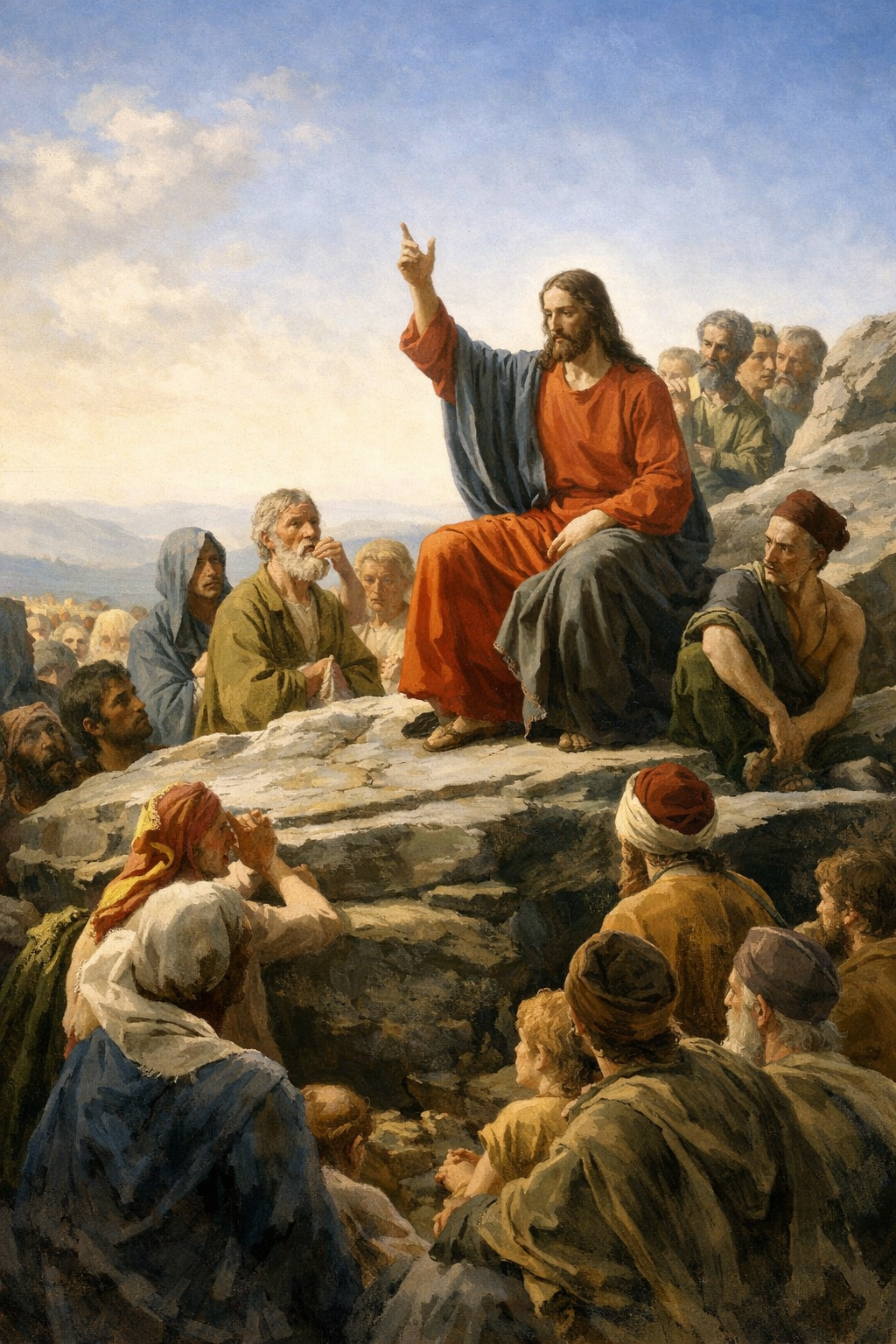
Sermon on the Mount
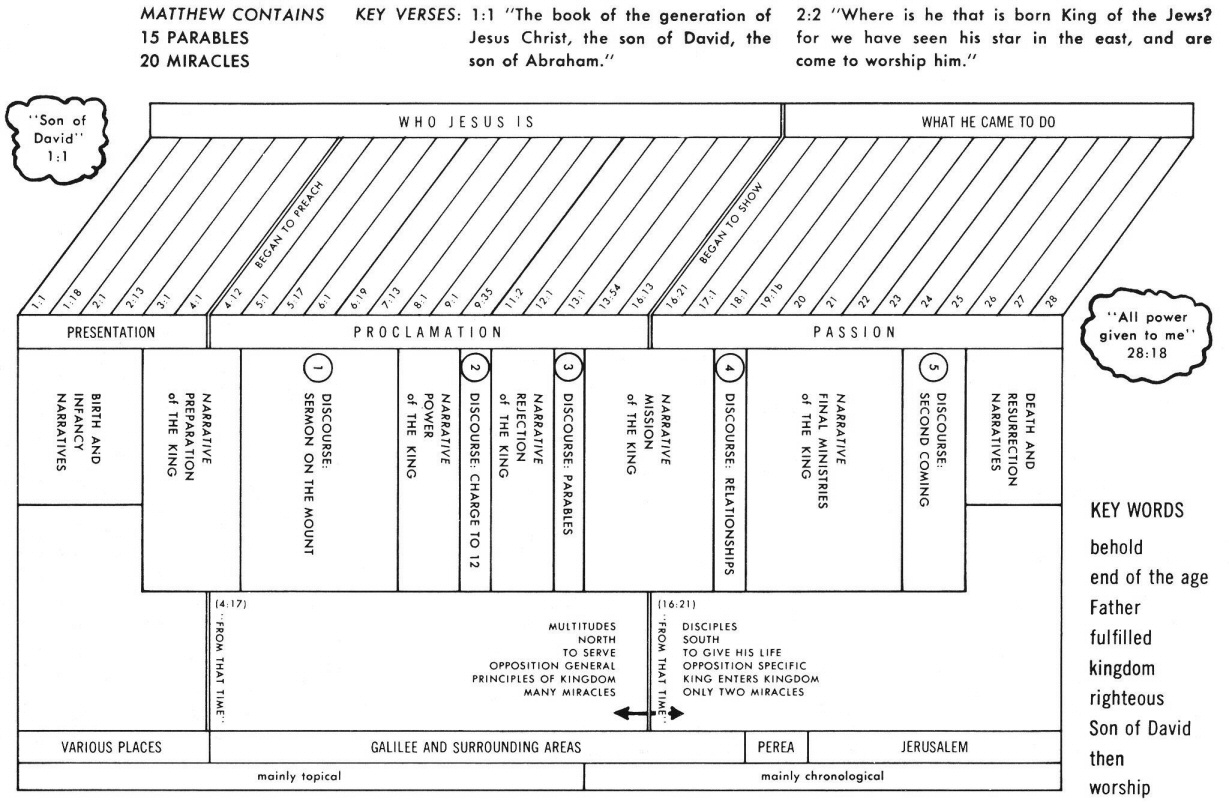
Click chart to enlarge
Charts from Jensen's Survey of the NT - used by permission
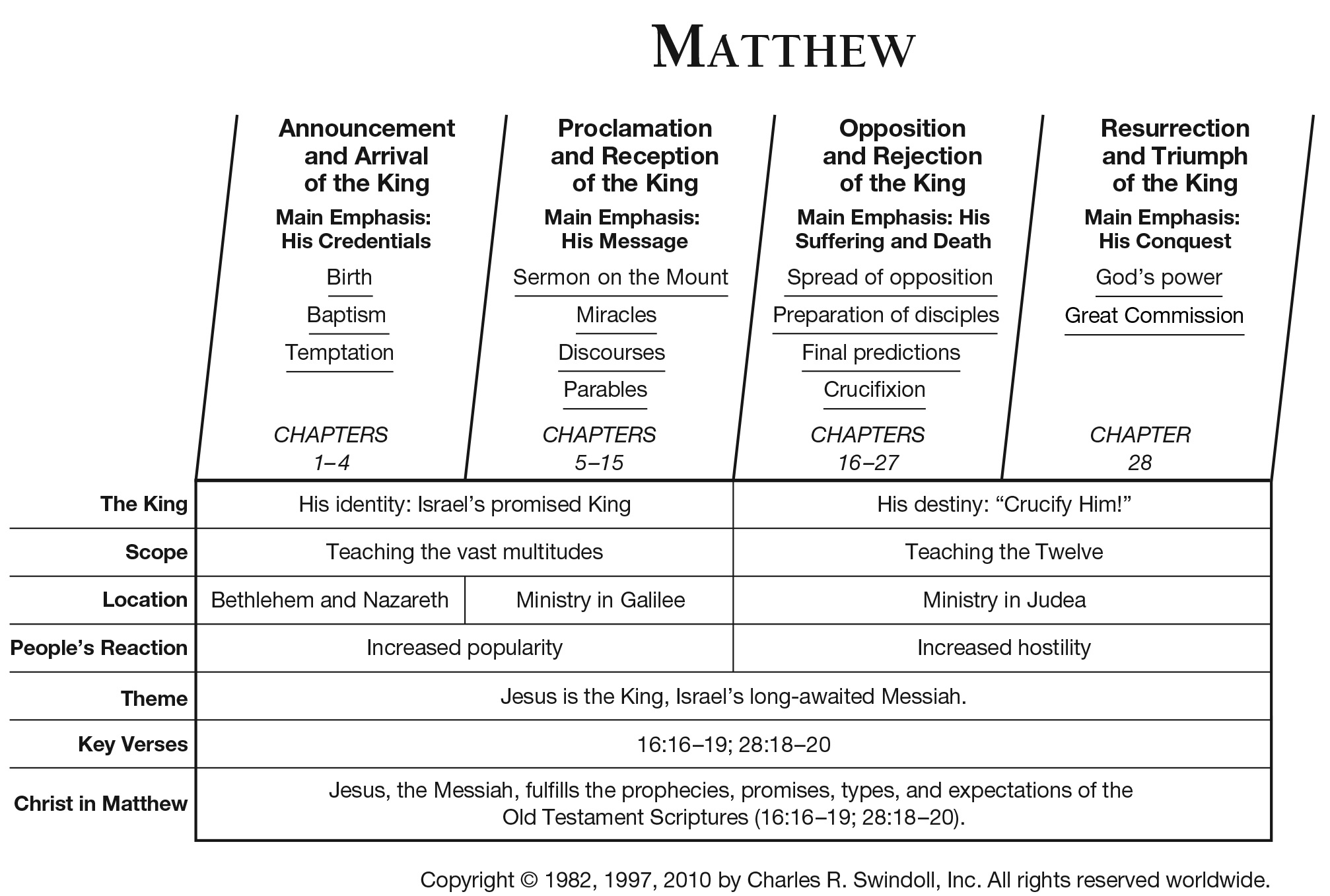
Another Chart from Swindoll
THE LIFE OF JESUS AS COVERED
BY MATTHEW (shaded area)
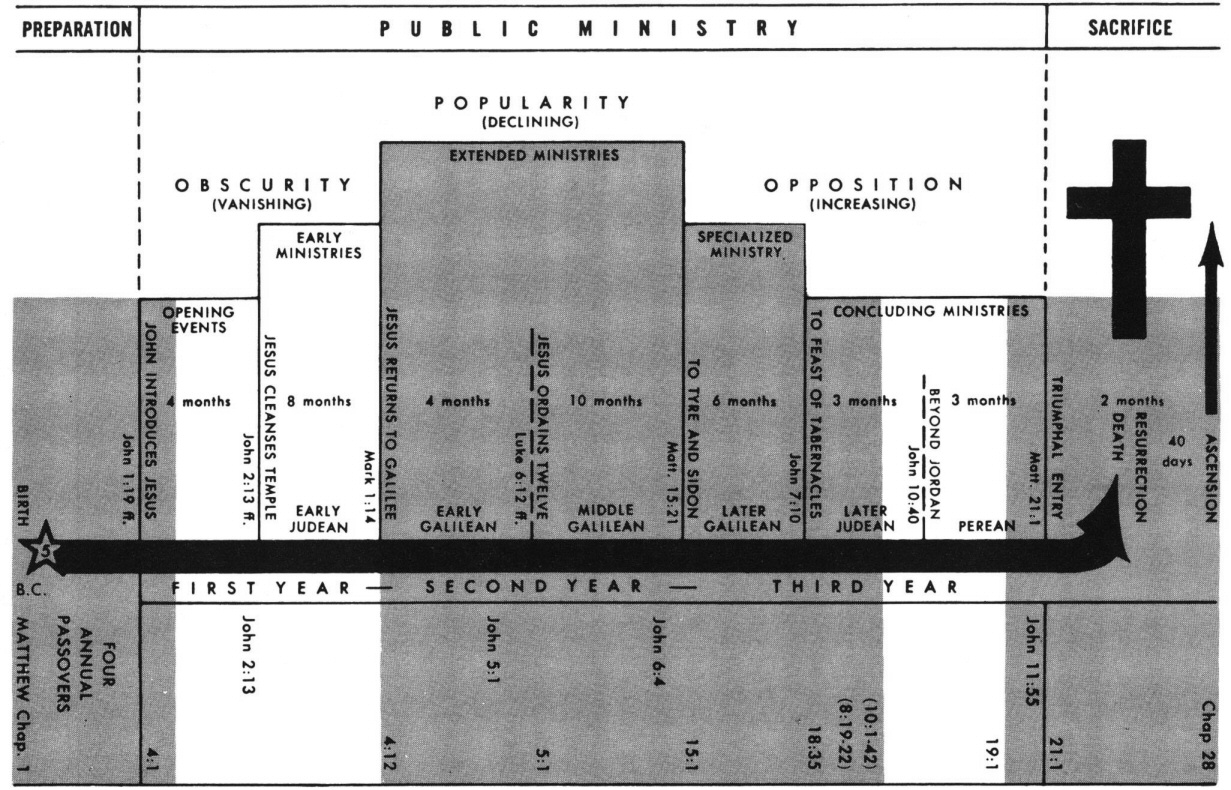
Click chart to enlarge
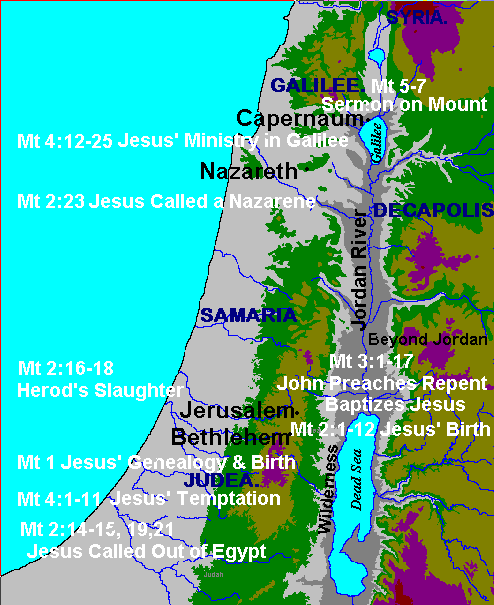
Jesus Birth and Early Years
Leading up to the Sermon on the Mount
Matthew 1-7

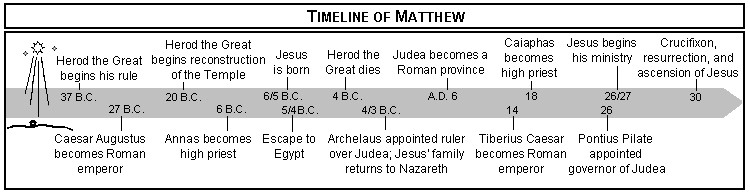
Source: Ryrie Study Bible
Matthew 7:22 "Many will say to Me on that day, 'Lord, Lord, did we not prophesy in Your name, and in Your name cast out demons, and in Your name perform many miracles?' (NASB: Lockman)
Greek: polloi erousin (3PFAI) moi en ekeine te hemera, Kurie kurie, ou to so onomati epropheteusamen, (1PAAI) kai to so onomati daimonia exebalomen, kai to so onomati dunameis pollas epoiesamen? (1PAAI)
Amplified: Many will say to Me on that day, Lord, Lord, have we not prophesied in Your name and driven out demons in Your name and done many mighty works in Your name? (Amplified Bible - Lockman)
KJV: Many will say to me in that day, Lord, Lord, have we not prophesied in thy name? and in thy name have cast out devils? and in thy name done many wonderful works?
NLT: On judgment day many will tell me, `Lord, Lord, we prophesied in your name and cast out demons in your name and performed many miracles in your name. (NLT - Tyndale House)
Phillips: In 'that day' many will say to me, 'Lord, Lord, didn't we preach in your name, didn't we cast out devils in your name, and do many great things in your name?' (New Testament in Modern English)
Wuest: Many shall say to me in that day, Lord, Lord, did we not in your Name prophesy, and in your Name cast out demons, and in your Name perform many miracles which demonstrated the power of God? (Eerdmans)
Young's: Many will say to me in that day, Lord, lord, have we not in thy name prophesied? and in thy name cast out demons? and in thy name done many mighty things?
Many will say to Me on that day, `Lord, Lord, did we not prophesy in Your name, and in Your name cast out demons, and in Your name perform many miracles: polloi erousin (3PFAI) moi en ekeine te hemera, Kurie kurie, ou to so onomati epropheteusamen, (1PAAI) kai to so onomati daimonia exebalomen (1PAAI), kai to so onomati dunameis pollas epoiesamen (1PAAI)?
- Say Mt 7:21; 24:36; Isaiah 2:11,17; Malachi 3:17,18; Luke 10:12; 1 Th 5:4; 2 Th 1:10; 2Ti 1:12,18; 4:8
- Did we Mt 10:5-8; Nu 24:4; 31:8; 1Ki 22:11-20; Je 23:13-32; Lk 13:26; Jn 11:51; Acts 19:13-15; 1Co 13:1,2; He 6:4-6
- Matthew 7 Resources - Multiple Sermons and Commentaries
- Matthew 7:21-23: Empty Words - John MacArthur
- Matthew 7:21-27: Saved or Self-Deceived, Part 2 - John MacArthur
- Matthew 7:21-27: Unmasking Christmas Hypocrites - John MacArthur
- Matthew 7:21-23: Empty Words and Empty Hearts 1 - John MacArthur
- Knowing Jesus vs. knowing about Jesus—what is the difference?
- Does Matthew 7:21-23 mean that believers can lose salvation? How can a person perform miracles in Jesus’ name if Jesus never knew them, i.e. they were not saved?
Related Resource:
- George Whitfield's classic sermon The Almost Christian
Many (polus) speaks of a large multitude. Here Jesus presents us with a stark contrast to the "few… who find" eternal life by entering the small gate and the narrow way (Mt 7:14).
Will say (3004) (lego) means to speak or talk, with an apparent focus upon content of what is said. Notice that Jesus does give them a chance to speak even though He already knows their heart.
That day - This is the specific future day known as the day of judgment specifically the judgment of unbelievers which Scripture teaches will occur at the Great White Throne (see Re 20:11, 12, 13, 14, 15 - see notes) after the Millennial reign of Christ. (See also related topic - Births, Deaths, and Resurrections.) That day will be a tragic and fateful day of separation forever from the presence of God (cp 2Th 1:9) for those who internal evil character is revealed by their outward evil conduct.
Constable has an interesting comment noting that…
Jesus claimed to be the eschatological Judge. This was one of Messiah’s functions. That day is the day Jesus will judge false professors. It is almost a technical term for the messianic age (cf. Isa. 2:11, 17; 4:2; 10:20; Jer. 49:22; Zech. 14:6, 20, 21). (Matthew)
As an aside among the many judgments mentioned in Scripture, seven are invested with special significance…
(1) the judgment of the believer's sins in the cross of Christ (Jn 12:31)
(2) the believer's self-judgment (1Co 11:31)
(3) the judgment of the believer's works (2Co 5:10)
(4) the judgment of the individual Gentiles at the return of Christ to the earth (Mt 25:32);
(5) the judgment of Israel at the return of Christ to the earth (Ezek 20:34, 35, 36, 37, 38, 40)
(6) the judgment of angels after the 1000 years (Jude 1:6)
(7) here, the judgment of the wicked dead with which the history of the present earth ends. (Rev 20:11, 12, 13, 14, 15) (C I Scofield)
Pastor Alan Carr gives some statistics on how "heavenly minded" America is in his sermon (Not Everyone Gets to Go to Heaven)
You might not think it, but our world is very heavenly minded. That is a strange statement considering just how wretched and wicked our world is, but in a recent CNN poll, it was discovered that 81% of the people asked believed in a literal heaven where people lived with God after death. 81%! 61% of those polled said that they believed they would go to Heaven immediately when they died. Another 88% believed that they would see departed family and friends when they arrived in Heaven.
I find these numbers astonishing in light of the wickedness that fills our society, don't you? Of course, there is another side to this story. Of all those polled, 6% believed Heaven could be reached by doing good works. Another 57% believed that Heaven was available to all who place their faith in God and did good works and 34% believed that Heaven was for those who had faith in God alone. Now, here is where a problem begins to be seen. A full 63% of those who responded believed they were going to Heaven, but they cited the wrong reason for getting there. The other 34%, who believed that Heaven came to those who placed their faith in God (Ed: Without specifically placing their faith in God's Substitutionary Atoning Sacrificial Lamb, Christ Jesus - Jn 1:29, Acts 4:12, 16:31, Ro 10:9,10 - belief in God is NOT sufficient for salvation. Neither is salvation like a "Life Insurance Policy" but is more accurately a "(New) Life Policy"! 2Co 5:17, 2Co 13:5), may be just as wrong as those who believe salvation comes as a result of works (Ed: Which Paul clearly refutes in Ep 2:8,9, Jas 2:10 Ro 3:20, Gal 2:16 2Ti 1:9, Titus 3:5).
Lord, Lord (2962) (kurios related to the adjective kuros - might, strong, supremacy, authoritative) describes one having absolute legal power and thus the one who is master or possessor. It is the one who has absolute ownership. The kurios has control over his possessions.
Jesus is referred to some ten times as Savior and some 700 times as Lord. Supreme in Authority. Kurios translates Jehovah (LORD in OT) in Septuagint (LXX) 7000 times. When the two titles are mentioned together, Lord always precedes Savior. Is He your kurios, your Lord, your Master, your Owner, your Possessor?
In summary, kurios signifies sovereign power and absolute authority. The primary idea is Jesus is the One in possession of all power and authority over those who are truly His possession. Paul in his description of genuine believers asks the saints at Corinth…
Or do you not know that your body is a temple of the Holy Spirit Who is in you, Whom you have from God, and that you are not your own? For you have been bought with a price: therefore glorify God in your body. (1Co 6:19,20)
Paul's point is that every genuine believer has been purchased (and redeemed) by the precious blood of the Lamb and now is rightfully the sole possession of the Lamb of God, Who is Lord, the Lord Jesus Christ. Those who were never born again called Him Lord but still lived like they belonged to themselves. In other words, they were the "lord" of their life, as shown by their conduct and lifestyle. Their actions of their life belied the affirmation of their lips.
I love Paul's description in Titus describing Jesus as the Possessor (cp Lord - "Absolute Possessor") of blood bought believers for He…
gave Himself for us, that He might redeem us from every lawless deed and purify for Himself a people for His own possession, zealous for good deeds. (Titus 2:14)
Comment: Possession translates the Greek noun periousios, which speaks of property owned as a rich and distinctive possession. The KJV translates it as peculiar people. Here the word is used figuratively to refer God's redeemed people as His costly possession and a distinctive treasure. It speaks of that which is choice, chosen, being beyond usual, special (one's own) peculiar, costly, select. The Septuagint (LXX) translation of Ex 19:5 uses periousios- you shall be My own possession, referring in that context to Israel (cp Dt 7:6; 14:2 Isa 43:21; Mal 3:17). Unfortunately, she forgot and forsook (for the most part - see for exception) her Husband (Is 54:5, Je 31:32, Ho 2:19).
Spurgeon makes some piercing comments regarding that day writing that…
He used no other word to describe that memorable period because that terse, brief expression suggests so much,-”in that day,”-that terrible day,- that last great day,-that day for which all other days were made, -that day by which all other days must be measured and judged. I pray, dear friends, that we may, each one of us, begin to set in the light of “that day” the things that we most prize. The riches upon which you have set your heart, how will their value be reckoned “in that day,” and how much of comfort will they afford you then? As for the way in which you have been spending your wealth, will that be such as you will remember “in that day” with satisfaction and comfort? Value your broad acres and your noble mansions, or your more moderate possessions, according to this gauge’ of their real worth,-how will they be valued “in that day”? And as to the pursuits which you so eagerly follow, and which now appear so important to you that they engross the whole of your thoughts, and arouse all your faculties and energies, are they worthy of all this effort? Will they seem to be so “in that day”?
What is the chief object of your life? Will you think as much of it “in that day” as you do now? Will you then count yourself wise to have so earnestly pursued it? You fancy that you can defend it now, but will you be able to defend it then, when all things of earth and time will have melted into nothingness? You value the esteem in which you are held among men, and you do rightly, for “a good name is better than precious ointment;” but are you really worthy of the good name that has been given to you? Is that favorable judgment of your fellow-creatures the verdict of infallible truth? Will you be as highly honored “in that day” as you are now? Will as much credit be given to you for honesty and virtue then as is given to you now? Is there no tinsel, no veneer, no deception, no counterfeit coin about you? O my brethren, who among us can submit his position amid his fellowmen to such a test as this without the most solemn questioning and searching of heart!
You young men are, perhaps, rejoicing in your youth, and letting your heart take full liberty in the enjoyment of earthly pleasure. God forbid that I should deprive you of any real pleasure; but let me ask, concerning those enjoyments, how will they appear “in that day”? Will they bear serious reflection even now? Then, how are they likely to endure the more sober judgment that will be exercised then? “In that day,” when the glare of this world’s lamps shall have died out, and the glitter of its pomp shall for over have passed into the eternal darkness, how will your pleasures look then? Especially, if you have sold yourself for those pleasures,-if you have bartered your peace of mind for them,-if you have disobeyed your God in order that you might enjoy them, how will they then appear when, at the end of the feast, the cost of it has to be met, and you have to give in your last account?
It is truly wise for a man to be familiar with his last hours; it is well for him often to rehearse that grand act when he must gather up his feet in the bed, and die, his father’s God to meet; and it is wiser still for him to overleap the chasm which divides us from the realities of eternity, and, by the force of faith rather than by imagination, picture himself standing in that mighty throng of the risen dead, from every part of land and sea,-the innumerable population of this great globe,-every eye turned in one direction, all looking to Him Who shall sit upon the great white throne, that Christ Who was once crucified in weakness, but who shall come in power and great glory, appointed Judge of all mankind. I know that I am inviting you to think of something that you do not wish to have brought to your mind. The world plucks you by the sleeve, and says, “Come away;” but I would fain detain you, for a little while, as the ancient mariner held the wedding guest, yet not to tell you a quaint story of far-off seas and strange adventures there, but solemnly to talk to you about your immortal soul, and to stir you up to see to its future destiny, lest Christ should come, and you should be as unprepared for His coming as the men in the days of Noah were for the flood which swept them all away.
Well, then, as everything is to be regarded as it will appear “in that day,” we will try to judge our profession of religion by that test, for it will mainly be to those who think themselves Christ’s people that I shall speak, and I pray that a strong North wind may blow through us; and if there be any chaff in this great heap, may it be speedily discovered, and be driven out from amidst the wheat! (Matthew 7:21-23 The Disowned)
It should be understand that if one reads the Scriptures in their normal, literal sense, there are several judgments encompassed by "that day".
In Mt 25:31-46 we read of the judgment of the "sheep and goats" which will occur after the Great Tribulation, at the time Jesus returns to establish His Millennial Kingdom (See study of Millennium 1; Millennium 2; Millennium 3). At the beginning of His reign on "that day" He will separate unbelieving Gentiles ("goats") from believing Gentiles ("sheep") to determine who will be allowed into His Messianic Kingdom on earth. These Gentile believers will have survived the Great Tribulation and thus will populate earth in their natural bodies (in contrast to believers who will had died and already been given their glorified bodies and who will actually reign with Christ in His kingdom).
At the end of this 1000 years, there will be another "that day" generally referred to as the Great White Throne judgment (Revelation 20:11-14-notes), at which all other non-believers of all ages will be judged and condemned to the Lake of Fire. Apparently at that time unbelievers, still being deceived, will attempt to remind the Lord Jesus (the Judge, cf 2Ti 4:1) of their incredible spiritual feats while on earth.
Did we not - This phrase in the Greek expects "an affirmative answer and thus pictures both the self-conceit and the self-deception of the persons Jesus describes. “Surely we have prophesied, etc." (Vincent)
Prophesy (4395) (propheteuo from pró = before or forth + phemí = tell) means literally to tell forth and can mean to speak forth God's message, not necessarily referring to speaking of future events. In other contexts to prophesy means to speak under inspiration and foretell future events. In this context the meaning could be either sense, although if the latter, it would imply that they were prophesying falsely in His name, because the canon of revelation is complete. The only legitimate prophesying in this age is to speak forth God's Word.
Gilbrant - In classical Greek prophēteuō is a compound word from two terms meaning “say, proclaim” and “before, in advance.” Its most prominent use is in connection with the oracles at places like Delphi. Typically, a person would ask a question of the gods and receive a cryptic answer from the female mouthpiece of the deities. This answer would then be completed and interpreted by the men who specialized in that task. Prophēteuō in this context meant “explain a message from the gods in response to a client’s question.” The Septuagint employs prophēteuō to translate nāvā’, “show, present, express oneself, speak as a prophet.” The emphasis rests on the proclamation in words, rather than on seeing visions. It is used to describe the activity of a variety of types of prophet, from the early groups (1 Samuel 10:5f. [LXX 1 Kings 10:5f.]) to the writing prophets of the monarchy period. (Complete Biblical Library Greek-English Dictionary)
Friberg - (1) generally, of speaking with the help of divine inspiration proclaim what God wants to make known, preach, expound (Acts 2.17; 1 Co 11.4); (2) as speaking out divinely imparted knowledge of future events foretell, prophesy (Mk 7.6; Jn 11.51; Rev 10.11); (3) as bringing to light what was concealed and outside the possibility of naturally acquired knowledge prophetically reveal, prophesy (Mt 26.68)
Zodhiates on propheteuo -
(I) To foretell things to come (Matt. 11:13; 15:7; Mark 7:6; 1 Pet. 1:10; Jude 1:14); to declare truths through the inspiration of God's Holy Spirit whether by prediction or otherwise (Luke 1:67; Acts 2:17, 18; 19:6; 21:9; 1 Cor. 14:1, 3-5; Rev. 10:11; 11:3; Sept.: 1 Kings 22:12, 18; Ezra 5:1; Jer. 11:21; Joel 2:28). The foretelling or foreannouncing may be, and often is, the responsibility of the prophet, but is not the essence of that office.
(II) To tell forth God's message, hence the noun prophétēs <G4396>, prophet, is the proclaimer, one who speaks out the counsel of God with the clearness, energy, and authority which spring from the consciousness of speaking in God's name and having received a direct message from Him to deliver. Thus one may prophesy without being a prophet in the strict sense of the word. A prophétēs, both in the OT and NT, is not primarily one who foretells things to come, but who (having been taught of God) speaks out His will (Deut. 18:18; Isa. chap. 1; Jer. chap. 1; Ezek. chap. 2; 1 Cor. 14:3). The art of heathen divination, however, uses the word manteúomai <G3132>, to soothsay, divine.
(III) Used once of the high priest, with whose office the gift of prophecy was connected (John 11:51).
(IV) As including the idea of praise to God accompanied by prediction (Luke 1:67; Sept.: 1 Sam. 10:5, 6, 11; 19:20, 21).
(V) Of false prophets (Matt. 7:22; Sept.: Jer. 14:14, 15).
(VI) Of mockery by the soldiers guarding Jesus, meaning to divine, guess, give a response, with the dat. (Matt. 26:68; Mark 14:65; Luke 22:64).
(VII) Specifically of the prophetic gift or chárisma <G5486>, charisma, imparted by the Holy Spirit to the early Christians (Acts 19:6; 21:9; 1 Cor. 11:4, 5; 13:9; 14:1, 3-5, 24, 31, 39). (Complete Word Study Dictionary – New Testament)
Propheteuo - 28x in 27v - prophesied(5), prophesies(3), prophesy(16), prophesying(3), prophetesses(1).
Matthew 7:22 "Many will say to Me on that day, 'Lord, Lord, did we not prophesy in Your name, and in Your name cast out demons, and in Your name perform many miracles?'
Matthew 11:13 "For all the prophets and the Law prophesied until John.
Matthew 15:7 "You hypocrites, rightly did Isaiah prophesy of you:
Matthew 26:68 and said, "Prophesy to us, You Christ; who is the one who hit You?"
Mark 7:6 And He said to them, "Rightly did Isaiah prophesy of you hypocrites, as it is written: 'THIS PEOPLE HONORS ME WITH THEIR LIPS, BUT THEIR HEART IS FAR AWAY FROM ME.
Mark 14:65 Some began to spit at Him, and to blindfold Him, and to beat Him with their fists, and to say to Him, "Prophesy!" And the officers received Him with slaps in the face.
Luke 1:67 And his father Zacharias was filled with the Holy Spirit, and prophesied, saying:
Luke 22:64 and they blindfolded Him and were asking Him, saying, "Prophesy, who is the one who hit You?"
John 11:51 Now he did not say this on his own initiative, but being high priest that year, he prophesied that Jesus was going to die for the nation,
Acts 2:17 'AND IT SHALL BE IN THE LAST DAYS,' God says, 'THAT I WILL POUR FORTH OF MY SPIRIT ON ALL MANKIND; AND YOUR SONS AND YOUR DAUGHTERS SHALL PROPHESY, AND YOUR YOUNG MEN SHALL SEE VISIONS, AND YOUR OLD MEN SHALL DREAM DREAMS;
Acts 2:18 EVEN ON MY BONDSLAVES, BOTH MEN AND WOMEN, I WILL IN THOSE DAYS POUR FORTH OF MY SPIRIT And they shall prophesy.
Acts 19:6 And when Paul had laid his hands upon them, the Holy Spirit came on them, and they began speaking with tongues and prophesying.
Acts 21:9 Now this man had four virgin daughters who were prophetesses.
1 Corinthians 11:4 Every man who has something on his head while praying or prophesying disgraces his head.
1 Corinthians 11:5 But every woman who has her head uncovered while praying or prophesying disgraces her head, for she is one and the same as the woman whose head is shaved.
1 Corinthians 13:9 For we know in part and we prophesy in part;
1 Corinthians 14:1 Pursue love, yet desire earnestly spiritual gifts, but especially that you may prophesy.
1 Corinthians 14:3 But one who prophesies speaks to men for edification and exhortation and consolation.
1 Corinthians 14:4 One who speaks in a tongue edifies himself; but one who prophesies edifies the church.
1 Corinthians 14:5 Now I wish that you all spoke in tongues, but even more that you would prophesy; and greater is one who prophesies than one who speaks in tongues, unless he interprets, so that the church may receive edifying.
1 Corinthians 14:24 But if all prophesy, and an unbeliever or an ungifted man enters, he is convicted by all, he is called to account by all;
1 Corinthians 14:31 For you can all prophesy one by one, so that all may learn and all may be exhorted;
1 Corinthians 14:39 Therefore, my brethren, desire earnestly to prophesy, and do not forbid to speak in tongues.
1 Peter 1:10 As to this salvation, the prophets who prophesied of the grace that would come to you made careful searches and inquiries,
Jude 1:14 It was also about these men that Enoch, in the seventh generation from Adam, prophesied, saying, "Behold, the Lord came with many thousands of His holy ones,
Revelation 10:11 And they said to me, "You must prophesy again concerning many peoples and nations and tongues and kings."
Revelation 11:3 "And I will grant authority to my two witnesses, and they will prophesy for twelve hundred and sixty days, clothed in sackcloth."
Propheteuo - 125x in 101v -
Nu 11:25-27; 1 Sa 10:5-6,10,13; 19:20-21,23-24; 1 Ki. 18:29; 22:10,12,18; 2 Chr. 18:7,9,11,17; 20:37; Ezr. 5:1; Jer. 2:8; 5:31; 11:21; 14:13-16; 19:14; 20:1,6; 23:13,21,25-26,32; 25:13,30; 26:9,11-12,20; 27:10,12,15-16; 28:6,8-9; 29:9,26-27,31; 32:3; 37:19; 49:34; Ezek. 4:7; 6:2; 11:4,13; 12:27; 13:2-3,16-17; 20:46; 21:2,9,14,28; 25:2; 28:21; 29:2; 30:2; 34:2; 35:2; 36:1,3,6; 37:4,7,9-10,12; 38:2,14; 39:1; Joel 2:28; Amos 2:12; 3:8; 7:12-13,15-16; Zech. 13:3-4; Rev. 10:11; 11:3
Henry Morris in fact feels that…
There are actually prophets and miracle workers who--perhaps sincerely, perhaps not--profess to be Christians but instead are unsaved, deluded and even enabled to do "wonderful works" by Satan in order to lead people to follow a false Christ. (Defenders Study Bible. World Publishing)
The Disciple's Study Bible rightly remarks that…
Miraculous powers do not give proof of authentic faith. Many in the first century claimed miraculous powers. Like the magicians at Pharaoh's court (Ex 7:11), they sometimes succeeded. The claim here is centered around "in your name.'' False disciples gain public acclaim for themselves. The source of their success is not easily explained. Their lack of faith is clearly evident. They do not act in accordance with God's will. Love for self, not for others, dominates their lives. Jesus claims as His own only humble, obedient servants. See Acts 19:13, 14, 15, 16. (Disciple's Study Bible)
In Your name - This phrase is repeated three times. All that these individuals did, they did ostensibly in the Name of Jesus, acting as if they were His legitimate representatives! They spoke the correct "religious dialect". They carried out the correct religious activities and ostensibly did so for the "right reasons". And yet they were veritable evangelical impostors and church charlatans, for their hearts had never been changed by grace through faith.
Someone's "name" in Scripture stood for their character, the very essence of who they were (see Eerdman's note below). These fakers claimed to be Jesus' representatives who had His authority and thus the association of Jesus' name would have lent some degree of credibility to the prophecy, the casting out of demons or the miracles. As an aside, Jesus did not correct their assertion that they had performed these deeds. Irregardless whether they actually did perform these deeds did not determine their fate. It was their heart of evil which continually practiced evil deeds which identified them as unregenerate and determined their eternal destiny in the lake of fire.
Eerdman's Dictionary comments on the concept of name in Scripture…
When Shakespeare asserted that “a rose by any other name would smell as sweet” (Romeo and Juliet II.ii.43) he was emphatically not expressing an idea that had any warrant in the biblical world — or anywhere else in the ancient Near East. In the ancient world generally, a name was not merely a convenient collocation of sounds by which a person, place, or thing could be identified; rather, a name expressed something of the very essence of that which was being named. Hence, to know the name was to know something of the fundamental traits, nature, or destiny of that to which the name belonged. (Freedman, D. N., Myers, A. C., & Beck, A. B.. Eerdmans Dictionary of the Bible (944). Grand Rapids, Mich.: W. B. Eerdmans)
See related topic - Name of the LORD is a Strong Tower: Summary
Spurgeon writes that…
they used the name, which is dear to the disciples of Christ, but they did not possess the nature of disciples. They used Christ’s name, for they said to Him, “Have we not prophesied in Thy name? and in Thy name have cast out devils? and in Thy name done many wonderful works?” They knew Christ’s name, but they had not His nature. They quoted His name, but they never copied His example. They had never come to Him, and trusted and loved Him. They knew His name, but they did not know Him; and He knew their names, but He did not know them. There was no communion -- no intimate intercourse between them. (The Disowned)
When they say “We prophesied in Your Name,” etc, notice that Jesus does not deny their claims of seemingly sensational supernatural activities! This suggests that miracles may be wrought through professing believers which should serve to remind us all that in the final analysis, miracles do not provide a valid assessment of one's heart condition!
Moses had long before warned about those who prophesy falsely…
If a prophet or a dreamer of dreams arises among you and gives you a sign or a wonder, 2 and the sign or the wonder comes true, concerning which he spoke to you, saying, 'Let us go after other gods (whom you have not known) and let us serve them,' 3 you shall not listen to the words of that prophet or that dreamer of dreams; for the LORD your God is testing you to find out if you love the LORD your God with all your heart and with all your soul. 4 "You shall follow the LORD your God and fear Him; and you shall keep His commandments, listen to His voice, serve Him, and cling to Him. 5 "But that prophet or that dreamer of dreams shall be put to death, because he has counseled rebellion against the LORD your God who brought you from the land of Egypt and redeemed you from the house of slavery, to seduce you from the way in which the LORD your God commanded you to walk. So you shall purge the evil from among you. (Dt 13:1-5)
Jesus warned that in the time of the Great Tribulation…
false Christs and false prophets will arise and will show great signs and wonders, so as to mislead, if possible, even the elect. (Mt 24:24)
Spurgeon makes an interesting observation that Jesus states the false professors…
prophesied, but they did not pray. Prayer is a vital evidence of Christianity, but prophecy is not. A thousand sermons would not prove a man to be a Christian, but one genuine prayer would. It is easy enough to speak to men, but quite another thing, from our inmost soul, to speak into the ear of God. They failed in that point; and, therefore, their failure was fatal. (The Disowned)
Cast out demons - This action was practiced during the ministry of Jesus (cp Mt 4:24; 8:16, 31; 9:33, 34; 12:24, 25, 26, 27, 28, 29; 17:18) and of the twelve disciples (see below) as well as in the early Church (e.g., Acts 5:16; 16:18; 19:12).
Jesus gave authority to His disciples including the unregenerate Judas Iscariot to cast out demons…
And having summoned His twelve disciples, He gave them authority over unclean spirits, to cast them out, and to heal every kind of disease and every kind of sickness. 2 Now the names of the twelve apostles are these: The first, Simon, who is called Peter, and Andrew his brother; and James the son of Zebedee, and John his brother; 3 Philip and Bartholomew; Thomas and Matthew the tax-gatherer; James the son of Alphaeus, and Thaddaeus; 4 Simon the Zealot, and Judas Iscariot, the one who betrayed Him. 5 These twelve Jesus sent out after instructing them, saying…
8 Heal the sick, raise the dead, cleanse the lepers, cast out demons; freely you received, freely give. (Mt 10:1-5, 8)
Dr Luke records both successful and unsuccessful exorcisms encounters related to the Name of Jesus…
And it happened that as we (Paul and Silas in Philippi) were going to the place of prayer, a certain slave-girl having a spirit of divination met us, who was bringing her masters much profit by fortunetelling. Following after Paul and us, she kept crying out, saying, "These men are bond-servants of the Most High God, who are proclaiming to you the way of salvation." (Ed: Notice that her theology was quite orthodox! Interesting!) And she continued doing this for many days. But Paul was greatly annoyed, and turned and said to the spirit, "I command you in the name of Jesus Christ to come out of her!" And it came out at that very moment. (Acts 16:16-18)
(Paul in Ephesus) Some of the Jewish exorcists, who went from place to place, attempted to name over those who had the evil spirits the name of the Lord Jesus, saying, "I adjure you by Jesus whom Paul preaches." 14 And seven sons of one Sceva, a Jewish chief priest, were doing this. 15 And the evil spirit answered and said to them, "I recognize Jesus, and I know about Paul, but who are you?" 16 And the man, in whom was the evil spirit, leaped on them and subdued all of them and overpowered them, so that they fled out of that house naked and wounded. 17 And this became known to all, both Jews and Greeks, who lived in Ephesus; and fear fell upon them all and the name of the Lord Jesus was being magnified. (Acts 19:13-17)
Scofield has the following summary on demons:
(1) Demons are spirits (Mt 12:43,45), Satan's emissaries (Mt 12:26,27), and so numerous as to make Satan's power practically ubiquitous (Mk 5:9).
(2) They are capable of entering and controlling both men and beasts (Mk 5:2, 5,11 - 13), and earnestly seek embodiment, without which, apparently, they are powerless for evil (Mt 12:43, 44; Mark 5:10, 11, 12).
(3) Demon influence and demon possession are discriminated in the NT Instances of the latter are Mt 4:24; 8:16,28,33; 9:32; 12:22; Mk 1:32; 5:15, 16,18; Luke 8:36; Acts 8:7; 16:16.
(4) Demons are unclean, sullen, violent and malicious (Mt 8:28; 9:33; 10:1; 12:43; Mk 1:23; 5:3 - 5; 9:17,20; Lk 6:18; 9:39).
(5) They know Jesus Christ as Most High God and recognize His supreme authority (Mt 8:31, 32; Mk 1:23,24; Acts 19:15; Jas 2:19).
(6) They know their eternal fate to be one of torment (Mt 8:29; Lk 8:31).
(7) They inflict physical maladies (Mt 12:22; 17:15, 16, 17, 18; Lk 13:16). However, mental disease is to be distinguished from the disorder of mind due to demonic control.
(8) Demon influence may manifest itself in religious asceticism (1Ti 4:1, 2, 3), degenerating into uncleanness.
(9) The sign of demon influence in religion is departure from the faith, i.e. the body of revealed truth in the Scriptures (1Ti 4:1).
(10) The demons maintain a conflict with Christians who would be spiritual (Ep 6:12; 1Ti 4:1, 2, 3). The Christian's resources are prayer and bodily control (Mt 17:21), "the full armor of God" (Eph 6:13, 14, 15, 16, 17, 18).
(11) All unbelievers are open to demon possession (Ep 2:2).
(12) Exorcism in the name of Jesus Christ (Acts 16:18) was practiced for demon possession. A
(13) One of the awful features of the apocalyptic judgments in which this age will end is an emergence of demons out of the abyss (Re 9:1-11,20).
Performed many miracles - Note their miraculous works were not few but many and again Jesus does not dispute their claim to fame! How many people in our day are ready to fall for miracles and follow miracle workers.
Miracles (1411) (dunamis from dunamai = to be able, to have power) power especially achieving power. It refers to intrinsic power or inherent ability, the power or ability to carry out some function, the potential for functioning in some way (power, might, strength, ability, capability), the power residing in a thing by virtue of its nature. Dunamis can be used of any kind of extraordinary power, in this case of miraculous powers.
D A Carson adds that…
The false claimants have prophesied in Jesus' Name and by that Name exorcised demons and performed miracles. There is no reason to judge their claims false; their claims are not false but insufficient. Significantly the miracles Jesus specifies were all done by His disciples during His ministry (cf. Mt 10:1, 2, 3, 4) (Ed note: Remember this included Judas Iscariot who would betray Him and clearly was a non-believer!) (Gaebelein, F, Editor: Expositor's Bible Commentary) (Bolding added)
Note that it is not spectacular public works of ministry but the "poor in spirit" private acts of righteousness that reveal the authenticity (or lack of) a person's relationship with Jesus (Mt 6:1-notes). As Spurgeon explains…
they attended to marvels, but not to essentials. They neglected the important things, which should have been done in secret; they did much that could be seen in public, but they failed in the plainer, simpler things that nobody saw. Let me just say to you, brothers and sisters, that herein lies a great part of our danger
<> the risk of getting a religious character without having a renewed heart,
<> doing religious actions without really being born again,
<> learning the brogue of the New Jerusalem without having been born as a citizen of the heavenly city,
<> becoming fluent talkers, and earnest workers, but not having confessed sin, or repented of it, or laid hold on Jesus Christ by living faith.
I do beseech you, young professors, to covet most of all secret holiness (see Holiness Quotes),
<> the holiness that does not wish to be seen,
<> plain, honest dealing with God in private,
<> much secret prayer and meditation upon the Word,
<> in brief, a life of true consecration to God.
You may prophesy if God calls you to do so. Perhaps you will cast out devils, I hope you may; and in Christ’s name you may do many wonderful works; but, first of all, “ye must be born again.” You must become as little children to sit at the feet of Jesus, and to learn of him. You must be obedient to His commands, and yield yourselves up to Him, or else you will be fatally mistaken, whatever profession you may make. (The Disowned)
William MacDonald adds that…
From these verses we learn that not all miracles are of divine origin and that not all miracle workers are divinely accredited. A miracle simply means that a supernatural power is at work. That power may be divine or satanic. Satan may empower his workers to cast out demons temporarily, in order to create the illusion that the miracle is divine. He is not dividing his kingdom against itself in such a case, but is plotting an even worse invasion of demons in the future. (Believer's Bible Commentary: Old and New Testaments)
The fact that Jesus never knew the false professors is not taught only in this passage but is seen in a number of Scriptures which illustrates how close to spiritual reality one may come and yet fail to be genuinely saved. One of the most bizarre OT examples is the prophet Balaam and in the NT we see the tragic saga of Judas Iscariot (see also below re Judas Iscariot).
John describes professors whose "true colors" became known during their lifetime writing that…
They went out from us, but they were not really of us; for if they had been of us, they would have remained with us; but they went out, in order that it might be shown that they all are not of us. (1 John 2:19) (Comment: They once professed to believe in Christ but later renounced the faith and began to manifest the spirit of antichrist. Their failure to continue in the faith proved they never had true saving faith in Christ. Genuine believers, although they may stumble and backslide, inevitably will continue in the faith until the end of their life -- they will persevere if they are true saints.)
The writer of Hebrews affirms this doctrine of perseverance of the saints (see note or here)…
For we have become partakers of Christ, if we hold fast the beginning of our assurance firm until the end (See note Hebrews 3:14)
Are there any Biblical examples of those who cast out demons, etc, but who were unquestionably unbelievers? In Matthew 10 we read that after naming the 12 disciples, they were sent out…
And having summoned His twelve disciples, He gave them authority over unclean spirits, to cast them out, and to heal every kind of disease and every kind of sickness. Now the names of the twelve apostles are these: The first, Simon, who is called Peter, and Andrew his brother; and James the son of Zebedee, and John his brother; Philip and Bartholomew; Thomas and Matthew the tax-gatherer; James the son of Alphaeus, and Thaddaeus; Simon the Zealot, and Judas Iscariot, the one who betrayed Him. These twelve Jesus sent out after instructing them, saying, "Do not go in the way of the Gentiles, and do not enter any city of the Samaritans; but rather go to the lost sheep of the house of Israel. And as you go, preach, saying, 'The kingdom of heaven is at hand. Heal the sick, raise the dead, cleanse the lepers, cast out demons; freely you received, freely give. (Mt 10:5-8)
It follows that Judas Iscariot, clearly an unbeliever, may have prophesied, cast out demons, and performed miracles, including healing the sick, raising dead and cleansing of lepers, but ultimately proved to be a "bad tree" because he did not do the will of the Father but instead continually practiced lawlessness. Mere professed devotion to Christ as "Lord, Lord" is but another Judas kiss!
Spurgeon makes the distinction that these professors…
were not silenced by men. They prophesied in Christ’s name, yet nobody said to them, “You shall not prophesy again, for you are living such inconsistent lives that we will not listen to you.” This does not appear to have happened with any one of these people. The man who went about casting out devils was not stopped, but he kept on doing so, and he declared even to Christ that he had done it, and done it continually.
***
Their tongues belied their hands. They said, “Lord, Lord,” but they did not do the will of the Lord. They were very glib of tongue when they took to prophesying, but the message never came out of their hearts. They never did the things they told others to do; they were earnest to exhort, but not diligent to set a good example to their hearers. They cast out devils; but, at the same time, they did not themselves escape from the power of the devil by giving up sin, and following after righteousness. They failed in the matter of practical holiness. They had not the grace of God in their souls, displaying itself in their ordinary, everyday actions. They could talk; they could sing; they could prophesy; but they were not obedient to the divine commands, and they did not walk in the ways of God. (The Disowned)
Spurgeon adds that these professors…
clung to their false hopes right to the end. They did not really know of the deception themselves. “What!” you ay, “did they never think that they were deceived?” Perhaps they did, now and then; but they always said to themselves. “We must not get into a doubting frame of mind. This looking within, and searching our hearts, will not do it will disturb and distress us.” So they went on daubing themselves with untempered mortar. They were as wrong as wrong could be, yet everybody treated them as though they were right, so they thought at last that they were right. For a man may, in time, make himself believe what he knows to be a lie. I have heard persons tell stories about themselves which had not any foundation in fact; but they have told them so often that I am sure they believe at last that they are really speaking the truth; though, if they would only think seriously, they would perceive that their tale is all invention. A man may go in and out among Christians, join in their prayers, and praises, and communions, and preach their gospel or hear it, till, at last, without any reason for his belief, be may persuade himself that it is all right. He may even pass through the portals of death undeceived. The righteous are often troubled when they come to die; but it is with these self-deceived people as the psalmist says, “There are no bands in their death: but their strength is firm. They are not in trouble as other men; neither are they plagued like other men.” Take heed, I beseech you, of self-deception. I say it first to myself, and next to you, lest, not until “that day” should we hear the Lord Jesus say to us, “I never knew you,” and lest, even “in that day,” we should say to him, “Lord, Lord,” and begin to argue that we were all right’, and Christ should put an end to it all by saying, “Depart from me, ye that work iniquity.” (The Disowned)
J C Ryle warns that…
The time is fast coming when nothing but authenticity will stand the fire. Authentic repentance towards God--authentic faith towards our Lord Jesus Christ--authentic holiness of heart and life--these, these are the things which will alone stand the judgment at the last day. (Practical Religion)
John MacArthur notes that the unbeliever's claims of prophesying, casting out demons and miracles can be explained in one of three ways…
(1) It may be that they were allowed to do those amazing works by God’s power. God put words in Balaam’s mouth, even though that prophet was false and wicked (Nu 23:5). King Saul, after he became apostate had the “Spirit of God [come] upon him mightily, so that he prophesied” (1Sa 10:10). The wicked high priest Caiaphas unwittingly and unintentionally “prophesied that Jesus was going to die for the nation” (John 11:51).
(2) A second possibility is that those amazing acts were accomplished by Satan’s power. Jesus predicted that “false Christs and false prophets will arise and will show great signs and wonders, so as to mislead, if possible, even the elect” (Matt. 24:24). The unbelieving sons of Sceva, for example, were Jewish exorcists, who made their living casting out demons (Acts 19:13-14). Mark 9:38-40 tells of someone outside the apostles casting out demons. Paul promises false signs in the last days, lying wonders of Satan (2 Thes 2:8-10). Acts 8:11 describes the work of a satanic sorcerer. Today there are miracle workers, healers, and exorcists who claim to work for Jesus Christ but are satanic deceivers.
(3) A third possibility is that some of the claims were simply false. The prophecies, exorcisms, and miracles were fake and contrived. No doubt all three will be represented. (MacArthur, J: Matthew 1-7 Macarthur New Testament Commentary Chicago: Moody Press)
Hebert Lockyer (in his fascinating work entitled Last Words of Saints and Sinners) gives us an example of a man who in essence said "Lord, Lord" but his life clearly "spoke" otherwise…
Casanova, renowned for his self-indulgence, ended his life in self-deception. On his death bed at the age of 73, he said "I have lived as a philosopher and die as a Christian." (Wrong!)
Matthew 7:23 "And then I will declare to them, 'I never knew you; DEPART FROM ME, YOU WHO PRACTICE LAWLESSNESS.' (NASB: Lockman)
Greek: kai tote homologeso (1SFAI) autois oti Oudepote ethnon (1SAAI) humas; apochoreite (2PPAM) ap' hemou oi ergazomenoi (PMPMPV) ten anomian
Amplified: And then I will say to them openly (publicly), I never knew you; depart from Me, you who act wickedly [disregarding My commands]. (Amplified Bible - Lockman)
KJV: And then will I profess unto them, I never knew you: depart from me, ye that work iniquity.
NLT: But I will reply, `I never knew you. Go away; the things you did were unauthorized.' (NLT - Tyndale House)
Phillips: Then I shall tell them plainly, 'I have never known you. Go away from me, you have worked on the side of evil!'"
To follow Christ's teaching means the only real security. (New Testament in Modern English)
Wuest: And then I will declare in a public announcement to them, I never came to know you experientially. Be going away from me, you who are working the lawlessness. (Eerdmans)
Young's: and then I will acknowledge to them, that -- I never knew you, depart from me ye who are working lawlessness.
And then I will declare to them, `I never knew you; DEPART FROM ME, YOU WHO PRACTICE LAWLESSNESS: kai tote homologeso (1SFAI) autois oti Oudepote ethnon (1SAAI) humas; apochoreite (2PPAM) ap' hemou oi ergazomenoi (PMPMPV) ten anomian:
- Never Mt 25:12; Jn 10:14,27, 28, 29, 30; 2 Ti 2:19
- Depart Mt 25:41; Ps 5:5; 6:8; Luke 13:25,27; Re 22:15
- Matthew 7 Resources - Multiple Sermons and Commentaries
- Matthew 7:21-23: Empty Words - John MacArthur
- Matthew 7:21-27: Saved or Self-Deceived, Part 2 - John MacArthur
- Matthew 7:21-27: Unmasking Christmas Hypocrites - John MacArthur
- Matthew 7:21-23: Empty Words and Empty Hearts 1 - John MacArthur
- Knowing Jesus vs. knowing about Jesus—what is the difference?
- Does Matthew 7:21-23 mean that believers can lose salvation? How can a person perform miracles in Jesus’ name if Jesus never knew them, i.e. they were not saved?
Then (tote) means at that time. Then is an adverb of time and often serves as a marker of subsequent time. In other words, then is often used to introduce what follows in sequence. Remember that whenever you encounter a then in Scripture, pause for a moment (slow down) and ask the simple question, "What time is it?" or "When is then?" or "What is the sequence of events being explained?" or "What follows then?". As you begin to practice reading the Scriptures with this interrogative mindset (see inductive Bible study, interrogate with the 5W'S & H and expressions of time), you will find yourself being rewarded with "nuggets of gold", precious insights that otherwise you would have just passed over with a superficial, "I've got to read through the Bible in a year" mentality. As you read through the Scriptures in a year, you might consider keeping a simple journal in which you record some of the "nuggets" your Teacher, the Spirit (cp Jn 14:26), illuminates for you as you take time to read inductively.
Spurgeon warns all those who might be deceived by "spiritual deeds" of whatever kind that…
If Christ does not know us, it matters not what we do. Even if we work miracles, if we astound the world with our abilities, it is all nothing if Christ does not know us. Now, I think there are many here who can humbly but confidently say, “He knows me.” He knows some of us, if by nothing else, by our constantly begging of Him. We have been at Him day and night in our necessities, pleading for His bounty, His mercy, His company; and He cannot say He does not know us. He knows a great deal about us, even through our prayers, if by no other way.
Declare (3670) (homologeo from homoú = together with + légo = say) means literally to say the same or agree in one's statement with another. Homologeo is to publicly acknowledge a fact often reference to bad behavior. In the present context homologeo means to make an emphatic declaration. Homologeo is used elsewhere of open confession of Christ before men (Mt 10:32; Ro 10:9); of John’s public declaration that he was not the Christ (Jn 1:20); of Herod’s promise to Salome in the presence of his guests (Mt 14:7).
There are 26 uses of homologeo in the NT -
Mt 7:23; 10:32; 14:7; Lk 12:8; Jn 1:20; 9:22; 12:42; Ac 7:17; 23:8; 24:14; Ro 10:9, 10; 1Ti 6:12; Titus 1:16; He 11:13; 13:15; 1Jn 1:9; 2:23; 4:2, 3, 15; 2Jn. 1:7; Re 3:5
I never knew you - As Spurgeon says
There is more thunder in those four words than you ever heard in the most terrible tempest that has rolled over your heads. There is no stamp of the foot or fire-glance of the eye to accompany them; they are spoken calmly and deliberately, yet they are terrible and overwhelming: “I never knew you."
Never (3763) (oudepote from oude = not even + pote = at any time) means not even at a time or never at all did I know you! The point is they were not "once saved" persons who then fell into sin and thereby "lost" their salvation. They simply were never at any time saved. Genuine salvation cannot be lost!
There are 16 uses of oudepote in the NT - Mt 7:23; 9:33; 21:16, 42; 26:33; Mk. 2:12, 25; Lk. 15:29; Jn. 7:46; Acts 10:14; 11:8; 14:8; 1 Co. 13:8; Heb. 10:1, 11
The words of an engraving from the cathedral of Lubeck, Germany, echo Jesus' sobering declaration…
Thus speaketh Christ our Lord to us…
You call Me master and obey Me not,
You call Me light and see Me not,
You call Me the way and walk Me not,
You call Me life and live Me not,
You call Me wise and follow Me not,
You call Me fair and love Me not,
You call Me rich and ask Me not,
You call Me eternal and seek Me not,
If I condemn thee, blame Me not.
Spurgeon writes that Jesus will not express Himself either…
passionately or angrily, but in stern, sad, solemn tones he said,
"I never knew you."
"But we used Thy Name, good Lord."
"I know you did, but I never knew you, and you never truly knew Me."
I can almost imagine someone turning around in that day and saying to some Christians who used to sit in that same pew,
"You knew me."
"Yes," they will reply, "we knew you, but that is of no avail, for the Master did not know you."
I can picture some of you crying out to your minister,
"Pastor, did not you know us? Surely you recollect what we used to do."
What can he reply?
"Ah, yes, sorrowfully do I own that I know you, but I cannot help you. It is only Christ's knowing you that can be of any avail to you."
Knew (1097) (ginosko) describes knowledge that one gains through direct personal involvement or experience. Here clearly Jesus uses ginosko not so much to describe His understanding but His relationship (actually lack of) with these evildoers. It is therefore not surprising that ginosko is sometimes used in the NT to describe intimate relationship, even speaking occasionally of marital intimacy between a man and woman (cf Bride and Bridegroom, Re 19:7, 8, 9 -see notes Re19:7; 8; 9). In other words a husband knowing his wife was a Jewish idiom for sexual intercourse (Mt 1:25).
Jesus is fully God, fully omniscient and thus He obviously knew their identity (their heart). What Jesus is saying in essence is "I was never at any time acquainted with you (never had an experiential knowledge of or with you implying that you never experienced Me, never had fellowship or communion with Me.)"!
Luke records a similar charge by Jesus for evildoers to depart…
And someone said to Him, "Lord, are there just a few who are being saved?" And He said to them, 24 "Strive (present imperative) to enter by the narrow door; for many, I tell you, will seek to enter and will not be able. 25 "Once the head of the house gets up and shuts the door, and you begin to stand outside and knock on the door, saying, 'Lord, open up to us!' then He will answer and say to you, 'I do not know where you are from.' 26 "Then you will begin to say, 'We ate and drank in Your presence, and You taught in our streets'; 27 and He will say, 'I tell you, I do not know where you are from; DEPART (aorist imperative) FROM ME, ALL YOU EVILDOERS.' 28 "There will be weeping and gnashing of teeth there when you see Abraham and Isaac and Jacob and all the prophets in the kingdom of God, but yourselves being cast out. 29 "And they will come from east and west, and from north and south, and will recline at the table in the kingdom of God. 30 "And behold, some are last who will be first and some are first who will be last." (Lk 13:23-30)
John in the context of his description of the state of eternal bliss (heaven), has a brief description of the horrible fate of all evildoers of all times writing that…
Outside are the dogs and the sorcerers and the immoral persons and the murderers and the idolaters, and everyone who loves (present tense) and practices (present tense) lying. (Re 22:15)
Comment: Take careful note of the fact that the tenses of the action verbs loves and practices is , which clearly indicates that these actions characterize the lifestyle of these individuals. We have all told a lie (even if just a little "white lie"!), but John is not talking about these occasional "blips" on the radar screen (that identifies intruders called "sins"), but about one's continual, unrepentant practice of loving lying! Compare this description with Jesus' words practice (present tense) lawlessness.
Spurgeon notes that…
it does not appear that Christ himself openly disowned these people during their lifetime. He held his tongue concerning them until “that day.” There they were, preaching, teaching a Sunday-school class, distributing the bread and wine at the communion, going about among their fellow-members, actively engaged in Christian service, and everybody saying of them, “What good people they are! “Yet the Lord Jesus Christ knew that they were not; why, then, did he not, in his righteous wrath, at once expose them? He did not, for such is his gentleness that he will bear long-even with a Judas; so he let these hypocrites alone throughout their whole lives, and they died “in the odor of sanctity,” and somebody preached a funeral sermon upon them, and wrote their memoir, and it was only at the last great day that the imposture was discovered, and then, for the first time, Christ said publicly to them, “I never knew you." (The Disowned)
Note that Jesus is not describing people who were once saved and then lost their salvation. They were never saved (oudepote = never, not at any time). The Bible does not teach one can lose their salvation contrary to what many of, for example, the Arminian persuasion falsely teach. There are many passages that support the fact that once you are genuinely saved (emphasis on "genuine"), you are eternally secure. Take for example, Jesus' own words on this subject in John 10 in which He declared…
My sheep (whose sheep? Who is the owner? compare the idea of "Lord" or kurios) hear My voice, and I know (ginosko - experientially know) them, and they follow (literally walk the same way after) Me and I give eternal (How long?) life to them, and they shall never (Jesus uses the strongest Greek expression possible - the double negative [ou me] meaning absolutely never, not ever! He could not have been any more clear!) perish (apollumi = destruction, not annihilation - Apollumi refers to that which is ruined and no longer usable for its originally intended purpose!); and no one (Again Jesus chooses the strongest Greek negative to leave no "wiggle" room for those who would say He did not teach eternal security!) shall snatch (harpazo = snatch like a wolf comes into a flock of sheep and suddenly seizes and catches away a little lambkin. Jesus' words are meant to comfort every lamb who is truly His. He will lose none!) them out of My hand. My Father, Who has given them to Me, is greater than all; and no one (For the third time Jesus uses not the Greek word for "relative negation" but absolute negation - Literally "but absolutely not one", no one, nothing, none at all; not even one, not the least! Jesus could not have been more clear, beloved!) is able (dunamai = speaks of the inherent ability to carry out some task - in this case no one at all has the capacity to pull off the heist of a truly saved soul!) to snatch (harpazo again - Jesus' repetition shuts the door on the possibility that a true believer could ever be lost! Safe in the Father and safe in the Son. If you have the Spirit's assurance that you are a true believer, then you can sleep well every night of your life!) them out of the Father's hand. I and the Father are one." (John 10:27-30)
C H Spurgeon dissects the identity of the throng to whom Jesus makes the declaration "I never knew you"…
RELIGIOUS PROFESSION
Well, first, they were persons who made an open profession. Jesus said, “Not every one that saith unto me, Lord, Lord, shall enter into the kingdom of heaven.” They called Christ “Lord”; so they virtually declared that they were His disciples. They said this plainly, as though they were not at all ashamed of it, and were, indeed, even proud of it. They said it twice over, zealously, frequently, “Lord, Lord.” They said it as if the saying of it were so sweet to them that they could not say it often enough. They said it in all sorts of company; they sometimes said it when wiser men would not have said it.
We know many persons who have never made any profession of being Christ’s followers. They that are without, God judgeth; but let those who are within, those who have come into the fellowship of the church, and have said, “Lord, Lord,” judge themselves, lest they should be deceived into a false security. It is not every one who has been called by the name of Christ whom He will own “in that day.” There has been many a loud profession that will count for nothing in that heart-searching time.
O my brethren, I am speaking to myself as I speak to every member of this church, and every member of any other Christian church, and I beseech you to see to it that you have something more than a mere profession, for these condemned ones had made an open profession of religion, yet Christ will say to them, “I never knew you.”
RELIGIOUS SERVICE
Note, next, that they had undertaken religious service, and that of a high class, for Christ says of them, “Many will say to me in that day, Lord, Lord, have we not prophesied in thy name?” They had not served in any mean capacity, for they had prophesied or preached in the name of Christ. This is one of the things to which false professors are very prone; they love to take the chief place’s in the synagogue. There is many a true servant of Christ who prefers to be a doorkeeper in the house of the Lord, while many a hypocrite, who would not keep the door on any account, would very cheerfully occupy the prophet’s chair, and prophesy in Christ’s name.
Ah, my brethren! this thought comes home to those of us who hold any office in the church, and especially to those of us who are preachers of the gospel.
If preaching could save a man, Judas would not have been damned. If prophesying could save a man, Balaam would not have been a castaway.
We may preach with the tongues of men and of angels; yet, if we have not love, it profiteth us nothing. We may be even leaders of the church in the noblest and, highest enterprises; and yet, for all that, Christ may say to us, at the last, “I never knew you.”
“But, Lord, the world blazed with my fame!” “I never knew you.”
“I gathered thousands round about me.” “I never knew you.”
“Wherever I went, they flocked to listen to my words.” “I never knew you.”
Some of you may say, “Lord, I was a deacon of the church,” or, “I was an elder. I was accustomed to visit the sick, and to speak to enquirers. Everybody in the church knew me, and I was held in high repute;” yet he may say, “I never knew you. I am an utter stranger to you. Your name was never familiar to me. I never knew you; depart from me.”
This truth comes close home, and it ought to come close home, to every one of us who has ever professed to be engaged in Christ’s service.
RELIGIOUS "SUCCESS"
These people, too, had obtained remarkable success, for they went on to say, “Have we not, in thy name, cast out devils?” It is grand success to cast out devils, and hey might well rejoice in it. But, dear friends, if you and I should be able to cast devils out of others, yet the devil should not be cast out of ourselves, we shall be in a woeful plight at the last.
If you knew a man who had the power to cast out a devil, you would probably say to yourself, “I wish I were as sure of salvation as he is. Did I not see Satan, as lightning, fall from heaven while he spake in the name of the Lord?” Suppose that did happen, it would not prove that his name was written in the Lamb’s Book of life. Rejoice in your success, my dear friend, as I may rejoice in mine; but let us both rejoice with trembling; for, although we may have brought ten thousand souls to Christ, yet, after all, we may never have come to Him ourselves; and if so, He will say to us, at the last, “I never knew you.”
RELIGIOUS ZEAL
And, once more, these people were not merely professors, and doers of great works, and very successful, but they were exceedingly zealous, and were noted for their practical energy, for they said, “Have we not, in thy name, done many wonderful works?” They had done many works in Christ’s name. They were busy night and day; they had a great many irons in the fire. They seemed as if they could never do too much, and what they did was really very wonderful; in fact, they did not like to do anything unless it was wonderful. A great part of the charm of it to them was that people wondered at them, and it kept them diligently at their work because they were so much wondered at. Yet is it possible that a wonderful life should, after all, be a lost life,-that a doer of many wonderful works should, at the last, be found wanting? Can it be? Yes, for so the Lord Jesus puts it in our text; and, therefore, I invite each professed believer here, however highly favored he may have been in his Master’s service, to put away from him everything that might tend to false security, and to ask himself, “Shall I, in that last great day of account, be proved to be right?”
I can imagine what some of you have been saying to yourselves while I have been speaking; you have said, “Well, I am not a professor of religion; I am not a prophesier; I never thought of attempting to cast out devils; I never did any wonderful works;” and you have comforted yourselves with the thought that my message did not concern you. But immediately after my text there is something that relates to you: “Whosoever heareth these sayings of mine.” (see note Matthew 7:24)
Now, you are, at least, all hearers; and if the gospel that you hear shall be so perfectly pure that it may be truly called the sayings of Christ, yet remember that there are multitudes of hearers who, through not being doers of the Word, will find at last that Christ never knew them.
“But, Lord, I always sat in my seat; I was never absent from the services, I used to be there whenever the doors were opened. I was there as regularly a the minister himself.”
Yes, that may all be true; yet the Lord Jesus will not know you unless your heart has truly known Him. If you remain without repentance, and without faith (Ed note: Notice Spurgeon sees repentance as an integral aspect of genuine salvation - cp Matthew 3:2, 4:17, 11:20, 21, 12:41, see esp Mk 1:15, 6:12, Lk 10:13, 11:32, 13:3, 5, see esp Lk 15:7, 10, 16:30), you may go to the house of prayer till you totter on your staff, and you may never once have been an inattentive hearer; but, unless faith comes to you by the hearing of the Word (Ro 10:17), and that faith makes you a doer of it, verily, verily, I say unto you, when the winds shall blow, and the floods shall rise, and the rain shall descend, your house shall be proved to have been founded on the sand, and shall be swept away forever (see note Matthew 7:27). So take our text with that which goes before it, and that which follows after it, and you will find that there is something here for every one of you. These people went a long way in religion, but they did not go far enough. (For full text see Matthew 7:21-23 The Disowned)
Here's a hymn I doubt we'll hear in the Sunday morning worship service…
I NEVER KNEW YOU
By Elizabeth Needham
(Play hymn)
When the King in His beauty shall come to His throne,
And around Him are gathered His loved ones, His own;
There be some who will knock at His fair palace door,
To be answered within, “There is mercy no more.”Refrain
“I have never known you,
I have never known you,
I have never, I have never,
I have never known you.”They had known whence He came, and the grace which He brought;
In their presence He healed, in their streets He had taught;
They had mentioned His Name and their friendship professed;
But they never believed, for of them He confessed:
RefrainNow the righteous are reigning with Abraham there;
But for these is appointed an endless despair;
It is vain that they call: He once knocked at their gate,
But they welcomed Him not; so now this is their fate:
RefrainO sinner, give heed to this story of gloom,
For the hour is fast nearing that fixes your doom;
Will you still reject mercy? still harden your heart?
Oh, then, what will you do as the King cries, “Depart!”
Refrain
DEPART FROM ME, YOU WHO PRACTICE LAWLESSNESS -
- Matthew 7 Resources - Multiple Sermons and Commentaries
- Matthew 7:21-23: Empty Words - John MacArthur
- Matthew 7:21-27: Saved or Self-Deceived, Part 2 - John MacArthur
- Matthew 7:21-27: Unmasking Christmas Hypocrites - John MacArthur
- Matthew 7:21-23: Empty Words and Empty Hearts 1 - John MacArthur
- Knowing Jesus vs. knowing about Jesus—what is the difference?
- Does Matthew 7:21-23 mean that believers can lose salvation? How can a person perform miracles in Jesus’ name if Jesus never knew them, i.e. they were not saved?
Note that these words are in all caps in the NAS, which is used in that translation to identify a specific quotation from the Old Testament. As an aside it is notable that the majority of the OT quotes are not taken from the Masoretic Hebrew text but from the Greek translation known as the Septuagint (LXX). So from what OT passage is Jesus quoting? The answer is Psalm 6:8 which reads
Psalm 6:8 Depart from me, all you who do iniquity, For the LORD has heard the voice of my weeping.
Depart (672) (apochoreo from apó = from, a marker of dissociation + choréo = to go from a place, give space) means to move away from a point, with emphasis upon separation and possible lack of concern for what has been left. To depart in the sense of desert or abandon (as in Ac 13:13).
Jesus uses the present imperative which indicates the commanded separation is forever.
There are only 3 uses of apochoreo in the NT…
Matthew 7:23 "And then I will declare to them, 'I never knew you; depart from Me, you who practice lawlessness.'
Luke 9:39 and behold, a spirit seizes him, and he suddenly screams, and it throws him into a convulsion with foaming at the mouth, and as it mauls him, it (demonic spirit) scarcely leaves him.
Acts 13:13 Now Paul and his companions put out to sea from Paphos and came to Perga in Pamphylia; and John left them and returned to Jerusalem.
Moulton records a secular use…
In the interesting census return reference is made to "the son of a man who had acquired the Alexandrian citizenship and had returned to his own country,” who consequently was to be reckoned as Alexandrian."
At the time of the judgment of the "sheep and the goats" (see above) the King and Judge will declare…
to those on His left, 'Depart from Me, accursed ones, into the eternal fire which has been prepared for the devil and his angels (Mt 25:41)
Comment: Is is noteworthy that Hell was not originally prepared for men but for the devil and his angels. However, men by failing to enter by the small gate and narrow way through Christ alone by faith alone, leave God no alternative except to send them into this place of eternal separation and torment.
Spurgeon asks…
What happened to these people after that sentence was pronounced upon them by Christ? It was that “nameless woe” of which we sang a little while ago. There is no name that can ever fully describe your state of woe if Christ does not know you, and says that he never did know you. If you have no acquaintance with the Redeemer-if in his loving heart there is no recognition of you,-if he says, “I never knew you,” ah, then! woe! woe! Woe thousand times, woe without hope for you; for, to be unknown of him is to be devoid of hope for ever and forever.
Practice (2038) (ergazomai from érgon = work) means to work out, engage in an activity involving considerable expenditure of effort. It was used to describe one toiling energetically and diligently in the vineyard. Jesus is not saying that they occasionally (present tense = habitual activity, their lifestyle) fall into sins (which can be the experience of genuine believers) but that they continually work exerting great effort and diligence in order to violate the law! Sadly their end justifies their means!
Ergazomai - 41 times - accomplish(1), accomplished(1), accomplishing(1), achieve(1), committing(1), do(2),does(3), doing(2), done(3), make a living(1), perform(5), performed(1), performing(1), practice(1), produces(1), traded(1),work(13), working(7), works(1), wrought(1).
Mt 7:23; 21:28; 25:16; 26:10; Mk 14:6; Lk 13:14; Jn. 3:21; 5:17; 6:27, 28, 30; 9:4; Ac 10:35; 13:41; 18:3; Ro 2:10; 4:4, 5; 13:10; 1Co 4:12; 9:6, 13; 16:10; 2 Co. 7:10; Ga 6:10; Ep 4:28; Col 3:23; 1Th 2:9; 4:11; 2Th 3:8, 10, 11, 12, He 11:33; Jas 1:20; 2:9; 2Jn 1:8; 3Jn 1:5; Re 18:17
Practice lawlessness - They reject God's law (and thus ultimately reject His Word and thus God Himself!) in favor of their own self centered, flesh driven desires and will for their life. They act as if there were no divine Torah (Law). Character is satisfactorily tested by the "fruit" of obedience (cp 1Sa 15:22,23)
Paul explains it this way…
the mind set on the flesh is death… because the mind set on the flesh is hostile toward God; for it does not subject itself to the law of God, for it is not even able to do so. (Ro 8:6, 7-notes)
In other words they won't obey God because they can't obey God. Their "uncircumcised", unconverted, unregenerate, unrepentant, hard hearts do not give them the power or ability to even be able to obey God.
Adam Clarke writes that…
The sense of this verse seems to be this: No person, by merely acknowledging my authority, believing in the Divinity of my nature, professing faith in the perfection of my righteousness, and infinite merit of my atonement, shall enter into the kingdom of heaven-shall have any part with God in glory; but he who doeth the will of my Father-he who gets the bad tree rooted up, the good tree planted, and continues to bring forth fruit to the glory and praise of God. There is a good saying among the rabbins on this subject. "A man should be as vigorous as a panther, as swift as an eagle, as fleet as a stag, and as strong as a lion, to do the will of his Creator."
Lawlessness (458) (anomia from a = without + nomos = law) is a noun which describes in a literal sense that which is contrary to the law. As often used in the NT, anomia can be described as living as though one's own ideas are superior to God's. Lawlessness says, "God may demand it but I don't prefer it." Lawlessness says, "God may promise it but I don't want it." Lawlessness replaces God's law with my contrary desires. I become a law to myself. Lawlessness is rebellion against the right of God to make laws and govern His creatures.
A profession of Christ and a continual practice of lawlessness as one's lifestyle are simply not compatible. As Jesus stated earlier a good tree (a regenerate heart, a new creature in Christ) cannot continually bear that sort of fruit (as one's virtual lifestyle)! Note that Jesus is not teaching sinless perfection, for He knows that in this body of physical flesh, genuine believers will sin because of the moral/ethical flesh, that evil disposition inherited from Adam and integrally part of our mortal bodies until we are glorified. So occasional sins or even falling to pattern of sin for a period of time is not what Jesus means by practice lawlessness. He is speaking here of the practice of sins as their "natural" state. They live to commit sin. They have never had a genuine change of heart in regard to sin. They still enjoy their sin. When a true believer sins, they are smitten and grieved over their sin and eventually will (or should) confess their sin and seek to turn from the sin that grieved their Father's heart. Genuine believers press onward and upward, albeit imperfectly, in the general direction of Christlikeness enabled by a Spirit energized desire for godliness, righteousness and holy things, such as His Word, prayer, fellowship with other believers, etc. Absence of these characteristics should cause one to examine themselves (see 2Co 13:5).
Anomia is used 15 times in the NT - Mt 7:23; 13:41; 23:28; 24:12; Ro 4:7; 6:19; 2Co. 6:14; 2Th 2:3, 7; Titus 2:14; He 1:9; 10:17; 1Jn 3:4. There are over 200 uses of anomia in the Septuagint.
Paul made a similar statement writing…
Nevertheless, the firm foundation of God stands, having this seal, "The Lord knows those who are His," and, "Let everyone who (present tense = continually) names the name of the Lord abstain (aorist imperative - Do this now! Don't delay! Conveys urgency!) from wickedness." (note on 2 Timothy 2:19 )
Sitting in church does not make you a Christian any more than sitting in a garage does not make you a car! Unless of course you are a car sitting in a garage!
Billy Graham made the soul sobering statement that…
No man can be said to be truly converted to Christ who has not bent his will to Christ. He may give intellectual assent to the claims of Christ and may have had emotional religious experiences; however, he is not truly converted until he has surrendered his will to Christ as Lord, Savior, and Master.
The danger of self deception - Kent Hughes tells the following story of a lawless man who continued his lawless ways after "conversion"…
Those of us who grew up in the fifties are quite familiar with the name Mickey Cohen because he was the most flamboyant criminal of the day. Perhaps some of us even remember Cohen’s becoming a “Christian.”
At the height of his career Cohen was persuaded to attend an evangelistic service at which he showed an interest in Christianity. Hearing of this, and realizing what a great influence a converted Mickey Cohen could have for Christ, many prominent Christian leaders began visiting him in an effort to convince him to accept Christ. Late one night, after repeatedly being encouraged to open the door of his life on the basis of Re 3:20 (note) (“Behold, I stand at the door and knock; if any one hears My voice and opens the door, I will come in…,” NASB), Cohen did so.
Hopes ran high among his believing acquaintances. But with the passing of time, no one could detect any change in Cohen’s life. Finally they confronted him with the fact that being a Christian meant he would have to give up his friends and his profession. The logic of his response was this: there are “Christian football players, Christian cowboys, Christian politicians; why not a Christian gangster?”
Mickey certainly was not one of the Lord’s converts!… every experienced Christian knows that the authenticity of a conversion will be revealed in time and life. As a pastor, I may witness a moving conversion. But the convert’s life will reveal the ultimate reality. I have seen spectacular conversions fizzle and even produce enemies of the gospel—apostates. I have seen other conversions, both dramatic and quiet, mature into deep Christian commitment. (Hughes, R. K. Hebrews: An Anchor for the Soul. Volume 1. Crossway Books; Volume 2
Soap And Salvation - We see a strange paradox in our world today. While there seems to be a religious awakening, there also seems to be an increase in wickedness. It just doesn't add up.
A skeptic sneeringly said, "The gospel has lost its power. While thousands profess Christ, nothing much is happening as a result." But it's not the fault of the gospel. It's because people make a profession but have no possession. It's not enough to acknowledge the truth of the gospel and say, "Lord, Lord" (Lk. 6:46). Our lives must be transformed.
A preacher was walking down a street when he met the owner of a company that made soap. As they talked, the soap maker said, "The gospel you preach can't be very good for there are still a lot of wicked people." The preacher noticed a child nearby making mud pies. The tot was smeared with dirt from head to toe. The preacher said to his friend, "Your soap can't be very good, for there is still a lot of dirt in the world." The man responded, "Well, it cleanses only when a person uses it." "Exactly!" said the preacher.
Is your faith real--not merely a profession, but heartfelt trust in Christ?
Do you have a relationship with Jesus that has changed your life? -- M. R. De Haan, M.D. (founder of RBC Ministries) (Our Daily Bread, Copyright RBC Ministries, Grand Rapids, MI. Reprinted by permission. All rights reserved)
I've reckoned myself to be dead unto sin,
And risen with Christ, and now He lives within;
The "life more abundant" He gives unto me,
This overflow life gives me full victory! --Kirk
Your Christianity isn't worth much if it doesn't change your character.
Above The Crowd - When the steeple of a local church caught fire after being struck by lightning, firefighters had a difficult time putting out the blaze. The crew had to haul heavy hoses up three flights of stairs to save the structure, which was described as tall, windowless, and empty.
I know some people who fit the description of that steeple. They are "tall" in the sense that they set themselves above others. They are "windowless" in that they never let anyone see inside. And they are "empty" because they never allow anything to get inside.
Whenever we set ourselves above and apart from others, we become spiritual firetraps, and one small spark can ignite a devastating blaze. Pride is particularly dangerous because Satan disguises it as good and makes us think we don't need God. Pride keeps many "good" people from entering heaven. And some who accomplish great miracles in Jesus' name will one day hear Him say, "I never knew you" (Matthew 7:23). But others who humble themselves are "the greatest in the kingdom of heaven" (Matthew 18:4).
We have the opportunity to learn the truth that Satan does not want us to believe: True godliness is achieved not by elevating ourselves but by lowering ourselves. —Julie Ackerman Link
God often uses lowly things
His purpose to fulfill,
Because it takes a humble heart
To carry out His will. —D. De HaanThose who know God will be humble;
those who know themselves cannot be proud.
Spurgeon in his notes on Matthew 7:21-23 related to his sermon The Disowned writes…
ONE of the best tests of everything is how it will appear in the moment of death, in the morning of resurrection, and at the day of judgment. Our Lord gives us a picture of persons as they will appear "in that day."
Riches, honors, pleasures, successes, self-congratulations, etc., should all be set in the light of "that day."
This test should especially be applied to all religious professions and exercises; for "that day" will try these things as with fire.
The persons here depicted in judgment-light were not gross and open sinners; but externally they were excellent.
I. THEY WENT A LONG WAY IN RELIGION.
1. They made an open profession. They said, "Lord, Lord."
2. They undertook Christian service, and that of a high class: they habitually prophesied and worked miracles.
3. They had obtained remarkable success.
Devils had owned their power.
4. They were noted for their practical energy.
They had done many wonders: they were active in many ways.
They had done wonders. Astonished everybody.
5. They were diligently orthodox.
They did everything in the name of Christ. The words "Thy name" are mentioned three times.
II. THEY KEPT IT UP A LONG WHILE.
1. They were not silenced by men.
No one discovered their falsehood, or detected their inconsistency.
2. They were not openly disowned by the Lord himself during life.
3. They were not made a laughing-stock by being left to use the holy name without result (Acts 19:13, 14, 15, 16, 17). Devils were cast out.
4. They expected to enter the Kingdom, and they clung to that false hope to the last. They dared to say, "Lord, Lord," to Christ himself, at the last.
III. THEY WERE FATALLY MISTAKEN.
1. Their tongue was belied by their hand They said, "Lord, Lord," but did not do the will of the Father.
2. They used the name which is named by disciples, but did not possess the nature of obedient servants (Luke 6:46).
3. They prophesied, but did not pray.
4. They cast out devils, but the devil was not cast out of them.
5. They attended to marvels, but not to essentials.
6. They wrought wonders, but were also workers of iniquity.
IV. THEY FOUND IT OUT IN A TERRIBLE WAY.
They had the information from the mouth of him whom they called Lord.
Here let us carefully notice:
1. The solemnity of what he said. "I never knew you. " He had been omitted from their religion. What an oversight!
2. The terror of what it implied: they must depart from all hope, and continue for ever to depart.
3. The awful truth of what he said. They were utter strangers to his heart. He had not chosen them, nor communed with them, nor approved them, nor cared for them.
4. The solemn fixedness of what he said. His sentence would never be recalled, altered, or ended. It stood, "depart from me."
Brethren, the Lord cannot say to some of us that he does not know us, for he has often heard our voices, and answered our requests.
He has known us—
In repentance, seeking mercy, and receiving it.
In gratitude, blessing his gracious name.
In adversity, looking for his aid, and enjoying it.
In reproach, owning his cause under ridicule.
In difficulty, seeking help and safety under his wing.
In love, enjoying happy fellowship with him.
In these and many other ways he knows us.
Professors, does Jesus know you? The church knows you, the school knows you, the world knows you; does Jesus know you?
Come unto him, ye strangers, and find eternal life in him
Warnings
In many simple works God is more seen than in wonderful works. The Pharisee at heaven's gate says, "Lord, I have done many wonderful works in thy name"; but, alas, has he ever made the Lord's name wonderful? —T. T. Lynch
Pollok describes the hypocritical professor as—
The man that stole the livery of heaven
To serve the devil in.
I knew you well enough for "black sheep," or, rather, for reprobate goats: I knew you for hirelings and hypocrites, but I never knew you with a special knowledge of love, delight, and complacency. I never acknowledged, approved, and accepted of your persons and performances (Ps 1:6; Ro 11:2). —John Trapp
Not "I once knew you, but cannot own you now;" but "I never knew you; as real penitents, suppliants for pardon, humble believers, true followers." —E. R. Conder
Note our Lord's open confession before men and angels, and specially to the men themselves: "I never knew you." I knew about you; I knew that you professed great things; but you had no acquaintance with me; and whatever you knew about me, you did not know me. I was not of your company, and did not know you. Had he once known them, he would not have forgotten them.
Those who accept his invitation, "Come unto me," shall never hear him say, "Depart from me." Workers of iniquity may now come to the Savior for mercy; but if they set up a hope of their own, and ignore the Savior, he will bid them depart to endure the rigors of his justice. Is it not striking that preachers, casters-out of devils, and doers of wonders, may yet be workers of iniquity? They may work miracles in Christ's name, and yet have neither part nor lot in him. —C. H. S.
"Depart from me,"—a fearful sentence, a terrible separation. "From me," said Christ, that made myself man for your sakes, that offered my blood for your redemption. "From me," that invited you to mercy, and you would not accept it. "From me," that purchased a kingdom of glory for such as believed on me, and have resolved to honor their heads with crowns of eternal joy. "Depart from me:" from my friendship, my fellowship, my paradise, my presence, my heaven. —Thomas Adams
Spurgeon concludes his exposition on Jesus' sobering words with this plea…
Judge ye, dear friends, whether ye know Christ or not, and whether Christ knows you; and, as you judge yourselves, whatever your verdict may be, take this last word of advice; whether he knows you or not, come to him; trust in him; rest in him. I felt, as I was thinking over this subject, “Well, perhaps my Lord does not know me;” so I made sure that he should, for I sought him there and then; and I exhort you to do the same. If you fear whether you do know him, trust him this very moment. Then, if you have made a mistake hitherto, and have not really known him, you will begin to know him now; and if you have known him, you will blessedly renew your acquaintance with him, and the question that has troubled you will disappear, and you will say, “Yes, Lord, blessed be thy name, I do know thee, and thou knowest me, and thou wilt know me for ever and ever.” May the Lord give each one of us this blessing, for Jesus sake! Amen