Matthew 7:2
Matthew 7:3
Matthew 7:4
Matthew 7:5
Matthew 7:6
Matthew 7:7
Matthew 7:8
Matthew 7:9
Matthew 7:10
Matthew 7:11
Matthew 7:12
Matthew 7:13
Matthew 7:14
Matthew 7:15
Matthew 7:16
Matthew 7:17
Matthew 7:18
Matthew 7:19
Matthew 7:20
Matthew 7:21
Matthew 7:22
Matthew 7:23
Matthew 7:24
Matthew 7:25
Matthew 7:26
Matthew 7:27
Matthew 7:28
Matthew 7:29
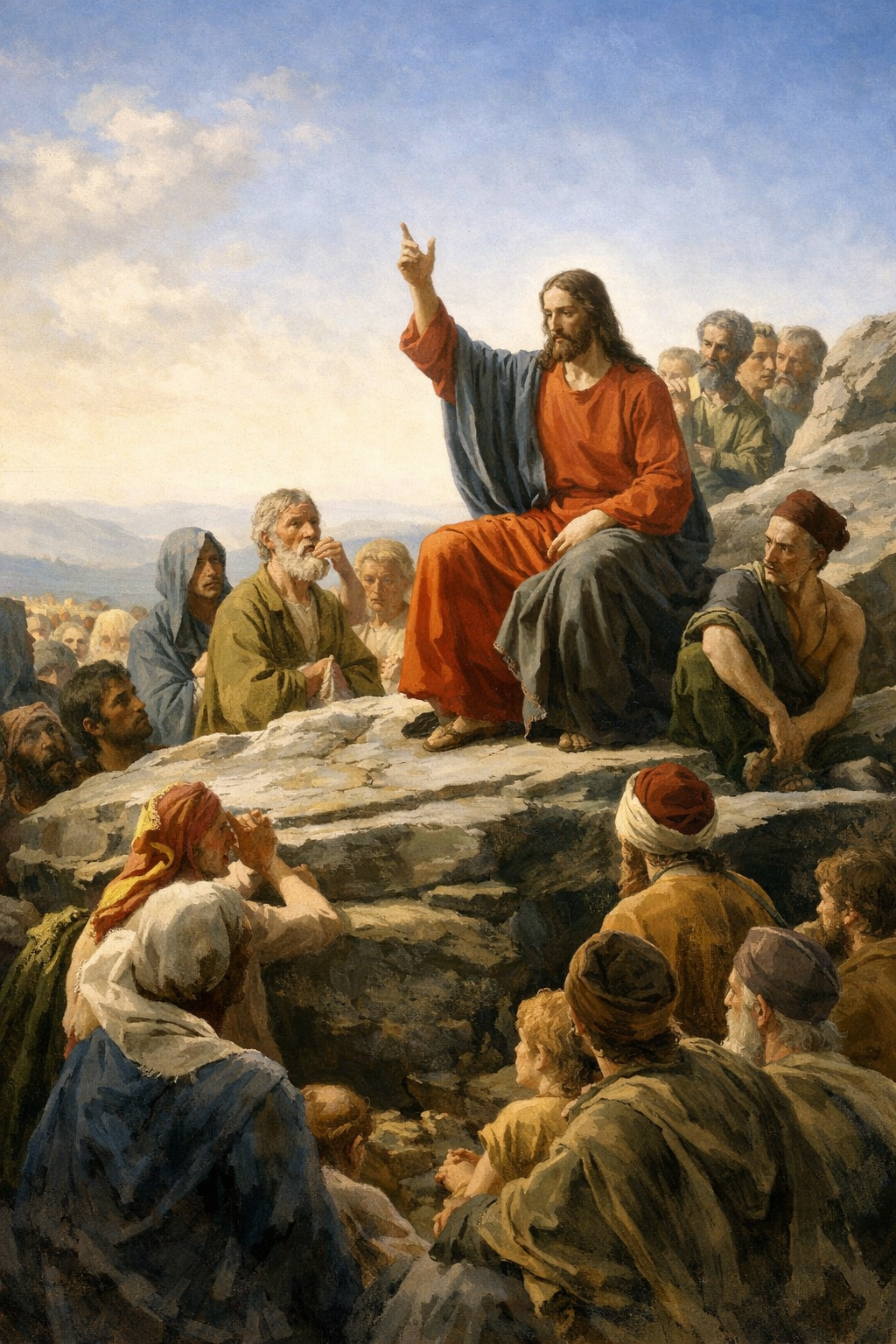
Sermon on the Mount
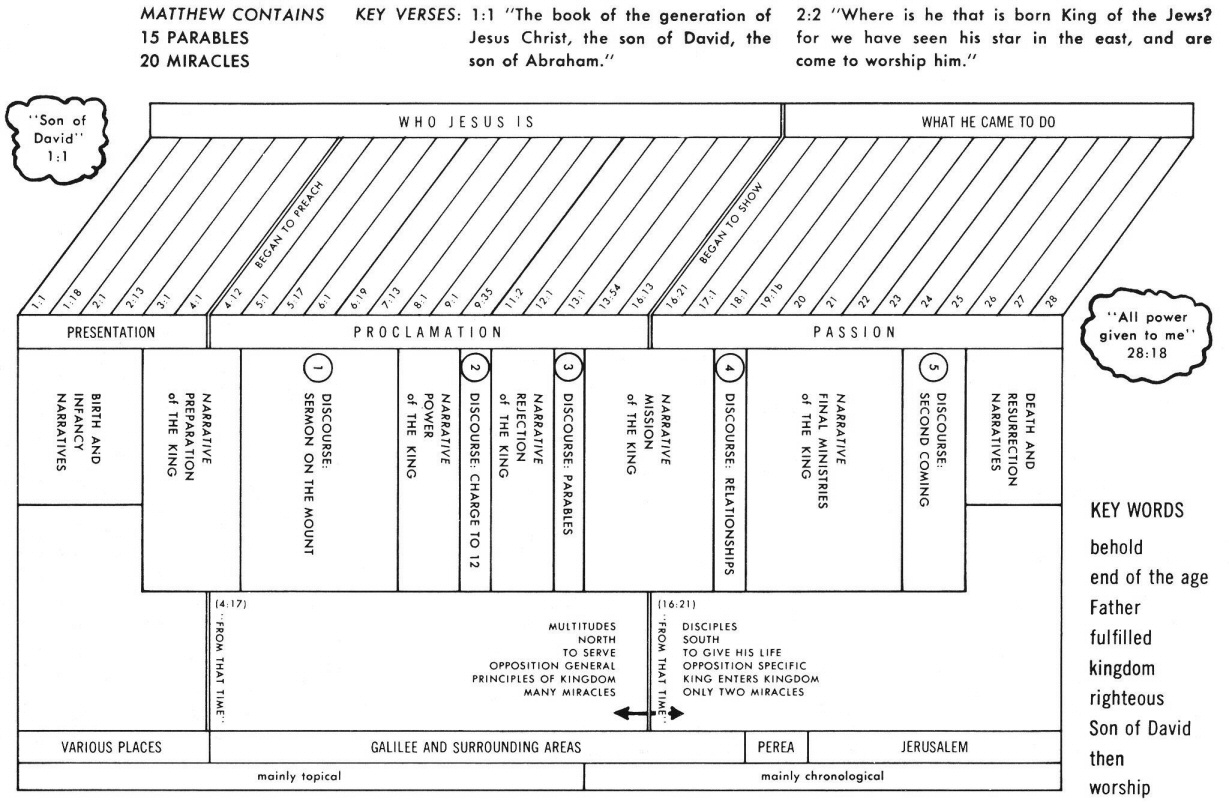
Click chart to enlarge
Charts from Jensen's Survey of the NT - used by permission
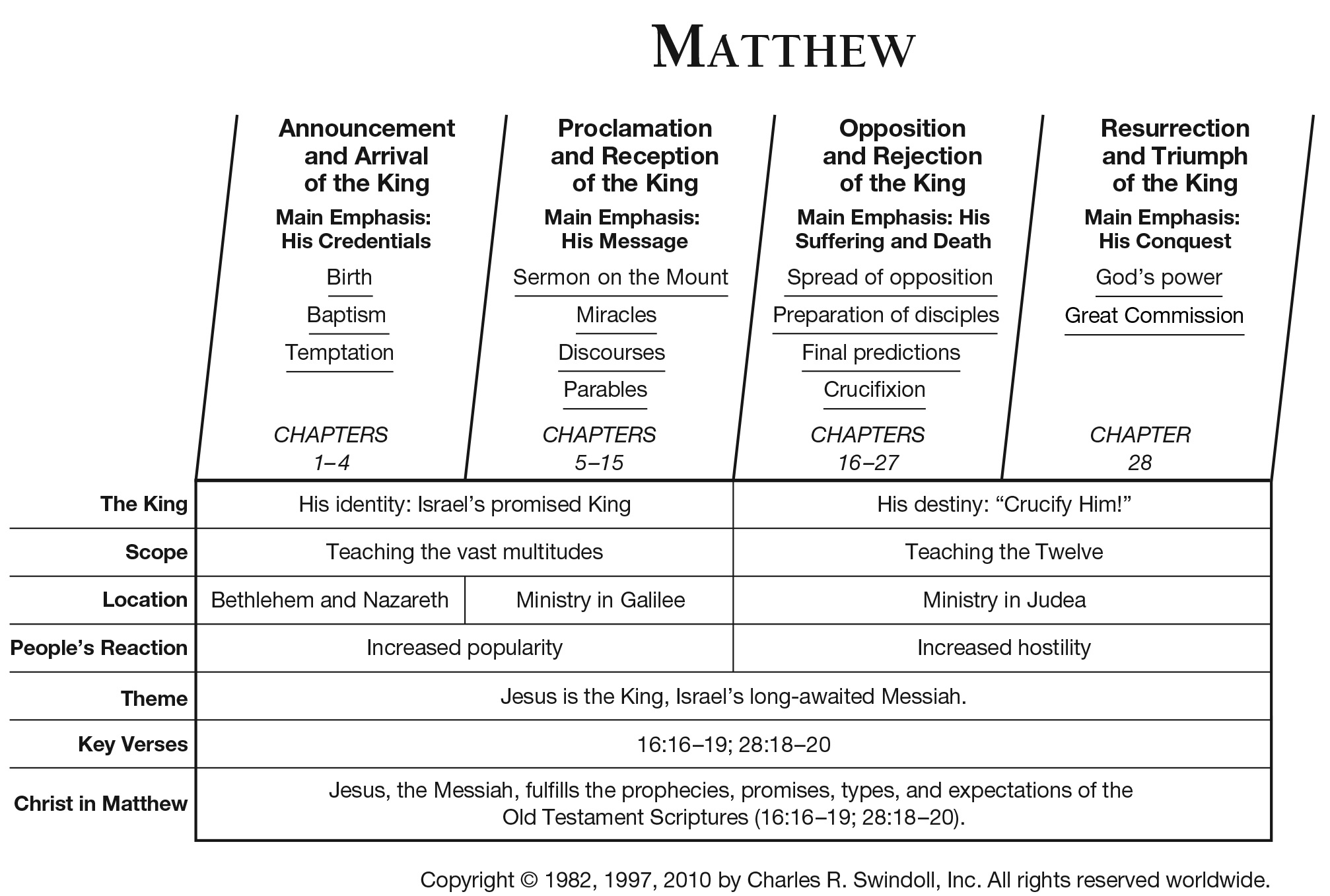
Another Chart from Swindoll
THE LIFE OF JESUS AS COVERED
BY MATTHEW (shaded area)
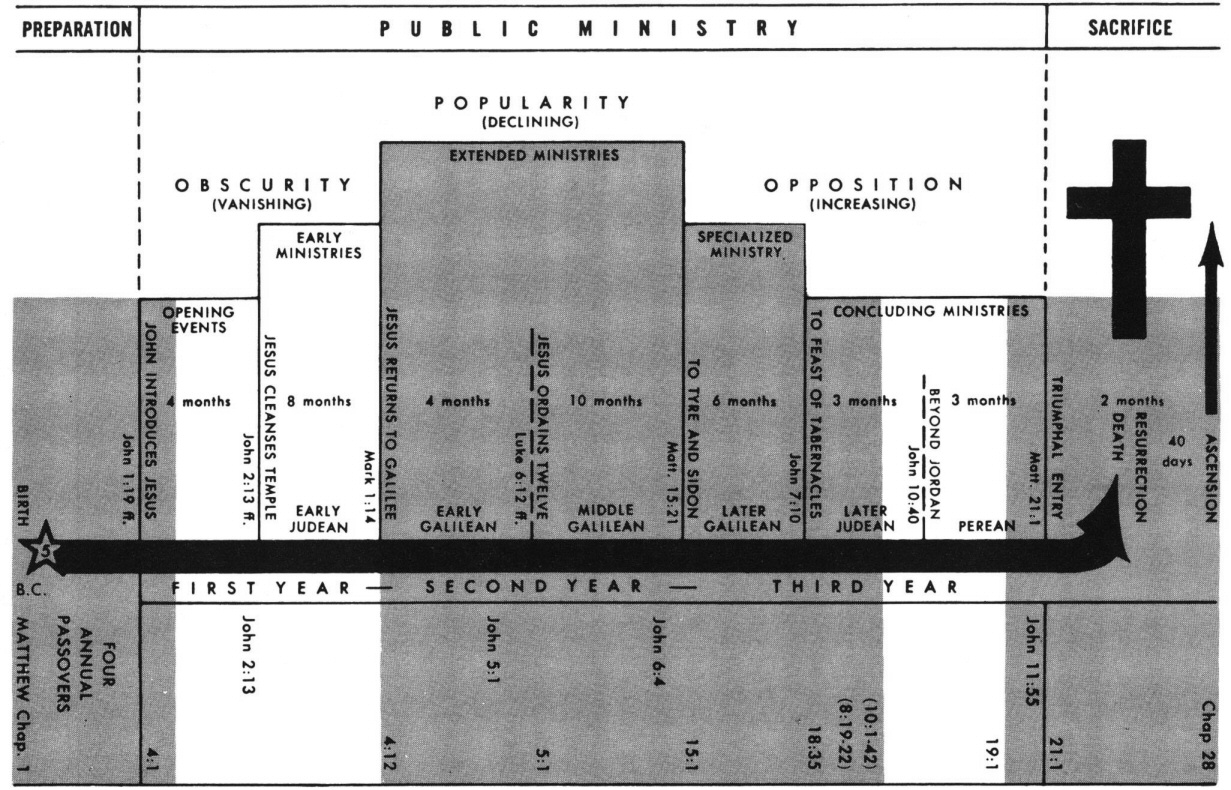
Click chart to enlarge
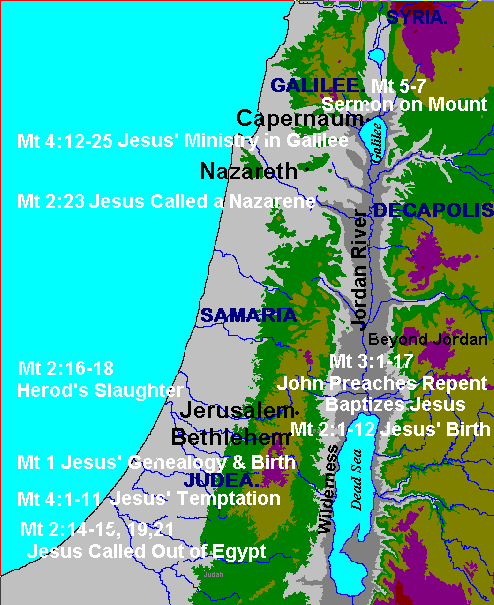
Jesus Birth and Early Years
Leading up to the Sermon on the Mount
Matthew 1-7
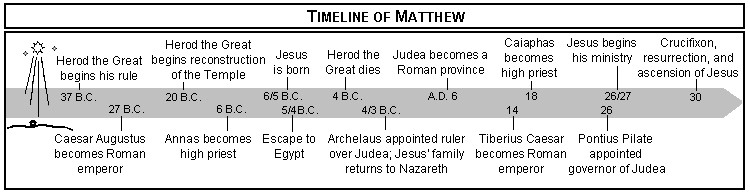
Source: Ryrie Study Bible
Matthew 7:26 "Everyone who hears these words of Mine and does not act on them, will be like a foolish man who built his house on the sand (NASB: Lockman)
Greek: kai pas o akouon (PANSN) mou tous logous toutous kai me poion ( PAPMSN) autous homoiothesetai (3SFPI) andri moro, ostis okodomesen (3SAAI) autou ten oikian epi ten ammon.
Amplified: And everyone who hears these words of Mine and does not do them will be like a stupid (foolish) man who built his house upon the sand. (Amplified Bible - Lockman)
KJV: And every one that heareth these sayings of mine, and doeth them not, shall be likened unto a foolish man, which built his house upon the sand:
NLT: But anyone who hears my teaching and ignores it is foolish, like a person who builds a house on sand. (NLT - Tyndale House)
Phillips: "And everyone who hears these words of mine and does not follow them can be compared with a foolish man who built his house on sand. (New Testament in Modern English)
Wuest: And everyone who is hearing these words of mine and is not habitually doing them shall be likened to an imprudent man without forethought or wisdom who was of such a character that he built his house upon the sandy ground. (Eerdmans)
Young's: 'And every one who is hearing of me these words, and is not doing them, shall be likened to a foolish man who built his house upon the sand;
Everyone who hears these words of Mine and does not act on them, will be like a foolish man who built his house on the sand: kai pas o akouon (PANSN) mou tous logous toutous kai me poion (PAPMSN) autous homoiothesetai (3SFPI) andri moro, hostis okodomesen (3SAAI) autou ten oikian epi ten ammon:
- 1Sa 2:30; Pr 14:1; Je 8:9; Lk 6:49; Jas 2:20
- Matthew 7 Resources - Multiple Sermons and Commentaries
- Matthew 7:13-29: The Way to Heaven - Study Guide (see dropdown) - John MacArthur
- Matthew 7:13-27: Foundations of Grace, Part 2 - John MacArthur
- Matthew 7:13-27: Two Paths, One Way - John MacArthur
- Matthew 7:21-27: Saved or Self-Deceived, Part 2 - John MacArthur
- Matthew 7:21-27: Unmasking Christmas Hypocrites - John MacArthur
- What does it mean that the wise man built his house upon a rock?
Everyone who hears - The present tense pictures the truth that all (no exceptions) continually hear Jesus' words. The implication is one can continually hear the Savior's voice through His word and His instruments of proclamation (pastors, relatives, friends, missionaries, etc) and yet refuse to truly "hearken" ("to give heed to") to His words of warning and wisdom by obeying them.
These words of mine - In immediate context, these words refer to Jesus' warning about hearing and not doing, but also the greater context of the sermon on the mount (and then all His words in the Gospels and in a sense "The Word" for indeed He is "the Word of God" [Jn 1:1, 1Jn 1:1, Re 19:13-note] Who became flesh [Jn 1:14]
Words (3055)(logos from légo = to speak with words; English = logic, logical) means something said and describes a communication whereby the mind finds expression in words. Lógos then is a general term for speaking, but always used for speaking with rational content. Lógos is a word uttered by the human voice which embodies an underlying concept or idea. When one has spoken the sum total of their thoughts concerning something, they have given to their hearer a total concept of that thing. Thus the word lógos conveys the idea of “a total concept” of anything. Lógos means the word or outward form by which the inward thought is expressed and made known. It can also refer to the inward thought or reason itself. Note then that lógos does not refer merely to a part of speech but to a concept or idea. In other words, in classical Greek, lógos never meant just a word in the grammatical sense as the mere name of a thing, but rather the thing referred to. In fact, the Greek language has 3 other words (rhema, onoma, epos) which designate a word in its grammatical sense. Lógos refers to the total expression whereas rhema (see word study) for example is used of a part of speech in a sentence. In other words rhema, emphasizes the parts rather than the whole.
As someone has said our deeds are fruit but our words are leaves!
Spurgeon put it this way…
I would not give much for your religion unless it can be seen. Lamps do not talk, but they do shine.
Jesus gave a similar admonition in His parable of the seed and sower (or "soils") teaching that…
the one on whom seed (the Word of God, the Gospel) was sown on the rocky places, this is the man who hears the word, and immediately receives it with joy yet (introduces a critical contrast) he has no firm root in himself, but is only temporary, and when affliction or persecution arises because of the word, immediately he falls away (Literally "is stumbled" = skandalizo = habitually is tripped up, offended or "scandalized" by the Word). (Matthew 13:20,21)
Comment: Note the NAS adds "firm" (You can discern this word is added by the translators because the NAS and KJV/NKJV place words not present in the original Greek sentence in italics something most other versions unfortunately don't do) so it reads literally "no root" where "no" is the strongest Greek word (ou) to express the negative sense. This distinction makes quite a difference in one's interpretation, for a plant with no root is by definition not really a true plant, in contrast to a plant that has no firmly attached root. Jesus is not saying these individuals believe and are saved for a while and then lose their salvation. They heard the Truth of the Gospel but had no genuine "germinating" faith by which they might lay hold of true salvation. Their belief was tantamount to intellectual assent. They were professors but not possessors of belief in Christ. They liked Jesus' promises of blessing but not His requirement of belief, the genuineness of this belief being evidenced by one's supernaturally changed life. Cp "hears… and does not act")
And does not act on them - Does not as the general habit or practice of their life obey the Words of truth and life.
Spurgeon comments that many people…
know as far as the theory goes what the plan of salvation is, as well as I do (cp Lk 6:46). Yet, where the knowledge is the same, the ultimate result may vary; two men may be equally well instructed in the Scriptures, yet one of them may be wise and the other foolish. To know what faith is, what repentance is, what a good hope in Christ is, may all be yours, and yet it may but increase your misery forever (Ed: Lk 12:48 applies to the saved in heaven [1Co 3:11, 12, 13, 14, 15] as well as to the unsaved in hell [Mt 11:21, 22, 23, 24]).
If ye know these things, happy are ye if ye do them (Jn 13:17). It is not the hearer, but the doer of the word, that is blessed (cp Jas 1:22-note vs Jas 1:25-note). Knowledge puffeth up; love alone buildeth up (1Co 8:1).
My dear friends, I am most earnest that those of you who are desiring to find everlasting life in Christ Jesus, may not be content with anything short of a true, deep, and real work of grace in your hearts; for no clearness of head knowledge, no natural earnestness of purpose or eagerness of desire can save you; without an interest in Christ Jesus you are lost to all eternity. “Ye must be born again;” (Jn 3:3, 5, 7) ye must be brought into vital union with the living Savior, or your hopefulness will end in overwhelming destruction.
James addressed his critical concern regarding hearers who failed to be doers commanding his readers to…
prove (present imperative = make this your continual practice - read the Word, then do the Word!) yourselves doers (poietes ~ "performers", "poets") of the word, and not merely hearers (akroates = those who sit passively and listen like a student who audits a class but is not held accountable for what they hear! Jesus says we are accountable when we hear!) who delude (present tense = continually; paralogizomai from pará = beside + logizomai = exercise one’s reason >> literally reasoning beside the truth) themselves. 23 For if anyone is a hearer of the word and not a doer, he is like a man who looks at his natural face in a mirror 24 for once he has looked (Literally = Put his mind down on indicating attention and continuous observation) at himself and gone away, he has immediately forgotten (completely forgot, literally hidden upon [one's mind]) what kind of person he was. 25 But one who looks intently (parakupto from pará = beside + kúpto = bend, stoop >> literally stooping sideways in order to see something exactly) at the perfect law, the law of liberty, and abides by it, not having become a forgetful hearer ("auditor") but an effectual doer, this man shall be blessed in what he does. 26 If anyone thinks himself to be religious, and yet does not bridle his tongue but deceives his own heart, this man's religion is worthless. (James 1:22-26-see verse by verse notes)
Spurgeon explains that…
If any soul will be lost emphatically, it is he who has been for years a hearer only, a hearer where thousands have believed unto eternal life (Jn 5:24). Over the cell of such a man write, "He knew his duty, but he did it not," and that cell will be built in the very center of Gehenna. It is the innermost prison of hell. Willful rejection of Christ ensures woeful rejection from Christ.
Will be like (3666)(homoioo from homoios = similar, of the same kind, of like disposition, in geometry similar [of figures]) means to make like (active sense). Most of the uses are in the passive sense meaning to become like something or someone (He 2:17). Homoioo is used to portray one thing with another in order to compare. To consider something to be like something else. To illustrate by comparison (Mt 7:24, 26, Lk 7:31, 13:20, Mk 4:30). To be like, to resemble, to be similar to (Acts 14:11).
TDNT adds that homoioo…
This word means a. “to make like or equal,” b. “to liken,” and c. (passive) “to be like.” In Matthew it usually serves to introduce parables. The introduction may be in the form of a stereotyped question (Mt 11:16, Mk 4:30, Lk 13:18, 20). In Mt 6:8 Jesus tells his disciples not to “be like” the Gentiles when they pray.
Here are the 15 uses of homoioo in the NT…
Matthew 6:8 (note) "Therefore do not be like them; for your Father knows what you need, before you ask Him.
Matthew 7:24 (note) "Therefore everyone who hears these words of Mine, and acts upon them, may be compared to a wise man, who built his house upon the rock.
Matthew 7:26 "And everyone who hears these words of Mine, and does not act upon them, will be like a foolish man, who built his house upon the sand.
Matthew 11:16 "But to what shall I compare this generation? It is like children sitting in the market places, who call out to the other children,
Matthew 13:24 He presented another parable to them, saying, "The kingdom of heaven may be compared to a man who sowed good seed in his field.
Matthew 18:23 "For this reason the kingdom of heaven may be compared to a certain king who wished to settle accounts with his slaves.
Matthew 22:2 "The kingdom of heaven may be compared to a king, who gave a wedding feast for his son.
Matthew 25:1 "Then the kingdom of heaven will be comparable to ten virgins, who took their lamps, and went out to meet the bridegroom.
Mark 4:30 And He said, "How shall we picture (with what can we compare) the kingdom of God, or by what parable shall we present it?
Luke 7:31 "To what then shall I compare the men of this generation, and what are they like?
Luke 13:18 Therefore He was saying, "What is the kingdom of God like, and to what shall I compare it?
Luke 13:20 And again He said, "To what shall I compare the kingdom of God?
Acts 14:11 And when the multitudes saw what Paul had done, they raised their voice, saying in the Lycaonian language, "The gods have become like men and have come down to us."
Comment: This use of homoioo suggests that they have become like in the sense of taking on an external form like the gods.
Romans 9:29 (note) And just as Isaiah foretold, "Except the Lord of Sabaoth had left to us a posterity, We would have become as Sodom, and would have resembled Gomorrah."
Hebrews 2:17 (note) Therefore, He had to be made like His brethren in all things, that He might become a merciful and faithful high priest in things pertaining to God, to make propitiation for the sins of the people.
Homoioo is used 29 times in the Septuagint (LXX) -
Ge 34:15, 22, 23; Ps. 28:1; 40:5; 49:12, 20; 83:1; 89:6; 102:6; 143:7; 144:4; Song 1:9; 2:17; 7:7; 8:14; Isa. 1:9; 40:18, 25; 46:5; La 2:13; Ezek. 31:2, 8, 18; 32:2; Hos. 4:5, 6; 12:10; Zeph. 1:11
Psalm 28:1 A Psalm of David. To Thee, O LORD, I call; My rock, do not be deaf to me, Lest, if Thou be silent to me, I become like those who go down to the pit.
Psalm 40:5 Many, O LORD my God, are the wonders which Thou hast done, And Thy thoughts toward us; There is none to compare with Thee; If I would declare and speak of them, They would be too numerous to count.
Psalm 49:12 But man in his pomp will not endure; He is like the beasts that perish.
Psalm 144:4 Man is like a mere breath; His days are like a passing shadow.
Isaiah 40:18 To whom then will you liken God? Or what likeness will you compare with Him? (Used twice)
Fool (3474) (moros; English = “moron”) has the root meaning of deficiency and is used especially of the one who is mentally dull, silly, stupid, foolish. Such a person is considered intellectually weak, irrational or lacking in foresight, and this is the manner moros is used by Jesus. Moros is the antonym of sophos (wise) or as in this context of phronimos (wise Mt 7:24). Moros is used to describe a person who has no respect for God (Mt 23:17). In Mt 5:22 (see discussion) moros describes a person who is morally worthless for calling his brother raca (Aramaic for empty-headed, stupid, vain).
In the present context Jesus says the person is foolish because he thinks that his house is secure (on "sand") simply because he has heard and perhaps even acknowledged (externally) the words of Christ. This person is deceived because he thinks that he is living a life which pleases God. In this metaphor, he is confident that his house will withstand the testing elements, but his confidence is not in Jesus but in himself! He is self-deceived or self-deluded (cp Jas 1:22).
TDNT explains that moros (and its cognates)…
denote deficiency, e.g., physical sloth, but more especially mental dullness. We find such varied uses as for insipid foods, animals that are sluggish in winter, or people suffering from fatigue. With a human reference the main use is psychological. What is meant is a weakness of understanding or judgment, sometimes through stupidity, sometimes through confusion, but always demanding censure. Along with a more rationalistic view, the Greeks suggest at times that folly of this nature is a fate. (Kittel, G., Friedrich, G., & Bromiley, G. W. Theological Dictionary of the New Testament. Eerdmans)
Built on sand - Homeowners who have foundation problems find that these can be quietly costly. How much more eternally costly for those whose spiritual lives prove to have been built on the wrong foundation!
C H Spurgeon speaking of the conditions in his day (late 1800's) wrote that there is…
Want of depth, want of sincerity, want of zeal in religion-this is the want of our times. Want of an eye to God in religion, lack of sincere dealing with one’s soul, neglect of using the lancet with our hearts, neglect of the search warrant which God gives out against sin, carelessness concerning living upon Christ; much reading about Him, much talking about Him, but too little feeding on His flesh and drinking of His blood-these are the causes of a tottering profession and a baseless hope.
Arthur Pink writes that these "hearers"
bring their bodies to the house of prayer but not their souls; they worship with their mouths, but not “in spirit and in truth.” They are sticklers for immersion or early morning communion, yet take no thought about keeping their hearts with all diligence. They boast of their orthodoxy; but disregard the precepts of Christ. Multitudes of professing Christians abstain from external acts of violence, yet hesitate not to rob their neighbors of a good name by spreading evil reports against them. They contribute regularly to the “pastor’s salary,” but shrink not from misrepresenting their goods and cheating their customers, persuading themselves that “business is business.” They have more regard for the laws of man than those of God, for His fear is not before their eyes.
On Rock Or Sand? - Japan's second-largest airport is sinking into the ocean. When Kansai International near Osaka was constructed on an artificial island, designers and builders knew that it would settle. They built hydraulic jacks into the structures to correct any tilt that occurred. But during its first 6 years, several key portions of the airport have reached or exceeded their 50-year sinking projection. They say there is no reason to be alarmed, but local residents are not so sure.
Most of us will never design or build an airport, but we are all in the process of constructing a life. There is no more crucial decision than choosing the foundation upon which we build.
Jesus used the metaphor of building on sand to describe the person who hears His words but does not put them into practice. "The floods came, and the winds blew and beat on that house," Jesus said, "and it fell. And great was its fall" (Matthew 7:27). Merely hearing what Jesus says is not enough.
In contrast, Jesus likened the person who hears and keeps His teachings to a wise man who builds his house on the rock (Mt 7:24-note). Not even the fiercest storm can bring it down.
Solid rock or sinking sand? On what foundation are we choosing to build today? —D C McCasland (Our Daily Bread, Copyright RBC Ministries, Grand Rapids, MI. Reprinted by permission. All rights reserved)
If you want life's truest treasures
Do not build on sinking sand;
Build upon the Rock of Ages ,
Trust in God's almighty hand. —Jarvis
With God's word as your foundation,
you can build a godly life.
Matthew 7:27 "The rain fell, and the floods came, and the winds blew and slammed against that house; and it fell --and great was its fall.". (NASB: Lockman)
Greek: kai katebe (3SAAI) e broche kai elthon (3PAAI) oi potamoi kai epneusan (3PAAI) oi anemoi kai prosekopsan (3PAAI) te oikia ekeine, kai epesen, (3SAAI) kai en (3SIAI) e ptosis autes megale.
Amplified: And the rain fell and the floods came and the winds blew and beat against that house, and it fell—and great and complete was the fall of it. (Amplified Bible - Lockman)
KJV: And the rain descended, and the floods came, and the winds blew, and beat upon that house; and it fell: and great was the fall of it.
NLT: When the rains and floods come and the winds beat against that house, it will fall with a mighty crash. (NLT - Tyndale House)
Phillips: Down came the rain and up came the floods, while the winds blew and battered that house till it collapsed, and fell with a great crash. (New Testament in Modern English)
Wuest: And the violent rainstorm came down and the torrents came, and the winds blew and rushed upon and beat against that house, and it fell, and its downfall was great. (Eerdmans)
Young's: and the rain did descend, and the streams came, and the winds blew, and they beat on that house, and it fell, and its fall was great.'
The rain fell, and the floods came, and the winds blew and slammed against that house; and it fell--and great was its fall: kai katebe (3SAAI) e broche kai elthon (3PAAI) oi potamoi kai epneusan (3PAAI) oi anemoi kai prosekopsan (3PAAI) te oikia ekeine, kai epesen, (3SAAI) kai en (3SIAI) e ptosis autes megale:
- Mt 12:43-45; 13:19-22; Ezek 13:10-16; 1Co 3:13; He 10:26-31; 2Pe 2:20-22
- Matthew 7 Resources - Multiple Sermons and Commentaries
- Matthew 7:13-29: The Way to Heaven - Study Guide (see dropdown) - John MacArthur
- Matthew 7:13-27: Foundations of Grace, Part 2 - John MacArthur
- Matthew 7:13-27: Two Paths, One Way - John MacArthur
- Matthew 7:21-27: Saved or Self-Deceived, Part 2 - John MacArthur
- Matthew 7:21-27: Unmasking Christmas Hypocrites - John MacArthur
The rain fell and the floods came and the winds blew… - In context these physical calamities picture the coming judgment of God regarding what every person ever born has chosen as their "foundation" for eternity. These physical elements picture the thoroughness of God's final judgement of every person's profession of faith as either "wheat" or "chaff".
Slammed against (4350) (proskopto from prós = to, against + kópto = cut, strike) means literally to strike against and so to dash against something in a violent manner. Proskopto in its literal use pictures a traveler who bumps against an obstacle and is caused to stumble.
John MacArthur makes the point that…
both builders build their houses in the same general location, evidenced by their apparently being hit by the same storm. In other words, the outward circumstances of their lives were essentially the same. One had no advantage over the other. They lived in the same town and possibly attended the same church, heard the same preaching, went to the same Bible study, and fellowshipped with the same friends…
The differences between the two builders and the two houses they built were not noticeable from the outside. But they were immeasurably more important than the similarities. The key is to understand that one does act upon God’s Word (obedience) and the other does not act upon His Word (disobedience). One builds using the divine specifications, the other uses his own. (MacArthur, J: Matthew 1-7 Chicago: Moody Press)
Spurgeon writes…
Even if you live to the world, or live unto Satan, you will not live without trial. The ungodly, who have their portion in this life, have to eat some bitter herbs with it, and have to dip their morsel in vinegar quite as much as believers do. “The floods came, and the winds blew, and beat upon that house;
I have no doubt that many slips and falls and apostasies of those professing to be true believers are due to the fact that they were not right at the first. Their foundations were always upon the sand (see Mt 7:26, 27). So, it was no more than might have been expected when their houses fell down at last. A flaw in the foundation is pretty sure to be followed by a crack in the superstructure.
The real foundation of our life is usually hidden, and is only proven in the storm. Don't fear or be discouraged by testings God allows into your life to bring you forth as precious pure gold!
Spurgeon - The fall was so great because he could never build again.
Wiersbe observes that…
A false profession will last until judgment comes. Sometimes this judgment is in the form of the trials of life. Like the person who received the seed of God’s Word into a shallow heart (Mt. 13:45, 46, 47, 48, 49), the commitment fails when the testing comes. Many people have professed faith in Christ, only to deny their faith when life becomes spiritually costly and difficult (Ed note: In Mt 13:20, 21 Jesus explains that "the one on whom seed was sown on the rocky places, this is the man who hears the word, and immediately receives it with joy; yet he has no firm root in himself, but is only temporary, and when affliction or persecution arises because of the word, immediately he falls away.")… Those who have trusted Christ, and have proved their faith by their obedience will have nothing to fear. Their house is founded on the Rock, and it will stand. But those who have professed to trust Christ, yet who have not obeyed God’s will, will be condemned.
How shall we test our profession of faith? By popularity? No, for there are many on the broad road to destruction (Mt 7:13,14-note). And there are many who are depending on words, saying “Lord, Lord”—but this is no assurance of salvation. Even religious activities in a church organization are no assurance. How then shall we judge ourselves and others who profess Christ as Saviour?
The two ways tell us to examine the cost of our profession. Have we paid a price to profess faith in Christ? The two trees tell us to investigate whether our lives have really changed. Are there godly fruits from our lives? And the two houses remind us that true faith in Christ will last, not only in the storms of life, but also in the final judgment. (Bible Exposition Commentary. 1989. Victor)
Mark in the parable of the seed and soils writes that…
"And in a similar way these are the ones on whom seed was sown on the rocky places, who, when they hear the word, immediately receive it with joy; and they have no firm root in themselves, but are only temporary; then, when affliction or persecution arises (cf "rain… floods… winds") because of the word, immediately they fall away." (Mark 4:16-17)
As Bengel has remarked on the end of Jesus' sermon…
“Thus it is not necessary for every sermon to end with consolation.”
Great was its fall - Why great? What does the fall picture? In the context of the Sermon on the Mount and Jesus' teaching elsewhere in the Gospels, the fall is great because it results in eternal separation from God in a place of unspeakable everlasting torment. As Jesus Himself declared that…
if your eye causes you to stumble, cast it out; it is better for you to enter the kingdom of God with one eye, than having two eyes, to be cast into hell, where THEIR WORM DOES NOT DIE, AND THE FIRE IS NOT QUENCHED (quoting Is 66:24). (Mk 9:47, 48)
In Mark's passage hell is the Greek noun Gehenna- the place in the Valley of Hinnom where, in OT times, human sacrifices were offered (2Chr 33:6; Je 7:31), and where the continuous burning of rubbish illustrated for the Jewish people unending judgment upon the wicked. There are 12 uses of Gehenna in the NT - Mt 5:22-note, Mt 5:29, 30-note; Mt 10:28; 18:9; 23:15, 33; Mk 9:43, 45, 47; Lk 12:5; Jas 3:6. In every instance except James, the word was spoken by Jesus Christ in most solemn warning of the consequences of unrepentant sin. Gehenna is not only the place where "their worm does not die, and the fire is not quenched" (Mk 9:48) but is also the "lake of fire" etc (Re 19:20-note; Re 20:10-note, Re 20:14-note, Re 20:15-note) and is synonymous with the second (Jn 8:24; Re 21:8-note)