Romans 6:2
Romans 6:3
Romans 6:4
Romans 6:5
Romans 6:6
Romans 6:7
Romans 6:8
Romans 6:9
Romans 6:10
Romans 6:11
Romans 6:12
Romans 6:13
Romans 6:14
Romans 6:15
Romans 6:16
Romans 6:17
Romans 6:18
Romans 6:19
Romans 6:20
Romans 6:21
Romans 6:22
Romans 6:23

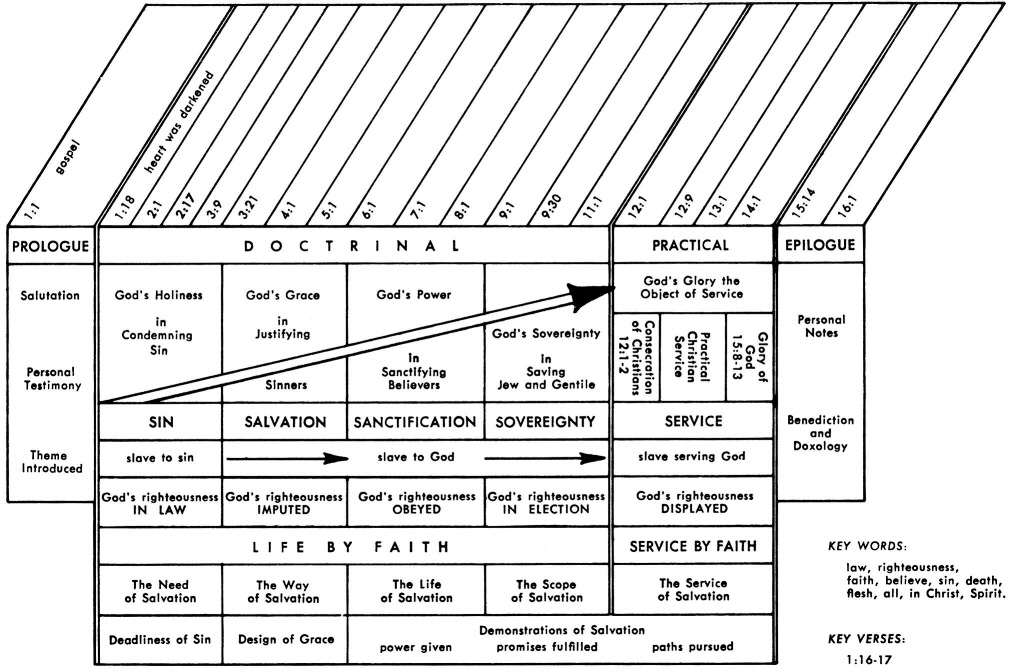
Click chart to enlarge
Chart from recommended resource Jensen's Survey of the NT - used by permission
click chart from Charles Swindoll
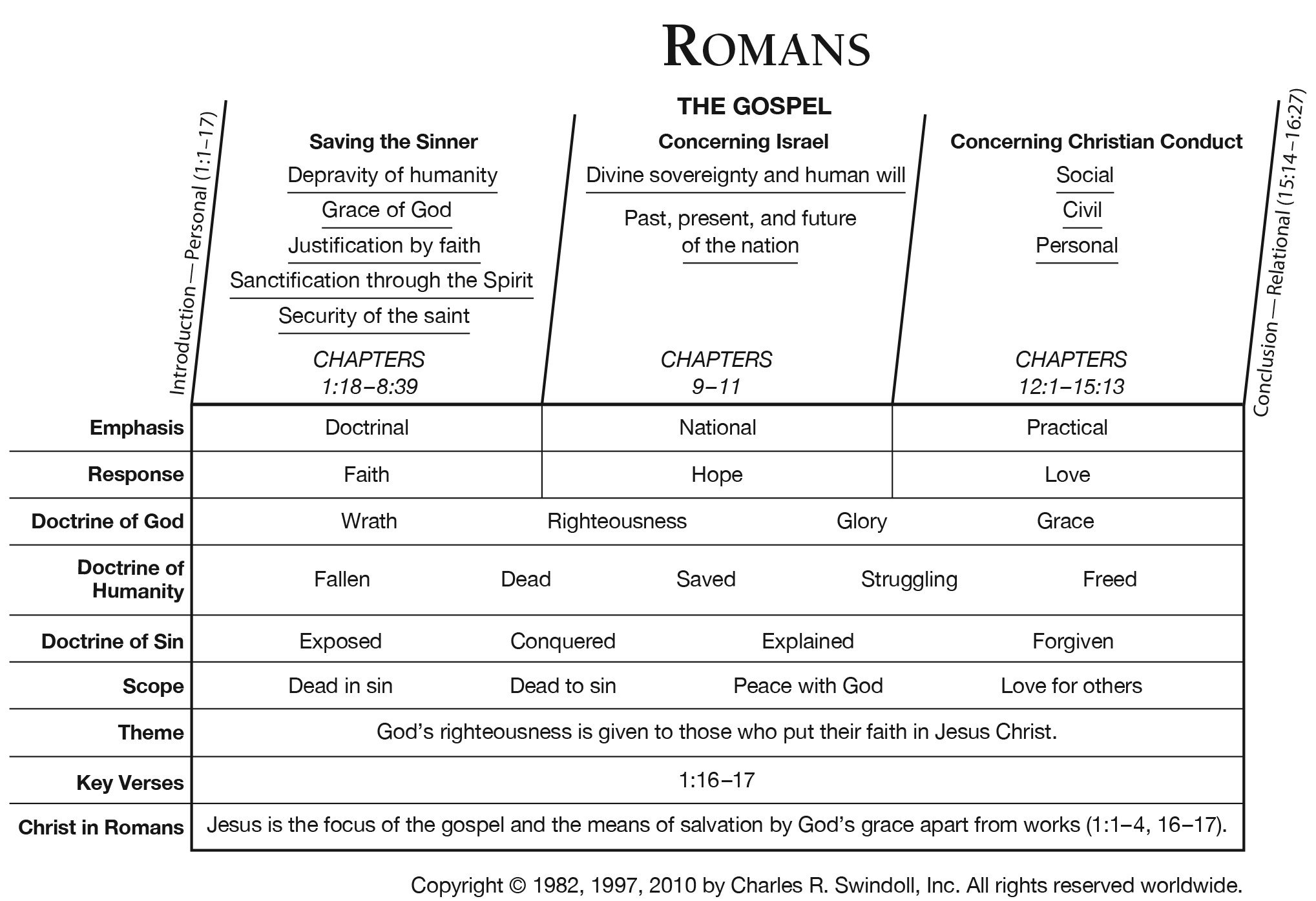
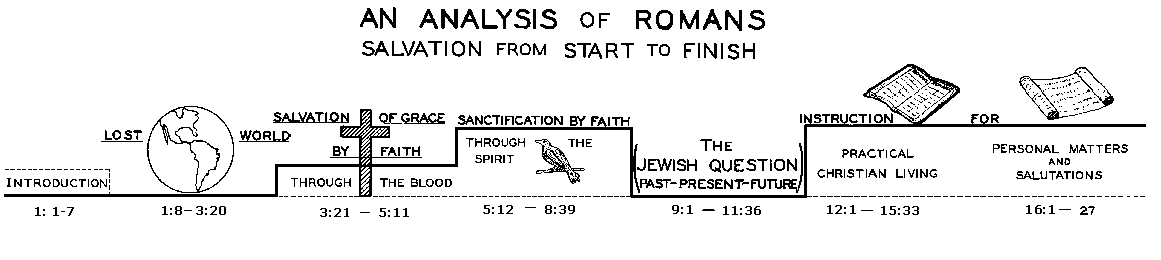
Source: Dr David Cooper
Click to Enlarge
| ROMANS ROAD to RIGHTEOUSNESS |
||||
| Romans 1:18-3:20 | Romans 3:21-5:21 | Romans 6:1-8:39 | Romans 9:1-11:36 | Romans 12:1-16:27 |
| SIN | SALVATION | SANCTIFICATION | SOVEREIGNTY | SERVICE |
| NEED FOR SALVATION |
WAY OF SALVATION |
LIFE OF SALVATION |
SCOPE OF SALVATION |
SERVICE OF SALVATION |
| God's Holiness In Condemning Sin |
God's Grace In Justifying Sinners |
God's Power In Sanctifying Believers |
God's Sovereignty In Saving Jew and Gentile |
Gods Glory The Object of Service |
| Deadliness of Sin |
Design of Grace |
Demonstration of Salvation | ||
| Power Given | Promises Fulfilled | Paths Pursued | ||
| Righteousness Needed |
Righteousness Credited |
Righteousness Demonstrated |
Righteousness Restored to Israel |
Righteousness Applied |
| God's Righteousness IN LAW |
God's Righteousness IMPUTED |
God's Righteousness OBEYED |
God's Righteousness IN ELECTION |
God's Righteousness DISPLAYED |
| Slaves to Sin | Slaves to God | Slaves Serving God | ||
| Doctrine | Duty | |||
| Life by Faith | Service by Faith | |||
|
Modified from Irving L. Jensen's chart above |
||||
R Ruin (Romans 1:17 – 3:20) – The utter sinfulness of humanity
O Offer (Romans 3:21-31) – God’s offer of justification by grace
M Model (Romans 4:1-25) – Abraham as a model for saving faith
A Access (Romans 5:1-11) – The benefits of justification
N New Adam (Romans 5:12-21) – We are children of two “Adams”
S Struggle w/ Sin (Romans 6:1-8:39) Struggle, sanctification, and victory
Romans 6:1 What shall we say then? Are we to continue in sin so that grace may increase? (NASB: Lockman)
Greek: Ti oun eroumen? (1PFAI) epimenomen (1PAS) te hamartia hina e charis pleonase? (3SAAS)
Amplified: WHAT SHALL we say [to all this]? Are we to remain in sin in order that God’s grace (favor and mercy) may multiply and overflow? (Amplified Bible - Lockman)
GWT: What should we say then? Should we continue to sin so that God's kindness will increase? (GWT)
KJV: What shall we say then? Shall we continue in sin, that grace may abound?
Moule: What shall we say then? Shall we cling to the sin that the grace may multiply, the grace of the acceptance of the guilty?
NLT: Well then, should we keep on sinning so that God can show us more and more kindness and forgiveness? (NLT - Tyndale House)
Phillips: Now what is our response to be? Shall we sin to our heart's content and see how far we can exploit the grace of God? (Phillips: Touchstone)
Wuest: What then shall we say? Shall we habitually sustain an attitude of dependence upon, yieldedness to, and cordiality with the sinful nature in order that grace may abound? (Eerdmans)
Young's Literal: What, then, shall we say? shall we continue in the sin that the grace may abound?
WHAT SHALL WE SAY THEN: Ti oun eroumen (1PFAI):
- Ro 6:15 2:4 3:5, 6, 7, 8,31, 5:20,21 Ga 5:13 1Pe 2:16 2Pe 2:18,19 Jude 1:4)
THE THIRD MAJOR
SECTION OF ROMANS
Note that the table above is intended to demonstrate that Romans 6-8 "belong together". While carefully observing, memorizing and meditating on the vital truths in Romans 6 is foundational for living a life of freedom and growth in Christlikeness (progressive sanctification or present tense salvation), the serious student (which we should all be!) would be wise to study all three chapters carefully as a unit for maximum spiritual benefit. Notice the logical pattern Paul presents -- Romans 6 deals with the believer being dead to Sin, Romans 7 deals with the believer being dead to the Law, and Romans 8 deals with the believer alive in the Spirit, Who gives us the power to life the "victorious Christian life"! Romans 6 tells us how Sin no longer reigns over us. Romans 7 explains how the Law no longer reigns over us. And finally Romans 8 explains how the indwelling Spirit gives us life and liberty in Christ Jesus our Liberator!
Paul Addresses...
Libertines in Romans 6
Legalists in Romans 7
Liberty in Romans 8
John Newton who was saved by and wrote about Amazing Grace wrote these words for the epitaph of his tombstone...
John Newton, Clerk,
once an infidel and libertine,
A servant of slaves in Africa,
was, by the rich mercy of our Lord and Saviour,
Jesus Christ,
Preserved, restored, pardoned,
And appointed to preach the faith
What shall we say then? - A rhetorical question (One authority has identified 74 rhetorical questions in Romans!) - one that is generally asked for the effect it produces with no answer necessarily expected. The idea is something like "What conclusion are we to draw from the doctrine previously taught?" Vincent says this is "A transition-expression and a debater's phrase." Greek NT - "What inference then shall we draw, i.e. from the relations of sin and grace expounded in ?"
Keep the context of Romans in mind (see table above) as you study Romans 6, 7 and 8. In the previous three chapters Paul has focused on crucial need for and provision of justification by faith through grace (past tense salvation) but now begins the practical section on sanctification (present tense salvation) which describes saints as saved from the power of sin through the finished work of Christ. Sin in Romans 6-8 is not a reference so much to the guilt of sin (that is dealt with in Romans 1-5) but with Sin as a power in the believer's life.
S Lewis Johnson has said that in Romans 6-8 - Wrath and justification (of Romans 3-5)...yield to the discussion of sin and sanctification. Justification is restoration to life, while sanctification is restoration to health. Justification brings us from the tomb; sanctification delivers us from the old "threads." (Sermon on Romans 6:1-14)
Compare a similar pattern when Jesus brought Lazarus up from the tomb - "And when He had said these things, He cried out with a loud voice, "Lazarus, come forth." He who had died came forth, bound hand and foot with wrappings; and his face was wrapped around with a cloth. Jesus said to them, "Unbind him, and let him go." (John 11:43, 44)
Romans 6 Outlined:
I. Holiness is the logical outcome of the life of a Christian:
A. Since they died to sin to rise to new life:
B. Since they have a new Master who is opposed to sin:
C. Since service to a master logically means obedience to that master: (Dunagan Commentary)
Ray Stedman wrote that - Verses 1-14 of the sixth chapter of Romans are the most important fourteen verses in Scripture, insofar as being delivered from enduring the Christian life to enjoying it is concerned. There is a difference between possessing eternal life, which all Christians have, and possessing that abundant life which the Lord came to give...I saw a sign the other day and it read, "When all else fails, follow directions." That is a good sign to hang over the sixth chapter of Romans." (from his sermon entitled The Day I Died) (Bolding added for emphasis - it is difficult to argue with the venerable Dr Stedman's conclusion! One can't know this section of Scripture well enough! Have you considered committing it to memory? See Memorizing His Word)
MacArthur introduces Romans 6-8 noting that "Paul moves from demonstrating the doctrine of justification, which is God’s declaring the believing sinner righteous (Ro 3:21-5:21), to demonstrating the practical ramifications of salvation on those who have been justified. He specifically discusses the doctrine of sanctification, which is God’s producing actual righteousness in the believer. (MacArthur, J.: The MacArthur Study Bible Nashville: Word Pub)
Dunagan - "Well", someone might say, "if God's grace so abounded over sin, why should we not go on sinning so as to give His grace the opportunity of abounding all the more?" This is not a completely hypothetical objection...the Russian monk Rasputin...taught...that, as those who sin most require most forgiveness, a sinner who continues to sin with abandon enjoys, each time he repents, more of God's forgiving grace than any ordinary sinner." "That question would naturally arise in the minds of the uninformed. Besides, some people would like to have an excuse to indulge in sin." From the Scriptures it is clear that people have tried to justify sin on "religious grounds" in the past. (2 Peter 2:19; Jude 1:4 "who turn the grace of our God into licentiousness..") (Romans 6 - Mark Dunagan Commentary on the Bible)
H C G Moule (Expositor's Bible Commentary) explains that in Romans 6-8 "IN a certain sense, St. Paul has done now with the exposition of Justification. He has brought us on, from his denunciation of human sin, and his detection of the futility of mere privilege, to propitiation, to faith, to acceptance, to love, to joy, and hope, and finally to our mysterious but real connection in all this blessing with Him Who won our peace (cf Ro 5:1-note, Ep 2:14-note). From this point onwards we shall find many mentions of our acceptance, and of its Cause; we shall come to some memorable mentions very soon. But we shall not hear the holy subject itself (justification) any more treated and expounded. It will underlie the following discussions everywhere; it will, as it were, surround them, as with a sanctuary wall. But we shall now think less directly of the foundations than of the superstructure, for which the foundation was laid. We shall be less occupied with the fortifications of our "holy city" than with the resources they contain, and with the life which is to be lived, on those resources, within the walls. Everything will cohere. But the transition will be marked, and will call for our deepest, and let us add, our most reverent and supplicating thought. (The Epistle of Paul the Apostle to the Romans) (Bolding added)
H C G Moule has a superb title for Romans 6:1-14 "Justification organically connected with sanctification: grace the supreme motive to obedience." Here begins the direct treatment of a great topic already suggested, (Romans 5 through Romans 8) the relation of gratuitous Pardon to Sanctity. This discussion occupies Romans 6 and Romans 7:1-6; and is closely connected with the rest of Romans 7. Let us distinctly note that up to this point it has not been explicitly in the argument at all. The strongest statements of the evil and the doom of sin were made e. g. in Romans 1 and Romans 2; but the argument thus far has been wholly occupied with acceptance; with Justification. No part of the passage from Romans 3:9 to this point, has purification of heart for its proper subject. (Romans 6 Cambridge Bible for Schools and Colleges)
Vine adds that Paul's "aim in this chapter is to show the inconsistency of continuing in sin after being justified by grace. He makes clear that newness of life and continuance in sin are a contradiction of the new life in Christ. Chapter five constitutes the basis of the teaching of chapter six. Chapter five speaks of the means by which God has bestowed spiritual life, chapter six of how we are to live the life. The leading theme of this chapter is identification with Christ; that is the very essence of the new life. While the keynote of chapter five is “through Christ,” that of chapter six is “in Christ.”...“In Christ” (Ro 6:3, 11, 23) suggests that we are in union of life with Him in glory (He is now exalted and glorified), on the ground of what He accomplished on the Cross. Chapter six has another keynote, namely, “unto God.” That expresses how the new life is to be lived (Ro 6:10, 11, 13, 22). (Bolding added) (Vine, W. Collected writings of W. E. Vine. Nashville: Thomas Nelson)
Steven Cole - Ro 6:1 is a test of whether you have correctly understood Paul’s message up to this point. If you’ve been tracking with him, he knows that you will be thinking, “If God’s response to increased sin is abundant grace (Ro 5:20), then why not sin more?” Since God freely justifies not those who try hard, but rather those who do not work; and since He justifies not those who are good people, but rather the ungodly (Ro 4:5); then why work at being good? Or, another form of it is, “If God is gracious towards sinners, then I’ll just sin and ask for His grace.” Or, as poet W. H. Auden put it (cited by Douglas Moo, The Epistle to the Romans Eerdmans], p. 356), “I like committing crimes. God likes forgiving them. Really the world is admirably arranged.” (Are You Dead to Sin- Romans 6-1-4)
Wayne Barber - "In Ro 6:1 the Apostle Paul has anticipated a question being asked by those who see grace as a license to sin—the Antinomians. These were the party-goers. "I’m under grace—I can do what I want to do! I’m free in Jesus—I can do what I want to do." Freedom is not the license to do what you want to do, to do what you please. It’s the power to do as you should. It’s a totally different thought. The Antinomians would take what Paul said and try to pervert it...You see, a lot of people still think, "I made a decision years ago. I walked the aisle. I cried big tears and asked God to forgive me. I’m a Christian now, and I can live like I want to live because of God’s grace. He saved me, and He forgave me." Hold it! Hold it! What were you saved from and what were you saved to? You must understand what Paul is saying here. There is no possible way a Christian can go back and live the lifestyle he lived when he was in Adam. Because he is not in Adam any more. He is now in Christ. That is the question he anticipates, and he is going to answer it. (Wayne Barber)
Wuest - So Paul proposes the question, “What shall we say then?”—say then to what? We go back to Ro 5:20 for our answer which we find in the apostle’s statement, “Where sin abounded, there grace was in superabundance, and then some on top of that.” (Paul’s teaching is that no matter how much sin committed, there are always unlimited resources of grace in the great heart of God by which to extend mercy to the sinning individual) The objector’s thought was as follows; “Paul, do you mean to tell me that God is willing to forgive a person’s sins as often as he commits them?” In response to Paul’s affirmative answer, this legalist says in effect, “Well then, if that is the case, shall we Christians keep on habitually sinning in order that God may have an opportunity to forgive us and thus display His grace?” That is the background of this man’s reasoning." (Wuest's Word Studies from the Greek New Testament)
Bob Deffinbaugh - "There is a corollary to the principle that grace always outruns and exceeds sin, and it is this: sin always seeks to use that which is good to promote evil." Interesting thought! (Romans 6:1-14 An End to the Reign of Death)
Peter may have been referring to passages like this when he wrote that in some of Paul's letters there "are some things hard to understand, which the untaught and unstable distort (twist or dislocate the limbs on a rack = singularly graphic word applied to the perversion of scripture), as they do also the rest of the Scriptures, to their own destruction." (see note 2 Peter 2:16)
ARE WE TO (continually) CONTINUE IN SIN: epimenômen têi hamartiâi:
- Ro 6:15; 2:4; 3:5-8,31; 5:20,21; Gal 5:13; 1Pe 2:16; 2Pe 2:18,19
Are we to continue in sin? - A rhetorical question of course. Of course not!
Continue in sin - Is literally "remain upon the sin". The phrase tends to mean not mere continuance, but perseverance in will ("I want to...") and act (see more discussion on epimeno below).
Moule - The phrase is frequent in other connections, and tends to mean not mere continuance, but perseverance in will and act. See e.g. 1Timothy 4:16.—The objection anticipated in this verse is abundantly illustrated in Church history. It may be prompted either by the craving for sinful licence, or by a prejudice against the doctrine of purely gratuitous pardon under the belief that it does logically favour security in sin. It is all the more noteworthy that St Paul meets it not by modifying in the least the gratuitous aspect of pardon; not by presenting any merit of the pardoned person as even the minutest element in the cause of pardon. He takes sanctity as entirely the effect of Justification, not at all its cause. (Romans 6 Cambridge Bible for Schools and Colleges)
Sin - As discussed elsewhere (See note on meaning of "sin" below, see also discussion on Sin as the Sin principle or propensity inherited from Adam), it is important to understand Paul's use of the word "sin". In this verse Paul refers to sin (singular) not sins (plural ). In fact, almost all of Paul's 38 uses of sin (hamartia) in Romans 5-8 are in the singular (Ro 7:5 is an exception = literally "the passions of the sins {plural}") and refer to sin as a power (reigning like a king) and not to individual sins (plural) one commits Here are all the uses of sin in Romans 5-8 -- Ro 5:12 (2x), Ro 5:13 (2x), Ro 5:20, Ro 5:21, Ro 6:1, 6:2, Ro 6:6 (2x), Ro 6:7, Ro 6:10, Ro 6:11, Ro 6:12, 13, 14 {Note: Ro 6:15 is the verb hamartano and does refer to committing individual acts of sin}, Ro 6:16, Ro 6:17, Ro 6:18, Ro 6:20, Ro 6:22, Ro 6:23, Ro 7:7 (2x and the first use may not refer to sin as a principle), Ro 7:8 (2x), Ro 7:9, Ro 7:11, Ro 7:13 (3x), Ro 7:14, Ro 7:17, Ro 7:20, Ro 7:23, Ro 7:25 (where "law" ~ the principle of), Ro 8:2, Ro 8:3, Ro 8:10 - As a side note, an interesting exercise would be to go over all of Paul's uses of "sin" in the singular form and make a list of what he teaches.
The Cambridge Bible Commentary notes that "The strongest statements of the evil and the doom of sin were made e. g. in Romans 1 and 2; but the argument thus far has been wholly occupied with acceptance, with justification (Ed: That is, the fact that justified believers are "accepted in the Beloved" Ep 1:6KJV-note). No part of the passage from Ro 3:9 to this point (Ro 6:1), has purification of heart for its proper subject. (Romans 6:1-14 Cambridge Bible Commentary)
Bishop Moule in his classic devotional work on Romans introduces this section discussing the objection expected in many who have read and reasoned through Romans 1-5...
“We need not, then, be holy, if such is your programme of acceptance.” Such was the objection, bewildered or deliberate, which St. Paul heard in his soul at this pause in his dictation; he had doubtless often heard it with his ears. Here was a wonderful provision for the free and full acceptance of “the ungodly” by the eternal Judge (i.e., justification). It was explained and stated so as to leave no room for human virtue as a commendatory merit. Faith itself was no commendatory virtue. It was not “a work,” but the antithesis to “works.” Its power was not in itself but in its Object. It was itself only the void which received “the obedience of the One” (Ro 5:19-note) as the sole meriting cause of peace with God. (Ed: Here is the question Paul anticipated...)
"Then — may we not live on in sin, and yet be in His favour now, and in His heaven hereafter?"
Let us recollect, as we pass on, one important lesson of these recorded objections to the great first message of St. Paul. They tell us incidentally how explicit and unreserved his delivery of the message had been, and how Justification by Faith, by faith only, meant what was said, when it was said by him. Christian thinkers, of more schools than one, and at many periods, have hesitated not a little over that point. (The Epistle of Paul the Apostle to the Romans)
(Moule adds that...) The objection anticipated in this verse is abundantly illustrated in Church history. It may be prompted either by the craving for sinful license, or by a prejudice against the doctrine of purely gratuitous pardon under the belief that it does logically favour security in sin. It is all the more noteworthy that Paul meets it not by modifying in the least the gratuitous aspect of pardon ; not by presenting any merit of the pardoned person as even the minutest element in the cause of pardon. He takes sanctity as entirely the effect of Justification, not at all its cause. (Cambridge Bible Commentary)
Are we to continue in sin? - As alluded to above, Paul begins this next major section (Romans 6-8) with a rhetorical question (asked merely for effect with no answer expected). Rhetorical questions are used in fact to make statements. Paul is responding to preceding verse in which he stated that "where sin increased, grace abounded all the more." (Ro 5:20-note).
Vincent comments that this rhetorical question is "A transition-expression and a debater’s phrase” (Morison). The use of this phrase points to Paul’s training in the Rabbinical schools, where questions were propounded and the students encouraged to debate, objections being suddenly interposed and answered. (Vincent, M. R. Word studies in the New Testament. Vol. 3, Page 1-65)
The idea of the rhetorical question is that if grace superabounds where sin abounds, ought we not to continue in it, and commit as much as possible, in order that grace might even more superabound? Why not go on sinning, so that grace may go on covering our sin? God would be getting more glory by our sinning through the covering of our sin.
Paul doesn't expect an answer per se but he does expect us to see the answer in the question. The answer is, we can't continue abiding in sin if we are genuine believers. As he will go on to explain in the next verse we can't live in sin if we died to it.
Some professing Christians think that once a person is saved, they can go on living in sin, a belief best known as antinomianism (anti = against + nomos = law. The antinomian espouses a doctrine that is "against the law of God" and, based on this faulty foundation, condones a loose view regarding the practice of sin.
Dr Ron Mattoon writing in regard to whether a believer can continue in sin states that...
You cannot do this.
You need not do this. Sin's dominion is broken in your life. You have the power to say "No!"
You must not do this. You must not let sin dominate your life.
You better not do this. Disaster stalks you like a blood hound if you are living sinfully. (Mattoon's Treasures -Treasures from Romans)
Scripture is quite clear that the believer is one who does not practice sin as his or her lifestyle. The apostle John clearly explains that...
No one (Greek = absolute negation = "Absolutely not one person"...) who is born (perfect tense = the birth or regeneration occurred at some point of time in the past when one first believed in Jesus' fully atoning sacrificial death, burial and resurrection [in short, "the Gospel"] and the effects of that new birth continue = thus even the perfect tense points to the permanence of one's new birth and thereby at least to a degree "debunks" the idea that one can "lose" their salvation or "new birth") of God practices (present tense = as their lifestyle) sin, because His seed abides (present tense) in him; and he cannot (present tense = absolutely does not have the intrinsic capability to continually) sin, because he is born (perfect tense = Again undergirds the doctrine of the "assurance of salvation") of God. (1John 3:9)
Comment: This is an important verse and principle to understand. John is saying if one is born again they cannot continually, habitually commit sins. He is not saying a believer never sins or that a believer in this life ever achieves "perfection". What he does say in essence is that there is a definite "change of direction" (not perfection) when a person is born again (cf Paul's parallel passage describing believers as a new creation in Christ, the evidence being that old things pass away and new things come 2Co 5:17-note). Viz (that is to say), if a person says "I have been born again. I am a believer in Jesus Christ." then such a person will demonstrate a general change in the direction of their life, from a life that relishes in sin, to a life that seeks to live for and please God. Can a believer fall back into "old habits"? Absolutely! But they are miserable. Whereas before they largely enjoyed their sins, now when they sins they are under a deep sense of conviction by the Holy Spirit and may also experience the disciplining hand of the Lord (Heb 12:5, 6-note, Heb 12:7, 8, 9, 10-note, Heb 12:11-note) which in fact proves they are truly sons of God (note). Do not be deceived by the false teaching that you can "believe" in Jesus and then continue living in sin just as you did before you "believed". And don't be deceived by the corollary false teaching that says based on your "profession of belief" in Jesus, you can continue living in sin for the remainder of your life, die and wake up in heaven! Wrong! Such tragic souls will indeed wake up, but not in heaven! This is a lie with eternally disastrous consequences! And so Paul begins to address this genre of false teaching in Romans 6:1ff. As an aside, while I firmly believe the saying "Once saved, always saved", I think it can be very deceptive and misleading if the one being described as "saved" has never experienced the truth of 1Jn 3:9 or 2Co 5:17-note.
Another line of false reasoning an antinomian might bring up based on the doctrine of justification by faith alone apart from works is "If good works don't save, then evil works will not condemn either. Why worry about sin? Why try to live a godly life if works don't matter?"
Continue (1961) (epimeno from epí = upon, in or at + meno = abide, endure, continue, stay or remain > epí intensifies the meaning and so this word is a strengthened form of meno and gives the force of adherence to and persistence in what is referred to) means literally to tarry, to stay at or with, to abide in, to continue in.
The most common usage of epimeno in the NT is the literal picture of one abiding, remaining on, tarrying or staying at a place (Acts 10:48, Acts 21:4, 10, Acts 28:12, 14, 1Co 16:7, 8, Gal 1:18)
Figuratively epimeno means to persist in (Jn 8:7), to persevere or to continue in an activity (Ac 12:16) or state, such as in a state of sin in Romans 6:1, in the faith in Colossians 1:23 (note), in the work of teaching in 1Ti 4:16. In which of these are you "persisting", beloved? Is there some sin in which you are continuing?
Epimeno is the word that John used of the determined Jewish leaders who persisted in trying to induce Jesus to contradict the law of Moses "But when they persisted (epimeno) in asking Him, He straightened up, and said to them, "He who is without sin among you, let him be the first to throw a stone at her." (John 8:7).
Thus Vine writes that epimeno "indicates persistence in what is referred to" which in Ro 6:2 is sin!
Preacher's Outline and Sermon Bible - The believer's position in Christ shows the utter impossibility of a true believer continuing in sin. The word "continue" means to practice or to habitually yield to sin. A true believer no longer practices sin and no longer yields to sin. He cannot live without sin, not totally, but he no longer lives in sin...Note another fact: when a man turns to God, he turns away from sin (1Th 1:9). It is a contradiction to say that when a man turns to God he turns to more and more sin.
Epimeno - 16x in 16v - John 8:7; Acts 10:48; 12:16; 21:4, 10; 28:12, 14; Ro 6:1; 11:22, 23; 1Cor 16:7, 8; Gal 1:18; Phil 1:24; Col 1:23; 1Tim 4:16. NAS = continue, 4; continued, 1; persevere, 1; persisted, 1; remain, 4; stay, 2; stayed, 3; staying, 1. There is one use of epimeno in the non-apocryphal Septuagint ( LXX) - Ex 12:39.
John 8:7 - see above
Acts 10:48 And he ordered them to be baptized in the name of Jesus Christ. Then they asked him to stay on for a few days.
Acts 12:16 But Peter continued knocking; and when they had opened the door, they saw him and were amazed.
Acts 21:4 And after looking up the disciples, we stayed there seven days; and they kept telling Paul through the Spirit not to set foot in Jerusalem.
Acts 21:10 And as we were staying there for some days, a certain prophet named Agabus came down from Judea.
Acts 28:12 And after we put in at Syracuse, we stayed there for three days.
Acts 28:14 There we found some brethren, and were invited to stay with them for seven days; and thus we came to Rome.
Romans 6:1 (note) What shall we say then? Are we to continue in sin that grace might increase?
Romans 11:22 (note) Behold then the kindness and severity of God; to those who fell, severity, but to you, God's kindness, if you continue in His kindness; otherwise you also will be cut off. 11:23 And they also, if they do not continue in their unbelief, will be grafted in; for God is able to graft them in again.
1 Corinthians 16:7 For I do not wish to see you now just in passing; for I hope to remain with you for some time, if the Lord permits. 8 But I shall remain in Ephesus until Pentecost;
Galatians 1:18 Then three years later I went up to Jerusalem to become acquainted with Cephas, and stayed with him fifteen days.
Philippians 1:24 (note) yet to remain on in the flesh is more necessary for your sake
Colossians 1:23 (note) if indeed you continue in the faith firmly established and steadfast, and not moved away from the hope of the gospel that you have heard, which was proclaimed in all creation under heaven, and of which I, Paul, was made a minister.
1 Timothy 4:16 Pay close attention to yourself and to your teaching; persevere (present imperative) in these things; for as you do this you will insure salvation both for yourself and for those who hear you.
Epimeno was used to describe someone abiding in some one’s home as a guest with the idea of fellowship, cordial relations, dependence and social intercourse.
Luke uses epimeno with the literal meaning to describe the request of new converts to Peter asking "him to stay on (epimeno) for a few days." (Acts 10:48) and with the figurative meaning describing when Peter "continued (epimeno) knocking" (Acts 12:16) and of Paul and Barnabas' urging of the new converts "to continue (epimeno) in the grace of God" (Acts 13:43).
Paul uses epimeno twice in Romans 11 writing "Behold then the kindness and severity of God; to those who fell, severity, but to you, God's kindness, if you continue (epimeno) in His kindness; otherwise you also will be cut off. And they also, if they do not continue (epimeno) in their unbelief, will be grafted in; for God is able to graft them in again. (see note Romans 11:22-23)
Epimeno was sometimes used of a person’s purposely living in a certain place and of making it his permanent residence. How is it possible that a believer can take permanent residence in the house of sin? Wuest in fact paraphrases it this way... they "asked him to be their guest for certain days." It's as if Paul were asking can a true believer stay on as a house guest of sin?
Furthermore, Paul's use of the present tense speaks of this abiding as continual. The idea is that the abiding under the rule and reign of Sin is habitual. Paul was not speaking of a believer’s occasional falling into sin, as every Christian does at times because of the weakness and imperfection of the fallen flesh. But he was speaking of intentional, willful sinning as an established pattern of life. He is saying that a genuine believer does not continually live in habitual sin in the same way as they did when they were unsaved. If that is true of someone you know, they need to soberly read 2Cor 13:5.
S Lewis Johnson adds that Paul is not asking "about whether one may lapse into sin, but as Shedd says, "he cannot contentedly ‘continue in sin,’ without any resistance of it and victory over it." (Romans 6:1-14)
Phillips paraphrases it this way ""Shall we sin to our heart's content and see how far we can exploit the grace of God?"
Or to phrase it another way "Shall we habitually sustain the same relationship to the sinful nature that we sustained before we were saved, a relationship which was most cordial, a relationship in which we were fully yielded to and dependent upon that sinful nature, and all this as a habit of life?
Paul's question also has theological implications. Specifically, the question is whether there is any relationship between justification and sanctification? In other words, can a person really be saved (justified) and yet continue in the same pattern of sinfulness (lack sanctification)? Can there be a divine transaction that has no impact in the believer's life? The answer is note just of theoretical interest, but has eternal ramifications!
Paul had already once alluded to distortion of the doctrine of the gospel of grace asking "and why not say (as we are slanderously reported and as some affirm that we say), “Let us do evil that good may come”? Their condemnation is just. (Romans 3:8-note)
This argument is apparently exactly what opponents were leveling against the gospel of the grace of God (What a great description of the "Gospel" = Acts 20:24), crying out "If you could be saved just by faith alone in Christ alone, then you could go out and live in sin."
Their argument was that the gospel of grace provided not only a license to sin, but outright encouragement to do so.
Jude addressed a similar issue warning his believing readers of the need to contend earnestly for the faith because "certain persons have crept in unnoticed (aorist tense, indicative mood = a historical reality, stealthily, literally get in by the side like gaining entrance secretly by a side door), those who were long beforehand marked out for this condemnation, ungodly (asebes = destitute of reverential awe toward God) persons who turn (metatithemi in the present tense = continually transposing two things one of which is put in place of the other) the grace of our God into licentiousness (aselgeia = acknowledging no restraints, daring whatever their caprice and wanton petulance suggested) and (present tense = continually) deny (arneomai = disown, disclaim connection with) our only Master (despotes = one who is the absolute owner and has uncontested power over another) and Lord, Jesus Christ." (Jude 1:4)
A famous historical instance of such perversion of the gospel of grace is found in the notorious life of the Russian monk Grigori Rasputin, who dominated the ruling family of Russia, the Romanovs, and became a very influential favorite of Czar Nicholas II. Rasputin taught the perverted "gospel" that salvation came through repeated experiencing of sin and repentance. He argued that because those who sin more require more forgiveness, those who sin with abandon will as they repent experience greater joy. Therefore, he reasoned, it was the believer’s duty to sin. In other words Rasputin's doctrine seems to have been "The more a person sins, the more grace he will receive. So sin with gusto.”
At times this type of thinking has been intellectualized, as in the last century in James Hogg’s "Private Memoirs and Confessions of a Justified Sinner". Today this thinking is very common among those who wish to justify their sexual lifestyles.
Robertson - There are occasionally so-called pietists who actually think that God’s pardon gives them liberty to sin without penalty (cf. the sale of indulgences that stirred Martin Luther). (Robertson, A. Word Pictures in the New Testament)
The idea expressed in Paul's question is alluded to by the inveterate God hater Voltaire's presumptuous declaration that "God will forgive; that is His ‘business."
W. H. Auden (widely considered among the greatest literary figures of the 20th century - in his early 20's he lived in Berlin, where he took advantage of the sexually liberal atmosphere) voiced a similar sentiment writing "I like committing crimes. God likes forgiving them. Really the world is admirably arranged."
Oh, how Rasputin, Voltaire and Auden needed to hear and heed the truth of Romans 6!
Michael Andrus - You are not a Christian because you lead a Christian lifestyle. Rather you lead a Christian lifestyle because you are a Christian. There are tens of millions of religious people in this country of ours and countless millions in other lands, who are staking their eternity upon the notion that they are Christians because they try to lead a relatively Christian lifestyle. But if that were possible, why do you suppose the Apostle Paul, the greatest Christian theologian and missionary of all time, would have spent three chapters talking about justification before he ever got to the subject of how to live the Christian life? The simple truth is that you can imitate a Christian life, and you can fake a Christian life, but you cannot really live a Christian life until you are one. (from "A Call to Holy Living")
Ray Stedman - I heard of a man in this congregation who admitted that he was a homosexual and was living as one. He claimed that he did not need to make any change in his life because, as a Christian, his sins are forgiven. (for full sermon click Can we Go on Sinning?)
The great Puritan writer John Owens used to say a pastor has only 2 problems: persuading unbelievers they are under the dominion of sin persuading believers they are not under the dominion of sin! Go figure!
Hendriksen describes "Another and far more recent example from life: this man was an ardent evangelist. One of his favorite passages was taken from this very chapter of Romans, “You are not under law but under grace” (see note Romans 6:14). He spoke persuasively, drawing large crowds. However, his immediate neighbor never went to hear him. When someone asked that neighbor, “How is it that we never see you in his audience?” the answer was, “Because I happen to know that his back yard is filled with stolen property.” (Hendriksen, W., & Kistemaker, S. J. New Testament Commentary Set, 12 Volumes. Grand Rapids: Baker Book House)
THE KEY TO ACCURATELY
INTERPRETING ROMANS 6-8:
WHAT DOES "SIN" MEAN?
Kenneth Wuest draws our attention to the little word SIN writing that "The first thing we must settle is regarding the word sin, is whether it refers (in context) to sin as an abstraction, namely, to acts of sin committed by the believer or to the totally depraved nature still in him? A rule of Greek syntax settles the question. The definite article (Ed note: Definite article equates with the Greek word for "the") appears before the word (Sin) in the Greek text. Here the article (the) points back to a previously mentioned sin defined in its context. The reference is to sin reigning as king (Ro 5:21-note). There sin is personified since it reigns as a king. But one cannot conceive of acts of sin reigning as king in the life of a person. They (individual acts of sin) are the result of some dominant factor reigning as a king. That can only be the evil nature still resident in the Christian. And here is the key to the interpretation of the entire chapter (Romans 6). Every time the word sin is used in this chapter as a noun, it refers to the evil nature in the Christian. Read the following verses and substitute the words sinful nature for the word sin, and see what a flood of light is thrown upon your understanding of this section of God’s Word (Ro 6:1, 2, 6, 10, 11, 13, 14, 16, 17, 18, 20, 22, 23). (Bolding and color added) (Wuest's Word Studies from the Greek New Testament)
Related Resources:
Another way of looking at this issue is to note that in this verse sin is singular (in contrast to plural sins as in Ro 3:25-note, Ro 4:7-note, Ro 11:27-note - the only 3 uses of "sins" plural in Romans) and does not refer to the ongoing death of specific sins which is part of our spiritual growth or sanctification. Rather the term sin in this verse refers to sin as a controlling power and as an enslaving tyrant, who prior to our salvation held "full sway" over our moral/ethical decisions! Paul's point is that believers have died in relation to the power sin was had over us as believers. And remember, it does not make one whit of difference whether or not you "feel" like this is true in your life. Paul's point is that if you are genuinely regenerate by the Spirit, you have been set free from the ruling power of the old tyrant Sin. He does not say you will never commit individuals sins again, for all believers still have the unredeemed (and unredeemable!) fallen flesh nature that seeks to coerce us to miss God's mark (sin) or sidestep His perfect path (transgression, trespass). At the time of Justification believers are set free once and for all from the ruling power of sin, but now in sanctification we must daily, moment by moment fight the battle with our residual, dethroned enemy and we now can do so infused by and controlled by God's Spirit (cp Ro 8:13-note).
J H Jowett has a strong warning for those who would trifle with sin writing that...
Sin is a blasting presence, and every fine power shrinks and withers in the destructive heat. Every spiritual delicacy succumbs to its malignant touch...Sin impairs the sight, and works toward blindness. Sin benumbs the hearing and tends to make men deaf. Sin perverts the taste, causing men to confound the sweet with the bitter, and the bitter with the sweet. Sin hardens the touch, and eventually renders a man "past feeling." All these are Scriptural analogies, and their common significance appears to be this--sin blocks and chokes the fine senses of the spirit; by sin we are desensitized, rendered imperceptive, and the range of our correspondence is diminished. Sin creates callosity. It hoofs the spirit, and so reduces the area of our exposure to pain. (from The Grace Awakening)
THAT GRACE MIGHT INCREASE: hina hê charis pleonasêi (3SAAS):
- Torrey's Topic Grace
That (2443) (hina) means so that, for the purpose of and as in this sentence is usually connected with a verb in the subjunctive mood.
Thomas Robinson - How absurd that a medicine should feed the disease it extinguishes!
ANTINOMIANISM
AGAINST THE LAW
Who would even ask such a question? Answer? An antinomian (anti = against, instead of + nomos = law) is literally one who is against the law, one who advocates "spiritual lawlessness", one who wants to live their life without any encumbering rules whatsoever, one who wants to do as they please. A good "working definition" is found in the OT, in the days of the Judges 21:25-note. Judges is a book which encompasses about 25% of all of Israel's OT history! Have you ever read it? If not, you need to! And as you do, think of "America the Beautiful" and the leaven of lawlessness beginning to spread and defile our beloved land! Revive us O LORD, according to Thy Word (Ps 119:25-note)! Now back to anti-nomianism, the belief that "As long as I believe in Jesus, I have a "fire insurance policy" and I am now free to live any way I want." Can you see the paradox? Out of one side of his mouth, this person says, "Sure I love Jesus" but out of the other side of his mouth "I sure love sin!" -- a bad case of "spiritual schizophrenia"! A veritable spiritual "Dr Jekyll and Mr Hyde!" "I love Jesus' teachings, but I don't care to follow them!" You get the idea. And you can see how this genre of individual might espouse the fallacious doctrine of more sinning = more grace! In a word Paul says "Wrong!"
Grace (5485) (charis) is God's unmerited favor (Click for more detailed discussion of amazing grace or charis) Grace is God’s generous favor to undeserving sinners and needy saints. When we depend on God’s grace, we can endure suffering and turn trials into triumphs. It is grace alone that saves us (Ep 2:8, 9, 10-see notes Ep 2:8; 9; 10). Saving grace is God's provision for the believer's sinful past and enabling grace His portion for daily Christian living. The result of receiving God's grace is peace with God or the state of well being that flows from the experience of the sinful creature being reconciled and forgiven.
As Hampton Keathley says
since grace is at the very heart, indeed, it is the very foundation and fountain of true Christianity, we should have a better grasp of this important word and its truth.... Furthermore, the doctrine of God’s Grace in Christ is multi-sided. As a doctrine of the Word it touches every area of truth or doctrine in one way or another. Every aspect of doctrine is related to grace. It is no wonder grace is an important word and one that Paul desires to be experienced by all. It is a fountain from which we must all drink deeply, but it is one that runs counter to our own natural tendencies. Rather than drink from God’s fountain, we tend to build our own broken cisterns. (Jer 2:13)
A Basic Definition—lexical: The Greek word for grace is charis. Its basic idea is simply “non-meritorious or unearned favor, an unearned gift, a favor or blessings bestowed as a gift, freely and never as merit for work performed.”
Expanded Definition—theological: Grace is “that which God does for mankind through His Son, which mankind cannot earn, does not deserve, and will never merit”1
Grace is all that God freely and non-meritoriously does for man and is free to do for man on the basis of Christ’s person and work on the cross. Grace, one might say, is the work of God for man and encompasses everything we receive from God. see Grace and Peace)
I would add given the truth that we begin this race of salvation by grace, run daily by grace and finish by grace, it behooves every Christian runner to understand some of these practical truths about how he or she is enabled to run with endurance the grace race that is set before us (He 12:1-note).
Someone has devised the following acronym which is not a bad "definition" of grace...
G (God's), R (Riches) A (At) C (Christ's) E (Expense)
Grace is not license to do as we please, but provides us the power to do as we should. God’s grace insures that those who have been regenerated will persevere until the end of life. This entire work is called sanctification, a work of God “whereby we are renewed in the whole man and are enabled more and more to die daily unto sin and to live unto righteousness” as stated by the Westminster Shorter Catechism (Ro 12:2 note; Ep 4:23-note; Col 3:10-note; 2Cor 4:16).
Wuest characterizes grace as follows: In its use among the pagan Greeks it referred to a favor done by one Greek to another out of the pure generosity of his heart, and with no hope of reward. When it is used in the NT, it refers to that favor which God did at Calvary when He stepped down from His judgment throne to take upon Himself the guilt and penalty of human sin. In the case of the Greek, the favor was done to a friend, never an enemy. In the case of God it was an enemy, the sinner, bitter in his hatred of God, for whom the favor was done. God has no strings tied to the salvation He procured for man at the Cross. Salvation is given the believing sinner out of the pure generosity of God’s heart. The Greek word referred to an action that was beyond the ordinary course of what might be expected, and was therefore commendable. What a description of that which took place at the Cross! The grace spoken of here is sanctifying grace [Ed: Grace is the Spirit of Christ indwelling me & enabling me to overcome sin. I cannot overcome it...it will overcome me if I try. All attempts to defeat the flesh in my own power will fail] that part of salvation given the saint in which God causes him to grow in Christ-likeness through the ministry of the Holy Spirit. (Wuest, K. S. Wuest's Word Studies from the Greek New Testament: Eerdmans)
Cereghin- Abounding sin may be the cause of abounding grace but abounding grace puts an end to abounding sin....Believers are free, but free to live for God, not free to live in sin. (Ref)
Might increase (4121) (pleonazo from pleion, comparative of polús = many, much) means to abound, to increase considerably the extent of an activity or state, with the implication of the result being an abundance...in this case that grace might be in abundance or surplus. The question is doesn't increasing in sin, set free a superfluity of grace somewhat like putting more money in circulation?
Pleonazo is aorist tense, active voice, subjunctive mood, the subjunctive with the conjunction hina expressing the purpose of continuing in sin (to increase grace-but as Paul explains this is faulty logic!)
Pleonazo - 9x in 8v - Ro 5:20; 6:1; 2Co. 4:15; 8:15; Phil. 4:17; 1Th. 3:12; 2Th. 1:3; 2Pe 1:8. NAS = cause to increase (1), grows greater(1), have too much(1), increase(2), increased(1),increases(1), increasing(1), spreading(1).
William Newell - The message of simple grace, apart from all works, to the poor natural heart of man seems wholly inconsistent and impossible. "Why!" people say, "If where sin abounds grace overflows, then the more sin, the more grace." So the unbeliever rejects the grace plan. Moreover, the uninstructed Christian also is afraid; for he says, "If we are in a reign of pure grace, what will control our conscious evil tendencies? We fear such utter freedom. Put us under 'rules for holy living, 'and we can get along." Another sad fact is that some professing Christians welcome the "abounding grace" doctrine because of the liberty they feel it gives to things in their daily lives which they know, or could know, to be wrong." (Romans 6)
John Piper writes that Paul "plays his own worst adversary in Ro 6:1. He has just said in Ro 5:20, "Where sin increased, grace abounded all the more." Now he asks, "What shall we say then? Are we to continue in sin so that grace may increase?" Here is the great objection to justification by grace through faith apart from works of the law. It seems to open the door to rampant sinning. In fact, it seems to invite more sinning because if grace is God's act to forgive and accept sinners on the basis of Christ's righteousness, not ours, then would not that grace shine all the brighter if we kept on sinning? The more sin there is, the more forgiveness there is. And the more sinning there is, the greater must be the righteousness of Christ to compensate for it. So doesn't Paul's radical teaching on justification open the door to careless living and indifference to holiness?" (For full sermon click Are We to Continue in Sin That Grace Might Increase)
John MacArthur - Before salvation, sin cannot be anything but the established way of life, because sin at best taints everything the unredeemed person does. But the believer has no excuse to continue habitually in sin. Can he then possibly live in the same submissive relationship to sin that he had before salvation? Put in theological terms, can justification truly exist apart from sanctification? Can a person receive a new life and continue in his old way of living? Does the divine transaction of redemption have no continuing and sustaining power in those who are redeemed? Put still another way, can a person who persists in living as a child of Satan have been truly born again as a child of God? Many say yes. Paul says no, as verse 2 emphatically states." (MacArthur, J: Romans 1-8. Chicago: Moody Press)
Michael Andrus in his sermon on Romans 6 illustrates the heretical teaching of sinning more in order to receive more grace by quoting the following newspaper editorial by George Neavoll who wrote ""I am a great advocate of sin. When I explained this admittedly rather unorthodox position to several fellow parishioners at our church's coffee hour the other Sunday, they appeared...well, stricken. When I expounded on the subject in one of our editorial board meetings last week, I could tell my colleagues were thinking, "Poor fellow. He's finally slipped over the edge." But after I was able to explain myself, my companions good-humoredly admitted maybe I had something--which is just enough encouragement for me to lay out the great Theory of Relative Sin before the Eagle-Beacon's 176,000 subscribers this morning. If the idea catches on, I might even form a group to promote my theory. We could call it the Immoral Minority, Inc. It would be devoted to the popularization, the enhancement, and the steadfast defense of sin--just good old, homegrown American sin...It is only when one sins that one knows the forgiveness of the Lord. Unless one is forgiven, one cannot forgive--and where would the world be if that were the case?"
Such is the character of false theology that Paul is teaching against.
Cereghin - While it is true that God will forgive sin in the life of the Christian, this above Objector has made several grave errors by failing to take into account what sin will do to the Christian:
- 1. It breaks fellowship with God.
- 2. It damages our relationship with God.
- 3. It damages our relationship with the brethren.
- 4. It causes inward guilt in us.
- 5. It can make us into hypocrites.
- 6. It retards progress in our Christian walk.
- 7. Our sin may give the enemies of the gospel great occasion to blaspheme (2Sa 12:14).
Bishop Moule writes a thought provoking introduction to Paul's teaching on sanctification in Romans 6-8 and while some of his words are a bit ponderous, the thoughtful, patient reader will benefit from Moule's analysis...
This undesigned witness to the meaning of the Pauline doctrine of Justification by Faith only will appear still more strongly when we come to the Apostle’s answer to his questioners. He meets them not at all by modifications of his assertions (Ed note: "assertions" he has already made concerning justification by faith only apart from works). He has not a word to say about additional and corrective conditions precedent to our peace with God (Ed note: the result of justification by faith as noted in Ro 5:1). He makes no impossible hint that Justification means the making of us good, or that Faith is a “short title” for Christian practice. No; there is no reason for such assertions either in the nature of words, or in the whole cast of the argument through which he has led us. What does he do? He takes this great truth of our acceptance in Christ our Merit, and puts it unreserved, unrelieved, unspoiled, in contact with other truth, of coordinate, nay, of superior greatness, for it is the truth to which Justification leads us, as way to end (Ed note: the truth of sanctification expounded in Ro 6-8). He places our acceptance through Christ Atoning in organic connection with our life in Christ Risen. He indicates, as a truth evident to the conscience, that as the thought of our share in the Lord’s Merit is inseparable from union with the meriting Person, so the thought of this union is inseparable from that of a spiritual harmony, a common life, in which the accepted sinner finds both a direction and a power in his Head.
Justification has indeed set him free from the condemning chain of sin, from guilt. He is as if he had died the Death of sacrifice, oblation, and satisfaction; as if he had passed through the Lama Sabachthani, (cf Mt 27:46, Mk 15:34) and had “poured out his soul” for sin (cf Isa 53:12, KJV). So he is “dead to sin,” (Ro 6:2, KJV) in the sense in which his Lord and Representative “died to” it (Ro 6:10); the atoning death has killed sin’s claim on him for judgment. As having so died, in Christ, he is “justified from sin.” But then, because he thus died “in Christ,” he is “in Christ” still, in respect also of resurrection (Ro 6:5). He is justified, not that he may go away, but that in His Justifier he may live, with the powers of that holy and eternal life with which the Justifier rose again.
The two truths (Ed note: Justification and Sanctification) are concentrated as it were into one, by their equal relation to the same Person, the Lord. The previous argument has made us intensely conscious that Justification, while a definite transaction in law, is not a mere transaction; it lives and glows with the truth of connection with a Person. That Person is the Bearer for us of all Merit. But He is also, and equally, the Bearer for us of new Life; in which the sharers of His Merit share, for they are in Him. So that, while the Way of Justification can be isolated for study, as it has been in this Epistle, the justified man cannot be isolated from Christ, Who is his life. And thus he can never ultimately be considered apart from his possession in Christ, of a new possibility, a new power, a new and glorious call to living holiness (Ed note: or daily sanctification).
In the simplest and most practical terms the Apostle sets it before us that our justification is not an end in itself, but a means to an end. We are accepted that we may be possessed, and possessed after the manner not of a mechanical “article,” but of an organic limb. We have “received the reconciliation” that we may now walk, not away from God, as if released from a prison, but with God, as His children in His Son. Because we are justified, we are to be holy, separated from sin, separated to God; not as a mere indication that our faith is real, and that therefore we are legally safe, but because we were justified for this very purpose, that we might be holy.
To return to a simile we have employed already, the grapes upon a vine are not merely a living token that the tree is a vine, and is alive; they are the product for which the vine exists. It is a thing not to be thought of that the sinner should accept justification — and live to himself. It is a moral contradiction of the very deepest kind, and cannot be entertained without betraying an initial error in the man’s whole spiritual creed.
And further, there is not only this profound connection of purpose between acceptance and holiness. There is a connection of endowment and capacity. Justification has done for the justified a twofold work, both limbs of which are all important for the man who asks, How can I walk and please God?
First, it has, decisively broken the claim of sin upon him as guilt. He stands clear of that exhausting and enfeebling load. The pilgrim’s burden has fallen from his back, at the foot of the Lord’s Cross, into the Lord’s Grave. He has peace with God, not in emotion, but in covenant, through our Lord Jesus Christ. He has an unreserved “introduction” into a Father’s loving and welcoming presence, every day and hour, in the Merit of his Head (cf Romans 5:1-2).
(Ed note: Second) But then also Justification has been to him as it were the signal of his union with Christ in new life; this we have noted already. Not only therefore does it give him, as indeed it does, an eternal occasion for a gratitude which, as he feels it, “makes duty joy, and labour rest.” It gives him “a new power” with which to live the grateful life; a power residing not in Justification itself, but in what it opens up.
It is the gate through which he passes to the fountain, the roof which shields him as he drinks. The fountain is his justifying Lord’s exalted Life, His risen Life, poured into the man’s being by the Spirit who makes Head and member one. And it is as justified that he has access to the fountain, and drinks as deep as he will of its life, its power, its purity. In the contemporary passage, 1Corinthians 6:17, St. Paul had already written (in a connection unspeakably practical), “He that is joined unto the Lord is one spirit.” It is a sentence which might stand as a heading to the passage we now come to render. (The Epistle of Paul the Apostle to the Romans)
Moule's beautiful analysis begs the question...
"Am I drinking deeply of
His life, His power, His purity?"
Romans 6:2 May it never be! How shall we who died to sin still live in it? (NASB: Lockman)
Greek: me genoito; (3SAMO) hoitines apethanomen (1PAAI) te hamartia pos eti zesomen (1PFAI) en aute?
GWT: That's unthinkable! As far as sin is concerned, we have died. So how can we still live under sin's influence? (GWT)
KJV: God forbid. How shall we, that are dead to sin, live any longer therein?
Moule: Away with the thought! We, the very men who died to that sin, — when our Representative, in Whom we have believed, died for us to it, died to meet and break its claim — how shall we any longer live, have congenial being and action, in it, as in an air we like to breathe? It is a moral impossibility that the man so freed from this thing’s tyrannical claim to slay him should wish for anything else than severance from it in all respects. (Ages)
NLT: Of course not! Since we have died to sin, how can we continue to live in it? (NLT - Tyndale House)
Phillips: What a ghastly thought! We, who have died to sin - how could we live in sin a moment longer? (Phillips: Touchstone)
Wuest: May such a thing never occur. How is it possible for us, such persons as we are, who have been separated once for all from the sinful nature, any longer to live in its grip? (Eerdmans)
Young's Literal: let it not be! we who died to the sin -- how shall we still live in it?
MAY IT NEVER BE: me genoito (3SAMO):
John Murray comments that in this passage Paul...
states the reason why the question should be answered with such decisive and emphatic negation. The reason is not in the form of elaborate argument but in the form of a question to show the inherent contradiction, indeed absurdity, of the supposed inference. "We who died to sin, how shall we still live in it?"...If we died to sin how can we any longer live in it?
Death and life cannot coexist;
we cannot be dead and living
with respect to the same thing at the same time....
It needs to be stressed at the outset in the exposition of this chapter that the fact of having died to sin is the fundamental premise of the apostle's thought. This is the identity of the believer—he died to sin. (The Epistle to the Romans– Volume I)
May it never be (15x in NAS = Luke 20:16; Ro 3:4, 6, 31; 6:2, 15; 7:7, 13; 9:14; 11:1, 11; 1 Cor 6:15; Gal 2:17; 3:21; 6:14) - Certainly not! (Amplified), By no means! (NIV), Far be the thought (Darby), Impossible!, Absurd!, Nonsense! God forbid that we should ever begin to think like that (Pritchard), What a ghastly thought! (Phillips), Perish the thought! (MacArthur)
This is Paul’s usual way of rejecting an idea indignantly. The King James Version is not literally correctly but certainly gets Paul's point across "God forbid!" (Ro 6:2KJV).
May it never be (me genoito) is aorist tense, middle voice, optative mood, the optative usually expressing a wish and in many NT uses is actually a prayer. The literal Greek reads “May it not become". Paul dismisses the thought of more sins bringing more grace as unthinkable.
Me genoito is the strongest Greek idiom to indicate repudiation (refusal to accept and implies a casting off or disowning as untrue, unauthorized, or unworthy of acceptance) and even conveys the idea of outraged indignation. One could translate somewhat prayerfully as “may such a thing never occur”.
Me genoito expresses "the revolting character of the rejected assertion, as well as a conviction of its falsehood. (F. Godet - Romans Commentary)
For a Christian to continue in sin, because his sins are forgiven and because grace will abound, is an abominable thought to Paul and it should also be so to all who by grace through faith in Christ are true saints or holy ones.
Why is this point so important to repudiate? In short, justification was not intended as a license to sin, but as liberation from sin. Salvation is God’s provision not only to be declared righteous (justified) but to live righteously (sanctified or growing in holiness). Christian conduct must be consistent with Christian conversion. Do not be deceived. If there is absolutely no change in your moral/ethical life after you ostensibly received Christ as Savior, then you have cause to be in serious doubt as to whether you ever truly received Christ by grace through faith. Faith alone saves but the faith that saves is never alone (see James' "dissertation" on dead versus living faith in Verse by verse notes beginning in James 2:14). (Ponder 2Co 13:5)
As C H Spurgeon aptly put it "An unchanged life is the mark of an unchanged heart, and an unchanged heart is a sign of an unregenerate life....The whole spirit of the gospel is opposed to the idea of sinning because God is gracious. It is a horrible Satanic suggestion, — “As pardon can be so easily obtained from God, let us sin the more against him.” The bare suggestion is utterly degrading and diabolical.”
If there is no change in your attitudes, in your outlook, etc, etc, then there is a very serious doubt as to whether you ever became a Christian at all! Salvation is not just a "fire insurance" policy to keep us out of hell, but is a personal relationship in which a Person comes to live within us (Col 1:27-note; Ro 8:9-note) and bring heaven into our heart, so that we daily live more and more for the latter and not the former!
I plead with you to not be deceived
and in error on this crucial doctrine.
John MacArthur states the point forcefully writing that - Paul is saying that death and life are incompatible. It is impossible to be dead and alive at the same time. So a Christian can't be living in sin when he has died to it. All who come to Christ make a break with sin, a definite act that took place in the past at the moment of salvation. If someone abides in a state of sin, he is not a believer. The apostle John said, "No one who is born of God practices sin, because he is born of God" (1Jn 3:9). The person who remains in a constant state of sinfulness gives evidence that he has never left his unregenerate state." (from Romans 6:1-5 Dying to Live Part 1)
Dr. Donald Grey Barnhouse, commenting on this verse, wrote, "Holiness starts where justification finishes; and if holiness does not start, we have the right to suspect that justification has never started (Romans, vol. 3: Eerdmans, 1961).
Hendriksen - The very suggestion that the end justifies the means, that grace may be produced by living in sin, is so thoroughly obnoxious to Paul that he answers it by making use of one of his characteristic, blunt rejection formulas, “By no means.” (Hendriksen, W., & Kistemaker, S. J. New Testament Commentary. Grand Rapids: Baker Book House)
Hendriksen goes on to add that "For a Christian, continuing to live in sin is not only impermissible, it is impossible!... (Paul) reminds his readers that something decisive has taken place in his and in their lives. By the grace of God they had died to sin; that is, they had renounced allegiance to their sinful selves and to all the allurements and enticements of this sinful world. (ibid)
Paul answers by showing that it is impossible for a believer to continue in sin, since God’s grace makes provision for an inward change in the believer the moment he receives the Lord Jesus as Saviour, a change in which the power of indwelling sin is broken and the divine nature implanted. This results in the liberation of that person from the compelling power of the Adamic nature, and his acquisition of the desire and power to live a holy life. This, Paul argues, makes impossible a life of sin.
Godet - Just as a dead man does not revive and resume his former occupations, as little can the believer return to his old life of sin; for in his case also there has been a death. (F. Godet - Romans Commentary)
D. Edmond Hiebert explains that there is an important relationship between Biblical truth and one's conduct writing that "There is an intimate connection between truth and godliness. A vital possession of truth is inconsistent with irreverence...real truth never deviates from the path of piety. A profession of the truth which allows an individual to live in ungodliness is a spurious profession.
J. Vernon McGee adds a chilling note writing that "If one out of ten responding to my invitation to receive Christ is genuine, I feel that my batting average is good. Other Christian workers tell me the same story. A member of the team of a very prominent evangelist has told me that only 3% of their inquirers can be considered genuine converts. So you see, our batting average is not too good, but we thank God for each person who does come to Christ. (McGee, J V: Thru the Bible Commentary: Nashville: Thomas Nelson)
Ray Stedman says what if "someone asks, "What if a Christian does go on sinning, living in sin, claiming forgiveness, but goes on without any change in his life whatever?" What about that? There are people who are doing that. The answer, in light of this Scripture is very simple: These people simply are revealing that they never truly have been justified by faith; they are not Christians. Let's put it as bluntly as the apostle himself put it. They are deceiving themselves and deceiving others. Though they may do so with good intent, and with utter sincerity as far as they know -- nevertheless the case is clear. It is impossible for your lifestyle to continue unchanged when you become a Christian. It is simply impossible, because a change has occurred deep in the human spirit. And those who protest, and say they can go on living this way, are simply revealing that there has been no change in their spirit, there has been no break with Adam. (Can we Go on Sinning?)
Kent Hughes writes that the "argument that we should continue in sin because we are under grace is absolutely fallacious! The reverse is true. It is impossible to continue living unchanged when you become a Christian. In fact, I will put it even stronger: those who argue that grace allows a buffer for sin—that their sin will ultimately glorify God anyway—are revealing they are not under grace! They are not Christians, no matter how much they argue otherwise. When we have experienced solidarity with Christ, our lifestyle is affected, just as it was by our solidarity with Adam. If one’s life has not changed and if there is no impulse for further change toward Christ, he or she is very probably not a Christian. (Hughes, R. K. Romans: Righteousness from heaven. Preaching the Word. Wheaton, Ill.: Crossway Books)
Wuest - We are occupied in Romans 6, not with the question of what kind of a life the child of God should live, a subject which he presents in chapters 12–16, but with the question of how or by what method the believer is to live that life. The reason why so many children of God who are earnestly trying to live a Christian life which would glorify the Lord Jesus, fail in that endeavor, is because they do not understand the truth of this chapter. (Wuest, K. S. Wuest's Word Studies from the Greek New Testament: Studies in the Vocabulary of the Greek New Testament: Grand Rapids: Eerdmans)
If you were to view sin as a realm or sphere ("in sin" ~ "in the sphere of sin"), Paul is saying that the believer no longer lives in sphere of sin, continually enslaved to its power. That's not the "atmosphere" a believer "breathes" so to speak. Paul is not saying that Christians never sin. His argument is that since believers have died to sin, they no longer live in that "spiritual" dimension. Salvation is not just a forensic transaction (justification) but salvation sets into action the process of transforming the believer into Christ-likeness (sanctification).
Elsewhere Paul declared that "if any man is in Christ, he is a new creature (in quality); the old things (antiquated, out-of-date things which do not belong to the new life in Christ Jesus) passed away (aorist tense = definite change took place in past at time of regeneration - this same verb describes the passing away of heaven and earth at the final conflagration); behold (as if contemplating a rapidly shifting scene. As in a flash, old things vanish, and all things become new), new things have come (perfect tense = dramatizes the abiding nature of the change introduced by regeneration)." (2Cor 5:17-note)
MacDonald commenting on (2Cor 5:17-note) notes that this verse "is a favorite with those who have recently been born again and is often quoted in personal testimonies. Sometimes in being thus quoted, it gives quite a false impression. Listeners are apt to think that when a man is saved, old habits, evil thoughts, and lustful looks are forever done away, and everything becomes literally new in a person’s life. We know that this is not true. The verse does not describe a believer’s practice but rather his position (i.e., justification). Notice it says that if anyone is in Christ. The words in Christ are the key to the passage. In Christ, old things have passed away and all things have become new. Unfortunately, “in me” not all this is true as yet! But as I progress in the Christian life (i.e., sanctification), I desire that my practice may increasingly correspond to my position. One day, when the Lord Jesus returns, the two will be in perfect agreement (i.e., glorification)." (Believer's Bible Commentary)
Cole - I’ve often chuckled at a cartoon (by Mary Chambers) that I saw years ago where two couples are talking and one woman says, “Well, I haven’t actually died to sin, but I did feel kind of faint once.” That cartoon captures how many of us feel about Romans 6:2, where Paul says that we “died to sin.” We would have to admit, “I don’t feel very dead to sin!” Maybe there have been a few times when I’ve felt kind of faint towards it. But, dead? No way! So when we come to Romans 6, where Paul doesn’t just say once (in 6:2) that we died to sin, but in some form he says it in 6:3, 4, 5, 6, 7, 8, 11, and 13. So if it seems like I’m repeating myself over the next couple of weeks, it’s because Paul repeats himself. But he wants us to get it because apparently it is crucial when it comes to living a godly life. And yet it’s very difficult to understand because I don’t feel very dead to sin! In fact, I rarely feel kind of faint! (Are You Dead to Sin- Romans 6:1-4)
HOW SHALL WE WHO DIED (with respect) TO (the) SIN: hoitines apethanomen (1PAAI) te hamartia:
DIED
DEATH
CRUCIFIED
(Key Words in Ro 6 - click)
Died to sin - "Freed both from the guilt and from the power of it." (Wesley)
Previously we were dead IN sin (Eph 2:1) but now because reception by grace through faith of Christ's finished work on the Cross, we are now dead TO sin. Sin may live in a believer (by virtue of the continuing existence of the sin nature) but the believer cannot live in sin.
Observe what great lengths Paul goes to under the inspiration of the Holy Spirit to declare and describe the believer's identification and relationship to the death of Christ - (1) We are dead to sin (Ro 6:2). (2) We were baptized into His death (Ro 6:3). (3) We were buried with Him (Ro 6:4). (4) We have been planted together in the likeness of His death (Ro 6:5). (5) Our old man is crucified with Him (Ro 6:6). (6) He that is dead is freed from sin (Ro 6:7). (7) We are dead with Christ (Ro 6:8). Now "add up" #1-8 and Reckon (command in the present imperative - keep on reckoning) yourselves dead to sin (Ro 6:11)
A life characterized by the unabated, unabashed (being at full strength and force), unaltered practice of sin by a Christian is ruled out by the radical transforming nature of salvation.
Newell renders this passage "Such ones as we, who died to sin! How shall we any longer be living in it?" and then explains...
Here we have, such ones as we (hoitines). This is more than a relative pronoun: it is a pronoun of characterization, “placing those referred to in a class” (Lightfoot). Paul thus has before his mind all Christians, and he places this pronoun at the very beginning: “such ones as we!”
He characterizes all Christians as those who died. The translation, “are dead” is wrong, for the tense of the Greek verb is the aorist, which denotes not a state but a past act or fact. It never refers to an action as going on or prolonged. As Winer says, “The aorist states a fact as something having taken place.” Note how strikingly and repeatedly this tense is used in this chapter as referring to the death of which the apostle speaks (Ro 6:2 "died to sin" = aorist tense; Ro 6:6 "crucified with Him" = aorist tense; Ro 6:7 "has died" = aorist tense; Ro 6:8 "have died" = aorist tense; Ro 6:10 "died" {2x} = aorist tense): Mark most particularly that the apostle in Ro 6:2 does not call upon Christians to die to sin but asserts that they shared Christ’s death, they died to sin!
Paul here therefore affirms that it was in regard to their relationship to sin that believers died. He is asserting concerning Christians that they died—not for sin, but unto it.
Paul now asks the question:
“How shall those whose relationship to sin has been broken by their dying, be still, as once, living in sin?”
The answer to this can only be, It is an impossibility. In this second verse, therefore, the apostle is not making a plea to Christians not to live unto sin; but asking how they who died to sin could go on living in it. It is as if one would say, Those who died in New York City, shall they still be walking the streets of New York City?
This does not mean that all Christians have discovered, or walk in, the path of victory over sin; for in this second verse Paul is answering directly the bald bold insinuation of Ro 6:1—that grace abounding over sin warrants and enables one believing that doctrine to go right on in his old life! We know from other Scriptures the impossibility of this (see 1Jn 3:9)
Newell goes on to add that this truth that the believer has to sin's power can be confusing because of the fact that even thought we are believers and are dead to the power of sin, we still
struggle with sin and that (struggle) within (us) is one of the most constant conscious experiences of the believer. But, as we see elsewhere, we must not confound our relationship to sin with its presence! (Ed: Our mortal enemy Sin {Remember Sin in Romans 5-8 is pictured as a cruel tyrant who desires to rule our mortal/physical bodies} is ever prowling around looking for an opportunity to pounce! The difference for the believer is that we now have a new relationship to this old foe!)
Distinguish this revealed fact that we died, from our experience of deliverance. For we do not die to sin by our experiences: we did die to sin (when we first placed our faith) in Christ's death. For the fact that we died to sin is a Divinely revealed word concerning us, and we cannot deny it! The presence of sin "in our members" will make this fact that we died to it hard to grasp and hold: but God says it. And He will duly explain all to our faith." (Ed: This is another reason the reader who desires to live the wonderful life of Victory in Jesus should strive to diligently study Romans 5 and Romans 6-8 as a "unit") (Bolding added) (Romans 6)
In Galatians Paul wrote "For through the Law I died (aorist tense = past completed, fully accomplished, historical act) to the Law (because Christ paid the penalty for sin that the law demanded - when He died, I died with Him), that I might live to God. (Gal 2:19)
Paul exulted in his spiritual but still very real death writing "But may it never be that I should boast, except in the cross of our Lord Jesus Christ, through which the world has been crucified (perfect tense = past completed act at a point in time with effect continuing into present = speaks of permanence) to me, and I to the world. (Gal 6:14-note)
Paul repeatedly emphasized to the churches the truth that the believer has died a spiritual death "For you have died (aorist tense = past completed, fully accomplished, historical act) and your life is hidden (perfect tense = past completed act at a point in time with effect continuing into present = speaks of permanence) with (sun/syn = pictures an intimate, irreversible union with) Christ in God. (Col 3:3-note, cf Col 2:20-note) = where "died" = aorist tense and "with" = sun/syn!)
How shall we...still live in sin? - How (pós) leaves no room for the possibility of the continued habit of sin in the Christian, for the Greek word pós means “how is it possible?” In fact according to some lexicons when pós is used in rhetorical questions the idea is that of rejecting an assumption. In other words "how could one? it is impossible that..."
We or such ones as we (hoítines plural of hóstis) is a pronoun which places those referred to in a class (see Newell's related note above), thus serving to render the ones referred to as general. In other words, Paul has before his mind all Christians, and he places this pronoun at the very beginning "such ones as we!" for emphasis.
The idea is "How is it possible for such as we are, (classified as we are as) born-again children of God, to do such a thing. It is against our nature to habitually yield to the evil nature. We are not persons of such a nature as to do so."
Godet explains "we" noting that "The pronoun hoítines is the relative of quality: people such as we. We have a quality which excludes such a calculation: that of beings who have passed through death. (F. Godet - Romans Commentary)
Adam Clarke notes that stating that one is dead to something was "common among Hebrews, Greeks, and Latins. To die to a thing or person, is to have nothing to do with it or him; to be totally separated from them: and to live to a thing or person is to be wholly given up to them; to have the most intimate connection with them." He goes on to quote Plautus who records (Latin = "Nihil mecum tibi, mortuus tibi sum") "I have nothing to do with thee; I am dead to thee."
Clarke also quotes Persa who says "Thou wast dead to me because I visited thee not."
Died (599) (apothnesko [word study] from apó = an intensifier and thnesko = to die) means literally, to die off, but stronger than thnesko. Although the NT uses it to refer to natural death, Paul uses it here to refer to believers who are justified by faith in Christ and thus who actually died to the power of sin.
Notice the use of the aorist tense which pictures finality, a once for all, past tense, historical event that in context equates with the moment each of us placed our faith in Christ. We can translate it "we died once and for all".
Note that Paul does not call upon Christians to die to sin (We died-not for sin, but to sin) but explains that by sharing in Christ's death, they have in fact already died to sin! That is a fact, not an experience. Feelings have nothing to do with it. From God's point of view, He sees the believer as dead, buried and raised (as discussed in the following verses) with the Lord Jesus Christ, and therefore united with Him so tightly that you can never be separated. This intimate identification with Christ is the basic truth of Romans 6:1, 2, 3, 4, 5, 6, 7, 8, 9, 10.
Ryrie calls our attention to the fact that the major effect of death is "is separation, not extinction: (1) physical death is the separation of body from spirit (James 2:26); (2) spiritual death is the separation of a person from God (Ep. 2:1-note); (3) the second death is eternal separation from God (Rev 20:14-note); (4) death to sin is separation from the ruling power of sin in one's own life (Ro 6:14-note). (The Ryrie Study Bible: New American Standard Translation: 1995. Moody Publishers)
Pritchard emphasizes that died
is not a present tense—"We are dying to sin"—or a future tense—"We will die to sin"—or an imperative—"Die to sin!" Nor is it an exhortation—"You should die to sin." This is a simple past tense—
"You died to sin."
The simple truth is that if you are a believer, you have already died to sin. It's a past event, an accomplished fact. What is a Christian? Someone who has died to sin." (Free At Last) (Bolding added)
Everett F Harrison observes that "At this point Paul does not explain when or how we died to sin, being content to state the fact and its obvious implication, that to go on sinning is logically impossible. What he does present here is not the impossibility of committing a single sin, but the impossibility of continuing in a life dominated by sin. Death to sin is not something hoped for or resolved upon by the believer; it is something that has already taken place. It is a simple fact basic to the living of the Christian life."
Moule has an interesting note on we who died to sin...
More literally and fully, we, as those who died to sin. The reference is again to a single past act; the death of the Second Adam, at which His brethren too, regarded as "in Him," "died to sin." See last note on Ro 6:12.
dead to sin See verse 10 note: "He died to sin, once and for ever." (Ro 6:10) It appears then that our "death to sin" (in Christ) must be explained by what His death to it was. And His was a death such as to free Him not from its impulses (for He was essentially free from them) but from its claim, its penalty, endured for us by Him. His death once over, the claim of sin was cancelled1. Therefore, for those who "died in Him," it was cancelled likewise. The phrase thus has, in the strict sense of it, not a moral but a legal reference. But the transition to a moral reference is inevitable when the Redeemer's Death is seen to be the act which exhausted the claim: in that death we see not only the strength of the claim, but the malignity of the claimant. (The Epistle of Paul the Apostle to Romans)
In Ephesians 2:1 (note) Paul reminds us that in Adam we were all "dead IN" our sins. Here in Romans 6 Paul reminds us that in Christ we are "dead TO" sin (the power of sin). What a difference the change of prepositions from "in" to "to" makes!
While believers are dead to sin, unfortunately sin is not dead to the Christian. Before we were saved, we chased after sin. Now that we are saved, sin chases after us!
NLT Study Bible "Just as dying means entrance into an entirely new state of being, our relationship with sin is now different because of Christ's death. To be "dead to sin" does not mean to be entirely insensitive to sin and temptation—believers are still involved in a battle with sin (Ro 6:12, 13, 14). However, Christians no longer have to live as helpless slaves to sin; they can choose not to sin (Ro 6:6,14, Ro 6:16, 17, 18, 19, 20, 21, 22)."
New Bible Commentary - To be 'dead to sin', thus, does not mean to be insensible to its enticements, for Paul makes clear that sin remains for the Christian an attraction to be battled with every day (see Ro 6:13-note). Rather it means to be delivered from the absolute tyranny of sin, from the state in which sin holds unchallenged sway, the state in which we all lived before conversion (Ro 3:9-note). As a result of this death to sin, we can no longer live in it (Ro 6:2b)—for habitual sinning reveals sin's tyranny, a tyranny from which the believer has been freed. (New Bible Commentary: 21st century edition) (Bolding added)
Barnes - "To be dead to a thing is a strong expression denoting that it has no influence over us. A man that is dead is uninfluenced and unaffected by the affairs of this life. He is insensible to sounds, and tastes, and pleasures; to the hum of business, to the voice of friendship, and to all the scenes of commerce, gaiety, and ambition. When it is said, therefore, that a Christian is dead to sin, the sense is, that it has lost its influence ever him; he is not subject to it; he is in regard to that, as the man in the grave is to the busy scenes and cares of this life...All Christians are thus in fact dead to sin. They do not live to sin; nor has sin dominion over them. The expression used here by the apostle is common in all languages. We familiarly speak of a man’s being dead to sensual pleasures, to ambition, etc., to denote that they have lost their influence over him." (Albert Barnes' Notes on the Bible)
Death in this verse refers to the separation of the believer from the power of the sinful nature (sin). Before salvation, we were compelled to obey sin's authoritative orders and urgent promptings. Since salvation, sin's power over the believer is broken. Note that Paul is not teaching so-called “eradication of the sinful nature,” (cf 1Jn 1:8, Ec 7:20, even righteous Daniel - compare Ezek 14:20 with Da 9:20) namely, that that nature is taken away completely for Scripture clearly teaches that this nature remains in the believer until we die. (See related discussion on the flesh)
Pritchard illustrates the great truth of died to sin by asking us to "Picture an ancient slave market. If you are a slave, you must obey your master's every word. He speaks, you obey. You are "alive" to his voice because he is your master. But suppose you are sold at an auction to a new master. From the moment of the sale, your old master no longer has any legal right to command you. He can speak but you no longer have to obey. He can command but you don't have to respond. You have "died" to his authority and "come alive" to a new master. Can you still obey the old master? Yes, but you don't have to because he has no power over you unless you choose to give him power. It doesn't make sense to obey your old master when you have a new master. That's the whole argument of Romans 6 in a nutshell. You "died" to your old slave master (sin) and have "come alive" to a new master (Jesus Christ). So why serve sin voluntarily when you don't have to? Why not serve Jesus Christ?" (Free At Last)
Mounce emphasizes that "Death separates. Death to sin removes the believer from the control of sin". Mounce goes on to qualify his comment noting that "Sin continues in force in its attempt to dominate the life and conduct of the believer. But the believer has been baptized into Christ, and that means to have been baptized into Christ’s death as well. Christ’s death for sin becomes our death to sin. Sin lies on the other side of the grave for those who have in Christ died to it. "What Paul was endeavoring to show was that “a real Christian cannot live in sin and that if he lives in sin he proves himself to be a non-Christian even though he is baptized."(Mounce, R. H. Romans: The New American Commentary. Broadman & Holman Publishers)
Vine - There is special stress on the pronoun We, and indeed on the whole clause, which gives a description characteristic of believers, and intimates at once the preposterousness of continuing in sin. The reference is to a definite occasion in our past, namely, when through faith in Christ we passed from death unto life (Jn 5:24, 1Jn 3:14). Death to sin liberates for a new life (Ro 6:4-note, Ro 8:4-note), involves separation from, and discontinuance of relation to, sin. As material objects do not affect the dead physical body, so spiritually a believer is to consider himself as having entered into a corresponding spiritual state with regard to sin. (Vine, W. Collected writings of W. E. Vine. Nashville: Thomas Nelson )
Wuest provides a more detailed explanation of our death to sin asking...
How is it possible for us, such persons as we are, who have been separated once for all from the sinful nature (Ed note: Sin in Ro 6 is personified as the sinful nature which has a ruling power and a realm), any longer to live in its grip?" Death means separation. Physical death is the separation of a person from his body, spiritual death, the separation of the person from God. There is a preposition prefixed to the verb (apo in apothnesko) which means “off, away from,” and is used with the ablative case whose root meaning is separation. This teaches us that there was a cleavage consummated between the individual and his evil nature. God used His surgical knife to cut the believing sinner loose from his evil nature. This occurred potentially in the mind and purpose of God when that believing sinner, elected to salvation before the universe was created, was identified with the Lord Jesus in His death on the Cross (Ro 6:3, 4, 5, 6, 7), and actually, the moment he placed his faith in Him as Savior.
Now, while God separated the believing sinner from the evil nature, yet He did not take it (the evil nature) out of him, but left it in his inner being. John in his first letter (1Jn 1:8) is most careful to tell us that this evil nature remains in the Christian throughout his earthly life and is not eradicated until that Christian dies or is glorified. Let us therefore hold to this, that while there is a definite cleavage between the believer and the sinful nature, yet that nature remains in him until he dies or is glorified.
The tense of the verb (apothnesko) is aorist, which speaks of a once for all act. God has wrought a cleavage or separation between the believer and the sinful nature which is a permanent one, a once for all disengagement of the person from the evil nature. This surgical operation is never repeated. So far as God is concerned, He has so thoroughly done His work that that separation could be permanent. But alas, because of the frailty of man, the Christian at infrequent intervals does yield to the evil nature and sin. But the point is, God has so constituted him, that he need not do so. He has imparted the divine nature which gives the Christian a hatred of sin and a love for righteousness. In addition to this, the Holy Spirit has been caused to take up His permanent residence in him to aid him in his battle against sin, and in his effort to live a Christian life.
To translate and interpret, “How is it possible for such as we, Christians, who have been separated once for all from the sinful nature, any longer to live within its grip?” Let us use a few illustrations. The Christian has the same power over the evil nature that he has over his radio. When a program suddenly comes over the air unfit for Christian ears, he can shut the radio off with a “There, you cannot bring that smut into my life.” Before salvation, the evil nature had absolute dominion over the sinner. Since salvation has wrought its beneficent work in his inner being, he has absolute dominion over it. Believe this, child of God, and act upon it (Ed note: which is what Paul says for us to do in Romans 6:11 [note] "Consider [command to do this habitually] yourselves to be dead to sin but alive to God" and act now based on that truth). The evil nature is a dethroned monarch. Paul personifies sin as a king reigning (Ro 5:21-note, “as sin has reigned as king”).
The Holy Spirit at the time of the sinner’s salvation, enthroned the Lord Jesus in the throne room of the believer’s heart (Ro 8:9-note). He stays on the throne so long as the believer keeps yielded to the Spirit and rejects the behests of the evil nature (Gal 5:16-note, Gal 5:17-note). When the believer sins, the dethroned king, the evil nature, mounts to the throne, with the consequent dethronement of the Lord Jesus. These are cold, hard facts, yet, nevertheless true to the Word of God in its teaching on this subject. However, such a procedure (Ed note: the believer continually giving in to the sin nature) cannot go on indefinitely nor often, for God puts a curb upon such a thing by sending suffering, chastening (Heb 12:5, 6-note, Heb 12:7, 8, 9, 10-note, Heb 12:11-note), and the Christian is made most miserable by a guilty conscience and the indwelling Holy Spirit who is grieved at such conduct (cp Ep 4:30-note, 1Th 5:19-note). (Bolding added) (Wuest's Word Studies from the Greek New Testament)
Wuest goes on to give an illustration - that will show the definite cleavage between the Christian and the evil nature, the disengagement that took place when God performed that major surgical operation. A floor lamp is connected to a wall outlet. It derives its power to give light from the electric outlet in the wall. Just so, a sinner is connected to the evil nature, and derives his incentive and energy to sin, from the evil nature. Remove the connecting plug from the wall outlet, and the light ceases to function. Its source of power has been cut off. Cut the connection between the sinner and the evil nature, and he ceases to function as a sinner. His source of power has been cut off. Upon no other basis can one explain the instantaneous and radical change in the outlook and actions of a sinner saved in a rescue mission, this change more apparent because of the life of gross sin he has lived. Connect the floor lamp with the wall outlet, and it starts to give light again. Connect the Christian with the evil nature still in him, and he sins again. But the point is, he is under no compulsion to put himself back into the control of the evil nature again, nor can he do it habitually, nor frequently. God has so adjusted things in the Christian’s life, that, while he remains a free moral agent capable of choosing between obeying the divine nature or the evil nature, yet, the preponderance of his choices are Godward. Thus does Paul declare the mechanical impossibility of a Christian habitually sustaining the same relationship to the evil nature which he sustained before he was saved. (Ibid)
Paul's entire doctrine of the Christian life hangs on the truth that we died to sin and as shown in the following chart is a key word in Romans 6. Ponder these passages interrogating them with the 5W'S & H questions.
- Ro 6:2: "We who died to sin"
- Ro 6:3: We "have been baptized into His death"
- Ro 6:4: "We have been buried with Him through baptism into death"
- Ro 6:5: "We have become united with Him in the likeness of His death"
- Ro 6:6: "Our old self was crucified with Him."
- Ro 6:7: "He who has died is freed from sin"
- Ro 6:8: "We have died with Christ"
- Ro 6:11: "Consider yourselves to be dead to sin but alive to God in Christ Jesus"
- Ro 6:13: "Present yourselves to God as those alive from the dead"
Paul reminded the Colossian believers of their identification with Christ's death writing
If (a condition of first class, assumed true = one can substitute "since" for "if") you have died (apothnesko in aorist tense = past tense, accomplished historical fact) with Christ to the elementary principles of the world (the material ways of looking at things and have escaped from the world’s crude and elemental notions and teachings of externalism), why, as if you were living in the world, do you submit yourself to decrees... (Col 2:20-note)
In Colossians 3 Paul again reminds the saints that they should seek the things above and set their mind on the things above because
you have died (apothnesko in aorist tense = historical fact) and your (new, real) life is hidden (perfect tense = speaks of permanence = Your new spiritual life is no longer in the sphere of the earthly and sensual, but is with the life of the risen Christ Who is unseen) with Christ in God. (Col 3:3-note)
Paul was speaking of this death when he wrote
I have been crucified (perfect tense = Paul's identification with Christ at the Cross was a past fact that had present spiritual benefits through identification) with Christ; and it is no longer I who live, but Christ lives in me; and the life which I now live in the flesh I live by faith in the Son of God, who loved me, and delivered Himself up for me." (Gal 2:20-note)
Godet has some interesting thoughts on
The practical application of the apostle's doctrine regarding this mysterious death, which is at the foundation of Christian sanctification, seems to me to be this:
The Christian's breaking with sin is undoubtedly gradual in its realization, but absolute and conclusive in its principle. As, in order to break really with an old friend whose evil influence is felt, half measures are insufficient, and the only efficacious means is a frank explanation, followed by a complete rupture which remains like a barrier raised beforehand against every new solicitation; so to break with sin there is needed a decisive and radical act, a divine deed taking possession of the soul, and interposing henceforth between the will of the believer and sin (Gal 6:14). This divine deed necessarily works through the action of faith in the sacrifice of Christ." (F. Godet - Romans Commentary)
John MacArthur sums up this section noting that "the phrase died to sin expresses the fundamental premise of this entire chapter in Romans, the rest of which is essentially an elaboration of that cardinal reality. It is impossible to be alive in Christ and also still be alive to sin. It is not that a believer at any moment before going to be with Christ is totally without sin, but that from the moment he is born again he is totally separated from the controlling power of sin, the sin life from which Christ died to deliver him. (MacArthur, J: Romans 1-8. Chicago: Moody Press) (Bolding added)
To reiterate, remember that although believers have died to sin, this truth does not mean that the we are in a state of death as far as sin’s temptations and allurements are concerned, as if we were immune to them in the same sense that a corpse is totally beyond the ability to respond to physical stimuli. Every believer knows from experience this is not the case. The difference is that now when sin tempts or allures us (cp Jas 1:14-note, 1Pe 2:11-note), we can say "no" (Ro 6:12, 13-note) whereas before we died to the power of sin, we could not reject the reign of sin in our lives. Remember to first say "yes" to the Spirit of Christ, Who will provide the motivation and the power to say "no" to the strong desires of the flesh (see this pattern in Gal 5:16-note, cp Ro 8:13-note)
WHAT PAUL
IS NOT
TEACHING
To state this important point another way, think of it as what Paul is NOT teaching. He is NOT teaching that sin (the power of sin, the sinful nature) is annihilated or non-existent in me. He is NOT teaching that as a Christian, I have reached the place where I cannot commit individual sins, although many teachers over the last two millennia have misinterpreted Paul's teaching in this very way.
Henry Morris emphasizes that "Paul is not setting forth a doctrine of sinless perfection, but of freedom from sin’s domination. The Christian may sin, but sinning is out of character. It is a declension from his norm, not his habitual practice. (Defenders Study Bible. World Publishing) (Bolding added)
And note also that Paul is not teaching, as some have taken it, that we should die to sin. They say that this is the way by which we come into the victorious Christian life. They say we ought to begin to crucify ourselves, and die to sin. Paul is NOT saying that we ought to do this but to the contrary he is telling us that it has already been done. Furthermore, Paul does NOT mean that we are dying to sin which is the way some people understand his teaching. They say Paul means that the Christian is gradually changing and growing, and the more he does so, the more he is dying to sin, and there will come a time when he will sort of outgrow all his evil. It doesn't mean that at all.
HOW SHALL WE...STILL LIVE IN IT: pos eti zesomen (1PFAI) en aute:
- Ge 39:9; Ps 119:104)(2Cor 5:14, 15 16, 2Cor 5:17-note; 1Pe 1:14; 4:1, 2, 3
You cannot be dead to sin and, at the same time, live in it.
John gives us a parallel passage writing that...
No one who is born of God practices (present tense = habitually) sin, because His seed abides (present tense = continually) in him; and he cannot (present tense = habitually and the Greek word for "not" indicates absolutely not - i.e., continuing to live in sin as a lifestyle is a virtual impossibility for the believer) sin (Note: John is not saying a believer never sins but that living in sin is not his lifestyle), because he is born (perfect tense = past completed action with continuing results - speaks of permanence of the new birth) of God. (See also 1Jn 3:9-preceding notes)
Barclay - How despicable it would be for a son or a daughter to consider himself or herself free to sin, because he or she knew that a father or a mother would forgive.
The psalmist gives us the great antidote for the false teaching that a genuine believer could continue to live in sin...
From Your precepts I get understanding; Therefore I hate every false way. (Ps 119:104-note)
Comment: Why does he hate every false way? He is in the Book and the Book is in him, transforming him, making him more and more holy. Are you in the Book daily?
Notice that what Paul denies is not that you can never commit a sin, but that you cannot habitually "live in it." Thus "live" implies more than an occasional lapse into sin but speaks of the "atmosphere" in which one lives. Think of a fish in a fishbowl. What is the "atmosphere" in which the fish finds himself? Clearly it is water. In a similar way, the person who is not yet a believer lives in the "fishbowl" of sin, the atmosphere of sin.
John Murray explains that because the new identity of a believer is that he or she has died to sin...
A believer cannot therefore live in sin; if a man lives in sin he is not a believer.
If we view sin as a realm or sphere
then the believer no longer lives in that realm or sphere.
And just as it is true with reference to life in the sphere of this world that the person who has died "passed away, and, lo, he was not: yea, I sought him, but he could not be found" (Psalm 37:36; cf. Ps 103:16), so is it with the sphere of sin; the believer is no longer there because he has died to sin. Failure to appreciate this premise upon which the subsequent argument rests and of which it is an expansion will distort our understanding of this chapter.
The believer died to sin once
and he has been translated to another realm.
(John Murray, The Epistle to the Romans, NIC Wm. B. Eerdmans Publishing Co., 1965)
Ron Teed asks "Shall we who have been saved by grace habitually sustain the same relationship to sin that we had before we were saved? Shall we go on with that same relationship where sin had full control and we yielded fully to it? Are we going to pursue that same life of sin? Can a person be saved and continue going on in the same life pattern they had before they were saved? Can there be justification without sanctification? Can a person be truly saved and not truly changed?” Some in our Christian community would say "yes". They claim that if you have ever simply asked Jesus into your heart you will be saved no matter how you live your life. In other words they are saying that justification can exist without sanctification. I think Paul makes the answer to that pretty clear in Romans 6:2. In verse 1 Paul asks: “Should we keep on sinning so that God can show us more and more kindness and forgiveness?” Then in Romans 6:2 NLT Paul gives us the answer: "Of course not! Since we have died to sin, how can we continue to live in it?" The very suggestion of such a thing is repulsive to Paul. The suggestion that a Christian who has come to faith in Christ could willfully continue in sinful behavior is not only repulsive, it is impossible. We like the comment that Dr. Donald Barnhouse made, and I quote: “Holiness starts where justification finishes. And if holiness does not start, you have the right to suspect that justification (being saved) never started either.” You cannot maintain the same relationship you had to sin before if you have truly accepted Christ as your Savior because the Holy spirit of God comes to live in you when you make that commitment. (Ron Teed Commentary – The Book of Romans)
Hendricksen - For a Christian, continuing to live in sin is not only impermissible, it is impossible! (Ed: See preceding notes) on 1Jn 3:9) To be sure, Paul knows that even a believer commits acts of sin until the day of his release from this earthly existence....But in the apostle’s theology this circumstance does not provide a valid reason for easy living. Moreover, the notion that a child of God should voluntarily give sin an opportunity to operate, that he should actually encourage it, produces a revulsion in Paul’s heart. He is disgusted with the very suggestion! (Note: Referring to his exclamation "May it never be!") He reminds his readers that something decisive has taken place in his and in their lives. By the grace of God they had died to sin; that is, they had renounced allegiance to their sinful selves and to all the allurements and enticements of this sinful world. Cf. Col 3:3-note, “For you died, and your life is hid with Christ in God.” All this had happened when they had been converted, had professed their faith, and had been baptized. (Hendriksen, W., & Kistemaker, S. J. Vol. 12-13: New Testament commentary: Exposition of Paul's Epistle to the Romans. Grand Rapids: Baker Book House) (Bolding added)
John Knox paraphrases this section asking how can we who have died to sin “breathe its air again?” (Noxious fumes indeed!)
John Phillips rightly notes that "Nothing can be more unresponsive than a person who is dead. Imagine someone trying to evoke a reaction from a corpse! It can be caressed, commanded, or kicked and no response will come, for the simple reason that it is dead to all such stimuli. God reckons the believer to be dead to the promptings of sin. (The John Phillips Commentary Series – Exploring Romans: An Expository Commentary)
R C H Lenski writes...
How can such a thought of going on in sin arise in the minds of us "who are such as died to the sin"? "How shall we still be living in it?" Logic? sound deduction? The very thought of going on in sin for any reason is in itself a shallow contradiction. It is like having died and yet talking about continuing to live. Only a fool confuses having died and still being alive. Paul points this out sharply: died (aorist, for the act is punctiliar) "to the sin"—still be living (durative) "in it." The power of grace produced this death to sin; how, then, can we still go on living in sin, to say nothing of such an impossibility as causing grace to increase? Here is an answer, indeed.
This is the ethical dative. The thought is as profound as the fact itself. The moment a man is dead he ceases to respond to stimuli. Coax him, command him, threaten him—no response, no reaction. The sphere in which he once moved ("in it") is his sphere no longer. So plain in the physical realm, is it less plain in the spiritual where the genuine realities exist? Once sin was the sphere in which we moved and responded to all this power of sin. Then came grace—oh, that blessed grace so vastly greater than the sin!—and possessed our soul which then and there died to the sin and, being thus dead, ceased living in it, ceased responding to it, the sin reached out to this dead one in vain.
This is the glory of grace that it made us die to sin. This is the abounding of grace over sin that it rendered us dead. This is our joy and delight in grace, the one reason that we embraced it: to be dead to sin. It is, of course, only the negative side, death is negative. Paul will add the positive, the newness of life. The negative explodes the fallacious question, the positive does so still more. Both this death and this new life and newness of life are such great effects of justification by faith through grace that they deserve to be unfolded in detail, and even these details are tremendous. (Lenski New Testament Commentary - The Interpretation of St. Paul's Epistle to the Romans)
F E Hamilton notes that in this section Paul is seeking to explain that "a real Christian cannot live in sin and that if he lives in sin he proves himself to be a non-Christian even though he is baptized." (F. E. Hamilton, The Epistle to the Romans. Grand Rapids: Baker, 1958)
Comment: I.e., water baptism is meaningless if the person lives a life continually under the dominion and tyranny of Sin. Such "rotten fruit" would be good evidence that while the person may have experienced "water baptism" (a natural, human "work"), they have never experienced baptism into the death of Christ (a supernatural, divine "work")! And it is this latter "baptism" which makes all the difference in one's demeanor in this present world and in their destiny in the world to come! Dear reader, I beg of you, do not let anyone deceive you with the deadly false teaching that baptism in water {by whatever means - sprinkling, immersion, etc} can effect regeneration and new birth by the Holy Spirit. Salvation is by faith alone in Christ alone and not by works! See example of Abraham Ro 4:1, 2, 3-note, Ro 4:4, 5-note and David Ro 4:6-note, Ro 4:7, 8-note. cf Ep 2:8, 9-note, see the true place for "works" as the "fruit" of the new birth in Ep 2:10-note)
Paul is asking how we could continue to live in sin as a lifestyle, sinning habitually and perpetually. One who has truly been redeemed by faith in Christ's death for his sins may occasionally slip into a sin, but he cannot live therein.
S Lewis Johnson makes the important distinction noting that Paul "What Paul is saying, then, in this verse is very important. He means that a believer cannot, in the light of what has happened to him in his representative, go on living in sin. If a man lives in sin, he is not a believer. (Romans 6:1-14)
Kenneth Wuest explains that "Paul tells us what there is in the inner spiritual and mechanical set-up of a Christian which prevents him from habitually obeying the behests of the sinful nature. These two things are the result of a major surgical operation which God performs in the inner being of every sinner He saves. They are the breaking of the power of indwelling sin, and the impartation of the divine nature. The first is referred to in Ro 6:2 in the words “are dead to sin,” and the second, in Ro 6:4, in the words, “walk in newness of life. (Wuest's Word Studies from the Greek New Testament)
Adam Clarke quotes Aelian (Var. Hist. iii.13) which records that the "The Tapyrians are such lovers of wine, that they Live in wine; and the principal part of their Life is Devoted to it.” They live to wine; they are insatiable drunkards.
Dr Ron Mattoon comments that "Death to sin is separation from its power, not extinction. When a person is born again, he has a new power to say "No" to sin, but many times will not use his new power. We are under new management "in Christ." The sin nature that once ruled over us before our salvation no longer has power or authority to dictate our lives unless we give that old nature power and consent to its control. Yes, our sin nature is still within us. There is a difference, however, now that we are saved. We have a choice in the matter in doing that which is right or wrong. We have power to say "No" to wrong. For us to continue in habitual, persistent sin, as we were before we were saved, would mock the grace of God and what He did for us. It would be like rescuing a prisoner of war from an enemy prison camp, and then the freed prisoner returns to the prison from which he was delivered to live in bondage. Such an action would mock those who rescued him. This is what the Christian does to God when he lives in wickedness. Shall we continue in sin? You cannot do this. You are under new management. You are united in Christ. You have a new nature that loves righteousness and hates sin. An English earl visited the Fiji Islands. Being an infidel, he critically remarked to the elderly chief, "You're a great leader, but it's a pity you've been taken in by those foreign missionaries. They only want to get rich through you. No one believes the Bible anymore. People are tired of the threadbare story of Christ dying on the cross for the sins of mankind. They know better now. I'm sorry you have been so foolish to accept their story." The old chiefs eyes flashed like a saber in the sun as he answered, "See that great rock over there? On it we smashed the heads of our victims. Notice the furnace next to it? In that oven we formerly roasted the bodies of our enemies. If it hadn't been for those foreign missionaries that you disdain and the love of Jesus Christ that changed us from man-craving cannibals to Christians, you would never leave this place alive. You better thank the Lord for the Gospel; otherwise we would be feasting on you.
If it were not for the Bible,
you would now be our supper!"
If you are truly saved, you have the Holy Spirit indwelling you to help you battle temptation. The Holy Spirit helps you to say "No!" to sin. You cannot persist in sinful, wicked living often or indefinitely. The Holy Spirit would be grieved, your conscience would be guilty, and you would be miserable. God uses suffering and chastisement (discipline) also to change your course and lifestyle. (Mattoon's Treasures -Treasures from Romans)
Moule on "live any longer therein" - "Live" is emphatic, in contrast to "dead." St Paul puts it as inconceivable that the soul which is so freed from such claim can endure, after its death in Christ to sin, (or, in other words, after His death to sin for it,) to yield its faculties as before to sin's influence. (The Epistle of Paul the Apostle to Romans)
Ray Stedman says that a believer who is living in the sphere and control of sin is like a person trying to start a car with an old battery. Stedman writes
"The other day, a friend and I were pushing an old car because we couldn't get it started. The battery was dead. We pushed it to a station where the service man hooked on another battery to the terminals of the old one; then he said, "Now try it." We switched on the starter button, and immediately there came a surge of power into the engine -- utilizing the energy of the new battery. Where once there was no power, now there was plenty. Now, the trouble in our lives is that we have this old battery that we got from Adam, but it is without power. God declares it to be dead, but we simply refuse to believe that it is dead. We have a certain fondness for it because we have had it so long. After all, it is the original battery that we got when we were born. As a matter of fact, it is a family battery -- it has been passed along from generation to generation, and we hate to part with these old antiques. We refuse to believe that it is no good. Of course, we are encouraged to use it by the flood of sales literature we see, suggesting ways to discover hidden power in our batteries. Or, we are told that the trouble is, we are not pushing the starter button hard enough; if we will learn how to push the starter button harder, we can get it to work -- there is nothing really wrong with the battery, it is the starter button, the motivating source." Stedman goes on to add that "Across this country this morning, in one form or another, there are preachers (who should know better) who are preaching this devilish gospel of "try harder." Nothing could be worse! This business of telling Christians to "try harder and you can make a success of your Christian life" was born right in the pit of hell. I don't know who originally phrased it this way but I have heard many times someone say, "Well, I believe that if I do my best, God does the rest." That is the most damnable lie ever spoken! If you live on that basis, you'll never get beyond doing your best; and, your best isn't good enough, and it never will be! As preachers proclaim the gospel of "try harder," Christians are responding with new resolves to consecrate their old selves to do their best for God, yet, all the time, they are totally ignorant of God's provision of a "new battery", available in Jesus Christ, with sufficient power to meet all the demands of life." (Click full sermon The Day I Died)
Death to sin: Abounding sin is the occasion of abounding grace, but abounding grace is for the destruction of abounding sin. It is absurd to suppose that a medicine should aggravate the disease it cures.
I. BELIEVERS ARE DEAD TO SIN.
1. In their condition before God.
2. In their character in consequence of it.
3. Forensically in the eye of the law.
4. Experimentally; in point of fact.
5. In their affection for it.
6. In its power over them.
Or, to put it another way, believers have died to sin legally in justification; personally in sanctification; professedly in baptism; and will die completely to it in glorification.
II. THIS IS ACCOMPLISHED
1. By participation in Christ’s death who died for it.
2. By communication of the power of Christ in killing it...
Death to sin is the necessary consequence of union with Christ, who delivers from its depraving, condemning, and reigning power. (T. Robinson.) (The Biblical Illustrator)
Converted men dislike sin:
An Armenian arguing with a Calvinist remarked, “If I believed your doctrine, and was sure that I was a converted man, I would take my fill of sin.” “How much sin,” replied the godly Calvinist, “do you think it would take to fill a true Christian to his own satisfaction?” Here he hit the nail on the head.
“How can we that are dead to sin
live any longer therein?”
A truly converted man hates sin with all his heart, and even if he could sin without suffering for it, it would be misery enough to him to sin at all. (C. H. Spurgeon.) (Biblical Illustrator)
The Life Application Bible Commentary sums up this section...
LIVING IN SIN
OR
DEAD TO SIN
Living in sin describes a lifestyle of habitual sinful practices. It is a life where sin reigns. Death is the currency of that kingdom. The subjects are slaves, and their future is hopeless. Why would anyone, given their freedom, want to remain in such a place, living such a life?
Dying describes the most frequent way a slave gained freedom (by dying) to illustrate one aspect of the salvation that God has given us through Christ. The problem of sin is so deeply rooted in us that radical action is required to eliminate it. (Barton, B, et al: The NIV Life Application Commentary Series: Tyndale)
Not Quite Dead…
“We died to sin; how can we live in it any longer?” Romans 6:2
Paul Harvey tells a fantastic story about an encounter with a kangaroo.
The Italian sailing team was in Australia for the America’s Cup and, finding themselves with some free time, decided to rent a Land Rover for a jaunt into the Australian outback. The team had been outfitted by the designer, Gucci, so they ventured into the bush clad in their Gucci jackets, wearing their Gucci watches, and carrying their Gucci bags. As they were driving, a kangaroo bounded out in front of their Land Rover. Unable to stop in time, they hit the poor animal. Climbing out of the four-wheel drive, they figured they would at least capitalize on the sad event by getting some close-up pictures of the kangaroo. One of the team members had the brilliant idea of putting his jacket on the critter for a fun photo. As they got the jacket on the animal, the kangaroo revived and bolted off into the bush—with the jacket, the car keys, and the team member’s wallet! The moral of the story? Sometimes what you think is dead is not quite as dead as you thought!
(Addendum from L A Times - The Italians walked back to Fremantle. So far, there have been no reports of a kangaroo wearing a Gucci jacket driving a car.)
That’s the perspective Paul brings to his discussion of our struggle with sin and temptation in Romans 6:1-23. After a wonderfully detailed treatment of God’s grace and our inability to achieve God’s righteous requirements through the law, he anticipates the next logical question. If our sin is an opportunity for God’s grace to be shown, shouldn’t we sin all the more—you know, so that God gets to show lots of grace? Paul’s immediate answer is forcefully simple: No way! “We died to sin; how can we live in it any longer?” he argues. Then he goes on to say, “For we know that our old self was crucified with him so that the body of sin might be done away with, that we should no longer be slaves to sin” (Romans 6:6). The point is simple. The behaviors, thoughts, attitudes, and actions that marked us before Christ were part of our old self. That’s not who we are anymore. That person is dead, so we’re now free to walk in a new life. As Paul says in 2 Corinthians 5:17, “If anyone is in Christ, he is a new creation; the old has gone, the new has come!”
The problem is, many of us live as if our old self was like that truck-struck kangaroo. Rather than leaving our old self behind, we decide that we’re better off cleaning it up and maybe even dressing it in some designer clothes. We figure that it’s enough if we take the old self to church and even teach it some Bible verses. If the old self goes on a missions trip or puts some money in the offering plate, maybe it will be harmless. But before long, it will be obvious that the old self isn’t as dead as we thought. And when the old traits of our old self revive, we’re pulled back into temptations and patterns of behavior that we thought we’d left behind. The old self fights against all that we want in Jesus—things like purity, integrity, holiness, and effectiveness for the kingdom.
Paul, anticipating this problem, says to “count yourselves dead to sin but alive to God in Christ Jesus” (Romans 6:11). When the temptations surface, we can deliberately choose to say, “I am dead to that temptation and am alive in Christ.”
Today, let’s choose to let the old self stay cross-struck dead and revel in the freedom of walking in our new identity as followers of Jesus!
YOUR JOURNEY…
- Have you experienced new life in Jesus? Can you look back at the moment when you, by faith, trusted in His death to forgive your sins and in His resurrection to give you a new life? If not, you can experience that incredible privilege today!
- In what areas of your life do the attitudes and actions of the old self surface?
- Think of some tangible ways you can remind yourself that you are now “dead to sin” and free from the hold of the addictions and attitudes of your old self. Then rejoice that you have been set free! (Joseph Stowell - Strength for the Journey)
Romans 6:3 Or do you not know that all of us who have been baptized into Christ Jesus have been baptized into His death? (NASB: Lockman)
Greek: e agnoeite (2PPAI) hoti hosoi ebaptisthemen (1PAPI) eis Christon Iesoun eis ton thanaton autou ebaptisthemen? (1PAPI)
Amplified: Are you ignorant of the fact that all of us who have been baptized into Christ Jesus were baptized into His death? (Amplified Bible - Lockman)
Berkley: Or do you not realize that as many of us as were baptized in union with Christ Jesus were baptized in union with His death?
KJV: Know ye not, that so many of us as were baptized into Jesus Christ were baptized into his death?
NLT: Or have you forgotten that when we became Christians and were baptized to become one with Christ Jesus, we died with him? (NLT - Tyndale House)
GWT: Don't you know that all of us who were baptized into Christ Jesus were baptized into his death? (GWT)
GNT: For surely you know that when we were baptized into union with Christ Jesus, we were baptized into union with his death.
ISV: Or don’t you know that all of us who were baptized into union with Christ Jesus were baptized into his death?
Wuest: Do you not know that all we who were placed in Christ Jesus, in His death were placed? (Eerdmans)
Young's Literal: are ye ignorant that we, as many as were baptized to Christ Jesus, to his death were baptized?
OR DO YOU NOT KNOW: e agnoeite 2PPAI):
- Ro 6:16; 7:1; 1Cor 3:16; 5:6; 6:2,3,9,15,16,19; 9:13,24; 2Cor 13:5; Jas 4:4
KNOW!
CONSIDER!
PRESENT!
Romans 6 summarizes the "steps" in sanctification. We must know that our old self was crucified with Christ (Ro 6:6-note). We must consider ourselves to be dead to sin (Ro 6:11-note). And we must present the members of our body as instruments of righteousness to God (Ro 6:13-note). While these are the "steps" we must choose to do (know, consider, present), the truth is that without the enabling desire and power of the indwelling Holy Spirit we cannot walk this road in our own strength. Have you tried on your own as I have? It might "work" for a short time, but eventually we fall. To walk supernaturally, we need to surrender daily and depend wholly on the Holy Spirit (e.g., read Ro 8:13).
Do you not know - This is a favorite Pauline phrase (14x by Paul in Romans = Ro 6:3, 16; 7:1; 11:2; 1Co 3:16; 5:6; 6:2, 3, 9, 15, 16, 19; 9:13, 24). Paul now begins to present a series of logical truths that explain the believer's new state of being dead to Sin. Remember Paul is speaking of the believer's position not his practice. Paul is not saying that we become perfect, but that we simply can no longer reside comfortably or habitually (as we did before conversion) in the realm which is ruled by "king sin".
Not know (50) (agnoeo [note] from a = negates + noeo = to perceive with thought in one's consciousness, not via one's senses) is literally not knowing and thus means to be ignorant (destitute of knowledge or education), not to recognize or not know (which is how agnoeo is used in this verse) or to commit a fault because of lack of insight (He 5:2-note, 2Pe 2:12-note).
Present tense speaks of continuous ignorance. This is a strong statement: "Are you continually ignorant", "Do you continually fail to recognize this truth"?
Agnoeo - 22x in 21v - Mk 9:32; Lk. 9:45; Acts 13:27; 17:23; Note: 6x's in Romans = Ro 1:13; 2:4; 6:3; 7:1; 10:3; 11:25; 1 Co. 10:1; 12:1; 14:38; 2Co. 1:8; 2:11; 6:9; Gal. 1:22; 1 Thess. 4:13; 1 Tim. 1:13; Heb. 5:2; 2Pe 2:12
The NAS renders agnoeo as have no knowledge(1), ignorance(1), ignorant(2), ignorantly(1), not know(2), not knowing(2), not recognize(1), not recognized(1), not understand(2), recognizing not(1), unaware(4), uninformed(2),unknown(2).
Moule asks "Do you forget that your covenant-Head, of Whose covenant of peace your baptism was the divine physical token, is nothing to you if not your Saviour “Who died,” and Who died because of this very sin with which your thought now parleys (confers with an enemy); died because only so could He break its legal bond upon you (justification), in order to break its moral bond (sanctification)? (The Epistle of Paul the Apostle to the Romans)
The New Jerusalem Bible says "You cannot have forgotten". I used to have a professor in medical school whose famous response to the ignorance of the residents was "You can't not know!"
Vincent commenting on agnoeo in the indicative mood (the mood of reality) writes that "the indicative mood presupposes an acquaintance with the moral nature of baptism and a consequent absurdity in the idea of persisting in sin. (Vincent Word Studies)
This mode of questioning is similar to that used by Jesus Himself. For example in addressing Nicodemus Jesus said ""Are you the teacher of Israel and do not (know or) understand these things?" (Jn 3:10)
Know is used three times in the first eleven verses of Romans 6 (Ro 6:3, Ro 6:6, Ro 6:9). We often hear the statement that knowledge is power, while ignorance results in defeat, and while knowing the Scriptural truth per se won't guarantee victory (we need to "know" and to "do" or to "obey" in His power), not knowing what God says will certainly assure defeat. What we do should be consistent with what we know to be true. What we are expected to know here are the facts about our death to Sin, the old tyrant that once ruled our moral/ethical life like a harsh dictator or tyrant. It is clear from Paul's question that it is the believer's responsibility to know the truth about our union and identification with Christ in His death, burial and resurrection.
See Related Resources on the believer's new, eternal position - in Christ and in Christ Jesus and in Christ
A firm knowledge of this truth is foundational for the outworking of our new life in Christ (sanctification or present tense salvation) so that we are not misled by faulty or inadequate views in regard to how we grow spiritually. It is not difficult for the Christian to take a biblical truth to a most unbiblical extreme in practice. Michael Andrus summarizes some of the more common faulty views which include growth in spirituality (1) by eradication of the sin nature or perfectionism, (2) by asceticism, (3) by legalism, (4) by emotionalism, (5) by quietism or mysticism and (6) by "new ageism".
Ron Teed asks "Do you know what a true Christian is? A Christian is not just merely a person who has been declared righteous and then chooses to do as they please. When one truly believes in Jesus, they are brought into a living, intimate union with Jesus Christ. Salvation does not occur when God deletes your record of sin from His computer and replaces it with a file entitled “SAVED.” Salvation occurs when your life is fused with the life of Jesus. You are immersed, or as Ro 6:3 says, baptized into Jesus Christ. That is true salvation. To be immersed or baptized into Jesus Christ means we are involved in all that God is doing in the life of Jesus. Paul is not talking about a baptism involving water here, but a spiritual baptism, an immersion, a fusing, a joining, a bonding with the very life of Jesus Christ. We further see in 1Cor 12:13 that when we ourselves are immersed into the life of Christ, we are therefore immersed into the lives of all the other Christians and therefore become united together as one body, a body controlled by the Holy Spirit, who is Christ living within us. That one body of believers, guided by the Holy Spirit to be righteous and do good works, is what the Church was meant to be. It was never meant to be a religious social club, or a collection of people who use the church and the name of Christ to satisfy their own greedy and selfish desires. (Ron Teed Commentary – The Book of Romans)
THAT ALL OF US WHO HAVE BEEN BAPTIZED INTO CHRIST JESUS: hoti hosoi ebaptisthemen (1PAPI) eis Christon Iesoun:
- Mt 28:19; 1Cor 12:13; Gal 3:27; 1Pe 3:21
Paul now explains how our death to sin was effected, came about or was worked out.
All is not the usual Greek word for all (pas) but is the pronoun hósos which is more literally rendered as many as and which Vincent comments is used for "designating all collectively."
Ryrie summarizes the profound theology of Romans 6:3 noting that "Baptism with the Holy Spirit joins the believer to Christ, separating him from the old life and associating him with the new. He is no longer "in Adam" but is "in Christ." Water baptism portrays this truth. (The Ryrie Study Bible: New American Standard Translation: 1995. Moody Publishers)
Baptized (907) (baptizo from bapto = cover wholly with a fluid; stain or dip as with dye; used of the smith tempering the red-hot steel, used of dyeing the hair; of a ship that "dipped" = sank) has a literal and a figurative meaning in the NT. The literal meaning is to submerge, to dip or immerse as in water. A study of the 77 NT uses (See below) reveals that most of the uses of baptizo in the Gospels and Acts are associated with literal water baptism.
The Greeks used baptizo to describe the dyeing of a garment, in which the whole material was plunged in and taken out from the element used. Baptizo was used of the act of sinking ships. Baptizo also meant to bathe of a boat which had been wrecked by being submerged and then stranded on the shore.
Figuratively, baptizo pictures the introduction or placing of a person or thing into a new environment or into union with something else so as to alter its condition or its relationship to its previous environment or condition. In this sense baptizo means to be identified with.
The baptism of John the Baptist was for repentance and was associated with a genuine belief in Jesus (Acts 19:4+) and thus these Jews who were being baptized by John (eg, Mt 3:6+, Mk 1:4, 5+, Contrast Lk 7:29+ = saved with Lk 7:30+ = unsaved) were genuinely "saved". Note that it was not the fact that John baptized them in water that they were saved but their salvation was based on repentance and belief in Jesus. See What was the meaning and importance of the baptism of John the Baptist?
James Montgomery Boice helps understand this figurative meaning of baptizo writing that "The clearest example that shows the meaning of baptizo is a text from the Greek poet and physician Nicander, who lived about 200 B.C. It is a recipe for making pickles and is helpful because it uses both words. Nicander says that in order to make a pickle, the vegetable should first be 'dipped' (bapto) into boiling water and then 'baptised' (baptizo ) in the vinegar solution. Both verbs concern the immersing of vegetables in a solution. But the first is temporary. The second, the act of baptizing the vegetable, produces a permanent change. When used in the New Testament, this word more often refers to our union and identification with Christ than to our water baptism... mere intellectual assent is not enough. There must be a union with Him, a real change, like the vegetable to the pickle!" (Bolding added)
In some contexts baptizo meant to wash ceremonially for purpose of purification (washing of cups - Mk 7:4+, Lk 11:38+ = This custom before meals, prescribed by the Pharisees, was not required by the original Mosaic law.).
In Greek literature baptizo meant to put or go under water in in a variety of senses. Here is a use from the Pseudepigrapha of the OT "waiting to be bathed in the waters of ocean."
In Mark 10:38 the meaning of baptizo is unique, for here Jesus describes being baptized into death on the Cross, something only He could supremely accomplish, although He does say that His followers will be "baptized with the baptism with which I am baptized" referring to the truth that those who identify with Jesus will suffer as He suffered, with the exception that only His suffering on Calvary was for the purpose of bearing sin.
Warren Wiersbe - When you read about “baptism” in the New Testament, you must exercise discernment to determine whether the word is to be interpreted literally or symbolically. For example, in Romans 6:3, 4+ and Galatians 3:27, 28+, the reference is symbolic (Ed: and figurative) since water baptism cannot put a sinner into Jesus Christ. Only the Holy Spirit can do that (Ro 8:9; 1Co 12:13; see Ac 10:44, 45, 46, 47, 48+). Water baptism is a public witness of the person’s identification with Jesus Christ, while Spirit baptism is the personal and private experience that identifies the person with Christ.
Baptizo - 77 times in 64v in the NT in the NASB- Mt 3:6+ (water baptism prior to coming of the Spirit), Mt 3:11+ (Note 2 or 3 types of baptism in this verse = [1] With water for repentance - not Christian baptism but similar to OT washings that symbolized a cleansing of personal repentance, cp Lk 7:29, 30+ and associated with genuine belief in Jesus -Acts 19:4 - but still under the OT economy and so prior to the coming of the Spirit in Acts 2 [2] With the Holy Spirit, something that happens to all believers - 1Cor 12:13, Ro 8:9 [3] With fire - could speak of judgment or could refer to baptism at Pentecost where fire symbolized the coming of the Spirit in which case there would be only 2 types of baptism described in this passage - note: this is a difficult verse), Mt 3:13, 14, 16; 28:19; Mk. 1:4 (John the Baptist or Baptizer), Mk 1:5, Mk 1:8 (distinguishes baptism with water for repentance -Mt 3:11, and that with the Holy Spirit), Mk 1:9; 6:14, 24; 7:4; 10:38, 39; 16:16; Lk. 3:7, 12, 16, 21; 7:29, 30; 11:38; 12:50; Jn. 1:25, 26, 28, 31, 33; 3:22, 23, 26; 4:1, 2; 10:40; Acts 1:5; 2:38, 41; 8:12, 13, 16, 36, 38; 9:18; 10:47, 48; 11:16; 16:15, 33; 18:8; 19:3, 4, 5; 22:16; Ro 6:3; 1Co. 1:13, 14, 15; 10:2; 12:13; 15:29; Gal. 3:27 and is rendered in the NAS as Baptist (3), baptize(9), baptized(51), baptizes(1), ceremonially washed(1),undergo(1).
There are only 2 uses of baptizo in the Septuagint (LXX), one in Isaiah 21:4 and the other in
2 Kings 5:14 So he went down and dipped himself seven times in the Jordan, according to the word of the man of God; and his flesh was restored like the flesh of a little child, and he was clean.
Note that baptízo is not "translated" but is transliterated in our English Bibles. To transliterate is simply to transcribe (a word in one alphabet) into corresponding letters of another alphabet. For example, the Greek word λογοσ can be transliterated as “logos”.
Guzik summarizes baptizo noting that "The idea behind the ancient Greek word for baptized is “to immerse or overwhelm something.” The Bible uses this idea of being baptized into something in several different ways. When a person is baptized in water, they are immersed or covered over with water. When they are baptized with the Holy Spirit (Mt 3:11, Acts 1:5) they are “immersed” or “covered over” with the Holy Spirit. When they are baptized with suffering (Mk 10:39), they are “immersed” or “covered over” with suffering. Here, Paul refers to being baptized - “immersed” or “covered over” in Christ Jesus. (Guzik) (Bolding added)
Vine writes that "baptizo was necessarily transliterated into English, as there was no equivalent in our language. “To immerse” would be simply “to plunge into.” To baptize is to put into water and take out again. It involves immersion, submersion, and emergence—death, burial and resurrection. The word was used among the heathen Greeks of articles which underwent submersion and emergence, as in the case of the dyeing of a garment. (Vine, W. Collected writings of W. E. Vine. Nashville: Thomas Nelson) (Click Vines full definition)
Kenneth Wuest explains that baptizo "can be illustrated by the action of the smith dipping the hot iron in water, tempering it, or the dyer dipping the cloth in the dye for the purpose of dying it...The word refers to the introduction or placing of a person or thing into a new environment or into union with something else so as to alter its condition or its relationship to its previous environment or condition. While the word...had other uses, yet the one that predominated above the others was the above one. Observe how perfectly this meaning is in accord with the usage of the word in Romans 6:3, 4, where the believing sinner is baptized into vital union with Jesus Christ. The believing sinner is introduced or placed in Christ, thus coming into union with Him. By that action he is taken out of his old environment and condition in which he had lived, the First Adam (cp 1Co 15:22), and is placed into a new environment and condition, the Last Adam (cp 1Co 15:45). By this action his condition is changed from that of a lost sinner with a totally depraved nature to that of a saint with a divine nature (2Pe 1:4). His relationship to the law of God is changed from that of a guilty sinner to that of a justified saint (Ro 3:28). All this is accomplished by the act of the Holy Spirit introducing or placing him into vital union with Jesus Christ (cp 1Co 12:13, Gal 3:27). No ceremony of water baptism ever did that. The entire context is supernatural in its character. The Greek word here should not be transliterated but translated, and the translation should read; “As many as were introduced (placed) into Christ Jesus, into His death were introduced. Therefore we were buried with Him through the aforementioned introduction into His death." (Wuest's Word Studies from the Greek New Testament)
In short baptizo as used in the present context describes the introduction or placing of an individual into a new environment, union with Christ, an unbreakable union which forever alters the individual's relationship to their previous environment.
Cereghin - This baptism must be a reference to Spirit baptism since water baptism does not put us “into” Jesus Christ. All water baptism does is make you wet. The new birth and the accompanying baptism with the Holy Spirit is what places the new saint into Christ, which is what takes place at salvation. Since water baptism has nothing to do with our salvation, it cannot be what Paul is referring to here. (Reference)
In fairness, it should be stated that a number of commentaries interpret Paul's reference to baptism here in Romans 6:3 as an allusion to water baptism although most of these writers do go on to explain that water baptism is just a picture or symbol of the divine transaction that transpired when the individual initially placed their faith in Christ. Wiersbe, a respected conservative commentator, for example writes
“It appears that Paul had both the literal and figurative in mind in this paragraph, for he used the readers’ experience of water baptism to remind them of their identification with Christ through the baptism of the Holy Spirit.” (Wiersbe)
Others, including this website, feel that Paul's use of baptism here is a reference only to the divine transaction and not to the physical act.
Spurgeon for example in a sermon on Romans 6:3-4 says that "I am content to take the view that baptism signifies the burial of believers in water in the name of the Lord, and I shall so interpret the text."
Spurgeon however goes on to qualify by stating that
I do not understand Paul to say that if improper persons, such as unbelievers, and hypocrites, and deceivers, are baptized they are baptized into our Lord's death....
O beloved, whether you have been baptized in water or not, I put this question to you, "Do you accept the Lord Jesus as your surety and substitute?" For if you do not, you shall bear your own guilt and carry your own sorrow, and stand in your own place beneath the glance of the angry justice of God... (Christ's) death is the hinge of our confidence: we are not baptized into His example, or His life, but into His death. We hereby confess that all our salvation lies in the death of Jesus, which death we accept as having been incurred on our account...These are Grand truths, but they are sure and comforting. You are getting among Atlantic billows now, but be not afraid. Realize the sanctifying effect of this truth. (Spurgeon, C H: Baptism--A Burial: sermon on Romans 6:3-4 )
Paul's metaphorical use (metaphor = use of a word or phrase literally denoting one kind of object or idea in place of another by way of suggesting a likeness or analogy between them) of baptizo in 1Co 10:1,2 helps understand how he uses baptizo in Romans 6. Paul reminded the Corinthians
I do not want you to be unaware, brethren, that our fathers were all under the cloud, and all passed through the sea and all were baptized into Moses in the cloud and in the sea. (1Co 10:1, 2)
Paul was not saying that the Israelites underwent literal water baptism in the name of Moses. What he meant was that the children of Israel identified with Moses, that they were entering into close union with him, coming to belong to him, so as to be in a sense identified with him acknowledging that he was the Lord’s appointed leader over them. There was solidarity between the people and Moses. As Moses led the children of Israel out of Egypt toward the Promised Land, all the nation of Israel pledged allegiance to Moses at first and recognized him as the divinely appointed "savior". Moses was the channel through which God spoke to the children of Israel. He was their anchor to God. In a deeper and more profound sense, believers are baptized into Jesus Christ.
John MacArthur writes that "Many people interpret Paul’s argument in Romans 6:3-10 as referring to water baptism. However, Paul is simply using the physical analogy of water baptism to teach the spiritual reality of the believer’s union with Christ. Water baptism is the outward identification of an inward reality-faith in Jesus’ death, burial, and resurrection. Paul was not advocating salvation by water baptism; that would have contradicted everything he had just said about salvation by grace and not works in Romans 3–5, which has no mention of water baptism." (MacArthur, J: Romans 1-8. Chicago: Moody Press)
Ray Stedman agrees writing that "The baptism that is mentioned here is not water baptism. It is the baptism of the Spirit, by which we were made part of the body of Christ. Water baptism is a sign of that, but the essential thing here is the baptism of the Spirit. The way some people read their Bibles, I am reminded of the fellows that go around with witching wands, looking for water. Have you heard of these? They take willow sticks and go around looking for water -- and wherever water is, the stick turns down. {Some} people read their Bibles that way. They go through it, and, wherever it mentions baptism, down goes the stick -- indicating water. Wherever it reads "baptism," they find water. But, this isn't water baptism. This is the baptism of the Holy Spirit, of which water baptism is a symbol. This baptism united me to Christ, and, the day that I believed in Jesus Christ, God cut off this old life, and crucified it with Christ, and buried it with him, and declared that it no longer had any right to live in his sight. Now get that! This is tremendously important. That was the day I died: The day that I believed in Jesus Christ, God made this real to me, and the reason that he put it to death was because it had absolutely no power in it to do good." (Bolding and color added) (Click sermon The Day I Died)
To reiterate, most of the evangelical commentaries that favor Paul's reference here in Romans 6 as alluding to water baptism, do not equate the physical act with salvation. For example the popular NIV Study Bible has this note
In NT times baptism so closely followed conversion that the two were considered part of one event. So although baptism is not a means by which we enter into a vital faith relationship with Jesus Christ, it is closely associated with faith. Baptism depicts graphically what happens as a result of the Christian's union with Christ, which comes with faith--through faith we are united with Christ, just as through our natural birth we are united with Adam. As we fell into sin and became subject to death in father Adam, so we now have died and been raised again with Christ--which baptism symbolizes. (Bolding added) (NIV Study Bible, note on Ro6:3-4)
In another passage which parallels Romans 6:3, Paul informs the Galatian saints that
you are all sons of God through faith in Christ Jesus. For (explaining how they are now "in Christ Jesus") all of you (hósos this is the identical Greek pronoun used here in Ro 6:3 translated "all of us") who were baptized (aorist tense = past tense event, once for all occurring at the time of conversion) into (vital union with) Christ have clothed yourselves with Christ." (Gal 3:26, 27)
MacArthur adds that "Though water baptism is the outward act of public confession of one’s faith in Jesus Christ, Paul is not here speaking of that baptism. The Bible nowhere teaches salvation by physical baptism, especially not in Galatians, where the central message is salvation by faith alone, plus absolutely nothing else. Since it is here equated with being clothed … with Christ, the phrase baptized into Christ cannot refer to any water ceremony at all but rather to spiritual identification with and immersion into the life of Christ...That is a great mystery that the human mind cannot fathom. But in some spiritually supernatural way that transcends time and space, the person who places his trust in Jesus Christ is crucified, buried, and resurrected with his Savior, baptized into Christ, “The one who joins himself to the Lord is one spirit with Him” (1Cor 6:17), so that when the Father looks at the sinful believer He sees His sinless Son. Faith appropriates the union that baptism symbolizes." (Bolding added) (MacArthur, J. Galatians. Chicago: Moody Press)
MacArthur also has an interesting discussion related to the the debate over the "type" of water baptism called for in Scripture...
The Greek word itself (baptizo) means literally to dip an object into water or other liquid, not to have the liquid put on the object. If all the forms of this word in Scripture had been translated (as “immersed”) instead of being simply transliterated (as “baptized”)-first into Latin and then into modern languages-the confusion we now see regarding the mode of baptism would never have arisen. In relation to other things the same word is translated-as we see in Luke 16:24, where the rich man in Hades asks that Lazarus might “dip [from baptizo] the tip of his finger in water and cool off my tongue,” and John 13:26, where Jesus “dipped [also from baptízo] the morsel.” As can be determined from any Greek lexicon, the original word never had a meaning other than dipping or submerging, and no other term is used for baptizing.
The Christian church knew no form of baptism but immersion until the Middle Ages, when the practice of sprinkling or pouring was introduced by the Roman Catholic church-which itself had previously always baptized by immersion. The great Catholic theologian Thomas Aquinas (1225–1274) said, “In immersion the setting forth of the burial of Christ is more plainly expressed, in which this manner of baptizing is more commendable.” The Catholic church did not recognize other modes until the Council of Ravenna, held in France in 1311. It was from the Catholic church that Lutheran and Reformed churches inherited the form of sprinkling or pouring. The Church of England did not begin the practice of sprinkling until 1645. The Eastern Orthodox church has never permitted any mode but immersion. (MacArthur, J: Matthew 1-7 Chicago: Moody Press)
HAVE BEEN BAPTIZED INTO HIS DEATH: eis ton thanaton autou ebaptisthemen (1PAPI):
- Ro 6:4,5,8; 1Cor 15:29; Gal 2:20,21
Have been baptized (907) (baptizo) is in the aorist tense which depicts a past completed, fully accomplished, historical act. The idea is that the believer is now identified with Christ's death including especially in context, identification with His death to the power of sin (see Ro 6:10-note).
Hughes explains that "The overall emphasis of these verses is upon our profound identity with Christ. Baptism bears with it the idea of identification, especially when it is linked to a person's name. For instance, 1Co 10:2 tells us that the Israelites were "baptized into Moses"—referring not to water baptism, but to the fact that they became united with Him as never before as they recognized His leadership and their dependence on Him. So it is with Christ. When we were baptized into Him (Matthew 28:19), we achieved a profound identification...The specific emphasis of Ro 6:3, 4, 5 is that we are so profoundly identified with Christ's death and resurrection that we actually did die with Him and truly were raised with Him, so that we now share in His resurrection life. (Hughes, R. K. Romans: Righteousness from heaven. Preaching the Word. Crossway Books) (Bolding added)
Paul emphasizes the "practical implications" of our profound, perfect identification with Christ attesting...
I have been crucified with Christ; and it is no longer I who live, but Christ lives in me; and the life which I now live in the flesh I live by faith in (Note: Not by works. Not by keeping a list of do's and don'ts. Not by "trying" merit God's favor. But by simple, child-like faith and trust in the sufficiency of) the Son of God, Who loved me, and delivered Himself up for me. (Gal 2:20-note)
Baptized is used in Romans 6 to picture or symbolize the truth of identification. Ray Stedman tells the story of his fellow pastor Ron Ritchie's explanation of this truth...
A woman came up to him and asked him to baptize her 9-year-old daughter. Ron was reluctant to do so without finding out whether the girl really understood what was happening, so he began to question her and to teach her about the reality behind the water baptism. He was gesturing as he talked to her, and noticed the shadow of his hand as it fell on the sand. So he said to the little girl,
"Do you see the shadow of my hand on the sand? Now that is just the shadow; the hand is the real thing. And when you came to Jesus, when you believed in Jesus, that was the real baptism. You were joined to Him, and what happened to Him happened to you. Jesus was alive; then He died, was buried, and then He arose from the dead. And that is what happened to you when you believed in Him."
He pointed to the shadow on the sand and said,
"When you go down in the water and are raised up again, that is a picture of what has already happened."
The girl immediately caught on and said,
"Yes, that is what I want to do because Jesus has come into my life."
Ponder the following illustration of "Identification" that is a picture of what occurs when we were baptized into Christ: During the Civil War a man by the name of George Wyatt was drawn by lot to go to the front. He had a wife and six children. A young man named Richard Pratt offered to go in his stead. He was accepted and joined the ranks, bearing the name and number of George Wyatt. Before long Pratt was killed in action. The authorities later sought again to draft George Wyatt into service. He protested, entering the plea that he had died in the person of Pratt. He insisted that the authorities consult their own records as to the fact of his having died in identification with Pratt, his substitute. Wyatt was thereby exempted as beyond the claims of law and further service. He had died in the person of his representative. There we have the truth of identification in a nutshell. God's way of deliverance is through death--through identification with our Substitute in His death and resurrection. (Born Crucified by L. E. Maxwell)
In his foreword of Born Crucified we read the following comments
As the facets of a cut diamond flash with exquisite colors in the sunlight, so the Scriptures, illuminated by the Spirit of God, glow with many glorious truths. The kind of Christian life set forth in the New Testament is so far above the experience of many professing Christians that they think it abnormal. Yet it is there, and many through God's grace have found it, and lived it, and described it in such terms as "the Life of Faith," "the Spirit-filled Life," "the Deeper Life," and "the Victorious Life." God has mightily blessed the messages of many servants of His, as for example Brother Lawrence, William Law, Hudson Taylor, Hannah Whitall Smith, the late Charles G. Trumbull, and others. Emphasizing various aspects of scriptural truth, they have led multitudes into a life of peace and joy and power.
Every sincere Christian wants to know how he can overcome temptation and be used of God in His service. How can we find freedom from anxiety, and really know that peace which passes understanding? How can we live at home the kind of consistent Christian life that we teach in our Sunday school classes and preach from our pulpits? How can we have real power in personal conversation as we seek to show men their need of a Savior? One of the most important keys to a life that knows such victory is the truth of the believer's identification with Christ in His death and resurrection.
The principal and founder of the Prairie Bible Institute at Three Hills, Alberta, Canada, which now has a remarkable history of over 25 years, seems to have a gift for imparting this vital truth to others. At the request of the Editor of the Sunday School Times he wrote a series of seven editorials which were published in the Times during the first seven weeks of 1944. These articles, with added material, have now been brought together in this volume. These studies touch upon the most vital parts of the Christian's daily life. Mr. Maxwell holds closely to the Scriptures, illuminates the truth with telling illustrations, and, as far as words can do it, shows Christians how to have victory over sin, and power in God's service. It is the kind of message so sorely needed in these days of coldness in the church, lawlessness in our own land, and chaos in the world. (Born Crucified by L. E. Maxwell)
Charles Hodge - There can be no participation in Christ’s life without a participation in His death, and we cannot enjoy the benefits of His death unless we are partakers of the power of His life. We must be reconciled to God in order to be holy, and we cannot be reconciled without thereby becoming holy. (Romans Commentary - Online)
Ray Pritchard explains why Paul goes into such detail about the believer's death with Christ writing that he does so because a believer's "tendency is to try to live in two worlds at once. We like to straddle the fence between the old life and the new life. We like to put one foot in the kingdom of sin and one foot in the kingdom of God. We like to have Christ and our old way of life. Paul says you can't do it. It won't work. It's not natural. You become spiritually schizophrenic. No man can live forever straddling the fence. (Editorial note: see Jesus' teaching in Mt 6:24-note) Eventually you have to go one way or the other. It's easy for us to live this way, because we can justify a bad attitude or an abusive spirit or an evil habit or a lustful way of life or hidden idolatry or pride or arrogance or envy or any of a thousand other sins. We say, "It doesn't matter because I've got a foot in the kingdom so God has to forgive me." That's an abuse of the grace of God. Talk like that reveals that you don't understand what Jesus did on the cross. It also shows that you don't understand what salvation really means. And it may possibly reveal that you've never truly been saved at all. One mark of a truly born again person is a growing sensitivity to personal sin and a growing desire to please God." (Romans 6:1-7: Free At Last)
Ray Stedman applies Paul's teaching regarding a believer's death to sin by posing the following questions:
"Have you really begun to hate sin deep inside of you --
your own sin, the things you do wrong and, for the moment, choose to do?
Have you begun to hate it?
Do you want to be free from it, want to be delivered,
want the power of it broken in your life?"
Can we go on sinning?
May it never be!"
You can only want that because there has come into your heart a new Spirit, there has come into the cup of your spirit the grace of the Lord Jesus Christ. And from that vantage point, He is beginning to assert the control of His purity throughout your whole life. You can't settle for sin any longer. In Chapter 6 Paul helps us to understand more about how this works, but here he makes it unquestionably clear. Can we go on sinning? May it never be!" (Can we Go on Sinning?)
Beloved, it behooves us all to meditate deeply on these simple, yet profound truths Paul is unfolding in Romans 6.
- As Head of the Church -Eph 1:22,23; 4:15,16; Colossians 1:18
- Christ prayed that all saints might have John 17:21,23
DESCRIBED AS
- Christ being in us -Ephesians 3:17; Colossians 1:27
- Our being in Christ -2 Corinthians 12:2; 1 John 5:20
- Includes union with the Father -John 17:21; 1John 2:24
- Is of God -1Corinthians 1:30
MAINTAINED BY
- Faith -Galatians 2:20; Ephesians 3:17
- Abiding in him -John 15:4,7
- His word abiding in us John 15:7; 1John 2:24; 2John 1:9
- Feeding on him -John 6:56
- Obeying him -1John 3:24
- The Holy Spirit witnesses -1John 3:24
- The gift of the Holy Spirit is an evidence of -1John 4:13
SAINTS
- Have, in mind -1Corinthians 2:16; Philippians 2:5
- Have, in spirit -1Corinthians 6:17
- Have, in love -Solomon 2:16; 7:10
- Have, in sufferings -Philippians 3:10; 2Timothy 2:12
- Have, in his death -Romans 6:3-8; Galatians 2:20
- Have assurance of -John 14:20
- Enjoy, in the Lord’s supper -1Corinthians 10:16,17
- Identified with Christ by -Matthew 25:40,45; Acts 9:4; 8:1
- Are complete through -Colossians 2:10
- Exhorted to maintain John 15:4; Acts 11:23; Colossians 2:7
- Necessary to growth in grace -Ephesians 4:15,16; Colossians 2:19
- Necessary to fruitfulness -John 15:4,5
BENEFICIAL RESULTS OF
- Righteousness imputed -2Corinthians 5:21; Philippians 3:9
- Freedom from condemnation -Romans 8:1
- Freedom from dominion of sin - 1John 3:6
- Being created anew -2Corinthians 5:17
- The spirit alive to righteousness -Romans 8:10
- Confidence at his coming -1John 2:28
- Abundant fruitfulness -John 15:5
- Answers to prayer -John 15:7
- They who have, ought to walk as he walked -1John 2:6
- False teachers have not -Colossians 2:18,19
- Is indissoluble -Romans 8:35
- Punishment of those who have not -John 15:6
Illustrated
- Vine and branches -John 15:1,5
- Foundation and building -1Corinthians 3:10,11; Ephesians 2:20,21; 1Peter 2:4, 5, 6
- Body and members -1 Corinthians 12:12,27; Ephesians 5:30
- Husband and wife -Ephesians 5:25-32