Related Resources:
- Inductive Bible Study - Introduction
- Inductive Bible Study - Observation
- Inductive Bible Study - video about how to use hinge words to change the way you read the Bible!
- Inductive Bible Study - Interpretation
- Inductive Bible Study - Application
- Simple Study on the Power of God's Word
- Authority of God's Word - study on 2 Timothy 3:16-17
- Ezra 7:10 - Exposition of the "Ezra 7:10 Principle"
- Job's "Secret" of perseverance?
- A Primer on the Lost Art of Biblical Meditation
- Memorizing God's Word - Why? How? Resource links...
- Memory Verses by Topic
- How to Perform A Greek Word Study on the Web
- Greek Tense, Voice, Mood Reference Guide
- Greek Word Studies - in depth
- Bible Interpretation - Figures of speech - scroll to page 68
- Multiple resources on Biblical Interpretation (Hermeneutics)
- Is Your Interpretation Supernaturalistic, Naturalistic, Existentialistic, Dogmatic?
- Typology - Study of Biblical types
- Click for Simple Introduction to Inductive Bible Study using PowerPoint (2002) - Hint: View in "Slide Show" mode [see icons at bottom of the Power Point frame - click the one that says "Slide Show" - you can hit your "Escape" key at any time to revert back to the normal screen] - each mouse click will progressively give more information on each slide and make your viewing more "interactive".
- Here is a video I have made and hope (Lord willing) to follow up with more related videos - How to Study Your Bible - "Hinge Words" Part 1
- Living by the Book by Dr Howard Hendricks - click here for all 19 sessions of about 20-25 minute each - this was a powerful tool God's Spirit used in my life about 30 years ago but it was not free at that time. There is also another set of videos in which Dr Hendrick's gives shorter sessions - 15 sessions, each about 6 minutes. Could you invest an hour and a half in something that might change the way you read the Bible for the rest of your life? That question is of course rhetorical. And don't say you're too old to learn now! Many Christians read the Bible, but they have never been taught HOW to read the Bible. Dr Hendricks will give you some basic pointers in the overview sessions and this may motivate you to view his 19 full sessions (and even better to use them to teach your Bible Study group or Sunday School class HOW TO READ THE BOOK, because most of them have never been taught!) Either way, your investment in time will yield precious fruit for eternity! Here is the same material in book form - borrow Living by the Book or pdf of revised edition Living by the Book.
- Jensen's Survey of the New Testament and Jensen's Survey of the Old Testament (over 2500 pages total) available in one Pdf download. If you are studying a particular book, check out this resource to help guide your inductive study of that book. It is a treasure chest of material!
- Watch the incredible youtube video The Indestructible Book - How We Got our English Bible - 3 hours, 37 minutes - It will make you weep!
THE THREE COMPONENTS OF INDUCTIVE BIBLE STUDY
- INTRODUCTION TO INDUCTIVE BIBLE STUDY
- OBSERVATION: What does it say?
- INTERPRETATION: What does it mean?
- APPLICATION: How do I respond?
- BIBLE VERSIONS How Literal is your translation?
OBSERVATION

What do I see?
What does it say?
- INTRODUCTION
- PRAYER
- ESTABLISH THE CONTEXT
- IDENTIFY KEY WORDS
- MARK KEY WORDS
- INTERROGATE WITH 5W'S & H
- TERMS OF CONCLUSION
- TERMS OF CONTRASTS
- EXPRESSIONS OF TIME
- TERMS OF COMPARISON: SIMILE & METAPHOR
A WORD BEFORE YOU BEGIN - You will receive the greatest benefit from these notes if you are aware of the desired goals/objectives -- These notes will be of little benefit to you if you are solely seeking passive receipt of more information. Instead, you need to come with a humble childlike attitude (cp Jesus' words Mt 18:2 3 4 Jas 1:21), and a desire for energetic engagement and true transformation. To help facilitate this goal of knowing God better (John 17:3) and growing more like his Son (2Peter 3:18-+), be alert for the "periodic pit stops" which we call Practice it! - these junctures will give you an opportunity to practice what you are reading and this in turn will help you to "internalize" what you are reading and will increase your retention and your confidence to apply these techniques in your daily time with God in His Word. As you become more comfortable with these techniques, you will increasingly experience the joy of self discovery of precious nuggets of Truth. Remember, that each time before you take a pause to Practice it!, also take a moment to beg your Teacher, the Spirit of Truth, to open the eyes of your heart so that it might not be just an intellectual exercise and you might be enabled to see the wonderful supernatural truths in His Word. You will also be pleasantly surprised to discover that observation in many of these practice exercises flows smoothly into interpretation and application, as the Spirit pricks your heart to believe and obey the truth He has just illuminated.
Observation describes the act of taking notice, fixing the mind upon, beholding with attention and as used in science includes the idea of making and recording one's findings, a skill certainly applicable to fruitful inductive study of the Scriptures. Observation is not just seeing but perceiving what one sees, so that one becomes mentally aware of what one observes. We live in a fast paced society and honing the vital skill of observation is not the natural inclination for most of us. We want answers fast (How many times have you heard someone say "Just Google it"?) and are loathe to linger too long observing a section of Scripture. But frankly, what better object to linger upon lovingly and long, than the eternal Word of Truth, the very revelation from the Creator to His creatures! We dare not let His precious Word "bore" us! And so we need to learn and practice the art of observation for as Yogi Berra once said...
You can see a lot
just by looking.
Dr H T Kuist would agree with Yogi for he defined observation as "the art of seeing things as they really are."
Kuist goes on to add that observation entails seeing "impartially, intensely and fearlessly."
Robert Traina rightly concludes that the goal of observation "is to enable one to become saturated with (Ed: filled completely with so that it permeates or pervades one's entire being) the particulars of a passage so that one is thoroughly conscious of the (object being observed). Observation is the means by which the data (Ed: Don't let that word "data" discourage you - observation should never become a mechanical, pedantic exercise, but should always be like a much anticipated journey which eventually leads to the matchless joy of discovering for yourself what God has said in a particular passage of the Bible) of a passage becomes part of the mentality of the student. It supplies the raw materials upon which the mind may operate in the interpretative process (Ed: As led by the Holy Spirit - Jn 16:13, 1Jn 2:27). (Borrow a copy of Methodical Bible Study. 2002. Zondervan)
You may be surprised and maybe even a bit insulted by the suggestion that most of us have never really been taught how to read a book, much less a divinely inspired book. (Mortimer Adler's How to Read a Book (or here) is a recommended secular work and makes for fascinating reading on this topic). Most of us really don't know how to read (are you shocked, annoyed, irritated?), that is we don't know what to look for in order to effectively and efficiently carry out the observation of a specific book of the Bible because we've never been instructed. To take an analogy from life, it's hard to go fishing unless you've got the proper gear. The goal of this section is to present some general guidelines on "how to read the 'Best Book'" but you will find the principles applicable to anything you are reading.
The Bible is unlike any other book for it is essentially a "love letter" from God to mankind. Stop for a moment and ponder this awesome truth. You have probably received a letter from your sweetheart when you were dating or courting. Do you remember how you responded when you received that letter? First, you were eagerly anticipating it. You couldn't wait for it to arrive in the mail. You kept checking the mailbox to see if the mail had arrived. And when it did come, you blocked out everything, opened the envelope and devoured every word, every nuance, every innuendo, as you read the letter from your beloved...and you read it not just once but over and over and over. You permitted nothing to interfere with reading the letter from beginning to end. The phone might have rung, but you paid little attention to the ringing. You were far more focused on observing and interpreting what the the love of your life had written. Is not this the approach we should take to "the letter" called the Bible written by the One Who "demonstrates His own love toward us, in that while we were yet sinners, Christ died for us" (Ro 5:8+)? Is this how you approach His word? Or have you "left your first love" (Re 2:4+)? Jesus speaking to the saints at Ephesus told them to "Remember (present imperative = command to keep on remembering - it's a good "preventative" for drifting) therefore from where you have fallen, and repent (aorist imperative = command calling for urgent action) and do (aorist imperative) the deeds you did at first or else I am coming to you, and will remove your lampstand out of its place-- unless you repent." (Rev 2:4,5+)
TWO PREREQUISITES - For Productive Inductive Bible Study
(1) Willingness to slow down
(2) Desire to carefully observe what the passage is literally saying unbiased by prior experience
Martin Luther whom God used to return His church to a Sola Scriptura approach (only the Scriptures) which birthed the Reformation, described what in essence is an inductive approach to Bible study when he said...
I study my Bible as I gather apples. First, I shake the whole tree that the ripest might fall . Then I shake each limb, and when I have shaken each limb, I shake each branch and every twig. Then I look under every leaf. I shake the Bible as a whole , like shaking the whole tree (~ Context). Then I shake every limb—study book after book (~ Overview of Book). Then I shake every branch, giving attention to the chapters when they do not break the sense (~ Observation of Chapters). Then I shake every twig, or a careful study of the paragraphs and sentences and words and their meanings (~Greek/Hebrew Word Studies)." (Ed note: my comments in green) (What word did Luther use to indicate progression in his approach? How many times? Train yourself to observe for "hinge words" like "then," for this will radically alter the way you read the Bible! Did you observe the other word Luther used 9 times? Shake/shaking which equates with reading actively and inductively!)
A T Pierson a well known 19th century preacher once wrote this comment regarding a passage he was studying
When I read this passage for the 100th time, the following idea came to me....
(Regarding Context, Pierson said) As in any organism, no member or part, however minute, can be fully understood aside from its relation to the whole; so, in Scripture, every paragraph and sentence is part of its totality, and must be studied in relation to all the rest. The text will be illumined by the context, or scripture immediately preceding and following. Every occurrence and utterance should be studied in its surroundings. How, why, when a word was spoken or an act done, helps to explain it, is its local coloring. Hidden relationships must be traced like underground roots and subterranean channels.
So here we see this great seasoned student of the Scripture saying "I've got to read it repeatedly and the more I read it the more I observe." That's the genius of the Word of God and why it is unlike any other book.
F B Meyer has an interesting suggestion if your "appetite" for the Word is at "low tide"...https://www.preceptaustin.org/titus_34-8#sozo
Do not always read your Bible because you like to do so, or desire it, but because it is right to do it, and as a matter of simple duty to your own life. Study the Word under the light of the Holy Spirit, as the ancient saint, when blindness was setting in, was wont to carry his Bible to the window, and place the open page in the full beams of the western sun. And slowly the appetite will re-assert itself, and you will come to esteem the Word of God more than your necessary food (Job 23:12+) . (Tried by Fire - Exposition of 1 Peter - Long for the Pure Milk)
There is another reason you can lack desire to spend time with God in His Holy Word. SIN! Unconfessed sin will always short circuit your desire to spend time with God for it grieves your Teacher, the Holy Spirit (Eph 4:30+). Peter instructs us regarding this crucial point writing...
Therefore, putting aside all malice and all deceit and hypocrisy and envy and all slander, 2 like newborn babies, long for the pure milk of the word, so that (hinge word = term of purpose) by it you may grow in respect to salvation, (1Pe 2:1+, 1Pe 2:2+)
What is the relationship between verse 1 and verse 2? Verse 1 describes sin, verse 2 describes desire or delight (or appetite). The sins of verse 1 blunt your appetite for the pure milk of the Word. Therefore, it is imperative that you first make sure you have a clean heart (Ps 24:3-4+) and confess your sin (1Jn 1:9+, cf Pr 28:13+, Ps 32:1-2+). And if the sin in your heart is not in Peter's list, pray Ps 139:23, 24+, asking the Spirit to show you the sin that is stealing your desire to read God's Word.
James gives a similar instruction writing...
Therefore, putting aside all filthiness and all that remains of wickedness, in humility receive ("put the welcome mat out for") the word implanted, which is able to save your souls. (James 1:21+)
C H Spurgeon's sage advice on John 5:39+ that relates to careful observation of the Biblical text - The Greek word here rendered search signifies a strict, close, diligent, curious search, such as men make when they are seeking gold, or hunters when they are in earnest after game. We must not rest content with having given a superficial reading to a chapter or two, but with the candle of the Spirit we must deliberately seek out the hidden meaning of the word. Holy Scripture requires searching-much of it can only be learned by careful study. There is milk for babes, but also meat for strong men. The rabbis wisely say that a mountain of matter hangs upon every word, yea, upon every title of Scripture. Tertullian exclaims, "I adore the fulness of the Scriptures." No man who merely skims the book of God can profit thereby; we must dig and mine until we obtain the hid treasure. The door of the word only opens to the key of diligence. The Scriptures claim searching. They are the writings of God, bearing the divine stamp and imprimatur- who shall dare to treat them with levity? He who despises them despises the God who wrote them. God forbid that any of us should leave our Bibles to become swift witnesses against us in the great day of account. The word of God will repay searching. God does not bid us sift a mountain of chaff with here and there a grain of wheat in it, but the Bible is winnowed corn-we have but to open the granary door and find it. Scripture grows upon the student. It is full of surprises. Under the teaching of the Holy Spirit, to the searching eye it glows with splendour of revelation, like a vast temple paved with wrought gold, and roofed with rubies, emeralds, and all manner of gems. No merchandise like the merchandise of Scripture truth. Lastly, the Scriptures reveal Jesus: "They are they which testify of me." No more powerful motive can be urged upon Bible readers than this: he who finds Jesus finds life, heaven, all things. Happy he who, searching his Bible, discovers his Saviour.
ILLUSTRATION OF IMPORTANCE OF OBSERVATION - As Wayne Barber was teaching men how to study the Bible "one of the guys in the group said, "You know what? That’s like bass fishing, isn’t it?" That caught my attention. I like to put it on levels that I can understand. I said, "What do you mean?" He said, "You know, we fish tournaments, a lot of us. And the first thing a tournament bass fisherman does is observe the lake. He doesn’t just go out to the lake and throw his line out with a bobber on the end and a hook and all and expect to catch a fish. No. He doesn’t want to know what’s on top of the water. He wants to know what’s underneath the water. So he spends days finding this out. He gets the ph factor and the oxygen content and the thermo clime. It’s got to be between 68 and 72 degrees. He gets a topographical map and finds the places in the lake with that particular temperature. Then he begins to mark it. He marks the creek channels and the coves, etc. He puts out his boat marker. He doesn’t do much fishing for about three days. But he does a lot of observation. When tournament day comes immediately he begins to interpret what he has observed and how he is going to fish that lake. The application is when he finally gets to that spot and he uses his equipment." (from Wayne Barber - 1 Corinthians 1 Commentary)
Related Resources:
- Great Fish Tale Illustrating importance of context
- Simple Overview of Inductive Study with example of how to mark a page
Begin with and maintain an attitude of prayer. Go to the Author of the Book before you go to the Book. And think about this - How many books have you ever read where you had the benefit of the author's presence to help you discern his original intent?!
The Bible is not men's truth but God's special revelation of Truth. We must always begin by conversing with the Author, beseeching Him to open the eyes of our heart to see, understand (put together the pieces so to speak) and illuminate His supernatural "love letter" to us (see Col 1:9, 10, 11f+ Ps 119:105+, Ep 1:17+; Ep 1:18, 19+).
The psalmist recognized his dependence on the God of the Word for illumination of the Word of God and cried out...
Open my eyes, (Remember to ask 5W's? Why? How important? When?) that I may behold wonderful things from Thy law. (Ps 119:18+)
George Sweeting once said "Prayer is the "open sesame" to the Bible. Always begin your Bible reading with prayer for divine guidance. All of us in reading some current book have wished the author were present to answer and explain some things, but this is rarely possible. Amazing as it seems, this is possible when reading the Bible."
Spurgeon comments: Open thou mine eyes. This is a part of the bountiful dealing which he has asked for; no bounty is greater than that which benefits our person, our soul, our mind, and benefits it in so important an organ as the eye. It is far better to have the eyes opened than to be placed in the midst of the noblest prospects and remain blind to their beauty.
That l may behold wondrous things out of thy law. Some men can perceive no wonders in the Gospel, but the psalmist felt sure that there were glorious things in the law: he had not half the Bible, but he prized it more than some men prize the whole. He felt that God had laid up great bounties in His word, and he begs for power to perceive, appreciate and enjoy the same. We need not so much that God should give us more benefits, as the ability to see what he has given.
The prayer implies a conscious darkness, a dimness of spiritual vision, a powerlessness to remove that defect, and a full assurance that God can remove it. It shows also that the writer knew that there were vast treasures in the Word which he had not yet fully seen, marvels which he had not yet beheld, mysteries which he had scarcely believed. The Scriptures teem with marvels; the Bible is a wonder land. It not only relates miracles, but it is itself a world of wonders. Yet what are these to closed eyes? And what man can open his own eyes, since he is born blind? God Himself must reveal revelation to each heart. Scripture needs opening, but not one half so much as our eyes do: the veil is not on the book, but on our hearts. What perfect precepts, what precious promises, what priceless privileges are neglected by us because we wander among them like blind men among the beauties of nature, and they are to us as a landscape shrouded in darkness!
The Psalmist had a measure of spiritual perception, or he would never have known that there were wondrous things to be seen, nor would he have prayed, "open Thou mine eyes" but what he had seen made him long for a clearer and wider sight. This longing proved the genuineness of what he possessed, for it is a test mark of the true knowledge of God that it causes its possessor to thirst for deeper knowledge
In sum, the psalmist was asking God to take the veil off of his eyes so that he might see spiritual truth revealed by the Spirit. He was acknowledging his inability to observe spiritual truth without the Spirit's illumination (cp 1Co 2:14, Acts 26:18, Jn 14:26, Lk 24:45).
Skip Heitzig commenting on Psalm 119:18+ as it relates to inductive Bible study suggests that we might consider beginning our study with a prayer something like this...
Lord, I submit myself to You as Your servant (Ro 12:1+). I pray that You would speak to me personally as I now open Your Word. Sharpen my powers of observation and open my eyes to what the text is saying. Give me wisdom and insight as I seek to interpret what the text means. And help me to apply Your truth to the specific areas in my life that need Your touch. Gently convict me of any issues I'm neglecting or trying to hide. Lord, I give You complete permission to search my heart to see if there is anything in me that is contrary to Your will (Ps 139:23, 24+). Challenge me with Your holiness and comfort me with Your promises, in Jesus' name. Amen. (Borrow a copy of How to Study the Bible and Enjoy It page 34)
R. W. Dale quipped that "Study without prayer is "atheism," and prayer without study is presumption."
Luke teaches that after His resurrection Jesus "opened (open thoroughly what had been closed) [His disciples'] minds to understand (suniemi- see also related noun form sunesis) the Scriptures. (Lk 24:45, 44, 46, 47, 48, 49, cp Ex 4:11)
Here Luke uses the Greek word for understand which describes the assembling of individual facts into an organized whole, as collecting the pieces of a puzzle and putting them together.
Martin Luther wrote the following on our desperate need for prayer when we study God's Word - You should completely despair of your own sense and reason, for by these you will not attain the goal...Rather kneel down in your private little room and with sincere humility and earnestness pray God through His dear Son, graciously to grant you His Holy Spirit to enlighten and guide you and give you understanding...Since the Holy Writ wants to be dealt with in fear and humility and penetrated more by studying with pious prayer than with keenness of intellect, therefore it is impossible for those who rely only on their intellect and rush into Scripture with dirty feet, like pigs, as though Scripture were merely a sort of human knowledge not to harm themselves and others whom they instruct.
As you begin your inductive adventure through the Bible, may a determined effort to stick close to the Author with an attitude of prayer...
Blessed book, God's Living Book,
Through its pages help me look;
May I behold from day to day
New light to guide me in the way.
-McClelland
Begin your study by careful observation with the goal being to establish the context which will lay the foundation for accurate interpretation. Accurate interpretation is almost certain to be compromised if one fails to carry out careful (accurate) observation (see example of misinterpretation of a well known verse). The English word "context" is derived from two words, con = with and texo = to weave. Thus even the derivation gives us a picture of the value of context in accurate interpretation -- it "weaves" the text together in an orderly, logical flow, a flow inspired by God intended to convey His message.
Context is the setting in which a passage occurs or simply what precedes and what follows the text you are studying. Thus context includes those verses immediately before and after the passage, then the paragraph and book in which the passage appears, then other books by this author, as well as the overall message of the entire Bible. Picture a set of concentric circles with the text you are observing in the center and surrounded by the next circle which is the paragraph or subdivision in which that text "lives." Next, you encounter the "circle" of the book in which that text is found and finally the "circle" of the entire Bible. Never observe a passage without looking at the "circles", especially the immediate paragraph, which means you need to not rush, but be willing to take a moment and do some more reading. (see Interpretation).
Establishing the context forces the reader to examine the biblical writer's overall flow of thought. The meaning of any passage is nearly always determined, controlled, or limited by what appears immediately beforehand and afterward in the text. Context is "king" in interpretation. Since context always "rules" in interpretation and Scripture must always be interpreted in light of its context, the first step in the study of any book of the Bible is to get an OVERVIEW of the book you are studying. Why? Because when you get an overview of the entire book, it will help you discover the context.
D Martyn Lloyd-Jones wrote that...
While there may be a certain value in hanging up texts on the walls of our homes or reading a collection of texts in a book like Daily Light, let us never forget that such practices can be dangerous, because there is a balance in Scripture, and the context of each and every verse is always important...It is the simple truth to say that most of the heresies that have troubled the Church throughout her long history have arisen because men and women have forgotten this simple principle. They have taken a text out of its context, and have formulated a doctrine out of it. If they had but taken it in its context they would have been saved from the error they have embraced. (Borrow Christian Unity - Studies in Ephesians page 14)
Irving Jensen writes...
While observing a passage of Scripture, you should lay the passage before you in temporary isolation and approach it impartially and fearlessly. You should scrutinize it with what Ruskin calls "the innocence of the eye"—as if you had never seen it before. As you weigh each part, there should be calmness, deliberateness, and extreme care in concentration. You breathe the air of expectancy and cherish your eye as an honest servant of the mind. What you should desire above all else, in a true scientific approach, is to see things as they really are. (Borrow Independent Bible study page 36)
Everything in a given book must be considered and analyzed within its setting, which means we can never isolate one verse or portion of the book from the rest of what is written. Setting is context and context is central if you are to arrive at a correct understanding of the text.
Two other sources of context to always consider and which may shed significant light on the understanding of a passage are the cultural environment when the passage was written and the historical when the passage was written (e.g., what does the text teach about what it was like to be a believer in that specific culture and how does that influence what the author is writing in a specific book).
As discussed in the section on "Interpretation", "context is king" and vital for accurate interpretation. Most misinterpretation (and subsequently misapplication) of Scripture is the result of taking the text out of its proper context. So the first task is to carefully observe the passage to establish the context. The natural tendency for most of us is to take a verse or verses out of context in order to support some point of view that we espouse or favor. This is called "proof-texting" and represents our attempt to make the Bible say what we want it to say or what we want to hear, rather than letting the Scripture say what God intended the passage to communicate. It is probably not an exaggeration to say that the most common failure in interpretation is to violate basic principle of allowing context to control how the passage is interpreted.
If context is so important, how does a lay person proceed to establish the context?
The simple answer is that one needs to read, re-read and carefully observe the text for repeated facts and truths. As one observes what is said, giving special attention to repeated words, phrases, or ideas, he or she should begin to understand the context.
It sounds easy doesn't it?
But careful observation is "easier said than done" for we live in a society which continually promulgates "instant gratification" and the "natural" approach to studying Scripture is to want to know immediately "What is in it for me?" or "How can this passage benefit me?" That's why one of the main prerequisites to productive inductive study is a willingness to slow down and to observe carefully.
Since most of us don't really know the basic principles of observation, we may read through the chapter or book without truly "observing" the text. How many times have you read a chapter in the morning and by noon you can barely remember what you read? The Bible is meant to be bread for daily use, not cake for special occasions. When you study the Bible "hit or miss," you MISS more than you HIT. We must approach God's Word as if our lives depended on it--because they do (cp Deut 32:46, 46, Job 23:10, 11, 12+, Joshua 1:8+). However, left to our human nature, we all tend to read the Bible more like Dr. Watson than like Sherlock Holmes (Click here for illustration). To effectively establish context, you need to learn to read like Holmes rather than Watson. Be encouraged beloved for you will find that if you persevere in this critical stage of inductive study, the passage will begin to open up to you as never before.
So from a practical standpoint, how should you begin to establish the context? Simply reading and re-reading a text could become very boring and non-productive. So let's look at some basic principles that will help us achieve our goal of determining the context...
First, read the text with the goal of looking for the things that are OBVIOUS.
• PEOPLE, PLACES, and EVENTS are the most obvious facts. In the epistles observation of the facts about the author and the recipients is a good place to begin to establish context.
• As you read through the text observe the facts that are obvious by virtue of being REPEATED.
• After you read through these notes on establishing context, take some time to practice establishing the context of a single chapter (Click 1 Thessalonians 1).
Have you ever put together a jigsaw puzzle? How do you usually begin? Which pieces do you try to find first? Don't you look carefully for the most obvious pieces (F.O.T.O), the corner pieces. Which pieces do you try to identify next? The next most obvious pieces are those with straight edges. Can you see how this analogy relates to the study of a book of the Bible? Once you have connected all these puzzle pieces together, you have a framework or "context" in which to place ("understand") the less obvious pieces of the puzzle. You will find that by beginning to observe the obvious, then the things within a book that are not easy to see or understand will eventually become clearer, "rising" to the surface even as you focus on those things that are obvious. And as you begin to grasp the context of the book, it will help you in your interpretation of the difficult, unclear or obscure parts of the book. But even as you have to invest some time to find the obvious pieces to establish the context of the puzzle, so too you will usually need to read a book (chapter) several times in order to begin to see the context and to begin to understand what the author is repeating or emphasizing (see key words below).
So remember, in your initial study of a passage, chapter or book...
F.O.T.O.
"Focus On The Obvious"
Read through the book (chapter) you are studying, observing for the obvious facts, details, events or ideas, those things which are usually repeated. As already stated, the three things that are usually most obvious and easiest to see are people, places and events. Please do not be distracted by minute details, by verses you do not understand or by your favorite passage. Remember that you are attempting to establish the context and you do so by observing and marking the most obvious facts. Let the acronym F.O.T.O. be your watchword as you begin to study any passage, chapter or book. Resist the temptation to look at the study notes of you Bible, especially if the passage is unclear. You do not want to spoil the priceless joy of self-discovery.
William Barclay once commented
It is only when truth is discovered that it is appropriated. When a man is simply told the truth, it remains external to him and he can quite easily forget it. When he is led to discover the truth himself it becomes an integral part of him and he never forgets.
Remember that once you begin to observe and identify the OBVIOUS facts, then those facts and truths that are not as easy to see or understand will begin to become clearer, "rising to the surface" so to speak. Please do not be discouraged or frustrated, for if you persevere in reading and re-reading the text with a specific purpose (e.g. "What does this section say about the author?"), you are in the process of establishing the CONTEXT and this background will aid and guide your interpretation of the difficult, unclear or obscure passages.
As you begin your journey in inductive Bible study, seek to have the mindset of an explorer searching diligently for priceless, hidden treasures (Ps 119:72+, Ps 119:127+, Ps 19:10+). Avoid reading the passage with the attitude of a tourist who is on a leisurely holiday for as Michael Green explains...
There is a basic difference between and explorer and a tourist. The tourist travels quickly, stopping only to observe the highly noticeable or publicized points of interest. The explorer...takes his time to search out all that he can find. Too many of us read the Bible like a tourist and then complain that our devotional times are fruitless. It is necessary that we take time to explore the Bible. Notable nooks and crannies will appear as we get beneath the surface.
If we do not carefully observe the Bible noting "what it says", taking time to carefully establish the context, we may misunderstand "what it really means" and worst of all we may misapply our misunderstanding with potentially calamitous results (see the following anecdotal story for the danger of "Incorrect Interpretation").
Robertson McQuilkin writes that...
It is a shameful thing to carelessly ignore the context. To deliberately violate the context is more than shameful; it is sinful, for it is a deliberate substitution of one's own words for the Word of God. The student of Scripture, though he may not understand the original languages, nevertheless has at his command the single most important tool -- the context. Let him use it diligently!" (Robertson McQuilkin - Borrow a copy of Understanding and Applying the Bible - Highly Recommended Resource)
Irving Jensen on context - Let context—the surrounding words and phrases—be your ally in interpreting any particular passage....It is important to study Scripture paragraph by paragraph,(many Bibles demarcate a new paragraph with the verse number in bold - these are not inspired demarcations but are usually helpful divisions) for this helps to see everything in context. Fanciful interpretations, as well as other wrong interpretations, are likely to experience a quick death when a student understands the context of a passage.
In his sermon on Hebrews 13:8 C H Spurgeon emphasizes the importance of context...
LET me read to you the verse that comes before our text (Hebrews 13:8+). It is always a good habit to look at texts in their connection. It is wrong, I think, to lay hold of small portions of God’s Word and take them out of their connection as you might pluck feathers from a bird. It is an injury to the Word of God and, sometimes, a passage of Scripture loses much of its beauty, its true teaching and its real meaning, by being taken from the context. Nobody would think of mutilating Milton’s poems by taking a few lines out of Paradise Lost, and then imagining that he could really get at the heart of the poet’s power. So, always look at texts in the connection in which they stand. (The Unchangeable Christ)
C H Spurgeon in another message emphasizes the vital importance of context...
We are not to treat the verses of the Bible as pigeons might treat a bushel of peas—picking out one here and another there, without any thought of the surroundings of that particular passage! No, this blessed Book was written for men to read right through—and if they are to understand the meaning of it, they must read each sentence in the connection in which it is found. (Christ’s Yoke and Burden)
John Piper is undoubtedly one of the most gifted and influential preachers of the 20-21st Centuries, and thus it is not surprising to hear him frequently allude to the importance of context in his sermons (Google search of Desiringgod.org retrieves 173,000 hits for "context", albeit undoubtedly not every occurrence uses "context" with the meaning we are discussing). Here are a few quotes from a variety of Piper's sermons (and since we are discussing the importance of context links to entire message are included to see the full and proper "context")...
We can see two clues in the immediate context.... (From Advice to Pastors- Preach the Word)
My approach is to assume that the New Testament writers built on the Old Testament meaning of the psalms (and other books) unless something in the context forces me to think otherwise..... (From Who Rules the World to Come- - Desiring God)
If you try to skip the Old Testament and interpret Jesus within your own context first without the Biblical-historical context and categories, you may make him a coach or a therapist or a good example or a guru or a mentor or a hero or a trailblazer. And there may be some truth in each of these. But they will not be as true and deep and authoritative and helpful as the categories that the Bible itself uses..... (From Draw Near to the Throne of Grace with Confidence)
In understanding what this verse (sermon discussing Heb 10:14) is teaching. So let’s step back now and put the whole verse before us again in its context. (From Perfected for All Time by a Single Offering)
But in the context, the kind of coming together in view seems to be one where the members “encourage one another.” Verse 25 is explicit: come together and encourage one another. The “one another” implies that there is something mutual going on. One is encouraging another and another is encouraging one. Each is doing or saying something that encourages.
But now think what this means in context. (From Magnifying God with Money)
So it is clear that for this young minister of the Word (see 2Ti 2:15), preaching was to be a prominent activity. And the context of 2Ti 3:16–17 seems to imply that preaching is not just for evangelism on the street corner or in the synagogue, but for the saints who need (as 2Ti 4:2 says) “reproof, rebuke, exhortation, patience and instruction.” (From The Place of Preaching in Worship)
Robert Girdlestone has a topic entitled "Read Each Book in the Light of the Context"...
In order to ascertain the meaning of any written statement, whether secular or sacred, we must read each sentence in the light of its context—i.e., of the neighboring sentences. In the Bible we ought to study passages rather than verses. The length of a 'passage' varies according to circumstances, and it may not be always easy to say where one passage ends and another begins. The sectional marks in some Bibles may help us, and the division into paragraphs and sub-paragraphs ought to make the matter clear, and where this is not the case, practice and the use of our common-sense will generally enable us to decide. The advantages of this method of study are manifold.
First, it usually enables us to see clearly who is the speaker or actor in each passage. It may be God, or it may be a prophet, or it may be an ordinary man; the view expressed may be inspired, or it may simply be the belief at the period. One of the first questions we ask concerning any statement recorded in the Bible is, Who makes it? Its influence on our life will vary according to the answer.
Again, the studying of the context enables us to see whether the statement contained in a verse or fragment of a verse is conditional or unconditional, or whether it needs to be qualified by the circumstances under which it is uttered....No text is more familiar, and few have been more blessed than that which we read in 1John 1:7, which is usually quoted thus :"The blood of Jesus Christ cleanses from all sin.' But, on turning to the passage, we find the little word "IF" introduced. It runs thus:— 'If we walk in the light...the blood of Jesus Christ His Son cleanses us from all sin.' It implies that we have already come to the light, and are walking in the light, so that we are like the man who has bathed and needs only to wash his feet (Jn 13:10).
Again, the study of the context will keep us from misapplying a text or throwing its force into the wrong direction. Thus, in Phil 2:12, there is an oft-quoted sentence: 'Work out your salvation in fear and trembling, for it is God Who works in you both to will and to work for His good pleasure.' Preachers are in the habit of dwelling on the apparent inconsistency between the two halves of the passage, and they argue from it that we cannot reconcile the doctrine of free will with Divine influence. But take a step further back, and the passage reads thus: 'So then, my beloved, just as you have always obeyed, not as in my presence only, but now much more in my absence, work out your salvation, for...."—in other words, 'Depend not on me (Paul), but on God; I cannot do for you (whether present or absent) what He can.' (Robert Girdlestone - Page 39 -"How to Study the English Bible")
You might also read Girdlestone on the topic "Examine the Meaning of Words" which begins this way—"Words are little things, but they are not to be despised. A little key opens a precious casket, and a little coin will purchase what may save a life; and so, a little word may suggest a world of meaning, or become the turning-point of a destiny. It has been said that words are finite, whilst the things which they represent are infinite. That is true; but we cannot get at the infinite truth except through finite words. Bible words need to be carefully studied and well weighed; their usage must be mastered, and we must be prepared to give 'small change' for them, that is, to translate them into the language of our present daily life." (Page 41 - How to Study the English Bible)
Irving Jensen...repeatedly alludes to the importance of context in his modern classic "Independent Bible Study page 24 (borrow this copy)"...
A Christian who studies a book of the Bible with serious intentions must learn its facts by way of its form, or, stated another way, he must learn its teaching by way of its structural context. He shouldn't study some parts and overlook others as though he were selecting the most lustrous jewels from the store counter and rejecting others. Rather, he will consider the total message of the book as likened to a beautiful plant, with a stream of life flowing through all its parts. Merrill C. Tenney, in writing of the "genius" of the Gospels, asserts that the basic presupposition of his approach is that "the content, form, and doctrine of the Gospels are the product of the Holy Spirit, to Whom they owe their vital power."....
When you, the student—face to face with the minute parts of Scripture including even the punctuation—wrestle to know its intent in its context, you are engaging in the study process known as analysis. Analysis is distinguished by its exactness, minuteness, and comprehensiveness. Tenney makes a high appraisal of the analytical method when he says, "In order to ascertain exactly what a given body of text says one should employ the analytical method."....
Context is one of the best indicators of the author's primary message.....
(The) process of using Scripture to interpret Scripture has been one of the soundest maxims in exegesis. But for segment studies, it is best first to concentrate your study on the words and thoughts in their immediate context and use, cross-reference study later as a supplementary guide.....
If an ambiguous word or phrase occurs in a segment of study, you will not be satisfied until the context sheds some light on its meaning....For example, the word "shepherd" could in a certain context emphasize the lowly aspect of such a man's occupation. However, for the phrase "The Lord is my shepherd," (Ps 23:1) the context of the Twenty-third Psalm indicates that the guidance, protection, and provision aspects of shepherding are being taught. Common sense and context, then, are two key helpmates in identifying the Bible author's intentions in his use of literal and figurative language....
Among the various maxims for interpreting parables, the rule of surrounding context offers us the most light for our interpretation. Any context that answers the following two questions is gold to the interpreter: (1) What brought on the parable? (2) What effect did the parable have on the hearers? Because parables speak of daily life, an understanding of the items in the parable relating to custom, culture, and geography of the biblical days is also essential to a full appreciation of the intent of the parable....
The Bible is its best interpreter, and such self-interpretation involves cross-reference study, distant context reference, and, of greatest aid, the immediate or surrounding context. Since the inductive method of study that is being urged in these pages emphasizes this immediate context study, involving terms as well as structure, a devotion to the disciplines of this method is sure to aid the Bible student in arriving at the true interpretation....
You will find that the Bible passage explains much of itself by its own context....
(Remember that) No Bible statement is without context.... (Borrow Independent Bible study)
How important is context? I would propose that context played a vital role in the initiation of the "Reformation!" Why so? Read Martin Luther's own words regarding the importance of context...
Thus I raged with a fierce and troubled conscience. Nevertheless, I beat importunately upon Paul at [Romans 1:17], most ardently desiring to know what St. Paul wanted. At last, by the mercy of God, meditating day and night, I gave heed to the context of the words, namely, “In it the righteousness of God is revealed, as it is written, ‘He who through faith is righteous shall live.’ ” There I began to understand [that] the righteousness of God is … righteousness with which [the] merciful God justifies us by faith.… Here I felt that I was altogether born again and had entered paradise itself through open gates. (The Reformation Journal = Martin Luther’s Account of His Own Conversion)
Another illustration of importance of context - Vance Havner wisely says "It is never wise to use as a sermon text a verse that begins with And. If we confine ourselves to that text, we have not said all that God meant to say in that connection. For instance, we often hear sermons from the verse ". . . Ye shall know the truth and the truth shall make you free" (John 8:32). But the first word in the verse is "And" which indicates that something has gone before. The preceding verse says, ". . . If ye continue in my word, then are ye my disciples indeed." (John 8:31) Then follows, "And ye shall know the truth and the truth shall make you free." Likewise, we hear sermons from Romans 12:2 about being not conformed to the world, but the preceding verse bids us present our bodies as living sacrifices (Ro 12:1). First, the positive, then the negative nonconformity to the world, and finally the positive again, "Be ye transformed." We must have the whole passage-to give a complete message. Torn out of context, one verse does not say all that God has said on that matter. We must preach not only the truth and nothing but the truth, but the whole truth in a given passage.
PUT IT INTO PRACTICE:
Click for an exercise on establishing context on 1 Thessalonians 1
ILLUSTRATION OF CONTEXT - We cannot arrive at a true understanding of God's Word by detaching texts from their contexts to find personal meaning in them and be feeding them into the world of our private preoccupations and letting that world impose new senses on old phrases. A theological student whom later I knew as a senior friend had committed himself to starting his ministry in the north of England when he received a very attractive invitation to join a teaching institution in South Wales instead. He did not feel able to withdraw from his commitments, but one day he read in Isaiah 43:6 (Authorized Version), "I will say to the north, Give up", and concluded that this was God telling him that he would be providentially released from his promise and so set free to accept the second invitation. No such thing happened, however, so he went north after all wondering what had gone wrong. Then he reread Isaiah 43:6 and noticed that it continued, "...and to the south, Do not withhold." At this point it dawned on him that he had been finding meaning in the text that was never really there. Instead, the concerns which he brought to his reading of the text had governed his interpretation of it. To impose meaning on the text is not the way to learn God's Law. Yet we constantly do this (don't we?), and it is one chronic obstacle to understanding. - Borrow J I Packer's Your Father Loves You.
Charles H. Spurgeon, "To remain divided is sinful! Did not our Lord pray, that they may be one, even as we are one"? (John 17:22). A chorus of ecumenical voices keep harping the unity tune. What they are saying is, "Christians of all doctrinal shades and beliefs must come together in one visible organization, regardless... Unite, unite!" Such teaching is false, reckless and dangerous. Truth alone must determine our alignments. Truth comes before unity. Unity without truth is hazardous. Our Lord's prayer in John 17 must be read in its full context. Look at verse 17: "Sanctify them through thy truth; thy word is truth." Only those sanctified through the Word can be one in Christ. To teach otherwise is to betray the Gospel. -- The Essence of Separation
What are key words or key phrases? Think about the keys to your car or house. What is their purpose? What happens when you misplace them? By analogy, in simple terms key words or phrases function like keys to help the reader "unlock" the meaning of a passage, a paragraph, a chapter or a book.
How do we go about identifying these crucial words and phrases? First, we need to understand a few more details about the "keys" and then we can take "action".
|
KEY WORDS... |
ACTION POINT |
|
• Are usually identified by the fact that they are repeated |
• Read the text taking special note of those words or phrases which the author uses repeatedly (e.g., What is repeated in Proverbs 118 times in 915 verses and at least once in every chapter? I'm sure you know, but click if you are unsure) • Note however that not every repeated word or phrase is key (see next action point). |
|
• Are vital to the understanding of the text and cannot be removed without leaving the passage devoid of meaning. |
• Applying the "rule of removal" helps determine whether a repeated word is truly a key word. If you can remove it from the text, it is not a key word and is not crucial to the overall meaning of that passage, chapter, etc. |
|
• May include pronouns, synonyms, closely related phrases |
• Be alert to the fact that the author may use synonymous words or phrases in lieu of the more obvious key word or phrase and these synonyms can be subtle and more difficult to identify, especially in the initial reading of a passage. In general, the more one reads a given passage, the more obvious the subtle synonyms will become! |
|
• May be key only in a paragraph, in a chapter or throughout the entire book |
• For example you may identify a key word/phrase in one chapter which may not be found anywhere else in the book. In that case it is key for that chapter and serves to help understand the main point of the chapter. Another chapter will have a different key because the main point is different. Does that make sense? |
|
• Always answer one or more of the 5W/H questions. |
• Always pause and ask as many of the 5W/H questions as common sense and context allow. Do not panic if you cannot ask all 6 questions. The skill of asking questions of the text takes practice, but is one of the most fruitful skills you can develop. Never read Scripture without asking one or more of the 5W/H questions. In time you this questioning mindset will be "second nature." |
|
• Should be marked in a unique way using symbols and/or colors. |
• Pause and place a symbol (+/- color) over the key (see next section) to aid it's identification and to get a sense of its relationship to the section as a whole. Mark this same key word the same throughout your Bible. |
|
• Often form the basis for making a list. |
• In the margin of your observation worksheet, make a list of the truths you glean by interrogating the key words or phrases. |
Why are we doing all this work on key words and key phrases?
Similar or recurring ideas and words will guide you to the author's main idea. The study of key words and phrases will help you discover the author's logic and flow of ideas. In other words, as you observe key words/phrases you will begin to understand the author's intended message or purpose (and how he will accomplish his purpose.) Don't become frustrated at this point. Remember that you are reading and re-reading in order to establish the context (which is crucial for arriving at an accurate interpretation). The process of identifying, marking and interrogating the key words/phrases is vital in order for you to firmly grasp the context. After several readings of a section focusing on author, recipient (these first two are only found in epistles), key words and key phrases, you will begin to understand what the main subject(s) are, which in turn will reveal the theme (unifying idea repeated or developed throughout a work) of the chapter or book you are observing.
KEY WORDS/PHRASES
v
MAIN SUBJECTS
v
THEME
To reiterate, as you read the Scriptural text, be alert for key words and phrases which help to establish the context, the overall theme, and the author's specific purpose for writing the book. Each encounter with a key word or phrase should prompt you to pause and mark it (see next section) as well as to ask one or more of the 5W/H questions.
PUT IT INTO PRACTICE:
Click simple exercise on identifying, marking & questioning the key word "God" in 2 Timothy 1
Click if you would like to more practice establishing context using 1 Thessalonians chapter 1
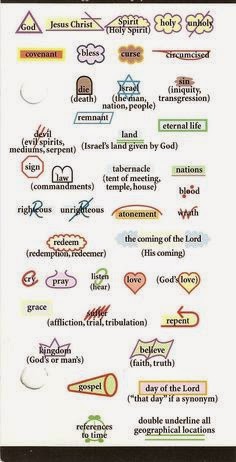
Mark each "key word" in a distinctive way, using symbols and/or color coding. Once you determine a symbol for the key word or phrase, it will be helpful to use this marking system throughout your Bible to facilitate quick recognition. (For many more examples of how to mark a book see this link)
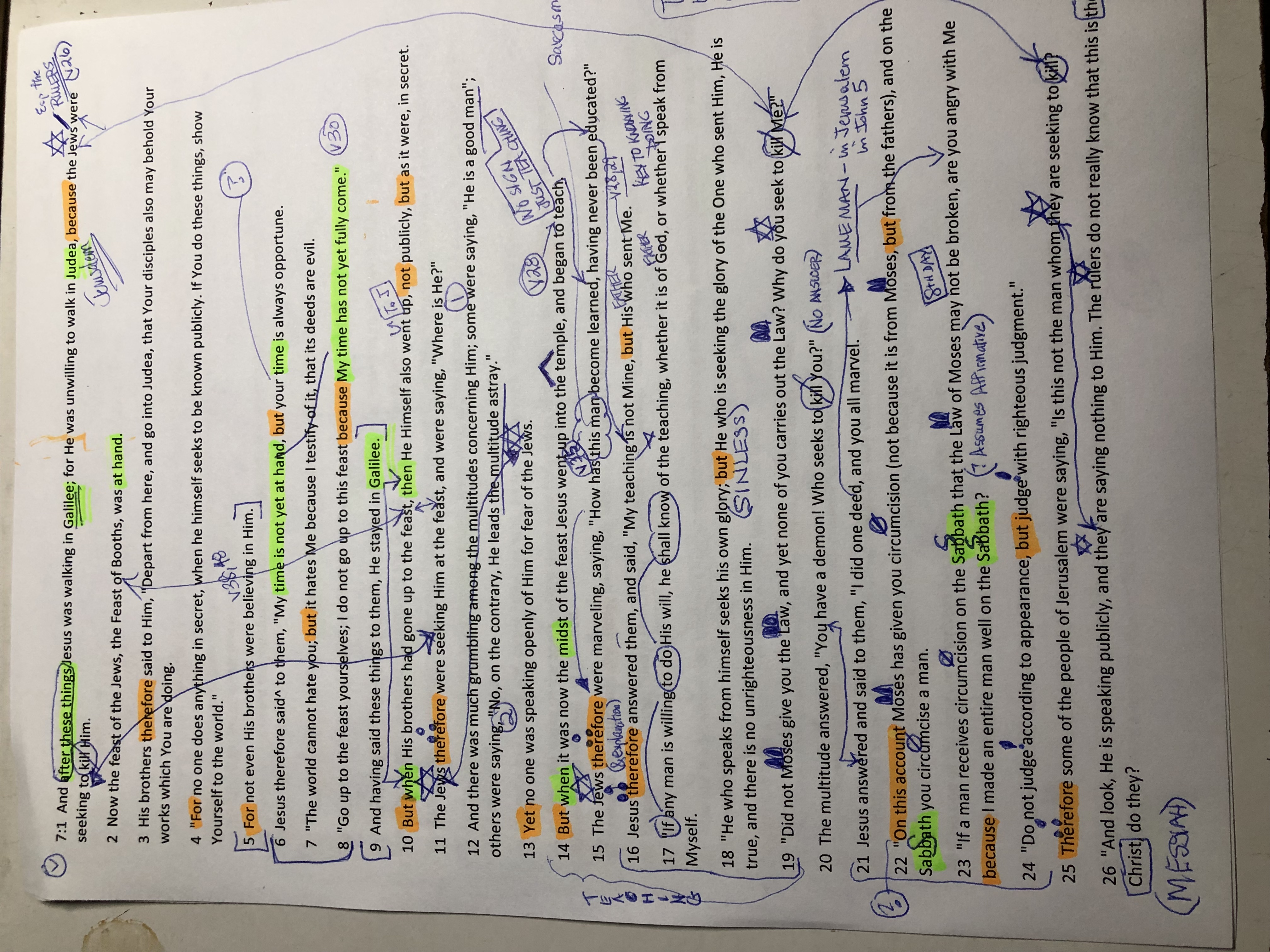
click to enlarge
Above is an example of a marked page I did in preparation for writing comments on John 7. Notice that one thing I find helpful is drawing lines/arrows connecting related words, clauses, passages, thoughts, etc. You probably do not want to do this in your personal Bible. Print off a copy of the text which gives you more freedom to change your markings which you will often do as you re-read and re-read the text!
Here are some examples of how you might mark some common key words (place symbol over the key word):
|
KEY WORD |
SYMBOL** |
| GOD (LORD or Jehovah in the OT) |
Purple Triangle |
| JESUS (Including references to Messiah in OT) |
Red Cross |
| HOLY SPIRIT | Blue Dove |
| TIME PHRASES |
Green Clock |
| GOSPEL | Red Megaphone |
**HINT: The symbols in the table are available in Microsoft Word's fonts - scroll down to "webdings" and "wingdings" (1-3). If you do not have Microsoft Word on your computer, these symbols will not be accurately displayed but you should still be able to understand the idea from the description of the symbol. Precept Ministries has an inexpensive bookmark entitled "How to Mark Key Words in Your Bible" with a number of examples for common Biblical words (call 1-800-763-8280 to order)
Remember that although God, Jesus and the Holy Spirit are always key words, they may occur many times in a given chapter or paragraph. In these situations, you may elect not to mark every occurrence lest you end up with so many marks that you can barely read the actual Scriptures! Use common sense about when to mark and when not to mark.
Don't forget to mark synonyms of the key word/phrase. A synonym is a word that has the same meaning as another word within a particular context and is used in place of the word. A synonym is like saying the same thing with a different word. For practice, read through 1 Thessalonians 1 (Click) and make note of the key word "gospel". If you have time print this chapter off (as an "Observation Worksheet") so you can mark the text. How would you mark "gospel"? What do you learn about the gospel? What other "5W's and H" questions can you ask of this key word? Now read through 1 Thessalonians 1 a second time, but this time read with the purpose of observing for any synonyms (including phrases) for "gospel" . Did you see any words or phrases that refer to the gospel? If you didn't see them, read it through a third time and you will probably see the two phrases that refer to the gospel. After reading through this chapter two or three times, you have begun to understand the context. You have also begun to understand how removal of "gospel" and its synonyms leaves the passage virtually devoid of meaning and on the other hand how an understanding of the key words/phrases helps you begin to discern the theme of this chapter. Click for more complete instructions on how to practice the inductive technique on 1 Thessalonians 1
WHY MARK
AND/OR COLOR THE TEXT?
Marking helps make the Scriptures your own because it helps remember the text. As discussed elsewhere, as a general rule we recall 10% of what we read, 20% of what we hear and 50% of what we read, hear and see (Click table). In addition (as with all of the Inductive "techniques") marking the text tends to slow us down, which is our desperate need. Marking in a sense helps us "be still" (Ps 46:10KJV) so that we might hear the still, small voice of the Spirit of the Lord speaking to us personally through the Holy Scriptures (1Ki 19:12KJV).
Marking allows one to quickly scan the page and see the key words that are emphasized in that section. Use the same symbols for key words from Genesis to Revelation as this will facilitate recognition throughout the Scriptures. Lamberski and Dwyer studied color coding and concluding that color-coding techniques improved attention, increased learner motivation and aided remembrance.
Avoid the temptation to "speed read" a passage and seeking to mechanically mark each occurrence of a key word (or reference to Author or Recipient if you are reading an epistle).
And don't forget that each encounter with a key word (fact about author or recipient) should stimulate a 5W's and H" question. Why is this used here? How does it impact the flow of thought? Who does this relate to? When did this occur?, etc. The more you practice this valuable skill, the more "sophisticated" your questions will become and the more profound will be the insights that the Spirit illuminates. And don't worry, for you can never run out of questions for the Word of God because it is a living Word!
As you seek to establish the context of the chapter or book, continually reading with a "marking, interrogating mindset", you will find yourself engaging more and more in active (versus passive) reading. Active reading not only stimulates your thinking and interaction with the text, it also slows you down. Active reading engages you in conversation with the Author. In a sense, by reading actively you are practicing the essence of the all but lost art of meditation on the Scriptures. Yes, marking and interrogating will slow you down somewhat, but you will gain so much more from the passage than if you had simply read through it in obedience to your "read through the Bible in a year" schedule.
Mark it down: Marking a book is not an act mutilation but of love. You may own the book but you've not really made it your own. Someone has well said that a Bible that is falling apart usually belongs to someone who is not!
Don't try to identify, mark and interrogate every "key word" in the first reading of a paragraph, chapter or book. A recommended approach is to read through a section (e.g., 2 Timothy 1) marking and interrogating a single key word. Then read through the same chapter again and mark another key word. To reiterate, "God", "Jesus", "Christ", "Lord" and "Spirit" are always "key words" and therefore should generally always be marked, unless they are so concentrated that marking them would make it difficult to see other key words in the text.
As you read and reread a chapter making observations on the key words, you will notice that you are beginning to understand and establish the context, which as "king" in the interpretation.
MARK THE SCRIPTURE:Are You Spoiling Your Beautiful Bible?
One day in St. Louis, Missouri, a young convert named C. I. Scofield walked into the office of a friend. He found him with a new copy of the Scriptures on his desk and a pencil in his hand. “Why, man, you’re spoiling that beautiful Bible!” exclaimed the young Christian. His older friend pointed him to Acts 8, where he had underscored the fifth verse, "Philip went down to the city of Samaria and began proclaiming Christ to them.“ (Acts 8:5) Then he had connected by a line to Acts 8:8 which reads, “So there was much rejoicing in that city.” Years afterward, Scofield frequently introduced his friend C. E. Paxson as “the man who first taught me to mark my Bible.” The inspiration and instruction that Paxson gave him led to the preparation of the now-famous Scofield Reference Bible with its helpful footnotes and cross-references."
Remember that while it is good to mark your Bible, it is better to let your Bible mark you because the value of the Bible is not in just knowing it, but in obeying it.
What kind of pen do I use to mark my Bible? One of the best pens for marking thin Bible pages is the Sakura Pigma Micron which comes in several colors, is long lasting, does not bleed through the page and comes in a variety of point widths (Micron 01 = 0.25mm is recommended - the 001 is superfine but can be easily bent).
How to Read the Bible
It shall greatly helpe ye to understande Scripture
If thou mark
Not only what is spoken or wrytten,
But of whom,
And to whom,
With what words
At what time,
Where,
To what intent,
With what circumstances,
Considering what goeth before
And what followeth.
Webster: in•ter•ro•gate \transitive verb:
to question formally and systematically
The best investigative reporters are the best interrogators - I think this truth applies to getting the most out of one's time in the Word of God, as long as one does not become too mechanical or pedantic. Mortimer Adler in his excellent book "How to Read a Book" (or here) writes...
If you ask a living teacher a question, he may really answer you. If you are puzzled by what he says, you may save yourself the trouble of thinking by asking him what he means. If, however, you ask a book a question, you must answer it yourself. In this respect a book is like nature. When you speak to it, it answers you only to the extent that you do the work of thinking and analysis yourself.
The Bible of course is not like nature, nor is it like any other book, for as believers we possess within ourselves (1Cor 3:16, 1Cor 6:19+) the Holy Spirit, the Author of the Book. And thus as we prayerfully, humbly, thoughtfully, meditatively, yea even as a little child interrogate the "living and active" (Heb 4:12+) Word of Truth (Ps 119:43+, 2Co 6:7, Col 1:5+, 2Ti 2:15+, Jas 1:18+, see also Jn 8:31,32, 17:17), our Teacher, the Spirit, in some very real (albeit to me still mysterious) way interacts with us, illuminating the inspired Word and leading us into all Truth, even as Jesus promised (John 16:13, cp Jn 14:16, 26, 15:26, 16:7 1Jn 2:20,27).
In his last letter to Timothy Paul wrote to this young disciple of Christ "Consider (command) what I say, for (term of explanation) the Lord will give you understanding in everything." (2Ti 2:7+) John Piper paraphrases Paul's instructions explaining to Timothy that "Thinking and asking questions (cp 5W/H questions) is the only way you will ever understand what I want to communicate in my letters. And either you do it poorly, or you do it well." (Ref)
To understand the Word of God,
Rely on the Spirit of God.
And so as you observe carefully for the author's use of key words and key phrases fight the urge to read passively by simply skimming over the text without engaging your mind. (You might search for the phrase "active reading" [6 hits] in How to Read a Book or here for Adler's comments on active reading) If you mark the text, you also need to fight the tendency to mark mechanically without thinking about what you just marked (I still fall into this "trap" even after years of practicing inductive Bible study). To counter these tendencies, we must make a definite choice to pause and prayerfully ponder and interrogate the inspired Word, asking and answering as many of the following "leading questions" as the text allows...
THE 5W/H QUESTIONS:
Who? Where? Why?
When? What?
How?
As an aside, questioning the text does not mean that one questions the inerrancy, plenary inspiration or authority of God's Holy Word!
The more you practice interrogating the text, the more the text will be opened to you by the illuminating ministry of the Spirit. Below are some suggestive questions, but remember to allow the text (and especially the context) to guide your specific questions...
Who is speaking? To whom and/or about whom is he speaking? Who are the main characters? Who is mentioned in the book (Why? What do we learn about them?) (In the epistles ask) Who is writing (author)? Who receiving?
Where did (or will) this happen (Why? When?)? Where was this said/written (where is the author) (Why?)?
Why was this written (What purpose?)? Why is this said? Why is he there?
When is this written (When in Biblical history - where on the timeline? When in the author's life)? When did/will this happen? When did he say/do it?
What is the author doing? What are the main events? What are the circumstances? What is the historical/cultural setting (as determined from the text)? What is the main subject of the chapter/book?
How will/did something happen? How is the truth illustrated?
Do not panic if you cannot ask every 5W/H question. And remember that these questions should be asked not only when you encounter key words or key phrases, but every time you identify one of the other Observation "code words" -- Contrast, Conclusion (and terms of explanation such as "for"), Comparison, Chronology (time phrase), etc. Every encounter with one of these "code words" is an opportunity to hone (sharpen) your skills of observation (SEE ALSO LITTLE "HINGE WORDS" WHICH CAN OPEN BIG DOORS OF INSIGHT AND UNDERSTANDING). Yes, it does take time and practice to train yourself to employ this "questioning mindset." (As an aside, questioning the text does not mean that one questions the inerrancy, plenary inspiration or authority of God's Holy Word!) As you train your eye to observe the Scriptures (this training takes some time), your enhanced ability to keenly observe and intelligently interrogate will also make you a better reader of everything you read for the rest of your life.
Learning to interrogate the Scripture with the 5W/H questions yields a number of dividends such as...
(1) It will force you to slow down and will "counteract" the tendency to "speed read" the Bible. This travesty is especially common when one falls behind schedule on their "Through the Bible in a Year" reading program! Here is a little test you can perform today. Assuming you began today with the "breakfast of champions", the pure milk of God's Word (1Pe 2:2+), ask yourself several times during the day, "What did I read this morning? What did it teach me about God? What did it say about me? How have I applied this Truth?" I fear too many of us have trouble recalling specific details of our time with God in His Word as the day draws nigh. I submit that if you pause and prayerfully ponder the pages of Holy Writ, your Teacher, the Spirit, will bring those passages to your remembrance during the day, giving you wisdom for living life to the full (John 10:10b)! On the other hand if it is the middle of the afternoon and you cannot even remember the book or chapter you read this morning, you have most likely read too fast and too passively. It is better to let one verse "read you" then to read a hundred verses that you cannot recall. Beloved, God's desire is that His book be our real time instruction manual for living, whether we are at home, at school or at work!
(2) It will engage your heart and mind with the text (and especially the Author of the text), forcing you to to read actively, more like an "explorer," rather than passively like a "tourist". The old adage "Stop and smell the roses" surely applies to acquisitively taking in the beauty of all of our Father's "good words" (Joshua 23:14, 21:45).
(3) It will create a "meditative mindset", as you pause and ponder the passages, chewing them like a cow chews cud, mulling them over in your mind, constantly seeking to ask the probing 5W/H questions. You will begin to gain insights into the Scriptures that you simply could not have been gleaned from a superficial, passive, unengaged reading of the Holy Word. You will begin to experience the joy of self discovery as your Teacher, the Spirit, illuminates and applies God's Truth to your life. In a very real sense, you will be learning how to meditate on the Holy Scriptures, a discipline which God promises to greatly bless (Read His promises which are applicable to you in Psalm 1:1+, Psalm 1:2+, Psalm 1:3+ and Joshua 1:8+).
We interpret the Bible properly when we learn to ask the right questions of the text. The problem is that many people do not know the "right questions" to ask or are either too lazy or too rushed to practice them! Imagine if God were to beckon you to come into His presence. Would you want to leave or would you linger? In His living and abiding Word, the Father has called us into His very presence, into communion with Himself, through the ministry of His Spirit and His Son, our Great High Priest, the Incarnate Word. May this transcendent truth motivate in all of us a continual "Mary like" attitude, so that we too would sit quietly at our Master's feet, lingering, listening, and learning the one thing that is really necessary (Lk 10:38 39 40 41 42)!
A W Pink wrote that "No verse of Scripture yields its meaning to lazy people." It therefore behooves us to "gird the loins of our mind for action" (1Peter 1:13+), so that we might diligently practice interrogating the Scriptures with the 5W/H's. As someone once pithily put it "God feeds the birds, but He doesn't throw the food into their nests!"
Learning to ask the right questions, to discern the answers and to carefully observe the text demands discipline, diligence and doing ("Just do it!"). Most "amateur sleuths" have never been trained in the "Sherlock Holmes Approach" to Scripture. If I were the Devil, that one who does not stand in the Truth (Jn 8:44), I would do everything I could to discourage the saints from learning now to carefully observe the Word of Truth for themselves, for fear that they might become equipped to fend off the fiery missiles of deceit filled lies leading to doubt, discouragement and despair. Had Eve been a better "inductive student", one wonders how events would have progressed on that fateful day in the Garden when our Adversary hissed those words calculated to generate doubt "Yea, hath God said...?" (Ge 3:1). So dear saint, let me encourage you to persevere in practicing the principles of Inductive Bible Study, for the reward you will experience in personal discovery and penetrating understanding of the Word of Life will eternally far outweigh your investment of time today (Ep 5:16KJV+, 1Ti 4:7, 8+)!
In short, the importance of a questioning mindset cannot be overemphasized as the answers to the 5W/H questions form the basis for every aspect of Inductive Bible Study - astute observation, accurate interpretation and appropriate application.
Although Rudyard Kipling was not referring to Inductive Bible Study when he wrote his poem Six Honest Serving-Men, you can still observe the parallel principle poetically phrased...
I keep six honest serving-men
(They taught me all I knew);
Their names are What and Why and When
And How and Where and Who.
I send them over land and sea,
I send them east and west;
But after they have worked for me,
I give them all a rest.
Kipling gives sound "Biblical" advice, except for his last line. Beloved, make it the goal of your life to never "give them all a rest" but instead daily "Be diligent (aorist imperative = Don't Delay! "Just Do It!" = a command we can obey only as we are enabled by the indwelling Spirit Who is continually "energizing" us Php 2:13NLT+! So Stay filled! Eph 5:18+! And daily walk by the Spirit Gal 5:16+, not grieving Him - Eph 4:30+ nor quenching Him-1Th 5:19+) to present yourself approved to God as a workman who does not need to be ashamed, handling accurately the Word of Truth." (2 Timothy 2:15+)
Most students of Scripture do not see the "gold nuggets" of truth in passages and paragraphs, because they do not know what to look for. One way you will learn what to look for is by asking the right questions. Questions will bring details to our attention. The following story from the secular classroom setting illustrates this point.
George Wood applies an interesting technique when he prepares and preaches a sermon on a particular text "As we read this particular text today, we want to do what we always do when we come to the Scripture, and ask two questions: "What DID the Scripture say?" And, "What DOES it say?" Answering "What did it say?" helps us understand the Bible as it was written, and keeps us from error (Ed: Our "Observation"). But answering the question, "What does the Bible say?" allows us to apply the Scripture now and personalize it in our life. (Ed: He combines interpretation and application)
Dr Martyn Lloyd-Jones speaks about the importance of interrogating the Word of God - I digress for a moment to point out that when we read our Bibles nothing is more important than that we should look at every word, and question it as to its meaning. How easy it is to do a certain amount of Bible reading every day, followed perhaps by a brief prayer! If your main concern is simply to read a certain amount each day you may well skip over words such as these, these profundities of our faith....We must learn how to read the Scriptures; and there is no one thing that is more important when we do so than just this, to ask questions of it. (from his sermon on Ephesians 1 Grace, Peace, Glory)
The essence of the inductive method was aptly illustrated by the experience of a student at Harvard who took a zoology course under professor Louis Agassiz, the renowned nineteenth-century naturalist. For the assignment Agassiz gave the student a pickled fish, a haemulon, which was to be the sole source of his observations over the next several days. (Click to read entire story) For three full days the student observed the Haemulon in order to gain a thorough understanding of the fish. And what did Professor Agassiz's advise him to do? LOOK! LOOK! LOOK! How else would the student master his subject? (Ed: Ask! Ask! Ask!) He was also instructed to draw out what he saw (Ed: Compare with Marking the Text, Making Lists, Recording your observations) for as Agassiz reminded him that the pencil is one of the best eyes!
Finally, he was instructed to recognize the parts of the haemulon in their orderly arrangement and relations to each other, for "facts are stupid things until brought into connection with some general law." (Ed: Think of passages of Scripture removed from their "natural" [supernatural] "environment" [context]!)
Was Agassiz's inductive method successfully inculcated into his student? By the student's own testimony "To this day, if I attempt [to draw] a fish I can draw nothing but haemulons." (Ed: The Bible in your memory is better than the Bible on your bookshelf!)
Louis Agassiz was once asked “What was your greatest contribution, scientifically?” to which he replied "I have taught men and women to observe."
The ability to correctly observe is a skill which must be perfected by practice and perseverance as illustrated in this true "fish story."
THE RESULTS CAN BE
LIFE CHANGING!
As an interesting aside, this renowned Harvard scientist steadfastly (his entire life) resisted the propagation of Charles Darwin's theories on evolution! May his tribe increase. Amen! (Louis Agassiz - Short Biography).
Warren Wiersbe phrased it this way "If we speak to the Lord about the Word, the Word will speak to us about the Lord!"
If you don’t talk to your Bible,
your Bible isn’t likely to talk to you!
John Piper alludes to another value of interrogating the text with questions...
So meditating on the Word of God day and night means to speak to yourself the Word of God day and night and to speak to yourself about it—to mull it over, to ask questions about it and answer them from the Scripture itself, to ask yourself how this might apply to you and others, and to ponder its implications for life and church and culture and missions. (When I Don't Desire God How to Fight for Joy - Online and free to Download) (Related Resources: Primer On Biblical Meditation; Meditation - Application of Inductive Bible Study)
You can learn more from a book if you stop and ask it questions than if you just read it passively. That includes the Bible too. One of the great problems in Bible reading is that we move our eyes over the words and come to the end of a column and don't know what we've read; we don't feel our minds or spirits expanded because we saw nothing fresh. It was purely mechanical. There was no discovery, no life, no breakthroughs to new insight. One of the best ways to change that is to train yourself to ask questions of the text. Often the posing of the question itself will already carry its answer with it and will open your mind to new things. This fairly prosaic, historical text in Luke 3:21–38 gives me an opportunity to show you what I mean. I'll simply take you with me through this text, pointing out the questions I asked and the answers I came up with. My guess is that as you follow me, questions of your own will arise. Good questions usually beget other questions, and that's how insight grows and grows. (Introductory comments to his sermon on The Baptism and the Genealogy of Jesus)
Editorial comment - Now click this link to see examples of questions Dr Piper asked to preach this text! Begin to incorporate this discipline of an "interrogative mindset" into your Bible reading. Beware of the danger of the "through the Bible in a year" reading program -- it is tempting to "just get through" the daily reading, but come to the end of the day and not even remember what you have read. That's "passive" reading. Interrogation of the text is "active" reading--your Teacher God's Spirit will richly reward you for your "labor of love!"
In Brothers, we are not professionals Dr Piper comments has more comments on querying the text
Several strong forces oppose our relentless and systematic interrogating of Biblical texts.
(1) One is that it consumes a great deal of time and energy on one small portion of Scripture. We have been schooled (quite erroneously) that there is a direct correlation between reading a lot and gaining insight. But, in fact, there is no positive correlation at all between the quantity of pages read and the quality of insight gained. Just the reverse for most of us. Insight diminishes as we try to read more and more. Insight or understanding is the product of intensive, headache-producing meditation on two or three propositions and how they fit together. This kind of reflection and rumination is provoked by asking questions of the text. And you cannot do it if you hurry. Therefore, we must resist the deceptive urge to carve notches in our bibliographic gun. Take two hours to ask ten questions of Galatians 2:20, and you will gain one hundred times the insight you would have attained by quickly reading thirty pages of the New Testament or any other book. Slow down. Query. Ponder. Chew....
It is impossible to respect the Bible too highly, but it is possible to respect it wrongly. If we do not ask seriously how differing texts fit together, then we are either superhuman (and see all truth at a glance) or indifferent (and don’t care about seeing the coherence of truth). But I don’t see how anyone who is indifferent or superhuman can have a proper respect for the Bible. Therefore reverence for God’s Word demands that we ask questions and pose problems and that we believe that there are answers and solutions which will reward our labor with treasures new and old (Matt. 13:52). We must train our people that it is not irreverent to see difficulties in the Biblical text and to think hard about how they can be resolved. Preaching should model this for them week after week....
I already quoted 2 Timothy 2:7+. But I close now by pointing out the relationship between the two halves of this verse. There is a command and a promise. Paul commanded, “Think (Ed: Command to do this continually) over what I say.” And then he promised, “God will give you understanding in everything.” Some people see tension between cogitation and illumination. Not Paul. He commands cogitation. And he promises illumination. How do the command and promise fit together? The little connecting word for gives the answer (Ed: See term of explanation) “Think … because God will reward you with understanding.”
A text like this explains why Benjamin Warfield reacted with dismay at those who elevated prayer for divine illumination above rigorous observation of God’s written Word and serious intellectual reflection on what it says....This is why the Bible has so many appeals to us that we should both meditate on the written Word of God with our minds and pray that God do His revelatory work in our hearts...To all the commands to meditate and think about God’s Word, the Bible adds the promise, “The Lord will give you understanding.” The gift of illumination does not replace meditation. It comes through meditation. The promise of divine light is not made to all. It is made to those who think. “Think over what I say, for God will give you understanding in everything.” And we do not think until we are confronted with a problem. Therefore, brothers, let us query the text. (Brothers, we are not professionals - free online Pdf)
ACTIVE VERSUS
PASSIVE READING
In his short biography of Jonathan Edwards Piper writes...
Edwards was not a passive reader. He read with a view to solving problems. Most of us are cursed with a penchant toward passive reading. We read the way people watch TV. We don't ask questions as we read. We don't ask, Why does this sentence follow that sentence? (Ed: cp observing for terms of explanation, terms of conclusion and terms of purpose or result) How does this paragraph relate to that one three pages earlier? (Ed: cp context and Keep Context King) We don't ferret out the order of thought or ponder the meaning of terms (Ed: How to Perform a Greek Word Study, Greek Word Studies and Hebrew Word Studies). And if we see a problem, we are habituated to leave that for the experts (Ed: We run too quickly to the commentaries, etc) and seldom do we tackle a solution then and there the way Edwards said he was committed to do if time allowed.
But Edwards calls us to be active in our minds when we read. A pastor will not be able to feed his flock rich and challenging insight into God's word unless he becomes a disciplined thinker. (Ed: One might say "active reading" is "thinking reading" or thinking while you are reading) But almost none of us does this by nature. We must train ourselves to do it (Ed: Piper hits the proverbial "nail on the head!" We need to discipline ourselves like Paul says in 1Ti 4:7-8+. And spiritual discipline takes work!). And one of the best ways to train ourselves to think about what we read is to read with pen in hand (Ed: cp marking key words - drawing lines between associations, contrasts, etc) and to write down a train of thought that comes to mind. Without this, we simply cannot sustain a sequence of questions and answers long enough to come to penetrating conclusions. This was the simple method that caused Edwards' native genius to produce immense and lasting results. (The Pastor as Theologian)
While strictly speaking John Piper's "Look at the Book" video studies are not classic inductive studies, he does go through passages applying active reading principles. If you decide to watch some of Piper's videos, first carry out your own inductive analysis of the passage before you watch his videos. Otherwise you will spoil your joy of self-discovery and you will find it difficult to read the passage "as if for the first time," because you will approach the text with his conclusions/bias/interpretation. That said, Piper's approach does give you an excellent example of active reading of a text. See Look at the Book list of Scriptures.
Below are some quotes from Mortimer Adler's modern day classic How to Read a Book related to active versus passive reading...
What we call passive is simply less active. Reading is better or worse according as it is more or less active. And one reader is better than another in proportion as he is capable of a greater range of activity in reading.....(ED: I WOULD INTERJECT THAT HE OR SHE IS LEARNING TO APPLY THE SKILLS OF INDUCTIVE STUDY - CONTEXT, KEY WORDS, INTERROGATION OF THE TEXT, ETC).
No one doubts that writing and speaking are active undertakings, in which the writer or speaker is clearly doing something. Many people seem to think, however, that reading and listening are entirely passive. No work need be done. They think of reading and listening as receiving communication from someone who is actively giving it. So far they are right, but then they make the error of supposing that receiving communication is like receiving a blow, or a legacy, or a judgment from the court....
The outstanding fault of the passive reader is his inattention to words, and his consequent failure to come to terms with the author. Until passive reading is overcome, the reader proceeds as if he knew what all the words meant, especially if he is reading something in which the important words also happen to be words in popular usage....
"The art of reading, in short, includes all the same skills that are involved in the art of discovery (ED: WHICH IS A MAJOR GOAL OF INDUCTIVE BIBLE STUDY): keenness of observation, readily available memory, range of imagination, and, of course, a reason trained in analysis and reflection."
Open my eyes,
that I may behold Wonderful things from Your law.
-- Psalm 119:18+
I also like to refer to these "connecting words" as "hinge words," because like hinges are necessary for a door to open properly, so too these words when properly understood can "open doors" to your understanding of the Scriptures. To reiterate, little hinges allow you to open big doors of understanding. In simple terms, a hinge word is a word that connects two parts of a sentence and often marks a transition, escalation, contrast, or causality. Instead of being a passive reader (See Adler's note on page 15 of How to Read a Book "Things you can comprehend without effort, such as magazines and newspapers, require a minimum of reading. You need very little art. You can read in a relatively passive way." page 18), now you can become an active reader, actively interrogating the "hinge words," and engaging interactively and personally (not mechanically) with the inspired Word (and therefore with God Himself!) You can make the shift from being a "TOURIST," (who skims the surface of places without staying long, observing from a distance rather than diving deep) to becoming an "EXPLORER" of the infinite treasures found in God's Word (cf Col 2:3+). In spiritual terms, a "TOURIST" visiting God’s Word reads the Scripture occasionally and/or casually, looking for inspirational verses without context (I used to do that with my memory verses, completely pulling them out of context!), preferring superficial familiarity over deep study and thus moving quickly through the text (especially is you are trying to keep pace with a "Read Through the Bible in a Year" program) without reflecting, meditating or applying. On the other hand an "EXPLORER” in God’s Word digs deep, seeking discovery and understanding, going beyond the surface, sometimes into difficult or unfamiliar terrain. The "EXPLORER” studies with a sense of awe and delight (that is is actually God Himself speaking to them), asking questions, seeking to establish the context, and following related cross-references. In short, the EXPLORER searches (paradoxically) for the "unsearchable riches in Christ" (Eph. 3:8+). These descriptions beg the question, do you read the Bible more like a TOURIST or like an EXPLORER?
🙏 THOUGHT - Here's a quick test - Did you see the "hinge word" in Psalm 119:18+? Notice the conjunction "that" which in this context serves as term of purpose and/or result and begs the simple question "Why should I ask God to open my eyes when I open His Word?" Or "What is the result of God's Spirit opening the eyes of my heart when I read His Word?" While this is a simple example, notice how observing and querying this hinge word enables you to meditate on this passage. Let the advice of Dr John Piper encourage you to begin to practice the fruitful disciplines of observation and interrogation --
"Insight or understanding is the product of intensive, headache-producing meditation on two or three verses and how they fit together. This kind of reflection and rumination is provoked by asking questions of the text. And you cannot do it if you hurry. Therefore, we must resist the deceptive urge to carve notches in our bibliographic gun. Take two hours to ask ten questions of Galatians 2:20+ and you will gain one hundred times the insight you would have attained by reading thirty pages of the New Testament or any other book. Slow down. Query. Ponder. Chew." (Brothers Let Us Query the Text) (Bolding added)
Small words, big blessings! Connecting words (conjunctions) join clauses, passages, paragraphs and chapters, linking the writer's train of thought into a cohesive unit. Someone has said that "conjunctions are important gap-fillers, the cartilage at the joints of speech." These small but vital connectors include words and phrases such as therefore, for, because, since, as a result, so, so that, at that time, then, now, when, for this reason, etc. Although these connecting words/phrases are common, it is probably because they are so common that they are easy to overlook and miss the vital connections they make in the text. However, once your eye is trained to recognize them, they function as "keys" which serve to unlock and shed light on the meaning of a passage, paragraph or chapter. Like well-oiled hinges, enabled by the Spirit, these little words begin to open big doors in your understanding of the Bible. Proper utilization of these connecting words will usually force you to examine the preceding context, which is always valuable to enhance the accuracy of your interpretation, because context is king in interpretation! I would be so bold as to say that if you learned to observe and interrogate even just one term (e.g., the conjunction "for"), it would radically change the way you read ALL of God's Word (because there are over 9000 uses of for throughout the Bible)!
🙏 THOUGHT - I was discipling a couple who live in India over Zoom recently and we spent one session discussing the significance of the little word "for" in the Bible. The following week, the wife stated that her Bible reading the past week had literally been transformed by understanding how to observe and interrogate the little word "for!" I was a bit taken aback, but of course was overjoyed, as I had never heard such a God glorifying personal testimony regarding the word "for!" My prayer for all who read these notes is that your Teacher, the Holy Spirit, would bring about the same transformative effect as you read the holy Scriptures, training yourself to observe and interrogate "hinge" words like "for." In Jesus' Name. Amen.
One other conjunction that is so common that it is frequently overlooked is the word "and." And is used as a function word to connect 2 or more terms or phrases. And can be used as a coordinating conjunction; expressing two elements to be taken together or in addition to each other. "And is a connective. The minute a speaker says and, he has to keep talking because and connects something that has gone before with something that is coming." (McGee).
While there can be overlap in the meaning of these terms, below are the general descriptions of each group, with a Scriptural example and a sample question prompted by use of that term. Before you look at the sample question, practice interrogating the passage yourself (your question may be much better than the one recorded!)
Related Resource:
- Youtube Video - Example of the Hinge Word "For" (video I did for folks in Tanzania)
- Inductive Bible Study - video about how to use hinge words to change the way you read the Bible! (video for a church in India)
AND The conjunction and is the Hebrew word waw and in Greek is the word kai. The word “and” is one of the most common hinge words in Scripture (22, 433x in NAS77) and in general writing. Though simple, it often carries more weight than it seems, especially in biblical narratives and teachings.
One should always take note of this frequent conjunction which serves to connect or join sentences, words or ideas (See tables below for more nuanced uses of "and"). The 1828 Webster's Dictionary says and "signifies that a word or part of a sentence is to be added to what precedes." Henry Morris in commenting on the presence of and (Heb = waw) in Genesis 1 comments "It is significant that every verse in the first chapter of Genesis (except Ge 1:1) begins with the conjunction “And” (Hebrew waw). This structure clearly means that each statement is sequentially and chronologically connected to the verses before and after. Each action follows directly upon the action described in the verse preceding it." (Borrow Genesis Record page 48) It follows that we should not neglect observing the conjunction and.
ILLUSTRATION OF VALUE OF "AND" - J Vernon McGee gives an interesting example of the value of observing "and" in his comments on Joshua 1:1+ which is translated as beginning with "Now" in the NAS and "after" in several other versions (Josh 1:1ESV, etc). The literal rendering however is "And it cometh to pass after the death of Moses...." (See Joshua 1:1YLT+). The Septuagint (Lxx) translation begins this verse with "kai" which is most often rendered "and." And so McGee comments "The first word of this verse, Now, should be translated “And,” which connects it with the final chapter of Deuteronomy. And is a connective. The minute a speaker says and, he has to keep talking because and connects something that has gone before with something that is coming. This supports the theory that Deuteronomy 34+ (Ed: Which describes the death of Moses) was written by Joshua." (See commentary)
Kai (and) is mostly a simple continuative, marking the progress of a continued discourse. In addition kai can be used as a continuative in respect to time, i.e., connecting clauses and sentences in the order of time. E.g., at the beginning of a sentence where anything is narrated as being done immediately or soon after that which the preceding context narrates (In this sense it functions much like the conjunction "then.") Kai can also be used as a conclusion, as when something is said to follow at once upon that which is presented in the preceding proposition. For example, in Mt 8:15+ we read "He touched her hand, and (kai) the fever left her." The idea is that "and immediately the fever left her." Here is another example from Mk 1:27+ "He (Jesus) commands even the unclean spirits, and (kai) they obey Him.” How fast do they "obey Him?" Immediately! Beloved, if the unclean spirits obey Jesus, should those of us who are now His very own possession (Titus 2:14+), His bond-servants (2 Ti 2:24+), not also obey immediately? That is rhetorical of course! Lord, enable us to have the desire and the power (cf Php 2:13NLT+) to more consistently obey You immediately! Amen. Jesus commands Levi "“Follow Me!” And (kai - and immediately) he got up and followed Him." (Mk 2:14). In Luke 8:25+ Jesus "commands even the winds and the water, and (kai = and immediately) they obey Him?”
In sum, don't discount the potential value of observing and interrogating the little conjunction "and." Here is a summary of Kai from the Analytical Lexicon
Kai - καί a coordinating conjunction with the sense varying according to its circumstances;
I. as a connective;
- connecting single words = and (Mt 2:11d);
- as a continuative, connecting clauses and sentences = and (Mt 21:23c);
- as coordinating time with an event when (Mk 15:25); (4) to introduce a result from preceding circumstances = and then, and so (Mt 4:19);
- to introduce an abrupt question expressing a contrasting feeling = then, in that case (2Co 2:2);
- as emphasizing an unexpected fact = and yet, nevertheless, and in spite of that (Mt 3:14);
- to explain what preceded = and so, that is, namely (Mt 8:33b; Jn 1:16);
- κ.… κ. both … and, not only … but also (Acts 26:29);
II. adverb;
- as an adjunctive = also, too (Mt 5:39);
- as an ascensive, introducing something unusual = even (Mt 5:46);
- to reinforce a contrast or comparison = also (2Co 8:11b; Heb 8:6) (BORROW Analytical lexicon of the Greek New Testament)
|
Function |
Description |
Example |
|
Simple Connector |
Links two equal ideas
|
“Jesus came and spoke…” |
|
Progressive Step (Amplification) |
Moves the thought forward with additional or deeper meaning |
"He went and found his brother” (John 1:41) |
|
Hinge Between Events |
Shifts from one event to another, especially in narrative |
“And He left them and went out of the city” (Matt 21:17) |
|
Cause-and-Effect Implication |
Sometimes implies logical progression (“and so...”) |
“They were amazed, and glorified God” (Luke 5:26) |
|
Parallel or Contrasting Action |
Shows contrast when used repetitively or rhythmically |
“They say and do not do” (Matt 23:3) |
|
Poetic or Rhetorical Flow |
Used to heighten intensity or build rhythm (especially in Hebrew poetry) |
Psalm 23: “He makes me lie down… and leads me… and restores…” |
THE FOLLOWING TABLE IS SIMILAR TO THE PRECEDING GIVING MORE NUANCED USES OF THE LITTLE WORD "AND"
|
FUNCTION OF 'AND' |
ROLE AS A HINGE WORD |
EXAMPLE |
|
ADDITION |
Adds new detail
|
“They bind burdens and won’t lift…” |
|
PROGRESSION |
Moves the action forward |
“He came and taught…” |
|
ESCALATION |
Intensifies accusation or praise |
“Love the greetings and the title…” |
|
TRANSITION |
Marks a shift to a new but related thought |
“He rebuked them and turned away…” |
|
PARALLELISM |
Pairs ideas with rhetorical or poetic effect |
“They tithe mint and neglect justice” |
|
RHYTHM/FLOW |
Maintains pace in storytelling or prophecy |
And God said… And it was so…” |
Here is another way to look at AND..
1. Additive / Coordinating
The most common use: linking two ideas together, often equal in weight.
Example: “Grace and truth were realized through Jesus Christ” (John 1:17).
Function: joins things without implying contrast.
2. Ascensive / Emphatic (“even, indeed”)
Sometimes kai heightens or emphasizes the second term.
Example: “And (kai = even) the Word became flesh” (John 1:14).
Function: intensifies, like saying “and in fact…”
3. Adversative / Contrastive (“but”)
In some contexts, kai carries the sense of mild contrast.
Example: “And (kai, but) not only this…” (Rom 5:3).
Function: shows progression or a shift in thought.
4. Consecutive / Resultative (“and so, and therefore”)
Kai can show cause and effect or logical sequence.
Example: “And (kai, so) they glorified God” (Acts 11:18).
5. Epexegetical (“serving to explain, clarify, or define something further”) / Explanatory (“that is, namely”)
Sometimes kai introduces further explanation of the previous phrase.
Example: “the sword of the Spirit, which is the word of God” (Eph 6:17). In some Greek constructions, kai helps make this identification.
✍️ Summary - The conjunction AND (kai) most often adds or joins, but depending on context it can also emphasize, contrast, show result, or explain. That’s why in English Bibles it sometimes gets translated as “and, also, even, indeed, so, but, namely.”
(1) Terms of conclusion (inference) = Synonyms = Therefore, So, For this reason, So then, etc
(a) Identifies a logical consequence or conclusion
(b) Identifies a statement which summarizes what was previously stated
(c) Identifies a deduction from (usually previously stated) facts, propositions, experience, reasoning, etc
(d) Sums up a preceding argument.
Ex: "Therefore do not let sin reign in your mortal body so that you obey its lusts." (Ro 6:12).
Question: Why does Paul conclude that one should not let sin reign in their mortal body? To answer you will be forced to review the prior verse Ro 6:11 and even the prior section Ro 6:1-10 (the foundational facts that allow Paul to issue the command in Ro 6:11)
(2) Terms of explanation = For, Because (for the reason explained next), some uses of since (e.g., Dt 15:4, 16, Heb 13:3)
(a) Give the reason for something, making it plain or understandable
(b) Give reasons why it is true or why it occurred
(c) Used to express cause, to explain (to give the reason for or cause of)
(d) Simply adds additional information.
(e) HINT -- A rule of thumb is that if you can substitute the word "because" in place of a "for," that is good support that the for is functioning as a term of explanation.
Ex: "For I am not ashamed of the Gospel, for it is the power of God for (notice this "for" is used as a preposition, not a conjunction and thus not a term of explanation) salvation to everyone who believes, to the Jew first and also to the Greek." (Ro 1:16)
Question: What is Paul explaining? Why is Paul not ashamed of the Gospel? What effect does this have on Paul? How does this impact Paul's boldness to proclaim the Gospel? (See Ro 1:15).
Ex: "For God knows that in the day you eat from it your eyes will be opened, and you will be like God, knowing good and evil." (Genesis 3:5)
Question: Who is speaking? To whom is he speaking? What is he explaining? What is he arguing? What is his goal? Is his explanation truthful? Comment: Notice how focusing on only one for prompts a veritable barrage of questions and greatly increases our insight into this important passage!
(3) Terms of purpose/result = So that, In order that, That (Of course, not all uses of "that" indicated a term of purpose or result, but uses at the beginning of a sentence or clause are more likely to have that function.)
(a) Indicates the intended goal of an idea or action.
(b) Indicates the end; effect; aim; design; consequence, good or bad.
(c) The reason for which something is done.
(d) So that = for the purpose of (1Cor 10:33)
Ex: For (term of explanation) I long to see you so that I may impart some spiritual gift to you, that you may be established. (Ro 1:11)
See Video from John Piper (Ro 8:3-4, Ro 7:4-6) - He writes "Purpose clauses ("in order that") tell us why God does what He does." While he does not go into detailed discussion of purpose clauses in his 9 minute video What the Law Could Not Do, he does highlight Paul's two uses of "in order that" and one use of "so that" emphasizing their crucial importance in Paul's argument. If you struggle with legalism, this video could be a powerful antidote for that "ism" which always counters grace and weakens our spiritual walk in the Spirit (Gal 3:3+). So pray, set aside 30 minutes and follow along with Dr Piper. Then memorize the passages discussed, asking the Spirit to use them to renew your mind and transform your thinking about the law IN ORDER THAT you might be enabled to walk according to the Spirit!
Question: What is the purpose of Paul's longing to see the saints in Rome? What is the purpose of his imparting a spiritual gift to them?
|
TERMS OF |
||
|
Term |
Example |
# of Occurrences* |
|
Therefore |
Ge 3:23 |
915x |
|
So** |
Ge 3:24 |
2199x |
|
For this reason |
Ge 2:24 |
68x |
|
So then |
Mt 12:12 |
36x |
|
TERMS OF |
||
|
For ** |
Ge 3:5 |
9583x |
|
Because** |
Ge 2:23 |
1426x |
|
TERMS EXPRESSING |
||
|
So that |
Ge 4:15 |
992x |
|
In order that |
Ex 20:20 |
38x |
|
In order to |
Ge 50:20 |
92x |
|
* Number of uses in the 1995 New American Standard translation ** Not every use is term of conclusion or term of explanation - check the context. When found at the beginning of a verse the term is usually a term of explanation. +: All words in BLUE are links to the uses of the word or phrase. |
||
Train your eye to observe the text carefully for these strategic words. Consider marking them in some distinctive manner (underlining, boxing, using a symbol).
"Conjunctions are important gap-fillers,
the cartilage at the joints of speech."
From the table above, what is the likelihood of encountering one of these terms in a chapter or paragraph? If you have ever rock climbed, you know that you are observing carefully for a ledge, outcropping, crack or crevice which you can grasp or in which you can plant your foot. The goal is to keep moving upward. How careful do you think you would be if you were several stories high on a large rock? The answer is obvious...very careful! While the analogy is imperfect, the rock climber's observations clearly determine the outcome of the outing (going up or down!).
What would happen to our observation skills in reading the Scripture, if we approached the text like rock climbers, observing carefully for these strategic terms (conclusion, contrast, explanation, purpose/result)? Clearly interacting with each encounter could increase our level of understanding, firmly grounding us on the truth. And as we train our eyes to spot these strategic terms, we also begin to train our minds to ask as many of the 5W/H type questions as we can muster.
The more skilled rock climbers becomes at identifying strategic rocks, cracks and crevices, the higher they are able to ascend. In the same way, as we practice and become proficient at observing and questioning these strategic Scriptural terms (of conclusion, contrast, explanation, purpose/result), we will be enabled (by our ever present Teacher the Spirit of course) to probe deeper into the meaning of a passage, paragraph, chapter or book. And over time observation for these terms will become our reflex response. Given the importance of these small, easily overlooked words and phrases, let's take another more in depth look at them.
Therefore - This is probably the best known "hinge" word. How often have you heard a pastor or teacher say "Every time you see a therefore always ask the question "What's it there for?"
Ray Burns wrote a short article entitled "What's the Therefore, There For?" in which he said "The title of this article is how I first realized I didn’t know how to read the Bible. I could quote it, I could tell others what I was told it said, but I didn’t know how to understand what was being said, and more importantly I often had no idea why something was said. I was guilty of eisegesis, a fancy way of saying “using a Bible verse without any real thought to what it meant when the author wrote it....Think of the word “therefore” as a magnifying glass, taking a bigger idea and zooming in to an important aspect of it. It says “We’ve discussed a big truth, now here’s why it matters.” If “therefore” is our signal that something important is being clarified, we should immediately stop and ask ourselves “Do I know what is being clarified?”...whenever you encounter this word, take time to answer one of the most important questions we can ask in our Bible reading: What’s the “therefore” there for? ”
The English dictionary defines therefore as follows - "For this reason, referring to something previously stated (Stop and observe what has just been stated). Therefore is used to introduce the logical result of something that has just been mentioned. Therefore is used to mark an inference (truth or proposition drawn from another truth) on the speaker’s part: those people have their umbrellas up; therefore, it must be raining.
Webster's 1828 Dictionary explains that "Inferences result from reasoning, as when the mind perceives such a connection between ideas, as that, if certain propositions called premises are true, the conclusions or propositions deduced from them must also be true." Webster's 1996 Dictionary adds that inference is "the act of passing from one proposition, statement, or judgment considered as true to another whose truth is believed to follow from that of the former."
Practice It! - Read Ge 3:23 therefore the LORD God sent him out from the garden of Eden, to cultivate the ground from which he was taken. What is the 5W/H question? Why did the LORD God send him (Adam) from the garden? How would you determine the answer? Examination of the preceding context (Ge 3:22) provides the answer
THE "HINGE" WORD
"SO"
So is another little "hinge" word that can function as a term of conclusion. So is frequently found at the beginning of verses and when used as a term of conclusion should prompt you to ask "Why?" which should draw your attention to preceding context to answer the question. There are over 3500 uses of "so" in the NAS95, but clearly not all uses of "so" are terms of conclusion. You will need to examine the context to determine if a given "so" and if you can substitute the word "therefore" and the sentence still make sense, that occurrence of "so" is functioning as a term of conclusion. Another clue that a given "so" may be term of conclusion is when it is the first word in a sentence (Jn 8:13+). And be aware that the use of "so" in the phrase "so that" functions as another important "hinge word" identifying it as a term of result or purpose.
Practice It! - Read Ge 2:21+. "So the LORD God caused a deep sleep to fall upon the man, and he slept; then He took one of his ribs, and closed up the flesh at that place."
What question does "so" prompt in this passage? How do you answer the question? Clearly you are forced to check the immediate context (Ge 2:20) to answer the simple question "Why" is so used?" or more to the point, "Why did the Lord God cause a deep sleep to fall on Adam?"
Do you see how this simple "technique" serves to slow you down and encourages you to actively (rather than passively) "engage" and interact with the passage and the Author of the passage?! Your observations in turn will lead you to more accurate interpretation of the passage.
FOR THIS REASON
For this reason - This phrase is used 68x in NAS but only 14 in ESV (which usually substitutes "therefore"). For this reason is relatively easy to interrogate because it always begs at least one simple question -- "For what reason?". Remember when practicing interrogation of "for this reason" (and for that matter, any of the "hinge" words), some passages will be easier to evaluate and yield more insights than other passages, so don't be frustrated if observation of some "hinge" words is not as rewarding as other "hinge" words. Keep practicing!
You will always receive one benefit in that you are slowing down and "forcing" yourself to focus more directly on a particular text, in essence meditating on the passage, rather than "speed reading" it! And as you slow down and meditatively interrogate a passage, you will give your Teacher, the Spirit, greater opportunity to speak to you (cf the "still small voice" that Elijah heard - 1Ki 19:12KJV).
Here are a few sample uses of for this reason (NAS) to practice: Ge 2:24, Mt 27:8, Lk 7:7, Jn 5:16, Jn 9:23, Phil 2:9, 2Ti 1:12, 1Jn 3:1, Jn 13:11, Ro 1:26, 1Cor 11:30
John MacArthur gives us another reason to be alert to the therefore's, then's, etc...
The "thens," "therefores," and "wherefores" of the Bible are usually transitions from teaching to exhortation, from truth to application, from knowing to doing. In the book of Romans, possibly Paul's most doctrinal letter, he focuses primarily on doctrine. But he does not let his readers "take it from there." Doctrine should lead to something. It should make a difference, a change in our lives. Chapter 12 begins with something of a climax to all he has said before. "I urge you therefore, brethren, by the mercies of God, to present your bodies a living and holy sacrifice, acceptable to God, which is your spiritual service of worship" (v. 1). After setting forth the "mercies of God" for eleven chapters, he exhorts us to respond by commitment. After the truth that "each one of us shall give account of himself to God," he says, "Therefore let us not judge one another anymore, but rather determine this—not to put an obstacle or a stumbling block in a brother's way" (Rom. 14:12-13). After teaching that all food is clean in itself, he says, "Therefore do not let what is for you a good thing be spoken of as evil" (Rom. 14:14-16). In the book of Galatians, after spending several chapters setting forth the truth that Christians are free from the law, Paul exhorts, "Therefore keep standing firm and do not be subject again to a yoke of slavery" (Gal. 5:1). As soon as he finished explaining the doctrine of sowing and reaping, he says, "So then, while we have opportunity, let us do good to all men, and especially those who are of the household of the faith" (Gal. 6:7-10). (See context in MacArthur Commentary on Hebrews)
C H Spurgeon had this to say about the importance of therefore -
"Every doctrine of the Word of God has its practical application. As each tree bears seed after its kind, so does every truth of God bring forth practical virtues. Hence, you find the apostle Paul very full of therefores—his therefores being the conclusions drawn from certain statements of divine truth."
John Piper on the edifying value of learning to observe and query the therefore's of Scripture...
Another way the Scriptures show us that ideas have consequences is by using the word “therefore” (1,039 times in the NASB). For example, “Therefore, having been justified by faith, we have peace with God through our Lord Jesus Christ” (Romans 5:1). “Therefore, there is now no condemnation for those who are in Christ Jesus” (Romans 8:1). “Therefore, do not be anxious for tomorrow” (Matthew 6:34). “Therefore, do not fear; you are of more value than many sparrows” (Matthew 10:31). “Therefore, treat people the same way you want them to treat you” (Matthew 7:12). “Therefore let us not judge one another anymore” (Romans 14:13). “Therefore do not let sin reign in your mortal body” (Romans 6:12). “Therefore glorify God in your body” (1 Corinthians 6:20). “Therefore whether we live or die, we are the Lord’s” (Romans 14:8).
Every one of these great “therefores” flows from a view of reality. If we want to live in the power of these great practical “therefores,” we must be gripped by the ideas—the views of reality—that go before them and support them.
One of the most important ideas in the universe is found in 1 Corinthians 15:51–58—the resurrection and a precious “therefore” that flows from it: “Behold, I tell you a mystery, we will not all sleep, but we will all be changed, in a moment, in the twinkling of an eye, at the last trumpet.… ‘O death, where is your victory? O death, where is your sting?’ The sting of death is sin, and the power of sin is the law; but thanks be to God, who gives us the victory through our Lord Jesus Christ. Therefore, my beloved brethren, be steadfast, immovable, always abounding in the work of the Lord, knowing that your toil is not in vain in the Lord.” (Piper, J. A Godward life : Savoring the supremacy of God in all life).
For and because are small words that are often overlooked, but which are frequently used in Scripture at the beginning of a passage (e.g, Php 2:12-13) or at the beginning of a clause, in the middle of a passage. Although listed under the category Terms of Conclusion, these words are more accurately classified as terms of explanation. In these occurrences for (because) often functions as a connective word which seeks to make something clear and/or understandable. In other words, for (because) functions like a marker which shows the cause or reason for something, specifically expressing the reason for what has been stated before... thus the logic for designating them as a "term of explanation".
The little word FOR is used...as cement to hold together
what has been said previously and what he is now going to say.
-- J. Vernon McGee
Be aware that for may sometimes be used to introduce a detailed description of something as alluded to earlier, so you will always need to examine the context to determine if it is being used as a "term of explanation". In many (if not most) of the uses of for as a conjunction one can substitute the synonym because which in my opinion is somewhat easier to understand. And because there as so many occurrences of "for" in the Bible, the diligent inductive student will have many opportunities to pause and ponder passages.
Here is an example of interrogating "for" in Mark who records the reaction to Jesus teaching in the synagogue at Capernaum on the Sabbath...
They were amazed at His teaching; for (substitute because) He was teaching them as one having authority, and not as the scribes. (Mk 1:22+; cf Mt 7:28, 29+)
What does for explain in this verse? Why were they amazed? How did the teaching of Jesus in the synagogue compare to the teaching the Jews normally heard? etc, etc.
In sum, when you encounter for or because, stop and interrogate the text asking why the for/because is there, what is being explained, etc. It will not be a waste of your time. Note also the caveat that this discussion relates to "for" as it is used as a conjunction, and not when "for" is used as a preposition (placed before another word or phrase to express some relation or quality, action or motion to or from the thing specified - "God made garments of skin for Adam and his wife"). Here are two ways to determine if a given "for" is likely functioning as a term of explanation:
(1) It is the first word in a sentence or a clause.
(2) You can substitute the word "because" and the sentence still makes good sense.
Practice it! - Read Ezra 7:9-10
For on the first of the first month he began to go up from Babylon; and on the first of the fifth month he came to Jerusalem, because the good hand of his God was upon him. 10 For Ezra had set his heart to study the law of the LORD and to practice it, and to teach His statutes and ordinances in Israel.
What is the hinge word in Ezra 7:10 (there is also one in Ezra 7:9 but our focus will be on the use in Ezra 7:10)? What is the 5W/H question you would ask? The obvious question is what does the "for" in Ezra 7:10 explain? Where does this force you to go in order to answer the question? Clearly, it calls us to re-read the preceding passage Ezra 7:9 to establish the context which is key to accurate interpretation. Now, what do you think for explains? Before you read further, try to arrive at your own answer.
From the context it is clear that For explains why "the good hand of his God was upon" Ezra. Observe another hinge word because in Ezra 7:9, which begs the question, what does the good hand of his God upon him explain? The answer is how they were able to travel from Babylon to Jerusalem in 4 months (travel was much slower in the ancient world so this is a good time).
As an aside, what is a simple list in Ezra 7:10? Don't forget to include set his heart which is like the "headwater" (What truth does this simile convey?) of this "spiritual river" (1) set heart, (2) study, (3) practice, (4) teach. Do you see a progression in the list? What's another word for "practiced it"? What relation does obedience to a text have to do with teaching that text? After you have arrived at your conclusions, you are now better prepared to go to the commentary on Ezra 7:10 (see commentary). In fact, you could write your own commentary on this great passage.
RELATED RESOURCE:
- Here is a link to a youtube video explaining and giving examples regarding the value of learning to observe and interrogate terms of explanation - How to Study Your Bible - "Hinge Words" Part 1
The phrase so that (or in order that) introduces a subordinate clause expressing purpose, result, or explanation. Whenever you encounter a term of purpose or result, it behooves you to ask: What is the intended purpose, result, or effect?”
For example prayerfully read Mt 6:2+ -
"So when you give to the poor, do not sound a trumpet before you, as the hypocrites do in the synagogues and in the streets, so that they may be honored by men. Truly I say to you, they have their reward in full."
What is the purpose brought out by use of so that? What is the result?
This simple discipline will slow you down and force you to answer the question, and as you pause to ponder the text, you will give your Teacher, the Holy Spirit, more opportunity to illuminate the passage regarding what it means or how it applies to your life. Notice also that in this passage so that is used to show an action (sounding a trumpet when giving) which produces an intended result (honor from men). Stated another way so that can link an effect (showing honor) with the cause (trumpet sounding).
Now read Phil 3:12+
"Not that I have already obtained it or have already become perfect, but I press on so that I may lay hold of that for which also I was laid hold of by Christ Jesus."
Notice first the term of contrast "but." What is Paul contrasting? On one hand he says he has not arrived at perfection, but on the other hand he makes the choice to keep on pressing on. Now interrogate the "so that." "What is Paul's purpose for continuing to press on?" or "What is the result he expects from his continuing to press on?"
The goal is not to make Bible reading a burden but a joy, not a drudgery but a delight! The more you actively engage with the text, the more you will love it—and the more you love it, the more you will long to read it.”
As J Vernon McGee well said "Bible study demands pondering deeply on a short passage, like a cow chewing cud. It is better to read a little and ponder a lot than to read a lot and ponder a little."
Chrysostom adds "To get the full flavor of an herb, it must be pressed between the fingers, so it is the same with the Scriptures; the more familiar they become, the more they reveal their hidden treasures and yield their indescribable riches."
Here is one more example for practice. Read Matthew 13:54+
"And coming to His hometown He (Jesus) taught them in their synagogue, so that they were astonished, and said, "Where did this man get this wisdom and these mighty works?"
WHAT is the term of purpose/result in this passage? WHAT question does it stimulate? The simple question is "WHAT is the result of Jesus' teaching?" Some other questions you might use to query to text include: What is the cause of their astonishment? Why did they ask about Jesus' wisdom? And a practical application question: Am I astonished at Jesus' teaching or do I just read mechanically through my Bible in a year program?
If you have just actively participated in this short practice on Mt 13:54, then it is likely that you have read the passage 2 to 4 times. That being the case, is not Mt 13:54 more familiar? If you did this in your morning devotional, aren't you more likely to remember it later in the day?
And so you see that one great blessing of observing and interrogating terms of explanation and terms of purpose/result is that you internalize the Word of Truth to a greater degree than if you had just read this passage as part of your goal to read an entire chapter. Yes, observation and interrogation of the text will slow you down, but that's exactly the point. You are in effect actively meditating on the passage. Meditation is sadly, a seldom practiced discipline in our fast paced society, but it one that God Himself promises great blessings.
Speaking to Joshua just before he was to lead Israel into the promised land, Yahweh gave these instructions to him...
“This book of the law shall not depart from your mouth, but you shall meditate on it day and night, so that you may be careful to do according to all that is written in it; for then you will make your way prosperous, and then you will have success. (Joshua 1:8+)
Did you notice all the "hinge words" in this passage - "but," "so that," "for (then)," and even "and"? What's the contrast? What's the purpose/result? What does "for then" explain? What does "and" add? The end result of prosperity and success begins with meditation on God's Word. The purpose of meditation that the word be obeyed. "For then" explains that when the Word of God is obeyed the result is the God of the Word bestows prosperity and success.
THOUGHT- Since Jehovah has not changed, His Word to Joshua is just as applicable to us beloved as it was 3000 years ago! We will be much more likely to ponder it "day and night" if we slow down to carefully observe and intelligently interrogate it! Lord enable each of us to become more and more like the psalmist who cried "O how I love Thy law! It is my meditation all the day." (Ps 119:97+) Amen
As you read the Bible and encounter the phrase so that, prayerfully pause and ponder and then practice what you learn from interrogating with as many relevant questions as you can. And over time, intelligent Spirit directed and controlled interrogation will become your "default mode" every time you open the Book like an explorer is search of precious treasure (cf Ps 19:10, Pr 2:3-5). And you will begin to be pleasantly surprised at how much more fruitful your Bible reading becomes as hone your skills of observation. And you will also arrive at more accurate interpretations and most importantly you can then appropriately apply what you learn!
Don't become frustrated! Persevere! It's always too soon to quit! As alluded to some passages (especially Pauline passages) are more difficult to carry out observations on than others. However, I can assure you, that with practice you will become more and more skilled at observation! There will be times when you will gain beautiful insights into a text that perhaps you had read many times before. Of course, there will be other times when you pause and ponder a passage, and the insights are not as dramatic.
However you will never waste your time interacting with God and His Word, as you will almost always gain a greater familiarity with the verse (and with God) and you will be more likely to retain that truth longer.
You will always be blessed for every time you prayerfully pause to ponder a passage you are in effect practicing a "mini-meditation." As illustrated above, meditation is a discipline God always promises to honor even as He promised the psalmist who wrote
1 How blessed is the man who does not walk in the counsel of the wicked, Nor stand in the path of sinners, Nor sit in the seat of scoffers!
2 But (term of contrast) his delight is in the law of the LORD, And in His law he meditates day and night.
3 He will be like a tree firmly planted by streams of water, Which yields its fruit in its season And its leaf does not wither; And in whatever he does, he prospers. (Ps 1:1-2+, 1:3+)
You will encounter ample opportunities to practice interrogating terms of purpose/result for there are 991 occurrences of the phrase so that and 151 uses of in order in the NAS95. Caveat - Note that the frequency of these terms will vary depending on which translation you use. For example, the ESV has only 622 occurrences of so that, because it often substitutes so or that for the phrase so that.
Below are some uses of related terms of purpose/result = that, as a result, in order that, in order to.
(1) That = for the purpose of - Read 1Cor 10:33ESV wherein Paul says "just as I try to please everyone in everything I do, not seeking my own advantage, but that of many, that they may be saved." Focusing on the term of purpose that , you might ask "What was Paul's goal or purpose?" This might prompt you to ask "How does this apply to my life purpose or does it even apply?" One commentator said that the "last phrase (in 1Cor 10:33) summarizes the whole purpose of the life of Christ and that of Paul and all true followers of Jesus Christ!" Notice how just pausing a moment to ponder the little word "that" caused us to think more deeply about this passage. We've probably read it many times before, but never stopped to "smell the roses" so to speak! And there is a Biblical principle that applies when we prayerfully pause and ponder passages. Paul called on Timothy to "Consider what I say, for the Lord will give you understanding." (2Ti 2:7) So as we take time to truly think about what we are reading, we can be sure that God's Spirit will lead us to a greater understanding of the passage. Does this mean we will understand every passage? Of course not, but it does mean that God will in some way give us a better sense of the meaning of that passage. Does that make sense?
(2) As a result (NAS) - Num 35:17-18, 20-21; Ezra 4:16; Isa 53:11; Da 10:16; John 6:66; 19:12; Eph 2:9; 4:14; Jas 2:22
(3) In order that (NAS)(38 uses) The phrase "in order that" expresses the purpose of or a means of achieving a specified end. Ex 8:22; 20:20; 32:29; Num 27:20; Deut 13:17; 14:29; 22:7; 24:19; 29:6, 13; 30:19; Josh 11:20; Jdg 3:2; 1 Kgs 6:6; 8:43; 2 Chr 6:33; Neh 6:13; Jer 25:7; 27:15; 36:3; Ezek 14:11; 16:54; 20:26; 46:20; Dan 2:16; 4:17; Luke 16:28; 20:20; John 11:52; Acts 3:19; Rom 4:16; 6:6; 7:4, 13; 2 Cor 9:3; Gal 3:14; Phil 3:11; 2Thess 2:12
(4) In order to (NAS)(93 uses in 92 verses) - Ge 11:31; 50:20; Ex 9:16; 20:20; 23:2; Deut 2:30; 6:23; 9:5, 19; 20:19; 29:19; Jdg 2:22; 6:11; 15:10; 19:3, 15; Ruth 2:23; 4:5, 10; 1 Sam 17:22, 28; 19:11; 21:6; 2Sam 10:3; 12:17; 14:20; 19:15; 20:15; 24:21; 1Kgs 2:27; 6:19; 15:17; 2Kgs 23:35; 2Chr 16:1; 30:17; 35:22; 36:22; Ezra 1:1; Neh 9:15, 29; Esther 1:11; 6:4; Ps 59:1; Isa 2:21; 30:1; 57:15; Jer 7:18; 11:5; 27:10; 37:12; 41:17; 43:5; Ezek 14:5; 22:20, 27; 27:9; 39:12, 14; 40:4; Dan 3:20; 11:14, 35; Joel 3:6; Amos 1:13; 2:7; Jonah 4:2; Zech 1:21; 13:4; Mark 3:10; 7:4, 9; 12:2, 13; 13:22; 14:10; Luke 2:5; 4:29; 6:34; 19:4; Acts 3:2; 6:2; 12:1; 18:10; 22:5; 2Cor 11:32; Gal 2:4; Phil 1:10; Col 1:22; 2Th 3:9; Heb 5:1; 10:9; 1 John 3:5
Addendum - The Greek conjunction hina is usually translated so, so that, in order that in the New Testament and is used to express purpose, aim, or goal. Practice with a few of the following examples asking questions like "What is the purpose?, What are the conditions in order that the purpose might be fulfilled?", etc, to help you develop the habit of pausing to ponder this strategic term of purpose. Note that you cannot ask every question of every verse. You can also vary your question depending on the context. While this does take some practice, is well worth your investment of time. Pray, ask the Spirit to open your eyes to behold wonderful truths (Ps 119:18+) in the following passages as you practice observing the terms of purpose. Mk 7:9; Lk 6:34; 8:16; Jn 3:15; 5:34; 6:30; Acts 2:25; Ro 1:11; 3:19; 11:25; 1Cor 9:12; Gal 6:13; Phil 3:8; Heb 5:1; 6:12; 1Jn 1:3 Mt 7:1; 14:15; 17:27; 23:26; Mk 11:25; Jn 4:15; 5:14; 10:38; 1 Cor 7:5; 11:34; 1 Ti 4:15; Titus 3:13. Mk 1:38; Lk 20:14; Jn 11:16; Heb 4:16.
ALL USES OF HINA IN THE GREEK TEXT - 663 Hits in 620 Verses. Note that not all English translations will accurately pick up the Greek conjunction hina. For example, look at the first use in Mt 1:22 (defaults to the NASB). All the popular versions fail to translate the HINA! (cf Mt 1:22NAS, Mt 1:22ESV, Mt 1:22NIV, Mt 1:22NLT, Mt 1:22RSV) Only the KJV, NKJV and NET versions give a more literal translation (Mt 1:22KJV, Mt 1:22NKJV, Mt 1:22NET), but even in the KJV and NKJV, it might be easy to miss it because they do not translate it "so that" but "that." Why am I making such a big deal about this? Because failure to literally render HINA does not (as easily) allow you to interrogate the text with a question like "What is the purpose or result?" The upshot is you have one less simple way to practice interrogating and meditating on Mt 1:22.
Matt. 1:22; Matt. 2:15; Matt. 4:3; Matt. 4:14; Matt. 5:29; Matt. 5:30; Matt. 7:1; Matt. 7:12; Matt. 8:8; Matt. 9:6; Matt. 10:25; Matt. 12:10; Matt. 12:16; Matt. 12:17; Matt. 14:15; Matt. 14:36; Matt. 16:20; Matt. 17:27; Matt. 18:6; Matt. 18:14; Matt. 18:16; Matt. 19:13; Matt. 19:16; Matt. 20:21; Matt. 20:31; Matt. 20:33; Matt. 21:4; Matt. 23:26; Matt. 24:20; Matt. 26:4; Matt. 26:5; Matt. 26:16; Matt. 26:41; Matt. 26:56; Matt. 26:63; Matt. 27:20; Matt. 27:26; Matt. 27:32; Matt. 28:10; Mk. 1:38; Mk. 2:10; Mk. 3:2; Mk. 3:9; Mk. 3:10; Mk. 3:12; Mk. 3:14; Mk. 4:12; Mk. 4:21; Mk. 4:22; Mk. 5:10; Mk. 5:12; Mk. 5:18; Mk. 5:23; Mk. 5:43; Mk. 6:8; Mk. 6:12; Mk. 6:25; Mk. 6:36; Mk. 6:41; Mk. 6:56; Mk. 7:9; Mk. 7:26; Mk. 7:32; Mk. 7:36; Mk. 8:6; Mk. 8:22; Mk. 8:30; Mk. 9:9; Mk. 9:12; Mk. 9:18; Mk. 9:22; Mk. 9:30; Mk. 10:13; Mk. 10:17; Mk. 10:35; Mk. 10:37; Mk. 10:48; Mk. 10:51; Mk. 11:16; Mk. 11:25; Mk. 11:28; Mk. 12:2; Mk. 12:13; Mk. 12:15; Mk. 12:19; Mk. 13:18; Mk. 13:34; Mk. 14:10; Mk. 14:12; Mk. 14:35; Mk. 14:38; Mk. 14:49; Mk. 15:11; Mk. 15:15; Mk. 15:20; Mk. 15:21; Mk. 15:32; Mk. 16:1; Lk. 1:4; Lk. 1:43; Lk. 4:3; Lk. 5:24; Lk. 6:7; Lk. 6:31; Lk. 6:34; Lk. 7:6; Lk. 7:36; Lk. 8:10; Lk. 8:12; Lk. 8:16; Lk. 8:31; Lk. 8:32; Lk. 9:12; Lk. 9:40; Lk. 9:45; Lk. 10:40; Lk. 11:33; Lk. 11:50; Lk. 12:36; Lk. 14:10; Lk. 14:23; Lk. 14:29; Lk. 15:29; Lk. 16:4; Lk. 16:9; Lk. 16:24; Lk. 16:27; Lk. 16:28; Lk. 17:2; Lk. 18:5; Lk. 18:15; Lk. 18:39; Lk. 18:41; Lk. 19:4; Lk. 19:15; Lk. 20:10; Lk. 20:14; Lk. 20:20; Lk. 20:28; Lk. 21:36; Lk. 22:8; Lk. 22:30; Lk. 22:32; Lk. 22:46; Jn. 1:7; Jn. 1:8; Jn. 1:19; Jn. 1:22; Jn. 1:27; Jn. 1:31; Jn. 2:25; Jn. 3:15; Jn. 3:16; Jn. 3:17; Jn. 3:20; Jn. 3:21; Jn. 4:8; Jn. 4:15; Jn. 4:34; Jn. 4:36; Jn. 4:47; Jn. 5:7; Jn. 5:14; Jn. 5:20; Jn. 5:23; Jn. 5:34; Jn. 5:36; Jn. 5:40; Jn. 6:5; Jn. 6:7; Jn. 6:12; Jn. 6:15; Jn. 6:28; Jn. 6:29; Jn. 6:30; Jn. 6:38; Jn. 6:39; Jn. 6:40; Jn. 6:50; Jn. 7:3; Jn. 7:23; Jn. 7:32; Jn. 8:6; Jn. 8:56; Jn. 8:59; Jn. 9:2; Jn. 9:3; Jn. 9:22; Jn. 9:36; Jn. 9:39; Jn. 10:10; Jn. 10:17; Jn. 10:31; Jn. 10:38; Jn. 11:4; Jn. 11:11; Jn. 11:15; Jn. 11:16; Jn. 11:19; Jn. 11:31; Jn. 11:37; Jn. 11:42; Jn. 11:50; Jn. 11:52; Jn. 11:53; Jn. 11:55; Jn. 11:57; Jn. 12:7; Jn. 12:9; Jn. 12:10; Jn. 12:20; Jn. 12:23; Jn. 12:35; Jn. 12:36; Jn. 12:38; Jn. 12:40; Jn. 12:42; Jn. 12:46; Jn. 12:47; Jn. 13:1; Jn. 13:2; Jn. 13:15; Jn. 13:18; Jn. 13:19; Jn. 13:29; Jn. 13:34; Jn. 14:3; Jn. 14:13; Jn. 14:16; Jn. 14:29; Jn. 14:31; Jn. 15:2; Jn. 15:8; Jn. 15:11; Jn. 15:12; Jn. 15:13; Jn. 15:16; Jn. 15:17; Jn. 15:25; Jn. 16:1; Jn. 16:2; Jn. 16:4; Jn. 16:7; Jn. 16:24; Jn. 16:30; Jn. 16:32; Jn. 16:33; Jn. 17:1; Jn. 17:2; Jn. 17:3; Jn. 17:4; Jn. 17:11; Jn. 17:12; Jn. 17:13; Jn. 17:15; Jn. 17:19; Jn. 17:21; Jn. 17:22; Jn. 17:23; Jn. 17:24; Jn. 17:26; Jn. 18:9; Jn. 18:28; Jn. 18:32; Jn. 18:36; Jn. 18:37; Jn. 18:39; Jn. 19:4; Jn. 19:16; Jn. 19:24; Jn. 19:28; Jn. 19:31; Jn. 19:35; Jn. 19:36; Jn. 19:38; Jn. 20:31; Acts 2:25; Acts 4:17; Acts 5:15; Acts 8:19; Acts 9:21; Acts 16:30; Acts 16:36; Acts 17:15; Acts 19:4; Acts 21:24; Acts 22:5; Acts 22:24; Acts 23:24; Acts 24:4; Acts 27:42; Rom. 1:11; Rom. 1:13; Rom. 3:8; Rom. 3:19; Rom. 4:16; Rom. 5:20; Rom. 5:21; Rom. 6:1; Rom. 6:4; Rom. 6:6; Rom. 7:4; Rom. 7:13; Rom. 8:4; Rom. 8:17; Rom. 9:11; Rom. 9:23; Rom. 11:11; Rom. 11:19; Rom. 11:25; Rom. 11:31; Rom. 11:32; Rom. 14:9; Rom. 15:4; Rom. 15:6; Rom. 15:16; Rom. 15:20; Rom. 15:31; Rom. 15:32; Rom. 16:2; 1 Co. 1:10; 1 Co. 1:15; 1 Co. 1:17; 1 Co. 1:27; 1 Co. 1:28; 1 Co. 1:31; 1 Co. 2:5; 1 Co. 2:12; 1 Co. 3:18; 1 Co. 4:2; 1 Co. 4:3; 1 Co. 4:6; 1 Co. 4:8; 1 Co. 5:2; 1 Co. 5:5; 1 Co. 5:7; 1 Co. 7:5; 1 Co. 7:29; 1 Co. 7:34; 1 Co. 7:35; 1 Co. 8:13; 1 Co. 9:12; 1 Co. 9:15; 1 Co. 9:18; 1 Co. 9:19; 1 Co. 9:20; 1 Co. 9:21; 1 Co. 9:22; 1 Co. 9:23; 1 Co. 9:24; 1 Co. 9:25; 1 Co. 10:33; 1 Co. 11:19; 1 Co. 11:32; 1 Co. 11:34; 1 Co. 12:25; 1 Co. 13:3; 1 Co. 14:1; 1 Co. 14:5; 1 Co. 14:12; 1 Co. 14:13; 1 Co. 14:19; 1 Co. 14:31; 1 Co. 15:28; 1 Co. 16:2; 1 Co. 16:6; 1 Co. 16:10; 1 Co. 16:11; 1 Co. 16:12; 1 Co. 16:16; 2 Co. 1:9; 2 Co. 1:11; 2 Co. 1:15; 2 Co. 1:17; 2 Co. 2:3; 2 Co. 2:4; 2 Co. 2:5; 2 Co. 2:9; 2 Co. 2:11; 2 Co. 4:7; 2 Co. 4:10; 2 Co. 4:11; 2 Co. 4:15; 2 Co. 5:4; 2 Co. 5:10; 2 Co. 5:12; 2 Co. 5:15; 2 Co. 5:21; 2 Co. 6:3; 2 Co. 7:9; 2 Co. 8:6; 2 Co. 8:7; 2 Co. 8:9; 2 Co. 8:13; 2 Co. 8:14; 2 Co. 9:3; 2 Co. 9:4; 2 Co. 9:5; 2 Co. 9:8; 2 Co. 10:9; 2 Co. 11:7; 2 Co. 11:12; 2 Co. 11:16; 2 Co. 12:7; 2 Co. 12:8; 2 Co. 12:9; 2 Co. 13:7; 2 Co. 13:10; Gal. 1:16; Gal. 2:4; Gal. 2:5; Gal. 2:9; Gal. 2:10; Gal. 2:16; Gal. 2:19; Gal. 3:14; Gal. 3:22; Gal. 3:24; Gal. 4:5; Gal. 4:17; Gal. 5:17; Gal. 6:12; Gal. 6:13; Eph. 1:17; Eph. 2:7; Eph. 2:9; Eph. 2:10; Eph. 2:15; Eph. 3:10; Eph. 3:16; Eph. 3:18; Eph. 3:19; Eph. 4:10; Eph. 4:14; Eph. 4:28; Eph. 4:29; Eph. 5:26; Eph. 5:27; Eph. 5:33; Eph. 6:3; Eph. 6:13; Eph. 6:19; Eph. 6:20; Eph. 6:21; Eph. 6:22; Phil. 1:9; Phil. 1:10; Phil. 1:26; Phil. 1:27; Phil. 2:2; Phil. 2:10; Phil. 2:15; Phil. 2:19; Phil. 2:27; Phil. 2:28; Phil. 2:30; Phil. 3:8; Col. 1:9; Col. 1:18; Col. 1:28; Col. 2:2; Col. 2:4; Col. 3:21; Col. 4:3; Col. 4:4; Col. 4:8; Col. 4:12; Col. 4:16; Col. 4:17; 1 Thess. 2:16; 1 Thess. 4:1; 1 Thess. 4:12; 1 Thess. 4:13; 1 Thess. 5:4; 1 Thess. 5:10; 2 Thess. 1:11; 2 Thess. 2:12; 2 Thess. 3:1; 2 Thess. 3:2; 2 Thess. 3:9; 2 Thess. 3:12; 2 Thess. 3:14; 1 Tim. 1:3; 1 Tim. 1:16; 1 Tim. 1:18; 1 Tim. 1:20; 1 Tim. 2:2; 1 Tim. 3:6; 1 Tim. 3:7; 1 Tim. 3:15; 1 Tim. 4:15; 1 Tim. 5:7; 1 Tim. 5:16; 1 Tim. 5:20; 1 Tim. 5:21; 1 Tim. 6:1; 1 Tim. 6:19; 2 Tim. 1:4; 2 Tim. 2:4; 2 Tim. 2:10; 2 Tim. 3:17; 2 Tim. 4:17; Tit. 1:5; Tit. 1:9; Tit. 1:13; Tit. 2:4; Tit. 2:5; Tit. 2:8; Tit. 2:10; Tit. 2:12; Tit. 2:14; Tit. 3:7; Tit. 3:8; Tit. 3:13; Tit. 3:14; Phlm. 1:13; Phlm. 1:14; Phlm. 1:15; Phlm. 1:19; Heb. 2:14; Heb. 2:17; Heb. 3:13; Heb. 4:11; Heb. 4:16; Heb. 5:1; Heb. 6:12; Heb. 6:18; Heb. 9:25; Heb. 10:9; Heb. 10:36; Heb. 11:28; Heb. 11:35; Heb. 11:40; Heb. 12:3; Heb. 12:13; Heb. 12:27; Heb. 13:12; Heb. 13:17; Heb. 13:19; Jas. 1:4; Jas. 4:3; Jas. 5:9; Jas. 5:12; 1 Pet. 1:7; 1 Pet. 2:2; 1 Pet. 2:12; 1 Pet. 2:21; 1 Pet. 2:24; 1 Pet. 3:1; 1 Pet. 3:9; 1 Pet. 3:16; 1 Pet. 3:18; 1 Pet. 4:6; 1 Pet. 4:11; 1 Pet. 4:13; 1 Pet. 5:6; 2 Pet. 1:4; 2 Pet. 3:17; 1 Jn. 1:3; 1 Jn. 1:4; 1 Jn. 1:9; 1 Jn. 2:1; 1 Jn. 2:19; 1 Jn. 2:27; 1 Jn. 2:28; 1 Jn. 3:1; 1 Jn. 3:5; 1 Jn. 3:8; 1 Jn. 3:11; 1 Jn. 3:23; 1 Jn. 4:9; 1 Jn. 4:17; 1 Jn. 4:21; 1 Jn. 5:3; 1 Jn. 5:13; 1 Jn. 5:16; 1 Jn. 5:20; 2 Jn. 1:5; 2 Jn. 1:6; 2 Jn. 1:8; 2 Jn. 1:12; 3 Jn. 1:4; 3 Jn. 1:8; Rev. 2:10; Rev. 2:21; Rev. 3:9; Rev. 3:11; Rev. 3:18; Rev. 6:2; Rev. 6:4; Rev. 6:11; Rev. 7:1; Rev. 8:3; Rev. 8:6; Rev. 8:12; Rev. 9:4; Rev. 9:5; Rev. 9:15; Rev. 9:20; Rev. 11:6; Rev. 12:4; Rev. 12:6; Rev. 12:14; Rev. 12:15; Rev. 13:12; Rev. 13:13; Rev. 13:15; Rev. 13:16; Rev. 13:17; Rev. 14:13; Rev. 16:12; Rev. 16:15; Rev. 18:4; Rev. 19:8; Rev. 19:15; Rev. 19:18; Rev. 20:3; Rev. 21:15; Rev. 21:23; Rev. 22:14
This discussion amplifies the preceding comments on meditation.
Remember the benefit that as you carry out interrogation of the terms of conclusion and terms of explanation, you are in a very real sense practicing Biblical Meditation, a spiritual discipline which has been largely lost in our modern, fast paced society, which is sad because God promises such wonderful blessings to those who meditate on His Word.
For example see Psalm 1:2+, Psalm 1:3+, Joshua 1:8+, Psalm 119:99+, cp Ps 119:97+, Ps 119:148+ [Do you prefer "study to slumber?"] See also Col 3:16+ where letting the Word richly dwell in us is in a sense an allusion to meditating on His Word and then observe how Colossians parallels being filled with the Spirit in Eph 5:18 See chart comparing Colossians and Ephesians! Clearly filling oneself with the Word will facilitate being filled with the Spirit. This begs the [rhetorical] question -- Could there be any relationship between meditating on the Scripture and being filled with/controlled by the Spirit?
In sum let the "hinge words" become your good friends, who continually guide you into the blessed practice of meditating on God's Word of Truth and Life day and night! You won't regret it in time or eternity!
Always consider marking these connective words by underlining or boxing them in (or use three dots in triangle form for "therefore"). But even if you don't mark them, always take a moment to stop and question why they are there. You will be amazed at how the Spirit will illuminate the passage when you make the choice to pause and ponder the passage.
Consider the "5P's" -
Pause to
Ponder the
Passage then
Practice it in the
Power of the Spirit
A GOOD
RULE OF THUMB
Whenever you see a "hinge word", stop and ask at least one 5W/H question. Terms of conclusion and explanation will usually compel you to re-read the previous passages. And as noted above, re-reading in turn helps you to establish the context, as well helping increase your retention (memorization) and understanding (interpretation) of that section of Scripture.
Spurgeon's Comments on Psalm 119:
Psalm 119:97. O how love I thy law! It is a note of exclamation. He loves so much that he must express his love, and in making the attempt he perceives that it is inexpressible and therefore cries, "O how I love!" We not only reverence but love the law, we obey it out of love, and even when it chides us for disobedience we love it none the less. The law is God's law, and therefore it is our love. We love it for its holiness, and pine to be holy; we love it for its wisdom, and study to be wise; we love it for its perfection, and long to be perfect. Those who know the power of the gospel perceive an infinite loveliness in the law as they see it fulfilled and embodied in Christ Jesus.
It is my meditation all the day. This was both the effect of his love and the cause of it. He meditated in God's word because he loved it, and then loved it the more because he meditated in it. He could not have enough of it, so ardently did he love it: all the day was not too long for his converse with it. His main prayer, his noonday thought, his evensong were all out of Holy Writ; yea, in his worldly business he still kept his mind saturated with the law of the Lord. It is said of some men that the more you know them the less you admire them; but the reverse is true of God's word. Familiarity with the word of God breeds affection, and affection seeks yet greater familiarity. When "thy law, "and "my meditation" are together all the day, the day grows holy, devout, and happy, and the heart lives with God. David turned away from all else; for in the preceding verse he tells us that he had seen an end of all perfection; but he turned in unto the law and tarried there the whole day of his life on earth, growing henceforth wiser and holier even sick of love, as the church saith (Song 2:5 5:8), she was sick of love towards Christ: so seemeth the prophet to be sick of love towards the word of God. This word "how, "also imports a comparison, and notes a greater love in David towards the word than towards riches or any other thing; in which respect he saith afterward in this very Psalm (Psalms 119:127), that he loveth the Lord's commandments "above gold, yea, above fine gold"; yea, as whosoever so loveth not Christ, that in respect of Christ, and for Christ's sake, he forsaketh father, and mother, and brethren, and sisters, wife and children, and his own life also (much more riches and other things not to be compared to life) is not worthy of him: so he that doth not love the word above all other things; yea, he that hateth not all other things below here, ill respect of the word, is not worthy of the word. Christ himself loved the word of God more than he loved any riches; for did he not for the performance of the word submit himself to such want, that the foxes had holes, and the birds had nests, but he had not whereon to lay his head? and that, although he were the heir of all things, yet he was ministered unto by certain women? He loved the word of God moro than he loved his mother, brethren, and sisters...Yea, Christ loved the word of God more than he loved his own life; for did he not lay down his life to fulfil the word of God?...If Christ Jesus himself loved the word more than all other things, yea, more than his life, which was more than the life of all angels, was there not great reason why David should love it in like manner? Had not David as much need of it as Christ?...
Psalm 119:99. I have more understanding than all my teachers. That which the Lord had taught him had been useful in the camp, and now he finds it equally valuable in the schools. Our teachers are not always to be trusted; in fact, we may not follow any of them implicitly, for God holds us to account for our personal judgments. It behooves us then to follow closely the chart of the Word of God, that we may be able to save the vessel when even the pilot errs. If our teachers should be in all things sound and safe, they will be right glad for us to excel them, and they will ever be ready to own that the teaching of the Lord is better than any teaching which they can give us. Disciples of Christ who sit at his feet are often better skilled in divine things than doctors of divinity.
For thy testimonies are my meditation. This is the best mode of acquiring understanding. We may hear the wisest teachers and remain fools, but if we meditate upon the sacred word we must become wise. There is more wisdom in the testimonies of the Lord than in all the teachings of men if they were all gathered into one vast library. The one book outweighs all the rest. David does not hesitate to speak the truth in this place concerning himself, for he is quite innocent of self consciousness. In speaking of his understanding he means to extol the law and the Lord, and not himself. There is not a grain of boasting in these bold expressions, but only a sincere childlike desire to set forth the excellence of the Lord's word. He who knows the truths taught in the Bible will be guilty of no egotism if he believes himself to be possessed of more important truth than all the agnostic professors buried and unburied.
Psalm 119:148. Mine eyes prevent the night watches. Or rather, the watches. Before the watchman cried the hour, he was crying to God. He did not need to be informed as to how the hours were flying, for every hour his heart was flying towards heaven. He began the day with prayer, and he continued in prayer through the watches of the day, and the watches of the night. The soldiers changed guard, but David did not change his holy occupation. Specially, however, at night did he keep his eyes open, and drive away sleep, that he might maintain communion with his God. He worshipped on from watch to watch as travellers journey from stage to stage.
That I might meditate in thy word. This had become meat and drink to him. Meditation was the food of his hope, and the solace of his sorrow: the one theme upon which his thoughts ran was that blessed "word" which he continually mentions, and in which his heart rejoices. He preferred study to slumber; and he learned to forego his necessary sleep for much more necessary devotion. It is instructive to find meditation so constantly connected with fervent prayer: it is the fuel which sustains the flame. How rare an article is it in these day
The following chart highlights the importance of careful observation and interrogation when you encounter connecting words or conjunctions. Conjunctions can greatly aid your understanding of the flow of thought in a passage, because they indicate relationships between the ideas that they link together. Just like the old spiritual "Dem Bones" where the "knee bone is connected to the thigh bone" etc, passages of Scripture are intimately connected. Therefore it behooves the observer of Scripture to be on the lookout for these small but useful words. Whenever one of these "code breaker" conjunctions is encountered, pause and ask a relevant 5W/H question - What is being explained? What's the reason or cause? Why the emphasis? What time is it, what is the sequence, etc? If interrogation of the text with 5W/H questions seems difficult, it is because it does take some practice to become skillful in asking the right questions.
🙏 THOUGHT - Let me encourage you to ask at least one 5W/H question every time you open the Scriptures, because as with every pursuit in life "practice makes perfect".
Here are a couple of definitions of common conjunctions to help ask the correct questions when you observe the specific conjunction.
Because - for the reason that, on account of the fact that; for the cause which is explained in the next proposition
For - For the following reason. Because. Note that many uses of "for" in Scripture function as a preposition instead of a coordinating conjunction. A good clue that "for" is a coordinating conjunction explaining the reason for something is that the "for" appears at the beginning of a sentence or clause. The American Dictionary writes that "for" is used as "The word by which a reason is introduced of something before advanced. “That ye may be the children of your father who is in heaven; for he maketh his sun to rise on the evil and on the good.” In such sentences, for has the sense of because, by reason that.
Until - see until.
Relationship
Conjunction or Connecting Word
CAUSE / REASON
Because, For this reason, Since, That
COMPARISON
As, Also, Just as, Like, Likewise, More, More than, So as, So also, Too
CONDITIONAL
If (See explanation)
CONTINUATION
And, Either, Neither, Nor, Or
CONTRAST
Although, But, Except, Even though, However, Much more, Nevertheless, Only, Otherwise, Whereas, Yet
EMPHASIS
Indeed, Only
EXPLANATION
For, Now
LOCATION / POSITION
At, In, On, Over, Where, Wherever
PURPOSE / RESULT
For this purpose, In order that, So that, That, Then, Therefore, Thus
TIME
After, As, Before, Now, Then, Until, When, While
"ABOUT FACE!"
"ABOUT FACE" is a common command in the military and signifies a complete reversal of direction as shown in the depiction above. While this picture is an excellent "metaphorical" description of the term "CONTRAST," it is also an excellent description of repentance, a complete reversal in thinking which results in a complete reversal in one's behavior! Too often I fear my "about face's" turn into 360's rather than remaining firm at 180, if you understand what I am saying! But that's another subject for another time. "About Face" is an excellent metaphor for the small conjunction BUT.
Contrast is the juxtaposition of dissimilar elements, things that are unlike. Contrast sets off their dissimilar qualities and in so doing makes something sharp and clear by highlighting the differences. Contrast focuses on the differences, whereas comparison (see below) focuses on similarities.
John Phillips once quipped "Oh, those revealing buts of the Bible. They are small hinges on which great truths and destinies swing." Always pause to ponder these little "hinges." You never know what great truth your Teacher the Holy Spirit might illumine as you read the text and context!
C H Spurgeon once said that the little word “but” is a very useful pause for all of us very busy saints of God.
Ray Stedman comments on "So Peter was kept in prison; BUT earnest prayer for him was made to God by the church. (Acts 12:5RSV+) stating that BUT "is always a crisis word. It indicates a change in direction." Little wonder that Dr Stedman was such an excellent expositor of the Scriptures!
Ray Stedman adds that "If you want a wonderful experience, take your New Testament and use a concordance to look up the two little words, "but God." See how many times human resources have been brought to an utter end; despair has gripped the heart and pessimism and gloom has settled upon a people; and there is nothing that can be done. Then see how the Spirit of God writes in luminous letters, "But God," and the whole situation changes into victory."
Ken Hemphill has written an entire excellent devotional book based on the one phrase "BUT GOD". Indeed, the central event of the history of the world pivots on one supernaturally strategic "BUT" Would you like to know what that BUT describes? ‘But God raised Him from the dead’.” (Acts 13:30+) What question does this prompt? "What is the contrast?" Great question! Now read the end of Acts 13:29 which says "they took Him down from the cross and laid Him in a tomb." Now you can understand why this BUT is so strategic! (BORROW Hemphill's book BUT GOD:devotions empowered by biblical statements of faith) In another chapter Hemphill reminds us, “The battle is not yours, BUT God's.” (2 Chronicles 20:15) Perhaps you needed that reminder today and might need to make an "about face!"
A PERSONAL TESTIMONY FROM A BROTHER IN INDIA REGARDING THE POWER OF THE HINGE WORD "BUT" --
Dear Dr. Bruce,
Thanks for sharing this interesting article, "But God." I am grateful to God for all the things we learned together with you through Zoom meetings. You have changed the way I read the Bible and preach the Word. Nowadays, we always help our church to pay special attention to these hinge words which we often overlook or do not give due attention. Recently, I preached on Acts 1:8 in our local church. After the sermon, one of the elders and experienced man of God, who is a senior leader in the India Campus Crusade organization, came to me and said, "For the first time, I see the significance of the BUT in "But you will receive power when the Holy Spirit comes on you." PTL!
Related Resource:
- Article on BUT GOD
While "but" is the main contrast be alert for other terms that highlight a contrast (# of uses are from 1995 version of the NASB). Note that in some cases the author may present a contrast without using one of the terms of contrast, and these instances are best discerned from the context.
|
TERMS |
|
|
Term |
# of Uses* |
|
|
|
* Number of uses in the 1995 New American Standard translation ** Yet can be either a time phrase or a marker of contrast - the context as always determines the meaning. +: All words in blue are active links to allow you to examine the uses of the respective word or phrase. |
|
Not all of the words or phrase in this table represent contrasts and therefore one must always examine the context Words of contrast are always important to note because they indicate a change in direction. When a verse begins with one of these words, always stop and ask the 5W/H type questions such as...
|
"What is the author's change of direction"? |
When a verse begins with a contrast word like "but", as a good inductive student, what should be your "natural reflex"? Clearly your attention should be drawn to re-read the preceding context to determine what the author is contrasting. Once again you are forced to slow down and engage your thinking process rather than speeding through a crucial "intersection" without slowing down.
Note that not all contrasts are identified or delineated by specific contrast words like but, yet, etc. Although they are more difficult to identify, be alert for contrasting thoughts. For example, observe the following passage...what is the contrast in 1Th 5:5 (note)?
"for you are all sons of light and sons of day.
We are not of night nor of darkness"
To reiterate, words of contrast should always be a clue the passage is changing direction.
For example. take a moment and read Galatians 5 and make a list of the two contrasting lifestyles in Gal 5:19, 20, 21, 22, 23+. Paul first writes that “the deeds of the flesh are evident” (Gal 5:19+) and then proceeds to list those deeds (providing the source of a simple list). Then in Gal 5:22+ Paul begins with the contrast word "but" writing “But the fruit of the Spirit is..." and gives us a list of the components of the fruit that characterizes life in the Spirit. The contrast is between two dramatically different lifestyles and ultimately two distinct destinies.
Now put you skills of observation to work by doing the following exercise.
PUT IT INTO PRACTICE:
Click here for an exercise on identifying,
marking and questioning the contrasting truths in Psalm 1
References to TIME show the progression or sequence of events, ideas, etc. `
Be on the alert for for words that express some element of time (# in parenthesis is frequency in 1977 NAS, but always check the context)...
|
Expressions of Time |
|
|
Term |
# of Uses |
|
|
Expressions of time identify the timing or sequence of events.
These words generally answer the 5W/H question "When?"
Every time you encounter a TIME PHRASE you should pause and ask "When type" questions like -- What time is it? When did this happen? When will this happen?, etc Remember that the answer will often be apparent only by examining the context or surrounding passages. Alternatively, consider the
"5P's" - Pause to Ponder the Passage then Practice it in the Power of the Spirit
Make note of what you learn "When" something occurs.
Mark expressions of time with a circle or clock (I use a green clock throughout my Bible and recommend Pigma Micron pens to keep from bleeding through the pages) in your Bible margin. I use Micron 01 size / .25 mm which is a fine point and excellent for marking the text. The Micron 005 creates an even finer line but the thin tip is easily bent. Several useful colors are available in a six pack of 0.20 mm (Black, Red, Blue, Green, Brown, Purple). These pens are not cheap but last for many months in my experience.
OBSERVE THE CHRONOLOGY
OF MATTHEW 24:15-31
Time phrases are especially crucial when interpreting prophecy. For example, practice this technique by reading Matthew 24:15-31 (print out a copy on your word processor) and mark the six uses of "then" or "when" (in NASB) and notice how the events come into focus as you note these expressions of time. Remember to check the context. Determine the context by interrogating the surrounding (especially the preceding) text. Do not look at commentaries or study notes to establish the context lest you be biased by their interpretation comments on this section of Scripture. Let the text speak for itself (i.e., read it as literal unless you discern a clear figure of speech). Ask and answer questions like -- Where is this taking place? Mt 24:1, 2, 3. What genre of literature does this section represent? Who (is speaking], [is the audience, what is their nationality?]? Mt 24:3, cp Mark 13:3 What is the general subject (or question that is being asked and addressed)? Now, you are primed and ready for this incredible and sadly oftimes very controversial passage Mt 24:15-31. Remember that whenever you read a verse, a paragraph, a chapter, etc, read with a purpose -- in this section of Matthew 24 your purpose is specifically to observe for the chronology, marking the text with a green clock (consider doing this in your Bible if you are neat, but remember that ballpoint ink will leak through the page - Micron pens are recommended).
Other time phrases that you want to be alert for especially in the Old Testament include "in that day" and "Day of the LORD". Click here to study the uses of the "Day of the LORD" and make a list of what you observe, remembering to examine the context because not all the uses refer to the same time period.
For some fascinating insights into what the future holds for Israel, observe the 40 uses of "in that day" in Isaiah (click here but remember to read the text in context) and the 19 uses in Zechariah 12-14 (for all 3 chapters click here or for the specific verses click here).
When used as an adverb THEN is always worth pausing to ponder and query asking questions like "What time is it? When? What happens next? Why does this happen now?, etc". THEN marks the next key moment—whether in time, logic, or climax (as explained below)—moving the narrative or argument forward. Begin to practice this simple interrogative/questioning mindset as you read the Scriptures. You will be surprised at how much your understanding of the text will increase over time! When then is used (as determined by the context) as an expression of time or "time phrase", it usually indicates sequence and thus marks that which is next in order of time, soon after that, following next after in order of position, narration or enumeration, being next in a series (See English definitions or here). Observing then can be very useful in following the course of events in a chapter or paragraph, especially in eschatological (prophetic) passages - e.g., in Nebuchadnezzar's dream there are several occurrences of "then" (in the NAS) - Da 2:35, Da 2:39, Da 2:40, Da 2:46, Da 2:48+. Compare the uses of then in the Olivet Discourse - Mt 24:9, Mt 24:14, 16, 21, 23, 30 (2 uses!), etc (see Matthew 24 commentary). Here are a few other words that can be synonyms of "then" - next, after that, afterwards, followed by, subsequently, afterward, following that, following this, later, before long.
SUMMARY OF THEN - Then (5119) is the Greek word τότε which can mean at that time, at that point, thereafter. It is an adverb of time that marks sequence, logical progression, or result. Think of tote as a spotlight that moves the narrative forward — whether chronologically, logically, or climactically.
(1) Temporal Sequence (Most Common) - Then (τότε) indicates the next event in time giving you the next step in the story or action. This is the most common use. - (1) Introduces the next chronological moment (2) Moves the narrative forward (“and then…”) (3) Often marks an immediate response to something just stated.
Examples: “Then the devil left Him…” (Mt 4:11+) “Then Jesus said to His disciples…” (Mt 16:24+) Here, τότε = “after that,” “at that moment.”
(2) Logical / Inferential “Then” - Then (τότε) can introduce the logical consequence or natural outcome of what precedes. The idea is “Given this… then this follows” Not strictly time, but more akin to showing cause-and-effect.
Example: “Then the kingdom of heaven will be comparable to ten virgins…” (Mt 25:1+) This flows logically from Jesus’ preceding teaching.
(3) Climactic or Highlighting “Then” - Then (τότε) often marks a dramatic turning point or key moment in a narrative. Here THEN serves to (1) Heighten tension (2) Signal something decisive (3) Call attention to a significant action or revelation
Example: “Then the chief priests and the elders… gathered…” (Mt 26:3+) Here then (τότε) marks a major plot movement toward the crucifixion.
(4) Eschatological Timing (“Then…”) - Then (τότε) in prophetic or apocalyptic contexts, introduces future sequence, especially in Jesus’ Olivet Discourse. This use is very important in that it arranges end-times events in order, distinguishes stages or phases or sometimes meaning “at that exact eschatological moment”
Example: “Then the sign of the Son of Man will appear in the sky…” (Mt 24:30+) (Comment: This is one of the most glorious uses of "THEN" in all the Bible!!! Maranatha, Lord Jesus!!!)
(5) Emphatic “Then”—Linking Cause to Response. Especially in moral or didactic passages, then (τότε) highlights the appropriate or expected response to truth.
Example: “Then the King will say…” (Mt 25:34+) Emphasizes the moment of Jesus' verdict following the basis for that verdict that is described earlier.
The word "then" occurs 3632x in the NAS95, 3171x in the NET, 2115x in the KJV, 2570x in the ESV, 2893x in the NIV. While not every "then" is a "time sensitive" word, most of them are, especially when they are at the beginning of a sentence or clause. Then is an important marker of time in the Revelation of Jesus Christ. Careful observation of the time phrases (after these things, then, when, and specific time phrases like 42 months, etc) in the Revelation are a major key to unlock one's understanding of this book which for many is so enigmatic, mysterious and confusing.
THEN in the NASB95 in the Revelation - Rev. 1:12; Rev. 5:4; Rev. 5:11; Rev. 6:1; Rev. 6:15; Rev. 7:13; Rev. 8:5; Rev. 8:13; Rev. 9:1; Rev. 9:3; Rev. 9:13; Rev. 10:5; Rev. 10:7; Rev. 10:8; Rev. 11:1; Rev. 11:12; Rev. 11:15; Rev. 12:3; Rev. 12:6; Rev. 12:10; Rev. 13:1; Rev. 13:11; Rev. 14:1; Rev. 14:9; Rev. 14:14; Rev. 14:16; Rev. 14:18; Rev. 15:1; Rev. 15:7; Rev. 16:1; Rev. 16:4; Rev. 16:10; Rev. 16:17; Rev. 17:1; Rev. 18:21; Rev. 19:6; Rev. 19:9; Rev. 19:10; Rev. 19:17; Rev. 20:1; Rev. 20:4; Rev. 20:11; Rev. 20:14; Rev. 21:1; Rev. 21:6; Rev. 21:9; Rev. 22:1
THEN in the ESV in the Revelation - Rev. 1:12; Rev. 3:3; Rev. 5:1; Rev. 5:11; Rev. 6:11; Rev. 6:15; Rev. 7:2; Rev. 7:13; Rev. 8:2; Rev. 8:5; Rev. 8:13; Rev. 9:3; Rev. 9:13; Rev. 10:1; Rev. 10:8; Rev. 11:1; Rev. 11:12; Rev. 11:15; Rev. 11:19; Rev. 12:17; Rev. 13:11; Rev. 14:1; Rev. 14:6; Rev. 14:14; Rev. 14:17; Rev. 15:1; Rev. 16:1; Rev. 17:1; Rev. 18:4; Rev. 18:21; Rev. 19:6; Rev. 19:10; Rev. 19:11; Rev. 19:17; Rev. 20:1; Rev. 20:4; Rev. 20:11; Rev. 20:12; Rev. 20:14; Rev. 21:1; Rev. 21:9; Rev. 22:1
How τότε Works
Function
What τότε Does
Think of it as…
Temporal
Next event in sequence
“After that…”
Logical
Next thought in argument
“Therefore…” / “In that case…”
Climactic
Moves plot to a decisive point
“At that crucial moment…”
Eschatological
Arranges end-time events
“At that time in the future…”
Responsive
Shows appropriate reaction
“Then (as expected)…”
Until - This word is an expression of time and means something will continue to happen up to a point and then it will not happen. Synonyms of until include till, up to, up till, up to the time.
- If something happens until a particular time, it happens during the period before that time and stops at that time. Stated another (similar) way, if something happens until a time, it happens before that time and then stops at that time.
- Up to the point in time. Up to such a time as.
- We can also see until with a negative to emphasize the moment in time after which the rest of your statement becomes true, or the condition which would make it true. Example - "The traffic laws don't take effect until the end of the year." "It was not until 1911 that the first of the vitamins was identified."
- Up to the time that. Up to such time as. Up to (the point in time or the event mentioned)
- Up to the time of; till (a specified time or occurrence) Ex: We played until it got dark. Keep going until I tell you to stop. I worked until noon.
- Here is an example of the use of UNTIL in Psalm 110:1 -
The preposition UNTIL can indicate the time before an event takes place (Ezek 33:22KJV) or the time until it takes place (Ps 104:23). It can also “mark a relative limit beyond which the activity of the main clause still continues” as it does in Psalm 112:8. in Psalm 110 UNTIL signifies the time until an event occurs. Stated another way, UNTIL indicates enemies will be active up to a point and then it will not happen. The point that it will not happen is when Jesus reigns over and subjugates all His enemies. Deffinbaugh elaborates on another aspect of UNTIL in Psalm 110:1 - "While the Messiah was to share in the power and prestige of Yahweh’s reign, there was a GAP OF TIME indicated between the time of His exaltation (“Sit …”) and His triumph (“UNTIL”). There is both a present and a future dimension to the prophetic oracle of Yahweh. The enemies of the Messiah will, at a later time, be subjected to Him, but not immediately. To make someone “the footstool for their feet” (v. 1c) was to completely subject him (cf. Ps. 8:6; 18:39), an expression probably based upon the practice of military conquerors who placed their feet on the necks of their defeated foes (cf. Josh. 10:24-25). Messiah was elevated to a position of equality with Yahweh, yet the outworking of His power was yet viewed as future." (Ref)
Example of until in Luke 21:24commentary "They will fall by the edge of the sword, and will be led captive into all the nations; and Jerusalem will be trampled under foot by the Gentiles UNTIL the times of the Gentiles are fulfilled."
Comment: In context (and keep in mind the following analysis is based on a literal interpretation of Scripture, not someone's systematic theology!), Luke says something found in no other place in Scripture, that the city of Jerusalem will be trampled under foot UNTIL. So there is a day when the Gentiles will not tread on the city of Jerusalem ("If something happens until a particular time, it happens during the period before that time and stops at that time."). Luke says that the time allotted to the Gentiles to tread on Jerusalem is finite and will stop one day, the day when the times of the Gentiles are fulfilled. One might ask if the Six-Day War of 1967 in which the Jews regained control of Jerusalem (See "The Old City") brought an end to Gentile domination of the city and so that year marked the end of the "times of the Gentiles?" While one might suppose that is the case from a superficial reading of the text, one must ask if Israel today (2018) controls ALL of the holy city? In fact the truth is that they do not control the MOST IMPORTANT piece of land in the entire city and for that matter, in the entire world! What is that property? Of course it is the Temple Mount area, the site of the former Jewish Temples and the present site of the Muslim Dome of the Rock and the Al-Aqsa Mosque, the third holiest site in Islam This small but supremely strategic swath of real estate is under Muslim control, and so it is tread under the feet of the Gentiles so to speak. But the small expression of time, UNTIL, tells us this day will come to an end some day in the future! So hopefully you can begin to understand how important it is to observe carefully and interrogate intelligently when you encounter an UNTIL.
Here are a few examples to practice (and remember to always check the context) - Mt 24:38, Lk 1:20, Acts 1:1-2, Acts 2:35, Acts 3:21, Acts 7:17, Gal 3:19, Rev 2:25, Rev 7:3
In summary whenever you encounter a time word/phrase, be it a THEN, an UNTIl or other "time sensitive" word/phrase consider the "5P's" - Pause to Ponder the Passage then Practice it in the Power of the Spirit. Remember you can always ask "What time is it?"
"A picture is worth a thousand words."
Figures of speech ("picture talk") are colorful expressions used for literary effect which may be a word or a phrase that departs from straightforward, literal language. Figures of speech are used for emphasis, freshness of expression or clarity. However, clarity may suffer if the figure is not properly interpreted. A picture can be worth a thousand words, unless we let our imagination run wild and come up with a thousand possible interpretations! Remember that all Scripture has a single intended meaning. Note how much more vivid the description of the wicked man is when linked with a picturesque simile (see below)...
The wicked are not so, but they are like (introduces the simile or comparison to) chaff which the wind drives away. (Psalm 1:4)
Comment: To the student trained in the art of observation, it is readily apparent that this passage calls for several interactions and interrogations, all of which serve to slow you down, to actively engage your mind (and heart) with the text (and ultimately the Author of the text) and to aid personal (self) discovery of precious pearls of wisdom in the passage (cp Pr 2:3-5 6-8).
Practice It! - Before you read further, take a moment to practice your skills of observation and interrogation (+) on Psalm 1:4.
Some observations and questions one might ask - Who are the wicked? What does the phrase "are no so" force us to do? (Check context to answer both of these questions) What does "but" introduce (+)? What is being contrasted? How does the figure used to describe a godly man contrast with the figure used to describe a wicked man? What is chaff? How easy is it for chaff to blown away by the wind? ("Chaff evokes an image of lightness, instability and worthlessness." - from reference with entire page on "chaff"!) What does this picture say about the fate of the wicked?, etc, etc. Once you have carried out your own observations, you are in a much better position to read the commentaries and you will be amazed at how often you find yourself saying "That passage does say that!" - Commentary on Psalm 1:4)
Clinton Lockhart has a simple rule for determining what is literal and what is figurative language in the Bible...
If the literal meaning of any word or expression makes good sense in its connections, it is literal; but if the literal meaning does not make good sense, it is figurative....Since the literal is the most usual signification of a word, and therefore occurs much more frequently than the figurative, any term should be regarded as literal until there is good reason for a different understanding. (See online copy of Principles of Interpretation, 1915 where Lockhart discusses LITERAL MEANING 6 times)
Robertson McQuilkin explains that...
Figurative language refers to any words that are used with a meaning other than their common, literal sense. When dog is used of a human being (e.g., Php 3:2+), the ordinary, literal designation of an animal is not intended... All human languages are filled with talk that is not literal, but Eastern languages are especially full of figures of speech. Since those languages are foreign to us, that is all the more reason to work hard at understanding exactly what the author had in mind (Ed: E.g., see example of a wall-less city). There is the hurdle of distance in language and culture, and there is also the hurdle of figurative language. Consider the plight of a foreigner seeking to understand the English word hang. A literal definition is easy to come by, but what is he to think when he hears, as a foreigner, that he has many hang-ups; that he should indeed hang loose and allow his true feelings to hang out? If he searches out those idioms carefully, he still may be at a loss to know why someone is absent because of a hangover, or when he is told, in spite of all the obstacles to understanding, that he should not only hang on, but hang in there....
Picture talk is one of the greatest problems of interpretation. To treat figurative language as if it were literal and to treat literal language as if it were figurative, constitute two of the greatest hindrances to understanding the meaning of the Bible (Robertson McQuilkin - Borrow a copy of Understanding and Applying the Bible)
In other words, while figures of speech can be enlightening, they can also be misleading if one mishandles them and uses them as an excuse to look for "hidden meanings" (See Discussion of allegorizing in section on Literal Interpretation) As discussed more in the section on interpretation, we must assiduously avoid all attempts to "go behind" the text. Instead, our continual quest should be to seek to carefully observe and accurately interpret what God's penman meant by what he wrote, for all Scripture has only one correct interpretation.
Roy Zuck gives a number of advantages of figures of speech...
(1) Figures of Speech Add Color or Vividness - To say, "The Lord is my rock" (Ps. 18:2+) is a colorful, vivid way of saying the Lord is the One on Whom I can depend because He is strong and unmovable. If we say, "It is raining hard," we are using a normal, plain statement. But if we say, "It is raining cats and dogs," we have used a sentence that means the same thing but is an unusual, more colorful way of expressing the same thought.
(2) Figures of Speech Attract Attention - A listener or reader immediately perks up because of the uniqueness of figures of speech. This is evident when Paul wrote, "Watch out for those dogs" (Php 3:2+), or when James wrote, "The tongue also is a fire" (Jas 3:6). When a comparison is made between two things that are normally not alike or normally not compared, then surprise occurs. Similes and metaphors, for example, often have this element of unexpectedness.
(3) Figures of Speech Make Abstract or Intellectual Ideas More Concrete - "Underneath are the everlasting arms" (Dt 33:27) is certainly more concrete than the statement, "The Lord will take care of you and support you."
(4) Figures of Speech Aid in Retention - Hosea's statement, "The Israelites are... like a stubborn heifer" (Hosea 4:16), is more easily remembered than if Hosea had written, "Israel is terribly stubborn." The scribes and Pharisees could hardly forget Jesus' words, "You are like whitewashed tombs, which look beautiful on the outside but on the inside are full of dead men's bones and everything unclean" (Mt 23:27). Figures of speech are used in many languages because they are easily remembered and make indelible impressions.
(5) Figures of Speech Abbreviate an Idea - They capture and convey the idea in a brief way. Because they are graphic, they eliminate the need for elaborate description. They say a lot in a little. The well-known metaphor, "The Lord is my Shepherd" (Ps 23:1+), conveys briefly many ideas about the Lord's relationship to His own.
(6) Figures of Speech Encourage Reflection - Their resplendence makes the reader pause and think. When you read Psalm 52:8+, "But I am like an olive tree flourishing in the house of God," you are challenged to reflect on points of similarities suggested in that simile. The same is true of Isaiah 1:8+, "The Daughter of Zion is left like a shelter in a vineyard, like a hut in a field of melons, like a city under siege." (Borrow a copy of Basic Bible Interpretation: A Practical Guide to Discovering Biblical Truth PAGE 144) (Recommended resource)
It is also important to remember that figures of speech although "figurative" are always intended to convey literal truth. As discussed below the literal meaning of a figure of speech is critically dependent on an analysis of the context in which is it used. Let's take a non-Biblical example of the figurative use of a word like "crown". If someone declares "I am going to crown you" the literal meaning of this figurative use will depend on the context. And so it could mean:
• I am going to place a literal crown on your head.
• I am going to symbolically exalt you to the place of kingship.
• I am going to knock you in the head.
As emphasized in the section on interpretation, Scripture should be understood in its literal, normal (normative), and natural sense. Figures of speech always convey literal truth and that is the meaning we must seek.
Steve Lewis has a list of Reasons for Figurative Language, the first being that "Figurative language is often used to speak about abstract concepts in terms of concrete things. All human speech contains this type of language because it is intrinsic to the way people communicate. Very often when we are talking about something which is not perceptible by the five senses, we use words which in one of their meanings refer to things or actions that are. When a man says that he grasps an argument he is using a verb (grasp) which literally means to take something in the hand but he is certainly not thinking that his mind has hands or that an argument can be seized. To avoid the word grasp he may change the form of the expression and say, "I see your point," but he does not mean that a pointed object has appeared in his visual field. Everyone is familiar with this linguistic phenomenon and the grammarians call it metaphor. But it is a serious mistake to think that metaphor is an optional thing which poets and authors may put into their work as a decoration and plain speakers can do without. The truth is that if we are going to talk at all about things which are not perceived by the senses, we are forced to use language metaphorically. There is no other way of talking. Anyone who talks about things that cannot be seen, or touched, or heard, or the like, must inevitably talk as if they could be seen or touched or heard. Some topics can only be discussed using this type of language. For example, almost all of the Bible language used to describe God involves metaphor because that is the only way that finite creatures can speak about the Infinite Creator. (See all 6 reasons Lewis lists for figurative language = Bible Interpretation - Figurative Language - excellent summary)
See also excellent related resource by Tony Garland - Interpreting Symbols
Dr. Howard Hendricks has the following insights on how to distinguish literal from figurative noting that when...
People talk about a 'literal interpretation of Scripture.' Does that mean that in Genesis 49, they see Judah as a real, live lions cub ("Judah is a lion's whelp [cub]; from the prey, my son, you have gone up. He couches, he lies down as a lion, and as a lion, who dares rouse him up? Ge 49:9,)? Or Joseph standing by a creek with roots going down into the soil ("Joseph is a fruitful bough, a fruitful bough by a spring; its branches run over a wall." Ge 49:22)? Or Benjamin as some sort of uncontrollable werewolf ("Benjamin is a ravenous wolf. In the morning he devours the prey, and in the evening he divides the spoil." Ge 49:27)? If so, I’ve got a good psychiatrist I can recommend. When we speak of “literal interpretation,” we mean taking the language in its normal sense, accepting it at face value as if the writer is communicating in ways that people normally communicate. As one person has put it,
“When the plain sense of Scripture makes common sense, seek no other sense.”
So, according to this principle, when Jesus tells us to “render to Caesar the things that are Caesars” (Lk 20:25), we don’t need to look for some hidden meaning or elaborate interpretation. It’s quite plain that He is telling us to pay our taxes. On the other hand, when He calls Herod a fox (Lk 13:31,32), He obviously is not saying that the man is a roving carnivore. He’s speaking figuratively, comparing Herod to that sly, dog-like creature. (Hendricks, Howard: Borrow a copy of Living by the Book. Excellent resource).
Below are several rules to keep in mind when evaluating figurative...
1) Clearly, one rule of thumb is to always read the passage for its literal sense unless there is some good reason not to. We must assiduously avoid the temptation to “spiritualize” or "allegorize" (look for "hidden" or "secret" meaning) the text, trying to make it say everything but what it plainly says. Only compelling reasons makes the words figurative.
Take as an example the beautiful Song of Solomon, which Dr John MacArthur states...
has suffered strained interpretations over the centuries by those who use the “allegorical” method (Ed note: allegory = having hidden spiritual meaning that transcends the literal sense of a sacred text and the respected commentator Matthew Henry plainly states Song of Solomon "is an allegory"!) of interpretation, claiming that this song has no actual historical basis, but rather that it depicts God’s love for Israel and/or Christ’s love for the church...A more satisfying way to approach Solomon’s Song is to take it at face value and interpret it in the normal historical sense, understanding the frequent use of poetic imagery to depict reality...thus providing spiritual music for a lifetime of marital harmony. It is given by God to demonstrate His intention for the romance and loveliness of marriage, the most precious of human relations." (See The MacArthur Daily Bible or borrow a copy of The MacArthur study Bible) (recommended resource)
William MacDonald adds that
the careful student of Scripture will realize that this (allegorical interpretation) cannot be the primary interpretation of the (Song of Solomon) since the church was a secret hidden in God from the foundation of the world and not revealed until the apostles and prophets of the NT. Few Christians will deny that in this song we have a very beautiful picture of the love of Christ for the church, but this is an APPLICATION and not the INTERPRETATION. (Borrow a copy of Believer's Bible Commentary) (Bolding and caps added) (Recommended resource)
2) Some passages use language that clearly identifies the use of a figure of speech (see like and as in "simile" below). For example Moses writes that manna was "fine as the frost on the ground." (Ex 16:14)
3) In some passages a literal interpretation makes absolutely no sense, thus forcing the reader to interpret it as a figure of speech. If the statement would obviously be irrational, unreasonable, or absurd if taken literally, the presumption is that it is a figure of speech.
For example, in John's Gospel, Jesus uses "picture talk" describing Himself as "Living Bread" (Jn 6:51, 35, 48), "the Light" (John 8:12, 1:4, 5, 7, 8,9, 3:19, 20, 21, 9:5, 11:9, 10, 12:35, 36, cp fulfillment of prophecy = Isa 9:2), "the Door" (Jn 10:1, 2, 7, 8, 9, 10), "the good Shepherd" (Jn 10:11, 14), "the resurrection and the life" (Jn 11:25), "the way, the truth and the life" (Jn 14:6), "the True Vine" (Jn 15:4, 5). Common sense tells us that Jesus is not a literal door, a literal vine, etc but that He is pointing to a literal truth about Himself.
4) It should also come as no surprise that when you are "figuring out the figurative", one of your best guides is the context. When taken in isolation, the expression or statement might be either figurative or literal, but in the context the author indicates that he does not intend the meaning to be taken as literal.
For example, in Psalm 63:7 David declares...
"In the shadow of Thy wings I sing for joy” (Ps 63:7+).
David is certainly not saying that God has wings for that would be an absurd interpretation. Examination of the entire Psalm (the context), leads one to a clearer understanding of the picture of God's protection for His children with the same watch care as a mother eagle for her helpless eaglets.
As a corollary, when read in context, there is usually a plain and ordinary meaning for the figure of speech. In many cases, the Scripture will even immediately explain the figure. Because of the integrity of the Scriptures, one can be confident that the ultimate truth in view will correspond to the plain and ordinary sense of the words used. Avoid the temptation of trying to make the figure of speech say something that God does not intend. Stated another way, although it is a figure of speech, it still will have only one "literal" meaning and that is always to be our goal in inductive Bible study.
Terms of comparison are the most common type of figurative language in the Bible, usually expressing similarity between things that are otherwise dissimilar. The basic idea of comparison is to take something with which everyone is familiar and use give the reader insight into something which is unfamiliar or less familiar. In everyday life, when we see two of anything alike, the similarity immediately draws our attention and this same phenomenon is true in Bible study. How often do you see children out in public and don't pay that much attention? But when we see twins, our attention is heightened and more focused. In the same way, similarities stand out thus the Bible frequently uses comparison things well known and understood, in order to give insights into truths which may not as well known or understood.
For example, in Psalm 1 we observe that the man who delights himself in the Word of God and mediates on it day and night will be like (term of comparison = simile) a tree planted by streams of water, which yields its fruit in its season, and its leaf does not wither; and in whatever he does, he prospers. (Ps 1:3+)
The writer could have just said the godly man prospers, but he compares him to a tree near water, which gives us additional insight into the character and course of the godly man.
Practice it! - Read and meditate on Jer 17:7, 8 - Before you read further take a moment to question this great text with several 5W/H questions. With what word does Jer 17:8 begin (see terms of explanation)? What question does that it suggest? Why will this man be like a tree? How does Jeremiah amplify the comparison of this man to a tree? What two things won't happen to him? What two things will happen to him? How does this description help us understand what it means to be blessed? Why is this man blessed...what has he done? What does anxious mean (be sure and read the origin or derivation of our English word anxious for a great word picture which describes how we feel when we are anxious - or see the original Greek word - merimnao - be anxious).
In sum, we know that the Bible uses figures of speech like terms of comparison (simile, metaphor) or "picture talk" to expand or amplify the meaning of the passage. But how can we easily recognize and accurately interpret figurative language? Below are a few guidelines to help you figure out the figurative:
Simile is a figure of speech which draws a comparison between subjects (which may or may not otherwise be alike) and is introduced (and identified) by use of as or like. For example if I say I am "as nervous as a long-tailed cat in a room full of rocking chairs", the picture is much more forceful than if I simply say "I am very nervous."
Practice it! - Read Ps 42:1 . What is the comparison. What 5W/H questions might you ask? Stop for a moment an practice questioning this passage before you read on.
As the deer pants for the water brooks,
So my soul pants for You, O God. (Ps 42:1)
Comment: What does the psalmist compare to what? The deer to my soul. Water brooks to God. Why does a deer pant for the water brooks? It is thirsty. It needs refreshing. It cannot live without water. So as water is to the deer's physical sustenance, the very person of God (not just knowledge about Him) Himself sustains us spiritually. Only God will fulfill our deepest longing. What does this simile say about one's attitude toward God? It is clearly an intense longing, not a casual or passing fancy. David was experiencing a severe "divine drought" (MacArthur). Have you ever seen an animal panting after running hard and then being offered some water? This is the picture is of an intense longing for God even as the deer longs for water. Made in the image of God image, men and women find the essence of life in the presence of God and His word. 1Peter 2:2 (note) paints a similar comparison of the longing of a newborn babe for its mother's milk with the appetite the believer should have for the spiritual nourishment found only in Gods pure, undiluted, unadulterated Word. Note the preceding context (1Pe 2:1+) for an explanation of why one might have decreased "appetite" for the Word of the LORD.
Spurgeon comments: As after a long drought the poor fainting deer longs for the streams or rather as the hunted deer instinctively seeks after the river to bathe its smoking flanks and to escape the dogs, even so my weary, persecuted soul pants after the Lord my God. Debarred from public worship, David was heartsick. Ease he did not seek, honour he did not covet, but the enjoyment of communion with God was an urgent need of his soul; he viewed it not merely as the sweetest of all luxuries, but as an absolute necessity, like water to a stag. Like the parched traveler in the wilderness, whose skin bottle is empty, and who finds the wells dry, he must drink or die -- he must have his God or faint. His soul, his very self, his deepest life, was insatiable for a sense of the divine presence. As the deer utters a loud cry so his soul prays. Give him his God and he is as content as the poor deer which at length slakes its thirst and is perfectly happy; but deny him his Lord, and his heart heaves, his bosom palpitates, his whole frame is convulsed, like one who gasps for breath, or pants with long running. Dear reader, dost thou know what this is, by personally having felt the same? It is a sweet bitterness. The next best thing to living in the light of the Lord's love is to be unhappy till we have it, and to pant hourly after it -- hourly, did I say? thirst is a perpetual appetite, and not to be forgotten, and even thus continual is the heart's longing after God. When it is as natural for us to long for God as for an animal to thirst, it is well with our souls, however painful our feelings. We may learn from this verse that the eagerness of our desires may be pleaded with God, and the more so, because there are special promises for the importunate and fervent (see note)
The Psalms and Proverbs are filled with comparisons, with over fifty uses of the word like (NAS) in similes.
Practice it! - Three exercises below.
(1) Read Pr 25:28. Re-read the passage and ask one or more 5W/H Questions. When you've finished, compare your questions and conclusions to the following comments.
Comment: What is compared to what? What is a city like when it is broken into? What happens when it has no walls? What will the city be like? Now carry that picture over to a man's spirit. When a city is broken into, there is death and destruction. When there are no walls ancient cities (always keep the historical context in mind) were basically defenseless! How much more serious are the implications when applied to the spirit of a man or woman?! In summary, the writer is using the picture of a defeated, overrun city as a comparison to help us understand the gravity of a soul that is overrun by the world, the flesh and the devil because we have elected to let down our guard ("wall")! Not a pretty site! Now you can go to the commentaries to see how they handle this passage. (Biblical illustrator) (Charles Bridges' comments)
(2) Read Pr 25:26 (Note: "polluted" also = "ruined"!) Ask one or more 5W/H Questions before you continue reading.
Comment: What is compared to what? What does a "trampled spring" picture? (Is the water clear and inviting?) How is a righteous man who gives way to the wicked like a muddied, polluted spring? What is a spring? A spring speaks of the source of the water. If the source is polluted, so too will be all that comes from that source! What are the implications for a righteous man or woman? How will this effect their usefulness to a holy God (Recalling that the best commentary on Scripture is Scripture compare 2Ti 2:21, 22) The spring, which like the man, was once clean, pure, and useful, is now polluted, impure and useless for service! (cp Pr 4:23 and note the term of explanation "for" - ask questions. And remember to apply the truths illuminated to your life beloved. cp Ps 139:23, 24)
As with all Scripture, not only is the immediate Scriptural context important in accurately interpreting a text, but the geographical/cultural/historical context is often important to consider and may add interesting insights. In analyzing Pr 25:26 we need to be aware of the great value of pure springs in the arid often desert like conditions of the near east, a geographical consideration which gives this proverb an even greater force. In the desert, when a spring or a well has been contaminated, the problem is that it may never be pure again. Therefore it will thereafter disappoint those who come to it for a drink. By comparison when a righteous man or woman defects to sin disappoints others who look to him. Remember that another aid in analyzing a text is to examine it in a different translation - in this verse, the Amplified translation expands on what it means to "give way", rendering it as "yields, falls down, and compromises his integrity." What a picturesque, practical and pithy proverb! And all of these insights have been gleaned by slowing down and chewing on the passage using the tools of Inductive Bible Study. Can you imagine what treasures await you, as you begin to hone your skills of Inductive Bible Study and utilize them on every Scripture you read for the rest of your life?!
(3) If you would like some more practice, study some of the following passages from the Proverbs and Psalms which use like and as. With each comparison "bombard" the text with the 5W/H questions. Consider doing this over a period of several days as a devotional exercise, recording your insights. Don't forget to check the context. Ask what is being compared and what insights you glean from the comparisons. Some of these uses are difficult to evaluate without a knowledge of the historical or cultural context - eg Ps 126:4 uses "Restore our captivity, as the streams in the South." One would have to understand that the South referred to a dry, desert area which floods when it receives the seasonal rains. When I encounter one of these passages, I will refer to the NLT which is a reasonably accurate paraphrase which can provide a clue regarding the meaning (see Ps 126:4NLT).
Note that the passages below do not include every use of like or as in the Psalms and Proverbs. I have read through and extracted those I felt would not be as useful to practice observing terms of comparison. Other passages were not included as they were somewhat difficult to interpret. Notice that I have added links to commentaries (denoted by N). Most of these will link to a commentary by Charles Bridges' which is older but still very highly respected. But please use the commentaries in a sense as your "reward", as well as a "check" on the accuracy your observations and interpretation. Always ask the 5W/H questions and arrive at your own conclusion ("commentary") before going to the formal commentary! You do not want to spoil the joy of self discovery! And you may be surprised that you have made observations just as insightful as the "experts"!
Proverbs:
Use of like - Pr 1:27 (N) Pr 4:18 19 (The preceding two are highly recommended. Look also for contrasts between these two "parallel" passages - see excellent succinct summary on Hebrew Parallelism = the expression of one idea in two or more different ways) (N); Pr 6:5, Pr 6:11(N); Pr 10:23, 26 (N) Pr11:28 (Cp Ps 1:3, Jer 17:8) (N); Pr 12:4 (N), Pr 12:18 (Wow! What a comparison! Note: One comparison is simile, the other is a metaphor) (N); Pr 16:15, 27(N); Pr 17:14 (Cp another translation - Pr 17:14NLT) (N); Pr 18:8, 11 (Note: one simile, one metaphor, check context = Pr 18:10)(N), Pr 18:19YLT, Pr 19:12 (N); Pr20:5 (N); Pr 21:1 (Ponder this one then look at N); Pr 23:5 (What a poignant picture! - N), Pr 23:32, 34 (Note importance of context to accurately analyze the preceding two passages) (N); Pr 24:34 (Note it begins with a term of conclusion - what must you do?) (N); Pr 25:11, 12, 13, 14 (What is the common theme in these 4 proverbs? Pr 25:13NLT helps grasp the meaning. Ns) Pr 25:18, 19, 20, 25 26, 28 (N) Pr 26:1 7 8 (cp Pr 26:8NLT) Pr 26:9, 10 11 17 18, 21, 22, 23 (Pr 26:23NLT) (N); Pr 27:8 (N); Pr 28:3 15(N) Pr 30:14(N); Pr 31:14(N)
Use of as - Pr 2:4(N), Pr 3:12(N), Pr 5:4(N), Pr 5:19(N), Pr 7:2, 10, 22, 23(N), Pr10:20(N), Pr 11:22(N) Pr 15:19(N) Pr 23:28(N) Pr 24:34(N) Pr 25:3(N) Pr 26:14(N) Pr 27:19(N) Pr 28:1(N)
Psalms:
Use of like - Ps 1:3 4; 2:9; 7:2; 17:12; 18:33; 22:14 15; 28:1; 29:6; 31:12; 35:5, 10, 16; 36:6; 37:2, 20, 35; 38:13 13; 39:12; 49:12, 20; 50:21; 52:2, 8; 55:6; 58:4, 7 8; 59:6, 14; 62:3; 64:3; 68:13; 71:19; 72:6, 16; 73:5, 20, 22; 77:13, 20; 78:8, 13, 15f, 27, 52, 57, 65, 69; 79:3, 5; 80:1; 82:7; 83:11, 13 14; 86:8; 88:4 5, 17; 89:6, 8, 10, 37, 46; 90:4 5, 9; 92:7, 10, 12; 97:5, 11; 102:3 4, 6 7, 9, 11, 26; 103:5, 15; 104:2; 105:41; 106:6; 107:27, 41; 109:18, 23; 113:5; 114:4, 6; 115:8; 118:12; 119:83, 119, 176; 126:1; 127:4; 128:3; 129:6; 131:2; 133:2 3; 135:18; 143:3, 7; 144:4; 147:16
Use of as - Ps 5:12 10:9 12:6 14:4 17:8 18:42 19:5 21:9 22:13 31:12 32:4 9 33:7 35:14 37:6 38:4 39:1 5 6 11 42:1 10 44:11 22 48:3 6 10 49:14 53:4 58:7 8 61:6 63:5 64:3 66:10 68:2 74:14 78:65 83:9 10 89:29 36 90:4 95:8 102:8 103:11 12 13 15 104:2 6 109:18 19 109:19 29 110:3 118:12 119:162 122:3 123:2 124:7 125:1 2 126:4 140:3 141:2 7 143:6 144:12 147:17
To reiterate, as you observe the preceding passages ask questions like what is being compared to what. Always remember to read the immediate context. Ask other 5W/H questions as dictated by the subject matter in that specific passage. Write down notes on the insights you receive from questioning the comparison (e.g., you could use a simple table like the one below). And don't forget that figures of speech always convey literal truth seek the literal truth that is brought out by the comparisons, using the context to help guide your interpretation (notice how observation merges almost imperceptibly with interpretation). While you will want to be open to the Holy Spirit's illumination of the passage, be careful not to let your "sanctified imagination" run wild to the point that you try to discern things that do not reflect the original intent of the passage.
|
PROVERB or PSALM |
WHAT IS |
OTHER 5W/H |
To encourage as the the value of this exercise, read Ps 2:9. Observe the simile, check the context and ask the 5W/H questions. The psalmist could have simply said "You shall shatter them" but note how the addition of the simile emphasizes the completeness and ease of their shattering! So take a moment and practice your skills of observation using the similes in the psalms. You will be blessed and challenged by the truths you discover. And you will begin to experience the Psalms and Proverbs coming alive in "3-D and Technicolor" in a way you may have previously thought possible only for "Bible scholars"!
In simple terms, a metaphor is a term or phrase which in some way shows comparison between two things but without using the words as or like. It is an implied comparison, a word (or phrase) applied to something it is not, to suggest a resemblance. Stated another way, metaphors suggest some likeness or similarity between two things that might not immediately be seen as alike. The value of metaphors (and similes) is that they give the reader a greater understanding then he or she would have had without the use of "word picture."
Patzia defines metaphor as "In general usage, an implied comparison in which the characteristics, qualities or actions of one thing are applied to another (e.g., speaking of God as shepherd). (Patzia, A. G., & Petrotta, A. J. borrow a copy of Pocket Dictionary of Biblical Studies. Downers Grove, Ill.: InterVarsity Press)
E W Bullinger in his classic work on figures of speech explains that "while the simile gently states that one thing is like or resembles another, the metaphor boldly and warmly declares that one thing IS the other. While the Simile says “All flesh is AS grass” (1Pe 1:24), the Metaphor carries the figure across at once, and says “All flesh IS grass” (Isa 40:6). This is the distinction between the two....The Simile says “All we like sheep,” while the Metaphor declares that “we are the sheep of His pasture.”...Ps 23:1 The Lord is my Shepherd”... It is He who tends his People, and does more for them than any earthly shepherd does for his sheep....Metaphors are so numerous in the Old Testament, that it is impossible to give more than these few to serve as specimens and examples. (Read pages 735-743 for Bullinger's full discussion of "Metaphor" - in "Figures of speech used in the Bible, explained" - online)
"You are the salt of the earth..." (Mt 5:13+)
Bullinger comments "Ye are the salt of the earth”: i.e., you are (or represent) with regard to the earth what salt is to other things, preserving it from total corruption and destruction; just as the few righteous in Sodom would have preserved that city. (Figures of speech used in the Bible) (See also page 2527 in Dictionary of Biblical Imagery for discussion of SALT)
What metaphors does Jesus use in the following verses? What do they teach us about how believers should live in this present, passing world? Note how Jesus uses two common metaphors to "explain" His main metaphor. Meditate on these passages asking these and similar questions before you read what the "prince of preachers", Charles Haddon Spurgeon observed in the passage. Notice how Spurgeon takes the passages and prays them back to the Lord - this is a discipline (an "application" if you will) we should all continually seek to practice! (Why is this practice so fruitful? See 1Jn 5:14, 15+, compare Jn 15:7)
You are the light of the world. A city set on a hill cannot be hidden. 15 Nor do men light a lamp, and put it under the peck-measure, but on the lampstand; and it gives light to all who are in the house. 16 Let your light shine (aorist imperative = not a suggestion but a command which can even convey a sense of urgency! see our need to depend on the Holy Spirit to obey) before men in such a way that they may see your good works, and glorify your Father who is in heaven. (Mt 5:14-16+).
Spurgeon: We are to remove the darkness of ignorance, sin, and sorrow. Christ has lighted us that we may enlighten the world. It is not ours to lie in concealment as to our religion. God intends his grace to be as conspicuous as a city built on the mountain’s brow. To attempt to conceal his Spirit is as foolish as to put a lamp “under a bushel”: the lamp should be seen by “all that are in the house,” and so should the Christian’s graces. Household piety is the best of piety. If our light is not seen in the house, depend upon it we have none. Candles are meant for parlors and bedrooms. Let us not cover up the light of grace: indeed, we “cannot be hid” if once the Lord has built us on the hill of his love, neither can we dwell in darkness if God has lighted us, and set us “on a candlestick.” Lord, let me be zealous to spread abroad the light I have received from thee even throughout the world! At least let me shine in my own home.
The light is ours, but the glorification is for our Father in heaven. We shine because we have light, and we are seen because we shine. By good works we best shine before men. True shining is silent, but yet it is so useful, that men, who are too often very bad judges, are yet forced to bless God for the good which they receive through the light which he has kindled. Angels glorify God whom they see; and men are forced to glorify God whom they do not see, when they mark the “good works” of his saints. We need not object to be seen, although
Another definition - Metaphors are comparisons that show how two things that are not alike in most ways are similar in one important way. Metaphors are a way to describe something and are used make a passage more understandable by painting a word picture. Unlike similes that use the words “as” or “like” to make a comparison, metaphors state that something is something else. In other words metaphor is the comparison of one thing to another without the use of like or as.
Dictionary.com says metaphor is "a figure of speech in which a term or phrase is applied to something to which it is not literally applicable in order to suggest a resemblance, as in 'A mighty fortress is our God.'"
The 1828 Webster's dictionary defines metaphor as
"A short similitude (simile); a similitude (simile) reduced to a single word; or a word expressing similitude (simile) without the signs of comparison. Thus "that man is a fox," is a metaphor; but "that man is like a fox," is a similitude (or simile). So when I say, "the soldiers fought like lions," I use a similitude (simile). In metaphor, the similitude is contained in the name; a man is a fox, means, a man is as crafty as a fox. So we say, a man bridles his anger, that is, restrains it as a bridle restrains a horse.
In the preceding examples from the beatitudes (Mt 5:13, 14) we see our Lord Jesus multiplying metaphors to communicate graphic truth about the vital, dynamic (even radical) lifestyle His disciples should live in order that they might spiritually impact a world shrouded in sin and spiritual darkness. As we have stated figurative language always calls for careful attention to the context so that we can derive an accurate picture of what the simile or metaphor was intended to picture by the author. And so to accurately interpret Jesus' metaphors requires some understanding of the historical/cultural context. In Jesus' day salt was the major means of arresting corruption in meats, and thus the audience clearly understood Jesus' charge to them. Light on the other hand calls for less understanding of the ancient culture, for we all know that physical light dispels physical darkness. We know that when we cannot see, we are in trouble! From the context of other Scriptures, we know that the whole world lies in spiritual darkness brought on by Adam's sin. Jesus charge is to shine forth our light in the spiritual darkness so others might see our good works (pictured here as "the lights" that shine forth) and give glory to God. In other words, God is invisible to our physical vision, but believers are to live in such a supernatural way, that others see the tangible supernatural evidence that clearly points to a supernatural Source, i.e., the invisible God. As an aside, if you are a believer and you question your value or your purpose in God's Kingdom work, then you need to meditate on Mt 5:16, because frankly, you could not have a higher and holier purpose than to be a "light beam" who points lost souls to God that they might come to know Him and His Son (Jn 17:3).
Practice it! - For an insightful study, click the following link which list most of the metaphors used to picture the Word of God. As you read each passage, ask the 5W/H questions and specifically what truth about His Word this picture is intended to portray. = Click for Word metaphors
JESUS' SEVEN
"I AM" METAPHORS
Practice it! - Read John 15:1 and John 15:5 and identify the metaphors. Ask your own 5W/H questions before reading the comment below.
Comment: Clearly Jesus is using a well known horticultural figure of speech which would have been familiar to His listeners and which served to emphasize His relationship to His Father. The interpretation is dramatic -- Abide in Jesus and bear much fruit. Fail to abide in Him and bring forth absolutely nothing. A vine branch has one great purpose which is to bear fruit. Vine branches are useless for making furniture or building homes. Vine branches are good for fruit bearing, but only as long as the branch remains attached to the vine! What is the application to every believer? Abide in the Vine, be at home with Jesus, keep your focus on Him through your time in the Word (He is the Word Jn 1:1), conducting yourself in loving obedience to the Word ingested. As this process takes place, you are learning to abide in the Vine.
Practice it! - Observe and ask the 5W/H questions on all seven of Jesus' "I Am" statements in John, all of which are metaphors that serve to expand our understanding of the infinitely glorious God-Man Christ Jesus!
Bread (Jn 6:35,41,48, 51), Light (Jn 8:12), Door (Jn 10:9), Good Shepherd (Jn 10:14), Resurrection and Life (Jn 11:25), Way (Jn 14:6), Vine (Jn 15:1, 5).
Bullinger comments: What bread does in supporting natural life is a representation of what Christ does in supporting and nourishing the new, Divine, spiritual life.... (Jesus is also saying) I am what a door is. I am the entrance to the sheepfold, and to the Father. Yes, a door, and not a flight of steps. A door, through which we pass in one movement from one side to the other.
Dictionary of Biblical Imagery (online) has this on BREAD - Bread, made of either wheat or barley, was a staple of the biblical diet. Its importance-Sirach 29:21 calls it “essential”-appears from the phrase “staff of bread” (Lev 26:26; Ezek 5:16; 14:13 RSV), implying that bread enables one to walk. This is so much the case that bread often just means *“food” and is so translated in English versions. The phrase “by bread alone” (Deut 8:3), means “by food alone” (cf. Gen 3:19; Num 21:5; Lk 15:17).
In addition to being food for human beings, bread belongs to religious ritual. It is one of the things to be sacrificed to the Lord (Ex 29:2; Lev 2:4–16). Legislation also directs that twelve fresh loaves (the so-called “showbread” or “bread of the presence”) be always arranged on a table before the Holy of Holies (Ex 25:30; 1 Chron 9:32; Heb 9:1–5); and OT law commands that unleavened bread be part of the Passover ritual (Ex 12:1–28).
Bread as Gift. Bread is often a gift of hospitality (Gen 14:18). This is so much so that Jesus, when he sends his missionaries out, can tell them to take no bread for the journey (Mk 6:8). The presumption is that bread will be happily supplied to them by those who accept their message.
But bread is even more a p 118 divine gift. For it is God who fills the hungry with good things (Lk 1:53). This is why one gives thanks for bread (Lk 9:16). Although bread is a human product-dough is made with human hands (Mt 13:33) and baked (Is 44:19)—there is no dough without grain, and there is no grain without the rain, which God sends (Mt 5:45). Biblical thought is appropriately captured by the traditional Jewish prayer, “Blessed art thou, O Lord our God, king of the universe, who creates the fruit of the earth.”
That God is quite literally the giver of bread appears in several remarkable miracle stories. When the Israelites wander in the desert and become hungry, they find on the ground manna, which is “the bread which the LORD has given you to eat” (Ex 16:15; cf. Ps 78:25). When Elisha is faced with a hundred hungry men and not enough bread to feed them, the Lord nonetheless says, “They shall eat and have some left.” In the event all are fed and some food is left (2 Kings 4:42–44). Twice when Jesus is with exceedingly large crowds, he takes only a few loaves of bread and some fish and miraculously distributes them to everyone (Mk 6:30–44; 8:1–10)—acts of divine provision and hospitality on a grand scale.
The bread of the Eucharist is also conceived as a divine gift. At the Last Supper, Jesus takes bread, says a blessing, breaks the bread and shares it with his disciples (Mk 14:22). Here the act of giving bread means that Jesus gives himself up on behalf of others; that is, under the figure of the bread, the Son of God is revealed as a sacrificial offering.
Eschatological Bread. If bread is a divine gift in the present, it will also be a divine gift when God’s kingdom comes in its fullness. The occasion for Jesus recounting the parable of the banquet (Lk 14:16–24) is a man’s declaration “Blessed is he who shall eat bread in the kingdom of heaven” (Lk 14:15). This is a reference to the eschatological banquet (Is 25:6–8; Rev 19:9), as are Jesus’ words at the end of the Last Supper: “I shall not drink again of the fruit of the vine until that day when I drink it new in the kingdom of God” (Mk 14:25 RSV).
Related to this is the intriguing promise in Revelation 2:17: “To the one who conquers I [Jesus] will give some of the hidden manna.” Whether the image is of manna again descending from on high (as in 2 Apoc. Bar. 29:8) or of the recovery of the golden urn of manna that was kept in the temple (Heb 9:4)—in Jewish legend the vessels of the temple were not carried off but miraculously hidden (2 Apoc. Bar. 6:1–10)—we cannot be sure. In either case, the eschatological promise is that the saints will be given “bread from heaven” (Neh 9:15). God will meet the needs of his people.The Lord’s Prayer. Jesus teaches his followers to pray for their “daily (epiousios) bread.” The expression is pregnant with meaning. The (presumably) Aramaic original no doubt alluded to Exodus 16:4, where it is said regarding the manna that “each day the people shall go out and gather enough for that day.” If so, then the prayer asks God to feed his people now (epiousios means “for the coming day” in the sense of “today”) just as in the past. But given that (a) “the coming day” can be given eschatological sense (cf. “the day of the Lord”), (b) manna was thought of as bread, and (c) there was an expectation that God would send manna in the end as at the beginning, many have taken Jesus’ words to refer to the bread of the eschaton (so already the Gospel of the Hebrews, according to Jerome).
There is no need to set the two interpretations against one another. Jesus and his first followers undoubtedly thought of the bread of his table fellowship as being both the present gift of God and a token of God’s eschatological provision for the saints. The same may be said of the bread of the Last Supper, and it is wholly appropriate that exegetical history has regularly connected the fourth line of the Lord’s Prayer with the Eucharist. So “give us this days our daily bread” can call to mind four things at once-the manna in the wilderness, God’s beneficent sovereignty in the present, the Eucharist, and the eschatological future.
Bread as Metaphor. Bread is sometimes used metaphorically. In Numbers 14:9 Joshua exhorts Israel not to “fear the people of the land, for they are no more than bread for us; their protection is removed from them, and the LORD is with us; do not fear them.” In other words, it will be as easy to defeat the Canaanites as it is to eat bread. In Isaiah 55:2 listening to the word of the Lord is likened to eating bread. The same image lies behind Proverbs 9:5, where Wisdom invites the wise to “come, eat of my bread.” It is understandable that in later Jewish tradition bread and manna become symbols of Torah (Mek. on Ex 13:17).
The Bible’s most striking metaphorical use of bread appears in John 6. Here Jesus declares that he is “the bread of life” (v. 35; cf. vv. 33, 41, 48, 51). The image is appropriate because John 6 brings together all the major biblical themes associated with bread. The bread from heaven is said to be a gift from above-“my Father gives you the true bread from heaven” (v. 32). Jesus’ multiplication of loaves and fish recalls Elisha’s similar miracle (2 Kings 4:42–44) and is explicitly compared with the provision of manna in the wilderness (vv. 31–34, 49–51). The bread that is Jesus gives life in the present (vv. 35, 47) but also means eternal life (vv. 27, 40). Finally, Jesus associates himself as the true bread with the Eucharist: “Unless you eat the flesh of the Son of man and drink his blood, you have no life in you” (v. 53).
Mention should be made, finally, of the name Bethlehem, which literally means “house of bread, city of bread.” There is obvious symbolism here: God, who provided bread in the wilderness and sent his Son as the salvific bread from heaven, ordained that Christ would be born in the city of bread.Summary. Bread is one of many biblical images that, if traced through the canon, yields a picture of salvation history and biblical doctrine in microcosm. Salient points on the chart include bread as a staple of life that comes to all people from God’s providence, miraculous sustenance of life for God’s chosen people in their wilderness wanderings at the time of the Exodus, the spiritual reality of faith in Christ and his atoning death, and the participation in the coming eschatological messianic banquet. (Page 434 in Dictionary of Biblical Imagery)
Hyperbole (Exaggeration) is a deliberate exaggeration for the sake of emphasis or effect.
Examples of hyperbole: In each of the following examples pause and ponder the passage, asking yourself what is the hyperbole or exaggeration and what does it mean in context.
Dt 1:28+ 'Where can we go up? Our brethren have made our hearts melt, saying, "The people are bigger and taller than we; the cities are large and fortified to heaven. And besides, we saw the sons of the Anakim there."'
Comment: What is the hyperbole? What is the purpose or effect of this hyperbole? "Fortified to heaven" grossly exaggerates the power of the enemy, in a sense even approaching the power of God. What is the application? When we take our eyes off of the majesty and greatness of our God, the temporal, earthly obstacles often become "exaggerated" in our imagination and reasoning!
Mark 1:5+ And all the country of Judea was going out to him, and all the people of Jerusalem; and they were being baptized by him in the Jordan River, confessing their sins.
Comment: What is the hyperbole? Clearly "all" does not signify every single person in Judea was going to John the Baptist, but Mark does emphasize that Jews were streaming out to John from everywhere in the region. Mark's emphatic point is that this "church service" did not just have one or two new baptisms but that multitudes were being baptized!
Matthew 23:24 "You blind guides, who strain out a gnat and swallow a camel!
Comment: What are the hyperboles? Gnats and camels! Before we explain those, did you see any other figurative language? Who is "you" in the passage? We would have to go and read the chapter and it would become apparent that Jesus is speaking to the Pharisees. Now were they literally "blind guides"? Jesus is not referring to physical blindness, but to spiritual blindness, for here was the very "Light of the World" in their eyesight, and yet they failed to see Him as their long awaited Messiah! Now the interpretation of the hyperbole not as simple and requires some understanding of the cultural context which forces us to go to other resources. In this case, I had to consult 4 Bible dictionaries before I found a useful explanation of the custom in Jesus' day of filtering wine to remove impurities symbolized by "gnats" (Easton's). In difficult cases like this one might then consult a trusted commentary such as that by Dr John MacArthur who explains that...
Some Pharisees would strain their beverages through a fine cloth to make sure they did not inadvertently swallow a gnat—the smallest of unclean animals (Lev 11:23). The camel was the largest of all the unclean animals (Lev 11:4). (See The MacArthur Study Bible:)
Psalm 119:20 My soul is crushed with longing after Thine ordinances at all times.
Comment: What is the hyperbole? Clearly one's soul cannot be literally crushed so this represents the exaggeration, to emphasize the great degree of the psalmist's longing for God's ordinances. How often does the psalmist experience this deep, profound longing? Let us seek to be imitators of the psalmist, asking God to give us even a "soul crushing longing" for His Word, if we find ourselves drifting into the waters of apathy God's Word. It is good when our thirst for the Scriptures is enormous and unflagging.
Spurgeon beautifully unpacks this hyperbole explaining that "True godliness lies very much in desires. As we are not what we shall be, so also we are not what we would be. The desires of gracious men after holiness are intense, -- they cause a wear of heart, a straining of the mind, till it feels ready to snap with the heavenly pull. A high value of the Lord's commandment leads to a pressing desire to know and to do it, and this so weighs upon the soul that it is ready to break in pieces under the crush of its own longings. What a blessing it is when all our desires are after the things of God. We may well long for such longings." (Ed: And we may well pray for them dear child of God. God will be pleased to grant such a request that is clearly in His holy will. [1Jn 5:14, 15])
RELATED RESOURCES
- Figurative Language - Tony Garland at spiritandtruth.org
- Figurative language - Bob Smith in Basics of Bible Interpretation - scroll to page 68 (see also irony, metonymy, hyperbole, personification, and synecdoche)
- Dictionary of Biblical Imagery - free for use online with no restrictions (i.e., you do not need to borrow this book). Editors Leland Ryken, J C Wilhoit, Tremper Longman III - This is a potential treasure chest to aid your preaching and teaching as it analyzes the meaning of a host of Biblical figures of speech. Clue - use the "One-page view" which then allows you to copy and paste text. One downside is there is no index, so you need to search 3291 pages for entries which are alphabetical. Here is an example from the entry for the image of "Rock"
"In the ancient world, where explosives and powerful drills were unknown, rock—abundant and varied in shape and size—was a ready image of impervious solidity. A rock provides a solid foundation, protection and security, but it can be a nuisance when it poses an obstacle to progress and dangerous when it falls. The Bible uses words translated “rock” in all these senses and occasionally in more specialized ways....Rocks can also get in one’s way. If people insist on pursuing their own way, they may find that God will get in their way as “a rock that makes them fall” (Is 8:13—14). This negative view of rocks becomes more common in the NT [NT NT. New Testament] . Paul refers to Isaiah 8 in Romans 9:32— 33. Rocks are an obstacle to agriculture as well, damaging plows or, as in the case of table rock, holding shallow soil that is easily baked in the sun and hostile to the growth of a seed (Mt 13:5; see Farming). More serious still is the horror of the collapse of a building, a picture of judgment in Luke 20:17—18. A landslide or rockfall, however, might be seen as a merciful release from the worse pains of the judgment to come (Rev 6:15—17)." (Go to page 2463)
PUT IT INTO PRACTICE:
Click and read Psalm 1 taking note of the figures of speech.
Holmes: “You see, but you do not observe. The distinction is clear. For example, you have frequently seen the steps which lead up from the hall to this room.”
Watson: “Frequently.”
Holmes: “How often?”
Watson: “Well, some hundreds of times.”
Holmes: “Then how many are there?”
Watson: “How many? I don’t know.”
Holmes: “Quite so! You have not observed. And yet you have seen. That is just my point. Now, I know that there are seventeen steps, because I have both seen and observed” (“A Scandal in Bohemia” in The Complete Sherlock Holmes. New York: Doubleday, 1927)

Beloved, let us diligently seek to be "spiritual Sherlocks" (cp 2Ti 2:15 - +) who not only read our Scriptures daily (as part of our devotional and/or read thru the Bible in a year programs), but also make time to truly observe the Scriptures in order that we might then be able to "do" them (proving ourselves "doers of the Word" Jas 1:22 - +) empowered by God's Spirit and His always sufficient supply of amazing grace.
So let me ask you again: Do you read the Scriptures like Dr Watson or like Sherlock Holmes? Do you mechanically read a section in the morning as part of your routine devotional and walk away without having truly observed what the Author is saying? If this is often your experience, then inductive study is for you and will revolutionize your time in God's Word.
As Howard Hendricks writes "Personal Bible study is the Christian's lifeline. It is never optional; always essential." Borrow a copy of Living by the Book
In 1 Corinthians Paul's quotes a passage from Isaiah 64:4, one which I have personally used many times in teaching and in praying. Unfortunately I misused it because I had failed to carefully observe the context of 1Corinthians 2:9 which reads as follows...
But just as it is written, "THINGS WHICH EYE HAS NOT SEEN AND EAR HAS NOT HEARD, AND which HAVE NOT ENTERED THE HEART OF MAN, ALL THAT GOD HAS PREPARED FOR THOSE WHO LOVE HIM."
Practice it! - Now stop and ask yourself, "To what is Paul referring?" Many of us have come to believe Paul is referring to future glory in heaven in the presence of our Lord. Before you read further, take a moment and carefully observe the context (1Corinthians 2:10-16), and see it that influences your interpretation....
For (if you miss this term of explanation, you could miss the interpretation!) to us God revealed them through the Spirit; for the Spirit searches all things, even the depths of God. For who among men knows the thoughts of a man except the spirit of the man, which is in him? Even so the thoughts of God no one knows except the Spirit of God. Now we have received, not the spirit of the world, but the Spirit who is from God, that we might know the things freely given to us by God, which things we also speak, not in words taught by human wisdom, but in those taught by the Spirit, combining spiritual thoughts with spiritual words. But a natural man does not accept the things of the Spirit of God; for they are foolishness to him, and he cannot understand them, because they are spiritually appraised. But he who is spiritual appraises all things, yet he himself is appraised by no man. For WHO HAS KNOWN THE MIND OF THE LORD, THAT HE SHOULD INSTRUCT HIM? But we have the mind of Christ. (1Cor 2:10-16+)
Observe that 1Cor 2:10+ begins with "for" (term of explanation) which in itself should prompt us to pause, ponder, and ask at least one 5W/H question -- "What is Paul explaining?" Is he not explaining how eye can see and ear hear and mind can comprehend what God has prepared for him? This should prompt another question - "What has God prepared for him?" In context, we observe that what "God has prepared for him" is not a reference to the glories to come in heaven, but to the glories we can see today. In other words, Paul is not referring to the future but to the present and specifically to the glories to be revealed in the Word of Truth by the Spirit of Truth to those who depend on and yield to His teaching ministry. Even such an excellent conservative commentator such as Henry Morris fails to interpret 1Cor 2:9 in context, writing...
The glories of "the new heavens and the new earth" (Isaiah 66:22) are beyond human imagination, for they are being "prepared" for us by Christ Himself (John 14:2,3+).
Now, I will concede that one might apply the words of 1Cor 2:9+ to the future glory, but the fact is that this is not an accurate interpretation in context. Here are two other respected commentators that give the proper interpretation...
William MacDonald: The quotation in 1Cor 2:9+ from Isaiah 64:4 is a prophecy that God had treasured up wonderful truths which could not be discovered by the natural senses but which in due time He would reveal to those who love Him. Three faculties (eye and ear and heart, or mind) by which we learn earthly things, are listed, but these are not sufficient for the reception of divine truths, for there the Spirit of God is necessary. This verse is commonly interpreted to refer to the glories of heaven, and once we get that meaning in our minds, it is difficult to dislodge it and accept any other meaning. But Paul is really speaking here about the truths that have been revealed for the first time in the NT. Men could never have arrived at these truths through scientific investigations or philosophical inquiries. The human mind, left to itself, could never discover the wonderful mysteries which were made known at the beginning of the gospel era. Human reason is totally inadequate to find the truth of God. (BORROW Believer's Bible Commentary PAGE 1756)
John MacArthur: These words from Isaiah 64:4, often incorrectly thought to refer to the wonders of heaven, refer rather to the wisdom God has prepared for believers. God's truth is not discoverable by eye or ear (objective, empirical evidence), nor is it discovered by the mind (subjective, rational conclusions)." (sEE 1 Corinthians: Godly Solutions for Church Problems - Page 22 OR MacArthur Study Bible)
Comment: In other words, spiritual truth (God's Word) is not understood merely because it is seen (read) or heard (eg, Bible on tape) or even because one uses his natural mind to think about it. E.g., consider the so-called "higher critics" who do a great deal of thinking about the Word but have absolutely no understanding of it's intrinsic truth, the truth God's Spirit intended to convey. And so Paul explains that in order for these glories of truth in God's Word to be seen by the eye of our heart, we must yield ourselves in complete dependence to our indwelling resident Teacher, the Holy Spirit (Cp 1Jn 2:20+, 1Jn 2:27+)
In conclusion, accurate interpretation is always dependent on accurate observation of the context (Context is not just king — it’s the throne, the palace, and the whole kingdom.) Never interpret a single verse in a "vacuum", but always take time to examine the context! Remember that to interpret a verse correctly means to understand its true meaning, not just what it seems to say to you or what you think it means or what someone (even a pastor or teacher) has told you it means! If you don’t observe what’s actually there, you’ll risk putting your own meaning into the text. You will be guilty of committing eisegesis.
It was more than fifteen years ago that I entered the laboratory of Professor Agassiz, and told him I had enrolled my name in the scientific school as a student of natural history. He asked me a few questions about my object in coming, my antecedents generally, the mode in which I afterwards proposed to use the knowledge I might acquire, and finally, whether I wished to study any special branch. To the latter I replied that while I wished to be well grounded in all departments of zoology, I purposed to devote myself specially to insects.
“When do you wish to begin?” he asked.
“Now,” I replied.
This seemed to please him, and with an energetic “Very well,” he reached from a shelf a huge jar of specimens in yellow alcohol.
“Take this fish,” he said, “and look at it; we call it a Haemulon; by and by I will ask what you have seen.”
With that he left me. . . . I was conscious of a passing feeling of disappointment, for gazing at a fish did not commend itself to an ardent entomologist. . . . .
In ten minutes I had seen all that could be seen in that fish, and started in search of the professor, who had, however, left the museum; and when I returned, after lingering over some of the odd animals stored in the upper apartment, my specimen was dry all over. I dashed the fluid over the fish as if to resuscitate it from a fainting-fit, and looked with anxiety for a return of a normal, sloppy appearance. This little excitement over, nothing was to be done but return to a steadfast gaze at my mute companion. Half an hour passed, an hour, another hour; the fish began to look loathsome. I turned it over and around; looked it in the face—ghastly; from behind, beneath, above, sideways, at a three-quarters view—just as ghastly. I was in despair; at an early hour, I concluded that lunch was necessary; so with infinite relief, the fish was carefully replaced in the jar, and for an hour I was free.
On my return, I learned that Professor Agassiz had been at the museum, but had gone and would not return for several hours. My fellow students were too busy to be disturbed by continued conversation. Slowly I drew forth that hideous fish, and with a feeling of desperation again looked at it. I might not use a magnifying glass; instruments of all kinds were interdicted. My two hands, my two eyes, and the fish; it seemed a most limited field. I pushed my fingers down its throat to see how sharp its teeth were. I began to count the scales in the different rows until I was convinced that that was nonsense. At last a happy thought struck me—I would draw the fish; and now with surprise I began to discover new features in the creature. Just then the professor returned.
“That is right,” said he, “a pencil is one of the best eyes. I am glad to notice, too, that you keep your specimen wet and your bottle corked.”
With these encouraging words he added—
“Well, what is it like?”
He listened attentively to my brief rehearsal of the structure of parts whose names were still unknown to me; the fringed gill-arches and movable operculum; the pores of the head, fleshly lips, and lidless eyes; the lateral line, the spinous fin, and forked tail; the compressed and arched body. When I had finished, he waited as if expecting more, and then, with an air of disappointment:
“You have not looked very carefully; why,” he continued, more earnestly, “you haven’t seen one of the most conspicuous features of the animal, which is as plainly before your eyes as the fish itself. Look again; look again!” And he left me to my misery.
I was piqued; I was mortified. Still more of that wretched fish? But now I set myself to the task with a will, and discovered one new thing after another, until I saw how just the professor’s criticism had been. The afternoon passed quickly, and when, towards its close, the professor inquired,
“Do you see it yet?”
“No,” I replied. “I am certain I do not, but I see how little I saw before.”
“That is next best,” said he earnestly, “but I won’t hear you now; put away your fish and go home; perhaps you will be ready with a better answer in the morning. I will examine you before you look at the fish.”
This was disconcerting; not only must I think of my fish all night, studying, without the object before me, what this unknown but most visible feature might be, but also, without reviewing my new discoveries, I must give an exact account of them the next day. I had a bad memory; so I walked home by Charles River in a distracted state, with my two perplexities.
The cordial greeting from the professor the next morning was reassuring; here was a man who seemed to be quite as anxious as I that I should see for myself what he saw.
“Do you perhaps mean,” I asked, “that the fish has symmetrical sides with paired organs?”
His thoroughly pleased, “Of course, of course!” repaid the wakeful hours of the previous night. After he had discoursed most happily and enthusiastically—as he always did—upon the importance of this point, I ventured to ask what I should do next.
“Oh, look at your fish!” he said, and left me again to my own devices. In a little more than an hour he returned and heard my new catalogue.
“That is good, that is good!” he repeated, “but that is not all; go on.” And so for three long days, he placed that fish before my eyes, forbidding me to look at anything else, or to use any artificial aid. “Look, look, look,” was his repeated injunction.
This was the best entomological lesson I ever had—a lesson whose influence was extended to the details of every subsequent study; a legacy the professor has left to me, as he left it to many others, of inestimable value, which we could not buy, with which we cannot part. . . .
The fourth day a second fish of the same group was placed beside the first, and I was bidden to point out the resemblances and differences between the two; another and another followed, until the entire family lay before me, and a whole legion of jars covered the table and surrounding shelves; the odor had become a pleasant perfume; and even now, the sight of an old six-inch worm-eaten cork brings fragrant memories!
The whole group of Haemulons was thus brought into review; and whether engaged upon the dissection of the internal organs, preparation and examination of the bony framework, or the description of the various parts, Agassiz’s training in the method of observing facts in their orderly arrangement, was ever accompanied by the urgent exhortation not to be content with them.
“Facts are stupid things,” he would say, “until brought into connection with some general law.”
At the end of eight months, it was almost with reluctance that I left these friends and turned to insects; but what I gained by this outside experience has been of greater value than years of later investigation in my favorite groups.