Philippians 1:2
Philippians 1:3
Philippians 1:4
Philippians 1:5
Philippians 1:6
Philippians 1:7
Philippians 1:8
Philippians 1:9
Philippians 1:10
Philippians 1:11
Philippians 1:12
Philippians 1:13
Philippians 1:14
Philippians 1:15
Philippians 1:16
Philippians 1:17
Philippians 1:18
Philippians 1:19
Philippians 1:20
Philippians 1:21
Philippians 1:22
Philippians 1:23
Philippians 1:24
Philippians 1:25
Philippians 1:26
Philippians 1:27
Philippians 1:28
Philippians 1:29
Philippians 1:30

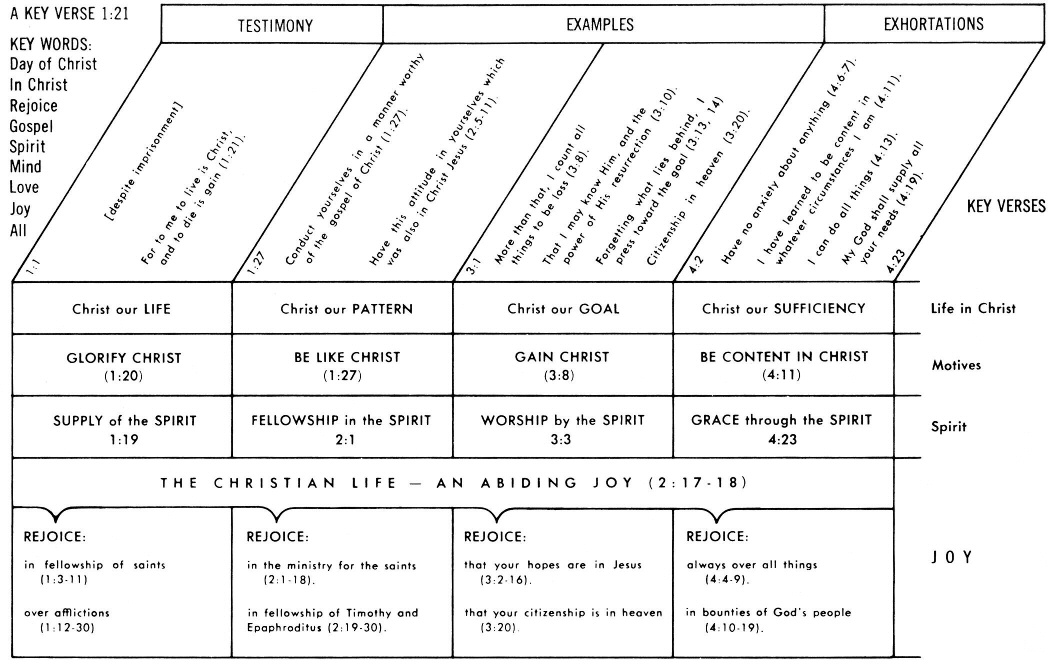
LIFE IN CHRIST
Click chart to enlarge
Charts from Jensen's Survey of the NT - used by permission
Philippians - Charles Swindoll = Chart on right side of page
| Account of Paul's Circumstances Php 1:1-30 |
Have the Mind of Christ Php 2:1-30 |
Have the Knowledge of Christ Php 3:1-21 |
Have |
| Partakers of Christ | People of Christ | Pursuit of Christ | Power of Christ |
| Suffering | Submission | Salvation | Sanctification |
| Experience | Examples | Exhortation | |
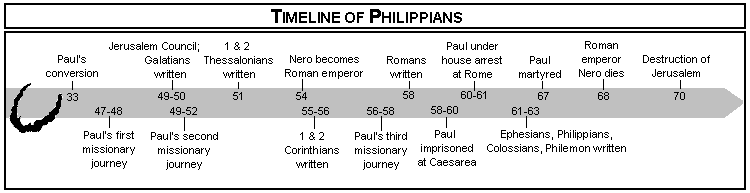
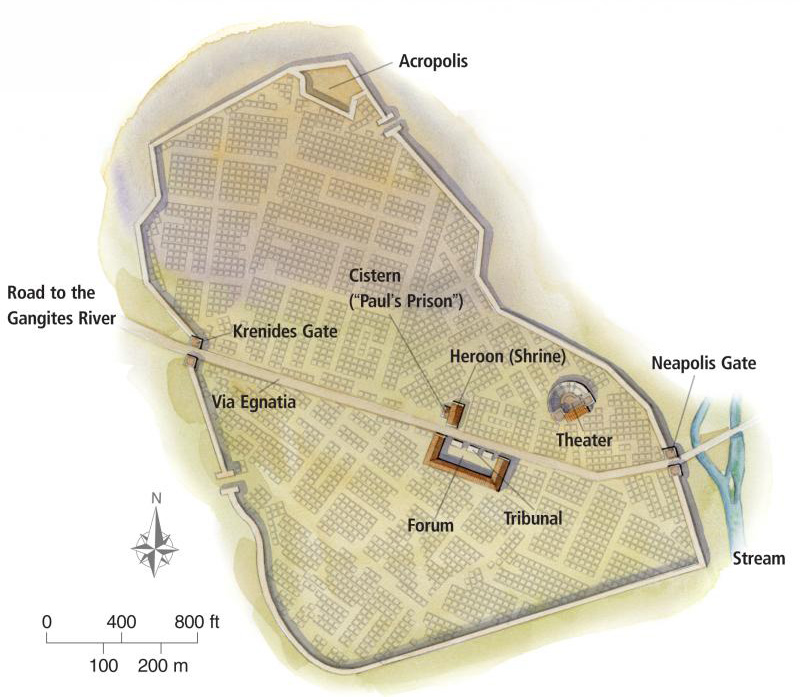
Philippi in the Time of Paul
The city plan above shows those features of the city of Philippi that archaeologists have so far identified as dating from the time of Paul. “Paul’s Prison” is not believed to be an authentic site, but was a cistern later associated with Christian worship. (ESV.org)
Philippians 1:21. For to me to live (PAN) is Christ and to die (AAN) is gain. (NASB: Lockman)
Greek: emoi gar to zon (PAN) Christos kai to apothanein (AAN) kerdos.
Amplified: For me to live is Christ [His life in me], and to die is gain [the gain of the glory of eternity]. (Amplified Bible - Lockman)
Lightfoot: Others may make choice between life and death. I gladly accept either alternative. If I live, my life is one with Christ: if I die, my death is gain to me.
GWT: Christ means everything to me in this life, and when I die I’ll have even more (GWT)
NAB: For to me life is Christ, and death is gain
NCV: To me the only thing important about living is Christ & dying would be profit for me. (NCV)
NLT: For to me, living is for Christ, and dying is even better. (NLT - Tyndale House)
Phillips: For living to me means simply "Christ", and if I die I should merely gain more of him. (Phillips: Touchstone)
TEV: For what is life? To me, it is Christ. Death, then, will bring more.
Wuest: For, so far as I am concerned, to be living, both as to my very existence and my experience, that is Christ, and to have died, is gain. (Eerdmans Publishing - used by permission)
Young's Literal: For to me to live Christ and to die gain.
FOR TO ME TO LIVE IS CHRIST: emoi gar to zon (PAN) Christos:
- Php 2:21; 1Co 1:30; Gal 6:14; Col 3:4
PAUL IS CHRIST CENTERED!
For (gar) explains why Paul is content to magnify the Lord by either his death or his life. Whenever you encounter this strategic term of explanation, take a moment to meditate on what the writer is explaining. Some uses of for are not as revealing, but some will yield incredibly rich insights that you might have missed had you not passed to ponder the living and active Word of God and given your Teacher the Spirit time to speak to you (1Cor 2:11-13)
H C G Moule on for - He takes up and expands the thought of the alternative just uttered, and the holy “indifference” with which he was able to meet it. (Philippians 1 Cambridge Bible for Schools and Colleges)
John Eadie explains the for (gar) - The particle gar introduces the confirmatory statement. Christ shall be magnified in my body, whether by life or by death-by life, for to me to live is Christ; by death, for death to me is gain. (Philippians 1 - Eadie's Commentary on Philippians)
Dwight Edwards explains for (gar - term of explanation) - Paul now continues ("for") the life-death motif found at the end of Php 1:20. Probably no verse better summarizes Paul's life (except perhaps Gal 2:20) than this. While still on earth, Paul saw life as inextricably bound up in Christ.
(1) HE WAS HOPELESSLY ADDICTED TO THE PRESENCE OF CHRIST - Phil 3:8-10.
(2) HE WAS DESPERATELY DEPENDENT UPON THE POWER OF CHRIST - Gal 2:20 Ro 15:18 (Ed: Energized by the Spirit of Christ)
(3) HE WAS UTTERLY ABANDONED TO THE PROGRAM OF CHRIST - Col 1:28,29.
(4) HE WAS PASSIONATELY JEALOUS FOR THE PERSON OF CHRIST - Col 1:14-19, Ro 15:17,18.
About what are you passionate? Sports? Hobbies? Work? Family? Paul sets the bar high in giving us a glorious declaration of his ruling passion! As James Hastings writes "The words of this text are not the words of a newly-born Christian, but the language of a full-grown man in Christ. They contain the ripe experience of a well-matured Christian. There are thirty years of Christian life and experience at the back of these words, “For me to live is Christ, and to die is gain.” We must not expect to leap into a religious experience of this kind; like St. Paul, we must grow in grace and knowledge to attain it. St. Paul grew more of a saint every day he lived, and his last days were the crowning days of a glorious and triumphant life." (Philippians 1:21 St. Paul’s Ruling Passion)
I like Dr Martyn-Lloyd Jones' reverent approach to Php 1:21 - We stand here face to face with one of the sublimest and greatest statements ever made, even by this mighty Apostle of our Lord and Saviour Jesus Christ. There is a sense in which anyone who faces this verse must feel that he stands on very sacred ground. Indeed, I am ready to admit that I would almost regard it as sacrilege to approach a verse like this in an unworthy manner. Here we have not only the statement of an experience which was true, which was a fact and a reality, but at the same time, and for that reason, we also find ourselves face to face with a standard of judgment. Any God-given experience is sacred, and nothing is further removed from the spirit of the New Testament than approaching a statement like this in a purely objective manner, handling it with our rough hands, bringing our critical or dissecting apparatus to bear upon it. There is something so sublime about it, so delicate and pure, that one is - as always with such verses - confronted with a kind of dilemma. On the one hand, one is afraid of handling it in a detached, so-called scientific manner yet, on the other hand, of course, there is also the danger that, if we do not analyze it up to a point, we fail to realise its inner meaning and its true purpose. One is compelled to do both - to analyse it and try to understand it, while always remembering that it is a living experience and a statement of fact which puts us under judgment. (He and He Alone - Sermon Index)
This is a key verse in this epistle. In fact it should be a "key verse" in the life of every saint. This should be our watchword, as we wait to see our Bridegroom either as we fall asleep or in the Rapture. As an aside, it is notable that the return of the Lord Jesus Christ is mentioned (directly or indirectly) approximately 318 times in the 260 chapters of the NT or about 1 in every 25 verses! Clearly the Spirit wants believers to live like Paul with an eternal Christo-centric perspective, a "Maranatha Mindset," the Biblical antidote for the love and lusts of the world (1 Jn 2:15-17-note)
Mattoon - Victorious Christianity is personal, "to me." It is something practical, "to live." It is also possible, "is Christ." (Ed: Actually no "is" in Greek so to live = Christ, cf Col 3:4 "Christ = our life") ILLUSTRATION: Missionary Bill Wallace, a doctor in China, loved these words. When he was arrested by the Communists and brutally treated, he would scribble this verse and others on the wall of his cell to help keep his sanity. After months of interrogation and abuse, he was found dead. The Communists claimed that he hanged himself, but his body showed signs of having been beaten to death. His friends buried him with honor and inscribed over his grave the words they felt described the motivation of his life: "For To Me To Live Is Christ." People wonder what the purpose of life is today and what they are here for. The Christian knows the answer to those questions. We have a purpose for living and that purpose is to glorify Christ and live for Him, not money, not self, not glory or fame.
This word "gain" can be translated "profit." This word suggests the idea of setting loose the moorings to set sail at sea. Paul was saying, "I am ready to go at any time!" Notice what he said at the end of his life.
2 Timothy 4:6—For I am now ready to be offered, and the time of my departure is at hand.
Are you ready to depart?
To me (emoi) is emphatic (first word in this Greek sentence). Paul feels very strong on this point as should every saint, for Christ is our life (Col 3:4), our hope of glory (Col 1:27).
Moule on to me - It is not self-assertion, however, but assertion of personal experience of the truth and power of God.
Robertson explains that Paul is giving us "his own view of living". And indeed it is the best view and one we should daily seek to emulate for Paul exhorted us to "Be imitators (present imperative = Not a suggestion, but a call to a supernatural lifestyle like Paul, like Jesus! Try to do this in your own strength! We need to be filled daily - Eph 5:18!) imitators of me just as I am of Christ." (1 Cor 11:1, cp 1 Co 4:16, Php 3:17, cp 1Th 1:6, 2Th 3:9, cp Heb 6:12, Heb 13:7, 2Ti 3:10-11-note)
Vincent says the idea is "Whatever life may be to others, to me ____."
How would you fill in the blank? What you think about, where you go, what you do… these are accurate "barometers" of what you think about. The NT repeatedly exhorts us to focus on Jesus. The writer of Hebrews says "Consider (aorist imperative ~ "Just do it!" is the idea) Jesus (Heb 3:1; He 12:2] Paul charges us to keep setting and seeking eternal things, the Eternal One - Col 3:1, Col 3:2)
Vincent adds that "For Paul life is summed up in Christ. Christ is its inspiration, its aim, its end. To trust, love, obey, preach, follow, suffer,—all things are with and in Christ. (A critical and exegetical commentary on the Epistles to the Philippians)
For to me - With this phrase, Paul is saying "I can't speak for you but I can speak for myself." Paul is being very personal. Paul's statement is similar to our common expression "As far as I am concerned" Paul was in prison and facing the prospect of death at the hands of the Roman government. Is it not true of all of us that in those "dying times" one usually thinks about the things that are most important in life. It was not difficult for Paul to explain what was of utmost importance to him. What makes your life worth living? your family? your work? your reputation? etc
To live (present tense) Christ -- This is the literal rendering for the Greek has no verbs for "is" which makes the statement even more dramatic. The present tense could be paraphrased "to go on living," (‘our never-failing life.’), signifying "the process, not the principle, of life." (Vincent) Paul had no thought of life apart from Christ and so we see in a nutshell Paul’s chief end for living! It was not living for money, fame or pleasure (are you as convicted as I am?). The Person and purpose of Jesus Christ are the "warp and woof" of Paul’s life, the sum total of his reason for existence. All of Paul’s activities and interests, yea, his entire existence was within the sphere of Christ, for indeed, "from Him and through Him and to Him are all things. To Him be the glory forever. Amen." (Ro 11:36-note)
Jesus, all for Jesus
All I am and have
And ever hope to be
Robin Mark - Play
ILLUSTRATION - A young man came to W. E. Gladstone when he was Prime Minister of England and said,
“Mr. Gladstone, I would appreciate your giving me a few minutes in which I might lay before you my plans for the future. I would like to study law.”
“Yes,” said the great statesman, “and what then?”
“Then, sir, I would like to gain entrance to the Bar of England.”
“Yes, young man, and what then?”
“Then, sir, I hope to have a place in Parliament, in the House of Lords.”
“Yes, young man, what then?” pressed Gladstone.
“Then I hope to do great things for Britain.”
“Yes, young man, and what then?”
“Then, sir, I hope to retire and take life easy.”
“Yes, young man, and what then?” he tenaciously asked.
“Well, then, Mr. Gladstone, I suppose I will die.”
“Yes, young man, and what then?”
The young man hesitated and then said, “I never thought any further than that, sir.”
Looking at the young man sternly and steadily, Gladstone said, “Young man, you are a fool. Go home and think life through!”
This illustration begs the question "WHAT ARE YOU LIVING FOR?" ARE YOU LIVING FOR TIME OR FOR ETERNITY?
You answer will determine the direction of your life. If you are living for the wrong purpose, your direction will be wrong. If your purpose is vague or fuzzy, your direction will be fuzzy. If you don’t know your purpose, you’ll just be swept along by the currents of our age, doing what seems to bring you happiness. It is crucial that you be clear and correct in answering the question, “What are you living for?” As the story of the young man and Mr. Gladstone illustrates, the correct answer to that question must include some thought about the fact of death and what lies beyond. It must also include consideration of the uncertainty of life, so that whenever death may come, it doesn’t thwart your purpose, for if your purpose is God's purpose for your life, you are immortal until your work is accomplished! That's part of the Good News of the Gospel.
To live (2198)(zao) refers literally to natural physical life (opposite of death - Acts 22:22, 25:24, 28:4). Figuratively zao refer to supernatural, spiritual life (cf Jn 11:25, 26). Zao can speak of the believer's source of a brand new quality of life, a supernatural life in Christ (Ro 6:11, 13; Gal 2:20). It can refer to life in the Spirit of Jesus (Gal 5:25) in contrast to living in the unregenerate state (in the flesh) (Ro 8:13).
Paul is saying that "to live (is) Christ" indicates that his life found it summa bonum, it's highest good, it's truest meaning, it's greatest satisfaction, it's most complete fulfillment, IN CHRIST, in His life lived out through him!
D A Carson - In the context, “to live is Christ” surely means that for Paul to keep on living here means ministry, Christ-centered ministry, Christ-empowered ministry, Christ’s presence in his ministry. To die is to bring that ministry to an end. But even so there is only gain, since the ministry is not an end in itself, and it is now swallowed up in the glorious delight of the unshielded presence of the exalted Jesus himself. (Basics for believers: an Exposition of Philippians)
Ray Pritchard - Consider the phrase “to live is Christ.” What does it mean? F. B. Meyer said that Christ is “the essence of our life…the model of our life…the aim of our life…the solace of our life…the reward of our life.” Think of the prepositions that express relationship. We live in Christ … for Christ … by Christ … through Christ … and from Christ. He is the beginning, the middle and the end of life. He is truly the Alpha and Omega, the A and Z, and every letter in between. Here are three statements to ponder: A. Christ is life. B. Christ transforms life. C. Christ transcends life. (The Life That Wins - Keep Believing Ministries)
Steven Cole asks and addresses the critical question - WHAT DOES IT MEAN TO “LIVE CHRIST”? To “live Christ” means to live in union with Christ, so that He becomes my all in all. The concept of being “in Christ” was vital to Paul’s understanding of what it means to be a Christian. He addresses this letter “to all the saints in Christ Jesus who are in Philippi” (Php 1:1). The instant a person truly believes in Jesus Christ as Savior, he is joined organically in a living, real union with Christ the Head as a member of His body, the church. To be “in Christ” means that all that is true of Christ is true of the believer. As Paul writes (Rom. 6:10, 11), “For the death that He died, He died to sin, once for all; but the life that He lives, He lives to God. Even so consider yourselves to be dead to sin, but alive to God in Christ Jesus.” The believer is in union with Christ. While that is our true standing before God, we must grow in our experience of the reality of that standing, so that in our daily lives, we live in fellowship with Christ, communing with Him and depending on Him for everything. It means growing to know Christ intimately (Phil. 3:10). It means growing to love Christ with all of my heart, soul, mind, and strength (Mark 12:30). It means submitting all of my thoughts, emotions, words, and deeds to the lordship of Christ, so that I seek to please Him in all respects (Col. 1:10). It means growing to experience Christ as my “all in all” (Eph. 1:23; Col. 3:11). Every aspect of life must be centered around the Lord Jesus Christ. The glorious person of Christ, and nothing less, is the Christian life. Of course, our experience of “living Christ” is a process that is never fully realized in this life. As Paul says (Phil. 3:12), “Not that I have already obtained it, or have already become perfect, but I press on in order that I may lay hold of that for which also I was laid hold of by Christ Jesus.” Even the most godly Christians have times when Christ seems distant and the soul is dull and sluggish. In this life we never reach a point where we are not tempted by sin, where we do not have to battle the lusts of the flesh, the lusts of the eyes, and the boastful pride of life (1 John 2:16). But, each of us who are truly children of God will have as our focus to live in an experiential way the fact of our union with Christ, so that He becomes our all in all. (Philippians 1:19-26: What Are You Living For?)
What To Expect When Christ is Your Life: Wayne Barber illustrates Paul's point with a hand puppet (a fish). Wayne explains "If I took a fish (a hand puppet fish) and said 'Okay. Swim!' the fish would just sit there because it does not have any life in it to enable it to swim. This fish is like a person without the Lord Jesus Christ. You tell him to try to love his brother. He gets up on Monday morning and says 'I'm going to love my brother.' But he has no life within him to produce the kind of love that God has commanded… This is what the Law does. It condemns people… but offers no spiritual life (1Pe 2:24-note). The man tries to love his "brother" but then God puts a person in his life that he didn't know existed. He cries out "God I can't love my brother." And God says that's exactly right. When the Law came and said "Don't covet." Paul being a zealous Jew tried not to covet (Ro 7:7, 8-note). What happened? Covet. Covet. Covet… all day long he coveted. The Law exposed that sin but there was no life within Paul to produce the character that the Law required. Thank God that Jesus fulfilled the Law and that when we are saved He comes into us and now there is His life within us (Col 3:4-note). Paul is saying that there is Someone inside of me that is my life. I draw my life from Him. Apart from Him I can do nothing (Jn 15:5). He is the Vine. I am the branch. All the life that is within Him, the power of the Holy Spirit that now dwells in me, causes me to be able to do whatever the Law requires (Ro 8:1-4-note). His life in me is the "secret" of the Christian life. The Christian life is not a principle, not a plan, not even any person, but the Person named "Jesus". Christianity is not getting us into heaven but getting heaven into us! There are two words for "live", bios, having to do with that external busyness of life. In 2Ti 2:4 (note) Paul describes "the affairs of everyday life" where "life" is bios which is the busyness and activity we all do daily. Zoe (word study) is the other word for life and is the essence of life. It's what makes us "tick". Christ is what "makes me tick." He is the essence of my life."
Dr Barber illustrates this principle of the Christ life with a story from the life of CT Studd who was at a fair one day and saw a man pumping a well as hard and fast as he had ever seen any man pump. Studd watched him for about an hour and the man never slowed down. Studd was mystified until he walked over to the man and noticed that his elbows were hinges and he was a wooden figure and "he wasn't pumping the well (it was an artesian well - see schematic below - note that the water table is higher than the well thus providing endless power! Now think of the Spirit of Christ, your Life, your eternally available "Artesian Well"! Whose energy are you living the Christian life in?) but the well was pumping him. That is what Paul is saying. Paul is saying in essence "Do you know what makes me tick, what makes me live, where I get all my resources from? It's the Lord Jesus Christ. Christ is my life!" If Christ is our life (Ed: Which He is if we are believers) then we need to stop trying to help Him out and then asking Him to bless what we do (after it has been done!) Instead, we simply need to walk in obedience to Him (Col 2:6-note). Let God tell you what to do. Do what you're told. Then the results are all His (Ed: And so is the glory!) This is a lifelong learning process, learning to let Jesus be our Life (Ed: Especially His Spirit - cp Jn 6:63). Then He gets the glory. God wants our availability, but it is not a passive acquiescence (Ed: Compare Php 2:12-note = our active role and Php 2:13-note His supernatural activity). In fact He will "burn us out," which is fine because ultimately it's His energy and the results are His. To reiterate, the Christ life is not one of passivity, but it is one of availability, of letting Him be Himself in and through us." (Excerpts from Sermon Series on Philippians by Dr. Wayne Barber -1988)

See also
Wuest adds that Paul's "words in Colossians 3:4 (note), “Christ, our life,” help us to understand this statement. Christ is Paul’s life in that He is that eternal life which Paul received in salvation, a life which is ethical in its content, and which operates in Paul as a motivating, energizing, pulsating principle of existence that transforms Paul’s life, a divine Person living His life in and through the apostle (Ed: Via His Spirit, His representative, the Spirit of Jesus - Acts 16:7, Php 1:19). All of Paul’s activities, all of his interests, the entire round of his existence is ensphered within that circumference which is Christ. The words, “to die” are more accurately, “to have died.” The tense denotes, not the act of dying, but the consequences of dying, the state after death. Death itself would not be a gain to Paul, but to be in the presence of his Lord in glory, that would be gain. (Wuest Word Studies - Eerdman Publishing Company Volume 1, Volume 2, Volume 3 - used by permission)
Spurgeon comments on Philippians 1:21 writing that "Paul's words mean more than most men think; they imply that the aim and end of his life was Christ-nay, his life itself was Jesus. In the words of an ancient saint, he did eat, and drink, and sleep eternal life. Jesus was his very breath, the soul of his soul, the heart of his heart, the life of his life. Can you say, as a professing Christian, that you live up to this idea? Can you honestly say that for you to live is Christ? Your business-are you doing it for Christ? Is it not done for self- aggrandizement and for family advantage? Do you ask, "Is that a mean reason?" For the Christian it is. He professes to live for Christ; how can he live for another object without committing a spiritual adultery? Many there are who carry out this principle in some measure; but who is there that dare say that he hath lived wholly for Christ as the apostle did? Yet, this alone is the true life of a Christian-its source, its sustenance, its fashion, its end, all gathered up in one word-Christ Jesus. Lord, accept me; I here present myself, praying to live only in Thee and to Thee. Let me be as the bullock which stands between the plough and the altar, to work or to be sacrificed; and let my motto be, "Ready for either."
Spurgeon - It seems to me to be the highest stage of man to have no wish, no thought, no desire but Christ—to feel that to die were bliss if it were for Christ, that to live in penury and woe and scorn and contempt and misery were sweet for Christ, to feel that it did not matter what became of one's self, so that one's Master was but exalted, to feel that though, like a leaf, you are blown in the blast, you are quite free from anxiety, as long as you feel that the Master's hand is guiding you according to his will. Though like the diamond you must be cut, you care not how sharply you may be cut, so that you may be made fit to be brilliant in his crown.
Lightfoot explains it is as if Paul is saying "I live only to serve Him, only to commune with Him. I have no conception of life apart from Him."
John Walvoord notes that "to Paul to live is Christ. By this he means that his life is wrapped up in Christ, in witnessing of Christ, in fellowship with Christ, in the goal to make his life a channel through which others might know Christ." (Everyman’s Bible Commentary)
Robert Thomas - Christ had become for him the motive of his actions, the goal of his life and ministry, the source of his strength… the act itself of dying at the hands of Rome was no tragedy in Paul’s eyes. Such a death would bear added witness to the gospel; it would confirm that Paul’s faith was steadfast to the end and it would serve as the gateway to Christ’s presence. (The Expositor's Bible Commentary, Volume 11)
Before going on, let’s take a little quiz. How would you complete the following sentence? “For to me to live is ____.” What word, phrase, passion, hobby, etc would you put in the blank? Don’t miss the point that no one leaves that sentence blank. Everyone finishes it with something. So I will ask again if you don’t fill the blank with Christ, what do you put there? Here are four questions to help you “fill in the blank”:
(1) Where do I tend to spend spare time and money? Mt 6:21
(2) What objects or persons give emotional delight as I mentally brood over them?
(3) Where do my thoughts flow in spare time?
(4) To what or whom do I turn during times of emotional upheaval or crisis?
Let’s all be very honest now – If you filled in the blank with “Christ” well I say PRAISE THE LORD! But in truth very few of us are at the point of spiritual maturity described by Paul, but that should not keep us from striving to fill in the blank with CHRIST, alone.
ONE PASSION -
HE AND HE ALONE!
Dr Martyn-Lloyd Jones - In these words we are surely brought face to face with the most important questions that can ever confront us - What is life? What is living? What does it mean to us? What is it all about? Is it not one of the major tragedies of life, indeed, is it not the greatest of all tragedies, that amid all our concerns about life, all our intellectual activity, all our discussions, the one thing which men and women are never concerned to face is the first and most obvious thing of all, namely life itself, and living. Not only is this a most important question in itself, but I want to go further and point out (and this, indeed, is especially the burden of this study) that here we stand face to face with the most thorough test we can ever encounter of our profession of the Christian faith. Because, of course, this is a word which is more or less meaningless to someone who is not a Christian… (in section skipped he deals with the answers to the question of what is life? Very interesting)… So, then, I end with my question: is living to us, Christ? I wonder whether we can make that statement that was made by Count Zinzendorf, the Moravian leader who helped John Wesley both before and after his conversion. He had never had the vision that Paul had on the road to Damascus, but to him, too, Christ was in the centre. Can we make his motto our own? 'I have one passion, it is he and he alone.' 'To me living is Christ.' Oh that we all might have this passion! I believe we could transform our land in a day, I believe a great revival would come, if only we had this passion. He and he alone! Let us dwell upon him; let us meditate upon him; let us ask the Holy Spirit to reveal him to us. Let us pray for it; let us spend time with it; let us absorb it; let it take the central place; let us do all we can to get to know him better, for to know him is to love him. I have one passion—it is he and he alone. (He and He Alone - Sermon Index)
All for Jesus! All for Jesus!
All my being’s ransomed powers;
All my thoughts and words and doings,
All my days and all my hours
Mary D James
Play this Choral Version
Motyer - In life he (Paul) is absorbed and determined in consecrated living for Christ; in death he expects to possess Christ totally. We could paraphrase and extend his thought by saying, ‘Life means Christ to me, as I more fully know and love and serve him day by day; death means Christ to me, when I shall finally possess and eternally enjoy him.’ (The Bible Speaks Today)
Hughes - How could Paul say “For to me to live is Christ”? At the deepest level it was because Christ was in him and he was in Christ—a description used more than any other in the New Testament to describe the believer’s living, saving union with Christ… We must understand that “For to me to live is Christ” is not the triumphant sentimentality of a trouble-free life but the joyous embrace of the burdens of the cross of Christ. (Ed: cp Gal 6:14). In effect, altogether this meant that Christ was at the conscious center of everything—so that Paul had a Christ-centered ministry, a Christ-powered ministry, and a Christ-exalting ministry. Paul would have lauded the declaration of Count Nikolaus von Zinzendorf, the father of German Protestant missions, “I have but one enthusiasm; it is He, only He.” (Philippians: the fellowship of the Gospel: Preaching the Word)
Word Biblical Commentary - To say “living is Christ” is to say that for him “life means Christ” (Goodspeed, Knox, Moffatt, Phillips). Life is summed up in Christ. Life is filled up with, occupied with Christ, in the sense that everything Paul does—trusts, loves, hopes, obeys, preaches, follows (Vincent), and so on—is inspired by Christ and is done for Christ. Christ and Christ alone gives inspiration, direction, meaning and purpose to existence." (Word Biblical Commentary : Philippians)
MacArthur sums up to live Christ as the phrase which "reflects what Paul saw as the summum bonum of his life. Christ was Paul's raison d'etre--his reason for being. He wasn't merely saying that Christ was the source of his life, that Christ lived in him, or that Christ wanted Paul to submit to Him. Though all those statements are true in themselves, they are only parts of this great truth: life in its sum is Christ." Paul reminded the Colossians of this deep truth -- Christ [Who is] our life (where "Who is" has been added by the translators) (Col 3:4)
William Rutherford - Live in Christ, and you are in the suburbs of Heaven. There is but a thin wall between you and the land of praises. You are within one hour’s sailing of the shore of the new Canaan.
In William Shakespeare's play "Hamlet," the young prince wondered whether to relieve the sorrows of life by suicide, musing "To be, or not to be: that is the question" but to Paul the answer to life's most profound question is, "To live Christ, and to die gain".
Rob Morgan gives 3 illustrations that relate to Phil 1:21 - (1) British pastor George Duncan was once invited to preach live from Keswick, England, on the BBC. He choose this text, saying it summed up the “full-orbed and balanced experience” of the Christian in “six unforgettable words, which in English at least are words of one syllable each, and should therefore not be beyond the understanding of the youngest or simplest of us.” "Victorious Christianity," Duncan said, "is something PERSONAL—to me… It is something PRACTICAL—to live… And it is something POSSIBLE—is Christ! (2) Retired missionary/pastor Dan Merkh. Merkh recalls being part of a church youth group that called itself the “Stalwarts” and choose Philippians 1:20–21 as its theme. But Merkh wasn’t very “stalwart” himself, for later while serving in the Marines, he drifted away from Christ and lived in a backslidden condition. He was assigned a desk job in the Marine Corps Depot of Supplies in Norfolk, and much paperwork passed over his desk. Someone gave him a glass paperweight in the shape of a half ball. The curve acted as a magnifying glass under which was to be placed a picture. Having nothing to put there, Dan remembered his old youth group theme and wrote the words, “To Live Is Christ and To Die Is Gain.” Every time he shuffled papers, his eyes fell on those words, and they eventually drilled into his heart. Later, rededicating his life to Christ and yielding himself to ministry, Philippians 1:20–21 became his life verses. (3) Another missionary, Bill Wallace, a doctor in China, also loved these words. When he was arrested by the Communists and treated brutally, he would scribble verses like these on the walls of his cell to keep himself sane. After months of interrogation and abuse, he was found dead. The Communists claimed he had hanged himself, but his body showed signs of having been beaten to death. Defying the Communist authorities, his friends buried him with honor. Over his grave, they inscribed the words they felt described the motivation of his life: “For To Me To Live Is Christ.” (From This Verse)
John MacArthur - Where did Paul find his contentment? In Philippians 1:21 he says, “To me, to live is Christ, and to die is gain.” He found it in Christ, not in material possessions. Professor Howard Vos said of Paul, “Christ is all to him, he lives only to serve Christ, he has no conception of life apart from Christ…. Christ’s goals, Christ’s orientation to life and society and mission, are his.” If you want to be like Paul and have true contentment, make Christ the love of your life, not material possessions. (Strength for Today) (See discussion of Christian Contentment)
Ray Pritchard - If you want Paul’s secret of success in just one sentence, here it is from Philippians 1:21, “For to me, to live is Christ and to die is gain.” Many of us learned this verse as children in Sunday School. We’ve heard it and recited it and memorized it over and over again. And well that we should. This verse reveals why Paul did what he did, why he said what he said, and how he found the strength to endure incredible hardship. Before going on, let’s take a little quiz. How would you complete the following sentence? “For to me to live is ________________.” What word or phrase would you put in the blank? If your name is Michael Jordan, the word is “basketball.” If you are Mark McGwire or Sammy Sosa, you might say “home runs.” If your name is Bill Gates, the word might be “Microsoft.” If you are a parent, the word might be “children.” A politician might say “winning the election.” A lawyer might say “winning the big case.” If you are in high school, you might say “going to Homecoming.” The list of possibilities is endless. It could be fun or school or sex or entertainment or money or college or career or winning the big game. Don’t miss the point. No one leaves that sentence blank. Everyone finishes it with something. If you don’t fill the blank with Christ, what do you put there? In this world there are winners and losers. A winner is a person with a positive, noble philosophy of life. A loser is a person with an unworthy purpose—or no purpose at all. Which are you—a winner or a loser? (The Life That Wins - Keep Believing Ministries)
Henrietta Mears (What the Bible is All About)
For to me, to live is Christ" (Phil. 1:21). Can you say this? Is Christ everything to you? Do you live for Him? Is your one aim and purpose to glorify Him?
Listen to the cries of the people of this world. What are they? To the successful businessperson it is, "To me to live is wealth." To the scholar it is, "To me to live is knowledge." To the soldier it is, "To me to live is victory." To the young man, "To me to live is pleasure." To the man desirous of recognition, "To me to live is fame." To the high school student, "To me to live is recognition." So we could go on and listen to all the voices of the world, but one is heard over them all—"To me to live is not wealth nor knowledge not fame nor glory but Christ. Christ first, last, midst all, and always Christ."
- Christ is the giver of life—"I have come that they may have life, and have it to the full" (John 10:10).
- Christ is life itself—"I no longer live, but Christ lives in me" (Galatians 2:20).
- Christ is the model of my life—"Be perfect, therefore, as your heavenly Father is perfect" (Matthew 5:48).
- Christ is the aim of my life—I desire to make known "the power and coming of our Lord Jesus Christ" (2 Peter 1:16).
- Christ is the reward of my life—"Thanks be to God for his indescribable gift!" (2 Cor. 9:15).
Paul says:
- When I travel, it is on Christ's errands.
- When I suffer, it is in Christ's service.
- When I speak, the theme is Christ.
- When I write, Christ fills my letters.
Brian Bell (Calvary Murrietta) on Php 1:19-30
1.1. Ever find yourself on the "horns of a dilemma"?
1.2. Dilemma's are predicaments that are not resolved w/a simple right or wrong! - Dilemma's always have advantages & disadvantages looming on both sides. - Dilemma's put us between a "rock & a hard place"!
1.2.1. 3 types of dilemma's: (Swindoll)
[1] Volitional Dilemma - When we want to do 2 different things @ the same time. {e.g. finish schooling & stay at your job.}
[2] Emotional Dilemma - When we have conflicting feelings about a difficult situation {e.g. pet contracts a painful disease/let die naturally or "the shot"}
[3] Geographical Dilemma - When we desire to be in 2 different places @ the same time. {e.g. Better job far away/ But family & friends, & church, & ministry are great here}
1.2.5. Paul runs into a "rock & a hard place" dilemma, 1 that is not only geographical, but intensely emotional, & volitional as well! (Php 1:23,24)
1.3. Outline/2 Parts:
Part 1 "Paul's Priorities" -
[1] J. - He put Christ 1st (Php 1:19-21)
[2] O. - He put others 2nd (Php 1:22-25)
[3] Y. - He put Himself last (Php 1:26).
Part 2 "The Philippians Conduct" -
[1] Striving together
[2] Not frightened by your enemy
[3] Suffering for His sake.
2.4. Php 1:21 - "gain" = unshackled & free!
2.4.1. "To die is gain!" - Isaac Asimov tells the story of a rough ocean crossing during which a Mr. Jones became terribly seasick. At an especially rough time, a kindly steward patted Jones on the shoulder and said, "I know, sir, that it seems awful. But remember, no man ever died of sea-sickness." Mr. Jones lifted his green countenance to the steward's concerned face and replied, "Man, don't say that! It's only the wonderful hope of dying that keeps me alive."
2.5. Do you fear Death…or Dying?
2.5.1. Many people say they do not fear death, but the process of dying. It's not the destination, but the trip that they dread.
John Newton, a one-time slave trader, was converted and became a great preacher and hymn writer in the Church of England. Two years before his death, in 1807, he was so weak that he could hardly stand in his pulpit; someone had to support him as he preached. Shortly before he died, when he was confined to his room and unable to move, he told a friend, "I am like a person going on a journey in a stagecoach, who expects its arrival every hour and is frequently looking out of the window for it -- I am packed and sealed, and ready for the post." {Newton wrote "Amazing grace"}
2.6. Different translations of Php 1:21:
Liv. Bib. - "For to me, living means opportunities for Christ, & dying - well, that's simply better yet!"
Phillips - "For living to me means simply Christ, & if I die I should merely gain more of Him."
GNB - "For what is life ? To me, it is Christ. Death then will bring more."
2.7. Q: What's your motto?
"For to me, to live is money,…& to die is to leave it all behind."
"For to me, to live is fame,…& to die is to be forgotten."
"For to me, to live is power,…& to die is to lose it all."
"For to me, to live is possessions,…& to die is to take none of them w/me."
2.8. Here's a paradoxical truth: "I will never be Happy if I am concerned primarily w/becoming Happy!" {it was Paul's goal to please God at every moment 2 Cor.5:9 "Therefore we make it our aim, whether present or absent, to be well pleasing to Him."}
2.9. "Fear not that your life shall come to an end, but rather that it shall never have a beginning."
2.10. Php 1:21 is the epitome of "Contentment"!
2.10.1. Longfellow on contentment said, "For after all, the best thing one can do when it's raining is to let it rain."
2.10.2. An Arabian Proverb says, "Better a handful of dry dates and content therewith, than to own the Gate of Peacocks and be kicked in the eye by a broody camel." [Broody =a mare kept for breeding}
2.10.3. Another said, "A contented man is the one who enjoys the scenery… along the detours!"
3. HE PUT OTHERS 2nd (Php 1:22-26)
3.1. Paul says I don't know which one to choose?
3.2. As w/all Dilemma's both sides of the issue have Benefits & Liabilities!
3.2.1. A missionary organization has as its logo an Ox & a Plow on one side; & an Altar on the other. The inscription reads, "Ready for either"…That was Paul's Motto!
3.3. Let's look at both of his options.
3.4. Option #1 - TO DEPART!
3.5. BENEFITS - [1] To be instantly w/Christ [2] Being free from pain & the frustrations of this world(ie. no more stonings, beatings, imprisonment's, & thorns' in the flesh) [3] No more living in constant danger [4] No more hunger & thirst [5] No more sleepless nights & hardships [6] Being in a place of perfection [7] Being in the very presence of God!
3.6. LIABILITIES - [1] Absent from those who needed him [2] The Philippians were his sp. children, to leave them was like a father abandoning his children. [3] He no longer would be a witness to the Roman guards & the prisoners [4] The infant church would be short a great champion of the truth.
3.7. Option #2 - TO REMAIN!
3.8. BENEFITS - [1] He could continue to nurture the Phil.'s growth & maturity in the Lord. [2] His writing ministry could continue, bringing God's grace & truth to countless generations he would never see.
3.9. LIABILITIES - [1] Remained chained in Rome, instead of going home to heaven.
3.10. Paul's #1 desire? - Heaven…"which is Far better!"
3.11. His Choice? - Though he badly wants to be w/Christ, he chooses to stay instead. He selflessly places their needs above his own desires.
3.11.1. "The true meaning of life is to plant trees, under whose shade you do not expect to sit." {Nelson Henderson}
4. HE PUT HIMSELF LAST
4.1. His body was not his own; his future was not his own;
his business was not his own; & his life was not his own.
4.1.1. "After crosses and losses, men grow humbler and wiser." {Benjamin Franklin}
AND TO DIE IS GAIN: kai to apothanein (AAN) kerdos :
- Isa 57:1, 57:2; Ro 8:35, 36, 37, 38, 39 ; 1 Co 22; 2 Co 5:1, 5:6, 5:8; 1Th 4:13; 14; 15; Rev 14:13
- Php 3:7
THE PARADOX
OF PASSING ON
The world sees death as the "end" as loss of all for which one has lived (and if they have lived totally for the temporal, it is indeed totally lost). Paul says not so for believers, whose loss is their gain (paradox)! This sounds like utter foolishness to the world. Indeed, Paul explains that "a natural man does not accept the things of the Spirit of God; for they are foolishness to him, and he cannot understand them, because they are spiritually appraised." (1 Cor 2:14)
Did you catch what Paul is saying when he says “to die is gain”? It is easy to miss it! Paul goes on to state that death is THE ENTRANCE to "gain," NOT the exit from living. Sadly, most of us see it as the latter, as what we are losing or leaving behind and not what we are gaining!
Let me read you a little poem that beautifully expresses Paul’s sentiment:
It is not death to die
To leave this weary road
And 'midst the brotherhood on high
To be at home with God.
It is not death to close
The eye long dimmed by tears
And wake in glorious repose
To spend eternal years.
It is not death, to bear
The wrench that sets us free
From dungeon-chain to breathe the air
Of boundless liberty.
It is not death to fling
Aside this sinful dust
And rise on strong, exulting wing
To live among the just.
Jesus, thou Prince of life
Thy chosen cannot die
Like Thee, they conquer in the strife
To reign with Thee on high.
Notice also that there is a close connection between the first half of this verse and the second. The more fully our life is bound up in the person and program of Christ, the greater "our gain" in heaven. (2 Cor 4:17-18)
To die for an unbeliever is to give up all your possessions, but to die for a believer is to gain your greatest Possession! Why do we so easily and often dabble with the passing pleasures of this passing world?
Spurgeon reminds us that "It is not death to die if the death of Christ be but the life of the soul."
A T Robertson on to die - To die (second aorist active infinitive, single act) is to cash in both principal and interest and so to have more of Christ than when living. So Paul faces death with independence and calm courage.
To die (apothnesko from apo = intensifies meaning or away from + thnesko = die) literally means to die off. It means to die a natural death and is the term applied to both men and animals. It literally means to cease to have vital functions.
Paul says that to die is gain because in the absence of life’s limitations (and tests and temptations) union with Christ will be completely consummated. Indeed, when "the earthly tent (our mortal body) which is our house is torn down, we have a building from God (a body of glory, immortal, incorruptible, eternal - 1Cor 15:40-58), a house not made with hands, eternal in the heavens. (2Co 5:1-note)
W E Vine on to live and to die - Life is never mere existence; death is never nonexistence. God created man, i.e., called him into existence (Ge 1:27), but Scripture nowhere states that man will ever cease to exist. All, whether living or dead, equally exist and are equally conscious of existence; cp. Luke 16:19–31.
Walvoord emphasizes Paul's (and each of our) gains through death - To die would be freedom from the chains (Ed: If not the literal chains like Paul, certainly the figurative chains of the sin that so easily entangles us causing us to be prone to wander), deliverance from self (Ed: Finally and fully free from the power, penalty and pleasure of sin!), the end of suffering, the curtain on strife, the beginning of a new life of freedom and abundance, the experience of being completely like Christ. (Everyman's Bible Commentary)
Guy King on to die - What is it to die? Paul tells us it is "to depart" - a metaphorical word, suggestive of a nautical figure, a loosing of moorings preparatory to setting sail; or of a military figure, a striking of camp ready to start on the march. He would for himself so gladly do that straightaway. In 2 Timothy 4:6 (cf Php 2:17), when his earthly end really had come, he says, using the same word and metaphor, "the time of my departure is at hand". The storm-tossed mariner sailing away on the last ocean voyage, to the haven where he would be; the battle-scarred warrior marching away off the field of war, for his Sovereign's Review - that is the apostle's idea of death, on the one side of it, the negative side.
Gain (2771) (kerdos) describes that which is gained or earned (profit). It is any gain or profit interest on money. It describes what is in the profit column. It can mean advantage.
Kerdos - only 3 times in the NT and not in the Septuagint - Phil 1:21
Phil 3:7 But whatever things were gain to me, those things I have counted as loss for the sake of Christ.
Titus 1:11 who (see their identification in Titus 1:10) must be silenced (muzzled, gagged!) because they are upsetting whole families, teaching things they should not teach, for the sake of sordid gain.
Paul knew that death is not a defeat to the Christian but is merely a graduation to glory, a "net gain" (so to speak) in accounting terms! When a Christian dies, he or she really finally and fully begins to live, for he or she passes into the perfect, eternal, glorious union with Christ, unhindered by the world, the flesh and the devil.
Ray Pritchard - Consider the positive results of losing your fear of death. When you can say, “I am not afraid to die,” you are …1. Free to focus on the things that really matter. 2. Indifferent to your own personal fate. 3. Utterly consumed with doing God’s will. Do you recognize these names? Nate Saint … Roger Youderian … Ed McCully … Peter Fleming … Jim Elliot. In 1955 these five young men (all under the age of 35) gathered in Ecuador with a vision of reaching a tribe of Indians called the Aucas (the word means “savage,” a name given to them by other tribes) who lived deep in the rain forest. No one had ever presented the gospel to them. These five missionaries—all highly trained and deeply devoted to God—began praying about ways to make contact. In September they began flying over an Auca village, lowering a pot containing gifts for the Indians. Eventually the Aucas took the gifts and replaced them with simple gifts of their own. In January 1956, the five men decided the time had come to make contact in person. After much prayer they established a base camp on a sandy beach of the Curaray River. On January 8, 1956—at about 3:30 PM, they were speared to death by the Indians who mistakenly thought they had come to hurt them. The news shocked the world. Many people wondered how young men with so much promise could waste their lives that way. When the journals of Jim Elliot were published several years later, they were found to contain this sentence: “He is no fool who gives up what he cannot keep to gain what he cannot lose.” The Apostle Paul would agree. Once you decide that your life won’t last forever, you are free to invest it in a cause greater than yourself. You give up what you can’t keep so that in the end you gain what you can never lose. This is what Paul meant when he said, “Whether by life or death.” (The Life That Wins - Keep Believing Ministries)
Robertson adds that "To die… is to cash in both principal and interest and so to have more of Christ than when living. So Paul faces death with independence and calm courage." For a Christian death is exchanging the burden of earthly life for the eternal joy of heaven.
McGee writes that "gain is always more of the same thing. If to live is Christ, then to die would be more of Christ.
The idea of gain is a precious thought concerning death. At death Christians collect the "dividends" from the investment of their earthly, temporal life for Christ and God pays the richest dividends… eternally! We will gain both in what we lose (sinful body, temptation, sorrow, sufferings, enemies, etc.) and in what we gain (glorified body, personal presence with Christ, joy, reunion with departed saints, etc.). To make the most of today, keep Christ, heaven and eternity constantly in mind because we cannot really live until we're really ready and willing to die. Remember also that heavenly-minded people like Paul are the one's who do the most earthly good.
DEATH TAKES BELIEVERS…
NOT TO A CEMETERY
BUT TO A SANCTUARY!
Ray Pritchard - How did Paul survive and thrive in a Roman jail? Philippians 1:21 gives Paul’s answer: “Life is wonderful … and it’s gonna get better.” The word “gain” is a monetary term that means to make a profit on an investment. Instead of complaining about being in jail, he rejoices that even in chains, he has experienced the power of Jesus Christ in his life. And when he dies, his current wonderful life will get even better. How could Paul say such things? It’s because for Paul death didn’t put him in a cemetery; it ushered him into a sanctuary. He knew that he would enter the presence of Christ at the moment of his death. That would truly be “gain” for him. (The Life That Wins - Keep Believing Ministries)
Hughes - The clarity and sanity of Paul’s confident dictum “For to me to live is Christ, and to die is gain” shows up the shallow tragedy of so many in Paul’s day and now. Among the ruins of ancient Carthage there is an inscription carved by a Roman soldier: “To laugh, to hunt, to bathe, to game—that is life.” “For to me to live is to hunt, go to the baths, and party!” As the Looney Tunes finis says, “That’s all, folks!” It is the same today because most will fill in the blank of “For to me to live is—” with anything but Christ. According to the tabloids and celebrity magazines, “for to me to live is” to fornicate, to accumulate, to dine well. Or on a more prosaic (everyday, ordinary) level, “for to me to live is” to golf, to work, to garden, to travel, to watch TV, to ski—to shop ’til I drop. Of course, if this be our life, then death is the loss of everything. When Queen Elizabeth I, the idol of European fashion, was dying, she turned to her lady-in-waiting and said, “O my God! It is over. I have come to the end of it—the end, the end.” But when Dr. Andrew Chong came to the end, he wrote, “For to me to live is Christ, and to die is gain. Hallelujah” and confidently said, “Nothing has changed. Nothing has changed.” Now he lives in eternal gain. (Hughes, R. Kent, Philippians: the fellowship of the Gospel, Preaching the Word)
Mike Mestler - For the believer In the Lord Jesus Christ death is not loss but gain. I. In death a Believer Gains a Release from Suffering and Sin. (2Cor 2:4) II. In death a Believer Gains a Reward for Service (2Ti 4.7-8) III. In death a Believer Gains a Reunion with the Savior and Other Saints (. 23;2 Cor. 5.8;1Th 4.14)
C H Spurgeon commenting on Philippians 1:21 wrote "Could I now have the greatest favor conferred on me that mortals could desire, I would ask that I might die. I never wish to have the choice given to me, but to die is the happiest thing man can have, because it is to lose anxiety, it is to slay care, it is to have the peculiar sleep of the beloved. To the Christian, death must be acceptable.
Guzik - This also obviously showed that Paul did not fear death. Though some men may fear dying, no Christian should fear death. “When men fear death it is not certain that they are wicked, but it is quite certain that if they have faith it is in a very weak and sickly condition.” (Spurgeon)
Ray Pritchard - Many who read Philippians 1 wonder how death can be a “gain” for anyone. In his sermon on this text Alexander Maclaren (Philippians 1:21-25 A Strait Betwixt Two) gives the following answers:
1. We lose everything we don’t need—We lose the world, the flesh, and the devil. We lose our trials, our troubles, our tears, our fears, and our weaknesses.
2. We keep everything that matters—We keep our personality, our identity, and our knowledge of all that is good.
3. We gain what we never had before—We gain heaven, the saints, the angels, the presence of God, and Jesus himself.
Although I have never seen it, I have been told there is a headstone in a cemetery in Montgomery, Alabama, which reads: "Under the clover, and Under the trees, Here lies the body of Jonathan Pease. Pease ain’t here, only the pod, Pease shelled out and went home to God." Do you fear death? You shouldn’t if you are a Christian. Death is the vehicle that takes us home to God. As I was preparing this sermon, I ran across a most encouraging thought: “A Christian is immortal until his work on earth is done.” Think about that for a moment. Death cannot touch you until God is through with you. You cannot die, and you will not die, until the appointed moment comes that God has ordained. If God is God, you will live as long as the Lord intends, and then you will go home to heaven. In that sense, every Christian life is always complete. I know that it doesn’t always look that way when we stand by the grave of a young person who died before reaching the prime of life. Truly the death of the young brings many questions that only God can answer. But this much is true. If a young person dies in the Christian faith, that young person has completed the life God intended for him. What seems to be a mistake to us is no mistake in God’s divine plan. When Pontius Pilate saw that Jesus would not answer him, he said, “Don’t you know I have the power to put you to death?” To which Jesus replied, “You have no power except that given to you by God” (see John 19:8-11). A few hours later Jesus cried out “It is finished” (John 19:30). He did not say, “I am finished,” but “It is finished,” meaning that he had completed the work God had given him to do. He knew that he could not die and would not die before God’s appointed time. In the same way the Apostle Paul said in 2 Timothy 4:7, “I have finished the race.” He knew that his death—the time and place and circumstances of it—was in God’s hands. Many years ago—perhaps 70 years ago—the great Southern evangelist John R. Rice preached in Waxahachie, Texas, just south of Dallas. As was his custom, Dr. Rice preached hard against sin, especially against the bootleggers bringing illegal liquor into that small Texas town. Eventually the powers that be decided that this pesky evangelist must be silenced. They sent a message to stop preaching or they would kill him. “You can’t threaten me with heaven,” he replied. Let me make two applications based on Philippians 1:21.
First, there is no such thing as an untimely death for a child of God. It may sometimes seem that way, especially in the death of the young, but that is only because we cannot see things from God’s point of view.
Second, our only task in life is to do God’s will until the moment God calls us to heaven. Since we can’t know the future, it is useless to waste our days worrying about when or how or where we will die. Best to leave that in God’s hands and to spend our energies in the cause of Christ and in the doing of God’s will day by day…
Several weeks ago I was watching television and happened to catch an interview with comedian Alan King. He has been on the circuit for decades and is well over 70 years old. The interviewer asked how he maintains such an optimistic attitude. His answer was humorous and profound. “I figure as long as I’m on the right side of the grass, I’ve got nothing to complain about.” That’s true, but it’s not complete. For Paul, either side was okay. If he was above the grass, he would minister to many people. If he was below the grass, he’d be in heaven with Jesus. Such a deal!… What will death be like for you? You can never say “To die is gain” unless you can also say “For to me to live is Christ.” If you cannot say “To live is Christ,” how can you be sure that “to die is gain?” We always come back to Jesus, don’t we? If you are afraid to die, perhaps it is because you don’t know Jesus. How should we face death? Not with defiance, not in desperation, but with simple childlike trust. When the time of your death arrives, put your hand in God’s hand and let him guide you safely home. Death is the narrow passageway between this life and the next. We toddle like little children down that frightening passageway with eyes full of fear. If only we could see that Jesus stands like a mother watching her children learn to walk. This is what death is like―just one more step and we’ll be there—safe in the arms of Jesus forever. The application is simple: 1. Do what God gives you to do today. 2. Trust God with tomorrow. 3. Death when it comes will be a great gain for you. When all is said and done, there are only two philosophies of life. You can say with the Apostle Paul “To me to live is Christ and to die is gain” or you can say with the world “To me to live is self and to die is loss.” Which will it be for you? (The Life That Wins - Keep Believing Ministries)
William Barclay commenting on to live is Christ, to die gain - This is the kind of peak of devotion which we can only dimly understand and only haltingly and imperfectly express. Sometimes we say of a man, “Music is his life—Sport is his life—He lives for his work.” Such a man finds life and all that it means in music, in sport, in work, as the case may be. For the Christian, Christ is his life.
It seems to me to be the highest stage of man to have no wish, no thought, no desire but Christ—to feel that to die were bliss if it were for Christ, that to live in penury and woe and scorn and contempt and misery were sweet for Christ, to feel that it did not matter what became of one's self, so that one's Master was but exalted, to feel that though, like a leaf, you are blown in the blast, you are quite free from anxiety, as long as you feel that the Master's hand is guiding you according to his will. Though like the diamond you must be cut, you care not how sharply you may be cut, so that you may be made fit to be brilliant in his crown.
It is not death to die if the death of Christ be but the life of the soul.
Today in the Word - In “A Call for Christian Risk,” pastor and theologian John Piper discussed the life of faith as a call to courage: “When the threat of death becomes a door to paradise the final barrier to temporal risk is broken. When a Christian says from the heart, ‘To live is Christ and to die is gain,’ he is free to love no matter what. Some forms of radical Islam may entice martyr-murderers with similar dreams, but Christian hope is the power to love, not kill. Christian hope produces life-givers, not life-takers. The crucified Christ calls his people to live and die for their enemies, as he did … Jesus unleashed a movement of radical, loving, risk-takers.” This is the Christ-centered faith Paul lived out and wrote about. (Moody Bible)
John G. Paton was planning to go as a missionary to the South Sea Islands, which prompted a fellow believer to warn him “You will be eaten by Cannibals!” Paton replied, “Mr. Dickson, you are advanced in years now, and your own prospect is soon to be laid in the grave, there to be eaten by worms. I confess to you, that if I can but live and die serving and honoring the Lord Jesus, it will make no difference to me whether I am eaten by Cannibals or by worms. In the Great Day my resurrection body will arise as fair as yours in the likeness of our risen Redeemer.” (Listen to John Piper's message on Paton - You Will Be Eaten by Cannibals! Lessons from the Life of John G. Paton)
Only one life, ’twill soon be passed;
Only what’s done for Christ will last.
Jowett said "To the Apostle Paul, death was not a darksome passageway, where all our treasures rot away in a swift corruption; it was a place of gracious transition, ‘a covered way that leadeth into light."
To make the most of today, keep eternity in mind.
Fill up each hour with what will last,
Buy up the moments as they go;
The life above, when this is past,
Is the ripe fruit of life below.
-Bonar
Larry Richards - Paul stated the one attitude which enables us to discover good in ills that would otherwise mar our lives. If we look at circumstances merely from a human point of view, and think first of our own comfort or our situation in this life, we might have good reason for despair. But Paul didn’t look at life this way at all. He was concerned only with serving Jesus and glorifying Him. If this is our primary motivation, our circumstances here will be relatively unimportant. We can live for Jesus in a hovel or a palace. We can share our pennies or our millions. We can give thanks for our rags or for our riches. Make pleasing Jesus your sole desire, and you declare independence from all the circumstances that can ruin the lives of others who struggle on without Him. (The 365 Day Devotional Commentary. Wheaton, Ill.: Victor Books.)
Wiersbe has some excellent practical thoughts on this great verse: "Php 1:21 becomes a valuable test of our lives. “For to me to live is____ and to die is____.” Fill in the blanks yourself. “For to me to live is money and to die is to leave it all behind.” “For to me to live is fame and to die is to be forgotten.” “For to me to live is power and to die is to lose it all.” No, we must echo Paul’s convictions if we are going to have joy in spite of circumstances, and if we are going to share in the furtherance of the gospel. “For to me to live is Christ, and to die is gain! ”No matter how you look at it, nothing can steal a man’s joy if he possesses the single mind! “For to me to live is Christ, and to die is gain” (Php 1:21). Maltbie Babcock, who wrote “This Is My Father’s World,” has said, “Life is what we are alive to.” When my wife and I go shopping, I dread going to the yard goods department, but I often have to go because my wife enjoys looking at fabrics. If on the way to the yard goods section I spot the book department, I suddenly come alive! The thing that excites us and “turns us on” is the thing that really is “life” to us. In Paul’s case, Christ was his life. Christ excited him and made his life worth living."
John MacArthur adds these practical & convicting thoughts: "Personalize Paul's message for a moment. Read verse 21 as, "For me, to live is __________, and to die is __________." Then fill in the blanks. If you put "wealth" in the first blank, dying brings not gain but loss. The same is true if you selected prestige, fame, power, or possessions because none of those things remain after death: prestige is lost, fame is forgotten, power is useless, and possessions are given to others. For verse 21 to make sense as Paul wrote it, only Christ can fill the first blank. Otherwise death is inevitably a loss. Many who read this will say, "I put Christ in my blank." But if they think about it carefully, they will realize that what they really meant was Christ plus wealth, Christ plus power, or Christ plus possessions. For verse 21 to read as Paul wrote it, Christ can't share the first blank with anything else. Those who truly live for Christ have no fear of death and make the best use of life: in both they glorify Christ. That was Paul's attitude and is to be ours as well."
Some people hold so tightly to this present life & are in such fear of losing or letting go that they in effect become slaves to their mortality (Heb 2:14,15). Paul gives us a powerful example of one who did not fear death, seeing it as merely the door to eternal life and thus freeing him to live with purpose, meaning, and commitment to the cause of Christ. Because Paul was ready to die, he was able to really live. He belonged to Christ and was confident of his eternal destination, so he could dedicate his life on earth to living for Christ. Where is your hope—is it in this life or in the next? Until you are ready to die, you won’t be ready to live.
Hymns Related to Philippians 1:21…
- DEAR MASTER, IN THY WAY
- IT IS NOT DEATH TO DIE
- LET THOUGHTLESS THOUSANDS CHOOSE
- LIVING FOR JESUS (Fanny Crosby)
- NO, NO, IT IS NOT DYING
- O JESUS, WHEN I THINK OF THEE
- WEEP NOT FOR A BROTHER DECEASED
- WHEN MUSING SORROW WEEPS THE PAST
| REMAINING | DEPARTING |
|
temporary residence; tent |
permanent abode in heaven |
| suffering mixed with joy | joy unmixed with suffering |
| suffering for a little while | joy forever |
| absent from the Lord physically | at home with the Lord (no purgatory or soul-sleep) |
| the fight | the feast |
| realm of sin | realm of complete sinlessness |
| oppty to live by faith and have fruitful ministry | living by sight; receiving rewards for fruitful ministry |
GOIN' HOME by Joe Stowell - At the age of 96, my Dad went home to be with the Lord. I have to tell you those last few days with him were precious days in many ways, but most precious was the way our hearts were drawn to Jesus and heaven. The business of life has a way of blotting out what is really important. There’s nothing like standing at death’s door to remind you that life is fast and fragile, but if you have Jesus and the assurance of going home to be with Him at the end, you really have all you need. As he spent his last days with us, my dad wanted all of us to sing hymns about heaven and seeing Jesus. These were those old songs that he had sung since he was a boy with words like, “When we all get to heaven, what a day of rejoicing that will be! When we all see Jesus,” the song said, “we’ll sing and shout the victory.” Or maybe some of you know this one: “This world is not my home, I’m just passing through. My treasures are laid up somewhere beyond the blue … and I can’t feel at home in this world anymore.” Dad’s favorite, though, was an old hymn that concluded with these words, “And I shall see Him face to face and tell the story—saved by grace!” Needless to say, these songs were sung with a few tears in our eyes. But underneath the tears was the solid and joyful confidence that he was moving on to a better place. Which made it easy to reply when someone said to me, “I hear you lost your dad”—“No, I know exactly where he is!” I will never forget those last few days. They may have been the most significant hours I have ever spent with my dad. And the way he died reminded me of lessons he had tried to teach me since I was a boy. Watching my dad die stirred my heart afresh to live now for Jesus in a way that makes finally seeing him face-to-face a highly anticipated joy. Death for my dad was not a thing to be feared, but a door to all that is far better. He believed what Paul said when he wrote, “For to me, to live is Christ and to die is gain” (Philippians 1:21).
My heart was also stirred to think about living now for things that will last forever. I remember Dad telling me years ago, “Only one life,” he would say, “will soon be past, and only what’s done for Christ will last!” Through his life, he had invested heavily in eternal things. And now he was about ready to reap the dividends. None of his money, property, or things meant anything on his deathbed. All he had was what he had sent on ahead—and that was a lot! And being with my dad when he died also reminded me to build relationships now that make those who will stand around my bedside grateful that they knew me. Just before he went home, my dad looked up at me and said, “Joe, we’re pals, aren’t we?” I’m going to hang on to that memory for the rest of my life!
Which reminds me of what C. S. Lewis said when he wrote, “Aim at heaven and you get earth thrown in. Aim at earth and you get neither!”
- Are you living for heaven? If yes, how would you prove your answer if you were to evaluate the way you spend your time, money, and talents?
- Make a list of earthly things that might be keeping you from pursuing eternal priorities. Ask the Lord to focus your heart on heaven in such a way that you will have no regrets!
- Take some time to think about how you would feel if you knew this were your last day on earth. Who would you talk to? Would any of the items on your to-do list be worthwhile activities in light of eternity?
(Goin’ Home! - Strength For The Journey)
The following notes are from Pastor Brian Bill -
If for me to live is Christ, then to die is gain, but…
- If for me to live is money, then to die is to leave it all behind
- If for me to live is fame, then to die is to be forgotten
- If for me to live is pleasure, then to die is to miss all the fun
- If for me to live is ambition, then to die is to become insignificant
- If for me to live is possessions, then to die is to have them all rust and fade away
Alexander MacLaren describes how death can be a gain.
1. We lose everything we don’t need – the world, the flesh, and the devil. We lose our trials, troubles, tears and fears.
2. We keep everything that matters – our personality, our identity, our fruit.
3. We gain what we never had before – heaven, rewards, the presence of God, fellowship with other believers.
HERE ARE 3 TOMBSTONE MARKERS THAT REVEAL DIFFERENT LIFE PHILOSOPHIES:
Here lies Lester Moore;
Four slugs from a .44,
No Les, no more.
- That’s bad theology for Les is still more somewhere, either in heaven or in hell.
Our second tombstone is from Montgomery, Alabama and reads:
Under the clover, and Under the trees,
Here lies the body of Jonathan Pease.
Pease ain’t here, only the pod,
Pease shelled out and went home to God.
- That's good theology!
Here is the last tombstone epitaph from a cemetery in Indiana:
Pause, Stranger, when you pass me by,
As you are now, so once was I
As I am now, so you will be,
So prepare for death and follow me.
An unknown passerby read those words and underneath scratched this reply:
To follow you I’m not content,
Until I know which way you went!
- Which way will you go when you die?
Florist Mix-up - A bank in Binghamton, New York, had some flowers sent to a competitor who had recently moved into a new building. There was a mix up at the flower shop, and the card sent with the arrangement read, “With our deepest sympathy.”
The florist, who was greatly embarrassed, apologized. But he was even more embarrassed when he realized that the card intended for the bank was attached to a floral arrangement sent to a funeral home in
of a deceased person. That card read, “Congratulations on you new location!”
There will be no mix up when we come to our new location into His glorious presence because we have a "hope laid up for (us) in heaven" (Col 1:5) and it is "an inheritance which is imperishable and undefiled and will not fade away" because it is "reserved in heaven" (1Pe 1:4) Little wonder that Paul would rejoice that to die was gain!
A Winner Either Way -Lois had just undergone cancer surgery and was alone with her thoughts. She had faced death before, or so she thought, but it had always been the death of people she had loved -- not her own.
Suddenly she realized that losing someone she loved was more threatening to her than the possibility of losing her own life. She wondered why. She remembered what she had asked herself before her operation, "Am I ready to die?" Her immediate answer had been, and still was, "Yes, I am. Christ is my Lord and Savior."
With her readiness for death secure, she now needed to concentrate on living. Would it be in fear or in faith? Then God seemed to say, "I have saved you from eternal death. I want to save you from living in fear." Isaiah 43:1 came to mind: "I have redeemed you; I have called you by name; you are Mine."
Now Lois testifies, "Yes, I am His! That's the reality that is more important than doctors telling me I have cancer." And then she adds, "I win either way!"
Lois' insight is a convinced echo of Paul's words in today's text, "For to me, to live is Christ, and to die is gain." Let's pray that those words may resonate in our hearts. That confidence makes us winners either way. -- J E Yoder (Our Daily Bread, Copyright RBC Ministries)
Safe in the Lord, without a doubt,
By virtue of the blood;
For nothing can destroy the life
That's hid with Christ in God.
- Anon.
C H Spurgeon (Morning and Evening) devotional on "For me to live is Christ" (Philippians 1:21) - The believer did not always live to Christ. He began to do so when God the Holy Spirit convinced him of sin, and when by grace he was brought to see the dying Saviour making a propitiation for his guilt. From the moment of the new and celestial birth the man begins to live to Christ. Jesus is to believers the one pearl of great price, for whom we are willing to part with all that we have. He has so completely won our love, that it beats alone for him; to his glory we would live, and in defence of his gospel we would die; he is the pattern of our life, and the model after which we would sculpture our character. Paul's words mean more than most men think; they imply that the aim and end of his life was Christ-nay, his life itself was Jesus. In the words of an ancient saint, he did eat, and drink, and sleep eternal life. Jesus was his very breath, the soul of his soul, the heart of his heart, the life of his life. Can you say, as a professing Christian, that you live up to this idea? Can you honestly say that for you to live is Christ? Your business-are you doing it for Christ? Is it not done for self- aggrandizement and for family advantage? Do you ask, "Is that a mean reason?" For the Christian it is. He professes to live for Christ; how can he live for another object without committing a spiritual adultery? Many there are who carry out this principle in some measure; but who is there that dare say that he hath lived wholly for Christ as the apostle did? Yet, this alone is the true life of a Christian-its source, its sustenance, its fashion, its end, all gathered up in one word-Christ Jesus. Lord, accept me; I here present myself, praying to live only in thee and to thee. Let me be as the bullock which stands between the plough and the altar, to work or to be sacrificed; and let my motto be, "Ready for either."
Hope of Dying - Isaac Asimov tells the story of a rough ocean crossing during which a Mr. Jones became terribly seasick. At an especially rough time, a kind steward patted Jones on the shoulder and said, "I know, sir, that it seems awful. But remember, no one ever died of seasickness." Mr. Jones lifted his green countenance to the steward's concerned face and replied, "Oh, don't say that! It's only the wonderful hope of dying that keeps me alive."
There's more in Jones' words than a touch of irony. As a Christian, I hear echoes of Paul's words to the Philippians. He said that the wonderful hope of dying kept him going (Philippians 1:21, 22, 23). Yet he wasn't merely looking for relief from his suffering. Paul's hope was rooted in Christ, who died on the cross for sinners, rose from the grave, ascended to heaven, and would one day take Paul into His presence. How did this hope of seeing Christ, either at death or at the Lord's return, keep Paul going? It gave meaning to every moment. It gave him reason to live for Christ. It also gave him incentive to focus on others who needed his encouragement. He said, "For to me, to live is Christ, and to die is gain" (v.21). Father, thank You for the risen Christ. He is our reason for living. —M R De Haan II (Our Daily Bread, Copyright RBC Ministries)
A wonderful joy is now flooding my heart,
Giving assurance that will not depart.
My Savior is living and reigning above;
Life has rich meaning because of His love.
—Bosch
Those who are prepared to die are most prepared to live.
Delayed Departure - Astronaut Shannon Lucid had been on the Russian space station Mir for more than 4 months when hurricanes and equipment trouble forced NASA to delay her scheduled ride home. She had to wait another 7 weeks before the space shuttle Atlantis could be launched to bring her back to earth. Christians are waiting for a ride home in the other direction, from earth to heaven, to be with Jesus. When death seems needlessly delayed for ourselves or someone we love who is terminally ill, we wonder why God leaves His children in a lingering illness on earth instead of quickly taking them to heaven.
The apostle Paul struggled to understand his own situation: "I am hard pressed between the two, having a desire to depart and be with Christ, which is far better. Nevertheless to remain in the flesh is more needful for you" (Phil. 1:23, 24).
Even when we can't see God's purpose, we can choose to trust His wisdom. With infinite understanding and unfailing love, He cares for His suffering children, as well as for their friends and family. To us, the departure may seem delayed. To God, each of His children is brought home right on time. --D C McCasland (Our Daily Bread, Copyright RBC Ministries, Grand Rapids, MI. Reprinted by permission. All rights reserved)
Someday He'll make it plain to me,
Someday when I His face shall see;
Someday from tears I shall be free,
For someday I shall understand.
--Leech
©Renewal 1939 The Rodeheaver Company
God's timing is perfect--even in death.
To Die Is Gain - Recently, I was feeling gratitude to God for His goodness to me during the past 80 years. But as I reflected on my life, I felt grief as I recalled the day when I learned that my brother Cornelius had been killed in action during World War II. He was only 20. Unlike me, he never realized the aspirations and hopes that are part of youth. Neither did the many young people who died during the years I was a pastor. Every one of these experiences was emotionally and spiritually draining. Such grief and loss!
C. S. Lewis reminds us that death and grief are not the whole picture, however. At the close of his book The Last Battle, Peter, Edmund, and Lucy meet the great lion Aslan (a symbol of Christ in heaven), who tells them that they died in an accident. Lewis wrote, "And as He spoke, He no longer looked to them like a lion; but the things that began to happen after that were so great and beautiful that I cannot write them. And for us this is the end of all the stories… But for them it is only the beginning of the real story."
For the Christian, the real story is heaven—endless life and joy with Jesus! "To live is Christ," which means joyful service, as well as suffering and grief. But "to die is gain" (Philippians 1:21). Then, the real story begins! —H V Lugt (Our Daily Bread, Copyright RBC Ministries, Grand Rapids, MI. Reprinted by permission. All rights reserved)
O That Will Be Glory
When all my labors and trials are o'er,
And I am safe on that beautiful shore;
Just to be near the dear Lord I adore
Will through the ages be glory for me.
— Gabriel (play hymn)
When a Christian dies,
he has just begun to live.
A Ruling Passion - Vladimir Lenin was the fanatical architect of the former USSR. A colleague once said of him, "Lenin thinks about nothing but revolution. He talks about nothing but revolution. He eats and drinks revolution. And if he dreams at night, he must dream about revolution."
No matter how much we deplore Lenin's fanaticism and all the evil that came from it, we must recognize that his single-minded passion not only helped him accomplish his goals but affected the entire course of history.
What is our ruling passion? Is there some cause, some sport, some hobby, some project that fills us with enthusiasm, focuses our energies, and commands the untiring investment of our time and thought and money? In light of what God says has eternal significance, what value does our passion really possess?
The apostle Paul expressed a worthy goal when he wrote, "None of these things move me; nor do I count my life dear to myself, so that I may finish my race with joy, and the ministry which I received from the Lord Jesus, to testify to the gospel of the grace of God" (Acts 20:24).
To know Jesus Christ, to trust Him, to love Him, and to serve Him--that is a passion with eternal value. --V C Grounds (Our Daily Bread, Copyright RBC Ministries)
Living for Jesus who died in my place,
Bearing on Calv'ry my sin and disgrace;
Such love constrains me to answer His call,
Follow His leading, and give Him my all.
--Chisholm
Without a heart aflame for God,
we cannot shine for Jesus.
Now And Later - More than 35 years ago, my family moved into a new house--a place we called home until recently when my mother sold it. Pleasant memories of the home where we grew up made it hard to part with. But one thing Mother told me makes it easier. She said that when the family first moved into the brick house Dad was so fond of, he told her, "This is my last move. My next move is up." As usual, Dad was right. When he died in the bedroom of that same house, he immediately moved to a far greater place Jesus had been preparing for him in heaven (Jn 14:2).
As kids, we never imagined the day when Dad would be gone and the house would be sold. But the brevity of life becomes more apparent as each year passes. And the importance of what we build or accumulate here takes on less and less significance. Our perspective should be like my dad's. He had his ultimate destination in mind. Although we can enjoy the blessings God has given us, we need to keep an eye on the final goal--spending eternity with our Savior.
If we keep our eternal goal in mind, we can say with the apostle Paul, "To live is Christ, and to die is gain" (Phil. 1:21). It's a creed we can live with both now and later. --J D Branon (Our Daily Bread, Copyright RBC Ministries)
Fill up each hour with what will last,
Buy up the moments as they go;
The life above, when this is past,
Is the ripe fruit of life below.
--Bonar
To make the most of today, keep eternity in mind.
Joy In Living And Victory In Dying - Having lost his beloved wife of many years, a 96-year-old man shared the deep longing of his heart with a retired pastor as he said, "There's nothing I want more than to be with my wife again." The minister replied, "I can understand that, but if she has gone to heaven and you don't profess to be a Christian, what hope do you have of being with her when you die?" After thinking for a few moments, the man blurted out the sad confession, "You're right--the thought of leaving this life terrifies me. I'm sick of living but afraid of dying!"
What a sharp contrast to Paul's outlook. The apostle was willing to live or to die. He desired to be with Christ in heaven but would gladly remain on earth to continue his ministry (Phil. 1:21). You may not be as desperate as that 96-year-old man. Life may be enjoyable for you, but are you prepared to face eternity? If so, you can say with the psalmist, "Yea, though I walk through the valley of the shadow of death, I will fear no evil; for You are with me" (Ps 23:4).
If not, receive the gift of eternal life that God offers today. By trusting Christ as your personal Savior, you will find joy in living and victory in dying! --R W De Haan (Our Daily Bread, Copyright RBC Ministries)
"To live is Christ, to die is gain,"
Let not this motto be in vain;
For though we stay or pass death's vale,
God's grace and peace will never fail!
--HGB
We are not ready to live
until we are ready to die.
Foundational Praying - It was a sunny, sad day in 1982--the day after my husband's funeral. I had gone alone to Bill's grave, hardly knowing why. As with Mary Magdalene who visited Jesus' tomb, the risen Lord was waiting for me. He impressed the words of Philippians 1:21 on my vacant mind, still numbed by Bill's untimely cancer death. I wove my prayer around the words of that verse:
"Lord, how often I've heard Bill testify, 'For to me, to live is Christ, and to die is gain.' Well, your servant has now died, an untold loss for us, an unspeakable gain for him. I know, Lord, that I too will die someday and enter that gain. But right now I'm still alive. I know I must not live in the past, precious as it is. For me, to live is You!'"
As I turned to leave, I knew I had prayed a foundational prayer. Much recovery and rebuilding lay before me, but beneath me was the only firm foundation on which to build--Jesus Christ. Has a loved one's death or the fear of your own death tested your foundation? Let Paul's words, written in the face of death, and Jesus' words to Mary encourage you to offer a foundational prayer of your own. Then begin to rebuild on the risen Christ! --J E Yoder (Our Daily Bread, Copyright RBC Ministries)
It matters not how dark the way,
How thick the clouds from day to day,
God will direct in all we do
If we take time to pray it through.
--Mead
Prayer is the soil in which
hope and healing grow best.
A Winner Either Way -Lois had just undergone cancer surgery and was alone with her thoughts. She had faced death before, or so she thought, but it had always been the death of people she had loved--not her own. Suddenly she realized that losing someone she loved was more threatening to her than the possibility of losing her own life. She wondered why. She remembered what she had asked herself before her operation, "Am I ready to die?" Her immediate answer had been, and still was, "Yes, I am. Christ is my Lord and Savior." With her readiness for death secure, she now needed to concentrate on living. Would it be in fear or in faith? Then God seemed to say, "I have saved you from eternal death. I want to save you from living in fear." Isaiah 43:1 came to mind: "I have redeemed you; I have called you by your name; you are Mine."
Now Lois testifies, "Yes, I am His! That's the reality that is more important than doctors telling me I have cancer." And then she adds, "I win either way!"
Lois' insight is a convinced echo of Paul's words in today's text, "For to me, to live is Christ, and to die is gain." Let's pray that those words may resonate in our hearts. That confidence makes us winners either way. --J E Yoder (Our Daily Bread, Copyright RBC Ministries, Grand Rapids, MI. Reprinted by permission. All rights reserved)
Safe in the Lord, without a doubt,
By virtue of the blood;
For nothing can destroy the life
That's hid with Christ in God.
--Anon.
We can really live
when we're ready to die.
Pulled In Two Directions - As Christians, we are pulled in two directions. We all want to go to heaven, but this life also holds great appeal. We are like the youngster in Sunday school who listened intently while the teacher told about the beauties of heaven. She concluded by saying, "Raise your hand if you want to go to heaven." Every hand shot up immediately--except one. "Why don't you want to go to heaven, Johnny?" "Well," he replied, "Mom just baked an apple pie for dinner." Now, we don't need to feel guilty for having a strong desire to enjoy life. Marriage, a family, a fulfilling job, travel, recreation--these all have a legitimate appeal. But if the delights of our earthly home are so attractive that we lose sight of God's purpose for putting us here, something's wrong.
The apostle Paul had mixed feelings too. Although he believed he would be released from prison, he knew that he could possibly fall victim to Nero's sword. This created a conflict. He longed to be with Christ, for that would be "far better" (Phil. 1:23). He also wanted to live--not merely to enjoy life but because he was needed by his fellow believers (v.24).
Paul was pulled in two directions, and in both cases it was for the highest reason. What about us? --D J De Haan (Our Daily Bread, Copyright RBC Ministries, Grand Rapids, MI. Reprinted by permission. All rights reserved)
Tempt not my soul away--Jesus is mine;
Here would I ever stay--Jesus is mine.
Perishing things of clay, born but for one brief day,
Pass from my heart away--Jesus is mine.
--J. Bonar
To make the most of your time on earth,
always keep heaven in mind.
F B Meyer - LIFE AND DEATH - "For to me to live is Christ, and to die is gain."-- Php 1:21. - HOW CLOSE life and death are! In this verse there is only a comma between them, and every one of us stands where that comma stands, between life and death. Life is the vestibule of death, and death is close on the heels of life. The systole and diastole; the throb and beat of the pulse; the swing of the pendulum this way or that!
St. Paul is enamored with the joys of life. He was a toiler and a traveler, and lived amid the busy throng that jostled him in the streets. The philosopher, as he passed, carrying his scrolls of learning, said: "To me to live is knowledge"; the soldier, passing, looked with contempt on the man of letters, and said: "To me to live is fame"; the merchant in passing, said, with pride: "To me to live is riches"; the toiling masses passed by, saying: "To us to live is toil and trouble." Amid all these, the Apostle strikes in with no bated breath, saying joyously: "To me to live is neither wealth, nor labor, nor fame, nor glory, but Christ." If you had asked him just what he meant, he would probably have replied, as Tyndale brings out in his translation, that "'Christ was the origin of his life."
If we would become partakers of the Divine Nature, we also must have such a definite experience. We can trace our natural life back to our parents, and our spiritual life must begin in the hour when, in early childhood, or later, we are made partakers of the Nature of the Risen Saviour (John 1:12-13;2Pe 1:4).
Christ must be the model of our life. Every man works to a model. Consciously or not, we are always imitating somebody, and every true follower of Christ seeks to approximate to the measuring of the stature of our Lord--"Beholding, we are changed into the same image, from glory to glory."
Christ must be the aim of life. That His will may be done on earth as in heaven; that others may know and love and serve Him as we do; that He may be the crowned King of men--that must be our purpose and aim. External things have no power over the one who can say: "I live, yet not I, but Christ liveth in me"; then we can triumph over Death itself, and say: "To die is gain."
PRAYER - The mountain peaks of the Christ-life that we would live call to us, but they often seem too steep and high for us to reach, but Thou knowest and hast an infinite compassion for Thy children. Fulfil in us the good pleasure of Thy will, and realize in us the ideals Thou hast taught us to cherish. AMEN (Our Daily Walk)
To me to live is Christ, and to die is gain. 22. But if I live in the flesh, this is the fruit of my labour: yet what I shall choose I wet not. 23. For I am in a strait betwixt two. having a desire to depart, and to be with Christ; which is far better: 24. Nevertheless to abide in the flesh is more needful for you, 25. And having this confidence, I know that I shall abide and continue with you all for your furtherance and joy of faith.’—Phil. 1:21–25.
A PREACHER may well shrink from such a text. Its elevation of feeling and music of expression make all sermons on it sound feeble and harsh, like some poor shepherd’s pipe after an organ. But, though this be true, it may not be useless to attempt, at least, to point out the course of thought in these grand words. They flow like a great river, which springs at first with a strong jet from some deep cave, then is torn and chafed among dividing rocks, and after a troubled middle course, moves at last with stately and equable current to the sea. The Apostle’s thoughts and feelings have here, as it were, a threefold bent in their flow. First, we have the clear, unhesitating statement of the comparative advantages of life and death to a Christian man, when thought of as affecting himself alone. The one is Christ, the other gain. But we neither live nor die to ourselves; and no man has a right to think of life or death only from the point of view of his own advantage. So the problem is not so simple as it looked. Life here is the condition of fruitful labour here. There are his brethren and his work to think of. These bring him to a stand, and check the rising wish. He knows not which state to prefer. The stream is dammed back between rocks, and it chafes and foams and seems to lose its way among them. Then comes a third bend in the flow of thought and feeling, and he gladly apprehends it as his present duty to remain at his work. If his own joy is thereby less, his brethren’s will be more. If he is not to depart and be with Christ, he will remain and be with Christ’s friends, which is, in some sort, being with Him too. If he may not have the gain of death, he will have the fruit of work in life.
Let us try to fill up, somewhat, this meager outline of the warm stream that pours through these great words.
I. The Simplicity Of The Comparison Between Life And Death To A Christian Thinking Of Himself Alone.
‘To me’ is plainly emphatic. It means more than ‘in my judgment’ or even ‘in my case.’ It is equal to ‘To me personally, if I stood alone, and had no one to consider but myself.’ ‘To live’ refers mainly here to outward practical life of service, and ‘to die’ should, perhaps, rather be ‘to be dead,’ referring, not to the act of dissolution, but to the state after; not to the entrance chamber, but to the palace to which it admits So we have here grandly set forth the simplicity and unity of the Christian life. While the words probably refer mainly to outward life, they presuppose an inward, of which that outward is the expression. In every possible phase of the word ‘life,’ Christ is the life of the Christian. To live is Christ, for He is the mystical source from whom all ours flows. ‘With Thee is the fountain of life,’ and all life, both of body and spirit, is from Him, by Him, and in Him. ‘To live is Christ,’ for He is the aim and object, as well as the Lord, of it all, and no other is worth calling life, but that which is for Him by willing consecration, as well as from Him by constant derivation. ‘To live is Christ,’ for He is the model of all our life, and the one all-sufficient law for us is to follow Him.
Life is to be as Christ, for Christ, by, in, and from Christ. So shall there be strength, peace, and freedom in our days. The unity brought into life thereby will issue in calm blessedness, contrasted wondrously with the divided hearts and aims which fritter our days into fragments, and make our lives heaps of broken links instead of chains.
Surely this is the charm which brings rest into the most troubled history, and nobleness into the lowliest duties. There is nothing so grand as the unity breathed into our else distracted days by the all-pervading reference to and presence of Christ. Without that, we are like the mariners of the old world, who crept timidly from headland to headland, making each their aim for a while, and leaving each inevitably behind, never losing sight of shore, nor ever knowing the wonders of the deep and all the majesty of mid-ocean, nor ever touching the happy shores beyond, which they reach who carry in their hearts a compass that ever points to the unseen pole.
Then comes the other great thought, that where life is simply Christ, death will be simply gain.
Paul, no doubt, shrank from the act of death, as we all do. It was not the narrow passage which attracted him, but the broad land beyond. Every other aspect of that was swallowed up in one great thought, which will occupy us more at length presently. But that word ‘gain’ suggests that to Paul’s confident faith death was but an increase and progression in all that was good hero. To him it was no loss to lose flesh and sense and all the fleeting joys with which they link us. To him death was no destruction of his being, and not even an interruption of its continuity. Everything that was of any real advantage to him was to be his after as before. The change was clear gain. Everything good was to be just as it had been, only better. Nothing was to be dropped but what it was progress to lose, and whatever was kept was to be heightened.
How strongly does that view express the two thoughts of the continuity and intensifying of the Christian life beyond the gravel And what a contrast does that simple, sublime confidence present to many another thought of death! To how many men its blackness seems to be the sudden swallowing up of the light of their very being! To how many more does it seem to put an end to all their occupations, and to shear their lives in twain, as remorselessly as the fall of the guillotine severs the head from the body. How are the light butterfly wings of the trivialities in which many men and women spend their days to carry them across the awful gulf? What are the people to do on the other side whoso lives have all been given to purposes and tasks that stop on this side? Are there shops and mills, or warehouses and drawing-rooms, or studies and lecture-halls, over there? Will the lives which have not struck their roots down through all the surface soil to the rock, bear transplanting? Alas! for the thousands landed in that new country, as unfit for it by the tenor of their past occupations, as some pale artisan, with delicate fingers and feeble muscles, sot down as a colonist to clear the forest!
This Paul had a work hero which he could carry on hereafter. There would be no reversal of view, no change in the fundamental character of his occupations. True, the special forms of work which he had pursued here would be left behind, but the principle underlying them would continue. It matters very little to the servant whether he is out in the cold and wet ‘ploughing and tending cattle,’ or whether he is waiting on his master at table. It is service all the same, only it is warmer and lighter in the house than in the field, and it is promotion to be made an indoor servant.
So the direction of the life, and the source of the life, and the fundamentals of the life continue unchanged. Everything is as it was, only in the superlative degree. To other men the narrow plain on which their low-lying lives are placed is rimmed by the jagged, forbidding white peaks. It is cold and dreary on these icy summits where no creature can live. Perhaps there is land on the other side; who knows? The pale barrier separates all here from all there; we know not what may be on the other side. Only we feel that the journey is long and chill, that the ice and the barren stone appal, and that we never can carry our household goods, our tools, or our wealth with us up to the black jaws of the pass.
But for this man the Alps were tunnelled. There was no interruption in his progress. He would go, he believed, without ‘break of gauge,’ and would pass through the darkness, scarcely knowing when it came, and certainly unchecked for even a moment, right on to the other side where he would come out, as travellers to Italy do, to fairer plains and bluer skies, to richer harvests and a warmer sun. No jolt, no pause, no momentary suspension of consciousness, no reversal, nor even interruption in his activity, did Paul expect death to bring him, but only continuance and increase of all that was essential to his life.
He has calmness in his confidence. There is nothing hysterical or overwrought or morbid in these brief words, so peaceful in their trust, so moderate and restrained in their rapture. Are our anticipations of the future moulded on such a pattern? Do we think of it as quietly as this man did? Are we as tranquilly sure about it? Is there as little mist Of uncertainty about the clearly defined image to our eye as there was to his? Is our confidence so profound that these brief monosyllables are enough to state it? Above all, do we know that to die will be gain, because we can honestly say that to live is Christ? If so, our hope is valid, and will not yield when we lean heavily upon it for support in the ford over the black stream. If our hope is built on anything besides, it will snap then like a rotten pole, and leave us to stumble helpless among the slippery stones and the icy torrent.
II. The Second Movement Of Thought Here,
The second movement of thought here, which troubles and complicates this simple decision, as to what is the best for Paul himself, is the hesitation springing from the wish to help his brethren.
As we said, no man has a right to forget others in settling the question whether he would live or die. We see the Apostle here brought to a stand by two conflicting currents of feelings. For himself he would gladly go, for his friends’ sake he is drawn to the opposite choice. He has ‘fallen into a place where two seas moot,’ and for a minute or two his will is buffeted from side to side by the ‘violence of the waves.’ The obscurity of his language, arising from its broken construction, corresponds to the struggle of his feelings. As the Revised Version has it, ‘If to live in the flesh—if this is the fruit of my work, then what I shall choose, I wet not.’ By which fragmentary sentence, rightly representing as it does the roughness of the Greek, we understand him to mean that if living on in this life is the condition of his gaining fruit from his toil, then he has to check the rising wish, and is hindered from decisive preference either way. Both motives act upon him, one drawing him deathward, the other holding him firmly here. He is in a dilemma, pinned in, as it were, between the two opposing pressures. On the one hand he has the desire (not ‘a desire,’ as the English Bible has it, as if it were but one among many) turned towards departing to be with Christ; but on the other, he knows that his remaining here is for the present all but indispensable for the immature faith of the churches which he has founded. So be stands in doubt for a moment, and the picture of his hesitation may well be studied by us.
Such a reason for wishing to die in conflict with such a reason for wishing to live, is as noble as it is rare, and, thank God, as imitable as it is noble.
Notice the aspect which death wore to his faith. He speaks of it as ‘departing,’ a metaphor which does not, like many of the flattering appellations which men give that last enemy, reveal a quaking dread which cannot bear to look him in his ashen, pale face. Paul calls him gentle names, because he fears him not at all. To him all the dreadfulness, the mystery, the pain and the solitude have melted away, and death has become a mere change of place. The word literally means to unloose, and is employed to express pulling up the tent-pegs of a shifting encampment, or drawing up the anchor of a ship. In either case the image is simply that of removal. It is but striking the earthly house of this tent; it is but one more day’s march, of which we have had many already, though this is over Jordan. It is but the last day’s journey, and to-morrow there will be no packing up in the morning and resuming our weary tramp, but we shall be at home, and go no more out. So has the awful thing at the end dwindled, and the brighter and greater the land behind it shines, the smaller does it appear.
The Apostle thinks little of dying because he thinks so much of what comes after. Who is afraid of a brief journey if a meeting with dear friends long lost is at the end of it? The narrow avenue seems short, and its roughness and darkness are nothing, because Jesus Christ stands with outstretched arms at the other end, beckoning us to Himself, as mothers teach their children to walk. Whosoever is sure that he will be with Christ can afford to smile at death, and call it but a shifting of place. And whosoever feels the desire to be with Christ will not shrink from the means by which that desire is fulfilled, with the agony of revulsion that it excites in many an imagination. It will always be solemn, and its physical accompaniments of pain and struggle will always be more or less of a terror, and the parting, even for a time, from our dear ones, will always be loss, but nevertheless if we see Christ across the gulf, and know that one struggle more and we shall clasp Him with ‘inseparable hands with joy and bliss in over measure for ever,’ we shall not dread the leap.
One thought about the future should fill our minds, as it did Paul’s, that it is to be with Christ. How different that nobly simple expectation, resolving all bliss into the one element, is from the morbid curiosity as to details, which vulgarises and weakens so much of even devout anticipation of the future. To us as to him Heaven should be Christ,-and Christ should be Heaven. All the rest is but accident. Golden harps and crowns, and hidden manna and white robes and thrones, and all the other representations, are but symbols of the blessedness of union with Him, or consequences of it. Immortal life and growth in perfection, both of mind and heart, and the cessation of all that disturbs, and our investiture with glory and honour, flung around our poor natures like a royal robe over a naked body, are all but the many-sided brightnesses that pour out from Him, and bathe in their rainbowed light those who are with Him.
To be with Christ is all we need.
For the loving heart to be near Him is enough.
I shall clasp thee again,
O soul of my soul,
And with God be the rest.’
Let us not fritter away our imaginations and our hopes on the subordinate and non-essential accompaniments, but concentrate all their energy on the one central thought. Let us not lose this gracious image in a maze of symbols, that, though precious, are secondary. Let us not inquire, with curiosity that will find no answer, about the unrevealed wonders and staggering mysteries of that transcendent thought, life everlasting. Let us not acquire the habit of thinking of the future as the perfecting of our humanity, without connecting all our speculations with Him, whose presence will be all of heaven to us all. But let us keep His serene figure ever clear before our imaginations in all the blaze of the light, and try to feed our hopes and stay our hearts on this aspect of heavenly blessedness as the all-embracing one, that all, each for himself, shall be for ever conscious of Christ’s loving presence, and of the closest union with Him, a union in comparison with which the dearest and sacredest blendings of heart with heart and life with life are cold and distant. For the clearness of our hope the fewer the details the better: for the willingness with which we turn from life and face the inevitable end, it is very important that we should have that one thought disengaged from all others. The one full moon, which dims all the stars, draws the tides after it. These lesser lights may gem the darkness, and dart down white shafts of brilliance in quivering reflections on the waves, but they have no power to move their mass. It is Christ and Christ only who draws us across the gulf to be with Him, and reduces death to a mere shifting of our encampment.
This is a noble and worthy reason for wishing to die; not because Paul is disappointed and sick of life, not because he is weighed down with sorrow, or pain, or loss, or toil, but because he would like to be with his Master. He is no morbid sentimentalist, he is cherishing no unwholesome longing, he is not weary of work, he indulges in no hysterical raptures of desire. What an eloquent simplicity is in that quiet ‘very far better!’ It goes straight to one’s heart, and says more than paragraphs of falsetto yearnings.
There is nothing in such a wish to die, based on such a reason, that the most manly and wholesome piety need be ashamed of. It is a pattern for us all!
The attraction of life contends with the attraction of heaven in these verses. That is a conflict which many good men know something of, but which does not take the shape with many of us which it assumed with Paul. Drawn, as he is, by the supreme desire of close union with his Master, for the sake of which he is ready to depart, he is tugged back even more strongly by the thought that, if he stays here, he can go on working and gaining results from his labour. It does not follow that he did not expect service if he were with Christ. We may be very sure that Paul’s heaven was no idle heaven, but one of happy activity and larger service. But he will not be able to help these dear friends at Philippi and elsewhere who need him, as he knows. So love to them drags at his skirts, and ties him here.
One can scarcely miss the remarkable contrast between Paul’s ‘To abide in the flesh is more needful for you,’ and the saying of Paul’s Master to people who assuredly needed His presence more than Philippi needed Paul’s, ‘It is expedient for you that I go away.’ This is not the place to work out the profound significance of the contrast, and the questions which it raises as to whether Christ expected His work to be finished and His helpfulness ended by His death, as Paul did by his. It must suffice to have suggested the comparison.
Returning to our text, such a reason for wishing to die, held in check and overcome by such a reason for wishing to live, is great and noble. There are few of us who would not own to the mightier attraction of life; but how few of us who feel that, for ourselves personally, if we were free to think only of ourselves, we should be glad to go, because we should be close to Christ, but that we hesitate for the sake of others whom we think we can help I Many of us cling to life with a desperate clutch, like some poor wretch pushed over a precipice and trying to dig his nails into the rock as he falls. Some of us cling to it because we dread what is beyond, and our longing to live is the measure of our dread to die. But Paul did not look forward to a thick darkness of judgment, or to nothingness. He saw in the darkness a great light, the light in the windows of his Father’s house, and yet he turned willingly away to his toil in the field, and was more than content to drudge on as long as he could do anything by his work. Blessed are they who share his desire to depart, and his victorious willingness to stay here and labour! They shall find that such a life in the flesh, too, is being with Christ.
III. Thus The Stream Of Thought Passes The Rapids And Flows On Smoothly To Its Final Phase Of Peaceful Acquiescence.
That is expressed very beautifully in the closing verse, ‘Having this confidence, I know that I shall abide and continue with you all, for your furtherance and joy in faith.’ Self is so entirely overcome that he puts away his own desire to enter into their joy, and rejoices with them. He cannot yet have for himself the blessedness which his spirit seeks. Well, be it so; he will stop here and find a blessedness in seeing them growing in confidence and knowledge of Christ and in the gladness that comes from it! He gives up the hope of that higher companionship with Jesus which drew him so mightily. Well, be it so; he will have companionship with his brethren, and ‘abiding with you all’ may haply find, even before the day of final account, that to ‘visit’ Christ’s little ones is to visit Christ. Therefore he fuses his opposing wishes into one. He is no more in a strait betwixt two, or unwitting what he shall choose. He chooses nothing, but accepts the appointment of a higher wisdom. There is rest for him, as for us, in ceasing from our own wishes, and laying our wills silent and passive at His feet.
The true attitude for us in which to face the unknown future, with its dim possibilities, and especially the supreme alternative of life or death, is neither desire nor reluctance, nor a hesitation compounded of both, but trustful acquiescence. Such a temper is far from indifference, and as far from agitation. In all things, and most of all in regard to these matters, it is best to hold desire in equilibrium till God shah speak. Torture not yourself with hopes or fears. They make us their slaves. Put your hand in God’s hand, and let Him guide you as He will. Wishes are had steersmen. We are only at peace when desires and dreads are, if not extinct, at all events held tightly in. Rest, and wisdom, and strength come with acquiescence. Let us say with Richard Baxter, in his simple, noble words:
‘Loll, it belongs not to my care
Whether I die or live;
To love and serve Thee is my share,
And that Thy grace must give.’
We may learn, too, that we may be quite sure that we shall be left here as long as we are needed. Paul knew that his stay was needful, so he could say, ‘I know that I shall abide with you.’ We do not, but we may be sure that if our stay is needful we shall abide. We are always tempted to think ourselves indispensable, but, thank God, nobody is necessary. There are no irreparable losses, hard as it is to believe it. We look at our work, at our families, our business, our congregations, our subjects of study, and we say to ourselves, ‘What will become of them when I am gone? Everything would fall to pieces if I were withdrawn.’ Do not be afraid. Depend on it, you will be left here as long as you are wanted. There are no incomplete lives and no premature removals. To the eye of faith the broken column in our cemeteries is a sentimental falsehood. No Christian life is broken short off so, but rises in a symmetrical shaft, and its capital is garlanded with amaranthine flowers in heaven. In one sense all our lives are incomplete, for they and their issues are above, out of our sight here. In another none are, for we are ‘immortal till our work is done.’
The true attitude, then, for us is patient service till He withdraws us from the field. We do not count him a diligent servant who is always wearying for the hour of leaving off to strike. Be it ours to labour where He puts us, patiently waiting till ‘death’s mild curfew’ sets us free from the long day’s work, and sends us home.
Brethren! there are but two theories of life; two corresponding aspects of death. The one says,’ To me to live is Christ, and to die gain’; the other,’ To me to live is self, and to die is loss and despair.’ One or other must be your choice! Which?
If you don't know who this great brother in Christ is, you need to take a moment and listen to the Mp3 Audio of John Piper's survey of Simeon's life entitled "Brothers, We Must Not Mind a Little Suffering" (to download to desktop or Ipod right click and select "Save Target As… ") - you will be as riveted to your seat as I was when I first heard the powerful and convicting testimony of this saint of old. You can also read a summary but the audio is better - Transcript…
by Charles Simeon
Phil. 1:21–24. To me to live is Christ, and to die is gain. But if I live in the flesh, this is the fruit of my labour: yet what I shall choose I wot not. For I am in a strait betwixt two, having a desire to depart, and. to be with Christ; which is far better: nevertheless to abide in the flesh is more needful for you.
THE way to ascertain the real excellence of religion, is to see what it can do for us in the hour of trial, when all other helps and comforts fail us. If it can support us then, and make us to triumph over all the feelings of nature, its power must be confessed to be exceeding great and highly beneficial. Now that it has that power, is evident from the example before us. St. Paul was in prison at Rome, confined there in order to be brought forth for execution, whenever Nero, the Roman emperor, should issue the command. Contentious teachers in the mean time were taking advantage of his confinement, to draw away disciples after them, and seeking thereby to add affliction to his bonds. And what effect had these upon him? As for his own sufferings, from whatever quarter they came, he was persuaded they would issue in his everlasting salvation; whilst the efforts of the teachers, notwithstanding the corruptness of their motives, would issue in the salvation of others: his mind therefore was kept in perfect peace, and he was equally willing either to live or die, assured that Christ would certainly be magnified in his body, whether by life or death. This blessed state of equanimity is admirably depicted in the words of our text. In order to take a fuller view of it, we shall point out,
I. The prospects of the Apostle—
These were truly blessed both in life and death:
1. In life—
Two objects were near his heart; namely, to honour Christ, and to benefit the Church. “To him to live was Christ.” To exalt Christ, to make known his salvation, and to extend the boundaries of his kingdom, was his constant aim, his sole employment — — — To further the welfare of the Church also, by confirming the faith, and advancing the happiness, of the disciples, this was the office that had been delegated to him by God himself, and which he had now for many years endeavored to execute to the utmost of his power.
He had already succeeded to an astonishing extent in promoting these objects; and he had no doubt but that, if his life were prolonged, they would continue to be advanced by means of his ministrations — — —
2. In death —
Having fled for refuge to the hope set before him, he was well assured that be was accepted in the Beloved. He had already for many years been with Christ by faith, walking as before him, depending upon him, holding sweet fellowship with him, and receiving continually out of his fulness: but he expected, immediately on his departure from this world, to be with him in a more intimate and immediate manner, beholding his glory, and enjoying the fullest possible communications of his love — — —
Not that these prospects were peculiar to him. The weakest Christian enjoys the same, only in an inferior degree: for every one who truly believes in Christ, will assuredly seek the advancement of his kingdom, and may firmly expect a participation of his glory.
Though these prospects were so glorious, yet they created some embarrassment in his mind. He proceeds to mention,
II. The straits and difficulties to which they reduced him—
He speaks not indeed of any serious difficulties, but only of a dilemma to which he was reduced by the contrary desires within him:
For his own sake he wished to die—
“To die,” he says, “would be gain to him.” And a glorious gain indeed it must be to one so prepared for death as he! To get rid of sin, and sorrow, and temptation, and suffering, of every kind; to have all the faculties of his soul perfected, all its capacities enlarged, all its wishes accomplished; to behold all the glory of his God and Saviour; to join with all the hosts of heaven in songs of joy and triumph; and to enter upon a state of unalienable everlasting felicity; well might he say, “This is far better:” for even his exalted happiness whilst on earth, must fall infinitely short of such a state as that — — —
We wonder not therefore that he wished to exchange his present trials for that unutterable bliss — — —
For the sake of others he wished to live—
It certainly was very desirable, and, in some sense, “needful” for the Church, that his labours should still be continued to them. They still needed his instruction to guide them, and his influence to preserve them, in the light way. Doubtless God could have guided and preserved them, without the intervention of any human being: but He has ordained men to be the instructors of his Church, and has connected the prosperity of his people with the labours of their ministers: and therefore the Apostle’s labours were of infinite value to those who could enjoy them. This he felt: he had reason to think, that, if he were spared to come to them again, their faith would be strengthened, and their rejoicing in Christ Jesus would be more abundant “through him.” Indeed the Church is a great hospital, in which experienced physicians regularly attend to the wants of the patients, and administer to them respectively from the inexhaustible storehouse of God’s word, whatever they judge most suited to their necessities — — —
From this consideration, he was as willing to live, as from other views he had been desirous to die: and he was for a while perplexed by the opposite attractions of the public benefit on the one hand, and his own personal advantage on the other.
But benevolence soon triumphed, and formed,
III. The ultimate decision of his mind—
Whether God made any revelation to him on the subject, or he inferred the purposes of God from the effects of divine grace operating on his soul, we know not: but he knew that he should abide and continue with the Church for some time longer; and he cordially acquiesced in this appointment. His mind was instantly assimilated to the mind and will of God: and he was willing to bear more, that he might do more; and to postpone his own enjoyment even of heaven itself, that he might bring others to enjoy it with him.
Blessed disposition of mind! how honourable to the Christian character! how worthy to be imitated by all who name the name of Christ! Yes; thus should we all “seek not our own things, but the things of Jesus Christ;” and “not our own wealth, but the wealth of others” — — —
This subject furnishes abundant matter,
1. For painful reflection—
How few are there, even of the people of God, who attain to this heavenly state of mind! As for the ignorant ungodly world, they are indeed often reduced to a strait, not knowing whether it is better to protract their miserable existence on earth, or to terminate it at once by some act of suicide. And if they choose life rather than death, it is not from love to God and to their fellow-creatures, but from the fear of that vengeance which awaits them on their departure hence. Ah! terrible dilemma! yet how common! The people of God, it is true, are, for the most part, far enough removed from this. What they may for a moment be brought to, under some extraordinary weight of trial and temptation, we presume not to say: for Job, that holy and perfect man, has sufficiently shewn us what is in the human heart. But peace and joy are the usual attendants on a state of acceptance with God: and it is the believer’s own fault, if he possess not such foretastes of heaven, as to make him long for death, as the door of entrance into perfect bliss. O my brethren, why is not this your state? Is it not owing to your retaining too much the love of this world in your hearts? Is it not owing to secret declensions from God, and to your not meditating sufficiently on the glories of heaven? Let me entreat you to gird up the loins of your mind, to take continual surveys of your future inheritance, and so to live in habitual fellowship with Christ, that death may be disarmed of its sting, and be numbered by you amongst your richest treasures.
2. For interesting inquiry—
How are we to obtain that blessed state of mind? The answer is plain: Let it be “to us Christ to live;” and then it will assuredly be “gain to die:” and, however great our desire after that gain, we shall have a self-denying willingness to live, for the honour of Christ, and the benefit of his people. Let us then seek a due sense of our obligations to Christ, that we may be constrained to live entirely for him. Let our first inquiry in the morning be, What can I do for my Lord this day? And in the evening, Have I rendered to him this day according to the benefits I have received from him? By such exercises we shall get our hearts inflamed with holy zeal for his glory; and shall be made willing to forego even our own happiness in heaven for a season, that we may serve him the longer on earth, where alone we can render him any effectual service. We shall lay out ourselves to make Christ more known, and his people’s joy in him more abundant. In short, if we get the principles of the Apostle rooted in our minds, we shall exhibit a measure at least of his holy practice in our lives. (From Horae Homileticae Vol. 18)
WHETHER TO LIVE,
OR TO DIE!
Phil. 1:21-26
Life and Death.
Omit the words "Christ" and "gain" and you are reminded how very close life and death lie; they are separated only by a comma. Life is the vestibule of death, and death follows closely upon life. The little babe is born and dies; the flower opens and fades; the spring seems hardly to have unfurled herself in summer before the leaves begin to fall; you clasp the hand of your friend in vigorous life to-day, to-morrow you hear that he has passed beyond the confines of our world. Life and death, the systole and diastole, the beat and throb of the pulse, the swing of the pendulum hither and thither. Every man stands where that comma stands, between life and death; all men are balancing between the two.
Probably there is not a single man or woman--the exceptions, at least, are very rare--that does not at some time of life count the gain of life against death; and there is the balance on one side or the other, and sometimes the equilibrium. Now life is the heavier, and again death. So Hamlet and Paul may be compared, as representing two classes of men. There is the one class, represented by Hamlet, who weigh the evils of life and death; there are other men, like St. Paul, who weigh the blessings.
Hamlet weighs the sorrows of life, from which death would relieve him, against the terrors of death, from which life delivers him. "To be, or not to be, that is the question." There are the sorrows of life, the whips and scorns of time, the rich man's pride, the proud man's contumely; and as he weighs these up upon the scale, he thinks that probably it would be better to die to escape them; but when he considers what death might bring, what dreams might come in death's sleep, he turns back to life as after all to be preferred.
St. Paul, on the other hand, is impressed with the riches of life and death. He does not know which to choose, because each is so sweet. Life is sweet, because it is Christ; death is sweet, because it is more of Christ. And so he balances the one against the other, and presently exclaims: "I am in a strait between the two. I do not know which of them to choose, but on the whole death preponderates, death is gain, to depart is far better." So that we have just these two thoughts, the blessings of life, and the blessings of death, as regarded by the Apostle Paul.
The Blessings of Life.
"To me to live is Christ." We may picture the Apostle Paul landing on the quay at Neapolis, the port of Philippi. His dress betokens travel and toil. Evidently a poor and somewhat insignificant man, unattended save by two or three as poor as himself. As he lands upon the busy quay he encounters many different men. There, for instance, is the merchant receiving his wares from the Orient, and preparing them for transit; he cries: "To me to live is wealth." Near him are the men who carry the packages from the ships to the emporiums of trade, or the great warehouses--the poor slaves--for them to live is 'toil and suffering, heavy blows and privations. Beside stands the philosopher, in his hand the scroll with the mystic words of wide knowledge, and as he looks upon the toil of the trader he prides himself that he lives for a superior aim, as he says: "To me to live is knowledge." Near to the little group is a soldier, who looks with contempt upon the man of letters, and cries: "To me to live is fame." Then the shadow of Octavius, the mighty emperor, who not far from Philippi won the great battle that gave him the empire of the known world, seems to rise amongst the group, crying in awful accents: "To me to live is empire." Amid all these voices the affirmation of the Apostle strikes in: "To me to live is not wealth, nor hard work, nor literature, nor fame, nor glory, but Christ. Christ first, last, midst, all in all, and perpetually Christ."
Christ--The Origin of our Life.
If you had asked the Apostle just what he meant, hi would probably have replied, as William Tyndale brings out in his translation, that Christ must be the origin of our life. The Day of Pentecost meant that from that moment, and onward, the Holy Spirit should bring the germ of the Christ-life, and sow it in the soil of our spirits, so that the very nature of Jesus glorified, transfigured and Divine, might be sown in the soil of our humanity, as incorruptible seed, to reproduce in endless succession the growth of the Christ-life.
The Essence of our Life.
Christ must be the essence of our life. As we reckon ourselves dead to our own selfish existence, Jesus Christ will take its place, so that we may be able to exclaim with the Apostle: "I live, yet not I, but Christ liveth in me."
The Model of our Life.
Christ must also be the model of our life. Every man works to a model. Consciously or unconsciously, we are always imitating somebody; and every true Christian will endeavour, in ever-growing perfectness, to approximate to the measure of the stature of his Lord. "It is enough that the disciple should be as His master."
The Aim of our Life.
Christ must also be the aim of our life. We desire to make Him known, loved, and revered, that His will may be done on earth as it is done in Heaven; that others may know Him as we know Him, love Him as we love Him, live for Him as we live for Him; that He may be the crowned King of men, putting down war and strife, and hastening on that glorious consummation, for which the Church prays and creation groans.
The Solace of our Life.
Christ must be the solace of our life. Amid all the storm, strife, and tumult, there is no cleft where the Christian finds safe abiding, but in the riven Rock of Ages, in the side of the pierced Christ, in the heart of the Redeemer, the doors of which always stand open, and He is evermore bidding us come to Him for rest.
The Reward of our Life. Christ must be the reward of our life.
The one reward for every Christian man is to get more of Christ; the one crown for every brow is to know Him better; the one infinite gain that comes for every labour, every tear, every act of sacrifice, is that Christ gives Himself, nearer, dearer, better than ever.
This enabled the Apostle, and enables us, to say, "Life is good; it is worth living." To live down here for Christ, to live in fellowship with Christ is to have the key to nature, to beauty, to love, to everything that is true and good. Life with all its darkness and sorrow is, after all, a good thing when a man can say, "To me to live is Christ."
The Blessings of Death.
But "to die is gain." What are the blessings to which death introduces us? Let us weigh them up. First, death is a beginning. The world says it is an end; Scripture says it is the beginning of an endless series. Take, for instance, the term employed by the Apostle Peter. He spake of his exodus, "his going out." As the exodus was the beginning of the national life of Israel, their going out into freedom, so death is the exodus of the spirit into the freedom of eternity.
Death a Birth.
The Apostle Paul speaks of death as a birth: "The first-born from the dead." It is the emergence of the spirit from the cramped, confined conditions of the first stage of its being into its true existence. He also speaks, in this passage, of death as a loosing. "Having a desire to depart." The Greek word there is marvellously beautiful; it is the unmooring of a vessel from its anchorage. We sometimes sing of the close of life thus:
"Safe home, safe home in port!
Rent cordage, shattered deck,
Torn sails, provisions short,
And only not a wreck."
How much truer is the conception suggested by Tennyson's description of the death of Arthur:
WHETHER TO LIVE, OR TO DIE!
"So said he, and the barge with oar and sail
Moved from the brink, like some full-breasted swan,
That, fluting a wild carol ere her death,
Ruffles her pure cold plume and takes the flood,
With swarthy webs."
Death is Freedom.
Secondly, in death we become free. It is the freeing of an imprisoned spirit: "We that are in this tabernacle do groan being burdened, not that we would be unclothed, but clothed upon, that mortality might be swallowed up of life." It is freedom from sin, freedom from the limitations of mortality, freedom from temptation, sorrow, care, and the anticipation and natural shrinking from death itself.
Death reveals Self.
Thirdly, death teaches us to discover our true selves. You remember Rudyard Kipling's poem about the ship that thought she was a lump of rivets and iron; but after a while she was loosed, and glided out to the ocean to be tested by the storm and the tempest. But it was only as the winds screamed through her cordage, and every timber was strained, that she suddenly discovered that she was a ship. And so we do not know what we are, until we are loosed, until our nature, which is full of strange yearnings and discontent, finds its real consummation and bliss in eternity.
In death also the Christian who has lived Christ here passes through the veil and sees Christ. He is with Christ in a sense in which we cannot be with Him here. Here we walk by faith, there by sight, and we shall see His face, and His name shall be in our foreheads.
After Death with Christ.
We can have no sympathy with the idea of some people who suppose that when we die we go into a kind of swoon, and stop there until the Judgment. Paul says: "I shall see Christ, I shall be with Christ; for me to live is Christ, to die is gain, for I shall be with Christ, which is far better." To be asleep would not be far better. If there is in reserve for us an experience far better than to live with Christ down here, it cannot be a negation, it must consist in more of Christ: nothing less would compensate the soul. When the spirit leaves for a little while the body which has been its humble friend, its companion and vehicle, laying it aside for a moment to take it again one day in transfigured beauty, it passes immediately into the presence of Jesus Christ, where it knows Him as it is known, and sees Him face to face.
And So Far Better.
This seems something of what Paul meant when he said that death was gain. There was the beginning of the real life; there was the liberation, the emancipation of his life, so that it might find itself in the presence of Christ, and in Christ the recovery of all beloved ones that had gone before. Probably they are with us now by their sympathy, their prayer, their thought of us. But we have to be with Him before we can be literally with them. When you find Christ you will find all your loved ones again in Him. Bret Harte, in a poem quoted in this connection by Dr. Campbell Morgan, says:
"As I stand by the Cross, on the lone mountain's crest,
Looking over the ultimate sea,
In the gloom of the mountain a ship lies at rest,
And one sails away from the lea;
One Spreads its white wings on the far-reaching track,
With pennant and sheet flowing free;
One hides in the shadow with sails laid a-back,
The ship that is waiting for me.
But lo! in the distance the clouds break away,
The gate's glowing portals I see,
And I hear from the outgoing ship in the bay
The song of the sailors in glee.
So I think of the luminous footprints that bore
The comfort o'er dark Galilee,
And wait for the signal to go to the shore
To the ship that is waiting for me."
Do you catch that thought? Two ships lying against the shore; one ship speeding out to sea in sunlight, the other ship waiting. That is your friend who has gone to Heaven, your wife, your child; this is your ship waiting for you. Some day you shall embark on that ship, the ship that is waiting for you. Mind that when that moment comes for loosing the shore-rope, you are ready.
The Choice between the Two. Life's Opportunities.
"Nevertheless to abide in the flesh is more needful for you." It is blessed to go when the Gate Beautiful opens to us, but there are reasons why the balance of choice may fall for the prolongation of life here. Granted that we shall know Christ there, yet here we may know Him as the angels cannot. They have never been tempted, have never fallen into sin, have never been solaced and comforted as we have been, have never continued with Him in all His trials and temptations, have never known Him forgiving sin with unwearied tenderness and pity, and lifting from the gates of death.
Granted that we may serve Him yonder, yet we can hardly do such work for Him there as here. Tears do not need to be wiped in that fair world. Words of comfort are devoid of meaning. There are no prodigals to come home, no backsliders to be restored, no lost sheep to be sought.
The Privilege of Suffering.
It is a good thing also to live for Christ here, because we have the opportunity of suffering for Him. Only here can we be nailed to His Cross, bear some of His shame, share our proportion of the blasphemy which is hurled upon His blessed person, or be reproached with His reproaches. Shakespeare makes King Henry say upon the field of Agincourt:
"For he to-day that sheds his blood with me
Shall be my brother; be he ne'er so vile,
This day shall gentle his condition:
And gentlemen in England now abed
Shall think themselves accursed they were not here.
So surely those who are beyond the reach of the pain and trouble of this world--babes like flowers nipped in early infancy,--will for ever be the losers because they never had the chance, as we have had, of standing alongside of Jesus Christ in this great battle.
The Privilege of Helping Others.
It is also good to live in this world as long as we may, because of the opportunities of helping others. When a man thinks it quietly over, however great his longing, it may be, to be gone, he reasons thus with himself: "I can do good while I stay. I would like to be away, but there are downtrodden ones I may uplift, there are weaklings who want my help, there are lost ones to be saved, and for their sake I cannot wish to be gone before my time. Let me remain as a pilot at his wheel, as the shepherd near his flock, as a sentry at his post, as long as I can help one other soul."
Often there come glimpses of the city; often there are love tokens thrown over its walls; often bunches of the everlasting flowers fall at our feet; often there are quaffs of the water of life; often the heavenly ones come and walk beside us, and speak of things in words that we cannot possibly reproduce. There are high moments in our life when the tide rises, when the chalice of our joy is full; but we turn back from the radiancy of glory, and the joys beyond compare, glad to abide in the flesh as long as there is one more lesson to learn, one more errand to fulfil, one more thirsty soul to refresh, one more backslider to bring home.
As His Lord did, so His great Apostle turned His back on the open door of Paradise, descended from the Transfiguration Mount, and set His face steadfastly to bear the Cross for a little longer. To abide in the flesh was manifestly better for these Philippian disciples especially, and indeed for many others in all the Churches, which Paul had been the means of founding; and there was borne in upon his mind the conviction that his willinghood to wait was accepted. "Having this confidence," he said "the confidence that I can help you best by remaining with you, I know that I shall abide, and continue with you all for your progress and joy in the faith, that your rejoicing may be more abundant in Jesus Christ for me, by my coming to you again." Not yet the final appearance before Nero: not yet the death-sentence: not yet the beheading beyond the city gate! A brief respite would be granted in which he would be able to pay another and farewell visit! One more meeting and parting, one more coming in and going out, one more Welcome and Good-bye. So the Lord had chosen for him, and so they required his help. He was therefore willing to turn back from the opened Heaven, with the immediate gain of death, to a few more tears, toils, and conflicts ere He should realise that the time of departure had really come (2Ti 4:6, 7). (F. B. Meyer. The Epistle to the Philippians)