Philippians 2:2
Philippians 2:3
Philippians 2:4
Philippians 2:5
Philippians 2:6
Philippians 2:7
Philippians 2:8
Philippians 2:9
Philippians 2:10
Philippians 2:11
Philippians 2:12
Philippians 2:13
Philippians 2:14
Philippians 2:15
Philippians 2:16
Philippians 2:17
Philippians 2:18
Philippians 2:19
Philippians 2:20
Philippians 2:21
Philippians 2:22
Philippians 2:23
Philippians 2:24
Philippians 2:25
Philippians 2:26
Philippians 2:27
Philippians 2:28
Philippians 2:29
Philippians 2:30

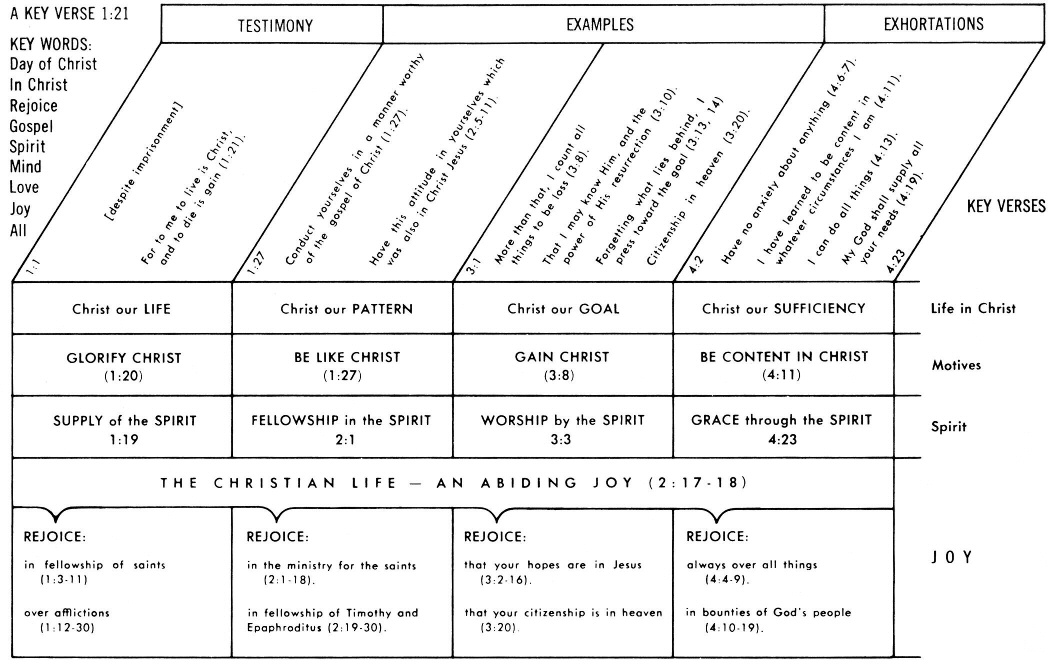
LIFE IN CHRIST
Click chart to enlarge
Charts from Jensen's Survey of the NT - used by permission
Philippians - Charles Swindoll = Chart on right side of page
| Account of Paul's Circumstances Php 1:1-30 |
Have the Mind of Christ Php 2:1-30 |
Have the Knowledge of Christ Php 3:1-21 |
Have |
| Partakers of Christ | People of Christ | Pursuit of Christ | Power of Christ |
| Suffering | Submission | Salvation | Sanctification |
| Experience | Examples | Exhortation | |
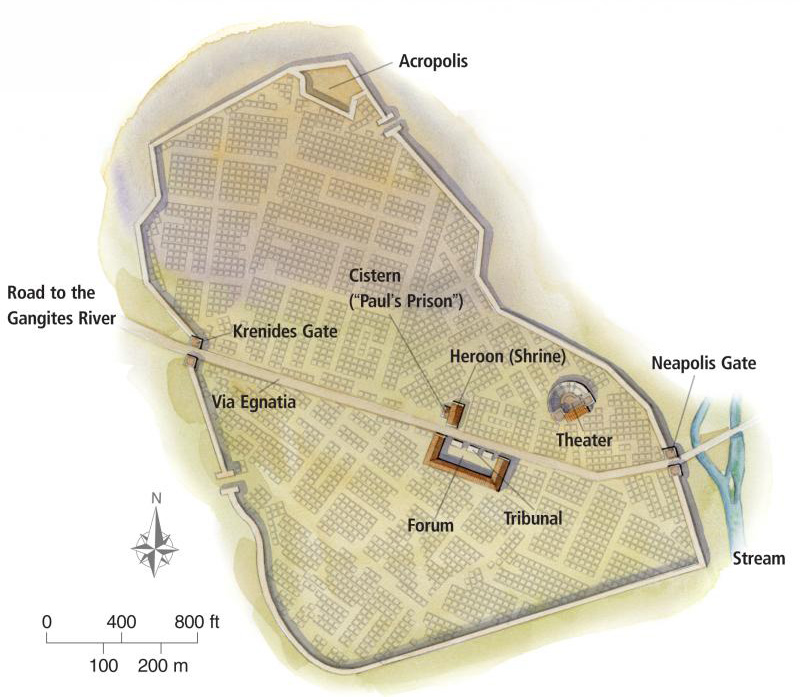
Philippi in the Time of Paul
The city plan above shows those features of the city of Philippi that archaeologists have so far identified as dating from the time of Paul. “Paul’s Prison” is not believed to be an authentic site, but was a cistern later associated with Christian worship. (ESV.org)
Philippians 2:21 For they all seek after their own interests, not those of Christ Jesus. (NASB: Lockman)
Greek: oi pantes gar ta heauton zetousin, (3PPAI) ou ta Iesou Christou
Amplified: For the others all seek [to advance] their own interests, not those of Jesus Christ (the Messiah). (Amplified Bible - Lockman)
Barclay: for all men are concerned with their own interest, and not with the interests of Jesus Christ. (Westminster Press)
KJV: For all seek their own, not the things which are Jesus Christ's.
Lightfoot: For all pursue their own selfish aims, reckless of the will of Christ.
NLT: All the others care only for themselves and not for what matters to Jesus Christ. (NLT - Tyndale House)
Phillips: All the others seem to be wrapped up in their own affairs and do not really care for the business of Jesus Christ. (Phillips: Touchstone)
Wuest: For one and all without exception are constantly seeking their own things, not the things of Christ Jesus. (Eerdmans Publishing)
Young's Literal: for the whole seek their own things, not the things of the Christ Jesus,
For they all seek after their own interests: oi pantes gar ta heauton zetousin, (3PPAI )
- Php 2:4; Isa 56:11; Mal 1:10; Mt 16:24; Lk 9:57-62, Lk 14:26, Acts 13:13, 15:38; 1Co 10:24, 33, 13:5 2Ti 1:15; 3:2; 4:10, 16
- Philippians 2 Resources - Multiple Sermons and Commentaries
- Philippians 2:19-30 Worth Imitating - Steven Cole
- Philippians 2:19-24 Model Spiritual Servants: Timothy - John MacArthur
- Philippians 2:19-24 Anti-Model of Leadership - John MacArthur
THE SELF-CENTERED
ROMAN CHURCH
I don't know about you, but I find this passage very convicting. You would think at age 70+ and closer than many to seeing my Savior, I would not still wrestle so frequently with self! But oh, such is not the case and so Paul reproofs my selfish tendency with this one passage. As explained below the verb for seek is in the present tense signifying that this is their general lifestyle, their "default" operating mode, so to speak.
Most people are interested in themselves, their advancement, their concerns. Here is God's advice - "And do you seek great things your yourself? Do not seek them." (Jer 45:5).
This self-centered attitude of the members of the church at Rome exemplified is the very thing Paul had just warned the saints to avoid - "Do nothing from selfishness or empty conceit, but with humility of mind regard one another as more important than yourselves; do not merely look out for your own personal interests, but also for the interests of others" (Php 2:3-4) Timothy's life is a model of the humility Paul calls for in Php 2:3-4. Timothy was following the example of his Lord's willingness to humble Himself (Php 2:5-11). We see later in this section that Epaphroditus was also an example of the humility of Christ (see note). Is not this self-denial in effect what Jesus called for in Luke 9:23-note declaring "If anyone wishes to come after Me, let him deny himself, and take up his cross daily (HOW OFTEN?), and follow Me.?" But don't attempt to deny self by relying on self! We must learn to rely on the provision of the Holy Spirit to give us the desire and the power to deny self! We see this pattern in Titus 2:13 where Paul says it is grace (Titus 2:11-note) that is "instructing (paideuo - disciplining, training, present tense = continually = a lifelong process, and NOT an arrival in this life! The "arrival" is called GLORY!) to DENY ungodliness and worldly desires and to live sensibly and righteously and godly in this present age, looking for the Blessed Hope and the appearing of the glory of our great God and Savior, Christ Jesus, (future looking motivates present living!)" (Titus 2:12-13-note).
Hughes reminds us that "Paul has already told us that even while he was under arrest in Rome, “Some indeed preach Christ from envy and rivalry” (Php 1:15; cf. v. 17). Thus many of the capable preachers in Rome were infused with a mean-spirited, selfish ambition. Certainly there were good Christians in Rome because once the others heard of Paul’s plight, “most of the brothers, having become confident in the Lord by my imprisonment, are much more bold to speak the word without fear” (Php 1:14). Who was Paul referring to?...Those whom Paul indicted were the able-bodied men in the church who had no concern about the church in Philippi or about the interests of Christ in the spread of the gospel. In a word, the able-bodied Christian men of Rome were infused with self and selfishness. Evidently the real men like Luke and Aristarchus were out of town, leaving only young Timothy to be the man. But how he shined! (Preaching the Word: Philippians)
For - always pause to ponder this term of explanation. At one time the Roman church was interested in others and had a reputation for sharing their faith (see below). Now (the letter to Philippi was written about 61AD) they could care less. They appear to have lost their passion for others.
There were undoubtedly hundreds of Christians in Rome, and yet not one was available to make this (short term) mission trip to Philippi. Not one! Reason: they were too busy doing their own thing to worry about anyone else. Now to be honest travel in those days was difficult and such a journey from Rome to Philippi could take as long as almost 2 months! And that is one way! So it was not your typical week long short term mission trip many of us have made to Central America or Africa! Evidently the church at Rome was living in a "me generation." In his letter to the saints in Rome Paul wrote (written about 3 years earlier in 57-58AD) Paul commended them writing...
First, I thank my God through Jesus Christ for you all, because your faith is being proclaimed throughout the whole world. (see note Romans 1:8)
All (3956) (pas) means one and all.
Wuest - "The words “All seek their own, not the things of Jesus Christ’s,” do not mean that Paul had no genuine Christian friends in Rome, but that ALL shrank from visiting far distant Philippi. The word “all” is strong. It means “the whole of them, one and all, all without exception.” (Philippians Commentary - Verse by Verse)
Wiersbe comments that "In a very real sense, all of us live either in Philippians 1:21 (note) or Philippians 2:21!" (ILLUSTRATION)
Seek (2212) (zeteo) means to strive after (continually = Present tense) with a sense of earnestness, devotion and ("Me first") priority. This seeking sad describes saints who are selfish rather than striving after the Savior's cause, quite a contrast with the charge earlier to "do nothing from selfishness or empty conceit" and "do not merely look out for your own personal interests, but also for the interests of others" (see note Philippians 2:3-4)
Guy King on their own interests - a) Ourselves - "all seek their own". How common a trait it is, in the generality of people, to be always careful to look after Number One. Even when such folk do good things, it is only to gain kudos and a reputation for themselves: they are of the same ilk as the "hypocrites" of Matthew 6:1 ff, who performed the creditable functions of giving, praying and fasting; "to be seen of men", "that they may have glory of men." I - is their god; Self - is their goal; Me, Me, Me - is their slogan. Well now, Timothy was not one of these - as the implication of the passage shows. (b) Others - "who will naturally care for your state" (Php 2:20). That was this young man's outlook. When Sir Bartle Frere returned from India, the carriage was sent to the village station to bring him to his home. When the new footman, but newly engaged, asked how he should recognise Sir Bartle, his aged mother said. "Look out for somebody helping someone else." Sure enough, when the London train had drawn in, the manservant observed a gentleman assisting an old lady to the platform and then jumping back into the carriage to fetch out her luggage. Going straight up to him, the footman enquired, "Sir Bartle?" Yes; it was he. What a lovely reputation to have! To be known as one who is always on the look-out to see when, and how, one can help others.
Barnes asks "How many professing Christians in our cities and towns are there now who would be willing to leave their business and their comfortable homes and go on embassy like this to Philippi? How many are there who would not seek some excuse, and show that it was a characteristic that they “sought their own” rather than the things which pertained to the kingdom of Jesus Christ? (Philippians 2)
Hughes adds that "Paul’s assessment was that there was no one like Timothy “who will be genuinely concerned for your welfare”—that is, one who, when he arrived on the scene in Philippi, would give the active interest and practical care that Paul desired be shown—the kind of care he himself would give. But Timothy would prove to be the genuine article." (Ibid)
Dwight Pentecost writes that...
Paul is saying a very sad thing. He is saying that as great as the need is for someone to minister in the Philippian church, no one cares — no one! Where are all those whom Paul has led to the Lord and schooled in truth in order that they might minister? They are gone. Where are those who walked with Paul and were trained to carry on Paul’s ministry? They are not here. When Paul looked for someone to go and meet the need at Philippi, Paul says, “They all seek their own.” They are selfish, too busy to go, too occupied with their own business to care, too selfish to endure what was involved in going (Ed: Be careful when you point a finger at others because 4 fingers are pointing at you!). And their selfishness, their preoccupation with their own things, their preoccupation with the things of this life caused them to forego the privilege to minister to the saints of God that the apostle set before them. It is this that is breaking the heart of the Apostle Paul. Here are saints to be taught. No one cares. Here are wounded hearts to be bound up. No one cares. Here are men to be reached for Christ. No one cares. Here are children to be taught and trained and guided in the things of the Lord, and no one cares. No one cares except the Apostle Paul.
That which characterized the Philippians could so well characterize us. There are burdens to be borne and shared, but no one cares. Saints of God to be taught, but no one cares. Young people and children to be trained in Sunday school, Vacation Bible School, youth ministry, home Bible clubs, but no one cares. Why? Too busy? Too preoccupied with their own business? No one cares. (ILLUSTRATION) Recently I read one of the most disturbing articles I have read in a long time. This article predicted that in ten years vast numbers of Sunday schools across our nation would have to be closed because of lack of teachers to teach. It drew our attention to the affluence of our day that makes it possible for people to have weekend homes and engage in weekend recreation that takes them away from a commitment to the Lord’s work. It anticipated a four-day work week when men will have even longer weekends, providing for greater opportunities for recreation away from the city. That means less commitment to the things of the Lord Jesus Christ. Such carelessness is not a sign of the mind of Christ. Beware lest you become one of those about whom Paul writes when he says that no one cares. The joy of sacrifice or the curse of indifference. Which is it? (Pentecost, J. D. The Joy of Living: A study of Philippians. Kregel Publications) (Bolding added)
Not those of Christ Jesus: ou ta Iesou Christou:
- Phil 1:20 21; 2Cor 1:5; 5:14, 15
Not (ou) signifies the absolute negative. There was absolutely no desire to glorify Christ Jesus. Lloyd Ogilvie remarks that most of us are overly concerned about our own affairs and allow our time to be filled by multiple demands and responsibilities. We must ask ourselves what is truly important. For Timothy, the important thing was the cause of Christ. Ogilvie says we must ask ourselves the question, "Is what I am doing advancing the cause of Christ or have I asked Christ to bless my causes?"
Not those of Christ Jesus: In essence they spurn the will of the Lord. They have forgotten that they are not their own, but they have been bought with a price with a great purpose to glorify God in our bodies (cf 1 Cor 6:19, 20) What is Christ Jesus concern? Human souls that need to hear and heed the Gospel.
Dwight Edwards writes that "The second reason for sending Timothy is now given. No one else qualified for the task. What disqualified them? They were primarily seeking after the things which pertained to themselves, not the things which pertained to Christ. The genitives here appear to be genitives of possession. These believers were seeking after the things which belonged to them (or so they thought). They were concerned about saving. their own lives and making this time on earth comfortable. While they were seeking after their own things, the things of Christ were passing them by. How opposite to Phil. 2:5-11. (Sermon)
Dietrich Bonhoeffer speaking to our natural tendency even as believers toward selfishness, said
"We must be ready to allow ourselves to be interrupted by God. God will be constantly crossing our paths and canceling our plans by sending us people with claims and petitions. We may pass them by, preoccupied with our more important tasks . . . It is a strange fact that Christians frequently consider their work so important and urgent that they will allow nothing to disturb them . . . But it is part of the discipline of humility that we must not spare our hand where it can perform a service and that we do not assume our schedule is our own to manage, but allow it to be rearranged by God." (Ed: Bonhoeffer clearly practiced what he preached, being martyred by the demonic Nazis just a few weeks before the prison camps were liberated by the Allies.)
Philippians 2:22 But you know of his proven worth, that he served with me in the furtherance of the gospel like a child serving his father (NASB: Lockman)
Greek: ten de dokimen autou ginoskete, (2PPAI) hoti os patri teknon sun emoi edouleusen (3SAAI) eis to euaggelion
Amplified: But Timothy’s tested worth you know, how as a son with his father he has toiled with me zealously in [serving and helping to advance] the good news (the Gospel). (Amplified Bible - Lockman)
Barclay: You know his tried and tested character, and you know that, as a child serves a father, so he has shared my service in the work of the gospel. (Westminster Press)
KJV: But ye know the proof of him, that, as a son with the father, he hath served with me in the gospel.
Lightfoot: But the credentials of Timotheus are before you: you know how he has been tested by long experience, how as a son with a father he has labored with me in the service of the Gospel.
NLT: But you know how Timothy has proved himself. Like a son with his father, he has helped me in preaching the Good News. (NLT - Tyndale House)
Phillips: But you know how Timothy has proved his worth, working with me for the Gospel like a son with his father. (Phillips: Touchstone)
Wuest: But you know from experience his character which has been approved after having been tested, that as a child to a father, with me he served as a slave would do in the furtherance of the good news. (Eerdmans Publishing)
Young's Literal: and the proof of him ye know, that as a child serveth a father, with me he did serve in regard to the good news;
BUT YOU KNOW OF HIS PROVEN WORTH: ten de dokimen autou ginoskete (2PPAI):
- Acts 16:3-12; 2Co 2:9, 8:8, 22, 24
- Philippians 2 Resources - Multiple Sermons and Commentaries
- Philippians 2:19-30 Worth Imitating - Steven Cole
- Philippians 2:19-24 Model Spiritual Servants: Timothy - John MacArthur
- Philippians 2:19-24 Anti-Model of Leadership - John MacArthur
"But you know from experience his character which has been approved after having been tested" (Philippians Commentary - Verse by Verse)
"But the credentials of Timotheus are before you: you know how he has been tested by long experience," (Lightfoot)
TIMOTHY: TESTED
AND APPROVED
But (1161) (de) is used here as an adversative conjunction (See term of contrast.) which places Timothy's character in stark contrast to the saints at Rome mentioned in the preceding verse. Paul is assuring the church at Philippi of Timothy's suitability to carry out the job.
You know (1097) (ginosko) (continually = Present tense) means to know from having gained experience and thus the Philippians knew Timothy's character from personal encounter, as a man who had been tested, passing the test and was thus approved. Do others know by their personal interaction with you that you are a man or woman who has stood (and passed) the test?
Proven worth (1382) (dokime) (Click in depth study of verb dokimazo) can describe a trial, test or ordeal (2 Co 8:2). More commonly in the NT dokime refers to that which has been tested and approved and when used of a person refers to proven character (Ro 5:4) or tested value. Even as precious metals were tried by fire, so believers are often tested in the fires of suffering, adversity and persecution resulting in a purified faith. Three times they had seen Timothy (Acts 16:13; 19:22; 20:3f.) and so the Philippians knew “Timothy’s record” and he had stood the test and proven his worth. Thus they should realize immediately that no “mediocre substitute” was being sent to them.
Dokime describes approval after testing as of gold or silver. The idea is that when you put metal through a fiery testing and it comes out on the other side persevering and enduring, what you call that metal is "proven" or "authentic" or "genuine." When you go through tribulation, and your faith is tested, and it perseveres, what you get is a wonderful sense of authenticity.
Ray Pritchard adds that dokime means "to be approved by passing a test. It has the idea of demonstrating under pressure that you have the “right stuff.” How did Timothy prove himself? By sticking with Paul through thick and thin. By volunteering to tackle the hard jobs. By refusing to cut and run under fire. By doing the menial tasks, the “dirty work” so that Paul was freed up to do what he did best. Note that this kind of “proving” doesn’t happen overnight. Too many people want “instant” spirituality and overnight maturity. God doesn’t work that way. Producing Christian character takes time and effort. Here’s a simple equation:
T + D = G
T = Time, D = Discipline and G = Growth. This formula works in every area of life, whether it be weight lifting, piano playing, Scripture memory, or learning to speak Ibo. Nothing worthwhile can be conquered in one evening. You can’t “blitz” your way to spiritual leadership. You’ve got to do what Timothy did—put yourself under a good leader and then pay the price over time. When will we learn that God is not looking for superstars? We already have too many superstars in the Christian world – people who build their careers on hype and glitz and marketing pizzazz. God wants faithful people who have proved their worth over the long haul. (Making God's A-Team)
Remember … you can buy talent,
but you can’t buy faithfulness.
In his first epistle, Paul had written to the Corinthians "so that I might put you to the test (dokime), whether you are obedient in all things." (1 Cor 2:16)
In his second epistle Paul gives a commendation to "our brother, whom we have often tested (verb form dokimazo) and found diligent in many things, but now even more diligent because of his great confidence in you." (2 Cor 8:22) In this verse Paul is referring to an unnamed brother in Christ whom he had tested and was willing to trust dealing with the collection for the saints in Jerusalem.
THAT HE SERVED WITH ME IN THE FURTHERANCE OF THE GOSPEL LIKE A CHILD SERVING HIS FATHER: hoti os patri teknon sun emoi edouleusen (3SAAI) eis to euaggelion:
- Php 2:20 1Cor 4:17 1Ti 1:2, 18, 2Ti 1:2 Titus 1:4
TIMOTHY HAD A
SERVANT'S HEART
He served (1398) (douleuo from doulos = bondservant) means to be in a position of a bondservant and act accordingly. It describes a servant who willingly commits himself to serve a master he loves and respects. The truly surrendered doulos (which Paul certainly was, and with whom Timothy was equal souled) had no life of his own, no will of his own, no purpose of his own and no plan of his own. All was subject to his master. The bondservant's every thought, breath, and effort was subject to the will of his master. In sum, the picture of a bondservant is one who is absolutely surrendered and totally devoted to his master. What a picture of Paul and Timothy's relation to their Lord! What an example for all believers of every age to emulate!
Write it down in large letters:
The world looks for winners …
God looks for servants.
Matthew Henry adds that "The highest honor of the greatest apostle, and most eminent ministers, is to be the servants of Jesus Christ; not the masters of the churches, but the servants of Christ."
When we get to heaven, we aren’t going to be asked if we were winners or losers on the earth. Forget about your won-lost record. The one thing we will want to hear Jesus say is, “Well done, good and faithful servant.”
Harry Ironside wrote that Paul's description of serving as a bondservant ""does not mean that his was a service of bondage. Rather he served in the whole-hearted obedience of one who realized that he had been "bought with a price," even the precious blood of Christ. (ILLUSTRATION) There is a story told of an African slave whose master was about to slay him with a spear when a chivalrous British traveler thrust out his arm to ward off the blow, and it was pierced by the cruel weapon. As the blood spurted out he demanded the person of the slave, saying he had bought him by his suffering. To this the former master ruefully agreed. As the latter walked away, the slave threw himself at the feet of his deliverer exclaiming, "The blood-bought is now the slave of the son of pity. He will serve him faithfully." And he insisted on accompanying his generous deliverer, and took delight in waiting upon him in every possible way. Thus had Paul, thus has each redeemed one, become the bondman of Jesus Christ. We have been set free to serve, and may well exclaim with the Psalmist "O LORD, surely I am Your servant, I am Your servant, the son of Your handmaid, You have loosed ( Lxx = diarresso = tear one's clothes as sign of grief, of chains or fetters broken - Lk 8:29-note) my bonds." (Ps 116:16 ).
Gospel (2098) (euaggelion [word tudy] from eú = good + aggéllo = proclaim, tell) means good news, glad tidings, Saxon = gōd-spell = lit. "good tale, message".
Grant Richison - The phrase "in the gospel" means in getting the gospel out to the Roman world. Sharing your faith to a world who never heard of Christ is rough business. But he was willing to put himself on the line with all its risks and dangers. He cultivated character through trusting God in difficulty. (Notes on Philippians 2:22)
Dwight Edwards elaborates on Timothy's proven character, writing that "These believers didn't have to be told of Timothy's character, for they knew of it by experience. First, he was a man of intense loyalty. He related to Paul as a son to his father, and he labored with him accordingly. Secondly, he was one of intense servanthood. We see this in "served"... as a bondslave. Thirdly, we see intense commitment. He served not in the pursuit of his own things but in "the gospel." (Sermon)
MacArthur adds that "From the time the apostle chose him to serve alongside him, Timothy surrendered any personal plans he may have had for his life. He began a non-stop adventure that would bring him great fruitfulness and spiritual satisfaction, but that would also involve suffering and sacrifice. (MacArthur, J. Philippians. Chicago: Moody Press)
Like a child serving his father - Paul of course was not Timothy's physical father but he was his spiritual father.
1 Corinthians 4:17 For this reason I have sent to you Timothy, who is my beloved and faithful child in the Lord, and he will remind you of my ways which are in Christ, just as I teach everywhere in every church.
1 Timothy 1:2; 18 To Timothy, my true child in the faith: Grace, mercy and peace from God the Father and Christ Jesus our Lord. 18 This command I entrust to you, Timothy, my son, in accordance with the prophecies previously made concerning you, that by them you fight the good fight,
2 Timothy 1:2 To Timothy, my beloved son: Grace, mercy and peace from God the Father and Christ Jesus our Lord.
Titus 1:4 To Titus, my true child in a common faith: Grace and peace from God the Father and Christ Jesus our Savior.